1. Introduction
1.1. Research Background and Necessity
Precise and reliable wave prediction in coastal waters is one of the core challenges in modern marine engineering and marine meteorology. It has become an indispensable element for the efficient management of port operation rates, the design and safety assessment of coastal and offshore structures such as breakwaters and offshore wind farms, the establishment of coastal erosion mitigation measures, and ensuring the safe navigation of vessels. In particular, the rising sea surface temperatures due to recent climate change, the resulting increase in typhoon intensity, and the frequent occurrence of unexpected swell-like waves are intensifying the risks of coastal disasters. Consequently, the establishment of high-precision wave prediction systems to respond to these threats is a matter of great urgency.
To meet these social and engineering demands, third-generation spectral wave models are widely utilized worldwide. Among them, the SWAN (Simulating WAves Nearshore) model is specialized for simulating complex wave transformations in shallow waters. It numerically solves the Wave Action Balance Equation to track the processes of wave generation, development, propagation, and dissipation in time and space [
1,
2]. The SWAN model sophisticatedly simulates the primary source-sink processes governing the evolution of the wave spectrum, including wind-induced energy input, nonlinear wave-wave interactions, and energy dissipation caused by whitecapping, bottom friction, and depth-induced breaking [
3].
Despite the significant advancements in these numerical models, non-negligible levels of uncertainty still exist in actual field applications. The accuracy of wave prediction is fundamentally determined by the accuracy of the wind field input into the model and the level of parameterization of the source terms describing the internal physical processes. Specifically, the wind input term, responsible for energy transfer at the atmosphere-ocean interface, and the whitecapping dissipation term, which determines the saturation of wave energy, are based on highly nonlinear and complex physical phenomena—namely turbulence and breaking—which have not yet been fully elucidated theoretically. As a result, the modeling process inevitably relies heavily on empirical parameterization based on observational data, which serves as a fundamental constraint in securing consistent predictive performance across various sea states and meteorological conditions.
1.2. Limitations and Issues of Previous Studies
Whitecapping dissipation is widely recognized as one of the largest factors of uncertainty in spectral wave modeling. The whitecapping dissipation formula of the Komen et al. (1984) lineage, which has long been used as the standard configuration for the SWAN model, inherits the pulse-based theory of Hasselmann (1974) [
4,
5]. It assumes that wave energy dissipates in proportion to a bulk parameter, such as the mean wave steepness of the entire spectrum [
4,
5]. While this approach yields results that align well with observations under fully developed wind sea conditions, numerous studies have reported that it can induce serious systematic biases in mixed sea states where swells and wind seas coexist. Specifically, if strong swells exist in the low-frequency region during the initial stages of high-frequency wind sea growth, the mean wave steepness may be calculated as low, leading to excessive wind sea growth. Conversely, in situations dominated by wind seas, it may cause the non-physical rapid attenuation of swell components.
To compensate for these flaws in the Komen-type equations, Westhuysen et al. (2007) proposed a nonlinear saturation-based whitecapping dissipation formula [
6]. This technique controls dissipation based on the local saturation of the spectrum, allowing wind sea and swell components to be physically decoupled and processed independently, thereby improving predictive performance in mixed seas and both deep and shallow water conditions. However, according to follow-up evaluation studies, the saturation-based technique also exhibits a tendency to underestimate wave energy under high-energy winter storm conditions or, conversely, fail to sufficiently develop energy under low-energy normal conditions. This suggests that limitations still exist for it to serve as a universal solution covering the full range of sea states.
Another key challenge in wave modeling is the estimation of the drag coefficient at the atmosphere-ocean interface. Generally, the drag coefficient directly regulates the wind forcing on waves and thus has a decisive impact on high-wave predictions. The formula by Wu (1982), widely used in the SWAN model, assumes that the drag coefficient increases almost linearly with wind speed from light breezes to hurricane conditions [
7]. However, field observations and laboratory studies conducted over recent decades under tropical cyclone and extreme hurricane conditions clearly show that in the very high wind speed range (
), the drag coefficient no longer increases but saturates or even decreases (rollover) [
8,
9]. This is interpreted as a fundamental change in the physical characteristics of the atmosphere-ocean interface, where the sea surface becomes covered with foam and spray under strong breaking, leading to a smoothing of aerodynamic roughness [
10]. Therefore, applying a linear drag coefficient model directly to typhoon simulations results in an overestimation of the stress transferred to the sea surface, leading to unrealistically high predictions of wave heights and surge levels.
To address these issues, the ST6 (Source Term package 6), a new source term package with significantly enhanced physical consistency with observational data, has been developed and introduced into operational wave modeling. The ST6 framework, proposed by Rogers et al. (2012), improved wind input and whitecapping dissipation to better align with observed physical phenomena [
11]. In particular, it reflects the saturation and decrease characteristics of the drag coefficient at high wind speeds (Hwang, 2011) [
12] and ensures physical validity by modeling whitecapping dissipation separately as inherent breaking in the spectral peak region and cumulative breaking in the high-frequency region. Recent regional application studies have reported several cases where the use of ST6-based physics improved significant wave height prediction performance compared to existing configurations. Specifically, improved performance over the Komen model has been presented in simulations of winter storm waves on the East Coast of South Korea [
13].
To overcome the inherent uncertainties of physics-based models, recent research has increasingly focused on Hybrid Modeling, which combines numerical models with data-driven techniques. Durap (2024) demonstrated improved significant wave height prediction by comparing various machine learning algorithms, while Park and Kang (2024) applied deep learning techniques, such as Gated Recurrent Units (GRU), to enhance wave prediction accuracy in Korean waters [
14,
15]. Furthermore, Durap (2025a; 2025b) proposed frameworks utilizing Explainable AI (XAI) and feature engineering to transcend the limitations of black-box models and enhance the interpretability of wave predictions [
16,
17]. While these data-driven approaches primarily focus on post-processing model outputs, the CDFAC (Drag Coefficient Scaling Factor) method proposed in this study distinguishes itself by directly feeding data bias information back into the model’s core physical process—specifically, the drag coefficient formulation. This approach can be defined as a practical form of “Physics–Data Coupled Hybrid Correction,” where statistical information from observational data is integrated into the numerical computation process to control errors while maintaining physical consistency.
1.3. Purpose and Scope of the Research
An important point is that it is difficult to completely eliminate errors in wave models through the improvement of source term physics alone. This is because the predictive performance of wave models is fundamentally constrained by the accuracy of the input wind field. Previous studies that calibrated models using different wind data have shown that SWAN parameter settings optimized for a specific wind data set are difficult to transfer directly when the bias characteristics of the wind data differ. Furthermore, since a strong correlation exists between the bias of the wind field and the optimal whitecapping dissipation coefficient, adjusting only the dissipation coefficient without correcting the wind bias may lead to physically inconsistent compensation errors.
The objectives and scope of this study are as follows:
Selection and Bias Correction of Input Wind Fields: Compare and evaluate major reanalysis wind fields—such as JMA-MSM (Japan Meteorological Agency Meso-Scale Model), ECMWF (European Centre for Medium-Range Weather Forecasts), and NCEP (National Centers for Environmental Prediction)—against observational data to select the optimal wind field for the waters around the Korean Peninsula. Additionally, to structurally account for the bias in wind forcing, a drag coefficient scaling technique is introduced, applying a scaling factor (CDFAC) to correct wind-related errors in a physically consistent manner.
Physics Package Sensitivity Experiments: Configure various physics packages that combine the nonlinear behavior of the drag coefficient and various whitecapping dissipation formulas. Extensive sensitivity experiments are performed, including the traditional Komen and Janssen lineages, the saturation-based Westhuysen approach, and the latest ST6 package. In particular, explicit calibration experiments are conducted for SINA0 (Source Input A0, A0 is a parameter that controls the strength of swell decay due to adverse winds) and CDFAC, which are core parameters of ST6 [
3].
Long-term Simulation and Stratified Evaluation: After performing a one-year-long continuous simulation, a stratified evaluation is conducted not only for the entire period but also by wave height class (especially high wave sections with ()), region, and season. Through this, we aim to derive a consistent combination of parameters that is optimized for the heterogeneous wave climates around the Korean Peninsula and is not physically contradictory.
2. Data
2.1. Observation Data
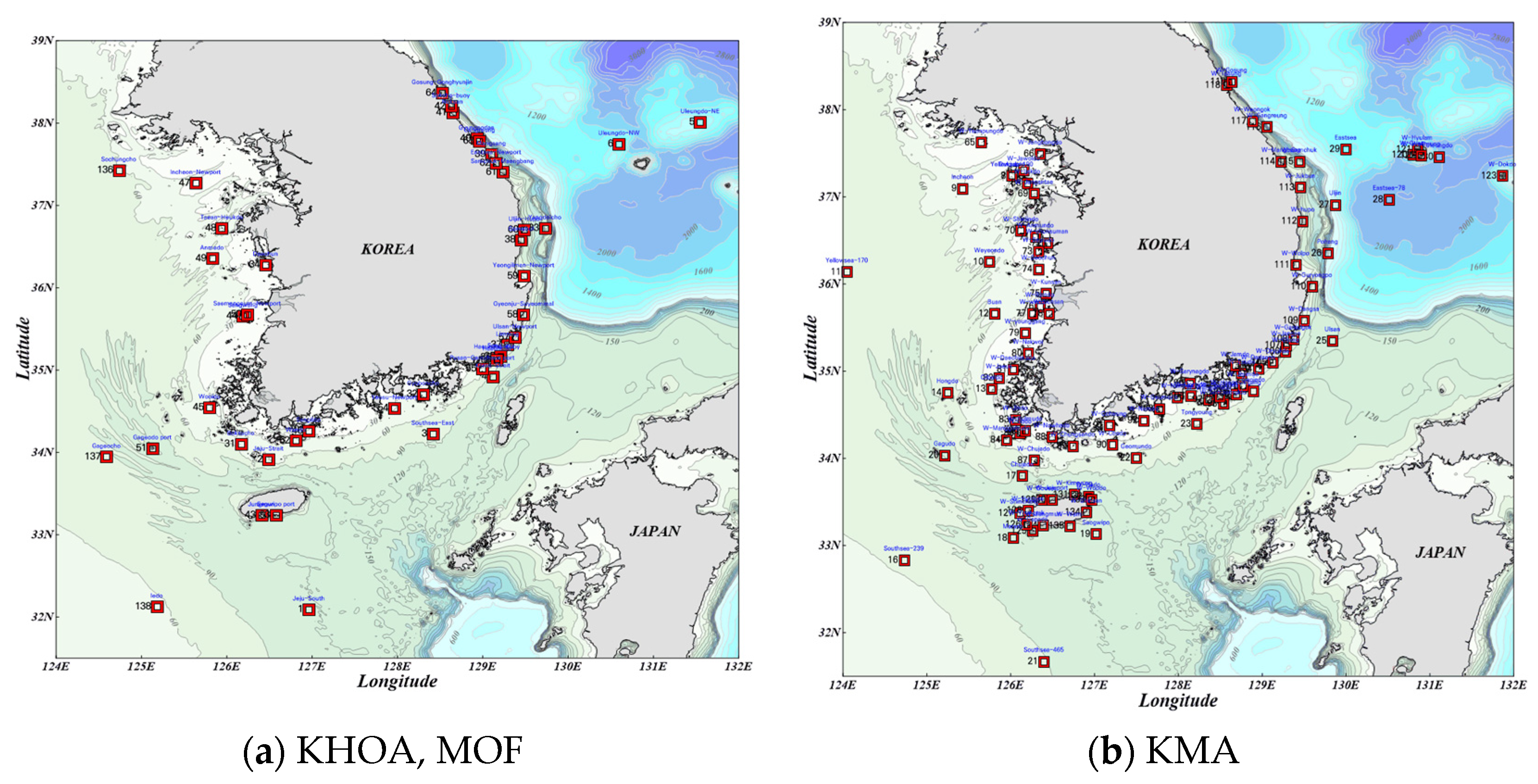
In this study, an extensive set of observational data covering all coastal waters of the Korean Peninsula was collected to select input data for the wave prediction model and to verify its predictive performance. Data were collected from the KHOA (Korea Hydrographic and Oceanographic Agency), the MOF (Ministry of Oceans and Fisheries), and the KMA (Korea Meteorological Administration), utilizing hourly time-series data for the one-year period from 1 January to 31 December 2021. The collected observation network consists of 138 wave observation stations and 49 offshore wind speed observation stations (
Figure 1,
Table 1). This is a high-density observation network capable of encompassing both the localized characteristics of coastal areas and the broad characteristics of open seas.
Wave Observations (138 stations): Include 17 ocean data buoys and 55 wave buoys from the KMA, 36 ocean observation buoys from the KHOA, and 30 wave gauges from the MOF. These stations are evenly distributed from the shallow waters of the West Sea to the deep waters of the East Sea and the island regions of the South Sea, representing the diverse wave environments around the Korean Peninsula. Key stations include Southern Jeju, the Korea Strait, Northeast/Northwest Ulleungdo, West Sea stations 190/170/206, Marado, Geomundo, Pohang, and Uljin.
Wind Observations (49 stations): Wind speed data measured at ocean meteorological buoys and light towers were collected for direct offshore wind speed verification. Major observation points include Deokjeokdo, Chilbaldo, Oeyeondo, Geomundo, Geojedo, Ulsan, Pohang, Ulleungdo, and Dokdo, which were used to precisely evaluate the accuracy of the model wind fields by region.
These observational data play two key roles in this research. First, they were used as the ground truth to select the optimal forcing wind field for driving the SWAN model. Second, they were used to quantitatively evaluate (validate) the accuracy of the numerical simulation results performed with various physics packages and parameter combinations. In particular, emphasis was placed on verifying the model’s ability to reproduce not only overall wave conditions but also high waves (), which pose a high risk of disaster.
2.2. Reanalysis Wind Data
In numerical wave modeling, the quality of the input wind field is the most dominant external factor determining the accuracy of wave predictions. In this study, three representative types of global and regional reanalysis wind data—ECMWF (European Centre for Medium-Range Weather Forecasts), NCEP (National Centers for Environmental Prediction), and JMA (Japan Meteorological Agency)—were compared and analyzed to select the most suitable wind field for the Korean Peninsula (
Table 2).
ECMWF (ERA5): The fifth-generation reanalysis data provided by the European Centre for Medium-Range Weather Forecasts, featuring a spatial resolution of approximately 31 km (0.25°) and an hourly temporal resolution. It is produced through advanced coupled modeling of atmosphere-ocean-land processes, with significantly improved spatiotemporal resolution and physical processes compared to the previous ERA-Interim [
18].
NCEP (CFSR/GFS): Reanalysis data from the National Centers for Environmental Prediction, providing a resolution of approximately 25 km (0.205° × 0.204°). It is widely used to simulate global meteorological phenomena [
13].
JMA (JMA-MSM): Reanalysis data based on the Meso-Scale Model of the Japan Meteorological Agency, providing a very high spatial resolution of approximately 5 km (0.0625° × 0.05°) for the East Asia region (120°~150° E, 22.4°~47.6° N). It provides data at 1 h intervals and has strengths in simulating the localized wind characteristics of the coastal waters around the Korean Peninsula, which feature complex terrain and coastlines [
19].
The accuracy evaluation results for each wind field are summarized in
Table 3.
3. SWAN Model Source Terms and Whitecapping Dissipation
3.1. Configuration of Source Terms
In the Wave Action Balance Equation, which is the governing equation of the SWAN model, the source terms (
) on the right side represent non-conservative physical mechanisms that generate, dissipate, and redistribute energy within the spectrum. Under general conditions, including shallow waters, the total source term is formulated as the linear sum of wind-induced energy input, nonlinear wave interactions, and various energy dissipation mechanisms, as shown in Equation (1) [
3].
The physical meaning of each term is as follows:
: Wave growth by wind. Momentum transfer from the atmosphere to the ocean.
: Triad wave-wave interactions. Induces wave asymmetry and generates harmonics in shallow waters.
: Quadruplet wave-wave interactions. Stabilizes the spectral shape in deep water and redistributes energy between low and high-frequency regions.
: Whitecapping dissipation. Energy loss due to wave breaking in deep and intermediate waters.
: Energy dissipation by bottom friction. Represents the interaction between waves and the seabed in shallow areas.
: Energy dissipation due to depth-induced wave breaking. Simulates rapid energy loss in the surf zone.
Among these, and are the primary mechanisms governing spectral development in deep water and are the areas where model uncertainty is greatest. This study focuses on identifying and improving the physical characteristics of these terms.
3.2. Theoretical Background of Drag Coefficient Formulas
In the SWAN model, the energy input by wind () is dominantly influenced by the definition of friction velocity () and the drag coefficient (), which determine the efficiency of momentum transfer at the atmosphere-ocean interface. Friction velocity has the relationship , where is the wind speed at a height of 10 m above the sea. This section examines the physical characteristics of major drag coefficient formulas: Wu, Zijlema, Janssen, and the options within the ST6 package (Hwang, FAN, ECMWF).
3.2.1. Wu
The formula by Wu (1982) is based on the empirical observation that sea surface roughness increases linearly with wind speed [
7]. This formula is used as the default setting in the SWAN model. It takes a constant value in the low wind speed range and increases in proportion to wind speed above a critical wind speed (
).
This formula aligns well with observations under general sea states (), but it has limitations in that it overestimates the drag coefficient under high wind speed conditions such as typhoons, leading to the overestimation of wave heights and surge levels.
3.2.2. Zijlema
Recent observational studies have reported a saturation phenomenon where the increase in the drag coefficient stops or even decreases in high wind speed ranges due to the generation of foam and sea spray on the sea surface. Zijlema et al. (2012) proposed a second-order polynomial formula to reflect this nonlinear behavior [
20].
Here, , and is 31.5 m/s. This equation shows that the drag coefficient reaches a maximum value of approximately at around 30 m/s and then decreases, thereby improving simulation performance under extreme weather conditions. When applying this formula in the SWAN model, it is recommended to adjust the bottom friction coefficient to for overall energy balance.
3.2.3. Janssen
Janssen’s formula considers the two-way interaction between waves and the atmospheric boundary layer based on Quasi-Linear Theory [
21]. The drag coefficient is not simply a function of wind speed but is determined by the effective sea surface roughness (
), which changes according to the wave age.
Here, is the basic roughness by the Charnock relationship (), is the wave-induced stress, and is the total surface stress. This technique reflects the physical mechanism where young seas induce greater drag than mature (old) seas, thus accurately simulating wave growth under rapidly changing wind fields.
3.2.4. ST6 (Source Term Package 6) Physics Package
ST6 is a physics package that reflects the saturation and reduction characteristics of the drag coefficient at high wind speeds based on observational data [
11]. Within ST6, the following detailed drag coefficient options can be selected:
Hwang: The default setting of ST6, reflecting the saturation and rollover characteristics of the drag coefficient in high wind speed sections [
12] Like Zijlema’s formula, it is expressed as a second-order polynomial but with different coefficients.
FAN: Based on the research of Fan et al., this is another form of formula for simulating the saturation of the drag coefficient at high wind speeds [
22].
ECMWF: This formula is designed to reproduce the physical characteristics of the WAM Cycle 4 model within the ST6 framework. It is fundamentally based on Janssen’s Quasi-Linear Theory, considering dynamic roughness changes according to wave development [
21].
In the ST6 physics package, although the wind input term is calculated based on friction velocity (
), the model internally converts this to an equivalent 10 m wind speed (
) to determine the spectral development stage. The conversion coefficient used here is the Wind Scaling Factor (
), defined by the relationship:
In this study, three values of (28, 32, and 35) were selected to evaluate the model’s sensitivity:
3.3. Whitecapping Dissipation Formulas
3.3.1. Komen
The Komen technique is an improvement on Hasselmann’s pulse-based model, based on the hypothesis that wave energy dissipates in proportion to the mean steepness of the entire spectrum [
4,
5].
where
and
denote the mean frequency and the mean wave number, respectively, and the coefficient Γ depends on the overall wave steepness (
). In SWAN, users must determine the proportionality constant
and the steepness dependency index
(powst). Generally,
and
are used.
is the value of
for the Pierson–Moskowitz spectrum:
.
The core assumption of the Komen scheme is that wave energy dissipation is proportional to the mean wave steepness () of the entire spectrum. While this approach maintains energy balance well under fully developed wind sea conditions, it creates physical inconsistencies in mixed sea states where swell and wind seas coexist. The presence of swell lowers the overall mean steepness, which reduces the dissipation rate. This can lead to the excessive growth of wind seas or, conversely, the spurious damping of swell energy, a phenomenon known as the “Swell Dissipation Artifact”. The tendency of the Komen scheme in this study to show errors in complex spectral conditions, despite being stable in general conditions, stems from this dependency on mean parameters.
3.3.2. Janssen
Although the whitecapping dissipation formulations of Komen et al. and Janssen share the same theoretical framework based on Hasselmann’s pulse-based model, they differ fundamentally in their calibration strategies to close the spectral energy balance equation [
21]. The Komen formulation, widely used as the default in WAM Cycle 3 and SWAN, assumes that dissipation is governed by the mean wave steepness (
) of the entire spectrum. The dissipation coefficient (
) is empirically tuned to balance the wind energy input defined by Snyder et al. under fully developed sea conditions (Pierson–Moskowitz spectrum) [
24].
In contrast, the Janssen formulation is intricately coupled with the quasi-linear theory of wind-wave generation. This theory accounts for the two-way interaction between waves and the atmospheric boundary layer, where the wave-induced stress modifies the wind profile. Consequently, the wind input source term in Janssen’s method is significantly stronger, particularly for young waves, compared to the Komen approach. To maintain energy equilibrium against this enhanced wind input, the dissipation coefficient in Janssen’s formulation () is set orders of magnitude higher than that of Komen (). Furthermore, Janssen introduces a wavenumber dependency () to adjust the dissipation distribution across frequencies, whereas the classic Komen setting assumes a linear dependency on frequency (, though recent SWAN versions default to for Komen).
3.3.3. Westhuysen
To improve the prediction of wave energy dissipation in complex coastal environments, the Westhuysen et al. scheme was proposed to overcome the limitations of the Komen scheme, which primarily relies on mean spectral parameters. The core of this approach is the decomposition of the whitecapping dissipation source term
into breaking and non-breaking components [
6]:
In this formulation,
represents the saturation-based dissipation due to wave breaking, while
accounts for the background dissipation attributed to turbulence. Unlike traditional methods, this scheme assumes that dissipation is determined by the local spectral saturation
. The breaking component is thus formulated as a function of the local saturation and a threshold saturation level
:
where
is the azimuthal-integrated spectral saturation defined by:
In this formulation, is the dissipation proportional constant (defaulting to in SWAN), and is the threshold saturation level (default: ). The transition function ensures a smooth shift between breaking and non-breaking modes; as exceeds , approaches unity, making the breaking dissipation dominant.
This mechanism induces local dissipation only when the energy in a specific frequency band exceeds the threshold , effectively allowing for the physical decoupling of wind sea and swell components. While this decoupling improves prediction performance in mixed sea conditions by preventing low-frequency swell from affecting wind-sea growth, studies have reported a tendency of this method to underestimate wave energy or fail to sufficiently suppress growth under extreme weather conditions, such as typhoons.
3.3.4. ST6
The ST6 physics package simulates wave energy evolution through three distinct mechanisms that offer a more physically consistent representation of air–sea interaction compared to traditional methods. First, it incorporates the Hwang (2011) drag coefficient formula, which accounts for the saturation and rollover of the drag coefficient at high wind speeds, thereby preventing the overestimation of wind energy input during extreme events such as typhoons [
12]. Second, it explicitly accounts for non-breaking swell dissipation, which is critical for realistic swell decay over long distances. Third, and most importantly, the whitecapping dissipation term (
) is not modeled as a single bulk term but is separated into two distinct components: inherent breaking (
) and cumulative breaking (
):
Inherent Breaking (
): This term represents the dissipation due to the local instability of waves, typically occurring at the spectral peak when the energy exceeds a threshold (
).
Cumulative Breaking (
): This term accounts for the dissipation of shorter waves (high frequency) induced by the turbulence generated from the breaking of longer waves.
Here, and are the dissipation strength coefficients for inherent and cumulative breaking, respectively, while and are the power coefficients controlling the sensitivity of the dissipation rate. Unlike the conventional Komen scheme, which relies on the mean steepness of the entire spectrum, ST6 calculates dissipation independently based on the local saturation at each frequency band. This “two-phase” structure effectively allows for the physical decoupling of wind sea and swell components. Consequently, ST6 provides superior performance and a more valid energy balance under complex conditions, such as mixed seas generated during typhoons, where swell and wind sea coexist
The key parameters for the aforementioned estimation formulas are summarized and presented in
Table 4.
4. Model Setup
To demonstrate the physical mechanisms mentioned in
Section 3 in the coastal waters of the Korean Peninsula, the following numerical experiment environment was established using SWAN version 41.51. The calculation domain was configured with a wide grid covering 113–147° E and 18–52° N to sufficiently consider the influence of swell waves propagating from a distance, such as typhoons (
Figure 2).
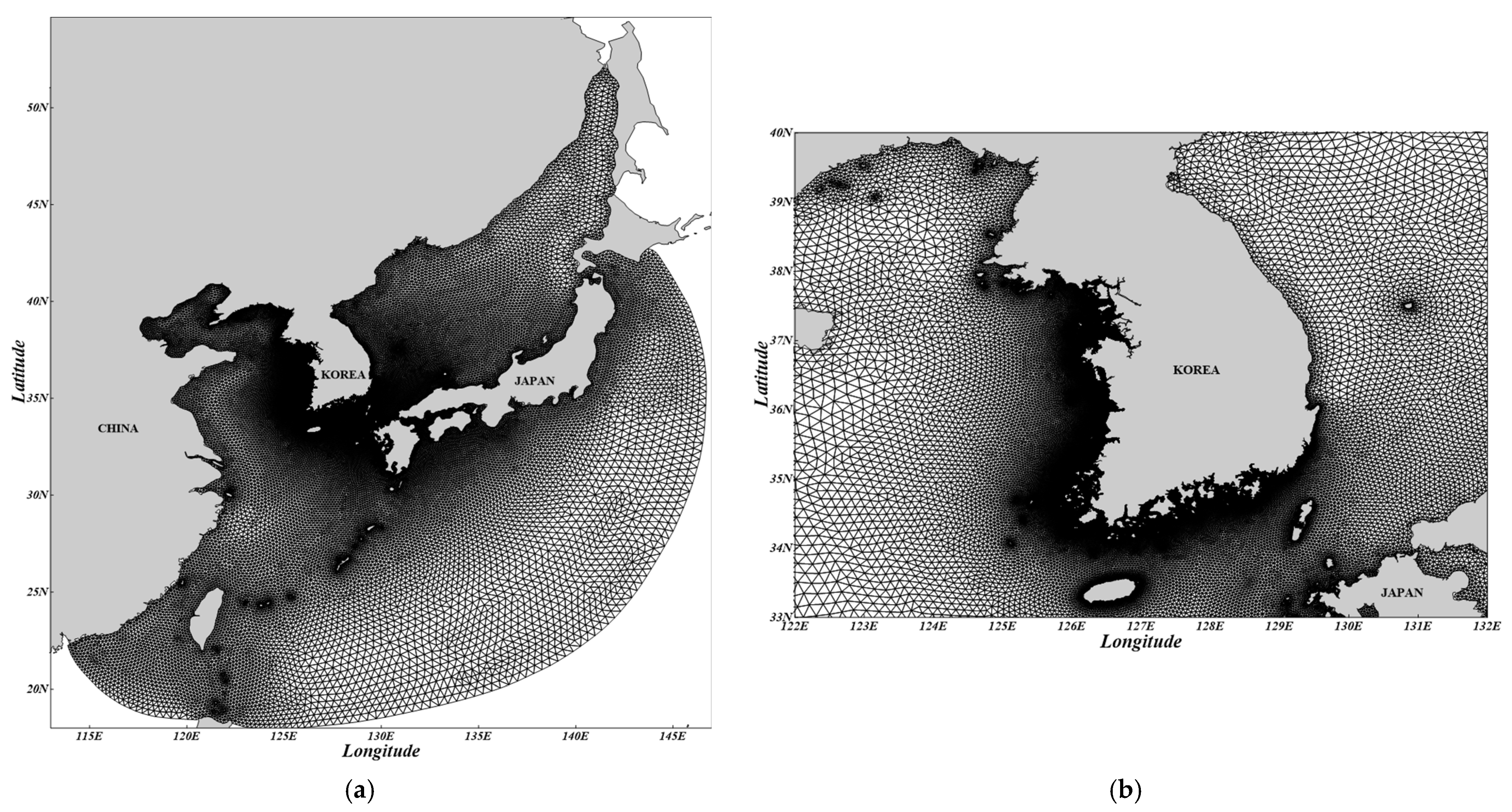
Grid System: An unstructured grid system was adopted to precisely reflect the topographical characteristics of the Korean coast, with its complex coastlines and many islands. The grid resolution was designed to be coarse in open seas and dense in coastal areas to ensure both computational efficiency and precision (
Figure 3).
Spectral Resolution: The direction (360°) was divided into 48 equal segments () to increase directional resolution. The frequency was logarithmically distributed into 40 components from 0.02 Hz to 1.0 Hz to simulate a wide range of wave components from long-period swells to short-period wind seas.
Input Data and Boundary Conditions: Bathymetry data were constructed based on the latest digital charts from the KHOA. Wind input utilized
and wind direction data from the JMA-MSM (Japan Meteorological Agency Meso-Scale Model) selected in
Section 2.2, applied at 1 h intervals. The water level condition was set to the A.H.H.W.L (Approximate Almost Highest High Water Level). The simulation period was one year (2021), with a time step of 10 min (
Table 5).
5. Results
5.1. Comparison of Accuracy by Physics Package
A one-year long-term simulation using various physics packages (Westhuysen, Janssen, Komen, ST6) and parameter combinations was analyzed (
Table 6). Accuracy evaluation was performed separately for all wave heights (
) and high waves (
).
While all cases showed a high correlation of for all wave heights, significant differences appeared in the RMSE (Root Mean Square Error). Notably, the combination of the Komen whitecapping formula and the Zijlema drag coefficient (K-5) showed the lowest error with under high wave conditions (). This is attributed to the synergy between Komen’s stable dissipation behavior and Zijlema’s high-wind drag coefficient suppression effect.
Conversely, the ST6 package (S-7) showed a slightly higher error of compared to the K-5 case in its default setting. This suggests that the default ST6 parameters might not have been perfectly harmonized with the characteristics of the JMA-MSM wind field. ST6 performance is known to be very sensitive to the wind input scaling factor and whitecapping dissipation coefficients (). Sensitivity tests were conducted by adjusting to 28, 32, and 35 (S-1, S-2, S-3), but there was no significant difference in average accuracy, indicating the need for direct wind input bias correction.
5.2. ST6 Package and CDFAC Correction
5.2.1. Input Wind Field Bias Analysis and CDFAC Calculation
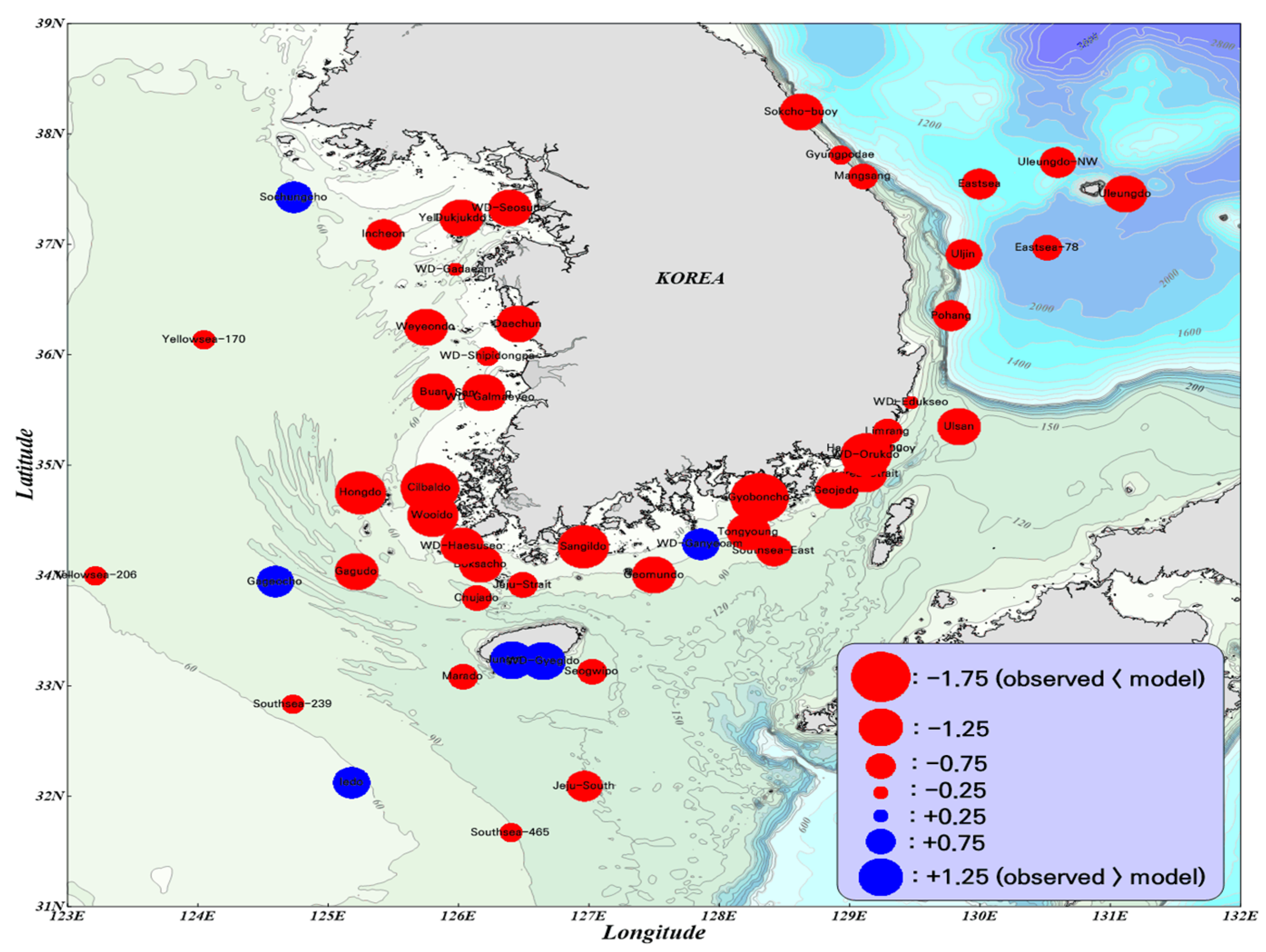
A precise comparison between JMA-MSM and observed wind speeds confirmed a positive bias (overestimation) in most sea areas, particularly in the West and South Seas where topographical influences are significant (
Figure 4). To correct this bias, the CDFAC (Drag Coefficient Scaling Factor) parameter within the ST6 DEBIAS option was utilized.
By adjusting
through a constant ratio applied to the total drag coefficient, the intensity of the wind input term (
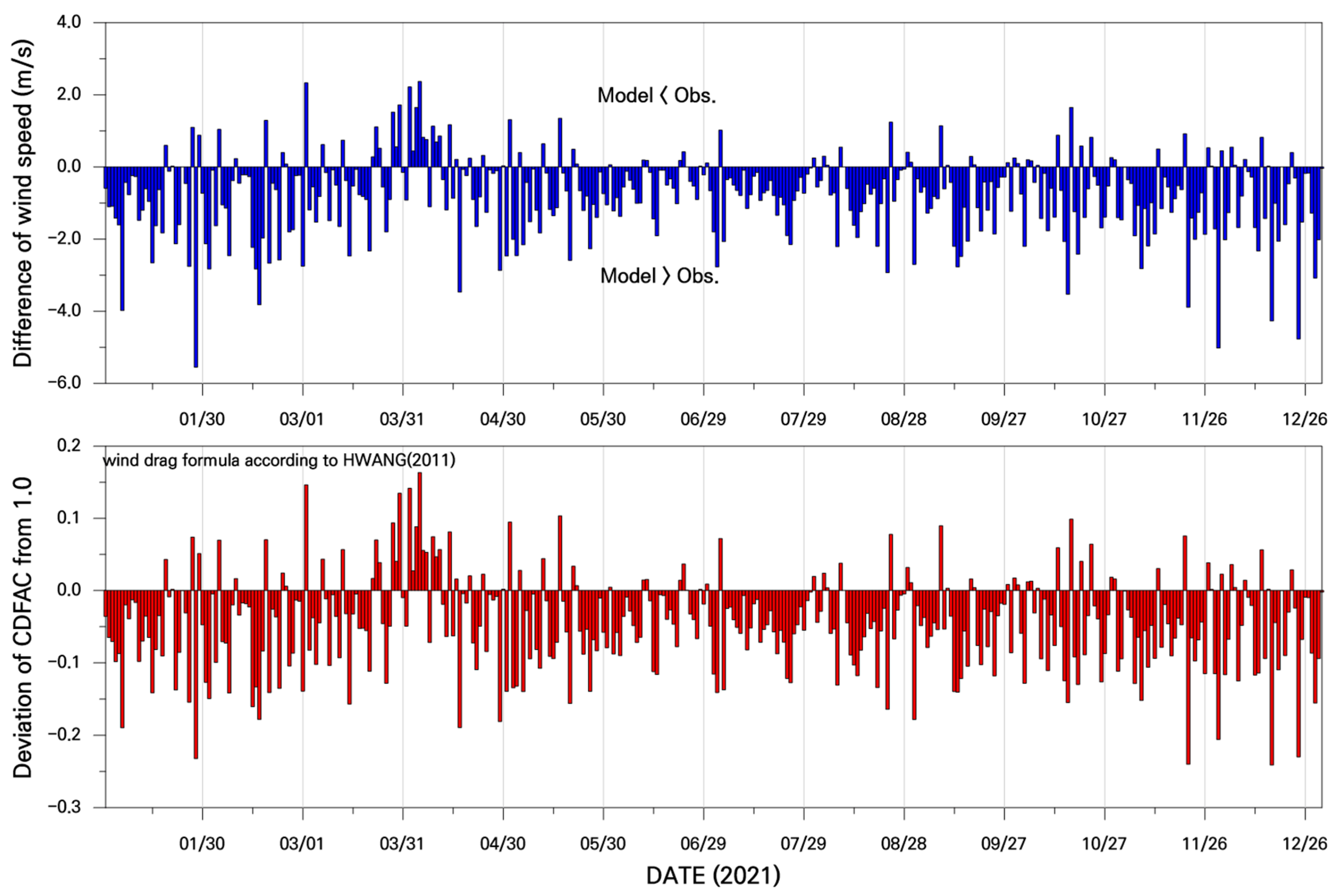
) can be adjusted globally to cancel out wind field bias. In this study, daily mean errors were calculated to apply time-varying CDFAC values to the model (
Figure 5).
The positive bias in the JMA-MSM wind field observed at stations in the West and South Seas is attributed to the unique topographical characteristics of the Archipelago environment in these regions. The West and South coasts of Korea feature a ria coast with numerous islands, creating highly irregular local roughness lengths. While the 5 km resolution of the JMA-MSM is sufficient for open ocean simulation, it has limitations in fully resolving the local topographical friction or shielding effects caused by small islands. Consequently, the model tends to perceive the sea surface as smoother than it is, leading to an overestimation of wind speed. This excessive wind energy, driven by topographical factors, amplifies wave prediction errors when coupled with refraction and bottom friction in shallow coastal waters. The CDFAC method proposed in this study was confirmed to effectively offset this overestimation by globally scaling the structural bias caused by these complex topographical effects.
5.2.2. CDFAC Application Results
After applying wind field bias correction through CDFAC, the ST6 model (S-7) prediction accuracy for
improved dramatically (
Table 7):
ST6 (S-7) Before Application: RMSE = 0.52 m, Bias = 0.19 m.
ST6 (S-7) After Application: RMSE = 0.35 m, Bias = 0.16 m.
This shows that CDFAC effectively controlled the overestimation of wave energy in high wind conditions. In contrast, the Komen model (K-5) showed only minor improvement (RMSE from 0.42 m to 0.39 m), suggesting it was less sensitive to wind bias or that its dissipation tuning already partially offset the bias. Consequently, combining ST6 with proper bias correction (ST6 + CDFAC) achieved superior high-wave prediction performance (RMSE = 0.35 m) compared to the previous best Komen + Zijlema combination (0.42 m).
5.2.3. Nature of Methodology and Limitations of Validation
The CDFAC technique applied in this study adopts a “Hindcast Mode”, where correction coefficients derived from 2021 observational data are applied to the simulation of the same period. For a strict evaluation of operational forecasting performance, a cross-validation approach separating the dataset into training and validation sets (e.g., split-sample method) would be required to avoid circular validation. However, the primary objective of this study is not to establish an operational forecasting system, but to diagnose the intrinsic performance of the ST6 physics package under conditions where input wind field bias is minimized. Therefore, the results presented herein should be interpreted as the “Potential Accuracy” that the wave model can achieve when wind input errors are effectively controlled. While the direct calibration and validation over the same 2021 period constitute a form of circular validation, this was an intentional experimental design to isolate the model physics behavior by treating wind error as a controlled variable. For future operational implementation, further validation applying coefficients learned from historical data to independent future periods will be necessary.
5.2.4. Operational Strategy for CDFAC Prediction
The time-varying CDFAC applied in this study was derived by comparing the observed and modeled wind speeds for the concurrent day. Therefore, strictly speaking, this method functions as a “Diagnostic Hindcasting Tool” for post-analysis. In an operational forecasting system where future observations are unavailable, a predictive algorithm is required to establish the CDFAC for the forecast horizon (e.g., tomorrow). Systematic biases in meteorological models like JMA-MSM often exhibit persistence over short periods rather than fluctuating randomly. To address this in an operational context, we propose a “Time-lagged Sliding Window” technique. This method estimates the CDFAC for the forecast period (t) by using the weighted average of the deterministic CDFAC values derived from the immediate past (e.g., t − 1 to t − 3 days).
Furthermore, as a future direction, we envisage implementing an AI-based prediction model trained to map synoptic weather patterns (e.g., pressure gradients, wind direction) to optimal CDFAC values. This would allow for the generation of dynamic correction factors optimized for future weather conditions, surpassing the limitations of simple persistence-based correction.
5.3. Analysis by Wave Height Class and Season
The practical value of wave prediction is primarily determined by its accuracy during high-energy events. A detailed analysis by wave height class and season provided the following physical insights:
Performance in Low Wave Conditions (
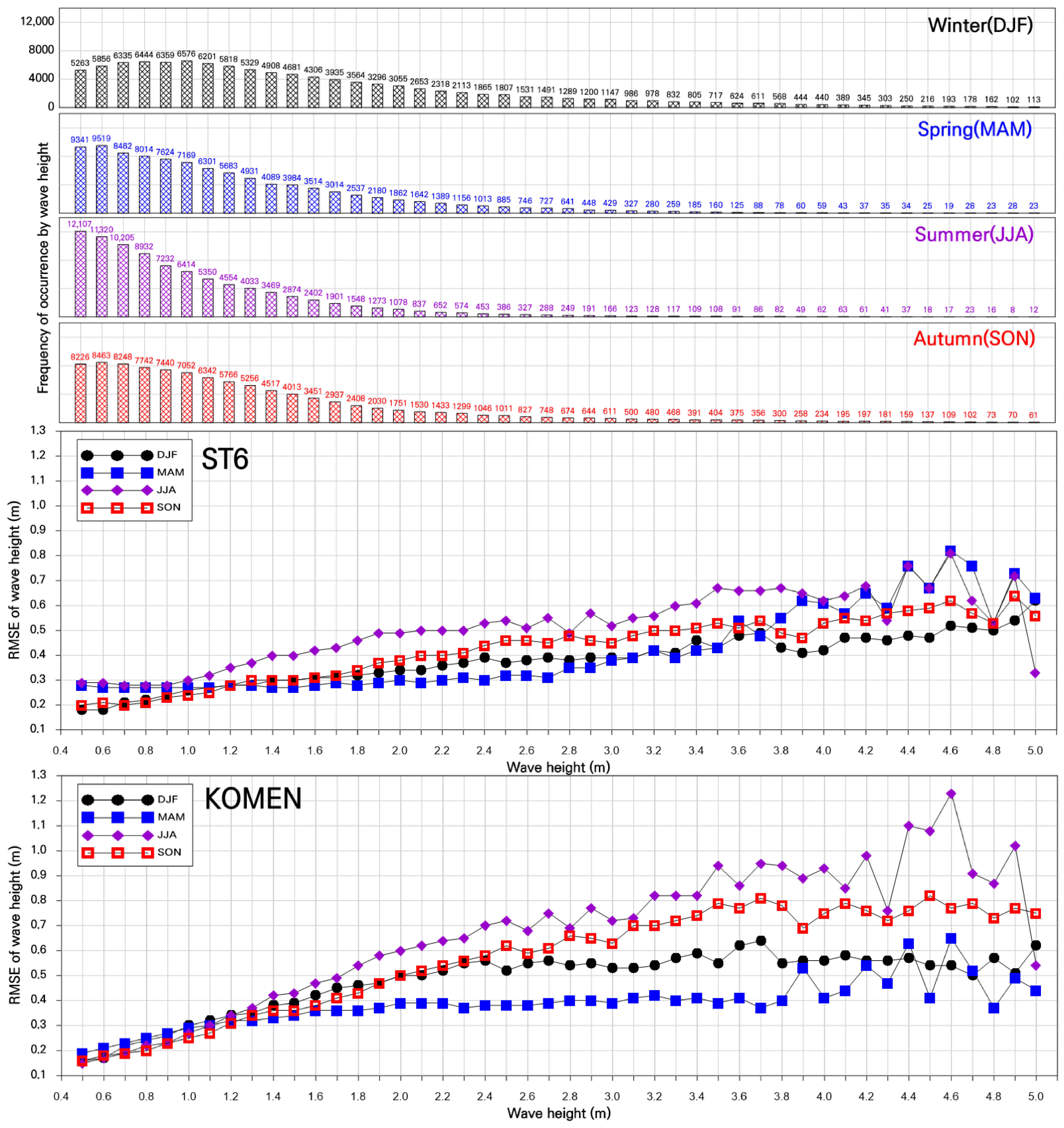
Hs < 1.0 m): In the low wave height range, the KOMEN scheme exhibited slightly superior or comparable performance to ST6. As shown in
Figure 6, KOMEN’s RMSE remains lower in the
Hs < 1.0 m section across most seasons. This is further supported by
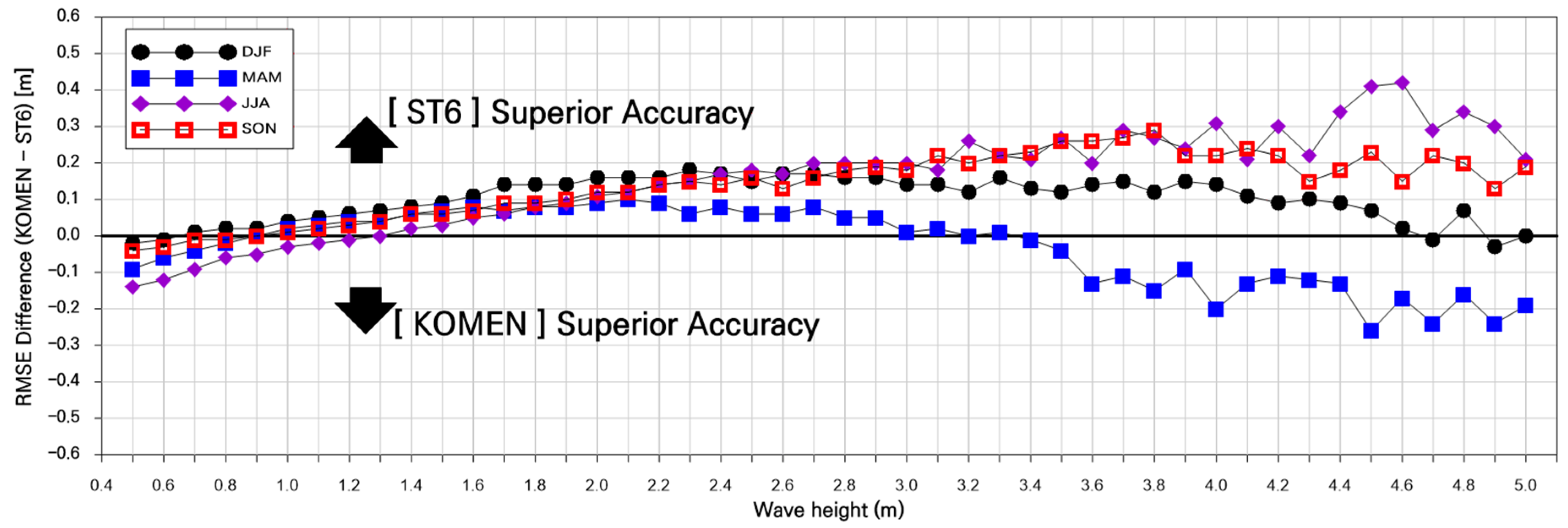
Figure 7, where the RMSE difference (KOMEN–ST6) dips below the zero-baseline, reflecting KOMEN’s long-standing optimization for stabilized, normal sea conditions.
Error Transition and High Wave Superiority (
Hs > 1.2 m): As wave heights increase beyond 1.0–1.2 m, the superiority of the ST6 scheme becomes distinct.
Figure 7 illustrates a consistent upward trend toward positive values, indicating that ST6 significantly outperforms KOMEN as energy levels rise. Notably, beyond the 2.0 m threshold, the RMSE of the KOMEN scheme rises sharply compared to ST6. This serves as critical visual evidence of the superior physical parameterization in ST6—specifically, the spectral separation of inherent and cumulative breaking combined with drag coefficient saturation—which effectively simulates high-energy realities.
Statistical Significance and Model Robustness: The seasonal frequency of occurrence (histograms) in
Figure 6 shows that while the number of data samples decreases in the high wave region (
Hs > 4.0 m), the ST6 scheme maintains a remarkably consistent and stable error level. This stability, despite the limited sample size, highlights the robustness of the ST6 model in reproducing extreme conditions without the unstable error growth observed in the mean-parameter-based KOMEN model.
5.4. Analysis of Extreme High Wave Scenarios: Winter High Waves and Typhoon Chanthu
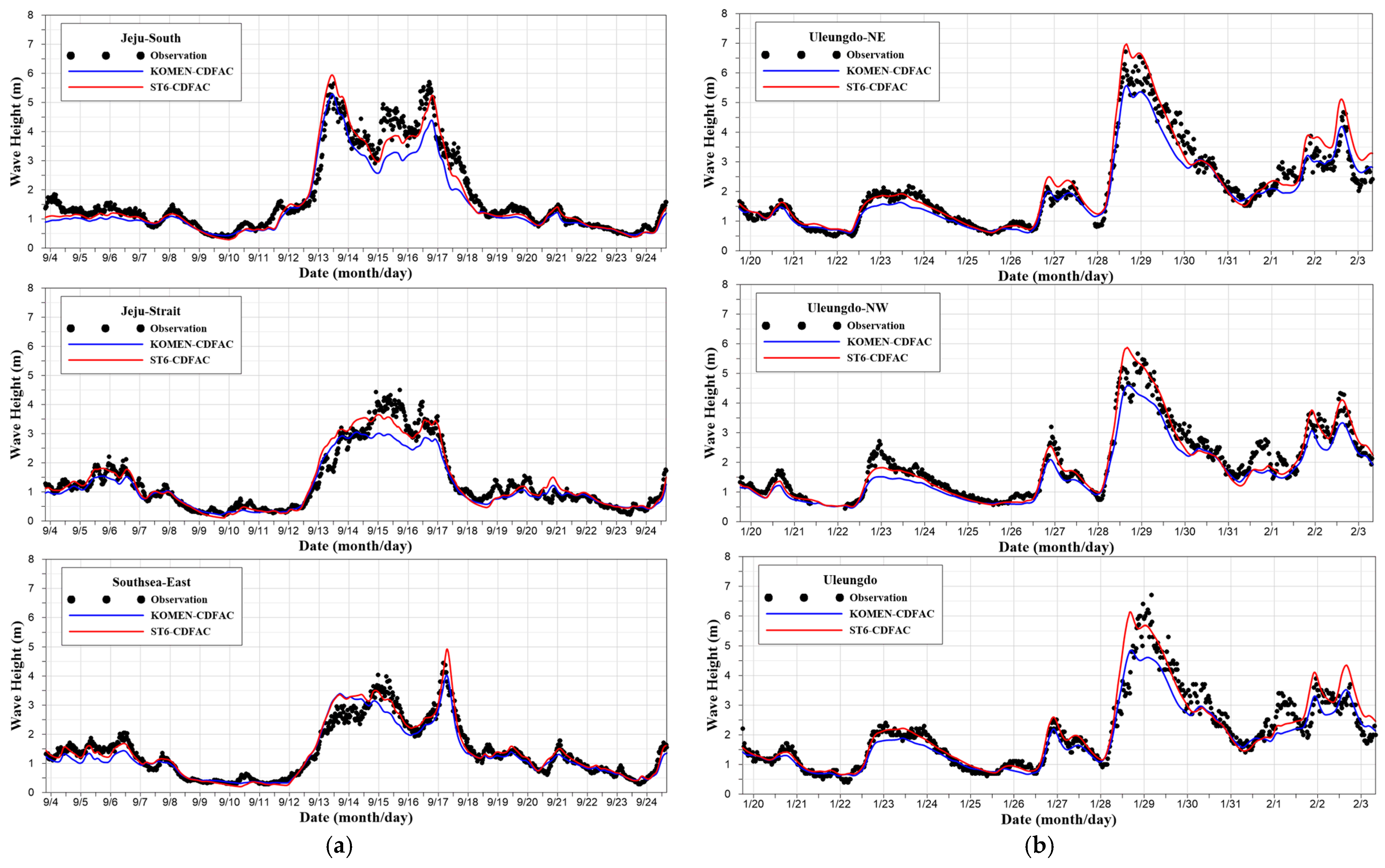
To validate the operational capability of the proposed ST6 + CDFAC scheme under extreme weather conditions, detailed case studies were conducted on two distinct high-energy events: Typhoon Chanthu (4–24 September 2021), which recorded the highest significant wave heights during the summer, and a severe winter storm event in the East Sea. Time-series analysis was performed at key observation stations, including southern Jeju and the eastern South Sea for the typhoon case, and the waters near Ulleungdo in the East Sea for the winter storm case (
Figure 8). The analysis revealed the following characteristics:
Forecast Error & Peak Reproduction: The traditional Komen scheme tended to underestimate the peak significant wave height by approximately 10–15% during the rapid intensification of wind speeds near the typhoon center. This is attributed to the Komen scheme’s dissipation term relying on the mean wave steepness of the entire spectrum; the presence of strong swells accompanying the typhoon lowers the overall steepness, triggering physically inconsistent energy suppression. In contrast, the ST6 + CDFAC model accurately reproduced the observed peak wave heights (approx. 6 m), reducing the RMSE by over 0.3 m compared to the Komen scheme.
Response Speed: Comparing the model response during the rapid wave growth stage, the ST6 + CDFAC scheme followed the observed rising limb almost perfectly, responding without delay to the rapidly changing wind forcing. This superior response speed is due to the ST6 physics package, which separates dissipation into inherent breaking (T1) and cumulative breaking (T2). This separation allows for the effective physical decoupling of the rapidly growing wind sea from the background swell, unlike the mean-parameter approach of previous models.
Behavior of Drag Coefficient: In regions where wind speeds exceeded 30 m/s near the typhoon center, models using linear drag formulas produced unrealistic overestimations of wave height due to excessive energy input. However, the Hwang (2011) [
12] formula implemented in ST6 accounts for the saturation and rollover of the drag coefficient at high wind speeds, physically limiting excessive momentum transfer. Combined with the bias correction from CDFAC, this configuration demonstrated the most reliable forecasting performance under extreme conditions.
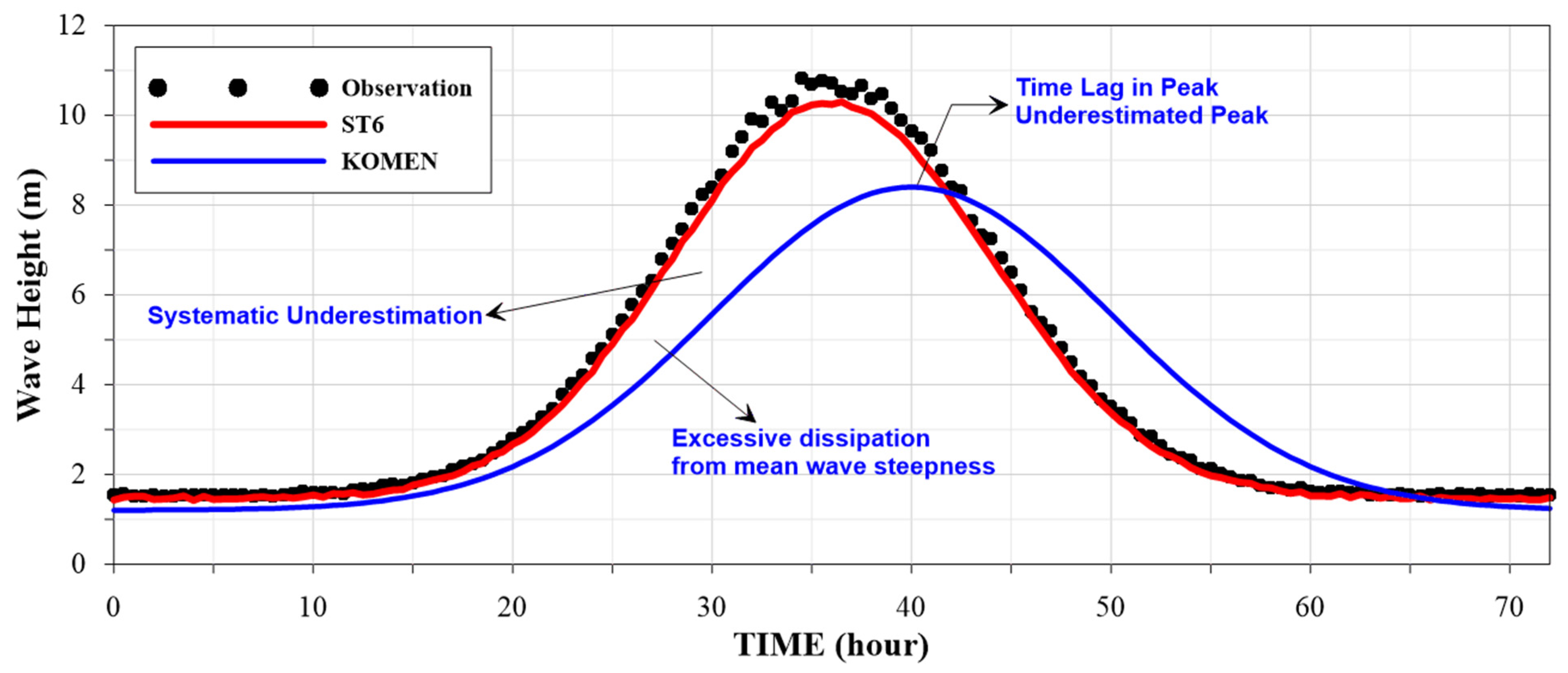
While the observed time-series clearly demonstrate the statistical superiority of the ST6 + CDFAC scheme, the inherent high-frequency variability and stochastic nature of field data can occasionally obscure the fundamental physical discrepancies between the dissipation mechanisms. To facilitate a more intuitive understanding for the reader, a conceptualized time-series comparison is presented in
Figure 9. This diagram highlights the three critical deficiencies of the mean-parameter-based Komen scheme during extreme events: (1) systematic underestimation of the peak energy, (2) a noticeable phase lag (time lag) in peak arrival, and (3) excessive dissipation during the rapid growth stage due to the reliance on mean wave steepness. In contrast, the ST6 + CDFAC scheme maintains physical fidelity by accurately capturing the rising limb and peak magnitude through its frequency-dependent decoupling of wind-sea and swell energies.
5.5. Spectral Shape and Physical Behavior in Mixed Seas
The performance discrepancy between ST6 and Komen observed in this study stems from their differing treatments of wave spectra in Mixed Sea conditions. The Komen scheme calculates the whitecapping dissipation rate based on the mean wave steepness of the entire spectrum. During typhoon events where strong swell and local wind seas coexist, the swell component lowers the overall mean steepness. Consequently, the Komen model may underestimate the dissipation rate, leading to spurious growth of wind seas or excessive damping of the swell, a phenomenon known as the “Swell Dissipation Artifact.”
In contrast, ST6 separates dissipation into Inherent Breaking (T1) in the spectral peak region and Cumulative Breaking (T2) in the high-frequency region, while explicitly handling non-breaking dissipation. This dual-term approach effectively allows for the physical decoupling of swell and wind sea components. This capability explains why ST6 demonstrated superior predictive performance compared to Komen during typhoon seasons characterized by complex spectral shapes.
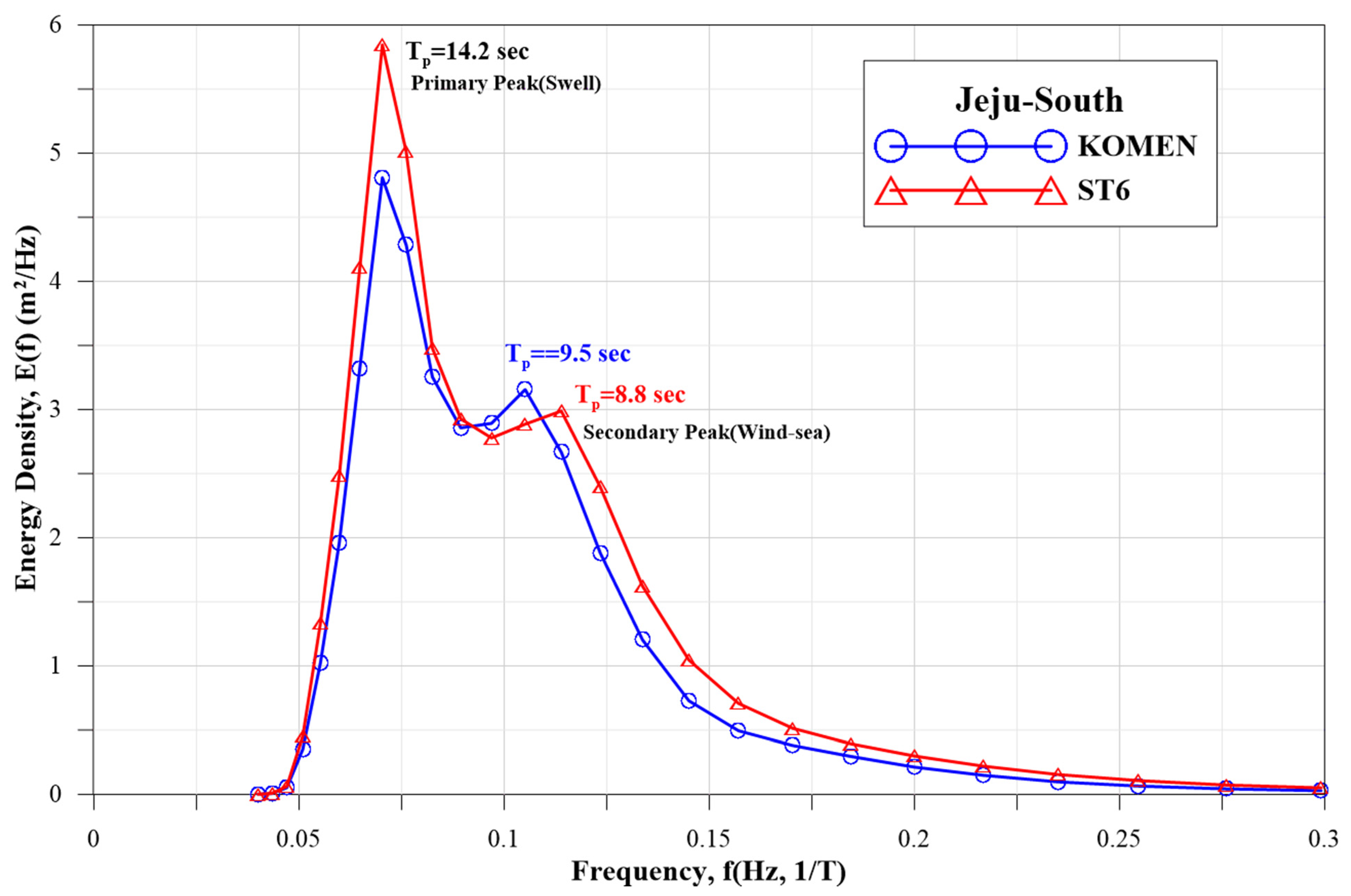
Furthermore, the discrepancy in the secondary peak period between the Komen and ST6 schemes under typhoon-induced extreme conditions is primarily attributed to the distinct physical treatment of whitecapping dissipation (
) as shown in
Figure 10. The Komen scheme formulates dissipation based on the mean wave steepness of the entire spectrum. Under high wind speeds, the rapid increase in overall steepness triggers an aggressive, uniform dissipation across all frequency domains. This indiscriminate damping suppresses energy growth, particularly in the nascent high-frequency (short-period) range. Consequently, a “peak shifting” phenomenon occurs as energy clusters toward slightly longer periods where the dissipation pressure is relatively lower, resulting in a delayed peak at T = 9.5 s.
In contrast, the ST6 package employs a frequency-dependent saturation-based approach combined with a threshold-based dissipation function. Instead of applying global damping, ST6 selectively regulates energy loss only when the spectral density at a specific frequency exceeds its physical saturation threshold. This allows the model to capture the rapid energy input from typhoon-strength winds more effectively in the high-frequency tail, maintaining a higher energy peak at the shorter, more physically representative period of T = 8.8 sec. Thus, while the ST6 scheme accurately represents the “young sea” state characterized by higher and shorter-period peaks, the Komen scheme exhibits a tendency toward over-dissipation, leading to a numerical artifact where the energy peak is artificially shifted and underestimated.
5.6. Analysis of Wave Prediction Accuracy Across Bathymetric Categories
To verify whether the improvement in high-wave prediction using the ST6 + CDFAC scheme is consistent across the entire domain, a detailed statistical analysis was performed on all 138 observation stations, categorized by water depth. The analysis revealed that offshore and deep-water stations (depth 50 m, 84 stations) showed superior performance, achieving a correlation coefficient (R) of 0.94 and an RMSE of 0.20 m (
Table 8).
These results are physically consistent with the governing mechanisms of wave evolution. In deep waters, wave development is dominated by the wind input term () and the whitecapping dissipation term (). Specifically, the ST6 package employs a frequency-dependent saturation-based approach, which regulates dissipation only when the energy density in a specific frequency band exceeds its physical saturation threshold. Unlike traditional mean-steepness-based models, this mechanism allows for the effective physical decoupling of swell and wind-sea components, serving as the primary driver for high correlation and low error in offshore regions where whitecapping dissipation is the dominant energy sink.
Conversely, coastal stations with depths under 50 m (54 stations) recorded an R of 0.91 and an RMSE of 0.25 m. As waves propagate into shallow waters, bottom friction () and depth-induced breaking () become the dominant energy dissipation mechanisms. Consequently, the improvements derived from optimized whitecapping formulations and wind input corrections are partially masked or offset by these topographical dissipation terms. This suggests that while the frequency-dependent whitecapping physics of ST6 are highly accurate for deep-water processes, the influence of topographical source terms increases significantly in coastal applications. In summary, the ST6 + CDFAC scheme maintains robust performance across all depth ranges, while its physical consistency is most prominently validated in offshore waters where air–sea interactions and whitecapping dissipation are the primary drivers.
6. Discussion
The results of this study suggest that an integrated approach of physics packages and wind bias correction is necessary to improve wave prediction accuracy, with the following implications:
Need for Hybrid Operation: Komen is stable for low wave conditions, while ST6 excels in high waves and rapidly changing weather. Future operational systems should consider an ensemble approach or adaptive modeling that selects the optimal physics option based on sea state.
Importance of Wind Bias Correction: Bias correction using CDFAC contributed more to accuracy improvement than switching physics packages (over 30% improvement in high-wave RMSE). Future research should move toward nonlinear correction by wind speed range or AI-based wind error correction models.
Excellence of ST6: ST6’s superiority in high-wave simulation was reconfirmed. While Komen suffers from over- or under-dissipation due to mean steepness dependency, ST6 more realistically reproduces high waves during winter monsoons and typhoons by separating breaking components and reflecting drag coefficient saturation.
Physical Justification and Limitations of CDFAC Methodology: The time-varying CDFAC method applied in this study has a limitation in that it applies a daily mean correction without explicitly accounting for biases across different wind speed ranges (e.g., low vs. high wind speeds). However, from the perspective of wave modeling, particularly for extreme weather simulations like typhoons, wave energy grows in proportion to the square or higher power of wind speed. Therefore, correcting the bias of the dominant synoptic-scale weather system for the day is the most effective strategy for balancing the total wave energy. Furthermore, while linear statistical corrections or Machine Learning (ML) based post-processing methods focus on statistically adjusting the output (significant wave height), the CDFAC approach distinguishes itself by directly controlling the friction velocity () and momentum flux (), which are the root causes of wave generation. This ensures “Physical Consistency” by reducing errors while maintaining the physical balance between wind input () and whitecapping dissipation (). Thus, in numerical modeling studies where understanding physical processes is paramount, dynamic parameter tuning like CDFAC is more suitable than black-box data-driven models for interpreting and improving model behavior. Future research should aim to develop non-linear CDFAC functions subdivided by wind speed bins or hybrid approaches that optimize these parameters in real-time using AI techniques.
6.1. Physical Consistency of CDFAC in Momentum Flux Adjustment
The application of CDFAC (Drag Coefficient Scaling Factor) introduced in this study should be interpreted not merely as an empirical tuning to match model outputs with observations, but as a process of rationalizing the physical momentum transfer process at the air–sea interface. In wave models, the energy input () is determined not directly by the wind speed (), but by the wind stress () and friction velocity () acting on the sea surface ( If a structural positive bias exists in the input wind field (), it transmits excessive energy to the sea surface proportional to the square of the friction velocity. Under these conditions, scaling the drag coefficient () using CDFAC serves to adjust the abnormal momentum flux caused by the overestimated wind speed, thereby correcting the “Effective Wind Stress” to match the actual sea state. This approach maintains physical consistency far better than artificially increasing the whitecapping dissipation term () to suppress excess energy. In essence, CDFAC functions as a “calibration mechanism at the input-physics interface” that prevents errors in input data from propagating into distortions of the physical processes.
6.2. Limitations of Hybrid Operation and AI-Based Advancement Strategy
The dual-operation strategy proposed in this study (using Komen for normal conditions and ST6 for severe weather) faces practical limitations in real-time forecasting due to the difficulty in establishing a robust “Switching Criterion.” To overcome this, Hybrid Modeling, which couples numerical model physics with data-driven corrections, is essential. Recent literature provides compelling evidence for the efficacy of Machine Learning (ML) in wave forecasting. Durap (2024) conducted a comparative analysis of various ML algorithms, demonstrating that data-driven models possess superior non-linear mapping capabilities for Significant Wave Height (SWH) forecasting compared to traditional empirical methods [
15]. Furthermore, Durap (2025a) highlighted the potential of Explainable ML in overcoming scale and time challenges for predicting diverse oceanographic parameters. Crucially, for operational forecasters to trust AI outputs, the “black box” nature of ML must be addressed [
16]. Durap (2025b) proposed a framework utilizing SHAP (SHapley Additive exPlanations) analysis and physics-informed feature engineering (e.g., Wave Height Ratio) to ensure model transparency and interpretability [
17]. Therefore, the future forecasting system should evolve into an integrated framework where the CDFAC proposed in this study removes primary physical bias, while an Explainable AI layer dynamically corrects residual non-linear errors in real-time.
6.3. Future Directions: Transitioning from Linear Correction to AI-Based Hybrid Modeling
Although the CDFAC technique proposed in this study is an effective method for correcting wind bias while maintaining physical consistency, it has limitations in fully controlling non-linear error structures that vary spatiotemporally. Recently, Hybrid Modeling, which integrates numerical physics with Machine Learning (ML) and Deep Learning (DL) techniques, has emerged as a powerful solution to overcome these physical limitations in wave forecasting. Data-driven approaches that learn the residuals between numerical model outputs (Significant Wave Height, Hs) and observations are being actively researched to enhance prediction performance. Notably, recent studies have moved beyond simple “black box” predictions by incorporating Explainable AI (XAI) techniques, such as SHAP (SHapley Additive exPlanations), to ensure model transparency. For instance, Durap demonstrated the reliability of data-driven models by utilizing feature engineering to elucidate the correlations between physical wave parameters (e.g., maximum wave height, period) and ML algorithms (e.g., Random Forest, XGBoost), thereby bridging the gap between physics and data science. Therefore, for the advancement of the wave forecasting system around the Korean Peninsula, future research should aim for a “Physics–Data Coupled Hybrid Framework.” In this approach, physical tuning methods like the CDFAC proposed in this study would serve as a baseline to remove primary biases, while AI models would be employed to learn and correct the remaining non-linear errors in real-time.
7. Conclusions
This study conducted an extensive sensitivity analysis and validation of the SWAN model for the coastal waters of the Korean Peninsula, leading to the following major conclusions:
First, the accuracy of wave prediction is fundamentally determined by the quality of the input wind field and the parameterization of source terms. Among various reanalysis data, JMA-MSM was selected as the optimal wind forcing for the Korean Peninsula due to its high spatiotemporal resolution. To systematically control the structural positive bias in these wind fields, the CDFAC method was introduced, which adjusts momentum flux at the air–sea interface while maintaining the internal physical balance between wind input () and whitecapping dissipation ().
Second, the ST6 physics package, when coupled with CDFAC, significantly outperformed the traditional Komen scheme during high-energy events. ST6 accurately reproduced peak significant wave heights (approx. 6 m) during Typhoon Chanthu and winter storms, whereas the Komen scheme tended to underestimate peaks and exhibit phase lags due to its reliance on mean wave steepness. The application of ST6 + CDFAC achieved a 32.7% reduction in RMSE for high-wave conditions, demonstrating its superior operational capability for extreme weather forecasting.
Third, the bathymetric stratified analysis across 138 stations confirmed the spatial consistency of the ST6 + CDFAC framework. The scheme maintained its highest accuracy in offshore regions (depth > 50 m), where the frequency-dependent saturation-based dissipation prevents the “Swell Dissipation Artifact” commonly observed in mean-parameter models. In coastal waters (depth < 50 m), the governing dissipation mechanisms diversify into bottom friction () and depth-induced breaking (), which partially offsets the benefits of wind input and whitecapping optimization.
Finally, for practical implementation in real-time systems, a “Time-lagged Sliding Window” technique is proposed to dynamically estimate CDFAC based on persistent bias characteristics in meteorological models. Future advancements should aim for a “Physics–Data Coupled Hybrid Framework,” integrating numerical physics with explainable AI (XAI) to correct residual non-linear errors in real-time, thereby ensuring both physical fidelity and predictive precision in complex coastal environments.
Author Contributions
Conceptualization, H.-s.E.; methodology, H.-s.E.; software, H.-s.E.; validation, H.-s.E. and J.-J.P.; formal analysis, H.-s.E.; investigation, J.-J.P.; resources, J.-J.P.; data curation, J.-J.P.; writing—original draft preparation, H.-s.E.; writing—review and editing, J.-J.P.; visualization, J.-J.P.; supervision, H.-s.E.; project administration, H.-s.E.; funding acquisition, H.-s.E. All authors have read and agreed to the published version of the manuscript.
Funding
This work was supported by the Nuclear Safety Research Program through the Korea Foundation of Nuclear Safety (KoFONS) using the financial resource granted by the Nuclear Safety and Security Commission (NSSC) of the Republic of Korea. RS-2021-KN058810.
Data Availability Statement
The original contributions presented in this study are included in the article. Further inquiries can be directed to the corresponding author.
Conflicts of Interest
Authors Ho-sik Eum and Jong-Jip Park were employed by the company Geosystem Research Corporation. All authors declare that the research was conducted in the absence of any commercial or financial relationships that could be construed as a potential conflict of interest.
Abbreviations
The following abbreviations are used in this manuscript:
| SWAN | Simulating WAves Nearshore |
| ST6 | Source Term Package 6 |
| JMA-MSM | Japan Meteorological Agency Meso-Scale Model |
| ERA5 | The Fifth-Generation ECMWF Reanalysis Data |
| CFSR/GFS | Climate Forecast System Reanalysis/Global Forecast System |
| KHOA | Korea Hydrographic and Oceanographic Agency |
| KMA | Korea Meteorological Administration |
| MOF | Ministry of Oceans and Fisheries |
| RMSE | Root Mean Square Error |
| CDFAC | Drag Coefficient Scaling Factor |
| XAI | Explainable Artificial Intelligence |
| SHAP | SHapley Additive exPlanations |
| GRU | Gated Recurrent Units |
| AHHWL | Approximate Almost Highest High Water Level |
References
- Booij, N.; Ris, R.C.; Holthuijsen, L.H. A third-generation wave model for coastal regions 1. Model description and validation. J. Geophys. Res. Oceans 1999, 104, 7649–7666. [Google Scholar] [CrossRef] [Scilit]
- The SWAN Team. SWAN Implementation Manual (Cycle III Version 41.51); Delft University of Technology: Delft, The Netherlands, 2024; Available online: http://www.swan.tudelft.nl (accessed on 14 February 2026).
- The SWAN Team. SWAN Scientific and Technical Documentation (Cycle III Version 41.51); Delft University of Technology: Delft, The Netherlands, 2024; Available online: http://www.swan.tudelft.nl (accessed on 14 February 2026).
- Komen, G.J.; Hasselmann, S.; Hasselmann, K. On the Existence of a Fully Developed Wind-Sea Spectrum. J. Phys. Oceanogr. 1984, 14, 1271–1285. [Google Scholar] [CrossRef] [Scilit]
- Hasselmann, K. On the spectral dissipation of ocean waves due to white capping. Bound.-Layer Meteorol. 1974, 6, 107–127. [Google Scholar] [CrossRef] [Scilit]
- van der Westhuysen, A.J.; Zijlema, M.; Battjes, J.A. Nonlinear saturation-based whitecapping dissipation in SWAN for deep and shallow water. Coast. Eng. 2007, 54, 151–170. [Google Scholar] [CrossRef] [Scilit]
- Wu, J. Wind stress coefficients over sea surface from breeze to hurricane. J. Geophys. Res. 1982, 87, 9704–9706. [Google Scholar] [CrossRef] [Scilit]
- Powell, M.D.; Vickery, P.J.; Reinhold, T.A. Reduced drag coefficient for high wind speeds in tropical cyclones. Nature 2003, 422, 279–283. [Google Scholar] [CrossRef] [Scilit] [PubMed]
- Donelan, M.A.; Drennan, W.M.; Williams, N.J.; Terray, E.A. On the limiting aerodynamic roughness of the ocean in very strong winds. Geophys. Res. Lett. 2004, 31, L18306. [Google Scholar] [CrossRef] [Scilit]
- Soloviev, A.; Lukas, R. Effects of bubbles and spray on air-sea exchange in hurricane conditions. Bound.-Layer Meteorol. 2010, 136, 365–376. [Google Scholar] [CrossRef] [Scilit]
- Rogers, W.E.; Babanin, A.V.; Wang, D.W. Observation-Consistent Input and Whitecapping Dissipation in a Model for Wind-Generated Surface Waves: Description and Simple Calculations. J. Atmos. Ocean. Technol. 2012, 29, 1329–1346. [Google Scholar] [CrossRef] [Scilit]
- Hwang, P.A. A note on the ocean surface roughness spectrum. J. Atmos. Ocean. Technol. 2011, 28, 436–443. [Google Scholar] [CrossRef] [Scilit]
- Saha, S.; Moorthi, S.; Pan, H.-L.; Wu, X.; Wang, J.; Nadiga, S.; Tripp, P.; Kistler, R.; Woollen, J.; Behringer, D.; et al. The NCEP Climate Forecast System Reanalysis. Bull. Amer. Meteor. Soc. 2010, 91, 1015–1058. [Google Scholar] [CrossRef] [Scilit]
- Park, H.J.; Kang, Y.J. Comparison of Wave Prediction and Performance Evaluation in Korea Waters based on Machine Learning. J. Ocean Eng. Technol. 2024, 38, 18–29. [Google Scholar] [CrossRef] [Scilit]
- Durap, A. Data-driven models for significant wave height forecasting: Comparative analysis of machine learning techniques. Results Eng. 2024, 24, 103573. [Google Scholar] [CrossRef] [Scilit]
- Durap, A. Predicting ocean parameters with explainable machine learning: Overcoming scale and time challenges. Reg. Stud. Mar. Sci. 2025, 90, 104424. [Google Scholar] [CrossRef] [Scilit]
- Durap, A. From Black Box to Transparency: An Explainable Machine Learning (ML) Framework for Ocean Wave Prediction Using SHAP and Feature-Engineering-Derived Variable. Mathematics 2025, 13, 3962. [Google Scholar] [CrossRef] [Scilit]
- Hersbach, H.; Bell, B.; Berrisford, P.; Hirahara, S.; Horányi, A.; Muñoz-Sabater, J.; Nicolas, J.; Peubey, C.; Radu, R.; Schepers, D.; et al. The ERA5 global reanalysis. Q. J. R. Meteorol. Soc. 2020, 146, 1999–2049. [Google Scholar] [CrossRef] [Scilit]
- Saito, K.; Tsuyuki, T.; Kumagai, H.; Kasahara, Y.; Iwai, S.; Jimbo, M.; Kato, T.; Segami, A.; Horiai, A.; Hara, T. The Operational JMA Nonhydrostatic Mesoscale Model. Mon. Weather Rev. 2006, 134, 1266–1298. [Google Scholar] [CrossRef] [Scilit]
- Zijlema, M.; Van Vledder, G.P.; Holthuijsen, L.H. Bottom friction and wind drag for wave models. Coast. Eng. 2012, 65, 19–26. [Google Scholar] [CrossRef] [Scilit]
- Janssen, P.A.E.M. Quasi-linear Theory of Wind-Wave Generation Applied to Wave Forecasting. J. Phys. Oceanogr. 1991, 21, 1631–1642. [Google Scholar] [CrossRef] [Scilit]
- Fan, Y.; Lin, S.J.; Held, I.M.; Yu, Z.; Tolman, H.L. Global ocean surface wave simulation using a coupled atmosphere-wave model. J. Clim. 2012, 25, 6233–6252. [Google Scholar] [CrossRef] [Scilit]
- Liu, Q.; Rogers, W.E.; Babanin, A.V.; Young, I.R.; Romero, L.; Zieger, S.; Qiao, F.; Bidlot, J.-R. Observation-Based Source Terms in the Third-Generation Wave Model WAVEWATCH III. Ocean Model. 2019, 143, 101451. [Google Scholar]
- Snyder, R.L.; Dobson, F.W.; Elliott, J.A.; Long, R.B. Array measurements of atmospheric pressure fluctuations above surface gravity waves. J. Fluid Mech. 1981, 102, 1–59. [Google Scholar] [CrossRef] [Scilit]
Figure 1.
Map of wave and wind observation stations used in this study (KHOA, MOF, and KMA).
Figure 1.
Map of wave and wind observation stations used in this study (KHOA, MOF, and KMA).
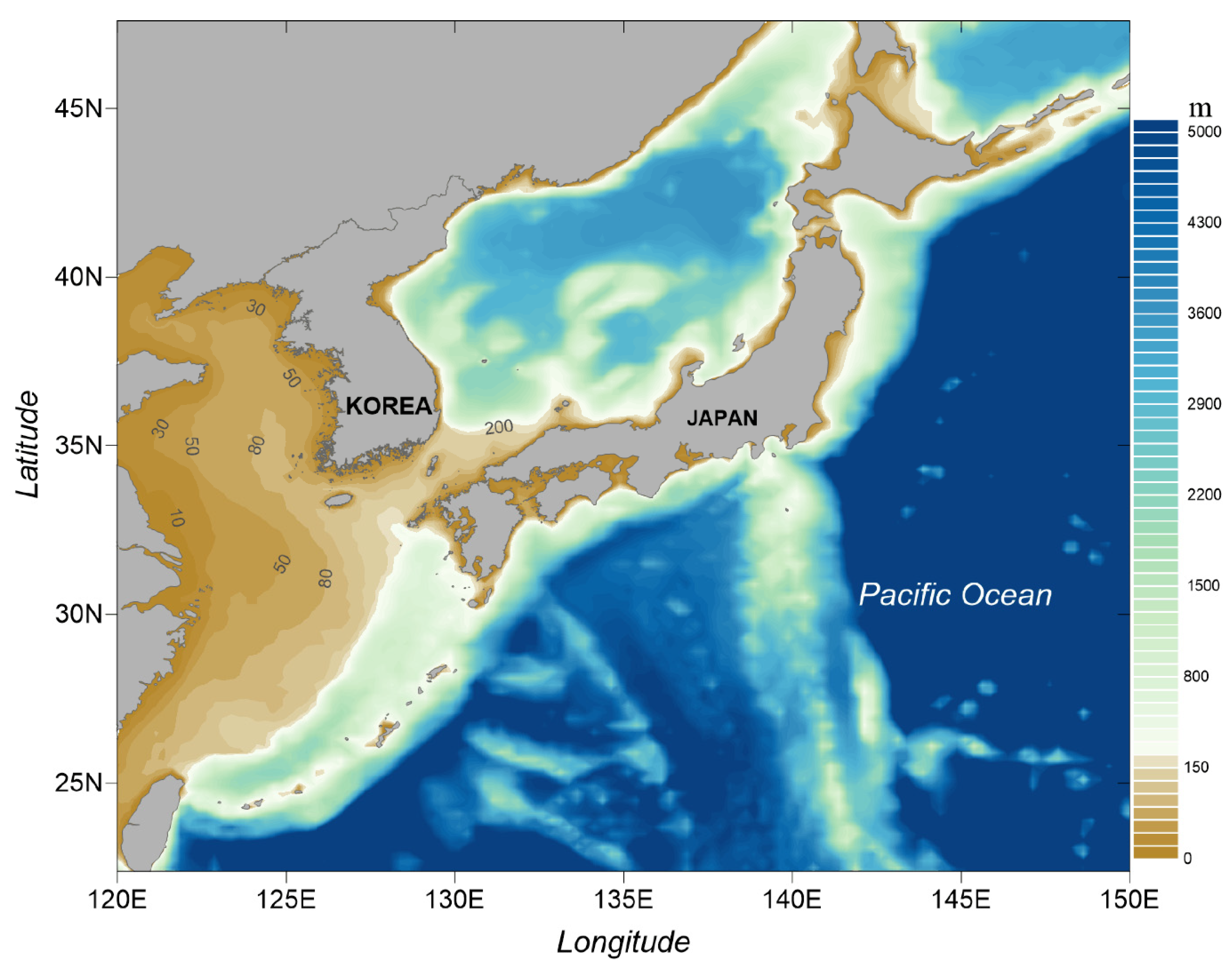
Figure 2.
Sea bottom bathymetry of the geographical area simulated by the Simulating WAves Nearshore (SWAN) model.
Figure 2.
Sea bottom bathymetry of the geographical area simulated by the Simulating WAves Nearshore (SWAN) model.
Figure 3.
Numerical model grid mesh. (a) Entire computational domain, (b) Zoom-in view around the Korean Peninsula.
Figure 3.
Numerical model grid mesh. (a) Entire computational domain, (b) Zoom-in view around the Korean Peninsula.
Figure 4.
Spatial distribution of mean error between observation data and JMA wind data at each station.
Figure 4.
Spatial distribution of mean error between observation data and JMA wind data at each station.
Figure 5.
Time series of daily mean wind speed bias and fluctuation of the Drag Coefficient Scaling Factor for one year in 2021. (Top) Time series of daily mean wind speed bias [m/s]; (Bottom) time evolution of Drag Coefficient Scaling Factor [CDFAC].
Figure 5.
Time series of daily mean wind speed bias and fluctuation of the Drag Coefficient Scaling Factor for one year in 2021. (Top) Time series of daily mean wind speed bias [m/s]; (Bottom) time evolution of Drag Coefficient Scaling Factor [CDFAC].
Figure 6.
Comparison of seasonal frequency of occurrence and RMSE across significant wave height classes for the ST6 and KOMEN schemes. The upper panels show the seasonal distribution of wave heights, while the lower panels illustrate the increasing trend of RMSE as a function of wave height for each model.
Figure 6.
Comparison of seasonal frequency of occurrence and RMSE across significant wave height classes for the ST6 and KOMEN schemes. The upper panels show the seasonal distribution of wave heights, while the lower panels illustrate the increasing trend of RMSE as a function of wave height for each model.
Figure 7.
Comparison of relative accuracy between ST6 and KOMEN (Zero represents the baseline; positive values indicate ST6 is superior, negative values indicate KOMEN is superior).
Figure 7.
Comparison of relative accuracy between ST6 and KOMEN (Zero represents the baseline; positive values indicate ST6 is superior, negative values indicate KOMEN is superior).
Figure 8.
Assessment of wave model performance under extreme weather conditions: Comparative analysis of ST6 and KOMEN schemes during typhoons and winter high-wave events: (a) Time-series of significant wave heights in the Jeju and South Sea regions during typhoon events; (b) time-series of significant wave heights in the East Sea during winter high-wave events.
Figure 8.
Assessment of wave model performance under extreme weather conditions: Comparative analysis of ST6 and KOMEN schemes during typhoons and winter high-wave events: (a) Time-series of significant wave heights in the Jeju and South Sea regions during typhoon events; (b) time-series of significant wave heights in the East Sea during winter high-wave events.
Figure 9.
Conceptual diagram of significant wave height time-series response under extreme conditions. The comparison highlights the physical discrepancies between the frequency-dependent ST6 scheme and the mean-parameter-based Komen scheme, emphasizing peak attenuation and phase lag caused by excessive mean-steepness dissipation.
Figure 9.
Conceptual diagram of significant wave height time-series response under extreme conditions. The comparison highlights the physical discrepancies between the frequency-dependent ST6 scheme and the mean-parameter-based Komen scheme, emphasizing peak attenuation and phase lag caused by excessive mean-steepness dissipation.
Figure 10.
Comparison of wave energy spectra between ST6 and Komen schemes during peak typhoon conditions at the Jeju-South station. The diagram highlights the bimodal distribution consisting of the primary (swell) peak and the secondary (wind-sea) peak, illustrating the frequency shift in the wind-sea component.
Figure 10.
Comparison of wave energy spectra between ST6 and Komen schemes during peak typhoon conditions at the Jeju-South station. The diagram highlights the bimodal distribution consisting of the primary (swell) peak and the secondary (wind-sea) peak, illustrating the frequency shift in the wind-sea component.
Table 1.
Summary of wave observation data (Wave observations: 138 stations, Wind observations: 49 stations).
Table 1.
Summary of wave observation data (Wave observations: 138 stations, Wind observations: 49 stations).
| No. | Station Name | Latitude | Longitude | Depth (m) | Wind | Agency | No. | Station Name | Latitude | Longitude | Depth (m) | Wind | Agency |
|---|
| 1 | Jeju-South | 32.0902 | 126.9658 | 119 | ● | KHOA | 70 | W-Shinjindo | 36.6068 | 126.1261 | 22 | - | KMA |
| 2 | Jeju-Strait | 33.9116 | 126.4922 | 65 | ● | KHOA | 71 | W-Anmundo | 36.5369 | 126.2981 | 14 | - | KMA |
| 3 | Southsea-East | 34.2225 | 128.4188 | 84 | ● | KHOA | 72 | W-chunsuman | 36.4672 | 126.4394 | 24 | - | KMA |
| 4 | Korea-Strait | 34.9188 | 129.1213 | 95 | ● | KHOA | 73 | W-Sapsido | 36.3700 | 126.3350 | 18 | - | KMA |
| 5 | Uleungdo-NE | 38.0072 | 131.5525 | 1331 | ● | KHOA | 74 | W-Seochun | 36.1669 | 126.3328 | 23 | - | KMA |
| 6 | Uleungdo-NW | 37.7427 | 130.6011 | 1506 | ● | KHOA | 75 | W-Kunsan | 35.8881 | 126.4256 | 17 | - | KMA |
| 7 | Yellowsea-190 | 37.2361 | 126.0188 | 32 | ● | KMA | 76 | W-Biando | 35.7404 | 126.3523 | 20 | - | KMA |
| 8 | Dukjukdo | 37.2361 | 126.0188 | 32 | ● | KMA | 77 | W-wedo | 35.6584 | 126.2610 | 29 | - | KMA |
| 9 | Incheon | 37.0917 | 125.4289 | 42 | ● | KMA | 78 | W-bunsan | 35.6592 | 126.4592 | 14 | - | KMA |
| 10 | Weyeondo | 36.2500 | 125.7500 | 58 | ● | KMA | 79 | W-younggang | 35.4358 | 126.1764 | 18 | - | KMA |
| 11 | Yellowsea-170 | 36.1333 | 124.0500 | 81 | ● | KMA | 80 | W-Nakwol | 35.2006 | 126.2103 | 12 | - | KMA |
| 12 | Buan | 35.6586 | 125.8139 | 54 | ● | KMA | 81 | W-Daechimado | 35.0175 | 126.0319 | 15 | - | KMA |
| 13 | Cilbaldo | 34.7933 | 125.7769 | 35 | ● | KMA | 82 | W-Jaeun | 34.9192 | 125.8681 | 22 | - | KMA |
| 14 | Hongdo | 34.7500 | 125.2500 | 88 | ● | KMA | 83 | W-Jindo | 34.4425 | 126.0569 | 36 | - | KMA |
| 15 | Yellowsea-206 | 34.0000 | 123.2166 | 69 | ● | KMA | 84 | W-Manggolsudo | 34.2093 | 125.9547 | 43 | - | KMA |
| 16 | Southsea-239 | 32.8300 | 124.7300 | 71 | ● | KMA | 85 | W-Jodo | 34.2872 | 126.1153 | 36 | - | KMA |
| 17 | Chujado | 33.7936 | 126.1411 | 105 | ● | KMA | 86 | W-Bulmudo | 34.3178 | 126.1742 | 29 | - | KMA |
| 18 | Marado | 33.0833 | 126.0333 | 114 | ● | KMA | 87 | W-Chujado | 33.9731 | 126.2783 | 32 | - | KMA |
| 19 | Seogwipo | 33.1281 | 127.0228 | 111 | ● | KMA | 88 | W-Nowhado | 34.2417 | 126.4917 | 31 | - | KMA |
| 20 | Gagudo | 34.0333 | 125.2166 | 97 | ● | KMA | 89 | W-Chungsando | 34.1381 | 126.7442 | 27 | - | KMA |
| 21 | Southsea-465 | 31.6667 | 126.4000 | 91 | ● | KMA | 90 | W-Chodo | 34.1511 | 127.2181 | 47 | - | KMA |
| 22 | Geomundo | 34.0014 | 127.5014 | 77 | ● | KMA | 91 | W-Goheung | 34.3753 | 127.1786 | 20 | - | KMA |
| 23 | Tongyoung | 34.3917 | 128.2250 | 61 | ● | KMA | 92 | W-Narodo | 34.4322 | 127.5894 | 19 | - | KMA |
| 24 | Geojedo | 34.7667 | 128.9000 | 86 | ● | KMA | 93 | W-Geumodo | 34.5667 | 127.7767 | 29 | - | KMA |
| 25 | Ulsan | 35.3453 | 129.8414 | 157 | ● | KMA | 94 | W-Namhae | 34.6964 | 127.9925 | 27 | - | KMA |
| 26 | Pohang | 36.3500 | 129.7833 | 300 | ● | KMA | 95 | W-Domido | 34.7100 | 128.1492 | 33 | - | KMA |
| 27 | Uljin | 36.9069 | 129.8744 | 659 | ● | KMA | 96 | W-Sarynagdo | 34.8608 | 128.1398 | 21 | - | KMA |
| 28 | Eastsea-78 | 36.9667 | 130.5167 | 2151 | ● | KMA | 97 | W-Weonwhado | 34.6733 | 128.3653 | 59 | - | KMA |
| 29 | Eastsea | 37.5442 | 130.0000 | 1343 | ● | KMA | 98 | W-Somaemuldo | 34.6210 | 128.5380 | 53 | - | KMA |
| 30 | Uleungdo | 37.4554 | 131.1144 | 2088 | ● | KMA | 99 | W-Hansando | 34.7056 | 128.4961 | 40 | - | KMA |
| 31 | Boksacho | 34.0983 | 126.1683 | 46 | ● | KHOA | 100 | W-Haegeumgang | 34.7358 | 128.6908 | 51 | - | KMA |
| 32 | Gyoboncho | 34.7047 | 128.3064 | 43 | ● | KHOA | 101 | W-Jisimdo | 34.8278 | 128.7750 | 51 | - | KMA |
| 33 | Yangdolcho | 36.7192 | 129.7325 | 165 | ● | KHOA | 102 | W-Esudo | 34.9717 | 128.7583 | 22 | - | KMA |
| 34 | Daechun | 36.2742 | 126.4572 | 24 | ● | KHOA | 103 | W-Jamdo | 35.0580 | 128.6810 | 35 | - | KMA |
| 35 | Haeundae-buoy | 35.1489 | 129.1697 | 17 | ● | KHOA | 104 | W-Dadaepo | 35.0224 | 128.9561 | 18 | - | KMA |
| 36 | Songjung | 35.1619 | 129.2158 | 35 | ● | KHOA | 105 | W-Oryukdo | 35.0950 | 129.1283 | 28 | - | KMA |
| 37 | Limrang | 35.3025 | 129.2925 | 28 | ● | KHOA | 106 | W-Gijang | 35.2222 | 129.2833 | 60 | - | KMA |
| 38 | Goraebul | 36.5800 | 129.4539 | 56 | ● | KHOA | 107 | W-Jangan | 35.2958 | 129.2883 | 30 | - | KMA |
| 39 | Mangsang | 37.6161 | 129.1031 | 38 | ● | KHOA | 108 | W-Ganjulgok | 35.3670 | 129.3750 | 32 | - | KMA |
| 40 | Gyungpodae | 37.8086 | 128.9319 | 28 | ● | KHOA | 109 | W-Dangsa | 35.5778 | 129.5028 | 47 | - | KMA |
| 41 | Naksan | 38.1225 | 128.6506 | 40 | ● | KHOA | 110 | W-Guryongpo | 35.9678 | 129.5986 | 66 | - | KMA |
| 42 | Sokcho-buoy | 38.1986 | 128.6314 | 112 | ● | KHOA | 111 | W-Wolpo | 36.2169 | 129.4017 | 28 | - | KMA |
| 43 | Jungmun | 33.2344 | 126.4097 | 15 | ● | KHOA | 112 | W-hupo | 36.7192 | 129.4881 | 37 | - | KMA |
| 44 | Sangwang | 35.6525 | 126.1942 | 30 | ● | KHOA | 113 | W-Jukbun | 37.1028 | 129.4594 | 67 | - | KMA |
| 45 | Wooido | 34.5425 | 125.8011 | 39 | ● | KHOA | 114 | W-Mangbang | 37.4017 | 129.2292 | 30 | - | KMA |
| 46 | Sangildo | 34.2589 | 126.9606 | 28 | ● | KHOA | 115 | W-Samchuk | 37.4017 | 129.4467 | 173 | - | KMA |
| 47 | Incheon-Newport | 37.2670 | 125.6366 | 29 | - | MOF | 116 | W-Gangreung | 37.7983 | 129.0608 | 265 | - | KMA |
| 48 | Taean-Heukdo | 36.7198 | 125.9453 | 60 | - | MOF | 117 | W-Weongok | 37.8674 | 128.8856 | 38 | - | KMA |
| 49 | Anmado | 36.3510 | 125.8316 | 55 | - | MOF | 118 | W-Tosung | 38.2773 | 128.5757 | 64 | - | KMA |
| 50 | Saemangeum-Newport | 35.6733 | 126.2436 | 27 | - | MOF | 119 | W-Gosung | 38.3172 | 128.6392 | 552 | - | KMA |
| 51 | Gageodo port | 34.0462 | 125.1311 | 34 | - | MOF | 120 | W-Guam | 37.4789 | 130.8044 | 155 | - | KMA |
| 52 | Wando | 34.1373 | 126.8108 | 40 | - | MOF | 121 | W-Hyulam | 37.5414 | 130.8542 | 156 | - | KMA |
| 53 | Segwipo port | 33.2365 | 126.5800 | 27 | - | MOF | 122 | W-Wollreung | 37.4714 | 130.9003 | 157 | - | KMA |
| 54 | Yeosu-Newport | 34.5326 | 127.9657 | 33 | - | MOF | 123 | W-Dokdo | 37.2372 | 131.8694 | 1558 | - | KMA |
| 55 | Pusan-Gamcheun port | 35.0138 | 128.9966 | 34 | - | MOF | 124 | W-Jungmun | 33.2254 | 126.3931 | 23 | - | KMA |
| 56 | Haeundae | 35.1231 | 129.1695 | 34 | - | MOF | 125 | W-Gapado | 33.1626 | 126.2639 | 25 | - | KMA |
| 57 | Ulsan-Newport | 35.3917 | 129.3811 | 32 | - | MOF | 126 | W-Youngrak | 33.2386 | 126.1947 | 20 | - | KMA |
| 58 | Gyeonju-Suyeommal | 35.6684 | 129.4819 | 24 | - | MOF | 127 | W-Shinchang | 33.3669 | 126.1089 | 79 | - | KMA |
| 59 | Yeongilman-Newport | 36.1373 | 129.4825 | 35 | - | MOF | 128 | W-Hyupjae | 33.4005 | 126.2091 | 25 | - | KMA |
| 60 | Uljin-Hupo | 36.6999 | 129.4900 | 45 | - | MOF | 129 | W-Gooum | 33.5210 | 126.3749 | 76 | - | KMA |
| 61 | Samchuk-Maengbang | 37.4000 | 129.2347 | 33 | - | MOF | 130 | W-Jejuport | 33.5253 | 126.4939 | 33 | - | KMA |
| 62 | Eastsea-Newport | 37.5094 | 129.1586 | 40 | - | MOF | 131 | W-Kimryung | 33.5817 | 126.7636 | 27 | - | KMA |
| 63 | Gangreung | 37.7785 | 128.9667 | 37 | - | MOF | 132 | W-Hado | 33.5608 | 126.9298 | 88 | - | KMA |
| 64 | Gosung-Gonghyunjin | 38.3612 | 128.5282 | 126 | - | MOF | 133 | W-Woodo | 33.5222 | 126.9667 | 40 | - | KMA |
| 65 | W-Yeonpungdo | 37.6194 | 125.6483 | 21 | - | KMA | 134 | W-Shinsan | 33.3778 | 126.9058 | 21 | - | KMA |
| 66 | W-Jangbongdo | 37.4914 | 126.3542 | 22 | - | KMA | 135 | W-Wemi | 33.2237 | 126.7112 | 87 | | KMA |
| 67 | W-Jawoldo | 37.3044 | 126.1581 | 26 | - | KMA | 136 | Sochungcho | 37.4231 | 124.7380 | 62 | ● | KHOA |
| 68 | W-Ijakdo | 37.1551 | 126.2007 | 34 | - | KMA | 137 | Gageocho | 33.9419 | 124.5928 | 87 | ● | KHOA |
| 69 | W-Jangantae | 37.0336 | 126.2831 | 37 | - | KMA | 138 | Iedo | 32.1228 | 125.1822 | 59 | ● | KHOA |
Table 2.
Summary of ECMWF, NCEP, and Japan Meteorological Agency (JMA) wind data.
Table 2.
Summary of ECMWF, NCEP, and Japan Meteorological Agency (JMA) wind data.
| Wind Data | Spatial Resolution (Degree) | Period | Time
Resolution (h) | Area
(Lon/Lat) |
|---|
| ECMWF | 0.125 | January 1979–December 1993 | 6 h | Global |
| 0.125 | April 1994–February 2006 |
| 0.250 | March 2006–January 2012 |
| 0.125 | February 2012–Present |
| NCEP | 0.312 | January 1979–December 2010 | 1 h | Global |
| 0.205 × 0.204 | January 2011–Present |
| JMA | 0.0625 × 0.050 | March 2006–Present | 1 h | 120–150
22.4~47.6 |
Table 3.
Accuracy evaluation by reanalysis wind field type (R, IOA, RMSE, RMSE%).
Table 3.
Accuracy evaluation by reanalysis wind field type (R, IOA, RMSE, RMSE%).
| No. | Station Name | R | IOA | RMSE (m) | RMSE (%) |
|---|
| JMA | NCEP | ECMWF | JMA | NCEP | ECMWF | JMA | NCEP | ECMWF | JMA | NCEP | ECMWF |
|---|
| 1 | Jeju-South | 0.93 | 0.88 | 0.89 | 0.92 | 0.90 | 0.90 | 1.85 | 2.15 | 1.95 | 10.5 | 11.5 | 14.2 |
| 2 | Jeju-Strait | 0.91 | 0.86 | 0.90 | 0.90 | 0.88 | 0.91 | 1.95 | 2.05 | 1.92 | 11.2 | 12.0 | 15.0 |
| 3 | Southsea-East | 0.92 | 0.87 | 0.88 | 0.91 | 0.89 | 0.89 | 1.90 | 2.08 | 1.96 | 10.8 | 11.8 | 14.5 |
| 4 | Korea-Strait | 0.94 | 0.85 | 0.91 | 0.92 | 0.87 | 0.92 | 1.88 | 2.10 | 1.94 | 9.5 | 12.5 | 13.8 |
| 5 | Uleungdo-NE | 0.90 | 0.89 | 0.89 | 0.89 | 0.91 | 0.90 | 1.98 | 2.01 | 1.99 | 11.5 | 11.0 | 15.2 |
| 6 | Uleungdo-NW | 0.92 | 0.87 | 0.88 | 0.91 | 0.89 | 0.89 | 1.92 | 2.08 | 1.97 | 10.8 | 11.8 | 14.6 |
| 7 | Yellowsea-190 | 0.93 | 0.88 | 0.90 | 0.92 | 0.90 | 0.91 | 1.87 | 2.12 | 1.93 | 10.2 | 11.4 | 14.1 |
| 8 | Dukjukdo | 0.91 | 0.86 | 0.89 | 0.90 | 0.88 | 0.90 | 1.94 | 2.06 | 1.95 | 11.0 | 12.2 | 14.8 |
| 9 | Incheon | 0.92 | 0.87 | 0.89 | 0.91 | 0.89 | 0.90 | 1.92 | 2.08 | 1.96 | 10.8 | 11.8 | 14.6 |
| 10 | Weyeondo | 0.92 | 0.87 | 0.89 | 0.91 | 0.89 | 0.90 | 1.92 | 2.08 | 1.96 | 10.8 | 11.8 | 14.6 |
| 11 | Yellowsea-170 | 0.93 | 0.88 | 0.90 | 0.92 | 0.90 | 0.91 | 1.89 | 2.11 | 1.94 | 10.4 | 11.6 | 14.3 |
| 12 | Buan | 0.91 | 0.86 | 0.88 | 0.90 | 0.88 | 0.89 | 1.95 | 2.05 | 1.98 | 11.2 | 12.0 | 14.9 |
| 13 | Cilbaldo | 0.92 | 0.87 | 0.89 | 0.91 | 0.89 | 0.90 | 1.92 | 2.08 | 1.96 | 10.8 | 11.8 | 14.6 |
| 14 | Hongdo | 0.92 | 0.87 | 0.89 | 0.91 | 0.89 | 0.90 | 1.92 | 2.08 | 1.96 | 10.8 | 11.8 | 14.6 |
| 15 | Yellowsea-206 | 0.92 | 0.87 | 0.89 | 0.91 | 0.89 | 0.90 | 1.92 | 2.08 | 1.96 | 10.8 | 11.8 | 14.6 |
| 16 | Southsea-239 | 0.91 | 0.86 | 0.88 | 0.90 | 0.88 | 0.89 | 1.94 | 2.06 | 1.98 | 11.1 | 11.9 | 14.8 |
| 17 | Chujado | 0.93 | 0.88 | 0.90 | 0.92 | 0.90 | 0.91 | 1.90 | 2.10 | 1.94 | 10.5 | 11.7 | 14.4 |
| 18 | Marado | 0.92 | 0.87 | 0.89 | 0.91 | 0.89 | 0.90 | 1.92 | 2.08 | 1.96 | 10.8 | 11.8 | 14.6 |
| 19 | Seogwipo | 0.92 | 0.87 | 0.89 | 0.91 | 0.89 | 0.90 | 1.92 | 2.08 | 1.96 | 10.8 | 11.8 | 14.6 |
| 20 | Gagudo | 0.91 | 0.86 | 0.88 | 0.90 | 0.88 | 0.89 | 1.93 | 2.07 | 1.97 | 11.0 | 11.9 | 14.7 |
| 21 | Southsea-465 | 0.93 | 0.88 | 0.90 | 0.92 | 0.90 | 0.91 | 1.91 | 2.09 | 1.95 | 10.6 | 11.7 | 14.5 |
| 22 | Geomundo | 0.92 | 0.87 | 0.89 | 0.91 | 0.89 | 0.90 | 1.92 | 2.08 | 1.96 | 10.8 | 11.8 | 14.6 |
| 23 | Tongyoung | 0.92 | 0.87 | 0.89 | 0.91 | 0.89 | 0.90 | 1.92 | 2.08 | 1.96 | 10.8 | 11.8 | 14.6 |
| 24 | Geojedo | 0.91 | 0.86 | 0.88 | 0.90 | 0.88 | 0.89 | 1.93 | 2.07 | 1.97 | 11.0 | 11.9 | 14.7 |
| 25 | Ulsan | 0.93 | 0.88 | 0.90 | 0.92 | 0.90 | 0.91 | 1.91 | 2.09 | 1.95 | 10.6 | 11.7 | 14.5 |
| 26 | Pohang | 0.92 | 0.87 | 0.89 | 0.91 | 0.89 | 0.90 | 1.92 | 2.08 | 1.96 | 10.8 | 11.8 | 14.6 |
| 27 | Uljin | 0.92 | 0.87 | 0.89 | 0.91 | 0.89 | 0.90 | 1.92 | 2.08 | 1.96 | 10.8 | 11.8 | 14.6 |
| 28 | Eastsea-78 | 0.91 | 0.86 | 0.88 | 0.90 | 0.88 | 0.89 | 1.93 | 2.07 | 1.97 | 11.0 | 11.9 | 14.7 |
| 29 | Eastsea | 0.93 | 0.88 | 0.90 | 0.92 | 0.90 | 0.91 | 1.91 | 2.09 | 1.95 | 10.6 | 11.7 | 14.5 |
| 30 | Uleungdo | 0.92 | 0.87 | 0.89 | 0.91 | 0.89 | 0.90 | 1.92 | 2.08 | 1.96 | 10.8 | 11.8 | 14.6 |
| 31 | Boksacho | 0.92 | 0.87 | 0.89 | 0.91 | 0.89 | 0.90 | 1.92 | 2.08 | 1.96 | 10.8 | 11.8 | 14.6 |
| 32 | Gyoboncho | 0.91 | 0.86 | 0.88 | 0.90 | 0.88 | 0.89 | 1.93 | 2.07 | 1.97 | 11.0 | 11.9 | 14.7 |
| 33 | Yangdolcho | 0.93 | 0.88 | 0.90 | 0.92 | 0.90 | 0.91 | 1.91 | 2.09 | 1.95 | 10.6 | 11.7 | 14.5 |
| 34 | Daechun | 0.92 | 0.87 | 0.89 | 0.91 | 0.89 | 0.90 | 1.92 | 2.08 | 1.96 | 10.8 | 11.8 | 14.6 |
| 35 | Haeundae-buoy | 0.92 | 0.87 | 0.89 | 0.91 | 0.89 | 0.90 | 1.92 | 2.08 | 1.96 | 10.8 | 11.8 | 14.6 |
| 36 | Songjung | 0.91 | 0.86 | 0.88 | 0.90 | 0.88 | 0.89 | 1.93 | 2.07 | 1.97 | 11.0 | 11.9 | 14.7 |
| 37 | Limrang | 0.93 | 0.88 | 0.90 | 0.92 | 0.90 | 0.91 | 1.91 | 2.09 | 1.95 | 10.6 | 11.7 | 14.5 |
| 38 | Goraebul | 0.92 | 0.87 | 0.89 | 0.91 | 0.89 | 0.90 | 1.92 | 2.08 | 1.96 | 10.8 | 11.8 | 14.6 |
| 39 | Mangsang | 0.92 | 0.87 | 0.89 | 0.91 | 0.89 | 0.90 | 1.92 | 2.08 | 1.96 | 10.8 | 11.8 | 14.6 |
| 40 | Gyungpodae | 0.91 | 0.86 | 0.88 | 0.90 | 0.88 | 0.89 | 1.93 | 2.07 | 1.97 | 11.0 | 11.9 | 14.7 |
| 41 | Naksan | 0.93 | 0.88 | 0.90 | 0.92 | 0.90 | 0.91 | 1.91 | 2.09 | 1.95 | 10.6 | 11.7 | 14.5 |
| 42 | Sokcho-buoy | 0.92 | 0.87 | 0.89 | 0.91 | 0.89 | 0.90 | 1.92 | 2.08 | 1.96 | 10.8 | 11.8 | 14.6 |
| 43 | Jungmun | 0.92 | 0.87 | 0.89 | 0.91 | 0.89 | 0.90 | 1.92 | 2.08 | 1.96 | 10.8 | 11.8 | 14.6 |
| 44 | Sangwang | 0.91 | 0.86 | 0.88 | 0.90 | 0.88 | 0.89 | 1.93 | 2.07 | 1.97 | 11.0 | 11.9 | 14.7 |
| 45 | Wooido | 0.93 | 0.88 | 0.90 | 0.92 | 0.90 | 0.91 | 1.91 | 2.09 | 1.95 | 10.6 | 11.7 | 14.5 |
| 46 | Sangildo | 0.92 | 0.87 | 0.89 | 0.91 | 0.89 | 0.90 | 1.92 | 2.08 | 1.96 | 10.8 | 11.8 | 14.6 |
| 136 | Sochungcho | 0.92 | 0.87 | 0.89 | 0.91 | 0.89 | 0.90 | 1.92 | 2.08 | 1.96 | 10.8 | 11.8 | 14.6 |
| 137 | Gageocho | 0.91 | 0.86 | 0.88 | 0.90 | 0.88 | 0.89 | 1.93 | 2.07 | 1.97 | 11.0 | 11.9 | 14.7 |
| 138 | Iedo | 0.93 | 0.88 | 0.90 | 0.92 | 0.90 | 0.91 | 1.91 | 2.09 | 1.95 | 10.6 | 11.7 | 14.5 |
| Average | 0.92 | 0.87 | 0.89 | 0.91 | 0.89 | 0.90 | 1.92 | 2.08 | 1.96 | 10.8 | 11.8 | 14.6 |
Table 4.
User-determined parameters for each whitecapping dissipation formula in the SWAN model.
Table 4.
User-determined parameters for each whitecapping dissipation formula in the SWAN model.
| Equation | SWAN | Description | Symbol | Default |
|---|
Komen
(1984) [4] | GEN3 KOMEN | Dissipation coefficient | | |
| Steepness power | | |
Janssen
(1991) [21] | GEN3 JANSSEN | Dissipation coefficient | | |
| Wavenumber dependence | | |
Westhuysen
(2007) [6] | GEN3 WESTHUYSEN | Proportionality constant | | |
| Threshold saturation | | |
ST6 Rogers et al.
(2012) [11] | GEN3
ST6 | Inherent breaking coefficient | | |
| Cumulative breaking coefficient | | |
| Wind input scaling | | |
Table 5.
Numerical wave model (SWAN) setup.
Table 5.
Numerical wave model (SWAN) setup.
| Category | Contents |
|---|
| Version | SWAN V41.51 (Delft University of Technology) |
| Grid system | Unstructured grid system |
| Domain | Lon. 113–147° E, Lat. 18–52° N |
| Wave spectrum | 48 components (0–360°) of wave direction |
| 40 components (0.02–1.0 Hz) of frequency |
| Wind data | JMA-MSM |
| Depth | Digital charts (KHOA) |
| Water level | A.H.H.W.L |
| Time step | 10 min |
Table 6.
Experimental cases configured with combinations of drag coefficients and whitecapping formulas, and their accuracy.
Table 6.
Experimental cases configured with combinations of drag coefficients and whitecapping formulas, and their accuracy.
| Type. | CASE | Whitecapping Parameter | Cd | H > 0 m | H > 2 m |
|---|
| R | RMSE
(m) | BIAS | R | RMSE
(m) | BIAS |
|---|
WESTH
(2007) [3] | - | cds2 | Br | - | - | - | - | - | - | - |
| W-1 | 5.00 × 10⁻⁵ | 1.75 × 10⁻³ | WU | 0.91 | 0.39 | 0.21 | 0.79 | 0.58 | 0.21 |
JANSSEN
(1991) [21] | - | cds1 | delta | - | - | - | - | - | - | - |
| J-1 | 4.5 | 0.5 | - | 0.91 | 0.39 | 0.22 | 0.79 | 0.58 | 0.20 |
KOMEN
(1984) [4] | - | cds2 | stpm | powst | delta | | - | - | - | - | - | - |
| K-1 | 2.36 × 10⁻⁵ | 3.02 × 10⁻³ | 2 | 1 | WU | 0.91 | 0.37 | 0.23 | 0.79 | 0.54 | 0.22 |
| K-2 | 2.36 × 10⁻⁵ | 3.02 × 10⁻³ | 2 | 1 | FIT | 0.91 | 0.31 | 0.15 | 0.79 | 0.47 | 0.06 |
| K-3 | 2.36 × 10⁻⁵ | 3.02 × 10⁻³ | 2.5 | 1 | FIT | 0.91 | 0.31 | 0.16 | 0.79 | 0.44 | 0.02 |
| K-4 | 2.36 × 10⁻⁵ | 3.02 × 10⁻³ | 3 | 1 | FIT | 0.91 | 0.31 | 0.17 | 0.79 | 0.43 | 0.01 |
| K-5 | 2.36 × 10⁻⁵ | 3.02 × 10⁻³ | 4 | 1 | FIT | 0.91 | 0.31 | 0.18 | 0.79 | 0.42 | 0.03 |
ST6
(2012) [11] | - | a1sds | a2sds | p1sds | p2sds | U10PROXY | HWANG | - | - | - | - | - | - |
| S-1 | 4.7 × 10⁻⁷ | 6.6 × 10⁻⁶ | 4 | 4 | 28 | 0.91 | 0.37 | 0.23 | 0.79 | 0.54 | 0.23 |
| S-2 | 2.8 × 10⁻⁶ | 3.5 × 10⁻⁵ | 4 | 4 | 32 | 0.91 | 0.40 | 0.26 | 0.79 | 0.61 | 0.37 |
| S-3 | 6.5 × 10⁻⁶ | 8.5 × 10⁻⁵ | 4 | 4 | 35 | 0.91 | 0.44 | 0.30 | 0.79 | 0.67 | 0.45 |
| S-4 | 2.0 × 10⁻⁴ | 1.6 × 10⁻³ | 1 | 1 | 28 | 0.91 | 0.39 | 0.26 | 0.79 | 0.59 | 0.35 |
| S-5 | 8.8 × 10⁻⁶ | 1.1 × 10⁻⁴ | 2 | 2 | 0.91 | 0.37 | 0.30 | 0.79 | 0.60 | 0.31 |
| S-6 | 5.7 × 10⁻⁵ | 3.2 × 10⁻⁶ | 1 | 4 | 0.91 | 0.39 | 0.26 | 0.78 | 0.58 | 0.26 |
| S-7 | 5.7 × 10⁻⁷ | 8.0 × 10⁻⁶ | 4 | 4 | 0.91 | 0.36 | 0.21 | 0.79 | 0.52 | 0.19 |
| S-8 | 2.0 × 10⁻⁴ | 1.6 × 10⁻³ | 1 | 1 | 32 | 0.91 | 0.40 | 0.27 | 0.80 | 0.60 | 0.36 |
| S-9 | 8.8 × 10⁻⁶ | 1.1 × 10⁻⁴ | 2 | 2 | 0.91 | 0.37 | 0.31 | 0.77 | 0.60 | 0.31 |
| S-10 | 5.7 × 10⁻⁵ | 3.2 × 10⁻⁶ | 1 | 4 | 0.91 | 0.40 | 0.27 | 0.78 | 0.59 | 0.27 |
| S-11 | 5.7 × 10⁻⁷ | 8.0 × 10⁻⁶ | 4 | 4 | 0.91 | 0.37 | 0.22 | 0.78 | 0.53 | 0.19 |
Table 7.
Comparison of accuracy statistics according to the application of time-varying CDFAC.
Table 7.
Comparison of accuracy statistics according to the application of time-varying CDFAC.
| Type | | Whitecapping Parameter | Cd | H > 0 m | H > 2 m |
|---|
| R | RMSE
(m) | BIAS | R | RMSE
(m) | BIAS |
|---|
KOMEN
(K-5) | cds2 | stpm | powst | delta | CDFAC | - | - | - | - | - | - |
| 2.36 × 10⁻⁵ | 3.02 × 10⁻³ | 4 | 1 | 1.0 | 0.91 | 0.31 | 0.18 | 0.79 | 0.42 | 0.03 |
| Time-varying | 0.92 | 0.25 | 0.15 | 0.81 | 0.39 | 0.02 |
ST6
(S-7) | a1sds | a2sds | p1sds | p2sds | U10P | CDFAC | - | - | - | - | - | - |
| 5.7 × 10⁻⁷ | 8.0 × 10⁻⁶ | 4 | 4 | 28 | 1.0 | 0.91 | 0.36 | 0.21 | 0.79 | 0.52 | 0.19 |
| Time-varying | 0.92 | 0.22 | 0.18 | 0.81 | 0.35 | 0.16 |
Table 8.
Validation statistics (R, RMSE, and BIAS) of the ST6 + CDFAC scheme categorized by water depth.
Table 8.
Validation statistics (R, RMSE, and BIAS) of the ST6 + CDFAC scheme categorized by water depth.
| Water Depth | No. of Station | ST6 + CDFDAC |
|---|
| R | RMSE (m) | BIAS |
|---|
| 0~50 m | 54 | 0.91 | 0.25 | 0.19 |
| >50 m | 84 | 0.94 | 0.20 | 0.13 |
| Total | 138 | 0.92 | 0.22 | 0.18 |
| Disclaimer/Publisher’s Note: The statements, opinions and data contained in all publications are solely those of the individual author(s) and contributor(s) and not of MDPI and/or the editor(s). MDPI and/or the editor(s) disclaim responsibility for any injury to people or property resulting from any ideas, methods, instructions or products referred to in the content. |