Article

Experimental Study on Layered Tuned Liquid Damper with an Elastic Structure

1
School of Naval Architecture and Ocean Engineering, Jiangsu University of Science and Technology, Zhenjiang 212003, China
2
Faculty of Science and Technology, University of Stavanger, 4021 Stavanger, Norway
*
Author to whom correspondence should be addressed.
J. Mar. Sci. Eng. 2026, 14(5), 413; https://doi.org/10.3390/jmse14050413
Submission received: 30 January 2026 / Revised: 18 February 2026 / Accepted: 23 February 2026 / Published: 25 February 2026
(This article belongs to the Special Issue Breakthrough Research in Marine Structures)

Abstract

Tuned liquid dampers (TLDs) are widely used in structural vibration mitigation, but they are limited by their damping frequency to use as passive damping equipment. To enhance the damping performance of the conventional TLD, a unique layered tuned liquid damper (LTLD) filled with water and diesel is proposed. The interfacial wave coupling mechanism for broadband energy dissipation has not been previously explored in sloshing-type dampers. A series of frequency-sweeping tests were carried out in the laboratory to compare the vibration suppression performance of the proposed LTLD against conventional TLD. The dampers were installed on an elastic supporting structural platform (SSP) with a height of one meter, and the bottom was horizontally excited with different amplitudes and frequencies using a hexapod motion simulator. The results indicate that the LTLD showed a better damping performance than the TLD under small-amplitude excitation and achieved optimization at two peaks. The separation surface movement dissipated the liquid motion’s energy and enhanced the hydrodynamic force in the horizontal direction. However, the damping effect of the LTLD weakened when the two liquids were no longer immiscible under large-amplitude excitation. Therefore, we recommend utilizing the LTLD to improve structural damping performance when d m a x / L   < 0.04984. In addition, the LTLD reduced the maximum wall pressure by about 25% in the transient state under large-amplitude excitation. This study presents experimental evidence that a water–diesel LTLD achieves broadband damping through interfacial wave coupling. The stable interfacial waves enhance energy dissipation and excite new vibration mitigation frequencies, offering a novel approach to overcoming the narrow-band limitation of conventional TLD.

1. Introduction

The repurposing of decommissioned offshore platforms into fixed-bottom wind turbines presents a compelling pathway for sustainable offshore wind energy expansion, offering substantial savings in both cost and construction time compared to installing new foundations. However, this circular economy approach introduces a critical engineering challenge: the dynamic characteristics of these platforms, originally designed for different loading conditions, are often ill suited to withstand the persistent wind-induced vibrations and potential resonance inherent to wind turbine operations. To address this, the tuned liquid damper has emerged as a particularly suitable mitigation technology. Leveraging the sloshing motion of liquid in a container to dissipate structural energy through reciprocal hydrodynamic forces, TLD systems offer the practical advantages of simple installation, minimal maintenance, and zero external energy requirements.
Sloshing in TLD is a forced motion inside a partially filled tank subjected to external excitation. The sloshing phenomenon has been widely studied in marine [1] and civil [2] engineering. On the one hand, the suppression of free surfaces can enhance stability and structural safety. On the other hand, the utilization of sloshing waves can improve the damping performance of the system.
A theoretical approach was developed to describe the second resonance of a rectangular tank with a slatted screen and predict steady-state wave elevations by Faltinsen et al. [3]. To accurately predict the nonlinear-coupled vibration, numerical methods including finite difference [4,5], finite element [6], finite volume [7], and smoothed particle hydrodynamic [8] techniques have been widely adopted. Based on the vorticity-stream function formulation, Siddique et al. [9] developed a new nonlinear numerical model to solve the motion of the two-dimensional flow field in TLD. Love and Tait [10] investigated the sloshing influence with three different numerical models: shallow water wave theory, a small-depth multimodal model, and an intermediate-depth multimodal model. More recently, Ding et al. [11] employed CFD simulations to investigate the hydrodynamic characteristics of toroidal tuned liquid multi-column dampers (TLMCDs), revealing frequency-dependent nonlinear behaviors in liquid column oscillatory responses that are crucial for accurate performance prediction.
The scaled model test is an effective tool for investigating the damping performance of TLD and verifying numerical methods. Altunisik et al. [12] built a coupling model of TLCD and flexible tower structure in the laboratory, where the damping ratio of the model under harmonic excitation at different angles was obtained using a vibration test. It was found that TLCD can reduce the natural frequency of the structure by increasing the total mass, and structural damping is significantly improved at 0, 15, 30, and 45 degrees of excitation. An equivalent linear mechanical model was developed to predict the structural and the free surface response motion under sinusoidal and random excitation, and the results were validated using a scaled model test [13]. Real-time hybrid testing was utilized to predict structural vibrations through data transmission instead of combining the structure and TLD together in the laboratory [14,15]. Extending this approach, Tao et al. [16] developed a segmented TLD with multiple chambers for multi-mode control and demonstrated its superior performance over single-mode TLDs in reducing seismic responses of buildings through real-time hybrid simulation. Park et al. [17] proposed a damping mechanism using embossments on the wall of the TLCD, which was termed ETLCD; the scaled model test indicated that the damping performance was superior to conventional TLCD in terms of response reduction, efficiency, and stability.
To improve the damping performance of TLD, damping baffles have been proposed to dissipate the structural energy [18,19,20,21]. Frandsen [22] developed a fully nonlinear two-dimensional σ -transform finite difference solver. The results show that the peak value of the numerical results was more significant than the approximate solution of the first-order potential flow theory. In addition, the effect of nonlinearity on restraining structural vibration was pronounced, and the system resonance shifted to a beating response. Bandyopadhyay et al. [23] optimized TLD shapes of the tank wherein the sloshing frequency was independent of the filling levels. Zahrai et al. [24] employed rotatable baffles to adjust the damping ratio of TLDs. It was shown that the presence of baffles reduced the displacement and acceleration responses of the structure up to 24.07% and 27.24%, respectively, under the best control. Xiao et al. [25] proposed a nonlinear stiffness and damping model (NSD-h) for large-scale TLDs, demonstrating significantly higher accuracy in predicting tank base forces under small excitations compared to conventional models—an important advancement for practical design applications.
Although a damping screen can dissipate energy, it may change the TLD frequency and increase the difficulty of construction. A multilayer tuned liquid damper was proposed to better suppress the pitch motion of a spar-type floating substructure [26]. Compared with tuned mass dampers (TMDs) [27,28], the TLD can achieve frequency modulation by changing the filling level of the tank. Hemmati et al. [29] used a TMD and tuned liquid column dampers (TLCDs) to suppress offshore wind turbines. The findings show that the optimal TLCD-TMD can outperform other single devices over the whole period. For offshore applications, Sardar and Chakraborty [30] proposed a tuned liquid damper with a floating base (TLD-FB) that maintains constant shallow water depth for deep tanks, demonstrating its effectiveness in mitigating wave-induced vibrations of offshore jacket platforms—a relevant advancement for the present study’s context. Lei Fu et al. [31] proposed an oscillator–liquid combined damper that enhanced the energy dissipation effect through interactions between the sloshing liquid and oscillator.
Recent years have also witnessed significant advances in TLCD applications for offshore wind and structural vibration control. Zhang et al. [32] investigated the use of TLCDs for mitigating vibrations in offshore wind turbines during shutdown, demonstrating that optimized TLCD parameters effectively reduce first-order frequency excitation-induced responses. Yang et al. [33] established a coupled numerical framework for analyzing TLCDs integrated within floating offshore wind turbine (FOWT) floaters, enabling arbitrary orientations and complex layouts without external hydrodynamic preprocessing. Their case study on a multi-column semi-submersible FOWT demonstrated that TLCDs reduce platform pitch oscillations by 4.49% and tower base loads by 5.56% under parked conditions, while also revealing the sensitivity of motion mitigation effectiveness to wave direction. Ding et al. [34] developed a novel design framework for TLCDs that explicitly accounts for liquid displacement exceedance and associated air entrainment under strong excitation, revealing that conventional length-ratio optimization can lead to performance degradation during high-intensity events—a critical insight for robust damper design.
All the TLDs involved in the above studies were single-fluid, with the disadvantage of the anti-vibration frequency being relatively single. Meanwhile, because the natural frequency is inversely proportional to the square root of the tank length, it is necessary to increase the TLD length if the resonance frequency of the structure is low, and small TLDs struggle to provide sufficient damping force if the resonant frequency is high. Therefore, effectively broadening the frequency band of TLDs is key to improving their vibration reduction performance while ensuring that the container maintains a constant size. Bauer [35] proposed a tank filled with two immiscible liquids of different densities. The density ratio provided an additional parameter to shift the natural frequencies of liquid to structure so that the layered TLD could counteract the structural vibration effectively. Based on the Lagrangian variational method, the motion characteristics of layered fluid under rotational and horizontal excitation were studied by Rocca et al. [36]. The numerical and experimental results showed that a new vibration reduction frequency appeared at a certain amplitude of external excitation frequency. Kim et al. [37] investigated the motions of three-layer fluid in the tank based on moving particle simulation, considering a buoyancy-correction model and a surface-tension model for interface particles. There are differences in wave heights and phases between separations. The pycnocline influences the free surfaces, wave regimes, and patterns [38].
Beyond passive configurations, hybrid control strategies have also been explored to enhance damping performance. Cao et al. [39] proposed a hybrid upgraded tuned liquid column damper (HUTLCD) combining active and passive components, demonstrating its superior vibration reduction capacity and control energy savings compared to pure active or passive configurations. Additionally, for practical implementation in complex structures, Li et al. [40] proposed a practical finite element simulation method for TLDs using linear link elements, demonstrating its accuracy in modeling cylindrical and rectangular tanks and its effectiveness in mitigating vibrations in high-rise steel frame structures—providing a useful tool for integrating TLDs into full-structure analysis. Suthar and Jangid [41] developed an optimal design methodology for tuned liquid sloshing dampers (TLSDs) using nonlinear constraint optimization, with top floor peak acceleration as the objective function and maximum sloshing depth as a constraint. Through numerical simulations using nonlinear shallow water wave theory, they demonstrated that the proposed methodology effectively controls across-wind responses of benchmark tall buildings and remains robust against ±15% uncertainty in building stiffness.
Despite these advances, several limitations persist in the existing research on liquid dampers. First, the vast majority of studies—whether numerical, experimental, or hybrid—have focused on single-fluid dampers, which are inherently restricted to a narrow operating frequency band. Second, while various performance enhancement strategies have been proposed, including baffles [18,19,20,21,22,23,24,25], embossments [17], multi-chamber configurations [16,26], and hybrid active–passive systems [39], many of these approaches introduce additional construction complexity, increase maintenance requirements, or may alter the natural frequency of the damper, thereby complicating the tuning process. Third, although the concept of dual-liquid dampers was introduced decades ago [35], experimental investigations remain scarce, and the underlying energy dissipation mechanisms—particularly the role of interfacial wave coupling—are not yet fully understood. Consequently, the practical feasibility and damping performance of layered tuned liquid dampers (LTLDs) under realistic excitation conditions have yet to be systematically established.
In this study, the effects of the LTLD partially filled with two liquids (water and diesel) were studied experimentally. Water and diesel were selected to construct the dual-layer liquid system based on their significant physical property differences: the density contrast ensures interfacial stability and clear distinguishability; immiscibility guarantees that the liquid layers remain independently stratified throughout sloshing, preventing mixing; and the viscosity differential facilitates the formation of a shear dissipation layer at the interface. This combination provides an ideal experimental platform for investigating the coupling mechanism of dual-liquid interfacial waves and their influence on structural vibration damping performance. The interaction between the LTLD and SSP with different amplitudes, frequencies, and filling ratios is analyzed using wavelet transform. The coupled model, which comprises a rectangular tank and an elastic supporting structural platform, has a single DOF violent harmonic excitation in the horizontal direction. Additionally, a laser displacement sensor and pressure sensors are used to record the nonlinear responses of the structure, and gauges and cameras are used to capture the motion of fluids. To this end, the study experimentally investigates an LTLD partially filled with two immiscible liquids—water and diesel—to evaluate its vibration suppression performance, examine the effects of key parameters (excitation amplitude, frequency, and filling ratio) on damping effectiveness, and elucidate the underlying energy dissipation mechanisms, with particular emphasis on the role of interfacial wave coupling in achieving broadband damping.

2. Test Setup

To systematically investigate the damping performance of the proposed LTLD and to address the research gaps identified in the Introduction, a series of controlled laboratory experiments were designed. The experimental program was structured to achieve three specific objectives: (i) to compare the vibration suppression effectiveness of the LTLD against a conventional single-fluid TLD under identical excitation conditions; (ii) to examine the influence of key parameters—including excitation amplitude, frequency, and diesel ratio R—on damping performance; and (iii) to elucidate the energy dissipation mechanisms associated with interfacial wave coupling between water and diesel. The section describes the experimental apparatus, test matrix, measurement techniques, and data acquisition procedures employed in the study.
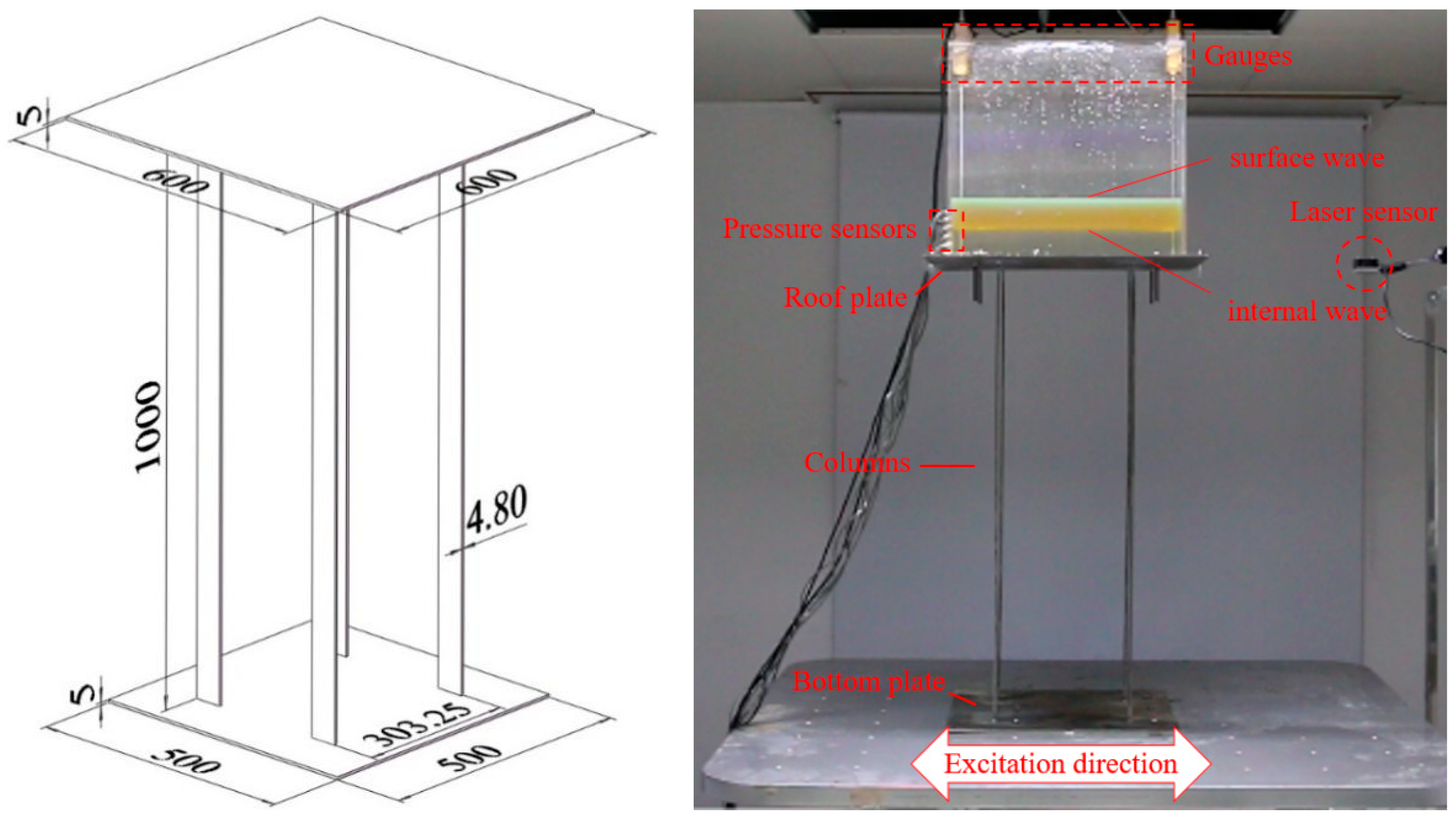
To simulate the motion response of the slender structure, in Figure 1, a supporting structure of four columns with a dimension of 4.8 × 50 × 1000 mm was constructed in the Laboratory of Vibration Test and Liquid Sloshing at Hohai University. Meanwhile, a base plate with 500 × 500 × 5 mm dimensions and a roof plate with 600 × 600 × 5 mm dimensions were used to link the moving simulator and the tank, respectively. Four bolts at each corner connected the steel plates to the 6 DOF motion simulation platform. The connection of columns to the base plate and roof plate was achieved via welding, and the columns were vertical to the ground. The base plate was subjected to sinusoidal excited vibration through the moving simulator, and a laser displacement sensor recorded the displacement–time histories of the roof plate with a sampling frequency of 1000 Hz.
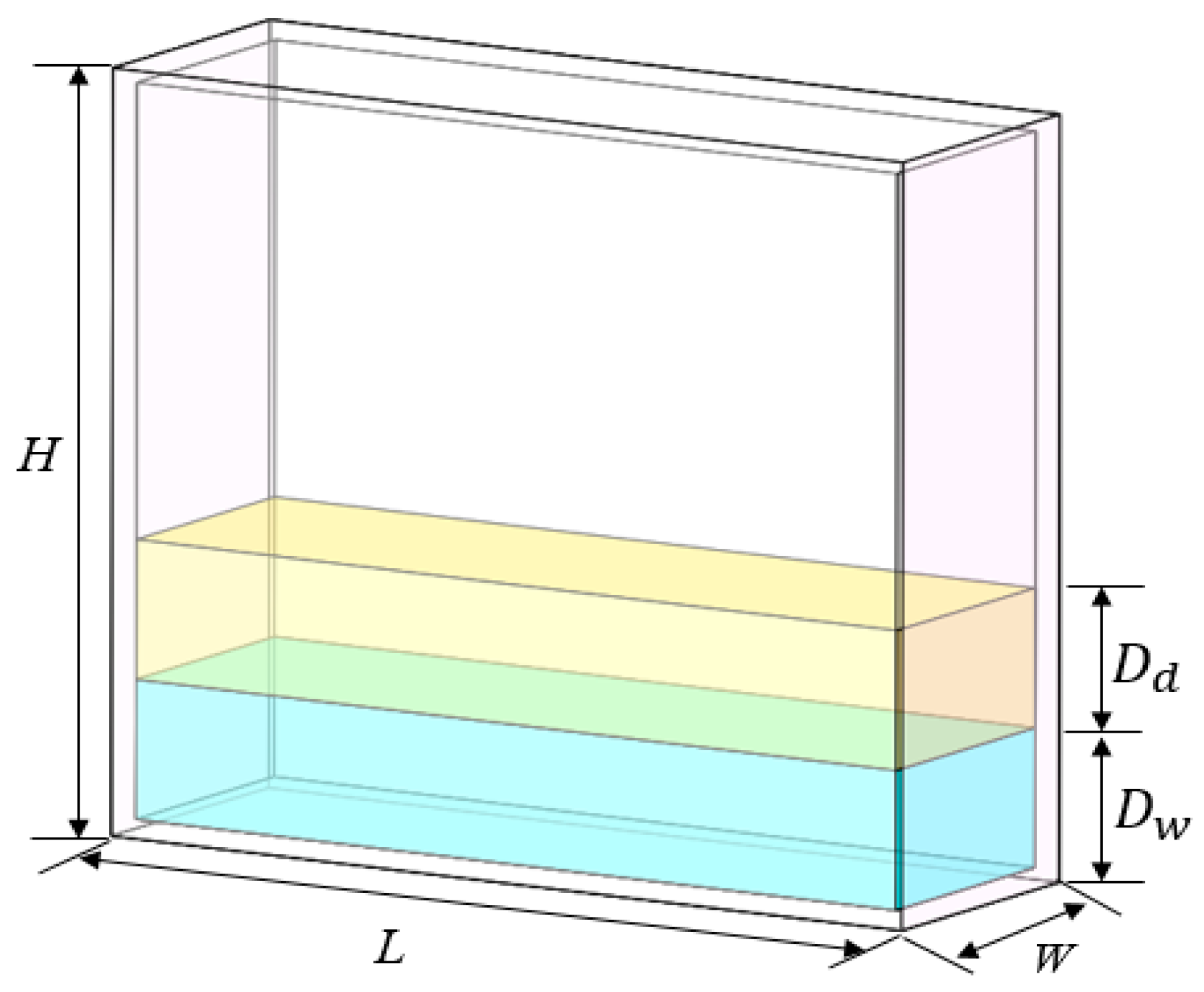
To evaluate the damping effect of the LTLD in suppressing structure vibration, a rectangular Perspex tank with dimensions (L × W × H) of 510 × 150 × 470 mm was designed, as shown in Figure 2, to observe the flow motion. Additionally, six pressure sensors were fixed to the left wall (1, 3, 5, 7, and 9 cm from the bottom of the tank) to obtain the impact force, and two gauges (WH200) were set at 2 cm on both sides of the tank to monitor the free surface elevation. The pressure and wave time history changes were saved using the data acquisition system SDA1000 with a sampling interval of 0.01 s. The tank was partially filled with water and diesel from the depth D w to D d . Based on the linear wave theory, the first standing wave frequency of the water in a rectangular tank can be evaluated using the following equation [42]:
f w n = 1 2 π n π g L t a n h n π D L
where L, D, n, and g represent the width of the tank, the depth of the liquid, the sloshing mode number, and the local gravitational acceleration, respectively.
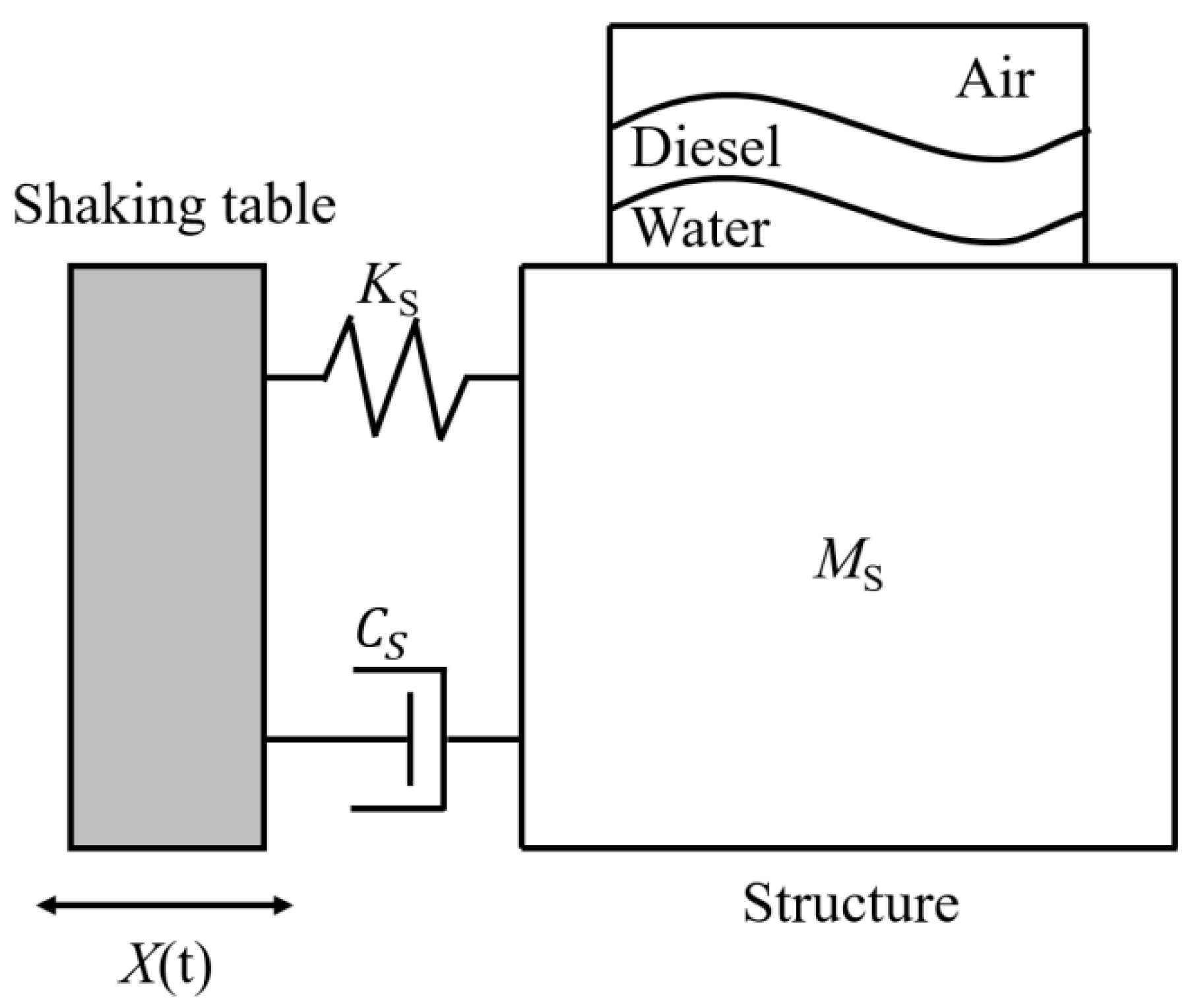
The schematic view of a single-degree-of-freedom structure coupled with a TLD is presented in Figure 3. The structure used in the tests was 304 stainless steel, with a density of 7930 kg/m3, and the tank material was plexiglass, with a density of 1190 kg/m3. Generally, a slender structure enhances the roof plate response. Further, shallow water presents more substantial nonlinear characteristics [10] and may result in a liquid mixture of water and diesel. Therefore, the study was carried out at medium liquid depths where the filling ratio D / L was equal to 0.25 and 0.35, which is beneficial for observing the interface elevation. The resonance frequencies were calculated using Equation (1) when D / L     = 0.25 and 0.35 are 1.0 Hz and 1.1 Hz, respectively. The liquid composition ratio of diesel R is defined as:
R = D d D , ( D = D d + D w )
To compare the effect of vibration reduction between the traditional TLD and the LTLD, the coupled structure was driven by sinusoidal excitation X ( t ) = A s i n ( 2 π f t ) , with three excitation amplitudes ( A ) and a wide range of excitation frequencies ( f ) adopted, as shown in Table 1 (Case 1-1 to 6-1). The excitation amplitudes of 1, 2, and 3 mm were selected to cover the linear-to-weakly nonlinear regime, effectively exciting interfacial waves without excessive fragmentation. The excitation frequency ranged from 0.5 Hz to 2.5 Hz (with an interval of 0.1 Hz), which covered the natural frequencies of the structure obtained via finite element (FE) analysis, while remaining within the operational limits of the shaking table. The resonant frequency region was tested with finer resolution to capture the peak responses. In addition, parts of the experiments (Case 1-2 to 6-2) were implemented to investigate the damping effect of the LTLD with different ratios of the layered liquids R and two filling levels. For this series, R values of 0, 0.2, 0.25, and 0.5 were adopted—with R = 0 serving as the single-fluid control case—to systematically examine the effect of interface position on energy dissipation. The two filling ratios (25% and 35%) correspond to intermediate water depths, where nonlinear sloshing characteristics are pronounced while avoiding liquid mixing under large excitations. This parameter matrix enables a comprehensive evaluation of the water–diesel LTLD’s damping performance and its governing factors.
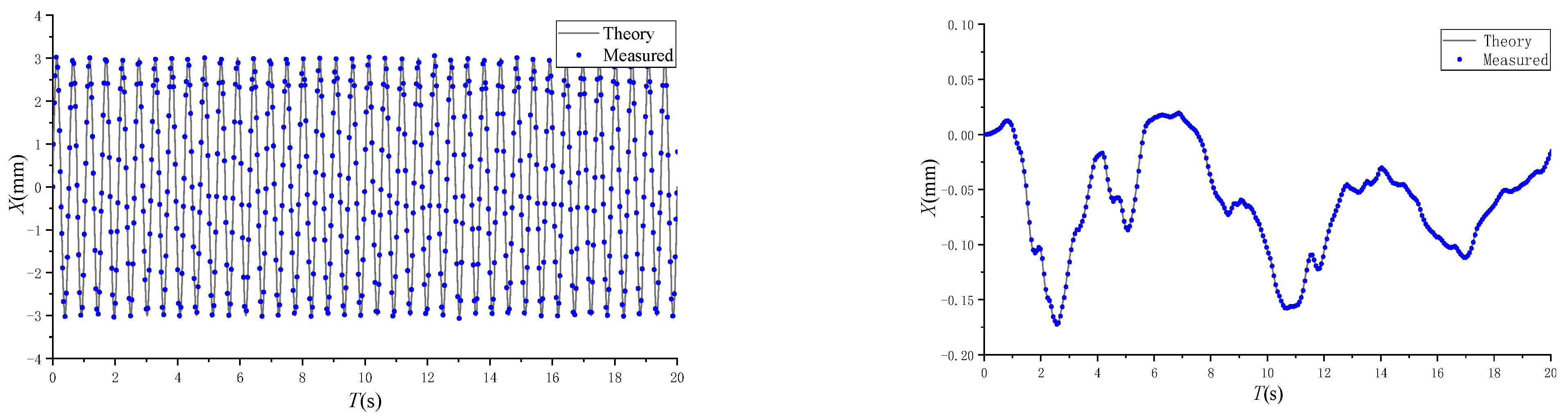
In the study, sinusoidal movements were applied to the bottom plate using the six degrees of freedom intelligent control system, and laser displacement sensors validated the motion simulator in Figure 4 under sinusoidal (X(t) = Asin(ωt), where ω = 11.93 rad/s and A = 3 mm) and El seismic excitation, in which the measured position was on the side of the shaking table. Each of the tests was repeated twice and over 40 s to enhance the repeatability of the data.

3. Results and Discussion

3.1. Dynamic Characteristics of Elastic Structure

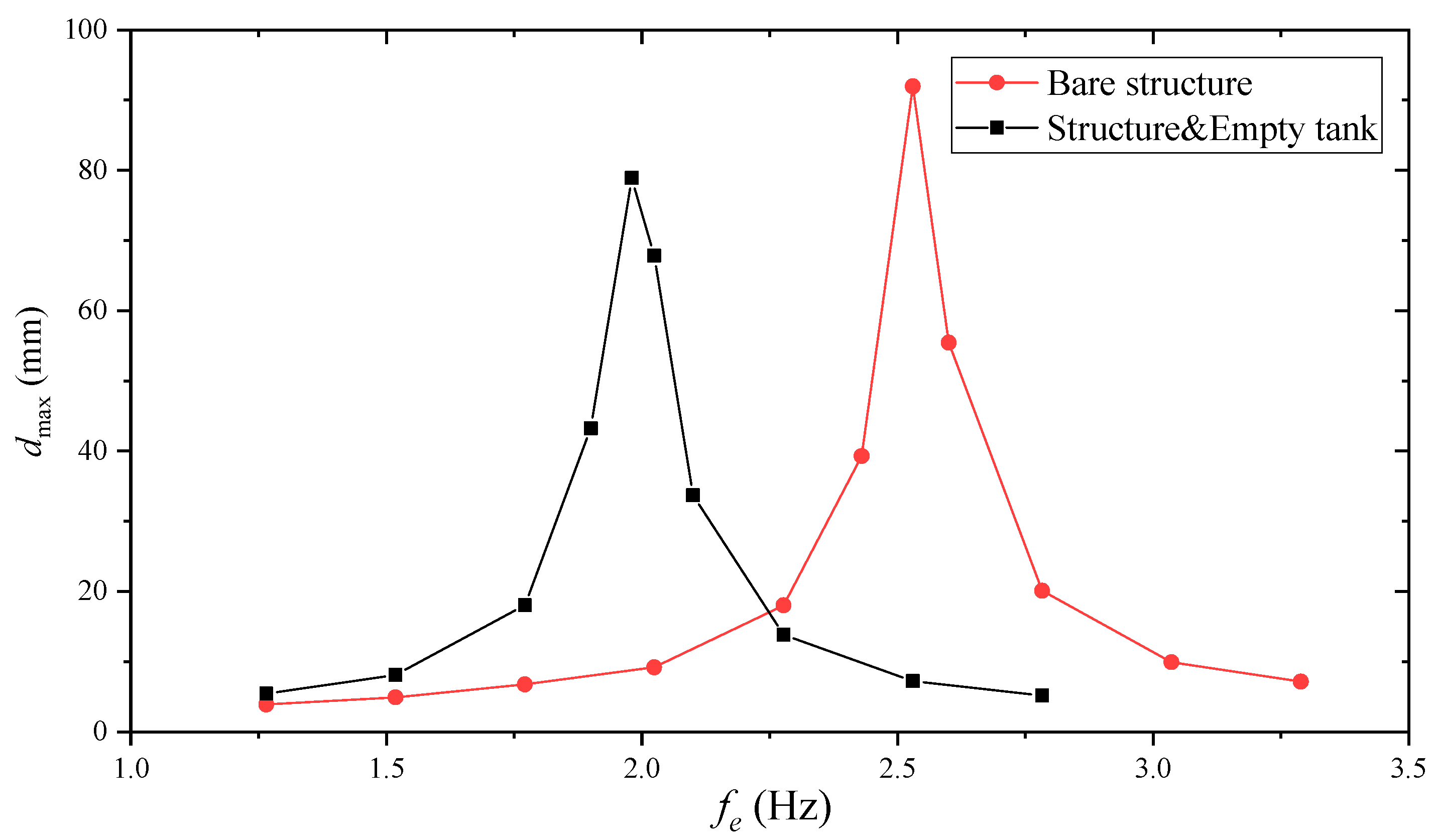
The time-series data for roof plate vibration were determined using a high-precision laser displacement sensor installed at the same height as the roof plate. Before the tank was installed on the top of the structure, some critical structural properties such as the damping ratio, resonance frequency, and response frequency diagram of the bare structure were determined experimentally using sweep tests. The natural frequency of the bare structure was calculated as 2.53 Hz by comparing the maximum displacement of the roof plate d m a x . The sweep interval was 0.01 Hz near the numerical natural frequency value of 2.50 Hz obtained via FE. The error of natural frequency was 1.2% as determined using the numerical and experimental method, which validated the construction of the model. The weight of the bare structure and of the empty tank was 31.8 kg and 10.5 kg, respectively. Affected by the increased mass of the tank, the natural frequency shifted to 1.98 Hz after the empty tank was installed on the structure. Meanwhile, in Figure 5, the diagram of d m a x versus f e is presented with the excitation frequency ranging from 0.5 f s to 1.5 f s , where f s is the natural frequency of the SSP with TLD. As can be seen from Figure 5, the peak value of d m a x decreased from 91.0 mm to 78.9 mm, which means that added mass reduced the structural vibration and induced frequency shift. The Logarithmic Decrement Method was used to calculate the damping ratio at 0.28% in the horizontal direction.

3.2. TLD and LTLD Performance in Suppressing Structural Vibration

The nonlinear response of the coupled system with three different amplitudes was studied to compare the performance of conventional TLDs and LTLDs. In the tests, small-bottom excitation amplitudes with 0.00196 < A/L < 0.00588 were selected in order to observe violent sloshing. The slender supporting structure magnified the bottom movement.
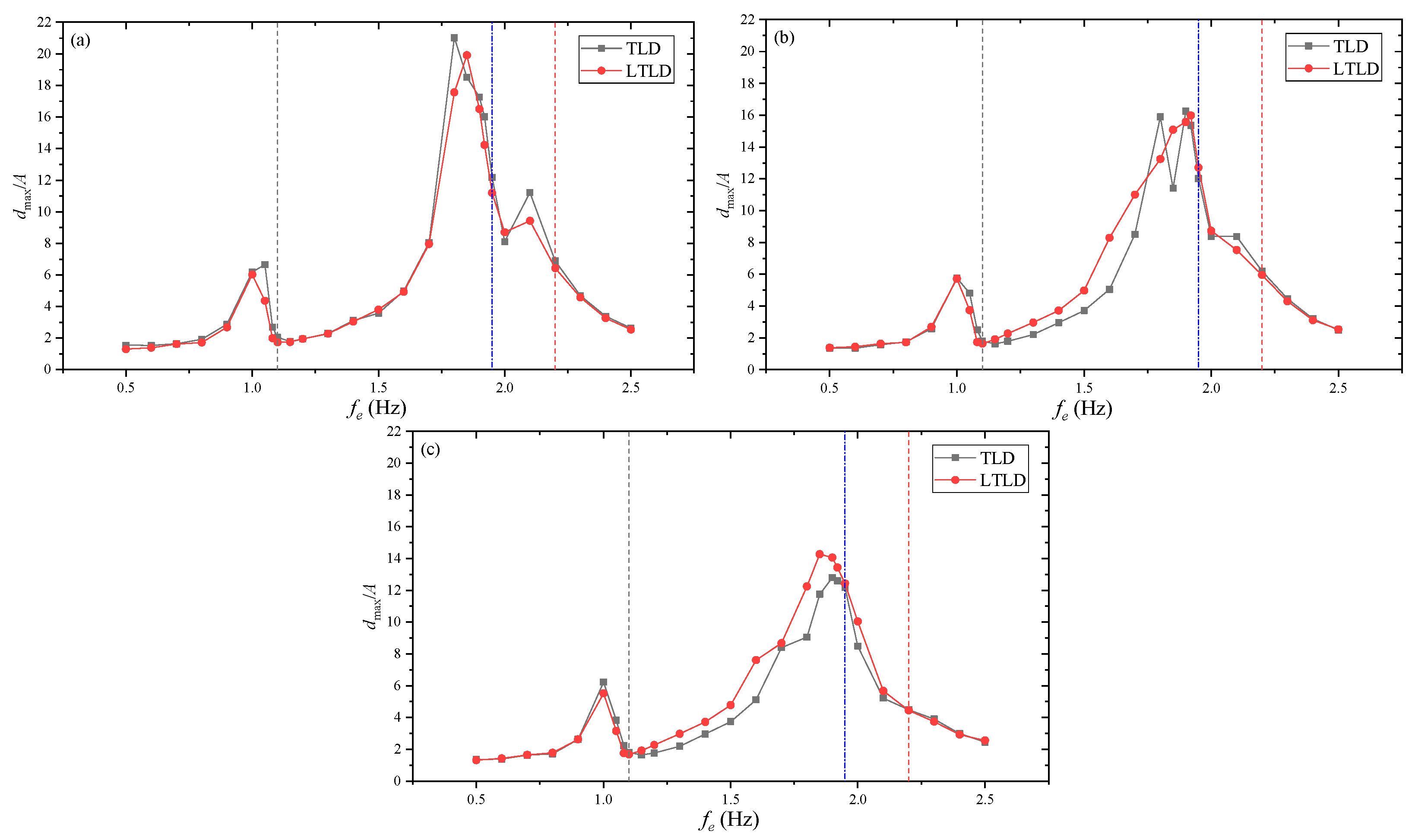
Figure 6 represents the roof plate displacement D m a x versus excitation frequencies f e of the TLD and LTLD for different excitation amplitudes. Meanwhile, the depth of diesel D d was half of the total liquid depth over the tests. Compared with the results without water in Figure 5 and Figure 6c shows the liquid performance in mitigating the vibration with the same excitation amplitude of 3 mm. It can be seen that the d m a x and f s were reduced by 51.34% and 4%, respectively, the reasons being the sloshing-induced hydrodynamic force and added mass of water. The fluid in the tank gained energy from the structural vibration and dissipated in two main ways: (i) suppressing structural vibration in the form of damping force; (ii) the internal dissipation of wave breaking and eddy energy. Remarkably, layered flow can dissipate additional energy through internal waves. As shown in Figure 6a, the LTLD has a better damping effect than the conventional TLD, where there is a single fluid in the tank. The results indicate that the LTLD has a further reduction ratio of 5.3% and smaller natural frequency shift when the amplitude A = 1 mm.
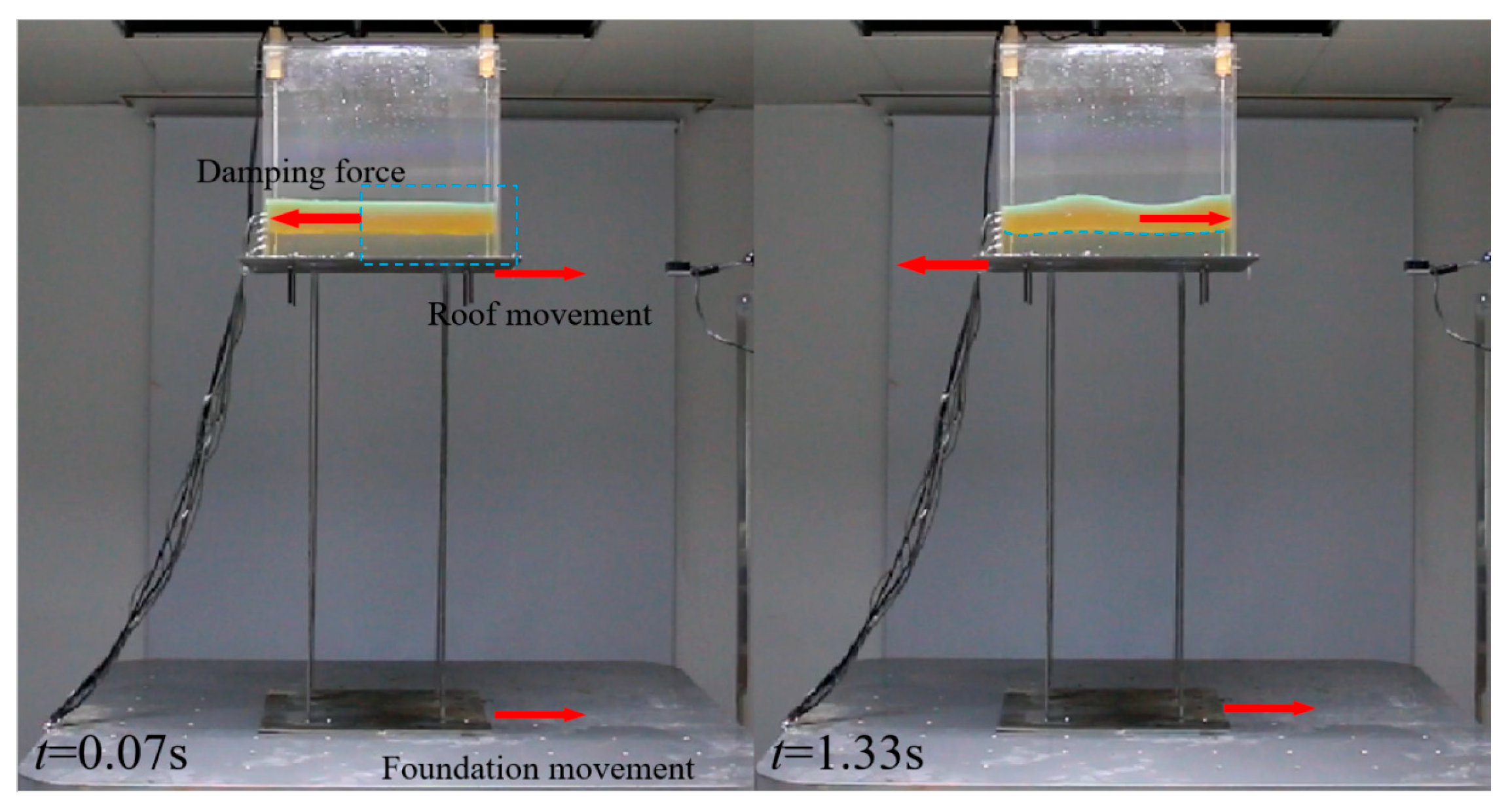
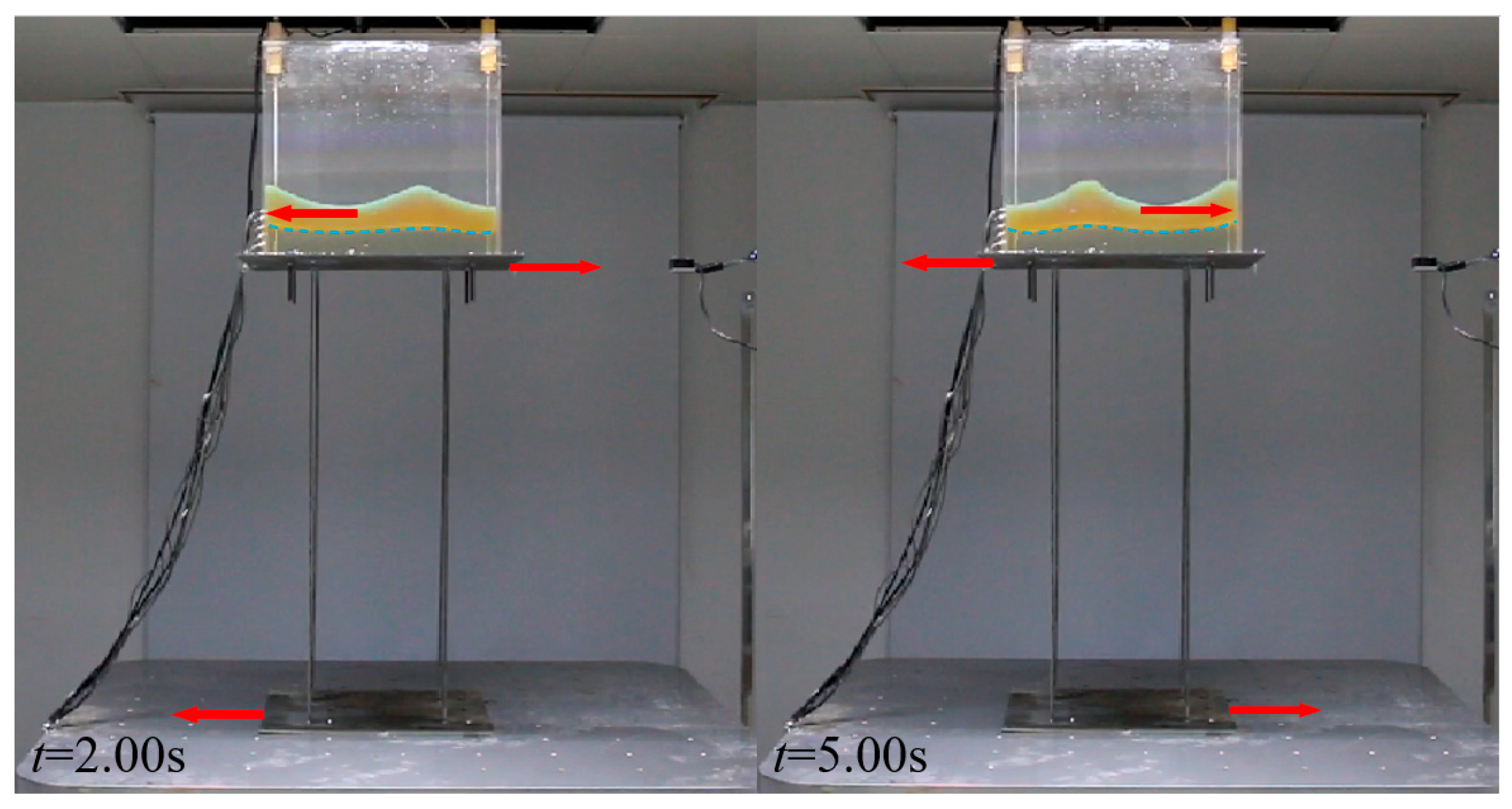
To directly demonstrate the damping mechanism of the LTLD, the dynamic response of the coupling system of Case 6-2 is presented in Figure 7. When t = 0.07 s, the shaking table drives the whole system to move to the right, and the movement direction of the roof and the base is the same. The fluid in the tank hinders the roof plate from moving to the right due to its own inertia. The left fluid absorbs the energy transferred by the structure movement, and its kinetic energy and potential energy reserves are reflected in the form of a sloshing wave propagating to the right, where the liquid shown by the blue dotted line is relatively stationary. It can be observed that the roof plate lags behind the bottom, and the fluid always provides a damping effect on the structure. With the increase in excitation time, the surface wave energy transfer to the internal wave is reflected in the blue dotted line approaching the free surface wave shape. Under small-amplitude excitation, the internal wave shape is clear because the two-fluid media are immiscible, which indicates that the shear and reflection effects dissipate the energy of the flow domain. Even if the mass of the LTLD were 8.0% lower than that of the pure-water TLD, the maximum displacement control effect of the LTLD could be improved by 5.12% under the condition of f e = 2.2 Hz in Case 6-2.
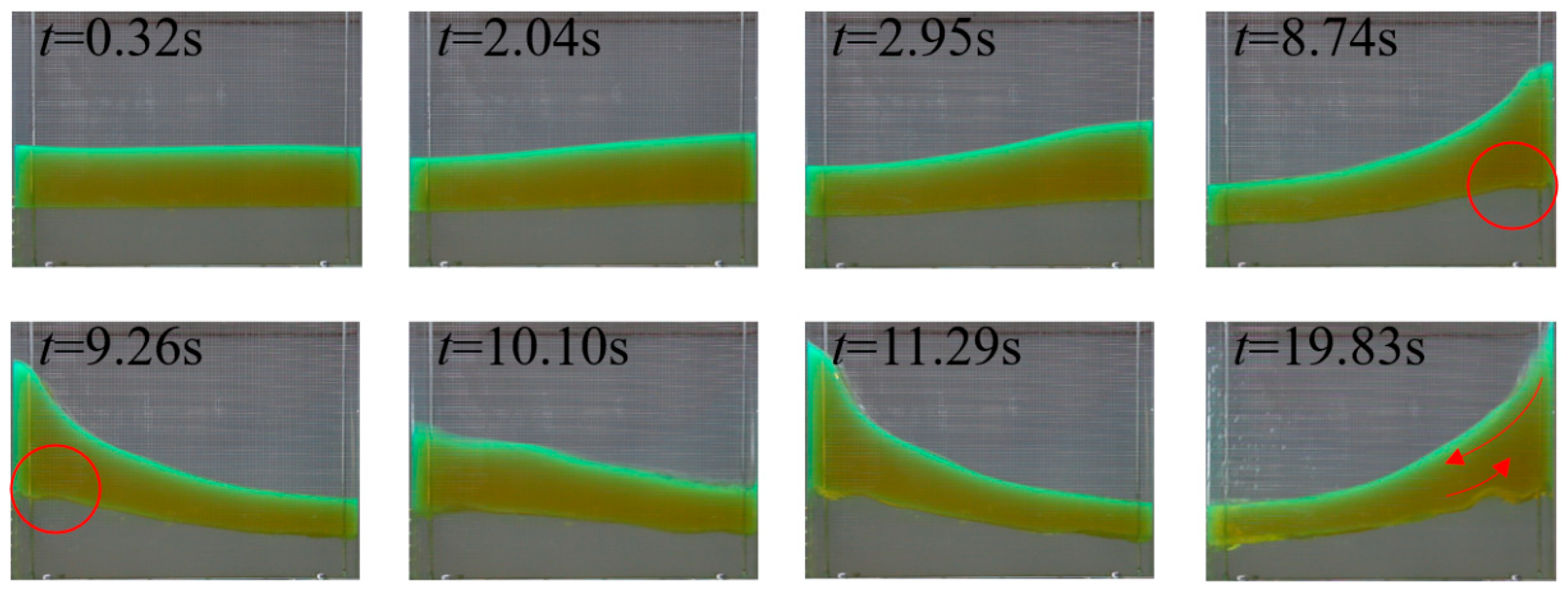
A second peak appears at a low frequency near 1.0 Hz in Figure 6; the reason for this is that, when the external excitation frequency approaches the natural frequency of liquid, as shown in Figure 8, it strengthens the sloshing waves in the tank and therefore increases the hydrodynamic force acting on the structure. In the first 2.95 s, the wave height for the inner wall increases continuously. However, when the excitation time reaches 8.74 s, the free surface motion causes the separation surface to excite a short wave (in the red circle). In addition, the separation surface appearance changes dramatically during the propagation of the short wave, which is quite different from that of the free surface (t = 11.29 s). The separation surface near the walls hinders the movement of the free surface, which prevents the phenomenon of “hydraulic jump” and the impact on the tank top in the LTLD that is seen in the conventional TLD.
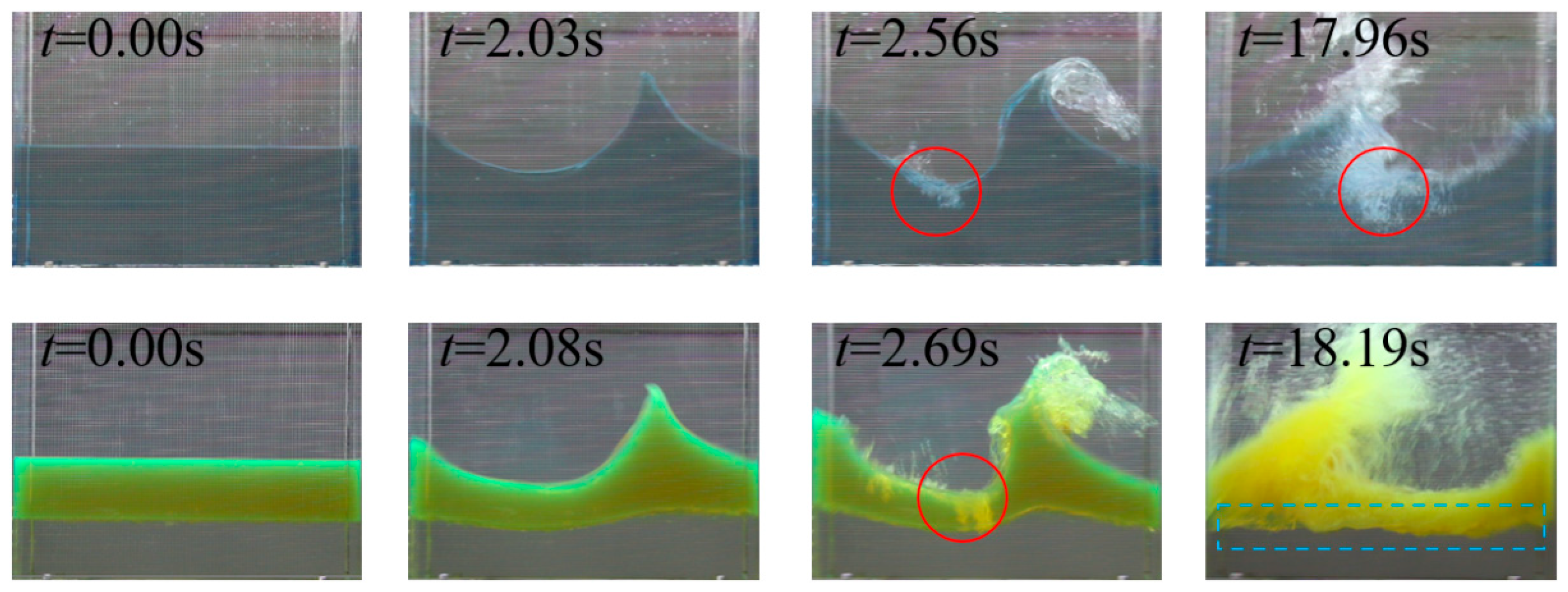
As shown in Figure 6c, the LTLD has adverse effects as the amplitude increases. To investigate the motion of the fluids under large-amplitude excitation, some of the resonance snapshots for the TLD and LTLD are shown in Figure 9. It can be observed that, once the tank begins to move, significant deformation of fluid occurs (t = 2.08 s), in which the elevation of the free surface is much greater than that of the separation surface. With the increase in energy input through structural vibration, the horizontal velocity at the wave crest breaks up because it is less than the average velocity (t = 2.69 s). It should be noted that violent sloshing occurs when the coupled system achieves balance and the maximum displacement d m a x / L = 0.07527. Violent tank sloshing may lead to the miscibility of water and diesel near the interface (t = 18.19 s), which weakens the interaction between the two flows. In addition, the other reason for the disadvantage of the LTLD at a large amplitude may be the smaller hydrodynamic forces acting on the tank due to the diesel density. Meanwhile, a larger natural frequency shift is caused by large-amplitude excitation.
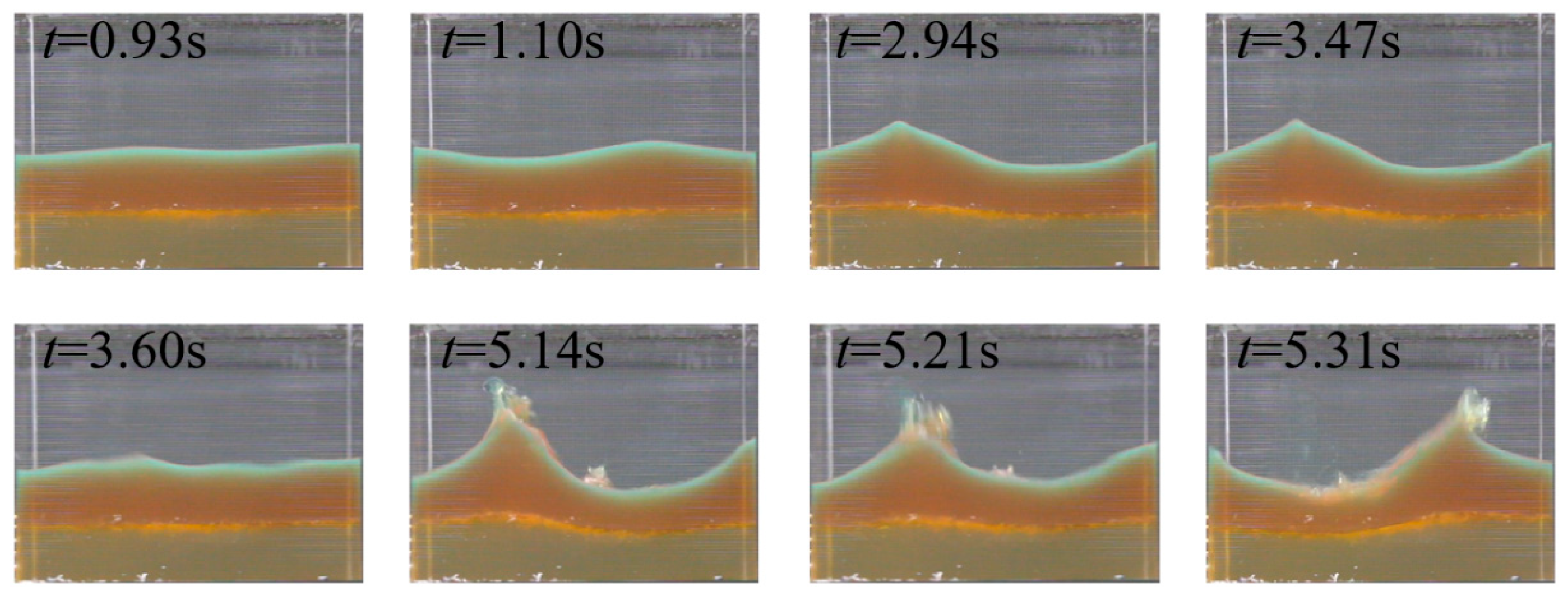
To compare sloshing wave morphology evolution in the LTLD at a small amplitude, A = 1 mm, images of the free and separation surface of Case 2-1 under resonance are shown in Figure 10 (different light sources caused the color difference). It can be seen that, in the process, the free and separation surface are stable, which indicates that the two liquids can be considered immiscible. Therefore, the separation surface motion at a small amplitude can achieve energy dissipation, which is also why the damping characteristic of the LTLD is found to be better than that of the conventional TLD in sweep tests (Figure 6a).
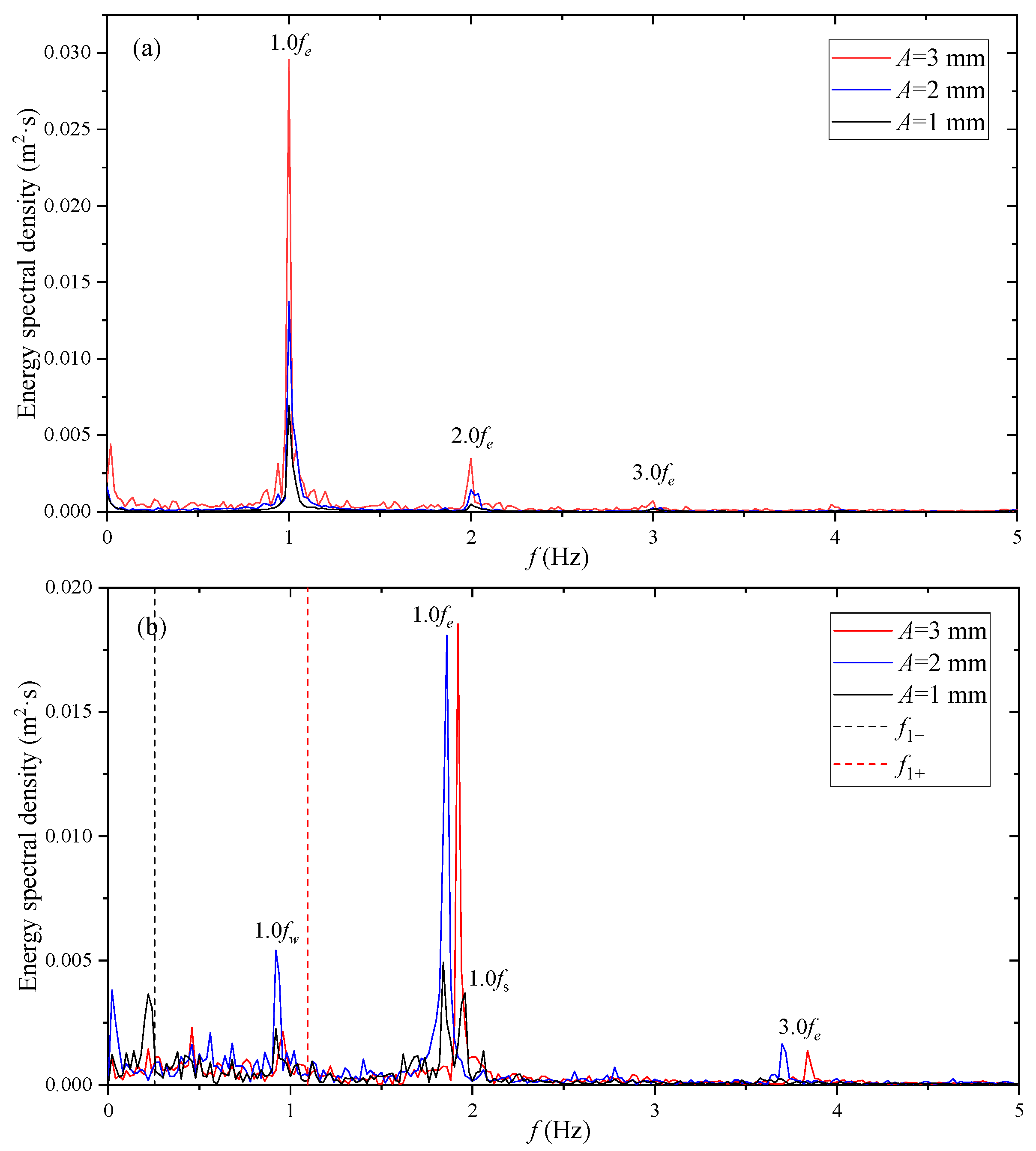
To investigate the frequency characteristics of the interfacial wave motion and its contribution to energy dissipation, the Fast Fourier Transform (FFT) was applied to analyze the power spectral density of the separation surface elevations. For an excitation frequency of 1.0 Hz (near the fundamental sloshing frequency), the energy spectra for the first 50 s are shown in Figure 11a. The dominant peaks appear at the natural sloshing frequency and its superharmonics (2.0 Hz and 3.0 Hz), indicating that nonlinear wave interactions lead to energy transfer to higher frequencies, which contributes to enhanced energy dissipation.
For two immiscible liquids with a free liquid surface, the analytical solution of the natural frequencies of stratified flow has been derived, and the frequencies can be expressed as [35,43]:
f n   ± 2 = ( L n ± L n 2 2 γ n β n ¯ ) γ n / 2 π
L n = k n g ( t h n 1 + t h n 2 ) + T 12 k n 3 ρ 2 · t h n 2 + T 01 k n 3 ρ 1 · ( t h n 1 + R 12 + t h n 2 ) β n = t h n 2 · t h n 1 ( k n g + T 01 k n 3 ρ 1 ) ( 1 R 12 ) k n g + T 12 k n 3 ρ 2 γ n = 2 ( 1 + R 12 t h n 2 · t h n 1 ) k n = n π L ,   t h n i = t h n π D i L , R 12 = ρ 1 / ρ 2 }
where f n ± represent the two natural frequencies for two immiscible liquids, and the numbers 1 and 2 represent the upper and lower liquids, respectively. T 12 and T 01 are the tension coefficients of the separation and free surface, respectively. The higher frequency f 1 + corresponds to the free surface motion, while the lower frequency f 1 is associated with the separation surface motion.
As shown in Figure 11b, the lower frequency f 1 is clearly observed under small-amplitude excitation (A = 1 mm), where the two liquids remain immiscible and the interfacial wave is stable. With increasing excitation amplitude (A = 2 mm and 3 mm), the energy at this frequency diminishes due to increased interfacial mixing and fragmentation. The deviation from the analytical solution may be attributed to the finite water depth effects [44]. This dual-frequency characteristic of layered flow provides an additional mechanism for tuning the damping frequency band of the LTLD, enabling it to target multiple structural modes and thereby enhancing its broadband vibration suppression capability.
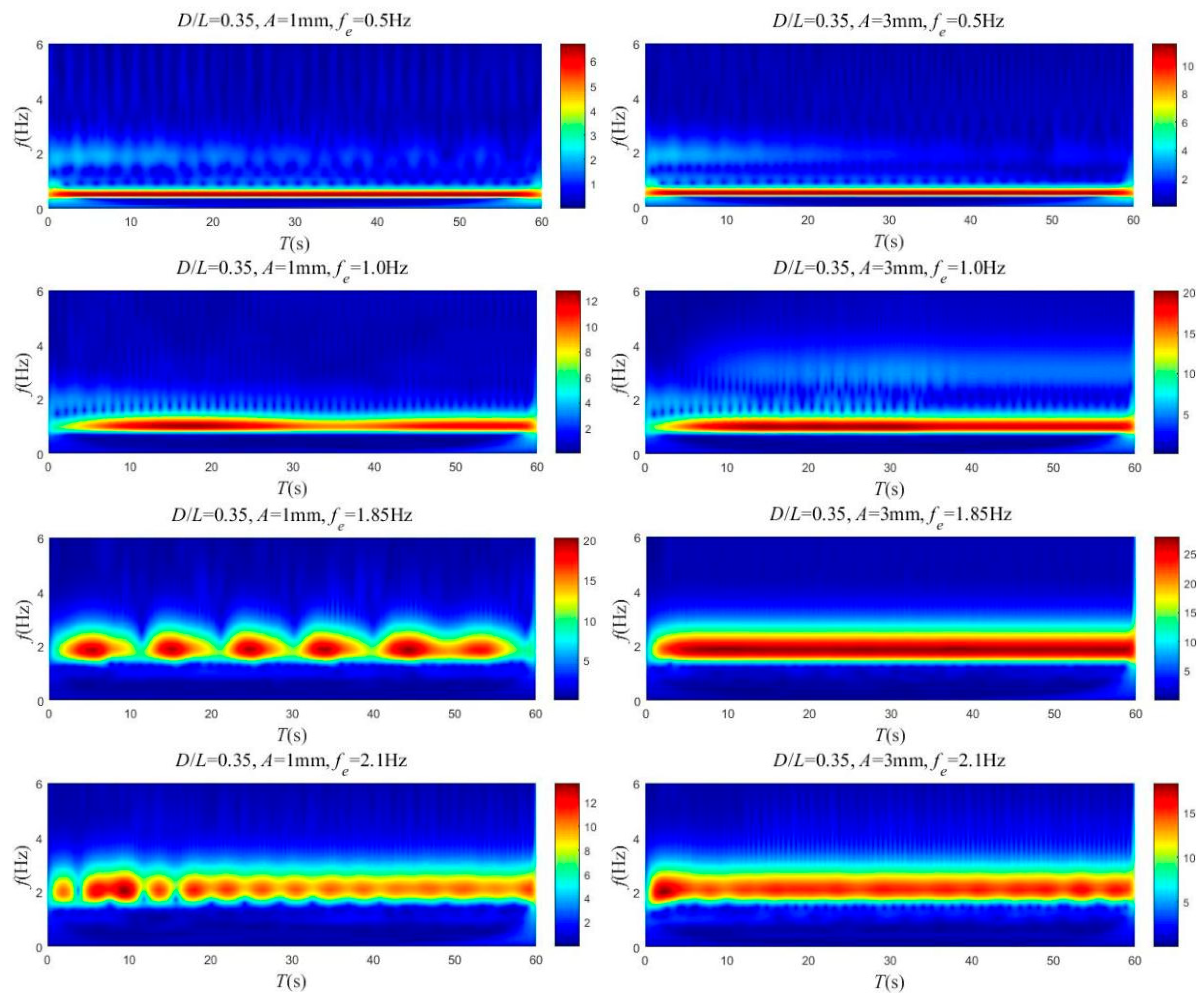
Wavelet transform has been successfully applied to analyze the hydroelastic effects of sloshing [45] and the nonlinear wave–wave interactions of breaking waves [46]. Instead of the Fast Fourier Transform, in the study, the wavelet transform was used to analyze the time-varying frequency components of the structural dynamic response. To compare the effects of amplitude on the dynamic response of the structure, the frequency components of the time history of the structural motion with different amplitudes and external frequencies are presented in Figure 12. At the low external frequency of 0.5 Hz, as shown, the first two orders of dynamic response show the external excitation frequency and the coupling system, respectively. However, the second wavelet ridge disappeared when the structural motion reached a steady state. In the transient state, the sudden excitation always resulted in nonlinear motion because of the unstable energy dissipation of the damper, where energy obtained by the fluid was more significant than the energy released. In addition, the frequency component distribution in the time domain showed periodicity under small-amplitude excitation, which indicates that, when the energy input is small, the low miscibility can increase the energy dissipation between two layers of fluid. The peak value that appears in Figure 6 with f e = 2.1 Hz can be interpreted as the 2.0 f w 1 -induced effect during the transient state. Therefore, we recommend the LTLD to improve damping performance when d m a x / L < 0.04984 with the consideration of energy dissipation.

3.3. Effects of Liquid Composition Ratio

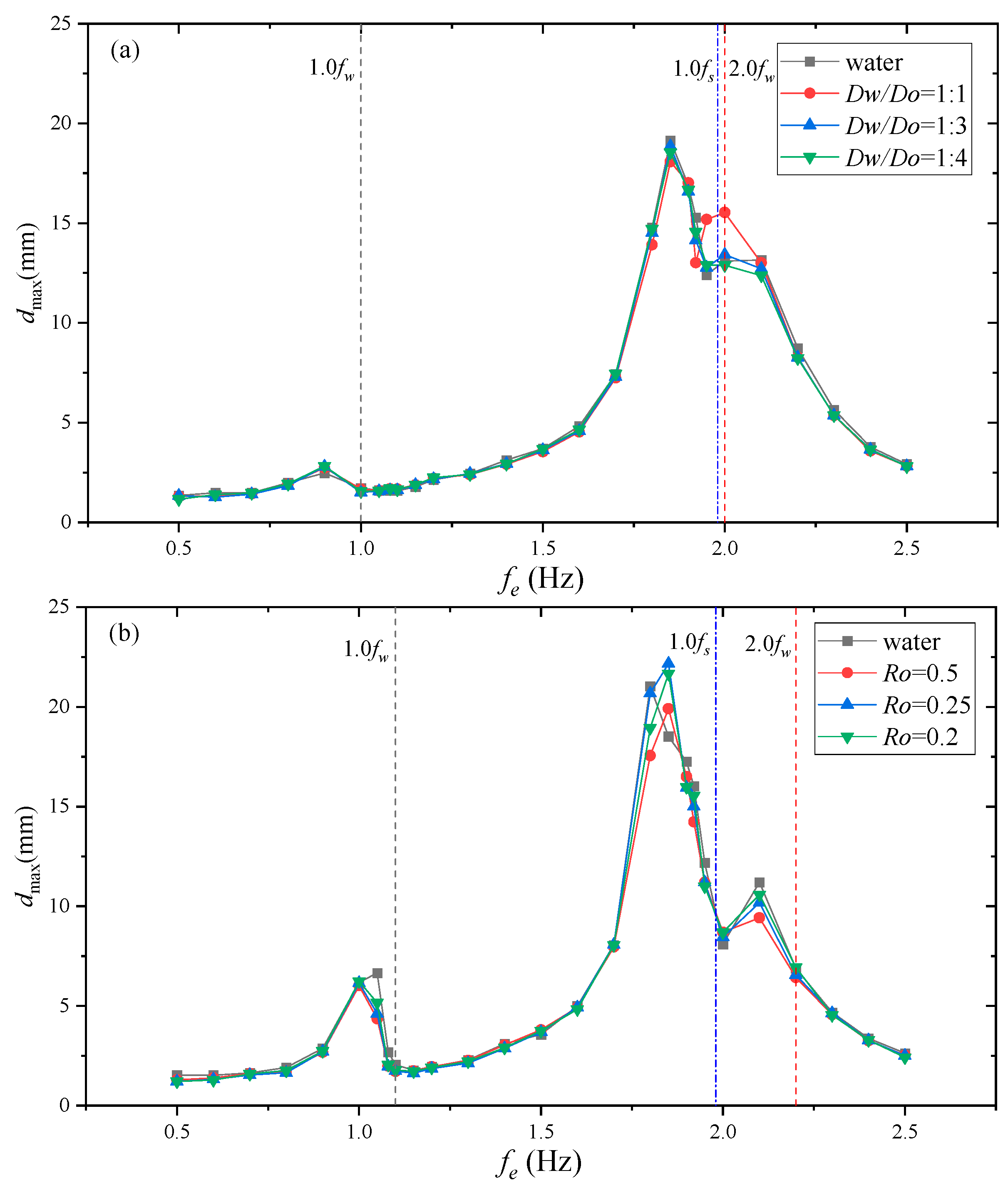
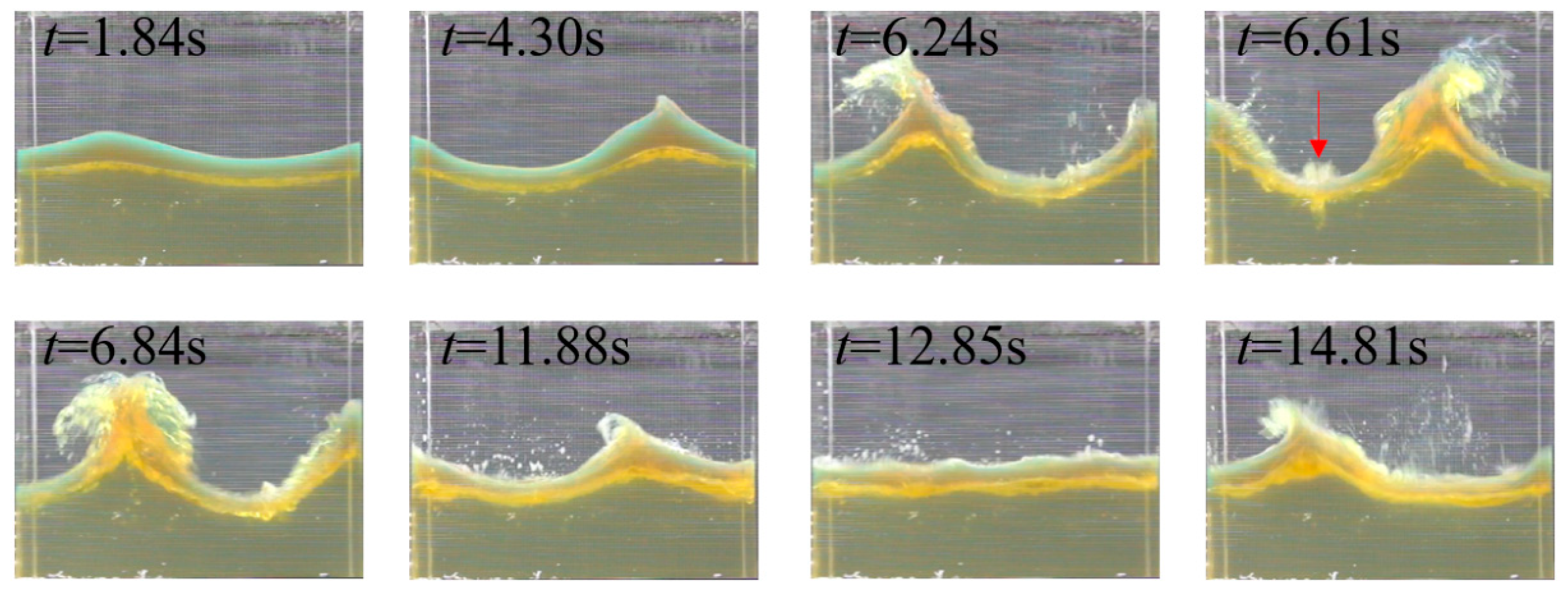
To evaluate the effect of the liquid composition ratio on the damping performance, the maximum roof displacements versus external excitation frequency are shown in Figure 13. It can be observed that the optimal diesel ratio R is 0.5, which indicates that the reduction in diesel depth restrains the generation of internal waves. If the diesel ratio is low, the stable shear layer cannot be formed to dissipate energy. Meanwhile, the mass of the LTLD is smaller than that of the TLD with the same depth, which reduces system damping. With the further decrease in diesel (Dw:Dd = 1:4), the damping performance of the LTLD is closer to that of the conventional TLD. The increase in diesel ratio reduces the mass ratio of the LTLD, which can optimize the influence of damper mass on structural inertia. The free and separation surfaces of Case 1-2 are shown in Figure 14. Under the low diesel ratio, the free surface wave is more efficiently transferred to the internal wave. When the standing wave decays, the free surface wave falls, which leads to the three-phase mixing phenomenon (t = 6.61 s). With the increase in the structural response, the standing wave splashes when t = 6.84 s. The energy input of the system is limited under small-amplitude excitation, so the sloshing phenomenon tends to ease in the following 6.84 s to 12.85 s.
The damping performance of the LTLD compared to the TLD is presented in Table 2, where the coefficient K quantifies the improvement effect of the LTLD. The LTLD demonstrates superior performance under conditions of shallower water depth (25% fill ratio) and smaller excitation amplitudes (A = 1 mm). In this scenario, the interfacial wave motion remains stable, allowing the LTLD to leverage its advantages effectively. However, at a larger amplitude of A = 3 mm and a fill ratio of 35%, the LTLD exhibits a negative impact on vibration reduction, with an 11.48% decrease in performance compared to the TLD. In summary, the LTLD demonstrates superior vibration suppression performance under small-amplitude excitation. Notably, its damping effect achieves an additional improvement of more than 5% compared to the TLD at a frequency ratio of R = 0.5, underscoring its significant advantage.
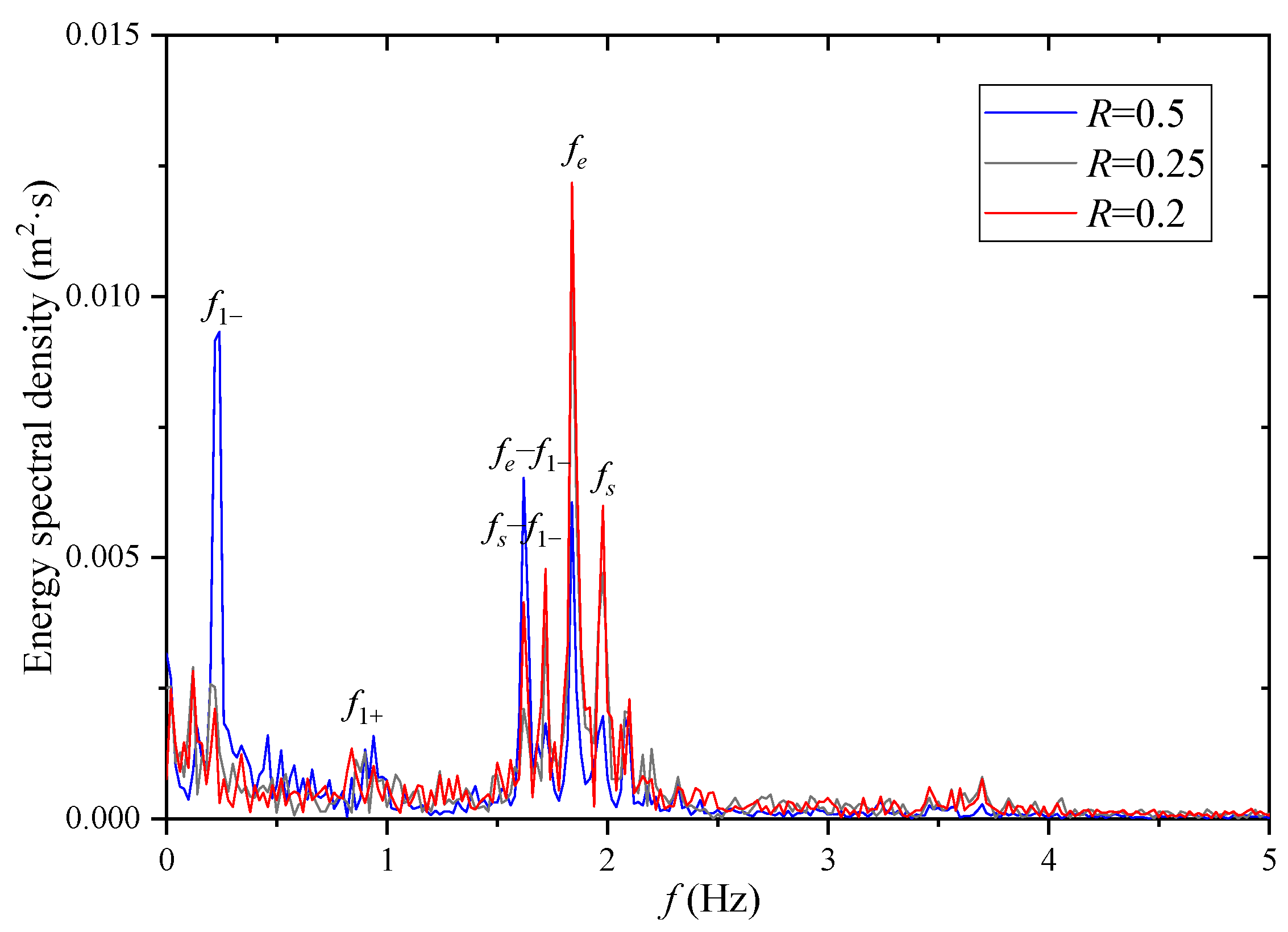
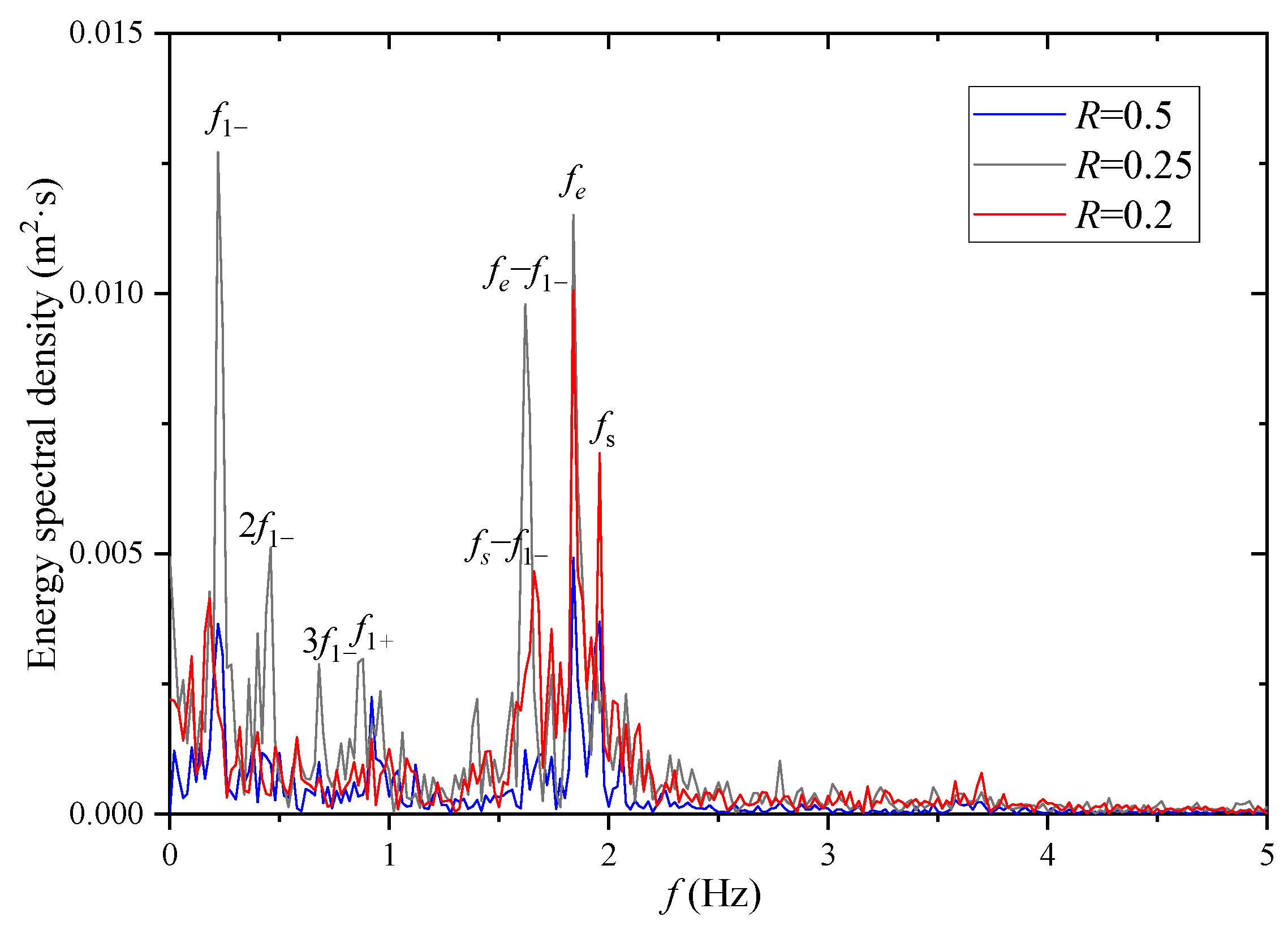
For the coupled LTLD and elastic structure system, the frequency composition of internal waves becomes more complicated and exhibits strong nonlinear characteristics with the evolution of the sloshing process. Figure 15 and Figure 16 show the frequency components of internal waves at system resonance for different liquid composition ratios. It should be noted that the internal wave elevations on the light wall contain many frequency components, including separation and free surface motion frequencies, multiplication frequencies, the natural frequency of the structure, and difference frequencies generated by wave–structure nonlinear interactions. Sorted based on the spectral energy of the frequency components of the 25% filling ratio, as shown in Figure 15, the frequencies are f e , f 1 , f e f 1 , f s , f e f 1 , f 1 + . The separation surface motion causes the small natural frequency, and this can be proven because the amplitudes near f 1 are obviously larger than f 1 + . For Case 2-1, R = 0.5, the separation wave is mainly modulated by f e before the structural dynamic response reaches a steady state. However, when the energy input and output of the damper achieve a balance, the amplitude of f 1 increases, which indicates the effect of energy dissipation in the separation surface worked gradually with the generation of the waves. When the filling ratio is 35% and R = 0.25, multiplication frequencies of 2 f 1 and 3 f 1 can be seen in Figure 16, which may reduce the hydrodynamic force acting on the tank, and the damping effect is worse than that of a single fluid. Affected by the mass of fluids, the LTLD showed better performance with a low filling level. Under the condition of immiscibility between liquids, the effect of the LTLD may improve upon increasing the number of layers of stratified flow. In this study, an LTLD with a liquid composition ratio of 0.5 is recommended to suppress structural vibration.

3.4. Fluctuating Pressure of LTLD Under Resonant Responses

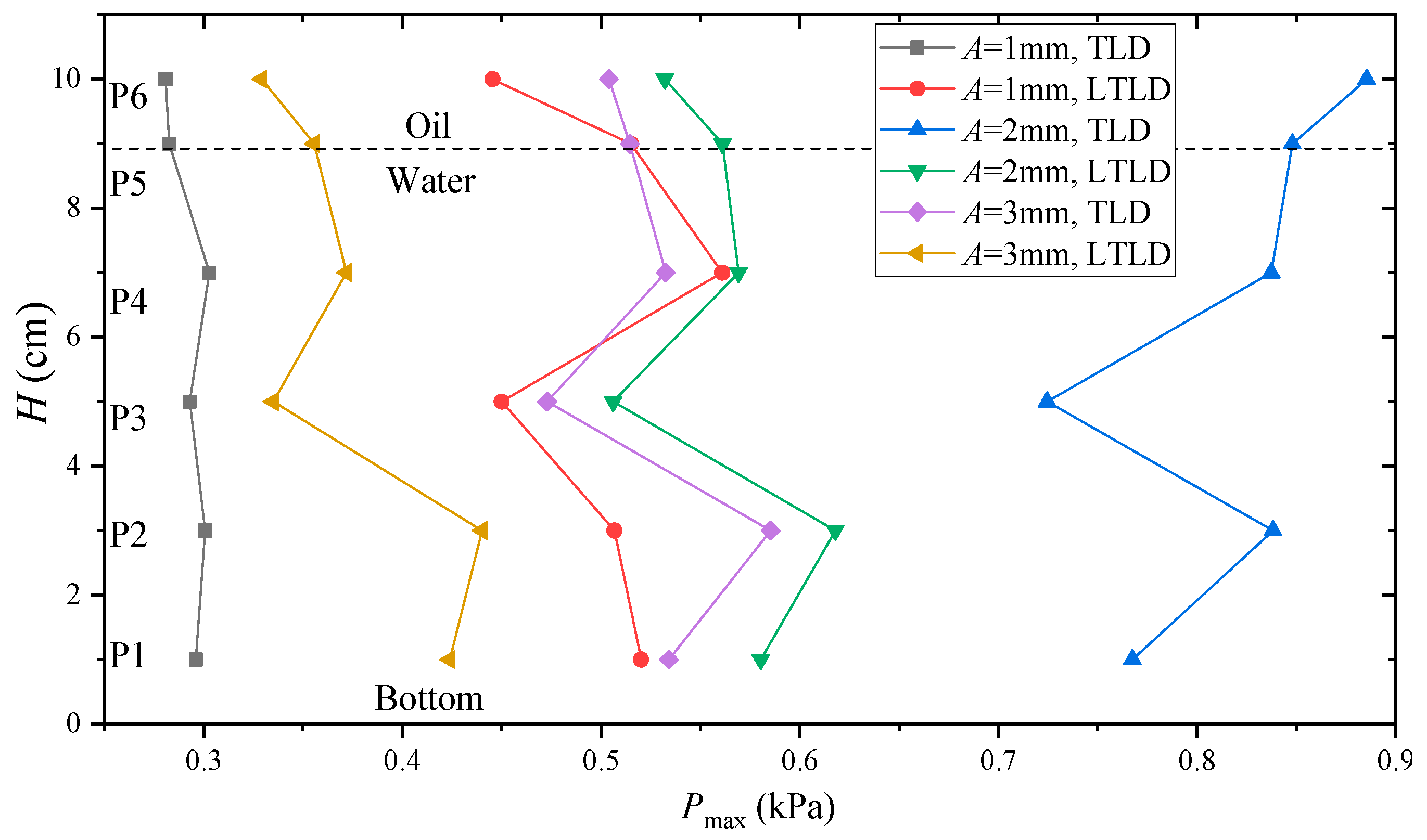
To evaluate the effect of fluctuating pressures on the tank, six pressure sensors on the left wall recorded the pressure that removed the initial hydrostatic for 50 s. The maximum fluctuating pressures P m a x of resonance excitation for different depths and amplitudes are presented in Figure 17. All the pressure sensors show the maximum value when the external amplitude is 2 mm. The reason may be that the sloshing wave of A = 2 mm was steady, and the amplitude of 1 mm and 3 mm restrained the sloshing wave and led to the breaking, respectively. By comparing the two dampers, we can see that for large amplitudes of 2 mm and 3 mm, the LTLD reduced the maximum fluctuating pressure value to twice that of the TLD via the energy dissipation of the interface wave. However, at small-amplitude excitation of 1 mm, the maximum fluctuating pressures caused by two-layer fluid were higher than those caused by single-layer fluid.
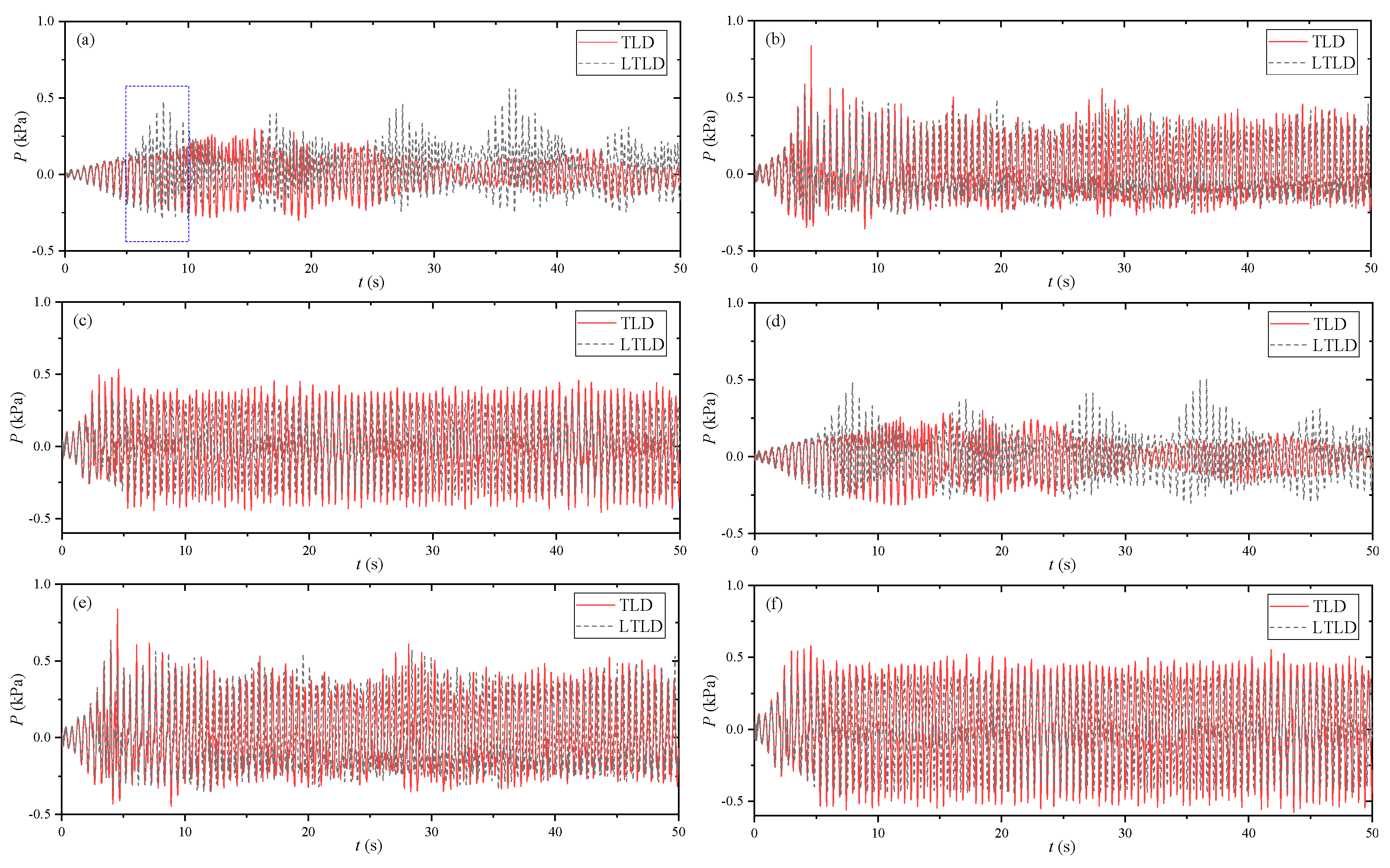
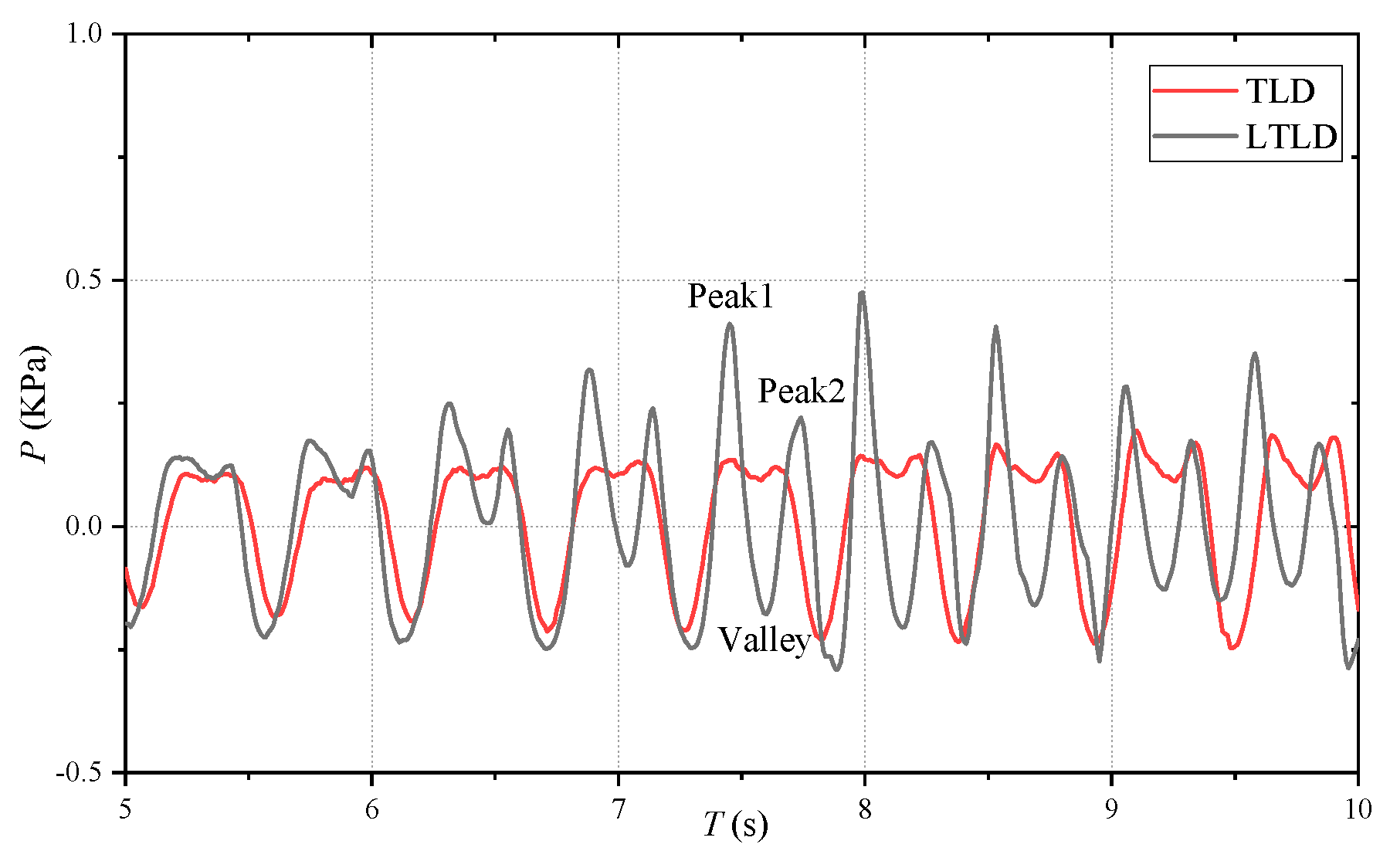
To find how amplitude affects the wall pressure, the time histories of P5 and P3, which have extreme values, are shown in Figure 18 with three different external amplitudes. It can be seen that the pressure curve of the two locations is similar under the same conditions. The stratified fluid was more likely to form sloshing waves, and the fluid tended to move along the tangent direction of the interface wave, which induced a higher damping force to act on the tank. For low-viscosity liquid, nonlinearity develops easily with a sharp crest and flat trough, and the transient state part shown in Figure 18a for 5-10 s within the blue dashed line was chosen for further study. In Figure 19, the two peaks that appear in response to pressure are related to the velocity distribution. Affected by the wave climbing on the left wall, the pressure increases with the horizontal velocity. The velocity nearly comes to a stop at the valley, where the wave reaches the highest level, but the wall pressure near the bottom drops to the minimum. At Peak2, the liquid on the left wall recedes and creates the second wall pressure peak by pushing water down [47] (Jin and Lin, 2019). For layered flows, the appearance of Peak1 and Peak2 may be caused by the phase difference of interface wave and surface wave motion.
For large amplitudes, as shown in Figure 18b,c,e,f, the pressure characteristics of the LTLD are similar to those of the TLD due to miscibility, and the maximum value at a steady state is close. However, before miscibility, the stratified fluid transferred energy through the interface, dissipated energy, and reduced the maximum pressure in the transient state, which is essential in order to reduce the impact on and noise in the structure. Due to the further increase in external energy input, the pressure was no longer at a higher level. The broken wave and rapid miscibility made the stratified liquids ineffective. It can be seen that the mass of stratified liquid is small, and the damping force provided by the LTLD is reduced. Therefore, the miscibility caused by the excessive normal velocity at the interface of two fluids would weaken the damping performance of the damper. In engineering applications, by keeping the interface wave from miscibility, the LTLD can enhance damping and broaden the damping frequency band.

4. Conclusions

Model tests were conducted to study the efficiency and characteristics of an LTLD coupled with an elastic structure. The damping performance was compared with the conventional single-liquid TLD with different amplitudes, diesel–water ratios and external excitation frequencies. The following conclusions can be drawn from the above results.
Both the TLD and LTLD showed good performance in suppressing structural vibration, and the LTLD showed a better damping effect under small-amplitude excitation of A = 1 mm and 2 mm. However, at an amplitude of 3 mm, the energy dissipation of the internal wave was significantly weakened by the miscibility. In addition, the mass of the LTLD in the same volume was less than that of the TLD, which reduced the hydrodynamic force acting on the tank. Snapshots tracked the miscibility of the LTLD near the separation surface under violent sloshing. We used FFT to analyze the spectral energy distribution of the separation surface and wavelet transform to present the time variation in frequency components of structural vibration. Three diesel–water ratios with two filling values were selected to compare the damping characteristics of the LTLD, and the results showed that R = 0.5 was the optimal value. The maximum fluctuating pressure occurred at A = 2 mm. By combining Figure 10 and Figure 18, it can be observed that the sloshing wave could not be fully developed when A = 1 mm and the tangential component of velocity along the interface was largely due to the flow not being able to move through the interface wave, which indicates that the maximum impact force of the LTLD was larger than the single-flow TLD. In cases of violent sloshing, as shown in Figure 18c,f, the pressure on the wall is less than the suction and the excess energy is consumed via wave breaking. The findings are summarized below:
  • Through sweep tests, it is shown that the LTLD achieves a further 5.3% reduction in roof plate vibration compared to the conventional TLD when A =   1 mm. However, a negative effect is seen near 1.0 f e and 2.0 f e . This indicates that the damper frequency doubling influence on the system cannot be ignored.
  • On the topic of immiscibility between two layers of liquid, the system’s energy can be dissipated via the movement of the separation surface to increase structural damping. However, vibration reduction is affected when two fluid layers are miscible due to large-amplitude excitation. We recommend adopting the LTLD when d m a x / L < 0.04984.
  • Under small-amplitude excitation, two natural frequencies of the fluid due to density stratification can be captured, representing the separation and free surface movement, respectively, which are close to the analytical results. These can be used to adjust the frequency band of the damper according to the structural displacement response spectrum.
  • For large-amplitude excitation, the stratified fluid transferred energy through the interface, dissipated energy, and reduced the maximum pressure by about 25% in the transient state, which is essential in order to reduce impacts on and noise in the structure.
Through systematic experiments on a water–diesel immiscible-liquid LTLD, this study validated the feasibility of achieving broadband structural damping via interfacial wave coupling between immiscible liquid layers, and quantified the advantages of the dual-liquid system over conventional single-fluid TLDs in terms of frequency bandwidth and vibration reduction performance. The study extends the research on TLDs from single-fluid sloshing to dual-liquid interfacial coupling, providing new experimental evidence for multiphase fluid–structure interaction dynamics.
Future research should investigate the influence of liquid properties—such as density ratio and viscosity ratio—on interfacial wave coupling and energy dissipation efficiency. Additionally, extending the current dual-layer configuration to multi-layer fluid systems could potentially enhance broadband damping capability by introducing additional interfacial wave interactions. Numerical modeling of the interfacial wave dynamics would also provide deeper insights into the energy dissipation mechanisms and support the development of design guidelines for practical engineering applications.

Author Contributions

Conceptualization, R.J.; methodology, P.D. and R.J.; investigation, P.D.; resources, Z.W. and R.Z.; data curation, P.D.; writing—original draft, P.D.; writing—review and editing, S.B. and R.J.; visualization, P.D.; supervision, Z.W., R.Z. and Y.X.; funding acquisition, R.J. All authors have read and agreed to the published version of the manuscript.

Funding

This study is supported by the National Natural Science Foundation of China (52301321, 52501337, 52271318), and the Natural Science Foundation of Jiangsu Province: BK20230669, BK20251009.

Data Availability Statement

The original contributions presented in this study are included in the article. Further inquiries can be directed to the corresponding author.

Conflicts of Interest

The authors declare no conflicts of interest.

Abbreviations

VariableDefinition
TLDTuned liquid damper
TLCDTuned mass damper
TMDTuned liquid column damper
LTLDLayered tuned liquid damper
SSPSupporting structural platform

References

  1. Mousavi, S.A.; Zahrai, S.M.; Bargi, K. Optimum geometry of tuned liquid column-gas damper for control of offshore jacket platform vibrations under seismic excitation. Earthq. Eng. Eng. Vib. 2012, 11, 579–592. [Google Scholar] [CrossRef]
  2. An, Y.; Wang, Z.; Ou, G.; Pan, S.; Ou, J. Vibration mitigation of suspension bridge suspender cables using a ring-shaped tuned liquid damper. J. Bridge Eng. 2019, 24, 04019020. [Google Scholar] [CrossRef]
  3. Faltinsen, O.; Firoozkoohi, R.; Timokha, A. Effect of central slotted screen with a high solidity ratio on the secondary resonance phenomenon for liquid sloshing in a rectangular tank. Phys. Fluids 2011, 23, 062106. [Google Scholar] [CrossRef]
  4. Marivani, M.; Hamed, M. Numerical simulation of structure response outfitted with a tuned liquid damper. Comput. Struct. 2009, 87, 1154–1165. [Google Scholar] [CrossRef]
  5. Xue, M.-A.; Lin, P. Numerical study of ring baffle effects on reducing violent liquid sloshing. Comput. Fluids 2011, 52, 116–129. [Google Scholar] [CrossRef]
  6. Ong, P.P.; Adnan, A.; Kwok, K.; Ma, C.-K.; Tiong, P.; Behbahani, H.P. Dynamic simulation of unrestrained interlocking Tuned Liquid Damper blocks. Constr. Build. Mater. 2017, 144, 586–597. [Google Scholar] [CrossRef]
  7. Maravani, M.; Hamed, M. Numerical modeling of sloshing motion in a tuned liquid damper outfitted with a submerged slat screen. Int. J. Numer. Methods Fluids 2011, 65, 834–855. [Google Scholar] [CrossRef]
  8. Kashani, A.H.; Halabian, A.M.; Asghari, K. A numerical study of tuned liquid damper based on incompressible SPH method combined with TMD analogy. J. Fluids Struct. 2018, 82, 394–411. [Google Scholar] [CrossRef]
  9. Siddique, M.; Hamed, M.; El Damatty, A. A nonlinear numerical model for sloshing motion in tuned liquid dampers. Int. J. Numer. Methods Heat Fluid Flow 2005, 15, 306–324. [Google Scholar] [CrossRef]
  10. Love, J.; Tait, M. Non-linear multimodal model for tuned liquid dampers of arbitrary tank geometry. Int. J. Non-Linear Mech. 2011, 46, 1065–1075. [Google Scholar] [CrossRef]
  11. Ding, H.; Song, J.; Fang, X. On the characteristics of fluid flow field and oscillatory response of tuned liquid multi-column dampers. J. Fluids Struct. 2024, 131, 104206. [Google Scholar] [CrossRef]
  12. Altunişik, A.C.; Yetişken, A.; Kahya, V. Experimental study on control performance of tuned liquid column dampers considering different excitation directions. Mech. Syst. Signal Process. 2018, 102, 59–71. [Google Scholar] [CrossRef]
  13. Tait, M. Modelling and preliminary design of a structure-TLD system. Eng. Struct. 2008, 30, 2644–2655. [Google Scholar] [CrossRef]
  14. Zhang, Z.; Staino, A.; Basu, B.; Nielsen, S.R. Performance evaluation of full-scale tuned liquid dampers (TLDs) for vibration control of large wind turbines using real-time hybrid testing. Eng. Struct. 2016, 126, 417–431. [Google Scholar] [CrossRef]
  15. Lee, S.-K.; Park, E.C.; Min, K.-W.; Lee, S.-H.; Chung, L.; Park, J.-H. Real-time hybrid shaking table testing method for the performance evaluation of a tuned liquid damper controlling seismic response of building structures. J. Sound Vib. 2007, 302, 596–612. [Google Scholar] [CrossRef]
  16. Tao, J.; Ashasi-Sorkhabi, A.; Mercan, O.; Xing, G.; Duan, Y. Real-time hybrid simulation of a shear-type building under multi-mode control using a segmented tuned liquid damper. Structures 2026, 84, 110926. [Google Scholar] [CrossRef]
  17. Park, B.; Lee, Y.; Park, M.; Ju, Y.K. Vibration control of a structure by a tuned liquid column damper with embossments. Eng. Struct. 2018, 168, 290–299. [Google Scholar] [CrossRef]
  18. Fediw, A.; Isyumov, N.; Vickery, B. Performance of a tuned sloshing water damper. J. Wind Eng. Ind. Aerodyn. 1995, 57, 237–247. [Google Scholar] [CrossRef]
  19. Tait, M.; El Damatty, A.; Isyumov, N.; Siddique, M. Numerical flow models to simulate tuned liquid dampers (TLD) with slat screens. J. Fluids Struct. 2005, 20, 1007–1023. [Google Scholar] [CrossRef]
  20. Love, J.; Tait, M. Nonlinear simulation of a tuned liquid damper with damping screens using a modal expansion technique. J. Fluids Struct. 2010, 26, 1058–1077. [Google Scholar] [CrossRef]
  21. Kumar, A.; Sinhamahapatra, K. Dynamics of rectangular tank with perforated vertical baffle. Ocean Eng. 2016, 126, 384–401. [Google Scholar] [CrossRef]
  22. Frandsen, J. Numerical predictions of tuned liquid tank structural systems. J. Fluids Struct. 2005, 20, 309–329. [Google Scholar] [CrossRef]
  23. Bandyopadhyay, R.; Maiti, S.; Ghosh, A.; Chatterjee, A. Overhead water tank shapes with depth-independent sloshing frequencies for use as TLDs in buildings. Struct. Control Health Monit. 2018, 25, e2049. [Google Scholar] [CrossRef]
  24. Zahrai, S.M.; Abbasi, S.; Samali, B.; Vrcelj, Z. Experimental investigation of utilizing TLD with baffles in a scaled down 5-story benchmark building. J. Fluids Struct. 2012, 28, 194–210. [Google Scholar] [CrossRef]
  25. Xiao, C.; Wu, Z.; Chen, K.; Tang, Y.; Yan, Y. An experimental study on the equivalent nonlinear model for a large-sized tuned liquid damper. J. Build. Eng. 2023, 73, 106754. [Google Scholar] [CrossRef]
  26. Ha, M.; Cheong, C. Pitch motion mitigation of spar-type floating substructure for offshore wind turbine using multilayer tuned liquid damper. Ocean Eng. 2016, 116, 157–164. [Google Scholar] [CrossRef]
  27. Yang, J.; He, E.; Hu, Y. Dynamic modeling and vibration suppression for an offshore wind turbine with a tuned mass damper in floating platform. Appl. Ocean Res. 2019, 83, 21–29. [Google Scholar] [CrossRef]
  28. Wang, W.; Li, X.; Zhao, H.; Wang, B.; Li, Y. Vibration control of a pentapod offshore wind turbine under combined seismic wind and wave loads using multiple tuned mass damper. Appl. Ocean Res. 2020, 103, 102254. [Google Scholar] [CrossRef]
  29. Hemmati, A.; Oterkus, E.; Khorasanchi, M. Vibration suppression of offshore wind turbine foundations using tuned liquid column dampers and tuned mass dampers. Ocean Eng. 2019, 172, 286–295. [Google Scholar] [CrossRef]
  30. Sardar, R.; Chakraborty, S. Wave induced vibration control of offshore jacket platform by tuned liquid damper with floating base. Ocean Eng. 2023, 273, 113948. [Google Scholar] [CrossRef]
  31. Fu, L.; Guo, T.; Li, G. Investigation on damping performance of new type oscillator-liquid combined damper. Int. J. Mech. Sci. 2018, 135, 53–62. [Google Scholar] [CrossRef]
  32. Zhang, J.; Liu, Z.; Sun, K.; Chea, C.P.; Wei, M.; Zhang, Y.; Lin, Z.; Geng, Y. Vibration control and parametric optimization of tuned liquid column damper for offshore wind turbines during shutdown. Energy 2025, 338, 138831. [Google Scholar] [CrossRef]
  33. Yang, J.; Jiang, Z.; Zhu, C.; Chen, Z.; Sun, J.; Si, Y. Coupled dynamic analysis of a multi-column semi-submersible floating offshore wind turbine with tuned liquid column dampers. Ocean Eng. 2026, 343, 123183. [Google Scholar] [CrossRef]
  34. Ding, H.; Zhang, J.; Wang, J.-T. Incorporating the effects of liquid displacement exceedance and associated air entrainment in passive tuned liquid column damper design. Structures 2026, 86, 111310. [Google Scholar] [CrossRef]
  35. Bauer, H.F. Oscillations of immiscible liquids in a rectangular container: A new damper for excited structures. J. Sound Vib. 1984, 93, 117–133. [Google Scholar] [CrossRef]
  36. La Rocca, M.; Sciortino, G.; Adduce, C.; Boniforti, M. Experimental and theoretical investigation on the sloshing of a two-liquid system with free surface. Phys. Fluids 2005, 17, 062101. [Google Scholar] [CrossRef]
  37. Kim, K.S.; Kim, M.H.; Park, J.-C. Development of moving particle simulation method for multiliquid-layer sloshing. Math. Probl. Eng. 2014, 2014, 350165. [Google Scholar] [CrossRef]
  38. Vaziri, N.; Chern, M.-J.; Borthwick, A.G.L. PSME model of parametric excitation of two-layer liquid in a tank. Appl. Ocean Res. 2013, 43, 214–222. [Google Scholar] [CrossRef][Green Version]
  39. Cao, H.Q.; Tran, N.-A.; Bui, H.-L. Hedge-Algebras-based hybrid control of earthquake-induced buildings using upgraded tuned liquid column dampers. Soil Dyn. Earthq. Eng. 2024, 184, 108728. [Google Scholar] [CrossRef]
  40. Li, Y.; Deng, Y.; Li, A. A practical finite element simulation method for the Tuned Liquid Damper (TLD) in the entire structure. J. Eng. Res. 2024, 13, 2171–2178. [Google Scholar] [CrossRef]
  41. Suthar, S.J.; Jangid, R.S. Design of tuned liquid sloshing dampers using nonlinear constraint optimization for across-wind response control of benchmark tall building. Structures 2021, 33, 2675–2688. [Google Scholar] [CrossRef]
  42. Yu, L.; Xue, M.-A.; Zheng, J. Experimental study of vertical slat screens effects on reducing shallow water sloshing in a tank under horizontal excitation with a wide frequency range. Ocean Eng. 2019, 173, 131–141. [Google Scholar] [CrossRef]
  43. Shen, G.; Wang, R.; Li, D.; Qiu, H. On TLD character of stratified fluid. J. Hydrodyn. A 1996, 11, 196–204. [Google Scholar]
  44. Chen, Y.; Xue, M.A. Numerical simulation of liquid sloshing with different filling levels using OpenFOAM and experimental validation. Water 2018, 10, 1752. [Google Scholar] [CrossRef]
  45. Jiang, M.R.; Zhong, W.J.; Yu, J.X.; Liu, P.L.; Yin, H.J.; Wang, S.D.; Ma, Y.X. Experimental study on sloshing characteristics in the elastic tank based on Morlet wavelet transform. China Ocean Eng. 2018, 32, 400–412. [Google Scholar] [CrossRef]
  46. Dziedziech, K.; Staszewski, W.J.; Ghosh, A.; Basu, B.; Uhl, T. Characterisation of instantaneous dynamic parameters in vibration analysis of tuned liquid column dampers. Nonlinear Dyn. 2017, 90, 717–731. [Google Scholar] [CrossRef]
  47. Jin, X.; Lin, P.Z. Viscous effects on liquid sloshing under external excitations. Ocean Eng. 2019, 171, 695–707. [Google Scholar] [CrossRef]
Figure 1. The SSP test model and the 6 DOF motion simulator with the coupled TLD-SSP system.
Jmse 14 00413 g001
Figure 2. Sketch of the 3D rectangular liquid tank of the TLD.
Jmse 14 00413 g002
Figure 3. Equivalent single-degree-of-freedom structure coupled to TLD.
Jmse 14 00413 g003
Figure 4. Comparison of theoretical and measured values of the simulator under sinusoidal and seismic excitation.
Jmse 14 00413 g004
Figure 5. Comparison of D m a x - f diagrams with and without the empty tank.
Jmse 14 00413 g005
Figure 6. The maximum roof plate displacement–frequency response curves for different amplitudes ((a) A = 1 mm, (b) A = 2 mm and (c) A = 3 mm).
Jmse 14 00413 g006
Figure 7. Dynamic response of the coupling system of 6-2 (A = 1 mm, D/L = 0.25, Dw:Dd = 1:1, fe = 2.2 Hz).
Jmse 14 00413 g007aJmse 14 00413 g007b
Figure 8. Images of the free and separation surface of Case 6-1 (A = 3 mm, D/L = 0.35, Dw:Dd = 1:1, fe = 1.0 Hz).
Jmse 14 00413 g008
Figure 9. Snapshots of TLD and LTLD under large-amplitude resonance (Case 5-1 and 6-1).
Jmse 14 00413 g009
Figure 10. Snapshots of LTLD under small-amplitude resonance (Case 2-1).
Jmse 14 00413 g010
Figure 11. Spectral analysis of interfacial surface elevations with different amplitudes ((a) f e = 1.0 Hz, (b) resonant frequencies).
Jmse 14 00413 g011
Figure 12. Wavelet analysis of structural response with different D/L, A, and f e .
Jmse 14 00413 g012
Figure 13. Maximum structural displacements with different liquid composition ratios. ((a) 25% filling level, (b) 35% filling level).
Jmse 14 00413 g013
Figure 14. Images of the free and separation surface of Case 1-2 (A = 1 mm, D/L = 0.35, Dw:Dd = 1:4, fe = 1.85 Hz).
Jmse 14 00413 g014
Figure 15. Spectral analysis of free surface elevations with different liquid composition ratios.
Jmse 14 00413 g015
Figure 16. Spectral analysis of interfacial surface elevations with different liquid composition ratios.
Jmse 14 00413 g016
Figure 17. The maximum fluctuating pressures P m a x of resonance excitation for different depths and amplitudes.
Jmse 14 00413 g017
Figure 18. Time history of the fluctuating pressure under resonance. ((a) P5, A = 1 mm; (b) P3, A = 1 mm; (c) P5, A = 2 mm; (d) P3, A = 2 mm; (e) P5, A = 3 mm; (f) P3, A = 3 mm.).
Jmse 14 00413 g018
Figure 19. Comparison of the fluctuating pressure between the LTLD and TLD.
Jmse 14 00413 g019
Table 1. Test conditions.
CasesA (mm)fe (Hz)Filling Ratio (%)R
1-110.5~2.5350
2-11350.5
3-12350
4-12350.5
5-13350
6-13350.5
1-21350.2
2-21350.25
3-21250
4-21250.2
5-21250.25
6-21250.5
Table 2. Damping performance of TLD and LTLD.
A (mm)Filling Ratio (%)Rdmax/A (mm)K
135021.03\
1350.519.925.28%
235016.24\
2350.515.981.60%
335012.80\
3350.514.27−11.48%
1350.221.66−3.00%
1350.2522.17−5.42%
125019.15\
1250.218.553.13%
1250.2518.861.51%
1250.518.085.59%
Disclaimer/Publisher’s Note: The statements, opinions and data contained in all publications are solely those of the individual author(s) and contributor(s) and not of MDPI and/or the editor(s). MDPI and/or the editor(s) disclaim responsibility for any injury to people or property resulting from any ideas, methods, instructions or products referred to in the content.