Article

Hydrodynamic Performance Analysis of Ship Propeller with Toroidal Boosted Appendage

1
School of Naval Architecture and Intelligent Manufacturing, Jiangsu Maritime Institute, Nanjing 211170, China
2
School of Naval Architecture and Ocean Engineering, Jiangsu University of Science and Technology, Zhenjiang 212003, China
*
Author to whom correspondence should be addressed.
J. Mar. Sci. Eng. 2026, 14(5), 410; https://doi.org/10.3390/jmse14050410
Submission received: 27 January 2026 / Revised: 13 February 2026 / Accepted: 18 February 2026 / Published: 24 February 2026
(This article belongs to the Special Issue Advances in High-Efficiency Marine Propulsion Systems)

Abstract

Hydrodynamic Energy-Saving Devices (ESDs) have become effective solutions to improve vessel operational efficiency in maritime applications. A novel toroidal boosted appendage which is installed behind the KP505 propeller, featuring an integrated self-driving turbine and closed-loop blade structure, is proposed to simultaneously enhance propulsion efficiency, rectify wake non-uniformity, and mitigate vortex-induced energy losses. High-fidelity Computational Fluid Dynamics (CFD) simulations are conducted to evaluate the hydrodynamic performance of the device, aiming to minimize side effects such as the generated tip vortices and pressure pulses. Based on the STAR-CCM+ software, the Realizable k ε turbulence model is adopted to simulate the flow fields of the propeller with and without the novel appendage. This paper focuses on investigating the influence of the new appendage on the propeller’s propulsion performance and conducts open-water performance prediction and wake field comparative analysis under different advance coefficients. The results show that the new appendage significantly improves the wake situation behind the propeller disk, changing from diffusion-flow to constriction-flow and achieving a uniform distribution of the wake field. The propulsion efficiency is increased by up to 7.453% at the design advance coefficient, and the novel toroidal boosted appendage is confirmed to have the potential to enhance the hydrodynamic performance of the propeller.

1. Introduction

The shipbuilding industry has increasingly been confronted with strict requirements for regulations and standards. Ship design places greater emphasis on measures for energy conservation, emission reduction, and energy efficiency improvement. The International Maritime Organization has introduced the Energy Efficiency Existing Ship Index (EEXI) [1], which indicates the new global demands for sustainable shipping. The new regulations affect the new ship design and operation, while the existing fleet also needs to meet higher standards. The shipbuilding industry urgently needs innovative solutions to achieve the goals of energy conservation and emission reduction. Therefore, beyond improving propulsion economy, ESDs also serve as crucial emission abatement technologies by directly reducing fuel consumption and consequently lowering greenhouse gas and pollutant emissions from maritime operations, aligning with the IMO’s decarbonization goals.
Hydrodynamic Energy-Saving Devices, as one of the effective energy-saving measures, have remarkable energy-saving effects and relatively low investment costs, and have been studied by numerous scholars and have achieved considerable results [2,3]. According to the statistical data provided by MOL Techno-Trade [4], ships equipped with ESDs in the shipbuilding industry can currently reduce fuel consumption by up to 5% in actual operation, providing strong evidence of the energy-saving effect of ESDs. Mewis’s research [5] indicated that there are three types of energy losses in the ship wake field: rotational loss in the incoming flow of the propeller, non-uniform ship wake loss related to rotation, and propeller vortex loss. Among them, the largest energy losses include post-propeller wake loss and vortex loss. If these energy losses can be effectively utilized, the propeller’s energy-saving efficiency will be significantly enhanced. Therefore, in actual ship design, choosing the appropriate ESD to reduce the energy loss in the ship’s wake field can achieve the expected energy-saving effect. The main achievements of ESDs are summarized in Table 1 and Figure 1.
The post-propeller energy-saving devices mainly include the Propeller Boss Cap Fins (PBCFs), free-rotating impellers, rudder-bulb fins, and fixed reaction fins, etc. Their main energy-saving mechanism is to convert and utilize the rotational energy lost in the propeller wake, reduce or eliminate the vortex generated by propeller rotation, thereby alleviating the impact of non-uniform wake distribution and providing additional thrust. Different researchers have studied the performance of new ESDs, such as the energy-saving appendage after the ducted propeller proposed by Gaggero [19], and simulation results showed that the optimized scheme effectively reduced the side effects of appendage by adjusting the geometric shape, and the tail vortex and vibration intensity were significantly weakened without sacrificing the propulsion performance. Furthermore, a new type of toroidal propeller, which was developed by Sharrow Marine [20], has attracted extensive attention in the industry due to its significant improvement in propulsion efficiency and noise reduction. The effectiveness of toroidal structures for noise and vibration restraint was also confirmed by Liu [21]. Using CFD simulation based on the Finite Volume Method (FVM), Nadery [22] investigated the hydrodynamic and acoustic performance of toroidal propellers, and the results showed that the toroidal propeller’s efficiency was approximately 13.3% higher than the B-series propeller, and the noise performance was apparently improved. Xu et al. [23] compared the flow field and vortex characteristics between the toroidal propeller and the conventional propeller by using the Detached Eddy Simulation (DES) method, and results indicated that the hydrodynamic noise of the toroidal propeller was effectively reduced and the structural stability was enhanced. Wang et al. [24] evaluated the hydrodynamic performance of a novel toroidal propeller by the CFD method and assessed the influence of different geometric parameters on propulsion performance. Xiang et al. [25] designed a new type of toroidal propeller and applied it to the pump-jet propulsion system; the simulation results showed that the propulsion efficiency can reach 0.88 when the advance coefficient is 1.2.
Although extensive studies have explored the hydrodynamic characteristics and wake field distribution of conventional ESDs for propellers [26,27], their effect on improving the propeller’s propulsion performance is limited, often leading to the generation of new vortex structures and additional pressure pulses. Sun [28] pointed out that these issues are often not fully considered in the design and analysis of conventional ESDs. The toroidal structure of the propeller can improve the tip flow and enhance the tip stiffness by adjusting the geometric configuration. Due to its unique shape, it can effectively reduce the leakage of the propeller tip vortices, which is conducive to reducing hydrodynamic noise and improving the propeller propulsion efficiency. However, the hydrodynamic performance analysis and experimental verification data are still rarely seen in the domestic and foreign academic literature [29]. Focusing on the energy dissipation problem in the rotating region of the propeller and combining the advantages of the toroidal structure, this paper proposes a new type of toroidal boosted energy-saving appendage for ship propellers to reduce the vortex loss and pressure pulses during the propeller operation. The fundamental novelty lies in its closed toroidal blade structure integrated with a self-driving turbine, which actively converts recovered propeller swirl energy into additional thrust, addressing both rotational loss recovery and wake rectification in a single, synergistically rotating unit, which is a mechanism distinct from conventional fixed or passively reacting ESDs. Based on the CFD method, this paper carries out simulations and comparison studies on the hydrodynamic performance of the propeller with and without the new appendage. The variation patterns of thrust, torque, and propulsion efficiency under different advance coefficients are discussed, so that the energy-saving effect of the new appendage can be comprehensively evaluated.
In this paper, the layout is organized as follows: first of all, Section 2 illustrates the geometry configuration and nondimensionalization. Then, Section 3 introduces the adopted turbulence model and numerical methods. Section 4 provides an overview of the calculation process, including meshing, parameter setting, and model validation. Section 5 discusses the performance evaluation and flow field evolution characteristics in detail. Finally, Section 6 summarizes the research results and presents the conclusions.

2. Propeller Geometry and Nondimensionalization

2.1. Geometric Model of the New Appendage

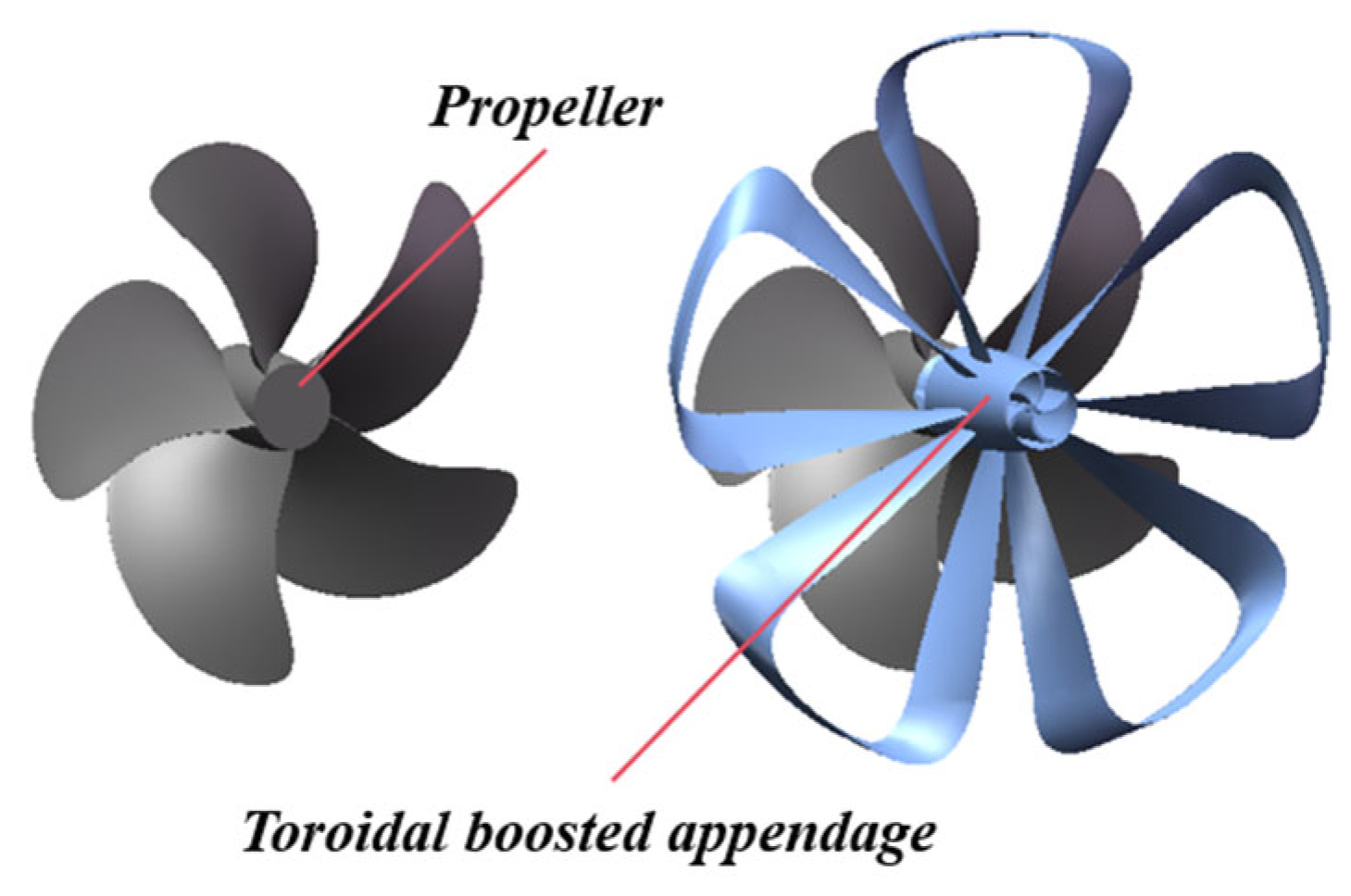
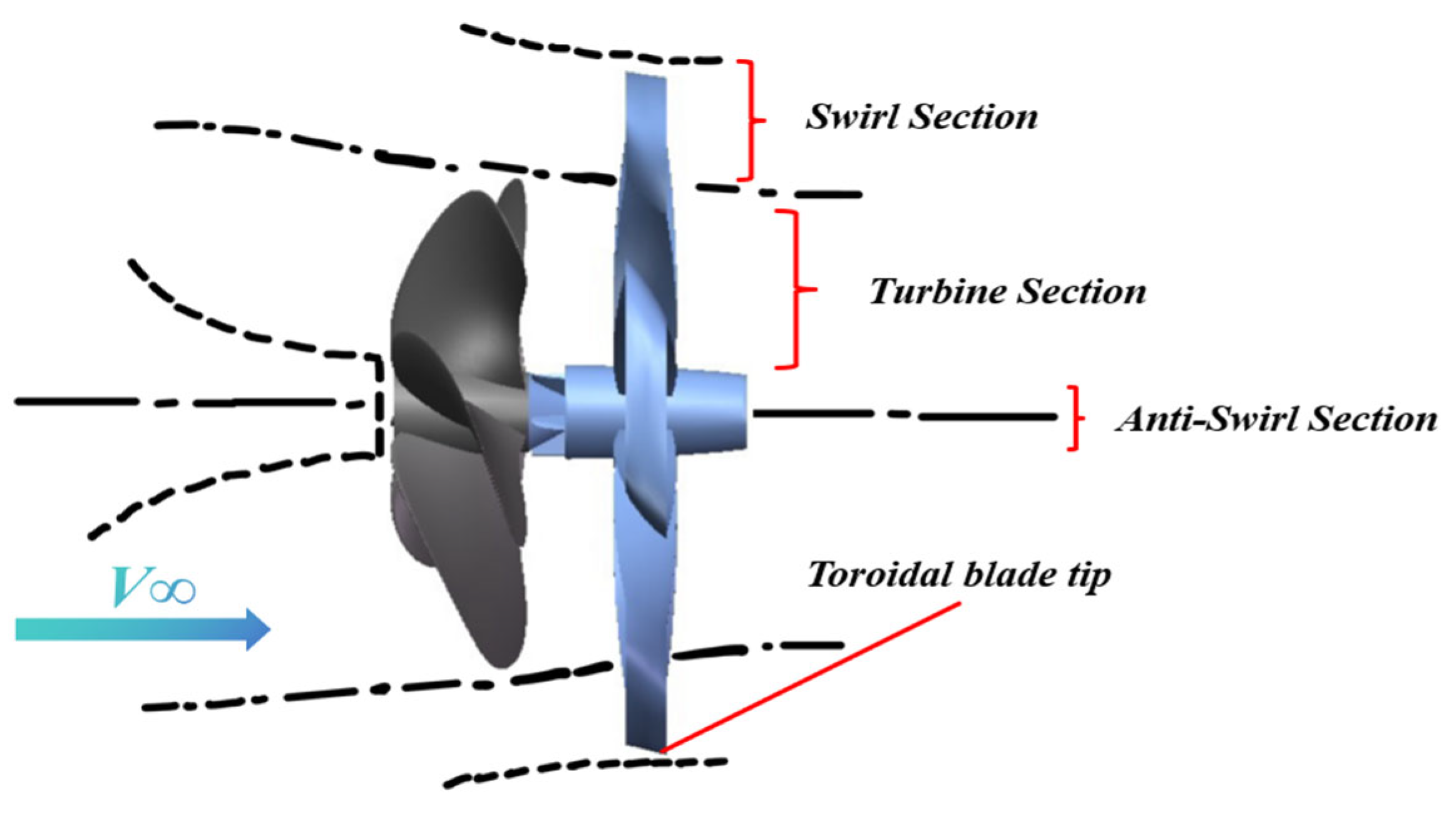
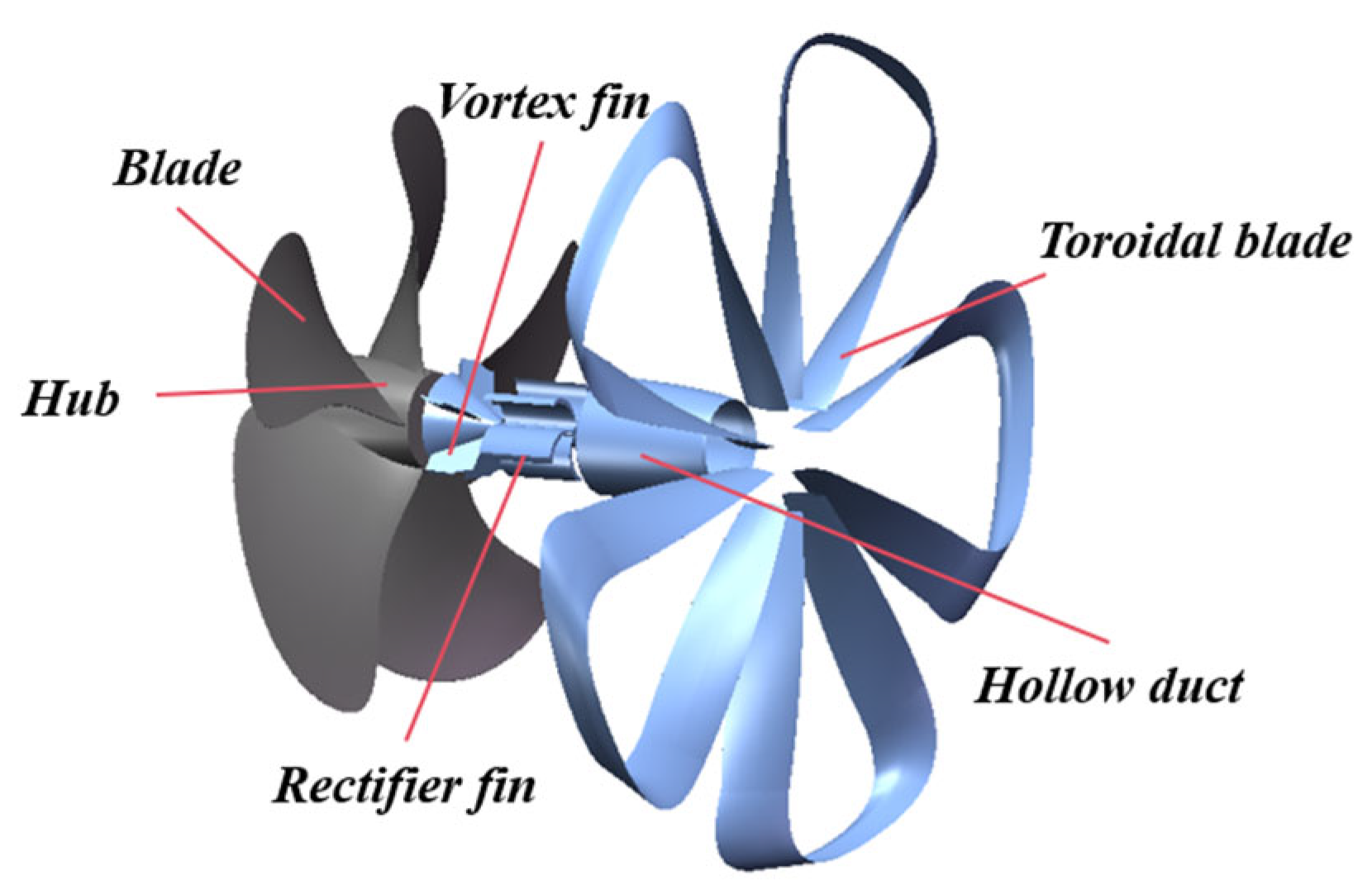
The new toroidal boosted appendage proposed in this paper, as shown in Figure 2 (the dark gray model is the KP505 propeller and the blue model is the new appendage), is composed of two parts: the toroidal blades and a turbine. The turbine is composed of a circular shaft frustum, vortex fins, and rectifier fins, all of which are installed in a hollow duct. The toroidal blades bend from the tip of one blade and connect to the tip of the adjacent blade, forming a closed toroidal structure, which is installed on the turbine. The structural details of the new appendage are presented in Figure 3. Its energy-saving mechanism is a multi-stage, synergistic process designed to recover the rotational kinetic energy from the propeller wake and convert it into additional useful thrust while simultaneously improving the wake flow field, which is shown in Figure 4. Its core components and working principles are as follows:
Stage 1: Energy absorption and initiation
The propeller wake contains significant rotational energy associated with hub and tip vortices, representing a primary source of energy loss. The vortex fins of the appendage are positioned within the core of this rotational wake. They absorb this rotational kinetic energy. The water flow impacting the fins generates lift, which cumulatively creates an additional rotational torque. This torque drives the entire appendage to rotate continuously and autonomously. This is the energy recovery phase.
Stage 2: Additional thrust generation
Once the appendage rotates, the outer toroidal blades (located outside the intense wake core) become active. The specific camber and orientation of the toroidal blades are designed so that, as the assembly rotates, they act like a secondary rotor and generate additional thrust in the ship’s forward direction. Furthermore, the closed toroidal structure helps guide water flow into the turbine section, aiding its rotation. It also promotes a more even distribution of vortices along the blades, reducing vortex disturbance and thereby lowering noise and vibration during operation.
Stage 3: Wake rectification and acceleration
The rotational and non-uniform nature of the propeller wake reduces propulsive efficiency. The rectifier fins feature a specific arc design. They help converge and accelerate the water flow while also assisting the rotation of the appendage. More critically, they rectify the wake behind the propeller by generating a counter-rotating water flow. This effectively suppresses the aggregation of hub vortices and transforms the wake from a diffusion-flow to a constriction-flow pattern, achieving a more uniform wake field distribution.
Through the synergistic mechanism described above, the appendage achieves multiple objectives. The rotating toroidal blades directly contribute additional thrust, which makes the thrust of the propulsion system increase. While the total torque remains largely unchanged, the significant increase in total thrust leads to a marked improvement in open water efficiency. The rectifying action creates a more uniform axial velocity distribution in the wake, reducing energy dissipation caused by large velocity gradients and converting part of the rotational kinetic energy into useful axial momentum. It also alters the formation and evolution process of both hub and tip vortices, weakening their intensity, which contributes to reduced vibration and potential cavitation risk. Compared to conventional fixed devices like Propeller Boss Cap Fins (PBCFs) or Pre-Swirl Stators (PSS), the fundamental innovations of this design are:
(1) Active Energy Conversion: It is not a passive flow conditioner. It actively converts the recovered swirl energy into net thrust via self-sustained rotation.
(2) Integrated Structure: It combines the functions of energy recovery (turbine) and thrust generation (toroidal blades) into a single, compact, synergistically rotating unit.
(3) Toroidal Configuration: The closed-loop toroidal blade structure is hypothesized to better constrain the tip flow and manage the tip vortex system more effectively than discrete fins.
In summary, the energy-saving mechanism of this novel toroidal boosted appendage lies in its integrated ability to recover waste rotational energy, convert it into useful forward thrust through autonomous rotation, and simultaneously rectify the propeller wake for improved hydrodynamic performance.
The KP505 propeller is used to construct the benchmark propeller, and the relevant geometric parameters are listed in Table 2. The diameter D of the benchmark propeller is 0.25 m, the pitch ratio at 0.7R is 0.997, and the hub ratio is 0.18. More information about the KP505 propeller can be found in reference [30]. The diameter of the new appendage is 1.3 times that of the KP505 propeller, which is 0.325 m. The hollow duct diameter is 0.02m, and the attack angle of the vortex fin is 12°. The structure dimensions of the toroidal boosted appendage are listed in Table 3. In addition, the center of the appendage coincides with the center of the benchmark propeller.

2.2. Nondimensionalization of Hydrodynamic Characteristics

The combined propulsion system mainly consists of the KP505 propeller and the new appendage. To study the hydrodynamic performance of the combined propulsion system in open water, some of the dimensionless hydrodynamic coefficients need to be defined first. Its hydrodynamic performance is calculated according to the following formulas, and the parameters obtained from the simulation are expressed in dimensionless form. The formulas are defined as follows [24]:
Advance   coefficient :   J = V A n D
Total   thrust   coefficient   of   the   combined   propulsion   system : K T = T P + T V ρ n 2 D 4
Total   torque   coefficient   of   the   combined   propulsion   system :   K Q = Q P + Q V ρ n 2 D 5
The   open   water   efficiency :   η = K T K Q J 2 π
where J is the advance coefficient, V A is the advance velocity to the propeller (m/s), ρ is the density of fluid (kg/m3), n is the rotational speed of the propeller (r/s), and D is the diameter of the propeller (m). The thrust of the propeller is set as T P (N), the thrust of the novel appendage is set as T V (N). Q P is the torque of the propeller (N⋅m), Q V is the torque of the novel appendage (N⋅m). The total thrust coefficient is denoted as K T , the total torque coefficient is denoted as K Q , and η is the combined propulsion system’s efficiency in open water.

3. Mathematical Model

3.1. Governing Equations

The STAR-CCM+ commercial solver is used to conduct numerical simulations of the propellers with and without the new toroidal boosted appendage. The research lays emphasis on the rotational motion of the marine propeller in water, assuming that the medium is continuous, isothermal, and incompressible. During the simulation process, the constructed mathematical model strictly adheres to the two fundamental laws of conservation of mass and momentum. It is supplemented and described by specific turbulence models to address different physical conditions, thus guaranteeing precise simulation of the hydrodynamic performance of the propeller. Through the time-averaging process of instantaneous flow, the complex turbulent motion is separated into two parts: the time-averaged part and the pulsating part. Thus, the statistical characteristics of turbulent flow can be effectively described based on the Reynolds-Averaged Navier–Stokes (RANS) equations for the solution. Then, only the continuity equations of the incompressible fluid need to be considered, and the specific form is listed as follows [31]:
( ρ u ¯ i ) x i = 0
( ρ u ¯ i ) t + x j ( ρ u ¯ i u ¯ j + ρ u i u j ¯ ) = P ¯ x i + x j μ ( u ¯ i x j + u ¯ j x i )
where x i , x j are the spatial coordinates of the fluid particle; ρ is the fluid density; u ¯ i , u ¯ j are the averaged Cartesian velocity components; P ¯ is the mean pressure; μ is the dynamic viscosity coefficient; ρ u i u j ¯ represents the Reynolds stress term.
The simulation results are obtained through the commercial CFD software package STAR-CCM+ version 23.10 (Double-precision version) in this paper. The RANS equations are used to control the fluid flow around the ship. The finite volume method is adopted to divide the computational domains into multiple control volumes, and the governing equations are converted into discrete algebraic equations for numerical solution. In addition, the sliding mesh technique is used to solve the rotational motion of the propeller.

3.2. Turbulent Flow Model

The selection of a turbulence model must first be based on an assessment of the flow regime within the computational domain, where the Reynolds number ( R e ) is the key dimensionless parameter distinguishing laminar, transitional, and fully developed turbulent flows. To evaluate the overall flow regime around the propeller, the global Reynolds number R e D is calculated based on the propeller diameter and the advance speed. Taking the design condition J = 0.4 ( V a = 5.0 m/s) as an example:
R e D = V a D ν = 5.0 × 0.25 1.0 × 10 6 = 1.25 × 10 6
Within the entire research range of advance coefficients, the calculated values of R e D range from 3.13 × 10 5   ( J = 0.1 ) to 2.81 × 10 6   ( J = 0.9 ) . The global Reynolds number for all operating conditions exceeds the order of 10 5 , indicating that the flow around the propeller is in a fully developed turbulent state.
The development of the boundary layer on the propeller blade surface and its interaction with the appendage are more significantly influenced by local flow characteristics. The profile at 0.7R is selected as the characteristic section, with its characteristic length taken as the chord length c at that location. Referring to the geometric proportions of the KP505 blade, c is estimated to be approximately 0.06 m. The characteristic velocity is the relative inflow velocity W experienced by the blade at that location, which is the vector sum of the advance speed V a and the circumferential velocity U . For the design condition J = 0.4 : advance speed V a = 5.0 m/s, rotational angular velocity ω = 2 π n = 2 π × 50   314.16 rad/s, radius at 0.7R r = 0.7 × ( D / 2 ) = 0.0875 m, circumferential velocity U = ω r 314.16 × 0.0875 27.49 m/s, relative inflow velocity W = V a 2 + U 2 27.94   m / s . The local characteristic Reynolds number is then:
R e c = W c ν = 27.94 × 0.06 1.0 × 10 6 = 1.68 × 10 6
The above Reynolds number analysis leads to a clear conclusion: all flow regions involved in this study (both global and local) are in a fully turbulent state with high Reynolds numbers ( R e > 10 5 ) .
The k ε turbulence model is one of the most widely used turbulence models. It is a model about turbulent kinetic energy k and turbulent dissipation rate ε , established based on the time-averaged continuity equation and the RANS equation. Building upon this foundation, Kinnas et al. [32] proposed an improved Realizable k ε turbulence model with a broader range of applications. This turbulence model shows relatively high simulation accuracy, such as free flows, homogeneous shear flows, and mixed flows. The Realizable k ε turbulence model is implemented using the STAR-CCM+ solver to numerically simulate the flow field around the KP505 propeller with the new appendage in this paper. This configuration is expected to provide a comprehensive explanation of the hydrodynamic behavior of the propeller and its appendage, including open water performance and wake characteristics, as well as the influence of different structural parameters.
Given the high Reynolds number, fully turbulent nature of the flow, and considering the need to accurately capture complex phenomena such as vortex shedding, flow separation, and wake dynamics, the Realizable k ε model was selected. This model offers a good compromise between computational cost and accuracy for engineering applications involving strong streamline curvature and rotation, as demonstrated in prior studies of marine propellers [33]. It is noted that this model may exhibit excessive dissipation of fine-scale turbulent structures and tip vortices. Consequently, while suitable for the comparative performance evaluation central to this study, higher-fidelity turbulence modeling is recommended for future work focusing on detailed vortex dynamics and long-wake validation. The formulas are defined as follows:
( ρ k ) t + x j ( ρ k u i ) x j μ + μ t σ k k x j = G k + G b Y M ρ ε + S k
( ρ ε ) t + x j ( ρ ε u i ) x j μ + μ t σ ε ε x j = ρ C 1 S ε ρ C 2 ε 2 k + v ε +
where μ t = C μ ρ k ε is the eddy viscosity, C 1 = max 0.43 , η η + 5 , η = S k ε , S = 2 S i j S i j , C 1 ε = 1.44 , C 2 = 1.9 , σ k = 1.0 , and σ ε = 1.2 . S i j = 1 2 ( u i x j + u j x i ) is the mean strain rate tensor. k is the turbulent kinetic energy, ε is the turbulence dissipation rate, G k is the generation of turbulent kinetic energy due to the mean velocity gradients, G b is the generation of turbulent kinetic energy due to buoyancy, and Y M is the contribution of the fluctuating dilatation in compressible turbulence to the overall dissipation rate. σ k and σ ε are the turbulent Prandtl numbers for k and ε , respectively. S k and S ε are source terms defined by the user.

4. Numerical Modeling and Simulation Setup

4.1. Grid Division

When conducting CFD numerical calculations, it is a challenge to deal with complex computational domains with rotation and bias characteristics. To improve the calculation accuracy and efficiency, this paper adopts the mesh generator in STAR-CCM+ to optimize the mesh division of the geometric model. This mesh generator is capable of creating high-quality volume cells and making necessary simplifications and corrections to the geometry, thereby laying a foundation for the accuracy of subsequent numerical simulations. The hybrid meshing technology is selected for mesh generation in this paper. This technology can accelerate the volume mesh generation and create high-quality meshes, while it can also save computational time, making it particularly suitable for the meshing of large parts.
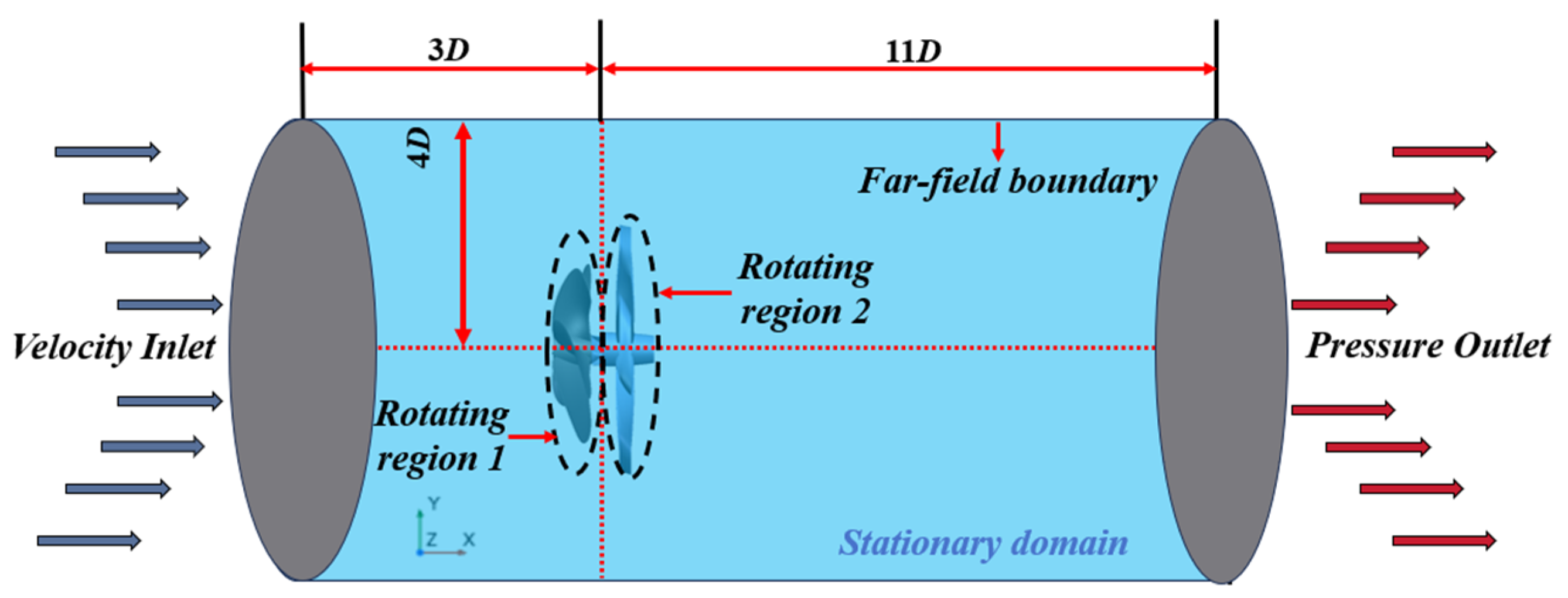
The high-accuracy simulation strategy is adopted, and the sliding mesh method is used for numerical simulation. To deeply explore the rotational characteristics of the propeller and the energy-saving appendage, the computational domain is divided into two types: the stationary domain and the rotating domain. By establishing an interface between the two computational domains, the flow field information can be exchanged efficiently so as to maintain the structured mesh geometry topology and reduce the consumption of computing resources. Specifically, we divide the flow field into three main cylindrical computational domains: the external stationary domain and two small internal rotating regions (see Figure 5). The toroidal boosted appendage forms the rotating region 1, and the KP505 propeller forms the rotating region 2. The specific parameters are as follows: The total length of the stationary domain is 14D, and the radius is 4D [34], where the propeller is 3D from the velocity inlet and 11D from the pressure outlet. The lengths of rotating region 1 and rotating region 2 are 0.5D and 0.7D respectively, and their diameters are both 1.7D. And D represents the diameter of the propeller.
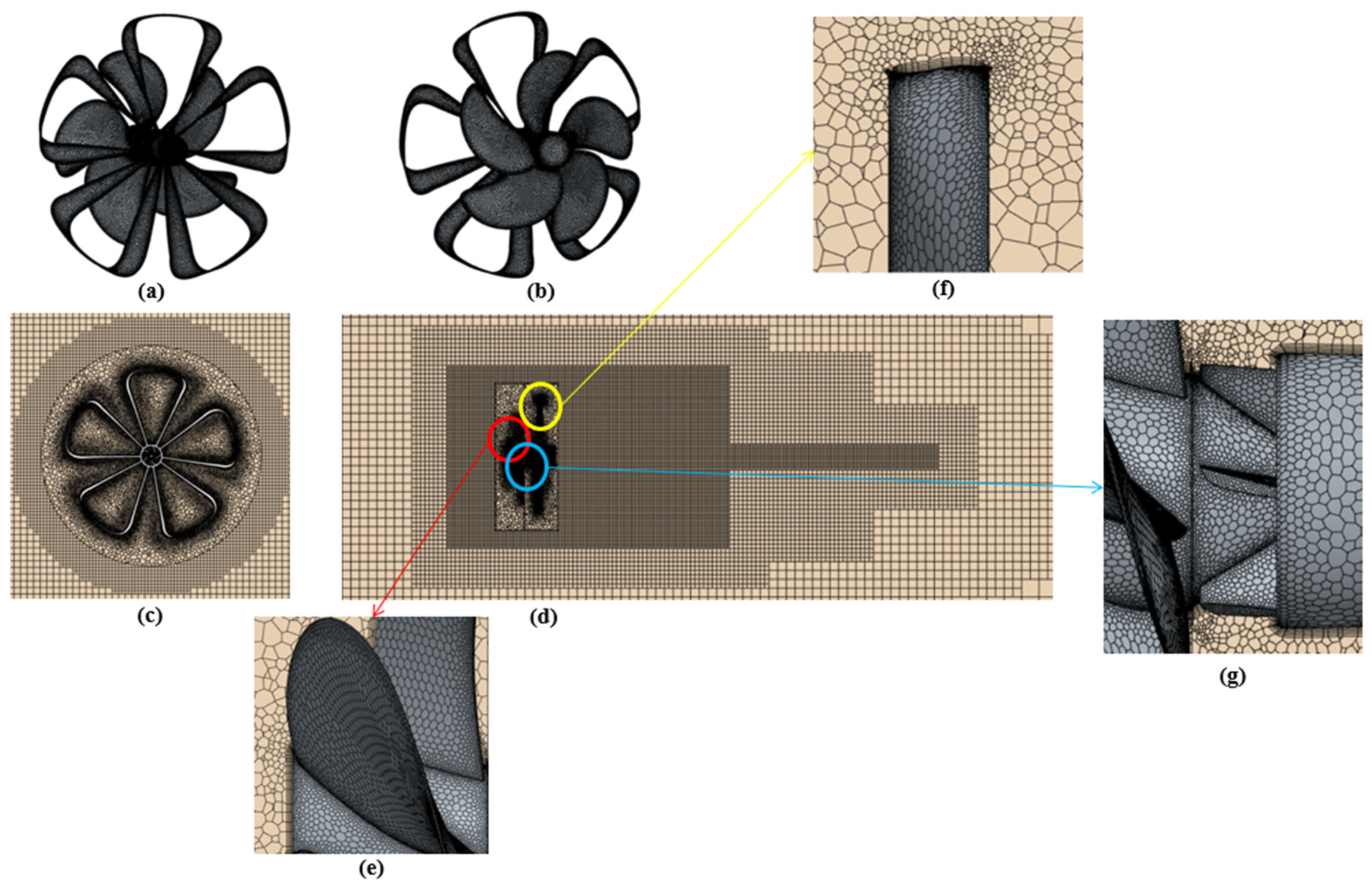
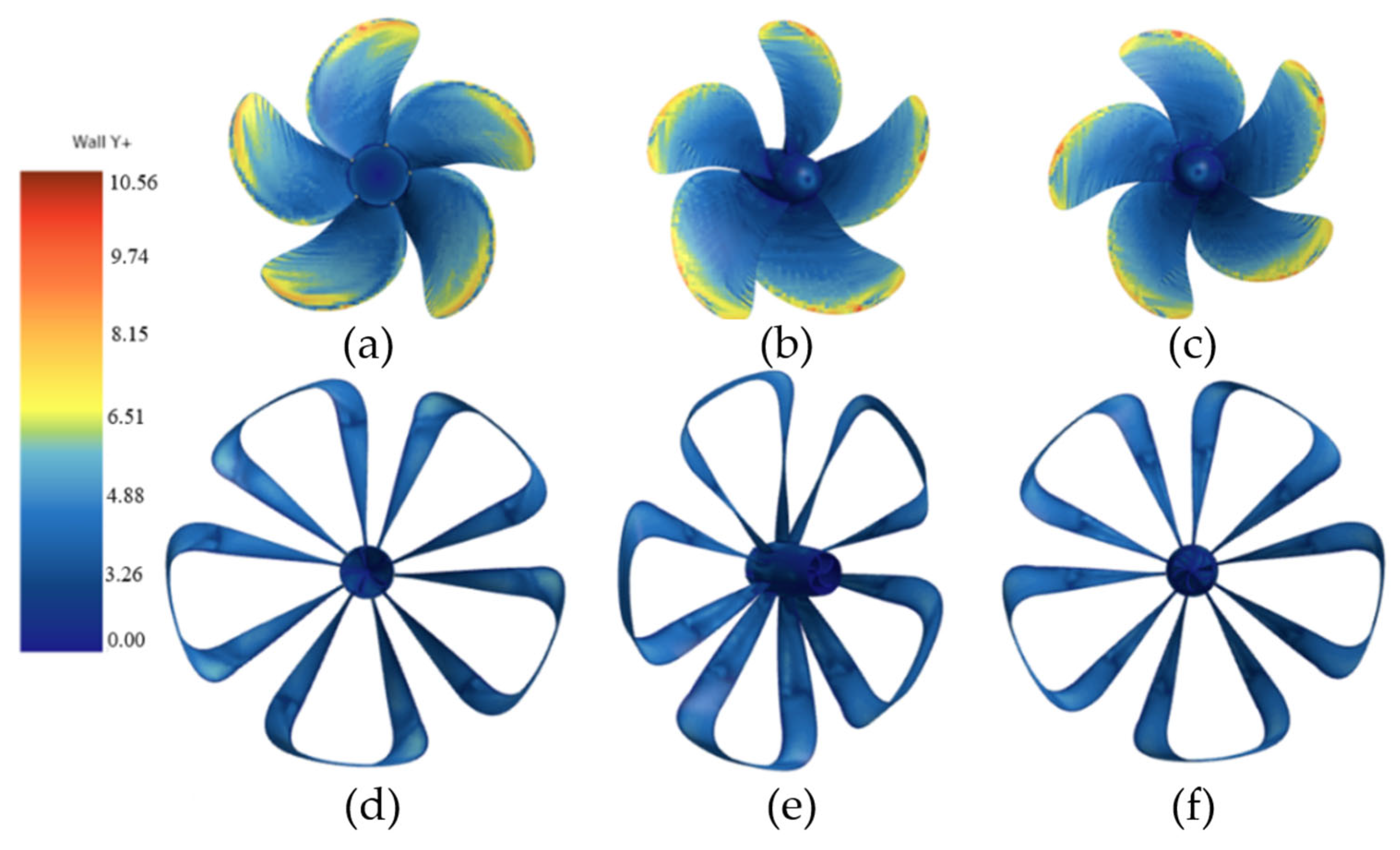
The propeller and energy-saving appendages have extremely complex rotational movements. Therefore, a strategy combining polyhedral meshes and cut-cell meshes is adopted to ensure high-quality meshes and simulation efficiency. Specifically, as shown in Figure 6, polyhedral meshes are used within the rotating regions, while cut-cell meshes are used in the stationary domain. To further enhance the simulation accuracy and optimize the mesh structure, two methods are adopted for the refinement of local region meshes in this paper. First, mesh refinement was carried out on the surface of the propeller and its appendage, and edge refinement was implemented at the edges of the geometric model. The specific sizes of edge refinement are 0.5mm and 0.25mm, showing a growth rate of 2 times. Second, the mesh in the wake region of the fluid domain was significantly densified, thereby precisely capturing the distribution characteristics of the propeller wake. This will facilitate an in-depth flow field analysis for axial and tangential velocities in the subsequent process. In the simulation process, the time step is set to 5.556 × 10⁻⁵ s. In the simulation setup, the all-y+ wall treatment was employed in STAR-CCM+, which automatically blends viscous sublayer and log-law formulations based on the local mesh resolution. To ensure adequate resolution for the wall functions, the base size of the surface mesh was controlled, targeting a dimensionless wall distance (y+) predominantly below 5 in regions of attached flow to suitably resolve the boundary layer. Figure 7 shows the resulting y+ distribution on the surfaces, confirming that the values are largely within an acceptable range for the chosen turbulence model and wall treatment, thereby supporting the reliability of the near-wall flow prediction. In addition, boundary conditions have been set to match the actual physical model and engineering conditions. The inlet boundary adopts the velocity inlet condition, while the outlet boundary uses the pressure outlet condition; both gauge pressure and reference pressure are set to 0 Pa. The specific physical parameters are shown in Table 4.

4.2. Mesh-Independent Verification

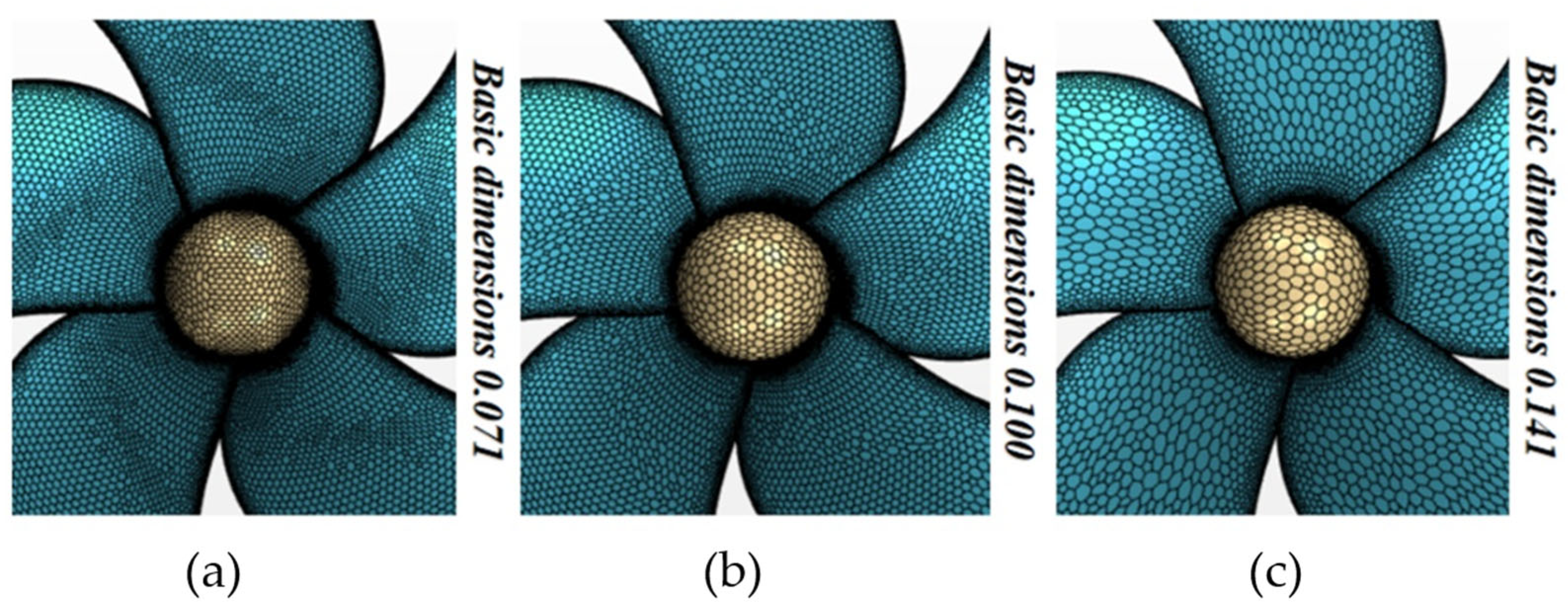
Grid division and verification are crucial in numerical simulation, directly affecting the accuracy of the results and the computational cost. The International Towing Tank Conference (ITTC) emphasizes the necessity of mesh uncertainty analysis. The key to improving the mesh quality lies in the reasonable selection of the mesh number. Too few meshes lead to inaccurate computation results with poor surface fit, while too many meshes slow down the convergence rate and increase the computational cost. The selection of an appropriate mesh size is particularly critical during CFD simulations, which helps ensure the accuracy of the numerical simulation. Based on the standard recommended by ITTC [35], the change rate of mesh size is specified as 2 in this paper. To verify the simulation method, numerical simulations are conducted on the open water performance of the propeller under a specific working condition with the advance coefficient J = 0.6. The mesh convergence is studied using three different mesh resolutions (i.e., fine, medium, and coarse), which are shown in Figure 8. Table 5 summarizes the results of three mesh simulations. Compared with the numerical results of the coarse mesh, the relative errors of the fine and medium meshes are all controlled within 3.1%, and the error between the medium and coarse mesh especially is even smaller.
The following uncertainty analysis utilizes the methods presented in [36]. The values S G 1 , S G 2 , S G 3 corresponding to fine mesh, medium mesh, and coarse mesh represent the computed values under the respective mesh conditions. The experimental values for the corresponding cases are denoted by D , and ε represents the difference between the simulated calculation values of two adjacent sets of meshes. The definitions of ε 21 and ε 32 are as follows:
ε 21 = S G 2 S G 1
ε 32 = S G 3 S G 2
The definition of the grid convergence factor R G is the ratio of the difference between the computational results of two adjacent sets of grids, which is:
R G = ε 21 ε 32
The grid convergence factors of open water performance parameters, namely thrust coefficient K T , torque coefficient 10 K Q , and open water efficiency η o , corresponding to different grid sizes are 0.667, 0.714, and 0.667, respectively. All these values lie between 0 and 1, indicating monotonic convergence, which allows the use of the Richardson extrapolation method for error and uncertainty analysis.
P G = I n ε 32 / ε 21 I n r G
C G = r G P G 1 r G P G e s t 1
δ R E G * = ε 21 r G P G 1
The calculation formula for grid uncertainty is as follows:
U G = C G δ R E G * + 1 C G δ R E G *
The error δ G and uncertainty U G C after correction with the correction factor can be expressed as
δ G * = C G * δ R E G *
U G C = 1 C G δ R E G *
The comparison error is denoted by E , while the modified comparison error is represented by E C . The calculation formula are as follows:
E = D S
c E C = D S C
S = S G
S C = S G δ G
The error uncertainty expression of the grid is expressed as:
U V = U S N 2 + U D 2
The uncertainty analysis summary for different grid sizes is shown in Table 6. Based on the data in Table 6, the comparison errors for the propeller’s K T , 10 K Q , and η o across different grid scales are all smaller than the uncertainties, E C < U V . This indicates that the verification of uncertainties for the aforementioned three sets of grids has been successfully achieved. This result indicates that the fineness of the selected mesh has an acceptable influence on the simulation results. Comprehensively balancing simulation accuracy and computational efficiency, the medium mesh is adopted in the subsequent numerical simulation research, thereby providing technical guarantees for the objectivity and accuracy of the simulation comparison results.

4.3. Model Validation

To ensure the reliability of the CFD simulation results for the toroidal boosted appendage, it is necessary to conduct numerical verification of the open water characteristics for the prototype KP505 propeller and compare the simulation results with experimental data [30]. Based on the previous analysis of grid independence, the Realizable k ε turbulence model is adopted to perform detailed numerical simulations under different advance coefficients ( J = 0.1–0.9). The specific parameter settings are as follows: the fluid density and kinematic viscosity coefficient are respectively specified as ρ = 999.1   kg / m 3 and v = 1 × 10 6   m 2 / s . With the change in the advance coefficients, the velocity inlet setting will also be adjusted accordingly, and the rotational speed of the propeller n is set to 50 r/s.
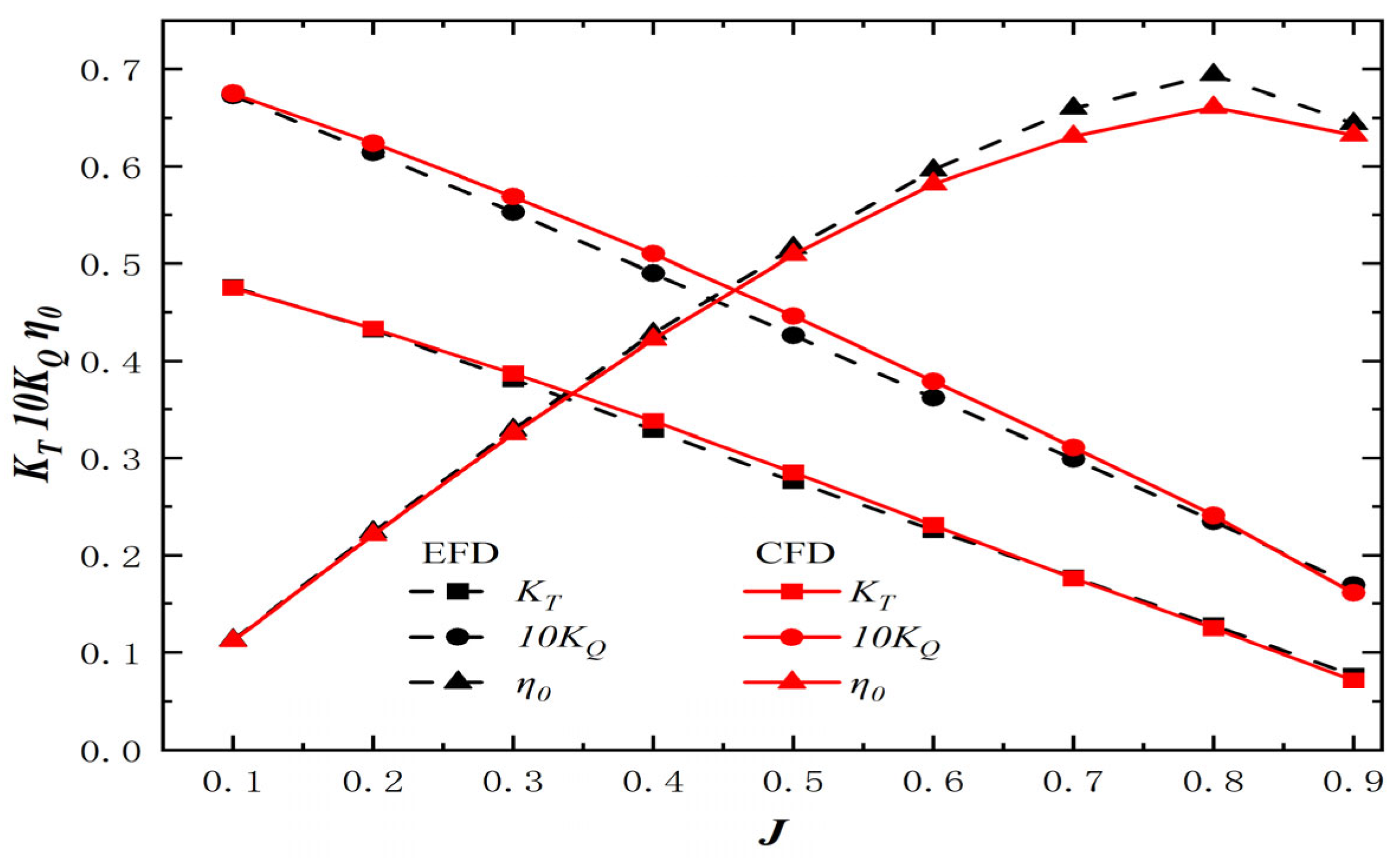
The correspondence between the advance coefficients and the velocities is shown in Table 7, and the simulation and experimental results for the open water performance are presented in Table 8 and Figure 9, including the thrust K T , torque 10 K Q , and open water efficiency η 0 . The comparison between the CFD and EFD (Experimental Fluid Dynamics) values shows that both of the results are quite similar in the case of low advance coefficients ( J = 0.1–0.3). With the increase in the advance coefficients, the errors between CFD and EFD values rise slightly. The average error of thrust K T is 2.190%, torque 10 K Q is 3.288%, and open water efficiency η 0 is 2.146%, indicating that the numerical simulation method is applicable and reliable in engineering applications. For the subsequent research, to accurately predict the energy-saving efficiency of the new toroidal boosted appendage, we suggest that the advance coefficients be limited to the normal range of 0.1–0.6, so as to conduct the design and performance evaluation of the new energy-saving appendage and meet the high requirements of simulation accuracy.

5. Results and Discussion

5.1. Comparison of Open Water Performance

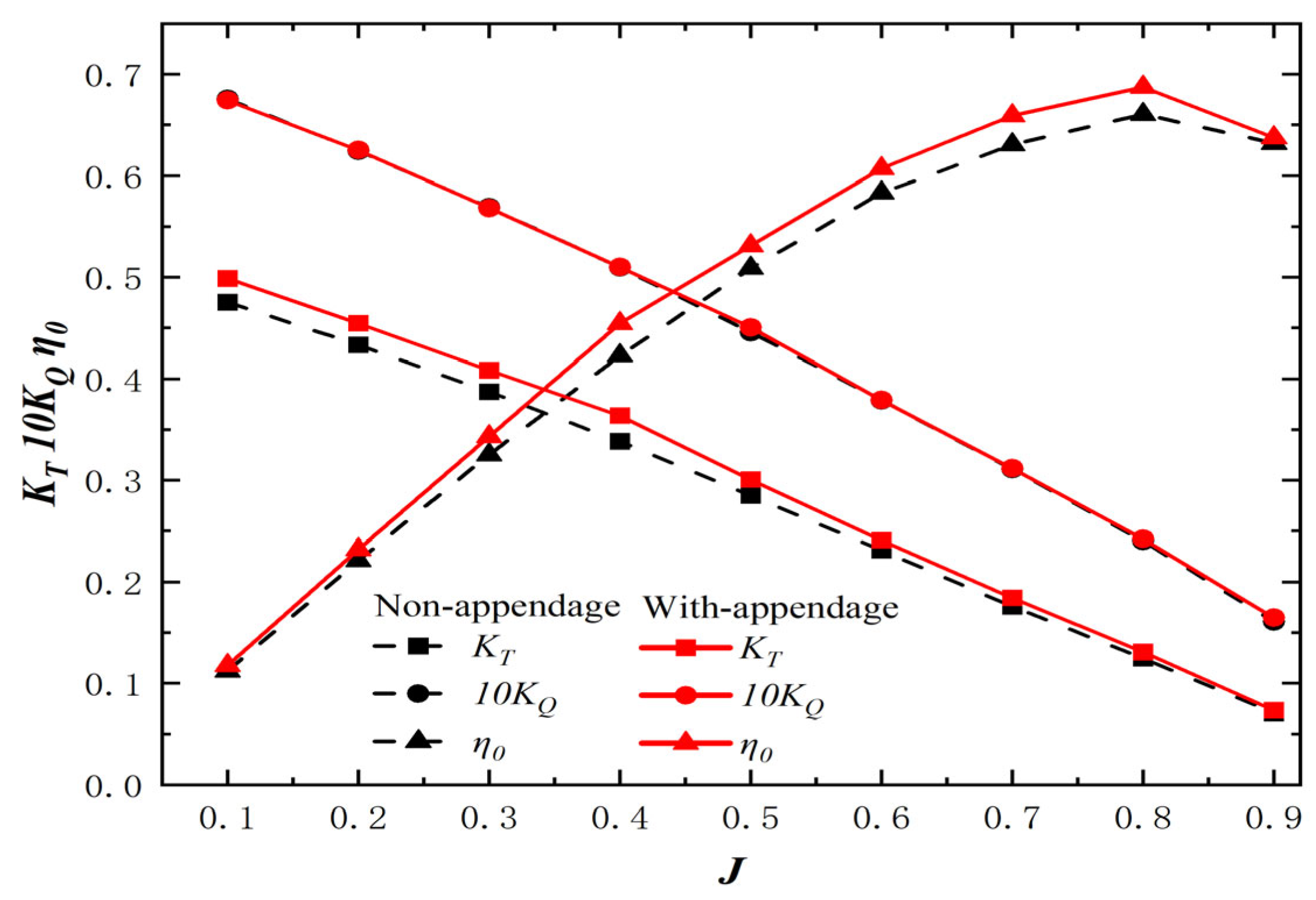
To compare the energy-saving effects of the new toroidal boosted appendage, the CFD method is used to conduct simulation studies on the conventional KP505 propeller and the combined propulsion system with the new appendage under different advance coefficients. The results of the open water performance for the propellers with and without the appendage are shown in Table 9. The numerical comparison of thrust K T , torque 10 K Q , and open water efficiency η 0 under different advance coefficients is shown in Figure 10. The black lines represent the conventional KP505 propeller, while the red lines represent the combined propulsion system with energy-saving appendage. In the range of advance coefficients J from 0.1 to 0.4, the improvement in thrust K T increases significantly from 4.924% to 7.538%, the improvement in open water efficiency η 0 increases significantly from 4.822% to 7.453%, and the improvement in torque 10 K Q increases from 0.078% to 0.178%. In the range of advance coefficients J from 0.5 to 0.9, the improvement in thrust K T rise from 3.244% to 5.476%, the improvement in open water efficiency η 0 rise from 0.860% to 4.509%, and the improvement in torque 10 K Q rise from 0.079% to 2.363%. It can be seen that the energy-saving effect of the new toroidal boosted appendage is particularly significant under low and medium advance coefficients, with the maximum increase in propulsion efficiency reaching 7.453% at the design advance coefficients J = 0.4.
Overall, the existence of the toroidal boosted appendage significantly increases the thrust K T and open water efficiency η 0 for the combined propulsion system, while the torque 10 K Q changes relatively little, and the energy-saving effect of the appendage is obvious. Meanwhile, we find that the energy-saving effect of the new toroidal boosted appendage is greatly affected by the advance coefficient. The improvement in the propulsion efficiency shows a trend of first increasing and then decreasing, which indicates that there exists a critical value for the advance coefficient. When the advance coefficient is lower than this critical value, the energy-saving effect of the appendage improves with the increase in the advance coefficient. When the advance coefficient exceeds this critical value, the energy-saving effect will stop increasing further. This might be due to the weakened lift interference effect of the airfoil profile in the turbine section of the new appendage, which leads to an increase in drag force and a reduction in additional thrust force provided to the propeller. In conclusion, the energy-saving advantages of the toroidal boosted appendage mainly lie in two aspects: First, it enhances the overall propulsion efficiency; Second, its synergistic effect with the propeller has a positive impact on the wake distribution behind the propeller. However, the predicted efficiency gains, while promising, are derived from RANS-based simulations and lack experimental validation for the complete system with the novel appendage. The numerical results are therefore model-dependent and should be interpreted as a strong indicator of potential rather than a definitive performance guarantee.

5.2. Comparison of Tail Vortex Structure

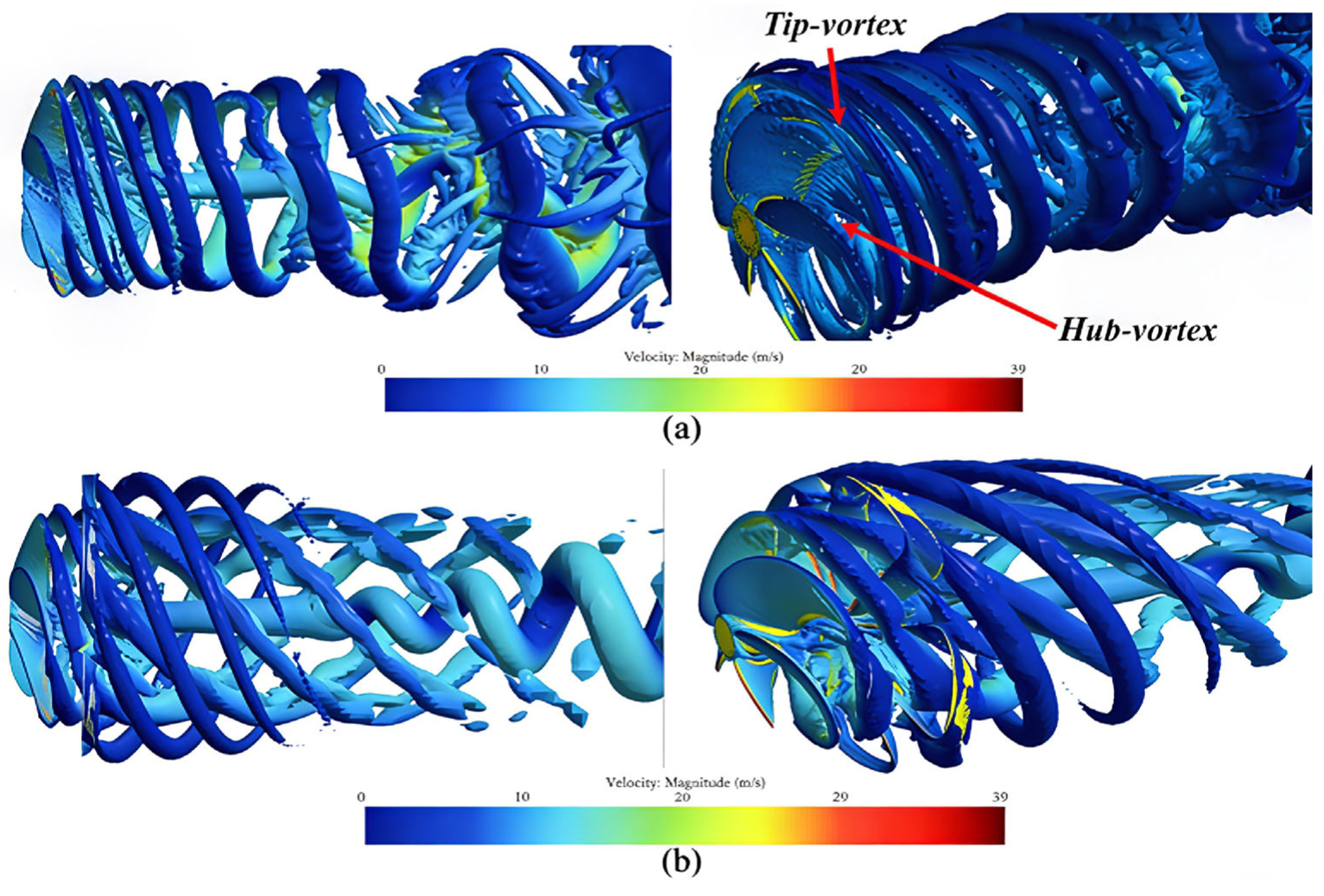
To further analyze the energy-saving effect of the new toroidal boosted appendage, a comparative analysis of the propeller vortex structure before and after its installation is conducted. The relevant results are shown in Figure 11. As shown in Figure 11a, the typical vortex dynamics phenomenon described by Felli et al. [37] is observed in the KP505 propeller. The tip and hub vortices are clearly visible in the flow field, and the tip vortices form a spiral trajectory and stack at the tip of the blade, with a small and sharp shape. The hub vortices show a jet-form pattern, with their maximum velocity occurring approximately 0.2R behind the hub (where R is the propeller radius). In the tip vortex region (r/R > 0.8) and hub vortex region (r/R < 0.4), a significant flow field separation phenomenon can be observed; however, the vortices that fall off the blade tail will eventually “connect”, which is more significant in traditional propellers. In contrast, as shown in Figure 11b, the existence of the new toroidal boosted appendage changes the formation mode of the local hub vortices. Meanwhile, the tip vortex interacts with the hub vortex, resulting in significant differences in its dynamic characteristics from traditional propellers. This finding is also confirmed by the research of Sun et al. [28]. The design of the toroidal blades promotes the fracture and separation of the downstream flow field while enabling more water to flow into the turbine section, thereby reducing the stacking phenomenon of the rotating vortices. In addition, this appendage effectively prevents the curling of the hub vortices and alters the evolution process, thereby significantly reducing the vortices’ intensity. The new design of the swirl section and anti-swirl section in the appendage effectively weakens the rotational resistance and flow field disturbance generated at the blade tip and hub, thereby decreasing the generation of secondary tip vortices and lowering blade vibration. In conclusion, the new toroidal boosted appendage shows a significant optimization effect on the wake flow behind the propeller and effectively improves the hydrodynamic performance and propulsion efficiency of the propeller.

5.3. Comparison of Pressure Distribution

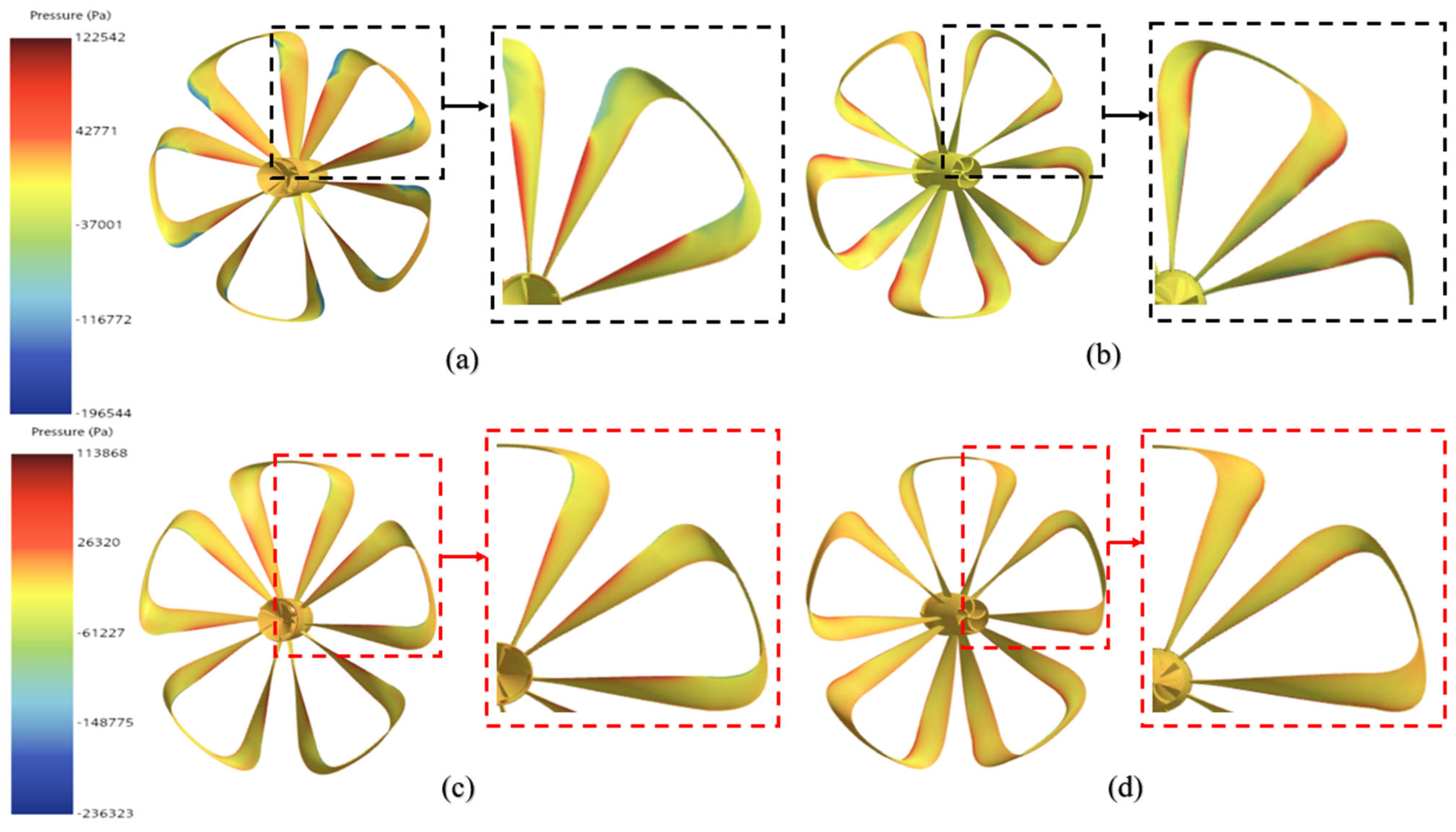
The existence of the new appendage directly affects the fluid flow behind the propeller, causing changes in the pressure distribution. The surface pressure distribution of the new appendage is shown in Figure 12. It can be seen from Figure 12a,b that the pressure changes are mainly concentrated in the turbine section and swirl section at the design advance coefficient ( J = 0.4), and the radial pressure distribution stratification characteristics are particularly obvious. The reduction in pressure difference is not conducive to the formation of tip and hub vortices in these areas. The maximum surface pressure in the swirl section of the toroidal blade occurs on the pressure side, while the minimum pressure is on the suction side; this pressure difference causes the toroidal blade to generate an additional thrust consistent with the ship’s forward direction. The pressure distribution in the turbine section of the toroidal blade is opposite to that in the swirl section. The surface pressure on the pressure side is lower than that on the suction side, generating a reverse force and rotational moment, thereby promoting the rotation of the appendage to recover energy. It is worth noting that, as shown in Figure 12c,d, the pressure distribution at a high advance coefficient ( J = 0.6) differs from that at the design advance coefficient ( J = 0.4). The stratification characteristics weaken, and the pressure difference between the suction and pressure sides decreases; this may lead to the appendage thrust reduction, thereby weakening the energy-saving effect. This further confirms the earlier observation in this paper that the propulsion efficiency improvement shows a declining trend at high advance coefficients. Compared with the conventional appendage studied by Conglin [33], the pressure distribution of the toroidal blade in the swirl section is more uniform, and the area of the low-pressure zone is reduced.
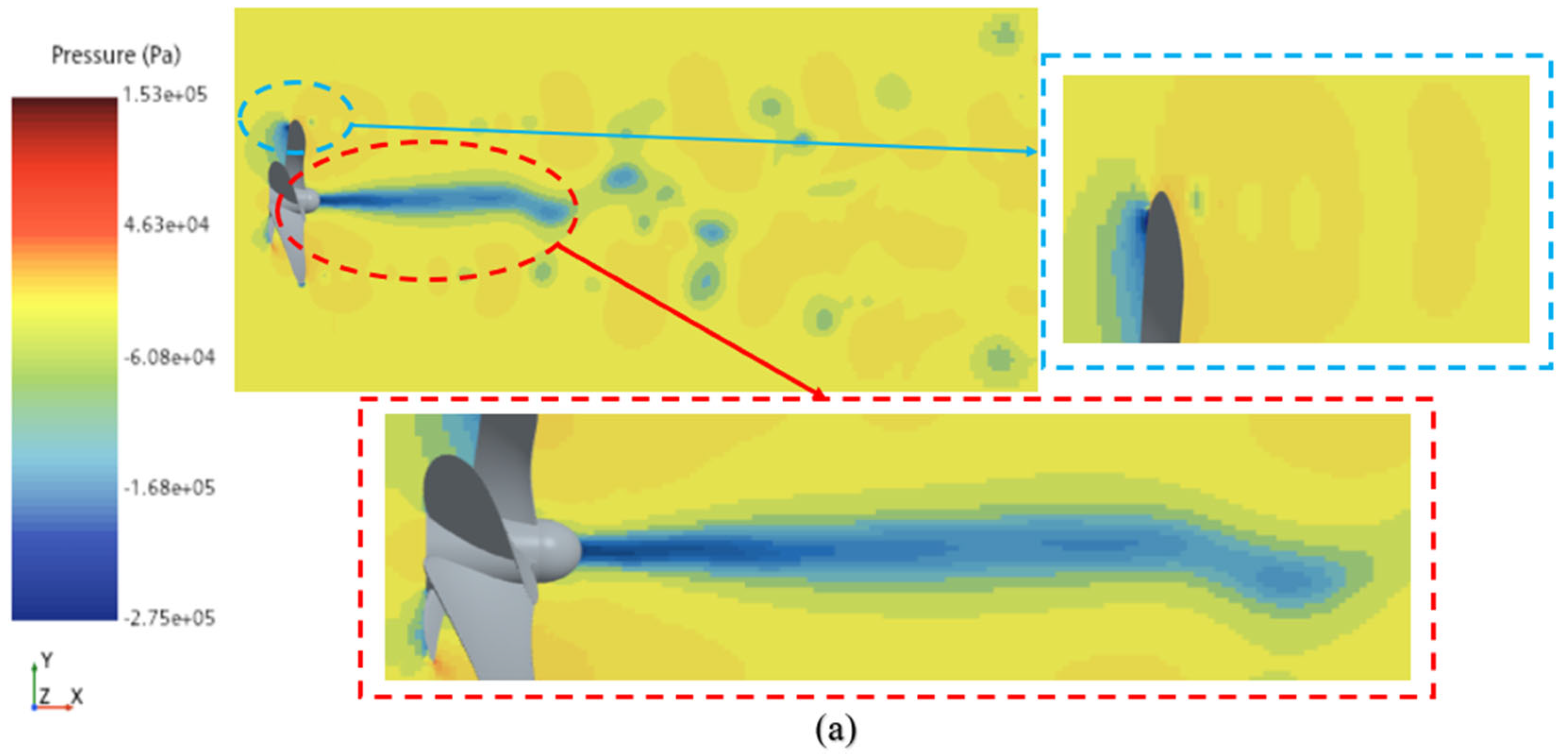
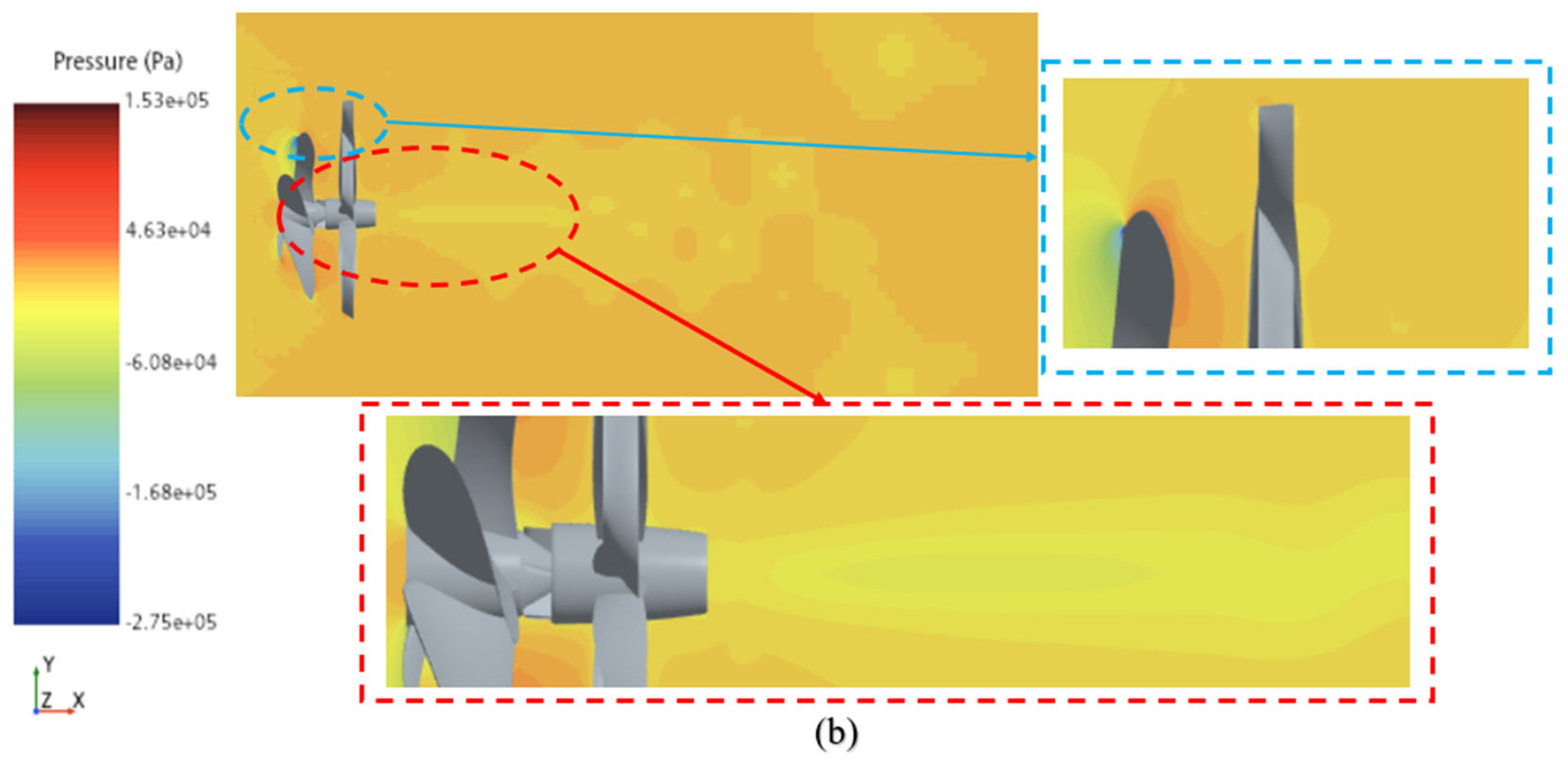
Figure 13 shows the longitudinal pressure comparison of the propeller flow field with and without the new appendage at the working condition J = 0.4. Without the new appendage, the flow field pressure at the suction surface of the blade is lower than that at the pressure surface. The hub vortices accumulate near the blade root, forming a long and low-pressure area. Meanwhile, the feather-like pressure accumulation points are shown in the blade tip region, which indicate the existence of tip vortices. Installation of the new appendage significantly increases the pressure behind the propeller and effectively reduces the areas of negative-pressure and low-pressure zones. The effectiveness of the new appendage in reducing hub vortex aggregation has been confirmed, and the system’s overall propulsion performance has simultaneously been improved.

5.4. Comparison of Velocity Field

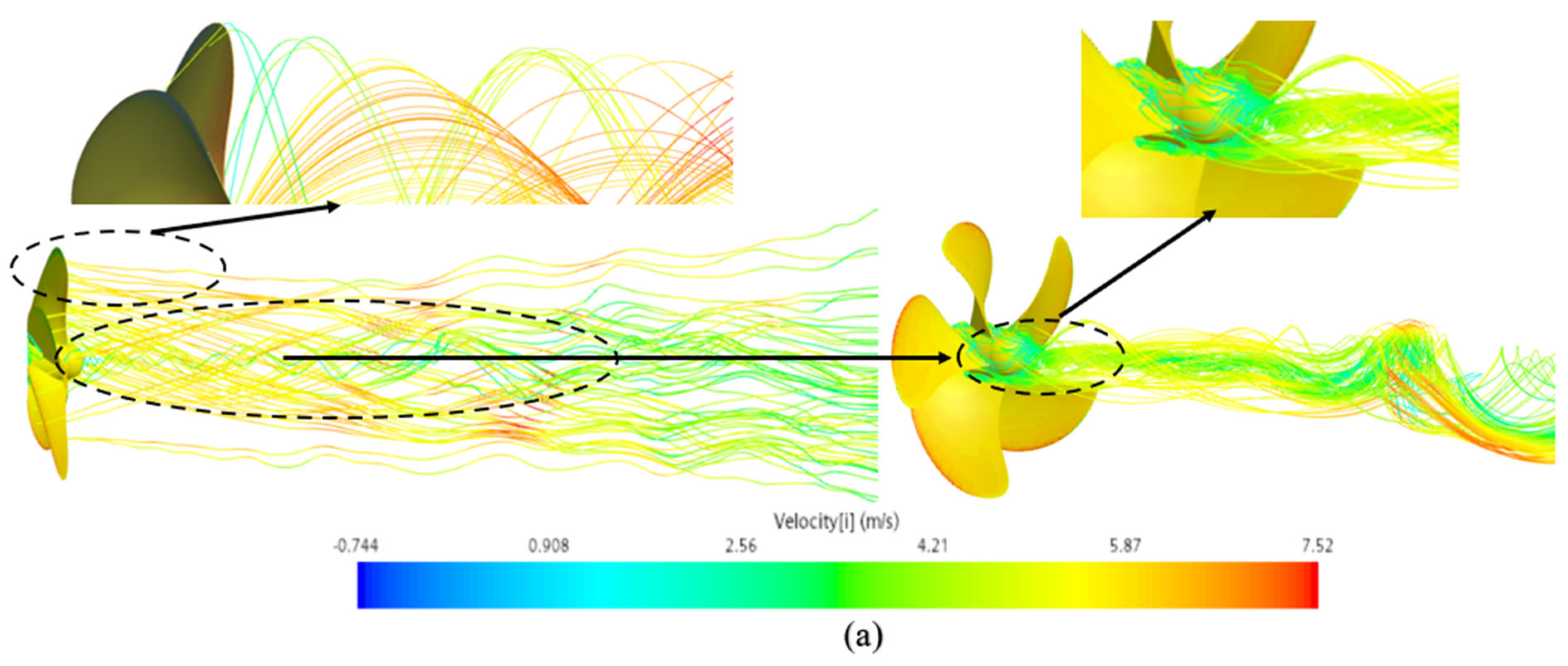
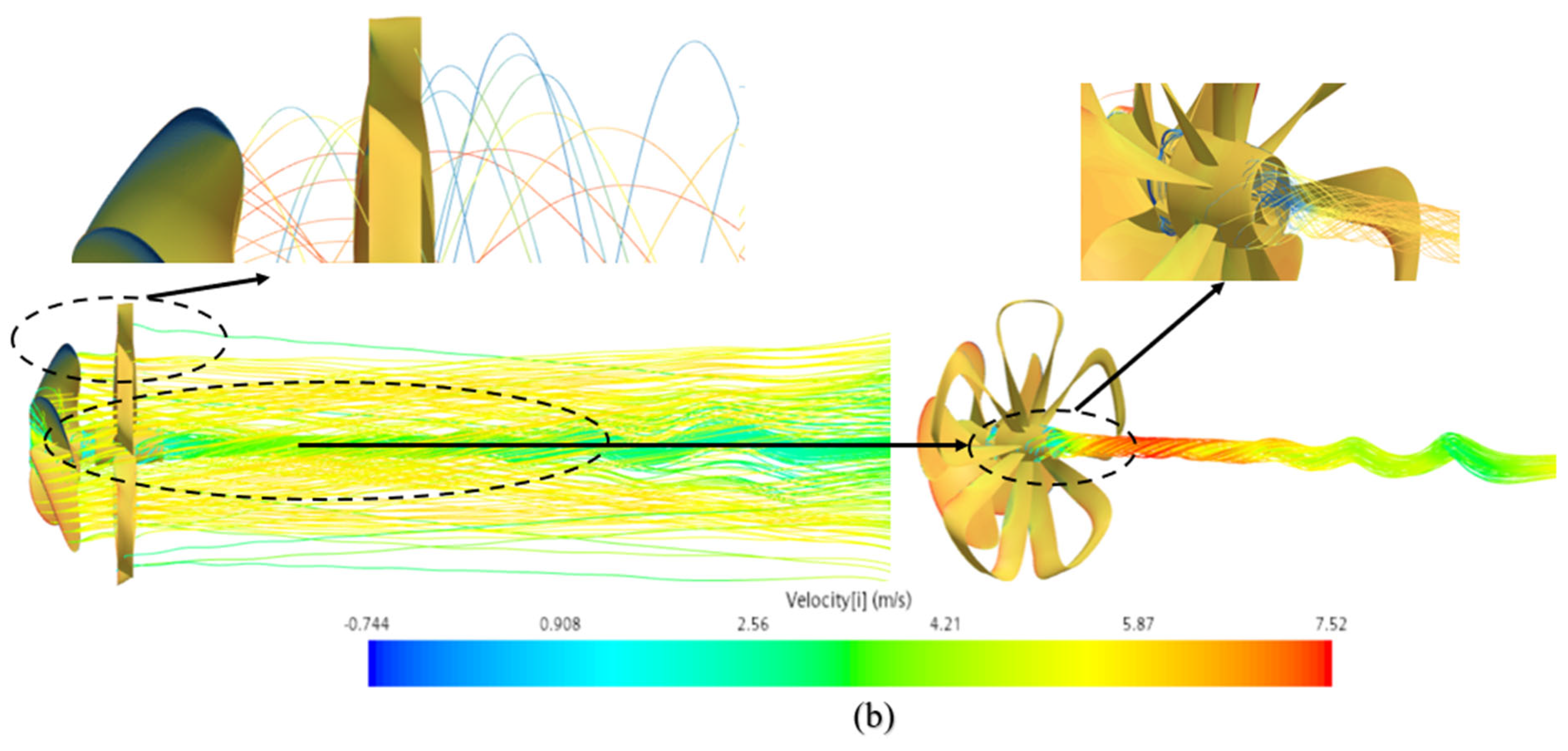
The influence analysis of the new appendage on the propeller velocity field is further carried out. Specifically, by comparing and analyzing the wake distribution (see Figure 14), disordered and intertwined streamlines are observed in the hub region of the propeller without appendage, indicating the presence of hub vortex agglomeration, which would further lead to the decline of hydrodynamic performance in this region. In contrast, with the installation of the new appendage, the streamline distribution in the hub region is significantly improved and presents an orderly flow pattern that converges towards the center. Not only is the flow dynamics optimized, but the flow velocity is also significantly increased in the hub region with the installation of the new appendage, and the maximum flow velocity in the hub region increases to 10.9 m/s. In summary, the new design of the appendage overcomes the limitations of traditional appendages in water flow energy recovery and further enhances the propulsion performance of the propeller system.
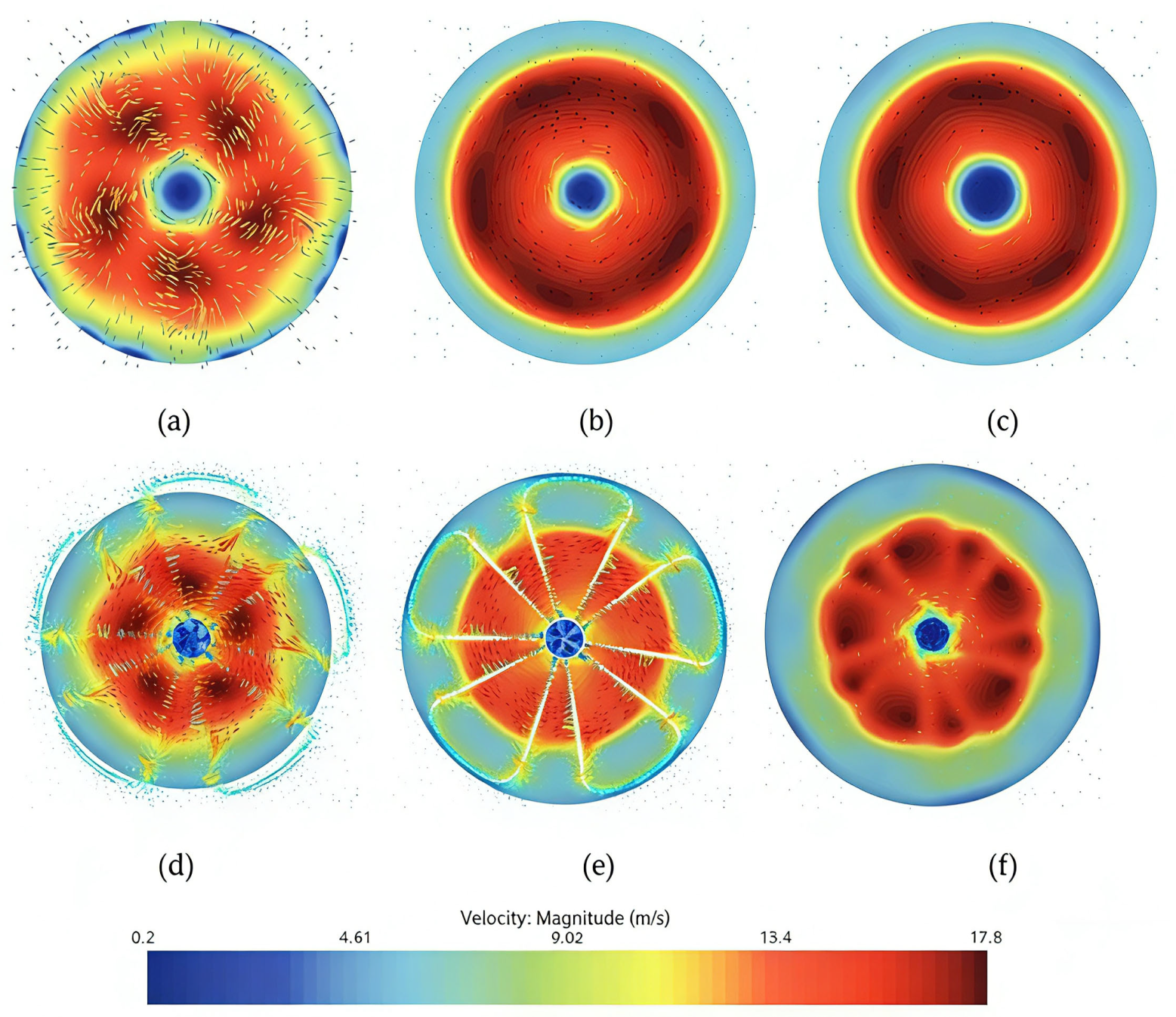
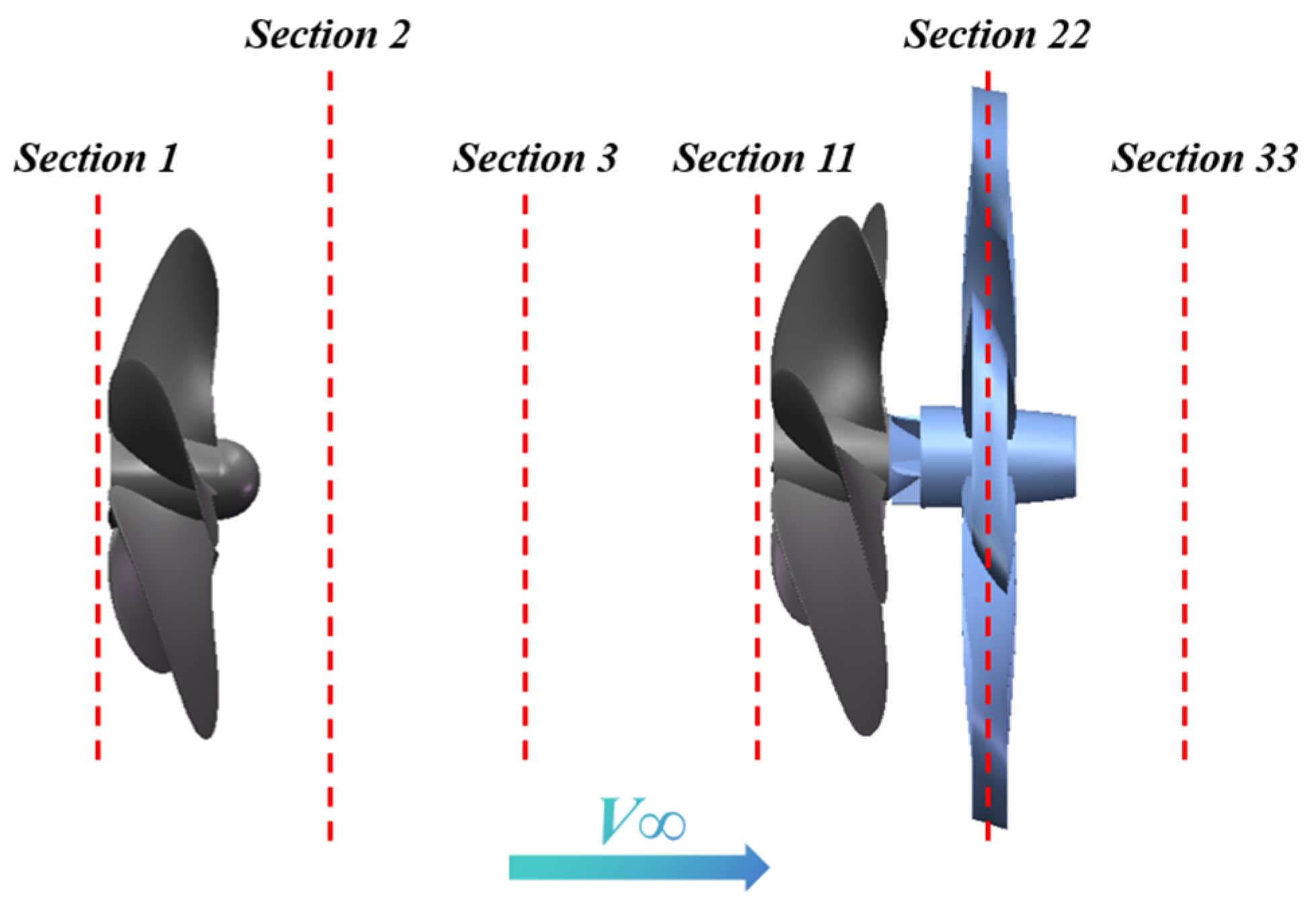
The cross-sectional diagram of the stern flow field is shown in Figure 15. Multiple sections of the propeller disk area are selected for comparative study, including sections of S1, S2, S3 (non-appendage), and sections of S11, S22, S33 (with appendage). By analyzing the axial velocity distribution at these sections, the energy-saving mechanism of the new appendage is revealed. It should be noted that the markings here are only to distinguish the same cross-section before and after the installation of the new appendage.
Figure 16 shows the axial velocity distribution characteristics at different cross-sections behind the propeller disk. Without the new appendage, the propeller disk region at the cross-section S1 of the upstream flow field exhibits a relatively high axial velocity. The red area in Figure 16 represents the high-speed convergence zone. This phenomenon indicates that there is a significant difference in the axial velocity distribution after the water flows through the propeller disk, with a large velocity gradient. Consequently, this leads to energy dissipation and weakens the propulsion efficiency of the propeller. In contrast, the wake axial velocity in the propeller disk region has significantly slowed down after the installation of the new appendage, which lies at the cross-section S11 of the upstream flow field; the area of the high-speed convergence zone has been greatly reduced. This change is mainly attributed to the utilization of the rotating water flow from the propeller wake by the toroidal boosted appendage, effectively reducing energy loss. Further observation of the central regions of the cross-sections S2 and S22 reveals that the wake recovery effect of the appendage is more significant. The axial velocity distribution at the propeller disk is smoother, and the area of the high-speed zone is significantly reduced. In addition, the anti-swirl section of the appendage has an accelerating effect on the flow velocity, avoiding energy dissipation caused by the flow velocity difference in the hub area. Finally, at the cross-sections S3 and S33 of the downstream flow field, the effectiveness of the appendage on the recovery and utilization of the propeller wake flow was further verified. Overall, the axial velocity distribution behind the propeller disk becomes more uniform after the installation of the new appendage, and the rotational energy in the wake has been effectively recovered. This not only improves the propeller’s propulsion efficiency but also optimizes overall performance.
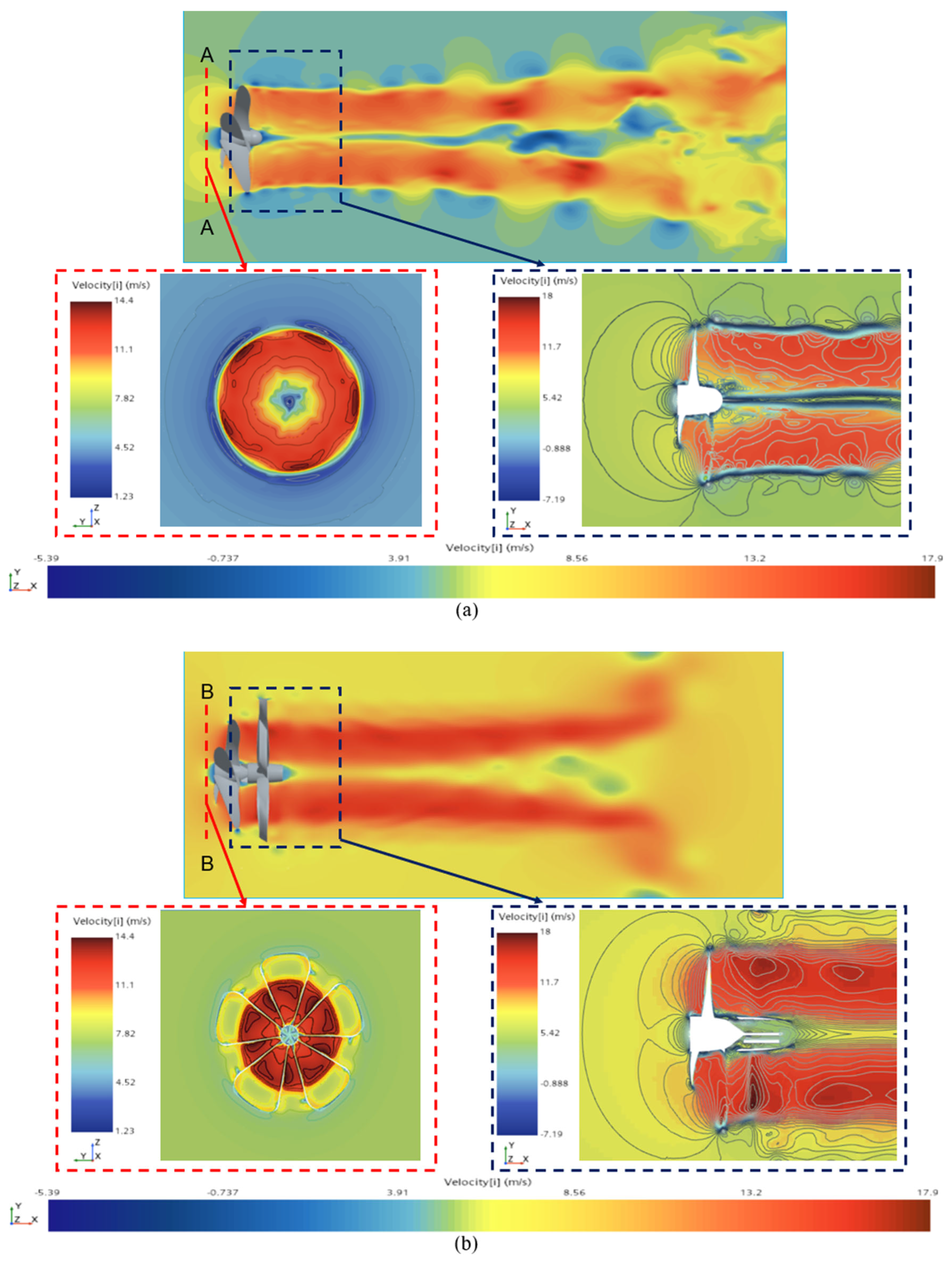
Figure 17 shows the distribution of the velocity field in the longitudinal section for the propellers with and without the new appendage. The influence of the new appendage on the disturbance of the flow field behind the propeller and the difference in flow velocity are further explored. From the perspective of momentum balance, the flow field velocity in the central region behind the propeller shows a diffusion trend without the appendage, with significant wake disturbances and drastic velocity variations. There are extensive high-speed zones in the propeller wake, and a significant velocity gradient between the core region and the outer buffer zone results in substantial energy loss. Through the coordinated operation of its anti-swirl section and toroidal blades, the wake flow field behind the propeller with the new appendage has been effectively “channelized”. Not only has the flow velocity in the central area been steadily increased, but the wake flow has also become smoother. The new appendage can effectively recover the rotational kinetic energy in the wake during the autonomous rotation process. Meanwhile, the new appendage gains power and rotates through the water flow behind the propeller during the propulsion process, generating additional thrust. The swirl section of the appendage promotes the integration of the low-speed region near the blade tip with the velocity field behind the blade surface, enhances the uniformity of the propeller flow field, and further improves the performance. This phenomenon is consistent with the research results of Li et al. [38]; the post-propeller energy-saving device can rectify the wake flow of the propeller and recover energy, effectively reducing energy loss. Overall, the new appendage recovers the tangential rotational energy of the propeller disk and neutralizes the adverse torque, generating additional thrust during the rotation process. And this new appendage effectively enhances the total thrust of the propeller and achieves the goal of energy conservation and efficiency improvement.

6. Conclusions

This paper presents a new type of toroidal boosted appendage for the ship propeller, which is installed behind the KP505 propeller. The hydrodynamic performance of the propulsion system under different advance coefficients is simulated by CFD numerical technology. The key research focuses on the influence of the new toroidal boosted appendage on the propeller’s hydrodynamic performance and conducts open water performance prediction and wake field comparative analysis under different advance coefficients. Based on the results of this study, the following conclusions are drawn:
(1) The numerical results of the open water characteristics of the KP505 propeller are in very good agreement with the experimental data.
(2) The influence of the new toroidal boosted appendage leads to an increase in the thrust coefficient of the propeller while the torque coefficient changes little, which improves the propulsion efficiency of the propeller by 7.453% at the design advance coefficient J = 0.4.
(3) The toroidal boosted appendage works well at low advance coefficients, which can improve propulsion efficiency and reduce output power.
(4) The toroidal boosted appendage can effectively improve the flow field and make the pressure distribution more uniform at the same time.
This study proposes a novel propulsion appendage designed to enhance propeller efficiency, with numerical simulations confirming its hydrodynamic feasibility. The results indicate measurable gains in thrust and efficiency under open-water conditions, supported by detailed flow analyses. However, several limitations must be acknowledged. The findings currently rely on computational models without direct experimental validation for the fully integrated system. Furthermore, the study is based on RANS simulations, which, while efficient, have inherent limitations in capturing all fine-scale turbulent and transitional flow features compared to scale-resolving methods like LES. Importantly, the analysis does not yet account for realistic operating environments, such as non-uniform hull wakes or rudder interactions, which may significantly influence real-world performance. The cavitation performance and structural load characteristics of the new appendage, important for practical application, are not evaluated in this initial hydrodynamic study.
To advance this research, future efforts should prioritize experimental validation through model-scale tests in towing tanks or cavitation tunnels, with particular focus on measuring the self-rotation behavior of the appendage and visualizing its wake-regulating effect. High-fidelity simulations using scale-resolving methods such as URANS or LES are recommended to better capture transient vortex structures and energy transfer mechanisms. Further studies should also investigate system-level integration under varied loading conditions and in combination with a rudder to assess practical efficacy and potential hydrodynamic interactions. Finally, a systematic multi-objective optimization framework should be applied to refine the appendage geometry—considering parameters such as blade curvature, fin angle, and duct profile—to holistically balance efficiency, cavitation inception, structural strength, and acoustic performance. Through these advancements, the proposed concept can progress toward a validated, optimized, and practically viable design suitable for next-generation marine propulsion systems.

Author Contributions

Conceptualization, D.L. and T.H.; methodology, D.L. and T.H.; software, T.H. and X.B.; validation, T.H. and Z.L.; formal analysis, D.L.; investigation, Q.G.; resources, T.H.; data curation, T.H. and Z.L.; writing—original draft preparation, T.H. and X.B.; writing—review and editing, D.L. and T.H.; visualization, T.H.; supervision, D.L.; project administration, D.L.; funding acquisition, Q.G. and X.B. All authors have read and agreed to the published version of the manuscript.

Funding

This research was funded by the Scientific Research Foundation of Jiangsu Maritime Institute (2025BSKY01 and 2024BSKY23), 2025 Jiangsu Province Industry-University-Research Cooperation Project (BY20250965) and the National Natural Science Foundation of China (NO. 52101315).

Data Availability Statement

The data that support the findings of this study are available from the corresponding author upon reasonable request.

Acknowledgments

The authors would like to thank Jiangsu University of Science and Technology for providing the CFD software usage. During the preparation of this work, the authors used DeepSeek V3 in order to improve the language. After using these tools, the authors reviewed and edited the content as needed and take full responsibility for the content of the publication.

Conflicts of Interest

The authors declare no conflicts of interest.

Abbreviations

The following abbreviations are used in this manuscript:
CFDComputational Fluid Dynamics
ESDsEnergy-Saving Devices
EEXIEnergy Efficiency Existing Ship Index
PBCFPropeller Boss Cap Fins
PSDPre-Swirl Duct
PSSPre-Swirl Stator
FVMFinite Volume Method
DESDetached Eddy Simulation
RANSReynolds-Averaged Navier–Stokes
ITTCInternational Towing Tank Conference
EFDExperimental Fluid Dynamics

References

  1. Annex—2022 Guidelines on the Method of Calculation of the Attained Energy Efficiency Existing Ship Index (EEXI). Available online: https://imorules.com/GUID-AEEBCA73-AF36-4241-A9A0-C0A2ADAD517A.html (accessed on 23 January 2026).
  2. Majumder, P.; Maity, S. A critical review of different works on marine propellers over the last three decades. Ships Offshore Struct. 2023, 18, 391–413. [Google Scholar] [CrossRef]
  3. Krol, P. Hydrodynamic State of Art Review: Rotor—Stator Marine Propulsor Systems Design. Pol. Marit. Res. 2021, 28, 72–82. [Google Scholar] [CrossRef]
  4. Simple Structure, Proven Energy Saving Effect. Available online: https://www.pbcf.jp/en/principle-en/ (accessed on 23 January 2026).
  5. Mewis, F. A novel power-saving device for full-form vessels. In Proceedings of the First International Symposium on Marine Propulsors, Trondheim, Norway, 22–24 June 2009. [Google Scholar]
  6. Nojiri, T.; Ishii, N.; Kai, H. Energy saving technology of PBCF (propeller boss cap fins) and its evolution. J. Jpn. Inst. Mar. Eng. 2011, 46, 350–358. [Google Scholar] [CrossRef]
  7. Kawamura, T.; Ouchi, K.; Nojiri, T. Model and full scale CFD analysis of propeller boss cap fins (PBCF). J. Mar. Sci. Technol. 2012, 17, 469–480. [Google Scholar] [CrossRef]
  8. Shin, H.J.; Lee, J.S.; Lee, K.H.; Han, M.R.; Hur, E.B.; Shin, S.C. Numerical and experimental investigation of conventional and un-conventional pre-swirl duct for VLCC. Int. J. Nav. Arch. Ocean Eng. 2013, 5, 414–430. [Google Scholar] [CrossRef]
  9. Hanaoka, A.; Kawanami, Y.; Hinatsu, M. Application of quasi-continuous method to open-water characteristics predictions of propellers with energy-saving ducts. Int. J. Offshore Polar Eng. 2016, 26, 72–80. [Google Scholar] [CrossRef]
  10. Mizzi, K.; Demirel, Y.K.; Banks, C.; Turan, O.; Kaklis, P.; Atlar, M. Design optimization of propeller boss cap fins for enhanced propeller performance. Appl. Ocean Res. 2017, 62, 210–222. [Google Scholar] [CrossRef]
  11. Gaggero, S. Design of PBCF energy saving devices using optimization strategies: A step towards a complete viscous design approach. Ocean. Eng. 2018, 159, 517–538. [Google Scholar] [CrossRef]
  12. Hu, J.; Zhang, W.P. Numerical simulation of propeller wake-freedom impeller coupling. J. Huazhong Univ. Sci. Technol. Nat. Sci. Ed. 2019, 47, 82–86+104. [Google Scholar]
  13. Nadery, A.; Ghassemi, H. Hydrodynamic performance of the ship propeller under oscillating flow with and without stator. Am. J. Civ. Eng. Architect. 2020, 8, 56–61. [Google Scholar]
  14. Bakica, A.; Vladimir, N.; Jasak, H.; Kim, E.S. Numerical simulations of hydrodynamic loads and structural responses of a Pre-Swirl Stator. Int. J. Naval Arch. Ocean Eng. 2021, 13, 804–816. [Google Scholar] [CrossRef]
  15. Wu, P.C.; Chang, C.W.; Huang, Y.C. Design of energy-saving duct for JBC to reduce ship resistance by CFD method. Energies 2022, 15, 6484. [Google Scholar] [CrossRef]
  16. Shen, H.L.; Obwogi, E.O.; Su, Y.M. The design and energy saving effect of partial duct and unconventional pre-swirl fin and their combination system. Ocean Eng. 2023, 287, 115857. [Google Scholar] [CrossRef]
  17. Sadakata, K.; Hino, T.; Takagi, Y. Estimation of full-scale performance of energy-saving devices using Boundary Layer Similarity model. J. Mar. Sci. Technol. 2024, 29, 245–271. [Google Scholar] [CrossRef]
  18. Xue, L.; Zou, D.; Jiao, C.; Dong, X.; Zhang, Z.; Ta, N.; Rao, Z. Tip-clearance pressure fluctuations between conventional pump-jet propulsor and pump-jet propulsor with rotor blade crown in non-uniform inflow. Phys. Fluids 2025, 37, 025125. [Google Scholar] [CrossRef]
  19. Gaggero, S.; Martinelli, M. Comparison of different propeller boss cap fins design for improved propeller performances. Appl. Ocean Res. 2021, 116, 102867. [Google Scholar] [CrossRef]
  20. The Sharrow Propeller™ Named “Clean Technology Transportation Solution of the Year” by CleanTech Breakthrough. Available online: https://www.sharrowmarine.com/news/the-sharrow-propeller-named-clean-technology-transportation-solution-of-the-year-by-cleantech-breakthrough (accessed on 23 January 2026).
  21. Liu, P.; Li, S.; Jin, H.; Tian, X.; Liu, G. Shape parameterization method and hydrodynamic noise characteristics of low-noise toroidal propeller. Ocean Eng. 2025, 328, 121088. [Google Scholar] [CrossRef]
  22. Nadery, A.; Bahrami, H.; Najafi, A.; Ghassemi, H.; Aminzadeh, M.; He, G.H. Numerical investigation of toroidal propeller: Hydrodynamic and hydroacoustic study. Ships Offshore Struct. 2025, 1–16. [Google Scholar] [CrossRef]
  23. Xu, P.; Guo, Y.; Ye, L.; Song, K. Hydrodynamic Performance of Toroidal Propeller Based on Detached Eddy Simulation Method. J. Mar. Sci. Eng. 2024, 12, 2132. [Google Scholar] [CrossRef]
  24. Wang, C.; Liu, S.; Xia, K.; Wang, C.; Ye, L. Numerical research on hydrodynamic performance of toroidal propeller under the influence of geometric parameters. Ocean Eng. 2024, 314, 119704. [Google Scholar] [CrossRef]
  25. Xiang, Y.; Wang, W. Hydrodynamic performance evaluation of pump-jet propulsion based on the toroidal propeller. Ocean Eng. 2024, 311, 118932. [Google Scholar] [CrossRef]
  26. Kim, J.H.; Choi, J.E.; Choi, B.J.; Chung, S.H.; Seo, H.W. Development of energy-saving devices for a full slow-speed ship through improving propulsion performance. Int. J. Nav. Architect. Ocean Eng. 2015, 7, 390–398. [Google Scholar] [CrossRef]
  27. Spinelli, F.; Mancini, S.; Vitiello, L.; Bilandi, R.N.; Carlini, M.D. Shipping Decarbonization: An Overview of the Different Stern Hydrodynamic Energy Saving Devices. J. Mar. Sci. Eng. 2022, 10, 574. [Google Scholar] [CrossRef]
  28. Sun, Y.; Su, Y.; Wang, X.; Hu, H. Experimental and numerical analyses of the hydrodynamic performance of propeller boss cap fins in a propeller-rudder system. Eng. Appl. Comput. Fluid Mech. 2016, 10, 145–159. [Google Scholar] [CrossRef]
  29. Wu, J.; Wang, Q.; Deasy, H.; Hang, J. A Study on the Effect of Toroidal Propeller Parameters on Efficiency and Thrust. Energies 2024, 17, 5938. [Google Scholar] [CrossRef]
  30. Nadery, A.; Ghassemi, H.; Chybowski, L. The effect of the PSS configuration on the hydrodynamic performance of the KP505 propeller behind the KCS. Ocean Eng. 2021, 234, 109310. [Google Scholar] [CrossRef]
  31. Tezdogan, T.; Demirel, Y.K.; Kellett, P.; Khorasanchi, M.; Incecik, A.; Turan, O. Full-scale unsteady RANS CFD simulations of ship behaviour and performance in head seas due to slow steaming. Ocean Eng. 2015, 97, 186–206. [Google Scholar] [CrossRef]
  32. Su, Y.; Kinnas, S.A. A Generalized Potential/RANS Interactive Method for the Prediction of Propulsor Performance. J. Ship Res. 2017, 61, 214–229. [Google Scholar] [CrossRef]
  33. Zhang, X.Y.; Zhang, X.R.; Chen, C.; Chang, X.; Zhang, Y. Numerical simulation of effective wake field and propulsion performance in a ship with moonpool. Ocean Eng. 2025, 323, 120589. [Google Scholar] [CrossRef]
  34. Cong, L. Computational Research on Three Kinds of Ship Energy-Saving Devices Based on CFD. Master’s Thesis, Dalian University of Technology, Dalian, China, 2017. [Google Scholar]
  35. International Towing Tank Conference. Practical guidelines for ship CFD applications. In ITTC Recommended Procedures and Guidelines; 7.5-03-02-03; ITTC: Zürich, Switzerland, 2011. [Google Scholar]
  36. Torckler, R.; Majidiyan, H.; Enshaei, H. CFD-based design of novel drag-reducing appendages for container ships. Appl. Ocean Res. 2025, 158, 104605. [Google Scholar] [CrossRef]
  37. Felli, M.; Falchi, M. Propeller tip and hub vortex dynamics in the interaction with a rudder. Exp. Fluids 2011, 51, 1385–1402. [Google Scholar] [CrossRef]
  38. Li, H.; Pan, G.; Huang, Q. Transient analysis of the fluid flow on a pumpjet propulsor. Ocean Eng. 2019, 191, 106520. [Google Scholar] [CrossRef]
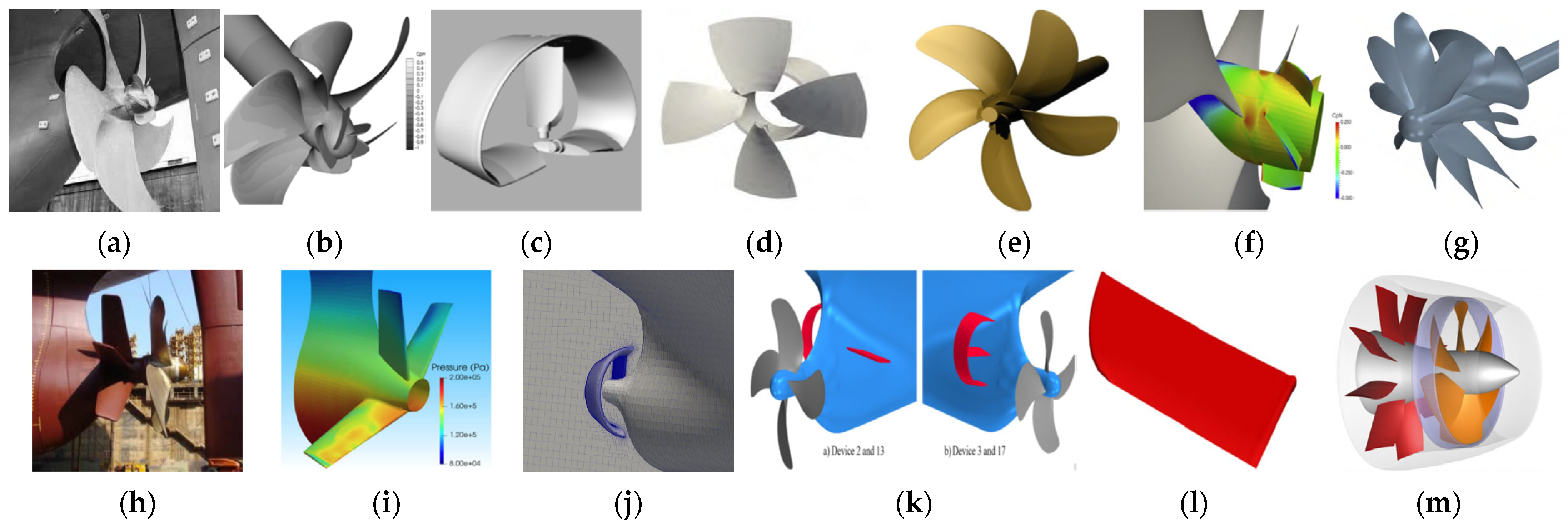
Figure 1. Different types of ESDs: (a) PBCF [6]; (b) PBCF [7]; (c) PSD [8]; (d) Swirl Duct [9]; (e) PBCF [10]; (f) PBCF [11]; (g) Grim Vane Wheel [12]; (h) PSS [13]; (i) PSS [14]; (j) Pre-Duct [15]; (k) Pre-Swirl Fin [16]; (l) Energy-Saving Fin [17]; (m) Energy-Saving Fin [18].
Jmse 14 00410 g001
Figure 2. Propeller model with appendage.
Jmse 14 00410 g002
Figure 3. Assembly diagram of propeller.
Jmse 14 00410 g003
Figure 4. New appendage energy-saving mechanism.
Jmse 14 00410 g004
Figure 5. Computational grid domain and boundary conditions.
Jmse 14 00410 g005
Figure 6. Flow field region mesh refinement: (a) Surface mesh distribution of front view; (b) surface mesh distribution of rear view; (c) meshing of disk profile; (d) meshing of propeller and appendage; (e) propeller prism boundary layer mesh; (f) appendage tip prism boundary layer mesh; (g) prism boundary layer mesh at the propeller-appendage junction.
Jmse 14 00410 g006
Figure 7. y+ diagram of propeller and appendage: (a) front view of propeller; (b) profile view of propeller; (c) rear view of propeller; (d) front view of appendage; (e) profile view of appendage; (f) rear view of appendage.
Jmse 14 00410 g007
Figure 8. Comparison of different basic grid sizes: (a) fine mesh; (b) medium mesh; (c) coarse mesh.
Jmse 14 00410 g008
Figure 9. Comparison of KP505 propeller between CFD and EFD.
Jmse 14 00410 g009
Figure 10. Comparison of open water performance between the KP505 propeller and the combination system.
Jmse 14 00410 g010
Figure 11. Comparison of vorticity between the KP505 propeller and the combination system: (a) non-appendage; (b) with-appendage.
Jmse 14 00410 g011
Figure 12. Comparison of axial pressure distribution: (a) suction side ( J = 0.4); (b) pressure side ( J = 0.4); (c) suction side ( J = 0.6); (d) pressure side ( J = 0.6).
Jmse 14 00410 g012
Figure 13. Comparison of longitudinal pressure distribution: (a) non-appendage; (b) with appendage.
Jmse 14 00410 g013aJmse 14 00410 g013b
Figure 14. Comparison of wake flow at the hub: (a) non-appendage; (b) with appendage.
Jmse 14 00410 g014aJmse 14 00410 g014b
Figure 15. A schematic diagram of the flow field section.
Jmse 14 00410 g015
Figure 16. Axial velocity distribution in different sections: (a) S1; (b) S2; (c) S3; (d) S11; (e) S22; (f) S33.
Jmse 14 00410 g016
Figure 17. Comparison of longitudinal velocity field: (a) non-appendage; (b) with appendage.
Jmse 14 00410 g017
Table 1. A literature review of the ESDs.
AuthorsYearName of DevicesResult
Nojiri et al. [6]2011Propeller Boss Cap FinsAround 1.5% efficiency improvement
Kawamura et al. [7]2012Propeller Boss Cap FinsA maximum 2.32% efficiency improvement
Shin et al. [8]2013Pre-Swirl DuctThe efficiency gains 3–8%
Hanaoka et al. [9]2016Swirl DuctReduce the total kinetic energy level
Mizzi et al. [10]2017Propeller Boss Cap FinsDecrease the eddy after the propeller
Gaggero [11]2018Propeller Boss Cap FinsPropulsion efficiency improvement of 1–4%
Hu et al. [12]2019Grim Vane WheelProvide additional thrust
Nadery et al. [13]2020Pre-Swirl StatorGain the delivered power by 2.3%
Bakica et al. [14]2021Pre-Swirl StatorImprove the propeller efficiency by 4.69%.
Wu et al. [15]2022Pre-DuctReduce the ship resistance by 2.49%
Shen et al. [16]2023Partial Duct-Pre-Swirl FinThe energy saving effect is about 4.26%
Sadakata et al. [17]2024Energy-Saving FinA vortex at the fin tip improves hull efficiency
Xue et al. [18]2025Rotor Blade CrownImprove noise radiation level of pump-jet propulsor
Table 2. Main dimensions of the KP505 propeller model.
ParameterNumeric Value
Diameter D (m)0.250
Number of blades N5
Expanded Area ratio Ae/A00.800
Hub ratio0.180
Pitch ratio (0.7R)0.997
Section typeNACA66
Table 3. Main dimensions of the new appendage model.
ParameterNumerical ValueParameterNumerical Value
Diameter Db (m)0.325Rectifier fin radian55°
Number of blades5Rectifier fin number5
Installation spacing (from KP505)0.22DHollow duct length (m)0.065
Vortex fin length (m)0.025Hollow duct diameter (m)0.020
Vortex fin number5Hollow duct thickness (m)0.003
Attack angle of vortex fin12°Section type of vortex finNACA001
Table 4. Parameters for boundary condition.
ParametersNumeric Value
Water density ρ 999.1 (kg/m3)
Kinematic viscosity ν 1.0 × 10⁻⁶ (m2/s)
Number of revolutions n 50 (r/s)
Table 5. Mesh independence validation results.
Mesh SolutionMesh Number (Million) K T 10 K Q η 0 K T
Error (%)
10 K Q
Error (%)
η 0
Error (%)
Fine mesh2.1380.2270.3720.5832.155%3.125%0.865%
Medium mesh1.1020.2290.3770.5811.293%1.823%0.519%
Coarse mesh0.5820.2320.3840.578---
Table 6. Uncertainty analysis summary for different grid sizes when J = 0.6 (after correction).
Items R G P G δ R E G C G U G δ G U G C S C E C U S N U D U V
K T 0.2271.1700.0040.5000.0040.0020.0020.2250.0010.0020.0050.005
10 K Q 0.3720.9710.01250.4000.0130.0050.0080.367−0.0050.0080.0070.010
η 0 0.5831.170−0.0040.5000.004−0.0020.0020.5850.0110.0060.0120.013
Table 7. Corresponding table of advance coefficient J and velocity V a .
J 0.10.20.30.40.50.60.70.80.9
V a ( m / s ) 1.252.503.755.006.257.508.7510.0011.25
Table 8. Comparison results of KP505 propeller.
J K T 10 K Q η 0
EFDCFDError (%)EFDCFDError (%)EFDCFDError (%)
0.10.4760.4750.210 0.6730.6750.297 0.1130.1120.506
0.20.4320.4330.231 0.6140.6241.629 0.2240.2211.375
0.30.3810.3871.575 0.5530.5692.893 0.3290.3251.281
0.40.3290.3382.736 0.490.514.082 0.4280.4221.293
0.50.2760.2853.261 0.4260.4464.695 0.5160.5091.370
0.60.2260.2312.212 0.3620.3794.696 0.5960.5822.372
0.70.1770.1760.565 0.2990.3114.013 0.6600.6314.402
0.80.1280.1252.344 0.2350.2412.553 0.6940.6614.775
0.90.0760.0716.579 0.1690.1614.734 0.6440.6321.937
Table 9. The results of open water performance for the propellers with/without the new appendage.
J K T 10 K Q η 0
WithoutwithImprove (%)WithoutwithImprove (%)WithoutwithImprove (%)
0.10.4750.4994.924 0.6750.6740.178 0.1120.1185.111
0.20.4330.4554.940 0.6240.6250.112 0.2210.2324.822
0.30.3870.4085.451 0.5690.5680.088 0.3250.3435.544
0.40.3380.3647.538 0.5100.5100.078 0.4230.4547.453
0.50.2850.3015.476 0.4460.4511.054 0.5090.5314.375
0.60.2310.2414.152 0.3790.3790.079 0.5830.6074.070
0.70.1760.1844.778 0.3110.3120.257 0.6300.6594.509
0.80.1250.1314.815 0.2400.2420.749 0.6610.6874.036
0.90.0710.0733.244 0.1610.1652.363 0.6320.6370.860
Disclaimer/Publisher’s Note: The statements, opinions and data contained in all publications are solely those of the individual author(s) and contributor(s) and not of MDPI and/or the editor(s). MDPI and/or the editor(s) disclaim responsibility for any injury to people or property resulting from any ideas, methods, instructions or products referred to in the content.