Article

Spatiotemporal Dynamics of the Thermophilic Benthic Harmful Dinoflagellates in Annaba Bay (Southern Mediterranean): Influence of Environmental Factors and Macrophyte Substrates


1
Marine Bioressources Laboratory, Faculty of Sciences, Badji, Mokhtar University, PB 12, Annaba 23000, Algeria
2
University of Montpellier, MARBEC, IRD, Ifremer, CNRS, CEDEX 5, 34095 Montpellier, France
3
Department of Biologic Sciences, Faculty of Natural and Life Sciences, University Mohamed-Cherif Messaadia, Souk Ahras 41000, Algeria
*
Author to whom correspondence should be addressed.
J. Mar. Sci. Eng. 2026, 14(4), 398; https://doi.org/10.3390/jmse14040398
Submission received: 16 December 2025 / Revised: 11 February 2026 / Accepted: 11 February 2026 / Published: 22 February 2026
(This article belongs to the Special Issue Impacts of Climate Change on Marine Life)

Abstract

For the first time in the bay of Annaba (Southern Mediterranean), we studied the spatiotemporal distribution of potentially toxic benthic dinoflagellates: Ostreopsis cf. ovata, Prorocentrum lima, Coolia monotis, and Amphidinium carterae, hosted by the dominant macrophytes Posidonia oceanica, Padina pavonica, Codium fragile, and Halopteris scoparia. Sampling of these macrophytes was conducted weekly during spring and summer as well as bi-weekly in autumn and winter, from October 2022 to November 2023, at contrasting sites within Annaba Bay. The measured environmental parameters included temperature, pH, dissolved oxygen, salinity, ammonium, nitrate, nitrite, dissolved organic nitrogen, dissolved inorganic nitrogen, phosphate, dissolved organic phosphorus, silicate, and chlorophyll a. A proliferation of O. cf. ovata was recorded in July 2023, coinciding with a marked increase in temperature, with a maximum abundance exceeding 40 × 103 cells g−1 of fresh weight (FW) on H. scoparia and C. fragile. The maximum abundance of P. lima reached 8700 cells g−1 FW on H. scoparia during July and August 2023. Coolia monotis exhibited a peak of 2800 cells g−1 FW on H. scoparia. The abundance of A. carterae increased with temperature, reaching a maximum of 980 cells g−1 FW on P. pavonica. The distribution of epiphytic dinoflagellates varied according to the macrophyte substrate. Overall, statistical analyses indicate that benthic dinoflagellate community structure is shaped by the combined effects of temperature, nutrient availability, and ecological niche differentiation, with temperature emerging as the dominant driver. This suggests that climate-driven increases in Mediterranean Sea surface temperatures are likely to extend the seasonal window of harmful benthic algal blooms, thereby enhancing ecological disturbances and potential risks to human health. This study provides the first assessment of BHAB dynamics along the Eastern Algerian coast, highlighting the role of ongoing regional warming in shaping future bloom patterns.

1. Introduction

Benthic harmful algal blooms (BHABs) represent a major environmental concern due to their potential damaging effects on marine ecosystems [1,2,3]. Certain BHAB species produce a variety of toxins that can accumulate throughout the food web [4,5,6,7], posing serious threats to both marine organisms and human health [2,8]. Over the past decades, research on BHABs has expanded significantly [3,9,10,11]. However, studies focusing on the warm Southern Mediterranean waters remain scarce and are still urgently needed. The geographic spread of BHAB species is facilitated by various vectors, including ballast water discharge and the translocation of shellfish carrying viable cysts or vegetative cells [12,13]. The increase in seawater temperature associated with climate change, together with the artificialization of coastal areas, has been identified as a major driver of the global expansion of BHABs [14,15,16,17]. In this context, several BHAB-forming species, including those investigated in the present study, have been described in the literature as thermophilic, meaning that they exhibit optimal growth, increased abundance, or enhanced physiological performance at relatively high temperature ranges compared to temperate counterparts [16,18,19,20]. The implementation of research and monitoring programs on BHAB species remains essential for understanding their dynamics and mitigating their impacts [8,21].
The environmental parameters that regulate epibenthic dinoflagellate populations may differ from those influencing planktonic species [18]. A key distinction lies in the ecological behavior of epibenthic dinoflagellates, which typically coexist in assemblages composed of species from the genera Prorocentrum, Ostreopsis, Coolia, Amphidinium, and Gambierdiscus; the latter is a typical tropical-to-subtropical species [22]. One of the defining characteristics of these species is their ability to attach to various substrates such as macrophytes, algal turf, rocks, corals, and detritus [5,6,23]. In aquatic ecosystems, abiotic factors such as temperature, salinity, nutrients, light, and hydrodynamic are recognized as key parameters influencing the proliferation of epibenthic dinoflagellates [6,10,20,24,25,26,27,28,29]. As noted by Glibert et al. (2018) [30], increasing temperature can enhance nutrient uptake by microalgae; however, their development is constrained by species-specific temperature tolerance limits [31]. BHAB occurrences appear to be predominant in tropical and subtropical regions [32,33]. Nevertheless, a notable increase in the number of BHAB species has been reported in temperate waters over the past two decades [6,10,23,34,35,36]. Although climate change and anthropogenic activities are thought to play a role in BHAB expansion, the complex interactions between abiotic and biotic factors and their effects on BHAB development is not fully understood [6]. The diversity, abundance, and distribution of BHAB species are likely influenced by multiple interacting environmental factors. For example, the proliferation of epibenthic dinoflagellates is closely related to the specific characteristics of macrophytes, such as their structural complexity and the release of allelopathic compounds [10,22,37,38,39,40,41]. In addition, grazing pressure by herbivores have also been shown to shape and control epibenthic dinoflagellate communities [18]. Numerous studies have been conducted in the Mediterranean to investigate the dynamic of epibenthic dinoflagellates and the environmental factors driving their blooms [19,24,26,27,36,39,42,43,44,45,46,47,48,49,50,51,52].
Among epiphytic dinoflagellates, O. cf. ovata, P. lima and C. monotis often represent an important fraction of potentially toxic assemblages [53]. Ostreopsis cf. ovata emerged as one of the main species responsible for toxic blooms in the Northern Mediterranean Sea and has been linked to several human health incidents [1,19,45,54,55,56,57]. This species forms floating aggregates at the sea surface and releases toxic aerosols, which can cause respiratory disorders and skin or eye irritation. Comprehensive descriptions of the intracellular profiles of the various Palytoxins (PLTX) analogs, namely ostreocins, mascarenotoxins, and ovatoxins produced by Ostreopsis species have been synthesized in the review paper by Pavaux et al. (2020) [58]. Along Mediterranean coastlines, several ovatoxins (OVTXs) as well as isobaric PLTX have been detected in mussels, sea urchins, and omnivorous or herbivorous fish [58,59,60]. In many cases, the measured concentrations exceeded the safety alert limit of 30 μg PLTX-equivalents per kilogram of fresh tissue recommended by the European Food Safety Authority [61,62,63,64]. Prorocentrum lima is a cosmopolitan species, widely distributed and often abundant in coastal environments. This dinoflagellate is known to synthesize several toxic compounds, including okadaic acid (OA) and its analogs, dinophysistoxins (DTXs), prorocentrolide, and prorocentin [65]. Prorocentrum lima has been implicated in diarrhetic shellfish poisoning (DSP) events worldwide and has also been suspected of contributing to ciguatera poisoning. Coolia monotis is generally considered nontoxic, although earlier studies suggested the existence of toxic strains producing cooliatoxin, exhibiting hemolytic activity [66,67,68]. Subsequent taxonomic revisions demonstrated that these toxic strains were misidentified and actually corresponded to Coolia tropicalis or Coolia malayensis [69].
To date, only two studies have reported the presence of harmful benthic dinoflagellates along the Algerian coast [45,70], and high-resolution data on their seasonal dynamics and substrate preferences remain lacking. In contrast, previous research in the region has primarily focused on neurotoxic planktonic dinoflagellates, such as Alexandrium pacificum [71,72,73]. In Annaba Bay, the interactions between toxic dinoflagellate species and local macrophytes as well as the influence of physicochemical environmental parameters have not yet been investigated. Addressing these knowledge gaps is essential for establishing robust ecological baselines and for assessing the potential impacts of benthic harmful algal blooms on coastal biodiversity and public health in the Southern Mediterranean.
The present study aims to: (1) monitor the dynamics of benthic dinoflagellates colonizing macrophytes at contrasting sites within Annaba Bay and (2) investigate the relationships between principal environmental factors (temperature, salinity, and nutrients), the colonized macrophytes, and the abundance of BHAB species.

2. Materials and Methods

2.1. Description and Geographic Location of the Study Area

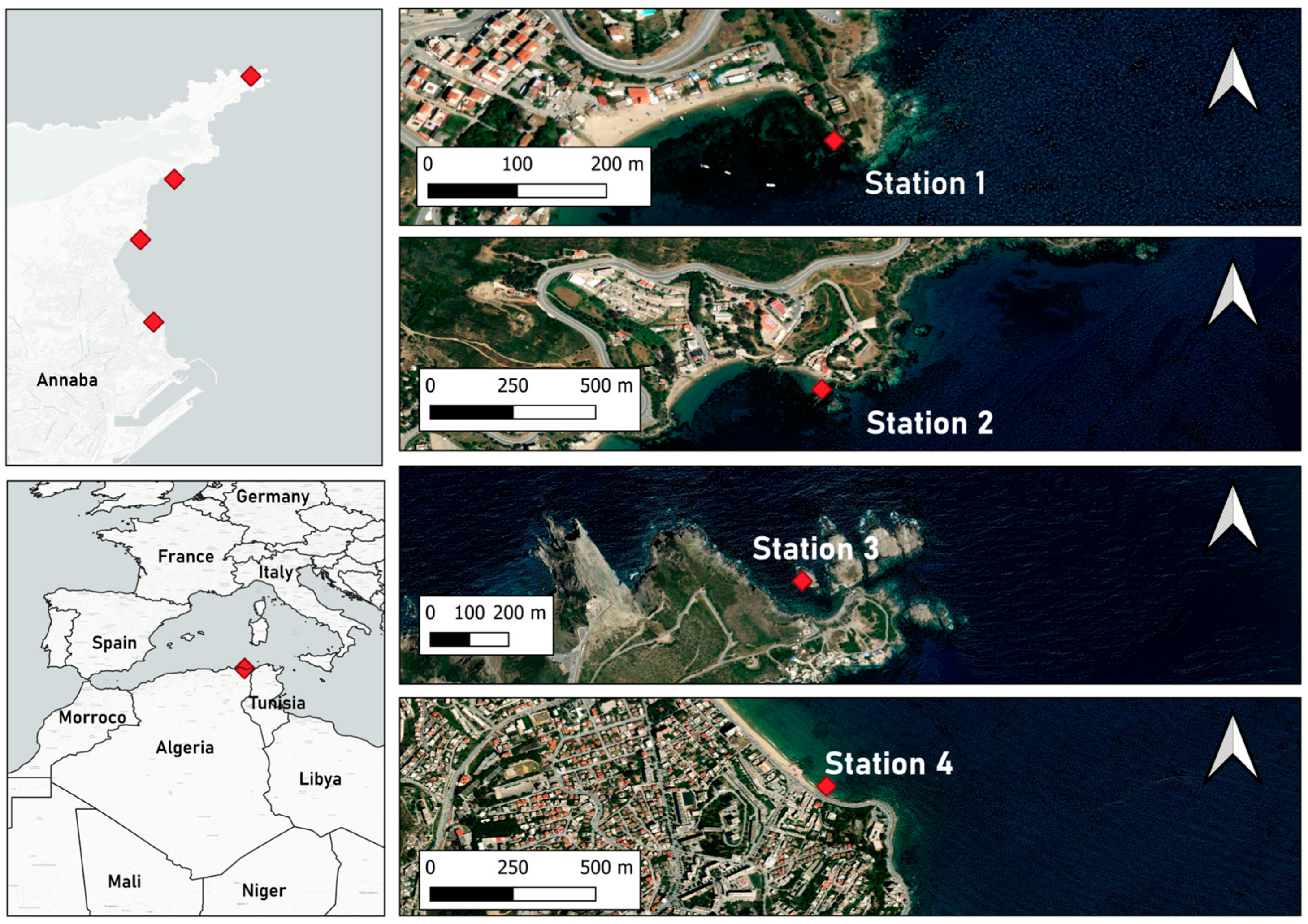
The Bay of Annaba is located on the eastern coast of Algeria, in the southwestern Mediterranean Sea (Figure 1). It stretches approximately 40 km between Cape Rosa (8°15′ E, 36°58′ N) and Cape de Garde (7°16′ E, 36°58′ N). The maximum depth of the bay does not exceed 65 m [74,75]. It receives freshwater input from two main rivers: the Seybouse River, which flows directly into the southwestern part of the bay, and the Mafragh River to the east. In addition to freshwater, the bay is also impacted by various sources of pollution [75]; the primary sources of pollution include agricultural runoff, industrial discharges, and urban wastewater, all of which contribute to degraded water quality and a disrupted Redfield ratio (N:P:Si).
In the context of this study, four sampling stations were selected within Annaba Bay. Station 1 (ST1: 36°56′2″ N, 7°45′50″ E) is located at Caroube Beach, near a highly urbanized and anthropized area. Station 2 (ST2: 36°94′7″ N, 7°77′46″ E) is situated at Belvedere Beach, slightly further north and more distant from direct pollution sources (see Figure 1). Site selection is based on substrate characteristics (rocky coastal systems) and local hydrodynamic conditions. Both areas are known to be particularly productive, supporting a wide diversity of marine flora and fauna (Table 1).
Furthermore, the low hydrodynamic activity in these areas [76] may provide favorable conditions for the development of benthic dinoflagellates. During the summer season, two additional monitoring stations were established, as sampling at these sites was not feasible during the rest of the year. The third station (ST3: 36°57′ N, 7°48′17″ E) was located at Cap de Garde, in a zone far from anthropogenic influences and characterized by strong currents and high hydrodynamic disturbances. In contrast, the fourth station (ST4: 36°55′01″ N, 7°46′05″ E) is situated at Fellah Rachid Beach, an urban coastal area that is easily accessible to bathers and visitors during the summer. This site is characterized by the absence of macrophytes during colder months and only a sparse presence during the warm season (Table 1).

2.2. Sampling Frequency and Collection of Macrophytes

Between October 2022 and November 2023, samples of fresh leaves and thalli from three macrophyte species Posidonia oceanica, Padina pavonica, and Halopteris scoparia were collected weekly during the spring and summer seasons as well as bi-weekly during autumn and winter. These species were consistently present throughout the year, whereas other macrophytes, such as Codium fragile and Sargassum sp., were only observed for short periods of 3 to 4 months. To access areas where macrophytes thrive, samples were collected at depths ranging from 0.5 to 0.6 m. Approximately 30 g of leaves and thalli from each target species were carefully placed into hermetically sealed 500 mL plastic containers, which were closed underwater to retain the surrounding seawater. This step was essential to preserve sample integrity and ensure the reliability of subsequent analyses. After collection, all samples were promptly transported to the laboratory for further processing.

2.3. Physicochemical Parameters

Temperature (°C), salinity, pH, and dissolved oxygen (DO) in mg L−1 were measured at each station using a HANA 9829 multiparameter probe (Hanna Instruments, Smithfield, RI, USA). Moreover, 500 mL of seawater was collected from each site for the analysis of nutrient concentrations. In the laboratory, water samples were filtered using Whatman GF/C filters (47 mm diameter, 1.2 µm pore size). All nutrient analyses were performed on the same day. The concentrations of silicates (SiO4), phosphates (H3PO4), and dissolved inorganic nitrogen (DIN), the latter comprising nitrite (NO2), nitrate (NO3), and ammonium (NH4), were determined following the procedures described in the manual by Aminot and Chaussepied (1983) [77]. The dissolved organic fraction was quantified as dissolved organic nitrogen (DON) and dissolved organic phosphorus (DOP), based on the method outlined by Rodier et al. (1966) [78]. Total dissolved nutrients in phosphorus (TDP) and nitrogen (TDN) were calculated as follows: TDP = H3PO4 + DOP, TDN = DIN + DON, where DIN is the sum of NO2 + NO3 + NH4. All the nutrients’ concentrations are expressed in µmol L−1. Seasonal fluctuations in chlorophyll a and phaeopigments concentrations (µg L−1) were measured using the Lorenzen method (1967). For this, 1000 mL of seawater was filtered through Whatman filters, and pigment extraction was performed using methanol [79].

2.4. Enumeration, Identification, and Cellular Concentration

The water from the benthic macroalgae samples was sieved to remove debris using a 200 µm filter and then placed in a container. The detachment of epiphytes was carried out by rinsing macrophyte fragments with 250 mL of pre-filtered seawater (0.2 µm) while vigorously agitating for 20 to 30 s, a duration established in the literature to ensure high detachment efficiency [1], then filtering through 200 µm. The two samples (from the container and from the box) were mixed (final volume 750 mL). Three subsamples of 50 mL were fixed with neutralized formaldehyde (4%. final concentration) and then stored, protected from light. To estimate the number of epiphytes per gram of fresh weight of macrophytes, the latter were drained and dried with absorbent paper and weighed [10]. The morphological identification of benthic dinoflagellates was based on several publications and subsequent studies [5,32,49,80,81,82,83,84,85].
Two types of sedimentation chambers were used for counting epiphytes: an Utermöhl (1958) [86] (Hydro-Bios, Altenholz, Germany) chamber of 25 mL for low cell densities and a Sedgwick–Rafter (Graticules Optics, Panningen, Netherlands) cell of 1 mL for higher densities, a minimum of 400 cells was counted per sample to ensure statistical robustness. After a sedimentation time adjusted to the volume of the counting chamber (25 mL subsamples were allowed to settle for at least 12 h in sedimentation chambers before being examined), dinoflagellates were enumerated using an inverted microscope (Exacta Optech Mod. IB., Munich, Germany) by scanning the entire bottom of the sedimentation chamber. Cellular concentrations are expressed as the number of cells per gram of fresh weight of macrophyte (cells g−1 FW).

2.5. Statistical Analyses

Seasonal and spatial variations in physicochemical and biological variables were assessed using two-way analysis of variance (ANOVA), with months and stations as fixed factors. Importantly, this analysis was restricted to stations ST1 and ST2 to ensure a balanced temporal design across the complete sampling period (October 2022–November 2023). Stations ST3 and ST4, which were sampled exclusively during the summer, were included only for spatial and substrate-preference comparisons during the peak bloom period. When significant differences were detected, Tukey’s post hoc tests were applied to identify pairwise differences between groups. To explore the relationships between cell densities of epibenthic dinoflagellates (Ostreopsis, Prorocentrum, Coolia, and Amphidinium), physical parameters (temperature, salinity, dissolved oxygen, and pH), nutrients, and biological variables (chlorophyll a and phaeopigments), pairwise linear relationships among environmental variables were examined using Pearson’s correlation coefficient. Environmental controls on benthic dinoflagellate community structure were further investigated using redundancy analysis (RDA), implemented with the vegan package. The significance of each environmental variable in explaining the variability of the biological data was subsequently tested. All statistical analyses were performed using R software (version 4.2.2; R Core Team, Vienna, Austria, 2022).

3. Results

3.1. Seasonal Variation in Physicochemical Parameters

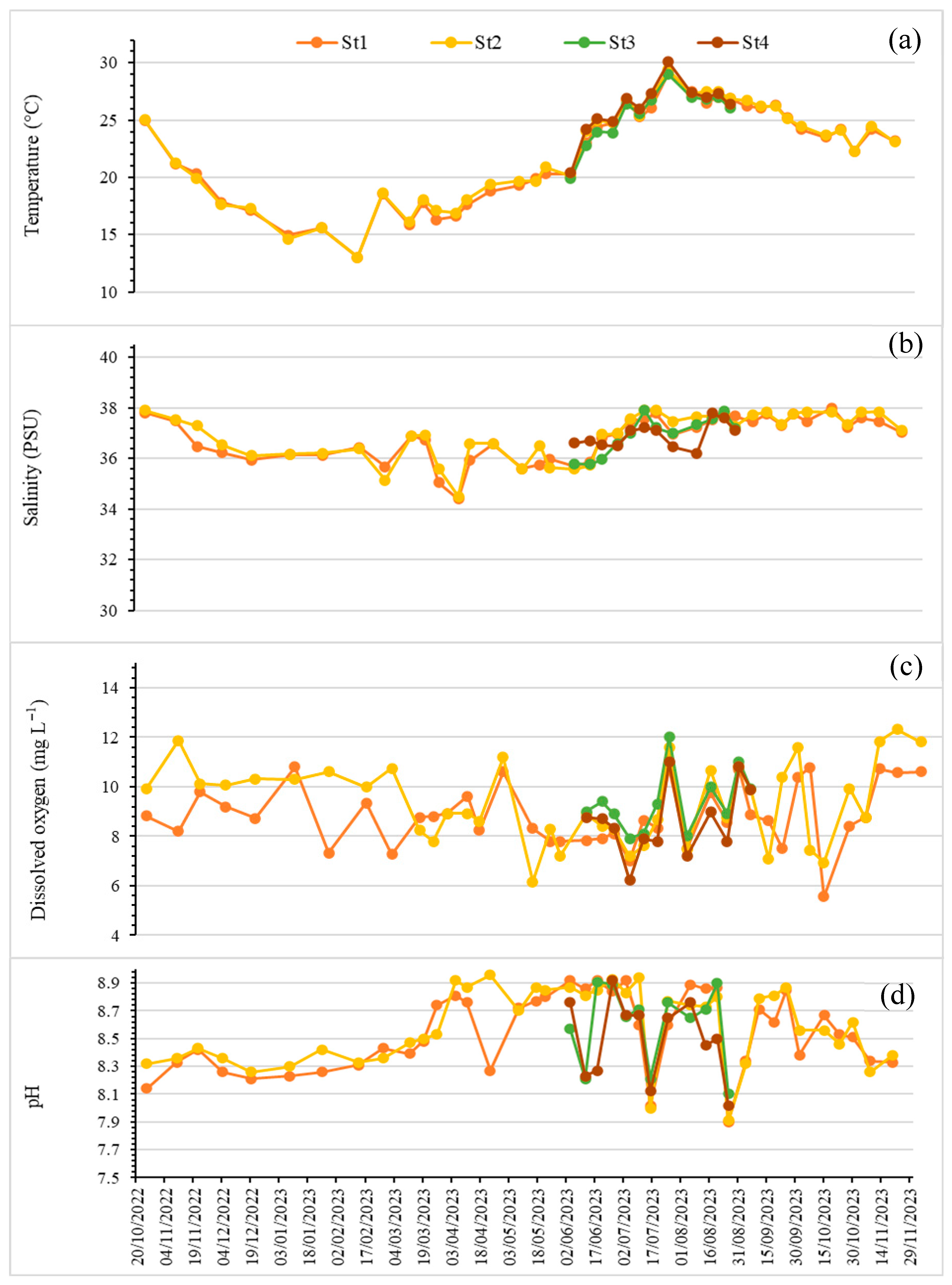
Figure 2 shows the variations in the measured physicochemical parameters. Overall, environmental variables exhibited pronounced seasonal variability (Figure 2), as confirmed by tow-way ANOVA (Table A1) and Tukey’s HSD post hoc tests (Figure A2). In particular, temperature showed a strong seasonal variation (p < 0.001), increasing from mean values of 21.72 ± 4.07 °C at Station 1 and 21.86 ± 4.10 °C at Station 2 to 25.43 ± 2.41 °C and 26.17 ± 2.22 °C at Stations 3 and 4, respectively (Table 2). Consistent with this pattern, the highest seasonal mean temperatures were recorded in summer (25–27 °C), whereas the lowest values occurred in spring and winter (15–18 °C) (Figure 2).
Similarly, salinity (Sal) varied significantly among seasons (p < 0.001), although within a relatively narrow range (Table A1). Mean salinity values ranged from 36.84 ± 0.77 at Station 1 to 36.98 ± 0.82 at Station 2 (Table 2), with a marked decrease during spring and higher values during summer and autumn (Figure 2).
In contrast, dissolved oxygen (DO) exhibited an inverse seasonal pattern (p < 0.001) (Figure A2). Mean DO concentrations were highest during autumn and winter, reaching 9.64 ± 1.25 mg L−1 at Station 2, while lower values were observed during summer, with a minimum of 7.22 mg L−1. Concurrently, pH displayed significant seasonal variation (p < 0.001), increasing from mean values of 8.42–8.50 in autumn/winter to 8.61–8.65 during spring and summer (Figure 2).

3.2. Seasonal Dynamics of Nutrients

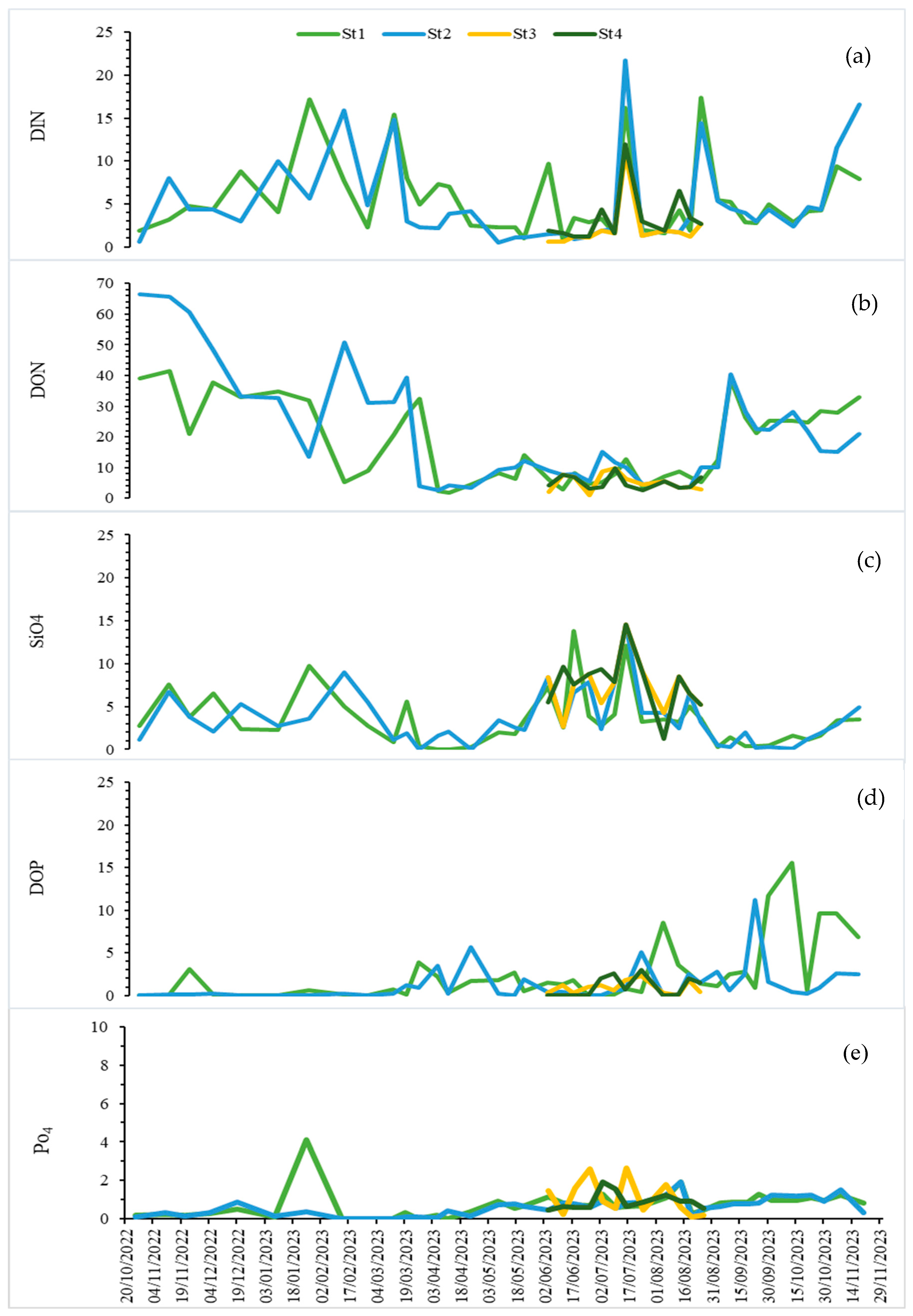
Figure 3 shows the seasonal variation in nutrient concentrations in the studied stations. The two-way ANOVA indicated that seasonal variability was the primary driver of physicochemical conditions in Annaba Bay, with significant temporal effects observed for most variables (Table A1 and Figure A1). In contrast, spatial variability among stations was limited and significant only for ammonium, silicate, and chlorophyll a. Phosphate and DOP remained stable across both temporal and spatial scales. Overall, these results highlight the dominance of seasonal forcing over spatial heterogeneity in structuring environmental dynamics in the study area.
Regarding nitrogen, distinct seasonal trends were evident. Nitrite varied significantly across seasons (p < 0.001) (Table A1), with summer mean concentrations reaching 3.58 µmol L−1 at Station 2 compared with values of below 1 µmol L−1 during autumn and spring. In addition, ammonium showed significant seasonal differences (p = 0.0057), with higher mean concentrations in autumn and winter (up to 2.30 µmol L−1 at Station 1) and markedly lower values in summer, particularly at Stations 3 and 4 (0.27–0.59 µmol L−1). By contrast, nitrate did not exhibit significant seasonal variation (p = 0.66), despite spatial differences in mean concentrations ranging from 1.18 µmol L−1 at Station 3 to 3.58 µmol L−1 at Station 2 (Figure 2). Similarly, DIN remained statistically stable throughout the year (p = 0.21), with mean values between 2.22 and 5.35 µmol L−1 (Figure 3).
Nutrient analyses revealed a clear predominance of organic forms over inorganic fractions throughout the study period (Figure 3). Dissolved organic nitrogen (DON) constituted the major component of the total dissolved nitrogen (TDN) pool, accounting for 59.98–84.20% of TDN, while dissolved inorganic nitrogen (DIN) remained at or near detection limits during the summer bloom peaks. This dominance of organic nitrogen was particularly pronounced at Stations 1 and 4. Similarly, dissolved organic phosphorus (DOP) represented 55.93–77.83% of total dissolved phosphorus across all stations. Overall, these findings indicate that organic nutrient forms contributed substantially more to total nutrient availability than inorganic fractions.
In parallel, phosphate showed significant seasonal variation (p = 0.0053), with mean summer concentrations reaching 0.79 µmol L−1 at Station 4, compared with values close to zero during spring and winter (Figure 2). Furthermore, silicate varied markedly (p < 0.001), increasing from mean spring values of ~1.5–2.0 µmol L−1 to summer and winter maxima exceeding 7.0 µmol L−1 (Figure 3).

3.3. Biological Indicators

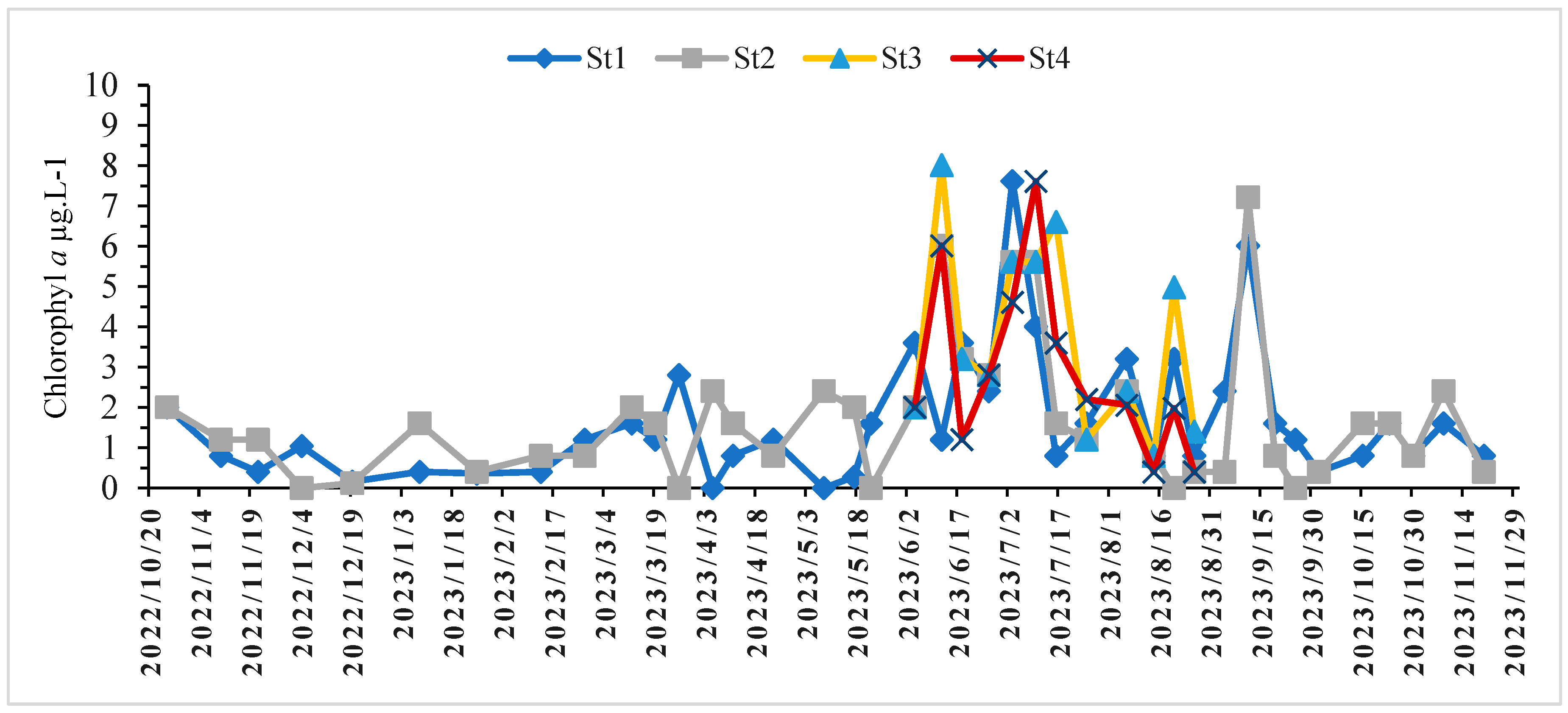
Biological variables also reflect seasonal forcing (Table 1 and Figure A1). Chlorophyll a displayed strong seasonality (p < 0.001), with mean concentrations increasing from approximately 1.0 µg L−1 in winter to more than 3.0 µg L−1 in summer, indicating enhanced phytoplankton biomass during warmer periods (Figure 4). Conversely, Phaeopigments did not differ significantly among seasons (p = 0.49), with mean values remaining consistently below 2.0 µg L−1.

3.4. Epibenthic Assemblage

During the study period (October 2022–November 2023), a diverse assemblage of microalgal taxa was identified. Although various diatoms and dinoflagellates were sporadically observed, these groups were recorded on a qualitative basis only. In accordance with a targeted monitoring strategy, quantitative analyses were focused on the four dominant and potentially harmful benthic dinoflagellates (identified morphologically as Ostreopsis cf. ovata, Prorocentrum lima, Coolia monotis, and Amphidinium carterae), as these taxa represent the primary ecological and public health concerns in Annaba Bay. These species were found in association with various macrophytes hosts, including Posidonia oceanica, Padina pavonica, Halopteris scoparia, Codium fragile, and Sargassum sp.; they exhibited variable cell abundances throughout the monitoring period (Figure 5, Figure 6, Figure 7 and Figure 8). For the first time, the four recorded benthic dinoflagellates in field samples (O. cf. ovata, P. lima, C. monotis and A. carterae) were isolated from Annaba Bay and monoclonal cultures were established. Ribotyping analyses confirmed the morphological identification of the three species (Sad Laib et al., in preparation).
The results suggest that temperature plays a key role in influencing the distribution and occurrence of BHAB.
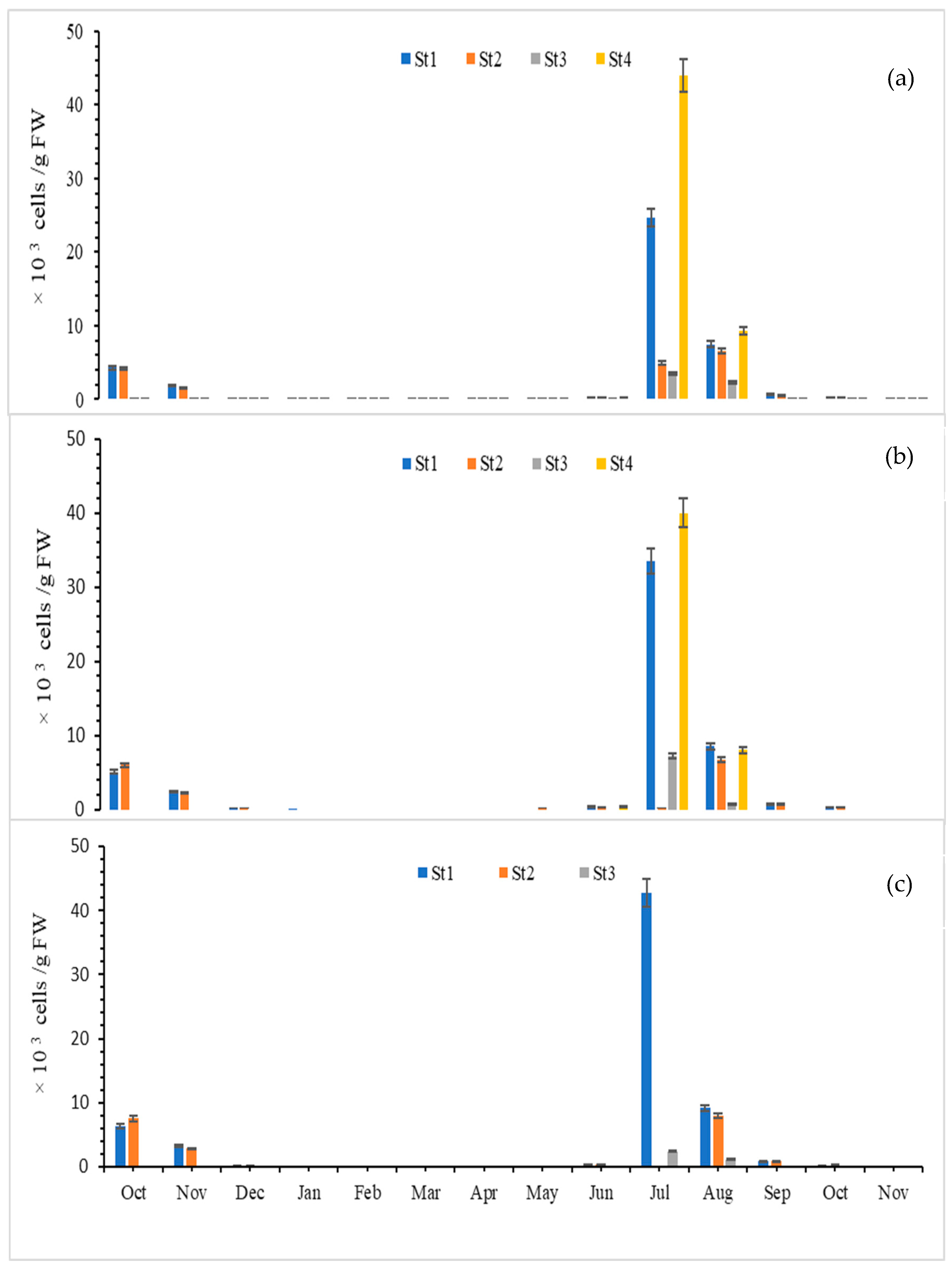
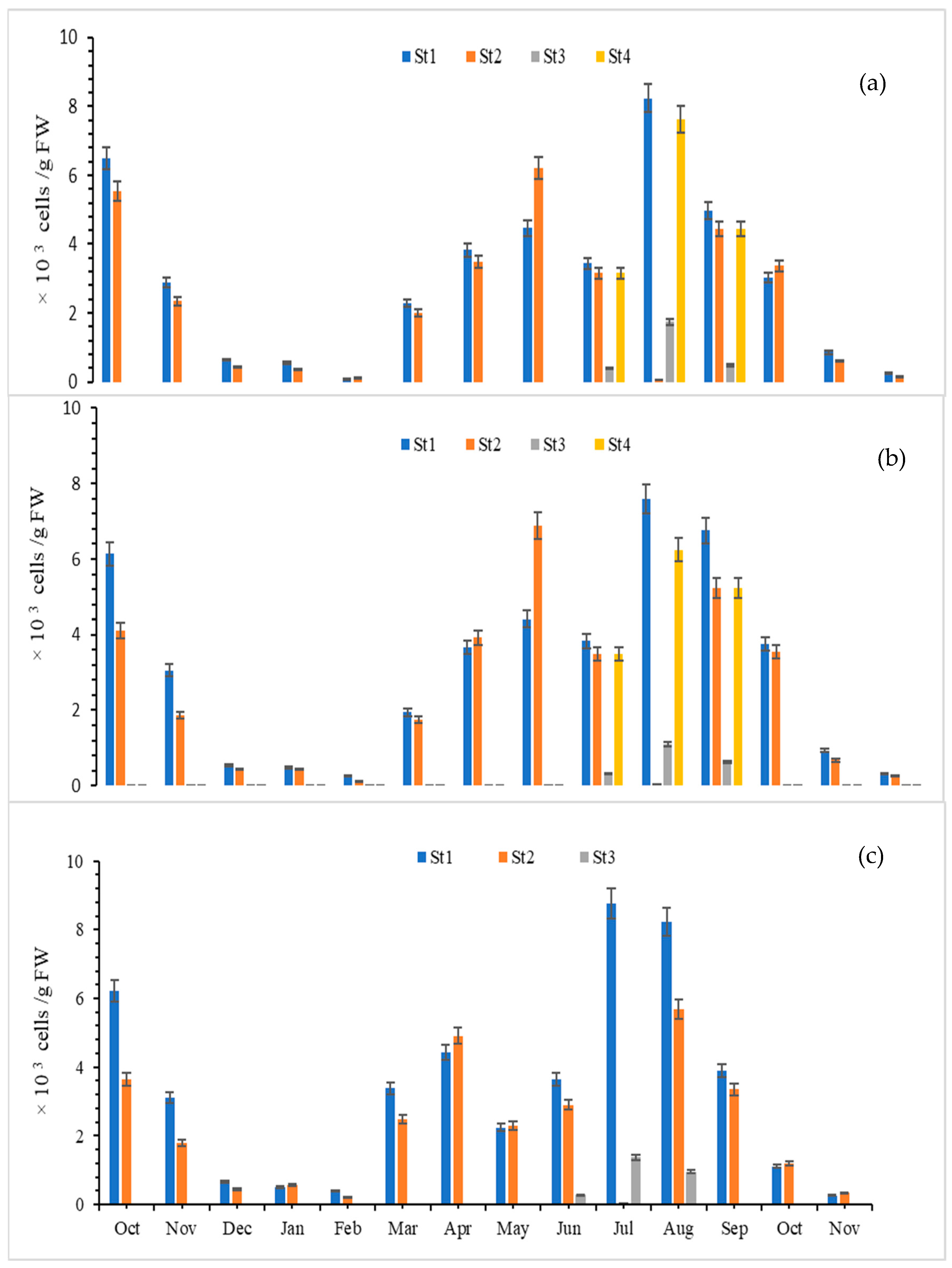
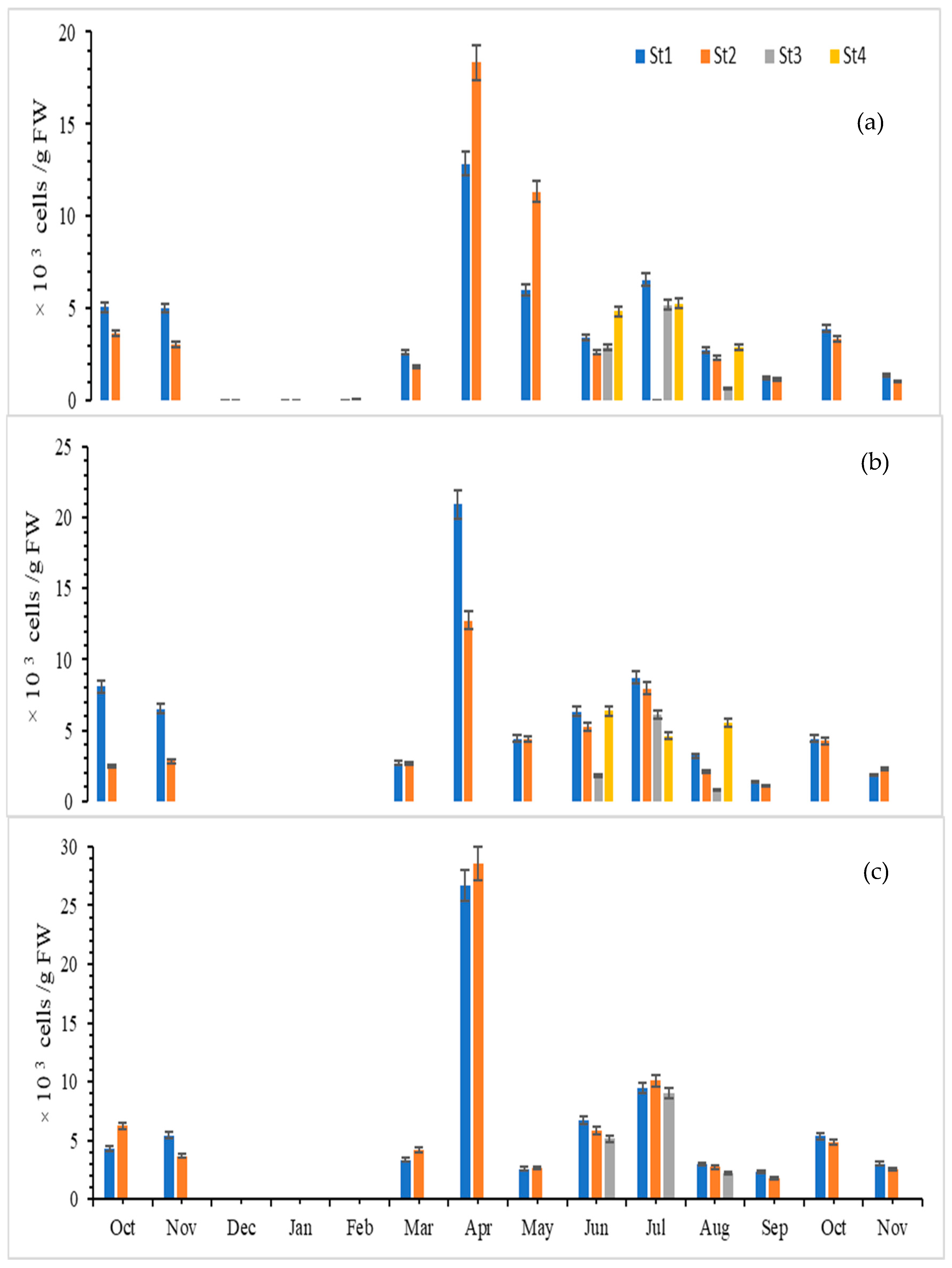
Ostreopsis cf. ovata exhibited the highest cell abundance, exceeding 40 × 103 cells g−1 fresh weight (FW) on H. scoparia and C. fragile in July 2023 at Stations 1 and 4, respectively (Figure 5a,c). This species was absent in January, when water temperatures were at their lowest, and reappeared in June (Figure 5). This seasonal pattern reflects a strong and highly significant positive correlation between O. cf. ovata abundance and temperature (r = 0.75, p = 0.01) (Figure A2). In contrast, P. lima was present throughout the sampling period, reaching a peak abundance of 8700 cells g−1 FW on H. scoparia at Station 1, coinciding with the maximum abundance of O. cf. ovata (Figure 6c). The lowest cell abundance for P. lima (65 cells g−1 FW) was recorded in February on P. pavonica (Figure 6b).
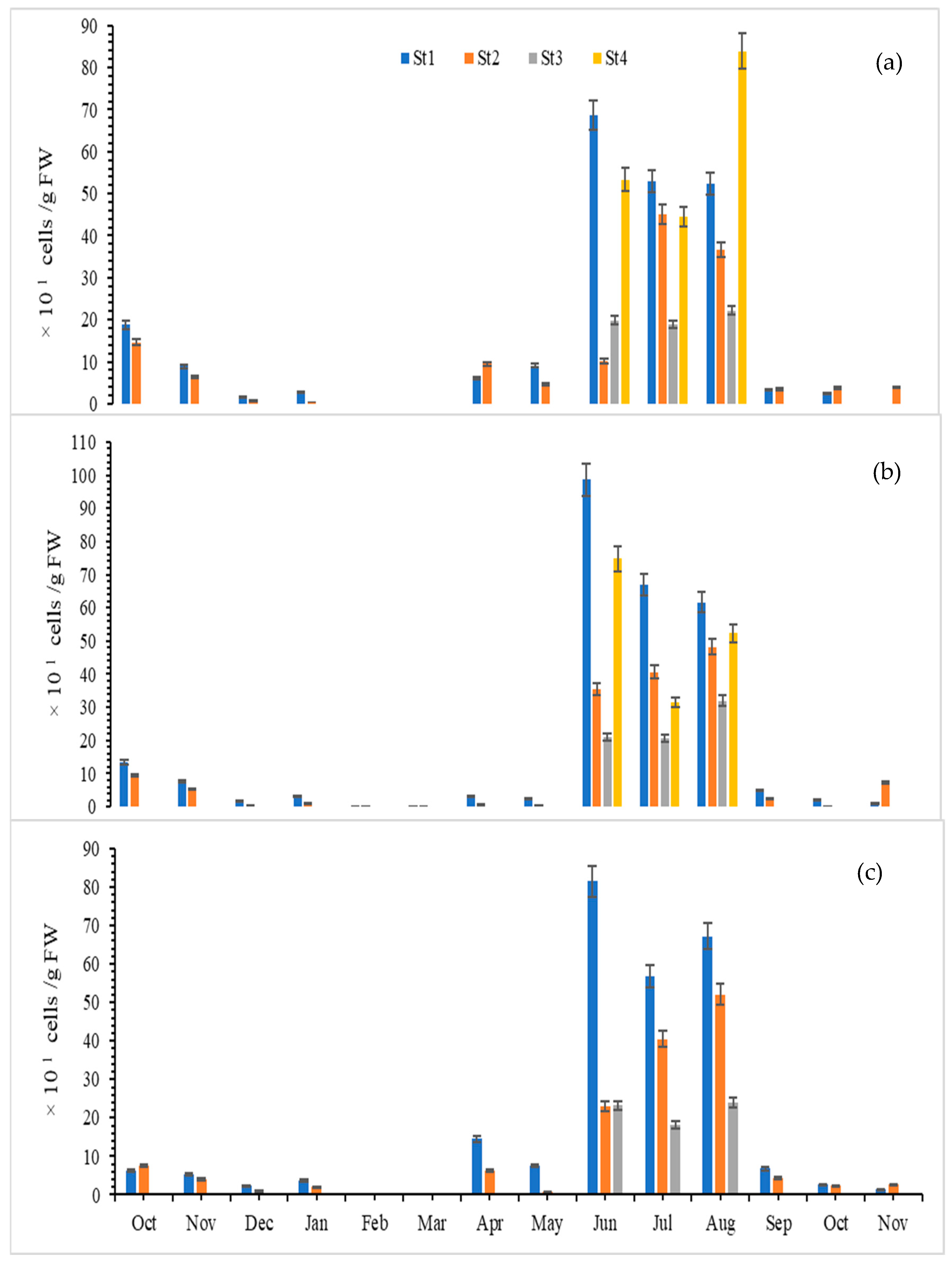
In the case of C. monotis, April favored its development, with densities exceeding 2800 cells g−1 FW on H. scoparia (Figure 7c). Amphidinium carterae reached its highest abundance in June at station 1, with 980 cells g−1 FW recorded on P. pavonica (Figure 8b).
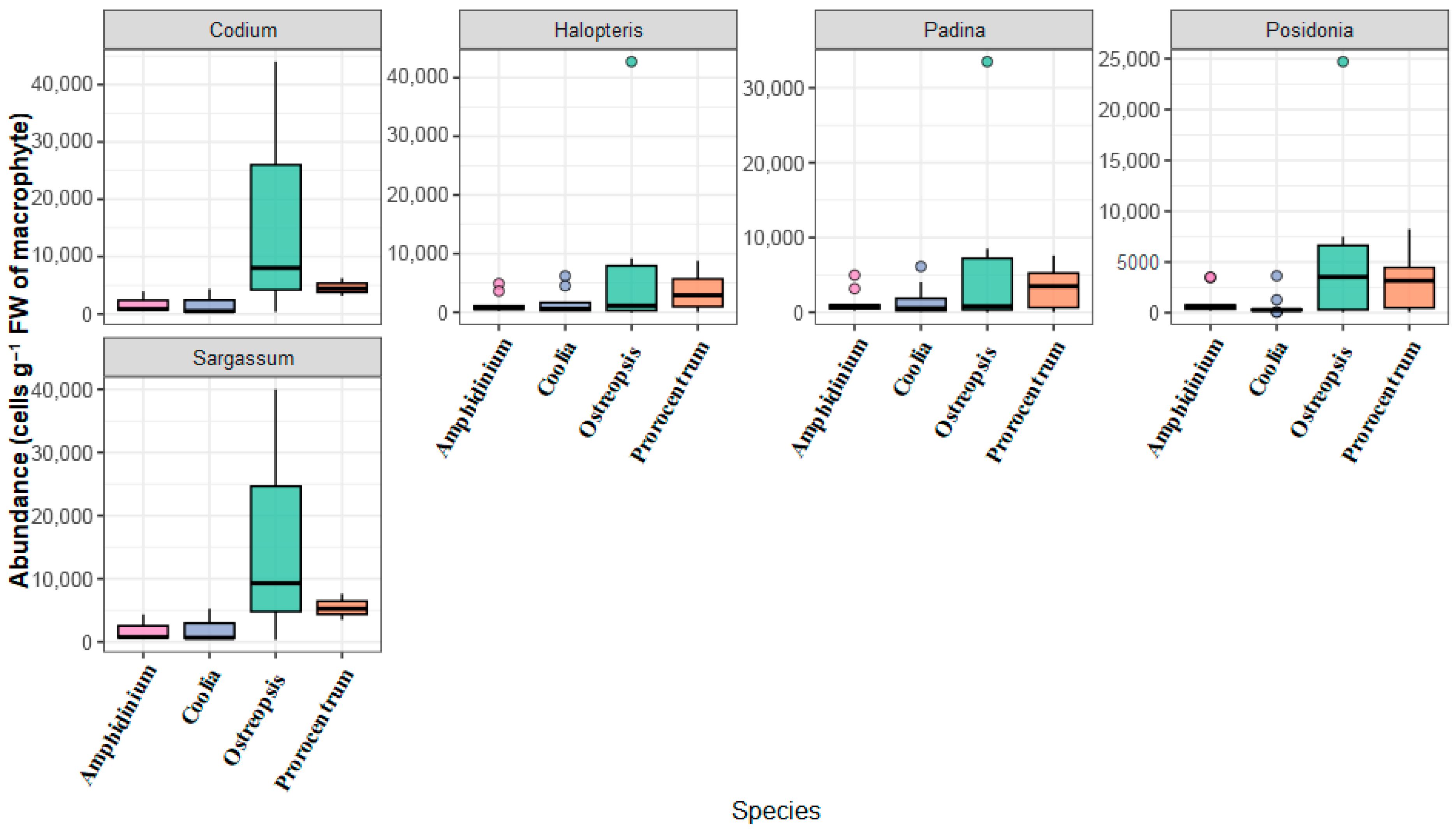
The results show that the abundances of BHAB species observed in Annaba Bay reached their highest values during the summer season, with O. cf. ovata being the dominant dinoflagellate exceeding 40 × 103 cells g−1 fresh weight (FW) on H. scoparia and C. fragile. Similarly, the other dinoflagellates, namely P. lima, C. monotis, and A. carterae, reached their maximum abundance on the macrophyte H. scoparia. To better understand the spatiotemporal distribution and diversity of the BHAB species, two additional stations (ST3 Cap La Garde and ST4 Fellah Rachid Beach) were sampled, each characterized by a distinct macrophyte habitat. The data indicate that the highest abundances were recorded at Station 4 on the macrophyte C. fragile (Figure 5a and Figure 9). Similarly to ST1 and ST2, the two additional stations exhibited the same trend in dinoflagellate distribution, with a marked dominance of O. cf. ovata on both C. fragile and Sargassum sp. Across all macroalgal substrates, O. cf. ovata exhibited the highest cell abundances particularly on C. fragile and Sargassum sp. (Figure 9). Amphidinium carterae and C. monotis consistently showed lower and more stable abundances, with more than 2800 cells g−1 fresh weight (FW) and 980 cells g−1 fresh weight (FW), respectively. Prorocentrum lima displayed intermediate abundances, with higher values on P. pavanica, P. oceanica and Sargassum sp. compared to other macrophytes. Overall, the results highlight a strong substrate-dependent pattern in BHAB species distribution, with Ostreopsis clearly dominating epiphytic assemblages.

3.5. Influence of Biotic and Abiotic Parameters on BHAB Dynamics

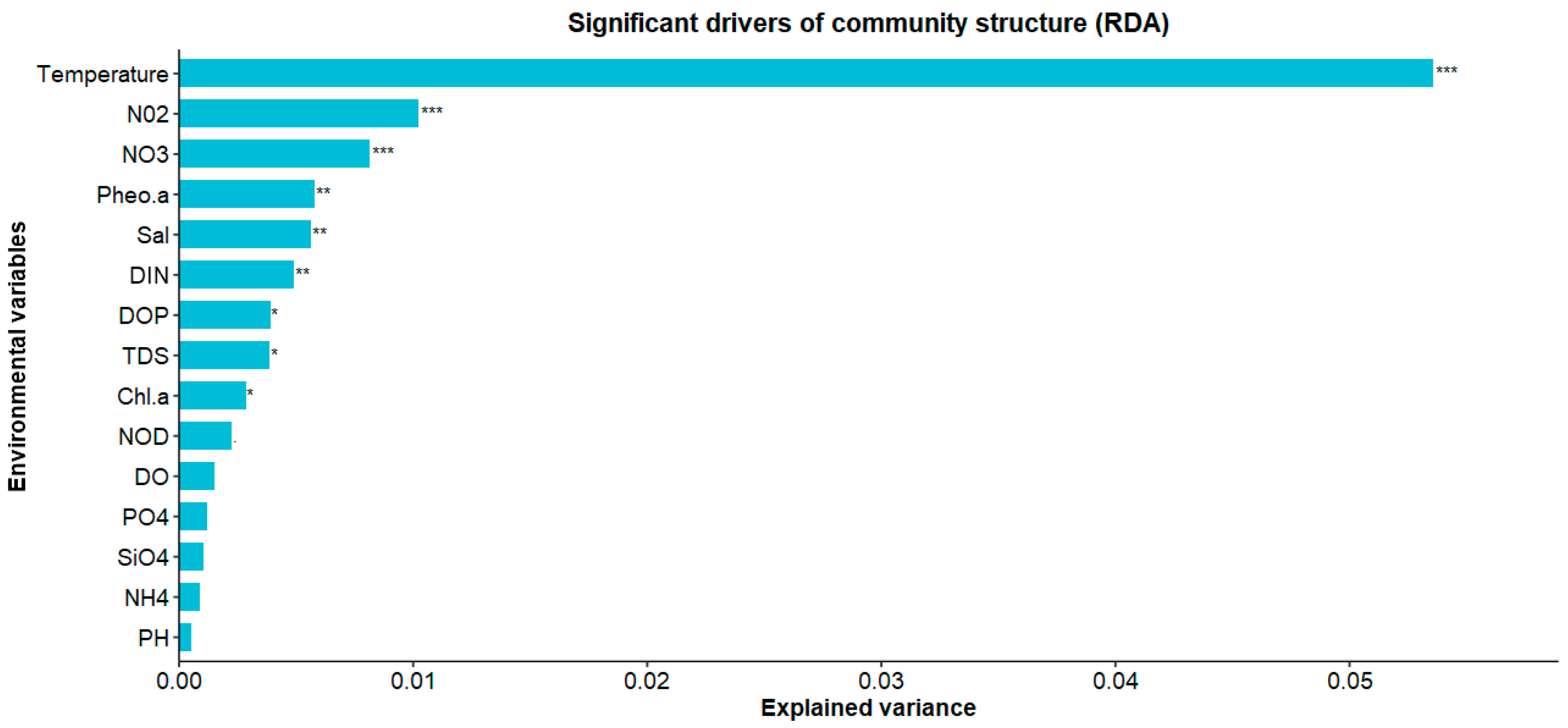
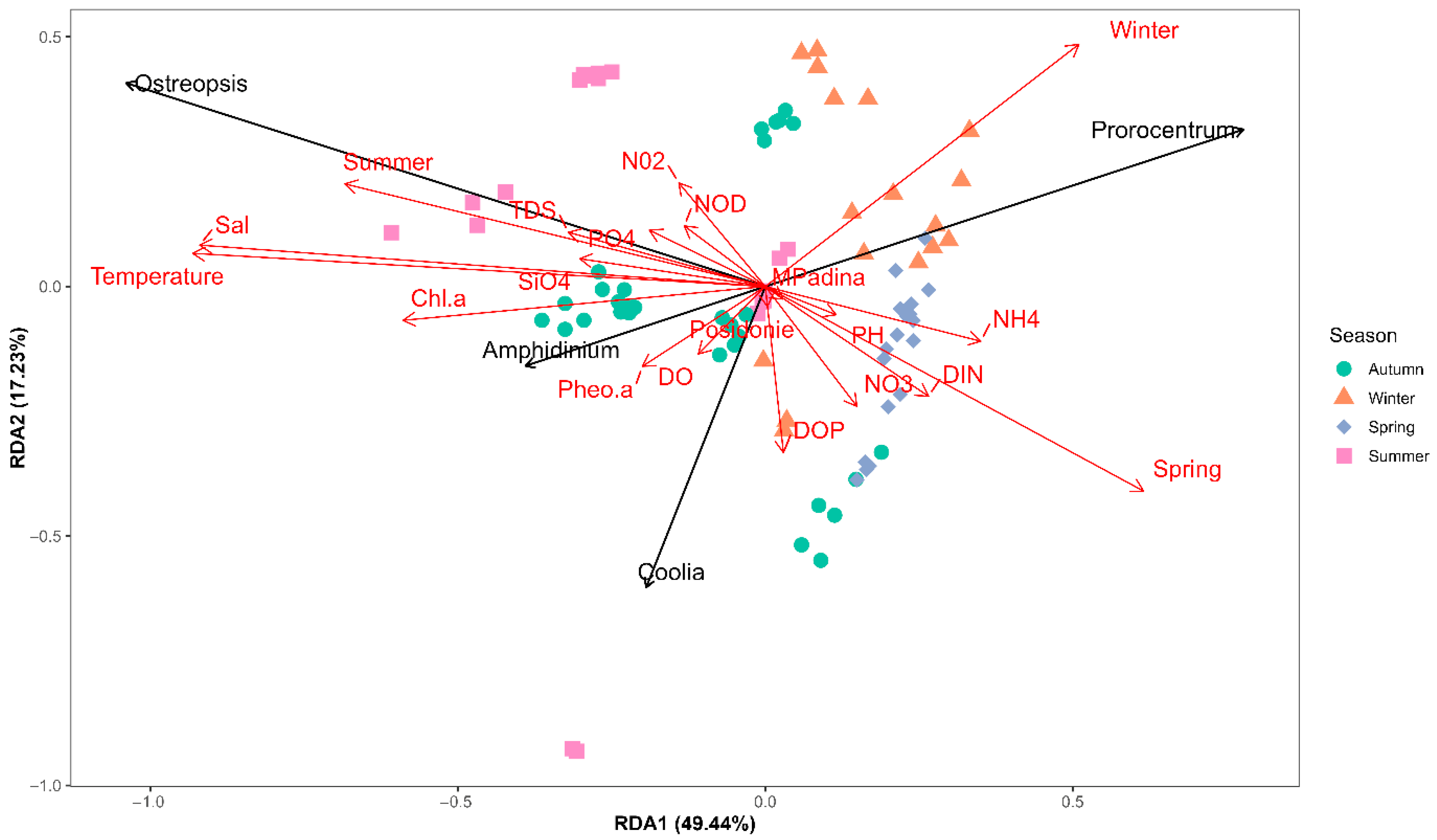
Redundancy analysis (RDA) revealed significant relationships between environmental variables and BHAB community structure (Figure 10 and Figure 11). Temperature was the strongest explanatory variable, accounting for approximately 5.3% of the total variance in community composition and showing a highly significant effect (p < 0.001). Among nutrient variables, NO2 and NO3 explained approximately 1.1% and 0.9% of the variance, respectively, and were also highly significant (p < 0.001) (Figure 10 and Figure 11). Pheophytin a and salinity each accounted for about 0.6% of the explained variance (p < 0.01), while DIN explained approximately 0.5% (p < 0.01). Dissolved organic phosphorus and TDS contributed more modestly, each explaining around 0.4% of the variance (p < 0.05). Chlorophyll a accounted for approximately 0.3% of the variance and was marginally significant (p < 0.05) (Figure 8). In contrast, DON explained less than 0.3% of the variance and showed only a weak association with community structure, while DO, PO4, SiO4, NH4, and pH each explained less than 0.2% of the variance and were not statistically significant (p > 0.05). Overall, the RDA results indicate that temperature- and nitrogen-related variables are the dominant drivers of community structure, whereas other physicochemical factors play comparatively minor roles (Figure 10 and Figure 11).
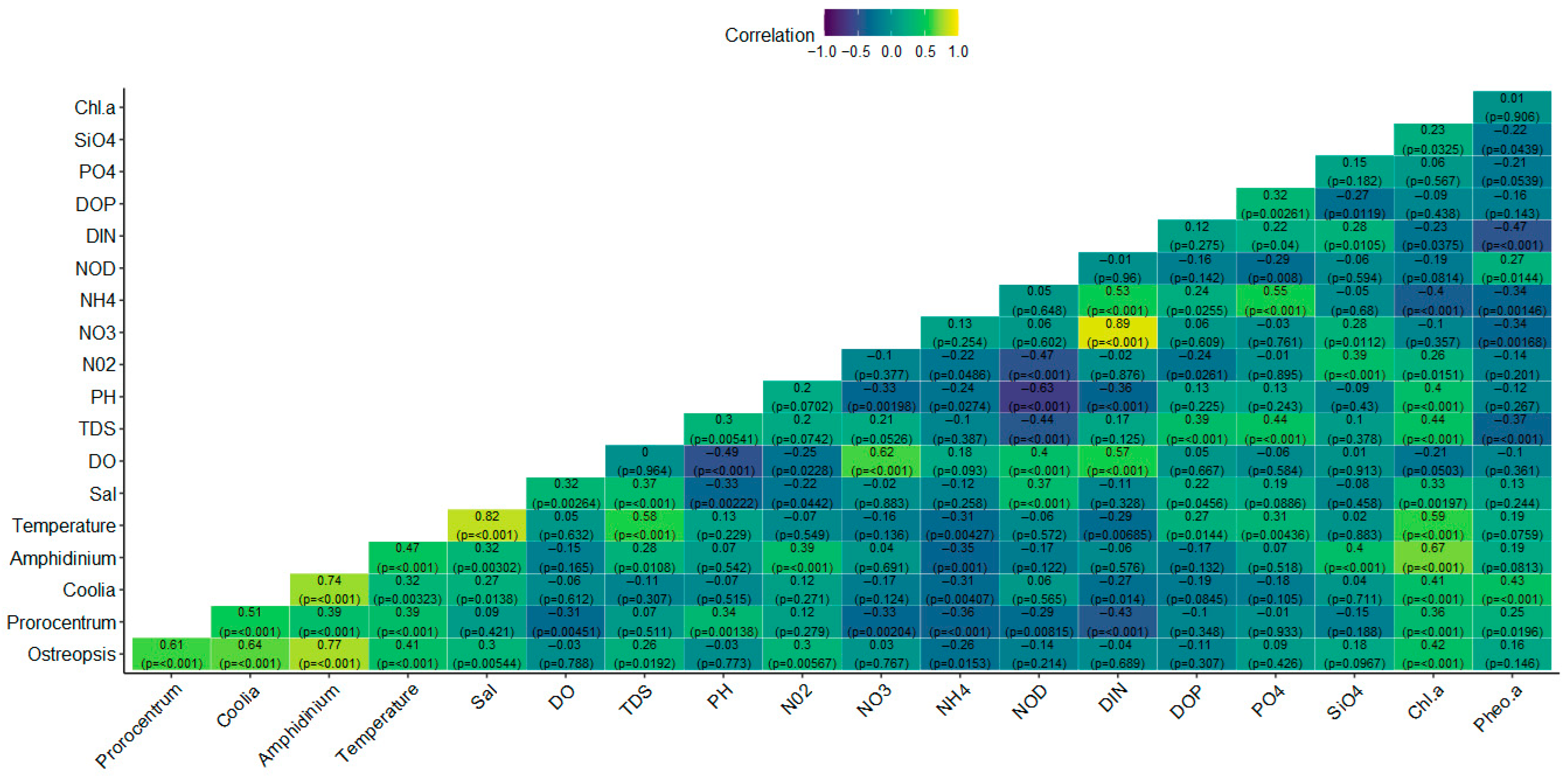
The combined interpretation of the correlation analysis and the RDA provides a coherent understanding of the environmental controls governing the distribution of the studied epibenthic dinoflagellates (O. cf. ovata, P. lima, C. monotis and A. carterae) (Figure A2). The correlation matrix highlights strong positive relationships among these genera, particularly between O. cf. ovata and P. lima (r ≈ 0.74) as well as with C. monotis (r ≈ 0.61) and A. carterae (r ≈ 0.51), indicating a shared ecological niche and common responses to environmental forcing. A direct correlation was observed between rising temperatures and an increase in bloom events for this species (Figure 10). Among abiotic factors, temperature shows consistent positive correlations with all four genera (r ≈ 0.32–0.47), underscoring its central role in promoting epibenthic dinoflagellate proliferation. This pattern is further supported by the RDA results, where temperature emerges as the most influential driver of community structure, explaining the largest proportion of variance (≈ 5–6%, p < 0.001), thus confirming its dominant regulatory effect (Figure 10 and Figure 11).
Additionally, chlorophyll a was positively correlated with temperature (r = 0.59, p < 0.001), indicating enhanced phytoplankton biomass under warmer conditions. Moreover, chlorophyll a exhibited significant positive correlations with nitrogen-related nutrients, including dissolved inorganic nitrogen (DIN; r = 0.47, p < 0.001), nitrate (NO3; r = 0.28, p = 0.011), and ammonium (NH4; r = 0.34, p = 0.0017) (Figure A2). Taken together, these relationships suggest that seasonal warming, coupled with increased nitrogen availability and regeneration, jointly promoted phytoplankton growth. In addition to temperature, nutrient-related variables contribute significantly, although with differentiated roles. Nitrogen species such as NO2 and NO3 display moderate correlations with dinoflagellate abundance (r generally < 0.4), yet they appear as significant predictors in the RDA, with NO2 and NO3 explaining notable fractions of variance (≈0.8–1.2%, p < 0.01). This suggests that while inorganic nitrogen alone does not directly control blooms, its seasonal availability modulates community composition. Moreover, DOP contributed more modestly, explaining around 0.4% of the variance (p < 0.05). Chlorophyll a accounted for approximately 0.3% of the variance and was marginally significant (p < 0.05). In contrast, DON explained less than 0.3% of the variance and showed only a weak association with community structure, while DO, PO43, SiO4, NH4, and pH each explained less than 0.2% of the variance and were not statistically significant (p > 0.05). Overall, the RDA results indicate that temperature- and nitrogen-related variables are the dominant drivers of community structure, whereas other physicochemical factors play comparatively minor roles (Figure 10 and Figure 11).
Consequently, the co-occurrence and proliferation of Ostreopsis, Prorocentrum, Coolia, and Amphidinium appear to result from the combined effect of warm conditions, moderate nutrient availability, and stable coastal environments, a pattern characteristic of epibenthic harmful algal assemblages in temperate to subtropical coastal systems.

4. Discussion

4.1. Occurrence of Benthic Harmful Algal Blooms (BHABs) in Annaba Bay

The present study investigated the dynamics of benthic dinoflagellates colonizing dominant macrophytes across contrasting sites in Annaba Bay (Southern Mediterranean Sea) and examined their relationships with environmental variables. Several of the recorded taxa are known producers of bioactive or toxic compounds, with O. cf. ovata considered to be among the most harmful benthic dinoflagellates due to its ability to produce volatile toxic compounds that can cause respiratory disorders in humans [19,61,62,87,88]. In addition to O. cf. ovata, the assemblage included P. lima a producer of lipophilic shellfish toxins, C. monotis, and Amphidinium carterae, all of which have been associated with toxin production or cytotoxic activity in previous studies [67,89,90,91,92]. Nevertheless, it is important to note that toxicity can vary markedly among species, strains, and regions, and that the presence of potentially toxic taxa does not necessarily imply toxin production or health risk in situ.

4.2. Spatial and Seasonal Variability of Ostreopsis cf. ovata Abundance

The seasonal pattern observed in Annaba Bay is consistent with previous Mediterranean studies reporting summer–autumn peaks of Ostreopsis spp. [10,36,44,93]. In July 2023, O. cf. ovata reached a maximum abundance of 4.4 × 10⁵ cells g−1 FW on C. fragile at ST4 (Fellah R Beach, Annaba Bay), coinciding with elevated water temperatures. These abundances fall within the range reported for several Mediterranean regions, including Morocco (2.7 × 10⁵ cells g−1 FW) [36] and Italy (5.28 × 10⁵ cells g−1 FW) [44], although they remain lower than peak values exceeding 106 cells g−1 FW reported in parts of the Northwestern Mediterranean [27]. Conversely, lower abundances have been reported in Tunisian waters [10,49,50,94], highlighting substantial spatial heterogeneity across the Mediterranean basin. The higher abundances compared to Tunisian lagoons (e.g., Bizerte) likely result from the prevalence of rocky substrates and macroalgae like C. fragile and H. scoparia in Annaba, which provide higher surface-to-volume ratios for attachment than the seagrass-dominated or sandy environments often found in Southern Mediterranean lagoons. Furthermore, the localized anthropogenic pressure at ST1 and ST4, characterized by high nutrient inputs from urban runoff, creates a localized eutrophication that supports higher biomass than the more oligotrophic open waters of the Algerian coast. Such variability likely reflects site-specific combinations of hydrodynamics, substrate availability, nutrient regeneration, and anthropogenic pressure rather than uniform regional drivers.

4.3. Dynamics of Prorocentrum lima, Coolia monotis, and Amphidinium carterae

Unlike O. cf. ovata, P. lima was present throughout the sampling period and exhibited two peaks in July and August, with abundances of up to 8 × 10³ cells g−1 FW. This year-round persistence is likely due to its broad thermal tolerance and mixotrophic capabilities, allowing it to survive in colder, nutrient-limited winter waters where more specialized species fail to thrive. Our values for P. lima are comparable to those reported from Morocco [36], Tunisia [10,51], Italy [44,95,96,97], and France [25,48], confirming the widespread seasonal persistence of this species in Mediterranean coastal systems. Coolia monotis reached maximum abundances of 2.8 × 10³ cells g−1 of fresh wight of H. scoparia in ST2 during April 2023, comparable to observations from the Aegean Sea but notably higher than those reported from Tunisia and Egypt, with 8.4 × 10² cells g−1 FW on Cymodocea nodosa in autumn 2001 in the Bay of Marsa (Tunisia) [94] and 1.1 × 10³ cells g−1 FW of the same dinoflagellate on C. nodosa in May in the Bay of Bizerte, as documented by Ben-Gharbia et al. (2019) [10]. Ismael et al. (2014) [47] recorded densities of 4.54 × 10² cells g−1 FW in summer 2005 along the coast of Alexandria (Mediterranean Sea). Such elevated abundances in Annaba Bay are likely favored by the local hydrodynamic conditions of the study sites. Coolia monotis is known to thrive in sheltered environments characterized by low hydrodynamic conditions and high organic matter accumulation [1,34], such as Stations 1 and 2, which may provide a particularly stable and suitable niche for this species. Although the genus Coolia has historically been associated with toxicity, recent taxonomic revisions indicate that toxic strains are largely confined to Coolia tropicalis and Coolia malayensis [67,98,99]. Consequently, the ecological significance of C. monotis in Annaba Bay is more likely related to benthic community structure than to direct health risks. Amphidinium carterae was observed at comparatively low abundance (maximum 8.5 × 10³ cells g−1 FW), consistent with previous reports suggesting that this genus often plays a secondary role in Mediterranean BHAB assemblages. This species has been associated with biological activity [92,100,101].

4.4. Role of Temperature in Shaping BHAB Dynamics

In the Mediterranean Sea, temperature has emerged as the environmental variable most strongly associated with BHAB abundance. This pattern was corroborated by our study, which revealed a highly significant positive correlation between Ostreopsis cf. ovata abundance and seawater temperature, with maximum cell densities coinciding with exceptionally high temperatures (30.1 °C) recorded in July 2023. Although this temperature exceeds the laboratory-determined optimal growth range of approximately 25 °C [88,102], it is important to distinguish between instantaneous physiological optima and ecologically observed peak abundances. Moreover, the relationship between temperature and benthic harmful algal bloom (BHAB) species is often species- and strain-specific and strongly modulated by local environmental conditions. The maximum cell density recorded at 30.1 °C likely reflects the cumulative effects of a prolonged warming period combined with high water column stability, conditions that favor cell accumulation while limiting physical dispersion. In semi-enclosed systems such as Annaba Bay, high summer temperatures may also enhance metabolic activity or coincide with peak irradiance levels, thereby sustaining high standing stocks even as intrinsic growth rates begin to plateau [103]. Consequently, these exceptionally high temperatures may enhance bloom intensity through environmental forcing and water column stratification rather than acting as a sole physiological driver. However, several studies have reported weak or inconsistent temperature BHAB species abundance relationships [104], suggesting that temperature interacts with additional environmental and biological factors.

4.5. Nutrient Availability and Benthic Dinoflagellate Responses

The apparent decoupling between nutrient concentrations and BHAB species abundance found in our study likely reflects fundamental ecological differences between planktonic and benthic microalgae, particularly in their nutrient acquisition strategies and habitat dependence. Benthic species are sessile and often rely on localized nutrient regeneration at the substrate–water interface rather than ambient water column concentrations. Specifically, host macrophytes actively contribute to this nutrient pool through the physiological leaching of DON and DOP or by passively trapping organic detritus within their complex architectural structures [1]. In our study, the dominance of organic nutrient fractions, particularly DON, which represented the largest portion of the total nitrogen pool, further supports the hypothesis that internal recycling and the remineralization of organic matter by the associated bacterial community play a key role in sustaining BHAB populations [30]. This mechanism allows benthic dinoflagellates to thrive even when inorganic nutrients are depleted in the surrounding water column [105].

4.6. Influence of Macrophyte Substrates

Macrophyte diversity emerged as a critical factor structuring BHAB distribution. Across stations, Ostreopsis and Coolia together accounted for approximately 80% of total benthic dinoflagellate abundance, with H. scoparia identified as the most favorable substrate at Stations 1, 2 and 3. At Station 4, the invasive macroalga C. fragile supported the highest abundances of O. cf. ovata, P. lima, and C. monotis. The pilose and spongy morphology of C. fragile likely enhances cell attachment and retention, providing a structurally complex microhabitat. In addition, allelopathic interactions between macrophytes and epiphytic microalgae may further influence colonization success [38,40].

4.7. Environmental Gradients Structuring Benthic Dinoflagellate Communities Revealed by Redundancy Analysis

The redundancy analysis ordination reveals a structured response of benthic dinoflagellate communities to interacting physicochemical and nutrient gradients with RDA1 and RDA2 explaining 49.44% and 17.23% of the total variance, respectively. The first canonical axis (RDA1) represents a dominant environmental gradient primarily driven by thermal conditions and salinity, whereas the second axis (RDA2) captures variation associated with nutrient speciation and organic matter dynamics.
Temperature and salinity exhibit strong, collinear vectors along RDA1, indicating their primary role in constraining community composition. Samples collected during summer cluster distinctly along the negative side of RDA1, reflecting the influence of elevated temperatures on community structure. Ostreopsis cf. ovata aligns closely with this thermal–salinity gradient, demonstrating a strong positive association with warm, saline conditions. This spatial configuration supports the interpretation that O. cf. ovata functions as a thermophilic, seasonally restricted taxon, whose proliferation is favored under high-temperature regimes rather than by nutrient enrichment alone. In contrast, P. lima is positioned along the positive side of RDA1 and shows close association with NH4, DIN and pH, indicating a distinct ecological strategy characterized by sensitivity to regenerated nitrogen forms.
The co-occurrence of winter and spring samples within this ordination sector suggests that P. lima may exploit periods of enhanced nutrient recycling and reduced thermal stress, thereby maintaining elevated abundances outside peak summer conditions. However, the mechanisms by which nutrient availability influences epibenthic dinoflagellate bloom dynamics remain incompletely understood [6,14,20,24,25,30]. In oligotrophic environments, mixotrophic behavior may provide a competitive advantage, allowing species such as O. cf. ovata, P. lima and C. monotis to supplement inorganic nutrient uptake through the assimilation of organic dissolved or particulate nutrient sources, notably via phagotrophy [6,20].
Along RDA2, C. monotis and Amphidinium carterae segregate toward vectors associated with DOP, NO3, and NO2, highlighting their linkage to organic nutrient pools and micro-scale benthic nutrient regeneration [18,30,106]. Their proximity to the ordination origin indicates broader ecological tolerance and reduced dependence on any single environmental driver, consistent with opportunistic or substrate-mediated life strategies. Seasonal structuring is clearly expressed in the ordination space. Summer samples are primarily structured by temperature forcing, whereas autumn and winter samples exhibit stronger associations with nutrient-related variables, underscoring a seasonal shift from temperature-driven to biogeochemically mediated controls. Importantly, the relatively short length of most nutrient vectors, compared with temperature and salinity, indicates that nutrients act as secondary modulators rather than primary drivers of community structure at the scale of observation.
Altogether, the RDA results demonstrate that benthic dinoflagellate community organization arises from the interaction of thermal forcing, nutrient form, and ecological niche differentiation. These findings reinforce the view that BHAB dynamics are governed by multifactorial controls, in which temperature sets the environmental window for bloom development, while nutrient input and regeneration and substrate-associated processes modulate species-specific responses.

5. Conclusions

Potentially harmful benthic dinoflagellates were recorded for the first time in Annaba Bay, with a marked dominance of O. cf. ovata and P. lima. The presence of potentially toxic species underscores a risk to public health, necessitating the implementation of regular monitoring for both cell densities and emerging biotoxins.
Our findings identify temperature as the overarching factor governing BHAB dynamics. It exerted a strong positive influence on the proliferation of O. cf. ovata. Regarding nutrients, the results suggest that these dinoflagellates are well-adapted to oligotrophic coastal waters, with some species maintaining populations even when inorganic nutrient levels are low. While opportunistic species are temperature-dependent, others like C. monotis and A. carterae persist as a more stable and constant component of the epiphytic community. The distribution of the found BHAB species was substrate-dependent, with the highest densities recorded on the native Halopteris scoparia and the invasive Codium fragile. The successful colonization of C. fragile by all four genera suggests that this invasive macroalga may act as a favorable permanent substrate, potentially facilitating the expansion of BHABs in the bay. Further research is required to explore host-preference trends and potential allelopathic interactions between these toxic dinoflagellates and their macrophyte substrates.

Author Contributions

Conceptualization, H.F.; methodology, H.F., O.S.L. and M.A.; software, O.S.L. and A.B.A.; validation, O.S.L., H.F. and M.L.; formal analysis, O.S.L. and A.B.A.; investigation, O.S.L.; resources, M.L. and H.F.; data curation, O.S.L.; writing—original draft preparation, O.S.L.; writing—review and editing, M.L. and A.B.A.; visualization, O.S.L.; supervision, M.L., A.B.A. and H.F.; project administration, H.F.; funding acquisition, M.L. All authors have read and agreed to the published version of the manuscript.

Funding

This research was supported by the Faculty of Sciences, Badji Mokhtar University Annaba, Algeria. The PhD project was funded partially by CIBSEEA (MUSE Montpellier University) and EXALTOX (EXPOSUM Montpellier University). We would like to express our sincere gratitude to the Laboratory of Marine Biodiversity, Exploitation and Conservation (MARBEC) for partially funding Sad Laib Ouafa’s doctoral research.

Data Availability Statement

The original contributions presented in this study are included in the article. Further inquiries can be directed to the corresponding author.

Acknowledgments

Thanks to the French Research Institute for Development (IRD) for the valuable support of Sad Laib. We also thank the Marine Bioresources Laboratory (BIOMAR) of Badji Mokhtar University for providing the necessary facilities and resources for field sampling.

Conflicts of Interest

The authors declare that they have no known competing financial interests or personal relationships that could have appeared to influence the work reported in this paper.

Appendix A

Table A1. Results of ANOVA two-way testing the effects of months (temporal variability) and stations (Stations 1 and 2) (spatial variability) on physicochemical and biological variables measured in Annaba Bay. Values represent p-values for each factor. Significance levels are indicated as follows: *** p < 0.001; ** p < 0.01; * p < 0.05; ns = non-significant (p ≥ 0.05). The ANOVA p-values are shown in red (ns: not significant).
MonthsStations
0.000 ***0.175 ns
S0.000 ***0.972 ns
OD0.005 **0.183 ns
TDS0.002 **0.421 ns
PH0.000 ***0.762 ns
NO20.003 **0.213 ns
NO30.028 *0.377 ns
NH40.076 ns0.045 *
DON0.002 **0.069 ns
DIN0.004 **0.341 ns
DOP0.797 ns0.420 ns
PO40.095 ns0.680 ns
SiO40.000 ***0.003 **
Chl a0.000 ***0.007 **
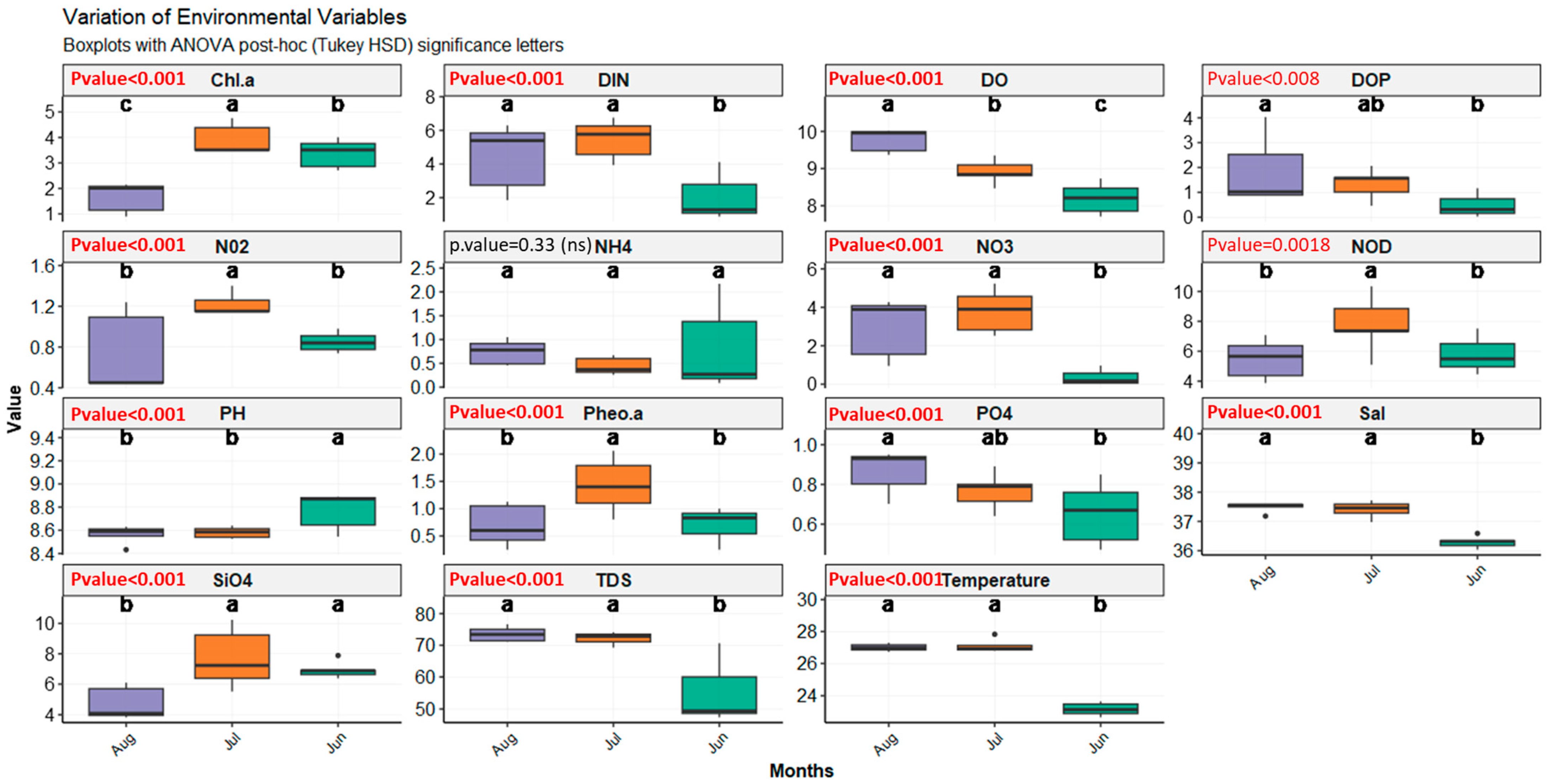
Figure A1. Monthly variation in environmental variables during the months where BHAB species proliferate (June, July, August). Boxplots show median, interquartile range, and extreme values. Differences among months were tested using one-way ANOVA, followed by Tukey’s HSD post hoc test when significant. Letters (a, b, ab) indicate statistical groupings: months sharing the same letter are not significantly different, while different letters indicate significant differences (p < 0.05).
Jmse 14 00398 g0a1
Figure A2. Pearson correlation heatmap of environmental variables and cell abundances, showing correlation coefficients (r) and p-values in each cell.
Jmse 14 00398 g0a2

References

  1. Vila, M.; Garcés, E.; Masó, M. Assemblages of potentially toxic epiphytic dinoflagellates on macroalgae in the northwestern Mediterranean Sea. Aquat. Microb. Ecol. 2001, 26, 51–60. [Google Scholar] [CrossRef]
  2. Mafra, L.L., Jr.; Sunesen, I.; Pires, E.; Nascimento, S.M.; Álvarez, G.; Mancera-Pineda, J.E.; Torres, G.; Carnicer, O.; Galindo, J.A.H.; Ramirez, S.S.; et al. Benthic harmful microalgae and their impacts in South America. Harmful Algae 2023, 127, 102478. [Google Scholar] [CrossRef] [PubMed]
  3. Martinez-Mercado, M.A.; Cembella, A.D.; Sanchez-Castrejon, E.; Saavedra-Flores, A.; Galindo-Sanchez, C.E.; Duran-Riveroll, L.M. Functional diversity of bacterial microbiota associated with the toxigenic benthic dinoflagellate Prorocentrum. PLoS ONE 2024, 19, e0306108. [Google Scholar] [CrossRef]
  4. Lee, J.S.; Igarashi, T.; Fraga, S.; Dahl, E.; Hovgaard, P.; Yasumoto, T. Determination of diarrhetic shellfish toxins in various dinoflagellate species. J. Appl. Phycol. 1989, 1, 147–152. [Google Scholar] [CrossRef]
  5. Hoppenrath, M.; Murray, S.A.; Chomérat, N.; Horiguchi, T. Marine Benthic Dinoflagellates–Unveiling their Worldwide Biodiversity; Schweizerbart’sche Verlagsbuchhandlung: Stuttgart, Germany, 2014. [Google Scholar]
  6. Berdalet, E.; Tester, P.A.; Chinain, M.; Fraga, S.; Lemée, R.; Litaker, W.; Penna, A.; Usup, G.; Vila, M.; Zingone, A. Harmful algal blooms in benthic systems: Recent progress and future research. Oceanography 2017, 30, 36–45. [Google Scholar] [CrossRef]
  7. Perkins, J.C.; Zenger, K.R.; Capper, A.; Liu, Y.; Strugnell, J.M. Characteristics of Benthic Toxic Dinoflagellate Communities within Three Coastal Regions of the Great Barrier Reef, Australia. Mar. Pollut. Bull. 2025, 210, 117319. [Google Scholar] [CrossRef]
  8. Gamarro, E.G.; Englander, K. Joint FAO-IOC-IAEA technical guidance for the implementation of early warning systems for harmful algal blooms. FAO Fish. Aquac. Tech. Pap. 2023, 690, I-202. [Google Scholar] [CrossRef]
  9. Berdalet, E.; McManus, M.A.; Ross, O.N.; Burchard, H.; Chavez, F.P.; Jaffe, J.S.; Yamazaki, H. Understanding harmful algae in stratified systems: Review of progress and future directions. Deep Sea Res. Part II Top. Stud. Oceanogr. 2014, 101, 4–20. [Google Scholar] [CrossRef]
  10. Ben Gharbia, H.; Laabir, M.; Ben Mhamed, A.; Gueroun, S.K.M.; Daly Yahia, M.N.; Nouri, H.; M’rabet, C.; Shili, A.; Yahia, O.K.D. Occurrence of epibenthic dinoflagellates in relation to biotic substrates and to environmental factors in Southern Mediterranean (Bizerte Bay and Lagoon, Tunisia): An emphasis on the harmful Ostreopsis spp., Prorocentrum lima and Cool. monotis. Harmful Algae 2019, 90, 101704. [Google Scholar] [CrossRef] [PubMed]
  11. Zingone, A.; Escalera, L.; Aligizaki, K.; Fernández-Tejedor, M.; Ismael, A.; Montresor, M.; Mozetič, P.; Taş, S.; Totti, C. Toxic marine microalgae and noxious blooms in the Mediterranean Sea: A contribution to the Global HAB Status Report. Harmful Algae 2021, 102, 101843. [Google Scholar] [CrossRef] [PubMed]
  12. Gollasch, S.; Lenz, J.; Dammer, M.; Andres, H.G. Survival of tropical ballast water organisms during a cruise from the Indian Ocean to the North Sea. J. Plankton Res. 2000, 22, 923–937. [Google Scholar] [CrossRef]
  13. Hallegraeff, G.M.; Anderson, D.M.; Belin, C.; Bottein, M.Y.D.; Bresnan, E.; Chinain, M.; Enevoldsen, H.; Iwataki, M.; Karlson, B.; McKenzie, C.H.; et al. Perceived global increase in algal blooms is attributable to intensified monitoring and emerging bloom impacts. Commun. Earth Environ. 2021, 2, 117. [Google Scholar] [CrossRef]
  14. Anderson, D.M.; Glibert, P.M.; Burkholder, J.M. Harmful algal blooms and eutrophication: Nutrient sources, composition, and consequences. Estuaries 2002, 25, 704–726. [Google Scholar] [CrossRef]
  15. Hallegraeff, G.M. Ocean climate change, phytoplankton community responses, and harmful algal blooms: A formidable predictive challenge. J. Phycol. 2010, 46, 220–235. [Google Scholar] [CrossRef]
  16. Kibler, S.R.; Tester, P.A.; Kunkel, K.E.; Moore, S.K.; Litaker, R.W. Effects of ocean warming on growth and distribution of dinoflagellates associated with ciguatera fish poisoning in the Caribbean. Ecol. Model. 2015, 316, 194–210. [Google Scholar] [CrossRef]
  17. Wells, M.L.; Karlson, B. Harmful algal blooms in a changing ocean. In Global Ecology and Oceanography of Harmful Algal Blooms; Springer International Publishing: Cham, Switzerland, 2018; pp. 77–90. [Google Scholar] [CrossRef]
  18. Fraga, S.; Rodríguez, F.; Bravo, I.; Zapata, M.; Marañón, E. Review of the main ecological features affecting benthic dinoflagellate blooms. Cryptogam. Algol. 2012, 33, 171–179. [Google Scholar] [CrossRef]
  19. Ben-Gharbia, H.; Yahia, O.K.D.; Amzil, Z.; Chomérat, N.; Abadie, E.; Masseret, E.; Sibat, M.; Zmerli Triki, H.; Nouri, H.; Laabir, M. Toxicity and growth assessments of three thermophilic benthic dinoflagellates (Ostreopsis cf. ovata, Prorocentrum lima and Coolia monotis) developing in the Southern Mediterranean basin. Toxins 2016, 8, 297. [Google Scholar] [CrossRef]
  20. Berdalet, E.; Tester, P.A. Key questions and recent research advances on harmful algal blooms in benthic systems. In Global Ecology and Oceanography of Harmful Algal Blooms; Springer: Cham, Switzerland, 2018; pp. 261–286. [Google Scholar] [CrossRef]
  21. Anderson, D.M. The Ecology and Oceanography of Harmful Algal Blooms: Multidisciplinary Approaches to Research and Management; Intergovernmental Oceanographic Commission: Paris, France, 2007. [Google Scholar]
  22. Parsons, M.L.; Preskitt, L.B. A survey of epiphytic dinoflagellates from the coastal waters of the island of Hawaii. Harmful Algae 2007, 6, 658–669. [Google Scholar] [CrossRef]
  23. Aligizaki, K.; Nikolaidis, G. The presence of the potentially toxic genera Ostreopsis and Coolia (Dinophyceae) in the North Aegean Sea, Greece. Harmful Algae 2006, 5, 717–730. [Google Scholar] [CrossRef]
  24. Cohu, S.; Thibaut, T.; Mangialajo, L.; Labat, J.P.; Passafiume, O.; Blanfuné, A.; Simon, N.; Cottalorda, J.M.; Lemée, R. Occurrence of the toxic dinoflagellate Ostreopsis cf. ovata in relation with environmental factors in Monaco (NW Mediterranean). Mar. Pollut. Bull. 2011, 62, 2681–2691. [Google Scholar] [CrossRef] [PubMed]
  25. Cohu, S.; Mangialajo, L.; Thibaut, T.; Blanfuné, A.; Marro, S.; Lemée, R. Proliferation of the toxic dinoflagellate Ostreopsis cf. ovata in relation to depth, biotic substrate and environmental factors in the North West Mediterranean Sea. Harmful Algae 2013, 24, 32–44. [Google Scholar] [CrossRef]
  26. Dhib, A.; Frossard, V.; Turki, S.; Aleya, L. Dynamics of harmful dinoflagellates driven by temperature and salinity in a northeastern Mediterranean lagoon. Environ. Monit. Assess. 2013, 185, 3369–3382. [Google Scholar] [CrossRef]
  27. Carnicer, O.; Guallar, C.; Andree, K.B.; Diogène, J.; Fernández-Tejedor, M. Ostreopsis cf. ovata dynamics in the NW Mediterranean Sea in relation to biotic and abiotic factors. Environ. Res. 2015, 143, 89–99. [Google Scholar] [CrossRef]
  28. Carnicer, O.; García-Altares, M.; Andree, K.B.; Tartaglione, L.; Dell’Aversano, C.; Ciminiello, P.; de la Iglesia, P.; Diogène, J.; Fernández-Tejedor, M. Ostreopsis cf. ovata from the western Mediterranean Sea: Physiological responses under different temperature and salinity conditions. Harmful Algae 2016, 57, 98–108. [Google Scholar] [CrossRef]
  29. Casabianca, S.; Capellacci, S.; Ricci, F.; Andreoni, F.; Russo, T.; Scardi, M.; Penna, A. Structure and environmental drivers of phytoplanktonic resting stage assemblages in the central Mediterranean Sea. Mar. Ecol. Prog. Ser. 2020, 639, 73–89. [Google Scholar] [CrossRef]
  30. Glibert, P.M.; Heil, C.A.; Wilkerson, F.P.; Dugdale, R.C. Nutrients and Harmful Algal Blooms: Dynamic Kinetics and Flexible Nutrition. In Global Ecology and Oceanography of Harmful Algal Blooms; Springer International Publishing: Cham, Switzerland, 2018; pp. 93–112. [Google Scholar] [CrossRef]
  31. Ras, M.; Steyer, J.P.; Bernard, O. Temperature effect on microalgae: A crucial factor for outdoor production. Rev. Environ. Sci. Bio/Technol. 2013, 12, 153–164. [Google Scholar] [CrossRef]
  32. Besada, E.G.; Loeblich, L.A.; Loeblich, A.R., III. Observations on tropical, benthic dinoflagellates from ciguatera-endemic areas: Coolia, Gambierdiscus, and Ostreopsis. Bull. Mar. Sci. 1982, 32, 723–735. [Google Scholar]
  33. Faust, M.A. Observation of sand-dwelling toxic dinoflagellates (Dinophyceae) from widely differing sites, including two new species. J. Phycol. 1995, 31, 996–1003. [Google Scholar] [CrossRef]
  34. Laza-Martinez, A.; Orive, E.; Miguel, I. Morphological and genetic characterization of benthic dinoflagellates of the genera Coolia, Ostreopsis and Prorocentrum from the south-eastern Bay of Biscay. Eur. J. Phycol. 2011, 46, 45–65. [Google Scholar] [CrossRef]
  35. Mangialajo, L.; Ganzin, N.; Accoroni, S.; Asnaghi, V.; Blanfuné, A.; Cabrini, M.; Cattaneo-Vietti, R.; Chavanon, F.; Chiantore, M.; Cohu, S.; et al. Trends in Ostreopsis proliferation along the Northern Mediterranean coasts. Toxicon 2011, 57, 408–420. [Google Scholar] [CrossRef] [PubMed]
  36. Ibghi, M.; El kbiach, M.L.B.; Rijal Leblad, B.; Aboualaalaa, H.; Hervé, F.; Sibat, M.; Laabir, M. Occurrence of three dominant epibenthic dinoflagellates (Ostreopsis spp., Coolia monotis and Prorocentrum lima) in relation to biotic substrates and environmental factors in a highly dynamic ecosystem: The Strait of Gibraltar (Southwestern Mediterranean). Environ. Monit. Assess. 2022, 194, 810. [Google Scholar] [CrossRef]
  37. Carlson, R.D.; Tindall, D.R. Distribution and periodicity of toxic dinoflagellates in the Virgin Islands. In Toxic Dinoflagellates; Elsevier Scientific: New York, NY, USA, 1985; pp. 171–176. [Google Scholar]
  38. Laabir, M.; Grignon-Dubois, M.; Masseret, E.; Rezzonico, B.; Soteras, G.; Rouquette, M.; Rieuvilleneuve, F.; Cecchi, P. Algicidal effects of Zostera marina L. and Zostera noltii Hornem. extracts on the neuro-toxic bloom-forming dinoflagellate Alexandrium catenella. Aquat. Bot. 2013, 111, 16–25. [Google Scholar] [CrossRef]
  39. Mabrouk, L.; Ben Brahim, M.; Hamza, A.; Mahfoudhi, M.; Bradai, M.N. A comparison of abundance and diversity of epiphytic microalgal assemblages on the leaves of the seagrasses Posidonia oceanica (L.) and Cymodocea nodosa (Ucria) Asch in Eastern Tunisia. J. Mar. Sci. 2014, 2014, 275305. [Google Scholar] [CrossRef]
  40. Accoroni, S.; Percopo, I.; Cerino, F.; Romagnoli, T.; Pichierri, S.; Perrone, C.; Totti, C. Allelopathic interactions between the HAB dinoflagellate Ostreopsis cf. ovata and macroalgae. Harmful Algae 2015, 49, 147–155. [Google Scholar] [CrossRef]
  41. Pichierri, S.; Accoroni, S.; Pezzolesi, L.; Guerrini, F.; Romagnoli, T.; Pistocchi, R.; Totti, C. Allelopathic effects of diatom filtrates on the toxic benthic dinoflagellate Ostreopsis cf. ovata. Mar. Environ. Res. 2017, 131, 116–122. [Google Scholar] [CrossRef] [PubMed]
  42. Penna, A.; Vila, M.; Fraga, S.; Giacobbe, M.G.; Andreoni, F.; Riobó, P.; Vernesi, C. Characterization of Ostreopsis and Coolia (Dinophyceae) isolates in the western Mediterranean Sea based on morphology, toxicity and internal transcribed spacer 5.8S rDNA sequences. J. Phycol. 2005, 41, 212–225. [Google Scholar] [CrossRef]
  43. Aligizaki, K.; Nikolaidis, G.; Katikou, P.; Baxevanis, A.D.; Abatzopoulos, T.J. Potentially toxic epiphytic Prorocentrum (Dinophyceae) species in Greek coastal waters. Harmful Algae 2009, 8, 299–311. [Google Scholar] [CrossRef]
  44. Totti, C.; Accoroni, S.; Cerino, F.; Cucchiari, E.; Romagnoli, T. Ostreopsis ovata bloom along the Conero Riviera (northern Adriatic Sea): Relationships with environmental conditions and substrata. Harmful Algae 2010, 9, 233–239. [Google Scholar] [CrossRef]
  45. Illoul, H.; Hernández, F.R.; Vila, M.; Adjas, N.; Bournissa, M.; Koroghli, A.; Marouf, N.; Rabia, S.; Ameur, F.L.K. The genus Ostreopsis along the Algerian coastal waters (SW Mediterranean Sea) associated with a human respiratory intoxication episode. Cryptogam. Algol. 2012, 33, 209–216. [Google Scholar] [CrossRef]
  46. Sahraoui, I.; Bouchouicha, D.; Mabrouk, H.H.; Hlaili, A.S. Driving factors of the potentially toxic and harmful species of Prorocentrum Ehrenberg in a semi-enclosed Mediterranean lagoon (Tunisia, SW Mediterranean). Mediterr. Mar. Sci. 2013, 14, 353–362. [Google Scholar] [CrossRef]
  47. Ismael, A.A. First observation of Coolia monotis Meunier along the coast of Alexandria, Egypt. Egypt. J. Aquat. Res. 2014, 40, 19–25. [Google Scholar] [CrossRef]
  48. Blanfuné, A.; Boudouresque, C.F.; Grossel, H.; Thibaut, T. Distribution and abundance of Ostreopsis spp. and associated species (Dinophyceae) in the northwestern Mediterranean: The region and the macroalgal substrate matter. Environ. Sci. Pollut. Res. 2015, 22, 12332–12346. [Google Scholar] [CrossRef]
  49. Abdennadher, M.; Zouari, A.B.; Sahnoun, W.F.; Alverca, E.; Penna, A.; Hamza, A. Ostreopsis cf. ovata in the Gulf of Gabès (south-eastern Mediterranean Sea): Morphological, molecular and ecological characterization. Harmful Algae 2017, 63, 56–67. [Google Scholar] [CrossRef]
  50. Moncer, M.; Hamza, A.; Feki-Sahnoun, W.; Mabrouk, L.; Hassen, M.B. Variability patterns of epibenthic microalgae in eastern Tunisian coasts. Sci. Mar. 2017, 81, 487–498. [Google Scholar] [CrossRef]
  51. Hachani, M.A.; Dhib, A.; Fathalli, A.; Ziadi, B.; Turki, S.; Aleya, L. Harmful epiphytic dinoflagellate assemblages on macrophytes in the Gulf of Tunis. Harmful Algae 2018, 77, 29–42. [Google Scholar] [CrossRef]
  52. Hosny, S.; Labib, W. Ecology of the epiphytic potentially harmful dinoflagellate Ostreopsis cf. ovata (Fukuyo) from coastal waters off Alexandria, Egypt. J. Oceanogr. Mar. Res. 2019, 7, 191. [Google Scholar] [CrossRef]
  53. Ibghi, M.; Rijal Leblad, B.; L’bachir El Kbiach, M.; Aboualaalaa, H.; Daoudi, M.; Masseret, E.; Laabir, M. Molecular Phylogeny, Morphology, Growth and Toxicity of Three Benthic Dinoflagellates Ostreopsis sp. 9, Prorocentrum lima and Coolia monotis Developing in Strait of Gibraltar, Southwestern Mediterranean. Toxins 2024, 16, 49. [Google Scholar] [CrossRef] [PubMed]
  54. Brescianini, C.; Grillo, C.; Melchiorre, N.; Bertolotto, R.; Ferrari, A.; Vivaldi, B.; Icardi, G.; Gramaccioni, L.; Funari, E.; Scardala, S. Ostreopsis ovata algal blooms affecting human health in Genova, Italy, 2005 and 2006. Eurosurveillance 2006, 11, e060907.3. [Google Scholar] [CrossRef] [PubMed]
  55. Bravo, I.; Vila, M.; Casabianca, S.; Rodriguez, F.; Rial, P.; Riobó, P.; Penna, A. Life cycle stages of the benthic palytoxin-producing dinoflagellate Ostreopsis cf. ovata (Dinophyceae). Harmful Algae 2012, 18, 24–34. [Google Scholar] [CrossRef]
  56. Ingarrao, C.; Pagliani, T. First report of an Ostreopsis ovata bloom on Abruzzo coast (W Adriatic) associated with human respiratory intoxication. Harmful Algae News 2014, 48, 3. [Google Scholar]
  57. Poli, M.; Ruiz-Olvera, P.; Nalca, A.; Ruiz, S.; Livingston, V.; Frick, O.; Dyer, D.; Schellhase, C.; Raymond, J.; Kulis, D.; et al. Toxicity and pathophysiology of palytoxin congeners after intraperitoneal and aerosol administration in rats. Toxicon 2018, 150, 235–250. [Google Scholar] [CrossRef]
  58. Pavaux, A.S.; Berdalet, E.; Lemée, R. Chemical Ecology of the Benthic Dinoflagellate Genus Ostreopsis: Review of Progress and Future Directions. Front. Mar. Sci. 2020, 7, 498. [Google Scholar] [CrossRef]
  59. Tubaro, A.; Durando, P.; Del Favero, G.; Ansaldi, F.; Icardi, G.; Deeds, J.R.; Sosa, S. Case definitions for human poisonings postulated to palytoxins exposure. Toxicon 2011, 57, 478–495. [Google Scholar] [CrossRef] [PubMed]
  60. Brissard, C.; Herrenknecht, C.; Séchet, V.; Hervé, F.; Pisapia, F.; Harcouet, J.; Lémée, R.; Chomérat, N.; Hess, P.; Amzil, Z. Complex toxin profile of French Mediterranean Ostreopsis cf. ovata strains, seafood accumulation and ovatoxins prepurification. Mar. Drugs 2014, 12, 2851–2876. [Google Scholar] [CrossRef]
  61. Ciminiello, P.; Dell’Aversano, C.; Fattorusso, E.; Forino, M.; Tartaglione, L.; Grillo, C.; Melchiorre, N. Putative palytoxin and its new analogue, ovatoxin-a, in Ostreopsis ovata collected along the Ligurian coasts during the 2006 toxic outbreak. J. Am. Soc. Mass Spectrom. 2008, 19, 111–120. [Google Scholar] [CrossRef] [PubMed]
  62. Rossi, R.; Castellano, V.; Scalco, E.; Serpe, L.; Zingone, A.; Soprano, V. New palytoxin-like molecules in Mediterranean Ostreopsis cf. ovata (dinoflagellates) and in Palythoa tuberculosa detected by liquid chromatography–electrospray ionization time-of-flight mass spectrometry. Toxicon 2010, 56, 1381–1387. [Google Scholar] [CrossRef]
  63. Guerrini, F.; Pezzolesi, L.; Feller, A.; Riccardi, M.; Ciminiello, P.; Dell’Aversano, C.; Tartaglione, L.; Dello Iacovo, E.; Fattorusso, E.; Forino, M.; et al. Comparative growth and toxin profile of cultured Ostreopsis ovata from the Tyrrhenian and Adriatic Seas. Toxicon 2010, 55, 211–220. [Google Scholar] [CrossRef]
  64. Gemin, M.P.; Lanceleur, R.; Meslier, L.; Herve, F.; Reveillon, D.; Amzil, Z.; Ternon, E.; Thomas, O.P.; Fessard, V. Toxicity of palytoxin, purified ovatoxin-a, ovatoxin-d and extracts of Ostreopsis cf. ovata on the Caco-2 intestinal barrier model. Environ. Toxicol. Pharmacol. 2022, 94, 103909. [Google Scholar] [CrossRef]
  65. Li, Y.Y.; Tian, X.Q.; Lu, Y.N.; Han, Q.H.; Ma, L.Y.; Fa, C.Q. Toxins and other chemical constituents from Prorocentrum lima. Biochem. Syst. Ecol. 2020, 89, 104015. [Google Scholar] [CrossRef]
  66. Nakajima, I.; Oshima, Y.; Yasumoto, T. Toxicity of benthic dinoflagellates in Okinawa. Nippon Suisan Gakkaishi 1981, 47, 1029–1033. [Google Scholar] [CrossRef]
  67. Holmes, M.J.; Lewis, R.J.; Jones, A.; Hoy, A.W.W. Cooliatoxin, the first toxin from Coolia monotis (Dinophyceae). Nat. Toxins 1995, 3, 355–362. [Google Scholar] [CrossRef]
  68. Phua, Y.H.; Roy, M.C.; Lemer, S.; Husnik, F.; Wakeman, K.C. Diversity and toxicity of Pacific strains of the benthic dinoflagellate Coolia (Dinophyceae), with a look at the Coolia canariensis species complex. Harmful Algae 2021, 109, 102120. [Google Scholar] [CrossRef]
  69. Junqueira, C.E.; Tibiriçá, A.; Sibat, M.; Fernandes, L.F.; Bilien, G.; Chomérat, N.; Hess, P.; Mafra, L.L. Diversity and Toxicity of the Genus Coolia Meunier in Brazil, and Detection of 44-methyl Gambierone in Coolia tropicalis. Toxins 2020, 12, 327. [Google Scholar] [CrossRef]
  70. Lounas, R.; Kasmi, H.; Chernai, S.; Amarni, N.; Hamdi, B. Dynamics of the genus Ostreopsis (Gonyaulacales, Dinophyceae) in a Mediterranean fish farm. Environ. Monit. Assess. 2021, 193, 333. [Google Scholar] [CrossRef]
  71. Frehi, H.; Couté, A.; Mascarell, G.; Perrette-Gallet, C.; Ayada, M.; Kara, M.H. Dinoflagellés toxiques et/ou responsables de blooms dans la baie d’Annaba (Algérie). Comptes Rendus Biol. 2007, 330, 615–628. [Google Scholar] [CrossRef]
  72. Hadjadji, I.; Frehi, H.; Ayada, L.; Abadie, E.; Collos, Y. Comparative analysis of Alexandrium catenella/tamarense blooms in Annaba Bay (Algeria) and in the Thau Lagoon (France): Phosphorus limitation as a triggering factor. Comptes Rendus Biol. 2014, 337, 117–122. [Google Scholar] [CrossRef]
  73. Hadjadji, I.; Laabir, M.; Frihi, H.; Collos, Y.; Shao, Z.J.; Berrebi, P.; Abadie, E.; Amzil, Z.; Chomérat, N.; Rolland, J.L.; et al. Unsuspected intraspecific variability in the toxin production, growth and morphology of the dinoflagellate Alexandrium pacificum RW Litaker (Group IV) blooming in a South Western Mediterranean marine ecosystem, Annaba Bay (Algeria). Toxicon 2020, 180, 79–88. [Google Scholar] [CrossRef]
  74. Frehi, H. Study of the Structure and Functioning of the Phytoplankton System in a Coastal Marine Ecosystem. Eutrophication of the Annaba Bay. Master’s Thesis, Badji-Mokhtar University, Annaba, Algeria, 1995. [Google Scholar]
  75. Amira, A.B.; Bougdah, M. Influence of Mafragh and Seybouse inputs (sediment and salts) on the productivity of Annaba Bay. Aquac. Aquar. Conserv. Legis. 2018, 11, 653–665. [Google Scholar]
  76. Derbal, F.; Kara, M.H. Composition et variations du peuplement ichtyologique de l’herbier superficiel à Posidonia oceanica (L.) Delile, dans la baie d’Annaba (Algérie). Rev. D’écologie 2010, 65, 39–149. [Google Scholar] [CrossRef]
  77. Aminot, A.; Chaussepied, M. Manual of Chemical Analysis in the Marine Environment; CNEXO: Paris, France, 1983. [Google Scholar]
  78. Rodier, J.; Bernard, L.; Nicole, M. Water Analysis, 8th ed.; Dunod: Paris, France, 1966. [Google Scholar]
  79. Lorenzen, C.J. Determination of chlorophyll and pheo-pigments: Spectrophotometric equations 1. Limnol. Oceanogr. 1967, 12, 343–346. [Google Scholar] [CrossRef]
  80. Meunier, A. Microplankton de la Mer Flamande. III. Les Péridiniens; Hayez, M., Ed.; Mémoires du Musée Royal d’Histoire Naturelle de Belgique: Bruxelles, Belgium, 1919. [Google Scholar]
  81. Fukuyo, Y. Taxonomical Study on Benthic Dinoflagellates Collected in Coral Reefs. Bull. Jpn. Soc. Sci. Fish. 1981, 47, 967–978. [Google Scholar] [CrossRef]
  82. Faust, M.A.; Gulledge, R.A. Identifying Harmful Marine Dinoflagellates; Contributions from the United States National Herbarium, National Museum of Natural History: Washington, DC, USA, 2002; Volume 42, pp. 1–144. [Google Scholar]
  83. Nagahama, Y.; Fukuyo, Y. Redescription of Cryptomonas lima, collected from Sorrento, Italy, the basionym of Prorocentrum lima. Plankton Biol. Ecol. 2005, 52, 100–106. [Google Scholar]
  84. Gárate-Lizárraga, I.; González-Armas, R.; Verdugo-Díaz, G.; Okolodkov, Y.B.; Pérez-Cruz, B.; Díaz-Ortíz, J.A. Seasonal dynamics of the dinoflagellate Amphidinium cf. carterae (Dinophyceae: Amphidiniales) in Bahía de la Paz, Gulf of California. Mar. Pollut. Bull. 2019, 146, 532–541. [Google Scholar] [CrossRef] [PubMed]
  85. Hoppenrath, M.; Chomérat, N.; Horiguchi, T.; Schweikert, M.; Nagahama, Y.; Murray, S. Taxonomy and phylogeny of the benthic Prorocentrum species (Dinophyceae)—A proposal and review. Harmful Algae 2013, 27, 1–28. [Google Scholar] [CrossRef]
  86. Utermöhl, H. Zur vervollkommnung der quantitativen phytoplankton-methodik. Int. Ver. Für Theor. Und Angew. Limnol. Mitteilungen 1958, 9, 1–38. [Google Scholar] [CrossRef]
  87. Amzil, Z.; Sibat, M.; Chomerat, N.; Grossel, H.; Marco-Miralles, F.; Lemee, R.; Nezan, E.; Sechet, V. Ovatoxin-a and palytoxin accumulation in seafood in relation to Ostreopsis cf. ovata blooms on the French Mediterranean coast. Mar. Drugs 2012, 10, 477–496. [Google Scholar] [CrossRef] [PubMed]
  88. Vila, M.; Abós-Herràndiz, R.; Isern-Fontanet, J.; Àlvarez, J.; Berdalet, E. Establishing the link between Ostreopsis cf. ovata blooms and human health impacts using ecology and epidemiology. Sci. Mar. 2016, 80, 107–115. [Google Scholar] [CrossRef]
  89. Rhodes, L.L.; Smith, K.F.; Munday, R.; Selwood, A.I.; McNabb, P.S.; Holland, P.T.; Bottein, M.Y. Toxic dinoflagellates (Dinophyceae) from Rarotonga, Cook Islands. Toxicon 2010, 56, 751–758. [Google Scholar] [CrossRef]
  90. Pagliara, P.; Caroppo, C. Toxicity assessment of Amphidinium carterae, Coolia cfr. monotis and Ostreopsis cfr. ovata isolated from the northern Ionian Sea (Mediterranean Sea). Toxicon 2012, 60, 1203–1214. [Google Scholar] [CrossRef]
  91. Echigoya, R.; Rhodes, L.; Oshima, Y.; Satake, M. The structures of five new antifungal and hemolytic amphidinol analogs from Amphidinium carterae collected in New Zealand. Harmful Algae 2005, 4, 383–389. [Google Scholar] [CrossRef]
  92. Karafas, S.; Teng, S.T.; Leaw, C.P.; Alves-de-Souza, C. An evaluation of the genus Amphidinium (Dinophyceae) combining evidence from morphology, phylogenetics, and toxin production, with the introduction of six novel species. Harmful Algae 2017, 68, 128–151. [Google Scholar] [CrossRef] [PubMed]
  93. Di Franco, E.; Di Franco, A.; Calò, A.; Di Lorenzo, M.; Mangialajo, L.; Bussotti, S.; Guidetti, P. Relations incohérentes entre la protection, l’assemblage benthique, la complexité de l’habitat et la biomasse des poissons dans les récifs rocheux tempérés méditerranéens. Ecol. Indic. 2021, 128, 107850. [Google Scholar] [CrossRef]
  94. Turki, S. Distribution of toxic dinoflagellates along the leaves of seagrass Posidonia oceanica and Cymodocea nodosa from the Gulf of Tunis. Cah. De Biol. Mar. 2005, 46, 29–34. [Google Scholar]
  95. Monti, M.; Minocci, M.; Beran, A.; Iveša, L. First record of Ostreopsis cf. ovata on macroalgae in the Northern Adriatic Sea. Mar. Pollut. Bull. 2007, 54, 598–601. [Google Scholar] [CrossRef]
  96. Accoroni, S.; Romagnoli, T.; Colombo, F.; Pennesi, C.; Di Camillo, C.G.; Marini, M.; Battocchi, C.; Ciminiello, P.; Dell’Aversano, C.; Iacovo, E.D.; et al. Ostreopsis cf. ovata bloom in the northern Adriatic Sea during summer 2009: Ecology, molecular characterization and toxin profile. Mar. Pollut. Bull. 2011, 62, 2512–2519. [Google Scholar] [CrossRef]
  97. Accoroni, S.; Romagnoli, T.; Penna, A.; Capellacci, S.; Ciminiello, P.; Dell’Aversano, C.; Totti, C. Ostreopsis fattorussoi sp. nov. (Dinophyceae): A new benthic toxic Ostreopsis species from the eastern Mediterranean Sea. J. Phycol. 2016, 52, 1064–1084. [Google Scholar] [CrossRef]
  98. Momigliano, P.; Sparrow, L.; Blair, D.; Heimann, K. The Diversity of Coolia spp. (Dinophyceae: Ostreopsidaceae) in the Central Great Barrier Reef Region. PLoS ONE 2013, 8, e79278. [Google Scholar] [CrossRef]
  99. Rhodes, L.; Smith, K.; Papiol, G.G.; Adamson, J.; Harwood, T.; Munday, R. Epiphytic dinoflagellates in sub-tropical New Zealand, in particular the genus Coolia Meunier. Harmful Algae 2014, 34, 36–41. [Google Scholar] [CrossRef]
  100. Mandal, S.K.; Singh, R.P.; Patel, V. Isolation and characterization of exopolysaccharide secreted by a toxic dinoflagellate, Amphidinium carterae Hulburt 1957 and its probable role in harmful algal blooms (HABs). Microb. Ecol. 2011, 62, 518–527. [Google Scholar] [CrossRef]
  101. Murray, S.A.; Garby, T.; Hoppenrath, M.; Neilan, B.A. Genetic diversity, morphological uniformity and polyketide production in dinoflagellates (Amphidinium, Dinoflagellata). PLoS ONE 2012, 7, e38253. [Google Scholar] [CrossRef]
  102. Meroni, L.; Chiantore, M.; Petrillo, M.; Asnaghi, V. Habitat effects on Ostreopsis cf. ovata bloom dynamics. Harmful Algae 2018, 80, 64–71. [Google Scholar] [CrossRef] [PubMed]
  103. Pezzolesi, L.; Guerrini, F.; Ciminiello, P.; Dell’Aversano, C.; Iacovo, E.D.; Fattorusso, E.; Forino, M.; Tartaglione, L.; Pistocchi, R. Influence of temperature and salinity on Ostreopsis cf. ovata growth and evaluation of toxin content through HR LC-MS and biological assays. Water Res. 2012, 46, 82–92. [Google Scholar] [CrossRef] [PubMed]
  104. Mabrouk, L.; Hamza, A.; Brahim, M.B.; Bradai, M.N. Temporal and depth distribution of microepiphytes on Posidonia oceanica (L.) Delile leaves in a meadow off Tunisia. Mar. Ecol. 2011, 32, 148–161. [Google Scholar] [CrossRef]
  105. Raine, R. Selection mechanisms controlling harmful algal blooms in coastal marine ecosystems. Oceanography 2014, 27, 66–77. [Google Scholar] [CrossRef]
  106. Fricke, A.; Pey, A.; Gianni, F.; Lemée, R.; Mangialajo, L. Multiple stressors and harmful benthic algal blooms (BHABs): Potential effects of temperature increase and nutrient enrichment. Mar. Pollut. Bull. 2018, 131, 552–564. [Google Scholar] [CrossRef]
Figure 1. Map of the sampling stations. Station 1: Caroube Beach; Station 2: Belvedere Beach; Station 3: Cap de Garde; and Station 4: Fellah Rachid Beach located in the Annaba Bay (Northeastern Algeria).
Jmse 14 00398 g001
Figure 2. Spatiotemporal variations in physicochemical parameters: (a) temperature (°C), (b) salinity, (c) dissolved oxygen (mg L−1), and (d) pH from October 2022 to November 2023 in Station 1 (La Caroube Beach) and 2 (Belvedere Beach) and during the summer season in Station 3 (Cap de Garde) and Station 4 (Fellah Rachid Beach).
Jmse 14 00398 g002
Figure 3. Spatio-temporal variations in chemical parameters (μmol L−1): (a) dissolved inorganic nitrogen (DIN), (b) dissolved organic nitrogen (DON), (c) silicate (Si(OH)4), (d) dissolved organic phosphorus (DOP), and (e) phosphate (PO4), from October 2022 to November 2023 in Stations 1 (La Caroube Beach) and 2 (Belvedere Beach) and during the summer season in Station 3 (Cap de Garde) and Station 4 (Fellah Rachid Beach).
Jmse 14 00398 g003
Figure 4. Spatio-temporal variations in chlorophyll a (μg L−1) from October 2022 to November 2023 in Stations 1 (La Caroube Beach) and 2 (Belvedere Beach) and during the summer season in Station 3 (Cap de Garde) and Station 4 (Fellah Rachid Beach).
Jmse 14 00398 g004
Figure 5. Ostreopsis cf. ovata densities expressed as cells g−1 of fresh weight of (a) Posidonia oceanica at ST1, ST2, ST3 and Codium fragile at ST4; (b) Padina pavonica at ST1, ST2, ST3 and Sargassum sp. at ST4; (c) Halopteris scoparia at ST1, ST2, ST3, sampled in the Annaba Bay during October 2022–November 2023.
Jmse 14 00398 g005
Figure 6. Prorocentrum lima densities expressed as cells g−1 of fresh weight of (a) Posidonia oceanica at ST1, ST2, ST3 and Codium fragile at ST4; (b) Padina pavonica at ST1, ST2, ST3 and Sargassum sp. at ST4. Samples were taken in Annaba Bay between October 2022–November 2023. (c) H. scoparia at ST1, ST2, ST3, sampled in Annaba Bay during October 2022–November 2023.
Jmse 14 00398 g006
Figure 7. Coolia monotis assemblage expressed as cells g−1 of fresh weight of (a) Posidonia oceanica at ST1, ST2, ST3 and Codium fragile at ST4; (b) Padina pavonica at ST1, ST2, ST3 and Sargassum sp. at ST4; (c) Halopteris scoparia at ST1, ST2, ST3, sampled in Annaba Bay during October 2022 and November 2023.
Jmse 14 00398 g007
Figure 8. Amphidinium carterae densities expressed as cell g−1 of fresh weight (a) Posidonia oceanica at ST1, ST2, ST3 and Codium fragile at ST4; (b) Padina pavonica at ST1, ST2, ST3 and Sargassum sp. at ST4; (c) Halopteris scoparia at ST1, ST2, ST3, sampled in Annaba Bay during October 2022 and November 2023.
Jmse 14 00398 g008
Figure 9. Distribution of phytoplankton abundance (cells g−1 FW of the macroalgae) across different macrophyte substrates. Boxplots show the abundance of dominant phytoplankton genera (Amphidinium carterae, Coolia monotis, Ostreopsis cf. ovata, Prorocentrum lima) associated with five macrophytes (Codium fragile, Halopteris scoparia, Padina pavanica, Posidonia oceanica, Sargassum sp.). Boxes represent the median and interquartile range, whiskers indicate data dispersion, and points denote outliers.
Jmse 14 00398 g009
Figure 10. Significant environmental drivers of community structure identified by redundancy analysis (RDA). Bars represent the proportion of explained variance for each environmental variable. Variables are ordered by decreasing explained variance. Asterisks indicate statistical significance: * p < 0.05, ** p < 0.01, and *** p < 0.001.
Jmse 14 00398 g010
Figure 11. Redundancy analysis (RDA) ordination showing the relationships between environmental variables and phytoplankton taxa across seasons (autumn, winter, spring, summer). Points represent samples colored by season. Red arrows indicate environmental variables, with arrow length and direction reflecting their relative contribution and correlation with the ordination axes (RDA1 and RDA2). Black arrows represent dominant phytoplankton genera, illustrating their associations with environmental gradients.
Jmse 14 00398 g011
Table 1. Comparative characteristics of the sampling stations in Annaba Bay.
StationLocationGPS CoordinatesAnthropogenic ImpactHydrodynamicsDominant SubstrateSampling Frequency
ST1La Caroube Beach36°55′22.42″ N; 7°46′59.45″ EHigh (densely urbanized area)Low (Sheltered)Rocky systems (H. scoparia, P. pavonica)Monthly (October 2022–November 2023)
ST2Belvedere Beach36°55′25.59″ N; 7°46′12.19″ EModerate (Residential area)Low (Sheltered)Rocky systems (P. oceanica, P. pavonica)Monthly (October 2022–November 2023)
ST3Cap de Garde36°58′3.59″ N; 7°47′1.39″ ELow (Remote/Natural site)High (Strong currents)Rocky (Sargassum sp.)Seasonal (June–July–
August 2023)
ST4Fellah Rachid Beach36°54′11.45″ N; 7°45′32.61″ EHigh (High summer tourism)Low (Sheltered beach area)Sandy/Rocky (C. fragile)Seasonal (June–July–
August 2023)
Table 2. Physicochemical parameters in the sampled stations from October 2022 to November 2023 in Stations 1 and 2 and during the summer season in Stations 3 and 4.
TSalDOpHNO3NH4DONDINDOPPO4SiO4TDNTDP
mg L−1 µmol L−1µmol L−1µmol L−1µmol L−1µmol L−1µmol L−1µmol L−1µmol L−1µmol L−1
St 1
Mean21.7236.848.918.492.462.3020.425.312.320.663.4925.732.98
Max26.9837.8110.588.896.507.4439.0010.599.382.106.9043.8110.37
Min15.2935.637.718.140.800.602.941.860.000.000.108.560.07
Sd4.070.770.720.211.821.7313.012.672.940.572.0713.503.14
% 9.578.9279.3720.6377.8322.17
St 2
Mean21.8636.989.648.543.581.3728.535.351.100.493.4433.881.59
Max27.3037.9012.078.9210.743.2566.4914.064.271.157.2369.435.01
Min15.1035.777.228.320.170.153.370.610.000.000.746.780.11
Sd4.100.821.250.213.351.0222.633.741.330.392.3522.781.51
% 10.574.0484.2015.8068.9531.05
St 3
Mean25.4336.949.358.611.180.275.232.220.870.617.407.451.47
Max26.9337.509.968.652.520.467.353.931.570.709.2311.282.21
Min22.6536.048.738.590.060.093.870.880.160.476.095.340.63
Sd2.410.790.610.031.250.191.861.560.700.121.643.320.79
% 15.793.6070.1629.8458.9341.07
St 4
Mean26.1736.928.618.501.790.595.143.431.000.797.828.571.79
Max27.8337.189.378.553.130.675.465.202.070.9010.2310.302.96
Min23.6536.598.008.430.060.524.871.460.030.575.346.920.60
Sd2.220.300.700.061.570.080.301.881.020.192.451.691.18
% 20.826.9059.9840.0255.9344.07
Disclaimer/Publisher’s Note: The statements, opinions and data contained in all publications are solely those of the individual author(s) and contributor(s) and not of MDPI and/or the editor(s). MDPI and/or the editor(s) disclaim responsibility for any injury to people or property resulting from any ideas, methods, instructions or products referred to in the content.