Article

Mechanistic Links Between Suspended Sediment Dynamics and Metal Partitioning Under Tidal Forcing: A Case Study of Quanzhou Bay


1
Marine Geological Survey of Jiangsu Province, Nanjing 210007, China
2
Laboratory for Marine Geology, Qingdao Marine Science and Technology Center, Qingdao 266237, China
3
Third Institute of Oceanography, Ministry of Natural Resources, Xiamen 361005, China
4
Fujian Provincial Key Laboratory of Marine Physical and Geological Processes, Xiamen 361005, China
5
College of Marine Geosciences, Ocean University of China, Qingdao 266100, China
6
East China Coastal Zone Field Scientific Observation and Research Station of the Ministry of Natural Resources, Nanjing 210007, China
7
School of Resources and Environmental Science, Quanzhou Normal University, Quanzhou 362000, China
8
College of Marine Living Resource Sciences and Management, Shanghai Ocean University, Shanghai 200090, China
9
College of Civil Engineering, Fuzhou University, Fuzhou 350108, China
*
Authors to whom correspondence should be addressed.
J. Mar. Sci. Eng. 2026, 14(4), 395; https://doi.org/10.3390/jmse14040395
Submission received: 26 January 2026 / Revised: 14 February 2026 / Accepted: 19 February 2026 / Published: 21 February 2026
(This article belongs to the Section Coastal Engineering)

Abstract

The coupling of physical transport and phase-transfer processes represents a fundamental mechanism governing metal cycling in estuarine systems under tidal oscillations. Taking Quanzhou Bay as a model system, we conducted continuous observations and sample collection at the river channel (Q1), the turbidity maximum zone (Q2), and the outer bay channel (Q3). The metals (Al, Ti, Ba, Cu, Mn, and Zn) were measured by ICP-MS to systematically investigate the distribution, transport, and inter-media transfer across multiple water layers under varying estuarine processes. Our findings demonstrate that particulate metal concentrations in Quanzhou Bay exhibit strong synchrony with suspended sediment concentrations (SSC) over tidal cycles, displaying a distinct sediment-following pattern controlled by alternating end members. Particulate metal fluxes during flood and ebb-tides generally followed the hierarchy Q1 > Q2 >> Q3. Notably, stations Q1 and Q2 were dominated by flood-tide fluxes with net transport directed landward, whereas Q3 was characterized by ebb tide dominance with net flux directed seaward—revealing a spatial division of labor between “inner bay retention/reallocation” and “outer bay channel export”. In contrast, dissolved metals exhibited marked element-specific responses to tidal forcing: Al and Ti increased during flood tides at stations Q1 and Q2, while Ba and Cu showed opposite trends, and Mn and Zn displayed more conservative behavior. Concurrently, solid/liquid partition coefficient (logKd) values for Al, Ti and Ba, Cu exhibited inverse patterns over tidal cycles, suggesting divergent adsorption–desorption regulation under identical hydrodynamic conditions that drives differential phase-transfer dynamics. These disparities likely reflect intrinsic chemical properties and source variations among the elements. This study elucidates, at the tidal timescale, the coupled processes of “alternating end-member control—estuarine filter modulation—concurrent channelized export and inner bay retention” in Quanzhou Bay, providing critical process-level insights for metal flux quantification and bay pollution remediation initiatives in an ecological restoration project.

1. Introduction

Estuaries serve as critical hubs linking terrestrial and marine systems and function as conduits through which terrigenous materials are delivered to the ocean [1]. Globally, rivers discharge approximately 15–20 billion tons of sediment to the ocean each year [2]. Meanwhile, estuarine bays are among the regions most intensively influenced by human activities. Against the backdrop of intensified anthropogenic pressures, metal contamination in estuarine bays has become progressively more prominent, constraining the sustainable development and utilization of these bays [3,4,5]. Metals exhibit complex geochemical behavior in estuarine environments; during transport, they are commonly associated with processes such as the transport and migration of particulate-bound metals, dissolved metals, and sediment-associated metals. Moreover, metals (mainly heavy metals) in different speciation (or occurrence) states display distinct bioavailability and toxic effects, and their ecological risks therefore vary accordingly [6,7]. Consequently, investigating the transport and migration processes of metals in estuarine bays and elucidating their driving mechanisms have become two of the major research hotspots in the field of environmental geochemistry in recent years.
Metal elements can enter estuarine bays through pathways such as riverine (runoff) input, coastal input, and atmospheric deposition. In many estuaries, river discharge represents a dominant pathway delivering both metals and suspended particulate matter (SPM) [8,9]. Depending on transport and migration carriers, metals in estuarine bays occur operationally as dissolved metals and suspended particulate-bound metals [10,11]. Particulate metal concentrations expressed on a volumetric basis (µg L−1) often covary with suspended sediment concentration (SSC), whereas mass-normalized particulate metal concentrations (µg g−1) can vary with particle type, source, and in-estuary processing [12,13,14,15]. In comparison, although the concentrations of most dissolved metal species generally decrease seaward under the influence of riverine inputs [16,17], a few dissolved metals may display an increasing offshore trend. This can arise from different mechanisms, including adsorption “scavenging” of dissolved metals by high concentrations of particles near the estuary, intrusion of high-salinity offshore waters, and atmospheric deposition [18,19,20]. In highly turbid systems, biological processes are often constrained, causing the behavior of particulate chemical elements to be governed more strongly by hydrodynamic and sedimentary processes [12,21,22].
Metal transport in estuaries is therefore closely coupled to the dynamics of water masses and particles. In estuarine and coastal regions, most particles are transported in the form of flocs, whose formation and stability are sensitive to salinity, SSC/particle size, and hydrodynamic conditions [23,24]. In turbidity maximum zones (TMZs) of the estuary, convergent circulation and intensified mixing commonly enhance aggregation, settling, and trapping of fine material, promoting the retention of particle-reactive contaminants [8,25,26]. However, strong hydrodynamic events and tidal currents can resuspend bottom sediments and associated metals, reintroducing them into the water column and enabling secondary dispersal through advection [8,27]. In parallel with particulate transport, phase exchange between particulate and dissolved pools (e.g., adsorption/desorption, complexation, and other solid–liquid exchange processes) can substantially modulate dissolved metal distributions and influence net migration tendencies between phases [10,28,29,30,31,32]. Tidal oscillations impose periodic changes in water-mass properties and shear stress, driving sub-daily variability in SSC, resuspension intensity, and solid–liquid exchange conditions, thereby shaping metal distributions in space and time [25,33].
Previous studies in Quanzhou Bay have documented that heavy-metal concentrations and distributions can be strongly affected by energetic forcing and sediment redistribution, particularly during typhoon events, which can trigger secondary pollution and reorganize metal inventories in the bay water and sediments [8,26]. More broadly, work in other estuarine and coastal systems shows that metal behavior reflects a combination of carrier dynamics and phase exchange: particulate metal concentrations in turbid estuaries often covary with suspended matter properties and hydrodynamic redistribution (e.g., suspended-matter geochemistry in the Scheldt estuary) [15], while dissolved–particulate partitioning can respond to salinity gradients and mixing, as reported for the Changjiang/Yangtze system and other large rivers and estuaries [10,28]. Tidal modulation of dissolved and particulate metals has also been observed in semi-enclosed bays subject to strong land-based inputs (e.g., Jiaozhou Bay), highlighting that short-timescale hydrodynamic variability can shape both metal levels and their phase association [13]. Despite extensive work on estuarine metal concentrations and end-member mixing, few studies explicitly couple transport pathways/flux asymmetry (flood vs. ebb) with time-varying solid–liquid partitioning at the tidal-cycle scale, particularly using synchronized observations in key dynamic zones such as TMZs and deep tidal channels. In addition, continuous observational constraints on how the estuarine filtration effect (aggregation–settling–resuspension), channelized transport, and inner-bay retention jointly determine net export/import patterns remain limited. Addressing these gaps requires coordinated time-series measurements of hydrodynamics, particle properties, and metal phase states in locations where these processes are most active.
Here, we investigate the Jinjiang Estuary and Quanzhou Bay to resolve the mechanisms regulating the transport–migration coupling of metals under tidal forcing. Time-series observation and sampling stations along a transect spanning the river channel, turbidity maximum zone, and main tidal channel of the bay were established. Key background data were collected include temporal variations in temperature, salinity, turbidity, and stratified flow velocity, as well as the size distribution of suspended particles. Additionally, time-series changes in particulate and dissolved metals (including the terrestrial metal elements Al, Ti, Ba and heavy metals Cu, Mn, Zn) were examined. Based on these data, the metal solid/liquid partitioning coefficient (logKd) was calculated to assess phase exchange strength and migration potential. By combining water level and flow velocity data, the particulate and dissolved metal fluxes in terms of mass transport and net flux direction were estimated. The study ultimately reveals the distribution patterns and controlling mechanisms of metals in the estuary, establishing a model for metal transport and migration under the influence of estuarine processes in Quanzhou Bay.

2. Materials and Methods

2.1. Study Area

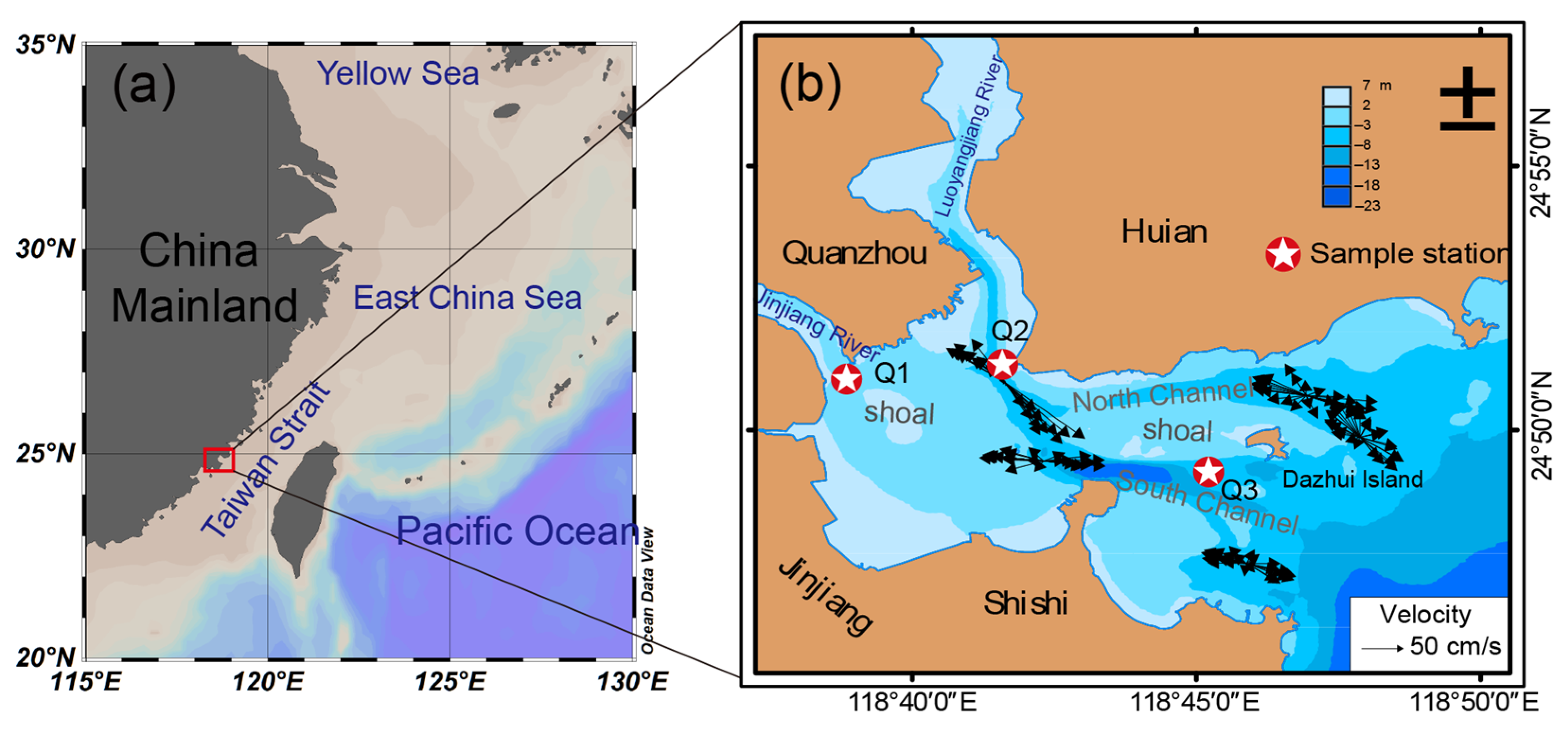
Quanzhou Bay is located in the southeastern part of Fujian Province, China, and can be divided into inner and outer bay areas, with the boundary at 118°43′ E (Figure 1). The total area of Quanzhou Bay is 136.42 km2, with a tidal flat area of 89.80 km2. The bay’s sediment primarily originates from the Jinjiang River, which has an annual runoff volume of 4.9 × 10⁹ m3 s−1 and an annual sediment flux of 2.54 × 10⁶ tons. The Luoyangjiang River also flows into the bay, but its contribution to runoff and sediment is negligible due to the recent construction of a dam. Quanzhou Bay experiences a regular semidiurnal tide, with stable tidal movements. The tidal current is also semidiurnal.
Figure 1b shows the tidal current chart for Quanzhou Bay during spring tide from July to September, based on multi-year average data [34]. The bay is divided into two main tidal channels, the south and north channels, with Dazhui Island as the boundary. The south channel, with a maximum depth greater than 20 m, serves as the primary channel and extends from the bay mouth to the estuary of the Luoyangjiang River. The north channel, which flares and deepens from west to east (maximum depth of 10 m), carries a smaller volume of water. During flood tides, tidal waters flow into the inner bay through both the north and south channels, meeting the freshwater from the Jinjiang River at the estuary. During ebb tides, the mixed waters are primarily carried along the south channel toward the open ocean, exposing the shoals located at the Jinjiang River estuary and between the north and south channels (Figure 1b).

2.2. In Situ Observation and Sampling

Field sampling and observations were conducted from 12:00 am, 10 September to 12:00 am, 11 September 2021, during mean tide conditions. Two complete tidal cycles were experienced during the observation period. The study area and station locations are shown in Figure 1b. Three continuous monitoring stations were established: station Q1 was located in the river channel near the Jinjiang River estuary; station Q2 was positioned at the confluence of the Jinjiang and Luoyangjiang River estuaries, within the estuarine turbidity maximum zone; and station Q3 was situated in the outer Quanzhou Bay, in the southern channel southwest of Dazhui Island. At each station, vertical profiles of temperature, salinity, and turbidity were obtained using a CTD profiler (SD204, SAIV, Laksevag, Norway). Current velocity and direction were measured with an Acoustic Doppler Current Profiler (ADCP, 1200 kHz, RDI, Ontario, CA, USA). Measurements were recorded at 5 min intervals, beginning at 12:00 on 10 September 2021 (10:00 for Q3).
Water sampling was collected continuously over two tidal cycles at all three stations with an interval of two hours. A plexiglass water sampler was used to collect 2 L samples at three depths: surface (0.2 h0), middle (0.6 h0), and bottom (0.8 h0), where h0 represents the total water depth. The water depths ranged from 2.6 to 9.3 m at station Q1, 5.9 to 11.8 m at station Q2, and 7.3 to 19.2 at station Q3. The sampler was rinsed with seawater before sampling, and the middle section of the water in the sampler was taken and stored in the sampling bottle. The sampling bottles were cleaned with deionized water and dried in advance.

2.3. Laboratory Analysis

2.3.1. Suspended Sediment Concentration (SSC) Measurement

The water sample (500 mL) was filtered through pre-weighed double acetate membranes with a diameter of 47 mm (pore size of 0.45 μm) for suspended sediment concentration (SSC) measurement, which were rinsed with distilled water to remove salt and dried at 40 °C, and then weighed using an electronic balance with a precision of 10−5 g. The weight of the suspended matter was then transformed to the volume concentration using the filtered water sample’s volume.

2.3.2. Grain-Size Analysis of Suspended Particles

The grain size of the suspended particles is measured with a laser particle sizer (Mastersizer 3000, Malvern Instruments, Ltd., Malvern, UK) using water samples. A 500 mL water sample is placed in a beaker and thoroughly shaken. Large particles, such as biological debris and plant fragments, are removed by passing the sample through a 1000 μm wet sieve. The sample is then subjected to ultrasonic treatment and analyzed using a Mastersizer 3000 laser diffraction particle size analyzer (Malvern Instruments, Ltd., Malvern, UK). The final result is the average of two consecutive measurements. The measurement error of the instrument is within 3%. The grain-size fractions are <4 μm for clay, 4–63 μm for silt, and >63 μm for sand.

2.3.3. Metal Analysis

Water samples from different depths were filtered through 0.45 μm cellulose acetate membranes. After salt removal, the filters were dried at low temperature (<40 °C) for 24 h. The dried filters were then weighed using a high-precision electronic balance with an accuracy of 1 × 10⁻⁵ g and a verification scale division of 1–50 mg. For digestion, the dried sample filters were placed in Teflon vessels and then digested using HNO3 (GR/Merck (Darmstadt, Germany), 65%) and HF (GR, 40%) in a closed-vessel system.
Elemental concentrations of Al, Ti, Ba, Cu, Mn, and Zn were determined by Inductively Coupled Plasma Mass Spectrometry (ICP-MS, iCAPQ, Thermo Fisher Scientific, Waltham, MA, USA). Quantification was performed by external calibration using multi-point calibration curves prepared from certified multi-element standard solutions. Calibration performance was checked by repeated analysis of a calibration verification standard during the analytical sequence, and results were corrected using procedural blanks. Quality control measures included analysis of duplicate samples (one duplicate per ten samples), procedural blanks, and certified reference materials (GBW series, GSD9–GSD12). Recovery rates ranged from 95% to 105%. Measurement precision, expressed as relative standard deviation, was <5% (error ranges are not reported in the concentration tables). Internal standards were not applied in this study, which is stated explicitly here to avoid ambiguity. Concentrations were initially measured in μg g−1 and subsequently converted to μg L−1 (mg L−1 for Al) based on the filtered volume of each water sample.
Dissolved Al, Ti, Ba, Cu, Mn, and Zn were measured in a portion of the filtered seawater using the same ICP-MS method described above.

2.4. Parameter Calculation

2.4.1. Metal Unit-Width Flux Calculation

A weighting method was used to calculate the east component, u , and the north component, v , of the depth-averaged flow velocity of each station at different times [8]. The u (m s−1) and v (m s−1) were calculated using Equations (1) and (2):
u = ( 1 × u 0 + 2 × u 0.2 + 2 × u 0.4 + 2 × u 0.6 + 2 × u 0.8 + 1 × u 1 ) / 10
v = ( 1 × v 0 + 2 × v 0.2 + 2 × v 0.4 + 2 × v 0.6 + 2 × v 0.8 + 1 × v 1 ) / 10
where u n and v n are the east and north components of the flow velocity in different layers.
The depth-averaged flow velocity (m s−1), U, was calculated using Equation (3):
U = u 2 + v 2
α = a r c t g   ( u / v )
where α is the direction of U .
The unit-width fluxes in each metal during flood tide, ebb tide and the whole tidal cycle were calculated using the following formulae, respectively, which were modified from [8].
Q a q = t 2 t 1 0 h 0 U · c a q d h d t
Q s = t 2 t 1 0 h 0 U · c s d h d t
where Q a q and Q s represent fluxes in dissolved and particulate metal (μg m−1 s−1 or mg m−1 s−1, respectively; t 2 and t 1 represent the start and end times for calculation; h 0 is the water depth; and c a q and c s represent the concentrations of dissolved and particulate metal (μg L−1 or mg L−1), respectively.

2.4.2. Solid/Liquid Partition Coefficient Calculation

The solid/liquid partition coefficient (Kd) is a key physicochemical parameter. It describes how metal elements partition between water and particulate matter in aquatic environments. Kd reflects metal mobility between the aqueous and solid phases. It also indicates the activity level of particulate-bound metals. This coefficient can be calculated from metal concentrations in the water phase and suspended solids. The equation is as follows:
K d = c s c w
In the equation, c s represents the mass concentration of particulate-bound metals (μg g−1). c w represents the dissolved metal concentration (μg L−1). Since Kd values vary greatly across different metals, we used log-transformed values (logKd) for analysis and discussion in this study.

3. Results

3.1. Variation in Sedimentary Background During Tidal Cycles in Quanzhou Bay

3.1.1. Water Temperature, Salinity, and Turbidity Variations

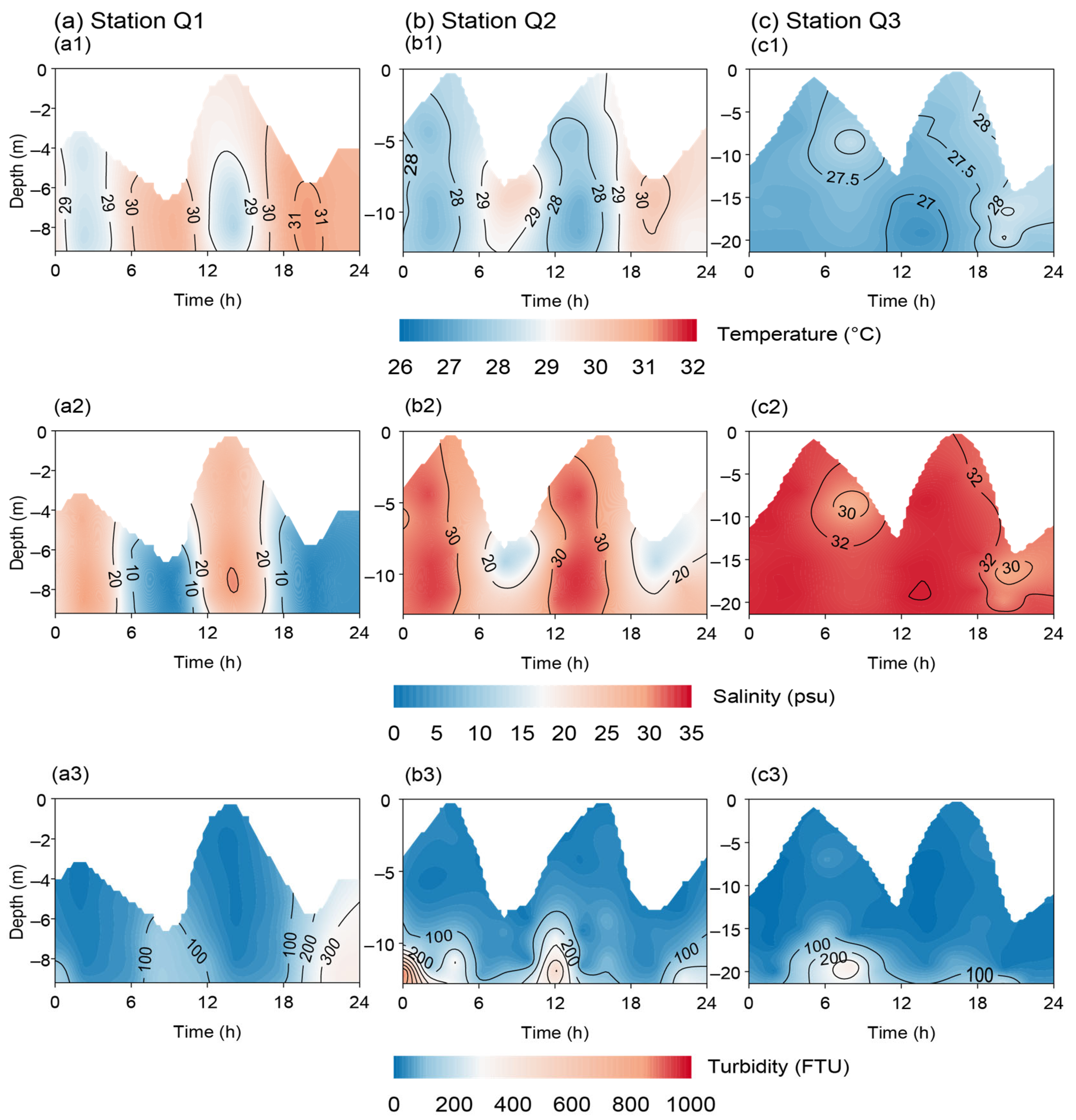
Based on CTD hydrographic data, water temperature showed a decreasing trend from station Q1 (near the Jinjiang River estuary) to station Q3 (near the inner–outer Quanzhou Bay boundary). The observed temperature range was 27.42–31.15 °C. Stations Q1 and Q2 were well-mixed in water columns with little temperature variation between surface and bottom layers due to relatively shallow water depths. Influenced by Jinjiang River runoff, both stations Q1 and Q2 showed higher temperatures during ebb slack and lower temperatures during flood slack (Figure 2(a1,b1)). Station Q3 was deeper and farther from the estuary with weaker river influence. It exhibited strong vertical temperature stratification during flood slack that varied little across the tidal cycle (Figure 2(c1)). Average salinity followed the pattern Q3 > Q2 > Q1 (Table 1). At station Q1, salinity ranged from 2.34 to 30.65 psu and showed clear differences between high and low tides (Figure 2(a2)). This reflects alternating control by estuarine and oceanic end members. The salinity of station Q2 ranged from 11.30 to 32.99 psu, with a reduced low-salinity range from the river’s influence (Figure 2(b2)). Station Q3’s salinity ranged from 28.06 to 34.04 psu and varied mainly in the vertical dimension, with lower values during ebb than flood tides (Figure 2(c2)). Temperature and salinity patterns reflect mixing between coastal river discharge and intruding seawater, and the vertical mixing was substantially stronger at stations Q1 and Q2 than at station Q3.
The maximum and average turbidity values decreased in the order of Q2 > Q1 > Q3 (Table 1). At station Q1, turbidity was relatively uniform vertically. It was higher during the river-dominated low tide and lower during the seawater-dominated high tide (Figure 2(a3)). Station Q2 exhibited large variations in turbidity (14.99–911.87 FTU). High-turbidity water spread upward from the bottom during flood tide, and low turbidity occurred during ebb tide, with non-uniform vertical distribution (Figure 2(b3)). At station Q3, turbidity was generally low. High turbidity occurred mainly in bottom waters during ebb tide (Figure 2(c3)).

3.1.2. Tidal Variation in Water Suspended Sediment Concentration (SSC) and Grain Size in Quanzhou Bay

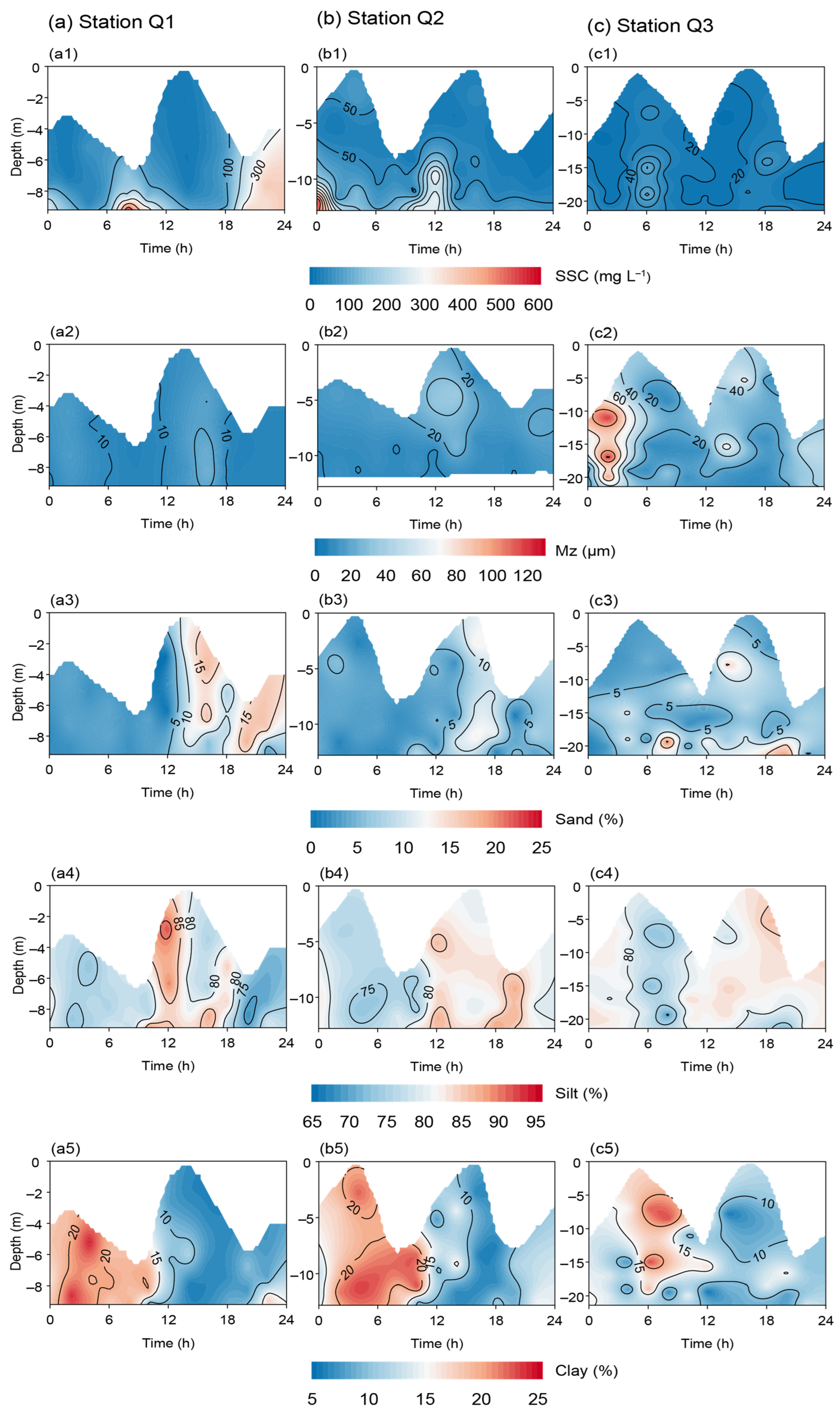
The distribution of suspended sediment concentration (SSC) in Quanzhou Bay mirrors turbidity patterns. SSC decreased progressively from Q1 to Q3 across the three stations (Table 1). At stations Q1 and Q2, the maximum SSC occurred near the bottom and decreased upward through the water column. However, SSC peaks appeared later at Q2 than at Q1 (Figure 3(a1,b1)). At station Q3, SSC remained low overall, with sporadic higher values distributed patchily through the water column during ebb tide (Figure 3(c1)).
Grain size is a key indicator of sedimentological characteristics. Table 1 and Figure 3 present grain-size results for suspended particles at the three stations. Throughout the tidal cycle, particles remained generally fine. Mean grain sizes (Mz) ranged from 7.66 to 25.55 μm (average 11.73 μm) at station Q1, 8.13–37.37 μm (average 113.72 μm) at station Q2, and 9.05–125.76 μm (average 34.09 μm) at station Q3 (Table 1). Overall, particle size coarsened from the estuary toward the bay mouth. Station Q1 showed relatively uniform grain-size, with slightly coarser particles during high tide (Figure 3(a2)). At station Q2, particles were slightly coarser during flood tide (Figure 3(b2)). Station Q3 exhibited pronounced vertical variation, with the coarsest particles appearing during flood tide (Figure 3(c2)).
Sand content was similar across all stations, marginally higher at stations Q1 and Q3 than at Q2 (Table 1). At stations Q1 and Q2, high sand values occurred during the ebb and low tide periods of the second tidal cycle. These values were distributed uniformly with depth (Figure 3(a3,b3)). At station Q3, elevated sand content appeared mainly in bottom waters and also in surface waters during flood tide (Figure 3(c3)). This pattern shows clear vertical stratification. Silt content was highest at station Q1 and similar at stations Q2 and Q3. At stations Q1 and Q2, silt distribution showed an almost inverse pattern to sand throughout the tidal cycle (Figure 3(a4,b4)). At station Q3, high silt values in the upper water column coincided with sand peaks (Figure 3(c4)). Clay content followed the pattern Q2 > Q1 > Q3. High clay values occurred during the first tidal cycle at all three stations (Figure 3(a5,b5,c5)).

3.1.3. Water Flow Variations During the Tidal Period in Quanzhou Bay

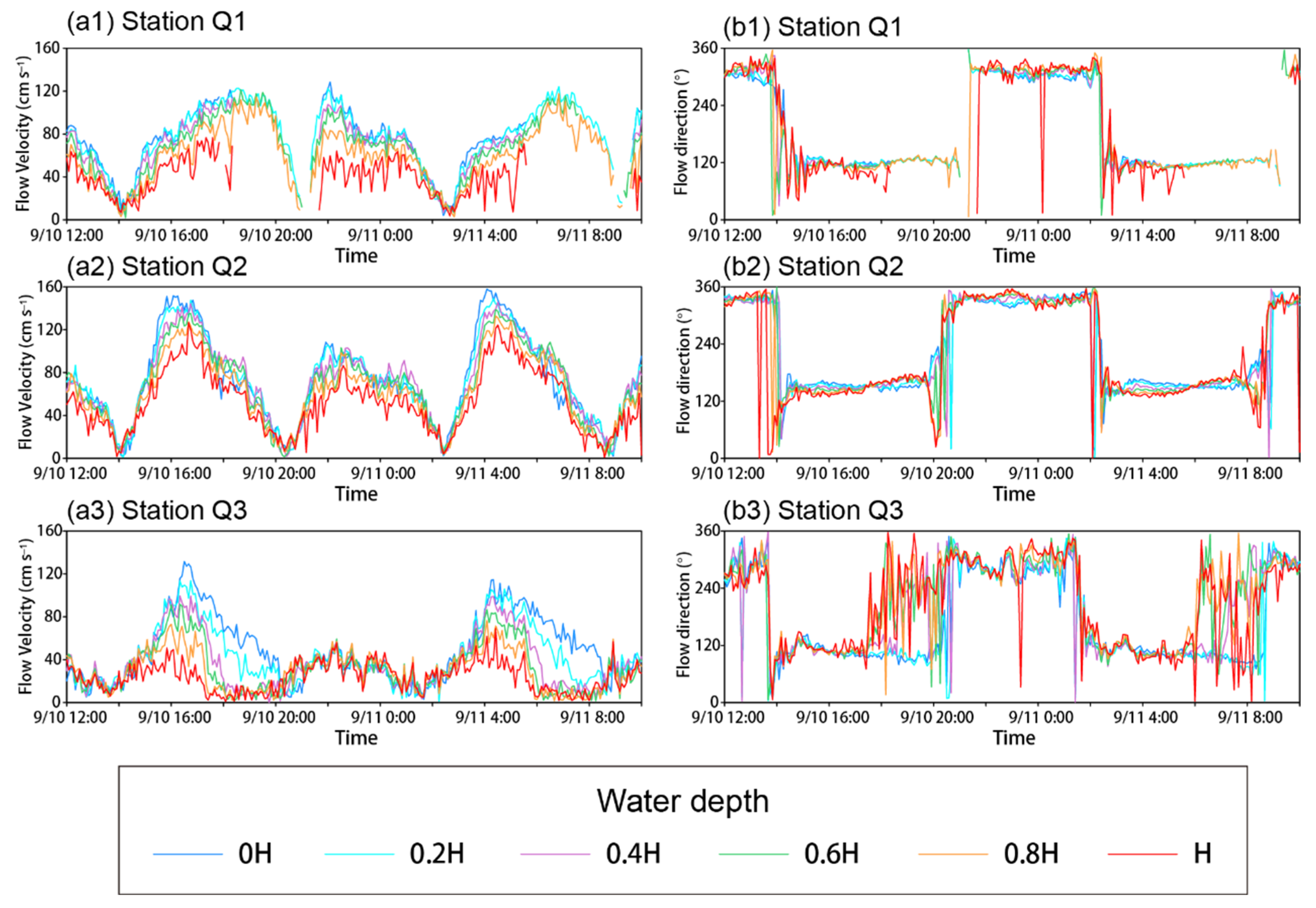
Based on flow velocity and direction measurements collected with an ADCP from September 10 at 12:00 to September 12 at 10:00, flow velocity and direction diagrams were produced for three stations (Figure 4). Measurements were taken at 0 h0 (surface), 0.2 h0, 0.4 h0, 0.6 h0, 0.8 h0, and h0 (bottom). At station Q1, where water depth was less than 4 m, only three depths (0.2 h0, 0.6 h0, and 0.8 h0) were measured.
All three stations showed rapid reversal of tidal current direction within short periods (ebb around 120° to flood around 310°). This pattern indicates typical reciprocating flow characteristics (Figure 4). Each station completed one tidal cycle in approximately 12 h. At station Q1, ebb duration exceeded flood duration, whereas at station Q2, ebb and flood durations were similar. Current velocity decreased from surface to bottom waters at all stations throughout the tidal cycle. The ranking of mean velocity was Q2 > Q1 > Q3 (Figure 4a). Velocity variations during flood and ebb differed among stations. At station Q1, maximum flood and ebb velocities were similar. However, the patterns differed during flood and ebb tides.
Due to their shallow depths, stations Q1 and Q2 were well-mixed, showing consistent flow direction between surface and bottom layers. Station Q3, located near a deep channel in the south channel, showed distinct stratification (Figure 4(b3)). During the transition from ebb to flood (around 18:00–20:00 on September 10), surface and bottom flows diverged. The surface layer maintained an ebb flow with lower-density water, while the bottom layer was dominated by a flood flow with higher-density water. During the shift from ebb to flood, dense seawater entered the bay first through the bottom layer. Consequently, the velocity change from ebb to flood occurred earlier at the bottom layer than at the surface.

3.2. Variations in Particulate and Dissolved Metals During the Tidal Period in Quanzhou Bay

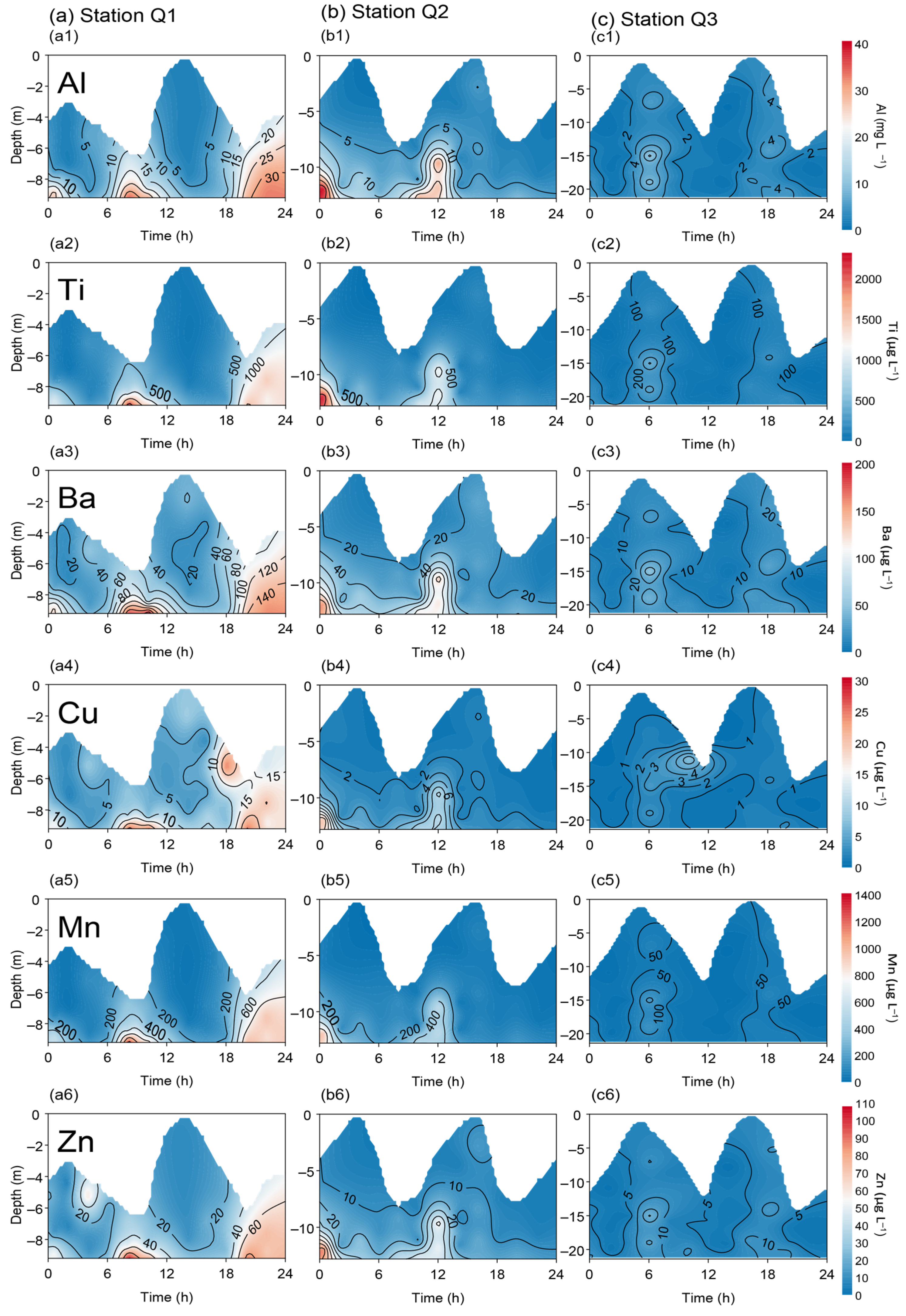
Particulate metal concentrations across three stations over a tidal cycle are shown in Table 2 and Figure 5. Overall, different metals displayed similar temporal trends in Quanzhou Bay (Figure 5). These trends closely matched suspended sediment concentrations (Figure 3), indicating that particle distribution primarily controls particulate metal variations. Variations between flood and ebb tides reflect differences in suspended particulate metals. These differences distinguish the river end-member upstream of the observation station from the marine end-member downstream. The estuarine end-member has higher metal concentrations and dominates during ebb tide, whereas the coastal marine end-member has low metal concentrations and dominates during flood tide. In addition, minor variations exist among metals, e.g., Cu showed surface peaks at 18 h while other elements did not, suggesting selective partitioning onto suspended particles, which may be related to transient biological effects and/or organic complexation in surface waters.
At station Q1, metals peaked around ebb slack and reached minima near flood slack. Vertically, low-density plumes and bottom resuspension kept surface and bottom concentrations higher than mid-layer values at stations Q1 and Q2 throughout the tidal cycle. At station Q3, low particle concentrations weakened flocculation–settlement–resuspension processes, resulting in smaller vertical variations in metals.
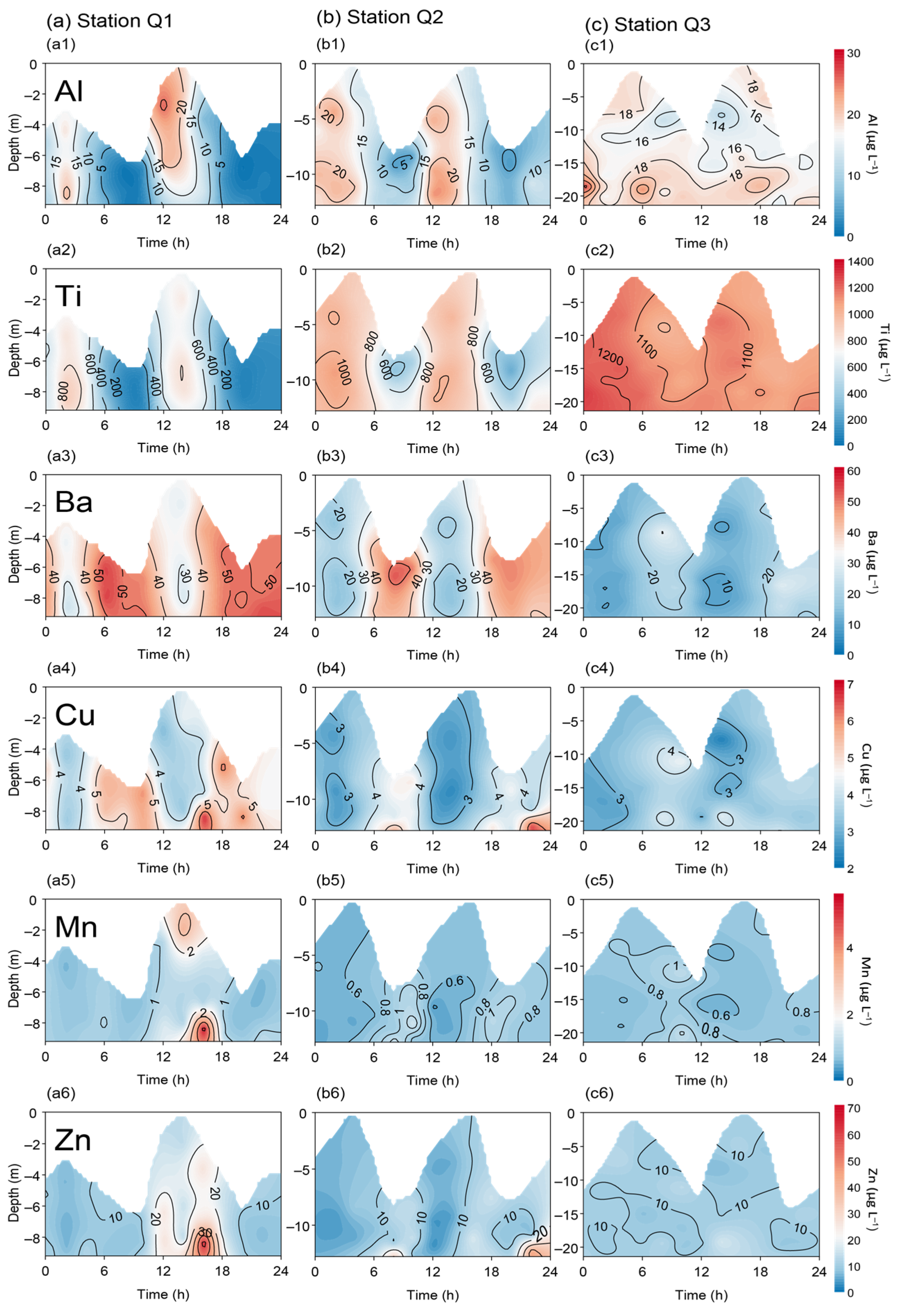
The temporal variations in dissolved metal concentrations at three consecutive stations are presented in Figure 6. Overall, these changes reflect the influence of estuarine tidal processes. However, distinct differences exist among various metals. Al and Ti concentrations at stations Q1 and Q2 were relatively low during low tide slack, increased during the flood tide, and peaked near high tide slack. In contrast, Ba and Cu showed the opposite pattern. Zn and Mn exhibited weak tidal variations; their concentrations even differed between tidal cycles. Nevertheless, their distribution patterns generally resembled those of Ba and Cu, and their behavior was more conservative compared to Al and Ti.
At station Q1 around 16:00 and station Q2 around 22:00, Cu, Zn, and Mn (Cu and Zn at station Q2) showed notably high concentrations at the bottom. This pattern may reflect remobilization from resuspended sediments/particles and/or diffusive input from sediment pore waters. At station Q3, located closer to the outer bay, dissolved metals showed weaker tidal variations. However, their general trends remained consistent with those observed at stations Q1 and Q2.

3.3. Differences in Solid/Liquid Partition Coefficients (logKd) for Metals

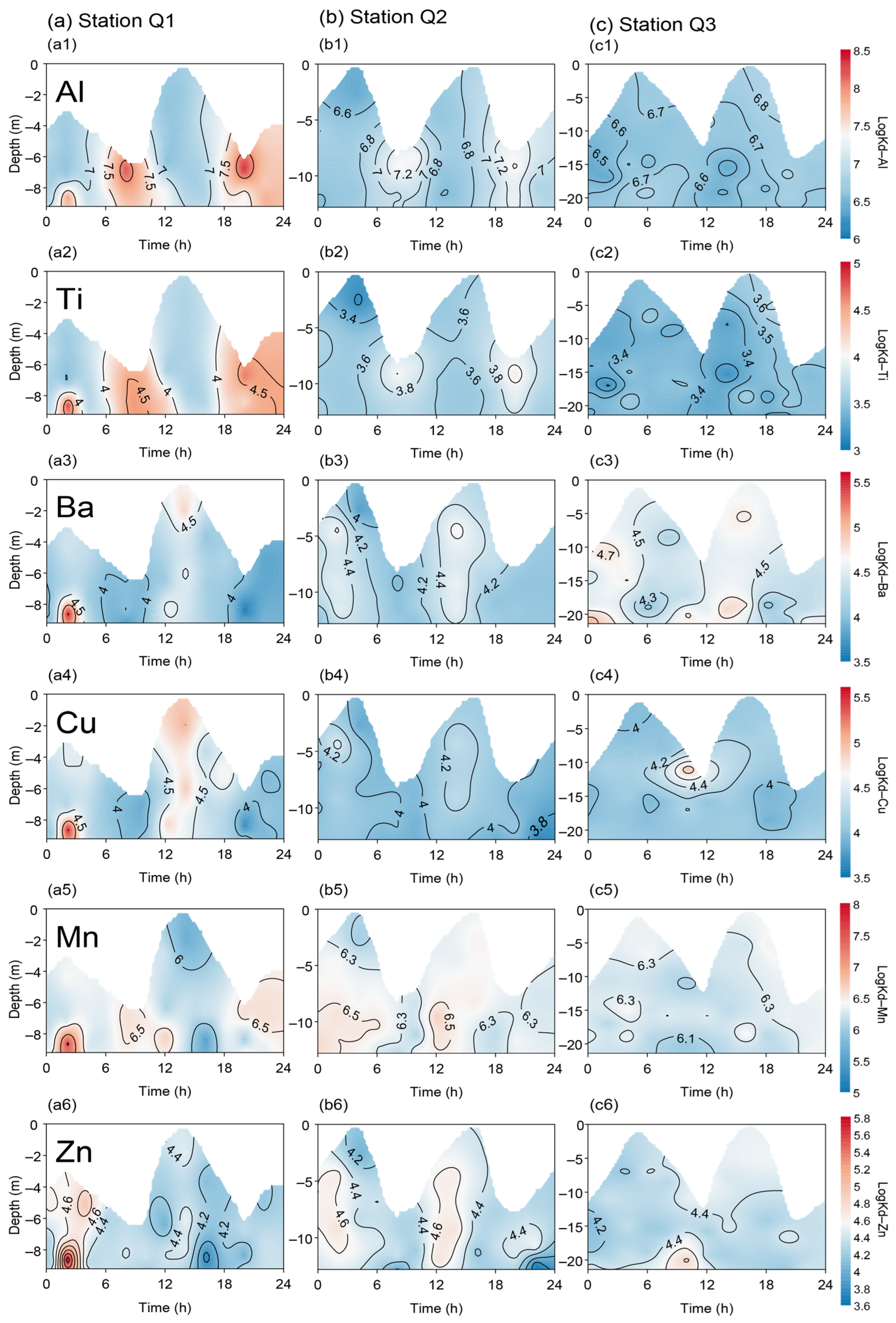
The solid/liquid partition coefficient (Kd) is a key physicochemical parameter that describes metal behavior in aquatic environments. It quantifies the dynamic equilibrium between particulate and dissolved phases during metal transport. In estuarine settings, the time required for metals to reach equilibrium is typically negligible compared to their transport timescales. Consequently, particulate and dissolved metals are generally assumed to remain in a continuous state of equilibrium. LogKd values were calculated for metals at three consecutive stations in Quanzhou Bay, with results presented in Table 3 and Figure 7. The average logKd values showed distinct spatial patterns: at station Q1, the order was Al > Mn > Zn > Cu > Ba > Ti; at station Q2, Al > Mn > Zn > Ba > Cu > Ti; and at station Q3, Al > Mn > Ba > Zn > Cu > Ti. From stations Q1 to Q3, trends varied among metals: Al and Ti increased progressively (Q3 > Q2 > Q1), while Ba decreased (Q1 > Q2 > Q3). Cu followed the pattern Q1 > Q3 > Q2, and Mn and Zn showed only minor variations. During tidal cycles at stations Q1 and Q2, Al and Ti exhibited similar behavior, with logKd values increasing during ebb tide and decreasing during flood tide. Ba and Cu showed opposite trends, peaking around ebb slack and reaching minimum values around flood slack. Mn and Zn displayed no clear tidal pattern at station Q1, but at station Q2 they followed trends similar to Ba and Cu. At station Q3, no significant tidal variations were observed for any metals.

3.4. The Unit-Width Fluxes in Particulate and Dissolved Metals During the Tidal Cycle

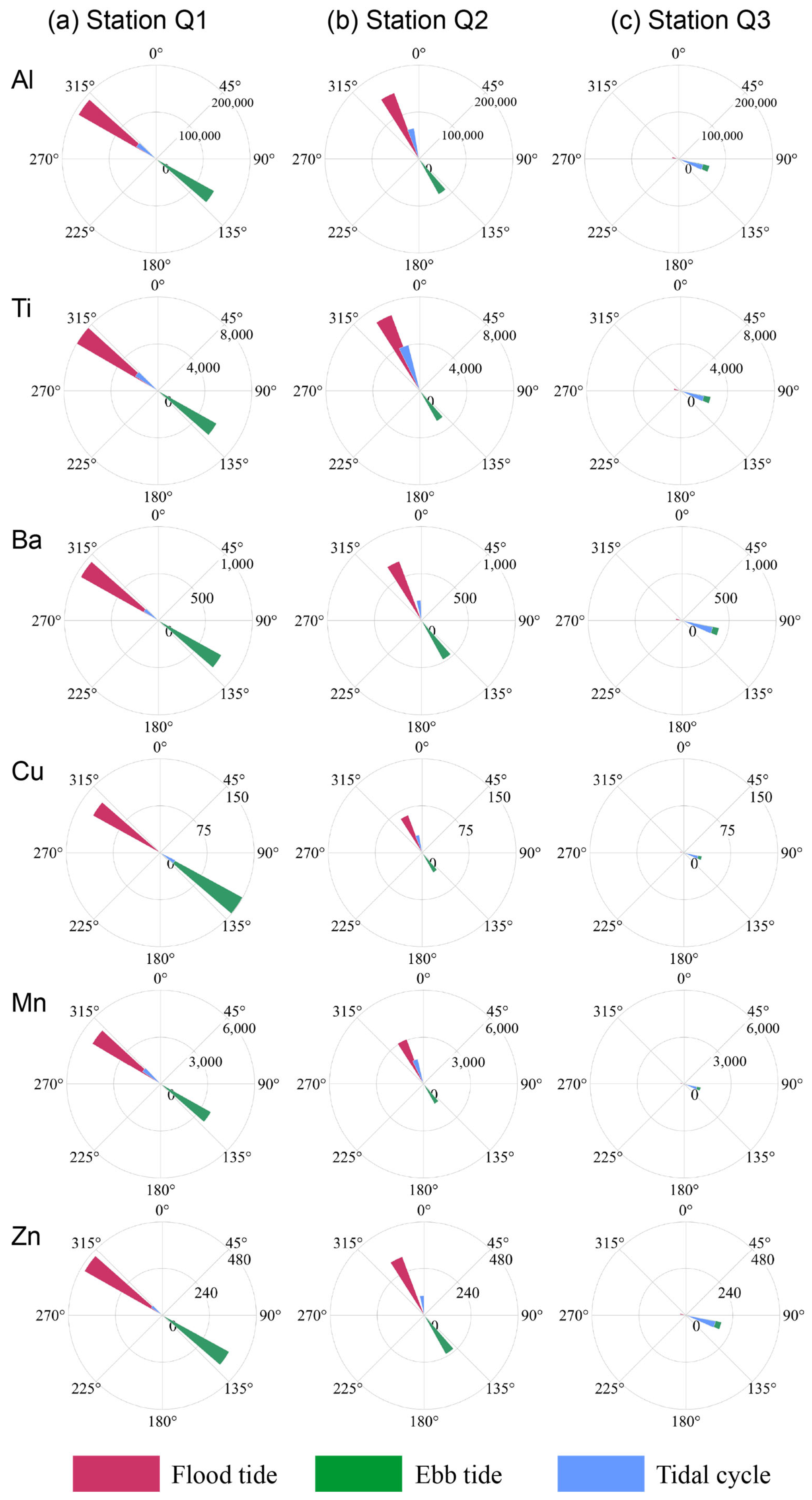
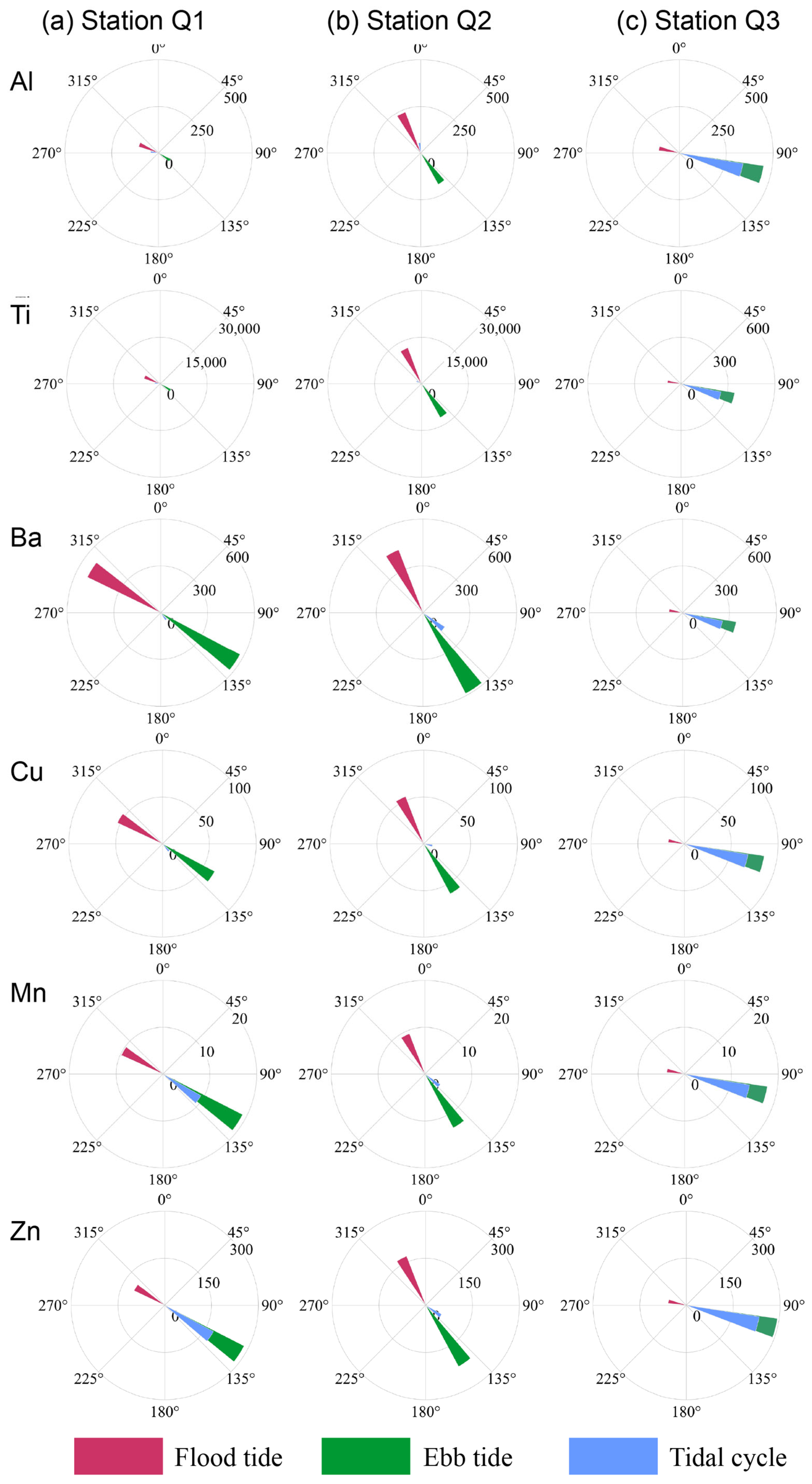
Based on water level and flow velocity data from ADCP measurements, we calculated the average unit-width fluxes in particulate and dissolved metals during flood tide, ebb tide, and a complete tidal cycle. The results are presented in Figure 8 and Figure 9.
During both flood and ebb tides, particulate metal fluxes followed the pattern Q1 > Q2 >> Q3. This indicates that station Q1 had the highest total unit-width flux of particulate metals in both tidal phases. Particulate metal fluxes varied significantly among elements, decreasing in magnitude as Al > Ti > Mn > Ba > Zn > Cu. Transport directions of particulate metals generally aligned with the bidirectional flow of flood and ebb currents. At stations Q1 and Q2, flood-tide metal fluxes dominated, resulting in net fluxes directed toward the estuary. In contrast, Station Q3 showed ebb-tide dominance, with net fluxes directed seaward. Coastal reclamation projects and the introduction of Spartina alterniflora have weakened hydrodynamic forces and reduced the tidal prism in Quanzhou Bay’s inner bay, leading to tidal flat and shoreline accretion [35]. These findings align with our observations of particulate metal enrichment at stations Q1 and Q2 during flood tide. The net metal flux at Station Q3 reflects the seaward transport of terrestrial materials through the southern channel under ebb currents.
Figure 9 shows the calculated average unit-width fluxes in dissolved metals at the three monitoring stations. During flood tide, the decreasing order of dissolved metal fluxes was Ti > Ba > Zn > Al > Cu > Mn at station Q1, Ti > Ba > Al > Zn > Cu > Mn at station Q2, and Ti > Ba > Al > Zn > Cu > Mn at station Q3. At station Q1, dissolved Al and Ti fluxes were directed northwestward (toward the estuary), while other dissolved elements flowed southeastward. At Stations Q2 and Q3, ebb-tide metal fluxes exceeded flood-tide fluxes.

4. Discussion

4.1. The Controlling Factors of the Physical Transport Process of Metal Elements in Quanzhou Bay

Quanzhou Bay experiences clear alternating end-member control driven by tidal oscillations. The riverine and marine end members alternately dominate water composition during flood and ebb tides, generating periodic fluctuations in metal transport [8]. Volume concentrations of different particulate metals vary synchronously within tidal cycles. Their temporal patterns closely match changes in suspended sediment concentration (SSC). This indicates that particulate metal transport in Quanzhou Bay is primarily governed by particle carrier movement. The transport process more readily shows a high-concentration riverine end-member signature during ebb tides. Conversely, flood tides better reflect a low-concentration marine end-member influence. This sediment-following behavior further implies that when hydrodynamic conditions drive substantial horizontal and vertical redistribution of suspended particles, particulate metals will be concurrently redistributed. This synchronization produces significant instantaneous flux variations.
Spatial variations in particulate metal transport within Quanzhou Bay are primarily controlled by sediment sources, topography, and sediment dynamics. At the estuarine (station Q1), suspended sediment concentration (SSC) and particulate metal concentrations peak during low tide due to strong riverine input [34]. As riverine influence weakens downstream, concentrations at stations Q2 and Q3 decrease significantly during low tide, which are dominated by tidal scouring instead. Quanzhou Bay features extensive tidal flats and well-developed tidal channels. Distinct transport pathways operate during flood and ebb phases due to the extensive tidal flats and well-developed tidal channels of Quanzhou Bay, and the tidal elevation strongly influences flow rates through these channels and their connectivity [35]. During the transition from ebb to flood tide, vertical flow divergence occurs near the deep trough at station Q3 (Figure 4), while denser seawater intrudes first at the bottom (Figure 2). This creates a temporal decoupling between vertical structure and transport pathways. Such stratification and early intrusion are particularly pronounced at channel stations. They shift the vertical position of metal transport and alter effective transport directions. In Quanzhou Bay, the flood waters enter the inner bay through the south and north channels and mix with river water at the estuary, and the mixed waters exit primarily through the south channel during the ebb tide [8,36], resulting in stronger export characteristics of station Q3 during ebb periods.
Besides horizontal transport, sedimentation-resuspension processes change suspended sediment concentration and grain-size composition, which enhances particulate metals and reshapes their vertical distribution [8,21,37]. Fine-grained tidal flat sediments experience intense short-term erosion and resuspension when water levels drop or flow velocities increase. Flocculation and aggregation may accompany this process [38,39]. Mud deposits on channel banks are then entrained by reversing currents. They enter the channel and join the transport system. This significantly increases particle and metal fluxes during specific periods. Tidal stage and channel geometry control these dynamics. During peak flood tide, water inundates larger areas of tidal flats, and channels widen. Higher flow velocities not only import external suspended particles but also trigger resuspension of surface sediments and then move them toward the estuary. Near flood slack, velocities decrease and hydrodynamic forces weaken, resulting in easier deposition of particles on tidal flats and near monitoring stations. Transport pulses and retention phases thus alternate within a single tidal cycle [35,36].
In contrast to their particulate counterparts, dissolved metal transport is regulated more directly by flow velocity and turbulent mixing, compounded by variations in end-member mixing ratios arising from freshwater-seawater interactions [13]. Dissolved metals exhibit marked elemental variations over tidal cycles: at stations Q1 and Q2, Al and Ti concentrations are lower at low water slack, increase during flood tide, and peak near high water slack, whereas Ba and Cu display opposite trends; Mn and Zn show comparatively weak tidal variations and appear quasi-conservative over the tidal timescale (Figure 6). For Mn, this subdued signal does not preclude redox cycling; rather, it may indicate that Mn(II) release from bottom sediments/resuspended particles and oxidation scavenging of particulate Mn(III/IV) oxides are either rapid relative to the tidal period and therefore buffer dissolved Mn, or approximately balanced between flood and ebb phases at these stations. Because we did not measure DO/ORP and Mn speciation directly, we treat this interpretation qualitatively and focus on the robust tidal patterns resolved by our concentration and flux time series. In addition, the disparities between Ba-Cu and Mn-Zn reflect that dissolved metals are influenced not only by the oscillatory transport of water masses but also modulated by elemental reactivity and the intensity of solid–liquid exchange, resulting in varying degrees of asymmetry in instantaneous fluxes between flood and ebb tides. Here, elemental reactivity refers to the extent to which dissolved elements deviate from conservative freshwater–seawater mixing due to adsorption/desorption with suspended particles/colloids, organic complexation, redox cycling, and precipitation/dissolution. The contrasting tidal patterns (Al–Ti vs. Ba–Cu) therefore reflect different end-member contrasts and element-specific reactivity: Al and Ti are particle/colloid reactive and can increase during flood-related mixing/resuspension, whereas Ba and Cu are more strongly linked to the freshwater end-member and/or DOM-controlled complexation, resulting in higher concentrations at low-tide slack. Mn and Zn show comparatively weak tidal variability, indicating quasi-conservative behavior over the tidal timescale at these stations.
The relationship between particulate and dissolved metal phases provides crucial insights into their transport–migration coupling. Flux measurements indicate that particulate metals at stations Q1 and Q2 are dominated by flood-tide contributions, with net fluxes directed toward the estuary, whereas at station Q3, ebb-tide fluxes prevail, resulting in net transport toward the outer bay (Figure 8 and Figure 9). Concurrently, solid/liquid partition coefficients (logKd) exhibit contrasting tidal patterns between Al (or Ti) and Ba (or Cu), suggesting that different elements may undergo opposing adsorption–desorption dynamics under identical hydrodynamic conditions. Together, these observations indicate a shift in the dominant control on the observed metal signals: from variability that is primarily explained by physical transport and carrier supply (water-mass exchange and SPM advection) to variability that is increasingly governed by tidally modulated solid–liquid partitioning, which in turn influences the instantaneous migration tendency of metals between particulate and dissolved phases. This mechanism, representing the transition from physical transport to solid/liquid phase migration, constitutes one of the key processes regulating estuarine metal distribution and will be discussed in detail in the following section.

4.2. The Partition Process of Metals Between Solid and Liquid States in Quanzhou Bay and Its Influencing Factors

In estuarine and bay environments, particulate metals are not only structurally incorporated in mineral lattices and (ii) loosely exchangeable surface-adsorbed fractions, but are also commonly hosted by highly reactive carrier phases, particularly Fe/Mn oxyhydroxides, organic matter (POM/organic coatings), and fine colloidal/aggregated material that can be operationally collected in the particulate fraction depending on filtration and aggregation state [13,28,40]. These reactive carrier phases (Fe/Mn oxyhydroxides and organic coatings/colloids) can dominate metal partitioning because they provide abundant sorption sites and can exchange with the dissolved pool on short (tidal) timescales. Redox cycling is particularly important for Mn. In oxic waters, dissolved Mn is typically present as Mn(II) but can be oxidized to particulate Mn(III/IV) oxyhydroxides, whereas under reducing conditions (e.g., within sediment porewaters, freshly resuspended aggregates, or near-bed microenvironments), Mn oxides can be reduced and dissolved Mn(II) can be released. These Mn oxyhydroxides are also highly effective scavengers for other trace metals, and thus Mn redox transformations can indirectly influence the partitioning of co-transported elements (including Zn) through adsorption/co-precipitation onto newly formed oxide surfaces. Suspended particulate matter in Quanzhou Bay is predominantly sourced from the Jinjiang River runoff, where the fine-grained fraction—represented by Al-rich lateritic soils in the catchment—is dominated by kaolinite-type clay minerals. These minerals exhibit stable crystalline structures with relatively weak internal cation exchange capacity, resulting in exchangeable cations being preferentially distributed at external surface edges and fracture sites rather than within interlayer spaces [41]. Such characteristics provide favorable conditions for the subsequent partitioning of metals among different phases. In Quanzhou Bay, the freshwater input from the Jinjiang River and tidal intrusion from the Taiwan Strait generate a pronounced longitudinal salinity gradient and strong tidal oscillations (Figure 2 and Figure 4), producing rapid (sub-daily) shifts in ionic strength and mixing ratios along the estuary–bay transect (Q1–Q3). Under these conditions, the fine-grained suspended particles delivered by river runoff (dominated by kaolinite-rich lateritic material) provide abundant reactive surfaces and coatings that interact with dissolved metals during each tidal cycle. As salinity increases during flood tide, higher ionic strength compresses the electrical double layer and reduces particle zeta potential, favoring aggregation/flocculation of fine particles and associated metal-bearing coatings/colloids [10,28]. At the same time, the changing major-ion composition (e.g., Na+, Cl) and increasing marine-derived ligands/DOM can promote competitive desorption and complexation for some elements [32], shifting solid–liquid partitioning in an element-specific way. These coupled processes offer a mechanistic explanation for the station-dependent tidal asymmetry observed in our dataset (i.e., flood-dominated particulate fluxes at Q1–Q2 versus ebb-dominated fluxes at Q3; and the contrasting logKd tidal patterns between Al, Ti and Ba, Cu; Figure 8 and Figure 9), indicating that in Quanzhou Bay, physical mixing not only advects carriers but can also modulate partitioning via salinity-controlled aggregation and exchange.
The solid/liquid partitioning of metal elements is not only regulated by the particulate-dissolved interface within the water column, but also strongly modulated by sediment resuspension processes at the sediment–water interface [42,43,44]. Resuspension reintroduces sediment into the water column, exhibiting selectivity with respect to particle size and viscosity [38,45], thereby directly altering the mass concentration of particulate metals in bottom waters. Concurrently, resuspension modifies the concentration and composition of bottom particulate matter, facilitating the exchange between particulate and dissolved metal phases. This is consistent with the episodic occurrence of anomalously high dissolved metal concentrations near the bottom, suggesting that carrier phase release and interfacial exchange at the bottom may significantly alter the dissolved metal inventory on short timescales, with rapid redistribution via tidal transport. In the case of Mn, such near-bed excursions are consistent with episodic inputs of dissolved Mn(II) from sediments and/or reductive dissolution during resuspension, followed by oxidation and re-adsorption as water masses mix and oxygen conditions recover.
In terms of controlling mechanisms, the intensity and direction of particle transport are jointly governed by particulate properties and environmental gradients across the water column [10,28]. Station Q2, situated near the turbidity maximum zone, exhibits relatively uniform vertical salinity distribution during flood tide but elevated bottom turbidity, accompanied by a grain-size stratification pattern of coarser surface and finer bottom sediments. This pattern reflects the coupled enhancement of fine-particle flocculation-settling and bottom sediment resuspension. The fine-particle enrichment and vigorous sediment–water interface exchange tend to amplify tidal-scale fluctuations in solid/liquid partitioning, creating an alternating dominance between adsorption–desorption and flocculation-settling processes within each tidal cycle. This effect is element-specific. For instance, at station Q2 the tidal evolution of logKd for Al (and Ti) is nearly opposite to that of Ba (and Cu) (Figure 7): Al–Ti exhibit higher particulate association when fine-particle enrichment and aggregation are enhanced, consistent with their strong affinity to clay/oxide/colloidal surfaces, whereas Ba–Cu display the reverse tendency, implying stronger control by water-mass mixing and/or salinity/ligand-mediated desorption and complexation. Consequently, the same hydrodynamic forcing at the turbidity maximum zone can generate contrasting instantaneous fluxes and net transport directions among elements. By contrast, station Q3, located in the outer bay channel downstream of the estuarine filter, exhibits substantially reduced suspended particle loads. The lower particle concentrations and relatively coarse grain-size distribution constrain flocculation and settling processes, thereby weakening overall transport intensity while emphasizing the relative contributions of horizontal advection and sediment resuspension.

4.3. Metal Transport-Migration Behavior Patterns Under the Influence of Estuarine Processes

Based on an integrated analysis of hydrodynamic regimes, spatiotemporal particulate dynamics, and solid/liquid partitioning patterns across the tidal cycle, metal behavior in Quanzhou Bay can be conceptualized as a coupled system characterized by alternating end-member control, estuarine filter modulation, and the coexistence of channelized export with inner-bay retention. Temporally, periodic hydrodynamic forcing during flood and ebb tides stabilizes seawater–freshwater mixing ratios within defined bounds, driving corresponding oscillations in salinity. Consequently, metal behaviors at any given location are not static but instead transition dynamically among different migration stages as water mass properties and particulate carrier conditions evolve.
At the spatial scale, the bay can be conceptualized as an assemblage of discrete material parcels. Along the continuous salinity gradient extending from the river mouth to the open sea, flocculation, settling, resuspension, and adsorption–desorption processes unfold with varying intensities as fluvial influence gradually wanes, oscillating spatially between the estuary and offshore waters with the tidal cycle [25,31,33]. Within this framework, the flocculation–settling–resuspension cycle serves as the central nexus linking sediment transport to contaminant migration: metal transport is intrinsically coupled to the movement of their water–sediment carriers, while transport processes are concurrently mediated by adsorption–desorption dynamics and the continuous exchange of metals between the aqueous phase and sedimentary reservoirs. In the river-dominated upper estuary where marine influence remains limited, coarse particles tend to deposit, whereas fine fractions remain suspended and transported, thereby elevating particulate metal concentrations in the water column. As marine influence intensifies seaward, enhanced flocculation of fine particles may trigger episodic settling. Concurrently, increasing ionic strength strengthens solid/liquid interface exchange, causing transport pathways to shift in response to ion exchange dynamics and electrical double layer compression [29,46]. Downstream of the estuarine turbidity maximum zone, where fluvial particle loads diminish substantially and flocculation weakens, the “source-sink” exchange effects become less pronounced, while particle concentration effects and adsorption–desorption equilibria increasingly govern the migration and fate of metals.
The spatial distribution patterns of metal elements in Quanzhou Bay are fundamentally consistent with the configuration of the tidal channel system. Particulate metals tend to accumulate and be retained at inner bay stations during flood tides, with net fluxes directed toward the estuary, whereas in the outer bay channels, they are more readily transported seaward through the south channel during ebb tides. This reflects a coupled functional partitioning characterized by “inner bay retention and redistribution versus outer bay channel export”. Meanwhile, the extensive tidal flats create distinct transport pathways between flood and ebb tides. Water level fluctuations and channel widening effects can amplify resuspension and flux pulses during specific tidal stages, which, by altering particle carrier conditions, further influence solid/liquid partitioning and elemental fractionation. Therefore, the transport and migration of metals in Quanzhou Bay should be regarded as a coupled outcome driven by hydrodynamic forcing, geomorphology, and particulate-dissolved exchange, rather than processes readily explainable by single end-member mixing or single-phase transport alone.

4.4. Comparison with Previous Studies in Quanzhou Bay and Other Estuaries

Our observations in the Jinjiang Estuary–Quanzhou Bay system are broadly consistent with established patterns reported for other estuarine environments, while providing additional process-level constraints at tidal-cycle resolution. In Quanzhou Bay, previous studies have emphasized the role of episodic, high-energy events (e.g., typhoons) in redistributing sediments and associated heavy metals and in driving secondary contamination signals [8,26]. Our time-series results complement these event-focused findings by showing that, even under non-extreme conditions, regular tidal oscillations can impose strong sub-daily variability in carrier abundance and transport pathways, thereby modulating instantaneous metal fluxes and net landward–seaward transport tendencies.
Beyond the study area, the strong co-variation between particulate metals and suspended sediment dynamics observed here is consistent with classical suspended-matter controls reported in turbid estuaries such as the Scheldt, where trace-metal distributions in suspended matter reflect particle transport and source-mixing processes [15]. Likewise, our interpretation that solid–liquid partitioning can vary with mixing and hydrodynamic conditions aligns with studies that quantified suspended particulate matter–water and sediment–water partitioning in the Yangtze Estuary [10] and documented spatial–temporal dissolved-particulate partitioning behavior in the Changjiang River continuum [28]. Tidal influences on dissolved and particulate metals have also been reported in semi-enclosed bays impacted by land-based inputs, such as Jiaozhou Bay, where both concentrations and phase associations respond to tidal mixing [13].
A key added value of the present work is that it explicitly couples station-resolved flood/ebb-flux asymmetry with time-varying solid–liquid partitioning (logKd) and concurrent hydrodynamic and particle observations along a transect spanning the river channel, turbidity maximum zone, and the main tidal channel. This integrated perspective helps reconcile why similar hydrodynamic forcing can yield different elemental responses: in our dataset, particle-mediated transport dominates the particulate pool, whereas dissolved-phase behavior and logKd variability indicate that phase exchange processes superimpose an element-specific modulation on top of end-member advection. In this way, our results extend prior concentration- and mixing-based interpretations by providing a tidal-cycle, process-based linkage between transport pathways, carrier dynamics, and partitioning behavior in Quanzhou Bay and comparable estuarine systems.
Our results also have environmental implications for contaminant persistence and exposure in Quanzhou Bay. Flood-dominated retention in the inner estuary, together with estuarine filtration (aggregation–settling–resuspension), can promote repeated trapping and remobilization of particle-bound metals in the turbidity maximum zone and nearby sediments, potentially sustaining local exposure hotspots. In contrast, ebb-dominated export in the main channel at the outer-bay station can enhance downstream transfer and broaden the exposure footprint beyond the inner bay. Moreover, tidal modulation of solid–liquid partitioning (logKd variability) indicates that the dissolved, potentially more bioavailable fraction may fluctuate on sub-daily timescales, implying pulsed rather than steady exposure. Quantifying these consequences will require additional biological and geochemical constraints (e.g., uptake/response indicators, DOC/ligand data, and seasonal coverage), which will be our focus in future work.

5. Conclusions

In Quanzhou Bay, our observations indicate that tidal oscillations exert a first-order control on metal transport, and the data show clear co-variations between physical transport and phase exchange. During flood–ebb cycles, alternating dominance of estuarine and marine end members regulates water mass properties, resulting in highly synchronous variations between particulate metal concentrations and suspended sediment concentrations (SSC), consistent with particle-associated transport, as evidenced by the strong co-variation between particulate metals and SSC observed here. Conversely, dissolved metals display element-specific tidal responses: at stations Q1 and Q2, dissolved Al and Ti increase during flood tide while Ba and Cu show opposite trends, whereas Mn and Zn exhibit relatively weak tidal variations and overall quasi-conservative behavior. Together with the element-specific tidal patterns reported here (Al–Ti versus Ba–Cu; Mn–Zn quasi-conservative), these observations indicate that advection alone cannot explain dissolved-metal variability, and that solid–liquid exchange and element-specific reactivity likely contribute on tidal timescales. Solid/liquid distribution coefficients (logKd) further reveal differential adsorption–desorption controls across the tidal cycle; the opposing trends in logKd between Al, Ti and Ba, Cu indicate that different elements may undergo adsorption–desorption adjustments in opposite directions under identical hydrodynamic conditions, suggesting a shift in the dominant control from transport-driven carrier variability to tidally modulated phase partitioning, which can bias apparent migration tendencies between particulate and dissolved pools. Flux analysis demonstrates that particulate metal fluxes during flood/ebb phases generally follow the order stations Q1 > Q2 ≫ Q3, with stations Q1 and Q2 dominated by flood-tide contributions and net flux directed landward (estuarine), whereas the outer bay station, Q3, is dominated by ebb-tide fluxes with net transport seaward. This spatial pattern is consistent with a functional differentiation within Quanzhou Bay—riverine-dominated input in the inner estuary (Q1–Q2), retention/reallocation within the inner bay, and channelized export at the outer-bay station (Q3)—as inferred from the measured flux asymmetries. Based on the tidal concentration patterns, logKd variability, and quantified flood/ebb fluxes presented in this study, metal behavior in Quanzhou Bay can be summarized by an “end-member alternating control—estuarine filter modulation—channelized export coexisting with inner bay retention” conceptual framework. This conceptual model emphasizes that hydrodynamic structure, topographic channeling, and particle-dissolved exchange collectively determine net export/import and environmental effects of metals, providing critical process-based evidence for quantifying estuarine filter intensity and its ecological risk implications under varying tidal regimes and seasonal conditions.

Author Contributions

Conceptualization, Y.L. (Yunhai Li), Y.L. (Yunpeng Lin) and S.Y.; methodology, Y.F., Y.L. (Yunpeng Lin), S.Y., J.J. and K.W.; validation, Y.F. and Y.L. (Yunhai Li); formal analysis, Y.L. (Yunpeng Lin), S.Y. and C.W.; investigation, S.Y., Z.C. and S.Z.; resources, Y.F., Y.L. (Yunhai Li) and Y.L. (Yunpeng Lin); data curation, Y.L. (Yunpeng Lin); S.Y., Z.C., X.C., C.W., S.Z. and M.J.; writing—original draft preparation, Y.F.; writing—review and editing, Y.L. (Yunhai Li), Y.L. (Yunpeng Lin), S.Y., Z.C., X.C., C.W., S.Z., J.J., M.J. and K.W.; visualization, Y.L. (Yunpeng Lin) and S.Y.; supervision, Y.L. (Yunhai Li); funding acquisition, Y.L. (Yunhai Li) and Y.L. (Yunpeng Lin). All authors have read and agreed to the published version of the manuscript.

Funding

This research was jointly funded by the Natural Science Foundation of Fujian Province, China (2025J01240), the National Natural Science Foundation of China (42506050), and the Natural Science Foundation of Xiamen, China (3502Z202573090).

Data Availability Statement

Data inquiries can be directed to the corresponding author.

Acknowledgments

We thank all the investigators for their help in collecting data during the survey. This manuscript benefited from comments by three anonymous reviewers.

Conflicts of Interest

The authors declare no conflicts of interest.

References

  1. Syvitski, J.P.M.; Peckham, S.D.; Hilberman, R.; Mulder, T. Predicting the terrestrial flux of sediment to the global ocean: A planetary perspective. Sediment. Geol. 2003, 162, 5–24. [Google Scholar] [CrossRef]
  2. Milliman, J.; Farnsworth, K. River Discharge to the Coastal Ocean: A Global Synthesis; Cambridge University Press: Cambridge, UK, 2011. [Google Scholar]
  3. Han, D.; Cheng, J.; Hu, X.; Jiang, Z.; Mo, L.; Xu, H.; Ma, Y.; Chen, X.; Wang, H. Spatial distribution, risk assessment and source identification of heavy metals in sediments of the Yangtze River Estuary, China. Mar. Pollut. Bull. 2017, 115, 141–148. [Google Scholar] [CrossRef]
  4. Wang, W.X.; Pan, K.; Tan, Q.; Guo, L.; Simpson, S.L. Estuarine pollution of metals in China: Science and mitigation. Environ. Sci. Technol. 2014, 48, 9975–9976. [Google Scholar] [CrossRef]
  5. Mali, M.; Dell’Anna, M.M.; Mastrorilli, P.; Damiani, L.; Piccinni, A.F. Assessment and source identification of pollution risk for touristic ports: Heavy metals and polycyclic aromatic hydrocarbons in sediments of 4 marinas of the Apulia region (Italy). Mar. Pollut. Bull. 2017, 114, 768–777. [Google Scholar] [CrossRef]
  6. Gokul, T.; Kumar, K.R.; Prema, P.; Arun, A.; Balaji, P.; Faggio, C. Particulate pollution and its toxicity to fish: An overview. Comp. Biochem. Physiol. Part C Toxicol. Pharmacol. 2023, 270, 109646. [Google Scholar] [CrossRef]
  7. Boenigk, J.; Wiedlroither, A.; Pfandl, K. Heavy metal toxicity and bioavailability of dissolved nutrients to a bacterivorous flagellate are linked to suspended particle physical properties. Aquat. Toxicol. 2005, 71, 249–259. [Google Scholar] [CrossRef]
  8. Lin, Y.; Li, Y.; Wang, L.; Zheng, B.; Yin, X.; Xu, Y. Typhoon Fung-wong (2008) induced heavy metals secondary pollution in Quanzhou Bay, southeast of China. Mar. Pollut. Bull. 2021, 164, 112047. [Google Scholar] [CrossRef]
  9. Wang, M.; Tong, Y.; Chen, C.; Liu, X.; Lu, Y.; Zhang, W.; He, W.; Wang, X.; Zhao, S.; Lin, Y. Ecological risk assessment to marine organisms induced by heavy metals in China’s coastal waters. Mar. Pollut. Bull. 2018, 126, 349–356. [Google Scholar] [CrossRef] [PubMed]
  10. Feng, C.; Guo, X.; Yin, S.; Tian, C.; Li, Y.; Shen, Z. Heavy metal partitioning of suspended particulate matter-water and sediment-water in the Yangtze Estuary. Chemosphere 2017, 185, 717–725. [Google Scholar] [CrossRef] [PubMed]
  11. Hamad, S.H.; Schauer, J.J.; Shafer, M.M.; Abed Al-Raheem, E.; Satar, H. The distribution between the dissolved and the particulate forms of 49 metals across the Tigris River, Baghdad, Iraq. Sci. World J. 2012, 2012, 246059. [Google Scholar] [CrossRef]
  12. Li, L.; Jiang, M.; Liu, Y.; Shen, X. Heavy metals inter-annual variability and distribution in the Yangtze River estuary sediment, China. Mar. Pollut. Bull. 2019, 141, 514–520. [Google Scholar] [CrossRef] [PubMed]
  13. Wang, C.; Liang, S.; Li, Y.; Li, K.; Wang, X. The spatial distribution of dissolved and particulate heavy metals and their response to land-based inputs and tides in a semi-enclosed industrial embayment: Jiaozhou Bay, China. Environ. Sci. Pollut. Res 2015, 22, 10480–10495. [Google Scholar] [CrossRef]
  14. Huang, J.; Ge, X.; Wang, D. Distribution of heavy metals in the water column, suspended particulate matters and the sediment under hydrodynamic conditions using an annular flume. J. Environ. Sci. 2012, 24, 2051–2059. [Google Scholar] [CrossRef]
  15. Zwolsman, J.J.G.; van Eck, G.T.M. Geochemistry of major elements and trace metals in suspended matter of the Scheldt estuary, southwest Netherlands. Mar. Chem. 1999, 66, 91–111. [Google Scholar] [CrossRef]
  16. Madadi, R.; Mejjad, N.; De-la-Torre, G.E. Geochemical speciation, ecological risk, and source identification of heavy metal(loid)s in sediments and waters from Musa Estuary, Persian Gulf. Mar. Pollut. Bull. 2023, 190, 114836. [Google Scholar] [CrossRef]
  17. Rubalingeswari, N.; Thulasimala, D.; Giridharan, L.; Gopal, V.; Magesh, N.S.; Jayaprakash, M. Bioaccumulation of heavy metals in water, sediment, and tissues of major fisheries from Adyar estuary, southeast coast of India: An ecotoxicological impact of a metropolitan city. Mar. Pollut. Bull. 2021, 163, 111964. [Google Scholar] [CrossRef]
  18. Jiang, S.; Zhang, Y.; Yu, G.; Han, Z.; Zhao, J.; Zhang, T.; Zheng, M. Source-resolved atmospheric metal emissions, concentrations, and deposition fluxes into the East Asian seas. Atmos. Chem. Phys. 2024, 24, 8363–8381. [Google Scholar] [CrossRef]
  19. Zhang, L.; Wu, Y.; Ni, Z.; Li, J.; Ren, Y.; Lin, J.; Huang, X. Saltwater intrusion regulates the distribution and partitioning of heavy metals in water in a dynamic estuary, South China. Mar. Environ. Res. 2023, 186, 105943. [Google Scholar] [CrossRef] [PubMed]
  20. Chen, X.; Seo, H.; Han, H.; Seo, J.; Kim, T.; Kim, G. Conservative behavior of terrestrial trace elements associated with humic substances in the coastal ocean. Geochim. Cosmochim. Acta 2021, 308, 373–383. [Google Scholar] [CrossRef]
  21. Martin-Torre, M.C.; Cifrian, E.; Ruiz, G.; Galan, B.; Viguri, J.R. Estuarine sediment resuspension and acidification: Release behaviour of contaminants under different oxidation levels and acid sources. J. Environ. Manag. 2017, 199, 211–221. [Google Scholar] [CrossRef]
  22. Yao, Q.; Wang, X.; Jian, H.; Chen, H.; Yu, Z. Behavior of suspended particles in the Changjiang Estuary: Size distribution and trace metal contamination. Mar. Pollut. Bull. 2016, 103, 159–167. [Google Scholar] [CrossRef]
  23. Dyer, K.R.; Manning, A.J. Observation of the size, settling velocity and effective density of flocs, and their fractal dimensions. J. Sea Res. 1999, 41, 87–95. [Google Scholar] [CrossRef]
  24. Xia, X.M.; Li, Y.; Yang, H.; Wu, C.Y.; Sing, T.H.; Pong, H.K. Observations on the size and settling velocity distributions of suspended sediment in the Pearl River Estuary, China. Cont. Shelf Res. 2004, 24, 1809–1826. [Google Scholar] [CrossRef]
  25. Huynh, T.T.; Kim, J.; Lee, S.D.; Fettweis, M.; Bi, Q.; Kim, S.; Lee, S.; Choi, Y.Y.; Nguyen, H.S.; Bui, T.V.; et al. Spatiotemporal Dynamics of Suspended Particulate Matter in Water Environments: A Review. Water 2024, 16, 3613. [Google Scholar] [CrossRef]
  26. Lin, Y.; Li, Y.; Zheng, B.; Yin, X.; Wang, L.; He, J.; Shu, F. Impact of typhoon Matmo (2014) on the distribution of heavy metals in Quanzhou Bay. Anthr. Coasts 2019, 2, 209–228. [Google Scholar] [CrossRef]
  27. Bai, Y.; Wu, B.; Chen, W.; Li, M.; Weng, Y. Influences of energetic typhoons on the redistributions of heavy metals in sediments along the Leizhou Peninsula coast, southern China. Mar. Pollut. Bull. 2022, 174, 113268. [Google Scholar] [CrossRef]
  28. Yang, Z.; Xia, X.; Wang, Y.; Ji, J.; Wang, D.; Hou, Q.; Yu, T. Dissolved and particulate partitioning of trace elements and their spatial–temporal distribution in the Changjiang River. J. Geochem. Explor. 2014, 145, 114–123. [Google Scholar] [CrossRef]
  29. Yu, F.; Ji, Y.; Li, Z.; Li, Y.; Meng, Y. Adsorption-desorption characteristics of typical heavy metal pollutants in submerged zone sediments: A case study of the Jialu section in Zhengzhou, China. Environ. Sci. Pollut. Res. 2023, 30, 96055–96074. [Google Scholar] [CrossRef]
  30. Upadhyay, S. Sorption Model for Dissolved and Leachable Particulate Aluminium in the Great Ouse Estuary, England. Aquat. Geochem. 2012, 18, 243–262. [Google Scholar] [CrossRef]
  31. Deng, Z.; Huang, D.; He, Q.; Chassagne, C. Review of the action of organic matter on mineral sediment flocculation. Front. Earth Sci. 2022, 10, 965919. [Google Scholar] [CrossRef]
  32. Millward, G.E.; Liu, Y.P. Modelling metal desorption kinetics in estuaries. Sci. Total Environ. 2003, 314–316, 613–623. [Google Scholar] [CrossRef]
  33. Fang, Z.; Xu, F.; Zhang, X. A new parameterization of flocculent layer resuspension of fine-grained sediments in estuarine environments. Ocean Dyn. 2025, 75, 38. [Google Scholar] [CrossRef]
  34. Lin, Y.; Li, Y.; Zheng, B.; Yin, X.; Wang, L.; He, J.; Shu, F.; Qiao, L. Evolution of sedimentary organic matter in a small river estuary after the typhoon process: A case study of Quanzhou Bay. Sci. Total Environ. 2019, 686, 290–300. [Google Scholar] [CrossRef]
  35. Xiao, X.; Li, Y.; Tang, J.; Luo, F.; Shu, F.; Wang, L.; He, J.; Zou, X.; Chi, W.; Lin, Y.; et al. Coupling Relationship of Geomorphic Evolution and Marine Hydrodynamics in the Stage-Specific Development of Urban Bays: A Modelling Case Study in Quanzhou Bay (1954–2017), China. J. Mar. Sci. Eng. 2022, 10, 1677. [Google Scholar] [CrossRef]
  36. Yang, S.; Li, Y.; Lin, Y.; Liu, M.; Zou, X.; Wang, L.; Zheng, B.; Yin, X.; He, J.; Shu, F. Evolution of sedimentary dynamic process/pattern in the Quanzhou Bay under impact of Typhoon Matmo (2014). Reg. Stud. Mar. Sci. 2023, 62, 102974. [Google Scholar] [CrossRef]
  37. Song, J.; Duan, X.; Han, X.; Li, Y.; Li, Y.; He, D. The accumulation and redistribution of heavy metals in the water-level fluctuation zone of the Nuozhadu Reservoir, Upper Mekong. Catena 2019, 172, 335–344. [Google Scholar] [CrossRef]
  38. Guo, C.; He, Q.; van Prooijen, B.C.; Guo, L.; Manning, A.J.; Bass, S. Investigation of flocculation dynamics under changing hydrodynamic forcing on an intertidal mudflat. Mar. Geol. 2018, 395, 120–132. [Google Scholar] [CrossRef]
  39. Shi, B.; Cooper, J.R.; Pratolongo, P.D.; Gao, S.; Bouma, T.J.; Li, G.; Li, C.; Yang, S.L.; Wang, Y.P. Erosion and Accretion on a Mudflat: The Importance of Very Shallow-Water Effects. J. Geophys. Res. Oceans 2017, 122, 9476–9499. [Google Scholar] [CrossRef]
  40. Ma, Y.; Qin, Y.; Zheng, B.; Zhang, L.; Zhao, Y. Seasonal variation of enrichment, accumulation and sources of heavy metals in suspended particulate matter and surface sediments in the Daliao river and Daliao river estuary, Northeast China. Environ. Earth Sci. 2015, 73, 5107–5117. [Google Scholar] [CrossRef]
  41. Liu, X.; Tournassat, C.; Kalinichev, A.G.; Grangeon, S.; Takahashi, Y.; Fernandes, M.M. Molecular-level understanding of metal ion retention in clay-rich materials. Nat. Rev. Earth Environ. 2022, 3, 461–476. [Google Scholar] [CrossRef]
  42. Kalnejais, L.H.; Martin, W.R.; Bothner, M.H. The release of dissolved nutrients and metals from coastal sediments due to resuspension. Mar. Chem. 2010, 121, 224–235. [Google Scholar] [CrossRef]
  43. Beltrame, M.O.; De Marco, S.G.; Marcovecchio, J.E. Dissolved and particulate heavy metals distribution in coastal lagoons. A case study from Mar Chiquita Lagoon, Argentina. Estuar. Coast. Shelf Sci. 2009, 85, 45–56. [Google Scholar] [CrossRef]
  44. Superville, P.J.; Prygiel, E.; Mikkelsen, O.; Billon, G. Dynamic behaviour of trace metals in the Deule River impacted by recurrent polluted sediment resuspensions: From diel to seasonal evolutions. Sci. Total Environ. 2015, 506–507, 585–593. [Google Scholar] [CrossRef] [PubMed]
  45. Pourabadehei, M.; Mulligan, C.N. Resuspension of sediment, a new approach for remediation of contaminated sediment. Environ. Pollut. 2016, 213, 63–75. [Google Scholar] [CrossRef]
  46. Miranda, L.S.; Wijesiri, B.; Ayoko, G.A.; Egodawatta, P.; Goonetilleke, A. Water-sediment interactions and mobility of heavy metals in aquatic environments. Water Res. 2021, 202, 117386. [Google Scholar] [CrossRef]
Figure 1. (a) The bathymetric map of Eastern China Maginal Sea and location of Quanzhou Bay. Different colors represent different water depths. (b) The sampling stations. Station Q1 is in the Jinjiang River channel; station Q2 is located at the junction of the Jinjiang estuary and Luoyangjiang estuary, where the turbidity maximum zone of Quanzhou Bay is located; station Q3 is in the south channel, southwest of Dazhui Island. The gray font shows the name of the tidal current zone and shoal. The black arrow is the tidal current during the spring tide from July to September (as a multi-year average) of Quanzhou Bay. This figure was adapted from [34].
Jmse 14 00395 g001
Figure 2. The variation in (a1,b1,c1) water temperature, (a2,b2,c2) salinity, and (a3,b3,c3) turbidity during the tidal period at stations Q1, Q2, and Q3 in Quanzhou Bay.
Jmse 14 00395 g002
Figure 3. Variation in (a1,b1,c1) suspended sediment concentration (SSC), (a2,b2,c2) mean grain size (Mz), (a3,b3,c3) sand, (a4,b4,c4) silt, and (a5,b5,c5) clay in suspended particles at stations Q1, Q2, and Q3 in Quanzhou Bay.
Jmse 14 00395 g003
Figure 4. (a1,a2,a3) Water flow velocity and (b1,b2,b3) direction variations during the tidal period in Quanzhou Bay. The lines of different colors in the figure represent different water layers. The H represents the total water depth.
Jmse 14 00395 g004
Figure 5. Variation in different particulate metals (a1,b1,c1) Al, (a2,b2,c2) Ti, (a3,b3,c3) Ba, (a4,b4,c4) Cu, (a5,b5,c5) Mn, and (a6,b6,c6) Zn during tidal cycles at stations Q1, Q2, and Q3 in Quanzhou Bay.
Jmse 14 00395 g005
Figure 6. Variation in different dissolved metals (a1,b1,c1) Al, (a2,b2,c2) Ti, (a3,b3,c3) Ba, (a4,b4,c4) Cu, (a5,b5,c5) Mn, and (a6,b6,c6) Zn during tidal cycles at stations Q1, Q2, and Q3 in Quanzhou Bay.
Jmse 14 00395 g006
Figure 7. Variation in different particulate metals’ solid/liquid partition coefficients (logKd) (a1,b1,c1) Al, (a2,b2,c2) Ti, (a3,b3,c3) Ba, (a4,b4,c4) Cu, (a5,b5,c5) Mn, and (a6,b6,c6) Zn during tidal cycles at stations Q1, Q2, and Q3 in Quanzhou Bay.
Jmse 14 00395 g007
Figure 8. The unit-width fluxes in particulate metals in Quanzhou Bay.
Jmse 14 00395 g008
Figure 9. The unit-width fluxes in dissolved metals in Quanzhou Bay.
Jmse 14 00395 g009
Table 1. The water temperature, salinity, turbidity, suspended sediment concentration and grain size in Quanzhou Bay.
(a) Station Q1(b) Station Q2(c) Station Q3
MaxMinMeanMaxMinMeanMaxMinMean
Temp. (°C)31.15 28.02 29.81 30.34 27.17 28.64 28.60 26.65 27.42
Sal. (psu)30.65 2.34 15.32 32.99 11.30 26.27 34.04 28.06 32.74
Turb. (FTU)355.6 15.01 100.1 911.9 14.99 119.5 385.6 4.36 53.29
SSC (mg L−1)592.7 19.02 145.7 562.9 16.54 90.37 108.5 5.62 29.57
Mz (μm)25.55 7.66 11.73 37.37 8.13 13.72 125.76 9.05 34.09
Sand (%)18.35 0.00 6.89 13.39 0.28 4.98 21.41 1.47 6.85
Silt (%)91.95 67.89 78.40 88.09 73.08 80.50 86.10 69.04 80.40
Clay (%)24.46 5.92 13.90 23.54 6.13 14.46 23.57 5.56 12.64
Table 2. The concentration of particulate and dissolved metals during tidal cycle in Quanzhou Bay.
(a) Station Q1(b) Station Q2(c) Station Q3
MaxMinMeanMaxMinMeanMaxMinMean
(i) Particulate metals
Al (mg L−1)35.02 2.00 12.45 39.78 1.59 8.75 10.61 0.29 2.39
Ti (μg L−1)2269 65.43 504.9 2233 45.32 331.4 422.3 12.88 92.26
Ba (μg L−1)200.5 15.38 65.72 158.2 8.60 41.11 49.92 2.22 13.16
Cu (μg L−1)27.06 1.65 9.65 20.13 0.56 3.46 7.02 0.24 1.24
Mn (μg L−1)1300 31.96 314.1 975.5 26.69 157.8 173.7 5.45 38.71
Zn (μg L−1)104.7 5.18 32.04 86.20 4.12 18.44 20.92 1.10 6.12
(ii) Dissolved metals
Al (μg L−1)25.92 0.36 9.08 23.97 3.88 13.92 26.53 11.50 17.55
Ti (μg L−1)5.42 0.55 1.12 1.40 0.36 0.74 1.26 0.52 0.73
Ba (μg L−1)6.81 3.14 4.70 6.58 2.43 3.70 4.44 2.28 3.39
Cu (μg L−1)65.13 6.07 14.10 45.22 3.24 10.60 16.40 7.16 10.37
Mn (μg L−1)54.60 25.47 43.32 52.95 15.17 32.40 30.67 8.65 16.35
Zn (μg L−1)896.8 82.23 434.7 1089 240.8 769.6 1279 979.6 1118
Table 3. The solid/liquid partition coefficients (logKd) of metals in Quanzhou Bay.
(a) Station Q1(b) Station Q2(c) Station Q3
MaxMinMeanMaxMinMeanMaxMinMean
Al8.396.587.257.446.586.916.886.426.66
Ti4.653.494.034.103.493.683.713.183.43
Ba4.853.564.114.683.964.244.984.014.49
Cu5.013.634.264.493.684.044.943.904.10
Mn6.695.486.306.696.106.386.466.006.26
Zn4.993.714.334.743.664.414.844.104.35
Disclaimer/Publisher’s Note: The statements, opinions and data contained in all publications are solely those of the individual author(s) and contributor(s) and not of MDPI and/or the editor(s). MDPI and/or the editor(s) disclaim responsibility for any injury to people or property resulting from any ideas, methods, instructions or products referred to in the content.