A Systematic Evaluation of CNN Configurations for Multiclass Oil Spill Classification in Hyperspectral Images

 , ,
, ,  ,
,  , and
, and
Abstract
1. Introduction
2. Materials
2.1. Hyperspectral Camera and Data Acquisition Format
2.2. Hyperspectral Dataset Acquisition and Preprocessing
3. Methods
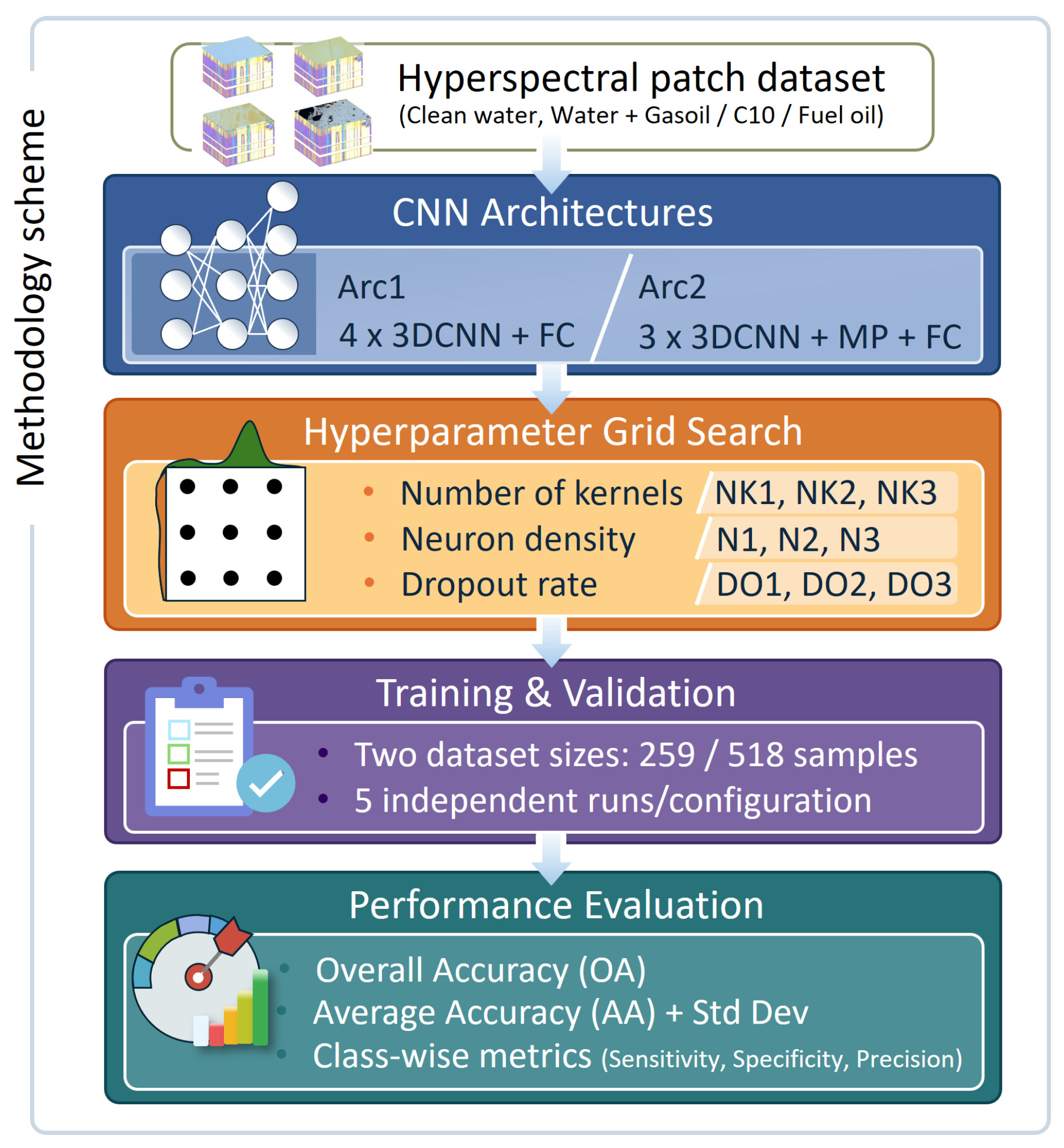
3.1. CNN Architectural Design
- Architecture 1—Arc1 (Deep Configuration): This model consists of four sequential 3D convolutional layers, each followed by a ReLu activation function [4 × 3DCNN + ReLU]. The spatial kernel size is fixed at 3 × 3 across all layers, while the spectral depth progressively decreases throughout the network: [130, 30, 5, 1]. This design allows for progressive compression and hierarchical feature extraction in the spectral domain, while maintaining spatial resolution. Following convolutional blocks, the architecture includes two fully connected layers: FC1 is followed by both ReLu activation and dropout regularisation, while FC2 only includes dropout. A final fully connected layer (FC3) is used for classification, with a softmax layer producing the class probabilities. This deep configuration aims to evaluate the advantages of deeper spectral feature extraction on model performance. The overall structure can be summarised as: [4 × (3DCNN + ReLu)] − [FC1 + ReLu + DO1] − [FC2 + DO2] − [FC3 + Softmax].
- Architecture 2—Arc2 (Pooling Configuration): This alternative design replaces the fourth convolutional layer with a 3D max pooling operation to reduce spatial–spectral resolution. The three convolutional layers again use 3 × 3 spatial kernels with spectral depths of [100, 30, 30], followed by a max pooling layer with a kernel size of [2, 2, 2] and a stride of [3, 3, 3]. The objective of this configuration is to evaluate whether spatial–spectral downsampling through pooling can approximate the feature abstraction achieved in deeper convolutional models while reducing complexity. The fully connected stage is identical to Arc1: FC1 includes ReLU activation and dropout, and FC applies dropout only, followed by the classification layer and softmax. The configuration can be summarised as: [3 × (3DCNN + ReLU)] − [MP] − [FC1 + ReLu + DO1] − [FC2 + DO2] − [FC3 + Softmax].
3.2. Hyperparameter Optimisation and Grid Search
- Number of convolutional kernels (NKs): Three configurations (NK1, NK2, and NK3) were defined to examine how varying the number of filters in each convolutional layer affects the capacity of the network to extract meaningful spatial–spectral features. A higher number of kernels increases the representational power of the network, which could improve its ability to detect subtle variations in oil spill patterns, but also increases computational complexity and risk of overfitting.
- Neuron density of the fully connected layer (N): Three levels of neuron density (N1, N2, N3) were tested in the dense layers after the convolutional block in order to evaluate how it influences the integration and abstraction of features extracted in the convolutional stages.
- Dropout rate (DO): The regularisation strength was varied across three dropout intensities (DO1, DO2, DO3), applied after the convolutional blocks to control overfitting and improve generalisation.
3.3. Training Protocol and Statistical Robustness
3.4. Performance Evaluation Metrics
- Sensitivity (Recall) measures the ability of the model to correctly identify oil-contaminated pixels, representing the true positive rate. High sensitivity is crucial in environmental monitoring to ensure that oil spills are not overlooked (Equation (2)).
- Specificity assesses the accuracy in identifying clean water surfaces, which corresponds to the true negative rate. This metric is particularly important for reducing false positives that could trigger unnecessary mitigation actions (Equation (3)).
- Precision quantifies the proportion of oil-contaminated pixels correctly identified among all pixels predicted as oil (Equation (4)).
4. Results and Discussion
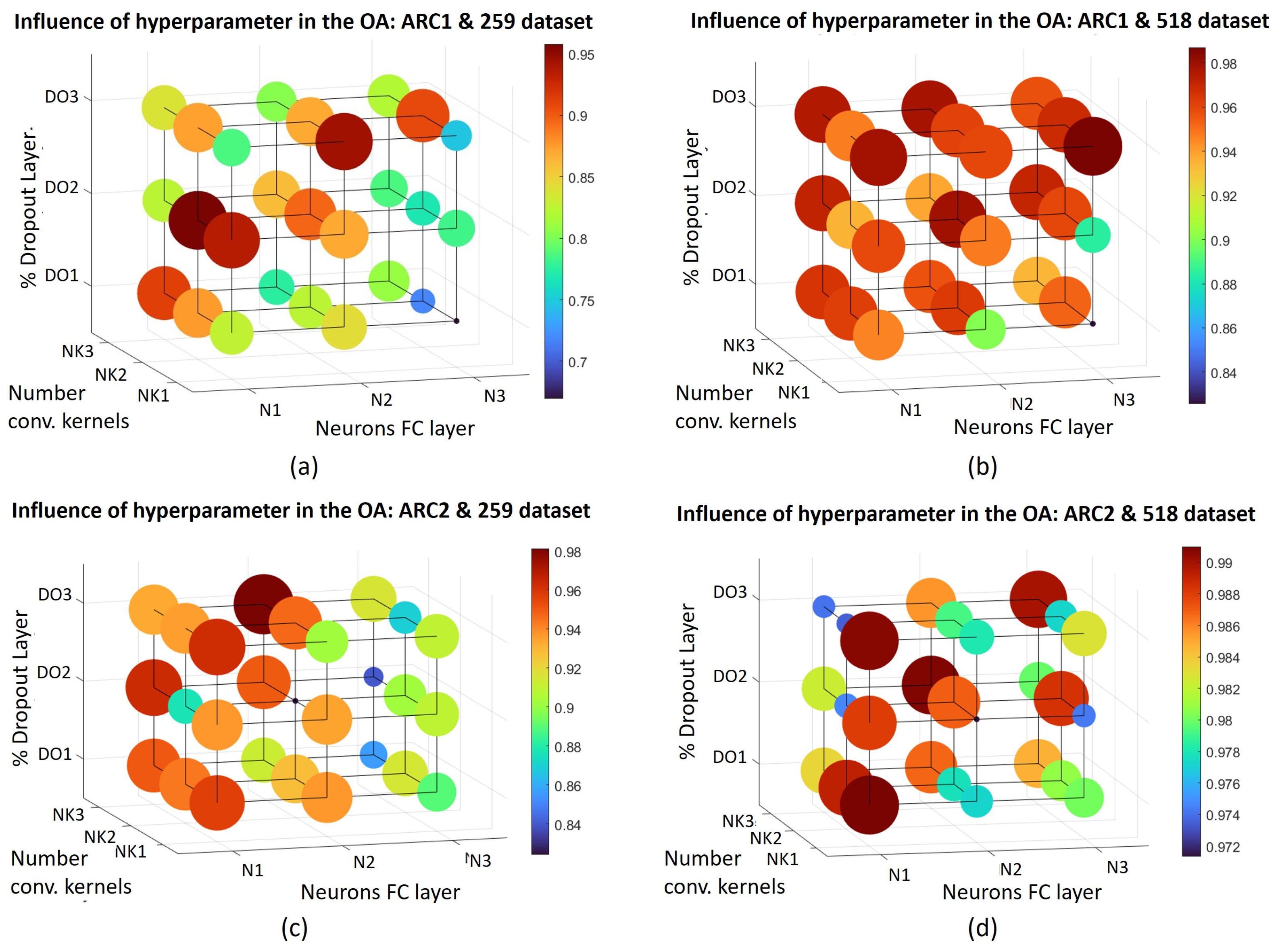
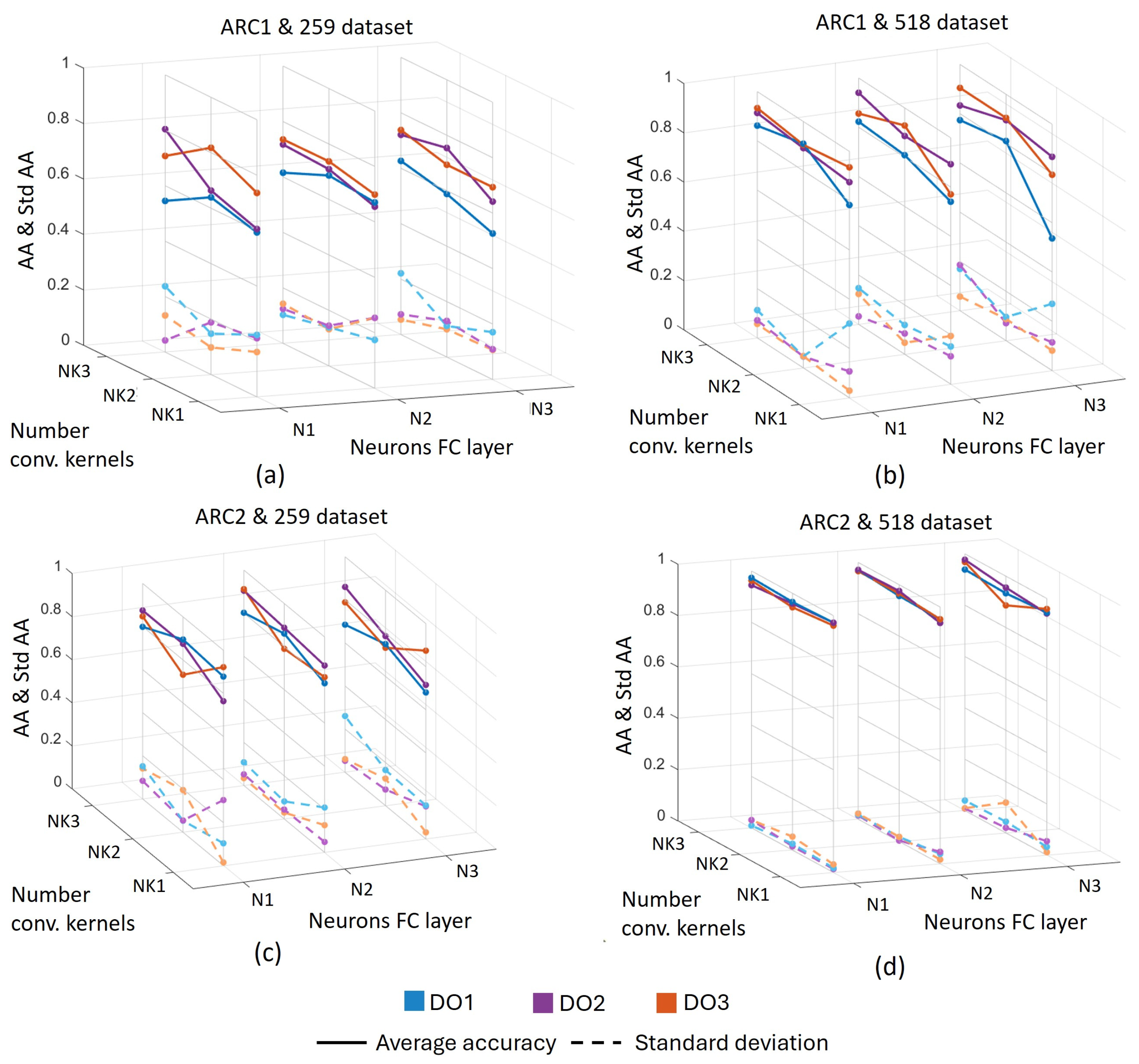
- Trade-off in feature extraction capacity: The analysis reveals that increasing the number of convolutional kernels does not necessarily enhance model performance. In fact, the use of the highest kernel configuration (NK2) consistently resulted in suboptimal accuracy, suggesting that an excessive number of feature maps may introduce redundancy or noise that hinders generalisation. Conversely, both the lowest (NK1) and moderate (NK3) kernel configurations yielded the best-performing models, particularly when paired with higher neuron densities in the fully connected layers. These findings underscore the importance of a balanced feature extraction process, rather than simply increasing depth or complexity.
- Model parsimony and architectural efficiency: The comparison between Arc1 (four convolutional blocks) and Arc2 (three convolutional blocks with pooling) highlights the advantages of streamlined design. In the high-sample regime, both architectures converged to near-perfect accuracy; however, Arc2 achieved this with fewer layers, reduced complexity, and greater consistency across configurations. This aligns with the principle of parsimony, supporting the selection of more compact architectures when they yield equivalent or superior results, especially for real-time or resource-constrained applications.
- Sensitivity to regularisation and data availability: The experiments reveal a non-linear relationship between dropout rate and model performance. While moderate dropout (DO2 and DO3) proved beneficial in mitigating overfitting, particularly in low-sample regimes, excessive regularisation (DO, 60%) significantly impaired learning, especially in Arc1. This was particularly problematic when combined with smaller kernel configurations, suggesting that under-constrained models struggle to consolidate meaningful spatial–spectral patterns from limited data. Thus, dropout must be carefully tuned in relation to both the network complexity and the size of the training set.
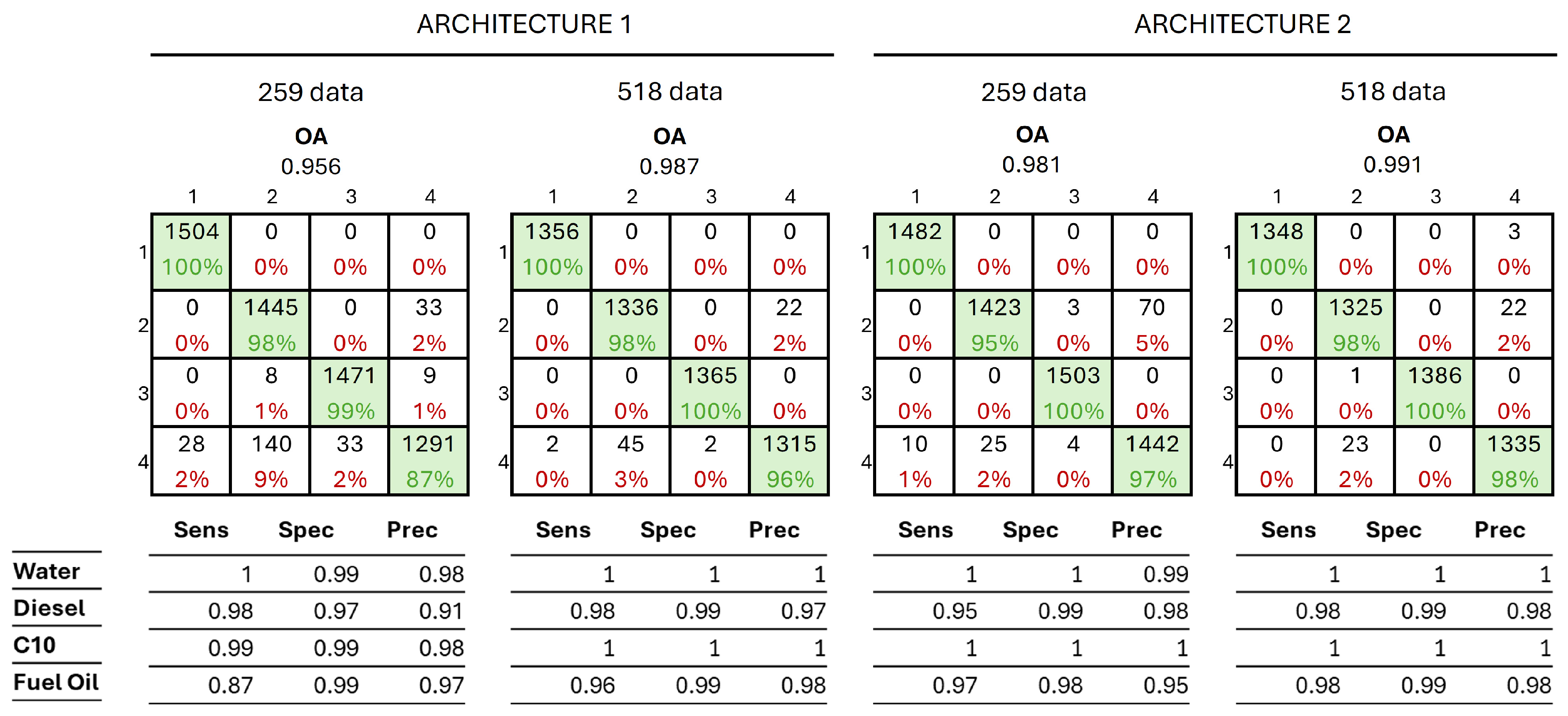
- Operational reliability and class-wise performance: From a practical standpoint, especially in maritime surveillance, models must not only be accurate but also reliable across all target classes. The confusion matrices and class-wise metrics confirm that Arc2 consistently delivers superior sensitivity, specificity, and precision, particularly for the most challenging class (fuel oil), which often shows spectral overlap with other hydrocarbons in low concentrations. Notably, clean water was detected with 100% sensitivity across all configurations, reinforcing the robustness of the model in avoiding false alarms that could trigger unnecessary responses. Moreover, Arc2 demonstrated high reproducibility across training runs, with near-zero standard deviation in the best-performing configurations, indicating stability against stochastic effects such as weight initialisation.
5. Conclusions
- Pooling-based dimensionality reduction is preferable to increased convolutional depth in this task. Across both data regimes, the architecture incorporating a max pooling layer (Arc2) consistently outperformed its deeper alternative (Arc1), achieving higher OA with lower architectural complexity. In particular, Arc2 achieved a near-perfect performance when trained with 518 samples (OA > 0.99), while Arc1 remained below that range, and Arc2, with 259 samples, matched the accuracy range of Arc1 trained with 518 samples. This result highlights the effectiveness of max pooling as a dimensionality reduction technique that preserves essential spatial–spectral information, reducing unnecessary model complexity.
- Performance is driven by the interaction between feature-extraction capacity and the classifier. While the best overall results were obtained when training with a larger dataset, the study reveals that carefully balanced configurations, particularly those using fewer kernels and higher neuron densities, can also deliver high performance with reduced training data. In contrast, the largest kernel setting (NK2) systematically led to suboptimal behaviour, indicating that increasing the number of feature maps can introduce redundancy/noise and degrade generalisation under the acquisition conditions considered.
- Regularisation and data availability must be co-tuned under scarce data scenarios. The analysis indicates that excessive dropout (0.6) impaired learning in the low sample regime in several configurations, whereas moderate dropout (0.2 and 0.4) preserved both accuracy and stability.
Author Contributions
Funding
Institutional Review Board Statement
Informed Consent Statement
Data Availability Statement
Acknowledgments
Conflicts of Interest
References
- Available online: https://sdgs.un.org/goals (accessed on 24 December 2025).
- Thiagarajan, C.; Devarajan, Y. The urgent challenge of ocean pollution: Impacts on marine biodiversity and human health. Reg. Stud. Mar. Sci. 2025, 81, 103995. [Google Scholar] [CrossRef]
- Babuji, P.; Thirumalaisamy, S.; Duraisamy, K.; Periyasamy, G. Human Health Risks due to Exposure to Water Pollution: A Review. Water 2023, 15, 2532. [Google Scholar] [CrossRef]
- Bochynska, S.; Duszewska, A.; Maciejewska-Jeske, M.; Wrona, M.; Szeliga, A.; Budzik, M.; Szczesnowicz, A.; Bala, G.; Trzcinski, M.; Meczekalski, B.; et al. The impact of water pollution on the health of older people. Maturitas 2024, 185, 107981. [Google Scholar] [CrossRef] [PubMed]
- Etim, I.I.N.; Ekerenam, O.O.; Ikeuba, A.I.; Njoku, C.N.; Emori, W.; Zhang, R.; Duan, J. Navigating the blue economy: A comprehensive review of marine pollution and sustainable approaches. J. Ocean. Limnol. 2025, 43, 1160–1182. [Google Scholar] [CrossRef]
- Yang, J.; Li, J.; van Vliet, M.T.; Jones, E.R.; Huang, Z.; Liu, M.; Bi, J. Economic risks hidden in local water pollution and global markets: A retrospective analysis (1995–2010) and future perspectives on sustainable development goal 6. Water Res. 2024, 252, 121216. [Google Scholar] [CrossRef]
- Yildiz, S.; Sönmez, V.Z.; Uğurlu, Ö.; Sivri, N.; Loughney, S.; Wang, J. Modelling of possible tanker accident oil spills in the Istanbul Strait in order to demonstrate the dispersion and toxic effects of oil pollution. Environ. Monit. Assess. 2021, 193, 538. [Google Scholar] [CrossRef]
- Kababu, E.; Angel, D.L.; Sisma-Ventura, G.; Belkin, N.; Rubin-Blum, M.; Rahav, E. Effects of crude oil and gas condensate spill on coastal benthic microbial populations. Front. Environ. Sci. 2022, 10, 1051460. [Google Scholar] [CrossRef]
- French-McCay, D.P.; Parkerton, T.F.; de Jourdan, B. Bridging the lab to field divide: Advancing oil spill biological effects models requires revisiting aquatic toxicity testing. Aquat. Toxicol. 2023, 256, 106389. [Google Scholar] [CrossRef]
- Acosta-González, A.; Martirani-von Abercron, S.M.; Rosselló-Móra, R.; Wittich, R.M.; Marqués, S. The effect of oil spills on the bacterial diversity and catabolic function in coastal sediments: A case study on the Prestige oil spill. Environ. Sci. Pollut. Res. 2015, 22, 15200–15214. [Google Scholar] [CrossRef]
- Jolliff, J.K.; Ladner, S.; Lewis, D.; Jarosz, E.; Crout, R.L.; Lawson, A.; Smith, T.; McCarthy, S.; Cayula, S. The hyperspectral signatures of complex ocean frontal boundaries: The example of cold air outbreaks in the northern Gulf of Mexico. In Proceedings of the SPIE 11014, Ocean Sensing and Monitoring XI; SPIE: Baltimore, MD, USA, 2019; p. 110140. [Google Scholar] [CrossRef]
- Li, Y.; Lu, H.; Zhang, Z.; Liu, P. A novel nonlinear hyperspectral unmixing approach for images of oil spills at sea. Int. J. Remote Sens. 2022, 41, 4684–4701. [Google Scholar] [CrossRef]
- Hu, C.; Lu, Y.; Sun, S.; Liu, Y. Optical Remote Sensing of Oil Spills in the Ocean: What Is Really Possible? J. Remote Sens. 2021, 2021, 9141902. [Google Scholar] [CrossRef]
- ITOPF (International Tanker Owners Pollution Federation). Oil Tanker Spill Statistics 2022. 2023. Available online: https://www.itopf.org/knowledge-resources/data-statistics/statistics/ (accessed on 16 January 2026).
- IMO (International Maritime Organization). Annual Report on Marine Pollution Incident Data: 2022. 2023. Available online: https://www.imo.org/en/OurWork/Environment/Pages/OilPollution.aspx (accessed on 16 January 2026).
- Al-Kamzari, A.; Gray, T.; Fitzsimmons, C.; Burgess, J.G. An Unresolved Environmental Problem—Small-Scale Unattributable Marine Oil Spills in Musandam, Oman. Sustainability 2025, 17, 7769. [Google Scholar] [CrossRef]
- Ortmann, A.C.; Poon, H.Y.; Ji, M.; Cobanli, S.E.; Wohlgeschaffen, G.; Greer, C.W.; Robinson, B.; King, T.L. Rapid dilution effectively decreases hydrocarbons following small oil spills, but impacts on microeukaryote communities are still observed. Front. Mar. Sci. 2024, 11, 1354063. [Google Scholar] [CrossRef]
- Fingas, M.; Brown, C. Review of oil spill remote sensing. Mar. Pollut. Bull. 2014, 83, 9–23. [Google Scholar] [CrossRef] [PubMed]
- Fingas, M.; Brown, C.E. A review of oil spill remote sensing. Sensors 2018, 18, 91. [Google Scholar] [CrossRef]
- Duan, P.; Kang, X.; Ghamisi, P.; Li, S. Hyperspectral Remote Sensing Benchmark Database for Oil Spill Detection with an Isolation Forest-Guided Unsupervised Detector. IEEE Trans. Geosci. Remote Sens. 2023, 61, 5509711. [Google Scholar] [CrossRef]
- Li, X.; Liu, B.; Zheng, G.; Ren, Y.; Zhang, S.; Liu, Y.; Gao, L.; Liu, Y.; Zhang, B.; Wang, F. Deep-learning-based information mining from ocean remote-sensing imagery. Natl. Sci. Rev. 2021, 7, 1584–1605. [Google Scholar] [CrossRef]
- Tsokas, A.; Rysz, M.; Pardalos, P.M.; Dipple, K. SAR data applications in earth observation: An overview. Expert Syst. Appl. 2022, 205, 117342. [Google Scholar] [CrossRef]
- Hong, X.; Chen, L.; Sun, S.; Sun, Z.; Chen, Y.; Mei, Q.; Chen, Z. Detection of Oil Spills in the Northern South China Sea Using Landsat-8 OLI. Remote Sens. 2022, 14, 3966. [Google Scholar] [CrossRef]
- Lei, F.; Wang, W.; Zhang, W.; Li, K.; Xu, Z. Oil Spills Tracking Through Texture Analysis from MODIS Imagery. In Proceedings of the IGARSS 2019–2019 IEEE International Geoscience and Remote Sensing Symposium, Yokohama, Japan; IEEE: New York, NY, USA, 2019; pp. 9768–9771. [Google Scholar] [CrossRef]
- Kolokoussis, P.; Karathanassi, V. Oil spill detection and mapping using sentinel 2 imagery. J. Mar. Sci. Eng. 2018, 6, 4. [Google Scholar] [CrossRef]
- Zakzouk, M.; El-Magd, I.A.; Ali, E.M.; Abdulaziz, A.M.; Rehman, A.; Saba, T. Novel oil spill indices for sentinel-2 imagery: A case study of natural seepage in Qaruh island, Kuwait. MethodsX 2024, 12, 102520. [Google Scholar] [CrossRef] [PubMed]
- Trujillo-Acatitla, R.; Tuxpan-Vargas, J.; Ovando-Vázquez, C. Oil spills: Detection and concentration estimation in satellite imagery, a machine learning approach. Mar. Pollut. Bull. 2022, 184, 114132. [Google Scholar] [CrossRef] [PubMed]
- Ivshina, I.B.; Kuyukina, M.S.; Krivoruchko, A.V.; Elkin, A.A.; Makarov, S.O.; Cunningham, C.J.; Peshkur, T.A.; Atlas, R.M.; Philp, J.C. Oil spill problems and sustainable response strategies through new technologies. Environ. Sci. Process Impacts 2015, 17, 1201–1219. [Google Scholar] [CrossRef] [PubMed]
- Goetz, A.F.H. Three decades of hyperspectral remote sensing of the Earth: A personal view. Remote Sens. Environ. 2009, 113, S5–S16. [Google Scholar] [CrossRef]
- Faltynkova, A.; Johnsen, G.; Wagner, M. Hyperspectral imaging as an emerging tool to analyze microplastics: A systematic review and recommendations for future development. Microplast. Nanoplast. 2021, 1, 13. [Google Scholar] [CrossRef]
- Sridhar, A.; Kannan, D.; Kapoor, A.; Prabhakar, S. Extraction and detection methods of microplastics in food and marine systems: A critical review. Chemosphere 2022, 286, 131653. [Google Scholar] [CrossRef]
- Vidal, C.; Pasquini, C. A comprehensive and fast microplastics identification based on near-infrared hyperspectral imaging (HSI-NIR) and chemometrics. Environ. Pollut. 2021, 285, 117251. [Google Scholar] [CrossRef]
- Shan, J.; Zhao, J.; Liu, L.; Zhang, Y.; Wang, X.; Wu, F. A novel way to rapidly monitor microplastics in soil by hyperspectral imaging technology and chemometrics. Environ. Pollut. 2018, 238, 121–129. [Google Scholar] [CrossRef]
- Goetz, A.F.H.; Vane, G.; Solomon, J.E.; Rock, B.N. Imaging spectrometry for earth remote sensing. Science 1985, 228, 1147–1153. [Google Scholar] [CrossRef]
- Chabrillat, S.; Foerster, S.; Segl, K.; Beamish, A.; Brell, M.; Asadzadeh, S.; Milewski, R.; Ward, K.J.; Brosinsky, A.; Koch, K.; et al. The EnMAP spaceborne imaging spectroscopy mission: Initial scientific results two years after launch. Remote Sens. Environ. 2024, 315, 114379. [Google Scholar] [CrossRef]
- eoPortal. Available online: https://www.eoportal.org/satellite-missions/eo-1#eo-1-earth-observing-1 (accessed on 24 December 2025).
- enMap. Available online: https://www.enmap.org/mission/ (accessed on 24 December 2025).
- ASI. Available online: https://www.asi.it/en/earth-science/prisma/ (accessed on 24 December 2025).
- Guanter, L.; Kaufmann, H.; Segl, K.; Foerster, S.; Rogass, C.; Chabrillat, S.; Kuester, T.; Hollstein, A.; Rossner, G.; Chlebek, C.; et al. The EnMAP spaceborne imaging spectroscopy mission for earth observation. Remote Sens. 2015, 7, 8830–8857. [Google Scholar] [CrossRef]
- HISUI. Available online: https://www.hisui.go.jp/en/sensors/index.html (accessed on 24 December 2025).
- Natale, V.G.; Kafri, A.; Tidhar, G.A.; Chen, M.; Feingersh, T.; Sagi, E.; Cisbani, A.; Baroni, M.; Labate, D.; Nadler, R.; et al. SHALOM—Space-borne hyperspectral applicative land and ocean mission. In Proceedings of the 2013 5th Workshop on Hyperspectral Image and Signal Processing: Evolution in Remote Sensing (WHISPERS), Gainesville, FL, USA, 26–28 June 2013; p. 1. [Google Scholar] [CrossRef]
- Hughes, G. On the mean accuracy of statistical pattern recognizers. IEEE Trans. Inf. Theory 1968, 14, 55–63. [Google Scholar] [CrossRef]
- Shan, J.; Zhao, J.; Zhang, Y.; Liu, L.; Wu, F.; Wang, X. Simple and rapid detection of microplastics in seawater using hyperspectral imaging technology. Anal. Chim. Acta 2019, 1050, 161–168. [Google Scholar] [CrossRef]
- LeCun, Y.; Bengio, Y.; Hinton, G. Deep learning. Nature 2015, 521, 436–444. [Google Scholar] [CrossRef] [PubMed]
- LeCun, Y.; Boser, B.; Denker, J.S.; Henderson, D.; Howard, R.E.; Hubbard, W.; Jackel, L.D. Handwritten Digit Recognition with a Back-Propagation Network. In Proceedings of the Advances in Neural Information Processing Systems; MIT Press: Cambridge, MA, USA, 1990; pp. 396–404. [Google Scholar]
- Krizhevsky, A.; Sutskever, I.; Hinton, G.E. ImageNet Classification with Deep Convolutional Neural Networks. Commun. ACM 2017, 60, 84–90. [Google Scholar] [CrossRef]
- Zhou, D.X. Theory of deep convolutional neural networks: Downsampling. Neural Netw. 2020, 124, 319–327. [Google Scholar] [CrossRef] [PubMed]
- Hu, T.; Yuan, J.; Wang, X.; Yan, C.; Ju, X. Spectral-Spatial Features Extraction of Hyperspectral Remote Sensing Oil Spill Imagery Based on Convolutional Neural Networks. IEEE Access 2022, 10, 127969–127983. [Google Scholar] [CrossRef]
- Yang, J.F.; Wan, J.H.; Ma, Y.; Zhang, J.; Bin Hu, Y.; Jiang, Z.C. Oil spill hyperspectral remote sensing detection based on DCNN with multi-scale features. J. Coast. Res. 2019, 90, 332–339. [Google Scholar] [CrossRef]
- Wang, B.; Shao, Q.; Song, D.; Li, Z.; Tang, Y.; Yang, C.; Wang, M. A spectral-spatial features integrated network for hyperspectral detection of marine oil spill. Remote Sens. 2021, 13, 1568. [Google Scholar] [CrossRef]
- Zhu, X.; Li, Y.; Zhang, Q.; Liu, B. Oil film classification using deep learning-based hyperspectral remote sensing technology. ISPRS Int. J. Geo-Inf. 2019, 8, 181. [Google Scholar] [CrossRef]
- Kang, X.; Wang, Z.; Duan, P.; Wei, X. The Potential of Hyperspectral Image Classification for Oil Spill Mapping. IEEE Trans. Geosci. Remote Sens. 2022, 60, 5538415. [Google Scholar] [CrossRef]
- Hong, D.; Han, Z.; Yao, J.; Gao, L.; Zhang, B.; Plaza, A.; Chanussot, J. SpectralFormer: Rethinking Hyperspectral Image Classification with Transformers. IEEE Trans. Geosci. Remote Sens. 2022, 60, 5518615. [Google Scholar] [CrossRef]
- Kang, X.; Deng, B.; Duan, P.; Wei, X.; Li, S. Self-Supervised Spectral-Spatial Transformer Network for Hyperspectral Oil Spill Mapping. IEEE Trans. Geosci. Remote Sens. 2023, 61, 5507410. [Google Scholar] [CrossRef]
- Kang, J.; Yang, C.; Yi, J.; Lee, Y. Detection of Marine Oil Spill from PlanetScope Images Using CNN and Transformer Models. J. Mar. Sci. Eng. 2024, 12, 2095. [Google Scholar] [CrossRef]
- Nadipelli, N.K.; Sarma, T.H.; Reddy, R.D.; Rao, K.R.M.; Mrudula, K.; Kanthi, M. Efficient Hyperspectral Band Selection Using GA-SR-NMI-VI: A Hybrid Similarity and Evolutionary-Based Approach. IEEE Geosci. Remote Sens. Lett. 2025, 22, 5507105. [Google Scholar] [CrossRef]
- Mukundan, A.; Karmakar, R.; Jouhar, J.; Valappil, M.A.E.; Wang, H.C. Advancing Urban Development: Applications of Hyperspectral Imaging in Smart City Innovations and Sustainable Solutions. Smart Cities 2025, 8, 51. [Google Scholar] [CrossRef]



| Hyperparameter | Codification | ARC1 | ARC2 |
|---|---|---|---|
| Neurons FC Layer | N1 | [256, 128] | [256, 128] |
| N2 | [128, 64] | [128, 64] | |
| N3 | [64, 32] | [64, 32] | |
| Number CNN kernel | NK1 | [2, 4, 8, 4] | [2, 4, 8] |
| NK2 | [16, 32, 64, 32] | [16, 32, 64] | |
| NK3 | [8, 16, 32, 16] | [8, 16, 32] | |
| DO1 | 0.6 | 0.6 | |
| % Dropout | DO2 | 0.4 | 0.4 |
| DO3 | 0.2 | 0.2 |
Disclaimer/Publisher’s Note: The statements, opinions and data contained in all publications are solely those of the individual author(s) and contributor(s) and not of MDPI and/or the editor(s). MDPI and/or the editor(s) disclaim responsibility for any injury to people or property resulting from any ideas, methods, instructions or products referred to in the content. |
© 2026 by the authors. Licensee MDPI, Basel, Switzerland. This article is an open access article distributed under the terms and conditions of the Creative Commons Attribution (CC BY) license.
Share and Cite
Carrasco-García, M.G.; González-Enrique, J.; Ruiz-Aguilar, J.J.; Camarero-Orive, A.; Elizondo, D.; Turias Domínguez, I.J. A Systematic Evaluation of CNN Configurations for Multiclass Oil Spill Classification in Hyperspectral Images. J. Mar. Sci. Eng. 2026, 14, 383. https://doi.org/10.3390/jmse14040383
Carrasco-García MG, González-Enrique J, Ruiz-Aguilar JJ, Camarero-Orive A, Elizondo D, Turias Domínguez IJ. A Systematic Evaluation of CNN Configurations for Multiclass Oil Spill Classification in Hyperspectral Images. Journal of Marine Science and Engineering. 2026; 14(4):383. https://doi.org/10.3390/jmse14040383
Chicago/Turabian StyleCarrasco-García, María Gema, Javier González-Enrique, Juan Jesús Ruiz-Aguilar, Alberto Camarero-Orive, David Elizondo, and Ignacio J. Turias Domínguez. 2026. "A Systematic Evaluation of CNN Configurations for Multiclass Oil Spill Classification in Hyperspectral Images" Journal of Marine Science and Engineering 14, no. 4: 383. https://doi.org/10.3390/jmse14040383
APA StyleCarrasco-García, M. G., González-Enrique, J., Ruiz-Aguilar, J. J., Camarero-Orive, A., Elizondo, D., & Turias Domínguez, I. J. (2026). A Systematic Evaluation of CNN Configurations for Multiclass Oil Spill Classification in Hyperspectral Images. Journal of Marine Science and Engineering, 14(4), 383. https://doi.org/10.3390/jmse14040383