Review

Development Status and Trend Analysis of Kelp Harvesting Devices in China

1
Fishery Machinery and Instrument Research Institute, Chinese Academy of Fishery Sciences, Shanghai 200092, China
2
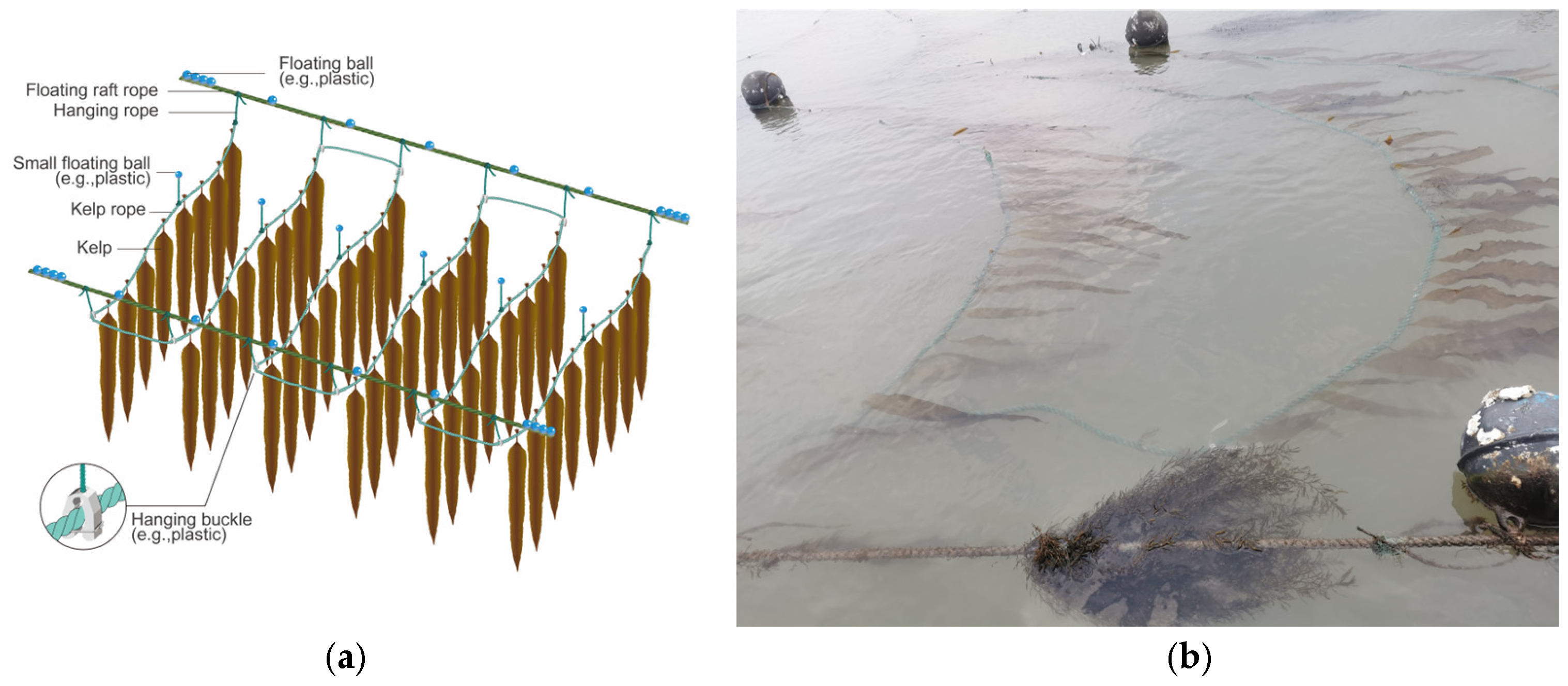
Key Laboratory of Tropical Marine Ecosystem and Bioresource, Fourth Institute of Oceanography, Ministry of Natural Resources, Beihai 536000, China
3
Guangxi Laboratory of Oceanography, Fourth Institute of Oceanography, Ministry of Natural Resources, Beihai 536000, China
4
College of Engineering Science and Technology, Shanghai Ocean University, Shanghai 201306, China
*
Author to whom correspondence should be addressed.
These authors contributed equally to this work.
J. Mar. Sci. Eng. 2026, 14(4), 381; https://doi.org/10.3390/jmse14040381
Submission received: 15 November 2025 / Revised: 26 January 2026 / Accepted: 29 January 2026 / Published: 17 February 2026
(This article belongs to the Section Marine Aquaculture)

Abstract

China has assumed a leadership position in global kelp cultivation and export. However, the kelp harvesting process in China still relies primarily on manual labor, with only limited adoption of semi-mechanized devices. This dependence results in suboptimal efficiency and elevated labor intensity. The industry now faces an acute labor shortage driven by an aging workforce and rising labor costs, highlighting the urgent need for a fully mechanized harvesting solution. This paper comprehensively reviews current research on mechanized kelp harvesting devices for raft cultivation systems in China. It compares domestic and international practices in kelp seedling cultivation, cultivation models, and harvesting devices, with particular emphasis on the technical challenges hindering harvesting device development in China. Based on this analysis, we propose several recommendations, including the simultaneous advancement of cultivation model optimization and harvesting device innovation, the development of harvesting technologies aligned with specific downstream processing requirements, and the design of modular and multifunctional kelp harvesting vessels. Looking ahead, future research should prioritize integrating automation and intelligent systems, reflecting evolving trends in China’s marine aquaculture. Furthermore, to support China’s “dual carbon” goals, future harvesting systems should incorporate carbon-reduction features.

1. Introduction

Kelp, a large edible brown alga (Phaeophyceae), is one of the most widely cultivated and economically important seaweed groups globally [1]. As the world’s largest producer and exporter of kelp, primarily the species Saccharina japonica, China leverages its significant nutritional value, rich in iodine, vitamins, mannitol, alginic acid, proteins, dietary fiber, and minerals, making it a vital economic seaweed for food, pharmaceutical, and industrial applications [2,3,4,5,6,7,8,9,10,11]. Beyond its economic importance, kelp exhibits remarkable photosynthetic carbon sequestration capacity: fresh kelp sequesters carbon at 0.89 × 10⁻³ t·t−1·h−1, equivalent to reducing CO2 emissions of 3.28 × 10⁻³ t·t−1·h−1 [12], while dried kelp contains about 31.2% carbon [13]. Annually, kelp harvesting in China removes more than 500,000 tons of carbon from seawater [13,14]. Furthermore, during growth, kelp releases substantial dissolved organic carbon (DOC), accounting for approximately 13–62% of its total photosynthetic carbon sequestration [15]. Approximately 58% of this DOC is subsequently converted to refractory DOC (RDOC) through biological and microbial processes, significantly contributing to the marine carbon sink [16].
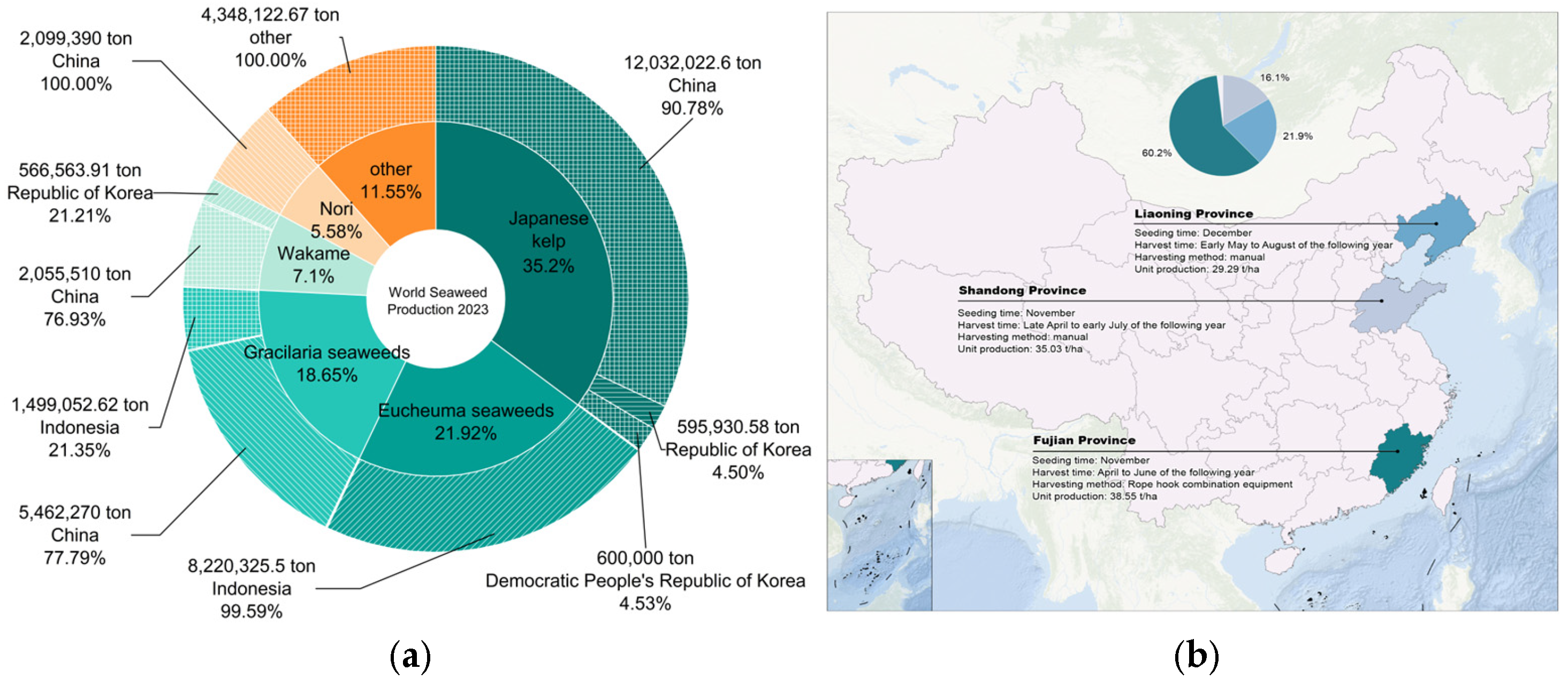
According to the 2024 State of World Fisheries and Aquaculture Report by the Food and Agriculture Organization of the United Nations (FAO) [17], global seaweed production reached over 36.5 million tons in 2022, valued at USD 17 billion, with export revenues around USD 1.6 billion. China dominated kelp production, contributing an estimated 89.4% of the world’s total output and accounting for 32.3% of global algae production (Figure 1a).
Since the establishment of large-scale kelp cultivation in the 1950s, China has maintained consistently high annual production levels, surpassing 1.86 million tons in 2024. The primary cultivation regions, including Fujian, Shandong, and Liaoning Provinces, collectively account for 98.62% of national output, with respective contributions of 50.39%, 29.13%, and 19.1% (Figure 1b).
However, China’s kelp cultivation remains predominantly reliant on manual labor, utilizing only basic semi-mechanized tools. Among all cultivation stages—including kelp seedling rearing, intermediate culture, seedling insertion, farming, and harvesting—the harvesting process is the most labor-intensive. In recent years, supported by major national research programs and dedicated funding, Chinese research institutions and leading enterprises have engaged in the development of mechanized kelp harvesting solutions [18,19,20]. Despite these efforts, most prototypes remain at the testing stage and have not yet achieved industrial-scale application. Significant challenges persist, including regional variations in the configurations of the raft-based horizontal cultivation system (RHCS), the low market value of kelp, the complex marine environment, and increasing pressure for intensive marine space utilization, collectively raising operational complexity and hindering the implementation of viable mechanized systems. Since seedling rearing techniques and cultivation models fundamentally constrain subsequent harvesting approaches, this paper commences with a review of domestic and international approaches to kelp seeding and cultivation. It proceeds to analyze current harvesting devices and identify key technical challenges within the Chinese context, concluding with proposed research directions for automated harvesting equipment.

2. Kelp Seeding and Cultivation Models

2.1. Chinese Kelp Seeding and Cultivation Models

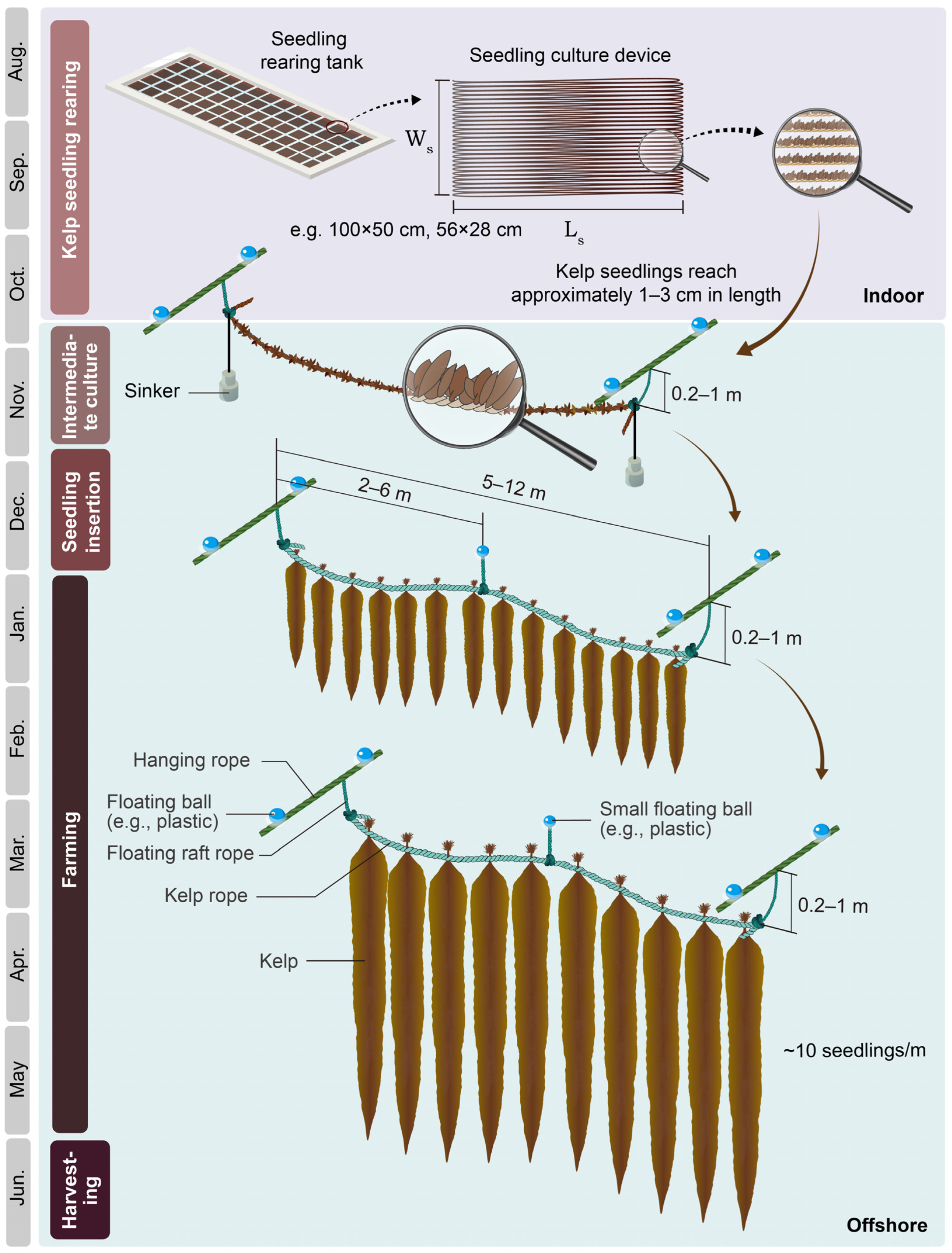
Artificial kelp cultivation involves three sequential stages: seedling rearing, intermediate culture and seedling insertion, and farming and harvesting (Figure 2). The initial nursery phase for kelp seedlings is conducted under controlled indoor conditions. Once juvenile sporophytes reach ≥1–3 cm in length, the seedling ropes are retrieved from the seedling culture device, sectioned into standardized segments according with the width between adjacent floating raft ropes (e.g., 5 m), and transferred offshore for a 20–30 day intermediate culture. Seedling insertion becomes transplant-ready (termed “seeding”) at ~20 cm, whereupon workers manually detach individual sporophytes from seedling ropes and insert them at prescribed intervals (e.g., 10 cm) into the gaps of grow-out ropes (termed kelp rope). These populated ropes are then suspended at sea using floating rafts. Historically, diverse suspension methods, including vertical, horizontal, sequential (vertical-to-horizontal transition), submerged raft, and “coordinated” processes [21,22,23,24], have been refined over decades. The selection of kelp cultivation systems is highly dependent on the hydrodynamic conditions of the farming site. The vertical (hanging-rope) system is only suitable for sheltered areas with low current velocities (≤12 cm s−1) [25]. In contrast, the prevailing current velocities in major kelp farming regions of China, typically range from 10 to 50 cm s−1 [26,27,28], significantly exceeding the suitable threshold for vertical systems. Moreover, the horizontal cultivation system exhibits distinct practical advantages in these environments, including more uniform irradiance of seedlings, a pronounced reduction in rope and frond entanglement, and superior structural stability and resilience against wind–wave exposure [1,25].
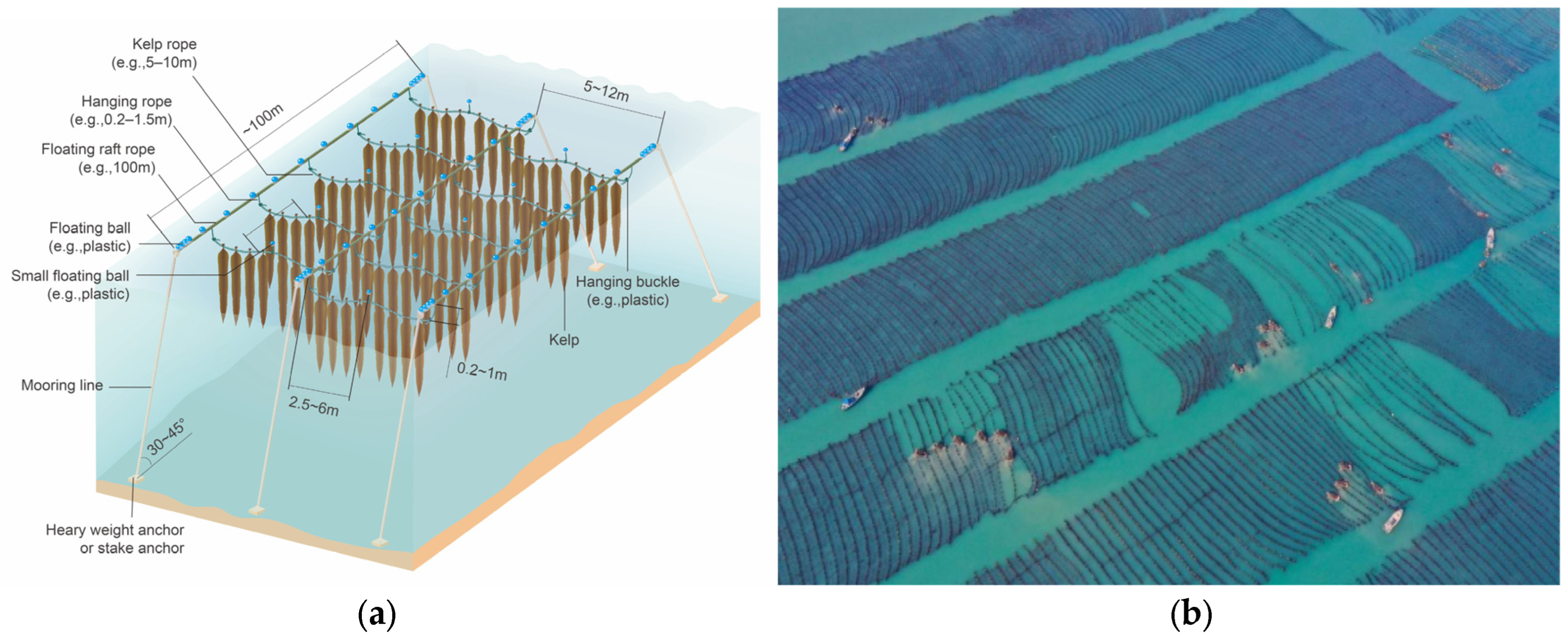
Consequently, China’s kelp farming industry has now largely standardized on the raft-based horizontal cultivation method (RHCS) (Figure 3). In this system, specific lengths of seedling ropes (e.g., 5 or 10 m in different aquaculture regions) are suspended horizontally between parallel floating raft mainlines, and suspension ropes spaced regularly (e.g., 1.5 m intervals) align grow-out ropes parallel to each other and perpendicular to prevailing currents (System note: 100 submerged kelp ropes deploy in parallel between adjacent raft ropes). During farming, cultivation personnel dynamically adjust suspension depth or add mid-rope floats. These adjustments are made in response to kelp biomass accumulation, water transparency fluctuations, and temperature variations. This maintains optimal depth positioning, enhancing the system’s distinguishing advantages: high yield per unit area, storm resistance, and superior quality [1,3].
Following decades of development, China has established a relatively comprehensive kelp cultivation system that represents the most effective manual operation model in current use. Notably, a spacing interval of 5–12 m between adjacent horizontal mainlines is commonly adopted. This configuration results in a mature kelp yield of approximately 100 kg (wet weight) per cultivation rope, corresponding to 29–39 t ha−1 [14], which aligns with the maximum towing capacity of an average worker during harvest. Regional adaptations occur based on kelp variety: northern zones (e.g., Shandong/Liaoning Provinces) cultivate larger sporophytes (1.5–2.5 kg/plant) at tighter intervals (4–6 m), whereas southern regions (e.g., Fujian Province) produce smaller sporophytes (0.5–1 kg/plant) at more widely spaced intervals (10–20 m), yielding comparable biomass per rope. Despite China’s issuance of local, industrial, and national cultivation standards [29,30], critical parameters such as raft dimensions, construction materials, structural configurations, cultivation density, and polyculture ratios with aquatic animals remain experience-based and locally adapted without a unified national standard [31,32]. Moreover, most cultivation follows the horizontal model, and operational heterogeneity persists. Smallholders (typically managing ≤ 50-hectare operations) dominate the sector, excluding a few large enterprises (e.g., Weihai Changqing Marine Technology Co., Ltd., Shandong Lidao Marine Technology Co., Ltd., and Shandong Haizhibao Marine Technology Co., Ltd.). These small-scale operations exhibit significant variations in raft length, rope spacing, float quantity and specifications, and kelp density.
Kelp farming practices in China vary significantly by region. In the north, large companies dominate, leading to relatively standardized operations. In contrast, in the south, the sector is characterized by numerous small-scale farmers, resulting in less uniform practices. Consequently, many academic studies on harvesting mechanization adopt a standardized spacing of around 5 m for experimental or design purposes, as seen in Zhang et al. [33] and Tan et al. [34]. Further, the raft spacing in the south commonly ranges from 10 to 20 m, a detail seldom documented in formal literature but widely acknowledged in practice. Furthermore, it is recognized that traditional raft-cultivation parameters, such as seedling rope length, were historically optimized for manual harvesting. The design accounts for a mature kelp load of approximately 100 kg per rope (5–12 m in length), aligning with an average worker’s hauling capacity, as seen in Chang et al. [35] and Liu et al. [36].
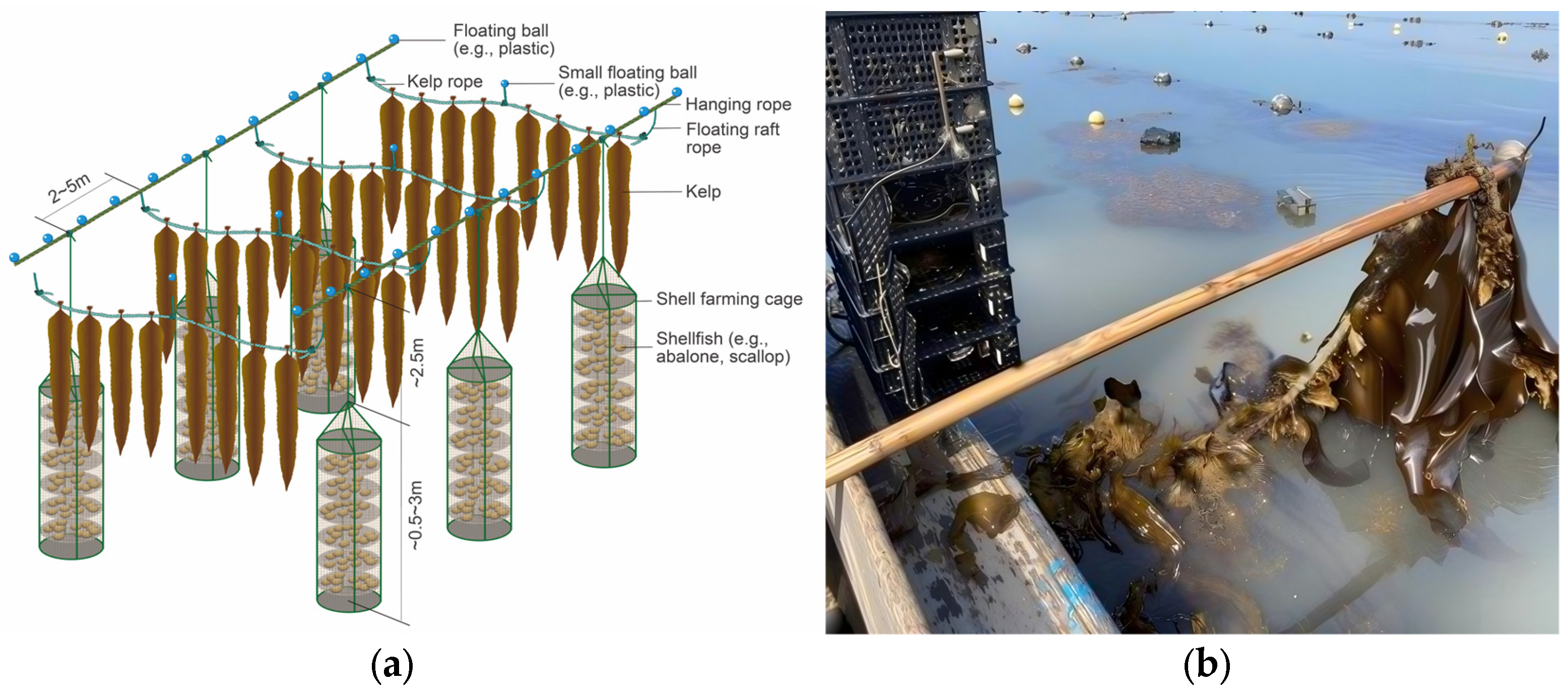
Recent years have witnessed the development of diverse Integrated Multi-Trophic Aquaculture (IMTA) models in China that leverage existing raft infrastructure [37]. A prominent example is the three-dimensional cultivation system implemented in Sanggou Bay [38,39], where kelp shares raft facilities with complementary species. Shellfish cages, for instance, are routinely suspended directly beneath kelp grow-out ropes (Figure 4). Concurrently, the expanding scale of China’s abalone aquaculture sector has driven a steady increase in demand for kelp as its primary feedstock [14]. Some enterprises employ a wild-seeding approach analogous to artificial cultivation. Specifically, during the natural gametophyte release periods, uninoculated seedling ropes are deployed in standard raft configurations to passively capture settling gametophytes. Kelp cultivated through this method typically exhibits smaller morphology but higher biomass density per unit area.
Furthermore, to advance mechanization during critical stages of kelp cultivation, China is actively exploring novel approaches. Inspired by international practices, researchers have proposed replacing traditional Chinese raft structure with long-rope raft systems [40,41]. For instance, Jiang et al. adapted conventional parallel short-rope designs to accommodate China’s unique raft-based cultivation conditions [40]. The model employs interconnected long cultivation ropes suspended with support ropes (Jmse 14 00381 i001) (Figure 5). While this system achieves yields comparable to traditional rafts, it currently exhibits operational incompatibility with China’s entrenched practices for seedling production, deployment, and harvesting. Consequently, further refinement and adaptation are required.

2.2. International Seedling Insertion and Cultivation Models

Globally, kelp seedling insertion methods exhibit significant diversity, including techniques like plug-in, seedling bundling, and twine seeding. Most kelp-cultivating nations, however, predominantly employ standardized single-long-rope cultivation systems, with minor variations in implementation details.
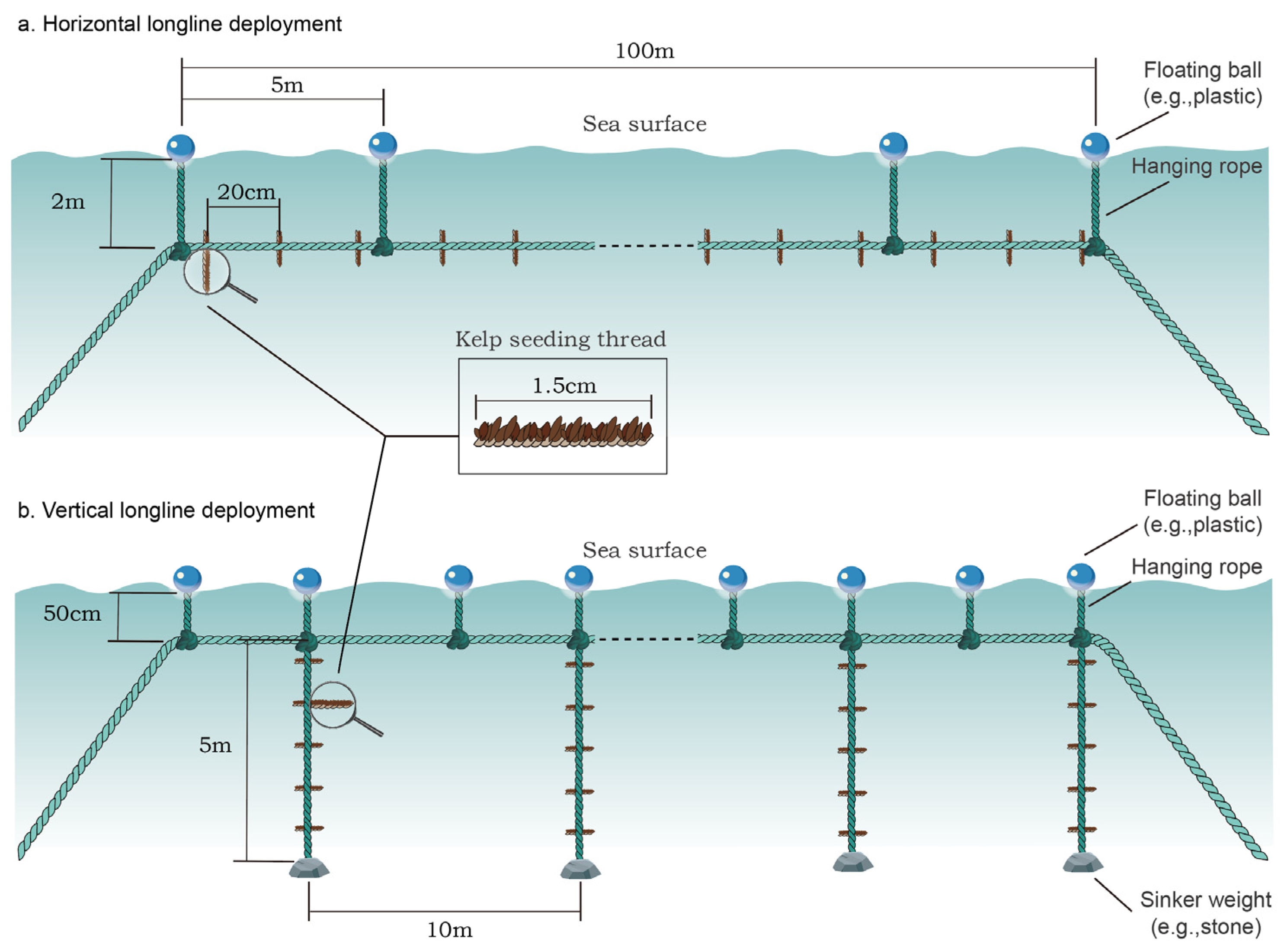
In Japan and South Korea, cutting and seedling bundling techniques are predominantly employed for food-grade kelp cultivation. The plug-in method utilizes juvenile sporophytes (e.g., 5 cm long) manually sectioned with their substrate lines into short segments (e.g., 4–5 cm). These segments are threaded at fixed intervals (e.g., 30 cm) into the gaps of a seedling rope and initially suspended vertically at sea. Once the seedlings reach a certain length (e.g., 1 m), the ends of different ropes are connected and suspended vertically from a longline for horizontal cultivation (Figure 6a). Alternatively, seedling ropes can be directly bundled onto longlines using binding ropes for horizontal cultivation (Figure 6b) [42,43,44,45,46]. The seedling bundling method typically employs larger seedlings (e.g., ≥20 cm). Clusters of 1–3 juvenile plants are inserted at fixed intervals (e.g., 20 cm) into the seedling rope gaps, which are then bundled onto the mainlines for horizontal cultivation [47]. The cultivation approach is functionally identical to that shown in Figure 6b.
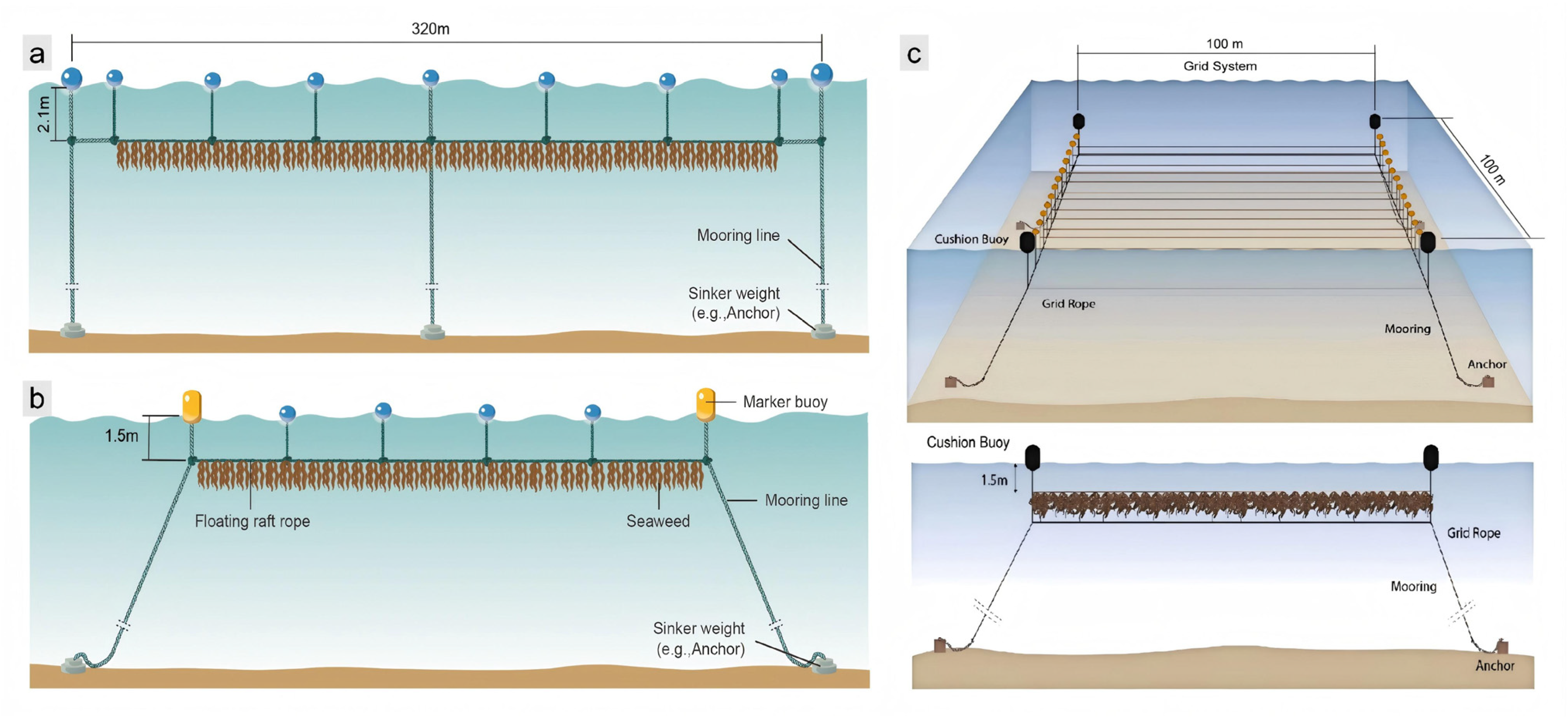
In Europe and North America, kelp seeding primarily employs the twine seeding method and grid system. In this approach, juvenile kelp sporophytes (e.g., 1–5 cm) attached to seeding curtain rope are uniformly wound onto longline cultivation ropes (e.g., 100 m length). These ropes are then secured to the main longlines for cultivation. Region-specific adaptations of this general exist. In the New England, USA, cultivation depth is modulated through ballast and buoy arrays (Figure 7a) [48]. In Scotland, UK, depth control is achieved by adjusting tether lengths between mainlines and surface floats (Figure 7b) [41]. Furthermore, in scenarios requiring larger-scale operations or where space is limited, grid-based systems emerge as the most suitable option [41]. Such a system comprises parallel individual longlines integrated with a sub-surface rope grid suspended at a fixed depth (e.g., 3 m), as illustrated in Figure 7c. However, the inherent rigidity of this design, which resists water movement, may lead to increased wear on components compared to more flexible systems like individual longlines. Additionally, the EU FP7 project AT~SEA project pioneered a bio-bonding seeding method. Sporophytes are first cultivated in rotating drums to prevent premature surface adhesion. During seeding, bioadhesives or hydrogels are introduced to the sporophyte suspension. which is then sprayed onto ropes/nets and immediately deployed [49]. Notably, kelp cultivated using these methods is primarily used as aquafeed, as it does not typically attain large sizes.

2.3. Comparison of Models

Variations in kelp seeding and cultivation methods across nations correlate with regional socioeconomic and environmental factors, including local kelp market prices, end-use applications, labor availability, and access to suitable sea areas. In China, high market demand for food-grade kelp, limited suitable cultivation zones, and comparatively low labor costs have driven predominant adoption of the single-plant insertion method, known for its optimized seedling utilization efficiency. This method typically integrates with the parallel double-longline system to maximize spatial efficiency within aquaculture space. Conversely, in Japan, South Korea, and Western nations, high labor costs render labor-intensive manual sporophyte seeding economically unviable. Consequently, these regions favor mechanization-compatible techniques such as the twine seeding method, the longline cultivation rope systems, and cutting method (Table 1).

3. Current Status of Kelp Harvesting

3.1. Development Status of Kelp Harvesting Devices in China

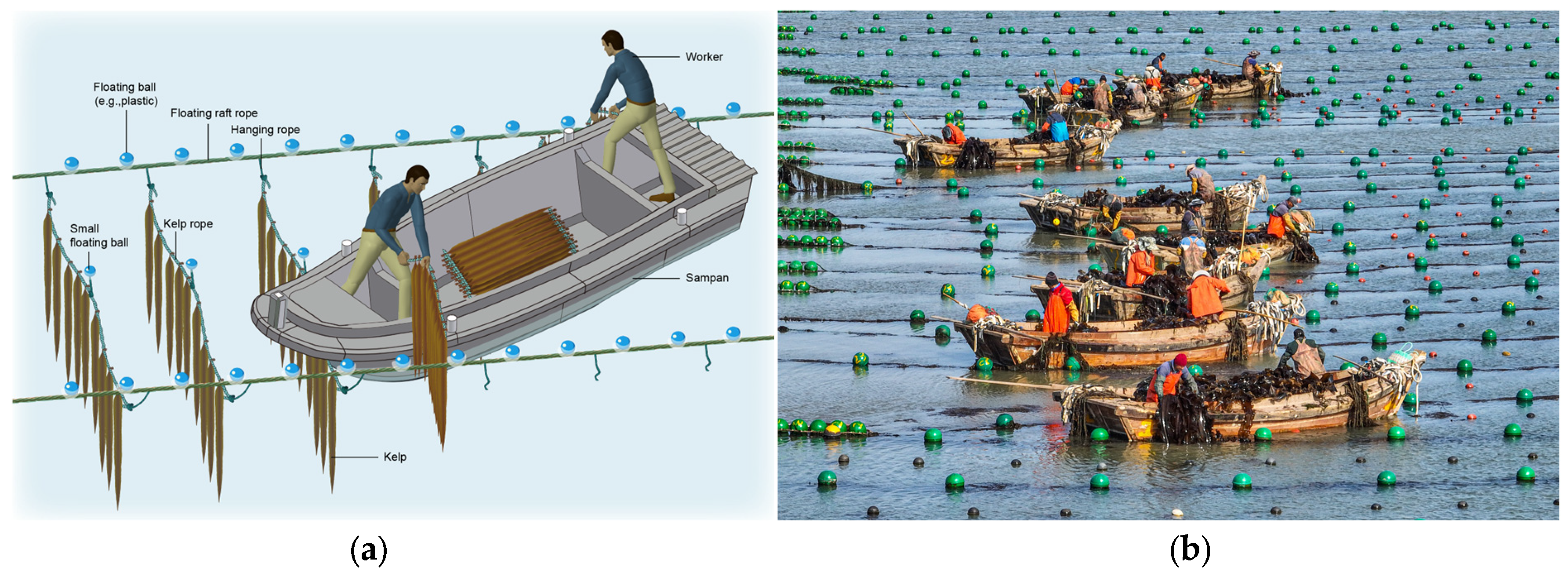
China’s large-scale kelp aquaculture industry spans multiple coastal provinces, resulting in slight regional variations in seeding and harvesting schedules (Figure 1b). Harvesting remains predominantly manual, typically conducted by two workers operating from small sampans. The operational sequence involves the following steps: 1. Positioning the sampan parallel to cultivation ropes using a guide rope. 2. Workers stationed at bow and stern sequentially untying rope knots. 3. Dividing long cultivation ropes into shorter segments. 4. Manually hauling segments aboard. 5. Transferring harvest to transport vessels before repeating the process [33] (Figure 8). Notably, harvesting operations typically commence between midnight and 2 a.m. Each worker harvests 4–8 tons daily, requiring approximately 1.5–3 million person-days annually, demonstrating the extreme labor intensity of current practices.
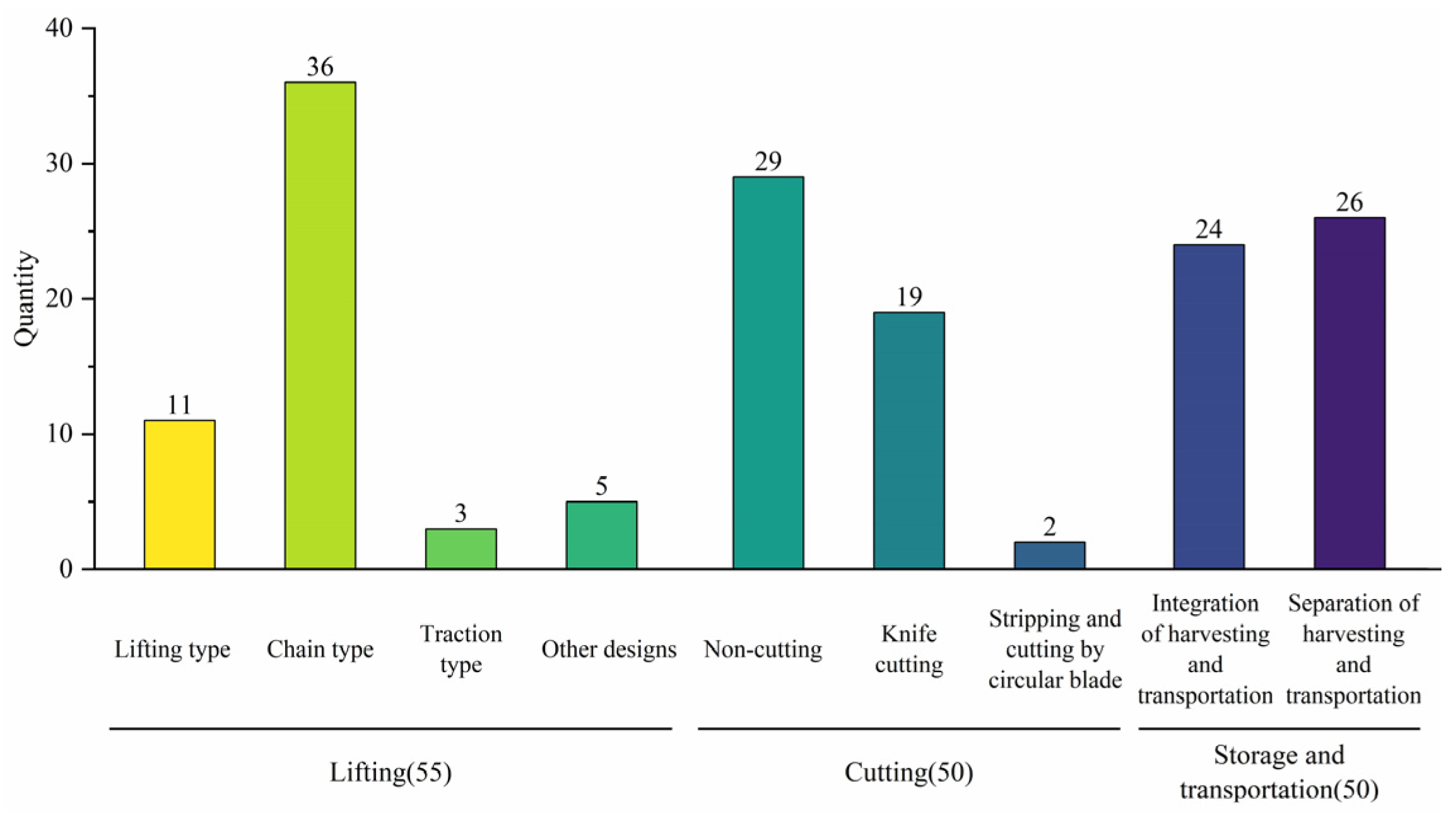
Over the past decade, Chinese research institutions and enterprises have devoted substantial efforts to developing diverse kelp harvesting technologies. Through comprehensive literature reviews, patent analyzes, and field investigations, a total of 53 distinct harvesting vessel designs and 11 specialized harvesting modules were identified (Supplementary Material Table S1). Existing designs were functionally categorized according to three critical harvesting stages: (1) Lifting: hauling the kelp from the water onto the vessel. (2) Cutting: severing kelp from seedling ropes. (3) Storage and transportation: onboard handling methods along with auxiliary configurations (Figure 9). The 11 harvesting modules are integrated within the 53 vessel designs and thus excluded from separate analysis.

3.1.1. Lifting Module

  • Lifting type
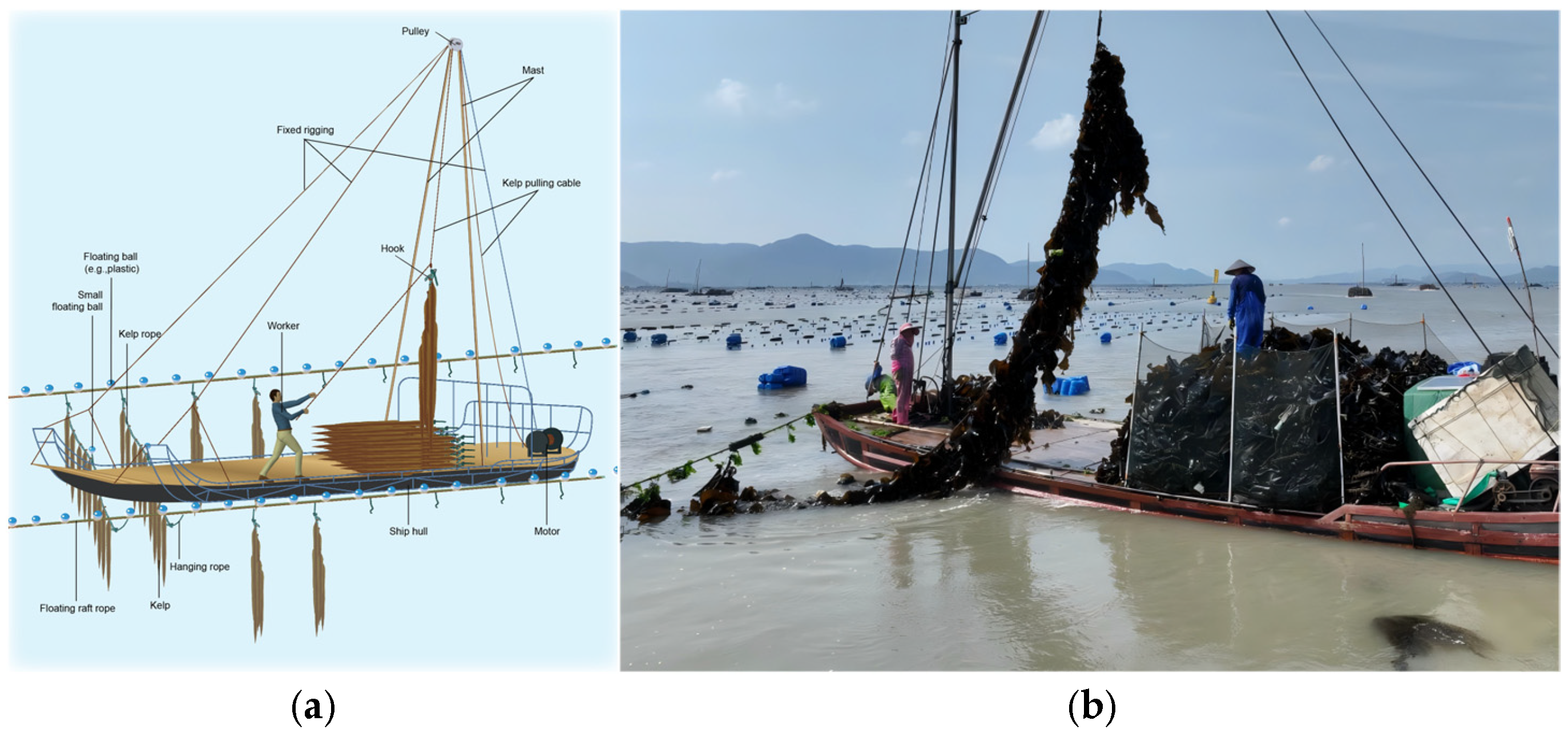
The lifting-type harvester [50,51,52,53,54,55,56,57] is defined as a semi-mechanized device incapable of fully mechanized, continuous operations. Representing an earlier generation of harvesting technology, these vessels typically utilize rope-and-hook systems to assist workers in hoisting kelp-laden cultivation ropes from the water onto the deck. A typical example is the rope-and-hook system employed in the Fujian’s aquaculture area, China (Figure 10). During operation, workers navigate the vessel into the cultivation area, detach the kelp seedling ropes from the main ropes, and hook one end onto a lifting hook. A rotary motor, coupled with a support rod, then elevates the rope. Finally, the direction is adjusted to deposit the kelp into a designated collection area on the vessel, completing the harvesting process.
Building on this foundation, Tan et al. [50] replaced the support rod with a rotary boom fitted with a manipulator, significantly minimizing manual rope-handling effort. Li et al. [51] converted the hull into a semi-submersible vessel featuring an adjustable draft depth, thereby reducing energy consumption during the rope dragging process. Liu et al. [52] substituted the support boom for a pulley system to decrease electricity usage. Chang et al. [53] mounted two swing arms on the hull, each fitted with a terminal hook. During operation, workers attach the ends of the seedling ropes directly to these hooks, enabling simultaneous engagement of both ends of the cultivation rope and direct lifting of the kelp onto the deck. Notably, other non-continuous lifting devices, such as combined rope-and-hook kelp harvesters [57] and jib-mounted harvesting devices [50], are also utilized in shellfish and asparagus cultivation. These adaptations facilitate daily inspection, feeding, and harvesting, demonstrating significant practical utility.
Compared to traditional manual harvesting, non-continuous lifting harvesters offer advantages such as simple device design, low cost, and ease of disassembly. While they reduce labor intensity to some extent, they fail to reduce the overall demand for manual labor. Furthermore, their limited resistance to wind and waves makes them unsuitable for large-scale operations. Consequently, these harvesters fail to address the fundamental challenges confronting kelp harvesting in China.
2.
Chain-type lifting
Chain-type lifting currently represents the primary focus of research and development for kelp harvesting devices in China. These systems operate by maneuvering the vessel into the raft cultivation structure for harvesting. A chain conveyor belt then lifts kelp-laden cultivation ropes or the main cables onto the deck. This mechanism enables continuous harvesting while simultaneously generating reverse traction that propels the vessel forward.
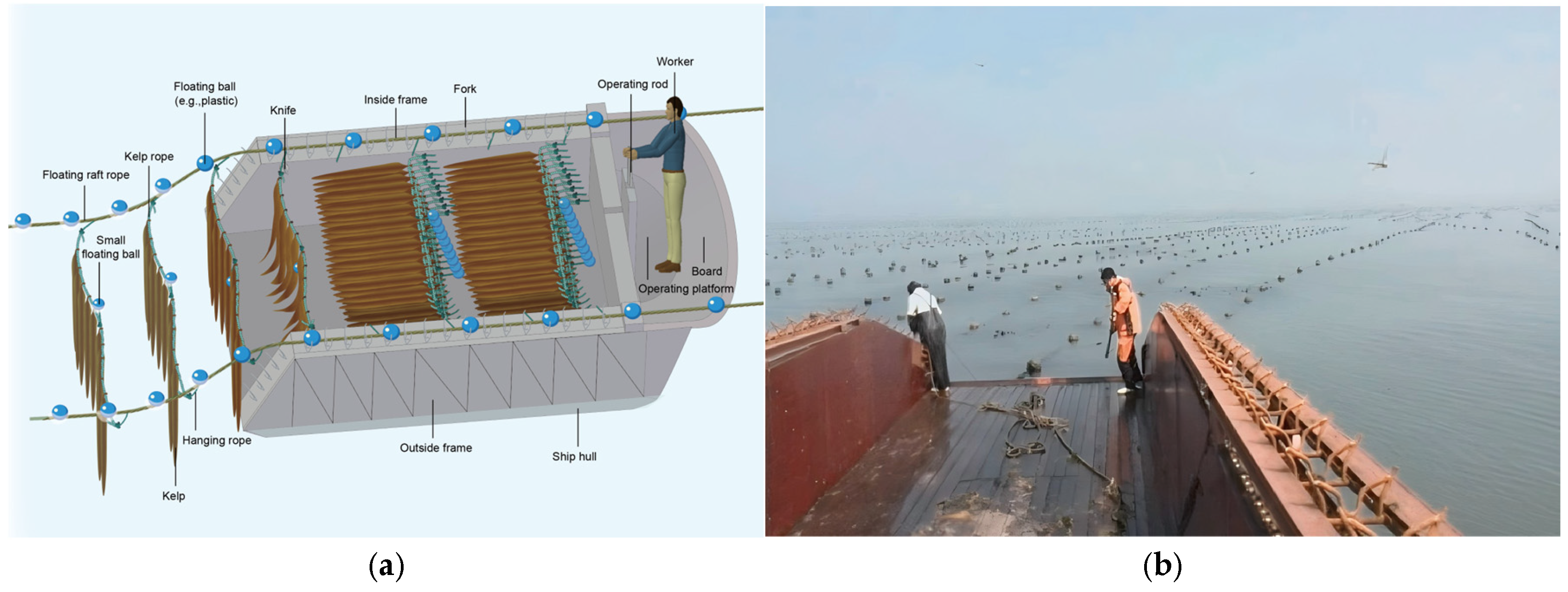
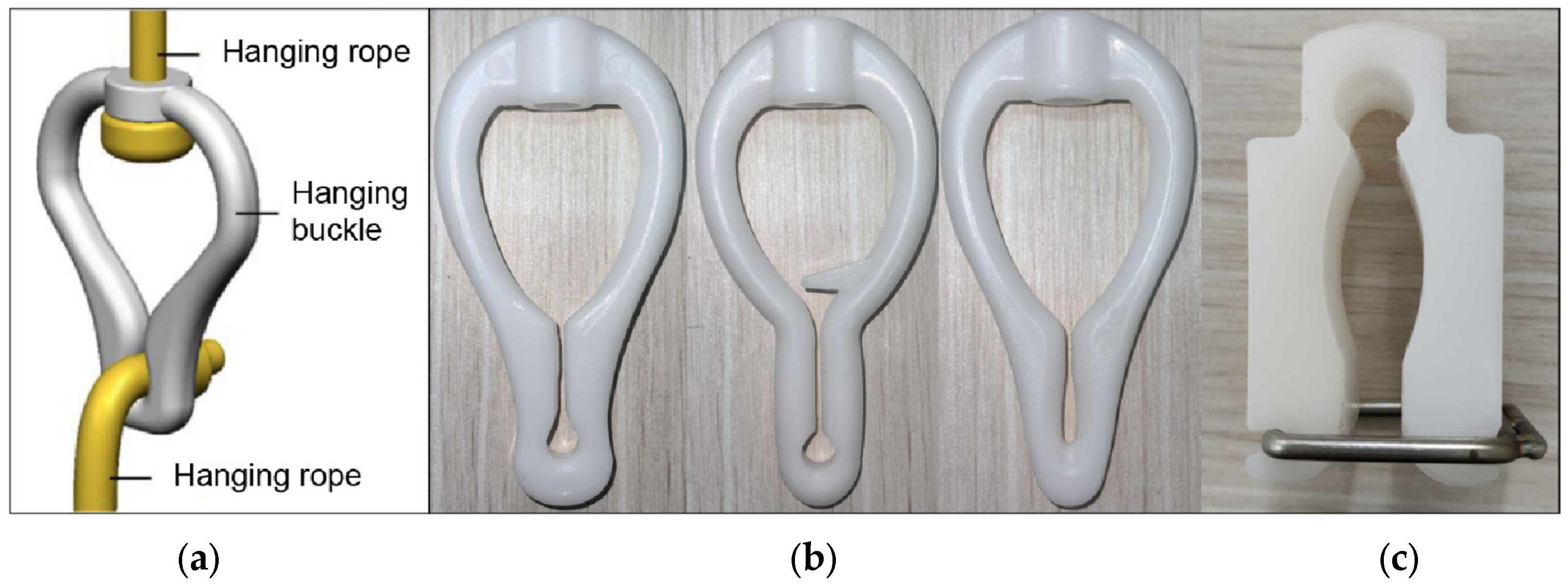
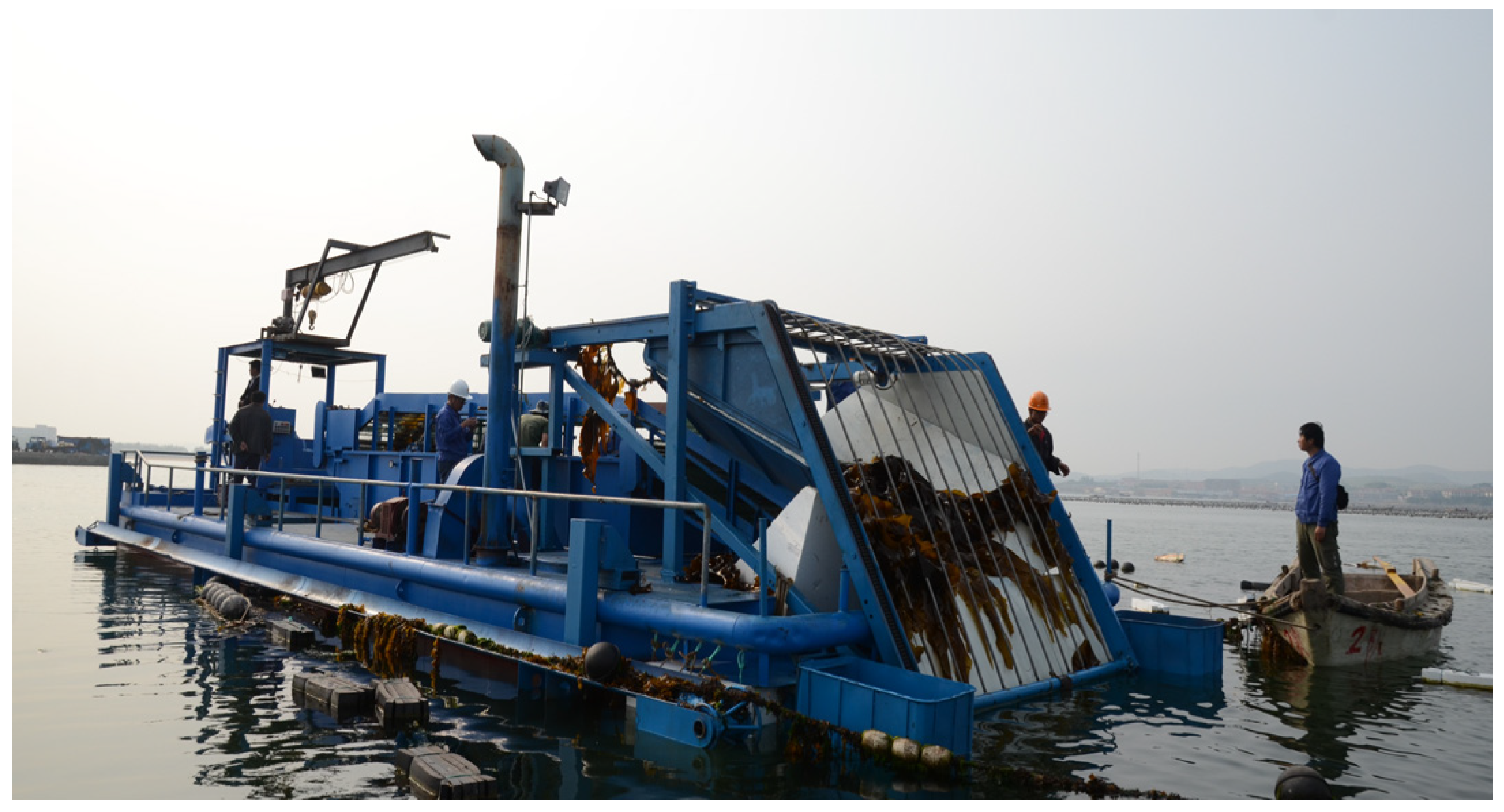
Early chain-type lifting devices relied on dragging the main ropes [58,59,60,61]. A representative design by Qu et al. [58] (Figure 11) features claw-equipped chains mounted bilaterally on the vessel. These claws engage high-density polyethylene (HDPE) float balls affixed to the main ropes, pulling the ropes backward to propel the vessel forward. Side-mounted cutters then sever the hanging ropes connecting the seedling ropes to the main ropes, releasing kelp into the harvesting compartment. Over 10 prototype vessels based on this design were constructed and tested in Lidao Bay, Rongcheng, Shandong Province. However, operational constraints persist. The vessel must submerge beneath the main ropes of the net-like raft structure (Figure 3) for entry/exit, complicating maneuvers. Complex sea conditions also generate sudden forces that frequently damage float balls or main ropes, impacting subsequent cultivation. Currents, wind, friction, and tension differentials between adjacent main ropes further cause operational deviation or path loss. Subsequent modifications address limitations, such as storage/transport (mothership-boat system [59,60,61,62], kelp collection nets, robotic arms, and longitudinal hull-traversing conveyor belts), float ball damage (later designs directly drag main ropes instead of float balls), propulsion (hydraulic push rods [63], dragging wheels, and rotating support wheels for float ball clamping), and detachment (Zheng et al. [59] developed an automatic release device using hanging buckles (Figure 12) for operational disengagement, which could prevent rotational entanglement of kelp around seedling ropes caused by reciprocating currents and have been widely adopted). Despite refinements, fundamental challenges remain—difficult raft access/egress, structural damage to rafts, and route deviation—preventing broad practical implementation of this vessel type.
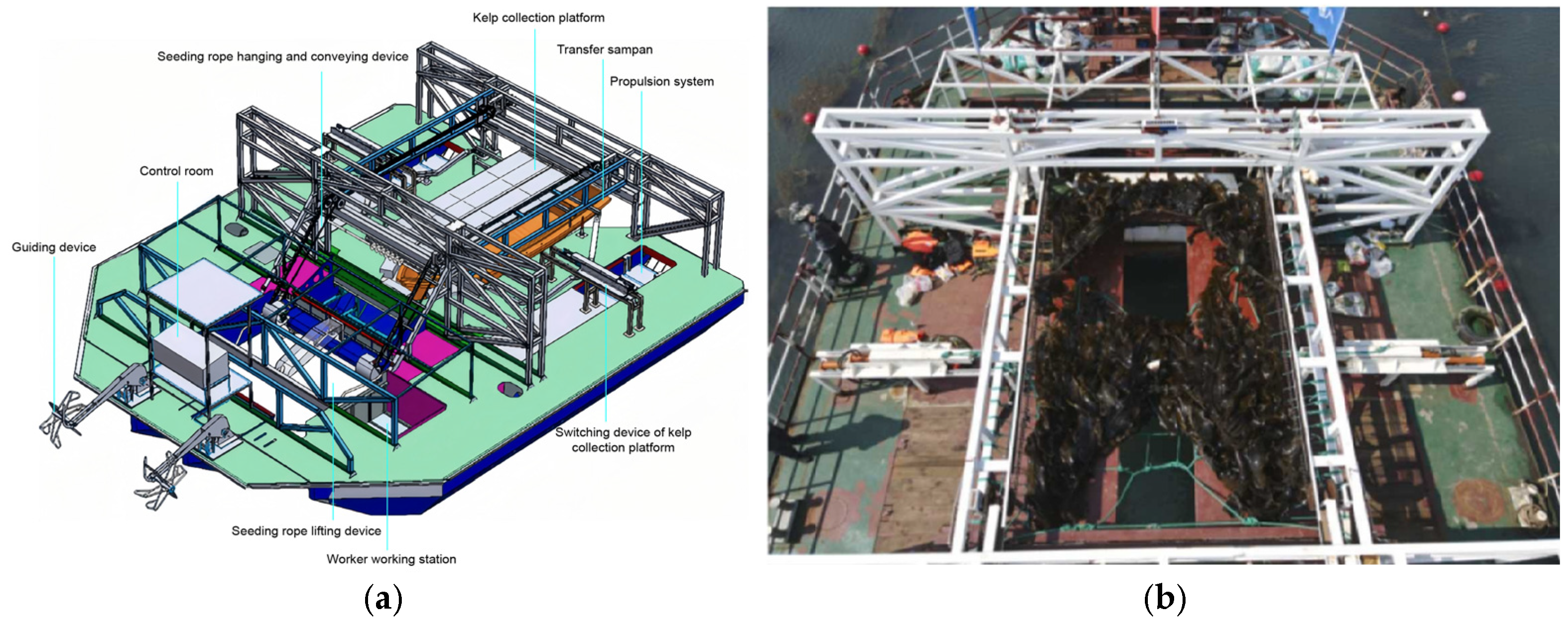
To minimize structural damage to rafts and reduce the loading forces on the net-like raft main ropes, recent harvesting vessels largely avoid lifting these primary components. Instead, harvesting operations utilize stern-mounted propulsion systems such as propellers [18,64,65,66] or outboard yacht engines [67]. Vessel designs further incorporate lightweight construction or enlarged hull areas (e.g., U-shaped hulls and catamarans) to achieve a draft shallower than the raft depth. Guiding devices mounted bilaterally [67,68,69] or sub-bilaterally [70,71] lock onto rafts during operations to maintain directional stability. However, in this configuration, seedling ropes are pressed deeper by the hull, creating taut conditions. Consequently, some systems incorporate forward-mounted guide rods [18,71], deflector plates [59,60,61,62,72], or guide rails [73] that leverage vessel momentum to lift the submerged seedling ropes to the surface. This enables manual detachment of seedling ropes from hanging ropes. The freed ropes are then transferred aboard via lateral chain hooks engaging the end knots [64,71,72,74,75,76] or central conveyor hooks uniformly engaging full rope length [77]. Despite these advances, most related patents remain theoretical or prototypical, with no mature commercial applications observed to date (Figure 13).
3.
Traction-type lifting outside the raft
To address the challenges associated with accessing and maneuvering within rafts, several harvesting systems have been developed based on the traction-lifting principle, enabling harvest operations to occur outside the raft structure [40,79]. However, as cultivation practices in China commonly employ stationary rafts with short, discontinuous seedling ropes, such systems typically require preprocessing of these ropes within the raft prior to harvesting.
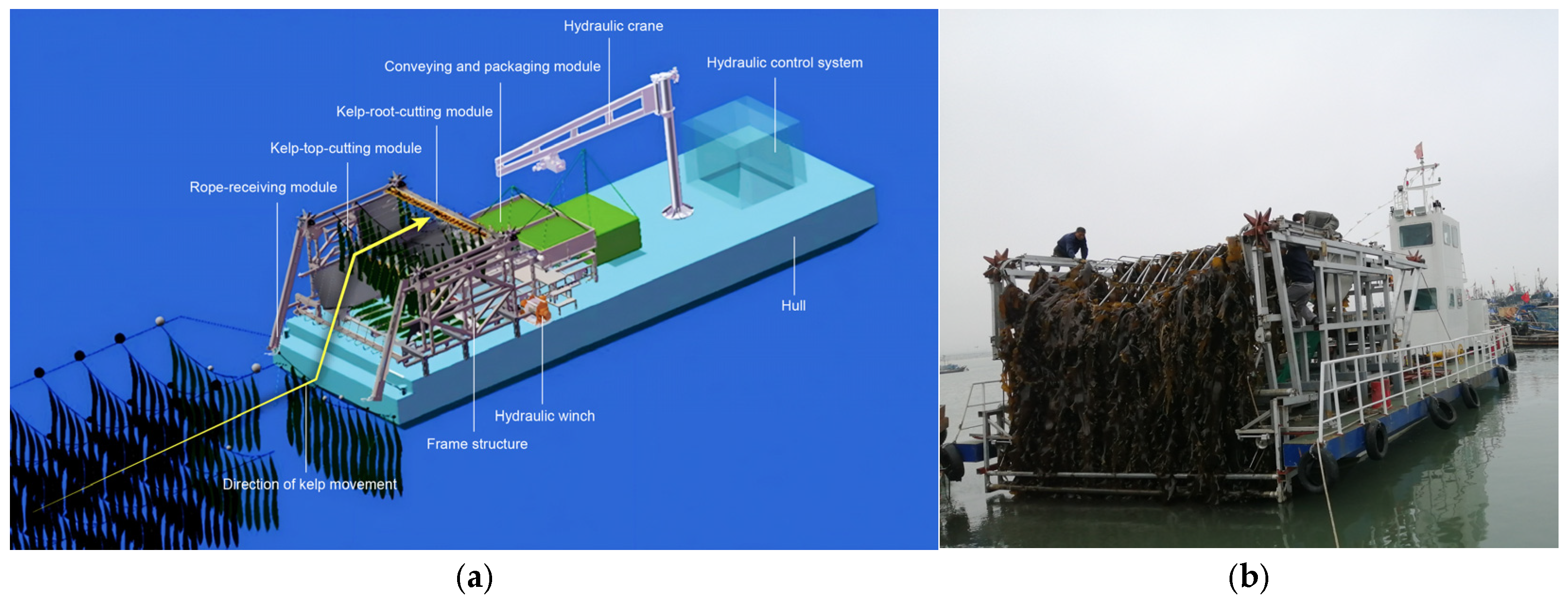
A representative example is the traction-type kelp harvester developed by Tan et al. [64], operating on the principle of mooring rope replacement (Figure 14). During operation, the main harvesting vessel remains positioned outside the raft structure. Auxiliary workers in smaller boats enter the cultivation zone to detach the kelp seedling ropes from the mooring ropes and reattach them to a newly deployed temporary hauling line. This line is then winched aboard the harvester, transporting the kelp onto the vessel. While achieving harvest rates of 15–20 t/h during trials, its method involves relatively complex operations requiring coordinated efforts from multiple personnel: typically, one operator navigating the harvester vessel, one operating the harvesting machinery, two workers piloting separate boats for rope detachment and reattachment, ropes, and an additional crew member assisting with material transfer. Furthermore, adverse sea conditions significantly increase traction difficulty, impeding continuous operation.
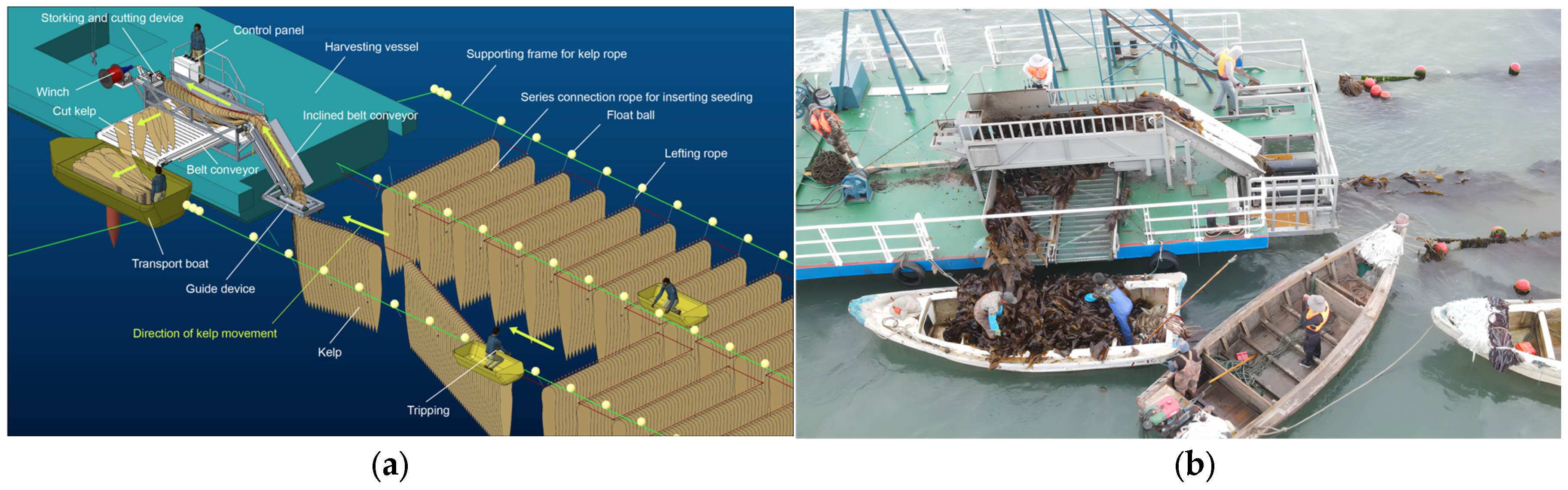
Jiang et al. [40] developed an external continuous stripping–cutting harvesting method utilizing long seedling ropes interconnected in series via hanging ropes (Jmse 14 00381 i001) (Figure 6). During operation, the vessel positions itself alongside the cultivation raft. Operators first disconnect the long seedling ropes from the mooring ropes. The harvester then winches the entire length of the rope aboard. Concurrently, a stripping–cutting blade severs the kelp fronds and facilitates holdfast detachment during rope retrieval (Figure 15). This approach substantially enhances the continuity and efficiency of mechanized harvesting operations; however, it necessitates machine-adaptable modifications or optimization of conventional cultivation rafts.
Building upon the long-seeding rope concept, several harvester designs have explored variations in rope lifting methods [80], cutting mechanisms [79,81], material transfer systems [80,82], and underwater harvesting techniques [82]. Notably, Tan et al. [83] designed a hybrid harvester vessel combining traction-based and rope-dragging principles. Prior to harvesting, operators detach the short seedling ropes from the mooring ropes, splice them end-to-end to form a continuous long rope, and attach one end to a single-chain hook system. The kelp is then winched aboard. While this approach integrates traction-based harvesting with the prevailing (domestic) practice using short seedling ropes, it still necessitates coordinated multi-personnel effort for the rope splicing. Furthermore, the splice joints between the joined ropes are prone to snagging, impeding smooth operations.
Beyond these challenges, traction-based harvesting encounters additional difficulties during the replacement of mooring ropes with hauling lines or the detachment of long seedling ropes from mooring ropes. These operations render the connected kelp seedling ropes highly susceptible to displacement by complex hydrodynamic forces. Furthermore, they risk entanglement with raft structures, the harvester vessel hull, or seabed rocks. Consequently, this method necessitates precise coordination between operators performing rope detachment and the harvesting vessel. This dependency significantly compounds the operational complexity of the process.

3.1.2. Cutting Module

Kelp cutting refers to the severance and segmentation of kelp fronds from seedling ropes. Among existing harvester designs, most lack a dedicated cutting module. Only a limited number incorporate cutting mechanisms, including manual cutting, fixed-blade cutting in traction-based systems [56,66,84,85,86,87], serrated-blade cutting [62,75], rotary-blade cutting [50,55,84,85,86], and rotary-disc stripping–cutting [40,80]. For fixed-blade cutting, blades are positioned along the kelp transmission path. Severance relies on the combined forward momentum of the vessel and the inertia of the moving kelp to cut the holdfasts. Serrated-blade cutting utilizes the interlocking reciprocating motion of upper and lower serrated blades to shear either the kelp holdfasts or the frond bodies. Rotary-blade cutting uses rotating blades or saws to cut and segment kelp at the holdfast and/or stipe regions. Additionally, some vessels incorporate specialized tools for stipe cutting or frond segmenting based on specific processing requirements [79,83].
Compared to manual cutting, blade cutting offers significantly higher operational speeds. However, vessel motion induced by environmental disturbances such as wind, waves, and currents often induces instability during cutting operations. This frequently results in misaligned cuts and incomplete severance, compromising cutting quality compared to manual methods.

3.1.3. Storage and Transportation Module

Early harvesting designs, including discontinuous harvesters or certain chain-driven continuous systems, typically employed an integrated harvest-and-transport approach. In this model, harvested kelp was stored directly within the vessel’s hold during operation. Upon reaching capacity, the vessel required immediate return to port, necessitating frequent transit between cultivation zones and docking facilities. This process substantially increased operational costs and reduced overall harvesting efficiency through frequent interruptions.
Subsequently, most harvester designs adopted a decoupled harvest–transport approach. A prevalent configuration stations a transport vessel alongside the harvester, transferring kelp via conveyor belts [62,68,79,80,88] or articulated booms [59,60,61]. This enables continuous harvesting operations, significantly enhancing efficiency. However, under moderate-to-severe sea conditions, maintaining stable alignment between vessels becomes challenging, frequently causing kelp spillage losses. To address this, researchers developed catamaran or U-shaped hull platforms [18,67,68,71,72,74,82,89,90] with integrated transport barges. Compared to side-by-side configurations, these designs improve wave resistance and operational safety. Nevertheless, they encounter significant alignment challenges when maneuvering within raft structures, and kelp transfer remains time-intensive. Jiang et al. [91] alternatively proposed a rotary claw system. This mechanism employs a rotary-driven reciprocating assembly to extend/retract grippers that insert between kelp fronds along the seedling rope, conveying harvested kelp directly to the transport vessel.

3.1.4. Multifunctional Harvesting Vessels

Multifunctional harvesting vessels integrate auxiliary modules to expand operational capabilities beyond harvesting. A representative example is the integrated blanching harvester [88], employing a chain-type continuous lifting system. During operation, operators detach seedling ropes from mooring ropes and place them onto a hook-equipped conveyor. This system transports ropes through an onboard blanching tank, utilizing abundant seawater resources to eliminate the post-harvest blanching step, processing steps, significantly reducing processing costs (Figure 16). Similarly, Lu et al. [80] developed a dual-mode cutting system accommodating divergent post-harvest requirements. Their design incorporates whole-rope harvesting (for sun-drying) and stripping-cutting after traction (for pickling), enabling single-vessel compatibility with both processing methods. However, as dedicated single-function harvesters remain developmentally immature, these multifunctional solutions are currently limited to prototype validation.

3.2. International Kelp Harvesting

3.2.1. Wild Kelp Harvesting

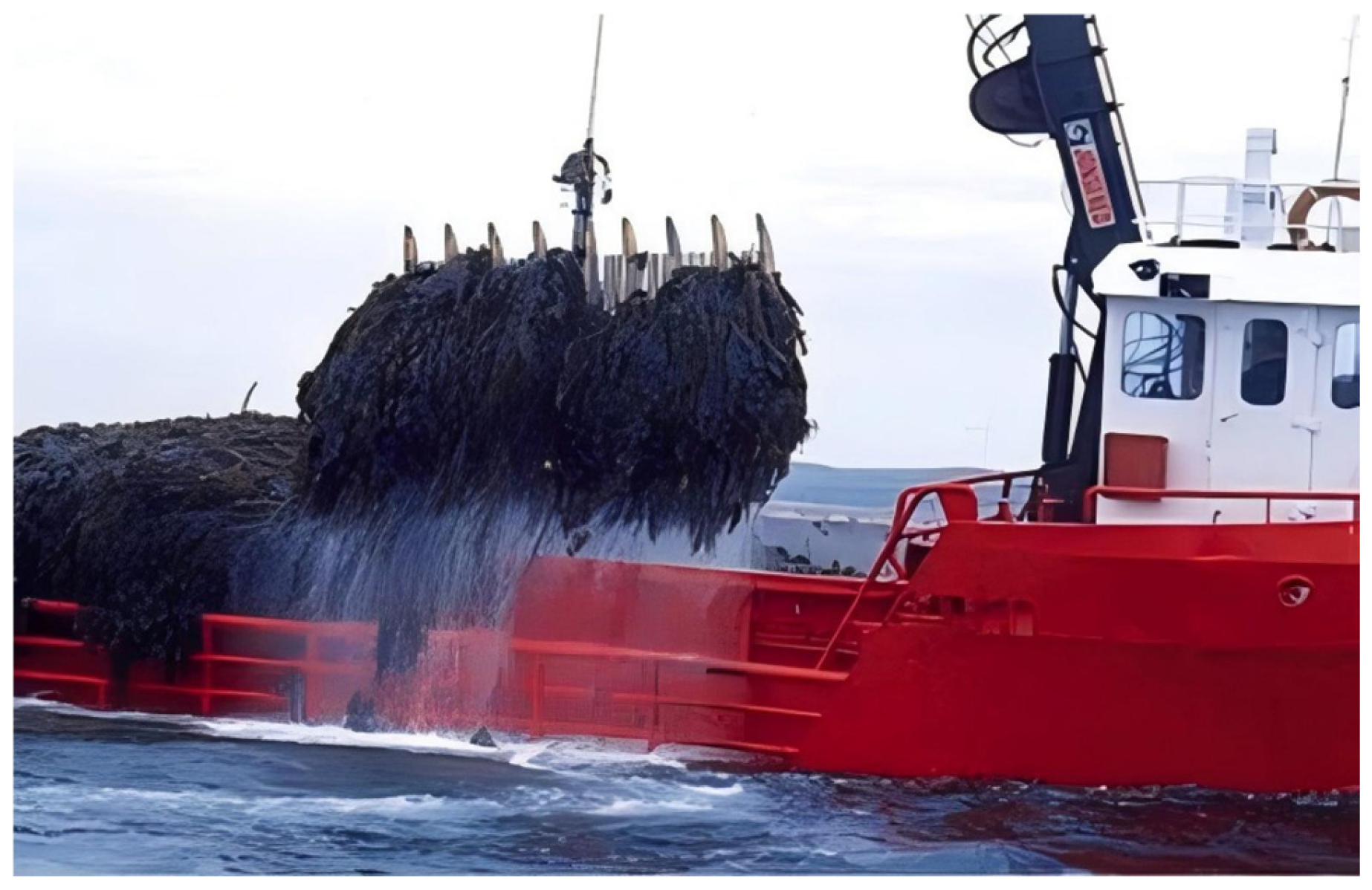
Internationally, wild kelp harvesting technology originated from aquatic plant harvesters. These systems operate by severing seaweeds at the seabed and mechanically retrieving the biomass using grabs to transfer it aboard the vessel. The first dedicated aquatic plant harvesters, the Gibeaux series, emerged in the 1960s through the British manufacturer Roble [70]. Subsequent developments led to specialized large-scale vessels designed specifically for wild kelp harvesting. Notable examples include the “Kelsol” harvester [40] and the “Seaweed Trawler” equipped single-arm crane [92] (Figure 17). These vessels feature robust hulls with enhanced wave resistance. Nevertheless, due to fundamentally distinct growth patterns of wild versus cultivated kelp, such harvesting systems remain technologically incompatible with aquaculture operations.

3.2.2. Cultivated Kelp Harvesting

Internationally developed kelp harvesting systems primarily target the long-rope cultivation model. Based on operational principles, these devices are categorized into two dominant types: lifting-based harvesters and traction-based harvesters. Lifting-based harvesters, predominantly used in Japanese and Korean fisheries, are optimized for harvesting kelp propagated from cuttings on seedling ropes. Traction-based harvesters see broader application across Japan, Korea, Europe, and North America, designed for kelp cultivated within suspended enclosure systems.
Lifting-based harvesters employ articulated booms or pulley-hook systems to vertically extract kelp in situ for onboard transfer. This method requires direct vessel positioning adjacent to cultivation lines, with operational parallels to Chinese lifting systems. In Norway, vessels utilize folding-arm cranes to hoist entire kelp-laden ropes above the deck. Workers then manually sever the biomass—either extending ropes for whole-rope harvesting or cutting binder ropes to detach seedling ropes from main infrastructure [93]. In contrast, Japanese operations (e.g., Omoe Fisheries Cooperative, Iwate) employ a dual-phase process. The seedling ropes are first dragged alongside the vessel, where fronds (with holdfast clusters) are excised and bundled. Onboard hoists then position these holdfast bundles for processing. Alternatively, hooks directly retrieve short seedling ropes after manual insertion for whole-rope extraction [94].
Internationally, the traction-type harvesting method operates within raft structures, utilizing traction machinery to retrieve either kelp seedling ropes or main ropes with attached seedlings. This system positions biomass for efficient processing while substantially reducing manual handling. It is widely adopted in Japan, South Korea, and the United States. In Japan (Hokkaido), traction equipment retrieves seedling ropes, primary ropes, and buoys directly into the vessel hold [95]. In South Korea, vessels employ inclined slides to extract primary ropes from the water column, after which workers then manually sever stipes, depositing kelp into harvesting compartments [96]. In the United States, traction equipment draws ropes across net-lined collection bags, severing kelp mid-transit for direct containment [49]. Building on traction principles, European innovations target automated cutting. The Netherlands-based Royal IHC and Vuyk Engineering Rotterdam developed a 6 m rotary-blade prototype harvester. Tested at a 2-hectare Solund (Norway) farm, this system achieved a harvesting capacity of 6 tonnes/hour [97].

3.3. Comparison of Harvesting Devices

Compared to domestic kelp harvesting technologies, development of foreign harvesting devices faces fewer technical challenges (Table 2), primarily characterized by the following:
(1) Foreign kelp aquaculture predominantly utilizes widely spaced long-line seedling ropes, eliminating complex netted structures. This configuration enhances maneuverability for diverse harvester vessel types during harvesting operations.
(2) Lower production volumes and extended harvesting periods abroad diminish pressure for ultra-high operational efficiency, thereby reducing the demand for rapid mechanical throughput.
(3) Internationally, kelp commands significantly higher prices—frequently exceeding 20-fold premiums over Chinese market values [98]. With labor constituting the dominant production cost, this price advantage enables significant investment in mechanization research and development and implementation, thereby reducing harvesting expenses.
(4) End-use applications are more distinct. In Japan and South Korea, kelp is primarily destined for human consumption, whereas in Europe and America, it serves predominantly as animal feedstock. Consequently, lifting-type harvesters dominate in the former regions (requiring intact fronds), while traction-type methods prevail in the latter due to reduced visual-quality requirements.
Consequently, foreign kelp harvesting systems rarely encounter the complex constraints prevalent in China. However, these systems exhibit significantly lower marine spatial utilization efficiency. For instance, Japanese and Korean models operate at <25% of China’s areal productivity [34]. Given China’s rising living standards and growing demand for aquatic products, optimizing marine spatial allocation has become an irreversible strategic priority. This imperative necessitates China-specific harvesting solutions, rendering direct adoption of foreign mechanization approaches technologically incompatible.

4. Discussion and Suggestions on the Current Status of Kelp Harvesting in China

4.1. Discussion on the Current Status of Kelp Harvesting in China

Despite China’s rapid advancement in agricultural mechanization, achieving comprehensive automation across numerous terrestrial sectors, aquatic harvesting technologies remain markedly underdeveloped. Kelp harvesting mechanization lags significantly, with no highly automated systems attaining commercial maturity despite decades of prototype efforts. Current operations rely predominantly on rudimentary hook-and-line systems, while advanced harvesting machinery remains confined to experimental prototypes. Due to kelp’s inherent biological characteristics and unique cultivation conditions, mechanized harvesting development faces significant technical challenges, manifested in the following aspects:

4.1.1. Traditional Kelp Cultivation Methods Present Fundamental Barriers to Mechanization

A. The lack of standardized cultivation parameters represents a significant barrier to mechanization in kelp aquaculture. While agronomic-mechanical coordination is a fundamental prerequisite for all mechanized agricultural operations—as seen in the standardized spacing, ditch width, and planting depth for crops like rice and peanuts—such coordination is critically absent in current kelp farming practices [31,32,34]. Despite the existence of some national guidelines, substantial inconsistencies persist in key technical parameters, such as raft frame width, float spacing and size, and seedling rope length, both across and within major producing provinces. These heterogeneities, while manageable in manual harvesting, critically impede the efficiency and reliability of mechanized systems. A salient example is the use of manually braided polyethylene–cotton blend seedling ropes, which exhibit inconsistent mechanical properties and non-uniform lengths. During mechanized harvesting operations, these ropes often suffer from poor elastic recovery and breakage, leading to frequent operational disruptions and downtime [34].
B. Stable mesh structures formed by seedling ropes and raft frames. To ensure raft stability, ropes are maintained under high tension, creating densely packed configurations. Following deployment, seedling ropes form increasingly dense networks. Consequently, harvesting requires extreme lifting forces to hoist main ropes and seedling ropes onto vessel, frequently damaging aquaculture infrastructure during this process.
C. Parallel short-rope cultivation configuration. Chinese kelp rafts utilize short seedling ropes arranged in densely parallel rows. Harvesting requires sequential retrieval of individual ropes onto vessels, fundamentally compromising operational continuity and efficiency.
D. Submerged loose ropes accumulation. Chinese kelp rafts retain multiple submerged ropes of varying lengths beneath the surface to facilitate farm management. Polyculture and rotational farming practices further increase underwater rope density. During vessel movement, these loose ropes entangle with propellers, rudders, and harvesting machinery, causing vessel immobilization or requiring operations suspension.

4.1.2. Conventional Vessel Designs Are Incompatible with Traditional Cultivation Requirements

A. Inadequate maneuverability and positioning precision. Current kelp harvesting vessels/platforms primarily use stern rudder-propellers for propulsion and directional control. Operations require vessels to maintain parallel alignment with cultivation hawsers during traversal. However, wind, waves, and currents induce significant heading and speed deviations, while flexible raft frames undergo deformation under hydrodynamic forces. Consequently, vessels cannot achieve stable navigation between raft frames during harvesting operations.
B. Insufficient development of specialized hull forms. Current kelp harvesting vessels/platforms are predominantly adapted from conventional fishing boat designs, rendering them inadequately tailored to complex raft environments. Existing configurations fail to achieve simultaneous stable navigation through dense raft arrays and continuous harvesting functionality.

4.1.3. Demographic and Economic Factors Continue to Favor Manual Harvesting

A. Persistent labor cost advantages. Current manual harvesting costs (approximately USD 0.01–0.015/kg) remain substantially lower than mechanized alternatives. Furthermore, the relatively low market price of Chinese kelp (≤USD 0.3/kg [99,100]) constrains profit margins, limiting capital allocation for harvesting equipment and mechanized operations.
B. Low annual utilization rate of specialized equipment. China’s kelp harvesting occurs within a highly concentrated seasonal window (<3 months annually), creating intense but brief equipment demand. Most dedicated harvesting vessels remain idle outside this period with limited alternative applications, further constraining mechanization’s economics.

4.1.4. China’s Intensive Marine Development Necessitates Novel Mechanized Harvesting Solutions

A. Complex multi-trophic cultivation systems. China’s transition toward intensive ocean use employs diversified approaches including Integrated Multi-Trophic Aquaculture (IMTA) models [101], offshore cultivation [102], and integrated “energy-fisheries” systems [103,104,105,106]. These configurations feature multi-species co-cultivation on rafts, creating structurally heterogeneous environments that impede mechanized harvesting operations.
B. Challenging offshore operating environments. As nearshore cultivation declines rapidly, offshore zones become the primary expansion area for Chinese kelp farming. These areas exhibit intensified wind, wave, and current conditions, posing critical challenges to both infrastructure integrity and harvesting vessel stability.

4.2. Development Strategies for Kelp Harvesting in China

Driven by accelerated population aging, increasing labor costs, declining interest in high-intensity maritime occupations, and intensified aquaculture demands, China’s kelp farming industry urgently requires a transition from labor-intensive to technology-intensive practices. Developing mechanized harvesting equipment is critical for enhancing cultivation efficiency, improving operational safety, and upgrading industry-wide quality standards.
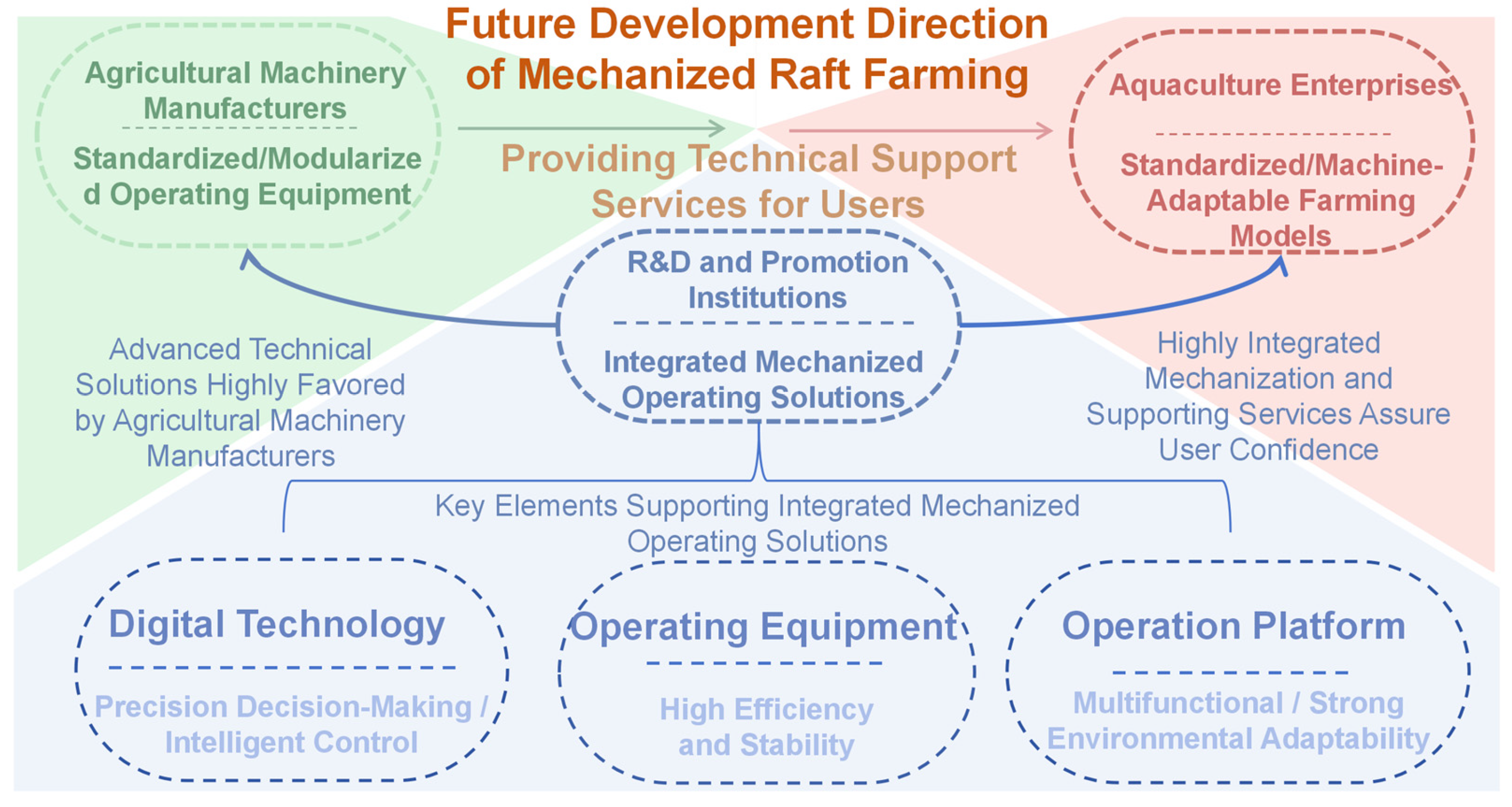
To achieve the development and industrialization of mechanized offshore operations, it is essential to foster collaboration among research institutions, agricultural machinery manufacturers, and aquaculture enterprises to collectively promote the mechanization and automation of raft-based aquaculture. The development pathway is illustrated in Figure 18.

4.2.1. Establish Mechanization-Compatible Multi-Trophic Kelp–Shellfish Cultivation Models

Advancements in cultivation models and harvesting technology must proceed concurrently. This requires innovating cultivation techniques or modifying traditional raft structures to establish standardized kelp cultivation protocols and develop stable, safe, and cost-effective raft systems compatible with mechanization. Priority should focus on promoting shellfish–kelp polyculture and rotational cultivation alongside the mechanization of critical processes. Developing key technologies and equipment for offshore seedling cultivation, process management, and mechanized harvesting will enhance nearshore resource utilization and productivity. These developments will provide the technological and infrastructural foundations for long-term, stable development of coastal shellfish and seaweed aquaculture while facilitating industry restructuring and sustainable growth.

4.2.2. Develop Specialized and Multifunctional Harvesting Vessels

Research should prioritize real-time environmental monitoring (wind, waves, and currents) within cultivation zones and navigation technologies enabling stable vessel maneuvering through raft arrays. Harvesting vessels require optimized hydrodynamic performance, including stability, capsize resilience, speed, seakeeping, and maneuverability. Modular design principles should be applied to decouple traction, harvesting, and transport functions. Furthermore, harvesting devices must be engineered for specific end-use requirements (e.g., dried kelp, blanched/pickled products, and feed), establishing a diversified equipment portfolio. Functional integration should extend to harvesting co-cultivated species (e.g., Gracilaria, wakame, and oysters), enhancing operational versatility and vessel utilization efficiency.

4.2.3. Establish Full-Process-Chain Mechanization and Automation

A standardized mechanized system encompassing seedling cultivation, outplanting, grow-out, harvesting, and processing must be established. Concurrently, high-yield kelp varieties optimized for mechanized harvesting require development, featuring enhanced holdfast adhesion, elongated stipes for low-damage towing, and durable fronds. Guided by intelligent technologies, innovation in fully automated and intelligent equipment across the production chain will advance the industry toward integrated mechanization–automation–intelligence systems.

4.2.4. Integrate Carbon Neutrality Objectives into Harvesting Technology

Given that cultivation constitutes a significant yet dynamic carbon sink (e.g., delayed harvest may convert sinks to sources), future research must prioritize quantifying net carbon sequestration. This requires adopting clean energy for harvesting operations, evaluating the impact of propulsion systems, energy efficiency, and harvesting efficacy on carbon flux, and conducting comprehensive ecological impact assessments. Such integrated analysis will enable holistic carbon footprint evaluation for the industry.

4.2.5. Strengthen Policy Support for Mechanization Advancement

Government agencies should stimulate technological innovation through targeted funding and policies fostering industry–academia–research collaboration. Industry-wide standards and regulations must be collaboratively developed by research institutions and aquaculture enterprises. Financial mechanisms, including agricultural machinery subsidies, should support adoption of mechanized cultivation, harvesting, and processing equipment. National and local strategic projects should prioritize accelerating the development of advanced marine agricultural machinery.

5. Conclusions

China leads global kelp production, accounting for 32.3% of worldwide seaweed output. Despite this scale, harvesting operations remain heavily dependent on manual labor and basic semi-mechanized equipment. With accelerating population aging and persistently rising labor costs, the sector faces imminent workforce shortages. Mechanized harvesting technologies’ development is therefore essential to ensure the industry’s sustainable development.
However, mechanized harvesting faces multifaceted challenges, such as existing farming modes constraining machinery adaptation, conventional vessel designs being incompatible with raft-environment operational demands, demographic and wage structures still sustaining labor-intensive methods, and intensive sea-use policies necessitating advanced technological solutions. Moreover, distinct national conditions limit the transferability of foreign technologies. Future research and development should prioritize four critical areas. (1) Coordinated cultivation-equipment innovation, requiring synchronized improvements in cultivation models and harvesting technology to establish standardized, mechanization-optimized systems for multi-species (kelp/shellfish–seaweed) operations. (2) Specialized vessel development, focusing on diversified platforms with enhanced hydrodynamic performance (stability, seakeeping, and maneuverability) and modular functionality tailored for harvesting and adaptable for related species. (3) Integrated mechanization systems, creating fully mechanized processes spanning the entire production chain, from seedling cultivation and grow-out to harvesting and processing, supported by automation and intelligent technologies. (4) Carbon-neutral harvesting, incorporating low-carbon design principles aligned with carbon neutrality targets into equipment development and conducting comprehensive assessments of mechanized harvesting’s impact on kelp carbon sequestration efficacy. To accelerate progress, robust policy support is essential. The Chinese government should promote cross-sector collaboration (industry–academia–research–application) to establish industrialization standards for mechanization. This necessitates dedicated research and development funding, targeted project support, and economic incentives for adopting mechanized solutions across the kelp industry value chain.

Supplementary Materials

The following supporting information can be downloaded at: https://www.mdpi.com/article/10.3390/jmse14040381/s1, Table S1: China Kelp Harvesting Technology and Function List.

Author Contributions

Conceptualization, Y.H.; methodology, Y.H.; validation, M.Y.; formal analysis, Z.Z. and Z.C.; investigation, L.L.; data curation, Y.Z.; writing—original draft preparation, Y.H., L.L., Z.Z. and Y.Z.; writing—review and editing, M.Y., Z.C. and T.J.; project administration, T.J.; funding acquisition, T.J. All authors have read and agreed to the published version of the manuscript.

Funding

This research was funded by National Key R&D Program of China (2023YFD2400800), the Science and technology plan project of Beihai City (grant number 201995076), the earmarked fund for China Agriculture Research System (CARS-50), Central Public-interest Scientific Institution Basal Research Fund, CAFS (NO. 2023TD86) and the 2025 Guangxi Economic Talent Development Support Special Project, Guangxi Zhuang Autonomous Region Marine Bureau (grant number 2025XHRC02).

Data Availability Statement

The original contributions presented in the study are included in the article. Further inquiries can be directed to the corresponding authors.

Conflicts of Interest

The authors declare no conflicts of interest.

References

  1. Liu, T. Kelp Cultivation Techniques; China Ocean University Press: Qingdao, China, 2019; ISBN 978-7-5670-2204-1. [Google Scholar]
  2. Liu, F.; Liang, Z.; Zhang, P.; Wang, W.; Sun, X.; Yuan, Y. Preliminary Discussion on the Development of Saccharina japonica Offshore Aquaculture in China. Prog. Fish. Sci. 2019, 40, 161–166. [Google Scholar] [CrossRef]
  3. Jin, Z.; Liu, Y.; Zhang, J.; Gong, Q.; Cui, J.; Liu, T. Breeding Actuality and Developing Direction of Laminaria in China. Trans. Oceanol. Limnol. 2009, 141–150. [Google Scholar] [CrossRef]
  4. Broch, O.J.; Alver, M.O.; Bekkby, T.; Gundersen, H.; Forbord, S.; Handå, A.; Skjermo, J.; Hancke, K. The Kelp Cultivation Potential in Coastal and Offshore Regions of Norway. Front. Mar. Sci. 2019, 5, 529. [Google Scholar] [CrossRef]
  5. Marinho, G.S.; Holdt, S.L.; Birkeland, M.J.; Angelidaki, I. Commercial Cultivation and Bioremediation Potential of Sugar Kelp, Saccharina latissima, in Danish Waters. J. Appl. Phycol. 2015, 27, 1963–1973. [Google Scholar] [CrossRef]
  6. McHugh, D.J. A Guide to the Seaweed Industry; Food and Agriculture Organization of the United Nations: Rome, Italy, 2003; ISBN 0429-9345. [Google Scholar]
  7. Yue, H.; Sun, Y.; Hu, J.; Zeng, S.; Ouyang, H. Industry and International Trade of Laminaria japonica in China. Agric. Outlook 2013, 9, 6. [Google Scholar] [CrossRef]
  8. Wang, B. Innovation and integration: The establishment of China’s kelp cultivation technology system in the 1950s. Anc. Mod. Agric. 2024, 1–16. Available online: https://caod.oriprobe.com/articles/67033003/chuang_xin_yu_rong_he__20_shi_ji_50_nian_dai_zhong.htm (accessed on 17 November 2024).
  9. Li, Y.; Wang, Y.; Chen, T.; Lin, X.; Chen, J.; Liu, Z. Research Progress of High-Value Comprehensive Utilization of Laminaria japonica. J. Fish. Res. 2023, 45, 10. [Google Scholar] [CrossRef]
  10. Yi, Z. Small Seaweed “Grows” into a Big Industry. Openings 2023, 40–43. [Google Scholar] [CrossRef]
  11. National Modern Agricultural Industry Technology System Kelp Industry Development Report. China Fish. 2021, 23–41.
  12. Ou, G.; Wang, X.; Yang, A.; Ke, A.; Guan, W. Inter-Species Variation in Carbon Sink Capacity of Large Kelp. Zhejiang Agric. Sci. 2017, 58, 1436–1439+1443. [Google Scholar] [CrossRef]
  13. Zhang, J.; Fang, J.; Tang, Q. The Contribution of Shellfish and Seaweed Mariculture in China to the Carbon Cycle of Coastal Ecosystem. Adv. Earth Sci. 2005, 359–365. [Google Scholar] [CrossRef]
  14. Department of Fishery Administration, the Ministry of Agriculture and Rural Affairs. China Fishery Statistical Yearbook 2024; China Agriculture Press: Beijing, China, 2024; ISBN 978-7-109-32126-7. [Google Scholar]
  15. Gao, Y.; Zhang, Y.; Du, M.; Lin, F.; Jiang, W.; Li, W.; Li, F.; Lv, X.; Fang, J.; Jiang, Z. Dissolved Organic Carbon from Cultured Kelp Saccharina japonica: Production, Bioavailability, and Bacterial Degradation Rates. Aquacult. Environ. Interact. 2021, 13, 101–110. [Google Scholar] [CrossRef]
  16. Wang, Z. Preliminary Study on Carbon Sink Method and Value Accounting of Cultured Saccharina japonica in Shandong Province. Master’s Thesis, Shanghai Ocean University, Shanghai, China, 2023. [Google Scholar]
  17. FAO. The State of World Fisheries and Aquaculture 2024—Blue Transformation in Action; FAO: Rome, Italy, 2024; ISBN 978-92-5-138763-4. [Google Scholar]
  18. Chen, T. Design and Optimization of Semi-Automatic Kelp Harvester. Master’s Thesis, Ocean University of China, Qingdao, China, 2015. [Google Scholar]
  19. Chen, J. Mechanized Cultivation of Kelp and Research on Seedling Clamping Machine. Master’s Thesis, Fujian Agriculture and Forestry University, Fujian, China, 2016. [Google Scholar]
  20. Zou, Y.; Chen, Z.; He, Y.; Li, Y. Development and Design of Automated Kelp Insertion Equipments. Autom. Appl. 2023, 64, 94–97. [Google Scholar] [CrossRef]
  21. Jiang, Y.; Li, R.; Li, Z. Cultivation Technique of the Nationally Approved Hybrid Kelp Variety “Dongfang No. 2”. Sci. Fish Farming 2008, 21–22. Available online: https://kns.cnki.net/KCMS/detail/detail.aspx?dbcode=CJFQ&dbname=CJFD2008&filename=KXYY200811017 (accessed on 17 November 2024).
  22. Beijing Modern Market Economy Research Center. Encyclopedia of Agricultural Science and Technology: Cultivation and Breeding in China; Shitu Audio-Visual Electronic Publishing House: Beijing, China, 2002; ISBN 7-900129-11-1. [Google Scholar]
  23. Editorial Committee of the Training Textbook for Workers, The Ministry of Agriculture. Seaweed Aquaculture; China Agriculture Press: Beijing, China, 1995; ISBN 7-109-03789-4. [Google Scholar]
  24. Lin, Q.; Cai, L. Questions and Answers on Marine Aquaculture Techniques; Fujian Science & Technology Publishing House: Fuzhou, China, 2012; ISBN 978-7-5335-4052-4. [Google Scholar]
  25. Peteiro, C.; Sánchez, N.; Martínez, B. Mariculture of the Asian Kelp Undaria pinnatifida and the Native Kelp Saccharina latissima along the Atlantic Coast of Southern Europe: An Overview. Algal Res. 2016, 15, 9–23. [Google Scholar] [CrossRef]
  26. Wang, Y.; Fan, R.; Nie, H.; Wei, H. Analysis on Tidal Current Characteristics During Different Kelp Growing Seasons in Sanggou Bay, China. Adv. Mar. Sci. 2021, 39, 508–518. [Google Scholar]
  27. Zeng, Y.; Guo, M.; Fang, X.; Jiang, Y.; Zheng, X. Analysis and simulation of drift trajectory in Fujian offshore. J. Xiamen Univ. 2023, 62, 435–443. [Google Scholar] [CrossRef]
  28. You, Y. Preliminary analysis of tidal current dynamic characteristics in Baima Gang sea area of Sansha Bay in Fujian Province. J. Fish. Res. 2022, 44, 249–259. [Google Scholar] [CrossRef]
  29. GB/T 15807—2008; Summer Seedling of Kelp. Sub-Technical Committee on Mariculture, National Technical Committee for Standardization of Aquatic Products: Beijing, China, 2008.
  30. NY/T 5057—2001; Technical Regulations for Pollution-Free Kelp Cultivation. Yellow Sea Fisheries Research Institute, Chinese Academy of Fishery Sciences: Qingdao, China, 2001.
  31. Liu, X.; Lin, G. Development Status and Suggestions for the Kelp Industry in Xiahu Town. Fujian Agric. Sci. Technol. 2017, 58–61. [Google Scholar] [CrossRef]
  32. Fang, J.; He, W.; Mao, Z.; Fang, J.; Jiang, Z.; Gao, Y.; Lin, F.; Du, M.; Liang, B. A Comparison of Nutrients in Kelp Cultured in Standardized and Traditional Long-Line Modes in Sanggou Bay. Prog. Fish. Sci. 2021, 42, 170–175. [Google Scholar] [CrossRef]
  33. Zhang, Y.; Chang, Z.; Zheng, Z.; Yang, J. Harvesting Machine for Kelp Culture in Floating Raft. Aquac. Eng. 2017, 78, 173–179. [Google Scholar] [CrossRef]
  34. Tan, Y.; Lou, S.; Chen, Z. Research on Integrated Specialized Ship for Kelp Harvesting, Classifying and Grading. Aquac. Eng. 2020, 91, 102121. [Google Scholar] [CrossRef]
  35. Chang, Z.; Zhang, Y.; Zheng, Z.; Wan, R.; Zhang, Z. Development Status of the Raft-Cultivation Harvesting Devices for Kelp. Fish. Mod. 2018, 45, 40–48. [Google Scholar]
  36. Liu, H.; Lu, L.; Jiang, T. Design and analysis of kelp harvesting module and its supporting ship. J. Fish. Res. 2023, 45, 263–270. [Google Scholar] [CrossRef]
  37. Chen, X.; Li, J.; Gao, H.; Chang, Z.; Han, Z. Integrated Multi-Trophic Aquaculture (IMTA) Technology Model. China Fish. 2020, 76–78. [Google Scholar]
  38. Zhang, R.; Wang, S. Analysis of the role of integrated multi-trophic aquaculture (IMTA) in promoting sustainable development of modern marine fisheries. China Fish. 2018, 38–40. [Google Scholar]
  39. Zhang, Z. Party Journalist Recommendation List|120,000 Hectares of “Forest” Thriving in This Sea. Dazhong Daily. 2022. Available online: https://sghexport.shobserver.com/html/baijiahao/2022/07/09/793063.html (accessed on 17 November 2024).
  40. Jiang, T.; Hong, Y.; Lu, L.; Zhu, Y.; Chen, Z.; Yang, M. Design and Experiment of a New Mode of Mechanized Harvesting of Raft Cultured Kelp. Aquac. Eng. 2022, 99, 102289. [Google Scholar] [CrossRef]
  41. Liu, F.; Liang, Z.; Liu, Y.; Zhang, P.; Yuan, Y.; Duan, M.; Wu, Y. A Kelp Seedling Raising and Twining Cultivation Method and a New Rotary Seedling Device. CN Patent CN115250900A, 1 November 2022. Available online: https://kns.cnki.net/KCMS/detail/detail.aspx?dbcode=SCPD&dbname=SCPD202204&filename=CN115250900A (accessed on 17 November 2024).
  42. Makonbu: Kelp Aquaculture (Makonbu). Available online: https://www.hro.or.jp/fisheries/h3mfcd0000000gsj/o7u1kr000000019q/o7u1kr000000d4fu/o7u1kr000000ct8q.html (accessed on 17 November 2024).
  43. Production Process (Natural & Cultured)|Hakodate Makonbu. Available online: https://makombu.marine-hakodate.jp/process/ (accessed on 17 November 2024).
  44. Hwang, E.; Hwang, M.; Lee, S.; Park, E.; Hwang, I. Cultivation of Ecklonia stolonifera; National Institute of Fisheries Science, Algae Bio-Research Center: Mokpo-si, Jeollanam-do, Republic of Korea, 2010; ISBN 978-89-88154. [Google Scholar]
  45. Hwang, E.; Park, E.; Yoo, H.; Lee, S.; Park, C. Cultivation of Undariopsis Peterseniana; National Institute of Fisheries Science, Algae Research Center: Mokpo-si, Jeollanam-do, Republic of Korea, 2016; ISBN 978-89-88154-84-7-93480. [Google Scholar]
  46. Artificial Seedling Production of Kombu. Available online: https://www.hro.or.jp/fisheries/h3mfcd0000000gsj/o7u1kr000000019q/o7u1kr000000d760/o7u1kr000000dbjv.html (accessed on 17 November 2024).
  47. Rishiri Kombu: Kombu Aquaculture Fisheries (Rishiri Kombu). Available online: https://www.hro.or.jp/fisheries/h3mfcd0000000gsj/o7u1kr000000019q/o7u1kr000000d4fu/o7u1kr000000czr3.html (accessed on 17 November 2024).
  48. SRSL. Seaweed Farming Feasibility Study for Argyll & Bute; Argyll & Bute Council: Lochgilphead, Scotland, 2019. [Google Scholar]
  49. Flavin, K.; Flavin, N.; Flahive, B. Kelp Farming Manual a Guide to the Processes, Techniques, and Equipment for Farming Kelp in New England Waters; Ocean Approved: Saco, ME, USA, 2013. [Google Scholar]
  50. Tan, Y.; Chen, Z.; Yuan, S.; Jiang, T.; Li, X.; Wang, Z.; Che, J.; Xiao, L. A Small Semi-Automatic Kelp Dragging Harvester and Harvesting Method. CN Patent CN110731166A, 31 January 2020. Available online: https://kns.cnki.net/KCMS/detail/detail.aspx?dbcode=SCPD&dbname=SCPD202001&filename=CN110731166A (accessed on 17 November 2024).
  51. Li, M.; Zhang, G.; Deng, C.; Li, X.; Yang, J.; Hui, P.; Su, L.; Ma, G.; Wu, S.; Yao, G. Semi-Submersible Kelp Harvesting Vessel. CN Patent CN103718735B, 16 March 2016. Available online: https://kns.cnki.net/KCMS/detail/detail.aspx?dbcode=SCPD&dbname=SCPD202201&filename=CN103718735B (accessed on 17 November 2024).
  52. Liu, W. Marine Product Harvesting Vessel. CN Patent CN203523341U, 9 April 2014. Available online: https://kns.cnki.net/KCMS/detail/detail.aspx?dbcode=SCPD&dbname=SCPD2014&filename=CN203523341U (accessed on 17 November 2024).
  53. Chang, Z.; Hao, P.; Zheng, Z.; Zhang, Y.; Zhang, Z.; Lu, G.; Chen, Z.; Chi, M. A New Hoisting-Type Kelp Harvesting Machine. CN Patent CN108142088A, 12 June 2018. Available online: https://kns.cnki.net/KCMS/detail/detail.aspx?dbcode=SCPD&dbname=SCPD2018&filename=CN108142088A (accessed on 17 November 2024).
  54. Dong, Z. Efficient Kelp Harvester. CN Patent CN215454031U, 11 January 2022. Available online: https://kns.cnki.net/KCMS/detail/detail.aspx?dbcode=SCPD&dbname=SCPD202201&filename=CN215454031U (accessed on 17 November 2024).
  55. Zheng, C. A Track-Based Traction-Type Lifting and Dragging Kelp Harvester. CN Patent CN109997500B, 3 December 2021. Available online: https://kns.cnki.net/KCMS/detail/detail.aspx?dbcode=SCPD&dbname=SCPD202104&filename=CN109997500B (accessed on 17 November 2024).
  56. Lin, W. A Harvesting Device for Cultivated Kelp. CN Patent CN109392430B, 1 December 2023. Available online: https://kns.cnki.net/KCMS/detail/detail.aspx?dbcode=SCPD&dbname=SCPD202302&filename=CN109392430B (accessed on 17 November 2024).
  57. Guo, Y.; Wang, C.; Zheng, M.; Lin, J.; Chen, M. A Kelp Harvesting Device. CN Patent CN202406538U, 5 September 2012. Available online: https://kns.cnki.net/KCMS/detail/detail.aspx?dbcode=SCPD&dbname=SCPD2012&filename=CN202406538U (accessed on 17 November 2024).
  58. Qu, G.; Qu, H.; Shen, Z.; Li, Z. Kelp Harvesting Vessel. CN Patent CN103477796B, 22 July 2015. Available online: https://kns.cnki.net/KCMS/detail/detail.aspx?dbcode=SCPD&dbname=SCPD202201&filename=CN103477796B (accessed on 17 November 2024).
  59. Zheng, Z.; Chang, Z.; Wan, R.; Yao, Z.; Zhang, Y.; Zhao, D. A Kelp Harvesting Device. CN Patent CN109699284A, 30 June 2020. Available online: https://kns.cnki.net/KCMS/detail/detail.aspx?dbcode=SCPD&dbname=SCPD201901&filename=CN109699284A (accessed on 17 November 2024).
  60. Zheng, Z.; Chang, Z.; Yao, Z.; Zhang, Y.; Zhu, P.; Zheng, F.; Xun, Z.; Hou, Z.; Zhou, Z.; Fan, Y. A Fully Automatic Kelp Harvesting Device. CN Patent CN110972689A, 10 April 2020. Available online: https://kns.cnki.net/KCMS/detail/detail.aspx?dbcode=SCPD&dbname=SCPD202001&filename=CN110972689A (accessed on 17 November 2024).
  61. Liu, P.; Jiang, Q.; Sun, Y.; Mu, C.; Chu, D.; Wen, J.; Gai, Z. A Rotary-Lifting Automatic Kelp Harvesting Vessel. CN Patent CN111252201A, 9 June 2020. Available online: https://kns.cnki.net/KCMS/detail/detail.aspx?dbcode=SCPD&dbname=SCPD202001&filename=CN111252201A (accessed on 17 November 2024).
  62. Zhao, G.; Zhang, G.; Liu, M.; Sun, Z.; Li, F.; Wu, L. A Floating Kelp Harvester. CN Patent CN106576585A, 26 April 2017. Available online: https://kns.cnki.net/KCMS/detail/detail.aspx?dbcode=SCPD&dbname=SCPD2017&filename=CN106576585A (accessed on 17 November 2024).
  63. Liu, H.; Li, J.; Zhang, B.; Wang, J.; Huang, W. A Non-Dragging Kelp Harvesting Vessel. CN Patent CN108848887A, 23 November 2018. Available online: https://kns.cnki.net/KCMS/detail/detail.aspx?dbcode=SCPD&dbname=SCPD2018&filename=CN108848887A (accessed on 17 November 2024).
  64. Tan, Y.; Chen, Z.; Chu, S.; Lou, S.; Jiang, T. Design of automatic drafting and hanging kelp harvesting vessel. Fish. Mod. 2018, 45, 69–74. [Google Scholar] [CrossRef]
  65. Chang, Z.; Zhang, Y.; Zheng, Z.; Zhang, Z.; Wang, T.; Gao, Y.; Dai, X. Kelp Combining Harvester. CN Patent CN106941865A, 14 July 2017. Available online: https://kns.cnki.net/KCMS/detail/detail.aspx?dbcode=SCPD&dbname=SCPD2017&filename=CN106941865A (accessed on 17 November 2024).
  66. Jia, L. A Device for Harvesting Kelp on the Seabed. CN Patent CN111788928A, 20 October 2020. Available online: https://kns.cnki.net/KCMS/detail/detail.aspx?dbcode=SCPD&dbname=SCPD202002&filename=CN111788928A (accessed on 17 November 2024).
  67. Gao, D.; Chang, Z.; Wang, R.; Kong, H.; Xie, S.; Sun, Y. Kelp Harvesting Device. CN Patent CN204180558U, 4 March 2015. Available online: https://kns.cnki.net/KCMS/detail/detail.aspx?dbcode=SCPD&dbname=SCPD2015&filename=CN204180558U (accessed on 17 November 2024).
  68. Gao, D.; Chang, Z.; Chen, T.; Zheng, W.; Zhang, Z.; Sun, Y.; Xiao, C.; Zhang, B. A New Kelp Harvesting Device. CN Patent CN104756667A, 8 July 2015. Available online: https://kns.cnki.net/KCMS/detail/detail.aspx?dbcode=SCPD&dbname=SCPD2015&filename=CN104756667A (accessed on 17 November 2024).
  69. Li, X.; Feng, X.; Xu, M.; Guo, Q. A New Kelp Harvester with Continuous Segmented Cutting Function. CN Patent CN116369041A, 4 July 2023. Available online: https://kns.cnki.net/KCMS/detail/detail.aspx?dbcode=SCPD&dbname=SCPD202301&filename=CN116369041A (accessed on 17 November 2024).
  70. Wang, T. Study on Overall Design and Propulsion Performance of Kelp Harvesting Platform. Master’s Thesis, Shandong Jiaotong University, Jinan, China, 2023. [Google Scholar]
  71. Sheng, Z.; Chu, G.; Li, T.; Xiao, X.; Li, Z.; Bi, J.; Bi, Z. Shallow-Draft Mother-Daughter Mechanized Kelp Harvesting and Transportation Platform. CN Patent CN215223170U, 21 December 2021. Available online: https://kns.cnki.net/KCMS/detail/detail.aspx?dbcode=SCPD&dbname=SCPD202104&filename=CN215223170U (accessed on 17 November 2024).
  72. Chang, Z.; Zhang, Y.; Zheng, Z.; Du, G.; Zhang, Z.; Wang, T.; Gao, Y.; Dai, X. A New Kelp Harvester. CN Patent CN206118426U, 26 April 2017. Available online: https://kns.cnki.net/KCMS/detail/detail.aspx?dbcode=SCPD&dbname=SCPD2017&filename=CN206118426U (accessed on 17 November 2024).
  73. Liu, H. Bionic Kelp Harvesting Device and Method. CN Patent CN111512774A, 11 August 2020. Available online: https://kns.cnki.net/KCMS/detail/detail.aspx?dbcode=SCPD&dbname=SCPD202002&filename=CN111512774A (accessed on 17 November 2024).
  74. Cui, J.; Yang, Y.; Chang, L. A New Kelp Harvesting Vessel with an Eccentric Flatbed Transport Mechanism. CN Patent CN220044208U, 21 November 2023. Available online: https://kns.cnki.net/KCMS/detail/detail.aspx?dbcode=SCPD&dbname=SCPD202302&filename=CN220044208U (accessed on 17 November 2024).
  75. Liu, X.; Qiu, G.; Shao, D.; Wu, H.; Liu, F.; Zhang, S.; Wang, Z. An Automated Kelp Harvester Based on Horizontal Cultivation Mode. CN Patent CN217160469U, 12 August 2022. Available online: https://kns.cnki.net/KCMS/detail/detail.aspx?dbcode=SCPD&dbname=SCPD202203&filename=CN217160469U (accessed on 17 November 2024).
  76. Zheng, Z.; Chang, Z.; Xu, J.; Zhang, Y. A New Kelp Harvesting Vessel. CN Patent CN206939006U, 30 January 2018. Available online: https://kns.cnki.net/KCMS/detail/detail.aspx?dbcode=SCPD&dbname=SCPD2018&filename=CN206939006U (accessed on 17 November 2024).
  77. Zhang, G.; Chang, Z.; Liu, L.; Yang, X. Kelp Harvester. CN Patent CN204217474U, 25 March 2015. Available online: https://kns.cnki.net/KCMS/detail/detail.aspx?dbcode=SCPD&dbname=SCPD2015&filename=CN204217474U (accessed on 17 November 2024).
  78. Wang, X.; Wang, Y.; Li, Z.; Che, H.; Zhu, L.; Sheng, T.; Zhou, H.; Geng, D. Research on the Three-Body Kelp Harvesting Ship Based on Floating Raft Aquaculture Mode. Aquac. Eng. 2025, 110, 102545. [Google Scholar] [CrossRef]
  79. Peng, Z.; Peng, S. Kelp Harvesting Platform. CN Patent CN210868793U, 30 June 2020. Available online: https://kns.cnki.net/KCMS/detail/detail.aspx?dbcode=SCPD&dbname=SCPD202002&filename=CN210868793U (accessed on 17 November 2024).
  80. Lu, R.; Yao, Y.; Xiao, L.; Wang, X.; Peng, Z.; Chen, X.; Wang, Z. A Multifunctional Kelp Harvesting Vessel and Harvesting Method. CN Patent CN114946392A, 30 August 2022. Available online: https://kns.cnki.net/KCMS/detail/detail.aspx?dbcode=SCPD&dbname=SCPD202203&filename=CN114946392A (accessed on 17 November 2024).
  81. Li, H. A Kelp Harvesting Device. CN Patent CN110463440A, 19 November 2019. Available online: https://kns.cnki.net/KCMS/detail/detail.aspx?dbcode=SCPD&dbname=SCPD201902&filename=CN110463440A (accessed on 17 November 2024).
  82. Pang, T.; Liu, J. A Vessel and Method For Mechanized Kelp Harvesting. CN Patent CN107972824A, 1 May 2018. Available online: https://kns.cnki.net/KCMS/detail/detail.aspx?dbcode=SCPD&dbname=SCPD2018&filename=CN107972824A (accessed on 17 November 2024).
  83. Tan, Y.; Zhang, G.; Jiang, T.; Zhu, Y. An Integrated Device for Automatic Single-Rope Kelp Harvesting and Cutting. CN Patent CN111466203A, 31 July 2020. Available online: https://kns.cnki.net/KCMS/detail/detail.aspx?dbcode=SCPD&dbname=SCPD202002&filename=CN111466203A (accessed on 17 November 2024).
  84. Xiang, Z. A Kelp Harvesting Device. CN Patent CN114568115A, 3 June 2022. Available online: https://kns.cnki.net/KCMS/detail/detail.aspx?dbcode=SCPD&dbname=SCPD202203&filename=CN114568115A (accessed on 17 November 2024).
  85. Fu, Y. A Semi-Automatic Tiered Kelp Guiding and Harvesting Auxiliary Device. CN Patent CN109463107A, 15 March 2019. Available online: https://kns.cnki.net/KCMS/detail/detail.aspx?dbcode=SCPD&dbname=SCPD201901&filename=CN109463107A (accessed on 17 November 2024).
  86. Zhang, Z. A Kelp Harvesting Device Designed to Prevent Net Entanglement During Storage. CN Patent CN211982665U, 24 November 2020. Available online: https://kns.cnki.net/KCMS/detail/detail.aspx?dbcode=SCPD&dbname=SCPD202101&filename=CN211982665U (accessed on 17 November 2024).
  87. Mao, Y.; Gao, P.; Wang, Y.; Li, T.; Zhang, Y.; Han, S.; He, J. An Automated Kelp Harvesting Platform with Structure to Reduce Float Clamping Damage. CN Patent CN111527870A, 14 August 2020. Available online: https://kns.cnki.net/KCMS/detail/detail.aspx?dbcode=SCPD&dbname=SCPD202002&filename=CN111527870A (accessed on 17 November 2024).
  88. Wang, Y.; Wang, Y.; Wang, Y. A Kelp Harvesting and Blanching Vessel. CN Patent CN103385064A, 13 November 2013. Available online: https://kns.cnki.net/KCMS/detail/detail.aspx?dbcode=SCPD&dbname=SCPD2014&filename=CN103385064A (accessed on 17 November 2024).
  89. Wang, J. A Kelp Harvesting Vessel. CN Patent CN105993378A, 12 October 2016. Available online: https://kns.cnki.net/KCMS/detail/detail.aspx?dbcode=SCPD&dbname=SCPD2016&filename=CN105993378A (accessed on 17 November 2024).
  90. Pang, T.; Liu, Q.; Liu, J. A Mechanized Kelp Harvesting Vessel and Harvesting Method. CN Patent CN110622688A, 31 December 2019. Available online: https://kns.cnki.net/KCMS/detail/detail.aspx?dbcode=SCPD&dbname=SCPD202001&filename=CN110622688A (accessed on 17 November 2024).
  91. Jiang, T.; Xu, Z.; Hong, Y.; Zou, H.; Zhu, Y.; Yan, W.; Xing, J. A Rotary Telescopic Claw-Type Device and System for harvesting and Transporting Kelp Seedling Ropes from Raft Frames. CN Patent CN110337896A, 18 October 2019. Available online: https://kns.cnki.net/KCMS/detail/detail.aspx?dbcode=SCPD&dbname=SCPD201902&filename=CN110337896A (accessed on 17 November 2024).
  92. Vea, J.; Ask, E. Creating a Sustainable Commercial Harvest of Laminaria hyperborea, in Norway. J. Appl. Phycol. 2011, 23, 489–494. [Google Scholar] [CrossRef]
  93. Seaweed Solutions Industrial-Scale Offshore Seaweed Cultivation. Available online: https://businessnorway.com/solutions/seaweed-solutions-industrial-scale-offshore-seaweed-cultivation (accessed on 18 November 2024).
  94. Revive the Coast with the Spirit of “Tenkei Kaikyou” (Gratitude for Divine Blessings and Restraint from Arrogance)! Available online: https://hama-p.jp/column/14897 (accessed on 10 April 2025).
  95. Delivering the Blessings of Rishiri to the World. Ebina Suisan. Available online: https://ebinasuisan.com/ (accessed on 10 April 2025).
  96. Wando Sea, a Paradise for Seaweed… Kelp Harvest in Full Swing. Available online: http://www.gjdaily.net/news/articleView.html?idxno=15181 (accessed on 10 April 2025).
  97. Sustainable Mechanisation Concepts for the Seaweed Market. Royal IHC. Available online: https://www.royalihc.com/innovations/sustainable-mechanisation-concepts-seaweed-market (accessed on 10 April 2025).
  98. US Seaweed Prices. Available online: https://www.selinawamucii.com/insights/prices/united-states-of-america/seaweed/ (accessed on 10 April 2025).
  99. Zhang, Y. Building the “Fujian Chip” of the aquaculture seed industry. Fujian Daily, 14 April 2022. [Google Scholar]
  100. Li, K. Analysis of the aquaculture situation in Shandong Province in 2020. Aquaculture 2021, 42, 76–80. [Google Scholar] [CrossRef]
  101. Li, W.; Yu, X.; Jiang, Z.; Du, M.; Jia, Y.; He, W.; Gao, Y. Assessment of Benthic Ecological Quality of Sanggou Bay Thorugh AMBI and M-AMBI Approaches. Period. Ocean Univ. China 2024, 54, 55–67. [Google Scholar] [CrossRef]
  102. Wu, H.; Wang, Y.; Wei, Q.; Zhang, H. Present Situation and Development Countermeasures of Far-reaching Marine Aquaculture in Fujian Province. Ocean Dev. Manag. 2023, 40, 120–126. [Google Scholar] [CrossRef]
  103. Guo, S.; Men, X.; Zhang, S.; Wang, S. Development status and synergetic development idea of China’s marine energy industry. China Offshore Oil Gas 2024, 36, 230–239. [Google Scholar] [CrossRef]
  104. Ye, X.; Liu, Q.; Lu, H.; Zeng, J.; Su, Z.; Yu, X.; Wang, Y. Research on the mixed polyculture patterns of shellfish—IMTA model analysis of shellfish, algae and sea urchin. Fish. Sci. Technol. Inf. 2021, 48, 192–196. [Google Scholar] [CrossRef]
  105. Peng, L.; Chen, W. Accelerating the construction of a full industrial chain for modern marine ranching. Nanfang Daily, 18 May 2023. [Google Scholar]
  106. Yang, J.; Zhang, J.; Ma, Z.; Liu, D.; Wang, H.; Yin, Z. Development trend and technical challenges of the integration of offshore wind turbine with marine ranch. South. Energy Constr. 2024, 11, 1–16. [Google Scholar] [CrossRef]
Figure 1. Global seaweed production distribution (2022) and provincial kelp production shares in China (2024) [14,17]: (a) global algae distribution map; (b) provincial kelp distribution in China.
Jmse 14 00381 g001
Figure 2. Overview of the main processes of kelp seeding and cultivation in China.
Jmse 14 00381 g002
Figure 3. Raft-based horizontal cultivation system for kelp in China: (a) schematic diagram; (b) field implementation.
Jmse 14 00381 g003
Figure 4. Bivalve-kelp co-culture configuration within China’s IMTA system: (a) schematic diagram; (b) field implementation.
Jmse 14 00381 g004
Figure 5. Diagram of the kelp cultivation model (“Jmse 14 00381 i001”): (a) schematic diagram; (b) field implementation.
Jmse 14 00381 g005
Figure 6. Schematic diagram of cutting kelp cultivation models in Japan and South Korea: (a) horizontal longline deployment; (b) vertical longline deployment.
Jmse 14 00381 g006
Figure 7. Kelp cultivation models in Europe and North America: (a) New England of the United States; (b) Scotland of the United Kingdom; (c) grid system.
Jmse 14 00381 g007
Figure 8. The scene of kelp manual harvesting: (a) schematic diagram of manual harvest; (b) the detailed situation.
Jmse 14 00381 g008
Figure 9. List of major kelp harvesting devices/designs in China.
Jmse 14 00381 g009
Figure 10. Chinese harvesting machine with rope and hook kelp: (a) schematic diagram of the machine; (b) harvesting situation [33].
Jmse 14 00381 g010
Figure 11. Chinese kelp harvesting machine based on chain structure: (a) schematic diagram of the machine; (b) harvesting situation [64].
Jmse 14 00381 g011
Figure 12. Hanging buckles for kelp cultivation and harvesting: (a) the 3D modeling of hanging buckles; (b) real hanging buckle; (c) hanging buckle in application.
Jmse 14 00381 g012
Figure 13. Chinese kelp harvesting machine with U-shape hull: (a) schematic diagram; (b) physical prototype [78].
Jmse 14 00381 g013
Figure 14. Chinese kelp harvesting machine outside the raft: (a) schematic diagram of the machine; (b) harvesting situation.
Jmse 14 00381 g014
Figure 15. Chinese kelp harvesting machine through a circular cutter: (a) schematic diagram of the machine; (b) harvesting situation.
Jmse 14 00381 g015
Figure 16. Chinese kelp harvesting machine with scalding function.
Jmse 14 00381 g016
Figure 17. Wild kelp harvesting machine, Seaweed trawler [92] (the image is from the article Creating a sustainable commercial harvest of Laminaria hyperborea, in Norway).
Jmse 14 00381 g017
Figure 18. Development path of mechanization of raft aquaculture based on industry–university–research–application.
Jmse 14 00381 g018
Table 1. Comparison of kelp seeding and cultivation methods across countries.
Seeding MethodCultivation MethodRegion of ApplicationCharacteristicsMechanization
Individual juvenile insertsraft-based horizontal cultivation methodChina (mainstream model) [1,48]Slowest seedling operation speed. Highest seedling utilization rate.
Minimal inter-plant competition. Accelerated growth rate. Larger mature blades.
Maximized sea area utilization. Peak area productivity.
Seedling ropes length: 5–12 m. Material must facilitate haptoral adhesion.
Requires manual gap-filling.
Primarily for human-consumption processing. Higher market value. a
Exhibits the highest labor intensity across all kelp cultivation stages—from nursery to harvesting—due to fundamental constraints in mechanization compatibility.
Wild seaweed attachmentraft-based horizontal cultivation methodChina (minority model)Wild-spore adhesion seeding. Operationally simple. Low seedling success rate.
High plant density. Intense intraspecific competition. Smaller mature fronds.
Low-management cultivation.
Primarily for abalone feed. Lower market value.
No specialized mechanized devices available.
Cluster insertion methodMonoline long-rope systemJapan [47]Moderate seeding speed. High seedling utilization.
Reduced inter-cluster competition. Rapid growth rate. Large mature fronds.
Mandatory thinning.
Primarily for human-consumption processing. Premium market value.
Manual operation requirement for seedling insertion process.
Partial mechanization requirement for manual operation.
Individual juvenile insertsMonoline long-rope systemChile [49]Low seeding speed. High seedling utilization.
Minimal inter-plant competition. Accelerated growth. Large mature fronds.
Suboptimal spatial efficiency.
Manual operation requirement for seedling insertion process.
Partial mechanization requirement for manual operation.
Twine seedlingMonoline long-rope systemJapan [42,43,46]
South Korea [44,45]
Moderate-to-high seeding speed. Moderate seedling utilization.
High initial competition. Accelerated early growth. Large mature fronds.
Essential manual thinning.
Premium food-grade processing. Higher market value.
Manual operation requirement for seedling insertion process.
Partial mechanization requirement for manual operation.
Twine seedlingGrid systemEurope and America [49]
China (limited experimental application)
Peak seeding throughput. Lowest seedling utilization rate.
Maximum stocking density., Extreme intraspecific competition. Minimized frond size.
High vacancy rate from mechanical bruising.
Low-management regime.
Premium animal feed and food-grade processing. Low market value.
Full-process mechanization with maximum operational speed and minimal labor demand.
Technical hurdle in basal meristem excision.
Direct/Binder SeedingGrid systemEurope [49]Maintenance of free-floating spore suspension.
High-speed seeding. Unpredictable settling density.
Patchy algal distribution. Suboptimal growth rate.
Constrained to sheltered locations.
Still at the experimental stage, and no corresponding mechanized equipment has been developed except for the seeding stage.
a The comparative subjects involved algae species utilized for feed and industrial chemical applications in China, including kelp processing residues (Saccharina japonica), wild-harvested kelp, and wild Sargassum (Sargassum spp.).
Table 2. Comparison of kelp harvesting mechanization among countries.
CountryKelp Cultivation MethodHarvesting Device TypeFeaturesProblems
ChinaRaft-based horizontal cultivation systemLifting typeCompact hull profile facilitates navigation within dense raft structures.
Simplified mechanical architecture ensures low manufacturing costs and straightforward disassembly/maintenance.
Multi-functional operation supports auxiliary tasks (e.g., oyster cage lifting, Gracilaria spp. harvesting).
Deployed extensively along Fujian’s kelp cultivation coastline.
Poor seakeeping performance under moderate wave conditions.
Minimal labor reduction.
Batch-mode operation prevents continuous large-scale harvesting.
Chain typeRequires entry into cultivation rafts, deploying drag mechanisms (dropline, float, or propeller-driven systems) along growth lines.
Features integrated harvest-transport systems and segregated process designs to accommodate varying operational needs.
Dominates prototype development, with several designs achieving continuous harvesting capability during trials.
Restricted raft accessibility due to hull-dimension constraints.
High risk of float/mooring rope damage during operation.
Significant kelp detachment during transfer.
Frequent navigation deviation from predefined paths.
Most designs remain confined to theoretical research or prototype testing without mature commercial deployment.
Raft-external traction typeHarvesting occurs externally to raft structures, eliminating vessel entry requirements.
Dual-dropline parallel cultivation enables concurrent optimization of growth systems and mechanized harvesters.
Poorly aligned with prevailing raft-based farming configurations in key production regions.
Rope substitution/conversion protocols in dual-line systems require exceptional crew coordination, frequently causing hazardous entanglement.
Circular stripping and cutting methods induce significant physical damage and disorganization during kelp retrieval.
Multifunctional harvestingIncorporates value-added processing modules alongside core harvesting functions, enabling cost-sharing through single-vessel operation.
Features specialized combinations such as harvest-blanch integration and dual-mode harvesters for divergent quality requirements.
Similar to the harvesting vessels mentioned above, these models encounter multiple operational challenges and are currently limited to prototype testing.
Japan
South Korea
Europe and America
Long-rope systemLifting typeExclusively processes kelp from cut-seedling cultivation systems for high-value human consumption markets.
Small hull designs.
Lacks continuous harvesting capability.
Fails to significantly reduce crew requirements.
Traction typeOptimized for kelp from enclosed-seedling systems destined for low-value applications.
Engineered for uninterrupted operation within longline cultivation systems.
Substantial vessel dimensions.
Cutting-edge prototypes integrate fully mechanized cutting systems.
Mechanical retrieval induces significant seedling loss and structural damage during continuous operations.
Most designs forgo cutting mechanisms.
Combined harvesting-transport architectures, reducing overall operational efficiency.
Wild kelpMechanical grab harvestingLarge hull structure.
Strong wind and wave resistance.
Large carrying capacity.
Causes severe damage to kelp, resulting in harvested kelp of lower value.
Not suitable for harvesting kelp from raft farming systems.
Disclaimer/Publisher’s Note: The statements, opinions and data contained in all publications are solely those of the individual author(s) and contributor(s) and not of MDPI and/or the editor(s). MDPI and/or the editor(s) disclaim responsibility for any injury to people or property resulting from any ideas, methods, instructions or products referred to in the content.