Comparative Analysis of Performance and Emissions of a Two-Stroke Marine Diesel Engine According to CPP Modes

Abstract
1. Introduction
2. Materials and Methods
2.1. Materials
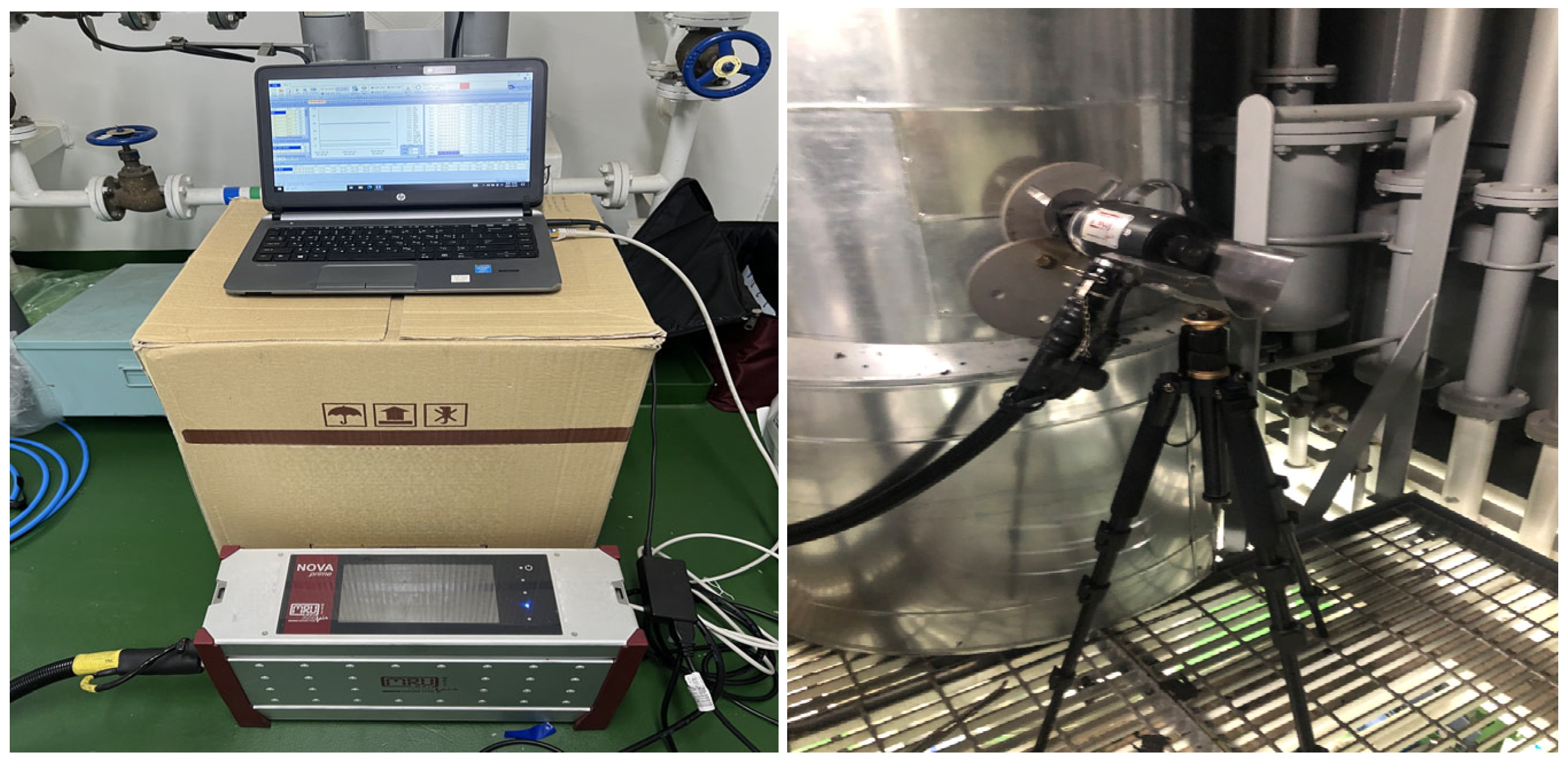
2.2. Methods
3. Results
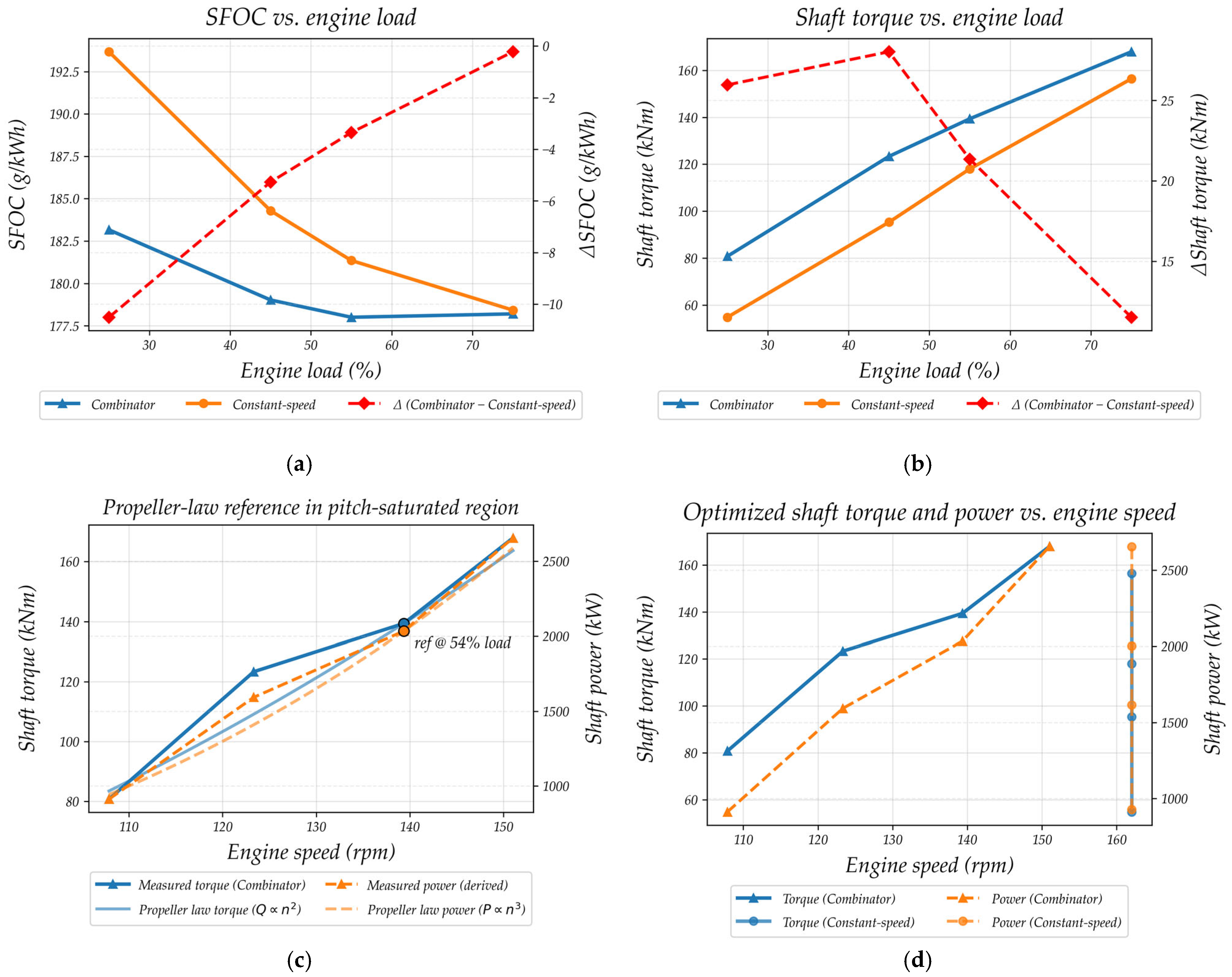
3.1. Propulsion and Fuel Performance Characteristics Under CPP Operating Modes
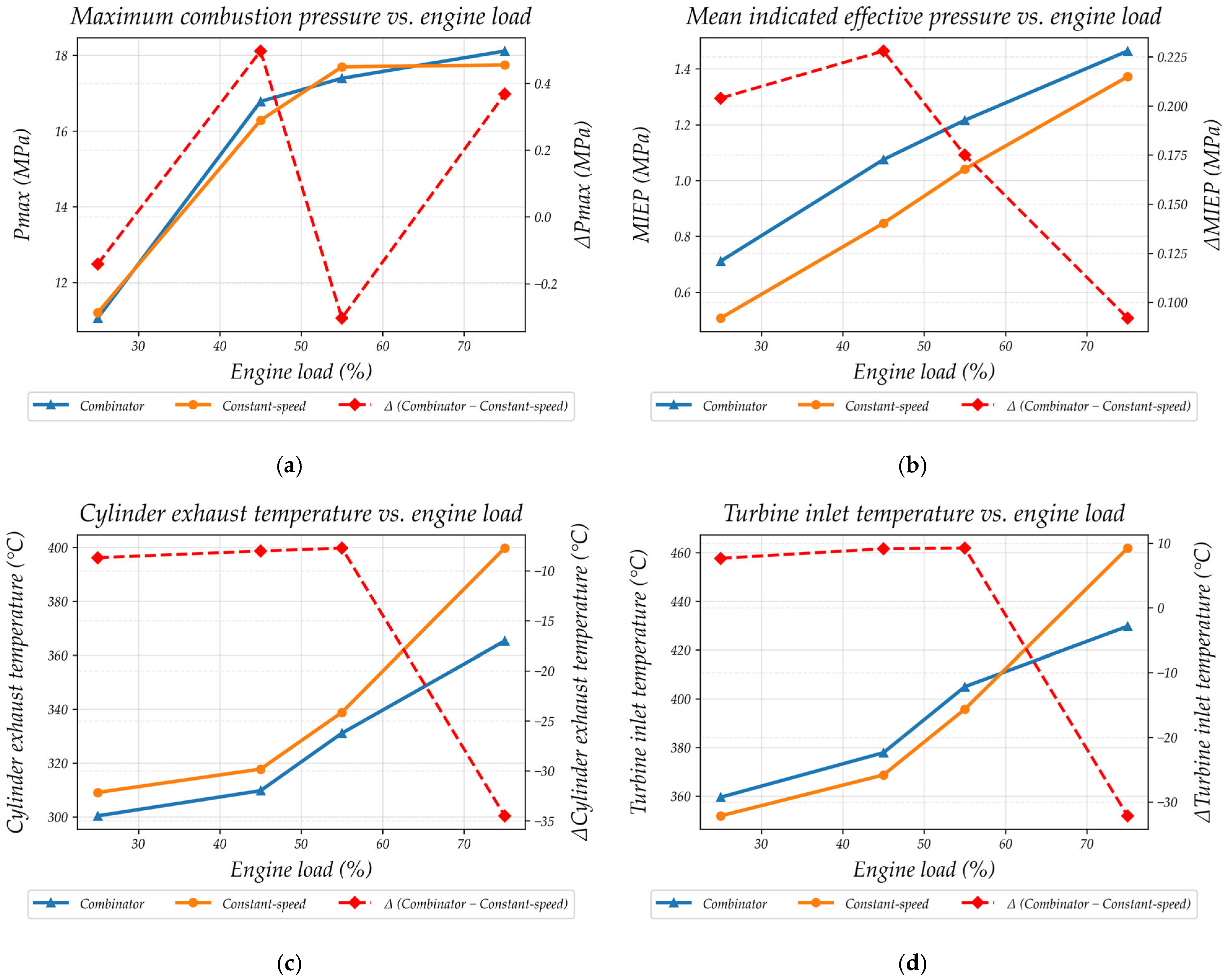
3.2. In-Cylinder Combustion Behavior and Thermal Characteristics
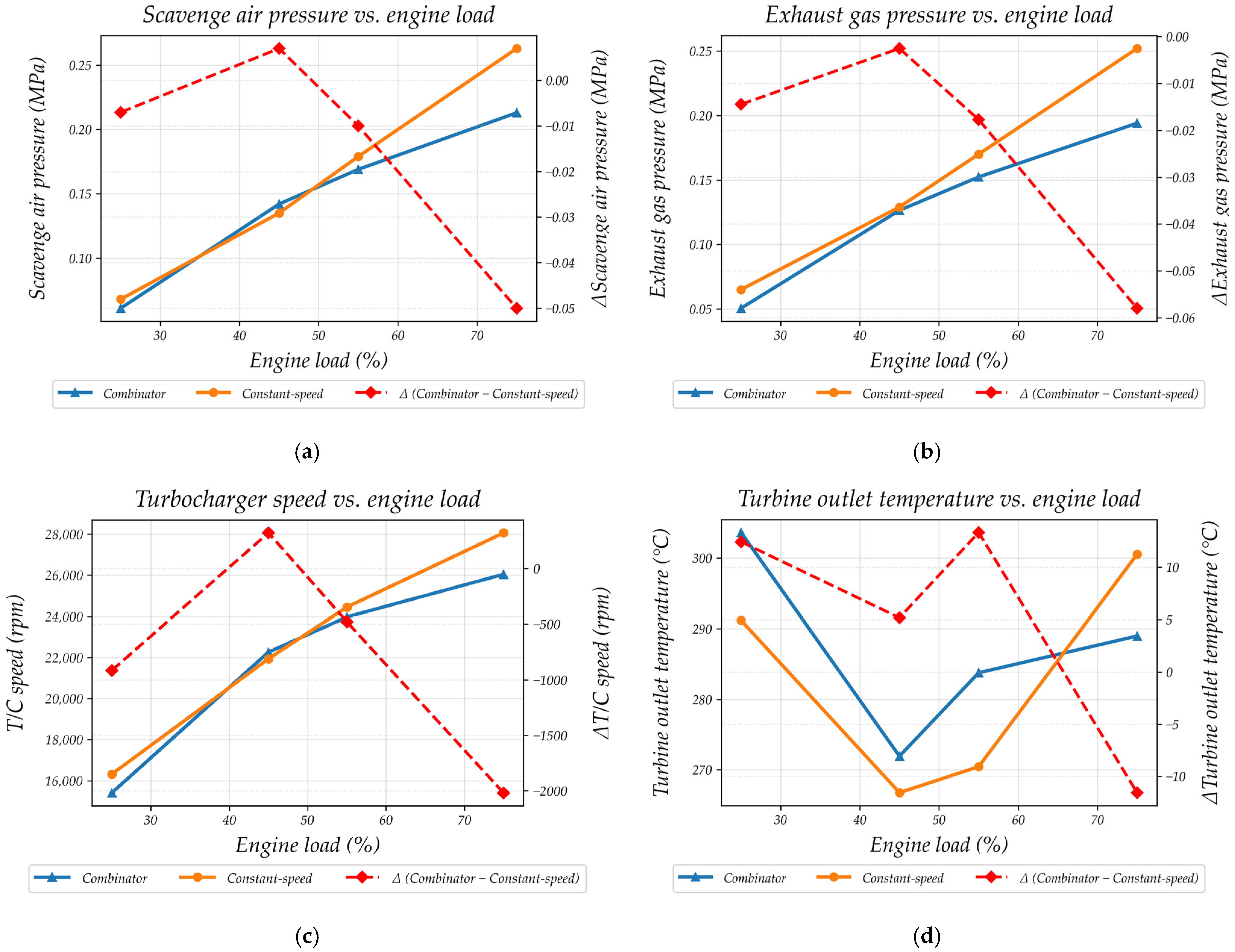
3.3. Boosting and Exhaust-System Response
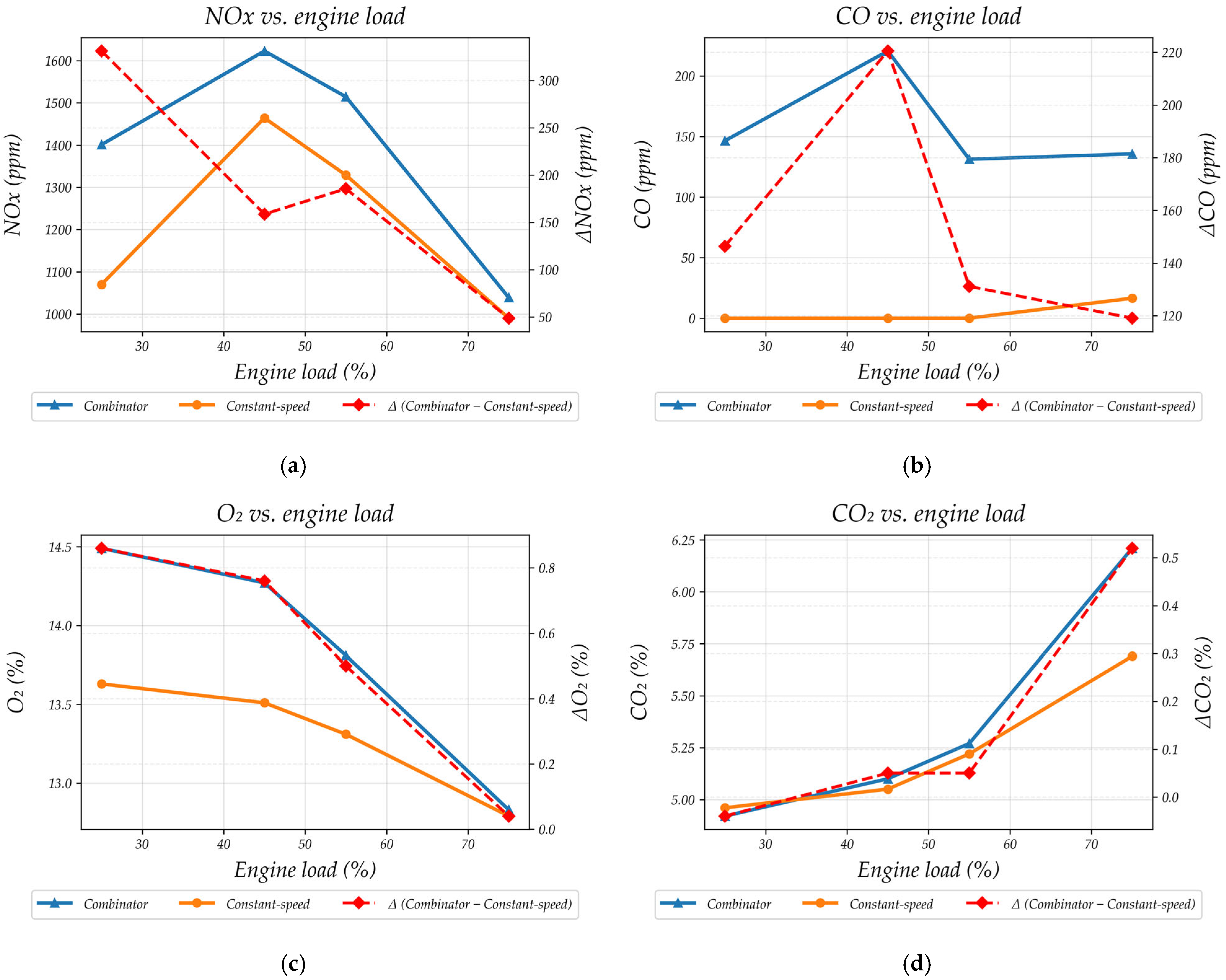
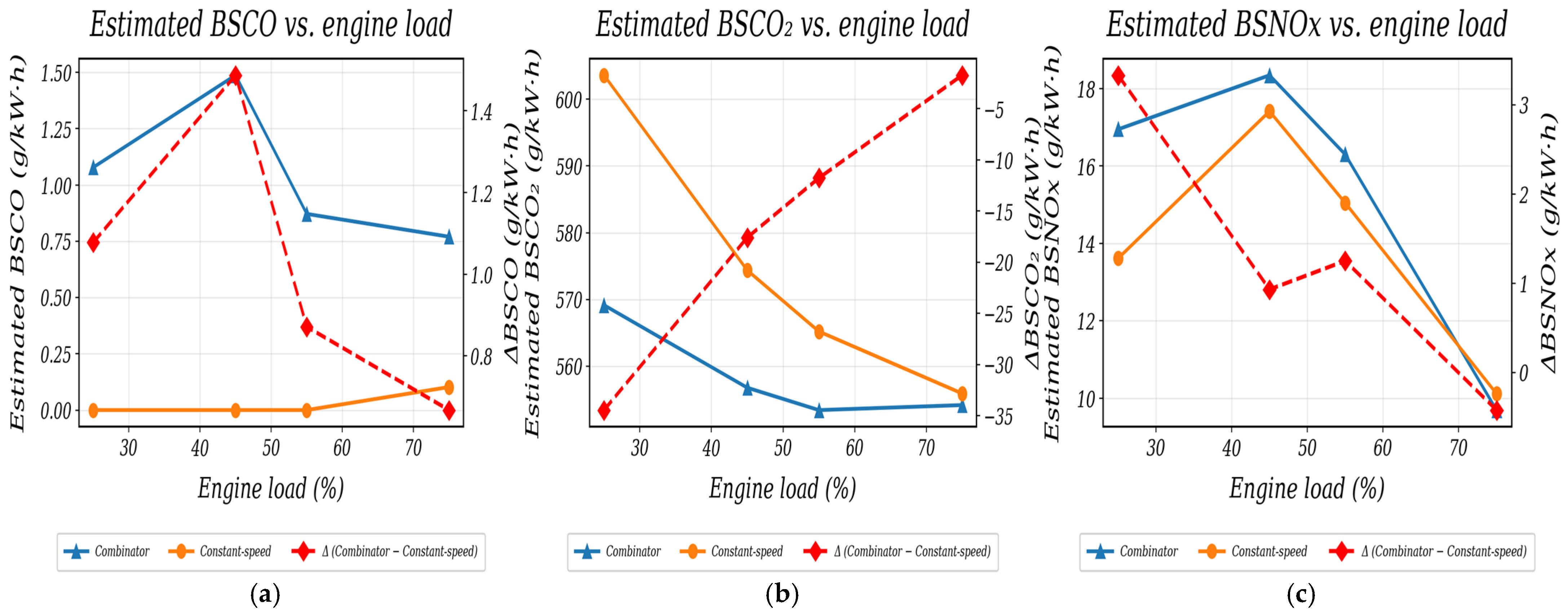
3.4. Exhaust Emission Characteristics and Trade-Off Analysis
4. Discussion
4.1. Operational Implications and CPP Control Strategy
4.1.1. Load-Dependent Operational Characteristics
4.1.2. Emission-Sensitive Operational Trade-Offs
4.1.3. Recommended CPP Operational Strategy Under Sea-Operation Conditions
4.1.4. Implications for Future Emission-Compliant Operation
5. Conclusions
Funding
Data Availability Statement
Acknowledgments
Conflicts of Interest
Abbreviations
| CPP | Controllable pitch propeller |
| FB | Fallback |
| SFOC | Specific fuel oil consumption |
| NOx | Nitrogen oxide |
| CO | Carbon monoxide |
| CO2 | Carbon dioxide |
| IMO | International Maritime Organization |
| EEDI | Energy efficiency design index |
| EEXI | Energy efficiency existing ship index |
| CII | Carbon intensity indicator |
| FPP | Fixed pitch propeller |
| MCR | Maximum continuous rating |
| SMCR | Specified maximum continuous rating |
| EGR | Exhaust gas recirculation |
| NDIR | Non-dispersive infrared |
| LAN | Local area network |
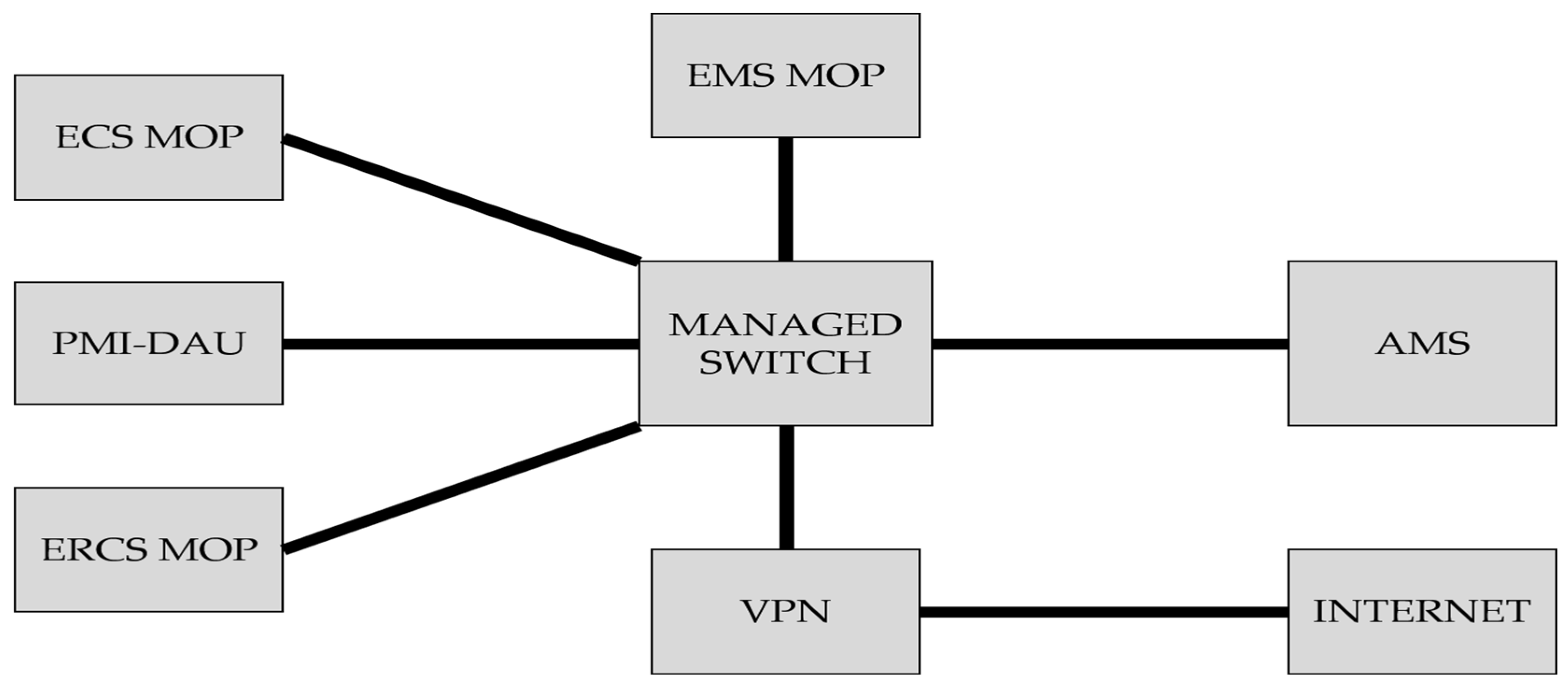
| EMS | Engine management system |
| ECS | Engine control system |
| MOP | Main operating panel |
| PMI | Cylinder pressure measurement system |
| DAU | Data acquisition unit |
| AMS | Alarm management system |
| VPN | Virtual private network |
| WAN | Wide area network |
| MIEP | Mean indicated effective pressure |
| Pmax | Maximum cylinder pressure |
| ppm | Parts per million |
References
- Roy, A.; Chakraborty, M. A review of ship emissions impacts on environmental, health, societal impacts and IMO’s mitigation policies. Reg. Stud. Mar. Sci. 2025, 81, 103964. [Google Scholar] [CrossRef]
- Tadros, M.; Ventura, M.; Guedes Soares, C. Review of the IMO initiatives for ship energy efficiency and their implications. J. Mar. Sci. Appl. 2023, 22, 662–680. [Google Scholar] [CrossRef]
- IMO. Ship Energy Efficiency Regulations and Related Guidelines; IMO: London, UK, 2015. [Google Scholar]
- IMO. Amendments to MARPOL Annex VI (Energy Efficiency Existing Ship Index and Carbon Intensity Indicator); Resolution MEPC: London, UK, 2021; Volume 328. [Google Scholar]
- Ren, H.; Zhang, J.; Gu, Y. Influence of EEDI (Energy Efficiency Design Index) on Ship–Engine–Propeller Matching. J. Mar. Sci. Eng. 2019, 7, 425. [Google Scholar] [CrossRef]
- Marques, C.H.; Caprace, J.-D.; Belchior, C. An approach for predicting the specific fuel consumption of dual-fuel two-stroke marine engines. J. Mar. Sci. Eng. 2019, 7, 20. [Google Scholar] [CrossRef]
- Geertsma, R.D.; Negenborn, R.R.; Visser, K. Adaptive pitch control for ships with diesel mechanical and hybrid propulsion. Appl. Energy 2018, 228, 2490–2509. [Google Scholar] [CrossRef]
- Saettone, S.; Peymani, A.; Simonsen, C.D.; Pérez, R. The importance of the engine-propeller model accuracy on the performance prediction of a marine propulsion system in the presence of waves. Appl. Ocean Res. 2020, 103, 102320. [Google Scholar] [CrossRef]
- Tian, W.; Lang, X.; Zhang, C. Optimization of Controllable-Pitch Propeller Operations for Yangtze River Sailing Ships. J. Mar. Sci. Eng. 2024, 12, 1579. [Google Scholar] [CrossRef]
- Tadros, M.; Ventura, M.; Guedes Soares, C. Optimization procedures for a twin controllable pitch propeller of a ROPAX ship at minimum fuel consumption. J. Mar. Eng. Technol. 2023, 22, 167–175. [Google Scholar] [CrossRef]
- Ozturk, Y.; Kurt, R.E.; Guedes Soares, C. The Effect of Propeller Pitch on Ship Propulsion. Trans. Marit. Sci. 2022, 11, 162–171. [Google Scholar] [CrossRef]
- Aletras, N.; Karvountzis-Kontakiotis, A.; Kefalas, N.; Grigoriadis, A.; Samaras, Z.; Ntziachristos, L. Optimization-Based Energy Management Algorithm for 2-Stroke Hybrid Ship with Controllable Pitch Propeller. J. Mar. Sci. Eng. 2024, 12, 2331. [Google Scholar] [CrossRef]
- Chen, D.; Gu, X.; Wu, T. A Hull–Engine–Propeller Matching Method for Shaftless Rim-Driven Thrusters. J. Mar. Sci. Eng. 2025, 13, 1414. [Google Scholar] [CrossRef]
- Herdzik, J. Problems of Nitrogen Oxides Emission Decreasing from Marine Diesel Engines to Fulfil the Limits of Tier 3. Rocz. Ochr. Sr. 2019, 21, 671–689. [Google Scholar]
- Okumuş, F.; Kökkülünk, G. Review of Nitrogen Oxides (NOx) Reduction Methods Used on Marine Diesel Engines. J. Mar. Eng. Technol. 2023, 3, 34–44. [Google Scholar] [CrossRef]
- Andersson, K.; Brynolf, S.; Lindgren, J.F.; Wilewska-Bien, M. (Eds.) Shipping and the Environment: Improving Environmental Performance in Marine Transportation; Springer: Cham, Switzerland, 2021. [Google Scholar] [CrossRef]
- Tran, T.G.; Kim, H. A study on the matching problem of engine, propeller, and ship hull under actual service conditions. Int. J. Naval Archit. Ocean Eng. 2023, 15, 100538. [Google Scholar] [CrossRef]
- Arina, I.M.; Iswantoro, A.; Fitri, S.A. Combining Optimum Propeller Design on Roro Ship Re-engine. Kapal J. Ilmu Pengetah. Dan Teknol. Kelauta 2023, 20, 201–2013. [Google Scholar] [CrossRef]
- Lee, J.; Dao, V.Q.; Jeong, E.-S.; Noh, J.-H.; Lee, J.-U. Efficiency Comparison and Optimal Voyage Strategy of CPP Combination and Fixed Modes Based on Ship Operational Data. Appl. Sci. 2025, 15, 10435. [Google Scholar] [CrossRef]
- ISO 8178; Reciprocating Internal Combustion Engines—Exhaust Emission Measurement. International Organization for Standardization: Geneva, Switzerland, 2017.
- Revised MARPOL Annex VI: Regulations for the Prevention of Air Pollution from Ships and NOx Technical Code 2008; International Maritime Organization (IMO): London, UK, 2009.


| Description | Specification |
|---|---|
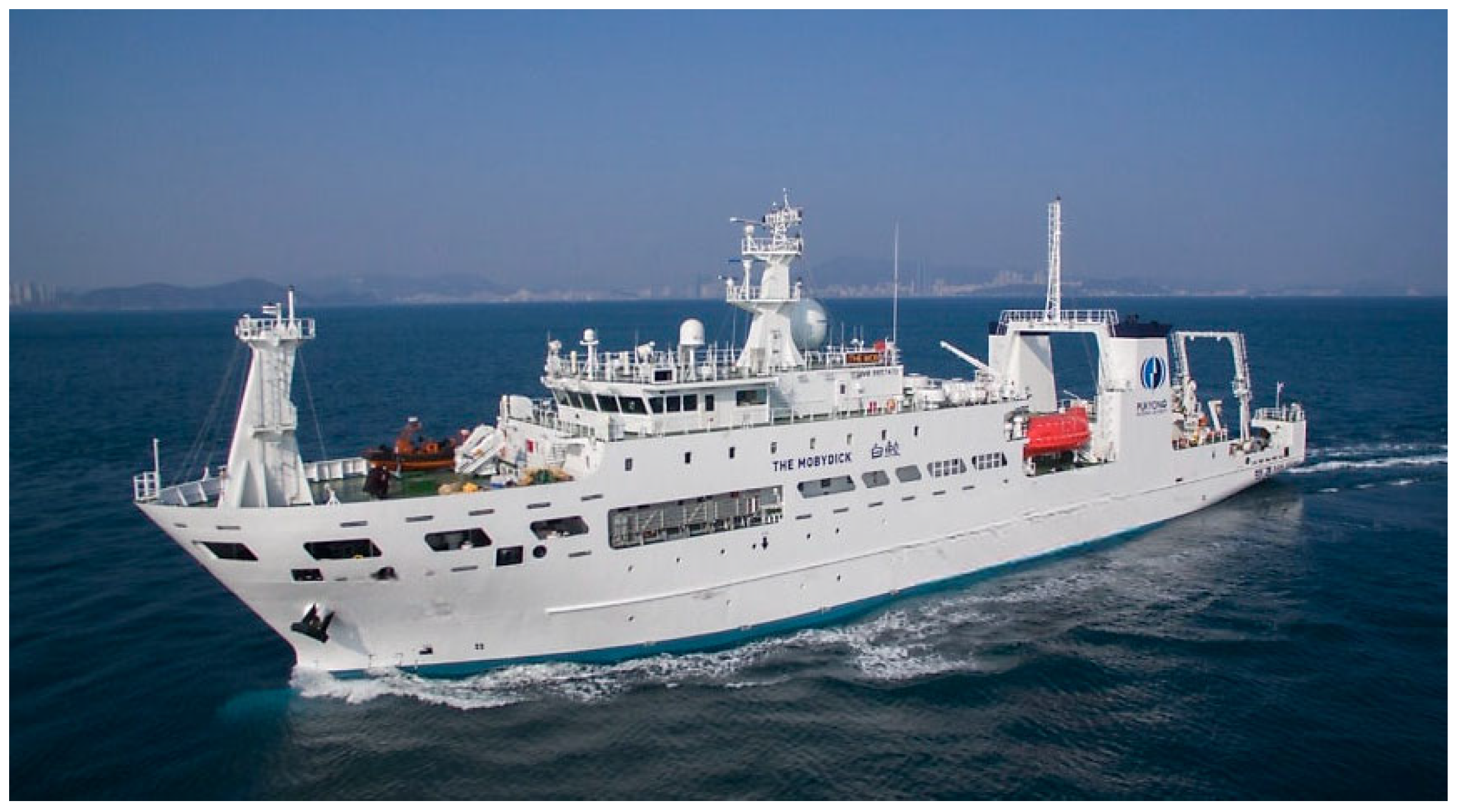
| Kind of ship | Fishery training ship |
| Gross tonnage | 3998 ton |
| Net tonnage | 1199 ton |
| Length over all | 97.00 m |
| Length between perpendiculars | 85.00 m |
| Breadth | 15.40 m |
| Depth | 8.30 m |
| Design draft | 5.30 m |
| Service speed (80% MCR, 15% S.M) | 15.27 knot |
| Description | Specification |
|---|---|
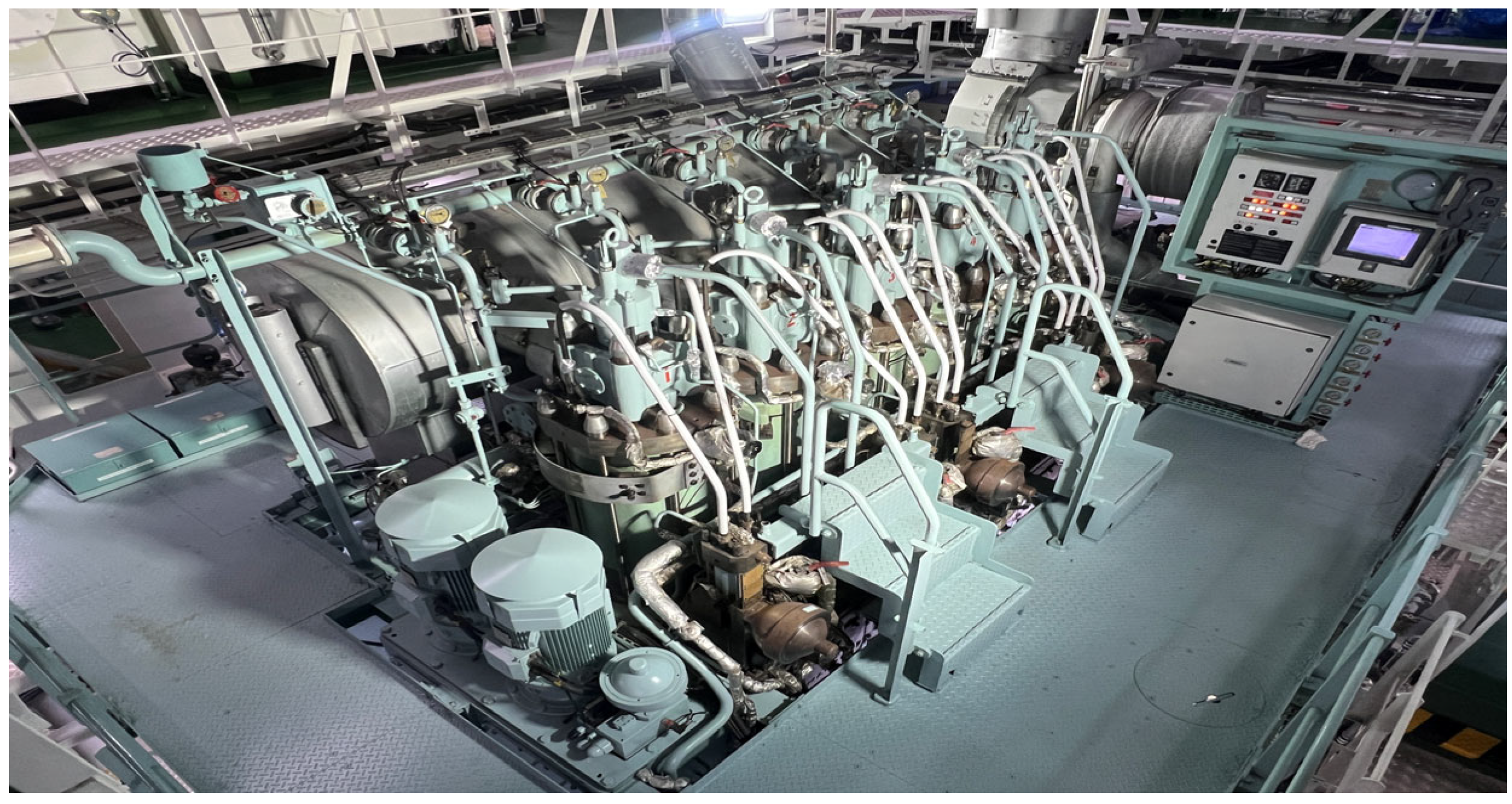
| Engine model | MAN 5S35ME-B9.5 with ecoEGR |
| Engine type | Two-stroke, non-reversible, electronically controlled fuel injection, light camshaft for exhaust valve, exhaust gas turbocharger and air cooler |
| Number of cylinders | 5 |
| Bore/Stroke | 350/1550 mm |
| Engine speed (at SMCR) | 167 rpm |
| Nominal Max. continuous rating | 4350 kW |
| Specific Max. continuous rating | 3475 kW |
| Continuous service rating | 2780 kW |
| Mean effective pressure (at SMCR) | 1.68 MPa |
| Piston speed (at SMCR) | 8.63 m/s |
| SFOC (at SMCR) | 173.0 g/kWh ± 5% tolerance under IMO Tier II mode, ecoEGR |
| Firing order | 1-4-3-2-5 |
| Description | Specification |
|---|---|
| Propulsion control system | Alphatronic 3000 |
| Propeller type | VBS940 |
| Diameter | 3800 mm |
| Propeller rpm | 167 rpm |
| Gear type | N/A |
| Trial P/D at 100% pitch | 0.9042 |
| Max available propeller pitch movement In propeller hub | Full ahead 123 mm |
| Full astern 54 mm |
| Description | Sea Operation |
|---|---|
| Kind of fuel | MGO |
| Density at 15 °C, kg/m3 | 855.1 |
| Kinematic Viscosity at 40 °C, mm2/s | 2.90 |
| Sulfur content, wt% | 0.043 |
| Flash point °C | 63 |
| Parameter | Measurement Range | Accuracy |
|---|---|---|
| NO | 0–5000 ppm | ±5 ppm |
| NO2 | 0–1000 ppm | ±5 ppm |
| O2 | 0–25.00% | ±0.2% |
| CO2 | 0–40.00% | ±0.3% |
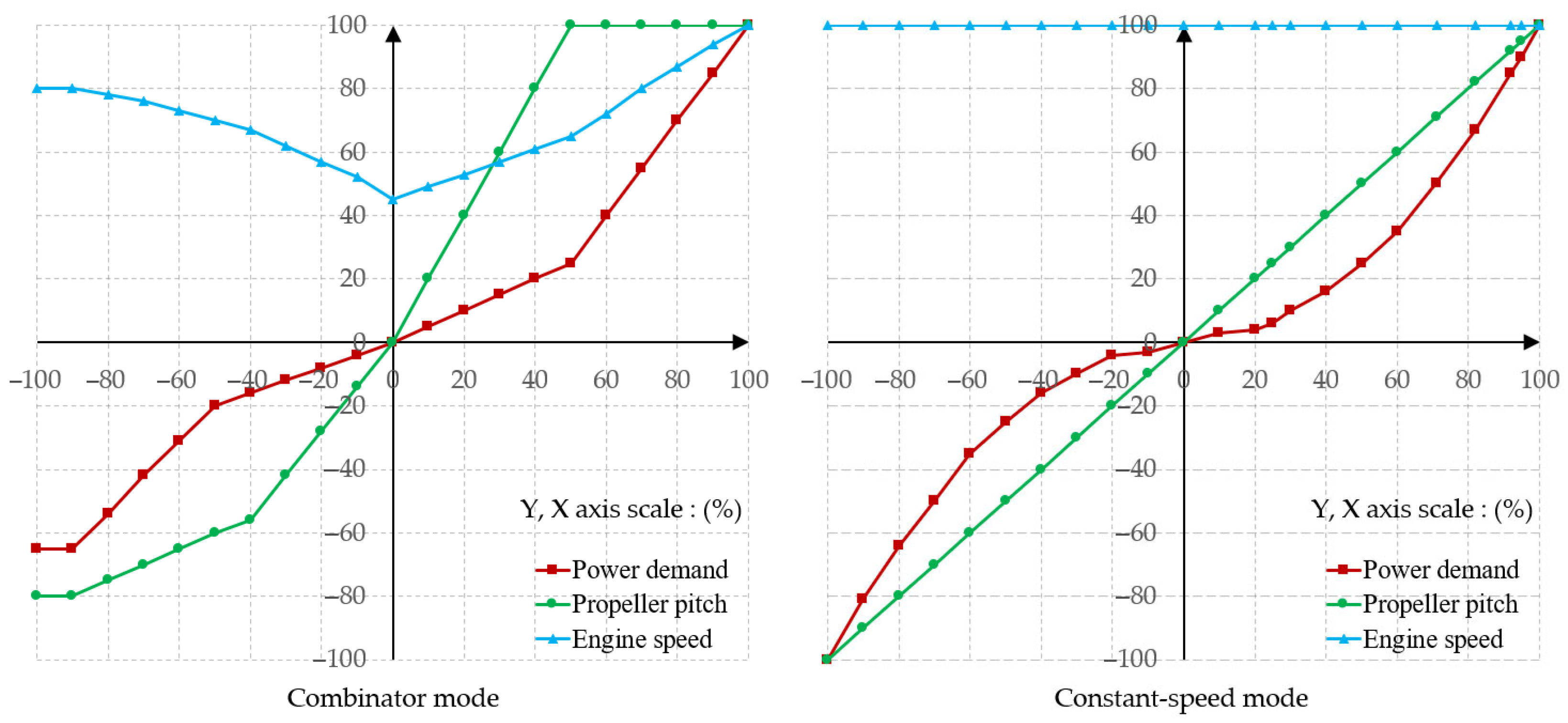
| CPP Mode | Load (%SMCR) | Engine Speed (RPM) | CPP Pitch (%) |
|---|---|---|---|
| Constant-speed mode | 75% | 162 | 92 |
| 55% | 162 | 80 | |
| 45% | 162 | 71 | |
| 25% | 162 | 47 | |
| Combinator mode | 75% | 151 | 100 |
| 54% | 139 | 100 | |
| 47% | 123 | 100 | |
| 25% | 108 | 100 |
| CPP Mode | Load (%) | Course | Wind Direction | Wind Force (Bft) | Sea State (Log Code) | Atmospheric Pressure (kPa) |
|---|---|---|---|---|---|---|
| Combinator | 25 | Straight | E | 2 | f | 101.0 |
| 47 | Straight | N | 3 | bc | 101.1 | |
| 54 | Straight | S | 4 | d | 100.0 | |
| 75 | Straight | S | 3 | bc | 100.9 | |
| Constant-speed | 25 | Straight | S | 3 | c | 101.4 |
| 45 | Straight | S | 3 | c | 101.4 | |
| 55 | Straight | S | 3 | c | 101.4 | |
| 75 | Straight | SE | 3 | c | 101.4 |
| CPP Mode | Load (%SMCR) | BSNOx (g/kWh, est.) | BSCO (g/kWh, est.) | BSCO2 (g/kWh, est.) |
|---|---|---|---|---|
| Constant-speed mode | 75% | 10.114 | 0.102 | 555.915 |
| 55% | 15.045 | ~0.000 (BDL) | 565.208 | |
| 45% | 17.411 | ~0.000 (BDL) | 574.370 | |
| 25% | 13.614 | ~0.000 (BDL) | 603.605 | |
| Combinator mode | 75% | 9.692 | 0.770 | 554.180 |
| 54% | 16.626 | 0.876 | 553.390 | |
| 47% | 18.482 | 1.528 | 555.544 | |
| 25% | 16.946 | 1.078 | 569.155 |
| Load Window | Low Load (≈25%) | Medium Load (≈45–55%) | High Load (≈75%) |
|---|---|---|---|
| Recommended CPP mode | Selective combinator (conditional use) | Continuous combinator | Prefer constant-speed |
| Expected performance benefit | SFOC ↓ (up to 5.4%); shaft torque ↑ (up to 47%) at partial load | Most favorable efficiency–propulsion window; improved engine–propeller matching | Marginal SFOC benefit; reduced torque advantage compared with partial-load operation |
| Emission risk (relative) | Highest: NOx ↑ (up to 31%); CO (dry) ≈ 130–220 ppm observed | Moderate: NOx penalty decreases with load | Lower: Mode-dependent emission differences decrease |
| When to override (typical cases) | Maneuvering, schedule recovery, or transient propulsion demand → allow combinator. If emission margin is limited or stable operation is prioritized → use constant-speed | In emission-restricted zones (e.g., near-port constraints) or if stability issues arise → temporarily revert to constant-speed | Only consider combinator when specific propulsion control is required (e.g., sea state/current response) |
| Control note | Apply time-/condition-limited combinator use and avoid frequent switching to reduce variability | Suitable as the default efficiency-optimized operating mode in this load range | Prioritize operational stability and consistency; avoid unnecessary mode-induced fluctuations |
Disclaimer/Publisher’s Note: The statements, opinions and data contained in all publications are solely those of the individual author(s) and contributor(s) and not of MDPI and/or the editor(s). MDPI and/or the editor(s) disclaim responsibility for any injury to people or property resulting from any ideas, methods, instructions or products referred to in the content. |
© 2026 by the author. Licensee MDPI, Basel, Switzerland. This article is an open access article distributed under the terms and conditions of the Creative Commons Attribution (CC BY) license.
Share and Cite
Moon, J. Comparative Analysis of Performance and Emissions of a Two-Stroke Marine Diesel Engine According to CPP Modes. J. Mar. Sci. Eng. 2026, 14, 331. https://doi.org/10.3390/jmse14040331
Moon J. Comparative Analysis of Performance and Emissions of a Two-Stroke Marine Diesel Engine According to CPP Modes. Journal of Marine Science and Engineering. 2026; 14(4):331. https://doi.org/10.3390/jmse14040331
Chicago/Turabian StyleMoon, Jaesung. 2026. "Comparative Analysis of Performance and Emissions of a Two-Stroke Marine Diesel Engine According to CPP Modes" Journal of Marine Science and Engineering 14, no. 4: 331. https://doi.org/10.3390/jmse14040331
APA StyleMoon, J. (2026). Comparative Analysis of Performance and Emissions of a Two-Stroke Marine Diesel Engine According to CPP Modes. Journal of Marine Science and Engineering, 14(4), 331. https://doi.org/10.3390/jmse14040331