Machine Learning Framework for Fault Detection and Diagnosis in Rotating Machinery


Abstract
1. Introduction
2. Rotating Machinery
2.1. Rotating Machinery in the Maritime Context
2.2. Faults in Rotating Machinery
2.3. Fault Diagnosis in Rotating Machinery Using Machine Learning
3. Proposed Framework for Condition Monitoring
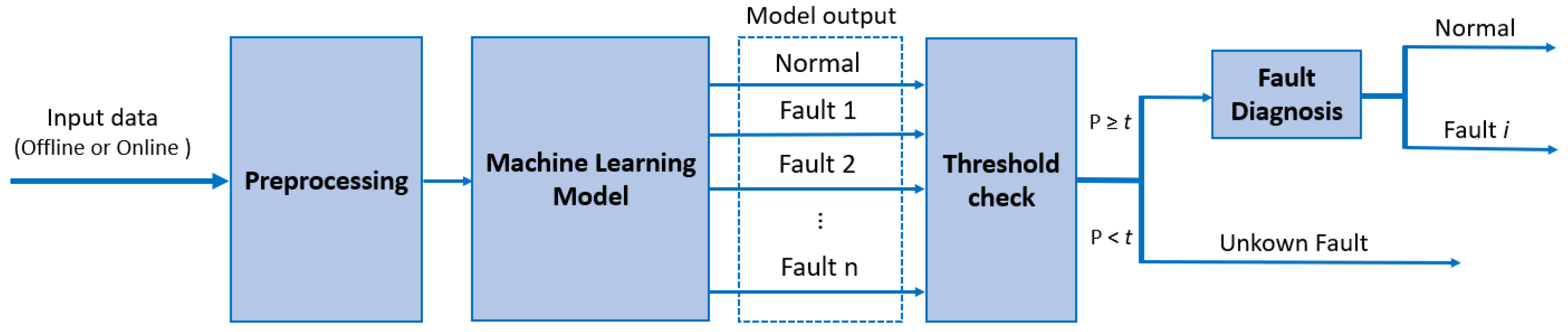
- The first component corresponds to the framework input, which can receive either previously acquired signals (offline) or real-time signals (online) from the sensors. The input data may include vibration signals, electrical current, temperature, or other measured physical quantities, depending on the condition monitoring technique employed and the type of machine or its application.
- The second component corresponds to the preprocessing phase, where the input signal is processed to match the format of the samples used during the development of the applied ML model. For example, if the model was trained using feature extraction based on statistical functions, the same extraction procedure must be applied to the raw input signal. Alternatively, if the model was developed using signals in the frequency domain, the input signal must first be converted from the time domain to the frequency domain.
- The third component represents the application of the Machine Learning model, which represents the core of the proposed framework. This model, previously trained with a labeled dataset mapping known machine fault patterns to fault classes, performs the classification task.
- The fourth component corresponds to the model’s output. The output consists of mutually exclusive classes, where the model assigns a score to the input sample across all possible classes, typically expressed as a probability distribution. The first class, Normal, indicates the absence of fault, confirming that the machine is operating under normal conditions. The remaining classes, from Fault 1 to Fault n, correspond to the different fault types or, alternatively, to varying severity levels of a particular fault if such gradation was included during model training. For example, Fault 1 and Fault 2 may both indicate unbalance, with Fault 2 corresponding to a higher severity level than Fault 1. The total of n + 1 output classes enables the proposed framework to perform automatic multi-fault diagnosis.
- In order to extend the robustness of the proposed framework, a fifth component was introduced after the model output. This threshold mechanism retrieves the highest probability value P assigned by the model to its predicted classes and compares it to a threshold value t. The value of t is selected by the user within the range [0, 1], according to the desired confidence level to the system. If a more rigid and accurate system is required, a higher value of t should be chosen, ensuring that a sample is classified as belonging to a known class only when its classification probability P exceeds t. Conversely, lower values of t reduce the confidence level associated with the sample classification process.
- The sixth component corresponds to the framework output. If P is greater than or equal to t, the system classifies the input signal as belonging to one of the known classes. Otherwise, the system classifies the input signal as an unknown fault, not represented within the model’s training data.
4. Experimental Evaluation
- Random Forest [2], selected for its robustness and frequent use in multiclass classification tasks;
4.1. Experimental Setting
- Random Forest and Support Vector Machines:
- Training with raw time domain signals, without any preprocessing;
- Training with statistical features extracted from the signals in the time domain;
- Training with vibration signals transformed from the time domain to the frequency domain.
- Convolutional Neural Networks:
- Training a one-dimensional CNN using the raw time domain vibration signals;
- Training a one-dimensional CNN with vibration signals transformed from the time domain to the frequency domain;
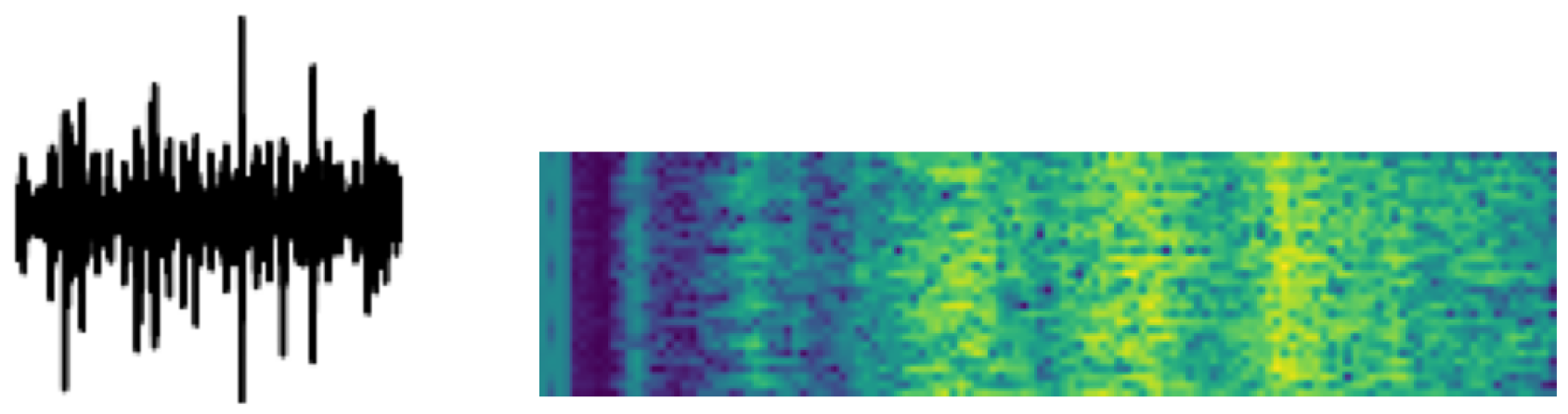
- Training a two-dimensional CNN using representative images of raw vibration signals;
- Training a two-dimensional CNN with images corresponding to the spectrograms of the acquired vibration signals.
4.2. Data Description
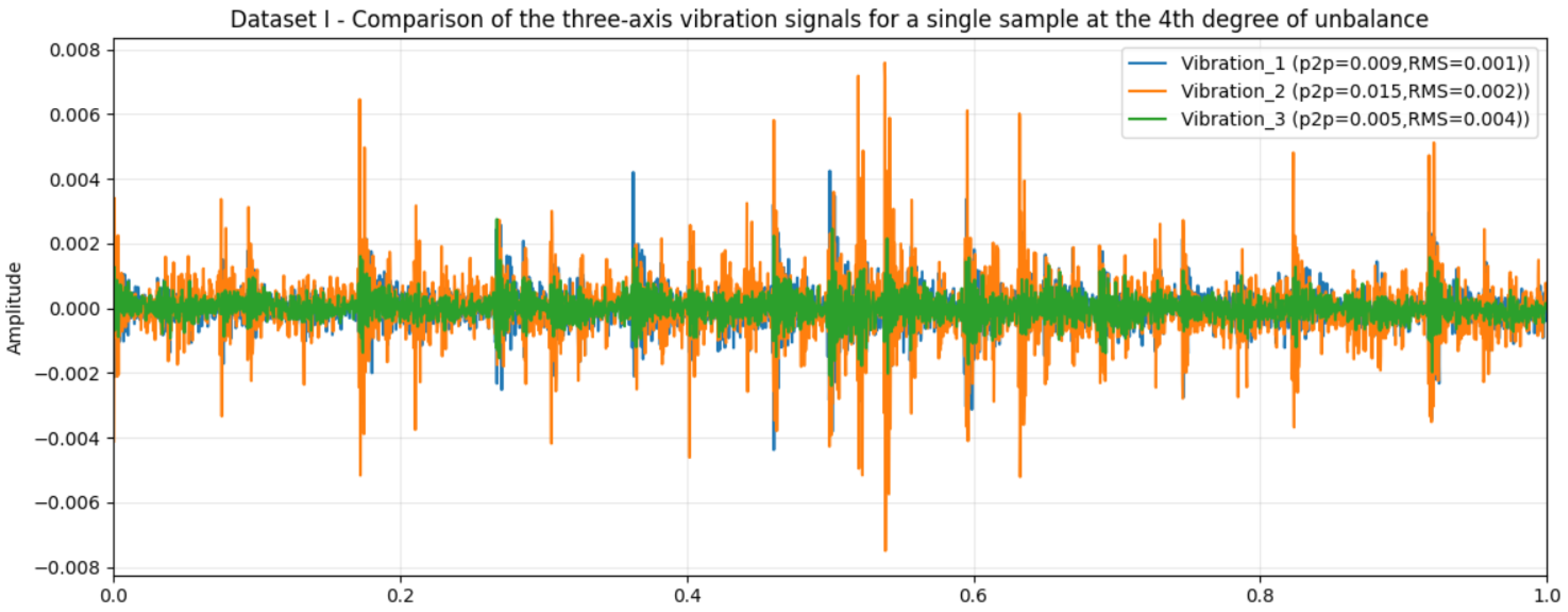
4.2.1. Dataset I
4.2.2. Dataset II
4.3. Preprocessament
4.4. Feature Extraction
5. Design and Development of Machine Learning Models
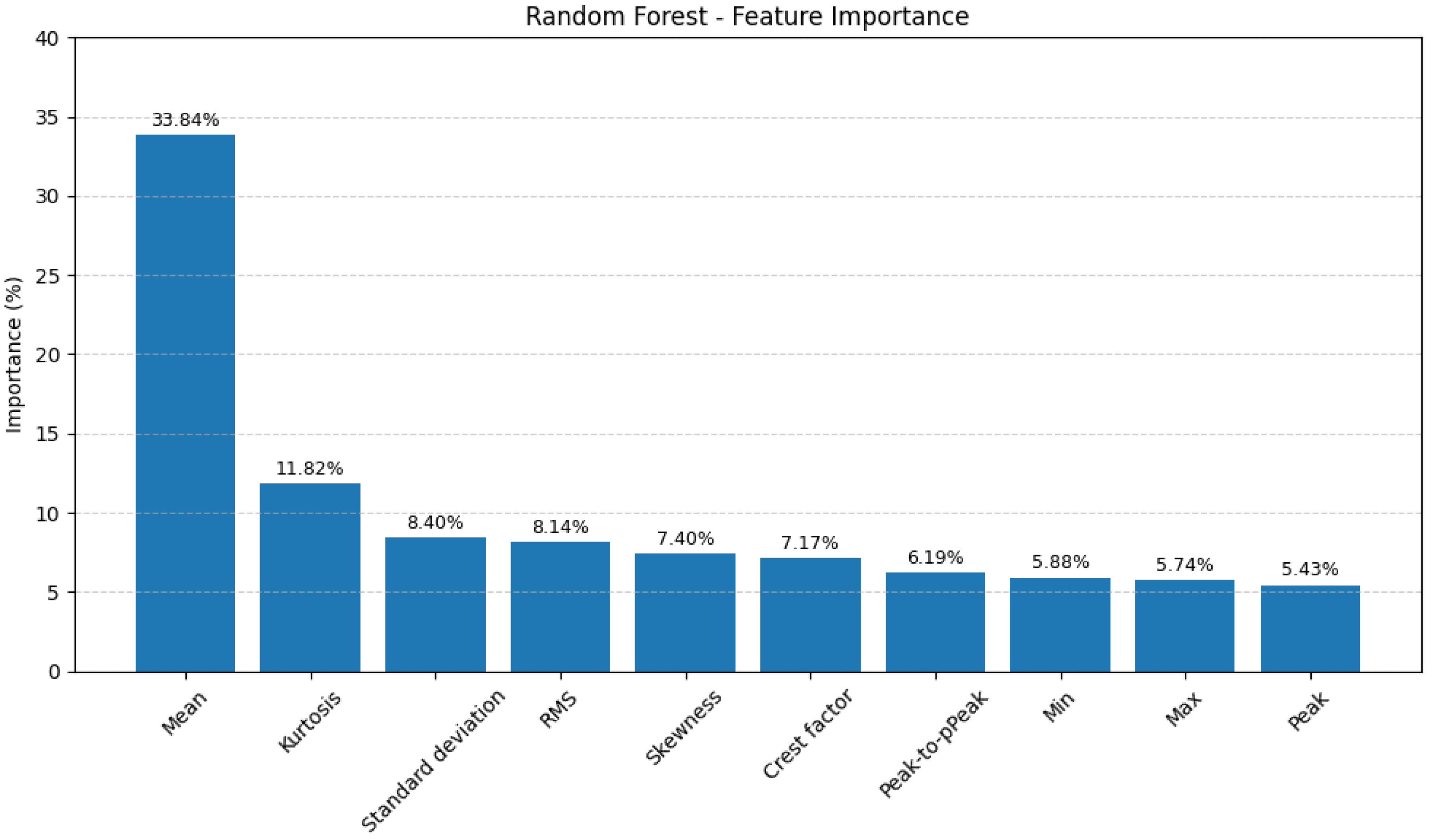
5.1. Random Forest
5.2. Support Vector Machines
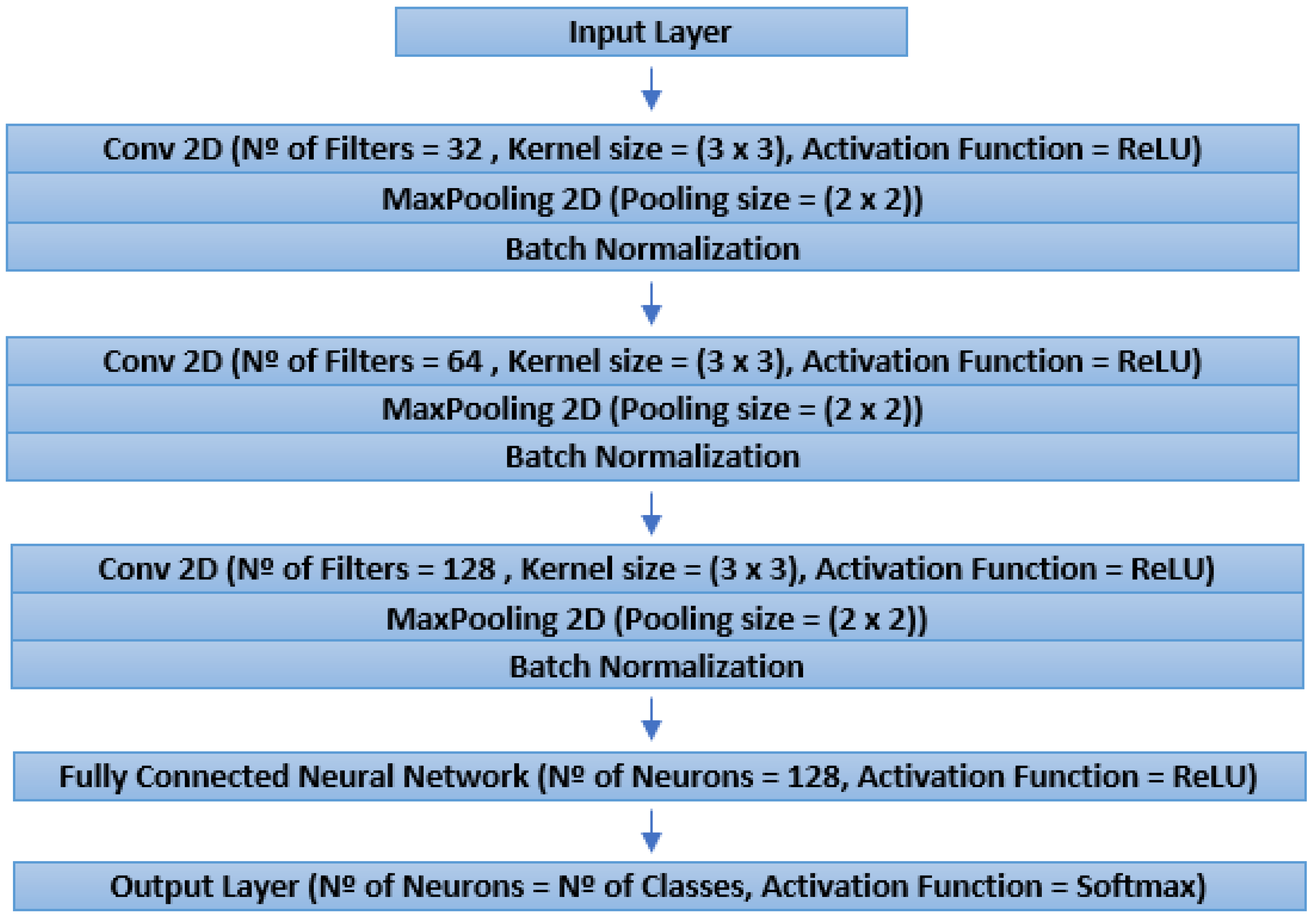
5.3. Convolutional Neural Networks
6. Results and Discussion
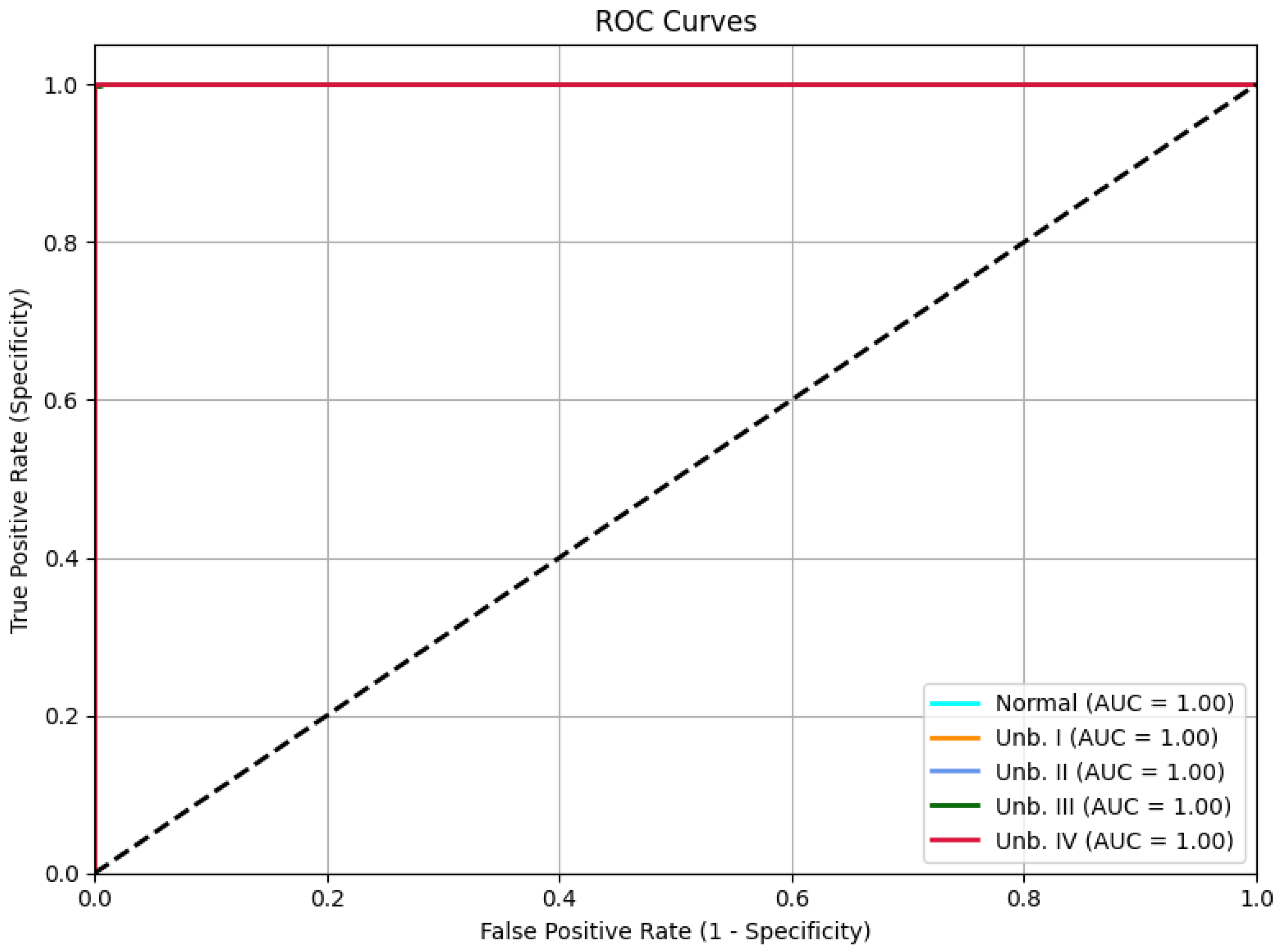
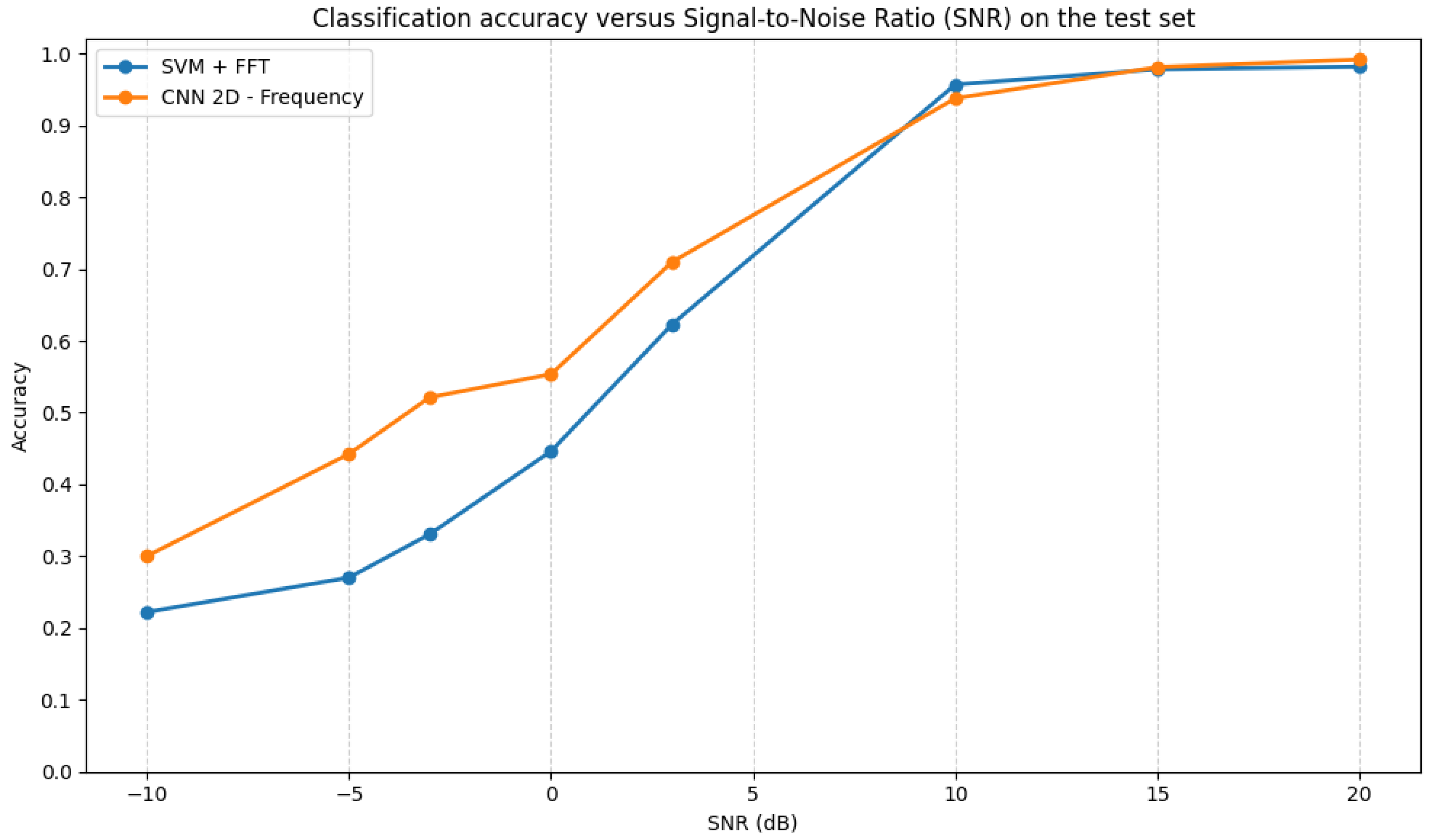
6.1. Known Faults
6.2. Unknown Faults
7. Conclusions
Author Contributions
Funding
Data Availability Statement
Conflicts of Interest
| 1 | More about Kaggle free resources in https://www.kaggle.com/code/dansbecker/running-kaggle-kernels-with-a-gpu (accessed on 28 October 2025). |
References
- Atmaja, B.T.; Ihsannur, H.; Suyanto; Arifianto, D. Lab-Scale Vibration Analysis Dataset and Baseline Methods for Machinery Fault Diagnosis with Machine Learning. J. Vib. Eng. Technol. 2024, 12, 1991–2001. [Google Scholar] [CrossRef]
- Nandi, A.; Ahmed, H. Condition Monitoring with Vibration Signals; Wiley—IEEE Press: Hoboken, NJ, USA, 2019. [Google Scholar]
- Nath, A.G.; Udmale, S.S.; Singh, S.K. Role of artificial intelligence in rotor fault diagnosis: A comprehensive review. Artif. Intell. Rev. 2020, 54, 2609–2668. [Google Scholar] [CrossRef]
- ISO 10816; Mechanical Vibration—Evaluation of Machine Vibration by Measurements on Non-Rotating Parts. ISO: Geneva, Switzerland, 2015.
- Cheng, Z.; Liu, H.; Hua, R.; Dong, L.; Ma, Q.; Zhu, J. Research on Multi-Fault Identification of Marine Vertical Centrifugal Pump Based on Multi-Domain Characteristic Parameters. J. Mar. Sci. Eng. 2023, 11, 551. [Google Scholar] [CrossRef]
- Bently, D.E.; Hatch, C.T. Fundamentals of Rotating Machinery Diagnostics; Bently Pressurized Bearing Press: Minden, NV, USA, 2002. [Google Scholar]
- McMillan, R.B. Rotating Machinery: Practical Solutions to Unbalance and Misalignment, 1st ed.; Fairmont Press: Lilburn, GA, USA, 2004. [Google Scholar]
- Higgins, L.R.; Mobley, R. Maintenance Engineering Handbook, 6th ed.; McGraw-Hill: New York, NY, USA, 2002. [Google Scholar]
- Khalil, A.F.; Rostam, S. Machine Learning-based Predictive Maintenance for Fault Detection in Rotating Machinery: A Case Study. Eng. Technol. Appl. Sci. Res. 2024, 14, 13181–13189. [Google Scholar] [CrossRef]
- Friswell, M.I.; Penny, J.E.T.; Garvey, S.D.; Lees, A.W. Dynamics of Rotating Machines; Cambridge University Press: Cambridge, UK, 2010. [Google Scholar]
- Neupane, D.; Seok, J. Bearing Fault Detection and Diagnosis Using Case Western Reserve University Dataset with Deep Learning Approaches: A Review. IEEE Acess 2020, 8, 93155–93178. [Google Scholar] [CrossRef]
- Hwang, S.-Y.; Lee, J.-c.; Lee, S.-s.; Min, C. Anomaly-Detection Framework for Thrust Bearings in OWC WECs Using a Feature-Based Autoencoder. J. Mar. Sci. Eng. 2025, 13, 1638. [Google Scholar] [CrossRef]
- Akbar, G.; Dhini, A. Fault Detection Model of Rotating Machinery Using Machine Learning: Case Study of Oil and Gas Company. In 15th International Conference on Software, Knowledge, Information Management and Applications; Institute of Electrical and Electronics Engineers Inc.: New York, NY, USA, 2023. [Google Scholar]
- Ong, P.; Tan, Y.K.; Lai, K.H.; Sia, C.K. A deep convolutional neural network for vibration-based health-monitoring of rotating machinery. Decis. Anal. J. 2023, 7, 100219. [Google Scholar] [CrossRef]
- Jolfaei, N.G.; Linden, L.V.D.; Jin, B.; Gorjian, N.; Rameezdeen, R.; Pourmajidian, M. An intelligent dynamic fault diagnostic model for rotating machinery. In 7th International Conference on System Reliability and Safety; Institute of Electrical and Electronics Engineers Inc.: New York, NY, USA, 2023. [Google Scholar]
- Lee, Y.E.; Kim, B.K.; Bae, J.H.; Kim, K.C. Misalignment Detection of a Rotating Machine Shaft Using a Support Vector Machine Learning Algorithm. Int. J. Precis. Eng. Manuf. 2021, 22, 409–416. [Google Scholar] [CrossRef]
- Tobi, M.A.S.A.; Ramachandran, K.P.; AL-Araimi, S.; Pacturan, R.; Rajakannu, A.; Achuthan, C. Machinery Faults Diagnosis using Support Vector Machine (SVM) and Naïve Bayes classifiers. Int. J. Eng. Trends Technol. 2022, 70, 26–34. [Google Scholar] [CrossRef]
- Liu, F.; Li, W.; Wu, Y.; He, Y.; Li, T. Fault Diagnosis of Imbalance and Misalignment in Rotor-Bearing Systems Using Deep Learning. Pol. Marit. Res. 2024, 31, 102–113. [Google Scholar] [CrossRef]
- Kumar, S. Motor Bearing Faults Detection and Classification based on Convolutional Neural Network and Support Vector Machine: A Comparative Study. In 2nd Global Conference for Advancement in Technology (GCAT); Institute of Electrical and Electronics Engineers Inc.: New York, NY, USA, 2021; pp. 1–6. [Google Scholar]
- Bouchareb, N.; Bengherbia, B.; Chadli, S.; Tobbal, A.; Rebiai, M.; Toumi, Y. Enhanced Bearing Fault Diagnosis Using Transfer Learning and Spectrograms with Pretrained GoogLeNet. In 2024 International Conference on Telecommunications and Intelligent Systems (ICTIS); Institute of Electrical and Electronics Engineers Inc.: New York, NY, USA, 2024. [Google Scholar]
- Joseph, T.; Sudeep, U.; Krishnan K, K. Deep Learning Based Fault Diagnosis of Rolling Bearing Using Spectrogram and CWT Images of Vibration Data. In 11th International Conference on Advances in Computing and Communications (ICACC); Institute of Electrical and Electronics Engineers Inc.: New York, NY, USA, 2024. [Google Scholar]
- Jallepalli, D.; Kakhki, F.D. Data-Driven Fault Classification Using Support Vector Machines. In Intelligent Human Systems Integration; Springer: Cham, Switzerland, 2021; pp. 316–322. [Google Scholar]
- Zhao, M.; Zhong, S.; Fu, X.; Tang, B.; Pecht, M. Deep Residual Shrinkage Networks for Fault Diagnosis. IEEE Trans. Ind. Inform. 2020, 16, 4681–4690. [Google Scholar] [CrossRef]
- Geng, Y.; Su, S.; Zhang, T.; Zhu, Z. A Novel Multi–Scale One–Dimensional Convolutional Neural Network for Intelligent Fault Diagnosis of Centrifugal Pumps. J. Mar. Sci. Eng. 2023, 11, 2278. [Google Scholar] [CrossRef]
- Gawde, S.; Patil, S.; Kumar, S.; Kamat, P.; Kotecha, K.; Abraham, A. Multi-fault diagnosis of Industrial Rotating Machines using Data-driven approach: A review of two decades of research. Eng. Appl. Artif. Intell. 2023, 123, 106139. [Google Scholar] [CrossRef]
- Sawai, T.B.; Mudke, S.; Kapoor, P.V.; Mujumdar, U.B. Bearing Fault Detection in Induction Motor using Ensemble Learning. In 2023 5th International Conference on Energy, Power and Environment: Towards Flexible Green Energy Technologies (ICEPE); Institute of Electrical and Electronics Engineers Inc.: New York, NY, USA, 2023. [Google Scholar]
- Mey, O.; Neudeck, W.; Schneider, A.; Enge-Rosenblatt, O. Vibration Measurements on a Rotating Shaft at Different Unbalance Strengths. 2022. Available online: https://fordatis.fraunhofer.de/handle/fordatis/151.2?locale=en (accessed on 4 March 2025).
- Mey, O.; Neudeck, W.; Schneider, A.; Enge-Rosenblatt, O. Machine Learning-Based Unbalance Detection of a Rotating Shaft Using Vibration Data. In 25th International Conference on Emerging Technologies and Factory Automation; Institute of Electrical and Electronics Engineers Inc.: New York, NY, USA, 2020. [Google Scholar]
- de Sá Só Martins, D.; Pestana-Viana1, D.; Lima, A.A.; Gutiérrez, R.; Vaz, L.; Haddad, D.B. COMFAULDA (ComposedFaultDataset). 2020. Available online: https://ieee-dataport.org/documents/composed-fault-dataset-comfaulda (accessed on 16 April 2025).
- Marwala, T.; Vilakazi, C.B. Computational intelligence for condition monitoring. arXiv 2007, arXiv:0705.2604. [Google Scholar] [CrossRef]
- Arun, F.G.; Alamanda, S.; Babu, S.B.G.T.; Kavita, K.; Pesaru, P.R.; Natrayan, L. Machine Learning-Based Fault Diagnosis for Rotating Machinery in Industrial Settings. In 9th International Conference on Science Technology Engineering and Mathematics (ICONSTEM); Institute of Electrical and Electronics Engineers Inc.: New York, NY, USA, 2024. [Google Scholar]
- Géron, A. Hands-On Machine Learning with Scikit-Learn and TensorFlow; O’Reilly: Sebastopol, CA, USA, 2017. [Google Scholar]
- Chollet, F. Deep Learning with Python, 2nd ed.; Manning: Shelter Island, NY, USA, 2021. [Google Scholar]
- Lee, H.; Yu, J. A Fault Detection Framework for Rotating Machinery with a Spectrogram and Convolutional Autoencoder. J. Appl. Sci. 2025, 15, 7698. [Google Scholar] [CrossRef]



| Kernel | Regularization Coefficient | Gamma | Degree |
|---|---|---|---|
| Linear | {0.1, 1, 10, 100} | — | — |
| RBF | {0.1, 1, 10, 100} | {0.001, 0.01, 0.1, Scale} | — |
| Polynomial | {0.1, 1, 10} | {0.01, 0.1} | {2, 3, 4} |
| Model | Dataset I | ||
|---|---|---|---|
| Kernel | Reg. Coef. | Gamma | |
| SVM | RBF | 10 | Scale |
| SVM + FeatExt | RBF | 100 | 0.1 |
| SVM + FFT | RBF | 100 | 0.001 |
| Model | Dataset II | |||
|---|---|---|---|---|
| Kernel | Reg. Coef. | Gamma | Degree | |
| SVM | Polynomial | 1 | 0.01 | 2 |
| SVM + FeatExt | RBF | 100 | 0.1 | – |
| SVM + FFT | Linear | 0.1 | – | – |
| Models | Dataset I | |||||
|---|---|---|---|---|---|---|
| Acc. | F1-Score | |||||
| Normal | Unb. I | Unb. II | Unb. III | Unb. IV | ||
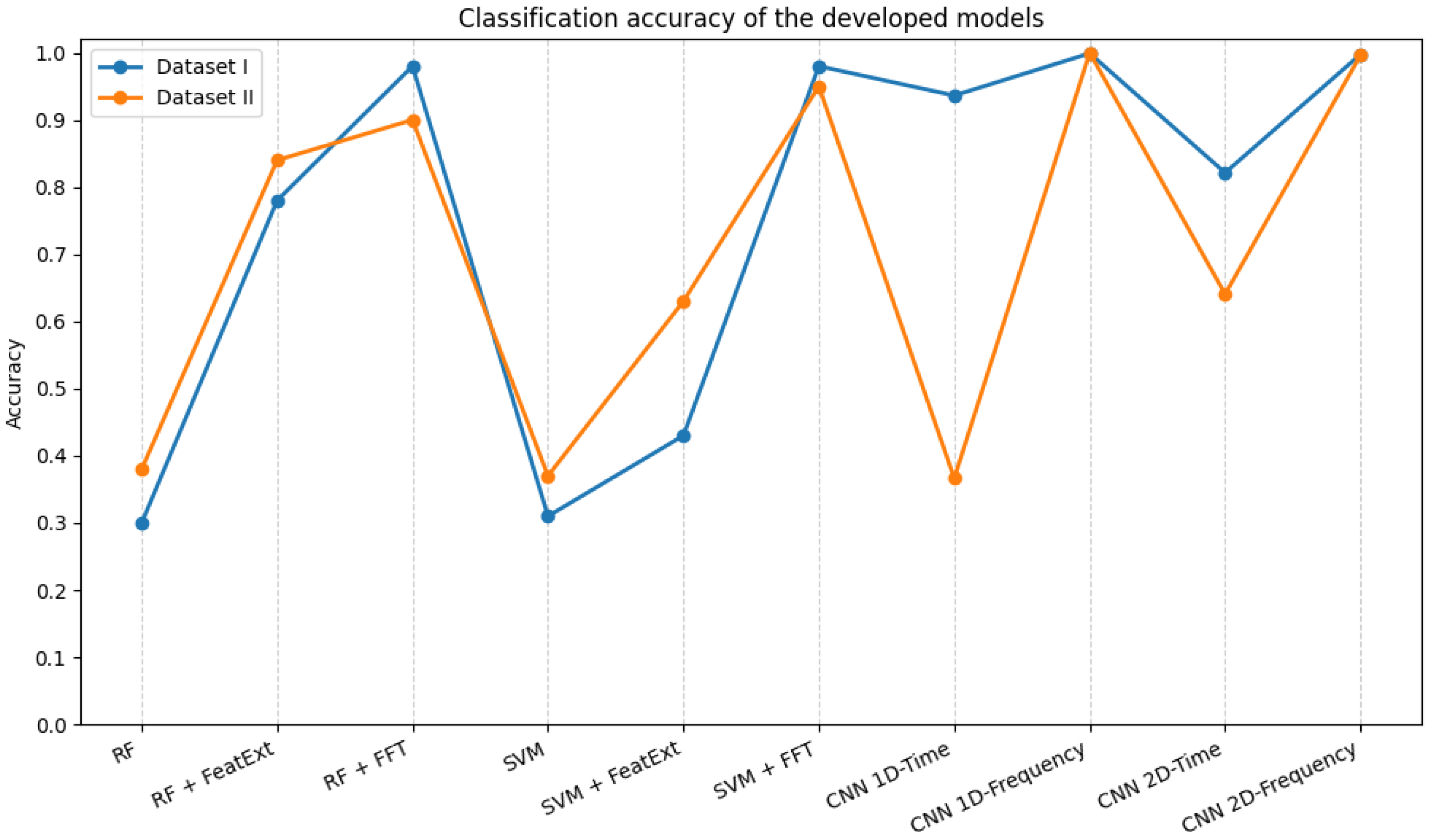
| RF | 0.30 | 0.32 | 0.30 | 0.16 | 0.21 | 0.40 |
| RF + Feat. Ext | 0.78 | 0.81 | 0.85 | 0.72 | 0.73 | 0.78 |
| RF + FFT | 0.98 | 0.99 | 0.97 | 0.95 | 0.98 | 0.99 |
| SVM | 0.31 | 0.34 | 0.35 | 0.20 | 0.22 | 0.40 |
| SVM + FeatExt | 0.43 | 0.39 | 0.41 | 0.43 | 0.39 | 0.51 |
| SVM + FFT | 0.98 | 0.98 | 0.98 | 0.99 | 0.98 | 1 |
| CNN 1D—Time | 0.94 | 0.95 | 0.93 | 0.90 | 0.92 | 0.99 |
| CNN 1D—Frequency | 0.99 | 1 | 1 | 1 | 1 | 1 |
| CNN 2D—Time | 0.82 | 0.82 | 0.78 | 0.74 | 0.81 | 0.97 |
| CNN 2D—Frequency | 0.99 | 1 | 1 | 0.99 | 1 | 1 |
| Models | Dataset II | ||||||
|---|---|---|---|---|---|---|---|
| Acc. | F1-Score | ||||||
| Normal | Unb. I | Unb. II | Unb. III | Misal. | Unb. II + Misal. | ||
| RF | 0.38 | 0.45 | 0.38 | 0.30 | 0.49 | 0.37 | 0.31 |
| RF + FeatExt | 0.84 | 0.80 | 0.72 | 0.83 | 0.93 | 0.85 | 0.92 |
| RF + FFT | 0.90 | 0.96 | 0.90 | 0.87 | 0.77 | 0.90 | 0.95 |
| SVM | 0.37 | 0.35 | 0.38 | 0.29 | 0.53 | 0.36 | 0.31 |
| SVM + FeatExt | 0.63 | 0.73 | 0.51 | 0.49 | 0.67 | 0.61 | 0.75 |
| SVM + FFT | 0.95 | 0.94 | 0.92 | 0.94 | 0.98 | 0.99 | 0.95 |
| CNN 1D—Time | 0.37 | 0.46 | 0.25 | 0.25 | 0.40 | 0.37 | 0.32 |
| CNN 1D—Frequency | 1 | 1 | 1 | 1 | 1 | 1 | 1 |
| CNN 2D—Time | 0.64 | 0.69 | 0.45 | 0.62 | 0.70 | 0.62 | 0.73 |
| CNN 2D—Frequency | 0.99 | 1 | 0.99 | 1 | 0.99 | 1 | 1 |
| Model | Training Time (Seconds) |
|---|---|
| RF | 796 |
| RF + FeatExt | 32 |
| RF + FFT | 552 |
| SVM | 14,226 |
| SVM + FeatExt | 74 |
| SVM + FFT | 384 |
| CNN 1D—Time | 1662 |
| CNN 1D—Frequency | 584 |
| CNN 2D—Time | 694 |
| CNN 2D—Frequency | 277 |
Disclaimer/Publisher’s Note: The statements, opinions and data contained in all publications are solely those of the individual author(s) and contributor(s) and not of MDPI and/or the editor(s). MDPI and/or the editor(s) disclaim responsibility for any injury to people or property resulting from any ideas, methods, instructions or products referred to in the content. |
© 2026 by the authors. Licensee MDPI, Basel, Switzerland. This article is an open access article distributed under the terms and conditions of the Creative Commons Attribution (CC BY) license.
Share and Cite
Fernandes, M.M.; Sousa, J.M.C.; Mendonça, L.F. Machine Learning Framework for Fault Detection and Diagnosis in Rotating Machinery. J. Mar. Sci. Eng. 2026, 14, 291. https://doi.org/10.3390/jmse14030291
Fernandes MM, Sousa JMC, Mendonça LF. Machine Learning Framework for Fault Detection and Diagnosis in Rotating Machinery. Journal of Marine Science and Engineering. 2026; 14(3):291. https://doi.org/10.3390/jmse14030291
Chicago/Turabian StyleFernandes, Miguel M., João M. C. Sousa, and Luís F. Mendonça. 2026. "Machine Learning Framework for Fault Detection and Diagnosis in Rotating Machinery" Journal of Marine Science and Engineering 14, no. 3: 291. https://doi.org/10.3390/jmse14030291
APA StyleFernandes, M. M., Sousa, J. M. C., & Mendonça, L. F. (2026). Machine Learning Framework for Fault Detection and Diagnosis in Rotating Machinery. Journal of Marine Science and Engineering, 14(3), 291. https://doi.org/10.3390/jmse14030291