Article

Intelligent Fault-Tolerant Control for Wave Compensation Systems Considering Unmodeled Dynamics and Dead-Zone

1
Fishery Machinery and Instrument Research Institute, Chinese Academy of Fishery Science, Shanghai 200092, China
2
State Key Laboratory of High-Speed Maglev Transportation Technology, College of Transportation, Tongji University, Shanghai 201804, China
*
Author to whom correspondence should be addressed.
These authors contributed equally to this work.
J. Mar. Sci. Eng. 2026, 14(3), 265; https://doi.org/10.3390/jmse14030265
Submission received: 24 December 2025 / Revised: 23 January 2026 / Accepted: 25 January 2026 / Published: 27 January 2026
(This article belongs to the Section Ocean Engineering)

Abstract

For marine development in harsh sea states, floating-body salvage equipment serves as critical support infrastructure. Aiming at the challenges of nonlinear dead-zone, model uncertainty, and actuator failures in the wave compensation systems of such equipment, this paper proposes an intelligent fault-tolerant control method based on neural networks. First, the dead-zone nonlinearity of the hydraulic system is compensated using an inverse model approach. Then, neural networks are employed to online learn unmodeled dynamics, while adaptive laws are designed to handle partial actuator failures and Lyapunov theory is used to prove the global stability of the closed-loop system, effectively enhancing the robustness and fault-tolerance of the wave compensation system under complex sea conditions. Unlike existing studies that rely on accurate system models, the proposed method integrates data-driven learning with model-based compensation. This integration enables adaptive handling of wave disturbances, model uncertainties, and actuator faults, thereby overcoming the strong model dependence and complex observer design inherent in traditional sliding-mode fault-tolerant control. Simulation and experiment results show that the method ensures high-precision dynamic tracking and compensation performance under various sea conditions.

1. Introduction

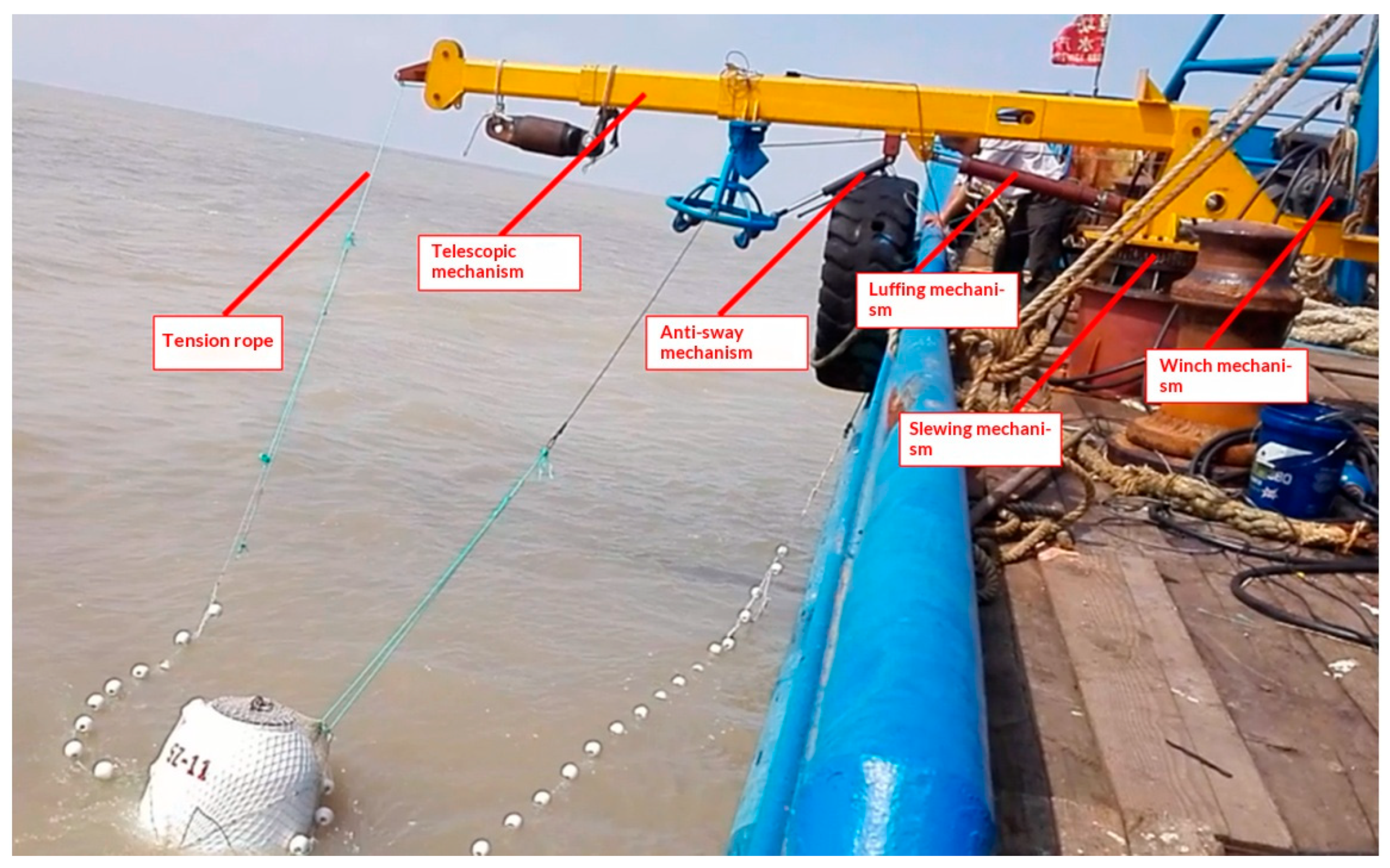
In recent years, undersea resource development has become a core domain of global marine competition [1]. Critical offshore equipment, such as marine cranes and floating cranes, as shown in Figure 1, serves as essential support for these operations [2]. Unlike land-based operations, vessels are subjected to wave-induced motions, which can severely compromise the stability and safety of maritime tasks [3]. Wave compensation technology is therefore pivotal in counteracting or restricting vessel motions to ensure safe operations, with its principles finding critical applications across diverse marine systems such as offshore wind installation, deep-sea mining, and ship-to-ship cargo transfer [4]. As the dynamic joint connecting floating platforms to underwater equipment, the wave compensation system directly determines operational accuracy and equipment survivability [5]. As the power-execution core of wave compensation systems, hydraulic systems must achieve high-precision dynamic compensation and multi-degree-of-freedom coordinated control under strong wave disturbances to ensure offshore operation safety and efficiency [6]. However, nonlinearities, time delays, and parameter degradation in hydraulic actuators severely restrict control accuracy and reliability [7]. In particular, the universal input dead-zone phenomenon directly impacts the system’s steady-state accuracy and dynamic performance [8]. When sea states exceed level 4, the strong time-varying and random wave disturbances amplify system nonlinearities and multivariable couplings, imposing stricter stability and reliability requirements on wave compensation systems. Thus, there is an urgent need for an intelligent control method with strong adaptability and fault tolerance [9].
Owing to their indispensable applications in marine transportation and offshore energy development, wave compensation systems have attracted extensive research efforts from scholars and engineers, with numerous studies focusing on their design, control and performance enhancement [10,11]. Ngo et al. [12] investigated an adaptive gain sliding mode control (SMC) scheme for maritime container position control in harsh ocean environments, proposing a control architecture with compensation and prediction mechanisms for marine crane systems. Chen et al. [13] first designed an optimal load trajectory planning scheme for marine crane salvage tasks, imposing constraints on physical quantities of booms, cables, and loads to eliminate load swing under complex sea conditions. They optimized transportation time using a dichotomy method and obtained optimal trajectories under corresponding conditions. Bozkurt et al. [14] proposes a composite control system integrating hydraulic and ship motion models under irregular waves. A particle swarm optimization–proportional–integral–derivative controller tracks desired vertical trajectories to achieve horizontal positioning under harsh sea conditions, validated via simulations. Zhou & Schlanbusch [15] designed an adaptive SMC scheme for nonlinear underactuated crane systems, introducing uniform quantizers to reduce communication burdens and compensate for input quantization and uncertain disturbances, achieving anti-swing control.
Researchers have also studied control schemes for environmental uncertainties in wave compensation systems. Zhang & Chen [16] designed an adaptive tracking controller to estimate unknown gravity parameters, eliminating vertical positioning errors and enabling fast, accurate offshore load transportation. Qian et al. [17] proposed a novel adaptive robust control scheme to address vertical positioning errors caused by mismatched wave disturbances in marine cranes, effectively suppressing load swing. Zhai et al. [18] designed a control scheme to ensure cargo stability relative to ships, developing an adaptive fuzzy controller based on a nonlinear observer with verified effectiveness through experiments. Van Trieu et al. [19] proposes a robust control method based on fixed-time disturbance observer. It estimates disturbances via nonlinear observer, uses fractional-order dynamic surface control to avoid differential explosion, and guarantees bounded 3-DOF vessel tracking errors.
While these studies have improved control accuracy and dynamic response, harsh sea state salvage equipment operates in complex environments with inevitable faults such as mechanical wear and hydraulic leakage due to long-term offshore operations, requiring targeted solutions for strict safety and durability demands [20].
Consequently, extensive research has focused on fault-tolerant control for wave compensation systems under harsh sea state. Actuators, exposed to variable environments and heavy tasks, are more prone to faults and require high fault tolerance. Guo & Chen [21] proposed an event-triggered fuzzy fault-tolerant control method for marine crane actuator faults and external disturbances, designing a robust controller based on fuzzy logic theory. Simulations showed good fault tolerance and reduced unnecessary communication via event triggering. Cuong et al. [22] developed an adaptive robust controller using nonsingular fast terminal SMC for underactuated systems with actuator faults, parameter uncertainties, and external disturbances, ensuring finite-time convergence and high robustness. Falconer et al. [23] proposed a cable condition monitoring method based on machine vision for marine cranes, predicting cable lifespan and providing real-time data for wave compensation system design. Gong et al. [24] designed a disturbance-resistant fault-tolerant scheme using a disturbance observer and adaptive fault observer to compensate for external disturbances and handle actuator faults, reducing cross-interference and guaranteeing global stability with a 99.1% disturbance rejection rate in simulations. However, limitations remain. SMC suffers from high-frequency chattering, and observer-based methods involve complex designs with optimization potential [25]. Thus, recent studies emphasize integrating control and computational methods, particularly data-driven approaches like neural networks, to construct hybrid intelligent control architectures [26].
For example, Lin et al. [27] proposed a control scheme combining iterative learning and neural networks to handle periodic and aperiodic disturbances, achieving accurate disturbance period prediction and compensation. Experiments on a marine crane platform verified its superiority over single methods like SMC in unknown disturbances and parameter uncertainties. Sun et al. [28] designed a controller using an improved grey wolf optimization algorithm with Radial Basis Function (RBF) neural networks to compensate for nonlinear wave disturbances, showing faster response and higher accuracy than traditional Linear Quadratic Regulator (LQR) in simulations. Kim et al. [29] developed an adaptive controller based on hierarchical SMC and artificial neural networks for 3D marine container cranes, using RBF networks to estimate and compensate for unknown dynamic disturbances. Tuan et al. [30] proposed a robust adaptive system combining second-order SMC and RBF neural networks, experimentally proven to enhance dynamic tracking and disturbance immunity. Qian et al. [31] designed a tracking controller with enhanced adaptive neural networks for inter-ship cargo transportation, predicting ship motions under wave impacts to generate real-time target trajectories and improve disturbance resistance.
Based on the above analysis, this paper proposes an intelligent fault-tolerant control scheme for harsh sea state wave compensation systems, compensating dead-zone via an inverse model, learning unknown hydraulic dynamics using RBF networks, and designing adaptive laws for partial actuator failures. The main contributions of this paper are summarized as follows:
  • Compared with existing methods, the proposed approach fully considers real physical characteristics such as hydraulic system dead zones, faults, and system model uncertainties, effectively enhancing the method’s generalizability in practical applications.
  • The proposed method does not require an accurate model of the controlled object. It adaptively learns the unmodeled dynamics of the controlled object through data-driven approaches, ensuring stable tracking within finite time under unknown model conditions and demonstrating strong robustness to parameter uncertainties.
  • Simulation and experiment results show that the root-mean-square error (RMSE) and maximum error of the proposed method are significantly reduced compared with traditional control methods, verifying its superior performance.
The remaining structure of this paper is as follows: Section 2 models the wave compensation system for harsh sea state floating body recovery equipment and defines the control objectives; Section 3 presents the RBF network-based model learning method, designs the adaptive fault-tolerant control law, and proves the system stability using Lyapunov theory; Section 4 validates the proposed method through comparative simulations under two different working conditions, demonstrating its superiority. The effectiveness of the proposed method was further verified through experiments in Section 5. Section 6 concludes the study.

2. Problem Statement

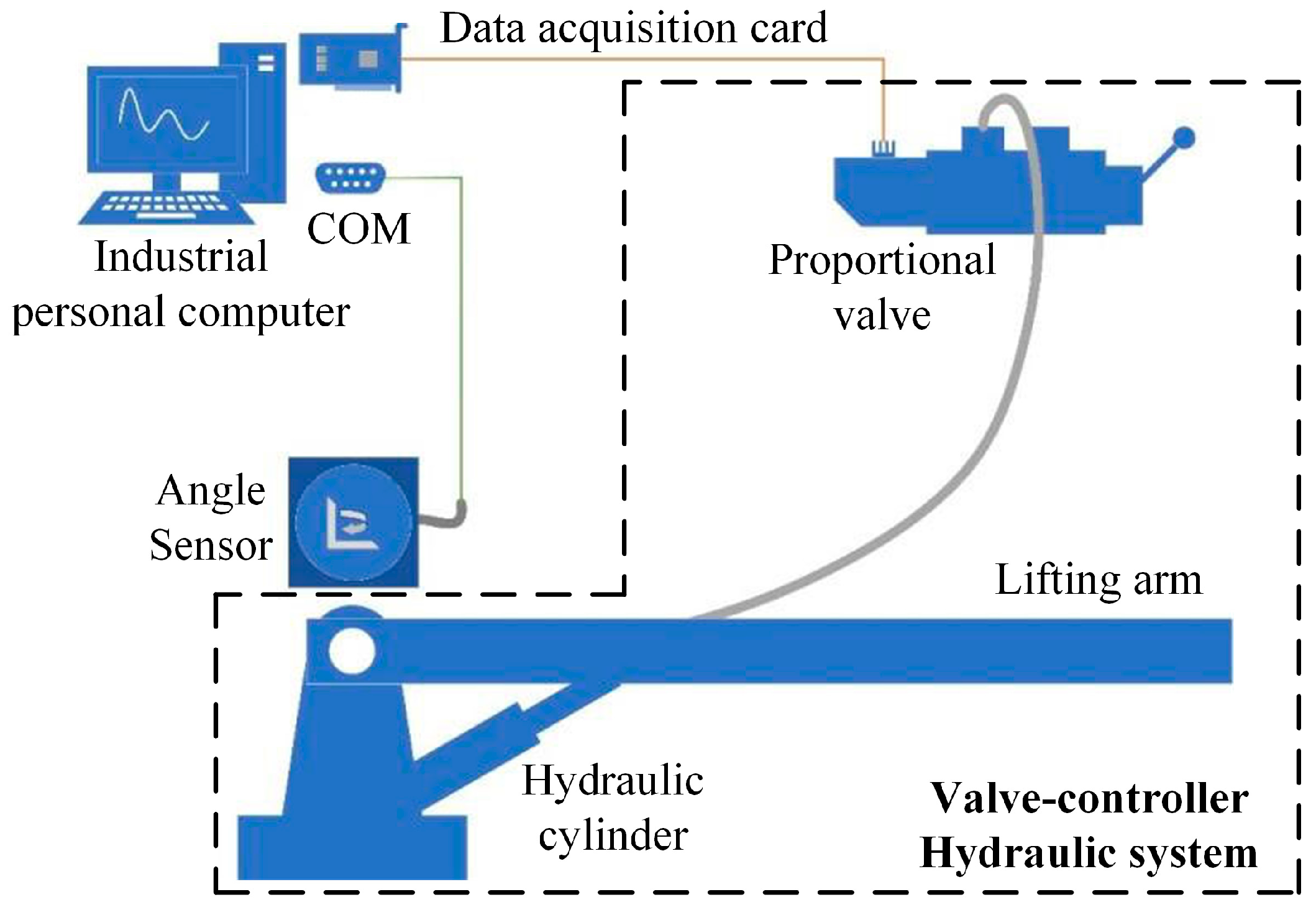
The wave compensation system consists of a valve-controlled cylinder, boom, angle sensor, industrial computer, and data acquisition card, with its basic principle illustrated in Figure 2. The valve-controlled cylinder, as the core subsystem, mainly comprises a proportional valve and a hydraulic cylinder.

2.1. System Model

The fundamental equations for the valve-controlled cylinder system are
q L = A e x ˙ + C i p L + V t 4 β p ˙ L
q L = K q x v + K c p L
m x ¨ = A e p L B s x ˙ K s x
where q L is the load flow rate, K q is the discharge coefficient, K c is the pressure coefficient, x v is the spool displacement of the proportional valve, p L is the load pressure, A e is the effective area of the hydraulic cylinder, x is the hydraulic cylinder displacement, C i is the total leakage coefficient, V t is the equivalent volume of the hydraulic cylinder, β is the equivalent bulk modulus of the hydraulic oil, m is the load mass, B s is the system damping, and K s is the load stiffness.
Selecting the state variables as x = x 1 x 2 x 3 T = x x ˙ p L T , the state-space equation of the system is
x ˙ 1 = x 2 x ˙ 2 = K s m x 1 B s m x 2 + A e m x 3 x ˙ 3 = 4 β A e V t x 2 4 β ( C i + K c ) V t x 3 + 4 β K q V t u
where u = x v .
Compared with the displacement adjustment process of the valve-controlled cylinder system, the pressure build-up process is extremely rapid, with a time constant much smaller than that of the displacement adjustment process. Thus, it can be treated as dynamic equilibrium, and the pressure build-up process can be neglected, i.e., x ˙ 3 0 . The state-space equation of the system then simplifies to
x ˙ 1 = x 2 x ˙ 2 = K s m x 1 ( B s m + A e 2 m ( C i + K c ) ) x 2 + A e K q m ( C i + K c ) u
It should be noted that the dynamic equations of the valve-controlled cylinder hydraulic system established in this section are applicable in the scenarios of wind-generated waves and swells. Under such conditions, the core influence of waves on the system is manifested as periodic rolling of the vessel, which in turn translates into inclination deviation of the crane lifting arm relative to the horizontal plane. Therefore, wave dynamics have not been directly incorporated into the internal model of the hydraulic system.

2.2. Control Objective

The working principle of the wave compensation system is that waves cause the boom installed on the hull to swing relative to the horizontal plane. The system must real-time control the proportional valve to adjust the hydraulic cylinder’s extension/retraction, ensuring the boom remains horizontal relative to the horizontal plane. Specifically, the ideal control objective is that when the hull swings with an angle approximate to θ a sin ( ω t + φ ) relative to the horizontal plane, the boom should swing with an angle opposite in direction but equal in amplitude, frequency, and phase relative to the hull, i.e.,
lim t e ( t ) = θ + θ d = θ + θ a sin ( ω t + φ ) = 0

3. Control System Design

3.1. Dead-Zone Compensation and Fault Analysis

Equation (5) presents the system model of the valve-controlled cylinder under ideal conditions. In practice, however, proportional valves have bidirectional dead zones, so the control system design must first compensate for the dead zone.
The dead-zone equation can be described as
u out = S ( u in ) = k 1 ( u in b 1 ) u in b 1 0 b 2 < u in < b 1 k 2 ( u in b 2 ) u in b 2
where k 1 and k 2 are the right and left slopes of the dead zone, b1 and b2 are the right and left dead-zone thresholds, k 1 > 0, k 2 > 0, b 1 > 0, b 2 > 0, u i n is the ideal input, and u o u t is the actual output.
To eliminate the dead zone, the inverse function of the dead-zone model yields the dead-zone compensation function
u co = S 1 ( u c ) = u c + k ^ 1 b ^ 1 k ^ 1 u c > 0 0 u c = 0 u c + k ^ 2 b ^ 2 k ^ 2 u c < 0
where k ^ 1 ,   k ^ 2 ,   b ^ 1 ,   b ^ 2 are estimated values of the dead-zone parameters, u c is the input to the dead-zone compensation function, and u c o is the output of the dead-zone compensation function.
Using Equation (8) as a compensator in series with the dead-zone model Equation (7), assuming b ^ 1 b 1 , b ^ 2 b 2 , we obtain
u out = S ( S 1 ( u c ) ) = k 1 k ^ 1 u c + k 1 ( b ^ 1 b 1 ) u c > 0 0 u c = 0 k 2 k ^ 2 u c + k 2 ( b ^ 2 b 2 ) u c < 0
Thus, when k ^ 1 = k 1 , k ^ 2 = k 2 , b ^ 1 = b 1 , b ^ 2 = b 2 , u c = u out , the dead zone is completely eliminated.
In addition to dead zones, hydraulic systems often experience partial failure faults, which can be expressed as
u a = ϖ u out
where u o u t is the output without actuator failure, u a is the actual actuator output, and 0 < ϖ < 1 represents the actuator failure degree. Considering the wave compensation system as a single-input system, the following assumption is made.
Assumption 1:
Actuator faults are partial failures, with no complete failure cases.

3.2. Unmodeled Dynamics Learning

Due to the complex characteristics of hydraulic systems, the model in Equation (5) cannot be precisely determined in practice. Without loss of generality, during controller design, Equation (5) can be rewritten as
x ˙ 1 = x 2 x ˙ 2 = f ( x ) + α u a
where f ( x ) is the system model that cannot be accurately obtained and can be approximated by an RBF neural network, and α = A e K q m ( C i + K c ) is a constant determined by system parameters.
The RBF network’s approximation of the unknown function f ( x ) is
f ^ ( x ) = W ^ T r ( x )
where r = r 1 , r 2 , , r n T is the output of the Gaussian function, r j = exp x c j 2 2 b j 2 , n is the number of network outputs, j is the node in the hidden layer, c j is the center of the hidden layer, b j is the width of the hidden layer, and W ^ is the estimated value of the weight.
Thus
f ˜ ( x ) = f ( x ) f ^ ( x ) = W T r ( x ) + ξ W ^ T r ( x ) = W ˜ T r ( x ) + ξ
where W is the ideal weight of the RBF network, and ξ is the approximation error of the network.

3.3. Adaptive Fault-Tolerant Control

The sliding surface is designed as
s = c e + e ˙
where c > 0 is a positive constant.
Then
s ˙ = c e ˙ + e ¨ = c e ˙ + x ˙ 2 = c e ˙ + f ( x ) + α ϖ u c = c e ˙ + f ( x ) + β u c
Let u c = ρ ^ ( k s + c e ˙ + f ^ ( x ) + η sgn ( s ) ) = ρ ^ χ ; the control law and adaptive law are designed as
ρ = 1 β
W ˜ ˙ = γ s r ( x )
ρ ^ ˙ = γ s χ sgn α
where k > 0 ,   γ > 0 ,   η > ξ are positive constants.

3.4. Stability Proof

Theorem 1:
With the control law and adaptive law shown in Equations (16)–(18), the tracking error of the wave compensation system will converge to 0 within a finite time and remain stable.
Proof of Theorem 1:
Select the Lyapunov function as
V = 1 2 s 2 + | β | 2 γ ρ ˜ 2 + 1 2 γ W ˜ T W ˜
where ρ ˜ = ρ ^ ρ .
Then
V ˙ = s s ˙ + | β | γ ρ ˜ ρ ^ ˙ 1 γ W ˜ T W ˜ ˙
From Equations (15) and (16), we have
V ˙ = s ( c e ˙ + β u c + f ( x ) ) + | β | γ ρ ˜ ρ ^ ˙ 1 γ W ˜ T W ˜ ˙ = s ( χ k s + β u c + f ˜ ( x ) η sgn ( s ) ) + | β | γ ρ ˜ ρ ^ ˙ 1 γ W ˜ T W ˜ ˙
Substituting Equation (13) into the above equation, we get
V ˙ = s ( χ k s + β u c + W ˜ T r ( x ) + ξ η sgn ( s ) ) + | β | γ ρ ˜ ρ ^ ˙ 1 γ W ˜ T W ˜ ˙ = s ( χ k s + β u c + ξ η sgn ( s ) ) + | β | γ ρ ˜ ρ ^ ˙ + W ˜ T s r ( x ) 1 γ W ^ ˙
From Equations (17) and (18), we have
V ˙ = s ( χ k s β ρ ^ χ + ξ η sgn s ) + | β | γ ρ ^ γ s χ sgn β = s ( χ k s β ρ ^ χ + ξ η sgn s + β ρ ˜ χ ) = s ( χ k s β χ ρ + ξ ) η | s | = k s 2 + s ξ η | s |
Since η > ξ , we can obtain
V ˙ k s 2 0
This shows that the system is stable, and the proof is completed. □
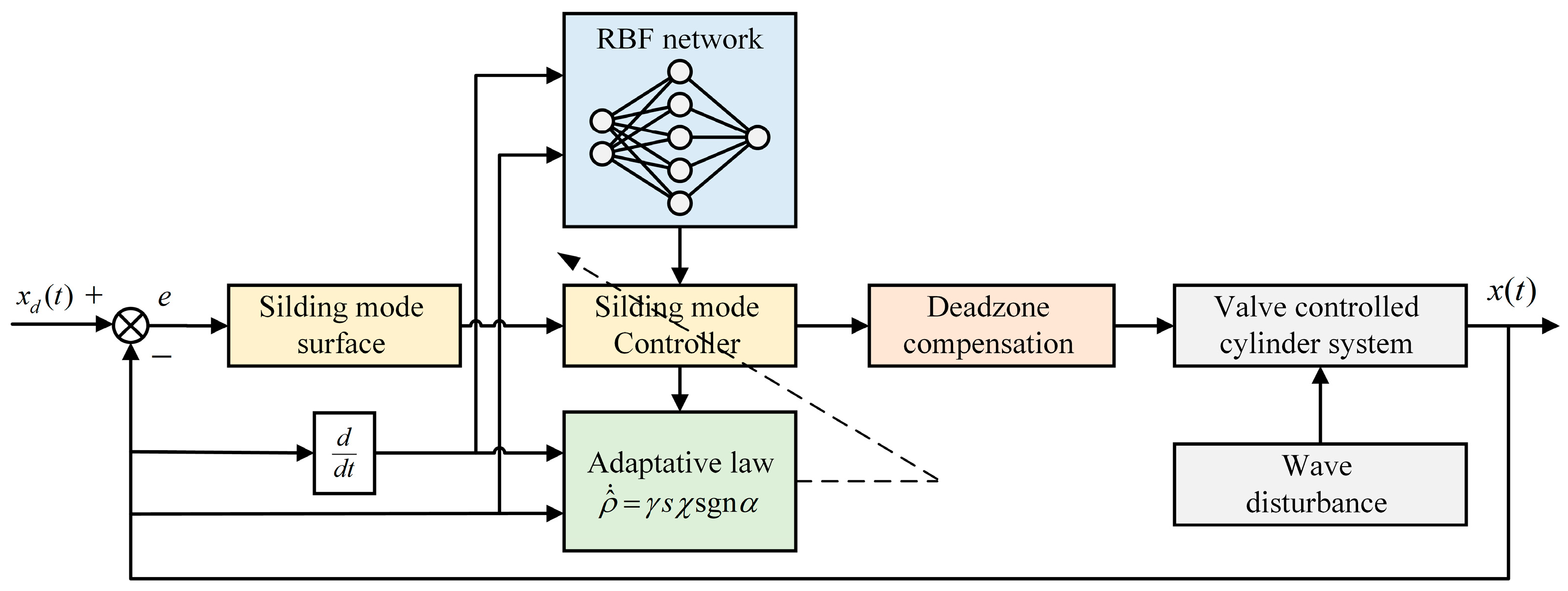
The block diagram of the control system is shown in Figure 3.

4. Numerical Simulation

To verify the superiority of the proposed method, two different working conditions are designed and compared with the Proportional-Integral-Differential (PID) control, PID control with dead-zone compensation, and the Adaptive RBF-SMC (ARBF-SMC) method without dead-zone compensation. The parameters of the PID are designed as k p = 320, k i = 170, k d = 10. The parameters of the ARBF-SMC without dead-zone compensation and the proposed ARBF-SMC with dead-zone compensation are b j = 3, c = 20, k = 40, η = 0.1 , γ = 10 , c j = 0.5 2 1 0 1 2 2 1 0 1 2 . Table 1 presents the parameters of the simulation object.
In this study, the parameters of the PID controller were determined using the trial-and-error method. Due to the presence of nonlinear dead zones, model uncertainties, and random disturbances in the wave compensation system, the premise of precise linear models relied upon by traditional tuning methods does not hold. In contrast, the trial-and-error method does not require an accurate model, through iterative adjustment and optimization based on the actual system response, it can achieve a parameter set that balances dynamic performance and steady-state accuracy. This approach serves as a practical engineering solution for such complex systems.
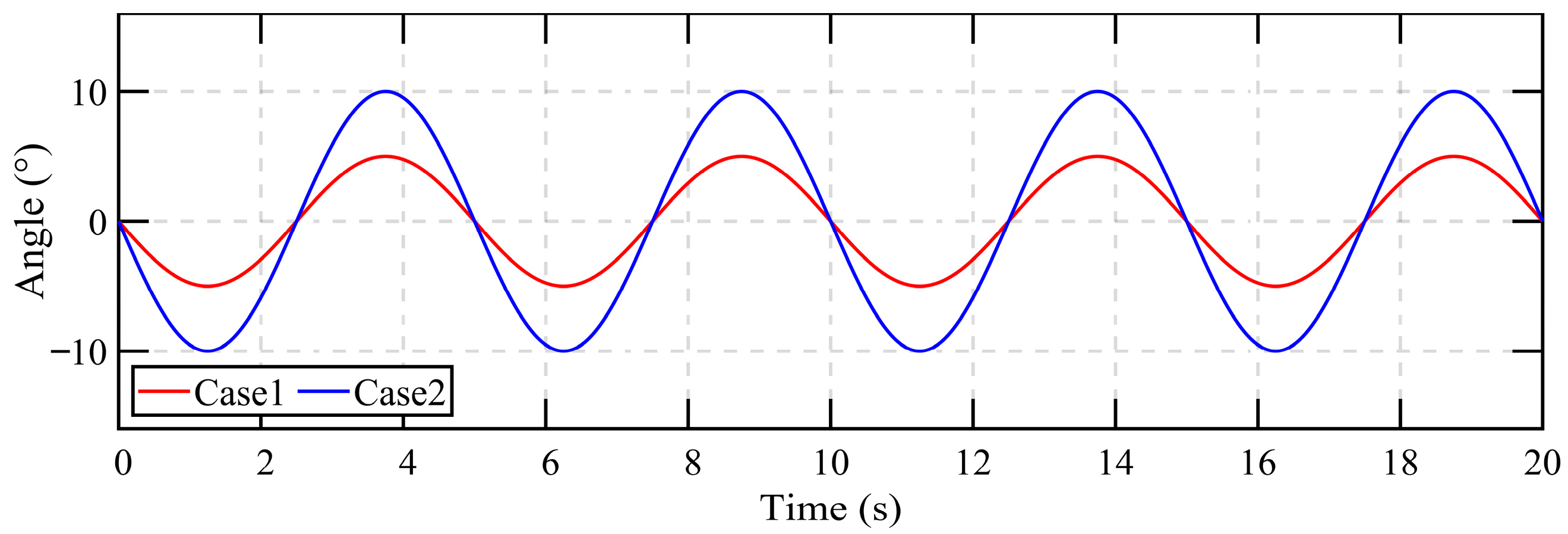
The two different working conditions are shown in Figure 4, which are:
Case 1: Maximum amplitude 5 ° , frequency 0.2 Hz, and partial actuator failure occurs at t = 10   s , ϖ = 0.6 .
Case 2: Maximum amplitude 10 ° , frequency 0.2 Hz, and partial actuator failure occurs at t = 10   s , ϖ = 0.6 .
The waves modeled in the simulation of this section are wind-generated waves and swells, with a frequency of 0.2 Hz. They can induce roll angle amplitudes of 5°/10° in the floating body. These wave characteristics correspond to sea states of levels 4–6 in deep-sea resource development areas such as the Northwest Pacific. Such waves represent a primary source of disturbance for floating salvage equipment under moderate to relatively severe sea conditions.
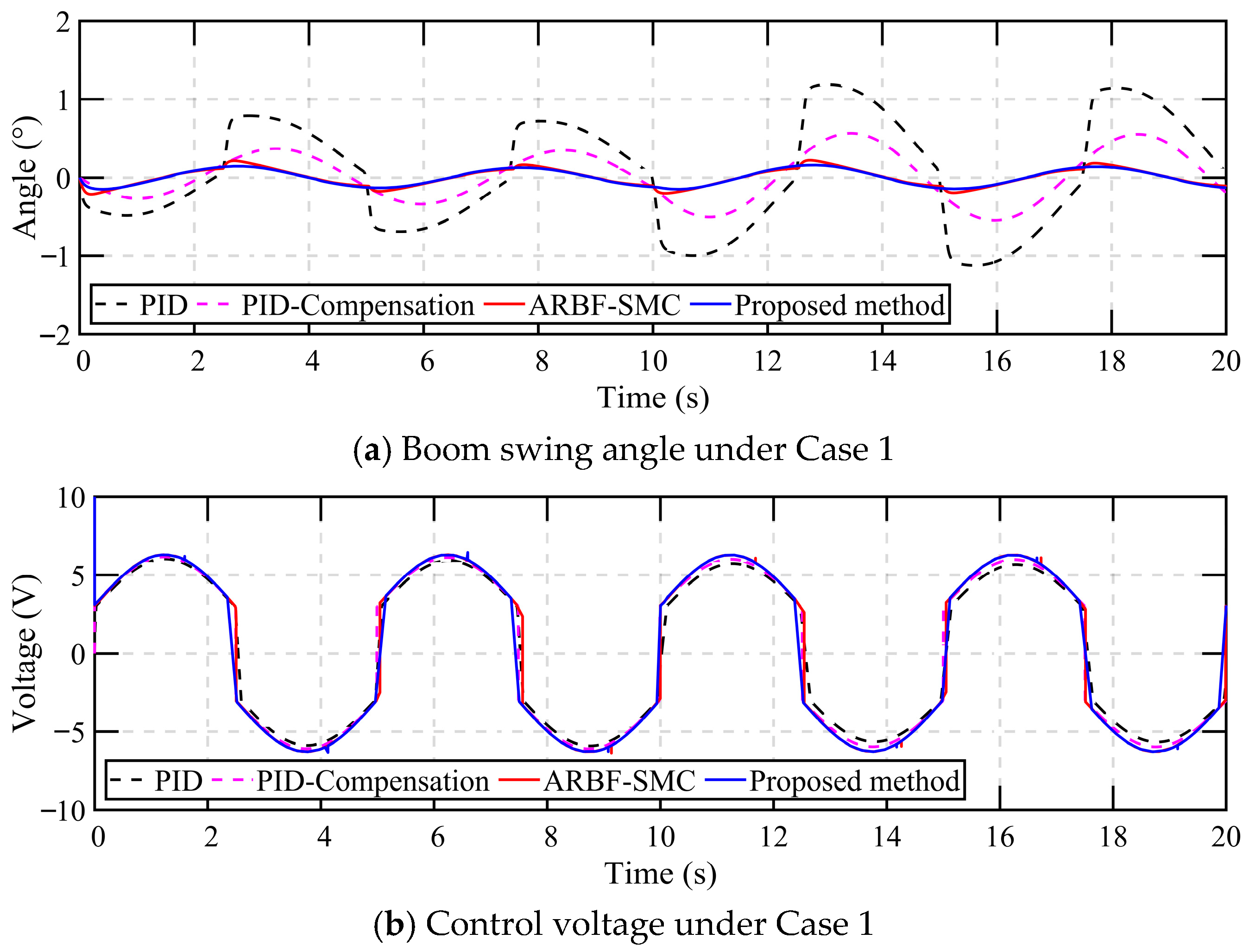
The boom swing angle under Case 1 is shown in Figure 5a. The proposed method has a smaller swing amplitude compared with other methods. The RMSE is only 0.0656 ° , which is reduced by 90.5%, 79.2%, and 38.9% compared with the other three methods, respectively. Especially when the actuator failure occurs at t = 10   s , the swing amplitude of the proposed method does not change significantly. The maximum error is only 0.1586 ° , which is reduced by 86.6%, 72.0%, and 28.2% compared with other methods. For the PID-based method, the swing amplitude increases obviously after the failure. The control voltage is shown in Figure 5b. Before the failure, the curves of the four methods are similar. After the failure, the control quantity of the PID-based method changes obviously, while the proposed method remains basically unchanged.
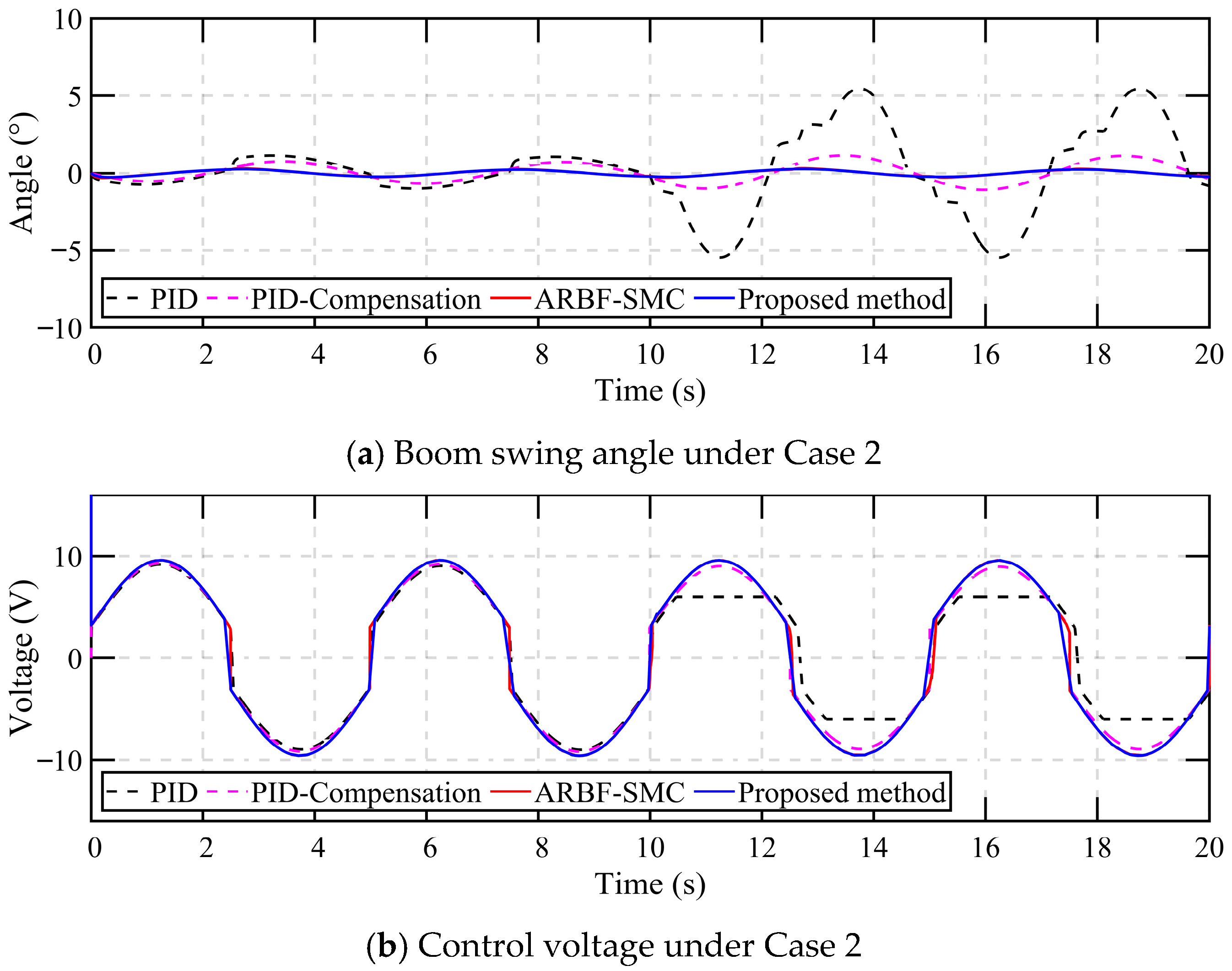
Figure 6a shows the boom swing angle under Case 2. It can be clearly seen that after the failure occurs at t = 10   s , the PID-based method has a large-scale swing, and the maximum swing amplitude reaches 5.5 ° , while the proposed method has only 0.27 ° . The RMSE of the proposed method is reduced by 93.5%, 77.0%, and 23.0% compared with other methods, which significantly improves the anti-swing ability. The control voltage under Case 2 is shown in Figure 6b. It can be seen that the proposed method can still adapt to the failure well, while the PID-based method changes obviously, and the maximum control voltage decays to 6.1   V , making it difficult to resist the partial actuator failure. The comparison indicators under the two working conditions are shown in Table 2.

5. Experiment

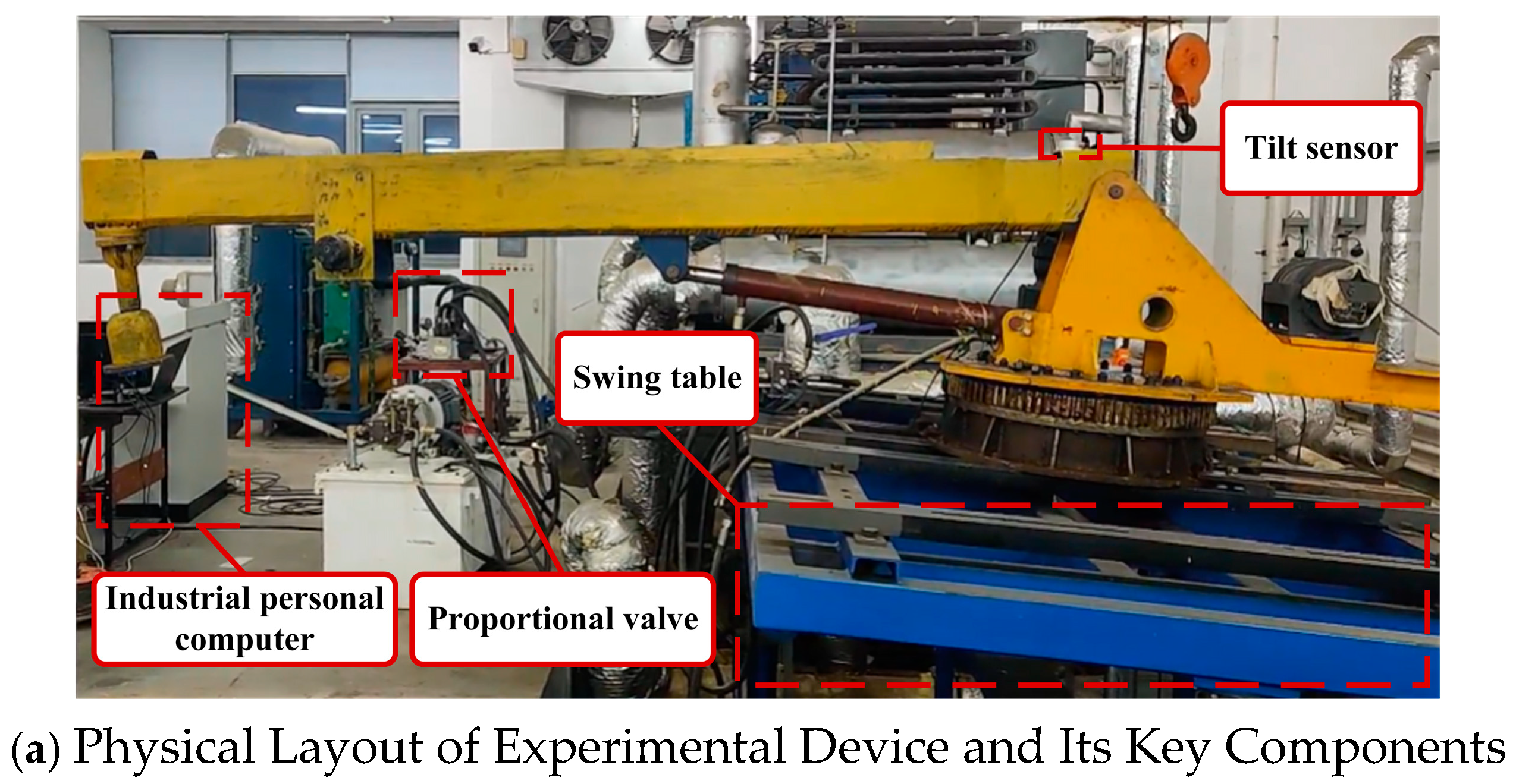
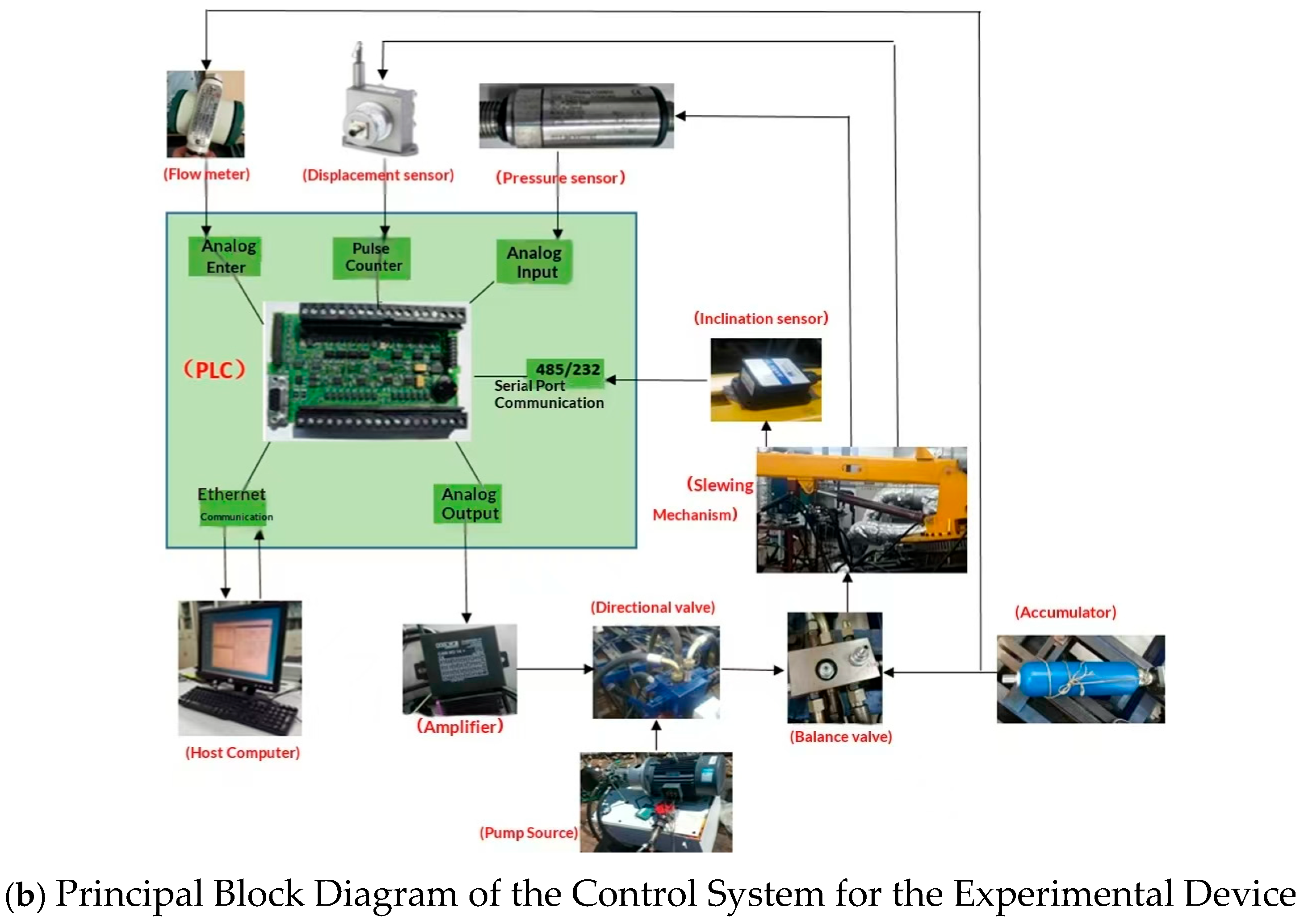
The experiment was carried out on a rapid control prototype wave compensation test bench by the Fishery Machinery and Instrument Research Institute, Chinese Academy of Fishery Sciences, Shanghai, China, as shown in Figure 7. The test bench mainly consists of a crane, an industrial computer, a proportional valve, a swing table, and a tilt sensor. The tilt sensor feeds back real-time angle data to the industrial computer. The proposed control algorithm, running on Simulink (MATLAB R2023a) within the industrial computer with a control step of 0.01 s, generates control signals based on the inclination data and sends them to the data acquisition card. The data acquisition card, installed in the motherboard slot of the industrial computer, generates voltage control signals in real-time to operate the proportional valve, which adjusts the crane boom to maintain its horizontal position. The swing table, driven by a hydraulic system, can simulate different wave frequencies and amplitudes.
Two different sea conditions were set for the experiments:
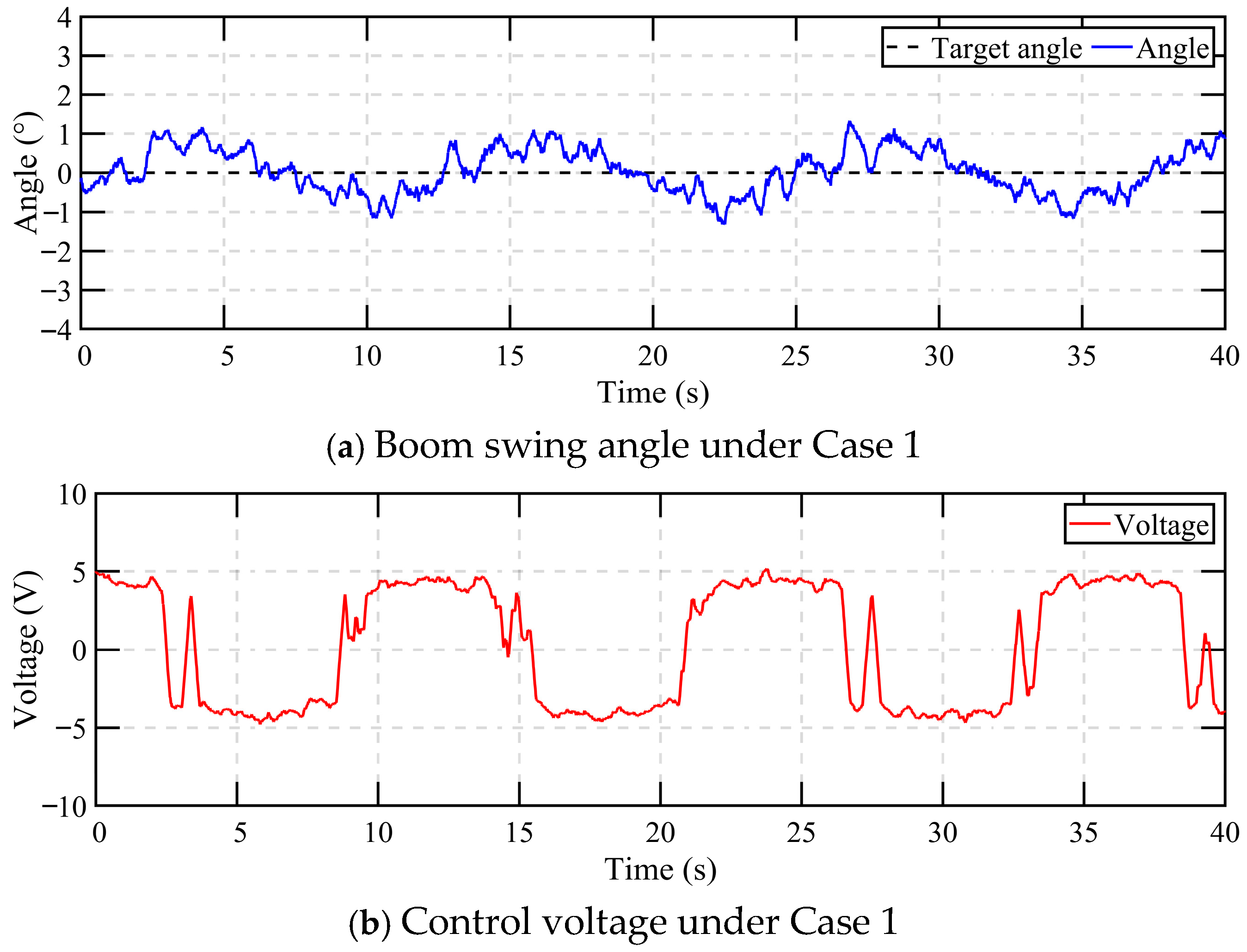
Case 1: Amplitude of 5°, frequency of 0.1 Hz.
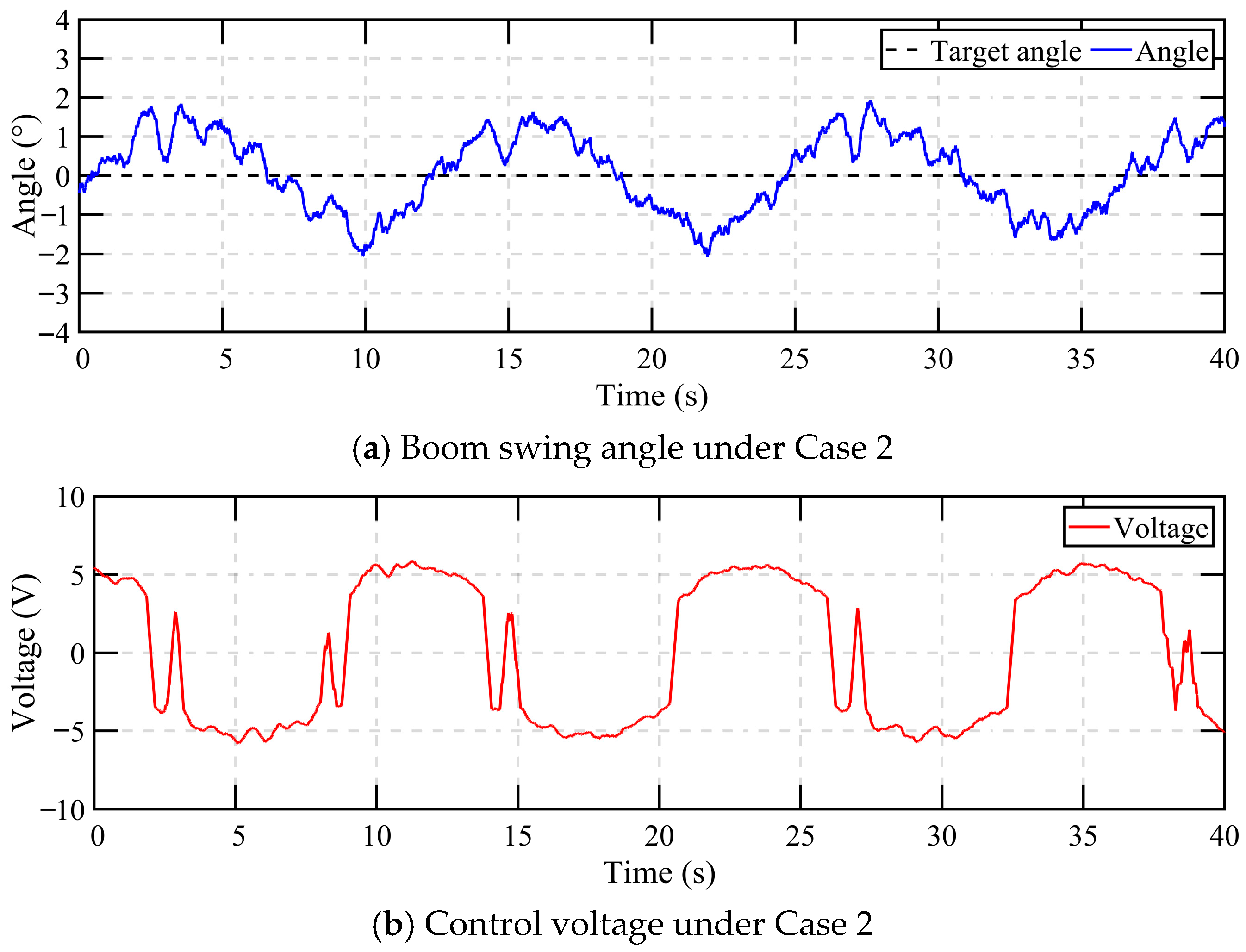
Case 2: Amplitude of 10°, frequency of 0.1 Hz.
The swing amplitude under Case 1 is shown in Figure 8a. It can be observed that the wave compensation system effectively resists wave disturbances, maintaining the boom’s inclination around 0°. The system exhibits a RMSE of 0.5715° and a maximum error of 1.3377°. However, the figure also reveals slight vibrations during system adjustments. The control voltage, as shown in Figure 8b, demonstrates that the control signals adapt well to the dead zone, with rapid adjustments near the voltage zero point to compensate for dead zone effects.
Under Case 2, as shown in Figure 9a, the system’s RMSE increases to 0.9825°, with a maximum error of 2.0724°. Although the swing amplitude increases compared to Case 1, the system still effectively suppresses wave influences. The corresponding control voltage in Figure 9b shows a proportional increase in control signals, reflecting the enhanced wave disturbances.

6. Conclusions

This paper addresses the issues of nonlinear dead zones, model uncertainties, and actuator failures in the hydraulic systems of harsh sea state floating body recovery equipment by proposing an intelligent fault-tolerant control method based on RBF neural networks. The method constructs a hybrid control architecture integrating model compensation and data-driven features: it compensates for dead-zone nonlinearities via an inverse model, leverages the online learning capabilities of neural networks for unmodeled dynamics, and employs an adaptive law to correct partial actuator failures in real time. The designed controller overcomes the reliance of traditional sliding-mode fault-tolerant control on precise models and simplifies the complexity of observer design. Simulation and experiment results demonstrate that under strong disturbances equivalent to sea state 6, the system achieves high-precision compensation and exhibits significant fault tolerance against partial actuator failures. This approach effectively resolves control challenges arising from the coupling of hydraulic system nonlinearities, time-varying disturbances, and equipment degradation in complex marine environments, providing a theoretical foundation and technical pathway for the intelligent upgrading of deep-sea resource development equipment.
It should be noted that the effectiveness of the proposed method has been validated in the laboratory; however, shipboard applications must meet industrial-grade certification conditions such as vibration resistance, salt fog corrosion resistance, and electromagnetic compatibility. Therefore, the laboratory setup cannot be directly translated to maritime scenarios. Future work will focus on optimizing the engineering adaptability of the method, with the aim of conducting real-ship sea trials after satisfying the relevant maritime industrial certification requirements.

Author Contributions

Methodology, Z.X. and X.Z.; Validation, Z.X.; Resources, Z.S. and Y.S.; Data curation, X.Z. and Y.G.; Writing—original draft, X.Z.; Writing—review & editing, Z.S. and Y.S.; Visualization, Y.G.; Supervision, Z.S. and Y.S.; Project administration, Y.S.; Funding acquisition, Z.S. and Y.S. All authors have read and agreed to the published version of the manuscript.

Funding

This work was supported by the National Key R&D Program of China (No. 2024YFD2400504) and the Central Public-interest Scientific Institution Basal Research Fund, Chinese Academy of Fishery Sciences (CAFS) (No. 2023TD85).

Data Availability Statement

The original contributions presented in this study are included in the article. Further inquiries can be directed to the corresponding author.

Conflicts of Interest

The authors declare no conflicts of interest.

References

  1. Cai, Y.; Zheng, S.; Liu, W.; Qu, Z.; Zhu, J.; Han, J. Sliding-mode control of ship-mounted Stewart platforms for wave compensation using velocity feedforward. Ocean. Eng. 2021, 236, 109477. [Google Scholar] [CrossRef]
  2. Chen, H.; Sun, N. An Output Feedback Approach for Regulation of 5-DOF Offshore Cranes with Ship Yaw and Roll Perturbations. IEEE Trans. Ind. Electron. 2022, 69, 1705–1716. [Google Scholar] [CrossRef]
  3. Su, Z.; Fan, J.; Shao, X.; Li, C.; Wang, X. Appointed-Time Prescribed Performance Control for Shipborne SideArm with DRL-Based Kinematic Compensation. IEEE Trans. Autom. Sci. Eng. 2025, 22, 22438–22454. [Google Scholar] [CrossRef]
  4. Chen, H.; Wang, X.; Benbouzid, M.; Charpentier, J.-F.; Aϊt-Ahmed, N.; Han, J. Improved Fractional-Order PID Controller of a PMSM-Based Wave Compensation System for Offshore Ship Cranes. J. Mar. Sci. Eng. 2022, 10, 1238. [Google Scholar] [CrossRef]
  5. Gaspar, J.F.; Kamarlouei, M.; Thiebaut, F.; Soares, C.G. Compensation of a hybrid platform dynamics using wave energy converters in different sea state conditions. Renew. Energy 2021, 177, 871–883. [Google Scholar] [CrossRef]
  6. Yu, H.; Chen, Y.; Shi, W.; Xiong, Y.; Wei, J. State Constrained Variable Structure Control for Active Heave Compensators. IEEE Access 2019, 7, 54770–54779. [Google Scholar] [CrossRef]
  7. Teng, Y.; Hu, Z.; Sun, Y. Virtual prototype modeling and fuzzy control of the heave compensation system for a 500-ton deep-sea mining vessel. Trans. Inst. Meas. Control 2025, 47, 1974–1986. [Google Scholar] [CrossRef]
  8. Xu, L.; Yao, L.; Wang, X.; Yang, J.; Niu, D. LADRC of Bridge Crane System Based on Dead Zone Compensation. In Proceedings of the 2022 IEEE 17th International Conference on Control & Automation (ICCA), Naples, Italy, 27–30 June 2022; pp. 400–405. [Google Scholar] [CrossRef]
  9. Maczyński, A.; Wojciech, S. Stabilization of Load’s Position in Offshore Cranes. J. Offshore Mech. Arct. Eng. 2011, 134, 021101. [Google Scholar] [CrossRef]
  10. Haselsteiner, A.F.; Ohlendorf, J.-H.; Oelker, S.; Ströer, L.; Thoben, K.-D.; Wiedemann, K.; De Ridder, E.; Lehmann, S. Lifting Wind Turbine Components from a Floating Vessel: A Review on Current Solutions and Open Problems. J. Offshore Mech. Arct. Eng. 2019, 141, 050801. [Google Scholar] [CrossRef]
  11. Woodacre, J.K.; Bauer, R.J.; Irani, R.A. A Review of Vertical Motion Heave Compensation Systems. Ocean Eng. 2015, 104, 140–154. [Google Scholar] [CrossRef]
  12. Ngo, Q.H.; Nguyen, N.P.; Nguyen, C.N.; Tran, T.H.; Bui, V.H. Payload pendulation and position control systems for an offshore container crane with adaptive—Gain sliding mode control. Asian J. Control 2020, 22, 2119–2128. [Google Scholar] [CrossRef]
  13. Chen, H.; Zhang, R.; Liu, W.; Chen, H. A time optimal trajectory planning method for offshore cranes with ship roll motions. J. Frankl. Inst. 2022, 359, 6099–6122. [Google Scholar] [CrossRef]
  14. Bozkurt, B.; Ertogan, M. Heave and Horizontal Displacement and Anti-Sway Control of Payload during Ship-to-Ship Load Transfer with an Offshore Crane on Very Rough Sea Conditions. Ocean. Eng. 2023, 267, 113309. [Google Scholar] [CrossRef]
  15. Zhou, J.; Schlanbusch, S.M. Adaptive Quantized Control of Offshore Underactuated Cranes with Uncertainty. In Proceedings of the 2022 IEEE 17th International Conference on Control & Automation (ICCA); Naples, Italy, 27–30 June 2022, IEEE: Piscataway, NY, USA, 2022; pp. 297–302. [Google Scholar] [CrossRef]
  16. Zhang, R.; Chen, H. An adaptive tracking control method for offshore cranes with unknown gravity parameters. Ocean. Eng. 2022, 260, 111809. [Google Scholar] [CrossRef]
  17. Qian, Y.; Fang, Y.; Lu, B. Adaptive robust tracking control for an offshore ship-mounted crane subject to unmatched sea wave disturbances. Mech. Syst. Signal Process. 2019, 114, 556–570. [Google Scholar] [CrossRef]
  18. Zhai, M.; Yang, T.; Sun, N.; Fang, Y. Observer-based adaptive fuzzy control of underactuated offshore cranes for cargo stabilization with respect to ship decks. Mech. Mach. Theory 2022, 175, 104927. [Google Scholar] [CrossRef]
  19. Van Trieu, P.; Van Binh, C. Fixed-Time Disturbance Observer-Based Fractional-Order Dynamic Surface Control of Autonomous Surface Vessel. Proc. Inst. Mech. Eng. Part I J. Syst. Control Eng. 2025, 09596518251383237. [Google Scholar] [CrossRef]
  20. Tang, G.; Lei, J.; Li, F.; Zhu, W.; Xu, X.; Yao, B.; Claramunt, C.; Hu, X. A modified 6-DOF hybrid serial-parallel platform for ship wave compensation. Ocean Eng. 2023, 280, 114336. [Google Scholar] [CrossRef]
  21. Guo, B.; Chen, Y. Fuzzy robust fault-tolerant control for offshore ship-mounted crane system. Inf. Sci. 2020, 526, 119–132. [Google Scholar] [CrossRef]
  22. Cuong, H.M.; Thai, N.V.; Trieu, P.V.; Dong, H.Q.; Nam, T.T.; Viet, T.X.; Nho, L.C.; Tuan, L.A. Nonsingular fractional-order integral fast-terminal sliding mode control for underactuated shipboard cranes. J. Frankl. Inst. 2022, 359, 6587–6606. [Google Scholar] [CrossRef]
  23. Falconer, S.; Nordgård-Hansen, E.; Grasmo, G. Remaining useful life estimation of HMPE rope during CBOS testing through machine learning. Ocean. Eng. 2021, 238, 109617. [Google Scholar] [CrossRef]
  24. Gong, Q.; Liu, Z.; Hu, X.; Teng, Y.; Li, K.; Han, G. Robust anti-disturbance fault-tolerant control of ship-board platforms with multiplicative actuator faults and unknown disturbances. Ocean. Eng. 2023, 286, 115552. [Google Scholar] [CrossRef]
  25. Qiang, H.; Xiao, C.; Huang, H.; Hai, Y.; Sun, Y. Yaw feedback control of active steering vehicle based on differential flatness theory. J. Theor. Appl. Mech. 2025, 63, 131–149. [Google Scholar] [CrossRef]
  26. Zhao, X.; Sun, Y.; Li, Y.; Jia, N.; Xu, J. Applications of machine learning in real-time control systems: A review. Meas. Sci. Technol. 2025, 36, 012003. [Google Scholar] [CrossRef]
  27. Lin, J.; Fang, Y.; Lu, B.; Hao, Y.; Cao, H. Controller design of an offshore boom crane utilizing iterative learning and neural network. Control Theory Appl. 2022, 39, 602–612. [Google Scholar]
  28. Sun, M.; Ji, C.; Luan, T.; Wang, N. LQR Pendulation Reduction Control of Ship-Mounted Crane Based on Improved Grey Wolf Optimization Algorithm. Int. J. Precis. Eng. Manuf. 2023, 24, 395–407. [Google Scholar] [CrossRef]
  29. Kim, T.D.; Nguyen, L.N.; Dinh, X.M.; Le, H.X. Adaptive Hierarchical Sliding Mode Control Design for 3D Ship-Mounted Container Crane with Saturating Actuators. J. Control Autom. Electr. Syst. 2022, 33, 1643–1658. [Google Scholar] [CrossRef]
  30. Tuan, L.A.; Cuong, H.M.; Trieu, P.V.; Nho, L.C.; Thuan, V.D.; Anh, L.V. Adaptive neural network sliding mode control of shipboard container cranes considering actuator backlash. Mech. Syst. Signal Process. 2018, 112, 233–250. [Google Scholar] [CrossRef]
  31. Qian, Y.; Hu, D.; Chen, Y.; Fang, Y.; Hu, Y. Adaptive Neural Network-Based Tracking Control of Underactuated Offshore Ship-to-Ship Crane Systems Subject to Unknown Wave Motions Disturbances. IEEE Trans. Syst. Man Cybern. Syst. 2022, 52, 3626–3637. [Google Scholar] [CrossRef]
Figure 1. Harsh sea state marine cranes.
Jmse 14 00265 g001
Figure 2. Wave compensation system.
Jmse 14 00265 g002
Figure 3. Control System Block Diagram.
Jmse 14 00265 g003
Figure 4. Simulation working conditions.
Jmse 14 00265 g004
Figure 5. Simulation results of Case 1.
Jmse 14 00265 g005
Figure 6. Simulation results of Case 2.
Jmse 14 00265 g006
Figure 7. Experiment platform.
Jmse 14 00265 g007aJmse 14 00265 g007b
Figure 8. Experimental results of Case 1.
Jmse 14 00265 g008
Figure 9. Experimental results of Case 2.
Jmse 14 00265 g009
Table 1. Parameters of the wave compensation system.
ParameterValue
Load Mass m   ( kg ) 150
Equivalent Damping B s   N / m 1200
System Stiffness K s   ( N · s / m ) 3.8 × 10 6
Equivalent Volume V t   ( m 3 ) 1.4 × 10 3
Discharge Coefficient K q   m 3 / s · A 3.42
Flow-Pressure Coefficient K ϵ   m 5 f N · s 4.5 × 10 11
Equivalent Bulk Modulus β   ( Pa ) 7.2 × 10 8
Total Leakage Coefficient C i   m 4 · s / k g 5.1 × 10 13
Equivalent Piston Area A e   m 2 2.4 × 10 3
Table 2. Comparison of indicators for Case 1 and Case 2.
PIDPID-CompensationARBF-SMCProposed Method
Case 1RMSE (°)0.69300.31550.1073
Max error (°)1.18770.56650.2210
Case 2RMSE (°)2.2300.63100.1888
Max error (°)5.46761.13300.3143
Disclaimer/Publisher’s Note: The statements, opinions and data contained in all publications are solely those of the individual author(s) and contributor(s) and not of MDPI and/or the editor(s). MDPI and/or the editor(s) disclaim responsibility for any injury to people or property resulting from any ideas, methods, instructions or products referred to in the content.