Review

Methodological Approaches to Battery-Powered Ro-Pax Ferries in Domestic Shipping: A Systematic Review of Route-Based Case Studies

Faculty of Maritime Studies, University of Split, Ruđera Boškovića 37, 21000 Split, Croatia
*
Author to whom correspondence should be addressed.
J. Mar. Sci. Eng. 2026, 14(2), 226; https://doi.org/10.3390/jmse14020226
Submission received: 17 December 2025 / Revised: 15 January 2026 / Accepted: 20 January 2026 / Published: 21 January 2026

Abstract

Maritime transport is responsible for 3% of global greenhouse gas (GHG) emissions, making it a focus of decarbonization efforts. Ro-pax ferries, operating in the domestic shipping, are particularly emission-intensive due to their high operational frequency, while advances in battery-powered propulsion suggest that electrification is feasible on short to medium distance routes. This paper uses a systematic literature review of studies published between 2014 and 2024 to investigate the application of battery-powered ferries from a maritime transport system perspective. Using the PRISMA 2020 guidelines, the authors identified 15 case-study-based papers on battery-powered ferries, with a specific focus on the methodological approaches applied to domestic shipping routes. The goal of this review is to identify and systematize the methodologies used in case study research to analyze the implementation of battery-powered ferries on specific routes. The review contributes a structured synthesis of (I) methodological approaches, grouped into four clusters, and (II) route framing and selection practices using a three-level route classification, revealing an increasing methodological complexity, from single-route feasibility assessments to diversified, maritime network-integrated approaches. The paper systematically links existing methodologies to operational and conceptual case studies, providing practical insights for future decarbonization projects.

1. Introduction

The introduction first presents the relevant regulatory framework and key definitions (Section 1.1) and then situates the study within the broader technological and research context of ferry electrification (Section 1.2), thereby motivating the subsequent systematic literature review.

1.1. Regulatory Framework and Key Definitions

The International Maritime Organization (IMO) has set the global agenda for the decarbonization of shipping, as the sector accounts for a significant share of GHG emissions and was responsible for 1076 million tons, or around 3% of global GHG emissions, in 2018. In 2018, the IMO presented its first GHG strategy, aiming to reduce shipping emissions by 50% by 2050 compared to 2008 levels [1]. In 2023, the IMO adopted a more ambitious strategy targeting net-zero emissions by 2050, with interim targets of a 20–30% reduction by 2030 and a 70–80% reduction by 2040. The revised strategy also stipulates that 5–10% of energy consumption should come from zero- or near-zero-emission fuels by 2030 to encourage early adoption of innovative propulsion technologies [2]. Among other things, these targets aim to promote the development and use of alternative fuels and technologies across the maritime industry. In addition, amendments to the International Convention for the Prevention of Pollution from Ships (MARPOL) introduce the Energy Efficiency Existing Ship Index (EEXI) and the Carbon Intensity Indicator (CII), which require ships to meet specific design-efficiency thresholds. For vessels with a gross tonnage (GT) of more than 5000, the regulations also require annual reporting on operational carbon intensity [3].
The European Union (EU) has established a comprehensive regulatory framework that now applies to most ships operating in its waters. As part of the “Fit for 55” initiative, the EU Emissions Trading System (ETS) was extended to maritime transport in 2024, requiring companies to surrender allowances for 40% of their emissions in 2024, increasing to 100% by 2026 [2]. However, most of these regulations apply only to ships over 5000 GT, leaving a significant gap in the decarbonization effort of maritime transport, particularly in the domestic shipping sector. Smaller ships, including ferries, account for 15–20% of total GHG emissions but are often subject only to national or regional environmental regulations [4,5,6]. Targeted policy initiatives at the national or regional level may therefore be necessary to support the decarbonization of this shipping segment [7,8]. The revised EU ETS Directive from 2023 also proposes including ships over 400 GT from 2027, following an assessment of their economic, environmental, and social impact [6,9,10]. Ro-pax ferries are essential to the European coastal and short sea transport network, carrying millions of passengers, vehicles, and freight each year. According to the latest report by the European Maritime Safety Agency (EMSA) [11], ro-pax vessels have the highest number of port calls in the EU. Due to their relatively high speeds and extensive annual travel distances, often exceeding 60,000 nautical miles, these ships emit disproportionately large amounts of CO2 [12]. The fourth IMO GHG study estimated that ro-pax ferries alone emitted approximately 37 million tons of CO2 in 2018 [9,13]. According to a recent report, the ro-pax ferry fleet is relatively old, with an average age of 14 to 25 years [12], which likely contributes to the sector’s high emission levels. The findings of the study showed that stakeholders are aware of the necessary environmental measures and the need to implement battery-powered ferries in domestic shipping, as detailed in [14].
According to report from 2019, the global ferry fleet carries approximately 4.27 billion passengers and 373 million vehicles annually [15]. A more recent report indicates that the gross tonnage (GT) of ferries in the European Union is 12 million, while the rest of the world accounts for 22.8 million GT [16]. This means that EU-controlled ferries represent about 53% of the world’s ferry fleet. These figures emphasize the significant size and importance of the ferry sector within national transport systems. Ferries provide regular, often frequent connections between islands and the mainland, as well as between island themselves, thus contributing significantly to the daily life of island populations. In addition, ferry transport supports the social and economic development of countries. A good transport system provides the opportunity to minimize the physical disadvantages of distance from the mainland and major economic centers. Additionally, improved accessibility positively impacts local economies [17], thereby fulfilling the primary functions of the maritime transport system [18]. The ferry fleet, as a component of the maritime transport system, is therefore a crucial element of national connectivity, ensuring the reliable transport of passengers and vehicles while supporting key strategic and economic factors for regional development [18,19,20]. Furthermore, the design and planning of maritime services are directed towards optimizing fleet utilization while meeting transport demand and environmental goals [17]. In this paper, the term ferry is used in accordance with the definitions of the IMO [21] and the European Parliament [22]. In particular, it refers to roll-on/roll-off passenger vessels (ro-pax) designed to carry more than 12 passengers and vehicles on scheduled services between specific ports. Similarly, the term short sea shipping, as defined by the European Commission, refers to maritime transport of passengers and goods between European ports or between European seaports and neighboring regions, excluding transoceanic voyages [23]. As the term short sea shipping is often used in a broader sense, for example, as maritime transport between EU countries or within a single EU member state, this paper adopts the term domestic transport as defined by the European Parliament, referring to maritime transport between ports of the same member state [22]. A closely related term, domestic shipping, is also defined by the European Parliament [24] as a transport service by ship between a port facility of one member state and another within the same state. Similarly, the term domestic voyage describes a sea voyage between ports of the same member state [25]. According to the Council of the European Communities, such activities fall under the concept of maritime cabotage, which broadly refers to maritime transport services within a single member state [26]. However, this interpretation is often used in the context of regulations and restrictions concerning privileged measures to protect the domestic maritime transport industry [18]. Other organizations, such as the International Transport Forum (ITF), distinguish between cabotage, coastal shipping, and island shipping, and use broader categorizations that partly overlap with the concepts of short sea shipping and domestic shipping [27]. For the purpose of this review, the scope is limited to the IMO and EU definitions of ro-pax ferries and the EU’s definition of domestic shipping to ensure consistency in selecting and analyzing studies. Accordingly, the term ferry in this paper refers exclusively to ro-pax ferries.

1.2. Background and Context

Trends in the maritime industry, including ferry transport, have long focused on reducing pollution and achieving long-term sustainability by adopting new technologies across different vessel types. A significant shift is evident in ferry operations, where, according to the European Alternative Fuels Observatory, 188 battery-powered ferries are currently operating in the EU, with an additional 69 under construction [28]. Battery-powered and hybrid diesel–electric ferries are already deployed in several countries worldwide, typically on short to medium routes. The predictable schedules, limited number of ports, and short distances make these vessels particularly suitable for this type of alternative propulsion systems [27]. From a technical perspective, the implementation of battery-powered ro-pax ferries on routes primarily depends on the alignment between route energy demand, battery capacity, and the charging concept [29,30]. Consequently, route selection must comply with battery redundancy requirements [30]. Electric ferries typically have battery capacities of about 50 to 500 kWh, while hybrid ferries have capacities of around 500 to 5000 kWh [31]. The battery installations are usually charged by high-power shore connections, enabling short port stays and faster turnaround with up to 4 MW peak charging power. Energy demand per crossing is determined by complex operational profiles, including maneuvering and navigation. Therefore, short, high-frequency ferry services with regular timetables are prioritized [29,30]. To maximize range capabilities, these vessels priorities lightweight materials. For instance, the well-known ferry Ampere utilizes lightweight design, while the ferry Ellen’s superstructure uses carbon-reinforced composites [29]. According to [31], who analyzed several commercially deployed battery-powered ferries, their speeds range from 7.5 to 30 knots, with an average of 9 knots.
Several studies and reports have focused on the application of such ferries on short-sea routes. The EMSA reported that battery propulsion is well-suited for ferry electrification, as these vessels operate on relatively short, scheduled voyages with sufficient time to recharge batteries [29]. The report from EnergiNorge [30] investigated ferry routes suitable for electrification and analyzed the cost-effectiveness of these initiatives. Vukić et al. [32] compared the environmental external costs of alternative-powered ferries using four types of fuel, including electric, and concluded that vessels with regular operating profiles and limited crossing distances are most suitable for all-electric operation. Laribi and Guy [33] emphasized that short and medium-distance ferry routes are predominantly served by medium-sized vessels, which typically provide frequent, highly regular services. Based on this, the process of introducing new technologies suggests that new alternative propulsion vessels should be tailored to the specifications and conditions of each maritime route, considering service regularity as well as technical and logistical characteristics. Torvanger et al. [34] used the Multi-Attribute Utility Method (MAUT) to investigate potential CO2 emission reductions through green procurement and licensing in Norwegian domestic shipping. The authors concluded that the short distances and fixed route patterns of most ferries create favorable conditions for the introduction of zero-emission technologies. Cheemakurthy and Garme [35] assessed ferries based on local operational requirements. The authors argued for their targeted modernization, which should be grounded in three pillars of sustainability and multi-criteria decision-making methods in order to optimize implementation. They recommended a tailored approach to ferry implementation based on local operational requirements. Local requirements were also discussed in [36] where the authors identified routes with low-carbon electricity from the grid as viable for electric ferries, but noted that in regions with high fossil fuel reliance in electricity production, electric ferries may not provide the intended emission reductions and could even be more carbon-intensive compared to conventional alternatives. Further discussion of spatial and locational aspects related to the range limitations of electrified maritime transport highlights the need to incorporate these factors into decision-making for implementing battery-powered ferries [17]. Gagatsi et al. [37] analyzed barriers to successful implementation of ferries in Europe and identified average route length as a major constraint. Tarkowski [38] analyzed the geo-economic conditions for a sustainable transition in ferry transport through four case studies of hybrid and electric ferries on contextual routes. The author concluded that short, high-frequency routes reduce investment costs. Additionally, short routes and the use of fixed ports facilitate electric propulsion by minimizing battery capacity requirements and reducing infrastructure and organizational expenses. The above discussed studies suggest that ferries are among the most suitable segments of maritime transport for electrification, especially considering their predictable service schedules and short crossing distances. Successful implementation requires a balance between technological feasibility, economic cost-efficiency, local energy conditions, and passenger experience.
Further research revealed several literature reviews on alternative marine propulsion, covering a wide range of topics and each focusing on a different aspect of sustainability in the maritime industry. These papers were not included in the systematic review as they were published outside the selected timeframe. Nevertheless, to acknowledge the most recent developments relevant to the topic of this study, in a broader context, the authors have provided a brief overview of these papers. Wang et al. [39] conducted a comprehensive review of papers and related case studies applying life cycle analysis (LCA) to alternative marine fuels, including LNG, hydrogen, methanol, ammonia, and biofuels. The study analyzed the entire fuel production chain, storage, transport, and ship application in detail. In the context of battery-powered ferries, the authors concluded that battery propulsion can effectively reduce ship emissions and is particularly suitable for short-distance transport. The literature review by Bei et al. [40] focused on the electrification of ship propulsion systems from technological, economic, and environmental perspectives. The study highlighted the challenges and solutions related to the electrification of propulsion systems and battery storage technologies. The authors concluded that lithium-ion batteries are currently the preferred energy storage solution for electric vessels such as cruisers, transport vessels, workboats, tugs, and bulk carriers. The review also found that electric vessels operating on short and medium range routes have economic advantages over traditional diesel-powered ones. Furthermore, full electrification is feasible for short-distance scenarios with current battery technology. Future technological advances should enable electrification on longer routes. Similarly, the authors in [41] addressed ship electrification, energy storage systems, battery management, and long-term energy optimization. This study provides a systematic overview of existing and emerging technologies for electric and hybrid ships, showing that vessels with predictable routes and regular connections can benefit from all-electric propulsion systems. In contrast, hybrids offer greater flexibility, suggesting that this type of propulsion system may be more viable in the early stages of the transition. A report [42] examined operational, technical, and port-related strategies for transitioning to zero-emission shipping as well as domestic fleets and the use of various alternative fuels and decarbonization measures. Ports were highlighted as energy hubs for the introduction of alternative propulsion technologies. The authors concluded that battery-powered ferries are a feasible option for domestic shipping because domestic shipping routes have short operational profiles, even if significant investment in onshore energy infrastructure is required. In [43], a systematic review of alternative marine fuels analyzed several dimensions, including technical characteristics, economic feasibility, environmental compatibility, safety aspects, industrial applications, and legal framework conditions. The study primarily focused on LNG, methanol, ammonia, biofuels, and hydrogen, but did not specifically address domestic shipping fleets. Another paper [44] provided a bibliometric overview identifying thematic clusters related to alternative propulsion technologies. The clusters included LNG, ammonia, and electric and hybrid energy systems. This analysis confirmed a growing interest and consolidation of research around electric and hybrid propulsion, supporting further empirical and policy-oriented studies.
Recent literature reviews provide valuable insights into various sustainability dimensions of alternative marine propulsion systems, covering topics such as life-cycle assessment, innovations in battery technologies, the electrification of ship propulsion systems, and multidimensional overviews of sustainable technologies within wider maritime regime contexts. This systematic literature review narrows its scope exclusively to ro-pax ferry transport and aims to systematize case study approaches in domestic shipping. A similar approach was adopted by Anwar et al. [31], who analyzed various technical parameters of commercially deployed electric ferries as well as projects in the research and development phase, and by Wang et al. [39], who investigated case studies of ferries using the LCA method as discussed in the previous paragraph.
By adopting the Preferred Reporting Items for Systematic Reviews and Meta-Analysis (PRISMA) 2020 guidelines [45,46], this paper aims to identify, classify, and evaluate methodologies applied in case study research on ferry routes, thereby advancing the understanding of how battery-powered ferries can be best implemented within the maritime transport system, particularly its regional subsystems [20]. By focusing on applied methodologies and using the case study as one criterion for selecting papers for the literature review, this tailor-made approach advances the discussion and addresses a gap in the literature by examining a specific niche of maritime transport related to domestic shipping from a methodological and case study perspective. The case study analysis approach is used as a first step to systematically develop modeling examples [38]. Furthermore, by identifying and analyzing case studies, an in-depth and refined understanding is gained, providing valuable information for future-specific research and studies [47,48]. Accordingly, the research questions (RQ) guiding this review are: (RQ1) Which methodologies have been applied in case study research to analyze the implementation of battery-powered ro-pax ferries on specific routes within domestic shipping from a maritime transport system perspective? (RQ2) How are case study routes framed and selected in the reviewed literature?
The rest of the paper is structured as follows: the second section presents the methodological framework for the systematic literature review, including the tailor-made criteria applied in the research. The third section reports the results, organized by methodological approaches and the characteristics of the analyzed case study routes. The discussion section guides the reader through the main findings of the review, while the conclusion provides closing remarks, outlines the study’s limitations, and offers suggestions for future research.

2. Materials and Methods

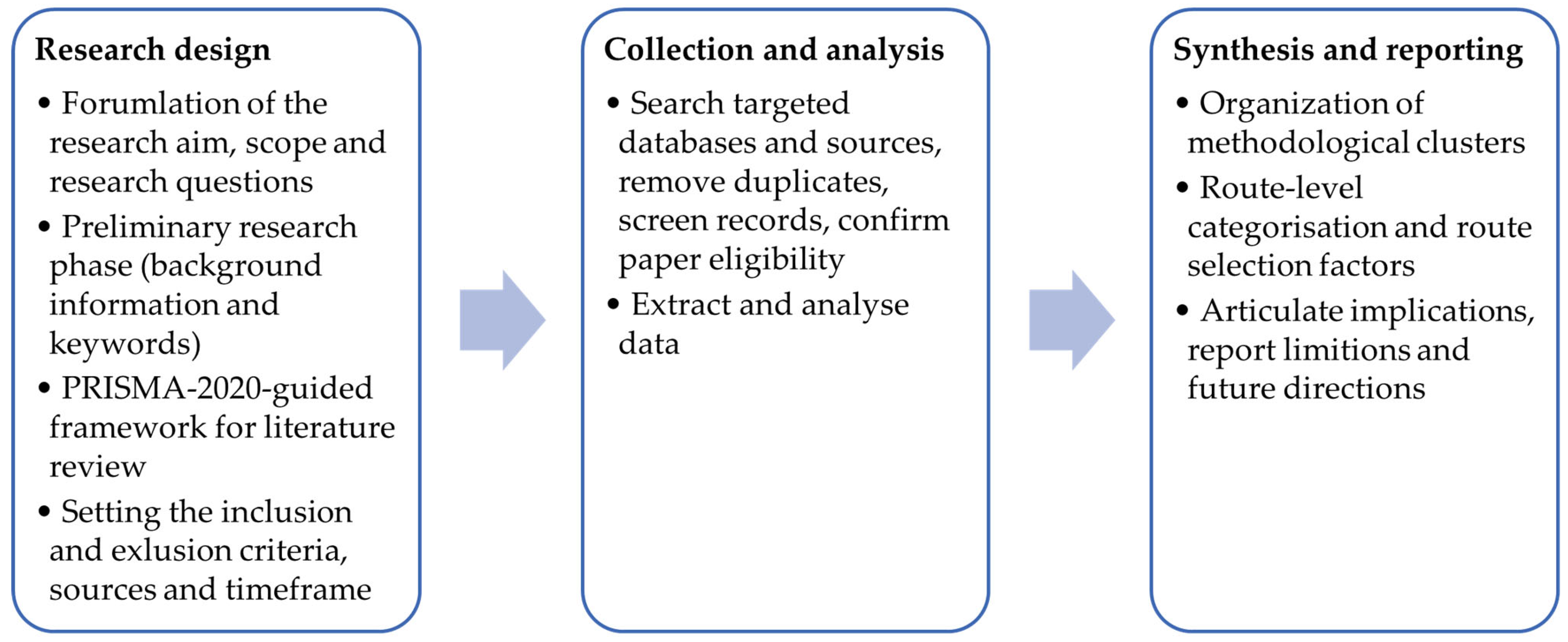
During the preliminary phase of this study, the authors identified a wide range of methodologies and approaches related to the implementation of battery-powered ferries, as well as literature on the adoption of alternative propulsion vessels within different maritime transport regimes. With this in mind, the authors sought an appropriate way to present the reports and their findings in a comprehensive literature review in order to provide a solid foundation for stakeholders and researchers interested in this niche topic. Accordingly, the authors chose the PRISMA 2020 guidelines [45,46] to identify, assess, and synthesize existing knowledge and methodologies from case study research, covering both real-life deployment and conceptual assessments of battery-powered ro-pax ferries. This framework provides a structured approach for conducting a systematic literature review. Figure 1 shows that the general research framework model consists of three steps: research design, collection and analysis, and synthesis and reporting. This research framework is further enhanced using the PRISMA 2020 analysis flow diagram in Figure 2. A case study approach was adopted to enable a consistent, structured comparison of operational contexts and methodologies from a maritime transport system perspective, aligning with comparable studies mentioned in the introduction [31,39]. Additionally, the PRISMA 2020 framework has already been successfully adopted in several previous studies covering topics within the maritime industry [42,49,50,51,52].
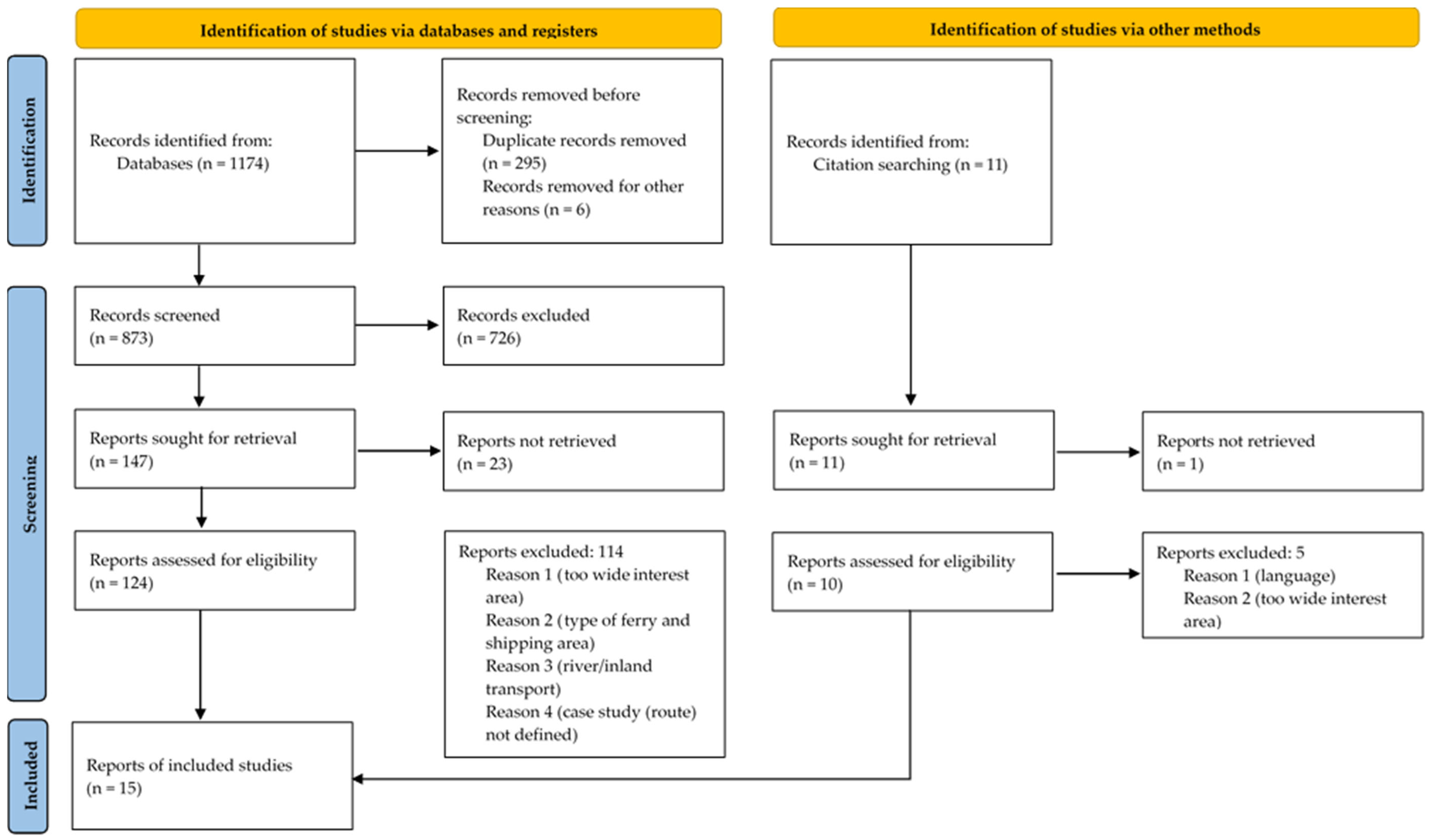
Based on the research framework model in Figure 1, the literature selection process is shown below in Figure 2, using the PRISMA 2020 analysis flow diagram [53]. In the preliminary and first phase of the literature review, the authors focused on a comprehensive keyword and keyword-string search strategy to ensure adequate coverage of topics related to battery-powered ro-pax ferries. Searches were conducted for the period from 2014 to 2024 across two major scientific databases, Web of Science and Scopus, to capture high-quality, peer-reviewed literature, including articles, conference papers, review articles, and book chapters from relevant research areas in the English language. Accordingly, a wide range of terms, corresponding combinations, and permutations with Boolean operators were used, including: ferry, ro-pax, ro-ro, electric, electrification, zero-emission, battery-powered, hybrid, diesel–electric, electric propulsion, alternative propulsion, alternative marine fuel, e-ferry, decarbonization, case study, scenario, short distance, route, line, short sea route, short sea shipping, coastal, and domestic. This broad search strategy was deliberately adopted because the authors observed, during the preliminary literature search, that comparable studies used different terminology to address similar concepts. It became clear that different authors used context-specific terms such as coastal shipping, particularly when referring to the broader meaning of short sea shipping, and vice versa.
While the inclusion criteria were limited to domestic ferry transport systems operating within a single national framework, the authors found three cross-border case study routes, namely Helsinki (Finland)–Tallinn (Estonia), Vaasa (Finland)–Umea (Sweden) [36], and Helsingor (Denmark)–Helsingborg (Sweden) [38], that were also incorporated. Although these routes connect countries, they represent high-frequency services with operational, technical, and infrastructural characteristics comparable to ferry routes within domestic shipping. Their inclusion was therefore justified on the basis of functional equivalence rather than political or administrative boundaries. This allows for a more comprehensive and comparable understanding of short-sea ferry electrification practices across geographically and operationally similar maritime transport contexts.
The term ferry was often used inconsistently in the literature reviewed, since some authors did not specify which type of ferry they were referring to, while others used the term too broadly to refer to any passenger-carrying vessel except a ro-pax ferry. The terms referring to ferry and domestic shipping, along with their implications for this review, were discussed and explained in the introduction. By applying a comprehensive keyword strategy, the authors attempted to systematically identify all potentially relevant papers addressing the research scope of this review. Consequently, searches of two databases yielded a large number of reports, as shown in Figure 2. However, this approach reduced the risk of excluding studies due to differences in terminology and ensured that the relevant dataset adequately reflected the multidisciplinary perspectives in ferry transport. Ultimately, the identified datasets were extracted from the two databases by the authors and analyzed in an MS Excel spreadsheet, with duplicates and inaccessible datasets removed. The authors performed all literature exclusions, and no automated tool was used.
The second phase of the review is related to the screening process. The purpose of screening is to identify papers relevant to the topic of the literature search and to exclude reports that do not fit the scope of the paper by reviewing the titles and abstracts of the extracted papers. During the screening of the selected literature, several relevant studies, with the backward and forward snowballing effect were identified, and analyzed according to the PRISMA 2020 guidelines (see Figure 2 “Identification of studies via other methods”). In Figure 2, “Identification via other methods” refers to the backward and forward snowballing effect (reference list checking and citation chasing) used to identify additional potentially relevant records. After identification, screening, and retrieval, 124 papers were assessed for eligibility. Eligibility assessment is the step in which reports are accepted or rejected based on the review’s inclusion and exclusion criteria. A thorough review of the relevant studies was conducted according to the eligibility criteria, and 114 papers were excluded for the following reasons: too wide interest area, studies addressing exclusively alternative propulsion technologies, marine engine systems, or zero-carbon fuel without a case study route context, undefined type of ferry or shipping area (as explained in the introduction), focus on river and/or inland waterway transport, and undefined case study (e.g., route). This tailor-made framework was also applied to references identified via the snowballing effect, resulting in 10 reports assessed for eligibility and five excluded. Finally, 15 reports were included in the literature review process after merging both identification pools (databases and snowballing) because they were consistent with the aim and scope and met the eligibility criteria. Only the reports included in this phase were considered for further analysis.

3. Results

This section presents the main findings of the literature review, structured into two parts. The first part focuses on the methodologies identified in the analyzed case studies and outlines how various analytical frameworks have been applied to assess the implementation of ferries on specific routes. The second part provides a route-based analysis, examining the ferry routes studied by the authors. These routes are considered through different levels of implementation within the maritime transport system, with particular attention given to the authors’ rationale for selecting them.

3.1. Methodologies

The review of selected literature identified a diverse set of methodologies addressing various aspects of ferry transport electrification in the implemented case study approaches over the years, as shown in Table 1.
To provide analytical clarity, the main methods implemented in the studies were grouped according to their research orientation:
  • conceptual and exploratory;
  • techno-economic and operational;
  • multi-criteria and decision support;
  • system-integrated and strategic approaches.
The grouping illustrates the gradual shift from a theoretical framework towards a more comprehensive decision-support and transport-system-wide application.
The first grouping, conceptual and exploratory methodologies, defines the concepts, barriers, and key drivers of ferry electrification, establishing the theoretical and contextual foundations for quantitative and model-based research. Gagatsi et al. [37] conceptualized the real-life ferry Ellen based on two demonstration routes operating in Denmark, combining a multi-faceted feasibility assessment of qualitative performance and market potential to demonstrate the feasibility of zero-emission operation under regional constraints. The authors conclude that the EU ferry fleet is quite old, indicating a need for newer and more energy-efficient vessels. Tarkowski [38] extended this reasoning through four case study analyses, each involving an already implemented real-life alternative propulsion ferry, of which three are relevant for this paper based on the ro-pax ferry selection criteria. Tarkowski’s case study approach provides knowledge of ferry shipping emission reduction, emphasizing the interactions among technical, operational, geographical, and economic conditions. The synthesis of case studies revealed that the specific implementation of ferries is strongly determined by local conditions. Similarly, Liebreich et al. [57] incorporated economic, technical, and social dimensions to determine viable routes and their industry-related implications by analyzing 132 ferry routes in Latin America using the Ellen ferry model. The authors emphasized the importance of stakeholders as a key factor in the successful implementation of battery-powered ferries, particularly in procurement processes to address potential bottlenecks in electrification efforts.
A second cluster of studies, techno-economic and operational, focused on empirical assessments of feasibility, costs, and operational performance. The EnergiNorge [30] report is based on a large-scale analysis of 52 Norwegian ferry routes where the Ampere ferry was used as the calculation model. The analysis focusses on evaluating the need for electric power at quays and the associated costs, as well as the capabilities of power network companies to deliver the required power. The report indicates that significant investments are necessary to electrify multiple ferry routes in Norway and confirms the required synergy between the state and various private companies for successful implementation. Gašparović and Klarin [54] conducted a multi-stage techno-economic analysis of 36 ferry routes on the Croatian part of the Adriatic coast to identify suitable routes for electrification. The authors used the real-life Ampere ferry as a model. The study adopts multiple scenarios involving diesel, hybrid, and fully electric ferry. By using the Croatian Split–Supetar ferry route, the study demonstrates that fully electric ferries could achieve a payback period of four to seven years and reduce fuel dependency. Vicenzutti [56] used data-driven simulation for the Croatian Porozina–Brestova route based on a case-study-specific ferry. Navigational and technical data from the conventional existing ferry were implemented into the simulation to evaluate fuel consumption, pollutant emissions, and operational expenditure. The results indicate that hybrid-electric ferries substantially reduce fuel use and emissions. Similarly, Perić et al. [58] and Vukić et al. [32] quantified emission reductions and external costs for electric propulsion in Croatian and Montenegrin contexts, respectively. By following the recommended air pollutant emission inventory guidebook, Perić et al. estimated exhaust gas emissions from the ferry and assessed the potential benefits of converting a ferry, as well as its impact on local air quality and emissions. The case study was based on a case-study-specific ferry on the Croatian Dominče–Orebić route. Vukić et al. conducted a comparative analysis of three different propulsion systems to assess their environmental external costs. The paper focuses on the Kamenari–Lepetane route in Montenegro, where a case-study-specific ferry is used as a model for calculation. The results confirm that the electric propulsion system achieves the lowest level of external costs compared to diesel and LNG propulsion. Kortsari et al. [59] evaluated the economic performance of a battery-powered ferry by comparing its construction and operating costs with diesel and diesel–electric vessels operating on similar routes. The authors selected comparable vessels, from the ferry operator perspective, and adjusted their characteristics to match Ellen’s operational profile. The results of this report suggest that, despite higher initial construction costs, electric ferries are economically viable, with an estimated payback period of five to eight years. Aboud and Massoud [61] discussed the possibility of integrating solar energy with batteries for the ferry operating between Port Said and Port Fouad in Egypt. The simulation was conducted on a case-study-specific ferry. The results were compared with the retrofitting capital and operational costs for each system. The findings confirm both the environmental and economic advantages of the hybrid ferry. It should be noted that, while most studies examined fully battery-powered or hybrid (diesel–electric) configurations, where energy is supplied by shore charging infrastructure, Aboud and Massoud explored hybrid solar-electric retrofitting as an alternative pathway toward electrification. This approach represents a complementary technological solution within the same decarbonization framework.
A further literature review and third group analysis integrated multi-criteria and decision-support approaches to emphasize the balance among environmental, economic, and social factors. Aspen et al. [55] used a combined multi-criteria decision-making method (MCDM) and Stochastic Multicriteria Acceptability Analysis and Technique for Order Preference by Similarity to Ideal Solution (SMAA-TOPSIS) model to evaluate ferry propulsion alternatives for a Norwegian ferry tender. The study analyzes uncertain criteria related to environmental impacts, costs, fuel access, and public acceptance across various case study ferry combinations operating on the Molde–Vestnes route in Norway. The authors note that the MCDM approach can assist both operators and concession authorities in evaluating multiple options for long-term contracts. The results indicate that all-electric configurations are the most robust solutions. Karountzos et al. [60] developed a Geographic Information Systems (GIS) spatial analysis (Exploratory Spatial Data Analysis—ESDA) using Bivariate Local Indicator of Spatial Association (Bi-LISA) models to analyze coastal maritime ferry networks and assess potential electrification areas for the Greek coastal shipping network. By adopting spatial analysis, the authors investigated 80 ferry routes. This comprehensive analysis enabled them to identify patterns, visualize spatial distributions, and detect variables related to socio-economic and environmental characteristics. The authors advocated considering both spatial and non-spatial characteristics of complex maritime networks for successful electrification. The results identified optimal hub ports with high passenger flow and proximity to spoke ports. Building on this, Karountzos’ thesis [17] introduced a GIS-based Spatial Decision Support System (SDSS) for implementing zero-emission ferries into maritime transport network design. The research supports a comprehensive evaluation of port efficiency, stakeholders, and policymakers, along with environmental, passenger, and connectivity factors in planning zero-emission maritime routes. Further work by Karountzos et al. [62] discussed a GIS-based multi-criteria site evaluation methodology to assess the feasibility of offshore renewable energy for powering electric ferry networks, while using the Green Coastal Shipping Network as the scenario setting. The improved feasibility of zero-emission ferry lines contributes to achieving GHG emission reductions. Therefore, the author emphasizes the importance of integrating energy production with maritime transport planning and supports a more holistic approach. All three Karountzos papers base their research on the ferry Ellen model. Collectively, these studies bridge methodological rigour with decision-making and spatial analysis to support evidence-based, holistic planning and stakeholder-informed optimization.
The final methodological clustering focuses on system-integrated and strategic methodological approaches, in which authors adopt holistic, system-level perspectives by integrating ferry electrification into the wider transport context. Generally, strategic methodologies are oriented toward long-term planning and analytical approaches that support system-level decision-making, all while considering technical, spatial, economic, and policy dimensions [63]. These studies move beyond individual routes and address the structural and policy dimensions of maritime decarbonization by examining the interdependencies between technology, infrastructure, and policy at a systemic level. While some of these works have already been discussed in previous categories, their overarching analytical scope and cross-sectoral applicability justify their inclusion in a distinct, higher-order group. This category, therefore, analyzes approaches that frame electrification as part of a broader transition of the transport system by integrating multiple transport modes and maritime networks, rather than treating it as an isolated solution. In particular, Karountzos’s works [17,60,62] frame ferry electrification as part of a systematic restructuring of the maritime transport network, where GIS-based modelling is coupled with decision-support methodologies to identify and optimize sub-networks for zero-emission operations. Similarly, EnergiNorge’s report [30] addresses Norway’s national ferry transition by analyzing selected routes and linking technical feasibility with grid readiness and policy alignment. A new addition to this clustering is the paper by Jenu et al. [36], which used a holistic comparative model to assess the emission-reduction potential across multiple transport modes, including land-based, water-based, and airborne options. The maritime segment focuses on two routes, namely the Helsinki–Tallinn and Vaasa–Umea routes, where the ferry Ellen was adopted as a reference model. The authors showed that the benefits of electrification depend strongly on the electricity mix. Depending on the energy mix used for electricity production, emissions from electric transportation modes may exceed those of existing modes, suggesting that a modal shift is not always recommended.

3.2. Routes

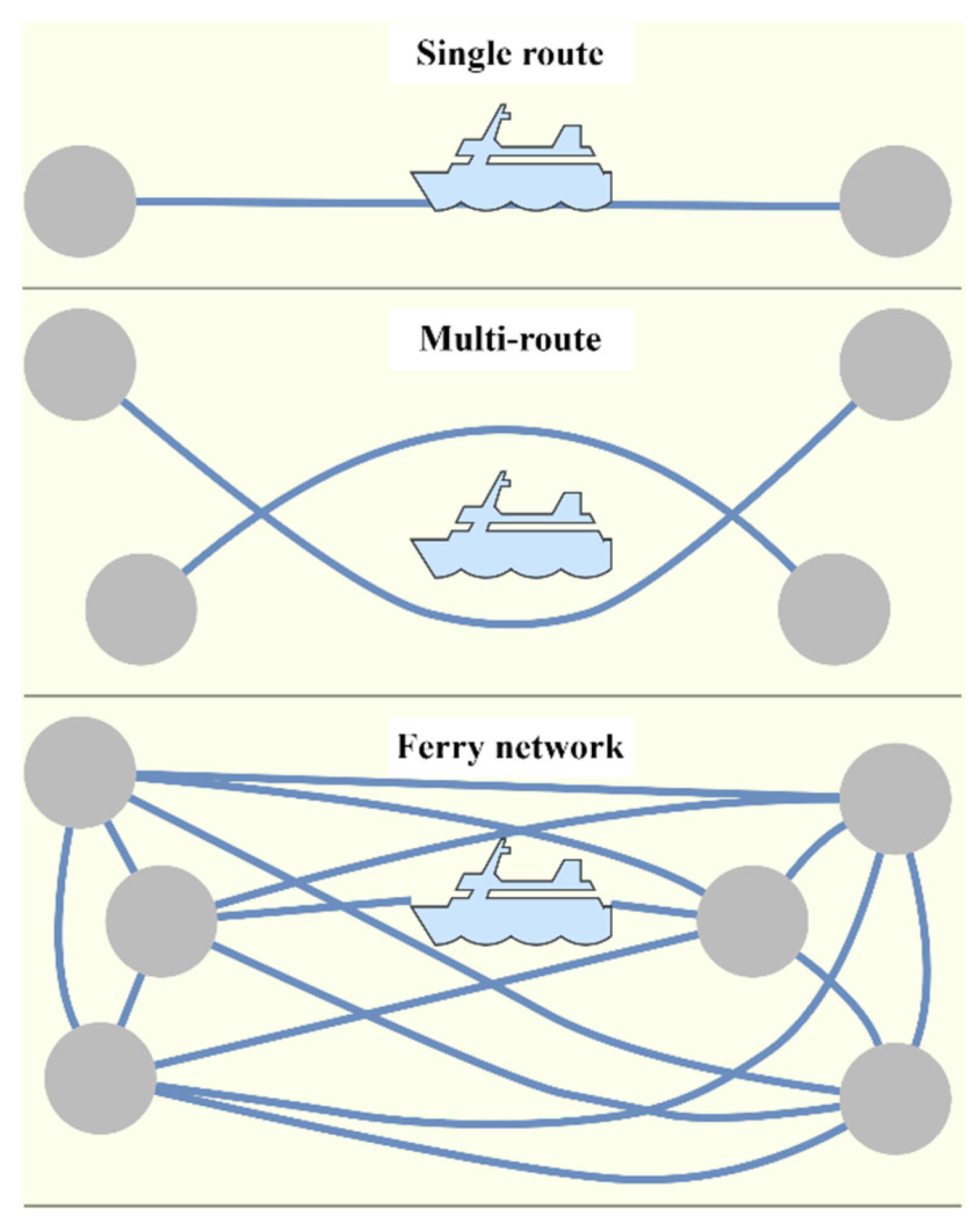
The selected papers examine ferry routes across three distinct levels (Figure 3 and Table 2), each reflecting a different dimension of the maritime transport system: single route, multi-route, and, at the highest level, ferry network-based case studies.
The single route classification refers to studies that focus on an individual route where a specific ferry has been implemented. These routes differ from the multi-route and network-based classifications because, in the reports, they are not presented as part of the higher-level classification of the national transport system network (example: [55]). The multi-route classification includes study that analyze multiple ferry routes. While these routes may belong to a national maritime transport network or a subnetwork within a specific region, the authors selectively examined specific ferry lines within that network for their research (example: [30]). Finally, the network-route classification includes studies that focus on an entire ferry network, large segments of it, or specific regional subsystems within the network (example: [62]). All three classification levels are shown in Table 2.
The analyzed papers represent a geographically diverse body of research on ferry electrification. The examined studies included Northern European contexts (Norway, Denmark, Finland, Sweden, and Estonia) [30,36,37,38,55,59], Southern European regions (Croatia, Greece, Montenegro) [17,32,54,56,58], and non-European areas such as Egypt [61] and Latin America [57]. The routes classification in the observed case studies showed that most reports focused on a single route, totaling 11. Among these, Tarkowski and Liebreich each conducted case study analyses on three routes [38,57]. These studies were still classified as single-route analyses, as each route was examined separately and in different national contexts, without forming a unified multi-route or network framework. Multi-route study extended its focus by evaluating multiple ferry routes, with a total of 52 for EnergiNorge [30]. Finally, the network-level category is represented by the studies of Karountzos [17,60,62], who approached ferry transport from a systematic perspective by analyzing maritime ferry networks as a cohesive operational structure rather than focusing on single or grouped routes.
A recurring ferry pattern emerged across studies on the use of electric ferries. Several studies used existing electric ferries as operational models for simulation and scenario evaluation. The ferries Ampere and Ellen appear most frequently as baseline models, with Ampere used in two studies [30,54] and Ellen in five [17,36,57,60,62]. For example, EnergiNorge [30] applied the operational profile of the Ampere ferry to provide a manageable basis for their calculations. It is important to note that Ellen’s real-life operation was discussed in three case studies [37,38,59]. A real-life case study of the Ampere ferry was used once in the reviewed literature, specifically in [38], which also analyzed a real-life scenario for the hybrid ferry Tycho Brache & Aurora af Helsingborg. All other studies used case-study-specific ferries for their research.
The analysis of the reviewed studies shows that the factors influencing route selection varied significantly across levels of analysis: single route, multi-route, or network level. Accordingly, the approaches evolved from technical and operational perspectives to system-integrated perspectives. In single-route studies, authors most often selected routes that allowed them to demonstrate the feasibility of electrification under certain conditions. In the paper by Gagatsi et al. [37], the route was chosen based on the ferry’s limited range and suitability for electric propulsion. Gašparović and Klarin [54] analyzed 36 Croatian ferry routes with sailing times of up to 60 min, of which 19 routes accounted for over 80% of passenger and vehicle traffic in coastal maritime transport. The Split–Supetar ferry route was selected as a representative single-route case study due to its highest traffic volume. In Aspen’s study [55], the route selection criteria were predefined by tender requirements, where the main criteria were not directly related to route selection but rather to the choice of alternative ferry propulsion systems, including GHG and NOx emissions, procurement costs, fuel availability, and public acceptance. Vicenzutti [56] utilized a route where the case-study-specific ferry was already operating, as the reference case provided operational data available for comparison with the conventional design. A similar approach was applied by Kortsari [59], although in the opposite direction. The Soeby–Fynshav route was chosen specifically because real-world operational data were available from the electric ferry Ellen. This enabled the authors to use the established operational pattern of the route to directly compare Ellen’s costs with those of comparable diesel-powered ferries. Vukić et al. [32] emphasized the socio-ecological importance of the route through the Bay of Kotor, considering its short distance and year-round operation. Jenu et al. [36] selected the route based on the potential for modal shift and the ferry’s role in connecting different modes of transportation. Tarkowski’s [38] case studies were selected to represent a wide range of conditions under which shipping electrification occurs: across fjords, coastal connections, and short-sea international links. All selected routes illustrate different operational characteristics, service patterns, and geographical conditions. Liebreich et al. [57] chose routes based on several parameters, including battery energy density, battery costs, infrastructure costs, and route frequency. Similarly, the route selection criteria in the studies by Perić et al. [58] and Aboud and Massoud [61] were based on route length and operational factors, including crossing time, disembarking, and manoeuvring duration.
In a single multi-route study, the aim was to identify groups of routes with similar characteristics to assess the broader applicability of the technology. EnergiNorge [30] used a systematic approach to select 52 Norwegian routes based on several factors. The first factor concerned section length: routes with a crossing time of less than 30 min were selected, as longer routes would be less competitive for battery-powered ferries compared to conventional diesel propulsion. The second factor was route complexity. Some analysed routes had a complex operational structure, with a single ferry operating between up to ten different ferry quays. The third factor referred to exposure and weather conditions. Certain Norwegian ferry routes operate in open sea areas, and these conditions require significant redundant battery capacity. Furthermore, it is also not uncommon for weather conditions to necessitate a route adjustment, which can result in significantly longer travel distances and crossing times. The fourth factor concerned traffic volume, as several routes had low traffic volumes and few departures. Such routes were excluded from consideration.
Finally, in network-level studies, the selection shifts from individual route characteristics to system-wide and spatial variables. Route selection is based on overall passenger demand, the proximity of ports within the operational range of electric ferries, operational frequency, and the assessment of regional renewable energy capacities. By integrating various factors and energy-related data, potential hub ports and sub-networks suitable for sustainable ferry electrification were identified, as defined by Karountzos in [17,60,62].

4. Discussion

The systematic literature review on battery-powered ferries in domestic shipping confirms increasing methodological maturity and diversification in this research field over the years. Although several review papers examine alternative marine fuels and electric propulsion in a broad, technology-oriented manner, often within the wider maritime transport regime context [39,40,41,42,43,44], there has been a lack of structured synthesis of methodologies applied to battery-powered ro-pax ferries within the maritime transport system regional component of domestic shipping from a case study research perspective. Existing review studies often tend to analyze fuels, technologies, or life-cycle performance at a generic vessel or fleet level, while route-specific operational contexts and the methodological designs of case studies remain fragmented and analyzed in isolation with respect to various characteristics, as detailed in [31]. A thorough understanding of the interplay between ferry characteristics and a particular route’s requirements is essential for operators to determine the critical features that should guide investment decisions in fleet renewal [64]. Accordingly, research on sustainable ferry operations is inherently multidisciplinary and includes economic and social analysis, environmental impact assessments, technology evaluations, spatial and local considerations, and a structured decision-making framework. This paper advances the field through a tailor-made systematic literature review model, that systematizes methodological and applicable knowledge related to the implementation of battery-powered ferries on specific routes within domestic shipping. Moreover, heterogeneous and often imprecise use of key terms, such as ferry and short-sea shipping, has restricted comparability across studies and hampered cumulative learning. To bridge this gap, the authors adopted harmonized IMO and EU definitions for ro-pax ferries and domestic shipping, thereby ensuring the conceptual consistency across the reviewed studies. The two papers with case studies that appear to be exceptions functionally belong to the same group, as exemplified by the authors of [36,38]. By further narrowing the scope to case-study-based analyses of routes where real-life and conceptual research on battery-powered ferries was conducted, this review provides systematized insights into the methodologies applied and the rationale for route selection examined in the reviewed studies. Through a synthesis of 15 selected studies, the evolution of research from isolated technical evaluations toward integrated, system-oriented analysis has been demonstrated.
Addressing research question 1 (RQ1), the methodological transition from conceptual and feasibility-focused analysis to holistic, multi-criteria, and system-integrated frameworks represents one of the findings of this review. This methodological progression is identified across four clusters: conceptual and exploratory studies, techno-economic and operational analysis, multi-criteria and decision-support approaches, and system-integrated and strategic frameworks. Conceptual and exploratory contributions clarify drivers, barriers, and contextual conditions for electrification and establish early design principles [37,38,57]. Techno-economic and operational studies quantify investment needs, operating costs, emissions, and external costs on specific routes [30,32,54,56,58,59,61]. This approach demonstrates feasibility under defined local constraints and highlights the importance of short, high-frequency services. Multi-criteria and decision-support approaches introduce formal multi-criteria structures that integrates environmental, economic, and social criteria to enable more transparent trade-offs in tendering and planning processes [17,55,60,62]. Finally, system-integrated and strategic works embed electrification within wider maritime transport systems, showing how maritime network design, hub selection, and energy mix shape achievable emissions reductions [17,30,36,60,62].
The second research question (RQ2) is addressed by introducing classification levels for case-study routes into single-route, multi-route, and network-level case studies. The predominance of single-route case study analyses shows that empirical, evidence-based research on ferry electrification is grounded in demonstration projects and contextualized case studies. Most authors deliberately select routes that exhibit favorable characteristics for electrification, such as short crossing times, high departure frequencies, predictable schedules, fixed ports, and, in some cases, socio-ecological significance [32,36,37,38,54,55,56,57,58,59,61]. Multi-route analysis is primarily represented by EnergiNorge [30], which systematically filtered 52 Norwegian routes using several criteria to identify groups of routes with similar profiles. Network-level studies by Karountzos move further by treating ferry routes as interconnected sub-networks and combining operational, spatial, and energy-system variables [17,60,62]. Observed patterns confirm and refine insights from the broader literature on alternative fuels, which already emphasizes that short-distance, high-frequency routes are primary candidates for early electrification, as indicated in the introduction section [29,33,34,35,39,40,41,42]. The methodological and case study route-oriented classifications demonstrate a coherent evolution from single-route feasibility studies towards multi-criteria and network-wide planning, confirming the initial assumption that methodological approaches in this field are diversifying and maturing toward system-level maritime network perspectives. This multi-layered progression indicates a broader recognition that ferry electrification cannot be addressed solely through a single methodological approach, but rather as a cross-sectoral process embedded within a wider understanding of maritime transport systems.
The analysis of ferry model archetypes further clarifies how research in the reviewed literature both enables and constrains generalization. Across the reviewed papers, three main ferry modeling strategies emerge: the use of existing real-life battery-powered ferries as templates (primarily Ellen and Ampere), case-study-specific models based on conventional ferries already operating on the case study-related routes, and real-life electric or hybrid ferries deployed on specific routes. Template-based modeling around Ampere and Ellen, used in a substantial share of studies [17,30,36,54,57,60,62], reduces the number of technical unknowns and allows researchers to benchmark results across different countries and methodological perspectives. This supports the development of standardized comparative frameworks and promotes the identification of common feasibility thresholds, such as crossing time, speed, energy demand, grid connection, and ferry capacity. At the same time, repeated reliance on a narrow set of ferry archetypes introduces potential bias toward particular ferry choices and especially regional conditions, while consequently risking under-representation of alternative ship configurations, operating environments, environmental conditions, and other local influencing factors. The consistent replication of ferry-related case study models confirms their methodological value but also indicates a research gap in diverse regional ferry types. Studies based on case-study-specific ferries [32,55,56,58,61] address this limitation, to some extent, by closely matching ferry and route characteristics and by explicitly modelling local operational parameters. Nevertheless, their results are less directly comparable across cases, which undoubtedly supports the narrative focused on tailor-made local integration factors, as several authors have argued [33,35,36,38]. Real-life electric ferry implementations [37,38,59] provide valuable validation by demonstrating, not only technical feasibility, but also organizational and regulatory challenges in converting or deploying ferries in complex local settings.
Further addressing the second research question (RQ2), the route selection factors observed in the case studies support the conclusion that local conditions are essential for meaningful assessment related to the deployment of battery-powered and hybrid ferries. In single-route case studies, the authors typically justify route choice by considering limited crossing time, route traffic volume, role in regional connectivity, available infrastructure, or the opportunity to use existing operational data. In contrast, multi-route and network-level studies systematically implement spatial analysis, hub-and-spoke structures, renewable energy potential, and broader network-wide demand patterns into route selection. The comparison mentioned suggests that future methodological development should create more explicit links between route classification levels. Single-route feasibility models could be parameterized in order to allow deployment within network-wide frameworks; on the other hand, network studies could adopt more detailed and comprehensive vessel-route matching procedures derived from the single-route level. The reviewed evidence also confirms that the electricity mix and regional energy system design, as highlighted in the study by Jenu [36] and the renewable energy source network study by Karountzos [62], can fundamentally alter the net climate benefits of electrification. Based on the analysis of the heterogeneous factors influencing route selection, the authors logically grouped them, as shown in Table 3.
The factor consolidation in the table above shows that route selection in the reviewed case studies is guided by a relatively coherent set, considering the substantial variation in individual case study contexts. This variation is related to the different parameters influencing route selection, depending on the scope of the case studies and the models applied. Operational and technical factors suggest that authors frequently prioritized routes with short crossing times, dense and stable service patterns, and well-documented operational data combined with operational profiles that match energy demand. This emphasis indicates that the route selection has primarily been driven by practical feasibility and data availability to ensure that case studies can robustly demonstrate technical viability under realistic operating conditions. Economic, environmental, social, and strategic groups appear alongside operational and technical factors. Economic aspects are primarily expressed through traffic demand and route utilization by connecting the most propulsive high-volume routes to investment justification. Environmental factors were presented both through direct emission targets, based on tender procurement, and through weather and exposure as constraints that shape energy needs and risks related to ferry voyages on the route. Social importance was less frequently observed in the studies, although it frames the broader relevance of the chosen routes for transport policy and regional development. Strategic relevance relates to the higher national importance of the entire maritime network system which ultimately integrates all the previously mentioned factors at a broader, network-wide level. Linking the strategic characteristics with the previously mentioned factors ensures that the adoption of new technologies on specific routes is successful and sustainable throughout the entire maritime network including ports, various services, and the overall coastal maritime transport structure, thus enabling the cohesiveness of the elements that form maritime transport systems [18,20,65].

5. Conclusions

In conclusion, this systematic literature review demonstrates that research on battery-powered ro-pax ferries in domestic shipping has evolved from isolated, technology-focused assessments to a more mature, diversified, and system-oriented field within the maritime transport system. By addressing the lack of structured synthesis of methodologies applied to battery-powered ro-pax ferries from a case study perspective, this review directly connects methodological approaches to real-world and conceptual applications on specific routes. Additionally, by identifying and analyzing relevant case studies, the inherent depth and specificity of the case study approach provide a strong foundation for the research field and mark the first step towards the systematic modelling. Therefore, the authors adopted a tailor-made systematic literature review model based on PRISMA 2020 guidelines and harmonized IMO and EU definitions of ro-pax ferries and domestic shipping. The findings confirm that electrification is no longer a conceptual innovation but rather a maturing area of applied and multidisciplinary research that must balance standardized comparative frameworks with customized, route-optimized solutions under diverse local conditions.
The research results are relevant to stakeholders in the maritime industry and to researchers. For ferry operators, the consolidated ferry route selection factors offer a structured basis for aligning battery-powered ferry implementation projects with route-specific operational, technical, and contextual conditions. This supports the long-term sustainability of the route. For researchers, the proposed framework enhances the comparability of different studies and clarifies the methodological complexity of electrifying ro-pax ferries compared to conventional analyses.
The authors’ tailor-made, case-study-based systematic literature review is subject to several limitations. By narrowing the thematic scope to methodologies applied in case study research on the maritime transport system’s regional component of domestic shipping, as well as to IMO and EU definitions of domestic shipping and ro-pax ferries, the study excluded other vessel types, technology-specific, and marine engine system papers focused on alternative fuel options. This inherently narrow scope yielded a relatively small corpus of 15 papers. Additionally, the search strategy, which primarily targeted English-language sources and the Web of Science and Scopus databases, may have overlooked relevant sources in other languages, grey literature, and other databases. Lastly, the classification of methodological approaches and route levels relies on the authors’ judgment and is constrained by the reporting across the selected case studies.
Future research on ferries in maritime transport should begin with clearer, standardized definitions. Based on the research results, it is recommended that studies specify the exact ferry type, the service regime, and the route’s role within the wider network. Reducing ambiguity around terminology would greatly improve comparability across studies which could provide stakeholders with a clearer basis for planning and implementing sustainable technologies. Furthermore, the heterogeneity of ferry routes means that one-size-fits-all solutions are not realistic. More customized configurations are needed that align with the specific profile of each route.

Author Contributions

Conceptualization, R.G., L.V., V.P. and M.R.; methodology, R.G. and L.V.; validation, R.G., L.V., V.P. and M.R.; formal analysis, R.G., L.V., V.P. and M.R.; investigation, R.G., L.V., V.P. and M.R.; resources, R.G., L.V., V.P. and M.R.; data curation, R.G., L.V., V.P. and M.R.; writing—original draft preparation, R.G. and L.V.; writing—review and editing, R.G. and L.V.; visualization, R.G. and L.V.; supervision, L.V. All authors have read and agreed to the published version of the manuscript.

Funding

This research received no external funding.

Data Availability Statement

The original contributions presented in this study are included in the article. Further inquiries can be directed to the corresponding author.

Conflicts of Interest

The authors declare no conflicts of interest.

Abbreviations

The following abbreviations are used in this manuscript:
Bi-LISABivariate Local Indicator of Spatial Association
CIICarbon Intensity Indicator
CO2Carbon Dioxide
EEXIEnergy Efficiency Existing Ship Index
EEAEuropean Environment Agency
EMSAEuropean Maritime Safety Agency
ESDAExploratory Spatial Data Analysis
ETSEmission Trading System
EUEuropean Union
GHGGreenhouse gas
GISGeographic Information System
GTGross tonnage
IMOInternational Maritime Organization
ITFInternational Transport Forum
LCALife cycle assessment
LNGLiquefied Natural Gas
MARPOLInternational Convention for the Prevention of Pollution from Ships
MCDMMulti-criteria decision-making
PRISMAPreferred Reporting Items for Systematic Reviews and Meta-Analysis
RQResearch Question(s)
RQ1Research Question 1
RQ2Research Question 2
Ro-paxRoll-on/Roll-off passenger (vessel/ferry)
Ro-roRoll-on/Roll-off (vessel/ferry)
SDSSSpatial Decision Support System
SMAAStochastic Multicriteria Acceptability Analysis
TOPSISTechnique for Order Preference by Similarity to Ideal Solution

References

  1. International Maritime Organization (IMO). Fourth IMO Greenhouse Gas Study. Available online: https://greenvoyage2050.imo.org/wp-content/uploads/2021/07/Fourth-IMO-GHG-Study-2020-Full-report-and-annexes_compressed.pdf (accessed on 17 November 2024).
  2. European Commission. Reducing Emissions from the Shipping Sector. Available online: https://climate.ec.europa.eu/eu-action/transport-decarbonisation/reducing-emissions-shipping-sector_en (accessed on 17 November 2024).
  3. International Maritime Organization (IMO). EEXI and CII—Ship Carbon Intensity and Rating System. Available online: https://www.imo.org/en/mediacentre/hottopics/pages/eexi-cii-faq.aspx (accessed on 5 April 2025).
  4. Otsason, R.; Tapaninen, U. Decarbonizing City Water Traffic: Case of Comparing Electric and Diesel-Powered Ferries. Sustainability 2023, 15, 16170. [Google Scholar] [CrossRef]
  5. Transport & Environment. Climate Impacts of Exemptions to EUʼs Shipping Proposals. Arbitrary Exemptions Undermine Integrity of Shipping Laws. Available online: https://www.transportenvironment.org/uploads/files/Climate_Impacts_of_Shipping_Exemptions_Report_updated.pdf (accessed on 16 August 2024).
  6. Laasma, A.; Otsason, R.; Tapaninen, U.; Hilmola, O.P. Evaluation of Alternative Fuels for Coastal Ferries. Sustainability 2022, 14, 16841. [Google Scholar] [CrossRef]
  7. Bačkalov, I.; Dahlke-Wallat, F.; Frank, E.; Friedhoff, B.; Grasman, A.; Jasa, J.; Kreukniet, N.; Quispel, M.; Thalmann, F. Greening of Inland and Coastal Ships in Europe by Means of Retrofitting: State of the Art and Scenarios. Sustainability 2025, 17, 5154. [Google Scholar] [CrossRef]
  8. Dong, T.; Alamoush, A.; Schönborn, A.; Ghaforian Masodzadeh, P.; Park, C.; Park, H.S.; Vakili, S.; Bilgili, L.; Ballini, F.; Ölcer, A.I. Roadmap for the Decarbonization of Domestic Passenger Ferries in the Republic of Korea. Sustainability 2025, 17, 1545. [Google Scholar] [CrossRef]
  9. Bukša, T.; Bukša, J.; Stanić Stanisavljević, B. Analysis of Ropax Short Sea Shipping Vessels in the Light of Directive (EU) 2023/959. Pomor. Zb. J. Marit. Transp. Sci. 2025, 65, 9–31. [Google Scholar]
  10. European Parliament. Report on the Proposal for a Directive of the European Parliament and of the Council Amending Directive 2003/87/EC Establishing a System for Greenhouse Gas Emission Allowance Trading within the Union, Decision (EU) 2015/1814 Concerning the Establishment and Operation of a Market Stability Reserve for the Union Greenhouse Gas Emission Trading Scheme and Regulation (EU) 2015/757|A9-0162/2022. Available online: https://www.europarl.europa.eu/doceo/document/A-9-2022-0162_EN.html (accessed on 10 November 2024).
  11. European Maritime Safety Agency (EMSA); European Environment Agency (EEA). European Maritime Transport Environmental Report 2025. Luxembourg, 2025. Available online: https://medblueconomyplatform.org/wp-content/uploads/2025/03/european-maritime-transport-environmental-report-2025.pdf (accessed on 21 October 2025).
  12. European Commission. 2024 Report from the European Commission on CO2 Emissions from Maritime Transport; Brussels, 2024. Available online: https://www.sipotra.it/wp-content/uploads/2025/02/2024-Report-from-the-European-Commission-on-CO2-Emissions-from-Maritime-Transport.pdf#:~:text=ship%20type%3A%20ships%20that%20often,so%20all%20of%20the%20distance (accessed on 7 October 2025).
  13. Mayanti, B.; Hellström, M.; Katumwesigye, A. Assessing the Decarbonization Roadmap of a RoPax Ferry. Marit. Econ. Logist. 2024, 27, 123–146. [Google Scholar] [CrossRef]
  14. Mišura, A.; Stanivuk, T.; Čišić, D. Attitudes on Introduction of Electric Ships in the Coastal Maritime Traffic of the Republic of Croatia. Sci. J. Marit. Res. 2019, 33, 84–91. [Google Scholar] [CrossRef]
  15. Interferry. Ferry Industry Facts. Available online: https://interferry.com/ferry-industry-facts/ (accessed on 25 October 2025).
  16. Nelissen, D.; De Vries, J.; Ross, S.; Király, J.; Raphaël, S. The Economic Value of the European Shipping Sector; Delft, 2025. Available online: https://ecsa.eu/wp-content/uploads/2025/03/CE_Delft_220297_The-economic-value-of-the-European-shipping_def.pdf (accessed on 20 April 2025).
  17. Karountzos, X.-O. GIS-Assisted Optimal Design of Maritime Transport Systems. Ph.D. Thesis, National Technical University of Athens (NTUA), Athens, Greece, 2023. Available online: http://hdl.handle.net/10442/hedi/54742 (accessed on 9 January 2024).
  18. Rodrigue, J.P. The Geography of Transport Systems. Geogr. Transp. Syst. 2024, 1–402. [Google Scholar] [CrossRef]
  19. Campisi, T.; Russo, A.; Tesoriere, G.; Bouhouras, E.; Basbas, S. The Evolution of Italy-Greece Passenger Maritime Transport: A Multi-Level Study to Estimate the Factors Influencing the Demand and Supply of Passenger Ferry Transport. Trans. Marit. Sci. 2024, 13, 2. [Google Scholar] [CrossRef]
  20. Janić, M. Maritime Transport System. In Resilience, Robustness, and Vulnerability of Transport Systems; Springer: Cham, Switzerland, 2022; pp. 319–402. [Google Scholar] [CrossRef]
  21. International Maritime Organization (IMO). Classifications Register Rules and Regulations. Available online: https://www.imorules.com/LRSHIP_PT4_CH2_1.html#LRSHIP_PT4_CH2_1 (accessed on 19 June 2025).
  22. Brambilla, M.; Martino, A. Research for TRAN Committee—The EU Maritime Transport System: Focus on Ferries; Brussels, 2016. Available online: https://www.europarl.europa.eu/RegData/etudes/STUD/2016/573423/IPOL_STU(2016)573423_EN.pdf (accessed on 15 April 2024).
  23. Commission of the European Communities. The Development of Short Sea Shipping in Europe: A Dynamic Alternative in a Sustainable Transport Chain; Brussels, 1999. Available online: https://eur-lex.europa.eu/legal-content/EN/TXT/PDF/?uri=CELEX:51999DC0317 (accessed on 15 April 2024).
  24. European Parliament. Regulation (EC) No 725/2004 of the European Parliament and of the Council of 31 March 2004 on Enhancing Ship and Port Facility Security. Off. J. Eur. Union 2004. Available online: https://eur-lex.europa.eu/legal-content/EN/TXT/PDF/?uri=CELEX:32004R0725 (accessed on 16 April 2024).
  25. European Parliament. Directive (EU) 2017/2110 of the European Parliament and of the Council of 15 November 2017 on a System of Inspections for the Safe Operation of ro-ro Passenger Ships and High-Speed Passenger Craft in Regular Service and Amending Directive 2009/16/EC and Repealing Council Directive 1999/35/EC. Available online: https://www.legislation.gov.uk/eudr/2017/2110#:~:text=For%20the%20purposes%20of%20this,Directive%2C%20the%20following%20definitions%20apply (accessed on 17 April 2024).
  26. Council of the European Communities. Council Regulation (EEC) No 3577/92 of 7 December 1992 Applying the Principle of Freedom to Provide Services to Maritime Transport within Member States (Maritime Cabotage). Off. J. Eur. Communities 1992. Available online: https://eur-lex.europa.eu/legal-content/EN/TXT/PDF/?uri=CELEX:31992R3577 (accessed on 17 April 2024).
  27. International Transport Forum (ITF). Decarbonisation, Coastal Shipping and Multimodal Transport: Summary and Conclusions. ITF Roundtable Reports, No. 192; OECD Publishing: Paris, France, 2023; Available online: https://www.itf-oecd.org/sites/default/files/docs/decarbonisation-coastal-shipping-multimodal-transport.pdf (accessed on 25 April 2024).
  28. European Alternative Fuels Observatory. Vessels. Available online: https://alternative-fuels-observatory.ec.europa.eu/transport-mode/maritime-sea/vessels (accessed on 28 September 2025).
  29. European Maritime Safety Agency (EMSA). Study on Electrical Energy Storage for Ships. Available online: https://www.emsa.europa.eu/publications/download/6186/3895/23.html (accessed on 20 April 2024).
  30. EnergiNorge. Electrification of Car Ferries in Norway—Survey of Investment Needs in the Power Grid; Oslo, 2015. Available online: https://www.fornybarnorge.no/contentassets/0ae3a2b651ae4e83a0487ad493c3270c/elektrifisering-av-bilferger-i-norge.pdf (accessed on 29 April 2024).
  31. Anwar, S.; Zia, M.Y.I.; Rashid, M.; De Rubens, G.Z.; Enevoldsen, P. Towards Ferry Electrification in the Maritime Sector. Energies 2020, 13, 6506. [Google Scholar] [CrossRef]
  32. Vukić, L.; Guidi, G.; Jugović, T.P.; Oblak, R. Comparison of External Costs of Diesel, LNG, and Electric Drive on a Ro-Ro Ferry Route. Promet 2021, 33, 463–477. [Google Scholar] [CrossRef]
  33. Laribi, S.; Guy, E. Marine Energy Transition with LNG and Electric Batteries: A Technological Adoption Analysis of Norwegian Ferries. Marit. Bus. Rev. 2023, 8, 80–96. [Google Scholar] [CrossRef]
  34. Torvanger, A.; Tvedt, J.; Hovi, I.B. Carbon Dioxide Mitigation from Public Procurement with Environmental Conditions: The Case of Short-Sea Shipping in Norway. Marit. Transp. Res. 2023, 4, 100085. [Google Scholar] [CrossRef]
  35. Cheemakurthy, H.; Garme, K. Fuzzy AHP-Based Design Performance Index for Evaluation of Ferries. Sustainability 2022, 14, 3680. [Google Scholar] [CrossRef]
  36. Jenu, S.; Baumeister, S.; Pippuri-Mäkeläinen, J.; Manninen, A.; Paakkinen, M. The Emission Reduction Potential of Electric Transport Modes in Finland. Environ. Res. Lett. 2021, 16, 104010. [Google Scholar] [CrossRef]
  37. Gagatsi, E.; Estrup, T.; Halatsis, A. Exploring the Potentials of Electrical Waterborne Transport in Europe: The E-Ferry Concept. Transp. Res. Procedia 2016, 14, 1571–1580. [Google Scholar] [CrossRef]
  38. Tarkowski, M. Towards a More Sustainable Transport Future—The Cases of Ferry Shipping Electrification in Denmark, Netherland, Norway and Sweden. World Sustain. Ser. 2021, 177–191. [Google Scholar] [CrossRef]
  39. Wang, Y.; Xiao, X.; Ji, Y.A.; Wang, Y.; Xiao, X.; Ji, Y. A Review of LCA Studies on Marine Alternative Fuels: Fuels, Methodology, Case Studies, and Recommendations. J. Mar. Sci. Eng. 2025, 13, 196. [Google Scholar] [CrossRef]
  40. Bei, Z.; Wang, J.; Li, Y.; Wang, H.; Li, M.; Qian, F.; Xu, W.; Bei, Z.; Wang, J.; Li, Y.; et al. Challenges and Solutions of Ship Power System Electrification. Energies 2024, 17, 3311. [Google Scholar] [CrossRef]
  41. Aksöz, A.; Asal, B.; Golestan, S.; Gençtürk, M.; Oyucu, S.; Biçer, E. Electrification in Maritime Vessels: Reviewing Storage Solutions and Long-Term Energy Management. Appl. Sci. 2025, 15, 5259. [Google Scholar] [CrossRef]
  42. Vakili, S.; Insel, M.; Singh, S.; Ölçer, A. Decarbonizing Domestic and Short-Sea Shipping: A Systematic Review and Transdisciplinary Pathway for Emerging Maritime Regions. Sustainability 2025, 17, 7294. [Google Scholar] [CrossRef]
  43. Zhang, W.; Wang, J.; Qin, G.; Kuntal, S.; Gong, F.; Yan, R. Review of the State-of-the-Art of Alternative Marine Fuels: A Viable Approach to Zero-Carbon Shipping. Clean. Logist. Supply Chain 2025, 16, 100232. [Google Scholar] [CrossRef]
  44. Tran, T.H.; Nguyen, H.M.T.; Thanh, T.N.; Nguyen, H.D. Technological Advancements in Reducing Carbon Emissions in Maritime Transportation: A Literature Survey. Int. J. Sustain. Dev. Plan. 2025, 20, 2269–2280. [Google Scholar] [CrossRef]
  45. Page, M.J.; McKenzie, J.E.; Bossuyt, P.M.; Boutron, I.; Hoffmann, T.C.; Mulrow, C.D.; Shamseer, L.; Tetzlaff, J.M.; Akl, E.A.; Brennan, S.E.; et al. The PRISMA 2020 Statement: An Updated Guideline for Reporting Systematic Reviews. BMJ 2021, 372, 71. [Google Scholar] [CrossRef]
  46. Page, M.J.; Moher, D.; Bossuyt, P.M.; Boutron, I.; Hoffmann, T.C.; Mulrow, C.D.; Shamseer, L.; Tetzlaff, J.M.; Akl, E.A.; Brennan, S.E.; et al. PRISMA 2020 Explanation and Elaboration: Updated Guidance and Exemplars for Reporting Systematic Reviews. BMJ 2021, 372, n160. [Google Scholar] [CrossRef]
  47. Salmons, J. Case Study Methods and Examples Sage Research Methods Community. Available online: https://researchmethodscommunity.sagepub.com/blog/case-study-methodology (accessed on 8 October 2025).
  48. Mills, J.A.; Durepos, G.; Wiebe, E. Quick Start to Case Study Research. Encycl. Case Study Res. 2010, 771–774. [Google Scholar] [CrossRef]
  49. Milin, V.; Skoko, I.; Lekšić, Ž.; Boko, Z. Navigational Safety Hazards Posed by Offshore Wind Farms: A Comprehensive Literature Review and Bibliometric Analysis. J. Mar. Sci. Eng. 2025, 13, 1330. [Google Scholar] [CrossRef]
  50. Bojić, F.; Gudelj, A.; Bošnjak, R. Port-Related Shipping Gas Emissions—A Systematic Review of Research. Appl. Sci. 2022, 12, 3603. [Google Scholar] [CrossRef]
  51. Maljković, M.; Pavić, I.; Meštrović, T.; Perkovič, M. Ship Maneuvering in Shallow and Narrow Waters: Predictive Methods and Model Development Review. J. Mar. Sci. Eng. 2024, 12, 1450. [Google Scholar] [CrossRef]
  52. Karin, I.; Medvešek, I.G.; Šoda, J. Best-Suited Communication Technology for Maritime Signaling Facilities: A Literature Review. Appl. Sci. 2025, 15, 3452. [Google Scholar] [CrossRef]
  53. PRISMA. PRISMA Flow Diagram. Available online: https://www.prisma-statement.org/prisma-2020-flow-diagram (accessed on 28 March 2024).
  54. Gašparović, G.; Klarin, B. Techno-Economical Analysis of Replacing Diesel Propulsion with Hybrid Electric-Wind Propulsion on Ferries in the Adriatic. In Proceedings of the International Multidisciplinary Conference on Computer and Energy Science, SpliTech 2016; Institute of Electrical and Electronics Engineers Inc.: Split, Croatia, 29 August 2016; Available online: https://ieeexplore.ieee.org/document/7555947 (accessed on 13 November 2024).
  55. Aspen, D.M.; Sparrevik, M. Evaluating Alternative Energy Carriers in Ferry Transportation Using a Stochastic Multi-Criteria Decision Analysis Approach. Transp. Res. Part D 2020, 86, 102383. [Google Scholar] [CrossRef]
  56. Vicenzutti, A.; Mauro, F.; Bucci, V.; Bosich, D.; Sulligoi, G.; Furlan, S.; Brigati, L. Environmental and Operative Impact of the Electrification of a Double-Ended Ferry. In Proceedings of the 15th International Conference on Ecological Vehicles and Renewable Energies, EVER 2020, Monte-Carlo, Monaco, 10–12 September 2020. [Google Scholar] [CrossRef]
  57. Liebreich, M.; Grabka, M.; Pajda, P.; Madrigal, M.; Rodríguez, R.; Juan, M.; Paredes, R. Opportunities for Electric Ferries in Latin America; Madrigal, M., Rodriguez Molina, R., Paredes, J.R., Eds.; Inter-American Development Bank: Washington, DC, USA, 2021. [Google Scholar] [CrossRef]
  58. Perić, T.; Stazić, L.; Bratić, K. Potential Benefits of Electricaly Driven Ferry, Case Study. Pedagogika. -Pedagog. 2021, 93, 217–224. [Google Scholar] [CrossRef]
  59. Kortsari, A.; Mitropoulos, L.; Heinemann, T.; Mikkelsen, H.; Aifadoupoulou, G. Evaluating the Economic Performance of a Pure Electric and Diesel Vessel: The Case of E-Ferry in Denmark. Trans. Marit. Sci. 2022, 11, 95–109. [Google Scholar] [CrossRef]
  60. Karountzos, O.; Kagkelis, G.; Kepaptsoglou, K. A Decision Support GIS Framework for Establishing Zero-Emission Maritime Networks: The Case of the Greek Coastal Shipping Network. J. Geovisualization Spat. Anal. 2023, 7, 16. [Google Scholar] [CrossRef]
  61. Aboud, L.M.; Massoud, O.F. Eco-Friendly Suez Eco-Friendly Suez Eco-Friendly Canal Ferries Incorporating PV/Shore Connection Hybrid Power System. Nav. Eng. J. 2023, 4, 134. [Google Scholar] [CrossRef]
  62. Karountzos, O.; Giannaki, S.; Kepaptsoglou, K. GIS-Based Optimal Siting of Offshore Wind Farms to Support Zero-Emission Ferry Routes. J. Mar. Sci. Eng. 2024, 12, 1585. [Google Scholar] [CrossRef]
  63. Kölbl, R.; Niegl, M.; Knoflacher, H. A Strategic Planning Methodology. Transp Policy 2008, 15, 273–282. [Google Scholar] [CrossRef]
  64. Papaioannou, G.; Nathanail, E.; Polydoropoulou, A. A Hybrid MCDA Methodology to Evaluate Ferry Fleet Assignment to Routes in the Greek Islands. Lect. Notes Intell. Transp. Infrastruct. 2023, 1378, 1517–1540. [Google Scholar] [CrossRef]
  65. The International Trade Membership Association. How Maritime Trade Has Become a Tool of Diplomacy and Deterrence. Available online: https://www.wita.org/blogs/maritime-trade-diplomacy-and-deterrence/ (accessed on 17 October 2025).
Figure 1. General research framework model.
Jmse 14 00226 g001
Figure 2. PRISMA 2020 analysis flow diagram [45,46,53].
Jmse 14 00226 g002
Figure 3. Illustration of ferry route classification (source: authors).
Jmse 14 00226 g003
Table 1. General overview of the chosen papers.
Paper (Year)FocusMethodologyImplications
EnergiNorge (2015) [30]Financial and technical feasibility of electrifying 52 ferry routes Model and selection process for the ferry routes and cost–benefit analysisUnderstanding the electrification profile of key Norwegian ferry routes
Gagatsi et al. (2016) [37]Conceptualization of medium-range fully electric ferryMulti-faceted feasibility assessmentE-ferry design for zero-emission operation on medium routes; infrastructure and regulatory barriers remain critical
Gašparović and Klarin (2016) [54]Techno-economic analysis of replacing conventional diesel propulsion with battery-powered, hybrid, and wind-assisted systems for short route ferriesMulti-stage techno-economic analysis and scenario comparisonBattery propulsion is economically viable, with a return on investment within 4 to 7 years.
Aspen et al. (2020) [55]Tender for a ferry crossing with technology-specific requirementsMCDM SMAA-TOPSISA fleet of four all-electric ferries is the most robust and superior alternative
Vicenzutti et al. (2020) [56]Environmental and operational analysis of the electrification of a ferryData-driven design and simulationHybrid propulsion solutions offer advantages particularly on short repetitive routes
Vukić et al. (2021) [32]Calculation and comparison of environmental external costs Emission quantification and external cost monetizationElectric propulsion yields lowest external costs when powered by renewables
Jenu et al. (2021) [36]GHG reduction potential of a modal shift from existing to fully electric transportationHolistic comparison approach and quantitative emissions modellingElectrification contributes to significant emission reductions; policy support essential to achieving uptake
Tarkowski (2021) [38]Drivers of ferry electrification Analysis of real-life case studiesFerry electrification emerges from technological, geographic, and policy interactions; local conditions shape implementation
Liebreich et al. (2021) [57]Type of routes that could be electrified Economic, technical, environmental and social analysis Short routes are viable for electrification; opportunity to develop regional industrial supply chains
Perić et al. (2021) [58]Environmental benefits of conversion to electrically driven ferryEstimation of the exhaust gas emissionsElectric ferry eliminated exhaust emissions on short routes
Kortsari et al. (2022) [59]Comparison of electric ferry and diesel vessels based on the economic performanceEconomic evaluationElectric ferry is a valid commercial alternative from a purely economic aspect
Karountzos et al. (2023) [60]Evaluation of potential zero-emission coastal shipping networksGIS Spatial analysis ESDA Bi-LISA modelCertain clusters of routes suitable for electrification; network restructuring can reduce GHG emissions
Karountzos (2023) [17] Design of a maritime transport system integrating zero-emission routes GIS-based Spatial Decision Support System Holistic methodology for integrating zero-emission vessels in network planning
Aboud and Massoud (2023) [61] Technical, economic and environmental feasibility of retrofitting the existing ferry fleetTechnical system design and simulationFerry conversion is a durable, cost-effective and environmentally friendly
Karountzos et al. (2024) [62]Framework for identifying optimal offshore wind farm locations to support a network of fully electric, zero-emission ferry routesGIS-based multi-criteria analysisRES infrastructure can generate sufficient energy to power network of zero-emission ferries
Table 2. Classification of routes in the case studies.
Route Level
Classification
PaperGeographic ScopeRoute(s) and RegionsFerry
Single[37]DenmarkSoeby–Fynshav
Soeby–Faaborg
Ellen (real life)
[54]CroatiaSplit–SupetarAmpere (model)
[55]NorwayMolde–VestnesCase-study-specific
[56]CroatiaBrestova–PorozinaCase-study-specific
[32]MontenegroKamenari–LepetaneCase-study-specific
[36]Finland, Estonia, SwedenHelsinki (Finland)–Tallinn (Estonia), Vaasa (Finland)–Umea (Sweden)Ellen (model)
[38]Norway, Denmark, Oresund strait (between Denmark and Sweden)Lavikk–Oppedal (Norway), Soby–Fynshav and Soby–Faaborg (Denmark),
Helsingor (Denmark)–Helsingborg (Sweden)
Ampere (real life); Ellen (real life); Tycho Brache & Aurora af Helsingborg (real life hybrids)
[57]South AmericaFlorianópolis–Santa Catarina (Brazil), Puntarenas–Playa Naranjo (Costa Rica), Caleta La Arena–Caleta Pulche (Chile)Ellen (model)
[58]CroatiaOrebić–DominčeCase-study-specific
[59]DenmarkSoeby–FynshavEllen (real life)
[61]EgyptPort Said–Port FouadCase-study-specific
Multi-route[30]Norway52 routesAmpere (model)
Network[60]Greece80 routes (Cyclades, Dodecanese, Eastern Aegean)Ellen (model)
[17]Greece80 routes (Cyclades, Dodecanese, Eastern Aegean)Ellen (model)
[62]GreeceCyclades, Dodecanese, Eastern AegeanEllen (model)
Table 3. Route selection factors in case studies.
GroupFactorsDescription
OperationalRoute length, crossing time, frequency, route complexity, data availability and reference comparabilityRoute selection based on the limited crossing time and/or route length, where the operational profile is compatible with the battery-powered ferry and port turnaround
EconomicTraffic demand and utilizationFocus on the routes with high traffic volume to justify investment; exclusion of low-demand routes
EnvironmentalEmissions and weather exposure, alignment with environmental targetsInfluence of meteorological and sea conditions
TechnicalTechnical suitability and propulsion-related fit, techno-economic and infrastructure
factors
Alignment of route profile and sailing pattern with the technical capabilities of the ferry; costs and infrastructure related requirements
SocialSocio-economic importance, acceptabilityBroader societal and transport-system relevance, socio-ecological value, year-round connectivity, modal shift potential, and public acceptance
StrategicSpatial, geographical, and network
configuration
Spatial relationships among routes and ports, coastal maritime shipping network structure, and identification of hub ports and sub-networks with strategic, national importance
Disclaimer/Publisher’s Note: The statements, opinions and data contained in all publications are solely those of the individual author(s) and contributor(s) and not of MDPI and/or the editor(s). MDPI and/or the editor(s) disclaim responsibility for any injury to people or property resulting from any ideas, methods, instructions or products referred to in the content.