1. Introduction
Unmanned Underwater Vehicles (UUVs) are essential tools for exploring oceanic mysteries and carrying out defense missions [
1,
2,
3,
4]. They have proven invaluable in various applications, including marine mapping and resource exploration [
5,
6,
7]. The effectiveness and success of UUV missions rely heavily on the accuracy and reliability of their navigation systems [
8,
9]. Currently, the testing and validation of navigation algorithms primarily occur through sea trials, which are costly, time-consuming, and subject to the complexities of marine environments, such as currents and wind waves. These factors lead to uncontrollable test conditions, poor repeatability, and challenges in obtaining a reliable reference for comparison [
10,
11]. To overcome these challenges, research into motion data generators offers a viable alternative, providing a data source for algorithm testing within laboratory environments [
12,
13,
14]. However, constructing a generator capable of producing data with high kinematic fidelity for navigation testing, without relying on vast amounts of real-world measurement data, remains a critical challenge. This study focuses precisely on addressing this challenge.
Researchers around the world have conducted extensive studies in this field. Existing approaches can be broadly categorized into two categories: The first is based on parametric excitation modeling [
15,
16], which is typically represented by the combination of idealized motion segments. This method treats a vehicle’s trajectory as a series of standard maneuvers, such as straight-line sailing and turning [
17,
18,
19]. While this approach is computationally efficient, it is overly idealized and tends to feature abrupt state transitions. As a result, it fails to accurately simulate realistic, smooth dynamic processes [
20]. The second type involves data-driven simulation methods [
21,
22,
23], which utilize techniques such as interpolation or neural networks to learn motion patterns from historical data [
24,
25]. Although these methods can generate high-fidelity data, their effectiveness depends heavily on the availability of large volumes of high-quality measured data, which is often limited in practice [
26]. This scarcity can significantly restrict their applicability. A direct solution approach is to combine both methods: utilizing a parametric model to ensure the physical structure while employing data-driven methods to optimize it. Therefore, the key challenge is accurately identifying multiple unknown parameters in the motion model using limited measured data.
This study addresses the above challenge by proposing a motion data generator for UUVs, based on parametric motion modeling and advanced identification algorithms. This generator aims to generate ideal motion data for navigation, enabling stable cruising and gentle maneuvering in calm waters and providing a benchmark reference for navigation algorithm research. The main contributions of this work are threefold: First, a decoupled 6-DOF parametric motion model is established, providing a theoretical foundation for realistic motion simulations. Second, a segmentation-identification framework is introduced that combines density-based clustering with dynamic identification algorithms, improving the accuracy of identifying unknown model parameters. Third, a comprehensive, high-fidelity data generation pipeline is developed for testing navigation algorithms, capable of synthesizing data sequences from IMU and AVP data. Experimental results show that the simulation data produced by our method exhibit over 88% reliability in approximating the motion characteristics of real-world datasets, effectively validating our proposed approach.
We have organized the paper in the following manner:
Section 2 provides a detailed explanation of the construction of the LAAV motion model.
Section 3 focuses on the parameter identification algorithm, which combines GPR-OPTICS and DIGA.
Section 4 discusses the process of generating IMU and AVP data.
Section 5 presents the experimental validation.
Section 6 provides an analysis of the results. Finally,
Section 7 concludes with a summary and discussion of application prospects. Additionally,
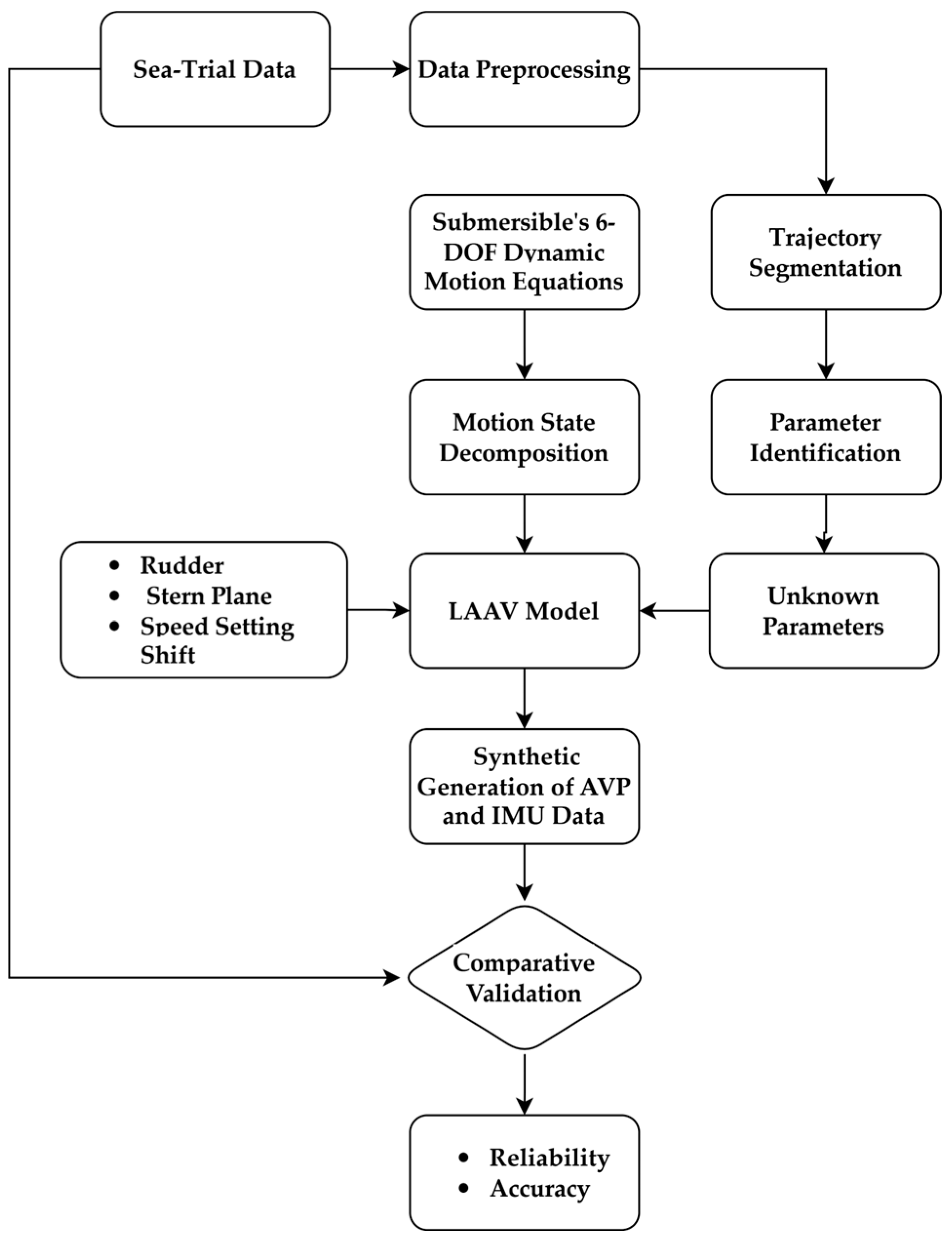
Figure 1 presents a flowchart depicting the derivation, development, and validation of the underwater vehicle motion model.
2. Derivation of the Dynamics-Based LAAV Model
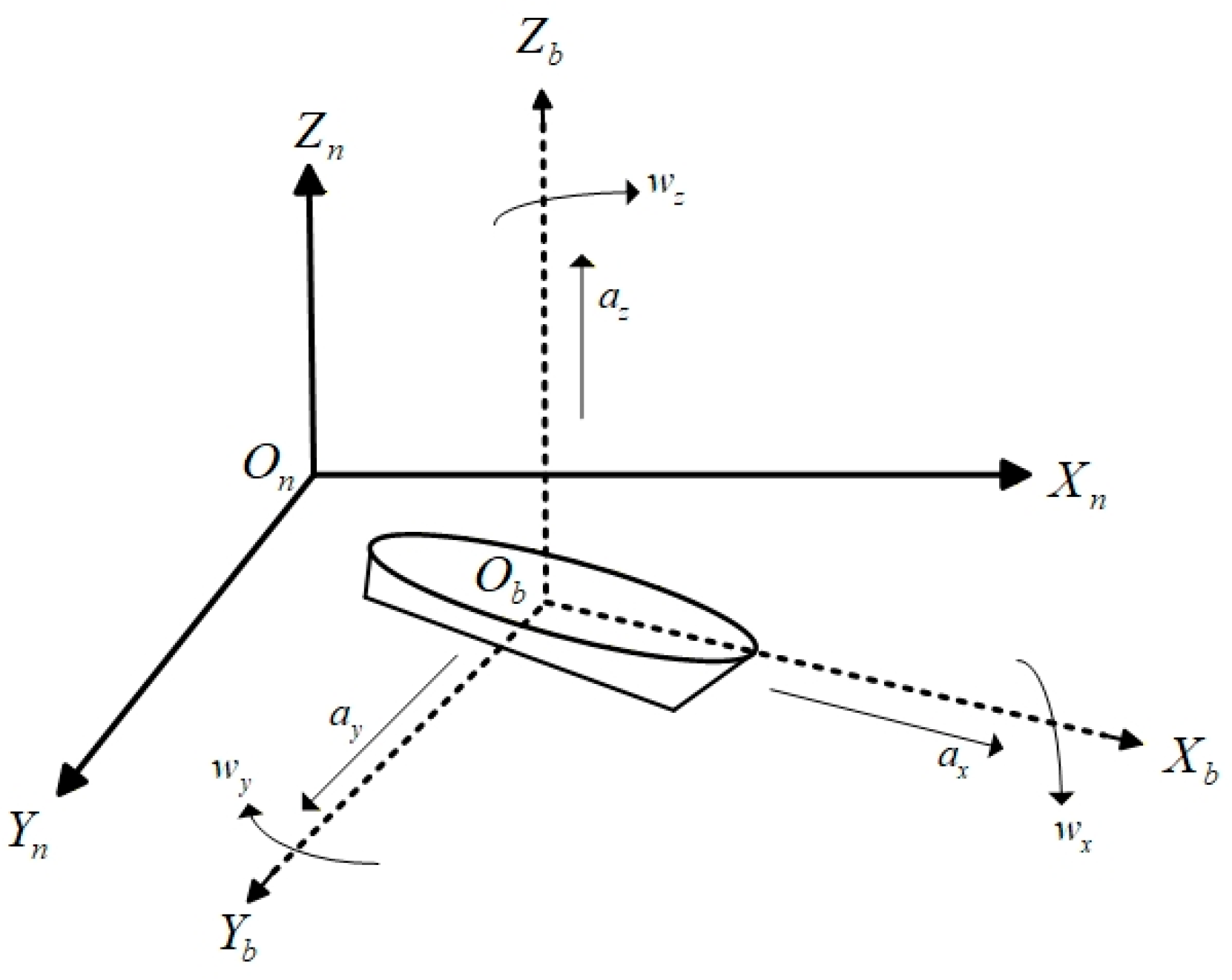
In the study of UUV motion modeling, two coordinate systems are defined:
denotes the navigation coordinate system (n frame), which in this paper is represented by the North-East-Down (NED) geographic frame;
represents the body-fixed frame (b frame), a right-handed orthogonal coordinate system that is rigidly attached to the vehicle. The origin of the b frame is located at the designed center of gravity of the UUV. The
-axis is aligned with the longitudinal axis pointing toward the bow, the
-axis coincides with the transverse axis pointing to starboard, and the
-axis is perpendicular to the
-plane pointing downward. A diagram illustrating the coordinate frames is displayed in
Figure 2.
By treating the UUV as a rigid body that is symmetric about the
-plane, with the center of buoyancy being vertically aligned with the center of gravity, a force analysis is performed in the b frame. Based on the theorems of linear and angular momentum, the 6-DOF dynamic equations of the vehicle are derived as follows:
In Equation (1), denotes the generalized velocity vector, while are the three linear velocity components. Meanwhile, are the three angular velocities about the axes in the b frame. and represent the three-axis accelerations of the vehicle in the b frame. is the generalized mass matrix, denotes the added mass matrix, represents the Coriolis and centripetal force matrix, accounts for the hydrodynamic damping (and moments), corresponds to the static force matrix, describes the force (and moment) induced by the rudder, and represents the force (and moment) generated by the propeller.
To derive the LAAV motion model, the following simplifying assumptions are applied to Equation (1): Assuming the UUV is in a state of cruising and performing gentle, moderate maneuvers, with gravity and buoyancy essentially balanced, the quadratic damping term and higher-order hydrodynamic effects are neglected, and the Coriolis force (and moment) is disregarded. The simplified six-degrees-of-freedom dynamic equations for the underwater vehicle are given as follows:
In Equation (2), represents gravity, and denotes buoyancy. , , and are the added mass coefficients along the three translational axes, while , , and represent the added mass moment of inertia coefficients about the three rotational axes. The terms , , , , , and correspond to the linear damping coefficients. denotes the sway–yaw coupled added mass coefficient, and is the sway–yaw coupled damping coefficient. represents the yaw–sway coupled added mass moment of inertia coefficient, while signifies the yaw–sway coupled damping coefficient. The subscript “thrust” on the right-hand side of the equation denotes the control forces and moments along the corresponding axes, including those generated by the thruster, rudder, and stern plane.
The proposed LAAV model draws inspiration from the derivation methodology of the MMG model [
27]. It formulates decoupled 6-DOF equations for linear and angular acceleration based on fundamental principles of mechanics.
This study employs a “motion decoupling and state idealization” approach, breaking down the spatial motion of the LAAV into horizontal and vertical planes, which are simplified into ideal states: variable-speed straight-line motion, steady turning, and diving or climbing. These physical simplifications allow for the derivation of analytical solutions for linear and angular velocities.
2.1. Mathematical Model of Three-Axis Linear Acceleration
2.1.1. Surge Acceleration
During steady-state navigation, the surge acceleration of a UUV,
, is zero. Under accelerated or decelerated motion, the corresponding control force is governed primarily by the propeller thrust. The propeller thrust equation takes the following form:
In Equation (3),
represents the thrust coefficient,
denotes the advance ratio, and
,
, and
are unsigned constants. This linear model and the use of unsigned coefficients simplify the derivation by neglecting the minor differences in thrust between positive and negative propeller rotations, which is a reasonable simplification for the purpose of motion data generation.
is the water density,
is the propeller’s rotational speed, and
is the propeller’s diameter. The advance ratio,
, takes the following form:
In Equation (4),
is the wake fraction, ranging from 0 to 0.4. By combining Equations (3) and (4) with the first expression in Equation (2), the longitudinal motion equation can be derived as follows:
For a fixed UUV type, all coefficients in Equation (5) except the rotational speed,
, are constant, which yields the following simplified form:
Based on the actual maneuvering profiles of the vehicle, which typically involve operation at different speed settings during navigation, the propeller’s rotational speed can be approximated as constant when maintaining a fixed setting. Consequently, we initially model the surge velocity response as a first-order system. To achieve a more accurate representation of the actual speed variation curve, a second-order overdamped time-domain function is ultimately adopted as the mathematical model for the surge acceleration, expressed as follows:
In Equation (7),
represents the surge velocity, while
denotes the variation in surge velocity.
and as the characteristic time constants of the second-order overdamped system, are distinct and not identical. At the same time, and are the damping ratio and natural frequency of the second-order system, respectively.
The surge acceleration, derived as the derivative of the velocity with respect to time, is expressed as follows:
2.1.2. Sway Acceleration
When analyzing the horizontal plane motion during a steady-turn maneuver, the sway acceleration of a UUV serves as its centripetal acceleration. With the yaw rate
and the surge velocity
, the relationship is expressed as follows:
2.1.3. Heave Acceleration
When analyzing the vertical plane motion during diving or climbing maneuvers, based on the measured data and velocity vector decomposition, a relationship exists between the heave velocity, surge velocity, and pitch angle, as expressed below:
By differentiating the mathematical expression of the heave velocity with respect to time, we can obtain the model for the heave acceleration’s form:
2.2. Mathematical Model of Three-Axis Angular Rates
In inertial navigation, the angular velocity
in the b frame is related to the Euler angle
derivatives through the attitude transformation matrix
:
The models in this paper are established based on a small-angle assumption. When the roll and pitch angles are small,
, leading to the approximate relations:
2.2.1. Yaw Rate
When a UUV executes a turning motion by deflecting its rudder, it induces a change in its yaw rate. The simplified forms of the second and sixth equations in Equation (2) can be expressed as follows:
In the above equation, represents the yaw rate, and denotes the rudder angle.
Substituting Equation (9) into the two equations of Equation (15) and using the relation
, the variables
and
can be eliminated, yielding an expression for the relationship between the yaw rate and the rudder as follows:
When a UUV executes a turning maneuver via rudder deflection, the motion can be considered a steady-state turn, wherein the surge velocity remains constant. For a given type of vehicle, the coefficients in Equation (17) can be treated as constants. Consequently, Equation (17) can be simplified as follows:
By applying the Laplace transform to Equation (17), the transfer function relating the yaw rate to the rudder angle in the Nomoto model can be derived:
Equation (18) indicates that the steering dynamics induced by rudder deflection can be simplified as a first-order system. To improve accuracy, the model is extended to a second-order system, which better captures high-frequency motion characteristics. The second-order model is expressed as follows:
Equation (19) contains a zero at
. Given that the value of
is significantly smaller than those of
and
, the zero can be neglected, allowing Equation (19) to be simplified to the following:
Therefore, the yaw rate of a UUV can be modeled as a second-order system. Based on full-scale trial data, small-scale UUVs, owing to their low mass and high maneuverability, typically exhibit an underdamped second-order response characteristic in their yaw rate when subjected to a step input of the rudder angle. This response is expressed as follows:
In Equation (21),
is an unsigned constant of proportionality,
and
represent the damping ratio and natural frequency, respectively, and
denotes the actual damped natural frequency:
2.2.2. Roll Rate
When a UUV executes a turning maneuver by deflecting its rudder, the dynamics of the roll angle are given by the fourth equation in (2), as follows:
As indicated by Equation (23), the variation in the roll angle constitutes a second-order system. In this study, and consistent with sea trial data, we define the mathematical model of the roll angle as a second-order underdamped time-domain function. Letting
represent the maximum roll angle attained during the turn, we express it as follows:
The parameters in Equation (24) are the damping ratio
and natural frequency
, with the actual frequency being defined as
.
The maximum roll angle
, from Reference [
28], is given as:
In Equation (26), denotes the gravitational acceleration. This Equation represents the classical formulation for a steady-state horizontal turning condition.
Upon completion of the turning maneuver, the roll angle of the UUV gradually diminishes. Based on sea trial data, this decay process can be characterized by a cosine-exponential decay function, expressed mathematically as follows:
In Equation (27), denotes the roll angle value at the end of the turning maneuver, represents the exponential coefficient, is the initial phase, while and are the damping ratio and natural frequency, respectively.
Under the idealized condition of calm water and negligible sideslip, the mathematical model for the roll rate is the derivative of the roll angle’s expression with respect to time, given by the following equation:
2.2.3. Pitch Rate
The relationship between the stern plane angle,
, and the pitch angle,
, of the UUV can be derived from the fifth equation in (2), yielding the following:
By reformulating Equation (24) in the Laplace complex domain, the transfer function between the pitch angle and stern plane angle of the UUV is yielded as follows:
We observe that the transfer function between these angles constitutes a second-order oscillatory system, expressed as follows:
Based on sea trial data, a second-order underdamped function is selected in this work as the mathematical model for the pitch angle. When the stern plane is deflected by an angle
, with an initial pitch angle of
, the pitch angle can be expressed as follows:
In Equation (32),
is an unsigned proportional constant,
is the actual oscillation frequency,
, and are the damping ratio and natural frequency, respectively.
Under the idealized condition of calm water and a negligible angle of attack, we obtain the pitch rate by taking the derivative of the pitch angle with respect to time, as expressed below:
The LAAV model of the UUV contains 13 unknown parameters, denoted as , , , , ,, , , , , , , and . For a specific type of UUV, these unknown parameters remain constant.
3. Parameter Identification Based on Trajectory Segmentation and Dynamic Identification
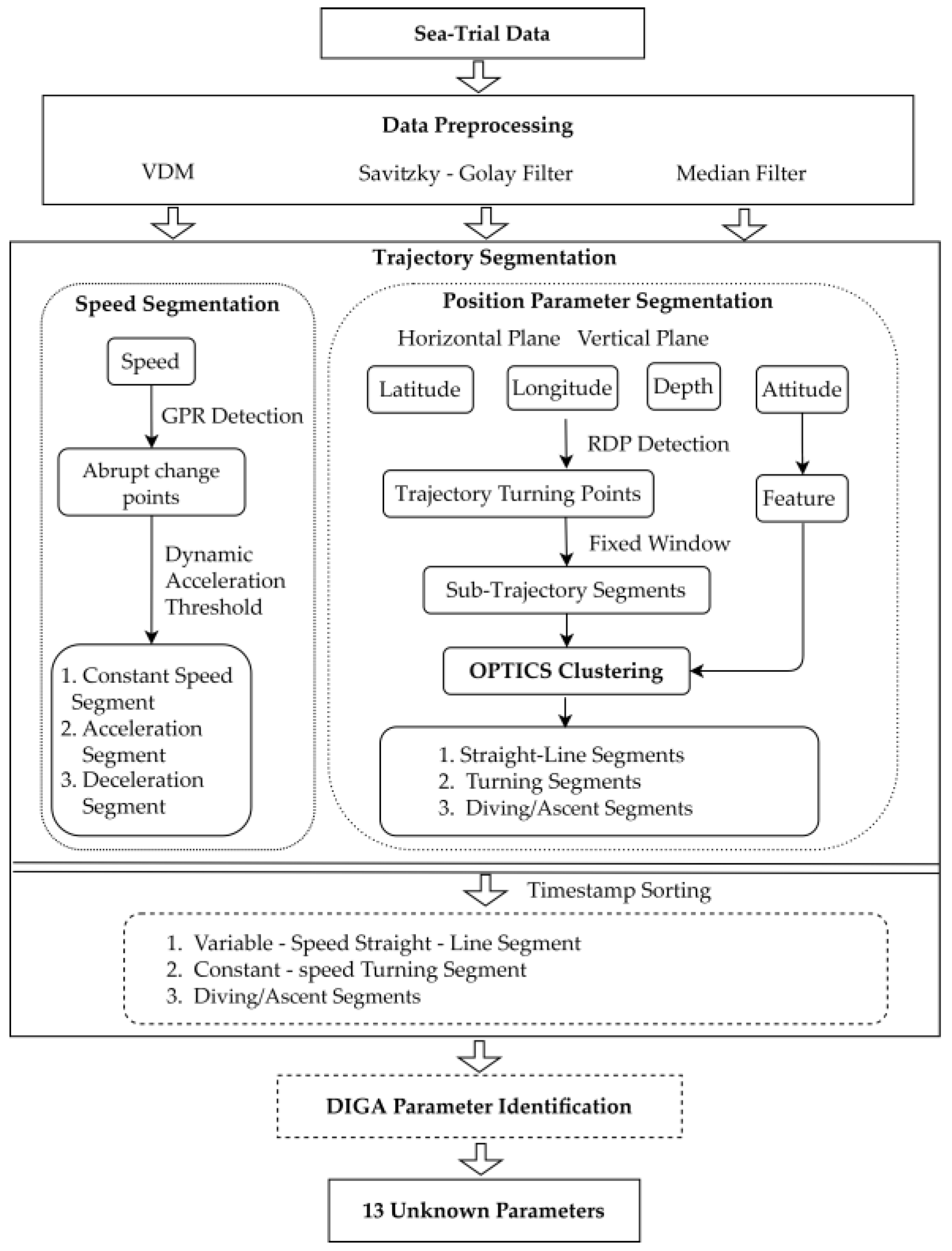
This study introduces a method for identifying model parameters by integrating three-dimensional (3D) trajectory segmentation using the GPR-OPTICS algorithm with a dynamic identification approach that utilizes the DIGA. The method employs measured data to determine the 13 unknown parameters in the LAAV model. The specific framework for parameter identification, which is based on trajectory segmentation and dynamic identification, is illustrated in
Figure 3.
3.1. Three-Dimensional Trajectory Segmentation Based on the GPR-OPTICS Algorithm
3.1.1. Speed Segmentation Based on GPR
GPR is a nonparametric machine learning method based on Bayesian statistics. Its core idea is to treat a function as a random process and infer its posterior distribution from observed data. This approach not only provides predictive values but also quantifies the uncertainty associated with these predictions. A significant increase in predictive uncertainty often accompanies abrupt change points in trajectories, which makes GPR particularly suitable for detecting abrupt change points in trajectories in this study.
The procedure for detecting abrupt change points in trajectory speed using GPR is as follows:
Following preprocessing, the trajectory speed data undergoes normalization, and a fixed sliding window, along with a prediction window, is configured.
GPR modeling: We construct a Gaussian process regression model using the data in the sliding window, configured with a fixed noise parameter and a squared exponential kernel defined as
In Equation (35), is the signal variance, is the length scale, is the noise variance, and is the Kronecker delta function (which equals 1 when , and 0 otherwise).
Abrupt change point diagnosis: A point is identified as an abrupt change point if more than 50% of the actual values within the prediction window fall outside the 92% confidence interval.
Abrupt change point screening: To ensure that each segment has sufficient length, we remove the latter of any two adjacent abrupt change points that are too close.
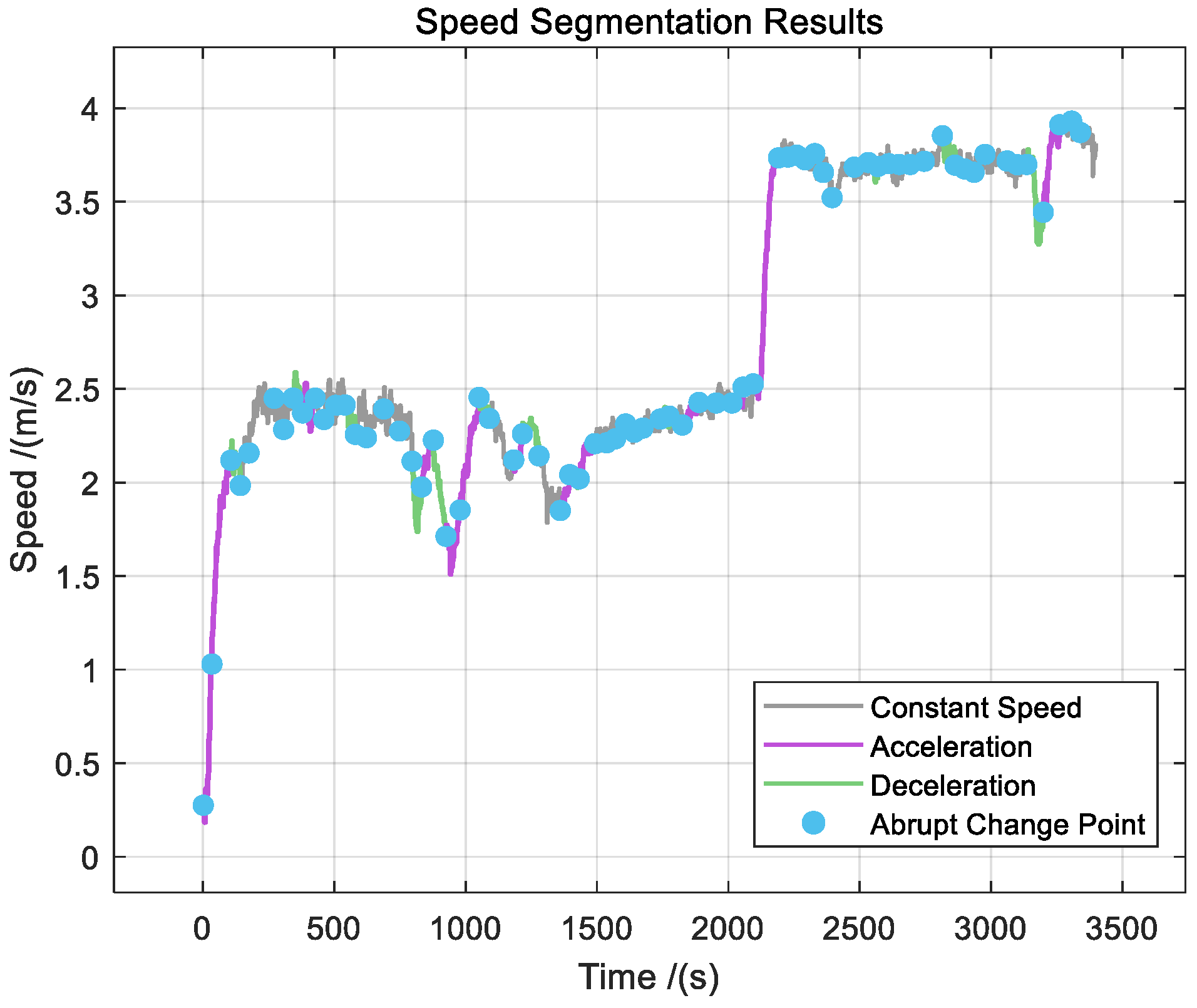
The trajectory speed segmentation aims to distinguish segments of constant speed, acceleration, and deceleration in the speed data. Following the detection of an abrupt change point using GPR, this study calculates the average acceleration for each speed segment and classifies them by applying appropriate thresholds.
The acceleration discrimination threshold is adaptively determined based on the global statistical characteristics of acceleration. First, the procedure yields the instantaneous acceleration sequences of the complete trajectory speed between adjacent abrupt change points. Subsequently, the threshold
is set based on their standard deviation
, as follows:
The purpose of configuring the coefficient in Equation (36) is to establish a buffer zone. This setup allows us to identify an acceleration (or deceleration) state only when the absolute value of acceleration significantly exceeds the range of natural fluctuations.
Figure 4 demonstrates the results of the trajectory speed segmentation. This method successfully segments the speed data, thereby paving the way for subsequent model identification by providing structured input.
3.1.2. Three-Dimensional Trajectory Segmentation Based on OPTICS Clustering
Ordered Point Identification for Cluster Structure (OPTICS) is a density-based clustering algorithm, and Bhattacharjee and Mitra [
29] have provided a detailed discussion of this method. As an extension of DBSCAN [
30], it overcomes DBSCAN’s sensitivity to the global parameter
(neighborhood radius). Its core advantage lies in discovering clusters of arbitrary shapes and varying densities, making it particularly suitable for segmenting complex time-series data such as the motion states of underwater vehicles.
The procedure for implementing 3D trajectory segmentation using OPTICS is as follows:
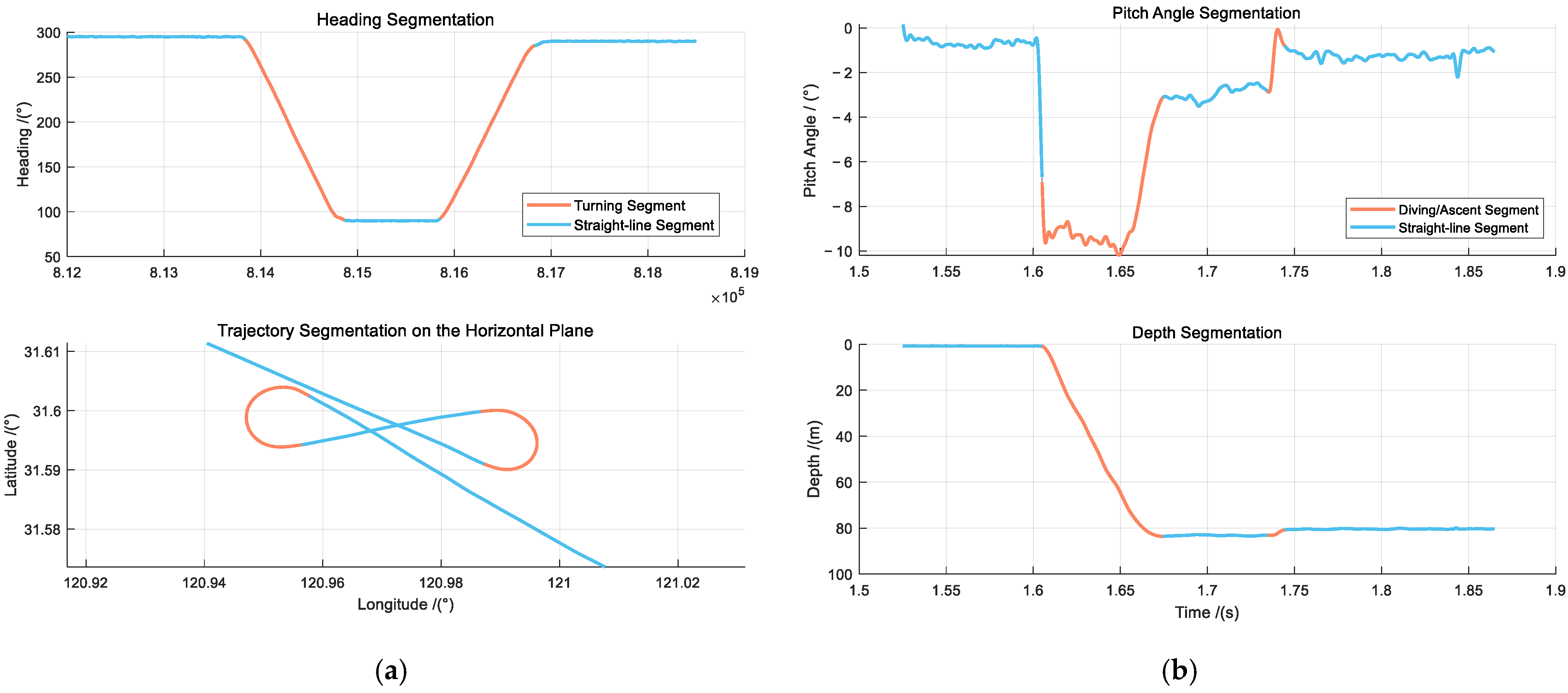
Given that the LAAV model developed in this paper comprises six independent equations, the three-dimensional trajectory in NED coordinates is projected onto both horizontal and vertical planes for processing, enabling precise segmentation of the motion state. We implement a unified segmentation framework with distinct parameter configurations for each plane to accommodate the characteristic differences between turning maneuvers in the horizontal plane and diving/ascent motions in the vertical plane. To overcome the respective limitations of the fixed-window method (which struggles with precise boundary identification) and the Ramer–Douglas–Peucker (RDP) algorithm (which often results in uneven segment lengths), a novel dynamic sliding window strategy is proposed that integrates fixed windows with trajectory turning points.
The rational selection of feature values is crucial for achieving efficient trajectory segmentation. In response to the distinct motion characteristics of 3D trajectories across different planes, this paper adopts a differentiated feature selection strategy: for horizontal plane segmentation, the rate of change in the heading angle is utilized as the feature to identify turning patterns accurately; for vertical plane segmentation, the magnitude of the pitch angle is employed to distinguish effectively between diving and ascent motions. The selected features combine simplicity with high discriminative power, laying a solid foundation for subsequent high-precision clustering and segmentation.
The OPTICS algorithm performs density-based clustering on sub-trajectory segments using the distinct features selected for the horizontal and vertical planes, respectively. Through postprocessing of the clustering results, our approach can effectively identify trajectory segments representing specific motion patterns. The framework distinguishes between turning and straight-line segments in the horizontal plane and classifies diving/ascent segments versus straight-line segments in the vertical plane.
Figure 5 shows the results of the 3D trajectory segmentation for the full-scale vehicle data.
The identified turning segments and diving/ascent segments are stored in dedicated data structures, providing a structured data foundation for subsequent dynamic identification tailored to different motion states.
3.2. Dynamic Identification Based on the DIGA
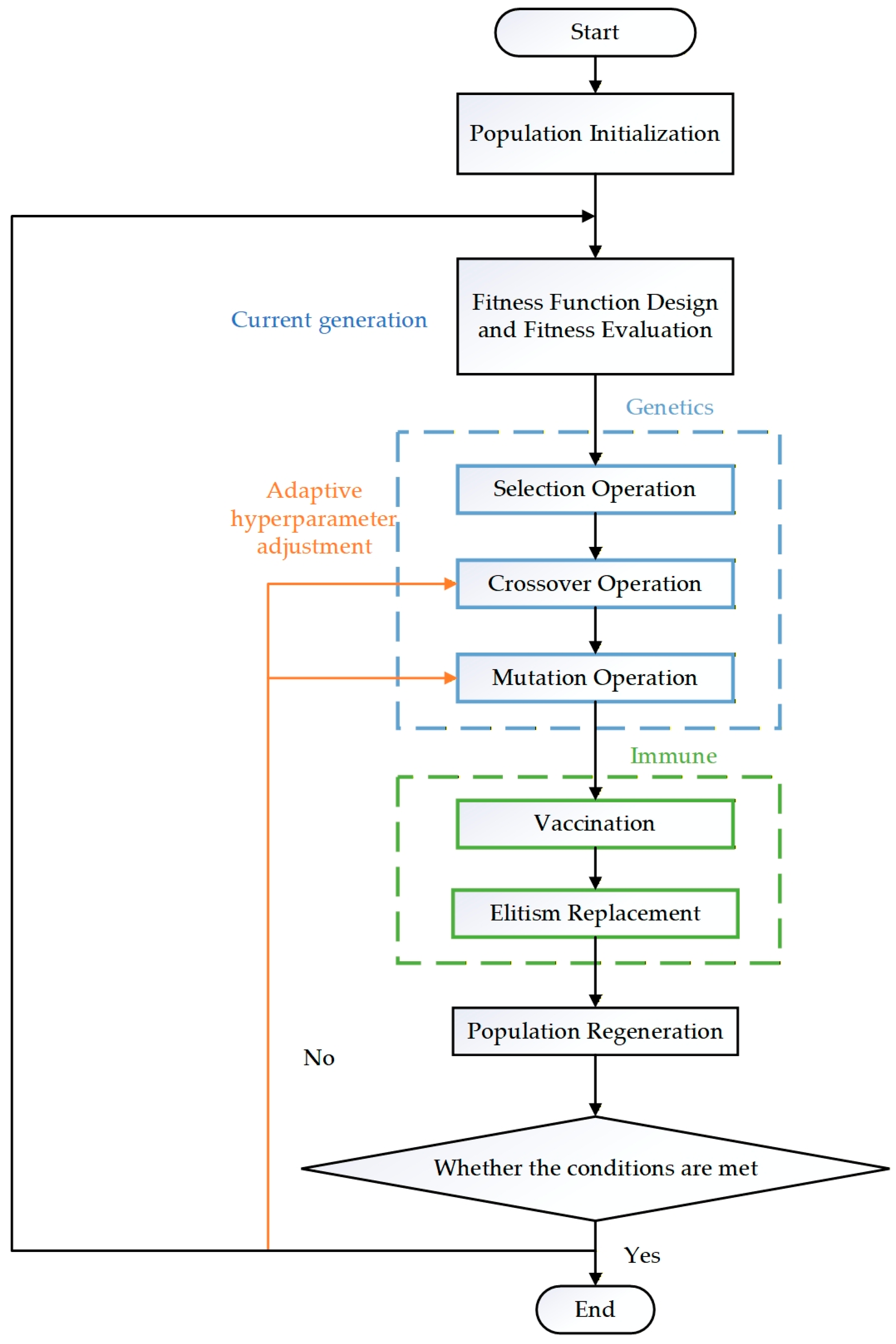
Building on the completed velocity and trajectory segmentation, parameter identification aims to estimate the LAAV model’s unknown parameters accurately. The Dynamic Immune Genetic Algorithm (DIGA), which integrates immune mechanisms into a genetic algorithm framework, is well-suited for identifying multiple parameters in highly nonlinear systems. In this study, DIGA is employed to identify 13 unknown parameters of the LAAV model using sea-trial data, overcoming common limitations of traditional methods such as convergence to local optima, slow convergence rates, and noise sensitivity.
The parameter identification problem is formulated as a nonlinear optimization model. Given the predefined parameter bounds, the objective function is defined as the root-mean-square error between the measured motion data and the model outputs. DIGA employs a two-layer cooperative optimization mechanism. The outer layer dynamically adjusts the crossover and mutation rates using a linear adaptive strategy. The inner layer then conducts parameter identification with these fixed hyperparameters, incorporating a vaccination mechanism to enhance population diversity. This improves the algorithm’s convergence speed and global search capability.
Figure 6 shows the dynamic identification process of the DIGA.
The key parameter settings for achieving DIGA recognition are shown in
Table 1. Additionally, the initial value ranges for the 13 unknown parameters to be identified were set based on their specific physical significance as described in
Section 2.
The identification work was conducted based on the actual sea trial data described in
Section 5.2, utilizing a continuous 2000-s segment of this data.
Table 2 lists the identification results for the 13 unknown parameters of the LAAV model under the UUV’s cruising conditions.
By substituting the specific parameters from
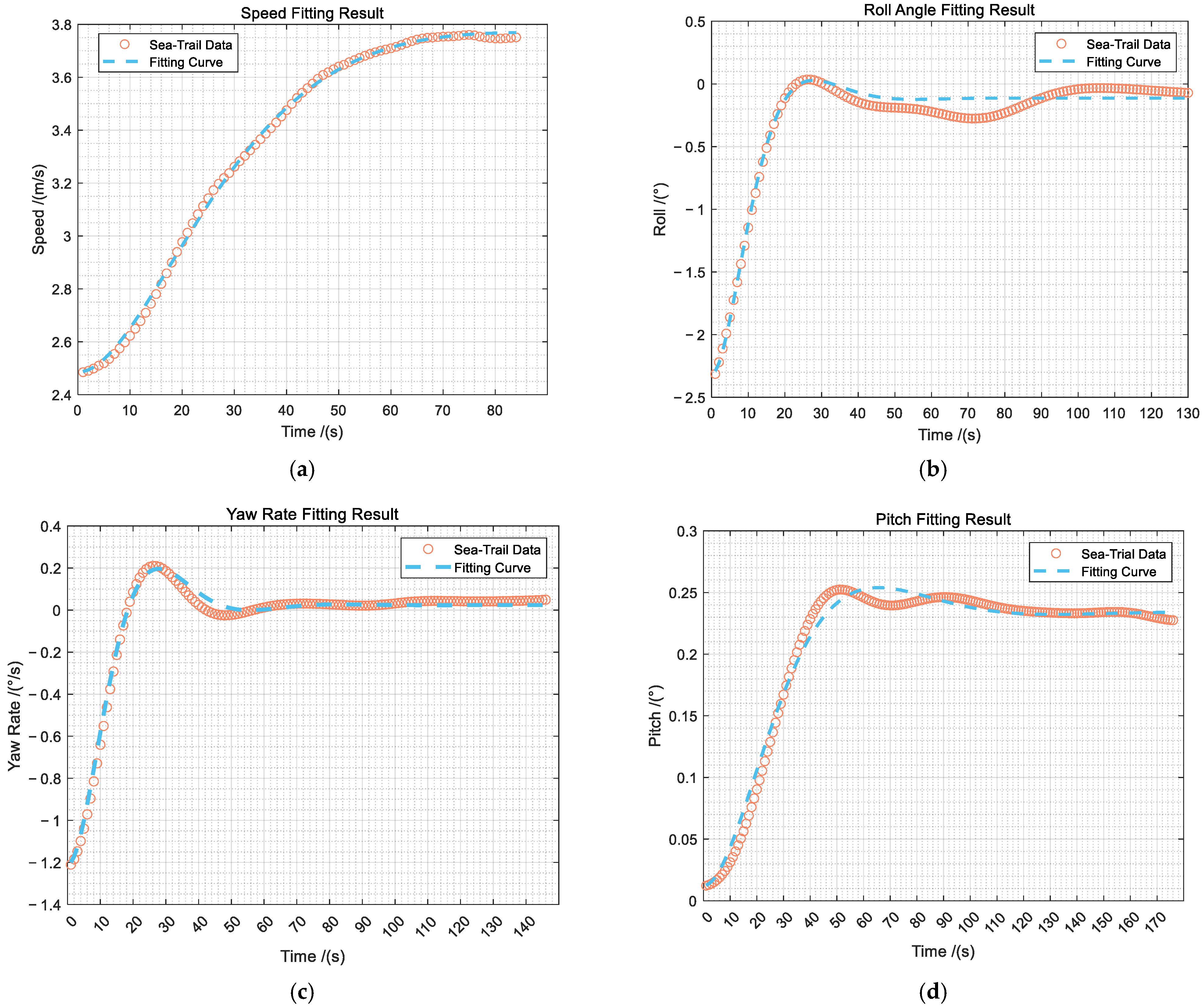
Table 2 into the model, the model generated fitted data for the acceleration, turning, and submerged-surfaced motion segments. These were compared with the actual vessel measurement data, as shown in
Figure 6.
As shown in
Figure 7, the fitted curves for speed, yaw rate, roll angle, and pitch angle, representing the acceleration, turning, and diving/ascent segments, demonstrate a close agreement with the actual experimental data from the sea trial.
4. Inertial Navigation Data Generation
The LAAV model takes the rudder angle, stern plane angle, and speed variation as inputs and outputs the three-axis accelerations and three-axis angular rates of the underwater vehicle in a body-fixed frame. The core function of the inertial navigation data generation module is to simulate and generate IMU and AVP data algorithmically based on the above outputs [
31]. In this study, the navigation frame is defined as the North-East-Down (NED) geographic frame.
4.1. IMU Data Generation with Noise
4.1.1. Accelerometer Output Processing
The accelerometer output is the specific force, which represents the difference between the absolute acceleration vector of the underwater vehicle and the gravitational acceleration vector. Equation (37) is the expression for the particular force.
Here,
and
represent the Earth’s rotation rate and the position rate, respectively, with
. The following derivation develops Equation (37) along the three axes of the NED geographic frame:
In Equation (38), represents the Earth’s rotation rate, and denotes the latitude.
The particular force output from the accelerometer can be calculated using Equation (39).
Here,
is defined as the coordinate transformation matrix from the n frame to the b fixed frame, the expanded form of which is presented in Equation (40).
Here,
is the inverse matrix of
. Because the direction cosine matrix is an orthogonal matrix, its inverse matrix is equal to its transposed one. Therefore,
can be expressed as follows:
4.1.2. Gyroscope Output Processing
Equation (42) is the expression for the gyroscope output.
Here,
is the projection of the angular velocity of the body frame with respect to the navigation frame.
is the projection of the angular velocity of the navigation frame with respect to the inertial frame and can be expressed as follows:
4.1.3. Noise Injection
IMU noise typically originates from two primary sources of error: deterministic errors and random errors. Let the ideal accelerometer output be
, the ideal gyroscope output be
, and the deterministic and random errors of the accelerometer and gyroscope be
,
,
, and
, respectively. The actual outputs of the accelerometer and gyroscope, denoted as
and
, can be expressed using Equation (38):
4.2. Synthetic AVP Ground Truth
The attitude, velocity, and position of the UUV at time step are denoted as , , and , respectively, with the time step duration being denoted as .
The attitude of the underwater vehicle at time step
, denoted as
, is expressed as follows:
In Equation (45),
.
is the transformation matrix of the Euler angle rates. Equation (46) is the expression for the transformation matrix.
In Equation (46), the symbols , , and represent the roll angle, pitch angle, and yaw angle, respectively.
The velocity of the UUV at time step
, denoted as
, is expressed as
In Equation (47), .
The position of the underwater vehicle at time step
, denoted as
, is expressed as follows:
In Equation (48), to reduce position errors, the average velocity over adjacent time steps, denoted as
, is employed as the velocity for the position update. The expression for
is given by the following:
In Equation (49), and represent the longitude and depth, respectively, while and denote the radii of curvature of the meridian and prime vertical at the vessel’s location, respectively.
5. Simulation of Inertial Navigation Data and Validation with Experimental Data from the Sea Trial
5.1. Simulation of AVP and IMU Data
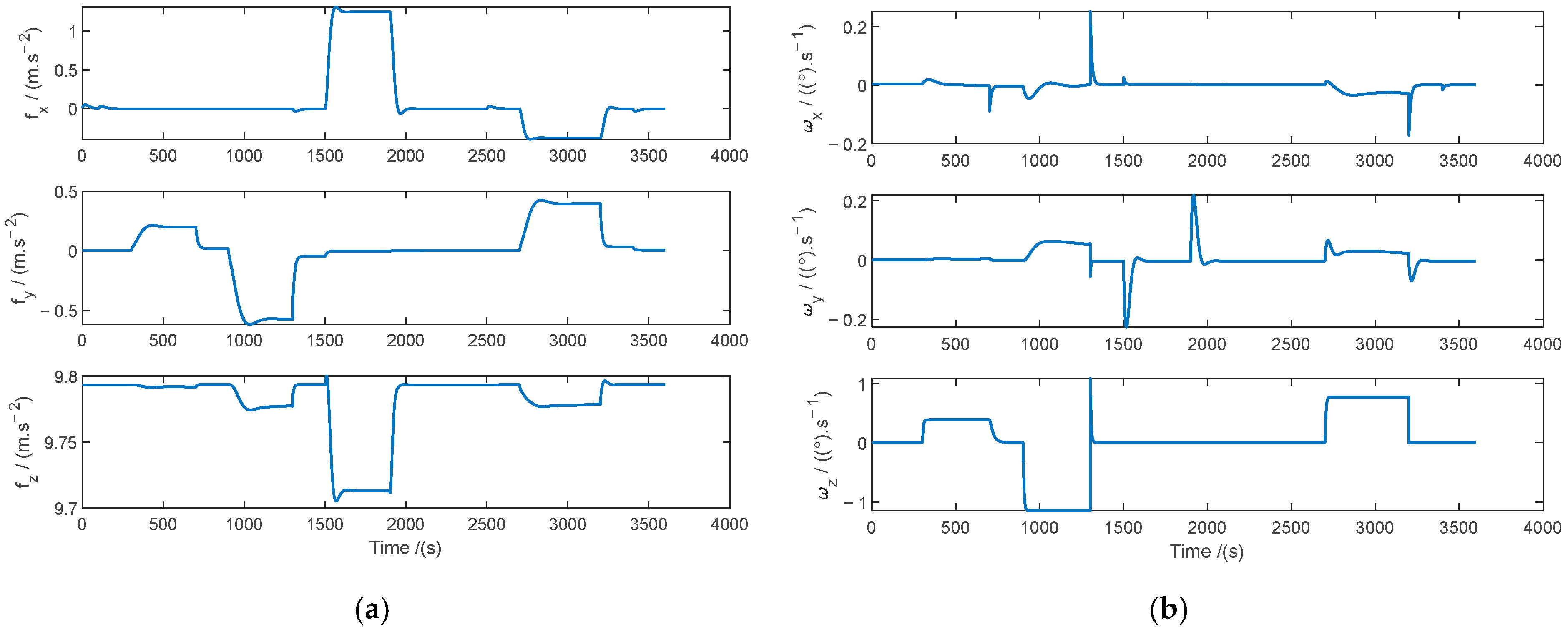
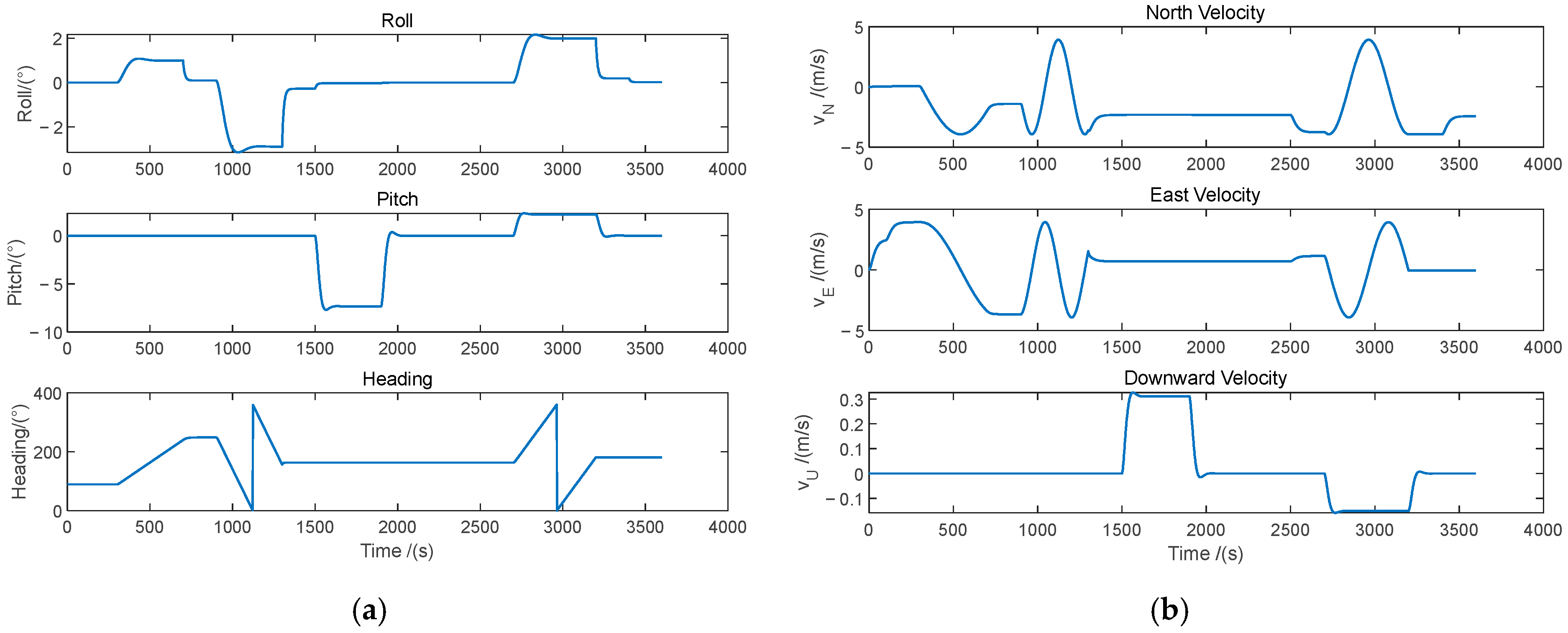
This section outlines the complete process for generating simulated inertial navigation data using the LAAV model. All IMU and AVP data presented here are simulated outputs from the model, created to showcase the functionality of the proposed data generator. The speed settings and control command sequences of the model are based on the motion characteristics derived from the sea-trial data to ensure kinematic plausibility. For example, two representative steady-state speed levels are defined: Speed Setting 1 at 2.5 m/s and Speed Setting 2 at 4.0 m/s.
Furthermore, this work aims to generate a set of “idealized” motion reference data with high kinematic fidelity for testing navigation algorithms. During data generation, only inertial device errors are considered, while auxiliary sensors and environmental disturbances are neglected. In other words, this generator outputs “idealized motion truth values containing only core IMU errors.”
In the algorithm, the gravitational acceleration is set to
. The initial geographic position is set to longitude
, latitude
, and a depth of 10 m. The initial velocity is 0 m/s, and the initial attitude is set to a heading angle
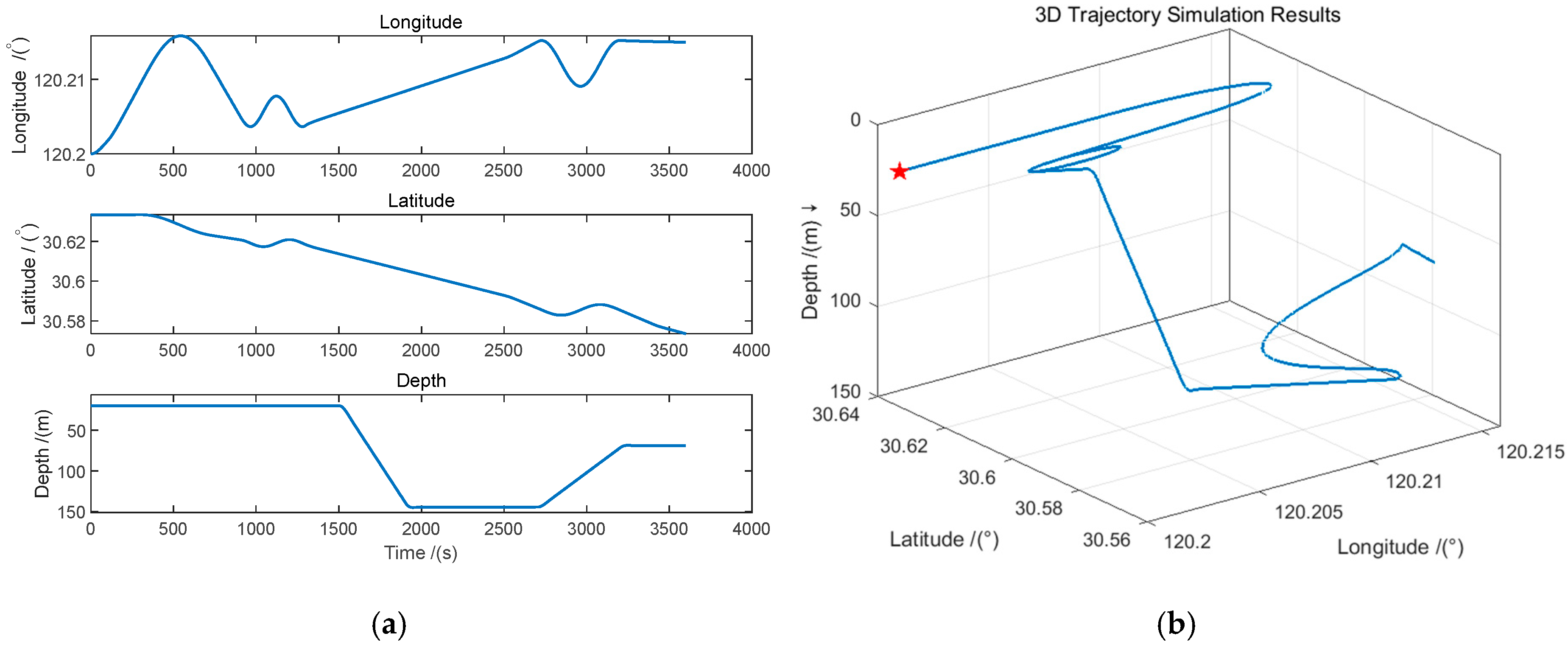
, with roll and pitch angles being initialized to 0°. To comprehensively represent the UUV’s navigation states, the designed trajectory includes constant velocity, acceleration, deceleration, left and right turns, as well as ascending and descending maneuvers. The total mission duration is 1 h, and
Table 3 summarizes the specific navigation plan.
The gyroscope has a deterministic error of 0.001 °/h and a random walk error of 0.001 °/√h, while the accelerometer has a deterministic error of 100 μg and a random walk error of 10 μg/√h.
Figure 8 displays the results of the simulation concerning the outputs of the inertial sensors.
5.2. Validation Utilizing Experimental Data from the Sea Trial
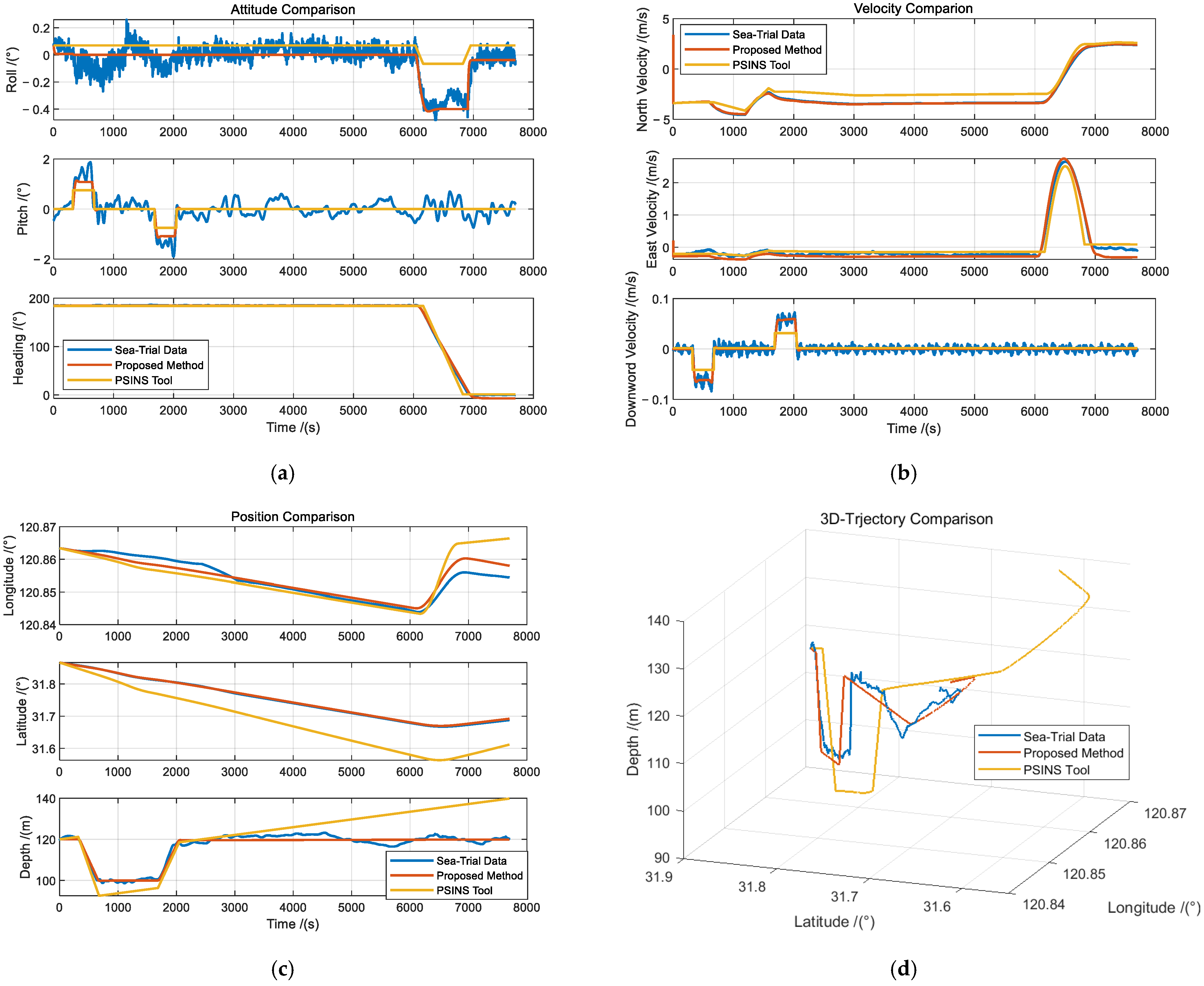
To evaluate the feasibility and practical performance of the proposed method, we conducted a comparative study on 6-DOF underwater motion trajectories. Utilizing real sea-trial data as ground truth, we compared the generated data from our proposed method with that from a parametric excitation modeling approach. This validation confirmed the correctness of our method and demonstrated its performance improvement over traditional approaches. The trajectory generator module of the widely recognized open-source PSINS toolbox [
32] served as a representative parametric mechanism modeling method for comparison.
We utilized a segment of real-world operational data collected from a small UUV in calm coastal waters for experimental evaluation. This dataset covered approximately 10,000 s at a sampling rate of 1 Hz and included comprehensive navigation state information: geodetic coordinates (longitude, latitude, and depth), carrier coordinate system velocity components (u, v, w), attitude angles (roll, pitch, heading), and angular velocities (p, q, r). Environmental parameters recorded by the shipborne Conductivity-Temperature-Depth (CTD) sensor indicated calm sea conditions during the testing period, with weak ocean current disturbances estimated at about 0.01–0.03 m/s in the southwest direction. This situation satisfied the quasi-hydrostatic assumption, making it suitable for method validation.
To ensure objectivity in evaluation, the validation process followed the “segmented training-independent testing” principle:
Parameter Identification: The first 2000 s of continuous navigation data were extracted as the training segment. This segment was input into the “segmentation-identification” framework described in
Section 3 to estimate the model parameters of the UUV (see
Table 2).
Trajectory Simulation: Utilizing the identified parameters, motion simulations were conducted for the remaining time period. Both the proposed method and the PSINS toolbox trajectory generator were utilized for these simulations.
Performance Comparison: The simulation results from both methods were compared against the measured ground truth over the same remaining time period. This comparison included a quantitative evaluation of both kinematic trend consistency and point-to-point accuracy.
This workflow ensures that the training and testing data originate from the same source but remain mutually exclusive, thereby objectively validating the feasibility of the proposed method and demonstrating its performance improvement over traditional parametric modeling approaches applied to the same motion system. The validation results are presented in
Figure 11.
To evaluate model performance comprehensively and validate the suitability of the kinematically consistent data for testing underwater navigation algorithms, we established acceptable error thresholds for key parameters—heading, roll, pitch, velocity, latitude/longitude, and depth. These thresholds are defined based on the requirement for kinematic fidelity and delimit the permissible error tolerance for deeming the simulated motion plausible.
Utilizing actual experimental data as the ground truth benchmark, we employed two quantitative metrics for evaluation:
Reliability: Quantified by hit rate. The hit rate is defined as the percentage of points in the generated data that fall within the predefined error band relative to the total number of points. A higher hit rate indicates that the generated data aligns more closely with the overall trend of the real data, signifying greater reliability.
Accuracy: Quantified by RMSE. RMSE reflects the average deviation between generated and actual data. A lower RMSE value indicates higher precision in point-by-point matching.
The credibility of generated data—its kinematic plausibility—is assessed comprehensively based on the above metrics. A high hit rate (high reliability) combined with a low RMSE (high precision) collectively form the quantitative foundation for high credibility.
The preset thresholds and their corresponding performance evaluation results are detailed in
Table 4.
As shown in
Table 4, our method achieves a hit rate exceeding 88% and an RMSE below the predefined threshold for all parameters evaluated. Additionally, it outperforms the PSINS toolbox in terms of both reliability and accuracy metrics. Detailed comparative results can be found in
Table 5.
Table 3 results confirm that our method outperforms the baseline approach by a significant margin, with reliability improvements exceeding 9% across all parameters and positional accuracy enhancements surpassing 56%.
6. Discussion
This work focuses on navigation simulation. The following comparison primarily validates the method’s effectiveness in generating realistic motion data for testing navigation algorithms, rather than assessing the accuracy of physical dynamics.
The performance comparison between the proposed method and the PSINS toolbox reveals a distinct improvement in both reliability and accuracy across AVP parameters. Specifically, in terms of trajectory reliability, the improvement for attitude parameters is relatively modest (9.4–13.3%), indicating that the proposed method offers better modeling reliability. The improvement for velocity parameters is more pronounced (26.9%), while that for position parameters is the most substantial (56.7%). A similar trend is observed in trajectory accuracy: the reduction in RMSE is more minor for attitude errors (24.0–49.2%), increases significantly for velocity errors (73.1%), and is most notable for position errors (82.9–94.9%).
This observed pattern of progressively greater improvement—from attitude to velocity to position—is a direct manifestation of error propagation in inertial navigation estimation. From the perspective of AVP parameter generation principles, the estimation of attitude, velocity, and position parameters is essentially a cascading integration process based on angular velocity and linear acceleration outputs from the LAAV model. Therefore, initial modeling errors in attitude (angular motion) are amplified during the sequential integration steps: they introduce larger errors into velocity estimates, which then accumulate into the most significant errors in the final position. Our method’s more accurate modeling of the fundamental LAAV dynamics provides a superior starting point. This foundational advantage compounds through the navigation solution chain, resulting in the observed hierarchical gains where the most substantial accuracy improvements are logically realized in the final position estimates.
This discrepancy primarily stems from the design principles of its built-in trajectory generator. The trajectory generator within the PSINS toolbox typically employs parametric excitation modelling. While its trajectory construction method possesses versatility, the model fails to incorporate the specific hydrodynamic characteristics, maneuvering responses, and genuine motion transition processes of particular underwater vehicles. Consequently, the generated data exhibits fundamental disparities with real UUV navigation data in terms of kinematic continuity and dynamic realism.
In summary, the methodology presented herein has been thoroughly validated against the PSINS toolbox, demonstrating its effectiveness. The generated trajectory data exhibits significantly enhanced overall credibility and precision, thereby providing high-fidelity data support for the development and validation of complex underwater navigation algorithms.
7. Conclusions
This work presents a motion data generation framework designed to address the pressing demand for high-fidelity, idealized motion data in UUV navigation algorithm research. Its core objective is to produce kinematically consistent data to support the development and testing of inertial navigation algorithms. We introduce a modeling strategy that integrates GPR-OPTICS trajectory segmentation with DIGA-based parameter identification. Utilizing real-world sea trial data, we derived model parameters and implemented a high-fidelity motion data generator. Under typical cruising conditions, including low-dynamic maneuvering states, the generator synthesizes 6-DOF AVP data that closely approximates the actual motion characteristics of UUVs, thereby establishing a reliable, idealized benchmark for the development of underwater navigation algorithms.
The method proposed in this paper is primarily applicable to generating idealized motion references for UUVs during stable cruising in calm water conditions and for mitigating small-magnitude maneuver states. However, constrained by the current modeling framework, the generated data does not incorporate the effects of systematic errors from auxiliary navigation sensors or environmental disturbances. Consequently, the method’s kinematic fidelity may be limited when precisely simulating high-amplitude, high-dynamic maneuvers or when applied to complex real-world sea conditions with significant environmental disturbances. Future research will focus on expanding the applicability and environmental adaptability of this approach.
Author Contributions
L.L.: Conceptualization, Methodology, Software, Validation, Formal analysis, Investigation, Data curation, Writing—original draft, and Visualization. H.B.: Conceptualization, Resources, Writing—review and editing, Supervision, and Project administration. R.W.: Methodology, Validation, Writing—review and editing, Supervision, and Funding acquisition. W.Y.: Software, Investigation, and Data curation. H.L.: Software, Validation, and Supervision. All authors have read and agreed to the published version of the manuscript.
Funding
This research received no external funding.
Data Availability Statement
The data analyzed or generated during this study are not publicly available due to confidentiality agreements and institutional data security policies. Reasonable requests for data may be directed to the corresponding author, and we will endeavor to provide support within the constraints of these confidentiality requirements. This statement has been reviewed and approved by the Editorial Office in accordance with journal policy.
Acknowledgments
The authors would like to thank Harbin Engineering University for providing the experimental UUV trajectory data from the sea trial. During the preparation of this work, the authors used ChatGPT-5 and Grammarly in order to improve the language. After using these tools, the authors reviewed and edited the content as needed and take full responsibility for the content of the publication.
Conflicts of Interest
The authors declare no conflicts of interest.
Abbreviations
The following abbreviations are used in this manuscript:
| UUV | Unmanned Underwater Vehicle |
| 6-DOF | Six Degrees of Freedom |
| LAAV | Linear and Angular Acceleration Vector |
| GPR | Gaussian Process Regression |
| DIGA | Dynamic Immune Genetic Algorithm |
| OPTICS | Ordering Points To Identify the Clustering Structure |
| RDP | Ramer–Douglas–Peucker |
| IMU | Inertial Measurement Unit |
| AVP | Attitude, Velocity, and Position |
References
- Alexandris, C.; Papageorgas, P.; Piromalis, D. Positioning systems for unmanned underwater vehicles: A comprehensive review. Appl. Sci. 2024, 14, 9671. [Google Scholar] [CrossRef]
- Cao, Q.; Feng, Y.; An, Y. Study of unmanned underwater vehicles in marine regulatory applications overview and application analysis of the two main types of AUVs and ROVs. Int. J. Ocean. Syst. Manag. 2025, 2, 67–106. [Google Scholar] [CrossRef]
- Liu, F.; Ma, Z.; Mu, B.; Duan, C.; Chen, R.; Qin, Y.; Pu, H.; Luo, J. Review on fault-tolerant control of unmanned underwater vehicles. Ocean Eng. 2023, 285, 115471. [Google Scholar] [CrossRef]
- Zhu, D.; Yan, T.; Yang, S.X. Motion planning and tracking control of unmanned underwater vehicles: Technologies, challenges and prospects. arXiv 2022, arXiv:2207.04360. [Google Scholar] [CrossRef]
- Aguzzi, J.; Thomsen, L.; Flögel, S.; Robinson, N.J.; Picardi, G.; Chatzievangelou, D.; Bahamon, N.; Stefanni, S.; Grinyó, J.; Fanelli, E.; et al. New technologies for monitoring and upscaling marine ecosystem restoration in deep-sea environments. Engineering 2024, 34, 195–211. [Google Scholar] [CrossRef]
- Wang, J.; Tang, Y.; Jin, S.; Bian, G.; Zhao, X.; Peng, C. A method for multi-beam bathymetric surveys in unfamiliar waters based on the AUV constant-depth mode. J. Mar. Sci. Eng. 2023, 11, 1466. [Google Scholar] [CrossRef]
- Pan, W.; Wang, Y.; Song, F.; Peng, L.; Zhang, X. UUV-assisted icebreaking application in polar environments using GA-SPSO. J. Mar. Sci. Eng. 2024, 12, 1845. [Google Scholar] [CrossRef]
- Du, X.; Hu, X.; Hu, J.; Sun, Z. An adaptive interactive multi-model navigation method based on UUV. Ocean Eng. 2023, 267, 113217. [Google Scholar] [CrossRef]
- Wang, Z.; Wang, H.; Yuan, J.; Yu, D.; Zhang, K.; Ren, J. Bio-inspired cooperative control scheme of obstacle avoidance for UUV swarm. J. Mar. Sci. Eng. 2024, 12, 489. [Google Scholar] [CrossRef]
- Hong, L.; Wang, X.; Zhang, D.-S. CFD-based hydrodynamic performance investigation of autonomous underwater vehicles: A survey. Ocean Eng. 2024, 305, 117911. [Google Scholar] [CrossRef]
- Zhang, J.; Zhang, T.; Liu, S.; Xia, M. A robust particle filter for ambiguous updates of underwater terrain-aided navigation. Mechatronics 2024, 98, 103133. [Google Scholar] [CrossRef]
- Li, C.; Chen, K.; Li, H.; Luo, H. Multisensor data fusion approach for sediment assessment of sewers in operation. Eng. Appl. Artif. Intell. 2024, 132, 107965. [Google Scholar] [CrossRef]
- Urvaev, I.N.; Bazykin, S.N. Computer simulation of hydrodynamics of an unmanned underwater vehicle. Meas. Monit. Manag. Control. 2024, 4, 58–67. [Google Scholar] [CrossRef]
- López-Barajas, S.; Sanz, P.J.; Marín-Prades, R.; Gómez-Espinosa, A.; González-García, J.; Echagüe, J. Inspection operations and hole detection in fish net cages through a hybrid underwater intervention system using deep learning techniques. J. Mar. Sci. Eng. 2023, 12, 80. [Google Scholar] [CrossRef]
- Yazdani, A.M.; Sammut, K.; Yakimenko, O.A.; Lammas, A.; Tang, Y.; Mahmoud Zadeh, S. IDVD-based trajectory generator for autonomous underwater docking operations. Robot. Auton. Syst. 2017, 92, 12–29. [Google Scholar] [CrossRef]
- Sun, J.; Ellerbroek, J.; Hoekstra, J.M. WRAP: An open-source kinematic aircraft performance model. Transp. Res. Part C Emerg. Technol. 2018, 98, 118–138. [Google Scholar] [CrossRef]
- Dolgov, D.; Thrun, S.; Montemerlo, M.; Diebel, J. Path planning for autonomous vehicles in unknown semi-structured environments. Int. J. Robot. Res. 2010, 29, 485–501. [Google Scholar] [CrossRef]
- Liu, X.; Hu, Y.; Mao, Z.; Tian, W. Numerical Simulation of the Hydrodynamic Performance and Self-Propulsion of a UUV near the Seabed. Appl. Sci. 2022, 12, 6975. [Google Scholar] [CrossRef]
- Chen, C.; Huang, W.; Wang, H.; Tian, L. A Novel High-Precision Trajectory Generator with Complex Motion Simulation for Enhanced Inertial Navigation Algorithm Testing. Actuators 2025, 14, 146. [Google Scholar] [CrossRef]
- Son, J.H.; Oh, S.H.; Hwang, D.H. Design of trajectory generator for performance evaluation of navigation systems. J. Position. Navig. Timing 2023, 12, 409–421. [Google Scholar] [CrossRef]
- Chen, K.; Shen, F.; Zhou, J.; Wu, X. Simulation platform for SINS/GPS integrated navigation system of hypersonic vehicles based on flight mechanics. Sensors 2020, 20, 5418. [Google Scholar] [CrossRef]
- Luis, C.E.; Vukosavljev, M.; Schoellig, A.P. Online trajectory generation with distributed model predictive control for multi-robot motion planning. IEEE Robot. Autom. Lett. 2020, 5, 604–611. [Google Scholar] [CrossRef]
- Potokar, E.; Lay, K.; Norman, K.; Benham, D.; Ashford, S.; Peirce, R.; Neilsen, T.B.; Kaess, M.; Mangelson, J.G. HoloOcean: A full-featured marine robotics simulator for perception and autonomy. IEEE J. Ocean. Eng. 2024, 49, 15. [Google Scholar] [CrossRef]
- Xue, Y.; Liu, Y.; Ji, C.; Xue, G. Hydrodynamic parameter identification for ship manoeuvring mathematical models using a Bayesian approach. Ocean Eng. 2020, 195, 106612. [Google Scholar] [CrossRef]
- Letizia, N.A.; Salamat, B.; Tonello, A.M. A novel recursive smooth trajectory generation method for unmanned vehicles. IEEE Trans. Robot. 2021, 37, 1792–1805. [Google Scholar] [CrossRef]
- Chen, K.; Wang, Z.; Fan, Z.; Yang, R.; Fang, Y. Trajectory Generator for Hypersonic Vehicle Based on Flight Dynamics. In Proceedings of the Advances in Guidance, Navigation and Control; Springer: Singapore, 2023; pp. 1151–1162. [Google Scholar]
- Yasukawa, H.; Yoshimura, Y. Introduction of MMG standard method for ship maneuvering predictions. J. Mar. Sci. Technol. 2015, 20, 37–52. [Google Scholar] [CrossRef]
- Molland, A.F.; Turnock, S.R. Marine rudders and control surfaces [electronic resource]: Principles, data, design and applications. Mar. Rudders Control. Surf. 2007, xi–xii, 71–232. [Google Scholar] [CrossRef]
- Bhattacharjee, P.; Mitra, P. A survey of density based clustering algorithms. Front. Comput. Sci. 2020, 15, 151308. [Google Scholar] [CrossRef]
- Luo, T.; Zheng, X.; Xu, G.; Fu, K.; Ren, W. An improved DBSCAN algorithm to detect stops in individual trajectories. ISPRS Int. J. Geo-Inf. 2017, 6, 63. [Google Scholar] [CrossRef]
- Veremeenko, K.K.; Savel’Ev, V.M. In-flight alignment of a strapdown inertial navigation system of an unmanned aerial vehicle. J. Comput. Syst. Sci. Int. 2013, 52, 106–116. [Google Scholar] [CrossRef]
- Fan, C.; Hu, X.; He, X.; Zhang, L.; Lian, J. Integrated polarized skylight sensor and MIMU with a metric map for urban ground navigation. IEEE Sens. J. 2017, 18, 1714–1722. [Google Scholar] [CrossRef]
| Disclaimer/Publisher’s Note: The statements, opinions and data contained in all publications are solely those of the individual author(s) and contributor(s) and not of MDPI and/or the editor(s). MDPI and/or the editor(s) disclaim responsibility for any injury to people or property resulting from any ideas, methods, instructions or products referred to in the content. |