Article

Research on Hydrodynamic Characteristics and Drag Reduction Optimization of Drillships with Moonpools


1
School of Naval Architecture and Ocean Engineering, Jiangsu University of Science and Technology, Zhenjiang 212100, China
2
Shanghai Salvage, Ministry of Transport, Shanghai 200082, China
*
Author to whom correspondence should be addressed.
J. Mar. Sci. Eng. 2026, 14(2), 215; https://doi.org/10.3390/jmse14020215
Submission received: 15 December 2025 / Revised: 17 January 2026 / Accepted: 17 January 2026 / Published: 20 January 2026
(This article belongs to the Special Issue Advancements in Marine Hydrodynamics and Structural Optimization)

Abstract

This paper analyzes the influence of moonpools on the hydrodynamic performance of drillships using the Reynolds-averaged Navier–Stokes (RANS) method. A three-dimensional numerical wave tank is established to realize regular waves and to perform prediction and validation of the KCS ship’s performance in calm water and head seas. After selecting optimal moonpool configurations under calm conditions, seakeeping analyses for a rectangular-moonpool drillship in waves and drag-reduction optimization in calm water and head seas are conducted. The comparative analysis shows that in calm-water navigation, different moonpool shapes lead to different added-resistance effects, and the drillship with a rectangular moonpool shows overall better performance in resistance and running attitude; the added resistance due to the moonpool mainly originates from the additional residual resistance. The sustained energy supply to the clockwise vortex within the moonpool is maintained by the continuous mass exchange between the water flow beneath the ship’s bottom and the water inside the moonpool. Under regular waves, the presence of a moonpool leads to an increase in the total resistance experienced by the drillship. A flange device can effectively reduce the mean amplitude of waves inside the moonpool, and when the flange is installed 10 mm above the still water level with a length of 120 mm, its drag-reduction effect is better. The flange structure can effectively improve the hydrodynamic characteristics of the drillship in waves. The numerical conclusions provide a reference value for the engineering application of drillships with moonpool structures.

1. Introduction

With the continuous growth of global energy demand and the gradual depletion of traditional onshore oil and gas resources, the development of offshore oil and gas has become a strategic choice for energy security worldwide. As a core asset for offshore oil and gas exploration and development, the performance of drillships directly affects development efficiency and economic returns. Against the backdrop of the “dual carbon” targets and the energy transition, enhancing drillship operational efficiency, reducing energy consumption and emissions, and improving environmental adaptability are of great practical significance for achieving green and efficient offshore oil and gas development. The operational capability, structural safety, and economic performance of drillships in complex marine environments directly influence development costs and investment returns, thereby affecting the stability and sustainability of energy supply [1,2]. Consequently, in-depth research on design optimization, performance enhancement, and operating technologies of drillships is of substantial theoretical value and engineering significance for advancing marine equipment technology, lowering offshore development costs, safeguarding energy security, and promoting the sustainable development of the ocean economy.
Drillships feature strong self-propulsion capability, high operational flexibility, and adaptability to various water depths. Compared with traditional fixed platforms, they offer superior mobility, broader operational scope, and lower capital costs, and have become key equipment for deepwater oil and gas resource development. To meet subsea operational requirements, a moonpool structure is often arranged amidships or near the center of the hull; however, the presence of the moonpool introduces a series of complex hydrodynamic issues [3,4]. The moonpool disrupts the continuity of the hull lines, and during navigation, it induces complex vortices leading to pressure fluctuations, increased resistance, reduced propulsion efficiency, and higher fuel consumption. Within the moonpool, flow separation, vortex generation and development, as well as reattachment, not only increase added resistance but also trigger hull vibration and noise, adversely affecting drilling accuracy and stability. Moreover, the moonpool can impair seakeeping, inducing additional motions in waves and reducing operational safety. These issues not only raise operating costs but also constrain operational performance in working sea states, becoming a technical bottleneck for deepwater development. Therefore, conducting hydrodynamic studies of moonpool-equipped drillships and performing in-depth optimization analyses for drag reduction are of significant engineering value for lowering operating costs, ensuring operational safety, and enhancing hydrodynamic performance, topics that continue to attract sustained attention from researchers at home and abroad.
Current research on the hydrodynamic performance of drillships primarily employs model testing and numerical simulation. Theoretical studies based on potential-flow theory are limited by their inability to account for viscous effects; moreover, under operating sea states, the mutual interactions between the hull and waves, together with the nonlinearity and complexity of the internal and external flow fields induced by the moonpool, further constrain theoretical approaches [5,6]. Model testing is accurate and reliable and can faithfully represent the hydrodynamic characteristics of drillships in complex marine environments, but it is costly and time-consuming [7,8,9,10,11,12,13]. With the development of computational fluid dynamics (CFD), viscous flow around the hull can be computed numerically, overcoming the limitations of theoretical methods while offering favorable economics; the numerical results show good agreement with experimental data, making CFD an important means for investigating the hydrodynamic characteristics of moonpool-equipped drillships at present.
The research on the hydrodynamic performance of drillships with moonpools is based on three-dimensional numerical wave tanks. Currently, domestic and international scholars have conducted extensive research on numerical wave tanks, which is relatively well-established [14,15,16]. Regarding the hydrodynamic performance of moonpool-equipped drillships, a series of studies has also been conducted worldwide.
Cheng et al. [17] (2020) applied numerical simulations to analyze how the filet radius of the moonpool edges and the inner-wall perforation (open-area) ratio affect ship resistance performance. Shi et al. [18] (2021), combining numerical simulations with model tests, investigated water run-up in a rectangular moonpool with a large aspect ratio at specific frequencies, and showed that the run-up amplitude at the moonpool boundary is much higher than in the case with heave-only motion of the hull. Machado et al. [19] (2022) integrated a genetic algorithm with potential-flow theory and CFD to develop an optimization system for a specific drillship; under head-sea regular waves and random seas (JONSWAP spectrum), they optimized four key parameters-moonpool length, width, location, and aft-edge angle-with the objective of minimizing relative free-surface motion inside the moonpool. Mavrakos et al. [20] (2023) considered a moonpool-type floating body in finite-depth regular waves and solved the heave radiation problem by theoretical analysis, a numerical panel method, and CFD. The theoretical and panel-method results are broadly consistent; the CFD method, by accounting for viscous effects, yields smaller magnitudes of added mass and damping near resonance and predicts earlier peak occurrences. Han et al. [21] (2024), focusing on a three-dimensional cylindrical moonpool and employing a domain decomposition approach combined with CFD, investigated the coupled hydrodynamic responses of piston-mode resonance with heave radiation, wave diffraction, and free heave motion. The results indicate frequency shifts between free-heave conditions and the radiation problem; vortex-shedding–induced quadratic damping causes the response to depend on heave amplitude. Li et al. [22] (2024), using CFD, conducted simulations and optimization for the motion responses of a semi-submersible platform equipped with an annular moonpool under a 100-year return-period sea state. Increasing the bottom opening size of the moonpool and reducing the chamber volume effectively suppressed heave and pitch responses; however, a design without a guiding chamfer increases vortex dissipation and suppresses piston motion, which benefits pitch reduction but aggravates heave. Zhang et al. [23] (2025), using CFD, examined the influence of moonpools on the effective wake field and propulsion performance of a self-propelled ship. The moonpool thickens the stern boundary layer and reduces inflow velocity to the stern propeller, leading to markedly increased steady thrust and torque. Liu et al. [24] (2025), through experiments and simulations, studied the effect of sidewall reflections on fluid resonance in a moonpool, focusing on the resonant characteristics of the piston mode and the first-and second-order sloshing modes.
Research on the hydrodynamic characteristics and drag-reduction optimization of moonpool-equipped drillships involves viscous flow and features a tightly coupled relationship among hull motions, the dynamic evolution of the water inside the moonpool, and external loading. The governing mechanisms are complex, and factors such as oscillations of the water in the moonpool (piston and sloshing modes), wave-making interference between the internal and external flow fields, and the selection and optimization of flange-based drag-reduction models all influence the hydrodynamic performance of moonpool drillships. Existing studies remain insufficiently comprehensive and in-depth-particularly regarding drag-reduction optimization for moonpool drillships-owing to the nonlinearity and complexity of the internal-external flow fields, incomplete clarity about the origins of the internal flow (including the evolution of vortex structures within the moonpool and the associated energy-dissipation mechanisms), and the unclear action mechanisms of flange drag-reduction models. Therefore, there is an urgent need to investigate the hydrodynamic characteristics and drag-reduction optimization of moonpool drillships, in order to mitigate the adverse impacts of internal fluid dynamics on operational activities, to elucidate the dynamic mechanisms of the flow field interactions, and thereby optimize the design of moonpool drag-reduction devices and improve the hydrodynamic performance of drillships in waves.
This study, based on CFD, investigates the influence of moonpools on the hydrodynamic performance of drillships, with the aims of evaluating the hydrodynamic characteristics of drillships featuring different moonpool configurations, elucidating the mechanisms of moonpool-induced added resistance, and, in conjunction with flange drag-reduction models, conducting a drag-reduction optimization study for a rectangular-moonpool drillship. Through comparative analyses in calm water and waves of the components of moonpool-induced added resistance, the vortex characteristics of the internal flow, hull motion responses, and the drag-reduction effectiveness of flange structures, the numerical findings are intended to provide valuable references for the engineering design and application of moonpool drillships.

2. Fundamental Numerical Theory

2.1. Governing Equations

Based on the CFD method and using the STAR-CCM+ software (Version 2302), with consideration of the nonlinearity of the flow field, the continuity equation and RANS equations for an incompressible viscous flow are as follows [25,26]:
u i ¯ x i = 0
u i ¯ t + u j ¯ u i ¯ x j + u i u j ¯ x j = 1 ρ p ¯ x i + ν 2 u i ¯ x j x j + f i
In the equation, ρ denotes density, t represents time, u i and u i correspond to the time-averaged flow velocity and the instantaneous fluctuating flow velocity, respectively, p signifies hydrostatic pressure, and f i refers to the fluid mass forces. Since the number of unknowns in Equations (1) and (2) exceeds the number of equations, the governing system of equations is unclosed and consequently unsolvable. Therefore, an assumption must be made for the Reynolds stress term u i u j ¯ / x j ; by constructing a turbulence model to relate the time-averaged and fluctuating quantities and to close the equations, the governing system becomes closed and solvable.

2.2. Turbulence Model

The SST k ω turbulence model is applied to study the hydrodynamic characteristics of a drillship with a moonpool. The SST k ω turbulence model is a hybrid model that combines the advantages of the Standard k ε turbulence model for far-field computations and the advantages of the Standard k ω turbulence model for near-wall computations. In the SST k ω model equations, the transport characteristics of turbulent shear stress are taken into account, which is theoretically more complete and advanced than the Standard k ω turbulence model and can accurately predict complex turbulent flows with separation; furthermore, the transport effect is considered in the turbulent viscosity, inheriting the far-field computational advantages of the Standard k ε turbulence model, with higher applicability and credibility. The transport equations for the turbulent kinetic energy k and turbulent dissipation ω are expressed as follows [27,28,29]:
t ( ρ k ) + ρ u ¯ k = μ + σ k μ t k + G k ρ β f β ω k ω 0 k 0
t ( ρ k ) + ρ u ¯ ω = μ + σ ω μ t ω + G ω ρ β f β ω 2 ω 0 2
In the equations: ω 0 represents the specific dissipation rate in the free stream, which plays a critical regulatory role in the model’s behavior at the outer edge of the boundary layer and in free shear flows. σ k and σ ω are model coefficients calculated according to Formula (5):
σ k = 0.85 F I + 1 F I , σ ω = 0.5 F I + 0.856 1 F I
Here F I is the blending factor, whose specific value needs to be determined based on the local flow conditions in the calculation.
In Equations (3) and (4), G k and G ω are the turbulence production terms; f β is the correction due to free shear flow; f β is the correction due to vortex stretching; k 0 and ω 0 are the ambient turbulence values. These coefficients are calculated specifically as follows:
G k = μ t f c S 2 2 3 ρ k u 2 3 μ t u 2
G ω = ρ γ S 2 2 3 u 2 2 3 ω u
In the equations: u is the velocity divergence, and S is the modulus of the strain rate tensor.
f β = 1 for   γ k 0 1 + 680 γ k 2 1 + 400 γ k 2 for   γ k 0
In the equations: γ k = k ω ω 3 .
f β = 1 + 700 γ ω 1 + 80 γ ω
In the equations: γ ω = ( W W ) : S β ω 3 and W are the rotation tensors of velocity, and β is a coefficient whose specific value needs to be determined based on the flow state. It should be noted that, during solver computation, to ensure computational stability, the solver will adjust the coefficients in the transport equations of k and ω according to the flow state.

2.3. Numerical Method

The numerical procedure for viscous flow fields solves the Reynolds-averaged Navier–Stokes equations, employing the finite volume method to discretize the governing equations. The spatially continuous computational domain is divided to form multiple sub-regions and discretized on a grid, transforming the governing equations into discretized algebraic equation systems. The convective and diffusive terms adopt the second-order upwind discretization scheme. The flow field calculation method employs the pressure-velocity coupling PISO algorithm, which offers significant advantages for solving transient problems. The VOF multiphase flow model method proposed by Hirt and Nichols in 1981 is adopted to track the free liquid surface, and the SST k ω turbulence model, which is widely applied in engineering and has good applicability, is selected for the viscous flow field computational study. In the initial stage of simulation, the water volume fraction in the region above the free liquid surface is set to zero, while the water volume fraction in the region below the free liquid surface is set to the full value.

2.4. Overlapping Grid Technique

The overlapping grid (Overset mesh), also known as a nested grid, is a strategy that can divide and combine grids. It performs excellently in handling problems involving object motion, especially when combined with the Dynamic Fluid Body Interaction (DFBI) module and the VOF multiphase flow model, where its advantages become more prominent. Through the overlapping grid technique, the grid quality in the ship appendage regions can be effectively ensured, thereby avoiding computational divergence problems caused by poor grid quality and further improving the reliability of numerical simulation results. This paper deals with the problem of ship motion in waves, where environmental changes in waves are relatively complex. To improve computational efficiency and numerical reliability, the overlapping grid technique is adopted to handle this problem.
The overlapping grid technique has its unique grid division method, which allows separate grid division for the entire computational domain and the ship hull in relative motion. In this technique, the computational domain is divided into two parts: the background region and the overlapping region. The background region refers to the entire computational domain, while the overlapping region specifically refers to the area around the ship hull. This division method enables the exchange of flow field information between the background region and the overlapping region through interpolation methods between grids, thus effectively handling the relative motion problem of the ship hull in the fluid. Due to the close coupling relationship between the overlapping grid and the background grid, numerical simulation solutions for most cases can be satisfied while ensuring computational accuracy. When establishing coupling relationships between different regions, the overlapping grid needs to satisfy two steps: hole cutting and donor search:
(1)
Hole cutting. The commonly used methods are mainly divided into hierarchical methods and the global method. The hole-cutting technique is used to determine the state of grid cells in the computational domain during numerical simulation, that is, to judge whether they are moving, stationary, or acting as receptor cells, which is a key step to ensure simulation accuracy.
(2)
Donor search. This process aims to help each receptor cell find the matching donor cell. Selecting appropriate interpolation parameters can significantly improve the performance of donor cells.

3. Numerical Validation of KCS Ship

3.1. Numerical Wave Tank Computational Validation

To verify the accuracy and reliability of the numerical wave tank, a three-dimensional numerical wave tank is constructed using the velocity inlet wave generation method. The wave free surface motion model is applied at the inlet boundary, and corresponding periodic waves are generated by calculating the fluid particle velocity and phase volume fraction at the boundary. The fifth-order Stokes wave model is adopted, which can generate wave surface states closer to those obtained experimentally compared to lower-order methods. Various parameters of the generated waves are controlled by setting the position of the free surface, wave height, water depth, and wavelength. Additionally, by adding damping source terms and applying the damping wave absorption method to set up a wave absorption zone at the outlet, the purpose of wave elimination is achieved. The established three-dimensional numerical wave tank is a rectangular parallelepiped with a length of 14 m, a width of 5 m, and a depth of 5 m, with a water depth of 3 m and the free liquid surface 2 m below the top of the basin. The wave parameters are shown in Table 1. In Table 1, λ represents the wavelength, A represents the wave amplitude, and T represents the period.
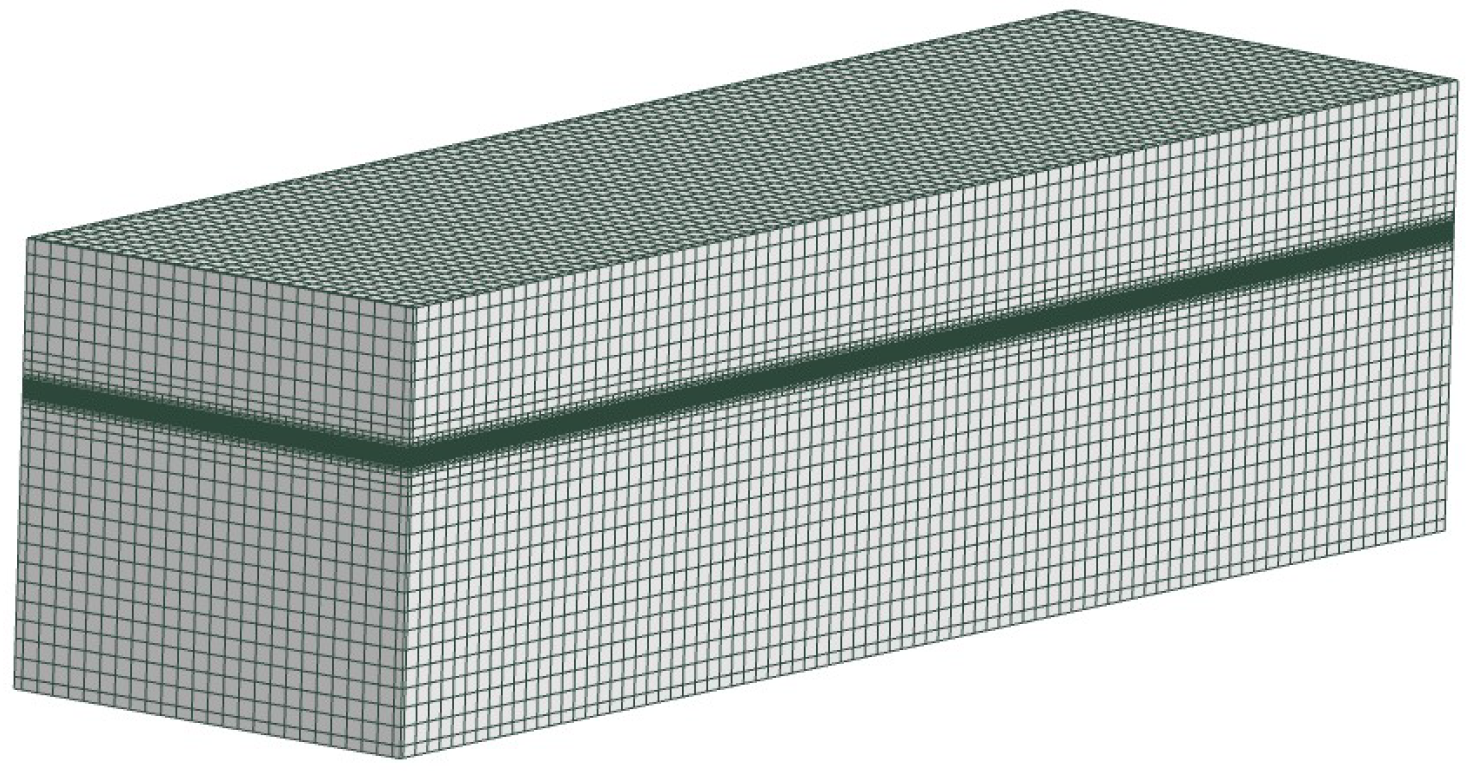
Non-uniform grid division is adopted for the computational domain grid division. To accurately capture the wave height at the free liquid surface, the grid in the region where the free liquid surface is located is refined. In the horizontal X direction, the grid size at the free liquid surface is approximately selected as 1/100 of the wavelength; in the vertical Z direction, the grid size is approximately selected as 1/10 of the wave height, with the total number of grids in the entire numerical basin computational domain being approximately 1.76 million. Meanwhile, to effectively reduce the influence of wave reflection, a wave absorption zone with a length of 3 m is set up at the rear of the computational domain. The inlet surface, top surface, and left and right-side surfaces of the numerical basin are all set as Velocity-inlet, the outlet surface is set as Pressure-outlet, and the bottom surface is set as Wall. The computational domain grid division is shown in Figure 1.
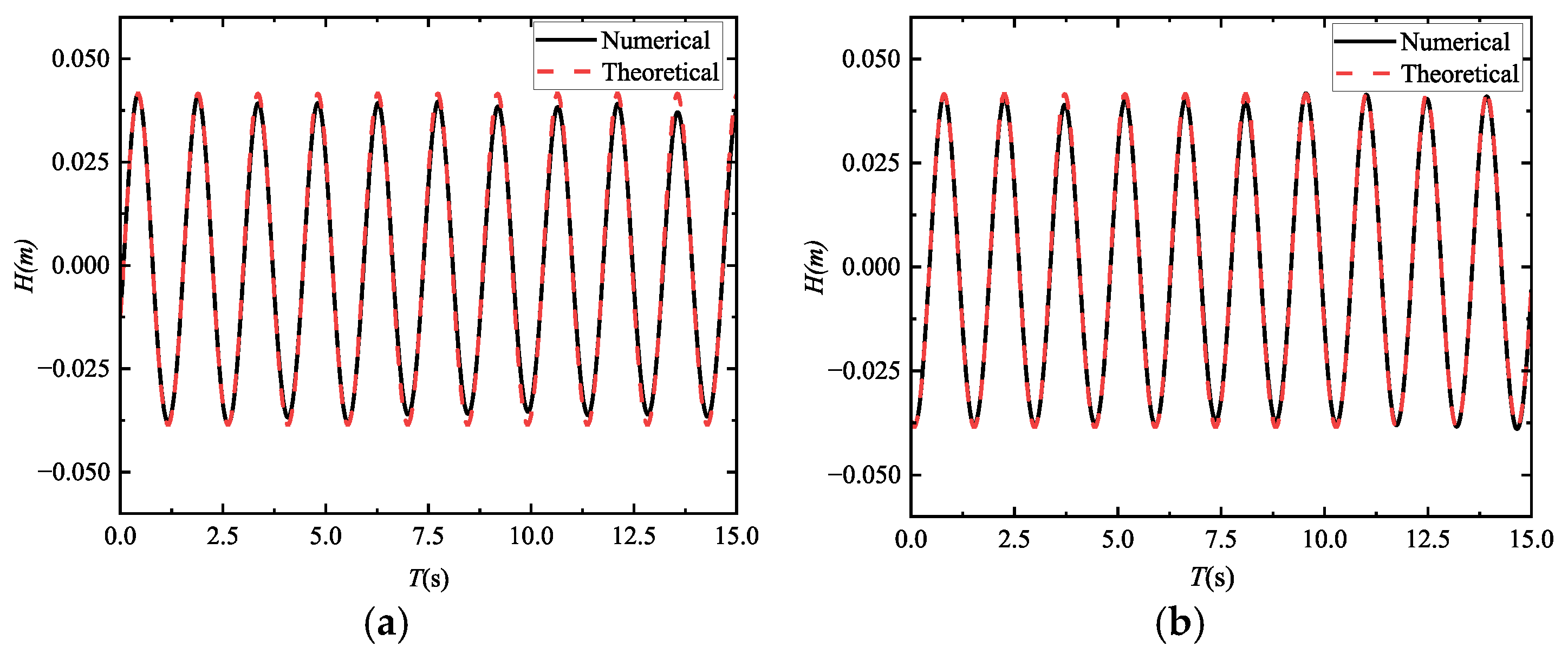
Based on reference [30], an appropriate time step of 0.005 s is selected. To monitor the changes in wave height during wave propagation, wave height monitoring points G1 and G2 are set at positions 2 m and 7 m from the inlet wave generation boundary, respectively. The time history variation curves of wave height monitoring points at different positions are shown in Figure 2. The black curves correspond to the numerical results (labeled “Numerical”), and the red curves represent the theoretical solution (labeled “Theoretical”). As can be seen from Figure 2, the waveforms at monitoring points G1 and G2 are stable with good wave amplitude regularity. The numerical simulation results agree well with theoretical values with high accuracy, especially in the region close to the wave-generation inlet, where the numerical results are more accurate. The numerical conclusions verify the accuracy and reliability of the three-dimensional numerical wave tank, laying the foundation for subsequent research in the paper.

3.2. Model Parameters and Computational Conditions

The KCS standard model ship with rudder is selected as the computational object, with a model scale ratio of 1:37.9. The ship parameters and experimental data are all based on the research results of the 2015 Tokyo Ship Hydrodynamics CFD Workshop. The main parameters of the KCS ship are detailed in Table 2, and its three-dimensional geometric model is shown in Figure 3.
Based on the experimental data published in the 2015 Tokyo Workshop, six working conditions are selected. Working condition 0 represents the KCS ship navigation simulation experiment in calm water, while working conditions 1 to 5 are ship model navigation simulation experiments in regular waves with different wavelengths. The ship model navigation state is head-sea navigation, using the DFBI model to continuously monitor the heave and pitch motions, and simultaneously observe the resistance changes in the ship model. The specific numerical simulation working conditions are shown in Table 3.

3.3. Computational Domain and Grid Division

The selection of the computational domain relates to the accuracy and computational efficiency of numerical simulation. When the KCS ship navigates in calm water and head seas, since the ship hull model is a symmetric model with symmetric flow, to reduce computation time, half of the entire flow domain is selected as the computational domain. Based on the established computational model, the cut-cell mesh technique is applied for computational domain discretization. For different working conditions, the size of the computational domain is determined based on the ship length and wavelength.
When the KCS ship navigates in calm water, based on λ w = 2 π c 2 / g to calculate the ship-generated wave wavelength, the inflow section length is selected as one point five times the ship length, which is greater than the maximum wavelength λ w of the ship-generated waves required for computation, avoiding the influence of the ship hull flow around on the flow domain at the inlet. To ensure the full development of the wake system, the outflow section length is selected as three times the ship length. In the molded depth direction, the part above the waterline is one time the ship length, and the part below the waterline is two times the ship length, to eliminate the shallow bottom effect. The selection of the computational domain width aims to minimize the reflection of ship-generated waves by the width boundary of the region, with the computational domain half-width selected as one point five times the ship length.
When the KCS ship navigates in head seas, the computational domain size varies for different working conditions, aiming to avoid the influence of boundary-induced reflected waves and shallow bottom effects as much as possible. According to the wavelength-to-ship length ratio, the wavelength for the corresponding working condition is calculated, with the inflow section length and half-width selected as one point five times the wavelength for the corresponding working condition, and the outflow section length as three times the wavelength for the corresponding working condition. The part below the waterline is two times the wavelength for the corresponding working condition, and the part above the waterline is one time the wavelength for the corresponding working condition.
To better simulate ship motion, overlapping grids are set around the ship hull. The ship motion region extends 1/4 ship length forward from the bow, 1/4 ship length aft from the stern, 1 ship breadth to the left from the centerline plane, and 1/5 ship length above and below the still water surface. The boundaries of the overlapping grid region are set as overlapping grid boundaries, while the symmetric plane is set as a symmetric plane. Due to the complex three-dimensional hull surface, grid refinement is applied near the bow and stern regions of the KCS hull. The wall function method is employed to account for boundary layer effects, with eight boundary layers meshed on the hull surface. The height of the first boundary layer grid is set to 1 mm, with a growth rate of 1.1, which satisfies the dimensionless height requirement for the first grid layer within the logarithmic law region of the boundary layer ( y + 30 ~ 300 ). During computation, the DFBI module is adopted to accurately predict the ship’s motion responses (heave and pitch). To precisely capture the wave height at the free surface, fine treatment of the grid near the free surface is required. The grid division method near the free liquid surface and the setup of the wave absorption zone at the rear of the computational domain are consistent with the three-dimensional numerical wave tank computational validation. Since the ship hull model is symmetric, the right-side surface in the overall boundary condition settings of the computational domain is set as Symmetry, which differs slightly from the three-dimensional numerical wave tank computational validation settings. The surface mesh of the KCS hull is illustrated in Figure 4, while the overset mesh around the KCS hull and the local mesh refinement near the free surface are shown in Figure 5.

3.4. Numerical Validation of KCS Ship in Calm Water Navigation

To verify the rationality of grid division and the accuracy of numerical results, a grid convergence study is conducted corresponding to Fn = 0.261. The base grid size is set to 10LPP‰ of the length between perpendiculars, while the grid size in the refined regions at the bow and stern is 4LPP‰. Following the grid division method of the three-dimensional numerical wave tank, a free ship surface grid flow-around model is generated. This computational grid is named Grid-1. Based on the requirements of grid convergence analysis, three sets of different computational grids need to be generated. The two additional grid models are achieved by adjusting the base grid size and the grid size within the refinement zones around the hull, with a grid refinement ratio of 2 . The three sets of grids from fine to coarse are Grid-1, Grid-2, and Grid-3, respectively. The total ship resistance coefficient CT, heave, and pitch values are selected as characteristic parameters for grid convergence analysis. Combined with model experimental results, the numerical results and error values for the three sets of different grid models are shown in Table 4.
The numerical errors are all within 5%, meeting the computational accuracy requirements. According to the computational results in the table, based on the analysis method in the reference literature [31,32,33,34,35], grid convergence analysis is performed on the numerical results of the three sets of different grid models. The convergence factors are calculated based on the differences in resistance coefficient, heave, and pitch obtained from Grid-1 and Grid-2, and Grid-2 and Grid-3. ε 21 ( ε R 21 , ε H 21 , and ε θ 21 ) are the differences in the resistance coefficient, heave, and pitch, respectively, between Grid-1 and Grid-2. ε 32 ( ε R 32 , ε H 32 , and ε θ 32 ) are the differences in the resistance coefficient, heave, and pitch, respectively, between Grid-2 and Grid-3. RG ( R R , R H , and R θ ) are the convergence factors corresponding to the resistance coefficient, heave, and pitch, respectively.
The dimensionless parameter definitions for R R , R H , and R θ are as follows:
R R = ε R 21 ε R 32
R H = ε H 21 ε H 32
R θ = ε θ 21 ε θ 32
The convergence factors R R , R H , and R θ corresponding to the resistance coefficient, heave, and pitch are calculated, and the numerical results are shown in Table 5. From Table 5, it can be seen that the numerical uncertainty of the simulation results is very low, and the grid convergence rates for resistance coefficient, heave, and pitch all satisfy the monotonic convergence condition. Subsequently, the Richardson Extrapolation (RE) method is applied to estimate error and uncertainty. The refinement ratio among the three sets of computational grids is r G , and the corresponding grid error δ R E G and estimated order of accuracy PG are as follows:
δ R E G = ε 21 r G P G 1
P G = ln ( ε 32 / ε 21 ) ln ( r G )
The Correction Factor Method is introduced to determine the error and uncertainty. The underlying concept of this method is established on the basis of benchmark data verification and validation studies, where the benchmark data consist of analytical solutions to the one-dimensional wave equation and the two-dimensional Laplace equation. When determining error and uncertainty, the Correction Factor Method is employed to quantify the influence of higher-order terms on error estimation. The corresponding refined grid error δ G is expressed as follows:
δ G = C G δ R E G = C G ε 21 r G P G 1
C G = r G P G 1 r G P G e s t 1
In Equation (16), PGest represents the estimation of the leading-term accuracy as the grid size approaches zero. Based on the value range of the calculated CG in Equation (16), the numerical uncertainty UG due to the computational grid is computed as follows:
U G = 9.6 ( 1 C G ) 2 + 1.1 δ R E G ( 1 C G < 0.125 ) 2 1 C G + 1 δ R E G ( 1 C G 0.125 )
Based on the calculations above, the numerical results of the grid convergence analysis are summarized and presented in Table 5. As shown in Table 5, the grid convergence rates obtained for the resistance coefficient, heave, and pitch all satisfy the monotonic convergence condition. Furthermore, the refined grid error δ G is smaller than their corresponding numerical uncertainty UG. It is considered that when the quality of grid division reaches the level equivalent to Grid-1, the computational results for KCS ship navigating in calm water are reliable, demonstrating that the CFD-based approach for predicting ship hydrodynamic performance exhibits reliability. Therefore, this paper adopts the grid division method of Grid-1 for subsequent computational research.

3.5. Numerical Validation of KCS Ship Wave Navigation

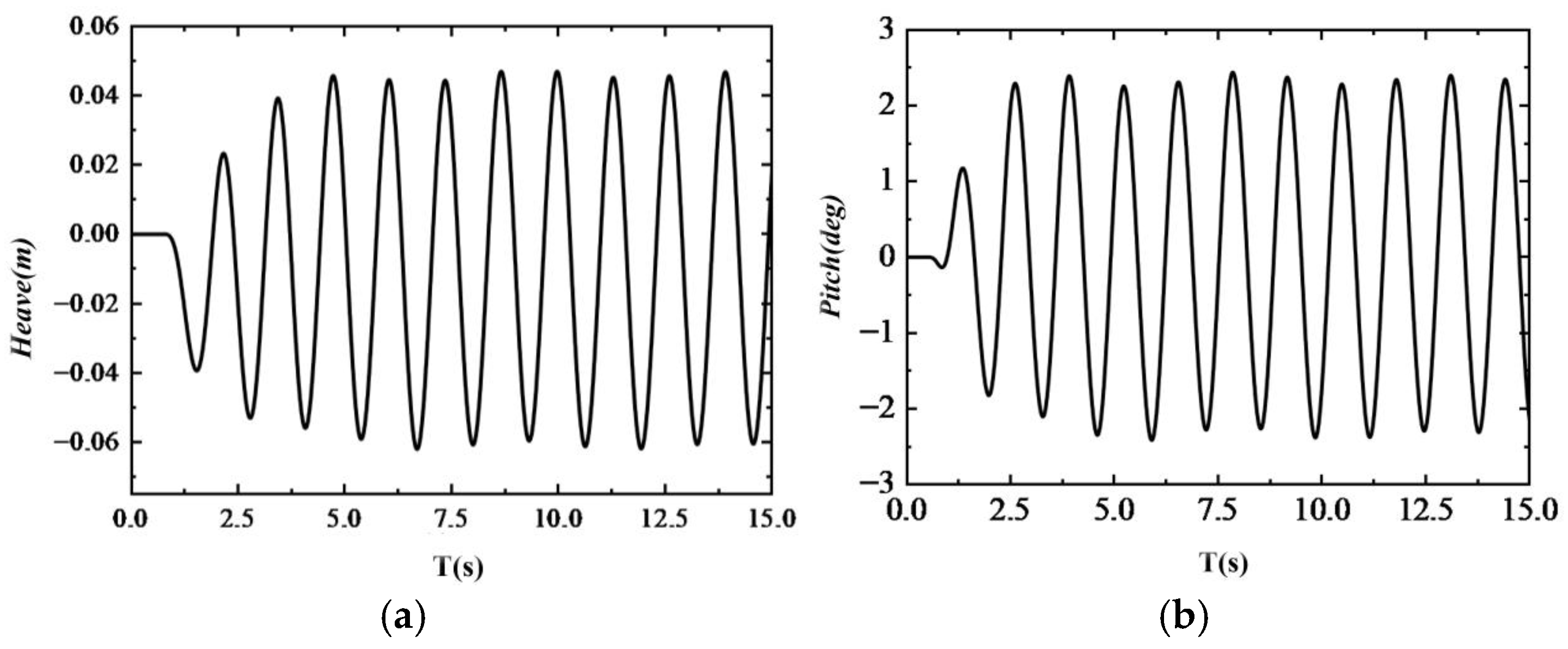
The hydrodynamic performance of the KCS ship under regular wave conditions is numerically validated, taking working condition 3 as an example. The time history curves of heave and pitch are shown in Figure 6. From the figure, it can be observed that the ship exhibits obvious transient response characteristics in the early stage of motion (t < 5 s), with violent and irregular ship motion. As the computation time increases, ship motion gradually becomes stable and shows significant periodic variation characteristics.
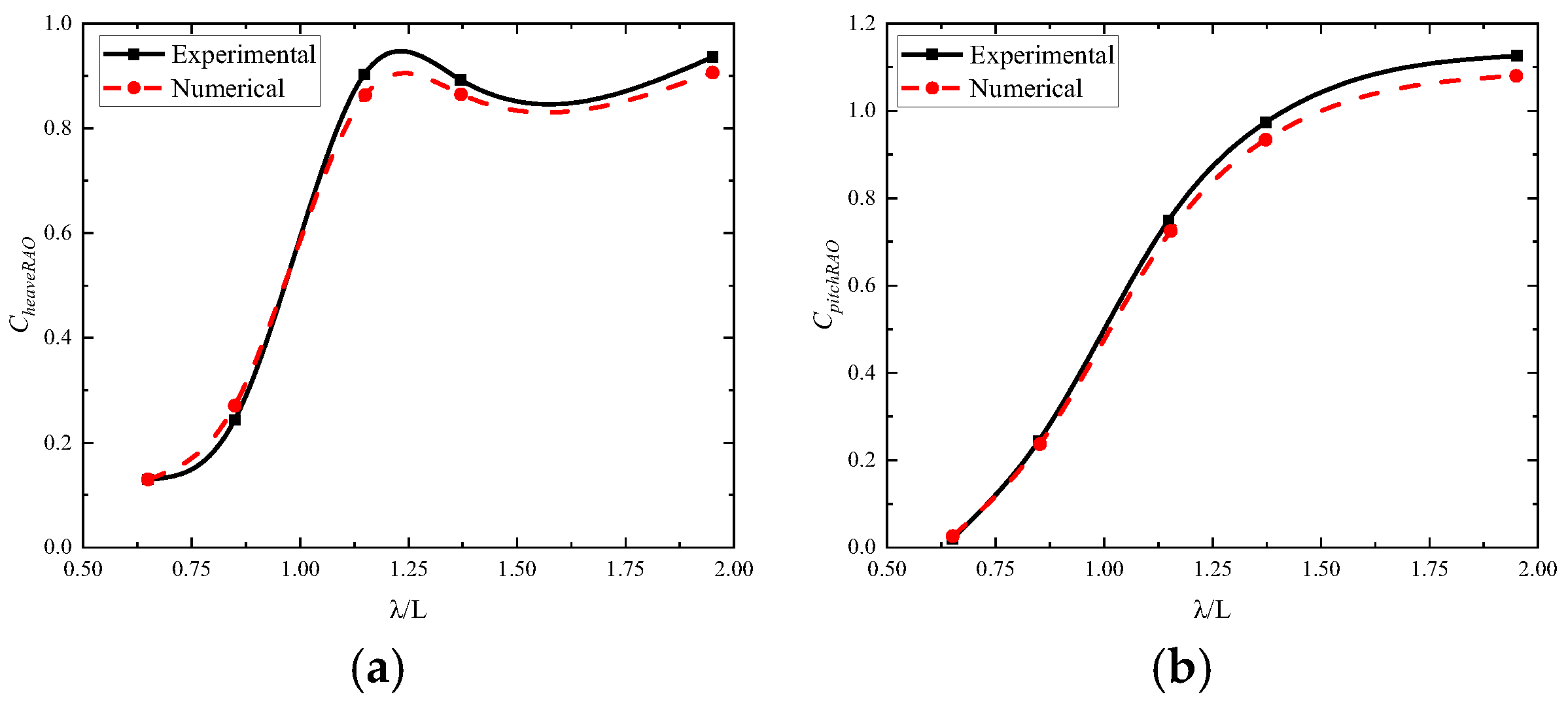
To conduct an in-depth analysis of the motion response characteristics of the KCS ship under regular wave conditions, the computational results for each working condition are expressed in the form of transfer functions, and comparative analysis is performed with the results from the literature [36,37]. The specific comparative analysis results are shown in Figure 7. The black curves correspond to the experimental results (labeled “Experimental”), and the red curves represent the numerical results (labeled “Numerical”). The transfer function expressions for heave and pitch motion are as follows:
C h e a v e R A O = Z A
C p i t c h R A O = θ A K
where Z represents the average amplitude of heave motion; θ represents the average amplitude of pitch motion; A represents the wave amplitude; AK represents the wave steepness; K represents the wave number, K = 2 π / λ .
From Figure 7, it can be observed that the transfer functions of heave and pitch motion response under different working conditions agree well with the experimental values. There are slight differences between the numerical results and experimental values, which are analyzed to be caused by the inherent uncertainty of model experiments, subtle discrepancies in initial conditions between experiments and numerical simulations, as well as the influence of multiple factors including reflected wave effects and the setup of the computational grid (particularly the grid density variations along the wave propagation path, which introduce numerical damping effects). The amplitude of the heave motion first increases and then decreases with the increase in wavelength, followed by another increase. Particularly, when the ratio of wavelength to ship length is 1.15, the transfer function of heave motion reaches its peak value. The pitch motion increases with the increase in wavelength, and at the wavelength-to-ship-length ratio of 1.95, the pitch transfer function reaches its maximum value.
To further analyze the resistance characteristics of the KCS ship under regular wave conditions, combined with the calculated results of total resistance for the KCS ship sailing in calm water under the same conditions, the wave-added resistance (Raw) is non-dimensionalized, and the ship added resistance coefficient Caw is defined, with its calculation expression as follows:
R a w = R t ¯ R c w
C a w = R a w ρ g A 2 B 2 / L
where Raw represents the wave-added resistance; R t ¯ represents the mean value of total resistance in the stable period under head sea conditions; Rcw represents the stable value of total resistance under calm water conditions; A represents the incident wave amplitude; B represents the ship breadth; and L represents the ship length.
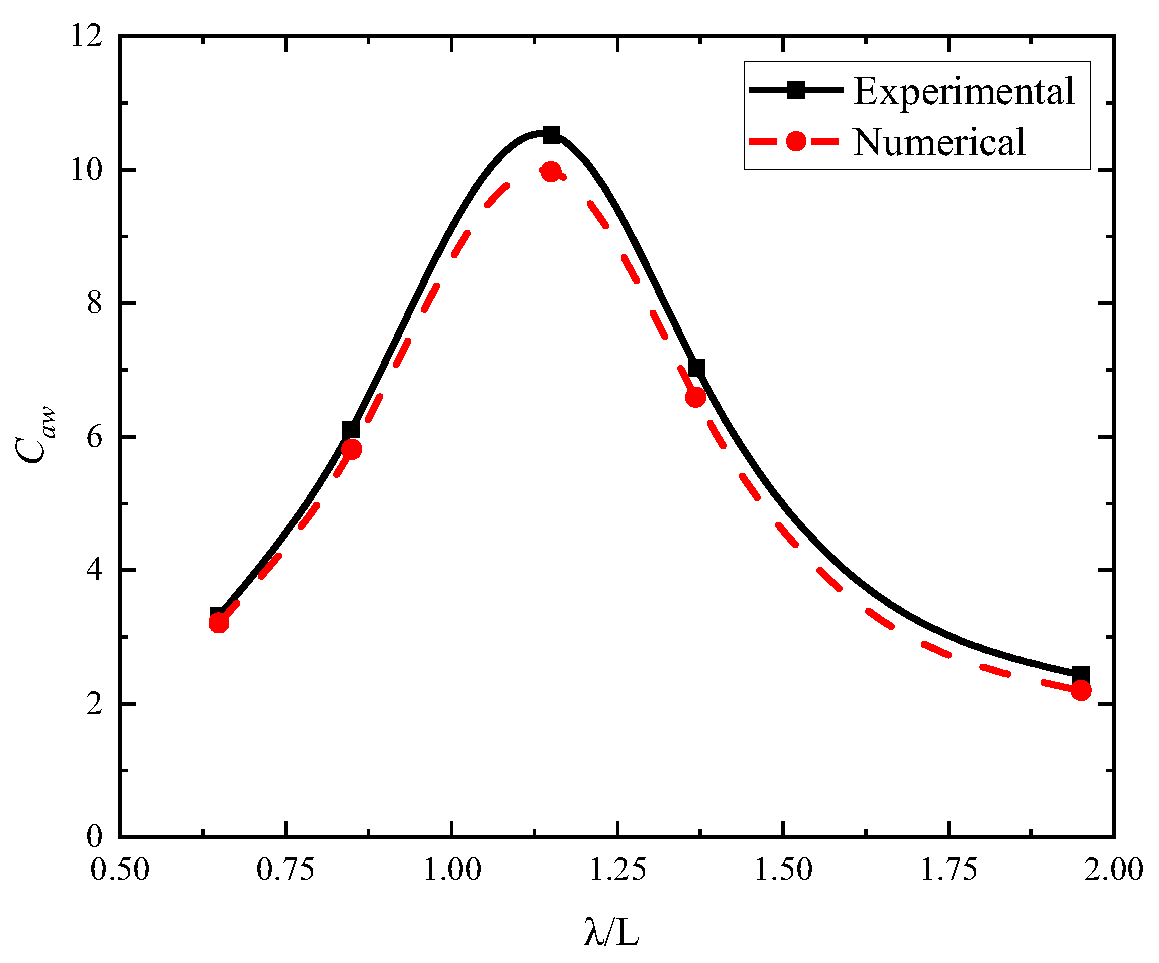
Based on the numerical results under different working conditions, the wave-added resistance coefficient curves are plotted in Figure 8. The black curves correspond to the experimental results (labeled “Experimental”), and the red curves represent the numerical results (labeled “Numerical”). From the figure, it can be observed that the numerical results agree well with the experimental results, showing good consistency. When the ratio of wavelength to ship length is 0.65 and 0.85, the added resistance coefficient is small and gradually increases. As the wavelength increases to slightly larger than the ship length (wavelength-to-ship-length ratio of 1.15), the added resistance coefficient reaches its peak value and then begins to gradually decrease. Based on the above analysis results, the accuracy and reliability of the numerical method in this paper are validated.

4. Effect of Moonpool on Hydrodynamic Performance of Drillship in Calm Water

4.1. Model Parameters and Moonpool Schemes

Taking a certain type of drillship as the research object, the numerical calculation model scale ratio is 54, and the main dimensions of the full-scale ship and ship model are shown in Table 6.
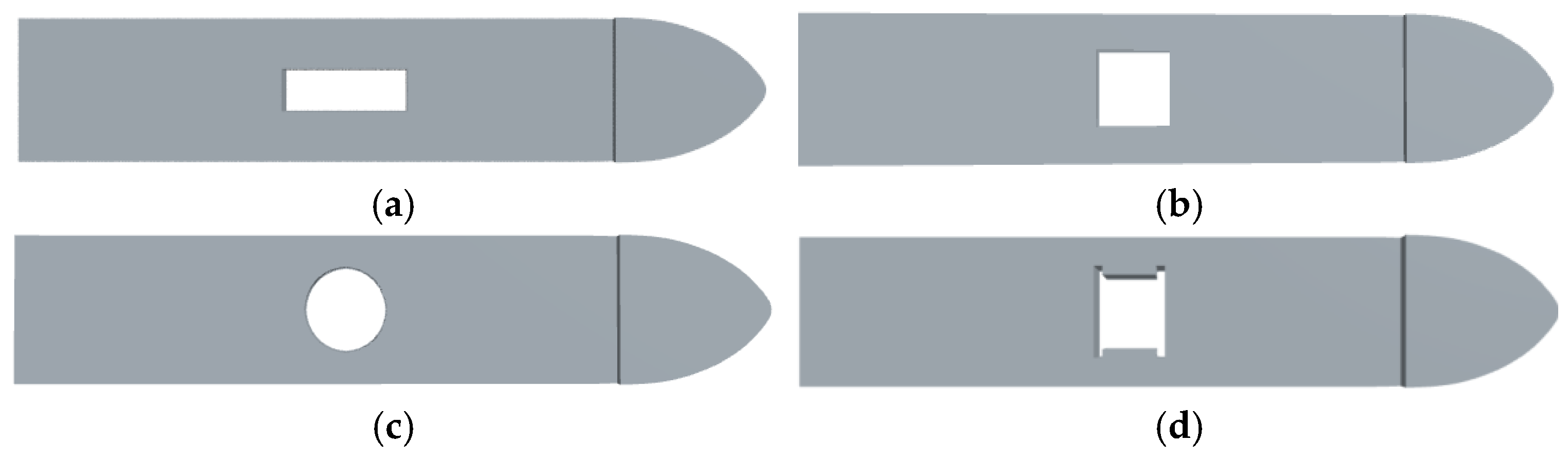
To investigate the effect of moonpool structural forms on the hydrodynamic performance of drillships, four different-shaped moonpools are selected based on conventional moonpool structures equipped in existing drillships at home and abroad. Taking a drillship without a moonpool as the reference ship type, four different-shaped moonpools are set at the opening near the midship section of the hull, namely rectangular moonpool, square moonpool, circular moonpool, and I-shaped moonpool. All moonpools are converted with equal area based on the rectangular moonpool as the reference. The I-shaped moonpool added four 1.92 m × 1.92 m water retention areas at the four corners based on the square cross-section. The relevant parameters of different moonpool structures are detailed in Table 7, and the drillship models with different moonpool schemes are shown in Figure 9.

4.2. Calculation Conditions and Grid Generation

To investigate the effects of different moonpool structural configurations on the hydrodynamic performance of drillships during calm water navigation, the service speed range of 7–15 knots under actual sea conditions is selected, with a speed interval of 2 knots between adjacent operating conditions. The specific numerical simulation conditions are shown in Table 8.
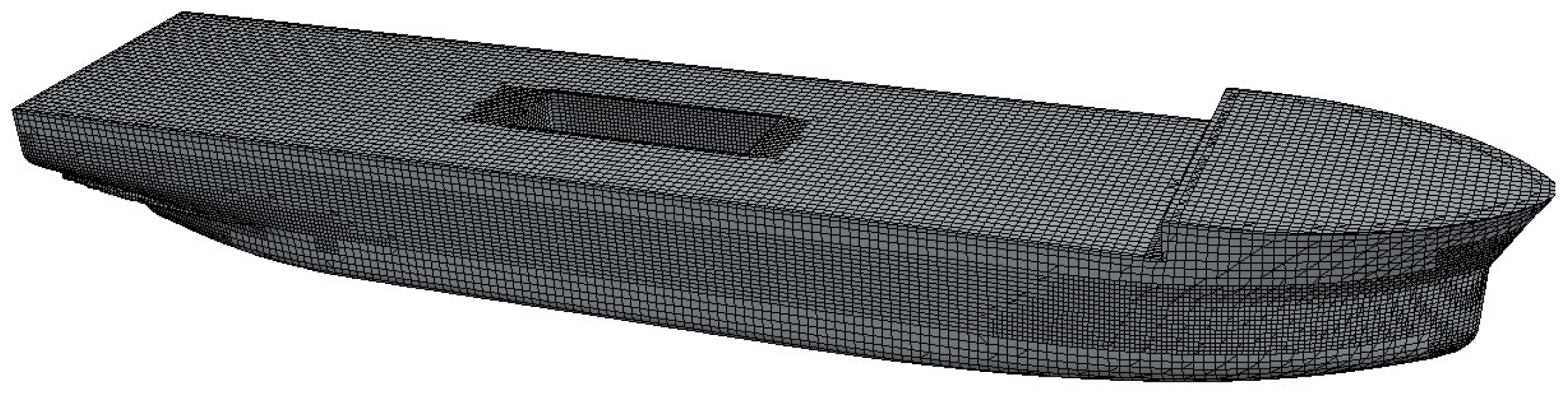
Because the models of the drillship without a moonpool and those with different moonpool configurations are symmetric about the centerline, a half-ship model is used for the computations. The mesh generation near the free surface, the wave-absorption zone at the aft end of the computational domain, the selection of the computational domain, the overset mesh around the hull, the grid refinement in the bow and stern regions, and the overall boundary-condition settings followed the KCS ship calm-water validation and are kept consistent. Furthermore, to capture the flow field details inside the moonpool and account for flow separation and vortex formation near its lower edge, the grid is refined in the vicinity of the moonpool, with a grid size set to 3‰ of the drillship’s waterline length. The hull surface mesh of the rectangular-moonpool drillship is shown in Figure 10.

4.3. Analysis of Numerical Results for Resistance Performance

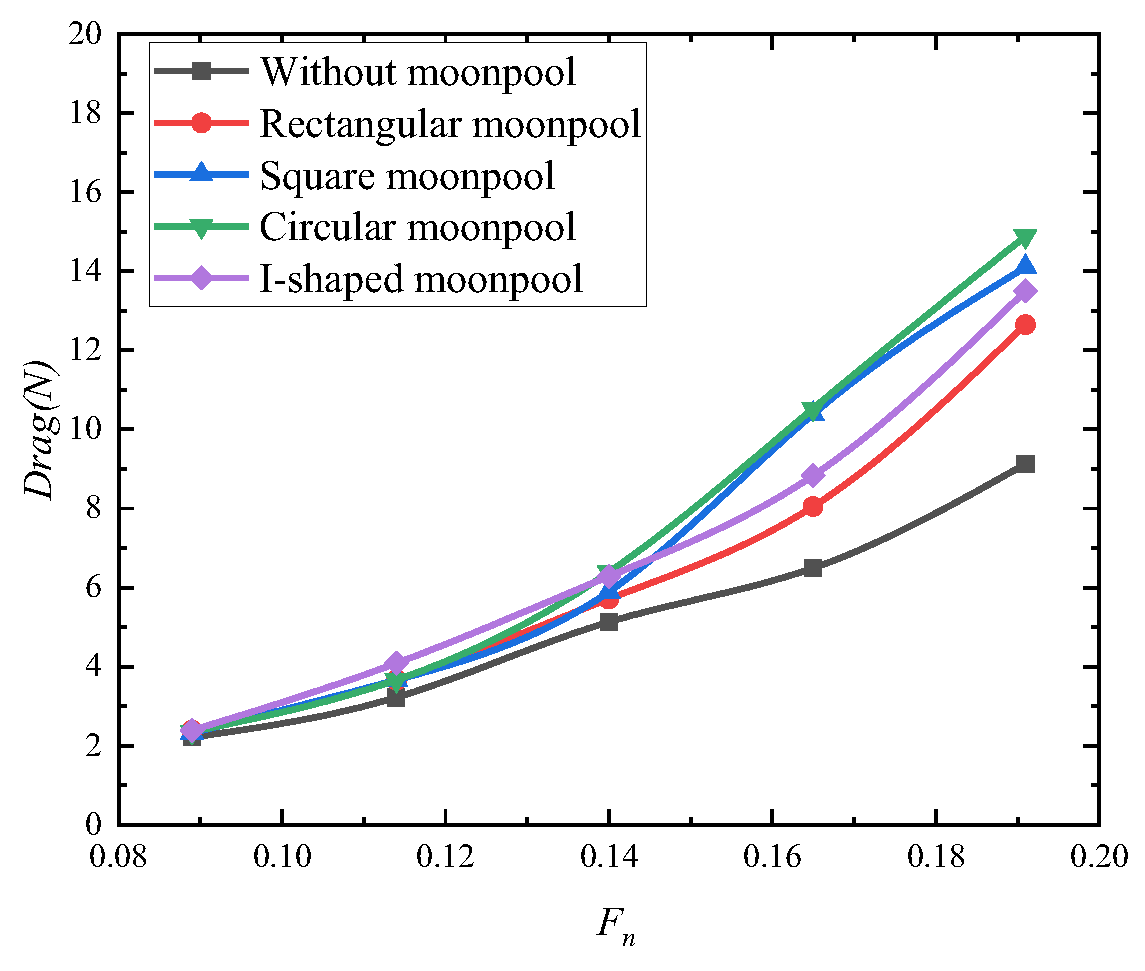
Numerical studies are conducted on the resistance performance of the drillship without a moonpool and drillships with different moonpool configurations at various speeds, and the total resistance curves are plotted in Figure 11 based on numerical results. From Figure 11, it can be seen that the presence of a moonpool and different moonpool shapes have extremely significant effects on the resistance performance of drillships. The total resistance of drillships without moonpools and those with different moonpool configurations increases with speed, and at all speeds, the total resistance of drillships with moonpools is higher than that of drillships without moonpools. This is because the presence of a moonpool induces added resistance, particularly added residual resistance, which includes added viscous pressure resistance and added wave-making resistance. The added viscous pressure resistance is primarily caused by boundary-layer separation effects at the moonpool edges, while the added wave-making resistance stems from water oscillations within the moonpool (piston and sloshing modes) and wave-making interference between the internal and external flow fields. With increasing speed, the total resistance of drillships with different moonpool configurations shows similar growth trends. Within a certain speed range (0.089 < Fn < 0.14), the differences in total resistance among various moonpool designs are not significant. When the Froude number Fn > 0.14, the total resistance increase for all moonpool design configurations exhibits an intensifying trend. The square and circular moonpools exhibit relatively higher resistance values that remain proximate to each other, while showing substantial deviations from other moonpool design schemes. By comparing the total resistance values of different moonpool designs, it is evident that the rectangular-moonpool drillship has a significant advantage in terms of resistance performance.
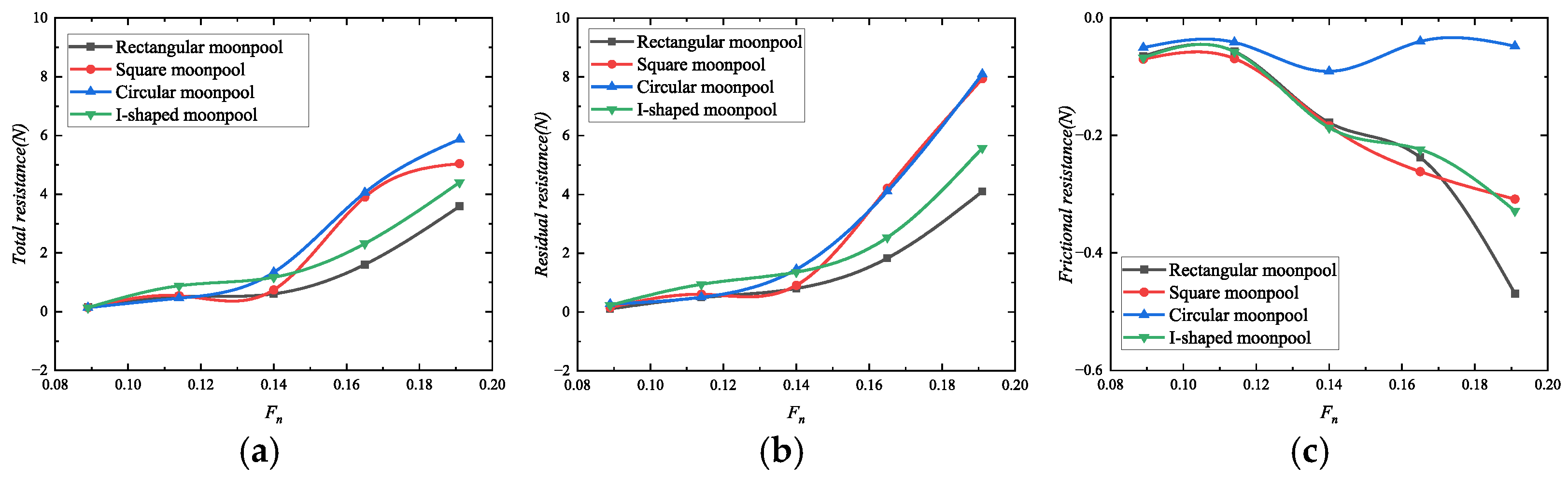
To quantify the influence of moonpool structural configurations on drillship resistance, in comparison with the results from the drillship without a moonpool, the added resistance curves for frictional resistance, residual resistance, and total resistance of the four different moonpool configurations are presented in Figure 12. From Figure 12, it can be seen that the moonpool-induced resistance increase primarily stems from the added residual resistance, which shows the same variation trend as the added total resistance. In contrast, the added frictional resistance caused by the moonpool is relatively small and consistently negative. This is because the presence of a moonpool reduces the wetted surface area, decreases the internal flow velocity, and alters the development of the hull boundary layer, causing it to separate earlier or become thinner. At low speeds, the differences in added resistance among drillships with different moonpool configurations are not significant. When the Froude number Fn > 0.14, the moonpool-induced resistance increase shows a marked increase with an intensifying trend, consistent with the aforementioned numerical conclusions regarding total resistance. Compared to other moonpool designs, the rectangular-moonpool drillship performs better in reducing resistance increase, with smaller added residual resistance and a relatively more pronounced reduction in frictional resistance.

4.4. Analysis of Navigation Attitude for Drillships with Different Moonpool Structural Configurations

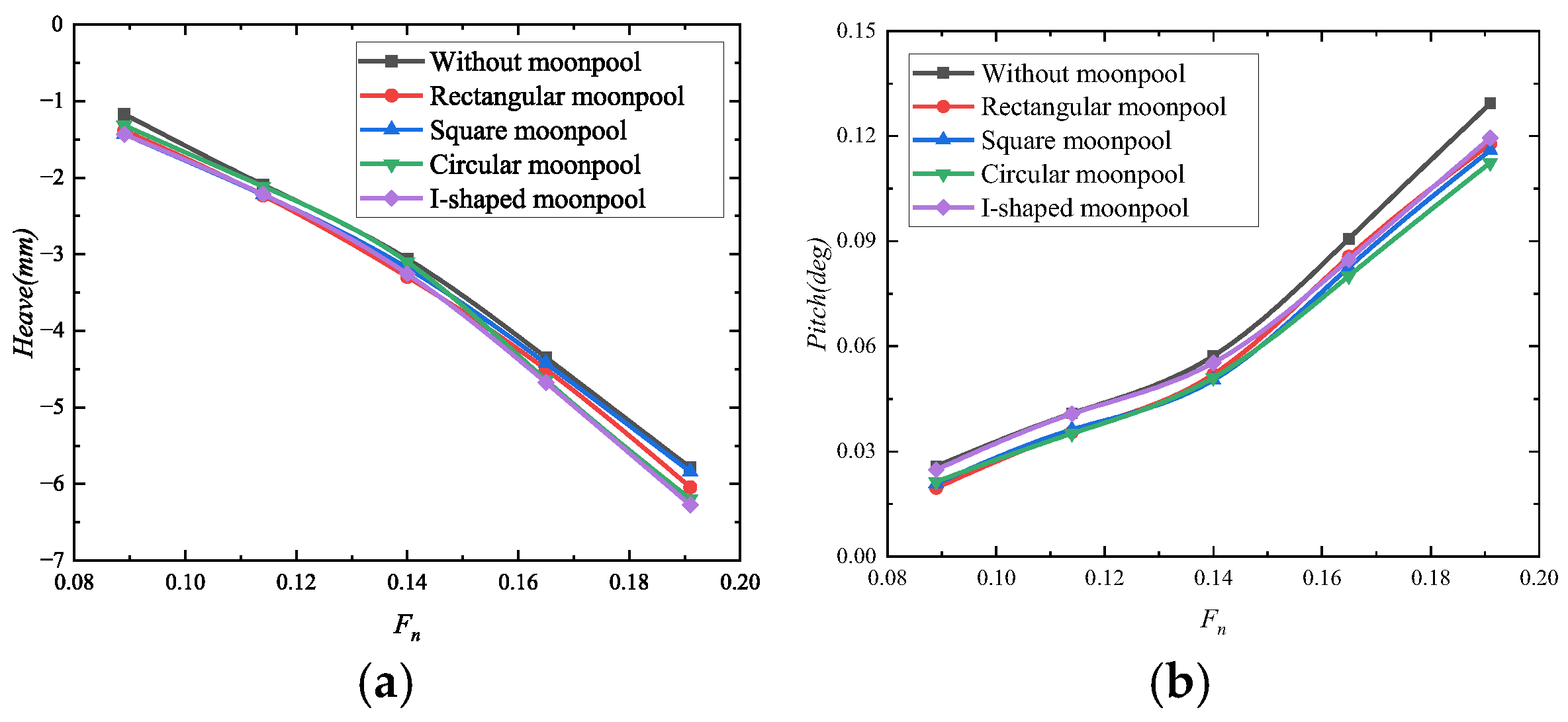
To investigate the influence of different moonpool configurations on the motion responses of drillships, the calculated curves for the heave and pitch of drillships without a moonpool and those with various moonpool designs are plotted in Figure 13. From Figure 13a, it can be seen that the presence of a moonpool slightly increases the sinkage. At low speeds, the sinkage of drillships without moonpools and those with different moonpool configurations is not significant; as speed increases, the heave phenomenon becomes more pronounced. Compared to drillships with other moonpool designs, the rectangular and square moonpool drillships show relatively smaller sinkage at the same speeds. From Figure 13b, it can be seen that the presence of a moonpool is beneficial for reducing hull pitch. At low speeds, the differences in pitch values between drillships without moonpools and those with different moonpool configurations are small. When the Froude number Fn > 0.14, as speed increases, the pitch phenomenon intensifies for both drillships without moonpools and those with different moonpool configurations.

4.5. Analysis of Flow Formation Mechanisms in Moonpool Internal Flow Field

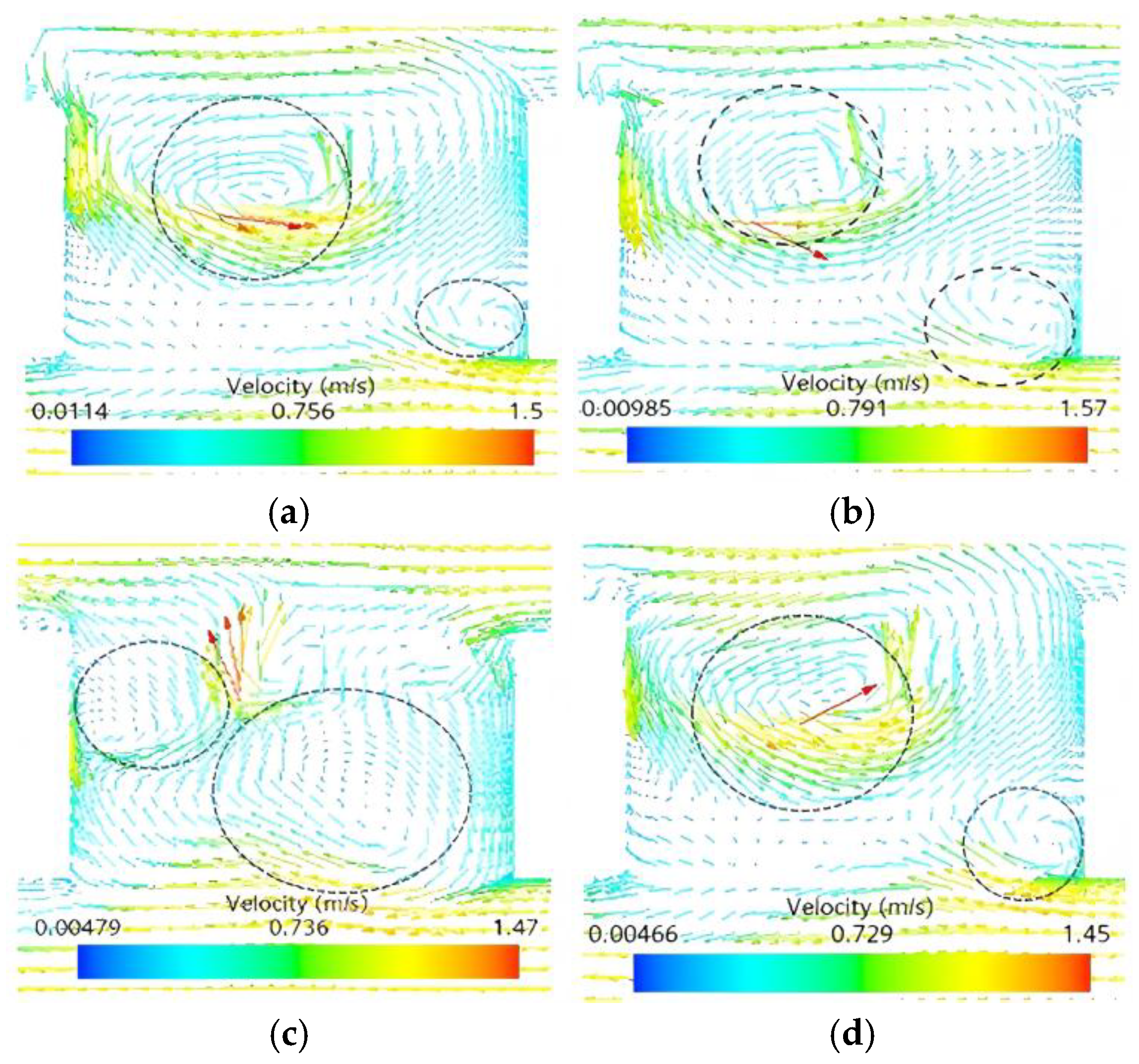
To investigate the flow field characteristics within the moonpool of a drillship, the rectangular-moonpool drillship with superior resistance performance is selected, at a Froude number Fn = 0.191, corresponding to a full-scale speed of 15 knots. The evolution of the velocity vector distribution in the longitudinal section of the internal flow field is shown in Figure 14. From Figure 14, it can be seen that the evolution of the velocity vector distribution in the longitudinal section of the internal flow field follows a regular pattern. In the leading-edge region of the moonpool (toward the bow), water from the ship’s bottom flows in and forms clockwise vortices due to flow separation. After accumulating a certain amount of energy, these vortices detach from the leading edge and migrate rearward. With continuous fluid exchange, the vortex volume gradually increases, and the vortex intensity gradually strengthens. Due to the obstruction of the moonpool’s aft wall, when the high-speed flow impacts the aft wall, a significant blocking effect occurs, forcing the flow to surge upward and form a climbing flow. This phenomenon causes a significant rise in the free surface at the trailing edge of the moonpool. The vortex, influenced by the climbing flow due to the blocking effect, begins to gradually migrate rearward and upward. During the rearward and upward migration of the vortex, as the energy within the internal flow field gradually dissipates, the vortex energy is gradually released, and some of the flow exits the moonpool and merges with the ship’s wake. Therefore, the vortex volume and intensity begin to gradually decrease, and the vortex continues to migrate rearward and upward to the trailing-edge region (toward the stern), where it is expelled and eventually disappears. Meanwhile, water from the ship’s bottom continuously flows into the moonpool at the leading-edge region (toward the bow), forming new vortices. In contrast to this vortex, a large and strong counterclockwise vortex forms in the upper central region of the moonpool due to the influence of air flow, located near the gas–liquid interface. As the energy of the internal flow field within the moonpool gradually dissipates, the volume and intensity of this vortex begin to decrease progressively, and it gradually migrates toward the left side into the trailing-edge region (toward the stern) before being expelled and eventually dissipating. This cycle repeats continuously, with the processes of vortex generation, development, and dissipation occurring in a periodic and regular manner. This continuous mass exchange between the ship-bottom flow and the internal moonpool flow provides sustained energy replenishment for the generation of clockwise vortices within the moonpool.

5. Effects of Moonpools on Seakeeping Performance of Drillships in Regular Waves

5.1. Calculation Conditions and Grid Generation

To investigate the influence of moonpools on the resistance and motion performance of drillships under wave conditions, based on the computational results of the moonpool’s effect on the hydrodynamic performance of drillships in calm water, the rectangular-moonpool drillship with superior resistance performance is selected as the research object, together with a drillship without a moonpool as the reference vessel. From Section 3.1, it is known that the two selected drillships have identical geometric parameters. The computational conditions are set at a Froude number Fn = 0.191, corresponding to a full-scale design speed of 15 knots, with wavelength-to-ship-length ratios ranging from 0.75 to 2.0 at intervals of 0.25, totaling six different incident wavelengths. The incident wave height is 0.08 m. The specific simulation conditions are shown in Table 9.
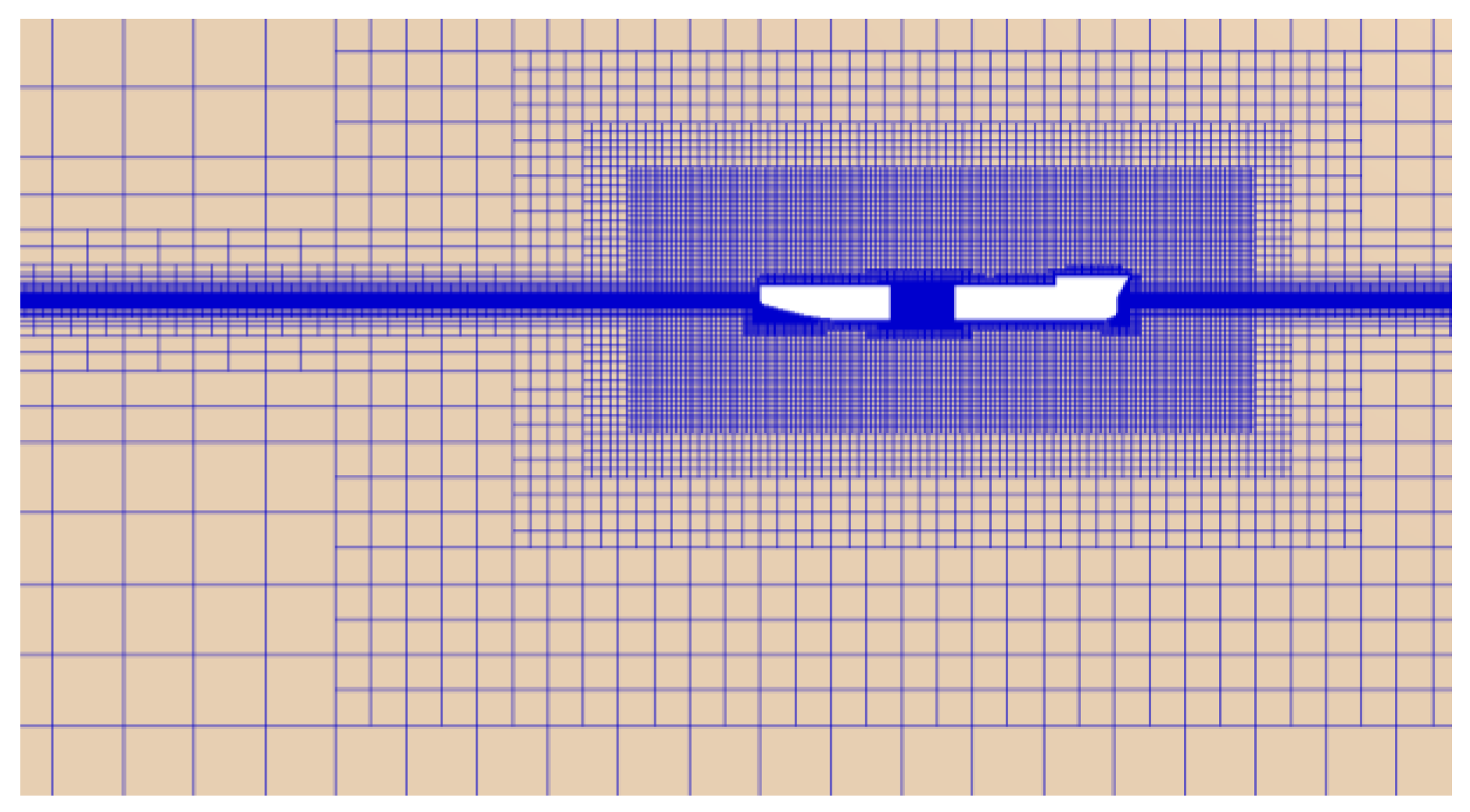
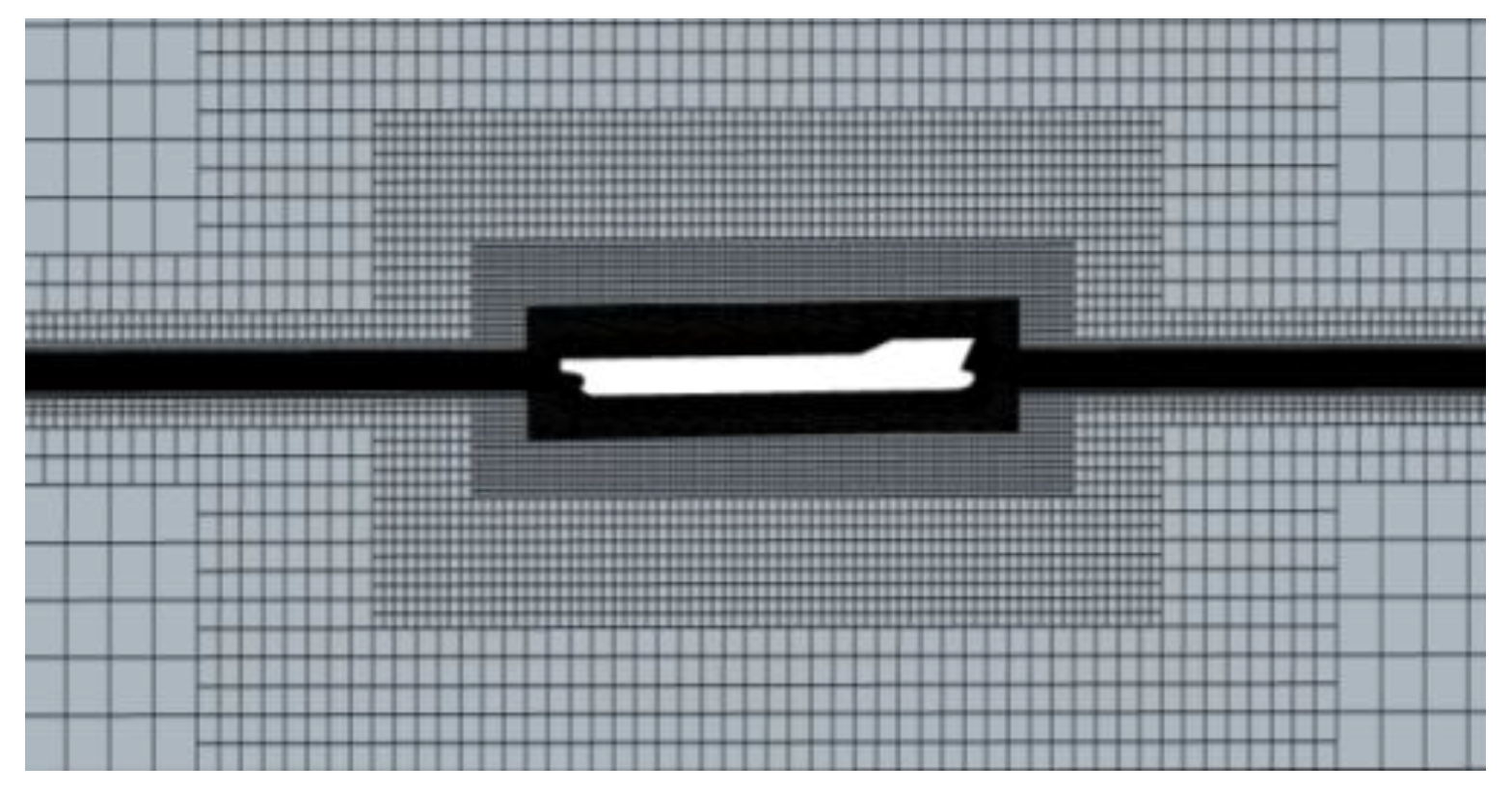
Due to the lateral symmetry of both the moonpool-free and rectangular-moonpool drillship models, half-model simulations are employed in the calculations. The grid generation method near the free surface, the wave-absorbing zone setup at the rear of the computational domain, the selection of computational domain, the overlapping grid generation around the hull, the grid refinement in the bow and stern regions, and the overall boundary condition settings are referenced from the KCS ship wave navigation calculation validation section, maintaining consistency with those settings. Grid refinement is also applied in the vicinity of the moonpool, with the grid size consistent with that used in the calm-water navigation calculations. Figure 15 shows a partial view of the local grid on the longitudinal section of the computational domain for the rectangular-moonpool drillship.

5.2. Analysis of Wave-Added Resistance Results

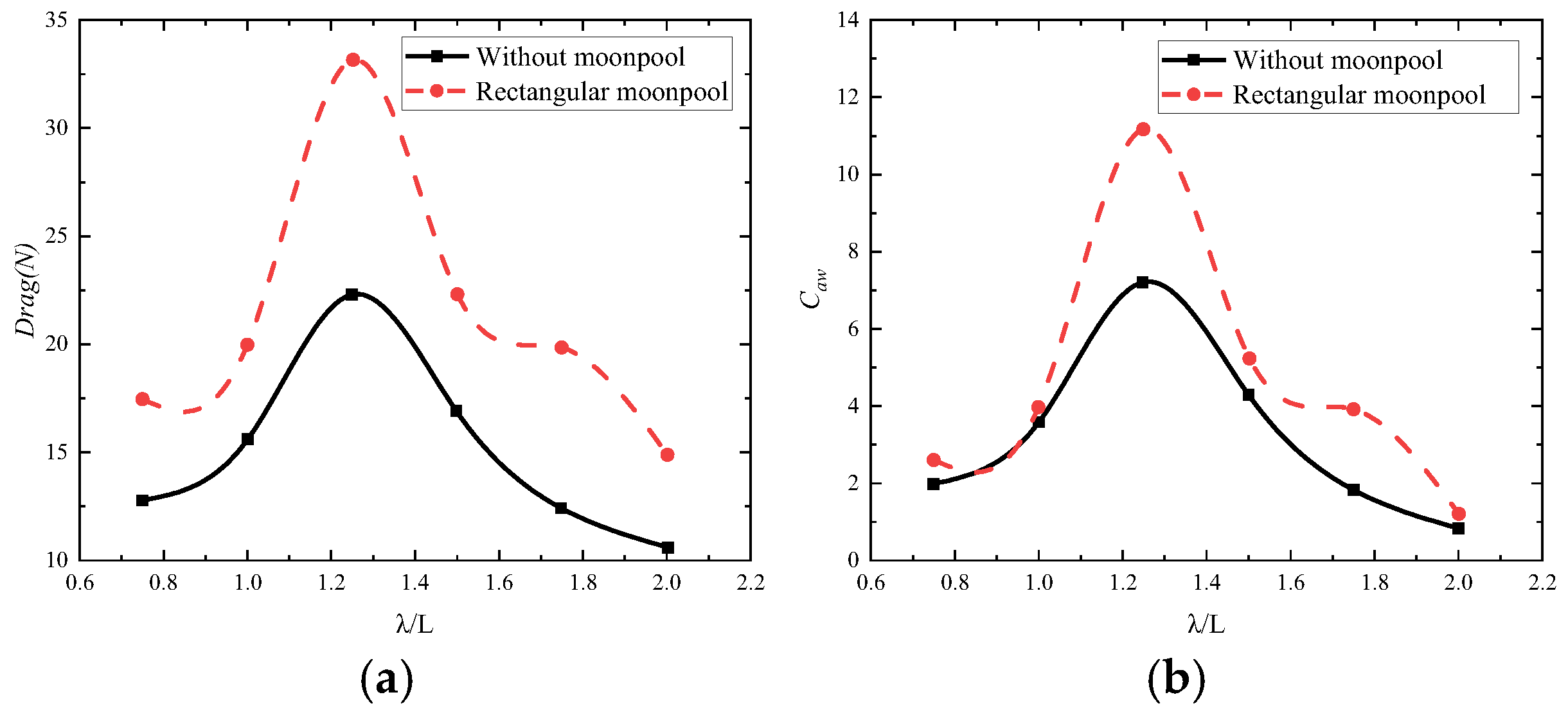
Based on the numerical results for the drillships with and without a rectangular moonpool under regular wave conditions, the resistance and wave-added resistance coefficients are plotted as functions of the wavelength-to-ship-length ratio in Figure 16. As illustrated in Figure 16, the total resistance and wave-added resistance coefficients of the drillship without a moonpool and the one with a rectangular moonpool exhibit consistency in their variation trends, albeit with significant numerical differences. With increasing wavelength-to-ship length ratio, the values show a trend of first increasing then decreasing. When the wavelength-to-ship length ratio is approximately 1.25, the wave-added resistance coefficient reaches its maximum value, which is caused by unfavorable resonance effects between the hull and waves. As the wavelength continuously increases and approaches infinity, the wave-added resistance coefficient will gradually approach zero, meaning that the ship’s navigation state in regular waves will gradually approach the calm water navigation state. At all wavelengths, the total resistance and wave-added resistance coefficients of the drillship without a moonpool are consistently lower than those of the drillship with a rectangular moonpool. The presence of a moonpool consequently increases the total resistance experienced by the drillship. Therefore, based on hydrodynamic performance and structural safety considerations, implementing certain measures to reduce the total resistance of moonpool drillships is of significant importance.

5.3. Analysis of Motion Response Results

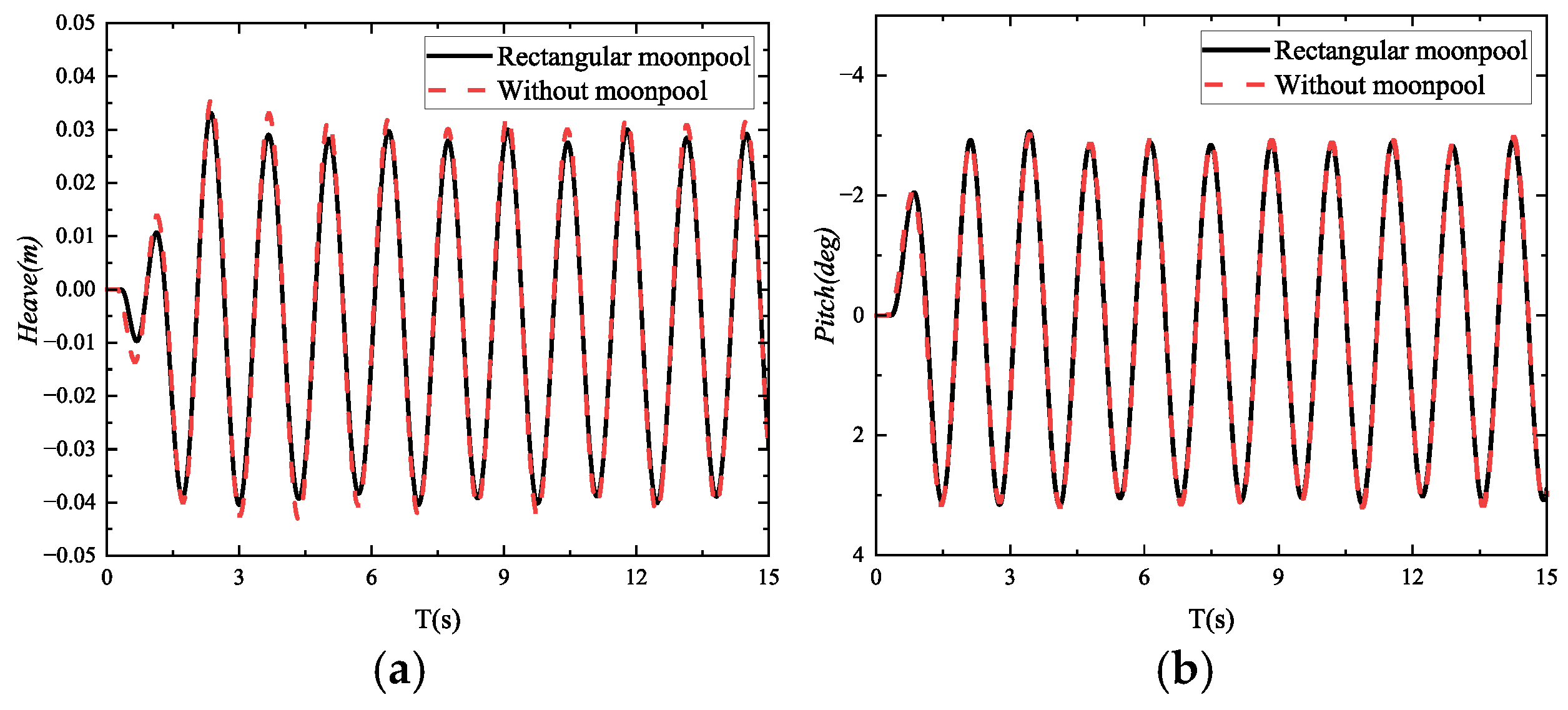
A numerical study is conducted to investigate the hydrodynamic performance of the drillship without a moonpool and the one with a rectangular moonpool in regular waves. The time histories of heave and pitch motions for the case with a wavelength-to-ship-length ratio of 1.75 are presented in Figure 17. As observed from Figure 17, under head-on regular waves, the heave motion amplitude of the drillship without a moonpool is slightly larger than that of the drillship with a rectangular moonpool, whereas the difference in the pitch motion amplitude between the two configurations is negligible.
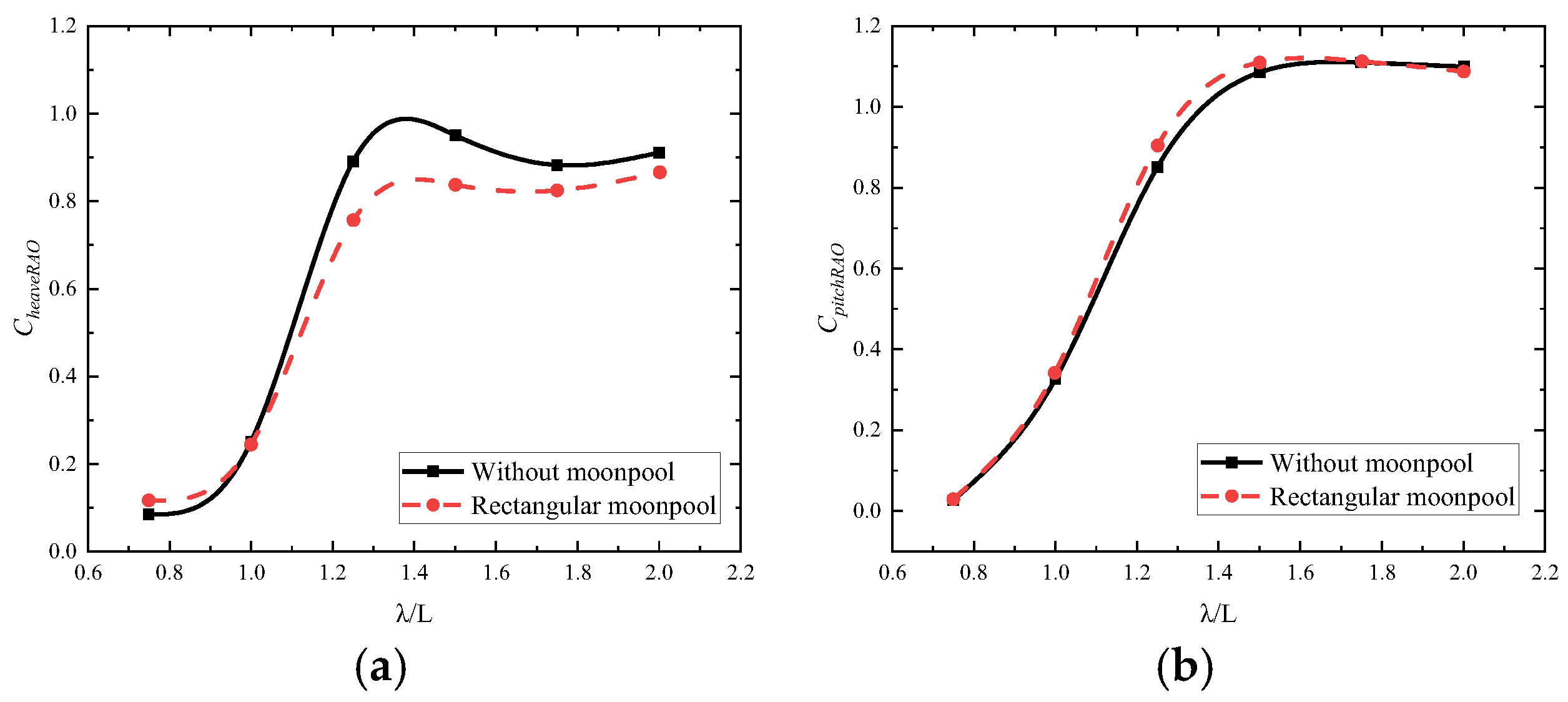
To gain deeper insight into the motion response characteristics of the drillships with and without a rectangular moonpool in regular waves and to present the heave and pitch responses intuitively, the results for all conditions are expressed in the form of transfer functions. The transfer function curves for heave and pitch of the drillships with and without a rectangular moonpool are presented in Figure 18. As shown in Figure 18a, the heave motion of the drillship without a moonpool and the one with a rectangular moonpool generally follow a consistent trend with varying wavelength, both exhibiting a non-monotonic variation characterized by an initial increase, followed by a decrease, then a subsequent rise, and finally approaching an asymptotic value of 1. The transfer function of the heave motion reaches its maximum when the wavelength-to-ship-length ratio is approximately 1.5. Within the wavelength-to-ship-length ratio range of 0.75 to 1.0, the rectangular moonpool exacerbates the hull’s heave motion. However, when the ratio exceeds 1.0, the heave motion amplitude of the drillship with a rectangular moonpool remains consistently lower than that of the moonpool-free drillship. Figure 18b shows a clear wavelength dependence for the pitch motion. Within the wavelength-to-ship-length ratio (λ/L) range of 0.75 to 1.5, the pitch transfer functions for the moonpool-free and the rectangular-moonpool drillships increase with increasing wavelength, reaching a maximum at a ratio of approximately 1.5, after which the pitch response amplitude decreases. Regarding the overall trend of the pitch transfer function, the curve exhibits a steeper slope and a faster growth rate at smaller λ/L ratios. As the ratio increases, the slope gradually flattens. With a further continuous increase in λ/L, the non-dimensional pitch response amplitude gradually stabilizes and approaches a value of 1. This is because in extremely long waves, the hull passively follows the wave surface with slow tilting, and the pitch angle tends to be consistent with the wave slope, with dynamic effects being essentially negligible. The pitch motion response exhibits quasi-static equilibrium, which conforms to ship seakeeping theory. Overall, the presence of a moonpool has a relatively significant impact on hull heave motion, while its effect on pitch motion is smaller.

5.4. Analysis of Free Surface Wave Patterns

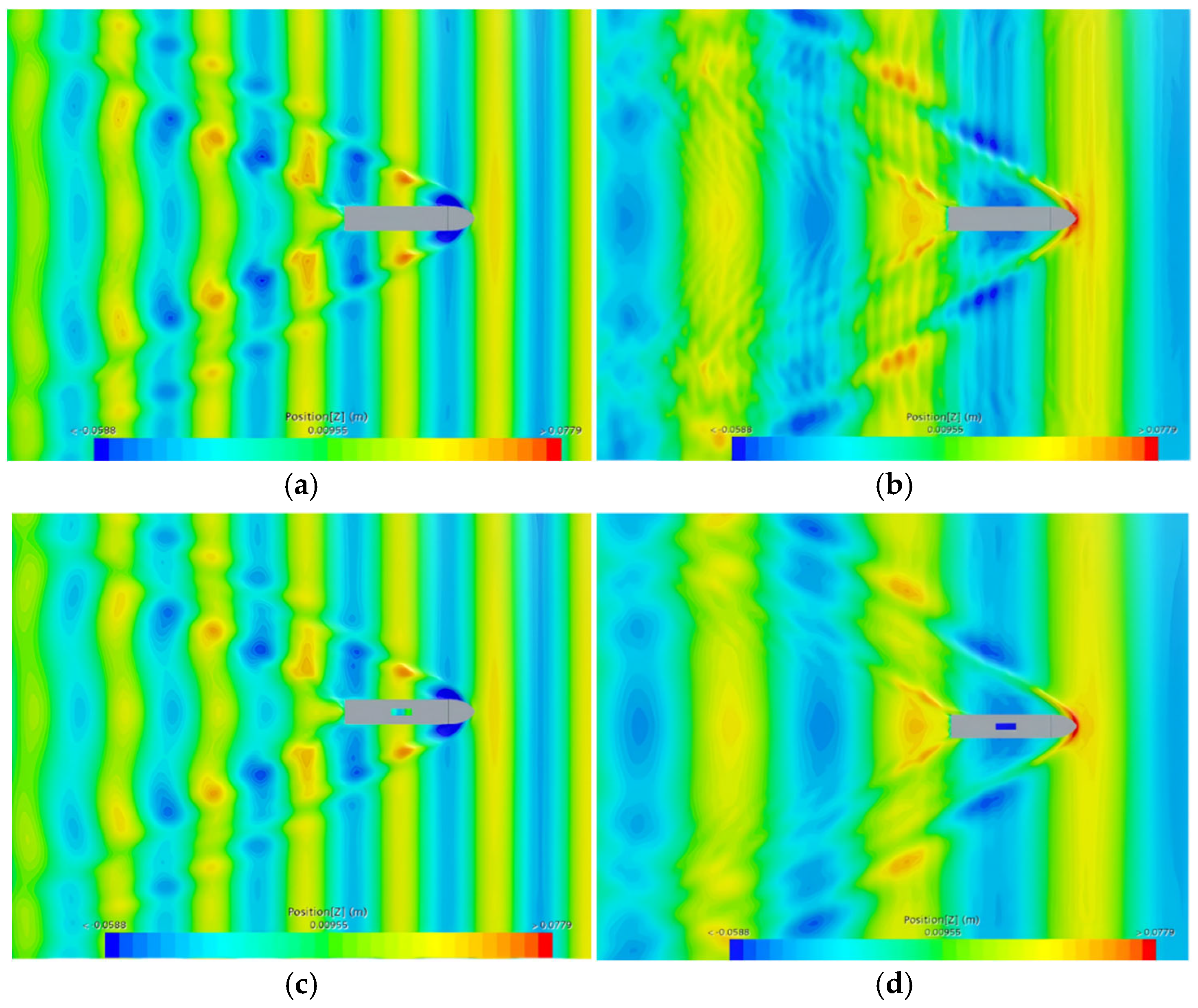
To investigate the free-surface wave patterns and their evolution under regular waves for the moonpool-free drillship and the rectangular-moonpool drillship, numerical results at the same instant for wavelength-to-ship-length ratios (λ/L) of 0.75 and 1.5 are selected. The corresponding free-surface wave patterns are presented in Figure 19. As can be observed from Figure 19, under the same wavelength-to-length ratio, the free-surface wave characteristics of the drillship without a moonpool and with a rectangular moonpool are very similar, exhibiting only minor differences. This indicates that the presence of the moonpool has a limited influence on the overall free-surface wave pattern of the drillship. Moreover, the trends in free-surface wave variation for both configurations are largely consistent across different wavelength-to-length ratios. Under regular waves, the ship-generated waves are influenced by incident, diffracted, and radiated waves, resulting in wave-system interference and nonlinear effects. In particular, the encounter and superposition of bow and stern transverse waves with the incident waves produce favorable or unfavorable interference, leading to significant dynamic variations in wave-height distribution over time. When the wavelength-to-ship-length ratio is 0.75, the interaction between ship motion and waves is strong, the effect of radiated waves is relatively pronounced, and the resulting free-surface wave pattern is comparatively complex. In contrast, when the wavelength-to-ship-length ratio is 1.5, the ship motion is relatively gentle, the influence of radiated waves is weaker, distinct transverse and divergent wave systems are observed, and the Kelvin-type wave pattern is more evident, resembling the free-surface wave features observed under calm-water conditions more closely.

6. Research on Moonpool Drag Reduction Optimization for Drillships

6.1. Flange Drag Reduction Model

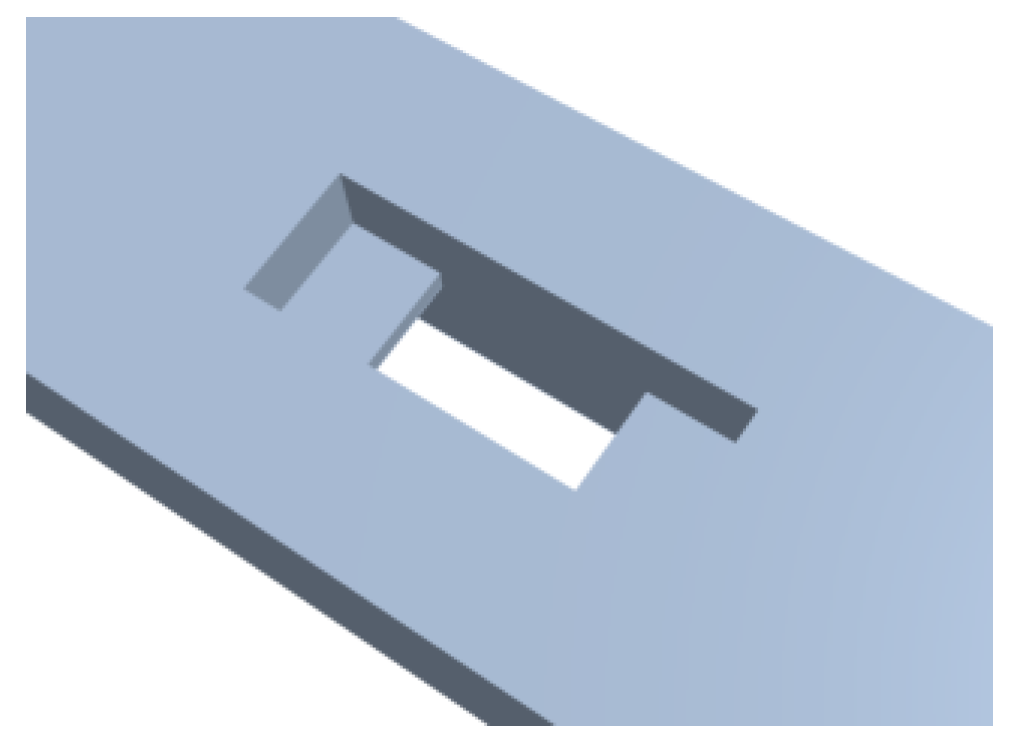
Based on the aforementioned research findings in this paper, it is discovered that whether under calm water or wave conditions, the presence of a moonpool significantly impacts hull resistance, while its effect on hull motion is relatively smaller. The internal liquid flow within the moonpool is considered the primary factor causing additional moonpool resistance. To suppress the liquid flow within the moonpool, following the principle of simplicity and efficiency, this paper takes the rectangular-moonpool drillship with superior resistance performance as an example and adds flange devices at the front and rear walls of the moonpool to reduce the internal liquid flow velocity and enhance the damping of fluid motion within the moonpool, achieving wave suppression and drag reduction effects. For the rectangular-moonpool drillship, water motion is primarily characterized by longitudinal sloshing. The presence of flange devices effectively suppresses the motion of the free surface at the front and rear ends of the moonpool, thereby optimizing the hydrodynamic characteristics of the moonpool. The flange device model is shown in Figure 20.
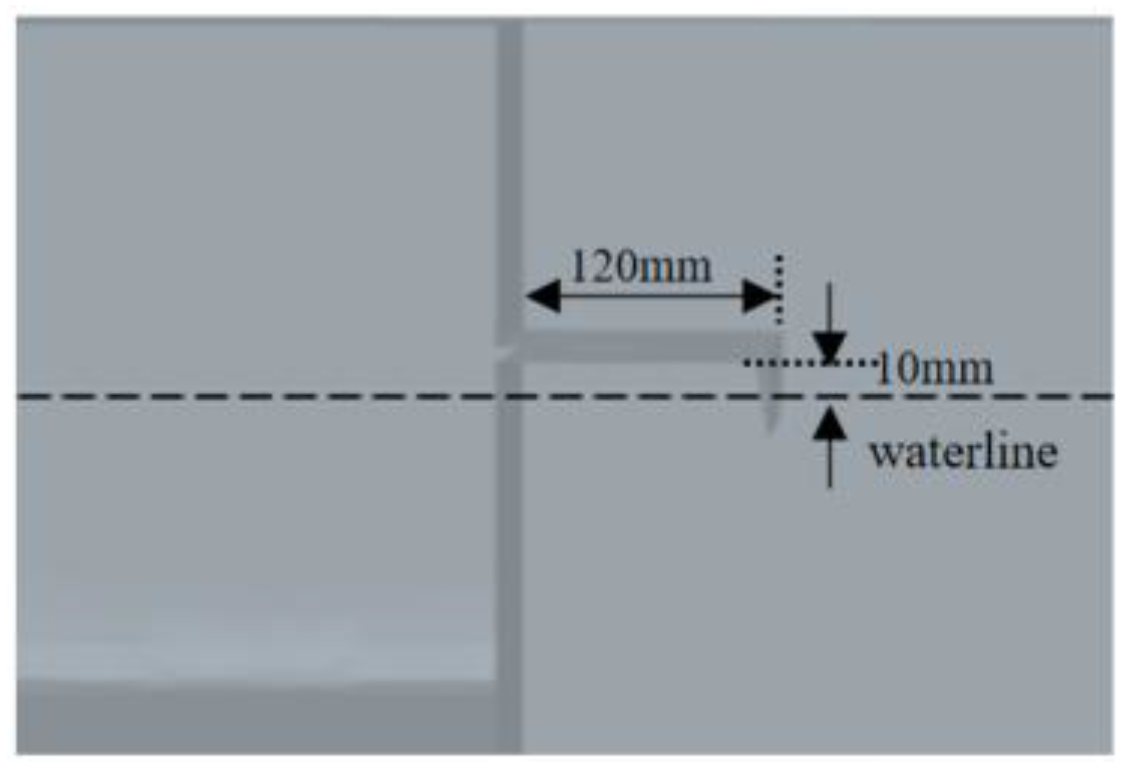
The position of the flange device relative to the free surface can be divided into three scenarios: level with the free surface, above the free surface, and below the free surface. According to Fukuda’s research [38] recommendations, when the flange device is placed close to the free surface, its working efficiency reaches optimal performance. Therefore, the installation position of the flange in this paper is based on the design waterline and extends upward and downward, successively selecting positions at the design waterline and 10 mm and 20 mm above and below the waterline. According to the literature [39], to effectively enhance damping effects, the flange device dimensions may need to be relatively large, and the flange structure installed on the front and rear walls of the moonpool should occupy no less than 33% of the moonpool opening area. Based on the structural dimensions of the rectangular-moonpool drillship, the flange device width is selected as the width of the rectangular moonpool, which is 176 mm. A thickness of 10 mm is adopted to withstand wave impact. By varying the length and position of the flange, an optimal drag reduction model is selected. Taking the flange structure with a length of 120 mm installed 10 mm above the waterline as an example, the three-dimensional model of the rectangular-moonpool drillship with flange is shown in Figure 21.

6.2. Calculation Selection for Flange Drag Reduction Optimization Model

To select an optimal flange device for drag-reduction optimization, the study focuses on two main parameters: the installation position and the length. A preliminary flange length of 120 mm is selected, and the installation positions are chosen relative to the design waterline, extending both upward and downward. Five installation points are selected for computational study: at the design waterline and at positions 10 mm and 20 mm above and below the waterline. Considering the computational condition at the full-scale design speed of 15 knots in calm water, with a Froude number Fn = 0.191, the mesh generation near the free surface, the wave-absorption zone at the aft end of the computational domain, the selection of the computational domain, the overlapping mesh around the hull, the grid refinement in the bow and stern regions, and the overall boundary condition settings are all referenced from the KCS ship calm-water validation section and maintain consistency. The mesh is also refined in the vicinity of the moonpool, maintaining the same grid size as used in the calm-water navigation analysis. Considering the significant influence of the flange device on the numerical results, the model region of the flange device undergoes additional grid refinement, with the grid size selected as 1.5‰ of the drillship’s waterline length. The total resistance calculation results for the rectangular-moonpool drillship with flange devices at different installation positions are shown in Table 10. From Table 10, it can be seen that with the addition of flanges, all schemes effectively reduce resistance. The flange device installed 10 mm above the waterline shows the most significant drag-reduction effect, with the resistance value reduced to 10.3 N. Compared to the resistance value of 12.691 N for the rectangular-moonpool drillship without flange structures at the design speed, this represents a reduction of 18.84%. From the perspective of drag-reduction effectiveness at different positions, the selection of installation position has a significant impact on the drag-reduction effect. Therefore, during the design phase, careful consideration should be given to determining reasonable appendage arrangement positions.
To further investigate the suppression effects of different-sized flange devices on internal fluid sloshing in moonpools, the study selects the installation position with superior resistance performance (10 mm above the waterline) based on the calculation results of different installation positions. The research is conducted by varying the length of the flange device. Based on the conclusions from the literature [39], to effectively enhance damping effects, it is necessary to ensure that the flange dimensions occupy more than 33% of the moonpool opening area. Therefore, this paper selects five different flange structures with lengths of 80 mm, 90 mm, 100 mm, 110 mm, and 120 mm for investigation. Considering the computational condition of a design speed of 15 knots in calm water, the total resistance calculation results for the rectangular-moonpool drillship with flange devices of different lengths are shown in Table 11. As shown in the data in Table 11, compared to the resistance value of 12.691 N for the rectangular-moonpool drillship without a flange structure at the design speed, all schemes with flanges achieve drag reduction effects. Among them, the scheme with a length of 120 mm performs optimally. The variation in flange dimensions has a significant impact on the drag reduction effect, indicating that larger flange structures possess certain advantages in drag reduction. Therefore, during flange structure design, it is necessary to determine the maximum allowable flange dimension standards to ensure the rationality and effectiveness of the design.
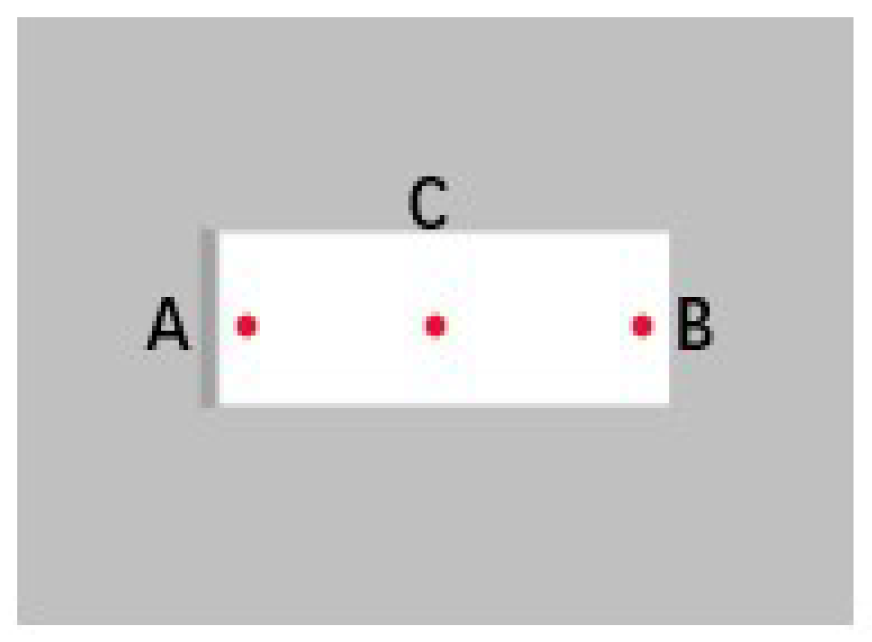
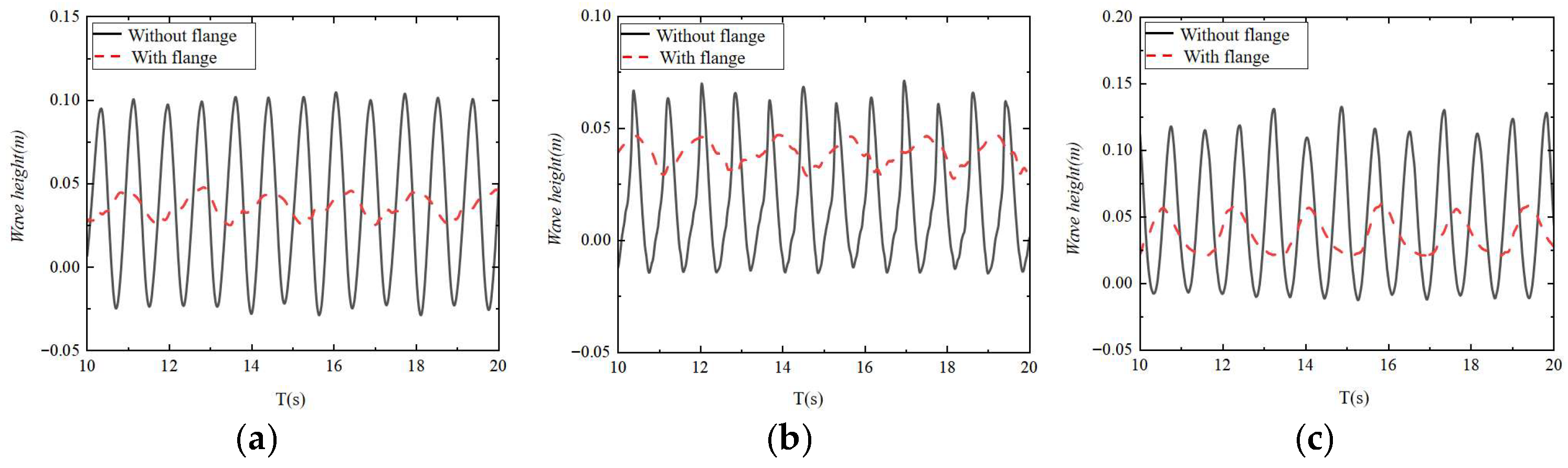
To further investigate the sloshing conditions of the internal fluid in the moonpool and reveal the mechanism of wave suppression and drag reduction by flange devices, this study takes as an example the drillship with a flange structure installed 10 mm above the waterline with a length of 120 mm, and compares it with the data results of the drillship without flange structures at Froude number Fn = 0.191. The wave height monitoring points within the moonpool of the rectangular-moonpool drillship with and without flange devices are compared. The wave height monitoring points within the moonpool are located at Point A (x = 1.14 m), monitoring point C (x = 1.375 m), and Point B (x = 1.61 m), where Point A is at the aft end of the moonpool, Point C is at the midsection of the moonpool, and Point B is at the forward end of the moonpool, as shown in Figure 22. The time-history curves of different wave height monitoring points in the internal flow field with and without flange devices are shown in Figure 23. In Figure 23, the red curve denotes the numerical results for the rectangular-moonpool drillship equipped with the flange devices (labeled “With flange”), while the black curve represents the rectangular-moonpool drillship without the flange devices (labeled “Without flange”). From Figure 23, it can be seen that after installing the flange devices within the moonpool, the average wave height at the forward monitoring point B significantly decreases from 0.1305 m to 0.0202 m, the average wave height at the midsection monitoring point C also decreases from 0.0759 m to 0.0175 m, and the average wave height at the aft monitoring point A decreases from 0.1219 m to 0.03397 m. The data indicate that the presence of the flange device can effectively reduce the average amplitude of waves within the moonpool, thereby reducing the oscillations of the internal fluid.

6.3. Comparative Analysis of Resistance Performance with and Without Flange During Calm Water Navigation

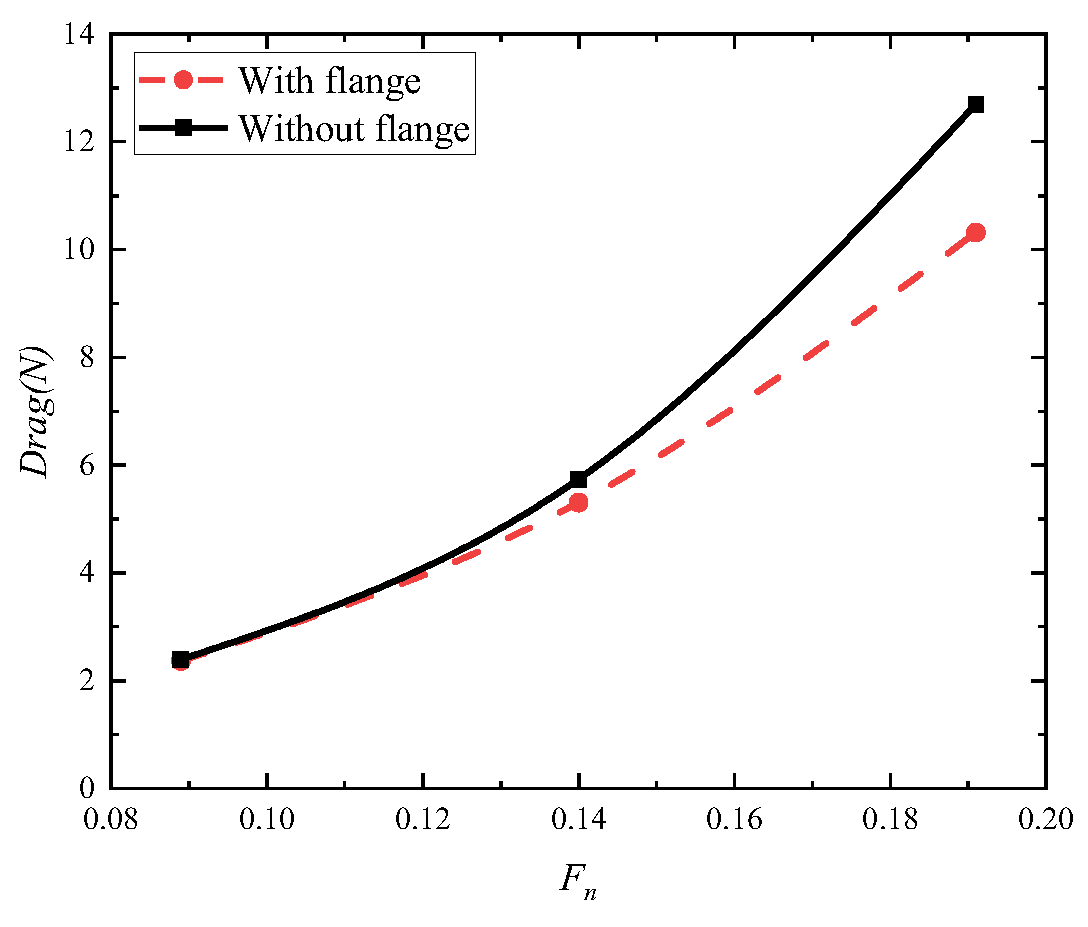
Based on the computational selection of the flange drag-reduction optimization model, it is found that the rectangular-moonpool drillship with a 120 mm flange installed 10 mm above the waterline exhibits superior resistance performance and has good suppression effects on internal fluid sloshing. To further evaluate its drag-reduction performance, computational simulations are conducted at different speeds in calm water, with simulation conditions selected for low, medium, and high-speed ranges at Froude numbers Fn of 0.089, 0.14, and 0.191, respectively, aiming to verify the feasibility and effectiveness of the designed flange device for drag reduction. The numerical results for the total resistance of the rectangular-moonpool drillship with and without flanges at different speeds are shown in Figure 24. In Figure 24, the red curve denotes the numerical results for the rectangular-moonpool drillship equipped with the flange devices (labeled “With flange”), while the black curve represents the rectangular-moonpool drillship without the flange devices (labeled “Without flange”). From Figure 24, it can be seen that at low speeds, the flange device’s effect on reducing the total resistance of the drillship is not significant, with a resistance reduction of approximately 1%. This difference is comparable to numerical errors, indicating that the drag-reduction effect of the flange is limited at this stage. The main reason is that at low speeds, vortex shedding and free-surface oscillations within the moonpool are weak, resulting in an insignificant wave suppression effect from the flange. At high speeds, the flange device exhibits significant drag-reduction performance. This performance arises because the internal fluid within the moonpool is dominated by longitudinal sloshing, enabling the flange to effectively dissipate the energy introduced by vortices rising along the moonpool’s aft wall, as well as the energy carried by the waves. Meanwhile, as speed increases, boundary-layer separation at the leading edge (toward the bow) of the moonpool intensifies vortex shedding, and the free-surface vibration response becomes significantly enhanced. The flange device achieves significant resistance reduction by suppressing vortex shedding and wave generation.

6.4. Comparative Analysis of Resistance Performance with and Without Flange in Regular Waves

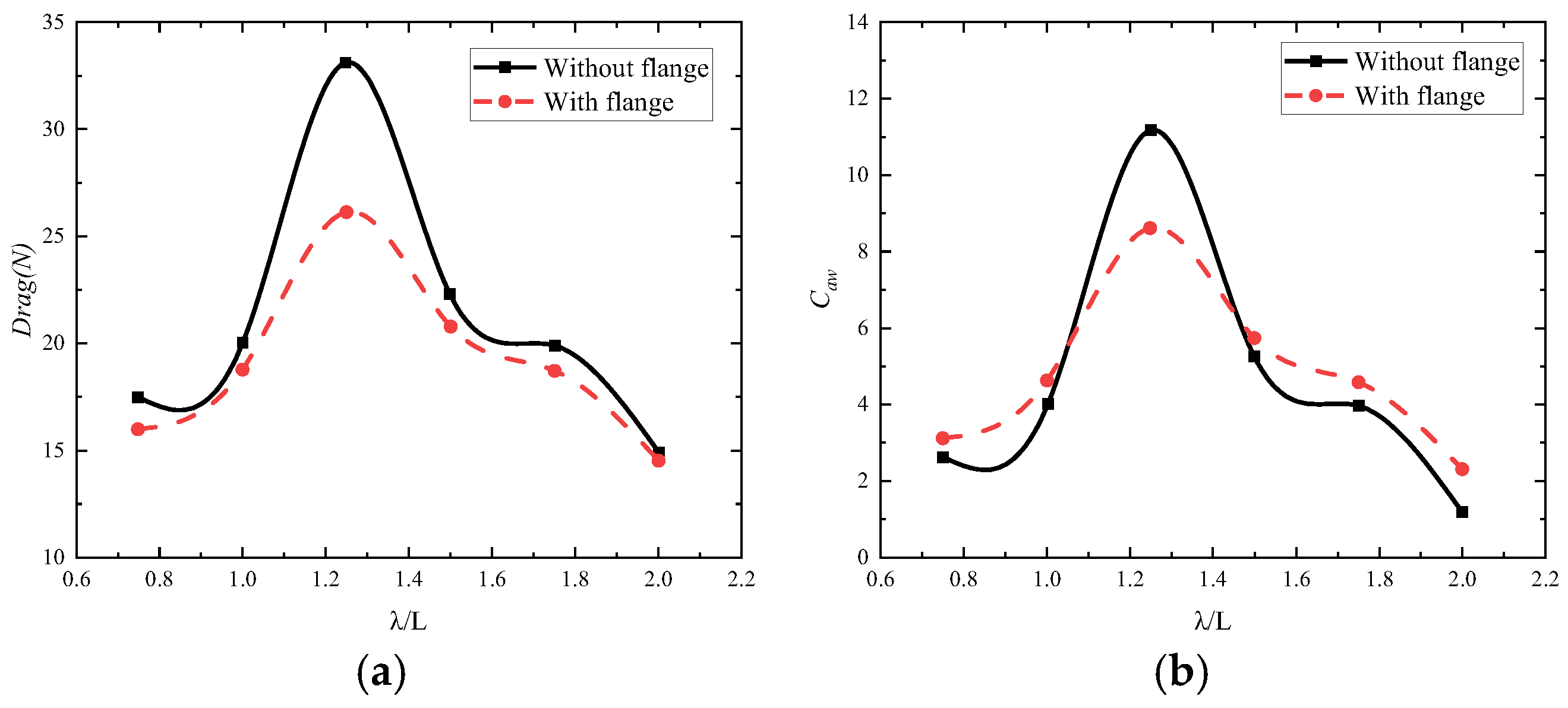
Based on the computational selection of the flange drag-reduction optimization model, a comparative analysis of the hydrodynamic performance of rectangular-moonpool drillships with and without flange devices is conducted under regular waves to further verify the drag-reduction effect after adding flange appendages. The analysis focuses on the rectangular-moonpool drillship with a 120 mm flange installed 10 mm above the waterline, compared with the rectangular-moonpool drillship without flange devices. The computational conditions are set at a Froude number Fn = 0.191, corresponding to a full-scale design speed of 15 knots, with wavelength-to-ship-length ratios ranging from 0.75 to 2.0 at intervals of 0.25, totaling six different incident wavelengths. The incident wave height is 0.08 m. The mesh generation near the free surface, the wave-absorption zone at the aft end of the computational domain, the selection of the computational domain, the overlapping mesh around the hull, and the overall boundary condition settings are all referenced from the KCS ship wave navigation validation section and maintain consistency. The resistance and wave-added resistance coefficients for the rectangular-moonpool drillships with and without flange devices at different wavelength-to-ship-length ratios are shown in Figure 25. In Figure 25, the red curve denotes the numerical results for the rectangular-moonpool drillship equipped with the flange devices (labeled “With flange”), while the black curve represents the rectangular-moonpool drillship without the flange devices (labeled “Without flange”).
From Figure 25, it can be seen that the presence of flanges produces a significant reduction in the total ship resistance, thereby effectively optimizing the added resistance coefficient. The wave-added resistance coefficients for drillships with and without flanges show roughly similar trends. As the wavelength-to-ship-length ratio increases, the values first increase and then decrease. When the wavelength-to-ship-length ratio is approximately 1.25, the wave-added resistance coefficient reaches its maximum value, which is caused by unfavorable resonance effects between the hull and waves. In the wavelength-to-ship-length ratio range of 1.0 to 1.5, the wave-added resistance coefficient of the rectangular-moonpool drillship with flanges is lower than that of the rectangular-moonpool drillship without flanges. Subsequently, as the wavelength continuously increases and approaches infinity, the wave-added resistance coefficient gradually approaches zero, meaning that the ship’s navigation state in regular waves will gradually approach that in calm water. Considering both hydrodynamic performance and structural safety, the flange structure can effectively improve the resistance characteristics of drillships in waves.

7. Conclusions

This paper constructs a three-dimensional numerical wave tank based on CFD methods and conducts validation studies on the hydrodynamic performance of fifth-order Stokes waves and the KCS ship in both calm water and head-on wave conditions. Subsequently, it investigates the selection of optimal hydrodynamic performance for drillships with different moonpool configurations during calm water navigation and performs seakeeping calculations for a rectangular-moonpool drillship under regular wave conditions. Building on this foundation and combined with the flange drag-reduction model, the study conducts drag-reduction optimization research for the rectangular-moonpool drillship, analyzing and comparing the numerical results. The following conclusions are drawn:
(1)
A three-dimensional numerical wave tank is constructed to validate the numerical wave generation and assess the hydrodynamic performance of the KCS ship in calm water and head waves. The numerical procedure, through grid convergence analysis, demonstrates that the grid generation method established in this paper for predicting the hydrodynamic performance of conventional ship types is reliable. The high agreement between the numerical results and the experimental values indicates that predicting ship hydrodynamic performance in calm water and head-on waves based on CFD methods is both feasible and accurate.
(2)
Numerical research is conducted on the hydrodynamic performance of drillships with different moonpool structural configurations during calm water navigation. The results show that moonpools have an obvious resistance-increasing effect, with different moonpool structural shapes exhibiting varying degrees of this effect. Moonpool resistance increase primarily originates from additional residual resistance. In terms of navigation attitude, the presence of a moonpool slightly increases hull sinkage but is beneficial in reducing hull pitch. Compared to other moonpool design schemes, the rectangular-moonpool drillship demonstrates superior overall performance in terms of resistance performance and navigation attitude.
(3)
Numerical analysis is conducted on the flow formation mechanisms in moonpool drillships during calm water navigation. The results show that significant energy dissipation occurs within moonpools due to waves and vortices generated by blocking effects and fluid motion, thereby producing additional resistance. The generation, development, and dissipation of vortices within moonpools continuously cycle, exhibiting periodicity and regularity. The sustained energy supply to the clockwise vortex within the moonpool is maintained by the continuous mass exchange between the water flow beneath the ship’s bottom and the water inside the moonpool.
(4)
Numerical research is conducted on the hydrodynamic performance of the rectangular-moonpool drillship under regular wave conditions. The results show that the total resistance and wave-added resistance coefficients for the drillships with and without a moonpool exhibit consistent trends. As the wavelength-to-ship-length ratio increases, their values first increase and then decrease. The presence of the moonpool leads to an increase in the total resistance of the drillship, with a relatively significant impact on hull heave motion and a smaller effect on pitch motion.
(5)
Numerical research is conducted on the mechanism of the flange drag reduction optimization model. For the rectangular-moonpool drillship with added flange devices during calm water navigation, by studying the two major parameters of flange devices (installation position and length), the results show that variations in flange installation position and length have significant impacts on drag reduction effects. The presence of flange devices effectively reduces the average amplitude of internal waves in moonpools, thereby reducing the oscillation of internal fluid in moonpools. The flange device model demonstrates favorable drag reduction performance when installed 10 mm above the waterline with a length of 120 mm. The results presented in this study are based on the model scale of the flange device, which can be converted to the full ship scale using the corresponding scale ratio. It is anticipated that significant drag reduction can also be achieved on full-scale drillships, thereby providing valuable reference for practical engineering applications.
(6)
Numerical verification is conducted on the hydrodynamic performance of the rectangular-moonpool drillship with optimal flange devices during calm water and head-on wave navigation. The results show that compared to the rectangular-moonpool drillship without flange devices, the drillship with flange devices demonstrates significant drag reduction performance during high-speed calm-water navigation. Under head-on wave conditions, the wave-added resistance coefficients for drillships with and without flange models show roughly similar trends. As the wavelength-to-ship-length ratio increases, the values first increase and then decrease. The presence of flanges has a significant reducing effect on the total ship resistance, and the flange structure effectively improves the hydrodynamic characteristics of drillships in waves.

Author Contributions

Conceptualization, J.H. and X.Z.; Methodology, J.H., C.S. and J.D.; Software, C.S. and J.D.; Validation, C.S. and J.D.; Formal analysis, C.S., J.D. and J.W.; Investigation, J.H. and C.S.; Resources, J.W., X.Z. and D.Z.; Data curation, J.D. and J.W.; Writing—original draft, J.H.; Writing—review & editing, J.W. and D.Z.; Visualization, J.W., X.Z. and D.Z.; Supervision, D.Z.; Project administration, X.Z. and D.Z.; Funding acquisition, J.H. and X.Z. All authors have read and agreed to the published version of the manuscript.

Funding

This research was funded by the National Natural Science Foundation of China (Grant Nos., 52401380 and 52301321), and the Natural Science Foundation of Jiangsu Province of China (Grant Nos., BK20220652 and BK20251030).

Data Availability Statement

Data is contained within the article.

Conflicts of Interest

The authors declare no conflicts of interest.

References

  1. Sun, J.Y.; Sun, S.L.; Sun, S.Z.; Ren, H.L. The impact of piston and sloshing motions on added resistance from moonpool configurations. Ocean Eng. 2023, 267, 113179. [Google Scholar] [CrossRef]
  2. Xu, X.; Zhang, X.; Chu, B.; Huang, H. On natural frequencies of three-dimensional moonpool of vessels in the fixed and free-floating conditions. Ocean Eng. 2020, 195, 106656. [Google Scholar] [CrossRef]
  3. Duan, F.; Ma, N.; Zhang, L.J.; Cao, K.; Zhang, Q. Study on the influence characteristics of moonpool scale effect on drillship navigation resistance. J. Ship Mech. 2020, 24, 1253–1260. [Google Scholar]
  4. Zhang, X.; Li, Z. Natural frequencies and modal shapes of three-dimensional moonpool with recess in infinite-depth and finite-depth waters. Appl. Ocean Res. 2022, 118, 102921. [Google Scholar] [CrossRef]
  5. Chu, B.; Zhang, X.; Zhang, Y. Effects of nonlinearity and viscous damping on the resonant responses in two-dimensional moonpools with a recess. Appl. Ocean Res. 2022, 127, 103295. [Google Scholar] [CrossRef]
  6. Sun, L.; Deng, X.X.; Zeng, Z.H.; Liu, C. Numerical calculation and analysis of resonance of drillship under wave action. Chin. J. Ship Res. 2020, 15, 90–105+114. [Google Scholar]
  7. Ravinthrakumar, S.; Kristiansen, T.; Molin, B.; Ommani, B. Coupled vessel and moonpool responses in regular and irregular waves. Appl. Ocean Res. 2020, 96, 102010. [Google Scholar] [CrossRef]
  8. Zhang, X.; Sun, L.; Sun, C.; Wang, C.; Chen, C. Study on the influence of the moonpool on the smooth water resistance performance of the ship. Ocean Eng. 2021, 237, 109590. [Google Scholar] [CrossRef]
  9. Liu, Z.; He, J.; Meng, Y.; Zhang, H.; Zhou, Y.; Tao, L. Numerical and experimental study on the influence of a moonpool on motion performance and stability of a drillship. Ocean Eng. 2022, 262, 112241. [Google Scholar] [CrossRef]
  10. Wei, Q.; Gu, J.Y.; Lyu, H.G.; Liu, W.-M.; Xu, X.-S. Coupling response of pitch and moonpool water motion of a drilling ship under wave-current excitation. Ocean Eng. 2024, 294, 116817. [Google Scholar] [CrossRef]
  11. Garad, S.; Kumar, S.; Bhattacharyya, A.; Datta, R. Multiple moonpools within a vessel free to heave and pitch: An experimental study. Appl. Ocean Res. 2024, 147, 103963. [Google Scholar] [CrossRef]
  12. Liu, Y.; Li, H.; Zhou, X.; Chen, J.; Wang, W.; Wang, Y.; Huang, Y. The influence of an annular moonpool on towing resistance of a separated polar ocean nuclear energy platform. Ocean Eng. 2022, 266, 112913. [Google Scholar] [CrossRef]
  13. Yao, Z.; Li, D.J.; Xu, G.; Ma, Y. Experimental study on resistance performance of drillship with open and closed moonpool. Chin. J. Ship Res. 2023, 18, 176–183. [Google Scholar]
  14. Huang, X.H.; Xiao, W.; Yao, X.L.; Gu, J.; Jiang, Z. An experimental investigation of reduction effect of damping devices in the rectangular moonpool. Ocean Eng. 2020, 196, 106767. [Google Scholar] [CrossRef]
  15. Cheng, X.; Li, G.; Skulstad, R.; Major, P.; Chen, S.; Hildre, H.P.; Zhang, H. Data-driven uncertainty and sensitivity analysis for ship motion modeling in offshore operations. Ocean Eng. 2019, 179, 261–272. [Google Scholar] [CrossRef]
  16. Chen, J.; Bian, W.; Wan, Z.; Yang, Z.; Zheng, H.; Wang, P. Identifying factors influencing total-loss marine accidents in the world: Analysis and evaluation based on ship types and sea regions. Ocean Eng. 2019, 191, 106495. [Google Scholar] [CrossRef]
  17. Cheng, X.K.; Zhou, G.P.; Zhang, Y.X.; Zhang, J. Numerical simulation study on the influence of moonpool on resistance performance of offshore ships at model scale. J. Ship Mech. 2020, 24, 589–598. [Google Scholar]
  18. Shi, C.; Lyu, H.N.; Yang, J.M. Study on nonlinear resonance characteristics of water in large-opening stepped moonpool of deep-sea drillship. J. Ship Mech. 2021, 25, 311–320. [Google Scholar]
  19. Machado, L.D.V.; Fernandes, A.C. Moonpool dimensions and position optimization with Genetic Algorithm of a drillship in random seas. Ocean Eng. 2022, 247, 110561. [Google Scholar] [CrossRef]
  20. Mavrakos, A.S.; Konispoliatis, D.N.; Ntouras, D.G.; Papadakis, G.; Mavrakos, S. Hydrodynamic coefficients in heave of a moonpool-type floater using theoretical, numerical and CFD methodologies. Ocean Eng. 2023, 279, 114519. [Google Scholar] [CrossRef]
  21. Han, J.; Zhang, X.; Chen, J.; Li, Z. On coupled hydrodynamic responses of three-dimensional cylindrical moonpools. Ocean Eng. 2024, 294, 116769. [Google Scholar] [CrossRef]
  22. Li, Y.; Shi, Z.; Yang, H.; Xie, D.; Chen, Y. Motion responses optimal design of semi-submersible platform equipped with a hollow moonpool based on CFD. Ocean Eng. 2024, 311, 119010. [Google Scholar] [CrossRef]
  23. Zhang, X.; Zhang, X.; Chen, C.; Chang, X.; Zhang, Y. Numerical simulation of effective wake field and propulsion performance in a ship with moonpool. Ocean Eng. 2025, 323, 120589. [Google Scholar] [CrossRef]
  24. Liu, H.; Jiang, S.C.; Ran, Y.Q.; Wang, Z.-H.; Song, Z.-W. Experimental and numerical investigations on fluid resonance in moonpool affected by the side wall reflection. Ocean Eng. 2025, 317, 119750. [Google Scholar] [CrossRef]
  25. Chorin, A.J. A numerical method for solving incompressible viscous flow problems. J. Comput. Phys. 1967, 2, 12–26. [Google Scholar] [CrossRef]
  26. Versteeg, H.K.; Malalasekera, W. An Introduction to Computation Fluid Dynamics: The Finite Volume Method; Wigley: New York, NY, USA, 1995. [Google Scholar]
  27. Menrer, F.R.; Kuntz, M.; Langtry, R. Ten years of industrial experience with the SST turbulence model. Turbul. Heat Mass Transf. 1967, 4, 35–42. [Google Scholar]
  28. Wilcos, D.C. Multi Scale Model for Turbulence Flows//24th Aerospace Sciences Meeting of AIAA; American Institute of Aeronautics and Astronautics: Reston, VA, USA, 1986. [Google Scholar]
  29. Hu, J.M.; Li, T.L.; Lin, Y.; Guan, G.; Zheng, Z.B. Prediction of ship power and speed performance based on RANS method. Int. Shipbuild. Prog. 2017, 64, 51–78. [Google Scholar] [CrossRef]
  30. Liu, Y. Hydroelastic Response of Large Floating Structure in Nonlinear Waves; Jiangsu University of Science and Technology: Zhenjiang, China, 2020. [Google Scholar]
  31. Stern, F.; Wilson, R.; Shao, J. Quantitative V&V of CFD simulations and certification of CFD codes. Int. J. Numer. Methods Fluids 2006, 50, 1335–1355. [Google Scholar]
  32. Longo, J.; Stern, F. Uncertainty Assessment for towing tank tests with example for surface combatant DTMB model 5415. J. Ship Res. 2005, 49, 55–68. [Google Scholar] [CrossRef]
  33. Wilson, R.; Stern, F. Verification and validation for RANS simulation of a naval surface combatant. AIAA Aerosp. Sci. Meet. Exhib. 2013, 53, 341–345. [Google Scholar]
  34. Zou, L.; Larsson, L. A Verification and Validation Study Based on Resistance Submissions. In Numerical Ship Hydrodynamics; Springer: Dordrecht, The Netherlands, 2014; pp. 203–254. [Google Scholar]
  35. Chen, K. Numerical Simulation Strategy and Uncertainty Analysis of Flow Field Around KCS Benchmark Ship Model; Jiangsu University of Science and Technology: Zhenjiang, China, 2022. [Google Scholar]
  36. Yin, H. Study on Ship Wave-Added Resistance Based on Potential Flow and Viscous Flow CFD; Dalian Maritime University: Dalian, China, 2021. [Google Scholar]
  37. Li, L.Y.; Wu, J.W.; Wan, D.C. CFD-based optimization of resistance and pitch of KCS ship with appendages in waves. Chin. J. Ship Res. 2022, 17, 63–72. [Google Scholar]
  38. Fukuda, K. Behavior of water in vertical well with bottom Opening of Ship, and its effects on Ship-Motion. J. Soc. Nav. Archit. Jpn. 1977, 141, 107–123. [Google Scholar] [CrossRef]
  39. Feng, Y.; Yu, J.X.; Wang, W.T.; Wang, H.K.; Xu, L.X.; Xu, W.P. Drag reduction optimization design of moonpool structure for pipe-laying vessels. Ship Eng. 2021, 43, 24–31, 138. [Google Scholar]
Figure 1. Computational domain grid division.
Jmse 14 00215 g001
Figure 2. Time history variation curves of wave height monitoring points at different positions: (a) G1 = 2 m; (b) G2 = 7 m.
Jmse 14 00215 g002
Figure 3. Three-dimensional geometric model of the KCS ship.
Jmse 14 00215 g003
Figure 4. Surface mesh of the KCS hull.
Jmse 14 00215 g004
Figure 5. Overset mesh around the KCS hull and local mesh refinement near the free surface.
Jmse 14 00215 g005
Figure 6. Time history curves of heave and pitch for working condition 3: (a) Time history of heave motion; (b) Time history of pitch motion.
Jmse 14 00215 g006
Figure 7. Transfer function curves of heave and pitch motion: (a) transfer function of heave motion; (b) transfer function of pitch motion.
Jmse 14 00215 g007
Figure 8. Curve of wave-added resistance coefficient.
Jmse 14 00215 g008
Figure 9. Drillship models with different moonpool schemes: (a) rectangular moonpool; (b) square moonpool; (c) circular moonpool; (d) I-shaped moonpool.
Jmse 14 00215 g009
Figure 10. Surface mesh generation for the hull of the rectangular-moonpool drillship.
Jmse 14 00215 g010
Figure 11. Total resistance curves of drillships without moonpools and with different moonpool structural configurations.
Jmse 14 00215 g011
Figure 12. Added resistance curves for different moonpool design configurations: (a) curve of added total resistance; (b) curve of added residual resistance; (c) curve of added friction resistance.
Jmse 14 00215 g012
Figure 13. Calculated navigation attitude curves for drillships without a moonpool and with different moonpool structural configurations: (a) heave calculation results; (b) pitch calculation results.
Jmse 14 00215 g013
Figure 14. Evolution of velocity vector distribution in longitudinal section of moonpool internal flow field: (a) t = 20 s; (b) t = 20.1 s; (c) t = 20.3 s; (d) t = 20.8 s.
Jmse 14 00215 g014
Figure 15. Partial view of the local grid on the longitudinal section of the computational domain for the rectangular-moonpool drillship.
Jmse 14 00215 g015
Figure 16. Curves of total resistance and the wave-added resistance coefficient: (a) total resistance calculation results; (b) wave-added resistance coefficient calculation results.
Jmse 14 00215 g016
Figure 17. Time history curves of heave and pitch for the drillships with and without a rectangular moonpool: (a) Heave time history curve; (b) Pitch time history curve.
Jmse 14 00215 g017
Figure 18. Transfer functions for heave and pitch of the drillships with and without a rectangular moonpool: (a) heave motion transfer function; (b) pitch motion transfer function.
Jmse 14 00215 g018
Figure 19. Free Surface wave patterns of the moonpool-free and rectangular-moonpool drillships at different wavelength-to-ship length ratios: (a) Free-surface wave pattern of the moonpool-free drillship at λ/L = 0.75; (b) Free-surface wave pattern of the moonpool-free drillship at λ/L = 1.5; (c) Free-surface wave pattern of the rectangular-moonpool drillship at λ/L = 0.75; (d) Free-surface wave pattern of the rectangular-moonpool drillship at λ/L = 1.5.
Jmse 14 00215 g019
Figure 20. Flange device model.
Jmse 14 00215 g020
Figure 21. Three-dimensional model of rectangular-moonpool drillship with flange.
Jmse 14 00215 g021
Figure 22. Wave height monitoring points in the moonpool interior.
Jmse 14 00215 g022
Figure 23. Time history curves of different wave height monitoring points in the moonpool internal flow field with and without flange devices: (a) Wave height monitoring point B; (b) wave height monitoring point C; (c) wave height monitoring point A.
Jmse 14 00215 g023
Figure 24. Numerical results for total resistance of the rectangular-moonpool drillship with and without flanges at different speeds.
Jmse 14 00215 g024
Figure 25. Total resistance and wave-added resistance coefficient curves: (a) total resistance calculation results; (b) wave-added resistance coefficient calculation results.
Jmse 14 00215 g025
Table 1. The wave parameters.
λ /(m)A/(m)T/(s)
3.34 m0.04 m1.458 s
Table 2. Main dimensions and parameters of the KCS ship.
Parameter NameSymbolFull-Scale Ship
Dimensions
Model-Scale
Dimensions
Scale Ratio λ 137.9
Length Between
Perpendiculars/m
LPP2306.0702
Molded Breadth/mB32.20.8498
Draft/mT10.80.2850
Displacement
Volume
52,0300.9571
Wetted Surface AreaS95396.6978
Block CoefficientCB0.65050.6505
Table 3. Numerical simulation working conditions.
Working Conditions012345
Froude number0.261
Speed2.017 m/s
Wavelength03.949 m5.164 m6.979 m8.321 m11.840 m
Wave height00.062 m0.078 m0.123 m0.149 m0.196 m
Wavelength-to-ship length ratio00.650.851.151.371.95
Table 4. Numerical results and error values for three sets of different grid models.
Grid SchemeGrid NumberCTError of
CT/%
Heave/mError of Heave/%Pitch/degError of Pitch/%
Grid-346 × 1043.7711.67−0.01204.680.16651.15
Grid-2107 × 1043.7881.23−0.01223.090.16400.36
Grid-1275 × 1043.8010.88−0.01232.300.16370.55
Table 5. Numerical results of the grid convergence analysis.
ParametersRGPGCG δ G × 10 2 U G × 10 2
Resistance coefficient0.7640.7740.3071.310.075
Heave0.5210.010.011
Pitch0.126.1177.3330.030.056
Table 6. Main dimensions of drillship.
Parameter NameSymbolFull-Scale Ship
Dimensions
Model-Scale
Dimensions
Length overall/mLoa174.83.237
Length between
perpendiculars/m
Lpp1643.037
Molded breadth/mB32.20.596
Draft/mT100.185
Table 7. Relevant parameters of different moonpool structures.
Serial NumberMoonpool ShapeFull-Scale ShipShip Model
1Rectangle: Length × Width (a × b)28.5 × 9.50.528 × 0.176
2Square: Side length (a)16.4540.305
3Circle: Radius (r)9.2830.172
4I-shape: Inner side (a),
Corner side (b)
16/1.920.296/0.0356
Table 8. Calculation conditions.
Operating Conditions12345
Froude number (Fn)0.0890.1140.1400.1650.191
Full-scale ship speed (kn)79111315
Ship model speed (m/s)0.490.630.770.911.05
Table 9. Calculation conditions.
Operating ConditionsValues
Speed15 kn
Wave height0.08 m
Wavelength-to-ship length ratio (λ/L)0.75, 1, 1.25, 1.5, 1.75, 2
Table 10. Total resistance calculation results for rectangular-moonpool drillship with flange devices at different installation positions.
Installation Position20 mm Above the Waterline10 mm Above the WaterlineAt the
Waterline
10 mm Below the Waterline20 mm Below the Waterline
Total resistance (N)10.8310.310.5110.7710.87
Table 11. Total resistance calculation results for rectangular-moonpool drillship with flange devices of different lengths.
Length Dimension80 mm90 mm100 mm110 mm120 mm
Total resistance (N)10.8410.6310.4510.3410.3
Disclaimer/Publisher’s Note: The statements, opinions and data contained in all publications are solely those of the individual author(s) and contributor(s) and not of MDPI and/or the editor(s). MDPI and/or the editor(s) disclaim responsibility for any injury to people or property resulting from any ideas, methods, instructions or products referred to in the content.