Article

Experimental Determination of Forces and Hydrodynamic Coefficients on Vertical Cylinders Under Wave and Current Conditions

by
Oier Peña Vega
*,
Urko Izquierdo
,
Iñigo Albaina
,
Gustavo A. Esteban
,
Iñigo Bidaguren
and
Jesús María Blanco
Energy Engineering Department, Bilbao School of Engineering, University of the Basque Country (UPV/EHU), Plaza Ingeniero Torres Quevedo, 1, 48013 Bilbao, Spain
*
Author to whom correspondence should be addressed.
J. Mar. Sci. Eng. 2026, 14(2), 129; https://doi.org/10.3390/jmse14020129
Submission received: 27 November 2025 / Revised: 31 December 2025 / Accepted: 31 December 2025 / Published: 8 January 2026
(This article belongs to the Special Issue Advancements in Marine Hydrodynamics and Structural Optimization)

Abstract

This paper presents an extensive experimental study on the hydrodynamic behavior of vertical cylinders representative of the structural elements of offshore floating photovoltaic (OFPV) platforms under both wave and steady-current conditions. The objectives are to determine reliable hydrodynamic coefficients for Morison-type formulations and to analyze the wake effects between cylinders for modular floating configurations. Tests under regular waves are conducted in a 25 m long wave flume at the Energy Engineering Department of the Bilbao School of Engineering. The obtained inertia and drag coefficients follow the expected trends for a wide range of Keulegan–Carpenter (KC) numbers, aligning well with classical experimental studies. Steady-current experiments are conducted in the same flume using a towing tank method. Again, the obtained drag coefficients align well with previous studies. As for the wake provoked by the first cylinder on the second cylinder located downstream at one of four different distances, in the wave cases, the wake attenuation is minimal and rapid recovery of the flow is observed for a wide range of KC values, while in the steady-current cases, the wake is stronger and affects the forces acting on the second cylinder.

1. Introduction

The global drive toward decarbonization and the increasing penetration of renewable sources have intensified the exploration of offshore environments as potential sites for sustainable energy generation. Among offshore renewables, offshore wind energy is the only technology that has reached full commercial maturity, particularly in fixed-bottom configurations. In contrast, floating wind and wave energy technologies remain at pre-commercial or demonstration stages, with ongoing efforts aimed at improving their technical reliability and reducing costs [1,2].
In recent years, the rapid reduction in photovoltaic (PV) costs and the growing scarcity of available land have prompted the development of floating photovoltaic (FPV) systems [3]. Initially conceived for inland reservoirs or sheltered coastal areas, FPV installations are now progressing toward more energetic environments, leading to the emergence of offshore floating photovoltaic (OFPV) systems [4], since the oceans receive nearly 70% of the world’s primary energy source: solar radiation [5].
Floating photovoltaic technologies present several advantages over land-based installations. Reported efficiency improvements of up to 13% have been attributed to natural water cooling and reduced dust accumulation [3,6]. Moreover, the continuing decrease in the levelized cost of electricity (LCOE) for FPV systems indicates strong economic potential, with projected values of 0.05 USD/kWh by 2030 and 0.04 USD/kWh by 2050—comparable to conventional ground-mounted PV systems [7,8].
Nevertheless, expanding FPV systems to the open sea introduces new technical and economic challenges. The combined effects of higher wave and current loads, stronger winds, and salt-water corrosion significantly increase structural and mooring demands, resulting in higher capital (CAPEX) and operational (OPEX) expenditures [8,9]. These aspects, together with the limited operational experience of FPV technology under offshore conditions, have so far confined most prototypes to semi-sheltered environments, highlighting the low technology readiness level (TRL) of OFPV systems [10].
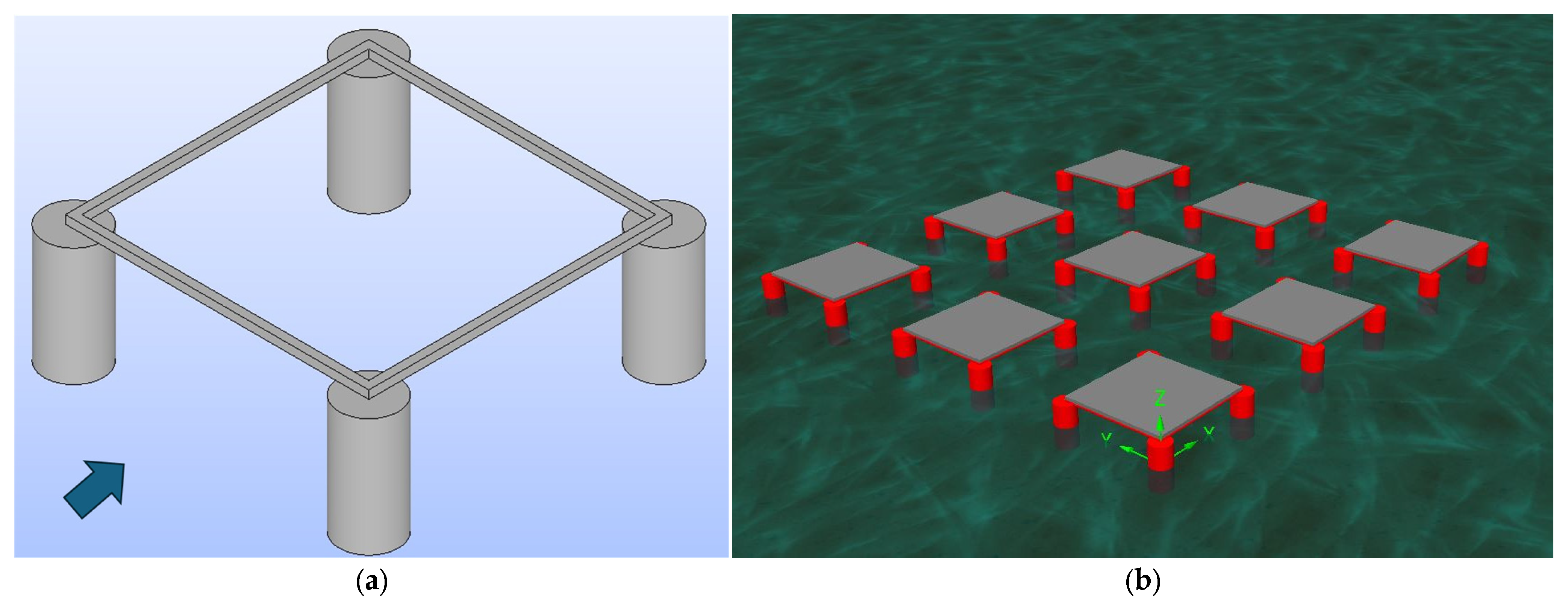
Despite these challenges, OFPV platforms represent a promising opportunity to support global decarbonization objectives by complementing offshore wind and other marine renewables, and by enabling hybrid offshore energy farms [10,11]. The concept explored in this study is based on a modular OFPV platform composed of independent floating cells, each formed by four vertical cylindrical columns that provide buoyancy and structural stiffness (Figure 1). The connection of these modular units enables the creation of large-scale OFPV farms adaptable to different environmental conditions [11].
The main objectives of this work are twofold.
The first objective is to experimentally determine the hydrodynamic coefficients—inertia and drag—of vertical cylinders representative of the structural columns of an OFPV platform under both wave and steady-current conditions, aiming to obtain reliable inputs for hydrodynamic simulations.
The second objective is to analyze the wake between consecutive cylinders to find the optimal configuration of the unit-cell structure. This work aims to analyze how geometric parameters such as spacing, diameter, and draught influence hydrodynamic loading in the region of disturbed flow generated downstream of the upstream cylinder. When a second cylinder is placed within this wake region, its hydrodynamic response can differ significantly from that of an isolated cylinder.
The state of the art demonstrates that Morison’s equation remains a robust and widely validated formulation for estimating hydrodynamic loads on slender bodies in oscillatory and steady flows. Numerous experimental studies have confirmed its applicability under regular and irregular wave conditions, producing consistent drag and inertia coefficients in agreement with classical works such as those by Sarpkaya [12] and Da Yuan and Huang [13]. The drag coefficients of circular cylinders have been extensively characterized under steady flows, with values typically ranging from 0.6 to 1.2 depending on the Reynolds number, surface roughness, and aspect ratio [14,15].
By contrast, wake interactions between cylinders under wave conditions have received less attention, and this aspect is one of the most significant contributions of the present study. Although interference effects in steady-currents have been thoroughly studied for tandem or side-by-side configurations [16], experimental data in oscillatory flow remain limited. Recent investigations [17,18,19] have shown that inter-cylinder spacing and flow regime strongly affect wake recovery, vortex shedding, and the resulting hydrodynamic load—factors that are crucial for the design of modular offshore platforms.
In addition, recent offshore studies have demonstrated that wake interactions between structural elements can significantly influence hydrodynamic loads and flow fields in multi-body configurations. Investigations of offshore platform designs highlight how structural layout governs wake development and load distribution under combined wave and current forcing, across a wide range of applications including offshore wind structures [20,21,22], floating photovoltaic systems [23,24], and wave energy converter arrays [25]. These works further motivate the need for comprehensive experimental data on wake interactions in wave and current environments.
Most existing works focus on highly specific configurations or on numerical validation through computational fluid dynamics (CFD) [18,26]. In contrast, the present research aims to extend the experimental database with a broader range of wave and current conditions, cylinder diameters, and draughts, thereby covering a wider spectrum of Keulegan–Carpenter (KC) and Reynolds (Re) numbers. The results provide refined hydrodynamic coefficients for use in simulation tools and improve understanding of wake-interaction phenomena. These findings contribute not only to the hydrodynamic design of offshore floating photovoltaic systems but also to the broader category of offshore floating and fixed structures where multiple slender elements are exposed to wave and current loading.
This paper presents the experimental methodology adopted to perform wave and steady-flow tests on vertical cylinders. The structure of the paper is as follows: Section 2 (Material and Methods) the experimental setup and test conditions are first described, followed by the procedures and governing equations used to determine the hydrodynamic forces, calculate the corresponding coefficients, and analyze wake effects. Section 3 presents and discusses the experimental results, and Section 4 summarizes the main conclusions.

2. Materials and Methods

2.1. Experimental Setup

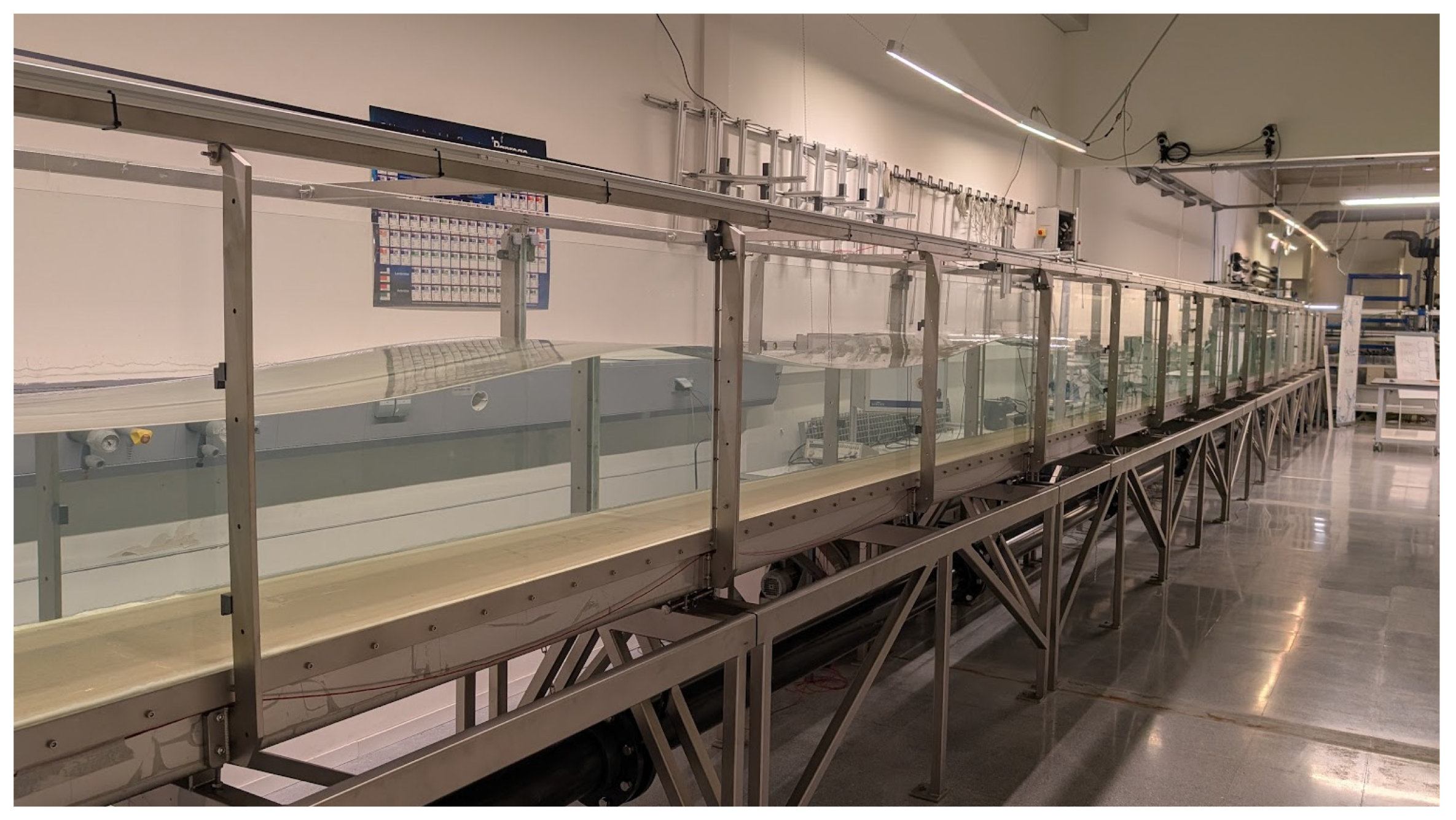
The experiments were carried out in the wave flume of the Energy Engineering Department of the Bilbao School of Engineering at the University of the Basque Country (UPV/EHU). This wave flume is 25 m long, 0.6 m wide, and 0.7 m high (Figure 2). Waves are created with a piston-type wave generation system, which is powered with the software Awasys 7 (Aalborg University, Department of Civil Engineering, Aalborg, Denmark) [27]. This generation system includes an active wave absorption system that calculates the incident waves that need to be generated considering the effect of the reflected waves. In addition, to minimize reflected waves, the wave flume has a beach passive absorption system [28]. The wave generator can reproduce regular, irregular, and solitary waves, allowing experimentation with several wave spectra. However, only regular waves were generated for the experiments presented in this paper.
In addition to the wave generator, there is a towing tank trolley installed on the flume. This carriage is used to reproduce steady flows that simulate sea currents. It is operated by two rack and pinion motors that control the speed of the movement based on the tooth pitch. The trolley can be moved in both directions, reaching a constant velocity of up to 0.7 m/s, with a minimum velocity of 0.05 m/s.
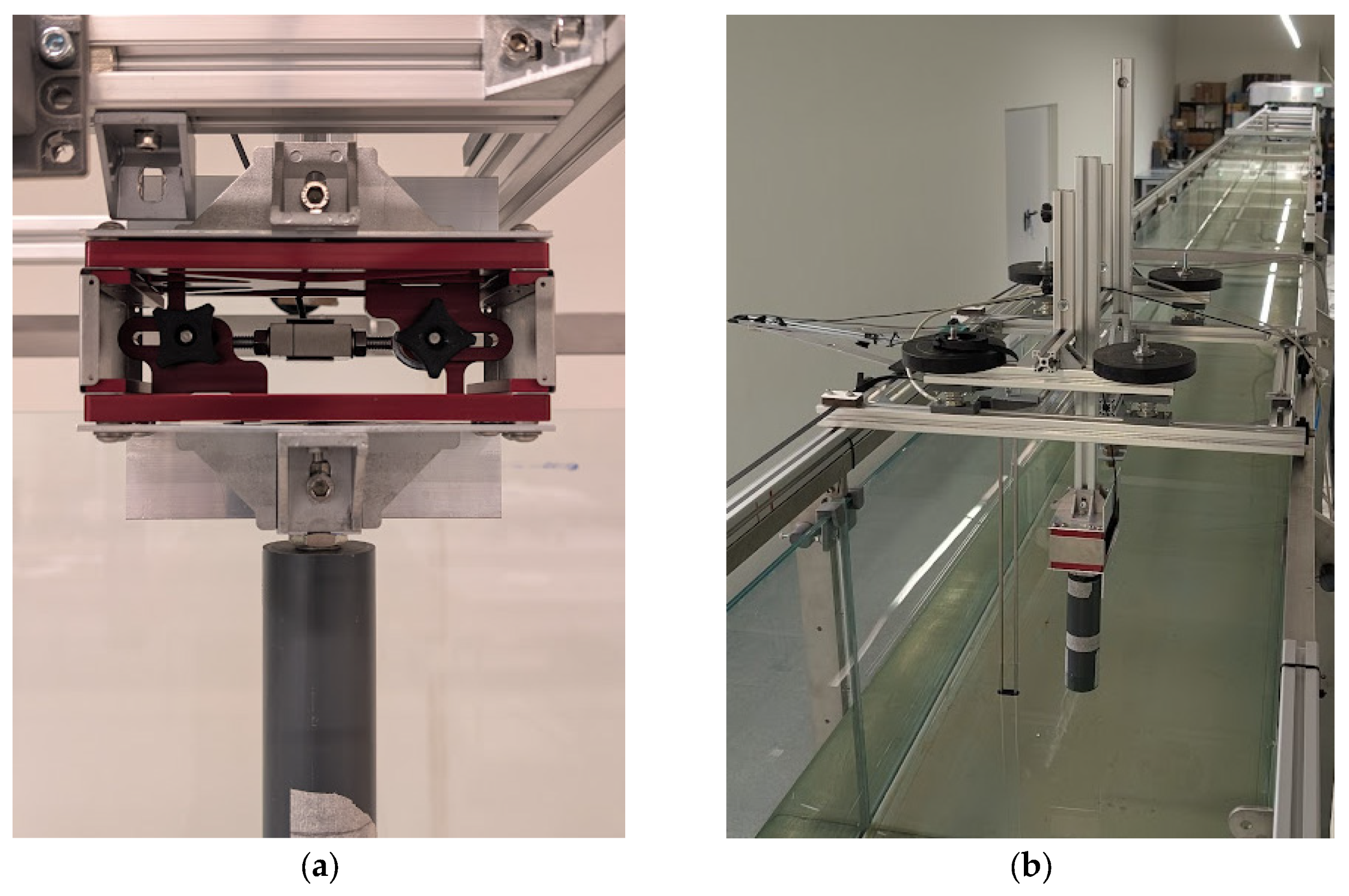
The wave heights and horizontal forces on the cylinder were measured. For the wave height measurements, a resistive-type wave gauge was used. For the force measurements, an ATO-LCS-DYLY-106 (Automation Technologies Online, Inc., Shanghai, China) load cell [29] integrated into a KineOptics WTB 3.0 (KineOptics, Sequim, WA, USA) wind-tunnel balance system [30] was employed (Figure 3). Although originally designed for aerodynamic applications, this system offers high-accuracy single-axis force measurements and has proven to be fully suitable for water-flume experiments. The KineOptics setup directly provides the horizontal force acting on the cylinder, significantly simplifying the data-processing workflow.
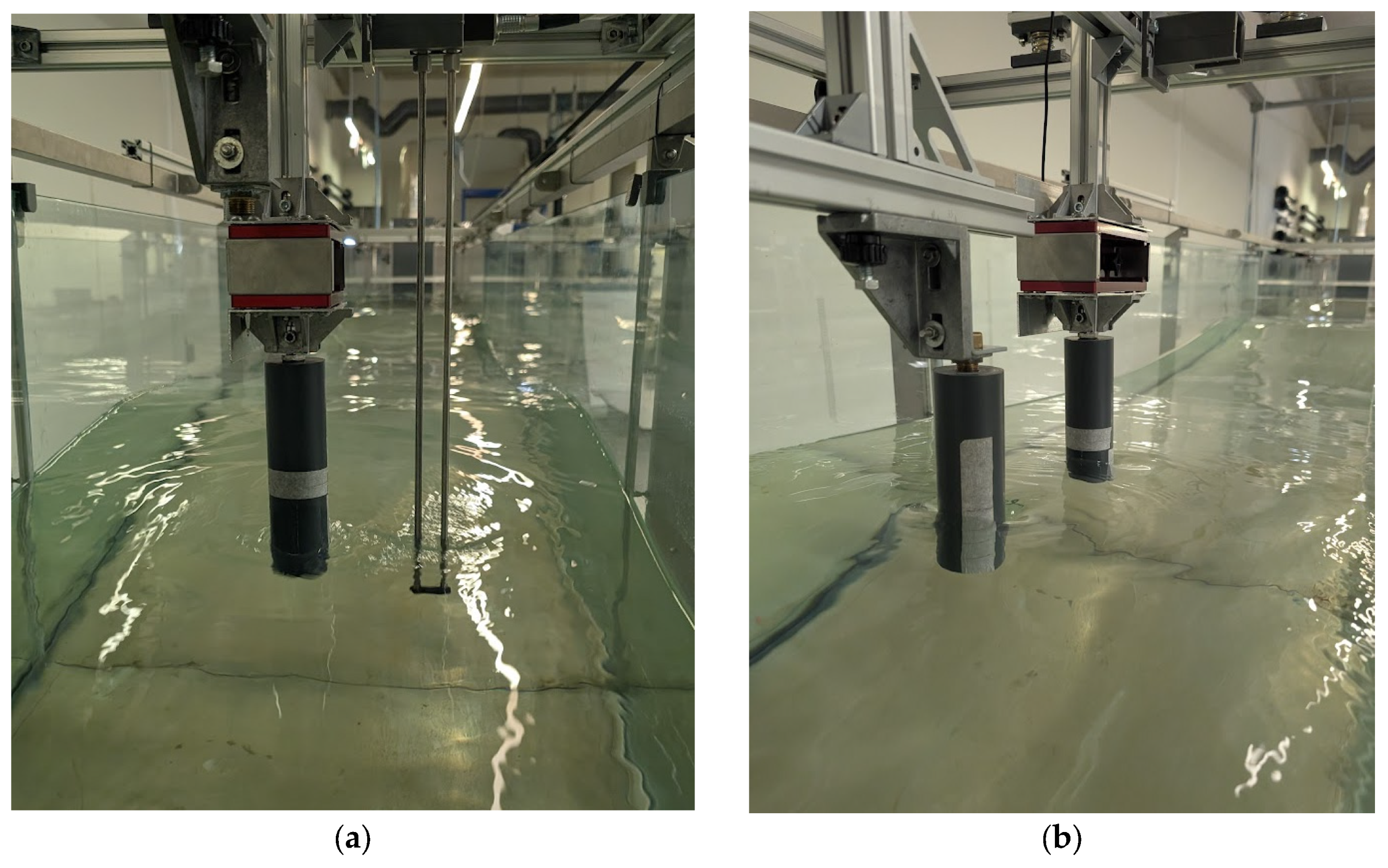
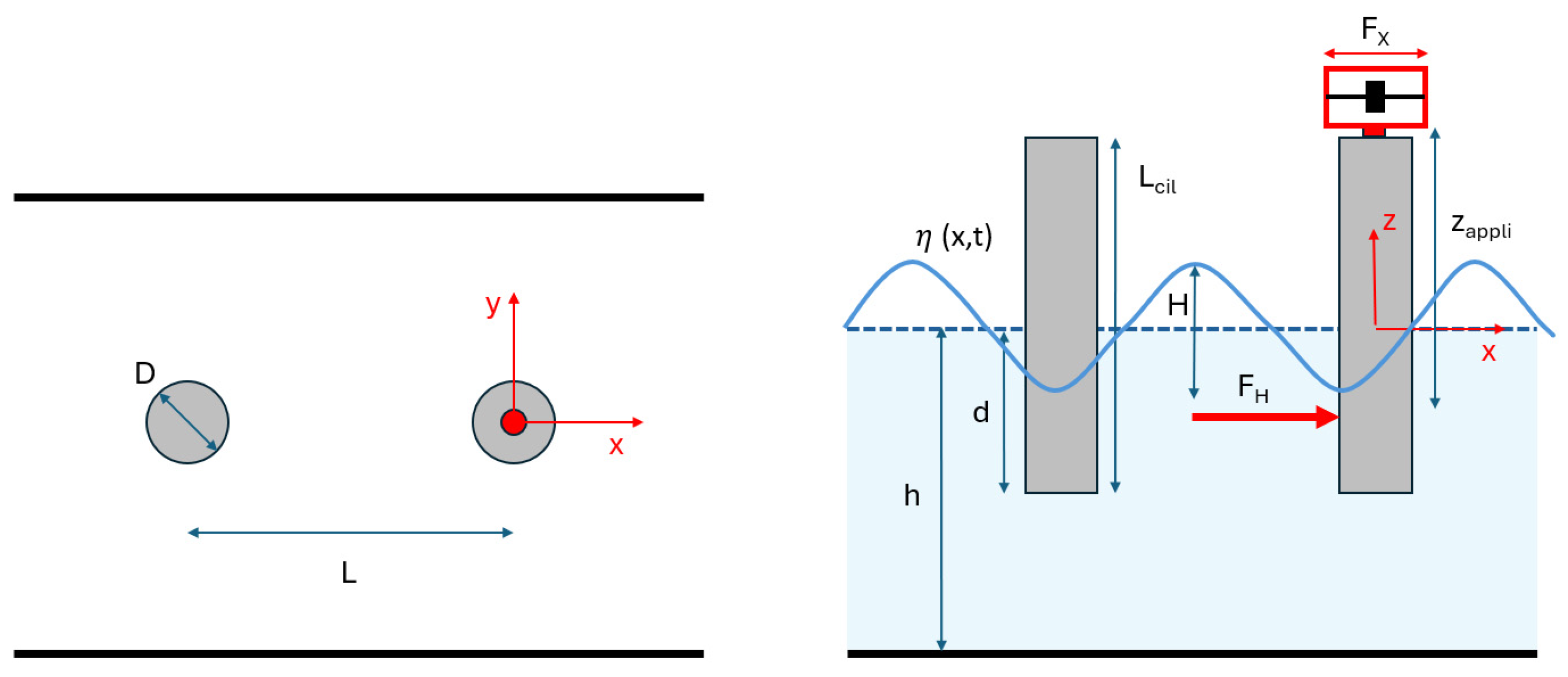
The experimental set up was assembled on a bridge above the flume, which is also located on the trolley for the towing tank experiments. On this bridge, the cylinder and the force sensor were put together. The resistive-type wave gauge was also placed on this bridge, as shown in Figure 4a, next to the cylinder in order to measure the precise location of the experimental waves in the flume. The data obtained were later used to characterize the experimental waves based on Stokes third-order wave theory [31]. The frequency of data acquisition for both the wave gauge and the KineOptics system with the ATO-LCS-DYLY-106 load cell was 750 Hz. With this setup, two kinds of experiments were carried out: waves and steady currents. In each experiment, forces were first measured on a single cylinder in order to determine the hydrodynamic coefficients for different configurations of cylinder diameter (D), cylinder draught (d), and wave or current conditions. After that, a second cylinder was placed at various distances (L) from the first one in order to determine the wake effect or wave attenuation that the first cylinder induced upon the second one. The setup of both experiments is presented in Figure 4, and Figure 5 provides a schematic representation of the experiments and parameters.
The relevant geometric and configuration parameters that were varied throughout the experiments are described below. The parameter ranges were selected to evaluate different potential layouts for the unit-cell design of the FPV structure. Four cylinder diameters were examined: 20 mm, 30 mm, 40 mm, and 50 mm. For each diameter, multiple draughts were considered, with values scaled relative to the cylinder size and spanning from 0.5 D to 4 D . The specific draughts tested for each diameter are summarized in Table 1.
Another aspect to consider is the blockage effect in wave experiments and the side-wall effect in steady-flow experiments. The potential influence of blockage due to the finite flume width was assessed considering the ratio between cylinder diameter and flume width (w), which ranged from D / w 0.033 to 0.083 (1:30 to 1:12) in this study. Blockage effects become significant only when the confinement substantially alters the wake development and accelerates the flow around the cylinder, typically at higher blockage ratios than those considered in this work [32]. According to Anagnostopoulos and Minear [33], blockage effects are almost negligible for blockage ratios lower than 0.2 when KC < 6. In the present study, the maximum blockage ratio is 0.083, well below this threshold. Although a wider range of KC numbers was investigated, the increase in flow acceleration due to blockage at higher KC is expected to remain small for the blockage levels considered. Moreover, the largest blockage ratio was found to occur for the cylinder with a 50 mm diameter, which belongs to low KC cases, while cases with higher KC ratios occur with cylinders of 20 mm and 30 mm in diameter, where the blockage ratio is smaller.
As for the side-wall effects, the minimum lateral clearance required to avoid wall interference should exceed approximately 0.36   L [34], where L is the characteristic longitudinal length scale of the wake interaction. In the present experiments, L corresponds to the maximum distance between two cylinders, which is equal to 0.5 m, yielding a minimum required clearance of approximately 0.18 m. Since the flume width is 0.6 m, the available lateral clearance is more than three times this threshold. Under these conditions, and for current velocities up to 0.5 m/s, the cylinder wakes remain well separated from the side-wall boundary layers, and no significant wall-induced acceleration or wake distortion is expected.
The influence of cylinder spacing was also investigated by positioning a second cylinder at different center-to-center distances, again normalized by the diameter. Four spacing values were used in all cases: 2.5 D , 5 D , 7.5 D , and 10 D . This parameter set enables a systematic assessment of wake development and its impact on the hydrodynamic forces experienced by the downstream cylinder.

2.2. Wave Experiments

In the experiments, the same wave parameters were repeated for all cases. These wave parameters are shown in Table 2, with periods ranging from 0.6 s to 1.4 s and wave heights from 2.5 cm to 15 cm. In all cases, the water depth (h) was 0.5 m, which is the maximum recommended for the wave generator in this wave flume. The intention was to recreate conditions as close as possible to deep water conditions in order to resemble a realistic OFPV deployment (assuming h/λ > 1/3 deep water conditions, where λ is the wavelength [35]). However, this could not be ensured for the longest waves because of the limitations of the flume and the wave generator. Nevertheless, since there is no scale or real case location determined yet, it does not restrict the validity of the results obtained, and the intermediate water approach was used later in both Stokes third-order wave theory and Morison’s equation.
Several practical constraints reduced the total number of experiments performed. First, based on the sensitivity of the force sensors (accuracy ±   0.003   N ), a minimum measurable force amplitude of 0.05 N was defined. Theoretical wave- and current-induced forces were estimated using an inertia coefficient of 2.0 and a drag coefficient of 1.2 [36]; cases with predicted force amplitudes below 0.05 N were omitted. In addition, cases in which the wave height exceeded the cylinder draught were excluded, as the cylinder would lose contact with the free surface near the troughs. In total, 252 wave experiments were carried out, each with just one cylinder and another cylinder placed in front at each of the four different distances. To evaluate experimental robustness, each test case was repeated twice, allowing the repeatability of the measurements to be assessed. The observed variability between repeated measurements remained within acceptable limits, indicating good consistency of the experimental procedure.
The wavelength is calculated using the dispersion relation:
ω 2 = g   k   t a n h   ( k · h ) ,
where ω = 2 π T is the angular frequency, h is the water depth and k = 2 π λ is the wave number. The wavelength was obtained from the wave number, and from there, the wave celerity ( c = λ T ). Since the waves in these experiments were regular, the wave celerity was used to calculate the arrival of a wave’s reflection to the cylinder. For the wave experiments, the bridge assembly and the cylinder were located at 15 m from the wave generator, so in the worst-case scenario, with a wave period of 1.4 s, the reflection would arrive after almost 11 s, which is sufficient to ensure the data acquisition of at least seven full wave periods.
Morison’s equation was used to calculate the hydrodynamic coefficients in the wave experiments [26]:
F H = F i n e r t i a + F d r a g d F H = ρ   C M   π D 2 4   u ˙ z , t   d z + ρ   C D   D 2   u z , t   u ( z , t )   d z
F H ( t ) = d η ρ   C M π D 2 4   u ˙ z , t + ρ   C D   D 2   u z , t   u ( z , t ) d z
where C D is the drag coefficient, C M is the mass or inertia coefficient, ρ is the water density ( ρ = 1000 kg/m3), u is the wave particle horizontal velocity, z the vertical position (still water level as reference) and u ˙ is the wave particle horizontal acceleration. Using this equation, the aim was to obtain experimental hydrodynamic coefficients: C M and C D . For this purpose, it is necessary to know the horizontal force ( F H ), which was experimentally measured. There was no way to directly measure the wave particle horizontal velocity and acceleration from the experiments. However, the wave height of the experimental waves could be measured with the resistive-type gauges. Based on the wave profile and following Stokes third-order equation, the experimental wave parameters—experimental wave period and wave height—were obtained, from which velocity and acceleration were calculated.
First, for the determination of the experimental wave parameters, the experimental wave profile was compared with the Stokes third-order free-surface elevation profile and using a nonlinear least-squares curve fitting method [37,38]. The third order Stokes free-surface elevation is given by Equation (4) [31], where higher harmonics arise from nonlinear wave theory rather than linear superposition. This approach is justified by the wave steepness values listed in Table 2, with a maximum H / λ = 0.12 , for which second- and third-order Stokes contributions are non-negligible. The fitting parameters are the wave amplitude (A) and angular frequency ( ω ).
η ( x , t ) = η 1 + η 2 + η 3 η 1 = A   cos θ η 2 = k   A 2 3 σ 2 4   σ 3   c o s   2 θ η 3 = k 2   A 3   3 + 8 σ 2 9 σ 4 16 σ 4   cos θ   + 27 9 σ 2 + 9 σ 4 3 σ 6 64 σ 6 cos 3 θ θ = k x ω t ,   σ = tanh k h
where k is the wave number ( k = 2 π / λ ), x is the horizontal position, and t is time.
Based on the fitted wave parameters, the wave particle velocity and acceleration were obtained consistently from the same third-order Stokes wave formulation. The corresponding velocity potential can be written as:
ϕ ( x , z , t ) = ϕ 1 + ϕ 2 + ϕ 3 ϕ 1 = ω 0   A k   cosh k ( z + h ) sinh k h   sin θ ϕ 2 = 3 8 ω 0   A 2   cosh 2 k   ( z + h ) sinh 4   k h sin 2 θ ϕ 3 = ω 0   k   A 3   9 4   sinh 2   k h 64   sinh 7   k h cosh   3 k ( z + h ) sin 3 θ
The horizontal velocity and acceleration were obtained by differentiation of the third-order velocity potential, following the formulations given in [31]. The nonlinear convective term ( ( u · ) u ) is included to account for higher order interactions [39]:
u   = 𝜕 ϕ 𝜕 x   u ˙ = 𝜕 u 𝜕 t   +   u ·   u  
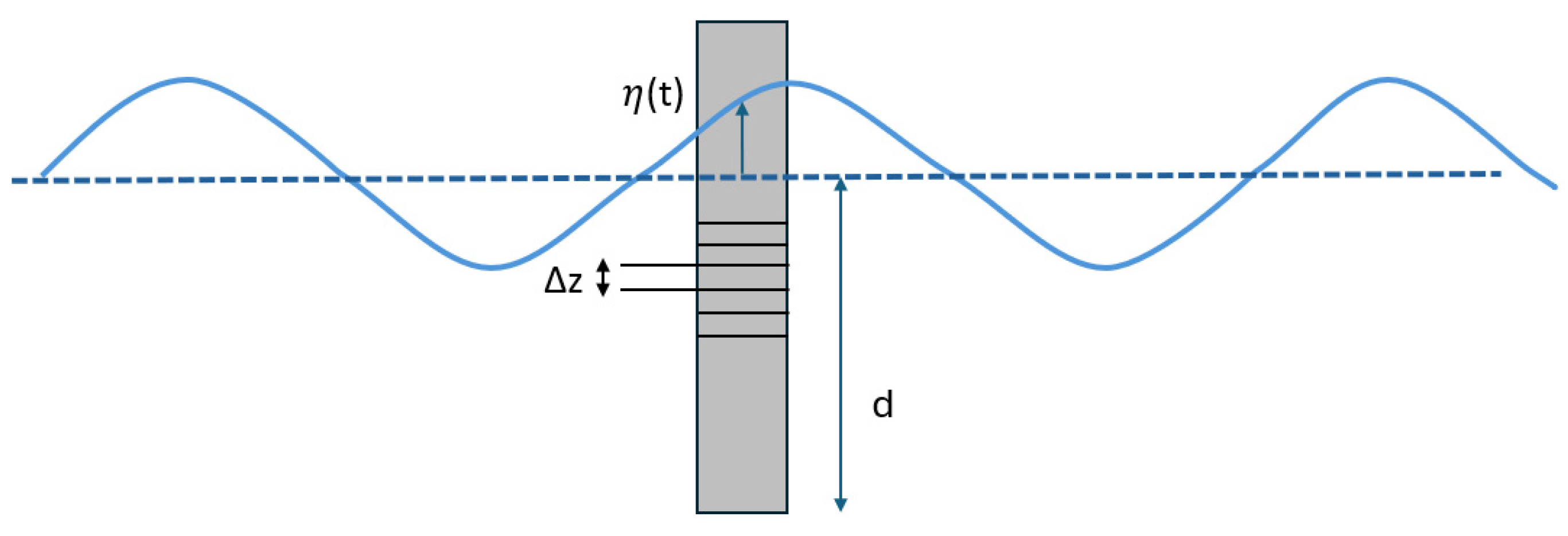
Both the velocity and acceleration of a wave particle are dependent on the wave parameters, as well as on its position on the z axis. Since Morison’s equation is also dependent on the z position, for both equations, z is discretized the same way in each time step: the distance from the free surface position η to the end of the cylinder d is discretized into 50 equal parts, and in each of those parts, the particle’s velocity and acceleration are calculated. With that, the horizontal force in each of those parts can be obtained using Morison’s Equation (2). The total horizontal force on the cylinder is the sum of all those forces in each segment of the submerged cylinder multiplied with the length of the discretized z height (Figure 6):
z = η + d 50 F H = i = 1 50 F H i   z i  
Comparing this total horizontal force with the experimental one, the inertia and drag coefficients from Morison’s equation were calculated using the least minimum square fitting method. Both coefficients are considered constant at every point of the cylinder, with one value obtained for each coefficient in each case. An inertia coefficient of 2.0 and a drag coefficient of 1.2 were used as the starting values [36].
Regarding the wake effect for the wave cases, the effect of the first cylinder on the second one was studied via a comparison of the amplitudes of the measured experimental forces for each case: the amplitude of the force when there was just one cylinder was compared with the force measured on the second cylinder when the first one was placed in front in the wave direction at different distances. Because of reflection, an effect was also produced on the front cylinder from the one in the rear, but this effect was not measured nor studied as it is out of the scope of this work. To analyze the wake effect or wave attenuation, the amplitude of the force was calculated by cutting the force signal results over at least four wave periods. These periods were selected by choosing the most stable four periods along the whole measured signal. Using this trimmed signal, the mean values of the maxima and minima were first calculated to determine the amplitude of the force:
a m p F = m e a n max F m e a n ( min F ) 2

2.3. Steady-Flow Experiments

As with the wave experiments, the objective of the steady-current experiments was to measure the horizontal force exerted on the cylinder. From these measurements, the hydrodynamic coefficient (drag coefficient) was obtained and the wake effect on the loads of the downstream cylinder studied. The towing tank experiments were designed using the same force measuring system as in the wave experiments (the KineOptics system).
The towing tank experiments were carried out following a very similar structure to the wave experiments, with the same cylinder diameters and draughts used. For the wake effect analysis, the distances between the cylinders were also the same. The steady-current speeds for these experiments were 0.2 m/s, 0.3 m/s, 0.4 m/s, and 0.5 m/s. However, the 20 mm diameter cylinder was not tested because the forces would be out of the detection range of the sensor. A total of 32 steady-current experimental cases were conducted (Table 3), each with just one isolated cylinder and one downstream cylinder placed at four different distances.
Regarding the hydrodynamic coefficients, the only force acting on the cylinder is the drag force exerted by the current on the cylinder, so just the drag coefficient needs to be calculated. A Butterworth filter was applied to clean the measured signal [40], obtaining an almost constant force result. Based on this signal, the mean force value was calculated, and then using the drag force equation, the drag coefficient was obtained:
F H = 1 2   C D   ρ   D   d   U 2 C D = F H 1 2   ρ   D   d   U 2
For the wake effect analysis, the measured forces were directly compared after the application of the filter. To perform a non-dimensional comparison of the wake effect, the ratio between the force on a cylinder with another cylinder in front at a certain distance and the force on a cylinder with no cylinder in front was calculated Equation (10). This method was used in both the wave and steady-current experiments.
R F i = F i F 0 ,   i = 1 4
where i denotes each of the four different distances between cylinders, and F 0 represents the amplitude of the force in just one cylinder.

2.4. Limitations of Experiments and Analyses

The experimental campaign was designed to provide a systematic characterization of hydrodynamic loads on vertical cylinders; however, several limitations should be acknowledged in the use of this methodology.
First, the wave experiments were conducted using regular waves only. While the use of regular waves allows for precise control of the wave parameters and facilitates the calculation of hydrodynamic coefficients, it is true that they do not capture the full complexity of real sea states. The direct extrapolation of the present results to irregular wave conditions should be performed with caution; the extension of the analysis to irregular wave conditions is beyond the scope of this study and is identified as an important topic for future investigations.
Second, the wake effect analysis was restricted to serial configurations of cylinders aligned with the wave propagation or relative flow direction. This configuration is considered sufficient to assess wake interactions relevant to modular OFPV structures and to identify the optimal spacing between in-line cylinders. For that reason, and due to the limited width of the flume, three-dimensional effects such as lateral diffraction or oblique interaction between neighboring cylinders were not considered in this study.
Force and wave measurements were subject to instrumentation and sensing limitations. The wave probes were calibrated before each experimental session to ensure their precision. Local free-surface disturbances in the vicinity of the cylinders were neglected. Force measurements are affected by sensor resolution ( ±   0.003 N ) and structural vibrations. A minimum theoretical force threshold of 0.05 N was established to ensure reliable force measurements. Structural vibrations are more important in steady flow experiments due to the movement of the carriage. To reduce their impact on the results, a Butterworth filter was applied to remove high-frequency vibrations from the measurements.
Additionally, vortex dynamics play a crucial role in both wave and steady-flow tests: in wave-induced wake interactions, unsteady vortex formation and shedding can influence force fluctuations, while in steady-flow tests, the relative motion between the cylinder and the surrounding fluid leads to classical vortex shedding, contributing to force variability. These effects are inherent to the physical problem and cannot be explicitly resolved in the present analysis. A more detailed investigation of vortex dynamics, including their influence on hydrodynamic forces and on the differences in wake recovery mechanisms between wave-induced and steady-flow conditions, is therefore intended to be conducted in future work using high-fidelity CFD simulations.
Finally, uncertainties in the hydrodynamic coefficients C D and C M arise from error propagation associated with force measurements, wave parameter estimation, and the fitting procedure applied to Morison’s equation. These uncertainties are particularly relevant in the inertia-dominated region, where the contribution of the drag component is minimal, and therefore, small force variations may lead to relatively large fluctuations in the calculated drag coefficients, resulting in a great dispersion of C D values.
Generative artificial intelligence tools were used in the preparation of this manuscript. ChatGPT (GPT-5.2, OpenAI) was used for language editing and clarity improvement, and MATLAB Copilot (MATLAB Version 2025b, The MathWorks, Inc.) was used to assist with code development and debugging. All content was reviewed, adapted, and validated by the authors, who take full responsibility for the manuscript.

3. Results and Discussion

In this section, the results obtained during the experimental campaign are presented. Starting with the wave experiments, the results related to the hydrodynamic coefficients and wake effect are discussed, followed by the steady-current experimental results.

3.1. Wave Experiments: Results

The wave experiments were first validated through a comparison between the target and measured wave conditions, fitting the experimental wave signal to Stokes third-order wave theory. This comparison was performed because it was assumed that the performance of the wave paddle could not be perfect and energy losses in the flume could also lower the wave height, making it slightly different from the targeted wave height.
Variations in the experimentally generated wave heights were explicitly considered when determining the hydrodynamic coefficients, as the velocity and acceleration terms in Morison’s Equation (2) were computed using the measured wave parameters rather than the target ones. Regarding the wave periods, discrepancies between the theoretical and experimental values were also considered in the calculations; however, these differences are very small and generally negligible.

3.1.1. Hydrodynamic Coefficient Calculation

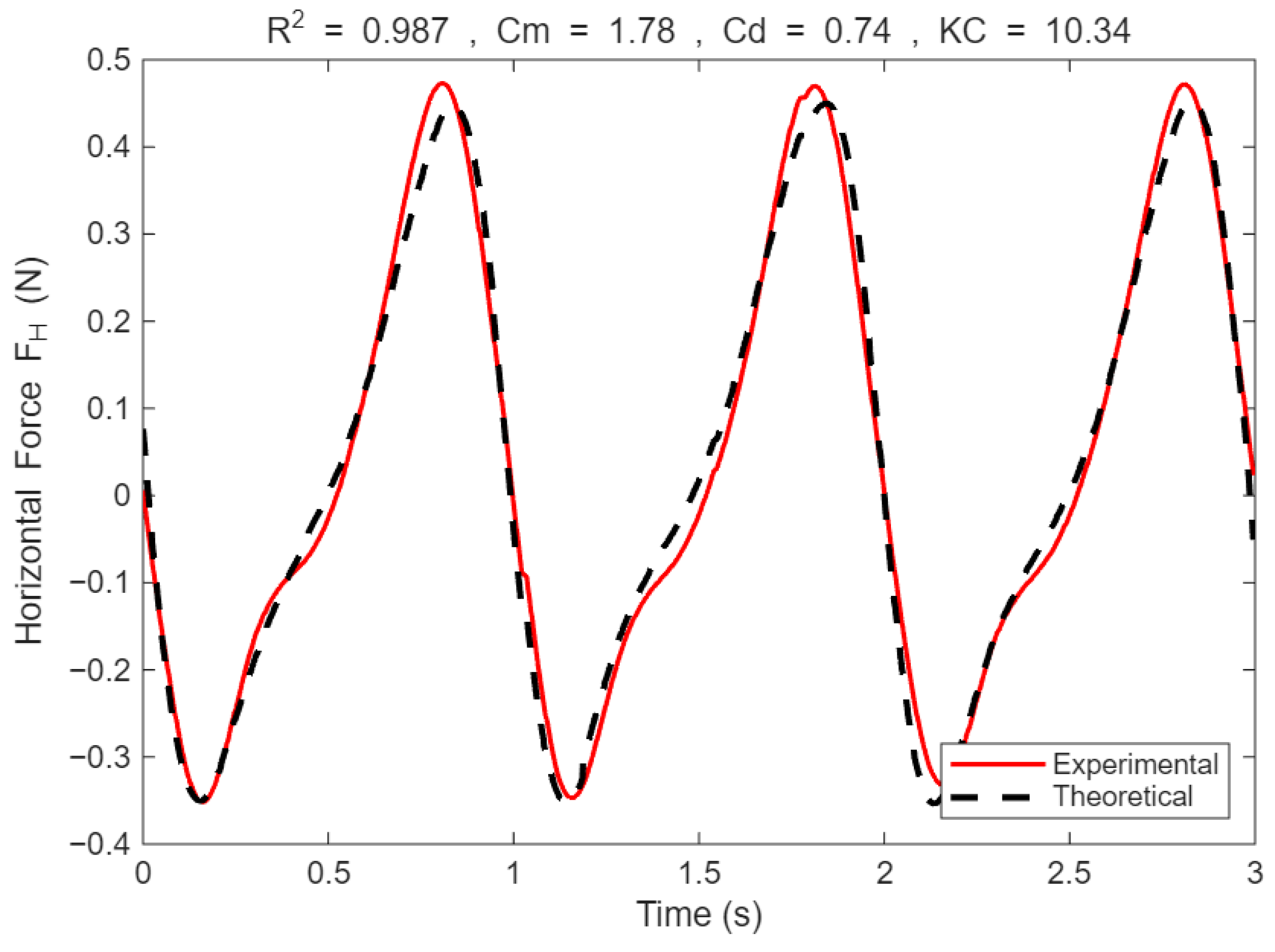
Using the experimental wave parameters, it is possible to calculate the wave particle velocity and acceleration at any point and time on the cylinder. As explained above, it is possible to calculate the total horizontal force with the velocity and acceleration results obtained for the discretized cylinder and to fit it to the experimental force signal, thereby obtaining the optimal inertia and drag coefficients. Figure 7 shows an example of the results of fitting.
Typical fitting quality was high, with the determination coefficients R 2 > 0.95 for most of the wave experiments. In fact, 89% of the experiments obtained a force fitting determination coefficient above 0.95, with a mean R 2 of 0.973.
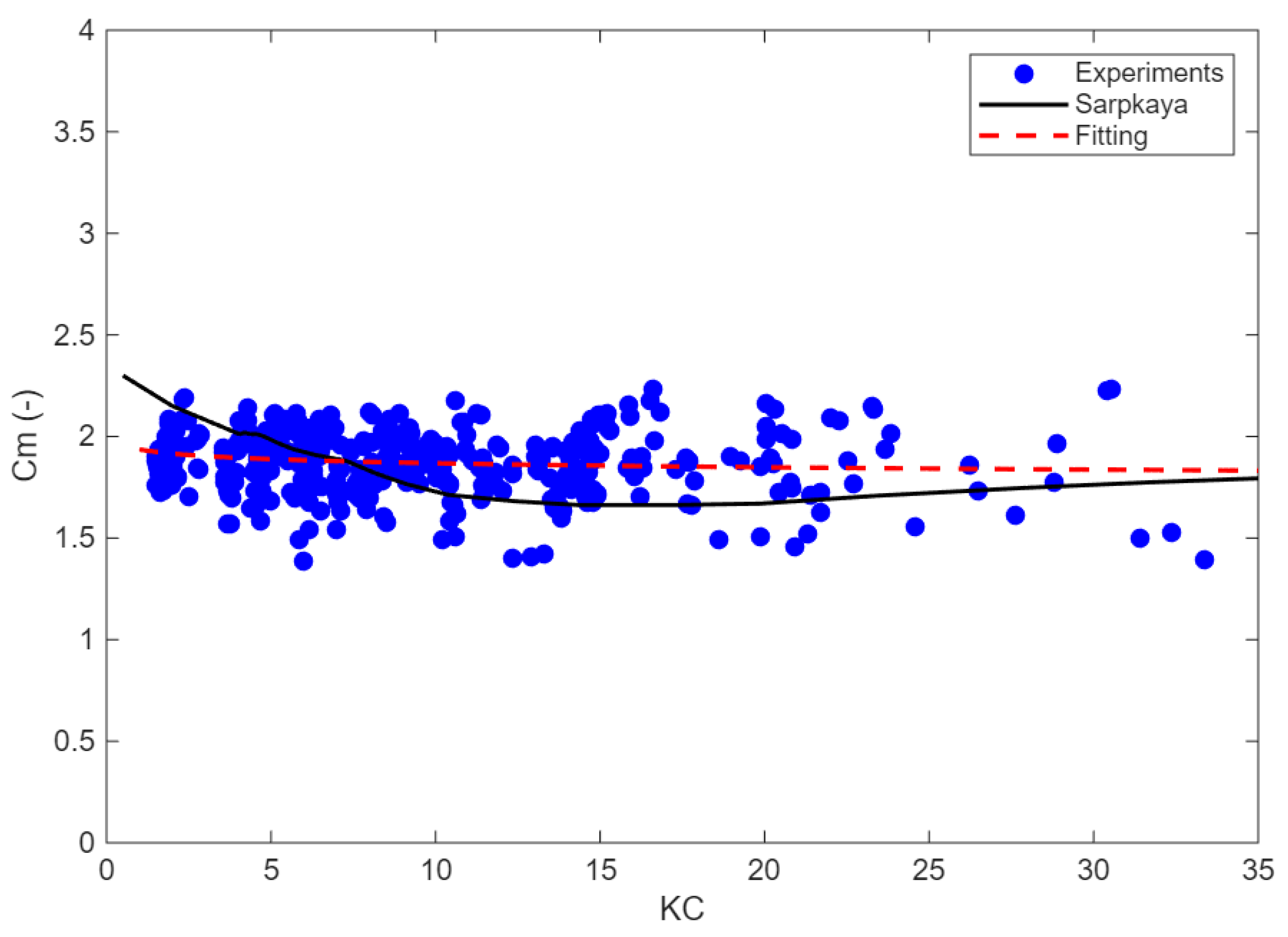
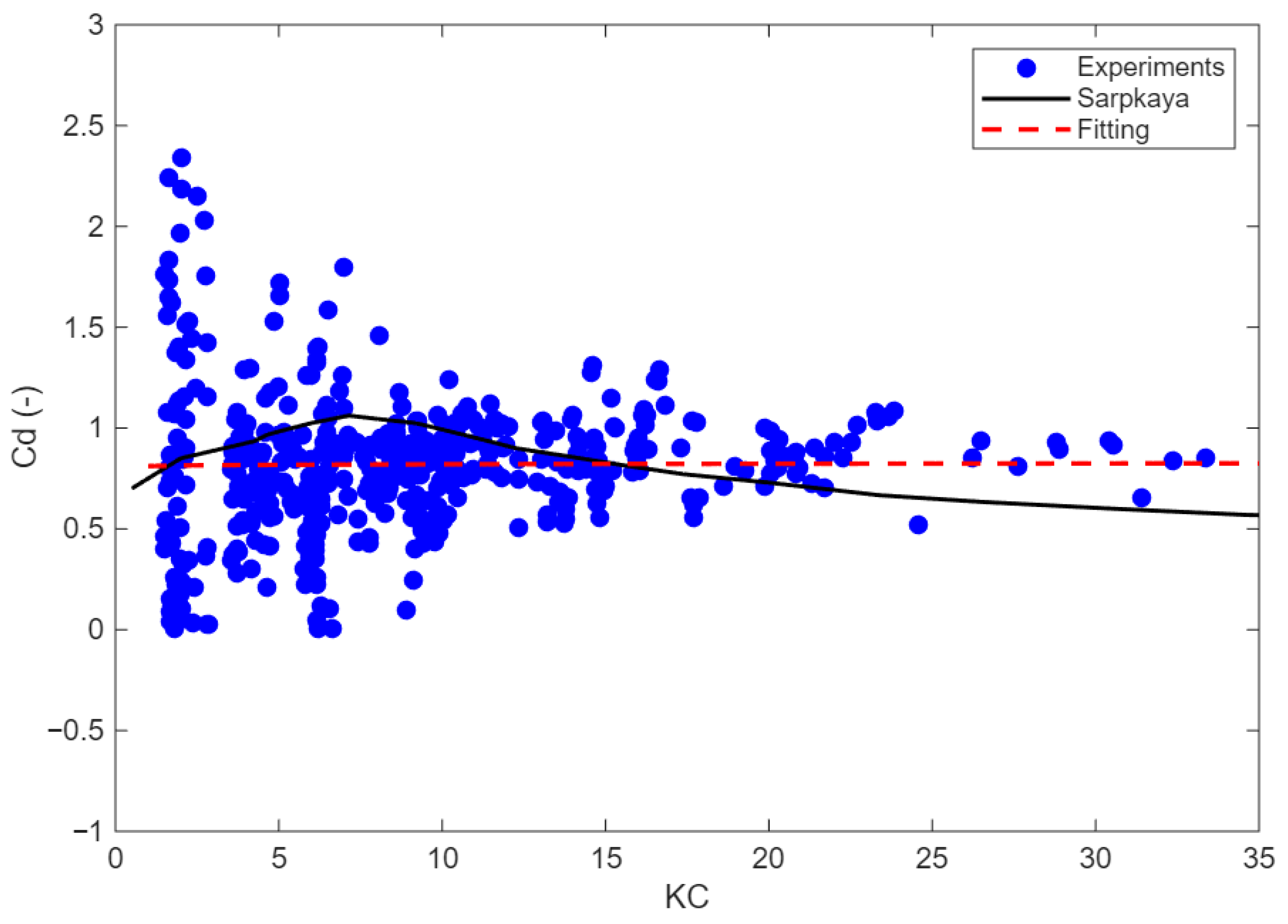
Figure 8 and Figure 9 show the results for the inertia and drag coefficients, respectively, and a comparison with Sarpkaya’s results [12]. The resulting coefficient values cover a wide range of KC numbers, from 1.5 to 33.5. The average inertia coefficient is 1.87 while the average drag coefficient is 0.84, showing a consistent trend with classical results.
At low KC values, the data show greater dispersion, particularly for the drag coefficient. In this low range, the flow acceleration dominates the total hydrodynamic force, and therefore, the inertia component accounts for most of the loading. As a result, the drag force is relatively small because small measurement uncertainties in force amplitude can produce large apparent variations in drag coefficient. Conversely, the inertia coefficient remains more constant in this region, reflecting the acceleration-dominated response of the cylinder.
As the KC number increases, the influence of acceleration diminishes while viscous and separation effects become more significant. Therefore, the drag component of the force starts to acquire significance. The inertia coefficient starts to decrease slightly, with the decrease more pronounced in Sarpkaya’s results than in the present experiments, where it remains closer to 2.0 despite a small decrease in value. As for the drag coefficient, the great dispersion observed at low KC numbers is eliminated and the value stabilizes between 0.8 and 1.0 as the KC number increases. When the KC number increases to approximately 20.0 and above, both coefficients tend to stabilize, showing consistent trends, with the inertia coefficient values similar to the ones obtained at low KC numbers and the drag coefficient values slightly higher (closer to 1.0) than Sarpkaya’s results. These discrepancies can be attributed to a combination of experimental and physical factors.
The present experiments were conducted at moderate Reynolds numbers, whereas Sarpkaya’s high KC measurements corresponded to higher Reynolds numbers. In Table 4, the Reynolds and KC number ranges reported by Sarpkaya and other experimental or numerical studies are shown. The drag coefficients obtained in the present study fall within the range of previous investigations and are consistent with experiments and simulations performed at moderate Reynolds numbers, such as [13].

3.1.2. Wake Effect/Wave Attenuation

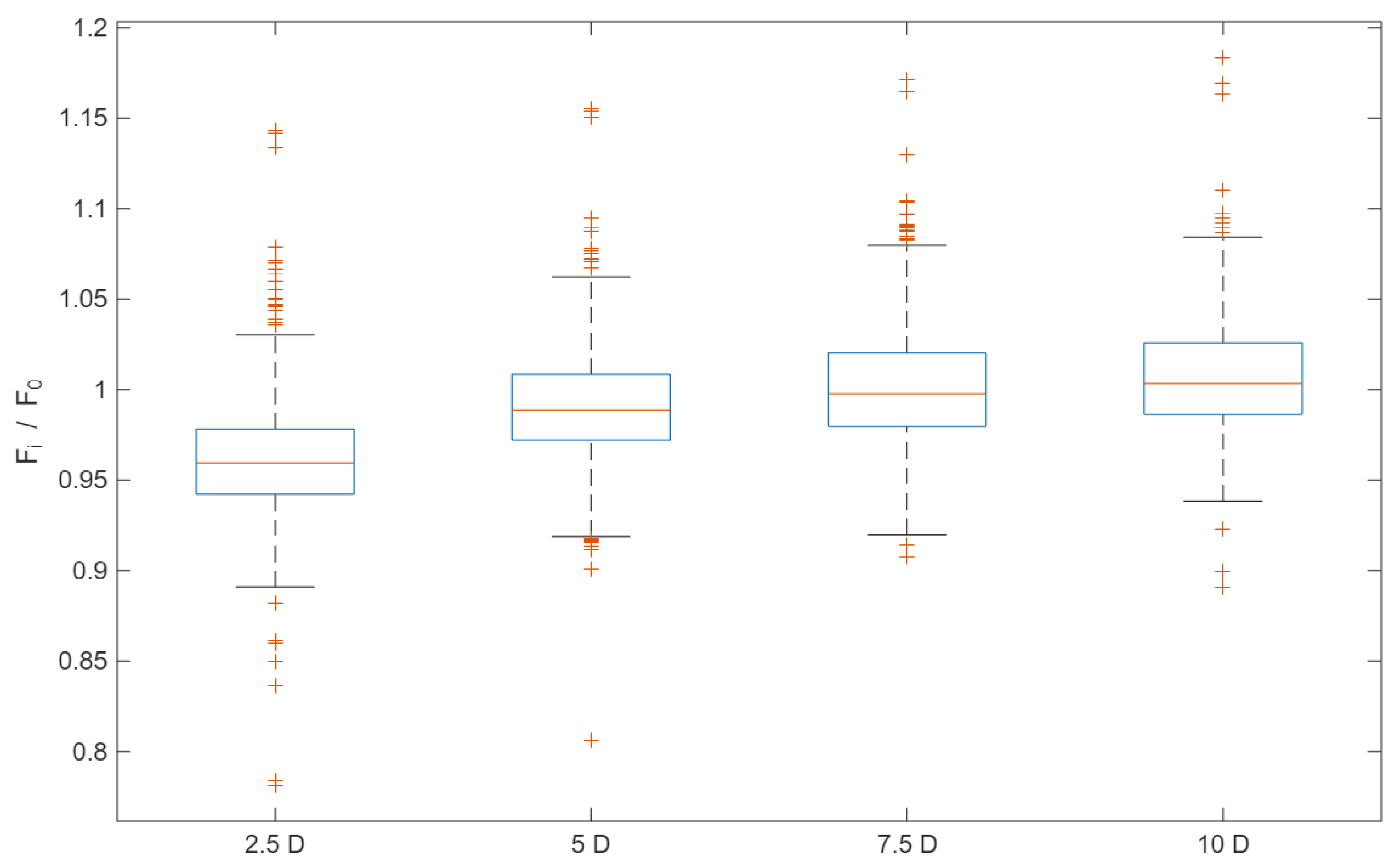
In Figure 10, the ratio of the second cylinder in relation to the first one, with respect to the ratio of the distance between the cylinders and the diameter of the cylinders, is depicted. The results show that wake effects are moderate under wave-induced oscillatory flow. The mean attenuation ratios are R F 1 = 0.97 , R F 2 = 1.00 , R F 3 = 1.01 , and R F 4 = 1.02 (see Figure 10), indicating a small initial reduction followed by a rapid recovery of the hydrodynamic loading downstream. These findings suggest that wake dissipation is faster under oscillatory flow than under steady-current conditions, as also observed in recent studies [17,18].
This behavior can be attributed to the fundamentally different vortex dynamics in oscillatory flow compared with steady flow. Under oscillatory flow, the horizontal displacement of particles is finite, which limits the downstream convection of shed vortices. Vortices generated during one-half of the wave cycle are displaced before the flow reverses, which weakens or disrupts the wake and prevents the formation of a persistent velocity deficit downstream of the cylinder. Similar wake confinement and rapid vortex decay under oscillatory flow for circular cylinders have been reported in previous CFD simulations, showing that flow reversal limits vortex convection and the development of wake [42,43,44].

3.2. Steady-Flow Experiments: Results

3.2.1. Drag Coefficient Calculation

As with the wave experiments, the first step of the steady-current experiments was to calculate the drag coefficient. While it was necessary to calculate the experimental wave parameters for the wave experiments, in the case of the towing tank experiments, the current speed was the most important variable. In this case, the cylinder was towed through quiescent water using a motorized carriage, thereby generating a controlled relative inflow velocity. The carriage was driven by a rack-and-pinion system, allowing the towing speed to be computed precisely from the motor rotation rate and gear characteristics. This was verified in the tests carried out after the system was installed, with satisfactory results, so any errors in the current speed were negligible.
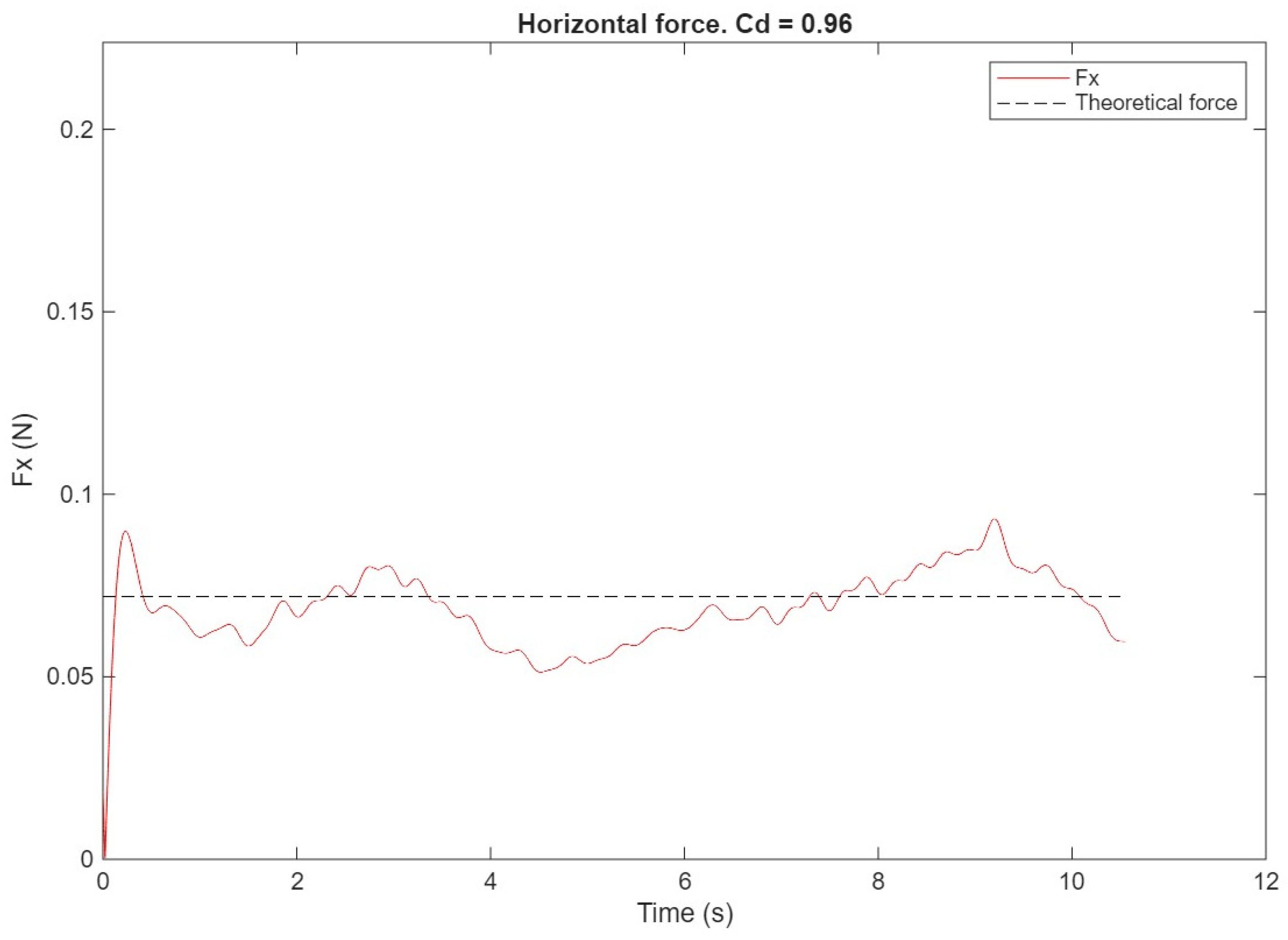
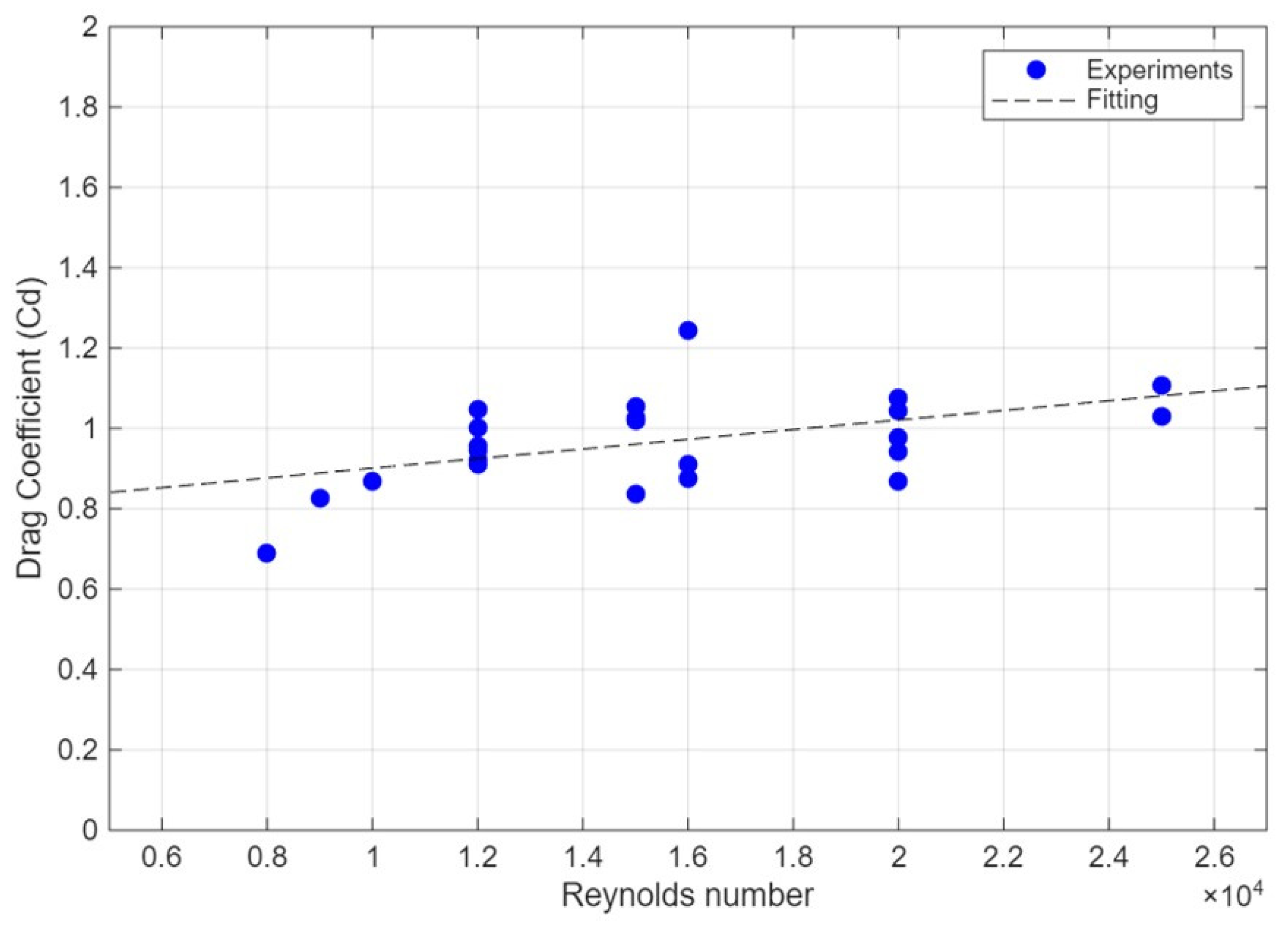
Therefore, after cleaning the experimental force signal with the Butterworth filter, the only unknown in the drag force Equation (9) was the drag coefficient. The experimental force was kept constant when calculating the mean value so that the drag coefficient could be easily calculated. Figure 11 shows how the mean force was determined. Although the force signal presents the typical fluctuations caused by vibrations and vortex shedding, the averaging procedure ensures a robust and representative estimate of the steady force. The calculated C D are shown in Figure 12. Aside from some outlying results, most of the drag coefficient values follow the classical results, with values between 0.8 and 1.0. As the Reynolds number increases, the coefficient values get closer to 1.0.

3.2.2. Wake Effect

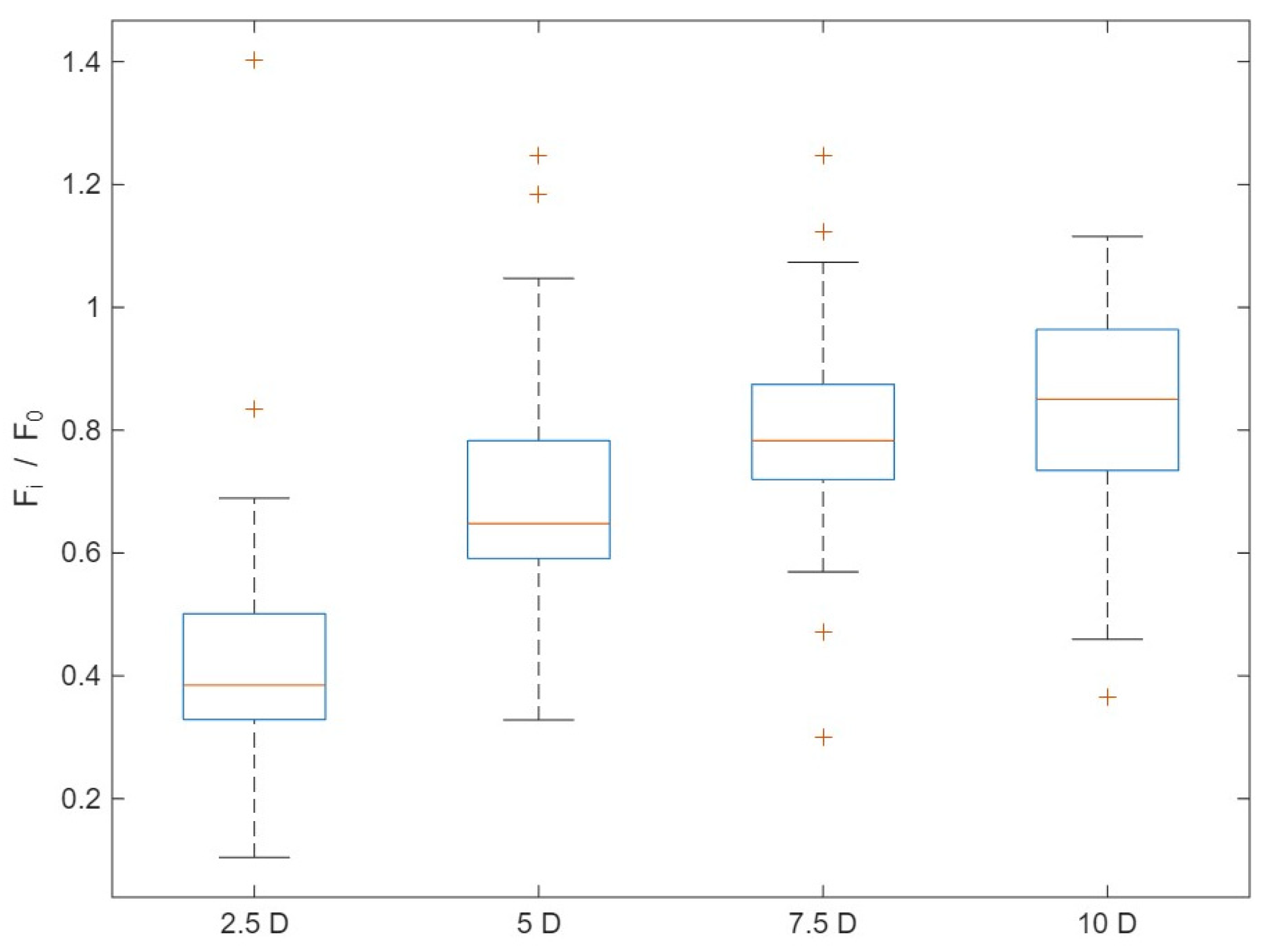
Finally, the wake effect was analyzed, following the same procedure used for the wave experiments. The results are shown in Figure 13, depicting the ratio of the amplitude of the force on the second cylinder in relation to the first one, with respect to the ratio of the distance between the cylinders and the diameter of the cylinders. Although the trend appears similar to the wave attenuation results, the force ratios at different distances are clearly below 1.0 in the steady-current cases, showing that the importance of the distance between consecutive cylinders is much more significant with currents than with waves. This is because fluid particles experience continuous horizontal displacement in steady flow, in contrast to the periodic motion induced by waves. As a result, vortices and velocity deficits are persistent downstream, leading to a stronger and more sustained wake. In this case, the mean attenuation ratios are R F 1 = 0.449 , R F 2 = 0.711 , R F 3 = 0.797 , and R F 4 = 0.826 . Therefore, at a distance that is ten times the diameter, the force is not completely restored yet.
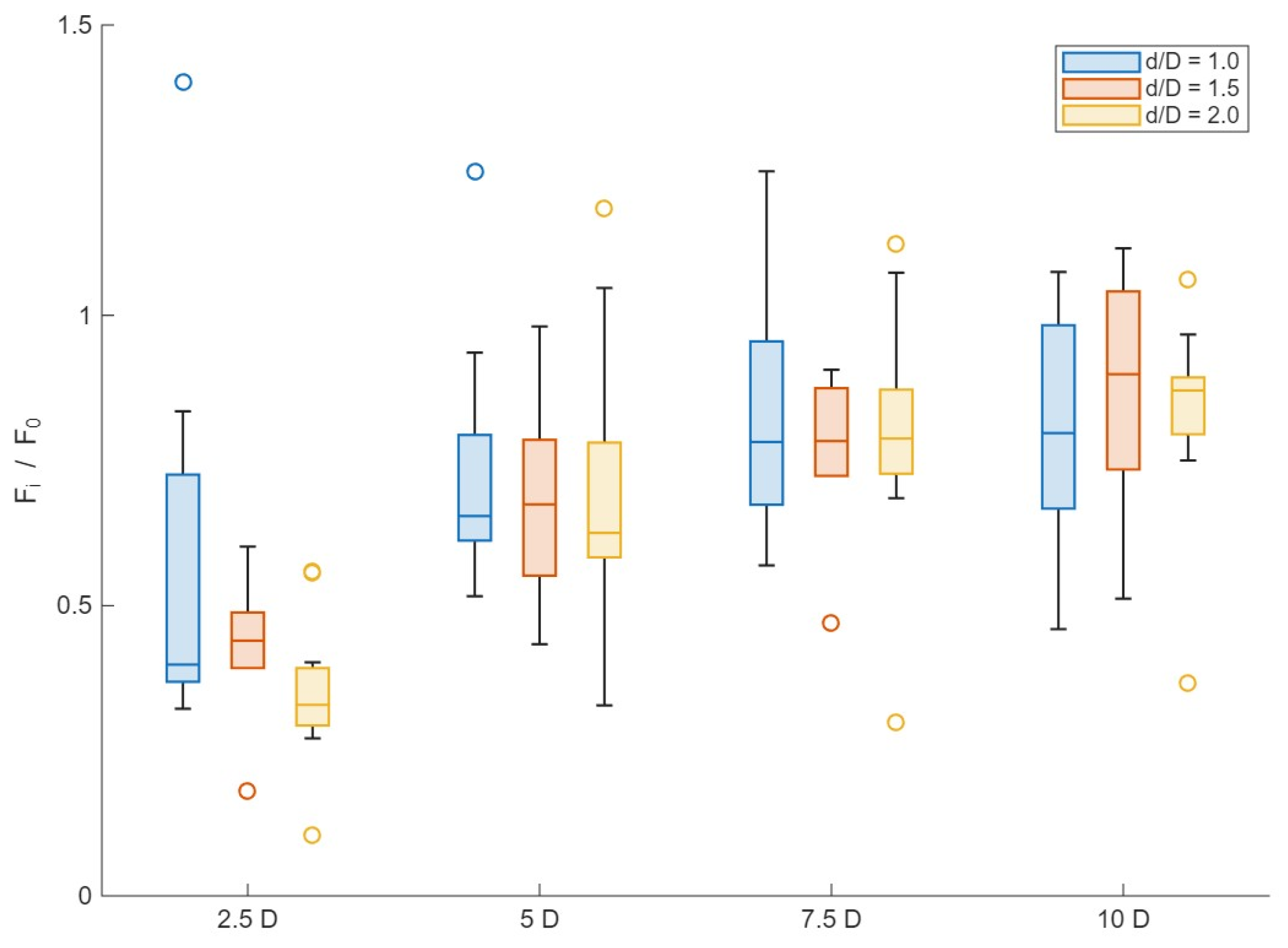
In Figure 14, a similar analysis was performed but with the boxplots grouped based on the ratio between the draught of the cylinder and its diameter. In the steady-flow experiments, ratios of 1.0, 1.5, and 2.0 were used for all diameters to compare them. No obvious differences were observed, but the biggest draught had a stronger wake (more reduced force) at closer distances, since smaller ratios were obtained with d/D = 2.0.

4. Conclusions

An extensive experimental campaign was conducted to characterize the hydrodynamic behavior of vertical cylinders representative of the structural elements of OFPV platforms under both wave and steady-current conditions. This study aimed to provide experimental validation of the hydrodynamic coefficients used in Morison-type formulations and to analyze the wake interactions between multiple cylinders for application in modular floating structures.
For the wave cases, the experimental results confirmed that the wave generation process was reliable, with average errors below 5% in wave height and 1% in period, ensuring accurate hydrodynamic analysis. The calculated inertia ( C M ) and drag ( C D ) coefficients showed trends in good agreement with classical results reported in the literature, particularly those of Sarpkaya and Bearman, with increased dispersion at low KC numbers and stabilization at higher values. The fitting of the experimental forces to Morison’s equation produced high correlation coefficients, validating the suitability of this approach for the tested geometries and flow regimes.
Regarding the wake effect under wave-induced oscillatory flow, the results demonstrated only minor attenuation of hydrodynamic forces downstream of the first cylinder. The mean attenuation ratios remained close to unity ( R F 1 = 0.97 , R F 2 = 1.00 ), indicating rapid wake recovery and limited interference effects between consecutive cylinders. This finding supports the assumption of quasi-independent hydrodynamic behavior among neighboring units within modular OFPV platforms.
For the steady-flow cases, the drag coefficients followed the expected results, with values between 0.8 and 1.0 in most cases, showing consistency with previous experimental and empirical results. The load reduction produced by the wake effect is more pronounced with steady flows than with waves, with the reduced forces on the cylinder depending on the spacing and draughts, as expected under unidirectional flow. Therefore, from a practical OFPV design perspective, the present results suggest that cylinder spacing within a module should primarily be governed by current-induced wake interactions rather than wave loading. Under steady-flow conditions representative of typical coastal and nearshore sites, a longitudinal spacing on the order of 10 diameters is recommended to ensure near-complete wake recovery and to minimize load asymmetry between upstream and downstream elements. Smaller spacings may be acceptable in wave-dominated environments since the flow recovery is faster; however, they lead to increased force variability under currents, which may have implications for long-term structural fatigue. On the other hand, although wave-induced wake effects are less dominant, wave loading may excite structural resonance, which should be explicitly assessed during the dynamic design stage and is beyond the scope of the present study.
The observed wake-induced load reduction on downstream cylinders also has direct implications for modular OFPV layout design. The results indicate that current-aligned rows of modules require conservative spacing to avoid persistent wake effects, whereas transverse spacing may be optimized to achieve compact configurations without a proportional increase in hydrodynamic loads.
Overall, this study provides a valuable experimental dataset covering a wide range of K C numbers in wave cases, contributing to the refinement of hydrodynamic coefficient estimates and wake interaction behavior for slender offshore structures. These results provide direct guidance for the hydrodynamic optimization of OFPV arrays and establish experimentally grounded spacing criteria that can be readily incorporated into early-stage layout and structural design; the results are also relevant to other offshore platforms employing cylindrical components, such as mooring lines, support columns, and floating substructures.
Future work will focus on validating these results via numerical and CFD simulations, as well as through the design of a modular OFPV structure, which will be placed in the wave flume and subjected to numerical simulations to study its dynamics and validate this work. The hydrodynamic coefficients calculated in this study will be necessary for those future numerical simulations.

Author Contributions

Conceptualization, O.P.V. and U.I.; methodology, O.P.V. and I.A.; software, I.A.; investigation, O.P.V. and U.I.; data curation, O.P.V. and I.B.; validation, O.P.V. and G.A.E.; writing—original draft preparation, O.P.V. and U.I.; writing—review and editing, U.I., I.B. and G.A.E.; resources, J.M.B.; supervision, J.M.B. All authors have read and agreed to the published version of the manuscript.

Funding

This research was funded by the project EKIOCEAN of the Basque Government (KK-2023/00097). The authors would like to express their gratitude for the support provided by the Research Groups of the Basque Government (ITSAS-REM, IT1514-22).

Data Availability Statement

The original data presented in the study are openly available in Zenodo at https://doi.org/10.5281/zenodo.17817803.

Acknowledgments

The authors express their sincere gratitude for the support provided by the Joint Research Laboratory on Offshore Renewable Energy (JRL-ORE) and Daniel de Miguel, the laboratory technician, for his assistance during the experimental campaign and for his continuous technical support throughout this work. During the preparation of this manuscript, the authors used ChatGPT (GPT-5, OpenAI) for text generation, language editing, and MATLAB code generation. The authors reviewed, verified, and edited all generated content and take full responsibility for the final version of this publication.

Conflicts of Interest

The authors declare no conflicts of interest.

Abbreviations

The following abbreviations are used in this manuscript:
OFPVOffshore floating photovoltaic
PVPhotovoltaic
FPVFloating photovoltaic
LCOELevelized cost of energy
CAPEXCapital expenditure
OPEXOperating expense
TRLTechnology readiness level
CFDComputational fluid dynamics
KC Keulegan–Carpenter
ReReynolds number
UPV/EHUUniversity of the Basque Country
C M Inertia coefficient
C D Drag coefficient
AIArtificial intelligence
ρ Water density
HWave height
AWave amplitude
TWave period
hWater depth
dDraught
LDistance between cylinders
DDiameter of the cylinder
λ   Wavelength
cWave celerity
ω Wave angular frequency
kWave number
gGravity acceleration (9.81 m/s2)
F H Horizontal force
zVertical coordinate
tTime
u Wave particle velocity
u ˙ Wave particle acceleration
η Wave free surface height
θ Wave phase
ϕ Velocity potential
R F Force ratio
R2Coefficient of determination

References

  1. Iglesias, G.; Taveira-Pinto, F.; Rosa-Santos, P.; Deng, Z.D. Preface to Special Topic: Marine Renewable Energy. J. Renew. Sustain. Energy 2015, 7, 061601. [Google Scholar] [CrossRef]
  2. Pillai, A.C.; Gordelier, T.J.; Thies, P.R.; Cuthill, D.; Johanning, L. Anchor loads for shallow water mooring of a 15 MW floating wind turbine—Part II: Synthetic and novel mooring systems. Ocean Eng. 2022, 266, 112619. [Google Scholar] [CrossRef]
  3. Kjeldstad, T.; Lindholm, D.; Marstein, E.; Selj, J. Cooling of floating photovoltaics and the importance of water temperature. Sol. Energy 2021, 218, 544–551. [Google Scholar] [CrossRef]
  4. Oliveira-Pinto, S.; Stokkermans, J. Assessment of the potential of different floating solar technologies—Overview and analysis of different case studies. Energy Convers. Manag. 2020, 211, 112747. [Google Scholar] [CrossRef]
  5. Pérez-Collazo, C.; Greaves, D.; Iglesias, G. A review of combined wave and offshore wind energy. Renew. Sustain. Energy Rev. 2015, 42, 141–153. [Google Scholar] [CrossRef]
  6. Wang, Z.; Carriveau, R.; Ting, D.S.-K.; Xiong, W.; Wang, Z. A review of marine renewable energy storage. Int. J. Energy Res. 2019, 43, 6108–6150. [Google Scholar] [CrossRef]
  7. Ministerio para la Transición Ecológica y el Reto Demográfico. Hoja de Ruta para el Desarrollo de la Eólica Marina y de las Energías del Mar. Available online: https://www.miteco.gob.es/eu/ministerio/planes-estrategias/desarrollo-eolica-marina-energias.html (accessed on 21 October 2025).
  8. Guo, C.; Sheng, W.; De Silva, D.G.; Aggidis, G. A Review of the Levelized Cost of Wave Energy Based on a Techno-Economic Model. Energies 2023, 16, 2144. [Google Scholar] [CrossRef]
  9. Stansby, P.; Draycott, S. M4 WEC development and wave basin Froude testing. Eur. J. Mech. B Fluids 2024, 104, 182–193. [Google Scholar] [CrossRef]
  10. Cuce, E.; Cuce, P.M.; Saboor, S.; Ghosh, A.; Sheikhnejad, Y. Floating PVs in Terms of Power Generation, Environmental Aspects, Market Potential, and Challenges. Sustainability 2022, 14, 2626. [Google Scholar] [CrossRef]
  11. Song, J.; Kim, J.; Lee, J.; Kim, S.; Chung, W. Dynamic Response of Multiconnected Floating Solar Panel Systems with Vertical Cylinders. J. Mar. Sci. Eng. 2022, 10, 189. [Google Scholar] [CrossRef]
  12. Turgut, S. In-Line and Transverse Forces on Smooth and Rough Cylinders in Oscillatory Flow at High Reynolds Numbers. Available online: https://apps.dtic.mil/sti/citations/ADA169562 (accessed on 21 October 2025).
  13. Yuan, Z.; Huang, Z. An experimental study of inertia and drag coefficients for a truncated circular cylinder in regular waves. J. Hydrodyn. Ser B 2010, 22, 318–323. [Google Scholar] [CrossRef]
  14. Towed Vertical Surface-Piercing Cylinders—UQ eSpace. Available online: https://espace.library.uq.edu.au/view/UQ:ea78e37 (accessed on 21 October 2025).
  15. Chaplin, J.R.; Teigen, P. Steady flow past a vertical surface-piercing circular cylinder. J. Fluids Struct. 2003, 18, 271–285. [Google Scholar] [CrossRef]
  16. Qiu, X.; Ji, X.; Zhou, J.; Li, J.; Tao, Y.; Liu, Y. Spacing Ratio Effects on the Evolution of the Flow Structure of Two Tandem Circular Cylinders in Proximity to a Wall. J. Mar. Sci. Eng. 2024, 12, 721. [Google Scholar] [CrossRef]
  17. Muddada, S.; Hariharan, K.; Sanapala, V.S.; Patnaik, B.S.V. Circular cylinder wakes and their control under the influence of oscillatory flows: A numerical study. J. Ocean Eng. Sci. 2021, 6, 389–399. [Google Scholar] [CrossRef]
  18. Wake Effects on Wave-Induced Loads Acting on Cylinders in a Tripod Configuration. Available online: https://www.mdpi.com/2077-1312/10/9/1211 (accessed on 21 October 2025).
  19. Wang, C.Z.; Wu, G.X. Interactions between fully nonlinear water waves and cylinder arrays in a wave tank. Ocean Eng. 2010, 37, 400–417. [Google Scholar] [CrossRef]
  20. Dhar, N.; Lloyd, C.J.; Walker, J.; Dorrell, R.M. The Influence of Structural Design on the Hydrodynamics of Floating Offshore Wind Turbine Platforms. J. Mar. Sci. Eng. 2025, 13, 248. [Google Scholar] [CrossRef]
  21. Lai, Y.; Cai, L.; Wu, X.; Wang, B.; Hu, Y.; Liang, Y.; Zhao, H.; Shi, W. Effect of Combined Wave and Current Loading on the Hydrodynamic Characteristics of Double-Pile Structures in Offshore Wind Turbine Foundations. Energies 2025, 18, 2573. [Google Scholar] [CrossRef]
  22. Ji, R.; Li, X.; Ye, Y.; Zhu, R.; Sun, K.; Wu, M.; Huang, F.; Reabroy, R. Hydrodynamic Characteristics of Offshore Wind Turbine Pile Foundations Under Combined Focusing Wave-Current Conditions. J. Mar. Sci. Eng. 2024, 12, 2068. [Google Scholar] [CrossRef]
  23. Gao, S.; Li, Z.; Liang, C.; Li, C.; Kong, X. Adaptive fault diagnosis method for offshore floating photovoltaic arrays considering wave-induced disturbances. Energy 2026, 342, 139714. [Google Scholar] [CrossRef]
  24. Li, Q.; Ke, S.; Cao, J.; Wang, W.; Cai, T.; Zhang, X. Nonlinear dynamic response analysis of offshore new floating pipe-type flexible photovoltaic arrays under wind-wave coupling effects. Ocean Eng. 2025, 340, 122222. [Google Scholar] [CrossRef]
  25. Verao Fernandez, G.; Stratigaki, V.; Vasarmidis, P.; Balitsky, P.; Troch, P. Wake Effect Assessment in Long- and Short-Crested Seas of Heaving-Point Absorber and Oscillating Wave Surge WEC Arrays. Water 2019, 11, 1126. [Google Scholar] [CrossRef]
  26. Zan, X.; Lin, Z.; Gou, Y. The Force Exerted by Surface Wave on Cylinder and Its Parameterization: Morison Equation Revisited. J. Mar. Sci. Eng. 2022, 10, 702. [Google Scholar] [CrossRef]
  27. Aalborg University. AwaSys Software. Available online: https://www.en.build.aau.dk/for-the-building-industry/hydrosoft/awasys (accessed on 25 November 2025).
  28. Izquierdo, U.; Galera-Calero, L.; Albaina, I.; Vázquez, A.; Esteban, G.A.; Blanco, J.M. Experimental and numerical determination of the optimum configuration of a parabolic wave extinction system for flumes. Ocean Eng. 2021, 238, 109748. [Google Scholar] [CrossRef]
  29. ATO. ATO S Type Load Cell ATO-LCS-DYLY-106. Available online: https://www.ato.com/Content/doc/Load-cell-catalog.pdf?srsltid=AfmBOoqhbwvmVLhhSg6iLiZ5vJ1atTjB2U9-qEnFzWg0vICdmn9NScXY (accessed on 21 October 2025).
  30. KineOptics Wind Tunnel Balance. Available online: https://www.kineoptics.com/WTB.html (accessed on 21 October 2025).
  31. Zhao, K.; Liu, P.L.-F. On Stokes wave solutions. Proc. R. Soc. Math. Phys. Eng. Sci. 2022, 478, 20210732. [Google Scholar] [CrossRef]
  32. Ruz, O.; Castillo, E.; Cruchaga, M.; Aguirre, A. Numerical study of the effect of blockage ratio on the flow past one and two cylinders in tandem for different power-law fluids. Appl. Math. Model. 2021, 89, 1640–1662. [Google Scholar] [CrossRef]
  33. Anagnostopoulos, P.; Minear, R. Blockage effect of oscillatory flow past a fixed cylinder. Appl. Ocean Res. 2004, 26, 147–153. [Google Scholar] [CrossRef]
  34. Yuan, Z.-M.; Zhang, X.; Ji, C.-Y.; Jia, L.; Wang, H.; Incecik, A. Side wall effects on ship model testing in a towing tank. Ocean Eng. 2018, 147, 447–457. [Google Scholar] [CrossRef]
  35. Cox, G.; Macfarlane, G. The Effects of Boat Waves on Sheltered Waterways—Thirty Years of Continuous Study. In Proceedings of the Australasian Coasts and Ports 2019, Hobart, Australia, 10–13 September 2019; Available online: https://www.researchgate.net/publication/336349691_The_Effects_of_Boat_Waves_on_Sheltered_Waterways_-Thirty_Years_of_Continuous_Study (accessed on 21 October 2025).
  36. Journée, J.M.J.; Massie, W.W. Offshore Hydromechanics; Delft Univeristy of Technology: Delft, The Netherlands, 2001. [Google Scholar]
  37. Introducción al ajuste por Mínimos Cuadrados—MATLAB & Simulink. Available online: https://es.mathworks.com/help/curvefit/least-squares-fitting.html (accessed on 21 October 2025).
  38. Raed, K.; Guedes Soares, C. Variability effect of the drag and inertia coefficients on the Morison wave force acting on a fixed vertical cylinder in irregular waves. Ocean Eng. 2018, 159, 66–75. [Google Scholar] [CrossRef]
  39. Dean, R.G.; Dalrymple, R.A. Water Wave Mechanics for Engineers and Scientists; World Scientific: Singapore, 1991. Volume 2. Available online: https://ambiental.ufpr.br/wp-content/uploads/2025/03/Water-wave-mechanics-for-engineers-and-scientists.pdf (accessed on 21 October 2025).
  40. Zhang, Z.; Ma, N.; Shi, Q.; Zhang, Y.; Wen, Y. Experimental study and uncertainty analysis on added resistance and pressure distribution of KVLCC2 in regular short waves. Ocean Eng. 2025, 317, 120093. [Google Scholar] [CrossRef]
  41. Chakrabarti, S.K. Handbook of Ofsshore Engineering; Elsevier: Amsterdam, The Netherlands, 2005. [Google Scholar]
  42. Chang, W.-Y.; Constantinescu, G. Oscillatory flow around a vertical circular cylinder placed in an open channel: Coherent structures, sediment entrainment potential and drag forces. J. Fluid Mech. 2023, 964, A22. [Google Scholar] [CrossRef]
  43. Williamson, C.H.K. Sinusoidal flow relative to circular cylinders. J. Fluid Mech. 1985, 155, 141–174. [Google Scholar] [CrossRef]
  44. An, H.; Cheng, L.; Zhao, M. Two-dimensional and three-dimensional simulations of oscillatory flow around a circular cylinder. Ocean Eng. 2015, 109, 270–286. [Google Scholar] [CrossRef]
Figure 1. Overall schematic diagram of a preliminary OFPV design: (a) unitary modular cell with incoming wave direction (blue arrow) and (b) an array of those cells.
Jmse 14 00129 g001
Figure 2. Experimental wave flume of the Energy Engineering Department in the Bilbao School of Engineering (UPV/EHU).
Jmse 14 00129 g002
Figure 3. Measuring setup: (a) KineOptics system with the ATO-LCS-DYLY-106 load cell; (b) bridge and trolley system.
Jmse 14 00129 g003
Figure 4. Types of experiments: (a) one cylinder, for coefficient determination; (b) two cylinders, for wake effect analysis.
Jmse 14 00129 g004
Figure 5. Schematic of the experimental setup with parameters.
Jmse 14 00129 g005
Figure 6. Discretization of the cylinder.
Jmse 14 00129 g006
Figure 7. Force fitting example. D = 40 mm, d = 80 mm, H = 100 mm, and T = 1.0 s.
Jmse 14 00129 g007
Figure 8. Inertia coefficient results. Comparison between Sarpkaya’s results [12] and own fitting curve.
Jmse 14 00129 g008
Figure 9. Drag coefficient results. Comparison between Sarpkaya’s results [12] and own fitting curve.
Jmse 14 00129 g009
Figure 10. Wave attenuation boxplot. Ratio of the amplitude of the force on the downstream cylinder at one of four different distances ( F i ) and the force on just one cylinder ( F 0 ).
Jmse 14 00129 g010
Figure 11. Example of the cleaned force data and the calculation of drag coefficient: D = 30 mm, d = 30 mm, and U = 0.4 m/s.
Jmse 14 00129 g011
Figure 12. Drag coefficients for towing tank experiments.
Jmse 14 00129 g012
Figure 13. Boxplot of the wake effect. Ratio of the amplitude of the force on the downstream cylinder placed at one of four different distances ( F i ) and the force on just one cylinder ( F 0 ).
Jmse 14 00129 g013
Figure 14. Boxplot of the wake effect grouped by the ratio between the draught and the diameter.
Jmse 14 00129 g014
Table 1. Cylinder parameters: diameter, draught, and distance between cylinders.
D [mm]d [mm]L [cm]
2020, 40, 60, 805, 10, 15, 20
3030, 45, 60, 90, 1207.5, 15, 22.5, 30
4020, 40, 60, 80, 12010, 20, 30, 40
5025, 50, 75, 10012.5, 25, 37.5, 50
Table 2. Wave parameters and water regime calculation.
h [m]T [s]H [cm]λ [m]h/λ [-]c [m/s]
0.50.62.5, 50.5620.890.94
0.50.82.5, 5, 7.5, 100.9960.501.24
0.50.92.5, 5, 7.5, 101.2480.401.39
0.51.02.5, 5, 7.5, 10, 12.5, 151.5130.331.51
0.51.22.5, 5, 7.5, 10, 12.5, 152.0480.241.71
0.51.42.5, 5, 7.5, 10, 12.5, 152.5710.191.84
Table 3. Steady-flowt experiment parameters.
D [mm]d [mm]U [m/s]
3030, 45, 600.2, 0.3, 0.4, 0.5
4040, 60, 800.2, 0.3, 0.4, 0.5
5050, 1000.2, 0.3, 0.4, 0.5
Table 4. Comparison of hydrodynamic coefficients for vertical circular cylinders under wave loading.
StudyType of StudyKC RangeRe RangeCmCd
Sarpkaya [12]Experimental5–100104–1051.6–20.6–1
Chakrabarti [41]Experimental2–30105–1061.22–1.90.7–1
Yuan and Huang [13]Experimental2–125 × 103–1.2 × 1041.8–2.20.8–1.2
Chang and Constantinescu [42]Numerical1.5–30.83 × 10⁴–6 × 1051.2–20.9–1.1
Anagnostopoulos [33]Numerical1–6 2.21.5–2
Present studyExperimental1.5–332 × 103–2.5 × 1041.6–2.20.8–1.1
Disclaimer/Publisher’s Note: The statements, opinions and data contained in all publications are solely those of the individual author(s) and contributor(s) and not of MDPI and/or the editor(s). MDPI and/or the editor(s) disclaim responsibility for any injury to people or property resulting from any ideas, methods, instructions or products referred to in the content.