Fused Geophysical–Contrastive Learning Model for CYGNSS-Based Sea Surface Wind Speed Retrieval in Typhoon Regions

 , , and
Abstract
1. Introduction
- (1)
- Adopt a dual-branch architecture with a CNN branch and a Transformer branch and introduce contrastive learning based on the Kullback–Leibler divergence to align local and global representations under few-sample conditions and enhance generalization capability in high-wind-speed regions;
- (2)
- Establish a GMF branch as a physical prior reference that is used only in the medium-to-low wind-speed regions where GMF is effective, serving as a physical anchor to guide learning and thereby avoiding enforced reliance on GMF in high-wind-speed regions where it fails;
- (3)
- Design an uncertainty-based adaptive fusion strategy that dynamically balances between data-driven predictions and the GMF reference to maintain robustness when the physical model locally fails or data uncertainty increases.
2. Datasets and Data Processing
2.1. CYGNSS Dataset
2.2. ECMWF ERA5 Dataset
2.3. NCEP Dataset
2.4. IBTrACS Dataset
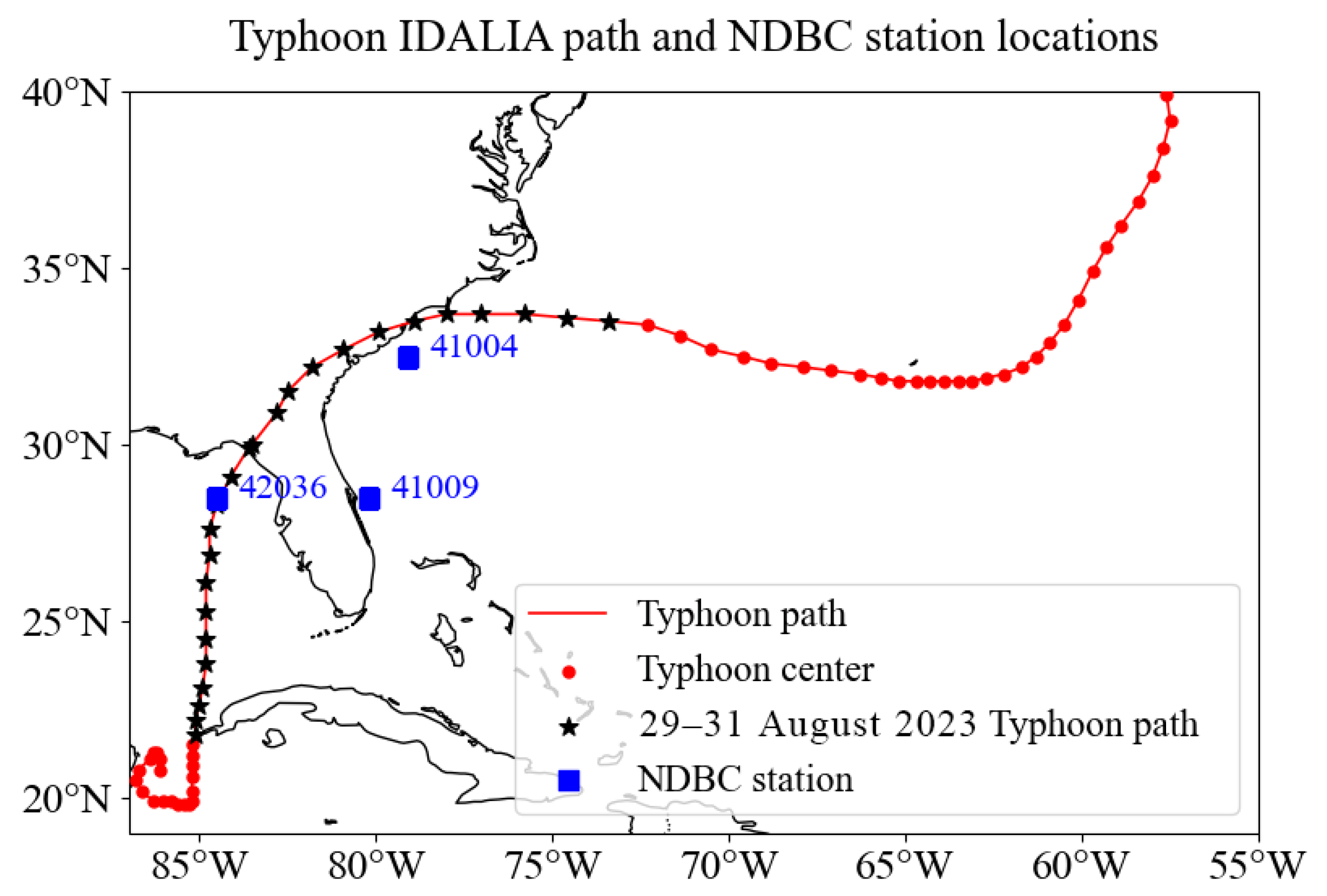
2.5. NDBC Dataset
3. Method
3.1. Data Preprocessing
- The quality control (QC) flag in the CYGNSS L1 dataset uses bit combinations to flag various data quality issues. Records identified by the following labels are excluded according to standard processing protocols.
- (a)
- poor_overall_quality: Poor overall quality (including attitude errors, CRC failure, RFI, etc.);
- (b)
- s_band_powere d_up: S-band transmitter powered on;
- (c)
- small_sc_attitude_err: Minor attitude errors (roll 1–30°, pitch 1–10°, yaw 1–5°);
- (d)
- large_sc_attitude_err: Major attitude errors (roll ≥ 30°, pitch ≥ 10°, yaw ≥ 5°).
- The data selection requires both the wind speed matching value and the CYGNSS observation data to be positive.
- A range corrected gain (RCG) value greater than 10 constitutes a criterion for data removal, with its formal definition and physical meaning provided in reference [31].
- The incident angle of the satellite antenna is less than 60°.
- The specular reflection point is on the sea.
3.2. Building an Experimental Dataset
3.3. Feature Selection
3.4. Construction of CLCTG Model
3.5. SHAP Value Analysis
3.6. Evaluation Metrics
4. Results and Discussion
4.1. Branch Ablation Experiments
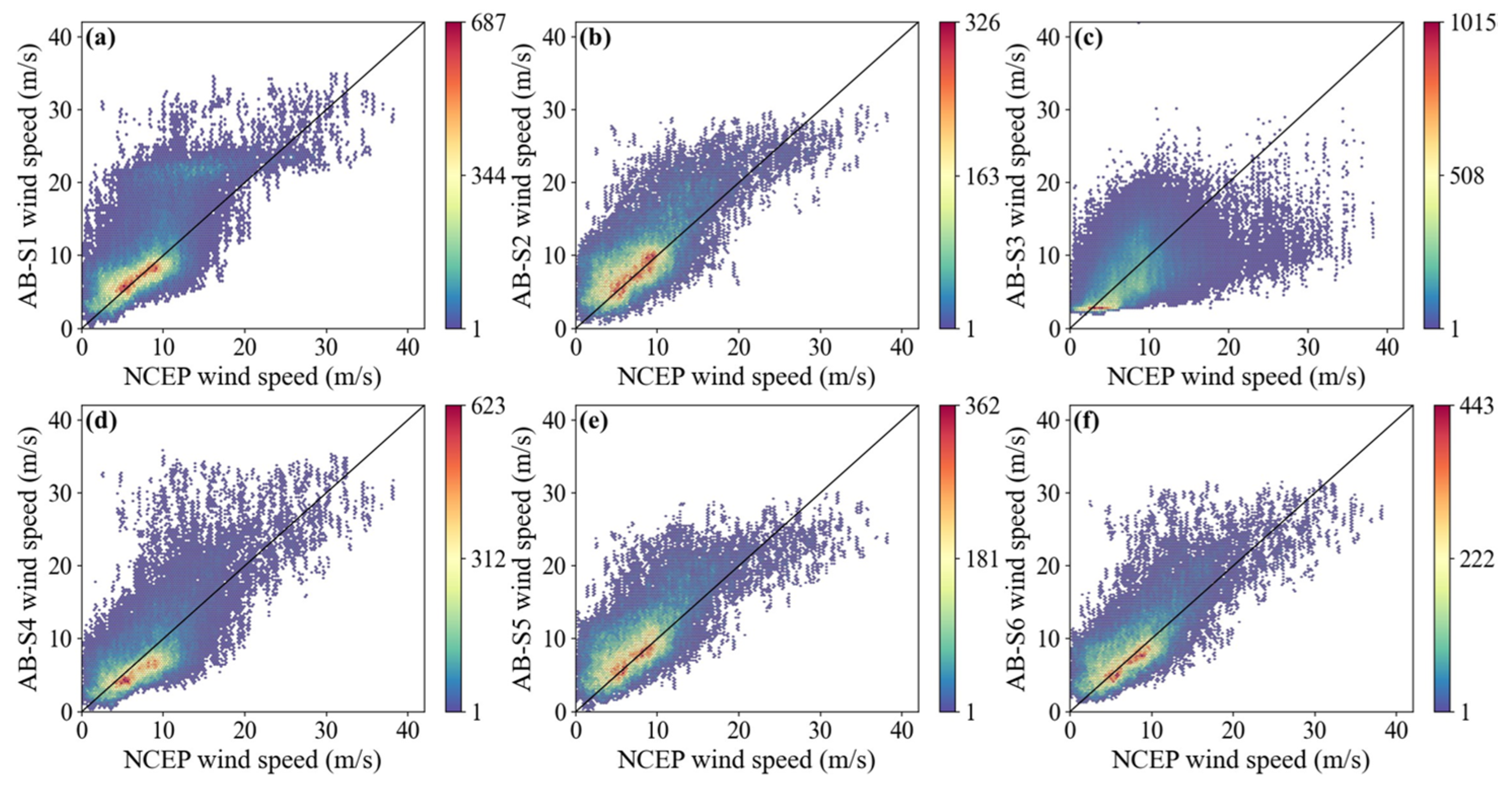
- AB-S1/2/3: The C/T/G branches trained jointly, outputting only C, T, or G branch results respectively;
- AB-S4/5: The G-Branch was removed, and only the C/T branches trained, outputting only C or T branch results;
- AB-S6: The G-Branch was removed, and only the C/T branches trained, with both outputs fused by the AF-Branch;
- CLCTG: All three branches trained jointly, with all outputs fused by the AF-Branch.
4.2. Model Comparative Experiments
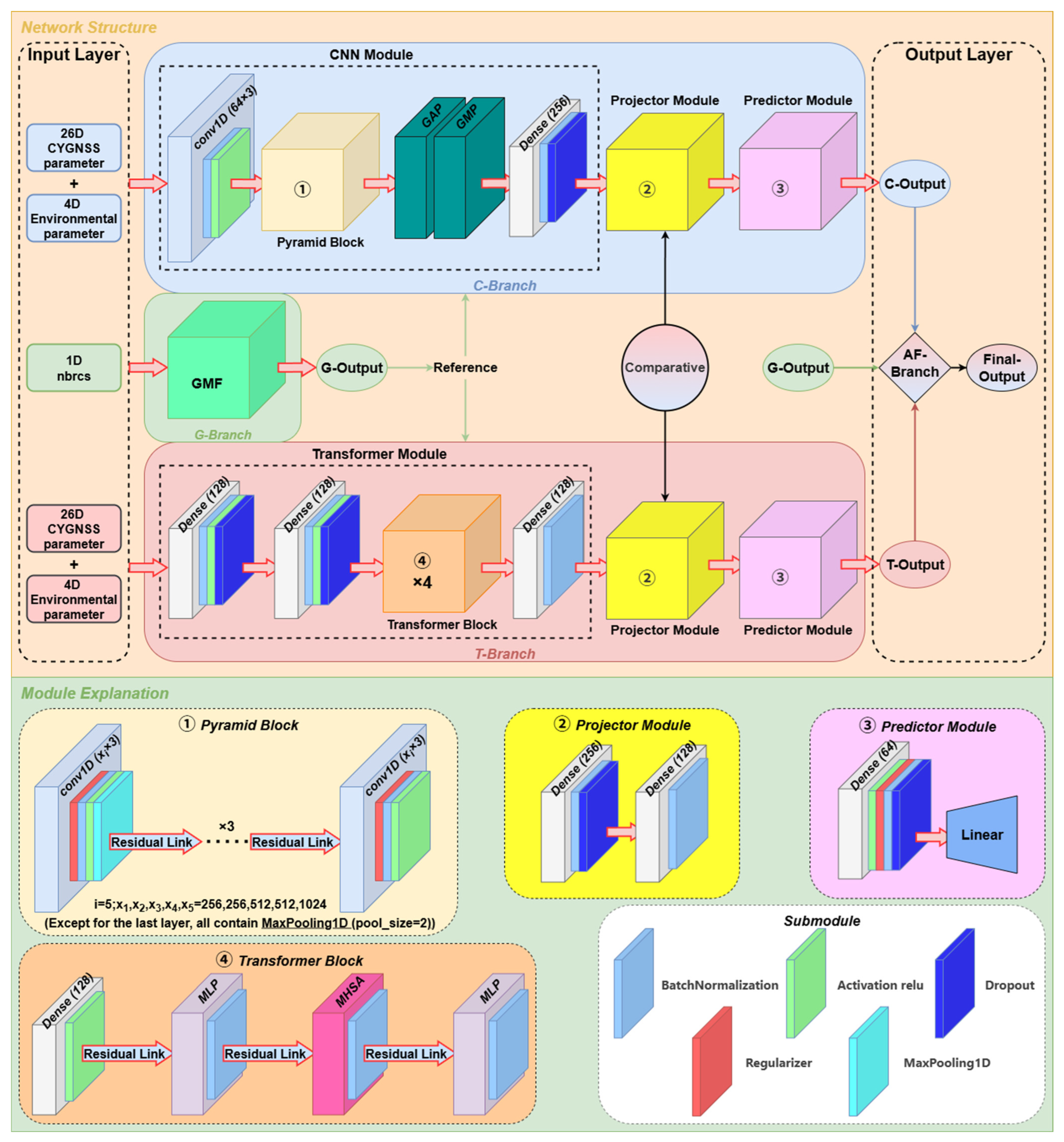
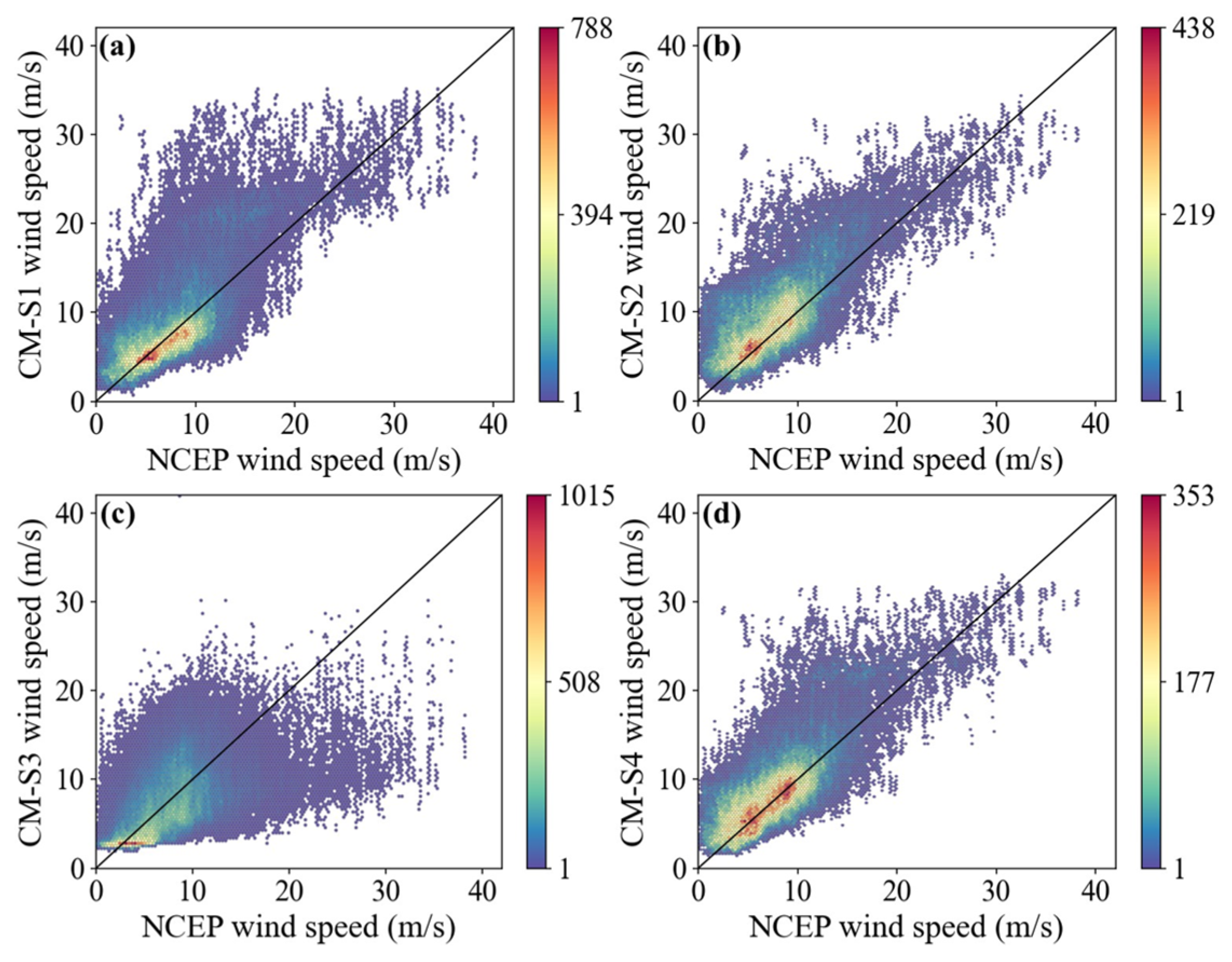
- CM-S1: A standalone CNN identical in structure to the C-Branch in CLCTG (structure shown in Figure 3, C-Branch);
- CM-S2: A standalone Transformer identical in structure to the T-Branch in CLCTG (structure shown in Figure 3, T-Branch);
- CM-S3: A standalone GMF model with parameters identical to those of the G-Branch in CLCTG (A, B, C, D = 43.2987, −0.1420, 2.8226, −0.0009, respectively);
- CM-S4: The CLCTG model with contrastive learning removed;
- CLCTG: Comparative Learning method of CNN–Transformer with GMF fusion.
4.3. Feature Ablation Experiments
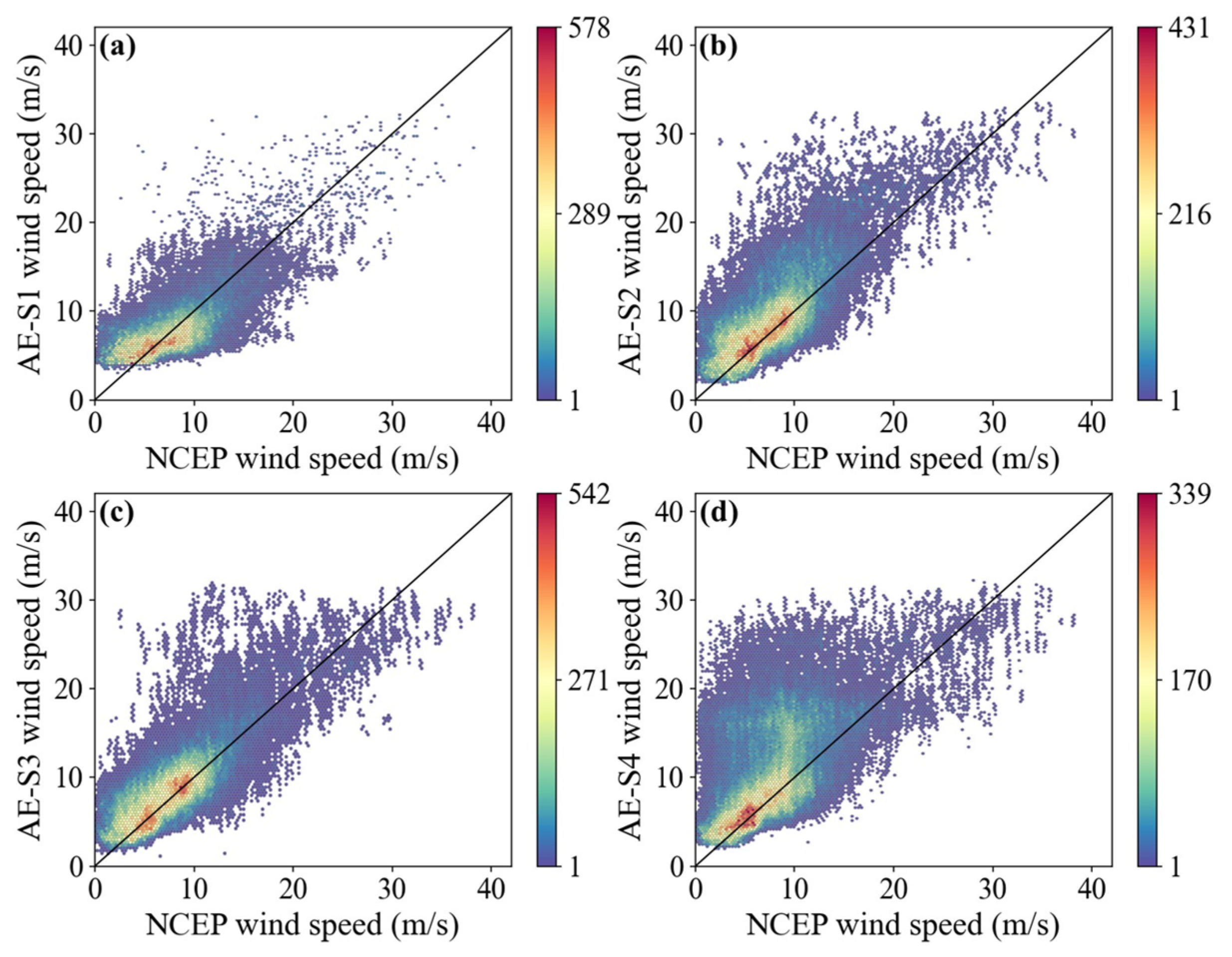
- AE-S1: Only 4 environmental parameters (4 features);
- AE-S2: Only 26 CYGNSS parameters (26 features);
- AE-S3: 26 CYGNSS parameters + 3 environmental parameters (excluding MSL) (29 features);
- AE-S4: 26 CYGNSS parameters + 3 environmental parameters (excluding SWH) (29 features);
- CLCTG: All 26 CYGNSS parameters + 4 environmental parameters (30 features).
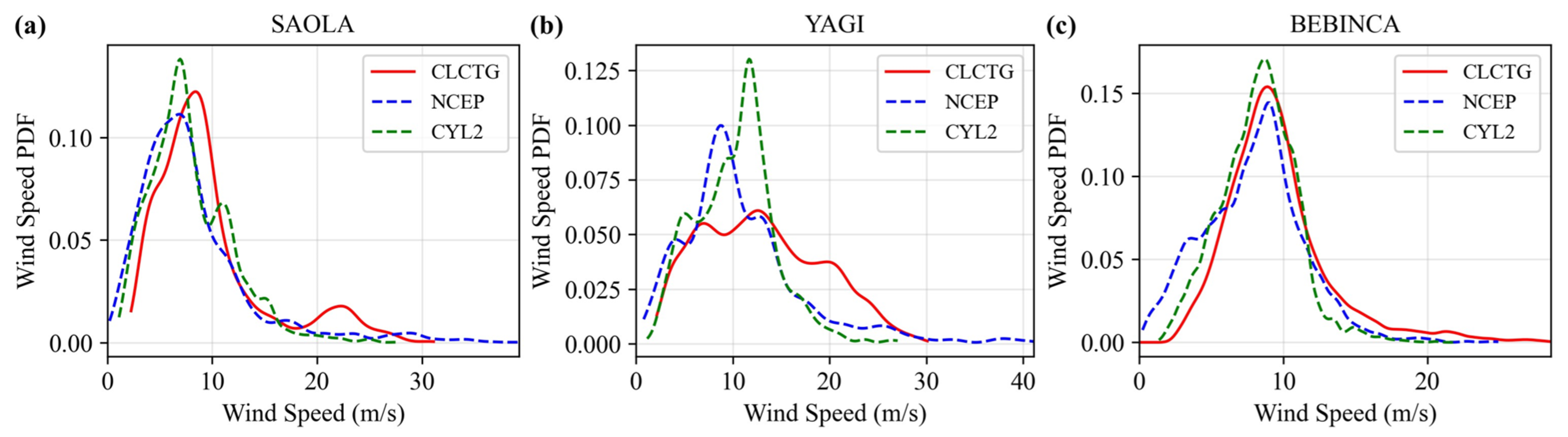
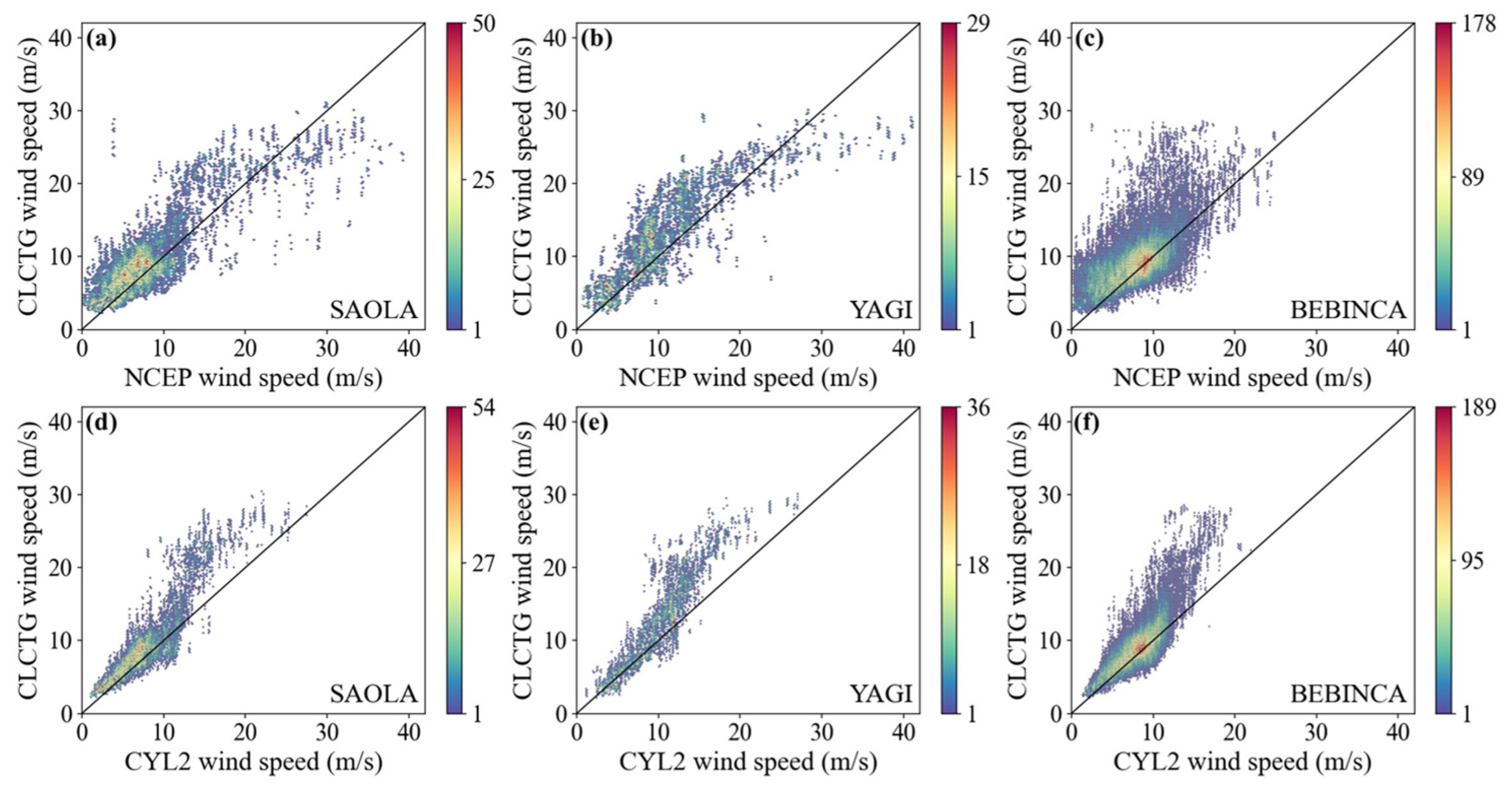
4.4. Comparative Analysis of Wind Speed Retrieval for Eastern Hemisphere Typhoons (Three Cases)
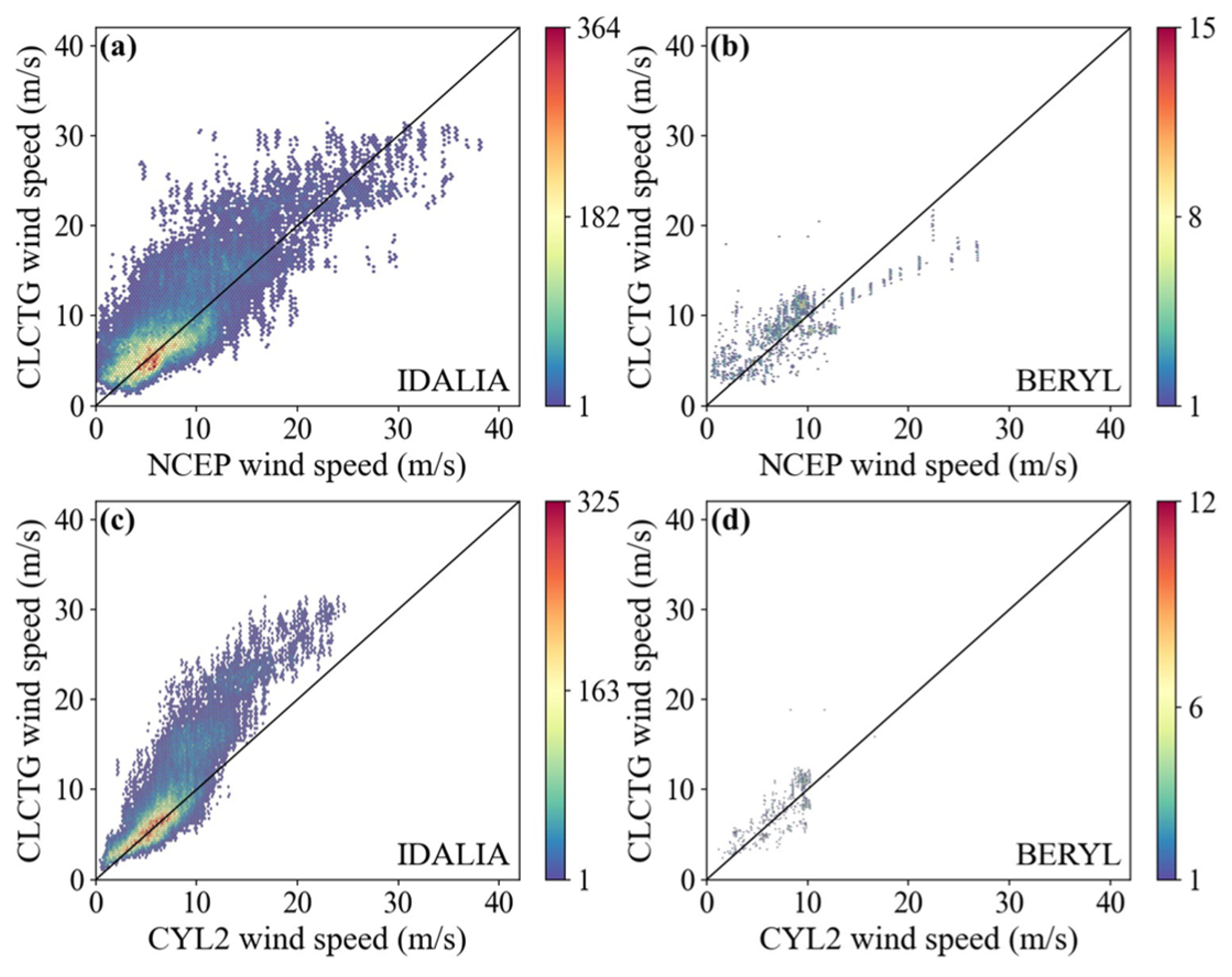
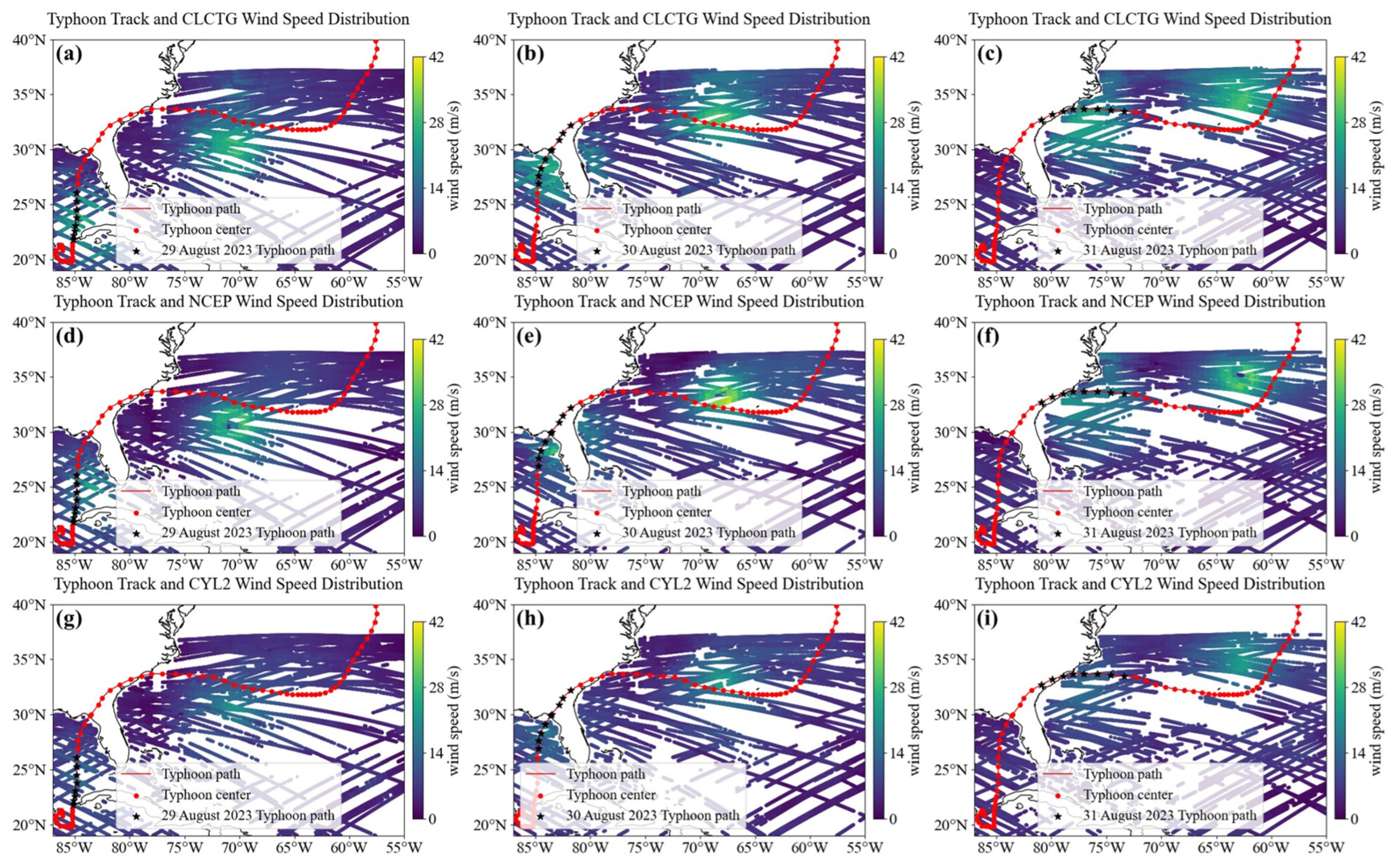
4.5. Comparative Analysis of Wind Speed Retrieval for Western Hemisphere Typhoons (Two Cases)
4.6. Cross-Validation of Results
- (1)
- Validation with IBTrACS Typhoon Center Wind Speeds:
- (2)
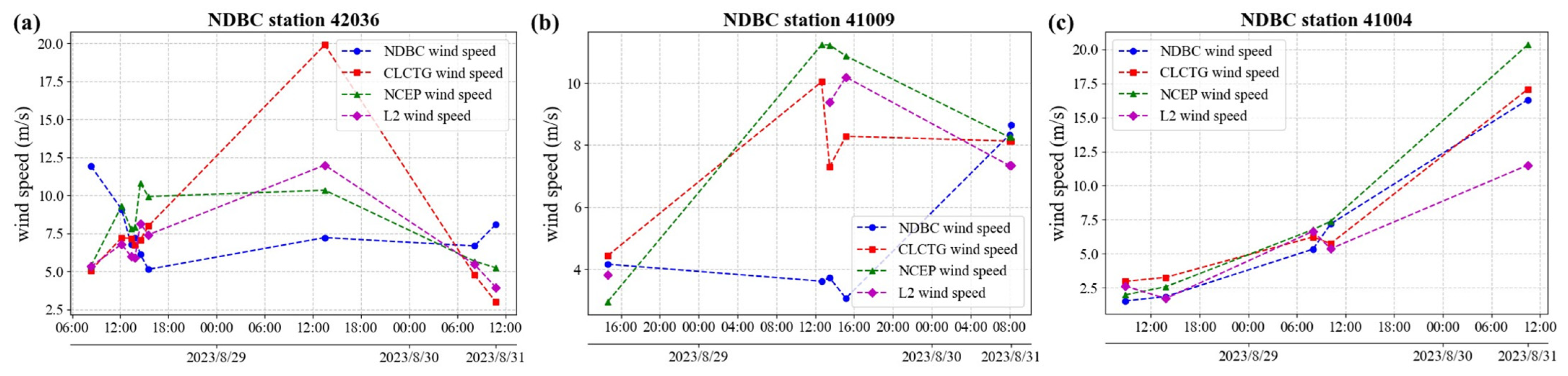
- Validation with NDBC Buoy Measurements (IDALIA):
- (3)
- Synthesis:
4.7. Discussion of Results
- (1)
- Systematic overestimation and side effects of data augmentation: The model exhibits systematic positive bias in typhoon core regions and in the 5–15 m/s interval. For example, at IDALIA’s core (station 42036) the predicted value (~19 m/s) is substantially higher than the NDBC observation (7.4 m/s) and the NCEP value used as a training reference (~10.5 m/s) (Figure 15a). This is mainly attributable to the sample augmentation strategy adopted to increase sensitivity to high wind speeds: while it increases the “visibility” of high-wind samples, it also introduces a statistical tendency toward higher wind speeds, thereby amplifying overestimation errors in the low- to moderate-wind-speed range.
- (2)
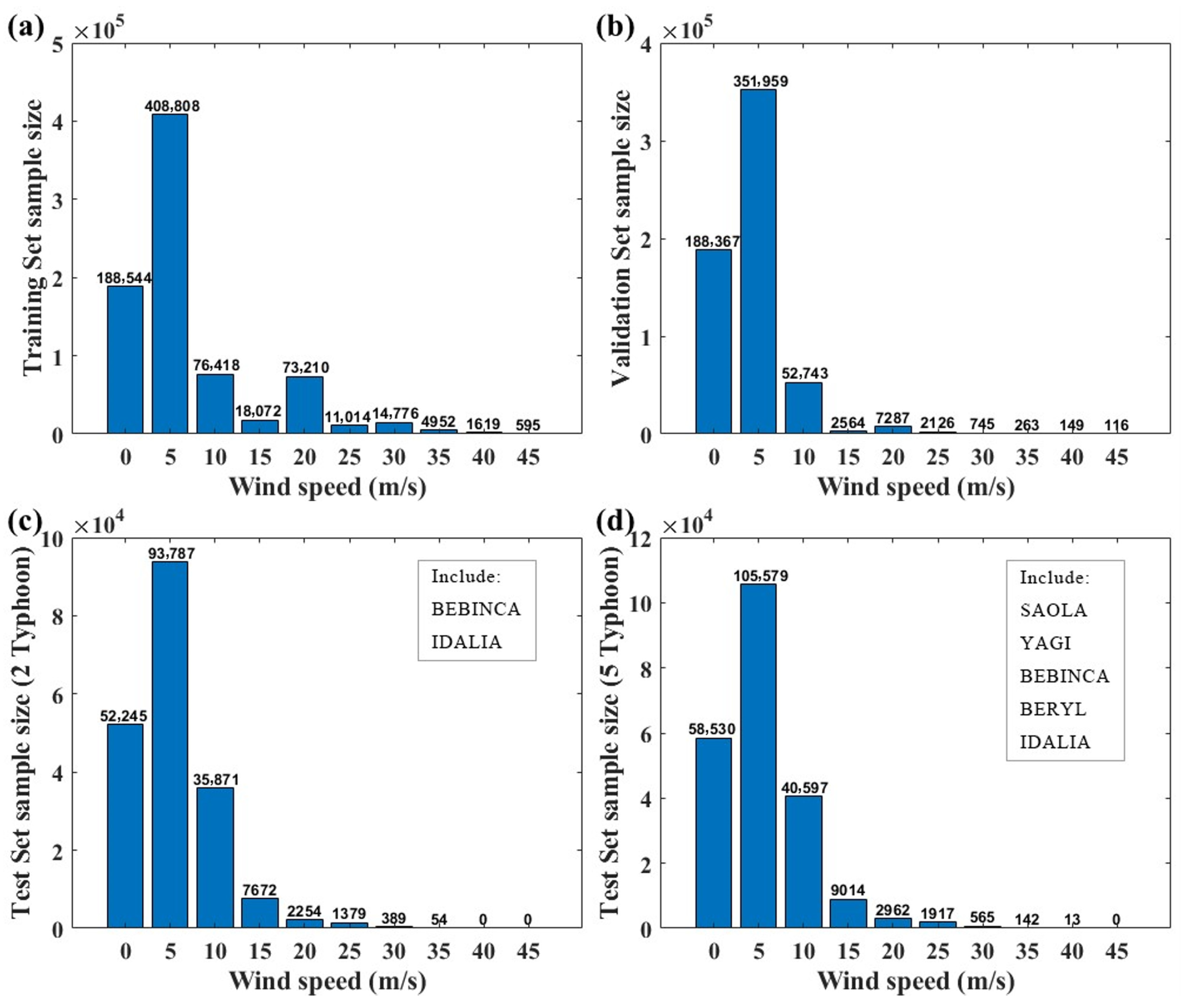
- Sparsity of high-wind samples and reference-data uncertainty: Although >20 m/s samples were augmented, true >30 m/s samples still accounted for a very small fraction of the training set (~2.7%, Figure 2), resulting in insufficient learning of extreme nonlinear features and very few model outputs exceeding 30 m/s (overall proportion ≈ 0.1%). Moreover, the reference data themselves exhibit uncertainty under extreme conditions, which limits the model’s ability to retrieve the most extreme peaks. Thus, the model’s underestimation in the >30 m/s range is related both to sample scarcity and to limitations of the training labels (reference data) and observational physics.
- (3)
- Latency in response to dynamic wind fields: in typhoon peripheral regions (e.g., Station 41009), the model shows delayed response to abrupt wind speed changes (Figure 15b). This arises because the AF-Branch’s fusion strategy based on local statistics tends to over-smooth instantaneous fluctuations in rapidly changing scenarios.
- (4)
- Model complexity and parameter sensitivity: The proposed multi-branch fusion architecture introduces relative structural complexity, and its performance depends on the coordination of multiple components and empirical thresholds within the adaptive fusion. Although Section 4.2 demonstrates the need for the current architecture, the various hyperparameters embedded in the model have not yet been subjected to a systematic sensitivity analysis.
5. Conclusions
Author Contributions
Funding
Data Availability Statement
Acknowledgments
Conflicts of Interest
References
- Jagdish Kumar, S.V.V.A.; Chakraborty, A.; Kumar, R. Validation of wind speed retrieval from RISAT-1 SAR images of the North Indian Ocean. Remote Sens. Lett. 2018, 9, 421–428. [Google Scholar] [CrossRef]
- Gao, Y.; Sun, J.; Zhang, J.; Guan, C. Extreme wind speeds retrieval using sentinel-1 IW mode SAR data. Remote Sens. 2021, 13, 1867. [Google Scholar] [CrossRef]
- Zavorotny, V.U.; Voronovich, A.G. Scattering of GPS signals from the ocean with wind remote sensing application. IEEE Trans. Geosci. Remote Sens. 2000, 38, 951–964. [Google Scholar] [CrossRef]
- Komjathy, A.; Zavorotny, V.U.; Axelrad, P.; Born, G.H.; Garrison, J.L. Gps signal scattering from sea surface. Remote Sens. Environ. 2000, 73, 162–174. [Google Scholar] [CrossRef]
- Clarizia, M.P.; Ruf, C.S.; Jales, P.; Gommenginger, C. Spaceborne GNSS-R minimum variance wind speed estimator. IEEE Trans. Geosci. Remote Sens. 2014, 52, 6829–6843. [Google Scholar] [CrossRef]
- Rodriguez-Alvarez, N.; Garrison, J.L. Generalized linear observables for ocean wind retrieval from calibrated GNSS-R delay–doppler maps. IEEE Trans. Geosci. Remote Sens. 2016, 54, 1142–1155. [Google Scholar] [CrossRef]
- Ruf, C.S.; Balasubramaniam, R. Development of the CYGNSS geophysical model function for wind speed. IEEE J. Sel. Top. Appl. Earth Obs. Remote Sens. 2019, 12, 66–77. [Google Scholar] [CrossRef]
- Li, Z.; Guo, F.; Chen, F.; Zhang, Z.; Zhang, X. Wind speed retrieval using GNSS-R technique with geographic partitioning. Satell. Navig. 2023, 4, 4. [Google Scholar] [CrossRef]
- Liu, Y.; Collett, I.; Morton, Y.J. Application of neural network to GNSS-R wind speed retrieval. IEEE Trans. Geosci. Remote Sens. 2019, 57, 9756–9766. [Google Scholar] [CrossRef]
- Reynolds, J.; Clarizia, M.P.; Santi, E. Wind speed estimation from CYGNSS using artificial neural networks. IEEE J. Sel. Top. Appl. Earth Obs. Remote Sens. 2020, 13, 708–716. [Google Scholar] [CrossRef]
- Chu, X.; He, J.; Song, H.; Qi, Y.; Sun, Y.; Bai, W.; Li, W.; Wu, Q. Multimodal deep learning for heterogeneous GNSS-R data fusion and ocean wind speed retrieval. IEEE J. Sel. Top. Appl. Earth Obs. Remote Sens. 2020, 13, 5971–5981. [Google Scholar] [CrossRef]
- Asgarimehr, M.; Zhelavskaya, I.; Foti, G.; Reich, S.; Wickert, J. A GNSS-R geophysical model function: Machine learning for wind speed retrievals. IEEE Geosci. Remote Sens. Lett. 2020, 17, 1333–1337. [Google Scholar] [CrossRef]
- Bu, J.; Yu, K.; Zuo, X.; Ni, J.; Li, Y.; Huang, W. GloWS-Net: A deep learning framework for retrieving global sea surface wind speed using spaceborne GNSS-R data. Remote Sens. 2023, 15, 590. [Google Scholar] [CrossRef]
- Zhao, D.; Heidler, K.; Asgarimehr, M.; Arnold, C.; Xiao, T.; Wickert, J.; Zhu, X.X.; Mou, L. DDM-Former: Transformer networks for GNSS reflectometry global ocean wind speed estimation. Remote Sens. Environ. 2023, 294, 113629. [Google Scholar] [CrossRef]
- Asgarimehr, M.; Arnold, C.; Weigel, T.; Ruf, C.; Wickert, J. GNSS reflectometry global ocean wind speed using deep learning: Development and assessment of CyGNSSnet. Remote Sens. Environ. 2022, 269, 112801. [Google Scholar] [CrossRef]
- Guo, W.; Du, H.; Guo, C.; Southwell, B.J.; Cheong, J.W.; Dempster, A.G. Information fusion for GNSS-R wind speed retrieval using statistically modified convolutional neural network. Remote Sens. Environ. 2022, 272, 112934. [Google Scholar] [CrossRef]
- Lu, C.; Wang, Z.; Wu, Z.; Zheng, Y.; Liu, Y. Global Ocean Wind Speed Retrieval from GNSS Reflectometry Using CNN-LSTM Network. IEEE Trans. Geosci. Remote Sens. 2023, 61, 5801112. [Google Scholar] [CrossRef]
- Du, H.; Li, W.; Cardellach, E.; Ribó, S.; Rius, A.; Nan, Y. Deep residual fully connected network for GNSS-R wind speed retrieval and its interpretation. Remote Sens. Environ. 2024, 313, 114375. [Google Scholar] [CrossRef]
- Ge, C.; Liang, Y.; Song, Y. Revitalizing cnn attention via transformers in self-supervised visual representation learning. Adv. Neural Inf. Process. Syst. 2021, 34, 4193–4206. [Google Scholar]
- Zhang, Y.; Chen, X.; Meng, W.; Yang, S.; Han, Y.; Hong, Z.; Yin, J.; Liu, W. Wind direction retrieval from CYGNSS L1 level sea surface data based on machine learning. IEEE Trans. Geosci. Remote Sens. 2022, 60, 5804413. [Google Scholar] [CrossRef]
- Ruf, C. Level 1 and 2 uncertainty analyses. In CYGNSS Handbook 2022; Chapter 11; Michigan Publishing Services: Ann Arbor, MI, USA, 2022; p. 164. [Google Scholar] [CrossRef]
- CYGNSS Level 1 Science Data Record Version 2.1: Vol. 2.1. Cygnss, PO.DAAC, CA, USA. 2018. Available online: https://podaac.jpl.nasa.gov/dataset/CYGNSS_L1_V2.1 (accessed on 14 January 2026).
- Yang, D.; Zhang, Q. GNSS-R sea surface wind measurement applications. In Gnss Reflected Signal Processing: Fundamentals and Applications; Chapter 9; Section 2; Publishing House of Electronics Industry: Beijing, China, 2012; p. 164. [Google Scholar]
- Bu, J.; Yu, K. Sea surface rainfall detection and intensity retrieval based on gnss-reflectometry data from the CYGNSS mission. IEEE Trans. Geosci. Remote Sens. 2022, 60, 5802015. [Google Scholar] [CrossRef]
- Voronovich, A.G.; Zavorotny, V.U. Bistatic radar equation for signals of opportunity revisited. IEEE Trans. Geosci. Remote Sens. 2018, 56, 1959–1968. [Google Scholar] [CrossRef]
- Gleason, S. Level 1B DDM Calibration Algorithm Theoretical Basis Document. CYGNSS Project Document. 2020. Available online: http://cygnss.engin.umich.edu/wp-content/uploads/sites/534/2021/07/148-0137_ATBD-L1B-DDM-Calibration_R3_release.pdf (accessed on 14 January 2026).
- Zhang, Y.; Mu, B.; Lin, M.; Song, Q. An evaluation of the chinese HY-2B satellite’s microwave scatterometer instrument. IEEE Trans. Geosci. Remote Sens. 2021, 59, 4513–4521. [Google Scholar] [CrossRef]
- Ecmwf. ERA5 Hourly Data on Single Levels from 1940 to Present. Copernicus Climate Change Service (C3S), Climate Data Store (CDS). 2023. Available online: https://cds.climate.copernicus.eu/doi/10.24381/cds.adbb2d47 (accessed on 14 January 2026).
- Hou, M.; Wang, G.; Bu, Q. Analysis of Wind Speed Characteristics in China’s Coastal Waters Based on Four Types of Reanalysis Data. Tianjin Sci. Technol. 2017, 44, 109–113. [Google Scholar] [CrossRef]
- Pan, Y.; Xu, J.; Zhang, Y.; Yuan, S.; Zhu, W. Simulation of Tropical Cyclones over the Northwest Pacific in 2015 Based on the East Asian Regional Reanalysis System. J. Guangdong Ocean Univ. 2020, 40, 53–63. [Google Scholar]
- Ribeiro, M.T.; Singh, S.; Guestrin, C. Why should I trust you? In Proceedings of the 22nd ACM SIGKDD International Conference on Knowledge Discovery and Data Mining, San Francisco, CA, USA, 13–17 August 2016; pp. 1135–1144. [Google Scholar] [CrossRef]
- Zhang, Y.; Yin, J.; Yang, S.; Meng, W.; Han, Y.; Yan, Z. High wind speed inversion model of CYGNSS sea surface data based on machine learning. Remote Sens. 2021, 13, 3324. [Google Scholar] [CrossRef]
- Ruf, C.S.; Gleason, S.; McKague, D.S. Assessment of CYGNSS wind speed retrieval uncertainty. IEEE J. Sel. Top. Appl. Earth Obs. Remote Sens. 2019, 12, 87–97. [Google Scholar] [CrossRef]
- Clarizia, M.P.; Ruf, C.S. Wind speed retrieval algorithm for the Cyclone Global Navigation Satellite System (CYGNSS) mission. IEEE Trans. Geosci. Remote Sens. 2016, 54, 4419–4432. [Google Scholar] [CrossRef]
- Maheshwari, M.; Chakraborty, A.; Kumar, A.; Nirmala, S. Cyclonic wind speed retrieval based on Bayesian regularized neural network using CYGNSS data. J. Appl. Remote Sens. 2021, 15, 024521. [Google Scholar] [CrossRef]
- Zhang, Y.; Zhao, X.; Yang, S.; Han, Y.; Hong, Z.; Meng, W.; Chen, Z.; Liu, W. Research on sea surface wind speed FM based on CYGNSS and HY-2B microwave scatterometer. IEEE Trans. Geosci. Remote Sens. 2024, 62, 5800415. [Google Scholar] [CrossRef]
- Wang, T.; Ruf, C.S.; Gleason, S.; O’Brien, A.J.; McKague, D.S.; Block, B.P.; Russel, A. Dynamic calibration of GPS effective isotropic radiated power for GNSS-reflectometry Earth remote sensing. IEEE Trans. Geosci. Remote Sens. 2022, 60, 5800512. [Google Scholar] [CrossRef]
- Powell, C.E.; Ruf, C.S.; McKague, D.S.; Wang, T.; Russel, A. An instrument error correlation model for global navigation satellite system reflectometry. Remote Sens. 2024, 16, 742. [Google Scholar] [CrossRef]
- Lundberg, S.; Lee, S.-I. A unified approach to interpreting model predictions. arXiv 2017, arXiv:1705.07874. [Google Scholar] [CrossRef]
- Lipovetsky, S.; Conklin, M. Analysis of regression in game theory approach. Appl. Stoch. Models Bus. Ind. 2001, 17, 319–330. [Google Scholar] [CrossRef]



| Date | Data Range | Quantity |
|---|---|---|
| 2019 | >30 m/s | 9214 |
| 2020 | >30 m/s | 3484 |
| 2021 | >30 m/s | 3662 |
| 2022 | >20 m/s | 88,726 |
| 4 September 2022 | 0–20 m/s | 691,842 |
| January–July 2023 | >30 m/s | 1080 |
| Date | Data Range | Quantity |
|---|---|---|
| October 2023 | >20 m/s | 10,686 |
| 11 October 2023 | 0–20 m/s | 595,633 |
| Area | Name | Date | Quantity | NCEP Peak Wind Speed | Range |
|---|---|---|---|---|---|
| Eastern Hemisphere Typhoon | SAOLA | 29–31 August 2023 | 16,287 | 39.3 m/s | 15°~25° N 105°~125° E |
| YAGI | 5–7 September 2024 | 7423 | 41.1 m/s | ||
| BEBINCA | 14–16 September 2024 | 89,173 | 24.9 m/s | 10°~30° N 120°~150° E | |
| Western Hemisphere Typhoon | BERYL | 1–3 July 2024 | 1958 | 26.8 m/s | 8°~40° N −97°~−25° W |
| IDALIA | 29–31 August 2023 | 104,478 | 38.2 m/s | 19°~40° N −87°~−55° W |
| Type | Parameters | Description |
|---|---|---|
| CYGNSS (26 Parameters) | prn_code (PRN) | GPS PRN code |
| ddm_nbrcs (NBRCS) | Normalized BRCS | |
| ddm_les (LES) | Leading-edge slope | |
| sp_ddmi_delay_correction (sddc) | Correction to DDMI specular point delay | |
| zenith_code_phase (zcp) | Zenith signal code phase | |
| range_corrected_gain (RCG) | Range corrected gain | |
| sp_fsw_delay (sfd) | Flight software specular point delay | |
| ddm_snr (SNR) | DDM signal-to-noise ratio | |
| sp_rx_gain (sg) | Specular point Rx antenna gain | |
| sp_inc_angle (angle) | Specular point incidence angle | |
| brcs_ddm_sp_bin_delay_row (br) | BRCS DDM specular point delay row | |
| brcs_ddm_sp_bin_dopp_col (brcc) | BRCS DDM specular point Doppler column | |
| brcs_ddm_peak_bin_delay_row (brr) | BRCS DDM peak bin delay row | |
| brcs_ddm_peak_bin_dopp_col (brc) | BRCS DDM peak bin Doppler column | |
| sc_pos(x/y/z) (spx, spy, spz) | Spacecraft position X/Y/Z at DDM sample time | |
| sc_vel(x/y/z) (scx, scy, scz) | Spacecraft velocity X/Y/Z at DDM sample time | |
| tx_pos(x/y/z) (tpx, tpy, tpz) | GPS Transmitter position X/Y/Z | |
| tx_vel(x/y/z) (tvx, tvy, tyz) | GPS Transmitter velocity X/Y/Z | |
| Environmental (4 Parameters) | MSL | Mean sea level pressure |
| SWH | Significant height of combined wind waves and swell | |
| SST | Sea surface temperature | |
| TP | Total precipitation |
| Category | Parameter | Value/Description |
|---|---|---|
| Computing Environment | Framework | TensorFlow 2.10, Keras, Scikit-learn |
| Hardware | NVIDIA GPU RTX 3060 (40 GB Memory) and 64 GB RAM | |
| Data Preprocessing | Normalization | Z-score Standardization (StandardScaler) |
| Sampling | Stratified sampling by wind speed bins | |
| Model Architecture | Projector Module | MLP (256, 128) + Batch Normalization |
| Dropout | 0.3 (Branches), 0.1–0.4 (Transformer heads) | |
| Regularization | L2 weight decay (0.0001) | |
| Contrastive Learning | Temperature Parameter (τ) | 0.07 |
| Margin | 0.1 m/s (Soft labeling) | |
| Training Configuration | Optimizer | Adam (initial ) |
| Scheduler | 10-epoch Linear Warmup + Smooth Decay | |
| Early Stopping | Patience = 10 (Monitor: val_loss) | |
| Loss weights () | 1.0, 0.8, 0.7, 0.6 |
| Num (m/s) | 0–5 | 5–10 | 10–15 | 15–20 | >20 | All |
|---|---|---|---|---|---|---|
| AB-S1 | 3.75 | 3.83 | 5.43 | 5.53 | 3.78 | 4.23 |
| AB-S2 | 3.98 | 2.93 | 3.81 | 4.22 | 3.80 | 3.48 |
| AB-S3 | 2.96 | 3.40 | 4.16 | 7.28 | 13.76 | 4.15 |
| AB-S4 | 2.72 | 2.86 | 4.70 | 5.40 | 4.37 | 3.41 |
| AB-S5 | 4.12 | 3.00 | 3.73 | 3.56 | 4.15 | 3.54 |
| AB-S6 | 3.51 | 2.67 | 3.82 | 4.26 | 4.15 | 3.25 |
| CLCTG | 3.40 | 2.91 | 3.80 | 4.30 | 3.67 | 3.30 |
| Num (m/s) | 0–5 | 5–10 | 10–15 | 15–20 | >20 | All |
|---|---|---|---|---|---|---|
| CM-S1 | 3.31 | 3.37 | 5.12 | 5.54 | 4.01 | 3.86 |
| CM-S2 | 4.39 | 3.13 | 3.65 | 4.20 | 3.79 | 3.66 |
| CM-S3 | 2.96 | 3.40 | 4.16 | 7.28 | 13.76 | 4.15 |
| CM-S4 | 3.32 | 2.76 | 3.91 | 4.71 | 3.81 | 3.27 |
| CLCTG | 3.40 | 2.91 | 3.80 | 4.30 | 3.67 | 3.30 |
| Num (m/s) | 0–5 | 5–10 | 10–15 | 15–20 | >20 | All |
|---|---|---|---|---|---|---|
| CM-S1 | 2.37 | 2.11 | 3.91 | 4.64 | 3.09 | 2.64 |
| CM-S2 | 3.38 | 2.21 | 2.81 | 3.38 | 3.05 | 2.70 |
| CM-S3 | 2.01 | 2.68 | 3.51 | 6.56 | 12.94 | 3.02 |
| CM-S4 | 2.53 | 1.90 | 2.80 | 3.93 | 3.07 | 2.34 |
| CLCTG | 2.61 | 2.00 | 2.81 | 3.46 | 2.91 | 2.39 |
| Num (m/s) | 0–5 | 5–10 | 10–15 | 15–20 | >20 | All |
|---|---|---|---|---|---|---|
| AE-S1 | 3.22 | 2.10 | 3.43 | 4.67 | 4.77 | 2.91 |
| AE-S2 | 8.49 | 8.89 | 7.34 | 4.18 | 7.25 | 8.34 |
| AE-S3 | 3.20 | 2.48 | 3.48 | 4.44 | 3.99 | 3.02 |
| AE-S4 | 6.20 | 5.31 | 5.06 | 4.20 | 4.85 | 5.47 |
| CLCTG | 3.40 | 2.91 | 3.80 | 4.30 | 3.67 | 3.30 |
| Num (m/s) | 0–5 | 5–10 | 10–15 | 15–20 | >20 | All |
|---|---|---|---|---|---|---|
| AE-S1 | 2.66 | 1.52 | 2.77 | 3.88 | 3.94 | 2.20 |
| AE-S2 | 6.14 | 7.29 | 6.27 | 3.22 | 6.20 | 6.61 |
| AE-S3 | 2.46 | 1.77 | 2.45 | 3.48 | 3.31 | 2.18 |
| AE-S4 | 4.19 | 3.64 | 3.93 | 3.09 | 4.04 | 3.83 |
| CLCTG | 2.61 | 2.00 | 2.81 | 3.46 | 2.91 | 2.39 |
| Typhoon | Type | 0–5 | 5–15 | >15 |
|---|---|---|---|---|
| SAOLA | NCEP | 0.29 | 0.13 | 0.23 |
| CYL2 | 0.28 | 0.10 | 0.48 | |
| YAGI | NCEP | 0.24 | 0.12 | 0.12 |
| CYL2 | 0.21 | 0.09 | 0.36 | |
| BEBINCA | NCEP | 0.35 | 0.04 | 0.23 |
| CYL2 | 0.11 | 0.07 | 0.40 |
| Typhoon | Type | 0–20 | >20 | All |
|---|---|---|---|---|
| SAOLA | NCEP | 3.23 | 5.58 | 3.39 |
| CYL2 | 3.06 | 4.38 | 3.08 | |
| YAGI | NCEP | 3.89 | 5.45 | 4.05 |
| CYL2 | 4.01 | 4.53 | 4.02 | |
| BEBINCA | NCEP | 3.36 | 3.39 | 3.36 |
| CYL2 | 2.47 | 2.17 | 2.47 |
| Typhoon | Type | 0–20 | >20 | All |
|---|---|---|---|---|
| SAOLA | NCEP | 2.50 | 4.12 | 2.58 |
| CYL2 | 2.13 | 3.74 | 2.15 | |
| YAGI | NCEP | 3.10 | 3.81 | 3.16 |
| CYL2 | 3.03 | 4.20 | 3.05 | |
| BEBINCA | NCEP | 2.44 | 2.85 | 2.44 |
| CYL2 | 1.72 | 2.09 | 1.72 |
| Typhoon | Type | 0–20 | >20 | Al l |
|---|---|---|---|---|
| IDALIA | NCEP | 3.23 | 3.68 | 3.25 |
| CYL2 | 3.37 | 6.46 | 3.40 | |
| BERYL | NCEP | 2.50 | 6.98 | 2.79 |
| CYL2 | 1.69 | null | 1.69 |
| Typhoon | Type | 0–20 | >20 | All |
|---|---|---|---|---|
| IDALIA | NCEP | 2.32 | 2.91 | 2.35 |
| CYL2 | 2.22 | 6.12 | 2.25 | |
| BERYL | NCEP | 2.02 | 6.44 | 2.18 |
| CYL2 | 1.44 | null | 1.44 |
| Typhoon | Timestamp | Date | IBTrACS Wind Speed (m/s) | Distance (km) | CLCTG Wind Speed (m/s) | NCEP Wind Speed (m/s) | CYL2 Wind Speed (m/s) | ||||
|---|---|---|---|---|---|---|---|---|---|---|---|
| ① | ② | ① | ② | ① | ② | ① | ② | ||||
| SAOLA | 1 | 29 August 2023, 18:00 | 71.96 | 39.27 | 49.94 | 23.85 | 29.87 | 28.85 | 26.36 | 17.48 | 20.79 |
| SAOLA | 2 | 30 August 2023, 18:00 | 66.82 | 20.95 | 33.08 | 24.89 | 28.40 | 29.22 | 31.42 | 24.50 | 27.48 |
| SAOLA | 3 | 1 September 2023, 00:00 | 59.11 | 6.48 | 6.48 | 30.45 | 30.45 | 29.52 | 29.52 | 22.03 | 22.03 |
| YAGI | 4 | 6 September 2024, 03:00 | 64.76 | 39.27 | 40.05 | 29.20 | 29.36 | 15.47 | 15.47 | 25.84 | 25.84 |
| BEBINCA | 5 | 14 September 2024, 03:00 | 27.24 | 18.08 | 27.03 | 25.83 | 27.37 | 5.43 | 5.43 | 15.06 | 15.06 |
| BEBINCA | 6 | 15 September 2024, 00:00 | 32.90 | 31.30 | 32.36 | 22.72 | 23.24 | 5.11 | 5.11 | 20.47 | 20.47 |
| IDALIA | 7 | 29 August 2023, 09:00 | 34.95 | 20.87 | 31.88 | 23.99 | 24.11 | 9.06 | 7.48 | 12.73 | 13.62 |
| IDALIA | 8 | 29 August 2023, 15:00 | 38.55 | 42.58 | 43.96 | 22.02 | 23.94 | 14.04 | 15.60 | 13.95 | 15.08 |
| IDALIA | 9 | 30 August 2023, 06:00 | 53.97 | 23.54 | 42.54 | 25.59 | 26.63 | 22.80 | 22.80 | 18.57 | 18.57 |
| IDALIA | 10 | 30 August 2023, 09:00 | 59.11 | 5.61 | 31.65 | 23.49 | 27.73 | 22.39 | 12.00 | 16.90 | 17.16 |
Disclaimer/Publisher’s Note: The statements, opinions and data contained in all publications are solely those of the individual author(s) and contributor(s) and not of MDPI and/or the editor(s). MDPI and/or the editor(s) disclaim responsibility for any injury to people or property resulting from any ideas, methods, instructions or products referred to in the content. |
© 2026 by the authors. Licensee MDPI, Basel, Switzerland. This article is an open access article distributed under the terms and conditions of the Creative Commons Attribution (CC BY) license.
Share and Cite
Zhang, Y.; Teng, Z.; Yang, S.; Shi, Q.; Li, J.; Guo, F.; Peng, B.; Han, Y.; Hong, Z. Fused Geophysical–Contrastive Learning Model for CYGNSS-Based Sea Surface Wind Speed Retrieval in Typhoon Regions. J. Mar. Sci. Eng. 2026, 14, 208. https://doi.org/10.3390/jmse14020208
Zhang Y, Teng Z, Yang S, Shi Q, Li J, Guo F, Peng B, Han Y, Hong Z. Fused Geophysical–Contrastive Learning Model for CYGNSS-Based Sea Surface Wind Speed Retrieval in Typhoon Regions. Journal of Marine Science and Engineering. 2026; 14(2):208. https://doi.org/10.3390/jmse14020208
Chicago/Turabian StyleZhang, Yun, Zelong Teng, Shuhu Yang, Qingjing Shi, Jiaying Li, Fei Guo, Bo Peng, Yanling Han, and Zhonghua Hong. 2026. "Fused Geophysical–Contrastive Learning Model for CYGNSS-Based Sea Surface Wind Speed Retrieval in Typhoon Regions" Journal of Marine Science and Engineering 14, no. 2: 208. https://doi.org/10.3390/jmse14020208
APA StyleZhang, Y., Teng, Z., Yang, S., Shi, Q., Li, J., Guo, F., Peng, B., Han, Y., & Hong, Z. (2026). Fused Geophysical–Contrastive Learning Model for CYGNSS-Based Sea Surface Wind Speed Retrieval in Typhoon Regions. Journal of Marine Science and Engineering, 14(2), 208. https://doi.org/10.3390/jmse14020208