Article

Numerical Modeling of Tsunami Amplification and Beachfront Overland Flow in the Ukai Coast of Japan

1
State Key Laboratory of Hydraulics and Mountain River Engineering, Sichuan University, Chengdu 610065, China
2
FAMU-FSU College of Engineering, Florida A&M University, Tallahassee, FL 32310, USA
*
Author to whom correspondence should be addressed.
J. Mar. Sci. Eng. 2026, 14(2), 193; https://doi.org/10.3390/jmse14020193 (registering DOI)
Submission received: 16 December 2025 / Revised: 12 January 2026 / Accepted: 14 January 2026 / Published: 16 January 2026
(This article belongs to the Section Coastal Engineering)

Abstract

Tsunami amplification and overland flow characteristics have been investigated using numerical modeling in a case study of the Ukai coast during the 2024 tsunami event. The tsunami wave amplification from offshore Iida Bay to Ukai has been investigated by using a hydrodynamic model. The model has been successfully validated by comparing simulated tsunami inundation with observations in Ukai. Non-breaking tsunami amplification from model simulations shows a power law, with a correlation coefficient R2 of 0.97, leading to a 1.84-fold amplification at the breaking depth location. After wave breaking, tsunami amplification follows an exponential function of water depth, with a significantly slower increase rate compared to that before breaking. Tsunami travel time from the Iida Bay offshore boundary to Ukai is determined by comparing tsunami peaks at two different locations. A quick approximation of tsunami travel time using the averaged depth for shallow wave celerity results in an 8.5% error compared to hydrodynamic model simulations. Supercritical and subcritical flow characteristics in the beachfront area have been examined using a wave dynamic model. Based on the Froude number, beachfront overland flow on an asphalt ground surface with low friction results in fast supercritical flow and deeper inundation, which can have major impacts on coastal structures and sediment scour. Grass-covered ground lowers tsunami velocity to slower subcritical flow and lower the maximum inundation height which can reduce the tsunami damage. The findings will provide valuable support for coastal hazard mitigation and resilience studies.

1. Introduction

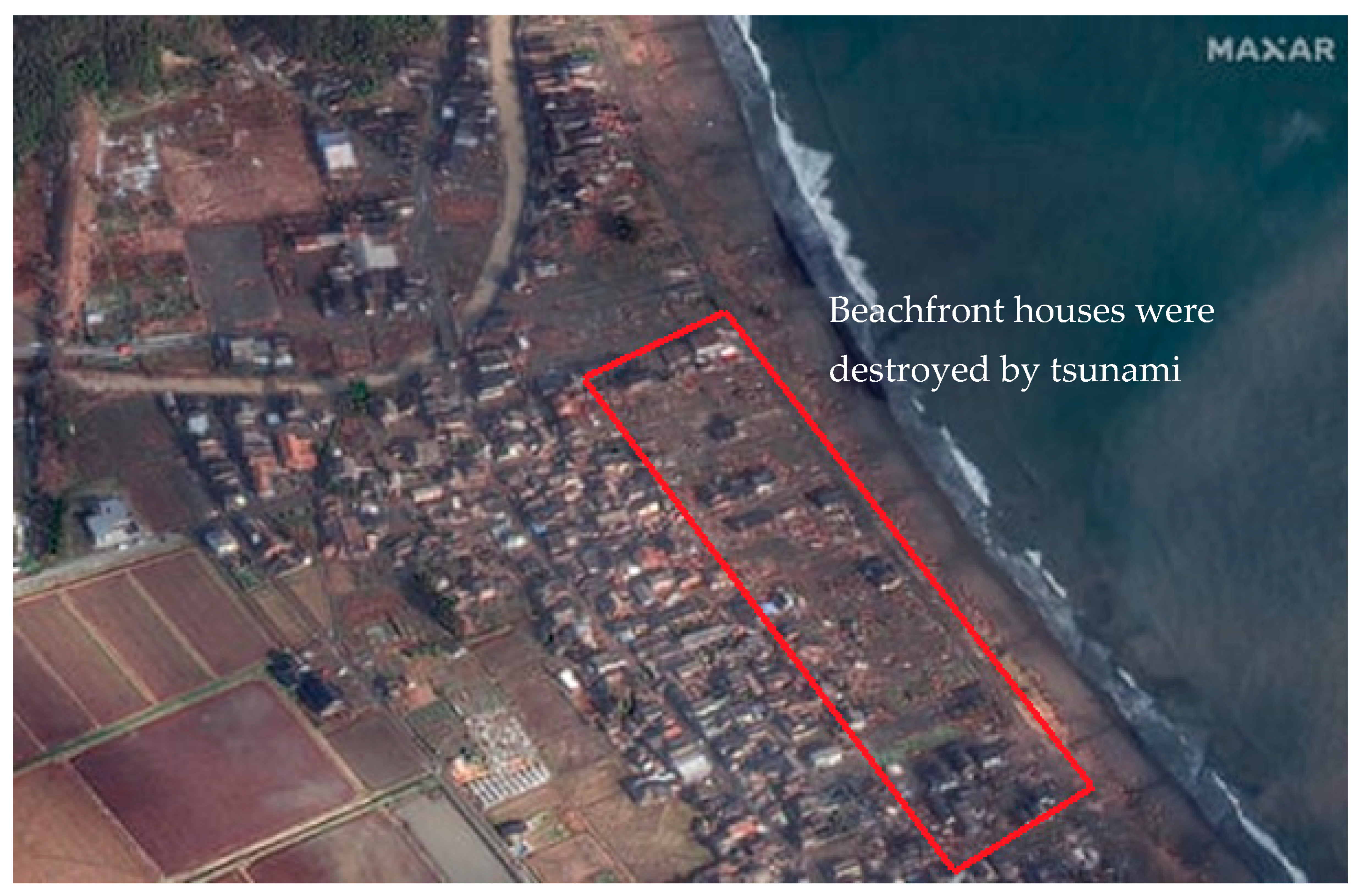
Tsunamis, among the most catastrophic natural disasters, pose a persistent threat to coastal regions worldwide, particularly in seismically active zones like Japan. The 2024 Noto Peninsula Earthquake, a magnitude 7.5 seismic event that struck north of the Noto Peninsula on 1 January 2024 in the epicentral coordinates around 37.49° N latitude and 137.27° E longitude, resulted in a significant tsunami affecting the eastern margin of the Sea of Japan [1]. This tsunami caused widespread coastal inundation and structural damages, with recorded wave heights varying between 1.3 and 5.8 m across affected coastal regions, including Ishikawa, Toyama, and Niigata Prefectures [2,3]. The Ukai coast of the Ishikawa District situated in Iida Bay is one of the most severely impacted areas. According to Yuhi et al. [1], the tsunami inundation in the Ukai area varies approximately from 2.7 m to 5.0 m, with run-up heights peaking at about 5.45 m. Due to the rapid arrival of the tsunami, many residents had little time to evacuate, contributing to significant casualties. Reports indicate that at least 26 lives were lost, with 24 fatalities recorded within Ukai Horyumachi alone [4]. The tsunami’s intense flow velocities and depth variations led to widespread structural destruction in the Ukai area. Floodwaters surged through river channels, increasing the extent of inundation beyond the primary impact zone [5]. Damage mechanisms included wave-induced pressure failures, impact from floating debris, and structural collapse due to sustained submersion [6]. Entire rows of buildings near the shoreline were destroyed, with many structures reduced to rubble [1]. The force of the tsunami was sufficient to destroy or irreparably damage nearly all buildings located within a block of the shoreline (Figure 1), illustrating the extreme vulnerability of low-lying coastal areas to tsunami inundation [7,8]. The damage to beachfront houses also shows the need for an investigation of the rapid supercritical features during the tsunami event. Post-tsunami surveys and remote sensing data captured by the Geospatial Information Authority of Japan (GSI) revealed that the inundation extended as far as 400 m inland, further emphasizing the tsunami’s during the event [9].
Some studies have revealed tsunami propagation in the coastal waters of the Noto Peninsula and Iida Bay. The 2D hydrodynamic modeling studies by Fukui et al. [10] identified wave convergence and interference patterns near the Ukai area as major contributors to the unexpectedly high water levels in the area. Computational simulations [1,11] suggest that multiple waves originating from different sections of the tsunami source merged offshore, amplifying wave heights upon reaching the coast. The amplification of tsunami waves was further enhanced by the superposition of short-period waves generated by wave refraction at the bay’s entrance [12]. Field observations confirmed that the tsunami waves inundated areas up to 400–500 m inland, affecting coastal infrastructure and causing widespread damage [1]. Numerical simulations by Yamanaka et al. [13] revealed that tsunami waves converging from multiple directions led to overlapping waveforms, particularly at Iida Port and Ukai Fishing Port, causing extensive inundation.
Tsunami amplification or shoaling, the process where wave heights increase as waves approach shallow coastal areas from deep water, played a crucial role in amplifying the tsunami impact along the Noto Peninsula coastline. The transition from deep to shallow water alters tsunami characteristics, leading to increased wave heights due to conservation of energy principles [14]. Knowles and Yeh’s [15] study indicates that Green’s law [16] offers a first-order approximation for tsunami shoaling, even though they also find that Green’s Law overestimates tsunami shoaling. However, additional factors such as nonlinearity, frequency dispersion, and wave breaking further shape wave evolution. Some studies have shown that tsunami amplification is not solely dictated by bathymetric slope but also by wave reflection and refraction effects. Steeper nearshore slopes lead to more rapid wave growth, whereas shallower slopes result in gradual amplification [17]. Studies on solitary-like wave shoaling indicate that wave energy can accumulate in certain nearshore regions, leading to unexpectedly high run-up heights [18]. This phenomenon was observed along the coastline near the Noto Peninsula, where some locations experienced inundation exceeding 3–5 m [1]. Additionally, the presence of vorticity in nearshore waters can modify tsunami propagation and shoaling behavior. Numerical simulations incorporating shear flow dynamics by Zhao and Liu [19] have shown that vorticity can potentially enhance wave height variations.
Beachfront overland flow characteristics are another important issue for assessment of the tsunami’s impact on coastal buildings and structures [20,21,22], as well as sediment scours [23,24,25,26], because fast supercritical flow can exert strong damaging forces on coastal houses. In beachfront areas, overland flows usually remain strong because of tsunami runup and overtopping from the adjacent beach slope, which may lead to heavy damage to coastal structures. In laboratory experimental studies of tsunami-like flow forces on structures, Harish et al. [27] found that tsunami forces on coastal structures are related to the Froude number and characteristics in front of the structures, which shows the importance of understanding beachfront overland flow for tsunami impacts on coastal structures. Bottom roughness caused by land cover and vegetation affects tsunami overland flows [28,29,30,31].
In the following sessions, Section 2 describes the study site and data. Section 3 presents the hydrodynamic modeling to investigate tsunami amplification from the entrance of Iida Bay to the Ukai coast by using a hydrodynamic model with a large model grid for fast simulations. In Section 4, a high-resolution VOF (volume of fraction) wave dynamic model [32] is used to simulate more details of tsunami overland inundation and flow characteristics in the beachfront coastal area without structures in Ukai. Discussions of findings and limitations are summarized in Section 5.

2. Available Data in the Study Site

2.1. Study Site and Bathymetry Data

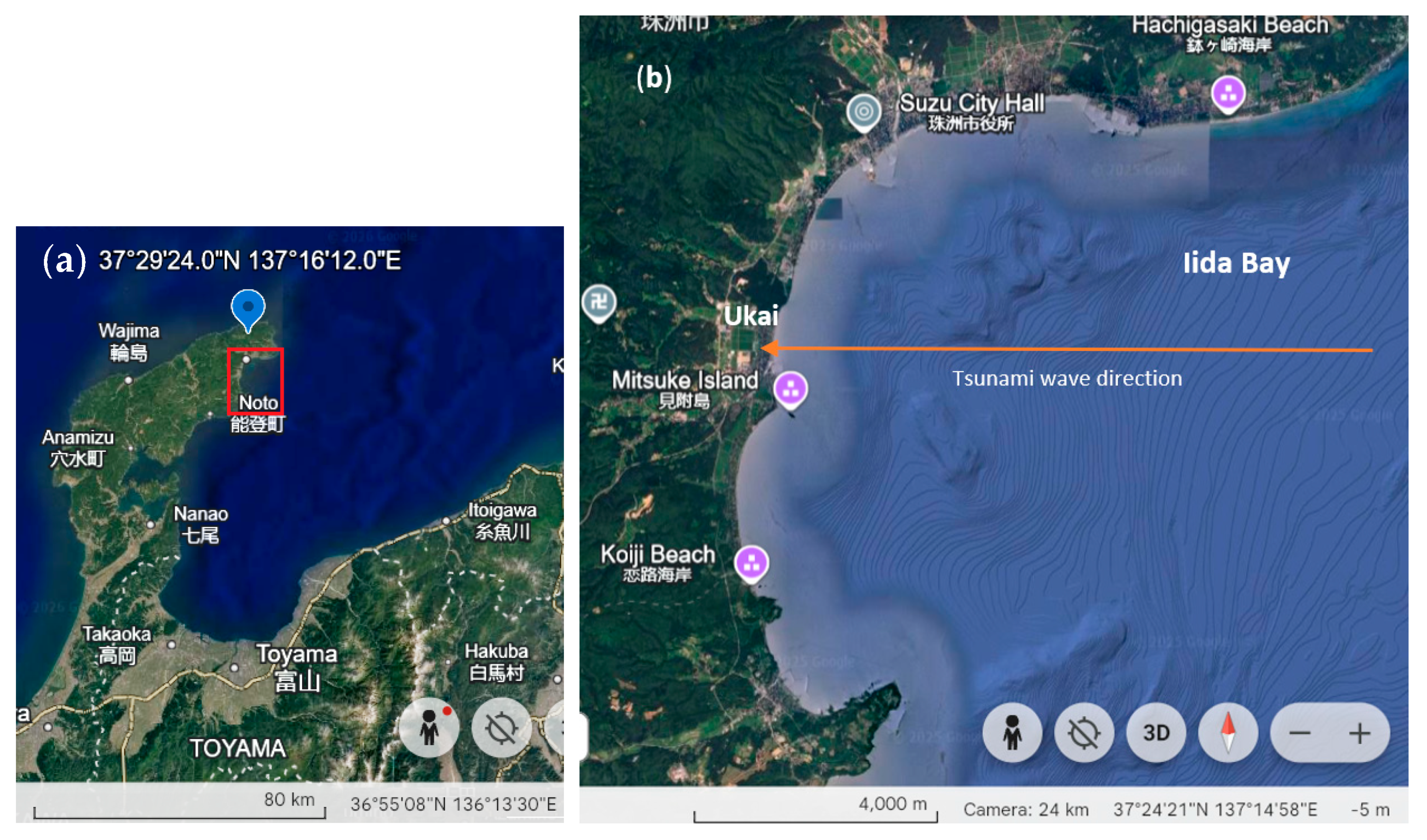
The Ukai area and Iida Bay are selected as the study site in this study (Figure 2). The Ukai coastline is approximately straight and parallel to the coastal bathymetry contour. The bottom elevation for our modeling study follows the line profile extended about 10 km from Ukai to Iida Bay. The epicenter of the earthquake is located at 37.49° N and 137.27° E [1].
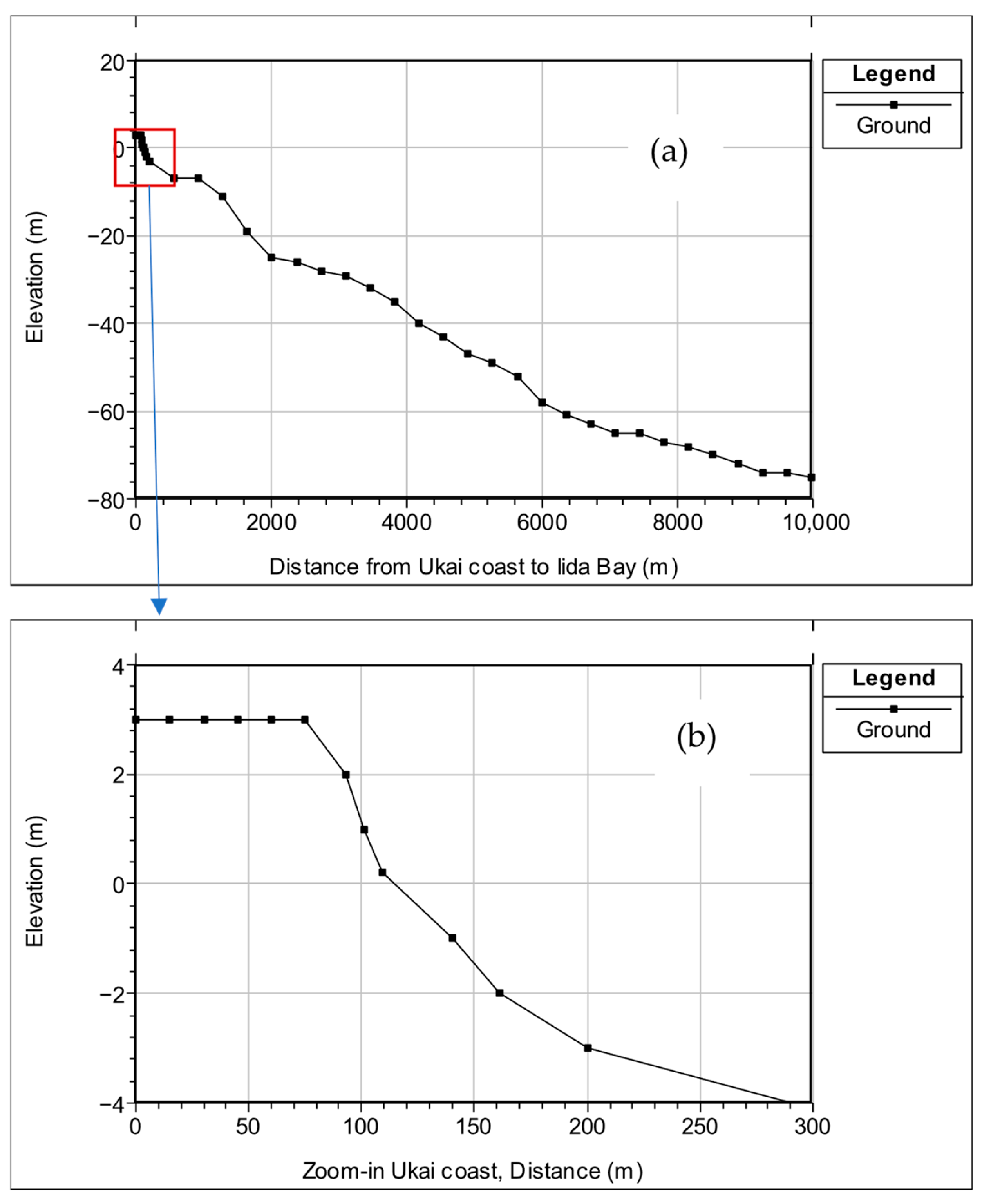
Figure 3. (a) Bottom profile from the Ukai coast to Iida Bay from the cross section showing in Figure 2; (b) zoom-in bottom profile in beachfront ground along a road without structure in the Ukai coast as shown in the red box in (a). Data were obtained from the public domain GEBCO website [33].
Jmse 14 00193 g003
The bottom profile in the bay was obtained from the public domain General Bathymetric Chart of the Oceans [33], which provides the most authoritative publicly available bathymetry of the world’s oceans with the latest released 22 July 2024 (https://download.gebco.net/, accessed on 20 June 2025). Bathymetry data for Iida Bay, at a 362 m resolution, were downloaded from the GEBCO data website and processed to create the bottom profile in the bay along the constant latitude 37°24′22″ line (Figure 2 and Figure 3). Higher-resolution bathymetric profile data near the coastal line and beachfront land area were obtained from the terrain data from Google Earth (Figure 3b). Based on the General Bathymetric Chart of the Oceans [33] and Google Earth, the coastal bathymetry is approximately parallel to the coastline.

2.2. Tsunami Data

The Ukai on the eastern shoreline of Iida Bay (Figure 2) experienced severe tsunami inundation during the event. The absence of protective infrastructure, coupled with the area’s low elevation and proximity to the bay, allowed the tsunami to advance far inland, causing extensive damage [1,5]. Based on the literature [1], tsunami inundation depths ranged between 3 and 5.0 m, while maximum run-up heights reached approximately 5.0 m. Floodwaters extended 200–500 m inland, submerging an area covering approximately 109 hectares [5]. Tsunami waves traveled through river channels, further extending the reach of the floodwaters [1]. For the location selected for this study, the inundation was approximately 3 m based on the inundation chart and color bar given by Yuhi et al. [1].
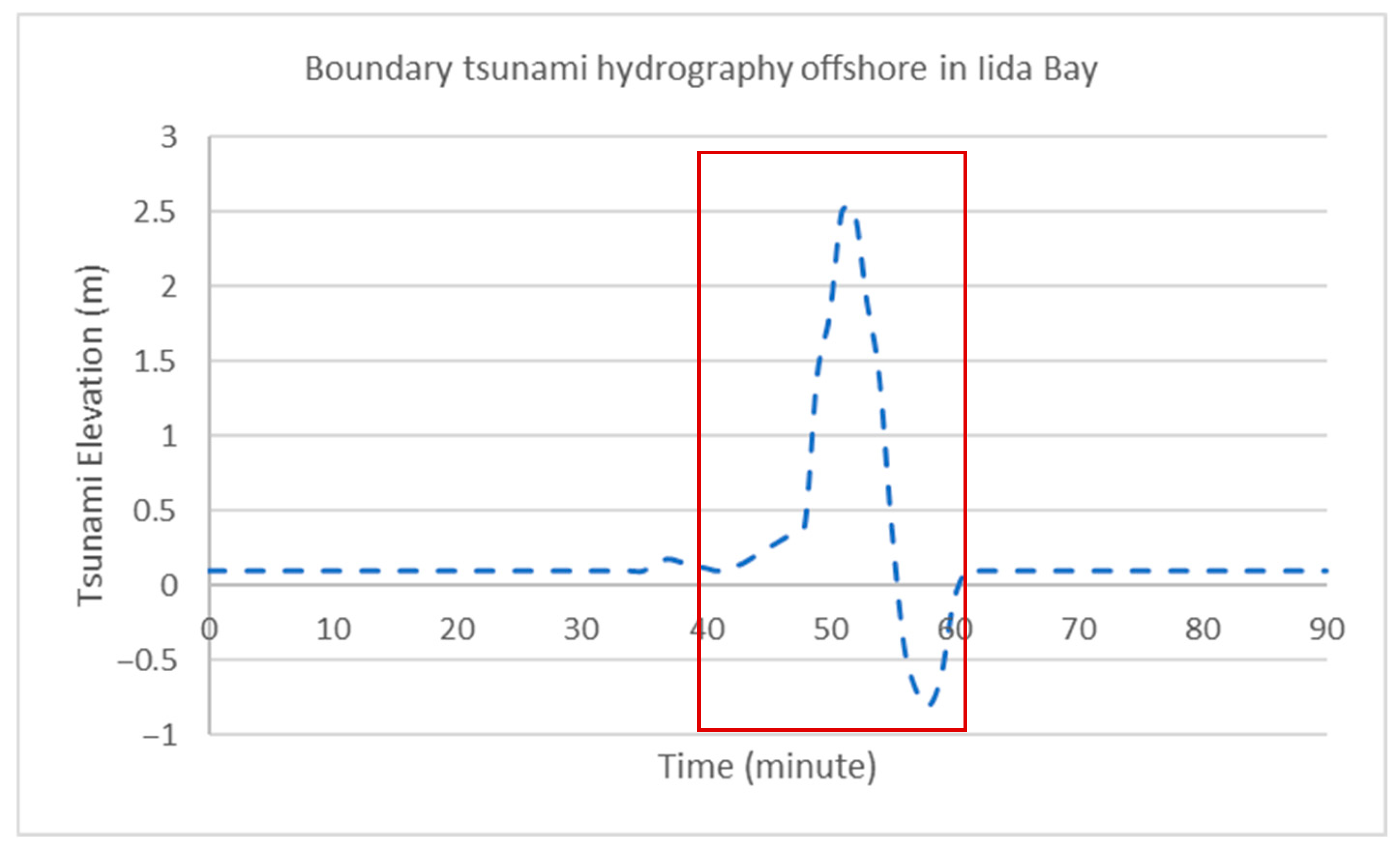
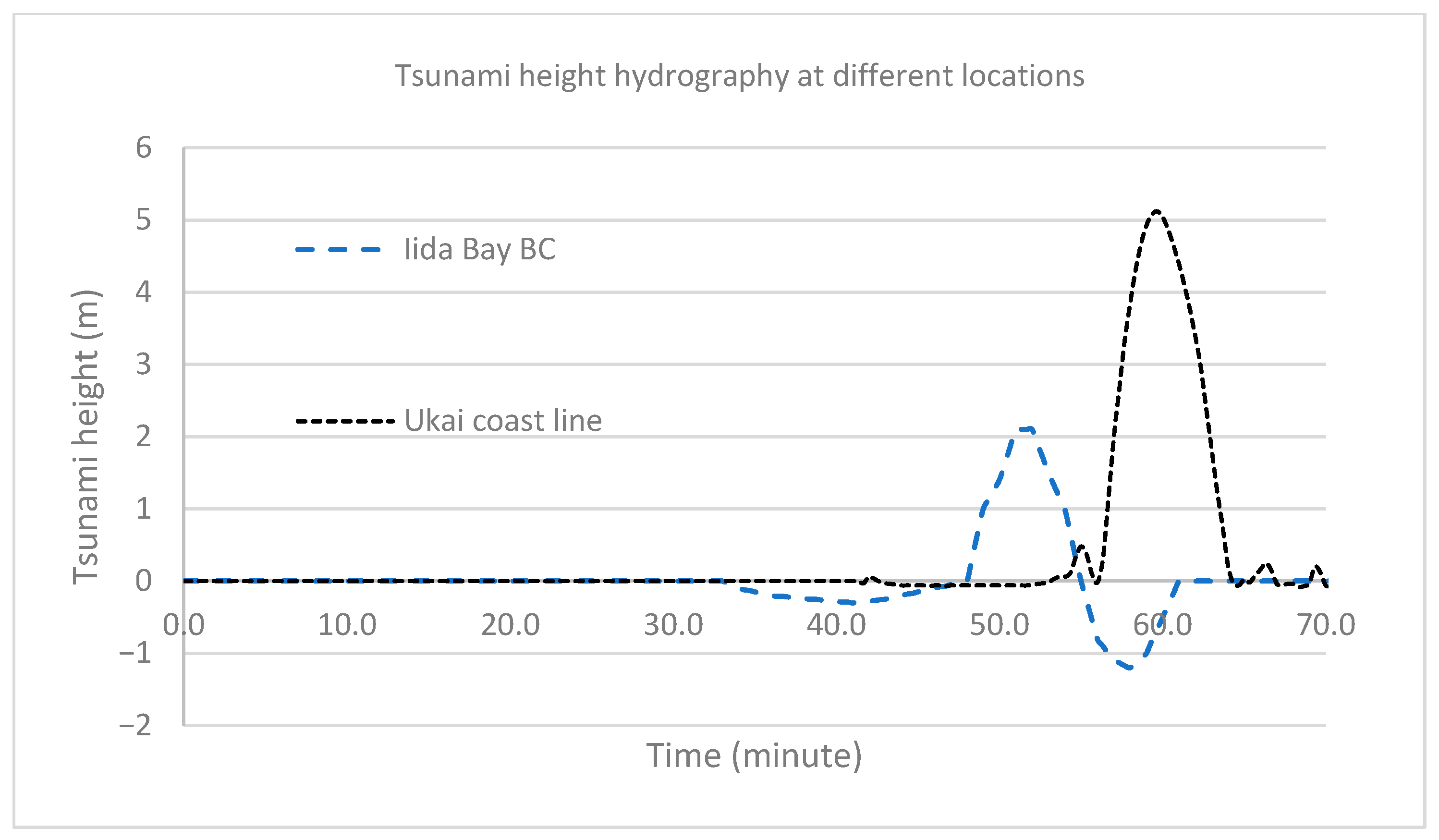
The time series of tsunami hydrography (Figure 4) was derived from the literature review. Direct measurement data of tsunami waves in the Iida Bay are not available. However, two-dimensional hydrodynamic modeling studies in recent literature [11,13] provide good references for general tsunamis in the bay. Numerical modeling by Takagi et al. [11] showed that tsunami wave heights in central Iida Bay exceeded 2.5 m. Yamanaka et al. [13] obtained a time series of tsunami wave forms with a peak tsunami height of 1.8 m at Iida Port in Iida Bay based on observed video images, which were digitized to support this study. Based on wave theory [34], when a wave travels from deep water to shallow water, the change in wave period is very small, even though the wave length and wave height may change significantly. Therefore, we approximately used the tsunami wave form near Iida Port as the basic wave form for the boundary condition in this study, with the same wave period in the middle of Iida Bay. However, the peak tsunami height of 2.5 m in Iida Bay [11] is used as the initial estimation for the time series of the tsunami hydrograph in Iida Bay. This value is later confirmed as reasonable, producing the 3 m inundation in Ukai that matches well with observed data by Yuhi et al. [1]. In order to have a stable initial condition for the tsunami simulation, we add 30 min of simulation before the tsunami, maintaining a constant water level at the tidal level from the local tidal chart for the simulation. The initial water level in the bay is also set by the tidal level from the local tidal chart for simulation. Considering the tsunami travel time to Ukai, we also extend model simulations after the end of the tsunami wave at the boundary. In an offshore location in Iida Bay, tsunamis behave as oscillating wave trains with both positive (crests) and negative (troughs) values as shown in Figure 4. The characteristics depend on the seabed’s movement. If the seafloor drops, the leading wave is a negative trough; if it rises, it is a positive crest. For studying tsunami wave shoaling, we will investigate tsunami shoaling or amplification from the 10 km offshore boundary of Iida Bay to Ukai (Figure 1 and Figure 3).

3. HEC-RAS Model Simulations of Tsunami Amplification from Iida Bay to the Ukai Coast

As shown in Figure 2, the Ukai coastline is approximately straight in the north–south direction and nearly perpendicular to incoming waves from Iida Bay. Based on data from the General Bathymetric Chart of the Oceans [33] and Google Earth, the coastal bathymetry is roughly parallel to the coastline. This alignment makes it reasonable to use a one-dimensional modeling approach to simulate tsunami propagation and shoaling along the path from Iida Bay to the Ukai coast (Figure 2). For this study, the one-dimensional unsteady hydrodynamic HEC-RAS model was selected to investigate tsunami shoaling from Iida Bay to the Ukai coast.

3.1. HEC-RAS Mode Description

The hydrodynamic model, HEC-RAS (Hydraulic Engineering Center—River Analysis System), is a publicly available computer software developed by the US Army Corps of Engineers [35] with the latest version 6.6. The unsteady flow module of the HEC-RAS solves the one-dimensional continuity and momentum equations to simulate one-dimensional unsteady flow. The HEC-RAS model has been widely used for unsteady river flow and dam breaks (e.g., [36,37,38]). Tsunamis are shallow and long waves with periods generally ranging from 5 to 15 min. Tsunami wave periods are much longer than wind-induced wave periods of 10–20 s. The phenomenon of tsunamis is similar to tidal bores or dam breaks. The numerical investigation by Amaliah and Gintiing [39] shows that HEC-RAS is capable of simulating tsunami waves. There are some successful applications of the HEC-RAS model for tsunami simulations, including onshore tsunami inundation in the Island of Lampedusa [40], the effect of land cover on tsunami overland flow propagation [30], and tsunami waves propagating and overtopping in converging channels [41]. In addition to its widely tested model applications, HEC-RAS offers some advantages through its user-friendly GUI interface for convenient pre- and post-processing of model inputs and outputs. In addition, the user manual provides a wide range of Manning coefficients for different land covers and surfaces, enabling more accurate modeling of tsunami inundation and overland flow. The Manning coefficient has been shown to affect tsunami propagation [29].

3.2. HEC-RAS Model Setup and Validation

As shown in Figure 2 and Figure 3, we selected a bottom profile from a coastal road in Ukai to Iida Bay, with a distance of about 10 km from the coast. From Google Earth, some roads from the Ukai coastal community, perpendicular to the coastline, are approximately 5 m long. Due to a lack of obstacles on the coastal roads, we selected a starting point from a coastal road about 100 m inland from the coastline. Then we selected a point in Iida Bay about 10 km away from the perpendicular coastline in Ukai as the boundary in Iida Bay. Bathymetry data for Iida Bay, at a 362 m resolution, were downloaded from the GEBCO 20124 data website and were processed for our application (https://download.gebco.net/ accessed on 20 June 2025). For the beach and land in the Ukai area, bottom elevation and distance were obtained from terrain data in Google Earth.
Based on the HEC-RAS user guide, the Manning friction coefficient is approximately 0.015 for an asphalt road surface. For the Manning coefficient on the bottom floor in Iida Bay and the beach, a constant Manning of 0.02 was used based on the literature review and model calibration. Bottom profile, as shown in Figure 2 and Figure 3, was used to set up a one-dimensional HEC-RAS model. A numerical wave tank was set up with a rectangular width of 5 m for all cross sections with zero wall friction, similar to smooth glass in the wave flume in the laboratory. The Manning coefficient in the side wall was set to zero so that only the bottom frictions had effects on the tsunami wave propagation. Model simulation time step is set to 2 s, and model output time step is set to 20 s.
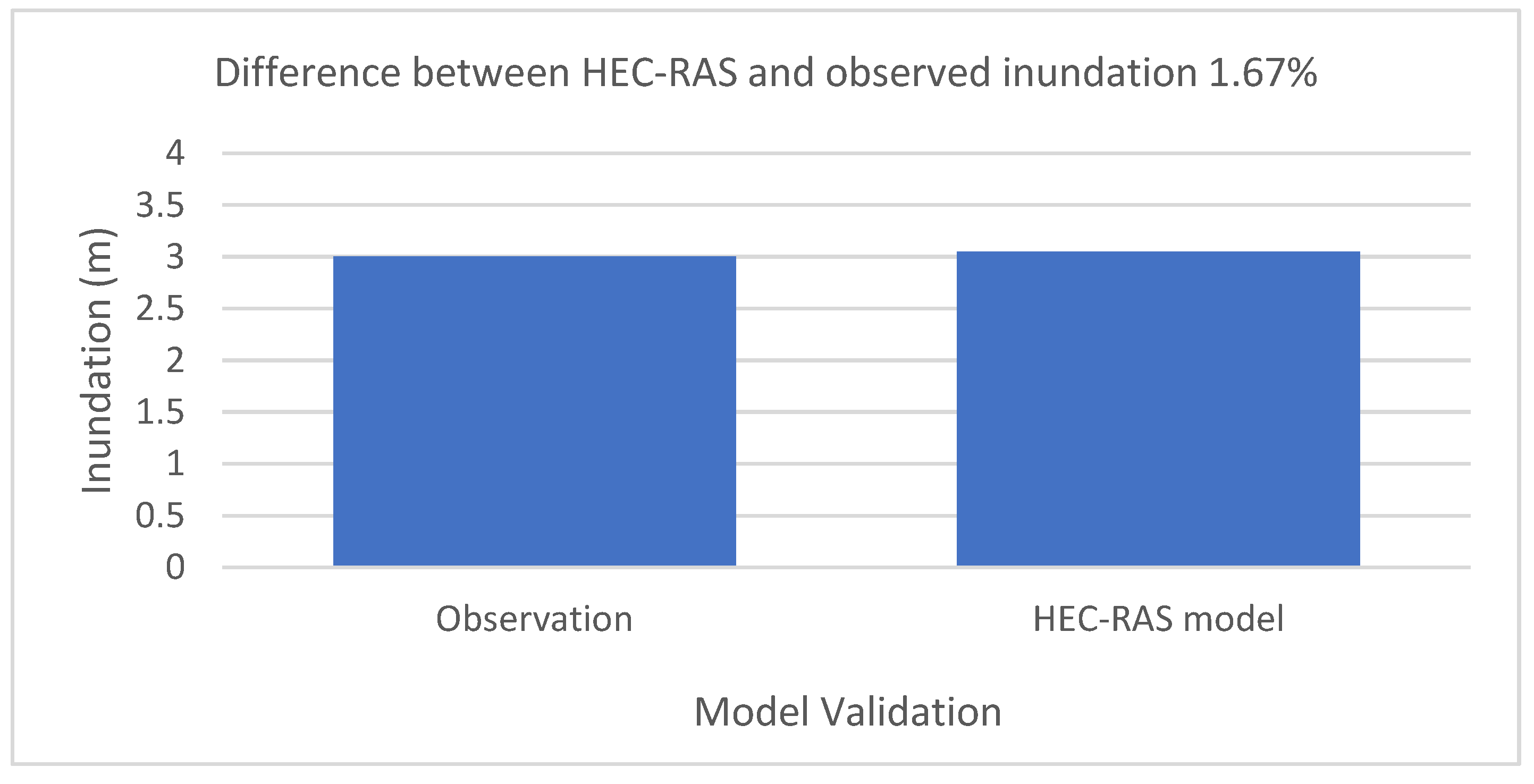
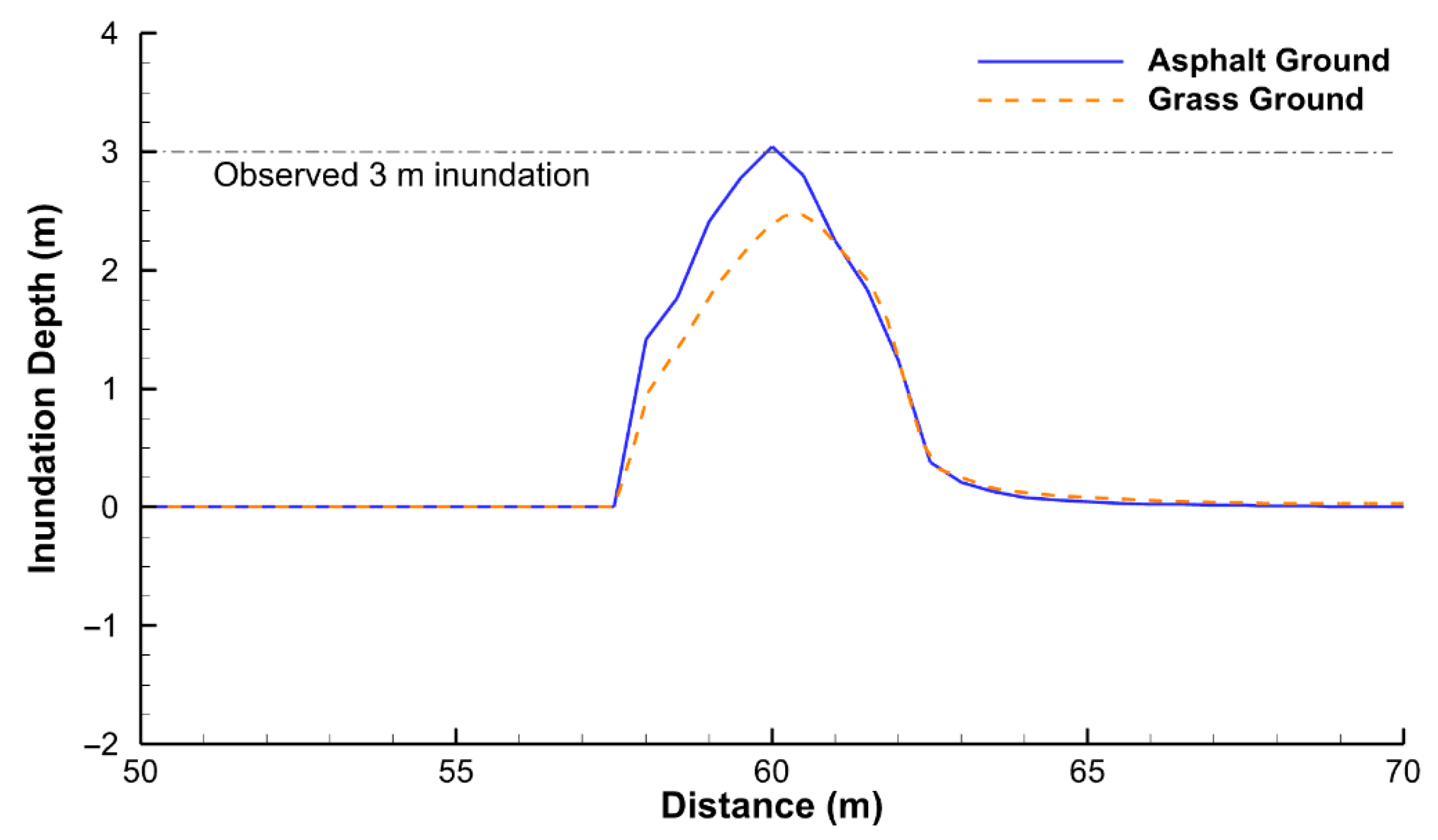
Due to limited observations, we use the observed inundation depth of 3 m [1] in Ukai for model validation. A comparison of HEC-RAS-simulated inundations to the observed 3 m inundation in Ukai is given in Figure 5. HEC-RAS simulation of the maximum 3.05 m inundation in Ukai compares well with the observed 3 m, with 1.67% error.

3.3. Tsunami Wave Shoaling Simulated by HEC-RAS Model

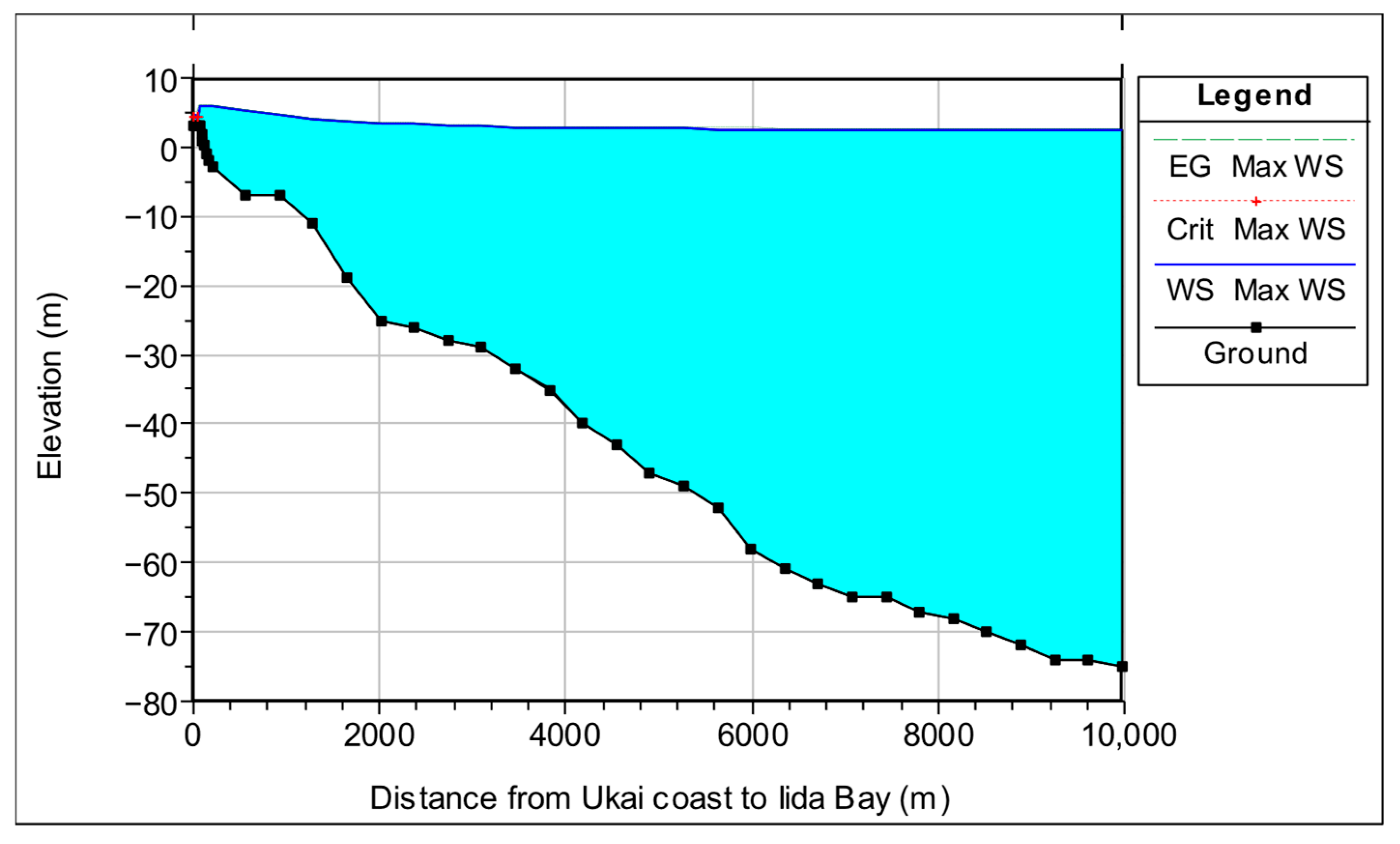
Because the results of inundation in Ukai for asphalt ground surface match well with the observation, the results are used to analyze tsunami amplification from Iida Bay to the Ukai coast. Tsunami and bottom elevations from the Iida Bay boundary to Ukai (about 10 km away) are shown in Figure 6. The changes in bottom elevations show the irregularity of the coastal floor, which is not a constant slope. The slope becomes steeper as the location approaches the coastline and beach. The surface elevation gradually increases with the increasing rate as the tsunami approaches the coast. The relationship between tsunami shoaling or amplification and changes in water depth is analyzed in the following sections.

3.3.1. Shoaling in Non-Breaking Wave Region

Green’s Law [16] has often used for small amplitude waves for the approximation of wave shoaling on the coast [42,43]. The Green’s Law assumes small amplitude and non-breaking waves propagating in shallow coastal water with a gradual depth. For our case study on the Ukai coast and Iida Bay, the coastline is approximately straight and parallel to the coastal bathymetry contour. In this case, wave refraction and energy loss from bottom friction may be ignored. The Green’s Law non-breaking tsunami wave shoaling equation can be expressed as the following simple formula:
H H 0 = k s = ( d d 0 ) 0.25
where k s = H / H 0 is the shoaling coefficient to show the wave amplification in shallow water [42]; H and d is the local wave height and water depth, respectively; and H 0 and d 0 are the wave height and water depth at the model boundary, about 10 km away from the coast in Iida Bay. In order to find out the breaking wave depth for the application of the non-breaking Green’s Law, the breaking water depth has to be determined. However, in the definition of the breaker depth index, both breaking wave height Hb and breaking depth d b are variables that need to be found.
Understanding wave breaking patterns is crucial for predicting tsunami shoaling and amplification. NASA’s field observations [44] during the 2004 Indonesian tsunami event capture unique time-lapse images of the tsunami wave breaking on India’s eastern coast, indicating that tsunami wave breaking exists in a manner similar to typical coastal waves. Therefore, the breaker index for solitary waves [42] can be used to estimate tsunami wave breaking.
Based on USACE [42], the breaker depth index is defined as follows:
H b d b = γ b
At the breaking point, Green’s Law can be rewritten as follows:
H b H 0 = ( d b d 0 ) 0.25
A breaking depth d b / d 0 function based on given offshore boundary conditions ( H 0 and d 0 ) and breaker depth index γ b is derived by combining the above two equations (Equations (2) and (3)). Equation (4) can be used separate the non-braking zone from the surf zone for non-breaking Green’s Law’s application:
d b d 0 = ( H 0 γ b × d 0 ) 0.8
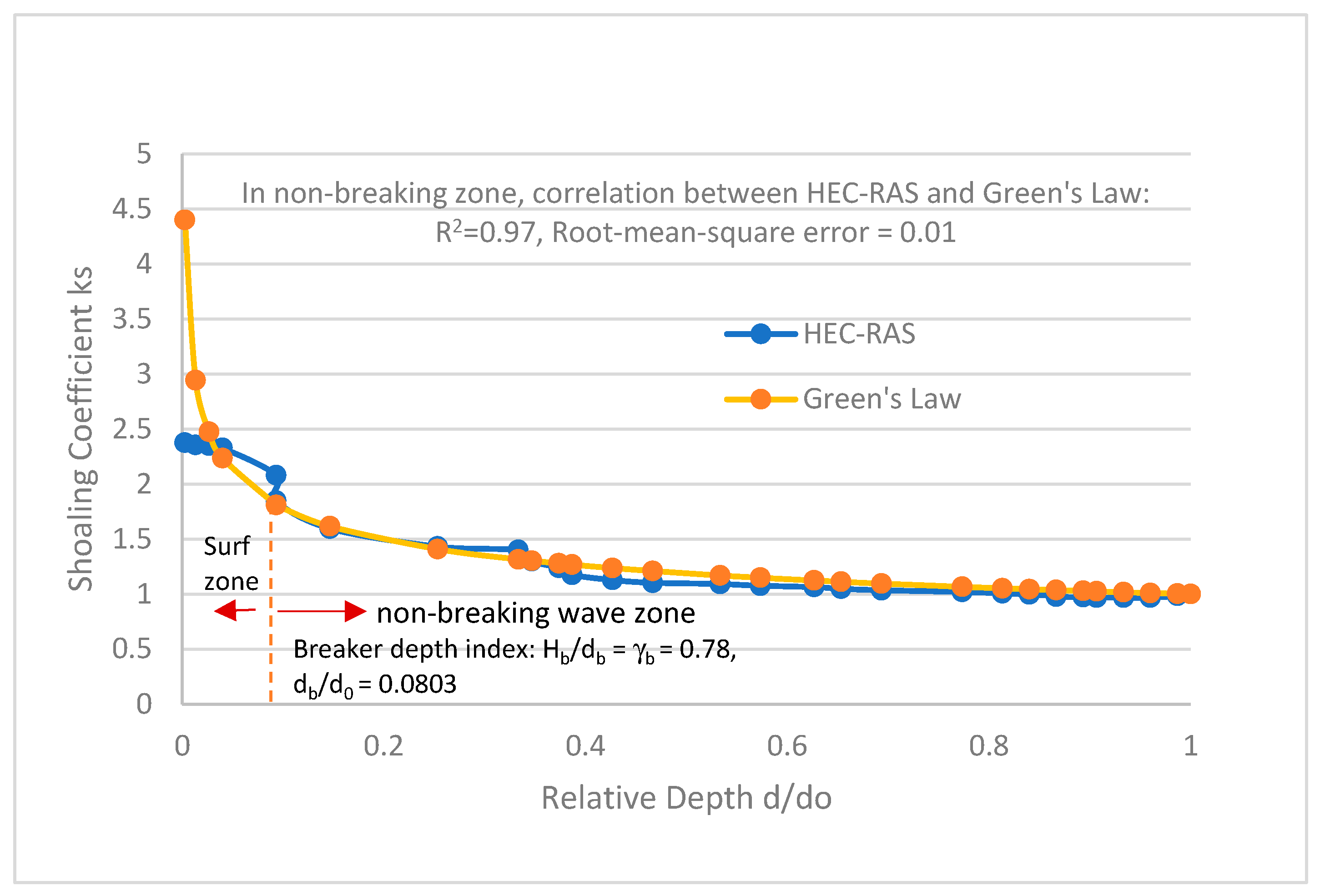
In the above formula (Equation (4)), boundary variables ( H 0 and d 0 ) are known for quick estimation of the breaking depth. Users can select a different breaker depth index γ b , for example, 0.78 by McCowan [45] or more recent 0.82 by Robertson et al. [46]. For this case study, γ b = 0.78 [45] was used. For d 0 = 75 m, H 0 = 2.5 m, and γ b = 0.78, we can find that d b / d 0 = 0.0803, and d b = 6.02 m. The closest location for the breaking water depth in the model is at d = 7 m location.
Results of shoaling from Green’s Law have been plotted to compare with HEC-RAS results in Figure 7 for the tsunamic wave. Because the HEC-RAS modeling result of 3.05 m tsunami inundation compares well to Yuhi’s [1] observation of 3.0 m inundation, the results from HEC-RAS can be used to evaluate errors from those resulting from Green’s Law in tsunami wave shoaling estimation. Before the water depth reaches the wave-breaking depth, results from Green’s law match well with HEC-RAS modeling results. For the case study on Ukai, the almost straight coastal line is approximately parallel to the wave crest and the coastal bathymetry. Based on the General Bathymetric Chart of the Oceans [33] and Google Earth, the coastal bathymetry is approximately parallel to the coastline. Therefore, wave refraction effects in Green’s Law can be reasonably neglected so that the simplified Green’s Law in Equation (1) can be applied for the water depth larger than the breaking water depth. Results shown in Figure 7 indicate that the tsunami wave height estimated by Green’s Law matches well with those obtained from the HEC-RAS model simulation. The correlation R2 between Green’s Law and the HEC-RAS model results in 0.97 and the root-mean-square error of 0.01, indicating that Green’s Law can be used to approximate tsunami amplification on the coast until it breaks.
Figure 6 and Figure 7 show that HEC-RAS can account for the irregular changes in bathymetry, while Green’s Law can only deal with a gradually varied slope. For example, for the two locations at about ×1 = 562 m and ×2 = 924, the depth is the same 7 m, which is the closest depth to the breaking depth d b = 6.02 m. Green’s Law shows the same tsunami shoaling coefficient k s = 1.84 because of the same water depth at two locations. However, the HEC-RAS model can account for the effects of neighboring bathymetry and bottom friction to derive two different tsunami shoaling or amplification factors of 1.84 and 2.08, even though the depth is the same in those two locations as shown in Figure 6 and Figure 7.

3.3.2. Tsunami Shoaling in the Surf Zone

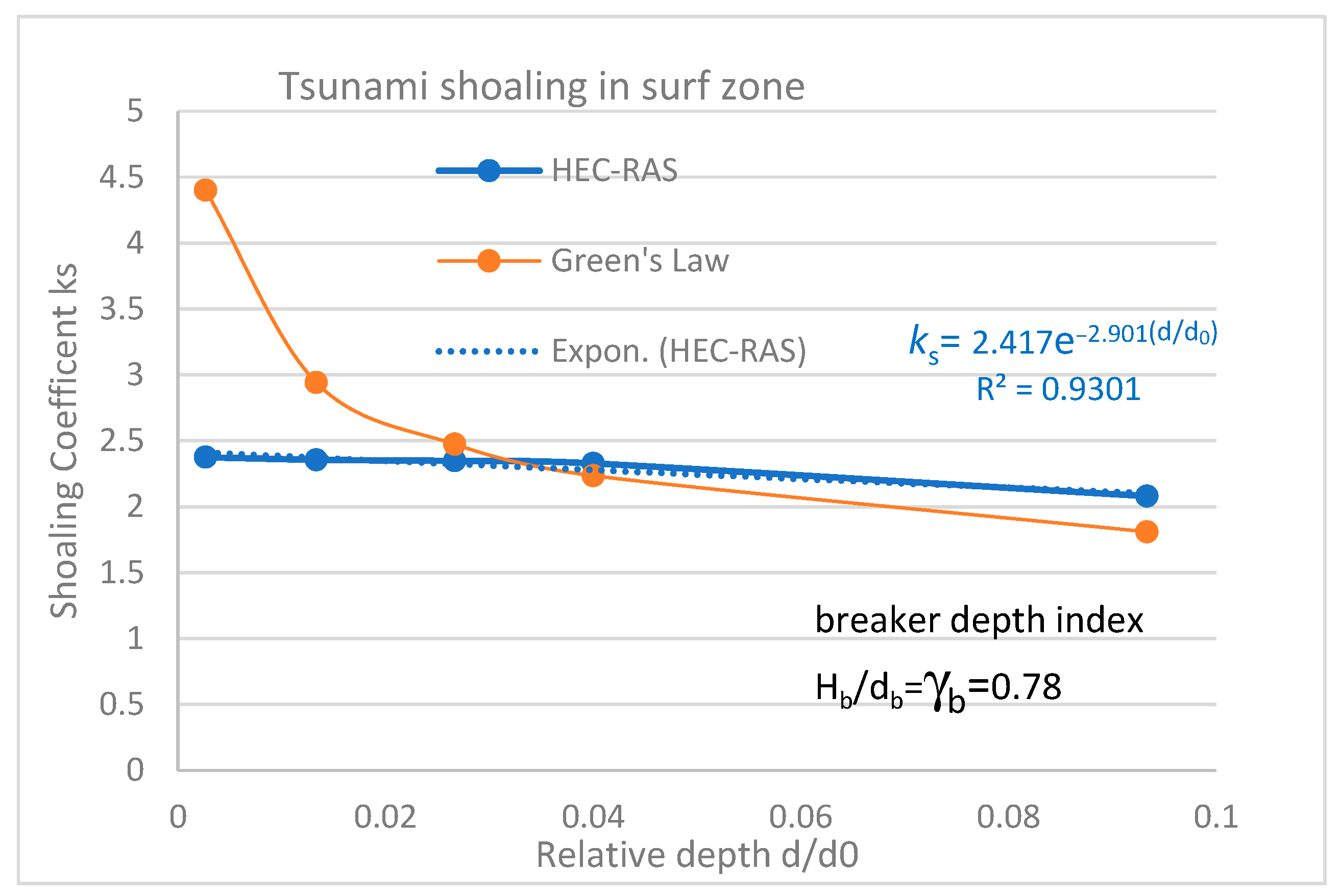
Theoretically, Green’s Law [16] in Equation (1) is no longer valid after wave breaking in the surf zone. However, for comparison purposes, we still plot the results of both HEC-RAS and Green’s Law in the surf zone from the breaking depth to the coastal line (Figure 8). The validated HEC-RAS model simulations of tsunami elevation gradually increase at a much slower rate (Equation (5)) than those given by Green’s Power Law (Equation (1)). Near the coastal line, the tsunami elevation is 2.4 m as simulated by HEC-RAS, compared with 4.4 m predicted by Green’s Law. Green’s Law substantially overestimates tsunami shoaling in the surf zone. Especially near the coastline, Green’s Law overestimates the tsunami elevation by almost a factor of two, indicating that it is not applicable in the surf zone. Regression fitting of the HEC-RAS modeling results show that the tsunami wave amplification in surf zone can be described by an empirical exponential function of water depth as shown below:
ks = 2.417 e−2.901(d/d0)

3.4. Travel Time from Offshore Boundary in Iida Bay to the Ukai Coastline

Tsunami height hydrography at three locations, including the Iida Bay boundary, coastline, and Ukai ground, is shown in Figure 9. The tsunami travel time is obtained based on the difference in time between Iida Bay and the coastline. From the offshore boundary about 10 km away from the Ukai coastline, the HEC-RAS model simulation shows that it takes 8.833 min for the tsunami to travel from a point 9834 m offshore at the Iida Bay boundary to the Ukai coastline. The hydrograph also demonstrates the amplification of the tsunami wave height from Iida Bay to the coastline in Ukai. The tsunami inundation height in Ukai is obtained by subtracting the tsunami’s elevation from the ground elevation.
A quick approximation method can also be used to approximately estimate the tsunami travel time. The tsunami’s average velocity u ¯ or the averaged tsunami wave speed C ¯ over the study area can be approximately represented by shallow water wave celerity [42] as shown in Equation (6) below:
u ¯ = C ¯ = g d ¯
Based on the physics definition, travel time is equal to the distance divided by the velocity, as shown in Equation (7):
T = S u ¯
where T is the travel time, S is the distance of 9834 m from the Ukai coastline to the offshore boundary in Iida Bay, and d ¯ is the average depth of 42 m over the study area from the ocean boundary to the coastal line location. The sum of all depths at all locations divided by the number of depth locations leads to the average depth. The distance between Ukai and the Iida Bay boundary divided by the average tsunami speed yields an approximate tsunami travel time of 8.078 min. The difference between the HEC-RAS model–simulated travel time and the simple, quick estimation by Equations (6) and (7) is 8.5%. Approximation Equations (6) and (7) can provide a rapid estimation of tsunami travel time during tsunami evacuation events.

4. Modeling Tsunami Overland Flow on Beachfront Ground Using a 2D Wave Dynamic Model

Understanding the overland flow characteristics will be very important for studying the impact of tsunamis on coastal structures and sediment scour [27]. In laboratory experimental studies of tsunami-like flow forces on structures, Harish et al. [27] found that tsunami forces on coastal structures are related to the Froude number and flow characteristics in front of the structures. Rapid supercritical flow can exert much stronger forces on coastal structures. Therefore, in the case study of Ukai coastal ground before reaching structures, tsunami overland flow characteristics (e.g., supercritical and subcritical flow) on beachfront ground are investigated using a high-resolution 2D VOF (Volume of Fraction) wave dynamic model [47]. The tsunami boundary condition in the nearshore location at a depth of 3 m was obtained from the above HEC-RAS hydrodynamic model simulation using the coarse segment, at a 10 km distance from the middle of Iida Bay. Although this VOF wave model with Δx = 0.1 m and Δz = 0.05 m high-resolution grids is computationally expensive and not as effective for large-scale simulation as HEC-RAS over a 10 km distance from Iida Bay to Ukai coast, it can provide more details of simulations of wave dynamics on a local scale from −3 m depth to the coastal ground. Therefore, high-resolution VOF wave dynamic modeling was conducted to investigate tsunami propagation and overland flow from −3 m depth to the beachfront ground, with local boundary conditions at −3 m obtained from a large-scale coarse-grid HEC-RAS simulation. The VOF wave dynamic model has been extensively validated by comparing with experimental data on tsunami runup over a beach slope [32,47], tsunami-induced uplifting wave force on a structure [48], and tsunami wave force acting on an elevated structure [49]. Model application case studies in dynamic wave modeling include wave dynamics in Pensacola Bay in Florida during Hurricane Ivan [48], hurricane waves in Biloxi Bay during Hurricane Katrina [50], and wave forces acting on an elevated beach house in Mexico Beach during Hurricane Michael [49]. Successful vertical 2D model validations and applications include solitary wave propagation and runup in gentle-slope beaches, horizontal wave force acting on idealized beachfront houses [32], and hurricane wave forces on coastal bridge decks subjected to solitary waves [48]. Additionally, the model has been employed in three-dimensional cases, such as the investigation of hurricane wave propagation and slamming forces on cylindrical piles within coastal surf zones [47], and hurricane wave runup and forces on a beachfront elevated house during Hurricane Michael [49]. The model outputs of wave forces on bridges have also been tested using artificial neural network models for fast predictions of wave impacts on bridges during hurricanes [51]. In this study, the model is further utilized to model the full-scale tsunami wave runup and overland inundation flow features in Ukai during the 2024 Noto earthquake in Japan.

4.1. Model Description

During the tsunami runup process on the beach, the water flow is in turbulent motion, and the turbulence effect cannot be neglected. Therefore, the Reynolds Averaged Navier–Stokes (RANS) equations (Equations (8) and (9)) are used to solve the mean fluid flow velocity, and the standard k-ε turbulence model (Equations (10) and (11)) is used for the turbulence closure of the RANS equations. Based on Xiao and Huang [32,47], the model governing equations and parameters are described below.
  • RANS Equations:
u i x i = 0
u i t + u j u i x j = 1 ρ p x i + g i + τ i j x j
  • k ε Turbulence Model:
k t + u j k x j = x j [ ( ν t σ k + ν ) k x j ] + G ε
ε t + u j ε x j = x j [ ( ν t σ ε + ν ) ε x j ] + C 1 ε ε k G C 2 ε ε 2 k
where τ i j = 2 ( ν + C d k 2 ε ) σ i j 2 3 k δ i j , σ i j = 1 2 ( u i x j + u j x i ) , ν t = C d k 2 ε , G = 2 ν t σ i j u i x j , C d = 0.09 , C 1 ε = 1.44 , C 2 ε = 1.92 , σ k = 1.0 , σ ε = 1.3 , k is the turbulent kinetic energy, ε is the turbulent dissipation rate, σ i j is the rate of strain tensor, δ i j is the Kronecker delta function, ν t is eddy viscosity, u i is velocity vector of the mean flow, p is the pressure of the mean flow, ρ is the fluid density, and i and j of Cartesian tensors are indices changing independently from 1 to 3 for three-dimensional flows, corresponding to x, y, and z directions, respectively. The model uses the Volume of Fraction (VOF) method to deal with surface boundary and wave breaking. Details of successful model validations for similar applications in modeling solitary waves in coastal slopes can be found in Xiao and Huang [32,47,49], indicating the model’s capability for tsunami wave modeling, as a tsunami wave is a long wave and similar to a solitary wave.

4.2. Model Setups for Tsunami Overland Flow and Inundation in Ukai Coast

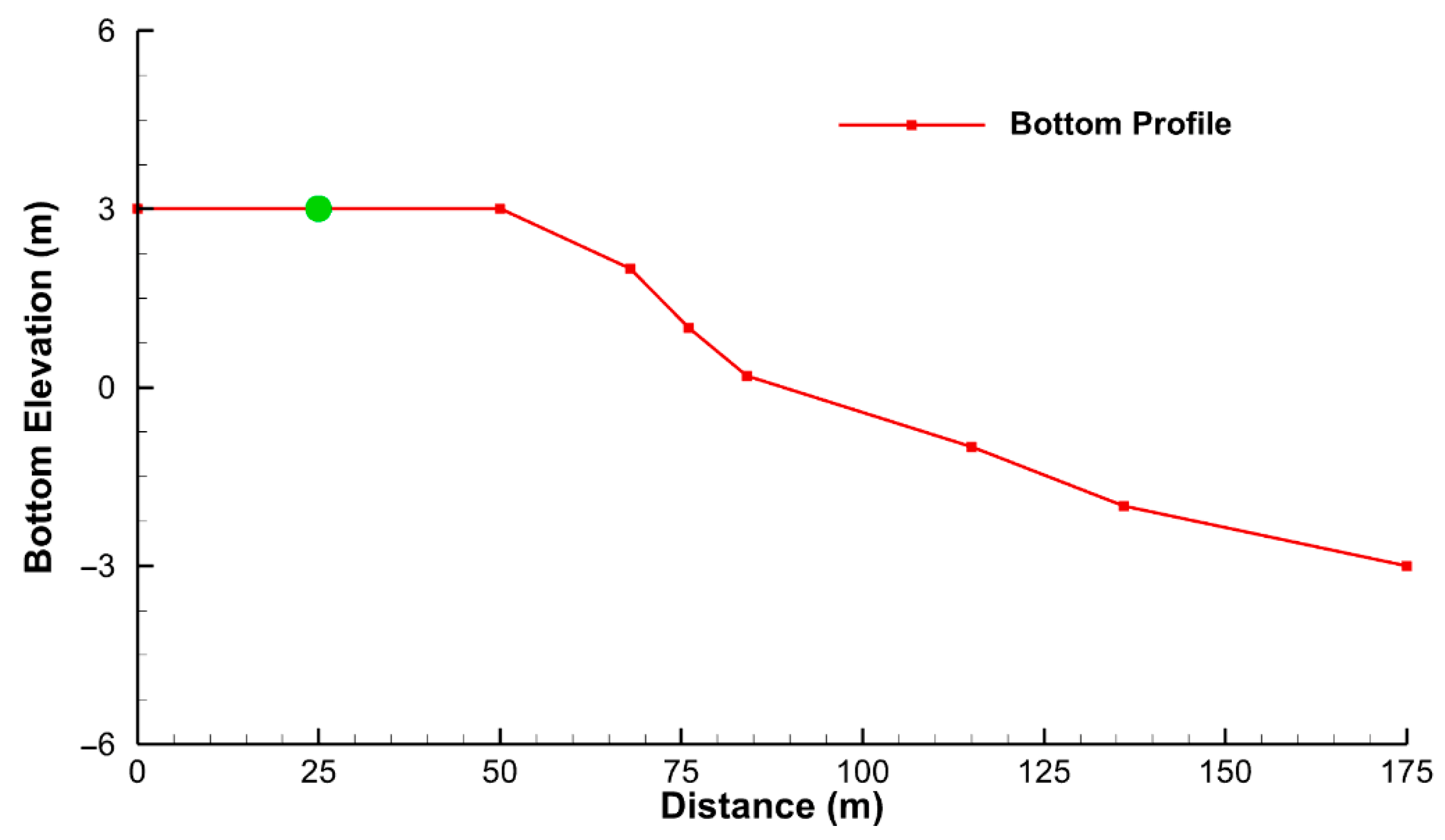
The dynamic wave model described above was employed to analyze the tsunami inundation and overland flow features on the beachfront ground where no structures exist on the Ukai coast. The coastal and beach bathymetry of Ukai beach was derived from the General Bathymetric Chart of the Oceans [33] and more detailed elevations of the beachfront ground obtained from Google Earth, as shown in Figure 10.
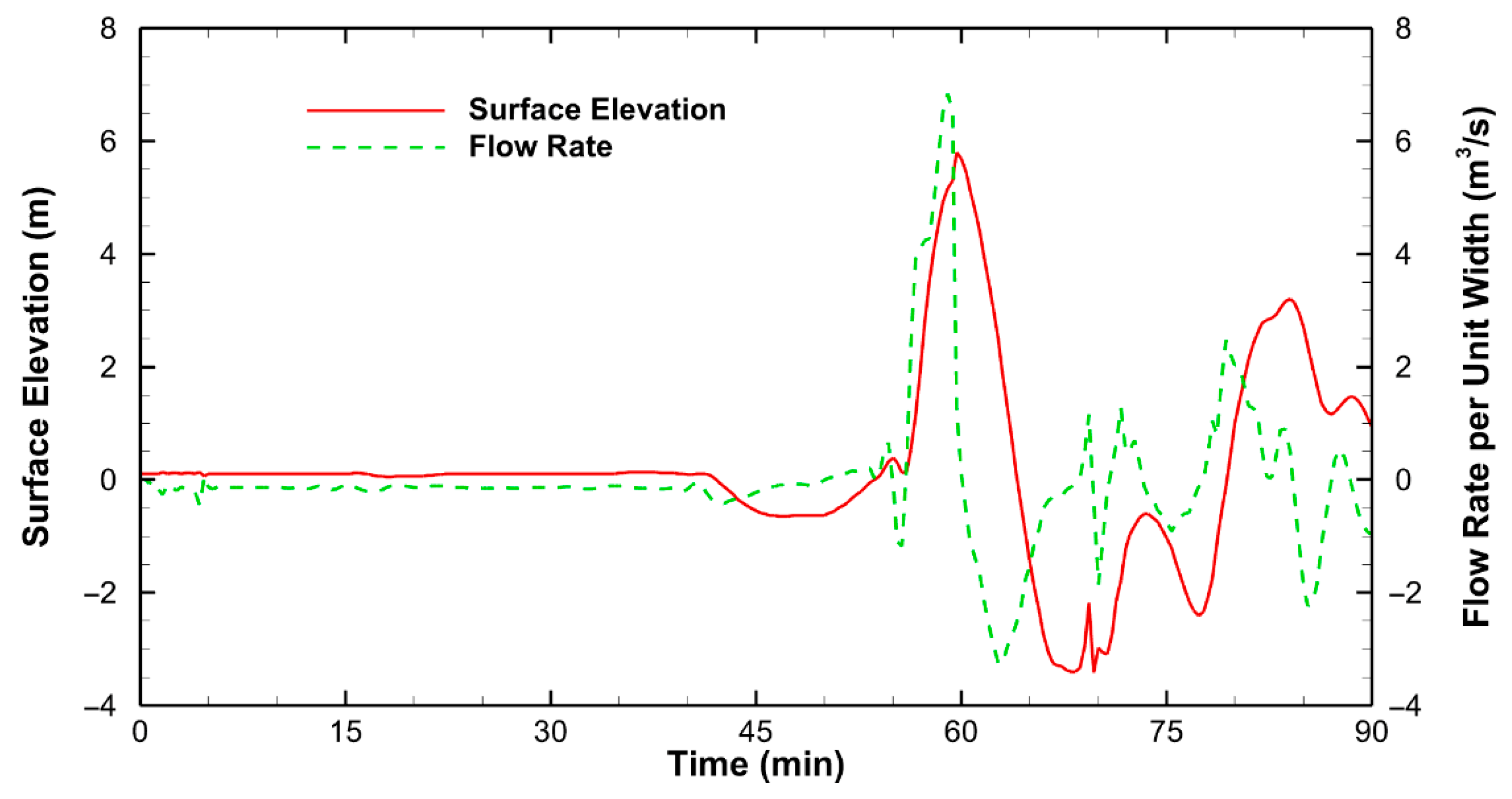
Considering the maximum wave runup heights on the coast occurred near the peak tsunami surge phase, both the surface elevation and velocity at the incident wave boundary are required to drive the dynamic wave model. The large-scale modeling results of surface elevation and flow rate by HEC-RAS at x = 175 and the depth of −3 m were used as boundary conditions for the dynamic wave model, as shown in Figure 11.
The dimension of the computation domain is x = 0 m to 175 m, and z = −3 m to 8 m. Model sensitivity studies have been conducted under different grid resolutions. Two different grid resolutions have been chosen, Δ x = 0.05   m ,   0.1   m and Δ z = 0.025   m , 0.05   m . Results indicate no significant differences in wave profiles and wave forces. Therefore, the grid size with Δ x = 0.1   m and Δ z = 0.05   m is selected for model simulations. The fixed time step Δ t = 0.005   s is used to provide a stable and precise solution during the entire computation. The 0.1 m horizontal grid size in the VOF wave model is much smaller than the smallest grid of 15 m used in HEC-RAS. Therefore, the vertical 2D VOF wave modeling will provide more details of the hydrodynamic analysis of tsunami inundation and overland flow characteristics.
In order to analyze the effects of land covers on tsunami wave propagations, two types of land surfaces (e.g., x = 0 to 50 in Figure 10) in the Ukai area were investigated using the dynamic wave model, which includes asphalt roads and grassland, such as lawns and parks. The Manning friction coefficient was approximately 0.015 for an asphalt road surface, and 0.03 for grassland such as lawns and parks, which were consistent with the HEC-RAS model.

4.3. VOF Wave Model Validation for the Case Study of Ukai

Figure 12 presents a comparative analysis of maximum inundation heights across different land cover types in the Ukai area, simulated using the dynamic wave model. The model demonstrates strong predictive capability for asphalt surfaces, yielding a maximum inundation depth of 3.03 m. This result shows close agreement with the field observation of 3.00 m [1], corresponding to a minor 1% deviation from measured values (Table 1). In contrast, grassland areas exhibited significantly reduced inundation depths of 2.42 m. This represents a 19.8% decrease in maximum inundation depth compared to asphalt surfaces, highlighting the substantial flood mitigation potential of vegetative land cover.

4.4. Effects of Land Covers on Beachfront Tsunami Overland Flow Characteristics in Ukai Coast

Supercritical overland flow and high Froude number can cause severe impacts on coastal structures and sediment scour [25,27,52]. The supercritical flow is a rapid flow dominated by inertial forces, while the subcritical flow is a flow dominated by gravitational forces [53]. Based on hydraulics reference [52], supercritical flow is defined when the Froude number is larger than one (Fr > 1), while subcritical flow is defined for a Froude number less than one (Fr < 1). Roberson et al. [53] also show that the impact drag force of fluid flow on an object is nonlinearly proportional to the square of the velocity:
F D = 1 2 C ρ A v 2
where C ρ is the drag coefficient, A is the area of the object facing the fluid, and ρ is the density of the fluid
FHWA [25] describes the relations between sediment scour around bridge piers and Froude number as shown below:
y s y 1 = 2.0 K 1 K 2 K 3 ( a y 1 ) 0.65 F r 1 0.43
where y s is the scour depth, y 1 is the flow depth directly upstream of the pier, K 1 , K 2 , and K 3 are corrections, a is the pier width, F r 1 is the Froude number directly upstream of the pier F r 1 = V 1 / ( g y 1 ) 1 / 2 , V 1 is the mean velocity of flow directly upstream of the pier, and g is the acceleration of gravity.
Equations (12) and (13) clearly show that fast supercritical flow with strong velocity and large Froude value will result in much stronger drag force and sediment scour. In this study, numerical model simulations have been conducted to investigate overland flow velocity on near-beach ground before the tsunami reaches the coastal community. The Froude number has been used to evaluate whether the flow is supercritical or subcritical.
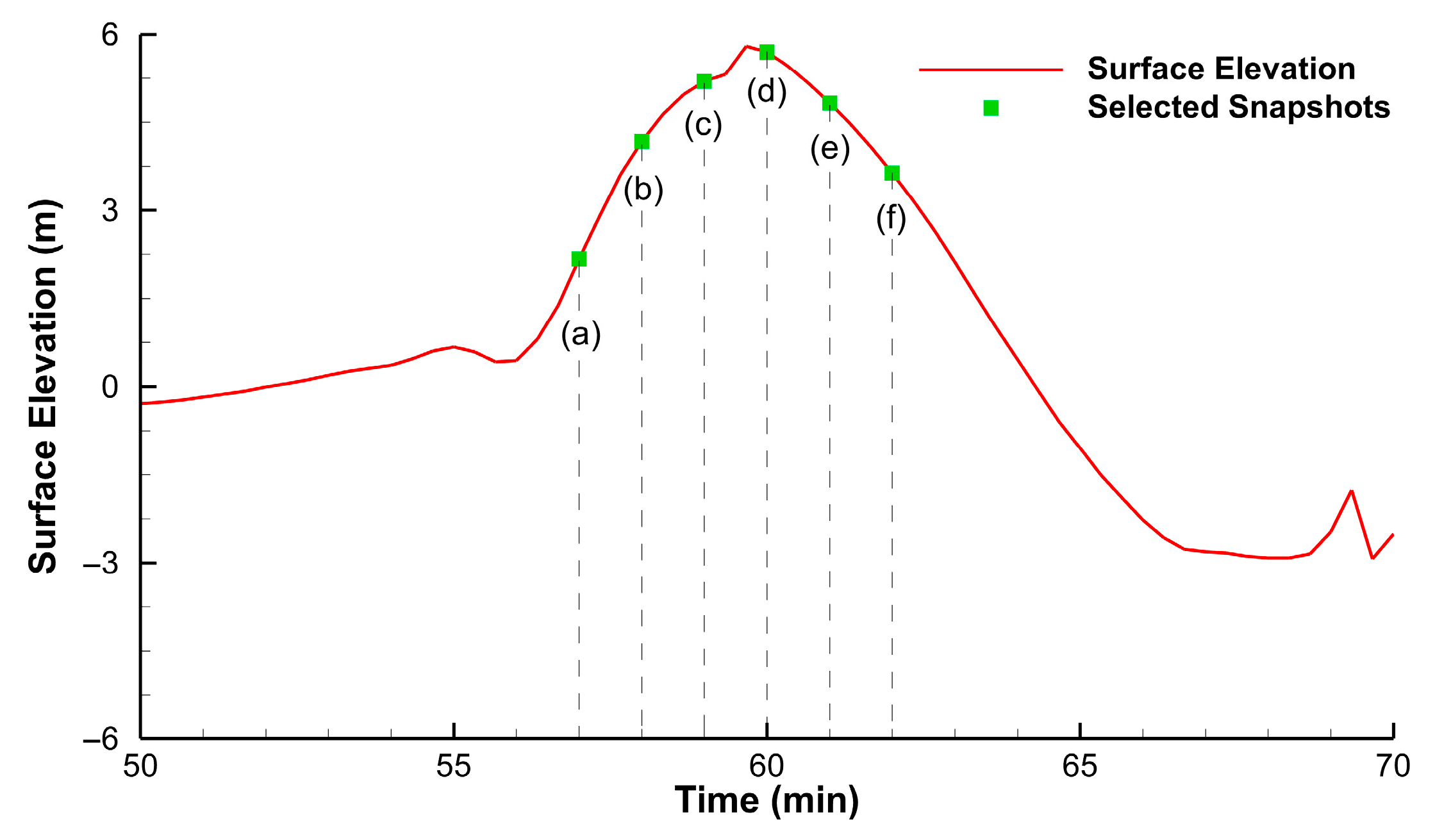
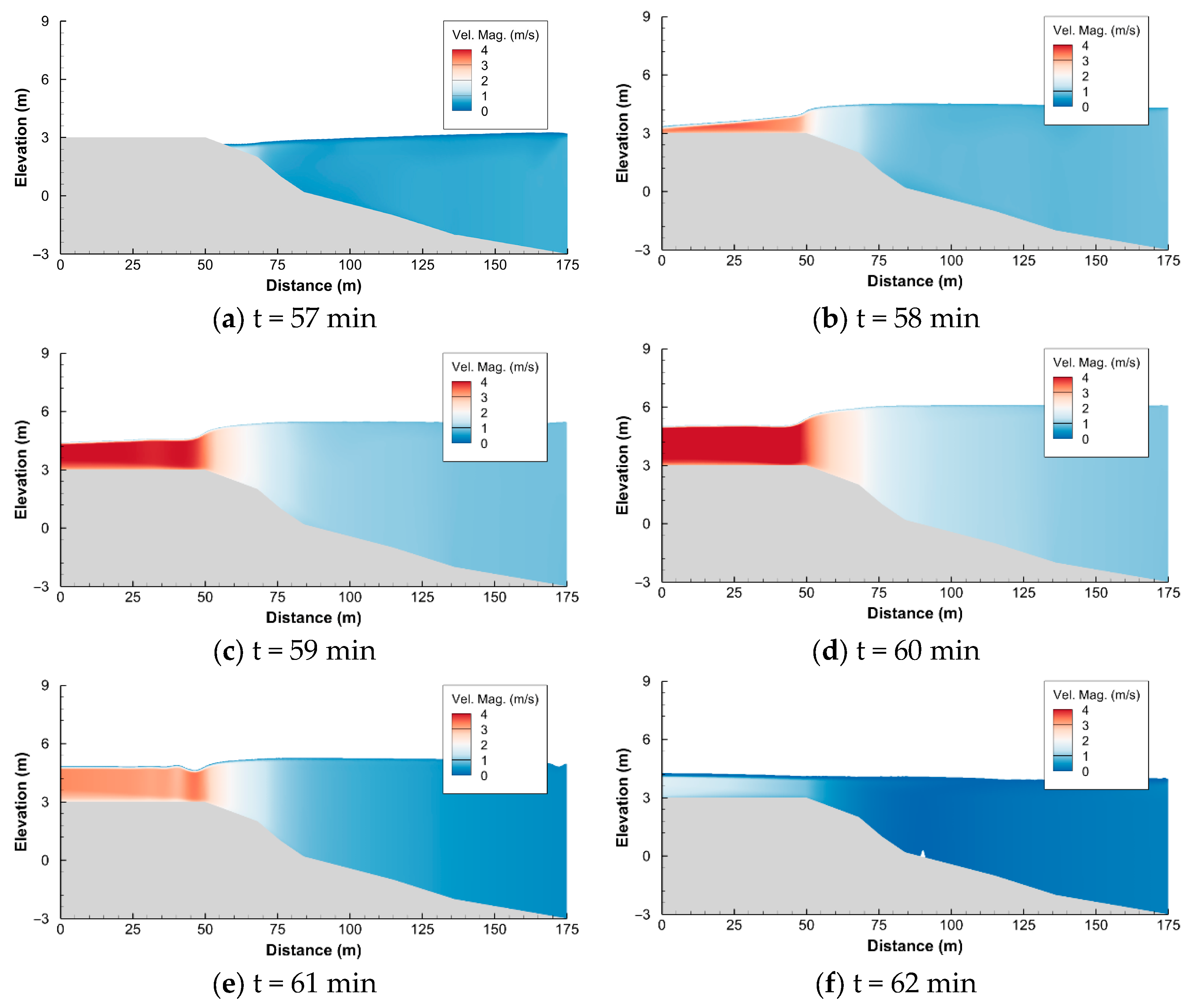
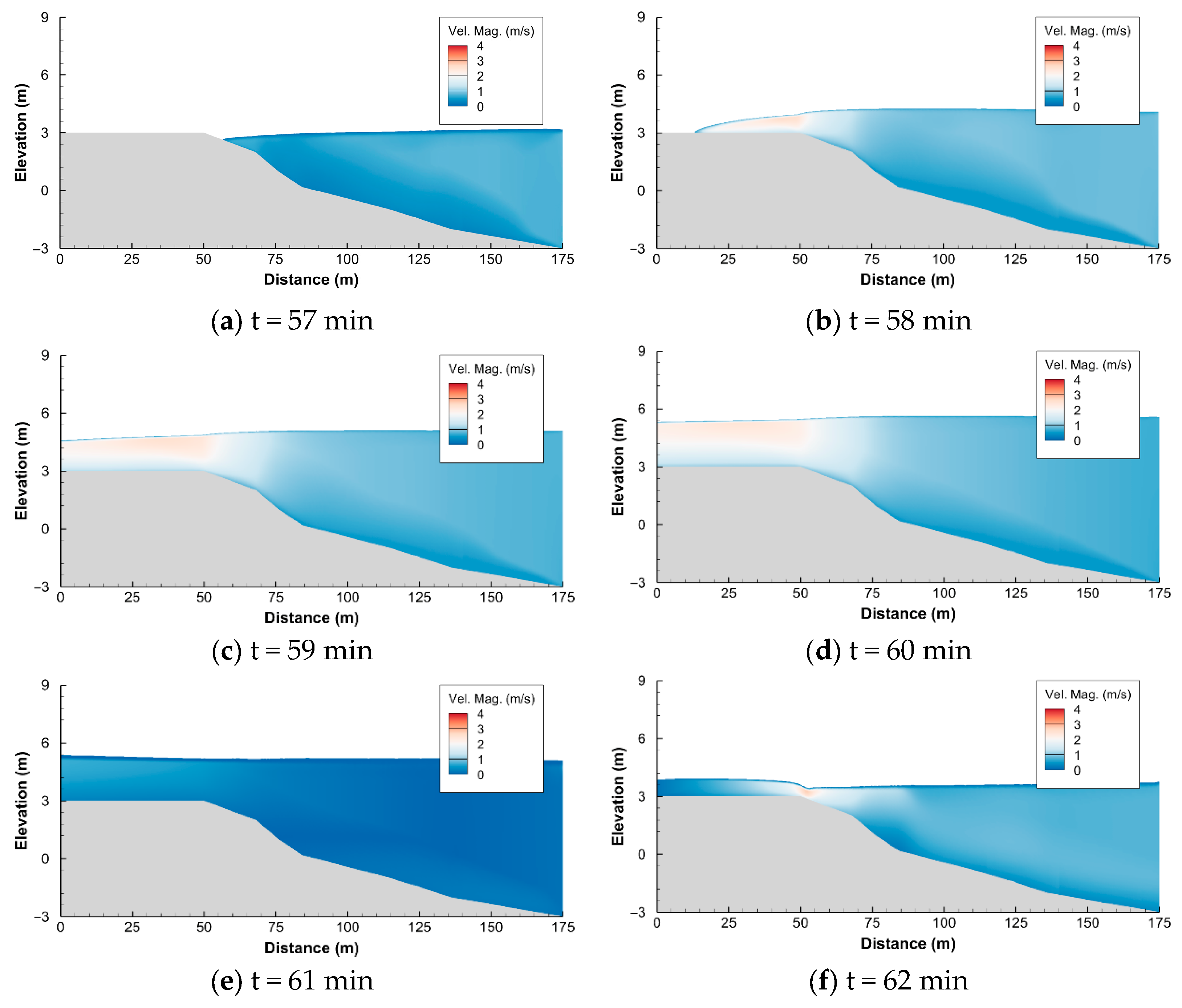
Six snapshots (a)–(f) in 1-minute intervals covering the rising and falling of the tsunami wave were selected from the tsunami hydrograph at the incident wave boundary (x = 175 m), where the still-water depth is 3 m (Figure 13). For each snapshot, the spatial distribution of instant velocity and surface elevation fields of the tsunami wave was used to compare the difference in tsunami runup on the beach and overland inundation flow in Ukai under different ground surface conditions in Ukai (Figure 14 and Figure 15).
Corresponding to the snapshots selected in Figure 13, velocity magnitude fields and tsunami surface elevation during the tsunami runup on the beach and inundation along the asphalt land surface are presented in Figure 14. Figure 14a depicts the initial stage of overland flow, as the crest of the tsunami reached the asphalt road surface. As the tsunami wave approaches the shoreline, the wave speed is slowed by bottom friction as the water shallows. The wave shape becomes asymmetrical, and the amplitude increases because of the decrease in water depth. As the tsunami bore front reached the land surface (Figure 14b,c), driven by shallow-water effects, the vertical flow velocity decreases sharply while horizontal velocity amplifies significantly, forming a high-energy impact jet (flow velocities reaching 4.57 m/s). The flow regime underwent distinct phase transitions with Froude number (Fr) evolution: subcritical flow (Fr < 1) dominated at the slope toe, and evolves into supercritical flow (Fr > 1) along the asphalt land surface, where inertial forces govern the flow dynamics. Figure 14e,f shows the rundown process of the tsunami wave. The return current achieved velocities of 60–80% of uprush speeds. The reflection and superposition of subsequent waves can create repetitive hydrodynamic impacts on coastal structures. Overall, Figure 14 provides a detailed sequence of events during the landfall of the tsunami wave, highlighting the complexity and dynamic nature of the process.
Unlike asphalt pavement, overland flows induced by the tsunami wave exhibited different characteristics on grassland (as shown in Figure 15) for each snapshot at different tsunami wave stages shown in Figure 13. The flow field characteristics of the tsunami wave on grassland were comprehensively affected by vegetation-induced friction, and its dynamic behavior shows significant nonlinear characteristics. The water level decreases gradually as the tsunami wave crest propagates along the grassland cover, displaying subcritical flow features. The maximum horizontal flow speed is 2.35 m/s, which is significantly reduced by the bottom friction compared with the asphalt case (4.57 m/s). Grassland can reduce flow velocity by 40–70% within a relatively short distance of 50 m, which is significantly higher than that of the hardened asphalt surface. Due to the larger bottom friction of the grassland, maximum tsunami elevation occurs on the beach and gradually decreases along the distance over the Ukai ground under subcritical flow conditions.
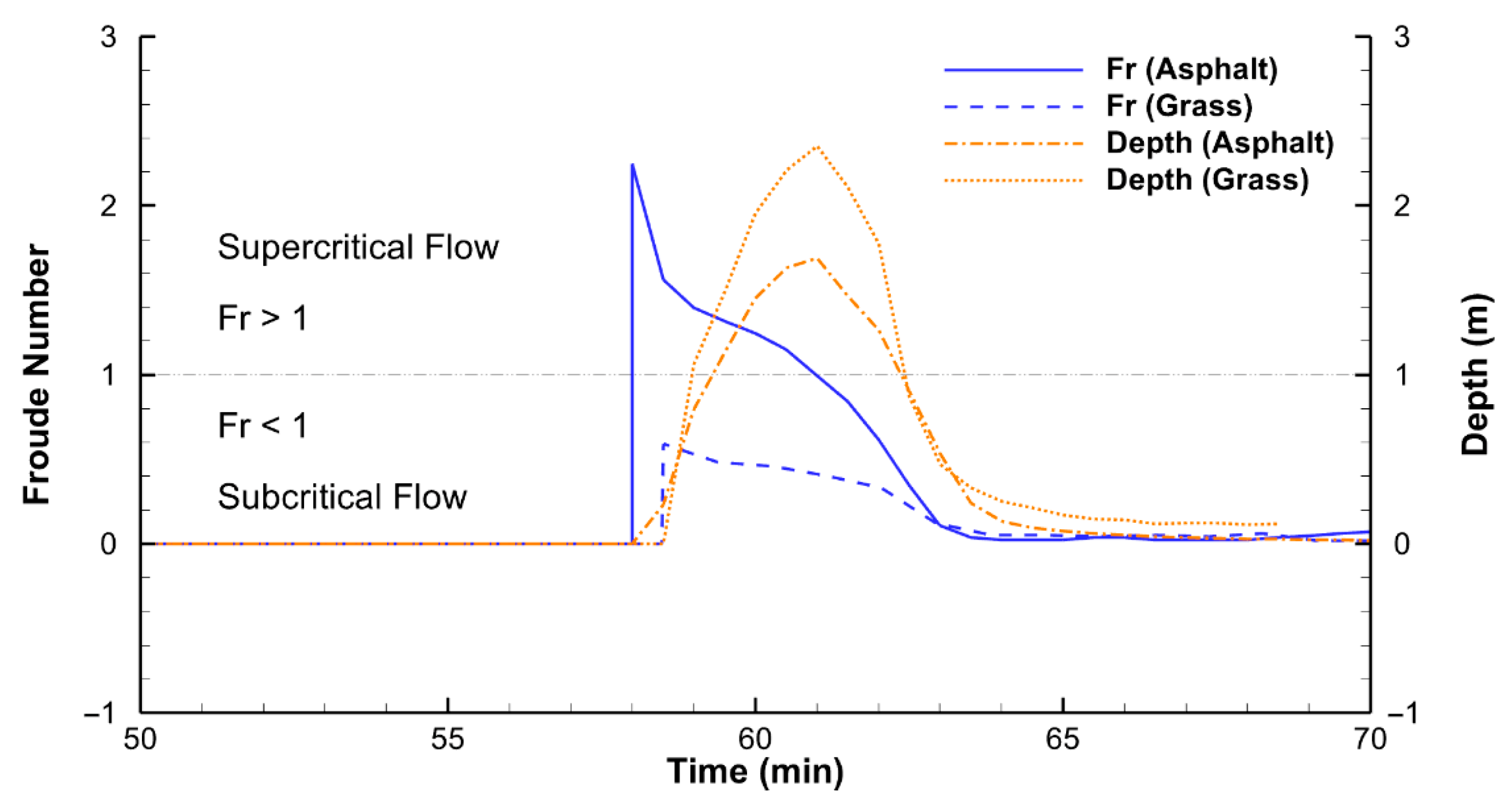
Figure 16 shows a comparison of the time history of the Froude number Fr at x = 25 m for land covers of asphalt and grass, respectively. For both cases, the Froude numbers were maximum at the moment the tsunami-induced inundation flow arrived. For the asphalt land cover, the maximum Froude Number Fr reached up to 2.25, suggesting supercritical flow. Supercritical flow phenomena involve rapid fluid motion (Froude > 1) in open channels, characterized by stationary shock waves, steep water surface changes, and air entrainment. The transition from supercritical flow to subcritical flow often causes a hydraulic jump or a turbulent surge. The high velocity in the supercritical flow will cause a substantial increase in drag force, as shown in Equation (12). The larger value of the Froude number will also cause an increase in sediment scour, as shown in Equation (13). Moreover, for 60% of the inundation period, the flow remained in a supercritical state, only reducing to supercritical flow during the rundown stage. For the grassland cover, the flow stayed in a subcritical regime throughout the whole tsunami rising and falling process, with a maximum Froude Number of 0.59. This is because bottom friction induced by grass significantly reduces the horizontal velocity, while increasing the flow depth after the landfall of the tsunami wave crest. This phenomenon is similar to the regular wave runup and attenuation affected by coastal vegetation [54].

5. Discussion

The unique characteristics of the Ukai coast make the one-dimensional hydrodynamic model HEC-RAS a reasonable choice for tsunami modeling in Iida Bay. As observed in Google Earth’s map (Figure 2), the Ukai coastline is approximately straight and perpendicular to the incoming tsunami from the bay. Additionally, the coastline is nearly parallel to the bathymetric contours of the seafloor. Two-dimensional numerical simulations by Takagi et al. [11] indicate that the tsunami wave crest in central Iida Bay is also nearly parallel to the Ukai coastline. As a result, wave refraction is minimal along the coastal profile extending from Iida Bay to Ukai (Figure 2), further justifying the use of one-dimensional hydrodynamic modeling. Model validation (Figure 5) shows that the HEC-RAS simulation of inundation in Ukai closely matches the observed 3 m inundation when a 2.5 m tsunami wave height in Iida Bay [11] is specified as a boundary condition in the model. Therefore, the tsunami shoaling process at varying water depths (Figure 7) can be reliably used to analyze tsunami amplification from deep to shallow waters.
When wave refraction is negligible along the path from Iida Bay to the Ukai coast, as shown in Figure 2, tsunami shoaling (or amplification) predicted by Green’s Law [16] (Equation (1) closely matches the validated HEC-RAS hydrodynamic simulations (Figure 7) before the tsunami breaks. The results from both HEC-RAS modeling and Green’s Law demonstrate a strong correlation between water depth and non-breaking tsunami shoaling when wave refraction is negligible along the Ukai coast. This indicates that tsunami shoaling along the Ukai coast is primarily driven by changes in water depth and can be reasonably approximated using simplified Green’s Law (Equation (1)). In other areas of Iida Bay with highly irregular coastlines and bathymetry, wave refraction needs to be included in the full form of Green’s Law H / H 0 = ( b / b 0 ) 0.5 ( d / d 0 ) 0.25 [42]. In more complicated cases, more complex two-dimensional wave modeling—such as that conducted by [11] and Yamanaka et al. [13]—may be necessary to account for wave diffraction and refraction in Iida Bay.
The beachfront area is adjacent to the beach and the coastal water. Tsunami overland flows in the beachfront area, and roads are affected by tsunami runup in the adjacent beach slope. Therefore, both tsunami wave runup in beach slope and beachfront overland flow are simulated by the fine-grid VOF wave dynamic model, which reveals fast-moving supercritical flow on asphalt roads in Ukai. These findings align with video footage of rapid tsunami flows in coastal streets, as seen on social media and YouTube. Model simulation shows that grassland cover, with the increase in bottom friction, can reduce tsunami inundation and beachfront overland flow velocity, which can be used to support tsunami hazard mitigation and resilience planning.
This study is limited to the 2D numerical modeling of the tsunami wave on the coast by the VOF wave model. In future studies, 3D numerical modeling may be used to investigate tsunami flow and force actions on coastal houses and the community. In addition, the effects of green and gray infrastructures on reducing tsunami impacts can be investigated by 3D numerical modeling. The VOF wave dynamic model used in this study is capable of both 2D and 3D numerical simulations [47,48,49,50,51]. There are other models available for vertically averaged 2D hydrodynamic modeling of tsunami wave propagation from offshore locations to coastal lands. Kolukula et al. (2025) [55] present the application of the ADCIRC model for tsunami modeling over the global ocean. The ADCIRC model has been extensively applied in our previous modeling studies of shallow coastal water waves [56,57,58,59,60,61]. In addition to the simple estimation of pier scour by Equation (13), effects of tsunamis on beach erosion and sediment scour can be investigated using the public-domain Xbeach model in future studies as described by Rasyif et al. (2019) [62]. The Xbeach model has been extensively used in modeling coastal wave effects on beach and dune erosions in different applications [63,64,65,66,67].

6. Conclusions

The tsunami amplification and shoaling process from about 10 km offshore in Iida Bay to the Ukai coast has been investigated using the HEC-RAS hydrodynamic model with a large grid for rapid simulation. The model was successfully validated by comparing the simulated inundation depth of 3.05 m with the observed 3 m inundation in Ukai. Analysis of the results shows that before the water depth decreases to the breaking depth, tsunami shoaling predicted by Green’s Law [16] closely matches the HEC-RAS model simulations, with a correlation coefficient (R2) of 0.97. Within the surf zone after a tsunami wave breaking, where the water depth falls below the breaking depth, tsunami shoaling in HEC-RAS follows an exponential function rather than the overestimated Green’s Law. A new explicit formula for tsunami breaking depth has been derived based on the breaking depth index and offshore boundary tsunami conditions in the bay. The HEC-RAS simulations indicate that the tsunami takes approximately 8.833 min to travel the 9834 m distance from the entrance of Iida Bay to the Ukai coastline. A quick approximation using the average depth yields a tsunami travel time differing by 8.5% from the HEC-RAS simulation.
With near-coast tsunami boundary conditions provided by the coarse-grid HEC-RAS hydrodynamic model, the fine-grid VOF wave dynamic model has been used to investigate tsunami runup in the beach slope and supercritical-subcritical overland flows in the beachfront area under different land cover conditions. Results reveal that the tsunami wave front creates fast-moving supercritical flow conditions on the asphalt ground surface. In contrast, grass-covered ground effectively reduces tsunami overland flow velocity to subcritical flow. The findings of this study provide valuable insights for tsunami hazard mitigation and resilience planning.

Author Contributions

Conceptualization, H.X. and W.H.; methodology, H.X., W.H. and R.L.; validation, H.X. and R.L.; formal analysis, W.H.; investigation, H.X.; data curation, R.L.; writing—original draft preparation, H.X. and W.H.; writing—review and editing, W.H.; visualization, H.X. and R.L.; supervision, W.H.; project administration, H.X.; funding acquisition, H.X. All authors have read and agreed to the published version of the manuscript.

Funding

This research was partially supported by the Sichuan Science and Technology Program (Grant No. 2026NSFSCZY0013) and the open research fund of State Key Laboratory of Hydraulics and Mountain River Engineering (Grant No. SKHL2504) to support H.X.’s time in preparing this manuscript.

Data Availability Statement

The data that support the findings of this study are available from the corresponding author upon reasonable request. The image in Figure 1 is obtained from and approved for free publication by the Vantor open data program available to users on the Discover platform (https://vantor.com/company/open-data-program/, accessed on 5 December 2025) [8].

Conflicts of Interest

The authors declare no conflicts of interest.

References

  1. Yuhi, M.; Umeda, S.; Arita, M.; Ninomiya, J.; Gokon, H.; Arikawa, T.; Baba, T.; Imamura, F.; Kumagai, K.; Kure, S.; et al. Dataset of Post-Event Survey of the 2024 Noto Peninsula Earthquake Tsunami in Japan. Sci. Data 2024, 11, 786. [Google Scholar] [CrossRef]
  2. Masuda, H.; Sugawara, D.; Cheng, A.-C.; Suppasri, A.; Shigihara, Y.; Kure, S.; Imamura, F. Modeling the 2024 Noto Peninsula Earthquake Tsunami: Implications for Tsunami Sources in the Eastern Margin of the Japan Sea. Geosci. Lett. 2024, 11, 29. [Google Scholar] [CrossRef]
  3. Pakoksung, K.; Suppasri, A.; Imamura, F. Preliminary Modeling and Analysis of the Tsunami Generated by the 2024 Noto Peninsula Earthquake on 1 January: Wave Characteristics in the Sea of Japan. Ocean Eng. 2024, 307, 118172. [Google Scholar] [CrossRef]
  4. 2024 Noto Earthquake. Available online: https://en.wikipedia.org/wiki/2024_Noto_earthquake (accessed on 20 April 2024).
  5. MLIT (Ministry of Land, Infrastructure), Transport and Tourism. Aerially Estimated Tsunami Inundation Area. Available online: https://www.mlit.go.jp/river/bousai/240101_noto/pdf/tsunamishinsui_higai_240202.pdf (accessed on 4 April 2024).
  6. Heidarzadeh, M.; Ishibe, T.; Gusman, A.R.; Miyazaki, H. Field Surveys of Tsunami Runup and Damage Following the January 2024 Mw 7.5 Noto (Japan Sea) Tsunamigenic Earthquake. Ocean Eng. 2024, 307, 118140. [Google Scholar] [CrossRef]
  7. Regrets, Sorrow: Residents Had Little Time to Escape Tsunami. Available online: https://www.asahi.com/ajw/articles/15157634 (accessed on 30 April 2024).
  8. Vantor Open Data Program Available to Users on Discover Platform, Image ID:10300100F2BE1300. Available online: https://vantor.com/company/open-data-program/ (accessed on 5 December 2025).
  9. Preliminary Earthquake Fault Model of the 2024 Noto Peninsula Earthquake (as of 29 February 2024). Available online: https://www.gsi.go.jp/common/000253939.pdf (accessed on 2 April 2024).
  10. Fukui, N.; Miyashita, T.; Yasuda, T.; Mori, N. Numerical Analysis of Local Tsunami Heights and Arrival Times of the 2024 Noto Peninsula Tsunami. Coast. Eng. J. 2025, 67, 292–305. [Google Scholar] [CrossRef]
  11. Takagi, H.; Siddiq, N.L.; Tanako, F.; De La Rosa, D.P.B. Locally Amplified Tsunami in Iida Bay Due to the 2024 Noto Peninsula Earthquake. Ocean Eng. 2024, 307, 118180. [Google Scholar] [CrossRef]
  12. Mulia, I.E.; Heidarzadeh, M.; Gusman, A.R.; Satake, K.; Fujii, Y.; Sujatmiko, K.A.; Meilano, I.; Windupranata, W. Compounding Impacts of the Earthquake and Submarine Landslide on the Toyama Bay Tsunami during the January 2024 Noto Peninsula Event. Ocean Eng. 2024, 310, 118698. [Google Scholar] [CrossRef]
  13. Yamanaka, Y.; Matsuba, Y.; Shimozono, T.; Tajima, Y. Nearshore Propagation and Amplification of the Tsunami Following the 2024 Noto Peninsula Earthquake, Japan. Geophys. Res. Lett. 2024, 51, e2024GL110231. [Google Scholar] [CrossRef]
  14. Knowles, J.; Yeh, H. On Shoaling of Solitary Waves. J. Fluid Mech. 2018, 848, 1073–1097. [Google Scholar] [CrossRef]
  15. Knowles, J.; Yeh, H. Evolution of Tsunami-like Isolated Waves Shoaling over a Plane Slope. Phys. Fluids 2023, 35, 047120. [Google Scholar] [CrossRef]
  16. Green’s Law. Available online: https://en.wikipedia.org/wiki/Green%27s_law (accessed on 7 April 2024).
  17. Xie, P.; Du, Y. CFD Modeling of Nonlinear Tsunami Wave Run-up Dynamics: Analytical Calibration and Estimation Methods. Ocean Eng. 2024, 313, 119495. [Google Scholar] [CrossRef]
  18. Li, Z.; Zhang, J.; Liu, H. Boussinesq Modeling for the Runup of Solitary-like Waves on a Slope and Circular Island. Ocean Eng. 2021, 226, 108742. [Google Scholar] [CrossRef]
  19. Zhao, X.; Ren, Z.; Liu, H. Propagation Characteristics of Tsunami Waves in Shear Flow Based on the Boussinesq Model with Constant Vorticity. Ocean Eng. 2023, 286, 115543. [Google Scholar] [CrossRef]
  20. Xie, P.; Chu, V.H. The Forces of Tsunami Waves on a Vertical Wall and on a Structure of Finite Width. Coast. Eng. 2019, 149, 65–80. [Google Scholar] [CrossRef]
  21. Rajaie, M.; Azimi, A.H.; Nistor, I.; Rennie, C.D. Experimental Investigations on Hydrodynamic Characteristics of Tsunami-Like Hydraulic Bores Impacting a Square Structure. J. Hydraul. Eng. 2022, 148, 04021061. [Google Scholar] [CrossRef]
  22. Kuiry, S.N.; Ding, Y.; Wang, S.S.Y. Numerical Simulations of Morphological Changes in Barrier Islands Induced by Storm Surges and Waves Using a Supercritical Flow Model. Front. Struct. Civ. Eng. 2014, 8, 57–68. [Google Scholar] [CrossRef]
  23. Pan, C.; Huang, W. Numerical Modeling of Suspended Sediment Transport Affected by Tidal Bore in Qiantang Estuary. J. Coast. Res. 2010, 26, 1123–1132. [Google Scholar] [CrossRef]
  24. Pan, C.; Huang, W. Numerical Modeling of Tsunami Wave Run-Up and Effects on Sediment Scour around a Cylindrical Pier. J. Eng. Mech. 2012, 138, 1224–1235. [Google Scholar] [CrossRef]
  25. FHWA (The Federal Highway Administration). Evaluating Scour at Bridges, HEC-18; Publication Number: HIF-12-003; FHWA: Washington, DC, USA, 2012; p. 340. [Google Scholar]
  26. Ishii, H.; Takabatake, T.; Esteban, M.; Stolle, J.; Shibayama, T. Experimental and Numerical Investigation on Tsunami Run-up Flow around Coastal Buildings. Coast. Eng. J. 2021, 63, 485–503. [Google Scholar] [CrossRef]
  27. Harish, S.; Sriram, V.; Schüttrumpf, H.; Sannasiraj, S.A. Tsunami-like Flow Induced Forces on the Structure: Dependence of the Hydrodynamic Force Coefficients on Froude Number and Flow Channel Width in Quasi-Steady Flow Phase. Coast. Eng. 2022, 172, 104078. [Google Scholar] [CrossRef]
  28. Pasha, G.A.; Tanaka, N. Critical Resistance Affecting Sub- to Super-Critical Transition Flow by Vegetation. J. Earthq. Tsunami 2019, 13, 1950004. [Google Scholar] [CrossRef]
  29. Esteban, M.; Roubos, J.J.; Iimura, K.; Salet, J.T.; Hofland, B.; Bricker, J.; Ishii, H.; Hamano, G.; Takabatake, T.; Shibayama, T. Effect of Bed Roughness on Tsunami Bore Propagation and Overtopping. Coast. Eng. 2020, 157, 103539. [Google Scholar] [CrossRef]
  30. Adityawan, M.B.; Rahmasari, P.; Chrysanti, A.; Farid, M.; Yakti, B.P.; Purnama, M.R. Effect of Land Cover on Tsunami Overland Flow Propagation: A Case Study of Painan, West Sumatra, Indonesia. Int. J. Adv. Sci. Eng. Inf. Technol. 2021, 11, 1704. [Google Scholar] [CrossRef]
  31. Murtaza, N.; Pasha, G.A.; Khan, Z.U.; Alotaibi, S.; Akbar, Z.; Khedher, K.M. Impact of Dyke and Vegetation on Fluid Force and Moment Reduction under Sub and Supercritical Flow Conditions. Phys. Fluids 2024, 36, 105196. [Google Scholar] [CrossRef]
  32. Xiao, H.; Huang, W. Numerical Modeling of Wave Runup and Forces on an Idealized Beachfront House. Ocean Eng. 2008, 35, 106–116. [Google Scholar] [CrossRef]
  33. GEBCO (General Bathymetric Chart of the Oceans 2024). Available online: https://download.gebco.net/ (accessed on 15 April 2024).
  34. Dean, R.G.; Dalrymple, R.A. Water Wave Mechanics for Engineers and Scientists; Advanced Series on Ocean Engineering; World Scientific: Singapore, 1991; Volume 2, ISBN 978-981-02-0421-1. [Google Scholar]
  35. USACE (US Army Corps of Engineers)—Hydrologic Engineering Center: HEC-RAS Documents. Available online: https://www.hec.usace.army.mil/software/hec-ras/documentation.aspx (accessed on 20 April 2024).
  36. Teng, F.; Shen, Q.; Huang, W.; Ginis, I.; Cai, Y. Characteristics of River Flood and Storm Surge Interactions in a Tidal River in Rhode Island, USA. Procedia IUTAM 2017, 25, 60–64. [Google Scholar] [CrossRef]
  37. Huang, W.; Teng, F.; Ginis, I.; Ullman, D.; Ozguven, E. Rainfall Runoff and Flood Simulations for Hurricane Impacts on Woonasquatucket River, USA. Int. J. Struct. Civ. Eng. Res. 2020, 9, 239–244. [Google Scholar] [CrossRef]
  38. Pilotti, M.; Milanesi, L.; Bacchi, V.; Tomirotti, M.; Maranzoni, A. Dam-Break Wave Propagation in Alpine Valley with HEC-RAS 2D: Experimental Cancano Test Case. J. Hydraul. Eng. 2020, 146, 05020003. [Google Scholar] [CrossRef]
  39. Amaliah, R.; Ginting, B.M. Investigating the Capability of HEC-RAS Model for Tsunami Simulation. J. Civ. Eng. Forum 2023, 9, 161–180. [Google Scholar] [CrossRef]
  40. Borzì, L.; Scala, P.; Distefano, S.; Laksono, F.X.A.T.; Manno, G.; Innangi, S.; Gamberi, F.; Kovács, J.; Ciraolo, G.; Di Stefano, A. Tsunami Propagation and Flooding Maps: An Application for the Island of Lampedusa, Sicily Channel, Italy. Earth Surf. Process. Landf. 2024, 49, 4842–4861. [Google Scholar] [CrossRef]
  41. Wuppukondur, A.; Baldock, T.E. Physical and Numerical Modelling of Representative Tsunami Waves Propagating and Overtopping in Converging Channels. Coast. Eng. 2022, 174, 104120. [Google Scholar] [CrossRef]
  42. U.S. Army Corps of Engineers. Engineering Manual, EM 1110-2-1100, Part II. In Chapter 1. Water Wave Mechanics; Chapter 3, Estimation of Nearshore Waves; Chapter 4. Sur Zone Hydrodynamics; U.S. Army Corps of Engineers: Washington, DC, USA, 2002. [Google Scholar]
  43. Sandanbata, O.; Watada, S.; Satake, K.; Fukao, Y.; Sugioka, H.; Ito, A.; Shiobara, H. Ray Tracing for Dispersive Tsunamis and Source Amplitude Estimation Based on Green’s Law: Application to the 2015 Volcanic Tsunami Earthquake Near Torishima, South of Japan. Pure Appl. Geophys. 2018, 175, 1371–1385. [Google Scholar] [CrossRef]
  44. Breaking Tsunami Waves Along India’s Eastern Coast. Available online: https://www.jpl.nasa.gov/images/pia04372-breaking-tsunami-waves-along-indias-eastern-coast/ (accessed on 11 April 2024).
  45. McCowan, J., VII. On the solitary wave. Lond. Edinb. Dubl. Philos. Mag. J. Sci. 1894, 32, 45–58. [Google Scholar] [CrossRef]
  46. Robertson, B.; Hall, K.; Zytner, R.; Nistor, I. Breaking Waves: Review of Characteristic Relationships. Coast. Eng. J. 2013, 55, 1350002-1–1350002-40. [Google Scholar] [CrossRef]
  47. Xiao, H.; Huang, W. Three-Dimensional Numerical Modeling of Solitary Wave Breaking and Force on a Cylinder Pile in a Coastal Surf Zone. J. Eng. Mech. 2015, 141, A4014001. [Google Scholar] [CrossRef]
  48. Huang, W.; Xiao, H. Numerical Modeling of Dynamic Wave Force Acting on Escambia Bay Bridge Deck during Hurricane Ivan. J. Waterw. Port Coast. Ocean Eng. 2009, 135, 164–175. [Google Scholar] [CrossRef]
  49. Xiao, H.; Huang, W. Failure Mechanism and Risk Analysis of an Elevated House Damaged during Hurricane Michael by Full-Scale Modeling of Wave-Surge Loads. Ocean Eng. 2024, 300, 117387. [Google Scholar] [CrossRef]
  50. Xiao, H.; Huang, W.; Chen, Q. Effects of Submersion Depth on Wave Uplift Force Acting on Biloxi Bay Bridge Decks during Hurricane Katrina. Comput. Fluids 2010, 39, 1390–1400. [Google Scholar] [CrossRef]
  51. Xiao, H.; Huang, W.; Wang, J. Modeling Hurricane Wave Forces Acting on Coastal Bridges by Artificial Neural Networks. J. Mar. Sci. Eng. 2025, 13, 2080. [Google Scholar] [CrossRef]
  52. Zhu, F.; Dodd, N. Swash zone morphodynamic modelling including sediment entrained by bore-generated turbulence. Adv. Water Resour. 2020, 146, 103756. [Google Scholar] [CrossRef]
  53. Roberson, J.A.; Cassidy, J.J.; Chaudhry, M.H. Hydraulic Engineering, 2nd ed.; Wiley: Chichester, NY, USA, 1998; ISBN 978-0-471-12466-5. [Google Scholar]
  54. Tang, J.; Zhao, C.; Shen, Y. Numerical investigation of the effects of coastal vegetation zone width on wave run-up attenuation. Ocean Eng. 2019, 189, 106395. [Google Scholar] [CrossRef]
  55. Kolukula, S.S.; Murty, P.L.N.; Kumar, T.S.; Pattabhi Ramarao, E.; Ramana Murthy, M.V. Tsunami modelling over global oceans. R. Soc. Open Sci. 2025, 12, 241128. [Google Scholar] [CrossRef] [PubMed]
  56. Huang, W.; Yin, K.; Ghorbanzadeh, M.; Ozguven, E.; Xu, S.; Vijayan, L. Integrating storm surge modeling with traffic data analysis to evaluate the effectiveness of hurricane evacuation. Front. Struct. Civ. Eng. 2021, 15, 1301–1316. [Google Scholar] [CrossRef]
  57. Vijayan, L.; Huang, W.; Ma, M.; Ozguven, E.; Ghorbanzadeh, M.; Yang, J.; Yang, Z. Improving the accuracy of hurricane wave modeling in Gulf of Mexico with dynamically-coupled SWAN and ADCIRC. Ocean Eng. 2023, 274, 114044. [Google Scholar] [CrossRef]
  58. Vijayan, L.; Huang, W.; Ma, M.; Ozguven, E.; Yang, J.; Alisan, O. Rapid simulation of storm surge inundation for hurricane evacuation in Florida by multi-scale nested modeling approach. Int. J. Disaster Risk Reduct. 2023, 99, 104134. [Google Scholar] [CrossRef]
  59. Ma, M.; Huang, W.; Xu, S.; Yin, K.; Vijayan, L. Improving storm surge predictions in the Gulf of Mexico by enhancing a parametric model of cyclone. Ocean Eng. 2026, 343, 123469. [Google Scholar] [CrossRef]
  60. Yin, K.; Xu, S.; Huang, W.; Xie, Y. Effects of sea level rise and typhoon intensity on storm surge and waves in Pearl River Estuary. Ocean Eng. 2017, 136, 80–93. [Google Scholar] [CrossRef]
  61. Yin, K.; Xu, S.; Zhao, Q.; Huang, W.; Yang, K.; Guo, M. Effects of land cover change on atmospheric and storm surge modeling during typhoon event. Ocean Eng. 2020, 199, 106971. [Google Scholar] [CrossRef]
  62. Rasyif, T.M.; Kato, S.; Syamsidik Okabe, T. Numerical Simulation of Morphological Changes due to the 2004 Tsunami Wave around Banda Aceh, Indonesia. Geosciences 2019, 9, 125. [Google Scholar] [CrossRef]
  63. Ma, M.; Huang, W.; Jung, S.; Oslon, C.; Yin, K.; Xu, S. Evaluating Vegetation Effects on Wave Attenuation and Dune Erosion during Hurricane. J. Mar. Sci. Eng. 2024, 12, 1326. [Google Scholar] [CrossRef]
  64. Ma, M.; Huang, W.; Jung, S.; Xu, S.; Vijayan, L. Modeling hurricane wave propagation and attenuation after overtopping sand dunes during storm surge. Ocean Eng. 2024, 292, 116590. [Google Scholar] [CrossRef]
  65. Ma, M.; Huang, W.; Vijayan, L.; Jung, S. Modeling wave-surge effects on barrier-island breaching in St. Joseph Peninsula during Hurricane Michael. Nat. Hazards 2024, 120, 14199–14226. [Google Scholar] [CrossRef]
  66. Yin, K.; Xu, S.; Huang, W. Modeling sediment concentration and transport induced by storm surge in Hengmen Eastern Access Channel. Nat. Hazards 2016, 82, 617–642. [Google Scholar] [CrossRef]
  67. Yin, K.; Xu, S.; Huang, W.; Li, R.; Xiao, H. Modeling beach profile changes by typhoon impacts at Xiamen coast. Nat. Hazards 2019, 95, 783–804. [Google Scholar] [CrossRef]
Figure 1. Homes near the coastline were destroyed or wiped out by the tsunami in the Ukai area of Suzu City in Ishikawa Prefecture, Japan. The image was obtained from and approved for free publication by the Vantor open data program [8].
Jmse 14 00193 g001
Figure 2. (a) Epocenter of the earthquake with the red box for the study area; and (b) Study site of Ukai beachfront area and Iida Bay, and the hydrodynamic model cross section along the line from Iida Bay to Ukai along the constant latitude 37°24′22″ line. The bottom profile is shown in Figure 3.
Jmse 14 00193 g002
Figure 4. Time series of tsunami hydrography offshore in Iida Bay.
Jmse 14 00193 g004
Figure 5. Comparison of HEC-RAS simulated inundation to the observed inundation in Ukai.
Jmse 14 00193 g005
Figure 6. HEC-RAS model–simulated maximum tsunami elevation from offshore in Iida Bay to the Ukai coast.
Jmse 14 00193 g006
Figure 7. Shoaling coefficient k s = H / H 0 versus the relative water depth d / d 0 , H 0 , and d 0 are the tsunami height and water depth at the model boundary about 10 km offshore in Iida Bay.
Jmse 14 00193 g007
Figure 8. The tsunami wave shoaling coefficient k s = H / H 0 in the surf zone when the depth is less than the breaking depth d b / d 0 .
Jmse 14 00193 g008
Figure 9. HEC-RAS–simulated tsunami height hydrography at two locations, showing travel time of 8.833 min from Iida Bay boundary to the Ukai coast, with locations shown in Figure 2 and Figure 6.
Jmse 14 00193 g009
Figure 10. Schematic diagram of the bottom elevation profile starting from a coastal road in the Ukai area of Suzu City in the Ishikawa Prefecture of Japan. The green circle shows the location that will be used to investigate the Froude number during a tsunami, for identifying supercritical or subcritical flow.
Jmse 14 00193 g010
Figure 11. Incident tsunami wave boundary conditions at x = 175 m and 3 m still-water depth generated from HEC-RAS modeling results.
Jmse 14 00193 g011
Figure 12. VOF wave model validation via comparison of the time history of surface elevation at x = 50 m for different land covers. Observed inundation is 3 m in Ukai [1].
Jmse 14 00193 g012
Figure 13. Snapshots (a)–(f) at different tsunami stages are selected to show spatial tsunami overland inundation and flow characteristics. The boundary tsunami hydrograph is at the model boundary x = 175 m, where the still-water depth is 3 m.
Jmse 14 00193 g013
Figure 14. Asphalt ground case: Snapshots (af) of tsunami inundation and overland velocity magnitude distribution in the beachfront area of Ukai (Manning friction coefficient n = 0.015).
Jmse 14 00193 g014
Figure 15. Grass ground case: Snapshots (af) of tsunami inundation and overland velocity magnitude distribution in the beachfront area of Ukai (Manning friction coefficient n = 0.03).
Jmse 14 00193 g015
Figure 16. Time series of Froude Number and inundation depth in the middle of the ground at x = 25 m (marker in Figure 11) under different land covers.
Jmse 14 00193 g016
Table 1. HEC-RAS–simulated maximum inundation for different land covers in Ukai.
Observation
(Yuhi et al., 2024 [1])
Manning n = 0.015
(Asphalt Road Surface)
Manning n = 0.03
(Grass Landcover)
Maximum Inundation3 m3.05 m2.47 m
Absolute Difference-0.05 m0.53 m
Percentage Difference-1%19.8%
Note: Manning coefficients for different land covers are obtained from HEC-RAS Technical Manual [35].
Disclaimer/Publisher’s Note: The statements, opinions and data contained in all publications are solely those of the individual author(s) and contributor(s) and not of MDPI and/or the editor(s). MDPI and/or the editor(s) disclaim responsibility for any injury to people or property resulting from any ideas, methods, instructions or products referred to in the content.