1. Introduction
Sponges and other benthic filter-feeders may be subject to currents of the ambient water due to sea currents, waves or wind driven flow that may affect their filtration rate (=pumping rate). There are limited and contradictory experimental observations [
1,
2,
3,
4,
5,
6,
7] and no established model for predicting the influence of ambient current velocity on the filtration rate of the individual organism.
Vogel & Bretz [
8] discussed how the Bernoulli principle, relating to changes in kinetic energy on ambient water velocity
U and pressure
p, may explain induced flows. Such flows have been termed “passive” since they do not entail immediate metabolic cost [
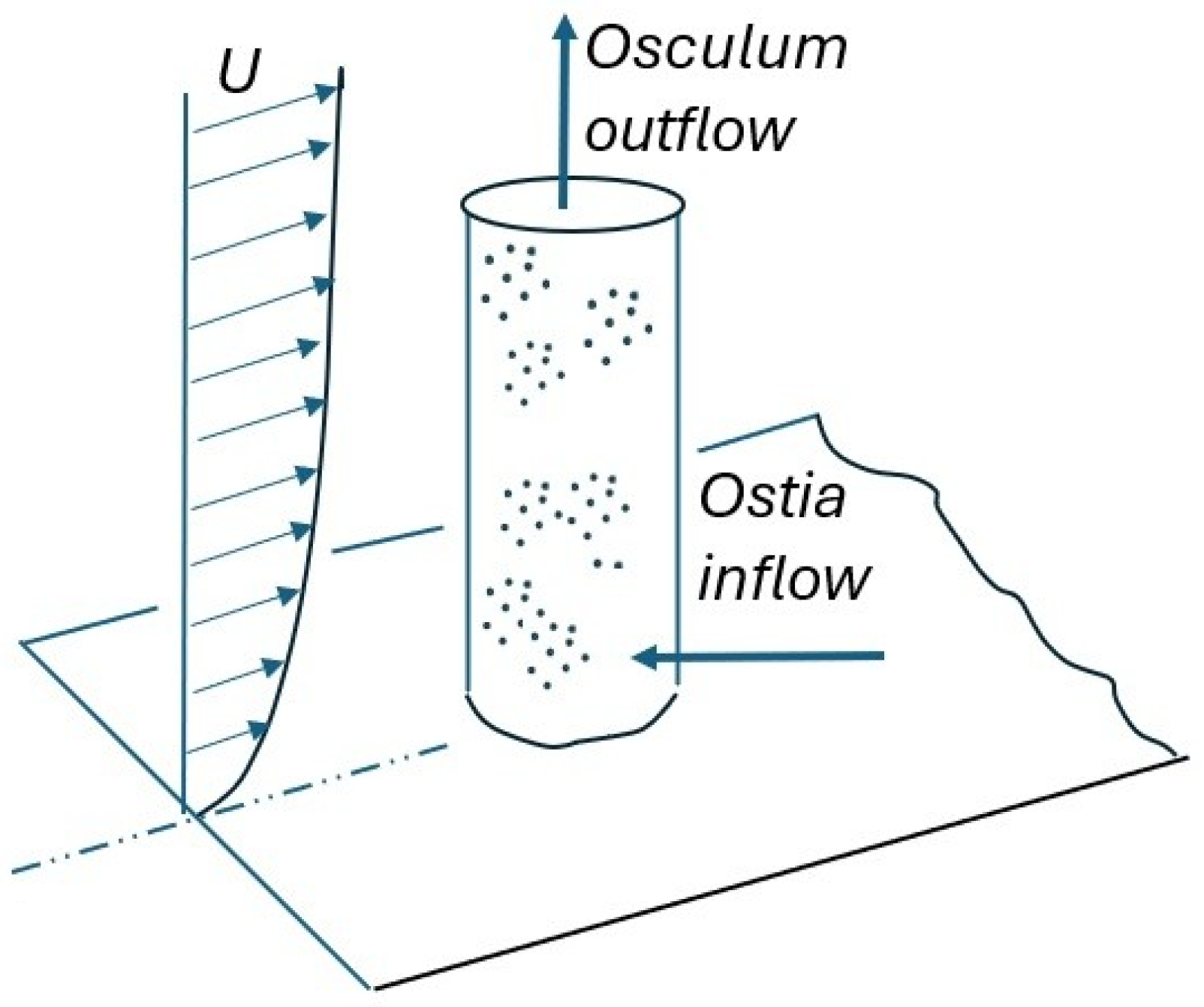
8]. In particular, the ambient flow past an elevated exhalant opening (osculum) of a sponge should provide a pressure reduction at the osculum and hence aid flow through the sponge, with sharp-edged protruding apertures being the most effective exits (
Figure 1).
Vogel [
1] measured the flow inside the demosponge
Halichondria bowerbanki by lowering a probe 4 mm into the osculum, and subsequently, the same probe was repositioned 3 cm in front of the sponge to record the external current velocity. It was found that the internal flow increased linearly with the external current, both in an actively pumping sponge and in a sponge “turned off” by exposure to fresh water. At an external current of 7 cm s
−1, the passive flow was about one-half the flow through an actively pumping sponge.
Later, Vogel [
2] measured the oscular flow velocity versus the ambient current velocity in eight species of marine sponges in situ with a two-channel thermistor flowmeter. Flow through the oscula was positively correlated with ambient flow, which indicated that the water flow through the sponges was in part induced by ambient currents. It was suggested [
2] that the phenomenon of flow induction was “likely to be widespread among sponges” but that an “evaluation of the role of current-induced flow” in sponges required information “as yet unavailable”. In a follow up study [
3], it was studied how a water current over a sponge could increase flow through the sponge. Here, hollow cylinders with wall perforations serving as ostia and an apical orifice as osculum served as sponge “models”. The models differed from an intact sponge in showing much lower flow induction. However, the magnitude of flow induction could be increased to near normal by the “addition of one-way valves” in the model ostia. Therefore, ref. [
3] suggested the presence of valves in living sponges, and “direct evidence” for such valves was apparently obtained by cannulating the demosponge
Haliclona viridis and observing that water could be more easily drawn out of an osculum than forced into it. However, such valves have never been identified, but the experimental approach is interesting because it studied the effect of both imposed positive and negative backpressure in a living sponge, and therefore, our re-interpretation of these data forms an important part of the present account.
Savarese et al. [
5] (Figure 4 therein) measured osculum outflow velocity and ambient flow velocity near the globose freshwater sponge
Baikalospongia bacillifera in the benthic boundary layer, shown to follow the usual logarithmic profile, and found a positive correlation of these velocities for one but negative correlation for two other sponges.
Leys et al. [
6] studied pumping rates of the glass sponge
Aphrocallistes vatus sponges in situ and in the lab subject to increasing ambient currents that were beneficial for thin-walled sponges and believed “to introduce a pressure gradient across the sponge wall”.
Ludeman et al. [
7] studied the effect of ambient flows on the oxygen removal for several sponges including
Cliona delitrix and
Callyspongia vaginalis. Two more recent computational studies [
9,
10] described in detail the flow past and through openings in the skeleton of the glass sponge
Euplectella aspergillum. Based on simulations that showed flow lines and vortices crossing the skeleton in crossflow, ref. [
10] concluded that the sponge skeleton gave rise to “complex swirling patterns” that favor the “distribution of suspended particles throughout the flagellated chambers of the sponge, where nutrients are absorbed”, and further, that the skeleton’s helical ridges “promote vortical structures” within the body cavity that increase the “available time for the sponge to feed”. These statements were criticized [
11], pointing out that [
10] in their model neglected the sponge’s tissue and the active choanocyte pumps. Therefore, the flow simulations were not informative regarding the water flow through live
E. aspergillum, and the speculations regarding feeding were “unfounded” [
11]. Nevertheless, their reply [
12] maintained the relevance of their conclusions, and in a more recent study [
13] they again ignored the justified criticism but referred instead to the ongoing debate as to whether active pumping by choanocytes is the only mechanism for water flow in sponges. They suggested [
13] that their CFD simulations were the ideal tool to resolve the debate about whether active pumping is the sole mechanism creating water flow inside
E. aspergillum. Thus, they found that their simulations [
13] provided “compelling evidence” in favor of passive ventilation in agreement with [
8] who demonstrated that a cylindrical plastic-model sponge showed a similar passive ventilation. But this does not resolve the debate about the importance of passive ventilation versus active pumping in sponges. Both mechanisms may be found in a sponge, and both may contribute to the feeding process. The contribution from passive feeding has the advantage of requiring no energy cost from the sponge. However, only the water entering the aquiferous system of the sponge and being actively pumped will be filtered by the choanocyte collar-filter. Some passive ventilation may rely on holes, which are not true ostia but gaps allowing water to pass through the sponge body without being filtered [
14]. It remains unknown if passive flow is filtered and thus may help sponges to lower their energy cost of pumping, but as we emphasize here, pressures and not velocity gradients drive water flows.
It is the purpose of the present study to review the literature and add to the interpretation and modeling of reported observations of the influence of ambient current on the filtration rate of a sponge by a fluid-mechanical approach to pump-system analysis.
2. Methods and Theoretical Considerations
Based on earlier modeling of filter-feeding invertebrates [
15], it is proposed that the influence of ambient current flow on pumping of a sponge should be modeled by considering the pump characteristic, often a near-linear relation between pump head (or pressure)
Pp versus pumping rate
Q (= filtration rate = volume follow rate),
and the system characteristic
Ps versus
Q, determined by the sum of frictional losses to flow, which in the case of a sponge depends on the pumping rate from the inlet pressure at ostia to the exit pressure at the osculum,
where −
PA = −
Postia +
Posc is the negative backpressure, and the frictional pressure drop of flow through the sponge Δ
Pfriction =
S ×
Q is assumed to be proportional to the volume flow rate
Q, because of the viscous dominated slow flows, and
S is a constant determined by the flow system of the sponge. We use the term backpressure to represent the pressure facing the sponge at its osculum exit flow. Imposed suction at the exit and/or excess pressure at the inlet imply negative backpressure. The interception of the two characteristics (
PP =
PS) determines the operating pump pressure, hence the pumping rate. The flow path through canals and choanocyte collar filters from any ostia at the sponge surface passes through the approximately same thickness of tissue wall to the atrium in many sponges and then at negligible pressure loss to the osculum. For the sponge, we may therefore use the average pressure over the cylindrical surface of a cylindrical upright sponge (
Figure 1) as the ostia pressure
Postia in (2).
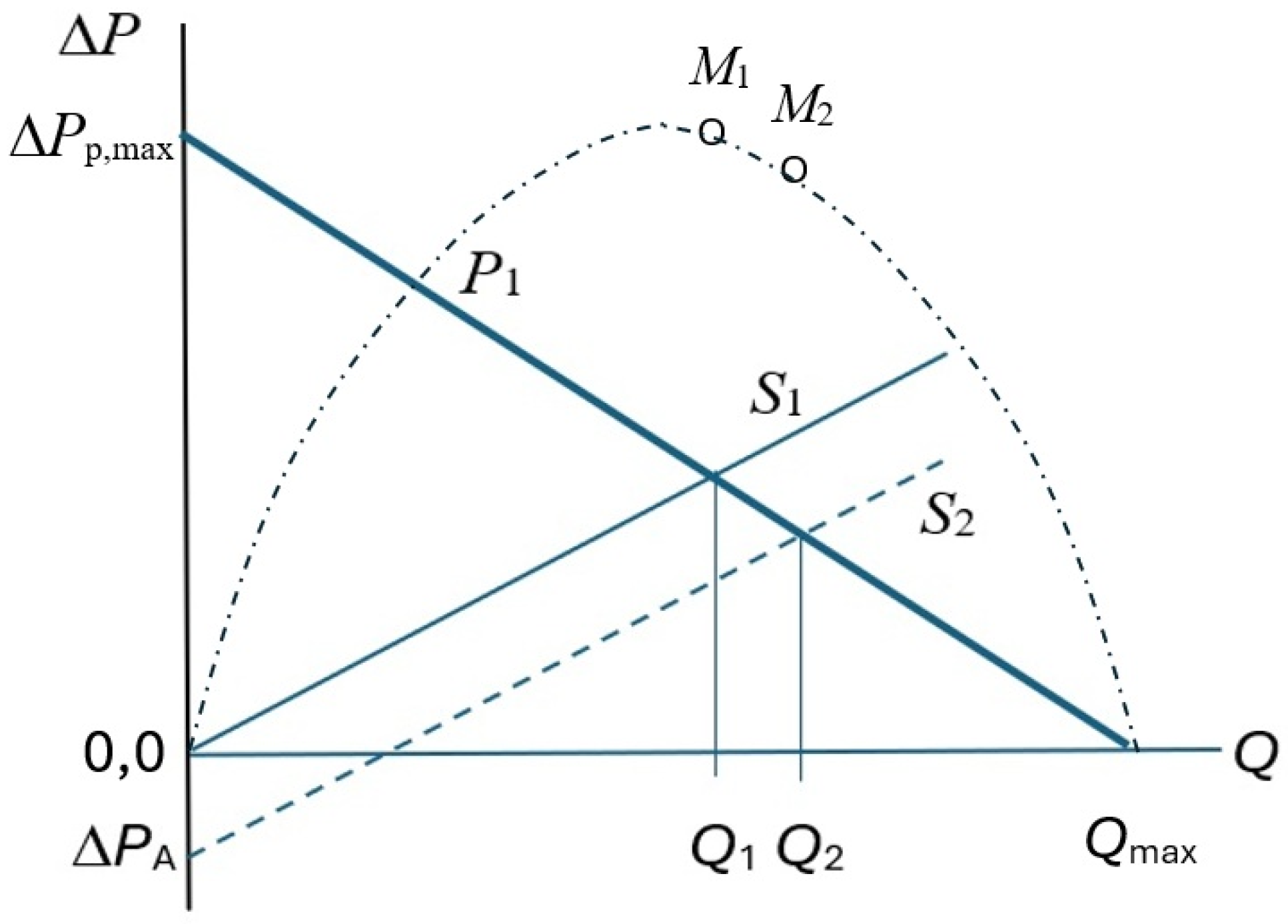
Figure 2 shows the pump characteristic
P1 and system characteristic
S1 without, and
S2 with ambient flow that increases the pumping rate from
Q1 to
Q2 due to a negative backpressure. Positive backpressure, on the other hand, would lead to reduced pumping flow. The shown parabola in
Figure 2 represents the reversible pumping power,
M = Δ
P ×
Q, delivered to the water flow, and for this example it shows a small reduction in power from
M1 to
M2 when applying ambient flow that gives a negative backpressure. Here we assume an unchanged pump characteristic. Therefore, the pump senses a reduced resistance to flow, hence delivers a higher flow rate, even at slightly reduced bio-energetic costs of pump work. To the question of how a sponge can sense an ambient flow, the simple answer is the pressure distribution around the sponge, because the associated shear forces along the sponge surface have little or no effect on the in- and out-flows, and hence the pumping rate.
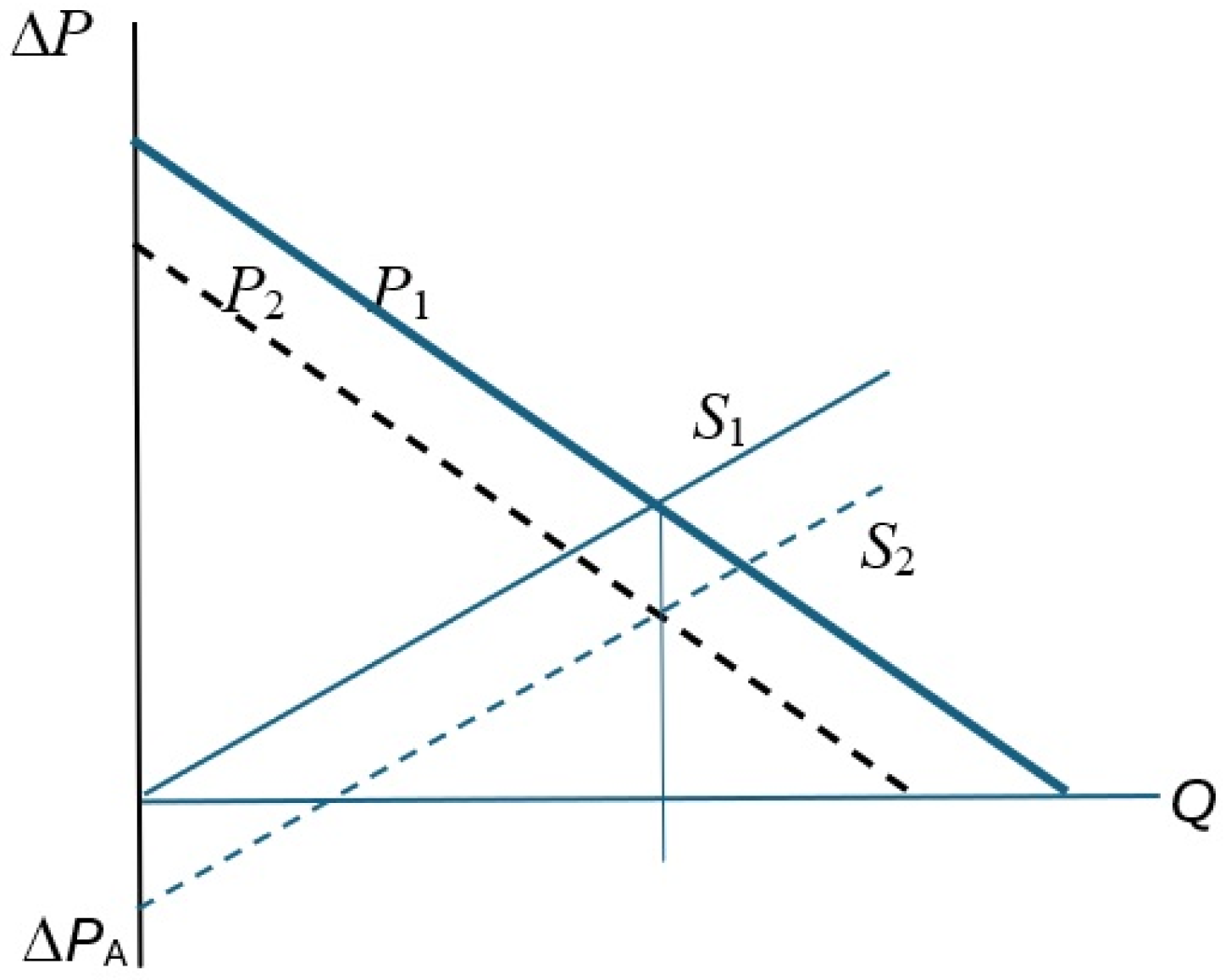
As an alternative or additional change in response, it could be imagined that the sponge-pump reduces its pumping power (say by reducing the beat frequency of pumping flagella), in effect changing its pump characteristic as illustrated in
Figure 3, which shows the shifted system characteristic
S2 due to negative backpressure intersecting the shifted pump characteristic
P2 at an unchanged filtration rate.
Here, we have estimated the pressure distribution over the surface of a cylindrical upright sponge subject to uniform ambient flow (we ignore the effect of a boundary layer profile, suggested in
Figure 1, because it would only change the effective mean velocity of cross flow). We use the theoretical calculations for a range of Reynolds numbers by [
16], whose results are supported by more recent CFD-calculations by [
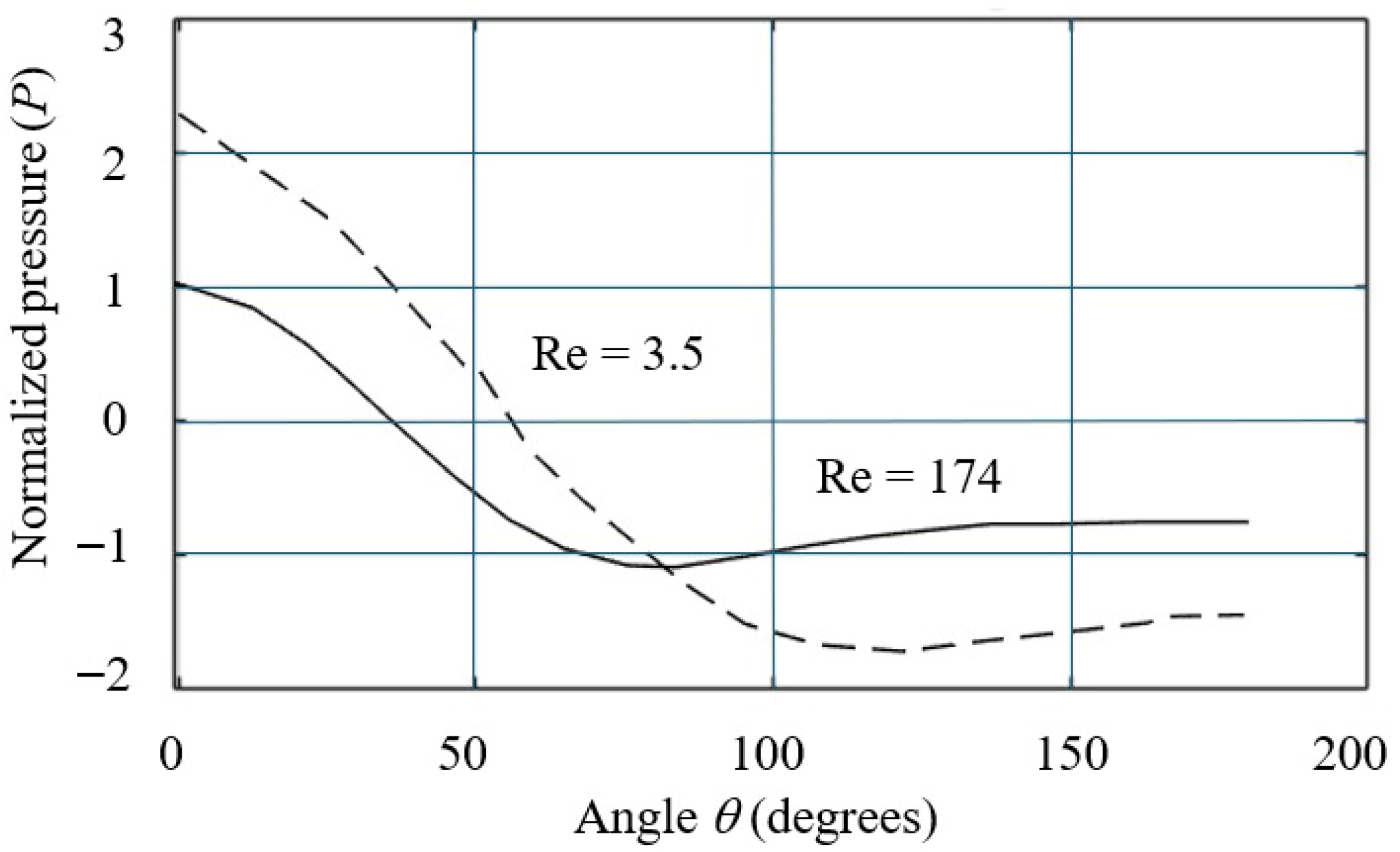
17]. Typically, the pressure is high and positive near the front stagnation point, decreasing to high negative values on the sides and in the rear stagnation region as shown in
Figure 4 for two values of the Reynolds number Re =
UD/υ, where
U is the ambient velocity,
D the diameter of the cylinder and υ the kinematic viscosity. As indicated, the mean normalized pressure,
P =
p/(½ρ
U2) where ρ is water density, over the circumference is nearly the same negative value for the two values of Reynolds number shown, about <
P> = −0.53. Following [
1], we estimate the pressure at the osculum from the Bernoulli principle to be reduced by ½ρ
U2, hence negative, and normalized to the value of
Posc = −1. The total backpressure therefore becomes −
PA = − (−0.53) −1 = −0.47, which would imply an increased pumping rate (the operating point at the
P1-
S1 intersection moves to the operating point at the
P1-
S2 intersection in the schematic in
Figure 2. It is interesting to note that the mean negative pressure on the cylinder surface by itself would oppose osculum outflow. But this is overruled by the suction at the osculum determined by the Bernoulli principle to give a net negative backpressure that drives an osculum outflow.
The present fluid-mechanical principle for an ambient current to induce osculum out-flow is fundamentally different from that described by [
3,
4]. Thus, Vogel [
4] suggested that water enters the upstream ostia “under the pressure” of the ambient current, while “a set of valves” close to the sponge surface “prevent backflow” where the pressure inside the sponge was “greater than that outside”. But it is true that “no matter what the direction of the current” the sponge would “take advantage of both the positive water pressure on its upstream entrance holes and the negative pressure at its exit holes”. As expressed by our model in Equations (1) and (2), it is the pressure from choanocyte pumps and possible ambient flow leading to a negative backpressure that drives the flow. Gradients in velocity fields, e.g., in the benthic boundary layer (as claimed by [
8,
18]) do not drive flows. From the example given in
Appendix A, it appears that the generated passive osculum flow at high ambient current speeds can be explained by the pressure distribution generated around the sponge by the ambient flow. Based on the present findings, we have re-interpreted published experimental data in the next section.
3. Results. Interpretation of Experimental Observations
Using an arrangement for applying pressure and measuring flow through a living sponge or a model of sponge, ref. [
3] (Figures 1–3 therein) determined the effect of positive and negative backpressures on oscular flows. For a “model sponge” (a hollow cylinder with perforated wall serving as inlet ostia, and an apical orifice serving as osculum) [
3] measured the ratio of osculum exit velocity
Vex to ambient current velocity as
Vex/
U ~ 0.22 for
U > 0.18 cm s
−1. In particular, ref. [
3] (Figure 3 therein, case of zero applied pressure) found an approximately parabolic increase in osculum flow in response to increasing ambient flow past a simple model sponge. This appears to agree with the ‘Bernoulli principle’ that is also parabolic as ½ρ
U2. Furthermore, the pressure difference imposed over the sponge [
3] (Figure 5 therein) is seen to give rise to a nearly linear increase in oscular out-flow rate for increasing suction pressure at osculum (which are positive pressures in the notation of [
3] (Figure 5 therein)). This pressure difference is the same as the negative backpressure Δ
PA in
Figure 2, which indicates that a linear increase in the negative Δ
PA may also give rise to a linear increase in
Q. Thus, the fluid-mechanical mechanism described here explains the experimental observations of [
3] without suggesting valves, which have never been identified in sponges.
Osculum outflow velocity and ambient flow velocity were measured by [
5] (Figure 3 therein) near the freshwater sponge
Baikalospongia bacillifera in the benthic boundary layer and they found a positive correlation of these velocities for one individual but negative correlation for two other individuals.
Leys et al. [
6] studied pumping rates of
Aphrocallistes vatus sponges in situ and in the lab subject to increasing ambient currents, finding
Vex/
U ~ 0.1 for actively pumping sponges, 0.05 for a non-pumping sponge, and 0.14 for a sponge that was soaked in bleach to remove tissue. The largest increases in excurrent velocities occurred in dead sponges whose tissue had been removed. Pumping sponges in the lab had the same rate of excurrent flow as recorded in situ (0 to 4 cm s
−1). The amount of flow induced through the sponge by ambient current—defined by
a, the slope of the regression of
Vex/
U—varied almost 10-fold among the different individual sponges, ranging from 0.02 to 0.1 in the laboratory tanks experiments, and 0.06 to 0.45 in the field. However, the induced flow may be expected to vary with sponge geometry, direction of flow, and distance from neighbors, and as seen in tank experiments, the physiological status of the sponge (whether actively pumping, arrested, or clogged) may also significantly affect the flow induced through the sponge by ambient current [
6].
Ludeman et al. [
7] (Figure 4 therein) for
Cliona delitrix found increasing
Vex and decreasing oxygen removal for increasing
U > 15 cm s
−1, which could suggest that choanocyte pumps reduce their metabolism because they sense they are being now aided by the ambient flow, which causes an overall reduction in resistance to flow. However, the same study found that the ratio of measured filtration rates and oxygen removal (respiration) of five other species of sponges was essentially constant, while for the sponge
Callyspongia vaginalis there was little change in filtration rate and respiration rate for increasing ambient currents from about 10 to 35 cm s
−1.
From the above experimental observations, it appears likely that ambient currents may enhance the osculum out-flow.
4. Imposed Pressures on Pump—Towards Understanding ‘Passive Flow’
The individual choanocytes represent the sponge pump, which may be characterized as a positive displacement pump where a vaned flagellum is beating in the sealed part of the collar and delivers a certain volume flow (filtration rate = pumping rate = volume flow) [
19,
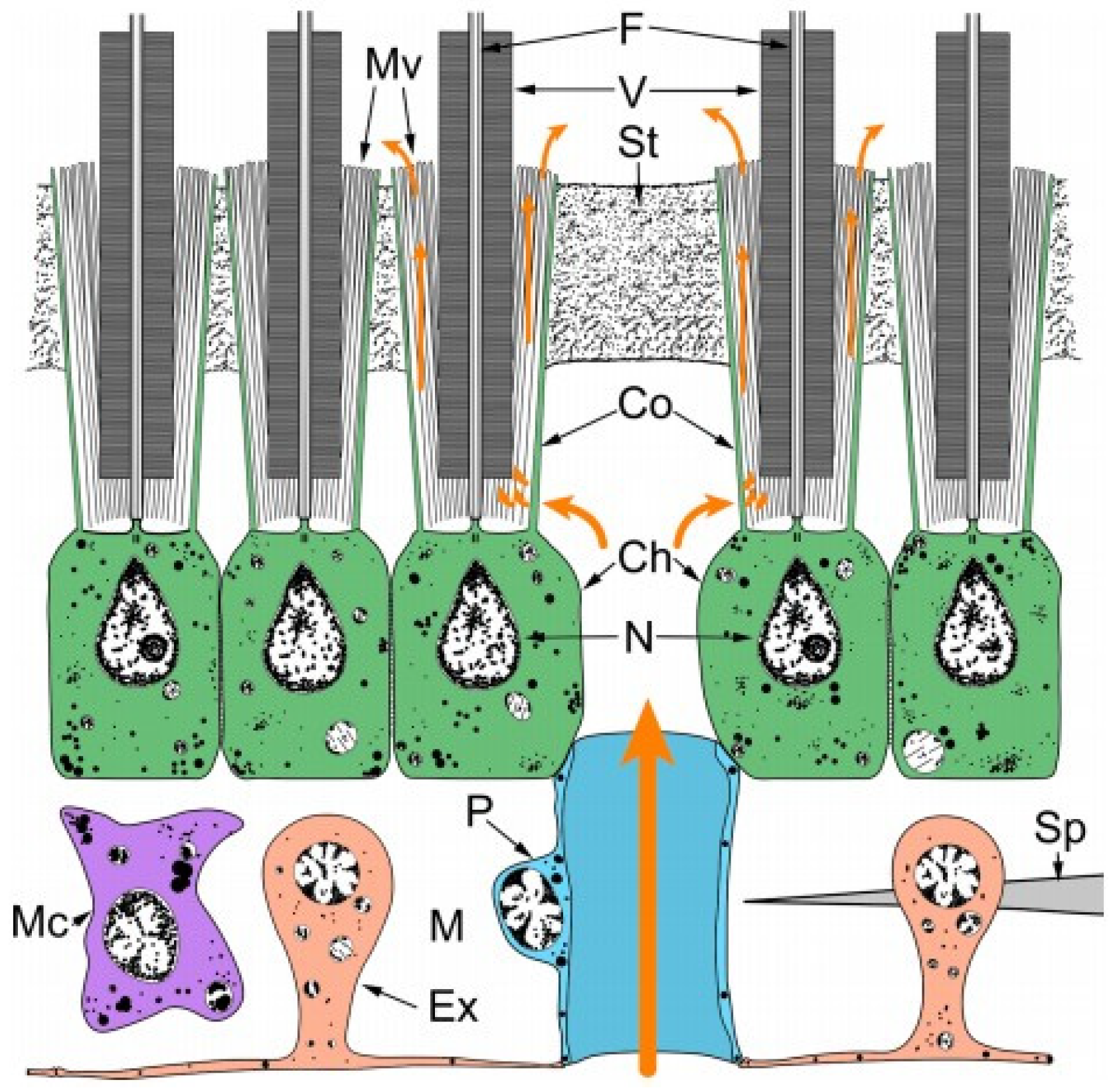
20]. In the choanocyte chamber, choanocytes are held together by an extracellular meshwork (secondary reticulum, called a strainer) at the distal end of their collars, which separates a low-pressure zone with inhalant water from a high-pressure zone with filtered exhalant water.
Fixation of sponge tissue with ruthenium red allowed [
21] us to reveal the thickness of 4.4 µm of the glycocalyx structure constituting the strainer for the first time.
Figure 5 shows the organization of water-pumping choanocytes in the calcareous sponge
Leucosolena variabilis. It is interesting to see the magnitude of the pressures generated by the ambient flow relative to that provided by the pump. When an increasing positive backpressure is experimentally imposed on the pumping choanocytes, the pressure in the high-pressure zone increases, causing a reduced pumping rate until the pumping rate becomes zero, which happens when the imposed backpressure is about 2.5 mm H
2O = maximum pump head [
19] (Figure 1 therein) and [
22]. Due to the sealing (secondary reticulum) no water is pushed into the low-pressure zone as long as the positive backpressure is not too high. But as shown by [
3] (Figure 5 therein), a positive backpressure of about 300 dyn cm
−2 (~3 mm H
2O) forces water to flow backwards into the osculum.
The range of zero flow at the maximum pump head was interpreted by [
3] to be due to the already mentioned action of one-way valves located in the dermal membrane near ostia; but such valves were not documented, and it still remains unknown if the functional data obtained with high backpressures on a cannulated and ligated sponge specimen of
Haliclona viridis were reversible. Furthermore, our present detailed knowledge on the structure and function of the choanocyte pump was unknown to Vogel in 1978.
The experiment [
3] is not easy to explain. First, we may suggest that the increasing positive backpressure could have been opposed by the pumping flagella up to a certain maximum (shut-off pressure) where the flow was stopped, as observed in experimental recordings of the so-called backpressure characteristic by [
22]. Next, we may suggest that the glycocalyx mesh in the strainer may be of a deformable material, which may deform by rising backpressure to eventually block the flow. But at still-higher backpressures, the strainer may rupture and allow backflow. However, in cases of a negative backpressure (osculum suction), which may be created by an ambient current, water from the inhalant canal will flow through a small opening (porocyte) into the chamber with the pumping and filtering choanocytes (
Figure 5). Here, the tight strainer (if not broken) forces all water to pass through the microvilli collar filter and further through the collar with a beating flagellum, and finally out into the exhalant canal to the osculum. But it is unknown if the extra “passive” water flow may influence the beating flagellum and thus the energy cost of pumping. It is suggested that all sponge species rely on the same common principles of choanocyte organization for pumping and filtration of water [
21].
5. Discussion
Riisgård et al. [
22] (Table 1 therein) determined the theoretical pumping power, based on measurements and theoretical calculations, for the demosponge
Haliclona urceolus. The experimentally measured back-pressure characteristic showed that the maximum pressure the sponge pump could deliver at zero pumping rate was 2.7 mm H
2O. From data on pumping rate and calculated pressure drop through the flow system, the pump characteristic was modeled for a ‘standard sponge’ where the normal operating pressure was estimated at Δ
H0 = 0.673 mm H
2O. Knowing the pumping rate and respiration rate [
23] estimated the cost of pumping as
Pp R = Δ
P ×
Q/
R = pump pressure × pumping rate/respiration rate = (1.04/80 =) 1.3%. From this reference, it may be evaluated how much energy would be saved if, for example, 50% of the active volume flow was replaced by induced passive flow. With an unchanged total flow through the microvilli filter, this would reduce the cost of pumping to 0.65% (see [
23] for calculations). A reduction of, for example, the beat frequency of the choanocyte flagella might reduce the energy cost of pumping, but the basic metabolism of the choanocytes with resting flagella may only be slightly reduced. This emphasizes that we have no information on how an induced passive flow might influence the sponge pump if it results in an increased volume flow and more food particles being retained.
Measuring the exit osculum volume flow of the glass sponge
Aphrocallistes vastus in situ at a 150 m deep reef, ref. [
6] found that ambient current velocities > 15 cm s
−1 increased the exit volume flow. Thus, the excurrent flow rates correlated with bottom currents governed by tides; the stronger the ambient current, the higher was the flow out of the sponge. The amount of flow induced through the sponge by ambient current, defined by the slope of the regression of exhalant flow velocity (
Vex) versus ambient current velocity (
U), ranged from
Vex/
U = 0.06 to 0.45, or about 17 to 2 times the pumping rate measured at low ambient flow. Further, concurrent with measurements of exhalant flow, in situ respiration rates were measured as the difference in oxygen concentration in incurrent and excurrent water of individual sponges = ΔO
2. The respiration measurements were made at low ambient flow and showed an average respiration of ΔO
2 = 0.53 µmol O
2 L−1 pumped by the sponge. From this, the liters of water filtered per ml of O
2 consumed can be estimated as
F/R =
F/(ΔO
2 ×
F) = 1/ΔO
2 = [1/(0.0224/0.53) = 1/0.04226 =] 23.7 L H
2O (ml O
2)
−1, which agrees with the
F/R-ratio for an actively pumping sponge. Unfortunately, the respiration rate was not measured at high ambient current velocities ≥ 15 cm s
−1, which could have revealed a possible increase in
F/R-ratio in case of increased osculum volume flow caused by ambient current, but without a concurrent increase in respiration, because the extra water flow through the sponge would be passive and thus metabolically costless.
An important possible factor causing increased osculum volume flow rate by ambient currents is in-flow of ambient water through holes in the sponge walls. Here, the 2 mm open holes through the wall of
Aphrocallistes vastus [
14] would give a higher exit volume flow, which would also imply a reduction in the particle retention efficiency, which, however, has so far never been measured in any sponge species in cases of increased exit volume flow caused by ambient currents. Finally, current-induced extra oscular water flow has been suggested to bypass the choanocyte chambers in the glass sponge
Scolymastra joubin [
24], and in the demosponges
Spongia officinalis and
Cliona viridis [
25].
Leys et al. [
6] estimated that the pumping of sponges required an “energetic expenditure of at least 28% of the respiration”, and due to this suggested high cost, they concluded that current-induced flow is highly beneficial. Likewise, using a model of the sponge canal system, ref. [
7] found that filter feeding might be more energetically costly than previously thought. However, the improved descriptions of the filter apparatus of the choanocytes [
23] (Table 1 therein) corrected the published values by [
6] and [
7] of respiration-specific pumping costs to 22 and 12.7%, respectively, whereas the value reported by [
15] was corrected to 1.3% and used in the above example. As it appears, the energy cost of pumping may not be very costly.
As already mentioned, ref. [
5] found that in general, the correlations between ambient current and oscular excurrent flow were negative. Likewise, ref. [
7] found that some species of demosponge did not use current-induced flow but rather responded to increased ambient currents by reducing their pumping rates. Obviously, there is at present no consensus on either the energetic cost of pumping or the possible benefit of ambient currents on the cost of pumping. Our idealized example of ambient flow past an isolated upright cylindrical sponge (
Figure 1) may be far from natural conditions, also because groups of sponges of many forms make up other configurations in the benthic boundary layer flow with a velocity gradient. We have shown how in theory an induced passive water flow may reduce the metabolic cost of filtering in
Figure 2. It remains unknown how the flagellum in the choanocyte collar may respond to extra ‘passive’ water being sucked into the sponge-pump, but in theory it may reduce the workload on the water-pumping flagella. Thus, it is still unknown if ambient currents may somehow help the sponge to process the same volume of water at lower energy cost. But our message is that we have demonstrated that moderate reduced energy costs are a theoretical possibility, but this does depend on the operating point of the sponge pump. Although we do not present new data, we bring to the attention existing relevant data on pressure distribution on the (admittedly) ideal cylindrical geometry, and we point out the importance of using fluid mechanical concepts of pump-system concepts in terms of characteristics to understand and conceptually predict effects of changed backpressure.
6. Conclusions
As reported by several investigators, ambient flow past a sponge, or past models of a sponge, can induce an increase in the flow through the sponge. We have reviewed the literature including its available empirical results, and we have presented the conceptual approach, illustrated by one particular geometry, that the pressure distribution on the surface with ostia inflow, in addition to that at osculum with outflow, drives an increase in filtration rate that would bring additional suspended food particles to the choanocyte filters for ingestion. Our cylindrical sponge model under uniform flow is highly simplified and may not represent real sponges, which exhibit diverse morphologies, orientations, and exist in complex boundary layer flows. To aid the analysis, we show how useful it is to consider the pump and system characteristics of the sponge. For the example considered, the pressure distribution represents a net negative backpressure that implies increased osculum out-flow and suggests a certain reduced energy expenditure of the choanocyte pumps, and hence ambient flow has a beneficial effect. One could imagine that some sponges might filter-feed without using their choanocyte pumps, thanks to ambient flow.