Article

Cetaceans Change Their Acoustic Behavior During the Airgun Noise of Seismic Surveys

by
Israel Maciel
1,2,3,*,
Rodrigo Tardin
3,4,
Sergio Carvalho Moreira
3,
Gabriel Melo-Santos
1,2,3,
Guilherme Maricato
3,4 and
Maria Alice S. Alves
1,2
1
Programa de Pós-Graduação em Ecologia e Evolução, Instituto de Biologia Roberto Alcantara Gomes, Universidade do Estado do Rio de Janeiro, Rio de Janeiro 20550-013, Brazil
2
Departamento de Ecologia, Instituto de Biologia Roberto Alcantara Gomes, Universidade do Estado do Rio de Janeiro, Rio de Janeiro 20550-013, Brazil
3
Laboratório de Ecologia e Conservação Marinha, Departamento de Ecologia, Universidade Federal do Rio de Janeiro, Rio de Janeiro 21941-853, Brazil
4
Programa de Pós-Graduação em Ecologia, Instituto de Biologia, Universidade Federal do Rio de Janeiro, Rio de Janeiro 21941-853, Brazil
*
Author to whom correspondence should be addressed.
J. Mar. Sci. Eng. 2026, 14(2), 181; https://doi.org/10.3390/jmse14020181
Submission received: 17 December 2025 / Revised: 7 January 2026 / Accepted: 13 January 2026 / Published: 15 January 2026

Abstract

Seismic surveys introduce high levels of noise into the soundscape. Thus, a major concern is the effect of these noise levels on animal communication, especially for species with high hearing acuity, such as cetaceans. We evaluated the effects of airgun pulses of seismic surveys on the acoustic behavior of humpback whales (Megaptera novaeangliae) and pantropical spotted dolphins (Stenella attenuata) in the two most important basins for oil and gas off Brazil. We detect the presence of airgun pulses and measure sound pressure levels (SPL) to evaluate whether SPL changed the acoustic parameters of cetacean vocalizations. Airgun pulses increased the SPL by 17%. This changes acoustic parameters differently: whales reduced call frequency and duration, while dolphins increased these parameters. In both cases, responses may be related to physiological limitations in sound modulation of each species. This was the first report on the impacts of seismic surveys on cetaceans’ communications in Brazil and the first for the pantropical spotted dolphin on this topic in the world. Impacts vary with the frequency and duration of emissions, indicating species-specific acoustic responses that depend on airgun noise characteristics. Whales cannot make efficient adjustments at higher or lower frequencies, and dolphins cannot adjust at lower frequencies. These results are important for discussing the effects of airgun noise on cetacean communication.

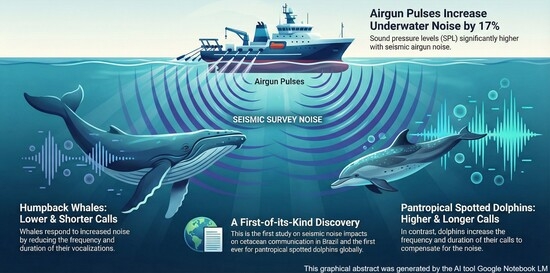
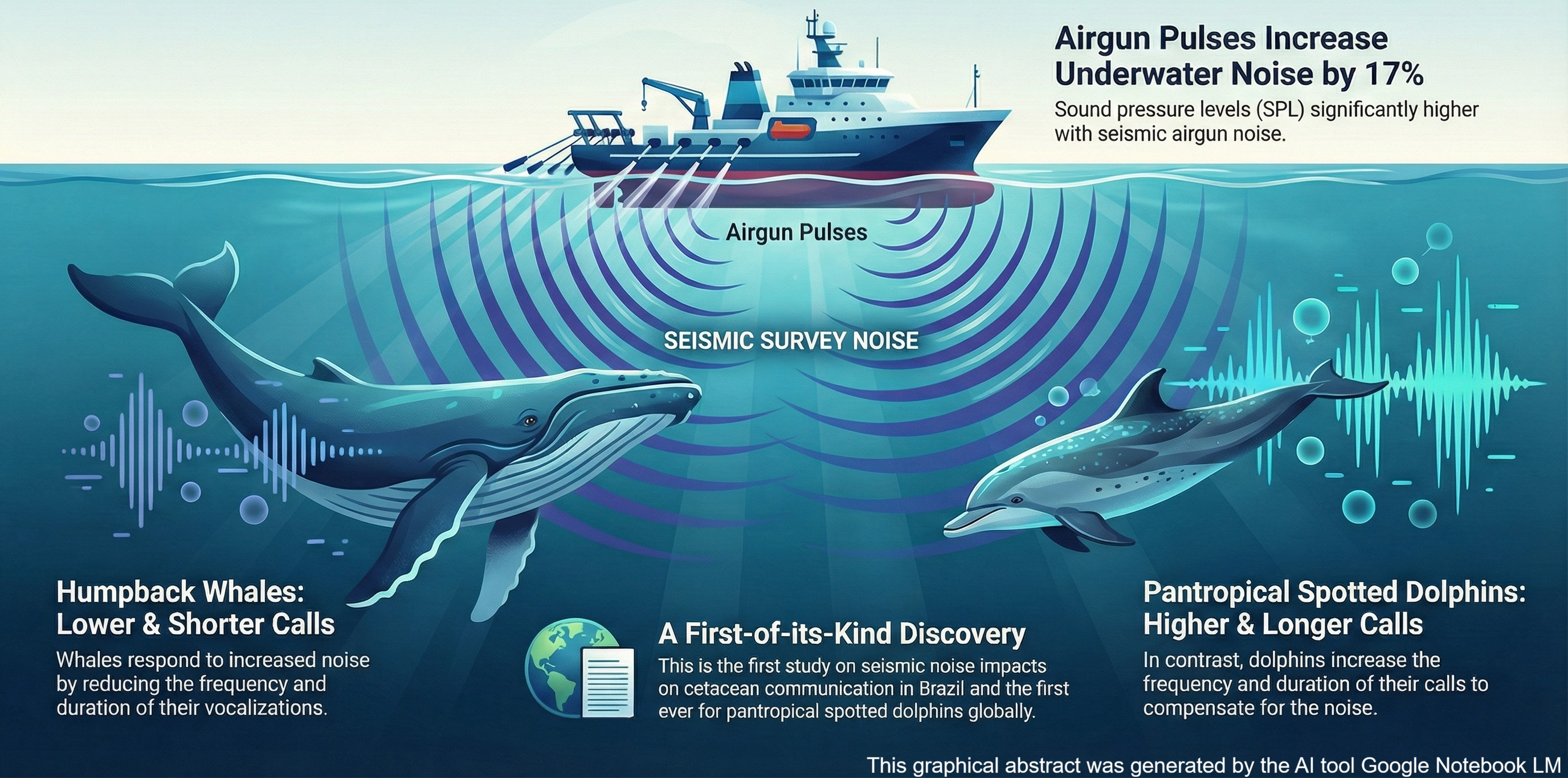
Graphical Abstract

1. Introduction

The world’s dependence on energy has grown steadily in recent decades, with oil and gas being the principal options used to meet this demand [1]. Fossil fuels have driven the economic and social growth of most countries for more than a century [2]. However, the exploitation of these fuels also generates significant social and ecological costs, such as pollution, oil spills, social displacement, and conflicts [2]. Despite recent efforts to promote an energetic transition, fossil fuels remain the main source of energy production worldwide [3].
To identify economically viable sources of oil and gas in the ocean, seismic surveys are currently considered the most effective method [4]. This procedure uses airguns to target different layers of the substrate, directing high-intensity noise toward the seafloor. In general, the sounds produced by seismic airguns are pulses of low frequency (2–200 Hz at source), short duration (<0.1 s), and high amplitude (216–261 dB re 1 µPa at 1 m) which are produced in the form of pressurized air, released abruptly from the airgun cylinders into the water [5,6]. One of the main concerns in terms of marine noise pollution is the high levels of anthropogenic noise pollution and its effects on the biota, in particular animals with high hearing acuity [7,8]. Noise can be defined as any sound that interferes with the reception of signals [6], and the marine acoustic environment is becoming increasingly noisier due to the intensification of human activities [9], such as shipping [10] and the exploitation of natural resources [9].
Seismic surveys produce constant noise with a high propagation capacity in the marine environment [11]. The influence of anthropogenic noise on marine mammals has been the subject of several studies (e.g., [12,13,14]). In general, cetaceans tend to increase their avoidance response [15,16], change the characteristics of their acoustic signals, including the frequency, duration, and sound level of their vocalizations, responding even over long distances [17,18,19]. These changes appear to be a response of these mammals to improve audibility and avoid masking by anthropogenic noise (e.g., [20,21]), although this strategy is not always effective [22]. Impacts from noise may also have the potential to induce stress [14,23], potentially cause hearing damage [7,24,25,26], alter group composition and breathing patterns [27], affect energetic budget [28], reduce social interactions [29], and may even provoke the temporary or permanent avoidance of a habitat [27,30,31].
Although the thresholds of exposure to pulsed noise have already been proposed for cetaceans [32,33], these values were established based on the acoustic limits described in live specimens of around a quarter of odontocete species and modeled based on morphological analyses in only three mysticete species. Also, the response to airgun noise may vary considerably, not only among species, but also according to the context, sex, and age group of the animals [25,34,35]. In addition, studies usually focus on a single species approach in the recording area, which limits conclusions and comparisons with other areas and taxa [3].
Given all this variation, the definition of a safe level of exposure for marine mammals is a difficult task. Given the general lack of data, management decisions must consider this variation carefully [36]. This scenario, together with increasing human pressures, further emphasizes the importance of understanding how cetacean species respond to airgun noise in different locations and under distinct conditions.
Despite advances in the regulation and control of seismic surveys in Brazil [37], there are few studies on the effect of seismic surveys on cetaceans, which are usually related only to the occurrence and diversity of cetaceans (e.g., [38,39,40]), and no study assessing effects on acoustic behavior. In the present study, we aimed to fill this knowledge gap, evaluating the effects of airgun noise on the acoustic behavior of cetaceans in the two basins with the greatest seismic survey activity on the Brazilian coast, the Campos Basin (CB) and Santos Basin (SB).

2. Materials and Methods

2.1. Study Area

The CB is located in southeastern Brazil and extends from Vitória, the capital of Espírito Santo State, to the town of Arraial do Cabo, in Rio de Janeiro State (Figure 1). It is also responsible for more than 60% of oil production in Brazil [41]. Similarly, the Santos Basin (SB) is limited to the north by the CB, extending from Arraial do Cabo to the city of Florianópolis, in Santa Catarina state. Although oil and gas exploration in SB is more recent, since 2006, it is by far the passive continental margin basin with the most hydrocarbon resources in the world, with 38 pre-salt oil and gas fields already discovered [42]. However, the offshore portion of these basins is an important area for cetaceans, in particular the annual migration of the humpback whale [43,44]. In recent years, the increasing exploration and exploitation of oil and gas from the pre-salt layer of the CB and SB continental shelves has led to a major increase in noise from activities such as drilling and seismic surveys [13].
The present study was conducted in specific areas of the CB and SB that were surveyed by Petroleum Geo-Services (PGS—Lysaker, Norway) using the 3D maritime seismic survey technique, covering 133,907.32 km2 (within the CB) and 221,432.15 km2 (within the SB) (Figure 1). However, within these areas, there was also seismic survey activity from other companies, with one to three seismic survey activities occurring within our study area in each campaign.

2.2. Data Collection

We monitored study areas from a 36 m supply vessel with a 2400 BHP engine, which operates independently from the seismic survey vessel. We collected acoustic data in combination with visual monitoring to cross-check the detection and identification of the cetacean species. Both visual and acoustic surveys were conducted by experienced marine mammal scientists, where a team was dedicated to the observation of cetaceans, and the other to the passive acoustic monitoring.
Data used in this study is part of a bigger study, where we recorded acoustic data at 22 sampling points replicated in five campaigns in CB and 42 sampling points replicated in four campaigns in SB, both using SoundTraps ST300 HF (Ocean Instruments—https://www.oceaninstruments.co.nz/product/soundtrap-300-hf-high-frequency/ (accessed on 5 December 2025)) with a sampling rate of 576 kHz/16 bits. Despite differences in the number of sampling points between bays, the sampling area is also different. Thus, in both basins, the density of sampling points is of the same order of magnitude (0.00016 points/Km2 in BC and 0.00019 points/km2 in BS). We conducted five campaigns in CB (January, May, and July 2020, and February and June 2021) and four campaigns in SB (November 2022, February and May 2023, and May 2024).
All acoustic recordings were obtained with the engine turned off to avoid both potential interference in the acoustic behavior of the cetaceans and the production of noise on acoustic samples. Once the engine was off, the SoundTraps were launched by an electric winch at the stern of the vessel to the depth marked on the cable. We used an A-frame to avoid noise produced by friction. The SoundTraps were attached to a cable with a 26 kg sinker and a safety cable with a buoy.
At each sampling point, we recorded 30-min samples, simultaneously, at three different depths (regularly at 20, 260, and 460 m) regardless of whether we sighted cetaceans or not. The deployment depths were proportionally adjusted when the depth was less than 500 m. For sampling points shallower than 500 m, the shallowest hydrophone was always kept at a depth of 20 m, and the others were placed at intermediate depths, at least 10 m from the bottom. This protocol aims to avoid surface and bottom noise, improving recording quality. We recorded at three depths to increase the chances of detection and to record signals with the best possible signal-to-noise ratio.
During daylight hours, when the vessel was traveling and when it stopped for acoustic sampling, two observers were on the bridge 6 m above sea level, each covering a 180° quadrant to detect cetaceans and identify species. The observers were equipped with reticulated binoculars, a Garmin MAP 78S GPS, and a Canon 70D camera with a telephoto lens (75–300 mm) to help in species identification.
Whenever cetaceans were sighted while the vessel was traveling between the sampling points, the engine was stopped, and opportunistic sampling was recorded, using only one recorder at 20 m deep. These samples were recorded only when the species was identified. When the individual or group sighted was moving rapidly, however, we did not deploy the recorders, given the time required to approach the animals, turn off the engines, and deploy the equipment. We obtained simultaneous acoustic and visual records at each sampling point.

2.3. Data Analysis

To measure the effect of airgun noise from seismic surveys on the acoustic behavior of cetaceans, we first identify in all samples where we detect cetacean vocalizations and if we also record airgun pulses from seismic surveys. To ensure greater representativeness of the data and greater robustness in the assessment of the effects of airgun noise on cetaceans, in this study, we only considered species that: (1) we obtained recordings of vocalizations on at least four encounters; and (2) obtained recordings of vocalizations in both, with and without airgun pulse detection. For samples recorded at three different depths, we only considered the measurement of airgun noise and vocalizations at the depth where the cetacean signals had the best signal-to-noise ratio.
All vocalizations were manually identified, and the acoustic parameters were measured in the Raven Pro 1.6 software (Cornell Laboratory of Ornithology). We measured the acoustic parameters of tonal sounds that had good signal-to-noise ratios (SNR > 10 dB) and an unambiguous contour. For this study, we considered the following acoustic parameters: low frequency, high frequency, delta frequency, peak frequency, and delta time.
We measured the noise levels based on the calibrated temporal variation in the sound pressure level (SPL) in each sampling point using the PAMGuide routine [45] in MATLAB 2020b®, considering the calibrated sensitivity of each SoundTrap as calibration. To identify differences in SPL between samples with and without airgun pulse detections, we considered the average SPL in a 30 min sample (up to 50 kHz) and tested using a Wilcoxon test.
Once we detected a difference in SPL between samples with and without airgun pulse detections, we ran a Quantile Regression with bootstrap confidence intervals (95% CI) to model the relationship between predictor variables and specific quantiles (0.25, 0.50, and 0.75). Therefore, we consider the acoustic parameters of cetaceans as the response variable and the SPL in the environment during each emission (sampling window = 1 s, up to 50 kHz) as the explanatory variable. The Quantile Regression considers asymmetries in the statistical distribution of data and allows the identification estimates separate coefficients at specific points of the data distribution (quantiles), allowing us to determine whether SPL affects short versus long vocalizations, or low versus high frequency vocalizations differently.
We used Google Notebook LM (version 3.21.0) to create the graphical abstract available in the online version. In the main text, no generative AI was used to generate text, data, or graphics, or to assist in study design, data collection, analysis, or interpretation.

3. Results

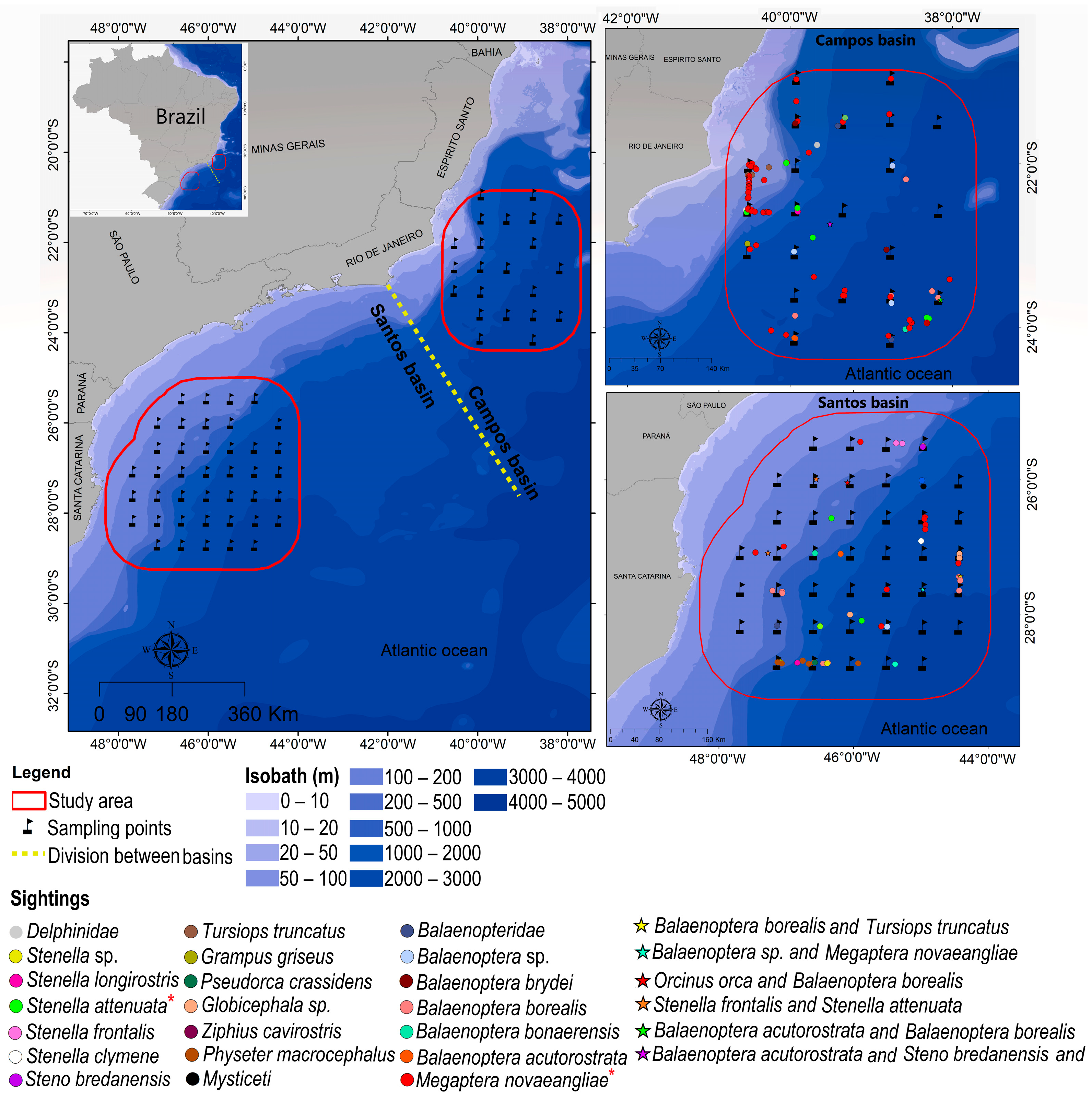
In general, we conducted 620 h ( x ¯ 10.86 h per day ± SD 2.56 h) of monitoring effort during 65 days of fieldwork in CB and 688 h ( x ¯ 10.09 h ± SD 2.56 h) during 73 days in SB. During these surveys, we identified 13 cetacean species in 108 sightings in CB and 18 cetacean species in 77 sightings in SB (Figure 1). We sampled 191 h of acoustic recordings in CB (179 h during sampling points and 12 h during opportunistic sampling) and 271.5 h SB (252 h during sampling points and 19.5 h during opportunistic sampling).
Following our representativeness and robustness criteria, we described the acoustic parameter to evaluate the effect of airgun noise on humpback whales, Megaptera novaeangliae, in the CB and on the pantropical spotted dolphin, Stenella attenuata, in CB and SB (Table 1). Five hours of humpback whale recordings were analyzed across 10 sightings in CB, and 3 h of pantropical spotted dolphin recordings across seven sightings in CB and SB.
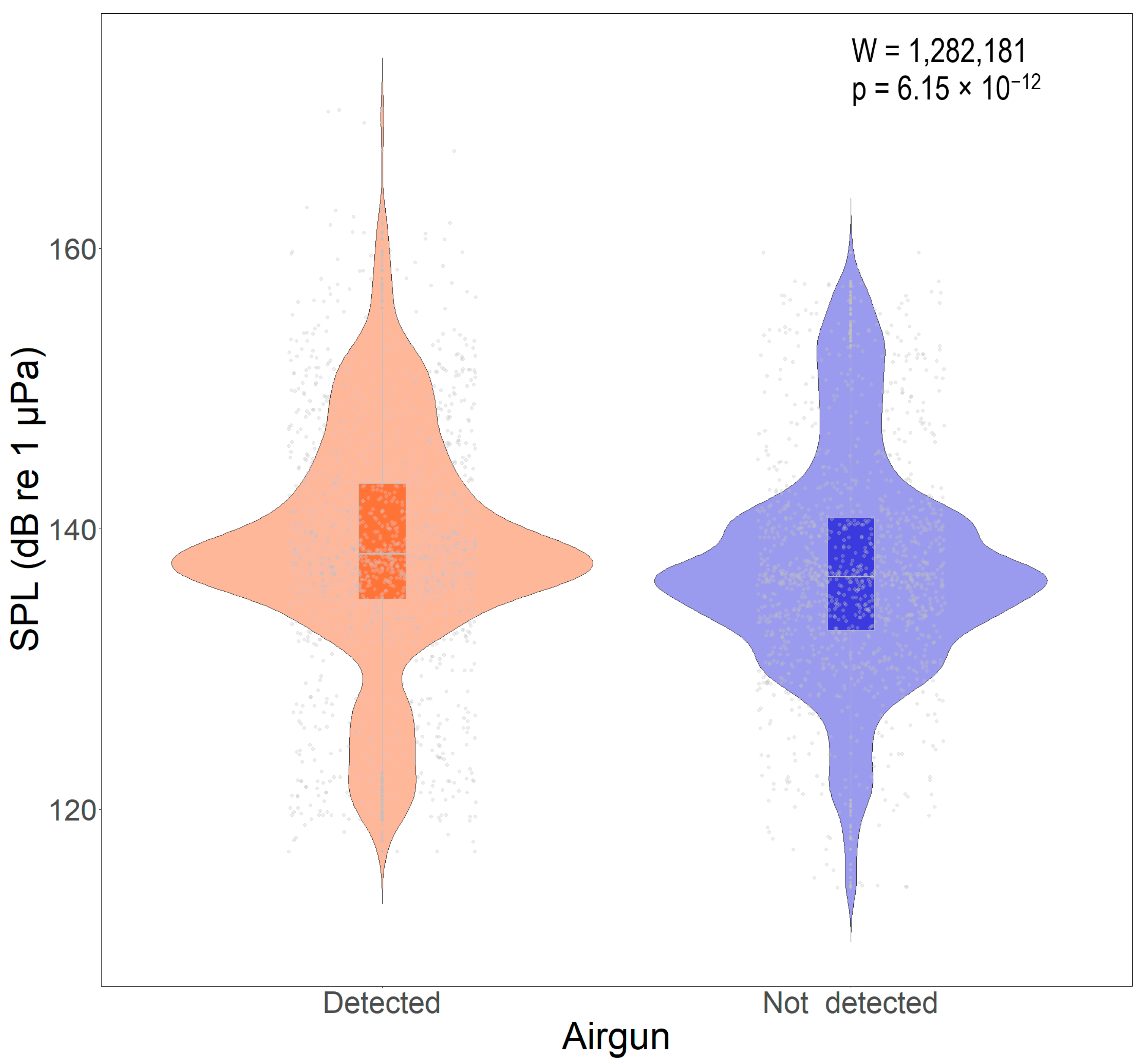
In total, 12 samples (including both sampling and occasional points) of humpback whale vocalizations and seven samples (also including both sampling and occasional points) of pantropical spotted dolphin vocalizations were analyzed. Of these samples, we detected airgun pulses in seven samples with humpback whales and one sample with pantropical spotted dolphin vocalizations. On average, airgun pulses have frequencies between 10.3 Hz and 3.4 kHz (reaching up to 46 kHz), with a duration of 42 ms and a peak frequency at 49.3 Hz. When airgun pulses of seismic surveys were detected, there was a higher SPL when compared to the period with no airgun noise detected (Figure 2). When we detected airgun pulses, there was an average increase of 1.43 dB re 1 µPa, representing a rise of 1.17 times (or 17%) in noise levels.
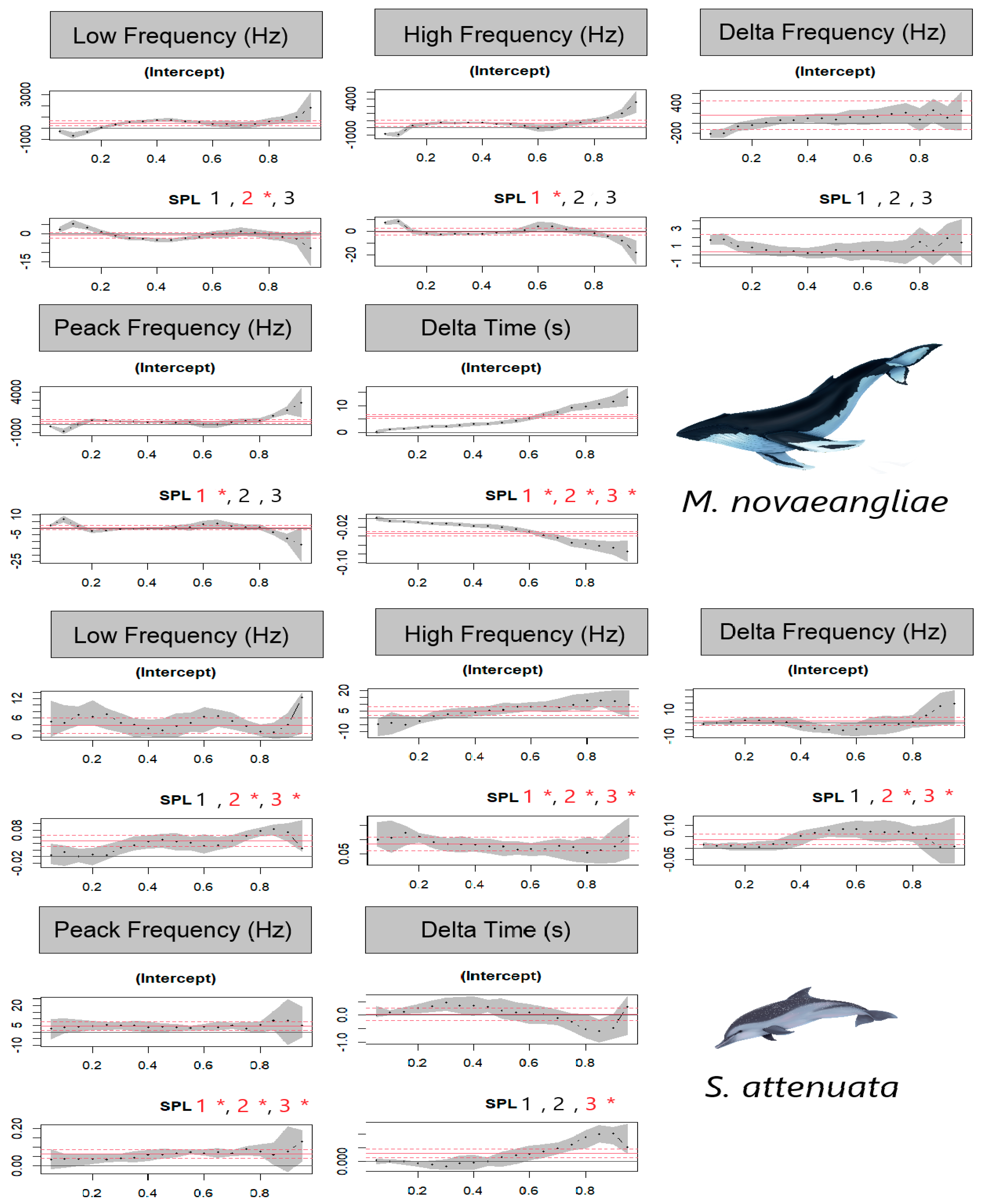
For both species, most of the acoustic parameters changed significantly due to SPL, except for the delta frequency for humpback whales (Table 2 and Figure 3). While humpback whales reduced the frequency and duration of their calls when SPL was higher, the pantropical spotted dolphin increased all its acoustic parameters (Table 2 and Figure 3).
For humpback whales, SPL influenced a reduction in the delta time of emissions, independent of call duration. However, only emissions with peak frequencies close to the median were significantly reduced. Furthermore, only emissions with minimum frequencies close to the median and lower maximum frequencies were significantly reduced. Since the minimum frequency was reduced only in the second quartile and the maximum frequency only in the first quartile, there was no significant change in delta frequency in any quartile. For the pantropical spotted dolphin, SPL influenced an increase in delta time only in the longer emissions. On the other hand, the peak frequency of all calls was significantly increased. The maximum frequency of pantropical spotted dolphin calls increased in all calls, but the minimum frequency, and consequently the delta frequency, increased only in medium (second quartile) and high (third quartile) frequencies.

4. Discussion

Our study is the first to report the effect of airgun noise on cetacean communication in Brazil and the first to report this effect on pantropical spotted dolphins in the world. We showed that, on average, the presence of airgun pulses increased ambient sound pressure levels by 16.5% when compared to recordings where airgun pulses were not detected. This increase in SPL caused changes in the acoustic parameters of the two cetacean species tested, indicating a reduction in the frequencies and duration of whale calls and an increase in these parameters in the case of dolphins. We also report that the effect of airgun noise is not equal to all emissions, varying between frequencies and duration.
In our study, we identify a complex and heterogeneous relationship between SPL and acoustic parameters of humpback whale vocalizations. These whales exhibited a consistent negative relationship across all analyzed quantiles, indicating a robust response, where higher SPLs are associated with shorter vocalization durations. This effect was significantly stronger in the upper quantiles of delta time, suggesting that longer vocalizations may be more susceptible to duration reduction under increased SPL. In contrast, low frequency, high frequency, and peak frequency showed quantile-specific effects, with significant relationships often associated with the lower quantiles of their distributions. This may be related to a physiological limit in sound production, such that whales cannot make efficient adjustments at very high or very low frequencies; that is, this is why there are no significant responses in the upper quartiles of high frequency and peak frequency or in the lower quartile of low frequency. This pattern seems to be a strategy to avoid masking their frequencies by airgun pulse noise.
Responses to airgun noise of seismic activities can differ not only between species but also within the same species. Humpback whales also showed contrasting responses to seismic activities in Australia, where McCauley et al. (2000) [46] reported that adults and calves avoided airguns at 140–143 dB re 1 μPa RMS, but migrating humpback whales showed a lower behavioral response even at 157–164 dB re 1 μPa RMS. In another study conducted in Australia, it was reported that during periods of active airguns, the number of male humpback whales singing increased, and the singers were more frequently observed interacting with females, but males that were not singing were less likely to engage in interactions with females [47]. On the other hand, a study conducted in Angola reported a significant reduction in humpback whale singing activity [48]. In contrast, Dunlop et al. (2017) [49] found no significant behavioral response in migrating humpback whales in relation to seismic activity.
Considering other whale species, on the west coast of the United States, McDonald et al. (1995) [50] report that a blue whale stopped calling in the presence of a seismic survey 10 km away. On the other hand, in a different population of blue whales, an opposite reaction was reported. Even a seismic survey using medium and low-power airguns caused changes in blue whales’ vocalizations in the St. Lawrence Estuary [12]. Blue whales increased the emission rate on the days when the seismic survey was operating, and more during the periods when the airguns were on [12]. These authors hypothesized that the blue whales were trying to compensate for the additional noise introduction and noted that the whales likely received a low noise level (131 dB re 1 μPa—peak to peak—at 30–500 Hz, with an average level exposure of 114 dB re 1 μPa). Thus, they suggested that even low-level seismic survey noise could interfere with important signals used in social interactions and feeding [12]. These studies reinforce how plastic could be the response to airgun noises of seismic surveys. These contrasting results reinforce the idea that sex, age, and behavioral context are fundamental to understanding the response of whales to airgun pulse noise.
Unlike humpback whales, the acoustic response of pantropical spotted dolphins to SPL indicates an increase in all acoustic parameters, more homogeneously across quartiles. Since these dolphins, which have high-frequency signals, were exposed to airgun noise that exhibits more energy at low frequencies, all frequency parameters showed significant changes in the upper quartiles, indicating adjustments in the higher frequencies. On the other hand, the lower quartiles did not show a significant response at the minimum frequency and delta frequency. Similarly to humpback whales, the acoustic response presented to dolphins may be related to a physiological limit in sound production, such that dolphins cannot make efficient adjustments at frequencies lower than airgun noise, avoiding masking their frequencies by airgun pulse noise. In addition, only longer emissions were affected by the SPL. The increase in vocal effort due to noise is in line with the predictions of the Lombard effect [51]. This increase in vocal effort tends to increase energy expenditure [28]. However, there are no studies indicating the medium and long-term consequences.
As far as we know, no study measured the effects of airgun noise from seismic surveys on the acoustic parameters of pantropical spotted dolphins. In our study, the duration of the calls of this species was, on average, much shorter than previously reported in the Santos Basin [52]. Also, few studies have measured the effects of seismic surveys on the acoustic communication of dolphins [3]. Goold (1996) [53] monitored the acoustic activity of the common dolphin (Delphinus delphis) before, during, and after the seismic surveys. The author reported that the emission rate was lower during the seismic survey, especially during the periods when the airguns were shooting [54]. Other studies conducted with harbor porpoises, Phocoena Phocoena, reported a reduction in buzzes near airguns [54] and a reduction in echolocation up to 8–12 km from the airguns [55].
Regarding the frequency parameters, we observed a similar behavioral response within the hearing groups. While low-frequency cetaceans (humpback whales) significantly reduced the frequency of all acoustic parameters, mid-frequency cetaceans (pantropical spotted dolphin) responded by increasing the frequency of all acoustic parameters. In both cases, it is possible that these responses are related to physiological limitations in sound modulation of each species.
It is important to note that we did not measure the distance between the airgun and our sampling points, and it is potentially variable in space and time. In addition, the measured SPL is composed not only of the surrounding airguns of seismic survey activities but also of the synergy with other natural components of the soundscape (e.g., wind, wave, and ocean currents). However, we only consider signals with good SNR, for both cetacean vocalizations and airgun pulses, not taking into account weak or dubious detections. We also consider several measures to avoid any self-noise and surface noise, including methods to reduce friction, turn off the vessel engine, and deploy hydrophones at depths greater than 20 m. In addition, to ensure greater accuracy in SPL measurements, our comparison considered SPL at the same time the animals emitted each emission. Thus, we believe that we avoid most pitfalls.

5. Conclusions

Even with the contributions of our study and others already published, throughout our discussion, we have made it clear that the behavioral response of cetaceans to airgun noise can vary according to context, species, and many other factors [37]. Our study represents a significant advancement, being the first to report the effects of airgun noise on cetacean communication in Brazil, and the first globally for the pantropical spotted dolphin. Our findings suggest that airgun pulses elevate ambient sound pressure levels and cetaceans respond acoustically to this change in the soundscape. Humpback whales responded by reducing call frequency and duration, and pantropical spotted dolphins increased their vocalization parameters, also changing their emissions in a specific frequency and duration range. These differences in species-specific responses may be related to a physiological limit on sound production, highlighting how the acoustic properties of the noise interact with the vocalization capabilities of each species.
Given the behavioral plasticity of cetaceans and the fragility of established acoustic thresholds, it is important to conduct further research across diverse areas and species to establish comprehensive behavioral response patterns and understand long-term consequences of airgun pulse exposure. Therefore, we recommend that decision-makers and environmental agencies consider that cetaceans’ acoustic behavior can be changed by airgun pulse exposure even at not too high levels (less than 160 dB). To proactively mitigate these impacts, we suggest implementing advanced noise reduction technologies, such as the deployment of bubble curtains to create effective acoustic barriers [56]. Furthermore, fostering robust collaboration between industry stakeholders, scientific researchers, and environmental regulatory bodies is fundamental to developing adaptive management strategies, improving the coexistence of energy exploration with the conservation of marine biodiversity.

Author Contributions

I.M.: Conceptualization, data curation, formal analysis, investigation, methodology, writing—original draft. R.T.: Conceptualization, methodology, data curation, formal analysis, writing—review & editing. S.C.M.: Conceptualization, methodology, data curation, formal analysis, writing—review & editing. G.M.-S.: Data curation, formal analysis, writing—review & editing. G.M.: Data curation, investigation, writing—review & editing. M.A.S.A.: Conceptualization, investigation, methodology, writing—review & editing. All authors have read and agreed to the published version of the manuscript.

Funding

We would like to thank Petroleum Geo-Services—PGS for funding and kindly authorizing the data use from Projeto de Monitoramento de Cetáceos e Caracterização do Ambiente Acústico (PMCCAA) and ENGEO Soluções Integradas em Meio Ambiente EIRELI for contributing to conceptualization, administration, and review. This study was financed by the Fundação Carlos Chagas Filho de Amparo à Pesquisa do Estado do Rio de Janeiro—FAPERJ, process SEI 260003/014944/2023. FAPERJ also supports a post-doctoral fellowship of G.M.S (PDS process E-26/200.506/2025) and G.M (PDR-10 process E-26/200.032/2024), the research of M.A.S.A. (CNE process E-26/201.126/2022) and R.T. (JCNE process E-26/200.238/2023). I.M. was supported by Programa de Apoio à Pesquisa e ao Desenvolvimento Acadêmico (PAPD). M.A.S.A. was supported by the CNPq productivity grant (PQ processes—#306.579/2018-9, 308615/2022-0). M.A.S.A. was also supported by a productivity fellowship from Rio de Janeiro State University (Prociência, UERJ/FAPERJ). This study was financed in part by the Coordenação de Aperfeiçoamento de Pessoal de Nível Superior—Brasil (CAPES)—Finance Code 001.

Data Availability Statement

The original contributions presented in this study are included in the article. Further inquiries can be directed to the corresponding author.

Acknowledgments

During the preparation of this manuscript, the authors used Google Notebook LM (version 3.21.0) for the purposes of generating the graphical abstract. The authors have reviewed and edited the output and take full responsibility for the content of this publication.

Conflicts of Interest

The authors declare that they have no known competing financial interests or personal relationships that could have appeared to influence the study reported in this paper.

Correction Statement

This article has been republished with a minor correction regarding the addition of AI disclosure paragraphs in the Acknowledgments and Materials and Methods sections. These changes does not affect the scientific content of the article.

References

  1. Ramos, S.B.; Veiga, H. Risk factors in oil and gas industry returns: International evidence. Energy Econ. 2011, 33, 525–542. [Google Scholar] [CrossRef]
  2. Spence, D.B. Corporate social responsibility in the oil and gas industry: The importance of reputational risk. Chi.-Kent L. Rev. 2011, 86, 59. [Google Scholar]
  3. Abas, N.; Kalair, A.; Khan, N. Review of fossil fuels and future energy technologies. Futures 2015, 69, 31–49. [Google Scholar] [CrossRef]
  4. Fawad, M.; Hansen, J.A.; Mondol, N.H. Seismic-fluid detection review. Earth-Sci. Rev. 2020, 210, 103347. [Google Scholar] [CrossRef]
  5. Dragoset, B. Introduction to air guns and air-gun arrays. Lead. Edge 2000, 19, 892–897. [Google Scholar] [CrossRef]
  6. Richardson, W.J.; Greene, C.R., Jr.; Malme, C.I.; Thomson, D.H. Marine Mammals and Noise; Academic Press: Cambridge, MA, USA, 2013. [Google Scholar]
  7. Affatati, A.; Camerlenghi, A. Effects of marine seismic surveys on free-ranging fauna: A systematic literature review. Front. Mar. Sci. 2023, 10, 1222523. [Google Scholar] [CrossRef]
  8. Goold, J.C.; Fish, P.J. Broadband spectra of seismic survey air-gun emissions, with reference to dolphin auditory thresholds. J. Acoust. Soc. Am. 1998, 103, 2177–2184. [Google Scholar] [CrossRef]
  9. Slabbekoorn, H.; Bouton, N.; van Opzeeland, I.; Coers, A.; ten Cate, C.; Popper, A.N. A noisy spring: The impact of globally rising underwater sound levels on fish. Trends Ecol. Evol. 2010, 25, 419–427. [Google Scholar] [CrossRef]
  10. Nedelec, S.L.; Radford, A.N.; Pearl, L.; Nedelec, B.; McCormick, M.I.; Meekan, M.G.; Simpson, S.D. Motorboat noise impacts parental behaviour and offspring survival in a reef fish. Proc. R. Soc. B Biol. Sci. 2017, 284, 20170143. [Google Scholar] [CrossRef] [PubMed]
  11. Nieukirk, S.L.; Mellinger, D.K.; Moore, S.E.; Klinck, K.; Dziak, R.P.; Goslin, J. Sounds from airguns and fin whales recorded in the mid-Atlantic Ocean, 1999–2009. J. Acoust. Soc. Am. 2012, 131, 1102–1112. [Google Scholar] [CrossRef]
  12. Di Iorio, L.; Clark, C.W. Exposure to seismic survey alters blue whale acoustic communication. Biol. Lett. 2010, 6, 51–54. [Google Scholar] [CrossRef]
  13. Huang, L.F.; Xu, X.M.; Yang, L.L.; Huang, S.Q.; Zhang, X.H.; Zhou, Y.L. Underwater noise characteristics of offshore exploratory drilling and its impact on marine mammals. Front. Mar. Sci. 2023, 10, 1097701. [Google Scholar] [CrossRef]
  14. Wright, A.J.; Soto, N.A.; Baldwin, A.L.; Bateson, M.; Beale, C.M.; Clark, C.; Deak, T.; Edwards, E.F.; Fernández, A.; Godinho, A.; et al. Anthropogenic noise as a stressor in animals: A multidisciplinary perspective. Int. J. Comp. Psychol. 2007, 20, 274–316. [Google Scholar] [CrossRef]
  15. Dunlop, R.A.; Noad, M.J.; McCauley, R.D.; Kniest, E.; Slade, R.; Paton, D.; Cato, D.H. A behavioural dose-response model for migrating humpback whales and seismic air gun noise. Mar. Pollut. Bull. 2018, 133, 506–516. [Google Scholar] [CrossRef]
  16. Heide-Jørgensen, M.P.; Blackwell, S.B.; Tervo, O.M.; Samson, A.L.; Garde, E.; Hansen, R.G.; Ngô, M.C.; Conrad, A.S.; Trinhammer, P.; Schmidt, H.C.; et al. Behavioral response study on seismic airgun and vessel exposures in narwhals. Front. Mar. Sci. 2021, 8, 658173. [Google Scholar] [CrossRef]
  17. Blackwell, S.B.; Nations, C.S.; McDonald, T.L.; Thode, A.M.; Mathias, D.; Kim, K.H.; Greene, C.R.; Macrander, A.M. Effects of Airgun Sounds on Bowhead Whale Calling Rates: Evidence for Two Behavioral Thresholds. PLoS ONE 2015, 10, e0125720. [Google Scholar] [CrossRef]
  18. National Research Council; Division on Earth and Life Studies; Ocean Studies Board; Committee on Characterizing Biologically Significant Marine Mammal Behavior. Marine Mammal Populations and Ocean Noise: Determining When Noise Causes Biologically Significant Effects; National Academies Press: Washington, DC, USA, 2005. [Google Scholar]
  19. Thode, A.M.; Blackwell, S.B.; Conrad, A.S.; Kim, K.H.; Marques, T.; Thomas, L.; Oedekoven, C.S.; Harris, D.; Bröker, K. Roaring and repetition: How bowhead whales adjust their call density and source level (Lombard effect) in the presence of natural and seismic airgun survey noise. J. Acoust. Soc. Am. 2020, 147, 2061–2080. [Google Scholar] [CrossRef] [PubMed]
  20. Fouda, L.; Wingfield, J.E.; Fandel, A.D.; Garrod, A.; Hodge, K.B.; Rice, A.N.; Bailey, H. Dolphins simplify their vocal calls in response to increased ambient noise. Biol. Lett. 2018, 14, 20180484. [Google Scholar] [CrossRef]
  21. Lesage, V.; Barrette, C.; Kingsley, M.C.; Sjare, B. The effect of vessel noise on the vocal behavior of belugas in the St. Lawrence River estuary, Canada. Mar. Mammal Sci. 1999, 15, 65–84. [Google Scholar] [CrossRef]
  22. Caorsi, V.Z.; Both, C.; Cechin, S.; Antunes, R.; Borges-Martins, M. Effects of traffic noise on the calling behavior of two Neotropical hylid frogs. PLoS ONE 2017, 12, e0183342. [Google Scholar] [CrossRef] [PubMed]
  23. Rolland, R.M.; Parks, S.E.; Hunt, K.E.; Castellote, M.; Corkeron, P.J.; Nowacek, D.P.; Wasser, S.K.; Kraus, S.D. Evidence that ship noise increases stress in right whales. Proc. R. Soc. B Biol. Sci. 2012, 279, 2363–2368. [Google Scholar] [CrossRef] [PubMed]
  24. Kastak, D.; Southall, B.L.; Schusterman, R.J.; Kastak, C.R. Underwater temporary threshold shift in pinnipeds: Effects of noise level and duration. J. Acoust. Soc. Am. 2005, 118, 3154–3163. [Google Scholar] [CrossRef]
  25. Lucke, K.; Siebert, U.; Lepper, P.A.; Blanchet, M.A. Temporary shift in masked hearing thresholds in a harbor porpoise (Phocoena phocoena) after exposure to seismic airgun stimuli. J. Acoust. Soc. Am. 2009, 125, 4060–4070. [Google Scholar] [CrossRef]
  26. Mooney, T.A.; Nachtigall, P.E.; Breese, M.; Vlachos, S.; Au, W.W. Predicting temporary threshold shifts in a bottlenose dolphin (Tursiops truncatus): The effects of noise level and duration. J. Acoust. Soc. Am. 2009, 125, 1816–1826. [Google Scholar] [CrossRef]
  27. Alves-Pereira, M.; Branco, N.A.C. Vibroacoustic disease: Biological effects of infrasound and low-frequency noise explained by mechanotransduction cellular signalling. Prog. Biophys. Mol. Biol. 2007, 93, 256–279. [Google Scholar] [CrossRef]
  28. Gallagher, C.A.; Grimm, V.; Kyhn, L.A.; Kinze, C.C.; Nabe-Nielsen, J. Movement and seasonal energetics mediate vulnerability to disturbance in marine mammal populations. Am. Nat. 2021, 197, 296–311. [Google Scholar] [CrossRef]
  29. Dunlop, R.A.; McCauley, R.D.; Noad, M.J. Ships and air guns reduce social interactions in humpback whales at greater ranges than other behavioral impacts. Mar. Pollut. Bull. 2020, 154, 111072. [Google Scholar] [CrossRef]
  30. Anderwald, P.; Brandecker, A.; Coleman, M.; Collins, C.; Denniston, H.; Haberlin, M.D.; O’Donovan, M.; Pinfield, R.; Visser, F.; Walshe, L. Displacement responses of a mysticete, an odontocete, and a phocid seal to construction-related vessel traffic. Endanger. Species Res. 2013, 21, 231–240. [Google Scholar] [CrossRef]
  31. Bryant, P.J.; Lafferty, C.M.; Lafferty, S.K. Reoccupation of Laguna Guerrero Negro, Baja California, Mexico, by gray whales. In The Gray Whale, Eschrichtius Robustus; Academic Press: Cambridge, MA, USA, 1984; pp. 375–387. [Google Scholar]
  32. NMFS. Revision to: Technical Guidance for Assessing the Effects of Anthropogenic Sound on Marine Mammal Hearing (Version 2.0). Underwater Thresholds for Onset of Permanent and Temporary Threshold Shifts; NOAA Technical Memorandum NMFS-OPR-59; U.S. Department of Commerce, National Oceanic and Atmospheric Administration: Silver Spring, MD, USA, 2018; p. 178.
  33. Southall, B.L.; Finneran, J.J.; Reichmuth, C.; Nachtigall, P.E.; Ketten, D.R.; Bowles, A.E.; Ellison, W.T.; Nowacek, D.P.; Tyack, P.L. Marine mammal noise exposure criteria: Updated scientific recommendations for residual hearing effects. Aquat. Mamm. 2019, 45, 125–232. [Google Scholar] [CrossRef]
  34. Richardson, W.J.; Miller, G.W.; Greene, C.R., Jr. Displacement of migrating bowhead whales by sounds from seismic surveys in shallow waters of the Beaufort Sea. J. Acoust. Soc. Am. 1999, 106, 2281. [Google Scholar] [CrossRef]
  35. Weilgart, L. A review of the impacts of seismic airgun surveys on marine life. In Proceedings of the CBD Expert Workshop on Underwater Noise and Its Impacts on Marine and Coastal Biodiversity, London, UK, 25–27 February 2014; pp. 1–10. [Google Scholar]
  36. Gedamke, J.; Gales, N.; Frydman, S. Assessing risk of baleen whale hearing loss from seismic surveys: The effect of uncertainty and individual variation. J. Acoust. Soc. Am. 2011, 129, 496–506. [Google Scholar] [CrossRef] [PubMed]
  37. Vilardo, C.; Barbosa, A.F. Can you hear the noise? Environmental licensing of seismic surveys in Brazil faces uncertain future after 18 years protecting biodiversity. Perspect. Ecol. Conserv. 2018, 16, 54–59. [Google Scholar] [CrossRef]
  38. Mandiola, M.A.; Giardino, G.V.; Bastida, J.; Rodríguez, D.H.; Bastida, R.O. Marine mammal occurrence in deep waters of the Brazil-Malvinas Confluence off Argentina during summer. Mastozoología Neotrop. 2015, 22, 397–402. [Google Scholar]
  39. Oliveira, J.L.M.D.; Uller, G.A.; Derntl, J.R.; Ribeiro, C.C.D.S.; Pereira, E.; Miranda, C.M.D.; Ferraz, A.A.; Costa, L.D.S.D. Marine biota sightings during 3D marine seismic surveys. In Proceedings of the Anais da Rio Oil & Gas Expo and Conference 2004, Rio de Janeiro, Brazil, 1 July 2004. [Google Scholar]
  40. Parente, C.L.; Araújo, J.P.D.; Araújo, M.E.D. Diversity of cetaceans as tool in monitoring environmental impacts of seismic surveys. Biota Neotrop. 2007, 7, 49–56. [Google Scholar] [CrossRef]
  41. ANP (Agência Nacional do Petróleo, Gás Natural e Biocombustíveis). Boletim da Produção de Petróleo e Gás Natural: Novembro 2017, n. 87; Agência Nacional do Petróleo, Gás Natural e Biocombustíveis (ANP): Rio de Janeiro, Brazil, 2017.
  42. He, W.Y.; Shi, B.Q.; Fan, G.Z.; Wang, W.Q.; Wang, H.P.; Wang, J.C.; Zuo, G.P.; Wang, C.F.; Yang, L. Theoretical and technical progress in exploration practice of the deep-water large oil fields, Santos Basin, Brazil. Pet. Explor. Dev. 2023, 50, 255–267. [Google Scholar] [CrossRef]
  43. Martins, A.C.; Kinas, P.G.; Wedekin, L.L.; Dalla Rosa, L. Spatial and seasonal patterns of cetacean species richness: A Bayesian approach. Deep Sea Res. Part I Oceanogr. Res. Pap. 2023, 196, 104046. [Google Scholar] [CrossRef]
  44. Zerbini, A.N.; Andriolo, A.; Heide-Jørgensen, M.P.; Pizzorno, J.L.; Maia, Y.G.; VanBlaricom, G.R.; DeMaster, D.; Simões-Lopes, P.; Moreira, S.; Bethlem, C. Satellite-monitored movements of humpback whales Megaptera novaeangliae in the Southwest Atlantic Ocean. Mar. Ecol. Prog. Ser. 2006, 313, 295–304. [Google Scholar] [CrossRef]
  45. Merchant, N.D.; Fristrup, K.M.; Johnson, M.P.; Tyack, P.L.; Witt, M.J.; Blondel, P.; Parks, S.E. Measuring acoustic habitats. Methods Ecol. Evol. 2015, 6, 257–265. [Google Scholar] [CrossRef] [PubMed]
  46. McCauley, R.D.; Fewtrell, J.; Duncan, A.J.; Jenner, C.; Jenner, M.N.; Penrose, J.D.; Prince, R.; Adhitya, A.; Murdoch, J.; McCabe, K. Marine seismic surveys—A study of environmental implications. APPEA J. 2000, 40, 692–708. [Google Scholar] [CrossRef]
  47. Dunlop, R.; Noad, M. Male humpback whales switch to singing in the presence of seismic air guns. Commun. Biol. 2024, 7, 1232. [Google Scholar] [CrossRef] [PubMed]
  48. Cerchio, S.; Strindberg, S.; Collins, T.; Bennett, C.; Rosenbaum, H. Seismic surveys negatively affect humpback whale singing activity off northern Angola. PLoS ONE 2014, 9, e86464. [Google Scholar] [CrossRef]
  49. Dunlop, R.A.; Noad, M.J.; McCauley, R.D.; Kniest, E.; Slade, R.; Paton, D.; Cato, D.H. The behavioural response of migrating humpback whales to a full seismic airgun array. Proc. R. Soc. B Biol. Sci. 2017, 284, 20171901. [Google Scholar] [CrossRef]
  50. McDonald, M.A.; Hildebrand, J.A.; Webb, S.C. Blue and fin whales observed on a seafloor array in the Northeast Pacific. J. Acoust. Soc. Am. 1995, 98, 712–721. [Google Scholar] [CrossRef]
  51. Lombard, E. Le signe de l’elevation de la voix. Ann. Mal. Oreille Larynx 1911, 37, 101–119. [Google Scholar]
  52. Pires, C.R.; Rossi-Santos, M.R.; Paro, A.D.; Wedekin, L.L. Whistles of the pantropical spotted dolphin (Stenella attenuata) in Santos Basin, western South Atlantic Ocean. J. Acoust. Soc. Am. 2021, 149, 3241–3249. [Google Scholar] [CrossRef]
  53. Goold, J.C. Acoustic assessment of populations of common dolphin Delphinus delphis in conjunction with seismic surveying. J. Mar. Biol. Assoc. United Kingd. 1996, 76, 811–820. [Google Scholar] [CrossRef]
  54. Pirotta, E.; Brookes, K.L.; Graham, I.M.; Thompson, P.M. Variation in harbour porpoise activity in response to seismic survey noise. Biol. Lett. 2014, 10, 20131090. [Google Scholar] [CrossRef]
  55. Sarnocińska, J.; Teilmann, J.; Balle, J.D.; van Beest, F.M.; Delefosse, M.; Tougaard, J. Harbor porpoise (Phocoena phocoena) reaction to a 3D seismic airgun survey in the North Sea. Front. Mar. Sci. 2020, 6, 824. [Google Scholar] [CrossRef]
  56. Dähne, M.; Tougaard, J.; Carstensen, J.; Rose, A.; Nabe-Nielsen, J. Bubble curtains attenuate noise from offshore wind farm construction and reduce temporary habitat loss for harbour porpoises. Mar. Ecol. Prog. Ser. 2017, 580, 221–237. [Google Scholar] [CrossRef]
Figure 1. Map of study area containing sightings and sampling points for acoustic recording in Campos and Santos basin, southeastern Brazil. The species marked with an asterisk were those selected for this study (Stenella attenuata and Megaptera novaeangliae).
Jmse 14 00181 g001
Figure 2. Comparisons of sound pressure levels (SPL dB re 1 µPa) with (“Detected”) and without (“Not detected”) detection of airguns pulses of seismic survey in the Campos and Santos Basin, off southeastern Brazil. The Wilcox test value (W) is shown in the figure, as is the p-value (p < 0.05).
Jmse 14 00181 g002
Figure 3. Quantile Regression Coefficients Across Quantiles for humpback whale, Megaptera novaeangliae, and pantropical spotted dolphin, Stenella attenuata, acoustic parameters in response to sound pressure level in Campos and Santos basins, southeastern Brazil. For each quartile (1 = 0.25, 2 = 0.5, and 3 = 0.75), when p < 0.05, the significance result was highlighted in red and with an asterisk. The red dashed horizontal line serves as the zero reference (coefficient = 0), indicating the absence of an SPL effect. Ceteceans drawings by G. Melo-Santos.
Jmse 14 00181 g003
Table 1. Acoustic parameters described for tonal emissions of Megaptera novaeangliae in Campos Basin and Stenella attenuata in Campos and Santos basins, southeastern Brazil. The values are represented as mean ( x ¯ ), standard deviation (SD), maximum (max), and minimum (min). N = number of emissions analyzed.
SpeciesLow Frequency (kHz)High Frequency (kHz)Delta Frequency (kHz)Duration
(s)
Peak Frequency (kHz)N
x ¯ ± SD
min–max
x ¯ ± SD
min–max
x ¯ ± SD
min–max
x ¯ ± SD
min–max
x ¯ ± SD
min–max
Megaptera novaeangliae0.22 ± 0.27
0.01–1.91
0.34 ± 0.37
0.01–2.52
0.12 ± 0.12
0.01–0.78
1.34 ± 2.54
0.01–64.96
0.27 ± 0.31
0.001–2.30
1875
Stenella attenuata7.56 ± 3.28
1.85–31.38
15.49 ± 6.11
5.95–42.67
7.93 ± 4.85
0.62–26.67
0.52 ± 0.34
0.01–2.71
11.40 ± 5.76
2.67–32.77
936
Table 2. Quantile regression coefficients for the effect of sound pressure level (SPL) on acoustic parameters in humpback whale, Megaptera novaeangliae, and pantropical spotted dolphin, Stenella attenuata, vocalizations in Campos and Santos basins, southeastern Brazil. When p < 0.05, the significance result was highlighted in red.
SpeciesParameterQuartileValueStd. Errort ValuePr (>|t|)
M. novaeangliaeLow Frequency (Hz)0.25−1.02530.659−1.550.12014
0.50−2.46530.622−3.960.00008
0.750.50830.7370.690.49040
High Frequency (Hz)0.25−2.73920.679−4.040.00006
0.50−0.74620.742−1.010.31497
0.75−0.04381.236−0.040.97177
Delta Frequency (Hz)0.250.59380.3551.670.09438
0.500.57530.4661.230.21752
0.750.33360.7890.420.67248
Peak Frequency (Hz)0.25−1.49360.371−4.020.00006
0.500.72321.3030.560.57889
0.750.69210.5201.330.18324
Delta Time (s)0.25−0.01160.002−4.90<2.2 × 10⁻¹⁶
0.50−0.02030.002−8.19<2.2 × 10⁻¹⁶
0.75−0.05500.004−13.17<2.2 × 10⁻¹⁶
S. attenuataLow Frequency (Hz)0.250.00340.0160.210.83417
0.500.04560.0153.130.00178
0.750.06240.0106.55<2.2 × 10⁻¹⁶
High Frequency (Hz)0.250.09270.0165.86<2.2 × 10⁻¹⁶
0.500.07700.0174.580.00001
0.750.07390.0203.620.00031
Delta Frequency (Hz)0.250.00490.0110.450.65621
0.500.07620.0135.97<2.2 × 10⁻¹⁶
0.750.07250.0233.150.00171
Peak Frequency (Hz)0.250.03260.0122.620.00900
0.500.06620.0115.98<2.2 × 10⁻¹⁶
0.750.08870.0155.78<2.2 × 10⁻¹⁶
Delta Time (s)0.25−0.00120.001−1.630.10347
0.500.00150.0020.870.38305
0.750.00620.0023.790.00016
Disclaimer/Publisher’s Note: The statements, opinions and data contained in all publications are solely those of the individual author(s) and contributor(s) and not of MDPI and/or the editor(s). MDPI and/or the editor(s) disclaim responsibility for any injury to people or property resulting from any ideas, methods, instructions or products referred to in the content.