1. Introduction
Since recovering from the effects of the COVID-19 epidemic, the global cruise industry has continued to grow steadily, leading to a substantial rise in the number of passengers taking cruises. According to statistics released by the Cruise Lines International Association (CLIA) [
1], the total number of global cruise passengers increased by 7.94 million (29.7%) over the six-year period from 2017 to 2024, rising from 26.7 million to 34.64 million. The safety of cruise passengers and maritime emergency management face significant challenges due to the large number of passengers on board cruise ships. In the case of a cruise ship in distress, resulting from collisions, fires, groundings, and so on, the evacuation of a large number of passengers would be a challenging task for the maritime rescue authorities and shipping companies due to the complex environment and accident situation, the huge number of people in distress, and the relatively limited rescue resources available. Consequently, this type of MAss Life-Threatening Incident at Sea (MALTIS) would lead to large casualties, property losses, and extreme negative consequences to society and the cruise industry, as shown in
Table 1. For example, in the “Sewol” sinking incident in 2014 [
2], the rescue efforts of various parties in South Korea were sluggish and the rescue coordination mechanism failed, ultimately leading to the tragic situation where 296 people went missing and the ship sank. Similarly, in the capsizing of the Chinese ferry “Eastern Star” in 2015 [
3], many passengers were trapped in the underwater compartments due to delayed evacuation and incorrect rescue decisions.
To improve the effectiveness of maritime rescue, an MALTIS should necessitate a quick rescue response and scientific decision-making for the dispatching of rescue resources. Many efforts have been made by maritime search-and-rescue authorities and the shipping community to cope with challenges posed by MALTISs, including the establishment of specific guidelines and programs, such as “Guidelines for Mass Rescue Operation” and “Guidelines for the Development of Cooperation Plans for Search and Rescue Agencies and Cruise Ships” by the International Maritime Rescue Federation (IMRF) [
4], “Studies on Large-scale Emergency Rescue Operations of Cruise Ships and Operation Manual of Large-scale Human Life Rescue of Cruise Ships” [
5,
6], etc.
In the academic community, recent studies in the field of cruise ship safety have focused on the following areas: search-and-rescue equipment and methodologies [
7], rescue ship schedule [
8], the deployment of maritime rescue forces [
9], and the distribution of emergency supplies and ships [
10]. From the literature reviewed so far, the research on MALTIS scenarios and decision-making at sea, especially in terms of the evolution mechanism of MALTISs, no longer meets the growing demands of the cruise industry. Furthermore, to ensure the resource scheduling for MALTISs aligns with the actual situation, it is imperative to clearly research and understand the evolution mechanism of MALTISs.
In order to address this research gap, this study proposes a scenario deduction model for MALTISs. The model integrates knowledge element theory and a Bayesian Network (BN) to deeply analyze the key nodes and their sensitivity in the evolution path of MALTISs. Furthermore, the proposed model incorporates fuzzy sets and improved Dempster–Shafer (DS) theory to minimize the subjectivity and uncertainty of expert judgements, thereby facilitating the determination of the probability distribution of BN nodes. The model, thus, would significantly facilitate the timeliness and effectiveness of decision-making for MALTISs.
The primary contributions of this study are as follows:
(1) Based on the knowledge element theory, the elements of the accident cases are extracted, and a scenario representation model for an MALTIS is proposed. This model includes the situational state, enabling factor, emergency measure, and endogenous scenario evolution.
(2) This study proposes a novel scenario deduction model for MALTISs, which is based on the BN, the evolution mechanism of such incidents, and the proposed scenario representation model.
(3) To minimize the subjectivity and uncertainty of expert judgment in the conditional probability table (CPT) of the scenario deduction model for MALTISs, a novel probability determination method is introduced. This approach combines fuzzy set theory and an improved version of DS evidence theory.
Finally, the effectiveness and applicability of the scenario deduction model for MALTISs were verified using the grounding accident of the Costa Concordia as a case study.
The remaining sections of this study are organized as follows:
Section 2 provides a comprehensive overview of the literature on the subject.
Section 3 explores scenario composition, proposing a scenario model comprising four elements based on knowledge element theory, and constructing a framework for accident evolution.
Section 4 offers a detailed exposition of the utilization of BNs for the construction of a scenario deduction model for MALTISs. This model employs a methodology that integrates fuzzy set theory and improved DS evidence theory to minimize the subjectivity of CPT. In
Section 5, the Costa Concordia grounding accident is used as a case study to verify the effectiveness of the constructed model. Finally, we conclude in
Section 6.
2. Related Works
The rapid expansion of the cruise industry has markedly increased the likelihood of MALTISs. Due to the potential for significant casualties, property damage, and severe negative social impacts caused by cruise ship accidents, MALTISs remain a prominent research topic. The challenges posed by passenger ship accidents and potential massive emergency rescues were comprehensively examined and discussed [
11,
12,
13]. This provides valuable insights into solving the problems of mass rescue operations and raises awareness of the severity and complexity of MALTISs. Furthermore, to minimize the response and operation times and enhance the efficiency of massive search-and-rescue operations, significant efforts have been made in mass-rescue resource scheduling.
Research on emergency resource scheduling has mainly focused on the ordering and scheduling of rescue ships [
14], helicopters [
15], and other emergency supplies [
16,
17], with the aim of generating optimal decisions based on modern decision theory and optimization algorithms. In light of the intricate nature of a major maritime emergency, multi-objective, multi-stage, and multi-emergency scenario approaches have been adopted to address the scheduling problem of maritime emergency supplies.
Though many models of major-rescue resource scheduling have been well discussed, comparatively less attention has been given to large-scale rescue operations aimed at transferring large numbers of people in distress. The evolution of MALTISs is influenced chronologically by the marine environment and weather conditions. To make the decision-making process of mass-rescue operations at sea practical, scientific, and adapted to the rapidly changing situation, accident scenarios should be deduced in advance as required by the Scenario–Response Theory of non-conventional emergency [
18]. As a typical non-conventional emergency, an MALTIS involves huge numbers of passengers in distress.
Due to the significant discrepancy between the available resources of maritime search and rescue and the potential risks posed by the booming cruise industry, mass-rescue operations at sea kept the focus of maritime authorities and academic research.
In response, this study examines the evolution mechanisms of such emergencies from a foundational perspective, drawing on advances in non-conventional emergency management theory while building upon existing maritime search-and-rescue practice results.
A non-conventional emergency scenario always evolves from one situational state to the next once the accident occurs, and then is impacted by both its internal dynamics and the surrounding environment, as well as by the emergency measures implemented by the maritime authorities [
19]. Generally, an emergency scenario is defined as a collection that includes elements such as the disaster-prone environment, the disaster-bearing body, and emergency response activities [
20]. Scenario identification mainly analyzes the relationships among the elements of an emergency event from perspectives such as scenario elements [
21,
22], event chains [
23,
24], and evolution paths [
25], forming the analytical basis for studies of scenario evolution mechanisms. Given the suddenness, uncertainty, and unpredictability of emergencies, the “scenario–response” emergency decision-making paradigm [
26] is regarded as one of the most effective methods for emergency management, with scenario deduction serving as its core. Therefore, the evolution mechanism, evolution path, and development trend of non-conventional emergencies have been extensively explored. System-dynamics models [
26], BNs [
27,
28], stochastic networks [
29], knowledge element theory [
30,
31], “state–situation” theory [
32], and scenario graphs [
33] have been widely applied to analyze and model the complex evolutions of non-conventional emergencies. In general, by constructing multidimensional correlation networks, quantifying node states, and integrating multisource data, these above-mentioned methods have been applied to comprehensively and insightfully reveal the sequential scenarios of emergencies. BNs, in particular, have become indispensable, owing to their strengths in uncertainty reasoning.
In case of maritime emergencies, many studies employ BNs to forecast scenario evolution and thereby strengthen maritime-safety decision-making. For instance, Wang et al. [
34] proposed a data-driven DBN model to simulate the evolution of emergency scenarios for maritime accidents in Arctic waters, analyzing the impact of environmental factors and emergency measures on the progression of ship grounding, fire, explosion, and collision accidents. Xie [
35] constructed a dynamic scenario network for shipboard fire incidents using a DBN combined with a negative decision rule to simulate key scenario transitions. Zhang et al. [
36] proposed a BN-based model using disaster system theory and scenario deduction to quantify how intelligent technologies reduce the probability and severity of collision accidents for inland autonomous ships on the Yangtze River. Wang et al. [
37] developed a DBN model based on a novel SERT framework (Scenario states, External environment, Emergency measures, Emergency objectives) to dynamically model the evolution of ship-grounding emergency scenarios in Arctic waters.
As shown in the previous discussion, current research indicates that BNs have made significant progress in modeling scenario deduction for maritime emergencies, particularly in handling the deduction of scenarios for various maritime accidents such as ship collisions, fires, and groundings. BNs have been widely applied and have yielded positive results. However, despite these advancements, there is a notable lack of studies specifically focused on the scenario deduction of MALTISs.
MALTISs, characterized by their large scale, complex disaster chains, and pronounced environmental constraints, impose higher demands on existing BN models. Although a considerable body of research has been devoted to analyzing the evolution of maritime emergencies, current models exhibit limited applicability to scenario deduction for large-scale casualties. This limitation arises from the need to simultaneously account for multiple evolving factors, such as passenger evacuation, the availability of lifesaving equipment, and the structural integrity of the vessel. Nevertheless, the integration of knowledge element theory [
27] with BNs represents a strategic imperative for overcoming the limited generalizability of traditional models in MALTISs. In the context of MALTISs, knowledge element theory provides a structured method for representing incident elements through an “entity–attribute–relation” framework, which captures the complex interactions between situational states, enabling factors, and emergency measures. This framework not only enables the identification and classification of various scenarios and responses within MALTISs, but also breaks down intricate disaster scenarios into smaller, quantifiable elements—each represented as a knowledge unit. By organizing these elements systematically, the knowledge element representation model refines qualitative scenario descriptions and offers structured inputs for quantitative analysis. These models, derived from qualitative assessments, are subsequently quantified and operationalized through the application of BNs, thereby allowing greater flexibility in modeling factors such as environmental fluctuations, human interventions, and vessel condition.
This integration has already proven effective in scenario deduction research across various non-conventional emergencies, including emergency incidents [
38], industrial accidents [
39], marine oil spills [
40], and public health emergencies [
41]. These studies have not only demonstrated the feasibility of combining knowledge element theory with BNs but also provided critical methodological support for addressing the challenges of multidimensional, concurrent evolution and scenario deduction in MALTISs.
As mentioned above, BNs can effectively model the scenario deduction process of maritime emergencies [
34,
35,
36,
37] and provide strong support for maritime safety decision-making. However, due to the large scale, complex disaster chains, and significant environmental constraints associated with MALTISs, there is a lack of specialized research in the existing literature analyzing the evolution of such incidents.
To address this research gap, this study proposes a scenario deduction model for MALTISs, based on the integration of knowledge element theory and BNs. The study conducts an in-depth investigation of key technologies, such as the composition of scenario knowledge elements and the structure of the BN deduction network. To minimize the subjectivity inherent in expert-based reasoning when constructing the CPT, the study proposes a novel probability determination method combining fuzzy set theory with an improved DS evidence theory algorithm [
42]. Expert evaluations are first transformed into membership function values using fuzzy set theory, and then fused through the improved DS algorithm to produce a CPT that reduces the bias of subjective judgment. The resulting CPT can be directly embedded into the scenario model for an MALTIS, enabling probabilistic inference of situational states. The resulting probability distributions of situational states are then subjected to comparative analysis, followed by a sensitivity analysis of the constructed model to identify key nodes along the evolution pathways. These critical nodes reveal the most influential factors driving the development of the incident, thereby enhancing the timeliness and effectiveness of decision-making in mass-rescue operations at sea.
3. Scenario Construction for Mass Life-Threatening Incidents at Sea Based on Knowledge Element Theory
Following an MALTIS, emergency decision-makers must implement timely and scientifically effective emergency response measures based on the current situation and the incident’s developing trend, to prevent further deterioration of the incident. However, such incidents are characterized by their large scale, complex disaster chains, and prominent environmental constraints, making it difficult for the emergency decision-makers to accurately grasp precise information about the accident solely based on experience. The proposed scenario deduction model for MALTISs, which is based on the knowledge element theory and BNs, provides predicted incident scenarios and corresponding theoretical support for such large-scale rescue decisions. Therefore, clarifying the constituent elements of a scenario and clearly expressing scenario information are fundamental to the construction of a scenario deduction model for maritime incidents. This section analyzes the key components of MALTIS scenarios, proposes a scenario knowledge element model, and depicts the incident status from a microscopic perspective, providing a scientific and reasonable accident scenario model for the scenario deduction of MALTISs.
3.1. Knowledge Element Theory
A knowledge element is the smallest unit of an event, representing an objective description of an abstract entity. Its formal representation forms the basis for constructing knowledge element models and conducting knowledge element network reasoning. In practice, a MALTIS can be divided into different entity units, each containing a large number of knowledge objects, with their common knowledge described in an effective manner. For any object in the set of specific objects, the common knowledge element of the model is described as follows [
41]:
: The basic knowledge element;
: The set of the entity;
: The corresponding attribute state set;
: The mapping relationship set of , describing the changes in attribute states and the relationships between their interactions.
: The attribute knowledge element;
: The measurable features;
: The measurement dimension, if the attribute is measurable;
: The attribute variation law, which could be a time-varying function.
: The relational knowledge element;
: The mapping attributes of the relationship r, which can be logical, functional, fuzzy, random, rule-based, etc.;
: The input attribute state set;
: The output attribute state set;
: The mapping function.
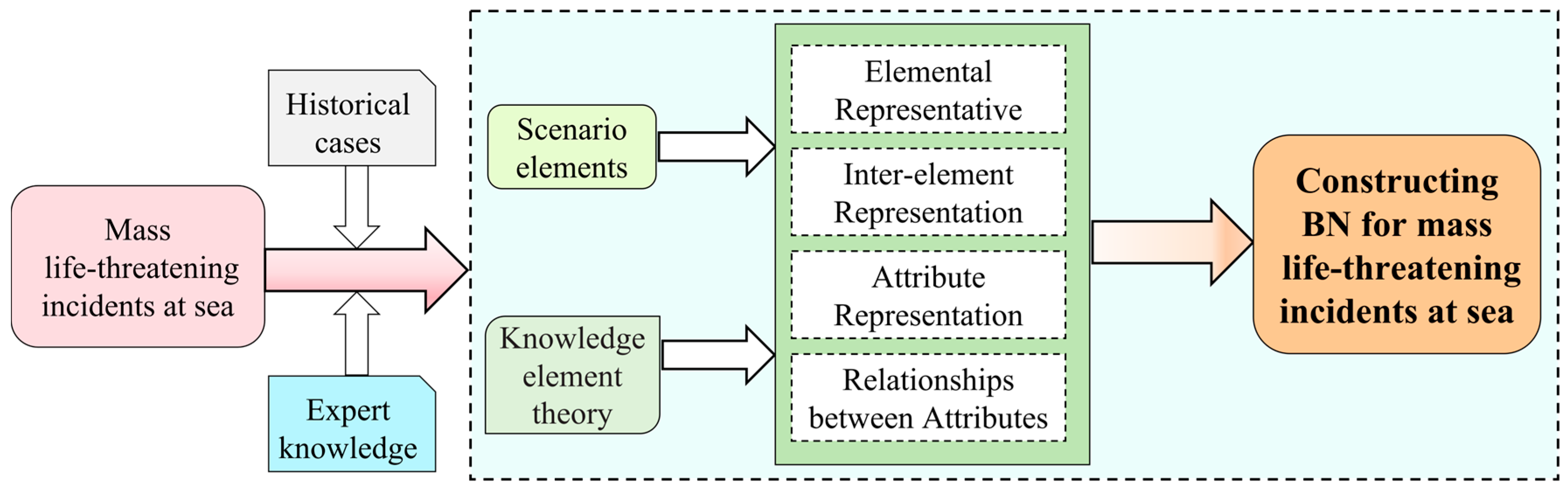
The knowledge element representation model of the scenario describes the interrelationships between the elements of the scenario, enabling analysis of its evolution process. This study, therefore, proposes a knowledge element expression model that comprehensively characterizes the composition and interrelationship mechanisms of the elements involved in an MALTIS from three perspectives: the knowledge elements, their attributes, and the relationships between these attributes. This model provides a fundamental framework for constructing and reasoning about knowledge element-based scenarios in such incidents.
3.2. Knowledge Element Representation for Mass Life-Threatening Incidents at Sea
This study analyses the structure of an MALTIS scenario. This is achieved by extracting, decomposing, and analyzing typical case studies from major global maritime accidents between 2004 and 2025. A layered approach of “Event → Scenario → Scenario Elements” is applied to extract the key information at each level.
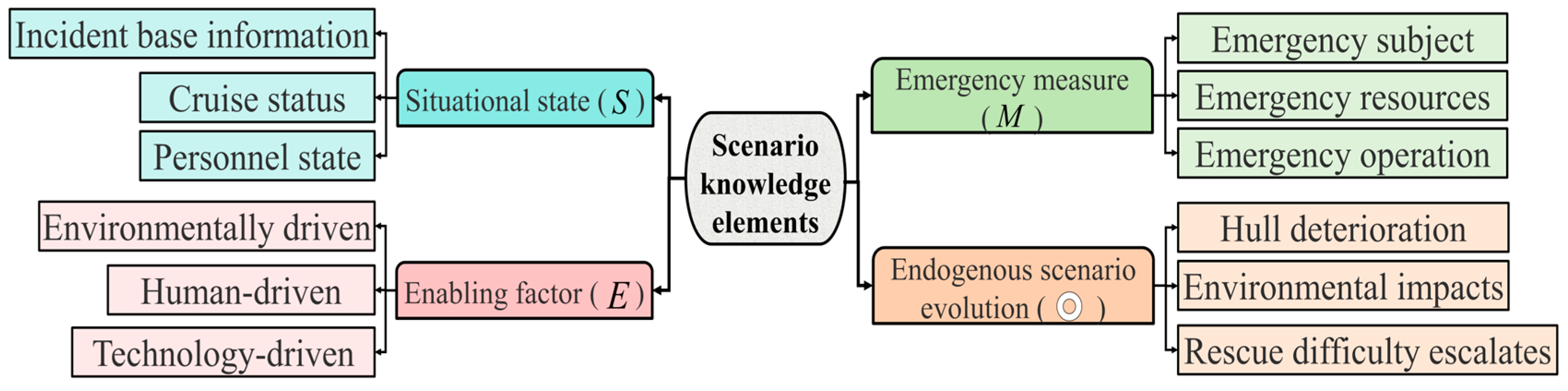
Figure 1 illustrates the composition of the scenario knowledge element for MALTISs, including the following components:
(1) Situational state (), refers to the various evolving states of the MALTIS at different stages, including elements such as incident information, cruise status, and passenger state. In an MALTIS, situational states can include scenarios such as a cruise ship running aground, damage to the ship’s hull, or passengers falling into the water during evacuation. Depending on the pathways of the incident as it evolves, situational states can be categorized as either positive or negative.
(2) Enabling factor (), refers to the objective and subjective factors that drive changes in the situational state of the MALTIS, such as the cruise ship sailing at high speed near the shore at night, water ingress into the cruise ship’s cabins, or passenger panic following the ship running aground. These factors can be driven by the environment, humans, and technology. Positive enabling factors mitigate the scenario’s worsening, while negative enabling factors exacerbate the scenario.
(3) Emergency measure (), refers to the series of actions taken by emergency decision-makers during the evolution of the MALTIS. These actions are based on the current internal and external environments, disaster-affected bodies, and available emergency resources. These measures aim to mitigate or delay the consequences of the incident and include elements such as the captain concealing the severity of the accident from the coast guard, the crew orderly evacuating passengers, and the maritime search-and-rescue organization carrying out the rescue operations. The effectiveness of these measures depends on factors such as the type of incident, competence of the maritime rescue authorities, and availability of emergency resources.
(4) Endogenous scenario evolution (), refers to the internal correlations and interactions between key risk factors during the occurrence and development of the MALTIS. This includes elements, such as ship hull deterioration, passenger panic and behavioral changes, environmental impacts, and the escalation of rescue difficulty. Endogenous scenario evolution strictly follows the accident chains and emergency response behavior patterns. This evolving process is driven by the incident’s inherent dynamics and is independent of external intervention.
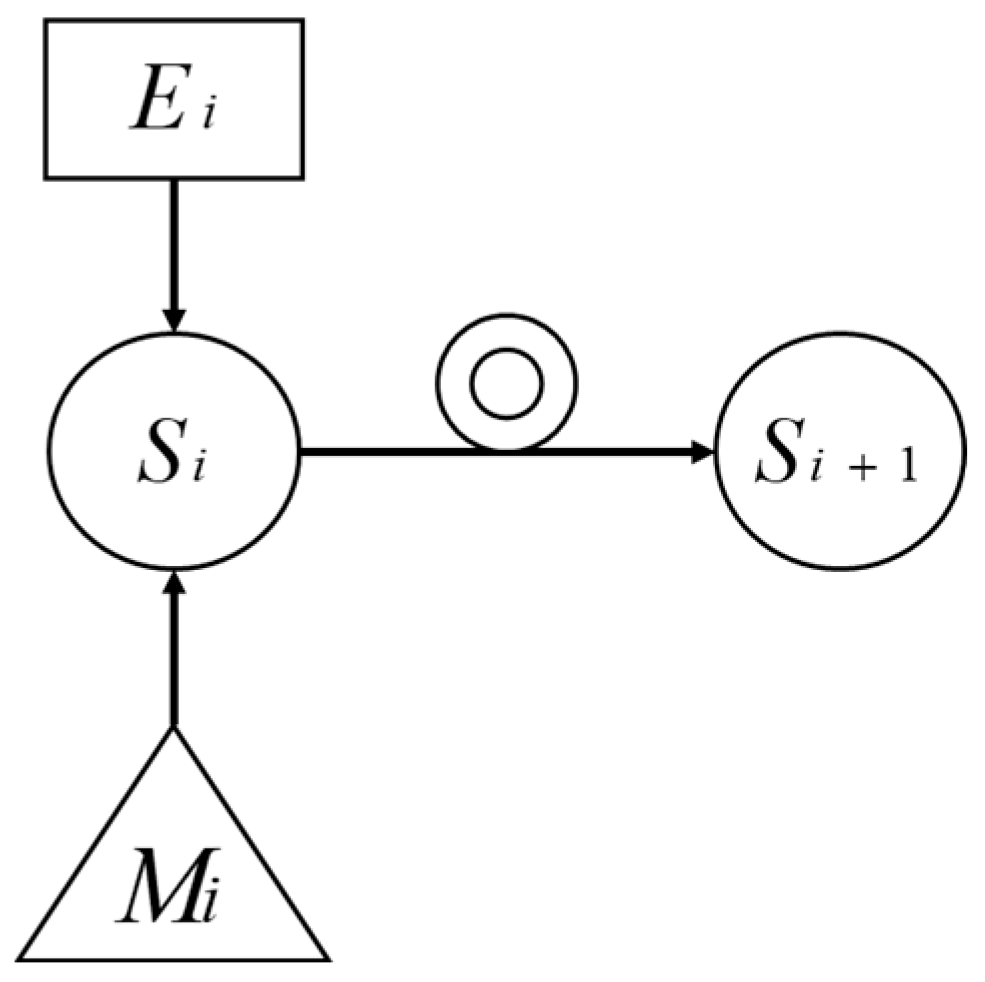
The relationships between scenario elements encompass both interactions within and between different categories of elements. In the knowledge element components of an MALTIS, enabling factors form the core. The knowledge element relationships for the basic units of the MALTIS are established based on the relationships between these enabling factors and other key elements, such as situational states, emergency measures, and endogenous scenario evolution; the knowledge element relationships for the basic units of MALTIS are established, as illustrated in
Figure 2.
Assume that at a certain moment, due to the influence of an enabling factor , an MALTIS suddenly occurs, with its initial scenario . In this scenario, the responsible decision-makers, based on the current situation and their expertise, will implement a series of emergency measures to control the deterioration of the incident. Under the combined influence of the enabling factor in scenario , the emergency measure, and endogenous scenario evolution, the situational state changes to . The components of scenario then serve as input variables for the next scenario , driving its evolution.
3.3. Analysis of the Mechanism of Maritime Emergency Scenario Evolution
The evolution cycle of an MALTIS spans from the initial stage to its conclusion, encompassing multiple scenario segments. Each scenario segment describes a different state of the incident’s evolution by expressing various information about the scenario. The scenario segment is made up of four key knowledge components: situational state, enabling factor, emergency measure, and endogenous scenario evolution. These components interact and influence one another, collectively shaping the overall evolution process of the maritime emergency.
By dividing the evolution process of an MALTIS into
time sequences along the timeline, the situational states evolve in chronological order, as shown in
Figure 3.
In the initial scenario of a maritime emergency, the knowledge element model indicates that at initial time , under the influence of enabling factor , a maritime emergency incident suddenly occurs. The initial scenario is represented as . Due to the effects of endogenous scenario evolution and emergency measure , the situational state of the knowledge element changes to . These steps form a complete basic unit of scenario evolution. During the actual process of the incident, if there are situational states, and represent the beginning and end of the entire incident scenario state, respectively. As time progresses, the situational state continues to evolve until the scenario evolution concludes.
Based on the above knowledge element relationships and scenario evolution representation model,
Figure 4 illustrates the process of the MALTIS scenario model.
This study addresses the scenarios of MALTISs. Based on a thorough analysis of historical cases and expert opinions, a knowledge element-based scenario representation model is presented by examining the scenario elements and evolution mechanisms of maritime emergencies. Furthermore, a BN for scenario deduction is developed to support emergency decision-making in mass-rescue operations at sea.
4. Construction of a Scenario Deduction Model for Mass Life-Threatening Incidents at Sea Based on Bayesian Networks
4.1. Bayesian Networks
Bayesian Networks (BNs) leverage directed acyclic graphs (DAGs) and conditional probability tables (CPTs) for modeling complex systems such as MALTISs, facilitating the effective integration of qualitative and quantitative analyses. DAGs offer a graphical representation of causal interrelationships among variables, thereby enhancing the visualization of the model structure. CPTs, on the other hand, quantitatively encode the probabilities of various states of these variables based on their causal antecedents [
27]. This synergy empowers BNs to deliver robust modeling capabilities and support reasoning and inference under conditions of uncertainty.
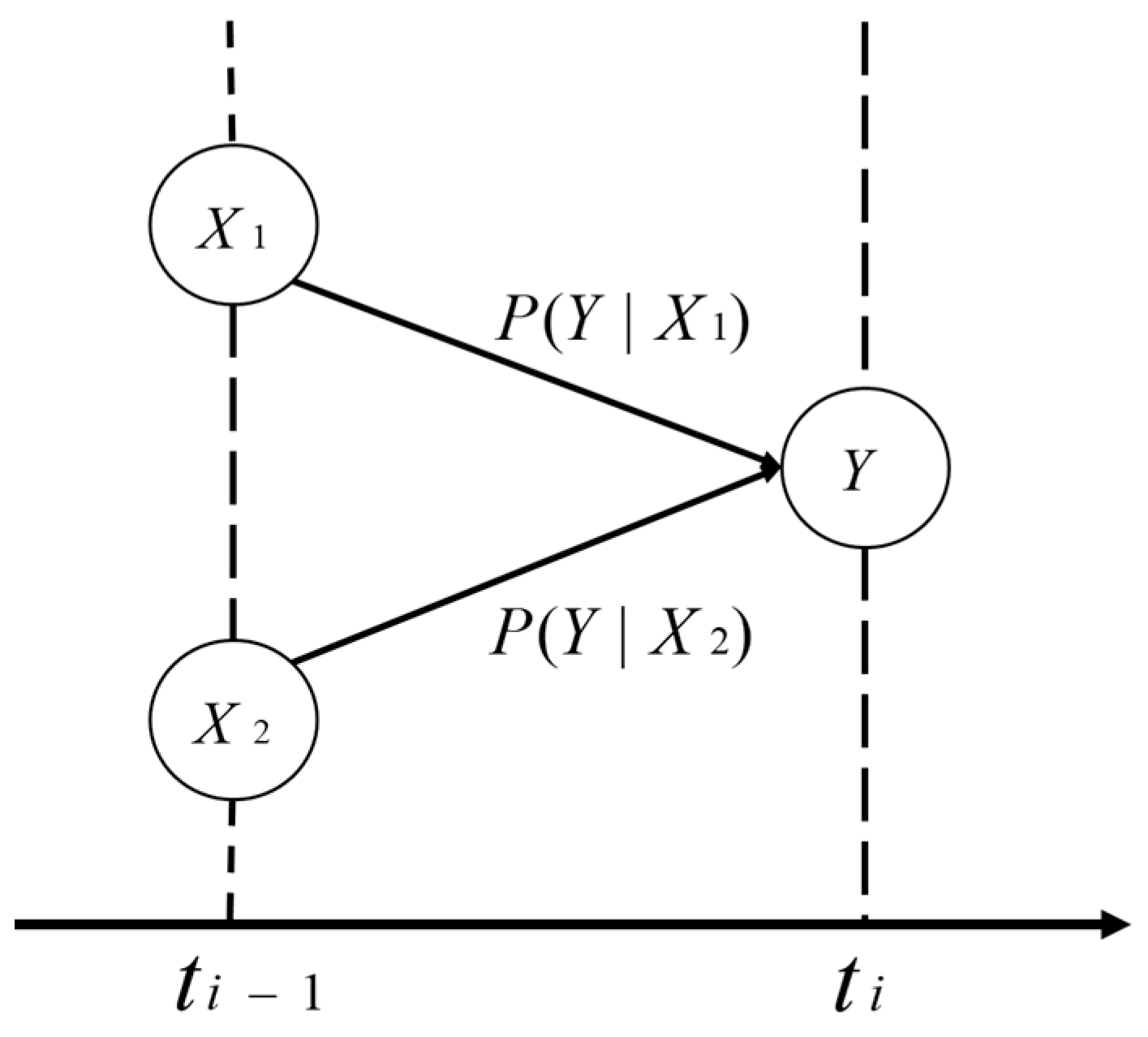
A schematic representation of a BN is shown in
Figure 5. In this figure, variable
is referred to as a child node, while node variables
and
are referred to as parent nodes.
Let the child node
have
parent nodes
,
, …,
, and each parent node is independent of the others; then, the probability of occurrence of node
is as in Equation (4):
Compared with the forward inference process described above, Bayes’ theorem represents a reverse reasoning approach, where the core lies in inferring the conditional probabilities of various possible causes based on the observed outcome. It can be expressed as
4.2. Construction of the BN Model for Mass Life-Threatening Incidents at Sea
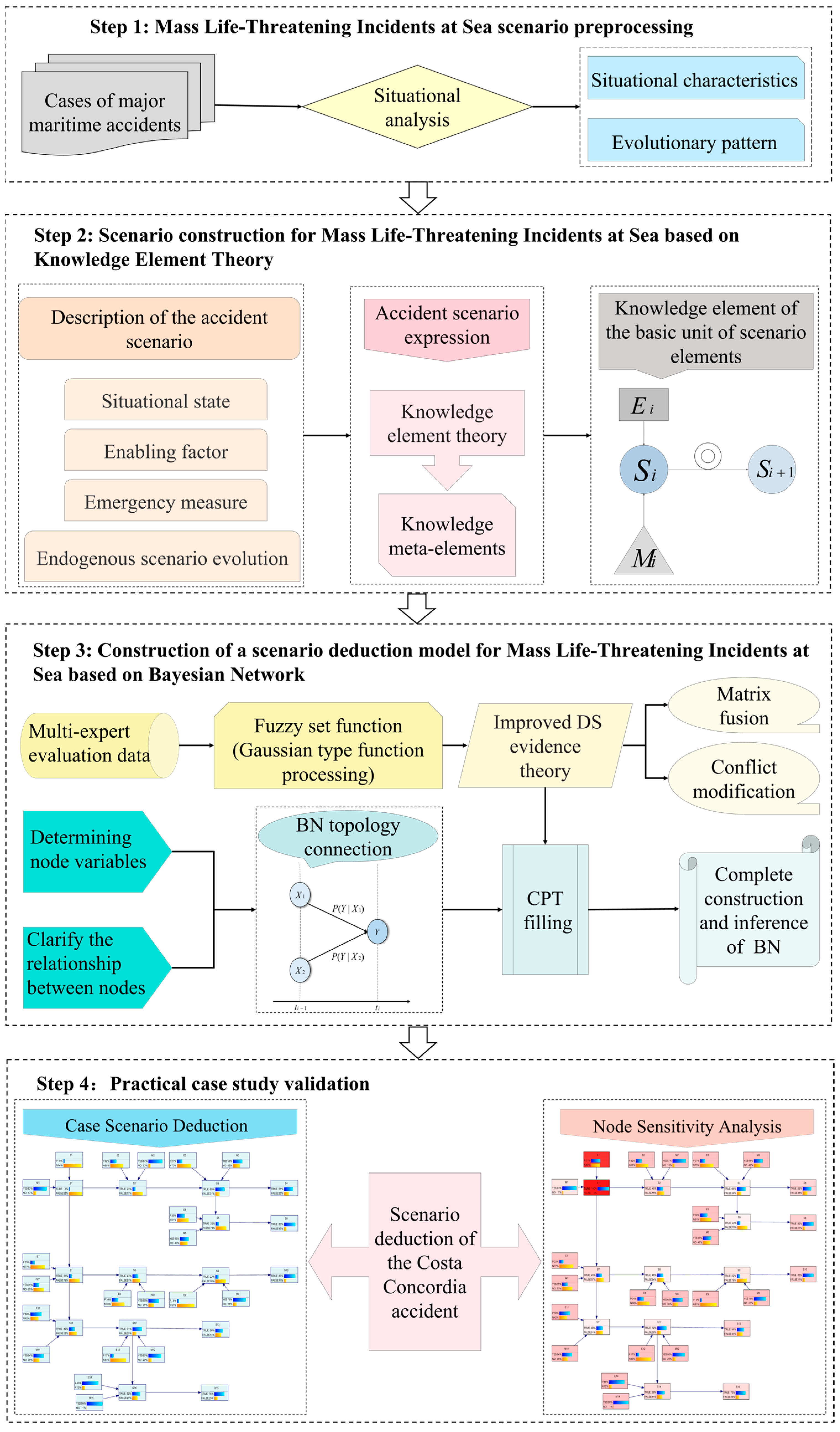
The knowledge element theory is applied to exploit the scenario knowledge elements for MALTISs in
Section 3. Furthermore, the scenario deduction for an MALTIS is modeled based on a BN in this section. As shown in
Figure 6, the overall modeling process consists of three main stages:
(1) Identification of network node variables. The first step involves representing the MALTIS scenario using the scenario knowledge elements, which entails manually extracting four key categories of elements relevant to different phases of the scenario: situational state (
), enabling factor (
), emergency measure (
), and endogenous scenario evolution (
). The relevant information regarding these variables is already known and was manually collected and organized by the author, drawing from original case data and reports from authoritative sources. Subsequently, based on the scenario evolution mechanisms discussed in
Section 3, the extracted elements are transformed into node variables within the BN. Following this, the data types and value ranges for these nodes are defined according to their internal attributes.
(2) Determination of the correlation between node variables. After the node variables in the BN are defined, the causal relationships between them are systematically established based on the previously constructed knowledge element scenario model and the analysis of MALTIS accident evolution patterns. These relationships are represented by directed edges within the structure of the Bayesian network. The BN is then constructed using GeNIe Academic 4.1 software, which automates the processes of scenario inference and probability calculation.
(3) Probability distribution. In a BN, the probabilities associated with nodes are usually categorized as prior, conditional, and posterior. The posterior probabilities are derived from prior and conditional probabilities. In this study, the prior and conditional probabilities are first obtained through expert scoring. And to minimize the subjectivity and enhance the reliability of the estimated probabilities, they are then refined and improved by fuzzy set theory and the improved DS evidence theory. Software MATLAB R2023a was used to automate the calculation of fuzzy membership values and the fusion process, facilitating matrix operations and the application of the Dempster combination rule.
This study uses GeNIE software to model the scenario deduction for MALTISs as mentioned above. GeNIE is a BN analysis tool that enables the straightforward and visual construction of network structures, as well as the calculation of probability values for the state nodes.
4.3. Evolution Pathways of Mass Life-Threatening Incidents at Sea
During the process of the occurrence and development of MALTISs, the incident exhibits different situational states at various points in time, and the corresponding scenario elements vary accordingly. Therefore, to investigate the scenario evolution of an MALTIS, it is necessary to examine the mechanisms of evolution of maritime emergencies and construct the corresponding pathways of scenario evolution.
This study analyzes the evolution mechanisms of maritime emergency scenarios, thereby providing a theoretical foundation for the scenario deduction of MALTISs. The node representing the occurrence of such an incident is identified as the core of the scenario model. From the historical data of major global maritime incidents, key scenarios with causal relationships are extracted as nodes and connected using directed arrows to form a DAG. Finally, the scenario elements are expressed in a standardized form using the knowledge element model established in
Section 3, thereby facilitating the transition from a single-scenario to a multi-scenario representation.
Analysis of historical cases of maritime accidents indicates that, following the onset of an MALTIS, the development direction and evolution pathways of the incident tend to be random due to the influence of endogenous scenario evolution mechanisms. However, the intervention of enabling factors and emergency measures can influence the evolution path of the maritime emergency, thereby giving rise to new desired evolution pathways.
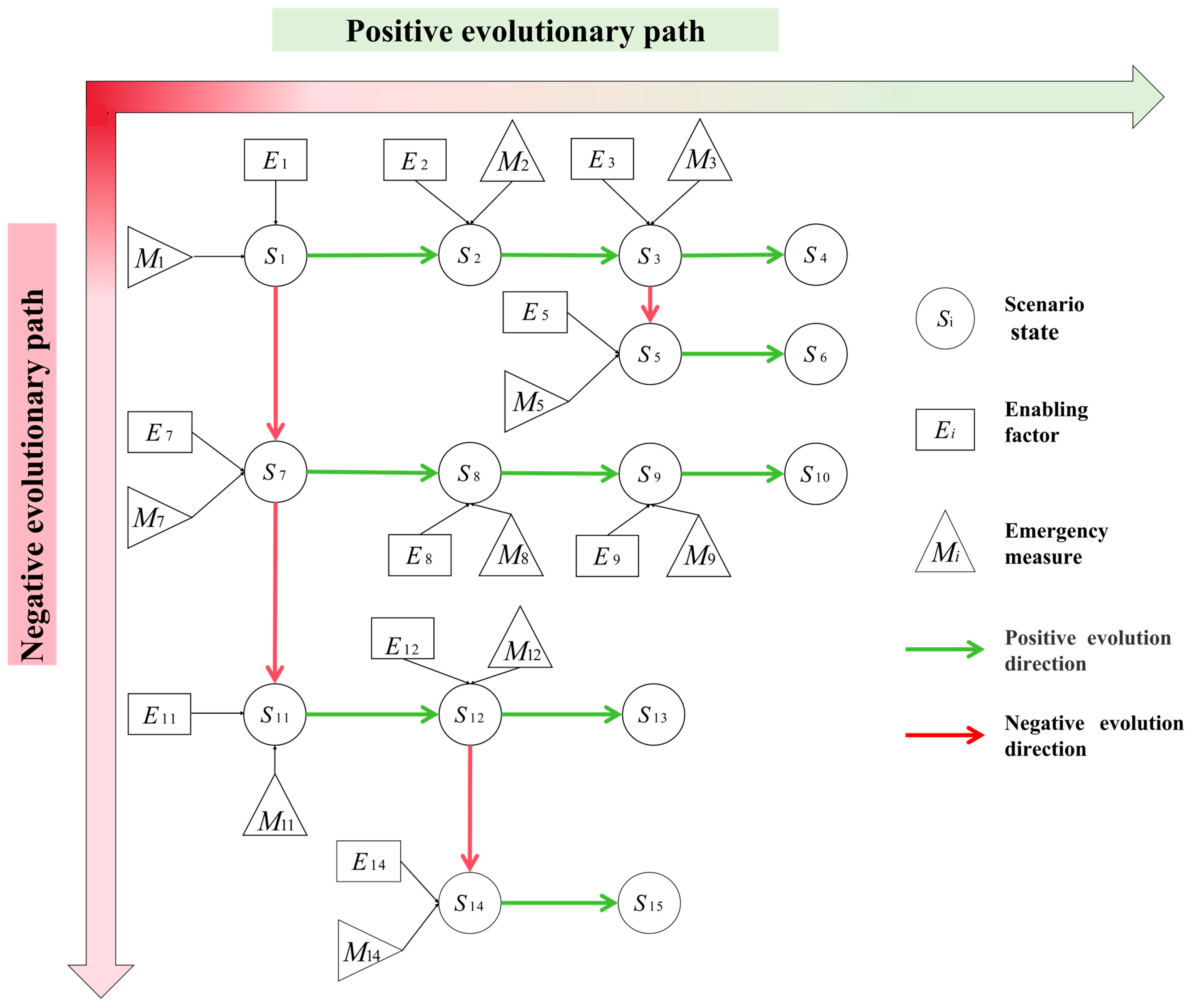
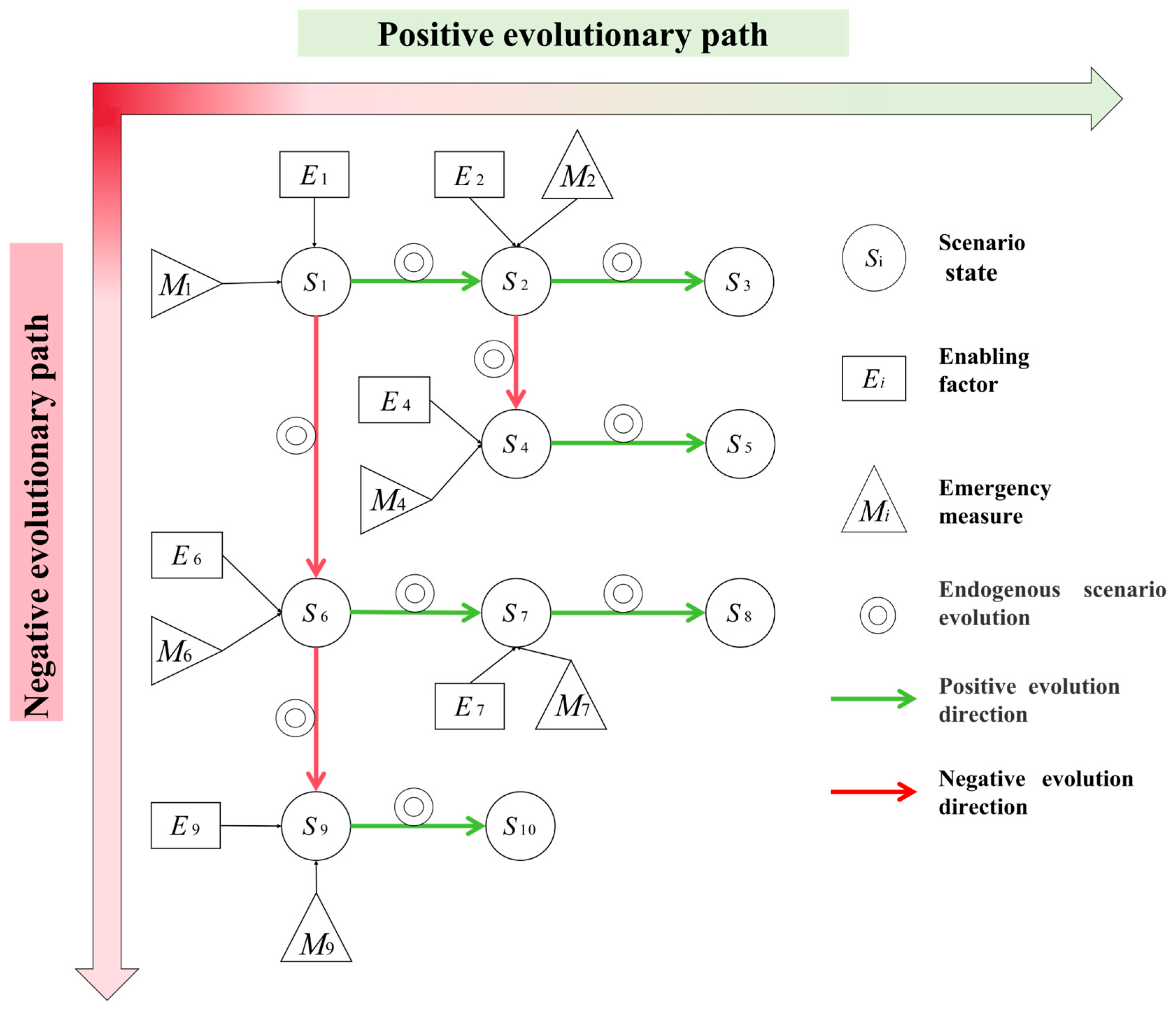
During the evolution of maritime emergencies, emergency decision-makers implement different measures for each critical situation to prevent the evolution of the scenario from deteriorating. When evaluating the effectiveness of emergency measures, two possible outcomes, optimistic and negative, are typically considered, leading to two divergent paths of evolution for the incident. The horizontal optimistic path represents the scenario evolving in the desired direction as a result of appropriate emergency measures being taken. The vertical negative path occurs when appropriate emergency measures are not taken, or are ineffective, causing the incident to evolve in an adverse direction, and worsening the severity of the incident. Based on this, this study constructs scenario evolution path models for both the optimistic and negative outcomes.
As shown in
Figure 7, all possible evolution paths of MALTISs are illustrated. In the initial situational state
, if the appropriate emergency measures
are taken and achieve the desired effect, the incident scenario will evolve to state
. If emergency measures
do not achieve the desired outcome, the scenario will evolve to
, and so on, until the emergency scenario ultimately dissipates.
4.4. Determining Probabilities Using Fuzzy Set Theory and Improved DS Evidence Theory
This study employs a composite analytical method based on fuzzy set theory and improved DS evidence theory to minimize subjectivity in the CPT and to perfect the node probabilities for the scenario deduction of MALTISs. This approach minimizes reliance on subjective expertise while ensuring the reliability and systematic consistency of the inferred incident trajectory and the key nodes that influence it.
4.4.1. Establishment of an Expert Evaluation Set
This study invited c experts to assess the likelihood of occurrence for situational state (
), enabling factor (
), and emergency measure (
) in an MALTIS. The evaluation set of scenario elements is presented in
Table 2, which lists the possible occurrence levels for each scenario node along with the corresponding degree of uncertainty. In this study, the likelihood of each scenario node was categorized into five linguistic variables: very high, high, medium, low, and very low.
4.4.2. Construction of Membership Functions
Fuzzy set theory, introduced by Zadeh in 1965, is a mathematical approach for quantifying vagueness by means of membership functions. It generalizes the classical characteristic function of a set into a membership function that maps elements to the interval [0,1], indicating the degree to which an element belongs to a fuzzy set.
In this study, a Gaussian membership function is adopted to convert the expert-assigned evaluation values and their associated uncertainties for scenario nodes into computable fuzzy membership degrees. The function is defined as follows [
42]:
In the formula, denotes the center of the membership function, and represents the range of uncertainty in the quantified risk probability estimation.
Based on the preceding analysis, the centers of the Gaussian membership function
corresponding to the five linguistic levels are set as 1, 0.75, 0.5, 0.25, and 0, respectively, as demonstrated in
Table 2. This enables five Gaussian membership functions to be constructed, with each representing one of the linguistic evaluation levels. By substituting the expert-assigned evaluation levels and their associated degrees of uncertainty for the situational state (
), enabling factors (
), and emergency measures (
) into the corresponding membership functions, fuzzy membership matrices can be obtained for each of the three element categories. These matrices are then subjected to data fusion by the improved DS evidence theory. Finally, the fused probability distribution is obtained from the evaluations of multiple experts through conflict factor adjustment and probability distribution optimization.
4.4.3. Data Fusion Based on Matrix Analysis for Improved DS Evidence Theory
The DS evidence theory, which was originally proposed by Dempster and subsequently expanded and formalized by Shafer, is ideal for handling the fusion of uncertain information from multiple sources. It has been widely applied in contexts involving complex decision-making.
This study addresses the computational complexity of fusing uncertain information based on the membership matrices described in
Section 4.4.2 by adopting an improved fusion approach based on matrix analysis. This method integrates expert opinions through binary evidence combination using a recursive computation process, significantly reducing the overall computational burden. Assuming that c experts provide evaluations for a given node, their respective probability distributions can be determined using the Gaussian membership functions described in
Section 4.4.2. The resulting probability distributions for the c experts are expressed as follows [
42]:
Each element
of the matrix
represents the probability that the
-th expert evaluates a node as being at the
-th risk level. Therefore, the sum of each row in this matrix equals 1, reflecting a complete probability distribution for each expert’s assessment. To proceed with data fusion, taking the transpose of any row in the matrix
and multiplying it with another row from the same matrix, a new matrix
is obtained; the computation is defined as
In matrix
the sum of the main diagonal elements constitutes the numerator in Equation (9), whereas the sum of all off-diagonal elements indicates the integrated conflict degree
. Finally, the fused probability values for the five levels are obtained using a weighted combination algorithm based on the improved DS evidence theory. The resulting belief assignment to matrix
after fusion is denoted as follows
:
In the formula, , which is the probability distribution function of evidence conflict. This distributes the conflict degree to all elements of the matrix. Accordingly, this probability distribution function satisfies the condition , thereby enabling to allocate to matrix according to the given proportion.
4.4.4. Determination of the CPT and Scenario Deduction
Building upon the detailed analysis of the evolution patterns and pathways of MALTISs presented in
Section 4.3, this study uses the GeNIe software to develop a BN-based MALTIS scenario deduction model. Once the scenario network has been constructed, the prior probabilities must be assigned to node variables, the CPT must be defined, and these are processed by GeNIe. This enables the occurrence probabilities of various scenario elements to be calculated and supports the scenario deduction of MALTISs.
To determine the CPT, this study employs a method that integrates fuzzy set theory with an improved DS evidence theory. First, based on historical case analysis and expert scoring, the evaluations of situational states, enabling factors, and emergency measures within the BN model for MALTISs are transformed into computable fuzzy membership degrees via Equation (6). This yields fuzzy membership matrices for each of the three types of nodes.
Next, these membership matrices are subjected to data fusion by a matrix-based improved DS evidence theory framework, thereby integrating the evaluations from c experts and aggregating multi-source information. Subsequently, conflict factor adjustments and probability distribution optimization are carried out, resulting in a final probability distribution that reflects the fused expert opinions. These distributions are then used to construct the CPT for each node. Once the CPTs have been determined, the corresponding probabilities are entered into the GeNIe platform to update the BN of this model. This allows the possible situational states and their associated probabilities to be deduced at different time points during the MALTIS, achieving dynamic scenario deduction for such emergencies.
5. Case Study
5.1. Introduction to the Accident Scenario
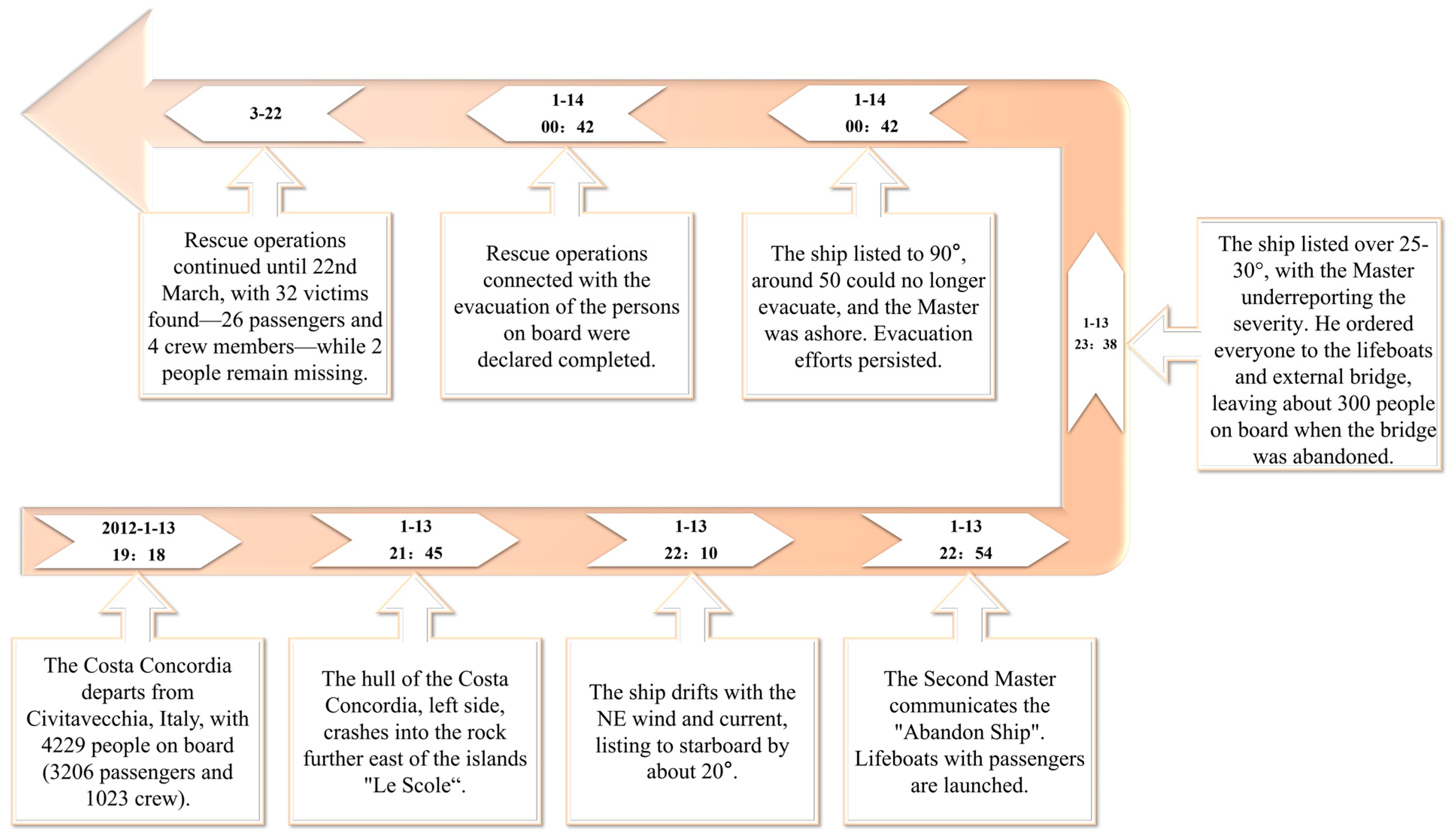
To validate the proposed scenario deduction, the grounding accident involving the Costa Concordia cruise ship was investigated in depth and used as a case study. On the evening of 13 January 2012, the Costa Concordia, a large luxury cruise ship operated by Costa Cruises, unfortunately ran aground near the Italian island of Giglio. The accident resulted in a 53-meter-long crack on the ship’s port side, leading to rapid water ingress and subsequent listing. The vessel was ultimately abandoned and grounded just a few meters from the shore. A total of 4,229 passengers were placed at risk as a result of the accident, which led to at least 64 cases of severe injury and 32 fatalities. We identified the key scenarios that occurred during the accident and analyzed the response measures taken by the cruise ship staff. These measures were arranged in chronological order to create an accident scenario evolution diagram, as illustrated in
Figure 8.
5.2. Determination of the Elements of the Costa Concordia Accident Scenario
In the grounding incident of the Costa Concordia, a multitude of factors, including enabling factors, the situational states, emergency measures, and the evolution of the accident itself, exerted a collective influence on its course. As analyzed in
Section 3 and
Section 4, the situational state (
), enabling factors (
), and emergency measures (
) are proposed as three components of knowledge bodies and the scenario evolution components of the Costa Concordia accident. The three components interact and influence each other, collectively forming the evolution and development process of the accident.
Having determined the scenario evolution components, the next step is to identify the scenario elements of the Costa Concordia accident. According to the mechanism, elements, and evolution path of the scenario model of MALTISs discussed previously, the knowledge elements were extracted from the Costa Concordia accident. Each scenario was analyzed in accordance with the Costa Concordia accident report and the opinions of experts in the field. This analysis identified key nodes in the elements of the accident scenario, which are outlined below.
As illustrated in
Table 3, there are 15 situational state nodes (
), 10 related emergency measures (
), and 10 corresponding enabling factors (
).
Based on the practical significance of the scenario nodes in the Costa Concordia incident, situational states and emergency measures are defined as Boolean variables to represent mutually exclusive states, as they only indicate whether a particular state occurs. In contrast, enabling factors are defined as binary ordinal variables due to their sequential nature, which reflects the different impacts of positive and negative driving factors on the evolution of the scenario [
43,
44]. This is shown in
Table 4 below.
In a BN, identifying the nodes is a necessary prerequisite for conducting evolutionary path analysis. Therefore, when constructing a BN for the deduction to model the Costa Concordia cruise ship grounding accident, it is necessary to abstract all situational states (
), enabling factors (
), and emergency measures (
) in
Table 3 as node variables of the BN. In addition, it is essential to determine “Cruise ship grounding” as the core node. Accordingly, the evolutionary path of the Costa Concordia cruise ship grounding scenario was developed and explored in the following sections.
5.3. Accident Evolution Path of Costa Concordia
Based on the BN evolution path of the MALTIS, constructed as described in
Section 4, this section presents the Costa Concordia accident scenario model. The core node of this model is the cruise ship grounding accident. According to the intrinsic causal relationships and development paths between nodes, the 25 scenario elements in
Table 3 are connected via directed edges. This links the scenario elements to the scenario evolution path, a BN model of the Costa Concordia accident, as shown in
Figure 9.
MALTISs are complex with interlinking elements. Different types of maritime emergencies will have varying scenarios to consider. Specifically, as a typical MALTIS, the Costa Concordia accident evolution model, compared to the BN evolution path for MALTISs, additionally incorporates thirteen scenario nodes, including five key situational state nodes, four enabling factor nodes, and four emergency measure nodes. This work argues that, after the Costa Concordia ran aground, the most critical path is the negative path “Passengers panic on boarding deck () → Most passengers have not yet been evacuated (),” because this scenario could lead to a large number of casualties and other catastrophic consequences. Therefore, the evolution path and direction of the Costa Concordia accident will be hugely impacted by whether the ship officers and the search-and-rescue authorities take timely, scientific, and reasonable emergency response measures.
5.4. Probability Calculation of Accident Scenario Nodes
Due to the lack of historical data and materials relating to MALTISs, it is essential to combine historical experience with expert scoring methodologies to ascertain a priori and conditional probabilities.
This study invited five experts in the field of maritime accident search and rescue to score the values and uncertainties of scenario nodes. The experts’ evaluations of each node were converted into computable fuzzy membership degrees using Equation (6). Subsequently, the improved DS evidence theory with matrix analysis was utilized to combine the evaluations of the five experts for each scenario node. The final probability value distribution was obtained by applying conflict factor correction and probability distribution optimization following the fusion of the evaluation opinions of the five experts.
Below, is used as an example to demonstrate the entire calculation process.
- (1)
Expert scoring and uncertainty assignment:
Each expert provided ratings for three scenario elements: cruise ship grounding (); cruise ships traveling at high speeds near shore at night (); captain orders a course change after detecting abnormal seabed conditions ()
These ratings represent the likelihood of each event occurring, and each expert also assigned an uncertainty value to quantify the reliability of their evaluation.
Table 5 summarizes the expert scores and uncertainties:
- (2)
Fuzzy membership calculation using the Gaussian function:
Next, the Gaussian membership function (Equation (6)) is applied to convert the expert evaluations into fuzzy membership values. For instance, for Expert 1’s evaluation of
, the score of 0.85 corresponds to the ‘High’ linguistic variable, where the mean (μ) is defined as 0.75, since 0.85 falls within the ‘High’ range. As defined in
Section 4.4.2, the average value for the ‘High’ linguistic variable is 0.75. The standard deviation (σ) is set to 0.1, representing the uncertainty level of the score, which indicates that the expert has a high degree of confidence in the score of 0.85, with only a small degree of uncertainty regarding its accuracy. The calculation is as follows:
Using this method, one can calculate the fuzzy membership values for each expert’s evaluation of all nodes (i.e.,
,
, and
). Ultimately, we obtained the fuzzy membership matrix for each expert, as shown in
Table 6.
- (3)
Data fusion using DS evidence theory:
Once the fuzzy membership values were computed for each expert, DS evidence theory was employed to combine the expert evaluations. The Dempster combination rule was used to combine the evaluations provided by each expert, taking into account the uncertainty and conflict among the experts’ opinions.
The fusion process was carried out using matrix operations. The expert evaluations were organized into a matrix, and the final fused matrix was calculated as shown in Equation (8).
- (4)
Final conditional probability calculation:
After applying the Dempster combination rule (Equation (9)), the final fused probability distribution was obtained. This distribution adjusts for the conflict between expert evaluations, ensuring that the resulting probabilities are consistent and account for the uncertainty between the different expert opinions. The final conditional probabilities were computed as follows: P(E1 = P) = 0.06, P(M1 = Y) = 0.83 and P(S1 = T∣E1 = P, M1 = Y) = 0.49.
By repeating the above calculations, we obtained the prior and conditional probabilities required for the BN deduction, with the probabilities of several key nodes presented in
Table 7.
Based on the probabilities of the nodes in
Table 7, Equation (4) was used to calculate the probabilities of the node variables occurring in different states. For example, the probability of the cruise ship grounding (
) node occurring is as follows:
The probability of Node
not occurring is
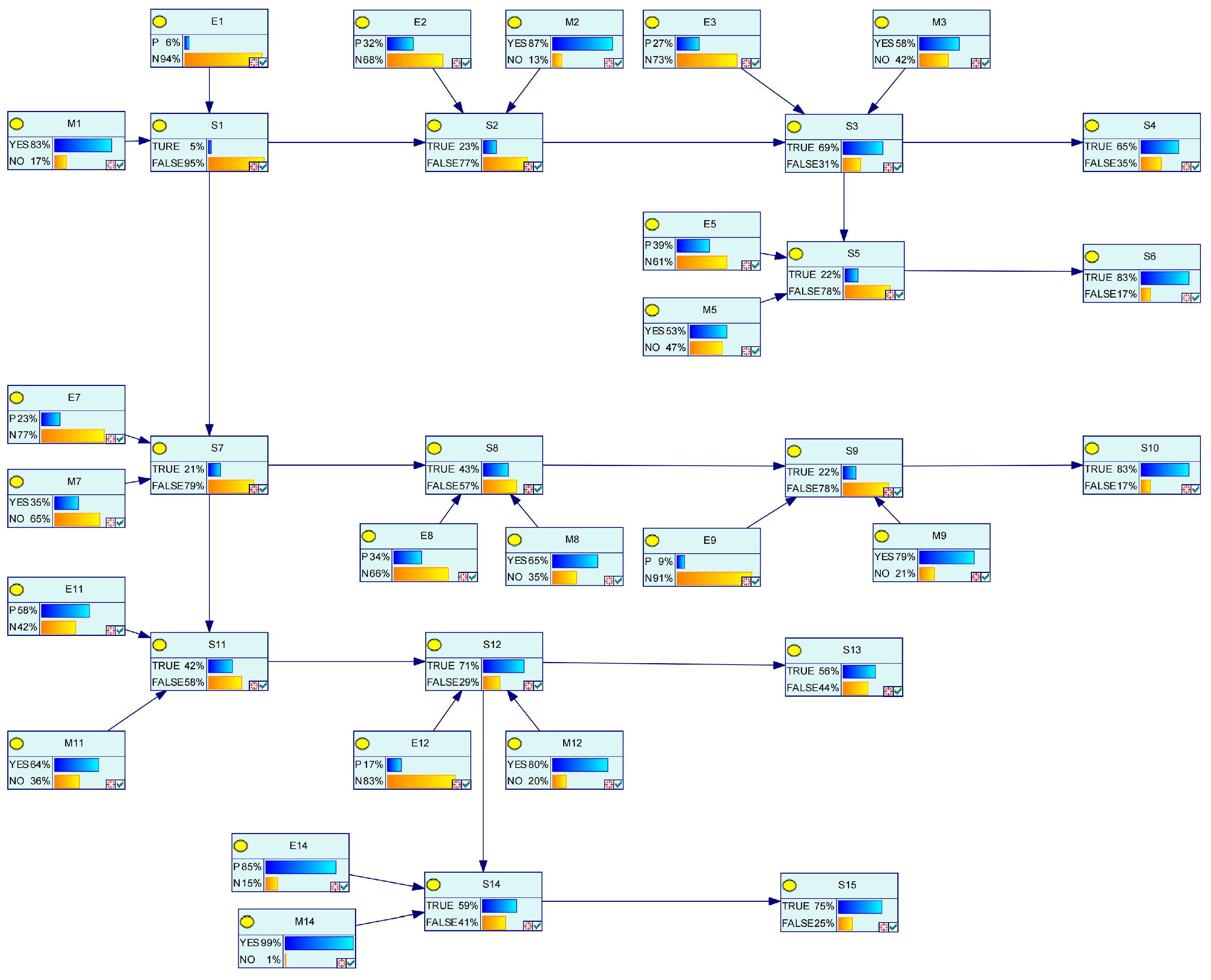
Similarly, the state probabilities of the other nodes were calculated to obtain the probabilistic inference diagram of the BN model of the Costa Concordia accident, as shown in
Figure 10.
Although the results of the above calculation show that the probability of the node “cruise ship grounding ()” occurring is very low, this is primarily because its parent node, “cruise ships traveling at high speeds near shore at night ()”, is a low-probability event. However, this does not mean that this node lacks research value. Due to their unique hull structure and operational mode, cruise ships have inherent defects in terms of damage stability. This leads to a higher risk of rapid capsizing in grounding accidents compared to other ship types, which can result in catastrophic consequences such as mass casualties and severe environmental pollution. Given the significant disparity between the severe consequences of grounding accidents of cruise ships and their low occurrence probability, it is essential to develop a grounding accident scenario deduction model, as proposed in this study, to conduct an in-depth analysis of the evolutionary mechanisms of such accidents.
5.5. The Comparison and Analysis of the Evolutionary Results of the Costa Concordia Cruise Ship Accident
This section discusses the proposed BN model of scenario deduction of the Costa Concordia and the experiments to explore the results and sensitivity of the model. This model can be used to deduce the evolution of accidents and to explore the sensitivity of network nodes, helping to identify those that affect the evolution of accidents.
5.5.1. Analysis of Results
To verify the BN model of the Costa Concordia accident constructed in the previous subsections, insightful experiments were carried out in this model to evaluate its performance and features. Based on experiments on the situational state probability of the Costa Concordia grounding accident, the results are analyzed as follows:
(1) As demonstrated in
Figure 10, if effective emergency measures (
, 83%) are taken to cope with the enabling factors along the optimistic evolution path (
,
,
and
), the situational state of the accident will improve with a high probability (64.7%). However, due to the complexity and adversity of the accident, the situational state will also evolve towards the negative evolution path (
,
,
) with probability (21.3% and 41.8%, respectively). This is partly related to the effectiveness of the emergency measures, the endogenous characteristics of scenario evolution, and the complicated and adverse environment and conditions. This does not necessarily suggest that emergency measures are ineffective. The emergency measures taken by the ship crew and maritime authorities are essential to slow down the deterioration of disaster scenarios and reduce losses during the evolution process. This would gain more valuable time for emergency rescue response and improvement of operational effectiveness.
(2) From the scenario evolution diagram in
Figure 10, it can be seen that the most probable scenarios in the Costa Concordia accident are as follows: passengers panic on boarding deck (
, 70.9%), passengers flock to emergency assembly point (
, 69.1%), and most passengers have not yet been evacuated (
, 59.4%). This indicates that once a cruise ship runs aground, the probability of an MALTIS significantly increases, making the consequences of the accident difficult to control. Therefore, the ship crew and search-and-rescue authorities should pay special attention to these key situational states and take effective and targeted emergency measures promptly to respond to accidents, thereby largely minimizing the probability of the evolution of the key negative path and improving the rescue effect.
(3) The BN-based MALTIS scenario deduction model proposed in this study is applied to the Costa Concordia grounding incident as an empirical case. According to the relevant incident reports, the Costa Concordia deviated from its course while speeding near the coast at night, causing the vessel to strike a rock on its port side, resulting in a 53 m long gash in the hull and flooding in some watertight compartments. The subsequent loss of power, vessel tilt, and inadequate emergency response ultimately led to the ship sinking and running aground just a few meters from the shore. The tilt-induced flooding hindered the deployment of lifeboats, further exacerbating the tragic consequences, with most passengers failing to evacuate in time when the ship was abandoned. The actual sequence of events in the Costa Concordia incident aligns closely with the scenario deduction results generated by the model developed in this study, thus validating the effectiveness and accuracy of the proposed scenario deduction model in practical applications.
(4) Analysis of the deduction results of the Costa Concordia accident clearly reveals how the situation could evolve into other scenarios after the ship ran aground under the effect of emergency measures. To a certain extent, these results can provide decision-makers with a theoretical reference to take emergency countermeasures and grasp the credible situation when scenario information is incomplete or there is uncertainty. It should be noted that the scenario deduction of the Costa Concordia accident was simplified. In contrast, actual major maritime accidents involve a lot of factors that can impact the scenario evolution to a varying extent. The BN-based MALTIS scenario deduction model could improve the accuracy of scenario deductions and appropriateness of emergency countermeasures by identifying the main factors affecting accidents.
5.5.2. Sensitivity Analysis of Nodes in the Deduction Network
Sensitivity analysis involves altering the value of a parameter within a system in order to identify the impact of such changes on the target. Examining sensitivity from both the system’s structural composition and parameter values, it is commonly applied in the structural analysis of systems and networks [
45]. Sensitivity analysis not only can help to verify that critical probabilities are consistent with the actual situation and relevant experts, but also can determine how the accident variables affect the core node of the scenario network.
BNs are comprehensive models of nodes and their relationships and possess robust sensitivity analysis capabilities. Based on the probabilistic deduction of the situational state of the Costa Concordia accident, sensitivity analysis of network node variables can investigate the extent to which the probability of the target node changes in response to changes in the probability of a specific node. This can support emergency decision-making after a cruise ship runs aground, helping decision-makers to make relatively objective and accurate decisions and prevent MALTIS. From the perspective of disaster prevention and mitigation, it is more important to make scientific decisions and take effective measures to interrupt or slow down the chain reaction of disasters than to control the direction in which the accident evolves.
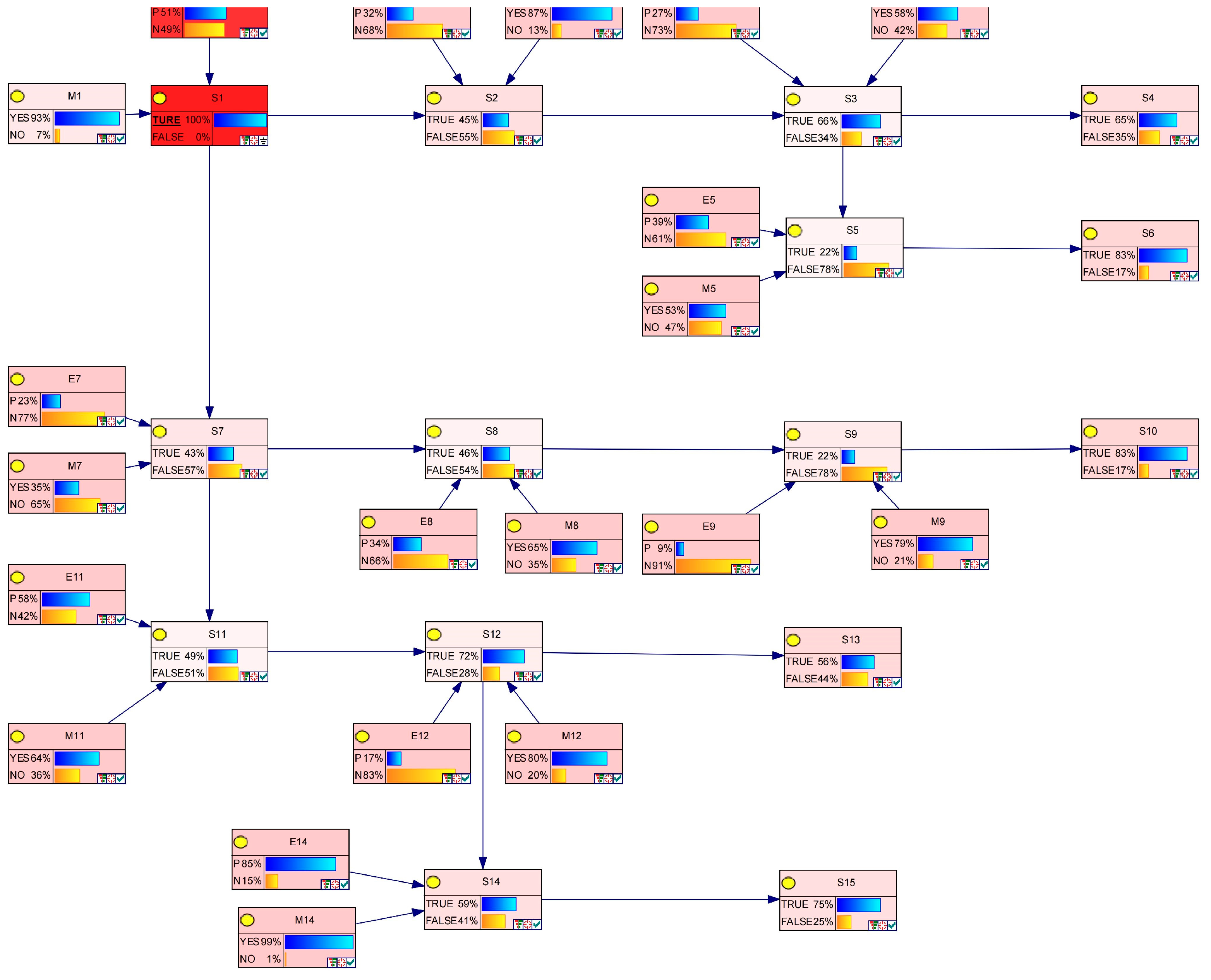
The sensitivity analysis of the nodes in the BN model of the Costa Concordia accident to the target node “cruise ship grounding (
)” was conducted to identify the critical factor of the accident using the GeNIe software. The depth of node color indicates the strength of sensitivity, with darker color indicating stronger sensitivity (that is, greater influence). The results are shown in
Figure 11 and
Table 8. In this study, the sensitivity value in
Table 8 is used to measure the response strength to changes in the node values for the Costa Concordia accident. Specifically, it indicates the extent to which changes in input conditions affect the state of the cruise ship grounding (
) node.
The results indicate that changes in the probabilities of the above nodes (, , , and ) significantly impact . Effectively addressing these nodes when responding to these accidents can influence the evolution of the situation more.
As shown in
Table 8, the node (
) is significantly more sensitive to node
than to other factors, primarily due to the cumulative effect of multiple risks which were brought out by this original risk factor. In the Costa Concordia accident, for example, the captain steered the ship at high speed (15.5 knots) near the coast at night in order to ‘pay respect’ to the residents of Giglio Island. This improper action resulted in a collision with an unmarked reef on the port side, causing a 53-meter crack in the hull. Poor visibility impaired the crew’s ability to visually identify the reef, and the combination of high-speed navigation and a reduced emergency response time significantly increased the risk of losing control. Although the helmsman delayed executing the turning command by 13 s, the following investigation confirmed that this was not the primary cause of the accident. The core issue lay in the captain’s errors in judgment and systemic vulnerabilities in a high-risk environment for the cruise ship. Therefore, night-time coastal navigation must strictly control speed and implement real-time monitoring to avoid catastrophic consequences caused by the coupling of multiple risks.
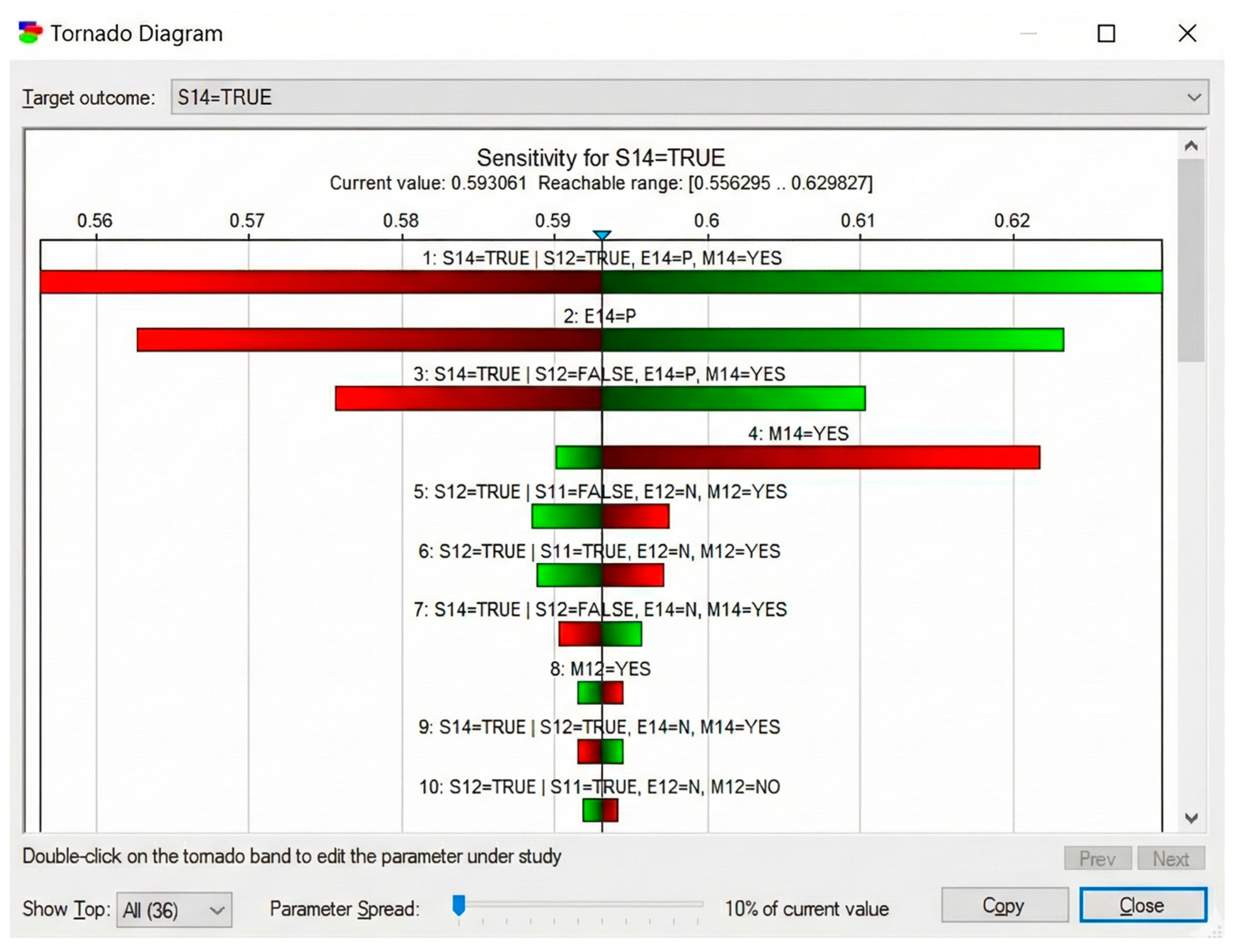
Additionally, GeNIe software was used to analyze the sensitivity of the node “most passengers have not yet been evacuated ()” in the BN model of the Costa Concordia accident, presenting the sensitivity results in the form of a tornado diagram.
A tornado diagram illustrates node sensitivity or influence within a BN model. It shows how changes to the model inputs affect the outputs and highlights the main factors influencing the target node. A tornado diagram features a central axis and a series of horizontal bars extending to the left and right. The length of these bars indicates the extent to which changes in the parameters of the nodes within their range influence the target state of the target node. The color of the bars in the tornado diagram indicates the direction of change in the target node state: red indicates a negative correlation with the target node probability, while green indicates a positive correlation. The greater the impact on the posterior probability of the target node occurring, the longer the horizontal bar and the stronger the sensitivity. The horizontal bars are arranged in descending order, representing a gradual decrease in the influence of each scenario.
Figure 12 shows the tornado diagram of the BN sensitivity analysis, with the target node output “most passengers have not yet been evacuated (
)” sorted from most to least sensitive.
This figure illustrates that the ten parameters are most sensitive to the node “most passengers have not yet evacuated ()”, with the sensitivity level represented by the length of the bars. It should be noted that the green bars indicate the probability of “most passengers have not yet evacuated ()” when the event above the bar occurs, while the red bars indicate the probability when the corresponding event above the bar does not occur. The difference between these two probabilities is referred to as the sensitivity variance. The tornado diagram also reveals that the conditional probability and the node “excessive angle of inclination of the hull restricts the deployment of lifeboats ()” lead to a relatively large fluctuation in the probability range of the node . This indicates that the above scenario factors have a significant impact on the node, and focusing efforts on these factors during emergency decision-making can help steer the incident in a positive direction.
6. Conclusions
This study proposed a BN-based MALTIS scenario deduction model. The model aims to support and inform emergency decision-making in such incidents.
Initially, a scenario knowledge representation model was established based on knowledge element theory. An accident scenario comprises four elements: situational state (), enabling factors (), emergency measures (), and endogenous scenario evolution (). Based on these elements, a complex accident scenario representation model and its deduction model can be established.
Subsequently, by analyzing the evolution mechanism of MALTISs, the four aforementioned elements are abstracted into BN nodes, thereby constructing a scenario deduction model for MALTISs. Subsequently, through expert surveys, the fuzzy set theory combined with the improved DS evidence theory is applied to integrate the opinions of multiple experts, resulting in the probability distribution of BN nodes. This enables the deduction of MALTIS scenarios and the determination of the accident development path.
At last, to verify the model’s effectiveness, scenario evolution direction and path deduction research were conducted using the Costa Concordia accident case. By identifying and analyzing the key nodes and their sensitivity in the Costa Concordia accident, the final deduction results were consistent with the actual development status of the accident scenario. This verified the feasibility and rationality of the scenario deduction network constructed in this study.
At the same time, it emphasized the key time nodes and emergency response measures in the maritime search and rescue process, thereby improving the efficiency and accuracy of emergency decision-making by rescue departments.
From the analysis, useful contributions and findings are summarized as follows:
(1) The proposed BN-based MALTIS scenario deduction model effectively captures the progression of MALTISs and offers flexible application potential, enabling both predictive scenario deduction and post-event analysis. By modeling MALTIS evolution, the model enhances the timeliness and effectiveness of incident response, ultimately improving the efficiency of mass rescue operations at sea and facilitating more effective and coordinated rescue interventions.
(2) The BN–based MALTIS scenario deduction model integrates fuzzy set theory with an improved DS evidence theory to support probability reasoning within the model, thereby minimizing subjectivity in expert judgment and enhancing the reliability of probability assessments. This approach further aids in more accurately predicting the evolution of incidents.
(3) Sensitivity analysis identifies critical nodes in MALTIS evolution and the maritime rescue process, providing a scientific basis for targeted emergency measures that enhance both the timeliness and precision of decision-making in mass-rescue operations at sea.
The contributions and findings from the proposed scenario deduction model for MALTISs are insightful and meaningful for improving mass-rescue operations at sea and the safety of the cruise industry. Nevertheless, there are several limitations in this study. For instance, the establishment of scenario knowledge elements for the BN-based MALTIS scenario deduction model is constrained by the limited number of available reference cases and incomplete historical records, which hinder the full quantification of certain influential human and organizational factors; these limitations impact the model’s representativeness and generalizability.
To improve the scenario deduction model for MALTISs, a database of cruise ship accidents and other large-scale emergencies at sea is imperative for a more elaborate BN structure and more accurate probabilities of nodes. This will make scenario deduction more aligned with real-world conditions and provide decision-makers with more effective emergency recommendations.