Article

Calibration and Verification of a Coupled Model for the Coastal and Estuaries in the Mekong River Delta, Vietnam


by
Lai Trinh Dinh
1 and
Thanh Nguyen Viet
2,*
1
Faculty of Hydraulic Engineering, Hanoi University of Civil Engineering, Hanoi 10000, Vietnam
2
Faculty of Civil Engineering, University of Transport and Communications, Hanoi 10000, Vietnam
*
Author to whom correspondence should be addressed.
J. Mar. Sci. Eng. 2026, 14(2), 157; https://doi.org/10.3390/jmse14020157 (registering DOI)
Submission received: 11 December 2025 / Revised: 6 January 2026 / Accepted: 7 January 2026 / Published: 11 January 2026
(This article belongs to the Section Coastal Engineering)

Abstract

This study focuses on the calibration and verification of a large-scale coupled numerical model to simulate the complex hydrodynamic–wave–sediment transport processes in the coastal and estuarine regions of the Mekong River Delta (MRD), Vietnam. Using the MIKE 21/3 modeling system, the research integrates Hydrodynamics (HD), Spectral Wave (SW), and Mud Transport (MT) modules across a computational domain of 270 × 300 km. The models were rigorously tested using field measurement data from three distinct periods: May 2004 (dry season calibration), September 2017 (first verification), and June 2024 (second verification). The results from the hydrodynamic model demonstrated high accuracy in predicting water levels, with the average Root Mean Square Error (RMSE) values ranging between 4.4% and 5.8%. The wave spectral model showed reliable performance, with the average RMSE values for wave height ranging from 15.1% to 18.0%. Furthermore, the Mud Transport module successfully captured suspended sediment concentrations (SSC), yielding average RMSE values between 26.0% and 32.1% after the fine-tuning of site-specific parameters such as critical shear stress for erosion and deposition. The study highlights the critical importance of utilizing site-specific sedimentological parameters to accurately predict morphological changes in highly dynamic estuarine environments. This validated model provides a robust tool for assessing coastal erosion and developing protection measures in regions that are increasingly vulnerable to climate change and human activities.

1. Introduction

The Mekong River Delta is one of the world’s largest and most dynamic deltaic systems, supporting extensive agriculture, aquaculture, navigation, and densely populated coastal zones for nearly 20 million people. It also plays a critical role in regional sediment and nutrient budgets [1,2]. The Mekong River Delta has 720 km of coastline, making it highly sensitive to hydrodynamic and sedimentary processes [3]. Hydrodynamics along the Mekong estuary and coast are governed by the interaction of monsoon-driven waves, mixed diurnal–semidiurnal tides, and strongly seasonal river discharge. These interacting processes generate pronounced spatial and temporal variability in circulation patterns and sediment transport [4,5]. As a result, the coastal–estuarine system of the Mekong Delta is characterized by highly complex hydrodynamics [6,7,8], posing significant challenges for both observation and numerical modeling.
The eastern coast of the MRD experiences relatively large tidal amplitudes from 2.0 to 4.0 m, whereas the western coasts are dominated by diurnal tides with lower amplitudes of approximately 0.8–1.2 m. Tidal dynamics play a crucial role in modulating sediment transport and morphological evolution across the delta [5]. Wave regimes are primarily controlled by the northeast and southwest monsoons. During the northeast monsoon (November–March), the East Sea is influenced by higher-energy waves with heights exceeding 1.0 m and long periods (>8.0 s). In contrast, the southwest monsoon generates lower-energy, shorter-period waves. Typical wave heights in the MRD range from 0.5 to 1.5 m, with wave periods between 3 and 7s [5,9]. In shallow water areas, waves often exhibit multiple peaks and flatten, while wave breaking generates low-frequency or infragravity waves.
The monsoons lead to obvious differences in river discharge and coastal wave patterns between the flood and dry seasons. The flood season begins in late May to October [10]. River discharge further exerts a strong influence on the hydrodynamic regime, particularly in major estuaries such as Soai Rap and Cua Tieu, where flows can reach up to 0.9 m/s. The presence of coastal structures significantly alters local flow conditions; for example, simulated current speeds behind breakwaters may decrease from approximately 0.1 m/s to 0.02 m/s, promoting sediment deposition in sheltered areas [11].
Sediment transport is strongly modulated by river discharges and monsoons. During the flood season, the Mekong and Bassac Rivers provide large amounts of sediment that are deposited on the delta front. Longshore sediment transport is dominant during the northeast monsoon, particularly from November to January, often in a southwest direction. Sediment dynamics in the Mekong Delta are influenced by both natural processes and human interventions, leading to significant morphological changes. The western coast of the MRD is characterized by fine silt (average particle size < 8 μm), primarily composed of mud and clay, while the eastern coast has sand and mud (average particle size ≈ 200 μm). Cohesive sediments (mud, clay) also exhibit high viscosity and mobility [2,4,5,12].
In recent decades, coastal erosion has intensified across large portions of the MRD coastline, largely due to reduced upstream sediment supply and increased exposure to high-energy waves. Historically, the Mekong transported approximately 160–200 million tons of sediment annually. However, recent estimates indicate a decline of more than 50%, primarily caused by upstream dam construction and in-channel sand mining. Additionally, floodplain trapping accounts for approximately 19–23% of sediment deposition, further reducing sediment delivery to the coast [13,14].
To mitigate coastal erosion, numerous artificial engineering structures have been implemented throughout the MRD, including sea dikes, geotube breakwaters, rows of spun pile–rock structures, semicircular breakwaters, Busaco blocks, and hollow triangular block breakwaters [3,15]. While these structures provide localized protection, they also modify natural hydrodynamic and sediment transport patterns.
Human activities have significantly altered sediment dynamics in the MRD. Upstream dam construction has drastically reduced sediment supply, with global studies indicating reductions of 60–98% in major deltas. Large-scale sand extraction from channels further exacerbates morphological instability and coastal erosion. In addition, groundwater extraction also contributes to land subsidence, affecting relative sea-level rise and coastal vulnerability [16].
Numerical models are widely used to investigate hydrodynamics and sediment transport in the MRD, such as Delft3D, ROMS, CSTMS, and MIKE21. These models are capable of simulating complex river networks and coastal systems, incorporating the effects of tides, wind, waves, Coriolis force, and sediment transport. They have been used to investigate long-term sedimentation processes and to distinguish the impacts of various natural and anthropogenic drivers on morphological changes [6,13,14].
Previous studies have demonstrated satisfactory model performance through calibration and validation against field observations, using statistical indicators such as the Nash–Sutcliffe efficiency (NSE), coefficient of determination (R2), Root Mean Square Error (RMSE), skill score (Sk), and Relative Squared Error (RSE) [9,14,17,18,19]. However, many existing studies focus on limited parameters or short observation periods, and relatively few models are fully and consistently validated using synchronized datasets that include water levels, flow velocities, waves, salinity, and suspended sediment concentrations. Therefore, despite extensive research efforts, the coupled hydrodynamic and sediment transport processes in the Mekong River Delta—driven by both natural dynamics (waves, tides, and river discharge) and human interventions—remain incompletely understood. There is a clear need for comprehensive model calibration and validation based on multi-parameter, synchronized field measurements. In this context, the present study utilizes observation datasets collected in May 2004, September 2017, and June 2024 to calibrate and verify coupled large-scale hydrodynamic and sediment transport models for the coastal and estuarine systems of the Mekong River Delta.

2. Study Area and Model Setup

2.1. Study Area and Data Collection

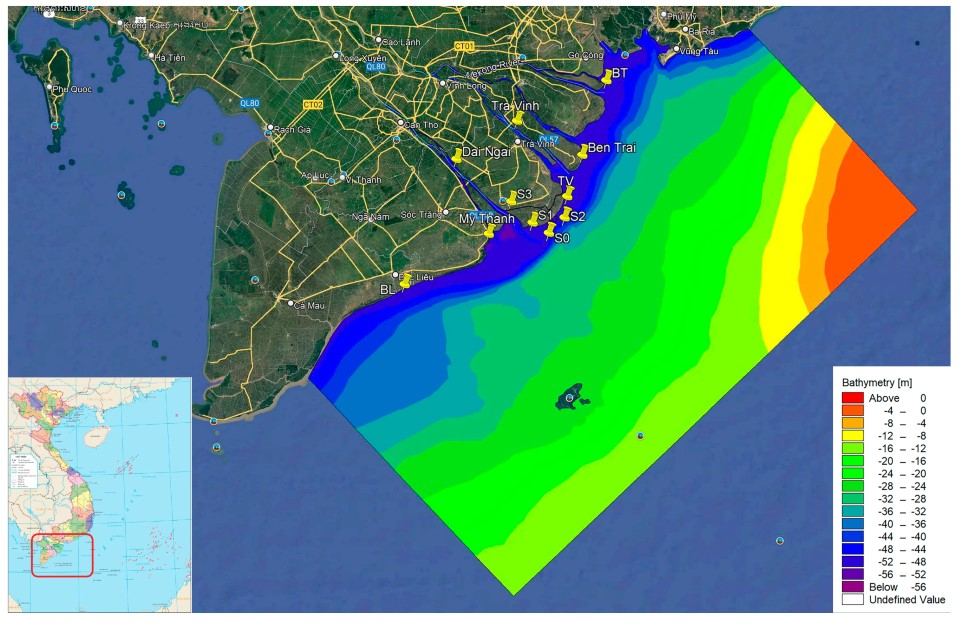
The study area is entirely in the Mekong River Delta (Figure 1). The south boundary is located in the Tam Giang Dong Ward, Ca Mau province. The north boundary is located at Moc Xuyen Ward, Ho Chi Minh City. The upstream boundaries are defined at Phu Huu Ward, Dong Thap Province on Tien River, and at Phuoc Thoi Ward, Can Tho City on Hau River.
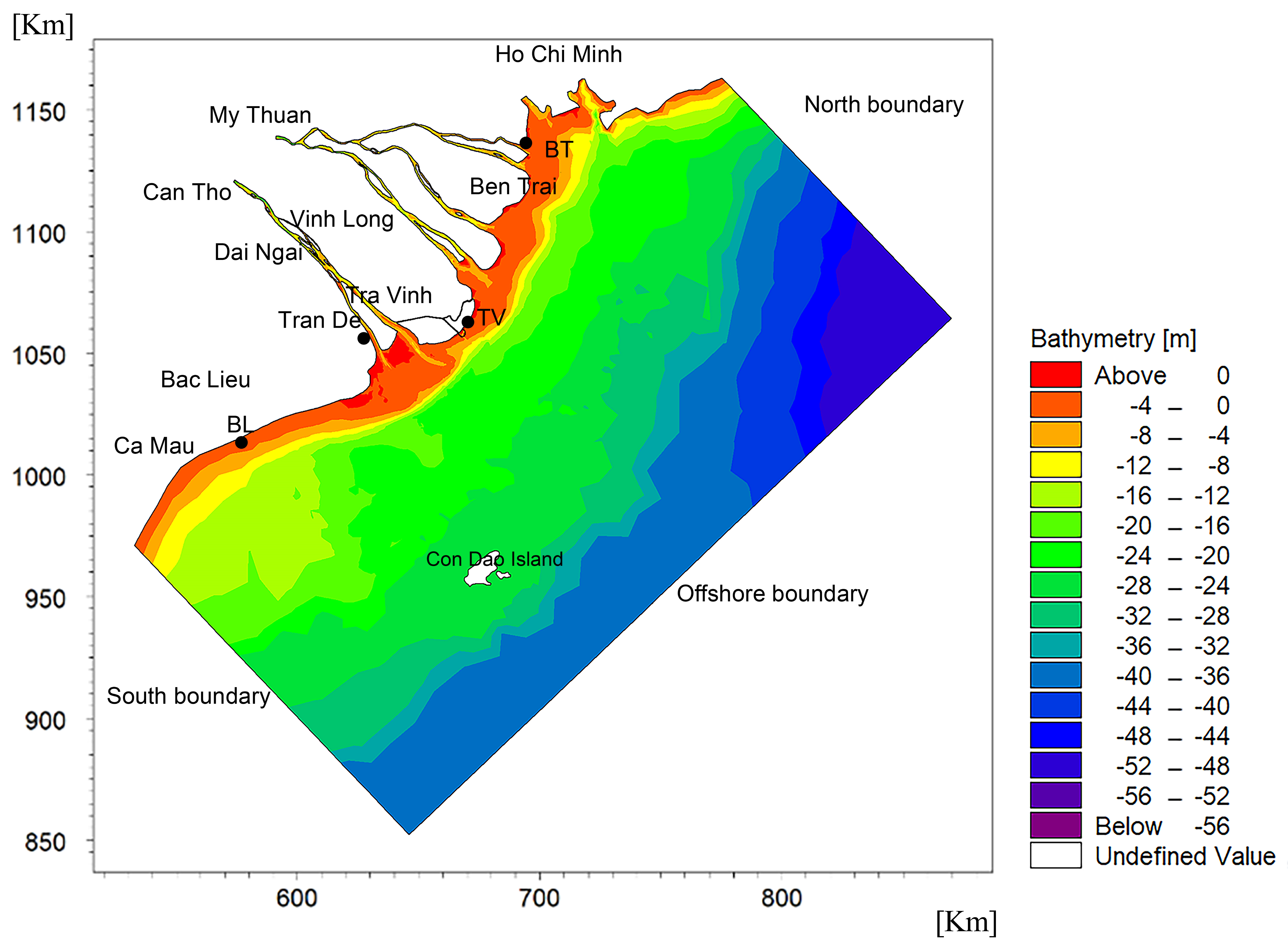
The 2005 bathymetry of the Dinh An estuary collected by PORTCOAST is adopted in this study, with horizontal coordinates referenced to the UTM 48 (Figure 2) [20]. All elevations are expressed in meters relative to the Chart Datum. Offshore elevations were surveyed by the Vietnam Navy’s Sixth Corporation in 2006. The bathymetry data in the Dinh An and Tran De estuaries were measured in June 2024 [21].
The observation of water levels and coastal area at the Dai Ngai, My Thanh, Tra Vinh, and Ben Trai stations were collected in May 2004, September 2017, and June 2024. The discharges at the Can Tho and My Thuan stations were measured in May 2004, November 2017, and June 2024. The location and time of the observation data such as current, wave, and suspended sediment concentration (SSC) are presented in Table 1.
Sediment data in Dinh An estuary, Duyen Hai Port, indicated that the median particle size ranges from 2.5 to 3.9 μm [5,23]. The suspended sediment concentration in the nearshore of the Go Cong coast, Cua Dai, Cua Tieu, and Soai Rap estuaries shows that the median grain sizes range from 4 to 7 μm with typical floc sizes of approximately 5 μm [19,24]. In addition, fluid mud has been observed in the Duyen Hai harbor basin, exhibiting densities ranging from 1050 to 1700 kg/m3, and a thicknesses range from 0.8 to 3.1 m [8,23].

2.2. Model Setup

In this paper, a large computational domain covering 270 × 300 km of the Mekong River Delta was simulated using the coupled MIKE 21/3 (2019 version) modeling system, incorporating Hydrodynamics (HD), Spectral Wave (SW), and Mud Transport (MT) modules. The numerical solution domain is discretized using the finite volume method (FVM), whereby the continuous domain is subdivided into non-overlapping control volumes to ensure local conservation of mass and momentum. A quadrangular mesh was applied to the river and navigation channel regions, while a rectangular mesh was used for the coastal and offshore areas. The rectangular mesh resolution ranged from 20 to 100 m, comprising 21,875 nodes and 26,765 elements. The scientific details of the HD, SW, and MT models are presented in the Manual [25,26,27].
The hydrodynamic model was forced using discharge data from the Tien River at My Thuan Station and the Hau River at Can Tho Station. The northern boundary condition was prescribed using observed water levels at Vung Tau (Ho Chi Minh City), and the southern boundary condition was based on water levels at Ganh Hao station (Ca Mau Province). Salinity at the upstream boundaries was derived from measurements at the My Thuan and Can Tho stations, whereas open-sea boundaries were assigned a constant value of 35 PSU (Figure 2). Wind forcing was represented by uniform wind shear stress at the water surface, based on wind data recorded at Con Dao Island at 3 h intervals. Horizontal eddy viscosity was estimated using the Smagorinsky formulation with a constant Cs = 0.30.
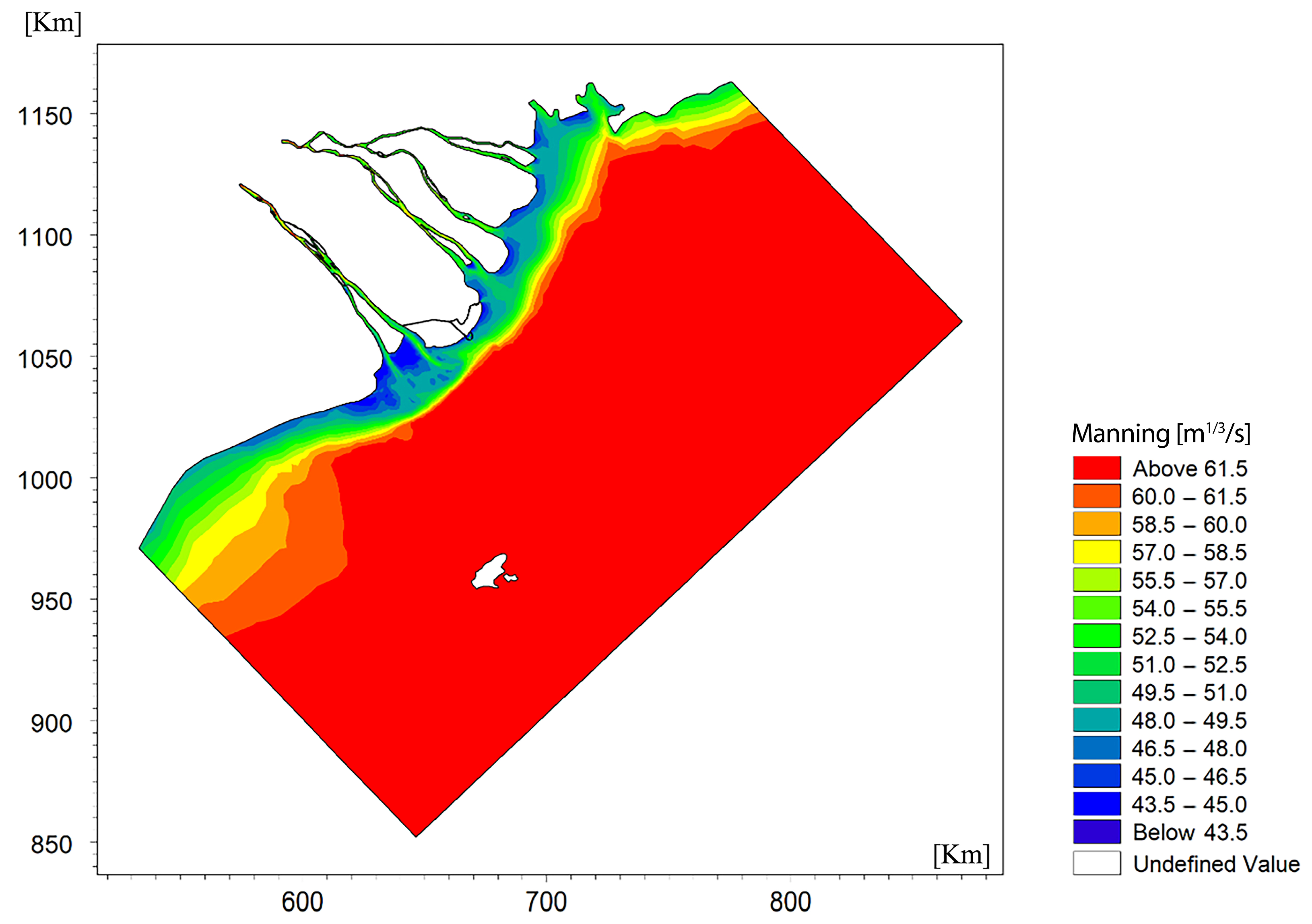
The Manning number (M) is a key parameter for calibrating and verifying the HD model [28,29]. The M can be determined based on CD via the relationship with water depth [30]. In the estuarine and coastal zones, values were selected ranging from 45 to 70 m1/3/s−1, while values for riverine areas ranged from 30 to 45 m1/3/s−1 [2]. Nguyen (2014) proposed an initial Manning number for MRD of 20 to 40 m1/3/s−1 [31]. Therefore, in this study, the initial Manning values were assigned according to water depth and varies in the domain from 40 to 65 m1/3/s−1). The final values of M will be selected through HD model calibration and verification.
The Spectral Wave (SW) module employs a fully spectral formulation under stationary conditions and is coupled with hydrodynamic inputs from the HD model. Wind forcing was obtained from the 3-hourly records at Con Dao Island. The initial wave conditions were generated using an empirical spectral formulation based on the JONSWAP fetch-growth relationship, with a fetch length of 160 km and a maximum peak frequency of 0.4 Hz. Other JONSWAP parameters follow DHI (2017) [27]. Wave breaking was parameterized using the Ruessink et al. (2003) formulation, and white capping dissipation was activated [32]. Closed boundary conditions were applied at the upstream river boundaries (Can Tho and My Thuan stations), while lateral open boundaries were specified along the northern and southern coastal limits. Time-varying offshore wave parameters provided by the Southern Institute of Water Resources Research (SIWRR) were imposed at the seaward boundary [33]. The Nikuradse roughness height is a key factor used to calibrate and verify the SW model. It was estimated from the median grain diameter [29,30,32]. The final values of Nikuradse roughness height will be determined during model calibration and verification.
The outputs of the HD and SW models were used as external forcing for the Mud Transport module. The model configuration incorporated site-specific parameters and employed a four-layer bed structure to represent vertical variations in cohesive sediment properties. The physical characteristics of these layers were allowed to vary horizontally to capture spatial differences in erosion and deposition across the study area. Parameters governing settling velocity, deposition, and erosion were initially estimated from the published literature, with the final values determined through model calibration and verification.
The suspended sediment concentrations (SSC) at the upstream boundaries, such as at the Can Tho and My Thuan stations, were prescribed as 0.15 kg/m3 during the dry season and 0.10 kg/m3 during the flood season. For northern and southern boundaries, the SSC is given as 0.15 kg/m3 at the nearshore grids, while it is taken as 0.0001 kg/m3 at offshore grids in flood season. For these same boundaries, the SSC was given as 0.10 kg/m3 at the nearshore grids, while it is taken as 0.0002 kg/m3 at offshore grids in the dry season.
A four-layer bed structure was adopted in the Mud Transport model. The properties of these layers were defined based on the MIKE 21 MT recommendations and the findings of Thanh (2012) [2], as summarized in Table 2.
The critical shear stress for erosion (τce) and deposition (τcd) are sensitive parameters, and a series of simulations are performed to calibrate and verify these parameters.

2.3. Model Calibration and Verification

Calibration and verification of the coupled model—comprising hydrodynamic, spectral wave, and sediment transport modules—are conducted for periods or events with the most reliable observational data available within the computational domain. The availability of inflow discharge, tide, distribution of flow through the Mekong River Delta, velocity of flow, wave parameters, and suspended sediment concentration should be carefully considered before selecting a time period for the model calibration and verification.
Four simulations were performed in this study. In the first simulation, the couple model, including HD, SW, and MT, was simulated in May 2004, based on the boundary conditions in Section 2.1 and the input parameters specified in the model setup in Section 2.2. The simulation results will be compared with observational data, and then the values of MAE and RMSE will be calculated. If the MAE and RMSE values are slightly high, a second run will be carried out with modified input parameters, specifically the Manning number and Nikuradse roughness height. This second simulation was repeated to find the most petite MAE and RMSE values. The input parameters of the model corresponding to the most petite MAE and RMSE were used for validation. Based on the results of the third and fourth simulations, conducted in September 2017 and June 2024, the verification of the couple model will be carried out based on the comparison model results with the observation data from 12 to 18 September 2017 and from 4 to 19 June 2024. The selected simulation periods (May 2004, September 2017, and June 2024) were chosen to represent typical hydrological and monsoon-driven conditions in the Mekong River Delta, including both dry- and wet season regimes and varying tidal–river interaction strengths. These periods are not intended to represent extreme flood or storm events but rather to provide a robust basis for model calibration and independent verification under commonly occurring conditions.
The coupled model performance was assessed with the Mean Absolute Error (MAE) and Root Mean Square Error (RMSE) between the observed and simulated data [28,34]. The values of the MAE and RMSE range from zero to ∞, and for a perfectly fitting model, these values are zero. There is no generally accepted threshold of the MAE and RMSE value to evaluate model performance, but large MAE and RMSE values indicate significant model error and a lower value of RMSE and MAE indicates better model performance [17,35]. An RMSE of less than 10% is excellent, 10–20% is good, 20–30% is satisfactory, and larger than 30% is poor [36]. The performance of the calibrated and verified couple model is evaluated using both methods.
M A E = 1 n 1 n A b s S i m u l a t e d O b s e r v e d
R M S E = 1 n 1 n ( S i m u l a t e d O b s e r v e d ) 2

3. Results and Discussion

3.1. Hydrodynamic Model Calibration and Verification

Bed roughness is one of the main parameters used to calibrate coastal and estuarine models. It also plays a crucial role in accurately simulating processes such as sediment transport and wave attenuation [29]. Therefore, in the hydrodynamic model, the Manning number is a key parameter for calibration [9,19,37].
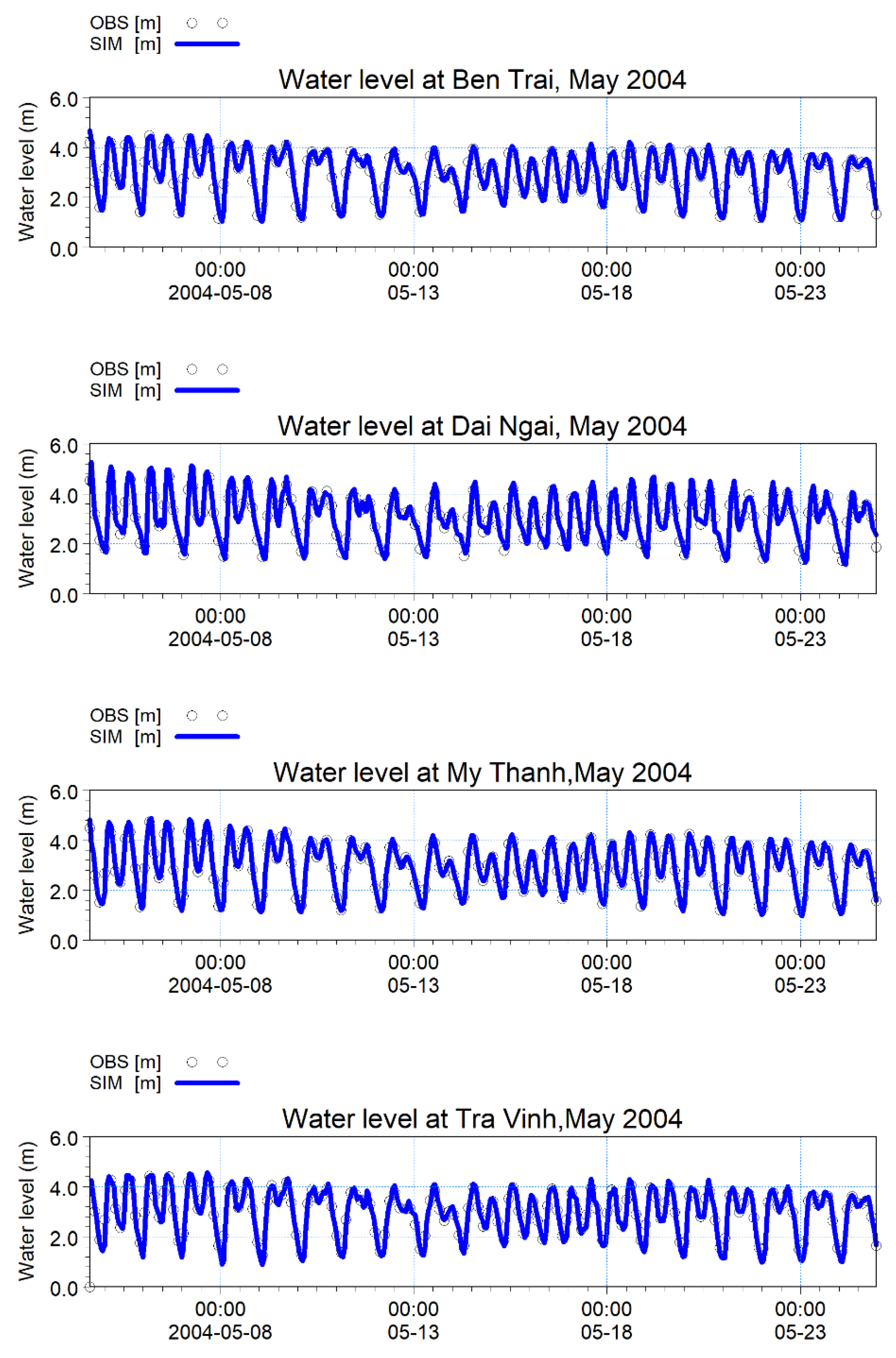
The first simulation results compared with measurement data from 6 to 24 May 2004 show that the RMSE ranges from 0.14 to 0.20 m with the difference varying from 4.0 to 6.2%, and its average difference is 5.8%. The MAE values range from 0.11 to 0.23 m, with the difference varying from 2.9 to 5.7%, and the average difference is approximately 4.3%. These indicate the HD model results’ consistence with observation data.
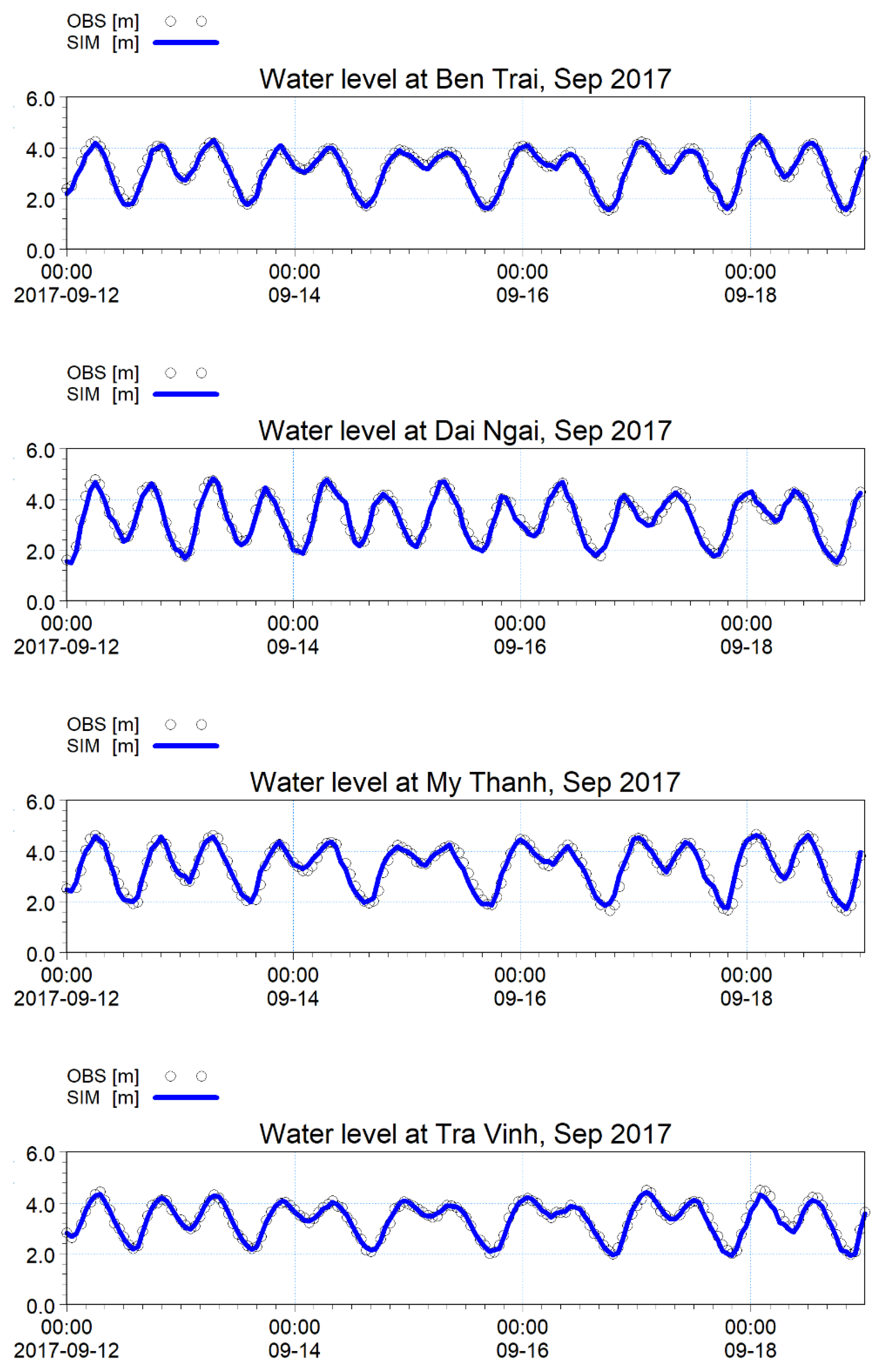
A comparison of the results of the second simulation in 2017 and observation data from 12 to 18 September 2017 indicates that the RMSE of water levels in four stations ranges from 0.12 to 0.26 m, with the difference ranging from 3.9 to 7.2% while the MAE value ranges from 0.09 to 0.20, with the difference varying from 2.7 to 5.1%. The average differences in the RMSE and MAE are 5.4% and 3.9%, respectively (Table 2). This simulation conducted during the flood season influenced flood flow. However, the results show that the HD model-calibrated parameters provide good simulation results for the water level regime in the study area.
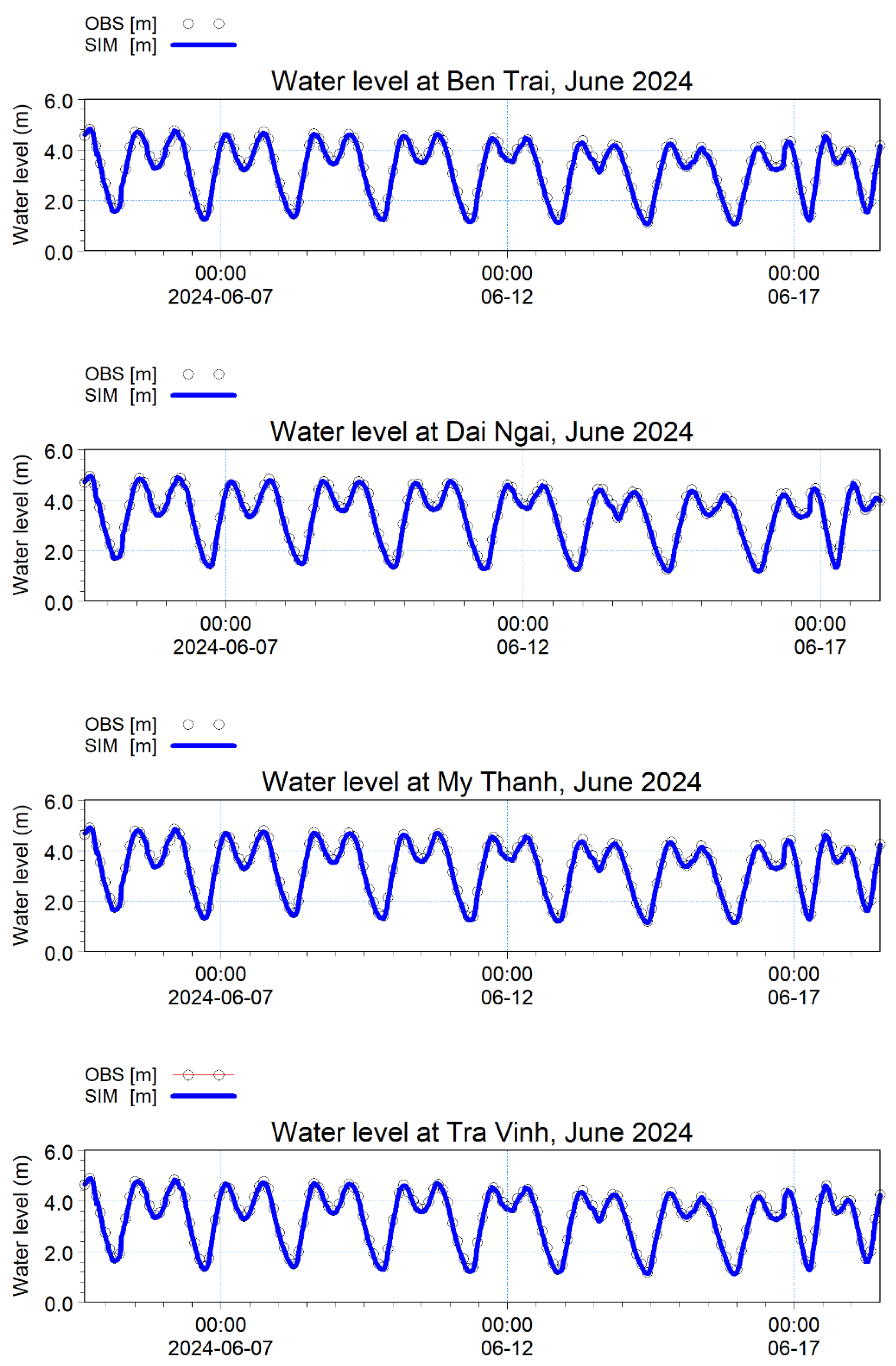
A comparison of the results of the third simulation for June 2024 and the observation data from 4 to 16 June 2024 indicates that the RMSE of water levels in four stations ranges from 0.11 to 0.20 m, with the difference ranging from 3.1 to 5.7%, while the MAE value ranges from 0.09 to 0.20, with the difference varying from 1.6 to 5.0%. The average differences between RMSE and MAE are 4.4% and 3.3%, respectively (Table 2). A detailed comparison of the simulation and observation of water levels at four stations is shown in Figure 3, Figure 4 and Figure 5. The second validation results further confirm that the HD model has accurately simulated water level fluctuations in the study area.
Table 3 indicates that the difference between water levels in the simulation results and observation data at the Dai Ngai and Tra Vinh stations is a bit high compared with the My Thanh and Ben Trai stations. The study area is characterized by strong interactions between astronomical tides, river discharge, and seasonal monsoon forcing, and the locations of two stations in the river is far from the estuaries by about 40 to 50 km, and the water level is subjected to river discharges from the canal and channel in the Mekong River Delta. The other reason may concern uncertainties in upstream discharge boundary conditions, especially during transitional hydrological periods, which can propagate downstream and effect water level accuracy at estuarine stations. Importantly, although the absolute deviations appear relatively large at some stations, the model satisfactorily reproduces the overall tidal range, phase, and temporal variation, which is reflected in the acceptable statistical performance indicators used for model verification. Therefore, the results remain adequate for the purpose of model calibration and verification in a highly dynamic estuarine environment.
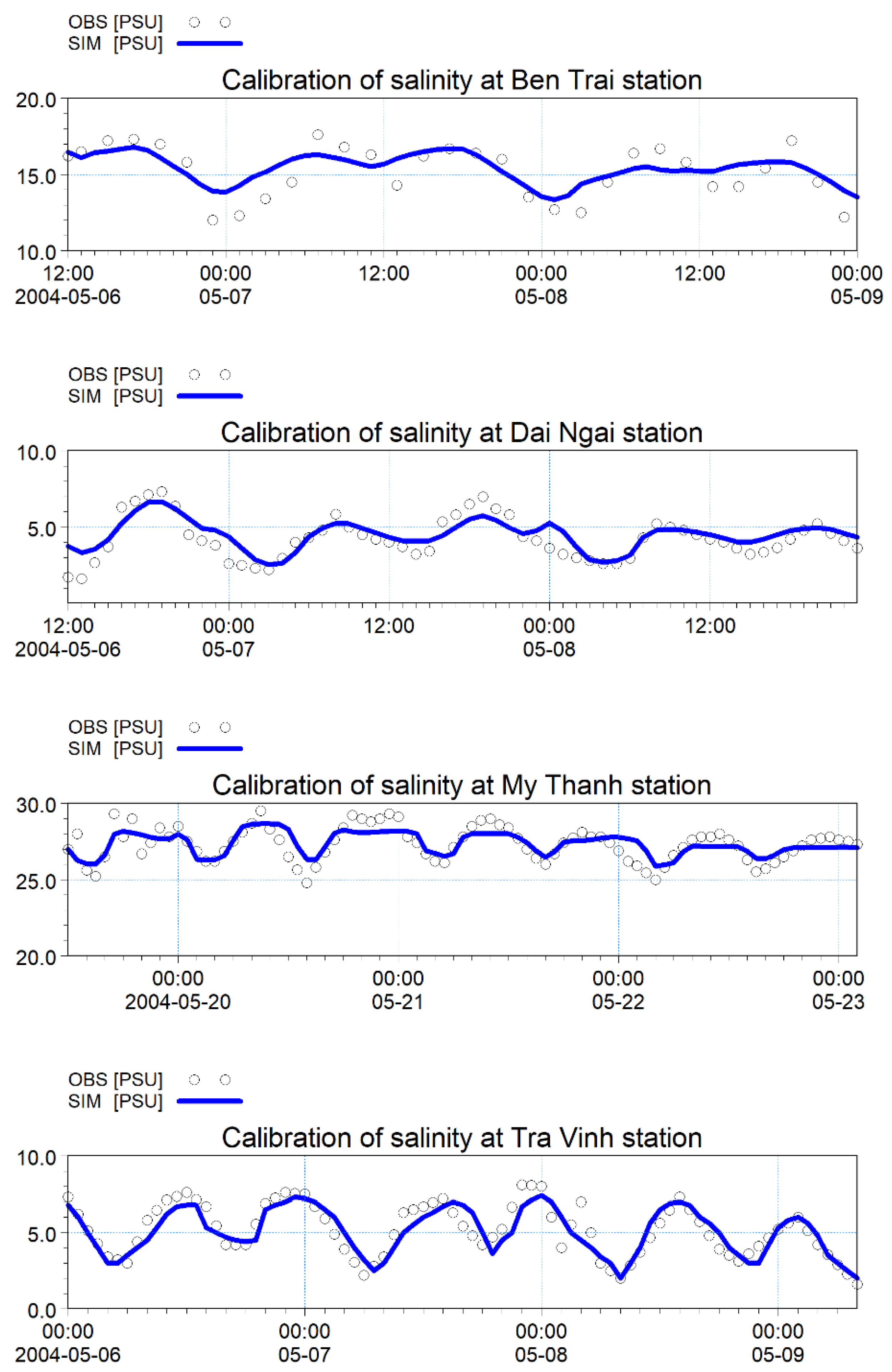
In terms of the salinity data, it is only measured in the dry season, in May 2004. During the flood season, salinity cannot be measured because the floodwater carries seawater to the mouth of the river. Therefore, the HD model was only calibrated with the measurement salinity data from 6 to 9 May 2004 in four stations, including those in Ben Trai, My Thanh, Tra Vinh, and Dai Ngai. The results of the first simulation for the calibration process show that the RMSE of salinity in four stations ranges from 0.63 to 1.22 PSU, with the difference ranging from 14.3 to 21.4%, while the MAE value ranges from 0.51 to 1.12, with the difference varying from 11.7 to 18.8%. The average differences in RMSE and MAE are 18.1% and 14.9%, respectively (Table 4). These results indicate that the model’s predictions are consistent with the measurement data in four stations. A comparison of observation and simulation results of salinity from four stations presented in Figure 6.
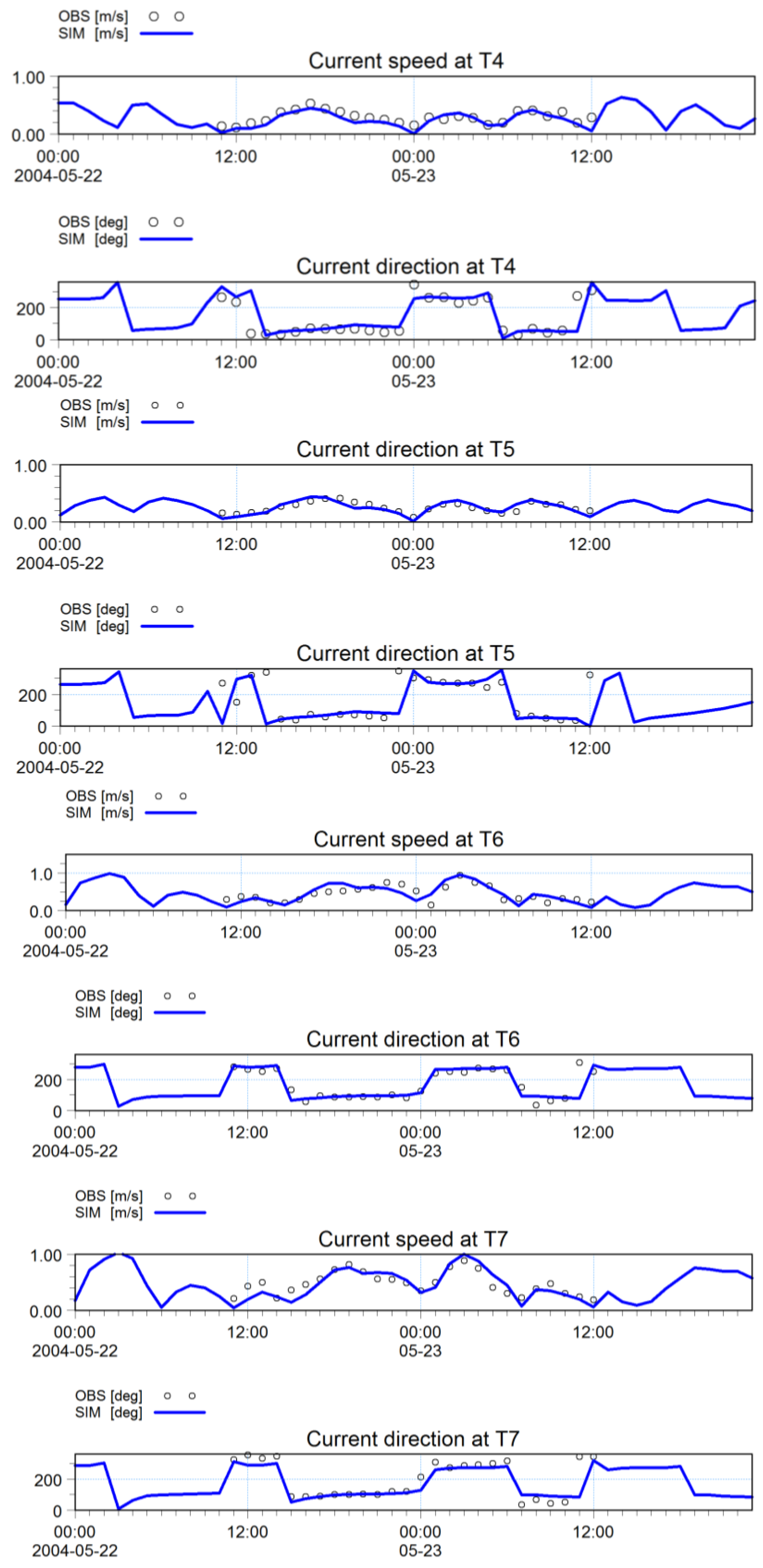
Nearshore current (speed and direction) at four stations, T4 to T7, measured from 6 to 24 May 2004, was used to calibrate the HD model. The RMSE of current speed ranges from 0.08 to 0.17 m/s, with the difference ranging from 17.5 to 21.5%, while the MAE value ranges from 0.07 to 0.13 m/s, with the difference varying from 13.4 to 17.6%. The average differences in RMSE and MAE are 19.4% and 15.5%, respectively. The RMSE values of the current direction range from 29.49 to 65.52 degrees, with the difference varying from 12.5 to 26.0%. The MEA ranges from 19.43 to 33.39 degrees, with a difference from 8.2 to 15.6%. The averages of RMSE and MAE are 20.8% and 12.7%, respectively (Table 5).
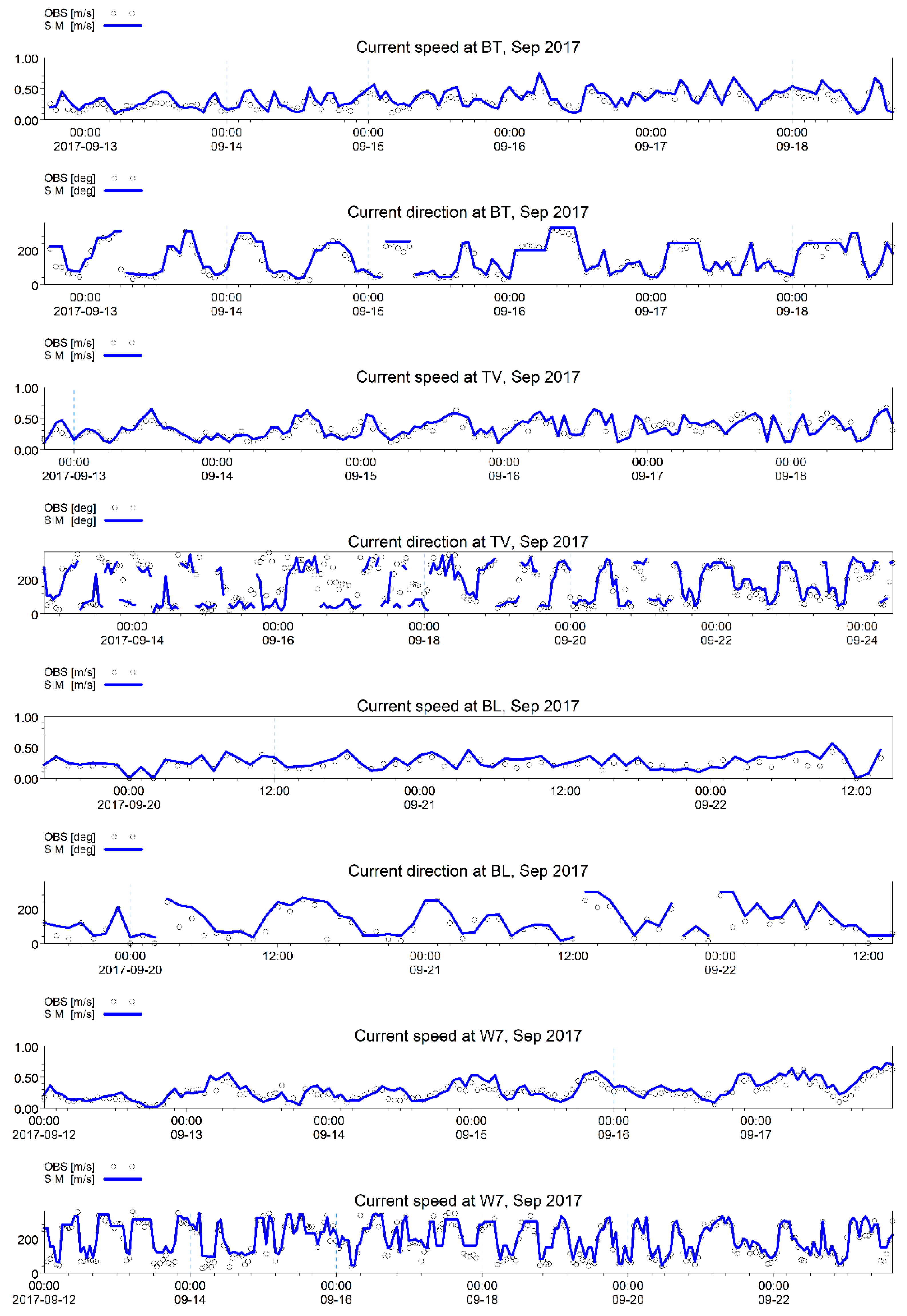
The result of the second simulation in September 2017 compared with measurement data from 12 to 18 September 2017 indicates that the RMSE of the current speed varies from 17.2 to 19.5%, while the current direction ranges from 17.3 to 23.4%. The MAE of the current speed ranges from 21.6 to 23.6%, and the current direction ranges from 23.2 to 25.7%. The average RMSE of the current speed and direction are 19.2% and 20.9%, and the average MAE of the current speed and direction are 22.6% and 24.4%, respectively (Table 5).
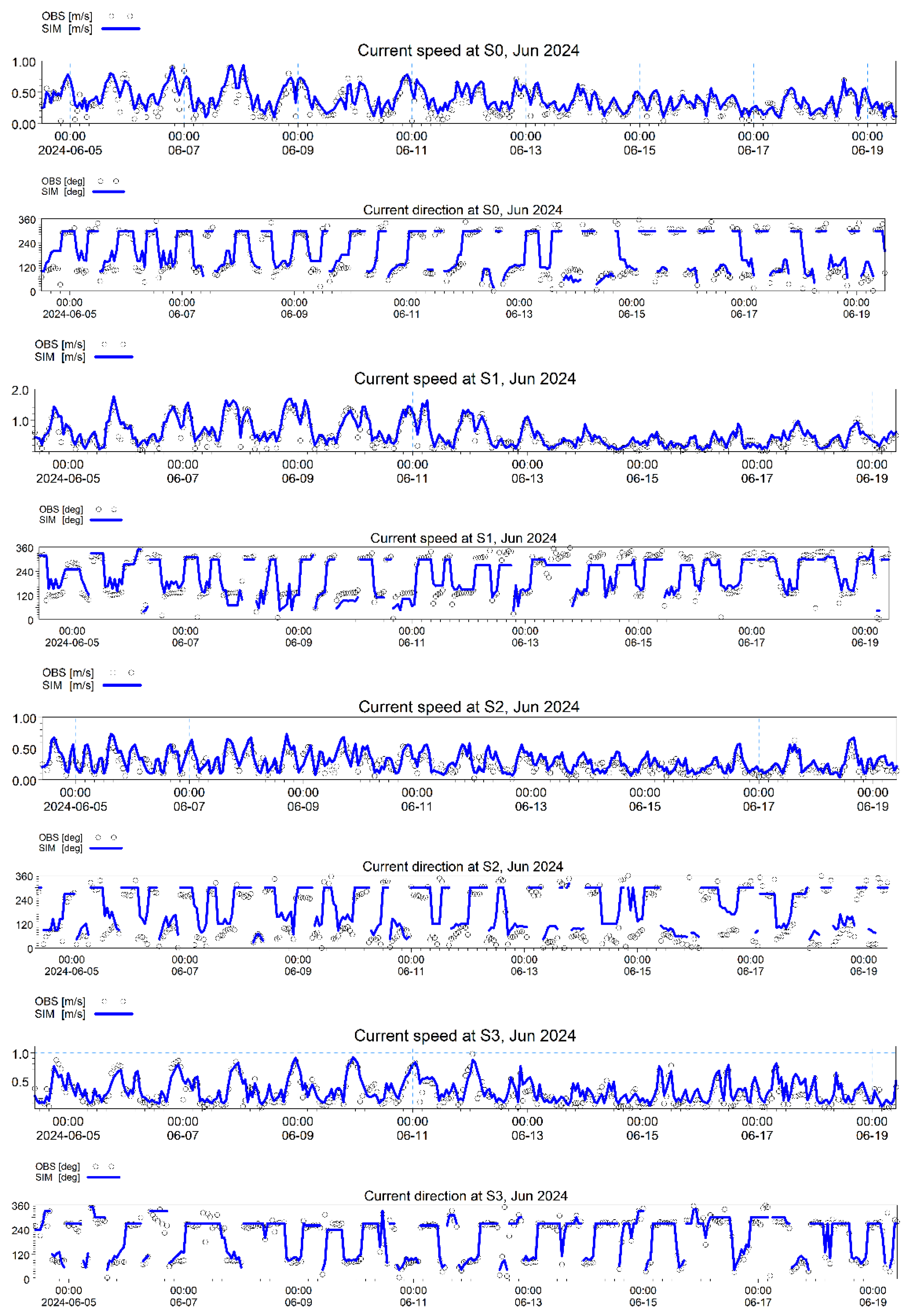
The result of the third simulation in June 2024 indicates the RMSE of current speed varies from 17.5 to 19,3%, while the current direction ranges from 18.6 to 27.8%. The MAE of the current speed ranges from 19.6 to 24.2%, and the current direction ranges from 22.6 to 32.4%. The average RMSE of the current speed and direction are 18.5% and 21.9%, and the average MAE of the current speed and direction are 21.8% and 26.8%, respectively (Table 5).
The simulation results indicate that the HD model accurately reflects flow trends at the survey stations, with no errors in phase or flow intensity. These errors can be explained by the fact that the current flow distribution, according to the average depth, will certainly differ from field measurements, where the depth is usually fixed at one location at site.
A comparison of the observation and simulation results of the current speed and direction at four stations (T4 to T7) in May 2024 is shown in Figure 7, at four stations (BT, TV, BL, and W7) in September 2017 is shown in Figure 8, and at four stations (S0, S1, S2 and S3) in June 2024 is shown in Figure 9.
Results obtained from the verification process demonstrate that the Manning’s roughness coefficient throughout the study area varies between 40 and 65 m1/3 s−1 (Figure 10).

3.2. Wave Spectral Model Calibration and Verification

Wave data that has been recorded is very limited on the coast of Mekong River Delta. In this study, the Spectral Wave model is calibrated by the measurement data at W7 station in May 2017 and then is verified by the measurement data in September 2017 and June 2024.
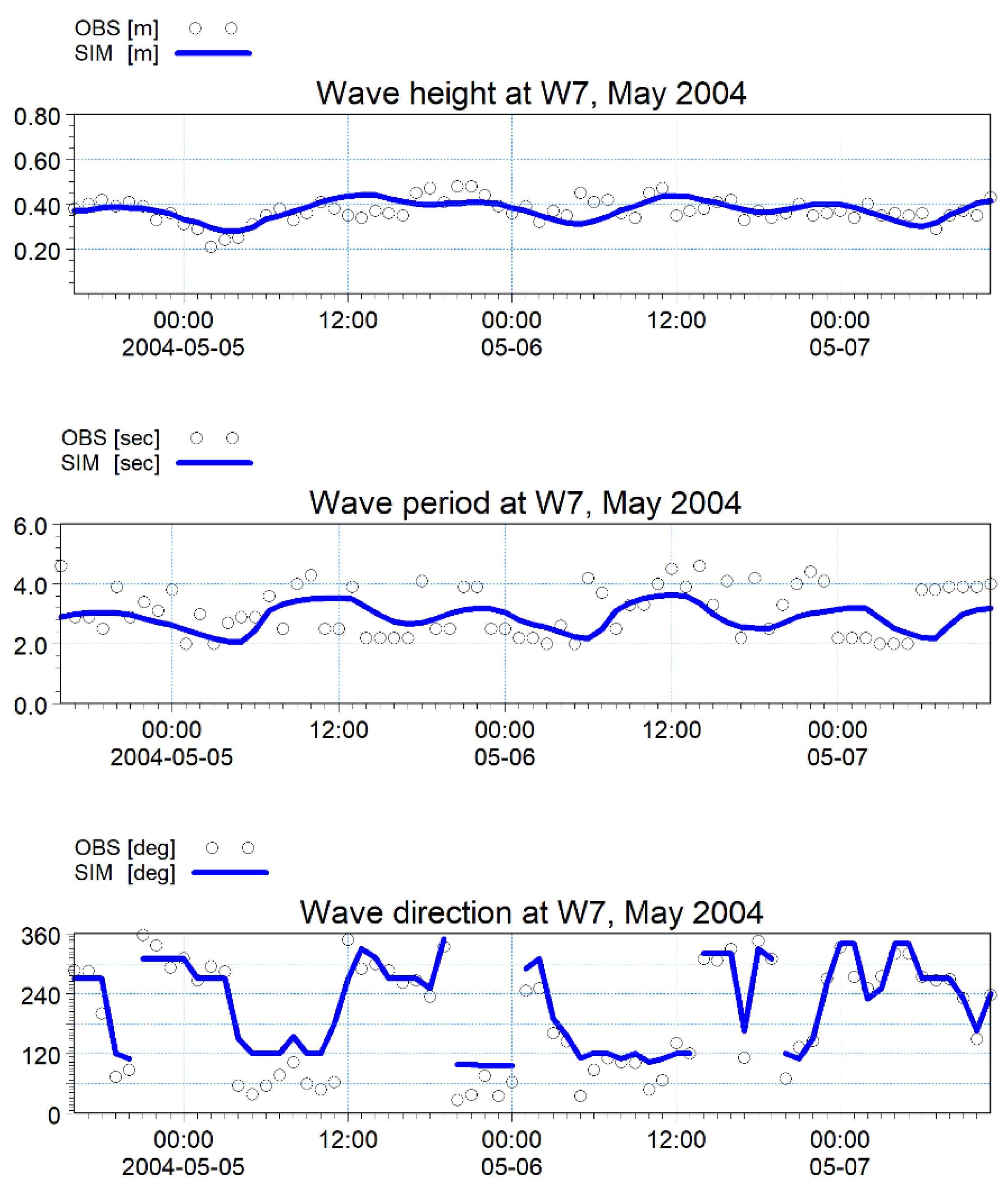
The calibration of the SW model is based on only wave height and period, measured from 13 to 15 May 2004 at the W7 location. The results show that the values of RMSE are 21.35% for wave height, 24.54% for wave period, and 29.14% for wave direction, while the values of MAE are 18.51% for wave height, 19.25% for wave period, and 22.65 for wave direction. The calibration results at W7 indicate relatively large errors. This is particularly evident under conditions of very small wave heights, where measurement uncertainties become comparable to the observed values. Consequently, greater discrepancies are observed between the numerical simulation results and the field measurements. A comparison of the simulation results and measurement data with regard to wave height, period, and direction at W7 in May 2004 is presented in Figure 11.
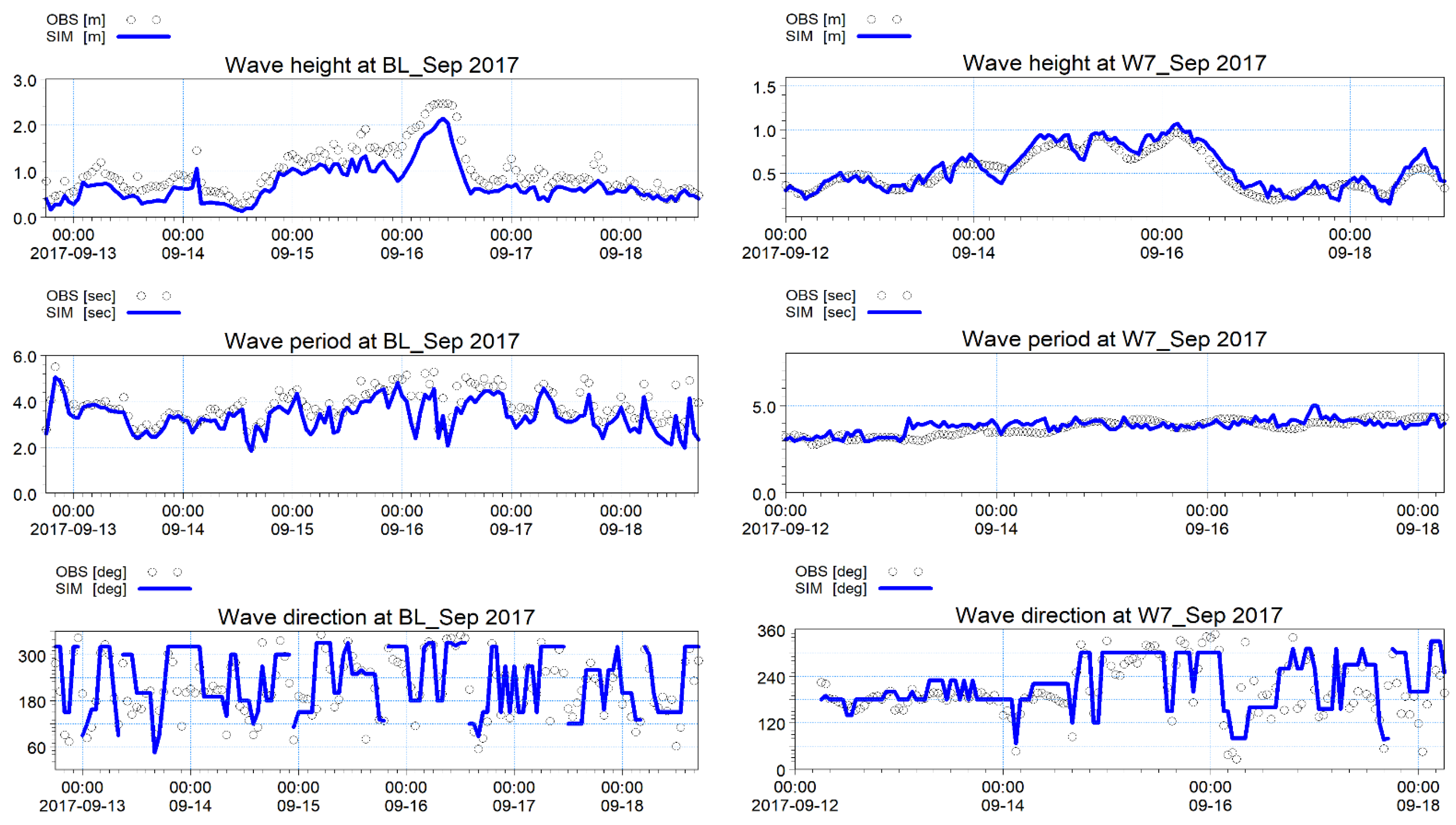
The first verification of the SW model is based on measurement data from 12 to 18 September 2017 at four stations (BT, TV, BL, and W7) (Table 6); the results can be summarized as below:
-
The values of RMSE for wave height at the four stations range from 14.70 to 15.64%, with an average of 15.1%. The MAE ranges from 12.10% to 13.51%, with an average of 12.8%.
-
The values of RMSE for wave period at the four stations range from 15.10 to 21.24%, with an average of 18.1%. The MAE ranges from 9.42% to 21.26%, with an average of 16.1%.
-
The values of RMSE for wave direction at the four stations range from 18.80 to 21.40%, with an average of 20.9%. The MAE ranges from 16.30% to 19.50%, with an average of 17.9%.
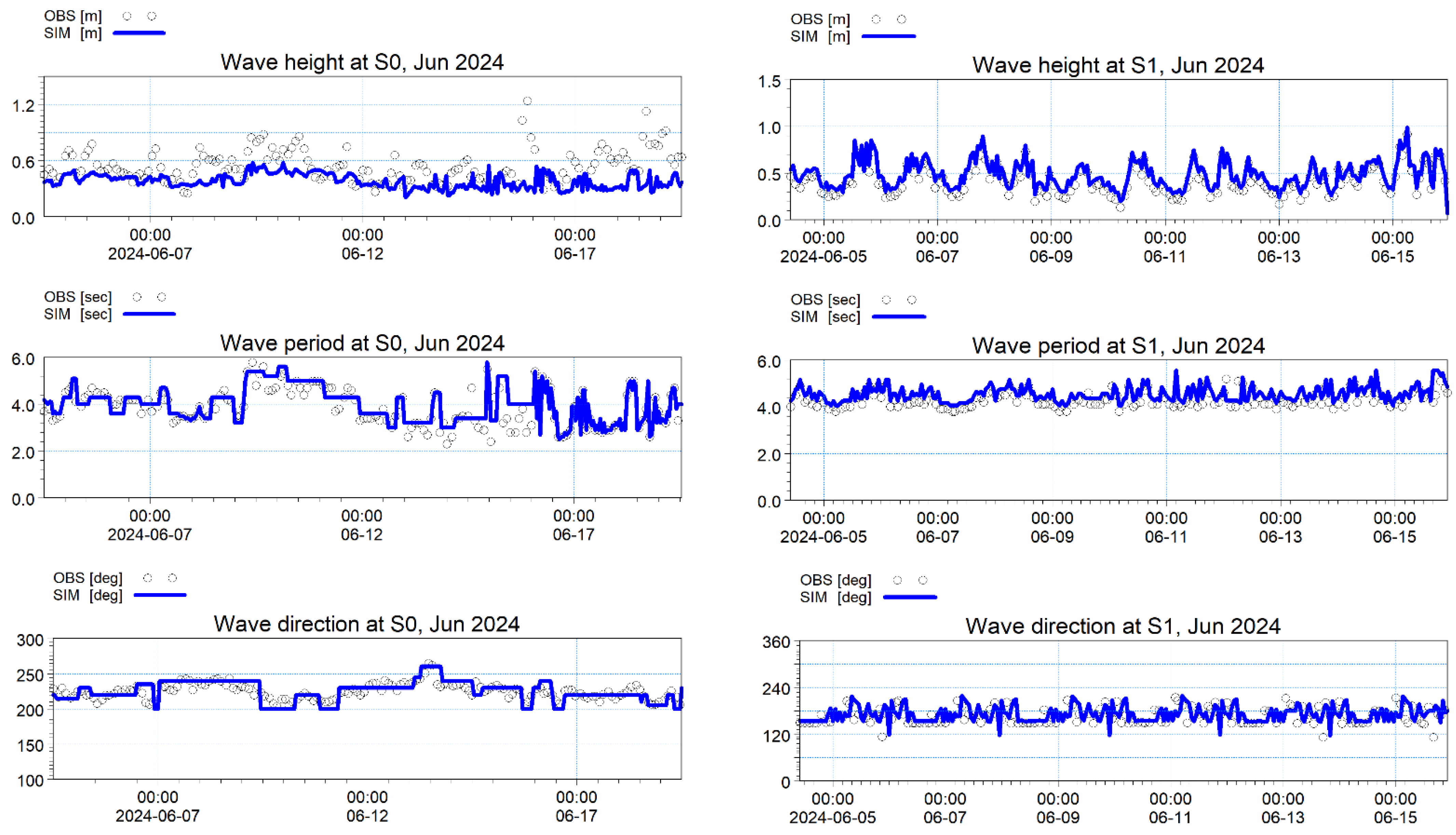
The second verification process is based on measurement data from 4 to 19 June 2024 at two stations (S0 and S1) (Table 6). The results can be summarized as below:
-
The values of RMSE for wave height at two stations range from 17.34 to 18.66%, with an average of 18.0%. The MAE ranges from 14.32% to 16.51%, with an average of 15.4%.
-
The values of RMSE for wave period at two stations range from 15,34 to 17.52%, with an average of 16.4%. The MAE ranges from 13.35% to 15.39%, with an average of 14.4%.
-
The values of RMSE for wave direction at two stations range from 20.39 to 21.45%, with an average of 20.9%. The MAE ranges from 18.32% to 19.12%, with an average of 18.7%.
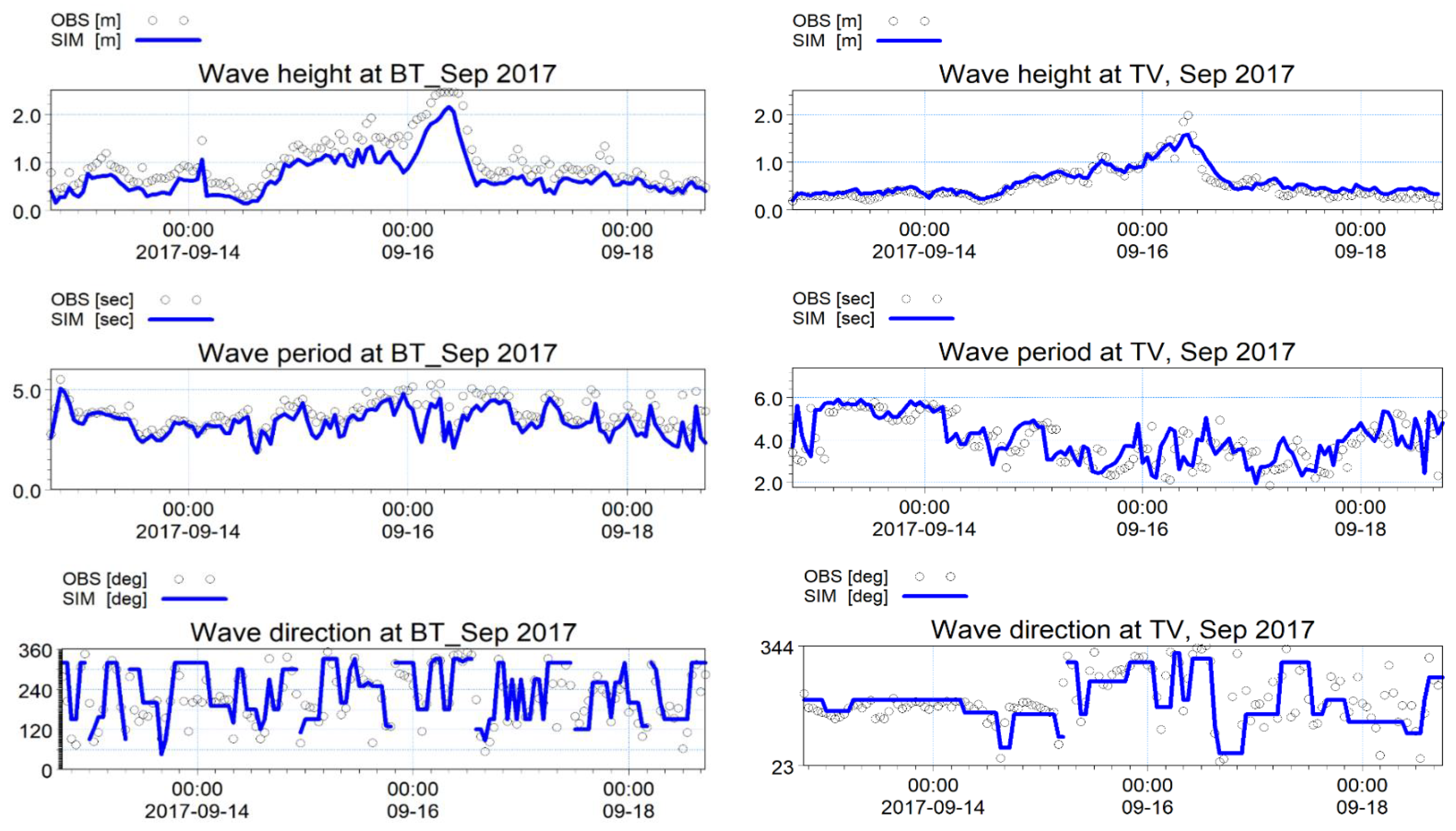
The comparisons of simulation results and measurement data of wave height, period, and direction at the BT, TV, BL, and W7 stations in September 2017 are presented in Figure 12 and Figure 13, respectively.
The comparison of simulation results and measurement data of wave height, period, and direction at S0 and S1 station in June 2024 is presented in Figure 14.
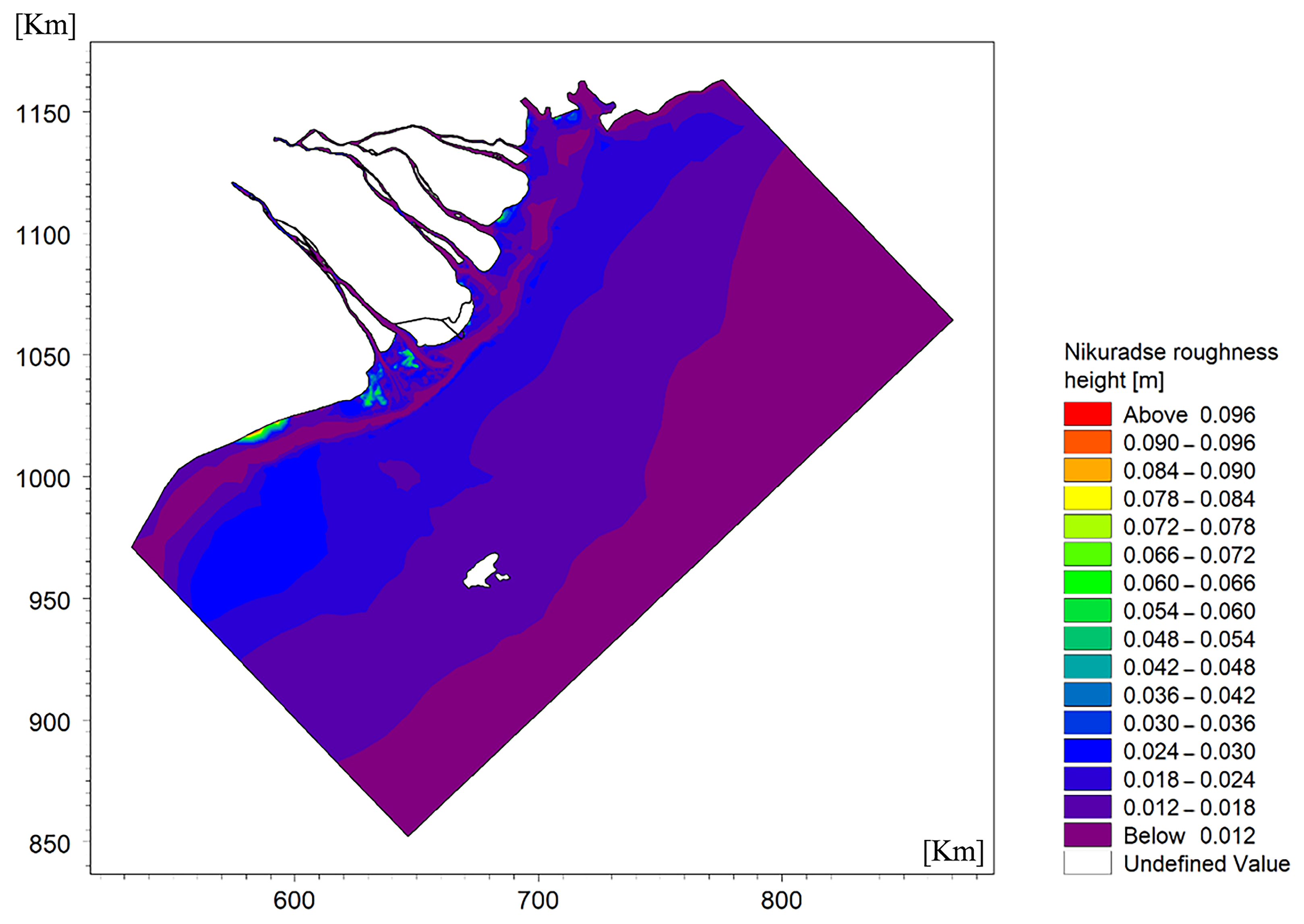
Based on the results of the verification processes, the most suitable values of the Nikuradse roughness height for the study area vary from 0.012 to 0.096 m, as shown in Figure 15.

3.3. Mud Transport Model Calibration and Verification

The Mud Transport model will be calibrated by the observation of SSC data in four locations (from T4 to T7) from 6 to 24 May 2004 and the verification based on measurement SSC data from 12 to 18 September 2017 and from 4 to 19 June 2024.
Based on the selection of input parameters in Table 2, the first simulation in May 2004 was performed. The values of RMSE and MAE are provided in Table 7. The value of RMSE ranges from 25.15% to 34.80%, and its average is about 32.10%. The value of MAE ranges from 19.08% to 32.55% with the average being 27.90%. The results in the first simulation indicated that the RMSE and MAE are a bit high. Therefore, a series of parameters such as critical shear stress for deposition τcd, critical shear stress for erosion τce, erosion coefficient E, coefficient α, and transition coefficient Ti will be discussed based on the literature and previous study results. The critical shear stress for deposition cd) has not been measured in coastal area of the Mekong River Delta estuary area. Therefore, this parameter has been used as a calibration factor. However, the literature values originating from laboratory studies have been found to support the calibration [38]. Krone found τcd values at 0.06–0.078 N/m2 [39], and Mehta and Partheniades found values at 0.18–1.1 N/m2 [40]. Nguyen applied the values of critical shear stress for the Dinh An estuary from 0.12 to 0.45 N/m2 [2]. It is indicated that the variations in τcd are due to the different sediment characteristics in the area. This study proposed the critical shear stress for deposition to range from 0.01 to 0.07 N/m2. The next two simulations in September 2017 and June 2024 will be used to define the RMSE and MAE to confirm the consistency of the MT model.
The critical shear stress for erosion (τce) is a required value for setting up the model. It also has not been measured in the study area. However, the parameter has been calculated for the Dinh An estuary with τce ranges from 0.3 to 0.8 N/m2 in 2003 [41]. PORTCOAST, NIPPON KOEI, and DHI proposed the various values from 0.1 to 0.8 N/m2 for the research on the heavy tonnage entrance to the Hau River through the Dinh An estuary in 2009 [42]. The values of τce applied in the Dinh An and Cung Hau estuaries vary from 0.1 to 1.8 N/m2 in 2012 [2]. The greater part of the explanation for the variations is the inundation length of the intertidal flats. Therefore, the model setup has concentrated on choosing the τce values controlled by the bottom elevation, inundation time, and the sediment characteristics. In this study, the value of τce after verification ranges from 0.05 to 0.48, applied for three layers above, and 1.8 N/m2 is applied to the lowest bottom layer in order to artificially prevent erosion from this layer.
The erosion coefficient (E) is a calibration factor used to control the overall level of the erosion. For erosion coefficient, Parchure and Mehta state values from 0.67 × 10⁻⁵ to 0.3 × 10⁻⁴ kg/m2/s [43]. Van Rijn has values varying from 5 × 10⁻⁷ to 5 × 10⁻⁶ kg/m2/s [44]. The Manual of MIKE 21MT proposed a range between 5 × 10⁻⁶ to 1 × 10⁻⁴ kg/m2/s for soft beds. Thanh proposed the erosion coefficient of 5 × 10⁻⁷ kg/m2/s for the bed of four layers [2]; this value of E was also chosen for this study.
The α coefficient is a calibration coefficient that steers the exponential rise in erosion when τb rises. Parchure and Mehta state values of the α coefficient from different studies to be between 4.2 and 25.6 m N−0.5 [43], and van Rijn estimates values from 10 to 20 m N−0.5 [44]. In the Scientific document of the MIKE 21 HD, α usually lies between 4 and 26 [27]. Thanh applied the α coefficient of 4.0 N−0.5 for three above layers and 1.0 N−0.5 for the bottom layer in Dinh An estuary. In this study, the α coefficients have been verified for three above-bed layers of 4 N−0,5 and the hard mud layer was chosen of 1.0 N−0.5; these values are as same as the suggestion of Nguyen (2012) [2].
The consolidation of the bottom sediment is not directly included in the model. However, a transition coefficient (Ti) can be used to determine a rate at which the sediment from upper layers is transformed to sediment at lower layers. Sediment layers exhibit distinct properties, particularly in terms of their critical shear stress for erosion. As a result, sediments that remain longer on the bed exhibit progressively higher critical bottom shear stress for erosion [38]. In the three above layers, the value 5 × 10⁻⁷ kg/m2/s is used between layer 1 and layer 2, the value of 1 × 10⁻⁷ kg/m2/s is used between layer 2 and layer 3, and 1 × 10⁻⁸ kg/m2/s is used between layer 3 and layer 4.
The above input parameters were applied in the second simulation conducted in May 2004 and were subsequently validated using observational data from September 2017 and June 2024 to assess the robustness of the model.
The RMSE and MAE values of the second simulation in May 2004 are provided in Table 7. The value of RMSE ranges from 25.15% to 34.80%, and its average is about 32.10%. The value of MAE ranges from 19.08% to 32.55%, with the average being 27.90%.
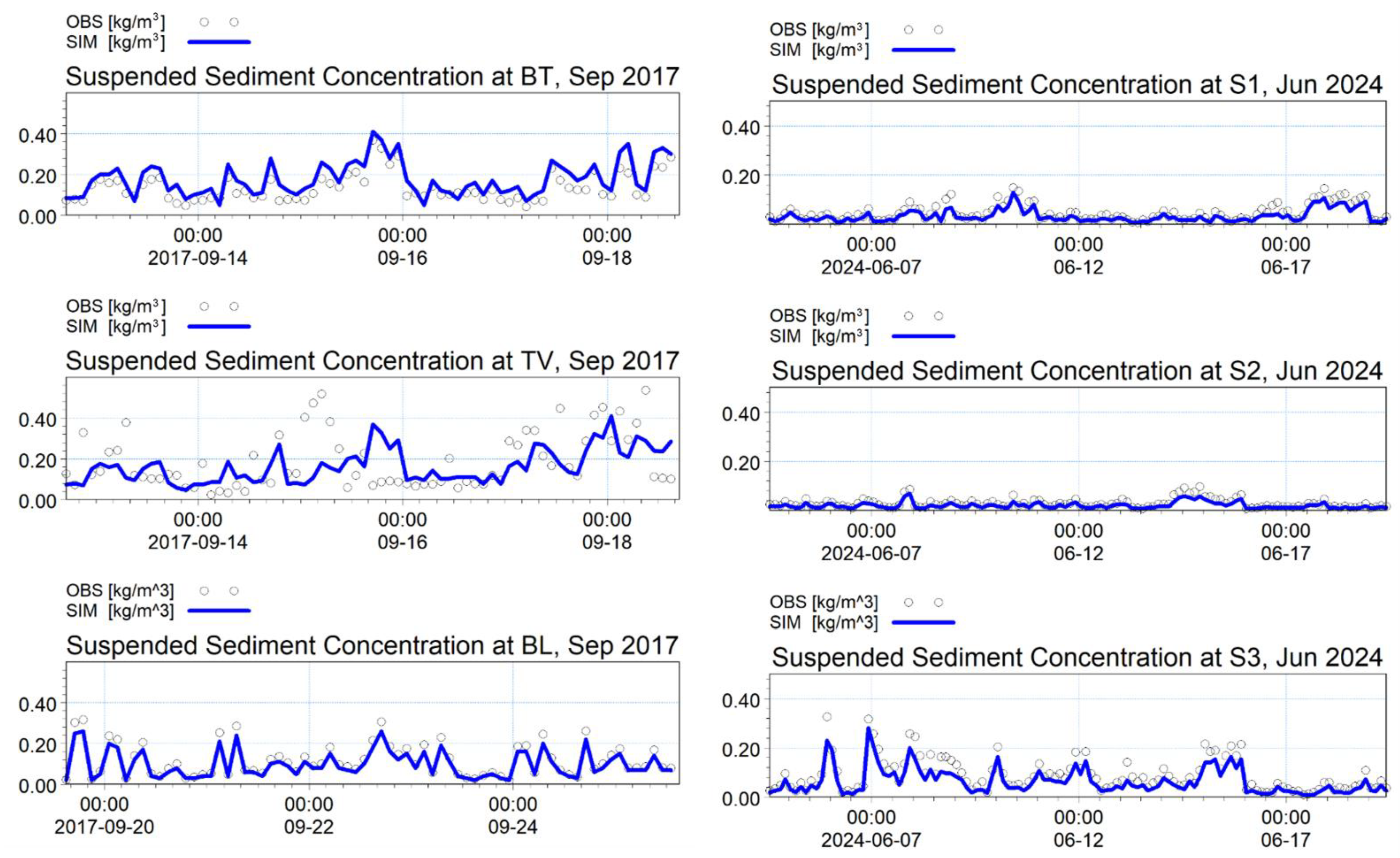
In the third simulation in September 2017, the results were compared with observation SSC data at the BT, TV, and BL stations. The value of RMSE ranges from 24.38% to 31.26%, and its average is about 28.00%. The value of MAE ranges from 20.43% to 31.36%, with the average being 25.00%. The results in Table 7 indicate that both the MAE and RMSE of the TV station are a bit high. This can be attributed to a sudden change in wave direction at the TV station, as illustrated in Figure 12 (right).
The third simulation in June 2024 was conducted to verify the input parameters again. The results of the third simulation were compared with measurement SSC data at the S1, S2, and S3 stations in June 2024. The values of the RMSE range from 22.12% to 29.62%, and its average is about 26.00%. The value of the MAE ranges from 19.24% to 25.16%, with the average being 22.30%.
Based on the results of the two verifications in September 2017 and June 2024, the input parameters of Mud Transport model are proposed in Table 8.
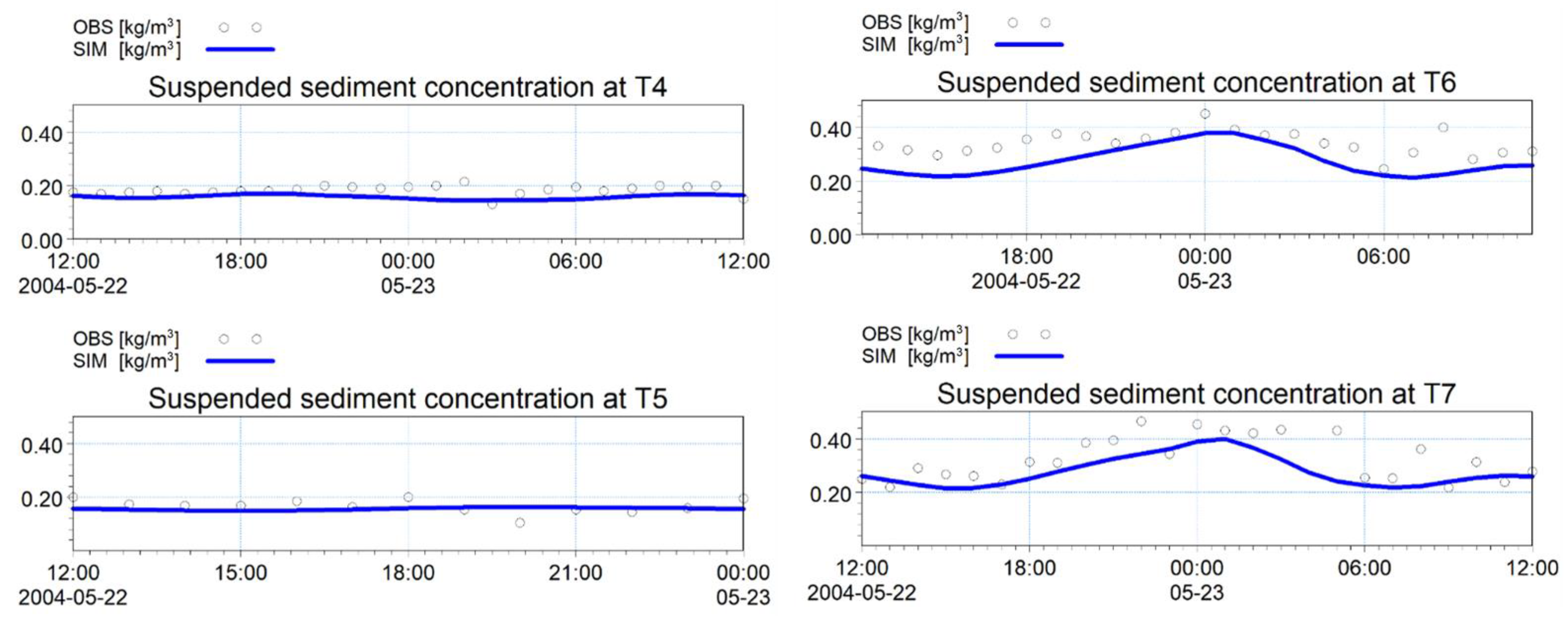
A comparison of measurement SSC data and results of the first simulation plotted in Figure 16, and it is indicated that the SSC distribution trend of the MT model is in good agreement with the measured data.
A comparison of measurement data and simulation results of the suspended sediment concentration at the BT, TV, and BL station in September 2017 and at the S1, S2, and S3 stations June 2024 in Figure 17. These results indicated that the numerical results agree well with observation data.
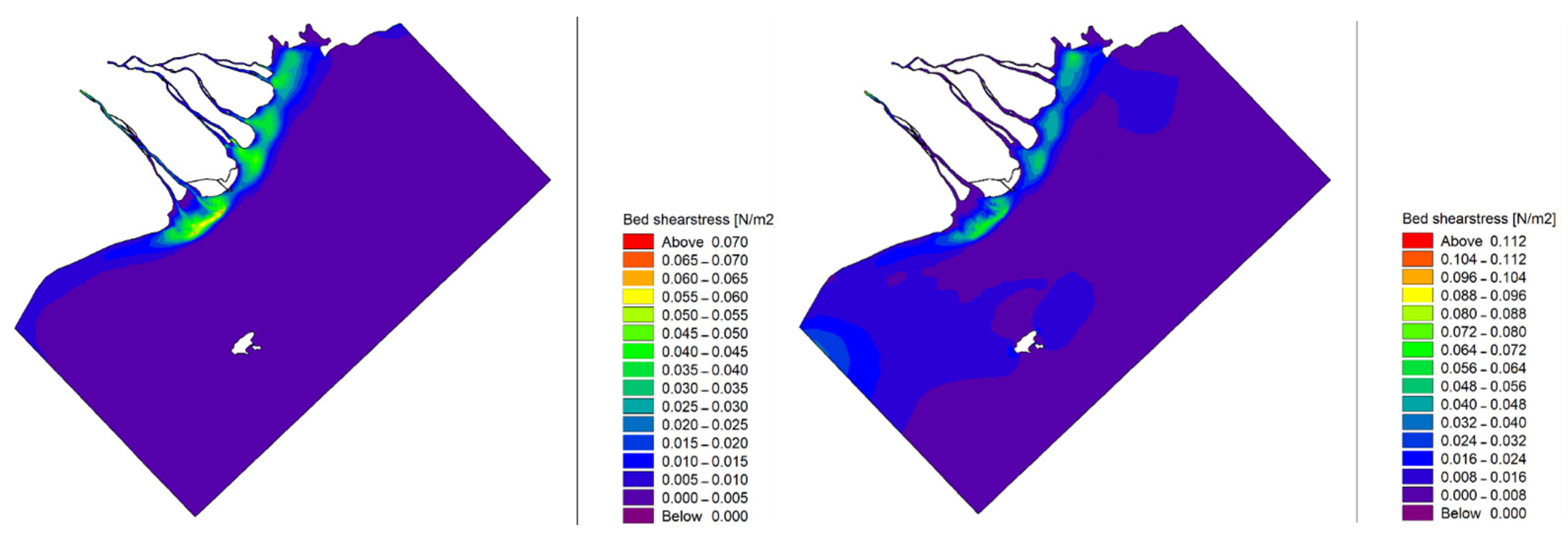
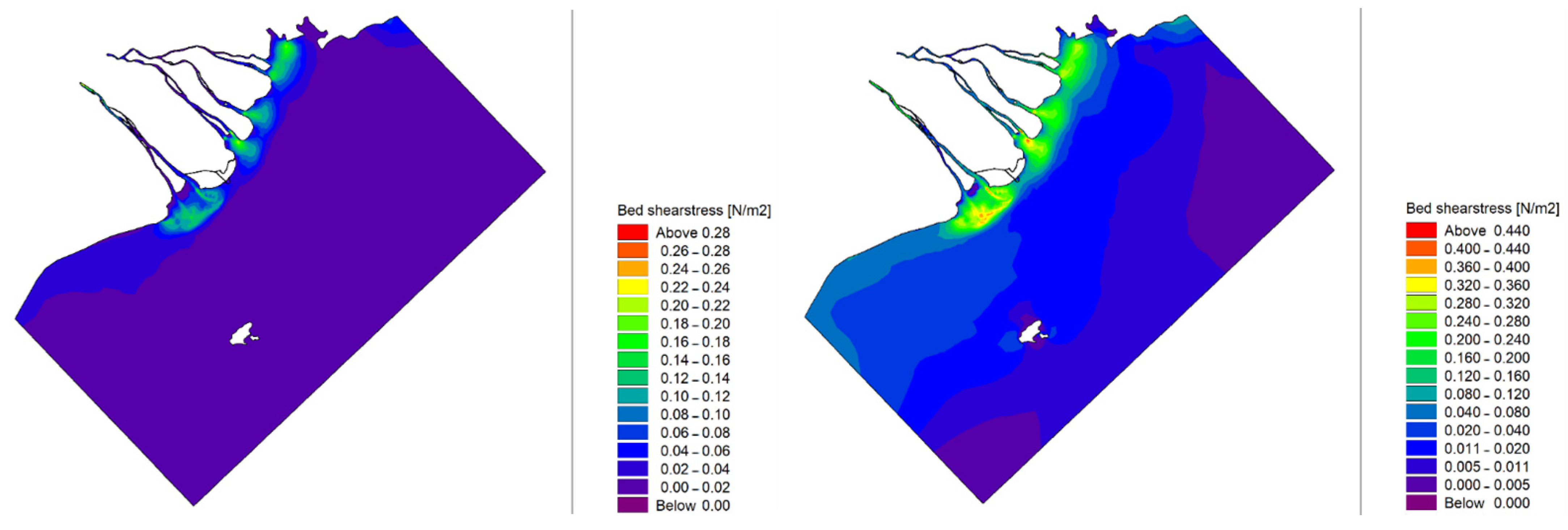
Based on the verification results, the distribution of critical shear stress for erosion of layer 1 range from 0.008 to 0.112 N/m2, layer 2 from 0.02 to 0.28 N/m2, and layer 3 from 0.011 to 0.48 N/m2, as shown in Figure 18 (right) and Figure 19, respectively.

3.4. Discussion

The analysis of the model–observation discrepancies indicates that errors are not randomly distributed but exhibit systematic patterns related to location, tidal phase, and seasonal forcing. At several estuarine stations, larger water level and current magnitude deviations occur during spring tides, suggesting sensitivity to tidal phase alignment and bathymetric uncertainty in narrow channels that are not fully resolved by the computational grid. Minor phase lags between the simulated and observed currents are most evident during ebb–flood transitions, where the nonlinear tidal–river interactions are strongest.
During the monsoon season, discrepancies in current magnitude and suspended sediment concentration increase, particularly at stations influenced by variable river inflow. These deviations are attributed to uncertainties in upstream discharge boundary conditions and the use of depth-averaged formulations that do not explicitly resolve vertical stratification and salinity-driven density effects. In coastal areas, the underestimation of short-term wave energy and the associated sediment resuspension is likely linked to the use of spatially uniform wind forcing and stationary wave simulations, which may not fully capture wind setup and squall-induced variability.
Despite these limitations, the model reproduces the dominant temporal patterns and magnitudes of hydrodynamic and sediment-related variables across most stations, indicating that the remaining biases primarily reflect simplified or unresolved processes rather than fundamental deficiencies in the coupled modeling framework.
The comparison focuses on model performance metrics reported in previous numerical studies of the Mekong River Delta and other large estuarine–coastal systems, including water levels, current velocities, wave characteristics, and suspended sediment concentrations. This approach is consistent with the scope of the present paper, which is limited to model calibration and verification. The statistical performance metrics obtained in this study (e.g., MAE and RMSE) are comparable to or better than those reported in previous studies using standalone hydrodynamic or sediment models in the Mekong estuary and similar tidal-dominated deltas, such as Manh et al. [13]; Le Xuan et al. [19]; Duy Vinh et al. [14]; and Tu et al. [9].
Unlike many existing studies that focus on validating a single component (e.g., hydrodynamics only), this manuscript presents the simultaneous calibration and independent verification of hydrodynamics, waves, and suspended sediment transport within a fully coupled modeling framework across both estuarine and coastal domains. The model demonstrates stable performance across multiple stations and under various hydrological conditions, indicating the enhanced robustness of the coupled system compared to previously reported applications that were limited in terms of spatial coverage or temporal duration.
The cohesive sediment module explicitly represents erosion and deposition governed by critical shear stresses, erosion coefficients, and depth-averaged advection–diffusion of suspended sediments. Processes such as flocculation and deflocculation hindered settling at high suspended sediment concentrations, and long-term bed consolidation, and detailed fluid mud rheology are not explicitly simulated in the present configuration and are instead treated implicitly through calibrated effective parameters.
Based on this comparative analysis, the innovation of this manuscript is its provision of a rigorously calibrated and verified coupled delta coastal–estuary modeling framework for the Mekong River Delta, which represents a methodological advancement and a reliable foundation for future applied and process-oriented studies. The model performance under extreme high-flow events, severe storms, or long-term climatic changes was not explicitly evaluated. This should be addressed in future studies using the validated modeling framework presented here.
Although this study is limited to model calibration and verification, the validated coupled hydrodynamic–wave–sediment framework provides a robust basis for subsequent scenario-based analyses relevant to sediment management and coastal engineering in the Mekong River Delta. Once validated, the model can be applied to evaluate the impacts of changes in upstream sediment supply, coastal protection structures, navigation works, and sea level rise on hydrodynamics and sediment transport patterns.

4. Conclusions

This research successfully established and validated a state-of-the-art, coupled model capable of simulating water movements and cohesive sediment dynamics across the vast Mekong River Delta. By integrating HD, SW, and MT modules, the model demonstrated a strong ability to describe time-dependent water movements and tidal wave deformation, which are essential precursors for accurate sediment modeling. The key findings from the study include the following:
The hydrodynamic and wave modules showed high agreement with observation data across multiple stations, confirming the model’s reliability in representing both dry and flood season conditions. The Manning number was determined based on the water depth, and it ranged from 40 to 65 m1/3/s. The Nikuradse roughness height was estimated from the median grain diameter which varies from 0.012 to 0.096 m. The investigation revealed that parameters such as critical shear stress for deposition and erosion are highly sensitive; even minor variations in these single parameters can lead to differences in accretion rates of several centimeters per day. This emphasizes the necessity of site-specific setups rather than relying on generalized literature values. The Mud Transport model of a four-layer bed was chosen to suit the geological conditions of the riverine, estuarine, and coastal areas of the Mekong Rive Delta.
Despite the theoretical complexity of fine-grained sediment behavior, the model proved capable of reproducing the right orders and patterns of suspended sediment concentrations and net sedimentation for the Mekong River Delta.

Author Contributions

Conceptualization, L.T.D. and T.N.V.; methodology, L.T.D. and T.N.V.; software, T.N.V.; validation, T.N.V. and L.T.D.; formal analysis, T.N.V.; investigation, L.T.D. and T.N.V.; resources, L.T.D. and T.N.V.; data curation, T.N.V.; writing—original draft preparation, T.N.V. and L.T.D., writing—review and editing, T.N.V. and L.T.D.; visualization, T.N.V. and L.T.D.; supervision, T.N.V.; project administration, L.T.D.; and funding acquisition, L.T.D. and T.N.V. All authors have read and agreed to the published version of the manuscript.

Funding

This research is partly funded by the Hanoi University of Civil Engineering (HUCE) under the grant number B2024.XDA.05.

Data Availability Statement

The data are not publicly available due to privacy or ethical restrictions.

Acknowledgments

This research is partly funded by the Hanoi University of Civil Engineering (HUCE) under the grant number B2024.XDA.05.

Conflicts of Interest

The authors declare no conflicts of interest.

References

  1. Anthony, E.J.; Brunier, G.; Besset, M.; Goichot, M.; Dussouillez, P.; Nguyen, V.L. Linking rapid erosion of the Mekong River delta to human activities. Sci. Rep. 2015, 5, 14745. [Google Scholar] [CrossRef] [PubMed]
  2. Thanh, N.V. Morphological Evolution and Back Siltation of Navigation Channel in Dinh An Estuary, Mekong River Delta: Understanding, Modelling and Soluting. Ph.D. Dissertation, Hohai University, Nanjing, China, 2012; p. 181. [Google Scholar]
  3. An, L.V.; Thanh, N.V.; Van Hai, P.; Lai, T.D. Overview of Coastal Protection Structures in the Mekong River Delta. In Proceedings of the 4th International Conference on Sustainability in Civil Engineering (ICSCE 2022); Hanoi, Vietnam, 25-27 November 2022; Nguyen-Xuan, T., Nguyen-Viet, T., Bui-Tien, T., Nguyen-Quang, T., De Roeck, G., Eds.; Lecture Notes in Civil Engineering; Springer Nature: Singapore, 2024; Volume 344, pp. 377–395. [Google Scholar] [CrossRef]
  4. Wolanski, E.; Ngoc Huan, N.; Trong Dao, L.; Huu Nhan, N.; Ngoc Thuy, N. Fine-sediment Dynamics in the Mekong River Estuary, Vietnam. Estuar. Coast. Shelf Sci. 1996, 43, 565–582. [Google Scholar] [CrossRef]
  5. Nguyen, V.-T.; Zheng, J.-H.; Zhang, J.-S. Mechanism of back siltation in navigation channel in Dinh An Estuary, Vietnam. Water Sci. Eng. 2013, 6, 178–188. [Google Scholar]
  6. Tran Anh, D.; Hoang, L.P.; Bui, M.D.; Rutschmann, P. Simulating Future Flows and Salinity Intrusion Using Combined One- and Two-Dimensional Hydrodynamic Modelling—The Case of Hau River, Vietnamese Mekong Delta. Water 2018, 10, 897. [Google Scholar] [CrossRef]
  7. Thanh, V.Q.; Roelvink, D.; van der Wegen, M.; Reyns, J.; Kernkamp, H.; Van Vinh, G.; Linh, V.T.P. Flooding in the Mekong Delta: The impact of dyke systems on downstream hydrodynamics. Hydrol. Earth Syst. Sci. 2020, 24, 189–212. [Google Scholar] [CrossRef]
  8. Nguyen, V.-T.; Le, V.-A. Fluid mud properties and nautical depth estimation: A case study in navigation channel of Duyen Hai Port, Vietnam. Ocean. Eng. 2023, 284, 115163. [Google Scholar] [CrossRef]
  9. Tu, L.X.; Thanh, V.Q.; Reyns, J.; Van, S.P.; Anh, D.T.; Dang, T.D.; Roelvink, D. Sediment transport and morphodynamical modeling on the estuaries and coastal zone of the Vietnamese Mekong Delta. Cont. Shelf Res. 2019, 186, 64–76. [Google Scholar] [CrossRef]
  10. Thanh, N.V.; Jinhai, Z.; Hau, L.P. Influence of reservoirs on morphological evolution of Red River, Vietnam. In Proceedings of the 8th National Conference on Sediment Basic Theoretical Research, Beijing, China, 22–25 April 2025; Hohai University Press: Nanjing, China, 2011. [Google Scholar]
  11. Letrung, T.; Li, Q.; Li, Y.; Vukien, T.; Nguyenthai, Q. Morphology Evolution of Cuadai Estuary, Mekong River, Southern Vietnam. J. Hydraul. Eng. 2013, 18, 1122–1132. [Google Scholar] [CrossRef]
  12. Anikiyev, V.V.; Zaytsev, O.V.; Trinh, T.H.; Savil’Yeva, I.I.; Starodubtsev, Y.; Shumilin, Y.N. Variation in the time-space distribution of suspended matter in the coastal zone of the Mekong River. Oceanology 1986, 26, 725–729. [Google Scholar]
  13. Manh, N.V.; Dung, N.V.; Hung, N.N.; Merz, B.; Apel, H. Large-scale suspended sediment transport and sediment deposition in the Mekong Delta. Hydrol. Earth Syst. Sci. 2014, 18, 3033–3053. [Google Scholar] [CrossRef]
  14. Duy Vinh, V.; Ouillon, S.; Van Thao, N.; Ngoc Tien, N. Numerical Simulations of Suspended Sediment Dynamics Due to Seasonal Forcing in the Mekong Coastal Area. Water 2016, 8, 255. [Google Scholar] [CrossRef]
  15. Le Xuan, T.; Ba, H.T.; Thanh, V.Q.; Wright, D.P.; Hasan Tanim, A.; Tran Anh, D. Evaluation of coastal protection strategies and proposing multiple lines of defense under climate change in the Mekong Delta for sustainable shoreline protection. Ocean. Coast. Manag. 2022, 228, 106301. [Google Scholar] [CrossRef]
  16. Trieu, N.A. Assessing the Effects of Upstream Dam Developments on Sediment Distribution in the Lower Mekong Delta, Vietnam. J. Water Resour. Prot. 2017, 9, 822–840. [Google Scholar] [CrossRef]
  17. Wang, J.; Kuang, C.; Fan, D.; Xing, W.; Qin, R.; Zou, Q. Spatio-Temporal Variation in Suspended Sediment during Typhoon Ampil under Wave–Current Interactions in the Yangtze River Estuary. Water 2024, 16, 1783. [Google Scholar] [CrossRef]
  18. Chen, X. Simulating hydrodynamics in a spring-fed estuary using a three-dimensional unstructured Cartesian grid model. Estuar. Coast. Shelf Sci. 2012, 115, 246–259. [Google Scholar] [CrossRef]
  19. Le Xuan, T.; Nguyen Cong, P.; Vo Quoc, T.; Tran, Q.Q.; Wright, D.P.; Tran Anh, D. Multi-scale modelling for hydrodynamic and morphological changes of breakwater in coastal Mekong Delta in Vietnam. J. Coast. Conserv. 2022, 26, 18. [Google Scholar] [CrossRef]
  20. PORTCOAST. Feasibility Project of Waterway for Heavy-Tonnages Ships to Enter the Hau River; Final Report in Project Management Unit of Waterway; Vietnam Ministry of Transport: Hochiminh City, Vietnam, 2006. [Google Scholar]
  21. Loi, T.D. Report on Numerical Modelling in The project of Dredging and Recovering Products of Dinh An—Hau River Navigation Channel to Meet the Needs of Ships with a Capacity of 10,000 Tons or More; Portcoast Consultant Corporation: Hanoi, Vietnam, 2024. [Google Scholar]
  22. Nguyen, V.T.; Nguyen, A.D.; Le, V.A. Optimization of Countermeasures to Stable and Protect Navigation Channels in Dinh An Estuary and Coastal of Tra Vinh Province, Vietnam. J. ETA Marit. Sci. 2024, 12, 2–13. [Google Scholar] [CrossRef]
  23. An, L.V.; Thanh, N.V.; Yasuyuki, N.; Bo, N.V. Investigation of fluid mud in Duyen Hai port, Tra Vinh province. Transp. Commun. Sci. J. 2020, 71, 553–567. [Google Scholar] [CrossRef]
  24. Thanh, L.T. Morphological Processes of the Tien River Estuaries, Mekong River, Vietnam. Ph.D. Dissertation, Hohai University, Nanjing, China, 2012; p. 187. [Google Scholar]
  25. DHI. MIKE 21&3 Flow Model FM, Hydrodynamic and Transport Modulem, Scientific Documentation; DHI Water&Environment: Hørsholm, Denmark, 2009; p. 56. [Google Scholar]
  26. DHI. Spectral Wave Module, Scientific Documentation; DHI Water&Environment: Hørsholm, Denmark, 2009. [Google Scholar]
  27. DHI. MIKE 21&3 Flow Model FM, Mud Transport Module, Scientific Documentation; D. Water&Environment, Ed.; DHI: Hørsholm, Denmark, 2009; p. 46. [Google Scholar]
  28. Hsu, M.H.; Kuo, A.Y.; Kuo, J.T.; Liu, W.C. Procedure to Calibrate and Verify Numerical Models of Estuarine Hydrodynamics. J. Hydraul. Eng. 1999, 125, 162–182. [Google Scholar] [CrossRef]
  29. Williams, J.J.; Esteves, L.S. Guidance on Setup, Calibration, and Validation of Hydrodynamic, Wave, and Sediment Models for Shelf Seas and Estuaries. Adv. Civ. Eng. 2017, 2017, 5251902. [Google Scholar] [CrossRef]
  30. Soulsby, R. Dynamics of Marine Sands: A manual for Practical Applications; Thomas Telford: London, UK, 1997. [Google Scholar]
  31. Nguyen, D.D. Influence of Quan Chanh Bo Navigation Channel on Hydrodynamic and Sediment Transport in Dinh An Estuary. Master’s Thesis, University of Liège, Liège, Belgium, Water Resources University, Ho Chi Minh City, Vietnam, 2014; p. 105. [Google Scholar]
  32. Ruessink, B.G.; Walstra, D.J.R.; Southgate, H.N. Calibration and verification of a parametric wave model on barred beaches. Coast. Eng. J. 2003, 48, 139–149. [Google Scholar] [CrossRef]
  33. SIWRR. Investigation of Morphological Evolution of Neashore Zone in the South-Central and South Provinces of Viet Nam; Southern Institute of Water Resources Research (SIWRR): Ho Chi Minh City, Vietnam, 2003. [Google Scholar]
  34. Nguyen, V.T.; Vu, M.T.; Zhang, C. Numerical Investigation of Hydrodynamics and Cohesive Sediment Transport in Cua Lo and Cua Hoi Estuaries, Vietnam. J. Mar. Sci. Eng. 2021, 9, 1258. [Google Scholar] [CrossRef]
  35. Sultana, R.; Hsu, K.L.; Li, J.; Sorooshian, S. Evaluating the Utah Energy Balance (UEB) snow model in the Noah land-surface model. Hydrol. Earth Syst. Sci. 2014, 18, 3553–3570. [Google Scholar] [CrossRef]
  36. Moriasi, D.; Arnold, J.G.; Van Liew, M.W.; Bingner, R.L.; Harmel, R.D.; Veith, T.L. Model evaluation guidelines for systematic quantification of accuracy in watershed simulations. Trans. ASABE 2007, 50, 885−900. [Google Scholar] [CrossRef]
  37. Vu, M.T.; Lacroix, Y.; Nguyen, V.T. Investigating the impacts of the regression of Posidonia oceanica on hydrodynamics and sediment transport in Giens Gulf. Ocean. Eng. 2017, 146, 70–86. [Google Scholar] [CrossRef]
  38. Lumborg, U.; Windelin, A. Hydrography and cohesive sediment modelling: Application to the Rømø Dyb tidal area. J. Mar. Syst. 2003, 38, 287–303. [Google Scholar] [CrossRef]
  39. Krone, R.B. Flume Studies of the Transport of Sediment in Estuarine Shoaling Processes; Final Report to SanFrancisco District US Army Corps of Engineers, Washington DC; University of California: Berkeley, CA, USA, 1962. [Google Scholar]
  40. Mehta, A.J.; Partheniades, E. An investigation of the depo-sitional properties of flocculated fine sediments. J. Hydraul. Res. 1975, 12, 361–381. [Google Scholar] [CrossRef]
  41. An, T.V. Study the Solutions to Stabilized Bed of Channel in Dinh An Estuary Service to Waterway Transport; States Level Project, No. 2003/19; Vietnam Ministry of Science and Technology: Hanoi, Vietnam, 2005. (In Vietnamese) [Google Scholar]
  42. PORTCOAST; NIPPON KOEI; DHI. Modelling Report, Project of Waterway for Heavy-Tonnages Ships to Enter the Hau River; Project Management Unit of Waterway, Vietnam Ministry of Transport: Hanoi, Vietnam, 2009. (In Vietnamese) [Google Scholar]
  43. Parchure, T.M.; Mehta, A.J. Erosion of soft cohesive sediment deposits. J. Hydraul. Eng. ASCE 1985, 111, 1308–1326. [Google Scholar] [CrossRef]
  44. van Rijn, L.C. Transport of Cohesive Materials; Delft Hydraulics H: Delft, The Netherlands, 1989; Volume 461, pp. 12.1–12.27. [Google Scholar]
Figure 1. The domain of the numerical model and observation locations.
Jmse 14 00157 g001
Figure 2. The domain bathymetry and boundaries.
Jmse 14 00157 g002
Figure 3. Comparison of observation and simulation of water levels at four stations in May 2004.
Jmse 14 00157 g003
Figure 4. Comparison of observation and simulation of water levels at four stations in September 2017.
Jmse 14 00157 g004
Figure 5. Comparison of observation and simulation of water levels at four stations in June 2024.
Jmse 14 00157 g005
Figure 6. Comparison of observation and simulation of salinity at four stations in May 2004.
Jmse 14 00157 g006
Figure 7. Comparison of observation and simulation of current speed and direction at T4 to T7 stations in May 2004.
Jmse 14 00157 g007
Figure 8. Comparison of observation and simulation of current speed and direction at four stations, BT, TV, BL, and W7, in September 2017.
Jmse 14 00157 g008
Figure 9. Comparison of observation and simulation of current speed and direction at S0, S1, S2, and S3 stations in June 2024.
Jmse 14 00157 g009
Figure 10. Distribution of Manning number in the study domain.
Jmse 14 00157 g010
Figure 11. Comparison of observation and simulation of wave height, period, and direction at W7 in May 2004 and at TV station in September 2017.
Jmse 14 00157 g011
Figure 12. Comparison of observation and simulation of wave height, period, and direction at BT (left) and TV (right) stations in September 2017.
Jmse 14 00157 g012
Figure 13. Comparison of observation and simulation of wave height, period, and direction at BL (left) and W7 (right) stations in September 2017.
Jmse 14 00157 g013
Figure 14. Comparison of observation and simulation of wave height, period, and direction at S0 and S1 stations in June 2024.
Jmse 14 00157 g014
Figure 15. Distribution of Nikuradse roughness height in the study domain.
Jmse 14 00157 g015
Figure 16. Comparison of observation and simulation of SSC at T4, T5, T6, and T7 stations in May 2004.
Jmse 14 00157 g016
Figure 17. Comparison of observation and simulation of SSC at stations BT, TV, and VL in September 2017 (left) and S1, S2, and S3 in June 2024 (right).
Jmse 14 00157 g017
Figure 18. Distribution of bed shear stress for deposition (left) and bed shear stress for erosion of layer 1 (right).
Jmse 14 00157 g018
Figure 19. Distribution of bed shear stress for erosion of layer 2 and layer 3.
Jmse 14 00157 g019
Table 1. Locations, data, and time measurement.
NameLocationObserved Variables/Measurement Duration
Ben Trai106.0131° E9.8466° NWater level/6–24 May 2004;
12–18 September 2017;
4–19 June 2024
Salinity/6–9 May 2004;
20–23 May 2004
Dai Ngai106.0045° E9.8010° N
My Thanh106.1917° E9.4510° N
Tra Vinh106.3501° E10.0012° N
T4106.2431° E9.4773° NCurrent/22–24 May 2004
SSC/22–24 May 2004
T5106.3002° E9.3955° N
T6106.3425° E9.3300° N
T7106.3222° E9.2737° N
BT106.7834° E10.2103° NWave/current/SSC (14–18 September 2017)
TV106.6853° E9.5013° NWave/current/SSC (14–18 September 2017)
BL105.7733° E9.2075 NWave/current/SSC (20–24 September 2017)
W7106.5011° E9.5000° NWave (12–18 September 2017) [22]
S0106.4896 E9.4312° NWave/Current/(7–17 June 2024)
S1106.4922° E9°27′24.55″ NWave/Current/SSC (7–17 June 2024)
S2106.5722° E9.5277° NCurrent, SSC (7–17 June 2024)
S3106.3231° E9.6111° NCurrent, SSC (7–17 June 2024)
Table 2. Characteristics of a multi-layer bed.
LayerThickness (mm)Density (kg/m3)E (kg/m2/s)τce (N/m2)a
1st layer0–51225 × 10−70.074
2nd layer0–503005 × 10−70.254
3rd layer0–504505 × 10−70.454
4th layer5005505 × 10−71.801
Table 3. Calibration and verification of water level results.
StationRMSEDifference (%)MAEDifference (%)
Calibration (6–24 May 2004)
Water level at Ben Trai (m)0.144.00.113.1
Water level at Dai Ngai (m)0.198.00.225.7
Water level at My Thanh (m)0.154.80.142.9
Water level at Tra Vinh (m)0.206.20.235.5
Average 5.8 4.3
First Verification (12–18 September 2017)
Water level at Ben Trai (m)0.123.90.092.7
Water level at Dai Ngai (m)0.267.20.205.1
Water level at My Thanh (m)0.124.10.112.8
Water level at Tra Vinh (m)0.236.30.155.0
Average 5.4 3.9
Second Verification (4–19 June 2024)
Water level at Ben Trai (m)0.113.10.092.5
Water level at Dai Ngai (m)0.205.70.205.0
Water level at My Thanh (m)0.103.60.101.6
Water level at Tra Vinh (m)0.195.10.124.1
Average 4.4 3.3
Table 4. Calibration and verification of salinity results.
StationRMSEDifference (%)MAEDifference (%)
Calibration (6–24 May 2004)
Salinity at Ben Trai (PSU)1.2021.41.1218.8
Salinity at Dai Ngai (PSU)1.2218.40.9213.6
Salinity at My Thanh (PSU)0.6314.30.5111.7
Salinity at Tra Vinh (PSU)1.2020.81.0815.2
Average 18.1 14.9
Table 5. Calibration and verification of current results.
StationRMSEDifference (%)MAEDifference (%)
Calibration (6–24 May 2004)
Current speed at T40.0921.50.0817.6
Current speed at T50.0819.40.0715.7
Current speed at T60.1717.50.1313.4
Current speed at T70.1719.20.1415.1
Average 19.4 15.5
Current direction at T465.5226.031.8412.7
Current direction at T529.4912.519.438.2
Current direction at T649.2623.729.9714.4
Current direction at T744.3120.833.3915.6
Average 20.8 12.7
First Verification (12–18 September 2017)
Current speed at BT(m/s)0.1618.80.1813.6
Current speed at TV (m/s)0.1217.60.1013.2
Current speed at BL (m/s)0.1419.50.1721.6
Current speed at W7 (m/s)0.1117.20.1013.0
Average 18.5 19.4
Current direction at BT (°)45.821.454.424.3
Current direction at TV (°)36.217.916.523.2
Current direction at BL (°)41.223.450.725.7
Current direction at W7 (°)35.417.316.58.4
Average 20.0 240
Second Verification (4–19 June 2024)
Current speed at S0 (m/s)0.1117.50.1419.6
Current speed at S1 (m/s)0.1218.20.1524.2
Current speed at S2 (m/s)0.1518.80.1821.5
Current speed at S3 (m/s)0.1319.30.1622.4
Average 18.5 21.9
Current direction at S0 (m/s)55.427.875.632.4
Current direction at S1 (m/s)41.526.355.328.5
Current direction at S2 (m/s)38.419.745.823.7
Current direction at S3 (m/s)32.418.645.422.6
Average 23.1 26.8
Table 6. Calibration and verification of wave parameters results.
StationRMSEDifference (%)MAEDifference (%)
Calibration (6–24 May 2004)
Wave height at W70.06521.350.07318.51
Wave period at W70.85024.540.65219.25
Wave direction at W756.51029.1448.67222.65
First verification (12–18 September 2017)
Wave height at BT0.06515.350.07313.51
Wave height at TV0.07215.640.08212.12
Wave height at BL0.06714.720.07513.35
Wave height at W70.05014.700.08012.10
Average 15.1 12.8
Wave period at BL (°)0.61015.740.70513.22
Wave period at TV (°)0.72221.240.74521.26
Wave period at BT (°)0.48420.360.52420.33
Wave period at W7 (°)0.32015.100.6009.42
Average 18.1 16.1
Wave direction at BL (°)41.221.450.718.7
Wave direction at TV (°)36.219.916.517.2
Wave direction at BT (°)45.820.454.419.5
Wave direction at W7 (°)62.618.868.516.3
Average 20.1 17.9
Second verification (4–19 June 2024)
Wave height at S00.06318.660.04716.51
Wave height at S10.05717.340.03214.32
Average 18.0 15.4
Wave period at S0 (°)0.65615.340.45713.35
Wave period at S1 (°)0.84317.520.72715.39
Average 16.4 14.4
Wave direction at S0 (°)56.220.3951.518.32
Wave direction at S1 (°)65.821.4554.419.12
Average 20.9 18.7
Table 7. Calibration and verification of SSC results.
StationRMSEDifference (%)MAEDifference (%)
First run of the calibration (6–24 May 2004)
SSC at T40.03134.800.02832.55
SSC at T50.03633.140.03429.21
SSC at T60.07135.430.06330.77
SSC at T70.08025.150.06319.08
Average 32.1 27.9
Second run of the calibration (6–24 May 2004)
SSC at T40.02829.280.02427.35
SSC at T50.03128.430.02926.52
SSC at T60.06632.430.06029.34
SSC at T70.07623.620.06017.28
Average 28.4 25.1
First verification (12–18 September 2017)
SSC at BL0.03328.340.02723.23
SSC at TV0.02531.260.02131.36
SSC at BT0.02324.380.02020.43
Average 28.0 25.0
Second verification (4–19 June 2024)
SSC at S10.03026.340.02222.51
SSC at S20.02129.620.01925.16
SSC at S30.01922.120.01619.24
Average 26.0 22.5
Table 8. Verification parameters for bottom layers in MIKE 21 MT.
LayerDensity (kg/m3)τce
(N/m2)
Ti
kg·m−2·s−1)
E
kg·m−2·s−1)
α
(mN−1)
Initial Thickness (mm)
1122.00.008 to 0.07 5 × 10−74.00–5 *
2300.00.05 to 0.285 × 10−75 × 10−74.00–50 *
3450.00.05 to 0.482 × 10−75 × 10−74.00–50 *
4550.01.801 × 10−85 × 10−71.0500
Notice: * Initial thickness varies in the area.
Disclaimer/Publisher’s Note: The statements, opinions and data contained in all publications are solely those of the individual author(s) and contributor(s) and not of MDPI and/or the editor(s). MDPI and/or the editor(s) disclaim responsibility for any injury to people or property resulting from any ideas, methods, instructions or products referred to in the content.