Article

Drift Trajectory Prediction for Multiple-Persons-in-Water in Offshore Waters: Case Study of Field Experiments in the Xisha Sea of China

1
School of Geography and Ocean Science, Nanjing University, Nanjing 210023, China
2
Collaborative Innovation Center for the South Sea Studies, Nanjing University, Nanjing 210023, China
3
Cssc Systems Engineering Research Institute, Beijing 450053, China
*
Author to whom correspondence should be addressed.
J. Mar. Sci. Eng. 2026, 14(2), 144; https://doi.org/10.3390/jmse14020144
Submission received: 1 December 2025 / Revised: 27 December 2025 / Accepted: 8 January 2026 / Published: 9 January 2026

Abstract

With the increasing frequency of maritime activities, large-scale man overboard incidents raise higher demands on maritime search and rescue (SAR) decision-making. Most existing drift models are designed for single-person-overboard situations and have limited ability to model multiple-persons-in-water (MPIW) scenarios. To address this gap, this study proposes a drift trajectory prediction method for MPIW based on full-scale field experiments in the Xisha Sea, South China Sea. In December 2023, six drift experiments were carried out, providing 57 h of tracking data under typical conditions with wind speeds from 0.17 to 7.77 m/s and surface current speeds from 0.06 to 0.96 m/s. Two basic MPIW scenarios were considered, side-by-side connection and random connection, and four MPIW drift models were built for upright 3-person (UP_3), upright 5-person (UP_5), upright–facedown–upright (U-F-U) and facedown 2-person (FD_2). The corresponding wind-induced drift coefficients were estimated. The stochastic variability of the crosswind leeway (CWL), including sign-change frequency and the probability of positive CWL, was systematically analyzed. For unconstrained regressions, the downwind leeway slope coefficients range from −2.96% to −12.61%, while CWL slope coefficients range from 1.01% to 2.78%, depending on group configuration. Monte Carlo simulations were then used to compare different model groups. In typical test cases, the proposed MPIW models reduce the normalized cumulative error for 11 h trajectory prediction from 0.18–0.23 to 0.08–0.17, indicating a clear improvement in the accuracy of search area delineation for group drowning scenarios. The results provide a useful reference for MPIW drift prediction and SAR decision-making in similar offshore and deep-water environments.

1. Introduction

With the rise in marine activities, the frequency of maritime accidents has significantly increased, particularly incidents involving multiple persons falling overboard. Such accidents pose significant challenges and safety risks to search and rescue (SAR) operations [1,2,3]. Decision-making strategies and resource mobilization are crucial in responding to major maritime disasters, where drift theory serves as the foundation for search planning. Decision makers rely on drift trajectory prediction models to accurately identify search areas for effective SAR mission planning [4].
The chances of survival for a person who has fallen overboard depend on factors such as water temperature, marine meteorological conditions, the person’s state of consciousness, and the duration of search and rescue (SAR) operations [5]. Because a person overboard drifts according to the forces in the marine environment, and the roll and pitch caused by wave and wind fields change their positions and attitudes [6], there is an urgent need for multiple-persons-in-water (MPIW) drift trajectory prediction models that can guide SAR forces to reach the person overboard and to protect lives. In response to this need, researchers have carried out a series of works and field experiments at sea with the objective of predicting the drift trajectories of floating objects at sea, such as life rafts, persons, oil drums, different types of fishing boats, surface drifters, containers, and oil spills [7,8,9,10]. However, the practical application of these techniques still involves challenges in terms of determining empirical parameters, including the form of drift objects, the leeway angle and regression coefficients for leeway, and the uncertainty surrounding the marine environment field.
On the basis of extensive field experiments, Allen and Plourde [11] proposed a quantitative leeway model for the first time. They also compiled a generalized database encompassing the wind-drift characteristics of 63 types of SAR targets, utilizing the wind speed and leeway angle as parameters. Later, Allen [12] decomposed the leeway velocity into the more robust downwind velocity and crosswind velocity components. Breivik conducted field experiments to determine leeway coefficients for different categories of objects, including oil drums and descending containers [6,13,14,15]. Li et al. [16] modeled the oil spill drift trajectory during the Sangji collision and designed five numerical simulation scenarios to determine the main sources of error in oil spill prediction. Asami and Takahashi [17] proposed a method to simulate the drift trajectory of volcanic debris in the marine environment, using the method of Stokes to evaluate the movement of volcanic debris around a ship hull. Callies and von Storch [18] predicted the trajectories of drifting bottles in the southern Baltic Sea, considering uncertainties in leeway and random dispersion. Wu et al. [19] proposed a sea-area-scale drift trajectory prediction method and established corresponding drift trajectory prediction models for person-in-water in different sea areas. Ren et al. [20] established a container drift model by considering water ingress into containers. Mu et al. [21] carried out experiments to study the drift characteristics of marine debris floating in the waters of Guangdong in China.
Research on maritime drift trajectory prediction modeling has provided essential data for the development of national search planning tools [22,23]. However, it should be noted that the target libraries and drift parameterization systems of these mainstream operational systems are primarily designed for single distressed targets (e.g., a single person overboard, liferafts, vessels, etc.). Their capability to predict drift trajectories for complex targets such as MPIW remains inadequate. At present, drift models and parameter sets for multiple targets that can be directly implemented in operational systems are lacking.
In summary, the current research on drift properties in person-overboard scenarios is all oriented toward individual persons and can simulate only simple drift scenarios, such as a person floating upright, lying down, etc. In addition, drift experiments are carried out mainly in offshore waters near coastlines, and there is no research related to the drift trajectory prediction of MPIW in deep waters far from shore. Deep, remote sea areas are far from SAR bases, and MPIW drift scenarios are complex, involving random combinations of people with different genders, weights, heights, postures, dresses, and states of consciousness, as well as the possibility of group drift (side-by-side, enclosing, randomly connected, etc.); therefore, there is an urgent need to carry out research on predicting drift trajectories of MPIW in deep, remote sea areas, with field-based case studies to support future generalization.
The Xisha Sea in China is an area with frequent human activities and a significant likelihood of maritime accidents. The objective of this research is to construct models for predicting drift trajectories of MPIW in deep, remote ocean areas, using field experiments in the Xisha Sea as a representative case study. First, different group-drift scenarios were designed, and field experiments were carried out in Xisha waters for MPIW with side-by-side drift (upright 5-person, upright 3-person, and upright–facedown–upright) and random-connection drift (facedown 2-person). A series of corresponding drift trajectory prediction models for MPIW were subsequently established, and the drift characteristics of various MPIW scenarios were analyzed. Finally, the drift prediction models were assessed via the Monte Carlo method.
The MPIW drift prediction model proposed in this paper provides a drift parameterization and uncertainty characterization method tailored to grouped man overboard target types, addressing a gap in current mainstream SAR operational systems. Based on wind-induced drift components and jibing statistical characteristics, and coupled with random diffusion settings, the model can be implemented to extend existing target drift models or target type library modules in operational SAR systems such as CANSARP and SAROPS. In the early stage of large-scale incidents, when only the number of survivors is available and group posture and connection patterns are unknown, operational systems may adopt a multi-configuration hypothesis, parallel multi-model, and weighted fusion workflow to support mass overboard scenarios. The results of this study provide critical technical support for predicting the drift of floating objects at sea, which is essential for enhancing the efficiency and effectiveness of maritime SAR operations, ultimately contributing to overall maritime rescue safety.

2. Methods and Experiments

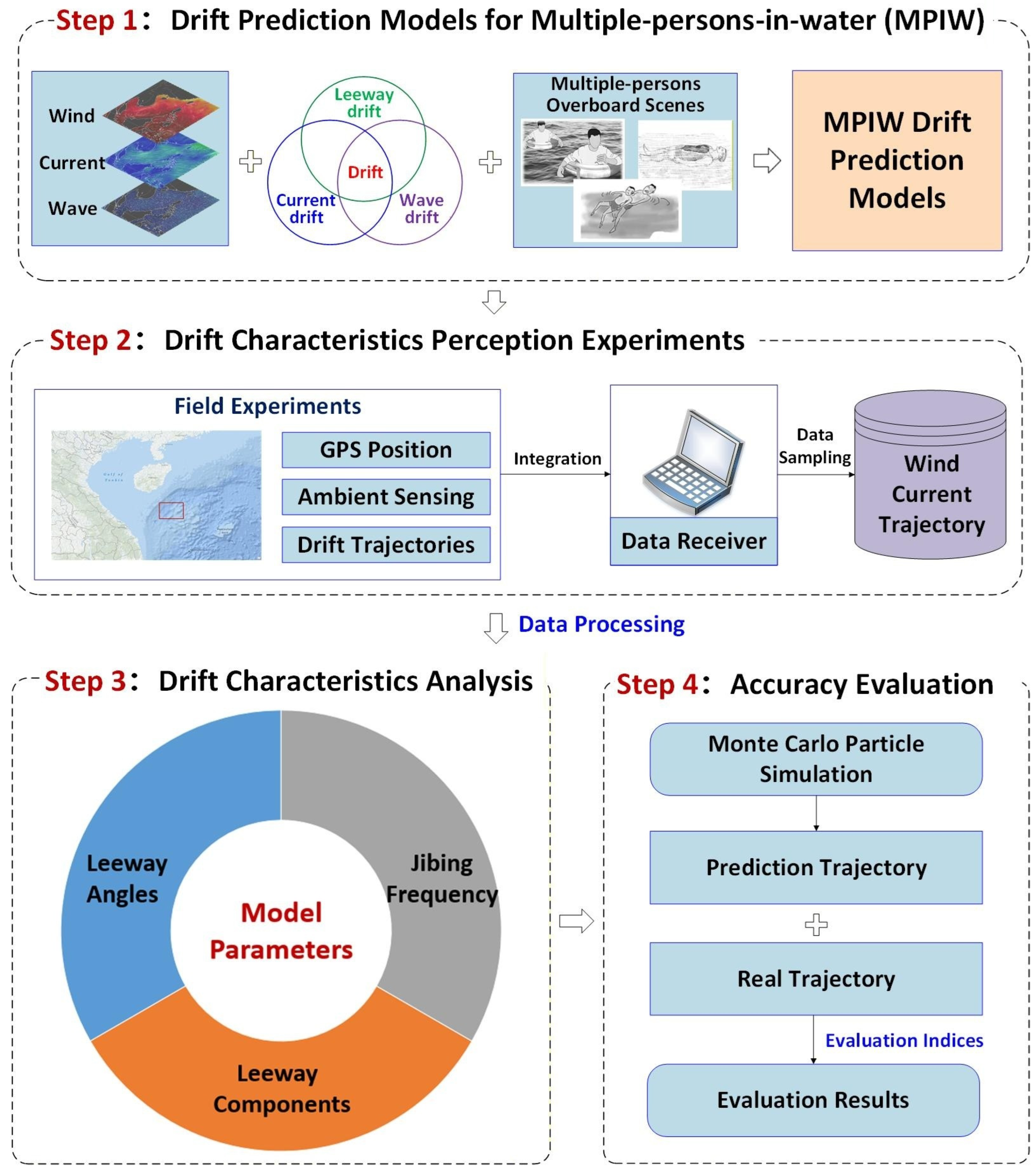
To investigate drift properties of MPIW in offshore SAR conditions, we conducted a study on the leeway model based on field experiments in the Xisha Sea, South China Sea; the study flowchart is shown in Figure 1.

2.1. Leeway Model

An object floating on the sea surface accelerates according to the following equation:
M + M ¯ d V d t = P ,
where V represents the speed of the object, the sum of the applied forces is denoted as P , and the additional mass M ¯ is a result of the water particles moving along the outer surface of the object.
Objects of small size (usually under 30 m) experience rapid acceleration [24], allowing for the simplification that the object has limitless acceleration and maintains a consistent velocity within the time step of the model calculations. Because of the equilibrium between hydrodynamic lift and drag beneath the surface of an object, as well as aerodynamic lift and drag in the presence of wind, an object carried by wind will experience a certain degree of deviation from its downwind trajectory.
Different types of floating objects exhibit varying leeway characteristics. Leeway is defined as the drifting motion of an object caused by surface winds (at a height of 10 m) and surface currents (0.3~1.0 m) [11,12,13,15]. The velocity of a floating target can be expressed as:
V o b j e c t = V F c u r r e n t + V L + V F w a v e ,
where V o b j e c t is the drift velocity of the object and V F c u r r e n t is the velocity induced by surface currents, which is approximately equal to the surface current velocity [25,26]. V L is the velocity induced by the sea wind, which is also referred to as the object’s slipping, i.e., motion relative to the ambient current field at a particular depth equal to the draft of the object. V F w a v e is the wave-induced drift velocity.
V F w a v e mainly includes the direct force of waves and the Stokes drift caused by wind-generated waves. For most targets in distress (less than 30 m in length), the direct force is negligible [6,13,24,27]. Stokes drift is the average Lagrangian velocity in the direction of wave propagation caused by the orbital movement of water particles influenced by a wave field [28]. In field experiments, separating the Stokes drift velocity from the leeway velocity acting on an object becomes challenging when the ambient flow field is subtracted [11]. Therefore, it is necessary to ignore the Stokes drift and consider it to be included in the empirical leeway coefficients [13,27].
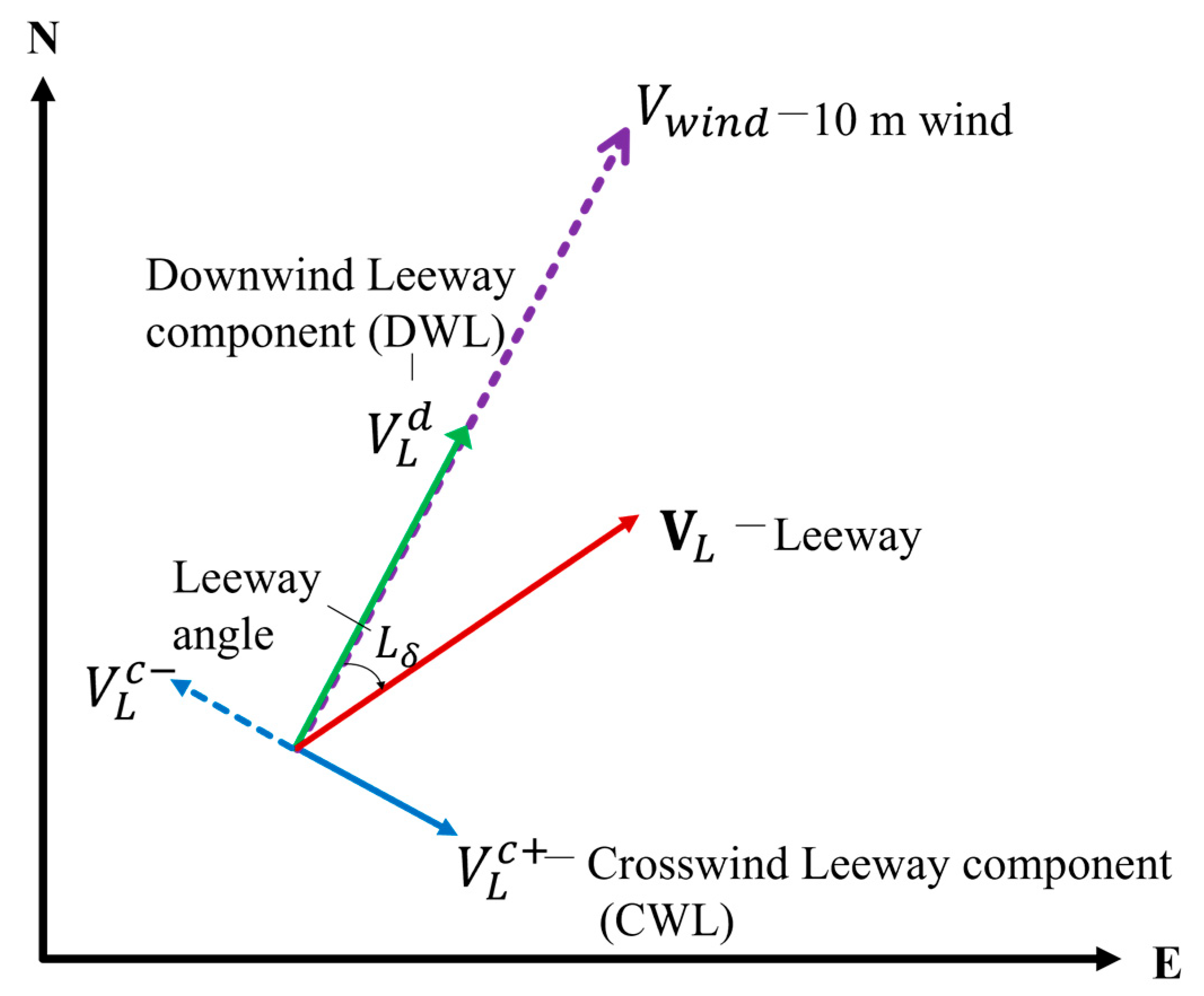
Simple linear regression modeling has proven to be the preferred method for parameterizing the leeway drift of targets in distress in maritime SAR. The leeway drift velocity can be decomposed into two parts: the Downwind Leeway Component (DWL) and the Crosswind Leeway Component (CWL) [12], where the CWL is considered positive when it points to the right relative to the DWL (Figure 2). Positive and negative CWL are usually considered to have the same probability. The main objective of the field experiment was to establish a correlation between the velocity of wind and the DWL and CWL components:
V L d = m d V w i n d + n d + ε d
V L c + = m c + V w i n d + n c + + ε c + ,
V L c = m c V w i n d + n c + ε c
where V L d is the DWL, V L c + is the +CWL, and V L c is the −CWL. m d , m c + and m c are the slopes of the linear regression determined on the basis of the experimental data; n d , n c + and n c are the intercepts; and ε d , ε c + , and ε c are the error terms. Assuming Gaussian error in linear regression, the three parameters ε d , ε c + , and ε c are sufficient to account for the errors in the three leeway components [6], and this regression model is unconstrained. When there is no wind speed, i.e., the leeway velocity is zero, the equation above transforms into a constrained model:
V L d = m d V w i n d + n d
V L c + = m c + V w i n d + n c + ,
V L c = m c V w i n d + n c
When wind speeds fall within a specific range, there is a shift in the leeway orientation, known as the jibing frequency [11]. Experimentally collected drift buoy track datasets can be classified into left-drift and right-drift observations on the basis of the buoy’s observed bias toward the left or right relative to the downwind direction. It is necessary to identify changes in the leeway direction to classify left and right drift events and to calculate the leeway coefficients for the left and right crosswind components separately.

2.2. Drift Trajectory Prediction Models for Multiple-Persons-in-Water (MPIW)

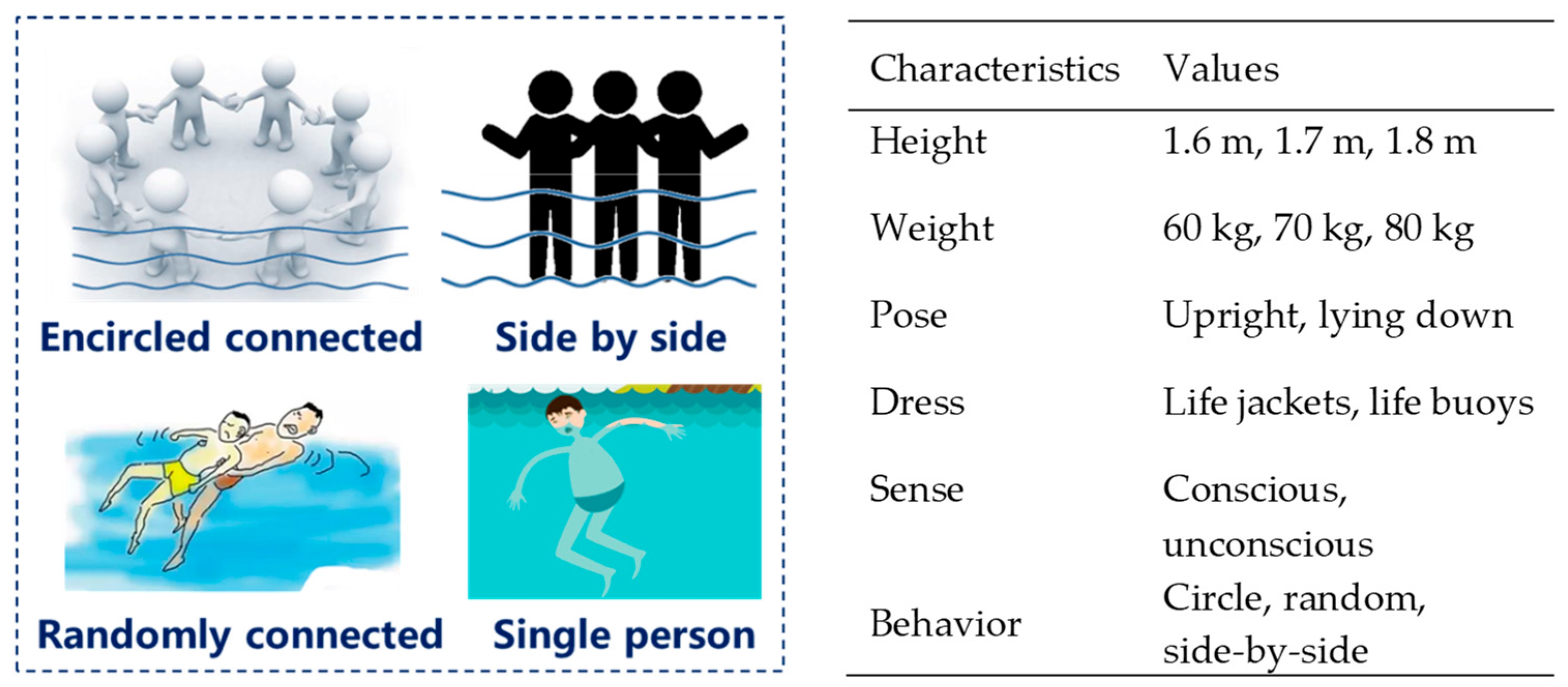
Group-overboard drift scenarios involve random combinations of people with different genders, weights, heights, postures, dresses, and states of consciousness, as well as multiperson drift (side-by-side, in a circle, randomly connected, etc.). We designed different MPIW scenarios and developed a series of MPIW trajectory prediction models on the basis of field experiments at sea.
(1)
Analysis of scenarios involving falling into water
We designed ergonomic manikins for different ocean-based multiple-person-overboard scenarios. The function, parameters, and structure are designed, and the MPIW scenarios and characteristics are shown in Figure 3.
(2)
Drift trajectory prediction models for MPIW
The prediction of drift trajectories is uncertain because of the complexity of the processes involved in ocean dynamics [29]. Marine weather conditions are intricate and are characterized by turbulent patterns at a small scale, swirling currents, variations in water layers, and differences in flow near the surface; these small-scale problems are often unsolvable. We focus on the Xisha Sea as our study area, which represents a typical deep offshore region with active maritime operations, assuming that, within the metocean conditions sampled in this study, differences in drift characteristics due to environmental and geographic factors can be represented by scenario-specific leeway coefficients [19].
There may be significant differences in the drift characteristics of MPIW in offshore and deep ocean areas due to geographic factors, natural features of the ocean current system, meteorological features, tectonics, and seafloor topography [19], and studies have carried out drift experiments mainly in offshore waters. In fact, in deep sea areas far from shore, the timeliness of MPIW SAR is more important because of the distance from SAR bases, and an accurate prediction method for MPIW drifting trajectories is urgently needed. Therefore, we carry out MPIW drift experiments in the Xisha Sea of China, and we establish corresponding drift trajectory prediction models for different types of drift in MPIW scenarios.

2.3. Experiments on the Perception of Drift Characteristics of MPIW

2.3.1. Experimental Sea Area

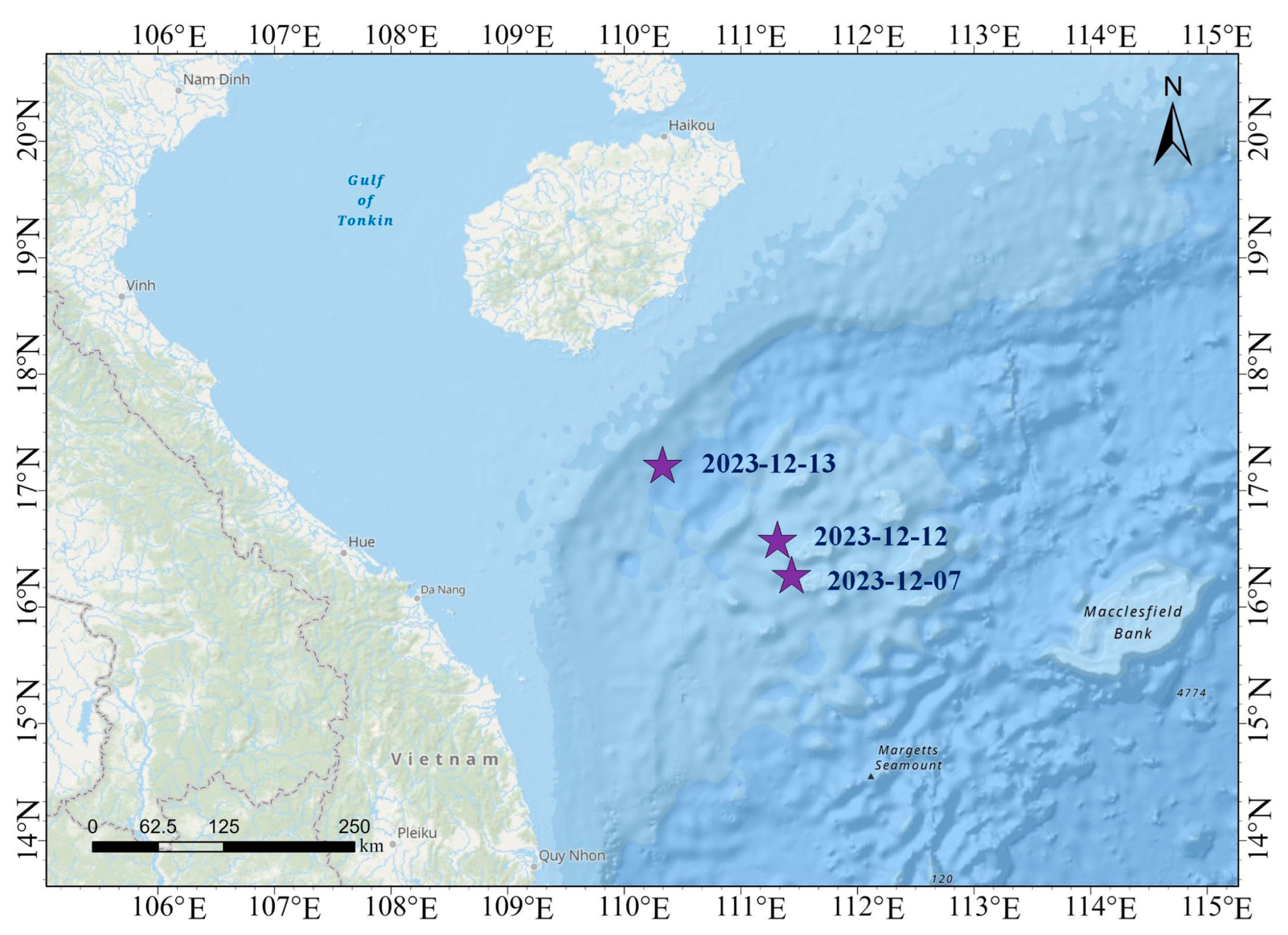
Xisha is located in the northwestern part of the South China Sea, southeast of Hainan Island, with latitude 15°47′~17°08′ N and longitude 111°10′~112°55′ E. Convection in the Xisha Sea area is vigorous, precipitation is high, and tropical cyclones, storms, droughts, and other catastrophic weather phenomena are frequent. Because the Xisha Sea is located in a monsoon area, it is affected by monsoon circulation, and the wind is highly variable. The dominant type of wave in the Xisha Sea area is wind waves, and the waves are generally large; leeway drift experiments in the Xisha Sea area are important for guiding maritime SAR.
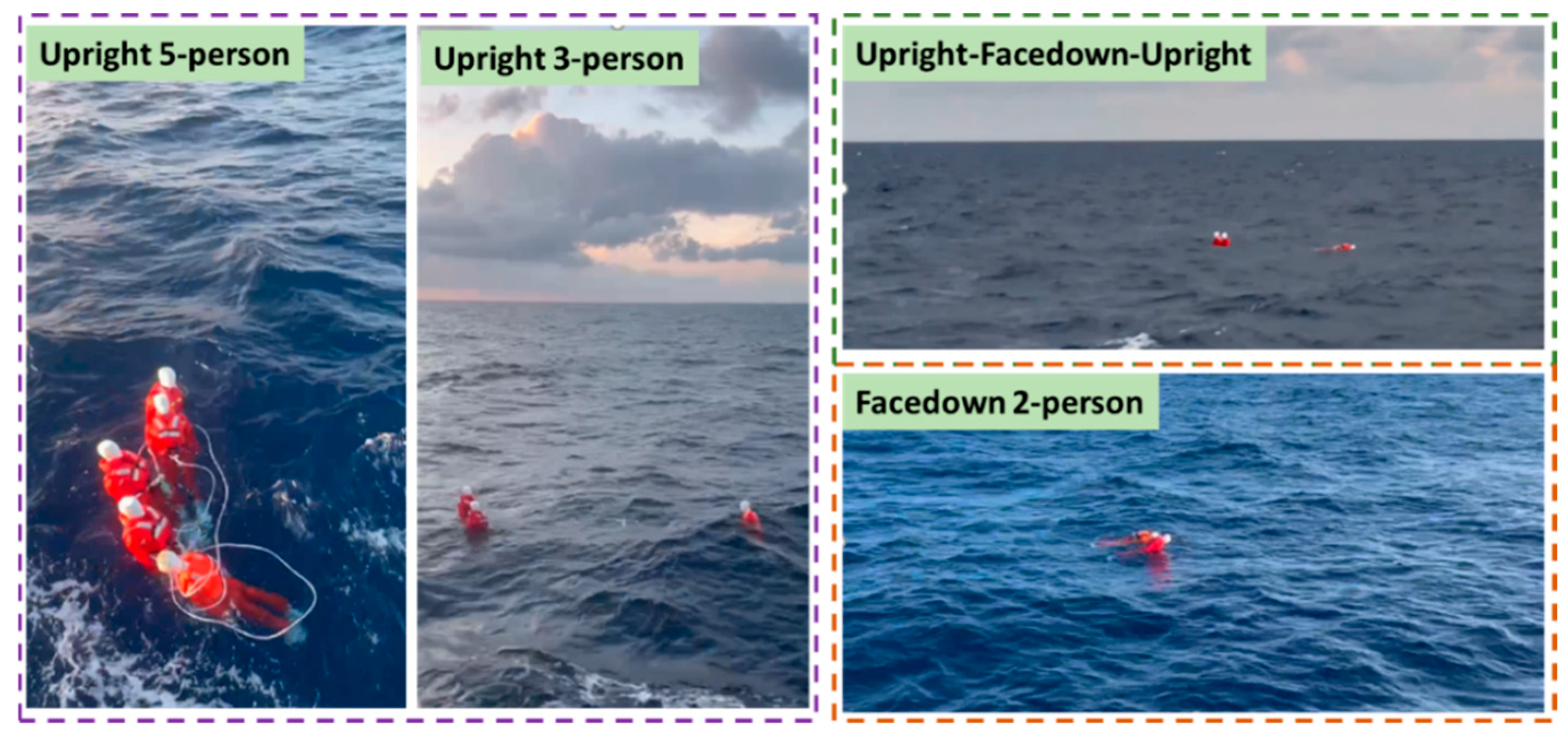
In December 2023, we conducted experiments in the Xisha Sea area of China over 3 days with 6 drifts (Figure 4); the cumulative experiment duration was 57 h. The sea drift experiments involved multiple manikins in different sea conditions with different postures and different drift scenarios. Owing to experimental time and cost constraints, we conducted studies on two drift scenarios: side-by-side (upright 5-person, upright 3-person, and facedown 2-person) and randomly connected (upright–facedown–upright). The upright 5-person and upright 3-person scenarios represented conscious MPIW drift, the facedown 2-person scenario represented unconscious MPIW drift, and the upright–facedown–upright scenario represented MPIW drift with support between conscious and unconscious persons.
On the basis of the leeway theory, the upright 5-person drift trajectory prediction model (UP_5), the upright 3-person drift trajectory prediction model (UP_3), the upright–facedown–upright drift trajectory prediction model (U-F-U), and the facedown 2-person drift trajectory prediction model (FD_2) were established for the Xisha Sea area.

2.3.2. Experimental Platform and Instruments

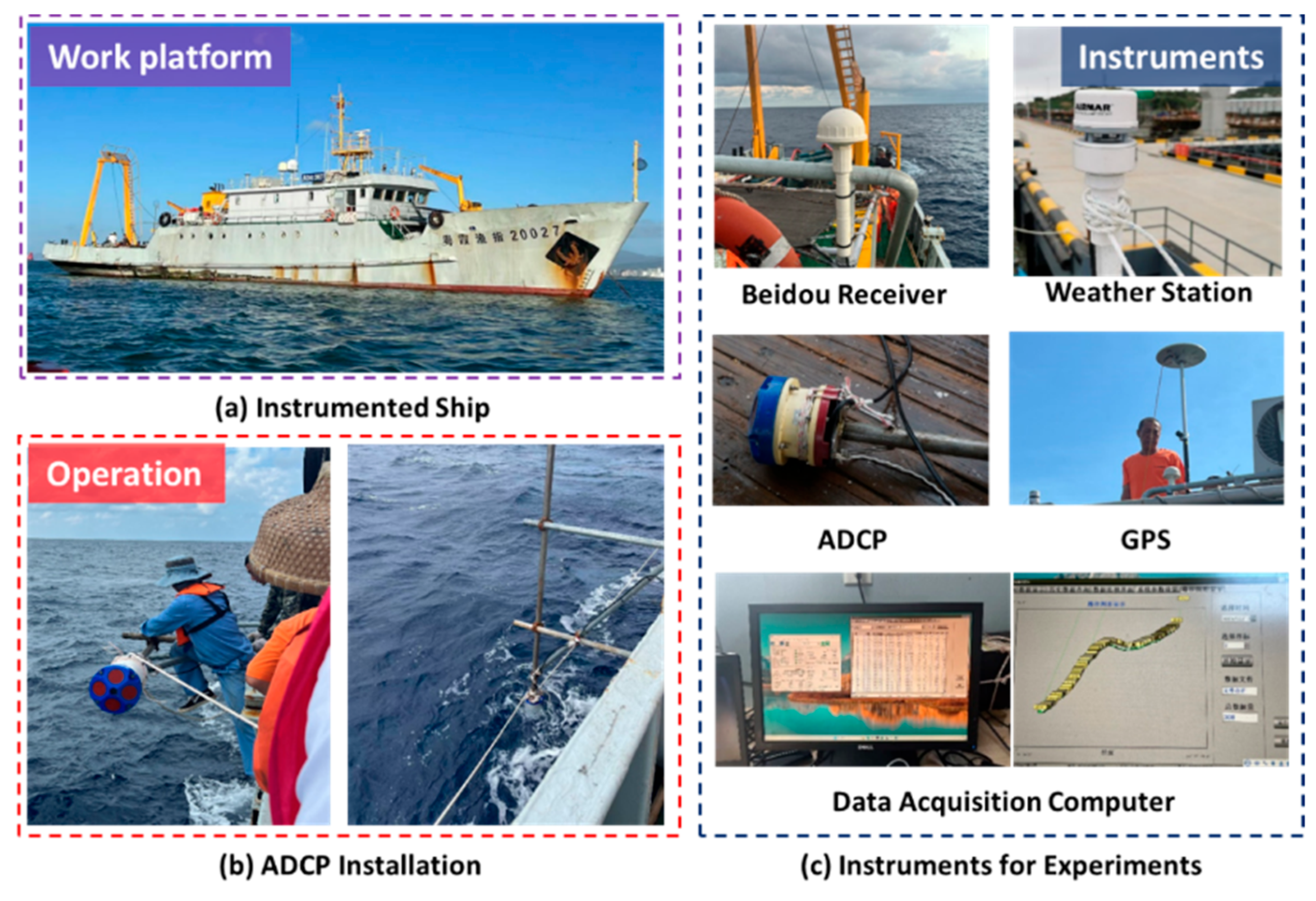
Directly installing an anemometer on a manikin drifting buoy will lead to great changes in its on-water structure; therefore, we used an offshore fishing vessel carrying observation instruments to conduct marine environment observations in the MPIW scenarios. The offshore fishing vessel was equipped with a GPS receiver, ADCP tachometer, weather station, BeiDou receiver, etc. The GPS receiver was used for real-time recording and real-time transmission of the position, the ADCP tachometer was used for measuring the flow velocity and direction, the weather station was used to measure the wind speed and direction, and the BeiDou receiver was employed to establish a two-way communication link with the drifting buoys. During the field experiments at sea, the fishing vessel always monitored the floating path of the manikins, with the objective of measuring the marine environmental factors in the sea area in its vicinity, and it stored the collected data in a database in real time. Figure 5 depicts the operational platform and the working environment.

2.3.3. Multiple-Persons-in-Water Drift Scenarios

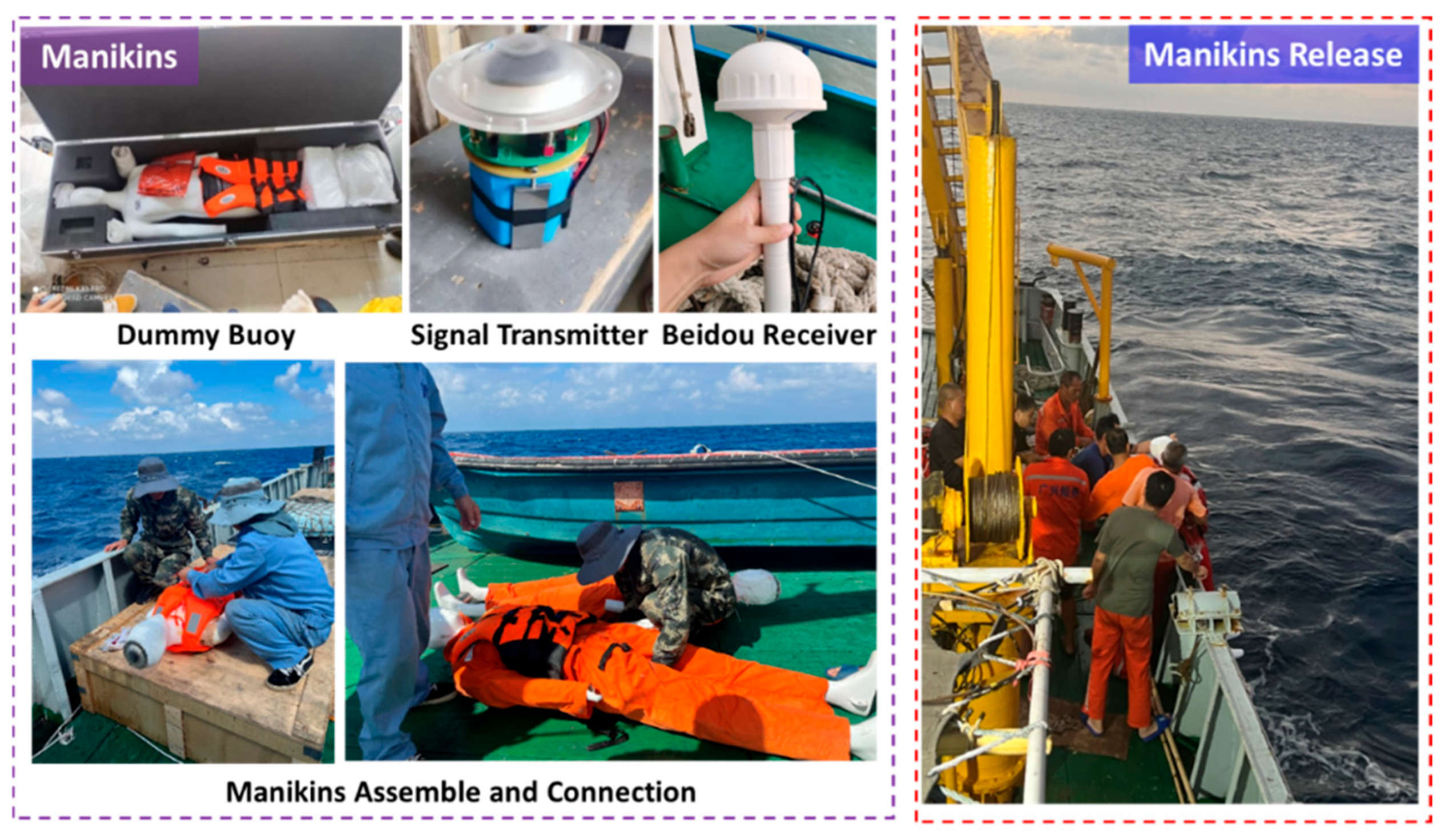
In the drift experiment, the weight of each manikin was 60 kg. BeiDou communication was adopted during the experiment, and the latitude, longitude, drift direction, and battery power of the buoy were sent to the BeiDou receiver in real time. The experimental platform received and displayed the information of the manikin’s drift trajectory visually in real time.
The sea experiment used seven manikin drift buoys, two in the facedown position for simulating the drift of an unconscious person and five in the upright position for simulating the drift of a conscious person in the water. By adjusting the foot counterweight block, a manikin could be positioned upright in the water. The manikins were connected to each other with a rope to simulate a group-overboard scenario. After arriving at the designated sea area and stabilizing the ship at anchor, two groups of manikins for MPIW scenarios with different types of drift were released at the same time, and then the anchor was lifted for tracking and observation. The assembly and release processes and the MPIW drift scenarios are shown in Figure 6 and Figure 7.

2.3.4. Collection of Marine Environment Data

The RDI ADCP WHS current meter was used to obtain continuous profile observations of sea currents, with a sampling frequency of 1 min. The ADCP was installed at a depth of 0.3 m, with a layer width of 0.5 m and a blind zone of 0.15 m, and it followed floating objects to collect surface currents at 0–1.5 m depth (Table 1). The ADCP flow measurement system incorporated an external GNSS compass to establish an absolute reference, effectively addressing measurement errors resulting from the effect of the ship’s magnetic field on the internal magnetic compass of the ADCP. Sea trials were conducted prior to the drift experiments to harmonize the coordinate systems of the ADCP flow measurement system and the ship. The weather station was an AIRMAR 200 WX, which was installed on top of the fishing boat facing the wind. The installation height was approximately 10 m, and the wind speed and direction were continuously measured with a collection frequency of 1 s. The real wind speed and direction were automatically calculated via the integrated compass and WAAS GPS.
During the experiments, all the marine environment observation equipment was adjusted and calibrated to ensure normal operation, and the distance between the equipment and the floating objects did not exceed 1000 m. For each experiment, after consecutive observations, the instruments were recovered and cleaned of surface residues, and the data collected by the manikins, ADCP, and weather station were comprehensively inspected, recorded, and preserved.

2.3.5. Data Preprocessing for Sea Experiments

Given that the flow at a depth of 0.3–1.0 m has the greatest impact on leeway [13], we utilized the measurements from the 1st vertical profile layer as the true flow velocity of the near-surface stream. The anomalous measurements were rejected according to the threshold settings, and real-time matching of the wind field, current field, and GPS receiver position data was performed. The manikin drift trajectory data included time and WGS84 latitude and longitude. The experimental data revealed that the intercorrelation between the leeway velocity and wind speed was highest at zero lag for a 10-min vector-averaged sample [6]. Therefore, in this study, 10-min sliding averages of both the marine environmental data and the drift-trajectory data were taken, yielding samples at 10-min intervals. To calculate the drift velocity by considering positional changes over time, we initially transformed the WGS84 latitude and longitude into planar coordinates. We subsequently computed the manikins’ drift velocity and direction by analyzing their positions at each sampled moment.

2.4. Particle Swarm Simulation-Based Modeling of Drift Trajectories for MPIW

2.4.1. Drift Trajectory Prediction

In predicting drift trajectories of unpowered MPIW, there are some uncertainties in the characterization of marine environmental data, model-based hydrodynamic drift processes, and the quantification of the drift characteristics of the objects [30,31]. A single-trajectory computation may be unrepresentative, and a probabilistic formulation is needed to solve this problem by finding the region that the object will most likely drift to. In maritime SAR, the final SAR area and the probability distribution of the particles provide important guidance for decision makers [32]. We used Monte Carlo methods [33] to model and quantify these perturbations, producing a series of ensembles of particle trajectories and thus obtaining the probability density distribution of the SAR area [34]. It is assumed that the positions of the objects in an MPIW scenario behave according to a Markov process or a first-order autoregressive process:
p s t + 1 s t , s t 1 , , s 1 = p s t + 1 s t ,
where s refers to the position of the drifter and indicates whether it is drifting or stranded. When the perturbation follows a Markov process, the evolution of the drift trajectory is expressed as:
d s = F ( s , t ) d t + d ϵ ,
where F denotes the displacement as a function of the influence of the ocean environment’s dynamic field; the random perturbation d ϵ , with a known covariance and zero mean, characterizes the drift properties and the uncertainty of the ocean environment.
To characterize the uncertainty in the quantification of drift characteristics for MPIW, perturbation terms are added to the slope and intercept of the ensemble particle regression equation [35]. There are drift velocities involved in trajectory prediction that cannot be solved on a grid scale, called subgrid velocities [36,37]; the subgrid velocities of the wind and flow fields driving drift trajectory prediction models consist of a mixture of errors in measurements, unaccounted motions, and real geophysical turbulence fluctuations. We use a random walk model to model the subgrid velocities, assuming that the perturbation v w i n d of the wind field follows a circular normal distribution.
v w i n d ( u w i n d , v w i n d ) N ( 0 , σ w ) ,
Taking DWL as an example, we have:
V L d = m d + ε d 20 (   V w i n d + v w i n d ) + ( n d + ε d 2 ) ,   n = 1 , , N ,
Here, ε d = S y x · n o r m , n o r m is a random number that followed normal distribution N ( 0,1 ) , and S y x is the standard deviation of regression. It should be noted that “20” and “2” are dimensionless scaling coefficients used to keep the parameter perturbations consistent with the observed variability at the 10 min sampling scale and to avoid unrealistic particle overdiffusion within a single time step. The slope controls the sensitivity of leeway drift to wind speed. If the slope perturbation is too large, it can amplify biases over the wind speed range and lead to unstable trajectories, so a stronger scaling is applied for the slope term ε d / 20 . By contrast, the intercept mainly represents wind speed-independent bias and low-frequency error. Its effect is closer to an overall translation of the trajectory, so a larger perturbation can be allowed to represent unmodeled error, and a weaker scaling is used for the intercept term ε d / 2 . These values were selected based on trial calculations for this case to balance uncertainty representation and forecast stability.
On the basis of the uncertainty modeling method described above, the drift trajectory in an MPIW scenario at any moment is modeled as follows:
L o c t L o c 0 = 0 t V o b j e c t t d t = 0 t V L t + V F c u r r e n t t d t ,
where L o c t is the position of the objects at time t and L o c 0 is the position at the beginning of the drift. The fourth-order Runge–Kutta method is used to calculate the drift trajectory.
In addition, the drift direction probability is predetermined upon particle release, after which particles are randomly selected to undergo changes in their drift directions according to the jibing frequency.

2.4.2. Accuracy Assessment Model for Drift Trajectory Prediction

To assess the model’s ability to accurately predict the drift paths of objects in MPIW scenarios, an accuracy evaluation model was constructed, and two accuracy evaluation indices, the relative predicted spatial and temporal distribution of differences (RASD) and the normalized cumulative difference distance (NCSD), were selected [19,38,39]. RASD was used to evaluate the accuracy of the predicted spatial locations at each time step:
R A S D = p c t p r t / t = 1 t D t ( T × 1 ) t = 1,2 , 3 , T ,
where t is the time step, p c t is the center of gravity of the particle, p r t is the real trajectory position, D t is the length of the true trajectory, and RASD is a T 1 matrix.
NCSD evaluates the accuracy of trajectory prediction from an overall trajectory perspective:
N C S D = t = 1 T p c t p r t t = 1 T D o t ,   D o t = t = 1 t D t .
Both indices consider the length of the true trajectory and can accurately assess the precision of the drift trajectory throughout the prediction period, with smaller RASD and NCSD values indicating higher prediction accuracy.

3. Characterization of MPIW Drift on the Basis of Field Experiments

3.1. Overview of the Drift Experiment

During the experiments in December 2023 in the Xisha Sea, the wind speed ranged from 0.17 to 7.77 m/s (1–4 levels), and the wind was mainly from the northeast. The range of sea-surface current speeds was 0.06–0.96 m/s, with a large change in the direction of the current, and tracking observations were conducted over a cumulative duration of 57 h, as shown in Table 2. These experiments and the resulting coefficients should be interpreted as a sample set representative of the Xisha Sea in December (winter monsoon season), and the quantitative values may vary under different seasons and metocean conditions.

3.2. Analysis of Measured Data from the Marine Environment

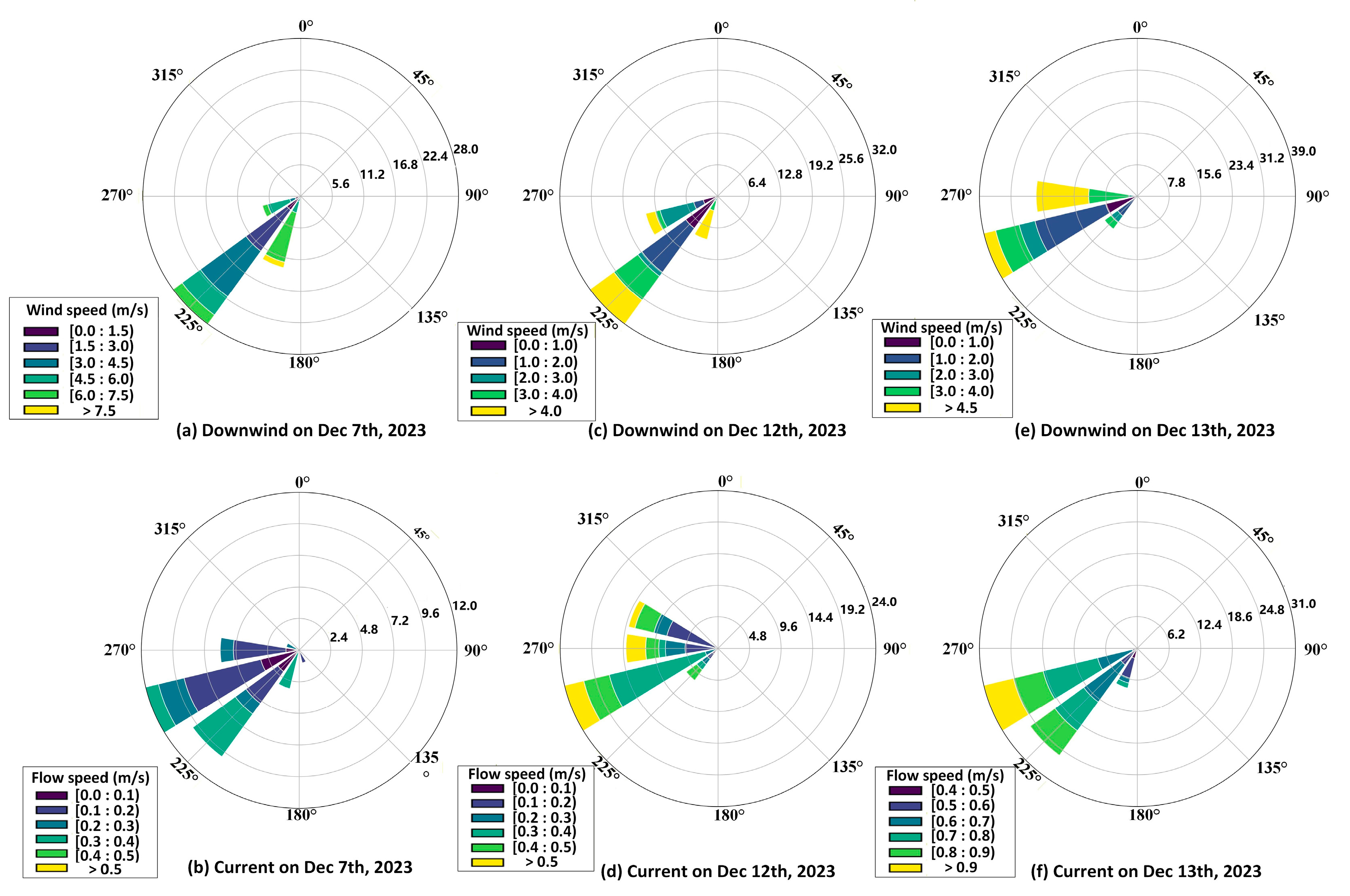
On the basis of the wind and current field samples, the wind and current speeds were divided to yield wind and current rose diagrams (Figure 8). For most of the moments, the wind speeds were low, the main downwind and current directions were southwest, and the current speeds were higher on 13 December 2023.
As shown in Figure 8a,b, on 7 December 2023, the downwind direction in the Xisha Sea area was between 180° and 270°, and the wind speed was mainly in the range of 3.0~6.0 m/s; the direction of the current field was between 145° and 300°, and the current speed was mainly in the range of 0.1~0.4 m/s. Figure 8e,f show that on 13 December 2023, the downwind direction in the Xisha Sea area was between 200° and 280°, and the wind speed was mainly in the range of 1.0~2.0 m/s; the direction of the current field varied between 180° and 270°, and the current speed was mainly in the range of 0.7~0.9 m/s.

3.3. Characterization of Leeway for MPIW

3.3.1. Calculation and Analysis of Leeway Components

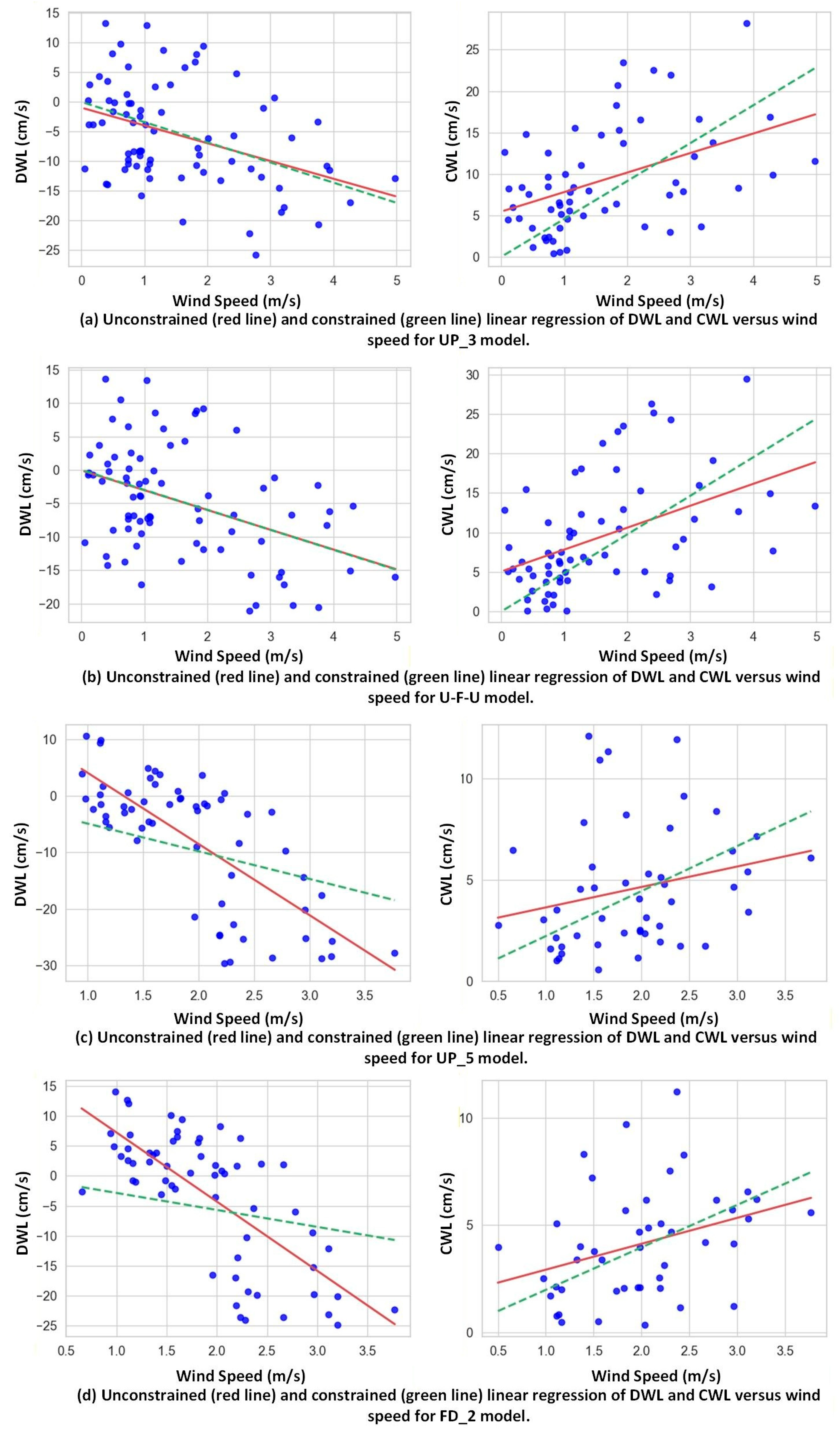
For each 10-min sample, the V L was calculated and separated into DWL and CWL, as well as +CWL and −CWL, which depend on the position of CWL relative to the downwind direction. During this procedure, constrained and unconstrained linear regression characterizations were employed to analyze the components of DWL, +CWL, and −CWL in relation to the 10 m wind speed (Figure 9), yielding the six coefficients m d , n d , m c + , n c + , m c and n c (Formula (3)) of the leeway for each MPIW drift prediction model, as shown in Table 3 and Table 4 (for each model, when there are few samples available for the +CWL/−CWL cases, we utilize the corresponding coefficients for the −CWL/+CWL scenarios).
Different MPIW drift prediction models have different coefficients, and R 2 is used to measure the strength of the linear relationship between leeway and wind speed. The unconstrained linear regressions of DWL for UP_3, U-F-U, UP_5, and FD_2 were 0.16, 0.18, 0.55, and 0.52, respectively, and the R 2 values of CWL were 0.20, 0.20, 0.11, and 0.11, respectively. It should be noted that CWL is more strongly affected by changes in group configuration and temporal variability in the environment. As a result, CWL typically shows larger dispersion, which can weaken its linear correlation with wind speed and lead to lower R 2 values. A low R 2 indicates substantial uncertainty if CWL is explained solely by a linear wind speed term. Accordingly, this study incorporates probabilistic and random diffusion mechanisms, including the +CWL probability and jibing frequency, in the subsequent Monte Carlo search area predictions to represent this uncertainty. In this way, the impact of CWL uncertainty is represented by probabilistic hotspot distributions in the predicted search area.
Unlike in the single-person-in-water drift experiment [21,40], the MPIW scenario exhibited significant upwind drift, and the DWL component exhibited a negative correlation with the wind speed; this indicates that with increasing wind speed, the leeway angle increased, gradually forming upwind drift. This phenomenon may arise from the combined effects of group configuration and the oceanographic conditions in the experimental area. Group connectivity can produce shading and water-hugging effects, which reduce the effective wind-exposed area per individual while increasing the wetted surface area and hydrodynamic drag. As a result, the wind-driven drift relative to the surrounding water tends to weaken. In addition, wind and current conditions showed pronounced temporal variability during the trials (Figure 8). Wind speed and direction changed frequently, and some periods exhibited low wind and strong current conditions. For example, on 13 December 2023, wind speeds were mainly 1.0 to 2.0 m/s, while current speeds reached 0.7 to 0.9 m/s. When wind and current directions were broadly aligned, differences between the effective coupled water layer of the group and the surface current reference, or the presence of vertical shear, can make the residual downwind component after removing current-induced drift more likely to become negative. A larger and more variable leeway angle can further increase uncertainty in regression estimates and instantaneous projections, making the inferred wind-induced components more sensitive.
These observations are due to the unique marine conditions present in the experimental sea area, where changes in current speed, current direction, wind speed, and wind direction are very frequent and where the leeway angle is large and fluctuates greatly. The influence of the marine environment on leeway in deep-sea areas far from shore is complex and subtle, requiring further analysis through extensive experimental statistics.

3.3.2. Analysis of the Leeway Angle

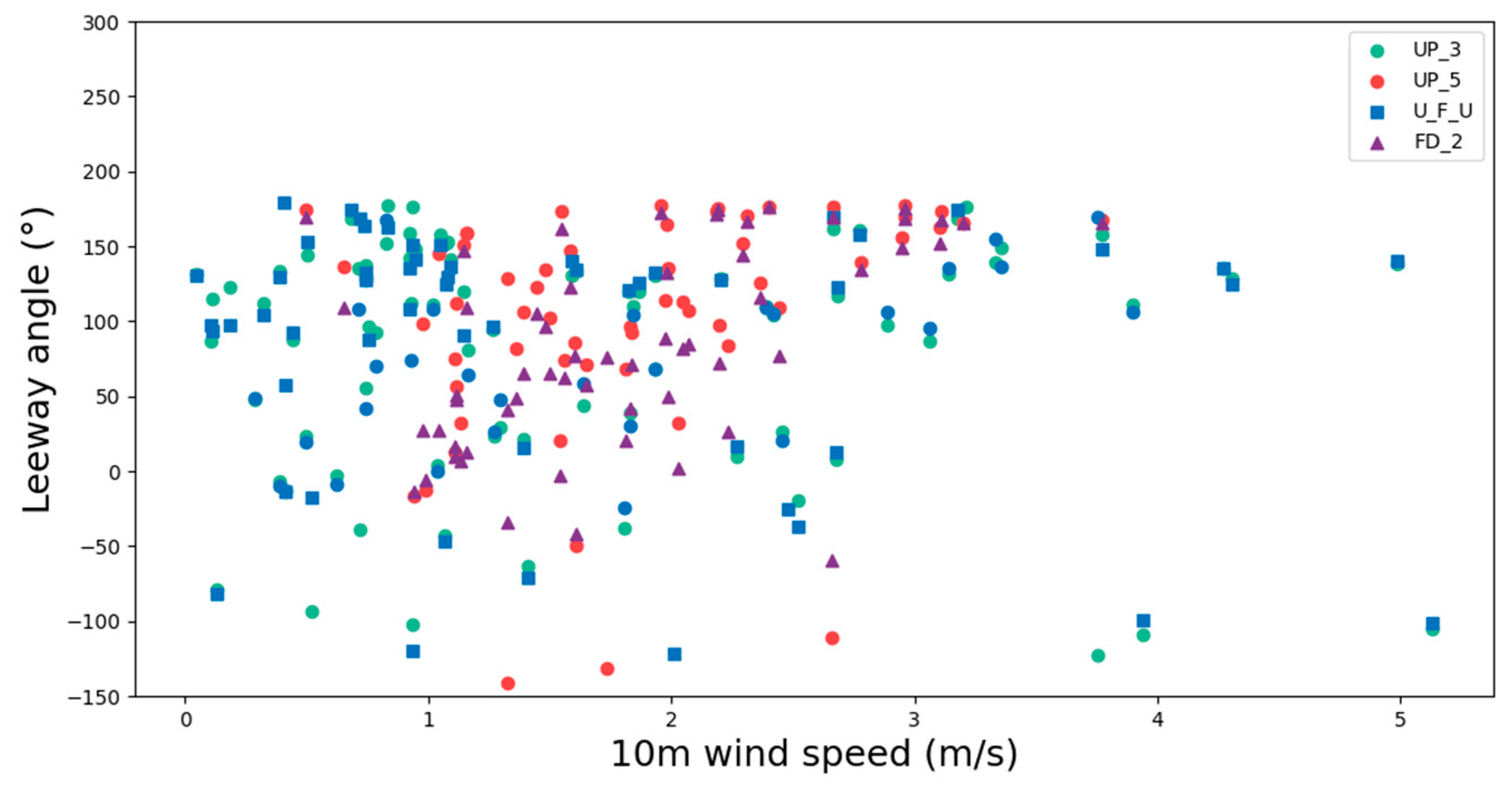
Positive/negative leeway angle values are indicated as +CWL/−CWL, as shown in Figure 10. Within a certain wind speed range, the leeway angles are mostly positive, indicating that the majority of the CWL is toward the right relative to the downwind direction. The range of variation in the leeway angle for the facedown 2-person MPIW drift scenario is smaller, suggesting that MPIW drift scenarios with an upright person overboard may require a larger search area.
The statistics of +CWL and −CWL are presented in Table 5. Within a single run, regarding the +CWL probability, MPIW with different group drifts in the same sea state clearly show significant similarities (e.g., the upright 5-person and facedown 2-person cases on 13 December 2023), and the +CWL probability is greater. Overall, the mean leeway angle for all trajectories ranged from −50° to 130° and had a significantly higher +CWL probability (79%) than −CWL probability (21%). These proportions are not coincidental, and the +CWL probability should be set carefully when particle simulation algorithms are used to predict SAR areas. It should be noted that the overall +CWL probability is computed by aggregating the counts of +CWL and −CWL samples across all experimental trajectories and then taking their proportion. This procedure is equivalent to sample weighting, in the sense that trajectories with more samples contribute more to the overall estimate.
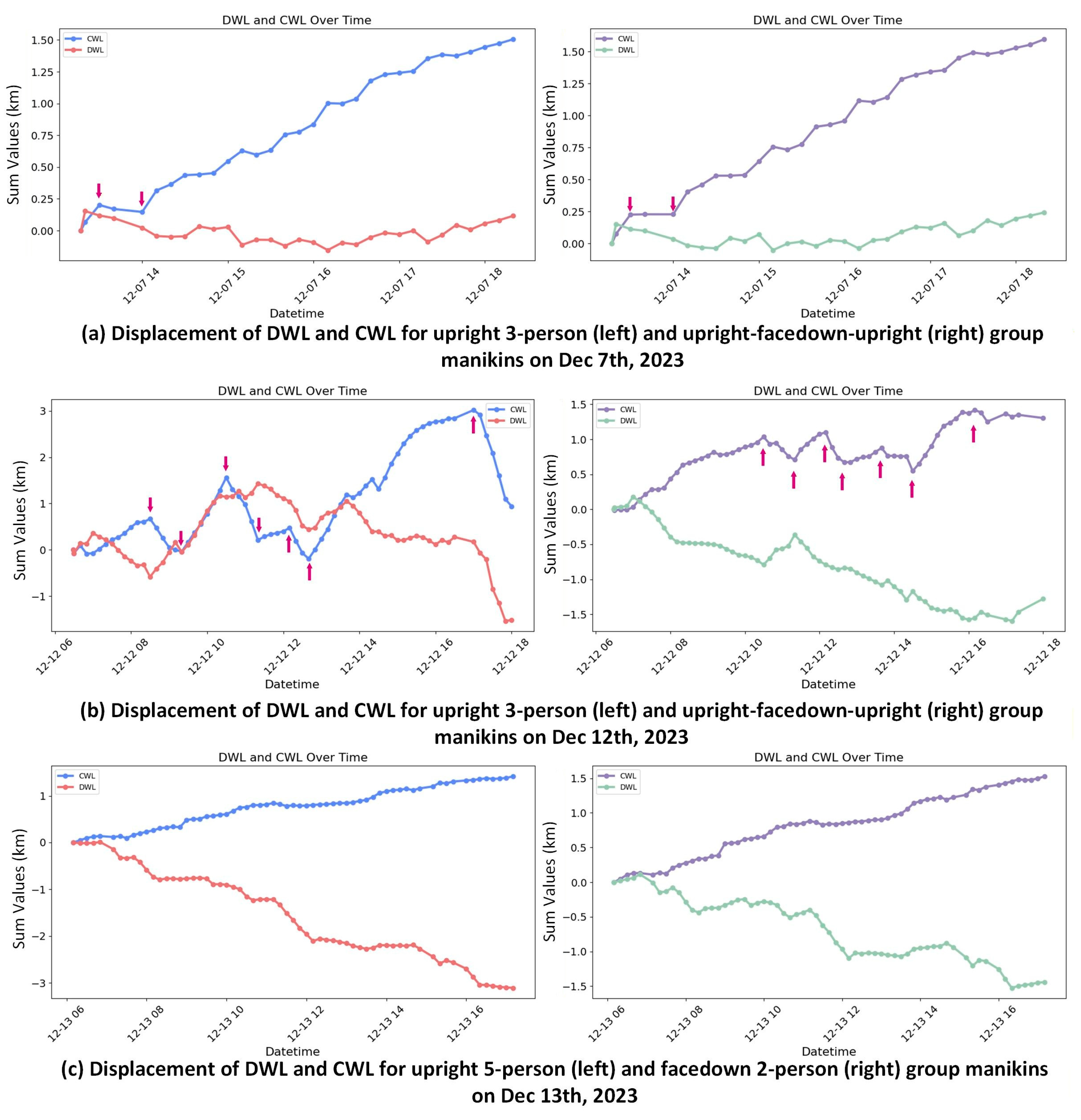
The displacements of the DWL and CWL of the manikins for each MPIW scenario were calculated to evaluate the dispersion of downwind and upwind drifts [6,12], as shown in Figure 11. Both downwind and upwind drift were observed for each group of manikins, with upwind drift being predominant. This could be attributed to the interaction between wind and current fields, as well as the inherent drift characteristics of the MPIW, indicating a need for further research. The cumulative displacement of each group of manikins on the CWL showed an increasing trend, indicating that drift was most often on the right side of the downwind direction. Most displacements of the group of manikins on the CWL undulated; i.e., there was a change in the CWL direction. The MPIW presented different drift characteristics. As shown in Figure 11c, the displacement of the CWL in the facedown 2-person scenario was greater than that in the upright 5-person scenario, whereas the negative displacement of the DWL in the upright 5-person scenario was greater, indicating that the leeway angle in the upright 5-person scenario was greater and that the upwind drift was more significant.

3.3.3. Calculation of the Jibing Frequency

The physical and geographic factors contributing to the change in leeway direction cannot be directly measured in experiments [19]. However, it is possible to determine the jibing frequency by conducting a statistical analysis on the long-term variations in the CWL direction [29,35].
When there is a high change frequency in the marine environment, the instability of the leeway angle direction and frequent changes in the sign of the CWL cannot be classified as jibing events. We conducted experiments on the parameters, and frequent changes in the sign of the CWL can be effectively eliminated by employing a stabilization period of 10 min. Therefore, a jibing event is defined as a change in the CWL from one side of the downwind direction to the opposite side such that the CWL maintains a stable direction for a minimum duration of 10 min before and after the change in direction.
The occurrence of jibing events is rare; thus, for different groups of MPIW, we conducted a comprehensive analysis to determine the frequency of jibing events across all samples. In accordance with the determination criterion, the arrows in Figure 12 indicate the primary change in the CWL direction. There were 18 jibing events during the 57 h drift experiments, so the jibing frequency of the MPIW in the Xisha waters was 0.32/h.
It is important to emphasize that this frequency estimate depends on the chosen stabilization window. With a 5 min window, short-lived directional fluctuations are more likely to be counted as jibing, which increases the number of events and inflates the estimated frequency. In contrast, with a 15- or 20-min window, some physically meaningful but brief direction changes are excluded, which reduces the event count and lowers the estimated frequency. Therefore, we adopt a 10 min window as a practical compromise that is more consistent with the physical interpretation of jibing.

4. Results and Discussion

4.1. Analysis of the Influence of the Marine Environment on the Leeway Direction

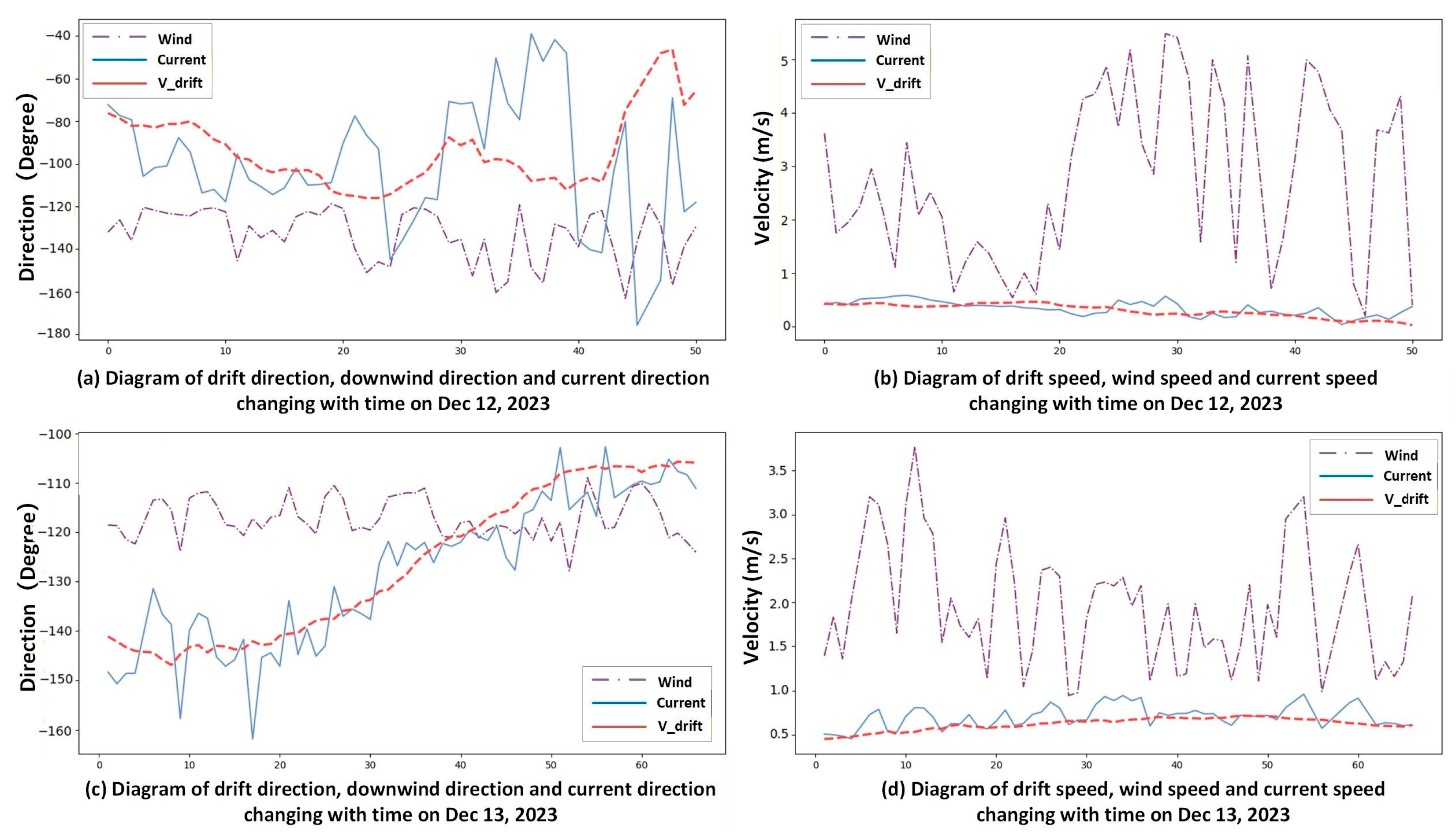
For MPIW, the role of waves in determining the empirical leeway coefficients does not need to be considered separately [6]. We consider significant rightward and upwind drift to be caused by the wind and current fields, and for the trajectories in various MPIW scenarios, statistical plots depicting the temporal evolution of the drift direction, downwind direction, current direction, drift speed, wind speed, and current speed are shown in Figure 12.
The following can be derived:
(1)
The drift speed closely approximates the current speed and is slightly lower when there are fluctuations and variations in the current speed.
(2)
The variation in the drift direction exhibits a consistent pattern with the alteration in the current direction; as shown in Figure 12c, the drift direction is deflected clockwise with respect to the current direction.
(3)
The downwind and current directions exhibit fluctuations and variations, whereas the changes in the drift direction are smoother.
The patterns above are derived from the statistical analysis of our experimental data. However, importantly, marine environmental conditions are complex and variable. Therefore, the conclusions drawn can only be applied to similar sea conditions. Further field experiments and studies on unique SAR targets are necessary for validation.
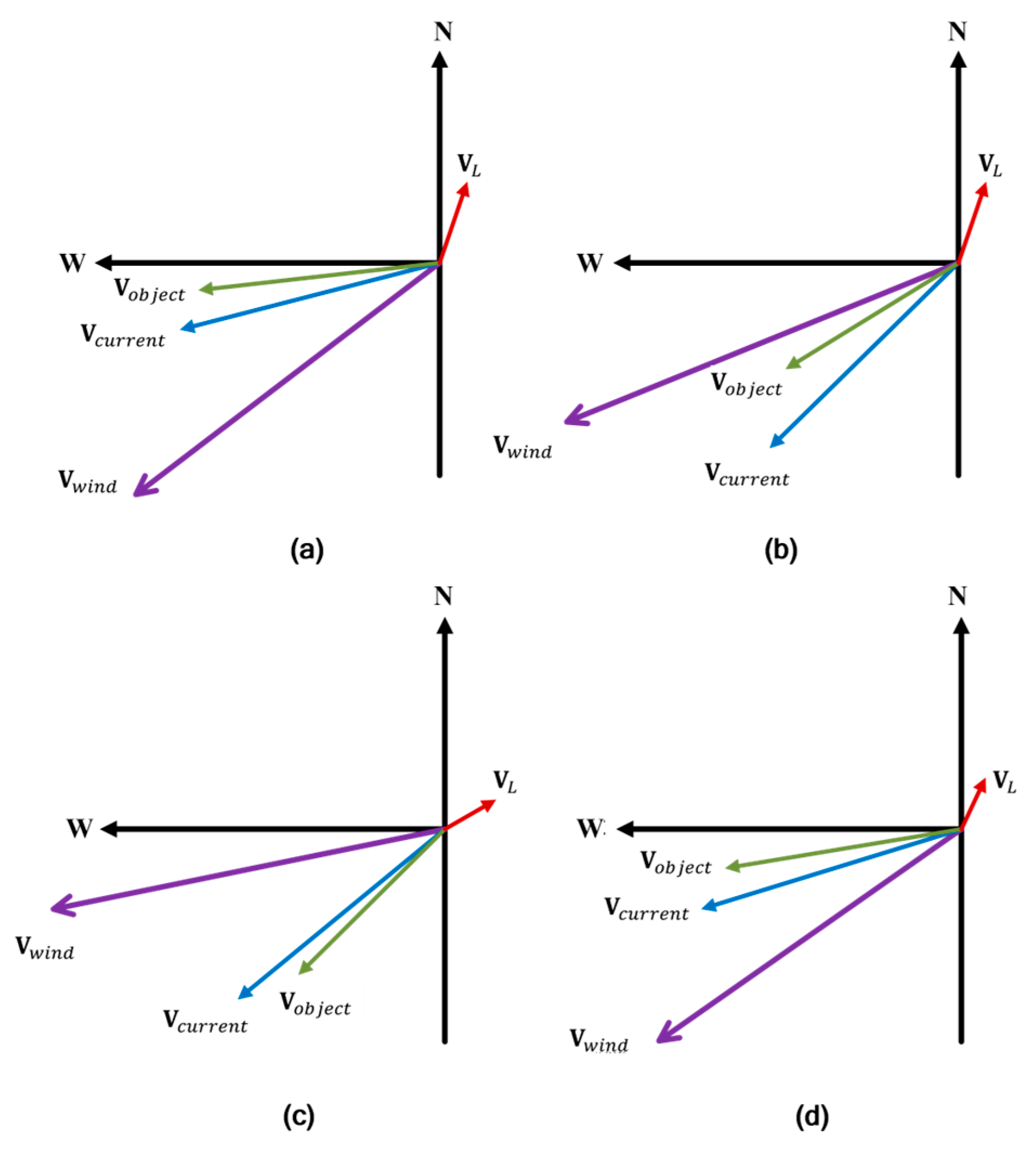
The drifts in the upright 3-person and upright 5-person scenarios are taken as examples (in the same sea state, the manikins in different scenarios have consistent left and right drift characteristics). For each trajectory, the leeway velocity is decomposed, and a graphical representation is provided to illustrate the relationships among the drift vector, leeway vector, wind-field vector, and current-field vector (Figure 13). The characteristics of the meteorological marine environment that lead to a significant rightward or upwind drift of the manikins are analyzed below.
During the field experiments, most of the leeway directions were observed to be to the right of the downwind direction and exhibited significant upwind drift. In the experiment conducted on 12 December 2023, most of the drift direction was to the right of the flow direction, whereas the downwind direction was predominantly on the left side of the flow direction. The disparity between the downwind direction and the flow direction was minimal (<90°); in such cases, most of the leeway velocities were positioned to the right of the downwind direction and exhibited upwind drift (Figure 13a).
In the experiment carried out on 13 December 2023, the drift velocity was generally lower than the flow velocity, and the flow direction fluctuated and changed, with an overall trend of clockwise deflection; the direction of drift was close to the flow direction, oscillating to the left or right of the flow direction; the predominant downwind direction was primarily on the right side of the flow direction, with minimal disparities (<90°) between the two, and most of the leeway velocity was observed on the right side of the downwind direction, resulting in upwind drift (Figure 13b,c). In the later stage of the experiment, following a clockwise deflection of the flow direction, the drift velocity aligned with the flow direction, with the downwind direction on the left side of the flow direction. Moreover, most of the leeway velocity remained on the right side of the downwind direction and exhibited an upwind tendency (Figure 13d).
Drift prediction for MPIW in deep offshore settings (e.g., the Xisha Sea case study) can be improved by setting a higher +CWL probability to increase the accuracy of SAR when Monte Carlo methods are employed to predict the search area in marine environmental conditions similar to those used in this experiment. However, the change patterns of the CWL and +CWL probabilities are complex and statistically significant, and many experiments will be needed to clarify them; moreover, the experimental data in this study are limited, and further experiments are needed.

4.2. Effect of the Parameters of the Drift Trajectory Prediction Model on Trajectory Prediction

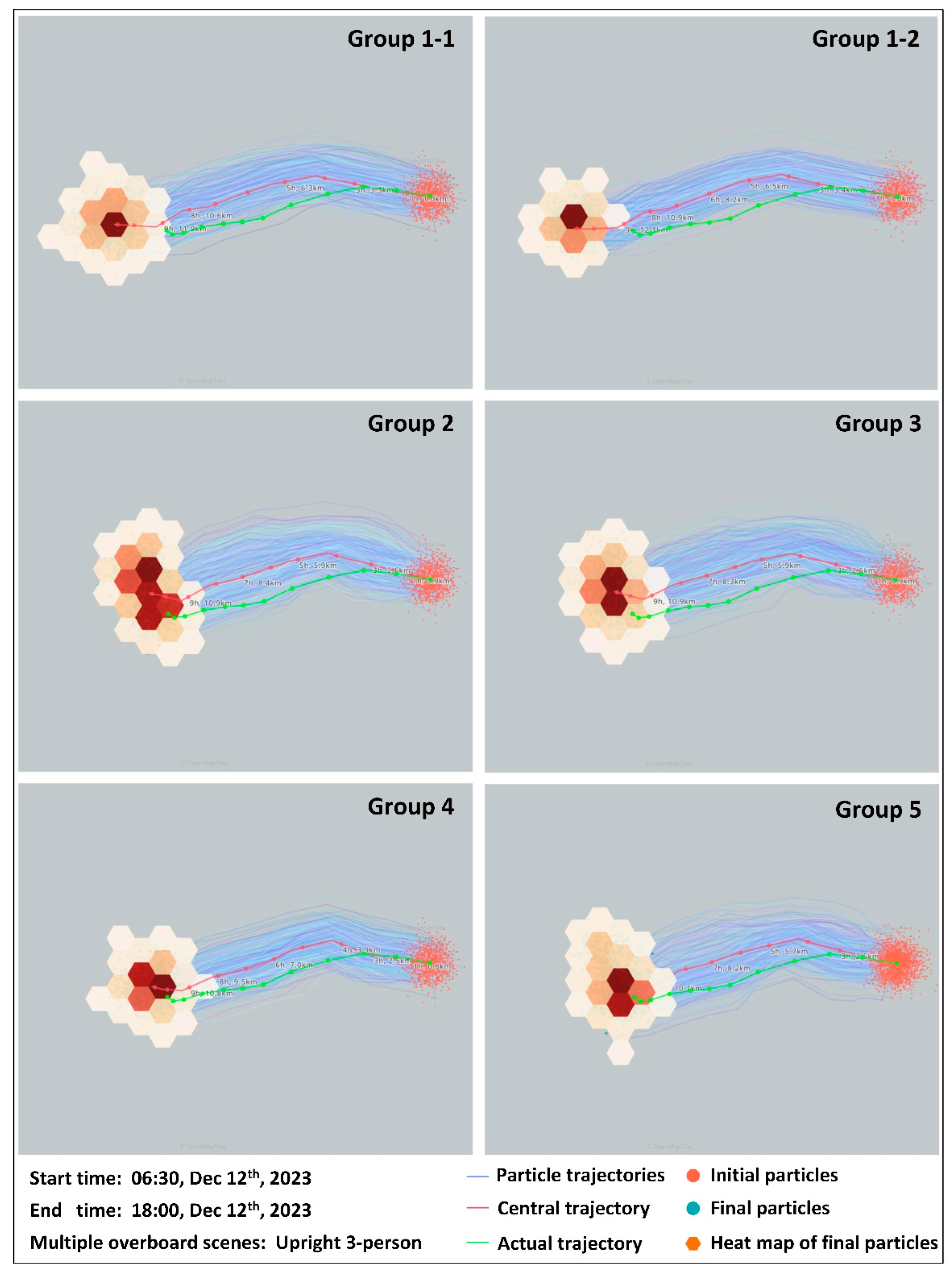
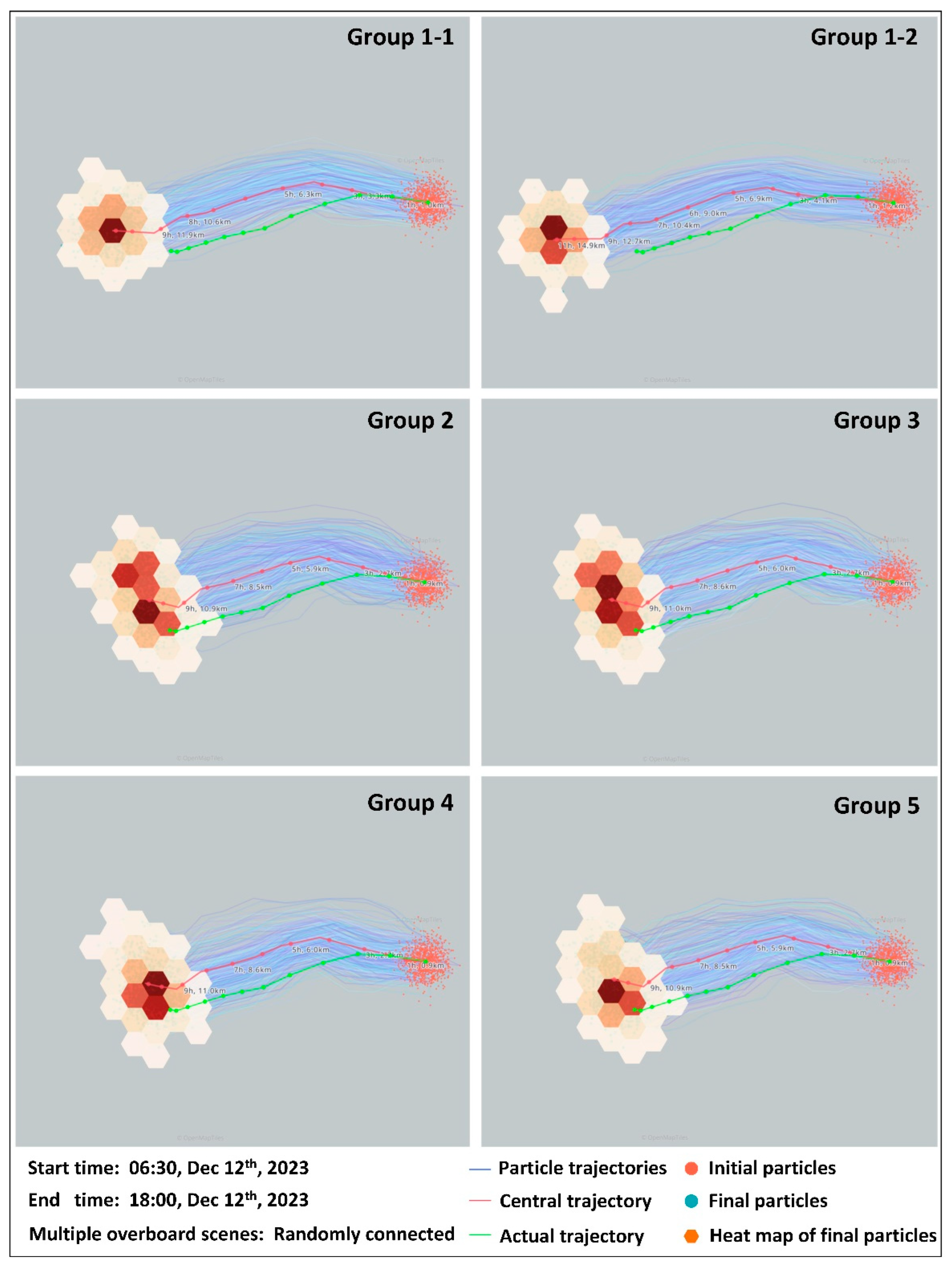
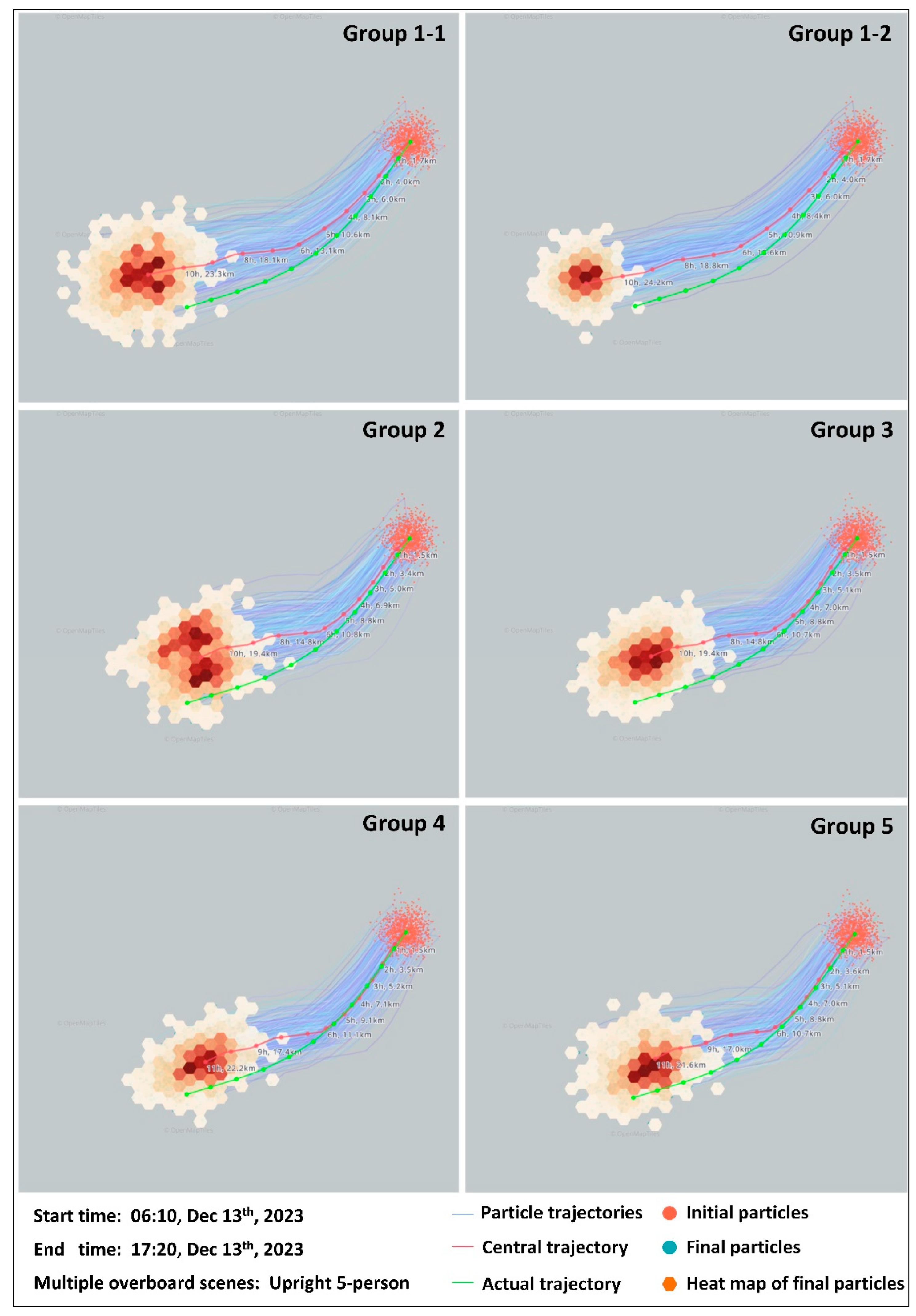
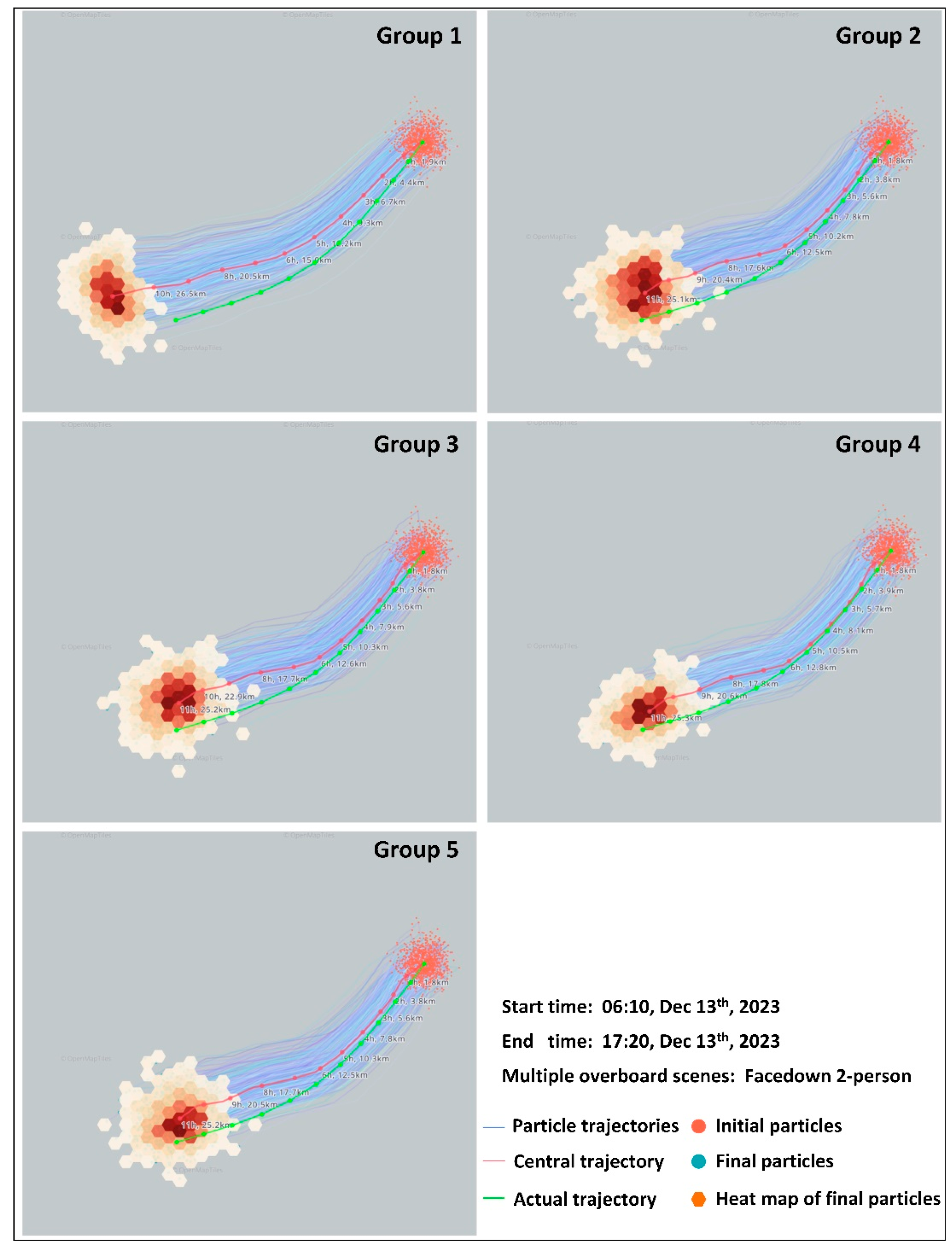
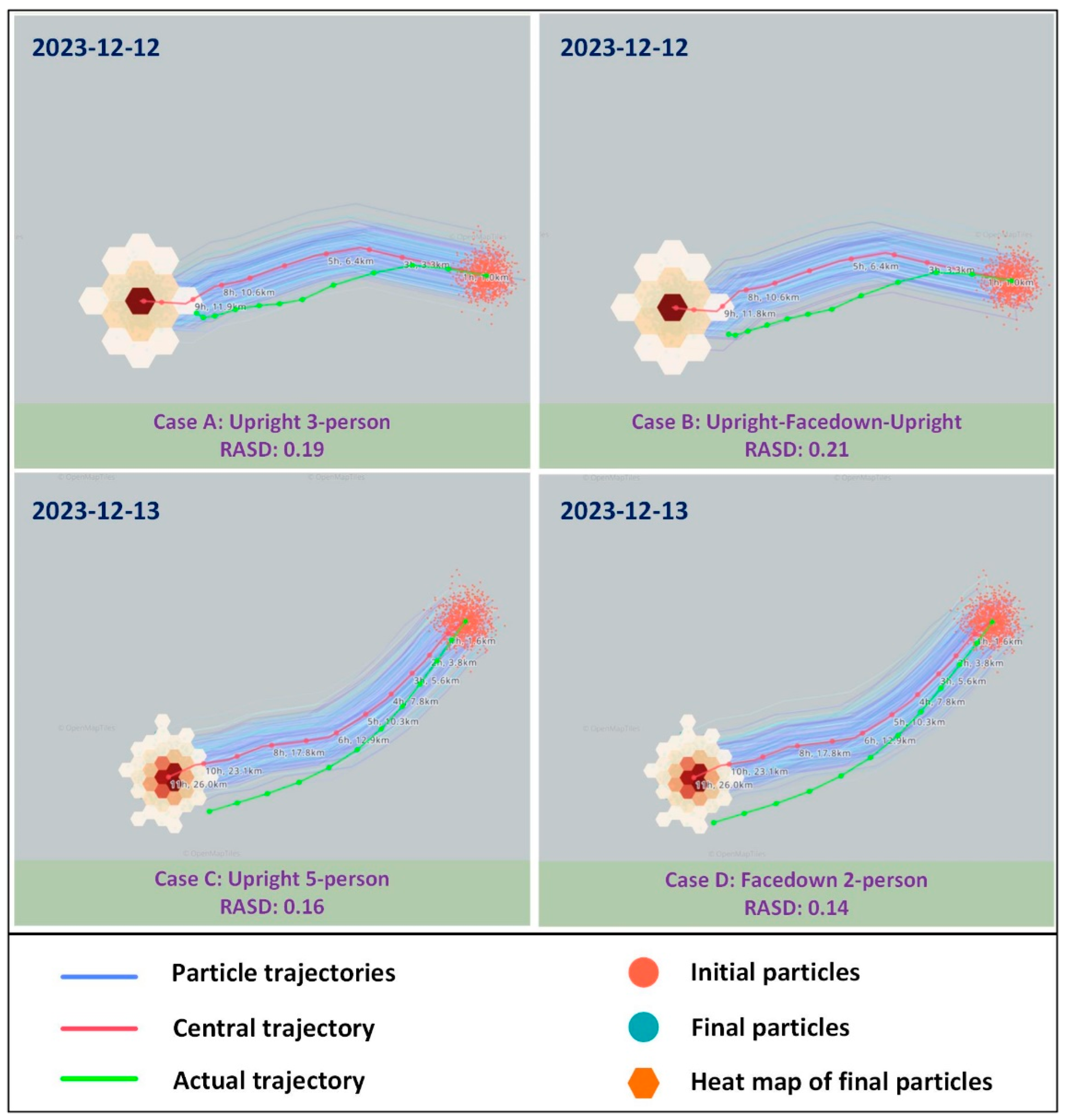
The experiments in this section focus on exploring the effects of the parameters of the MPIW drift trajectory prediction model on the trajectory prediction accuracy. Table 6 shows the specific information of the four comparative experimental cases we set up; all four cases were derived from our field experiments due to gaps in existing research on the drift characteristics of MPIW. Five sets of simulations were conducted for each case, and Group 1 (Groups 1-1 and 1-2) was utilized to compare the accuracy of our model with that of existing methods (Table 7). In Groups 2–5, our proposed model was employed with various +CWL probabilities and jibing frequencies to investigate their impacts on drift prediction simulation. The configuration parameters for trajectory prediction particle tracking, including the computational time step and output time step, are shown in Table 8.
For each simulation, 1000 particles were generated for trajectory tracking, which ensured statistical significance and yielded the optimal drift prediction [19]. The probability distribution of the particles was then calculated via the kernel density estimation method to generate a heatmap of the particle ensemble, with higher heat zones representing areas that are more likely to contain the target in distress.
The predicted and real drift positions are marked for each hour in every run, and the center trajectories of all the simulated particles are plotted. Additionally, the RASD and NCSD values are calculated for each output time interval, as presented in Table 9 and Table 10. Table 11 shows, for each case at 11 h, the group that gives the lowest RASD and NCSD and the corresponding values, and this makes it easy to identify the best group. Heatmaps depicting the distribution areas of the simulated particles are generated to evaluate the coverage of the trajectory prediction results for real trajectories, with darker areas indicating higher particle concentrations. The simulation results of trajectory prediction are shown in Figure 14, Figure 15, Figure 16 and Figure 17. The computational efficiency of drift trajectory prediction is as follows: for an 11 h trajectory prediction, the computational time consumed is <10 s, which meets the timeliness requirement of maritime SAR auxiliary decision-making.
The experimental results show that the drift trajectory prediction model for MPIW proposed in this study leads to a significant reduction in both RASD and NCSD, as well as a substantial improvement in prediction accuracy, compared to the models in previous studies (Group 1) that solely relied on leeway coefficients for single-person-overboard scenarios. In addition, the final prediction region of the simulated particles in Group 1 does not cover the real drift trajectory, indicating that the drift trajectory prediction model for a single person in water is not applicable to MPIW. The simulation results of Groups 2-4 indicate that when the appropriate +CWL probability and jibing frequency are set (Group 4), the particle distribution is predominantly concentrated on the side adjacent to the actual trajectory, resulting in the highest accuracy in drift prediction. This is discussed in detail below.
When the jibing frequency is not considered (Group 2), the high-probability region of the simulated particles is dispersed, which may lead to an increase in the size of the final search area; this is not conducive to effective search.
A larger high-probability region of the simulated particles (Group 2 and Group 3) is also observed when the +CWL probability is set to 50%. The likelihood of the actual drift trajectory falling within the high-probability SAR range is greater in Group 4 when an appropriate value is set for the +CWL probability, and the distribution range of the simulated particles is smaller, which is helpful in carrying out efficient SAR operations. For different cases, the RASD and NCSD of Group 4 are significantly reduced, and the RASD of Case D is significantly improved from 0.22 to 0.06. The findings indicate that optimizing the value of the +CWL probability can increase the accuracy of drift simulation to a certain degree.
The use of different jibing frequencies results in different simulated particle probability distributions. Although there is no significant difference in the calculation results of the accuracy assessment index, there are differences in the high-heat region of the particle probability distribution, and the degree to which the search region can cover the actual drift trajectory location varies. For example, in Case A, Group 4 sets the appropriate jibing frequency, and the actual trajectory is located entirely within the highest-heat region. Group 5 ignores the jibing frequency, and the actual trajectories do not fall within the highest-heat region, although the difference in RASD between the two is small.
The experimental results show that there are different drift trajectories in an individual-person-in-water scenario and an MPIW scenario. Moreover, the particle trajectories simulated by the proposed drift trajectory prediction model for MPIW exhibit a greater degree of consistency with the observed real trajectories. Additionally, optimizing the +CWL probability can increase the trajectory prediction accuracy to a certain extent. The quantitative coefficients reported here are best interpreted as case-study parameters, which are expected to be transferable primarily to similar offshore or deep-water metocean conditions, while broader generalization requires further multi-season and multi-region validation.
The proposed MPIW drift prediction model can be used as a submodule in existing operational SAR systems. When an alert is received for a large-scale man overboard incident, the system usually knows only the total number of persons in distress (for example, 1000 persons), while the posture and connection pattern of the groups are not known in real time. In this case, the MPIW model can be used in a workflow that assumes several group configurations, runs several models in parallel, and then combines the results in a probabilistic way. First, based on prior information or simple rules, the total number of persons is divided into several possible group configurations. For example, we may treat “five connected standing persons” as a basic unit and divide the total number of persons into multiple such units, which are then assigned to the four MPIW scenario models defined in this study. The system then calls the corresponding drift model for each configuration and obtains the particle probability fields and high-probability search areas for that configuration. Finally, the outputs of the four models are combined using weights, which may come from historical data, field observations, or expert judgment, to form a single probabilistic search area. These weights and the grouping scheme can be updated when new observations become available so that the predicted search area and the associated SAR plan can be revised in a rolling manner.
From an operational point of view, the results show that, in typical test cases, the MPIW model provides clear reductions in RASD and NCSD compared with the control setting in which group targets are treated as a traditional single person overboard. These reductions give a useful indication of the potential gains when extending existing systems to group overboard scenarios. It should be noted that these improvements are derived from a case study in the Xisha Sea with a limited number of experiments. Both the model parameters and the performance gains may change with season and regional meteorological and oceanographic conditions. A robust assessment of operational benefits will require additional field experiments in different sea areas and seasons, together with independent validation data.

4.3. Drift Trajectory Prediction of MPIW Neglecting Wind Field Effects

From Section 4.2, when Group 1 uses the leeway coefficients for a single person-in-water scenario, the drift speed of the simulated particles is significantly greater than the actual drift speed, and the predicted trajectory is longer than the actual trajectory, which results in the actual trajectory not falling within the search region of the simulated particles. We speculate that the wind field has a greater driving effect on a single person overboard, so we ignore the wind field in this section and use only the flow field data to predict the drift trajectories in the MPIW scenario (Figure 18).
Considering only the current field effects, the drift velocity of the simulated particles is slightly greater than the actual drift velocity for the group-drift upright 3-person, upright–facedown–upright, and upright 5-person scenarios, and the drift velocity of the simulated particles is close to the actual velocity for the facedown 2-person case, indicating that there is a more significant upwind drift in the MPIW drift scenario that includes persons in upright postures; this is consistent with the phenomenon described in Section 3.3.2.
In contrast to the trajectory prediction results in Section 4.2, the RASD values of the predicted trajectories for all four cases are larger than the RASD values of cases in which the driving effect of the wind field is considered and a reasonable +CWL and jibing frequency are set; e.g., the RASD of Group 4 for Case D is only 0.06, whereas that of the group that ignores the wind field is 0.14. Nevertheless, the accuracy of trajectory prediction is superior to that when unreasonable single-person-in-water drift parameters are used (Group 1), suggesting that there is a significant difference between the drift characteristics of single-person-overboard and MPIW in the marine environmental conditions of our experiments.
For Case C, although the RASD obtained when ignoring the effect of the wind field is the same as that of Group 2, which is 0.16, the measured trajectory does not fall within the search area generated by the simulated particles. This indicates that the current field significantly affects the overall trend and drift speed in the MPIW scenario, and the wind field plays a crucial role in shaping the distribution of the simulated particles and consequently leads to variations in the final search area.

4.4. Limitations Analysis and Future Work

4.4.1. Research Limitations

(1) Scope and representativeness of experiments. The drift experiments in this study were carried out mainly in the Xisha Sea, China. The data come from sea trials in December 2023, including six drift events with a total observation time of 57 h. The experiments cover typical conditions with wind speeds from 0.17 to 7.77 m/s and surface current speeds from 0.06 to 0.96 m/s. As a result, the statistical characteristics and model parameters obtained here represent a sample set for this specific season and region. In other sea areas, for example, the Nansha Islands region, meteorological and oceanographic conditions may be different, and the drift characteristics of groups of persons in water may also change.
(2) Statistical uncertainty. Because of the limited amount of data, the experimental dataset was not split into separate calibration and validation subsets. Model calibration and performance evaluation are both based on the same observations, so the current results are an internal evaluation without an independent validation dataset. In addition, the larger spread of CWL-related statistics suggests that the model parameters and predictions may be more sensitive and uncertain under certain sea states.
(3) Simplified description of physical processes. The study uses a parameterized framework of flow-induced drift, leeway, jibing probability, and random diffusion to describe MPIW drift uncertainty. This design meets the computational efficiency needed for operational forecasting, but it simplifies several physical processes, such as the time evolution of group configuration, wave-induced transport, and vertical shear of surface currents. These simplifications may reduce prediction accuracy under extreme or rapidly changing sea conditions.
(4) Scenario coverage and operational integration. The field experiments include two group overboard scenarios, namely side-by-side connection and random connection. Other group formations, such as encircling connections, may have different drift dynamics and statistical properties. Moreover, although an integration scheme compatible with existing SAR systems is proposed, full end-to-end implementation and testing in real operational systems have not yet been carried out.

4.4.2. Future Work Plan

(1) Multi-season and multi-area field trials and independent validation. Future work will include continuous observations in different deep ocean areas, such as the Nansha Islands and other representative regions, under different seasonal conditions. These data will be used to build an independent validation dataset to test the stability and transferability of key statistical quantities, including leeway parameters, +CWL probability, and jibing frequency. On this basis, more robust and broadly applicable parameter ranges can be established.
(2) Expanded group configuration and dynamic evolution modeling. The study will be extended to more complex group configurations, such as encircling formations, loosely clustered groups, and separation–aggregation patterns. Changes in posture and in the connection relationships within the group will be taken into account so that configuration–parameter mappings or hierarchical models can be developed. This is expected to improve the ability of the model to describe realistic accident scenarios.
(3) Integration for operational systems. The MPIW model will be implemented in existing operational SAR systems as a target type library or target drift model. Comparative experiments will be designed against the traditional single-target parameterization to quantify the gains in the accuracy of probabilistic search regions and in the efficiency of resource deployment. These efforts will help move the proposed model towards practical operational use.

5. Conclusions

This study presents a drift trajectory prediction method specifically for multiple-persons-in-water (MPIW) incidents to support search and rescue (SAR) planning and is demonstrated through a case study of full-scale field experiments in the Xisha Sea, South China Sea. Various group-drift scenarios were designed for simulating MPIW accidents, and field experiments were conducted for two drift scenarios, side-by-side and randomly connected, to obtain nine leeway coefficients and jibing frequencies for four models (upright 5-person, upright 3-person, upright–facedown–upright, and facedown 2-person). The results demonstrate that the proposed MPIW drift prediction model significantly enhances prediction accuracy and better represents real-world conditions compared to individual overboard drift models. Specifically, the prediction error for the 11-h drift trajectory was reduced from 0.22 to 0.06, marking a substantial improvement in SAR operation effectiveness.
The +CWL probabilities have a substantial influence on the prediction of drift trajectories, particularly in the Xisha Sea area of China, where a distinct rightward drift is observed in the MPIW drift scenario. The combined effect of marine environmental forces led to notable differences in +CWL probabilities, and the inherent uncertainties in marine environmental data pose significant challenges for providing definitive +CWL probabilities. These uncertainties highlight the complexity of accurate drift trajectory prediction in diverse marine conditions, which suggests a need for additional sea drift experiments to better quantify and manage these risks. We also found that the current field significantly influences the overall trend and drift speed of MPIW, and the wind field plays a crucial role in shaping the distribution of simulated particles, resulting in variations in the final search area.
This study still has several limitations. The experimental data come mainly from experiments in the Xisha Sea area in December 2023, and the model evaluation is an internal assessment without an independent validation dataset. In addition, only two types of MPIW scenarios are considered, namely side-by-side connection and random connection. Future work will include field tests in different seasons and sea areas with independent validation, extension of the modeling framework to more group configurations and their dynamic evolution, stronger treatment of wave–current–wind coupling and uncertainty propagation, and end-to-end integration and comparative evaluation within existing operational SAR systems. These efforts are expected to further improve the generality of the model and its value for operational applications.
The findings from this study are significant for improving the accuracy of MPIW drift trajectory predictions, which can directly enhance the success rate of SAR operations. By minimizing the search risks during SAR missions, this work contributes to greater safety in maritime rescue operations, ensuring better protection of human lives at sea.

Author Contributions

Conceptualization, L.C.; methodology, J.W.; software, J.W. and Z.W.; validation, Z.W. and C.N.; formal analysis, J.W.; investigation, J.W. and Z.W.; data curation, J.W. and Z.W.; writing—original draft preparation, J.W.; writing—review and editing, Z.W.; visualization, J.W. and Z.W.; supervision, L.C.; project administration, L.C.; funding acquisition, J.W. All authors have read and agreed to the published version of the manuscript.

Funding

This research was funded by the National Key Research and Development Program of China, grant number 2024YFB3908800, and the National Natural Science Foundation of China, grant number 42501564, and the Basic Research Program of Jiangsu, grant BK20251227.

Data Availability Statement

The original contributions presented in this study are included in the article. Further inquiries can be directed to the corresponding author.

Conflicts of Interest

The authors declare no conflicts of interest.

References

  1. Zhou, X. Spatial risk assessment of maritime transportation in offshore waters of China using machine learning and geospatial big data. Ocean Coast. Manag. 2024, 247, 106934. [Google Scholar] [CrossRef]
  2. Wu, J.; Cheng, L.; Chu, S.; Song, Y. An autonomous coverage path planning algorithm for maritime search and rescue of persons-in-water based on deep reinforcement learning. Ocean Eng. 2024, 291, 116403. [Google Scholar] [CrossRef]
  3. Liu, L.; Shan, Q.; Xu, Q. Usvs path planning for maritime search and rescue based on pos-dqn: Probability of success-deep q-network. J. Mar. Sci. Eng. 2024, 12, 1158. [Google Scholar] [CrossRef]
  4. Wu, J.; Wang, Z.; Song, Y.; Zhou, X.; Cheng, L. A reinforcement learning-assisted search and rescue resource allocation decision-making approach for maritime emergencies. Comput. Ind. Eng. 2025, 201, 110933. [Google Scholar] [CrossRef]
  5. Cafarelli, D.; Ciampi, L.; Vadicamo, L.; Gennaro, C.; Berton, A.; Paterni, M.; Benvenuti, C.; Passera, M.; Falchi, F. MOBDrone: A drone video dataset for man overboard rescue. In Proceedings of the International Conference on Image Analysis and Processing, Lecce, Italy, 23–27 May 2022; pp. 633–644. [Google Scholar]
  6. Breivik, Ø.; Allen, A.A.; Maisondieu, C.; Roth, J.C. Wind-induced drift of objects at sea: The leeway field method. Appl. Ocean Res. 2011, 33, 100–109. [Google Scholar] [CrossRef]
  7. Kasyk, L.; Pleskacz, K.; Kapuscinski, T. Analysis of wind and drifter movement parameters in terms of navigation safety: The example of Szczecin lagoon. Eur. Res. Stud. J. 2021, XXIV, 541–559. [Google Scholar] [CrossRef]
  8. Chen, Y.; Zhu, S.; Zhang, W.; Zhu, Z.; Bao, M. The model of tracing drift targets and its application in the South China Sea. Acta Oceanol. Sin. 2022, 41, 109–118. [Google Scholar] [CrossRef]
  9. Bhaganagar, K.; Kolar, P.; Faruqui, S.H.A.; Bhattacharjee, D.; Alaeddini, A.; Subbarao, K. A Novel Machine-Learning Framework With a Moving Platform for Maritime Drift Calculations. Front. Mar. Sci. 2022, 9, 831501. [Google Scholar] [CrossRef]
  10. Gonçalves, L.P.L.V. Automatic Detection of Castaways in SAR Missions Using UAVs. Master’s Thesis, Escola Naval, Lisbon, Portugal, 2021. [Google Scholar]
  11. Allen, A.; Plourde, J. Review of Leeway: Field Experiments and Implementation; Technical Paper CG-D-08-99; US Coast Guard Research and Development Center: Groton, CT, USA, 1999; 351p, Available online: https://www.researchgate.net/publication/235044274_Review_of_Leeway_Field_Experiments_and_Implementation (accessed on 1 April 1999).
  12. Allen, A. Leeway Divergence; Technical Paper CG-D-05-05; US Coast Guard Research and Development Center: Graton, CT, USA, 2005; 128p. Available online: https://ntrl.ntis.gov/NTRL/dashboard/searchResults/titleDetail/ADA435435.xhtml (accessed on 1 January 2005).
  13. Breivik, Ø.; Allen, A.A. An operational search and rescue model for the Norwegian Sea and the North Sea. J. Mar. Syst. 2008, 69, 99–113. [Google Scholar] [CrossRef]
  14. Breivik, Ø.; Allen, A.A.; Maisondieu, C.; Roth, J.-C.; Forest, B. The leeway of shipping containers at different immersion levels. Ocean Dyn. 2012, 62, 741–752. [Google Scholar] [CrossRef]
  15. Breivik, Ø.; Allen, A.A.; Maisondieu, C.; Olagnon, M. Advances in search and rescue at sea. Ocean Dyn. 2013, 63, 83–88. [Google Scholar] [CrossRef]
  16. Li, Y.; Yu, H.; Wang, Z.-y.; Li, Y.; Pan, Q.-q.; Meng, S.-j.; Yang, Y.-q.; Lu, W.; Guo, K.-x. The forecasting and analysis of oil spill drift trajectory during the Sanchi collision accident, East China Sea. Ocean Eng. 2019, 187, 106231. [Google Scholar] [CrossRef]
  17. Asami, M.; Takahashi, C. Drift prediction of pyroclasts released through the volcanic activity of Fukutoku-Okanoba into the marine environment. Mar. Pollut. Bull. 2023, 186, 114402. [Google Scholar] [CrossRef] [PubMed]
  18. Callies, U.; von Storch, H. Extreme separations of bottle posts in the southern Baltic Sea–tentative interpretation of an experiment-of-opportunity. Oceanologia 2023, 65, 410–422. [Google Scholar] [CrossRef]
  19. Wu, J.; Cheng, L.; Chu, S. Modeling the leeway drift characteristics of persons-in-water at a sea-area scale in the seas of China. Ocean Eng. 2023, 270, 113444. [Google Scholar] [CrossRef]
  20. Ren, L.; Yang, J.; Wang, J. An improved drift model of dropped containers under wind and current effects. Ocean Eng. 2024, 307, 118167. [Google Scholar] [CrossRef]
  21. Mu, L.; Tu, H.; Geng, X.; Qiao, F.; Chen, Z.; Jia, S.; Zhu, R.; Zhang, T.; Chen, Z. Research on the drift prediction of marine floating debris: A case study of the south china sea maritime drift experiment. J. Mar. Sci. Eng. 2024, 12, 357. [Google Scholar] [CrossRef]
  22. Dawson, J.W. Canadian Coast Guard College CANSARP Development Group Web Site, CANSARP User Manual. 2009. Available online: https://manualzz.com/doc/4229282/cansarp-search-planning-family-user-manual (accessed on 1 January 2005).
  23. Kratzke, T.M.; Stone, L.D.; Frost, J.R. Search and rescue optimal planning system. In Proceedings of the 2010 13th International Conference on Information Fusion, Edinburgh, Scotland, 26–29 July 2010; pp. 1–8. [Google Scholar]
  24. Hodgins, D.O.; Hodgins, S.L. Phase II Leeway Dynamics Program: Development and Verification of a Mathematical Drift Model for Liferafts and Small Boats; Seaconsult Marine Research Limited: Nova Scotia, NS, Canada, 1998. [Google Scholar]
  25. Anderson, E.; Odulo, A.; Spaulding, M. Modeling of Leeway Drift; US Coast Guard Report CG-D-06-99; National Technical Information Service: Springfield, VA, USA, 1998. [Google Scholar]
  26. Abascal, A.J.; Castanedo, S.; Medina, R.; Losada, I.J.; Alvarez-Fanjul, E. Application of HF radar currents to oil spill modelling. Mar. Pollut. Bull. 2009, 58, 238–248. [Google Scholar] [CrossRef]
  27. Tanizawa, K.; Minami, M.; Imoto, Y. On the drifting speed of floating bodies in waves. J. Soc. Nav. Arch. Jpn. 2001, 2001, 151–160. [Google Scholar] [CrossRef]
  28. Kundu, P.K.; Cohen, I.M.; Dowling, D.R. Fluid Mechanics; Academic Press: Boston, MA, USA, 2015. [Google Scholar]
  29. Zhu, K.; Mu, L.; Tu, H. Exploration of the wind-induced drift characteristics of typical Chinese offshore fishing vessels. Appl. Ocean Res. 2019, 92, 101916. [Google Scholar] [CrossRef]
  30. Özgökmen, T.M.; Piterbarg, L.I.; Mariano, A.J.; Ryan, E.H. Predictability of drifter trajectories in the tropical Pacific Ocean. J. Phys. Oceanogr. 2001, 31, 2691–2720. [Google Scholar] [CrossRef]
  31. Sayol, J.M.; Orfila, A.; Simarro, G.; Conti, D.; Renault, L.; Molcard, A. A Lagrangian model for tracking surface spills and SaR operations in the ocean. Environ. Model. Softw. 2014, 52, 74–82. [Google Scholar] [CrossRef]
  32. Zhu, K.; Mu, L.; Xia, X. An ensemble trajectory prediction model for maritime search and rescue and oil spill based on sub-grid velocity model. Ocean Eng. 2021, 236, 109513. [Google Scholar] [CrossRef]
  33. Melsom, A.; Counillon, F.; LaCasce, J.H.; Bertino, L. Forecasting search areas using ensemble ocean circulation modeling. Ocean Dyn. 2012, 62, 1245–1257. [Google Scholar] [CrossRef]
  34. Gao, J.; Mu, L.; Bao, X.; Song, J.; Ding, Y. Drift analysis of MH370 debris in the southern Indian Ocean. Front. Earth Sci. 2018, 12, 468–480. [Google Scholar] [CrossRef]
  35. Meng, S.; Lu, W.; Li, Y.; Wang, H.; Jiang, L. A study on the leeway drift characteristic of a typical fishing vessel common in the Northern South China Sea. Appl. Ocean Res. 2021, 109, 102498. [Google Scholar] [CrossRef]
  36. Griffa, A. Applications of stochastic particle models to oceanographic problems. In Stochastic Modelling in Physical Oceanography; Springer: Berlin/Heidelberg, Germany, 1996; pp. 113–140. [Google Scholar]
  37. Ullman, D.S.; O’Donnell, J.; Kohut, J.; Fake, T.; Allen, A. Trajectory prediction using HF radar surface currents: Monte Carlo simulations of prediction uncertainties. J. Geophys. Res. Ocean. 2006, 111, C12005. [Google Scholar] [CrossRef]
  38. Liu, Y.; Weisberg, R.H. Evaluation of trajectory modeling in different dynamic regions using normalized cumulative Lagrangian separation. J. Geophys. Res. Ocean. 2011, 116. [Google Scholar] [CrossRef]
  39. Zhang, X.; Cheng, L.; Zhang, F.; Wu, J.; Li, S.; Liu, J.; Chu, S.; Xia, N.; Min, K.; Zuo, X. Evaluation of multi-source forcing datasets for drift trajectory prediction using Lagrangian models in the South China Sea. Appl. Ocean Res. 2020, 104, 102395. [Google Scholar] [CrossRef]
  40. Tu, H.; Wang, X.; Mu, L.; Xia, K. Predicting drift characteristics of persons-in-the-water in the South China Sea. Ocean Eng. 2021, 242, 110134. [Google Scholar] [CrossRef]
Figure 1. Study flowchart.
Jmse 14 00144 g001
Figure 2. Relationships between the wind speed and leeway components.
Jmse 14 00144 g002
Figure 3. MPIW scenarios and characteristics.
Jmse 14 00144 g003
Figure 4. Sea area of the marine field experiments.
Jmse 14 00144 g004
Figure 5. Operational scenarios and field experiment work platform.
Jmse 14 00144 g005
Figure 6. Assembly and release of manikins.
Jmse 14 00144 g006
Figure 7. MPIW drift scenarios.
Jmse 14 00144 g007
Figure 8. Rose diagrams of the wind and current fields during the field experiments.
Jmse 14 00144 g008
Figure 9. Leeway components versus wind speed in the MPIW drift trajectory prediction model for the upright 3-person, upright–facedown–upright, upright 5-person, and facedown 2-person drift scenarios.
Jmse 14 00144 g009
Figure 10. Leeway angle profiles in various MPIW scenarios.
Jmse 14 00144 g010
Figure 11. DWL and CWL displacements in various MPIW scenarios (The arrow indicates the change in CWL direction).
Jmse 14 00144 g011
Figure 12. Plot of the temporal evolution of the drift, downwind and current directions (left), as well as the drift, wind and current velocities (right).
Jmse 14 00144 g012
Figure 13. Interrelationships among drift vectors, leeway vectors, wind field vectors, and flow field vectors (a): drift experiments conducted on 12 December 2023; (bd): drift experiments conducted on 13 December 2023).
Jmse 14 00144 g013
Figure 14. Comparison between the actual and simulated trajectories for five sets of simulation experiments in Case A.
Jmse 14 00144 g014
Figure 15. Comparison between the actual and simulated drift trajectories for five sets of simulation experiments in Case B.
Jmse 14 00144 g015
Figure 16. Comparison between the actual and simulated drift trajectories for five sets of simulation experiments in Case C.
Jmse 14 00144 g016
Figure 17. Comparison between the actual and simulated drift trajectories for five sets of simulation experiments in Case D.
Jmse 14 00144 g017
Figure 18. Comparison between the actual drift trajectory and the simulation prediction when the wind field is ignored.
Jmse 14 00144 g018
Table 1. Sensing equipment for the marine environmental elements.
InstrumentationsTachometerWeather StationPosition
RDI ADCP WHSAIRMAR 200 WXGPS
ElementsCurrentWindPosition
Collection frequency60 s1 s1 s
NotesInstallation depth: 0.3 m
Level width: 0.5 m
Blind zone: 0.15 m
Installation height: 10 m/
Table 2. Overview of drift trajectories in field experiments.
RunSceneStart LocationStart Time
(UTC + 8)
End Time
(UTC + 8)
Drift Distance
(km)
Wind Speed (m/s)Current Speed (m/s)
1UP_3111.460° E
16.320° N
20231207
13:17
20231207
18:20
3.880.17–7.580.06–0.40
2U-F-U111.462° E
16.319° N
20231207
13:17
20231207
18:20
3.970.17–7.580.06–0.40
3UP_3111.361° E
16.538° N
20231212
06:30
20231212
18:00
12.390.05–7.770.04–0.58
4U-F-U111.360° E
16.536° N
20231212
06:30
20231212
18:00
12.110.05–7.770.04–0.58
5UP_5110.393° E
17.296° N
20231213
06:10
20231213
17:20
2.620.50–4.000.46–0.96
6FD_2110.394° E
17.296° N
20231213
06:10
20231213
17:20
2.800.50–4.000.46–0.96
Table 3. Leeway components for each model, obtained via unconstrained linear regression.
ModelComponent m (%)SE-m95% CI-m (%) n (cm/s)SE-n95% CI-n (cm/s) S y x (cm/s)N
UP_3DWL−2.990.69[−4.35, −1.63]−0.981.68[−4.33, 2.37]7.8488
+CWL 2.350.65[1.05, 3.65]5.461.24[2.98, 7.94]5.6166
−CWL 1−2.350.65[−3.65, −1.05]−5.461.24[−7.94, −2.98]5.6122
U-F-UDWL−2.960.61[−4.18, −1.74]−0.081.62[−3.29, 3.13]7.5688
+CWL2.780.72[1.34, 4.22]5.071.39[2.29, 7.85]6.2570
−CWL 1−2.780.72[−4.22, −1.34]−5.071.39[−7.85, −2.29]6.2518
UP_5DWL−12.611.34[−15.30, −9.92]16.722.69[11.34, 22.10]7.7963
+CWL1.010.60[−0.20, 2.22]2.621.29[0.03, 5.21]2.9452
−CWL 1−1.010.60[−2.22, 0.20]−2.621.29[−5.21, −0.03]2.9411
FD_2DWL−11.571.42[−14.41, −8.73]18.853.12[12.62, 25.08]7.6163
+CWL1.210.49[0.24, 2.18]1.711.06[−0.43, 3.85]2.3952
−CWL 1−1.210.49[−2.18, −0.24]−1.711.06[−3.85, 0.43]2.3911
1 The −CWL coefficients are obtained by sign reversal of the +CWL regression results; the corresponding SE and 95% CI are inherited from the +CWL regressions because the −CWL subset is too small for a stable independent regression.
Table 4. Leeway components for each model, obtained via constrained linear regression.
ModelComponent m (%)SE-m95% CI-m (%) S y x (cm/s)N
UP_3DWL−3.400.34[−4.08, −2.72]7.8688
+CWL4.570.42[3.74, 5.40]6.4866
−CWL−4.570.42[−5.40, −3.74]6.4822
U-F-UDWL−2.990.31[−3.60, −2.38]7.5688
+CWL4.880.43[4.02, 5.74]6.9470
−CWL−4.880.43[−5.74, −4.02]6.9418
UP_5DWL−4.900.60[−6.10, −3.70]9.5463
+CWL2.220.20[1.82, 2.62]3.0852
−CWL−2.220.20[−2.62, −1.82]3.0811
FD_2DWL−2.840.57[−3.98, −1.70]9.9463
+CWL1.980.16[1.67, 2.29]2.4652
−CWL−1.980.16[−2.29, −1.67]2.4611
Table 5. Statistics of leeway angles.
DateScenarioLeeway Angle (+)
(Degree)
Leeway Angle ()
(Degree)
Probability
+CWL
Probability
−CWL
7 December 2023UP_383.2766.8883%17%
7 December 2023U-F-U83.6355.7587%13%
12 December 2023UP_3127.5968.9471%29%
12 December 2023U-F-U123.1589.9376%24%
SumUP_3110.8068.4775%25%
SumU-F-U108.4782.3480%20%
13 December 2023UP_5123.2687.6983%17%
13 December 2023FD_296.6892.1283%17%
Sum///79%21%
Table 6. Experimental cases for analyzing the effects of drift trajectory prediction model parameters on trajectory prediction.
CaseMPIWGroupModel+CWL
Probability
Jibing
Frequency (h−1)
Case AUpright 3-person on 12 December 2023Group 1-1PIW-1 150%0.04
Group 1-2PIW-T 150%0.04
Group 2UP_T50%neglected
Group 350%0.32
Group 479%0.32
Group 579%neglected
Case BUpright–facedown–upright on 12 December 2023Group 1-1PIW-1 150%0.04
Group 1-2PIW-2 150%0.04
Group 2U_F_U50%neglected
Group 350%0.32
Group 479%0.32
Group 579%neglected
Case CUpright 5-person on 13 December 2023Group 1-1PIW-1 150%0.04
Group 1-2PIW-T 150%0.04
Group 2UP_F50%neglected
Group 350%0.32
Group 479%0.32
Group 579%neglected
Case DFacedown 2-person on 13 December 2023Group 1PIW-2 150%0.04
Group 2FD_T50%neglected
Group 350%0.32
Group 479%0.32
Group 579%neglected
1 PIW-1 represents Allen’s [12] proposed drift model for a person in water in an upright posture, PIW-2 represents Allen’s [12] proposed drift model for a person in water in a facedown posture, and PIW-T represents the drift model of a person in water proposed by [40].
Table 7. Leeway coefficients from previous studies [12,40].
ModelDWL+CWL−CWL
k d
( % )
b d
( c m / s )
S y x
( c m / s )
k c +
( % )
b c +
( c m / s )
S y x
( c m / s )
k c
  ( % )
b c
( c m / s )
S y x
( c m / s )
PIW-10.480.008.300.150.006.70−0.150.006.70
PIW-21.11710.23.040.043.904.05−0.04−3.904.05
PIW-T1.230.003.870.490.002.91−0.440.002.19
Table 8. The configuration parameters for trajectory prediction particle tracking.
Parameter/SymbolValueUnitDescription
Number of particles1000Number of particles released in each simulation
Computation time step15minTime step for trajectory integration
Output time step60minTime interval for output and for computing RASD/NCSD
Trajectory integration schemeRK4Fourth order Runge–Kutta scheme used for trajectory integration
σwComputedm/sStandard deviation of sub grid wind speed perturbations
σcComputedm/sStandard deviation of sub grid current speed perturbations
εdComputedDescribed in formula 8
+CWL probabilitySee Table 6Probability of positive CWL at each time step
Jibing frequency fjSee Table 6h−1At each time step, a random number ϵ is drawn from U(0, 1); if e < fj · Δt, the CWL sign is changed. “Neglected” means that the CWL direction is not allowed to change, i.e., the frequency is set to 0
Table 9. The precision of each group in cases A and B.
CaseRASDNCSD
1 h2 h3 h4 h5 h6 h7 h8 h9 h10 h11 h1 h2 h3 h4 h5 h6 h7 h8 h9 h10 h11 h
AGroup 10.020.040.090.150.150.110.100.100.110.180.190.020.030.040.060.080.090.100.110.120.150.18
Group 10.020.030.080.150.140.110.100.110.120.200.220.010.020.030.060.070.090.100.110.120.150.18
Group 20.040.100.150.200.190.160.120.110.070.110.120.030.050.080.100.120.130.150.150.160.170.18
Group 30.040.100.150.200.190.160.120.110.070.110.120.030.050.080.100.120.130.150.150.160.170.18
Group 40.040.090.120.170.140.110.070.060.040.070.070.030.050.080.110.110.120.130.140.140.150.16
Group 50.040.100.140.170.170.140.090.080.040.070.080.030.060.080.100.110.130.140.140.140.150.16
BGroup 10.030.050.100.160.160.140.130.150.150.220.240.020.030.040.070.090.100.120.130.150.180.21
Group 10.010.010.060.130.140.150.160.190.200.290.310.010.010.020.040.060.080.100.120.150.190.23
Group 20.040.100.150.200.190.170.140.140.100.140.160.030.050.070.100.120.140.150.160.170.190.21
Group 30.040.100.150.200.190.170.140.140.100.140.160.030.050.070.100.120.130.150.160.170.190.21
Group 40.040.100.140.190.170.130.100.090.050.090.100.030.060.070.100.110.120.130.140.140.150.17
Group 50.040.100.140.190.170.140.100.100.060.090.110.030.050.070.100.110.130.140.140.150.160.17
Table 10. The precision of each group in cases C and D.
CaseRASDNCSD
1 h2 h3 h4 h5 h6 h7 h8 h9 h10 h11 h1 h2 h3 h4 h5 h6 h7 h8 h9 h10 h11 h
CGroup 10.020.040.040.060.070.100.120.150.160.170.190.030.040.040.050.060.080.090.120.140.160.19
Group 10.020.040.050.060.080.110.130.160.170.180.200.030.040.050.060.070.080.100.130.150.180.21
Group 20.020.010.030.040.060.070.120.150.150.170.160.020.020.030.030.040.060.080.100.120.150.17
Group 30.020.010.030.040.060.070.120.150.150.160.160.020.020.030.030.040.050.070.100.120.140.17
Group 40.010.010.020.020.040.050.100.120.120.130.120.010.010.020.020.030.030.050.070.090.110.13
Group 50.010.010.020.020.040.050.100.120.120.130.130.010.010.020.020.030.040.050.070.090.110.13
DGroup 10.030.050.050.070.090.120.140.170.180.210.220.030.050.060.070.080.100.120.140.170.200.23
Group 20.030.020.030.030.040.050.080.110.100.110.100.030.030.030.030.040.040.060.070.090.110.12
Group 30.030.020.030.030.040.050.080.110.100.110.100.030.030.030.030.040.040.060.070.090.110.12
Group 40.020.010.020.010.020.030.060.080.070.080.060.030.020.020.020.020.030.040.050.060.070.08
Group 50.020.010.020.020.030.040.070.090.080.090.070.030.020.020.030.030.030.040.060.070.080.09
Table 11. Summary of the best-performing Group for each Case at 11 h.
CaseRASD Best Group RASDNCSD Best Group NCSD
AGroup 40.07Group 40.16
BGroup 40.10Group 40.17
CGroup 40.12Group 40.13
DGroup 40.06Group 40.08
Disclaimer/Publisher’s Note: The statements, opinions and data contained in all publications are solely those of the individual author(s) and contributor(s) and not of MDPI and/or the editor(s). MDPI and/or the editor(s) disclaim responsibility for any injury to people or property resulting from any ideas, methods, instructions or products referred to in the content.