Numerical Analysis of Air-Injection Drag Reduction for the KVLCC2 Hull Using the VOF Interface-Capturing Method

Abstract
1. Introduction
2. Numerical Models
2.1. Governing Equations
2.2. Turbulence Model
2.3. VOF and Interface Capturing Method
3. Computational Materials and Methods
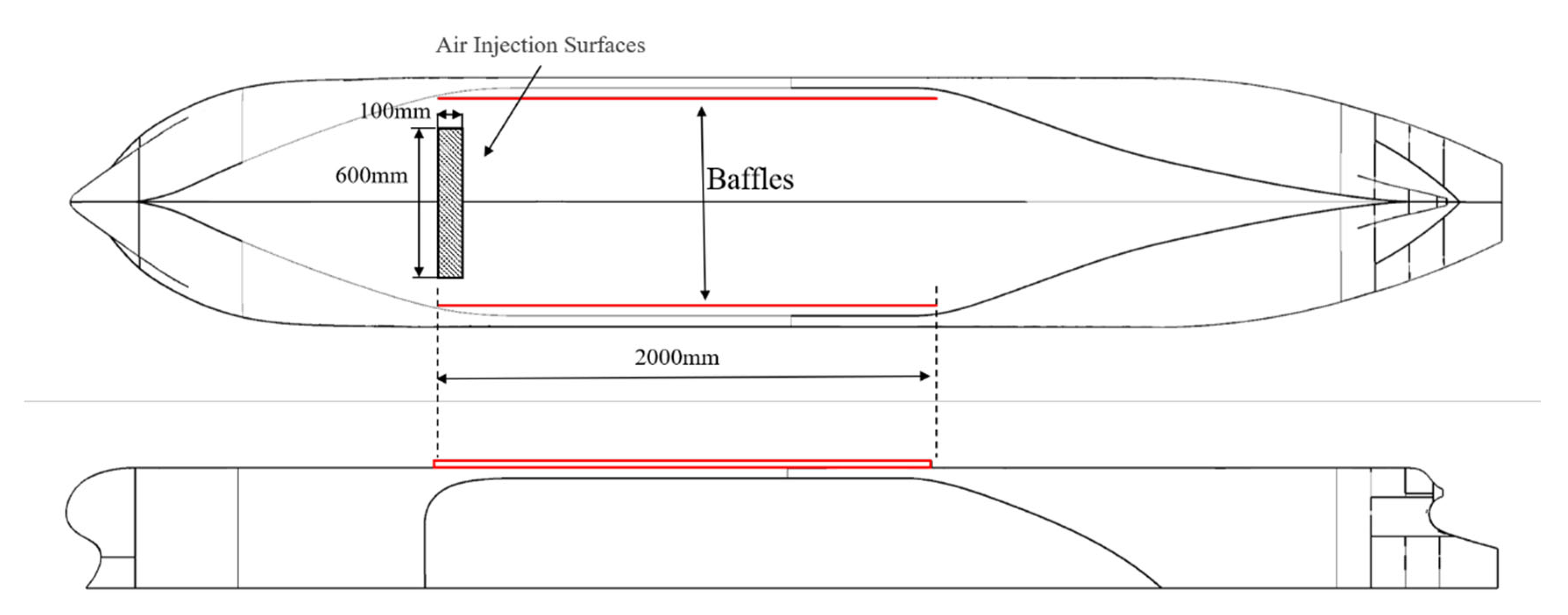
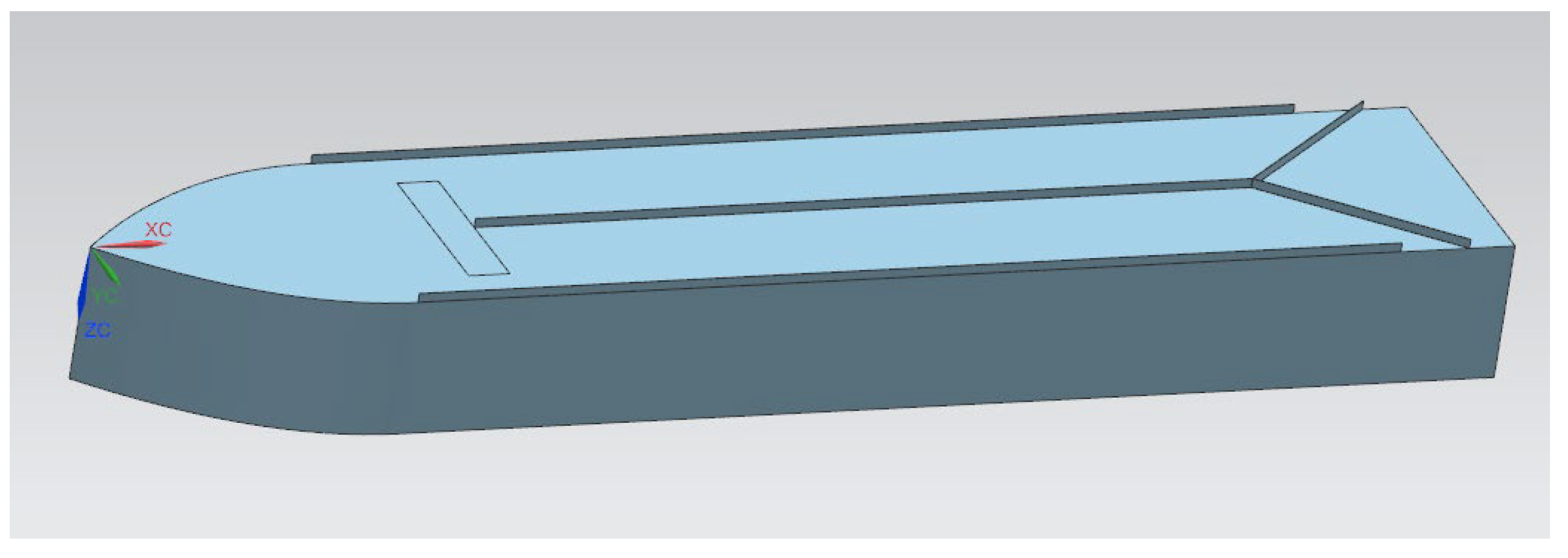
3.1. Geometric Model
3.2. The Definition of Drag Reduction and Air Injection Rate
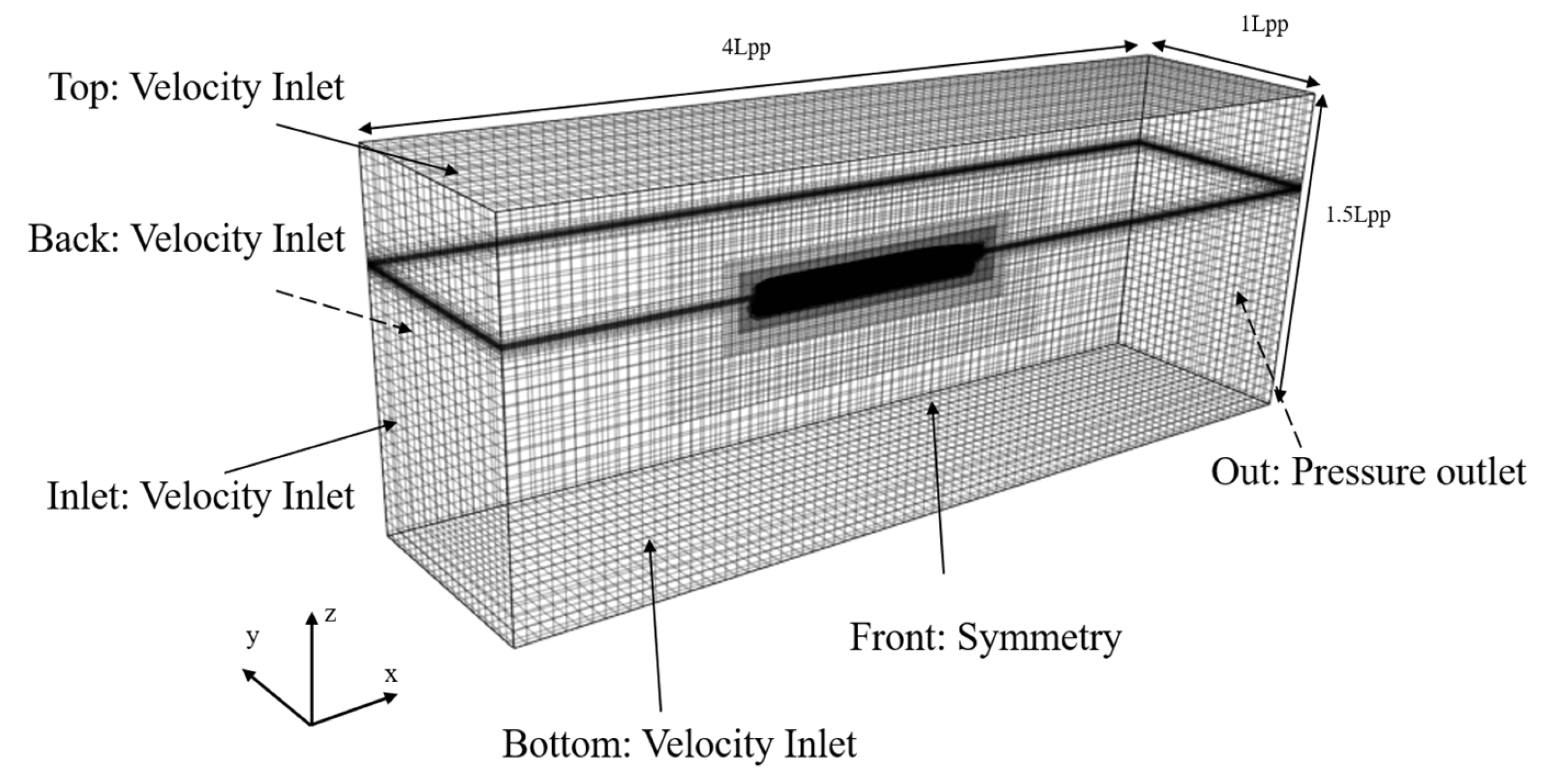
3.3. Computational Domain and Boundary Conditions
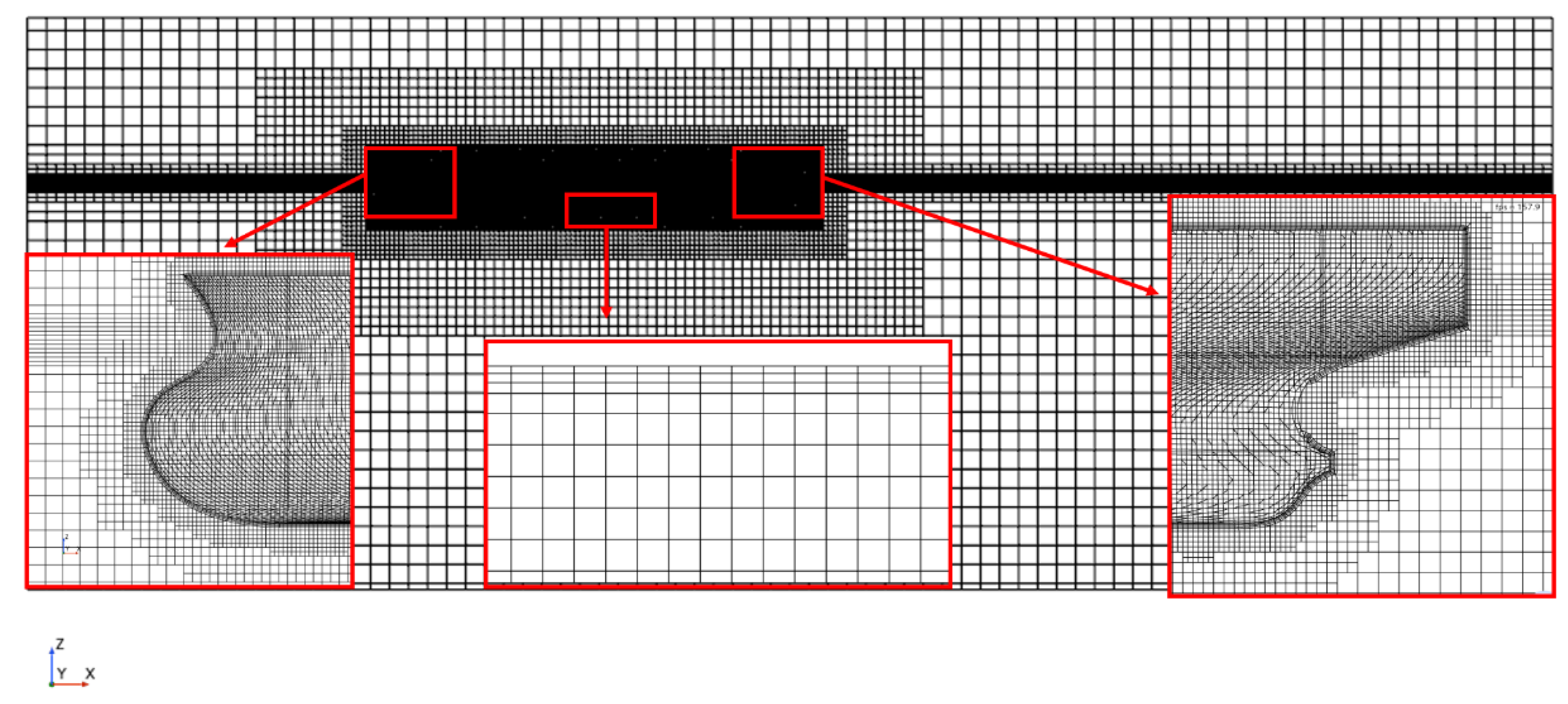
3.4. Mesh Independence and Parameter Settings
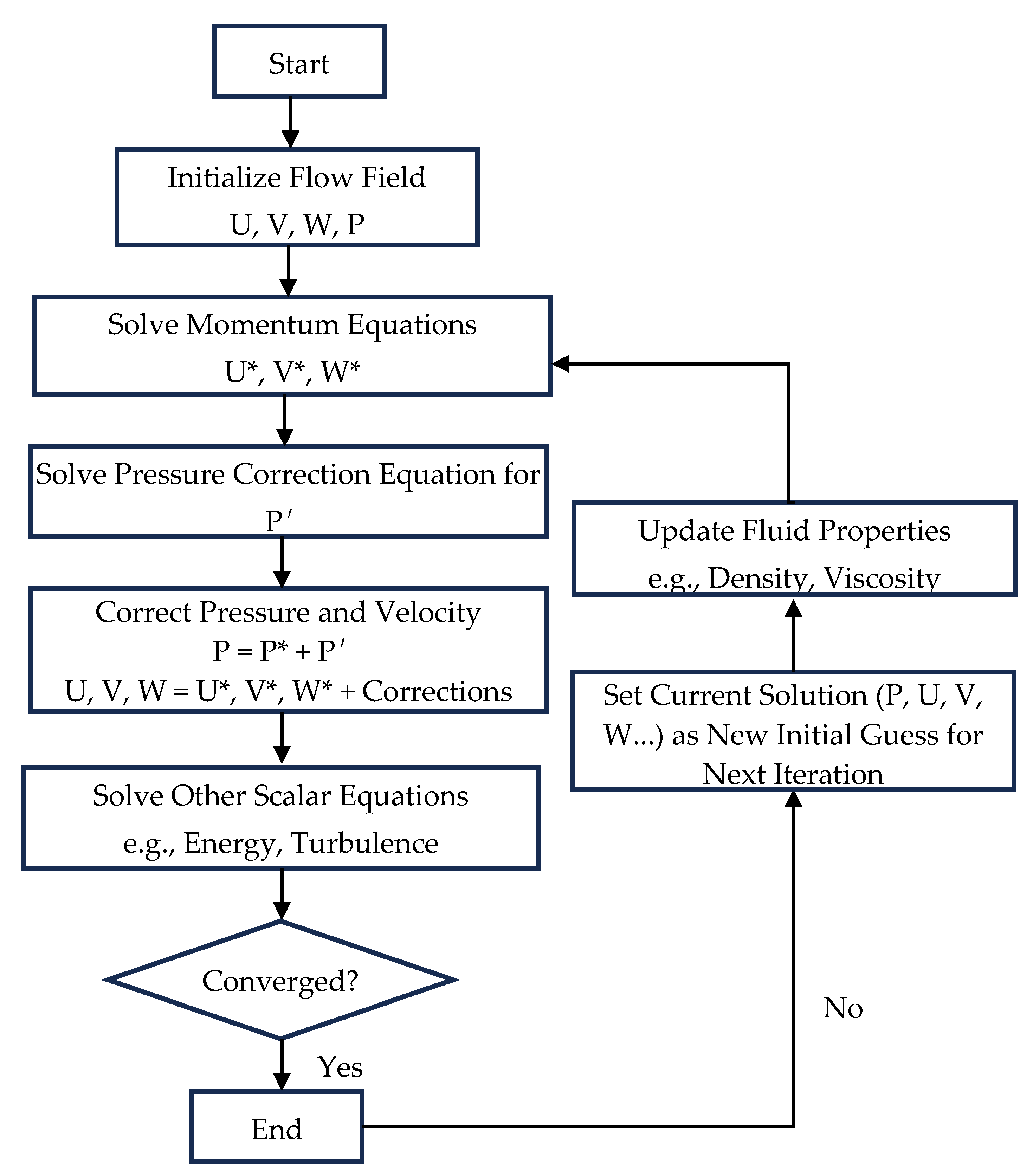
3.5. Numerical Setup and Calculation Conditions
4. Results and Discussion
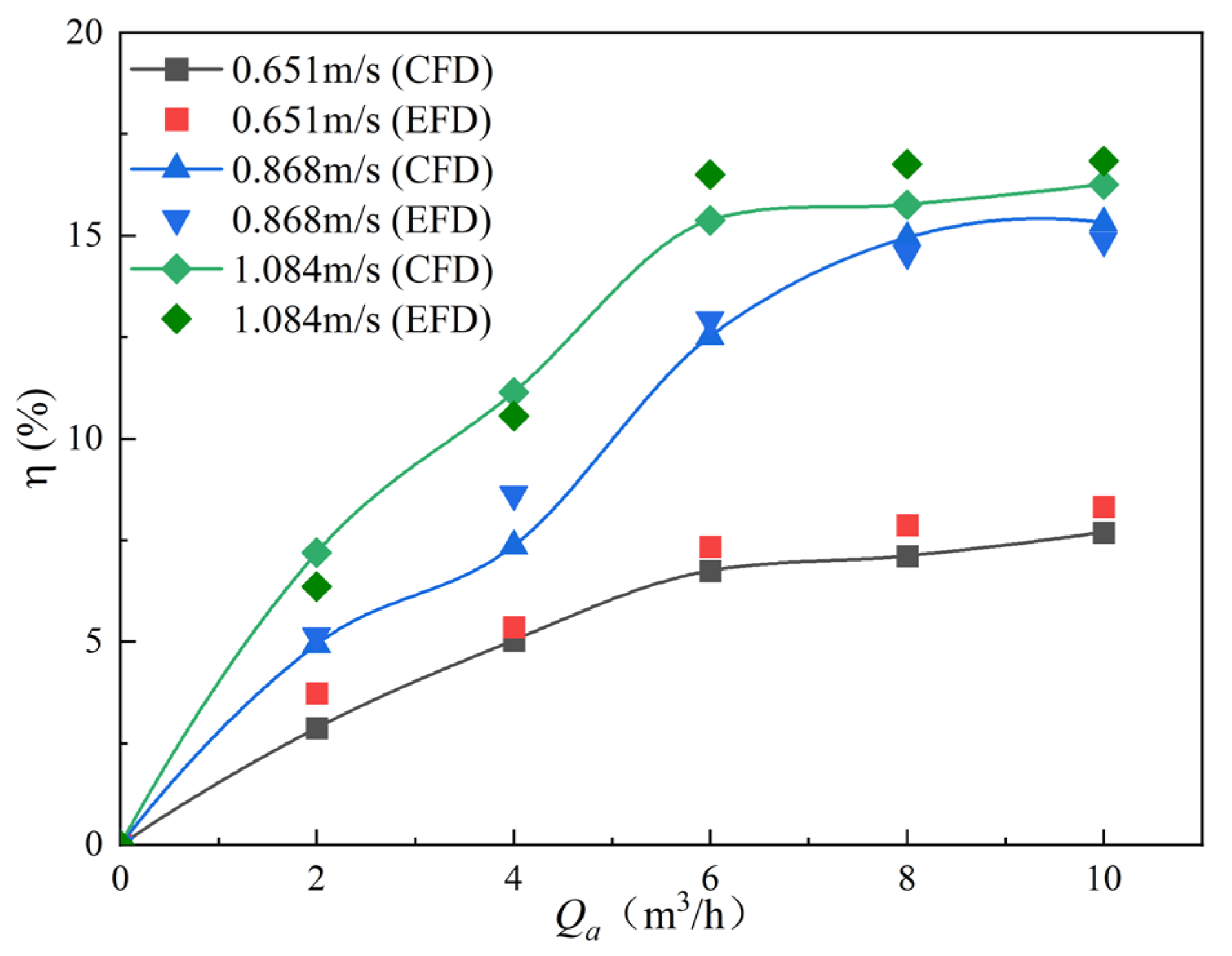
4.1. Validation of Numerical Model
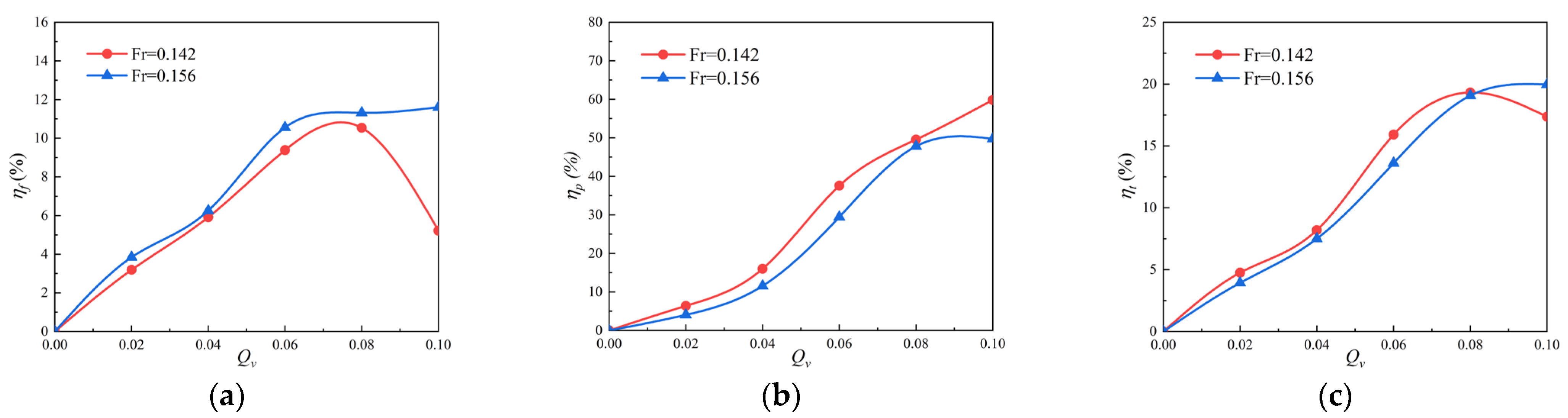
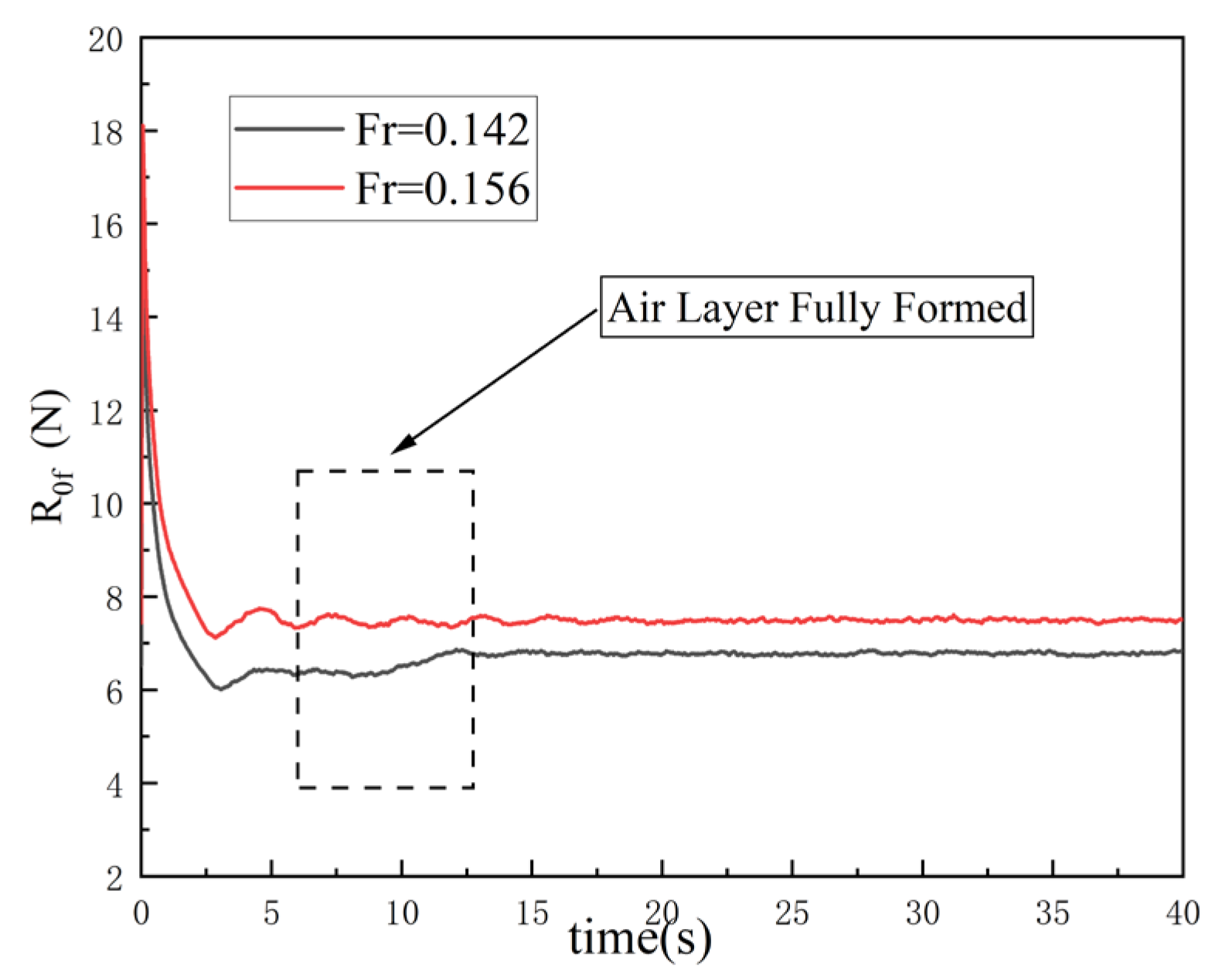
4.2. Drag Reduction at Different Speeds and Air Flow Rates
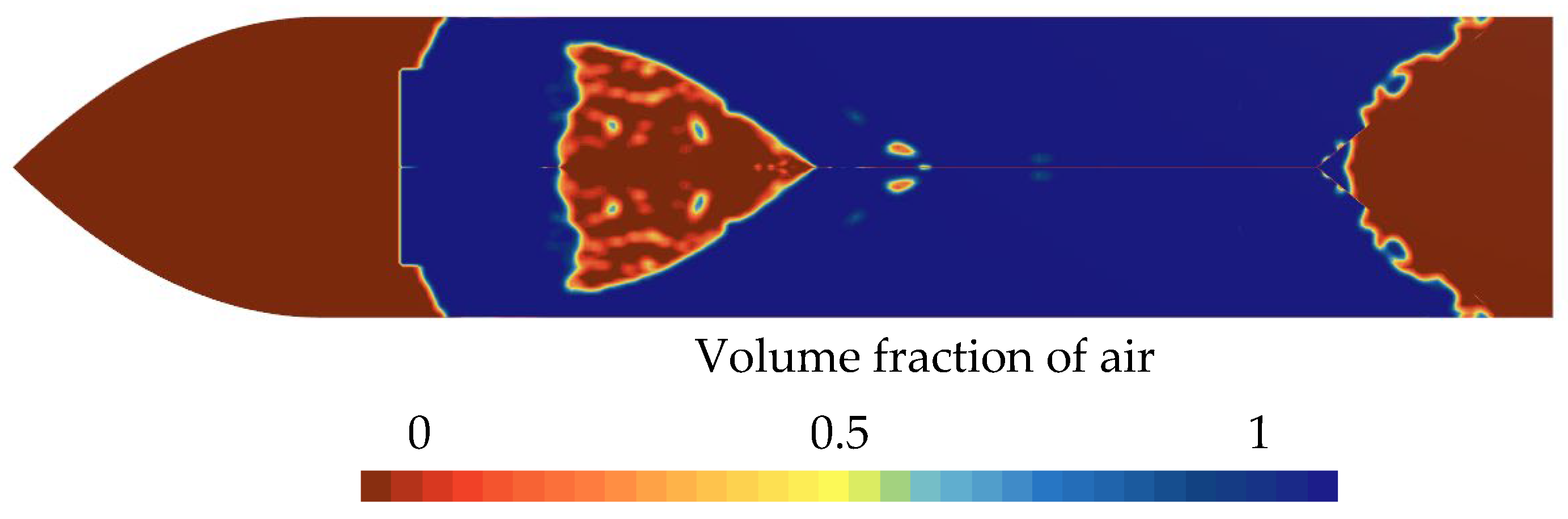
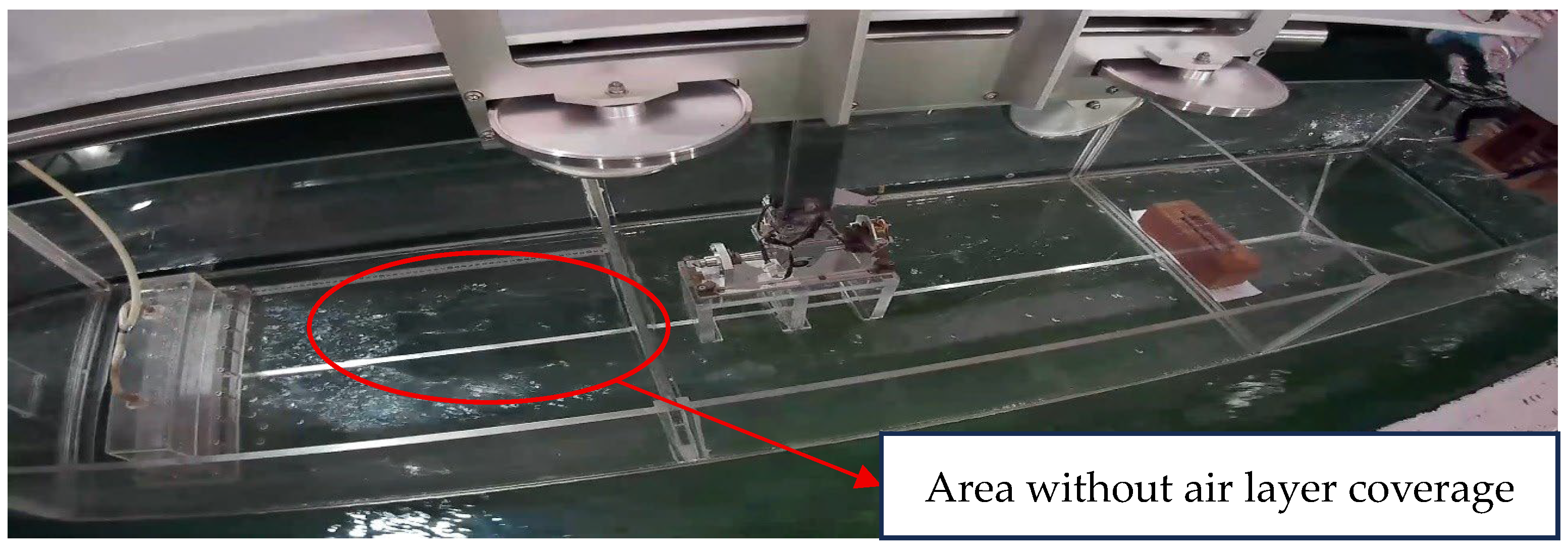
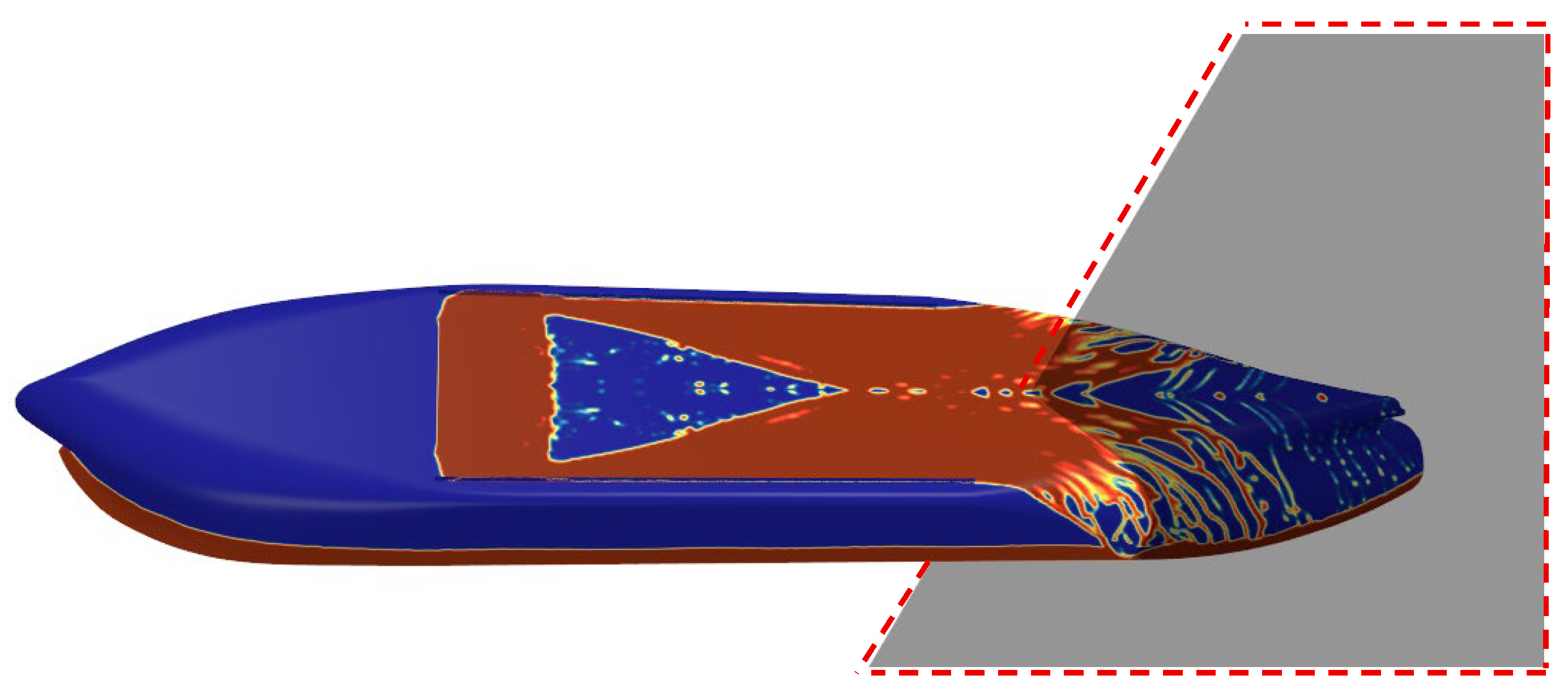
4.3. Mechanism Analysis of Air-Free Zone Formation
4.4. Mechanism of the Decrease in Frictional Reduction Rate for the Fr Number of 0.142
4.5. Mechanisms of the Reduction in Viscous Pressure Drag Reduction
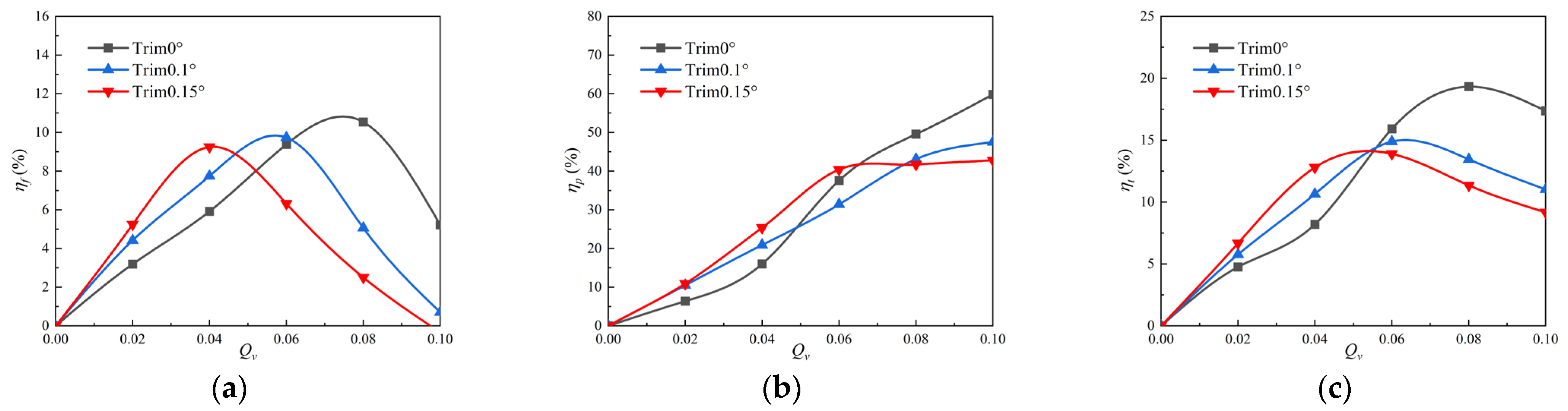
4.6. Effect of Trim Angle on Drag Reduction Rate
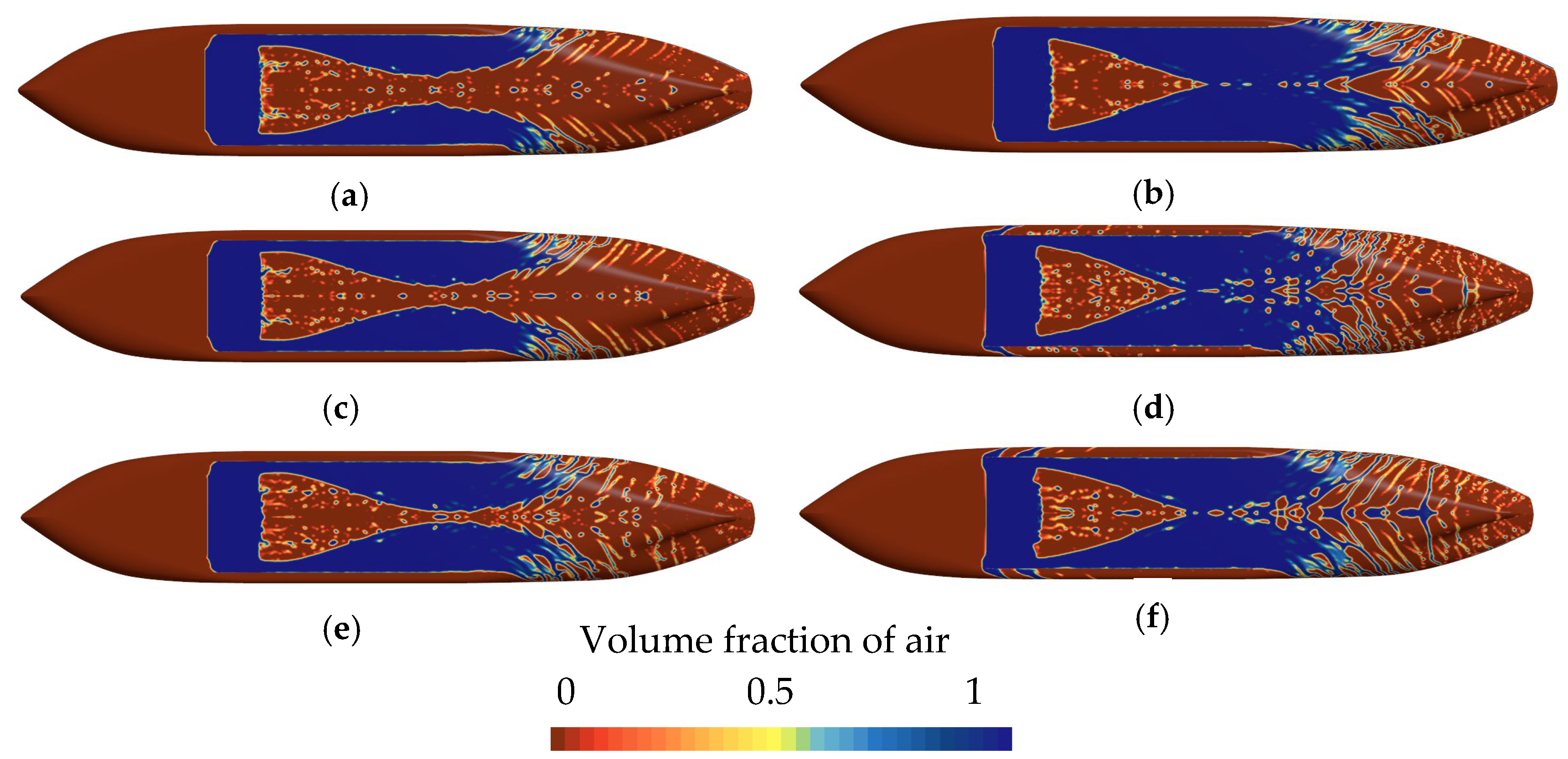
4.7. Effect of Injection Surface Configuration
5. Conclusions
- The computational model in this study comprises 1.48 million grids, employing the SST turbulence model and first-order discrete time formulation. Taking into account the free surface and surface tension, the morphology of the air layer under the hull and the variation in resistance can be accurately predicted based on the RANS equations and the VOF two-phase flow model. The simulation of 40 s of physical time required an actual computation time of 8 h, demonstrating high computational efficiency and result accuracy. The results indicate that the air layer exhibits varying degrees of drag reduction effects on resistance components such as frictional and pressure drag. In this paper, the maximum total drag reduction rate achieved for a KVLCC2 ship model equipped with baffles is up to 19.3%.
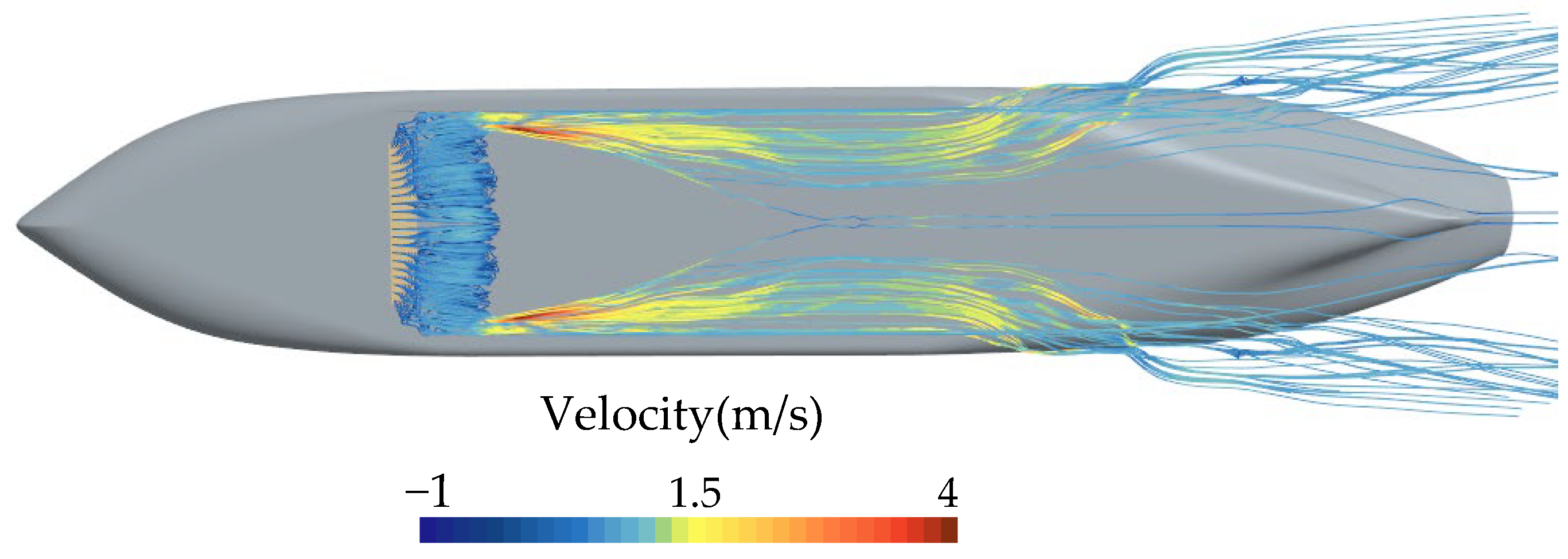
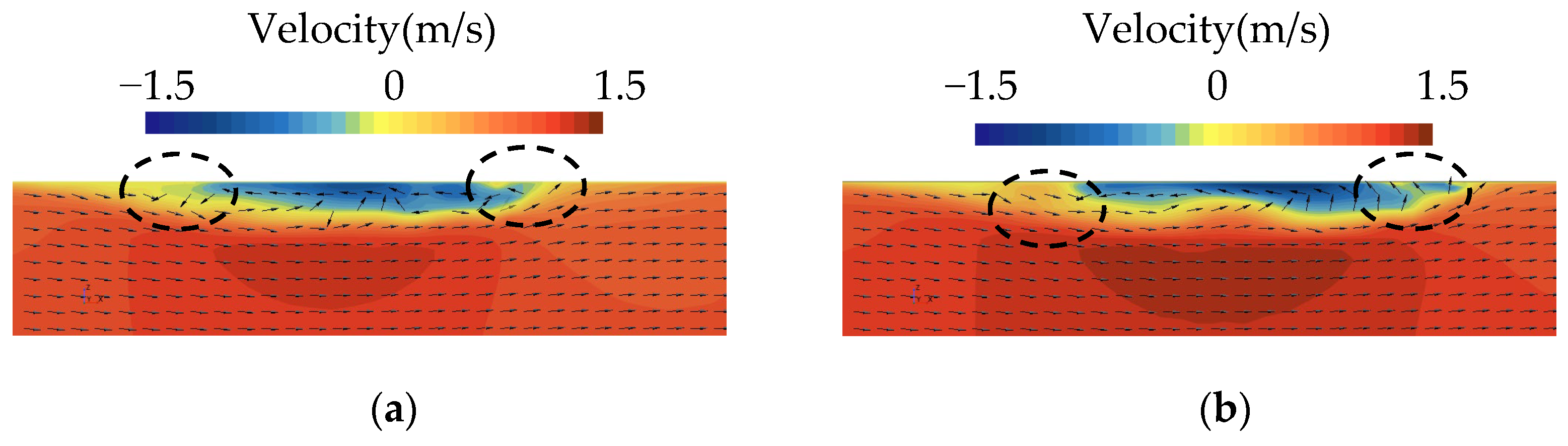
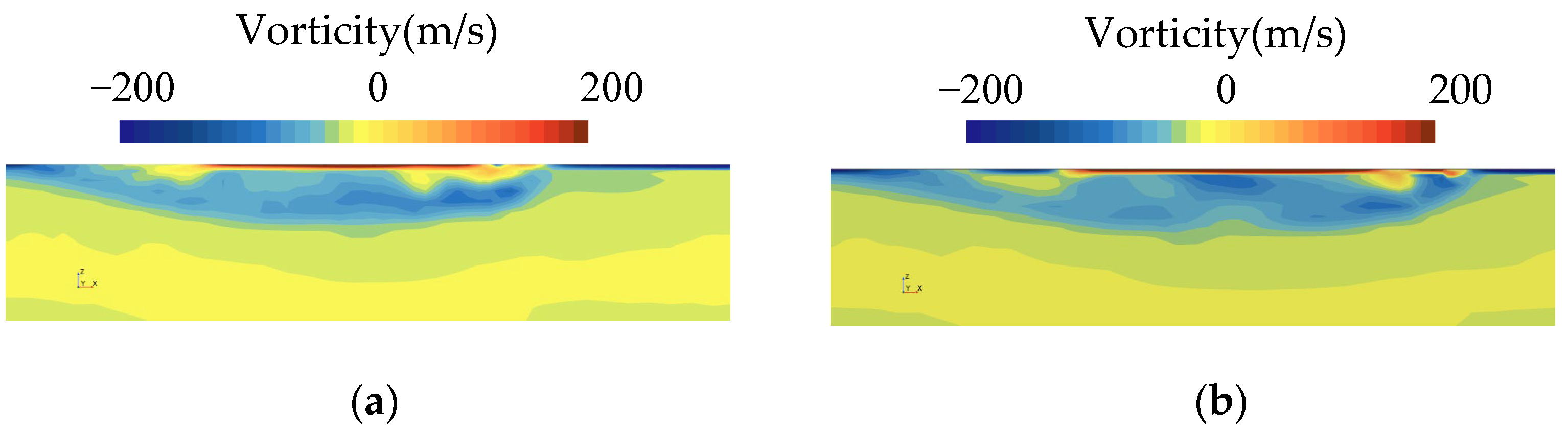
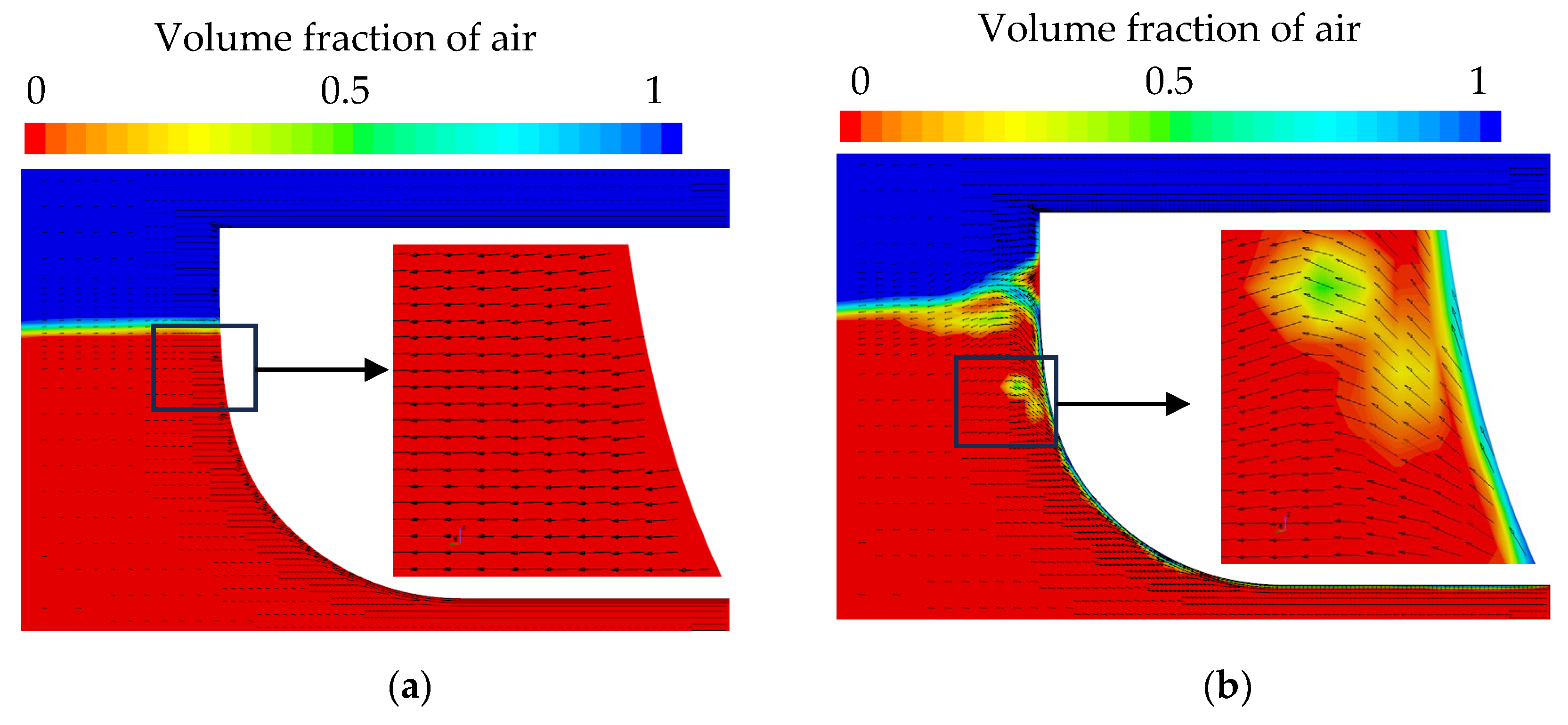
- Subjected to the combined effects of inflow velocity and jet injection velocity, the air downstream of the injection site develops a recirculating velocity vector and two counter-rotating vortices. This flow pattern causes the gas–liquid interface to contact the hull bottom, resulting in an air-free region.
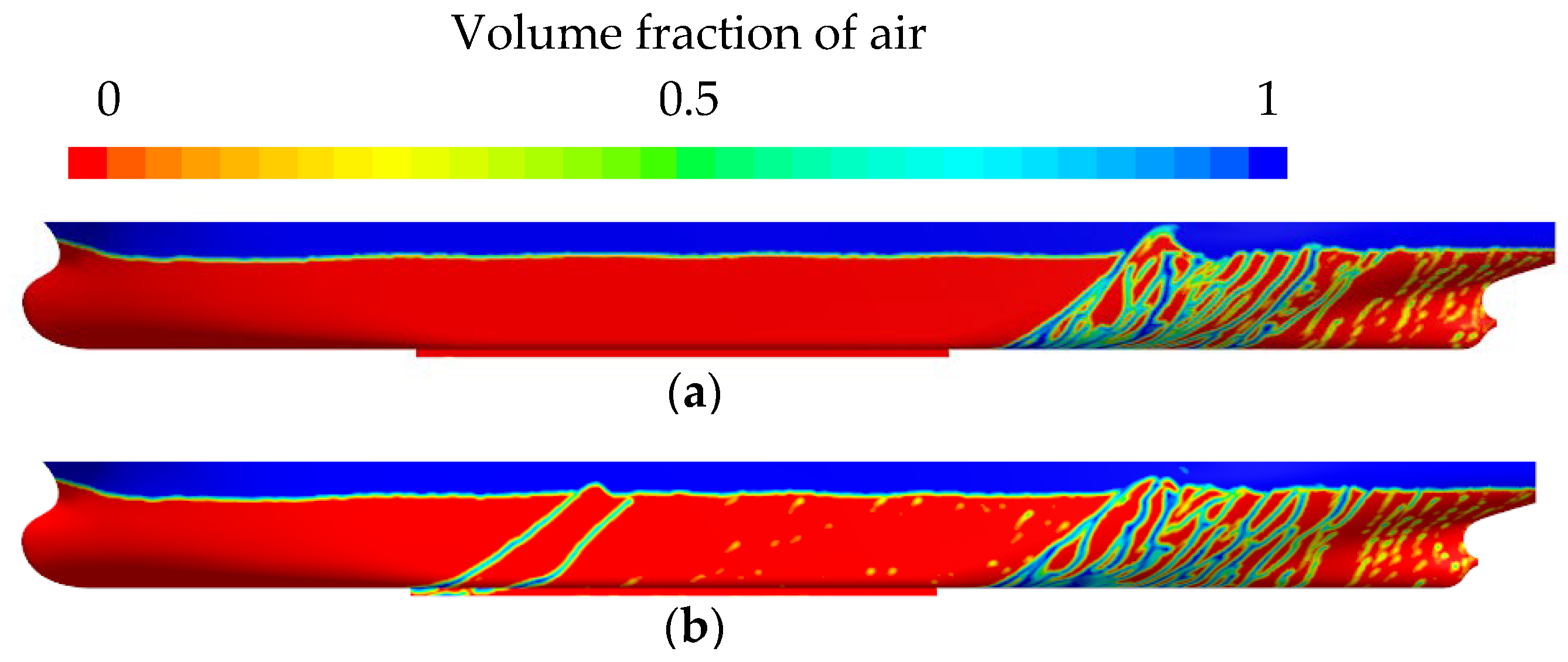
- The ship stern trim directly influences the effects of air layer drag reduction. At low airflow rates, the ship trim can expand the gas coverage area beneath the ship, enhancing the reduction in frictional drag and pressure drag. However, at high airflow rates, the trimmed ship is prone to gas overflow from the bow, thereby diminishing the drag reduction effects on both frictional drag and pressure drag.
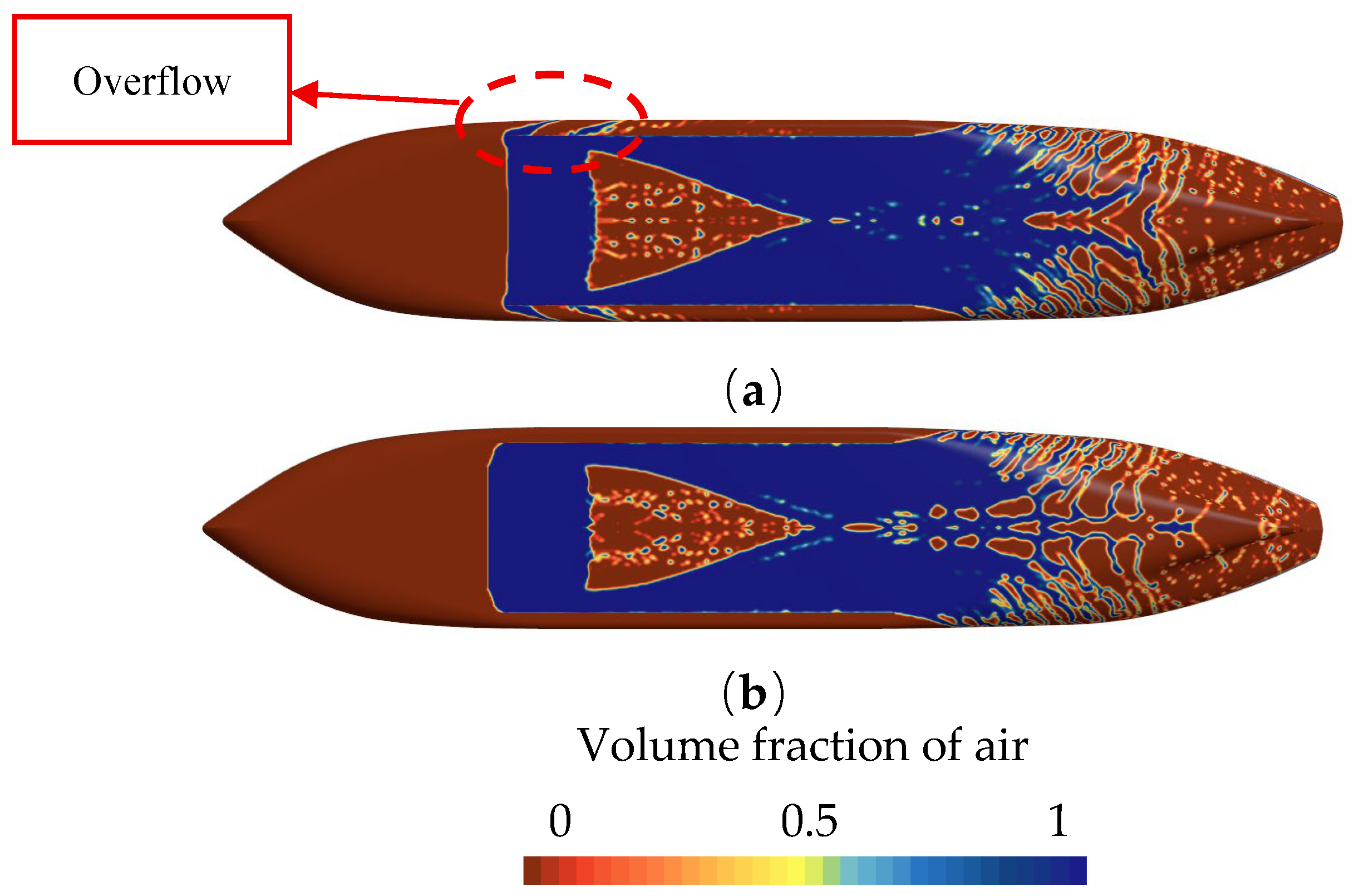
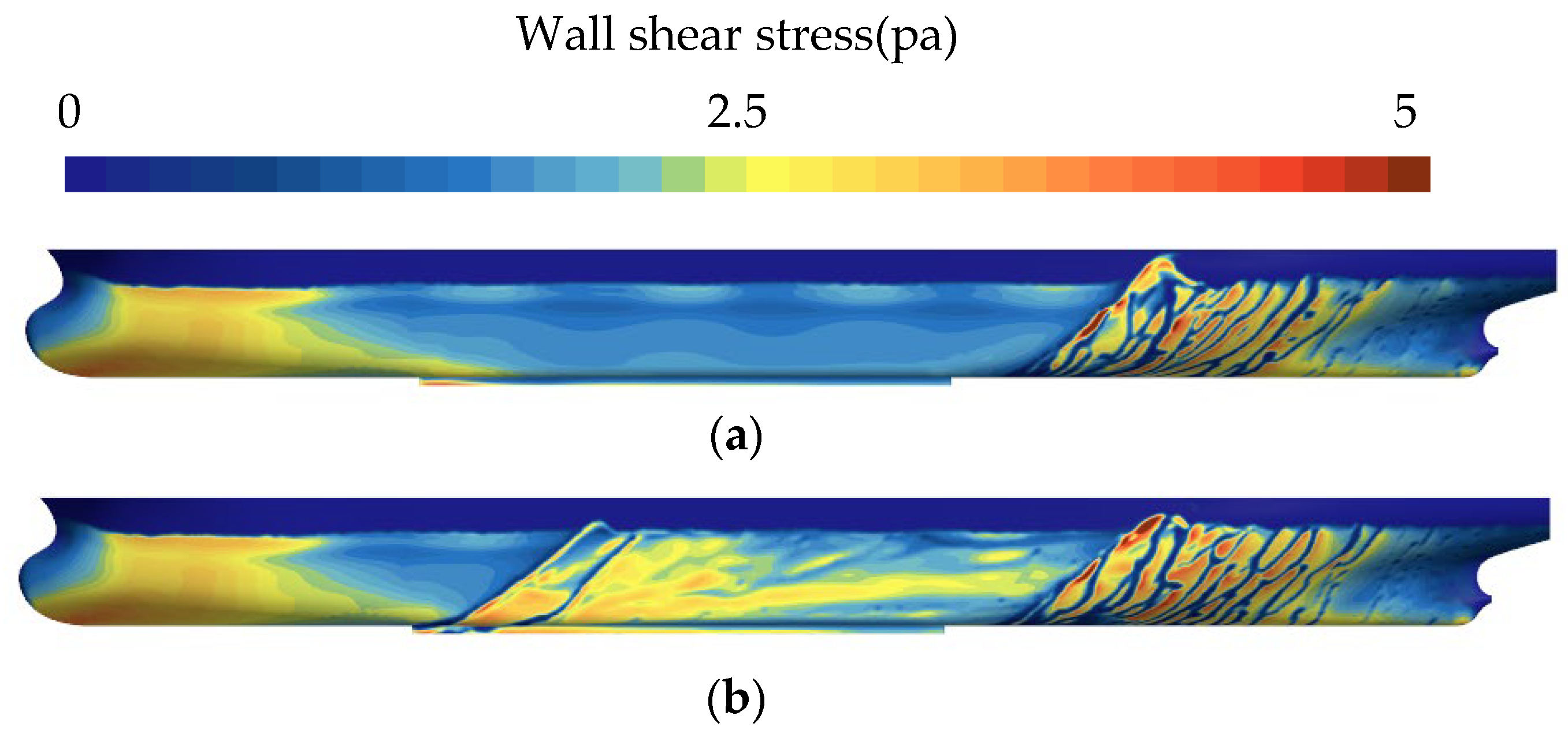
- The excessive air injection or ship stern trim can increase the air layer thickness, causing it to overflow the baffles. The escaping air changes the flow field along the hull sides and increases frictional stress on the hull-side surface. Preventing overflow of the bottom air layer is essential to maintain drag reduction effectiveness.
- The air layer at the stern can effectively reduce the viscous pressure drag. Due to buoyancy and surface tension, the air layer remains attached to the stern wall. The velocity vector is nearly parallel to the tangential direction of the wall surface. Therefore, the flow separation will be reduced, thereby reducing the viscous pressure resistance.
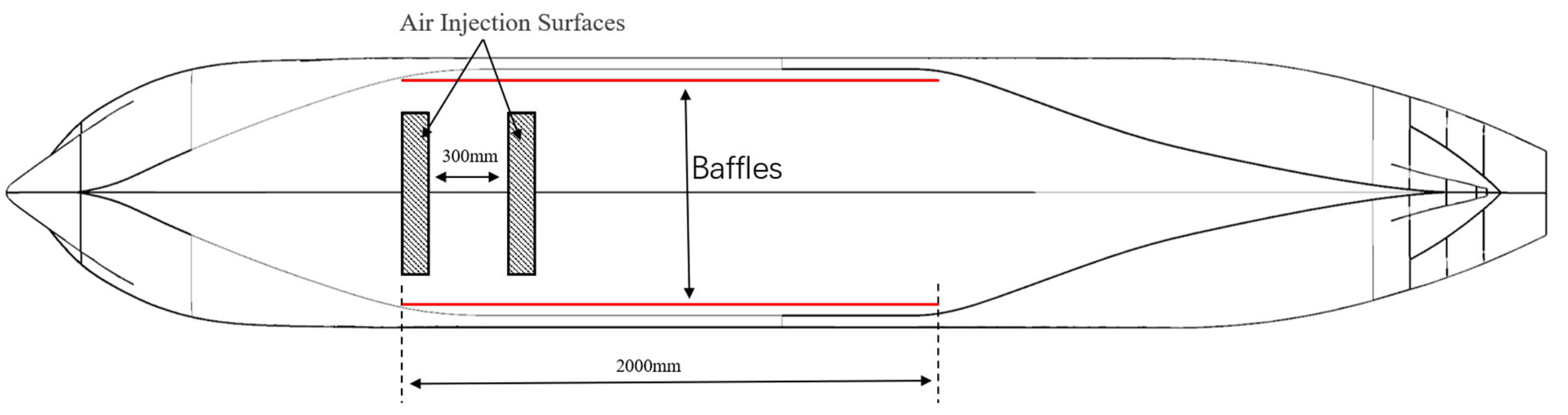
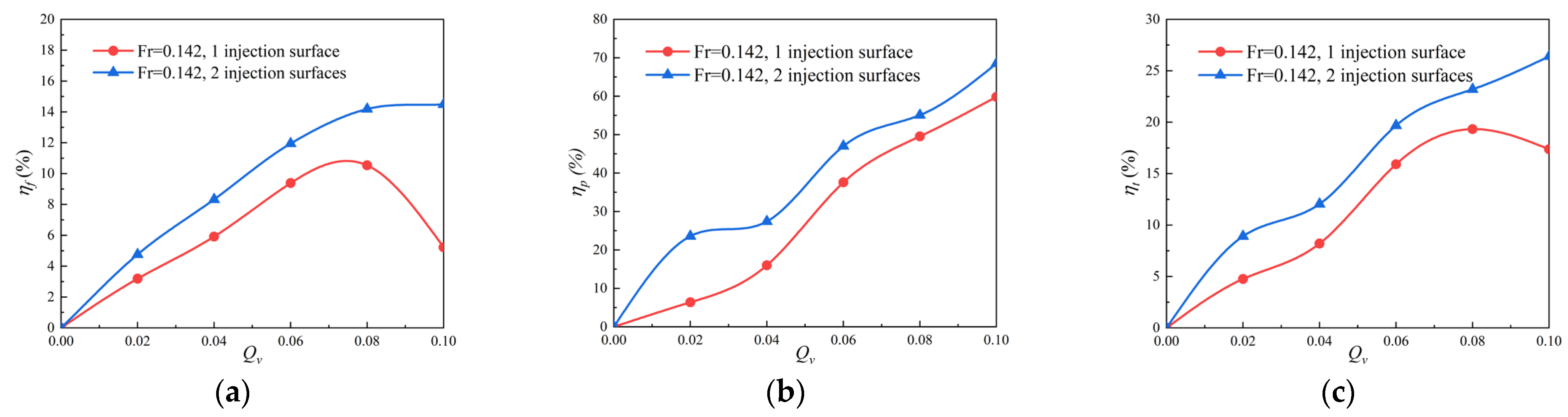
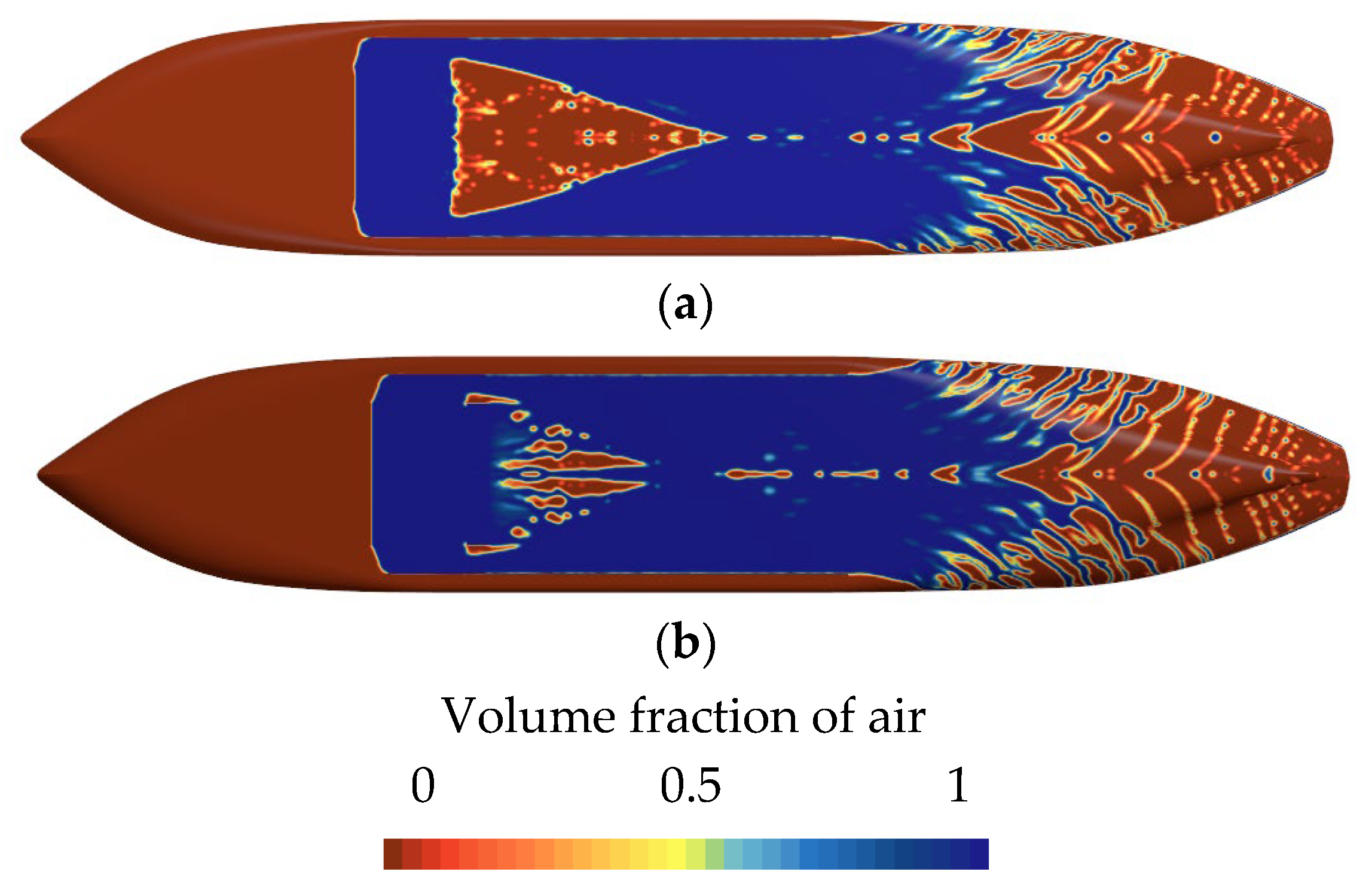
- Adopting the dual-injection-surface configuration effectively reduces the air-free zones, resulting in more uniform hull-bottom air layer coverage and a significant increase in drag reduction in frictional resistance and viscous pressure resistance. The appropriate injection surface configuration can effectively improve the performance of air layer drag reduction.
Author Contributions
Funding
Data Availability Statement
Conflicts of Interest
References
- Qin, S.J.; Ji, S.; Sun, S.; Wu, R.; Wu, D.Z. Current state and prospects on applications of ship drag reduction using air lubrication. Chin. J. Ship Res. 2023, 18, 1–10. [Google Scholar]
- Cai, J.Q. Ship Resistance Reduction by using Thin Layer of Air Film. Shipbuild. China 2000, 41, 11–15. [Google Scholar]
- Park, S.H.; Lee, I. Optimization of drag reduction effect of air lubrication for a tanker model. Int. J. Nav. Arch. Ocean Eng. 2018, 10, 427–438. [Google Scholar] [CrossRef]
- Mohamad, S.A.; Youssef, M.; Bennaya, M.; Elsherbiny, K. Experimental and Numerical Investigation of Air Layer Drag Re-duction on a Flat Plate. Alex. Eng. J. 2025, 121, 436–451. [Google Scholar] [CrossRef]
- Dong, W.C.; Guo, R.X.; Cheng, X.L.; Lu, Y.S. Experimental study on resistance reduction of planing craft by air injection. Shipbuild. China 2002, 43, 13–18. [Google Scholar]
- Mäkiharju, S.A.; Lee, I.-H.R.; Filip, G.P.; Maki, K.J.; Ceccio, S.L. The topology of gas jets injected beneath a surface and subject to liquid cross-flow. J. Fluid Mech. 2017, 818, 141–183. [Google Scholar] [CrossRef]
- Mäkiharju, S.; Ceccio, S. On multi-point gas injection to form an air layer for frictional drag reduction. Ocean Eng. 2018, 147, 206–214. [Google Scholar] [CrossRef]
- Huang, H.B.; He, S.L.; Gao, L.J.; Shi, X.Y.; Zhang, C.H.; Xue, Q.Y. Reduction of friction drag by gas injection in a high-Reynolds-number flat-plate turbulent boundary layer. Shipbuild. China 2018, 59, 1–15. [Google Scholar]
- Gao, L.J.; Chen, S.F.; Yun, Q.Q.; He, S.L.; Wang, L.Y.; Lu, F. Research on influence factors in air layer drag reduction technology. Shipbuild. China 2018, 59, 1–13. [Google Scholar]
- Mao, L.; Wu, R.; Liu, H.; Ji, S. Blowing out of Ship Bottom or Ship Sides-A Study on Drag Reduction of Air Film. J. Shanghaiship Shipp. Res. 2020, 43, 1–6. [Google Scholar]
- Kringel, C.; Simonsen, A.S.; Tziaros, F.; Bielicki, S.; Hærvig, J.; Papaioannou, G. Experimental Study of Air Lubrication with Fluidic Oscillators for Flat Plate Drag Reduction. Ocean Eng. 2025, 334, 121632. [Google Scholar] [CrossRef]
- Li, Q.Y.; Dong, W.C. Numerical analysis of resistance reduction by bubbly layer for deep-Veeship. J. Nav. Univ. Eng. 2011, 23, 31–35. [Google Scholar]
- An, H.; Liu, X.Q.; Zhang, H.Y.; Cui, Z.H. Numerical study on pressure drag reduction for a surface vessel with struts with the drag reduction mode of ventilated super cavitating combined with air layer. Ocean Eng. 2025, 324, 120727. [Google Scholar] [CrossRef]
- Zheng, X.; Zhang, Z.; Tu, G.; Xiong, C.; Wang, M.; Wang, S. On the Effects of Ventilation Rate and Froude Number on Air-Layer Drag Reduction over an Axisymmetric Underwater Vehicle. Int. J. Multiph. Flow 2026, 195, 105527. [Google Scholar] [CrossRef]
- Chen, Y.; Zou, X. Review of air layer and air cavity drag reduction on ships. Ship Eng. 2021, 43, 44–52. [Google Scholar]
- Hao, W. Numerical study of the effect of ship attitude on the perform of ship with air injection in bottom cavity. Ocean Eng. 2019, 186, 106119. [Google Scholar] [CrossRef]
- Wu, H.; Ou, Y.P. Numerical Study of Influence of Trim and Heel on Stability of Ship Bottom Air Layer. Ship Eng. 2015, 37, 21–25. [Google Scholar]
- Ye, Q.; Dong, W.C. Model experimental study on resistance reduction of a 95,000 DWT bulk carrier by air lubrication. J. Harbin Eng. Univ. 2015, 36, 68–72. [Google Scholar]
- Fang, H.Z.; Chen, Z.C.; Chen, C.; Sun, S.; Wang, X.Y.; Wu, D.Z. On the drag reduction and heeling stability of a heeled planing air cavity hull. Ocean Eng. 2023, 283, 115087. [Google Scholar] [CrossRef]
- Zhang, X.S.; Ji, X.Q.; Chen, L.Q.; Huang, H.B.; Hong, F.W. Numerical study on the wave pattern characteristic of air layer in cavity and the effects of multiple influence factors. J. Hydrodyn. 2023, 35, 923–941. [Google Scholar] [CrossRef]
- Dong, M.Y.; Tong, Z.; Che, L.Y.; Xing, L. Analysis of mutual interference between hull and propeller of air-layer drag reduction planning ship. Ship Eng. 2025, 47, 17–24, 82. [Google Scholar]
- Shao, X.; Zhang, J.; Cai, H.; Chen, P.; Liu, H.; Cao, L.; Wu, D. Study on the Characteristics of an Underwater Vehicle Pump-Jet Propeller under the Influence of Drag-Reduction Air. Ocean Eng. 2025, 328, 121071. [Google Scholar] [CrossRef]
- Ding, Z.Q.; Dai, Y.; Chen, Z.G.; Feng, Y.K.; Wu, Y.F. Model experimental research of the air injection drag reduction system without air maintenance devices for a 2600 DWT bulk carrier. Ocean Eng. 2025, 323, 120661. [Google Scholar] [CrossRef]
- Wu, H.; Dong, W.C.; Ou, Y.P. Experimental study for the influence of groove configuration on plate air layer drag reduction. J. Natl. Univ. Def. Technol. 2017, 39, 158–163. [Google Scholar]
- Madavan, N.K.; Deutsch, S.; Merkle, C.L. Reduction of turbulent skin friction by microbubbles. Phys. Fluids 1984, 27, 356–363. [Google Scholar] [CrossRef]
- Zhao, X.J.; Zong, Z. Experimental and numerical studies on the air-injection drag reduction of the ship model. Ocean Eng. 2022, 251, 111032. [Google Scholar] [CrossRef]
- Wu, H.; Dong, W.C.; Ou, Y.P. Experimental study of flow field characteristics and air distribution strategies on a flat plate with air injection. J. Harbin Eng. Univ. 2016, 37, 1220–1226. [Google Scholar]
- Ye, Q.; Ou, Y.P.; Xiang, G.; Chen, J.J. Numerical Study on the Influence of Water Depth on Air Layer Drag Reduction. Appl. Sci. 2024, 14, 431. [Google Scholar] [CrossRef]
- Chen, S.F.; Wang, X.; Gao, L.J.; Zhang, X.S.; Yan, Z.G.; Huang, H.B. Study on piping design and evaluation of air layer drag reduction system. Shipbuild. China 2025, 66, 198–208. [Google Scholar] [CrossRef]


| Parameters | Value | |
|---|---|---|
| Ship | Model | |
| scale | 1 | 58 |
| Lpp (m) | 320 | 5.5172 |
| Lwl (m) | 325.5 | 5.6121 |
| Bwl (m) | 58 | 1 |
| D (m) | 30 | 0.5172 |
| T (m) | 20.8 | 0.3586 |
| Displacement (m3) | 312,622 | 1.6023 |
| S w/o rudder (m2) | 27,194 | 8.0838 |
| KG(m) | 18.6 | 0.3207 |
| Case | Test Ship | KVLCC2 | ||||
|---|---|---|---|---|---|---|
| Number (Million) | Total Resistance (N) | Change Rate (%) | Number (Million) | Total Resistance (N) | Change Rate (%) | |
| EXP | - | 5.154 | 0 | - | - | - |
| Grid1 | 0.86 | 5.183 | 0.56 | 1.04 | 9.08 | 0 |
| Grid2 | 1.45 | 5.130 | −0.47 | 1.48 | 9.00 | −0.88 |
| Grid3 | 2.22 | 5.062 | −1.78 | 2.21 | 9.02 | −0.66 |
| Model | Total Resistance (N) | Total Resistance Rate (%) | Change Rate (%) |
|---|---|---|---|
| EFD | - | 0.4056 | - |
| KVLCC2 | 9.00 | 0.4072 | 0.39 |
| KVLCC2 (With Baffle) | 9.18 | 0.4136 | 1.98 |
| Fr | Qv | Trim (deg) | Number of Air Injection Surfaces |
|---|---|---|---|
| 0.142 | 0 0.02 0.04 0.06 0.08 0.10 | 0, 0.1, 0.15 | one, two |
| 0.156 | 0 0.02 0.04 0.06 0.08 0.10 | 0 | one |
| Velocity (m/s) | Total Drag (EFD) | Total Drag (CFD) | ||
|---|---|---|---|---|
| Qa = 0 m3/h | Qa = 8 m3/h | Qa = 0 m3/h | Qa = 8 m3/h | |
| 0.651 | 2.86 N | 2.65 N | 2.69 N | 2.50 N |
| 0.868 | 5.09 N | 4.33 N | 5.10 N | 4.35 N |
| 1.084 | 8.23 N | 7.00 N | 8.39 N | 6.98 N |
| Qv | Fr = 0.142 | Fr = 0.156 | ||||
| Rf (N) | Rp (N) | Rt (N) | Rf (N) | Rp (N) | Rt (N) | |
| 0 | 7.15 | 2.03 | 9.18 | 8.48 | 2.36 | 10.85 |
| 0.02 | 6.92 | 1.89 | 8.81 | 8.16 | 2.26 | 10.42 |
| 0.04 | 6.73 | 1.70 | 8.43 | 7.95 | 2.09 | 10.04 |
| 0.06 | 6.48 | 1.26 | 7.72 | 7.59 | 1.67 | 9.37 |
| 0.08 | 6.40 | 1.02 | 7.41 | 7.52 | 1.24 | 8.78 |
| 0.10 | 6.78 | 0.81 | 7.59 | 7.49 | 1.19 | 8.68 |
Disclaimer/Publisher’s Note: The statements, opinions and data contained in all publications are solely those of the individual author(s) and contributor(s) and not of MDPI and/or the editor(s). MDPI and/or the editor(s) disclaim responsibility for any injury to people or property resulting from any ideas, methods, instructions or products referred to in the content. |
© 2025 by the authors. Licensee MDPI, Basel, Switzerland. This article is an open access article distributed under the terms and conditions of the Creative Commons Attribution (CC BY) license (https://creativecommons.org/licenses/by/4.0/).
Share and Cite
Zhao, X.; Hao, Y.; Zhang, Q. Numerical Analysis of Air-Injection Drag Reduction for the KVLCC2 Hull Using the VOF Interface-Capturing Method. J. Mar. Sci. Eng. 2025, 13, 2253. https://doi.org/10.3390/jmse13122253
Zhao X, Hao Y, Zhang Q. Numerical Analysis of Air-Injection Drag Reduction for the KVLCC2 Hull Using the VOF Interface-Capturing Method. Journal of Marine Science and Engineering. 2025; 13(12):2253. https://doi.org/10.3390/jmse13122253
Chicago/Turabian StyleZhao, Xiaojie, Yanping Hao, and Qi Zhang. 2025. "Numerical Analysis of Air-Injection Drag Reduction for the KVLCC2 Hull Using the VOF Interface-Capturing Method" Journal of Marine Science and Engineering 13, no. 12: 2253. https://doi.org/10.3390/jmse13122253
APA StyleZhao, X., Hao, Y., & Zhang, Q. (2025). Numerical Analysis of Air-Injection Drag Reduction for the KVLCC2 Hull Using the VOF Interface-Capturing Method. Journal of Marine Science and Engineering, 13(12), 2253. https://doi.org/10.3390/jmse13122253