Article

Experimental Study on Short-Term Fracture Conductivity Simulation of Hydraulic Fractures in Marine Combustible Ice Reservoirs

1
Technology Service Company, Sinopec Huabei Oilfield Service Corporation, Zhengzhou 450006, China
2
State Key Laboratory of Deep Oil and Gas, China University of Petroleum (East China), Qingdao 266580, China
3
School of Petroleum Engineering, China University of Petroleum (East China), Qingdao 266580, China
4
Steam Injection Technical Service Center of Shengli Oilfield Branch Company, Dongying 257001, China
5
College of Pipeline and Civil Engineering, China University of Petroleum (East China), Qingdao 266580, China
*
Author to whom correspondence should be addressed.
J. Mar. Sci. Eng. 2026, 14(2), 130; https://doi.org/10.3390/jmse14020130
Submission received: 9 December 2025 / Revised: 5 January 2026 / Accepted: 6 January 2026 / Published: 8 January 2026
(This article belongs to the Section Marine Energy)

Abstract

Marine combustible ice, as a potential clean energy resource, has attracted widespread attention in recent years. To enhance its production efficiency, hydraulic fracturing is considered a promising technique, in which fracture conductivity is one of the key parameters for evaluating stimulation performance. However, experimental investigations on low-strength sediments remain limited, and the evolution of fracture conductivity in hydrate-bearing sediments has not been systematically understood. Since ice and combustible ice share similar characteristics in terms of crystal structure, spectral features, mechanical behavior, and thermal expansion, and ice remains stable under low-temperature conditions, ice was employed as an experimental analog for combustible ice. This study systematically investigated the effects of proppant particle size, proppant concentration, and ice saturation on the short-term fracture conductivity. The results indicate that fracture conductivity increases with higher ice saturation and sand concentration. Larger proppant particles exhibit higher initial conductivity but experience greater conductivity loss. A multi-factor prediction model for the short-term fracture conductivity of fractured marine combustible ice reservoirs was established. The effects of properties of rock plates and sanding induced fracture clogging on conductivity are further discussed. These findings provide an experimental basis and theoretical reference for understanding the fracture conductivity characteristics and optimizing fracturing operations in marine combustible ice reservoirs.

1. Introduction

Marine combustible ice (natural gas hydrate) is a solid clathrate compound formed by methane and other light hydrocarbon gases under low-temperature and high-pressure conditions. It is widely distributed in permafrost regions and marine sediments, and is characterized by abundant reserves, high energy density, and large-scale resource potential [1]. The estimated global energy equivalent of natural gas hydrates is approximately 80 billion tons of crude oil, making them one of the most promising clean energy resources for future energy supply [2]. However, the low strength, high porosity, weak cementation, and strong stress sensitivity of hydrate-bearing sediments pose significant challenges to efficient and safe exploitation. Hydraulic fracturing has been widely applied in conventional oil and gas reservoirs to enhance permeability and improve production efficiency, and it is also considered a potential stimulation technique for marine combustible ice reservoirs [3,4,5,6,7]. For hydrate-bearing sediments, however, the effectiveness of hydraulic fracturing highly dependent on the ability of fractures to maintain conductivity under closure stress. Fracture conductivity is therefore a key parameter for evaluating the stimulation performance and long-term effectiveness of hydraulic fracturing, as it directly reflects the capacity of proppants to preserve fracture permeability under formation conditions. The magnitude and stability of fracture conductivity largely determine the sustainability of production, and the overall success of stimulation operations.
Over the past decades, numerous short-term conductivity experiments and theoretical studies have been conducted worldwide, forming a systematic understanding framework. Early work by Raghavan et al. [8] analyzed transient flow behavior within fractures using infinite- and uniform-conductivity models and identified three flow stages. Walsh [9] emphasized the importance of fracture deformation and proposed a cavity model in which rough fractures were represented as smooth parallel plates containing cylindrical proppant particles. With advances in experimental conditions and measurement techniques, research has gradually shifted toward exploring the evolution of fracture conductivity under multifactor conditions.
Fracture conductivity, as a key factor controlling fracturing efficiency, has been demonstrated to depend on multiple variables, such as formation pressure, proppant concentration, and proppant properties [10,11,12]. Tian et al. [13] systematically investigated the effects and mechanisms of proppant size, closure stress, and fracture surface characteristics through orthogonal experiments and conductivity tests. Yan et al. [14] examined post-fracturing conductivity variations in tight reservoirs. Wen et al. [15] employed a conductivity evaluation system to study the impacts of proppant type and concentration on embedment and fracture conductivity, showing that proppant embedment significantly deteriorates conductivity. Gupta et al. [16] further explored the effects of proppant concentration, size, and volcanic ash on fracture conductivity, identifying various damage mechanisms such as proppant crushing, embedment, and diagenesis under simulated reservoir conditions. Guiterrez et al. [17] experimentally investigated the conductivity behavior of shear-slipping fractures, while Reece et al. [18] used a triaxial testing system to measure shale fracture conductivity before and after slip events. To minimize artificial packing effects, Richard et al. [19] applied vibration to the proppant pack, achieving a denser particle arrangement.
Fracture conductivity is also affected by many other factors, including flowback rate, embedment, proppant breakage, and shape [20,21,22,23,24,25], most of which are formed during the early stage of fracturing. Many studies have focused on conductivity reduction caused by particle migration into fractures, such as clay minerals, which lead to long-term blockage and permeability loss [26,27]. However, few studies have examined clogging within proppant-filled fractures. Gidley et al. [28] concluded that at low flow rates, crushed proppant fines have little impact on permeability, while at higher flow rates, migrating particles can clog the proppant pack and reduce conductivity.
In addition, fracture surface characteristics—such as morphology, roughness, bedding, and surface texture—also have significant effects on conductivity. Zhang et al. [29] reproduced natural shale fracture morphology by preparing rock plates containing in situ fractures and cutting them along the natural fracture direction for testing. Develi et al. [30] developed transparent rough-fracture models simulating realistic fracture geometries to study conductivity. He et al. [31] used high-strength cement and 3D printing to fabricate reusable reservoir plates with specific surface morphologies (uniform, random, or stepped). Liu et al. [32] investigated the influence of bedding characteristics on the propped fracture conductivity of shale samples.
However, most existing studies focus on conventional oil, gas, and tight reservoirs, while research on fracture conductivity in marine combustible ice reservoirs remains limited and is still in its infancy. Li et al. [33] investigated the combined effects of proppant size, concentration, and hydrate saturation on fracture conductivity in combustible ice-bearing sediments, developing a multi-factor empirical model for predicting conductivity evolution. Li et al. [34] further examined the coupled effects of closure stress, hydrate saturation, and dissociation modes, revealing the dynamic damage mechanisms of fracture conductivity during hydrate dissociation.
Building upon these studies, this work further explores the influence of proppant size, proppant concentration, ice saturation, and sanding clogging on fracture conductivity. A fracture conductivity prediction model for combustible ice reservoirs is established to quantitatively describe the coupling relationships among the controlling factors, effectively reflecting the evolution of fracture flow channels under multifactor interactions.

2. Experimental Materials and Methods

2.1. Experiment System of Fracture Conductivity for Combustible Ice Reservoirs

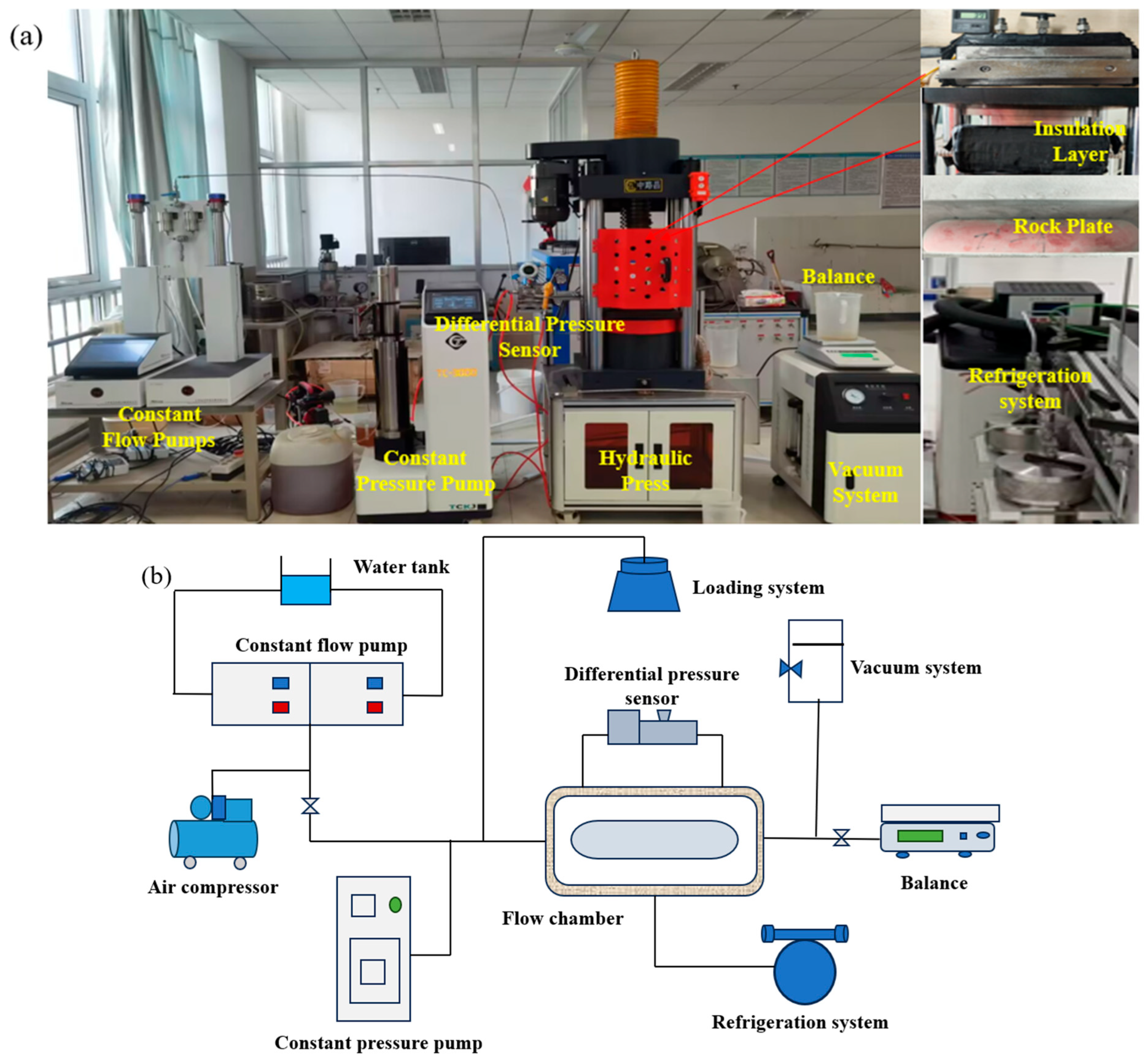
The experimental apparatus (developed by Jiangsu Tuochuang Scientific Research Instruments Co., Ltd., Nantong, China) for evaluating the fracture conductivity of hydraulic fractures in combustible ice reservoirs is shown in Figure 1a. The experiment setup consists of an API conductivity cell (encased with an insulation layer to maintain low temperature), a pressure loading system, a displacement monitoring system, a data acquisition system, a vacuum system, and a low-temperature control system. The pressure loading system includes a constant-pressure pump and a hydraulic press; the data acquisition system comprises a differential pressure sensor, a displacement sensor, and an electronic balance; the vacuum system contains a vacuum pump; and the low-temperature control system consists of a low-temperature circulating refrigerator.
Fracture conductivity is the product of fracture width and the permeability of the proppant-packed layer. The fracture conductivity of the proppant pack under Darcy flow conditions can be calculated using Equation (1), as shown below:
k W f = μ Q L 99.998 Δ p w
where kWf is the fracture conductivity of the proppant-packed layer (μm2·cm); μ is the fluid viscosity at the test temperature (cP); Q is the flow rate (cm3/min); L is the distance between the pressure ports (cm); ω is the width of the conductivity cell (cm); and Δp is the pressure difference (kPa).
By substituting the relevant dimensions of the API conductivity cell into the above calculation formula, where the width of the conductivity cell is 3.81 cm and the distance between the pressure ports (L) is 12.7 cm, the simplified equation for calculating the proppant fracture conductivity under Darcy flow conditions can be expressed as
k W f = 5.555 μ Q Δ p
where kWf is the fracture conductivity of the proppant-packed layer (μm2·cm); μ is the fluid viscosity at the test temperature (cP); Q is the flow rate (cm3/min); and Δp is the pressure difference (kPa).

2.2. Preparation Method of Combustible Ice Reservoir Rock Plates

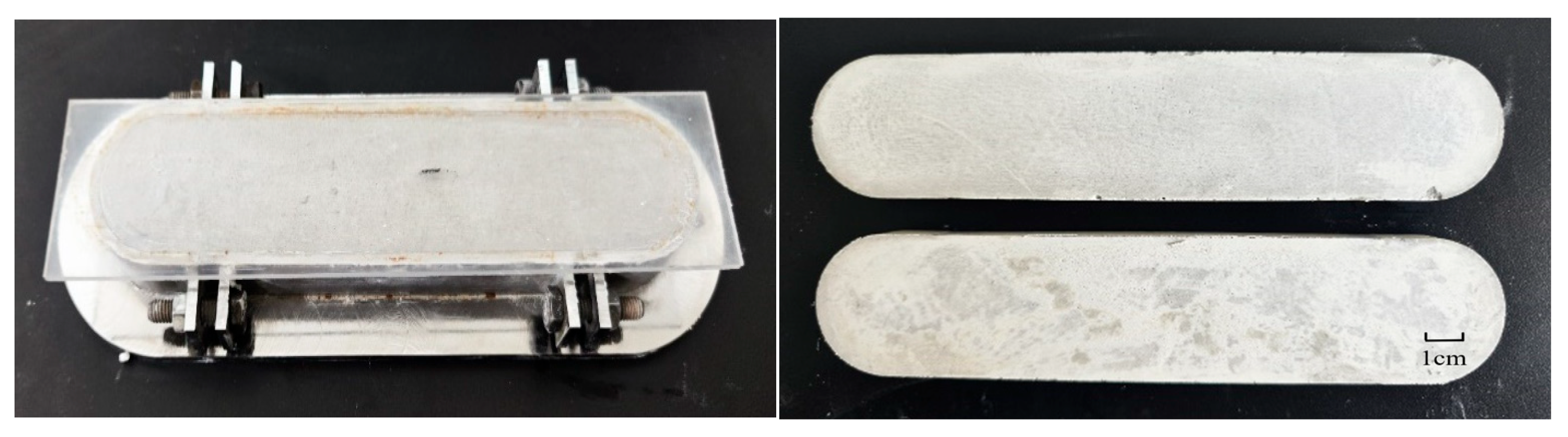
Based on the mineral composition of the combustible ice reservoir in the Shenhu area of the South China Sea, a corresponding simulation formulation was designed [35]. Heavy calcium carbonate powder (800 mesh), quartz sand, and illite were selected as the basic framework materials for preparing the reservoir rock plates. By adjusting the proportions of cement and deionized water, the final simulation formulation for the marine combustible ice reservoir was determined as follows: the mass ratio of heavy calcium carbonate powder, quartz sand, and illite powder was 36.7:33.3:30, the cement content was 16% of the total mixture mass, and the deionized water content was 33% of the total mass. After proportional mixing, cement and deionized water were added and thoroughly stirred. The mixture was then poured into molds, shaped, and cured to form rock plates, as shown in Figure 2.
The scale of prepared rock plates (length × width × thickness) are measured as 177.7 mm × 38 mm × 12 mm, which fits the API standard conductivity cell. To simulate the occurrence state of marine combustible ice, regular ice was selected as a substitute material. Ice exhibits high similarity to methane hydrate in terms of density, elastic modulus, mechanical response, and crystal structure, and it also offers advantages such as controllable experimental conditions, low cost, and high safety [36,37].
The ice saturation in the samples was controlled using a quantitative water injection method. The amount of injected water was calculated using Equation (3).
m w = 0.92 ρ w ϕ V S
where mw is the mass of injected water (g); ϕ is the porosity of the rock matrix; Vf is the apparent volume of the rock matrix (cm3); S is the preset saturation (%); and ρw is the density of water (kg/m3).
After measuring the required amount of water, deionized water was evenly applied to the surface of the rock plate, allowing it to infiltrate along the plate surface naturally and uniformly. The plate was then frozen at −5 °C for 5–6 h to obtain the saturated ice–rock plate.
To verify the actual ice saturation, two independent methods were employed, including the mass method and the porosity method, according to Shen et al. [35]. Specifically, the mass method determines ice saturation based on the mass difference between the ice-saturated sample and the dry sample, while the porosity method estimates ice saturation by comparing the pore volume before and after ice saturation. Overall, the results obtained from both methods show good agreement with the predicted values, while the mass-based method (adopted in this study) demonstrates higher reliability. Although the porosity-based method accounts for the effect of low-temperature freezing on pore volume, gas porosity measurements are fundamentally based on Boyle’s law under isothermal conditions. Freezing of the core may disturb the gas temperature in the measurement chamber, leading to deviations from ideal isothermal behavior and reduced measurement accuracy. Consequently, the uncertainty of ice saturation determined by the porosity method is slightly higher than that of the mass method.
Throughout the entire experiment, a low-temperature circulating refrigeration system combined with a thermal insulation jacket was used to continuously control the temperature of the conductivity cell, maintaining it at approximately −5 °C. Under this temperature condition, the melting of ice occurs relatively slowly, which can be neglected for “short-term” conductivity evaluation.

2.3. Optimization of Closure Pressure Range

Marine combustible ice reservoirs are typically composed of loosely cemented muddy siltstones with low compaction, high porosity, and weak cementation. Within the conventional closure pressure range (6.9–69 MPa) commonly adopted in proppant conductivity tests (SY/T 6302-2019) [38], hydrate-reservoir-simulated rock plates are prone to mechanical failure, which may result in deviations in fracture conductivity measurements. Therefore, it is necessary to determine a reasonable range of closure pressure suitable for short-term fracture conductivity testing of combustible ice reservoirs by considering both the reservoir characteristics and the mechanical properties of the artificial rock plates.

2.3.1. Compression Deformation Experiment

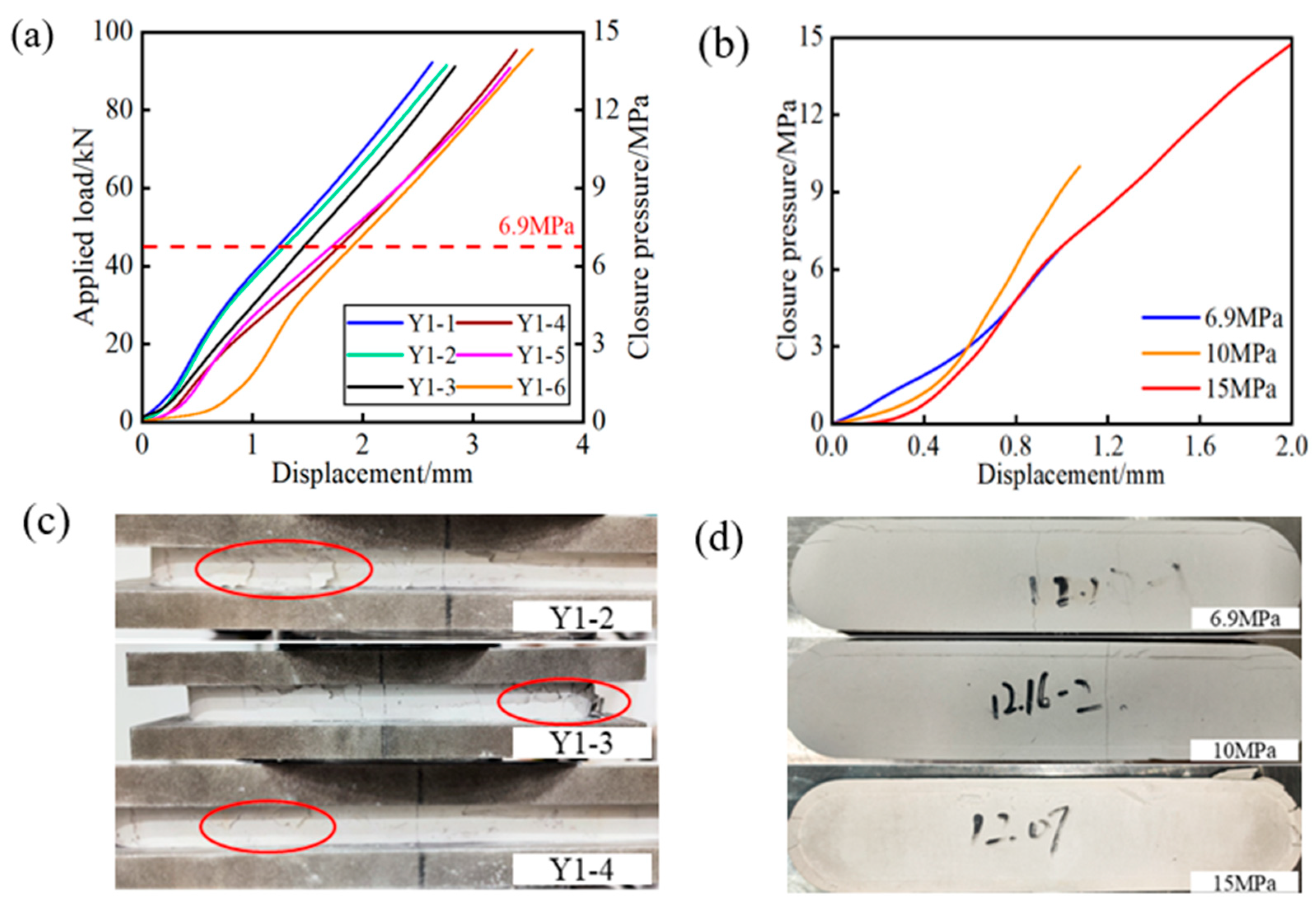
Compression deformation tests were conducted on the rock plates under uniaxial and conductivity cell confinement conditions, as shown in Figure 3. The results indicate that as the closure pressure approaches 6.9 MPa, the curve exhibits an approximately linear trend, suggesting that the rock plates remain in a continuous compaction state and experience significant structural failure. Under the conductivity cell conditions, the displacement–load curves coincide within the 4–7 MPa range, indicating that this interval represents the critical closure pressure range for the failure of the rock plate framework.

2.3.2. Microstructural Characterization of Rock Plates at Different Closure Pressures

The microstructural evolution of the simulated combustible ice sediment rock plates under compression was analyzed using nuclear magnetic resonance (NMR), mercury intrusion porosimetry (MIP), and computed tomography (CT) scanning. These analyses provide a basis for determining a reasonable closure pressure range for fracture conductivity testing.
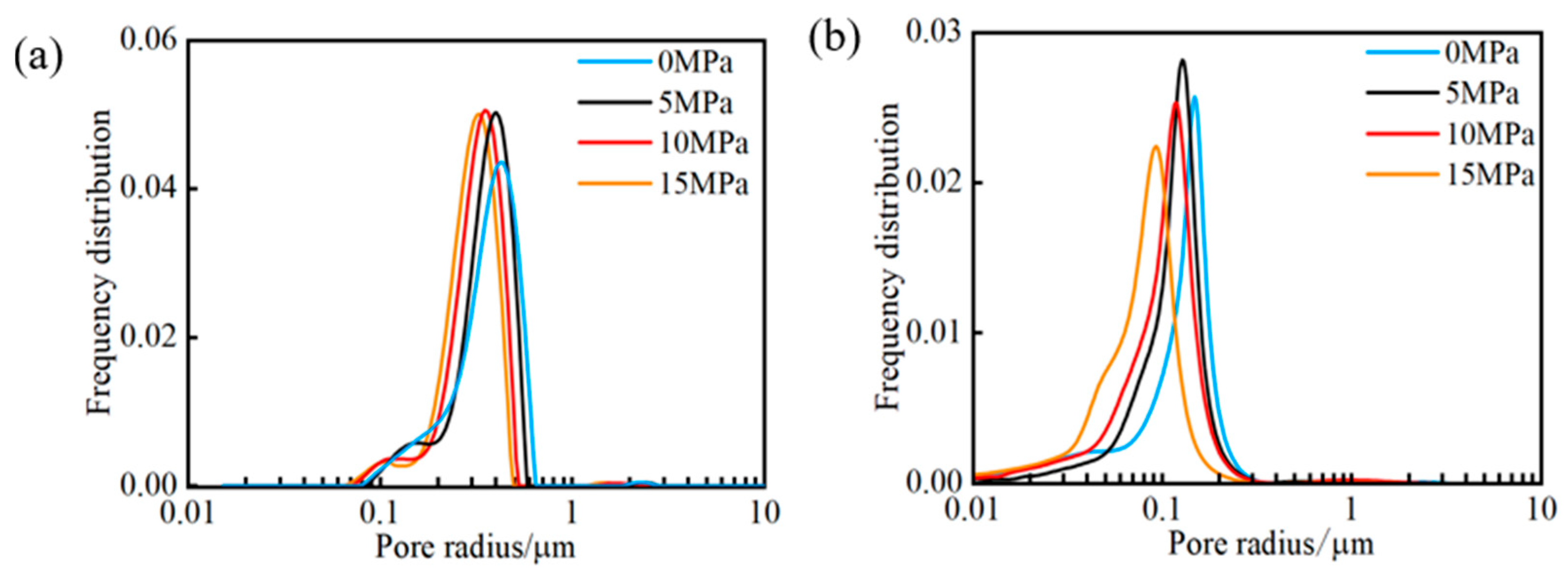
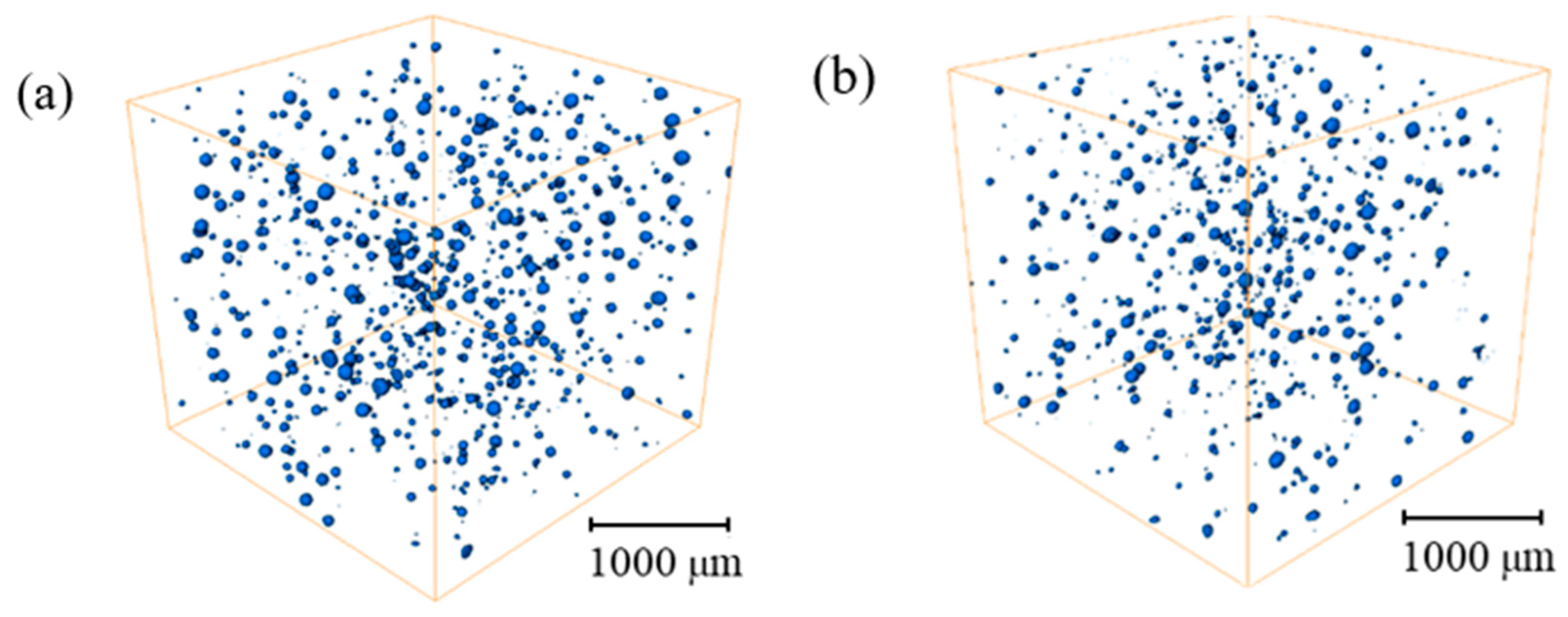
The rock plates were first loaded to different closure pressures in the API conductivity cell. They were then removed, and a cylindrical core sample with a diameter of 25 mm was cut from the center of each plate using quartz-wire cutting. NMR, MIP, and CT tests were subsequently performed on the core samples. Figure 4a shows the pore radius distribution converted from the NMR T2 spectrum, while Figure 4b presents the pore radius distribution curve of the simulated combustible ice sediment rock core obtained from the mercury intrusion porosimetry (MIP) experiment.
According to the pore distribution curves, at closure pressures of 5–10 MPa, the samples exhibit higher and more uniform pore radius distribution frequencies. Compared with the 0 MPa condition, the samples show less pore deformation, indicating that the pore structure is relatively stable within this pressure range. When the closure pressure increases to 15 MPa, the average pore radius decreases significantly, and the distribution frequency drops sharply, suggesting that the rock core undergoes severe pore collapse and a substantial loss of supporting capacity. The mercury intrusion porosimetry results further reveal that when the closure pressure reaches 5 MPa, the porosity of the rock core decreases noticeably and tends to stabilize at 15 MPa, indicating that the pore structure has been compacted to a relatively stable state. The CT imaging results are consistent with these findings. As shown in Figure 5, the number of large pores decreases markedly while that of small pores increases at 15 MPa, further confirming that high closure pressure causes significant compression and damage to the pore network structure.

2.3.3. Exploratory Tests According to Industry Standard

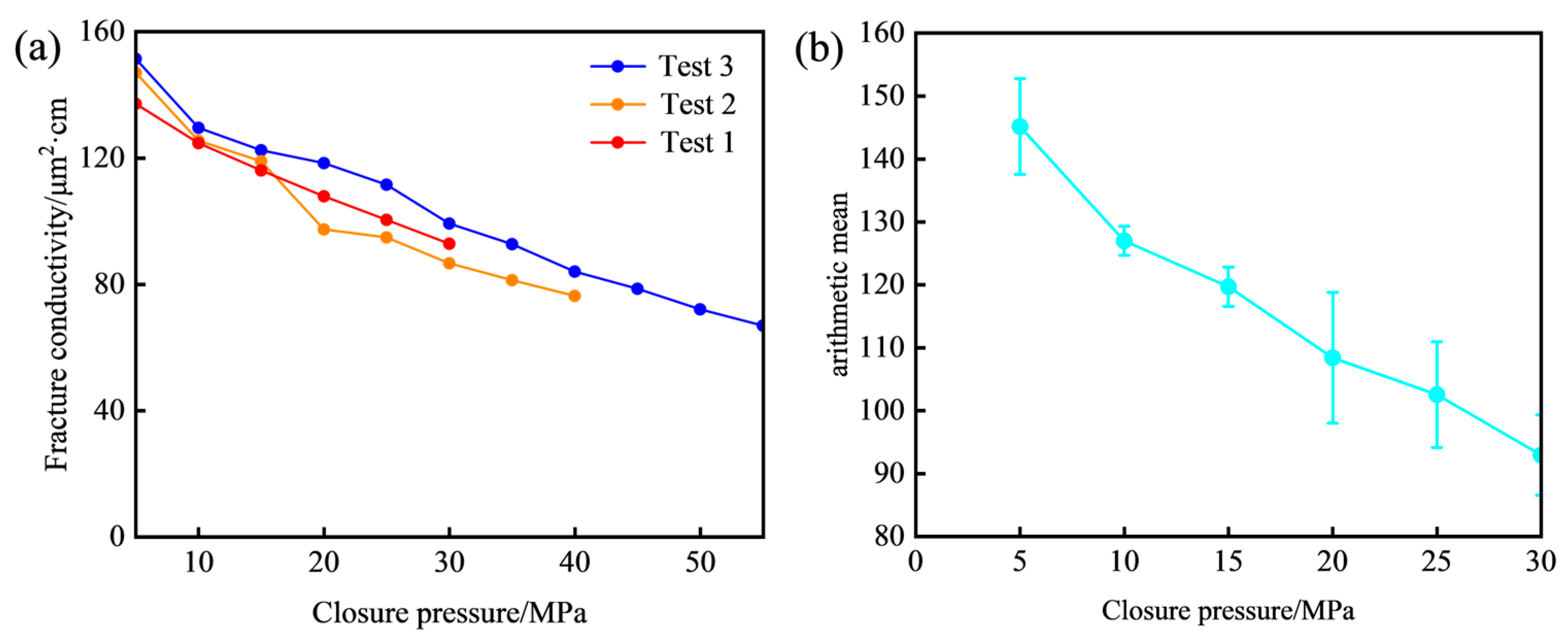
According to the industry standard “Testing Method for Fracture Conductivity of Proppants” (SY/T 6302-2019), exploratory experiments were conducted by gradually increasing the closure pressure to evaluate the variation and test feasibility of the short-term fracture conductivity of the combustible ice reservoir rock plate framework (with each test repeated three times), as shown in Figure 6. The results indicate that fracture conductivity decreases with increasing closure pressure, which is consistent with the conventional variation trend of fracture conductivity. However, the experimental results show increasing dispersion, as evidenced by enlarged standard deviations, when the closure pressure exceeds 15 MPa, suggesting that the rock plates undergo failure at higher closure pressure, leading to unstable fracture geometry and increased fluctuations in conductivity measurements. Within the main operating pressure range of 5–15 MPa, the arithmetic mean values and corresponding error bars (standard deviation) demonstrate that fracture conductivity remains stable and exhibits good repeatability, with relative deviations generally below 5%. Therefore, this closure pressure range is suitable for the short-term fracture conductivity test for combustible ice sediment fractures.
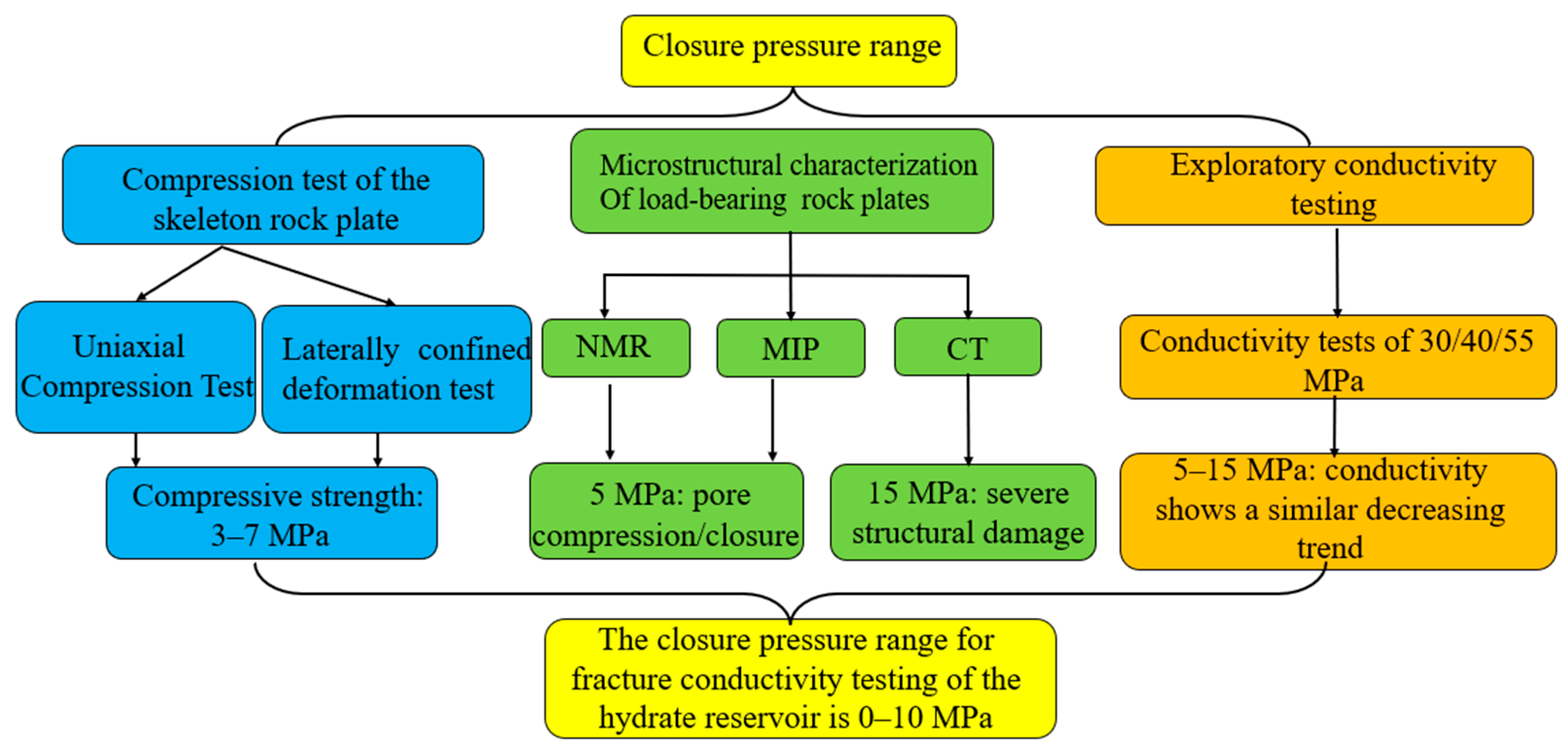
Based on the above macroscopic tests and microstructural characterization, a closure pressure range was optimized for the short-term fracture conductivity tests of simulated combustible ice sediments. The specific optimization workflow is shown in Figure 7.
Considering the influence of ice saturation on the mechanical properties of the rock plate, the upper limit of the closure pressure should be appropriately increased. Under a closure pressure of 10 MPa, the distribution of large and small pores within the rock plate is relatively uniform, and the overall supporting performance of the rock plate remains stable within the conductivity cell environment. Therefore, it is recommended that the closure pressure for short-term fracture conductivity testing of simulated combustible ice sediment fractures be set within the range of 0–10 MPa, with five key monitoring points designed at 1, 3, 5, 7, and 10 MPa during the testing process.

2.4. Experiments Design

Fracture conductivity experiments were conducted using ice-saturated rock plates, the test fluid used in all experiments was deionized water. The closure pressure was monotonically increasing applied. This study focuses on the effects of ice saturation, proppant concentration, and proppant particle size on the short-term fracture conductivity. The experimental scheme is presented in Table 1.

3. Analysis of Influencing Factors on the Short-Term Fracture Conductivity of Ice-Saturated Rock Plates in Combustible Ice Reservoirs

According to the experiments design in Table 1, three groups of experiments were conducted to investigate the influencing factors on the short-term fracture conductivity of ice-saturated rock plates in combustible ice reservoirs. The simulated rock plates were prepared as details in Section 2.2. The followings mainly focus on the effects analysis of ice saturation (Group A in Table 1), proppant concentration (Group B in Table 1), and proppant particle size (Group C in Table 1).

3.1. Effect of Ice Saturation

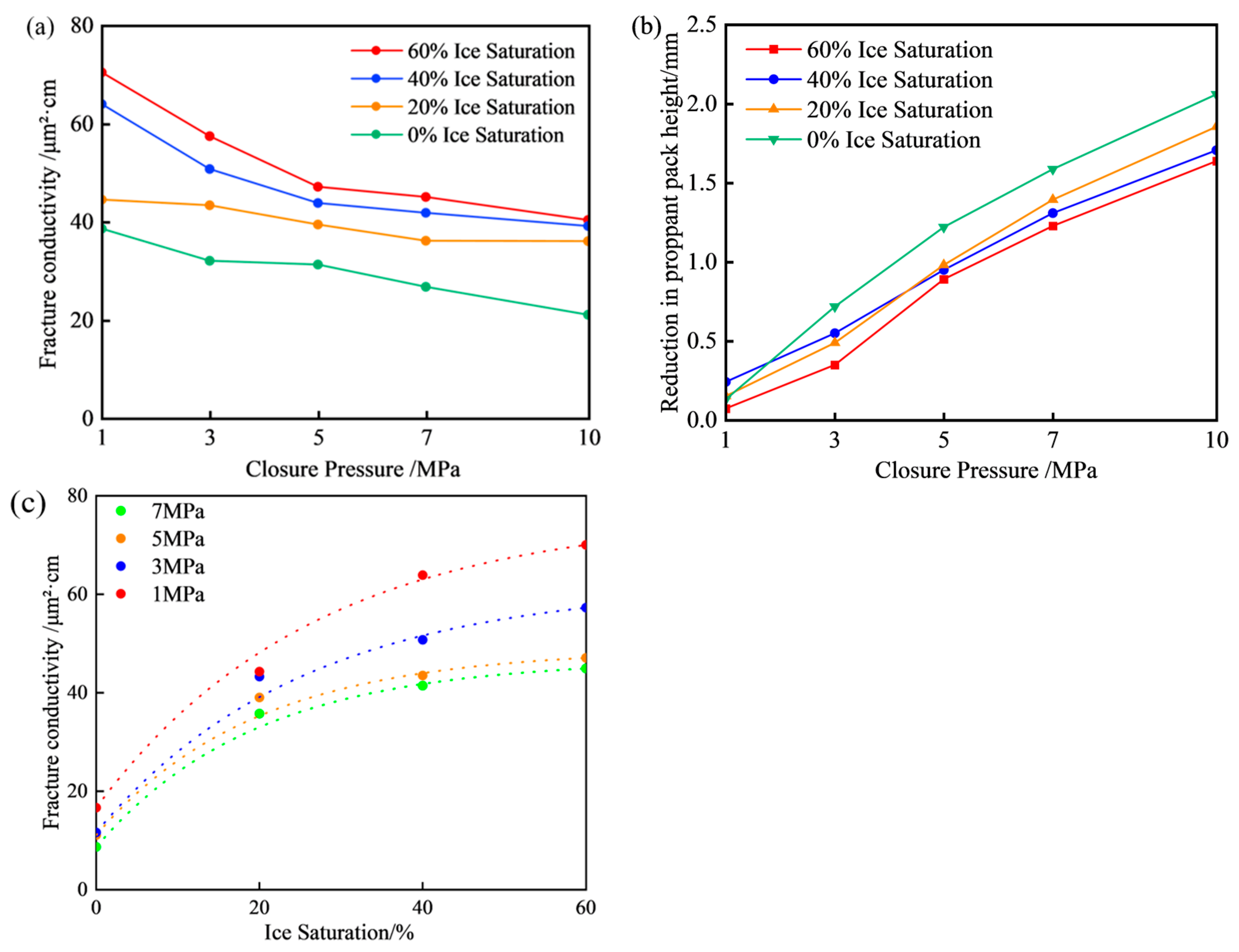
Figure 8a illustrates the variation in short-term fracture conductivity of ice-saturated rock plates in combustible ice reservoirs under different ice saturation conditions. The results indicate that fracture conductivity increases with increasing ice saturation. Under the same closure pressure, the fracture conductivity at 60% ice saturation is approximately 1.3 times that at 0% ice saturation and 1.8 times that at 20% ice saturation. When the closure pressure is 5 MPa, as the ice saturation increases from 0% to 20%, 40%, and 60%, the fracture conductivity increases from 30.14 μm2·cm to 39.44, 43.85, and 47.14 μm2·cm, corresponding to increases of 23%, 32%, and 36%, respectively. These results indicate that higher ice saturation is generally beneficial to the enhancement of short-term fracture conductivity.
The fracture conductivity loss rate is defined as the percentage reduction in fracture conductivity at elevated closure pressure relative to that at 1 MPa. When the closure pressure increases to 10 MPa, the conductivity loss rates at ice saturations of 0%, 20%, 40%, and 60% are 48%, 19%, 39%, and 43%, respectively.
The fracture conductivity loss rate exhibits a pronounced nonlinear response with increasing closure pressure. As the closure pressure increases, intensified compaction of the proppant pack together with further compression of the pore structure of the rock plate jointly accelerates the degradation of fracture conductivity.
The presence of ice significantly modifies this behavior by altering the pore-scale mechanical structure. At relatively low ice saturations, ice is mainly distributed within pore spaces, where it acts as a cementing and load-bearing medium. This enhances interparticle bonding and increases the overall mechanical stiffness of the sediment framework, thereby effectively suppressing pore collapse and proppant embedment and reducing the fracture conductivity loss rate. However, at higher ice saturations, ice not only fills pore spaces but also progressively coats grain surfaces and occupies particle contact regions. This distribution weakens interparticle friction, making particle rearrangement and local structural instability more likely under high closure pressure. As a result, fracture conductivity degradation becomes more pronounced despite the higher ice content [39].
Notably, at a closure pressure of 10 MPa, the specimen with 20% ice saturation exhibits the lowest fracture conductivity loss rate among all tested conditions. This result indicates that an appropriate ice saturation level can optimally enhance the mechanical stability of the sediment framework, thereby effectively suppressing fracture conductivity degradation under high-pressure conditions.
Figure 8b shows the variation in the reduction in proppant pack height under different ice saturation levels. As seen in the figure, the reduction in pack height decreases with increasing ice saturation. Under the same closure pressure, when the ice saturation increases from 20% to 60%, the reduction decreases by approximately 0.4 mm, indicating that higher ice saturation effectively mitigates the compression deformation of the proppant pack. A higher degree of ice saturation not only enhances the mechanical properties of the rock plate—such as strength and elastic modulus—but also improves the structural stability of the fracture, thereby maintaining the stability of short-term fracture conductivity in ice-saturated rock plates within combustible ice reservoirs.
The experimental results indicate that the short-term fracture conductivity of ice-saturated rock plates in combustible ice reservoirs is positively correlated with ice saturation. Under different closure pressure conditions, the fitted relationship between fracture conductivity and ice saturation in combustible ice reservoirs satisfies Equations (4)–(7), and the fitted curves are shown in Figure 8c as doted lines.
F 1 = 8.4677 Ln S h + 27.538 , R 2 = 0.9803   ( 1 MPa )
F 1 = 7.1150 Ln S h + 20.223 , R 2 = 0.9886   ( 3 MPa )
F 1 = 6.0893 Ln S h + 20.835 , R 2 = 0.9911   ( 5 MPa )
F 1 = 6.1073 Ln S h + 14.455 , R 2 = 0.9911   ( 7 MPa )
where Sh is the ice saturation of the rock plate in the combustible ice reservoir (%), and F is the short-term fracture conductivity of the ice-saturated rock plate (μm2·cm).

3.2. Effect of Proppant Concentration

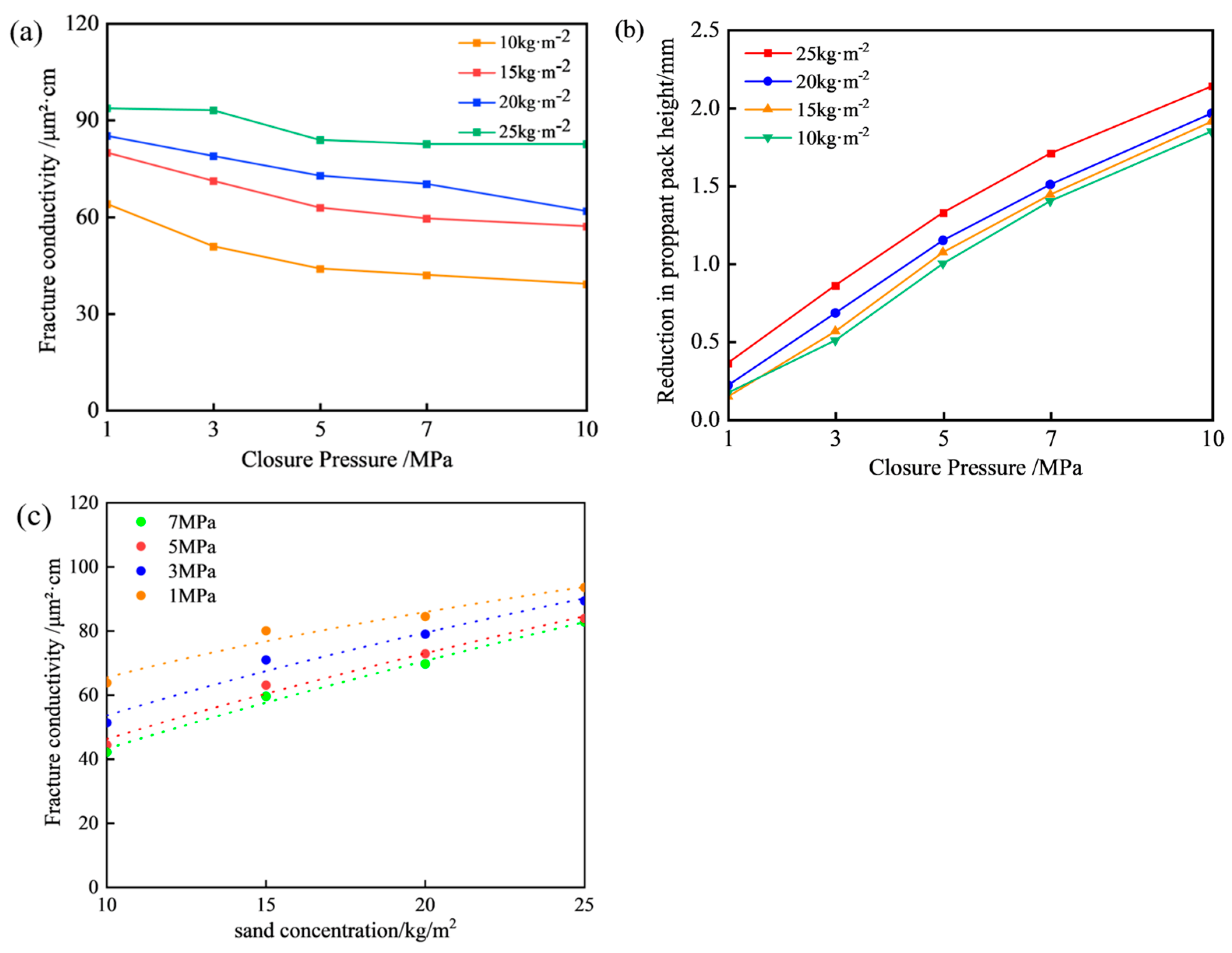
Figure 9a shows the effect of different proppant concentrations on the short-term fracture conductivity of ice-saturated rock plate (Sh = 40%) in combustible ice reservoirs. The results indicate that fracture conductivity increases significantly with increasing sand concentration. At a closure pressure of 5 MPa, when the sand concentration increases from 10 kg·m−2 to 15, 20, and 25 kg·m−2, the fracture conductivity rises from 43.86 μm2·cm to 62.88, 72.78, and 83.83 μm2·cm, corresponding to increases of 30.3%, 39.7%, and 47.6%, respectively. When the closure pressure is increased to 10 MPa, the conductivity loss rates for the four sand concentrations are 39%, 29%, 27%, and 12%, showing a decreasing trend with increasing sand concentration. These results indicate that a higher sand concentration increases the height of the proppant pack, enlarges the pore spaces between proppant particles, and enhances interparticle interactions, forming a more stable supporting structure and thereby effectively improving the short-term fracture conductivity of ice-saturated rock plate fractures.
Figure 9b illustrates the variation in proppant pack height reduction under different sand concentrations. The results show that the reduction in pack height increases with increasing sand concentration. When the sand concentration increases from 10 kg·m−2 to 25 kg·m−2, the reduction value increases by approximately 1.5 times, indicating that the compaction of the proppant pack is more pronounced under high sand concentration conditions. However, this phenomenon does not lead to a decrease in fracture conductivity. Although the pack height reduction is greater at higher sand concentrations, the final height of the proppant pack after compression remains higher than that under lower sand concentration conditions, thereby maintaining an overall higher fracture conductivity.
The experimental results indicate that the short-term fracture conductivity of ice-saturated rock plates in combustible ice reservoirs exhibits a linear relationship with sand concentration (as shown in Figure 9c). The fitted relationships between short-term fracture conductivity and sand concentration under different closure pressure conditions satisfies Equations (8)–(11).
F 2 = 2.201 C + 42.168 , R 2 = 0.9484   ( 1 MPa )
F 2 = 2.201 C + 34.219 , R 2 = 0.9594   ( 3 MPa )
F 2 = 2.201 C + 27.320 , R 2 = 0.9755   ( 5 MPa )
F 2 = 2.201 C + 25.022 , R 2 = 0.9880   ( 7 MPa )
where C is the proppant sand concentration (kg·m−2), and F is the short-term fracture conductivity of the ice-saturated rock plate in combustible ice reservoirs (μm2·cm).

3.3. Effect of Proppant Particle Size

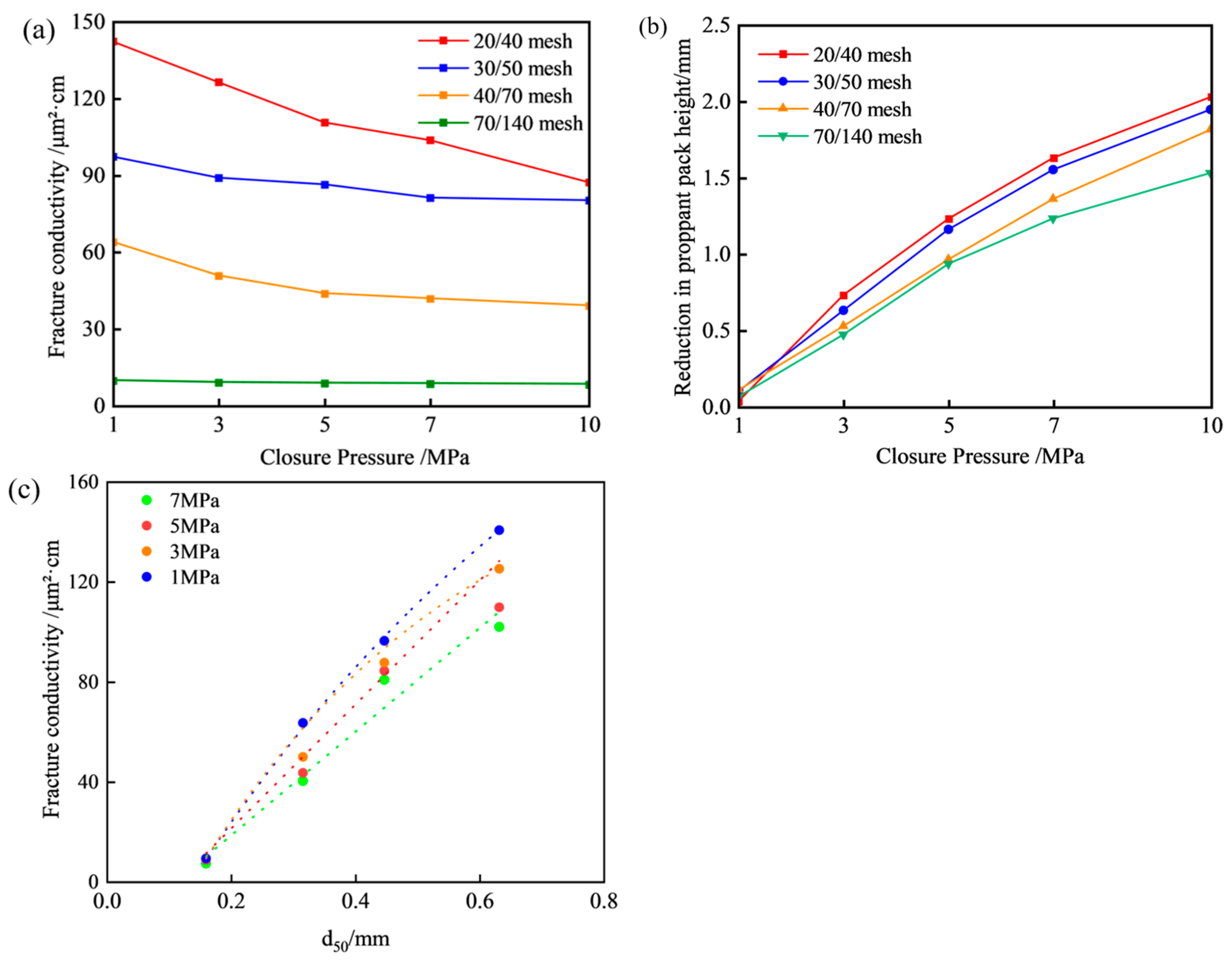
Figure 10a shows the effect of different proppant particle sizes on the short-term fracture conductivity of ice-saturated rock plates (Sh = 40%) in combustible ice reservoirs. The results indicate that fracture conductivity increases significantly with increasing proppant particle size. At a closure pressure of 5 MPa, the fracture conductivity for 70/140 mesh proppant is 8.78 μm2·cm, while those for 40/70, 30/50, and 20/40 mesh proppants are 43.86, 86.52, and 110.77 μm2·cm, respectively. The conductivity of the 20/40 mesh proppant is about 12 times higher than that of the 70/140 mesh. When the closure pressure rises to 10 MPa, the conductivity loss rates for the 20/40, 30/50, 40/70, and 70/140 mesh proppants are 39%, 17%, 39%, and 14%, respectively. These results indicate that although larger proppant particles can provide higher initial fracture conductivity, under high pressure, the pores between particles are more prone to compaction and deformation, leading to restricted fluid flow paths and reduced conductivity.
Figure 10b illustrates the variation in proppant pack height reduction under different proppant particle sizes. The results show that the height reduction increases with increasing proppant particle size. At a closure pressure of 10 MPa, the reduction difference between 20/40 mesh and 70/140 mesh proppants is approximately 0.5 mm, indicating that larger proppant particles are more prone to compaction and deformation under high pressure. In contrast, smaller proppant particles have more contact points and form a denser sand pack, which can effectively support the fracture, thereby reducing the height reduction in the proppant pack and maintaining better structural stability. It should be noted that the fracture conductivity of 70/140 mesh proppant is relatively poor and is difficult to meet the requirements for fracture conductivity in hydraulic fracturing engineering. Here, we include the results of the 70/140 mesh proppant only to show the influence of proppant particle size on fracture conductivity in hydrate reservoirs.
The experimental results indicate that the short-term fracture conductivity of ice-saturated rock plates in combustible ice reservoirs is positively correlated with proppant particle size. To establish a fitting equation, the proppant particle sizes were converted to their median diameters(d50) which is the diameter corresponding to the cumulative particle size distribution of the sample reaching 50%. The d50 values for 20/40 mesh, 30/50 mesh, 40/70 mesh, and 70/140 mesh proppants are 0.631 mm, 0.446 mm, 0.315 mm, and 0.159 mm, respectively. The fitted relationships (as shown in Figure 10c) between fracture conductivity and proppant particle size under different closure pressure conditions satisfies Equations (12)–(15).
F 3 = 89.897 Ln d 50 + 174.11 , R 2 = 0.9861   ( 1 MPa )
F 3 = 84.622 Ln d 50 + 159.06 , R 2 = 0.9756   ( 3 MPa )
F 3 = 82.185 Ln d 50 + 150.07 , R 2 = 0.9689   ( 5 MPa )
F 3 = 82.797 Ln d 50 + 147.16 , R 2 = 0.9707   ( 7 MPa )
where d50 is the median particle size of the proppant (mm), and F is the short-term fracture conductivity of the ice-saturated rock plate in combustible ice reservoirs (μm2·cm).

3.4. Multifactor Prediction Model of Fracture Conductivity for Combustible Ice Reservoirs

To comprehensively describe the effects of ice saturation, proppant concentration, proppant particle size, and closure pressure on the short-term fracture conductivity of ice-saturated rock plates in combustible ice reservoirs, individual mathematical models for each single factor were established based on the experimental results, followed by the development of an integrated multifactor model.
First, considering separately the influences of ice saturation (Sh), proppant concentration (C), median proppant particle size (d50), and closure pressure (P) on fracture conductivity (F), single-factor models were constructed.
The relationship between ice saturation and fracture conductivity follows a logarithmic trend according to Equations (4)–(7), with the coefficient of determination (R2) ranging from 0.98 to 0.99. So, the fitted relationship is expressed as
F 1 = a 1 Ln ( S h ) + b 1
where a1 and b1 are constants that vary with closure pressure. The relationship between proppant concentration and fracture conductivity is linear according to Equations (8)–(11), with the coefficient of determination (R2) ranging from 0.94 to 0.99, and the fitted equation is expressed as
F 2 = a 2 C + b 2
where a2 and b2 are constants that vary with closure pressure. The relationship between proppant particle size and fracture conductivity follows a logarithmic relationship according to Equations (12)–(15) with the coefficient of determination (R2) ranging from 0.96 to 0.99, and the fitted equation is expressed as
F 3 = a 3 Ln ( d 50 ) + b 3
where a3 and b3 are constants that vary with closure pressure. The relationship between closure pressure (P, ranging from 0 to 10 MPa) and fracture conductivity follows a power-law function based on our observation (Figure 8a, Figure 9a and Figure 10a), and the fitted relationship is expressed as
F 4 = a 4 P 2 + b 4 P + c 1
where a4, b4 and c1 are fitting constants.
On this basis, a multifactor comprehensive model was established using a multiple fitting method, and the relationship fitted by the dataset of the three groups measurements (as in Table 1) is expressed as follows:
F = 153.4861 + 82.10261 Ln d 50 + 6.016 Ln S h + 2.0030 C 5.5591 P + 0.3039 P 2 , ( 0   MPa P 10   MPa )
where P is the closure pressure (MPa); d50 is the median particle size of the proppant (mm); C is the sand concentration (kg·m−2); Sh is the ice saturation of the rock plate in the combustible ice reservoir (%); and F is the short-term fracture conductivity of the ice-saturated rock plate in combustible ice reservoirs (μm2·cm).The model exhibits a high goodness of fit, with a coefficient of determination R2 = 0.92 and a highly significant p-value of 2.5 × 10⁻²⁸, indicating strong statistical reliability of the proposed relationship.

3.4.1. Model Accuracy and Robustness Analysis

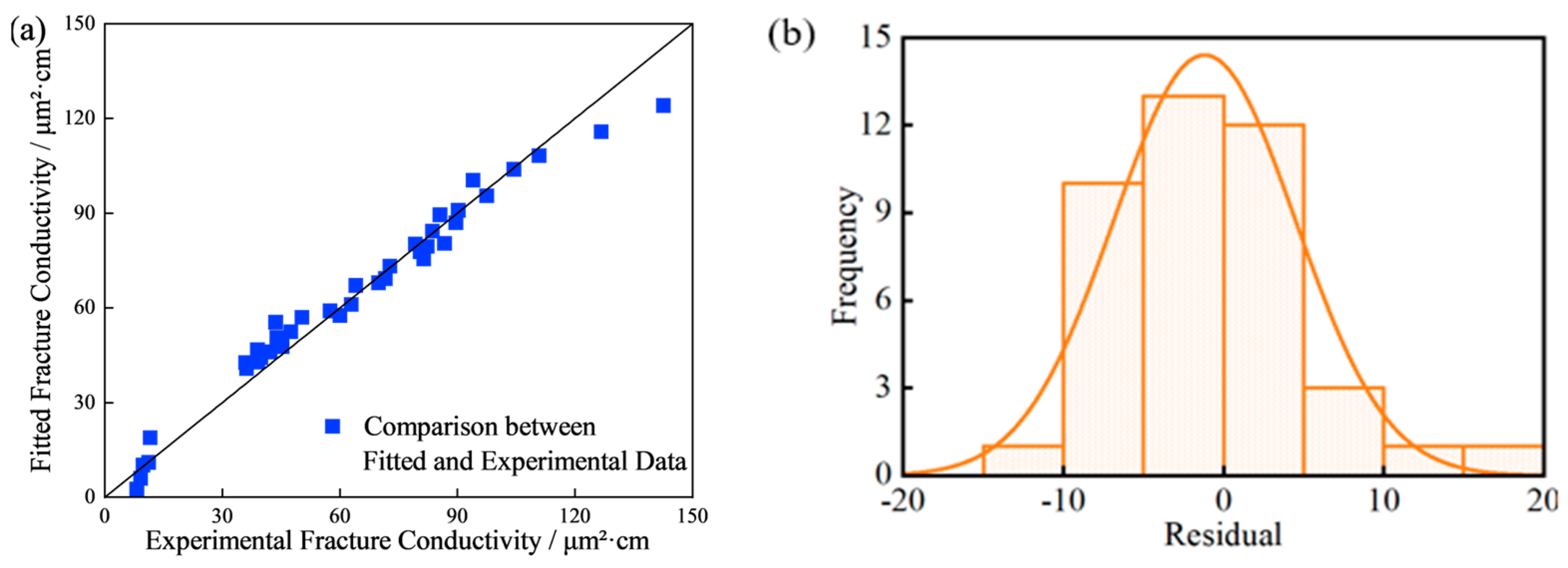
The model’s accuracy and robustness were verified by calculating the mean square error (MSE) and the coefficient of determination (R2). The results show that the fitted model achieved an R2 of 0.9159 and an MSE of 43.1220, indicating a good fitting performance. A higher R2 (closer to 1) and a smaller MSE suggest a higher consistency between the model’s predicted results and the experimental data.
To further validate the model’s accuracy, the calculated fracture conductivity values were compared with the experimentally measured values (Figure 11a). As shown by the distribution of the data points, most points are concentrated near the diagonal line, demonstrating that the model predictions are highly consistent with the experimental results. This confirms that the model can accurately describe the relationship between the short-term fracture conductivity of ice-saturated rock plates in combustible ice reservoirs and the influencing factors, meeting the requirements for engineering prediction.
By plotting a residual histogram (Figure 11b), the distribution of prediction errors was visually evaluated to analyze the robustness of the multifactor mathematical model. The residuals are approximately normally distributed, indicating that the model’s error distribution satisfies the normality assumption. This further demonstrates that the model exhibits good fitting performance and high robustness.

3.4.2. Global Sensitivity Analysis

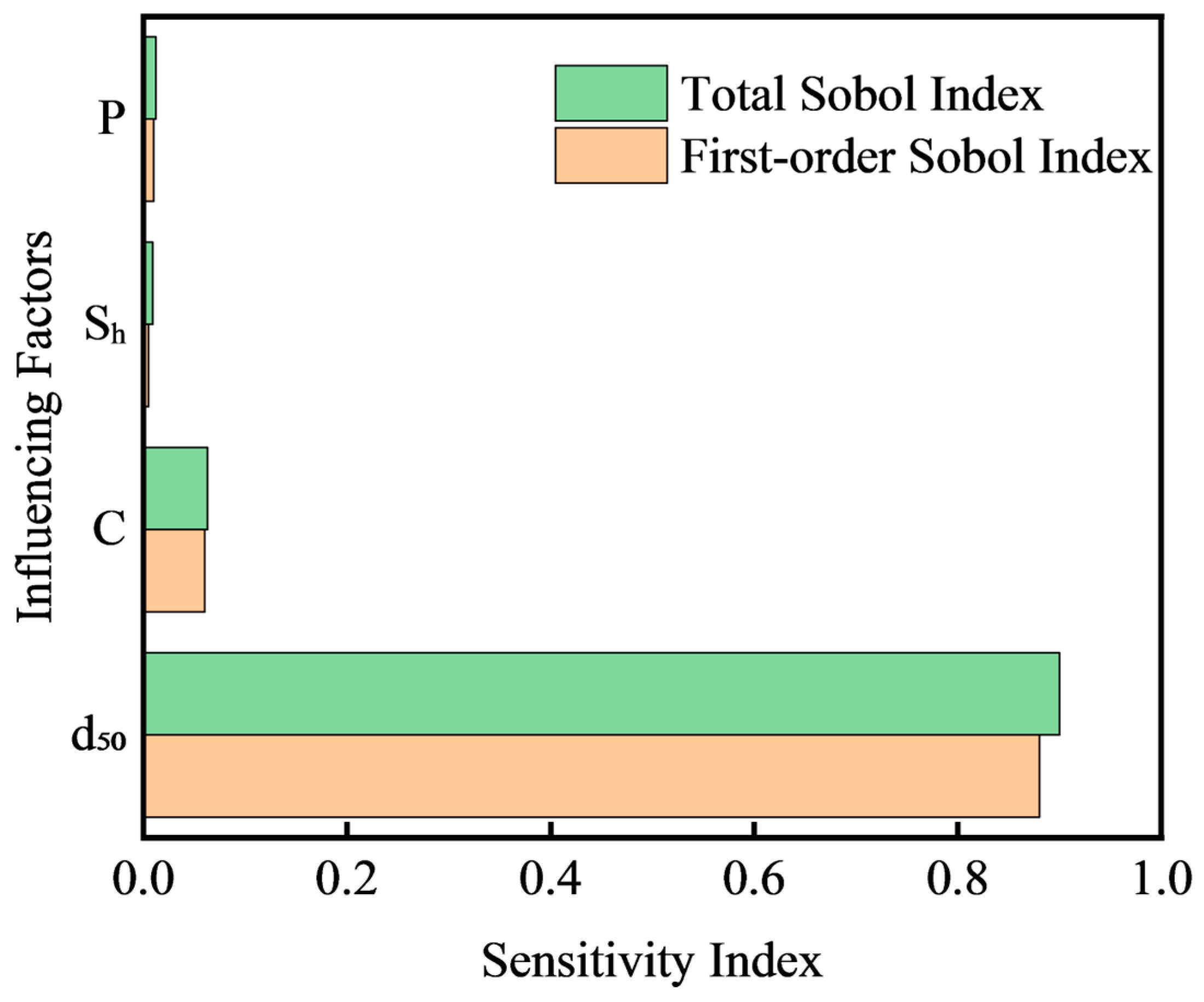
According to the experimental results, the degrees of influence of different factors on the short-term fracture conductivity of ice-saturated rock plates in combustible ice reservoirs vary significantly. To quantify the contribution of each factor, a global sensitivity analysis was performed on the input variables of the model. The Sobol method decomposes the total variance of the model output into portions attributable to individual input variables and their interactions, thereby quantifying the contribution of each variable to the output uncertainty [40]. By calculating the Sobol sensitivity indices, the contributions of the different factors to the uncertainty in the predicted fracture conductivity were evaluated. The results are shown in Figure 12, where the first-order Sobol index represents the direct impact of an individual factor on the model output without considering interactions, while the total Sobol index reflects the combined effect of that factor and its interactions with other variables on the output results.
As shown in Figure 12, the Sobol index analysis indicates that the first-order index of proppant particle size is the highest, reaching 0.8952, making it the most dominant factor. This is followed by proppant concentration, closure pressure, and ice saturation. These results suggest that proppant particle size is the primary controlling factor determining fracture conductivity, while the other factors have relatively smaller effects, particularly ice saturation and closure pressure, which exhibit limited influence. Overall, the importance of the factors can be ranked as follows: Proppant particle size > Sand concentration > Closure pressure > Ice saturation.

4. Discussion

4.1. Influence of Rock Plate’s Saturation Conditions

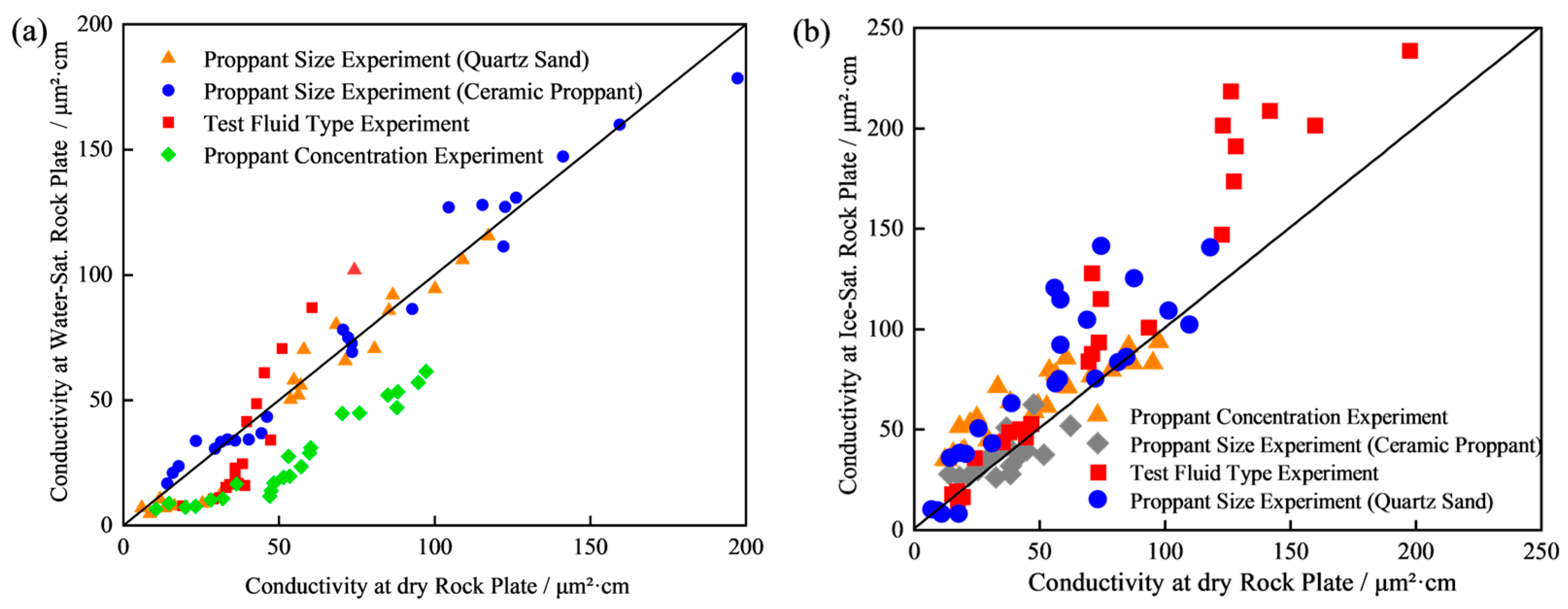
The previous experiments primarily analyzed the variation in short-term fracture conductivity under ice-saturated rock plate conditions. To further compare the fracture conductivity characteristics under different reservoir states, additional short-term fracture conductivity tests were conducted on water-saturated rock plates and framework rock plates (dry) under the same experimental conditions. Figure 13 presents the comparison of fracture conductivity under different rock plate conditions. The fracture conductivity of the water-saturated rock plate is lower than that of the framework rock plate, while the ice-saturated rock plate generally exhibits higher conductivity. Under water-saturated conditions, liquid water fills the rock pores, and hydration effects induce microstructural changes that reduce both strength and Young’s modulus. Consequently, the rock plate deforms more easily under pressure, weakening the proppant support and reducing conductivity. In contrast, the presence of ice improves the pore structure and mechanical performance, enhancing compressive strength and fracture stability, and thereby forming more stable flow channels. As closure pressure increases, the fracture conductivity of the ice-saturated rock plate gradually decreases, and the differences among the three conditions diminish. This is mainly because the progressive melting of ice causes the rock’s mechanical properties to approach those of the framework rock plate, resulting in similar conductivity levels.
Comprehensive analysis of the different experimental conditions indicates that the transformation of the rock plate from a framework state to an ice-saturated state has a significant impact on fracture conductivity, particularly under low closure pressure conditions where the difference is most pronounced. The presence of ice increases the rigidity and structural stability of the rock plate, mitigating the influence of particle size variation on the supporting structure, thereby amplifying the conductivity difference compared with the framework rock plate. However, under high closure pressures and ice-melting conditions, the rock strength decreases, the fracture channel becomes compressed, and the fracture conductivity declines substantially, leading to a gradual reduction in the difference among the different rock plate states.
It should be noted that the decomposition of natural gas hydrates under actual reservoir conditions is accompanied by methane release, which may induce additional gas-driven effects. In contrast, the use of ice as a substitute for gas hydrates in this study does not account for gas–liquid multiphase flow processes. Therefore, the results obtained in this study are mainly applicable to the analysis of short-term fracture conductivity, and certain limitations remain in describing fracture flow behavior under long-term marine combustible ice reservoir development conditions.

4.2. Sanding Induced Fracture Clogging

For combustible ice reservoirs, fine silt particles in the reservoir may be transported with the gas and water flow into the proppant-filled fractures, partially blocking the intergranular pores and flow channels and thereby impairing the fracture conductivity. So, investigating fracture blockage is of great significance in the study of fracture conductivity in hydraulically fractured combustible ice reservoirs.
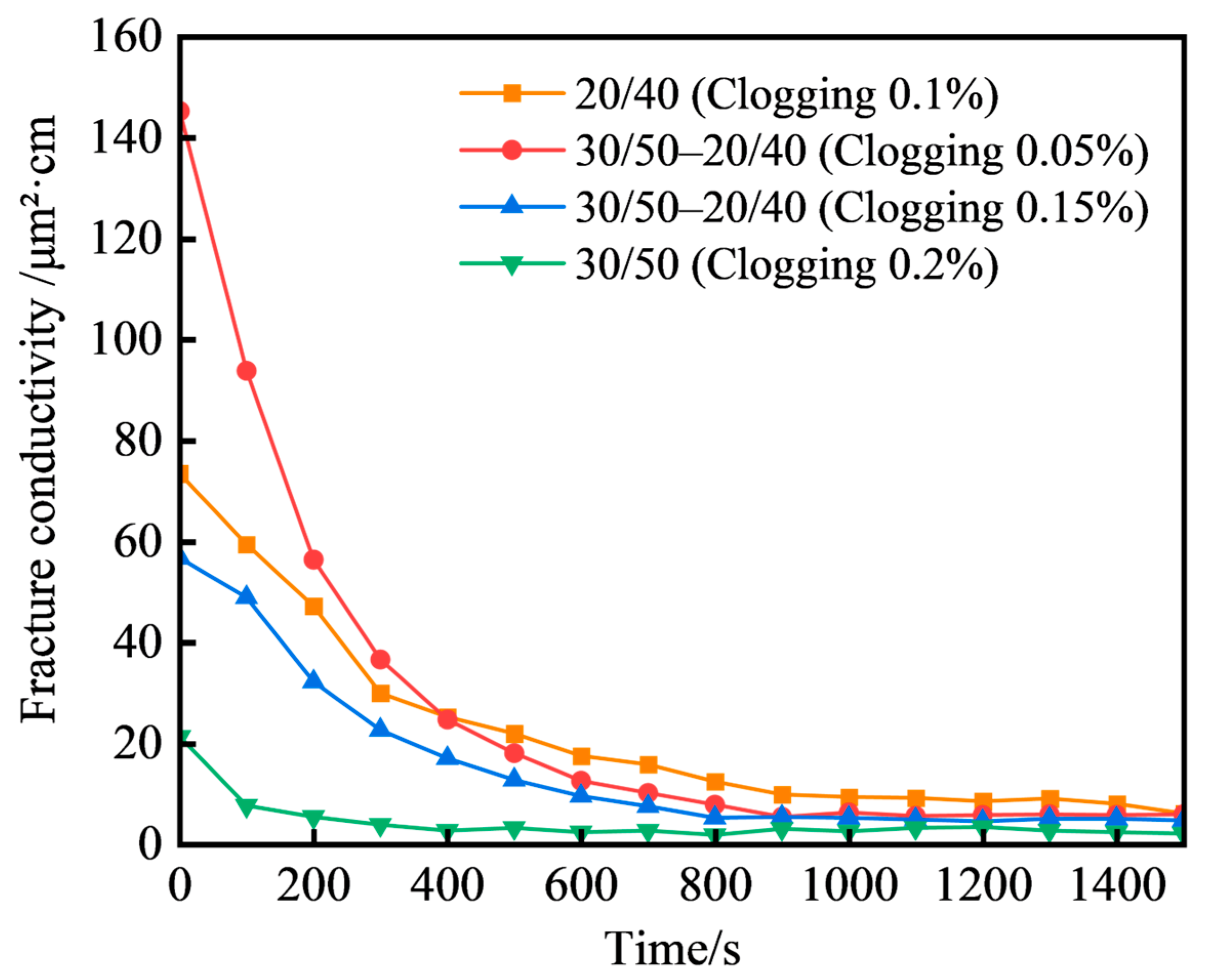
To quantitatively investigate this phenomenon, a series of fracture blockage experiments were conducted under a closure pressure of 3 MPa and a proppant concentration of 15 kg/m2. The blockage ratio (M2/M1) was defined as the ratio of the mass of fine particles making up the rock plate frame (M2) to the mass of proppant (M1). Several blockage ratios—0.05%, 0.1%, 0.15%, and 0.2%—were tested using different proppant particle size combinations (20/40 mesh, 30/50–20/40 mesh, and 30/50 mesh).
The presence of blockages alters the pore structure and flow channels within the proppant pack, thereby significantly reducing fracture conductivity. Experimental results show that fracture conductivity decreases rapidly with increasing blockage volume and approaches nearly zero under high blockage conditions. As shown in Figure 14, at a higher blockage ratio (e.g., 0.2%), the blocking particles densely fill the pore spaces and obstruct the flow channels, resulting in a rapid decline in fracture conductivity. Under moderate blockage ratios (0.1–0.15%), fracture conductivity initially decreases rapidly and then stabilizes, indicating that partial flow channels remain functional. At a low blockage ratio (0.05%), the effect on flow channels is minimal, and fracture conductivity decreases slowly while remaining relatively high. Overall, as the blockage ratio increases, the effective flow area within the pores decreases and fluid resistance increases, leading to a more pronounced reduction in fracture conductivity.

5. Conclusions

Through fracture conductivity tests on both framework and ice-saturated rock plates in combustible ice reservoirs, a systematic analysis was conducted to investigate the effects of ice saturation, proppant particle size, sand concentration, and fracture blockage on the short-term fracture conductivity. A corresponding prediction model was also developed.
1. Based on the combined results of rock plate compression deformation tests and pore structure characterization, the reasonable range of closure pressure for short-term fracture conductivity experiments of simulated combustible ice reservoir rock plates was determined to be 0–10 MPa, with five key monitoring points recommended at 1, 3, 5, 7, and 10 MPa.
2. The short-term fracture conductivity of combustible ice reservoirs increases with both ice saturation and proppant concentration. Larger proppant particles provide higher initial conductivity but are more susceptible to compaction and conductivity loss under high closure pressure. A multi-factor prediction model for the short-term fracture conductivity of fractured marine combustible ice reservoirs was established. The Sobol global sensitivity analysis indicates that the relative influence of the factors follows the order: proppant particle size > sand concentration > closure pressure > ice saturation.
3. The properties of rock plates and sanding induced fracture clogging play an important role on the fracture conductivity. At low closure pressures, ice-saturated rock plates exhibit the highest fracture conductivity, followed by framework (dry) rock plates, while water-saturated rock plates have the lowest conductivity due to hydration-induced weakening and deformation of the rock matrix. Fine particles migrating into the proppant pack can partially or completely block the intergranular pores and flow channels. The fracture conductivity shows a rapid decline with increasing blockage, highlighting the importance of controlling sanding and fracture clogging in the fracturing design of marine combustible ice reservoirs.


Author Contributions

M.L.: Experiment execution, data processing and manuscript writing. Z.W.: Methodology, Verification of key results, and supervision. X.Z.: Experiment execution and data acquisition. X.H.: Participation in data curation. J.W.: Participation in manuscript revision. F.W.: Participation in periodic (stage-wise) discussions. All authors have read and agreed to the published version of the manuscript.

Funding

This research is supported by the National Key R&D Program of China (2023YFC2811005), and the Fundamental Research Funds for the Central Universities (No. 24CX03016A, 24CX02011A). The work is supported by “the Fund of State Key Laboratory of Deep Oil and Gas, China University of Petroleum (East China).

Data Availability Statement

The original contributions presented in this study are included in the article. Further inquiries can be directed to the corresponding author.

Conflicts of Interest

Author Mingzhong Li was employed by Technology Service Company, Sinopec Huabei Oilfield Service Corporation. Author Xiatong Han was employed by Steam Injection Technical Service Center of Shengli Oilfield Branch Company. The remaining authors declare that the research was conducted in the absence of any commercial or financial relationships that could be construed as a potential conflict of interest.

References

  1. Yan, C.; Chen, Y.; Tian, W.; Cheng, Y.; Li, Y. Effects of methane-carbon dioxide replacement on the mechanical properties of natural gas hydrate reservoirs. J. Clean. Prod. 2022, 354, 131703. [Google Scholar] [CrossRef]
  2. Li, Q.; Zhao, D.; Yin, J.; Zhou, X.; Li, Y.; Chi, P.; Han, Y.; Ansari, U.; Cheng, Y. Sediment instability caused by gas production from hydrate-bearing sediment in Northern South China Sea by horizontal wellbore: Evolution and mechanism. Nat. Resour. Res. 2023, 32, 1595–1620. [Google Scholar] [CrossRef]
  3. Fan, M.; Han, Y.; Gu, M.; McClure, J.; Ripepi, N.; Westman, E.; Chen, C. Investigation of the conductivity of a proppant mixture using an experiment/simulation-integrated approach. J. Nat. Gas Sci. Eng. 2020, 78, 103234. [Google Scholar] [CrossRef]
  4. Cong, Z.; Li, Y.; Liu, Y.; Xiao, Y. A new method for calculating the direction of fracture propagation by stress numerical search based on the displacement discontinuity method. Comput. Geotech. 2021, 140, 104482. [Google Scholar] [CrossRef]
  5. Li, Y.; Hubuqin; Wu, J.; Zhang, J.; Yang, H.; Zeng, B.; Xiao, Y.; Liu, J. Optimization method of oriented perforation parameters improving uneven fractures initiation for horizontal well fracturing. Fuel 2023, 349, 128754. [Google Scholar] [CrossRef]
  6. Li, Y.; Long, M.; Zuo, L.; Li, W.; Zhao, W. Brittleness evaluation of coal based on statistical damage and energy evolution theory. J. Pet. Sci. Eng. 2019, 172, 753–763. [Google Scholar] [CrossRef]
  7. Economides, M.J.; Nolte, K.G. Reservoir Stimulation; Prentice Hall: Englewood Cliffs, NJ, USA, 1989. [Google Scholar]
  8. Raghavan, R.; Cady, G.V.; Ramey, H.J. Well-test analysis for vertically fractured wells. J. Pet. Technol. 1972, 24, 1014–1020. [Google Scholar] [CrossRef]
  9. Walsh, J.B. Effect of pore pressure and confining pressure on fracture permeability. Int. J. Rock Mech. Min. Sci. Geomech. Abstr. 1981, 18, 429–435. [Google Scholar] [CrossRef]
  10. Chen, D.; Wang, N.Z.; Ye, Z.H.; Zhang, J.L. Propped fracture conductivity evolution under a combination of compaction and embedment: Establishing a model and analyzing the influencing factors. Pet. Drill. Tech. 2018, 46, 82–89. [Google Scholar]
  11. Su, Y.B.; Lin, G.Y.; Han, Y. Conductivity of the hydraulic sand-added fractures in the tight sandstone reservoir. Pet. Geol. Oilfield Dev. Daqing 2017, 36, 140–145. [Google Scholar]
  12. Zhang, J.; Kamenov, A.; Zhu, D.; Hill, A. Development of new testing procedures to measure propped fracture conductivity considering water damage in clay-rich shale reservoirs: An example of the Barnett Shale. J. Pet. Sci. Eng. 2015, 135, 352–359. [Google Scholar] [CrossRef]
  13. Tian, F.; Jia, Y.; Yang, L.; Liu, X.; Guo, X.; Martyushev, D.A. Experimental study on factors affecting fracture conductivity. Processes 2024, 12, 1465. [Google Scholar] [CrossRef]
  14. Yan, C.; Zhang, P.; Dong, L.; Zhang, C.; Cheng, Y. Long-term fracture conductivity in tight reservoirs. Energy Sci. Eng. 2024, 12, 1187–1199. [Google Scholar] [CrossRef]
  15. Wen, Q.; Zhang, S.; Wang, L.; Liu, Y.; Li, X. The effect of proppant embedment upon the long-term conductivity of fractures. J. Pet. Sci. Eng. 2007, 55, 221–227. [Google Scholar] [CrossRef]
  16. Gupta, A.; Rai, C.; Sondergeld, C. Experimental investigation of propped fracture conductivity and proppant diagenesis. In Proceedings of the Unconventional Resources Technology Conference (URTeC), Denver, CO, USA, 22–24 July 2019; Society of Exploration Geophysicists: Tulsa, OK, USA, 2019; pp. 136–153. [Google Scholar]
  17. Gutierrez, M.; Øino, L.E.; Nygaard, R. Stress-dependent permeability of a de-mineralised fracture in shale. Mar. Pet. Geol. 2000, 17, 895–907. [Google Scholar] [CrossRef]
  18. Reece, J.S.; Zoback, M.D.; Kohli, A.H. Effect of shear slip on fault permeability in shale reservoir rocks. AGU Fall Meet. Abstr. 2014, 2014, H13Q-03. [Google Scholar]
  19. Richard, S.; Schrader, S.; Schrader, R.; Ereaux, B. Improved methods of measuring proppant conductivity. In Proceedings of the SPE Western Regional Meeting, San Jose, CA, USA, 23–26 April 2019. [Google Scholar] [CrossRef]
  20. Davies, D.R.; Kuiper, T.O.H. Fracture conductivity in hydraulic fracture stimulation. J. Pet. Technol. 1988, 40, 550–552. [Google Scholar] [CrossRef]
  21. Nguyen, P.D.; Dusterhoft, R.G.; Clarkson, B.A.; Edwards, W.J. Mitigating Formation Invasion to Maintain Fracture Conductivity. In Proceedings of the International Petroleum Technology Conference (IPTC), Doha, Qatar, 21–23 November 2005. [Google Scholar] [CrossRef]
  22. Mittal, A.; Rai, C.S.; Sondergeld, C.H. Proppant-conductivity testing under simulated reservoir conditions: Impact of crushing, embedment, and diagenesis on long-term production in shales. SPE J. 2018, 23, 1304–1315. [Google Scholar] [CrossRef]
  23. Zhang, F.; Zhu, H.; Zhou, H.; Guo, J.; Huang, B. Discrete-element-method/computational-fluid-dynamics coupling simulation of proppant embedment and fracture conductivity after hydraulic fracturing. SPE J. 2017, 22, 632–644. [Google Scholar] [CrossRef]
  24. Zhang, F.; Mack, M. Integrating fully coupled geomechanical modeling with microsesmicity for the analysis of refracturing treatment. J. Nat. Gas Sci. Eng. 2017, 46, 16–25. [Google Scholar] [CrossRef]
  25. Zhu, H.; Zhao, Y.-P.; Feng, Y.; Wang, H.; Zhang, L.; McLennan, J.D. Modeling of fracture width and conductivity in channel fracturing with nonlinear proppant-pillar deformation. SPE J. 2019, 24, 1288–1308. [Google Scholar] [CrossRef]
  26. El Shaari, N.; Swint, A.; Kalfayan, L. Utilizing Organosilane With Hydraulic Fracturing Treatments To Minimize Fines Migration Into the Proppant Pack—A Field Application. In Proceedings of the SPE Western Regional Meeting, San Francisco, CA, USA, 13–16 November 2008. [Google Scholar] [CrossRef]
  27. Liang, F.; Vo, L.K.; Nguyen, P.D.; Green, T.W. Maintaining production of frac-packed wells by inhibiting scale buildup and fines migration. In Proceedings of the SPE International Oilfield Scale Conference and Exhibition, Aberdeen, UK, 14–15 May 2014. [Google Scholar] [CrossRef]
  28. Gidley, J.L.; Penny, G.S.; McDaniel, R.R. Effect of proppant failure and fines migration on conductivity of propped fractures. SPE Prod. Facil. 1995, 10, 20–25. [Google Scholar] [CrossRef]
  29. Zhang, J.; Kamenov, A.; Zhu, D.; Hill, D. Laboratory Measurement of Hydraulic Fracture Conductivities in the Barnett Shale. SPE Prod. Oper. 2014, 29, 26–41. [Google Scholar] [CrossRef]
  30. Develi, K.; Babadagli, T. Experimental and visual analysis of single-phase flow through rough fracture replicas. Int. J. Rock Mech. Min. Sci. 2015, 73, 139–155. [Google Scholar] [CrossRef]
  31. He, B.; Wang, X.; Li, B.; Zhou, F. The influence of fracture surface morphology on propped fracture conductivity in tight sandstone reservoir. Geoenergy Sci. Eng. 2023, 221, 111268. [Google Scholar] [CrossRef]
  32. Liu, E. Effects of fracture aperture and roughness on hydraulic and mechanical properties of rocks: Implication of seismic characterization of fractured reservoirs. J. Geophys. Eng. 2005, 2, 38–47. [Google Scholar] [CrossRef]
  33. Li, Q.; Zhang, C.; Yang, Y.; Ansari, U.; Han, Y.; Li, X.; Cheng, Y. Preliminary experimental investigation on long term fracture conductivity for evaluating the feasibility and efficiency of fracturing operation in offshore hydrate-bearing sediments. Ocean. Eng. 2023, 281, 114949. [Google Scholar] [CrossRef]
  34. Li, B.; Shen, Y.; Sun, Y.; Qi, Y.; Shan, H.; Zhang, G. Assessing hydraulic fracturing feasibility in marine hydrate reservoirs: Impact of closure pressure and hydrate decomposition on fracture conductivity. Ocean Eng. 2024, 309, 118569. [Google Scholar] [CrossRef]
  35. Shen, K.; Yu, Y.; Zhang, H.; Xie, W.; Lu, J.; Zhou, J.; Wang, X.; Wang, Z. Triaxial experiment study of natural gas hydrate sediments fracturing and its initiation mechanism: A simulation using large-scale ice-saturated synthetic cubic models. J. Mar. Sci. Eng. 2025, 13, 1065. [Google Scholar] [CrossRef]
  36. Ma, X.; Jiang, D.; Sun, Y.; Li, S. Experimental study on hydraulic fracturing behavior of frozen clayey silt and hydrate-bearing clayey silt. Fuel 2022, 322, 124366. [Google Scholar] [CrossRef]
  37. Shen, K.; Xie, W.; Yu, Y.; Wang, Y.; Wang, Z.; Wang, X.; Zhang, W. Experimental Study on Mechanical Properties of Artificial Cores Saturated With Ice: An Analogical Simulation to Natural Gas Hydrate Bearing Sediments. Energy Sci. Eng. 2024, 12, 4918–4931. [Google Scholar] [CrossRef]
  38. SY/T 6302-2019; Procedures for Measuring the Conductivity of Proppants. National Energy Administration. Petroleum Industry Press: Beijing, China, 2019.
  39. Wang, Z.; Wang, X.; Shen, K.; Su, J.; Zhao, Z.; Zhou, W. Characterization of Ice Distribution in Geotechnical Materials Basedon Cryo-electron Microscopy. Energy Sci. Eng. 2024, 12, 8–12+114. [Google Scholar]
  40. Chen, L.; Xu, Z.; Huang, D.; Chen, Z. An improved sobol sensitivity analysis method. J. Phys. Conf. Ser. 2024, 2747, 012025. [Google Scholar] [CrossRef]
Figure 1. Experimental system for fracture conductivity measurements in gas hydrate reservoirs: (a) Experimental apparatus; (b) Schematic illustration of the testing setup.
Jmse 14 00130 g001
Figure 2. Experimental Rock Plates for Fracture Conductivity Testing in Combustible Ice Reservoirs.
Jmse 14 00130 g002
Figure 3. Displacement–load curves and failure states of rock plates under different pressure-bearing conditions. (a) Displacement–load curves of rock plates under uniaxial conditions. (b) Displacement–load curves of rock plates under different pressure-bearing conditions in the fracture conductivity chamber. (c) Failure state of rock plates under 6.9 MPa axial pressure. (d) Failure state of rock plates under different pressure-bearing conditions in the fracture conductivity chamber.
Jmse 14 00130 g003
Figure 4. Pore Radius Distribution Curve Converted from (a) NMR Data and (b) Mercury Intrusion.
Jmse 14 00130 g004
Figure 5. CT-Scanned Pore Network Model of the Rock Core under different closure pressures, (a) Closure pressure at 0 MPa, (b) Closure pressure at 15 MPa.
Jmse 14 00130 g005
Figure 6. Variation in fracture conductivity of rock plates under different closure pressures: (a) repeated test results; (b) arithmetic mean values with standard deviation.
Jmse 14 00130 g006
Figure 7. Optimization workflow of closure pressure range for fracture conductivity testing in combustible ice reservoirs.
Jmse 14 00130 g007
Figure 8. Effects of Ice Saturation on Short-Term Fracture Conductivity (a) and Variation in Proppant Pack Height Reduction (b) under Different Ice Saturation Conditions; (c) Fitted relationship between the short-term fracture conductivity and ice saturation.
Jmse 14 00130 g008
Figure 9. Effects of Proppant Concentration on Short-Term Fracture Conductivity (a) and Variation in Proppant Pack Height Reduction (b) under Different Proppant Concentration Conditions; (c) Fitted relationship between the short-term fracture conductivity and Proppant Concentration.
Jmse 14 00130 g009
Figure 10. Effects of proppant particle size on Short-Term Fracture Conductivity (a) and Variation in Proppant Pack Height Reduction (b) under Different proppant particle size Conditions; (c) Fitted relationship between the short-term fracture conductivity of and proppant particle size.
Jmse 14 00130 g010
Figure 11. (a) Validation of Fitting Results; (b) Validation Using Residual Histogram.
Jmse 14 00130 g011
Figure 12. Results of Global Sensitivity Analysis.
Jmse 14 00130 g012
Figure 13. Comparison of Short-Term Fracture Conductivity among (a) Water-Saturated, (b) Ice-Saturated, and dry Rock Plates.
Jmse 14 00130 g013
Figure 14. Effect of Blockage Ratio on the Short-Term Fracture Conductivity of Ice-Saturated Rock Plates in Combustible Ice Reservoirs.
Jmse 14 00130 g014
Table 1. Experimental scheme for short-term fracture conductivity testing of ice-saturated rock plates in combustible ice reservoirs.
Group
Index
Proppant Concentration/(kg·m−2)Particle Size/MeshIce Saturation
/%
Closure Stress/MPa
A1040/700%, 20%, 40%, 60%1, 3, 5, 7, 10
B10, 15,
20, 25
40/7040%1, 3, 5, 7, 10
C1020/40, 30/50
40/70, 70/140
40%1, 3, 5, 7, 10
Disclaimer/Publisher’s Note: The statements, opinions and data contained in all publications are solely those of the individual author(s) and contributor(s) and not of MDPI and/or the editor(s). MDPI and/or the editor(s) disclaim responsibility for any injury to people or property resulting from any ideas, methods, instructions or products referred to in the content.