Article

Linking Sidescan Sonar Backscatter Intensity to Seafloor Sediment Grain Size Fractions: Insight from Dongluo Island

Guangzhou Marine Geological Survey, China Geological Survey, Guangzhou 510760, China
*
Authors to whom correspondence should be addressed.
J. Mar. Sci. Eng. 2026, 14(2), 125; https://doi.org/10.3390/jmse14020125
Submission received: 25 November 2025 / Revised: 29 December 2025 / Accepted: 3 January 2026 / Published: 7 January 2026
(This article belongs to the Section Geological Oceanography)

Abstract

Accurate characterization of seafloor sediment properties is critical for marine engineering design, resource assessment, and environmental management. Sidescan sonar offers efficient wide-area mapping capabilities, yet establishing robust quantitative relationships between acoustic backscatter intensity and sediment texture remains challenging, particularly in heterogeneous coastal environments. This study investigates the correlation between sidescan sonar backscatter intensity and sediment grain size parameters in waters southwest of Hainan Island, China. High-resolution acoustic data (450 kHz) were acquired alongside surface sediment samples from 18 stations spanning diverse sediment types. Backscatter intensity, represented by grayscale values, was systematically compared with grain size distributions and individual size fractions. Results reveal that mean grain size shows no meaningful correlation with backscatter intensity; however, fine sand fraction content (0.075–0.25 mm) exhibits a strong negative linear relationship (R2 = 0.87 under optimal conditions). Distribution-level analysis demonstrates that backscatter variability mirrors sediment textural complexity, with coarse sediments producing broad, elevated intensity distributions and fine sediments yielding narrow, suppressed distributions. Inter-survey variability highlights the sensitivity of absolute intensity values to environmental conditions during acquisition. Spatial distribution analysis reveals that sediment grain size follows a systematic NE-SW gradient controlled by hydrodynamic energy, with notable local anomalies controlled by reef structures (producing coarse bioclastic sediment) and topographic sheltering (maintaining fine-grained deposits in shallow areas). These findings provide a quantitative basis for fraction-specific acoustic classification approaches while emphasizing the importance of multi-scale analysis incorporating both regional hydrodynamic trends and local morphological controls. The established relationship between fine sand abundance and acoustic response enables semi-quantitative sediment prediction from remotely sensed data, supporting improved seafloor mapping protocols for offshore infrastructure siting, aggregate resource evaluation, and coastal zone management in morphologically complex environments.

1. Introduction

Seafloor properties, especially sediments that comprise the seafloor, constitute fundamental geological information for research areas such as marine engineering, marine hazards, and marine mineral exploration [1,2,3,4]. They are particularly essential for studies involving deep-sea mining vehicle landing and walking, sinking of unexploded ordnance on the seafloor, and exploration of marine sand resources [5,6,7,8]. Therefore, developing rapid and accurate seafloor sediment classification techniques holds significant scientific and practical importance.
Among various seafloor mapping techniques, sidescan sonar has emerged as a primary tool for seafloor geomorphology and sediment surveys due to its efficiency and wide coverage. Its core parameter, backscatter intensity, is simultaneously influenced by seafloor topographic relief and sediment physical properties, including surface roughness and volume heterogeneity [9,10,11]. Urick’s theory indicates that in areas where seafloor topography is relatively flat without dramatic variations, changes in backscatter intensity primarily originate from differences in sediment characteristics [9]. Based on this principle, the grayscale values in sidescan sonar imagery (a visual representation of backscatter intensity) has been widely employed for qualitative classification of seafloor sediments. However, traditional methods predominantly rely on visual interpretation or semi-quantitative analysis of image texture features, which tend to produce deviations when identifying transitional zones between sediment types, making it difficult to achieve fine-scale delineation of sediment spatial distribution [12]. Establishing a quantitative relationship between backscatter intensity and sediment grain size parameters would potentially overcome this bottleneck, providing a reliable theoretical foundation for quantitative sediment classification based on acoustic imagery.
Currently, while some studies have explored the statistical relationship between backscatter intensity and mean sediment grain size, the conclusions vary considerably, with most investigations focusing on specific regions or limited grain size ranges [12,13,14,15,16]. This suggests that the relationship between backscatter intensity and sediment grain size may not be a simple linear correspondence, but rather is subject to complex influences from multiple factors including grain size distribution, sorting, and sediment composition. Therefore, conducting detailed comparative studies in more diverse sedimentary environments and revealing the underlying controlling mechanisms represents an essential pathway toward mature application of this technology.
To this end, this study selected a typical marine area southwest of Hainan Island, China, as the study region, synchronously acquiring high-resolution sidescan sonar data and seafloor surface sediment samples. Through systematic analysis, the research aims to achieve the following objectives: (1) clarify the dependence relationship between sonar grayscale values and topography; (2) investigate the quantitative correlations between grayscale values and sediment grain size parameters, particularly the content of various grain size fractions; (3) analyze the spatial distribution patterns of sediments and identify the roles of hydrodynamic sorting versus local morphological controls; and (4) evaluate the feasibility and limitations of utilizing sonar grayscale characteristics to discriminate different sediment types in morphologically complex environments. The research findings aim to provide critical data support for constructing more accurate acoustic-sedimentological conversion models, advancing the application of sidescan sonar in seafloor sediment surveys from qualitative to quantitative approaches.

2. Study Area and Methods

2.1. Study Area

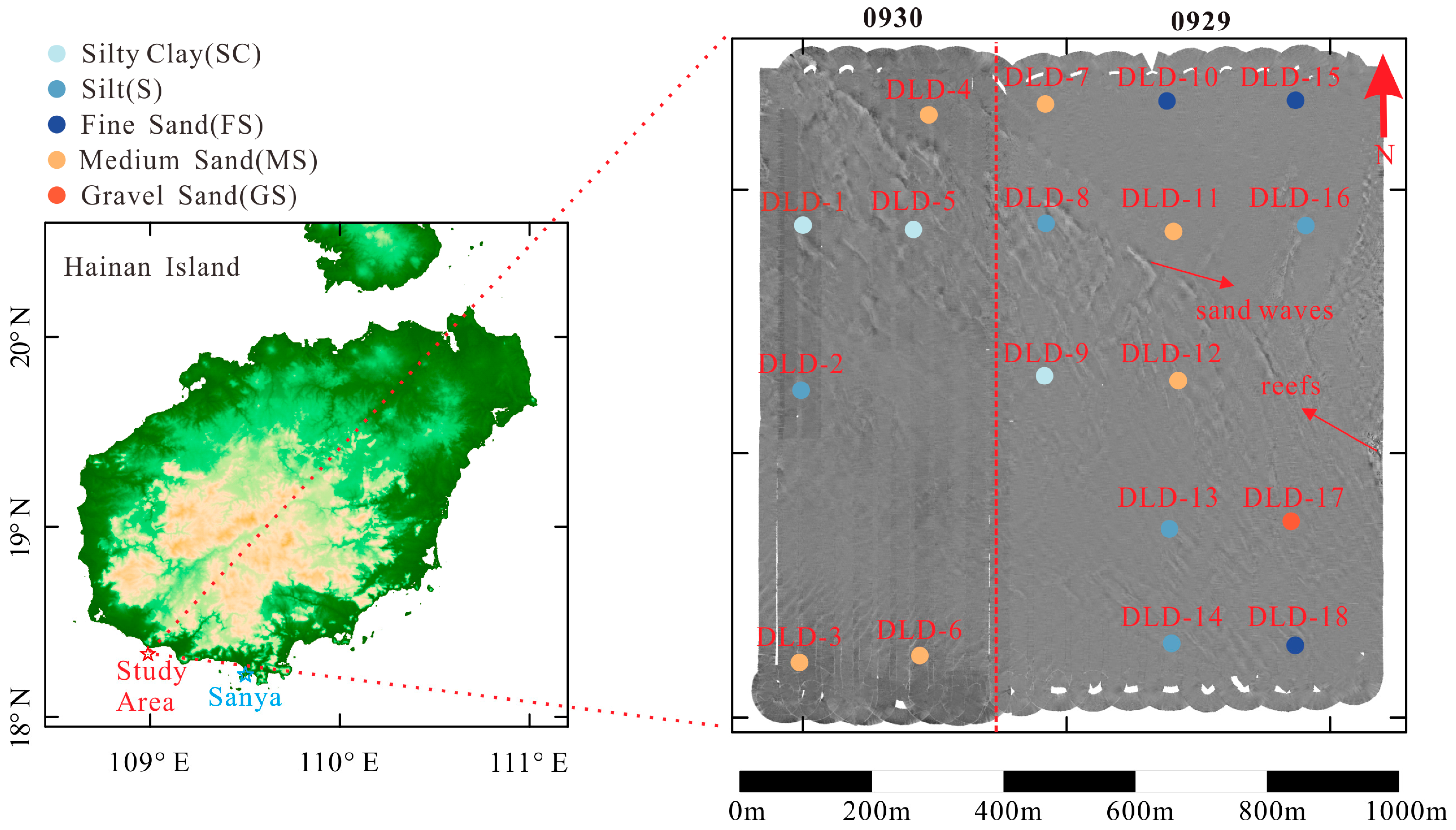
The study area is located in the southwestern offshore region of Hainan Island, China (108.98° E to 108.99° E, 18.32° N to 18.33° N), covering approximately 1 km2 (Figure 1). This site was specifically selected for its combination of moderate water depths (6.6 to 15.8 m), diverse sediment types, and relatively mild topographic gradients, providing an ideal natural laboratory for investigating backscatter-sediment relationships under conditions where sediment properties, rather than extreme topographic relief, are expected to dominate acoustic response.
The seafloor exhibits a gentle slope (approximately 0.9%) that deepens from northeast to southwest, with water depth increasing gradually across the survey domain. Despite this overall mild gradient, the seafloor is characterized by subtle undulations that host a variety of small-scale morphological features, including sand waves, troughs, ridges, and scattered reef structures. These features are formed and maintained by local hydrodynamic processes, primarily driven by tidal currents and seasonal monsoon-induced wave action [17]. The regional hydrodynamic regime promotes active sediment transport and reworking, resulting in spatially heterogeneous sediment distributions that range from coarse gravelly sand in high-energy zones to fine sand and silt in more sheltered or deeper areas.

2.2. Sidescan Sonar Data Acquisition and Processing

2.2.1. Data Acquisition

To acquire seafloor acoustic imagery for study area, a Kewei C400 acoustic Unmanned Surface Vehicle (USV, Anhui Kewei Intelligent Technology Co., Ltd., Anhui, China) equipped with a 3DSS-iDX three-dimensional sidescan sonar(Ping Digital Signal Processing Inc., North Saanich, BC, Canada) was utilized, which met the survey requirements [17,18]. The sonar transducer’s transmission frequency was 450 kHz, the beam width was 55°, and the constraint angle was 10°. Survey lines were oriented in a north-south direction with 30 m line spacing to ensure complete coverage without excessive overlap, and the vessel maintained a consistent speed of approximately 3.6 knots to balance acquisition efficiency with data quality. The range setting was dynamically adjusted based on water depth: 30 m range for depths < 5 m and 50 m range for depths > 5 m, ensuring that the swath width remained proportional to the acoustic footprint and minimizing range-dependent resolution degradation. Positioning was achieved using GPS differential signals with an error of less than 1 m. Theoretically, its along-track resolution can reach 10 cm, and its across-track resolution can reach 5 cm. Two separate surveys were conducted on 29 September and 30 September 2020, under similar weather and sea state conditions to minimize environmental variability (see Figure 1; data on the right side of the dotted line were acquired on 0929, and data on the left side were acquired on 0930).

2.2.2. Data Processing

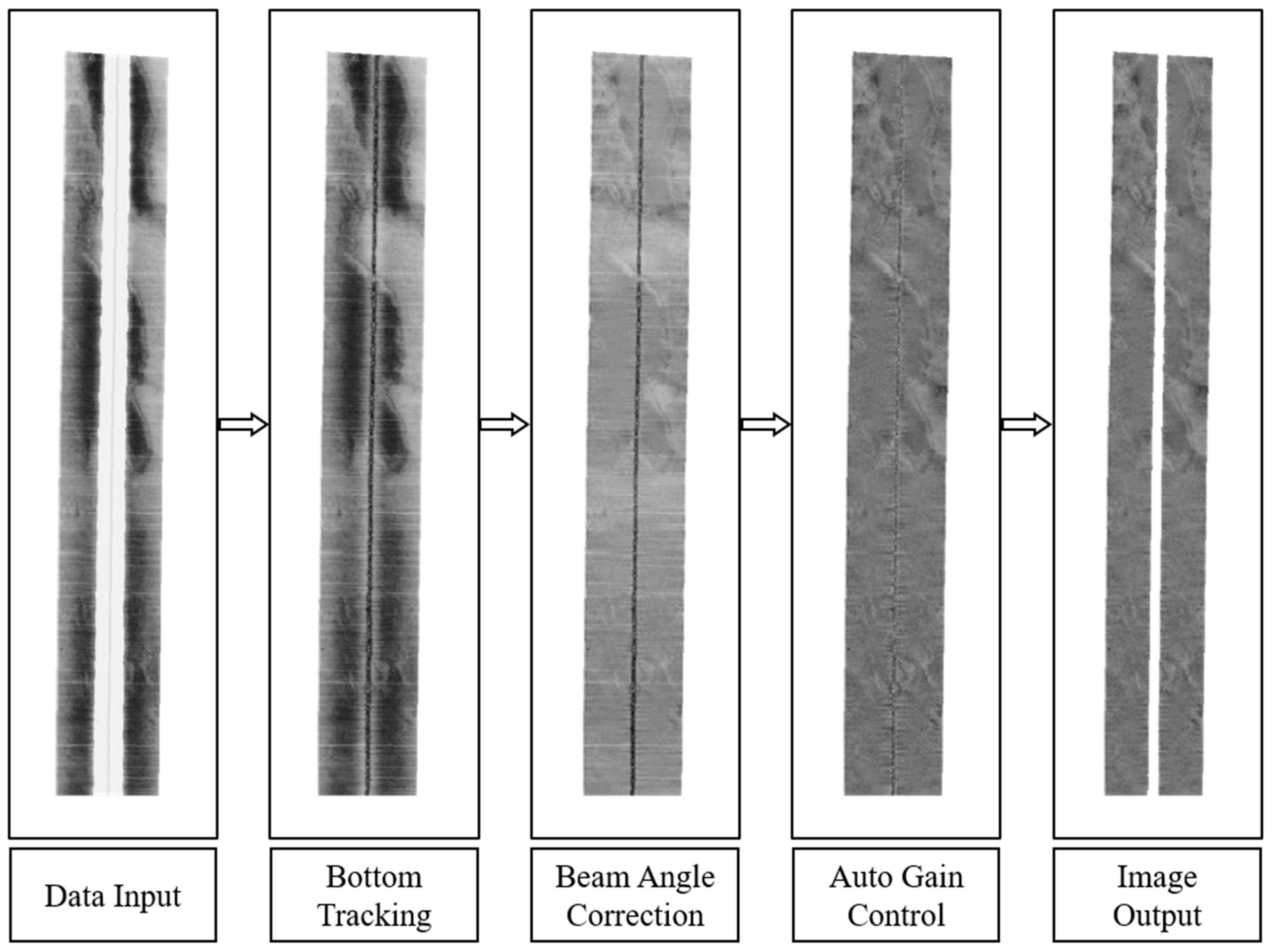
Backscatter intensity in sidescan sonar images is represented by the magnitude of the grayscale value (the brightness/darkness of the image) [19]. Therefore, this study uses the grayscale values from the sidescan sonar images as a proxy for backscatter intensity. To obtain grayscale values, SonarWiz(Version 5) was used to process the raw sonar data (in XTF format) and generate GeoTIFF images. Python(Version 3.12) was then employed to extract grayscale values from the GeoTIFF images to represent backscatter intensity (code provided in Appendix A). During processing of the raw sonar data, the imported data first underwent bottom tracking, followed by beam angle correction (aimed at correcting the nonlinear response characteristics of the sonar transducer), and then automatic gain control (used to eliminate large-scale effects of incidence angle and propagation distance on signal reflection intensity). Additionally, to mitigate the influence of the nadir zone, the central 40% nadir region of the image was made transparent (Figure 2). The final exported GeoTIFF images had a color resolution of 8-bit and a spatial resolution of 0.5 m/pixel.

2.3. Sediment Sampling and Grain Size Analysis

2.3.1. Sediment Sampling

To obtain sufficient weight of surface seafloor sediments, a grab sampler (specifications: 40 cm × 30 cm × 30 cm, weight 40 kg) was used. During sampling, upon the vessel’s arrival at designated stations, the sampler was deployed. After reaching the seafloor, positions were recorded by the navigation system. A total of 18 station samples were collected, all meeting the experimental weight requirements. The spatial distribution of sampling stations reflects a compromise between maximizing coverage of the acoustic dataset and logistical constraints. While the 18-station array provides reasonable representation of the major sediment facies observed in the acoustic imagery, we acknowledge that finer-scale spatial variability may not be fully captured, particularly in transitional zones between sediment types. This limitation is inherent to grab sampling approaches and represents a potential source of uncertainty in point-to-pixel correlations.

2.3.2. Grain Size Analysis

Grain size analysis of the samples was conducted at the Guangzhou Institute of Energy Testing, following the GB/T50123-2019 standard [20]. Since samples from some stations were sandy sediments, a combination of sieve analysis and laser diffraction particle sizing was employed. The procedure involved: placing an appropriate amount of sample in an oven (105 °C) to dry, then weighing it on a balance with a sensitivity of 0.001 g; adding 20 cm3 of a 0.5 mol/dm3 sodium hexametaphosphate dispersant to the dried sample; transferring the material passing through the sieve into a 1000 mL measuring cylinder and adding distilled water up to the 1000 mL mark; sequentially passing the material retained on the sieve through sieves of different size grades. Each size fraction was dried, weighed on a balance with a sensitivity of 0.0001 g, and its mass percentage calculated. For the fraction passing the finest sieve, the pipette method was used to extract suspensions corresponding to particle sizes of 0.075 mm and 0.005 mm at specific times, temperatures, and depths; 25 mL of each suspension was extracted, dried, and weighed to calculate its mass percentage.
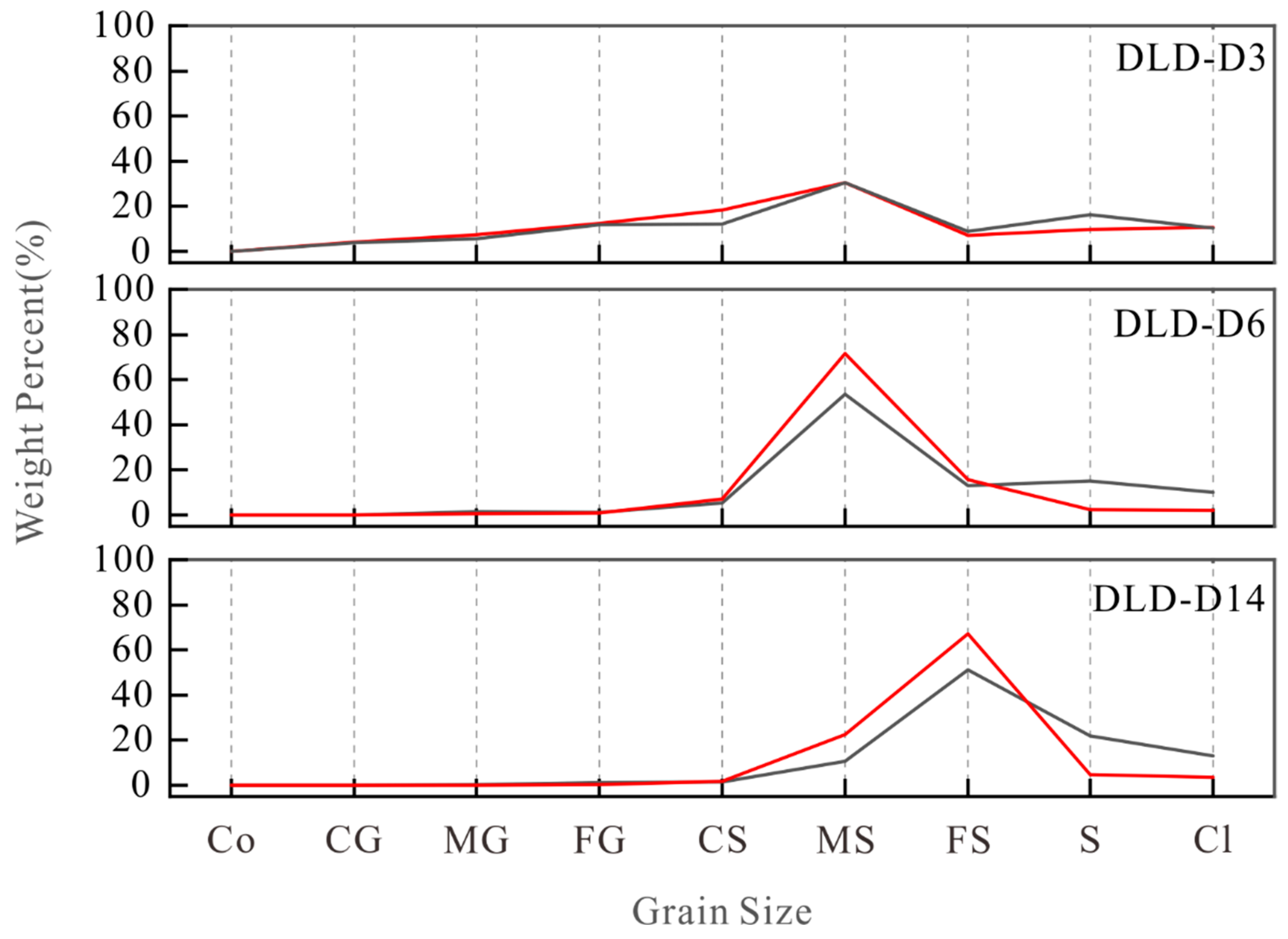
Repeatability tests were performed on samples DLD-3, DLD-6, and DLD-14. As shown in Figure 3 and Table 1, the grain size distributions and mean grain sizes for these three stations showed good repeatability (data marked in red were used in subsequent discussions).

3. Results and Discussion

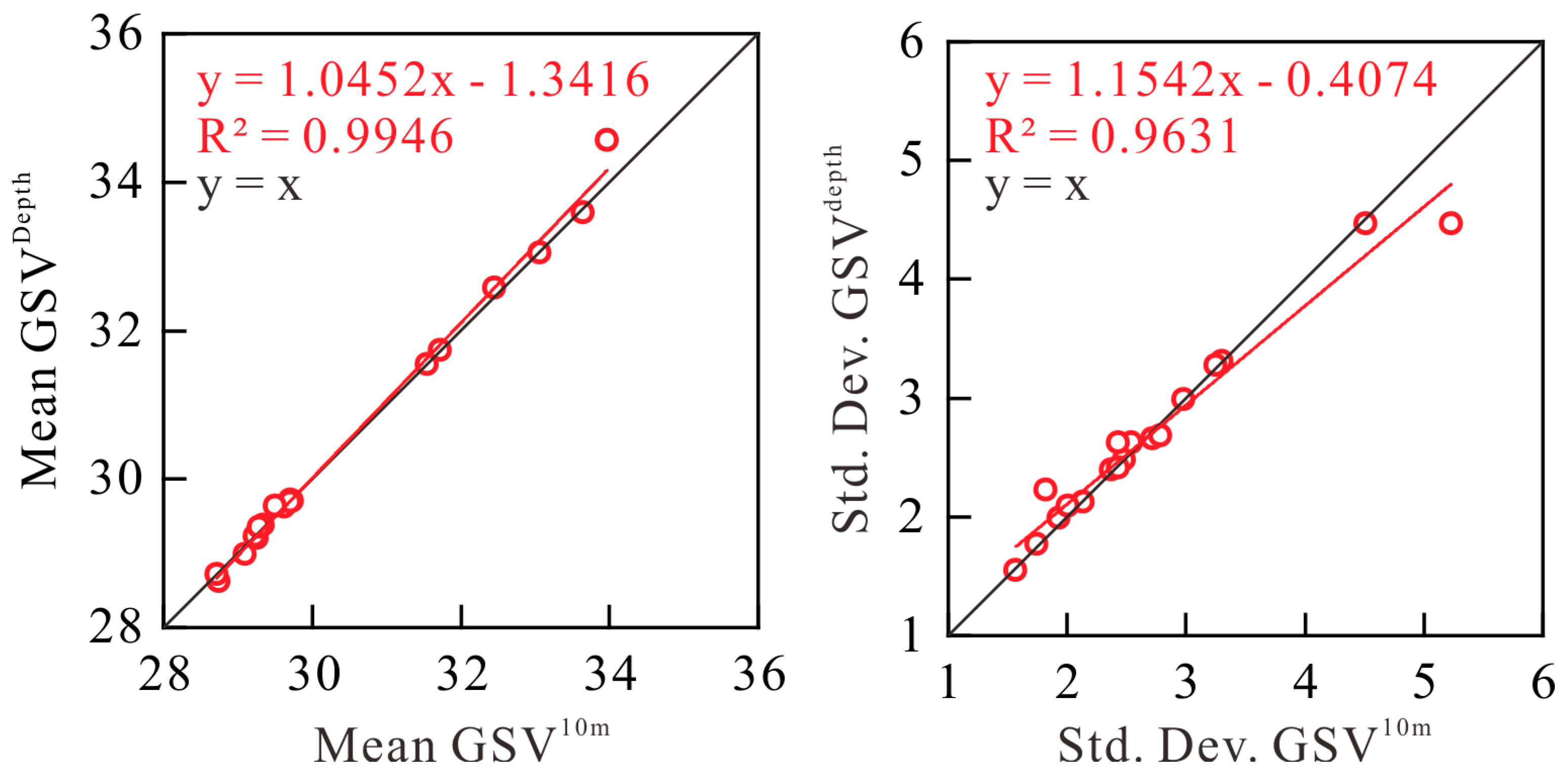
In studies utilizing sidescan sonar imagery for sediment classification, the selection of grayscale value extraction window size is crucial [23]. We reviewed extraction ranges used in similar research: Goff defined the extraction area as a 15 m × 15 m grid [13]; Collier set the extraction range to a 20 m × 20 m grid based on positioning errors of sediment sampling points [12]; Buscombe used a 25 m × 25 m grid based on backscatter spectral analysis results [24,25]. Given the water depth range of the study area (6.6~15.8 m), this study extracted grayscale value within a 10 m radius centered on the sampling positions, as well as data within a radius equal to the water depth at the sampling point. The former approach considered the average water depth of the area to be around 10 m, thus considering the sampling error to 10 m; the latter defined the sampling error as the local water depth. A comparison of data from both methods revealed that their averages and standard deviations were very close to the y = x function, indicating that the choice of extraction range had negligible impact on the mean grayscale value and its distribution (Figure 4). Based on these results, subsequent discussions in this paper utilize grayscale value extracted from within a 10 m radius of the sampling positions. This finding also provides a basis for selecting extraction ranges in future studies.

3.1. Inter-Survey Variability

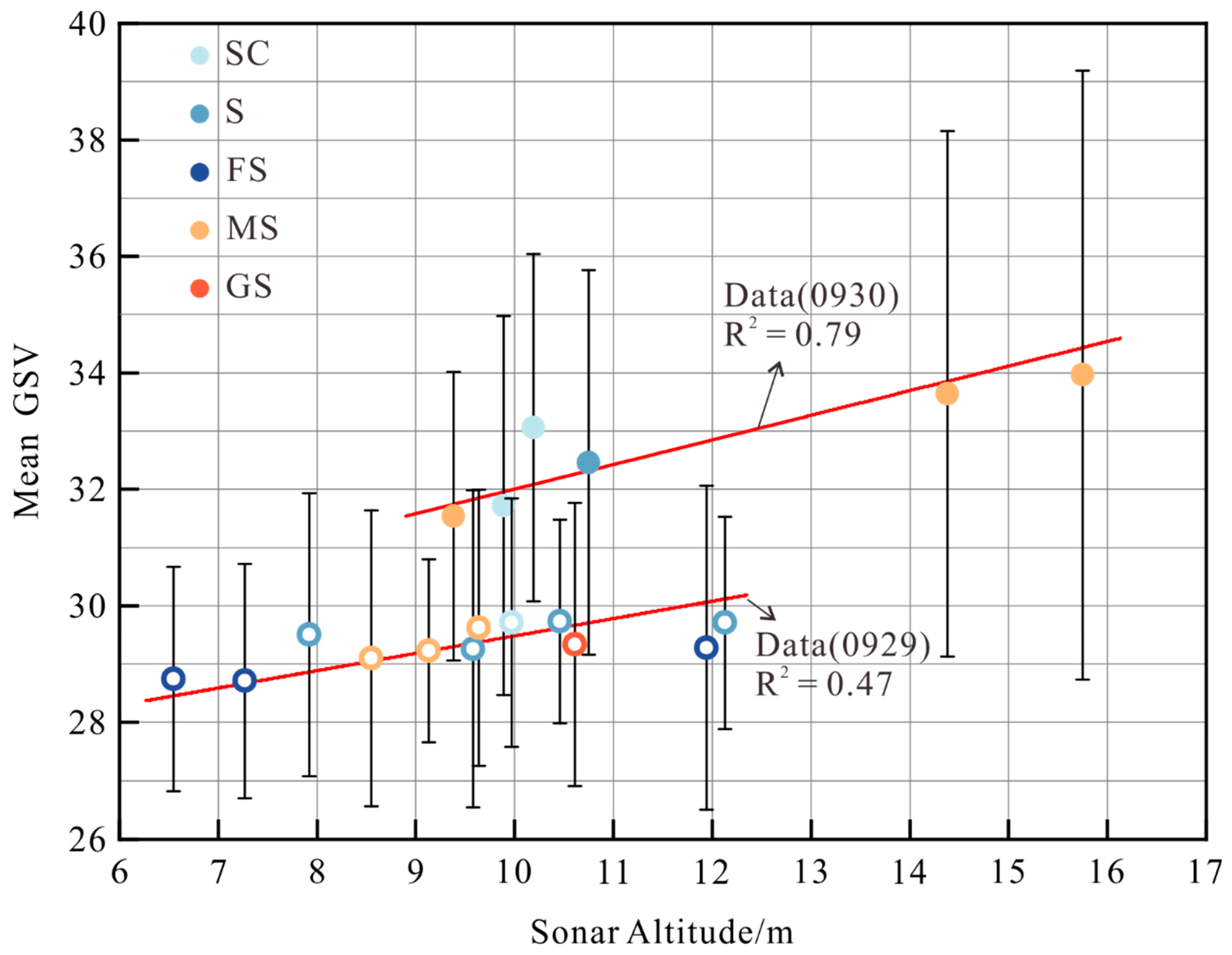
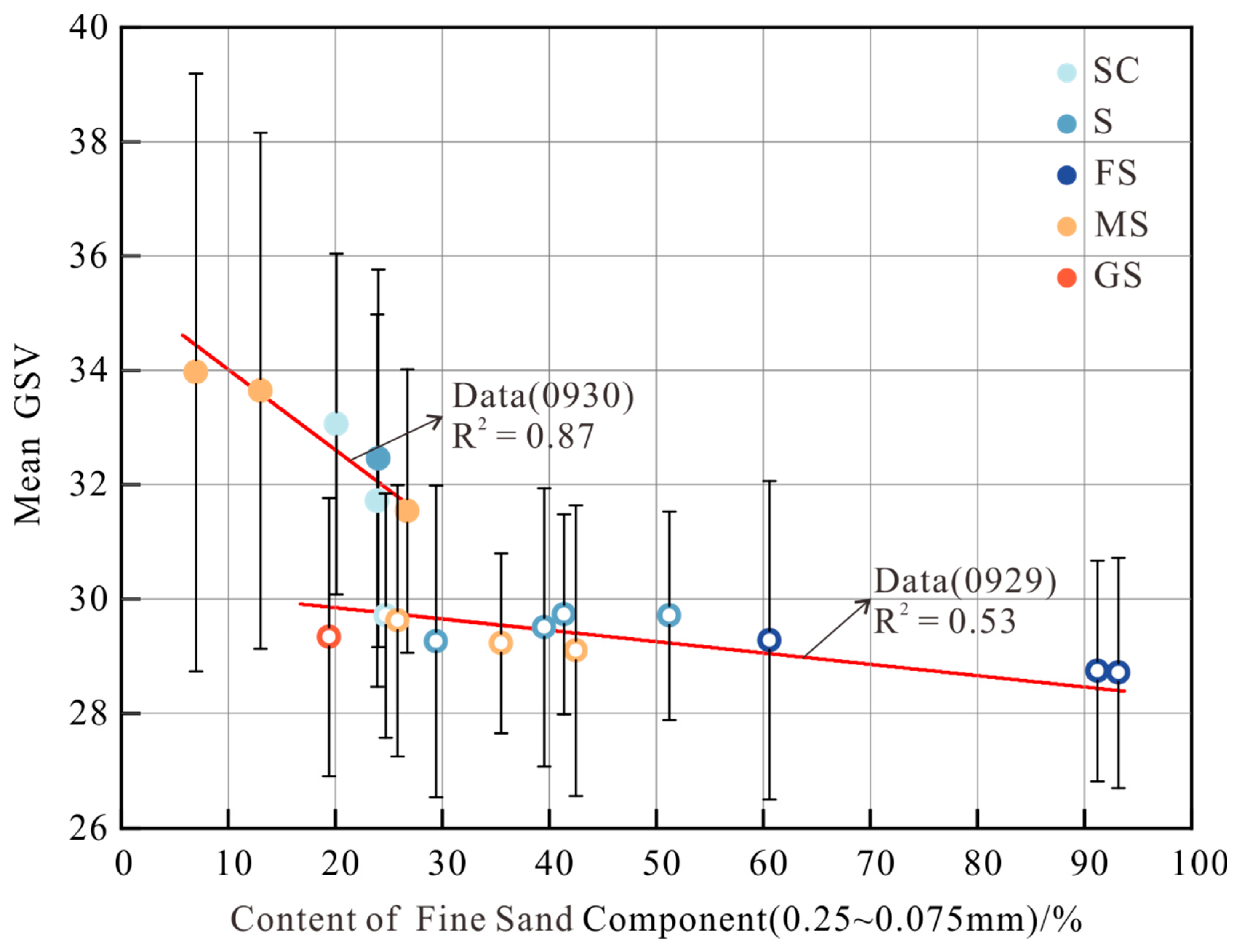
During the processing of sidescan sonar data, despite applying identical parameters to both the 0929 and 0930 datasets, noticeable differences in grayscale values were observed between the two datasets: As shown in Table 2, the range of mean grayscale values for all data on 0929 was 28.7~29.7 (mean 29.3), whereas for 0930 it was 31.5~34.0 (mean 32.7), representing an approximate 3-unit offset in grayscale values. Therefore, in subsequent correlation analyses, data from the two days are discussed separately. This inter-survey variability affects the strength of correlations, with the 0930 dataset generally showing stronger relationships between GSV and sediment properties than the 0929 dataset (Figure 5 and Figure 6).

3.2. Correlation Between Mean GSV and Sonar Altitude

The grayscale value of sidescan sonar imagery reflects the backscatter intensity of acoustic waves from the seafloor, and its variation is controlled not only by sediment properties but also by factors such as seafloor topography [9]. Figure 5 illustrates the relationship between mean grayscale value and sonar altitude above the seafloor (i.e., water depth). Since the sidescan sonar data were collected using a USV in this study, the transducer altitude is equivalent to the depth from the water surface to the seafloor, which can be considered as representing seafloor topographic variation. Although the study area exhibits minor topographic relief (slope approximately 0.9%), the grayscale value still showed a significant increasing trend with increasing sonar altitude, indicating that topographic factors exert a non-negligible influence on backscatter intensity even when topographic changes are subtle. This finding is consistent with results from previous researches, further confirming that topographic variation is an important variable for explaining spatial variability in backscatter intensity [13,27,28].
Further analysis revealed differences in the strength of correlation between the two datasets: data from 0930 showed a strong linear relationship between grayscale value and sonar altitude (R2 = 0.79), whereas the correlation for 0929 data was weaker (R2 = 0.47). This discrepancy may stem from differences in marine environmental conditions between the two survey days.

3.3. Correlation Analysis Between Mean GSV and Sediment Grain Size Parameters

3.3.1. Relationship with Mean Grain Size

Currently, there are limited quantitative studies on the relationship between sidescan sonar backscatter intensity and sediment grain size. The mean grain size ranges in existing studies vary, but the primary findings generally indicate a linear negative correlation between backscatter intensity and the mean sediment grain size in Φ units [12,13,14,15], although one study found a linear negative correlation with mean grain size in mm [16] (Table 3).
A critical point must be noted regarding the correlation between backscatter intensity and mean grain size. Most previous studies report a linear negative correlation between backscatter intensity and the mean grain size (Φ). Given the logarithmic relationship between grain size (mm) and grain size (Φ) (Φ = −log2d), a linear correlation (backscatter intensity vs. grain size (Φ)) does not imply a linear correlation (backscatter intensity vs. grain size (mm)). This study compared the correlations for mean grayscale value vs. mean grain size (mm) and mean grayscale value vs. mean grain size (Φ). For mean grayscale value vs. mean grain size (mm), the 0929 data showed a very weak positive correlation (R2 = 0.18), while the 0930 data showed almost no correlation (R2 = 0). For mean grayscale value vs. mean grain size (Φ), both the 0929 data and the 0930 data showed no correlation (R2 = 0, R2 = 0.05). This lack of strong correlation may originate from that mean grain size alone does not fully delineate the distribution characteristics of these sediment samples.

3.3.2. Relationship with Content of Fine Sand Component

Although no correlation was found between mean sediment grain size and mean grayscale value in this study, and the mean grayscale value was somewhat influenced by topographic variation, an analysis of the correlation between mean grayscale value and the content of different grain size fractions revealed a certain negative correlation with the fine sand fraction content (0.075~0.25 mm). Figure 6 illustrates the relationship between mean grayscale value and fine sand fraction content. Overall, they exhibit a negative correlation trend. The fitted correlation is strong for the 0930 data (R2 = 0.87) but weaker for the 0929 data (R2 = 0.53). This suggests that the content of this specific fraction may dominate the overall variation in grayscale value: higher fine sand content corresponds to lower grayscale values. Smith also compared mean backscatter intensity with fine fraction content and similarly found that mean backscatter intensity decreases with increasing fine fraction content [29]. Further analysis shows that when the fine sand content exceeds 60%, grayscale values are generally low; whereas when fine sand content is low (<40%), grayscale values are significantly higher. This phenomenon indicates that when the fine sand fraction is dominant, the seafloor surface is relatively smooth, resulting in weaker scattering and thus lower grayscale values. As the fine sand content decreases, coarser-grained sediments (such as gravel and sand fractions) may appear on the seafloor, increasing surface roughness and generating stronger interface scattering, which manifests as higher grayscale values in the acoustic imagery.
From the perspective of sediment type, medium sand and gravelly sand generally exhibit higher grayscale values compared to silty sand and fine sand. This difference aligns with acoustic scattering theory, where coarser-grained sediments produce stronger scattering, resulting in higher grayscale values in sonar images.
Based on the results above, it can be concluded that a linear negative correlation exists between mean sonar grayscale value and fine sand content. This provides a potential basis for fine-scale seafloor sediment classification using backscatter intensity. However, given the variation in correlation strength between different datasets, temporal variability and environmental factors must be considered in practical applications, necessitating the establishment of standardized measurement and correction procedures [30,31].

3.4. Correlation Analysis Between GSV Distribution and GS Distribution

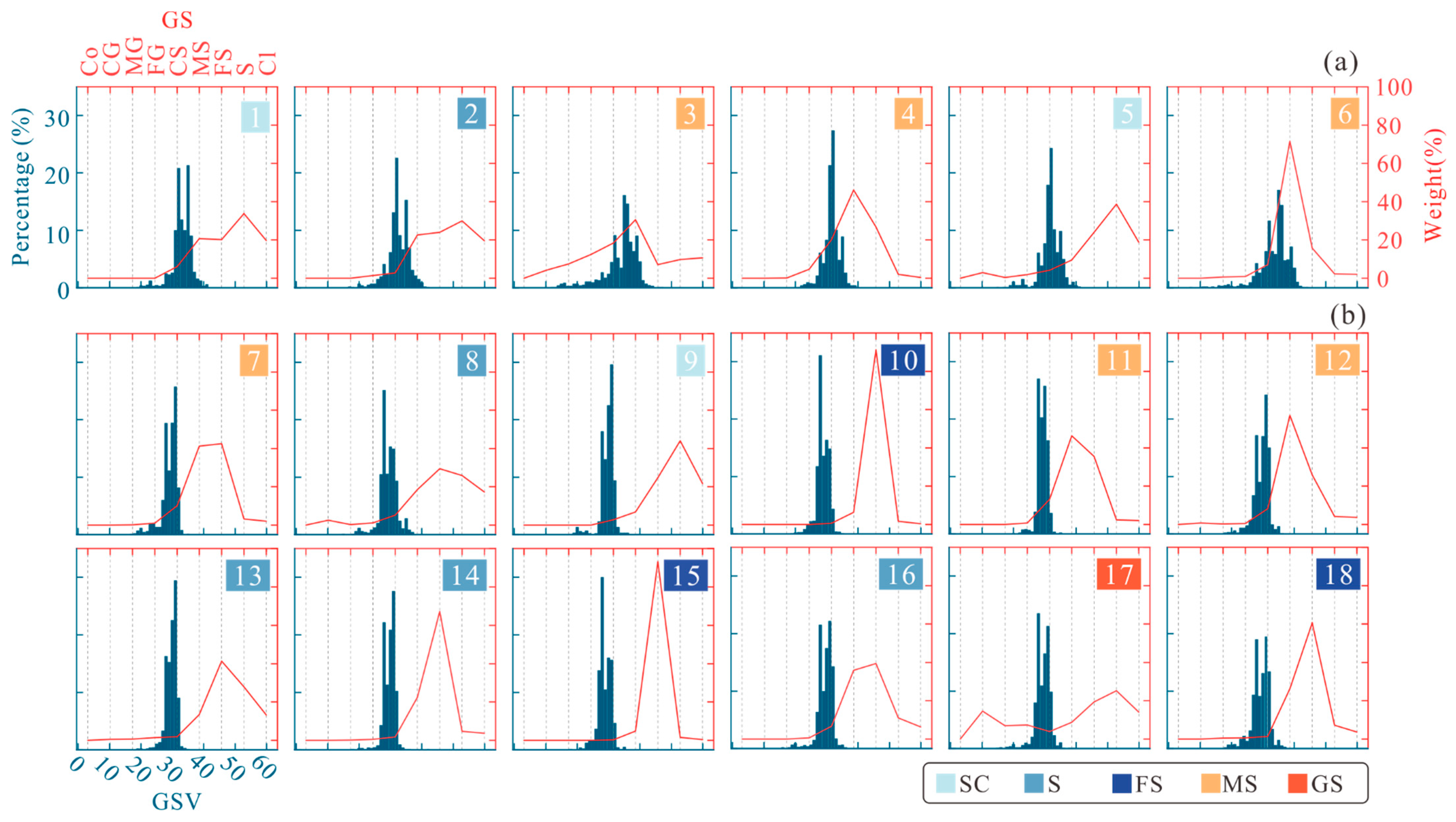
To further elucidate the intrinsic relationship between grayscale values and sediment composition, this study compared the frequency distribution of grayscale values with the grain size distribution for each station (Figure 7). The results show a good correspondence between them at most stations, reflecting the controlling effect of sediment composition on acoustic scattering characteristics.
At stations dominated by coarse-grained sediments (e.g., DLD-3, DLD-17), the grayscale distribution exhibits broad peaks and high values, consistent with their high proportions of medium sand, coarse sand, and gravel, indicating that rough surfaces cause strong scattering.
At stations dominated by fine sand and silt (e.g., DLD-10, DLD-15), grayscale values are concentrated in the low range with a narrow distribution, reflecting the acoustically smooth characteristics of homogeneous fine-grained sediments.
Stations are silty clay sediments (e.g., DLD-1, DLD-9) that often show multimodal grayscale distributions corresponding to bimodal or poorly sorted characteristics in their grain size distributions, suggesting complex sediment sources or diverse depositional dynamic processes.
Although the acoustic and sedimentological characteristics correspond well at most stations, inconsistencies are observed at some stations (e.g., DLD-2, DLD-14). Such deviations may originate from interference by local microtopography (e.g., sand waves, biogenic mounds), bioturbation, or other factors, indicating that sonar grayscale values are not determined solely by surface sediment grain size but are the result of the combined effects of multiple environmental factors.
The results indicate that grayscale value distribution characteristics can effectively reflect sediment sorting, compositional complexity, and spatial heterogeneity, demonstrating potential for rapid sediment type identification at a regional scale. However, to achieve accurate seafloor sediment classification, it remains necessary to integrate acoustic data with ground-truth sampling. Particularly in areas where acoustic response and grain size composition are inconsistent, enhanced fusion analysis of multi-source data is recommended.

3.5. Spatial Distribution Patterns of Sediments and Controlling Factors

Analysis of the spatial distribution of sediment grain size across the study area (Figure 1) reveals systematic patterns that reflect the combined influence of hydrodynamic processes and local morphological features. Understanding these distribution patterns is essential for interpreting the observed correlations between acoustic backscatter and sediment properties, as it clarifies the degree to which topography and hydrodynamics pre-organize sediment texture.
The majority of coarser-grained stations (DLD-4, DLD-7, DLD-11, DLD-12, and DLD-17, with mean grain sizes ranging from 0.4 to 3.1 mm) are concentrated in the northeastern sector of the study area, forming an approximately NW-SE trending linear zone. In contrast, finer-grained stations (DLD-1, DLD-2, DLD-5, DLD-8, DLD-9, DLD-13, DLD-14, and DLD-18, with mean grain sizes ranging from 0.1 to 0.3 mm) are predominantly located southwest of this coarse-grained zone. This spatial arrangement creates a systematic grain size gradient, with sediment progressively fining from northeast to southwest across the study domain.
Significantly, this sediment distribution pattern closely parallels the bathymetric gradient, which also shows progressive deepening from northeast (6.6 m water depth) to southwest (15.8 m water depth). This spatial correspondence between grain size and water depth is not coincidental, but rather reflects the fundamental control of hydrodynamic energy on sediment distribution. Shallower areas in the northeast experience higher wave orbital velocities and stronger tidal current speeds, creating energetic conditions capable of maintaining coarser sediment in transport and preventing fine particle deposition. Conversely, deeper southwestern areas experience attenuated wave energy and reduced current velocities, allowing fine sediment to settle and accumulate. This depth-dependent energy gradient drives hydraulic sorting, progressively winnowing fines from shallow high-energy zones and concentrating them in deeper low-energy zones, thereby establishing the observed NE-SW grain size trend.
Superimposed on this regional gradient are notable local deviations that indicate additional controlling factors beyond simple depth-energy relationships. The northeastern corner contains a cluster of fine-grained stations (DLD-10, DLD-15, DLD-16, mean grain sizes 0.2–0.3 mm) despite their shallow location, while the southwestern sector includes anomalously coarse stations (DLD-3, DLD-6, mean grain sizes 2.0 and 0.4 mm) in deeper water. These spatial anomalies demonstrate that hydrodynamic sorting alone cannot fully explain sediment distribution patterns.
The southwestern coarse-grained anomalies may be controlled by reef structures that act as localized sediment sources. For example, Station DLD-17, located adjacent to reef patches, exhibits the coarsest sediment (mean grain size 3.1 mm) with 60–70% of the coarse fraction consisting of bioclastic material derived from in-situ reef breakdown. Given the widespread reef presence in the study area, the coarser texture at DLD-3 and DLD-6 is very likely attributable to the same reef-sourced biogenic sediment supply mechanism observed at DLD-17, overriding the regional depth-energy gradient. Conversely, the northeastern fine-grained cluster (DLD-10, DLD-15, DLD-16) in shallow water (6.6–7.9 m) likely results from topographic sheltering, sediment supply limitations, or recent depositional events.
This spatial analysis has important implications for interpreting the GSV-grain size correlations established in Section 3.3. The observed relationships integrate the effects of: (1) regional hydrodynamic sorting that creates systematic covariation between depth, grain size, and (through geometric scattering effects) GSV; and (2) local morphological controls (reefs, topographic complexity) that introduce secondary spatial variability. Consequently, the strong correlation between GSV and fine sand content (R2 = 0.87 for 0930 dataset) reflects not only direct acoustic scattering from sediment texture, but also the fact that both variables are organized by common underlying controls—primarily hydrodynamic energy gradients, with secondary modulation by reef sediment sources and local sheltering effects. This underscores the importance of considering spatial context when applying acoustic classification models: predictions will be most reliable in areas where hydrodynamic sorting is the dominant control, but may fail in reef-proximal zones or other settings where local morphological factors override regional energy gradients. Multi-scale analysis incorporating both regional trends and local deviations is therefore essential for robust acoustic sediment mapping.

4. Conclusions

This study systematically analyzed the correlation between sidescan sonar backscatter intensity and sediment grain size off the southwestern coast of Hainan Island, leading to the following main conclusions:
(1) Inter-Survey Variability and Topography Influence: Differences in sidescan sonar backscatter intensity values were observed between different survey sessions, likely due to variations in environmental factors. Backscatter intensity is also influenced by topographic changes. Therefore, the influence of both survey session differences and topographic changes must be considered in subsequent seafloor classification research.
(2) Key Grain Size Parameter: Backscatter intensity showed a significant negative correlation with fine sand fraction (0.075–0.25 mm). This finding suggests that the abundance of a specific grain-size fraction, rather than the integrated mean grain size, is the governing factor for the backscatter intensity. The established GSV-fine sand correlation enables semi-quantitative prediction of fine sand content from acoustic imagery, facilitating rapid mapping of sediment distributions over large areas.
(3) GSV Distribution and Grain Size Distribution Coupling: The distribution characteristics of sonar grayscale values demonstrated a clear coupling with sediment grain size distributions. Stations dominated by coarse-grained sediments (e.g., medium sand, gravelly sand) exhibited higher and broader grayscale value distributions, indicative of strong scattering from rough surfaces. Conversely, fine-grained stations (e.g., fine sand, silt) showed lower and narrower value distributions, characteristic of acoustically smooth seafloors. This consistent pattern confirms the validity of using backscatter data to differentiate major sediment types based on acoustic scattering principles.
(4) Sediment Spatial Distribution Patterns and Controlling Factors: Sediment grain size exhibits a clear NE–SW spatial gradient, with coarser sediments prevailing in shallow northeastern areas and finer sediments dominating deeper southwestern zones, broadly consistent with the regional bathymetric and hydrodynamic gradient. High-energy shallow environments favor coarse sediment retention, whereas low-energy deeper areas promote fine sediment accumulation. Superimposed on this regional pattern, local deviations may be primarily controlled by reef distribution and seafloor topographic complexity, indicating that morphological factors can locally override hydrodynamic control on sediment composition.
This study has established a quantitative relationship between sidescan sonar grayscale and sediment grain size (especially fine sand content), providing a scientific basis for rapid fine-scale seafloor classification using acoustic imagery in morphologically complex study areas. Further research in more types of seafloor environments and over a wider range of grain sizes is recommended to further validate and promote the applicability of this methodology.

Author Contributions

Funding acquisition, M.W.; data acquisition, J.Y. and R.L.; data processing and analysis, S.M., B.L., Z.C. and C.W.; visualization, S.M., J.T., Z.Z. and C.C.; writing—original draft preparation, S.M., P.W. and B.L.; writing—review and editing, S.M., P.W. and M.W. All authors have read and agreed to the published version of the manuscript.

Funding

This work was supported by the National Key Research and Development Program of China (2021YFC2801704).

Data Availability Statement

The data presented in this study are available on request from the corresponding author due to laboratory confidentiality regulations.

Conflicts of Interest

The authors declare that the research was conducted in the absence of any commercial or financial relationships that could be construed as potential conflicts of interest.

Abbreviations

The following abbreviations are used in this manuscript:
GSVGrayscale value
GSGrain size
CoCobble, >20 mm
CGCoarse Gravel, 20~10 mm
MGMedium Gravel, 10~5 mm
FGFine Gravel, 10~2 mm
CSCoarse Sand, 2~0.5 mm
MSMedium Sand. 0.5~0.25 mm
FSFine Sand, 0.2~0.075 mm
SSilt, 0.075~0.005 mm
ClClay, <0.005 mm
SCSilty Clay
GSGravelly Sand

Appendix A. Grayscale Value Extraction Code

import rasterio
from rasterio.windows import Window
from pyproj import Transformer
import numpy as np
import matplotlib.pyplot as plt
import os
# 1. Define latitude and longitude points in batch
points = [
  (18.33135333, 108.9854767),
  (18.329455, 108.98563),
  # …… (Other coordinates)
]
# 2. Define GeoTIFF file path
geotiff_path = 'dld.tif'
# 3. Define output directory
output_dir = 'output'
os.makedirs(output_dir, exist_ok=True)
# 4. Open the GeoTIFF file
with rasterio.open(geotiff_path) as dataset:
  # 5. Define coordinate transformer
  transformer = Transformer.from_crs("EPSG:4326", dataset.crs, always_xy=True)
  # 6. Iterate through each lat/lon point
  for i, (lat, lon) in enumerate(points):
    print(f"Processing point {i + 1}: ({lat}, {lon})")
    # 7. Convert lat/lon to projected coordinates
    x, y = transformer.transform(lon, lat)
    print(f"Target point projected coordinates: ({x}, {y})")
    # 8. Calculate pixel range for the target area
    pixel_size_x, pixel_size_y = dataset.res # Get pixel resolution (in meters)
    radius = 10 # 10-meter radius
    offset_x = radius / pixel_size_x # Horizontal pixel offset
    offset_y = radius / pixel_size_y # Vertical pixel offset
    # Convert projected coordinates to pixel coordinates
    row, col = dataset.index(x, y)
    print(f"Target point pixel coordinates: ({row}, {col})")
    # Calculate window extent
    window = Window(
      col - offset_x, # Left boundary
      row - offset_y, # Top boundary
      2 * offset_x,  # Width
      2 * offset_y  # Height
    )
    # 9. Extract grayscale value data within the window
    data = dataset.read(1, window=window)
    print("Extracted grayscale value data:")
    print(data)
    # 10. Create a circular mask
    rows, cols = data.shape
    center_row, center_col = rows // 2, cols // 2 # Window center
    y_grid, x_grid = np.ogrid[:rows, :cols]
    mask = (x_grid - center_col)**2 + (y_grid - center_row)**2 <= (offset_x)**2 # Circular mask
    # 11. Extract grayscale value data within the circular area
    circle_data = data[mask]
    print("Grayscale value data within the circular area:")
    print(circle_data)
    # 12. Calculate statistical metrics
    pixel_count = circle_data.size  # Pixel count
    max_value = np.max(circle_data) # Maximum value
    min_value = np.min(circle_data) # Minimum value
    mean_value = np.mean(circle_data) # Mean value
    std_value = np.std(circle_data)  # Standard deviation
    print(f"Pixel count: {pixel_count}")
    print(f"Max value: {max_value}")
    print(f"Min value: {min_value}")
    print(f"Mean value: {mean_value}")
    print(f"Standard deviation: {std_value}")
    # 13. Analyze grayscale value distribution
    unique_values, counts = np.unique(circle_data, return_counts=True)
    print("Grayscale value distribution statistics:")
    for value, count in zip(unique_values, counts):
      print(f"Gray value {value}: {count} pixels")

References

  1. Ciacchella, M.C.; Castellino, M.; Tomassi, A.; Trippetta, F.; Marrocchi, A.; Bracciale, M.P. Waves After Waves: The Use of Citric Acid as Salt Crystallization Inhibitor for Improving the Resistance of Concrete in Marine Environments. J. Compos. Sci. 2025, 9, 639. [Google Scholar] [CrossRef]
  2. Chiocci, F.L.; Cattaneo, A.; Urgeles, R. Seafloor Mapping for Geohazard Assessment: State of the Art. Mar. Geophys. Res. 2011, 32, 1–11. [Google Scholar] [CrossRef]
  3. Liu, Y.; Li, S.; Zhong, S.; Guo, G.; Liu, J.; Niu, J.; Xue, Z.; Zhou, J.; Dong, D.; Suo, Y. Machine learning: A new approach to intelligent exploration of seafloor mineral resources. Earth Sci. Front. 2024, 31, 520–529. [Google Scholar] [CrossRef]
  4. Gao, W.; Wang, H.; Sun, Y.; Xu, W.; Gui, Y. Sediment Distribution and Seafloor Substratum Mapping on the DD Guyot, Western Pacific. J. Mar. Sci. Eng. 2025, 13, 1904. [Google Scholar] [CrossRef]
  5. Su, Q.; Lyu, H.; Yang, J.; Sun, P. Analysis of the walking performance of tracked deep⁃sea mining vehicle on soft sediment. Ocean Eng. 2022, 40, 162–168. [Google Scholar] [CrossRef]
  6. Wang, H.; Zhang, J.; Lei, Y. Research progress on the mechanism and estimation method of the sinking of submarine un-exploded ordnance. Ocean Eng. 2024, 43, 1–15. [Google Scholar] [CrossRef]
  7. Ni, Y.; Li, J.; Xi, L. Discussion on grain-size grading scale and sediment classification for marine sand and gravel. J. Trop. Oceanogr. 2020, 40, 143–151. [Google Scholar] [CrossRef]
  8. Wang, X.; Wang, A.; Jiang, T.; Yang, Y.; Zhang, B. Review of application areas for side scan sonar image. Bull. Surv. Mapp. 2019, 1–4. [Google Scholar] [CrossRef]
  9. Urick, R.J. Principles of Underwater Sound; Mc-Graw-Hill: New York, NY, USA, 1983; ISBN 0-07-066087-5. [Google Scholar]
  10. Dunsiger, A.; MacIsaac, R. Broadband Seismic Data Used for Seafloor Sediment Classification. In Proceedings of the OCEANS ’78, Washington, DC, USA, 6–8 September 1978; pp. 521–526. [Google Scholar]
  11. Gardner, J.V.; Field, M.E.; Lee, H.; Edwards, B.E.; Masson, D.G.; Kenyon, N.; Kidd, R.B. Ground-Truthing 6. 5-kHz Side Scan Sonographs: What Are We Really Imaging. J. Geophys. Res. Solid Earth 1991, 96, 5955–5974. [Google Scholar] [CrossRef]
  12. Collier, J.S.; Brown, C.J. Correlation of Sidescan Backscatter with Grain Size Distribution of Surficial Seabed Sediments. Mar. Geol. 2005, 214, 431–449. [Google Scholar] [CrossRef]
  13. Goff, J.A.; Olson, H.C.; Duncan, C.S. Correlation of Side-Scan Backscatter Intensity with Grain-Size Distribution of Shelf Sediments, New Jersey Margin. Geo-Mar. Lett. 2000, 20, 43–49. [Google Scholar] [CrossRef]
  14. Ryan, W.B.F.; Flood, R.D. Side-Looking Sonar Backscatter Response at Dual Frequencies. Mar. Geophys. Res. 1996, 18, 689–705. [Google Scholar] [CrossRef]
  15. Davis, K.S.; Slowey, N.C.; Stender, I.H.; Fiedler, H.; Bryant, W.R.; Fechner, G. Acoustic Backscatter and Sediment Textural Properties of Inner Shelf Sands, Northeastern Gulf of Mexico. Geo-Mar. Lett. 1996, 16, 273–278. [Google Scholar] [CrossRef]
  16. Borgeld, J.C.; Hughes Clarke, J.E.; Goff, J.A.; Mayer, L.A.; Curtis, J.A. Acoustic Backscatter of the 1995 Flood Deposit on the Eel Shelf. Mar. Geol. 1999, 154, 197–210. [Google Scholar] [CrossRef]
  17. Li, Y.; Wei, C.; Li, R.; Fu, X.; Yang, J.; Li, M. Application of UAV and USV in joint survey of the submarine and land geomorphology in Dongluo Island, Hainan. Mar. Geol. Front. 2021, 37, 80–88. [Google Scholar] [CrossRef]
  18. Wang, Y.; Chang, L.; Li, Y.; Zhao, B.; He, C. Exploring into the Application of Sonar in Marine Surveying and Mapping with 3DSS-iDX-450 3D Sidescan Sonar as an Example. Value Eng. 2023, 42, 111–113. [Google Scholar]
  19. Subarsyah; Manik, H.M.; Albab, A. Side-Scan Sonar Image Processing: Seabed Classification Based on Acoustic Backscattering. IOP Conf. Ser. Earth Environ. Sci. 2021, 944, 012001. [Google Scholar] [CrossRef]
  20. GB/T 50123-2019; Ministry of Water Resources of the People’s Republic of China. Standard for Geotechnical Testing Method. Beijing China Planning Publishing House: Beijing, China, 2019.
  21. Lü, W. Study on Grain Size Characteristics of Sediments from Different Marine Environments. Master’s Thesis, First Institute of Oceanography, Qingdao, China, 2017. [Google Scholar]
  22. John, M. Grain Size Determination and Interpretation. In Techniques in Sedimentology; Blackwell Scientific Publications: Oxford, UK, 1988. [Google Scholar]
  23. Huvenne, V.A.I.; Blondel, P.; Henriet, J.-P. Textural Analyses of Sidescan Sonar Imagery from Two Mound Provinces in the Porcupine Seabight. Mar. Geol. 2002, 189, 323–341. [Google Scholar] [CrossRef]
  24. Buscombe, D.; Grams, P.E.; Kaplinski, M.A. Characterizing Riverbed Sediment Using High-Frequency Acoustics: 1. Spectral Properties of Scattering. J. Geophys. Res. Earth Surf. 2014, 119, 2674–2691. [Google Scholar] [CrossRef]
  25. Buscombe, D.; Grams, P.E.; Kaplinski, M.A. Characterizing Riverbed Sediment Using High-Frequency Acoustics: 2. Scattering Signatures of Colorado River Bed Sediment in Marble and Grand Canyons. J. Geophys. Res. Earth Surf. 2014, 119, 2692–2710. [Google Scholar] [CrossRef]
  26. JTS 133-2013; Ministry of Transport of the People’s Republic of China. Code for Geotechnical Investigation on Port and Waterway Engineering. People’s Communications Publishing House: Beijing, China, 2013.
  27. Lubis, M.Z.; Anurogo, W.; Khoirunnisa, H.; Irawan, S.; Roziqin, A. Using Side-Scan Sonar Instrument to Characterize and Map of Seabed Identification Target in Punggur Sea of the Riau Islands, Indonesia. J. Geosci. Eng. Environ. Technol. 2017, 2, 1–8. [Google Scholar] [CrossRef]
  28. Goff, J.A.; Swift, D.J.P.; Duncan, C.S.; Mayer, L.A.; Hughes-Clarke, J. High-Resolution Swath Sonar Investigation of Sand Ridge, Dune and Ribbon Morphology in the Offshore Environment of the New Jersey Margin. Mar. Geol. 1999, 161, 307–337. [Google Scholar] [CrossRef]
  29. Smith, L.; Stark, N.; Jaber, R. Relating Side Scan Sonar Backscatter Data to Geotechnical Properties for the Investigation of Surficial Seabed Sediments. Geo-Mar. Lett. 2023, 43, 9. [Google Scholar] [CrossRef]
  30. Du, M. Near-Subsea Multi-Source Data Integration and Its Application in Marine Engineering. Master’s Thesis, University of Chinese Academy of Sciences, Beijing, China, 2023. [Google Scholar] [CrossRef]
  31. Zhao, Y.; Zhao, T. Survey of the intelligent seabed sediment classification technology based on sonar images. J. Intell. Syst. 2020, 15, 587–600. [Google Scholar]
Figure 1. Study Area (Longitude varies from 108.98° E to 108.99° E, latitude varies from 18.32° N to 18.33° N).
Jmse 14 00125 g001
Figure 2. Sidescan sonar data processing diagram.
Jmse 14 00125 g002
Figure 3. Repeatability of grain size distribution. The particle size classification standards are as follows: Co (Cobble, >20 mm), CG (Coarse Gravel, 20~10 mm), MG (Medium Gravel, 10~5 mm), FG (Fine Gravel, 10~2 mm), CS (Coarse Sand, 2~0.5 mm), MS (medium sand. 0.5~0.25 mm), FS (Fine Sand, 0.2~0.075 mm), S (Silt, 0.075~0.005 mm), and Cl (clay, <0.005 mm). The red and black lines represent the results of two replicate grain size analysis of the same sediment sample.
Jmse 14 00125 g003
Figure 4. Grayscale value and its standard deviation (water depth vs. 10 m).
Jmse 14 00125 g004
Figure 5. Correlation of mean grayscale values and sonar altitude. Solid circles represent the data from 0930, while hollow circles represent the data from 0929; the error bars indicate the standard deviation of the grayscale values within a 10-m range of each station.
Jmse 14 00125 g005
Figure 6. Correlation between mean grayscale values and fine sand component content.
Jmse 14 00125 g006
Figure 7. Comparison between grayscale value distribution and grain size distribution at different stations ((a): 0930, (b): 0929). Red part represents the percentage distribution of sidescan sonar grayscale values, while blue part shows the mass percentage of different particle size. The particle size classification standards are as follows: Co (Cobble, >20 mm), CG (Coarse Gravel, 20~10 mm), MG (Medium Gravel, 10~5 mm), FG (Fine Gravel, 10~2 mm), CS (Coarse Sand, 2~0.5 mm), MS (Medium Sand. 0.5~0.25 mm), FS (Fine Sand, 0.2~0.075 mm), S (Silt, 0.075~0.005 mm), and Cl (Clay, <0.005 mm). The numbers 1–18 in the figure represent the station numbers of different sediment samples.
Jmse 14 00125 g007
Table 1. Repeatability of mean grain size.
SampleMean Grain Size
(mm)
Standard DeviationMean Grain Size
(Φ)
Standard Deviation
DLD-32.00.13−1.0 0.10
1.7−0.8
DLD-60.40.011.2 0.01
0.51.1
DLD-140.30.012.2 0.05
0.32.1
The mean grain size of sediments is commonly expressed using the Φ scale (Φ = −log2d, where d is the sediment diameter in mm). Therefore, a larger mean grain size corresponds to a smaller mean Φ value [21,22].
Table 2. Mean grayscale values, mean grain sizes, and φ values of different stations.
Sample StationAcquisition TimeDepth/mGSVMean GS/mmMean GS (Φ)Laboratory Classification 1
DLD-1093010.233.10.22.3Silt
DLD-210.832.50.22.2Fine sand
DLD-315.834.02.0−1.0Medium sand
DLD-49.431.50.60.6Medium sand
DLD-59.931.70.70.6Silt
DLD-614.433.60.41.2Medium sand
DLD-709298.629.10.41.3Medium sand
DLD-89.629.30.60.7Silty Sand
DLD-910.029.70.13.1Silt
DLD-106.628.70.22.5Fine Sand
DLD-119.129.20.41.2Medium sand
DLD-129.629.60.51.0Medium sand
DLD-1310.529.70.31.7Silty Sand
DLD-1412.129.70.22.2Silty Sand
DLD-157.328.70.22.5Fine Sand
DLD-167.929.50.31.7Silty Sand
DLD-1710.629.33.1−1.6Gravel Sand
DLD-1811.929.30.31.9Fine Sand
1 Classification standard from “Code for Geotechnical Investigation on Port and Waterway Engineering” JTS 133-2013 [26].
Table 3. Correlation between mean grain size and backscatter intensity (grayscale value, GSV) in different studies.
ResearcherMean GS RangeCorrelation with Mean GSVCorrelation with Mean GSV (Φ)
Goff [13]0.25~4 mm-negative
Collier [12]0.016~0.5 mm-negative
Ryan [14]0.004~4 mm-negative
Davis [15]1~8 mm-negative
Borgreld [16]0~0.12 mmnegative-
This Study0.1~3.1 mmNo correlationNo correlation
Disclaimer/Publisher’s Note: The statements, opinions and data contained in all publications are solely those of the individual author(s) and contributor(s) and not of MDPI and/or the editor(s). MDPI and/or the editor(s) disclaim responsibility for any injury to people or property resulting from any ideas, methods, instructions or products referred to in the content.