


Abstract
Ship weather routing optimization has evolved from deterministic great-circle navigation to sophisticated frameworks that account for dynamic environmental conditions and operational constraints. This paper presents a waypoint-sequencing Model Predictive Control (MPC) approach for energy-efficient ship weather routing under forecast uncertainty. The proposed rolling horizon framework integrates neural network-based vessel performance models with ensemble weather forecasts to enable real-time route adaptation while balancing fuel efficiency, navigational safety, and path smoothness objectives. The MPC controller operates with a 6 h control horizon and 24 h prediction horizon, re-optimizing every 6 h using updated meteorological forecasts. A multi-objective cost function prioritizes fuel consumption (60%), safety considerations (30%), and trajectory smoothness (10%), with an exponential discount factor (γ = 0.95) to account for increasing forecast uncertainty. The framework discretises planned routes into waypoints and optimizes heading angles and discrete speed options (12.0, 13.5, and 14.5 knots) at each control step. Validation using 21 transatlantic voyage scenarios with real hindcast weather data demonstrates the method’s capability to propagate uncertainties through ship performance models, yielding probabilistic estimates for attainable speed, fuel consumption, and estimated time of arrival (ETA). The methodology establishes a foundation for more advanced stochastic optimization approaches while offering immediate operational value through its computational tractability and integration with existing ship decision support systems.
1. Introduction
Modern ship weather routing systems must simultaneously optimize multiple, often conflicting objectives, including fuel consumption reduction, voyage time minimisation, crew safety enhancement, and environmental impact mitigation [1,2]. Existing research has typically addressed these challenges in isolation, developing either advanced speed prediction models without uncertainty quantification or sophisticated optimization algorithms without realistic vessel performance modelling. Such a fragmented approach fails to capture the consistent nature of maritime operations, where weather forecast uncertainty directly impacts speed predictions, which in turn affects route optimization decisions, ultimately determining fuel consumption and emissions. Therefore, this research is motivated by the need to address these gaps through a unified framework that not only advances the theoretical understanding of ship routing under uncertainty but also provides practical, computationally feasible tools that can potentially be implemented in real-time operations.
Traditional voyage planning follows the four-stage process mandated by IMO Resolution A.893(21): Appraisal, Planning, Execution, and Monitoring [3]. This framework is legally enforced by SOLAS Chapter V, Regulation 34, which requires all ships to plan voyages from berth to berth, taking into account all pertinent information for safe navigation [4]. In any case, it should be noted that traditional voyage planning methods offer several advantages: simplicity of execution, minimal computational requirements, and robustness in the absence of detailed weather data. However, these methods exhibit fundamental limitations in modern shipping operations. The static nature of traditional routes prevents them from exploiting favourable weather conditions or from efficiently avoiding developing storm systems. The empirical weather margins often prove either too conservative, resulting in unnecessary fuel consumption, or insufficient, leading to delays and increased emissions when severe weather is encountered [5].
Ship route optimization has started out from deterministic methods, where weather conditions and sea states are assumed to be known at all times [6], to sophisticated stochastic approaches. Dijkstra’s algorithm was extended for maritime applications with the VISIR framework [7,8] for least-time routing. Graph-based algorithms under deterministic conditions were also explored [9], and the A* algorithm [10] was applied to enhance computational efficiency. Early work on stochastic ship routing relied mostly on dynamic programming and Markov decision processes [11,12]. Given the inherent uncertainty in maritime operations, stochastic optimization methods provide frameworks for explicitly incorporating uncertainties. Two- and multi-stage stochastic programming models were formulated [13], though they suffer from the curse of dimensionality in large-scale problems, as noted in [14,15]. The computational challenges were further emphasised even early on [16]. As for robust optimization approaches to the ship routing problem, they mainly focused on finding solutions that perform effectively in worst-case scenarios [17], though solutions might be overly conservative. Risk indicators and objectives for robust optimization were developed and proposed as well [18,19].
Machine learning (ML) has enhanced optimization methods through improved prediction and adaptation capabilities. The ability of ML algorithms to predict weather patterns, identify patterns in historical data, and adapt to dynamic environments has been demonstrated in recent research [20,21]. Supervised learning algorithms [22], including artificial neural networks and support vector machines, were applied to assess fuel consumption. Stochastic optimization has been combined with reinforcement learning [23] for improved real-time decision-making, enabling routes to be altered based on the most recent observations and forecasts while dynamically adapting to changing weather patterns. Unsupervised learning methods were utilised in [24], including clustering and anomaly detection for weather pattern recognition and identification of abnormal circumstances that could affect ship performance and safety. Continuing on contemporary approaches, Digital twin frameworks [25] for Carbon Intensity Indicator (CII) compliance were presented. In contrast, more recently, digital twin capabilities have been enhanced through reinforcement learning [26] to enable adaptive ship performance prediction. Weather forecasts have been integrated with ECDIS interfaces [27], though the impacts of forecast uncertainty are not addressed.
In the last few years, Model Predictive Control (MPC) has emerged as a particularly interesting and robust framework for ship weather routing, having the ability to optimize vessel trajectories while accounting for dynamic environmental conditions and operational constraints. The effectiveness of MPC for autonomous ship navigation [28] was demonstrated by integrating chart-based path planning with COLREG-compliant collision avoidance, using a simplified MPC formulation that balances computational efficiency with predictive accuracy for real-time implementation. A continuous dynamic optimal control approach [29] was proposed for unmanned ships that combines chart-based path planning with MPC-based collision avoidance, establishing a dual-objective optimization framework that simultaneously minimises energy consumption and sailing time while adapting to real-time meteorological information.
The challenge of real-time route optimization is addressed explicitly in [30], where the traditional multi-stage decision-making problem was transformed into a one-step optimal control problem using predictive control principles, thereby avoiding the computational delays that can render routes suboptimal when conditions change. Comprehensive frameworks integrating empirical, physics-based, CFD, and ML methods remain underdeveloped. Most studies validate their models under specific conditions without systematic assessment for different ship types, loading conditions, or sea states. While forecast uncertainty is recognised, few studies quantify its distribution through attainable ship speed models. Current approaches mainly consider speed modelling and uncertainty separately or use simplified propagation methods. None of the existing frameworks simultaneously develops attainable ship-speed models and quantifies the propagation of forecast uncertainty while comparing different approaches under operational conditions.
The integration of diverse methodologies, ranging from traditional optimization algorithms to modern AI-based forecasting, machine learning approaches, and advanced control strategies like MPC and SMPC, represents the future directions of ship weather routing research. The successful synthesis of Model Predictive Control frameworks with stochastic optimization, ensemble weather forecasting, and machine learning presented in this research offers particular promise for addressing the complex, multi-objective nature of ship routing under uncertainty.
2. Materials and Methods
2.1. Reference Vessel and Performance Analysis
A 28,050 DWT bulk carrier was chosen as the reference vessel and served as the basis for developing a mathematical model for the Navi-Trainer Professional 5000 (NTPro 5000, Wärtsilä Voyage, Helsinki, Finland) simulator [31]. The chosen vessel is a typical medium-sized bulk carrier with principal dimensions of 160.40 m length between perpendiculars (LPP), 27.20 m beam, and 13.60 m depth. The propulsion system consists of a two-stroke marine diesel engine rated at 6150 kW (8361 PS) at 136 rpm under nominal conditions, although derated to 5850 kW at 129 rpm for heavy fuel oil operation. The attainable ship speed data was collected through an extensive number of simulations conducted on the NTPro 5000 navigation simulator for [31]:
- (a)
- 13 sea states according to various significant wave heights,
- (b)
- 13 encounter wave angles,
- (c)
- 2 spectra,
- (d)
- 2 loading conditions,
- (e)
- 3 intended reference ship speeds,
which gives a total of 2028 simulations.
All data processing and analysis were performed using MATLAB R2024b and Python 3.13.5. While the simulations were initially conducted for wave encounter angles from 0° to 180°, the results were extended to the full 0–360° range by applying symmetrical principles, as differences in ship responses to port and starboard wave encounters can be considered negligible [31]. For route optimization applications, ship headings were assigned at 15° intervals throughout the complete 0–360° compass range, enabling the calculation of relative encounter angles for any combination of ship course and wave direction. For operational implementation, attainable ship speeds are obtained by bilinear interpolation between the discrete simulation points in the lookup tables. This ensures smooth transitions for intermediate values of wave height and encounter angle rather than using rounded or nearest-neighbour approximations.
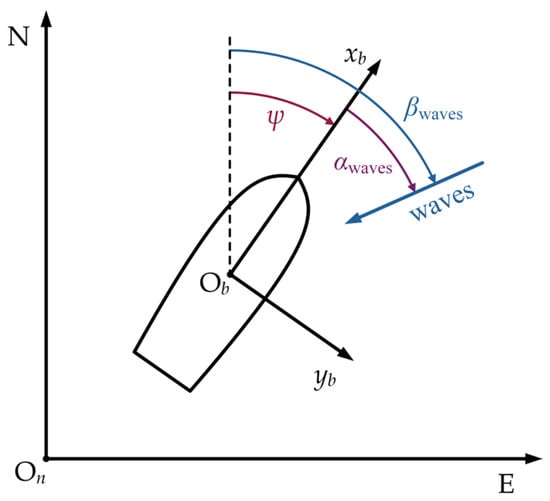
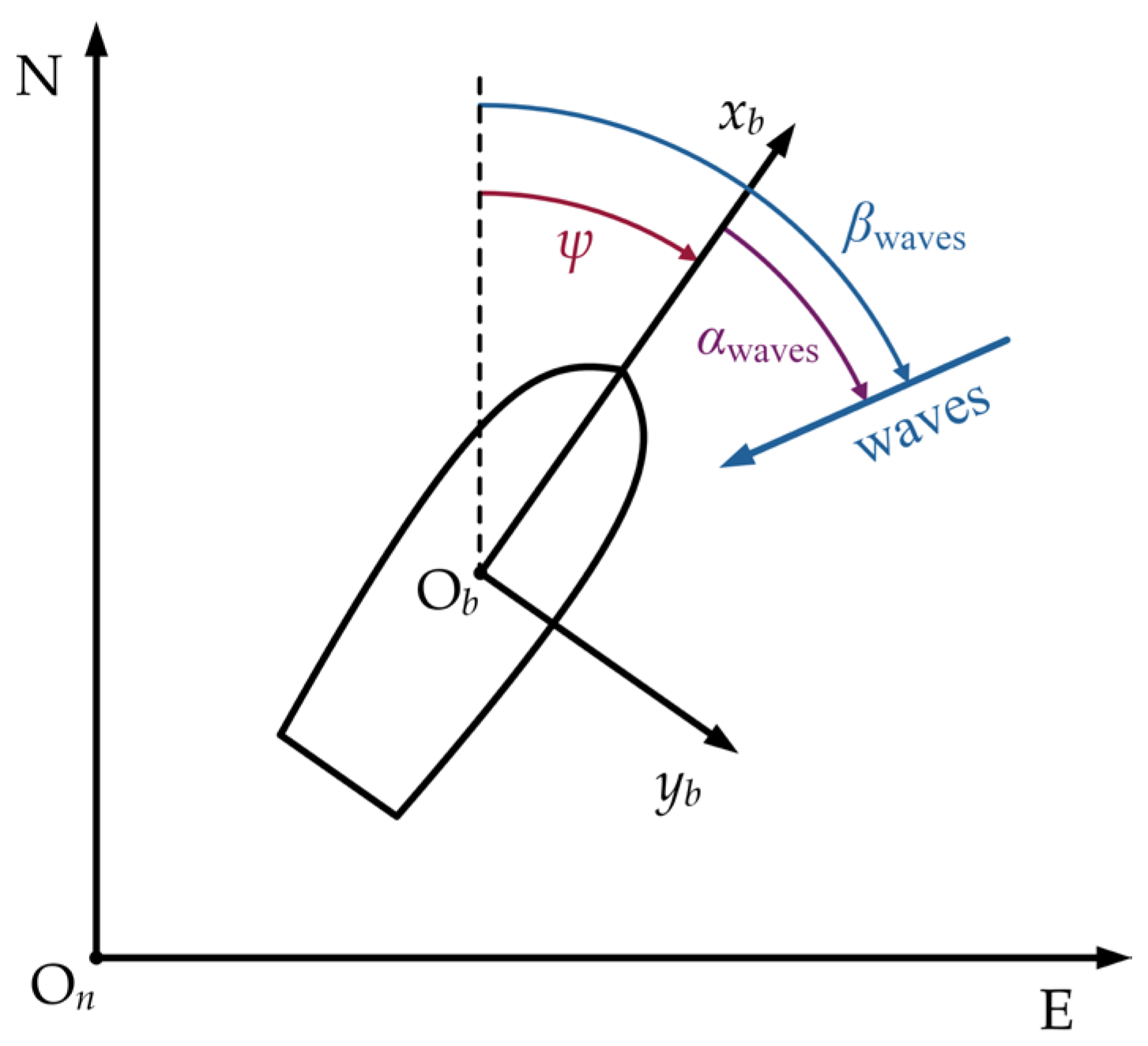
The attainable ship speed calculation method thus followed the approach outlined in [31]. The encounter wave angle shown in Figure 1, can be expressed in terms of the ship heading and meteorological wave direction
Figure 1.
The encounter wave angle relative to the ship’s heading.
If one neglects the wind and ocean current loads, the attainable ship speed can be expressed as a function of the intended reference speed and current sea conditions represented by the significant wave height wave period and encounter wave angle which yields
The present formulation neglects ocean current loads to isolate wave-induced speed degradation as the primary source of stochastic voyage variability. While currents can contribute 4.5–7.5% fuel variations in regions such as the Gulf Stream [32], wave-induced speed reductions routinely exceed 20–30% under North Atlantic winter conditions. Furthermore, the Rotterdam–New York route crosses the Gulf Stream nearly orthogonally during the western approach, and the mid-Atlantic segments pass through regions where surface currents typically remain below 0.5 knots. The NTPro 5000 simulator explicitly computes aerodynamic loads from apparent wind velocity on projected areas above the waterline [31,33], and the Pierson-Moskowitz spectrum couples wind and wave fields by representing fully developed wind-generated seas. Correlation analysis from [31] shows that wind-speed correlations to attainable speed are approximately 8–10% weaker than wave-height correlations, confirming that wave-induced resistance dominates speed loss for bulk carriers of this class.
As detailed in [31], the simulation-based lookup tables include NaN values for conditions where excessive vessel motions prevented the autopilot from maintaining the demanded course, effectively establishing operational safety boundaries for the routing optimization framework. To enable fast attainable speed estimation suitable for real-time routing applications, neural network regression models, as defined in [34], were used to capture the complex nonlinear relationships between environmental conditions and vessel response. A set of models of the form
was developed to estimate the attainable ship speed using NTPro data for the Pierson–Moskowitz wave spectrum. The same applies to fuel oil consumption (FOC) models
where denotes the narrow NN, the medium NN, the wide NN, the bilayered NN, and the trilayered NN.
Neural networks can vary in structure and flexibility depending on the relationship between their input and hidden layers. Narrow, medium, and wide neural networks each contain a single hidden layer but differ in the balance of neurons: narrow networks have fewer hidden-layer neurons than input neurons, medium networks maintain roughly equal sizes across the two layers, and wide networks invert this ratio with more neurons in the hidden layer. All three provide moderate model flexibility that increases as the size of the first layer grows. More complex architectures, such as bilayered and trilayered neural networks, incorporate two or three hidden layers, respectively, each with a variable number of neurons. These multilayer configurations offer high model flexibility, which expands as the size of each hidden layer increases, enabling richer feature extraction and more expressive modelling.
The neural networks were trained using a k-fold cross-validation approach, with k = 9. In other words, eight folds (corresponding to 80% of the data) were used for training, while one fold (i.e., 10% of the data) was employed for validation. Also, an independent test sample comprising 10% of the total dataset was reserved for testing. Basic characteristics of developed neural network models, with an emphasis on hidden layers, are presented in Table 1. According to (3) and (4), all NNs were created with three input and one output layers.
Table 1.
Characteristics of neural network models.
For the stochastic ship weather routing optimization framework presented in this study, the Model Predictive Control (MPC) waypoint sequencing approach was selected due to its computational efficiency and potential suitability for real-time implementation within maritime decision support systems. The MPC waypoint sequencing approach advances beyond passive voyage prediction to active path optimization, implementing real-time speed control decisions within a structured framework. Unlike traditional routing approaches, which quantify uncertainty without modifying vessel response, the MPC framework actively adjusts reference speeds at each control interval to minimise a multi-objective cost function. The planned route is initially discretised into waypoints, creating a sequence of target positions that remain unchanged throughout the voyage. At each waypoint approach, the MPC controller solves a finite-horizon optimization problem over the default 6 h control horizon with 24 h prediction capability, selecting from discrete speed options based on weighted objectives: 60% fuel consumption, 30% safety margins, and 10% control smoothness.
Let the route be defined by a sequence of waypoints: where each waypoint is defined as:
where is latitude, is longitude, and is the distance to the next waypoint in nautical miles,
The cumulative distance to the waypoint is defined as
with , while the total route distance is:
For a given distance along the route, the segment is identified such that . The position at distance can be calculated using linear interpolation:
where and .
For the purpose of weather forecasts, the North Atlantic region has been divided into a rectangular, discrete grid , where all neighbouring points are 50 nm apart. For each grid point, we have weather parameters
where is the wind speed and is the meteorological wind direction.
Thus, the weather at any point is based on the nearest point
Temporal selection was based on indices for which criteria , is valid. The forecast data was handled with a lead time , i.e., as , where is the forecast issue date and time, and is the forecast hour.
Uncertainty metrics are classified according to:
- (a)
- Wave height class:
- (b)
- Wave encounter angle class: {Head, Bow-Quartering, Beam, Stern-Quartering, Following}
- (c)
- Lead time class:
The error metric lookup function
retrieve required uncertainty metrics on the right-hand side of (11) for a given sea state condition expressed in terms of and where RMSE is Root Mean Square Error, MAE is Mean Absolute Error, Bias quantifies systematic forecast tendencies, UGR is Uncertainty Growth Rate, CRPS is Continuous Ranked Probability Score, IoA is Index of Agreement and FSS is Fractions Skill Score, as defined in [31].
2.2. Waypoint-Sequencing MPC Optimal Ship Routing
The voyage optimization problem seeks to minimise total cost while ensuring timely arrival under weather uncertainty. The objective function, i.e., the total voyage cost (USD), can be expressed as
where is the fuel cost weight, is the safety cost weight, is the smoothness cost weight, is the fuel consumption cost (USD), is the safety risk cost (USD), and is the path smoothness penalty cost (USD).
Decision variables can be expressed in terms of the control vector u, which is equal at optimization step k to
where is the ship heading at hour (°), is the reference speed at the hour (kn), is the total number of reference ship speeds that correspond to the number of discretised engine loads, is the control horizon (h). The complete waypoint sequencing MPC optimization problem for ship routing, in our case, can be written at each optimization step (every 6 h) as
where (h) is the prediction horizon; is the discount factor; is the progress reward coefficient (USD/nm) and is the distance made good toward the destination in hour (nm).
The fuel cost component in (14) for the voyage using variable consumption based on actual conditions is
where is the specific fuel consumption for segment i (kg/kWh), (kW) is the required engine power for segment i, is the actual travel time for segment i (hours), is the fuel price (USD/tonne).
Safety costs in (14) penalise dangerous high-wave conditions
where is the safety cost component (USD), is the risk weighting factor (1.0 by default), is the probability of exceeding the wave limit, is the safety penalty coefficient in USD/day (10,000 by default), is the operational wave height limit in meters ( by default).
Following optimal control principles [35], one can express the smoothness cost component in (14) as
where is the smoothness penalty cost component (USD), is the smoothness penalty coefficient in USD/(°)2 (0.01 by default), is the heading change between segments i − 1 and i (°). This cost penalises abrupt heading changes between consecutive time steps. The smoothness penalty implicitly enforces manoeuvring feasibility by favouring gradual heading changes compatible with rudder and ship turning characteristics. The present framework operates at the strategic routing level with hourly time steps where manoeuvring transients are orders of magnitude shorter than the MPC’s control horizon. Explicit manoeuvring dynamics modelling would be beneficial for collision avoidance or port approach applications but introduces unnecessary computational complexity for open-ocean route optimization. The minimum steerage speed constraint (23) ensures maintained directional controllability throughout the voyage.
The first stochastic constraint (15) presents a probabilistic arrival time in terms of probabilistic measure and robust scheduling of 95% confidence on-time arrival, where is the required arrival time in hours, is the allowable early arrival window in hours (e.g., ), is the allowable late arrival window in hours (e.g., ), and is the significance level that ensures a 95% confidence level.
The constraint (16) presents heading deviation bounds, where is the ship heading at hour i (°), i.e., the actual heading the ship will take, it is also a decision variable in the optimization; is the maximum allowed deviation from direct heading (°) that depends on navigation phase (smaller when approaching critical waypoints and larger in open seas); is the direct bearing to the target (°).
The constraint (17) reflects actual ship engine operating points, which are not completely arbitrary choices. Marine diesel engines are designed to operate efficiently at specific power settings; thus, only reference speeds were selected for further analyses, although these set values can be easily extended.
Ship dynamics constraint (18) is the discrete-time state evolution equation that describes how the ship moves from position to over one hour, where is the unit heading vector at substep i.e.,
is the number of integration substeps within one hour, is the integration time step (h), and is the attainable speed at the substep (kn) that may vary within the hour due to changing weather conditions. Multiple substeps ensure a smooth trajectory and improve accuracy for great-circle paths and obstacle crossings.
The navigational constraint (19) ensures that no position along the ship’s trajectory can be inside land masses or shallow water areas unsuitable for navigation, where indicates a set of all land coordinates and indicates a set of coordinates with insufficient water depth (shallow waters).
The constraint (20) requires that for each critical waypoint , there must exist at least one time point where the ship passes within (e.g., 30 nm) of that waypoint. With this constraint, optimizer guarantees passage through safe, established shipping lanes, maintains great circle efficiency and satisfies maritime traffic regulations.
The constraint (21) requires that the ship must travel at least nautical miles (e.g., 100 nm) during the prediction horizon (e.g., 48 h), where is the distance travelled in hour (nm), and is the time step. Without this constraint, the optimizer might find unrealistic solutions like staying in port (zero fuel cost, zero safety risk), circling in place waiting for perfect weather, moving backwards if fuel-optimal, stalling indefinitely in calm zones, etc.
The constraint (22) defines a rectangular bounding box on the Earth’s surface, constraining all ship positions to remain within specified geographic limits.
Minimum steerage speed constraint (23) is related to the steerage speed at which a ship still maintains directional control. Below this speed, the rudder becomes ineffective, and the ship cannot be steered.
The hard constraint (24) would make routes with completely infeasible. Therefore, it is recommended to use a soft constraint that is already embedded in the safety cost component (27). This adds a penalty cost proportional to the probability and duration of encountering high waves. However, this bound can be used to alter the reference ship speed, particularly efficient when coupled with encounter angles. In this context, the constraints (24) and (25) create forbidden zones that vary with sea state. So, instead of hard bounds, one should use the encounter angle penalty in the following form
where
and is the encounter angle penalty coefficient with units of (USD/h/m) or (USD/h/m2), depending on the penalty zone, and encounter angle zones could be defined as
- (i)
- preferred zones,
- (ii)
- marginal zones,
- (iii)
- dangerous zones, .
This approach can enable realistic routing that avoids dangerous encounter angles without making them absolutely forbidden.
Three distinct approaches were used to calculate the estimated time of arrival (ETA), which serve as performance benchmarks for the ship weather routing framework. The traditional voyage planning approach assumes a constant reference speed throughout the voyage, disregarding the effects of weather and operational variations. The total voyage distance is calculated as the sum of great circle distances between consecutive waypoints:
where represents waypoint in geographic coordinates (latitude, longitude), and denotes the great circle distance metric. The estimated time of arrival under the constant speed assumption becomes
where is the departure time and represents the standard planning speed. This method provides a baseline against which weather-routed voyages can be compared.
The perfect information scenario represents the theoretical optimum achievable with complete knowledge of actual weather conditions throughout the voyage. This retrospective analysis uses actual (hindcast) significant wave height and wave direction data [31].
For each time step the reference speed is selected based on prevailing conditions and encounter angle zones:
where the wave encounter angles and zones are determined using (1) and (31).
The attainable ship speed is calculated using the neural network-based Pierson-Moskowitz model (3), as follows
while the ship’s position evolves according to the kinematic equation
and through numerical integration with a time step it yields
The perfect information ETA is determined when the ship reaches the destination within tolerance as
The forecast-based approach simulates voyage progression using weather predictions available at departure, accounting for forecast degradation with increasing lead time This method employs forecasted significant wave height and wave direction where represents the forecast lead time [31,36]. The reference speed selection incorporates forecast uncertainty
and the forecast-dependent attainable speed thus becomes
Position evolution follows the same kinematic model, but with forecast-dependent parameters
The forecast-based ETA represents the prediction available at departure
These three ETA calculations enable a comprehensive performance assessment:
- (a)
- Measures the benefit of weather-aware routing versus traditional planning.
- (b)
- Quantifies the gap between actual performance and the theoretical optimum.
- (c)
- Evaluates forecast-based prediction accuracy.
Standardised performance metrics that capture both operational efficiency and uncertainty propagation were used to evaluate the effectiveness of ship weather routing. Attainable ship speed (Vatt.) serves as the fundamental performance indicator, representing the actual ship’s speed achievable under prevailing actual or forecasted environmental conditions. The metric incorporates both deterministic predictions from neural network models and stochastic variations, as captured by RMSE values, depending on the forecast lead time. The speed uncertainty propagates through all subsequent performance calculations.
Reference speed selection (Vref.) follows the discrete operational paradigm with three telegraph settings corresponding to each desired speed. For still water conditions, power requirements in terms of Maximum Continuous Rating (MCR) are defined as
The speed adaptation logic incorporates both reactive adjustments based on current conditions and proactive modifications anticipating forecast degradation.
Estimated time of arrival (ETA) quantification extends beyond point estimates to provide complete probabilistic distributions. The three previously established benchmark ETAs enable the decomposition of voyage performance. The stochastic optimization structure yields ETA distributions with standard deviations σETA ranging from 8 to 17 h for transatlantic voyages, which enables reliability statements such as p (Tarrival ≤ ttarget) for commercial scheduling. The actual elapsed time from departure to arrival is represented by voyage time (Tvoyage), which serves as the baseline for validation. The metric enables direct comparison between algorithms.
Specific Fuel Oil Consumption (SFOC) in terms of MCR can be defined as follows
The stochastic approach to fuel consumption calculations provides consumption distributions rather than point estimates. CO2 emissions are directly related to fuel consumption, using an emission factor of 3.114 kg CO2/kg fuel for heavy fuel oil. The metric enables Carbon Intensity Indicator (CII) calculations, demonstrating potential improvement through optimized routing compared to great circle navigation, directly supporting IMO decarbonization targets for 2050.
These metrics collectively enable comprehensive performance assessment, with computational efficiency tracked through algorithm execution times and solution quality measured against the classic voyage-planning method. The framework provides both real-time operational metrics for voyage execution and aggregate statistics for fleet performance analysis, thus establishing the quantitative basis for routing system selection and configuration within advanced ship Decision Support Systems (DSS).
3. Results
The following results demonstrate the predictive accuracy of the neural network models developed for attainable ship speed estimation across diverse sea-state conditions and encounter angles. The performance indices for validation and testing of all attainable ship speed models, expressed in terms of RMSE, MSE, R2, and MAE, are presented in Table 1. To enable a direct comparison with the results of the linear models, performance indices for a set of multivariate linear regression models are also provided.
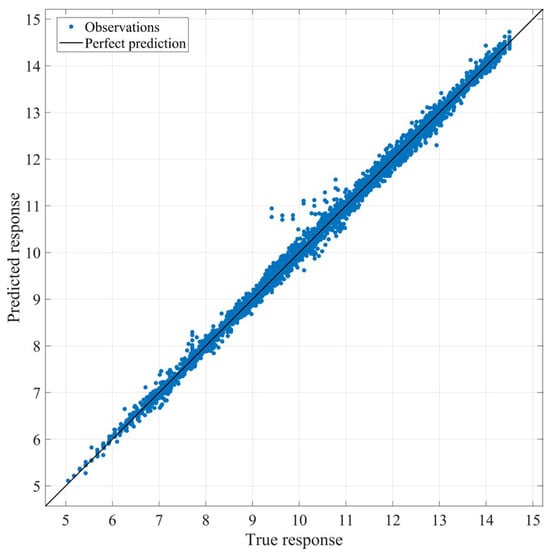
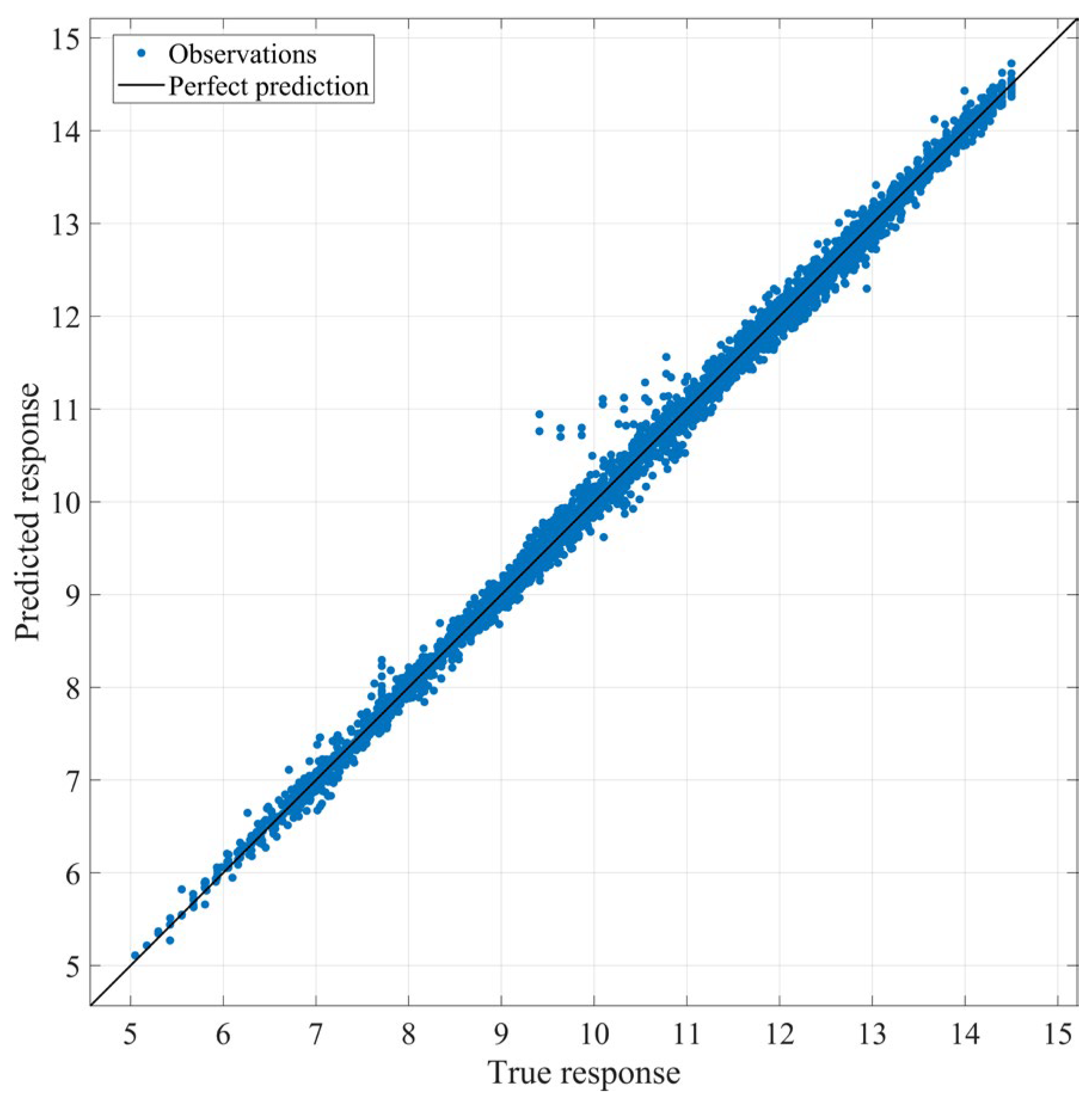
As shown in Table 2, all neural network–based models yielded excellent results. It can be considered highly reliable for ship routing optimisation and for the rapid estimation of attainable ship speed under a wide range of actual or forecasted sea states. Among them, the wide neural network (wNN) demonstrated the strongest predictive capability, achieving the lowest error values and the highest R2 scores in both validation and testing. Its single, broad hidden layer with 100 ReLU-activated neurons provided sufficient representational capacity to capture complex nonlinear relationships while maintaining strong generalisation performance across conditions. For these reasons, the wNN architecture was selected as the final model for attainable ship speed estimation in this study. A comparison of predicted and true responses obtained using the wNN is presented in Figure 2.
Table 2.
Performance indices for validation of the NN and LR models for the estimation of the attainable ship speed.
Figure 2.
Predicted vs. actual (true) response for wide neural network predictions in the case of the attainable ship speed estimations.
For additional interpretability, the magnitude of the prediction errors can be expressed in operational terms. The RMSE values obtained for the wide neural network, approximately 0.07–0.12 knots, indicate that the deviation between the predicted and the actual attainable ship speed is very small relative to typical variations encountered in real sea states. Errors of this order do not materially influence routing calculations or voyage-time estimates, as they fall well within the range of uncertainty already inherent in environmental forecasts and ship performance measurements. Consequently, the predictive precision achieved by the selected model is sufficient for reliable use in ship routing applications. However, it is certainly important to emphasise that the high success rate of the machine learning models is primarily due to the high-quality and noise-free data obtained from numerical simulations of the NaviTrainer Pro 5000 and NavCad. With measured ship speed data in real conditions, it is obviously not possible to expect such high accuracy without appropriate filtering/smoothing techniques.
For the validation and verification of the selected MPC optimization method with weather uncertainties, the transatlantic route from Rotterdam to New York was chosen as the test case. On this route, the comprehensive weather forecast data from NOAA GFS is readily available, providing diverse meteorological conditions and sufficient voyage duration (approximately 10–12 days) to observe the full evolution of forecast uncertainty from short-range (0–24 h) through extended-range (120–168 h) predictions. The selection of representative voyage scenarios was based on a comprehensive analysis of collected weather forecasts and historical weather data [31,34]. The MPC formulation, waypoint sequencing, and uncertainty propagation methods impose no geographic restrictions. Extension to alternative routes (e.g., transpacific, Europe–Asia) requires only the definition of appropriate waypoint sequences and access to regional meteorological forecast data. Similarly, the neural network performance models are vessel-independent architectures that can be retrained for different ship types given equivalent simulator or operational performance data.
To ensure that the optimization framework is tested under diverse meteorological conditions, the weather data were systematically analysed to identify periods with varying sea state characteristics. Seven voyage start dates were selected for the optimization scenarios: 1 February 2025, 7 February 2025, 12 February 2025, 19 February 2025, 25 February 2025, 27 February 2025, and 5 March 2025. In the selection process, the Douglas sea state scale was used as a reference for categorising the observed significant wave height ranges.
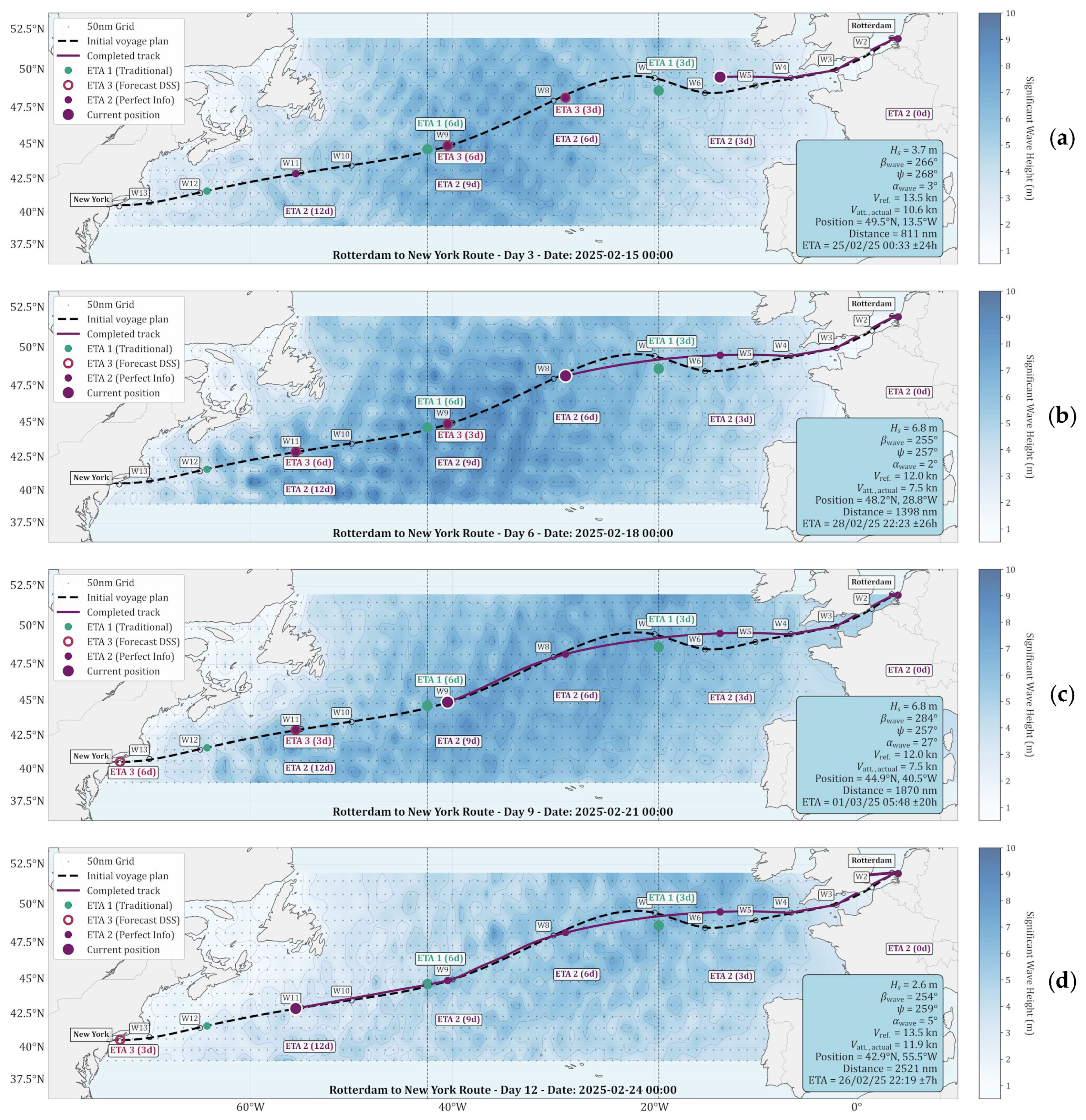
The start date of the example voyage shown in Figure 3 was set to 12 February 2025. The MPC approach achieved a total voyage duration of 345 h, representing a 6.1% improvement over traditional baseline voyage planning. The results of the voyage are shown in five snapshots. Each snapshot displays the ship’s position at 3-day intervals (days 3, 6, 9 and 12) overlaid on synoptic wave-height fields. Three reference ETAs, explained in Section 2, are plotted at each time step; the first, ETA1 (green dots), represents traditional voyage planning with constant speed, without weather considerations. ETA2 (purple dots) shows the optimal path achievable with perfect weather information using the PM attainable speed NN-based model. Finally, ETA3 (pink circles) indicates the MPC forecast-based prediction of the ship’s position using weather forecasts available at each decision point. The divergence between ETA1 and the weather-informed references (ETA2 and ETA3) illustrates the impact of wave conditions on voyage performance, particularly in the mid-Atlantic region, where significant wave heights exceed 4 m.
The temporal evolution of control decisions and forecast accuracy throughout the voyage reveals the MPC controller’s adaptive behaviour in response to evolving weather conditions.
Following a systematic pattern of days, where the framework tracks both actual and forecasted states at 3-day intervals, enabling a comprehensive assessment of predictive capability degradation over the voyage duration. This temporal sampling captures the transitions in meteorological conditions while maintaining computational tractability. Table 3 synthesises the actual and forecasted conditions at the same 3-day intervals throughout the voyage. However, in this instance, it presents the temporal evolution of control decisions alongside the three benchmark ETA calculations.
For the 12 February 2025 scenario, the total voyage duration of 345.6 h demonstrates the MPC framework’s operational characteristics under challenging North Atlantic winter conditions. This represents a 2.6% increase compared to the perfect-information baseline of 336.5 h, indicating the cost of forecast uncertainty in practical implementation. The discrete speed adaptation pattern throughout the voyage reveals the controller’s systematic response to both actual conditions and forecast evolution. The controller maintained an average attainable speed of 10.28 knots throughout the voyage, compared to an average reference speed of 13.1 knots commanded by the optimization algorithm. This 21.5% reduction from commanded to achieved speed directly quantifies the cumulative weather impact on vessel performance along the optimized route.
Figure 3.
The visualised voyage from Rotterdam to New York, with actual and forecasted weather data using the MPC routing approach (start date 12 February 2025) showing: (a) Day 3; (b) Day 6; (c) Day 9; (d) Day 12.
Comprehensive validation across all seven voyage scenarios revealed consistent MPC performance characteristics under diverse meteorological conditions. The attainable ship speed NN-based model was employed throughout all simulations, ensuring methodological consistency in performance evaluation while capturing the full spectrum of wave-vessel interactions characteristic of North Atlantic operations. Voyage durations ranged from 299 h achieved during the favourable conditions of 5 March 2025 to 345.6 h for the 12 February scenario. This 46.6 h spread, representing a 15.6% variation in voyage duration, directly correlates with the severity of the encountered sea states and demonstrates the framework’s ability to adapt operational control strategies.
Table 3.
Actual and forecasted ship performance values, for every 3 days of the voyage, along with the ETA1, ETA2 and ETA3 uncertainty (start date 1 February 2025).
Table 4 presents the comparison across all seven voyage scenarios, revealing consistent patterns that validate the robustness of the MPC approach.
Table 4.
Comparison of total voyage performance metrics for seven transatlantic voyage scenarios.
The traditional voyage-planning approach, assuming perfect weather and lacking alternatives, yields fuel consumption of 312.0 to 333.7 tonnes. For comparison purposes, results from the stochastic ETA approach developed in [31] are also included in Table 4. An example of a simplified rolling-horizon MPC waypoint-sequencing algorithm with uncertainty is provided in Appendix A Table A1.
4. Discussion
The MPC waypoint sequencing framework presented in this study advances to active speed control through discrete reference speed choices (12.0, 13.5, 14.5 knots). Unlike traditional voyage planning, which assumes constant speed under calm conditions, the MPC approach provides realistic fuel consumption estimates (333.9–370.4 tonnes) that account for actual weather-induced speed loss. The primary benefits are improved schedule reliability, with ETA uncertainty reducing from ±113 h at departure to ±7 h near arrival, and proactive adaptation to evolving weather conditions. Voyage durations of 299–345.6 h and fuel consumption also demonstrate consistent performance improvement with computational efficiency suitable for real-time shipboard implementation (10–15 s/cycle, 15.97–48.49 min total voyage computation). The framework’s optimal configuration (Np = 24 h, Nc = 6 h) balances forecast reliability (RMSE < 2.0 m for Hs within 24–72 h windows) with strategic planning capability. Shorter horizons led to 15% fuel penalties through reactive control. The 21.5% average speed reduction from the reference speed to the attainable speed (10.28 kn) in the 12 Feb scenario validates the realism of the forecast uncertainty.
The selection of optimal prediction (Np) and control (Nc) horizons for the MPC was systematically evaluated across multiple configurations to balance computational efficiency, control stability, and forecast reliability. Five primary configurations were tested:
- (i)
- Np = 12 h with Nc = 6 h (providing minimal look-ahead but rapid computation),
- (ii)
- Np = 24 h with Nc = 6 h (default configuration),
- (iii)
- Np = 36 h with Nc = 6 h (extending medium-range planning capability),
- (iv)
- Np = 48 h with Nc = 6 h (maximising forecast utilisation within 2-day windows),
- (v)
- Np = 72 h with Nc = 6 h (approaching forecast degradation limits).
The 24 h prediction horizon emerged as optimal, providing sufficient anticipatory capability to navigate approaching weather systems. It remains within the reliable forecast window with RMSE below 2.0 m for significant wave height. Shorter horizons (Np = 12 h) led to reactive rather than proactive control, with approximately 15% higher fuel consumption due to late speed reductions when encountering deteriorating conditions. On the contrary, extended horizons (Np = 48–72 h) incorporated increasingly uncertain forecast data, leading to conservative speed selections that unnecessarily prolonged the total voyage duration. The 6 h control horizon provided across all viable configurations proved beneficial for waypoint tracking stability, as demonstrated by the failed Np = 48 h with Nc = 12 h test configuration. It showed oscillatory behaviour and waypoint overshooting, with the vessel’s 120–168 nautical mile advancement per control step exceeding typical inter-waypoint distances on transatlantic routes. Empirical testing, therefore, confirmed that control horizons must satisfy Nc ≤ 6 h to maintain convergent behaviour, as the absolute magnitude of Nc relative to route geometry proved more critical than the Np/Nc ratio alone for ensuring system stability.
The computational performance metrics validate the framework’s suitability for real-time implementation aboard commercial vessels. The MPC implementation required 10–15 s per optimization cycle on standard computational hardware, with approximately 70% of computation time allocated to weather forecast evaluation at future waypoint positions. This involves interpolating meteorological variables from the gridded forecast data to specific waypoint coordinates and propagating uncertainty bounds through the prediction horizon. For the complete transatlantic voyage, total computation time averaged 20.5 min across all scenarios, ranging from 15.97 min for benign conditions to 48.49 min for complex weather patterns requiring frequent re-optimization.
Spatial deviation analysis reveals the inherent trade-off between route flexibility and computational complexity in the waypoint-based formulation. In the 12 February scenario, the maximum cross-track distance reached only 38 nautical miles from the great-circle route, as the fixed waypoint structure with 50 nautical-mile spacing inherently constrains spatial exploration. While this limitation prevents exploitation of localised weather windows that might exist between waypoints, it ensures predictable vessel behaviour aligned with traditional maritime navigation practices and ECDIS integration requirements. For operational inclusion within existing Decision Support Systems (DSS) and Electronic Chart Display and Information Systems (ECDIS), the MPC framework requires the following input data streams: (i) real-time vessel position from GPS/AIS, (ii) gridded weather forecast data from services such as NOAA GFS or ECMWF, typically updated every 6 h, and (iii) vessel-specific performance parameters stored in onboard databases. Integration would involve a dedicated software module that communicates with the ECDIS via standardised interfaces (e.g., IEC 61174) and displays recommended waypoints and speed settings as advisory overlays.
The stochastic component of wave-induced speed loss with attainable speeds reduced to 7.5–10.6 knots against reference speeds of 12.0–14.5 knots in challenging conditions (Table 3), substantially exceeds the deterministic influence of predictable current patterns. Regarding wind resistance, for low-speed vessels such as bulk carriers, air resistance typically represents approximately 2% of total resistance. In contrast, for container ships with large windage areas, this contribution can reach 10% [36]. The dominance of wave-added resistance for similar vessel classes justifies the present framework’s focus. Nonetheless, extension to high-windage vessels would require explicit aerodynamic modelling and integration of ocean currents.
The framework’s dependence on weather-forecasting skill imposes fundamental performance limits, regardless of algorithmic sophistication. Beyond 72–120 h forecast horizons, prediction uncertainty accumulates to levels where optimization benefits diminish substantially. This constraint suggests that the MPC approach is particularly well-suited for mid-range transoceanic voyages of 5–10 days duration, where the majority of the voyage falls within reliable forecast windows while providing sufficient optimization horizon to achieve meaningful fuel savings.
The selection of an appropriate optimization methodology for ship weather routing under forecast uncertainty required systematic evaluation against the complete problem formulation presented in Section 2. Table 5 and Table 6 present a comprehensive cross-method comparison for seven candidate algorithms: Dynamic Programming (DP) [11], A* [10], Dijkstra’s algorithm [9], Genetic Algorithms (GA) [37], Particle Swarm Optimization (PSO) [38], Simulated Annealing (SA) [36], and Model Predictive Control (MPC) [28]. They were evaluated against all objective function components (12)–(14) and constraints (15)–(25). Fundamental structural incompatibilities were identified that interfere with the direct application of these optimization approaches to the complete problem formulation, while demonstrating the unique suitability of the proposed MPC framework.
The multi-objective weighted sum formulation (12) immediately distinguishes algorithm capabilities. Graph-based methods (A*, Dijkstra) are inherently single-objective and require prior scalarization that makes dynamic adjustments during operation impossible. While GA demonstrates native multi-objective support through Pareto front generation (NSGA-II variants), and PSO can tackle multiple objectives through penalty aggregation, only MPC provides direct integration of the weighted cost components within its native formulation. The discount factor in (14) aligns with MPC’s finite-horizon structure, whereas graph methods assume uniform edge weights and DP requires explicit incorporation into the Bellman equation.
Table 5.
Cross-method evaluation of objective function components and constraints.
Table 6.
Cross-method evaluation of implementation criteria with overall assessment.
The most significant distinction is in handling the smoothness cost Jsmooth,i. This path-dependent term, penalising heading changes between consecutive time steps, fundamentally violates the Markovian assumption underlying Dynamic Programming. Bellman’s principle of optimality requires that transition costs depend solely on current state-action pairs; the dependence on previous heading ψi−1 invalidates this requirement. Similarly, graph-based methods cannot represent path-dependent costs because edge weights must be independent of the traverse history. Resolution through state augmentation or edge-to-edge graph transformation is theoretically possible but multiplicatively increases computational complexity, eliminating the efficiency advantages motivating these approaches. In contrast, metaheuristic methods (GA, PSO, SA) and MPC can evaluate Jsmooth directly over a sequence of decisions, with MPC’s explicit heading-sequence optimisation providing the most natural accommodation.
The probabilistic arrival constraint (15) presents perhaps the most discriminating requirement. It calls for explicit uncertainty quantification that deterministic methods (A*, Dijkstra) cannot accommodate. Dynamic Programming would require transformation to Stochastic DP with scenario enumeration, multiplicatively compounding the already prohibitive state space. Metaheuristic methods can address probabilistic constraints through Monte Carlo fitness evaluation. Still, this approach is computationally expensive, requiring numerous trajectory simulations per fitness assessment, and provides no guarantee of constraint satisfaction. The MPC framework uniquely integrates forecast uncertainty via empirical lookup tables (RMSE, Bias) and propagates uncertainty via soft constraints without scenario explosion.
The waypoint proximity constraint (20) further differentiates algorithmic capabilities. For DP, tracking visited waypoints requires 2n visitation states for n waypoints, creating exponential complexity growth. Graph methods handle waypoint sequencing as sequential goal states, though this decomposition may yield suboptimal solutions. MPC maintains native waypoint tracking through state-indexed progression, ensuring constraint satisfaction without combinatorial expansion. Operational constraints (16)–(19) and (21)–(25) exhibit varying compatibility across methods. State dynamics (18), geographic bounds (22), and discrete speed options (17) are generally manageable through appropriate formulation, state space masking for DP, graph construction for A*/Dijkstra, encoding design for metaheuristics, and direct optimization bounds for MPC. However, the land/shallow avoidance constraint (19) requires memory-intensive precomputation for DP, while MPC addresses this through predefined waypoint sequences, ensuring navigable waters. The encounter-angle constraint (25) demands wave-direction-dependent action filtering, which MPC accommodates through zone-based penalty functions, whereas other methods require additional constraint-handling mechanisms.
Table 6 reveals decisive differences in the feasibility of implementation. The computational tractability assessment shows that DP faces approximately 4.3 × 10⁹ discrete states in the North Atlantic routing domain, yielding ~1014 total operations, which exceed practical limits by several orders of magnitude. Graph methods achieve tractability for simplified formulations but require complete reconstruction at each forecast update, negating efficiency advantages. Metaheuristics exhibit moderate computational requirements but require 104–105 trajectory simulations per optimisation cycle to achieve adequate population sizes and generations, making real-time feasibility within the 6 h decision interval challenging. Only MPC demonstrates verified computational tractability, achieving 10–15 s optimisation cycles suitable for shipboard implementation.
As previously stated, weather forecasts inherently degrade with lead time, imposing periodic re-optimization as updated meteorological data becomes available. DP requires complete re-solution at each update; graph methods demand reconstruction; metaheuristics can warm-start but lack principled forecast integration. MPC’s receding horizon architecture, the defining characteristic of the methodology, shows alignment with this operational requirement. The 6 h control horizon implements near-term decisions before replanning, while the 24 h prediction horizon maintains anticipatory capability within reliable forecast windows. Regarding optimality guarantees, DP and graph-based methods provide global optimality within their respective formulations, but these formulations do not capture the whole problem. Metaheuristics provide no guarantee of optimality, with solution quality depending on population diversity, operator design, and convergence criteria. MPC achieves local optimality at each horizon with established receding-horizon stability properties, representing a principled balance between solution quality and computational feasibility.
For validation purposes, comparison against traditional voyage planning (constant-speed assumption) and stochastic ETA prediction (passive uncertainty quantification) provides appropriate benchmarks that share operational context and data structures. These comparisons, presented in the results section, demonstrate substantive improvements and possible fuel savings with voyage durations of 299–345 h, achieved through the complete problem formulation that only MPC can handle. The computational efficiency of 10–15 s per cycle, with total voyage computation times of 15–48 min, confirms practical viability for real-time maritime decision support systems.
5. Conclusions
This study presented a Model Predictive Control framework for ship weather routing optimization that integrates neural network-based attainable speed prediction with rolling horizon weather forecast updates. The wide neural network architecture demonstrated strong predictive accuracy across diverse sea state conditions and encounter angles, providing the computational efficiency required for real-time implementation within the MPC optimization loop. Validation across seven transatlantic voyage scenarios confirmed that the framework provides realistic voyage predictions under diverse meteorological conditions, with voyage durations ranging from 299 to 345 h. Compared to traditional deterministic planning, which underestimates fuel consumption by neglecting weather-induced speed loss, the MPC approach delivers accurate fuel estimates and substantially reduces ETA uncertainty, enabling improved commercial scheduling and operational reliability. Several avenues remain for extending the proposed MPC framework. The current discrete speed settings constrain optimization; continuous speed optimization with detailed transient engine modelling could yield additional efficiency gains within engineering constraints. Geographic extension beyond the North Atlantic and integration with port-to-port optimization, incorporating berth availability, would enable comprehensive voyage planning beyond ocean passages. Integration with emerging AI-based weather prediction systems could enable continuous trajectory optimization through more frequent forecast updates.
Validation scope should also be extended in three directions: (i) geographic generalisation across routes with distinct meteorological characteristics, including transpacific crossings; (ii) vessel type diversity, particularly vessels with higher windage and specific hull form characteristics; and (iii) validation against actual operational voyage data where accessible, including noon reports and AIS-derived tracks with concurrent meteorological observations. Such extensions would quantify the transferability of the presented framework across the operational diversity encountered in commercial shipping.
Author Contributions
Conceptualisation, methodology: M.M., M.V., J.P.-O.; validation, M.M.; formal analysis, investigation, data curation, M.M.; writing—original draft preparation, M.M.; writing—review and editing, M.M., M.V., J.P.-O.; visualisation, M.M.; supervision, M.V., J.P.-O. All authors have read and agreed to the published version of the manuscript.
Funding
This work was supported by the Croatian Science Foundation under the project HRZZ-IP-2022-10-2821. This work was also supported by the University of Rijeka (PROJECTS no. PU-17 uniri-iz-25-10-Funded by the European Union–NextGenerationEU).
Data Availability Statement
The data presented in this study are available on request from the corresponding author due to privacy.
Conflicts of Interest
The authors declare no conflicts of interest.
Appendix A
Table A1.
Example of simplified rolling horizon MPC waypoint sequencing algorithm with uncertainty.
References
- Zis, T.P.V.; Psaraftis, H.N.; Ding, L. Ship weather routing: A taxonomy and survey. Ocean Eng. 2020, 213, 107697. [Google Scholar] [CrossRef] [Scilit]
- Walther, L.; Rizvanolli, A.; Wendebourg, M.; Jahn, C. Modelling and Optimization Algorithms in Ship Weather Routing. Int. J. E-Navig. Marit. Econ. 2016, 4, 31–45. [Google Scholar]
- IMO. Guidelines for Voyage Planning (Resolution A.893, Adopted 25 Nov 1999); International Maritime Organization: London, UK, 2000. [Google Scholar]
- IMO. International Convention for the Safety of Life at Sea (SOLAS), Consolidated Edition; International Maritime Organization: London, UK, 2020. [Google Scholar]
- Weintrit, A. (Ed.) Marine Navigation and Safety of Sea Transportation: Navigational Problems; CRC Press: Boca Raton, FL, USA, 2013. [Google Scholar]
- Bijlsma, S.J. Optimal ship routing with ocean current included. J. Navig. 2010, 63, 565–568. [Google Scholar] [CrossRef] [Scilit]
- Mannarini, G.; Pinardi, N.; Coppini, G.; Oddo, P.; Iafrati, A. VISIR-I: Small vessels, least-time nautical routes using wave forecasts. Geosci. Model Dev. 2016, 9, 1597–1625. [Google Scholar] [CrossRef] [Scilit]
- Mannarini, G.; Salinas, M.L.; Carelli, L.; Petacco, N.; Orović, J. VISIR-2: Ship weather routing in Python. Geosci. Model Dev. 2024, 17, 4355–4382. [Google Scholar] [CrossRef] [Scilit]
- Silveira, P.; Teixeira, A.P.; Guedes Soares, C. AIS Based Shipping Routes Using the Dijkstra Algorithm. Int. J. Mar. Navig. Saf. Sea Transp. 2019, 13, 565–571. [Google Scholar] [CrossRef] [Scilit]
- Shin, Y.W.; Abebe, M.; Noh, Y.; Lee, S.; Lee, I.; Kim, D.; Bae, J.; Kim, K. Near-Optimal Weather Routing by Using Improved A* Algorithm. Appl. Sci. 2020, 10, 6010. [Google Scholar] [CrossRef] [Scilit]
- Shao, W.; Zhou, P.; Thong, S.K. Development of a novel forward dynamic programming method for weather routing. J. Mar. Sci. Technol. 2012, 17, 239–251. [Google Scholar] [CrossRef] [Scilit]
- Ferguson, D.S.; Elinas, P. A Markov Decision Process Model for Strategic Decision Making in Sailboat Racing. In Proceedings of the Canadian Conference on Artificial Intelligence, St. John’s, NL, Canada, 25–27 May 2011; pp. 110–112. [Google Scholar]
- Azaron, A.; Kianfar, F. Dynamic shortest path in stochastic dynamic networks: Ship routing problem. Eur. J. Oper. Res. 2003, 144, 138–156. [Google Scholar] [CrossRef] [Scilit]
- Birge, J.R.; Louveaux, F. Introduction to Stochastic Programming; Springer: New York, NY, USA, 2011. [Google Scholar]
- Puterman, M.L. Markov Decision Processes: Discrete Stochastic Dynamic Programming; John Wiley & Sons: Hoboken, NJ, USA, 2014. [Google Scholar]
- Bellman, R. Dynamic Programming; Princeton University Press: Princeton, NJ, USA, 1957. [Google Scholar]
- Bertsimas, D.; Sim, M. The price of robustness. Oper. Res. 2004, 52, 35–53. [Google Scholar] [CrossRef] [Scilit]
- Fabbri, T.; Vicen-Bueno, R.; Hunter, A. Multi-Criteria Weather Routing Optimization Based on Ship Navigation Resistance, Risk and Travel Time. In Proceedings of the International Conference on Computational Science and Computational Intelligence (CSCI), Las Vegas, NV, USA, 13–15 December 2018; pp. 135–140. [Google Scholar]
- Wang, H.; Mao, W.; Eriksson, L. A three-dimensional Dijkstra’s algorithm for multi-objective ship voyage optimization. Ocean Eng. 2019, 186, 106131. [Google Scholar] [CrossRef] [Scilit]
- Miao, Y.; Zhang, C.; Zhang, X.; Zhang, L. A Multivariable Convolutional Neural Network for Forecasting Synoptic-Scale Sea Surface Temperature Anomalies in the South China Sea. Weather Forecast. 2023, 38, 849–863. [Google Scholar] [CrossRef] [Scilit]
- Wu, Z.; Wang, S.; Yuan, Q.; Lou, N.; Qiu, S.; Bo, L.; Chen, X. Application of a deep learning-based discrete weather data continuousization model in ship route optimization. Ocean Eng. 2023, 285, 115435. [Google Scholar] [CrossRef] [Scilit]
- Gkerekos, C.; Lazakis, I.; Theotokatos, G. Machine learning models for predicting ship main engine Fuel Oil Consumption: A comparative study. Ocean Eng. 2019, 188, 106282. [Google Scholar] [CrossRef] [Scilit]
- Moradi, M.H.; Brutsche, M.; Wenig, M.; Wagner, U.; Koch, T. Marine route optimization using reinforcement learning approach to reduce fuel consumption and consequently minimize CO2 emissions. Ocean Eng. 2022, 259, 111882. [Google Scholar] [CrossRef] [Scilit]
- Bâra, A.; Văduva, A.G.; Oprea, S.V. Anomaly Detection in Weather Phenomena: News and Numerical Data-Driven Insights into the Climate Change in Romania’s Historical Regions. Int. J. Comput. Intell. Syst. 2024, 17, 134. [Google Scholar] [CrossRef] [Scilit]
- Wei, Q.; Liu, Y.; Dong, Y.; Li, T.; Li, W. A digital twin framework for real-time ship routing considering decarbonization regulatory compliance. Ocean Eng. 2023, 278, 114407. [Google Scholar] [CrossRef] [Scilit]
- Latinopoulos, C.; Zavvos, E.; Kaklis, D.; Leemen, V.; Halatsis, A. Marine Voyage Optimization and Weather Routing with Deep Reinforcement Learning. J. Mar. Sci. Eng. 2025, 13, 902. [Google Scholar] [CrossRef] [Scilit]
- Orlandi, A.; Cappugi, A.; Mari, R.; Pasi, F.; Ortolani, A. Meteorological Navigation by Integrating Metocean Forecast Data and Ship Performance Models into an ECDIS-like e-Navigation Prototype Interface. J. Mar. Sci. Eng. 2021, 9, 502. [Google Scholar] [CrossRef] [Scilit]
- Potočnik, P. Model Predictive Control for Autonomous Ship Navigation with COLREG Compliance and Chart-Based Path Planning. J. Mar. Sci. Eng. 2025, 13, 1246. [Google Scholar] [CrossRef] [Scilit]
- Wang, X.; Zhao, X.; Wang, G.; Wang, Q.; Feng, K. Weather Route Optimization Method of Unmanned Ship Based on Continuous Dynamic Optimal Control. Sustainability 2022, 14, 2165. [Google Scholar] [CrossRef] [Scilit]
- Wang, Z.; Wang, S. Real-Time Dynamic Route Optimization Based on Predictive Control Principle. IEEE Access 2022, 10, 55062–55072. [Google Scholar] [CrossRef] [Scilit]
- Marjanović, M.; Valčić, M.; Prpić-Oršić, J.; Barić, M. A data-driven framework for attainable ship speed uncertainty under stochastic weather conditions. Brodogradnja 2026, 77, 77108. [Google Scholar] [CrossRef] [Scilit]
- Lo, H.K.; McCord, M.R. Routing through dynamic ocean currents: General heuristics and empirical results in the Gulf Stream region. Transp. Res. Part B Methodol. 1995, 29, 109–124. [Google Scholar] [CrossRef] [Scilit]
- Wärtsilä. Wärtsilä Navigation simulator NTPRO 5000. In Ship Speed Modeling in Wärtsilä NTPRO 5000; Wärtsilä: Helsinki, Finland, 2011. [Google Scholar]
- Valčić, M.; Martić, I.; Degiuli, N.; Grlj, C.G.; Zhang, M. Comparative analysis of machine learning methods for the prediction of brake power and rate of revolution for bulk carriers. Ocean Eng. 2025, 322, 120517. [Google Scholar] [CrossRef] [Scilit]
- Bryson, A.E.; Ho, Y.C. Applied Optimal Control; Taylor & Francis Group, LLC: New York, NY, USA, 1975. [Google Scholar]
- Marjanović, M.; Prpić-Oršić, J.; Turk, A.; Valčić, M. Anomalous Behavior in Weather Forecast Uncertainty: Implications for Ship Weather Routing. J. Mar. Sci. Eng. 2025, 13, 1185. [Google Scholar] [CrossRef] [Scilit]
- Zhou, P.; Zhou, Z.; Wang, Y.; Wang, H. Ship Weather Routing Based on Hybrid Genetic Algorithm Under Complicated Sea Conditions. J. Ocean Univ. China 2022, 22, 28–42. [Google Scholar] [CrossRef] [Scilit]
- Du, W.; Li, Y.; Zhang, G.; Wang, C.; Zhu, B.; Qiao, J. Ship weather routing optimization based on improved fractional order particle swarm optimization. Ocean Eng. 2022, 248, 110680. [Google Scholar] [CrossRef] [Scilit]

Disclaimer/Publisher’s Note: The statements, opinions and data contained in all publications are solely those of the individual author(s) and contributor(s) and not of MDPI and/or the editor(s). MDPI and/or the editor(s) disclaim responsibility for any injury to people or property resulting from any ideas, methods, instructions or products referred to in the content. |
© 2026 by the authors. Licensee MDPI, Basel, Switzerland. This article is an open access article distributed under the terms and conditions of the Creative Commons Attribution (CC BY) license.