Fuzzy Adaptive Super-Twisting Sliding Mode Control for Underactuated USV Formation Based on Dynamic Cooperative Error Correction


Abstract
1. Introduction
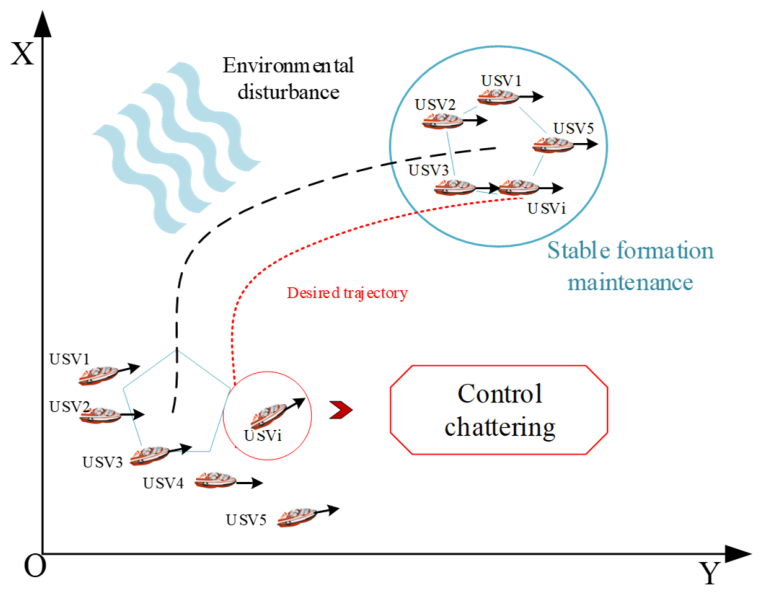
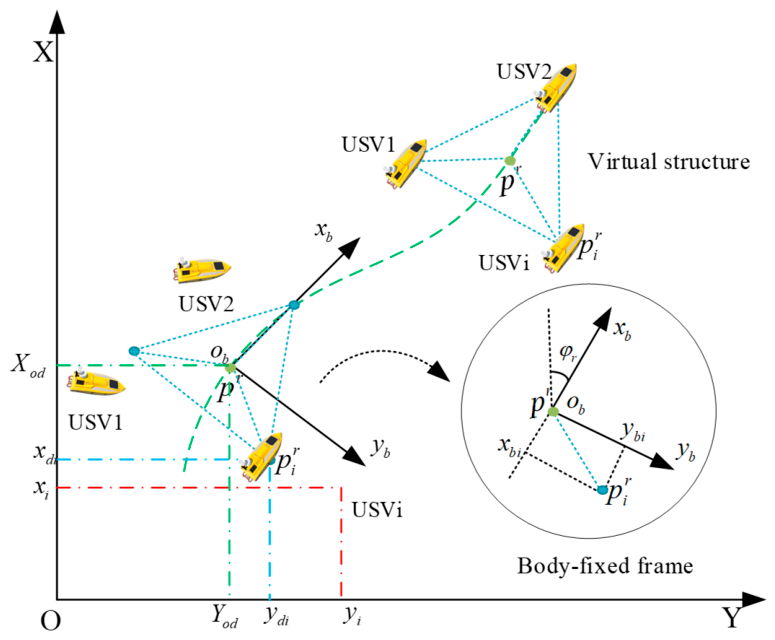
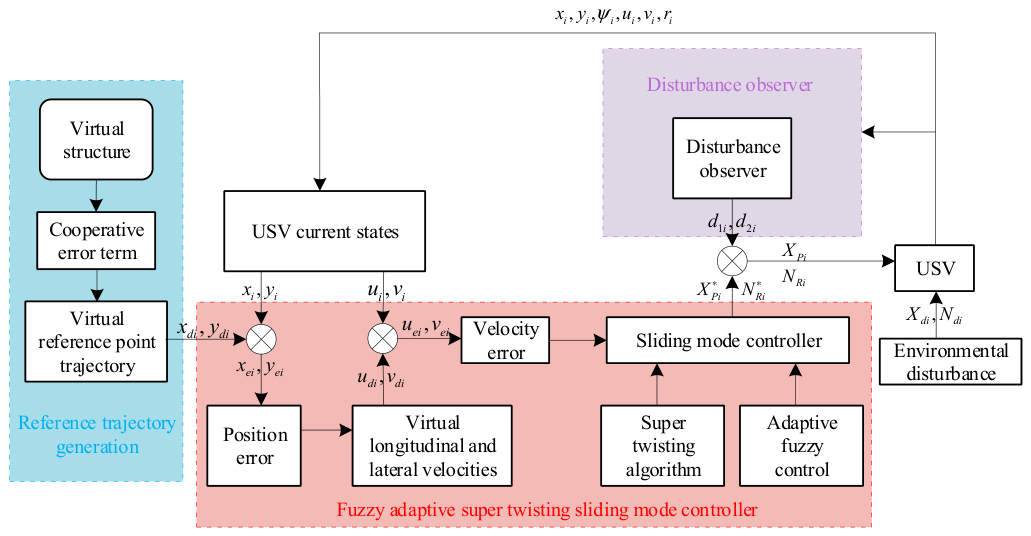
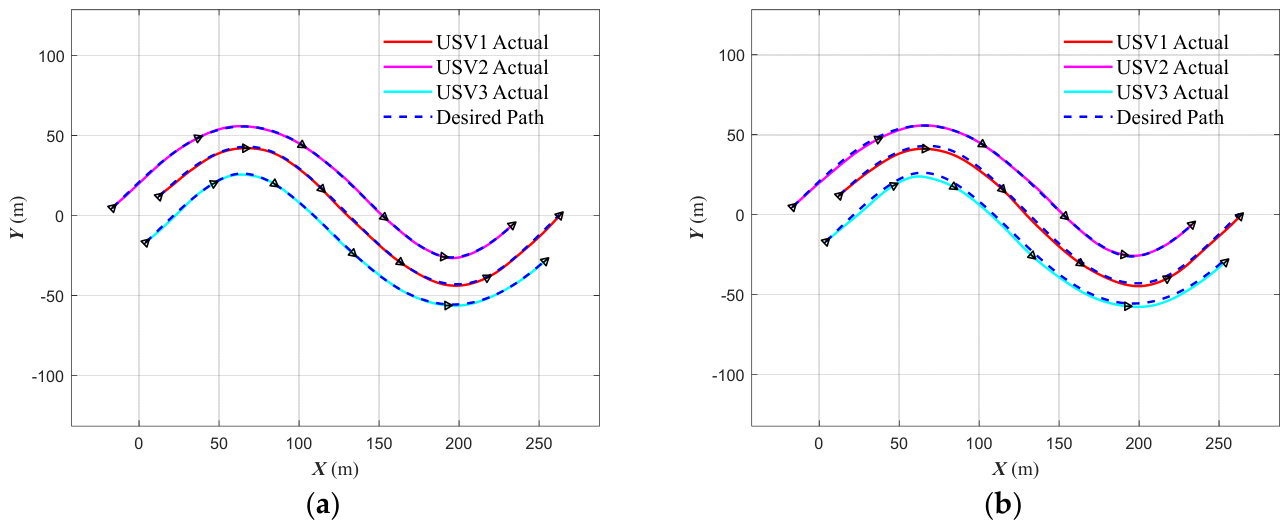
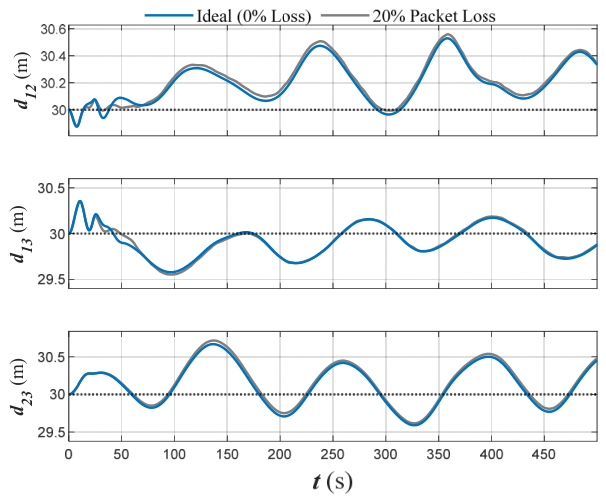
- A formation tracking architecture based on local dynamic cooperative error correction is constructed. Building upon the nominal trajectory generated by the traditional virtual structure method, a cooperative error term containing the relative position information of local neighbor nodes is introduced. This achieves a leap from independent single-vessel trajectory tracking to strongly coupled multi-vessel cooperative keeping, enhancing the formation rigidity and cooperative precision during time-varying disturbances and maneuvers without imposing an excessive communication burden; To the best of the authors’ knowledge, this is the first work to embed topological consensus corrections directly into the kinematic outer loop of an underactuated USV formation controller, rather than treating cooperative control as an independent parallel layer.
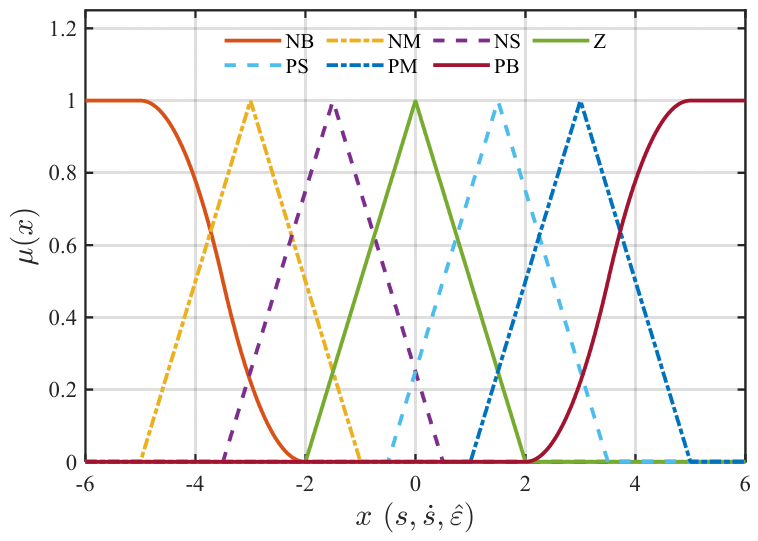
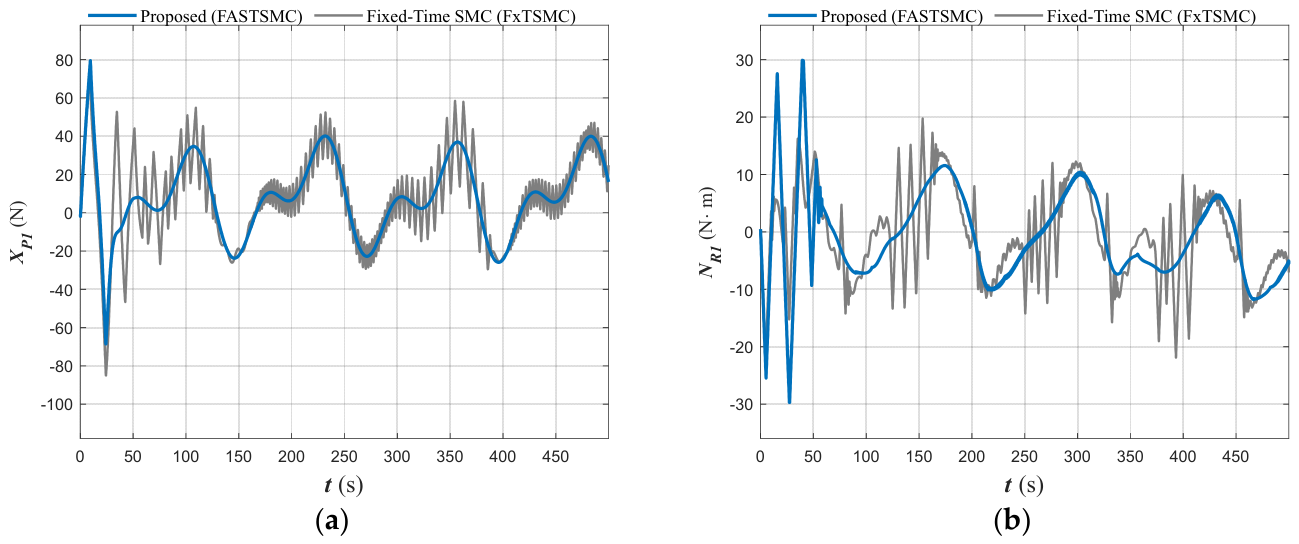
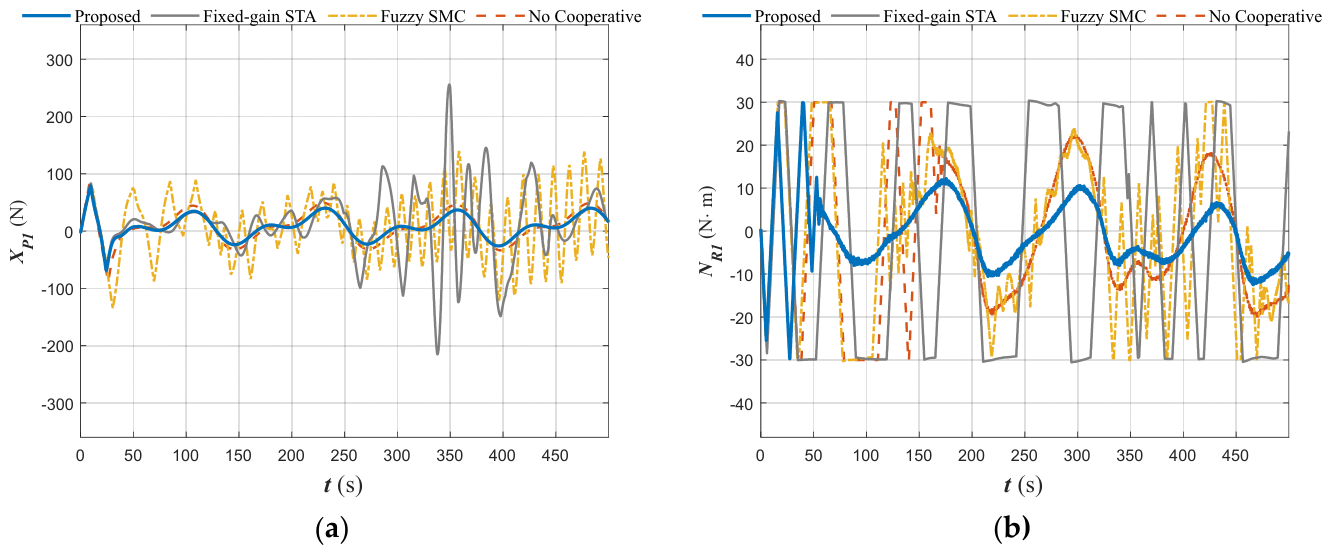
- A fuzzy adaptive super-twisting sliding mode control law is designed, achieving the dynamic decoupling of control response speed and chattering suppression. To address the chattering pain point of traditional sliding mode control, a fuzzy logic system based on 49 expert rules is designed for the real-time online dynamic optimal tuning of the super-twisting control gains. Combined with a hyperbolic tangent function, this mitigates the high-frequency chattering issue of actuators in traditional sliding mode control while ensuring the rapid convergence of system states;
- An underactuated composite anti-disturbance mechanism with feedforward compensation and differential smoothing is proposed. A nonlinear disturbance observer is integrated to accurately estimate and feedforward-cancel low-frequency macroscopic environmental disturbances. Simultaneously, to overcome the lack of direct driving force in underactuated lateral control, a first-order low-pass filter and a tracking differentiator are introduced to smooth the virtual control laws and the second derivative of the sway velocity. This avoids initial control chattering and noise amplification, ensuring smooth low-level control.
2. Problem Formulation
2.1. Mathematical Modeling of the USV Formation
2.2. Problem Description of USV Formation Control Based on Virtual Structure
3. Design of Adaptive Sliding Mode Controller
3.1. Formation Cooperative Error and Kinematic Virtual Control Law Design
3.1.1. Kinematic Outer-Loop Control Design Based on Cooperative Error Correction
3.1.2. Virtual Control Law Design
3.1.3. First-Order Low-Pass Filter Design
3.2. Fuzzy Adaptive Super-Twisting Dynamic Sliding Mode Controller Design
3.2.1. Longitudinal Thrust Sliding Mode Control Law Design
3.2.2. Yaw Moment Control Law Design
3.2.3. Fuzzy Adaptive Parameter Tuning Mechanism
- When the sliding surface and its derivative share the same sign and their absolute values are large (e.g., both are PB or both are NB), it indicates that the USV is deviating rapidly from the desired trajectory under strong ocean disturbances. In this case, the output is assigned to PB to supply a massive control gain increment, aggressively forcing the system state back toward the sliding surface.
- When the system state is approaching the sliding surface rapidly (), a moderate or negative gain increment (e.g., NS or Z) is assigned to dynamically reduce the kinetic energy and prevent severe overshooting.
- When the state has steadily reached the sliding manifold ( and ), the adaptive increment converges to the Z/NS level. This gracefully shrinks the super-twisting switching amplitude, thereby fundamentally mitigating actuator chattering.
3.3. Final Composite Control Law Construction Based on Feedforward Compensation
4. Stability Analysis of the Formation Control System
5. Simulation Verification and Results Analysis
5.1. Simulation Parameter Settings and Realistic Marine Environment Modeling
5.2. Ablation Study Scenario Design
5.2.1. Trajectory and Formation Geometry
5.2.2. Definition of Ablation Scenarios
5.3. Simulation Results and Discussion
5.3.1. Trajectory Tracking and Formation Rigidity Analysis


5.3.2. Velocity Tracking and Control Smoothness Analysis

5.4. Robustness Test Against Communication Uncertainty
5.5. Comparative Analysis with State-of-the-Art Algorithm
6. Conclusions
Author Contributions
Funding
Data Availability Statement
Conflicts of Interest
References
- Lv, Z.; Wang, X.; Wang, G.; Xing, X.; Lv, C.; Yu, F. Unmanned surface vessels in marine surveillance and management: Advances in communication, navigation, control, and data-driven research. J. Mar. Sci. Eng. 2025, 13, 969. [Google Scholar] [CrossRef] [Scilit]
- Bae, I.; Hong, J. Survey on the developments of unmanned marine vehicles: Intelligence and cooperation. Sensors 2023, 23, 4643. [Google Scholar] [CrossRef] [Scilit] [PubMed]
- Wu, W.; Sun, Q.; Yang, H. The application of unmanned vehicle systems during the course of maritime law enforcement. Front. Mar. Sci. 2025, 12, 1672951. [Google Scholar] [CrossRef] [Scilit]
- Wang, N.; Jia, W.; Wu, H.; Wang, Y. Event-triggered self-organizing swarm control of distributed unmanned surface vehicles. IEEE Trans. Intell. Transp. Syst. 2025, 26, 3431–3445. [Google Scholar] [CrossRef] [Scilit]
- Zhang, G.; Liu, S.; Zhang, X.; Zhang, W. Event-triggered cooperative formation control for autonomous surface vehicles under the maritime search operation. IEEE Trans. Intell. Transp. Syst. 2022, 23, 21392–21404. [Google Scholar] [CrossRef] [Scilit]
- Liu, J.; Wang, Y.; Li, H.; Huang, P.; Liang, B.; Wu, H.; Yu, S. Research on Formation Path Planning Method and Obstacle Avoidance Strategy for Deep-Sea Mining Vehicles Based on Improved RRT*. J. Mar. Sci. Eng. 2026, 14, 138. [Google Scholar] [CrossRef] [Scilit]
- Wen, G.; Fu, J.; Wang, B.; Wang, X.; Shen, H. Robust Formation Tracking of ASVs With Nonconservative Collision Avoidance: A Control Barrier Function-Based Approach. IEEE Trans. Ind. Electron. 2026, 73, 9174–9186. [Google Scholar] [CrossRef] [Scilit]
- Li, T.; Gong, Z.; Mu, D.; Han, X. State-constrained path planning for fast sweeping of unmanned surface vessel formations. Ocean Eng. 2026, 347, 123926. [Google Scholar] [CrossRef] [Scilit]
- Gao, Z.; Ni, S.; Guo, G.; Xu, Y.; Li, H.; Mumtaz, S.; Politis, I. Multi-Lane Merging Control for Vehicular Platoons in 2-D Planar With Prescribed Performance. IEEE Trans. Veh. Technol. 2026, 75, 9066–9079. [Google Scholar] [CrossRef] [Scilit]
- Wang, Z.; Zhang, X.; Li, W.; Feng, Z. Real-Time UUV Obstacle Avoidance Through Flexible Steering Technology Based on Improved Soft Actor-Critic Framework. IEEE Trans. Instrum. Meas. 2025, 74, 3003514. [Google Scholar] [CrossRef] [Scilit]
- Xu, D.; Li, Z.; Xin, P.; Zhou, X. The non-singular terminal sliding mode control of underactuated unmanned surface vessels using biologically inspired neural network. J. Mar. Sci. Eng. 2024, 12, 112. [Google Scholar] [CrossRef] [Scilit]
- Heshmati-Alamdari, S.; Nikou, A.; Dimarogonas, D.V. Robust trajectory tracking control for underactuated autonomous underwater vehicles in uncertain environments. IEEE Trans. Autom. Sci. Eng. 2021, 18, 1288–1301. [Google Scholar] [CrossRef] [Scilit]
- Peng, Z.; Wang, D.; Chen, Z.; Hu, X.; Lan, W. Adaptive dynamic surface control for formations of autonomous surface vehicles with uncertain dynamics. IEEE Trans. Control Syst. Technol. 2013, 21, 513–520. [Google Scholar] [CrossRef] [Scilit]
- Riahifard, A.; Rostami, S.M.H.; Wang, J.; Kim, H.-J. Adaptive leader-follower formation control of under-actuated surface vessels with model uncertainties and input constraints. Appl. Sci. 2019, 9, 3901. [Google Scholar] [CrossRef] [Scilit]
- Xue, J.; Song, Y.; Hu, H. Formation control of a multi-unmanned surface vessel system: A bibliometric analysis. J. Mar. Sci. Eng. 2024, 12, 1484. [Google Scholar] [CrossRef] [Scilit]
- Yan, X.; Jiang, D.; Miao, R.; Li, Y. Formation control and obstacle avoidance algorithm of a multi-USV system based on virtual structure and artificial potential field. J. Mar. Sci. Eng. 2021, 9, 161. [Google Scholar] [CrossRef] [Scilit]
- Dong, Z.; Zhou, W.; Tan, F.; Wang, B.; Wen, Z.; Liu, Y. Simultaneous modeling and adaptive fuzzy sliding mode control scheme for underactuated USV formation based on real-time sailing state data. Ocean Eng. 2024, 314, 119743. [Google Scholar] [CrossRef] [Scilit]
- Chen, X.; Huang, F.; Zhang, Y.; Chen, Z.; Liu, S.; Nie, Y.; Tang, J.; Zhu, S. A novel virtual-structure formation control design for mobile robots with obstacle avoidance. Appl. Sci. 2020, 10, 5807. [Google Scholar] [CrossRef] [Scilit]
- Dong, Z.; Lu, S.; Hu, Z.; Liu, W.; Ding, Y.; Liu, Y. Simultaneous modeling and backstepping control algorithm for trajectory tracking of underactuated USV based on real-time sailing data in complex ocean conditions. ISA Trans. 2025, 166, 145–158. [Google Scholar] [CrossRef] [Scilit] [PubMed]
- Li, W.; Zhang, X.; Wang, Y.; Xie, S. Comparison of linear and nonlinear model predictive control in path following of underactuated unmanned surface vehicles. J. Mar. Sci. Eng. 2024, 12, 575. [Google Scholar] [CrossRef] [Scilit]
- Dong, Z.; Zhang, Z.; Qi, S.; Zhang, H.; Li, J.; Liu, Y. Autonomous cooperative formation control of underactuated USVs based on improved MPC in complex ocean environment. Ocean Eng. 2023, 270, 113633. [Google Scholar] [CrossRef] [Scilit]
- Dong, Z.; Tan, F.; Zhou, W.; Wang, B.; Liu, Y. Distributed formation control of underactuated UMVs based on nonlinear model prediction algorithm with obstacle avoidance strategy incorporating relative velocity constraints. Ocean Eng. 2024, 312, 119272. [Google Scholar] [CrossRef] [Scilit]
- Wang, S.; Zhu, M.; Wen, Y.; Tian, K. Parametric dynamic modeling-based robust nonlinear model predictive control design for tracking unmanned surface vehicle trajectory. Ocean Eng. 2025, 328, 121074. [Google Scholar] [CrossRef] [Scilit]
- Ma, Y.; Liu, Z.; Wang, T.; Song, S.; Xiang, J.; Zhang, X. Multi-model predictive control strategy for path-following of unmanned surface vehicles in wide-range speed variations. Ocean Eng. 2024, 295, 116845. [Google Scholar] [CrossRef] [Scilit]
- Mokhiamar, O.; Abe, M. Experimental verification using a driving simulator of the effect of simultaneous optimal distribution of tyre forces for active vehicle handling control. Proc. Inst. Mech. Eng. Part D J. Automob. Eng. 2005, 219, 135–149. [Google Scholar] [CrossRef] [Scilit]
- Xiong, X.; Pan, Z.; Liu, Y.; Yue, J.; Xu, F. An adaptive backstepping sliding mode control strategy for the magnetorheological semi-active suspension. Proc. Inst. Mech. Eng. Part D J. Automob. Eng. 2025, 239, 4453–4465. [Google Scholar] [CrossRef] [Scilit]
- Lei, Y.; Wen, G.; Fu, Y.; Li, X.; Hou, B.; Geng, X. Trajectory-following of a 4WID-4WIS vehicle via feedforward–backstepping sliding-mode control. Proc. Inst. Mech. Eng. Part D J. Automob. Eng. 2022, 236, 322–333. [Google Scholar] [CrossRef] [Scilit]
- Niu, S.; Wang, J.; Li, Z.; Liu, Z.; Zhao, J.; Sun, Z. Command filter and neural network-based fixed-time backstepping control of electro-hydraulic system with uncertainties. Appl. Math. Model. 2026, 157, 116848. [Google Scholar] [CrossRef] [Scilit]
- Dong, Z.; Liu, W.; Ding, Y.; Lu, S.; Hu, Z.; Liu, Y. Time-varying formation trajectory tracking scheme for underactuated USVs based on adaptive sliding mode control with improved guidance strategy. Ocean Eng. 2025, 331, 121340. [Google Scholar] [CrossRef] [Scilit]
- Dong, Z.; Tan, F.; Yu, M.; Xiong, Y.; Li, Z. A bio-inspired sliding mode method for autonomous cooperative formation control of underactuated USVs with ocean environment disturbances. J. Mar. Sci. Eng. 2024, 12, 1607. [Google Scholar] [CrossRef] [Scilit]
- Li, Y.; Bao, C.; Guo, R. Adaptive fuzzy sliding-mode control for ship path tracking based on a fixed-time disturbance observer. J. Mar. Sci. Eng. 2025, 13, 1788. [Google Scholar] [CrossRef] [Scilit]
- Liu, W.; Ye, H.; Yang, X. Super-twisting sliding mode control for the trajectory tracking of underactuated USVs with disturbances. J. Mar. Sci. Eng. 2023, 11, 636. [Google Scholar] [CrossRef] [Scilit]
- Soltanian, F.; Shasadeghi, M.; Mobayen, S.; Skruch, P. Output Tracking Control of a Nonlinear System Based on Takagi-Sugeno Fuzzy Model: Generalized Partial Eigenstructure Assignment Approach. IEEE Access 2024, 12, 18520–18535. [Google Scholar] [CrossRef] [Scilit]
- Hou, Z.; Lv, Z.; Wu, Y.; Zhou, H. Finite-Time Fault-Tolerant Control for a Coaxial Tilt-Rotor eVTOL Under a Rotor Fault. IEEE Trans. Ind. Electron. 2026, 73, 10792–10804. [Google Scholar] [CrossRef] [Scilit]
- Lv, Z.; Zhao, Q.; Sun, X.; Wu, Y. Finite-Time Control Design for a Coaxial Tilt-Rotor UAV. IEEE Trans. Ind. Electron. 2024, 71, 16132–16142. [Google Scholar] [CrossRef] [Scilit]
- Hu, R.; Chu, X.; Dou, D.; Liu, X.; Liu, Y.; Qi, B. Toward Real-World Applicability: Lightweight Underwater Acoustic Localization Model Through Knowledge Distillation. IEEE J. Ocean. Eng. 2025, 50, 1429–1442. [Google Scholar] [CrossRef] [Scilit]
- Hu, X.; Du, J.; Sun, Y. Robust adaptive control for dynamic positioning of ships. IEEE J. Ocean. Eng. 2017, 42, 826–835. [Google Scholar] [CrossRef] [Scilit]
- Dong, Z.; Wang, B.; Tan, F.; Zhou, W.; Liu, Y. Online parameter identification and real-time manoeuvring prediction for a water-jet USV based on weighted multi-innovation prediction error method integrated with dynamic window strategy. Appl. Ocean Res. 2024, 153, 104260. [Google Scholar] [CrossRef] [Scilit]
- Swaroop, D.; Hedrick, J.K.; Yip, P.P.; Gerdes, J.C. Dynamic surface control for a class of nonlinear systems. IEEE Trans. Autom. Control 2000, 45, 1893–1899. [Google Scholar] [CrossRef] [Scilit]
- Wang, N.; Lv, S.; Er, M.J.; Chen, W.-H. Fast and accurate trajectory tracking control of an autonomous surface vehicle with unmodeled dynamics and disturbances. IEEE Trans. Intell. Veh. 2016, 1, 230–243. [Google Scholar] [CrossRef] [Scilit]
- Alvaro-Mendoza, E.; Gonzalez-Garcia, A.; Castañeda, H.; De León-Morales, J. Novel adaptive law for super-twisting controller: USV tracking control under disturbances. ISA Trans. 2023, 139, 561–573. [Google Scholar] [CrossRef] [Scilit] [PubMed]
- Han, J. From PID to Active Disturbance Rejection Control. IEEE Trans. Ind. Electron. 2009, 56, 900–906. [Google Scholar] [CrossRef] [Scilit]
- Liu, J.; Wang, B. Adaptive fuzzy control of USV based on improved finite-time command-filtered backstepping method. IEEE Access 2025, 13, 70313–70323. [Google Scholar] [CrossRef] [Scilit]
- Dinh, T.X.; Thien, T.D.; Anh, T.H.V.; Ahn, K.K. Disturbance observer based finite time trajectory tracking control for a 3 DOF hydraulic manipulator including actuator dynamics. IEEE Access 2018, 6, 36798–36809. [Google Scholar] [CrossRef] [Scilit]
- Zhang, G.; Shang, X.; Liu, J.; Zhang, W. Improved iterative learning path-following control for USV via the potential-based DVS guidance. Ocean Eng. 2023, 280, 114543. [Google Scholar] [CrossRef] [Scilit]





| NB | NM | NS | 0 | PS | PM | PB | |
|---|---|---|---|---|---|---|---|
| NB | PB | PB | PS | 0 | NS | NB | NB |
| NM | PB | PM | 0 | NS | NM | NB | NM |
| NS | PS | 0 | NS | NM | NB | NM | NS |
| 0 | 0 | NS | NM | NB | NM | NS | 0 |
| PS | NS | NM | NB | NM | NS | 0 | PS |
| PM | NM | NB | NM | NS | 0 | PM | PB |
| PB | NB | NM | NS | 0 | PS | PB | PB |
| Term | USV1 | USV2 | USV3 | Term | USV1 | USV2 | USV3 |
|---|---|---|---|---|---|---|---|
| 2.7 | 4.0 | 2.7 | 0.1 | 0.1 | 0.1 | ||
| 0.18 | 1.5 | 0.1 | 50 | 50 | 50 | ||
| 0.1 | 0.1 | 0.1 | 0.01 | 0.01 | 0.01 | ||
| 0.1 | 0.1 | 0.1 | 0.1 | 0.1 | 0.1 | ||
| 10 | 10 | 10 | 0.1 | 0.1 | 0.1 | ||
| 5 | 10 | 10 | 8 | 8 | 8 | ||
| 0.1 | 0.1 | 0.1 | 10,000 | 10,000 | 10,000 | ||
| 0.1 | 0.1 | 0.1 |
| Algorithms | Position RMSE (m) | Formation RMSE (m) | Chattering (RMS dU) |
|---|---|---|---|
| Proposed | 0.7416 | 0.2545 | 0.6996 |
| Baseline 1 (Fixed-gain STA) | 3.5581 | 1.9011 | 1.7806 |
| Baseline 2 (Fuzzy SMC) | 1.2673 | 0.7887 | 2.2378 |
| Baseline 3 (No Cooperative) | 2.0889 | 2.0861 | 0.7251 |
Disclaimer/Publisher’s Note: The statements, opinions and data contained in all publications are solely those of the individual author(s) and contributor(s) and not of MDPI and/or the editor(s). MDPI and/or the editor(s) disclaim responsibility for any injury to people or property resulting from any ideas, methods, instructions or products referred to in the content. |
© 2026 by the authors. Licensee MDPI, Basel, Switzerland. This article is an open access article distributed under the terms and conditions of the Creative Commons Attribution (CC BY) license.
Share and Cite
Peng, S.; Luo, J.; Du, L.; Wang, H. Fuzzy Adaptive Super-Twisting Sliding Mode Control for Underactuated USV Formation Based on Dynamic Cooperative Error Correction. J. Mar. Sci. Eng. 2026, 14, 1610. https://doi.org/10.3390/jmse14171610
Peng S, Luo J, Du L, Wang H. Fuzzy Adaptive Super-Twisting Sliding Mode Control for Underactuated USV Formation Based on Dynamic Cooperative Error Correction. Journal of Marine Science and Engineering. 2026; 14(17):1610. https://doi.org/10.3390/jmse14171610
Chicago/Turabian StylePeng, Shuitao, Jing Luo, Lei Du, and Hao Wang. 2026. "Fuzzy Adaptive Super-Twisting Sliding Mode Control for Underactuated USV Formation Based on Dynamic Cooperative Error Correction" Journal of Marine Science and Engineering 14, no. 17: 1610. https://doi.org/10.3390/jmse14171610
APA StylePeng, S., Luo, J., Du, L., & Wang, H. (2026). Fuzzy Adaptive Super-Twisting Sliding Mode Control for Underactuated USV Formation Based on Dynamic Cooperative Error Correction. Journal of Marine Science and Engineering, 14(17), 1610. https://doi.org/10.3390/jmse14171610