1. Introduction
Safe, cost-effective, and environmentally compatible wave protection is increasingly needed for ports, offshore aquaculture facilities, and floating platforms. With increasing water depth, foundation construction for fixed breakwaters becomes more difficult and costly, particularly where seabed conditions are unfavorable. By comparison, floating breakwaters (FBs) are less constrained by water depth and seabed conditions. They can be deployed flexibly, are relatively easy to install and remove, can be reused, and allow water exchange. Current FB designs include conventional box-type, hybrid-type, raft-type, and horizontal plate-type configurations, as well as FBs integrated with wave energy converters (WECs).
Previous reviews have covered the principal FB configurations and their hydrodynamic performance [
1,
2], as well as the integration schemes, hydrodynamic characteristics, and power take-off (PTO) performance of floating breakwater–wave energy converter (FB-WEC) systems [
3]. A further review considered wave attenuation, energy capture, structural loads, and multi-objective optimization of the FB-WEC systems used to protect offshore floating photovoltaic systems [
4]. As FB configurations have diversified, research has expanded beyond wave transmission to floating-body motions [
5], mooring loads, local nonlinear flows, and hydroelastic response. In FB-WEC systems, design parameters that favor energy capture may not provide the required wave attenuation or load control. However, existing reviews have not systematically linked configuration-specific wave attenuation mechanisms and key hydrodynamic responses to the applicability and limitations of different hydrodynamic analysis methods. Accordingly, this review examines how FB configurations can be compared on the basis of their dominant wave attenuation mechanisms and key hydrodynamic responses, and how these differences should guide the selection of analysis methods.
To address this gap, this review develops an integrated comparative framework that links FB configuration characteristics, dominant wave attenuation mechanisms, key hydrodynamic responses, and the applicability of different analysis methods. Rather than treating these aspects as separate topics, the review examines their interdependence by clarifying how changes in configuration modify the governing attenuation mechanisms and associated motions, loads, and local flow responses, and how these physical characteristics affect the suitability and limitations of empirical, potential-flow, CFD, and experimental approaches. On this basis, the review further identifies common engineering limitations related to long-period wave attenuation, extreme-state safety, multifunctional performance coordination, and prototype validation. The main scientific contribution of this review is therefore to establish a coherent configuration–mechanism–response-method linkage, providing a unified basis for FB performance comparison, method selection, and engineering assessment in deep and far-offshore waters.
2. Classification of Floating Breakwater Configurations
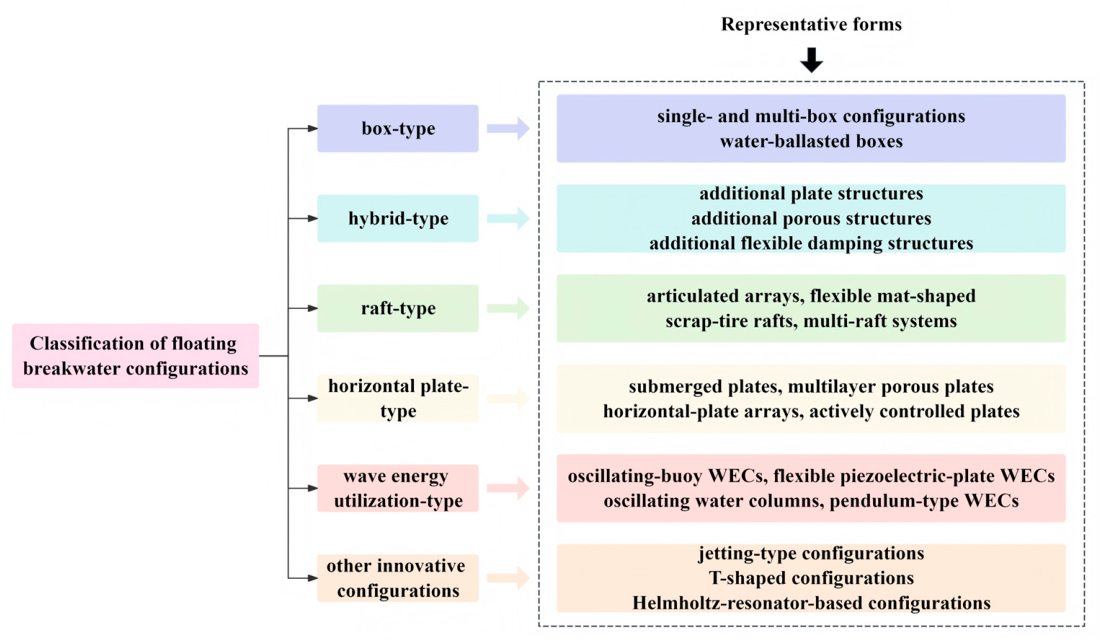
FB configurations have evolved from conventional box-type structures to designs incorporating appendages, multiple floating bodies, and integrated WECs. Performance enhancement has likewise shifted from reliance mainly on structural dimensions and wave reflection toward the combined use of viscous dissipation, multi-body interference, and wave energy absorption. Based on main-body form and functional characteristics, existing FBs are classified here into box-type, hybrid-type, raft-type, horizontal plate-type, wave energy utilization-type, and other innovative configurations (
Figure 1).
2.1. Box-Type
Box-type FBs remain among the most widely studied configurations due to their simple structure, ease of construction and installation, and broad engineering applicability. Liu and Wang [
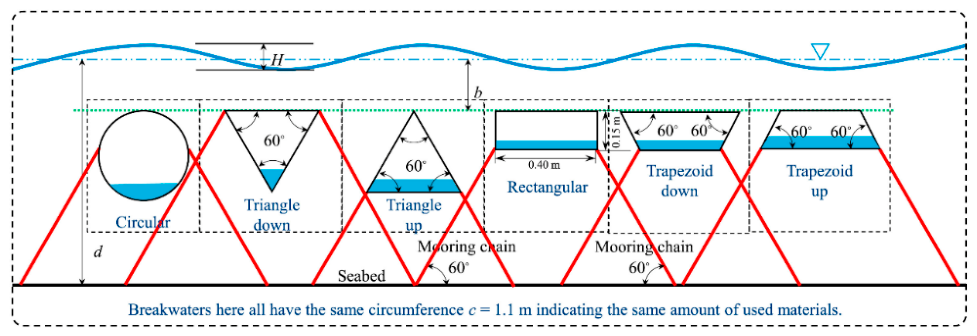
6] compared rectangular, circular, trapezoidal, and triangular cross-sections (
Figure 2), showing that an asymmetric section with a wider upper part and narrower lower part improved material utilization, while the upper deck contributed to wave attenuation. Sun et al. [
7] proposed an I-shaped cross-section to improve structural loading conditions and attitude response. Yang et al. [
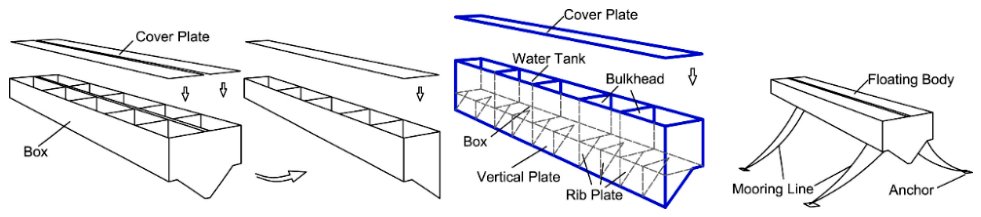
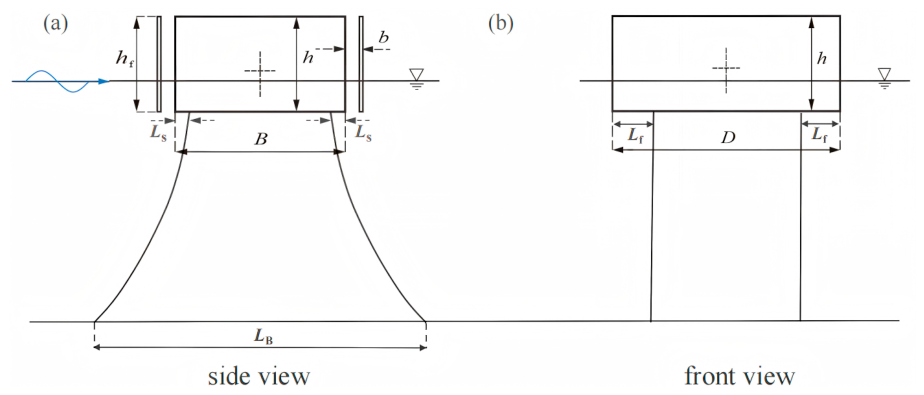
8] considered the additional influence of internal water motion and found that internal liquid sloshing and deck overtopping induced pronounced nonlinearities in the sway and roll responses of a water-ballasted box-type FB (
Figure 3). Beyond the response of a single box, Liu and Wang [
9] combined two rectangular boxes, which enhanced wave reflection and reduced floating-body motions.
Long-period waves remain a particular challenge for box-type FBs. To reduce the relatively high wave transmission in this range, Chen et al. [
10] divided a continuous long box into an array of box units. Adjusting the relative draft, unit spacing, and structural length improved wave attenuation performance. de Andrade et al. [
11] showed that increasing the relative width reduced wave transmission and enlarged the lee-side sheltered area. Changes in draft, spacing, length, and width can improve attenuation over a wider range of wave periods, but the resulting improvements still rely largely on geometric scaling and enhanced wave reflection.
2.2. Hybrid-Type
Under medium- and long-period waves, conventional FBs may exhibit reduced wave attenuation, larger motions, and greater variations in mooring loads. Hybrid-type FBs address these limitations by adding components that introduce additional attenuation mechanisms with less reliance on changes to the main-body dimensions. Based on component form and functional mechanism, they are grouped into additional plate structures, additional porous structures, and additional flexible damping structures.
2.2.1. Additional Plate Structures
Additional plate structures include vertical and horizontal plates, composite wing plates, and multilayer thin plates installed beneath the main body, along its sides, or on the wave-facing side. These components extend the wave–structure interaction region and modify the local flow without substantially increasing the main-body dimensions. He et al. [
12] examined a rectangular FB with additional vertical plates and found that restricting water motion beneath the floating body lengthened the natural pitch period and shifted pronounced wave energy dissipation toward the longer-period range. Han and Dong [
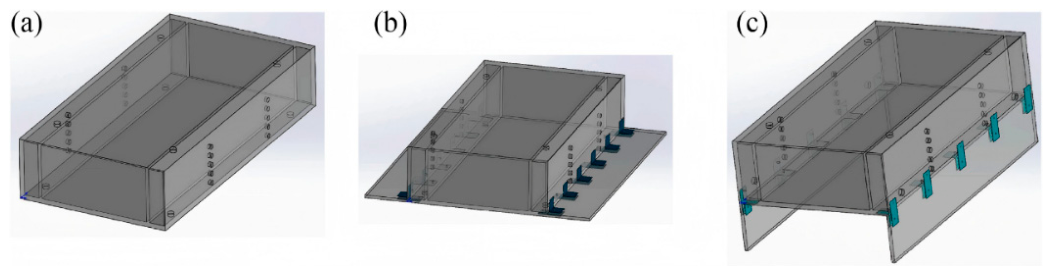
13] compared horizontal and vertical plates (
Figure 4) of different lengths. Increasing the plate length raised both the reflection and dissipation coefficients, while horizontal plates were more effective in suppressing sway and, at greater drafts, roll.
Extending plate-based design to a composite configuration, Wu et al. [
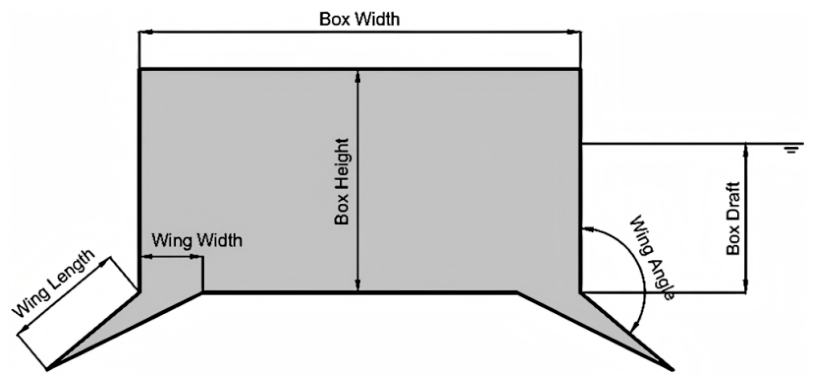
14] combined plates with openings and arc-shaped wings, achieving markedly improved attenuation of medium- and long-period waves. For a wing-plate FB (
Figure 5), Mao et al. [
15] used a multi-objective genetic algorithm to optimize the structural parameters, and the resulting design provided better wave attenuation than a conventional square box under the conditions considered. Beyond plate geometry, Chang et al. [
16] compared five connection methods for an FB with double-layer thin plates. The plates increased the effective draft and interaction area, while strong shear flows and wake vortices contributed to energy dissipation. Rigid connection produced greater improvements in wave attenuation and motion responses than the other connection methods. Solid plates enlarge the wave–structure interaction region, but the accompanying local loads and connection demands have prompted consideration of porous components that permit through-flow.
2.2.2. Additional Porous Structure
Additional porous structures typically consist of perforated plates or porous media installed around the main body. Flow-through perforation generates local jets and vortices, whereas seepage through porous media introduces hydraulic resistance. Both processes contribute to wave energy dissipation. Nasri et al. [
17] studied a trapezoidal pontoon-type FB with porous plates and found that a lower opening ratio on the wave-facing plate improved wave attenuation. Increasing the plate height reduced wave transmission but increased sway and mooring tension. Plate height should therefore be selected by considering attenuation performance, floating-body motion, and mooring loads together. Porous additions are not limited to perforated plates. Park and Kim [
18] examined an FB with wide porous media on both sides of the main body. Within the range considered, increasing porosity generally reduced reflection and transmission while enhancing wave energy dissipation. The porous media also weakened resonant peaks in the mooring loads.
Under combined wave–current conditions, Li et al. [
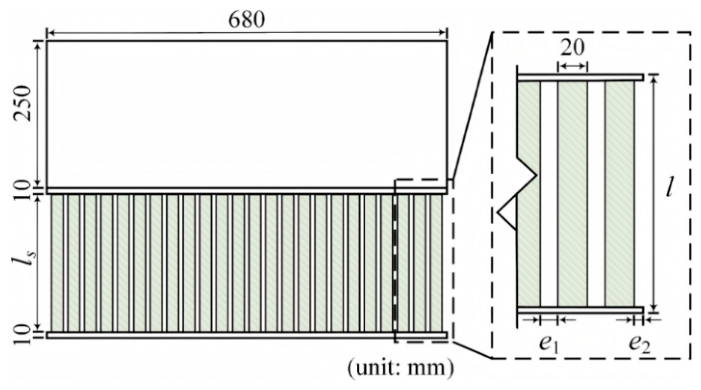
19] investigated a porous FB (
Figure 6) and found that following currents altered wave transmission through changes in wave height and period. The attenuation of long-period waves remained limited, but increasing the relative width reduced the transmission coefficient. Hu et al. [
20] studied an FB with porous baffles (
Figure 7) and showed that the baffles reduced nearby water-particle velocities and generated local vortices, thereby increasing wave energy dissipation and suppressing floating-body motions. Hydrodynamic performance therefore depends on more than the opening ratio [
21,
22]. Plate height, relative structural width, and ambient currents also affect wave transmission, floating-body motions, and mooring loads.
2.2.3. Additional Flexible Damping Structure
Additional flexible damping structures, including nets, aquatic vegetation, and curtains, deform under wave action and dissipate wave energy through relative fluid–structure motion, hydrodynamic damping, and vortex shedding. Cheng et al. [
23] developed a dual-pontoon-net FB and validated the numerical model against on-site prototype measurements. The configuration combined wave reflection by the pontoons with net-induced dissipation through FSI. For vegetation-based additions, Sun et al. [
24] showed that longer kelp, closer planting spacing, and more array rows improved attenuation, particularly for long-period waves. This improvement was associated with the evolution of turbulent kinetic energy and vortex shedding around the kelp.
Using flexible curtains suspended beneath a rectangular FB (
Figure 8), He et al. [
25] found that a single curtain provided attenuation comparable to that of a rigid slotted barrier. A double-curtain arrangement improved long-period attenuation through curtain buffering and the added mass of the confined water. The added mass lengthened the natural period, while the curtains also reduced main-body motions and mooring tension. Jia et al. [
26] showed, using an FSI model, that a lower elastic modulus promoted deformation and vortex-induced dissipation, whereas higher stiffness increased reflection. Increasing the height of the flexible components further improved attenuation, although the benefit diminished for long-period waves. Because deformation, vortex shedding, and added-mass effects act together, the hydrodynamic performance of flexible damping structures should be evaluated within an FSI framework.
2.3. Raft-Type
Raft-type FBs consist of multiple buoyant modules connected rigidly or flexibly. Wave attenuation results from multi-body hydrodynamic interference and, in articulated systems, relative motion between modules. Diamantoulaki and Angelides [
27] showed that the configuration of a hinged array strongly affected its hydrodynamic response and wave attenuation, with the preferred arrangement varying with wave frequency. For a flexible mat-shaped FB, Loukogeorgaki et al. [
28] found that the translational and rotational stiffnesses of the connectors significantly affected its hydroelastic response.
The influence of module arrangement is also evident in scrap-tire rafts. AlYousif et al. [
29] found that increasing the number of tire rows reduced wave transmission and suppressed resonance, whereas adding a second layer enhanced wave reflection. To integrate wave protection with energy conversion, Wan et al. [
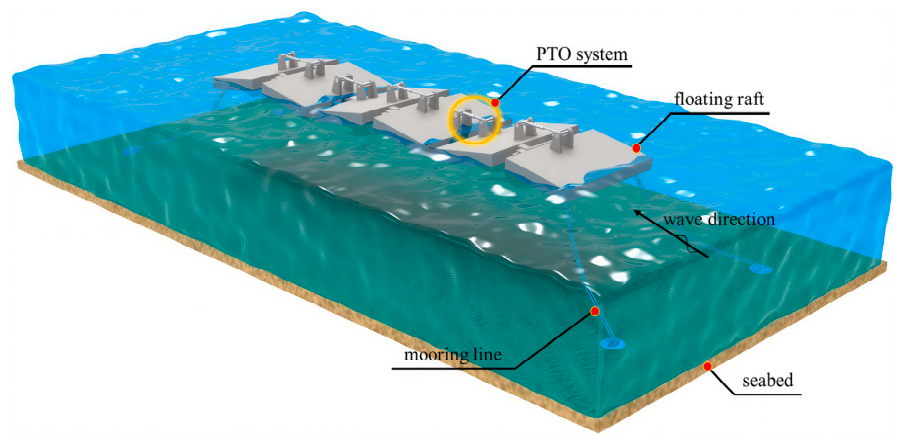
30] connected plate-like rafts through PTO-equipped hinges to form a hybrid raft-type system (
Figure 9). Compared with the two-raft arrangement, the three-raft configuration intensified multi-body hydrodynamic interference and increased pitch response. Raft width, resonance modes, and mooring configuration affected both wave attenuation and power capture. Two-point mooring broadened the effective capture bandwidth but increased mooring tension. Raft-type FBs exploit multi-body interference and relative motion for wave attenuation, but the associated connector loads and global hydroelastic response remain their principal engineering constraints.
2.4. Horizontal Plate-Type
Horizontal plate-type FBs generally use horizontal plates placed near or below the free surface. Wave attenuation is mainly associated with diffraction and changes in the local flow near the plate edges. Plate length and submergence depth are important for a single plate, whereas the number and arrangement of plates become relevant in multilayer and array configurations. Wang et al. [
31] found that wave transmission decreased as the plate approached the free surface and that, under the same conditions, a horizontal plate attenuated waves more effectively than a submerged vertical plate. For multilayer porous plates, Poguluri et al. [
32] showed that porosity and submergence depth jointly affected transmission and dissipation. When these parameters were appropriately matched, the double-layer arrangement outperformed the single- and triple-layer configurations.
Zhou et al. [
33] proposed a horizontal-plate array breakwater. Wave energy was dissipated mainly in the gaps between adjacent plates, where water exchange occurred. The spaced arrangement also reduced the amount of plate material required. Although the transmission coefficient increased with wave period, the array retained some capacity to attenuate long-period waves. Liang et al. [
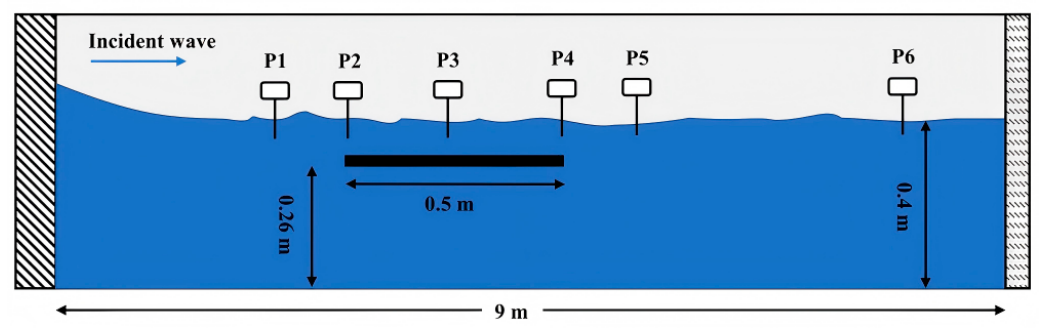
34] instead examined an actively controlled horizontal plate (
Figure 10), which was more adaptable to different wave conditions than a fixed plate. Active control provides a way to address the period sensitivity of passive plates. If the plate were coupled to a PTO system, its motion could also be used for wave energy conversion.
2.5. Wave Energy Utilization-Type
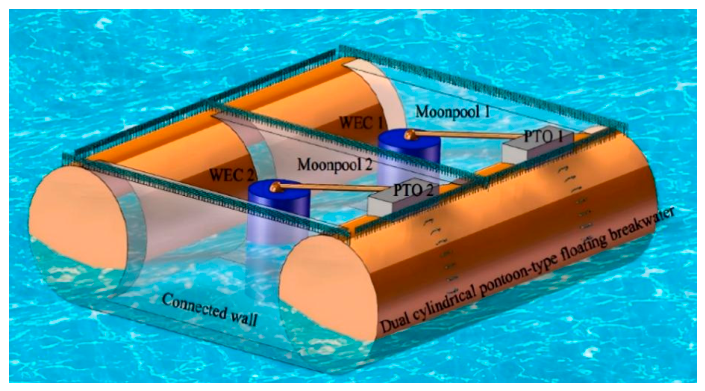
Wave energy utilization-type FBs integrate WECs with the breakwater body to capture part of the incident wave energy while limiting wave transmission. Oscillating buoys, piezoelectric plates, oscillating water columns (OWCs), and pendulum devices have been used in such systems. The WEC changes the surrounding wave field and the motion of the FB. Energy capture therefore has to be assessed together with wave attenuation and load response. Cheng et al. [
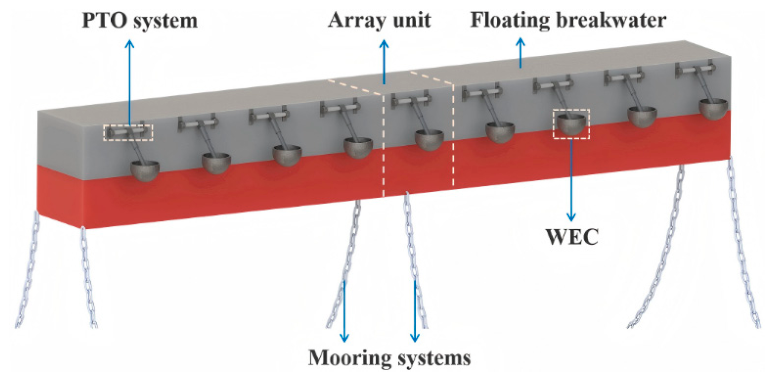
35] combined a moonpool-type FB with an oscillating-buoy WEC array (
Figure 11). Moonpool fluid motion improved both wave energy absorption and wave attenuation. Zheng et al. [
36] studied a flexible piezoelectric-plate WEC in front of an FB and found that greater submergence lowered and narrowed the main absorption-efficiency peaks but had little effect on wave attenuation.
In FB-WEC systems with narrow gaps or OWC chambers, local fluid resonance can affect both energy capture and wave transmission. Cheng et al. [
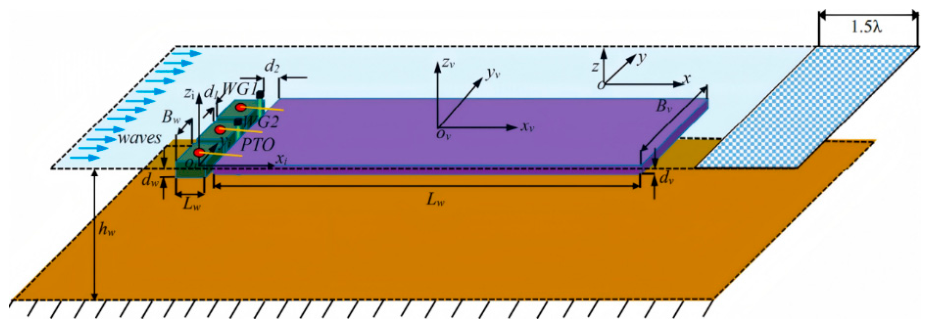
37] installed modular FB-WEC units at the leading edge of a very large floating structure (VLFS) (
Figure 12). Increasing the draft and length of the WEC-type FB modules improved their phase matching with long-period waves. Gap resonance produced multiple peaks in capture efficiency, and an asymmetric WEC shape further strengthened the gap resonance. Cheng et al. [
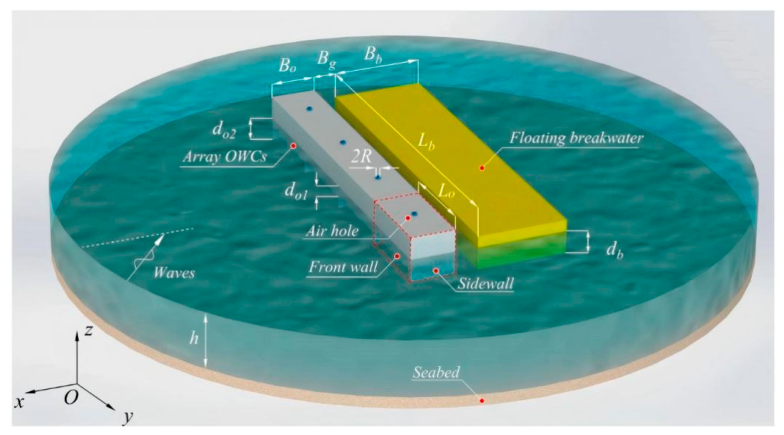
38] arranged OWCs along an ultra-long flexible FB (
Figure 13). Gap resonance increased the peak conversion efficiency and reduced wave transmission, but the number of OWCs that favored energy conversion did not coincide with that for wave attenuation. Zhou et al. [
39] found that narrow-gap resonance benefited the system with a symmetric WEC but adversely affected that with an asymmetric WEC, while varying the gap width caused only slight changes in the transmission coefficient.
Hydrodynamic interaction between the WEC and the FB also affects floating-body motions and mooring loads. In the rectangular FB-oscillating-body array (
Figure 14) studied by Zhou et al. [
40], increasing the incident wave height improved energy extraction but reduced wave attenuation. Energy absorption by the WECs also lowered the pitch- and surge-related mooring loads. Huang et al. [
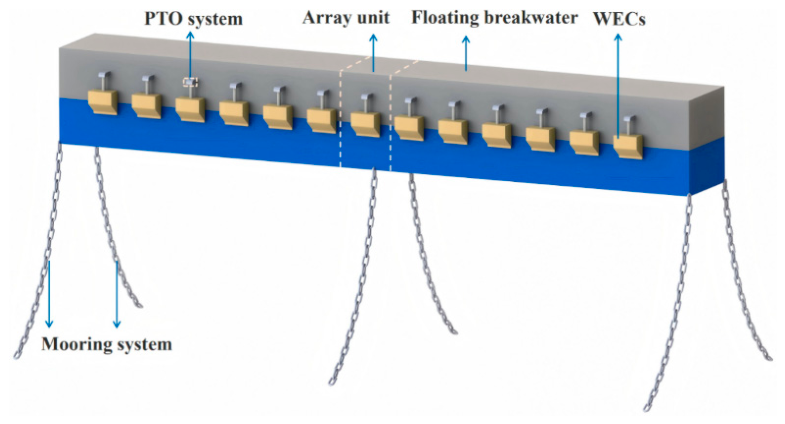
41] developed a pendulum-type WEC array-FB system (
Figure 15). Under the tested conditions, hydrodynamic coupling increased power generation and reduced wave transmission and pitch-related mooring loads. Hu et al. [
42] integrated OWCs, each equipped with an independent PTO system, into a flexible multi-module pontoon-type FB. Bottom openings strengthened chamber resonance and energy dissipation, whereas excessive structural flexibility reduced conversion efficiency through multimodal radiated-wave interference. Local resonance and floating-body motion can increase energy capture without necessarily improving wave attenuation or reducing structural and mooring loads. Energy capture, wave attenuation, and load response must therefore be evaluated together in FB-WEC design.
2.6. Other Innovative Configurations
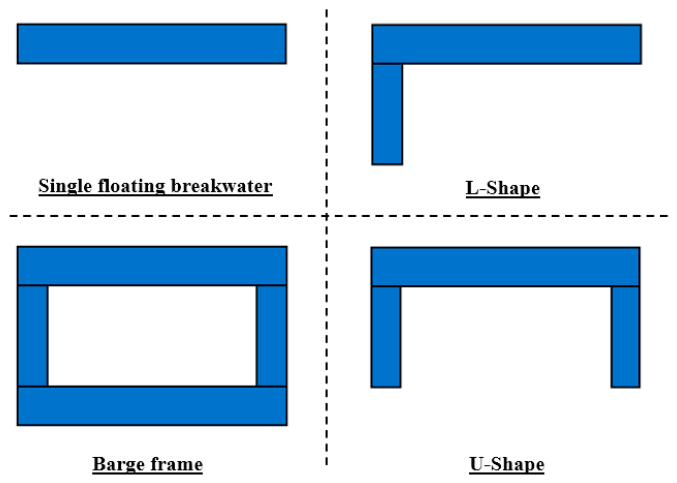
Innovative FBs extend conventional configurations through changes in spatial arrangement, cross-section, or internal fluid motion, and in some cases through integration with other offshore functions. Zhang and Magee [
43] compared single-body, L-shaped, U-shaped, and frame-type arrangements (
Figure 16). Spatial arrangement affected wave transmission and the motion of the protected floating body, with the frame-type arrangement providing greater motion suppression. Ji et al. [
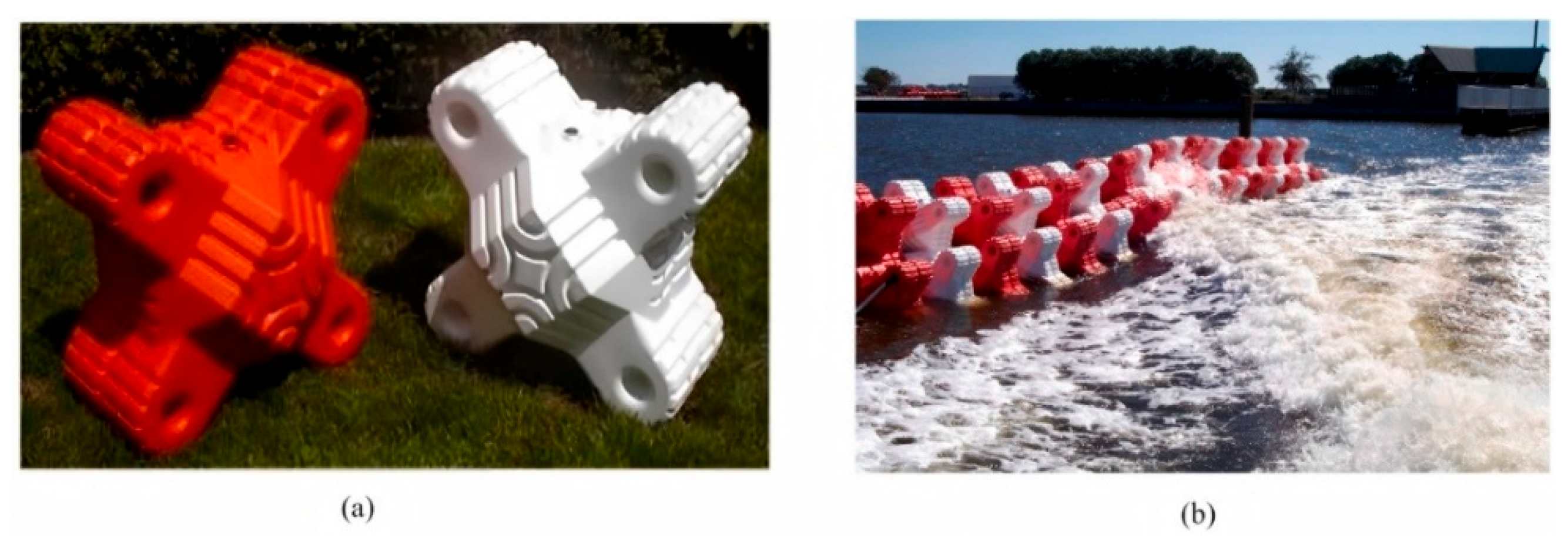
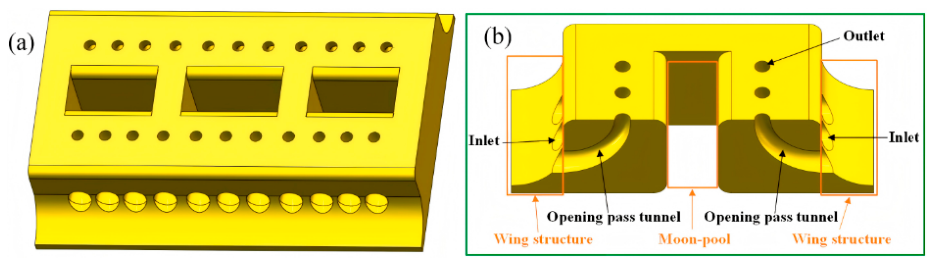
44] developed an FB with wing structures and symmetric openings (
Figure 17). Experiments showed favorable wave attenuation, relatively small motions, and a relatively uniform distribution of mooring loads. Ruan et al. [
45] proposed a partially T-shaped FB whose upper component attenuated free-surface fluctuations while the lower component impeded water motion. Compared with a box-type FB of the same size, it dissipated more energy and transmitted less under long-period waves. He et al. [
46] found that a three-tier stepped FB required only a small relative draft under short-period waves but a larger draft to maintain wave attenuation under long-period waves.
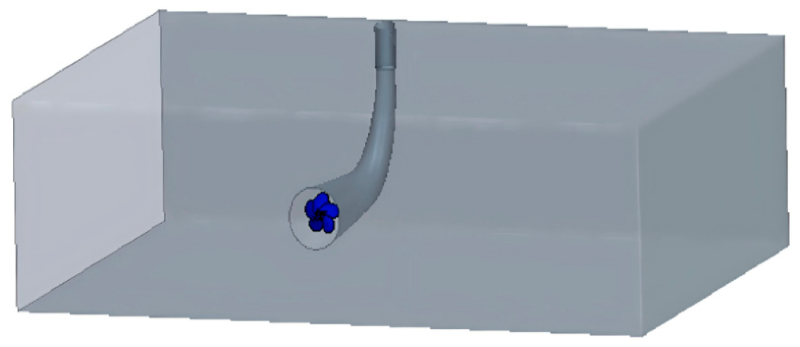
Some configurations use internal or locally accelerated flow as an additional source of damping. Wu et al. [
47] proposed a jetting-type FB (
Figure 18) that accelerated the local flow to generate high-speed water jets, increasing wave energy dissipation under long-period waves. For offshore aquaculture, Wang et al. [
48] integrated an aquaculture tank into an FB. The tank acted as a tuned liquid damper, reducing roll response and improving wave attenuation, while perforated baffles reduced sloshing energy under the filling conditions considered.
Long-period attenuation has also been addressed through added-mass and cavity-resonance mechanisms. Ji et al. [
49] used radiation-induced heave added mass to improve long-period wave attenuation. A configuration based on this mechanism was implemented in an engineering project, and experiments reported a wave attenuation rate above 65% for periods of 5.5–12.0 s. Lu et al. [
50] developed a Helmholtz-resonator-based FB using a hydrofoil-inspired geometry and a perforation layout, which could improve long-period wave attenuation. Most of these concepts, however, have been assessed under regular waves using numerical models or model-scale experiments. Their engineering applicability therefore remains to be assessed under broader wave conditions, with motion, load, and implementation constraints taken into account.
Taken together, these studies indicate that configuration innovation increasingly changes not only the level of wave attenuation but also the physical mechanism by which attenuation is achieved, motivating the cross-configuration comparison in
Section 2.7.
2.7. Performance Comparison and Applicability Analysis
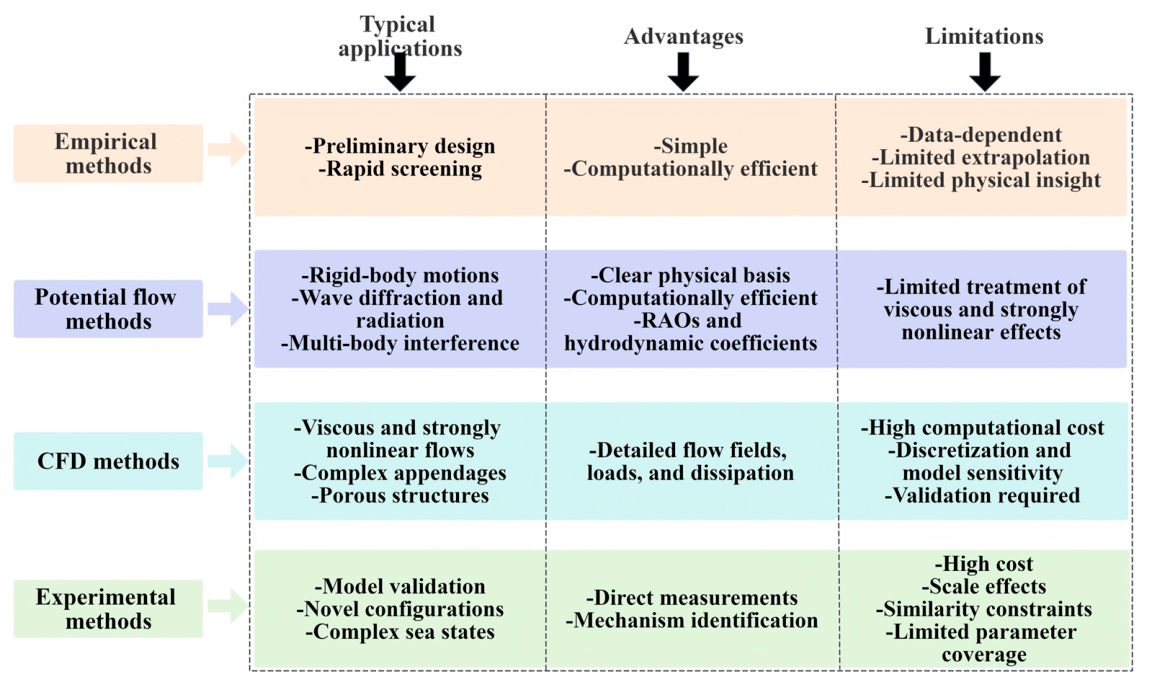
Table 1 compares the dominant wave attenuation mechanisms, applicability, and limitations of the six FB categories reviewed above. For box-type and horizontal plate-type FBs, long-period wave attenuation remains closely tied to relative width, draft, or plate length. Increasing these dimensions can reduce wave transmission, but requires more material and may increase structural and mooring loads. Hybrid, raft-type, and other innovative configurations use different combinations of wave reflection, viscous dissipation, multi-body interference, flexible damping, added-mass effects, and local resonance. These mechanisms can improve attenuation over a wider range of wave periods, but they also make local wave loads, connection loads, and hydroelastic responses more important. With functional integration, wave attenuation becomes coupled with energy conversion in FB-WEC systems or with internal fluid control in aquaculture systems. Floating-body motions and mooring loads must also be controlled, and improvement in one response does not necessarily improve the others. The appropriate analysis method therefore depends on the dominant attenuation mechanisms and key hydrodynamic responses of each FB configuration.
The comparison above shows that FB configurations should not be evaluated solely by structural form or transmission coefficient. Different configurations activate different combinations of reflection, radiation, viscous dissipation, resonance, multi-body interference, and flexible deformation, which, in turn, determine the hydrodynamic responses that need to be resolved. This configuration–mechanism–response relationship provides the physical basis for selecting appropriate hydrodynamic analysis methods, as discussed in
Section 3.
3. Hydrodynamic Analysis Methods for Floating Breakwaters
FB hydrodynamic analysis involves different combinations of diffraction and radiation, viscous dissipation, nonlinear free-surface effects, multi-body interference, and FSI. Depending on the dominant processes and responses to be evaluated, existing approaches can be broadly divided into empirical, potential flow, CFD, and experimental methods.
3.1. Empirical Methods
Empirical methods use the regression of experimental or numerical data to relate wave conditions and structural parameters to hydrodynamic responses, without directly solving the governing equations. They mainly predict transmission coefficients and, less commonly, reflection and energy dissipation coefficients or mooring loads. Their low computational cost suits preliminary design and parameter screening. Most empirical relations for FBs are derived from wave–flume data. Nikpour et al. [
51] developed a transmission-coefficient equation for a trapezoidal FB with 60° side slopes from regular-wave tests covering different wave heights, periods, and drafts. AlYousif et al. [
52] used irregular-wave measurements from nine scrap-tire configurations to develop an empirical equation for the transmission coefficient.
Empirical formulations have also been developed for porous configurations and for load prediction based on numerical databases. Nasri et al. [
17] developed a transmission-coefficient equation for trapezoidal FBs with at least two porous plates attached beneath the pontoon, using wave steepness, the draft-to-width ratio, relative porous plate height, and a dimensionless parameter representing plate porosity and arrangement. Using three-dimensional numerical data, Zang et al. [
53] derived equations for the transmission coefficient and maximum total mooring force of a horizontal multi-cylinder FB. The mooring force equation included wind speed, current velocity, wave height, wave period, and water depth. Numerical databases can support empirical prediction of responses that are costly to measure, but the equations inherit the assumptions and uncertainties of the underlying numerical model. Empirical methods are therefore best suited to rapid performance estimation and preliminary design within the range of wave and structural conditions covered by the data used to derive the equations. Their application to new configurations or systems governed by different attenuation mechanisms requires physics-based analysis or experimental validation.
3.2. Potential Flow Methods
Potential flow methods model the fluid as inviscid, incompressible, and irrotational, reducing wave–structure interaction to diffraction and radiation boundary-value problems. They efficiently predict hydrodynamic coefficients, response amplitude operators (RAOs), and wave transmission and reflection coefficients when viscous dissipation and severe free-surface nonlinearities are secondary. For FBs with regular boundaries, analytical and semi-analytical solutions also provide direct insight into the effects of structural parameters. Wang et al. [
54] used velocity-potential decomposition and eigenfunction expansion to derive analytical and simplified solutions for the transmission coefficient. They examined the effects of structural width, draft, incident wavelength, and body motion and produced transmission coefficient charts. Potential flow formulations have also been extended to FBs containing porous media and to hydroelastic energy conversion systems. Park et al. [
55] applied a multi-domain boundary element method to a two-dimensional FB of arbitrary shape containing a wide porous medium. Zheng et al. [
36] combined linear potential flow theory and eigenfunction matching in a hydroelastic model of a flexible piezoelectric-plate WEC placed in front of an FB. The model coupled the plate’s electromechanical response with the surrounding wave field and enabled the simultaneous evaluation of wave energy absorption and wave attenuation.
For engineering assessment, hydrodynamic coefficients alone are often insufficient because floating-body motions and connector or mooring loads under irregular waves may also govern system safety. Cebada-Relea et al. [
56] combined hydrodynamic data from a three-dimensional frequency-domain boundary element method (BEM) with time-domain simulations of floating-body motions, mooring forces, and connector loads. Nonlinear Froude–Krylov and hydrostatic restoring forces were evaluated on the instantaneous wetted surface. Their results showed that considering only regular waves could substantially underestimate the maximum connector loads. For mooring system assessment, de Andrade et al. [
57] obtained hydrodynamic coefficients with OrcaWave and used OrcaFlex to compare the motions and mooring forces of taut, slack, and hybrid mooring systems. Frequency-domain analysis efficiently provides hydrodynamic coefficients and RAOs. Time-domain analysis is better suited to evaluating motions and peak connector or mooring loads under irregular waves, particularly when nonlinear restoring forces are considered.
To account for free-surface and body-boundary nonlinearities, Cheng et al. [
35] developed a three-dimensional time-domain potential flow numerical wave tank with fully nonlinear boundary conditions on the instantaneous wetted body surface and free surface for a moonpool-type FB with an array of heaving-buoy WECs. Even with fully nonlinear boundary conditions, potential flow formulations do not readily resolve wave breaking and overtopping or viscous phenomena such as boundary-layer separation, vortex shedding, and local jets. Zhang et al. [
58] developed a frequency-domain numerical model based on potential flow theory with viscous correction for an inertial built-in WEC array-FB system. The model was used to examine energy extraction performance and the interaction between the WEC array and the FB. Potential flow methods are therefore suitable for problems governed primarily by wave diffraction and radiation, rigid-body motions, hydroelastic responses, or the coupled dynamics of FBs, mooring systems, and WECs. CFD or physical experiments are more appropriate when strongly nonlinear free-surface behavior and viscous dissipation govern wave attenuation or loads.
3.3. CFD Methods
CFD methods solve the Navier–Stokes equations and use free-surface capturing and turbulence modeling to represent fluid viscosity, turbulence, and nonlinear free-surface motion. They can resolve wave breaking, overtopping, local jets, slamming, and vortex shedding, together with the associated flow fields and loads. Mesh-based CFD commonly combines the volume of fluid (VOF) method with Reynolds-averaged Navier–Stokes equations, large-eddy simulation (LES), or other high-fidelity turbulence-resolving approaches to investigate complex unsteady hydrodynamic processes under combined environmental conditions [
59]. At the component scale, Ji et al. [
60] used CFD to examine the wave attenuation mechanisms and flow characteristics around and inside an FB with wing structures and openings. To include floating-body motion and mooring response, Peng et al. [
61] coupled VOF, LES, six-degree-of-freedom body motion, and a mooring model in OpenFOAM to simulate wave breaking and floating-body motions, and validated the model against experimental results. Internal fluid motion and FSI have also been considered in CFD models. Wang et al. [
48] incorporated external waves, internal liquid sloshing, perforated baffles, mooring forces, and floating-body motions into a CFD model of an aquaculture tank-type FB. Li et al. [
62] developed an OpenFOAM-based FSI model for an FB-bridge box-girder system and compared wave–force attenuation on the bridge under different mooring arrangements.
Smoothed particle hydrodynamics (SPH) is a Lagrangian mesh-free particle method suitable for simulating wave breaking, fluid impact, and large-amplitude floating-body motions. Chen et al. [
63] used δ-SPH to study a dual FB. They examined the effects of body spacing and wave period on its hydrodynamic performance and also considered Bragg-resonance reflection. Chen et al. [
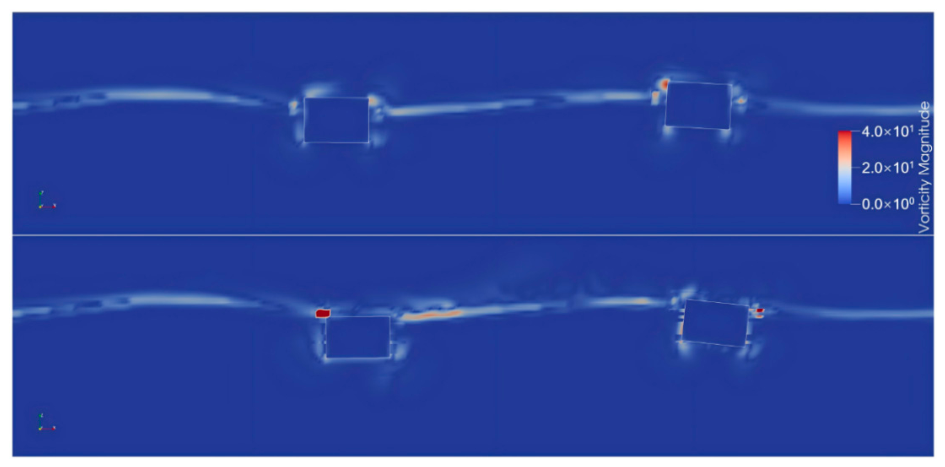
64] coupled an enhanced SPH formulation with a mooring analysis program to evaluate the slamming, wave attenuation, and motion responses of a rectangular FB with wing plates. The model also provided the surrounding velocity and vorticity fields. For porous structures, Zheng et al. [
65] developed an SPH model based on mixture theory and modified the discretization of the mass-conservation equation and the particle-shifting technique.
The accuracy and computational cost of CFD depend on mesh or particle resolution, time-step selection, free-surface treatment, turbulence modeling, and the algorithms used for body motion and mooring coupling. Almeida-Medina et al. [
66] compared dynamic-mesh techniques, free-surface capturing methods, and rigid-body motion algorithms within an OpenFOAM-MoorDyn framework. All of the schemes considered showed high numerical accuracy, while the overset-mesh scheme was the most computationally efficient. Bian et al. [
67] used a CFD numerical wave flume to assess sidewall-gap effects in two-dimensional experiments on a moored dual-cylinder FB and found that gap diffraction affected the transmission coefficient. CFD is particularly suitable for evaluating wave attenuation and loads when viscous dissipation, nonlinear free-surface motion, fluid impact, local jet flows, or the coupled responses of the floating body and mooring system must be considered.
3.4. Experimental Methods
Physical model experiments reproduce wave–structure–mooring interactions under controlled conditions. Measurements commonly include free-surface elevation, floating-body motions, mooring loads, and local pressures. Jet flows, wave slamming, and wave breaking can also be observed directly during the experiments. The experimental facility and arrangement are selected according to the environmental conditions and hydrodynamic processes of interest. Xu et al. [
68] conducted water tank experiments on a streamlined double-row FB with wing plates designed for a specific port. Under realistic nearshore conditions, the experiments evaluated wave attenuation together with body motions, mooring tensions, and pressures on the FB surface. Ji et al. [
44] investigated the three-dimensional hydrodynamic performance of an FB with wing structures and symmetric openings in a wave pool, with particular attention to wave diffraction, motion responses, and mooring loads. Li et al. [
19] conducted experiments on a porous FB in a circulating water channel and examined its hydrodynamic performance and mooring forces under different wave and current conditions.
Experiments can also be used to examine nonlinear flow processes, resonance, and hydrodynamic interactions between multiple components. Ji et al. [
69] investigated an FB with curved opening passages and submerged arc-shaped wings. They observed water spraying upward along the opening passages, together with wave slamming and breaking at the rear wall. For resonance-related attenuation, Zhang et al. [
70] combined physical experiments with Bloch band theory to examine how the configuration of an FB array affected its resonance characteristics and attenuation bandwidth. Huang et al. [
41] used physical model experiments to examine the hydrodynamic interaction between a pendulum-type WEC array and an FB. Experimental measurements provide benchmark data for validating numerical models. Scale effects must nevertheless be considered when model-scale results are extrapolated to prototype conditions.
Differences in physical representation, computational cost, and the hydrodynamic responses that can be resolved make method selection a configuration- and mechanism-dependent problem rather than a simple comparison of numerical accuracy.
3.5. Method Comparison
The four methods differ in their applicability to the hydrodynamic analysis of FBs (
Figure 19). Methods should be selected according to the dominant hydrodynamic processes and key responses of each FB configuration. Empirical methods are efficient for preliminary screening when the configuration and parameter ranges are covered by the data used to derive the equations. Potential flow methods are more appropriate when wave reflection, diffraction and radiation, rigid-body motion, or multi-body interference govern the response. They are widely used for conventional box-type FBs, raft-type and array configurations, and FB-WEC systems. When attenuation depends on jets through openings in porous components, vortex shedding, wave breaking, or slamming, CFD is better suited to representing the associated viscous and nonlinear free-surface processes. Flexible deformation, mooring dynamics, and PTO response require hydrodynamic analysis to be coupled with the corresponding structural, mooring, or energy-conversion models. Physical experiments remain important for observing complex flow phenomena, measuring motions and loads, and validating theoretical and numerical models. Their parameter coverage is limited by testing cost, while scale effects complicate extrapolation to prototype conditions.
No single method can represent all of the processes and responses relevant to FB performance. During preliminary design, empirical or potential-flow methods can be used for configuration screening and parametric studies, whereas CFD and coupled models become necessary when viscous dissipation, strongly nonlinear flow, FSI, mooring dynamics, or PTO response must be resolved, with physical experiments providing validation. Therefore, method selection should follow the dominant attenuation mechanism and target hydrodynamic response identified for a given configuration, rather than being based on the numerical technique alone. These coupled aspects—including structural effects, mooring restraint, attenuation mechanisms, and FSI—are discussed further in
Section 4.
4. Hydrodynamic Characteristics of Floating Breakwaters
The preceding sections show that FB performance arises from the interactions among structural configuration, attenuation mechanisms, and hydrodynamic responses, while the choice of analysis method determines how these processes can be represented and resolved. Structural parameters and mooring constraints modify floating-body motion and the surrounding wave field, while local nonlinear flows and structural deformation further alter energy reflection, radiation, and dissipation. Accordingly, structural design, mooring design, wave attenuation mechanisms, and FSI are not independent topics but interconnected aspects of the same hydrodynamic response process. This section discusses these interactions and their implications for FB performance.
4.1. Structural Design and Optimization
Structural parameters affect wave attenuation, floating-body motions, and mooring loads, and their effects are often coupled. The main variables considered in existing studies include the main-body cross-section and dimensions, appendage geometry, and the arrangement of multiple units. Sun et al. [
71] compared rectangular and triangular FBs with trapezoidal FBs with different bottom angles. Under the same wave height, draft, and wave period, trapezoidal cross-sections with smaller bottom angles were more effective in limiting increases in mooring force. The bottom angle also affected wave attenuation performance. For a stepped trapezoidal FB, Zhang and Tay [
72] showed that the slope angle and step configuration affected wave reflection, transmission, and energy dissipation, with smaller slope angles and fewer steps favoring attenuation. Cross-sectional design should therefore consider wave transmission and reflection together with motion and mooring responses.
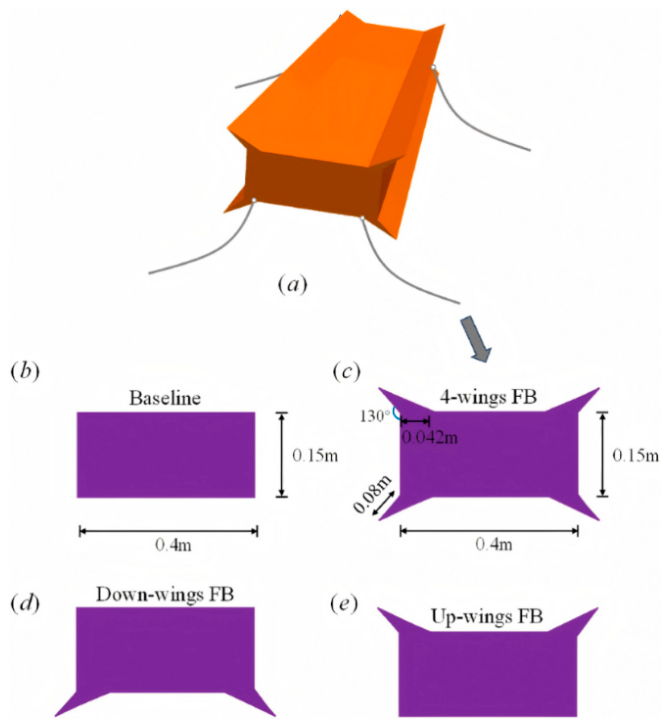
Studies of appendage design have mainly considered wing plates and horizontal flanges. Chen et al. [
64] found that wing plates enhanced wave energy dissipation under long-period waves and changed the velocity and vorticity fields near a rectangular FB. Yuan et al. [
73] compared four-wing, down-wing, and up-wing configurations (
Figure 20). The four-wing configuration showed good wave attenuation performance under regular and irregular waves, with an RAO magnitude approximately half that of the wingless model. Wei and Yin [
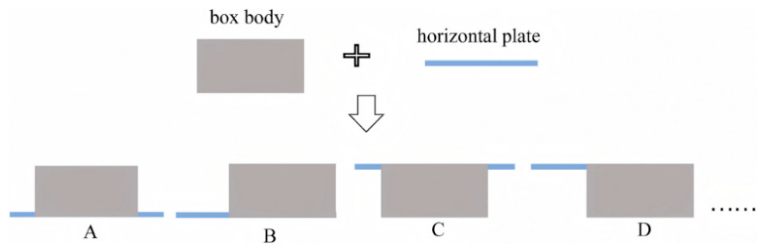
74] found that horizontal flanges (
Figure 21) improved wave attenuation and reduced floating-body motions but increased mooring tension. Raising the flanges and moving them seaward improved the overall performance. Appendage parameters should therefore be selected by considering wave attenuation, motion responses, and mooring loads together.
The selection of principal dimensions should consider both wave attenuation performance and structural material requirements. For a rectangular semi-submerged FB under solitary waves, Lin et al. [
75] found that increasing the relative length continued to reduce wave transmission, whereas the increases in reflection and energy dissipation gradually diminished. Under the examined conditions, a relative length of 5–10 provided a balance between wave attenuation performance and economic viability. Liu et al. [
76] developed a surrogate model using support vector regression and combined it with a genetic algorithm to optimize the main-body width and draft, together with the wing-plate height, width, and angle, subject to a transmission coefficient below 0.20. The optimized configuration reduced the cross-sectional area by 20% relative to the initial configuration while maintaining good wave attenuation performance under long-period waves. Dimensional optimization should therefore balance attenuation requirements against structural size, while surrogate models can improve the efficiency of the optimization process.
Layout design has been studied for both harbor applications and FB-WEC systems. Xu et al. [
68] considered a streamlined double-row FB designed for a particular harbor. Its wave attenuation varied with incident wave height and period. Reflection from nearshore structures also affected harbor tranquility and the motion responses of the FB. In an FB-WEC system, Zhou et al. [
39] found that small gap widths and slender WECs favored wave energy absorption, although the improvement in wave attenuation was limited. For harbor applications, the layout should reflect site-specific protection requirements. In FB-WEC systems, energy absorption and wave attenuation must also be balanced.
4.2. Mooring System Design and Optimization
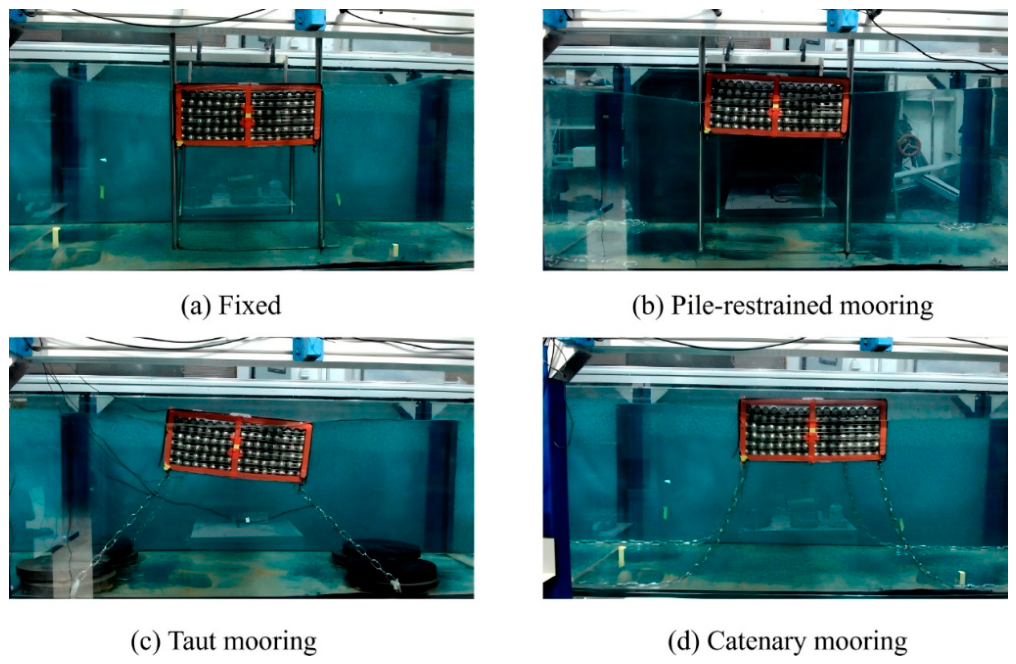
The mooring system maintains the position of an FB and constrains its motions in six degrees of freedom. Its restraint type, stiffness, pretension, and line arrangement therefore affect both hydrodynamic performance and mooring loads. Luo et al. [
77] compared fixed, pile-restrained, taut, and catenary configurations (
Figure 22). Fixed restraint provided good wave attenuation performance, while pile restraint performed similarly to the emerged fixed configuration. Because of its high compliance, catenary mooring allowed large surge and heave motions under long-period waves, thereby weakening wave attenuation. Taut mooring had high stiffness and effectively suppressed wave transmission when fully submerged, although its performance depended on pretension and the submergence state of the FB. de Andrade et al. [
57] found that slack mooring produced lower mooring forces, and taut mooring more effectively suppressed heave. Hybrid mooring systems could produce higher peak loads. Mooring selection must therefore consider the target wave conditions and submergence state, as the restraint required to limit motion does not necessarily minimize mooring loads.
The mooring-line arrangement also influences how restraint is shared among individual lines. Liang et al. [
78] found that crossed and parallel arrangements, with the lines clear of the seabed, both enhanced the reflection and dissipation of long-period waves, but their wave attenuation remained weaker than that under fixed restraint. Vishwakarma and Karmakar [
79] reported that crossed mooring generally reduced line tensions by 20–60% relative to an open mooring arrangement, but the reduction depended on the cross-sectional shape. The tension in individual lines could also increase within some frequency ranges. Mooring arrangements should therefore be evaluated in terms of their effects on hydrodynamic performance and load distribution among individual mooring lines. Wave height also affects the nonlinear response of the mooring lines. Using the absolute nodal coordinate formulation, Huang et al. [
80] found that the change in the tension of the wave-facing line became more pronounced with increasing wave height, while the displacements of intermediate nodes exhibited greater nonlinearity. The mooring system is therefore not merely a station-keeping component. Its restraint stiffness alters floating-body motions and the associated radiated waves, thereby changing the distribution of incident wave energy among transmission, reflection, and dissipation. This coupling explains why mooring characteristics must be considered together with the wave attenuation mechanisms discussed next.
4.3. Wave Attenuation Mechanisms
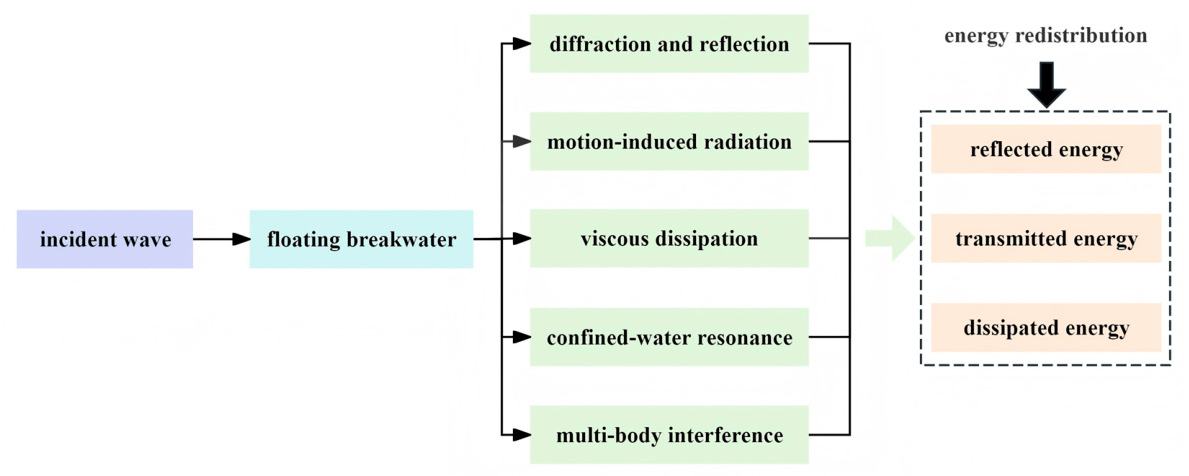
FBs attenuate waves by redistributing incident wave energy among reflection, transmission, and dissipation. The main processes include wave diffraction, motion-induced wave radiation, local nonlinear flow and viscous dissipation, confined-water resonance, and multi-body hydrodynamic interference (
Figure 23). Floating-body motions and mooring constraints modify the balance among these processes. Wang et al. [
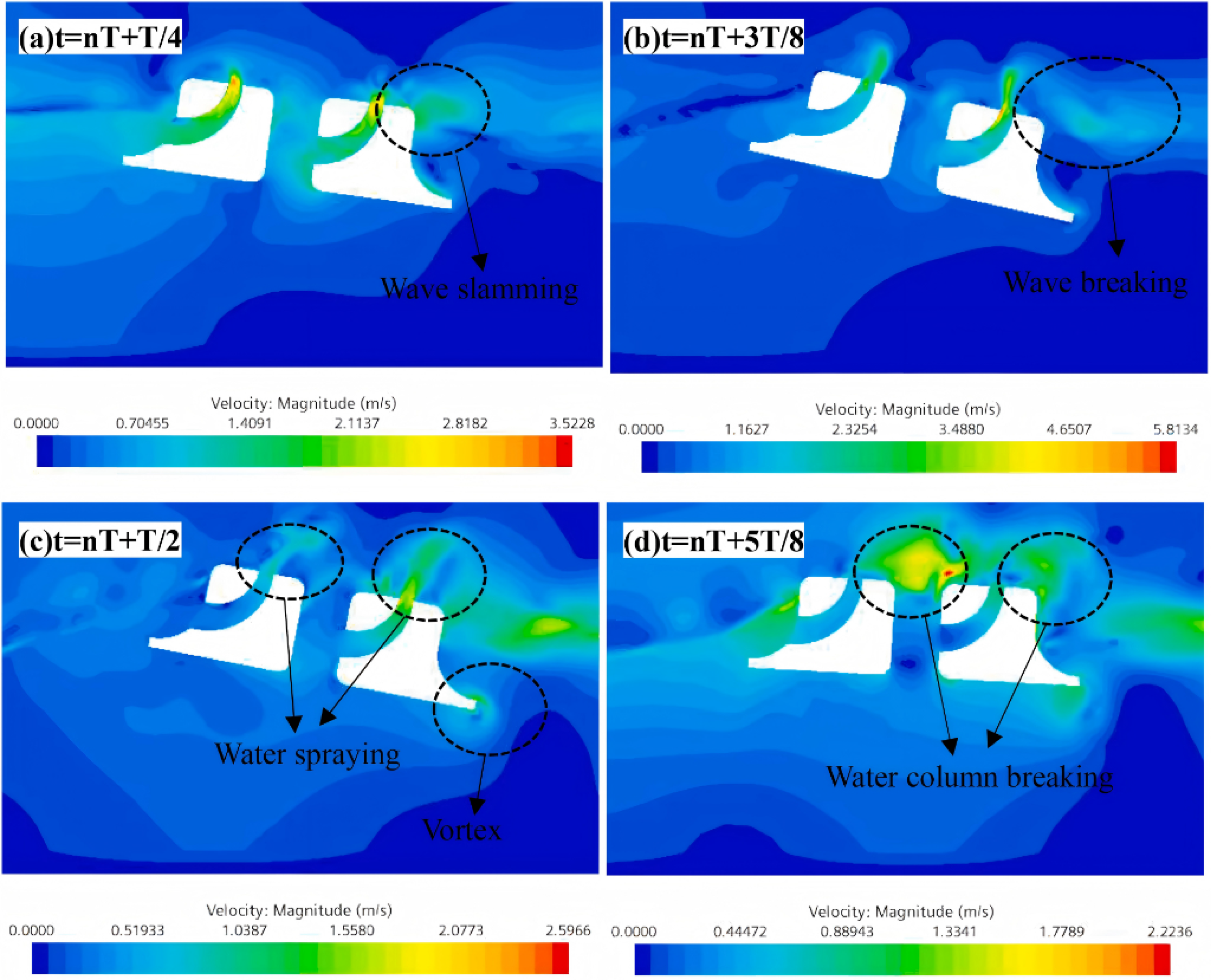
54] showed that motion-induced wave radiation affected wave transmission and that appropriate control of the motion response could improve attenuation within specific parameter ranges. Local nonlinear flow provides another source of wave energy dissipation. Ji et al. [
60] found that the improved attenuation of an FB with wing structures and openings resulted mainly from slamming induced by the wings and water spraying through the openings. Wave breaking, vortex formation, and water column breakup also occurred around the structure (
Figure 24). Motion-induced radiation and local nonlinear dissipation therefore represent two distinct contributions to wave attenuation.
Flexible components can affect both wave reflection and energy dissipation. Li et al. [
81] found that a single densely planted kelp row mainly enhanced wave reflection, whereas multiple rows promoted wave energy dissipation. The dissipation was associated with the velocity field, the evolution of turbulent kinetic energy, and vortex development and shedding around the kelp. In gaps and cavities, confined-water motion can produce resonant attenuation. Ji et al. [
82] showed that the moonpool effect and vortex dissipation in a double-row FB reduced wave transmission, particularly under short-period waves. For lower-frequency attenuation, Zhang et al. [
70] experimentally investigated a Helmholtz-type FB array. They found that Helmholtz resonance, unlike Bragg resonance, could occur in a single structure at a lower frequency, making it suitable for attenuating long-period waves. When Helmholtz resonance was activated, radiated waves generated within the FB cavity interacted with the incident waves, dissipating wave energy. The maximum dissipation coefficient occurred within the frequency range corresponding to Helmholtz resonance.
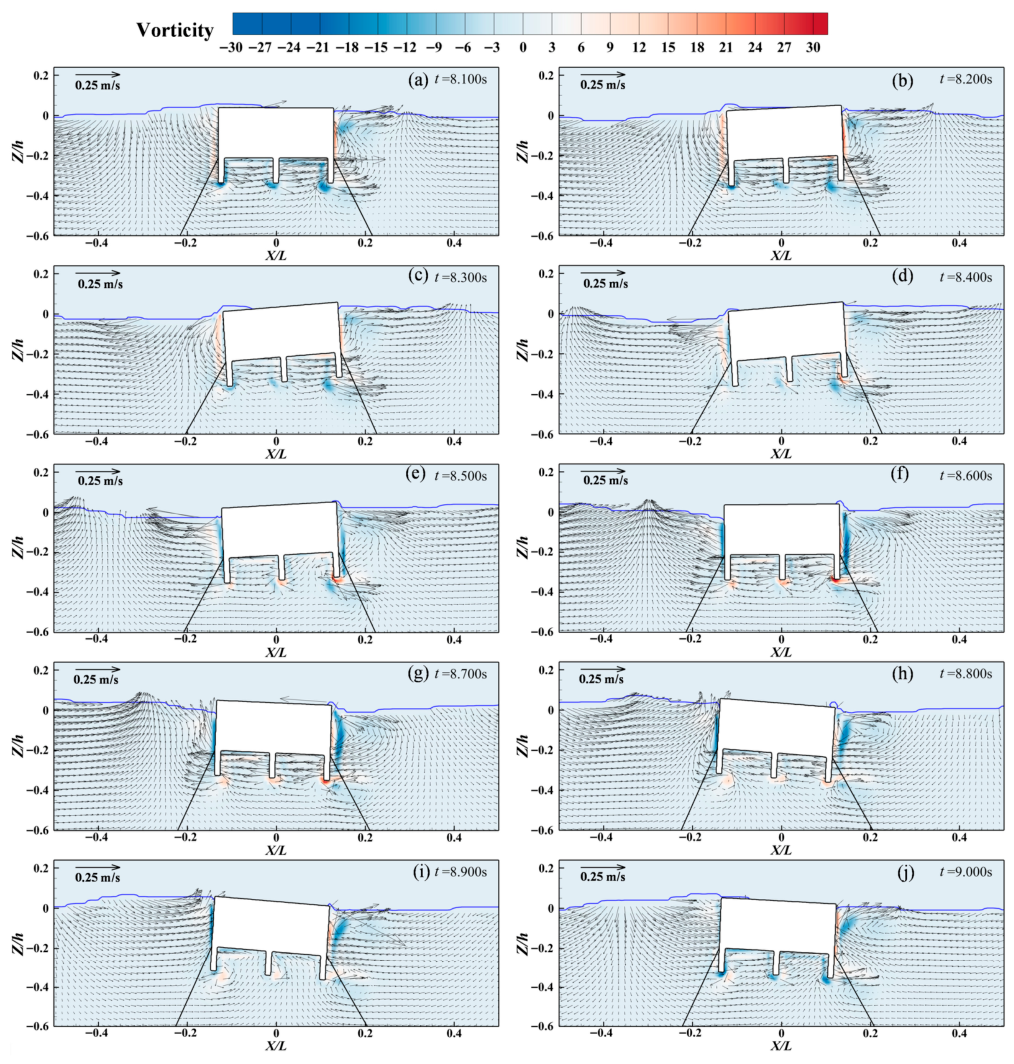
FB arrays can also attenuate waves through Bragg reflection caused by interference among the units. Liu et al. [
83] found that the reflection coefficient peaked when the spacing between floating bodies equaled an integer multiple of half the wavelength. They also found that greater draft increased vorticity around the structures (
Figure 25) and that box length affected local vorticity and wave energy dissipation. Wang et al. [
84] reported possible Bragg reflection in a dual-FB system when the spacing was approximately 0.7 times the wavelength. Bragg reflection is sensitive to the spacing between units relative to the wavelength.
4.4. Fluid–Structure Interaction
FSI must be considered when an FB or its appendages undergo elastic deformation under wave loading. Fluid–structure coupling is also widely considered in numerical studies of flexible offshore structures involving unsteady flow and vortex shedding [
85]. Wave loads and mooring constraints affect both rigid-body motion and elastic deformation. These responses alter the fluid-domain boundary and local flow, thereby changing wave energy dissipation. Zhang et al. [
86] developed a rigid–flexible coupling model combining the moving particle semi-implicit (MPS) method with the finite element method (FEM). MPS simulated violent free-surface motions, including wave breaking, while FEM solved structural deformation. The model could capture the coupled response of large-amplitude rigid-body motion and small structural deformation. For flexible wave-dissipating components, Jia et al. [
26] combined an immersed boundary method with a finite element structural solver. A relatively low elastic modulus produced larger deformation and promoted vortex-induced dissipation, whereas greater stiffness enhanced wave reflection (
Figure 26). The stiffness of flexible appendages therefore affects the balance between deformation-induced dissipation and wave reflection.
For large flexible FBs, hydrodynamic analysis must account for elastic deformation of the main body as well as rigid-body motion [
87]. Cheng et al. [
37] incorporated modal expansion into a coupled FEM-BEM model. Mindlin plate elements represented the structure, while the wave field was solved with fully nonlinear potential-flow boundary conditions. The model was used to evaluate the effects of WEC geometric parameters, the WEC-VLFS gap, and wave nonlinearity on the hydroelastic response. For an ultra-long flexible FB integrated with an OWC array, Cheng et al. [
38] coupled the finite volume method with FEM. Out-of-phase interference among multimodal radiated waves generated by elastic deformation reduced energy conversion performance. Hu et al. [
42] used a two-way coupled CFD-FEM model for a multi-module flexible pontoon-OWC system. Greater structural stiffness enhanced chamber resonance, whereas excessive flexibility caused interference among multimodal radiated waves and reduced energy conversion efficiency.
5. Current Problems and Challenges
The comparative synthesis above reveals four interrelated challenges that currently constrain the engineering application of FBs in deep and far-offshore waters: long-period wave attenuation, structural and mooring safety under extreme sea states, multifunctional performance coordination, and scale effects and prototype validation.
- (1)
Limited attenuation of long-period waves: Most FBs attenuate short- and medium-period waves, but transmission generally increases under long-period swell and the long-period components of extreme sea states. When the wavelength is much greater than the FB width and draft, waves pass more readily beneath the structure [
54]. Increasing the width or draft can reduce transmission, but construction costs and mooring loads limit such increases in practice. Changing the cross-sectional shape or adopting a novel configuration provides another way to improve attenuation. Such improvements are often confined to particular wave-period ranges [
70], and effective attenuation over a broad range of long-period waves remains difficult.
- (2)
Structural and mooring safety under extreme sea states: Under irregular wave conditions, second-order difference-frequency forces may induce slow-drift motions and increase mooring line tensions [
88]. Large-amplitude motions can also cause slack–taut transitions and transient tension peaks in mooring lines. For very large or array-based FBs, the long-term stochastic loading of module connectors, anchoring systems, and mooring networks complicates the assessment of fatigue damage and failure evolution [
89]. Methods for assessing strongly nonlinear responses, extreme transient loads, and lifetime fatigue are therefore still needed.
- (3)
Performance trade-offs in multifunctional systems: FB-WEC systems combine wave protection and energy utilization, but many integrated concepts remain at the numerical, model-scale experimental, or demonstration stages, and their long-term performance under complex sea states still requires further validation [
3]. Energy capture may benefit from relative body motion or local resonance, whereas wave protection requires low transmission and controlled motions and loads. These functions can therefore favor different structural and PTO parameters [
90]. WEC type, PTO scheme, and site conditions also affect system performance. FB-WEC design therefore needs to consider energy capture, wave attenuation, structural safety, and economic viability together [
91].
- (4)
Scale effects and insufficient prototype validation: Most FB studies rely on model-scale experiments and numerical simulations. Reynolds similarity is difficult to satisfy simultaneously in Froude-scaled experiments. For flexible models, structural stiffness and mass distribution must also be reproduced. Scale effects may therefore influence wave breaking, viscous dissipation, structural deformation, and local slamming [
92,
93]. In addition, facility-related confinement and blockage effects may influence laboratory hydrodynamic measurements and should be considered when interpreting model-scale results [
94]. Prototype sea trials and long-term field monitoring remain scarce. More full-scale experiments and field measurements are needed to support engineering design.
6. Summary and Outlook
6.1. Summary
Based on the integrated comparison of FB configurations, attenuation mechanisms, hydrodynamic responses, and analysis methods, three main conclusions can be drawn.
- (1)
FB design has shifted from relying mainly on main-body dimensions and wave reflection toward the combined use of viscous dissipation, local resonance, added-mass effects, and multi-body hydrodynamic interference. These mechanisms can improve long-period wave attenuation, but the improvement is often confined to particular wave-period ranges, and broadband attenuation remains difficult to achieve.
- (2)
The applicability of analysis methods depends on the dominant hydrodynamic processes and the hydrodynamic responses to be evaluated. Complex coupled problems therefore generally require complementary analysis methods.
- (3)
Improved wave attenuation does not necessarily coincide with reduced floating-body motions or mooring and connector loads. In FB-WEC systems, conditions favorable for energy capture may also differ from those for wave attenuation and load control. FB performance should therefore be assessed using multiple performance measures rather than the transmission coefficient alone.
6.2. Outlook
Accordingly, future FB research may focus on the following aspects.
- (1)
Broadband attenuation of long-period waves: Combining attenuation mechanisms that are effective over different wave-period ranges may broaden the range of long-period waves that can be attenuated. The resulting configurations should be examined under irregular and multidirectional waves, with particular attention to whether lower wave transmission can be maintained without substantial increases in floating-body motions, mooring loads, and construction and maintenance requirements.
- (2)
Structural safety under extreme sea states and long-term reliability: Extreme loads and long-term fatigue represent different aspects of FB safety and should both be considered in engineering design. For modular and array-based FBs, future studies should compare how connection arrangement and mooring configuration affect extreme loads and cumulative fatigue damage, and determine whether measures that reduce one response are also beneficial to the other. Studies of extreme wave-induced connection forces [
95] and fatigue damage 89 provide a basis for this direction.
- (3)
Performance trade-offs in multifunctional FB systems: Related studies of marine energy systems indicate that energy-harvesting performance and hydrodynamic responses can be coupled with the motions of the supporting platform or energy-harvesting device [
96,
97]. For FB-WEC systems, wave protection and safety criteria should be defined for the target sea state and intended application before selecting structural and PTO parameters. This would help identify structural and PTO parameter ranges that meet the required protection and safety levels while providing useful energy conversion, allowing wave attenuation and energy capture to be considered jointly.
- (4)
Prototype validation and field-data-supported assessment: Future validation should compare model-scale measurements and numerical predictions directly with prototype measurements and long-term field observations. Particular attention should be given to scale-related changes in wave attenuation, floating-body motions, and loads. Field data could then be used for model calibration and uncertainty assessment and, when sufficiently representative datasets become available, for data-driven hydrodynamic prediction. Recent work has applied data-driven models to wave elevation prediction behind FBs, although their performance still requires validation against field measurements [
98].
Author Contributions
Conceptualization, R.J. and S.X.; Methodology, G.G. and M.Y.; Formal analysis, H.-S.Y. and M.Y.; Investigation, G.G., K.M.T., J.S., H.-S.Y., S.P. and R.R.; Resources, S.P. and R.R.; Writing—original draft preparation, G.G. and J.S.; Writing—review and editing, G.G. and K.M.T.; Visualization, M.Y.; Funding acquisition, R.J. All authors have read and agreed to the published version of the manuscript.
Funding
This research was financially supported by the National Natural Science Foundation of China (No. 52501337), the Basic Research Program of Jiangsu (No. BK20251009), the Zhenjiang Social Development Guiding Science and Technology Plan Project (No. FZ2024116), and the Doctoral Research Start-up Foundation of Jiangsu University of Science and Technology.
Data Availability Statement
No new data were created or analyzed in this study. Data sharing is not applicable to this article.
Acknowledgments
The authors sincerely thank the reviewers for their constructive comments and suggestions.
Conflicts of Interest
The authors declare no conflicts of interest.
References
- Dai, J.; Wang, C.M.; Utsunomiya, T.; Duan, W. Review of recent research and developments on floating breakwaters. Ocean Eng. 2018, 158, 132–151. [Google Scholar] [CrossRef] [Scilit]
- Lian, J.J.; Luo, J.; Wang, X.Q. Recent progress on structural types of floating breakwaters. Sci. Sin. Technol. 2025, 55, 51–65. [Google Scholar] [CrossRef] [Scilit]
- Zhao, X.L.; Ning, D.Z.; Zou, Q.P.; Qiao, D.S.; Cai, S.Q. Hybrid floating breakwater-WEC system: A review. Ocean Eng. 2019, 186, 106126. [Google Scholar] [CrossRef] [Scilit]
- Wang, H.; Sun, Z.; Lian, J.; Li, J. A review of floating breakwater-wave energy converter integrated systems. Renew. Sustain. Energy Rev. 2026, 232, 116811. [Google Scholar] [CrossRef] [Scilit]
- Samuel, S.P.; Gayathri, R.; Koley, S.; Muthusamy, C. Motion responses with hydrodynamic factors in designing a floating breakwater and wave energy converter: A review. J. Ocean Eng. Mar. Energy 2025, 11, 233–263. [Google Scholar] [CrossRef] [Scilit]
- Liu, Z.; Wang, Y. Numerical studies of submerged moored box-type floating breakwaters with different shapes of cross-sections using SPH. Coast. Eng. 2020, 158, 103687. [Google Scholar] [CrossRef] [Scilit]
- Sun, B.; Zhang, H.; Yang, S.; Li, C. Experimental investigation on the wave-attenuating performance and shape optimization of water ballast type floating breakwater. Ocean Eng. 2022, 248, 110848. [Google Scholar] [CrossRef] [Scilit]
- Yang, Z.; Ji, X.; Xie, M.; Li, J.; Zhang, H.; Wang, D. Experimental study on the dynamic response of a water ballast type floating breakwater. Ocean Eng. 2021, 233, 109012. [Google Scholar] [CrossRef] [Scilit]
- Liu, Z.; Wang, Y. Numerical investigations and optimizations of typical submerged box-type floating breakwaters using SPH. Ocean Eng. 2020, 209, 107475. [Google Scholar] [CrossRef] [Scilit]
- Chen, J.; Zhang, J.; Wang, G.; Zhang, Q.; Guo, J.; Sun, X. Numerical simulation of the wave dissipation performance of floating box-type breakwaters under long-period waves. Ocean Eng. 2022, 266, 113091. [Google Scholar] [CrossRef] [Scilit]
- de Andrade, E.M.; de Oliveira Costa, D.; Fernandes, A.C.; Junior, J.S.S. Three-dimensional analysis of wave transmission and sheltered area of floating breakwaters. J. Mar. Sci. Appl. 2025, 1–19. [Google Scholar] [CrossRef] [Scilit]
- He, F.; Li, J.; Pan, J.; Yuan, Z. An experimental study of a rectangular floating breakwater with vertical plates as wave-dissipating components. Appl. Ocean Res. 2023, 133, 103497. [Google Scholar] [CrossRef] [Scilit]
- Han, X.; Dong, S. Interaction between regular waves and floating breakwater with protruding plates: Laboratory experiments and SPH simulations. Ocean Eng. 2023, 287, 115906. [Google Scholar] [CrossRef] [Scilit]
- Wu, S.-X.; Sun, P.-N.; Zhou, M.-L.; Liu, N.-N.; Peng, Y.-X.; Xie, C.-M.; Ni, X.-Y. Experimental study on a new floating breakwater with openings, arc-shaped wings, and plates. Phys. Fluids 2024, 36, 077166. [Google Scholar] [CrossRef] [Scilit]
- Mao, P.; Chen, C.; Chen, X.; Zhang, Q.; Bao, Y.; Yang, Q. An innovative design for floating breakwater with multi-objective genetic optimal method. Ocean Eng. 2024, 312, 119202. [Google Scholar] [CrossRef] [Scilit]
- Chang, M.; Cui, J.; Masvaya, B.; Chen, X. Numerical investigation on the hydrodynamic behavior of a novel floating breakwater with double-layer thin plates using the smoothed particle hydrodynamics method. Phys. Fluids 2026, 38, 025104. [Google Scholar] [CrossRef] [Scilit]
- Nasri, B.; Moghim, M.N.; Badri, M.A. Experimental study on trapezoidal pontoon-type floating breakwaters with attached porous plates. J. Ocean Eng. Mar. Energy 2021, 7, 41–57. [Google Scholar] [CrossRef] [Scilit]
- Park, J.C.; Kim, K.H. Analytical solutions for diffraction and radiation problems of an infinitely long floating compound breakwater with wide porous media. Ocean Eng. 2023, 279, 114548. [Google Scholar] [CrossRef] [Scilit]
- Li, S.; Wei, F.; Xu, H.; Li, Y.; Zhang, L. Experiment study on wave attenuation performance of a new type of porous floating breakwater. Ocean Eng. 2024, 309, 118334. [Google Scholar] [CrossRef] [Scilit]
- Hu, K.Z.; Xu, T.J.; Wang, S. Hydrodynamic investigation of a new type of floating breakwaters integrated with porous baffles. Appl. Ocean Res. 2025, 154, 104380. [Google Scholar] [CrossRef] [Scilit]
- AlYousif, A.; Venkateswarlu, V.; Vijay, K.G. Hydrodynamic performance of a porous double-wing funnel breakwater: An experimental and numerical investigation. Ocean Eng. 2026, 358, 125785. [Google Scholar] [CrossRef] [Scilit]
- Lee, J.; Song, J.; Kim, S. Hydrodynamic performance of a box-type submerged floating breakwater with an overlying horizontally coupled perforated plate. Ocean Eng. 2026, 357, 125593. [Google Scholar] [CrossRef] [Scilit]
- Cheng, Y.; Ji, C.; Gu, X.; Huo, F.; Cui, J.; Yuan, Z. Hydrodynamics of a dual-module pontoon-net floating breakwater system: Numerical simulations and prototype tests. J. Hydrodyn. 2021, 33, 915–927. [Google Scholar] [CrossRef] [Scilit]
- Sun, B.; Li, C.; Yang, S.; Zhang, H.; Song, Z. Experimental and numerical study on the wave attenuation performance and dynamic response of kelp-box type floating breakwater. Ocean Eng. 2022, 263, 112374. [Google Scholar] [CrossRef] [Scilit]
- He, F.; Pan, J.; Li, J.; Zheng, S.; Yuan, Z. An experimental study of a rectangular floating breakwater with flexible curtains as wave-dissipating components. Appl. Ocean Res. 2024, 152, 104185. [Google Scholar] [CrossRef] [Scilit]
- Jia, X.; Guo, S.; Wang, K.; Fu, S.; Yu, X.; Peng, W. Wave attenuation performance of a floating breakwater integrated with flexible wave-dissipating structures. J. Mar. Sci. Eng. 2026, 14, 97. [Google Scholar] [CrossRef] [Scilit]
- Diamantoulaki, I.; Angelides, D.C. Analysis of performance of hinged floating breakwaters. Eng. Struct. 2010, 32, 2407–2423. [Google Scholar] [CrossRef] [Scilit]
- Loukogeorgaki, E.; Michailides, C.; Angelides, D.C. Hydroelastic analysis of a flexible mat-shaped floating breakwater under oblique wave action. J. Fluids Struct. 2012, 31, 103–124. [Google Scholar] [CrossRef] [Scilit]
- AlYousif, A.; Neelamani, S.; Valle-Levinson, A. Hydrodynamic performance of tire-based floating breakwater. Mar. Georesour. Geotechnol. 2021, 39, 1025–1043. [Google Scholar] [CrossRef] [Scilit]
- Wan, C.; Yang, C.; He, M.; Baldock, T.E.; Nielsen, P.; Johanning, L. Hydrodynamic and power conversion performance of a hybrid raft-type WEC and breakwater system using SPH method. Renew. Energy 2025, 245, 122753. [Google Scholar] [CrossRef] [Scilit]
- Wang, K.; Zhang, Z.; Xu, W. Transmitted and reflected coefficients for horizontal or vertical plate type breakwater. China Ocean Eng. 2011, 25, 285–294. [Google Scholar] [CrossRef] [Scilit]
- Poguluri, S.K.; Kim, J.; George, A.; Cho, I.-H. Wave interaction with horizontal multilayer porous plates. J. Waterw. Port Coast. Ocean Eng. 2022, 148, 04022016. [Google Scholar] [CrossRef] [Scilit]
- Zhou, W.; Cheng, Y.; Lin, Z. Numerical simulation of long-wave wave dissipation in near-water flat-plate array breakwaters. Ocean Eng. 2023, 268, 113377. [Google Scholar] [CrossRef] [Scilit]
- Liang, H.; Zhao, E.; Qin, H.; Mu, L.; Su, H. A model coupling CFD and DRL: Investigation on wave dissipation by actively controlled flat plate. IEEE Access 2022, 10, 98290–98308. [Google Scholar] [CrossRef] [Scilit]
- Cheng, Y.; Xi, C.; Dai, S.; Ji, C.; Cocard, M.; Yuan, Z.; Incecik, A. Performance characteristics and parametric analysis of a novel multi-purpose platform combining a moonpool-type floating breakwater and an array of wave energy converters. Appl. Energy 2021, 292, 116888. [Google Scholar] [CrossRef] [Scilit]
- Zheng, S.; Meylan, M.; Zhang, X.; Iglesias, G.; Greaves, D. Performance of a plate-wave energy converter integrated in a floating breakwater. IET Renew. Power Gener. 2021, 15, 3206–3219. [Google Scholar] [CrossRef] [Scilit]
- Cheng, Y.; Xi, C.; Dai, S.; Ji, C.; Collu, M.; Li, M.; Yuan, Z.; Incecik, A. Wave energy extraction and hydroelastic response reduction of modular floating breakwaters as array wave energy converters integrated into a very large floating structure. Appl. Energy 2022, 306, 117953. [Google Scholar] [CrossRef] [Scilit]
- Cheng, Y.; Du, W.; Dai, S.; Yuan, Z.; Incecik, A. Wave energy conversion by an array of oscillating water columns deployed along a long-flexible floating breakwater. Renew. Sustain. Energy Rev. 2024, 192, 114206. [Google Scholar] [CrossRef] [Scilit]
- Zhou, B.; Lin, C.; Huang, X.; Zhang, Q.; Yuming, Y.; Zhang, H.; Jin, P.; Yang, Y. Hydrodynamic performance and narrow gap resonance of WEC-floating breakwater hybrid system: An experimental study. Ocean Eng. 2025, 328, 121040. [Google Scholar] [CrossRef] [Scilit]
- Zhou, B.; Huang, X.; Lin, C.; Zhang, H.; Peng, J.; Nie, Z.; Jin, P. Experimental study of a WEC array-floating breakwater hybrid system in multiple-degree-of-freedom motion. Appl. Energy 2024, 371, 123694. [Google Scholar] [CrossRef] [Scilit]
- Huang, X.; Zheng, Z.; Jin, P.; Zhou, B.; Zhang, H. Numerical optimization and experimental study on the hybrid system of pendulum wave energy converter and floating breakwater. Energy 2025, 331, 136914. [Google Scholar] [CrossRef] [Scilit]
- Hu, Y.; Cheng, Y.; Dai, S.; Yuan, Z.; Incecik, A. Hydroelastic performance of a flexible pontoon-type floating breakwater embedded with multiple oscillating-water-column devices. Renew. Energy 2025, 259, 125065. [Google Scholar] [CrossRef] [Scilit]
- Zhang, C.; Magee, A.R. Effectiveness of floating breakwater in special configurations for protecting nearshore infrastructures. J. Mar. Sci. Eng. 2021, 9, 785. [Google Scholar] [CrossRef] [Scilit]
- Ji, C.; Bian, X.; Lu, L.; Guo, J.; Xu, S.; Lv, F. 3D experimental investigation of floating breakwater with symmetrical openings and wing structures. Ocean Eng. 2024, 313, 119624. [Google Scholar] [CrossRef] [Scilit]
- Ruan, X.; Qian, H.; Dai, J.; Fan, F.; Niu, S. Numerical study on the wave attenuation performance of a novel partial T special-type floating breakwater. J. Mar. Sci. Eng. 2024, 12, 2269. [Google Scholar] [CrossRef] [Scilit]
- He, F.; Gao, S.; Hong, J.; Lin, Y.; Wei, M. An experimental study on the hydrodynamic performance of a stepped floating breakwater. Ocean Eng. 2026, 351, 124386. [Google Scholar] [CrossRef] [Scilit]
- Wu, J.; Li, T.; Chen, M.; Hallak, T.S. On the study of a body force model for a jetting type breakwater. Ocean Eng. 2024, 310, 118695. [Google Scholar] [CrossRef] [Scilit]
- Wang, S.; Xu, T.J.; Wang, T.Y.; Dong, G.H.; Hou, H.M. Hydrodynamic analysis of an aquaculture tank-type floating breakwater integrated with perforated baffles. Appl. Ocean Res. 2024, 153, 104261. [Google Scholar] [CrossRef] [Scilit]
- Ji, C.; Lu, L.; Wang, Y.; Zhao, X.; Xu, S.; Yuan, Z.-M.; Cheng, Y. A new approach for long wave attenuation of floating breakwater: Mechanism and validation. Engineering, 2025; in press. [CrossRef] [Scilit]
- Lu, L.; Ji, C.; Zhao, X.; Bian, X.; Lyu, F.; Guo, J.; Xu, S. 3D experimental study of a novel Helmholtz-resonator-based floating breakwater for long-period wave attenuation. Ocean Eng. 2026, 343, 123169. [Google Scholar] [CrossRef] [Scilit]
- Nikpour, A.H.; Moghim, M.N.; Badri, M.A. Experimental study of wave attenuation in trapezoidal floating breakwaters. China Ocean Eng. 2019, 33, 103–113. [Google Scholar] [CrossRef] [Scilit]
- AlYousif, A.; Neelamani, S.; Valle-Levinson, A. Wave transmission, reflection, and dissipation of scrap tire floating breakwater in random waves. ISH J. Hydraul. Eng. 2021, 27, 411–422. [Google Scholar] [CrossRef] [Scilit]
- Zang, Z.; Fang, Z.; Qiao, K.; Zhao, L.; Zhou, T. Numerical study on wave dissipation and mooring force of a horizontal multi-cylinder floating breakwater. J. Mar. Sci. Eng. 2024, 12, 449. [Google Scholar] [CrossRef] [Scilit]
- Wang, Y.; Ji, C.; Xu, S.; Mao, R. Theoretical study on the wave attenuation performance of floating breakwater with a rectangular cross-section. China Ocean Eng. 2025, 39, 244–255. [Google Scholar] [CrossRef] [Scilit]
- Park, J.C.; Kim, K.H.; Wang, J.H.; Zhao, X.-L. A multi-domain BEM approach for hydrodynamic analysis of arbitrarily shaped 2D floating breakwaters with wide porous media. Ocean Eng. 2026, 343, 123570. [Google Scholar] [CrossRef] [Scilit]
- Cebada-Relea, A.J.; López, M.; Aenlle, M. Time-domain numerical modelling of the connector forces in a modular pontoon floating breakwater under regular and irregular oblique waves. Ocean Eng. 2022, 243, 110263. [Google Scholar] [CrossRef] [Scilit]
- de Andrade, E.M.; Fernandes, A.C.; Sales Junior, J.S. Mooring system influence on the response of floating breakwaters. In Proceedings of the International Conference on Offshore Mechanics and Arctic Engineering, Vancouver, BC, Canada, 22–27 June 2025; American Society of Mechanical Engineers: New York, NY, USA, 2025; Volume 88926, p. V003T06A060. [Google Scholar]
- Zhang, H.; Wang, H.; Zhou, X.; Hu, J.; Zhou, B. Numerical investigation of a three-dimensional integrated system combining an inertial built-in wave energy converter array and a floating breakwater. Energy 2025, 326, 136102. [Google Scholar] [CrossRef] [Scilit]
- Yin, M.; Ji, R.; Zhu, R.; Sun, K.; Zhang, J.; Cheng, Y.; Zhang, Y.; Reabroy, R. High-fidelity IDDES simulations of unsteady hydrodynamics and wake evolution characteristics of a tidal current turbine under focused wave-current interaction. Renew. Energy 2026, 266, 125647. [Google Scholar] [CrossRef] [Scilit]
- Ji, C.; Bian, X.; Xu, S.; Guo, J.; Huo, F. Numerical study on the hydrodynamic performance of floating breakwaters with complex configurations. Ocean Eng. 2023, 273, 114032. [Google Scholar] [CrossRef] [Scilit]
- Peng, N.N.; Lau, W.K.; Wai, O.W.H.; Chow, K.W. Computational and experimental studies of wave-structure interaction: Wave attenuation by a floating breakwater. Phys. Fluids 2023, 35, 045112. [Google Scholar] [CrossRef] [Scilit]
- Li, L.; Huang, B.; Luo, W.; Fan, S. Mitigation of focused wave effects on the box girder coastal bridge using floating breakwaters and frictional rubber bearings. Ocean Eng. 2025, 341, 122611. [Google Scholar] [CrossRef] [Scilit]
- Chen, Y.; Liu, Y.; Meringolo, D.D.; Hu, J. Study on the hydrodynamics of a twin floating breakwater by using SPH method. Coast. Eng. 2023, 179, 104230. [Google Scholar] [CrossRef] [Scilit]
- Chen, X.; Li, M.; Shi, P.; Lyu, H.; Cui, J. Numerical investigation on hydrodynamic characteristics of floating breakwater with wings using a coupled SPH method. Mar. Georesour. Geotechnol. 2026, 44, 615–635. [Google Scholar] [CrossRef] [Scilit]
- Zheng, T.; Yin, K.; Lin, W.; Xu, S.; Wang, Y.; Sun, S. Numerical investigation of the interaction between waves and porous floating breakwater by the smooth particle hydrodynamics method. Ocean Eng. 2026, 352, 124634. [Google Scholar] [CrossRef] [Scilit]
- Almeida-Medina, T.; Cercos-Pita, J.L.; Gosset, A.; Díaz-Casás, V. A methodology for CFD simulations of floating structures in waves coupled with mooring dynamics. Ocean Eng. 2025, 336, 121764. [Google Scholar] [CrossRef] [Scilit]
- Bian, X.; Ji, C.; Xu, S.; Guo, J.; Huo, F. Numerical study on the effect of gap diffraction on the hydrodynamic performance of a floating breakwater. China Ocean Eng. 2024, 38, 663–675. [Google Scholar] [CrossRef] [Scilit]
- Xu, Y.; Sui, Y.; Zhang, J.; Lin, H.; Wang, Z. Experimental study on hydrodynamic characteristics of streamlined-layout double-row floating breakwaters with wing plates. J. Mar. Sci. Eng. 2025, 13, 2038. [Google Scholar] [CrossRef] [Scilit]
- Ji, C.; Bian, X.; Huo, F.; Guo, J.; Lian, Z.; Yuan, Z. Experimental study on hydrodynamic characteristics of a new type floating breakwater with opening pass and wing structure. Ocean Eng. 2022, 259, 111923. [Google Scholar] [CrossRef] [Scilit]
- Zhang, Y.; Xu, J.; Kar, P.; Ning, D. Experimental investigation on hydrodynamic performance of a helmholtz resonator-based floating breakwater array. Ocean Eng. 2025, 338, 121982. [Google Scholar] [CrossRef] [Scilit]
- Sun, B.; Wang, J.; Di, D.; He, C.; Wang, F. Experimental study and analysis of flow field characteristics of floating breakwaters with different cross-sectional shapes. Ocean Eng. 2026, 352, 124527. [Google Scholar] [CrossRef] [Scilit]
- Zhang, Y.; Tay, Z.Y. Numerical investigation on hydrodynamic and wave attenuation performance of a stepped-type floating breakwater. Ocean Eng. 2026, 362, 126321. [Google Scholar] [CrossRef] [Scilit]
- Yuan, H.; Zhang, H.; Wang, G.; Tu, J. A numerical study on a winglet floating breakwater: Enhancing wave dissipation performance. Ocean Eng. 2024, 309, 118532. [Google Scholar] [CrossRef] [Scilit]
- Wei, K.; Yin, X. Numerical study into configuration of horizontal flanges on hydrodynamic performance of moored box-type floating breakwater. Ocean Eng. 2022, 266, 112991. [Google Scholar] [CrossRef] [Scilit]
- Lin, J.; Zhu, Z.; Liu, Y.; Mao, H.; Ma, Y.; Yang, H.; Tian, Z. Numerical investigation of structural dimension effects on the extreme wave attenuation characteristics of floating breakwaters. Ocean Eng. 2026, 345, 123776. [Google Scholar] [CrossRef] [Scilit]
- Liu, Z.; Jiang, Z.; Cappietti, L. Hydrodynamics-based geometric optimisation and parametric analysis of a wing-type floating breakwater. Ocean Eng. 2026, 351, 124422. [Google Scholar] [CrossRef] [Scilit]
- Luo, K.; Dong, Y.; Yuan, J. Impact of mooring configurations on wave attenuation of porous floating breakwater: A comparative experimental study. Coast. Eng. 2025, 202, 104823. [Google Scholar] [CrossRef] [Scilit]
- Liang, J.; Liu, Y.; Chen, Y.; Li, A. Experimental study on hydrodynamic characteristics of the box-type floating breakwater with different mooring configurations. Ocean Eng. 2022, 254, 111296. [Google Scholar] [CrossRef] [Scilit]
- Vishwakarma, R.D.; Karmakar, D. Hydrodynamic analysis of different shapes of moored hybrid floating breakwater. J. Mar. Sci. Appl. 2024, 23, 743–761. [Google Scholar] [CrossRef] [Scilit]
- Huang, J.; Fan, J.; Yan, J.; Fang, H.; Wu, Q. Study on dynamic response of wave height variation to floating breakwater mooring system. J. Vib. Eng. Technol. 2025, 13, 281. [Google Scholar] [CrossRef] [Scilit]
- Li, C.; Zhang, H.; Zhang, H.; Sun, B.; Yang, S. Wave-attenuation and hydrodynamic properties of twin pontoon floating breakwater with kelp. Appl. Ocean Res. 2022, 124, 103213. [Google Scholar] [CrossRef] [Scilit]
- Ji, C.; Deng, X.; Cheng, Y. An experimental study of double-row floating breakwaters. J. Mar. Sci. Technol. 2019, 24, 359–371. [Google Scholar] [CrossRef] [Scilit]
- Liu, W.; Luo, Z.; Mao, M. A Numerical study on the Bragg resonance characteristics of multiple floating breakwaters. J. Mar. Sci. Eng. 2025, 13, 1014. [Google Scholar] [CrossRef] [Scilit]
- Wang, G.; Xie, S.; Yuan, H.; Wang, R.; Zhang, T.; Liu, X.; Tu, J. Numerical investigation of hydrodynamic characteristics of a dual floating breakwater. Ocean Eng. 2024, 294, 116728. [Google Scholar] [CrossRef] [Scilit]
- Li, X.; Ji, R.; Yang, H.; Zhang, Y.; Reabroy, R.; Dou, P.; Chen, L.; Xu, L. A comprehensive review of numerical simulations on vortex-induced vibration response characteristics of deep-sea risers. Fluids 2026, 11, 159. [Google Scholar] [CrossRef] [Scilit]
- Zhang, G.; Zhao, W.; Wan, D. Moving particle semi-implicit method coupled with finite element method for hydroelastic responses of floating structures in waves. Eur. J. Mech.-B/Fluids 2022, 95, 63–82. [Google Scholar] [CrossRef] [Scilit]
- Amouzadrad, P.; Mohapatra, S.C.; Guedes Soares, C. Numerical model for the hydroelastic response of a moored articulated floating platform with a flap-type wave energy converter. J. Ocean Eng. Mar. Energy 2026, 12, 697–715. [Google Scholar] [CrossRef] [Scilit]
- Wang, J.; He, C.; Wang, D.; He, K.; He, Z.; Zhang, M.; Xu, K. Investigation of second-order low-frequency wave forces approximations for moored floating structures. Ocean Eng. 2023, 282, 114987. [Google Scholar] [CrossRef] [Scilit]
- Cebada-Relea, A.J.; Aenlle, M.; López, M. Fatigue damage risk assessment on connections of floating pontoon arrays. Ocean Eng. 2024, 299, 117317. [Google Scholar] [CrossRef] [Scilit]
- Cheng, Y.; Fu, L.; Dai, S.; Collu, M.; Cui, L.; Yuan, Z.; Incecik, A. Experimental and numerical analysis of a hybrid WEC-breakwater system combining an oscillating water column and an oscillating buoy. Renew. Sustain. Energy Rev. 2022, 169, 112909. [Google Scholar] [CrossRef] [Scilit]
- Battisti, B.; Giorgi, G.; Fernandez, G.V. Balancing power production and coastal protection: A bi-objective analysis of wave energy converters. Renew. Energy 2024, 220, 119702. [Google Scholar] [CrossRef] [Scilit]
- Ruzzo, C.; Muggiasca, S.; Malara, G.; Taruffi, F.; Belloli, M.; Collu, M.; Li, L.; Brizzi, G.; Arena, F. Scaling strategies for multi-purpose floating structures physical modeling: State of art and new perspectives. Appl. Ocean Res. 2021, 108, 102487. [Google Scholar] [CrossRef] [Scilit]
- Attili, T.; Heller, V.; Triantafyllou, S. Scaling approaches and scale effects in wave-flexible structure interaction. J. Fluids Struct. 2023, 123, 103987. [Google Scholar] [CrossRef] [Scilit]
- Kong, M.; Ji, R.; Wu, M.; Sun, K.; Zhang, J.; Zhang, Y.; Zhu, R.; Reabroy, R. Correction of sidewall blockage effect for twin-rotor vertical axis tidal stream turbine subjected to different solidities. Phys. Fluids 2025, 37, 035157. [Google Scholar] [CrossRef] [Scilit]
- Cebada-Relea, A.J.; López, M.; Claus, R.; Aenlle, M. Short-term analysis of extreme wave-induced forces on the connections of a floating breakwater. Ocean Eng. 2023, 280, 114579. [Google Scholar] [CrossRef] [Scilit]
- Noor, N.V.N.; Srineash, V.K.; Behera, M.R. Hydrodynamics of spar mounted OTEC system: An experimental and numerical study. Ocean Eng. 2026, 363, 126463. [Google Scholar] [CrossRef] [Scilit]
- Yin, M.; Ji, R.; Zheng, J.; Sun, K.; Zhang, J.; Cheng, Y.; Zhang, Y.; Reabroy, R. Energy-harvesting dynamics analysis of a vertical-axis tidal turbine considering multi-degree-of-freedom motion interaction effects using the lattice Boltzmann method. Renew. Energy 2026, 266, 125632. [Google Scholar] [CrossRef] [Scilit]
- Zhang, J.; Jiang, L.; Han, X.; Wang, X. A causality-and frequency-aware deep learning framework for wave elevation prediction behind floating breakwaters. Expert Syst. Appl. 2025, 305, 130844. [Google Scholar] [CrossRef] [Scilit]
| Disclaimer/Publisher’s Note: The statements, opinions and data contained in all publications are solely those of the individual author(s) and contributor(s) and not of MDPI and/or the editor(s). MDPI and/or the editor(s) disclaim responsibility for any injury to people or property resulting from any ideas, methods, instructions or products referred to in the content. |





 ,
,