Editorial

Advanced Studies in Marine Data Analysis


1
School of Engineering, University of Southampton, Southampton SO16 7QF, UK
2
School of Ocean and Civil Engineering, Shanghai Jiao Tong University, Shanghai 200240, China
3
School of Naval Architecture and Ocean Engineering, Jiangsu University of Science and Technology, Zhenjiang 212003, China
4
Liverpool Logistics, Offshore and Marine Research Institute, Liverpool John Moores University, Liverpool L3 3AF, UK
*
Author to whom correspondence should be addressed.
J. Mar. Sci. Eng. 2026, 14(17), 1567; https://doi.org/10.3390/jmse14171567
Submission received: 28 July 2026 / Accepted: 1 August 2026 / Published: 25 August 2026
(This article belongs to the Special Issue Advanced Studies in Marine Data Analysis)
Digitalisation is reshaping the relationship between the ocean and information. Satellites, autonomous platforms, ubiquitous sensing, cloud computing, and artificial intelligence (AI) now generate continuous streams of heterogeneous marine data at unprecedented spatial and temporal scales. Marine data, once regarded primarily as operational by-products, have become the foundation of intelligent maritime systems. International initiatives, including the United Nations Decade of Ocean Science for Sustainable Development (2021–2030) [1], the International Maritime Organization (IMO) digitalisation agenda [2], and the emergence of Maritime Autonomous Surface Ships (MASS) [3], are accelerating this transition. Marine data no longer simply support maritime operations; they are increasingly shaping how maritime systems are designed, operated, and governed.
The significance of this transformation extends well beyond the growth in data volume. Modern maritime systems integrate observations from satellites, autonomous platforms, sensor networks, ocean monitoring systems, offshore infrastructure, and smart ports, creating an increasingly connected marine data ecosystem. These heterogeneous observations capture vessel behaviour, environmental dynamics, engineering performance, and human activities across multiple spatial and temporal scales. Rather than existing as isolated observations, marine data now form an evolving digital infrastructure linking observation, communication, and maritime operations [4,5].
Yet, more data have not simplified maritime decision-making; they have made it more demanding. Marine observations remain heterogeneous, incomplete, uncertain, and continuously evolving, while differences in sensing modalities, spatial and temporal resolution, and data quality complicate the integration of these observations. The challenge is therefore no longer acquiring data but transforming diverse marine observations into reliable intelligence for maritime decision-making.
Recent advances in AI have transformed marine data analysis [6]. Advances in machine learning, graph learning, Bayesian reasoning, multimodal learning, and foundation models have expanded marine analytics from pattern recognition towards knowledge generation and decision support. These capabilities now underpin applications in navigation, offshore engineering, environmental monitoring, autonomous shipping, and smart ports.
These advances also expose the limits of the current AI paradigms. In maritime applications, predictive accuracy alone is insufficient [7]. AI systems must remain reliable under uncertainty, adapt to changing conditions, and communicate the confidence associated with their predictions [8,9]. Reliability, transparency, and robustness are therefore becoming operational requirements rather than desirable attributes. Achieving reliable maritime intelligence requires AI to be integrated with physical knowledge, engineering constraints, uncertainty awareness, and human judgement.
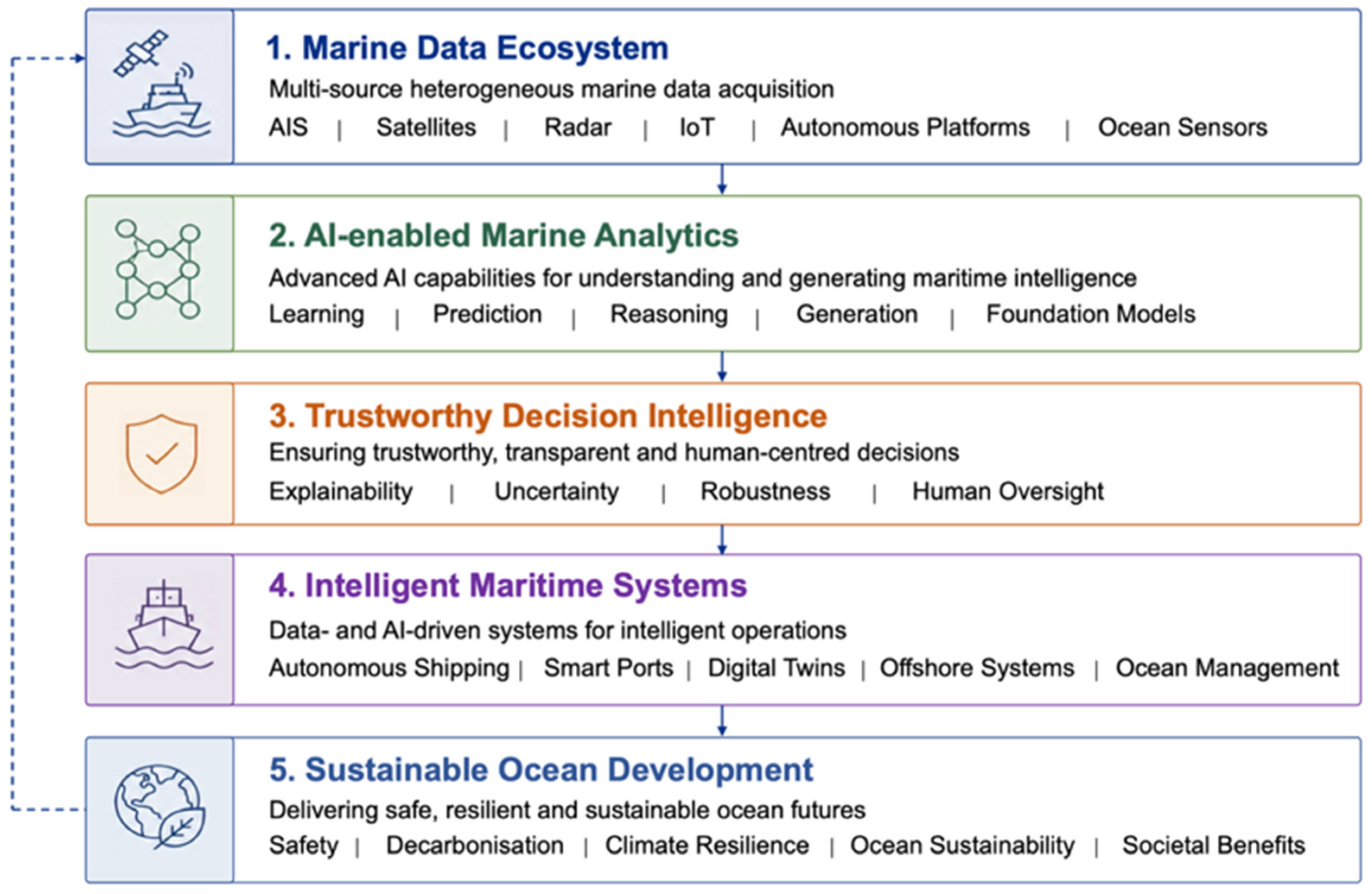
To frame this transition, a four-layer conceptual framework is proposed to describe the evolution of marine data analysis (Figure 1). At its foundation is the marine data ecosystem, where distributed sensing platforms and digital maritime infrastructure continuously generate heterogeneous observations. These observations are transformed through AI-enabled marine analytics into actionable information. Their practical value, however, depends on trustworthy decision intelligence, which combines AI with uncertainty awareness, explainability, engineering knowledge, and human judgement to support transparent and reliable operational decisions. Together, these capabilities enable intelligent maritime systems, including autonomous shipping, smart ports, digital twins, offshore engineering, and sustainable ocean management, in which data, intelligence, and engineering operate as an integrated whole. At the highest level, these systems support sustainable ocean development by translating technological intelligence into safe, resilient, low-carbon, and sustainable maritime operations, thereby generating long-term environmental, economic, and societal benefits.
The studies assembled in this Special Issue illustrate each stage of this framework. Although they address diverse topics, including generative marine data, maritime safety, intelligent sensing, fuel consumption prediction, smart ports, and autonomous navigation, the studies collectively demonstrate how marine data analysis is evolving from algorithm-centred applications towards integrated maritime intelligence.
Generative AI exemplifies this evolution by extending marine analytics beyond the interpretation of observed data. A study on text-driven dynamic marine data generation shows how synthetic marine scenarios can complement physical observations for simulation, model development, and intelligent system training, expanding the scope of marine data ecosystems (Contribution 1–3).
A similar evolution is evident in maritime safety research. By combining Bayesian reasoning with data-driven learning, the proposed framework explicitly incorporates uncertainty into accident analysis while remaining closely aligned with engineering practice (Contribution 4,5). Complementing this risk-oriented perspective, a study on VTS-based channel safety management demonstrates how large-scale vessel monitoring data can be transformed into smart warnings, shifting maritime safety systems from retrospective accident analysis towards proactive risk identification and operational intervention (Contribution 6) In safety-critical maritime systems, understanding the confidence associated with a prediction is often as important as the prediction itself, making uncertainty an integral component of trustworthy maritime intelligence (Contribution 7,8).
Intelligent sensing is undergoing a comparable transition. Rather than simply increasing sensor availability, autonomous maritime systems are increasingly depending on adaptive information acquisition. The scenario-based sensing strategy presented in this Special Issue demonstrates how sensing can become decision-driven, enabling autonomous systems to prioritise observations according to operational objectives and environmental uncertainty (Contribution 9–11).
The same progression can be observed in sustainable maritime engineering. Data-driven methods are now widely applied in voyage optimisation, fuel consumption prediction, offshore energy systems, environmental monitoring, and smart port management (Contribution 12–14). Their significance, however, extends beyond improvements in operational efficiency. Marine data analysis is becoming a technology enabling decarbonisation, resource optimisation, and climate resilience. The chronological validation strategy proposed for ship fuel consumption prediction reflects this shift by prioritising operational realism over benchmark performance, highlighting the importance of models that remain reliable under operational conditions.
Collectively, the contributions in this Special Issue demonstrate that the future of marine data analysis lies not simply in improving algorithms but in transforming heterogeneous marine observations into reliable intelligence for complex maritime operations. Future progress will therefore depend on the development of intelligent maritime systems that integrate AI, physical knowledge, uncertainty awareness, and human expertise to support safe, resilient, and sustainable decision-making.
One promising direction is provided by the emergence of marine foundation models. By learning transferable representations from vessel trajectories, satellite observations, oceanographic measurements, numerical simulations, and operational records, these models could provide a unified understanding of maritime systems across navigation, environmental forecasting, offshore engineering, and autonomous operations. At the same time, digital twins are expected to evolve into operational intelligence platforms that continuously integrate real-time sensing, physics-based simulation, and AI for adaptive monitoring, predictive maintenance, and resilient system management.
Equally important is the development of trustworthy and physically grounded AI. Future maritime AI must remain robust under uncertainty, communicate the confidence associated with its predictions, and incorporate physical knowledge where observational data alone are insufficient. Human expertise will remain essential for interpreting uncertainty, balancing competing objectives, and ensuring that AI supports rather than replaces operational decision-making.
Marine data analysis is becoming central to the development of intelligent maritime systems. Its future will be defined not by the scale of available data or the complexity of AI models but by the ability to deliver reliable intelligence that supports safe, resilient, and sustainable maritime operations.

Funding

This work was supported by the National Natural Science Foundation of China (grant Nos. 52571357, 52301322, and 52506259), the Natural Science Foundation of Shanghai Municipality (grant No. 24ZR1454800), and the State Key Laboratory of Mechanical System and Vibration (grant No. MSV202411).

Acknowledgments

We sincerely thank all authors, reviewers, and the JMSE editorial team for their valuable contributions, constructive feedback, and professional support in making this Special Issue possible.

Conflicts of Interest

The authors declare no conflicts of interest.

List of Contributions

  • Xue, Z.; Zhang, J.; Yu, C.; Zang, Y.; Chen, Z.; Miao, Z. Enhanced Text-Driven Directional Editing for Marine Dynamic Data Generation. J. Mar. Sci. Eng. 2026, 14, 1139. https://doi.org/10.3390/jmse14121139.
  • Tao, W.; Luo, Y.; Tong, J.; Xia, Q.; Qu, J. A Ship Heading Estimation Method Based on DeepLabV3+ and Contrastive Learning-Optimized Multi-Scale Similarity. J. Mar. Sci. Eng. 2025, 13, 1085. https://doi.org/10.3390/jmse13061085.
  • Zhang, L.; Jiang, F.; Huang, L.; Silva, D.; Duan, W.; Soares, C.G. Long-Term Significant Wave Height Forecasting in the Western Atlantic Ocean Using Deep Learning. J. Mar. Sci. Eng. 2025, 13, 1968. https://doi.org/10.3390/jmse13101968.
  • Song, B.-H. Analysis of Risk Factors Influencing the Outcomes of Capsizing, Sinking, and Flooding Accidents in Coastal Waters of the Republic of Korea: A Fuzzy Bayesian Network Approach. J. Mar. Sci. Eng. 2026, 14, 897. https://doi.org/10.3390/jmse14100897.
  • Lei, B.; Wang, R.; Chi, C.; Yu, L.; Yu, Z.; Wang, D. Shaft-Rate Magnetic Field Localization Algorithm Based on Improved Exponential Triangular Optimization. J. Mar. Sci. Eng. 2026, 14, 216. https://doi.org/10.3390/jmse14020216.
  • Syue, S.-H.; Tsou, M.-C.; Chen, T.-H. From VTS Monitoring to Smart Warnings: Big Data Applications in Channel Safety Management. J. Mar. Sci. Eng. 2025, 13, 2324. https://doi.org/10.3390/jmse13122324.
  • Yu, L.; Tian, Y.; Chen, J.; Chi, C.; Li, T.; Li, J. Balancing Accuracy and Speed: Improved D-FINE for Real-Time Ocean Internal Wave Detection. J. Mar. Sci. Eng. 2026, 14, 388. https://doi.org/10.3390/jmse14040388.
  • Hoehner, F.; Langenohl, V.; el Moctar, O.; Schellin, T.E. Scenario-Based Sensor Selection for Autonomous Maritime Systems: A Multi-Criteria Analysis of Sensor Configurations for Situational Awareness. J. Mar. Sci. Eng. 2025, 13, 2008. https://doi.org/10.3390/jmse13102008.
  • Huai, S.; Liu, T.; Jiang, Y.; Dai, Y.; Xue, F.; Hu, Q. Link Availability-Aware Routing Metric Design for Maritime Mobile Ad Hoc Network. J. Mar. Sci. Eng. 2025, 13, 1184. https://doi.org/10.3390/jmse13061184.
  • Dong, H.; Yang, L.; Liu, Y.; Li, S. Hybrid Log-Mel and HPSS-Aided Convolutional Neural Network for Underwater Very-Low-Frequency Remote Passive Sonar Detection. J. Mar. Sci. Eng. 2025, 13, 2030. https://doi.org/10.3390/jmse13112030.
  • Vorkapić, A. Toward Realistic Ship Fuel Consumption Prediction Under Chronological Validation. J. Mar. Sci. Eng. 2026, 14, 538. https://doi.org/10.3390/jmse14060538.
  • Ou, H.; Zhang, Q.; Li, C.; Lu, D.; Miao, W.; Li, H.; Xu, Z. Flow Control-Based Aerodynamic Enhancement of Vertical Axis Wind Turbines for Offshore Renewable Energy Deployment. J. Mar. Sci. Eng. 2025, 13, 1674. https://doi.org/10.3390/jmse13091674.
  • Lee, J.; Sim, M.; Kim, Y.; Lim, H.; Lee, C. Strategizing Artificial Intelligence Transformation in Smart Ports: Lessons from Busan’s Resilient AI Governance Model. J. Mar. Sci. Eng. 2025, 13, 1276. https://doi.org/10.3390/jmse13071276.
  • Zhang, Q.; Miao, W.; Zhao, K.; Li, C.; Chang, L.; Yue, M.; Xu, Z. Influence of Geometric Effects on Dynamic Stall in Darrieus-Type Vertical-Axis Wind Turbines for Offshore Renewable Applications. J. Mar. Sci. Eng. 2025, 13, 1327. https://doi.org/10.3390/jmse13071327.

References

  1. United Nations Decade of Ocean Science for Sustainable Development. Available online: https://www.unesco.org/en/decades/ocean-decade (accessed on 21 July 2026).
  2. 2023 IMO Strategy on Reduction of GHG Emissions from Ships. Available online: https://www.imo.org/en/ourwork/environment/pages/2023-imo-strategy-on-reduction-of-ghg-emissions-from-ships.aspx (accessed on 21 July 2026).
  3. Autonomous Ships: Regulatory Scoping Exercise Completed. Available online: https://www.imo.org/en/mediacentre/pressbriefings/pages/massrse2021.aspx (accessed on 21 July 2026).
  4. Li, X.; Feng, M.; Ran, Y.; Su, Y.; Liu, F.; Huang, C.; Shen, H.; Xiao, Q.; Su, J.; Yuan, S.; et al. Big Data in Earth System Science and Progress towards a Digital Twin. Nat. Rev. Earth Environ. 2023, 4, 319–332. [Google Scholar] [CrossRef] [Scilit]
  5. Jahanbakht, M.; Xiang, W.; Hanzo, L.; Rahimi Azghadi, M. Internet of Underwater Things and Big Marine Data Analytics—A Comprehensive Survey. IEEE Commun. Surv. Tutor. 2021, 23, 904–956. [Google Scholar] [CrossRef] [Scilit]
  6. Awais, M.; Naseer, M.; Khan, S.; Anwer, R.M.; Cholakkal, H.; Shah, M.; Yang, M.-H.; Khan, F.S. Foundation Models Defining a New Era in Vision: A Survey and Outlook. IEEE Trans. Pattern Anal. Mach. Intell. 2025, 47, 2245–2264. [Google Scholar] [CrossRef] [Scilit] [PubMed]
  7. Kauffmann, J.; Dippel, J.; Ruff, L.; Samek, W.; Müller, K.-R.; Montavon, G. Explainable AI reveals Clever Hans effects in unsupervised learning models. Nat. Mach. Intell. 2025, 7, 412–422. [Google Scholar] [CrossRef] [Scilit]
  8. Steyvers, M.; Tejeda, H.; Kumar, A.; Belem, C.; Karny, S.; Hu, X.; Mayer, L.W.; Smyth, P. What large language models know and what people think they know. Nat. Mach. Intell. 2025, 7, 221–231. [Google Scholar] [CrossRef] [Scilit]
  9. Rong, Y.; Leemann, T.; Nguyen, T.-T.; Fiedler, L.; Qian, P.; Unhelkar, V.; Seidel, T.; Kasneci, G.; Kasneci, E. Towards Human-Centered Explainable AI: A Survey of User Studies for Model Explanations. IEEE Trans. Pattern Anal. Mach. Intell. 2024, 46, 2104–2122. [Google Scholar] [CrossRef] [Scilit] [PubMed]
Figure 1. A conceptual framework illustrating the evolution of marine data analysis from a marine data ecosystem to AI-enabled analytics, trustworthy decision intelligence, and intelligent maritime systems, ultimately supporting sustainable ocean development.
Jmse 14 01567 g001
Disclaimer/Publisher’s Note: The statements, opinions and data contained in all publications are solely those of the individual author(s) and contributor(s) and not of MDPI and/or the editor(s). MDPI and/or the editor(s) disclaim responsibility for any injury to people or property resulting from any ideas, methods, instructions or products referred to in the content.