Article

Efficient and Interpretable Underwater Acoustic Target Recognition Using a Lightweight Heterogeneous Kernel Network

1
Ocean College, Jiangsu University of Science and Technology, Zhenjiang 212100, China
2
School of Naval Architecture and Ocean Engineering, Jiangsu University of Science and Technology, Zhenjiang 212100, China
*
Author to whom correspondence should be addressed.
J. Mar. Sci. Eng. 2026, 14(17), 1561; https://doi.org/10.3390/jmse14171561
Submission received: 3 July 2026 / Revised: 11 August 2026 / Accepted: 19 August 2026 / Published: 24 August 2026
(This article belongs to the Special Issue Advanced Research in Underwater Acoustic Signal Processing)

Abstract

Underwater acoustic target recognition (UATR) is challenging due to the complex, multi-scale physical characteristics of marine targets and the strict computational limits of edge platforms like unmanned surface vehicles. To navigate the severe interference of underwater environments, existing methods increasingly rely on heavyweight architectures to achieve high recognition accuracy. However, the massive computational overhead of these models is fundamentally at odds with the restricted power and processing capabilities of practical deployment platforms. To resolve this conflict between performance and deployability, we propose LHK-Net, a lightweight Heterogeneous Kernel Network. By integrating a Heterogeneous Kernel Pyramid with Residual Depthwise Separable Convolutions, LHK-Net dynamically captures multi-scale acoustic features, from macroscopic steady-state harmonics to localized transient impulses, while compressing the model size to merely 0.82 M parameters. Additionally, a dual-domain Time–Frequency Attention module and an Adaptive SK-Fusion mechanism are incorporated for robust noise suppression. Experiments on the DeepShip dataset demonstrate that LHK-Net achieves state-of-the-art accuracy, outperforming heavyweight models at real-time speeds. Extensive visual analyses further validate that the network possesses strong physical interpretability, effectively aligning its internal feature representations with the intrinsic acoustic properties of the targets.

1. Introduction

Because electromagnetic waves attenuate rapidly in aquatic environments, acoustic signals serve as the primary information carrier for underwater surveillance and communication [1,2]. Consequently, Underwater Acoustic Target Recognition (UATR) has emerged as a critical technology for maritime security and threat assessment [3]. While UATR encompasses various sound sources, ship-radiated noise represents a particularly significant category, containing rich acoustic fingerprints that reflect a target’s mechanical structure and operating status [4]. Achieving robust recognition, however, remains difficult due to complex multipath propagation, time-varying channel conditions, and high ambient noise levels inherent to the underwater acoustic environment.
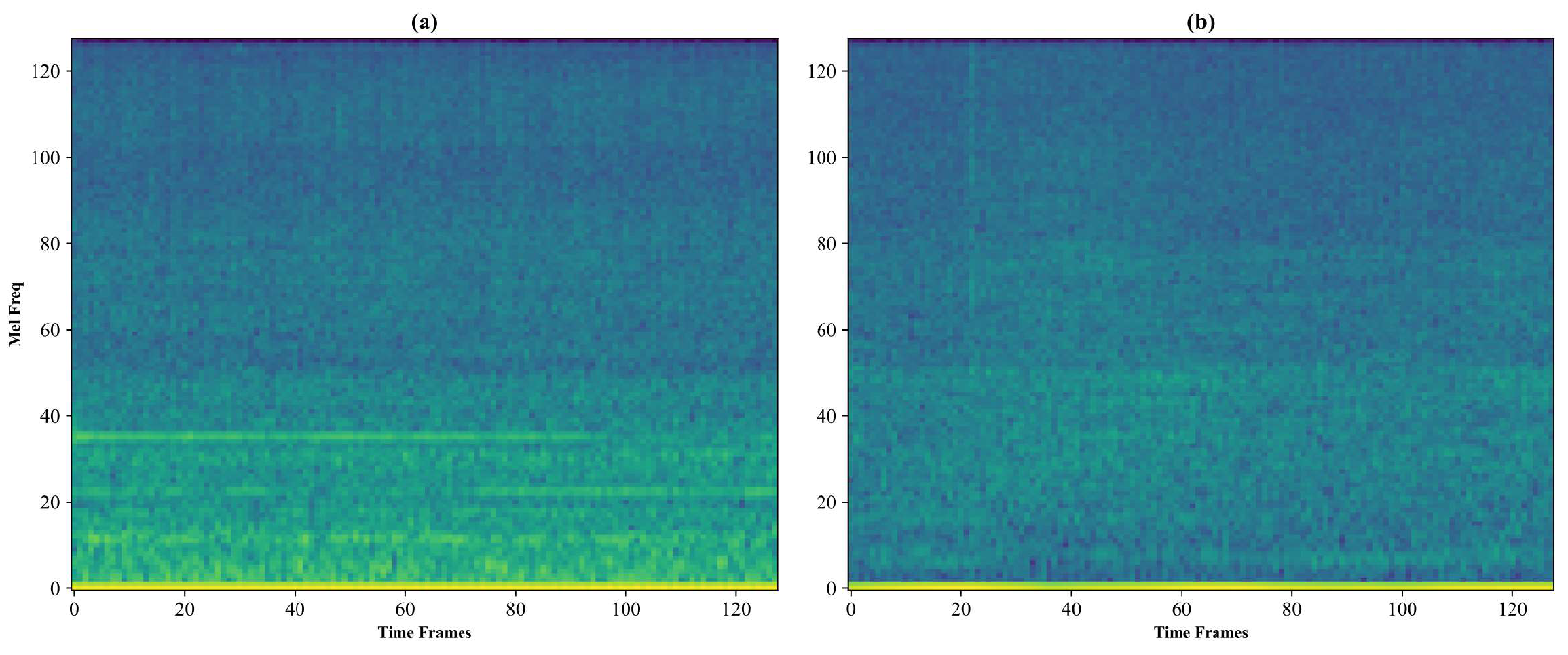
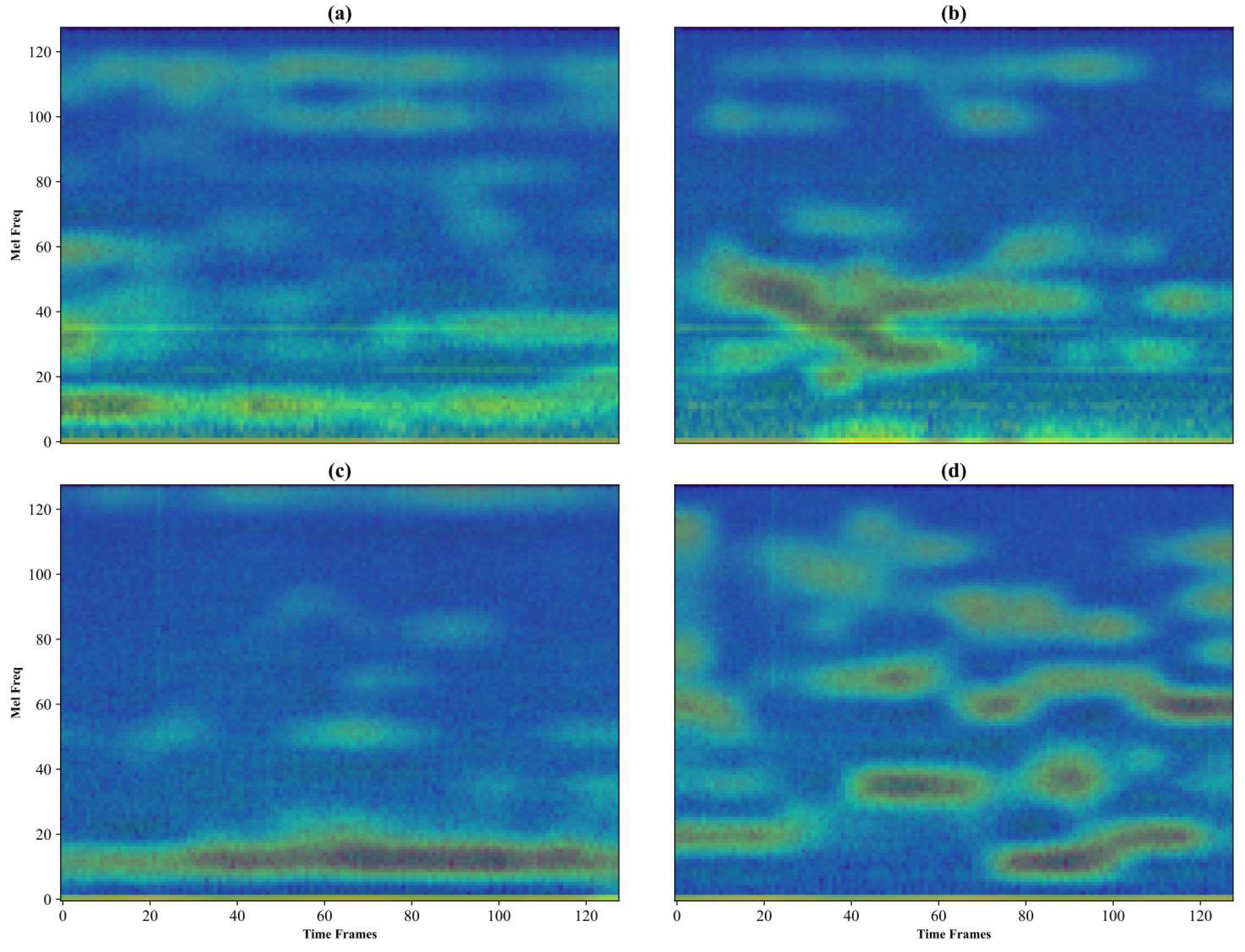
Analyzing non-stationary underwater signals amidst complex ocean interference is challenging. Transforming 1D raw acoustic signals into 2D time–frequency distributions has become a prevalent strategy to address this [5,6]. Classical techniques, including the Short-Time Fourier Transform (STFT), Mel-frequency Cepstral Coefficients (MFCCs), Constant-Q Transform (CQT), and Wavelet Scattering Transform (WST), highlight useful signal components in complementary ways. Using ship-radiated noise as a representative example, Figure 1 demonstrates how the Mel spectrogram visualizes the distinct physical attributes of different targets. The Passengership (Figure 1a) exhibits a stable, steady-state distribution with continuous horizontal harmonic lines. For the Tug sample recorded under an active maneuvering or working condition (Figure 1b), intermittent mechanical impacts and rapid operating-state changes generate transient broadband components that appear as localized vertical impulses or discrete spots [7]. These informative 2D feature maps have thus become standard inputs for deep-learning-based recognition models.
From an acoustic perspective, ship-radiated noise contains structures with markedly different time–frequency extents. Periodic excitation from propulsion and rotating machinery produces relatively stable harmonic components that persist over longer temporal intervals, whereas intermittent mechanical impacts and rapid operating-state changes generate localized broadband transients. These coexisting global rhythmic and local impulsive patterns imply that a single fixed receptive field may not represent all discriminative structures effectively [4,7]. This observation provides the physical motivation for the heterogeneous receptive fields used in LHK-Net.
Deep learning has largely superseded traditional machine learning methods to become the dominant paradigm in UATR [8,9]. Convolutional Neural Networks (CNNs) serve as the backbone for most state-of-the-art systems due to their strong local feature extraction capabilities, with early research primarily adapting standard architectures like ResNet [10,11]. Recent advancements generally follow two main trajectories to enhance feature discriminability. The first involves multi-stream feature fusion, where distinct inputs such as MFCC, CQT, and Low-Frequency Analysis and Recording (LOFAR) spectrograms are merged to provide complementary acoustic information [11,12]. The second integrates attention mechanisms, embedding modules like Efficient Channel Attention [13] or Coordinate Attention [14] to adaptively reweight informative spectral channels.
Although CNNs excel at extracting local patterns, their limited receptive fields hinder the modeling of long-range global dependencies [15,16]. Transformers address this issue through self-attention mechanisms, capturing global semantic contexts across the entire time–frequency spectrum [17,18]. However, because pure Transformers often lack the inductive bias needed for fine-grained local details, the field has shifted toward hybrid CNN–Transformer architectures. Leading models such as the underwater acoustics CNN–Transformer cooperation network (UACTC) [19] and the multi-path parallel CNN–Transformer network (MPCT-Net) [15] utilize convolutional layers for local feature extraction and Transformer blocks for global dependency modeling. Other innovations incorporate cross-attention for multi-view fusion [20] or differential attention for low Signal-to-Noise Ratio (SNR) robustness [21]. While these hybrid models achieve superior accuracy, their high parameter counts and computational latency [22] make them less suitable for real-time applications on resource-constrained underwater platforms.
To facilitate deployment on edge devices like Unmanned Surface Vehicles (USVs) and buoys, researchers have focused on developing lightweight architectures. A common strategy optimizes classic backbones with efficient operators, as seen in LW-SEResNet10 [23] and DLA-ResNet [24], which significantly reduce model size via Depthwise Separable Convolutions (DSCs). Specialized designs have also emerged: MA-CNN-A [25] utilizes asymmetric convolutions to extract fine-grained features with minimal parameters, while UATFSN [26] recently decoupled time and frequency modeling with anisotropic kernels to reduce parameters to 0.05 M. Similarly, LTFSD-Net [27] proposed a dual-stream lightweight network for active sonar recognition.
Despite these advances in efficiency, a critical limitation persists: most lightweight architectures rely on structural homogeneity, utilizing static kernel sizes or fixed patch tokens. This rigid scale design restricts their ability to simultaneously capture diverse acoustic patterns, such as macroscopic harmonic lines and localized transient impulses. To address this scale mismatch problem, we propose the Lightweight Heterogeneous Kernel Network (LHK-Net), explicitly designed to adaptively match the heterogeneous physical scales of diverse underwater targets. We construct a Heterogeneous Kernel Pyramid (HKP) containing parallel branches with Macro ( 7 × 7 ), Meso (5 × 5), and Micro ( 3   ×   3 ) branches, explicitly decoupling global rhythmic patterns from local transient impulses. To ensure extreme efficiency for edge deployment, we introduce a Residual Depthwise Separable Convolution (Res-DSConv) block with an optimized expansion ratio, reducing the model complexity to 0.82 M parameters and 0.38 G FLOPs. Additionally, a Time–Frequency Attention (TFA) module and an Adaptive Selective Kernel Fusion (ASKF) mechanism are introduced to suppress background noise and dynamically weight multi-scale features. Extensive experiments on the DeepShip dataset with a rigorous file-level split demonstrate that LHK-Net achieves state-of-the-art accuracy at real-time inference speeds. Furthermore, detailed visual analyses confirm the strong physical interpretability of our proposed architecture.
To the best of our knowledge, LHK-Net is the first UATR architecture to organize a single time–frequency representation into three lightweight, scale-specialized heterogeneous-kernel branches and adaptively fuse them according to the acoustic pattern of each input. Unlike generic multi-scale feature aggregation, the proposed design couples scale-specific feature extraction, branch-level attention, diversity supervision, and adaptive fusion in a unified lightweight network, thereby jointly preserving recognition performance and computational efficiency.

2. Methodology

We propose LHK-Net for efficient and interpretable underwater acoustic target recognition. Traditional deep learning models typically employ static receptive fields that struggle to capture the multi-scale physical characteristics of underwater signals. LHK-Net is specifically designed to overcome this limitation.

2.1. Overall Architecture

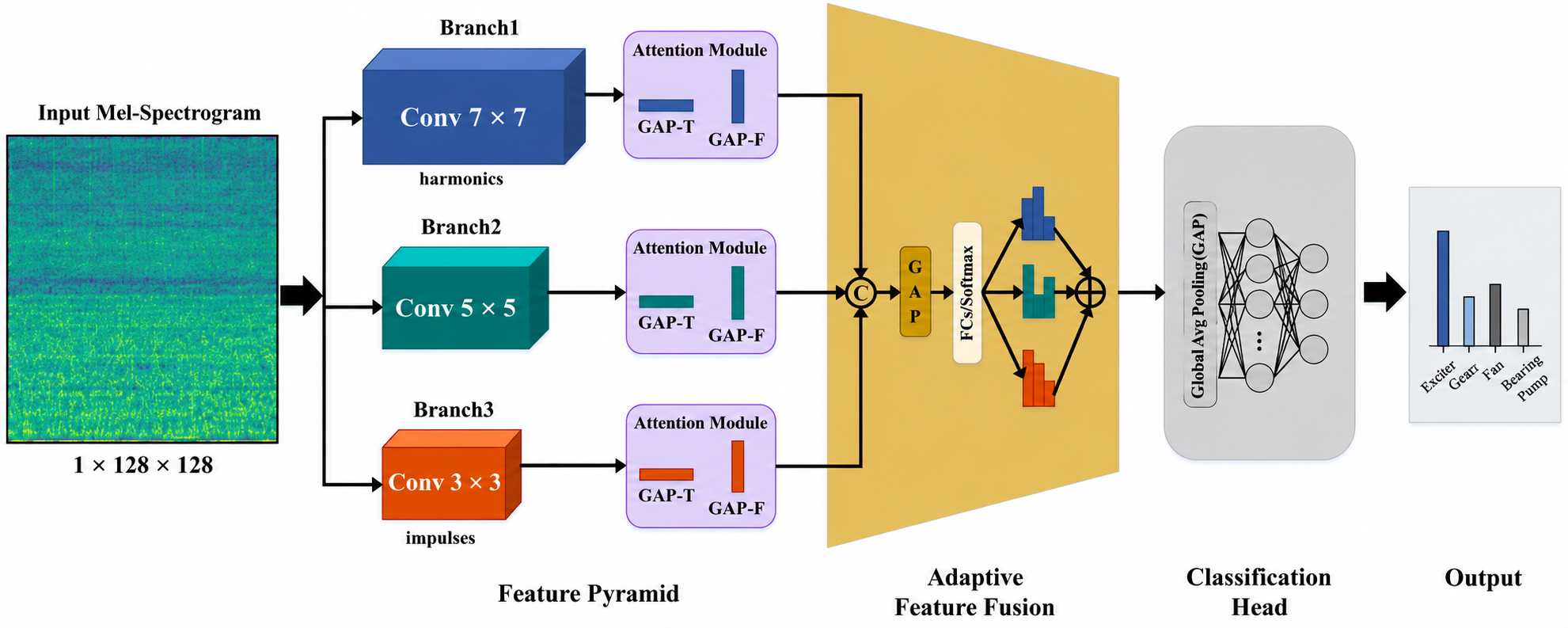
As illustrated in Figure 2, the architecture accepts a 2D Mel spectrogram and treats acoustic target recognition as a pattern-recognition problem in the time–frequency domain. The core backbone of LHK-Net is the HKP, which differs from conventional homogeneous designs by dividing feature extraction into three parallel, scale-specialized streams. The Macro branch uses 7   ×   7 kernels to capture wider-context rhythmic patterns such as continuous harmonic lines, the Micro branch uses 3   ×   3 kernels to preserve localized transient details, and the Meso branch uses 5   ×   5 kernels to represent intermediate-scale structures. The terms Macro, Meso, and Micro are used consistently throughout the manuscript without quotation marks.
The three branches therefore serve complementary representation roles rather than acting as redundant parallel paths. The 7   ×   7 branch integrates patterns over a wider time–frequency neighborhood, the 3   ×   3 branch preserves localized high-variation details, and the 5   ×   5 branch covers intermediate structures that cannot be assigned exclusively to either extreme. Processing the same Mel spectrogram at these three receptive-field scales enables the network to represent the coexistence of continuous harmonics, transition patterns, and short-duration impulses. Their outputs are subsequently refined by TFA and fused by ASKF, allowing the model to select the most informative scale for each input while retaining the low computational cost of depthwise separable convolution.
As depicted in the overall pipeline (Figure 2), each branch incorporates a Physics-Aware TFA module to ensure robustness against complex underwater environments. Functioning as a dual-domain filter, it suppresses ambient noise while highlighting discriminative frequency bands and temporal segments. Because simply concatenating features from these branches may introduce redundancy, we deploy an ASKF module at the end of the backbone. Operating as a dynamic soft-selection mechanism, it intelligently aggregates multi-scale features by assigning adaptive weights based on the input signal’s intrinsic properties. Finally, a lightweight classification head processes the fused representation to predict the target category. This hierarchical design allows LHK-Net to maintain a compact footprint while maximizing physical interpretability and recognition accuracy.

2.2. Lightweight Feature Extraction Branch with Physics-Aware Attention

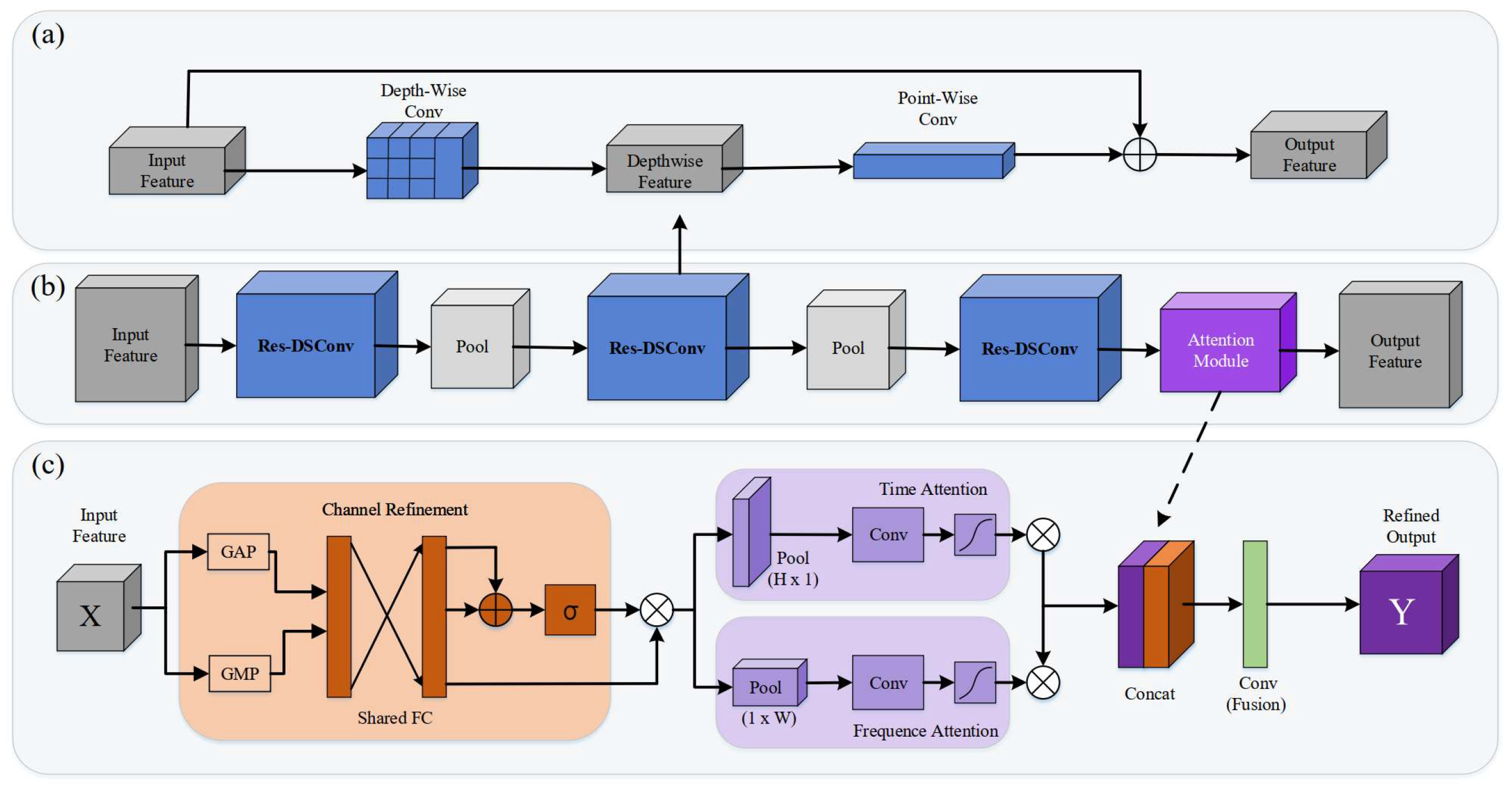
To facilitate deployment on resource-constrained USV platforms, we designed a lightweight feature extraction branch that balances representational capacity with computational efficiency. The hierarchical architecture of a single branch is detailed in Figure 3.
The fundamental building block is the Res-DSConv (Figure 3a), while the terminal TFA module is shown in Figure 3c. TFA first applies channel refinement to the input feature X using Global Average Pooling (GAP) and Global Max Pooling (GMP), followed by a shared Fully Connected (FC) layer that recalibrates inter-channel dependencies. Let X have dimensions C   ×   H   ×   W , where C is the number of channels, H is the frequency-axis height (number of frequency bins), and W is the temporal-axis width (number of time frames). The time-attention path uses an H   ×   1 pooling operation that spans the frequency axis and retains the W temporal positions, whereas the frequency-attention path uses a 1   ×   W pooling operation that spans the time axis and retains the H frequency positions. After element-wise multiplication with the refined features, the two streams are concatenated and a fusion convolution produces the final refined output Y .

2.3. Adaptive Feature Fusion Strategy

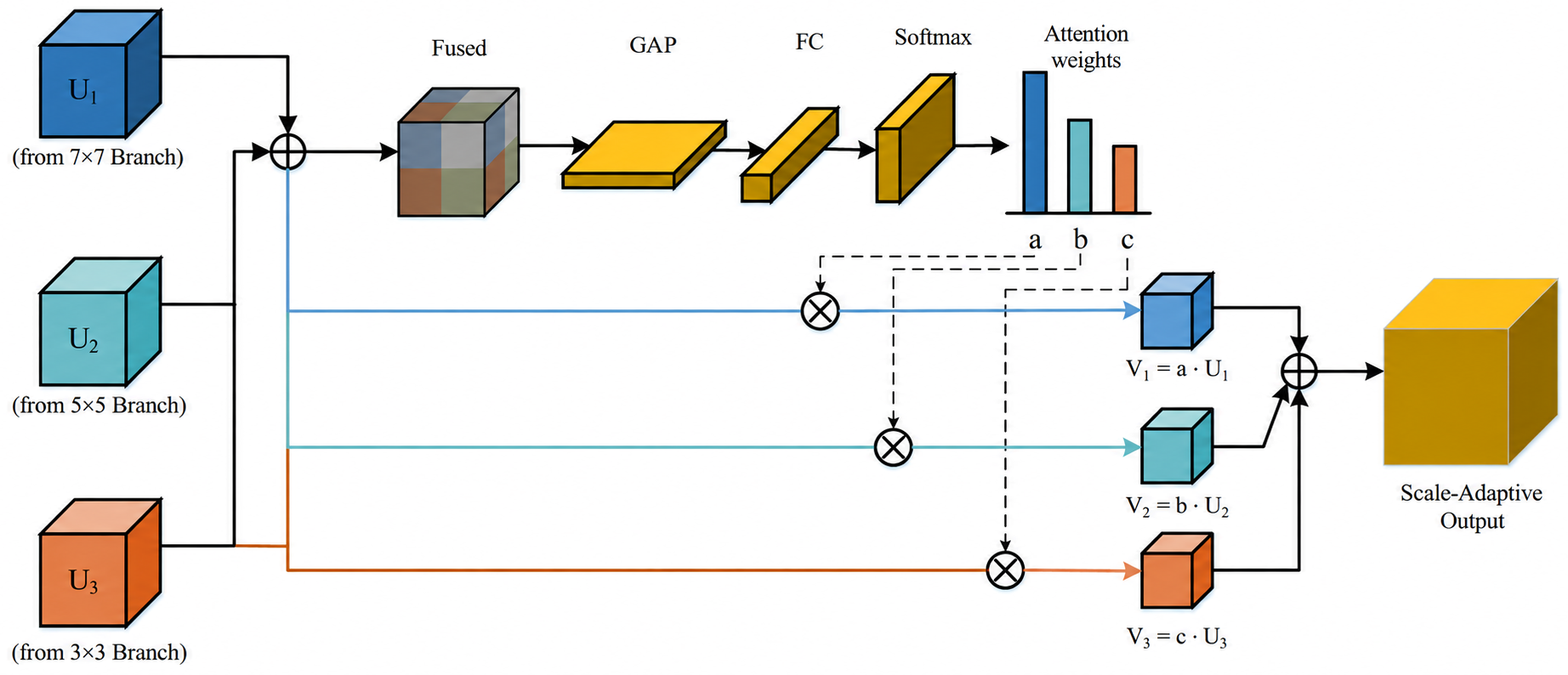
Because heterogeneous branches extract multi-scale representations, a naive concatenation or summation strategy is insufficient. Such methods treat global rhythmic patterns and local transient impulses with equal importance, regardless of the input. To address this, we propose an ASKF module (Figure 4) that functions as a dynamic feature selection mechanism. It adaptively adjusts the receptive field based on the input stimulus to emphasize the most discriminative branch.
Let U 7 , U 5 , and U 3 R C × H × W denote the refined feature maps from the Macro ( 7   ×   7 ), Meso ( 5   ×   5 ), and Micro ( 3   ×   3 ) branches. The fusion process follows a “Split-Fuse-Select” paradigm. During the fuse phase, an element-wise summation integrates the inputs into a fused map: U = U 7 + U 5 + U 3 . This aggregated map acts as a global descriptor containing mixed multi-scale information. Next, a GAP layer compresses the spatial dimensions into a channel descriptor.
In the select phase, an FC layer reduces dimensionality and captures inter-channel dependencies, after which a Softmax operator generates three sets of channel-wise attention weights ( a ,   b ,   c ). These weights correspond to the three branches and satisfy the constraint a c + b c + c c = 1 . Finally, the scale-adaptive output V is computed via the weighted aggregation of the original inputs:
V c = a c · U 7 , c + b c · U 5 , c + c c · U 3 , c
where V c represents the c-th channel of the output feature map. Through this mechanism, the network intelligently assigns higher weights to the 7   ×   7 branch (large a ) for steady-state harmonic signals, and conversely shifts focus to the 3   ×   3 branch (large c ) for transient impulses.

2.4. Multi-Task Loss Function

We employ a composite loss function to effectively train LHK-Net, maximizing classification accuracy while enforcing feature diversity across parallel streams. The total loss L total is a weighted sum of the main classification loss, the auxiliary supervision loss, and the diversity regularization loss:
L total = L main + α L aux + β L div
where α and β are hyperparameters balancing the auxiliary and diversity constraints. Specifically, the main loss is L main = L CE ( p f , y ) , and the auxiliary loss is L aux = 1 3 k { 7,5 , 3 } L CE ( p k , y ) , where the superscript ( f ) denotes the ASKF-fused prediction, the superscript ( k ) denotes the prediction of the k   ×   k branch, and L CE is the cross-entropy operator defined in Equation (3).
Both the primary objective ( L main ) and the auxiliary objective ( L aux ) utilize the standard Cross-Entropy (CE) loss. L main evaluates the final output of the ASKF module to ensure globally optimal decisions. To mitigate gradient vanishing and enforce scale-specific discriminability, we introduce deep supervision via L aux , which aggregates the classification losses from the independent Macro, Meso, and Micro predictions before fusion. For a batch of N samples and C classes, the classification loss is:
L cls = 1 N i = 1 N c = 1 C y i , c l o g ( p i , c )
where y i , c is a binary indicator representing the correct class label, and p i , c is the predicted probability.
Because parallel branches may inadvertently learn redundant representations, we incorporate a diversity loss ( L div ) to prevent feature homogenization. To ensure the network captures distinct physical patterns across different kernel sizes, it is imperative to maximize the orthogonality between branch feature maps. We formulate L div using the pairwise cosine similarity between the flattened feature vectors of the three branches:
L div = i j U i · U j U i 2 U j 2
where i , j { 7,5 , 3 } , U i and U j denote the global feature descriptors from the branches, and   ·   2 represents the L2 norm. Minimizing this similarity forces the branches to diverge and capture complementary information, ensuring that the ASKF module receives distinct multi-view inputs.

2.5. Training Strategy and Implementation Details

Labeled data scarcity and significant background noise frequently hamper UATR model training. To ensure stable convergence and enhance generalization, we employ a comprehensive optimization strategy encompassing data augmentation, label regularization, and a progressive training protocol.

2.5.1. Data Augmentation and Regularization

To prevent overfitting on limited underwater datasets, we implement a hybrid augmentation strategy combining SpecAugment and Mixup. SpecAugment randomly masks continuous frequency bands ( f ) and time frames ( t ) directly on the Mel spectrograms, forcing the network to reconstruct features from incomplete inputs and improving robustness against transient interference. Additionally, Mixup generates virtual samples by convexly combining input pairs and their labels, smoothing decision boundaries by encouraging linear interpolations between classes. Finally, we adopt a label smoothing strategy to convert hard “one-hot” vectors into soft targets, thereby penalizing extreme probability estimations and preventing over-confidence in noisy environments.

2.5.2. Multi-Stage Progressive Optimization

Optimizing competing objectives requires careful gradient balancing. We propose a Multi-Stage Progressive Training Protocol to decouple representation learning from feature differentiation.
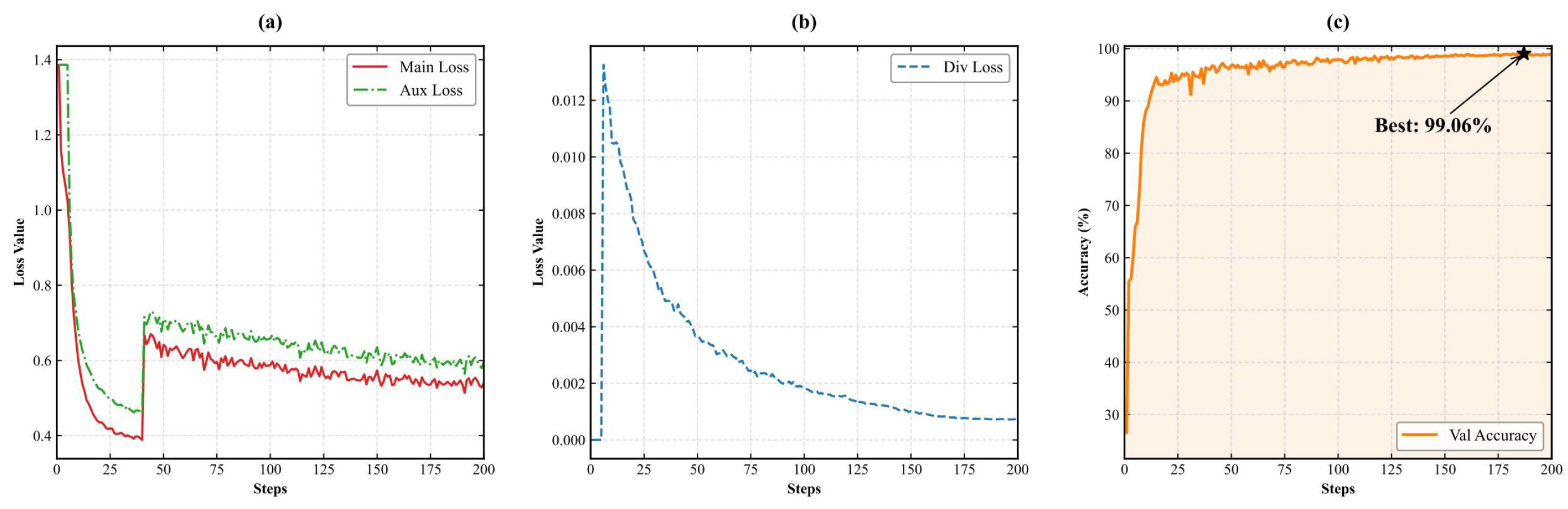
The protocol contains three consecutive phases, and the curves in Figure 5 should be interpreted relative to these phase boundaries. In Phase I (warm-up; first 5 epochs), the auxiliary and diversity terms are disabled ( α = 0 ,   β = 0 ), so the network is optimized only by the main cross-entropy loss L main . This establishes stable semantic features before branch-specific constraints are introduced.
In Phase II (branch specialization), auxiliary supervision and diversity regularization are activated α = 1.0 ,   β = 0.1 ). L aux supplies direct class supervision to the Macro, Meso, and Micro branches, while L div discourages redundant features and drives the three branches toward complementary scale-specific representations. The fused output and all individual loss components are monitored throughout this phase.
In Phase III (joint fusion optimization), the ASKF module and fused classifier are optimized end-to-end together with the specialized branches under the complete objective L total = L main + L aux + 0.1 L div . Together, Phases II and III span the remaining 195 epochs. The transition from branch specialization to joint fusion occurs at approximately step 35 in Figure 5. Because the jointly optimized parameter set and gradient balance change at this boundary, L main and L aux exhibit a short upward discontinuity before adapting to the new joint optimization state. This discontinuity is therefore an expected consequence of the progressive schedule, rather than optimization divergence; both losses subsequently resume their downward trends.

3. Experiments

3.1. Dataset and Feature Extraction

LHK-Net is evaluated on the DeepShip benchmark dataset, comprising real-world underwater recordings collected in the Strait of Georgia delta. We focus on four common vessel categories: Cargo, Passengership, Tanker, and Tug. These categories represent diverse acoustic characteristics, covering both large-tonnage steady-state noise and smaller, high-maneuverability transient noise.
To prevent data leakage, we adopt a rigorous file-level splitting strategy instead of a random frame-level shuffle. Segments extracted from the same continuous recording share identical channel responses and background conditions; randomly distributing these between training and testing sets inflates performance metrics without reflecting true generalization ability. Therefore, the dataset is strictly partitioned by audio files, ensuring all segments from a specific recording ID are assigned exclusively to either the training or the test set.
The partitioning procedure contains two stages. First, the original audio files are divided into a training-file pool and an independent test-file pool before segmentation; consequently, segments derived from a test file are never used for model optimization, hyperparameter selection, or checkpoint selection. After segmentation, 85% of the segments generated from the training-file pool are used for optimization and the remaining 15% form a development validation set for monitoring convergence and selecting checkpoints. The validation set therefore represents within-training-file development performance, whereas the test set evaluates generalization to previously unseen recordings. All compared models use the same files, segmentation parameters, and train/validation/test configuration.
Because the validation segments remain within the training-file pool while the test clips are derived from completely unseen audio files, the two sets represent different levels of difficulty. The best validation accuracy of 99.06% and the test OA of 72.27% therefore differ by 26.79 percentage points; this gap is consistent with recording-level domain shift and should not be interpreted as an inconsistent metric calculation. A conventional segment-level random split can assign clips from the same recording to both training and testing, allowing shared channel, background, and operating-condition cues to inflate the test score. The lower result under the present unseen-file protocol is consequently a more conservative and deployment-relevant estimate of generalization.
For every compared method, validation and testing use the same fixed data protocol: checkpoint selection is based only on the 15% development split from the training-file pool, and final reporting uses the independent test-file pool exactly once. OA, Macro-F1, class-wise F1 scores, and confusion matrices provide complementary aggregate and class-level validation. Because the current study uses one predefined file-level partition, the reported differences are descriptive paired comparisons under a common independent test set rather than claims of inferential significance across repeated partitions. Repeated grouped splits or recording-level bootstrap confidence intervals are reserved for future work and are not inferred from correlated clips.
For data preprocessing, the raw audio signals are resampled to 16 kHz and segmented into 6-s clips using a non-overlapping policy to maximize sample diversity. This yields 22,263 samples for training and 5760 samples for testing. The 1D time-domain segments are then transformed into 2D Mel spectrograms via the STFT, utilizing a Hanning window with an FFT size of 1024, a hop length of 752 samples, and a filter bank of 128 Mel bands. This generates a 128 × 128 feature map, providing a compact yet informative representation for LHK-Net.
Mel spectrograms were selected because they are a widely used and compact time–frequency representation in UATR [5,6] and provide a consistent input for fair architectural comparison. The focus of this study is the design of a lightweight, scale-adaptive classifier rather than a comparison of acoustic front ends; accordingly, the same Mel representation is used for all evaluated models.

3.2. Ablation Studies

Comprehensive ablation studies were conducted on the DeepShip dataset to validate the contribution of each LHK-Net component. Table 1 summarizes the impact of the HKP, the functional modules (TFA and ASKF), and the multi-task optimization strategy, while Figure 5 visualizes the training dynamics of the proposed loss functions.
The kernel specifications were selected as three nested odd sizes ( 3   ×   3 ,     5   ×   5 , and 7   ×   7 ), which preserve a centered receptive field while providing local, intermediate, and wider context without the cost of very large kernels. Their usefulness is quantitatively supported by Table 1: the 3 × 3 , 5   ×   5 , and 7   ×   7 single-branch models obtain OAs of 67.74%, 67.47%, and 66.11%, respectively, whereas their heterogeneous combination reaches 72.27%. The corresponding gains are 4.53, 4.80, and 6.16 percentage points over the individual branches, showing that the chosen scales contribute complementary information rather than representing arbitrary kernel settings. The complete model also improves class-wise F1 scores to 0.63, 0.76, 0.72, and 0.76 for Cargo, Passengership, Tanker, and Tug, respectively.
Finally, the multi-task loss ablation shows that relying solely on the final classification loss ( α = 0 ,   β = 0 ) produces a suboptimal OA of 70.62%. Figure 5 should be read together with the three-phase schedule described in Section 2.5.2. The apparent abrupt rise in the main and auxiliary losses around step 35 (Figure 5a) marks the planned transition from branch specialization to joint fusion optimization. At this boundary, ASKF, the fused classifier, and the three specialized branches begin joint end-to-end adaptation, which redistributes the gradients and temporarily raises L main and L aux . Consequently, the loss values on the two sides of the boundary should not be interpreted as consecutive points from one stationary optimization phase. After a short adaptation interval, both losses resume decreasing and converge, while L div continues its downward trend (Figure 5b). Validation accuracy does not collapse at the transition; it remains stable and subsequently improves to the best value of 99.06% during the final fusion stage (Figure 5c). Thus, stopping at the transition would select an intermediate checkpoint before fusion convergence. The reported confusion matrices use the final checkpoint selected by the best validation performance after completion of the progressive schedule.

3.3. Comparison with State-of-the-Art Methods

LHK-Net was benchmarked against representative convolutional, lightweight, multi-scale, and Transformer-based architectures under a common data protocol.
The comparison set was selected to cover complementary architecture families: conventional residual CNN baselines (DeepShip baseline and AM-ResNet), a lightweight attention CNN (LW-SE-ResNet10), a multi-scale CNN (AMSCNet), a lightweight local-global Transformer (MobileViT-XS), and a domain-specific CNN–Transformer cooperation model (UACTC). It therefore includes both established convolutional baselines and more recent lightweight Transformer designs. All methods receive the same 6-s audio clips transformed into 128 × 128 Mel spectrograms and use the identical file-level train/validation/test partition and evaluation metrics; no model is given an alternative acoustic front end or access to test-file segments during training. Architecture-specific internal blocks are retained so that the comparison isolates the effect of the classifier architecture under a common data configuration.

3.3.1. Accuracy and Complexity Trade-Off

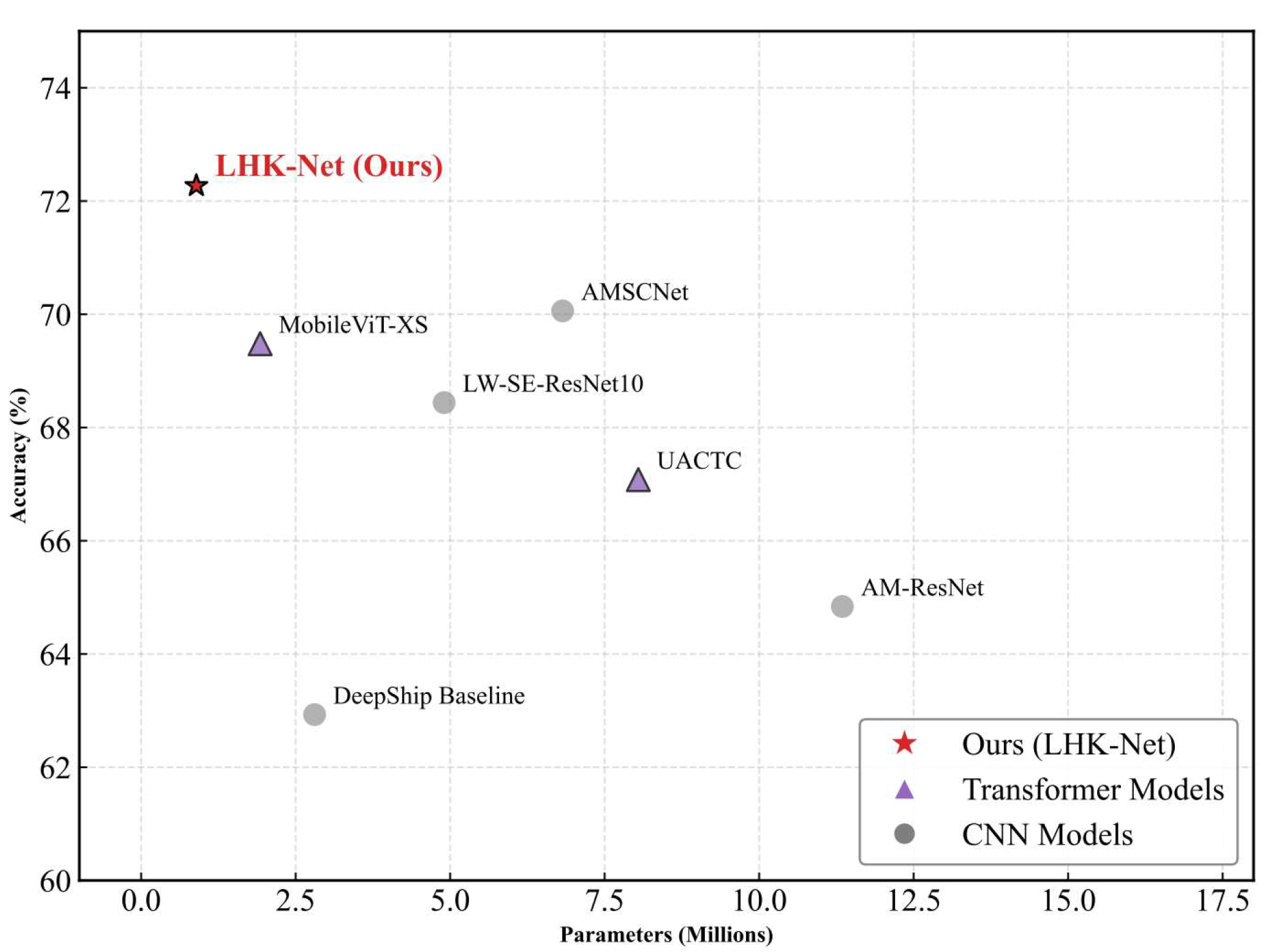
Figure 6 illustrates the trade-off between recognition accuracy and model complexity. UACTC contains approximately 8 M parameters in our implementation and achieves reasonable accuracy, but remains substantially larger than the 0.82 M-parameter LHK-Net. LW-SE-ResNet10 is also lightweight, although its accuracy is lower under the common file-level protocol. Here, the Pareto frontier denotes the set of non-dominated models for which recognition accuracy cannot be improved without increasing parameter count, or parameter count cannot be reduced without decreasing accuracy. LHK-Net occupies the favorable upper-left region, achieving 72.27% accuracy with only 0.82 M parameters. It also outperforms AMSCNet while being approximately 4 × faster in inference, indicating that heterogeneous kernels capture discriminative features without massive over-parameterization.
Computational complexity was evaluated in FLOPs using a Mel spectrogram ( 128 × 128 ) as input. LHK-Net contains 0.82 M parameters and requires approximately 0.38 GFLOPs for a single forward pass. Considering forward and backward propagation, the training cost is approximately 1.14 GFLOPs per clip per epoch, while Mel-spectrogram extraction contributes approximately 0.023 GFLOPs per clip, resulting in a complete test-time cost of approximately 0.403 GFLOPs per clip. These results demonstrate the low computational burden of LHK-Net during both training and inference.

3.3.2. Visual Analysis of Learned Representations

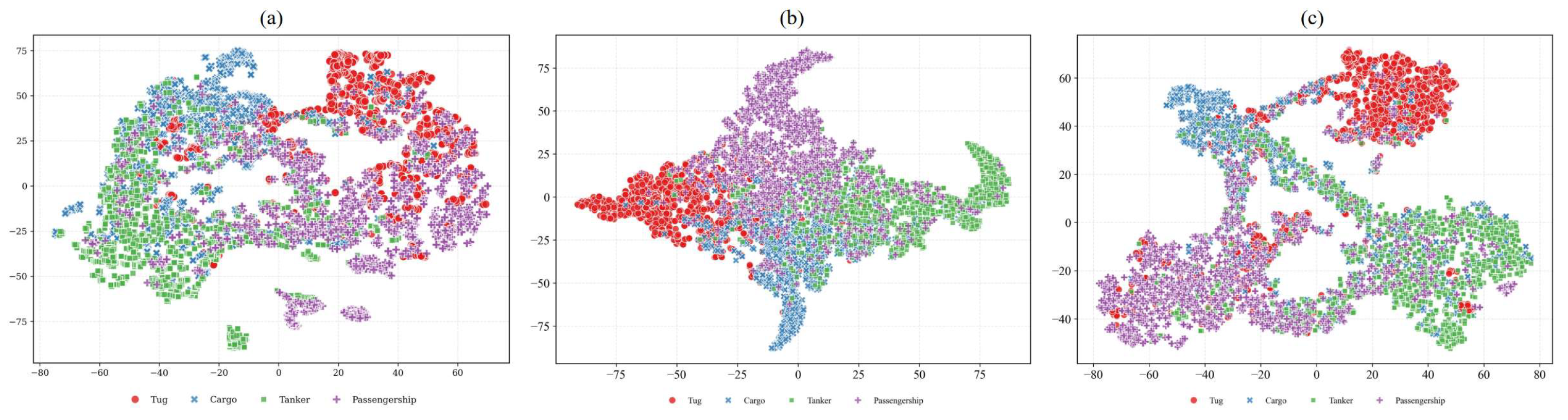
To investigate why LHK-Net outperforms heavier models, the learned feature spaces are visualized using t-distributed stochastic neighbor embedding (t-SNE) in Figure 7. The baseline AM-ResNet (Figure 7a) fails to form distinct clusters, with categories remaining intertwined, explaining its poor generalization. Interestingly, while the state-of-the-art UACTC model (Figure 7c) appears to form well-separated islands, closer inspection reveals highly impure clusters. For instance, the top-right cluster contains a chaotic mixture of Tug and Cargo samples, suggesting the Transformer model overfits to nuisance features rather than learning intrinsic acoustic signatures. In contrast, LHK-Net (Figure 7b) forms coherent and dense clusters. Despite Tug and Cargo sharing similar broadband noise characteristics, our model effectively structures the feature space based on actual semantic content, achieving significantly higher class purity.

3.3.3. Quantitative Verification via Confusion Matrices

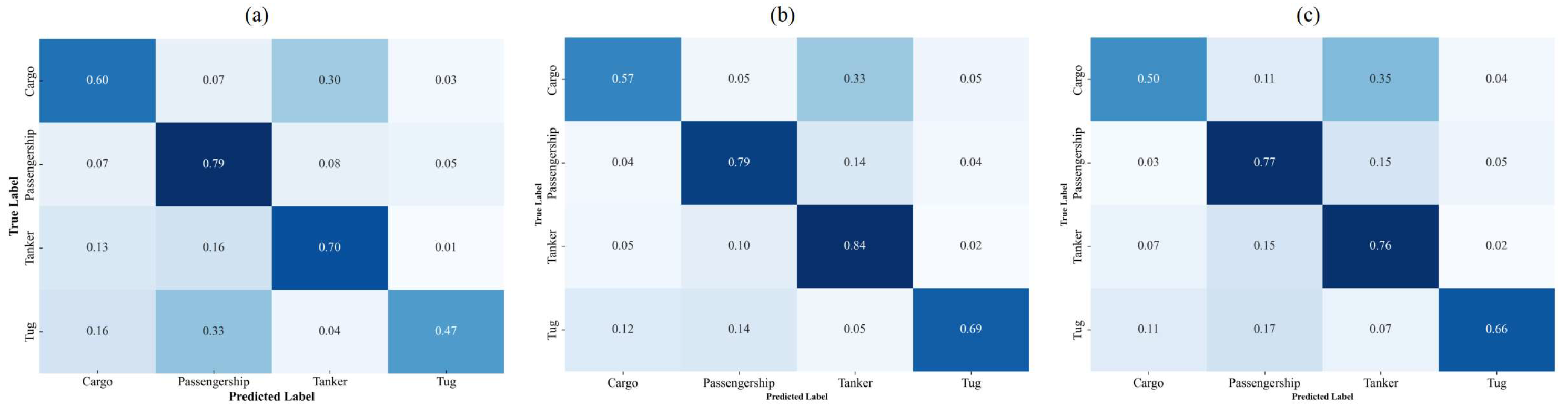
Figure 8 presents a quantitative comparison of class-level performance. In the confusion matrix of UACTC (Figure 8c), the largest off-diagonal error occurs when Cargo samples are misclassified as Tanker, accounting for 35%, whereas only 4% of Cargo samples are misclassified as Tug. Compared with UACTC, LHK-Net (Figure 8b) reduces the misclassification rate of Cargo samples as Tanker from 35% to 33%, representing a modest improvement of 2 percentage points rather than the substantial reduction stated previously. More notable gains are observed in the class-specific recalls. Specifically, LHK-Net increases the recall from 50% to 57% for Cargo, from 77% to 79% for Passengership, from 76% to 84% for Tanker, and from 66% to 69% for Tug. These corrected results provide a more balanced account of the improvements achieved by LHK-Net and the remaining inter-class confusion.

3.4. Interpretability Analysis

Beyond achieving state-of-the-art accuracy, elucidating the underlying mechanisms of LHK-Net is crucial for its real-world reliability. To verify the reliability of our proposed method, a comprehensive interpretability analysis was conducted, demonstrating that the network’s internal decisions align effectively with the physical characteristics of ship-radiated noise.
Gradient-weighted class activation mapping (Grad-CAM) provides sample-level visual evidence for scale-specialized perception. For the Passengership example, the Macro branch (Figure 9a) forms stronger and more coherent responses along persistent harmonic trajectories than the Micro branch (Figure 9c), whose response is weaker and more localized. For the Tug example under the illustrated active operating condition, the Macro branch (Figure 9b) produces broader, more diffuse responses, whereas the Micro branch (Figure 9d) produces sharper localized peaks aligned with transient components. Figure 9a,c therefore compare the two branch scales on the same Passengership sample, while Figure 9b,d provide the corresponding comparison on the same Tug sample.
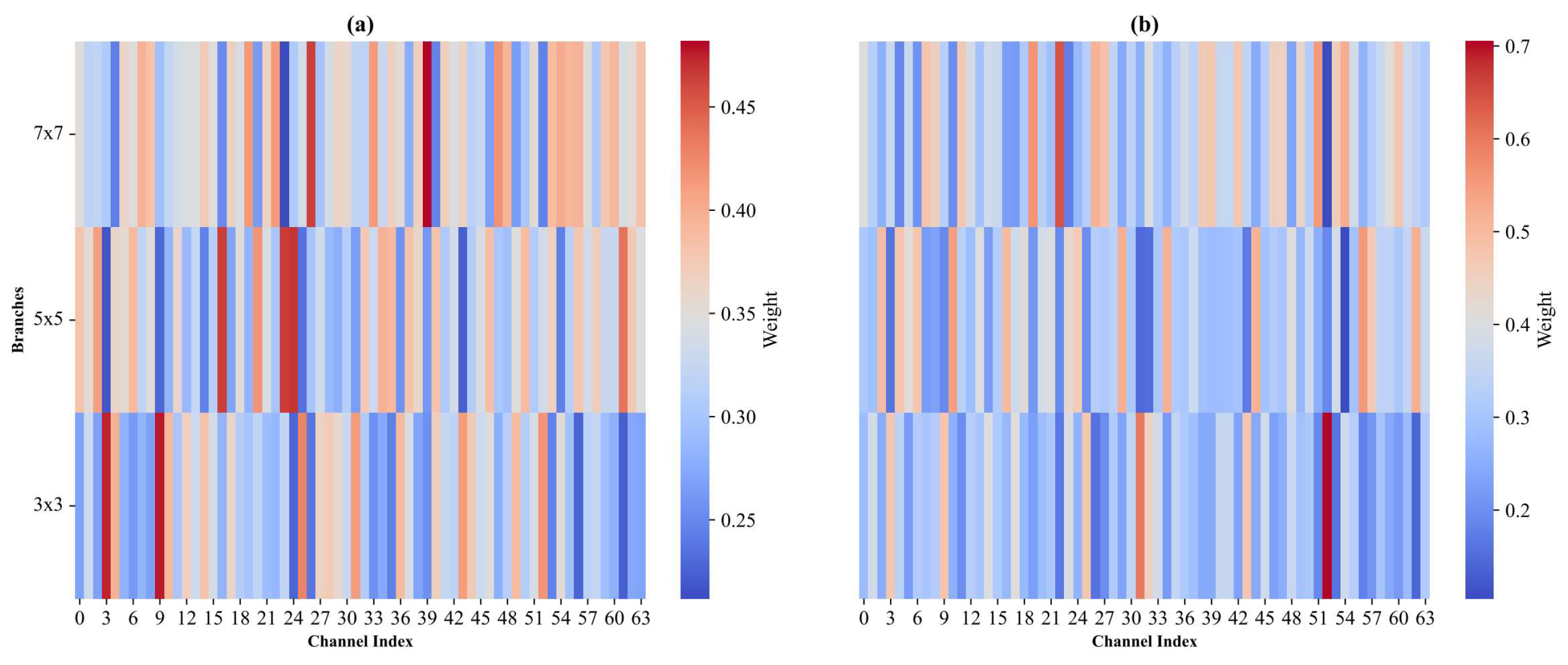
Examining the internal attention weights of the ASKF module quantitatively verifies this adaptive switching mechanism. As shown in Figure 10, the network assigns significantly higher weights to the Macro (7 × 7) branch (red heatmap regions) across multiple discriminative channels for the steady-state Passengership signal, prioritizing larger receptive fields for temporal consistencies. Conversely, the network shifts preference to the Micro (3 × 3) branch for the transient Tug signal, localizing impacts. This alignment between Grad-CAM and internal weights provides compelling evidence that LHK-Net dynamically matches the kernel scale to intrinsic acoustic properties.
The visual interpretation is cross-checked quantitatively using the ablation and confusion-matrix results. Relative to the three single-branch variants, heterogeneous fusion increases OA by 4.53–6.16 percentage points; removing TFA lowers OA by 0.83 points, and replacing ASKF with non-adaptive concatenation lowers OA by 1.40 points. At the class level, Figure 8 shows that LHK-Net improves the Cargo, Tanker, and Tug diagonal recalls over UACTC by 7, 8, and 3 percentage points, respectively, although the Cargo→Tanker error decreases by only 2 points. Thus, Grad-CAM and attention maps are used as mechanism visualizations, while Table 1 and Figure 8 provide the quantitative performance evidence supporting the same interpretation.
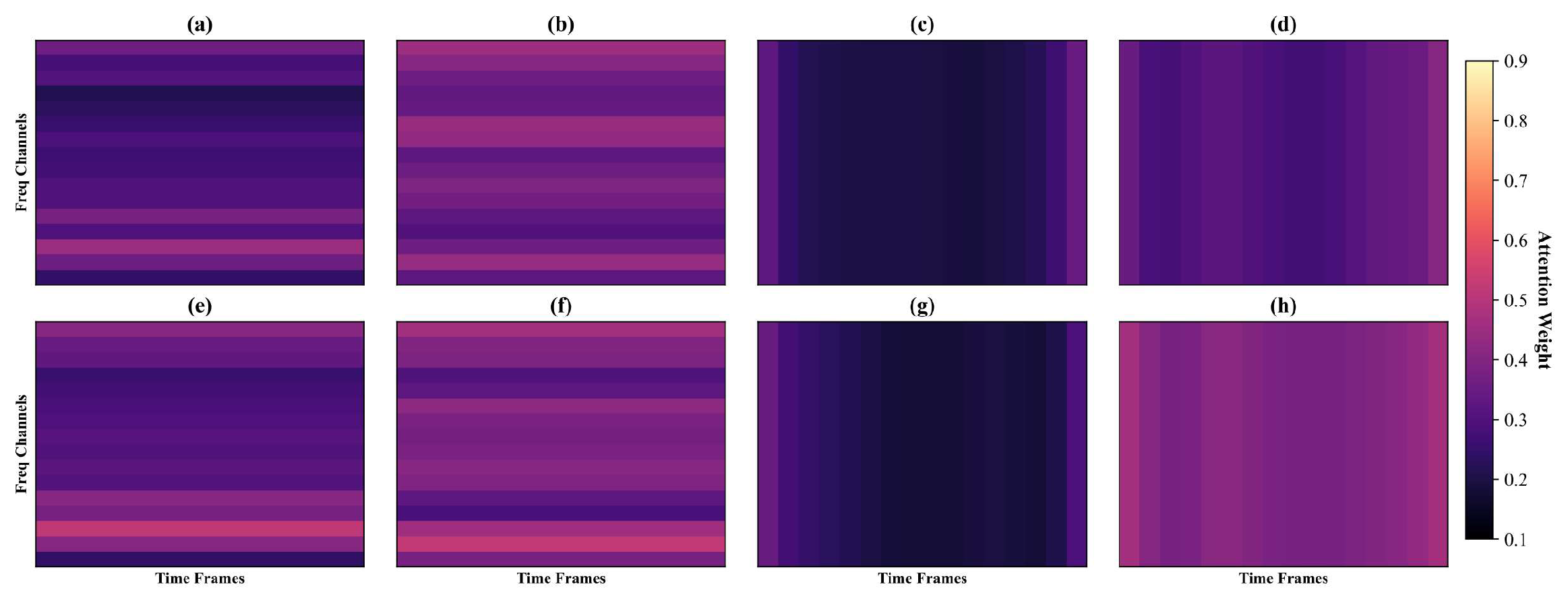
To demonstrate how LHK-Net mitigates pervasive environmental noise, the attention maps generated by the TFA module are visualized in Figure 11. Functioning as an adaptive band-pass filter, the frequency attention maps (Figure 11 top) assign high weights to specific frequency bins corresponding to the target’s harmonics while suppressing noise-dominated bands. Simultaneously, the time attention maps (Figure 11 bottom) act as a temporal gate, synchronizing high weights with transient occurrences while attenuating background segments. By integrating these spectral and temporal mechanisms, LHK-Net achieves robust dual-domain denoising.

4. Conclusions

A primary bottleneck in current UATR models is the scale mismatch between static receptive fields and the diverse physical characteristics of underwater targets. To address this issue, we proposed LHK-Net, which employs an HKP with parallel Macro ( 7   ×   7 ), Meso ( 5   ×   5 ), and Micro ( 3   ×   3 ) branches to represent persistent harmonic patterns, intermediate-scale structures, and localized transient events, respectively. The TFA and ASKF modules further suppress ambient interference and dynamically aggregate the scale-specific features. Grad-CAM visualizations, fusion-weight analysis, and quantitative ablation experiments clarify the contributions of these components. Under the rigorous file-level evaluation protocol on DeepShip, LHK-Net achieves an OA of 72.27% with only 0.82 M parameters and 0.38 GFLOPs, providing a favorable balance between generalization to unseen recordings and computational efficiency.
The principal innovation of LHK-Net lies in treating heterogeneous kernel branches as the core representation mechanism for UATR. The three lightweight branches are specialized for complementary time–frequency scales and are adaptively coordinated rather than statically aggregated. This design preserves the recognition benefits of multi-scale modeling while maintaining a compact computational footprint. Moreover, the use of real marine recordings and an unseen-file test protocol provides a more realistic assessment of generalization than a random segment-level split. Although the model size and forward-pass complexity indicate potential suitability for resource-constrained platforms, the current evaluation remains an offline benchmark experiment rather than an on-board sea trial. The reported results should therefore be interpreted as evidence of deployment potential rather than direct validation of field performance.
Future work will extend the proposed scale-adaptive framework to few-shot learning scenarios to address the limited availability of labeled underwater acoustic data. Beyond acoustic-only representation learning, we will investigate metadata-assisted modeling that explicitly incorporates vessel-geometry descriptors and motion-related parameters, such as speed and operating state, when such annotations are available. We will also examine the transferability of the learned representations from shallow coastal waters to deep-sea environments. Finally, on-board evaluations will be conducted using a USV or buoy across multiple vessels and under controlled variations in operating state, range, channel condition, and signal-to-noise ratio, with recording-level uncertainty quantified across repeated field trials.


Author Contributions

Conceptualization, Y.S.; methodology, M.F.; software, F.K.; validation, H.W.; writing—original draft preparation, Y.S.; writing—review and editing, M.F. All authors have read and agreed to the published version of the manuscript.

Funding

This research received no external funding.

Data Availability Statement

The original contributions presented in this study are included in the article. Further inquiries can be directed to the corresponding authors.

Acknowledgments

During the preparation of this manuscript, the authors used ChatGPT-5.5 solely for English language polishing, including improvements to grammar, wording, clarity, and readability. The tool was not used for the conceptualization or design of the study, research methodology, data collection or analysis, generation of figures or tables, interpretation of the results, conclusions, or reference selection. The authors reviewed and edited all outputs and take full responsibility for the content of this publication.

Conflicts of Interest

The authors declare that they have no known competing financial interests or personal relationships that could have appeared to influence the work reported in this paper.

References

  1. Stefanov, A.; Stojanovic, M. Design and performance analysis of underwater acoustic networks. IEEE J. Sel. Areas Commun. 2011, 29, 2012–2021. [Google Scholar] [CrossRef] [Scilit]
  2. Li, Z.; Chitre, M.; Stojanovic, M. Underwater acoustic communications. Nat. Rev. Electr. Eng. 2025, 2, 83–95. [Google Scholar] [CrossRef] [Scilit]
  3. Guo, S.; Liang, G.; Zou, N.; Qiu, L.; Hao, Y.; Wang, Y. A Ship Radiated Noise Recognition Method Applicable to Incomplete Training Data Sets. IEEE J. Ocean. Eng. 2025, 50, 1798–1811. [Google Scholar] [CrossRef] [Scilit]
  4. Zou, M.S.; Xie, Z.W.; Jiang, L.W. Numerical Modeling of the Low-Medium Frequency Vibration and Acoustic Radiation of Underwater Vehicles. J. Ship Res. 2023, 67, 213–222. [Google Scholar] [CrossRef] [Scilit]
  5. Wu, Y.; Li, X.; Wang, Y. Extraction and classification of acoustic scattering from underwater target based on Wigner-Ville distribution. Appl. Acoust. 2018, 138, 52–59. [Google Scholar] [CrossRef] [Scilit]
  6. Zhu, P.; Zhang, Y.; Huang, Y.; Zhao, C.; Zhao, K.; Zhou, F. Underwater acoustic target recognition based on spectrum component analysis of ship radiated noise. Appl. Acoust. 2023, 211, 109552. [Google Scholar] [CrossRef] [Scilit]
  7. Lin, C.G.; Zou, M.S.; Qi, L.B.; Sima, C.; Chu, J.L. Propeller-shaft-hull coupling acoustic radiation characteristics induced by friction self-excitation of the stern bearing. Ocean Eng. 2023, 287, 115769. [Google Scholar] [CrossRef] [Scilit]
  8. Khishe, M.; Mosavi, M. Classification of underwater acoustical dataset using neural network trained by Chimp Optimization Algorithm. Appl. Acoust. 2020, 157, 107005. [Google Scholar] [CrossRef] [Scilit]
  9. Liu, Y.; Zhang, B.; Kong, F.; Wang, B.; Luo, C. Hybrid active learning with wavelet scattering transform and attention-augmented networks for underwater acoustic signal classification under data scarcity. Ocean Eng. 2026, 343, 123214. [Google Scholar] [CrossRef] [Scilit]
  10. Liu, Y.; Zhang, B.; Kong, F.; Wang, B.; Luo, C.; Ma, L. Underwater acoustic classification using wavelet scattering transform and convolutional neural network with limited dataset. Appl. Acoust. 2025, 232, 110564. [Google Scholar] [CrossRef] [Scilit]
  11. Yang, Y.; Yao, Q.; Wang, Y. Underwater Acoustic Target Recognition Method Based on Feature Fusion and Residual CNN. IEEE Sens. J. 2024, 24, 37342–37357. [Google Scholar] [CrossRef] [Scilit]
  12. Song, G.; Guo, X.; Wang, W.; Ren, Q.; Li, J.; Ma, L. A machine learning-based underwater noise classification method. Appl. Acoust. 2021, 184, 108333. [Google Scholar] [CrossRef] [Scilit]
  13. Yang, J.; Zhang, Z.; Li, W.; Wang, X.; Yang, S.; Yang, C. Underwater Acoustic Target Classification Using Auditory Fusion Features and Efficient Convolutional Attention Network. IEEE Sens. Lett. 2025, 9, 7001304. [Google Scholar] [CrossRef] [Scilit]
  14. Chen, L.; Luo, X.; Zhou, H.; Shen, Q.; Chen, L.; Huan, C. Underwater acoustic multi-target recognition based on channel attention mechanism. Ocean Eng. 2025, 315, 119841. [Google Scholar] [CrossRef] [Scilit]
  15. Li, G.; Wu, M.; Yang, H. A new underwater acoustic signal recognition method: Fusion of cepstral feature and multi-path parallel joint neural network. Appl. Acoust. 2025, 239, 110809. [Google Scholar] [CrossRef] [Scilit]
  16. Ma, Y.; Liu, M.; Zhang, Y.; Zhang, B.; Xu, K.; Zou, B.; Huang, Z. Imbalanced Underwater Acoustic Target Recognition with Trigonometric Loss and Attention Mechanism Convolutional Network. Remote Sens. 2022, 14, 4103. [Google Scholar] [CrossRef] [Scilit]
  17. Feng, S.; Zhu, X. A Transformer-Based Deep Learning Network for Underwater Acoustic Target Recognition. IEEE Geosci. Remote Sens. Lett. 2022, 19, 1505805. [Google Scholar] [CrossRef] [Scilit]
  18. Li, P.; Wu, J.; Wang, Y.; Lan, Q.; Xiao, W. STM: Spectrogram Transformer Model for Underwater Acoustic Target Recognition. J. Mar. Sci. Eng. 2022, 10, 1428. [Google Scholar] [CrossRef] [Scilit]
  19. Jin, A.; Yang, S.; Lei, M.; Zeng, X.; Wang, H. An effective convolutional and transformer cooperation network for underwater acoustic target recognition. Eng. Appl. Artif. Intell. 2025, 159, 111791. [Google Scholar] [CrossRef] [Scilit]
  20. Dong, W.; Fu, J.; Zou, N.; Zhao, C.; Miao, Y.; Shen, Z. CAF-ViT: A cross-attention based Transformer network for underwater acoustic target recognition. Ocean Eng. 2025, 318, 120049. [Google Scholar] [CrossRef] [Scilit]
  21. Deng, S.; Hong, F. Advancing underwater acoustic target recognition in low-SNR environments with UATR-DIFF-transformer. Ocean Eng. 2025, 341, 122668. [Google Scholar] [CrossRef] [Scilit]
  22. Yao, H.; Gao, T.; Wang, Y.; Wang, H.; Chen, X. Mobile_ViT: Underwater Acoustic Target Recognition Method Based on Local–Global Feature Fusion. J. Mar. Sci. Eng. 2024, 12, 589. [Google Scholar] [CrossRef] [Scilit]
  23. Yang, S.; Xue, L.; Hong, X.; Zeng, X. A Lightweight Network Model Based on an Attention Mechanism for Ship-Radiated Noise Classification. J. Mar. Sci. Eng. 2023, 11, 432. [Google Scholar] [CrossRef] [Scilit]
  24. Lyu, C.; Hu, X.; Niu, Z.; Yang, B.; Jin, J.; Ge, C. A light-weight neural network for marine acoustic signal recognition suitable for fiber-optic hydrophones. Expert Syst. Appl. 2024, 235, 121235. [Google Scholar] [CrossRef] [Scilit]
  25. Yan, C.; Yan, S.; Yao, T.; Yu, Y.; Pan, G.; Liu, L.; Wang, M.; Bai, J. A Lightweight Network Based on Multi-Scale Asymmetric Convolutional Neural Networks with Attention Mechanism for Ship-Radiated Noise Classification. J. Mar. Sci. Eng. 2024, 12, 130. [Google Scholar] [CrossRef] [Scilit]
  26. Chen, M.; Lu, Y.; Cheng, L.; Zhu, R.; Tao, K.; Li, Y.; Abdel Wahab, M. Lightweight underwater acoustic time-frequency separation network for efficient marine target recognition. Ocean Eng. 2026, 343, 123234. [Google Scholar] [CrossRef] [Scilit]
  27. Chen, Y.; Liang, H.; Li, H.; Song, S. A Lightweight Time–Frequency–Space Dual-Stream Network for Active Sonar-Based Underwater Target Recognition. IEEE Sens. J. 2025, 25, 11416–11427. [Google Scholar] [CrossRef] [Scilit]
Figure 1. Mel-spectrogram comparison of typical ship-radiated noise between Passengership (a) and Tug (b).
Jmse 14 01561 g001
Figure 2. The overall architecture of the proposed LHK-Net.
Jmse 14 01561 g002
Figure 3. The hierarchical architecture of the feature extraction branch (b), along with its fundamental Res-DSConv block (a) and the terminal TFA module (c).
Jmse 14 01561 g003
Figure 4. The schematic of the ASKF module. It functions as a dynamic feature selection mechanism by generating channel-wise attention weights to intelligently aggregate multi-scale representations.
Jmse 14 01561 g004
Figure 5. Training dynamics under the multi-stage progressive protocol. The main and auxiliary losses (a) decrease within each stage; their short discontinuity around step 35 corresponds to the planned transition from branch specialization to joint ASKF fusion rather than divergence. The diversity loss continues to decrease as branch representations differentiate (b), while validation accuracy continues to improve after the transition and reaches its best value during the final fusion stage (c).
Jmse 14 01561 g005
Figure 6. Trade-off between recognition accuracy and model complexity on the DeepShip dataset.
Jmse 14 01561 g006
Figure 7. t-SNE visualization of learned features with enlarged axis labels: (a) AM-ResNet, which exhibits substantial class overlap; (b) LHK-Net, which forms the clearest and most compact class-separated clusters; and (c) UACTC, which forms several visually separated but locally mixed clusters.
Jmse 14 01561 g007
Figure 8. Confusion matrices with enlarged class labels and cell values for (a) AM-ResNet, (b) LHK-Net, and (c) UACTC. In panel (c), the largest off-diagonal value corresponds to Cargo samples misclassified as Tanker (35%), whereas only 4% are misclassified as Tug. Compared with UACTC, LHK-Net reduces the misclassification rate of Cargo samples as Tanker to 33% and increases the class-specific recalls for Cargo, Passengership, Tanker, and Tug from 50%, 77%, 76%, and 66% to 57%, 79%, 84%, and 69%, respectively.
Jmse 14 01561 g008
Figure 9. Grad-CAM comparison of scale-specialized branches. (a) Macro 7 × 7 response for a Passengership sample; (b) Macro 7 × 7 response for a Tug sample; (c) Micro 3 × 3 response for the same Passengership sample as in (a); and (d) Micro 3 × 3 response for the same Tug sample as in (b). The Macro branch emphasizes persistent harmonic context, whereas the Micro branch more sharply localizes transient components. Brighter colors (green to yellow) indicate regions with higher Grad-CAM activation and greater contribution to the classification decision, whereas darker blue regions indicate lower activation.
Jmse 14 01561 g009
Figure 10. Channel-wise ASKF weights with enlarged labels. The color bars report the normalized weights assigned to the Macro (7 × 7), Meso (5 × 5), and Micro (3 × 3) branches. For the illustrated Passengership sample (a), several discriminative channels receive larger Macro-branch weights; for the Tug sample under the illustrated active operating condition (b), the strongest channel-wise responses shift toward the Micro branch.
Jmse 14 01561 g010
Figure 11. Visualization of the dual-domain denoising mechanism across various samples. The TFA module functions as an adaptive band-pass filter in the frequency domain (ad) and acts as a temporal gate in the time domain (eh) to effectively suppress environmental noise.
Jmse 14 01561 g011
Table 1. Comprehensive Ablation Studies on Input Features, Modules, Optimization Strategies, and Loss Functions.
ConfigurationCargoPassengershipTankerTugMacro-F1Overall Accuracy (%)
Single Branch Network
3 × 30.560.730.700.690.6767.74
5 × 50.560.710.700.690.6667.47
7 × 70.550.700.680.690.6666.11
Network Module
Remove TFA0.630.740.710.760.7171.44
Remove ASKF0.670.740.710.740.7170.87
Loss Function
Only Main0.610.740.710.740.7170.62
LHK-Net (Proposed)0.630.760.720.760.7272.27
Disclaimer/Publisher’s Note: The statements, opinions and data contained in all publications are solely those of the individual author(s) and contributor(s) and not of MDPI and/or the editor(s). MDPI and/or the editor(s) disclaim responsibility for any injury to people or property resulting from any ideas, methods, instructions or products referred to in the content.