Article

Odontocete Occurrence in Highly Trafficked European Straits: Insights from Static Acoustic Monitoring


by
María Pérez Tadeo
* and
Joanne O’Brien
Marine and Freshwater Research Centre, Department of Natural Resources and the Environment, Atlantic Technological University, H91 T8NW Galway, Ireland
*
Author to whom correspondence should be addressed.
J. Mar. Sci. Eng. 2026, 14(16), 1473; https://doi.org/10.3390/jmse14161473
Submission received: 6 July 2026 / Revised: 3 August 2026 / Accepted: 4 August 2026 / Published: 10 August 2026
(This article belongs to the Section Marine Ecology)

Abstract

Static Acoustic Monitoring (SAM) using C-PODs, deep C-PODs, and F-PODs was conducted as part of the STRAITS project (Strategic Infrastructure for improved animal Tracking in European Seas), funded under the EU’s Horizon research and innovation programme, to investigate odontocete acoustic occurrence across four European straits: the North Channel, the Sound, the Strait of Gibraltar, and the Dardanelles Strait. The acoustic presence of dolphin species and harbour porpoises was modelled in relation to tidal cycle, moon phase, sea surface temperature (SST), diel period, season, and Sound Pressure Levels (SPLs), representing ambient underwater sound using a Generalised Additive Modelling (GAM) approach. Harbour porpoises were primarily detected in the Sound and the North Channel, while dolphin detections were higher in the Strait of Gibraltar and the Dardanelles Strait. There was a significant association with SPLs on both species across all locations where it was assessed. There was a significant effect of tidal cycle and SST on both species across all locations except the Dardanelles Strait. Temporal patterns were significant across species and study sites. This study presents the first multi-strait assessment of odontocete occurrence in key marine corridors, highlighting the relationship of environmental and temporal drivers, underwater noise, and odontocete occurrence, and providing insights for marine spatial planning and conservation management in highly trafficked regions.

1. Introduction

Defined as “narrow waterways connecting two seas or oceans between adjacent landmasses” [1], straits are characterised by strong tidal currents and the convergence of different water masses [2,3,4]. These complex hydrodynamic conditions lead to upwellings and frontal systems, which, by bringing nutrient-rich waters to the surface, increase productivity in the area [5]. Increased productivity supports higher trophic levels, promoting the aggregation of fish and other prey species, which in turn attract top predators such as cetaceans. These processes make straits key ecological corridors for both migratory and resident fish species, e.g., herring [6], bluefin tuna [7], and different cetaceans [8,9,10,11]. Straits also function as strategic maritime passages that facilitate vessel traffic [12,13,14].
As a result, three main elements coexist in these environments: complex hydrodynamics, ecological hotspots for cetaceans and prey, and intense anthropogenic activity, mostly shipping [11,15]. This spatial overlap increases the exposure of marine species to anthropogenic noise. Despite this, the effects of underwater noise on the occurrence and behaviour of marine predators and their prey in these highly dynamic environments remain understudied. Therefore, it is essential that straits are monitored and that potential adverse effects are assessed, reported, and mitigated.
Cetaceans, highly reliant on sound for communication, navigation, and foraging [16,17], are particularly vulnerable to anthropogenic noise [18]. The intense shipping traffic, typical of European straits such as the Strait of Gibraltar or the Danish Sound [12,13], can result in chronic noise exposure for cetaceans, leading to behavioural disturbances, habitat displacement, communication masking, stress, or even hearing loss, i.e., temporary or permanent threshold shifts [19,20,21,22,23,24,25,26,27,28,29].
Maritime traffic is one of the most widespread and persistent anthropogenic underwater noise sources in the oceans [30] and has increased baseline ocean noise levels over recent decades, particularly at lower-frequency bands, between 10 and 1000 Hz [31,32,33]. Although shipping noise propagates mostly at low frequencies, it not only overlaps with hearing ranges of low-frequency cetaceans, i.e., baleen whales, but also partially overlaps with hearing ranges of mid-frequency cetaceans, such as toothed whales [20,25]. Furthermore, propeller cavitation noise produced by vessels can propagate at higher frequencies, reaching >20 kHz [20,34,35], thus overlapping with the hearing range of high-frequency cetaceans such as porpoises [25,31].
Ambient underwater noise levels vary considerably across marine environments. Relatively low Sound Pressure Levels (SPLs) of 74.5 to 86.3 dB re 1 μPa (25 Hz–50 Hz-centred frequency bands) were recorded in a fjord in Iceland, where the soundscape was primarily dominated by wind and rain prior to port construction [36]. Measurements from different acoustic stations in the northern Adriatic Sea between 2020 and 2021, including the COVID-19 lockdown period, showed SPLs ranging between 64 and 95 dB re 1 μPa for the 63 Hz-centred frequency band and from 70 to 100 dB re 1 μPa for the 125 Hz-centred frequency band [37]. Noise levels were higher at stations located close to ports compared to those within Natura 2000 sites, with shipping identified as one of the main noise sources [37]. SPLs recorded in offshore Irish waters over the Porcupine Bank in 2016 ranged between 98 and 118 dB re 1 μPa for the 10–100 Hz frequency band in June, with the highest values corresponding to seismic activity and shipping [38] and between 100 and 115.5 dB re 1 μPa for the 10–100 Hz frequency band in October, with occasional seismic airgun detections and strong presence of fin whale songs [38]. SPLs recorded in the North Channel, an area dominated by strong currents [2,3], highlighted for wind farm development and presenting commercial and ferry maritime traffic [39], ranged between 80 and 120 dB re 1 μPa [40]. Higher SPLs have been reported for heavily trafficked environments, such as the Strait of Gibraltar, with levels ranging from 95 to 132.24 dB re 1 μPa for the 63 Hz-centred frequency band and from 97 to 129.82 dB re 1 μPa for the 125 Hz-centred frequency band [41,42,43,44]. These examples show a gradient in underwater noise levels recorded at different locations, under different levels of anthropogenic pressures, from relatively undisturbed environments to heavily trafficked straits, where persistent shipping noise levels contribute to chronic exposure for marine organisms.
In European waters, all cetacean species are protected under the European Union’s Habitats Directive (92/43/EEC), where they are listed under Annex IV as species requiring strict protection throughout their natural range, including within Exclusive Economic Zones (EEZs). Furthermore, harbour porpoises (Phocoena phocoena) and bottlenose dolphins (Tursiops truncatus) are also listed under Annex II, as species whose conservation requires the designation of Special Areas of Conservation (SACs). In addition, the Marine Strategy Framework Directive (MSFD; 2008/56/EC) establishes a legal obligation for Member States to achieve and maintain Good Environmental Status (GES) in marine waters. Under the MSFD, underwater noise is addressed as Descriptor 11, which states that “the introduction of energy, including underwater noise, is at levels that do not adversely affect the marine environment.” Together, these legislative instruments require monitoring frameworks capable of assessing cetacean presence and evaluating potential adverse effects from anthropogenic noise sources.
Given their ecological and geopolitical significance, straits represent priority areas for multidisciplinary monitoring efforts. The four-year (2023–2027) STRAITS project (Strategic Infrastructure for improved animal Tracking in European Seas), funded under the European Union’s Horizon research and innovation programme, was established to develop coordinated marine animal tracking and monitoring infrastructure across four European straits. This project brings together multiple partners focused on the use of acoustic telemetry to investigate the migration and connectivity of fish populations across these strategic corridors [45]. Complementing this effort, static acoustic monitoring was implemented to investigate the acoustic occurrence of marine mammals and to characterise the underwater soundscape, thereby providing a broader ecosystem perspective on animal movement and the potential influence of anthropogenic noise in these highly trafficked environments. Within this framework, the present study focuses on passive acoustic detections of harbour porpoises and dolphin species and examines their acoustic occurrence in relation to environmental and temporal drivers and underwater noise conditions across four European straits, all of which are characterised by heavy maritime traffic.

2. Materials and Methods

2.1. Study Sites

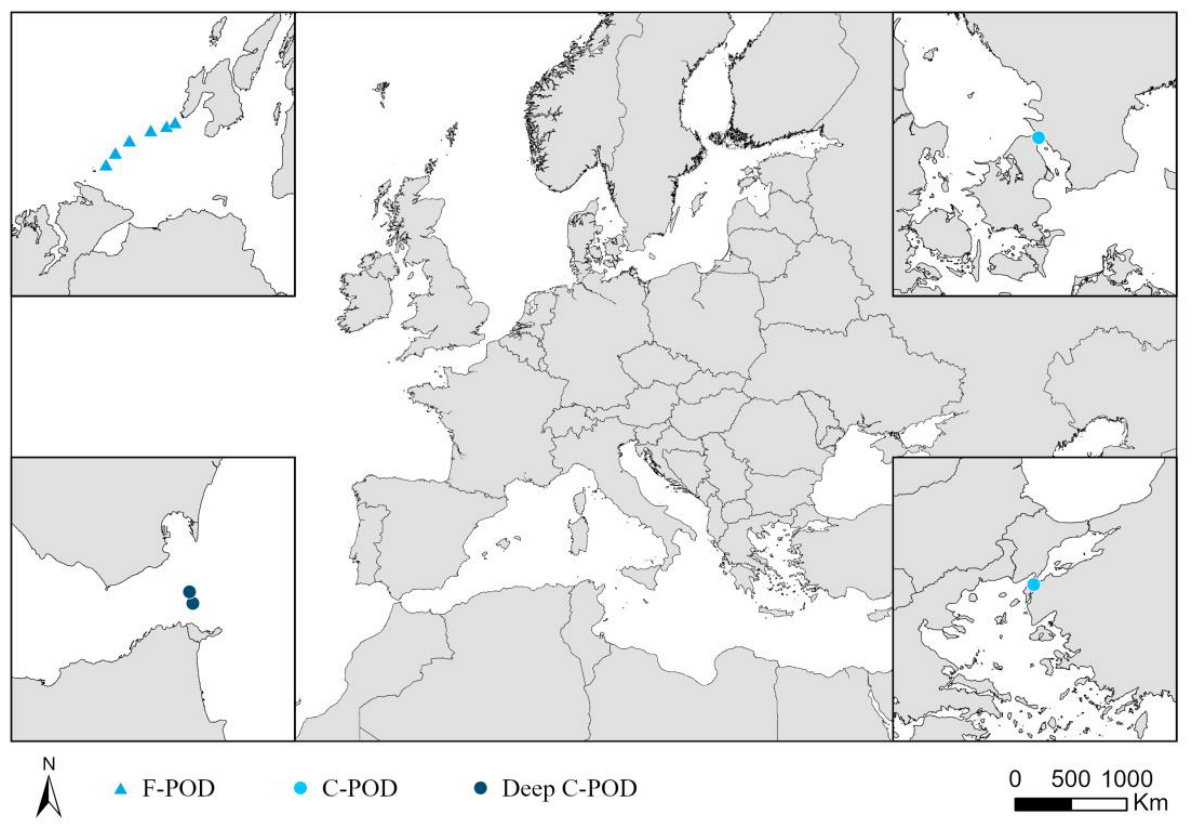
Four European straits were targeted for this study due to their strategic geographic positions and ecological significance: the North Channel, the Sound, the Strait of Gibraltar, and the Dardanelles Strait (Figure 1).

2.2. Data Collection

Static Acoustic Monitoring (SAM) deployments were conducted between 2023 and 2025 across four European straits: the North Channel, the Sound, the Strait of Gibraltar, and the Dardanelles Strait, to assess the acoustic presence of odontocetes. SAM devices were integrated with existing moorings where acoustic receivers were deployed and maintained by different STRAITS project partners. Click loggers, including C-PODs, deep C-PODs, and F-PODs (Chelonia Ltd., Mousehole, UK), were used to assess habitat use by odontocetes (Figure 1 and Table 1). The two North Channel stations included in the present analyses (Stations 9 and 20) were positioned approximately 7.6 km apart, both located within the Irish Exclusive Economic Zone, off Malin Head (Co. Donegal, Ireland).

2.3. Data Processing and Analysis

Data from C-PODs, deep C-PODs, and F-PODs were extracted using the software C-POD.exe (version 2.048) and FPOD.exe (version 2.16) (Chelonia Ltd.). Cetacean echolocation clicks were classified using the KERNO-F classifier into narrow-band high-frequency (NBHF) clicks, primarily associated with porpoises, and into other cetacean clicks, predominantly corresponding to dolphin species. To minimise false detections, only click trains classified as high- or moderate-quality were retained for further analysis.
Data validation was performed to verify whether acoustic detections originated from dolphins or porpoises, using the FPOD.exe software. Visual inspection was conducted on 10% of all detections, following the manufacturer’s recommendations, based on examination of detection train amplitude, frequency, and NBHF index. A small number of dolphin detections recorded in the Sound were identified as false positives and were excluded for subsequent analyses.
POD data were extracted as Porpoise Positive Minutes (PPM) and Dolphin Positive Minutes (DPM) per hour (i.e., minutes per hour where at least one click train was detected) for each deployment and study site and converted into a binary presence (1)/absence (0) format for modelling purposes.
Statistical analysis was performed using RStudio, v. 4.3.3 [46]. Dolphin and porpoise presence/absence data were analysed using a Generalised Additive Model (GAM) approach implemented in the R package mgcv [47]. The response variable, presence-absence of dolphins and/or porpoises, was analysed using a binomial error distribution with a logit link function [48]. Models were estimated using restricted maximum likelihood (REML). GAMs were fitted separately for each species group, study site, and sound pressure level (SPL) frequency category. Categorical predictors (tidal cycle, moon phase, diel phase, season, and station where applicable) were included as parametric terms, whereas continuous environmental predictors (SST and SPL variables) were included as smooth terms using thin plate regression splines. Smooth terms were fitted using a basis dimension of k = 5. Model adequacy was assessed using basis-dimension diagnostics (gam.check()), concurvity diagnostics, and residual autocorrelation analyses, while model performance was quantified using AIC, adjusted R2, and percentage deviance explained. Each hour during the study period was classified across a range of environmental and temporal covariates including tidal cycle, moon phase, diel phase, season, and sea surface temperature (SST). Seasons were categorised as spring (March, April, May), summer (June, July, August), autumn (September, October, November), and winter (December, January, February). Diel and moon phase were determined using the suncalc package [49], which is specific to the geographic coordinates of each study site (Table 1). Diel periods were defined relative to sunrise and sunset, resulting in four categories: morning (one hour before to one hour after sunrise), day (between morning and evening), evening (one hour before to one hour after sunset), and night (between evening and morning). Moon phase values between 0 and 1 were obtained and classified as new moon (from 0 to 0.125), first quarter (from 0.25 to 0.375), full moon (from 0.5 to 0.625), last quarter (from 0.75 to 0.875), and transition phase (from 0.125 to 0.25; from 0.375 to 0.5; from 0.625 to 0.75, and from 0.875 to 1).
The tidal cycle was determined using the tide and current prediction software WXTide32 (version 4.7) [50]. The nearest reference locations were selected for each study site: Tarifa, Strait of Gibraltar (36.0000, −5.6000); Aarhus, Kattegat (56.1000, 10.1300); Portpatrick, Western Scotland (54.5054, −5.0713); and Aydincik Limani, Gokceada (40.0900, 26.0000). Tides were categorised over a 24-h period into high tide (one hour before to one hour after high tide), low tide (one hour before to one hour after low tide), ebb tide (transition between high and low tide), and flood tide (transition between low and high tide) following [51].
Sea surface temperature (SST) data for each study area were obtained from the Copernicus Marine Environment Monitoring Service (CMEMS) online portal. For the Dardanelles Strait, SST data were extracted from the Black Sea High Resolution and Ultra-High Resolution L3S SST product [52], whereas for the Strait of Gibraltar, the Sound, and the North Channel, SST data were derived from the European North West Shelf: Iberia-Biscay-Irish Seas High Resolution ODYSSEA L4 SST Analysis product [53].
Statistical models were fitted separately for each species group (dolphins and porpoises), study site (North Channel, Dardanelles Strait, Strait of Gibraltar, and the Sound), and SPL frequency category (low-, mid-, and high-frequency). Because data were collected at two monitoring stations in the North Channel, station was included as a random effect in the corresponding GAMs. Broadband underwater noise levels (SPLs) were included as explanatory variables in all models except those for the Strait of Gibraltar, where acoustic data were unavailable. Broadband noise measurements were obtained from SAM devices deployed alongside the PODs at each monitoring station. Broadband recorders, including SoundTrap (Ocean Instruments, NZ) and SYLENCE-LP (RTsys, France) devices, were used to record underwater sound. The SoundTrap ST500 HF units, serial numbers 5714, 5668, and 5715, were paired with hydrophones 6088, 6086, and 6098, respectively, and calibrated with end-to-end sensitivities of −174.8, −175.6, and −175.7 dB re. 1 V/μPa. These devices were deployed at the North Channel (Station 9), the Sound, and the Dardanelles Strait, capturing broadband sound in the 0–48 kHz frequency range with a sampling rate of 96 kHz. The SYLENCE-LP device (serial number 2309007) was calibrated with a hydrophone sensitivity of −175 dB re. 1 V/μPa. It was deployed in the North Channel (Station 20), recording broadband sound in the 0–32 kHz frequency range at a sampling rate of 64 kHz. All devices were configured with a duty cycle of 15 min per hour. SPLs, expressed in dB re 1 μPa, were quantified in 1/3-octave bands (using a Hanning window, 0% overlap, 1-s resolution) in RStudio (version 4.4.1, June 2024) using the third-octave level (TOL) function from the sound analysis PAMGuide package from [54]. A detailed description of the acoustic processing workflow is provided in [55]. Average SPLs were subsequently calculated within three broad frequency categories: low-frequency (0–1 kHz), mid-frequency (1–10 kHz), and high-frequency (>10 kHz). These operational frequency bands were selected to represent broad components of the underwater soundscape and to examine whether odontocete acoustic occurrence responded differently across frequency ranges. The low-frequency band (0–1 kHz) encompasses the frequency range where commercial vessel noise is typically concentrated [32,33], whereas the mid- and high-frequency bands were included to assess potential responses across higher-frequency components of the soundscape. Due to strong multicollinearity among frequency categories [56], separate models were fitted for each noise category (low-, mid-, and high-frequency), allowing independent assessment of the effects of underwater noise across different frequency ranges.
Candidate models were developed using a backward model-selection approach, beginning with a full model containing all ecologically relevant predictors. These models were compared using Akaike Information Criterion (AIC), and the model with the lowest AIC value was selected as the final model. Predictors were retained when their inclusion improved model support based on AIC, and they represented ecologically relevant temporal or environmental drivers. Model validation included assessment of smoothing basis adequacy using the k-index diagnostics from the gam.check() function, nonlinear dependence among model terms using the concurvity() function, and residual temporal autocorrelation using autocorrelation functions acf() of Pearson residuals [57,58]. Model performance was evaluated using AIC, adjusted R2, and the percentage of deviance explained provided by the mgcv package. Candidate model structures, model performance statistics, and model diagnostics are provided in Appendix A Table A1, Table A2 and Table A3.
To visualise relationships between explanatory variables and the probability of dolphin and harbour porpoise acoustic presence, predicted probabilities were derived from the fitted binomial GAMs and plotted across all significant predictors. GAMs were selected as the statistical analysis approach due to (1) the binary response variable, (2) the inclusion of both fixed and random effects in the model, (3) the estimation of predicted probabilities of dolphin and harbour porpoise acoustic occurrence, and (4) their capacity, unlike Generalised Linear Models (GLMs) and Generalised Linear Mixed Models (GLMMs), which have also been widely applied to assess the effect of environmental variables on odontocete acoustic occurrence [59,60], to account for the non-linear relationship between odontocetes occurrence and the explanatory variables SST and SPLs [57].

3. Results

A total of 13,801 h of C-POD and 3214 h of F-POD data were recorded across the monitored locations, with 26,485 Porpoise Positive Minutes (PPM) for harbour porpoise and 9893 Dolphin Positive Minutes (DPM). Specific details for each location are presented in Table 2.

3.1. North Channel (Ireland)

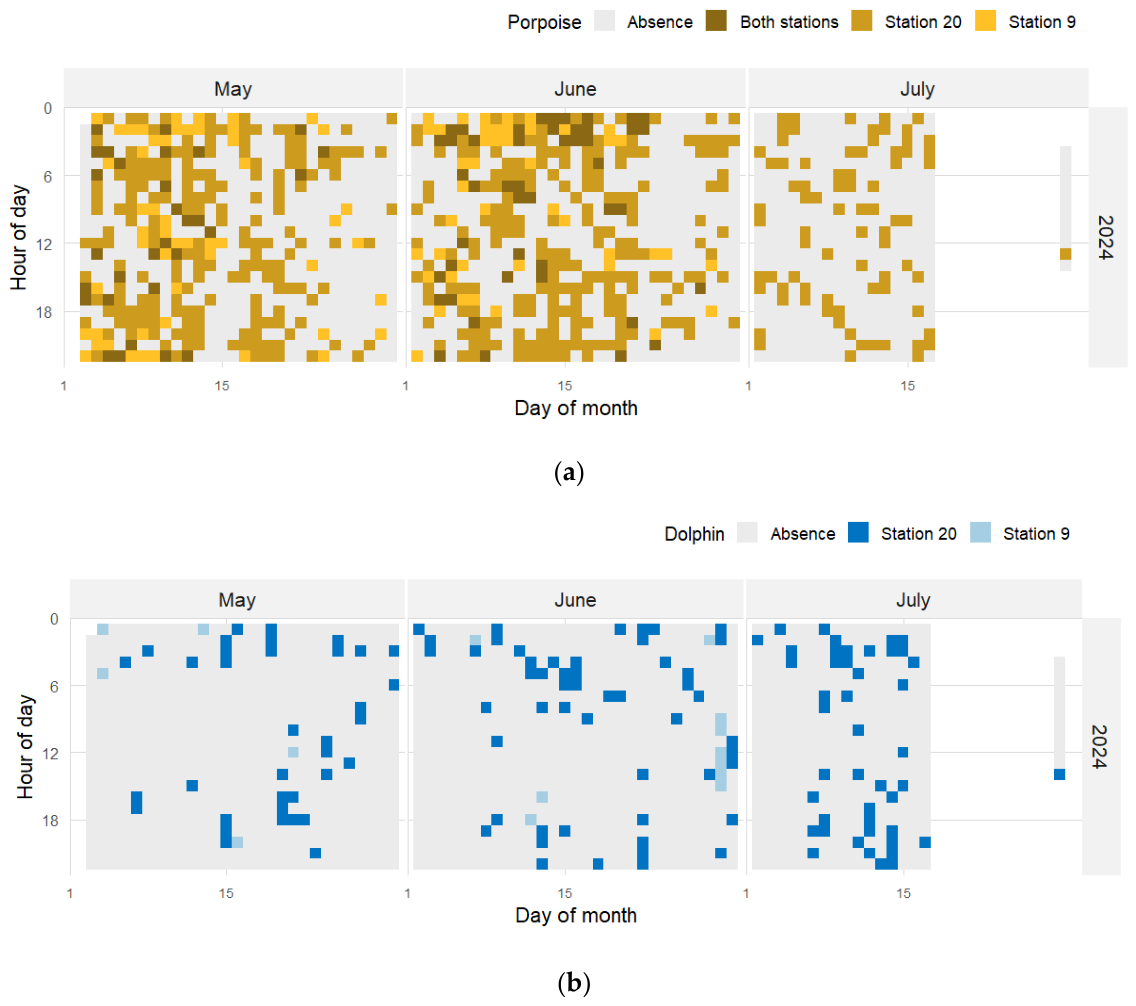
In the North Channel, dolphin detections were sparse and irregular at Station 9, with few acoustic occurrences in May, a slight increase in June and July, and remained patchy and without a clear diel pattern. In contrast, dolphin detections were more common at Station 20. Although porpoises were recorded throughout the full diel cycle, dolphin activity was slightly higher during the evening, nighttime, and early morning periods. Overall, these patterns indicate sporadic dolphin acoustic presence at Station 9, more consistent use of Station 20 by dolphins, and regular use of both stations by harbour porpoises, with minimal temporal variation between months (Figure 2).
In the North Channel, SST ranged from 8.6 to 13.55 °C, with a mean temperature of 11.01 ± 1.11 °C during the data collection period. SPLs ranged from 60.05 to 114.58, 67.65 to 101.52, and 72.76 to 102.36 dB re 1 µPa for low-, mid-, and high-frequency bands, respectively. Mean SPLs were 92.95 ± 9.97, 84.74 ± 7.10, and 84.17 ± 8.03 dB re 1 µPa for the corresponding frequency categories.

3.1.1. Harbour Porpoise

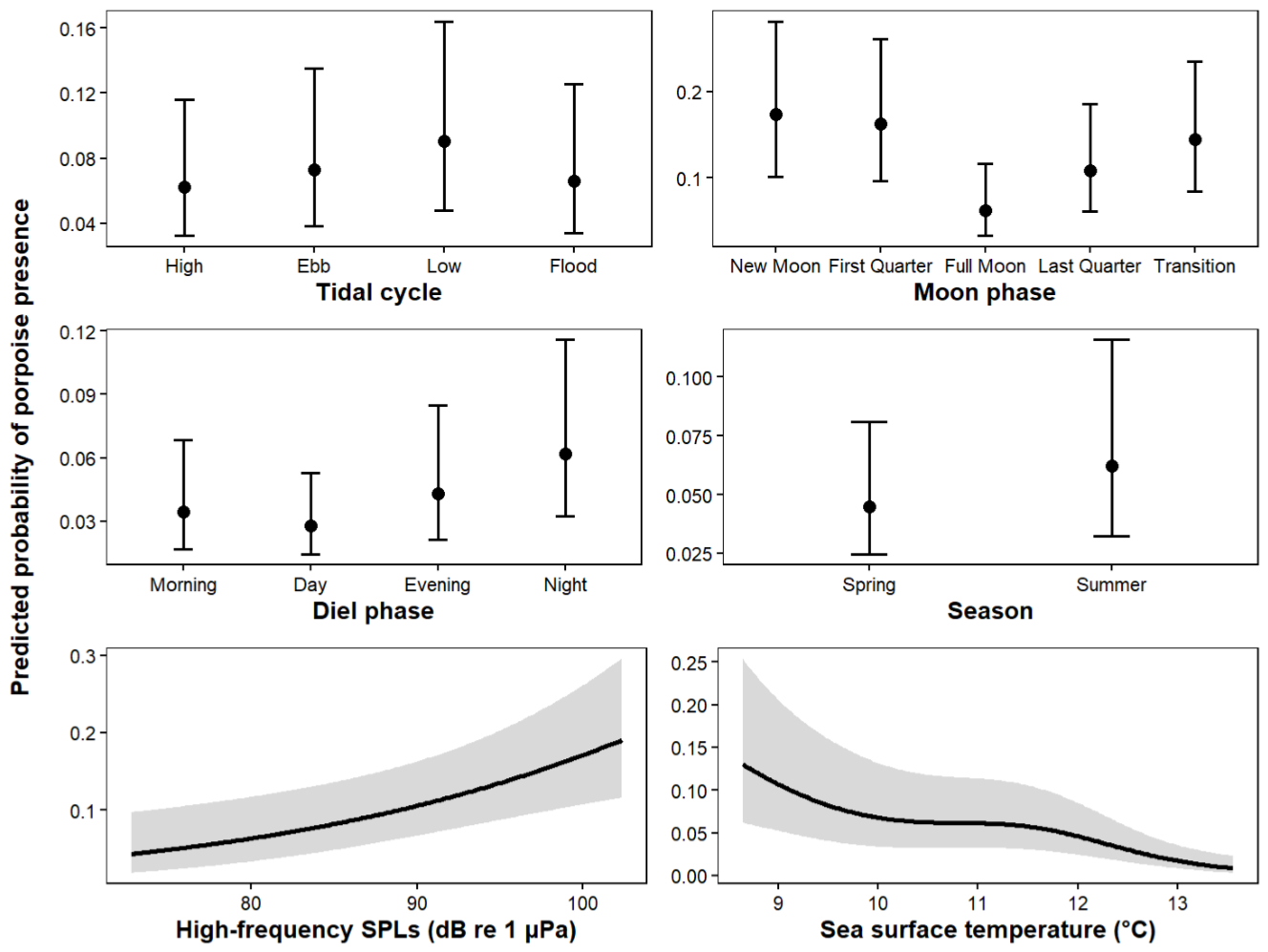
Harbour porpoise acoustic presence was significantly associated with the tidal cycle, moon phase, diel, season, SST, and high-frequency SPLs. Baseline acoustic presence also differed among stations (Table 3). The predicted probability of porpoise acoustic presence increased during low tide compared to high tide, was lower during the full and last-quarter moon phases than during the new moon, higher at night than during the morning, and higher during summer than during spring (Table 3, Figure 3). In addition, the predicted probability of acoustic presence decreased with increasing SST and increased with increasing high-frequency SPLs (Table 3, Figure 3).
These relationships were identified by the selected GAM, which included tidal cycle, moon phase, diel phase, season, high-frequency SPL, SST, and station as a random effect (Table 3). The model explained 9.13% of the deviance (adjusted R2 = 0.091), and model diagnostics indicated adequate model performance (Appendix A Table A1, Table A2 and Table A3).

3.1.2. Dolphins

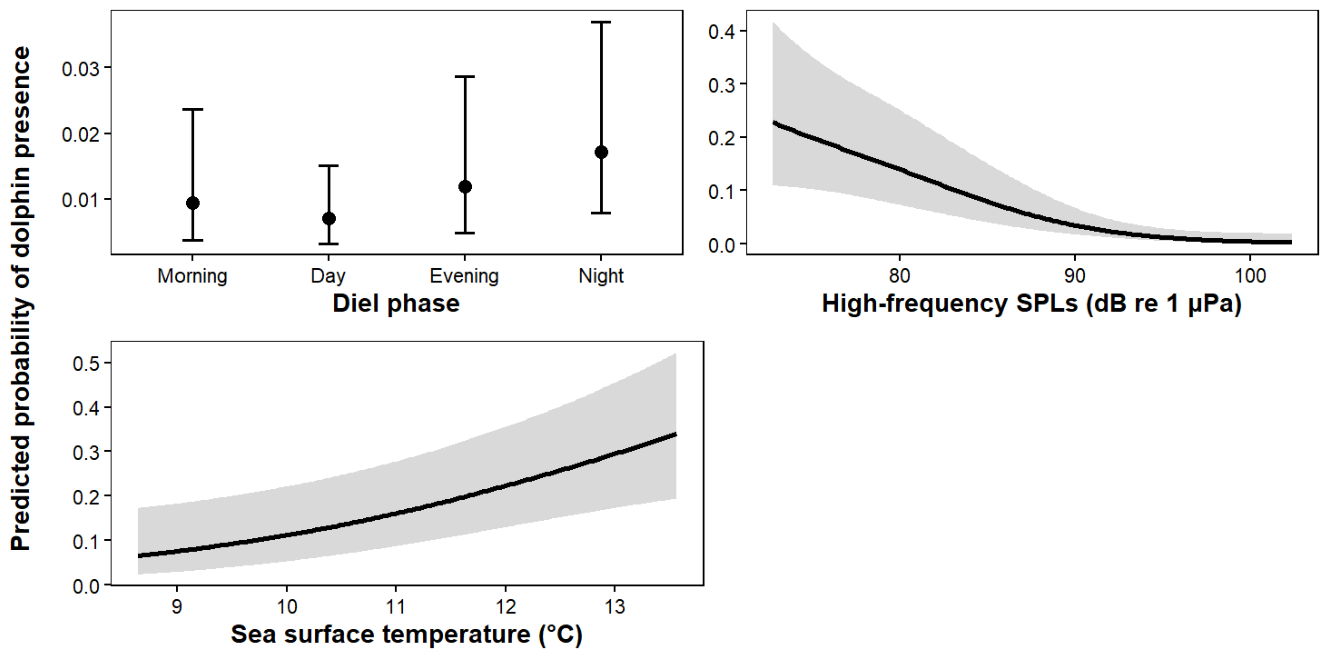
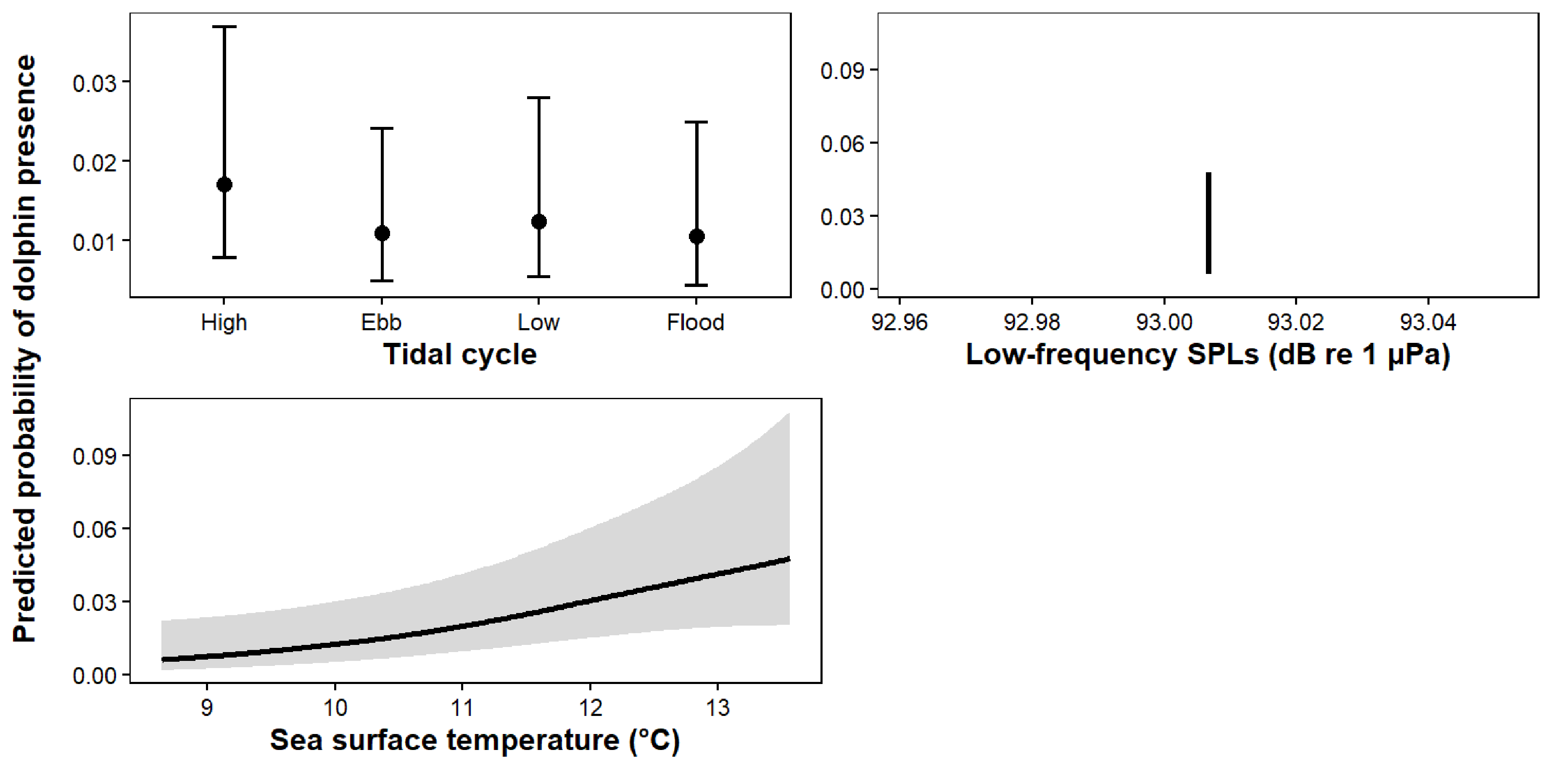
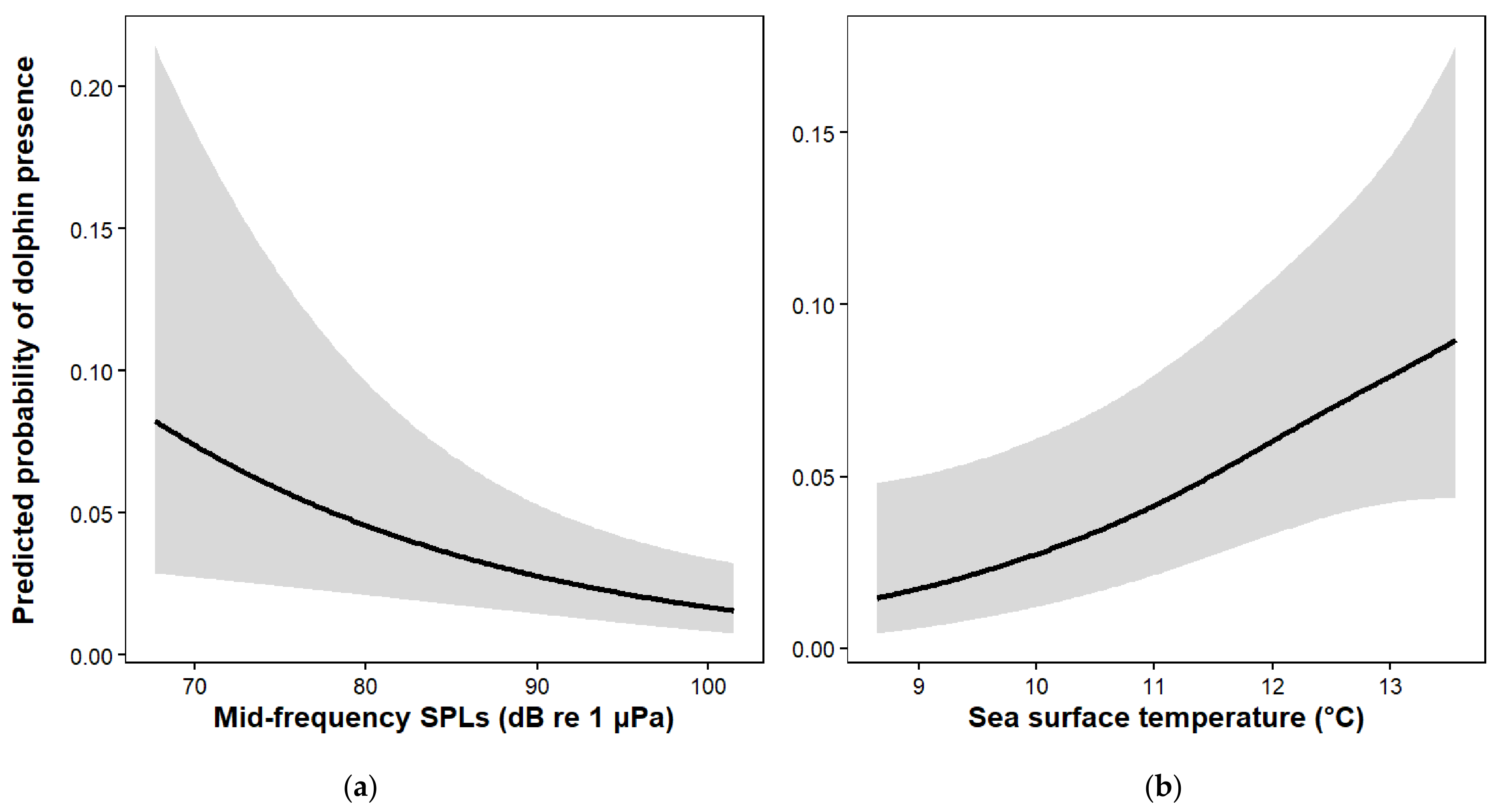
Dolphin acoustic presence was significantly associated with tidal cycle (in the model including low-frequency SPLs), diel phase (in the model including high-frequency SPLs), SST, and low-, mid-, and high-frequency SPLs. (Table 4). The predicted probability of dolphin acoustic presence decreased during ebb tide compared to high tide and increased during nighttime compared to daytime (Table 4). The predicted probability of dolphin acoustic presence increased with increasing SST and low-frequency SPLs and decreased with mid- and high-frequency SPLs (Table 4, Figure 4, Figure 5 and Figure 6). The observed negative relationships with mid- and high-frequency SPLs are consistent with reduced dolphin acoustic presence under elevated noise conditions.
These relationships were identified by the selected GAMs, which included tidal cycle, diel phase, season, SPL, SST, and station as a random effect (Table 4). The selected models explained 11.4–13.0% of the deviance (adjusted R2 = 0.046–0.055) (Appendix A Table A1 and Table A2). Model diagnostics indicated adequate smooth basis dimensions and acceptable concurvity across models (Appendix A Table A3).

3.2. The Sound (Denmark)

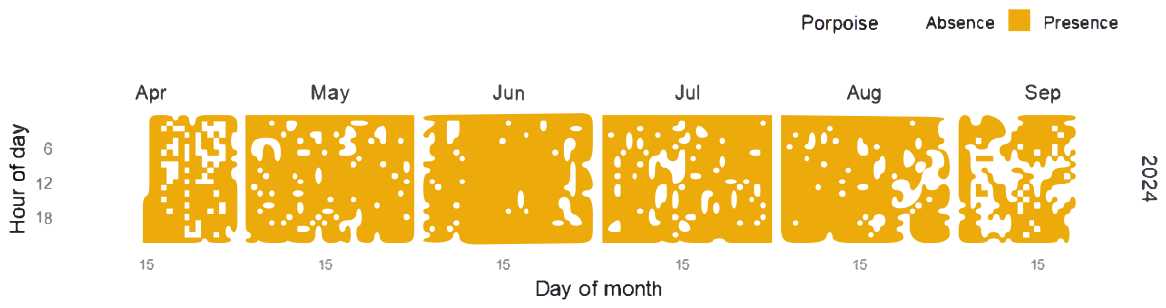
In the Sound, harbour porpoise detections occurred daily and during most hours from April to September. This pattern indicates continuous occupancy of the area and consistent habitat use across months and throughout the diel phase, with only minor fluctuations in acoustic occurrence over time (Figure 7).
In the Sound, SST ranged from 6.33 to 19.83 °C, with a mean temperature of 15.26 ± 3.77 °C during the data collection period. SPLs ranged from 96.09 to 107.1, 94.94 to 121.68, and 89.89 to 115.78 dB re 1 µPa for low-, mid-, and high-frequency bands, respectively. Mean SPLs were 111.24 ± 3.43, 113.31 ± 4.28, and 109.64 ± 3.75 dB re 1 µPa for the corresponding frequency categories.

Harbour Porpoise

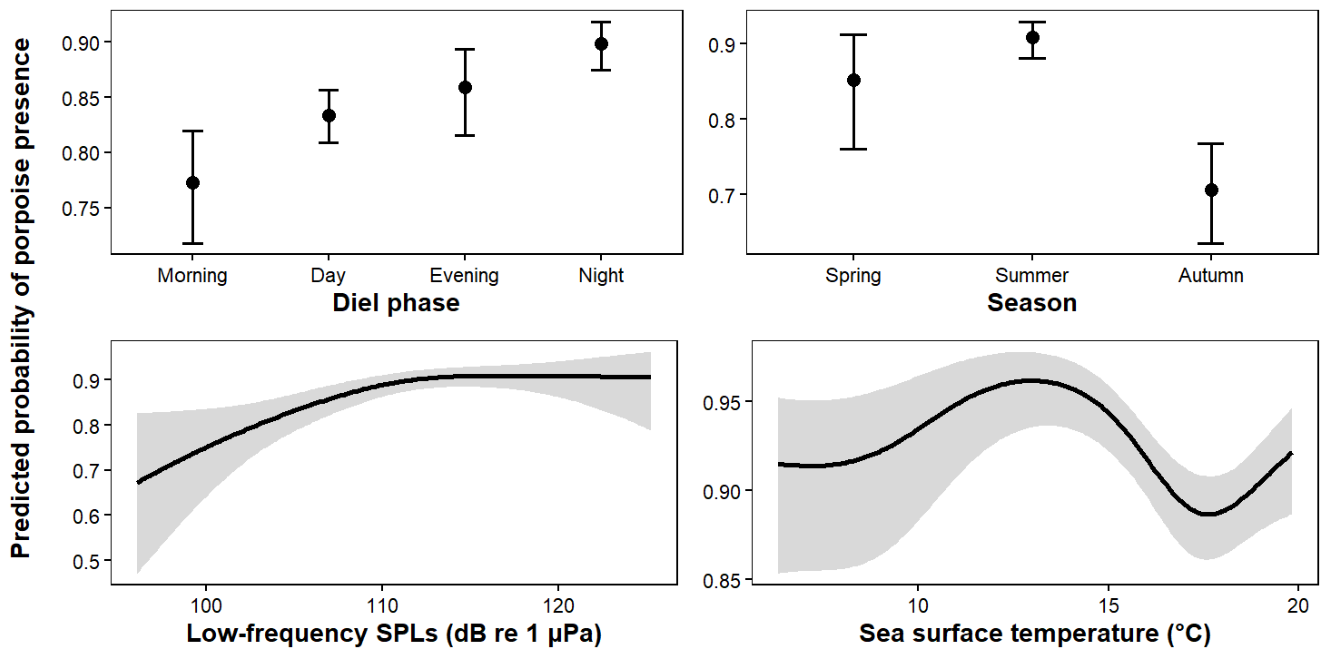
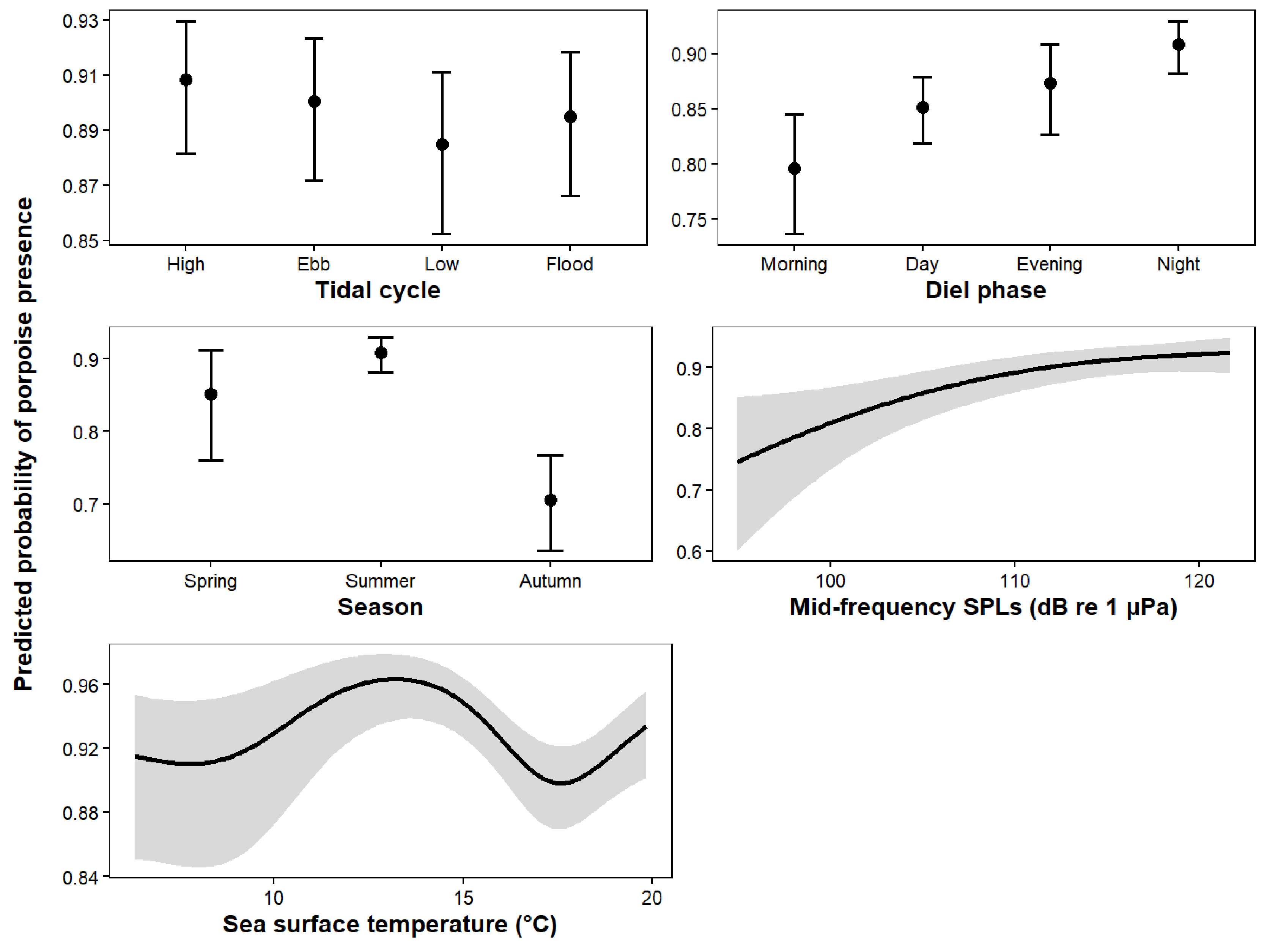
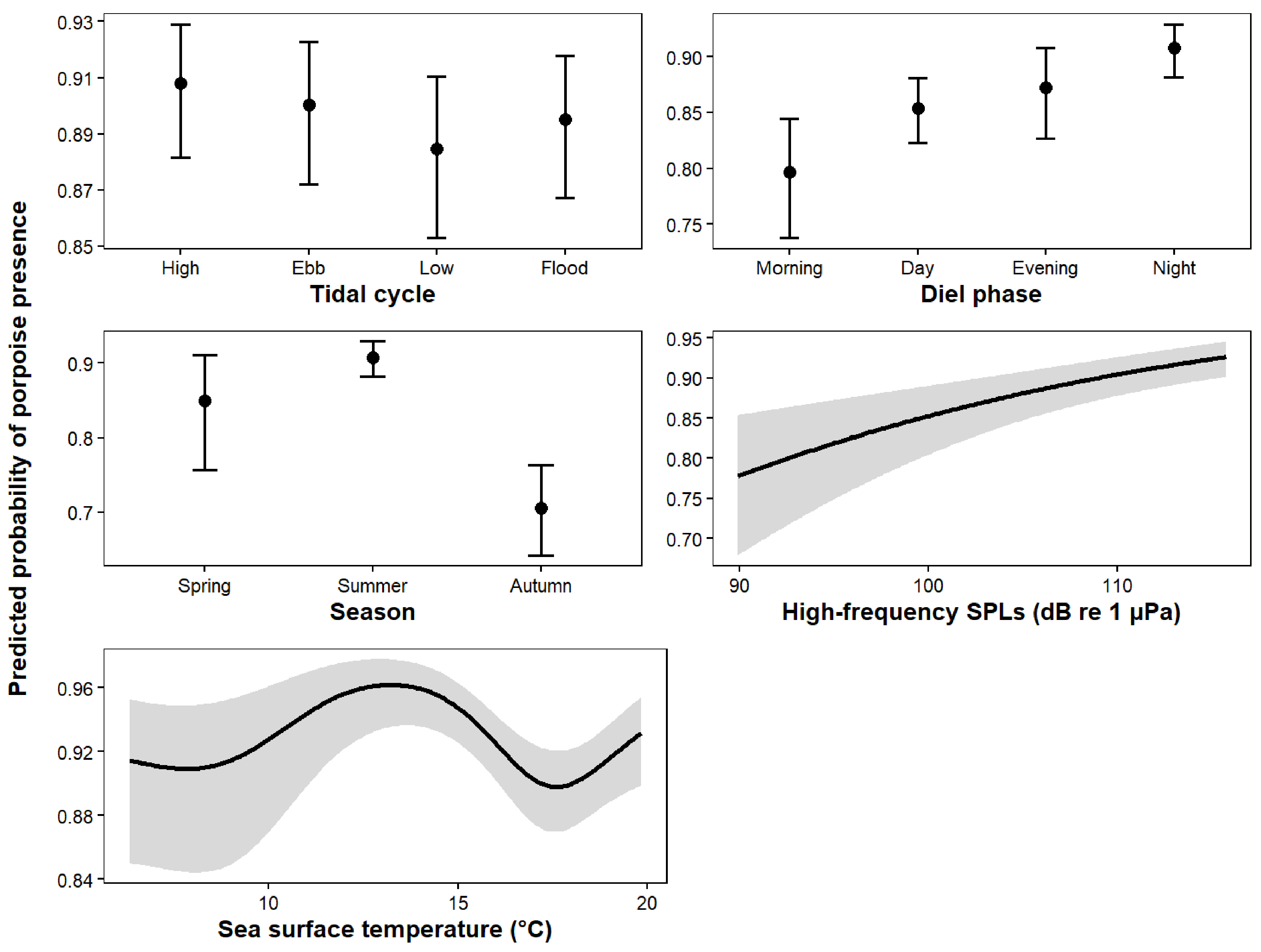
Harbour porpoise acoustic presence was significantly associated with diel phase, season, SST, and SPLs in all models, while tidal cycle was also significant in the models including mid- and high-frequency SPLs (Table 5). The predicted probability of porpoise acoustic presence was lower during the morning compared to other time periods (day, evening, and night) (Table 5, Figure 8, Figure 9 and Figure 10). Acoustic presence was also lower during low tide than high tide conditions (Table 5, Figure 9 and Figure 10). The predicted probability of porpoise acoustic presence increased in summer and decreased in autumn compared to spring (Table 5, Figure 8, Figure 9 and Figure 10). Acoustic presence was highest between 10 and 15 °C and lowest at 17 and 18 °C (Table 5, Figure 8, Figure 9 and Figure 10). Porpoise acoustic presence increased when SPLs increased (Table 5, Figure 8, Figure 9 and Figure 10).
These relationships were identified by the selected GAMs, which included diel phase, season, and smooth terms for SPL and SST, while tidal cycle was additionally retained in the mid- and high-frequency SPL models (Table 5, Table A1, Table A2 and Table A3). The low-, mid-, and high-frequency models explained 6.01%, 6.00%, and 5.86% of the deviance, with adjusted R2 values of 0.060, 0.059, and 0.058, respectively (Table A2).

3.3. The Strait of Gibraltar (Spain)

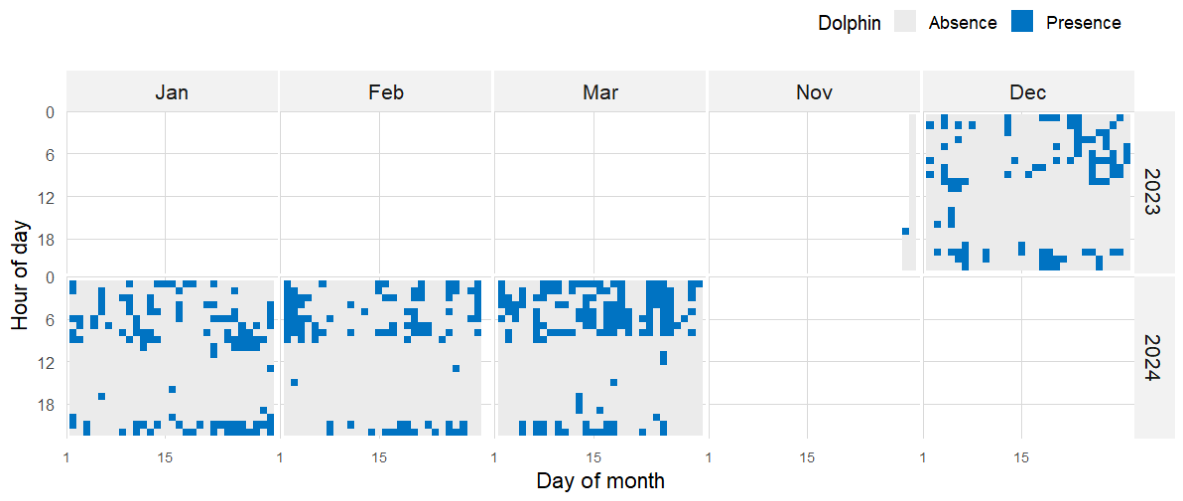
In the Strait of Gibraltar, dolphin detections were common and exhibited a clear diel pattern, with detections increasing during nighttime and morning hours and occurring less frequently during the daytime. The repeated acoustic presence of dolphins across days and months suggests intermittent but regular use of the area during winter and early spring (Figure 11).
In the Strait of Gibraltar, SST ranged from 14.72 to 19.36 °C, with a mean temperature of 16.98 ± 0.91 °C during the data collection period.

Dolphins

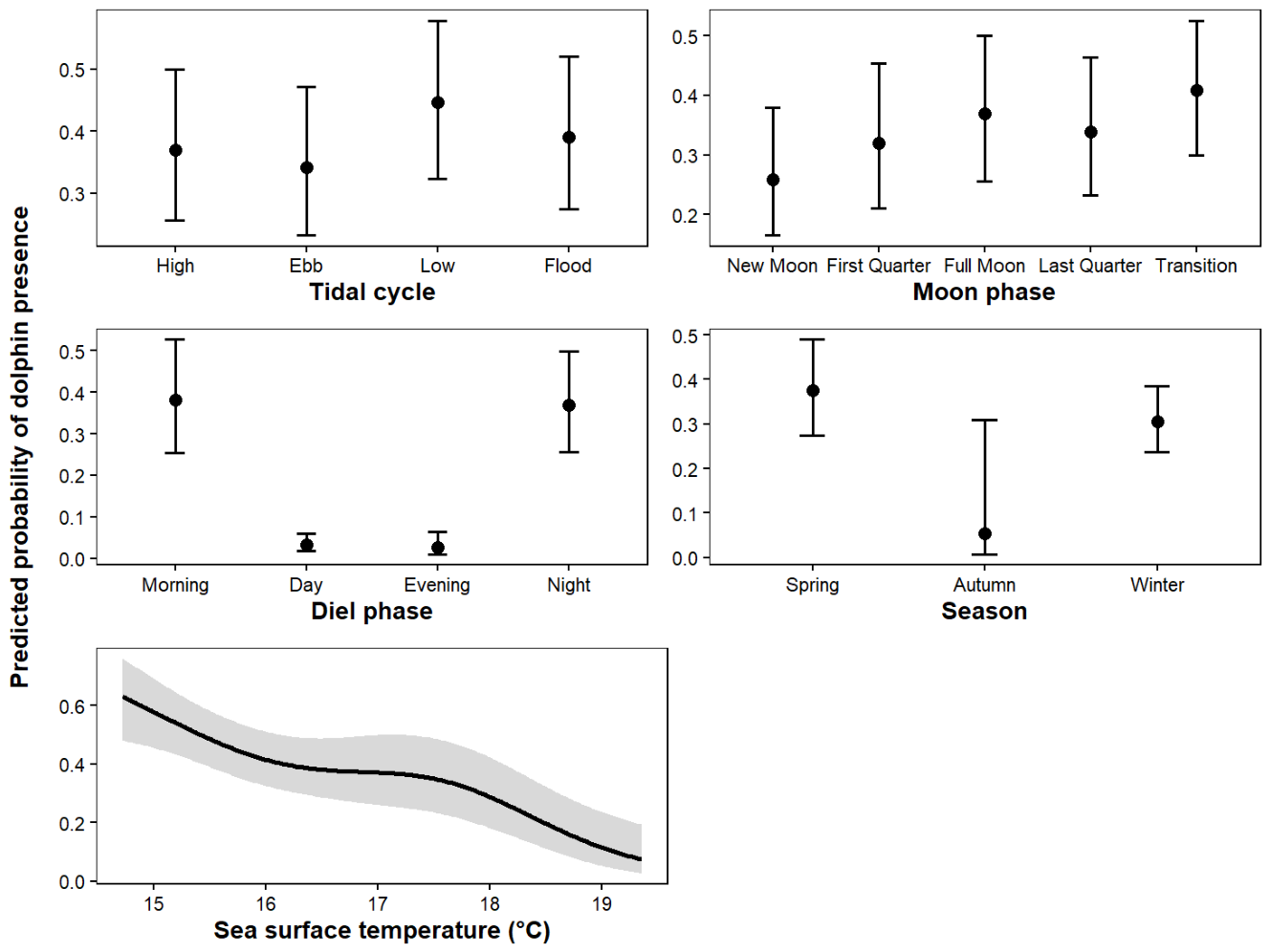
Dolphin acoustic presence was significantly associated with tidal cycle, moon phase, diel phase, season, and SST (Table 6). The predicted probability of dolphin acoustic presence increased during low-tide compared to high-tide conditions (Table 6, Figure 12). There was also increased dolphin acoustic presence during full moon and transition phases compared to new moon (Table 6, Figure 12). The predicted probability of dolphin acoustic presence decreased during the day and evening compared to the morning and during autumn compared to spring (Table 6, Figure 12). Dolphin acoustic presence decreased with increasing SST (Table 6, Figure 12).
These relationships were identified by the selected GAM, which included tidal cycle, moon phase, diel phase, season, and a smooth term for SST (Table 6). Model selection, performance statistics, and diagnostic results are provided in Appendix A Table A1, Table A2 and Table A3. The final model explained 20.6% of the deviance and had an adjusted R2 of 0.192 (Table A2).

3.4. Dardanelles Strait (Turkey)

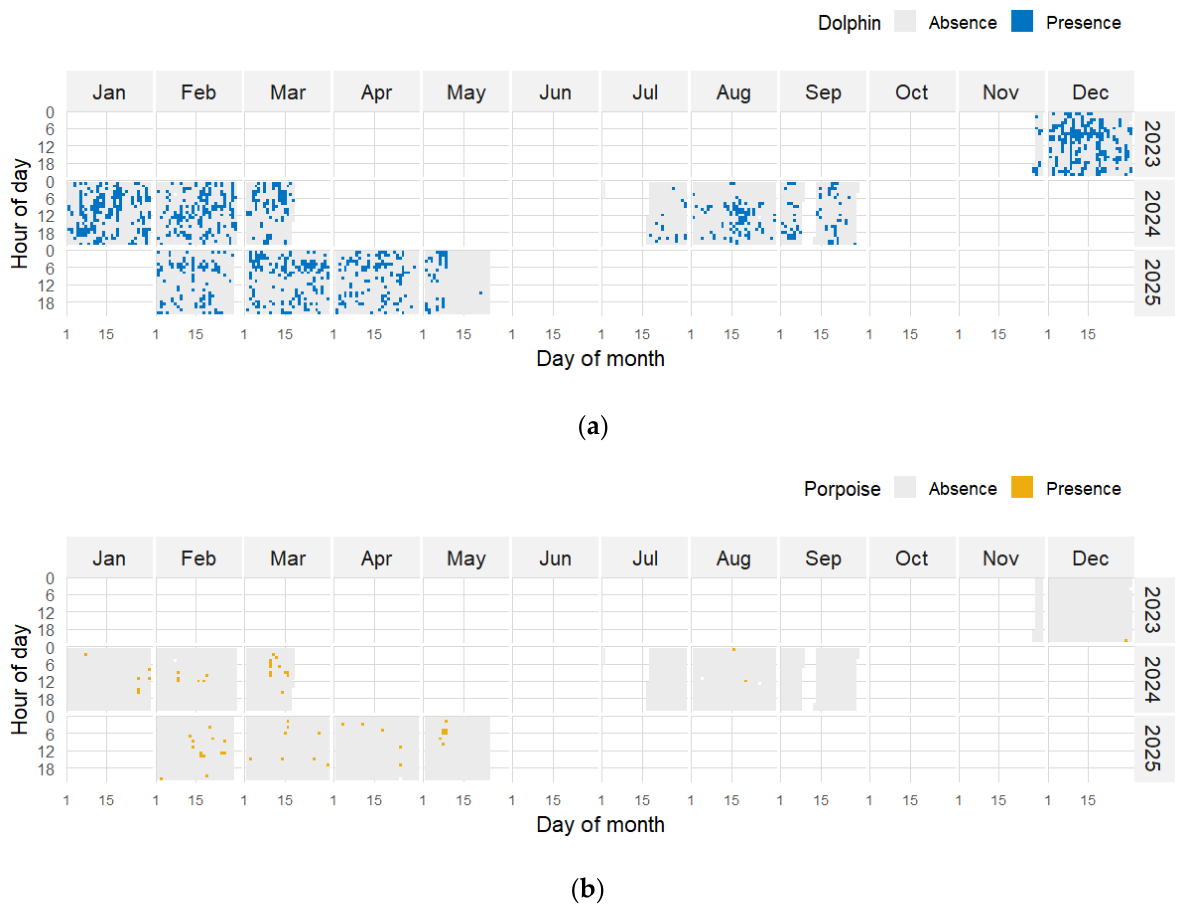
In the Dardanelles Strait, dolphin detections were frequent and widespread across months, with no clear diel pattern observed. In contrast, harbour porpoises were recorded only rarely (Figure 13).
In the Dardanelles Strait, SST ranged from 7.8 to 27.6 °C, with a mean temperature of 19.7 ± 7.61 °C during the data collection period. SPLs ranged from 82.8 to 150.8, 66 to 138, and 70 to 129.99 dB re 1 µPa for low-, mid-, and high-frequency bands, respectively. Mean SPLs were 112.43 ± 13.07, 114 ± 10.55, and 108.85 ± 7.23 dB re 1 µPa for the corresponding frequency categories.

Dolphins

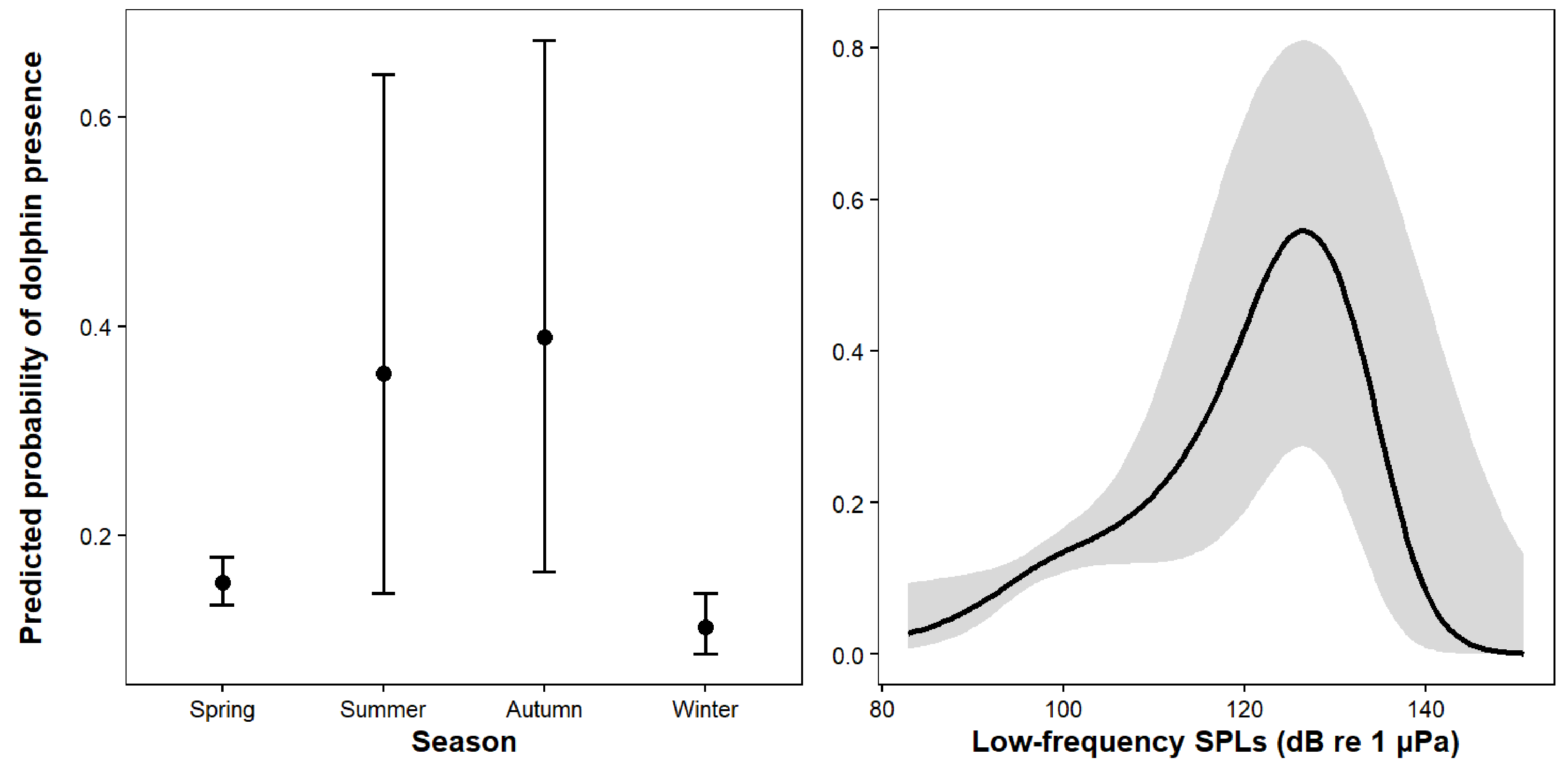
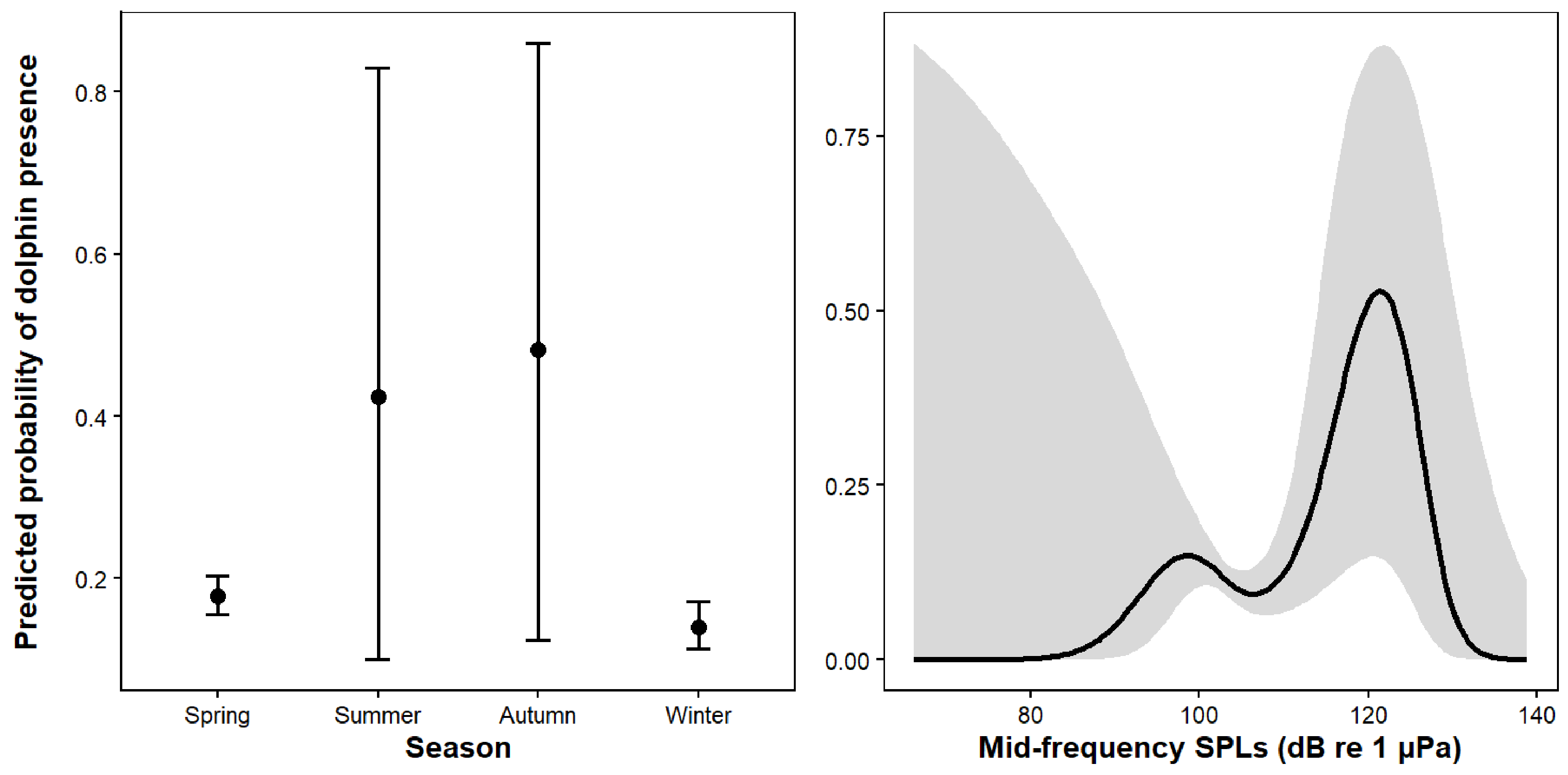
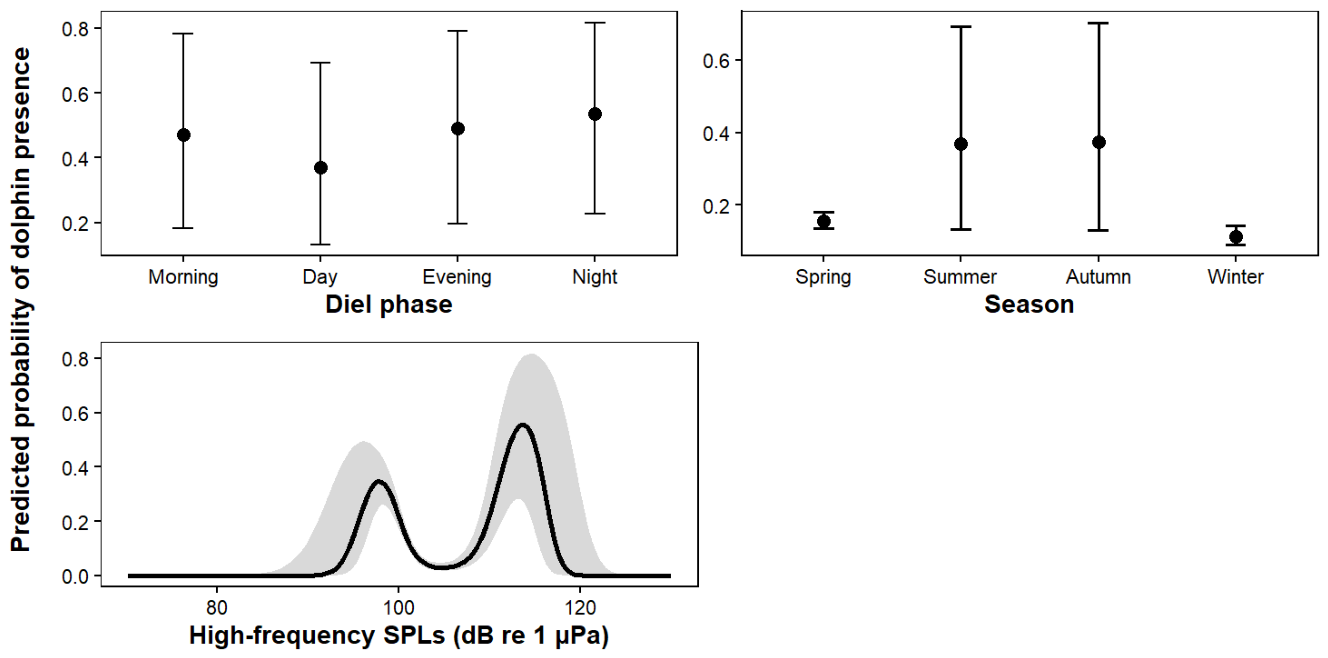
Dolphin acoustic presence was significantly associated with season in all models, while diel phase was significant only in the high-frequency SPL model (Table 7). The predicted probability of dolphin acoustic presence was higher during autumn in one of the models and decreased in winter across all the models compared to spring (Table 7, Figure 14, Figure 15 and Figure 16). Diel phase was significant only in the high-frequency model, where acoustic detections were less likely during the day than in the morning. The relationship between dolphin acoustic presence and SPL were nonlinear. Occurrence probability was highest at intermediate-low-frequency SPLs (between 120 and 125 dB re 1 µPa), while the mid- and high-frequency models showed non-linear responses with peaks at intermediate and higher SPLs (Table 7, Figure 14, Figure 15 and Figure 16).
These relationships were identified by the selected GAMs, which included diel phase, season, and a smooth term for SPL across all three frequency bands (Table 7). The selected models showed similar explanatory performance, with adjusted R2 values between 0.029 and 0.047, and between 3.82% and 6.41% deviance explained (Appendix A Table A1 and Table A2). Although diel phase was not statistically significant in the low- and mid-frequency models, it was retained because its inclusion improved model support based on AIC. Model selection, performance statistics, and diagnostic results are provided in Appendix A Table A1, Table A2 and Table A3.
Across all straits, harbour porpoises were present in the Sound (100% of monitored days) and the North Channel (98.7 and 84.7% of recording days at stations 9 and 20, respectively), with only a few detections recorded in the Dardanelles Strait (16.29% of monitored days). Dolphin species were detected in the Strait of Gibraltar (59.56% of monitored days), the Dardanelles (82.02% of monitored days), and, to a lesser extent, in the North Channel (16.9 and 79.2% of monitored days at stations 9 and 20, respectively).
SST varied across sites. The highest mean SST was recorded in the Dardanelles Strait (19.7 ± 7.6 °C), followed by the Strait of Gibraltar (17 ± 0.9 °C), the Sound (15.3 ± 3.8 °C), and the North Channel (11 ± 1.1 °C). The Dardanelles Strait presented the highest variability, with temperatures ranging from 7 to 27 °C. The Sound showed similarly high variability, with SST ranging from 6 to 20 °C. In contrast, the North Channel and the Strait of Gibraltar showed lower variability, with SST ranging between 8 and 14 °C, and between 15 and 19 °C, respectively.
Average low-frequency (0–1 kHz) SPLs were highest in the Dardanelles Strait (112.4 ± 13.1 dB re 1 µPa), followed by the Sound (111.2 ± 3.4 dB re 1 µPa), and the North Channel (93 ± 10 dB re 1 µPa). Average mid-frequency (1–10 kHz) SPLs were also highest in the Dardanelles Strait (114 ± 10.6 dB re 1 µPa), followed by the Sound (113.3 ± 4.3 dB re 1 µPa), and the North Channel (84.7 ± 7.1 dB re 1 µPa). Average high-frequency (>10 kHz) SPLs were highest in the Sound (109.6 ± 3.8 dB re 1 µPa), followed by the Dardanelles Strait (108.9 ± 7.2 dB re 1 µPa), and the North Channel (84.2 ± 8 dB re 1 µPa).
Across all fitted GAMs, model diagnostics indicated adequate smoothing basis dimensions, low to moderate concurvity among smooth terms, and only moderate positive lag-1 residual autocorrelation (Appendix A Table A3).

4. Discussion

Long-term SAM using acoustic click loggers was conducted across four European straits: the North Channel, the Sound, the Strait of Gibraltar, and the Dardanelles Strait to investigate the acoustic occurrence patterns of harbour porpoises and dolphin species in relation to environmental, temporal, and acoustic drivers. These key maritime corridors provided a unique opportunity to assess how cetacean acoustic occurrence is affected by environmental, temporal, and acoustic conditions within these highly dynamic and heavily trafficked marine systems.
The results indicate spatial separation between taxa. Harbour porpoises were mainly detected in the northern straits, i.e., the Sound and the North Channel, while dolphins were more frequently detected in the southern straits, i.e., the Strait of Gibraltar and the Dardanelles Strait, although they were also detected to a lesser extent in the North Channel. This latitudinal segregation between harbour porpoises and dolphins has been documented across European waters, with harbour porpoises distributed in cold- to temperate-continental-shelf waters in the northern hemisphere [61,62], while dolphin species present a wider distribution and are also present in warmer oceanic environments [63,64,65].

4.1. North Channel

Although a small number of harbour porpoise detections were recorded in the Dardanelles Strait, both harbour porpoises and dolphins were clearly detected in the North Channel during the recording period. Harbour porpoises were detected more frequently than dolphins.
These observations are consistent with previous visual studies in the area, confirming the regular presence of both harbour porpoises and dolphin species including common, bottlenose, and Risso’s dolphins [66,67,68,69]. More recently, harbour porpoises and dolphins have also been detected acoustically during the long-term SeaMonitor project [40,70]. However, data were only collected between May and mid-July, limiting the assessment of seasonal patterns and potentially underrepresenting peak occurrence periods, particularly for harbour porpoises during the winter months, when their presence is higher within the SAC located along the eastern coast of Northern Ireland [40,71].
The predicted probability of harbour porpoise acoustic presence increased during the night, which is consistent with previous findings at this [40] and other locations [72,73]. While this is often linked to foraging activity, alternative explanations have been proposed by [74], who investigated the acoustic behaviour of captive porpoises, such as increased reliance on echolocation under low-light conditions or the presence of circadian rhythms.
Harbour porpoise acoustic occurrence was influenced by environmental conditions, increasing during low tide and under new moon conditions. This contrasts with [73], who found an increase in porpoise detections under full-moon conditions in Sweden. It has been suggested that the correlation with lunar and tidal phases might act as proxies for prey activity patterns, as tidal and lunar cycles are known to affect prey behaviour and availability [74].
The relationship between porpoise acoustic presence and underwater noise levels was less intuitive. Harbour porpoise detections increased with higher SPLs at high-frequency bands, contrasting with the widely documented sensitivity of this species to noise disturbance [22,27,29]. This, however, has been documented at different locations, with the possible explanation that areas of higher noise overlap with increased prey availability or favourable foraging conditions, leading to a trade-off between energetic needs and disturbance avoidance.
Unlike harbour porpoises, the probability of detecting dolphins was higher under high-tide conditions and positively correlated with SST, being highest at 13 °C, suggesting species-specific habitat preferences. This contrasts, however, with [40], who found a negative correlation between dolphin presence and SST at different stations in the North Channel. Although dolphin detections increased at low-frequency SPLs, the probability of acoustic presence decreased at mid- and high-frequency SPLs, potentially reflecting behavioural responses to ambient underwater sound levels, which in this highly trafficked area are likely influenced by vessel activity among other natural and anthropogenic sound sources, as reported in previous studies [20,21,26].
Overall, these findings suggest that harbour porpoise and dolphin acoustic occurrence is shaped by a complex relationship between environmental conditions and ambient underwater sound levels in the North Channel, with species-specific responses.

4.2. The Sound, Denmark

The highest number of harbour porpoise detections was recorded in the Sound, Denmark, with detections recorded on 100% of monitored days. The harbour porpoise is the most abundant cetacean in the North and Baltic Seas [9], and the only resident cetacean in the Baltic Sea [75]. The Sound hosts part of the Belt Sea population, one of the three harbour porpoise populations in Danish waters [9,76,77]. This population has been estimated at approximately 14,000 individuals in 2022 and is currently declining [78,79,80]. The high number of detections recorded in the present study confirms the ecological importance of the Sound as a key habitat within the porpoise Belt Sea population.
Similarly to the North Channel, porpoise detections increased at night, consistent with observations from the Belt Sea population [81] and elsewhere [71,72,73], believed to be linked to daily shifts in prey distribution [82]. Seasonally, detections increased during summer months and declined in autumn, in line with previous studies on the Belt Sea population [81,83]. The northern Øresund has been identified as a hotspot during the breeding season (spring and summer), with a gradual southward shift from the end of the summer [8,76,84,85]. These patterns are thought to be linked to prey availability, influenced by a spring front in the northern part of the strait, which would increase productivity and prey aggregation [76], as well as the distribution of key prey species such as herring [8]. Given the high energetic demands of this species, due to their small size and the cold waters they inhabit, their habitat use is likely primarily driven by prey distribution [71,85].
Harbour porpoises have been reported to prefer relatively low SSTs, often around or below 5 °C in the western Atlantic [86,87]. In contrast, studies from the North Sea [69] and Wales [88] have reported higher occurrence at warmer SSTs, between 9 and 17 °C and between 15 and 17 °C, respectively. These later findings are more comparable to the SST ranges observed in the present study. We recorded a peak in porpoise acoustic presence below 9 °C in the North Channel, which agrees with the negative correlation found by [40] in the same area, while in the Sound, detections were recorded within a wide range of temperatures (from 5 to 20 °C), with particularly high detection rates between 10 and 15 °C. This suggests that harbour porpoises tolerate a relatively broad range of temperatures in European waters, and that their presence is likely more strongly influenced by prey availability and oceanographic processes than by temperature alone.
The positive relationship observed between harbour porpoise detections and underwater noise levels across all frequency bands is particularly unexpected. Given the well-documented sensitivity of harbour porpoises to anthropogenic noise, an avoidance behaviour would be expected instead [19,29,89]. E.g., ref. [85] observed behavioural changes and a decrease in porpoise foraging under shipping noise conditions. While counterintuitive, ref. [90] described a similar pattern, with an increase in echolocation activity of harbour porpoises in the vicinity of oil and gas platforms despite presenting higher noise levels. They attributed this to the increase in prey availability because of the artificial reefs created by such anthropogenic structures and the fishing exclusion zones around them. Similarly, ref. [91] found an increase in detections within a windfarm further north. In the Sound, the most likely explanation is the spatial overlap between areas of high porpoise density and intense vessel traffic [13], rather than a direct positive response to noise. A similar scenario has been observed in the NY-NJ Harbour Estuary, where porpoises were present despite high levels of anthropogenic activity [87]. The authors proposed that prey availability could compensate for potential adverse impacts of noise, providing a possible explanation for the presence of this species in such highly trafficked locations. This highlights an important consideration when interpreting acoustic data: correlations with noise do not necessarily imply causation but may reflect co-occurrence with underlying ecological drivers, such as prey distribution.

4.3. Strait of Gibraltar, Spain

The highest number of dolphin detections was recorded in the Strait of Gibraltar, while harbour porpoises were not detected. This pattern is consistent with the documented species in the area: short-beaked common dolphins (Delphinus delphis), striped dolphins (Stenella coeruleoalba), and bottlenose dolphins [92,93], while harbour porpoises have only been found stranded [94].
The Strait of Gibraltar is a highly productive region driven by strong currents and water mass exchanges between the Atlantic Ocean and the Mediterranean Sea, enhancing prey availability [5]. Dolphin detections increased at night and were highest in the early morning, likely reflecting feeding behaviour. This is consistent with previous studies showing that common and striped dolphins in the region feed primarily on mesopelagic species that migrate towards the surface at night, increasing their availability to predators [95,96]. Seasonal patterns were also observed, with higher detections in spring and lower in autumn. Additionally, detections were highest at about 15 °C, declining to their lowest at 19 °C.
Although long-term SPLs could not be obtained at this location, a previous study by [44] collected short-term acoustic recordings and reported high SPLs, ranging from 108.63 to 132.24 dB re 1 µPa in the 63 Hz-centred frequency band, and from 106.16 to 129.82 dB re 1 µPa in the 125 Hz-centred frequency band. Vessel noise was identified as the primary anthropogenic noise source, while dolphin clicks and whistles represented the main biological sound source. This is consistent with the Strait of Gibraltar being one of the busiest maritime traffic corridors in the world [12,14]. Consequently, cetaceans in this region are known to be exposed to elevated levels of chronic ship traffic noise [42,43,44]. These high levels of maritime traffic have been associated with adverse effects on cetacean populations, including bottlenose dolphins [11,26].

4.4. Dardanelles Strait, Turkey

Relatively high numbers of dolphin detections were recorded in the Dardanelles Strait, while harbour porpoise detections were rare. Cetacean species known to occur in the Black Sea and the Sea of Marmara include common dolphins, bottlenose dolphins, and harbour porpoises [97]. Harbour porpoises likely belonging to the endangered Black Sea subpopulation (P. phocoena relicta) have been recorded from strandings as far as the Aegean and Mediterranean coasts [98] and acoustically in the northern Aegean Sea [99] but have been rarely sighted in the Dardanelles Strait [97]. The low numbers of harbour porpoise detections are therefore consistent with previously reported distribution patterns, and it is possible that these detections belong to the endangered Black Sea subspecies.
Seasonal patterns in dolphin detections were observed, increasing in autumn and decreasing during winter. These patterns could be linked to the spring and autumn migrations following prey availability between the Aegean Sea and the Black Sea [97].
Connecting the Sea of Marmara and the Aegean Sea, and ultimately the Black and Mediterranean Seas, the Dardanelles Strait is a major maritime corridor, presenting intense vessel traffic [100]. Despite its ecological relevance for regional connectivity, the Dardanelles Strait has received relatively low attention in terms of marine mammal monitoring compared to the Bosphorus Strait in recent years, where a greater number of cetacean surveys have been conducted [22,23,101,102].
Dolphin acoustic occurrence was highest at low-frequency SPLs between approximately 120 and 125 dB re 1 µPa. At mid- and high-frequency bands, dolphin detections showed peaks at both intermediate and higher SPLs. As in the previous straits, these patterns likely reflect a combination of behavioural responses and spatial overlap with vessel traffic.
Across all study sites, harbour porpoise and dolphin acoustic occurrence in straits was influenced by a combination of environmental and temporal drivers, the latter likely reflecting prey availability. The observed relationships with broadband SPLs indicate associations with ambient underwater sound levels, which likely reflect a combination of natural and anthropogenic sound sources, including vessel noise. While harbour porpoises were detected under high underwater noise levels, the underlying mechanisms are complex and likely involve a trade-off between foraging opportunities and disturbance exposure. Integrating prey distribution data across study locations would help to better understand these relationships and the relative importance of ecological drivers and anthropogenic noise.
Limitations of the present study include the deployment of different versions of acoustic click detectors, which could influence comparison of detections across study locations due to differences in equipment sensitivity [103]. Therefore, comparisons among sites should be interpreted with caution, and the main objective of this study was not to directly compare absolute detection rates among straits, but rather to assess acoustic occurrence patterns and the influence of environmental, temporal, and acoustic drivers within each study site. Additionally, temporal coverage varied across locations. These differences may influence the probability of detecting species with seasonal or spatially variable occurrence patterns. Consequently, the results should be interpreted in the context of the specific monitoring periods available at each location rather than as a direct comparison of cetacean abundance or occurrence among straits. Finally, the interpretation of broadband SPLs, particularly in the high-frequency band (>10 kHz), requires caution. Although high-frequency sound levels may reflect anthropogenic sources such as vessel-generated noise, this frequency range can also include biological sounds, including cetacean echolocation clicks and vocalisations. Future studies would benefit from the use of the same version of click detectors and from standardised long-term deployments when possible. Acoustic stations were limited to the existing monitoring arrays of acoustic receivers for fish telemetry by project partners, and deployment, maintenance, and retrieval were also dependent on the logistics of these. Nevertheless, this work represents an important first step towards integrating SAM within existing multidisciplinary monitoring infrastructure.
The coordinated monitoring efforts across these locations have produced a valuable dataset, enabling the assessment of odontocete acoustic occurrence across high-traffic European straits. All the study locations are characterised by heavy maritime traffic, resulting in substantial overlap between shipping activity and cetacean distribution. These protected species are likely exposed to chronically elevated underwater noise levels generated by vessel traffic in key ecological habitats, reinforcing the need for targeted monitoring and mitigation strategies.
To our knowledge, this study represents the first long-term multi-strait assessment of odontocete acoustic occurrence in relation to noise levels and environmental and temporal variables across major European maritime corridors. Overall, this study highlights the value of coordinated long-term passive acoustic monitoring in showing patterns of cetacean acoustic occurrence across these straits. Understanding these patterns is particularly relevant given the high levels of shipping traffic and anthropogenic pressures in these straits, with implications for conservation planning and mitigation strategies aimed at minimising anthropogenic impacts on cetacean populations.

Author Contributions

Conceptualization, M.P.T. and J.O.; methodology, M.P.T. and J.O.; formal analysis, M.P.T.; data curation, M.P.T. and J.O.; writing—original draft preparation, M.P.T.; writing—review and editing, J.O.; supervision, J.O.; project administration, M.P.T. and J.O.; funding acquisition, J.O. All authors have read and agreed to the published version of the manuscript.

Funding

This study was conducted as part of the four-year STRAITS project (Strategic Infrastructure for improved animal Tracking in European Seas), funded under the EU’s Horizon research and innovation programme (https://www.europeantrackingnetwork.org/en/straits, accessed on 3 August 2026).

Data Availability Statement

The raw data supporting the conclusions of this article will be made available by the authors on request.

Acknowledgments

We would like to thank Diego del Villar and Rachel Morgan (Loughs Agency), Kim Birnie-Gauvin and Kin Aarestrup (Technical University of Denmark), Aytaç Özgül, Altan Lok, Evrim Kurtay, and Şebnem Ondul (Ege University), Ricardo Sánchez Leal, and Juan Jiménez Rincón (Instituto Español de Oceanografía, IEO) for their support and assistance with the deployment and retrieval of the acoustic monitoring equipment, enabling the successful collection of acoustic data.

Conflicts of Interest

The authors declare no conflicts of interest.

Appendix A

Candidate models were developed using a backward model-selection approach, beginning with a full model containing all ecologically relevant predictors. Sequentially simplified models were compared using Akaike’s Information Criterion (AIC), and the model with the lowest AIC was selected as the final model. Predictors were sequentially removed when their exclusion improved model support or did not substantially reduce model support according to AIC. Ecologically relevant predictors were retained when their inclusion resulted in a lower AIC, even if individual regression coefficients were not statistically significant.
Table A1. Model selection based on Akaike Information Criterion (AIC) for GAMs assessing harbour porpoise and dolphin acoustic presence in the North Channel, the Sound, the Strait of Gibraltar, and the Dardanelles Strait. The selected models are highlighted in bold.
SiteSpeciesSPLCandidate ModelAICΔAIC
North ChannelPorpoiseHFTide + Moon + Diel + Season + s(SPL) + s(SST)3309.10.0
North ChannelDolphinLFTide + Moon + Diel + Season + s(SPL) + s(SST)1193.96.5
North ChannelDolphinLFTide + Diel + Season + s(SPL) + s(SST)1187.40.0
North ChannelDolphinLFTide + Season + s(SPL) + s(SST)1204.417.0
North ChannelDolphinLFTide + s(SPL) + s(SST)1202.515.1
North ChannelDolphinMFTide + Moon + Diel + Season + s(SPL) + s(SST)1206.14.4
North ChannelDolphinMFTide + Diel + Season + s(SPL) + s(SST)1201.70.0
North ChannelDolphinMFTide + Season + s(SPL) + s(SST)1217.716.0
North ChannelDolphinMFTide + s(SPL) + s(SST)1215.914.2
North ChannelDolphinHFTide + Moon + Diel + Season + s(SPL) + s(SST)1190.55.8
North ChannelDolphinHFTide + Diel + Season + s(SPL) + s(SST)1184.70.0
North ChannelDolphinHFTide + Season + s(SPL) + s(SST)1203.318.6
North ChannelDolphinHFTide + s(SPL) + s(SST)1201.616.9
The SoundPorpoiseLFTide + Moon + Diel + Season + s(SPL) + s(SST)3565.85.0
The SoundPorpoiseLFMoon + Diel + Season + s(SPL) + s(SST)3563.93.1
The SoundPorpoiseLFDiel + Season + s(SPL) + s(SST)3560.80.0
The SoundPorpoiseMFTide + Moon + Diel + Season + s(SPL) + s(SST)3566.30.7
The SoundPorpoiseMFTide + Diel + Season + s(SPL) + s(SST)3565.60.0
The SoundPorpoiseHFTide + Moon + Diel + Season + s(SPL) + s(SST)3569.71.4
The SoundPorpoiseHFTide + Diel + Season + s(SPL) + s(SST)3568.30.0
Strait of GibraltarDolphin-Tide + Moon + Diel + Season + s(SST)2351.30.0
Dardanelles StraitDolphinLFTide + Moon + Diel + Season + s(SPL)3469.47.6
Dardanelles StraitDolphinLFMoon + Diel + Season + s(SPL)3468.16.3
Dardanelles StraitDolphinLFDiel + Season + s(SPL)3461.80.0
Dardanelles StraitDolphinLFSeason + s(SPL)3474.012.2
Dardanelles StraitDolphinMFTide + Moon + Diel + Season + s(SPL)3476.86.6
Dardanelles StraitDolphinMFMoon + Diel + Season + s(SPL)3475.25.0
Dardanelles StraitDolphinMFDiel + Season + s(SPL)3470.20.0
Dardanelles StraitDolphinMFSeason + s(SPL)3483.813.6
Dardanelles StraitDolphinHFTide + Moon + Diel + Season + s(SPL)3383.76.4
Dardanelles StraitDolphinHFMoon + Diel + Season + s(SPL)3381.84.5
Dardanelles StraitDolphinHFDiel + Season + s(SPL)3377.30.0
Dardanelles StraitDolphinHFSeason + s(SPL)3416.939.7
Table A2. Performance statistics for the most supported GAMs assessing harbour porpoise and dolphin acoustic presence in the North Channel, the Sound, the Strait of Gibraltar, and the Dardanelles Strait.
SiteSpeciesSPL BandFinal ModelAICAdjusted R2Deviance Explained (%)
North ChannelPorpoiseHFTide + Moon + Diel + Season + s(SPL) + s(SST)3309.10.0919.13
North ChannelDolphinLFTide + Diel + Season + s(SPL) + s(SST)1187.40.05513.00
North ChannelDolphinMFTide + Diel + Season + s(SPL) + s(SST)1201.70.04611.40
North ChannelDolphinHFTide + Diel + Season + s(SPL) + s(SST)1184.70.04812.70
The SoundPorpoiseLFDiel + Season + s(SPL) + s(SST)3560.80.0606.01
The SoundPorpoiseMFTide + Diel + Season + s(SPL) + s(SST)3565.60.0596.00
The SoundPorpoiseHFTide + Diel + Season + s(SPL) + s(SST)3568.30.0585.86
Strait of GibraltarDolphin-Tide + Moon + Diel + Season + s(SST)2351.30.19220.60
Dardanelles StraitDolphinLFDiel + Season + s(SPL)3461.80.0324.05
Dardanelles StraitDolphinMFDiel + Season + s(SPL)3470.20.0293.82
Dardanelles StraitDolphinHFDiel + Season + s(SPL)3377.30.0476.41
Table A3. Diagnostic assessment for the most supported GAMs used to assess harbour porpoise and dolphin acoustic presence in the North Channel, the Sound, the Strait of Gibraltar, and the Dardanelles Strait.
SiteSpeciesSPLSmooth TermkEDF ak-IndexBasis Dimension Test (p)Concurvity Observed bLag-1 Residual ACF c
North ChannelPorpoiseHFs(SPL_HF)51.000.940.0050.880.173
North ChannelPorpoiseHFs(SST)53.250.80<0.0010.330.173
North ChannelDolphinLFs(SPL_LF)53.620.920.20.080.165
North ChannelDolphinLFs(SST)51.530.75<0.0010.510.165
North ChannelDolphinMFs(SPL_MF)51.000.920.210.670.240
North ChannelDolphinMFs(SST)51.480.73<0.0010.510.240
North ChannelDolphinHFs(SPL_HF)51.870.970.950.860.172
North ChannelDolphinHFs(SST)51.150.74<0.0010.510.172
The SoundPorpoiseLFs(SPL_LF)52.390.970.480.1880.207
The SoundPorpoiseLFs(SST)53.790.77<0.0010.3990.207
The SoundPorpoiseMFs(SPL_MF)51.770.970.570.160.209
The SoundPorpoiseMFs(SST)53.810.76<0.0010.290.209
The SoundPorpoiseHFs(SPL_HF)51.000.950.140.140.210
The SoundPorpoiseHFs(SST)53.800.76<0.0010.310.210
Strait of GibraltarDolphin-s(SST)53.180.72<0.0010.340.218
DardanellesDolphinLFs(SPL_LF)53.700.980.930.5770.275
DardanellesDolphinMFs(SPL_MF)53.720.970.740.4700.281
DardanellesDolphinHFs(SPL_HF)53.860.970.700.0750.254
a EDF = estimated degrees of freedom. b Observed concurvity values are presented because they quantify the observed nonlinear dependence between model terms. c Lag-1 residual ACF represents the autocorrelation between residuals from consecutive hourly observations.

References

  1. Xie, J.; Bai, P.; Xu, X.; Xie, L.; Li, M.; Gao, Y. Estimating the summer residual flow based on sea surface temperature within a narrow strait. Front. Mar. Sci. 2025, 12, 1621833. [Google Scholar] [CrossRef] [Scilit]
  2. Hill, A.E.; Simpson, J.H. On the interaction of thermal and haline fronts: The Islay front revisited. Estuar. Coast. Shelf Sci. 1989, 28, 495–505. [Google Scholar] [CrossRef] [Scilit]
  3. O’Connell, R.; Furlong, R.; Guerrini, M.; Cullinane, M.; Murphy, J. Development and application of a GIS for identifying areas for ocean energy deployment in Irish and Western UK Waters. J. Mar. Sci. Eng. 2023, 11, 826. [Google Scholar] [CrossRef] [Scilit]
  4. Ramírez, T.; Jiménez, J.R.; Bautista, B.; Liger, E. El estrecho de Gibraltar y su papel en la productividad y el intercambio biogeoquímico entre el mar Mediterráneo y el océano Atlántico. Mem. Real. Soc. Esp. Hist. Nat. 2023, 16, 33–56. [Google Scholar]
  5. Echevarría, F.; Lafuente, J.G.; Bruno, M.; Gorsky, G.; Goutx, M.; González, N.; Jiménez-Gómez, F. Physical–biological coupling in the Strait of Gibraltar. Deep-Sea Res. Part II Top. Stud. Oceanogr. 2002, 49, 4115–4130. [Google Scholar] [CrossRef] [Scilit]
  6. Ulrich, C.; Post, S.L.; Clausen, L.A.W.; Berg, C.; van Deurs, M.; Mosegaard, H.; Payne, M.R. Modelling the mixing of herring stocks between the Baltic Sea and the North Sea from otolith data. In Proceedings of the 2012 Annual Science Conference, Bergen, Norway, 17–21 September 2012. [Google Scholar] [CrossRef]
  7. Medina, A.; Magro, A.; Macías, D.; Varela, J.L. Monitoring the reproductive status of resident and migrant Atlantic bluefin tuna in the Strait of Gibraltar. Mar. Ecol. Prog. Ser. 2022, 697, 97–108. Available online: https://www.jstor.org/stable/27179548 (accessed on 3 August 2026). [CrossRef] [Scilit]
  8. Sveegaard, S.; Nabe-Nielsen, J.; Stæhr, K.J.; Jensen, T.F.; Mouritsen, K.N.; Teilmann, J. Spatial interactions between marine predators and their prey: Herring abundance as a driver for the distributions of mackerel and harbour porpoise. Mar. Ecol. Prog. Ser. 2012, 468, 245–253. [Google Scholar] [CrossRef] [Scilit]
  9. Unger, B.; Nachtsheim, D.; Ramírez Martínez, N.; Siebert, U.; Sveegaard, S.; Kyhn, L.; Balle, J.D.; Teilmann, J.; Carlström, J.; Owen, K.; et al. MiniSCANS-II: Aerial Survey for Harbour Porpoises in the Western Baltic Sea, Belt Sea, the Sound and Kattegat in 2020. Joint Survey by Denmark, Germany and Sweden. Final Report to Danish Environmental Protection Agency, German Federal Agency for Nature Conservation and Swedish Agency for Marine and Water Management. 2021. Available online: https://www.tiho-hannover.de/fileadmin/57_79_terr_aqua_Wildtierforschung/79_Buesum/downloads/Berichte/20210913_Report_MiniSCANSII_2020_revised.pdf (accessed on 3 August 2026).
  10. Scuderi, A.; Campana, I.; Gregorietti, M.; Moreno, E.M.; García Sanabria, J.; Arcangeli, A. Tying up loose ends together: Cetaceans, maritime traffic and spatial management tools in the Strait of Gibraltar. Aquat. Conserv. Mar. Freshw. Ecosyst. 2024, 34, e4066. [Google Scholar] [CrossRef] [Scilit]
  11. Espada, R.; Olaya-Ponzone, L.; Martín-Moreno, E.; Gil-Vera, P.; Anfruns Fernández, I.; Patón Domínguez, D.; García-Gómez, J.C. Fin Whale (Balaenoptera physalus) Migration in the Strait of Gibraltar: Evaluating Maritime Traffic Threats and Conservation Measures. J. Mar. Sci. Eng. 2025, 13, 2156. [Google Scholar] [CrossRef] [Scilit]
  12. HM Government of Gibraltar. Monitoring Programme for British Gibraltar Territorial Waters: Marine Strategy Framework Directive. 2015. Available online: https://www.gibraltar.gov.gi/new/sites/default/files/HMGoG_Documents/MSFD_Marine_Monitoring_Programme.pdf (accessed on 26 February 2026).
  13. Berglund, J.; Boström, J.; Clausen, P.; Gamfeldt, L.; Gundersen, H.; Hancke, K.; Kallio, M. Biodiversity and Ecosystem Services in Nordic Coastal Ecosystems: An IPBES-like Assessment. In The Geographical Case Studies; Nordic Council of Ministers: Copenhagen, Denmark, 2018; Volume 2. [Google Scholar]
  14. Moreno-Gutiérrez, J.; Durán-Grados, V. Towards the declaration of the strait of Gibraltar as an environmental controlled area. Mar. Pollut. Bull. 2023, 192, 115042. [Google Scholar] [CrossRef] [Scilit] [PubMed]
  15. Almunia, J.; García Beitia, S.; Lüke, J.P.; Rosa, F.; De Stephanis, R. Pilot Passive Acoustic Monitoring in the Strait of Gibraltar: First Evidence of Iberian Orca Calls and 40 Hz Fin Whale Foraging Signals. J. Mar. Sci. Eng. 2025, 13, 2330. [Google Scholar] [CrossRef] [Scilit]
  16. Gordon, J.; Gillespie, D.; Potter, J.; Frantzis, A.; Simmonds, M.P.; Swift, R.; Thompson, D. A review of the effects of seismic surveys on marine mammals. Mar. Technol. Soc. J. 2003, 37, 16–34. [Google Scholar] [CrossRef] [Scilit]
  17. Hooker, S.K.; Aguilar De Soto, N.; Baird, R.W.; Carroll, E.L.; Claridge, D.; Feyrer, L.; Miller, P.J.O.; Onoufriou, A.; Schorr, G.; Siegal, E.; et al. Future directions in research on beaked whales. Front. Mar. Sci. 2018, 5, 514. [Google Scholar] [CrossRef] [Scilit]
  18. Duarte, C.M.; Chapuis, L.; Collin, S.P.; Costa, D.P.; Devassy, R.P.; Eguiluz, V.M.; Juanes, F. The soundscape of the Anthropocene ocean. Science 2021, 371, eaba4658. [Google Scholar] [CrossRef] [Scilit] [PubMed]
  19. Nabe-Nielsen, J.; Tougaard, J.; Teilmann, J.; Sveegaard, S. Effects of Wind Farms on Harbour Porpoise Behavior and Population Dynamics; Scientific Report from Danish Centre for Environment and Energy No. 1; Report Commissioned by the Environmental Group Under the Danish Environmental Monitoring Programme; Danish Centre for Environment and Energy, Aarhus University: Aarhus, Denmark, 2011; p. 48. [Google Scholar]
  20. Erbe, C.; Reichmuth, C.; Cunningham, K.; Lucke, K.; Dooling, R. Communication masking in marine mammals: A review and research strategy. Mar. Pollut. Bull. 2016, 103, 15–38. [Google Scholar] [CrossRef] [Scilit] [PubMed]
  21. Erbe, C.; Marley, S.A.; Schoeman, R.P.; Smith, J.N.; Trigg, L.E.; Embling, C.B. The effects of ship noise on marine mammals—A review. Front. Mar. Sci. 2019, 6, 606. [Google Scholar] [CrossRef] [Scilit]
  22. Bas, A.A.; Christiansen, F.; Amaha Öztürk, A.; Öztürk, B.; McIntosh, C. The effects of marine traffic on the behaviour of Black Sea harbour porpoises (Phocoena phocoena relicta) within the Istanbul Strait, Turkey. PLoS ONE 2017, 12, e0172970. [Google Scholar] [CrossRef] [Scilit] [PubMed]
  23. Bas, A.A.; Christiansen, F.; Öztürk, B.; Öztürk, A.A.; Erdoǧan, M.A.; Watson, L.J. Marine vessels alter the behaviour of bottlenose dolphins Tursiops truncatus in the Istanbul Strait, Turkey. Endanger. Species Res. 2017, 34, 1–14. [Google Scholar] [CrossRef] [Scilit]
  24. Southall, B.L.; Bowles, A.E.; Ellison, W.T.; Finneran, J.J.; Gentry, R.L.; Green, C.R.; Kastak, D.; Ketten, D.R.; Miller, J.H.; Nachtigall, P.E.; et al. Marine Mammal Noise Exposure Criteria: Initial Scientific Recommendations. Bioacoustics 2008, 17, 273–275. [Google Scholar] [CrossRef] [Scilit]
  25. Southall, B.L.; Finneran, J.J.; Reichmuth, C.; Nachtigall, P.E.; Ketten, D.R.; Bowles, A.E.; Tyack, P.L. Marine mammal noise exposure criteria: Updated scientific recommendations for residual hearing effects. Aquat. Mamm. 2019, 45, 125–232. [Google Scholar] [CrossRef] [Scilit]
  26. Tenan, S.; Hernández, N.; Fearnbach, H.; de Stephanis, R.; Verborgh, P.; Oro, D. Impact of maritime traffic and whale-watching on apparent survival of bottlenose dolphins in the Strait of Gibraltar. Aquat. Conserv. Mar. Freshw. Ecosyst. 2020, 30, 949–958. [Google Scholar] [CrossRef] [Scilit]
  27. Tougaard, J.; Beedholm, K.; Madsen, P.T. Thresholds for noise induced hearing loss in harbor porpoises and phocid seals. J. Acoust. Soc. Am. 2022, 151, 4252–4263. [Google Scholar] [CrossRef] [Scilit] [PubMed]
  28. Lemos, L.S.; Haxel, J.H.; Olsen, A.; Burnett, J.D.; Smith, A.; Chandler, T.E.; Torres, L.G. Effects of vessel traffic and ocean noise on gray whale stress hormones. Sci. Rep. 2022, 12, 18580. [Google Scholar] [CrossRef] [Scilit] [PubMed]
  29. Frankish, C.K.; von Benda-Beckmann, A.M.; Teilmann, J.; Tougaard, J.; Dietz, R.; Sveegaard, S.; Binnerts, B.; de Jong, D.A.F.; Nabe-Nielsen, J. Ship noise causes tagged harbour porpoises to change direction or dive deeper. Mar. Pollut. Bull. 2023, 197, 115755. [Google Scholar] [CrossRef] [Scilit] [PubMed]
  30. Rojano-Doñate, L.; Lamoni, L.; Tougaard, J.; Findlay, C.R. Effect of Vessel Noise on Marine Mammals and Measures to Reduce Impact. In The Effects of Noise on Aquatic Life; Popper, A.N., Sisneros, J., Hawkins, A.D., Thomsen, F., Eds.; Springer: Cham, Switzerland, 2023. [Google Scholar] [CrossRef] [Scilit]
  31. Malakoff, D. A push for quieter ships. Science 2010, 328, 1502–1503. [Google Scholar] [CrossRef] [Scilit] [PubMed]
  32. Merchant, N.D.; Witt, M.J.; Blondel, P.; Godley, B.J.; Smith, G.H. Assessing sound exposure from shipping in coastal waters using a single hydrophone and Automatic Identification System (AIS) data. Mar. Pollut. Bull. 2012, 64, 1320–1329. [Google Scholar] [CrossRef] [Scilit] [PubMed]
  33. Merchant, N.D.; Pirotta, E.; Barton, T.R.; Thompson, P.M. Monitoring ship noise to assess the impact of coastal developments on marine mammals. Mar. Pollut. Bull. 2014, 78, 85–95. [Google Scholar] [CrossRef] [Scilit] [PubMed]
  34. Aguilar Soto, N.; Johnson, M.; Madsen, P.T.; Tyack, P.L.; Bocconcelli, A.; Fabrizio Borsani, J. Does intense ship noise disrupt foraging in deep-diving Cuvier’s beaked whales (Ziphius cavirostris)? Mar. Mammal. Sci. 2006, 22, 690–699. [Google Scholar] [CrossRef] [Scilit]
  35. Jensen, F.H.; Bejder, L.; Wahlberg, M.; Soto, N.A.; Johnson, M.; Madsen, P.T. Vessel noise effects on delphinid communication. Mar. Ecol. Prog. Ser. 2009, 395, 161–175. [Google Scholar] [CrossRef] [Scilit]
  36. Laute, A.; Grove, T.J.; Stoller, A.M.; Smith, A.; Fournet, M.E. Characterizing the underwater soundscape at the site of a proposed port in northeast Iceland. Mar. Pollut. Bull. 2024, 209, 117072. [Google Scholar] [CrossRef] [Scilit] [PubMed]
  37. Picciulin, M.; Sebastianutto, L.; Fortuna, C.M.; Mackelworth, P.; Holcer, D.; Gospić, N.R. Are the 1/3-octave band 63-and 125-Hz noise levels predictive of vessel activity? The case in the Cres–Lošinj archipelago (Northern Adriatic Sea, Croatia). In The Effects of Noise on Aquatic Life II; Springer: New York, NY, USA, 2016; pp. 821–828. [Google Scholar] [CrossRef] [Scilit] [PubMed]
  38. Berrow, S.D.; O’Brien, J.; Meade, R.; Delarue, J.; Kowarski, K.; Martin, B.; Porter, L. Acoustic Surveys of Cetaceans in the Irish Atlantic Margin in 2015–2016: Occurrence, Distribution and Abundance; Department of Communications, Climate Action & Environment and the National Parks and Wildlife Service (NPWS), Department of Culture, Heritage and the Gaeltacht: Dublin, Ireland, 2018; 348p. [Google Scholar]
  39. Johnston, B.; Al Kez, D.; McLoone, S.; Foley, A. Offshore wind potential in Northern Ireland using GIS multi-criteria assessment. Appl. Energy 2025, 378, 124764. [Google Scholar] [CrossRef] [Scilit]
  40. Pommier, M.; O’Brien, J. Passive Acoustic Monitoring of Cetaceans over the Malin Shelf: Final Report to the Special EU Programmes Body (SEUPB) for the European Union’s INTERREG VA Programme (Environment Theme); Special EU Programmes Body: Belfast, UK, 2023. [Google Scholar]
  41. Castellote, M.; Clark, C.W.; Lammers, M.O. Acoustic and behavioural changes by fin whales (Balaenoptera physalus) in response to shipping and airgun noise. Biol. Conserv. 2012, 147, 115–122. [Google Scholar] [CrossRef] [Scilit]
  42. Contreras Merida, M.R.; Merchant, N.D.; Warr, S.; Dissanayake, A. Underwater Noise in the Bay of Gibraltar. 2024. Available online: https://papers.ssrn.com/sol3/papers.cfm?abstract_id=4711787 (accessed on 3 August 2026).
  43. Pérez Gimeno, N.P.; Arroyo, G.M.; Ancela, J.L.C.; de la Cruz, A. CETÁCEOS Y PAISAJES SONOROS MARINOS EN EL ESTRECHO DE GIBRALTAR: RESULTADOS PRELIMINARES DEL “PROYECTO SEANIMALMOVE”/CETACEANS AND MARINE SOUNDSCAPES IN THE STRAIT OF GIBRALTAR: PRELIMINARY RESULTS OF THE “SEANIMALMOVE PROJECT”. 2024. Available online: https://www.spacustica.pt/acustica2024/pdf/papers/ID106.pdf (accessed on 3 August 2026).
  44. Perez Tadeo, M.; O’Brien, J. Underwater noise levels in the Strait of Gibraltar and surrounding waters: Findings from the AMIGOS survey. Front. Mar. Sci. 2025, 12, 1655366. [Google Scholar] [CrossRef] [Scilit]
  45. Özgül, A.; Birnie-Gauvin, K.; Abecasis, D.; Alós, J.; Aarestrup, K.; Reubens, J.; Lennox, R.J. Tracking aquatic animals for fisheries management in European waters. Fish. Manag. Ecol. 2024, 31, e12706. [Google Scholar] [CrossRef] [Scilit]
  46. R Core Team. R: A Language and Environment for Statistical Computing; R Foundation for Statistical Computing: Vienna, Austria, 2024; Available online: https://www.R-project.org/ (accessed on 3 August 2026).
  47. Wood, S. Package ‘mgcv’. R Package Version. 2015. Available online: https://cran.r-project.org/web/packages/mgcv/index.html (accessed on 3 August 2026).
  48. Zuur, A.F.; Ieno, E.N.; Walker, N.; Saveliev, A.A.; Smith, G.M. Mixed Effects Models and Extensions in Ecology with R; Springer: New York, NY, USA, 2009. [Google Scholar]
  49. Thieurmel, B.; Elmarhraoui, A. suncalc: Compute Sun Position, Sunlight Phases, Moon Position and Lunar Phase. R Package Version 0.5.1. 2022. Available online: https://CRAN.R-project.org/package=suncalc (accessed on 17 December 2025).
  50. Flater. WXTide32 Is a Windows Port of Dave Flater’s UNIX Program XTide Version 1.6.2. 2005. Available online: http://svhorizon.com/wxtide32/ (accessed on 17 December 2025).
  51. O’Brien, J.; Beck, S.; Wall, D.; Pierini, A.; Hansen, S. Marine Mammals and Megafauna in Irish Waters, Behaviour, Distribution and Habitat Use. Work Package 2: Developing Acoustic Monitoring Techniques. PReCAST Final Report—Marine Research Sub-Programme 2007–2013 (NDP 2007-’13). PBA/ME/07/005. 2013, pp. 1–205. Available online: http://oar.marine.ie/handle/10793/870 (accessed on 3 August 2026).
  52. CMEMS. Copernicus Marine Environmental Monitoring Service. Black Sea—High Resolution and Ultra High Resolution L3S Sea Surface Temperature Dataset. Available online: https://data.marine.copernicus.eu/product/SST_BS_SST_L3S_NRT_OBSERVATIONS_010_013/download?dataset=SST_BS_SST_L3S_NRT_OBSERVATIONS_010_013_b_202311 (accessed on 20 January 2026).
  53. CMEMS. Copernicus Marine Environmental Monitoring Service. European North West Shelf/Iberia Biscay Irish Seas—High Resolution ODYSSEA L4 Sea Surface Temperature Analysis Dataset. Available online: https://data.marine.copernicus.eu/product/SST_ATL_SST_L4_NRT_OBSERVATIONS_010_025/download?dataset=IFREMER-ATL-SST-L4-NRT-OBS_FULL_TIME_SERIE_201904 (accessed on 20 January 2026).
  54. Merchant, N.D.; Fristrup, K.M.; Johnson, M.P.; Tyack, P.L.; Witt, M.J.; Blondel, P.; Parks, S.E. Measuring acoustic habitats. Methods Ecol. Evol. 2015, 6, 257–265. [Google Scholar] [CrossRef] [Scilit] [PubMed]
  55. Perez Tadeo, M.; O’Brien, J. Baseline Underwater Noise Levels across European Straits. manuscript in preparation. [CrossRef] [Scilit]
  56. Zuur, A.F.; Ieno, E.N.; Elphick, C.S. A protocol for data exploration to avoid common statistical problems. Methods Ecol. Evol. 2010, 1, 3–14. [Google Scholar] [CrossRef] [Scilit]
  57. Zuur, A.F. A Beginner’s Guide to Generalized Additive Models with R; Highland Statistics Ltd.: Ellon, UK, 2012. [Google Scholar]
  58. Zuur, A.F.; Ieno, E.N. A protocol for conducting and presenting results of regression type analyses. Methods Ecol. Evol. 2016, 7, 636–645. [Google Scholar] [CrossRef] [Scilit]
  59. Stalder, D.; van Beest, F.M.; Sveegaard, S.; Dietz, R.; Teilmann, J.; Nabe-Nielsen, J. Influence of environmental variability on harbour porpoise movement. Mar. Ecol. Prog. Ser. 2020, 648, 207–219. [Google Scholar] [CrossRef] [Scilit]
  60. Carmen, M.; Berrow, S.D.; O’Brien, J.M. Foraging behavior of bottlenose dolphins in the Shannon Estuary, Ireland as determined through static acoustic monitoring. J. Mar. Sci. Eng. 2021, 9, 275. [Google Scholar] [CrossRef] [Scilit]
  61. Fontaine, M.C. Harbour porpoises, Phocoena phocoena, in the Mediterranean Sea and adjacent regions: Biogeographic relicts of the last glacial period. Adv. Mar. Biol. 2016, 75, 333–358. [Google Scholar] [CrossRef] [Scilit] [PubMed]
  62. Department of Agriculture, Environment and Rural Affairs. Harbour Porpoise (Phocoena phocoena) Special Area of Conservation: North Channel. Conservation Objectives and Advice on Operations. DAERA 2019. Available online: https://data.jncc.gov.uk/data/be0492aa-f1d6-4197-be22-e9a695227bdb/NorthChannel-conservation-advice.pdf (accessed on 3 August 2026).
  63. Silva, M.A.; Prieto, R.; Magalhães, S.; Seabra, M.I.; Santos, R.S.; Hammond, P.S. Ranging patterns of bottlenose dolphins living in oceanic waters: Implications for population structure. Mar. Biol. 2008, 156, 179–192. [Google Scholar] [CrossRef] [Scilit]
  64. Jefferson, T.A.; Weir, C.R.; Anderson, R.C.; Ballance, L.T.; Kenney, R.D.; Kiszka, J.J. Global distribution of Risso’s dolphin Grampus griseus: A review and critical evaluation. Mammal Rev. 2014, 44, 56–68. [Google Scholar] [CrossRef] [Scilit]
  65. Correia, A.M.; Gil, Á.; Valente, R.; Rosso, M.; Pierce, G.J.; Sousa-Pinto, I. Distribution and habitat modelling of common dolphins (Delphinus delphis) in the eastern North Atlantic. J. Mar. Biol. Assoc. U. K. 2019, 99, 1–15. [Google Scholar] [CrossRef] [Scilit]
  66. Berrow, S.; O’Brien, J.; Ryan, C.; Bolin, V.; O’Connor, I. Inshore Boat-Based Surveys for Cetaceans: North Donegal; Report to the National Parks and Wildlife Service; Irish Whale and Dolphin Group: Kilrush, Ireland, 2012; p. 19. [Google Scholar]
  67. Booth, C.G.; Embling, C.; Gordon, J.; Calderan, S.V.; Hammond, P.S. Habitat preferences and distribution of the harbour porpoise Phocoena phocoena west of Scotland. Mar. Ecol. Prog. Ser. 2013, 478, 273–285. [Google Scholar] [CrossRef] [Scilit]
  68. Hammond, P.S.; Macleod, K.; Berggren, P.; Borchers, D.L.; Burt, L.; Cañadas, A.; Vázquez, J.A. Cetacean abundance and distribution in European Atlantic shelf waters to inform conservation and management. Biol. Conserv. 2013, 164, 107–122. [Google Scholar] [CrossRef] [Scilit]
  69. Gilles, A.; Adler, S.; Kaschner, K.; Scheidat, M.; Siebert, U. Modelling harbour porpoise seasonal density as a function of the German Bight environment: Implications for management. Endanger. Species Res. 2011, 14, 157–169. [Google Scholar] [CrossRef] [Scilit]
  70. Pommier, M.; O’Donnell, C.; Barile, C.; McGill, R.; Berrow, S.; O’Brien, J. Exploring environmental and biological drivers of cetacean occurrence in the cross-border region of the Malin Shelf using data from a European fishery survey. Front. Mar. Sci. 2023, 10, 1224267. [Google Scholar] [CrossRef] [Scilit]
  71. Benjamins, S.; van Geel, N.; Hastie, G.; Elliott, J.; Wilson, B. Harbour porpoise distribution can vary at small spatiotemporal scales in energetic habitats. Deep-Sea Res. Part II Top. Stud. Oceanogr. 2017, 141, 191–202. [Google Scholar] [CrossRef] [Scilit]
  72. Wisniewska, D.M.; Johnson, M.; Teilmann, J.; Rojano-Donate, L.; Shearer, J.; Sveegaard, S.; Madsen, P.T. Ultra-high foraging rates of harbor porpoises make them vulnerable to anthropogenic disturbance. Curr. Biol. 2016, 26, 1441–1446. [Google Scholar] [CrossRef] [Scilit] [PubMed]
  73. Stedt, J.; Wahlberg, M.; Carlström, J.; Nilsson, P.A.; Amundin, M.; Oskolkov, N.; Carlsson, P. Micro-scale spatial preference and temporal cyclicity linked to foraging in harbour porpoises. Mar. Ecol. Prog. Ser. 2023, 708, 143–161. [Google Scholar] [CrossRef] [Scilit]
  74. Osiecka, A.N.; Jones, O.; Wahlberg, M. The diel pattern in harbour porpoise clicking behaviour is not a response to prey activity. Sci. Rep. 2020, 10, 14876. [Google Scholar] [CrossRef] [Scilit] [PubMed]
  75. Scheidat, M.; Gilles, A.; Kock, K.H.; Siebert, U. Harbour porpoise Phocoena phocoena abundance in the southwestern Baltic Sea. Endanger. Species Res. 2008, 5, 215–223. [Google Scholar] [CrossRef] [Scilit]
  76. Sveegaard, S.; Andreasen, H.; Mouritsen, K.N.; Jeppesen, J.P.; Teilmann, J.; Kinze, C.C. Correlation between the seasonal distribution of harbour porpoises and their prey in the Sound, Baltic Sea. Mar. Biol. 2012, 159, 1029–1037. [Google Scholar] [CrossRef] [Scilit]
  77. Carlén, I.; Nunny, L.; Simmonds, M.P. Out of sight, out of mind: How conservation is failing European porpoises. Front. Mar. Sci. 2021, 8, 617478. [Google Scholar] [CrossRef] [Scilit]
  78. Gilles, A.; Authier, M.; Ramirez-Martinez, N.C.; Araújo, H.; Blanchard, A.; Carlström, J.; Eira, C.; Dorémus, G.; Fernández Maldonado, C.; Geelhoed, S.C.V.; et al. Estimates of Cetacean Abundance in European Atlantic Waters in Summer 2022 from the SCANS-IV Aerial and Shipboard Surveys. Final Report Published 29 September 2023. 64p. Available online: https://www.tiho–hannover.de/itaw/scans–iv-survey (accessed on 3 August 2026).
  79. Owen, K.; Gilles, A.; Authier, M.; Carlström, J.; Genu, M.; Kyhn, L.A.; Sveegaard, S. A negative trend in abundance and an exceeded mortality limit call for conservation action for the Vulnerable Belt Sea harbour porpoise population. Front. Mar. Sci. 2024, 11, 1289808. [Google Scholar] [CrossRef] [Scilit]
  80. Sveegaard, S.; Teilmann, J.; Tougaard, J. Effects of Artificial Reefs on Marine Mammals. Construction and Placement of the Artificial Reef. Aarhus University, DCE—Danish Centre for Environment and Energy, 16 s. Scientific Note no. 2024, |7. Available online: https://dce.au.dk/fileadmin/dce.au.dk/Udgivelser/Notater_2024/N2024_07.pdf (accessed on 3 August 2026).
  81. Jørgensen, P.B.; van Beest, F.M.; Kyhn, L.A. Harbour Porpoise Presence at Kattegatt Syd Offshore Windfarm Site from December 2020 to December 2023—Final Report Aarhus University, DCE—Danish Centre for Environment and Energy. 2024. 40p. TR309. Available online: https://dce.au.dk/fileadmin/dce.au.dk/Udgivelser/Tekniske_rapporter_300-349/TR309.pdf (accessed on 3 August 2026).
  82. Sveegaard, S.; Teilmann, J.; Berggren, P.; Mouritsen, K.N.; Gillespie, D.; Tougaard, J. Acoustic surveys confirm the high-density areas of harbour porpoises found by satellite tracking. ICES J. Mar. Sci. 2011, 68, 929–936. [Google Scholar] [CrossRef] [Scilit]
  83. Sveegaard, S.; Balle, J.D.; Kyhn, L.A.; Larsen, J.; Mohn, C.; Teilmann, J.; Nabe-Nielsen, J. Monthly Variation in Fine-Scale Distribution of Harbor Porpoises at St. Middelgrund Reef. 2017. Available online: http://dce2.au.dk/pub/TR97.pdf (accessed on 3 August 2026).
  84. Sveegaard, S.; Teilmann, J.; Tougaard, J.; Dietz, R.; Mouritsen, K.N.; Desportes, G.; Siebert, U. High-density areas for harbor porpoises (Phocoena phocoena) identified by satellite tracking. Mar. Mammal Sci. 2011, 27, 230–246. [Google Scholar] [CrossRef] [Scilit]
  85. Wisniewska, D.M.; Johnson, M.; Teilmann, J.; Siebert, U.; Galatius, A.; Dietz, R.; Madsen, P.T. High rates of vessel noise disrupt foraging in wild harbour porpoises (Phocoena phocoena). Proc. R. Soc. B Biol. Sci. 2018, 285, 20172314. [Google Scholar] [CrossRef] [Scilit] [PubMed]
  86. Wingfield, J.E.; O’Brien, M.; Lyubchich, V.; Roberts, J.J.; Halpin, P.N.; Rice, A.N. Year-round spatiotemporal distribution of harbour porpoises within and around the Maryland wind energy area. PLoS ONE 2017, 12, e0176653. [Google Scholar] [CrossRef] [Scilit] [PubMed]
  87. Rekdahl, M.L.; Trabue, S.G.; King-Nolan, C.D.; Strindberg, S.; Rosenbaum, H.C. Hardly seen, often heard: Acoustic presence of harbour porpoises (Phocoena phocoena) in one of the most urbanised estuaries in the world. Front. Mar. Sci. 2023, 10, 1167945. [Google Scholar] [CrossRef] [Scilit]
  88. Isojunno, S.; Matthiopooulos, J.; Evans, P.G.H. Harbour porpoise habitat preferences: Robust spatio-temporal inferences from opportunistic data. Mar. Ecol. Prog. Ser. 2012, 448, 155–170. [Google Scholar] [CrossRef] [Scilit]
  89. Nabe-Nielsen, J.; Sibly, R.M.; Tougaard, J.; Teilmann, J.; Sveegaard, S. Effects of noise and by-catch on a Danish harbour porpoise population. Ecol. Model. 2014, 272, 242–251. [Google Scholar] [CrossRef] [Scilit]
  90. Clausen, K.T.; Teilmann, J.; Wisniewska, D.M.; Balle, J.D.; Delefosse, M.; van Beest, F.M. Echolocation activity of harbour porpoises, Phocoena phocoena, shows seasonal artificial reef attraction despite elevated noise levels close to oil and gas platforms. Ecol. Solut. Evid. 2021, 2, e12055. [Google Scholar] [CrossRef] [Scilit]
  91. Scheidat, M.; Tougaard, J.; Brasseur, S.; Carstensen, J.; van Polanen Petel, T.; Teilmann, J.; Reijnders, P. Harbour porpoises (Phocoena phocoena) and wind farms: A case study in the Dutch North Sea. Environ. Res. Lett. 2011, 6, 025102. [Google Scholar] [CrossRef] [Scilit]
  92. de Stephanis, R.; Cornulier, T.; Verborgh, P.; Sierra, J.S.; Gimeno, N.P.; Guinet, C. Summer spatial distribution of cetaceans in the Strait of Gibraltar in relation to the oceanographic context. Mar. Ecol. Prog. Ser. 2008, 353, 275–288. [Google Scholar] [CrossRef] [Scilit]
  93. Bearzi, G.; Genov, T.; Natoli, A.; Gonzalvo, J.; Pierce, G.J. Delphinus delphis (Inner Mediterranean Subpopulation). The IUCN Red List of Threatened Species 2021. e.T189865869A189865884. Available online: https://www.researchgate.net/profile/Giovanni-Bearzi/publication/358003856_Common_dolphin_Delphinus_delphis_Inner_Mediterranean_subpopulation/links/61eac934c5e3103375ae57d1/Common-dolphin-Delphinus-delphis-Inner-Mediterranean-subpopulation.pdf (accessed on 3 August 2026).
  94. Rojo–Nieto, E.; Álvarez–Díaz, P.D.; Morote, E.; Burgos–Martín, M.; Montoto–Martínez, T.; Sáez–Jiménez, J.; Toledano, F. Strandings of cetaceans and sea turtles in the Alboran Sea and Strait of Gibraltar: A long-term glimpse at the north coast (Spain) and the south coast (Morocco). Anim. Biodivers. Conserv. 2011, 34, 151–163. [Google Scholar] [CrossRef] [Scilit]
  95. Giménez, J.; Marçalo, A.; García-Polo, M.; García-Barón, I.; Castillo, J.J.; Fernández-Maldonado, C.; de Stephanis, R. Feeding ecology of Mediterranean common dolphins: The importance of mesopelagic fish in the diet of an endangered subpopulation. Mar. Mamm. Sci. 2018, 34, 136–154. [Google Scholar] [CrossRef] [Scilit]
  96. Saavedra, C.; García-Polo, M.; Giménez, J.; Mons, J.L.; Castillo, J.J.; Fernández-Maldonado, C.; Santos, M.B. Diet of striped dolphins (Stenella coeruleoalba) in southern Spanish waters. Mar. Mamm. Sci. 2022, 38, 1566–1582. [Google Scholar] [CrossRef] [Scilit]
  97. Öztürk, B.; Öztürk, A.A. Marine mammals in Turkey. Fish. Sci. 2002, 68, 282–285. [Google Scholar] [CrossRef] [Scilit] [PubMed]
  98. Ryan, C.; Cucknell, A.C.; Romagosa, M.; Boisseau, O.; Moscrop, A.; Frantzis, A.; McLanaghan, R. A Visual and Acoustic Survey for Marine Mammals in the Eastern Mediterranean Sea During Summer 2013; Unpublished Report to the International Fund for Animal Welfare, Marine Conservation Research International; International Fund for Animal Welfare, Marine Conservation Research International: Kelvedon, UK, 2014. [Google Scholar]
  99. Dede, A.; Tonay, A.M.; Öztürk, A.A. The acoustic detection of small cetaceans in Saros Bay in the northern Aegean Sea. J. Black Sea/Mediterr. Environ. 2025, 31, 260. [Google Scholar]
  100. Savaş, A.; Bilgili, L. Emission estimation of ship traffic in the dardanelles. Çanakkale Onsekiz Mart Univ. J. Mar. Sci. Fish. 2022, 5, 80–85. [Google Scholar] [CrossRef] [Scilit]
  101. Dede, A.; Öztürk, A.A.; Akamatsu, T.; Tonay, A.M.; Öztürk, B. Long-term passive acoustic monitoring revealed seasonal and diel patterns of cetacean presence in the Istanbul Strait. J. Mar. Biol. Assoc. U. K. 2013, 94, 1195–1202. [Google Scholar] [CrossRef] [Scilit]
  102. Awbery, T.; Akkaya, A.; Smith, C.C.; Bradley, S.; Hawkins, L.; Terpering, T.; Yıldırım, B. Combining Data Sources to Understand the Fine-Scale Distribution and Encounter Rates of Common Dolphins Delphius delphis in one of the busiest waterways in the world, the Istanbul Strait. In 2021 International Workshop on Metrology for the Sea; Learning to Measure Sea Health Parameters (MetroSea); IEEE: Piscataway, NJ, USA, 2021; pp. 134–138. [Google Scholar] [CrossRef] [Scilit]
  103. Todd, N.R.E.; Kavanagh, A.S.; Rogan, E.; Jessopp, M.J. What the F-POD? Comparing the F-POD and C-POD for monitoring of harbor porpoise (Phocoena phocoena). Ecol. Evol. 2023, 13, e10186. [Google Scholar] [CrossRef] [Scilit] [PubMed]
Figure 1. Locations of C-POD, deep C-POD, and F-POD deployments across four straits: the North Channel (top left), the Sound (top right), the Strait of Gibraltar (bottom left), and the Dardanelles Strait (bottom right) conducted during the STRAITS project between 2023 and 2025.
Jmse 14 01473 g001
Figure 2. Distribution of (a) harbour porpoise and (b) dolphin detection positive hours from 3 May to 29 June 2024 at Station 9 and from 3 May to 16 July 2024 at Station 20 in the North Channel.
Jmse 14 01473 g002
Figure 3. Predicted probability of harbour porpoise acoustic presence in the North Channel, across tidal cycle, moon phase, diel, season, high-frequency (>10 kHz) SPLs, and SST.
Jmse 14 01473 g003
Figure 4. Predicted probability of dolphin acoustic presence in the North Channel, across tidal cycle, low-frequency (0–1 kHz) SPLs, and SST.
Jmse 14 01473 g004
Figure 5. Predicted probability of dolphin acoustic presence in the North Channel, across (a) mid-frequency (1–10 kHz) SPLs and (b) SST.
Jmse 14 01473 g005
Figure 6. Predicted probability of dolphin acoustic presence in the North Channel, across diel phase, high-frequency (>10 kHz) SPLs, and SST.
Jmse 14 01473 g006
Figure 7. Distribution of harbour porpoise detection-positive hours between 15 April and 21 September 2024, in the Sound, Denmark.
Jmse 14 01473 g007
Figure 8. Predicted probability of harbour porpoise acoustic presence in the Sound, Denmark across diel phase, season, low-frequency (0–1 kHz) SPLs, and SST.
Jmse 14 01473 g008
Figure 9. Predicted probability of harbour porpoise acoustic presence in the Sound, Denmark across tidal cycle, diel phase, season, mid-frequency (1–10 kHz) SPLs, and SST.
Jmse 14 01473 g009
Figure 10. Predicted probability of harbour porpoise acoustic presence in the Sound, Denmark across tidal cycle, diel phase, season, high-frequency (>10 kHz) SPLs, and SST.
Jmse 14 01473 g010
Figure 11. Distribution of dolphin detection positive hours between 29 November 2023 and 31 March 2024, in the Strait of Gibraltar.
Jmse 14 01473 g011
Figure 12. Predicted probability of dolphin acoustic presence in the Strait of Gibraltar across tidal cycle, moon phase, diel phase, season, and sea surface temperature.
Jmse 14 01473 g012
Figure 13. Distribution of (a) dolphin and (b) harbour porpoise detection positive hours between 27 November 2023 and 18 March 2024, from 17 July to 28 September 2024 and from 1 February to 18 May 2025, in the Dardanelles Strait.
Jmse 14 01473 g013
Figure 14. Predicted probability of dolphin acoustic presence in the Dardanelles Strait across season and low-frequency (0–1 kHz) SPLs.
Jmse 14 01473 g014
Figure 15. Predicted probability of dolphin acoustic presence in the Dardanelles Strait across season and mid-frequency (1–10 kHz) SPLs.
Jmse 14 01473 g015
Figure 16. Predicted probability of dolphin acoustic presence in the Dardanelles Strait across diel phase, season, and high-frequency (>10 kHz) SPLs.
Jmse 14 01473 g016
Table 1. Overview of SAM deployments conducted between 2023 and 2025 during the STRAITS project.
LocationStationLatitudeLongitudeDeployment DateRetrieval DateDeployment Depth (m)
North Channel2055.5191−7.06383 May 202431 October 202472.2
North Channel955.4656−7.14093 May 202429 June 202431
North Channel3455.5745−6.94863 May 2024Not retrieved42.7
North Channel6555.6374−6.645312 March 2024Not retrieved34.4
North Channel5255.6192−6.774212 March 2024Not retrieved72.1
North Channel7255.6542−6.574912 March 2024Not retrieved26.6
The Sound-56.049312.637015 April 202411 November 202415
Dardanelles Strait-40.382326.6353827 November 202318 March 202420
17 July 202430 January 2025
1 February 20259 May 2025
Strait of GibraltarH1835.9637−5.359929 November 202314 December 2024800
Strait of GibraltarH14 *35.9914−5.368829 November 2023Equipment failure (no data recorded)870
* The deep C-POD deployed at Station H14 experienced an equipment failure during deployment. The instrument struck the seabed, causing the batteries to become displaced within the housing, which prevented the device from operating. Consequently, no acoustic data was recorded at this station.
Table 2. Summary of acoustic monitoring effort, Detection Positive Minutes (DPM), and % of days with detections for harbour porpoise and dolphins at each monitored location.
LocationData Recorded (hrs)Harbour PorpoiseDolphin
PPM% Days with DetectionsDPM% Days with Detections
North Channel (Station 9, Northern Ireland)1391101198.76716.9
North Channel (Station 20, Northern Ireland)1823248384.785479.2
The Sound (Denmark)382922,93110042 c15
Strait of Gibraltar (Spain)2955--459859.56
Dardanelles Strait (Turkey)7027 a60 b16.29433282.02
a Of the 7027 h of C-POD data recorded in the Dardanelles Strait, 3938 h were included in the statistical analysis because corresponding SST and SPL measurements were available. b Ignored for modelling, as the number of detections was very low. c False positive detections.
Table 3. Results from the most supported GAMs assessing acoustic presence of harbour porpoises in the North Channel in response to tidal cycle, moon phase, diel phase, season, high-frequency SPLs, and sea surface temperature (SST). Station was included as a random effect. Significant predictors are shown in bold.
High-Freq SPLs
Predictor VariableEstimateSEzp
Intercept−1.4531.000−1.4530.146
Tide cycle (relative to high)
Ebb0.1730.1161.4930.136
Low0.4050.1263.217<0.01
Flood0.0700.1440.4880.625
Moon phase (relative to new moon)
First quarter−0.0820.160−0.5140.607
Full Moon−1.1580.213−5.425<0.001
Last quarter−0.5470.180−3.045<0.01
Transition−0.2250.123−1.8200.069
Diel (relative to morning)
Day−0.2220.158−1.4060.160
Evening0.2350.2041.1510.250
Night0.6180.1723.599<0.001
Season (relative to spring)
Summer0.3390.1542.198<0.05
EdfRef.dfChi.sqp
SPLs1.0001.0029.75<0.01
SST3.2263.68264.97<0.001
Station0.9771.00042.52<0.001
Table 4. Results from the most supported GAMs assessing acoustic presence of dolphins in the North Channel in response to tidal cycle, diel phase, season, low-, mid-, and high-frequency SPLs, and SST. Station was included as a random effect. Significant predictors are shown in bold.
Low-Freq SPLsMid-Freq SPLsHigh-Freq SPLs
Predictor VariableEstimateSEzpEstimateSEzpEstimateSEzp
Intercept−3.1261.175−2.661<0.01−3.1100.738−4.216<0.001−3.1640.398−7.954<0.001
Tidal cycle (relative to High)
Ebb−0.4570.207−2.209<0.05−0.3870.204−1.9000.057−0.3960.204−1.9380.053
Low−0.3290.230−1.4280.153−0.2990.228−1.3100.190−0.3220.229−1.4070.159
Flood−0.4880.266−1.8390.066−0.4070.261−1.5590.119−0.4000.262−1.5280.127
Diel (relative to morning)
Day−0.3050.304−1.0030.316−0.2950.303−0.9700.332−0.3000.304−0.9850.324
Evening0.2310.3820.6040.5460.2250.3810.5900.5560.2830.3830.7390.460
Night0.5940.3171.8820.0600.6020.3171.9020.0570.6490.3182.042<0.05
Season (relative to spring)
Summer−0.1830.314−0.5840.559−0.060.313−0.1820.856−0.0460.304−0.1500.881
edfRef.dfChi.sqpedfRef.dfChi.sqpedfRef.dfChi.sqp
SPLs3.6263.92429.29<0.0011.0011.0027.816<0.011.8712.23840.029<0.001
SST1.5331.89912.38<0.011.4771.81810.041<0.011.1471.28011.468<0.01
Station0.9801.00047.35<0.0010.9381.00014.474<0.0010.2511.0000.3540.197
Table 5. Results from the most supported GAMs assessing acoustic presence of harbour porpoises in the Sound, Denmark, in response to tidal cycle, diel phase, season, low-, mid-, and high-frequency SPLs, and SST. Significant predictors are shown in bold.
Low-Freq SPLsMid-Freq SPLsHigh-Freq SPLs
Predictor VariableEstimateSEzpEstimateSEzpEstimateSEzp
Intercept0.7760.2303.382<0.0010.9440.2473.8230.0010.9190.2453.759<0.001
Tidal cycle (relative to High)
Ebb----−0.0900.127−0.7090.478−0.0890.127−0.7010.483
Low----−0.2530.123−2.058<0.05−0.2510.123−2.040<0.05
Flood----−0.1500.119−1.2600.208−0.1460.119−1.2250.221
Diel (relative to morning)
Day0.3910.1402.788<0.010.3850.1402.743<0.010.4030.1402.874<0.01
Evening0.5900.1972.976<0.010.5690.1972.885<0.010.5620.1972.850<0.01
Night0.9620.1596.044<0.0010.9330.1605.846<0.0010.9270.1595.810<0.001
Season (relative to spring)
Summer0.5770.2702.137<0.050.5430.2731.984<0.050.5600.2712.068<0.05
Autumn−0.8060.299−2.696<0.01−0.8760.310−2.822<0.01−0.8540.303−2.821<0.01
edfRef.dfChi.sqpedfRef.dfChi.sqpedfRef.dfChi.sqp
SPLs2.3932.95527.06<0.0011.7672.21122.60<0.0011.0011.00218.07<0.001
SST3.7873.97134.97<0.0013.8073.97736.35<0.0013.7963.97434.70<0.001
Table 6. Results from the most supported GAM assessing acoustic presence of dolphins in the Strait of Gibraltar in response to tidal cycle, moon phase, diel phase, season, and SST. Significant predictors are shown in bold.
Predictor VariableEstimateSEzp
Intercept−1.0310.286−3.609<0.001
Tide cycle (relative to high)
Ebb−0.1200.155−0.7780.436
Low0.3240.1482.181<0.05
Flood0.0900.1430.6300.529
Moon phase (relative to new moon)
First quarter0.3020.2361.2810.200
Full Moon0.5200.2222.344<0.05
Last quarter0.3860.2311.6680.095
Transition0.6830.1903.603<0.001
Diel (relative to morning)
Day−2.8770.224−12.866<0.001
Evening−3.1550.439−7.191<0.001
Night−0.0540.151−0.3590.720
Season (relative to spring)
Autumn−2.3371.064−2.197<0.05
Winter−0.3100.215−1.4440.149
edfRef.dfChi.sqp
SST2.2812.83325.17<0.001
Table 7. Results from the most supported GAMs assessing the acoustic presence of dolphins in the Dardanelles Strait in response to diel phase, season, and low-, mid-, and high-frequency SPLs. Significant predictors are shown in bold.
Low-Freq SPLsMid-Freq SPLsHigh-Freq SPLs
Predictor VariableEstimateSEzpEstimateSEzpEstimateSEzp
Intercept−2.2470.291−7.711<0.001−2.3860.415−5.744<0.001−2.5140.319−7.879<0.001
Diel (relative to morning)
Day−0.1890.170−1.1150.265−0.1550.169−0.9160.360−0.4220.174−2.426<0.05
Evening0.2270.2091.0870.2770.2640.2081.2700.2040.0720.2120.3380.735
Night0.2020.1681.2050.2280.2440.1671.4630.1440.2510.1691.4790.139
Season (relative to spring)
Summer1.0970.6031.8190.0691.2190.9681.2600.2081.1490.6901.6660.096
Autumn1.2480.6002.079<0.051.4540.9641.5080.1321.1720.7041.6650.096
Winter−0.3740.130−2.888<0.01−0.2900.122−2.374<0.05−0.3650.124−2.945<0.01
edfRef.dfChi.sqpedfRef.dfChi.sqpedfRef.dfChi.sqp
SPLs3.6993.9535.76<0.0013.7213.96215.4<0.013.8653.98887.06<0.001
Disclaimer/Publisher’s Note: The statements, opinions and data contained in all publications are solely those of the individual author(s) and contributor(s) and not of MDPI and/or the editor(s). MDPI and/or the editor(s) disclaim responsibility for any injury to people or property resulting from any ideas, methods, instructions or products referred to in the content.