1. Introduction
The optimization of ship design and performance has consistently been a central concern in ship engineering. In the ship design process, seakeeping is a critical performance criterion that directly affects navigational safety, onboard comfort, and operational economy. Improving seakeeping performance remains a major challenge for designers, particularly in complex and variable marine environments. Designing ships with superior seakeeping performance has become the focal point of engineers’ exploration and pursuit. Seakeeping refers to a ship’s motion and stability characteristics in waves and is closely related to its principal dimensions. These parameters, including ship length, breadth, draft, and other hull-form characteristics, have a significant influence on motion responses in waves. By optimizing the principal dimensions, the motion performance of a ship in waves can be improved, thereby enhancing its overall seakeeping performance.
Lloyd [
1] stated in Ship Behaviour in Rough Weather that several critical dimensional parameters of a ship affect its seakeeping performance. Specifically, he emphasized the effects of ship length, breadth, draft, and the waterplane area coefficient. Özüm et al. [
2] investigated the influence of principal dimensions on ship seakeeping through a controlled variable analysis. The findings of the study indicate that variations in ship length and the ratio of breadth to draft exert a significant influence on the seakeeping performance of a ship during their research. Deng et al. [
3] generated a variety of hull designs incorporating main scale variations and analyzed the impact of alterations in length and breadth on the seakeeping performance of the ship. Lindstad et al. [
4,
5,
6] conducted a study aimed at enhancing the energy efficiency of hull forms under realistic sea conditions. Their approach involved modifying the principal ratios among breadth, draft, and length to reduce the block coefficient while maintaining the cargo-carrying capacity. Matsui [
7] proposed the Matsui hull form as a systematic model for examining the effects of ship dimensions on wave-induced ship responses. The applicability of this proposed ship type was verified through a comparison with the reaction of an actual ship in waves. These studies demonstrate the feasibility of improving ship seakeeping performance by strategically adjusting principal dimensions. Recent studies have further confirmed that hull-form coefficients and principal geometric parameters can substantially affect seakeeping performance. Khosravi Babadi and Ghassemi [
8] investigated the optimization of hull forms by varying the block coefficient (
Cb) and midship coefficient (
CM), while keeping other main geometric parameters unchanged. Their results showed that these coefficients had a noticeable influence on pitch motion and the motion sickness index, although their effects on heave, roll, and added resistance were less significant. This indicates that hull-form coefficients, especially those related to hull fullness, can be effective design variables for seakeeping oriented hull-form optimization.
In general, ship hull-form optimization typically consists of three main components: (1) hull-form deformation, (2) optimization algorithm selection, and (3) objective function evaluation. Among these components, the automatic reconstruction of hull geometry is particularly important because it provides a crucial prerequisite for hull-form optimization [
9]. Han et al. [
10] utilized the F-spline optimization method in two distinct hydrodynamic hull form optimization scenarios. Kim et al. [
11] developed a parametric modification function for ship geometry. Park et al. [
12] proposed a multi-parameter curve adjustment method for the KCS bow hull form. The modification was achieved by adjusting design parameters such as the sectional area curve, profile shape, bulb breadth, and bulb height. Choi et al. [
13] utilized a bell shaped correction function to rectify the initial ship shape, with wave making resistance as the objective function. The accuracy of the calculation results was confirmed by comparing them with experimental data. In addition to geometric deformation techniques, recent hull-form optimization studies have increasingly attempted to integrate resistance reduction and seakeeping improvement within a unified optimization framework. Iqbal et al. [
14] optimized a small fishing vessel by combining hull-form modification and center of gravity optimization. Their study showed that reducing the radius of gyration about the
y-axis could improve seakeeping performance while also reducing added resistance and mean total resistance in waves. This suggests that hydrodynamic performance improvement should not be limited to calm-water resistance but should also consider dynamic responses in waves during the hull-form optimization process.
Regarding optimization algorithms, Sarıoz [
15] proposed a straightforward optimization technique based on a nonlinear direct search method for single and multi-objective seakeeping optimization of ships. This method enabled the development of hull forms with improved seakeeping performance by optimizing the principal dimensions, thereby confirming the effectiveness of the optimization approach. Zheng et al. [
16] offer a novel optimization approach that uses self-organizing maps and model-based annealing random search. Their results showed that the proposed strategy improved both solution accuracy and optimization efficiency. Wang et al. [
17] present a method for the quick optimization of the trimaran outrigger configuration. The optimal outrigger arrangement was obtained to minimize heave, pitch, and roll motions. Zheng et al. [
18] conducted research on the dynamic space reduction optimization framework. Their results showed that, compared with the particle swarm optimization (PSO) method, the dynamic space reduction framework reduced the computational cost of hull-form optimization by 23%.
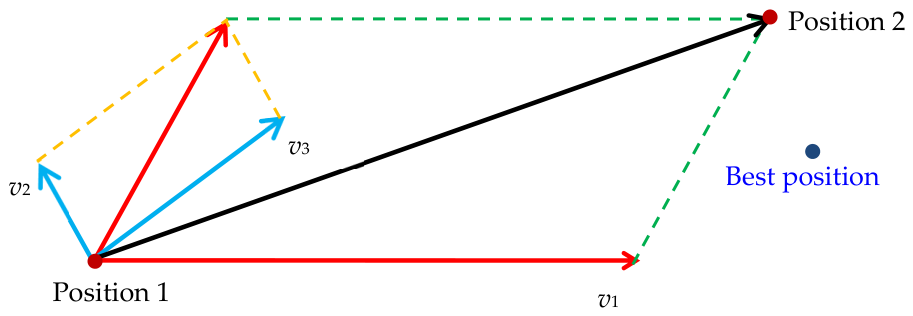
Particle swarm optimization (PSO) is a heuristic optimization algorithm inspired by the collective behavior of social animals, such as bird flocks and fish schools. It aims to achieve optimization through information exchange and cooperation among particles. PSO was initially developed in 1995 by James Kennedy and Russell Eberhart to address optimization problems, particularly those pertaining to continuous optimization. The algorithm searches for the optimal solution by simulating the movement of individual particles within the solution space. PSO has several advantages, including simple implementation, a relatively low tendency to become trapped in local optima, and strong global search capability. Campanan et al. [
19] introduced two optimization algorithms: derivative free PSO and a filled function based algorithm. The principal aim of these algorithms is to minimize the thrust and sinkage of a ship navigating challenging wave conditions, thereby improving the overall efficiency and effectiveness of the optimization algorithm. Zhang et al. [
20] introduced an enhanced PSO algorithm coupled with the arbitrary shape deformation technique to modify the hull form. The findings demonstrate that this optimization methodology significantly reduces computational effort and can be effectively employed to optimize the hull form.
Accurate and efficient seakeeping assessment methods are essential for objective function evaluation in hull-form optimization. Over the past several decades, numerical analyses and ship motion calculations in waves have evolved from two-dimensional (2D) methods [
21,
22,
23,
24,
25,
26] to three-dimensional (3D) methods [
27,
28] and from linear formulations to nonlinear approaches [
29,
30]. In recent years, computational fluid dynamics (CFD) methods have been increasingly adopted for seakeeping analysis [
31]. Kim et al. [
32] investigated the motion responses of KVLCC2 and its modified hull forms in regular head waves using the unsteady Reynolds-averaged Navier-Stokes (URANS) method. Lee et al. [
33] selected four representative ship types as test models: an LNG ship, an oil tanker, a container ship, and a bulk carrier.
Moreover, four numerical approaches were employed for seakeeping analysis: the asymptotic formulation, two-dimensional (2D) strip theory, the three-dimensional (3D) surface element method, and computational fluid dynamics (CFD). These methods were evaluated to assess their accuracy and reliability. Jiao et al. [
34] proposed a 2.5-dimensional seakeeping algorithm based on an improved strip-theory formulation. The numerical predictions of the algorithm were validated through model tests conducted in both regular and irregular waves in a towing tank.
However, a mere calculation of a ship response amplitude operator (RAO) is insufficient as an objective function. Because seakeeping optimization may involve several response indicators, the construction of an efficient objective function remains a key issue. Some recent studies have attempted to simplify this problem by using indirect or surrogate indicators. For example, Iqbal et al. [
35] introduced the pitch radius of gyration
Ry as a single-objective indicator for improving seakeeping performance and evaluated its applicability for different hull types. Their results indicated that minimizing
Ry can contribute to reducing vertical motion responses for certain hull forms, although such an indirect indicator cannot replace a full seakeeping analysis. This highlights the need for an objective-function formulation that is computationally efficient while still directly connected to the calculated motion responses. Consequently, a model that can effectively predict a ship’s motion responses in waves is essential for constructing reliable objective functions [
17,
36]. Sayli et al. [
37,
38,
39,
40] developed linear and nonlinear regression models to describe the relationship between hull-form parameters and ship seakeeping performance. These models were established through multiple regression analysis using a Mediterranean fishing vessel as the research object, and both models achieved satisfactory prediction accuracy. Petranovic et al. [
41] conducted multiple linear regression analyses based on three seakeeping methods to examine the relationship between the analyzed principal parameters and the frequency-independent model error of CFD. Cakici and Aydin [
42] developed three regression models to investigate how the geometric characteristics of a sloop affect its motion responses. The obtained results provide practical methods for seakeeping prediction. More broadly, data-driven [
43] and optimization-based decision frameworks [
44] have been increasingly applied in maritime and engineering systems.
In this study, a parametric hull-form deformation method is proposed to vary the block coefficient of the ship hull. A new combination of principal dimensions is also introduced for seakeeping-oriented hull-form optimization. The ship motion responses in waves are calculated using strip theory, which provides the basis for the subsequent optimization framework. Hull-form deformation is performed according to the principal dimensions and block coefficient of the ship.
In the present study, the optimization objective is constructed directly from the calculated heave and pitch response amplitude operators (RAOs), rather than from an indirect seakeeping indicator. A hull-form database and a seakeeping database are established by varying the principal hull dimensions and the block coefficient of the modified Wigley hull. Based on these data, a multivariate linear regression model is developed to approximate the relationship between the selected hull-form parameters and the heave and pitch RAOs. This regression model is then used as a computationally efficient surrogate objective function in the PSO-based hull-form optimization procedure.
The remainder of this paper is organized as follows.
Section 2 describes the application of strip theory to calculate the motion responses of a ship in regular waves.
Section 3 presents the development of the multivariate linear regression model for the heave and pitch RAOs.
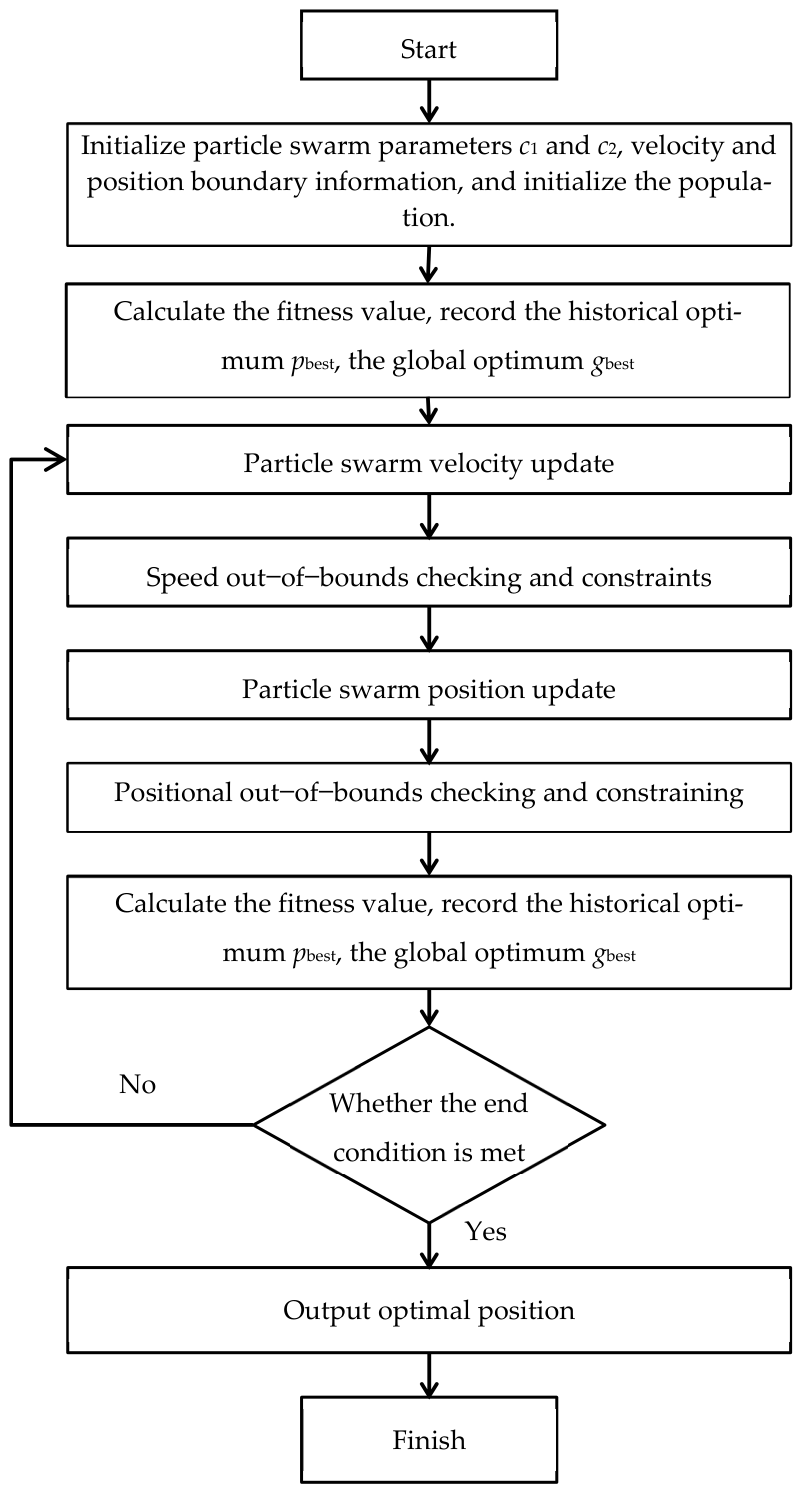
Section 4 introduces the hull-geometry deformation method and the PSO algorithm. The results and discussions are presented in
Section 5. Finally, the main conclusions of this study are summarized.
2. Seakeeping Analysis
2.1. Equations of Motion
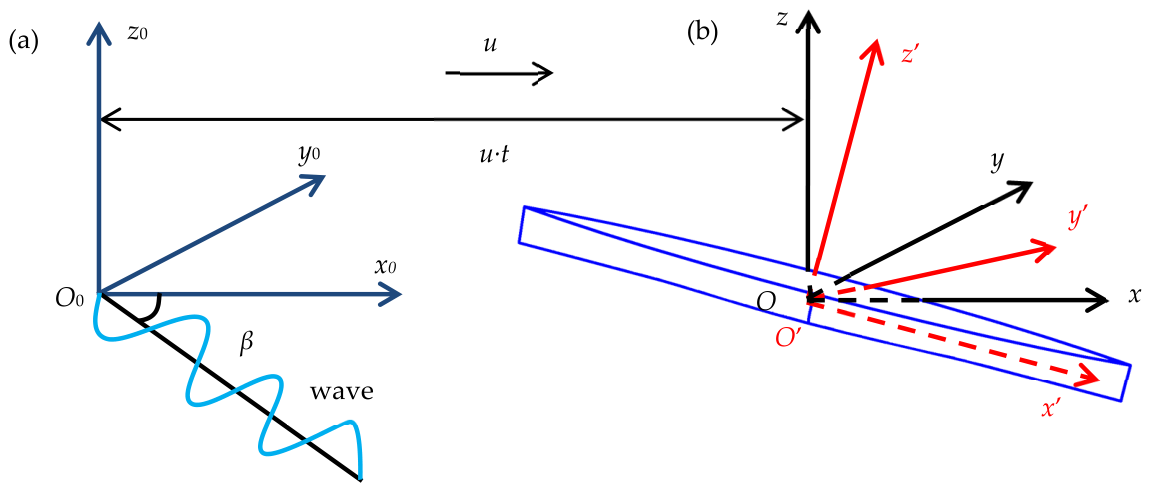
The analysis of ship motions in waves commonly involves three coordinate systems. The first coordinate system, denoted as
O0-
x0-
y0-
z0, is fixed in the inertial space and is independent of both fluid and ship motions. A schematic diagram of this coordinate system is shown in
Figure 1a. The
O0-
x0-
y0 plane coincides with the mean free surface, and the
z0-axis points vertically upward. This space-fixed coordinate system is particularly useful for describing incident wave characteristics.
The second coordinate system, denoted as
O-
x-
y-
z, is rigidly attached to the hull and moves with the ship. It is therefore referred to as the body-fixed coordinate system. The body-fixed coordinate system is shown in
Figure 1b. When the hull surface is described in this coordinate system, the hull-surface equations do not contain time-dependent parameters. For most conventional ships, particularly those symmetric about the longitudinal centerplane, the
x-axis is aligned with the ship centerline and points forward toward the bow. When the ship is in its equilibrium position, the
Oxy plane coincides with the calm-water surface, and the
z-axis points vertically upward, with the origin located at midship.
The third coordinate system, denoted as
O’-
x’-
y’-
z’, coincides with the body-fixed coordinate system
O-
x-
y-
z when the ship is in its equilibrium position. However, unlike the body-fixed coordinate system,
O’-
x’-
y’-
z’ does not move with the ship’s oscillatory motions but remains fixed at the equilibrium position. For a ship advancing at a constant forward speed, this coordinate system translates with the ship at its mean forward speed. Therefore,
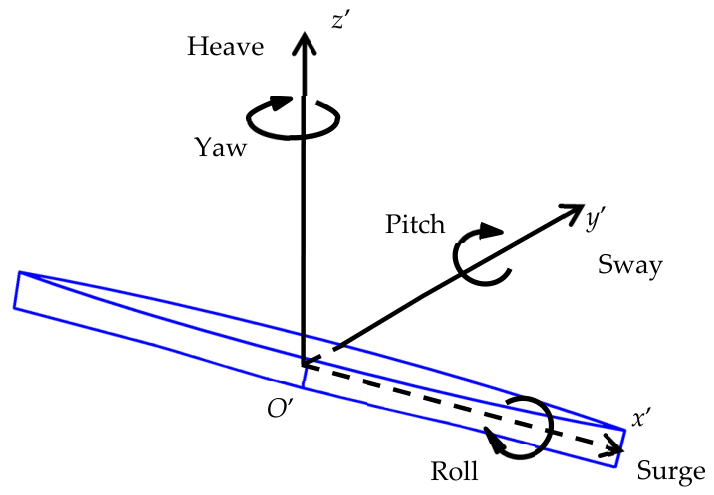
O’-
x’-
y’-
z’ serves as a reference coordinate system for describing the ship’s oscillatory displacements and attitudes, as shown in
Figure 1b.
The present study focuses on the coupled ship motions in heave and pitch. Here, heave refers to the translational motion along the vertical (
z)-axis, while pitch denotes the rotational motion about the transverse (
y)-axis. The directions of the heave and pitch motions are illustrated in
Figure 2. The corresponding equations of motion are given as follows:
The terms in the equation depend on several factors, including the hull form, principal dimensions, oscillation frequency, ship speed, wavelength, and encounter angle between the ship and the incident waves. Therefore, for a given ship, the hydrodynamic coefficients in Equation (1) can be accurately determined. The motion amplitudes can then be obtained by solving the corresponding matrix equation, thereby yielding the response amplitude operators (RAOs) of the ship’s oscillatory motions.
The above equation also theoretically indicates that the motion amplitudes of a ship in waves can be modified by changing the hull-form coefficients and principal dimensions. This provides a theoretical basis for subsequent ship-design optimization, enabling the motion responses of a ship to be adapted to its operating environment.
2.2. Strip Theory
To begin the process of solving the equations of motion in
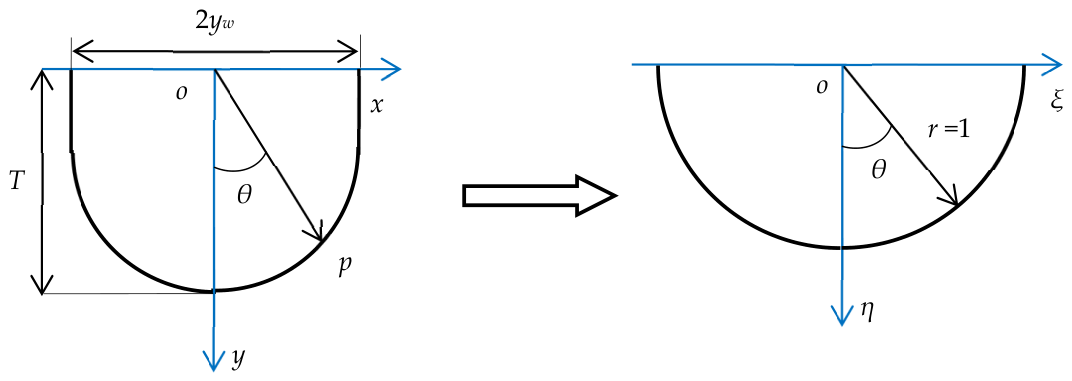
Section 2.1, it is necessary to first obtain the coefficients that are contained inside the equations. In this study, the two-dimensional hydrodynamic coefficients of each hull section are first calculated using the Lewis conformal mapping method, as described in
Appendix A. These sectional hydrodynamic coefficients are then incorporated into the strip-theory framework and integrated along the ship length to obtain the three-dimensional hydrodynamic coefficients of the whole hull. Fundamentally, strip theory divides the hull into a finite number of two-dimensional transverse sections, based on the slender body assumption. It posits that for a significant portion of the ship body, the predominant flow is essentially confined to the transverse cross-section. Consequently, it simplifies the 3D flow around the ship hull into a 2D flow around individual cross-sections. After determining the fluid forces acting on each transverse section through 2D analysis, these forces are subsequently integrated along the longitudinal direction to obtain the total hydrodynamic forces on the ship body. To calculate the global additional mass and the damping coefficients, Gerritsma and Benkelman [
45] developed the method. The numerical formulation in this subsection is organized into three parts: the calculation of the three-dimensional added-mass and damping coefficients, the calculation of the hydrostatic restoring coefficients, and the calculation of the wave excitation force and moment.
First, the sectional added-mass and damping coefficients are integrated along the ship length to obtain the three-dimensional hydrodynamic coefficients required in the heave-pitch coupled equations of motion. Equations (3)–(10) give the corresponding added-mass and damping coefficients, including the diagonal terms associated with pure heave and pitch motions and the off-diagonal coupling terms between heave and pitch.
In Equations (3)–(10), a33 and b33 denote the two-dimensional sectional added-mass and damping coefficients, respectively. The coefficients A33, B33, A55, and B55 represent the three-dimensional added-mass and damping terms associated with heave and pitch motions. The coefficients A35, B35, A53, and B53 represent the coupling effects between heave and pitch. These coefficients are obtained by integrating the sectional hydrodynamic quantities along the longitudinal direction of the hull.
Second, the hydrostatic restoring coefficients are calculated from the waterplane geometry. These coefficients describe the restoring force and restoring moment generated by the hydrostatic pressure when the ship is displaced from its equilibrium position. The corresponding restoring coefficients are given by Equations (11)–(13).
In Equations (11)–(13), C33 denotes the heave restoring coefficient, C55 denotes the pitch restoring coefficient, and C35 and C53 denote the coupled restoring coefficients between heave and pitch.
Third, the wave excitation terms are calculated. Under the head-sea approximation, the incident waves are assumed to propagate along the longitudinal direction of the ship. In this condition, the dominant wave-induced responses considered in the present study are heave and pitch. The wave heave excitation force
F3 and the wave pitch excitation moment
M5 are decomposed into cosine and sine components, as given in Equations (14) and (15), respectively.
In Equations (14a)–(14c), F3c and F3s represent the cosine and sine components of the wave heave excitation force, and F3 is the resultant wave heave excitation force. Similarly, in Equations (15a)–(15c), M5c and M5s represent the cosine and sine components of the wave pitch excitation moment, and M5 is the resultant wave pitch excitation moment.
Through the above three steps, all coefficients and excitation terms required for the coupled heave-pitch equations of motion are obtained. This organization clarifies that Equations (3)–(10) are used to calculate the global hydrodynamic coefficients, Equations (11)–(13) are used to calculate the hydrostatic restoring coefficients, and Equations (14)–(15) are used to calculate the wave excitation force and moment.
2.3. Empirical Formulation for Ship Added Resistance
To estimate the added resistance of a ship advancing in head seas over a range of wavelengths, the following formulation is introduced:
For the added resistance of ships in short waves, Liu et al. [
46] proposed a new approximate formulation for estimating the short-wave added resistance:
By simplifying the aforementioned expression and incorporating representative design data for various ship types, the formula for estimating the added resistance in short waves can be derived as follows:
where
LE is the length of entrance of the considered waterline.
For the long-wave region, Jinkine and Ferdinande [
47] proposed a formulation for estimating the added resistance in regular head waves of arbitrary wavelength, which can be expressed as follows:
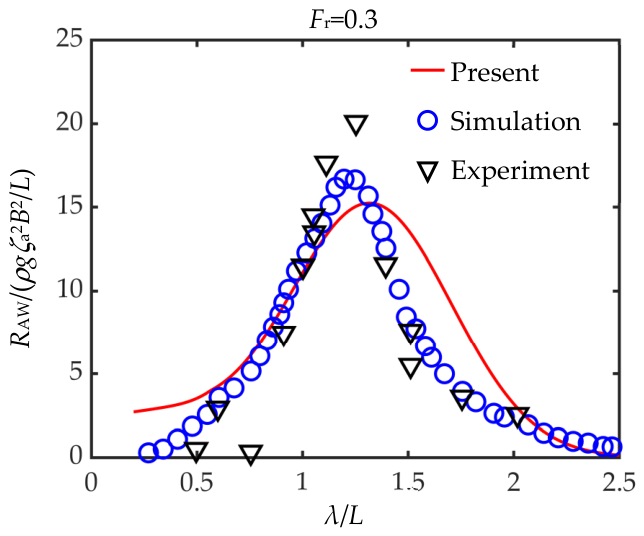
This formulation was derived from experimental data for fine-form, high-speed cargo ships. The main particulars of the Wigley III hull are provided in
Table 1. The two formulations were then applied to predict the added resistance of the ship, and the corresponding results are shown in
Figure 3. It can be observed from the figure that the present predictions are in good agreement with both numerical simulations and experimental measurements [
48]. Therefore, the proposed method can serve as a practical tool for assessing ship added resistance during the preliminary ship design stage.
3. Multivariate Linear Regression Analyses
In
Section 2, the heave and pitch motions of the ship are calculated using strip theory. The principal ship-scale parameters influence the motion responses indirectly through their effects on the mass properties, hydrostatic restoring coefficients, hydrodynamic added-mass and damping coefficients, and wave excitation terms. Thus, the relationship between the principal ship-scale parameters and the RAOs is not expressed as a direct analytical function of the design variables. For hull-form optimization, an explicit and computationally efficient approximation is desirable to relate the design variables to the seakeeping performance indices. Therefore, a multivariate linear regression model is employed as a surrogate model to approximate this relationship and to support efficient hull-form optimization for improved seakeeping performance.
One hundred hull forms that satisfy the constraints of the optimization strategy are generated and stored to establish a hull-form database. For each hull form, the heave and pitch motions are calculated using the method described in
Section 2, and the corresponding results are used to construct a seakeeping database. Based on multiple linear regression analysis, the functional relationship between the principal hull-form parameters and ship seakeeping performance is determined. This section presents the multiple linear regression method, which describes the relationship between two or more variables by fitting a linear equation. The resulting multiple linear regression equations are used as objective functions for hull-form optimization.
The least-squares method is used to derive the multiple linear regression equations. When estimating a dependent variable, two or more independent variables are commonly used instead of a single independent variable.
The multiple linear regression equation is expressed as follows:
where
P is an estimated dependent variable, and
x1,
x2, …,
xm are independent variables.
A1,
A2, …,
Am are regression coefficients that represent the proportion of contributions of each variable. Based on Equation (20), the independent variables
x1,
x2, …,
xm can provide an accurate representation of dependent variables
P via the determination of regression coefficients
A1,
A2, …,
Am.
When the dependent-variable number is
n, Equation (20) should be extended to a database by the following equation
where the subscript
m represents the independent-variable number,
xnm denotes the value of the
nth data of the
mth variable, and
Pn denotes the value of the dependent variable for the
nth set of data.
Equation (21) can also be written in the following form:
where
By solving Equation (22), the regression coefficient of the model can be obtained.
In the regression analysis, the optimization variables, including ship length, breadth, draft, and the morphing parameter, are used as independent variables, whereas the optimization objectives, namely, the heave RAO and pitch RAO, are used as dependent variables. The relationship between the optimization objectives and the design variables is then established by constructing multiple linear regression models.
5. Results and Discussion
5.1. Hydrodynamic Coefficient Calculation Results
According to the strip theory in
Section 2.2, the hydrodynamic coefficient of the ship at a designated speed is calculated. The ship structural parameters are shown in
Table 2. The Froude number
Fr = 0.3 is considered.
The dimensionless hydrodynamic coefficients for heave and pitch motions can be obtained as follows:
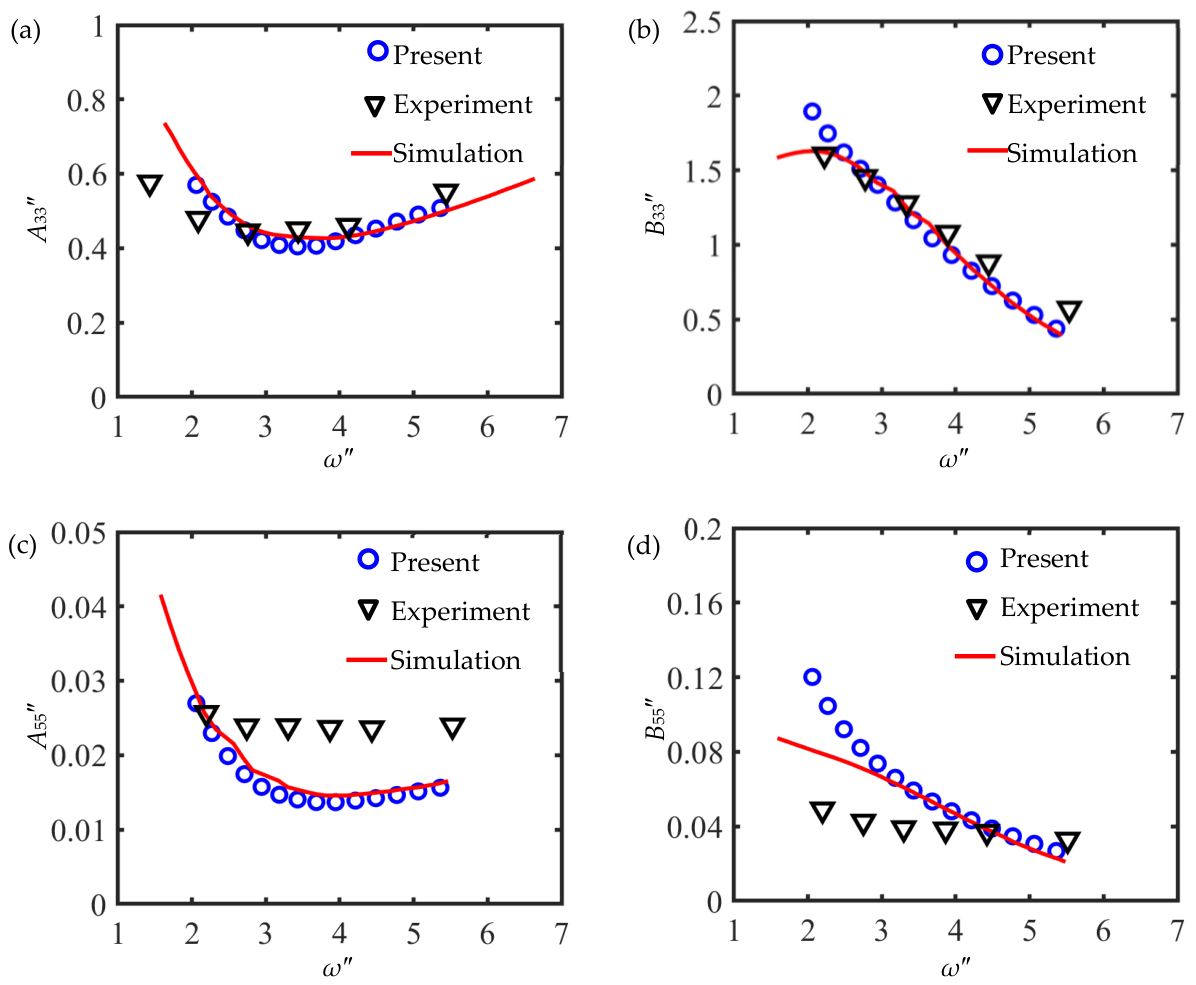
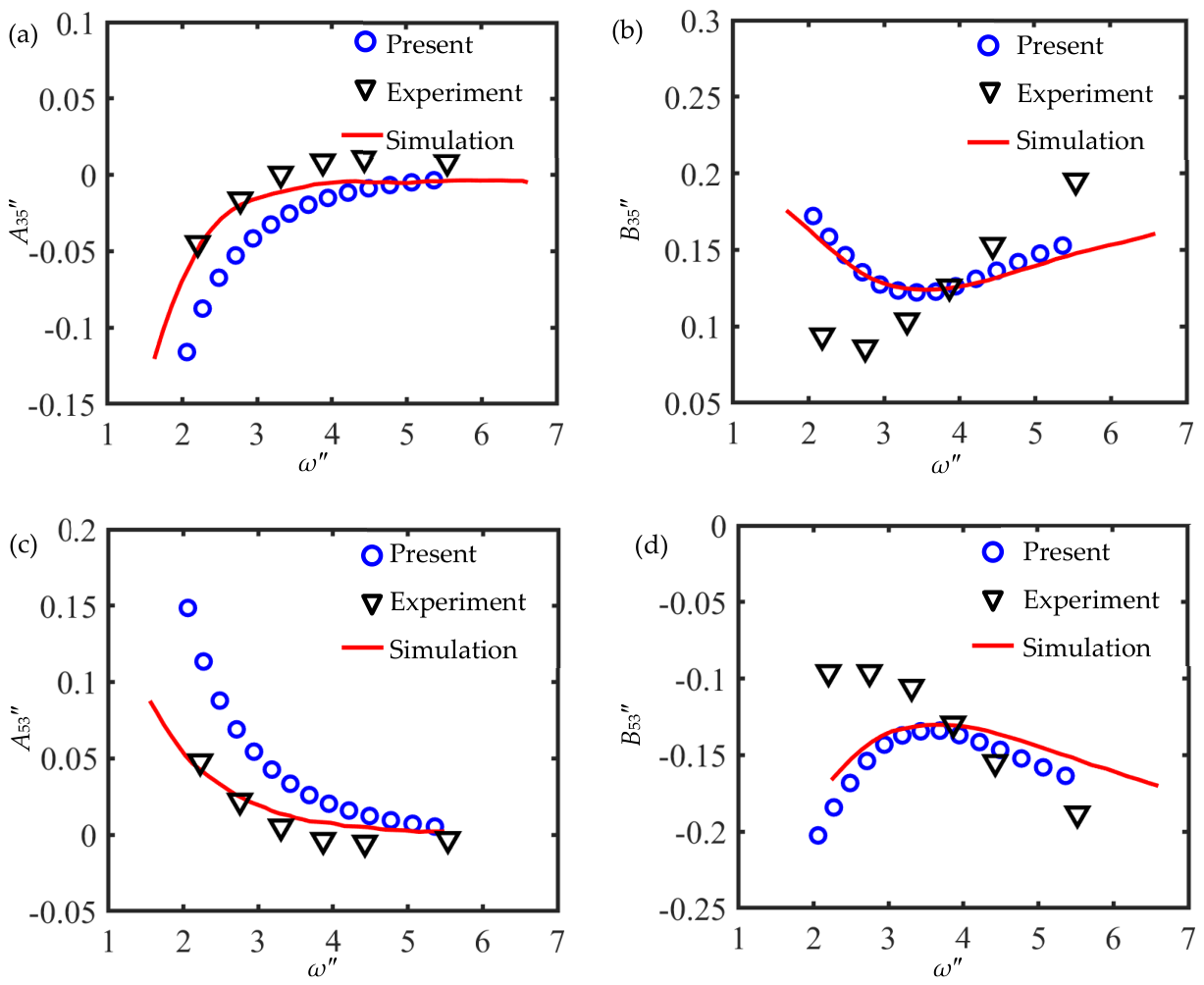
The diagonal and off-diagonal coefficients of the modified Wigley I model are shown in
Figure 7 and
Figure 8, respectively. The numerical results obtained using strip theory are compared with the experimental results of Gerritsma [
50] and the nonlinear time-domain strip-theory results reported by Bandyk [
51]. The comparison shows that the present numerical results agree well with those reported by Bandyk [
51], and only minor differences are observed between the calculated hydrodynamic coefficients and Gerritsma’s experimental results [
50]. The agreement in the high-frequency range is better than that in the low-frequency range. For longitudinal motions, the static restoring force dominates at low frequencies; therefore, the errors in the added-mass and damping coefficients have a limited influence on the motion calculations.
To provide a quantitative assessment of the agreement between the present results and the reference data, the mean absolute error (MAE) and the peak-normalized mean absolute error (NMAE) are introduced. The MAE represents the average magnitude of the absolute pointwise discrepancy between the present result and the reference data. To facilitate the comparison of errors among hydrodynamic quantities with different magnitude levels, the NMAE is adopted as a dimensionless error metric obtained by normalizing the MAE with respect to the maximum absolute value of the corresponding reference data.
As shown in
Table 3, the NMAE values of the diagonal hydrodynamic coefficients relative to the nonlinear time-domain numerical simulation results are all below 6%, indicating good agreement between the present calculations and the numerical simulation results. When the present results are compared with the experimental data, the NMAE values of
A33″and
B33″ are also relatively low, approximately 6%. However, the NMAE values of
A55″ and
B55″ reach 35.33% and 44.25%, respectively, indicating a relatively pronounced discrepancy when the mean error is normalized by the peak magnitude of the experimental reference data.
The error metrics for the off-diagonal coupled hydrodynamic coefficients are listed in
Table 4. Compared with the nonlinear numerical simulation results, the NMAE values of the coupled damping terms
B35″ and
B53″ obtained from the present calculations are 1.69% and 5.49%, respectively, indicating relatively low errors. In contrast, the normalized errors of
A35″ and
A53″ are larger, with NMAE values of 15.55% and 29.88%, respectively, relative to the numerical simulation results, and 37.77% and 51.76%, respectively, relative to the experimental data. This indicates that the off-diagonal added-mass terms are more sensitive to the low-frequency hydrodynamic behavior and to the relatively small peak magnitudes of the reference data. However, the lower errors observed for the coupled damping terms suggest that the discrepancies are not uniformly distributed across all coupled coefficients but are mainly concentrated in the coupled added-mass terms.
The results of the added mass and damping coefficients for heave and pitch can be observed in
Figure 7 and
Figure 8. The nonlinear time-domain method and the experimental results show more evident deviations from the present results in the low-frequency region, whereas better agreement is obtained in the high-frequency region. This behavior is related to the limitation of the conventional strip-theory formulation at low frequencies. Since the two-dimensional sectional hydrodynamic coefficients used in the strip-theory integration tend to increase as the oscillation frequency decreases, the resulting heave and pitch hydrodynamic coefficients may become excessively large in the low-frequency range. Therefore, the relatively large normalized errors in the pitch-related terms are mainly associated with the low-frequency behavior rather than a uniform deviation over the whole frequency range.
From the hydrodynamic coefficients of each profile, the dimensionless ratio of wave heave excitation force to wave amplitude (
F3″) and the ratio of wave heave excitation moment (
M5″) to wave amplitude are derived as
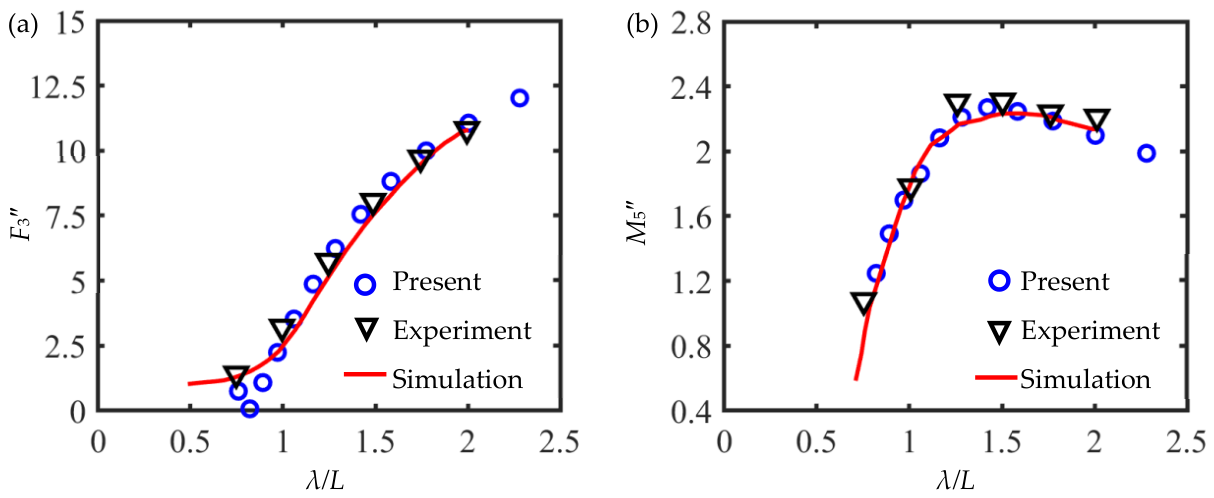
As depicted in
Figure 9, the general trends of both wave force and wave moment are consistent with the results of Gerritsma’s experiment [
50] and Bandyk’s nonlinear time-domain strip method [
51], demonstrating that the accuracy of the computation complies with the demands. The corresponding MAE and NMAE values are listed in
Table 5. For
F3″, the NMAE values of the present simulation results relative to the numerical simulation and experimental reference data are only 3.76% and 3.23%, respectively. For
M5″, the NMAE values relative to the two sets of reference data are 2.60% and 2.58%, respectively, which are low and nearly identical. Therefore, the present method can reproduce the main amplitudes and variation trends of the wave excitation quantities with good accuracy, while the larger discrepancies are mainly concentrated in the low-frequency hydrodynamic coefficients and the coupled added-mass terms.
5.2. Frequency Responses of Heave and Pitch
By substituting the hydrodynamic coefficients obtained in
Section 5.1 into the equations of motion established in
Section 2.1, the heave and pitch responses at each prescribed frequency were calculated using the frequency-domain complex-amplitude method. Under the assumption of linear harmonic motion, the coupled second-order equations of motion were transformed into a dynamic-stiffness matrix equation, from which the steady-state complex amplitudes of heave and pitch were directly obtained. In this calculation, the Froude number was set to
Fr = 0.3, and the frequency-dependent response amplitudes were evaluated over the considered wave-frequency range. The resulting complex amplitudes were then used to determine the corresponding heave and pitch response amplitude operators.
As an auxiliary internal consistency check of the frequency-domain solution procedure for the coupled heave-pitch equations of motion, the same set of governing equations was additionally solved using a time-domain integration method. In the frequency-domain approach, based on the assumption of a linear harmonic response, the second-order differential equations of motion were transformed into a dynamic-stiffness matrix form, from which the steady-state complex amplitudes at each frequency could be directly obtained. In the time-domain approach, the original equations of motion were integrated in time under the same hydrodynamic coefficients and wave-excitation conditions, and the steady-state response amplitudes were extracted after the decay of the initial transient response. The steady-state amplitudes obtained from the time-domain simulations were then non-dimensionalized as response amplitude operators (RAOs) and compared with those obtained from the frequency-domain solution. Since the governing equations are linear and the incident wave is harmonic, the steady-state response obtained from the time-domain integration is theoretically expected to be consistent with the direct frequency-domain solution. Therefore, the time-domain comparison is reported only as an internal check of the implementation of the coefficients, excitation terms, and coupled equations, rather than as an independent validation, an alternative method, or a scientific finding.
The dimensionless expressions for the heave and pitch motions of the ship are as follows:
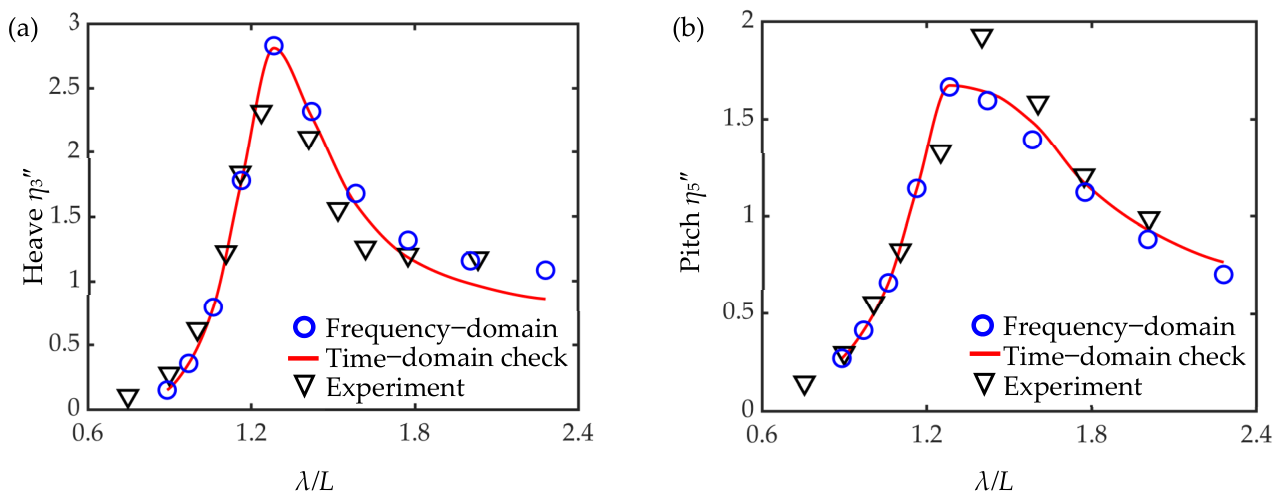
Figure 10 compares the frequency-domain RAOs, the auxiliary time-domain check results, and the experimental measurements for the modified Wigley I hull.
Table 6 lists the corresponding MAE and NMAE values of the heave and pitch RAOs. Compared with the frequency-domain solution, the MAE and NMAE of the time-domain heave response
η3″ are 0.0689 and 2.43%, respectively, while those of the pitch response
η5″ are 0.0303 and 1.81%, respectively. These low error levels indicate that the time-domain integration method is consistent with the frequency-domain complex-amplitude solution in terms of both response amplitude and frequency-dependent variation. In comparison with the experimental data, the MAE and NMAE are 0.1175 and 4.76% for the heave response and 0.0946 and 4.75% for the pitch response, respectively. Since the NMAE values relative to the experimental measurements are below 5%, the frequency-domain predictions show good agreement with the experimental results reported in reference [
50], which provides the validation of the present seakeeping calculation.
Compared with the relatively large discrepancies observed in some hydrodynamic coefficients, particularly the low-frequency hydrodynamic coefficients and the coupled added-mass terms, the final motion response errors remain relatively low. This indicates that the errors in individual hydrodynamic coefficients do not directly dominate the final heave and pitch responses. The motion responses are governed by the combined effects of added mass, damping, hydrostatic restoring coefficients, and wave excitation terms. Therefore, even though some hydrodynamic coefficients exhibit relatively large local deviations, the resulting heave and pitch RAOs still show good agreement with the experimental reference data [
50].
Since the governing equations are linear and the incident wave is harmonic, the frequency-domain complex-amplitude solution provides the steady-state response directly. Therefore, this direct frequency-domain solution was used to generate the seakeeping database and to evaluate the objective function in the optimization procedure.
5.3. Model for Ship Motion Responses
The section begins with the establishment of a hull form database and a seakeeping database in
Section 5.3.1. In
Section 5.3.2, the relationship between various hull size variables and ship seakeeping is elucidated, using the linear equation derived from the multiple linear regression analysis as discussed in
Section 3. This linear equation is then employed as the objective function of the optimization algorithm. A result comparison between the strip theory and the multiple linear regression model is displayed in
Section 5.3.3.
It should be noted that the linear regression model adopted in this study is not intended to replace the inherently nonlinear hydrodynamic relationship between hull geometry and ship motion. Instead, it is used as an explicit surrogate model for hull-form optimization within a limited and predefined design space. The motion responses used to construct the regression model were first calculated using strip theory under regular-wave conditions.
Meanwhile, the design variables, including length, breadth, draft, and the morphing parameter related to the block coefficient, were restricted within the prescribed variation ranges. The bounds of the principal dimensions
L,
B, and
T were selected with reference to previous studies on principal-dimension-based hull-form optimization and seakeeping sensitivity analysis [
3,
52]. In these studies, limited variations around a parent hull are commonly adopted to preserve the basic ship type and avoid unrealistic geometric changes. Therefore, the present study defines a local design space around the parent modified Wigley hull rather than a global ship-design space. These bounds also maintain the generated hulls within the slender displacement hull regime, which is consistent with the applicability range of the strip-theory based seakeeping calculation.
The range of the morphing parameter (C) was determined differently. It was not prescribed empirically but calculated from the geometric constraints used in the hull-form deformation process. In particular, the allowable variation of the block coefficient (Cb) and the maximum transverse displacement of the offset points were imposed as constraints. The lower and upper bounds of C were then obtained by applying these constraints to the morphing formulation. As a result, the selected range of C ensures that the deformed hull satisfies the required block coefficient range while avoiding excessive lateral distortion of the hull lines.
In this study, the stipulations require that any adjustments to the primary dimensions of the hull must not exceed 10% of the original measurements. Additionally, modifications to displacement must adhere to a range of 3% of the initial value. The variable ΔY represents the shape change of the ship along the y-axis, which cannot exceed 5% of the original shape lines. Therefore, within this controlled range, the linear regression model can be regarded as a first-order approximation of the relationship between the main hull-form parameters and the heave and pitch RAOs, providing a computationally efficient objective function for the subsequent optimization process.
5.3.1. Hull Form Database and Seakeeping Database
One hundred sets of ship hulls that meet the optimization strategy’s constraints are generated and stored to create a hull form database, with
Table 7 showing some of the hull parameters.
The ability to accurately forecast how the ship will react is the most important aspect of seakeeping performance analysis. The ship transfer function determines a portion of the response, and the excitation that the sea provides when the ship encounters it determines another portion. Head-sea conditions are considered in this study as a representative case for evaluating the longitudinal seakeeping responses of the monohull, particularly heave and pitch motions. These responses are used as the starting point for the present seakeeping analysis. The heave and pitch responses were computed using the strip theory in
Section 2, with the ship oriented to head into the sea at a speed corresponding to the Froude number
Fr = 0.3.
Table 8 and
Table 9 present the seakeeping database of ships, which has been calculated from ship models in the hull form database.
5.3.2. Multiple Linear Regression Equations for Heave and Pitch Motion
In order to establish multiple linear regression equations, it is essential to carefully select the key parameters from
Table 7. The seakeeping performance of a ship is closely related to its principal hull-form parameters. Therefore, in the multiple regression analysis, the principal hull-form parameters are used as independent variables, whereas the heave and pitch response amplitude operators (RAOs) are used as dependent variables. This enables the regression equations for heave and pitch to be established. The regression coefficients in the equations were then calculated using data from the hull form and seakeeping databases. The developed regression models are expressed as follows:
where
and
are the predicted values of the heave and pitch responses, respectively.
Ai and
Bi (
i = 1, 2, …, 4) are the regression coefficients of the heave and pitch linear regression model.
By solving Equations (39) and (40), the regression equation coefficients can be obtained and are listed in
Table 10 and
Table 11, allowing trade-off estimates of responses owing to simultaneous geometric variable variation.
The coefficient of determination,
R2, is a goodness-of-fit measure in multiple linear regression. Its maximum value is 1, and an
R2 value close to 1 indicates that the regression model fits the data well. Conversely, a low
R2 value indicates poor model fit.
Table 10 and
Table 11 present the
R2 values used to evaluate the fitting performance of the regression models. Based on these values, the linear regression analysis is considered adequate for the dependent variables, and most frequencies exhibit satisfactory goodness-of-fit results.
The regression coefficients listed in
Table 10 and
Table 11 provide an interpretation of how the hull-form variables affect the heave and pitch responses. In the present parameterization, the morphing parameter is mainly represented by the variation in the block coefficient (
Cb), which controls the fullness of the transverse sections and thereby changes the body-plan geometry of the hull. A smaller
Cb corresponds to a finer hull form, whereas a larger
Cb indicates a fuller hull form. According to the signs of the regression coefficients, the favorable geometric tendency for reducing both heave and pitch responses is to increase
L/
B and
B/
T while decreasing
Cb, as summarized in
Table 12. Therefore, the morphing process affects the final optimized hull by adjusting the fullness of the hull sections together with the principal dimensional ratios, resulting in a hull form with improved seakeeping performance.
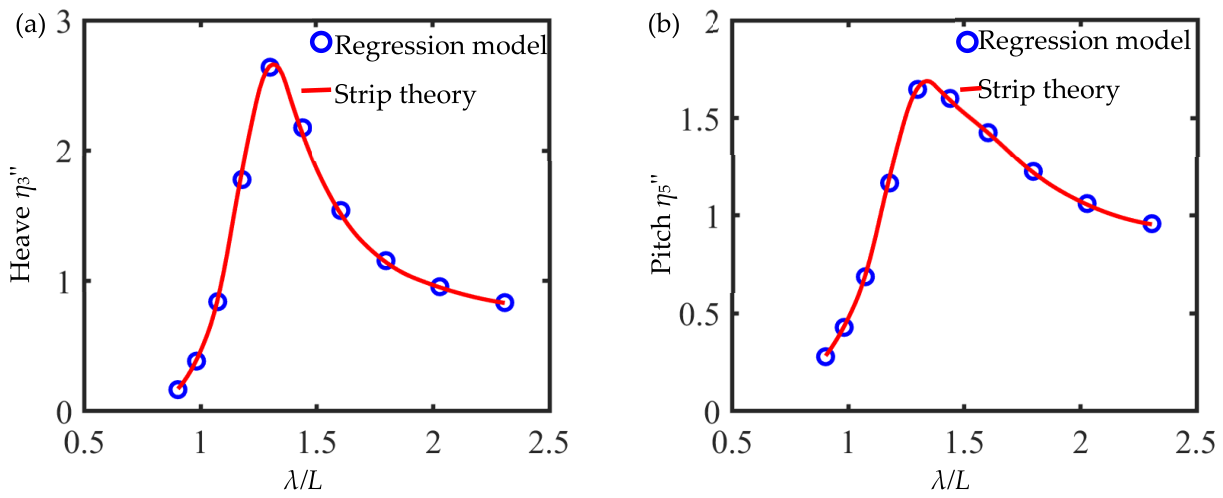
5.3.3. Comparison Between Strip Theory and Linear Regression Model
For the vessel V_010 in
Table 7, the comparison of the transfer functions of heave and pitch obtained by the strip theory and the linear regression model is depicted in
Figure 11a,b. The Froude number
Fr = 0.3, and the wave direction angle is 180°.
As shown in
Figure 11, for a given Froude number and encounter angle, the values predicted by the regression model are very close to those calculated using strip theory across all investigated wavelengths. This agreement validates the predictive capability of the linear regression model. However, the results obtained from strip-theory calculations cannot be directly used as the objective function in the optimization problem, because the functional relationship between the objective function and the design variables cannot be represented by a simple mathematical equation. Therefore, the linear regression model derived from the multiple linear regression analysis in
Section 3 is used as a practical objective function for the optimization strategy discussed in
Section 5.4.
5.4. Optimization Results
To improve seakeeping performance, the PSO algorithm is employed to optimize the principal hull-form parameters of the ship. The Wigley hull model is used as a case study to examine how the design variables, constraints, and objective function affect seakeeping performance. The optimization objective is to reduce the heave and pitch motions in waves by modifying the hull form. To this end, the previously developed linear regression model, as described in
Section 5.3.2, is used to obtain an explicit relationship between the response amplitude operators (RAOs) and the hull-form parameters. This explicit relationship is then used as the objective function in the PSO-based optimization procedure.
For ships with displacement and principal dimensions close to those of the parent hull form, the peak frequencies of the RAO curves generally show only small shifts. This characteristic has been confirmed through extensive numerical calculations and model tests. Therefore, instead of using a weighted combination of ship responses under different sea conditions, a simple merit criterion can be adopted for regular-wave seakeeping optimization.
In this study, the motion response at the wave frequency corresponding to the peak of the RAO curve is selected as the objective function. Head-sea conditions are considered at a single design speed corresponding to a Froude number of Fr = 0.3.
The ship type parameters requiring optimization include the ship length
L, breadth
B, draft
T, and the morphing parameter
C (which can change the block coefficient
Cb). The variation range of each parameters is shown in
Table 13. The constraints require that the change in displacement of the ship is kept to 3% of the original displacement and also that the displacement of the hull form along the
y-axis is limited to a 5% change. The detailed parameter settings used in the particle swarm optimization algorithm are summarized in
Table 14.
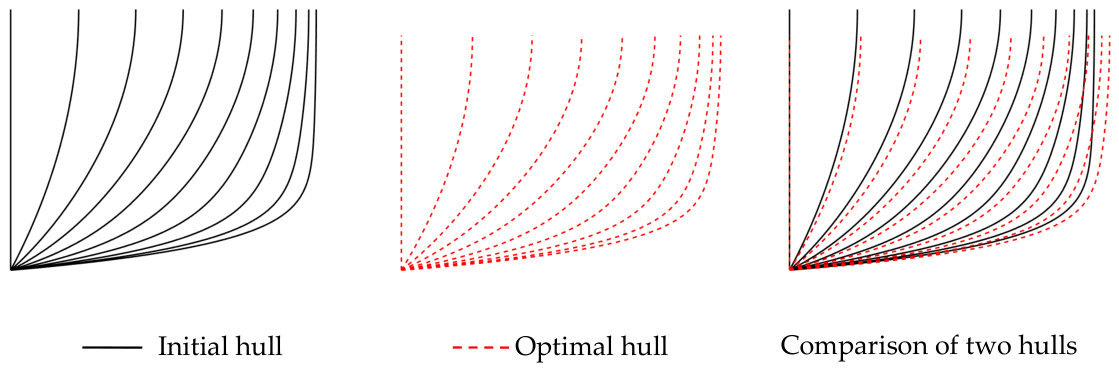
Figure 12 shows the body plans of the initial Wigley hull and the optimized hull form, represented by the solid and dashed lines, respectively. As shown in
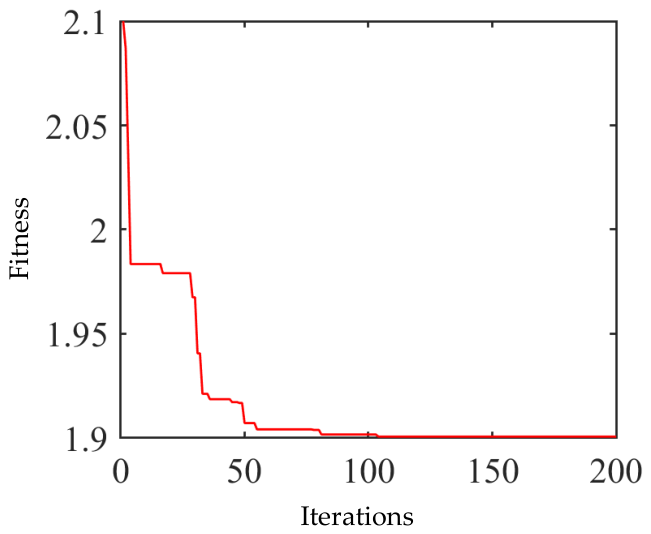
Figure 13, the fitness value decreases as the number of iterations increases, indicating that the PSO algorithm progressively optimizes the design variables until convergence is achieved. Finally, a set of optimized hull-form parameters satisfying all constraints is obtained.
The initial hull has been enhanced through the optimization process, which has resulted in a hull form that is sensible.
Table 15 presents the primary information on the parameter of both the initial and optimized hull shapes.
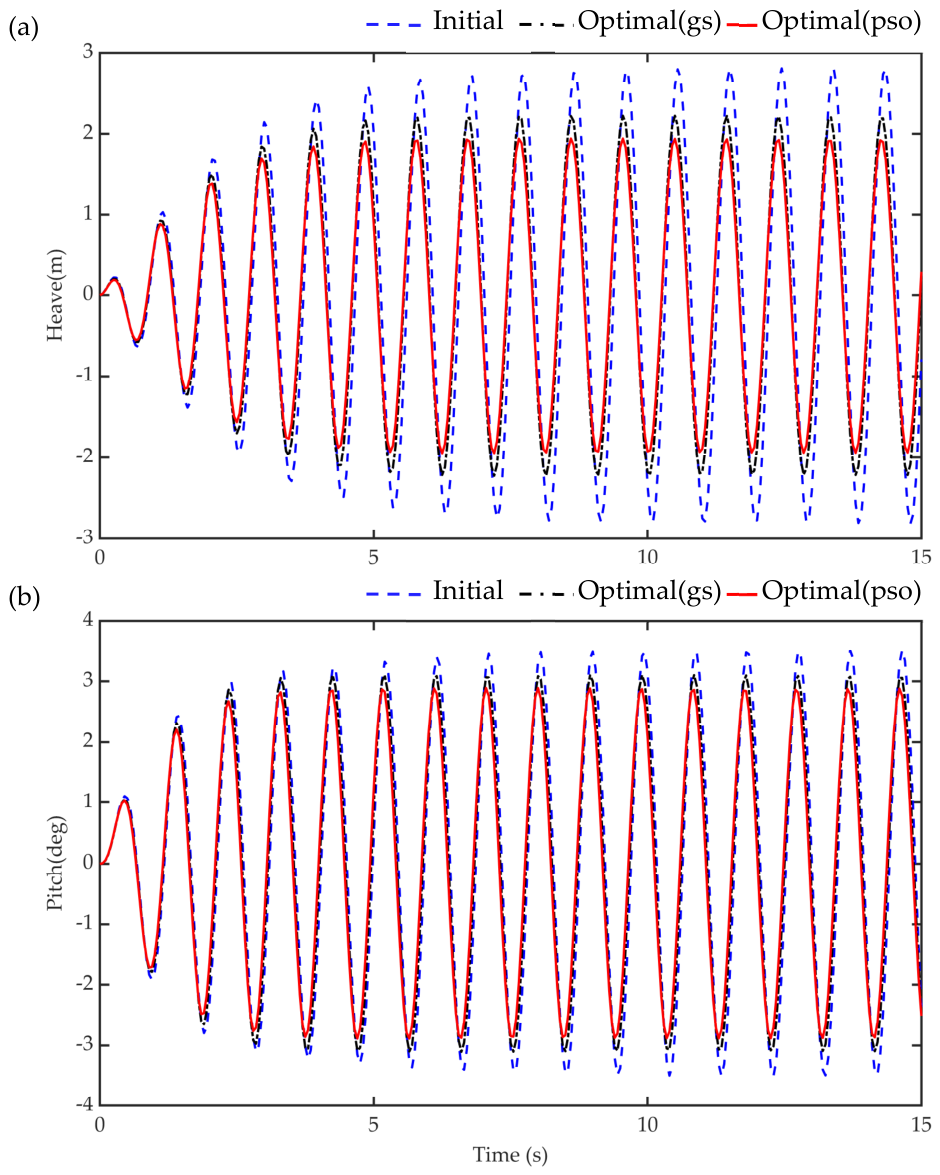
The motion responses of the initial hull and the optimized hulls obtained by global search (GS) and PSO were calculated under the same sea condition using strip theory, as shown in
Figure 14. The results show that both optimization methods reduce the heave and pitch responses compared with the initial hull. As summarized in
Table 16, the GS-optimized hull reduces the heave response by 21.2% and the pitch response by 11.7%, while the PSO-optimized hull achieves larger reductions of 31.1% and 17.9%, respectively. These results indicate that PSO provides better motion-response optimization performance than GS for the present hull-form optimization problem.
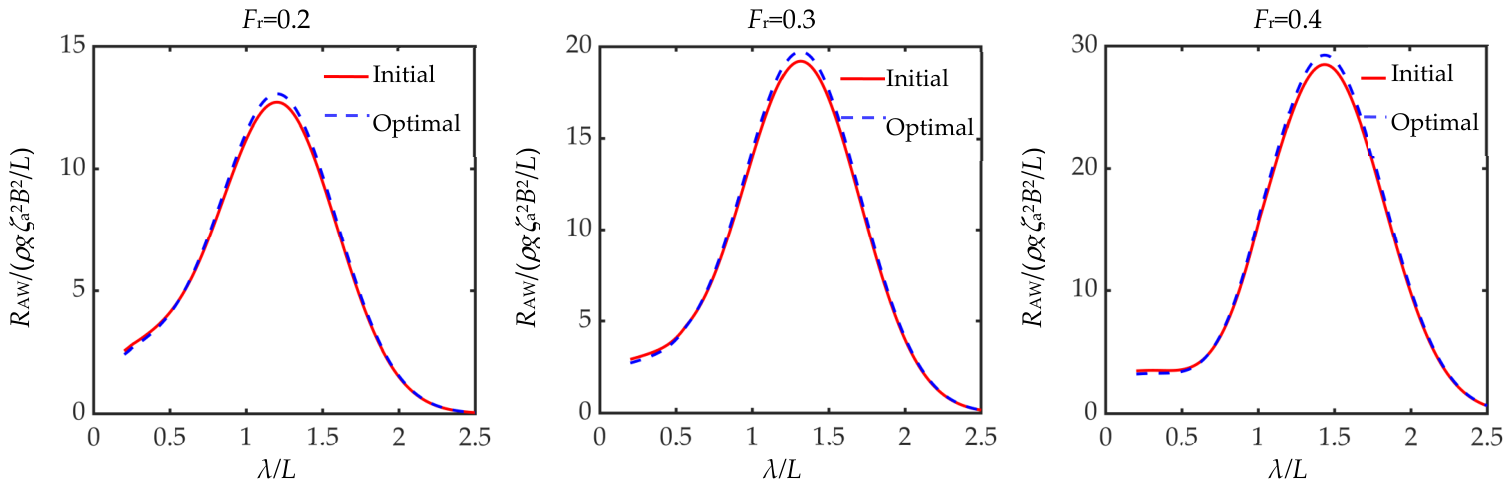
To further examine the effectiveness of the optimized hull under conditions beyond the baseline optimization case, additional seakeeping calculations were conducted for different ship speeds and encounter angles. In these comparisons, the optimized hull was not re-optimized for each operating condition. Instead, the hull form obtained from the original optimization procedure was directly evaluated under the additional conditions and compared with the initial hull. The peak values of the heave and pitch RAO curves within the investigated wavelength range were extracted as representative response indicators.
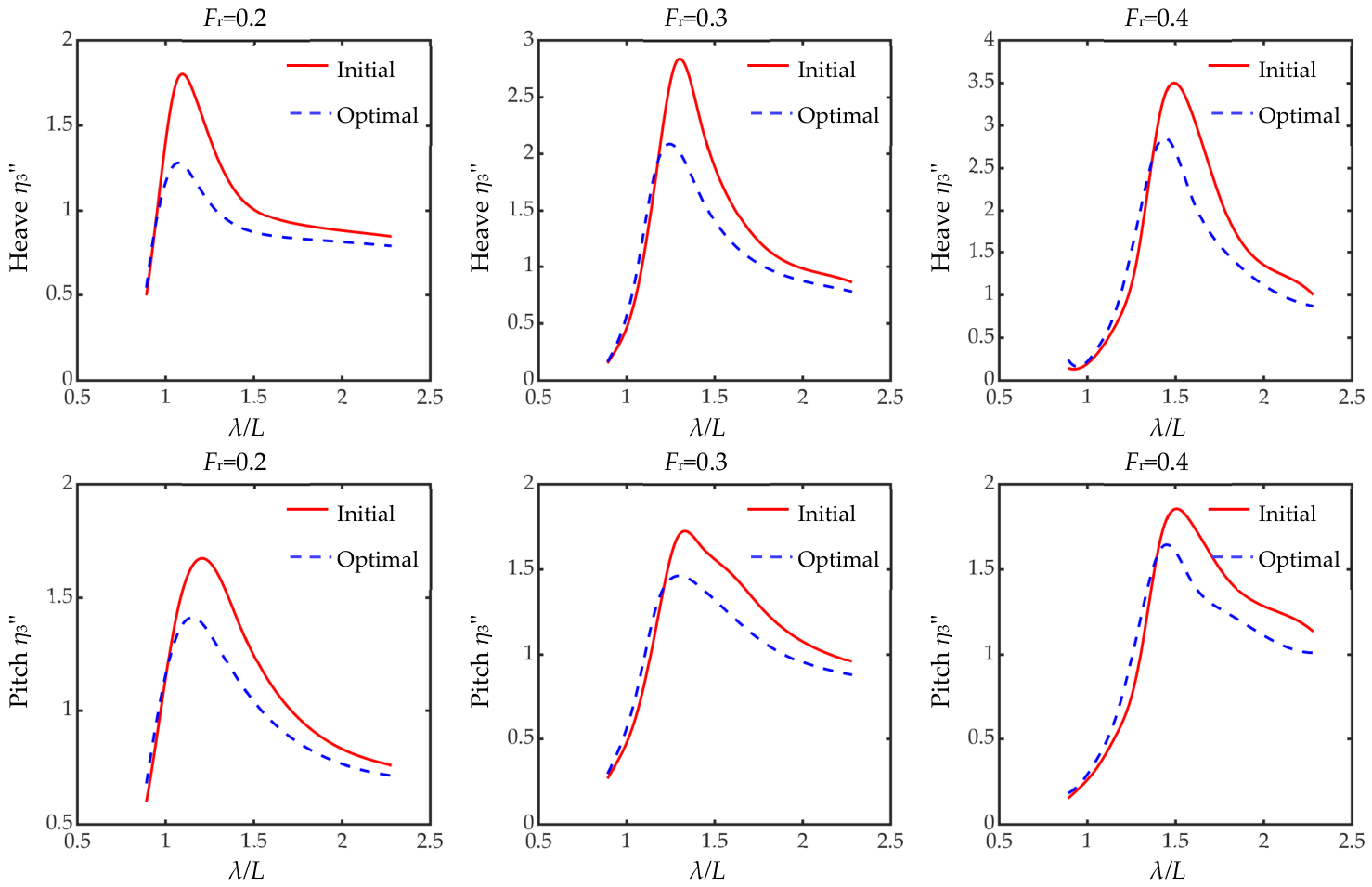
First, the influence of ship speed was examined under the head-sea condition (
β = 180°). Three Froude numbers,
Fr = 0.2,
Fr = 0.3, and
Fr = 0.4, were considered. The corresponding RAO curves are shown in
Figure 15, and the peak RAO values are summarized in
Table 17. Compared with the initial hull, the optimized hull reduces the peak heave RAO by 27.1%, 31.1%, and 11.6% at
Fr = 0.2,
Fr = 0.3, and
Fr = 0.4, respectively. The corresponding reductions in peak pitch RAO are 13.9%, 17.9%, and 8.6%. These results indicate that the optimized hull maintains lower peak heave and pitch responses than the initial hull over the examined speed range.
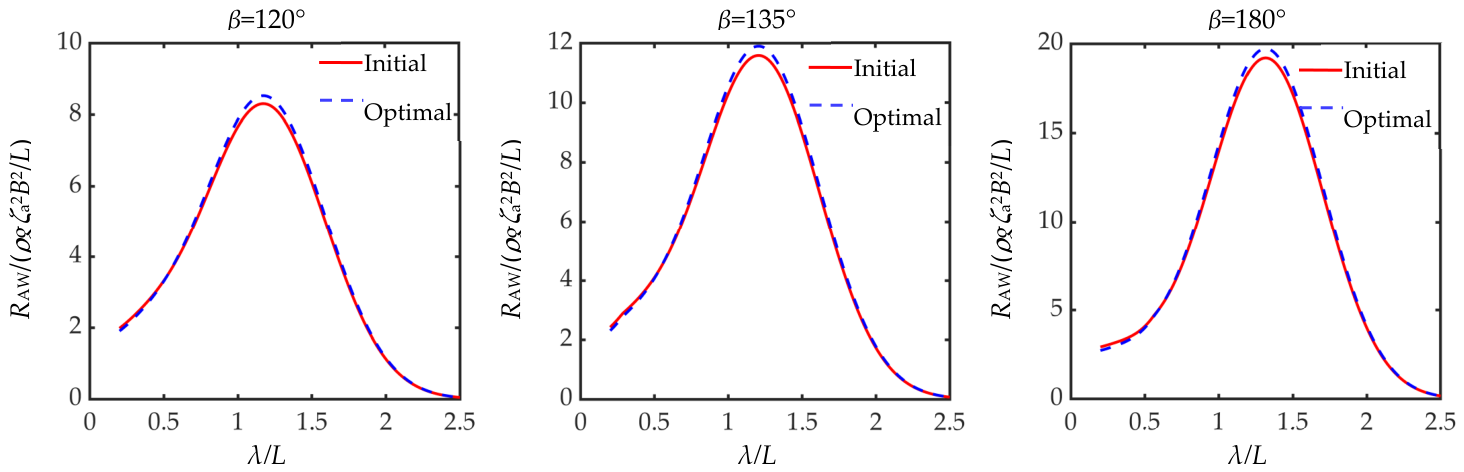
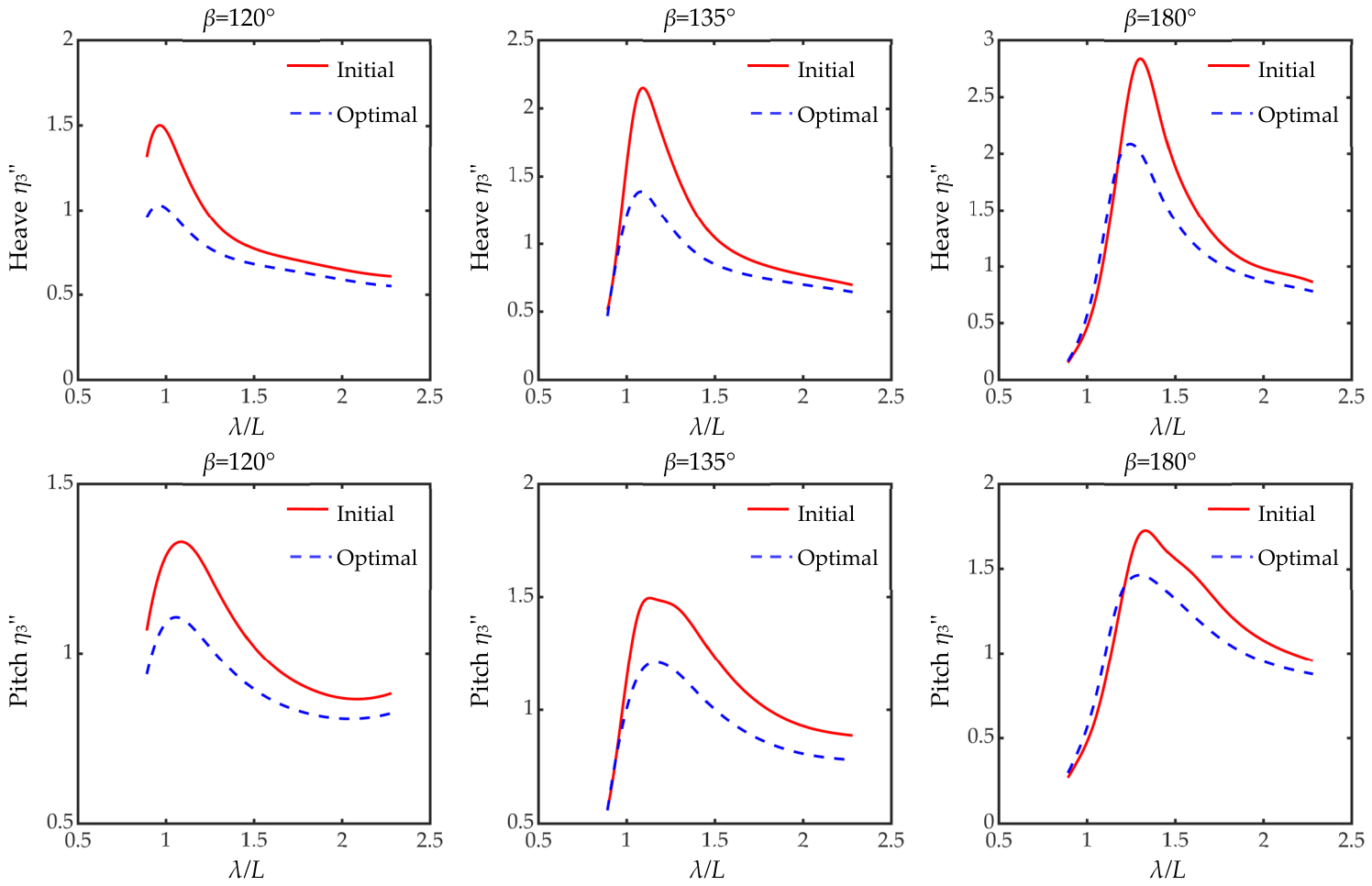
Second, the influence of encounter angle was investigated at
Fr = 0.3. Three encounter angles,
β = 120°,
β = 135°, and
β = 180°, were selected to assess the response of the optimized hull under oblique-wave and head-sea conditions. The RAO curves are presented in
Figure 16, and the corresponding peak values are listed in
Table 18. The optimized hull reduces the peak heave RAO by 31.5%, 33.9%, and 31.1% at
β = 120°,
β = 135°, and
β = 180°, respectively. The peak pitch RAO is reduced by 16.5%, 18.8%, and 17.9% under the same encounter angles. These results show that the optimized hull also preserves its seakeeping advantage under the examined wave-heading conditions.
Figure 17 and
Figure 18, together with
Table 19 and
Table 20, further illustrate the practical design trade-off associated with the optimized hull form. Although the optimized hull achieves improved seakeeping performance, it also results in a slight increase in added resistance. Under head-sea conditions, at
Fr = 0.2, 0.3, and 0.4, the peak added resistance increases from 12.7231 to 13.0659, from 19.2029 to 19.7220, and from 28.4964 to 29.2672, respectively. The corresponding percentage increase remains consistently around 2.7%. Similarly, for different encounter angles at
Fr = 0.3, the optimized hull shows only a slight increase in peak added resistance, ranging from 2.6% to 2.7%.
These results indicate that the reduction in motion responses is not achieved at the cost of a substantial resistance penalty. Instead, the optimized hull form leads to a relatively minor increase in added resistance while providing more pronounced improvements in vertical motion responses, particularly in heave and pitch. Therefore, from a practical design perspective, the proposed optimization represents a reasonable compromise: accepting a marginal increase in added resistance in exchange for a significant improvement in seakeeping performance. For ships operating in waves, this trade-off is acceptable, as the improved motion behavior contributes to enhanced operability, comfort, and safety.
Overall, the additional calculations demonstrate that the optimized hull form does not improve the seakeeping performance only under the baseline design condition but also maintains consistent advantages under the investigated regular-wave conditions with varying ship speeds and encounter angles. In terms of ship speed, the optimized hull shows lower peak heave and pitch RAOs than the initial hull at all examined Froude numbers. In terms of encounter angle, the optimized hull also exhibits reduced peak responses under both oblique-wave and head-sea conditions. These results indicate that the proposed optimization framework can effectively improve the heave and pitch responses of the hull within the considered operating range. The comparison further confirms that the optimized hull form provides a more favorable seakeeping performance than the initial hull, supporting the effectiveness of the regression-based objective function and the PSO-based hull-form optimization strategy adopted in this study.
6. Conclusions
In this paper, the heave and pitch RAOs of a modified Wigley hull are calculated using strip theory, and a regression-assisted PSO optimization framework is developed for hull-form optimization with seakeeping performance as the objective. The Lewis conformal mapping method is used to calculate the two-dimensional sectional hydrodynamic coefficients, and strip theory is then applied to obtain the global hydrodynamic coefficients and motion responses. A hull-form database and a seakeeping database are established, and a multivariate linear regression model is developed to approximate the relationship between the principal hull-form parameters and the heave and pitch RAOs. The regression model is then used as the objective function in the PSO optimization procedure. The main conclusions are as follows.
First, the strip-theory based seakeeping calculation provides reliable heave and pitch RAO predictions for the modified Wigley hull. The calculated RAO curves show good agreement with the reference experimental and numerical results, indicating that the adopted calculation method can meet the accuracy requirements for the preliminary seakeeping assessment of hull forms.
Second, the proposed hull-form deformation method can effectively modify the principal dimensions and block coefficient of the Wigley hull while maintaining a physically reasonable hull geometry. By combining variations in ship length, breadth, draft, and block coefficient, the method expands the hull-form design space and provides feasible candidate hulls for seakeeping based optimization.
Third, the established multivariate linear regression model can accurately predict the heave and pitch RAOs within the investigated design space. The comparison between the regression model and strip-theory results shows that the prediction error remains within 5%. This confirms that the regression model can be used as an efficient surrogate objective function in the optimization process, reducing the need for repeated direct seakeeping calculations during hull-form optimization.
Fourth, the optimized hull form obtained using the PSO algorithm shows reduced peak heave and pitch responses under different ship speeds. Under head-sea conditions with Fr = 0.2, Fr = 0.3, and Fr = 0.4, the optimized hull reduces the peak heave RAO by 11.6–31.1% and the peak pitch RAO by 8.6–17.9% compared with the initial hull. These results indicate that the optimized hull maintains improved seakeeping performance over the investigated speed range.
Finally, the optimized hull also shows consistent improvements under different encounter angles. At Fr = 0.3, the peak heave RAO is reduced by 31.1–33.9%, and the peak pitch RAO is reduced by 16.5–18.8% for the examined encounter angles. These additional calculations indicate that the optimized hull form does not only improve the response at a single operating point but also maintains lower peak heave and pitch responses under the investigated regular wave conditions with varying ship speeds and encounter angles. Therefore, the proposed regression assisted PSO optimization framework provides an effective and computationally efficient approach for hull-form optimization with seakeeping performance as the design objective.
7. Future Work
Although this study demonstrates the feasibility of improving the heave and pitch responses of the Wigley hull using PSO optimization assisted by a linear regression model, several limitations remain and should be addressed in future work. First, the validation in this study primarily relies on comparisons with previously published numerical simulations and experimental data for the baseline Wigley hull. No dedicated experimental campaigns have been conducted for the optimized hull form. Therefore, future work will include towing tank tests of both the original and optimized hulls under representative regular and irregular wave conditions. The measured heave and pitch RAOs, added resistance, and response spectra will be compared with numerical predictions and surrogate model outputs, and uncertainty analysis will be introduced to quantitatively assess the reliability of the proposed optimization framework.
Second, the current hydrodynamic analysis is based on classical strip theory, which is effective and suitable for preliminary hull-form optimization but inevitably involves simplifying assumptions. In particular, nonlinear effects associated with extreme sea states, wave breaking, slamming, and deck wetness cannot be fully captured by the current linear formulation. Moreover, the present optimization focuses only on coupled heave and pitch motions, while other important seakeeping responses are not included in the objective function. Future research will extend the optimization framework by incorporating more accurate hydrodynamic solvers, such as three-dimensional potential flow methods, nonlinear time-domain simulations, and CFD based approaches. The model will also be expanded from the current two-degree-of-freedom formulation to a more comprehensive six-degree-of-freedom seakeeping analysis.
Finally, future optimizations will consider irregular wave spectra and multiple sea states that better represent actual operational conditions. Multi-objective optimization will be introduced to balance critical ship performance metrics, including seakeeping, added resistance, and stability. By combining experimental validation, nonlinear numerical simulations, and more comprehensive seakeeping metrics, the practical applicability and reliability of the proposed hull-form optimization approach can be further enhanced.