Article

Dynamical Precursors and Temporal Persistence of Environmental Forcing in Wave Overtopping at a Field-Scale Breakwater


1
Marine Information Technology Corp., Seoul 08507, Republic of Korea
2
Korea Hydrographic and Oceanographic Agency, Busan 08507, Republic of Korea
*
Author to whom correspondence should be addressed.
J. Mar. Sci. Eng. 2026, 14(12), 1130; https://doi.org/10.3390/jmse14121130 (registering DOI)
Submission received: 2 May 2026 / Revised: 5 June 2026 / Accepted: 16 June 2026 / Published: 19 June 2026
(This article belongs to the Section Coastal Engineering)

Abstract

Wave overtopping is one of the most complex coastal hazards to characterize in field conditions due to its high non-linearity and the interaction between unsteady hydrodynamics and wave–structure processes. To get insights into the underlying occurrence and persistence of overtopping, this study proposes an integration of numerical and data-driven models. Multi-month field observations made at a breakwater are used to investigate the hydro-meteorological parameters causing overtopping initiation and persistence. High-frequency video-derived overtopping detections are combined with coupled ADCIRC–UnSWAN (ADvanced CIRCulation–Unstructured Simulating WAves Nearshore) hindcasts to construct near-structure hydro-meteorological conditions. The results reveal a clear dynamical asymmetry showing that overtopping initiation corresponds to exceedance of crest elevation at individual wave-scale associated with elevated wave height, water level, wave steepness, and wind characteristics, whereas overtopping persistence depends on short-term temporal effects associated with wave energy, direction, and sustained water levels. Gradient-boosted decision trees, temporal convolutional networks, and Transformer models are employed, demonstrating that persistence cannot be inferred from instantaneous sea-states alone, indicating a separation of timescales between triggering and sustained overtopping dynamics. These findings provide field-scale evidence of distinct hydrodynamic regimes governing overtopping processes, highlighting the importance of temporal characteristics for understanding overtopping dynamics and developing predictive coastal hazard frameworks.

1. Introduction

Wave overtopping poses a significant threat to the safety of pedestrians and to coastal defenses [1]. Accurate prediction of wave overtopping at coastal structures is a major challenge due to the nonlinear wave–structure interaction characterized by intermittent, threshold-driven responses and short-term hydro-meteorological dynamic data under natural forcing. The complexity arises from wave transformation, breaking, local reflection, and tide-driven water level variability affecting the overtopping probability of an individual wave at a given structure [2].
Existing prediction methods largely rely on empirical formulations such as EurOtop [3], numerical models [4] and physical models [5] that simplify nearshore wave transformation, resulting in overtopping prediction uncertainties when applied to site-specific environments. Empirical formulas are limited by assumptions about structure geometry and local wave conditions; numerical models require simplified parameterizations of wind, breaking, and nearshore processes and are often too computationally expensive for real-time use, while physical model testing is constrained by high cost and scalability. Together, these limitations underscore the need for new approaches that integrate overtopping physics with operational feasibility.
In recent years, machine learning (ML) surrogates have attracted increasing attention as potential alternatives or complements to empirical and numerical prediction frameworks for coastal engineering problems. ML models have been employed for both overtopping prediction [6,7,8,9] and coastal structures’ design optimization [10]. The readers are referred to Reference [11] for a review of the range of machine learning models applied for overtopping prediction between 2001 and 2021. These data-driven models have been demonstrated to approximate hydrodynamic responses with substantially reduced computational cost compared to numerical solvers [12]. While these studies illustrate the promise of ML in overtopping modeling, they are limited by their datasets developed under controlled conditions lacking real-world variability of wave-to-wave intermittency that characterizes overtopping in the field. Furthermore, most existing approaches emphasize predictive skill rather than using data-driven analysis to gain insights into underlying dynamical mechanisms governing overtopping. As noted in Reference [13], prediction and detection of individual overtopping events remain challenging due to a lack of robust techniques.
Beyond ML applications for overtopping discharge [6,9], recent studies have explored the use of operational METOCEAN variables and sensor-based datasets for overtopping detection or hazard assessment. ML models trained on high-resolution overtopping observations [14] can outperform traditional models by capturing nonlinear interactions among waves, water levels, and wind forcing [15]. While static ML models (e.g., decision trees and gradient boosting) have shown promising skill in classifying overtopping occurrence, as reported in recent overtopping studies [15], they rely on instantaneous predictor variables and do not explicitly incorporate the temporal evolution of sea-states leading to overtopping.
Parallel developments in video-based coastal monitoring further motivate the integration of field observations into overtopping prediction frameworks. Cameras are increasingly being used as tools for shoreline monitoring [16,17], EWS (Early Warning System) [18], and overtopping volume estimation [16,19], with recent studies demonstrating their utility for hazard evaluation and run-up analysis [8,20]. However, existing video-based studies primarily focus on run-up monitoring or beach hazard classification rather than overtopping prediction, and they seldom integrate video information with hydrodynamic measurements or numerical hindcasts. Meanwhile, coastal monitoring networks increasingly provide dense, multimodal time series data that presents an opportunity to develop sequence-aware prediction frameworks that explicitly model short-term temporal evolution while remaining computationally efficient for operational deployment. A recent study [8] trained deep learning classifiers on 3709 video-recorded overtopping events along with METOCEAN forecasts to predict hourly overtopping occurrence, treating overtopping as an instantaneous binary outcome; however, it did not represent short-term sea-state evolution that leads to overtopping. Another study applied Vision Transformer [21] to emulate CFD-generated overtopping flow fields, relying solely on synthetic post-overtopping data. These recent developments highlight the need for sequence-aware models capable of exploiting higher-frequency sea-state variability and multimodal field measurements.
These limitations reveal that there is a lack of long-term, field-based overtopping datasets that capture the full range of environmental variability encountered at real coastal structures. Second, current ML overtopping models are predominantly static, using instantaneous predictors and failing to represent the temporal evolution of hydrodynamic conditions that influence event onset. Third, there is no existing framework that integrates multimodal data including CCTV (Closed-Circuit Television) observations, in situ wave gauges, and numerical hindcasts. Fourth, existing ML studies generally target overtopping discharge or hydraulic intensities rather than overtopping occurrence and severity, which are more relevant for operational safety management.
In response to these limitations, this study investigates wave overtopping as a dynamical fluid–structure interaction process characterized by distinct temporal regimes. Data-driven models are employed to investigate underlying hydrodynamic mechanisms governing overtopping initiation and persistence. High-frequency CCTV-derived overtopping observations are integrated with coupled ADCIRC–UnSWAN (Advanced CIRCulation and Unstructured Simulating WAves Nearshore) hindcasts. Gradient-boosted decision trees (GBDTs) provide a strong baseline for static classification, while a temporal convolutional network (TCN) and a time-series Transformer (TF) model are developed to capture the hydrodynamic conditions preceding overtopping events. The proposed framework enables identification of timescale separation and regime transitions in field-scale wave overtopping, providing new physical insight into the processes governing overtopping occurrence and severity.

2. Data and Methodology

2.1. Study Site

The field investigation was conducted at the Yeondaepu breakwater (33°29′44″ N, 126°25′37″ E) on the northern coast of Jeju Island, South Korea. The site experiences a semidiurnal tidal regime, with a typical range of approximately 1.5 m during neap tides and up to 4.5 m during spring tides. Local wave conditions are dominated by northeastward incident waves, which generate higher energy and longer wave periods (5–12 s) during the winter season, while calm short-period waves prevail during summer. The combination of energetic seasonal waves and the breakwater’s direct exposure to the northern approach makes this site particularly susceptible to wave overtopping.
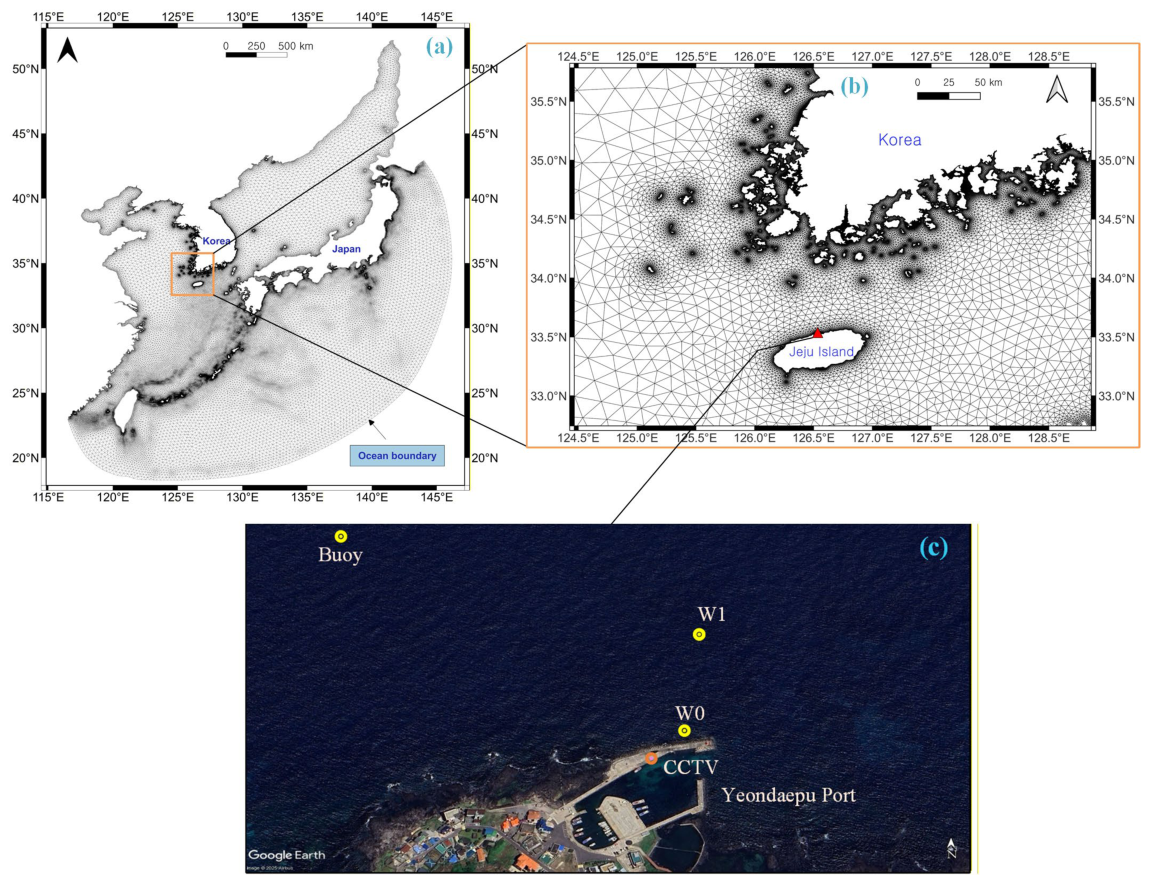
A high-definition CCTV system installed at the site for continuous monitoring of overtopping activity has been operational since 20 October 2024. The CCTV records at 30 frames s−1 with resolutions of 1920 × 1080 pixels. The CCTV operates continuously with short interruptions caused by occasional equipment malfunctions. Figure 1 shows the study site along with the locations of a CCTV camera and field wave gauges. All recorded footage is automatically transmitted to a central database for long-term storage and analysis. Further details of the monitoring layout and configuration are provided in Reference [22].

2.2. Field Wave Observation Gauges

A field monitoring system was deployed around the Yeondaepu breakwater to observe and record the nearshore hydrodynamic parameters that lead to wave overtopping. Two wave gauges were installed along near the breakwater, supplemented by external buoy and wind data for spatial validation. The first gauge (W0) was a pressure-type AAT sensor installed at a depth of approximately 6 m (33°29′49″ N, 126°25′37″ E), while the second gauge (W1) was an Acoustic Doppler Current Profiler (ADCP) positioned at 15 m depth (33°29′57″ N, 126°25′38″ E), roughly 365 m offshore from W0. Both instruments were mounted on tripod-type bottom frames (TRBMs) and configured for continuous data acquisition starting in October 2024. The data were processed to yield hourly observations of key wave characteristics, including significant wave height (Hs), peak wave period (Tp), and mean wave direction (Dp). Data continuity was generally high, except for short gaps caused by fishing activity, equipment loss, or temporary power interruptions.
To complement local measurements, offshore observations were obtained from the Gueom buoy (33°31′16″ N, 126°22′30″ E), operated by the Korea Meteorological Administration (KMA), at a water depth of approximately 90 m. The buoy provided continuous wave records for the comparison and validation of nearshore hydrodynamic observations. The location of the wave gauges and the buoy is depicted in Figure 1. Additionally, wind speed and direction data were retrieved from the Oedo Automatic Weather Station (AWS), located inland from Yeondaepu (33°28′37″ N, 126°25′54″ E). These multi-source datasets together provided a robust basis for correlating wind forcing with nearshore wave transformation and overtopping activity. Further details of the instrumentation and data acquisition setup are available in [22].

3. Modeling Framework

3.1. Numerical Model

Hydrodynamic and wave conditions were simulated using the coupled ADCIRC–UnSWAN modeling system on an unstructured mesh covering the regional shelf and nearshore zone of the study area (Figure 1). The ADCIRC model [23] solved the depth-integrated shallow-water equations including tidal, wind, and barometric forcing. Tidal boundary conditions incorporated eight harmonic constituents (M2, S2, N2, K1, O1, Q1, P1, and K2). Bottom friction was represented using a spatially varying Manning’s of 0.025–0.035, while lateral viscosity and Coriolis terms were activated. The model was run in non-stationary mode with a 1.0 s time step and a 20.0 min coupling interval. The unstructured mesh comprised 374,208 nodes and 697,109 elements, with spatial resolution varying from approximately 80 m in the nearshore zone and area of interest to tens of kilometers at the open ocean boundary. The UnSWAN spectral grid employed 36 directional bins and 30 frequency bins spanning 0.031–0.548 Hz.
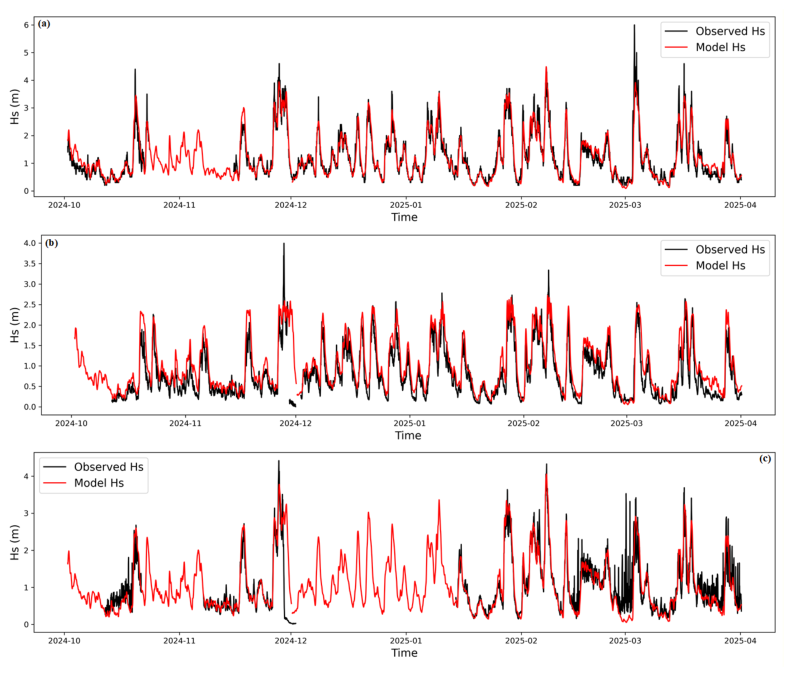
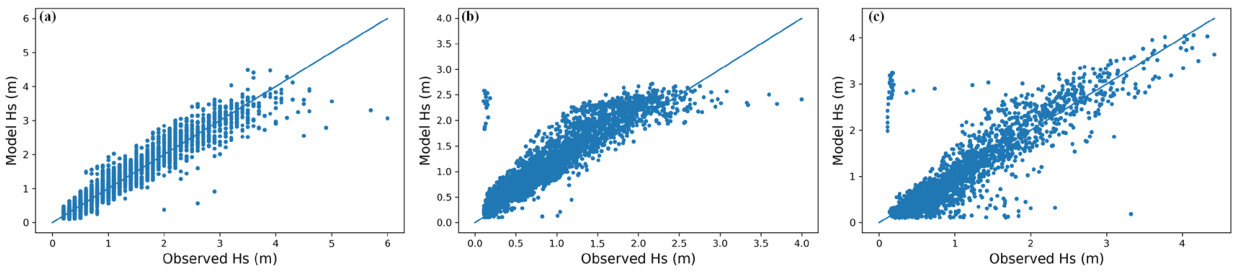
The UnSWAN spectral wave model [24] was coupled in two-way mode to account for radiation-stress feedbacks on water levels and currents. Simulations employed the third-generation [25] white-capping [26] and bottom-friction formulations, with triad and quadruplet nonlinear interactions activated. Wind and current forcing fields were provided from ADCIRC at 20 min intervals. This coupled model has been validated in several previous studies [27,28,29]. Model outputs included significant wave height (HSIG), mean and peak periods (TMM10 and RTP), mean and peak directions (DIR and PDIR), directional spreading (DSPR), water level (WATLEV), depth (DEPTH), near-surface current velocity (VEL), and wind vector (WIND). Additional diagnostic variables such as the breaking fraction (QB), breaker index (GAMMA), and wave steepness (STEEPNESS) were recorded every 20 min. Together these variables characterize the instantaneous forcing and short-term hydrodynamic state preceding overtopping. The coupled model was initialized from hot-start files and validated against in situ buoy and gauge measurements (W0 and W1) during the monitoring period (October 2024–March 2025), providing continuous hindcast fields used for comparison with the field and video-based overtopping observations. Figure 2 and Figure 3 show a qualitative comparison of significant wave height between numerical model output and field observations through time-series comparison and scatterplots, respectively. The quantitative performance metrics of the validated data are summarized in Table 1, showing that the model hindcasts are in excellent agreement with field observations.

3.2. CCTV Footage

Continuous footage of the CCTV was manually reviewed to produce binary overtopping labels (0/1) at 1 HZ frequency. The labeling covered the period from 20 October 2024 (CCTV operational start) to 19 March 2025 (end of overtopping event season), during which 24 overtopping cases were identified and subsequently analyzed. Each case represents a storm-scale episode of elevated overtopping activity rather than continuous crest exceedance. Approximately 2.3 million frames (2.69 TB) were analyzed from which 53,506 overtopping seconds (1 s frames with visible overtopping) were detected and labeled. Overtopping was defined as the moment when the water jet or splash visibly exceeded the breakwater crest line, as verified by frame-by-frame inspection. For each case, the precise start and end times, total frame counts, and overtopping frame counts were archived as individual CSV (Comma-Separated Value) files. Video frames affected by fog, spray, glare, or camera motion were classified as non-overtopping. Night-time segments were manually reviewed frame-by-frame to confirm overtopping continuity under available ambient lighting. Intervals where overtopping visibility was lost due to darkness were marked as unusable and excluded from analysis. This procedure ensured consistent detection accuracy across varying lighting and weather conditions.
The individual storm durations ranged from approximately 2 h to 70 h, with an average duration of approximately 27 h per event. The total number of overtopping seconds within each case varied from single digits to nearly 9500 s per storm, corresponding to differences in both storm intensity and duration. The mean overtopping occurrence rate was approximately 57 s/h, while peak hourly overtopping rates averaged 202 s/h, reaching a maximum of 664 s/h during the most energetic event. These statistics (listed in Supplementary Table S1) indicate a wide dynamic range in overtopping behavior, from brief, low-activity events to prolonged periods of elevated overtopping activity occurring intermittently over multiple tidal cycles. Such variability reflects the influence of both storm severity and local hydrodynamic conditions at the breakwater, providing a robust basis for subsequent correlation and analyses.

3.3. ML Models

Three machine learning models of increasing temporal complexity are employed in this study. The first, a gradient-boosted decision tree (GBDT), uses only the current sea-state conditions to detect whether overtopping is occurring. The second and third, a temporal convolutional network (TCN) and a Transformer, additionally use the recent history of sea-state conditions to predict future overtopping. This hierarchy is designed to distinguish overtopping triggered by instantaneous threshold exceedance from overtopping sustained by the temporal evolution of forcing conditions.

3.3.1. Problem Formulation, Data Splits, and Evaluation Metrics

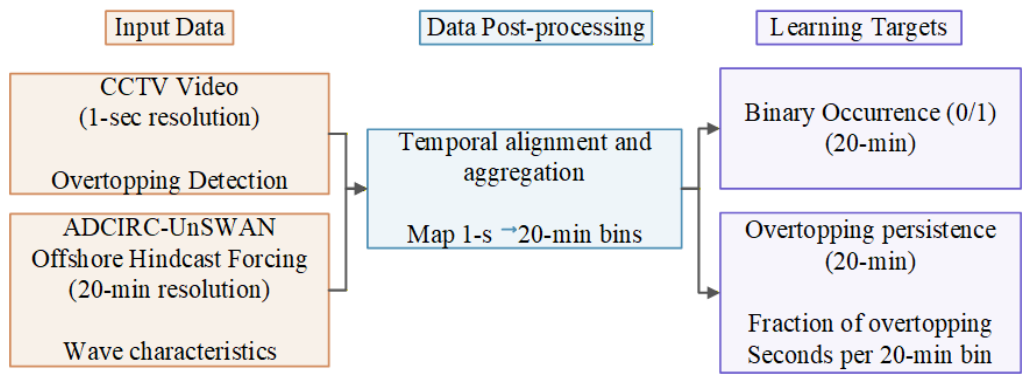
Wave overtopping prediction models were developed by integrating (i) coupled ADCIRC-SWAN hindcast outputs at 20 min resolution at three locations (W0, W1, and offshore buoy), and (ii) overtopping labels derived from CCTV observations originally annotated at 1 s resolution and subsequently aggregated to match the 20 min forcing interval. The integrated predictor variables consisted of wave height, direction, spectral characteristics, water level, velocity, wind components, wave breaking fraction, and wave steepness. Model inputs were restricted to overtopping detection through CCTV and numerical hindcast outputs; the in situ field observations of wave parameters were excluded to ensure that predictive skill reflects operational forecast capability rather than near-structure sensing. An overview of the input data streams and the construction of learning targets is shown in Figure 4.
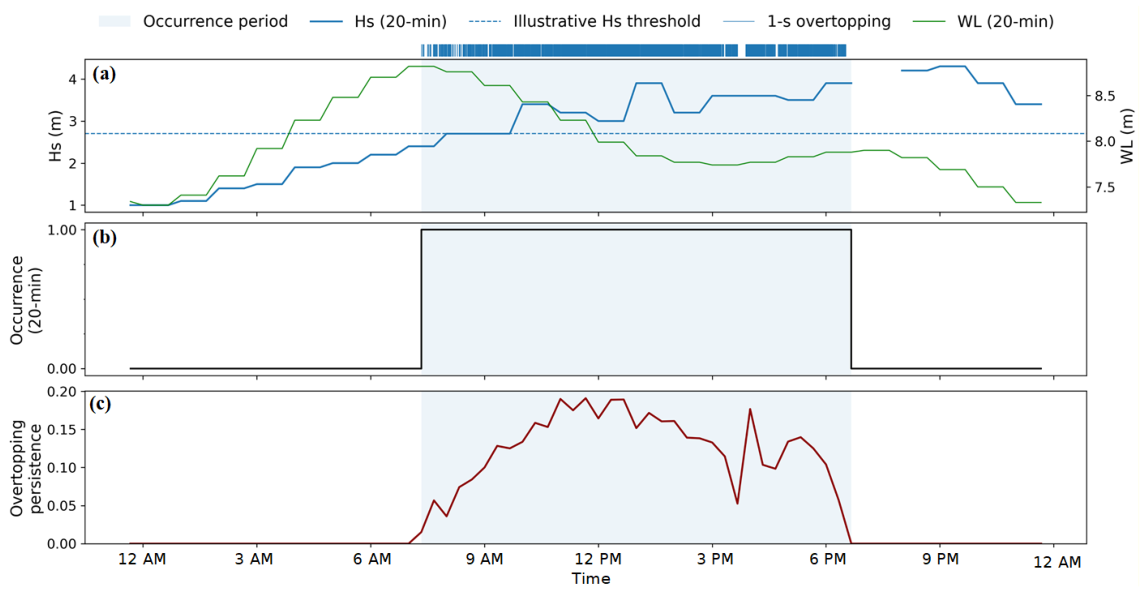
Two prediction targets were defined: (i) binary overtopping occurrence to indicate whether any overtopping occurred within a 20 min interval, and (ii) overtopping severity, which was defined as the fraction of overtopping seconds within each 20 min bin. The overtopping severity here refers to a temporal persistence rather than overtopping discharge or volume. This definition enables severity-oriented modeling without requiring overtopping discharge or volume measurements and is consistent with the video-based observational framework employed in this study. A forecasting setup was adopted using a historical input window of a sequence length (in 20 min steps), a lead time, and an optional future aggregation window for persistence-oriented targets. Data were split chronologically into training, validation, and test subsets to preserve temporal dependence and prevent information leakage across storm periods. For a demonstration of contrasting temporal behavior of overtopping occurrence with variation in significant wave height (Hs) and water level (WL), a sample overtopping event is shown in Figure 5. In Figure 5b, occurrence responds to instantaneous threshold exceedance while Figure 5c shows the evolution of overtopping persistence with the duration of sustained forcing. The individual 1 s overtopping detections derived from CCTV imagery are shown as a timing barcode at the top of the panel to indicate the temporal structure of overtopping within the event. It is evident from the figure that while overtopping occurrence is showing a continuous binary 1, the severity of overtopping within an event varies significantly, with short periods of non-overtopping within an event demonstrated by breaks in barcode and variations in persistence curve.
A notable feature of this event is the cessation of overtopping after approximately 18:00, despite a continued increase in Hs to nearly 4 m. This behavior reflects the joint dependence of overtopping on wave height and water level. As water level decreases, the effective crest freeboard increases, and the higher waves no longer reach the structure crest. It is also noted that the absence of detections after 18:00 is partly attributed to reduced visibility in night-time frames, which were excluded from labeling when overtopping could not be reliably confirmed.
Given the strong class imbalance in overtopping occurrence, model performance is evaluated using precision–recall metrics rather than overall accuracy. Model skill was assessed using area under the PR-AUC (Precision–Recall—Area Under the Curve) for the imbalanced binary occurrence task, complemented by ROC-AUC (Receiver Operating Characteristic—Area Under the Curve) and thresholded precision/recall/F1 at operationally relevant decision thresholds. For persistence prediction, mean absolute error (MAE) was computed both over all bins and conditionally over sustained-overtopping bins (cMAE; e.g., fraction of overtopping seconds ≥ 0.05) to reduce domination by the majority zero class. The aggregated CCTV and hydrodynamic data used for the models’ training and evaluation are provided as Supplementary Materials (Table S2).
All sequence models were trained using standard binary cross-entropy loss without any explicit false-alarm penalty or class weighting. Therefore, performance differences reflect the ability of each architecture to capture temporal structure rather than cost-sensitive tuning. Given the use of PR-AUC and recall-oriented evaluation, explicit class weighting was not required. The models demonstrated stable learning without collapse, and results therefore reflect architectural differences rather than cost-sensitive tuning.

3.3.2. Gradient-Boosted Decision Trees (GBDTs)

GBDTs [30] were adopted as a static baseline to quantify the predictability of overtopping occurrence from instantaneous 20 min hindcast forcing. In this context, “static” refers to models constructed using predictors without explicit temporal aggregation. GBDT models are well suited to METOCEAN predictors and provide robust performance under class imbalance when combined with appropriate threshold selection. The model was trained using hindcast-only predictors and evaluated on the held-out test period using PR-AUC. Operational thresholds were selected on the validation set to satisfy recall-oriented requirements (recall ≥ 0.70), reflecting an early-warning objective. Under this configuration, the GBDT baseline achieved strong binary detection skill, which indicates that instantaneous forcing conditions alone provide important predictive information for overtopping occurrence, while serving as a reference against which the benefits of temporal augmentation are subsequently assessed.
Feature Importance
A feature relevance was evaluated using permutation importance to assess the relative contribution of hindcast predictors to overtopping occurrence. Permutation importance quantified the contribution of each predictor by measuring the reduction in predictive performance when feature values were randomly permuted. Model performance was assessed using PR-AUC, which is more suitable than accuracy or ROC-AUC for the imbalanced overtopping dataset in this study. This approach provides a performance-based and model-agnostic measure of feature relevance. To confirm that feature-importance estimates reflect predictive capability all importance analyses were conducted using hindcast-only inputs. Field observations were excluded to prevent information leakage from near-structure measurements, which is consistent with the operational objective of forecasting overtopping events using remotely available numerical wave and meteorological forcing, rather than detecting overtopping through local sensors.
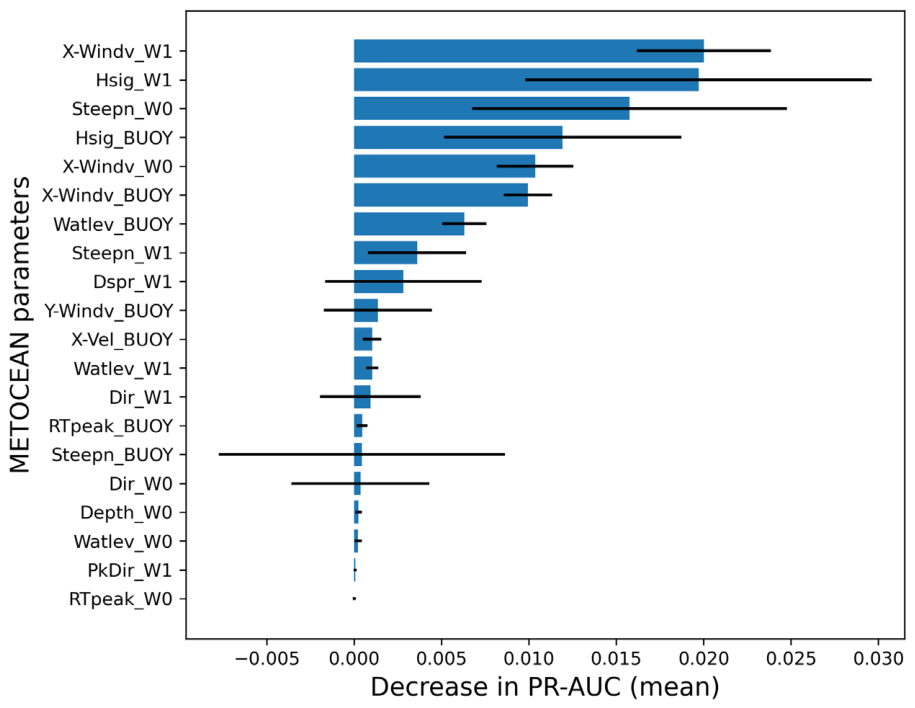
Figure 6 presents the permutation importance rankings expressed as the mean decrease in PR-AUC across multiple permutation repeats, with standard deviation represented by error bars. The results indicate that the significant wave height, wave steepness, directional properties, and spectral spreading exert the strongest influence on model predictive skill. Differences in importance rankings are due to strong collinearity among wave parameters (e.g., significant wave height, steepness, and spectral spreading), which can distribute predictive information across correlated variables. Accordingly, importance results are interpreted qualitatively, with emphasis placed on consistently influential predictors rather than absolute rankings. Since multiple lagged and rolling features correspond to the same underlying physical variable, permutation importance values were aggregated at the base-variable level by summing contributions across all temporal variants. Feature selection was therefore based on the cumulative importance of each physical variable, rather than the ranking of individual features shown in Figure 6. Based on this aggregated ranking, the selected predictors were Hsig_W0 (significant wave height at W0), Steepn_BUOY (wave steepness at the buoy), X-Windv_BUOY (wind velocity in the x-direction at the buoy), Y-Vel_W0 (wave velocity in the y-direction at W0), Dir_W0 (wave direction at W0), Dir_W1 (wave direction at W1), Dspr_BUOY (directional spreading at the buoy), and Depth_W1 (water depth at W1), which together captured the dominant physical controls on overtopping while avoiding feature redundancy.
Temporal Sequential Modeling Motivation
Static models are effective for binary overtopping detection, but they are inherently unable to represent temporal persistence and accumulation phenomenon that govern overtopping severity. In field conditions, sustained overtopping is often associated with prolonged elevated water levels, wave energy, and directional consistency over multiple tidal cycles. These processes evolve over timescales longer than a single 20 min snapshot and cannot be represented by static predictors. Furthermore, overtopping events are rare and temporally clustered, which limits the effectiveness of uniformly sampled temporal learning.
Therefore, effective severity prediction requires both sequence-aware models and training strategies that efficiently utilize the limited number of overtopping events present in field datasets. This study, therefore, evaluates a hierarchy of ML models with increasing temporal characteristics, ranging from static GBDT to convolutional and attention-based temporal architectures. Each model is assessed in terms of its suitability for binary overtopping detection and short-term hydrodynamic evolution.

3.3.3. Temporal Convolutional Networks (TCNs)

TCNs, originally proposed for segmentation and detection [31], are widely used for time series forecasting [32,33]. In this study, TCNs were evaluated as sequence-aware classifiers capable of representing short-term temporal evolution through causal, dilated convolutions. TCNs provide a computationally efficient alternative to recurrent networks and can capture multi-scale temporal dependencies with a fixed receptive field determined by dilation and kernel configuration. In this study, TCNs operated on fixed-length input sequences and produced probabilistic predictions of overtopping occurrence within a specified future time window. The architecture consisted of stacked temporal convolutional blocks with exponentially increasing dilation factors that enabled multi-scale temporal receptive fields. A systematic grid search was conducted over key design choices, including input sequence length, forecast lead time, target aggregation window, channel width, and dropout regularization. Model selection was based on validation-set precision–recall performance, with the best-performing configurations evaluated on a held-out test set. A total of 541 configurations were evaluated across input sequence length (4–24 h), forecast lead time (20–120 min), future aggregation window (40–120 min), network width, and dropout rate.

3.3.4. Transformer-Based Temporal Models

Unlike static classifiers, Transformer-based models [34] explicitly learn the temporal evolution of environmental forcing conditions (hydro-meteorological characteristics) leading to sustained overtopping. They provide physically meaningful estimates of overtopping persistence once exceedance conditions are present. Using static and temporal models, this study investigated how the instantaneous forcing thresholds dominate overtopping initiation, whereas severity and persistence are governed by short-term temporal structure that can only be captured through sequence-aware learning.
Event-Based Segment Construction
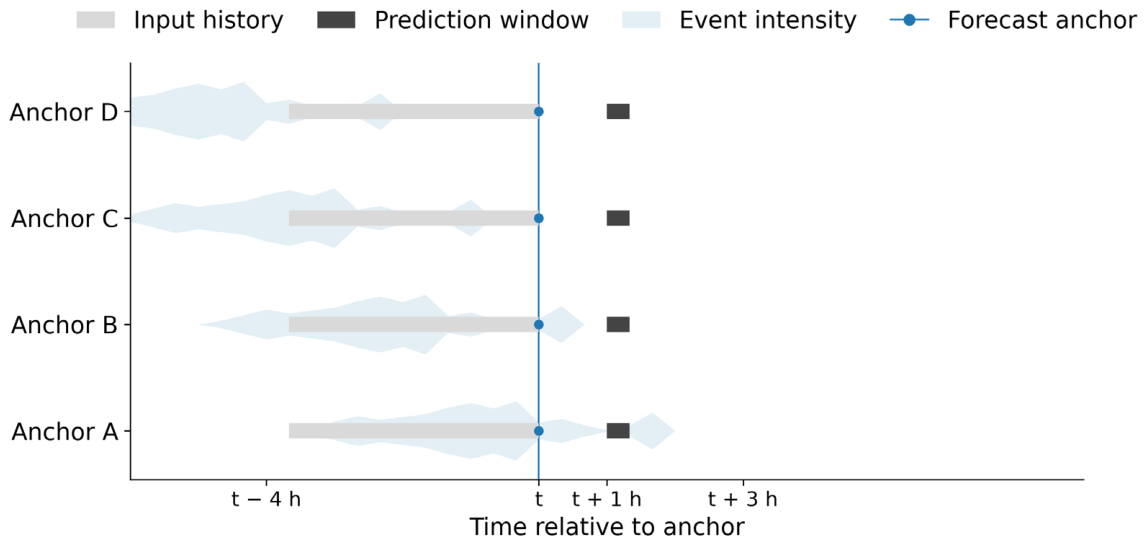
A key methodological challenge in applying temporal models to overtopping characteristics was the rarity and clustering of overtopping events. To address the class imbalance, an event-based segment learning strategy was adopted using the original 1 s CCTV overtopping labels. Overtopping events were defined as adjacent sequences of overtopping seconds, allowing for short gaps of up to 300 s within an event. Each event typically spanned several hours to days, corresponding to one or more 20 min bins. For each detected event, multiple forecast anchors were sampled within the event and its surrounding temporal context. Figure 7 illustrates this procedure for a representative overtopping event in October 2024. Each anchor represents a distinct forecast issuance time and generates one training segment, which increases sample efficiency while preserving event-level independence. Each anchor generated a training segment consisting of approximately 4 h of historical 20 min hindcast features, followed by a lead time of approximately 60 min and a prediction window of approximately 40 min. The target for each segment was defined as the mean fraction of overtopping seconds within the prediction window.
A sensitivity analysis across different segment-density regimes demonstrated that sampling densities of 50–60 anchors per event and 800–1200 total segments derived from roughly 24 independent events consistently produced the best generalization performance. Increasing anchor density beyond this level degraded test performance despite increasing the training set size, which indicates that effective sample size is governed by the number of independent overtopping events rather than the segment count.

4. Results and Discussion

This section examines the predictive performance of each model in context of the physical processes it can represent. Section 4.1 focuses on overtopping initiation, where the static GBDT model is used to test whether instantaneous forcing conditions are sufficient to detect overtopping. Section 4.2 then examines whether the sequence-aware TCN and Transformer models, which incorporate the temporal evolution of forcing, can improve the prediction of future and sustained overtopping. The comparison between static and sequence-aware models therefore investigates a physically meaningful question, namely, whether overtopping is driven primarily by instantaneous threshold exceedance, by short-term forcing history, or both.

4.1. Threshold-Dominated Overtopping Initiation

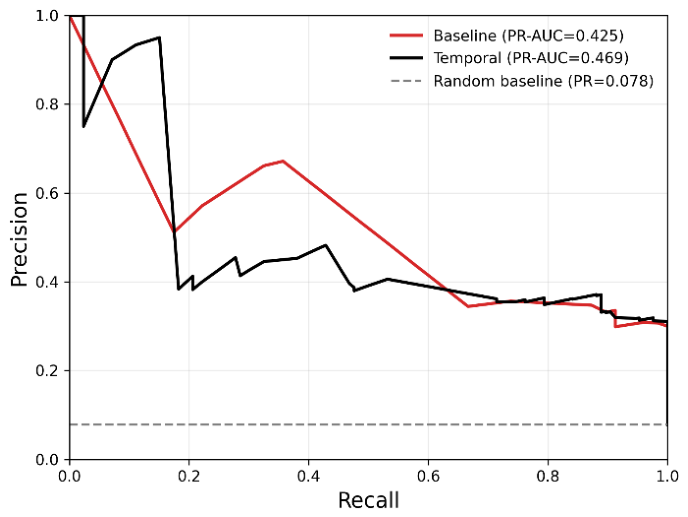
A comparison of the evaluated occurrence-detection models is summarized in Table 2. Among the tested models, GBDT provided strong baseline performance for binary overtopping detection. Two GBDT configurations were considered: (i) a static baseline model trained on instantaneous 20 min hindcast predictors and (ii) a temporally enhanced model incorporating short-term temporal memory through lagged and rolling features constructed from a permutation-selected set of physical variables. Figure 8 compares PR curves for the baseline and temporal GBDT models evaluated on the test dataset. The temporally enhanced GBDT achieves higher overall precision–recall performance, providing an improved test PR-AUC relative to the baseline model, with gains most evident across intermediate recall levels. This indicates that incorporating short-term temporal information improves the discrimination of overtopping events beyond what can be achieved using instantaneous forcing alone.
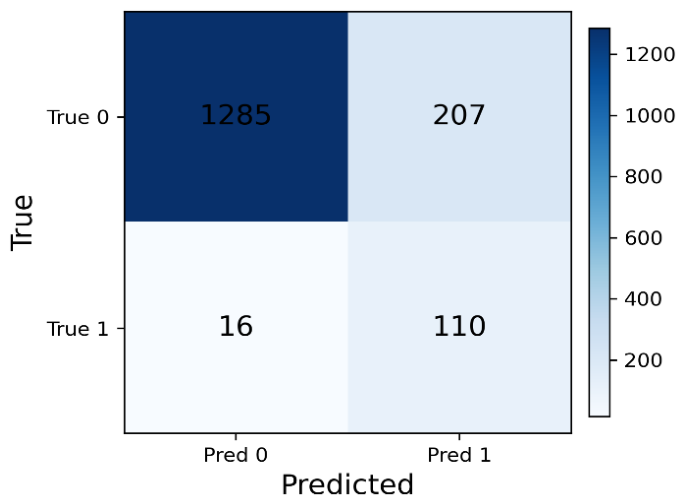
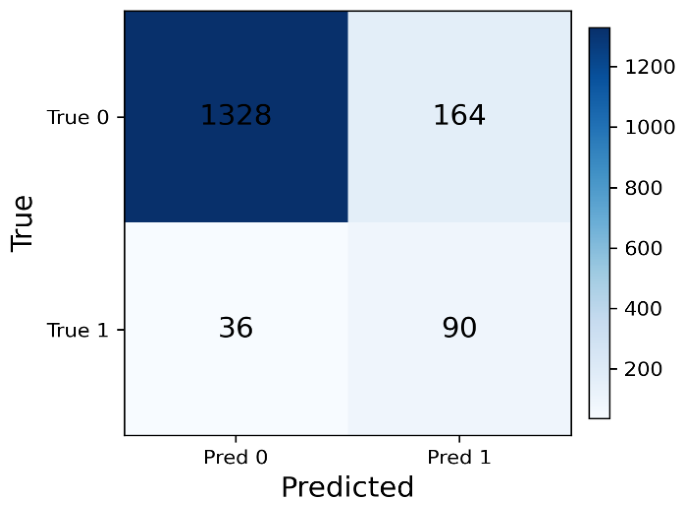
Operational performance of the baseline and temporal GBDT is further illustrated by the confusion matrix shown in Figure 9 and Figure 10, respectively. The temporal model in Figure 10 achieves high event detection rates while maintaining a manageable false-alarm rate, consistent with early-warning system requirements. The static baseline GBDT model in Figure 9 exhibits similarly high recall but at slightly lower precision, highlighting the benefit of temporal augmentation in reducing false positives without sacrificing sensitivity.

4.2. Sequence-Based Overtopping Prediction

4.2.1. Short-Term Hydrodynamic Memory in Overtopping Onset

Sequence-aware models (TCN and TF) were evaluated to assess whether short-term temporal context improves the prediction of future overtopping events relative to instantaneous detection. In contrast to the static and temporally enhanced GBDT models discussed in Section 4.1, these models operated on fixed-length sequences of hindcast forcing and were trained to predict the occurrence of overtopping within a specified future time window rather than at the current time step.
Table 3 summarizes the performance of the TCN and Transformer (TF) models for future overtopping event prediction. The TCN results correspond to the best-performing configuration identified through a systematic hyperparameter search. The explored design space varied the input sequence length (4–24 h), forecast lead time (20–120 min), future aggregation window (40–120 min), network width and depth, and dropout rate. The selected model used two convolutional layers with 32 channels each, a dropout rate of 0.4, a 4 h input sequence, a 60 min lead time, and a 40 min prediction window. The TCN achieved higher PR-AUC on both the validation and test sets compared to the GBDT-based occurrence models.
The TF model was evaluated using the same sequence-based formulation as the TCN. The best-performing Transformer configuration employed a 16 h input sequence, a 20 min lead time, and a 120 min prediction window, with a two-layer encoder (model dimension 128, feed-forward dimension 128) and a dropout rate of 0.25. The best-performing configuration was selected from 661 evaluated combinations spanning the same task space as the TCN grid search, with additional architecture parameters including model dimension [64, 128], number of layers [2,3], feed-forward width [128, 256], and dropout rate. As summarized in Table 3, the TF model achieved the higher test PR-AUC than TCN, which indicates strong discriminative skill for future overtopping events over extended forecast horizons. Compared to the TCN, the TF exhibits higher precision but lower recall at the recall-constrained operating point, which reflects a more selective prediction behavior.
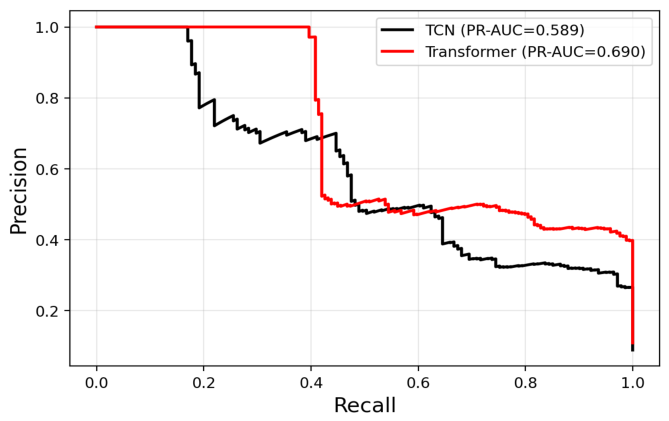
The corresponding PR curves for the TCN and Transformer models are shown in Figure 11. Consistent with Table 3 metrics, the Transformer exhibited superior overall PR performance and achieved a higher PR-AUC on the test set. The TCN maintained competitive precision at lower recall levels but degraded more rapidly as recall increased. This behavior suggests that while both sequence-aware models capture short-term temporal dependencies relevant for future event prediction, the Transformer architecture provides improved robustness across a wider range of operating thresholds.
These findings reflect the ability of sequence-aware architectures to exploit temporal structure when the prediction task is framed as a short-term forecasting problem rather than instantaneous threshold exceedance. Importantly, the improved performance of sequence-aware models in Table 3 does not contradict the results in Section 4.1. The GBDT models outperform sequence-aware approaches for instantaneous binary overtopping detection, which indicates that occurrence at 20 min resolution is largely governed by threshold-like forcing conditions. Sequence-based models provide added value primarily when predicting future events over extended horizons, where overtopping persistence become more relevant. These results highlight the importance of aligning model architecture with the intended prediction task and operational objective.

4.2.2. Temporal Persistence and Sustained Overtopping Regimes

This study also formulated overtopping severity and persistence as a regression problem with the severity defined as the fraction of overtopping seconds within a 20 min window. The sequence-aware models (TCN and Transformer) were trained on event-anchored temporal segments derived from 1 s overtopping labels with the aim of focusing on sustained overtopping periods. Both models used a prediction setup with a 4 h input history, 60 min lead time, and 40 min target window, and were optimized via hyperparameter searches over network capacity, kernel or feed-forward width, and dropout.
To address the limited number of independent overtopping events, an event-anchored sampling strategy was adopted by drawing multiple 20 min forecast anchors within bounded pre- and post-event windows using 1 s overtopping labels. The sensitivity tests indicated optimal generalization at moderate sampling densities of approximately 50–60 anchors per event. For comparison, a relaxed event definition allowing small temporal gaps between overtopping seconds was also tested by segmenting the 24 field-consistent events into 726 shorter sub-events. While this over-segmentation increased the apparent sample size and reduced MAE and cMAE as shown in Table 4, it primarily reflected event fragmentation rather than additional independent physical information that led to optimistic performance estimates.
Table 4 shows that both sequence-aware regression models achieved strong performance for persistence prediction demonstrating the ability to capture sustained overtopping dynamics. The Transformer achieved the lowest validation and test cMAE demonstrating superior sample efficiency while the TCN showed improvements but greater sensitivity to architecture and sampling choices. The models’ performance was highly sensitive to the definition of an independent overtopping event. Relaxed event separation criteria increased the apparent sample size and improved error metrics, but this reflected event fragmentation rather than new physical information. Overall, the results reveal an asymmetry between overtopping initiation and persistence where occurrence is governed by snapshot-scale forcing, whereas severity depends on the temporal variability in wave energy, directional stability, and water level variations. Sequence-aware models explicitly capture this evolving context, underscoring the need to treat detection and severity as distinct yet complementary prediction tasks in operational coastal hazard assessment.
From a fluid-dynamical perspective, these results indicate that wave overtopping at field scale cannot be represented as a single stochastic process. Instead, the system exhibited a regime transition where overtopping initiation behaved as an exceedance process while sustained overtopping reflects memory effects associated with wave energy, directional coherence (the temporal consistency of wave propagation direction, represented by mean wave direction Dir and directional spreading DSPR in the hindcast), and elevated mean water level.

4.3. Limitations and Future Work

Several limitations should be acknowledged. First, overtopping severity was represented using a persistence proxy derived from video observations rather than direct measurements of discharge or volume. While this captures operationally relevant intensity, it does not fully characterize hydraulic loading. Second, the number of independent overtopping events was limited, which constrained the complexity of temporal models. Future work should explore integration of higher-frequency numerical forcing by incorporating additional severity proxies derived from videometry and field observations of overtopping characteristics (thickness and volume). Such efforts would further clarify the generality of the conclusions drawn here.

5. Conclusions

This study investigated wave overtopping at a rubble-mound breakwater using field-scale observations and coupled numerical hindcasts. The aim was to investigate the physical processes that influence overtopping dynamics under natural forcing by hydro-meteorological parameters. The results are consistent with wave overtopping arising from two distinct fluid-dynamical regimes. Overtopping initiation is influenced by threshold exceedance in hydro-meteorological parameters. In contrast, overtopping persistence and severity depend on short-term hydrodynamic memory associated with sustained environmental forcing that includes prolonged elevated water levels driven by storm surge, persistent wave energy, and directional coherence over timescales of several hours. This separation of temporal scales explains why static models capture overtopping initiation effectively, whereas sequence-aware models are required to represent sustained overtopping dynamics, providing new physical insight into field-scale wave–structure interaction. Static gradient-boosted decision tree models achieved the highest accuracy for binary overtopping detection. These models provided high recall under operating thresholds, making them appropriate for early-warning applications based on hindcast or forecast METOCEAN conditions. Sequence-aware models trained on event-based temporal segments significantly outperformed static baselines for severity prediction. Transformer models demonstrated superior sample efficiency, achieving near-optimal performance with substantially fewer training segments. Sensitivity analysis further revealed that model skill is limited by the number of independent overtopping events rather than raw data volume, which emphasizes the importance of event-aware training strategies for rare coastal hazards.
The value of sequence-aware models in this study lies in revealing the physical relevance of temporal persistence, which enables a clearer separation between threshold-driven initiation and history-dependent severity of overtopping. Overall, the results highlight that reliable overtopping forecasting in field settings requires a modular approach with static models suitable for detection and temporal models for persistence estimation. Future work should extend the proposed framework to explore higher-frequency forcing inputs and incorporate additional severity proxies derived from videometry and in situ measurements of overtopping characteristics. Such developments would further support the deployment of operational overtopping prediction systems for coastal safety and infrastructure management.

Supplementary Materials

The following supporting information can be downloaded at: https://www.mdpi.com/article/10.3390/jmse14121130/s1, Table S1: Overtopping (OT) events observed between October 2024 and March 2025 at the study site; Table S2: Aggregated CCTV and hydrodynamic data for ML models.

Author Contributions

Conceptualization, K.R. and W.H.C.; methodology, K.R.; software, K.R.; validation, K.R., W.H.C., H.-Y.L., G.-H.S., and J.Y.M.; formal analysis, K.R., W.H.C., H.-Y.L., G.-H.S., and J.Y.M.; investigation, W.H.C. and J.Y.M.; resources, W.H.C. and J.Y.M.; data curation, K.R.; writing—original draft preparation, K.R.; writing—review and editing, W.H.C., H.-Y.L., G.-H.S., and J.Y.M.; visualization, K.R.; supervision, W.H.C. and J.Y.M.; project administration, W.H.C. and J.Y.M.; funding acquisition, W.H.C. and J.Y.M. All authors have read and agreed to the published version of the manuscript.

Funding

This research was conducted with the support of the Korea Institute of Marine Science and Technology Promotion (Development of Wave-Overtopping Quantitative Observation Technology: RS-2022-KS221567) from the Ministry of Oceans and Fisheries in 2026.

Data Availability Statement

The original contributions presented in this study are included in the Supplementary Materials. Further inquiries can be directed to the corresponding author.

Conflicts of Interest

Authors Dr. Khawar Rehman, Mr. Wan Hee Cho and Mr. Jong Yoon Mun are employed by the company Marine Information Technology Corp. Seoul, Korea. The remaining authors declare that the research was conducted in the absence of any commercial or financial relationships that could be construed as a potential conflict of interest.

References

  1. Zhao, X.; Hou, Y.; Lu, F.; Shi, Z.; Huang, Z. Numerical Investigations of Pedestrian Overboard on a Compound Slope Dike Due to Excessive Overtopping Waves. Phys. Fluids 2024, 36, 107148. [Google Scholar] [CrossRef]
  2. Hughes, S.A.; Nadal, N.C. Laboratory Study of Combined Wave Overtopping and Storm Surge Overflow of a Levee. Coast. Eng. 2009, 56, 244–259. [Google Scholar] [CrossRef]
  3. Van der Meer, J.W.; Allsop, N.W.H.; Bruce, T.; De Rouck, J.; Kortenhaus, A.; Pullen, T.; Schüttrumpf, H.; Troch, P.; Zanuttigh, B. EurOtop: Manual on Wave Overtopping of Sea Defences and Related Structures. 2018. Available online: https://www.overtopping-manual.com/assets/downloads/EurOtop_II_2018_Final_version.pdf (accessed on 12 October 2025).
  4. Altomare, C.; Suzuki, T.; Chen, X.; Verwaest, T.; Kortenhaus, A. Wave Overtopping of Sea Dikes with Very Shallow Foreshores. Coast. Eng. 2016, 116, 236–257. [Google Scholar] [CrossRef]
  5. Koosheh, A.; Etemad-Shahidi, A.; Cartwright, N.; Tomlinson, R.; van Gent, M.R.A. Wave Overtopping Layer Thickness on the Crest of Rubble Mound Seawalls. Coast. Eng. 2024, 188, 104441. [Google Scholar] [CrossRef]
  6. den Bieman, J.P.; van Gent, M.R.; van den Boogaard, H.F. Wave Overtopping Predictions Using an Advanced Machine Learning Technique. Coast. Eng. 2021, 166, 103830. [Google Scholar] [CrossRef]
  7. Formentin, S.M.; Zanuttigh, B.; Van Der Meer, J.W. A Neural Network Tool for Predicting Wave Reflection, Overtopping and Transmission. Coast. Eng. J. 2017, 59, 1750006-1–1750006-31. [Google Scholar] [CrossRef]
  8. Alvarellos, A.; Figuero, A.; Rodríguez-Yáñez, S.; Sande, J.; Peña, E.; Rosa-Santos, P.; Rabuñal, J. Deep Learning-Based Wave Overtopping Prediction. Appl. Sci. 2024, 14, 2611. [Google Scholar] [CrossRef]
  9. Elbisy, M.S. Machine Learning Techniques for Estimating Wave-Overtopping Discharges at Coastal Structures. Ocean Eng. 2023, 273, 113972. [Google Scholar] [CrossRef]
  10. Rif’atin, H.Q.; Magdalena, I.; Dewata, D.; Saengsupavanich, C.; Sanitwong-Na-Ayutthaya, S. Optimization of Stepped Revetment Configuration on Minimizing Wave Run-up and Overtopping. Phys. Fluids 2024, 36, 046617. [Google Scholar] [CrossRef]
  11. Habib, M.A.; O’Sullivan, J.J.; Salauddin, M. Prediction of Wave Overtopping Characteristics at Coastal Flood Defences Using Machine Learning Algorithms: A Systematic Rreview. IOP Conf. Ser. Earth Environ. Sci. 2022, 1072, 012003. [Google Scholar] [CrossRef]
  12. Portillo Juan, N.; Negro Valdecantos, V.; Troch, P. Advancing Artificial Intelligence in Ocean and Maritime Engineering: Trends, Progress, and Future Directions. Ocean Eng. 2025, 339, 122077. [Google Scholar] [CrossRef]
  13. Koosheh, A.; Etemad-Shahidi, A.; Cartwright, N.; Tomlinson, R.; van Gent, M.R.A. Individual Wave Overtopping at Coastal Structures: A Critical Review and the Existing Challenges. Appl. Ocean Res. 2021, 106, 102476. [Google Scholar] [CrossRef]
  14. Brown, J.M.; Yelland, M.J.; Pascal, R.W.; Pullen, T.; Bell, P.S.; Cardwell, C.L.; Jones, D.S.; Milliken, N.P.; Prime, T.D.; Shannon, G.; et al. WireWall: A New Approach to Coastal Wave Hazard Monitoring. 2020.
  15. McGlade, M.; Valiente, N.G.; Brown, J.; Stokes, C.; Poate, T. Investigating Appropriate Artificial Intelligence Approaches to Reliably Predict Coastal Wave Overtopping and Identify Process Contributions. Ocean Model. 2025, 194, 102510. [Google Scholar] [CrossRef]
  16. Chi, S.H.; Zhang, C.; Sui, T.T.; Cao, Z.B.; Zheng, J.H.; Fan, J.S. Field Observation of Wave Overtopping at Sea Dike Using Shore-Based Video Images. J. Hydrodyn. 2021, 33, 657–672. [Google Scholar] [CrossRef]
  17. Pikelj, K.; Ružić, I.; Ilić, S.; James, M.R.; Kordić, B. Implementing an Efficient Beach Erosion Monitoring System for Coastal Management in Croatia. Ocean Coast. Manag. 2018, 156, 223–238. [Google Scholar] [CrossRef]
  18. Abalia, A.; de Santiago, I.; Garnier, R.; Liria, P.; Epelde, I.; Asier, N.; Denis, M. Development and Validation of a Process-Based Coastal Flooding Early Warning System—Zarautz Beach. In Proceedings of the XVIIIèmes Journées Nationales Génie Côtier—Génie Civil, Anglet, France, 25–27 June 2024. [Google Scholar] [CrossRef]
  19. Formentin, S.M.; Altomare, C.; Marzeddu, A.; Zanuttigh, B. Image Clustering for Overtopping Volume Measurements. Phys. Fluids 2024, 36, 065137. [Google Scholar] [CrossRef]
  20. de Santiago, I.; Plomaritis, T.A.; Avalos, D.; Garnier, R.; Abalia, A.; Epelde, I.; Liria, P. Comparison of Wave Overtopping Estimation Models for Urban Beaches. Towards an Early Warning System on the Basque Coast. Sci. Total Environ. 2024, 912, 168783. [Google Scholar] [CrossRef] [PubMed]
  21. Schrama, W.P.; van Bergeijk, V.M.; Mares-Nasarre, P.; den Bieman, J.P.; van Gent, M.R.A.; Aguilar-López, J.P. Surrogate Modelling of Dike Wave Overtopping Hydrodynamics Using an Adapted Deep Learning Vision Transformer. Coast. Eng. 2026, 203, 104874. [Google Scholar] [CrossRef]
  22. Rehman, K.; Lim, S.-J.; Cho, W.H.; Mun, J.Y. Integration of Multi-Modal Field Data for Statistical Analysis of Wave Overtopping. J. Coast. Disaster Prev. 2025, 12, 193–204. [Google Scholar] [CrossRef]
  23. Westerink, J.J.; Luettich, R.A.; Blain, C.A. ADCIRC: An Advanced Three-Dimensional Circulation Model for Shelves, Coasts, and Estuaries. Report 2. User’s Manual for ADCIRC-2DDI. 1994.
  24. Booij, N.; Ris, R.C.; Holthuijsen, L.H. A Third-Generation Wave Model for Coastal Regions 1. Model Description and Validation. J. Geophys. Res. Ocean. 1999, 104, 7649–7666. [Google Scholar] [CrossRef]
  25. Komen, G.J.; Hasselmann, S.; Hasselmann, K. On the Existence of a Fully Developed Wind-Sea Spectrum. J. Phys. Oceanogr. 1984, 14, 1271–1285. [Google Scholar] [CrossRef]
  26. Madsen, O.S.; Poon, Y.K.; Graber, H.C. Spectral Wave Attenuation by Bottom Friction: Theory. In Coastal Engineering 1988, Proceedings of the 21st International Conference on Coastal Engineering, Costa del Sol-Malaga, Spain, 20–25 June 1988; American Society of Civil Engineers: Reston, VA, USA, 1988. [Google Scholar]
  27. Mun, J.Y.; Cho, W.H.; Rehman, K. Estimation of Overtopping Discharge Using Real-Time Monitoring, Numerical, Empirical, and Neural Network Methods. J. Korean Soc. Mar. Environ. Saf. 2024, 30, 527–540. [Google Scholar] [CrossRef]
  28. Mun, J.Y.; Cho, W.H.; Rehman, K. Hazard Classification and Risk Evaluation for Pedestrians at Sea Dikes Due to Wave Overtopping. In Proceedings of the 35th International Ocean and Polar Engineering Conference 2025, Goyang, Republic of Korea, 1–6 June 2025. ISOPE-I-25-446. [Google Scholar]
  29. Mun, J.Y.; Cho, W.H.; Rehman, K. Multiscale Numerical Modeling of Wave Overtopping for Pedestrian Hazard Classification and Risk Assessment. J. Mar. Sci. Eng. 2025, 13, 2022. [Google Scholar] [CrossRef]
  30. Friedman, J.H. Stochastic Gradient Boosting. Comput. Stat. Data Anal. 2002, 38, 367–378. [Google Scholar] [CrossRef]
  31. Lea, C.; Flynn, M.D.; Vidal, R.; Reiter, A.; Hager, G.D. Temporal Convolutional Networks for Action Segmentation and Detection. In Proceedings of the 30th IEEE Conference on Computer Vision and Pattern Recognition, CVPR 2017, Honolulu, HI, USA, 21–26 July 2017; Volume 2017. [Google Scholar]
  32. Wan, R.; Mei, S.; Wang, J.; Liu, M.; Yang, F. Multivariate Temporal Convolutional Network: A Deep Neural Networks Approach for Multivariate Time Series Forecasting. Electronics 2019, 8, 876. [Google Scholar] [CrossRef]
  33. Liu, Y.; Dong, H.; Wang, X.; Han, S. Time Series Prediction Based on Temporal Convolutional Network. In Proceedings of the 18th IEEE/ACIS International Conference on Computer and Information Science, ICIS 2019, Beijing, China, 17–19 June 2019. [Google Scholar]
  34. Vaswani, A.; Shazeer, N.; Parmar, N.; Uszkoreit, J.; Jones, L.; Gomez, A.N.; Kaiser, Ł.; Polosukhin, I. Attention Is All You Need. In Proceedings of the Advances in Neural Information Processing Systems 30: Annual Conference on Neural Information Processing Systems 2017, Long Beach, CA, USA, 4–9 December 2017; Volume 2017. [Google Scholar]
Figure 1. Study site and observation configuration. (a) Computational domain for ADCIRC-UnSWAN model. (b) Red triangle showing location of the Yeondaepu study site on Jeju Island. (c) Local zoom-in view showing the breakwater, CCTV-based overtopping observation point, and offshore wave forcing locations (W0, W1, and buoy); the locations of the marine wave gauges are not according to scale.
Jmse 14 01130 g001
Figure 2. Time-series comparison of numerically predicted and observed significant wave height (Hs) at (a) buoy, (b) W0, and (c) W1 for the period 1 October 2024~30 March 2025. Periods of missing field data due to equipment malfunction are evident in all panels.
Jmse 14 01130 g002
Figure 3. Scatterplots of numerically predicted and field-observed significant wave height Hs (m) at (a) buoy, (b) W0, and (c) W1 for the period 1 October 2024~30 March 2025.
Jmse 14 01130 g003
Figure 4. Overview of data inputs and label construction used for training overtopping prediction models.
Jmse 14 01130 g004
Figure 5. (a) Significant wave height (Hs) and water level (WL) during a representative 7 February 2025 event. (b) Binary overtopping occurrence. (c) Temporal persistence of overtopping. The shaded region indicates 20 min intervals classified as overtopping occurrence.
Jmse 14 01130 g005
Figure 6. Gain-based and permutation-based feature importance.
Jmse 14 01130 g006
Figure 7. Event-based temporal segment construction for sequence-aware overtopping prediction, showing multiple forecast anchors sampled within a single overtopping event observed in October 2024.
Jmse 14 01130 g007
Figure 8. PR curves on the test set comparing the baseline and temporal GBDT models. The dashed line indicates the random-chance baseline corresponding to the event rate in the test set.
Jmse 14 01130 g008
Figure 9. Confusion matrix of the baseline GBDT model evaluated on the test set.
Jmse 14 01130 g009
Figure 10. Confusion matrix of the temporal GBDT model evaluated on the test set.
Jmse 14 01130 g010
Figure 11. Precision–recall curves for TCN and Transformer (TF) models.
Jmse 14 01130 g011
Table 1. Performance metrics for comparison between numerically predicted and field-observed wave characteristics.
Wave GaugeParameterBiasrmsecorr
BuoyHs0.040.250.96
Tp0.821.080.83
W1Hs0.000.430.85
Tp−0.010.790.82
W0Hs0.230.350.91
Tp−0.851.240.62
Table 2. Performance comparison of static and temporally enhanced GBDT models for overtopping occurrence detection.
ModelVal
PR-AUC
Test
PR-AUC
Test
ROC-AUC
Precision (Test)Recall (Test)
Baseline/Static GBDT0.5200.4250.930.3470.873
Temporal Physics-Enhanced GBDT0.5230.4690.930.3540.714
Table 3. Performance of sequence-based models for future overtopping event prediction.
ModelVal
PR-AUC
Test
PR-AUC
Test
ROC-AUC
Precision (Test)Recall (Test)Prediction Horizon
TCN0.6720.5890.9270.4930.48960–100 min
TF0.4940.6900.9420.5140.42620–140 min
Table 4. Performance of sequence-aware models for overtopping severity prediction under different event definitions.
Number of Overtopping EventsModelVal MAEVal cMAETest MAETest cMAE
24 events
(Field consistent)
TCNreg0.03560.04400.04070.0341
TFreg0.05340.02730.05840.0139
726 events
(Over-segmented)
TCNreg0.00150.00150.00140.0015
TFreg0.00280.00320.00280.0035
Disclaimer/Publisher’s Note: The statements, opinions and data contained in all publications are solely those of the individual author(s) and contributor(s) and not of MDPI and/or the editor(s). MDPI and/or the editor(s) disclaim responsibility for any injury to people or property resulting from any ideas, methods, instructions or products referred to in the content.