Article

A Novel Ship-to-Shore Emergency Response System for Instantaneous Microbial Inactivation in Ballast Water


1
College of Oceanography and Ecological Science, Shanghai Ocean University, Shanghai 201306, China
2
National Engineering Research Center of Special Equipment and Power System for Ship and Marine Engineering, Shanghai 200031, China
*
Author to whom correspondence should be addressed.
J. Mar. Sci. Eng. 2026, 14(12), 1121; https://doi.org/10.3390/jmse14121121
Submission received: 26 April 2026 / Revised: 2 June 2026 / Accepted: 9 June 2026 / Published: 18 June 2026
(This article belongs to the Section Marine Pollution)

Abstract

To address the risks of cross-border transmission of pathogenic microorganisms posed by the failure or non-compliance of shipboard ballast water treatment systems, ports urgently require efficient and flexible emergency response solutions. This study presents a novel, containerized, integrated ship-to-shore emergency response system specifically designed for the rapid inactivation of pathogenic microorganisms in ballast water. The core innovation lies in the integration of a three-degree-of-freedom (3-DOF) hydraulic robotic arm, a vision and positioning system, and a dynamic inflatable sealing structure designed for rapid, automated docking with a ship’s ballast water discharge outlet (DN250), thereby enhancing operational safety and efficiency. The system employs a purely physical treatment process of “ultrasound (US) pre-treatment + dual-stage ultraviolet (UV) disinfection,” allowing for reception and treatment without secondary chemical pollution. The integrated treatment train, consisting of US (30 kHz, 7.6–12 kW, minimum acoustic energy density ≥ 0.45 J/cm2) followed by dual-stage UV disinfection (minimum UV dose: 147 mJ/cm2), maintained effective microbial inactivation at turbidity levels of 15, 125, 250, and 500 NTU. US alone showed little direct bactericidal effect, whereas the first UV stage achieved log reduction values (LRVs) of 3.31–4.13, and the complete US + UV + UV process achieved total LRVs of 5.07–7.34 for Escherichia coli. The results showed that dual-stage UV disinfection was key to achieving high inactivation efficacy (p < 0.001), while ultrasound, despite its limited direct bactericidal effect, may have facilitated downstream UV disinfection within the sequential treatment train. This system not only fills a critical gap in port biosecurity emergency infrastructure but also provides an experimentally validated, efficient, environmentally friendly, and flexibly deployable shore-based solution.

1. Introduction

Ballast water is widely recognized as a primary vector for the global spread of Aquatic Invasive Species (AIS) and Harmful Aquatic Organisms and Pathogens (HAOP), despite its critical role in maintaining vessel stability and safe operations [1,2]. Annually, about 12 billion tons of ballast water are transported across the globe, carrying an average of up to 7000 species per day, which leads to significant ecological degradation, economic losses, and public health threats [3]. To address these risks, the International Maritime Organization (IMO) adopted the Ballast Water Management Convention (BWMC), which established the D-2 discharge standard to regulate the concentration of viable organisms and indicator microbes in discharged ballast water [4]. However, current ballast water research has primarily focused on larger organism size classes, such as zooplankton and phytoplankton, whereas the risks posed by pathogenic microorganisms have received comparatively less attention [5,6]. This imbalance is partly attributable to the difficulties in detecting microorganisms and the scarcity of data on microbial inactivation, particularly for organisms smaller than 10 μm [7,8]. Notably, it has been demonstrated that ship ballast water serves as a vector for numerous human pathogenic microorganisms, such as Vibrio cholerae [9], Escherichia coli (E. coli) [10], Bacillus anthracis, and Vibrio parahaemolyticus [11]. This poses a direct threat to the biosecurity of port areas and, by extension, national biosecurity.
Although the widespread deployment of onboard Ballast Water Management Systems (BWMSs) is currently the primary regulatory strategy, its practical application faces limitations. On the one hand, shipowners may be unwilling to install costly BWMSs on aging vessels with limited service life or poor economic viability [12]. On the other hand, even equipped vessels may fail to achieve compliance because of equipment malfunction, unstable treatment performance, or variable water quality along non-fixed routes [13]. Consequently, shore-based facilities have emerged as an indispensable biosecurity emergency backup. Reception concepts mainly include fixed shore-based facilities, floating/barge-based systems, and mobile truck units. These concepts offer different levels of flexibility and can be adapted to diverse logistical conditions [14,15]. Existing shore-based and mobile treatment examples, including InvaSave 300 and Bawat’s mobile solutions, have shown that shore-based treatment is technically feasible [16]. Nevertheless, their adoption remains constrained by a fundamental engineering bottleneck: the interface between the vessel and the shore.
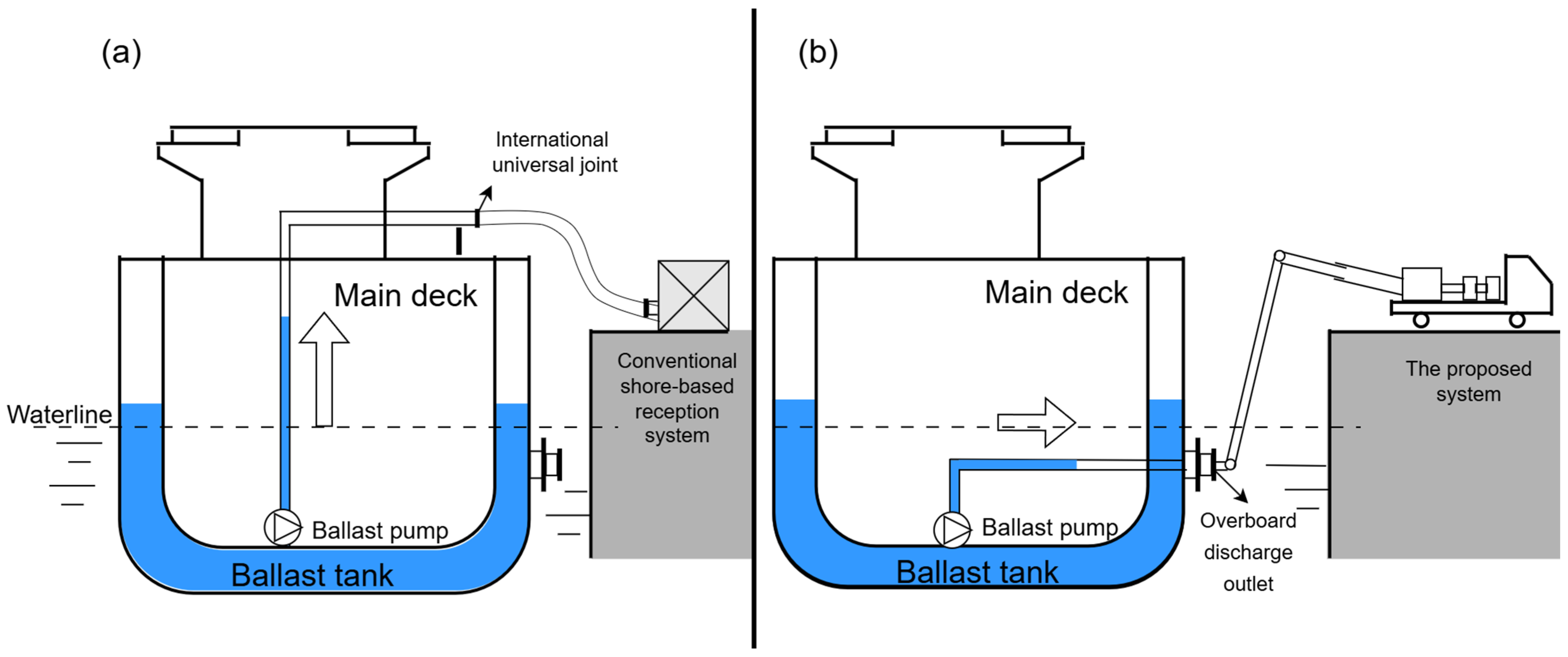
Conventional connection methods rely on the ship’s internal ballast pumps to transfer water from bottom tanks to international standard connections on the deck, often tens of meters above [17]. This elevation difference results in low overall transfer efficiency, making it difficult to meet the urgent demands of emergency ballast water reception and treatment. In reality, the vast majority of vessels rely on near-waterline overboard discharge outlets for rapid gravity discharge, yet existing technologies struggle to directly utilize these interfaces. To address this issue, the present study proposes a novel docking scheme that connects directly to the vessel’s overboard discharge outlet. A schematic comparison between the conventional transfer route and the proposed docking method is presented in Figure 1. The critical challenge in realizing this technology lies in the complex operational conditions: due to dynamic changes in vessel draft, these outlets are frequently submerged. Therefore, the docking device must overcome limited underwater visibility, wave disturbances, and dynamic ship motions to ensure precise positioning, sealing integrity, and operational safety.
Regarding ballast water treatment, various technologies have been developed to meet the D-2 discharge standards, including filtration, ultraviolet (UV) irradiation, electrochlorination, thermal treatment, and Advanced Oxidation Processes (AOPs) (e.g., utilizing ozone, hydrogen peroxide, or peracetic acid). As a conventional pretreatment, filtration is effective but often faces clogging issues in high-turbidity environments [18]. UV treatment is a widely used non-chemical method that inactivates microorganisms by destroying nucleic acids and has the advantage of leaving no chemical residues; however, its effectiveness is influenced by turbidity, dissolved organic matter, and algal content [19]. On the other hand, conventional oxidative treatments (e.g., electrochlorination) guarantee reliable microbial inactivation but risk introducing toxic disinfection by-products and related ecological concerns [20,21]. AOPs mainly rely on the activation of peroxide-based precursors or ozone to generate highly reactive radicals, including hydroxyl and sulfate radicals, and therefore show strong degradation capacity [22,23]. In practice, however, their use is often limited by continuous chemical dosing, high energy consumption, and complex system maintenance. Thermal treatment can avoid these chemical risks, but its long heating time makes it less suitable for time-sensitive emergencies. For shore-based emergency response, the treatment process needs to support rapid deployment, continuous in-line operation, and the avoidance of secondary pollution.
Consequently, this study adopted a physical process combining ultrasound pre-treatment with dual-stage UV irradiation (US + UV + UV). Sound-driven chemistry uses sound waves to alter fluid properties through physical and chemical effects, and it has shown good potential in ecological restoration and fluid purification [24]. Although the treatment module has received formal type approval and has been shown to comply with the D-2 standard under standard test conditions, its performance may still decline under challenging water quality conditions, including high turbidity, high organism load, and elevated organic matter [25]. Moreover, port health authorities and customs are particularly concerned with the acute public health risks posed by pathogenic microorganisms. In biosecurity emergencies, such as global pandemics or regional disease outbreaks, mitigating these acute microbial threats becomes the most time-critical task [26,27]. The biological experiments therefore focused on whether the system could maintain effective emergency microbial inactivation under the extreme conditions typical of port environments. Against this background, the present study addresses two unresolved issues. One is the lack of a technology that can directly dock with ships’ main ballast water discharge outlets. The other is the lack of integrated validation for continuous microbial inactivation under challenging high turbidity conditions.
To this end, a mobile containerized shore-based system was developed, integrating a novel overboard transfer unit with an in-line treatment module. The pivotal innovation of this study lies in the engineering and integration of a mobile, containerized shore-based architecture, particularly the novel use of a 3-DOF hydraulic manipulator and dynamic sealing mechanism for automated underwater docking. To ensure continuous in-line water processing, a physical treatment module (BSKY series, US + UV + UV) was incorporated into the system. This ship-to-shore connection enables immediate in-line treatment after reception, allowing pathogen inactivation while avoiding secondary chemical pollution. For clarity, the abbreviations, symbols, and markings used throughout this study are summarized in Table 1.

2. Materials and Methods

2.1. Design and Composition of the Ship-to-Shore Emergency Response System

The design and implementation of port-based ballast water reception and treatment processes must balance operational efficiency, economic viability, environmental safety, and regulatory compliance within a comprehensive framework. (1) Compliance is the foremost principle of the design. The facility is required to be in full compliance with the provisions set forth in the BWMC [28]. Crucially, the core in-line treatment module utilized in this system has obtained formal Type Approval, demonstrating its reliable efficacy in eliminating larger organisms (zooplankton > 50 µm and phytoplankton 10–50 µm) under standard conditions. Building upon the public health concerns outlined previously, a primary design challenge for emergency port-reception lies in guaranteeing the inactivation of pathogenic microorganisms. Therefore, the system’s treatment capacity was specifically stress-tested for this scenario. (2) Robustness under varying environmental conditions is critical; the facility should maintain stable operation across different salinities, turbidities, and a wide range of water temperatures (0–40 °C) commonly found in port areas. (3) Operational synergy with port activities is essential. The type (e.g., fixed, containerized, or barge-based), scale, and layout of the reception and treatment facility must be highly integrated with the specific needs of the port, including terminal type, vessel traffic, and cargo turnover patterns, to avoid disrupting port operations and causing vessel delays [29]. Furthermore, a standardized ship-to-shore interface design should enable rapid connection. (4) Contingency and supplementary role are other key considerations. The availability and rapid response capability of port facilities are crucial, especially for providing timely solutions when a ship’s onboard system fails or when a vessel is non-compliant with regulations. For multi-purpose terminals or ports with uncertain treatment demands, mobile treatment units show distinct advantages. They do not require large-scale retrofitting of port infrastructure and can be offered to vessels as a fee-based service, highlighting their unique benefits [30].
To achieve the aforementioned objectives and adhere to the proposed design considerations, a series of key performance assumptions for the system were established: (1) Baseline compliance is met. The system is presumed to satisfy standard IMO requirements for all organism size classes based on its Type Approval pedigree, allowing the current proof-of-concept to focus exclusively on evaluating pathogenic inactivation. (2) High efficacy against acute microbial threats under high turbidity challenge water. The system is hypothesized to exhibit robust stability and high treatment efficacy even under high turbidity conditions. Since turbidity is a primary determinant of UV disinfection efficacy and a critical challenge in port environments, it was designated as the principal challenge parameter in this investigation. Furthermore, given that rapid response and dynamic parameter adjustment are crucial in time-critical port emergency reception scenarios, turbidity serves as a practical control parameter for real-time monitoring. (3) The system is designed for flexible and rapid deployment without requiring permanent infrastructure modifications. This includes a standardized ship-to-shore interface for quick and secure connection to support continuous treatment. (4) The facility is assumed to feature a skid-mounted architecture for convenient transportation, installation, and maintenance. It also integrates power and control units to support efficient operation.
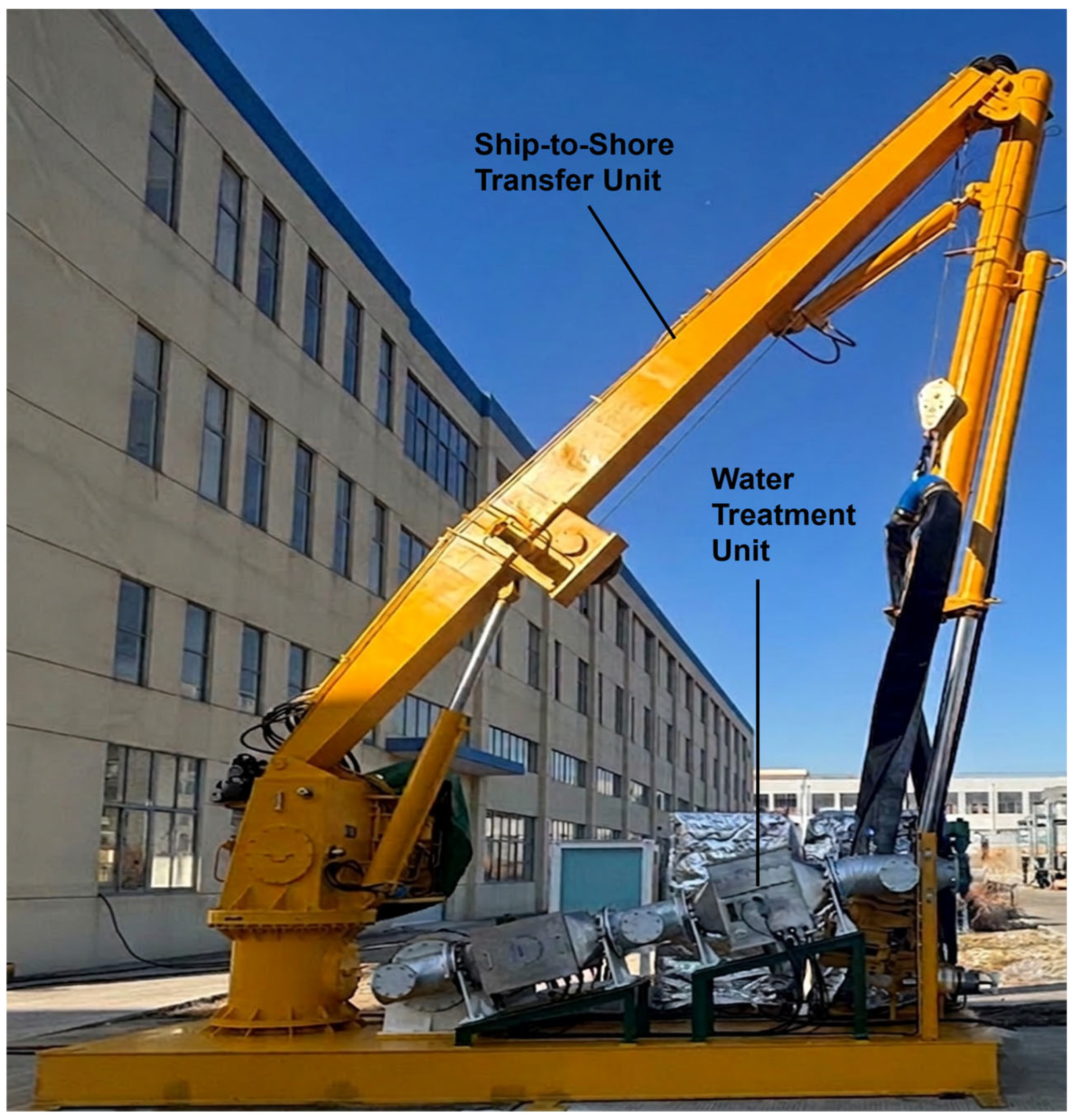
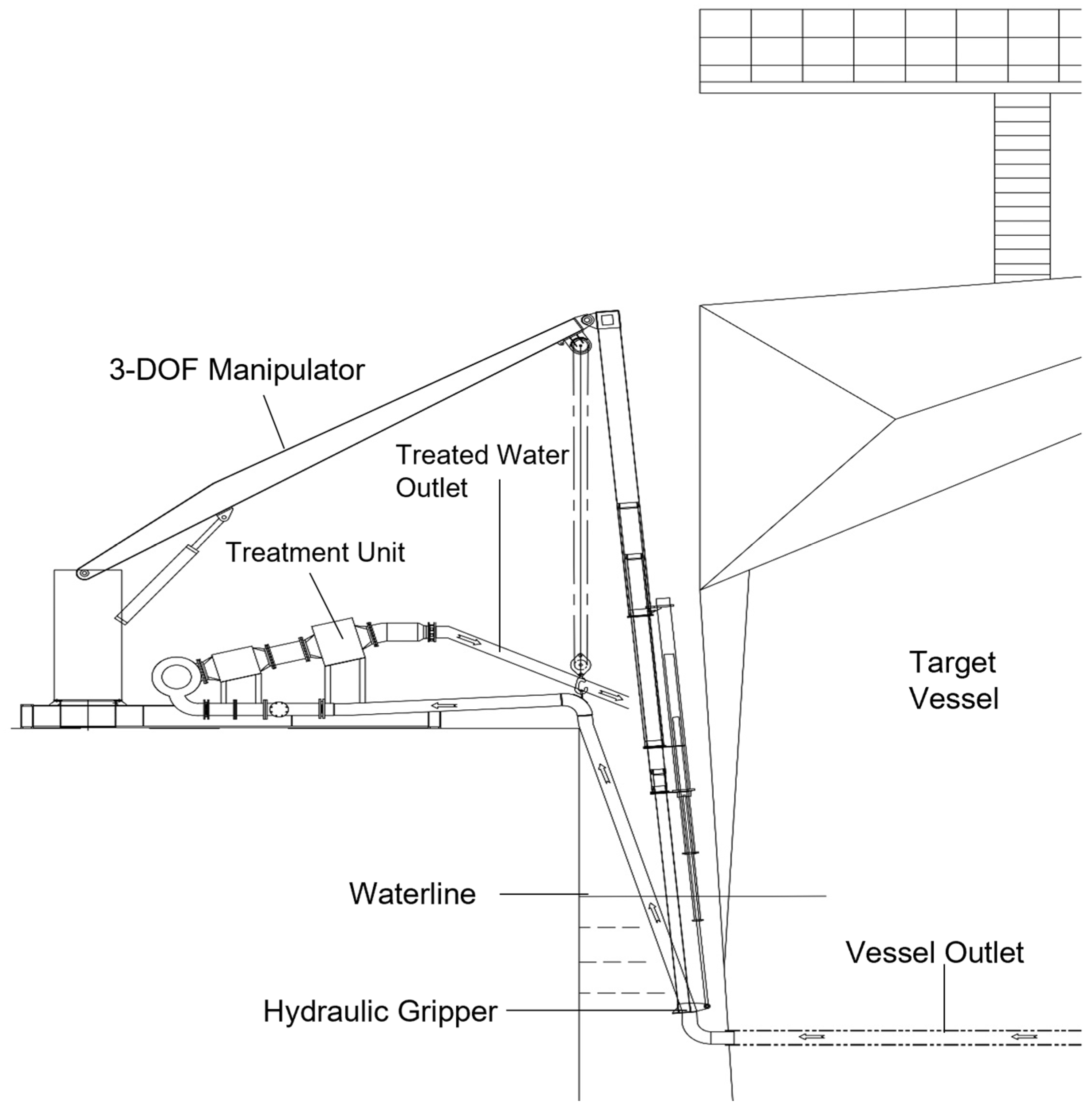
The ship-to-shore emergency response system for ballast water not only meets the aforementioned assumptions but also addresses the challenges of variable port conditions, underwater operations, and the need for a leak-proof connection. To better illustrate the system, its physical prototype and operational workflow are presented in Figure 2 and Figure 3, respectively. This is achieved through the integration of a hydraulic robotic arm, an underwater vision and positioning system, and a dynamic inflatable sealing structure. Upon a ship’s berthing, the system enables the direct reception, immediate treatment, and subsequent discharge of ballast water directly at the vessel’s overboard discharge outlets. The entire system consists of two main modules: a ship-to-shore transfer unit and a water treatment unit (Figure 2). All key components, including the hydraulic robotic arm, power unit, core treatment module, air compressor, and control console, are integrated onto a 20-foot containerized skid base. This modular design facilitates transportation by standard trucks or cranes, ensuring mobility and rapid deployment across different port terminals.
For the underwater installation and detachment of the ballast water transfer pipe, the system incorporates a bespoke three-degree-of-freedom (3-DOF) hydraulic manipulator (Figure 3). Its kinematics comprise linear extension along the Z-axis (horizontal reach), vertical translation along the Y-axis (operational depth), and azimuthal rotation about the X-axis, which is actuated by the control tower. This hydraulic manipulator serves a dual function: on land, it can lift pipe elbows using a wire rope; underwater, it executes the high-precision task of pipe docking. The manipulator features an 8-m horizontal reach and can operate at depths down to 15 m. A hydraulic gripper is mounted at the end-effector of the robotic arm. This design offers two significant advantages: (1) Versatile Grasping: It performs a physical enveloping grasp, which imposes no restrictions on the material of the target object and offers greater adaptability to various shapes. (2) Enhanced Safety: By eliminating the prolonged rigid connection between the shore-based robotic arm and the vessel, the system mitigates mechanical stress and the risk of damage caused by the ship’s movement due to waves and wind. Once the transfer connector is secured inside the vessel’s discharge pipe, the gripper detaches, leaving only a flexible hose as the connection. Integrated into the manipulator’s end-effector is a dual-camera vision system (MC-XZ-3) that streams orthogonal real-time video to the operator, enabling high-precision alignment with the vessel’s submerged discharge outlet. This system supplants high-risk manual interventions, thereby significantly enhancing operational safety. Sealing is accomplished via an innovative dynamic inflation mechanism. An onboard compressor pressurizes a rubber sealing ring on the transfer connector. The resulting expansion ensures a tight fit against the discharge pipe’s inner surface, compensating for irregularities, ovality, and corrosion to maintain a watertight seal.
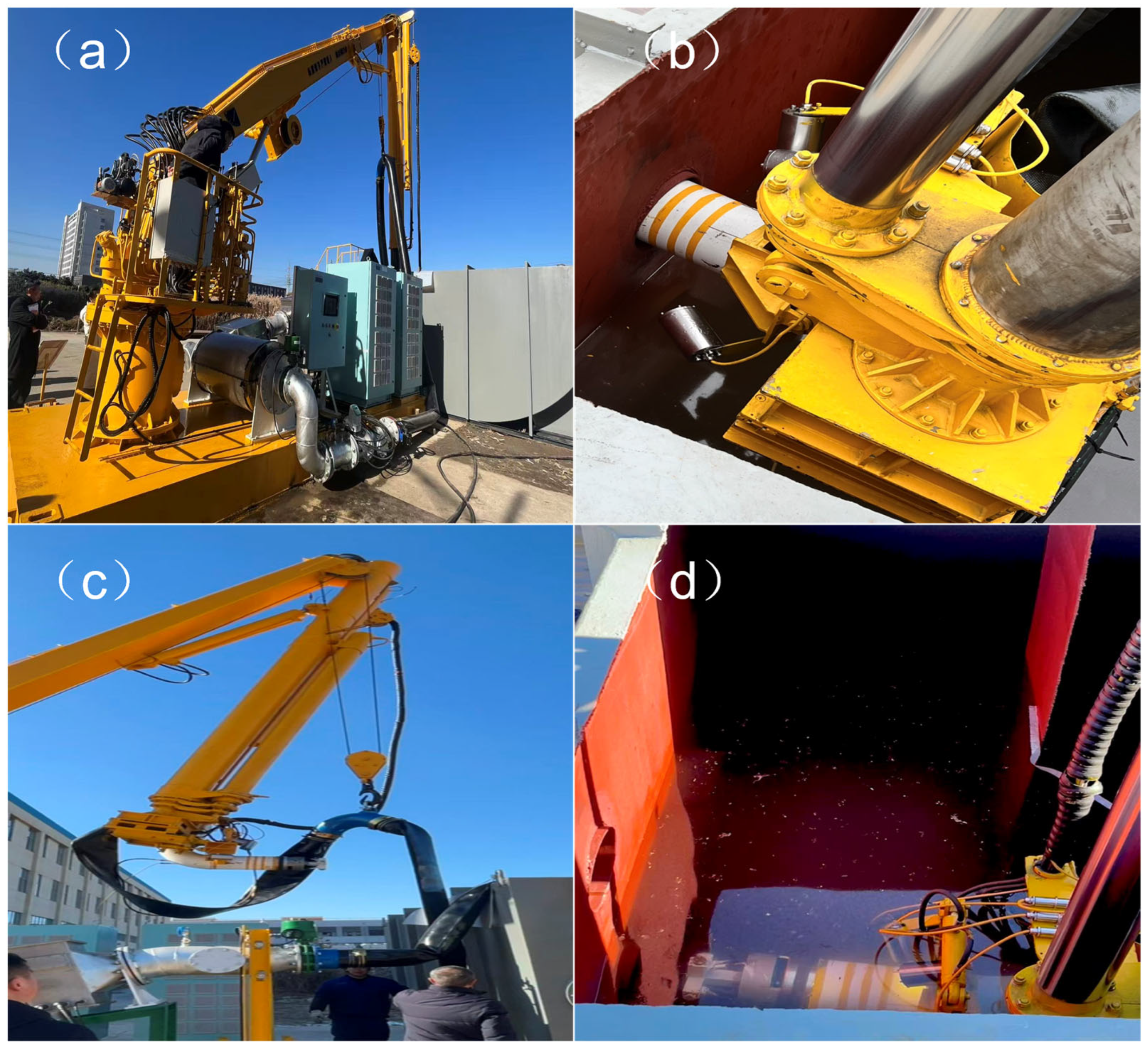
Representative photographs from the docking function validation on the land-based test platform are presented in Figure 4. These images give a direct view of the test setup and the docking process. Figure 4a shows the overall configuration of the system after docking. During the docking tests, the manipulator was used to lift and position the flexible hose and transfer assembly (Figure 4c) and to align the hydraulic gripper with the target discharge outlet. To account for variations in vessel draft and outlet submergence, two representative docking scenarios were examined: docking at an above-waterline discharge outlet (Figure 4b) and docking at a below-waterline discharge outlet (Figure 4d). These experiments demonstrate the feasibility of the proposed manipulator-assisted docking approach under both above-waterline and below-waterline outlet conditions.
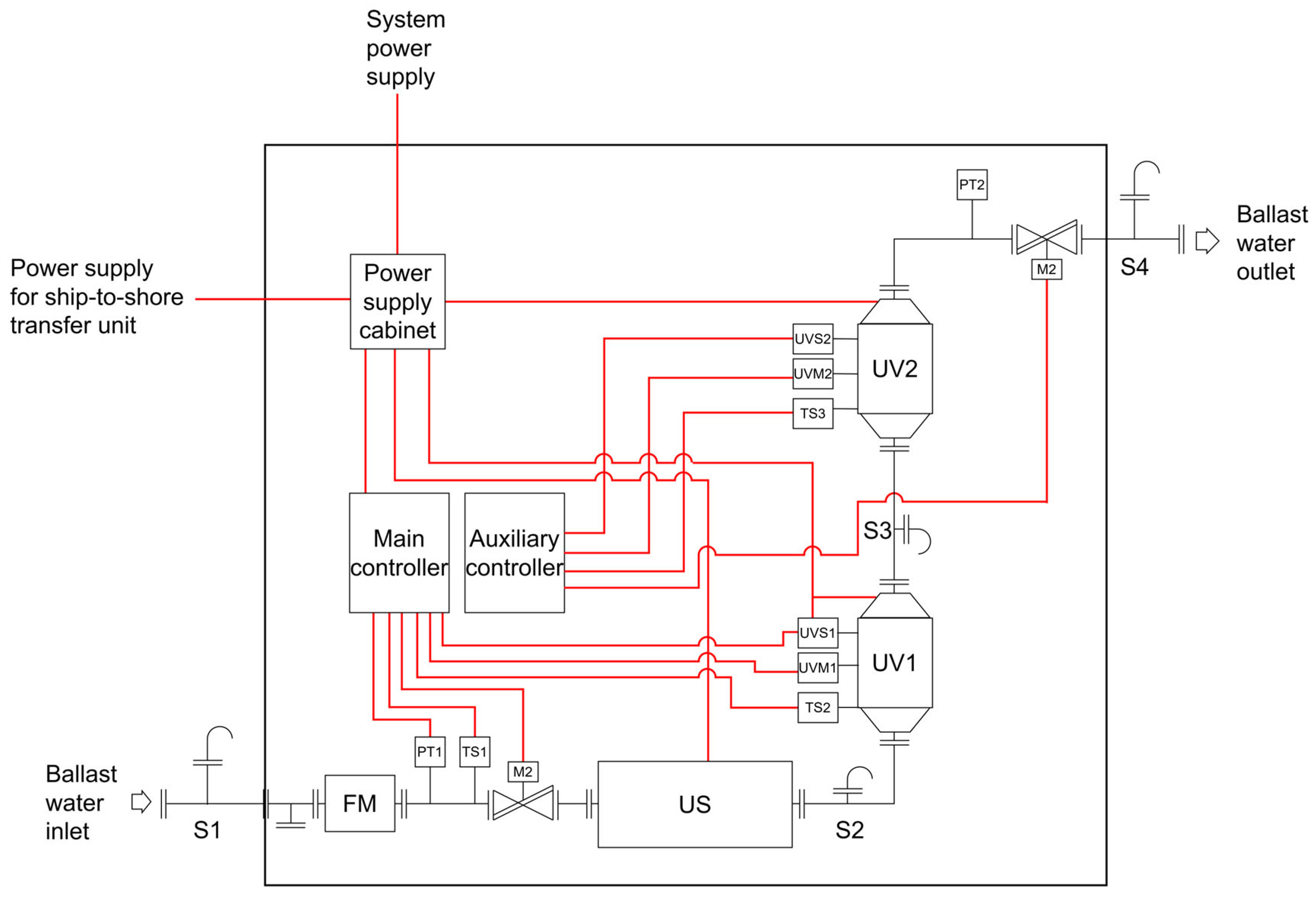
The water treatment unit used in this study was BSKY600 ((Wuxi Brightsky Electronic Co., Ltd., Wuxi, China) and consisted mainly of one ultrasound pretreatment module, two UV disinfection modules, power cabinet, controllers, valves, and a flow meter. A process and instrumentation diagram of the water treatment unit is provided in Figure 5, and the main components and monitoring elements of the water treatment unit are summarized in Table 2. The system had a treatment rated capacity of 400 m3/h. During operation, ballast water was first introduced into the US unit. At this stage, ultrasonic cavitation and mechanical shear promoted particle dispersion and helped disrupt some particulate aggregates in the influent. After this pretreatment step, the water entered UV reactor 1 (UV1) and then UV reactor 2 (UV2) in sequence. This two-stage UV configuration was designed to enhance final microbial inactivation under high turbidity conditions. Controlled by the system’s automated logic to adapt to varying turbidity, the ultrasound pre-treatment unit (BSKY_US35) operated dynamically within a frequency of 30 kHz and a power range of 7.6–12 kW to maintain a minimum acoustic energy density of ≥0.45 J/cm2 for mechanical particle dispersion. As for the downstream disinfection section, the UV disinfection unit (BSKY_UV514) provided a minimum UV dose of 147 mJ/cm2. To keep the system in stable operating condition, an online monitoring and control system was integrated into the treatment unit. This part included a flow meter for hydraulic monitoring, pressure transmitters installed at the inlet and outlet sections, temperature sensors arranged at key process locations, and UV monitoring components associated with the UV reactors. During the experiments, the measured flow rate fluctuated between 85 and 119 m3/h, with an average of 95 m3/h. In addition, sampling ports were arranged before and after the main treatment stages, so that microbiological analysis could be carried out during the tests. The operation of the US and UV modules was coordinated by the main controller and the auxiliary controller.

2.2. Experimental Setup

2.2.1. Preparation of the Test Platform and Experimental Water

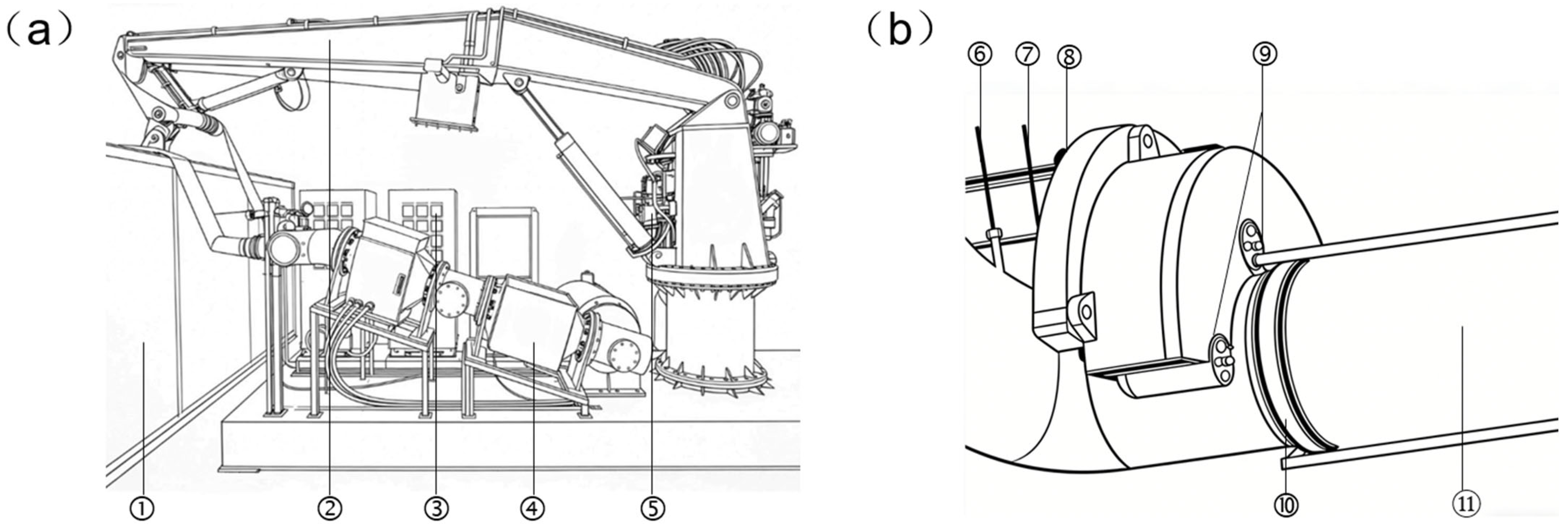
A land-based experimental platform was constructed to evaluate the system’s treatment performance (Figure 6). Upon the establishment of a secure connection via the 3-DOF hydraulic manipulator, ballast water was conveyed to the emergency treatment unit for subsequent processing. The experiments were conducted using river water sourced from the Rutai River, China (32°11′43″ N, 120°05′45″ E). The natural river water matrix provided a realistic chemical background, ensuring the presence of natural organic matter and baseline ions. To simulate challenging water turbidity, kaolin was selected as the representative inorganic particulate matter for this study. This kaolin, characterized by its swelling properties and surface activity (average particle size: 2.65 μm), served as a potential surrogate for a worst-case shielding scenario for the downstream treatment units, particularly UV disinfection. By dispersing varying masses of kaolin into the simulated ballast water, four distinct target turbidity levels were prepared: A (15 NTU), B (125 NTU), C (250 NTU), and D (500 NTU). Although turbidity served as the primary operational control parameter, the corresponding Total Suspended Solids (TSS) concentrations were also determined to be approximately 27.2, 173.8, 354.4, and 746.2 mg/L, respectively, to provide a comprehensive mass profile of the particulate load. Furthermore, the fundamental physicochemical characteristics of the prepared challenge water were constantly monitored to ensure experimental consistency across test batches. These monitored parameters included a pH of 7.4 ± 0.2, a conductivity of 450 ± 50 μS/cm, a Total Organic Carbon (TOC) level of 6.5 ± 0.8 mg/L, and a Chemical Oxygen Demand (COD) of 15.0 ± 2.0 mg/L. Each batch of prepared water was inoculated with E. coli to achieve an initial concentration exceeding 107 CFU/100 mL. E. coli was purchased from the China Center for Type Culture Collection (Wuhan, China).

2.2.2. Sample Collection

The experiment was conducted across four turbidity gradients. For each turbidity level, the test water was spiked with E. coli to an initial concentration exceeding 107 CFU/100 mL. Three independent treatment replicates were performed for each turbidity gradient. To monitor the treatment process, water samples were collected at four key process nodes to determine the system’s inactivation efficiency for E. coli: S1: Raw water inlet; S2: After US treatment; S3: After the primary UV treatment unit; and S4: At the final outlet, after the secondary UV treatment unit (Figure 7). During each treatment run, sampling was conducted after the system had reached stable operation at the target flow rate. Prior to sample collection, each sampling port was flushed with the corresponding process water for approximately 10 s to minimize the influence of stagnant water remaining in the pipeline. Samples for microbiological analysis were collected in sterile 500 mL glass bottles that had been autoclaved at 121 °C for 15 min. Samples for physicochemical analyses were collected in 1 L high density polyethylene bottles. Bottles used for physicochemical analyses were rinsed once with the sample water before collection, whereas bottles used for microbiological analysis were not pre-rinsed in order to maintain sterility. Samples were immediately placed in insulated containers maintained at 2–6 °C and transported to the laboratory for analysis. Microbiological analyses were completed within 6 h of sample collection.

2.2.3. Sample Analysis

The fundamental physicochemical characteristics and biological concentrations of the test water were systematically analyzed. The pH and conductivity were monitored with a multi-parameter portable meter (HQ40d, Hach, Loveland, CO, USA). Turbidity was measured using a portable turbidimeter (2100P, Hach, Loveland, CO, USA). Total Suspended Solids (TSS) were measured gravimetrically according to the standard method (APHA 2540D). Total Organic Carbon (TOC) was quantified using a TOC analyzer (TOC-L, Shimadzu, Kyoto, Japan), and Chemical Oxygen Demand (COD) was analyzed utilizing a benchtop spectrophotometer (DR3900, Hach, Loveland, CO, USA). The quantitative analysis of E. coli was performed according to the U.S. Environmental Protection Agency (EPA) Method 1103.1. Briefly, water samples were serially diluted in a 10-fold gradient, and a volume of 100 mL was filtered through sterile membrane filters (0.45 μm pore size). The membranes were placed onto mTEC (membrane-Thermotolerant E. coli) agar plates. The plates were first incubated at 35 ± 1 °C for 2 h for bacterial resuscitation, followed by a second incubation at 44.5 ± 0.5 °C for 22–24 h. After incubation, viable E. coli colonies were enumerated. The inactivation of E. coli was calculated as the Log Reduction Value (LRV), using the formula: LRV = log10(N0/N), where N0 is the concentration of E. coli before treatment and N is the concentration after treatment.

2.2.4. Statistical Analysis

All experiments were conducted in independent triplicates, with data expressed as the mean ± standard deviation (SD). Statistical analyses and data visualization were performed using GraphPad Prism 9.5 (GraphPad Software, Boston, MA, USA). Because microbial count data typically span several orders of magnitude and are right-skewed, E. coli concentrations were analyzed on a log10 scale to stabilize variance and improve normality. Differences in E. coli concentrations across sampling points (S1–S4) were assessed using one-way ANOVA coupled with Dunnett’s post-hoc test. This stage-wise analytical approach was adopted to evaluate treatment performance along the actual sequential treatment train under different challenge-water conditions. For samples with undetectable bacteria, the analytical limit of detection (LOD; 1 CFU/100 mL) was assigned prior to log10 transformation to avoid undefined logarithmic values. This approach was selected because it provides a conservative estimate of inactivation efficiency and enables consistent calculation of log reduction values across treatment stages. Statistical significance was defined as p < 0.05.

3. Results

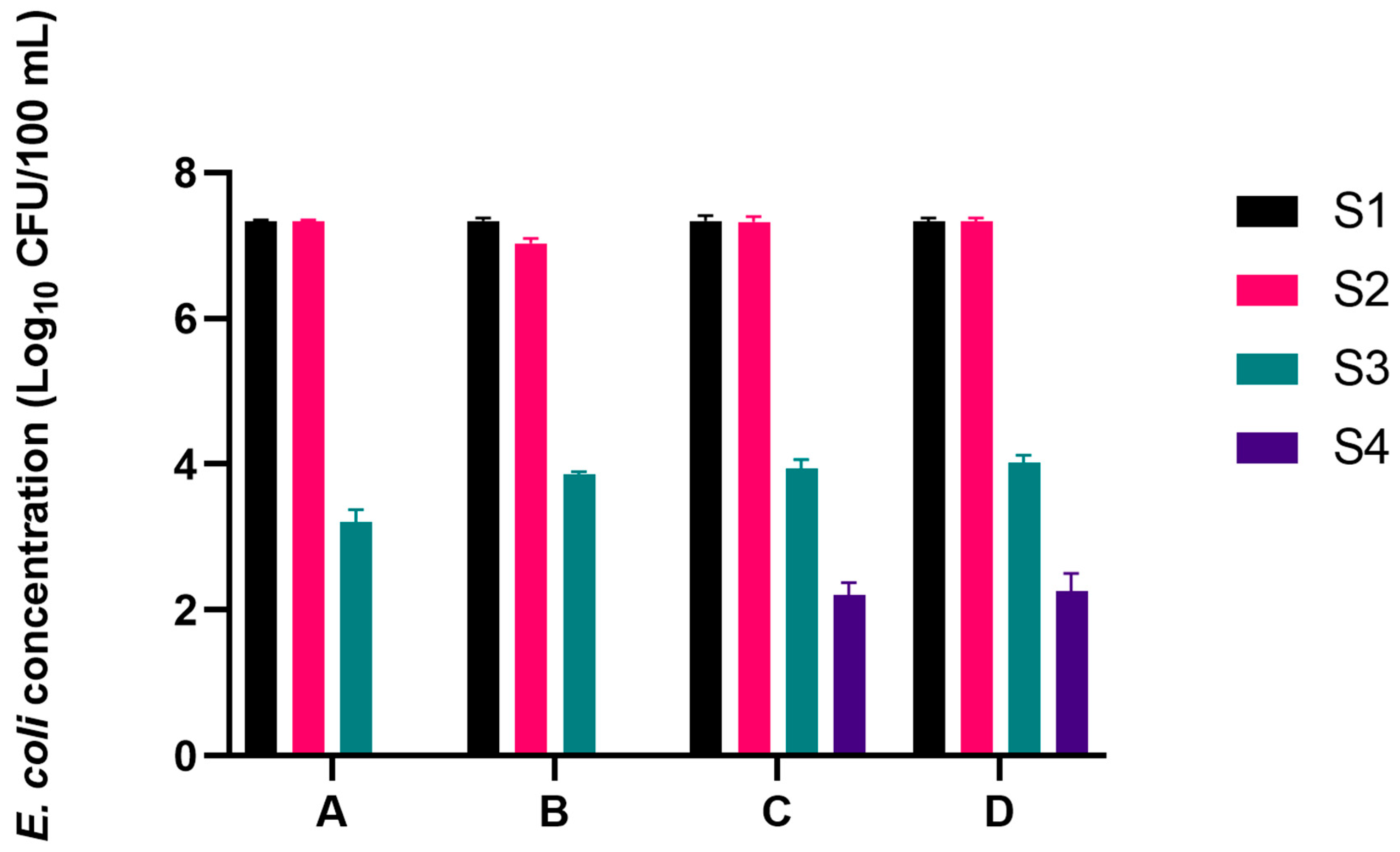
To make the system response under different turbidity levels clearer, the changes in E. coli concentration across the treatment stages were first presented for each condition. The concentrations of E. coli at four sampling points (S1, S2, S3, and S4) were measured under four turbidity levels: A (15 NTU), B (125 NTU), C (250 NTU), and D (500 NTU). Figure 8 illustrates the trends in E. coli counts (expressed as Log 10   CFU / 100   mL ) for the four groups (A, B, C, and D) across different treatment stages (S1–S4). A downward trend in E. coli concentration was observed for all turbidity levels as the treatment progressed from S1 to S4. At S1, all four groups exhibited high initial E. coli counts, ranging from a minimum of 7.26 Log 10   CFU / 100   mL to a maximum of 7.41 Log 10   CFU / 100   mL . These initial concentrations, all exceeding 7.0 Log 10   CFU / 100   mL , met the experimental requirements. Comparing the S4 samples to their S1 counterparts, the E. coli concentrations in groups A and B were below the limit of detection (0 Log 10   CFU / 100   mL ). In groups C and D, the concentrations decreased to average values of 2.20 Log 10   CFU / 100   mL and 2.26 Log 10   CFU / 100   mL , respectively. This pattern suggests that under the lower challenge conditions represented by 15 and 125 NTU, the cumulative UV dose provided by the two-stage UV units was sufficient to drive the final bacterial concentration below the detection limit. In contrast, under the more severe turbidity conditions of 250 and 500 NTU, suspended particles likely reduced the effectiveness of UV and partially shielded particle-associated bacteria from irradiation. Consequently, although the overall reduction remained high in groups C and D, a residual bacterial population persisted at the final outlet. Overall, these results represent a log reduction from the initial S1 concentrations, indicating the high treatment efficiency of the system.
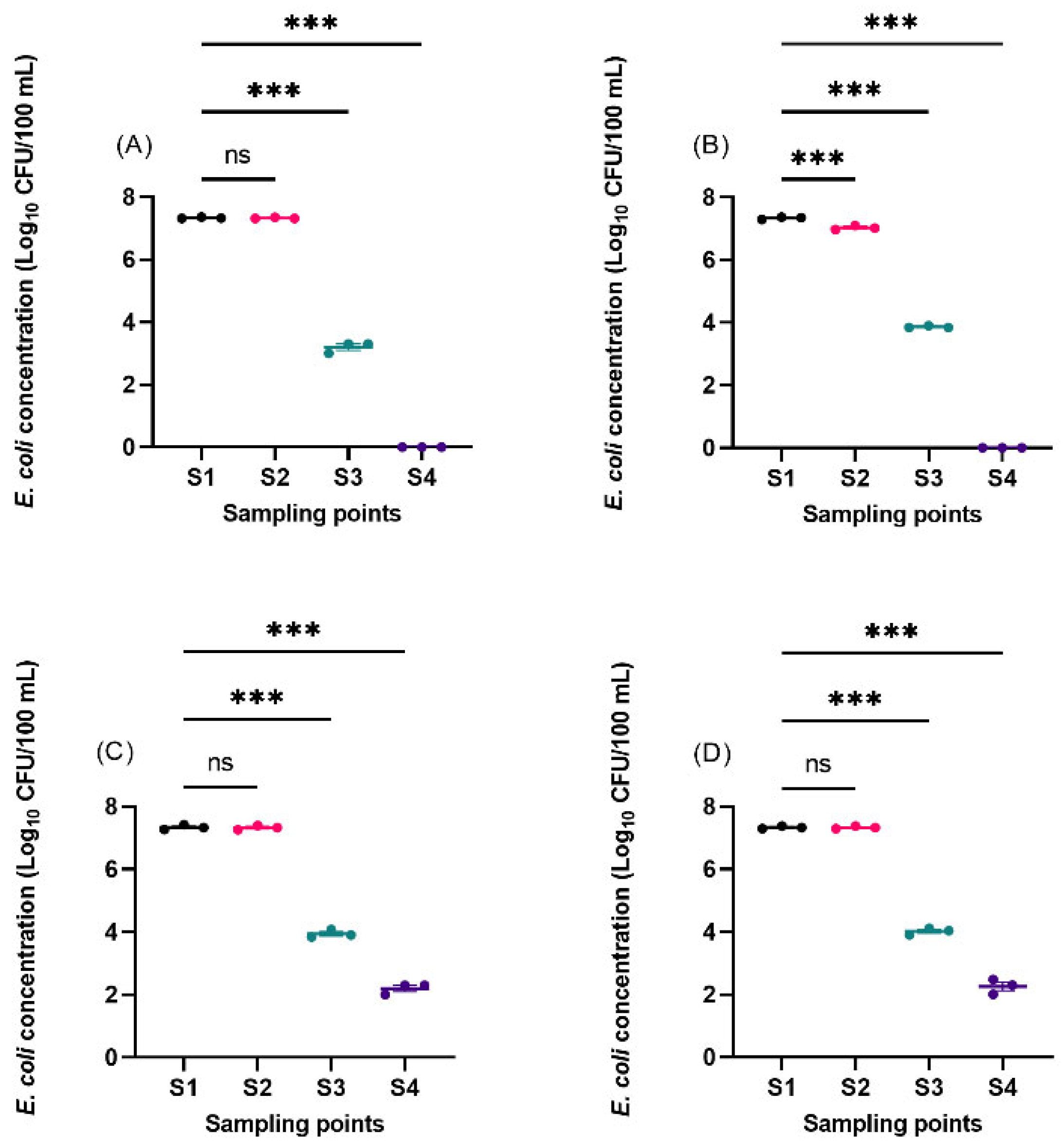
The standalone application of ultrasound demonstrated a generally poor bactericidal effect on E. coli in this test (Figure 9). Although the E. coli concentration post-sonication (S2) showed some level of reduction compared to the initial concentration (S1) across all experimental groups, the greatest change occurred at 125 NTU. As depicted in Figure 9, the concentration dropped from 7.34 Log 10   CFU / 100   mL to 7.03 Log 10   CFU / 100   mL . Nevertheless, the differences in E. coli concentrations between S1 and S2 samples were not found to be statistically significant (p > 0.05) in the 15, 250, and 500 NTU groups. This suggests that ultrasound possesses limited direct lethal capability against E. coli. A plausible reason is that, under the short hydraulic residence time and operating energy density used in this continuous flow system, ultrasound primarily acted on particle dispersion and aggregate disruption rather than causing extensive direct membrane destruction of individual bacterial cells.
The experimental data demonstrate that ultraviolet (UV) treatment is highly effective in inactivating E. coli under varying turbidity levels. Across all turbidity groups, the E. coli concentrations following UV treatments (S3 and S4) were substantially lower than those in the untreated raw water (S1) and sonication (S2) groups. For the S3 treatment, a substantial reduction in bacterial counts was observed. Under all four turbidity levels, the E. coli concentration dropped significantly (to 3.0–4.1 Log 10   CFU / 100   mL ) after S3, showing a highly significant statistical difference compared with S1 (p < 0.001). Furthermore, the E. coli concentration in the S4 samples was further reduced to near or at the limit of detection. The further decrease observed at S4 indicates that the second UV stage contributed additional disinfection capacity and improved the overall inactivation performance of the system. Across the entire turbidity range from 15 NTU to 500 NTU, the final S4 group exhibited a highly significant statistical difference in E. coli reduction when compared to the initial S1 group (p < 0.001).
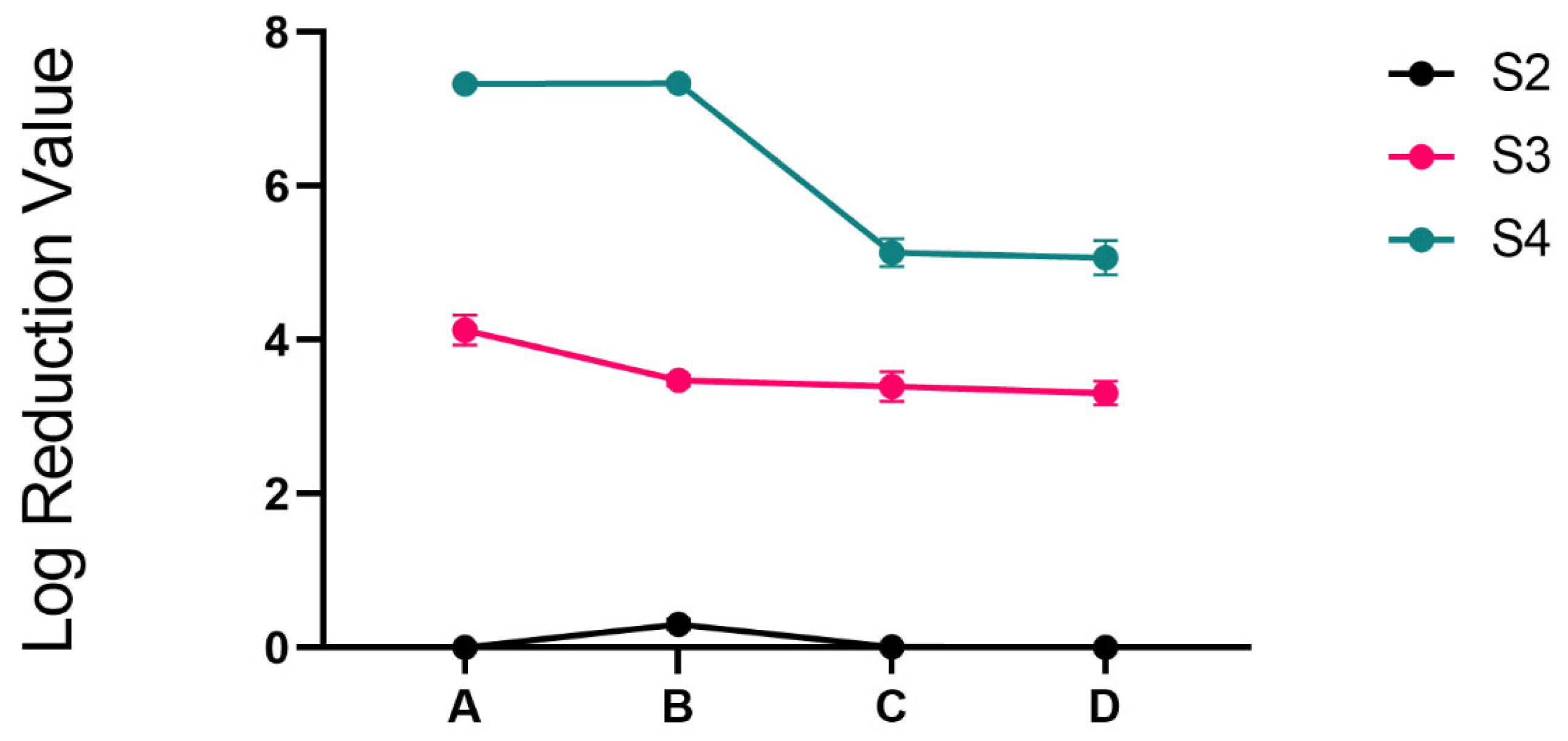
Figure 10 presents the Log Reduction Value (LRV) for each treatment stage under different turbidity conditions, providing a clearer view of how turbidity influenced microbial inactivation across the treatment process. Variations in E. coli log reduction were observed among the three treatment methods at different turbidities. Standalone ultrasound treatment (S2) produced no apparent inactivation effect across most turbidity groups, with log reduction values close to 0. For the combined treatment of ultrasound and a single UV pass (S3), the average log reduction values were 4.13, 3.47, 3.39, and 3.31 under turbidity levels of 15, 125, 250, and 500 NTU, respectively. This demonstrated a continuous downward trend, yet maintained a relatively stable disinfection effect. In contrast, the combined treatment of ultrasound with a double UV pass (S4) achieved high inactivation results under all four turbidity conditions, with all log reduction values being greater than or equal to 5.0. Compared to the high log reductions of 7.33–7.34 at lower turbidities, the S4 treatment dropped to 5.14 and 5.07 under the 250 and 500 NTU conditions, respectively. Meanwhile, the S3 log reduction decreased to 3.39 and 3.31, indicating a relative reduction in disinfection efficiency at high turbidity levels. From Figure 10, a gradual weakening of the UV disinfection effect can be observed as turbidity increased. This trend is consistent with the expected optical interference effect of suspended solids. Nevertheless, the double-pass UV configuration maintained an LRV above 5.0 across all turbidity conditions, indicating that staged UV can partially compensate for turbidity-induced losses in disinfection efficiency.

4. Discussion

To illustrate the differences between the present work and previously reported mobile ballast water treatment systems, a qualitative comparison is provided in Table 3. Existing representative solutions have demonstrated the feasibility of shore-based or mobile ballast water treatment [16,31]. However, their similarities also reveal a persistent engineering constraint. Most reported systems are connected at the deck level through manual hose coupling, which either requires the vessel to have a suitable international shore connection flange or demands temporary onboard installation by crane. In practical port operations, both options are burdensome: the former may require temporary pipe modification, whereas the latter increases operational complexity, safety risk, and berth occupation time. In addition, deck-level reception relies on transferring ballast water from bottom tanks to a much higher elevation, leading to head loss [17]. In this context, the novelty of this study does not lie in simply presenting another mobile treatment unit, but in redefining the ship-to-shore transfer interface itself. The proposed system shifts the connection point from the conventional deck manifold to the ship’s near-waterline overboard discharge outlet and realizes this connection through robotic-arm-assisted underwater docking with dynamic sealing. This configuration is intended to better align the reception route with the vessel’s native discharge outlet. As a result, the system avoids deck-piping retrofits and temporary onboard installation, and reduces hydraulic losses associated with unnecessary vertical conveyance. These engineering features are particularly valuable for emergency port response, where rapid deployment, minimal ship modification, low operational disruption, and high transfer efficiency are more important than simply adding treatment capacity [32]. When combined with the single-pass, chemical-free US + UV + UV treatment train, the system further distinguishes itself from approaches that depend on in-tank chemical contact or post-treatment holding time [33]. It should be noted that the proposed system is relocatable mainly by road transport and quay-side deployment, and therefore offers less mobility than systems that can also be deployed on barges or workboats [34]. Accordingly, the main contribution of this work is an integrated emergency-response architecture that couples a novel docking interface with continuous in-line microbial inactivation under high turbidity conditions.
This study evaluated the inactivation efficacy of the ship-to-shore emergency response system against E. coli in simulated ballast water under four turbidity conditions. From a regulatory perspective, the final effluent should be evaluated against the IMO D-2 limit for E. coli (250 CFU/100 mL). In this study, the S4 concentrations under 250 NTU and 500 NTU were 158 and 182 CFU/100 mL (corresponding to 2.20 and 2.26 Log10 CFU/100 mL), respectively, both below the threshold, while under 15 NTU and 125 NTU the values were below the detection limit. These results indicate that, for E. coli as an indicator organism, the final effluent concentrations under the tested conditions were below the IMO D-2 threshold. At the same time, this finding alone should not be taken as evidence of full D-2 compliance for all regulated organism groups in this experiment. The results also demonstrated that while ultrasound treatment alone had a limited bactericidal effect, the combined system exhibited robust disinfection performance. It consistently achieved a >5-log inactivation even at high turbidity (500 NTU), indicating its strong robustness under challenging conditions. UV treatment demonstrated strong disinfection capability, but its effectiveness was negatively affected by turbidity. The initial UV treatment (S3) resulted in a highly significant reduction in bacterial counts (p < 0.001). Furthermore, the secondary UV treatment (S4) further improved the inactivation, especially in the 15 and 125 NTU groups, which is consistent with the general understanding of the cumulative effect of UV energy dosage [35].
Turbidity was observed to negatively affect UV efficacy. As turbidity increased from 15 NTU to 500 NTU, the LRV of the single UV treatment (S3) decreased from 4.13 to 3.31. This negative impact was even more pronounced in the double UV treatment (S4), where the LRV experienced a decline from 7.34 to 5.07. The mechanisms behind this effect primarily include the scattering of UV light by suspended particles, which reduces the effective radiation dose, and the shielding of bacteria that are attached to or embedded within these particles [36,37]. Previous studies have also confirmed that elevated turbidity leads to a decline in UV disinfection efficiency, emphasizing the need for pre-treatment measures in highly turbid waters [38]. In contrast, standalone ultrasound treatment did not cause a statistically significant reduction in E. coli concentration across most turbidity levels (p > 0.05), achieving only an approximately 0.3-log reduction even under optimal conditions. However, the sequential-process results suggest that ultrasound pretreatment may have improved subsequent UV disinfection through indirect mechanisms. The bactericidal action of ultrasound is mainly attributed to acoustic cavitation, which refers to the formation, growth, and instantaneous collapse of microbubbles in the liquid. This collapse generates localized high temperatures, pressures, and mechanical shear forces that can disrupt cellular structures [39]. Nevertheless, as reported in previous research, the effectiveness of ultrasound against small microorganisms like bacteria is limited by energy density and exposure time, often requiring high intensity and prolonged treatment to achieve significant inactivation [40]. Research also supports the synergistic effect of combining ultrasound with other treatments, such as chlorination [41,42]. The combination of mechanisms in the developed treatment system is designed to amplify the UV disinfection effect, partially compensating for the adverse impacts of high turbidity. On one hand, the mechanical forces from acoustic cavitation can break up bacterial aggregates and particle coatings, thereby increasing the effective exposure area of bacteria and enhancing UV penetration [39,43]. On the other hand, ultrasound may inflict sublethal damage to the cell membrane or wall, reducing the cell’s stress resistance and DNA repair efficiency, thus increasing its susceptibility to UV inactivation [44,45].
The combined treatment system utilizes a physical process, which avoids the addition of chemical agents and the associated problem of secondary pollution. By facilitating continuous in-line processing, it effectively inactivates E. coli dynamically as the water flows. This circumvents the need for the extended contact times in batch reactors or the mandatory holding times typically associated with electrochemical and conventional chemical treatments [46]. In comparison, mainstream physical treatment technologies, such as the “Filtration + UV” approach, also avoid chemical pollution. However, their biological efficacy is highly susceptible to variable port water conditions (e.g., turbidity, color), often leading to a significant reduction in performance [47]. Chemical treatment technologies like electrolytic chlorination generate active substances that not only pose a corrosion risk to ballast tanks but, more critically, their disinfection by-products (DBPs) can cause irreversible secondary pollution to sensitive marine ecosystems upon discharge [48]. Although these technologies are effective in pathogen reduction, controversies remain regarding their efficiency, operational simplicity, and potential environmental impacts upon discharge [49]. The present proof-of-concept study was not designed as a full factorial experiment; therefore, interaction effects between turbidity and treatment stage, or between ultrasound and the individual UV units, were not statistically isolated. Future research could delve deeper into the microscopic mechanisms of how ultrasound affects bacterial cell structure and physiological state. For instance, molecular biology techniques could be used to examine changes in DNA damage and the expression of repair genes, to more comprehensively elucidate the synergistic mechanism of the US + UV process.

5. Conclusions

This study presents a novel ship-to-shore emergency response system for ballast water. During the development, particular attention was given to direct reception from a vessel’s overboard discharge outlet instead of relying on the conventional deck-level transfer route. For this purpose, a 3-DOF hydraulic manipulator, a vision and positioning system, and a dynamic inflatable sealing structure were incorporated into the system. Although the long-term operation and maintenance of the proposed system still require further verification in practice, its preliminary engineering feasibility was demonstrated on a land-based platform. From a practical point of view, this shortens the transfer path and makes the receiving procedure more suitable for emergency application in port environments. The system was evaluated under four turbidity conditions (15, 125, 250, and 500 NTU), and the experimental results demonstrated effective treatment performance across this range. Ultrasound alone had only a limited direct bactericidal effect, whereas the first UV stage achieved log reduction values of 3.31–4.13, and the addition of the second UV stage increased the total LRVs of the full process to 5.07–7.34. These results indicate that the major inactivation effect came from dual-stage UV disinfection, while the US + UV + UV process remained effective under highly turbid conditions. Future work will focus on the following aspects: (1) Conducting in-situ trials on berthing vessels in a real port environment to validate the system’s docking stability and overall operational performance under dynamic conditions such as waves and ship motion. (2) Further optimizing the visual recognition algorithm using machine learning for fully autonomous docking and integrating a real-time water quality feedback loop to dynamically optimize the energy consumption of the treatment units. (3) Performing a cost–benefit analysis and exploring viable business models (e.g., as a value-added service for ports) to assess its market potential and scalability.
Prospectively, this system has the potential to support port biosecurity emergency response. Its core technology of automated underwater docking also provides a valuable paradigm for other automated fluid transfer applications in the field of marine engineering. Furthermore, advocating for the international standardization of docking interfaces will be a crucial long-term objective. A standardized interface would significantly enhance the system’s interoperability, enabling it to seamlessly adapt to diverse discharge outlets on various vessel types and ultimately facilitating its adoption.

Author Contributions

Conceptualization, Y.L. and H.W.; methodology, Y.L. and Q.W.; software, Y.L.; validation, Y.L., Q.W. and L.Y.; formal analysis, Y.L. and L.Y.; investigation, Q.W. and L.Y.; resources, H.W.; data curation, Y.L. and Q.W.; writing—original draft preparation, Y.L.; writing—review and editing, Y.L., Q.W. and H.W.; visualization, Y.L.; supervision, H.W.; project administration, L.Y.; funding acquisition, H.W. All authors have read and agreed to the published version of the manuscript.

Funding

This study was funded by the National Key Research and Development Program (2022YFC2302800).

Data Availability Statement

The original contributions presented in this study are included in the article. Further inquiries can be directed to the corresponding author.

Conflicts of Interest

The authors declare no conflicts of interest.

References

  1. Outinen, O.; Bailey, S.A.; Casas-Monroy, O.; Delacroix, S.; Gorgula, S.; Griniene, E.; Kakkonen, J.E.; Srebaliene, G. Biological Testing of Ships’ Ballast Water Indicates Challenges for the Implementation of the Ballast Water Management Convention. Front. Mar. Sci. 2024, 11, 1334286. [Google Scholar] [CrossRef]
  2. Stankiewicz, M.; Ljungberg, R.; Helavuori, M. Ballast Water Management in the Baltic Sea. WMU J. Marit. Aff. 2010, 9, 201–211. [Google Scholar] [CrossRef]
  3. Bailey, S.A. An Overview of Thirty Years of Research on Ballast Water as a Vector for Aquatic Invasive Species to Freshwater and Marine Environments. Aquat. Ecosyst. Health Manag. 2015, 18, 261–268. [Google Scholar] [CrossRef]
  4. Gollasch, S.; David, M.; Voigt, M.; Dragsund, E.; Hewitt, C.; Fukuyo, Y. Critical Review of the IMO International Convention on the Management of Ships’ Ballast Water and Sediments. Harmful Algae 2007, 6, 585–600. [Google Scholar] [CrossRef]
  5. Hess-Erga, O.-K.; Moreno-Andrés, J.; Enger, Ø.; Vadstein, O. Microorganisms in Ballast Water: Disinfection, Community Dynamics, and Implications for Management. Sci. Total Environ. 2019, 657, 704–716. [Google Scholar] [CrossRef] [PubMed]
  6. Brinkmeyer, R. Diversity of Bacteria in Ships Ballast Water as Revealed by next Generation DNA Sequencing. Mar. Pollut. Bull. 2016, 107, 277–285. [Google Scholar] [CrossRef]
  7. Rey, A.; Basurko, O.C.; Rodríguez-Ezpeleta, N. The Challenges and Promises of Genetic Approaches for Ballast Water Management. J. Sea Res. 2018, 133, 134–145. [Google Scholar] [CrossRef]
  8. Carney, K.J.; Basurko, O.C.; Pazouki, K.; Marsham, S.; Delany, J.E.; Desai, D.V.; Anil, A.C.; Mesbahi, E. Difficulties in Obtaining Representative Samples for Compliance with the Ballast Water Management Convention. Mar. Pollut. Bull. 2013, 68, 99–105. [Google Scholar] [CrossRef]
  9. McCarthy, S.A.; Khambaty, F.M. International Dissemination of Epidemic Vibrio Cholerae by Cargo Ship Ballast and Other Nonpotable Waters. Appl. Environ. Microbiol. 1994, 60, 2597–2601. [Google Scholar] [CrossRef]
  10. Annamalai, S.; Futalan, C.C.; Ahn, Y. Electrochemical Disinfection of Simulated Ballast Water Using RuO2-TiO2/Ti Electrode. Int. J. Environ. Res. Public Health 2022, 19, 1835. [Google Scholar] [CrossRef]
  11. Lv, B.; Zhu, G.; Tian, W.; Guo, C.; Lu, X.; Han, Y.; An, T.; Cui, Y.; Jiang, T. The Prevalence of Potential Pathogens in Ballast Water and Sediments of Oceangoing Vessels and Implications for Management. Environ. Res. 2023, 218, 114990. [Google Scholar] [CrossRef]
  12. Nie, A.; Wan, Z.; Shi, Z.; Wang, Z. Cost-Benefit Analysis of Ballast Water Treatment for Three Major Port Clusters in China: Evaluation of Different Scenario Strategies. Front. Mar. Sci. 2023, 10, 1174550. [Google Scholar] [CrossRef]
  13. Jang, P.-G.; Hyun, B.; Shin, K. Ballast Water Treatment Performance Evaluation under Real Changing Conditions. J. Mar. Sci. Eng. 2020, 8, 817. [Google Scholar] [CrossRef]
  14. Pereira, N.N.; Brinati, H.L.; Pereira Antunes, R. Onshore Reception Facilities for Ballast Water. Ship Sci. Technol. 2017, 10, 41–57. [Google Scholar] [CrossRef][Green Version]
  15. Wang, Z.; Corbett, J. Scenario-Based Cost-Effectiveness Analysis of Ballast Water Treatment Strategies. Manag. Biol. Invasions 2021, 12, 108–124. [Google Scholar] [CrossRef]
  16. Ishola, A.; Kontovas, C.A. Managing Ship’s Ballast Water: A Feasibility Assessment of Mobile Port-Based Treatment. Sustainability 2022, 14, 14824. [Google Scholar] [CrossRef]
  17. Zhang, B.; Zhang, L. Research on Application of Ballast Water Port Reception Facility. J. Shanghai Ocean. Univ. 2018, 27, 401–406. (In Chinese) [Google Scholar] [CrossRef]
  18. Duan, D.; Xu, F.; Wang, T.; Guo, Y.; Fu, H. The Effect of Filtration and Electrolysis on Ballast Water Treatment. Ocean Eng. 2023, 268, 113301. [Google Scholar] [CrossRef]
  19. Xiao, J.; Xu, Y.; Hu, L.; Wu, H. Evaluating the Treatment Performance of Filtration & Real-Time UV Irradiation Processes for Bacteria and Pathogens in Fresh Ballast Water. Reg. Stud. Mar. Sci. 2023, 63, 102971. [Google Scholar] [CrossRef]
  20. Xiong, W.; Zhan, X.; Yang, J.; Shi, Y.; Li, X. Enhanced Advanced Oxidation Treatment through the Synergy of Chloride Ion Activation and Electro-Fenton Process. Sep. Purif. Technol. 2024, 342, 126998. [Google Scholar] [CrossRef]
  21. Zhu, Y.; Ling, Y.; Peng, Z.; Zhang, N. Formation of Emerging Iodinated Disinfection By-Products during Ballast Water Treatment Based on Ozonation Processes. Sci. Total Environ. 2020, 743, 140805. [Google Scholar] [CrossRef]
  22. Guo, J.; Li, X.; Tang, Y.; Zhu, Z.; Sun, H.; Shi, Y.; Li, X.; Xiong, W. Adsorbed-Proton Promoted Oxygen Reduction to Hydrogen Peroxide for Enhanced Marine Ballast Water Treatment. Sep. Purif. Technol. 2025, 364, 132571. [Google Scholar] [CrossRef]
  23. Kiejza, D.; Kotowska, U.; Polińska, W.; Karpińska, J. Peracids—New Oxidants in Advanced Oxidation Processes: The Use of Peracetic Acid, Peroxymonosulfate, and Persulfate Salts in the Removal of Organic Micropollutants of Emerging Concern—A Review. Sci. Total Environ. 2021, 790, 148195. [Google Scholar] [CrossRef]
  24. Siebenmorgen, C.; Poortinga, A.; van Rijn, P. Sono-Processes: Emerging Systems and Their Applicability within the (Bio-)Medical Field. Ultrason. Sonochem. 2023, 100, 106630. [Google Scholar] [CrossRef]
  25. Balaji, R.; Yaakob, O.; Koh, K.K. A Review of Developments in Ballast Water Management. Environ. Rev. 2014, 22, 298–310. [Google Scholar] [CrossRef]
  26. Hwang, C.; Jung, S.; Hwang, Y.; Cho, B. Lethal Effects of Pulsed High-Voltage Discharge on Marine Plankton and Escherichia coli. Water Air Soil Pollut. 2010, 213, 161–169. [Google Scholar] [CrossRef]
  27. Costa, C.F.M.; Monteiro Neto, V.; de Carvalho Santos, B.R.; Costa, B.R.R.; Azevedo, A.; Serra, J.L.; Mendes, H.B.R.; Nascimento, A.R.; Mendes, M.B.P.; Kuppinger, O. Enterobacteria Identification and Detection of Diarrheagenic Escherichia coli in a Port Complex. Braz. J. Microbiol. 2014, 45, 945–952. [Google Scholar] [CrossRef]
  28. International Maritime Organization. MEPC.153(55): Guidelines for Ballast Water Reception Facilities (G5); IMO: London, UK, 2006. [Google Scholar]
  29. Zhang, K.; Chu, Q.; Liu, L.; Jia, J. Feasibility Study on Shore-Based Treatment Technology of Ship’s Ballast. IOP Conf. Ser. Earth Environ. Sci. 2021, 621, 012160. [Google Scholar] [CrossRef]
  30. Pereira, N.N.; Brinati, H.L. Onshore Ballast Water Treatment: A Viable Option for Major Ports. Mar. Pollut. Bull. 2012, 64, 2296–2304. [Google Scholar] [CrossRef]
  31. Kontovas, C.A. The Market and Economics of Mobile Port-Based Ballast Water Treatment Solutions. In Proceedings of the IAME 2019 Conference, Athens, Greece, 25–28 June 2019. [Google Scholar]
  32. Simeonova, A.; Kralev, P. Onshore Ballast Water Management Systems: National Perspectives. Annu. J. Tech. Univ. Varna 2023, 7, 1–11. [Google Scholar] [CrossRef]
  33. Cheng, L.; Wei, X.; Gao, A.; Zhou, L.; Shi, X.; Zhou, X.; Bi, X.; Yang, T.; Huang, S. Performance and Mechanism of Sequential UV-NaClO Disinfection: Inactivation and Reactivation of Antibiotic-Resistant Bacteria, Disinfection Byproduct Formation and Microbial Community Variation. J. Water Process Eng. 2024, 58, 104824. [Google Scholar] [CrossRef]
  34. Maglić, L.; Zec, D.; Frančić, V. Effectiveness of a Barge-Based Ballast Water Treatment System for Multi-Terminal Ports. Promet Traffic Transp. 2015, 27, 429–437. [Google Scholar] [CrossRef]
  35. Ren, Z.J.; Zhang, L.; Shi, Y.; Shao, J.C.; Leng, X.D.; Zhao, Y. Microorganism Removal from Ballast Water Using UV Irradiation. J. Residuals Sci. Technol. 2016, 13, 31–35. [Google Scholar] [CrossRef][Green Version]
  36. Waite, T.; Kazumi, J.; Lane, P.; Farmer, L.; Smith, S.; Smith, S.; Hitchcock, G.; Capo, T. Removal of Natural Populations of Marine Plankton by a Large-Scale Ballast Water Treatment System. Mar. Ecol. Prog. Ser. 2003, 258, 51–63. [Google Scholar] [CrossRef]
  37. Kollu, K.; Ormeci, B. Effect of Particles and Bioflocculation on Ultraviolet Disinfection of Escherichia coli. Water Res. 2012, 46, 750–760. [Google Scholar] [CrossRef]
  38. Liu, L.; Chu, X.; Chen, P.; Xiao, Y.; Hu, J. Effects of Water Quality on Inactivation and Repair of Microcystis viridis and Tetraselmis suecica Following Medium-Pressure UV Irradiation. Chemosphere 2016, 163, 209–216. [Google Scholar] [CrossRef]
  39. He, Q.; Liu, D.; Ashokkumar, M.; Ye, X.; Jin, T.Z.; Guo, M. Antibacterial Mechanism of Ultrasound against Escherichia coli: Alterations in Membrane Microstructures and Properties. Ultrason. Sonochem. 2021, 73, 105509. [Google Scholar] [CrossRef] [PubMed]
  40. Holm, E.R.; Stamper, D.M.; Brizzolara, R.A.; Barnes, L.; Deamer, N.; Burkholder, J.M. Sonication of Bacteria, Phytoplankton and Zooplankton: Application to Treatment of Ballast Water. Mar. Pollut. Bull. 2008, 56, 1201–1208. [Google Scholar] [CrossRef]
  41. Qi, Z.; Liu, C. Ultrasound Treatment Reducing the Production of VBNC Bacteria in the Process of Chlorine Disinfection: Efficiency and Mechanisms. Chem. Res. Chin. Univ. 2023, 39, 425–433. [Google Scholar] [CrossRef]
  42. Wong, C.; Zhou, X.; Carroll, L.; Fay, M.; Salazar, J.; Zhang, W. Transcriptomic Response of Listeria monocytogenes and Salmonella enterica Typhimurium to Power Ultrasound and Chlorine Treatments. Appl. Microbiol. 2025, 5, 119. [Google Scholar] [CrossRef]
  43. Wang, X.; Huang, Y.; Zhang, K.; Shi, Y.; Lu, Z.; Wang, Y. Inactivation Effect and Mechanisms of Combined Ultraviolet and Metal-Doped Nano-TiO2 on Treating Escherichia coli and Enterococci in Ballast Water. Environ. Sci. Pollut. Res. 2020, 27, 40286–40295. [Google Scholar] [CrossRef]
  44. Rubio, D.; Nebot, E.; Casanueva, J.F.; Pulgarin, C. Comparative Effect of Simulated Solar Light, UV, UV/H2O2 and Photo-Fenton Treatment (UV-Vis/H2O2/Fe2+,3+) in the Escherichia coli Inactivation in Artificial Seawater. Water Res. 2013, 47, 6367–6379. [Google Scholar] [CrossRef] [PubMed]
  45. Bai, Y.; Shi, C.; Zhou, Y.; Zhou, Y.; Zhang, H.; Chang, R.; Hu, X.; Hu, J.; Yang, C.; Peng, K.; et al. Enhanced Inactivation of Escherichia coli by Ultrasound Combined with Peracetic Acid during Water Disinfection. Chemosphere 2023, 322, 138095. [Google Scholar] [CrossRef]
  46. Nanayakkara, K.G.N.; Alam, A.K.M.K.; Zheng, Y.-M.; Chen, J.P. A Low-Energy Intensive Electrochemical System for the Eradication of Escherichia coli from Ballast Water: Process Development, Disinfection Chemistry, and Kinetics Modeling. Mar. Pollut. Bull. 2012, 64, 1238–1245. [Google Scholar] [CrossRef] [PubMed]
  47. Guilbaud, J.; Wyart, Y.; Moulin, P. Economic Viability of Treating Ballast Water of Ships by Ultrafiltration as a Function of the Process Position. J. Mar. Sci. Technol. 2018, 24, 1197–1208. [Google Scholar] [CrossRef]
  48. Kurniawan, S.B.; Pambudi, D.S.A.; Ahmad, M.M.; Alfanda, B.D.; Imron, M.F.; Abdullah, S.R.S. Ecological Impacts of Ballast Water Loading and Discharge: Insight into the Toxicity and Accumulation of Disinfection by-Products. Heliyon 2022, 8, e09107. [Google Scholar] [CrossRef]
  49. Batista, W.; Fernandes, F.; Lopes, C.; Lopes, R.; Miller, W.; Ruiz, G. Which Ballast Water Management System Will You Put Aboard? Remnant Anxieties: A Mini-Review. Environments 2017, 4, 54. [Google Scholar] [CrossRef]
Figure 1. Comparison between (a) the conventional transfer route via deck-level standard connection and (b) the proposed direct docking method at the ship’s main ballast water discharge outlet.
Jmse 14 01121 g001
Figure 2. Physical prototype of the developed ship-to-shore emergency response system, which consists of a transfer unit and a water treatment unit.
Jmse 14 01121 g002
Figure 3. Workflow of the ship-to-shore emergency response system. The system employs a 3-DOF hydraulic manipulator equipped with a hydraulic gripper to establish a secure connection between the discharge outlet of the target vessel and the treatment unit. Ballast water is then transferred for processing and subsequently released through the treated water discharge outlet.
Jmse 14 01121 g003
Figure 4. Photographs of the docking function validation on the land-based test platform. (a) Overall view of the system after docking; (b) simulated above-waterline docking condition; (c) docking manipulator during operation; (d) simulated below-waterline docking condition.
Jmse 14 01121 g004
Figure 5. Process and instrumentation diagram of the water treatment unit. The treatment train consists of a US pretreatment module followed by two UV reactors (UV1 and UV2) in series for continuous in-line disinfection. The hydraulic flow path (black lines) is equipped with an influent flow meter, pressure transmitters, temperature sensors, motorized valves, and four sampling ports distributed across the main treatment stages. Electrical and control signal connections (red lines) demonstrate the coordination of the US and UV modules via the main controller, auxiliary controller, and power supply cabinet.
Jmse 14 01121 g005
Figure 6. The experimental setup. (a) The test platform, composed of: ① a simulated ballast water tank, ② a 3-DOF hydraulic manipulator, ③ a power cabinet, ④ a treatment unit, and ⑤ a control console. (b) Detailed view of the hydraulic gripper and docking interface, indicating: ⑥ connection to the hydraulic pump, ⑦ connection to the air compressor, ⑧ connection to the camera display screen, ⑨ underwater camera, ⑩ rubber sealing ring, and ⑪ ballast water discharge pipe.
Jmse 14 01121 g006
Figure 7. The layout of sampling points.
Jmse 14 01121 g007
Figure 8. Changes in E. coli concentration at different sampling points (S1–S4) under initial turbidity conditions of (A) 15 NTU, (B) 125 NTU, (C) 250 NTU, and (D) 500 NTU.
Jmse 14 01121 g008
Figure 9. Effects of ultrasound and UV treatments on E. coli concentration under four different turbidity levels. The panels show results for turbidity levels of (A) 15 NTU, (B) 125 NTU, (C) 250 NTU, and (D) 500 NTU. Treatments are S1 (raw water), S2 (sonication), S3 (single-pass UV), and S4 (double-pass UV). Asterisks indicate significant differences (*** p < 0.001; ns, not significant).
Jmse 14 01121 g009
Figure 10. Log reduction value of E. coli under different treatments as a function of water turbidity. The treatments include sonication alone (S2), sonication followed by single-pass UV (S3), and sonication followed by double-pass UV (S4). Turbidity levels were (A) 15 NTU, (B) 125 NTU, (C) 250 NTU, and (D) 500 NTU. Data are presented as mean ± standard deviation (SD) (n = 3). Error bars that are not visible are either shorter than the symbol size or obscured by the x-axis (for S2 and S4).
Jmse 14 01121 g010
Table 1. Nomenclature of abbreviations, symbols, and markings used in this manuscript.
CategoryTerm/Symbol/MarkingDefinition/Explanation
AbbreviationAISAquatic Invasive Species
AbbreviationAOPsAdvanced Oxidation Processes
AbbreviationBWMCBallast Water Management Convention
AbbreviationBWMSBallast Water Management System
AbbreviationCODChemical Oxygen Demand
AbbreviationCFUColony Forming Units
AbbreviationHAOPHarmful Aquatic Organisms and Pathogens
AbbreviationIMOInternational Maritime Organization
AbbreviationLODLimit of Detection
AbbreviationLRVsLog Reduction Values
AbbreviationNTUNephelometric Turbidity Unit
AbbreviationSDStandard Deviation
AbbreviationTOCTotal Organic Carbon
AbbreviationTSSTotal Suspended Solids
AbbreviationUSUltrasound treatment
AbbreviationUVUltraviolet treatment
SymbolN0Initial concentration of E. coli before treatment
SymbolNConcentration of E. coli after treatment
SymbolpProbability value used for statistical significance testing
MarkingS1Sampling point before treatment
MarkingS2Sampling point after Ultrasound treatment
MarkingS3Sampling point after the first UV treatment stage
MarkingS4Sampling point after the second UV treatment stage
Table 2. Main components and monitoring elements of the water treatment unit.
ComponentLabelFunction
Ultrasound pretreatment unitUSUltrasound pretreatment for particle dispersion and disruption of particulate aggregates
UV reactor 1UV1First stage UV disinfection
UV reactor 2UV2Second stage UV disinfection
UV sensorUVS1/UVS2Monitoring of UV reactor operating conditions
UV maintenanceUVM1/UVM2UV reactor inspection and maintenance
Flow meterFMMeasurement of influent flow rate
Pressure transmitterPT1/PT2Measurement of inlet and outlet pressure
Temperature sensorTS1/TS2/TS3Measurement of water temperature at key locations
Motorized valveM1/M2Flow regulation and isolation control
Sampling portS1/S2/S3/S4Sampling before and after key treatment stages
Main controllerCentral process control and module coordination
Auxiliary controllerSupplementary control of treatment operations
Power supply cabinetElectrical power distribution and support
Table 3. Qualitative comparison of representative mobile ballast water treatment systems and the proposed system in terms of deployment configuration, connection point, underwater docking capability, treatment principle, and additional holding/residence time.
SystemDeployment ConfigurationConnection PointUnderwater Docking CapabilityTreatment PrincipleAdditional Holding/Residence Time
InvaSave 300 [16]Multiple deployment modes (e.g., truck, workboat, or barge)DeckN/AFiltration + UVNo additional holding tank time (single-pass, in-line treatment)
Bawat BWTT [16]Multiple deployment modes (e.g., truck, barge, or temporary on-deck installation)DeckN/APasteurization (heat treatment)No additional holding tank time (single-pass, internal thermal retention > 40 s)
HarborBallastMultiple deployment modes (e.g., truck, fixed-location, or barge)DeckN/AFiltration + UVNo additional holding tank time (single-pass, in-line treatment)
Glosten Ballast Responder [31]Single deployment mode (temporary on-deck installation)DeckN/AIn-tank chemical dosing and neutralizationYes (in-tank contact time)
Proposed system (this study)Single deployment mode (truck)Overboard discharge outlet YesUS pre-treatment + dual-stage UVNo additional holding tank time (single-pass, in-line treatment)
Notes: US = ultrasound; UV = ultraviolet; N/A = not applicable. Information on representative systems was compiled from publicly available technical descriptions and project documents.
Disclaimer/Publisher’s Note: The statements, opinions and data contained in all publications are solely those of the individual author(s) and contributor(s) and not of MDPI and/or the editor(s). MDPI and/or the editor(s) disclaim responsibility for any injury to people or property resulting from any ideas, methods, instructions or products referred to in the content.