1. Introduction
Offshore wind-farm analyses rely on accurate representation of the local wind climate for wake modelling, layout optimisation, energy-yield estimation, and turbine-load assessment [
1,
2]. In many offshore wind-engineering workflows, long-term wind climatology is represented using finite ensembles of weighted inflow states rather than directly using continuous long-duration wind time series, primarily to reduce computational cost within wake-model and engineering calculations [
3,
4].
Common approaches for representing wind climatology include directional-sector statistics, sector-wise Weibull parameterisations [
5,
6], statistical wind-speed distribution modelling and probability estimation [
7,
8], and discretised inflow-state ensembles used in wake and energy-yield calculations [
9]. In wind-resource and wind-farm energy studies, these representations are commonly combined with gridded, reanalysis, hindcast, or scatterometer-derived wind datasets, together with data-processing steps that affect the resulting energy estimates [
10,
11]. In wake-model and layout-optimisation workflows, the same climatological information must often be evaluated repeatedly across many inflow cases, making the choice of inflow-state construction directly relevant to computational cost and predicted energy response [
12,
13].
In this paper, inflow refers to the ambient wind conditions used as inputs to the wake and energy-yield calculations. An inflow state corresponds to a single inflow condition associated with a populated speed–direction bin within the joint wind-speed–direction distribution, where populated refers to a bin with non-zero occurrence frequency in the dataset. Each inflow state includes a representative wind speed, representative wind direction, turbulence intensity, and occurrence probability computed from the underlying wind climatology [
14]. The resulting inflow-state ensembles are then used as weighted ambient inflow conditions in the wake-loss and AEP analyses described in
Section 3 and
Section 6.
The term empirical is used throughout the paper to distinguish inflow-state ensembles derived directly from observed or hindcast climatological datasets from the synthetic inflow-state ensembles generated using the controlled stochastic wind generator described in
Section 4.
Table 1 summarises the terminology used throughout the inflow-state discretisation workflow.
Discretisation resolution affects both computational cost and how well the inflow-state ensemble preserves the underlying wind climatology. Fewer directional sectors or broader wind-speed bins reduce the number of inflow states that must be evaluated, lowering computational cost for large offshore arrays and long-term climatological analyses [
3]. However, coarser discretisation also removes directional and wind-speed detail present in the original wind dataset. Predicted turbine power depends nonlinearly on wind speed [
15,
16], while wake interactions are sensitive to the alignment between inflow direction and turbine layout [
1,
17]. Consequently, different inflow-state ensembles derived from the same wind record can produce different wake-loss and annual-energy-production (AEP) estimates. A recent large-scale offshore wind-farm study demonstrated the sensitivity of predicted wake losses and energy yields to the characteristics of the underlying wind climate, further emphasising the importance of how inflow conditions are represented in wind-farm analyses [
18].
In wind-resource and wake-modelling workflows, wind climatology is commonly represented using directional sectors together with sector-wise wind-speed distributions or representative sector wind speeds [
4]. Depending on the inflow-state construction procedure, the within-sector wind-speed distribution may subsequently be reduced to smaller sets of representative inflow states prior to wake-model evaluation. In some engineering implementations, this simplification may involve assigning a single representative wind speed to each directional sector, such as the sector mean. Because turbine power curves are nonlinear [
16], reducing the within-sector wind-speed distribution to a single representative value can bias predicted power and wake-loss estimates relative to calculations that retain the underlying wind-speed distribution.
Directional-sector and discretised speed–direction inflow representations are widely used in offshore wind-resource assessment, wake modelling, and wind-farm energy-yield calculations [
4,
9,
19]. Engineering software and modelling environments, including WAsP [
4], FLORIS [
20], FOXES [
14], and PyWake [
21], are commonly used for wake-loss and energy-yield calculations under many inflow conditions. In these workflows, long-term wind climatology is typically reduced to weighted inflow states constructed from the joint wind-speed–direction distribution so that large numbers of wake-model evaluations can be performed efficiently [
9].
These considerations raise two engineering questions. First, what directional and wind-speed resolution is required for wake-model predictions to converge within a practical engineering tolerance? Second, how strongly do different inflow-state ensembles influence predicted wake loss and AEP across different wind climates and wind-farm layouts? The present study addresses these questions directly by systematically comparing different inflow-state discretisation strategies while holding the turbine model, wake-model configuration, and wind-farm layouts fixed. The paper is therefore not intended as a wake-model validation study or a wind-farm layout-optimisation study. Instead, the focus is on quantifying how alternative inflow-state discretisations influence predicted wake loss and AEP under otherwise identical turbine, wake-model, and layout assumptions.
In many wind-farm analysis workflows, inflow-state construction is used to reduce the number of inflow conditions that must be evaluated during wake-model and optimisation calculations [
20,
21]. The discretisation choices made at this stage determine how much of the original wind-speed and directional structure is retained in the calculations. Reducing the number of retained inflow states can lower computational cost, but it may also change the predicted wake loss and AEP if within-sector wind-speed variability is removed [
16].
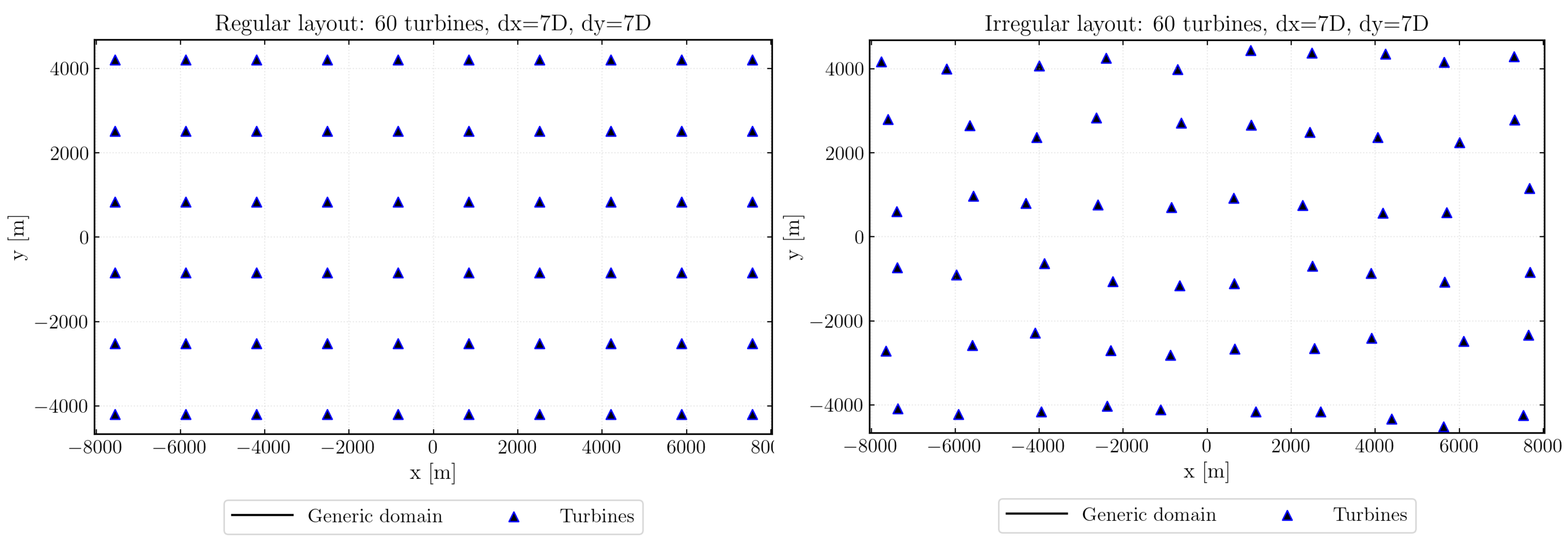
To address these questions, both controlled synthetic datasets and offshore climatological datasets are analysed. The study compares discretised empirical inflow-state ensembles with simplified sector-mean inflow-state ensembles for annual and seasonal climatologies using example regular and irregular wind-farm layouts, each comprising 60 turbines. The objective is not to develop a new wake model, but to isolate how inflow-state discretisation influences predicted wake loss and AEP. The turbine model, wake-model configuration, and wind-farm layouts are fixed throughout the analysis, with only the inflow discretisation varied so that differences in wake loss and AEP can be attributed directly to the discretisation choices.
The results presented in
Section 6 show that moderate reductions in discretisation resolution, including fewer directional sectors, broader wind-speed bins, and correspondingly smaller inflow-state ensembles, produce relatively small changes in predicted wake loss and AEP when the underlying within-sector wind-speed variability is retained. In this case, the wind-speed distributional structure within each directional sector remains represented, although at a coarser discretisation resolution. In contrast, replacing the within-sector wind-speed distribution with a single representative sector wind speed produces substantially larger differences in predicted wake loss and AEP relative to the more highly discretised reference ensembles.
This behaviour arises because turbine power depends nonlinearly on wind speed, such that averaging wind speed prior to wake-model evaluation is not generally equivalent to averaging the resulting power response across the underlying wind-speed distribution. As a result, evaluating turbine power using a single sector-mean wind speed is not generally equivalent to evaluating the full within-sector wind-speed distribution. These results show that preserving within-sector wind-speed variability has a larger influence on predicted wake loss and AEP than moderate reductions in discretisation resolution for the datasets and wind-farm layouts considered in this study.
This paper makes three contributions. First, it describes a reproducible method for constructing weighted inflow states from the joint wind-speed–direction distribution of long-term wind datasets, including hub-height reconstruction and assignment of occurrence probabilities. Second, it quantifies how directional resolution and wind-speed bin width influence wake-loss and AEP estimates when the resulting inflow-state ensembles are used in wake-model calculations. Third, it compares discretised empirical inflow-state ensembles with simplified sector-mean inflow-state ensembles and quantifies the resulting differences in predicted wake loss and AEP.
The remainder of the paper is organised as follows.
Section 2 describes the wind-data preprocessing and inflow-state construction procedure.
Section 5 introduces the diagnostic and power–response metrics used in the analysis.
Section 3 describes the wake-model setup and the regular and irregular wind-farm layouts.
Section 6 presents the discretisation, seasonal, and layout-sensitivity results.
Section 7 and
Section 8 discuss the practical implications of the findings and summarise the main conclusions.
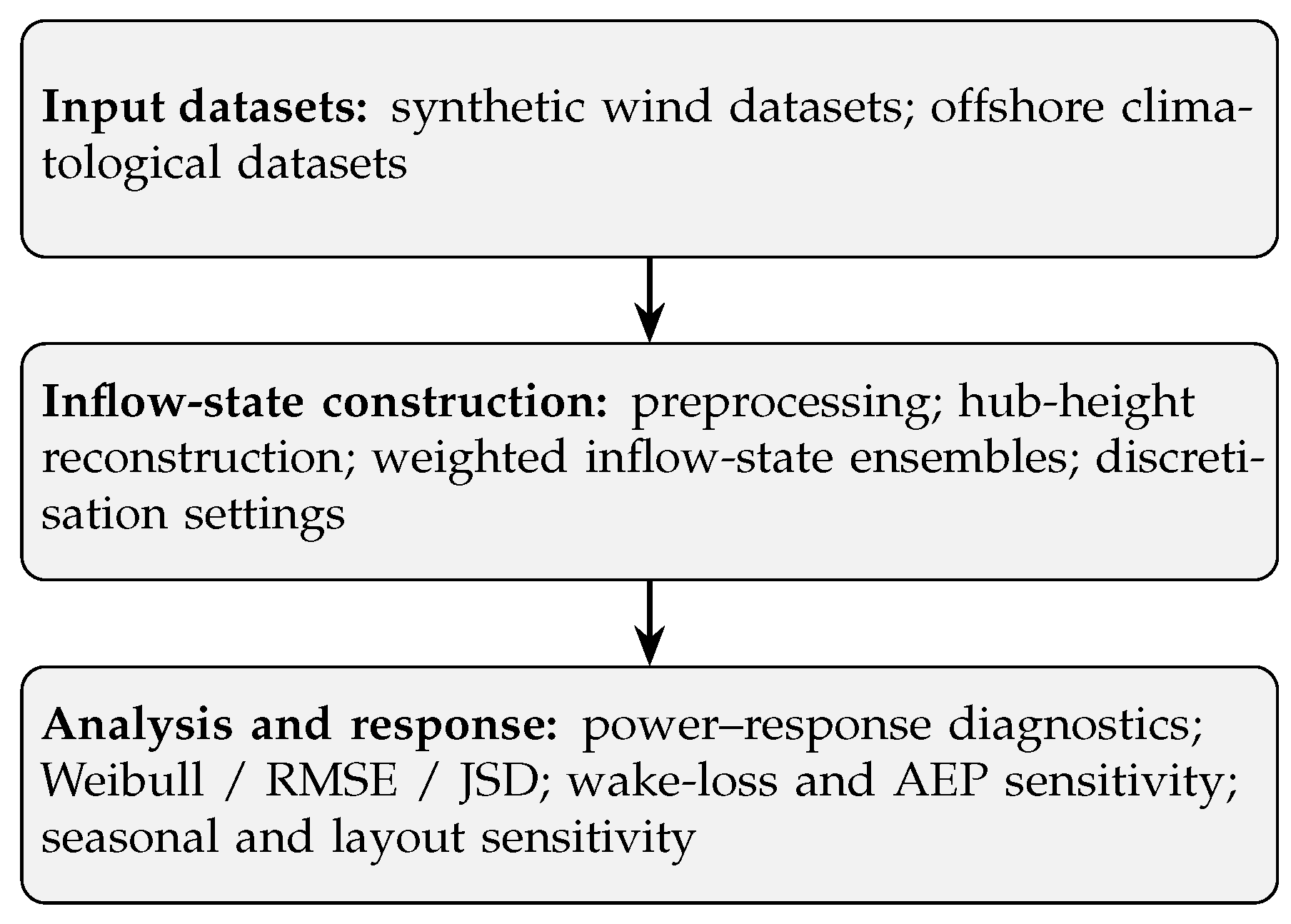
Figure 1 summarises the overall methodological structure adopted in the present study, including the inflow-state construction workflow, diagnostic analyses, and downstream wake-model applications.
2. Wind-Climate Preprocessing and Inflow-State Construction
2.1. Overview
Atmospheric inflow is represented using discrete inflow states defined by hub-height wind speed (bin centre), wind direction (sector centre), turbulence intensity, and associated occurrence probability. The inflow states are constructed directly from the empirical joint distribution of reconstructed hub-height wind speed and direction. Wind-data preprocessing, hub-height reconstruction, and discretisation procedures are described in
Section 2.2,
Section 2.3 and
Section 2.4, respectively.
The default inflow-state construction uses 72 directional sectors (5
resolution) together with 1
wind-speed bins. Additional coarser discretisations used in the sensitivity analysis are summarised in
Table 2. Annual and seasonal inflow-state datasets are generated using the same methodology applied to the corresponding subsets of the wind time series.
2.2. Wind Datasets and Preprocessing
Two classes of wind datasets are used in the analysis. The first consists of controlled synthetic datasets used to evaluate the behaviour of the inflow discretisation methodology under reproducible conditions. The second consists of offshore-representative datasets derived from long-term wind climatologies commonly used in offshore wind-resource assessment workflows [
22,
23,
24,
25].
Input time series consist of wind speed and wind direction at one or more reference heights obtained from measurements, reanalysis products, or hindcast datasets. Prior to inflow-state construction, the time series are screened for missing values, non-physical wind speeds, and duplicate timestamps where present. The processed datasets are then subdivided into annual and seasonal subsets (DJF, MAM, JJA, and SON) for the analyses presented in
Section 3 and
Section 6.
All inflow-state constructions, wake-model calculations, and discretisation experiments in this paper use these processed annual and seasonal subsets.
2.3. Hub-Height Reconstruction
Wake-model inflow conditions are typically defined at turbine hub height, whereas the available wind datasets are often provided at one or more reference levels below hub height [
24,
25,
26]. Hub-height wind speed is therefore reconstructed from the available vertical levels prior to inflow-state construction.
When wind-speed values are available at two reference heights
and
(with
), an instantaneous shear exponent is calculated from the corresponding wind speeds
and
using
The reconstructed hub-height wind speed
is then estimated using the power–law relationship commonly applied in offshore wind-resource assessment studies [
24,
26,
27]. The power–law approach is adopted here because it provides a simple and internally consistent reconstruction method across all datasets considered in the discretisation sensitivity analysis.
where
H is the turbine hub height and
z denotes the selected reference level used in the extrapolation. The synthetic wind generator described later in
Section 4 uses the inverse form of the same power–law relationship to generate winds at multiple heights from the synthetic hub-height wind speed.
If either wind-speed value was missing, non-physical, or below a low-speed threshold used to avoid unstable shear estimates near zero wind speed (typically 0.1
–0.5
), the instantaneous exponent was replaced by a fallback value
. This value is representative of near-neutral offshore shear conditions for the reference-height ranges considered here [
28]. No temporal smoothing was applied to the instantaneous shear exponent.
This analysis focuses on the sensitivity of wake-model predictions to inflow discretisation instead of on detailed atmospheric-stability effects or refining how the vertical wind profile is reconstructed. Using a consistent hub-height reconstruction across all ensembles and datasets means the observed differences in wake loss and AEP come from the inflow discretisation choices.
Hub-height wind direction is taken from the directional level nearest to the selected hub height. This assumes directional veer between adjacent levels is small relative to the directional sector widths used in the discretisation analysis. Cases with missing directional data are removed during preprocessing.
The reconstructed hub-height wind-speed and wind-direction time series are then used in the subsequent joint speed–direction discretisation.
2.4. Construction of Discretised Inflow States
The reconstructed hub-height wind-speed and wind-direction time series are discretised on a joint wind-speed–direction grid in order to construct the inflow states used in the wake-model calculations.
Directional discretisation uses
equal-width sectors
while wind speed is discretised into bins of width
.
The baseline inflow-state construction uses
directional sectors (5
resolution) together with wind-speed bins of width
. This discretisation is used as the reference inflow-state ensemble for the sensitivity analysis. A 5
directional resolution should be fine enough to capture wake-alignment effects associated with changes in inflow direction while limiting excessive sparsity within individual speed–direction bins for the datasets used in this study [
1,
17]. A wind-speed bin width of 1
provides comparable resolution across the operational wind-speed range while remaining consistent with discretisations commonly used in engineering wake and energy-yield calculations [
11]. Additional coarser discretisations are evaluated in
Section 6. Wind speeds between
and
are included in the inflow-state construction. This operational range is selected to match the turbine operating conditions used in the wake-model calculations described in
Section 3.1, including the IEA 15 MW reference turbine [
27]. Observations outside this range are excluded from the inflow states.
The number of wind-speed bins is defined as
Let denote the directional-sector centres and the wind-speed bin centres.
For each timestamp
t, the reconstructed hub-height wind speed
and wind direction
are assigned to the corresponding joint speed–direction bin. The empirical joint histogram is then constructed as
where
denotes the indicator function.
The joint wind-speed–direction distribution is estimated directly from the empirical time series rather than through parametric fitting in order to preserve the observed structure of the wind climate.
The corresponding empirical joint probabilities are calculated as
such that
Only populated bins () are retained as inflow states. Each retained bin is assigned a directional-sector centre , a representative wind speed corresponding to the bin centre, and an empirical occurrence probability . The total number of retained inflow states, therefore, depends on the empirical joint wind-speed–direction distribution and the selected discretisation settings.
Annual inflow-state files are generated for all datasets. Seasonal inflow-state files (DJF, MAM, JJA, and SON) are generated using the same procedure applied separately to the corresponding seasonal subsets of the time series.
2.5. Inflow-State Ensembles
The inflow-state ensembles considered in the sensitivity analysis vary the directional and wind-speed discretisation while keeping the wind dataset, turbine model, wake-model configuration, and wind-farm layouts fixed. The wake-model calculations are used here as a controlled comparison framework for evaluating the effects of different inflow-state ensembles under otherwise fixed modelling conditions. The analysis focuses on the relative sensitivity to inflow discretisation, not on optimising or evaluating wake-model performance itself.
The baseline inflow-state ensemble uses 72 directional sectors (5
resolution) together with 1
wind-speed bins (72 × 1). Coarser discretisations are generated by reducing directional resolution and increasing wind-speed bin width. The analysed inflow-state ensembles are summarised in
Table 2.
A sector-mean inflow-state ensemble is also evaluated. In this case, each directional sector is represented by the mean wind speed from the corresponding time series over the operational wind-speed range considered in the analysis, while sector occurrence probabilities are retained from the empirical directional distribution.
The analysed inflow-state ensembles, therefore, span relatively fine empirical wind-state constructions through to coarser sector-based approximations, allowing the effects of inflow resolution to be evaluated across both annual and seasonal climatologies.
2.6. Turbulence-Intensity Assignment
Each inflow state is assigned a representative turbulence intensity for use in the wake-model calculations. When turbulence-intensity time series are available, turbulence intensity is assigned using the mean value associated with each populated speed–direction bin. Otherwise, turbulence intensity is estimated using a power–law relationship evaluated at the representative wind speed of each inflow state.
The default turbulence-intensity model is defined as
where
is the reference turbulence intensity at wind speed
, and
controls the decay of turbulence intensity with increasing wind speed.
The default configuration uses
at
with
, consistent with relatively low offshore turbulence conditions and IEC Category C inflow characteristics [
29]. A lower turbulence-intensity limit of 0.03 is applied to avoid unrealistically low values at higher wind speeds.
The present analysis focuses on the sensitivity of wake-model predictions to wind speed and directional discretisation rather than to turbulence-intensity parameterisation. The same turbulence-intensity methodology is therefore applied consistently across all inflow-state ensembles in order to isolate the effects of the inflow discretisation itself.
4. Controlled Synthetic Test Case
A controlled synthetic wind dataset was generated to test the inflow-state construction and discretisation workflow under reproducible conditions. The synthetic dataset provides a controlled test case for evaluating the effects of directional discretisation, wind-speed binning, and sector-based inflow approximations under known vertical shear and directional-veering conditions without the additional spatial and climatological variability present in offshore reanalysis or hindcast datasets.
The synthetic time series was generated at hourly resolution, consistent with the ERA5 hourly temporal resolution used in offshore wind-resource assessment workflows [
22]. Wind speeds and directions were generated at two reference heights ( 10
and 100
), while hub-height quantities were reconstructed for the turbine configuration used in this study ( 150
hub height for the IEA 15 MW reference wind turbine) using the same hub-height reconstruction workflow described in
Section 2.3, including the power–law extrapolation defined in Equation (
14). The resulting synthetic datasets were then processed using the same preprocessing, hub-height reconstruction, inflow-state construction, and diagnostic workflow applied to the offshore climatological datasets described in
Section 2.2.
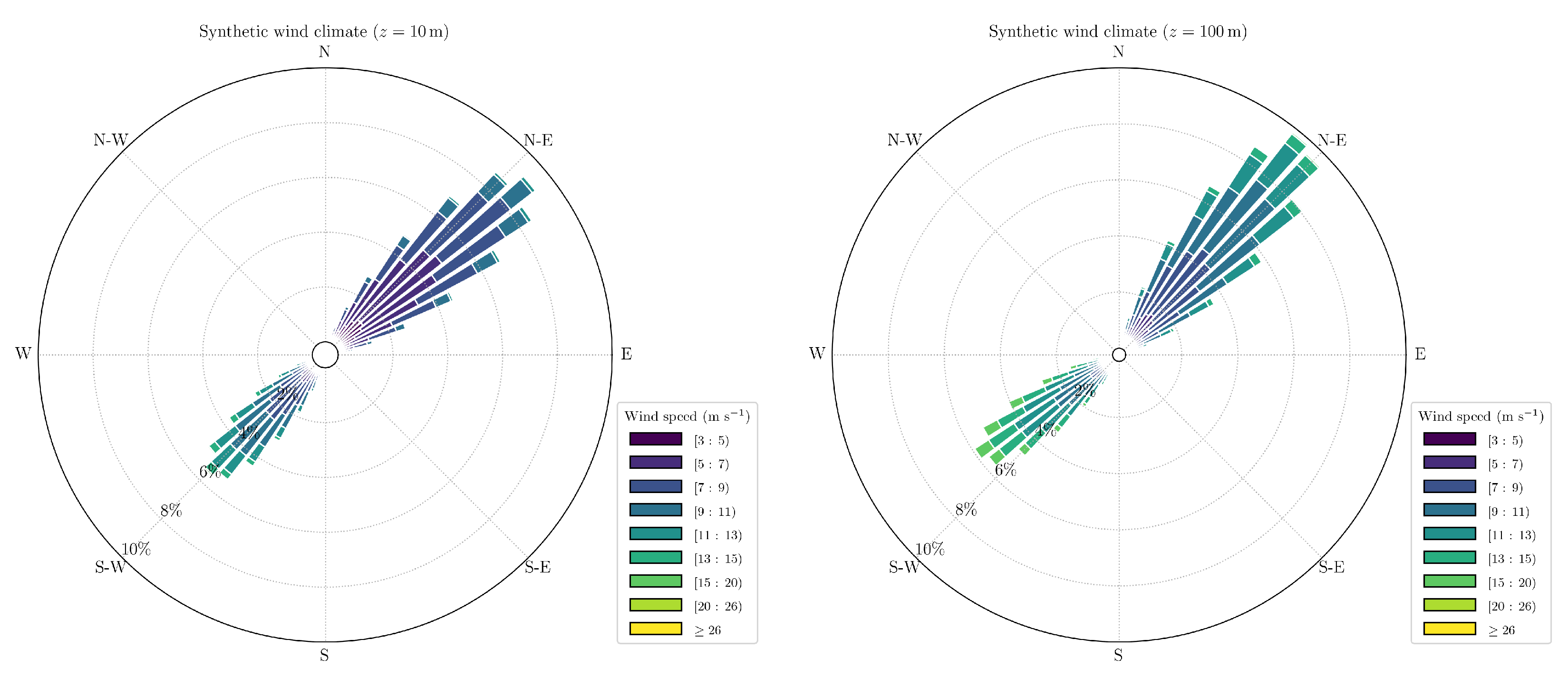
The synthetic generator produced a 40-year hourly wind record beginning on 1 January 1980 using a fixed random seed 1234 to ensure reproducibility. The synthetic wind climate consisted of two persistent directional regimes represented using a high-persistence two-state Markov chain with equal regime persistence probabilities and transition probability . The first regime represented predominantly south-westerly flow with a mean direction of 230, while the second represented north-easterly flow with a mean direction of 45. The regimes were selected to generate a bimodal directional distribution with contrasting north-easterly and south-westerly flow conditions, together with directional veer between the two reference heights.
Regime-dependent mean wind speeds varied seasonally. The south-westerly regime used mean winter and summer hub-height wind speeds of 15 and 10 , while the north-easterly regime used corresponding values of 11 and 8 . A weak diurnal modulation with an amplitude of approximately 1 was superimposed together with Gaussian stochastic variability having a standard deviation of 2 . Intermittent high-wind perturbations were introduced using exponentially distributed burst increments with occurrence probability 0.01 per time step and scale parameter 3 to broaden the upper tail of the wind-speed distribution without modelling extreme-event processes.
Vertical structure was represented using a time-varying power–law shear relationship together with regime-dependent directional veer between the two reference heights. Power–law shear profiles are widely used in offshore wind-resource assessment and hub-height extrapolation workflows [
26,
28]. Using the same power–law formulation introduced in
Section 2.3 for hub-height reconstruction (Equation (
2)), the synthetic generator defines wind speed at height
z from the synthetic hub-height wind speed
as
where
H denotes the turbine hub height.
The south-westerly regime used a mean shear exponent with standard deviation 0.03, while the north-easterly regime used a mean with standard deviation 0.035. Shear exponents were clipped to the range to avoid non-physical values. A weak reduction in shear was applied for hub-height wind speeds exceeding approximately 20 .
Directional veer was represented as a time-varying directional offset between the lower and upper reference heights. The south-westerly regime used a mean veer of 10 with a standard deviation of 5, while the north-easterly regime used a mean veer of with a standard deviation of 5. Veer values were clipped to the range −30 to 30.
Wind speeds and directions at each height were converted to horizontal velocity components using the standard meteorological “from” convention,
where
denotes wind direction measured clockwise from north. Resulting velocity components
u and
v are expressed in
.
Random missing values were introduced independently at the two reference heights to emulate incomplete observational or reanalysis datasets. Missing-data fractions of 1% and 3% were applied at 10 and 100 , respectively, while hub-height quantities were retained complete for consistency checks during reconstruction.
The primary output of the generator was a NetCDF dataset containing wind-component, wind-speed, wind-direction, shear, veer, and regime-index variables together with associated metadata and units. The dataset includes eastward and northward velocity components, reconstructed wind speeds and directions at all vertical levels, shear exponent
, directional veer
, and regime-index time series. The synthetic dataset was generated using the archived workflow scripts provided in the Data Availability statement and associated Zenodo archive (DOI:10.5281/zenodo.19678324). Additional details of the synthetic wind generator implementation, parameterisation, and workflow are provided in
Appendix A.
Turbine power calculations used the IEA 15 MW offshore reference wind turbine specification [
27], with power and thrust characteristics defined using the corresponding reference turbine implementation [
33]. The synthetic dataset was used exclusively for discretisation diagnostics and controlled sensitivity testing. Wake-model calculations and wind-farm AEP simulations presented in
Section 6 were performed separately using the offshore climatological datasets described in
Section 2.2.
Figure 3 shows the synthetic wind-rose distributions at the two reference heights used in the analysis. The wind roses were constructed using the same baseline 5
directional discretisation adopted in the inflow-state construction workflow. Wind-speed classes correspond to the same 1
binning approach used in the discretised inflow-state ensembles.
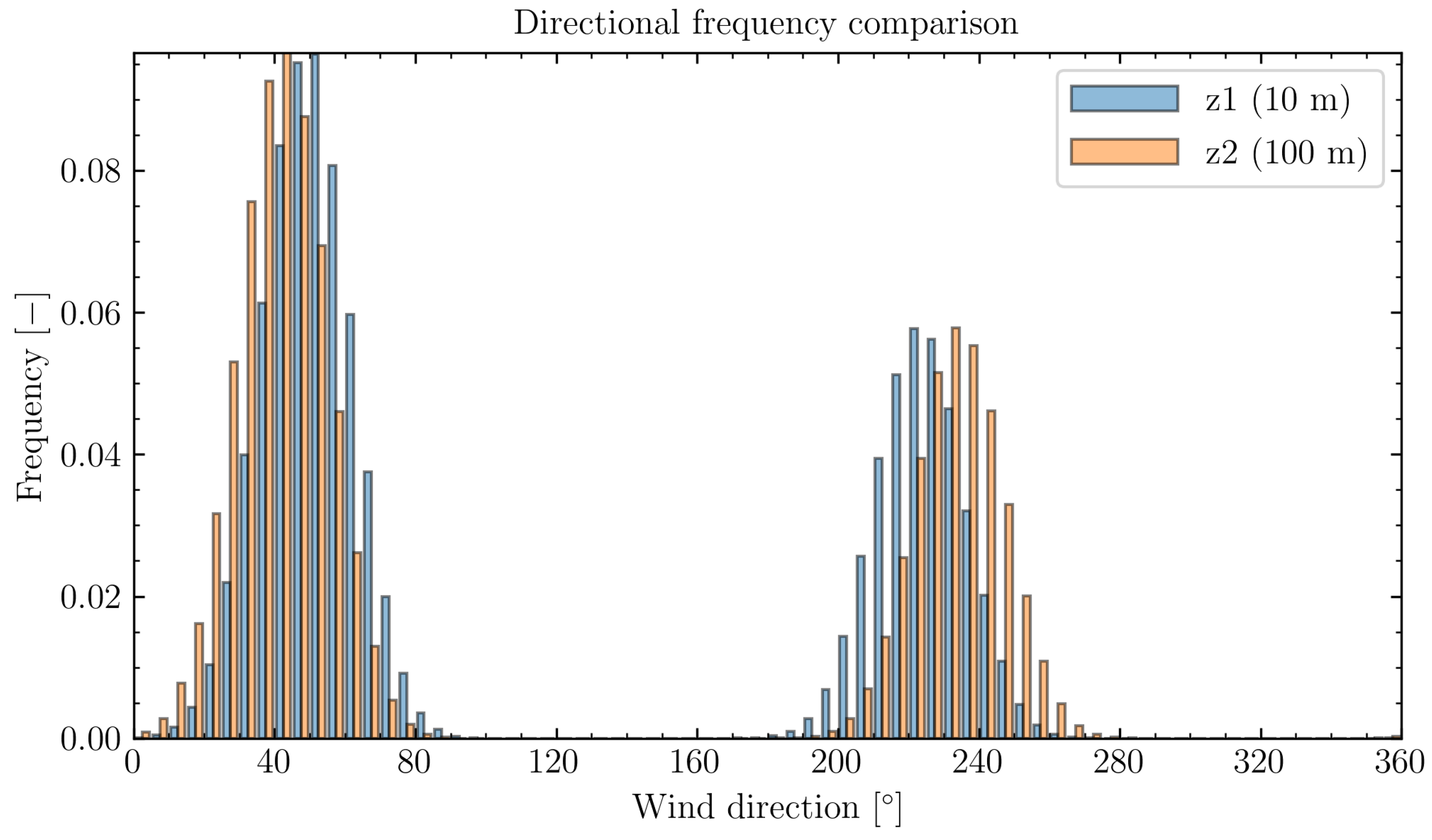
The marginal directional-frequency distributions derived from the synthetic wind dataset are shown in
Figure 4. The distributions show the bimodal directional structure generated by the synthetic time series, with dominant north-easterly and south-westerly flow regimes and directional veer between the two reference heights.
The corresponding summary statistics of the synthetic wind dataset are presented in
Table 3. These statistics provide a quantitative check on the directional structure, vertical shear behaviour, and wind-speed variability represented within the processed synthetic dataset.
The higher wind speeds at 100
are consistent with the power–law shear relationship used in the synthetic generator, while the shift in circular-mean wind direction between the two heights reflects the directional veer introduced between the lower and upper reference levels. Together with the wind-rose and directional-frequency diagnostics shown in
Figure 3 and
Figure 4, these statistics provide a controlled diagnostic check on the preprocessing, hub-height reconstruction, and inflow-state construction procedures prior to the discretisation analyses presented in
Section 5.
5. Diagnostics Framework
The analysis uses a set of diagnostics to characterise the wind climatology, evaluate the effect of inflow discretisation, and quantify how different inflow-state ensembles influence derived quantities such as turbine power, wake loss, and annual energy production (AEP). These methods do not modify the inflow-state construction itself. Instead, they quantify how closely the discretised inflow states reproduce the underlying wind-speed–direction distribution and how sensitive the downstream engineering calculations are to the selected discretisation.
5.1. Wind-Climate and State-Frequency Diagnostics
Basic directional and wind-speed statistics were calculated for each processed dataset together with the corresponding annual and seasonal subsets. These diagnostics include mean wind speed, directional occurrence frequency, wind-speed percentiles, and marginal directional distributions derived from the discretised inflow-state ensembles described in
Section 2.4.
Directional occurrence frequencies were evaluated using the same directional-sector definitions adopted in the inflow-state construction. Marginal directional distributions were obtained by integrating across all wind-speed bins within each directional sector.
For the synthetic dataset described in
Section 4, these diagnostics were used to verify that the expected bimodal directional structure and directional differences between the two reference heights were retained after preprocessing and discretisation. For the offshore climatological datasets, the same diagnostics characterise the dominant directional structure represented in the wake-model inflow conditions.
5.2. Power–Response Diagnostics
Wind-farm energy production depends on the nonlinear relationship between wind speed and turbine power output. Replacing the wind-speed distribution within each directional sector with a single representative value can therefore change predicted turbine power and AEP.
Let
denote the turbine power curve as a function of wind speed
U. Using the empirical inflow states, the expected turbine power is calculated as
where
is the representative wind speed associated with inflow state
and
is the corresponding occurrence probability defined in Equation (
6).
For each directional sector, the marginal sector probability is
The sector-mean wind speed is then calculated from the conditional wind-speed distribution within that sector as
A sector-mean representation evaluates the turbine power curve once per directional sector using this mean wind speed. The corresponding power estimate is
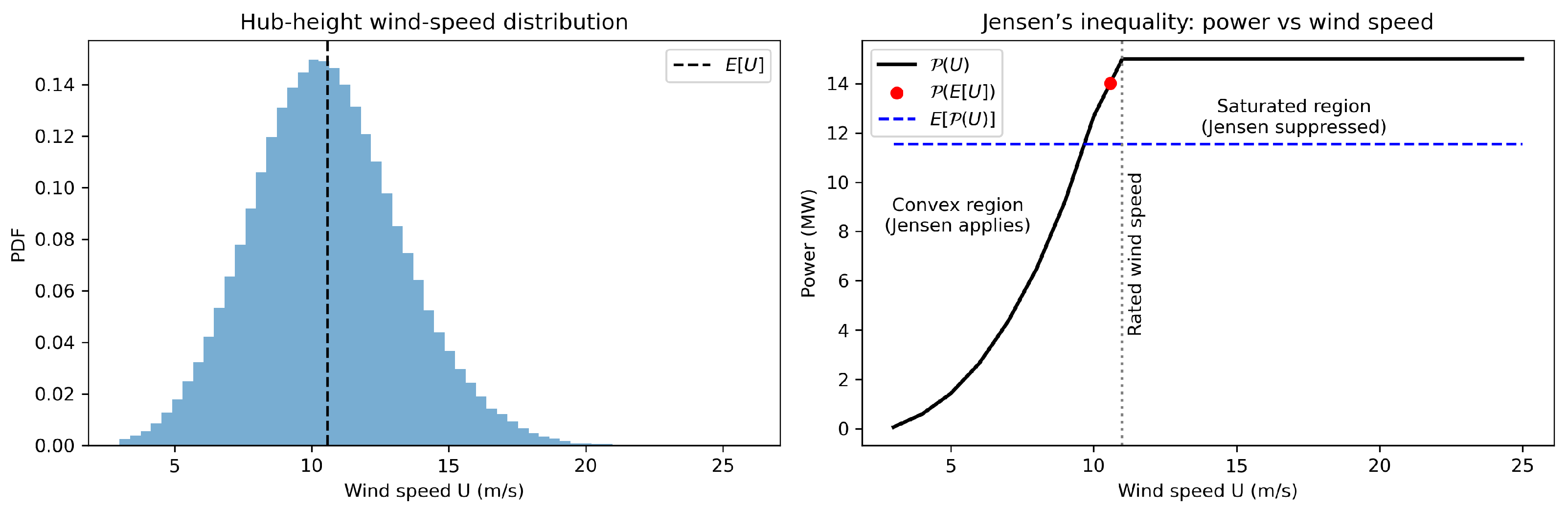
Because turbine power curves are strongly nonlinear below rated wind speed, evaluating the power curve at
is not generally equivalent to averaging power across the full wind-speed distribution within the sector [
35]. For a convex part of the power curve, Jensen’s inequality [
36] gives
This shows why sector-mean wind speeds can give different power estimates from calculations that use the full within-sector wind-speed distribution. The magnitude and sign of the difference depend on which part of the turbine power curve is sampled by the sector wind-speed distribution.
The relative difference between the empirical and sector-mean inflow-state ensembles was quantified as
This diagnostic was used to quantify how directional-sector resolution, wind-speed bin width, and sector-mean inflow approximations influence predicted turbine power and AEP.
5.3. Discretisation and Convergence Diagnostics
The influence of inflow discretisation was evaluated by repeating the inflow-state construction and wake-model calculations using the discretisations listed in
Table 2. The sensitivity analysis isolates the effect of directional resolution and wind-speed bin width while keeping the wind datasets, turbine model, wake-model configuration, and wind-farm layouts unchanged.
Comparisons were performed using both annual and seasonal climatologies. Changes in predicted quantities were evaluated using absolute and relative differences between discretisation settings.
The 72 × 1 inflow-state ensemble, corresponding to 72 directional sectors with 1
wind-speed bins, was treated as the reference discretisation for all convergence comparisons in
Section 6.
The total number of populated inflow states was also calculated for each discretisation after removal of empty wind-speed–direction bins. These diagnostics provide a direct proxy for the computational cost associated with progressively finer directional and wind-speed resolution, since increasing the number of populated inflow states also increases the number of wake-model evaluations required in the weighted simulations [
30].
5.4. Weibull and Distribution-Comparison Diagnostics
Sector-wise Weibull distributions were fitted to the directional wind-speed distributions to compare parametric sector-wise wind-speed models with the empirical inflow-state construction [
5,
37].
These Weibull fits were used only as diagnostic comparisons and did not influence the inflow-state generation itself. The comparison provides a simple diagnostic check on how well commonly used parametric wind-speed models reproduce the directional structure represented by the empirical inflow states.
For each directional sector, the empirical and Weibull-modelled wind-speed distributions were compared using the root-mean-square error (RMSE). For directional sector
i, the RMSE was calculated as
where
and
denote the empirical and Weibull-modelled probabilities for directional sector
i and wind-speed bin
j, respectively, and
denotes the number of wind-speed bins.
At the site level, the empirical joint wind-speed–direction distribution and the corresponding Weibull-based reconstruction were compared using the Jensen–Shannon divergence (JSD), which provides a bounded and symmetric measure of distributional similarity [
38].
For two discrete joint wind-speed–direction distributions
P and
Q, the Jensen–Shannon divergence is defined as
where
and
denotes the Kullback–Leibler divergence [
39].
Higher RMSE and JSD values indicate sectors where the wind-speed distribution departs from a simple Weibull form, for example, when multiple wind regimes contribute within the same directional sector [
6,
8]. These diagnostics quantify how progressively coarser inflow-state ensembles alter the represented wind-speed and directional structure.
5.5. Bootstrap Variability Assessment
Interannual variability in the inflow-state probabilities was estimated using a year-block bootstrap procedure [
40]. Entire calendar years were resampled with replacement to generate alternative bootstrap realisations of the joint wind-speed–direction distribution while preserving the seasonal structure within individual years.
For each bootstrap realisation, the inflow-state probabilities were recalculated using the same discretisation procedure described in
Section 2.4. The resulting ensemble provides an estimate of how sensitive the inflow-state occurrence probabilities are to year-to-year variability within the underlying wind climatology.
The bootstrap analysis was applied separately to the annual and seasonal climatological subsets. Unless otherwise stated, 500 year-block bootstrap realisations were used throughout the uncertainty analyses presented in this study.
5.6. Wake-Loss, AEP, Layout, and Seasonal Sensitivity Metrics
The effect of inflow discretisation on downstream engineering calculations was evaluated using probability-weighted wake-loss and annual-energy-production (AEP) metrics derived from the wake-model calculations described in
Section 3.3.
For each inflow-state ensemble, the relative AEP difference with respect to the reference discretisation was calculated as
where
corresponds to the baseline empirical inflow-state ensemble using 72 directional sectors and 1
wind-speed bins.
Wake-loss sensitivity was evaluated using the absolute wake-loss difference
where
denotes the wake loss obtained using the reference discretisation.
These diagnostics were evaluated independently for the regular and irregular wind-farm layouts described in
Section 3.2. Comparing the two layouts provides a practical check on whether the discretisation sensitivity depends strongly on turbine alignment and repeated downstream wake interactions.
Separate diagnostics were also evaluated for the standard meteorological seasons DJF, MAM, JJA, and SON to assess whether discretisation sensitivity changes under different directional and wind-speed conditions within the annual climatology.
6. Results
The synthetic-dataset diagnostics in
Section 4 showed that the processing chain reproduced the generated wind-speed, directional, shear, and veer structure before applying the same diagnostics to the offshore climatological datasets. The results below use those diagnostics to examine three linked questions: how sector-mean wind speeds affect turbine power estimates, how empirical inflow discretisation affects wake loss and AEP, and whether the same trends hold across seasonal subsets and wind-farm layouts. All comparisons are deterministic comparisons between inflow-state ensembles under the fixed turbine, wake-model, and layout settings described earlier; formal uncertainty estimates on the wake-model predictions are not estimated here.
6.1. Synthetic Power–Distribution Diagnostics
The synthetic dataset was first used to isolate the effect of replacing the wind-speed distribution within each directional sector by a single sector-mean wind speed, following the power–response diagnostic defined in
Section 5.2. Here, the sector mean is the arithmetic mean wind speed within each directional sector, weighted by the empirical wind-speed-bin probabilities. This comparison is important because the IEA 15 MW turbine power curve is nonlinear between cut-in and rated wind speed [
35]. Evaluating turbine power at a sector-mean wind speed is, therefore, not equivalent to averaging power across the full wind-speed distribution within that sector.
The power-curve effect is illustrated in
Figure 5. The figure compares the power obtained from the full within-sector wind-speed distribution with the power obtained from sector-mean wind speeds for the synthetic annual dataset. The difference is a pre-wake effect: it arises before any turbine–turbine wake interaction is calculated.
The annual and seasonal differences between the empirical and sector-mean calculations are summarised in
Table 4. The sector-mean approximation overestimates expected turbine power for all five subsets. The annual overestimate is 12.58%, while the seasonal values range from 6.66% in JJA to 13.91% in DJF. The expected power calculated using the full empirical wind-speed distribution is denoted here as
.
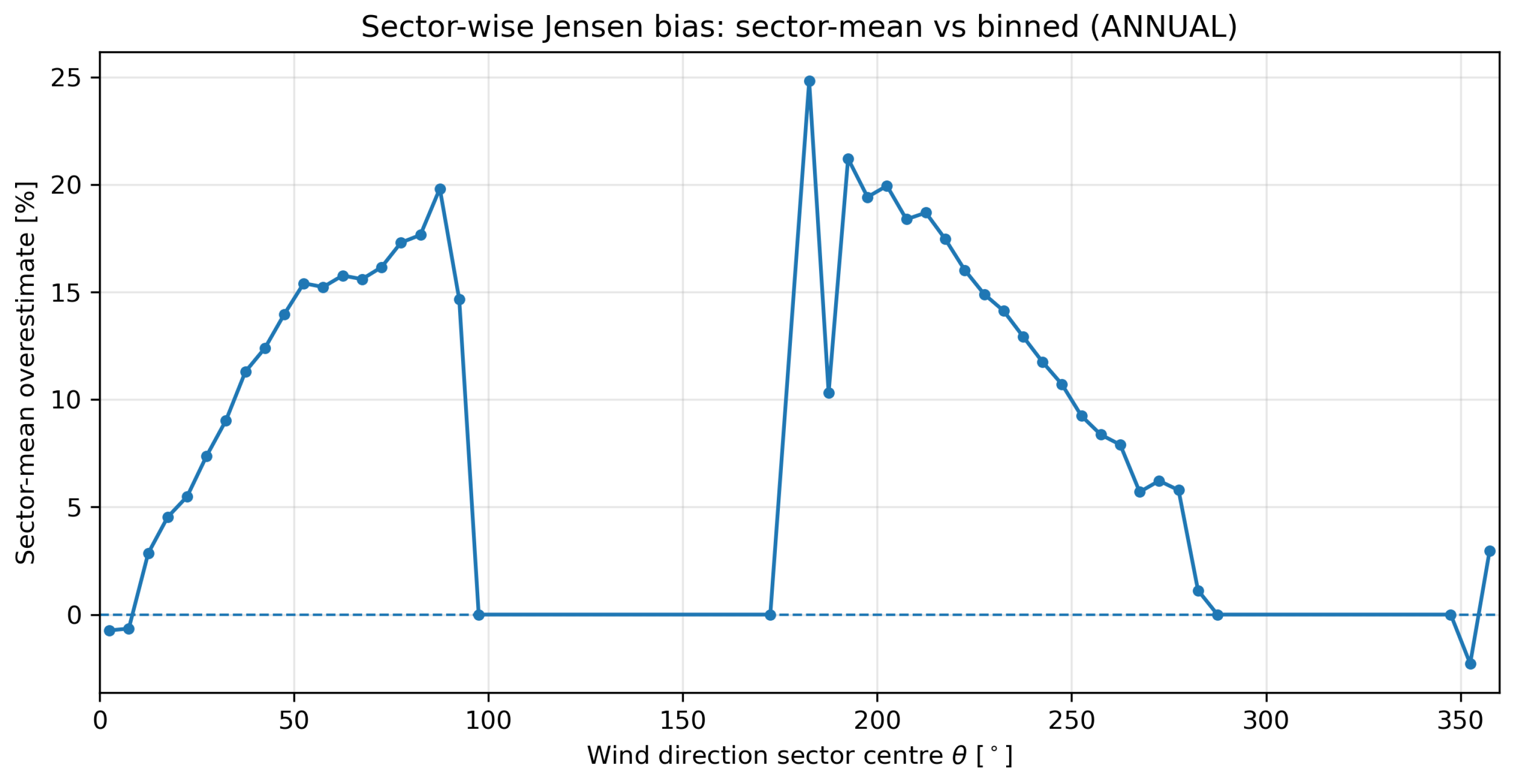
The sector-wise annual pattern is shown in
Figure 6. The largest sector-level differences occur where the wind-speed distribution within a directional sector crosses the nonlinear part of the turbine power curve. This confirms that the bias in
Table 4 is already present in the inflow-to-power conversion and is not caused by wake interactions.
6.2. Weibull and Discretisation Sensitivity Diagnostics
Sector-wise Weibull fits were compared with the empirical wind-speed distributions as a diagnostic check on simplified parametric sector-wise wind-speed models. The Weibull fits were diagnostic only and were not used to construct the inflow states.
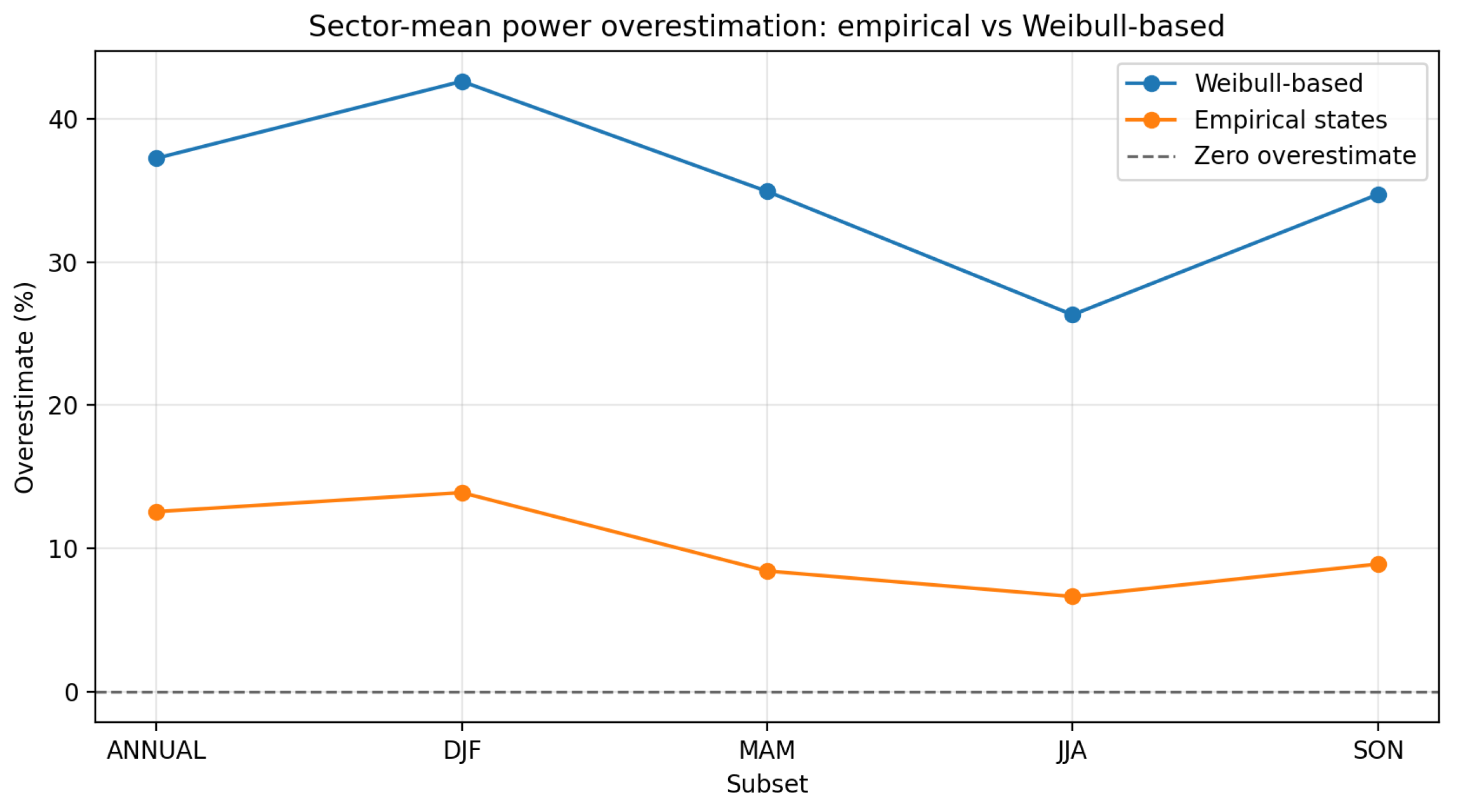
The empirical and Weibull-based sector estimates are compared in
Figure 7. The sectors with the largest differences are those where the empirical distribution is widened or partly multimodal, because a single Weibull distribution cannot reproduce multiple wind-speed populations within the same direction sector.
The sensitivity analysis was repeated for the inflow discretisations listed in
Table 2, with the turbine power curve and all other analysis settings kept unchanged. The power-bias behaviour shown in
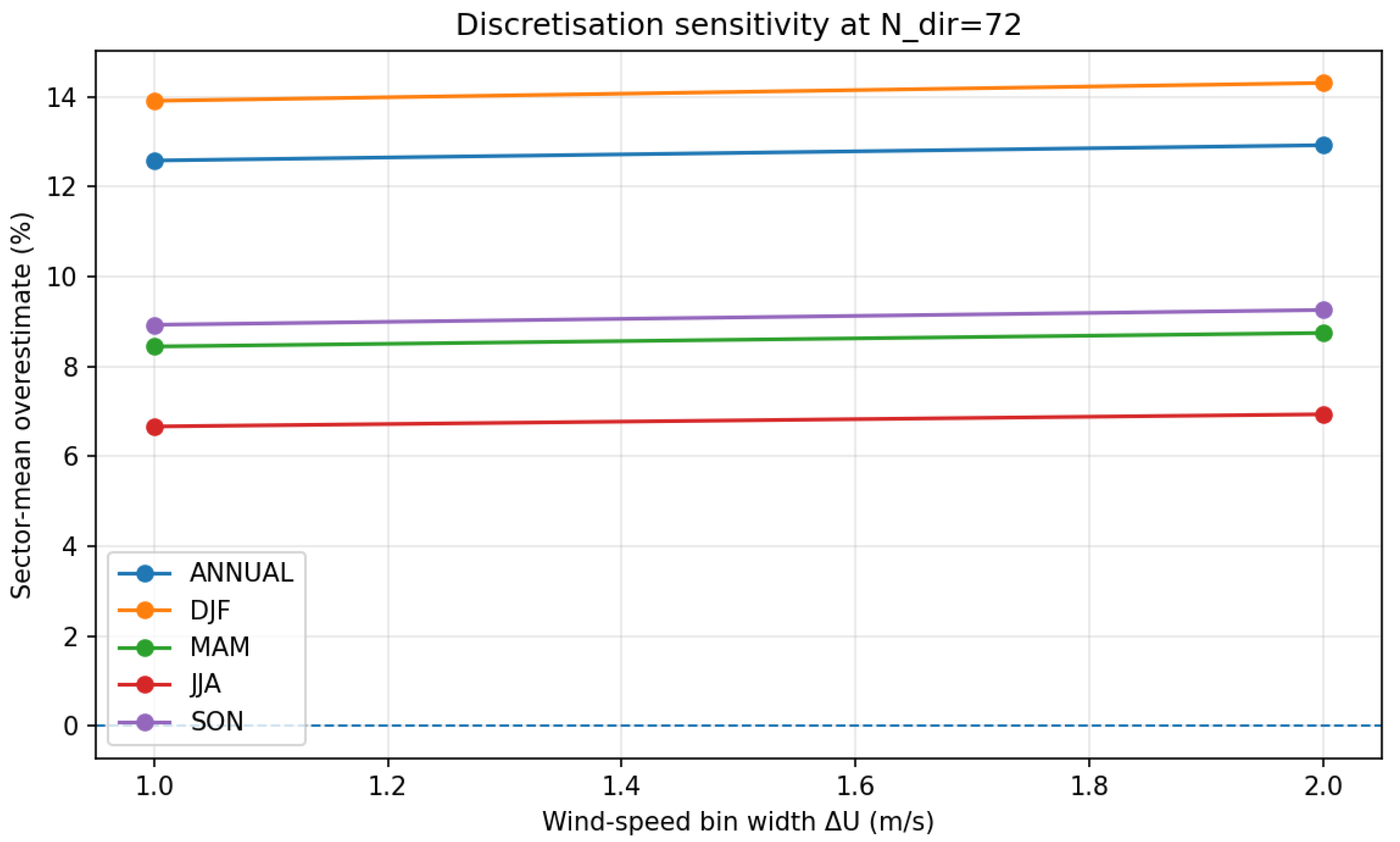
Figure 8 remains evident across all tested discretisations. The seasonal ordering remains consistent across the tested discretisations, with DJF showing the largest sector-mean power overestimate and JJA the smallest.
The convergence values in
Table 5 quantify the annual sensitivity of the sector-mean power-bias estimate to inflow-state discretisation. The convergence metric
was defined as the absolute relative deviation of the sector-mean power bias
from the 72 × 1 reference case,
where
denotes the sector-mean power bias obtained using the 72 × 1 reference discretisation. Smaller values of
, therefore, indicate closer agreement with the reference case and reduced sensitivity to further discretisation refinement.
For 1 wind-speed bins, the relative deviation from the 72 × 1 reference remains below 0.5% across all tested directional resolutions. Increasing the directional resolution from 36 to 72 sectors at changes the annual power-bias estimate by less than 0.01 percentage points at the reported precision, with . By contrast, changing the wind-speed bin width from 1 to 2 changes from 12.58% to 12.92% for the 72-sector case.
For the synthetic case, these results show that the sector-mean power bias is controlled mainly by how the within-sector wind-speed distribution is treated. Directional refinement beyond 36 sectors changes the annual power-bias estimate by less than the reporting precision used in
Table 5 when
.
6.3. Offshore Inflow-State Characteristics
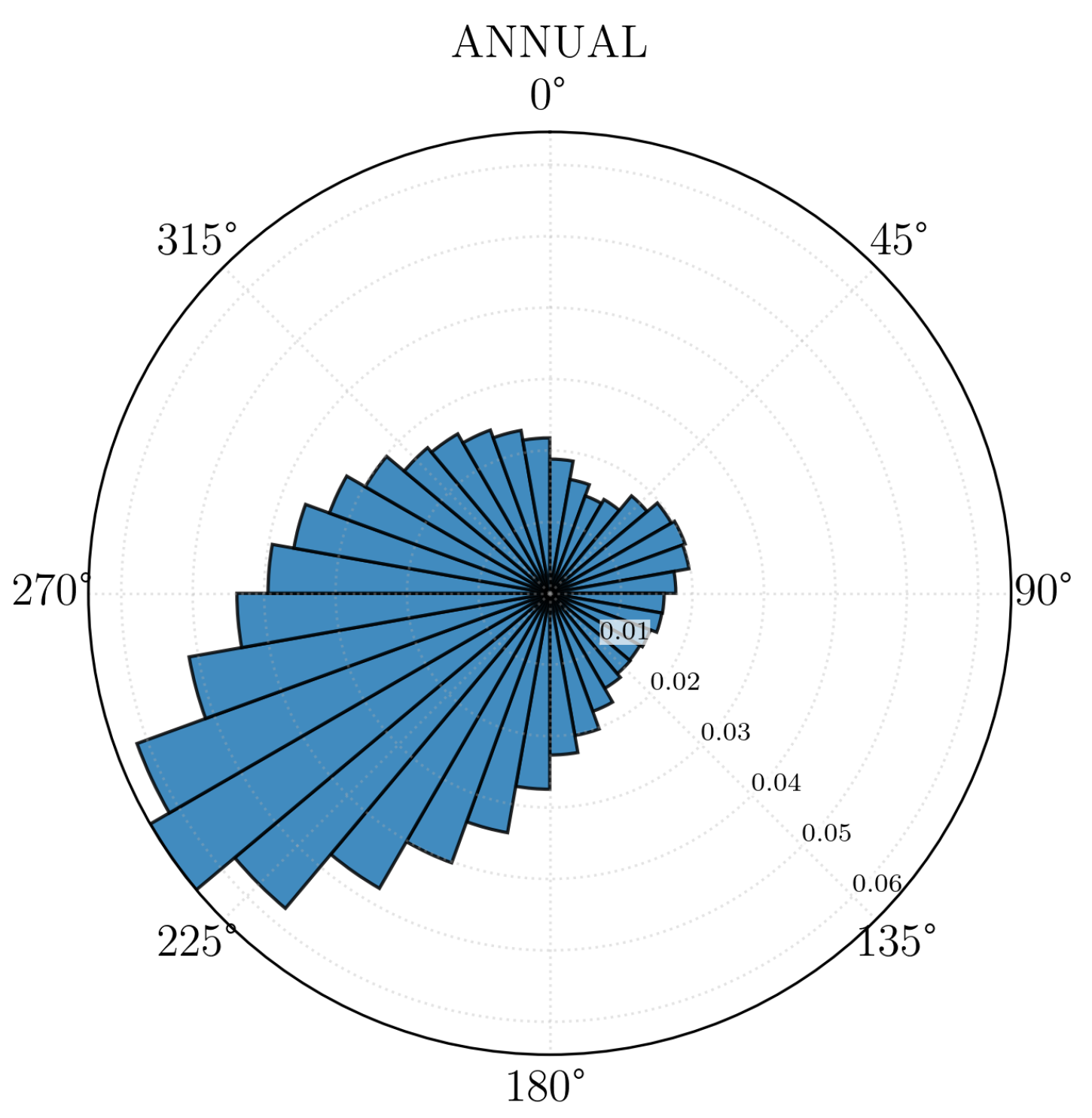
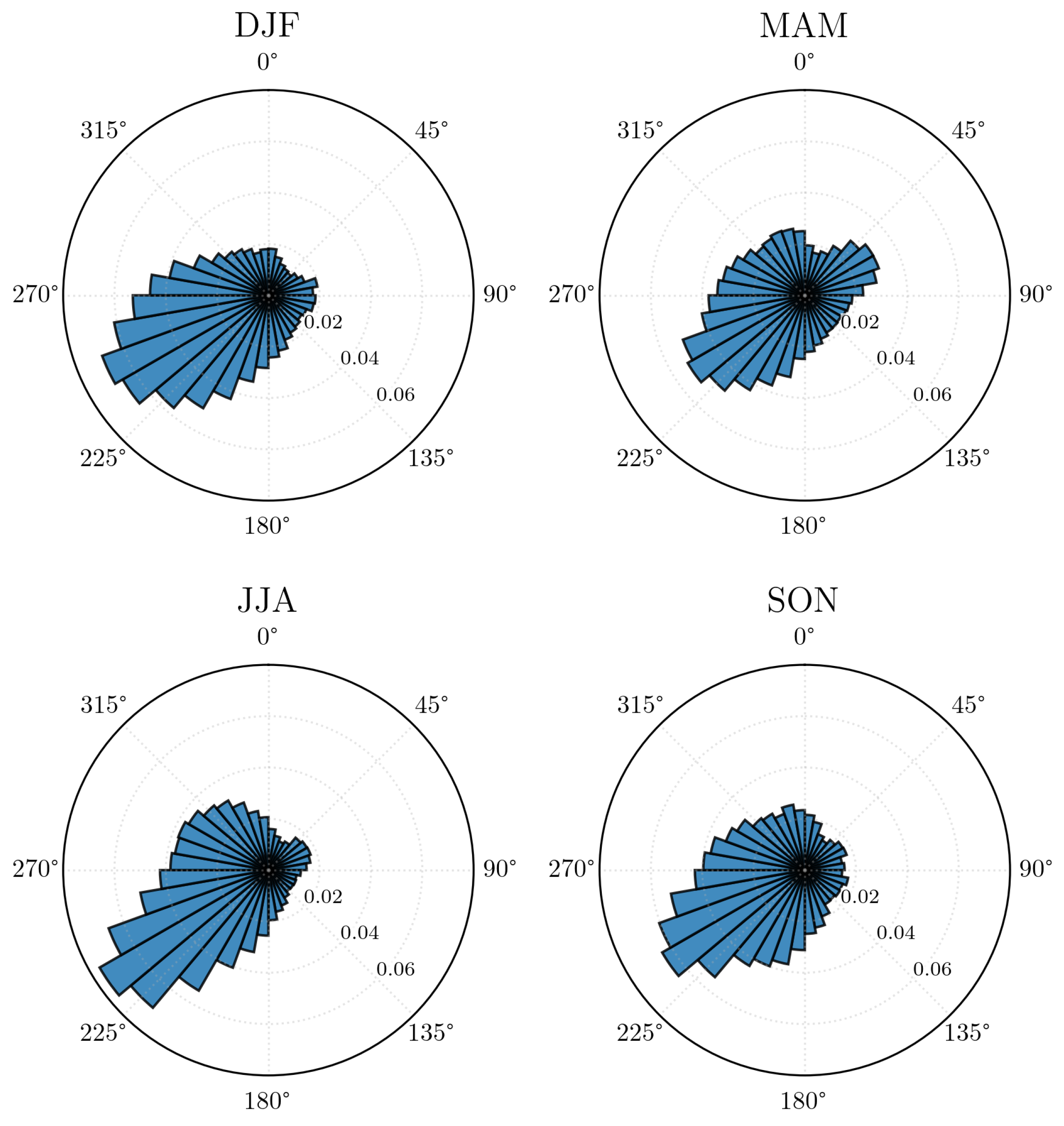
The offshore climatological datasets, obtained from locations within the Celtic Sea off the south coast of Ireland, were processed using the same inflow-state construction workflow. The annual weighted wind rose in
Figure 9 provides the baseline directional distribution used for the annual wake-model calculations. The seasonal wind roses in
Figure 10 show that the directional and wind-speed structure changes between DJF, MAM, JJA, and SON, rather than being a simple rescaling of the annual distribution.
The annual empirical inflow-state ensemble contains 1593 populated states after removal of empty wind-speed–direction bins. The seasonal state counts range from 1317 in JJA to 1546 in DJF. The corresponding wake-loss and AEP estimates for the irregular 60-turbine layout are listed in
Table 6.
The seasonal wake-loss estimates range from 5.35% in DJF to 10.05% in JJA. Over the same subsets, ambient farm power varies from 434.42 MW in JJA to 664.69 MW in DJF. The seasonal inflow-state subsets, therefore, produce differences in both the ambient power available to the farm and the directional wake conditions entering the wake-model calculations.
6.4. Wake-Loss and AEP Sensitivity to Inflow Discretisation
Wake-model calculations were repeated for the inflow-state ensembles listed in
Table 2. The 72 × 1 empirical inflow-state ensemble was treated as the annual reference case.
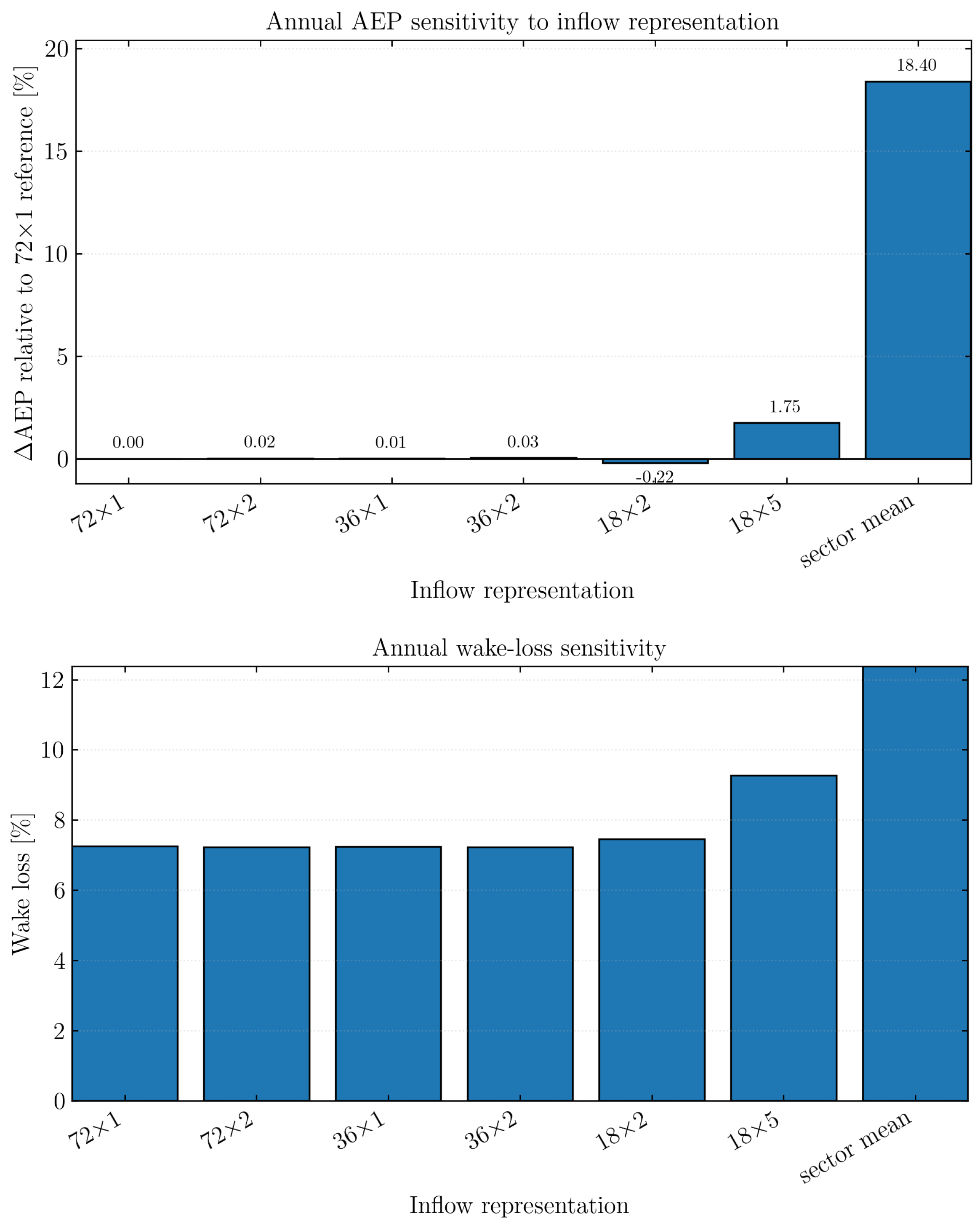
Figure 11 shows the annual AEP and wake-loss sensitivity, and
Table 7 lists the corresponding numerical values.
For the empirical inflow-state ensembles with 1 or 2 wind-speed bins, annual AEP remains within 0.03% of the 72 × 1 reference for the 72 × 2, 36 × 1, and 36 × 2 cases. The 18 × 2 case results in a larger AEP difference of , but still remains within a quarter of a percent of the reference.
Changes in both AEP and wake-loss estimates are larger when broad wind-speed bins or sector-mean averaging are used. The 18 × 5 case shows a 1.75% AEP difference, and increases wake loss from 7.25% to 9.27%. The sector-mean inflow-state ensemble gives the largest response in this annual comparison, increasing AEP by 18.40% and wake loss by 5.13 percentage points relative to the empirical reference.
The empirical and sector-mean rows in
Table 7 separate state-count reduction from loss of within-sector wind-speed information. Reducing the empirical inflow-state ensemble from 1593 states to 416 states in the 36 × 2 case changes AEP by 0.03% and wake loss by
percentage points. The sector-mean inflow-state ensemble uses only 72 states, but changes AEP by 18.40% and wake loss by 5.13 percentage points. For the cases tested here, the results depend more strongly on whether the within-sector wind-speed distribution is retained than on the number of inflow states alone.
6.5. Seasonal Sensitivity to Inflow Discretisation
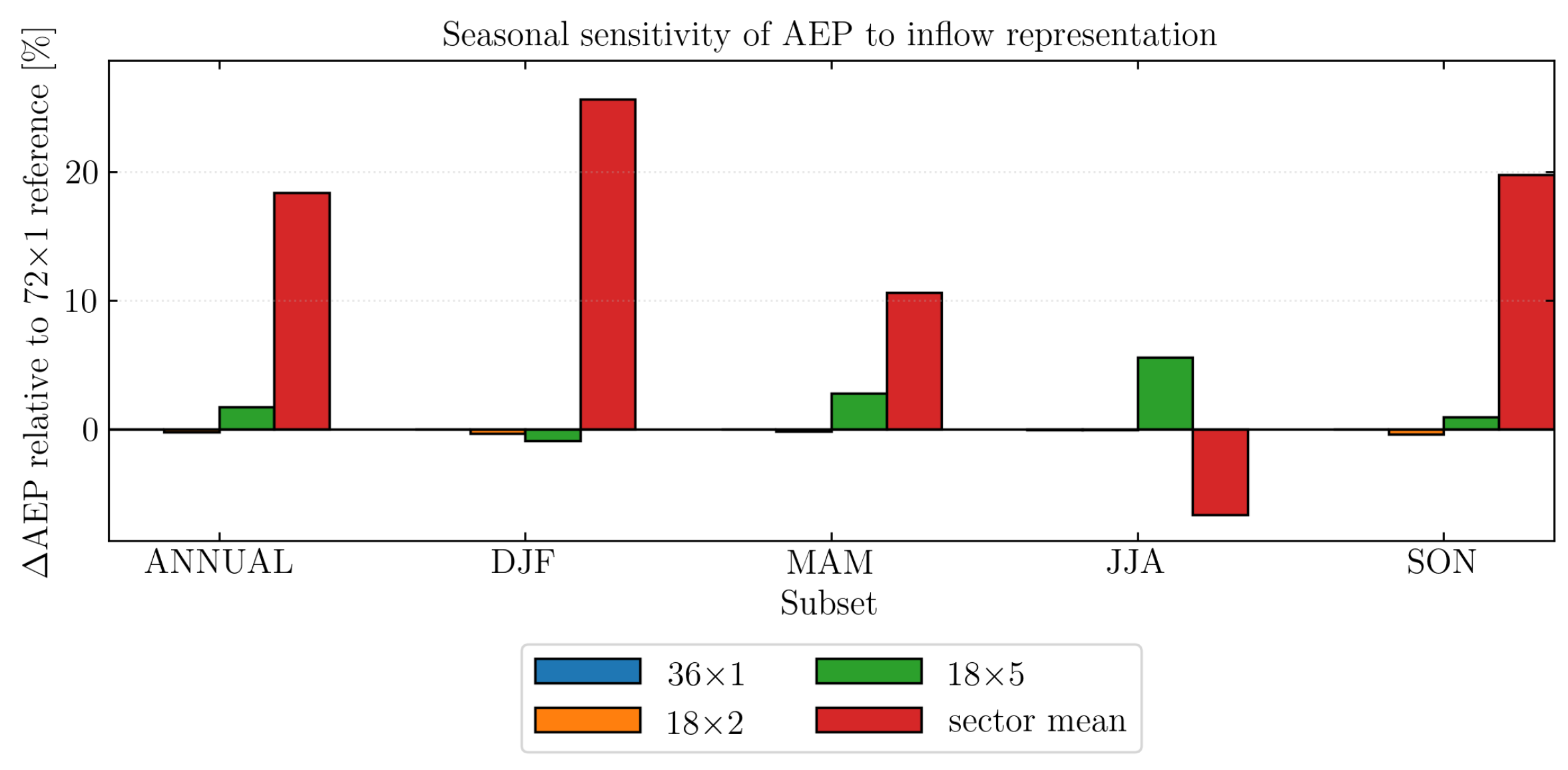
Seasonal AEP sensitivity for selected empirical inflow-state ensembles is shown in
Figure 12. The 72 × 2 empirical case remains within
to 0.26% of the seasonal reference across DJF, MAM, JJA, and SON. The 36 × 1 and 18 × 2 cases also remain much closer to the reference than the 5
wind-speed-bin case.
The 18 × 5 case shows positive AEP differences in all seasonal subsets and reaches 5.99% in JJA. Seasonal AEP is therefore more sensitive to broad wind-speed bins than to moderate reductions in directional resolution for the tested empirical inflow-state ensembles.
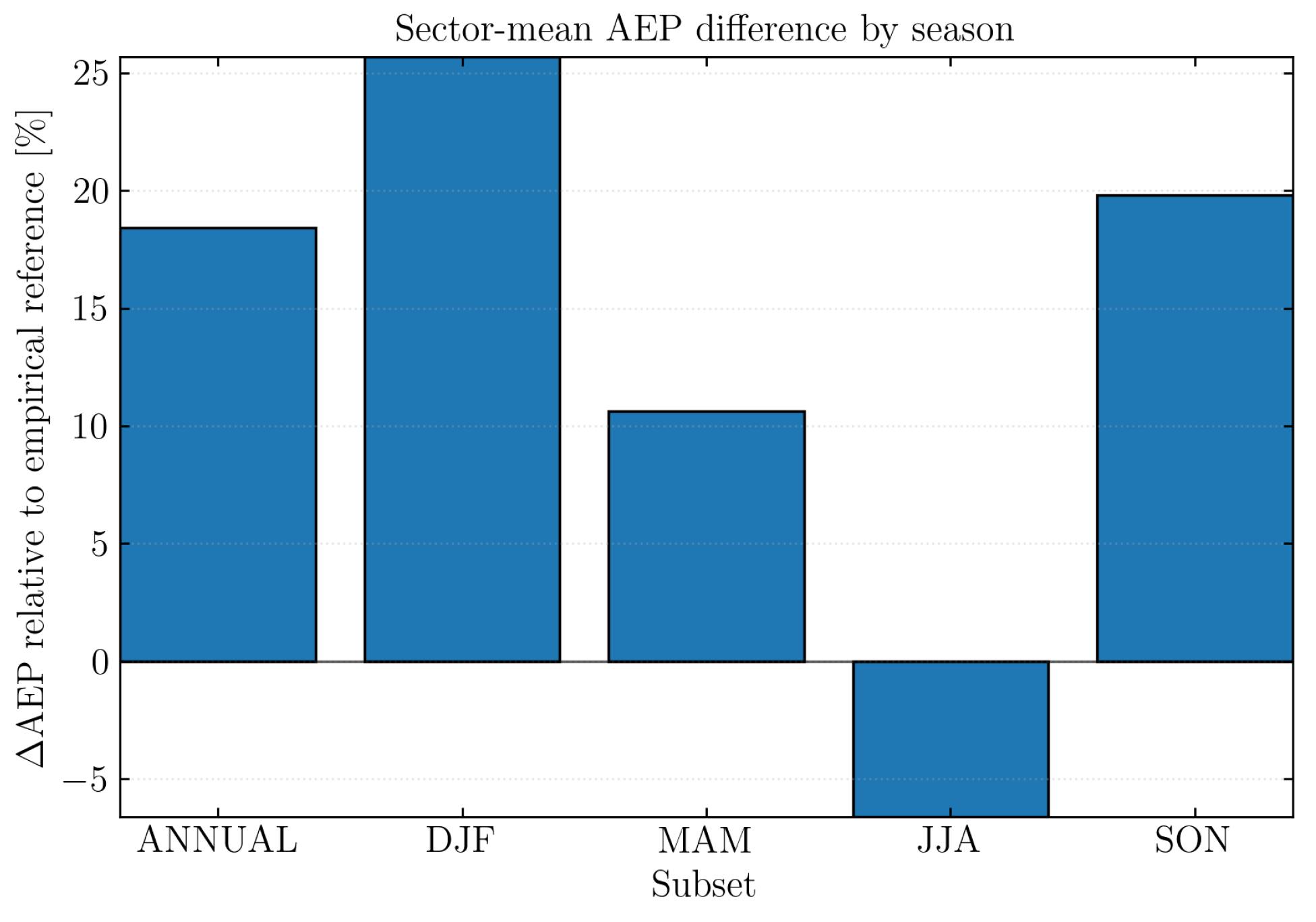
The sector-mean inflow-state ensemble is shown separately in
Figure 13 because it differs from the empirical coarsening cases. The sector-mean approximation increases AEP by 25.68% in DJF, 10.62% in MAM, and 19.82% in SON, but shows a negative AEP difference of
in JJA.
The sign change between DJF and JJA shows that the sector-mean approximation does not introduce a fixed offset. The effect depends on the seasonal wind-speed distribution and on which parts of the turbine power curve are sampled by each directional sector.
6.6. Layout Robustness
The inflow-discretisation analysis was repeated for both the regular aligned layout and the irregular layout defined in
Section 3.2. The layout comparison is summarised in
Table 8. In this table, the “Difference” column is calculated as the regular-layout
AEP minus the irregular-layout
AEP, while the wake-loss range denotes the minimum and maximum wake-loss values across the two layouts for each inflow-state ensemble.
For both layouts, empirical inflow-state ensembles using 1 or 2 wind-speed bins remain within 0.56% of their respective 72 × 1 references. The 18 × 5 case produces larger AEP differences of 1.75% for the irregular layout and 2.33% for the regular layout. The sector-mean case shows the largest response in both layouts, with AEP differences of 18.40% and 19.07%, respectively.
The regular layout produces larger AEP differences than the irregular layout for the two coarsest cases: 2.33% versus 1.75% for 18 × 5, and 19.07% versus 18.40% for the sector-mean inflow-state ensemble. For the two layouts tested here, the ranking of inflow-state discretisations is unchanged: the empirical 1 and 2 cases remain closest to the reference, the 18 × 5 case produces an intermediate difference, and the sector-mean inflow-state ensemble produces the largest AEP and wake-loss changes.
7. Interpretation and Practical Implications
7.1. Importance of Within-Sector Wind-Speed Structure
The synthetic and offshore results in
Figure 8 and
Figure 11, and
Table 5 and
Table 7, show that collapsing the within-sector wind-speed distribution to a single representative speed produces larger changes in predicted turbine power, wake loss, and AEP than moderate changes in directional resolution or retained state count.
For the synthetic dataset, replacing the empirical within-sector wind-speed distribution by a single sector-mean wind speed produced annual power differences of 12.58%, with seasonal differences ranging from 6.66% in JJA to 13.91% in DJF (
Table 4). The same behaviour remained visible across all tested discretisation settings (
Figure 8;
Table 5). For 1
wind-speed bins, changing the directional resolution from 18 to 72 sectors altered the annual synthetic power-bias estimate by less than 0.4 percentage points, whereas replacing the within-sector wind-speed distribution by sector-mean wind speeds produced annual differences exceeding 12%.
The offshore wake-model calculations presented in
Figure 11 and
Table 7 show the same overall behaviour for both AEP and wake-loss sensitivity. Reducing the empirical inflow-state ensemble from 1593 retained states in the 72 × 1 reference case to 416 states in the 36 × 2 case changed annual AEP by only 0.03% and wake loss by
percentage points. By contrast, the sector-mean inflow-state ensemble reduced the inflow description to only 72 states while increasing AEP by 18.40% and wake loss by 5.13 percentage points relative to the empirical reference.
These comparisons show that reducing the number of retained states does not necessarily degrade the engineering response, provided that the within-sector wind-speed distribution is preserved. The larger differences arise when the wind-speed distribution within each directional sector is collapsed into a single representative value prior to power-curve evaluation. This behaviour follows directly from the nonlinear relationship between wind speed and turbine power discussed in
Section 5.2.
The results also show that the response depends on the structure of the underlying climatology and does not behave as a fixed offset. The sector-mean approximation produced positive AEP differences in DJF, MAM, and SON, but produced a negative response in JJA (
Figure 13). The magnitude and sign of the response, therefore, depend on the interaction between the seasonal wind-speed distribution and the nonlinear turbine power curve rather than on state-count reduction alone.
7.2. Discretisation Resolution and Engineering Convergence
The convergence results show that, for the datasets and layouts considered here, wind-speed resolution produces larger differences in the engineering response than directional refinement once the directional discretisation reaches approximately 36 sectors.
For 1
wind-speed bins, the relative convergence deviation defined in
Section 5.3 remained below 0.5% across all tested directional resolutions (
Table 5). Increasing the directional resolution from 36 to 72 sectors changed the annual synthetic power-bias estimate by less than 0.01 percentage points at the reported precision.
The offshore wake-model calculations presented in
Figure 11 and
Table 7 show the same overall trend. The empirical 72 × 2, 36 × 1, and 36 × 2 inflow representations remained within 0.03% of the annual AEP reference despite reducing the retained state count from 1593 states to between 416 and 825 states. Larger departures appeared primarily when broad 5
wind-speed bins were introduced.
These results indicate that relatively compact empirical inflow-state ensembles can retain the dominant wake-loss and AEP behaviour while substantially reducing the number of wake-model evaluations required. For the present datasets and layouts, the 36 × 2 empirical representation reduced the retained state count by approximately 74% relative to the 72 × 1 reference while remaining within 0.03% of the annual AEP result.
The Weibull comparison diagnostics further support this interpretation.
Figure 7 shows that the largest discrepancies between empirical and Weibull-based sector representations occurred in sectors where the wind-speed distribution was broadened or partly multimodal. In these sectors, a single Weibull distribution does not fully reproduce the empirical within-sector structure retained in the discretised inflow states.
7.3. Implications for Wake-Model Inflow-State Ensembles
The results have direct implications for state-based wake-modelling workflows in which ambient inflow conditions are represented using weighted speed–direction states. In practice, inflow-state ensembles are often simplified to reduce computational cost by reducing directional resolution, increasing wind-speed bin width, or replacing the within-sector wind-speed distribution with a single representative value.
The present results show that these simplifications do not produce equivalent engineering responses. Moderate reductions in directional resolution or retained state count produced relatively small changes in AEP and wake loss, provided that the empirical wind-speed distribution within each directional sector was retained. By contrast, replacing the within-sector distribution with sector-mean wind speeds introduced substantially larger changes in both AEP and wake-loss estimates.
This distinction is important because the state count alone is not a reliable measure of the quality of the inflow-state ensemble. The 36 × 2 empirical case reduced the retained state count by approximately 74% relative to the 72 × 1 reference while changing annual AEP by only 0.03%. The sector-mean representation reduced the state count further but produced an 18.40% increase in annual AEP because the within-sector wind-speed variability was removed entirely.
The layout-robustness analysis presented in
Table 8 indicates that the main conclusions are not specific to a single turbine arrangement. Although the magnitude of the response changed between the regular and irregular layouts, the ordering of the inflow representations remained unchanged between the two configurations, with the sector-mean and 18 × 5 cases producing the largest departures in both layouts.
For the cases tested here, keeping the within-sector wind-speed distribution has more impact on wake-loss and AEP predictions than increasing directional resolution or reducing retained state count alone.
For the present cases, empirical inflow representations using directional resolutions of 36 sectors or greater, together with 1 or 2 wind-speed bins, provided close agreement with the higher-resolution reference cases while substantially reducing retained state count.
7.4. Practical Considerations and Limitations
The methodology was evaluated using the controlled synthetic dataset described in
Section 4, together with the offshore climatological datasets and wake-model workflow described in
Section 2.2 and
Section 3.3. The synthetic dataset provided a controlled framework for isolating discretisation effects, while the offshore climatological cases demonstrated how the same behaviour propagates into wake-loss and AEP calculations.
Several limitations should nevertheless be recognised when interpreting the results. The reported sensitivities depend on the turbine power curve, wake-model configuration, inflow climatology, and wind-farm layouts considered in the present study. Different turbine characteristics, atmospheric-stability conditions, terrain effects, or wake-model formulations may alter the absolute magnitude of the reported differences.
The analysis also focuses specifically on inflow representation and discretisation effects rather than on absolute energy-yield prediction uncertainty. Other sources of uncertainty, including atmospheric stability, turbine-control behaviour, wake-model selection, and long-term climatological variability, were not propagated through the engineering calculations.
The wake-model calculations were performed using steady weighted inflow states rather than time-varying transient simulations. This study evaluates how discretised climatological inflow representations influence engineering calculations under consistent modelling assumptions rather than attempting to reproduce full operational variability.
Finally, the convergence behaviour identified here should not be interpreted as a universal discretisation threshold applicable to all wind-farm configurations or datasets. The results instead provide a quantitative demonstration of how inflow discretisation influences predicted turbine power, wake loss, and AEP within the synthetic and offshore climatological frameworks considered here.
8. Conclusions
This study analysed how inflow-state discretisation influences predicted turbine power, wake loss, and annual energy production (AEP) in state-based offshore wind-farm wake calculations. The analysis combined controlled synthetic wind datasets with offshore climatological datasets to separate the effects of directional resolution, wind-speed bin width, and sector-mean inflow simplifications under reproducible conditions.
The results show that preserving the within-sector wind-speed distribution is more important for the engineering response than moderate reductions in directional resolution or retained state count for the cases tested here. Empirical inflow-state ensembles using 1 or 2 wind-speed bins remained close to the 72 × 1 reference case even when the number of retained states was substantially reduced. For the offshore climatological cases, the 36 × 2 empirical inflow-state ensemble reduced the retained state count from 1593 to 416 states while remaining within 0.03% of the annual AEP reference value.
By contrast, replacing the within-sector wind-speed distribution with a single sector-mean wind speed produced substantially larger differences in both turbine-power estimates and wake-loss calculations. For the synthetic dataset, sector-mean averaging produced annual power differences exceeding 12%, while the offshore wake-model calculations showed annual AEP differences of 18.40% together with wake-loss increases exceeding 5 percentage points relative to the empirical reference ensemble. The results further showed that these responses varied seasonally, including a sign change in the JJA sector-mean AEP response. This behaviour shows that the effect depends on the structure of the underlying wind-speed distribution and the nonlinear turbine power curve rather than on state-count reduction alone.
The convergence analysis showed that directional refinement beyond approximately 36 sectors produced comparatively small changes in the engineering response for the datasets and layouts used in this study when 1 wind-speed bins were retained. Larger departures appeared primarily when broad wind-speed bins or sector-mean averaging removed substantial within-sector wind-speed structure.
The layout-sensitivity analysis showed that the main conclusions remained consistent across both regular aligned and irregular 60-turbine layouts. Although the magnitude of the AEP response changed between layouts, the ordering of the inflow-state ensembles remained unchanged, with the sector-mean and 18 × 5 cases producing the largest departures from the empirical reference calculations.
The results show that reducing the number of inflow states does not necessarily degrade wake-model predictions provided that the underlying within-sector wind-speed variability is retained. Preserving the wind-speed distribution within each directional sector had a larger influence on predicted turbine power, wake loss, and AEP than moderate reductions in discretisation resolution alone.
For the offshore cases examined here, the 36 × 2 empirical inflow-state ensemble reduced the number of retained inflow states, and therefore the number of wake-model evaluations, by approximately 74% relative to the 72 × 1 reference case while remaining within 0.03% of the annual AEP result. This shows that substantial reductions in computational cost are possible without materially changing the engineering response for the cases examined in the present study.
The methodology and diagnostics presented here provide a reproducible approach for constructing and evaluating weighted inflow-state ensembles from long-term wind climatologies. The approach is directly applicable to state-based offshore wind-farm workflows in which computational efficiency must be balanced against preserving the underlying wind-speed and directional structure.