Article

Effect of Cable Failure on the Wind-Induced Vibration of a Single-Pylon Cable-Stayed Bridge

1
Department of Bridge Engineering, Southwest Jiaotong University, Chengdu 610031, China
2
National Key Laboratory of Bridge Intelligent and Green Construction, Southwest Jiaotong University, Chengdu 611756, China
3
School of Engineering, Xizang University, Lhasa 850000, China
*
Author to whom correspondence should be addressed.
J. Mar. Sci. Eng. 2026, 14(12), 1089; https://doi.org/10.3390/jmse14121089
Submission received: 8 May 2026 / Revised: 8 June 2026 / Accepted: 9 June 2026 / Published: 12 June 2026

Abstract

The dynamic characteristics and buffeting response of long-span single-pylon cable-stayed bridges are not fully understood after cable failure occurs in coastal wind environments. This study investigates how the location, number, and pattern of cable failures affect structural performance. A three-dimensional finite element model of a 280 m main-span bridge was established using the aerodynamic coefficients extracted from wind tunnel tests. Modal analyses and nonlinear time-domain simulations were conducted. The results show that frequency reduction concentrates in lower-order vertical bending modes, with the first and second modes being the most sensitive. Variations in frequency are closely related to the failure location of stay cables, with the largest reduction at the mode antinode. Unilateral multiple failures induce bending–torsion coupling, whereas symmetric bilateral failures only lower frequencies. Under wind loads, the failure of stay cables results in the redistribution of static internal forces, primarily to the adjacent stay cables on the same side. This phenomenon is enhanced as the number of failed cables increases. The change in buffeting internal forces results in a non-monotonic trend, and the shorter cables near the pylon are more sensitive. Cable failure, which occurs at different phases of the buffeting process, significantly influences the structure's transient response. The scenario in which the structure is subjected to wind loads after cable failure results in the largest variation amplitude.

1. Introduction

Cable-stayed bridges, as one of the predominant structural forms for modern long-span bridges, have been widely adopted in coastal and sea-crossing projects [1]. In recent years, the number of completed and ongoing sea-crossing single-pylon cable-stayed bridges has steadily increased. Representative examples include the Rama VIII Bridge in Thailand [2], the South Channel Bridge of the Hangzhou Bay Sea-Crossing Bridge [3], and the North Branch Bridge of the Pearl River Huangpu Bridge with main spans of 300, 318 and 383 m, respectively [4]. They are all examples of single-pylon cable-stayed bridges. In addition, the Dongtouxia Sea-Crossing Bridge, with a main span of 248 m, is currently under construction. For these bridges in marine environments, their overall stiffness and stability rely heavily on the coordinated performance of the cable system. However, stay cables in such environments are subjected to severe service conditions: prolonged exposure to strong typhoon loads [5], corrosion induced by high temperatures, high humidity, and high salinity, and wind-induced fatigue all act in a coupled manner to influence cable stability [6,7]. These combined effects may lead to the mechanical degradation or even fracture of stay cables, which, in turn, trigger internal force redistribution and alterations in dynamic characteristics, thereby compromising bridge safety and serviceability. For long-span single-pylon cable-stayed bridges, the structural system is notably sensitive to local damage [8], and cable failure events can induce changes in dynamic performance and modify wind-induced vibration responses [9,10]. For instance, the sudden collapse of the Nanfang’ao Cross-Harbor Bridge in Yilan in 2019 has been attributed by researchers to its coastal location, corrosion of hangers by sea wind, and long-term wind-induced fatigue exacerbated by strong typhoon-induced winds [11]. For coastal bridges that similarly employ single-pylon spatial-cable systems, such incidents underscore the urgency of evaluating structural safety following the failure of stay cables in strong winds.
The influence of stay cable failure on the structural performance of bridges has garnered widespread attention in the academic community. Regarding the mechanical behavior and structural damage induced by cable loss, Wolff et al. [12] demonstrated through nonlinear dynamic analysis that the sudden rupture of a single cable may trigger progressive collapse of the structure, particularly when a critical cable fails. Ruiz-Teran et al. [13], based on theoretical derivations for multi-degree-of-freedom systems, found that the dynamic amplification factor (DAF) resulting from sudden cable failure can exceed the code-recommended value of 2.0, and its magnitude is closely related to the failure location, structural damping, and component stiffness. Mozos et al. [14,15] conducted parametric studies showing that variations in girder stiffness and cable arrangement significantly affect the post-failure dynamic response of cable-stayed bridges. Chen et al. [16] observed that under multiple cable failures, failure of cables near the pylon is more likely to induce unstable local collapse than failure in the mid-span region. With respect to coupled service load effects, Zhou et al. [17] noted that bridge parameters such as failure duration, time-history profile, and initial state markedly influence the dynamic performance, and the stochastic coupling of traffic and wind loads exerts a non-negligible effect on the post-failure response. In the context of assessing sea-crossing cable-stayed bridges in marine environments, Yao et al. [18] investigated the combined suppression of wind-induced vibrations for two adjacent cables using interconnected tuned mass dampers. This verified the device's effectiveness in reducing displacement response amplitudes. Yan et al. [19] proposed a CNN-BiLSTM intelligent damage identification method and validated its effectiveness in damage localization and severity assessment using measured data from Typhoon Mujigae, achieving an overall identification accuracy exceeding 98%. For theoretical studies on dynamic amplification effects due to cable failure, Chao et al. [20] revealed that the DAF in multi-degree-of-freedom systems subjected to sudden loading may exceed 2.0, suggesting that adopting 2.0 as an upper limit in design guidelines may lead to unconservative designs in certain cases. Buelvas et al. [21] analyzed extradosed bridges and found that the DAFs for girder axial force and bending moment remain below 2.0, whereas the DAF for shear force can exceed 2.0 when the girder stiffness is low. More recently, Liu et al. [22] derived analytical expressions for the dynamic amplification effect of the main girder after cable rupture in cable-stayed bridges using the modal superposition method. Their results indicate that higher-order modes dominate the dynamic amplification of shear forces and bending moments, and that shorter failure durations lead to more pronounced amplification effects.
Despite the aforementioned research progress, existing studies have predominantly focused on symmetric twin-pylon systems [23,24], and systematic investigations on spatial single-pylon, long-span, asymmetric structural systems subjected to cable failure under extreme wind fields remain relatively limited. In particular, comparative analyses of failure modes—from single- to multiple-cable failures and from unilateral to bilateral fracture patterns—require further exploration. Moreover, the mechanism by which the structural buffeting response induced by cable failure under wind loading evolves remains unknown. Most existing analyses assume that cable failure occurs prior to the application of wind load, without addressing the transient effects of cable breakage at different phases of the buffeting process. To address these gaps, this study investigates a long-span single-pylon cable-stayed bridge with a 280 m main span. A typical strong coastal wind environment is simulated. Aerodynamic coefficients from wind tunnel tests are used to build a three-dimensional nonlinear finite element model of the full bridge. Through modal analysis and nonlinear time-domain methods, the degradation mechanisms of structural dynamic characteristics resulting from cable failure at different locations and in varying quantities are systematically explored. The transient impact effects of cable breakage at different phases during buffeting are analyzed, and the buffeting response characteristics of the structure under sea wind action after cable failure are thoroughly evaluated. The findings are intended to provide theoretical support for the wind-resistant design and in-service safety assessment of coastal long-span single-pylon cable-stayed bridges.

2. Analysis Methods

2.1. Engineering Background and Numerical Modeling

This study takes a single-pylon cable-stayed bridge with a 280 m main span and spatial double-cable-plane configuration as the engineering background. The geometric dimensions, girder cross-section, cable arrangement, and initial cable forces are derived from the design documents of an actual single-pylon cable-stayed bridge. The total length of the bridge is 485 m, and it uses a hybrid girder structural system: the north-side span comprises a concrete girder and has a total length of 175 m, whereas the south main span is a steel box girder. The standard cross-section of the steel box girder has a width of 68 m and a central depth of 4 m. The pylon is a reinforced-concrete structure cast with C60 concrete. The entire bridge is equipped with 76 stay cables, with 38 cables arranged on each of the north and south sides in a spatial double-cable-plane fan configuration. Given the dynamic characteristics of this bridge—namely, a long span, a wide deck cross-section, and low structural damping—extreme loading scenarios such as cable failure may significantly compromise the wind-resistant performance and in-service safety of the bridge structure. To this end, a systematic technical route was devised, as illustrated in Figure 1, with the objective of identifying the mechanisms that influence the failure of stay cables, as observed in the wind-induced vibration response of the bridge structure during numerical simulation.
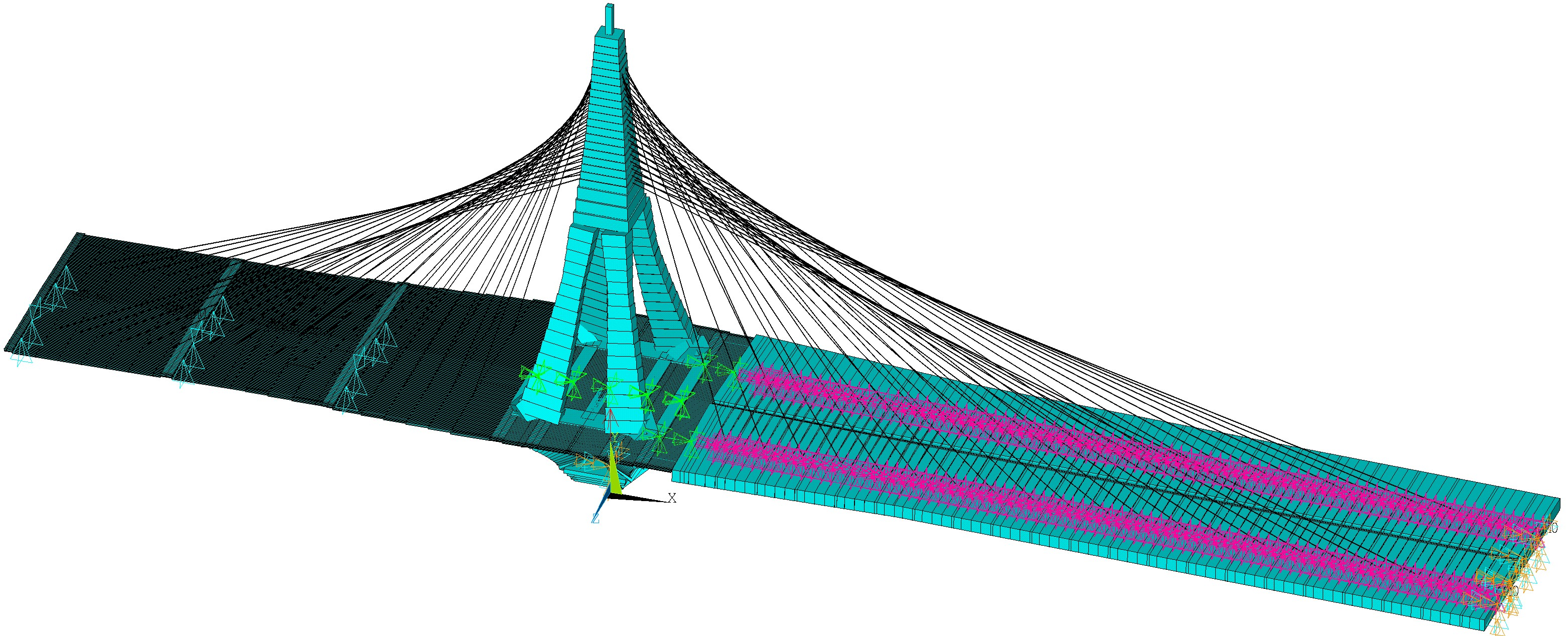
The three-dimensional full-bridge finite element model was established using the software ANSYS APDL (Version 2021 R1), as shown in Figure 2. Both the main girder and the pylon were simulated using spatial beam elements (Beam4). For the steel box girder segment, the elastic modulus was set to 2.06 × 10⁵ MPa, Poisson’s ratio was 0.3, and material density was 7850 kg/m3. The concrete girder and pylon, both constructed with C60 concrete, were assigned an elastic modulus of 3.6 × 10⁴ MPa, Poisson’s ratio of 0.2, and material density of 2600 kg/m3. The stay cables, as tension-only members, were modeled using Link10 elements, and the initial cable forces under the completed bridge state were applied via initial strains to account for their geometric stiffness contribution. Boundary conditions were prescribed in strict accordance with the design drawings, and the effects of the secondary dead load were meticulously incorporated. Furthermore, the corresponding mass moments of inertia were assigned according to the actual mass distribution to ensure the accuracy of subsequent dynamic characteristic analysis and wind-induced response evaluation.

2.2. Completed Bridge Dynamic Properties and Failure Scenario Setup

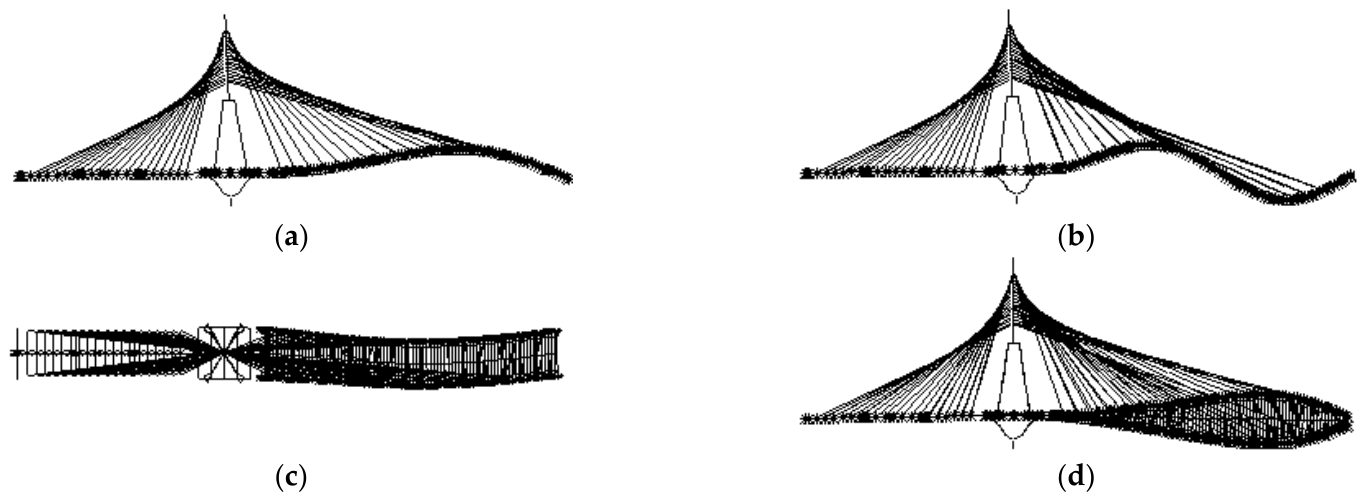
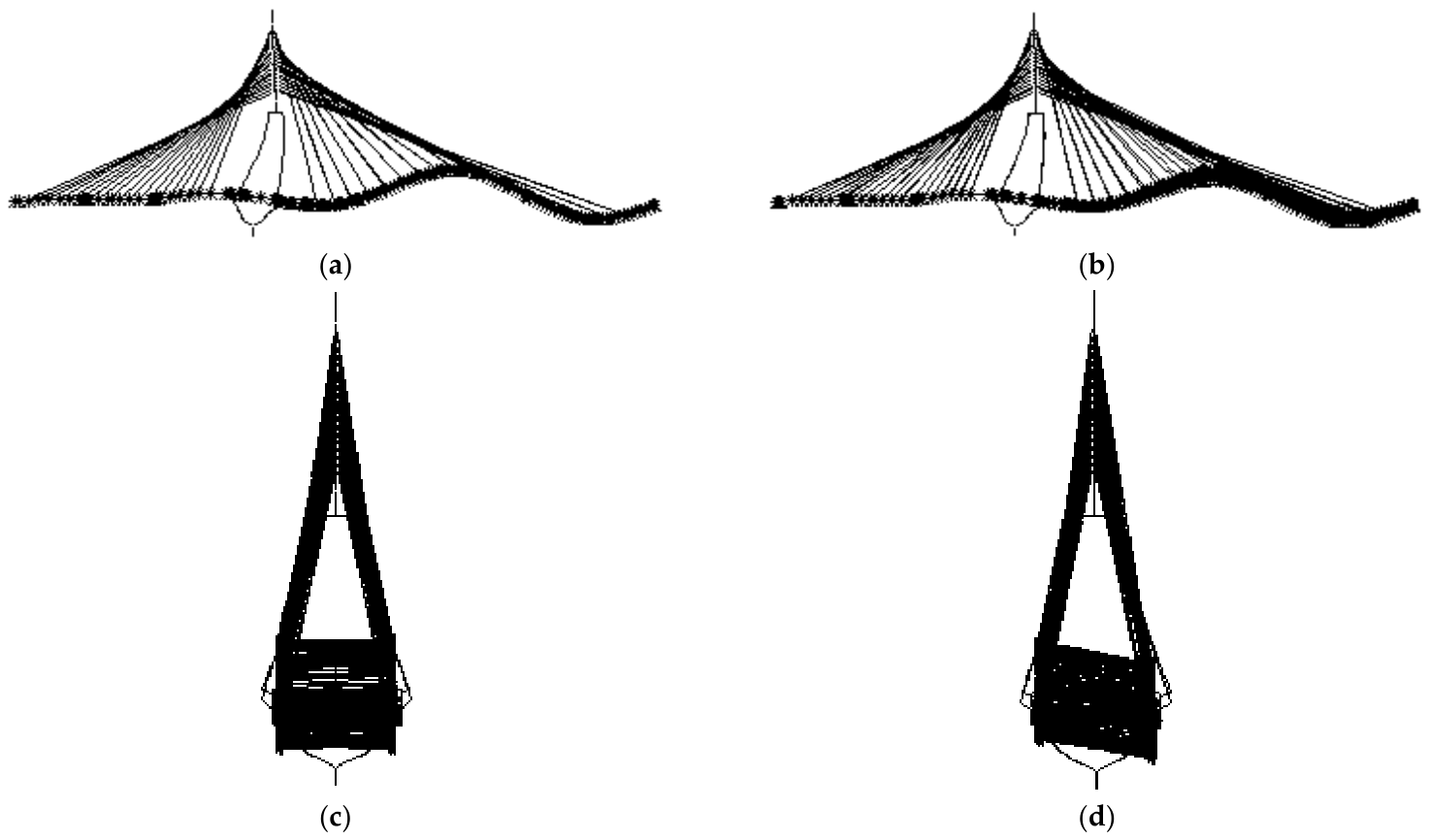
Based on the aforementioned finite element model, a modal analysis was first performed to assess the completed bridge's state without any cable failure. The first 15 natural frequencies and the corresponding mode shapes were extracted, as summarized in Table 1. As indicated in Table 1, the fundamental mode shapes primarily manifest as vertical bending, transverse bending, and torsion. The modal frequencies calculated in this study agree well with those provided by the bridge design institute, demonstrating the reliability of the finite element model, and thus, allowing subsequent computational studies to be carried out. Figure 3 presents the principal modes relevant to the wind-induced vibration of the structure, including the first symmetric and antisymmetric vertical bending modes of the main girder (1st and 2nd modes), the first transverse bending mode of the main girder (5th mode), and the first symmetric torsional mode of the main girder (6th mode). These results serve as a reference for evaluating the effects of subsequent cable failure.
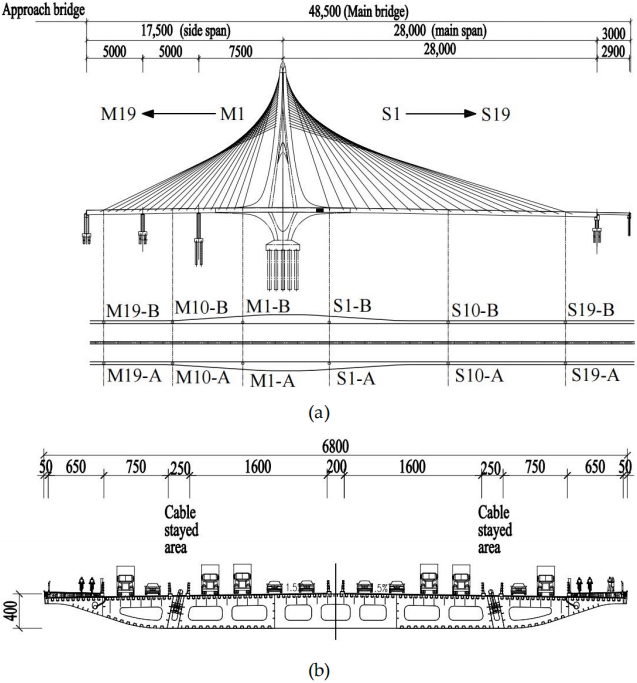
Stay cables serve as the critical load-transmitting links connecting the main girder and the pylon. Their failure disrupts the original mechanical equilibrium, leading to the redistribution of the internal force and alterations in the structure's dynamic characteristics. In the definition of cable failure scenarios, the cables on a single-cable plane (designated as Cable Plane A) are taken as the primary objects of failure simulation, as illustrated in Figure 4. Cable failure is modeled by instantaneously removing the corresponding cable elements using the element birth/death technique in ANSYS. On this basis, symmetric bilateral failure scenarios are further introduced in Section 3.4 to enable a comparative analysis of the effects of different failure patterns on the structural dynamic characteristics.

3. Effect of Cable Failure on Structural Dynamic Characteristics

3.1. Single Stay Cable Failure

According to the aforementioned numbering convention, cables S1-A(B) to S19-A(B) are the main-span stay cables. The side-span cables are denoted as M1-A(B) to M19-A(B). The variation amplitude of each modal frequency of the bridge, δ f , is defined by Equation (1):
δ f = f b i f a i f a i × 100 %
where f a i is the frequency of the i -th mode of the bridge before cable failure, and f b i is the frequency of the i -th mode of the bridge after the failure of a specific stay cable.
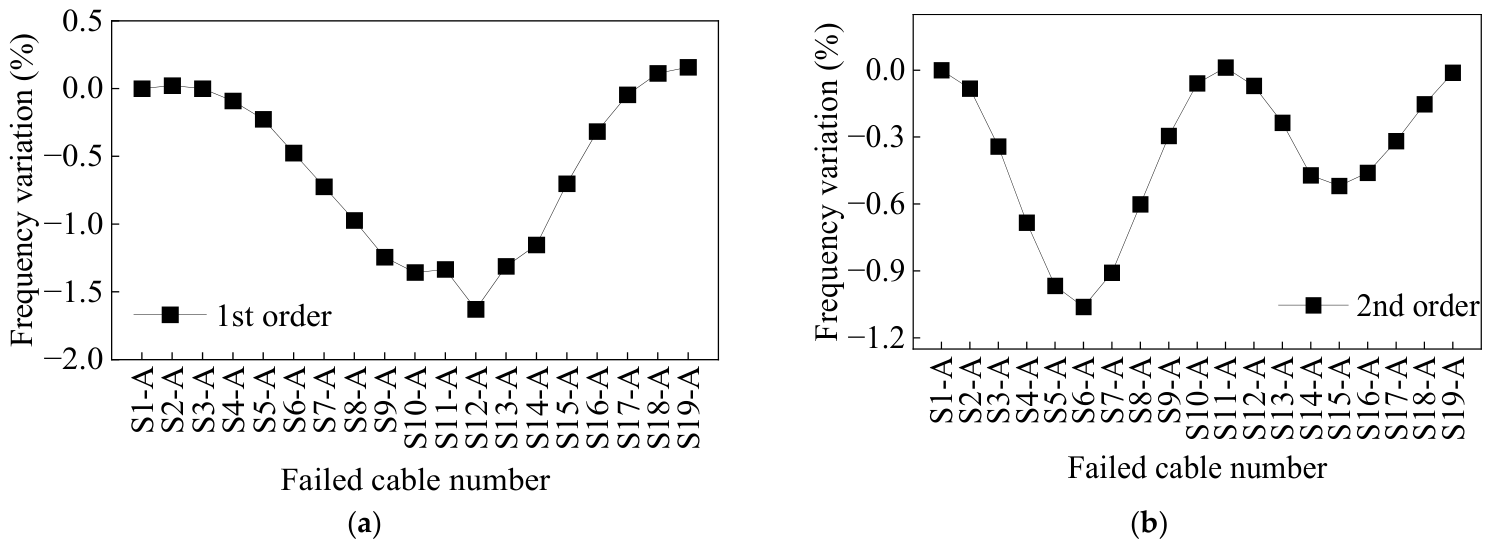
Since auxiliary piers are installed in the side spans, additional restraints are applied to the main girder, and there is evidence of relatively higher stiffness. Subsequent calculations focus exclusively on main-span cable failures. To justify this simplification, the failure of a single side-span cable was simulated, and the resulting changes in frequency were examined using δ f . The results show that the first and second modal frequencies change by less than 0.19% and 0.05% in absolute value, respectively, with mode shapes almost unchanged. Even for the 13th mode (first vertical bending of the side span), the maximum absolute change is only 0.30%, and this mode does not affect the global dynamics of the main span. These quantitative checks confirm that side-span cable failure has a negligible effect on global dynamic characteristics.
The maximum and mean frequency variations in the first 15 modes across all single-cable failure scenarios were extracted and are summarized in Table 2. As shown in Table 2, the frequency variation induced by cable failure generally decreases with increasing mode order. Specifically, the first symmetric vertical bending mode (Mode 1) and the first antisymmetric vertical bending mode (Mode 2) of the main girder exhibit maximum variations of −1.628% and −1.061%, and mean variations of −0.594% and −0.380%, respectively, both of which are substantially larger than those of the remaining modes. From Mode 3 onward, the variations in frequency drop sharply, and the variations in the transverse bending and torsional modes remain consistently low. This indicates that the frequency reduction caused by cable failure is concentrated primarily in the lower-order vertical bending modes of the main girder, consistent with the physical mechanism whereby cable failure primarily weakens the main girder's vertical elastic support. Given that Modes 1 and 2 exhibit the highest sensitivity and represent the fundamental vertical bending modes that influence the structure's global dynamic response, they are selected as the sensitive modes for subsequent analyses.
Figure 5 presents the frequency variation curves of Modes 1 and 2 as a function of the failed cable location.
For the first mode, failure of cable S12-A induces the largest reduction in frequency, as its anchorage point lies precisely at the antinode of this mode shape. For the second mode, the drop from peak frequency occurs upon the failure of cables S6-A and S15-A, both of which are likewise situated within the antinodal region of the corresponding mode shape. The above results demonstrate that the influence of cable failure on modal frequencies is intimately related to the spatial correspondence between the failure location and the modal shape: when a failed cable is located at the antinode of a given mode, it provides the greatest stiffness contribution to that mode, and consequently, its failure results in the most pronounced frequency attenuation.
The preceding analysis has identified the sensitive modes under single-cable failure conditions. However, the frequency attenuation caused by the failure of a single cable is relatively limited. Under actual service conditions, the simultaneous or sequential failure of multiple cables represents an even more unfavorable scenario, and its influence on the sensitive modes requires further clarification.

3.2. Multiple Stay Cable Failures

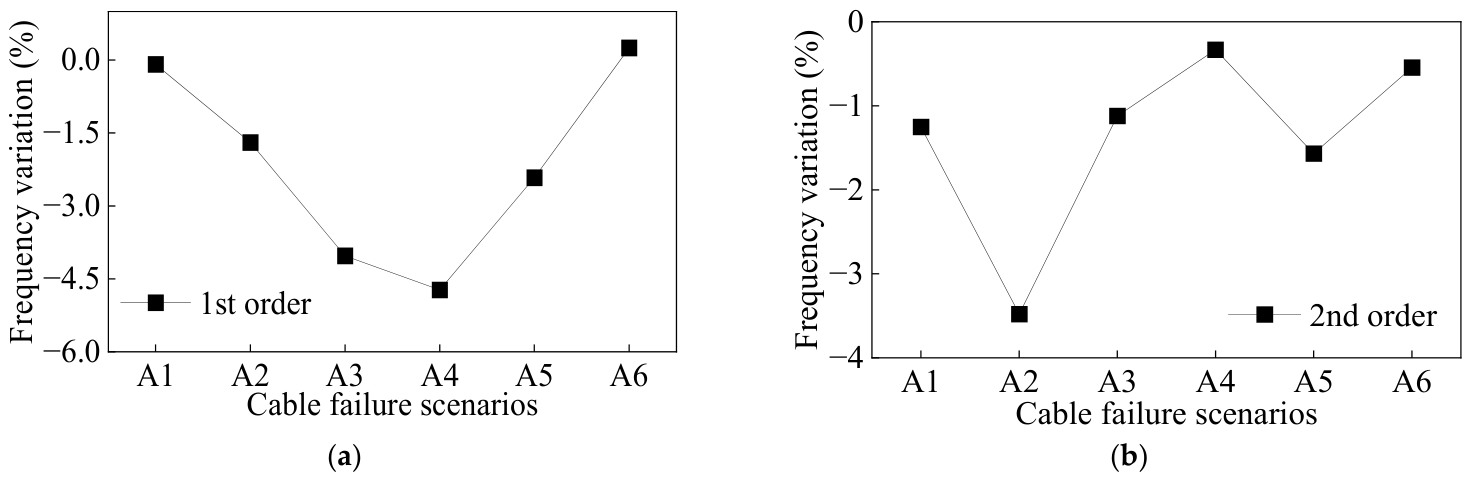
In extreme environments such as strong winds or fire, cable-stayed bridges may be subjected to the simultaneous or sequential failure of multiple cables. Existing studies [12] have demonstrated that the failure of a single cable can trigger the redistribution of internal forces from adjacent cables, thereby predisposing neighboring cables to progressive failure. Furthermore, the failure of multiple cables can significantly alter the structure's dynamic response characteristics, exposing it to an elevated risk of local collapse [16]. To investigate the influence of multiple cable failures, Group A scenarios were defined, comprising six groups of three adjacent failed cables uniformly distributed along the main span (A1 to A6). Since Section 3.1 has already established Modes 1 and 2 as the sensitive modes, only the frequency variations for these two modes are considered here. The frequency of variations in the sensitive modes under each scenario is presented in Figure 6.
Compared with the single-cable failure results presented in Table 2, multiple cable failures induce a substantially larger frequency reduction. The maximum variation in the first mode increases from −1.63% under single-cable failure to −4.73% under Scenario A4, while that of the second mode increases from −1.06% to −3.48% under Scenario A2. In terms of sensitivity ranking, the first mode consistently exhibits the largest or second-largest variation across all scenarios, confirming that the sensitive modes identified under single-cable failure remain valid under multiple-cable conditions. Regarding the antinode effect, the trend observed in Figure 6 is consistent with that of single-cable failure: Scenario A4 includes cable S12-A, which is located at the antinode of the first mode shape, and this scenario produces the largest reduction in frequency for the first mode; Scenario A2 includes cable S6-A, located at the antinode of the second mode shape, and yields the largest reduction in frequency for the second mode. This indicates that the antinode effect remains applicable under multiple cable failure scenarios.
Group A scenarios are uniformly distributed along the span and, therefore, do not reflect the differential influence of the cable failure location. To quantify the coupling effect between failure location and quantity, it is necessary to further investigate, within the framework of the sensitive modes, the influence patterns of multiple cable failures in different characteristic regions.

3.3. Combined Effect of Location and Quantity

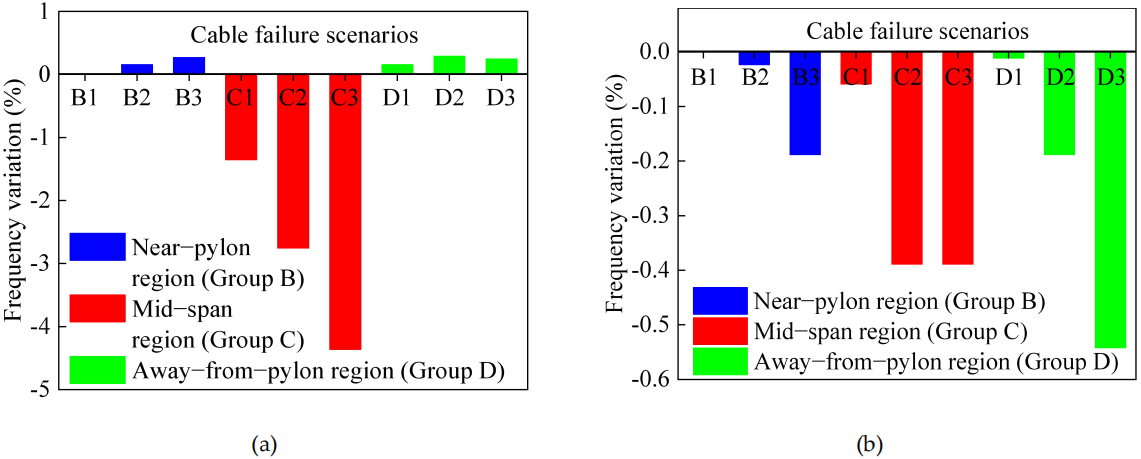
To further quantify the coupling effect between the location of cable failure and its quantity, three characteristic regions were selected within the main span—the near-pylon region (Group B), the mid-span region (Group C), and the away-from-pylon region (Group D). Within each group, the number of failed cables increased incrementally from one to three, and the resulting influence on the frequencies of the first two sensitive modes was examined. The frequency variations under each scenario are presented in Figure 7.
From the perspective of failure location, the influence of cable failure differs between the two sensitive modes. For the first mode, the frequency reduction is most pronounced when failure occurs in the mid-span region (Group C), with all scenarios C1 to C3 exhibiting negative variations. In contrast, failures in the near-pylon region (Group B) and the away-from-pylon region (Group D) produce small positive variations regardless of the number of failed cables. This indicates that, for the first mode, only mid-span failures decrease frequency, whereas failures near or far from the pylon lead to a slight increase in frequency. This behavior may be attributed to the alteration of the girder restraint distribution caused by cable failure, which induces local stiffness redistribution. For the second mode, failures in all three regions result in frequency reductions, with the largest decrease occurring in the away-from-pylon region (Group D), followed by the mid-span region (Group C) and the near-pylon region (Group B). The difference in the most sensitive location between the first and second modes is closely related to the spatial distribution characteristics of the respective mode shapes of bridges.
Quantitatively, for the first mode in the mid-span region, the frequency reduction for three adjacent cable failures was 3.22 times that of a single failure, exceeding the linear expectation of 3.0 by 7.2%. For the second mode in the away-from-pylon region, the reduction increased from −0.012% for a single failure to −0.542% for three failures, with incremental reductions from 0.18% to 0.35%. These data confirm that the nonlinear cumulative effect becomes increasingly pronounced as more cables fail, regardless of the mode. Multiple cable failures degrade the global stiffness matrix. As such, this degradation is not a simple linear superposition of individual cable effects. The underlying mechanism can be understood as follows: when adjacent cables fail, the overlapping portions of their stiffness contributions are removed simultaneously, and the modal strain energy concentrated in that region is released cumulatively, leading to an accelerated degradation of the residual structural stiffness. This characteristic of nonlinear accumulation is consistent with the findings of Mozos et al. [14,15] regarding the influence of girder stiffness distribution on the dynamic response following cable failure, and further suggests that the spatial correspondence between damage location and modal shape is a key factor governing the degree of stiffness degradation.

3.4. Comparison of Unilateral and Bilateral Failures

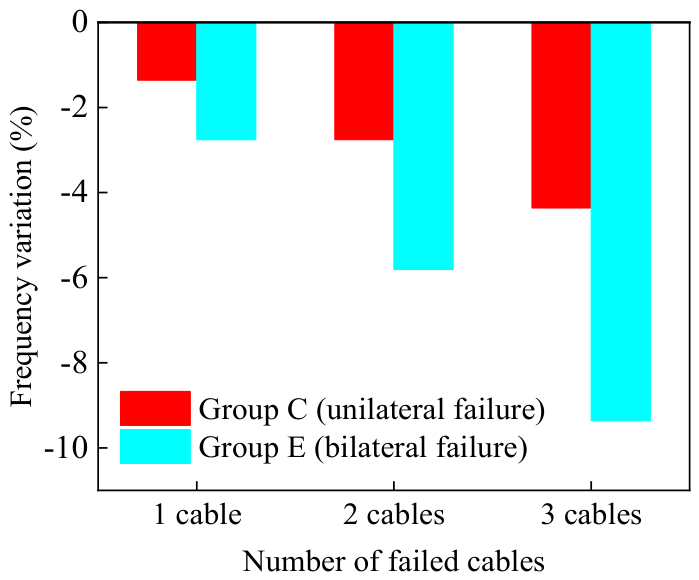
The preceding analyses have all focused on unilateral cable-plane failures. This section investigates the influence of symmetric bilateral stay cable failure, with the failure location concentrated in the mid-span region and designated as Group E scenarios. A comparison of the first modal frequency variation under unilateral and bilateral failure scenarios is presented in Figure 8.
The frequency reduction induced by symmetric bilateral cable failure is substantially larger than that caused by unilateral failure. Taking Scenario E3 as an example, the first modal frequency variation reaches −9.36%, which is approximately 2.1 times that of the corresponding unilateral scenario (C3). Notably, the frequency reduction resulting from bilateral failure exceeds the reduction in unilateral failure twice over, indicating that the contributions of stiffness of the cables on both sides are not entirely independent but exhibit a certain coupling amplification effect.
In addition to frequency changes, the failure pattern also significantly influences the mode shapes. As illustrated in Figure 9, multiple unilateral cable failures disrupt the symmetry of the structure's transverse stiffness distribution, introducing appreciable torsional components into the originally pure vertical bending modes. This bending–torsion coupling effect intensifies as the number of failed cables increases and may adversely affect the bridge's flutter stability. In contrast, although symmetric bilateral failures cause larger frequency reductions, the mode shapes remain symmetric and no bending–torsion coupling is observed, because the cable restraints on both sides of the main girder undergo identical changes.

4. Effect of Cable Failure on Wind-Induced Vibration Response of the Structure

4.1. Wind-Induced Vibration Response Calculation Theory and Aerodynamic Force Simulation

This study investigates the wind-induced vibration response characteristics of a long-span single-pylon cable-stayed bridge under cable failure scenarios using a nonlinear time-domain analysis approach implemented on a finite element analysis platform. The dynamic equilibrium equation of the structure under wind loading is expressed by Equation (2):
M U ¨ + C U ˙ + K U = F s t + F b + F s e
where M , C , and K denote the mass, damping, and stiffness matrices of the structure, respectively; U ¨ , U ˙ , and U represent the nodal acceleration, velocity, and displacement vectors, respectively; F s t is the static wind load vector under mean wind action; F b is the buffeting load vector induced by fluctuating wind; and F s e is the self-excited load vector arising from the interaction between the structure and the airflow.
The static wind load F s t is applied to the nodes of the main girder, and its magnitude is determined by the mean incoming wind speed and the three-component force coefficients of the girder's cross-section. For the i -th node of the main girder, the static wind drag, lift, and lift moment per unit length are given by Equations (3), (4), and (5), respectively:
D s t , i = 1 2 ρ U 2 C D ( α ) B
L s t , i = 1 2 ρ U 2 C L ( α ) B
M s t , i = 1 2 ρ U 2 C M ( α ) B 2
where ρ is the air density; U is the mean incoming wind speed; B is the width of the main girder cross-section; and C D , C L , and C M are the drag, lift, and moment coefficients, respectively. All these variables are functions of the wind angle of attack α and are obtained from wind tunnel tests.
The buffeting load F b is induced by the fluctuating wind and is calculated based on a quasi-steady assumption. The buffeting force acting on the i -th node of the main girder can be expressed as a linear function of the fluctuating wind velocity, and its power spectral density is determined by the wind spectrum model. The self-excited load F s e represents the coupling effect between the structural motion and the airflow; it typically plays a dominant role near the flutter critical wind speed. Considering that the flutter critical wind speed of the present bridge (exceeding 110 m/s) is significantly higher than the wind speed used for the design reference (30.7 m/s), the contribution of the self-excited force is conservatively neglected in the buffeting calculations.
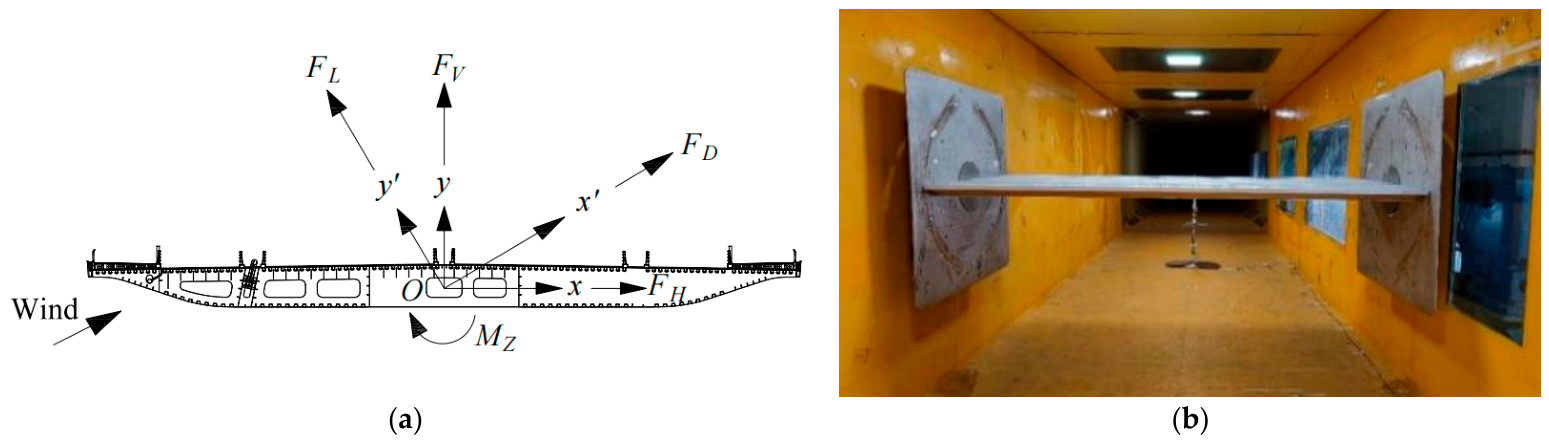
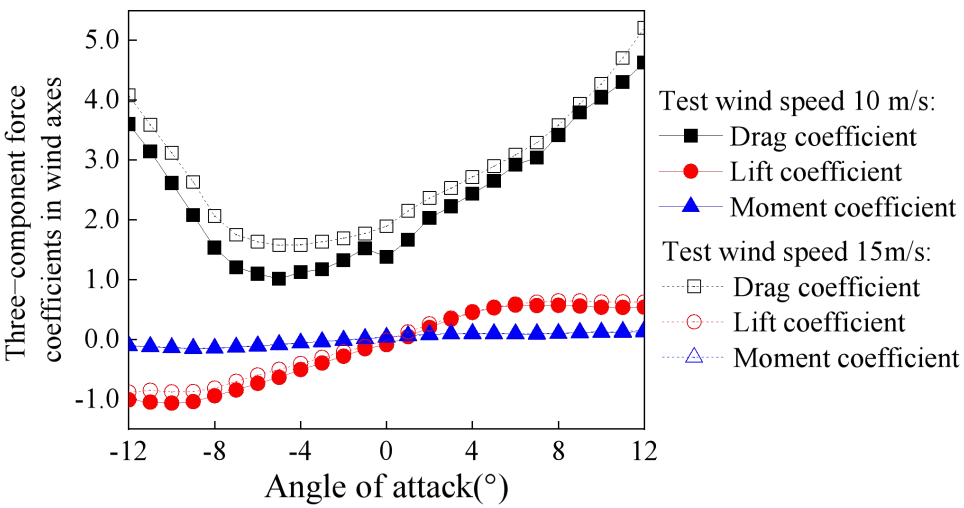
Time-domain analysis was performed using ANSYS to compute the variation in the bridge's buffeting response after stay cable failure. The aerodynamic force coefficients of the main girder were obtained from wind tunnel tests performed at a geometric scale of 1:80. The tests were conducted under the uniform flow condition with a turbulence intensity of less than 0.5%. The blockage ratio was kept below 5%, satisfying Chinese standard recommendations [25]. Under inflow wind speeds of 10 and 15 m/s, the aerodynamic coefficients remained similar, indicating that the Reynolds number effects are negligible. The quasi-steady assumption was then adopted for buffeting analysis without considering aerodynamic admittance. The sectional model is illustrated in Figure 10, and the resulting aerodynamic coefficients are presented in Figure 11.
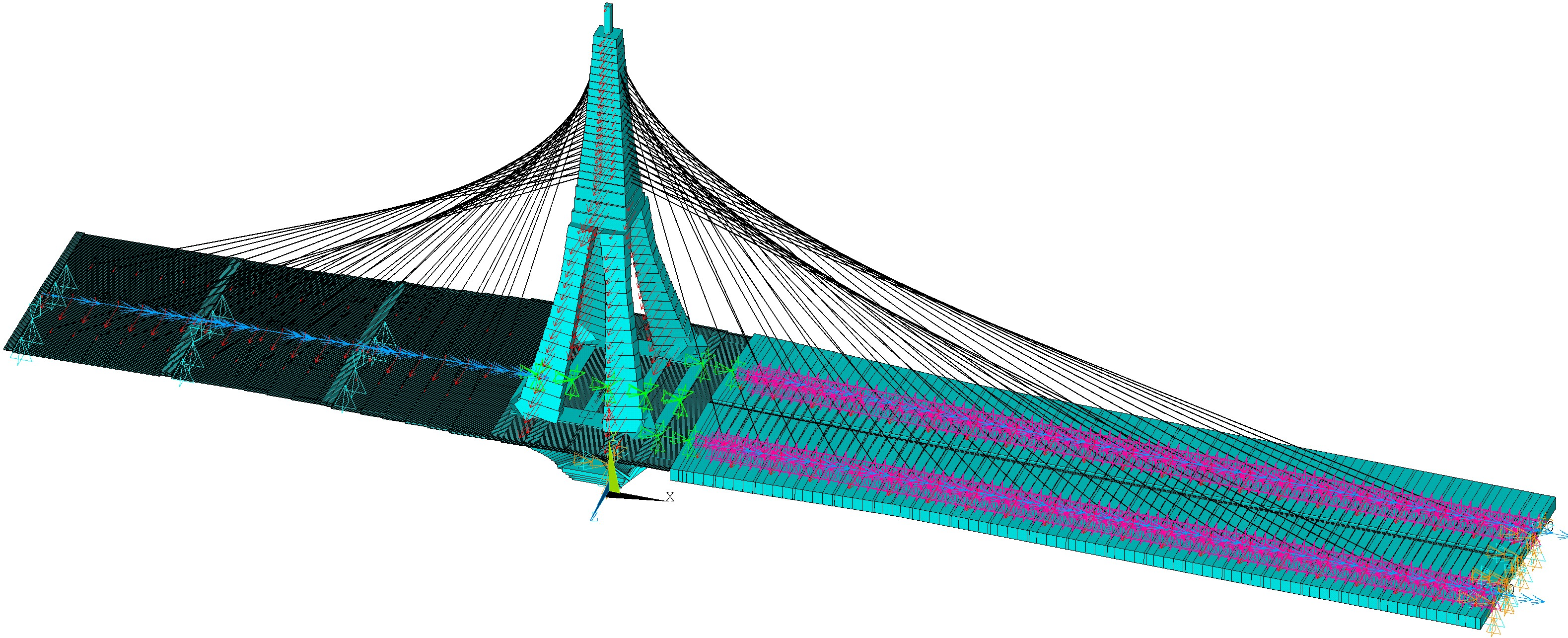
The full-bridge finite element model with applied wind loads is illustrated in Figure 12. The distribution direction of the mean wind load, the nodal arrangement of the buffeting forces, and the boundary conditions of the main girder and the pylon are indicated.
The fluctuating wind field in the buffeting calculation model was generated based on the spectral representation method. To simulate a strong wind environment at the bridge site, the Simiu spectrum was adopted to model the power spectral density of the along-wind fluctuating wind velocity, and the Lumley–Panofsky spectrum was employed for the vertical fluctuating wind velocity. The corresponding expressions are given by Equations (6) and (7), respectively:
n S u ( n ) u * 2 = 200 f ( 1 + 50 f ) 5 / 3
n S w ( n ) u * 2 = 6 f ( 1 + 4 f ) 2
where S u ( n ) and S w ( n ) are the power spectral densities of the along-wind and vertical fluctuating wind velocities, respectively; n is the frequency; f = n z / U z is the reduced frequency in friction velocity coordinates; and u * is the friction velocity of the airflow. The classical Davenport coherence function model was adopted to describe the spatial correlation of wind velocity along the main girder. Its expression is given by Equation (8):
c o h ( r , n ) = e x p ( C n r U )
where r is the spatial distance between the two points, and C is the decay coefficient, taken as 7.0 in this study.
Based on the aforementioned model, the calculation of the wind-induced vibration response after cable failure follows a ‘static equilibrium—dynamic response’ analysis procedure. First, a nonlinear static analysis is performed by applying the mean wind load F s t to the structure. The nonlinear static equilibrium position under the combined action of cable failure and static wind is determined using the Newton–Raphson method. Rayleigh damping with a damping ratio of 0.3%, referring to the first and second vertical bending modes of the bridge in its current state (after cable failure when applicable), was used in the subsequent transient analysis. Starting from the equilibrium configuration, spatially distributed fluctuating wind-velocity time histories were used to compute the nodal buffeting forces F s . Finally, a transient dynamic analysis was conducted to obtain the internal force time-history responses at critical locations.

4.2. Wind-Induced Vibration Response Behavior of the Bridge in the Completed State

Before investigating cable failure scenarios, it is essential to establish the dynamic response characteristics of the structure in its intact state. For this bridge, located in a flat and open area, the terrain category was considered Class B, and the corresponding surface roughness coefficient was taken as 0.16 [25]. Since the height of the main girder above ground was 27.7 m, the design reference wind speed was determined to be 30.7 m/s. In the present simulation, the fluctuating wind field was generated at 21 points along the main girder. The angle of attack was set to 0°. A time step of 0.125 s and a total duration of 5120 s were adopted to ensure adequate coverage of the dominant frequency components of the wind spectrum and the convergence of the response statistics.
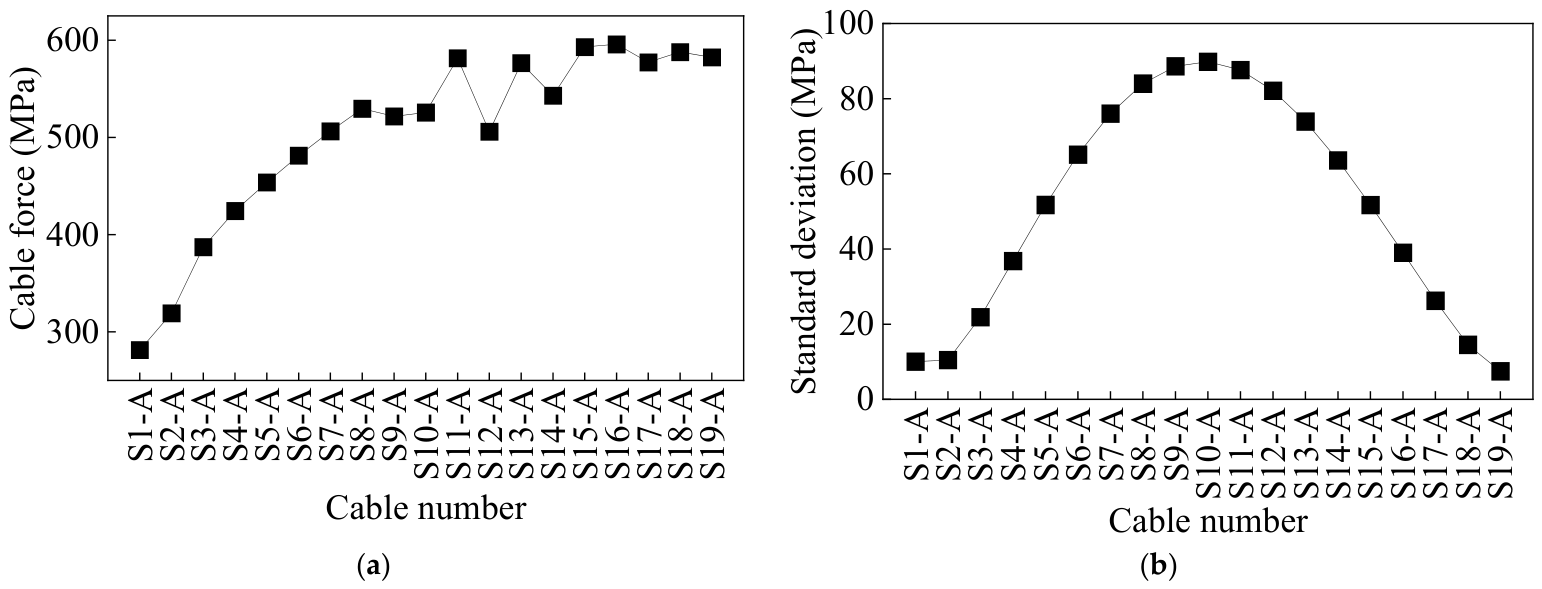
In this section, performance evaluation benchmarks are established from two perspectives: the static wind response and the buffeting response. For the static wind response, the cable forces under static wind loading are taken as the evaluation index. For the buffeting response, attention is given to the dynamic fluctuations induced by the wind, and statistical analysis is performed over the steady-state segment from 620 s to 5120 s. The results are presented in Figure 13.
Under static wind loading, the cable forces in the main span exhibit an increasing trend from the cables near the pylon to those farther from the pylon. During the buffeting response, the standard deviations of the cable forces in the main span present a symmetric distribution pattern, with maximum values occurring at mid-span.

4.3. Single Stay Cable Failure

To elucidate the influence of cable failure on different characteristic regions on the wind-induced response of the structure, three representative locations were selected for comparative analysis: a cable near the pylon (S1-A), a cable at the mid-span (S10-A), and a cable away from the pylon (S19-A). Under a consistent wind load input, transient dynamic analyses were performed, with particular attention given to the variations in internal force in the remaining cables following the failure event. The static wind-induced force variation amplitude δ F and the dynamic wind-induced force variation amplitude δ σ of the stay cables are defined by Equations (9) and (10), respectively:
δ F = F b i F a i F a i × 100 %
δ σ = σ b i σ a i σ a i × 100 %
where F a i and σ a i denote the static wind internal force and the standard deviation of the buffeting internal force, respectively, of the i -th stay cable without cable failure, and F b i and σ b i represent the corresponding quantities under the cable failure condition.
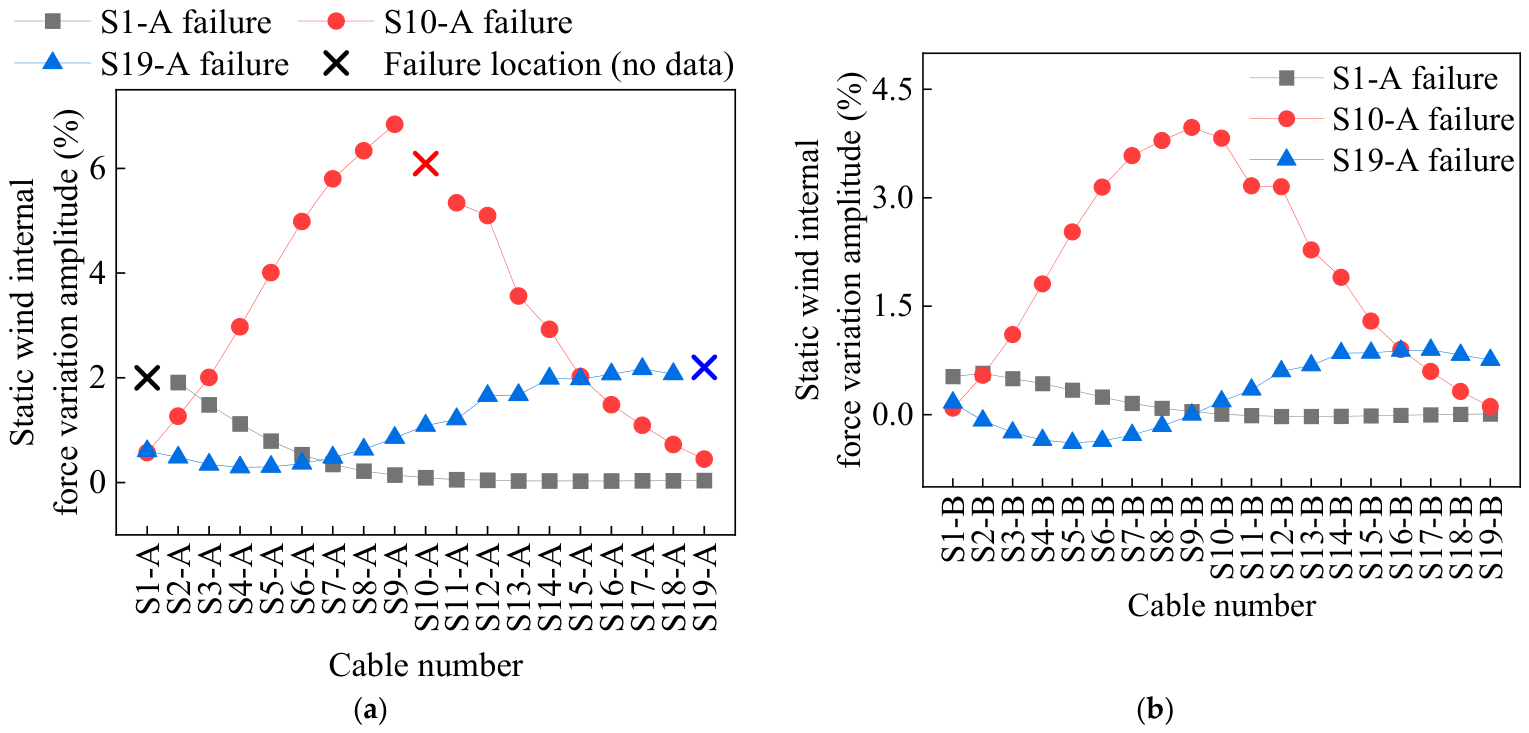
Figure 14 presents the variation amplitudes of the static wind internal forces of all stay cables under different cable failure scenarios. Under static wind loading, the failure of a single stay cable induces a pronounced “proximity effect”: the static wind load is predominantly transferred to the adjacent cables, and the increase in the static wind's internal force becomes larger as the distance from the failure point decreases. Moreover, the static wind load is primarily redistributed to the cables on the same side, whereas the influence on the cables on the opposite side remains relatively weak.
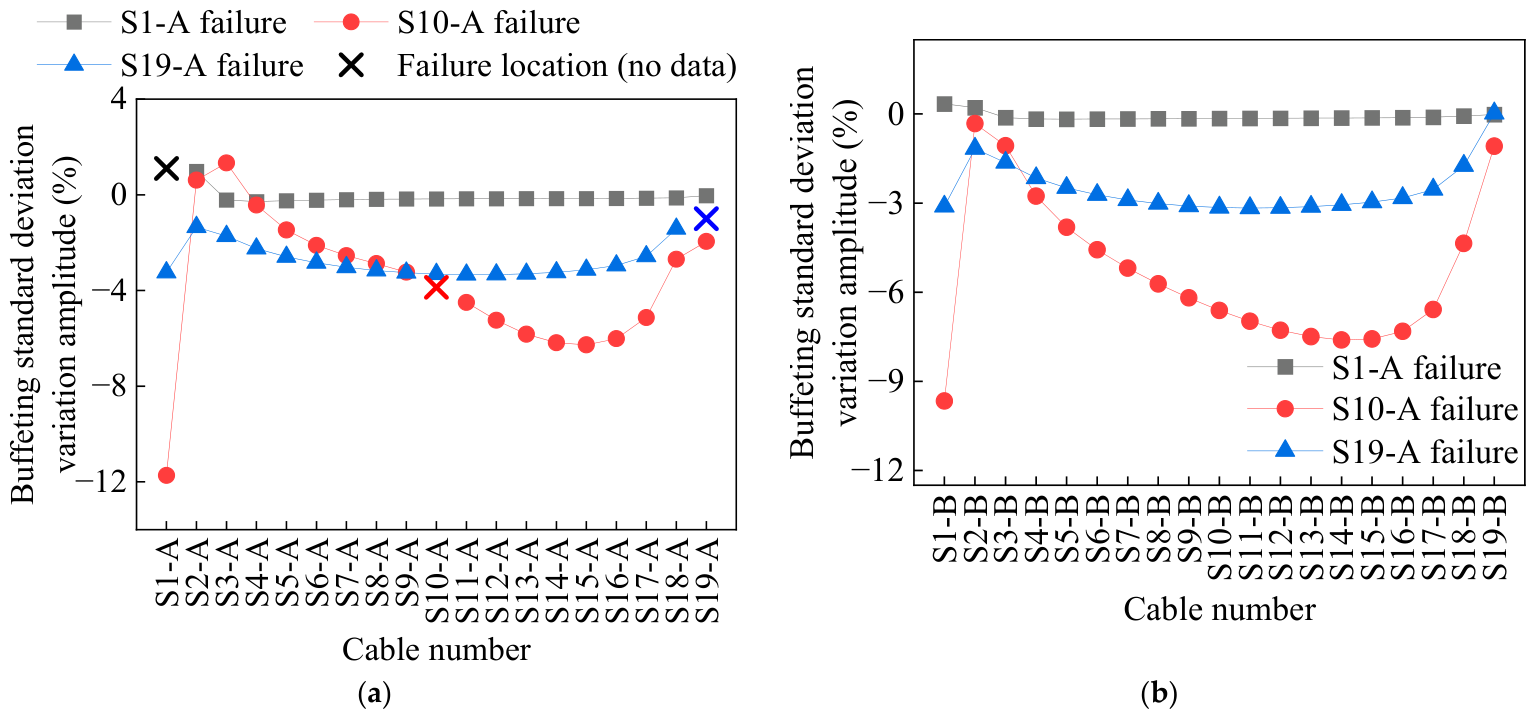
Figure 15 presents the variation amplitudes of the buffeting internal forces of all stay cables under different cable failure scenarios. Regardless of the failure location, the variation in the standard deviation of the buffeting internal force is particularly pronounced for the short cables near the pylon, indicating that short cables are more sensitive to local deformation. Further comparison of the effects of different failure locations reveals that failure of the mid-span cable (S10-A) exerts the greatest influence on the overall static response and also produces the most significant impact on the buffeting response of the bridge.

4.4. Multiple Stay Cable Failures

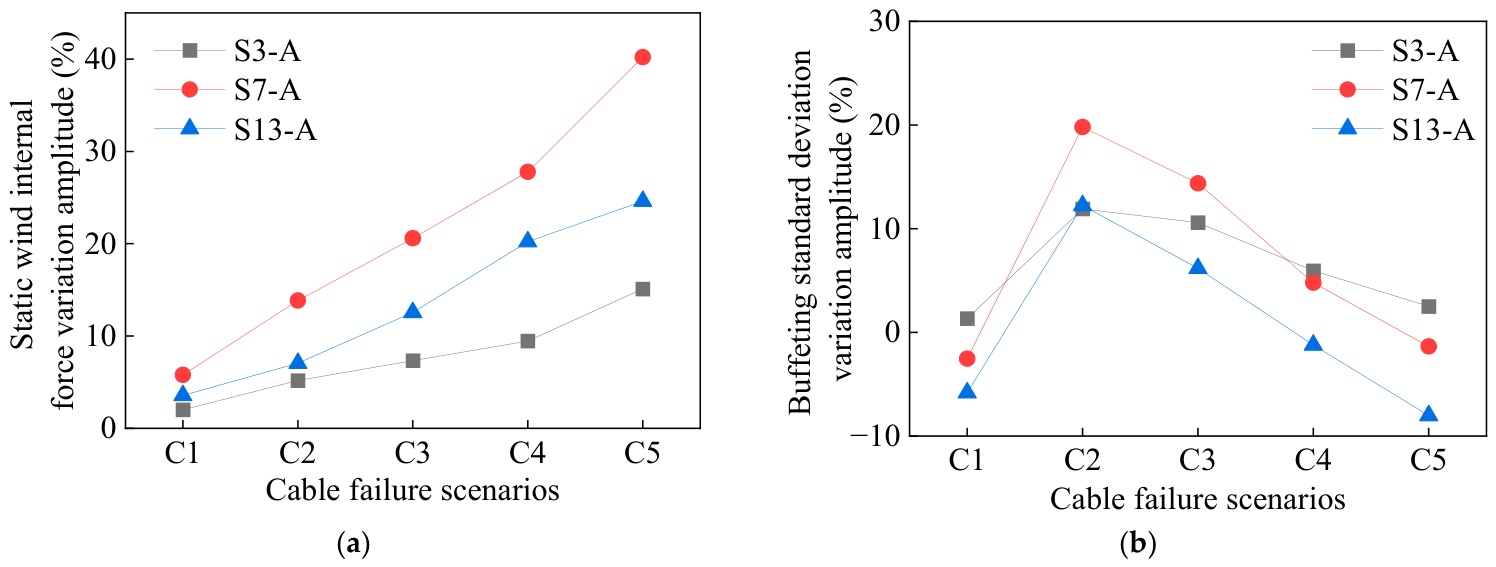
For the case of mid-span cable failures, the number of failed cables progressively increased to five (scenarios designated as C1 to C5) to investigate the influence mechanism of damage accumulation on the wind-induced vibration response of the bridge. Three representative stay cables were selected for monitoring: cable S7-A adjacent to the failure zone on the left side, cable S13-A adjacent on the right side, and cable S3-A located farther from the failure zone. The computed results are presented in Figure 16.
As the results show, the variation amplitudes of the static wind internal forces and the internal buffeting forces exhibit distinct trends as the number of failed cables increases. The variation in static wind internal forces in each cable increases monotonically with the number of failed cables, which is consistent with the static equilibrium principle whereby a reduction in load-carrying components leads to internal force redistribution. In contrast, the buffeting internal force variation in each cable displays a non-monotonic trend, initially increasing before subsequently decreasing. The variation amplitudes peak when two cables fail (Scenario C2); as the number of failed cables continues to rise, the internal buffeting force variations begin to decline. This phenomenon may be attributed to changes in the global modal characteristics of the bridge.

4.5. Stay Cable Failure During Buffeting

In all preceding analyses, it was assumed that cable failure occurs prior to the application of wind loads, i.e., the structure first experiences cable failure and is subsequently subjected to wind action. However, for cable-stayed bridges situated in marine environments, stay cables are subjected to the long-term coupled effects of strong winds and corrosion induced by high temperature, high humidity, and high salinity. Consequently, stay cables are more prone to failure during the buffeting process of the bridge. Zhou et al. [17] noted that complex coupling effects exist between wind loads and cable failure events, which significantly influence the post-failure dynamic response of the bridge. To better understand how cable failure affects the buffeting response of the bridge, this section further investigates the influence of cable failure at different buffeting phases on the transient response in the wind environment detailed above.
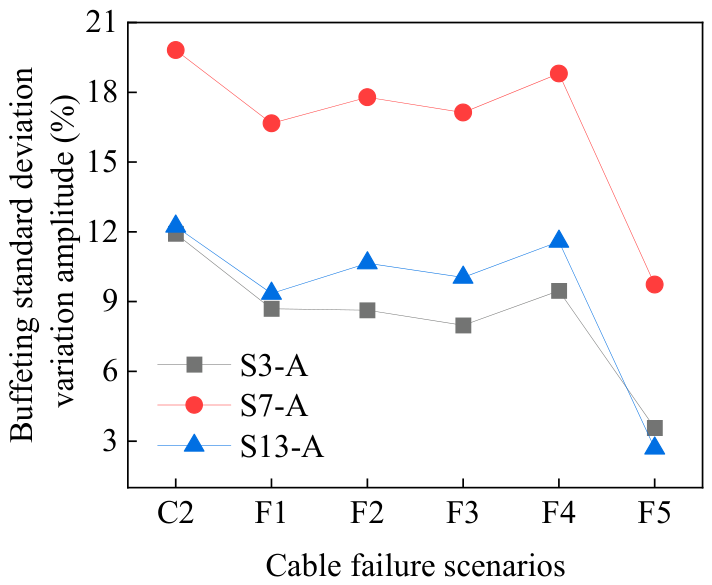
Based on the variation characteristics of the cable force time-history curve of S7-A obtained from the preceding analyses, five representative cable failure instants were selected as calculation scenarios: the moment of maximum cable force (F1), the moment of minimum cable force (F2), the moment the maximum cable force rate increases (F3), the moment the maximum cable force rate decreases (F4), and a random instant (F5). According to the results presented in Section 4.4, the variation amplitude of the buffeting standard deviation reaches its peak under a failure scenario involving two mid-span cables (S9-A and S10-A), designated as Scenario C2. Therefore, this combination of failure is adopted for all scenarios investigated in this section.
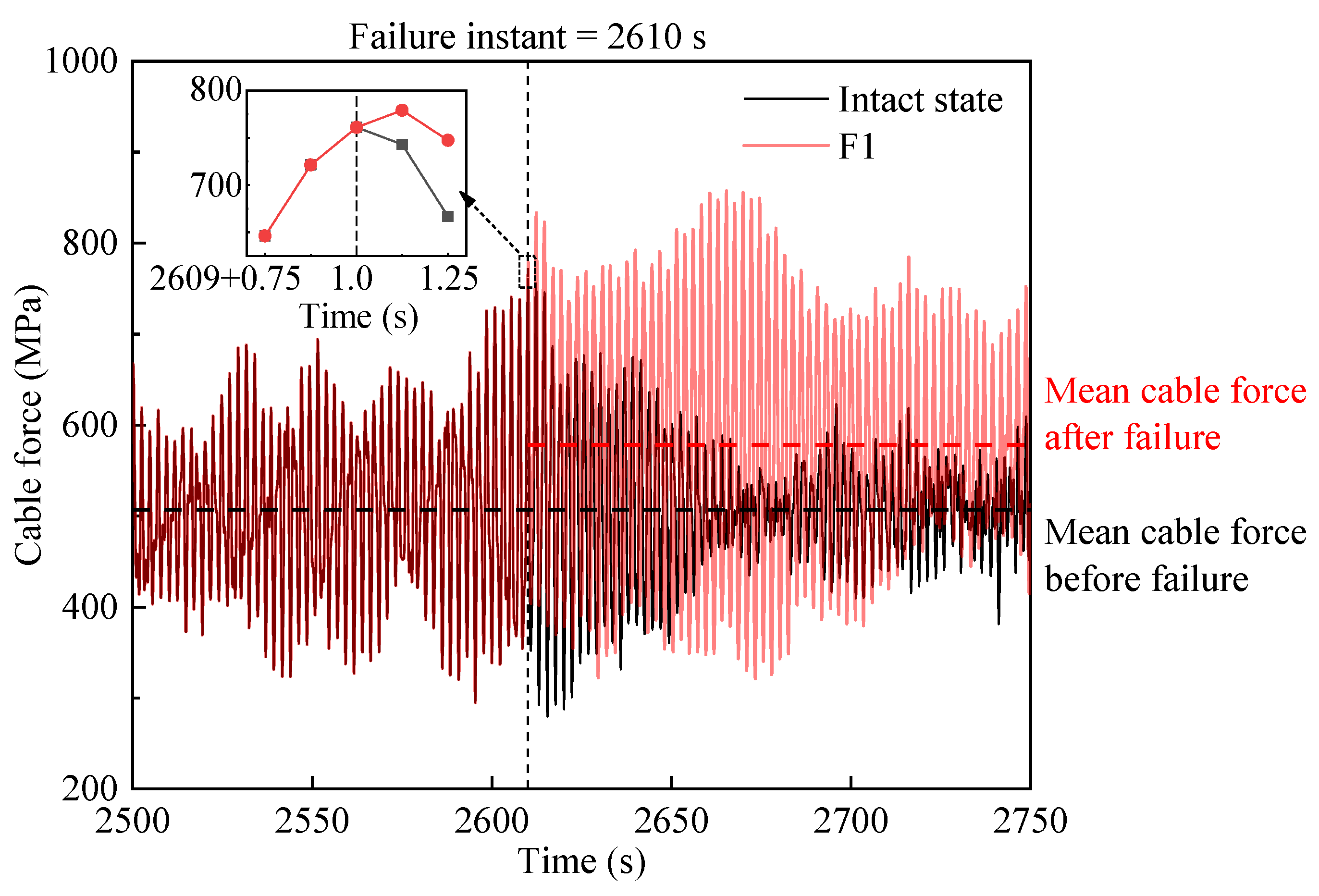
Figure 17 presents the cable force time history of the adjacent cable S7-A under Scenario F1. It can be observed that prior to cable failure, the force in S7-A exhibits steady-state buffeting around the mean value, corresponding with an intact bridge state. At the moment of cable breakage, the cable force rises sharply in an extremely short time, after which it rapidly stabilizes at a new equilibrium position following a brief oscillation. The mean cable force after failure is significantly elevated compared to before failure. This indicates that cable failure occurring during the buffeting process induces internal force redistribution among stay cables.
Figure 18 compares the variation amplitudes of the buffeting standard deviation for three representative stay cables—S3-A, S7-A, and S13-A—under six scenarios: C2 and F1 through F5. From the computational results, it can be observed that when a stay cable fails during the buffeting process, the timing of its failure impacts the calculated results. Specifically, the amplitudes under Scenarios F1, F2, F3, and F4 are relatively close to one another, whereas the amplitude under Scenario F5 is notably smaller than those of other scenarios. In terms of the degree of influence, the variation amplitude of S7-A is the most pronounced, followed by those of S3-A and S13-A, and the overall trends of the three curves are generally consistent. In addition, the variation amplitude corresponding to cable failure at the trough of the cable force (i.e., Case F2) is slightly larger than that at the peak (i.e., Case F1). Scenario F4 corresponds to the moment at which the maximum cable force rate decreases, during which the vertical velocity of the main girder is relatively large. The sudden rupture at this instant induces a comparatively marked increase in response. In Scenario F5, cable breakage occurs at a random instant (t = 3000 s), during which the fluctuating wind load is at a relatively low level. The instantaneous response of the structure is therefore less developed, leading to the smallest variation amplitude among all scenarios.
In summary, the influence of cable failure at different phases of the buffeting process produces significant differences in the structural buffeting response. The moment at which the maximum cable force rate decreases represents a relatively unfavorable phase for cable breakage. When the stay cable fails before the buffeting analysis (i.e., Case C2), the buffeting internal forces of each cable reach their maximum values. Therefore, this case can be used to evaluate the effect of stay cable failure on the overall wind-induced response of the bridge and the wind-induced internal forces in local components.
It should be noted that the above conclusions are derived from the specific bridge parameters and scenario settings considered in this study, and their general applicability requires further validation. In addition, this study focused primarily on the effects of main-span cable failure, and the influence of side-span cable failure is not addressed. The effects of stay cable rupture under extreme inflow conditions on the overall structural response and the forces of adjacent cables were primarily analyzed. Future work could focus on the accumulation of damage in stay cables in marine environments to provide recommendations for periodic bridge inspection.

5. Conclusions

This study examines a long-span single-pylon cable-stayed bridge with a main span of 280 m as the engineering background. A three-dimensional finite element model of the full bridge was established with the aim of systematically investigating the effects of stay cable failure—considering both the location and number of failed cables—on the structural dynamic characteristics and wind-induced buffeting response of the bridge. The transient effects of cable failure at different phases during the buffeting process were also explored. The main conclusions are as follows:
(1)
The reduction in frequency induced by cable failure is concentrated primarily in the lower-order vertical bending modes. The variation in frequency is closely related to the spatial correspondence between the failure location and the mode shape, with the largest reduction occurring when the failed cable is located at the antinode of the corresponding mode. The first two modal frequencies carry spatially distinguishable information about cable failure locations, which is relevant for vibration-based damage localization in bridge inspection.
(2)
Multiple cable failures induce a nonlinear cumulative effect, as incremental reductions in frequency became progressively larger as the number of failed cables increased. Unilateral multiple cable failures disrupt the symmetry of the transverse stiffness distribution, introducing torsional components into the vertical bending modes and producing a bending–torsion coupling effect that intensifies with the number of failed cables.
(3)
Under wind loads, the failure of stay cables results in static internal forces being redistributed, primarily to the adjacent stay cables on the same side. The redistribution is governed by local stiffness continuity, so the force increases as the distance from the failure point decreases. As the number of failed cables increases, the variation in static internal force results in an increasing trend in each cable.
(4)
The change in buffeting internal forces has a non-monotonic trend with an increasing number of failed cables. When a small number of stay cables fail, a reduction in local stiffness increases the buffeting response. As the number of failed cables increases, the buffeting response decreases instead. Possible reasons for this are the decrease in the overall stiffness of the bridge and the resulting reduction in the participation of higher-order modes. Short cables near the pylon are more sensitive to buffeting response, exhibiting larger internal force fluctuations than cables at other locations.
(5)
Cable failure has a significant influence on the transient response of the structure when it occurs at different phases of the buffeting process. The scenario in which the structure is subjected to wind loads after cable failure results in the largest variation amplitudes. Therefore, this case can be used to evaluate the effect of stay cable failure on the overall wind-induced response of bridges and the effect that wind-induced internal forces have on local components.

Author Contributions

Conceptualization, H.T.; methodology, J.X., H.T. and J.K.; software, J.X. and J.K.; validation, J.X.; formal analysis, J.X.; investigation, J.X. and J.K.; resources, H.T. and Y.L.; data curation, J.X.; writing—original draft preparation, J.X.; writing—review and editing, J.X. and H.T.; visualization, J.X.; supervision, H.T. and Y.L.; project administration, H.T. and Y.L.; funding acquisition, H.T. All authors have read and agreed to the published version of the manuscript.

Funding

This research was funded by the National Natural Science Foundation of China (grant number 52178507) and Science and Technology Projects of Xizang Autonomous Region (grant number XZ202601ZR0164).

Data Availability Statement

The data presented in this study are available upon request from the corresponding author.

Conflicts of Interest

The authors declare no conflicts of interest.

References

  1. Li, C.; Wu, G.-Y.; Li, L.-X.; Liu, C.-G.; Li, H.-N.; Han, Q. A Comprehensive Performance Evaluation Methodology for Sea-Crossing Cable-Stayed Bridges under Wind and Wave Loads. Ocean. Eng. 2023, 280, 114816. [Google Scholar] [CrossRef]
  2. Nanakorn, C.; Chitnuyanondh, L.; Limsuwan, E. Rama VIII Bridge, Bangkok, Thailand. Struct. Eng. Int. 2002, 12, 158–160. [Google Scholar] [CrossRef]
  3. Su, H.; Guo, C.; Han, T.; Li, R.; Liu, Z.; Su, F.; Shang, L. Research on Safety State Evaluation of Cable-Stayed Bridge Structures across the Sea. J. Mar. Sci. Eng. 2023, 11, 2034. [Google Scholar] [CrossRef]
  4. Wang, Y.; Huang, C.; Feng, Y. Huangpu Pearl River Northern Channel Bridge, Guangzhou—The Longest Single-pylon Cable-stayed Bridge Span in China. Steel Constr. 2012, 5, 53–60. [Google Scholar] [CrossRef]
  5. Zhang, X.; Xu, H.; Cao, M.; Lin, Z.; Damjanović, D.; Peng, J. On Real-Time Estimation of Typhoons-Induced Cable Tension of Long-Span Cable-Stayed Bridges from Health Monitoring Data. J. Wind. Eng. Ind. Aerodyn. 2023, 232, 105272. [Google Scholar] [CrossRef]
  6. Yao, G.; He, X.; Long, H.; Lu, J.; Wang, Q. Corrosion Damage Evolution Study of the Offshore Cable-Stayed Bridge Anchorage System Based on Accelerated Corrosion Test. J. Mar. Sci. Eng. 2023, 11, 896. [Google Scholar] [CrossRef]
  7. Yan, J.; Zhang, Y.; Chen, Z.; Li, P.; Li, Y.; Cao, Z.; Wu, J.; Yang, K.; Zhang, D. Pipeline Systems in Floating Offshore Production Systems: Hydrodynamics, Corrosion, Design and Maintenance. J. Mar. Sci. Eng. 2026, 14, 176. [Google Scholar] [CrossRef]
  8. Yi, J.; Li, J. Longitudinal Seismic Behavior of a Single-Tower Cable-Stayed Bridge Subjected to Near-Field Earthquakes. Shock Vib. 2017, 2017, 1675982. [Google Scholar] [CrossRef]
  9. Zhao, S.; Shi, Y.; Chen, J.; Yan, Z.; Zhang, B.; Zhang, X.; Wang, Z. Study the Influence of Cable Breakage on Wind-Induced Vibration Characteristics of the Curved Beam Unilateral Stayed Bridge. Buildings 2023, 13, 1038. [Google Scholar] [CrossRef]
  10. Chen, Y.; Wang, S.; Huang, K.; Zhong, J.; Cheng, H. Research on Dynamic Response of a Single-Tower Cable-Stayed Bridge with Successive Cable Breaks Based on a 3D Index. Appl. Sci. 2023, 13, 9197. [Google Scholar] [CrossRef]
  11. Fan, B.; Sun, Q.; Wang, S.; Ma, X.; Zou, J. Lessons Learned from a Progressive Collapse Accident of a through Tied-Arch Bridge: FE Modeling and Inverse Analysis. J. Perform. Constr. Facil. 2025, 39, 04025045. [Google Scholar] [CrossRef]
  12. Wolff, M.; Starossek, U. Cable Loss and Progressive Collapse in Cable-Stayed Bridges. Bridge Struct. 2009, 5, 17–28. [Google Scholar] [CrossRef]
  13. Ruiz-Teran, A.M.; Aparicio, A.C. Dynamic Amplification Factors in Cable-Stayed Structures. J. Sound Vib. 2007, 300, 197–216. [Google Scholar] [CrossRef]
  14. Mozos, C.M.; Aparicio, A.C. Parametric Study on the Dynamic Response of Cable Stayed Bridges to the Sudden Failure of a Stay, Part I: Bending Moment Acting on the Deck. Eng. Struct. 2010, 32, 3288–3300. [Google Scholar] [CrossRef]
  15. Mozos, C.M.; Aparicio, A.C. Parametric Study on the Dynamic Response of Cable Stayed Bridges to the Sudden Failure of a Stay, Part II: Bending Moment Acting on the Pylons and Stress on the Stays. Eng. Struct. 2010, 32, 3301–3312. [Google Scholar] [CrossRef]
  16. Chen, Q.; Wang, H.; El-Tawil, S.; Agrawal, A.K.; Bhattacharya, B.; Wong, W. Progressive Collapse Behavior of a Long-Span Cable-Stayed Bridge Induced by Cable Loss. J. Bridge Eng. 2023, 28, 05023005. [Google Scholar] [CrossRef]
  17. Zhou, Y.; Chen, S. Numerical Investigation of Cable Breakage Events on Long-Span Cable-Stayed Bridges under Stochastic Traffic and Wind. Eng. Struct. 2015, 105, 299–315. [Google Scholar] [CrossRef]
  18. Yao, C.; Li, D.; Wei, X. Vibration Suppression of Two Adjacent Cables Using an Interconnected Tuned Mass Damper/Nonlinear Energy Sink. J. Mar. Sci. Eng. 2024, 12, 1096. [Google Scholar] [CrossRef]
  19. Yan, J.; Zhao, Y.; Li, C.; Lu, J. Research on Intelligent Identification Model of Cable Damage of Sea Crossing Cable-Stayed Bridge Based on Deep Learning. Buildings 2025, 15, 3849. [Google Scholar] [CrossRef]
  20. Chao, Z.; Hong, H.; Bi, K.; Yan, X. Dynamic Amplification Factors for a System with Multiple-Degrees-of-Freedom. Earthq. Eng. Eng. Vib. 2020, 19, 363–375. [Google Scholar] [CrossRef]
  21. Buelvas, H.; Benjumea, J.M.; Chio, G. Dynamic Amplification Factors of Girder and Cables of Extradosed Bridges during Sudden Cable Failure. Bridg. Struct. 2021, 17, 101–110. [Google Scholar] [CrossRef]
  22. Liu, H.; Li, J.; Zhang, J.; Luo, J. Dynamic Amplification Analysis of the Main Girder of Cable-Stayed Bridges After Cable Rupture Using the Modal Superposition Method. Buildings 2025, 15, 596. [Google Scholar] [CrossRef]
  23. Fu, Y.; Dong, F.; Wang, J. Wind Resistance Performance Assessment of Long-Span Cable-Supported Bridges Based on Time-Varying Reliability Theory. Sustainability 2024, 16, 923. [Google Scholar] [CrossRef]
  24. Cao, Z.; Liu, Y.; Xu, B.; Li, X. Investigation of the Impact of Cable Corrosion on the Ultimate Strength and Fatigue Life of Stay Cable Bridges. Sci. Rep. 2025, 15, 41868. [Google Scholar] [CrossRef] [PubMed]
  25. JTG/T 3360-01-2018; Wind-Resistent Design Specification for Highway Bridges. China Communications Press Co., Ltd.: Beijing, China, 2018.
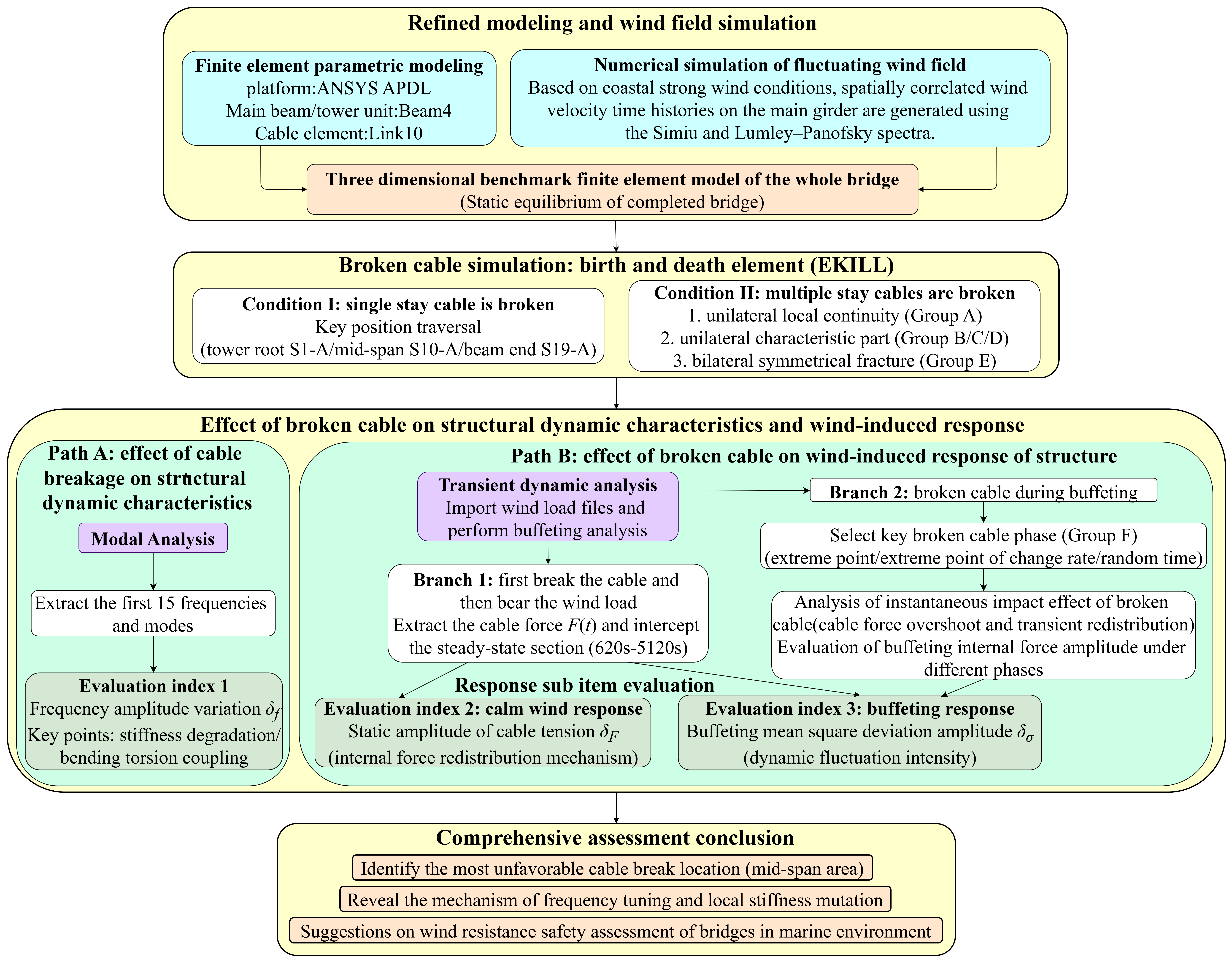
Figure 1. Research route for investigating the influence of stay cable failure on the structure's wind-induced vibration response.
Jmse 14 01089 g001
Figure 2. Three-dimensional finite element model of the full bridge.
Jmse 14 01089 g002
Figure 3. Key mode shapes of wind-induced vibration of the bridge: (a) 1st symmetric vertical bending (Mode 1); (b) 1st antisymmetric vertical bending (Mode 2); (c) 1st transverse bending (Mode 5); (d) 1st symmetric torsion (Mode 6).
Jmse 14 01089 g003
Figure 4. Bridge configuration: (a) view of elevation with stay cable numbering (dimensions in cm); (b) standard cross-section of the steel box girder (dimensions in cm).
Jmse 14 01089 g004
Figure 5. Variation amplitude of bridge modal frequencies after failure of a single stay cable: (a) first modal frequency variation; (b) second modal frequency variation.
Jmse 14 01089 g005
Figure 6. Variation amplitude of bridge modal frequencies after multiple stay cable failures: (a) first modal frequency variation; (b) second modal frequency variation. Group A scenarios are uniformly distributed along the main span: A1 to A6 correspond to failures of three adjacent cables:S2-A~S4-A, S5-A~S7-A, S8-A~S10-A, S11-A~S13-A, S14-A~S16-A, and S17-A~S19-A, respectively.
Jmse 14 01089 g006
Figure 7. Influence of the number of failed cables at different locations on the variation amplitude of bridge modal frequencies: (a) first modal frequency variation; (b) second modal frequency variation. Near-pylon region (Group B): B1 to B3 correspond to failures of S1-A, S1-A~S2-A, and S1-A~ S3-A, respectively. Mid-span region (Group C): C1 to C3 correspond to failures of S10-A, S9-A~S10-A, and S9-A~S11-A, respectively. Away-from-pylon region (Group D): D1 to D3 correspond to failures of S19-A, S18-A~S19-A, and S17-A~S19-A, respectively.
Jmse 14 01089 g007
Figure 8. Comparison of the influence of unilateral and bilateral stay cable failures on the first modal frequency variation. Group C (unilateral failure): C1 to C3 correspond to failures of S10-A, S9-A~S10-A, and S9-A~S11-A, respectively. Group E (bilateral failure): E1 to E3 correspond to symmetric bilateral failures at the corresponding mid-span locations.
Jmse 14 01089 g008
Figure 9. Comparison of bridge vertical bending mode shapes before and after stay cable failure: (a) intact state (front view); (b) three-cable failure state (front view); (c) intact state (side view); (d) three-cable failure state (side view).
Jmse 14 01089 g009
Figure 10. Identification of aerodynamic force coefficients of the main girder: (a) cross-section of the main girder; (b) sectional model test.
Jmse 14 01089 g010
Figure 11. Three-component force coefficients of the main girder cross-section.
Jmse 14 01089 g011
Figure 12. Schematic diagram of the full-bridge finite element model with applied wind loads.
Jmse 14 01089 g012
Figure 13. Stay cable forces resulting from wind-induced responses: (a) static wind response; (b) buffeting response.
Jmse 14 01089 g013
Figure 14. Variation amplitude of static wind internal forces of the remaining stay cables after a single-cable failure: (a) cables on the same side; (b) cables on the opposite side. Discontinuities in the curves indicate the locations of failed cables (no data available), marked by cross symbols of the same color.
Jmse 14 01089 g014
Figure 15. Variation amplitude of buffeting internal forces of the remaining stay cables after a single-cable failure: (a) cables on the same side; (b) cables on the opposite side. Discontinuities in the curves indicate the locations of failed cables (no data available), marked by cross symbols of the same color.
Jmse 14 01089 g015
Figure 16. Wind-induced internal force variation amplitudes of selected stay cables after multiple cable failures: (a) static wind internal force variation; (b) buffeting internal force variation. C1 to C5 correspond to failures of S10-A, S9-A~S10-A, S9-A~S11-A, S9-A~S12-A, and S8-A~S12-A, respectively.
Jmse 14 01089 g016
Figure 17. Cable force time-history curve of S7-A before and after cable failure occurred at the moment of peak cable force during buffeting.
Jmse 14 01089 g017
Figure 18. Variation amplitudes of buffeting internal forces on selected stay cables under scenarios with different cable failure instants.
Jmse 14 01089 g018
Table 1. First 15 natural frequencies and mode shapes of the bridge without cable failure.
Mode No.Frequency (Hz)Mode Shape Description
10.4422First symmetric vertical bending of main girder
20.8480First antisymmetric vertical bending of main girder
30.8646First transverse bending of pylon
41.0311Second antisymmetric vertical bending of main girder
51.0855First transverse bending of main girder
61.1383First symmetric torsion of main girder
71.5371Second symmetric vertical bending of main girder
81.5428Second transverse bending of pylon
91.6737First antisymmetric torsion of main girder
101.7517Second antisymmetric torsion of main girder
112.0398First longitudinal bending of pylon
122.1813Second symmetric torsion of main girder
132.2189First vertical bending of side-span main girder
142.2697Third antisymmetric vertical bending of main girder
152.3539Torsion of pylon
Table 2. Sensitivity statistics of each mode to a single-cable failure.
Mode No.Mode Shape DescriptionMaximum Frequency Variation
(%)
Corresponding Failed CableMean Frequency
Variation
(%)
1First symmetric vertical bending of main girder−1.62822S12-A−0.59392
2First antisymmetric vertical bending of main girder−1.06132S6-A−0.38046
3First transverse bending of pylon0.06940S15-A0.03592
4Second antisymmetric vertical bending of main girder−0.58190S9-A−0.20622
5First transverse bending of main girder0.11976S14-A0.05236
6First symmetric torsion of main girder−0.21084S12-A−0.08646
7Second symmetric vertical bending of main girder−0.70262S4-A−0.11813
8Second transverse bending of pylon0.03241S3-A0.01501
9First antisymmetric torsion of main girder0.09560S2-A0.03490
10Second antisymmetric torsion of main girder−0.29685S6-A−0.06129
11First longitudinal bending of pylon−0.04902S6-A−0.02864
12Second symmetric torsion of main girder−0.34383S4-A−0.03450
13First vertical bending of side-span main girder−0.00451S5-A−0.00237
14Third antisymmetric vertical bending of main girder−0.12336S3-A−0.03316
15Torsion of pylon−0.02124S12-A−0.00089
Disclaimer/Publisher’s Note: The statements, opinions and data contained in all publications are solely those of the individual author(s) and contributor(s) and not of MDPI and/or the editor(s). MDPI and/or the editor(s) disclaim responsibility for any injury to people or property resulting from any ideas, methods, instructions or products referred to in the content.