A DOA-CNN-BiGRU-SA Hybrid Framework for Short-Term Sea Level Height Prediction


Abstract
1. Introduction
- (1)
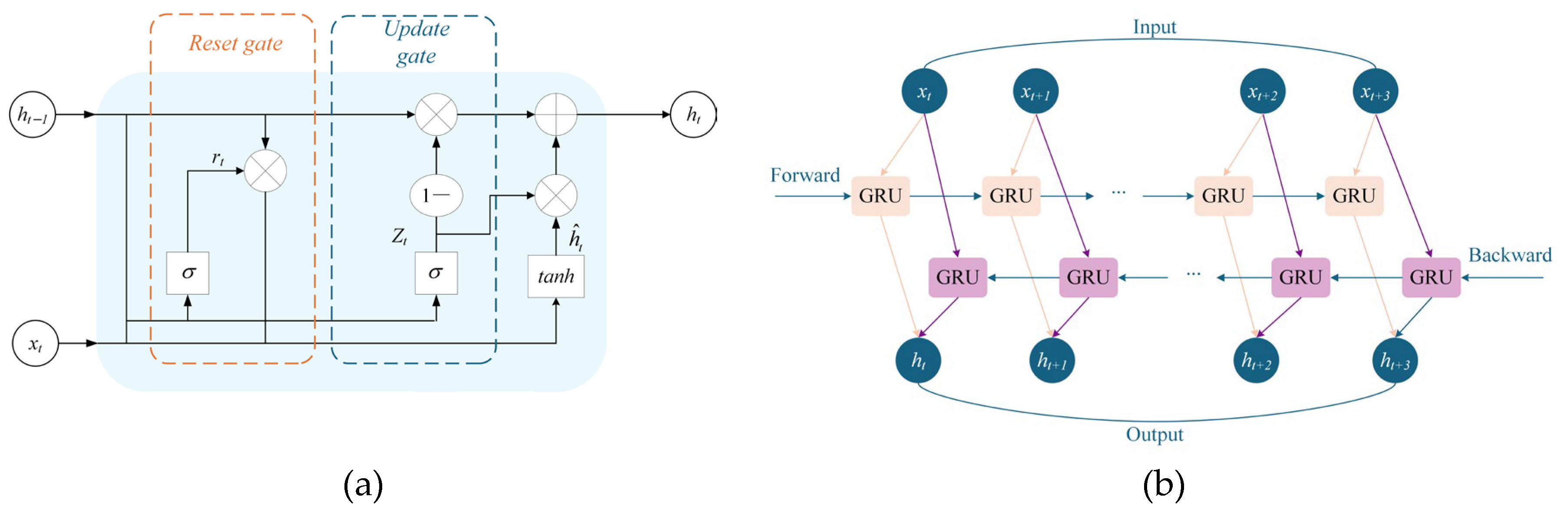
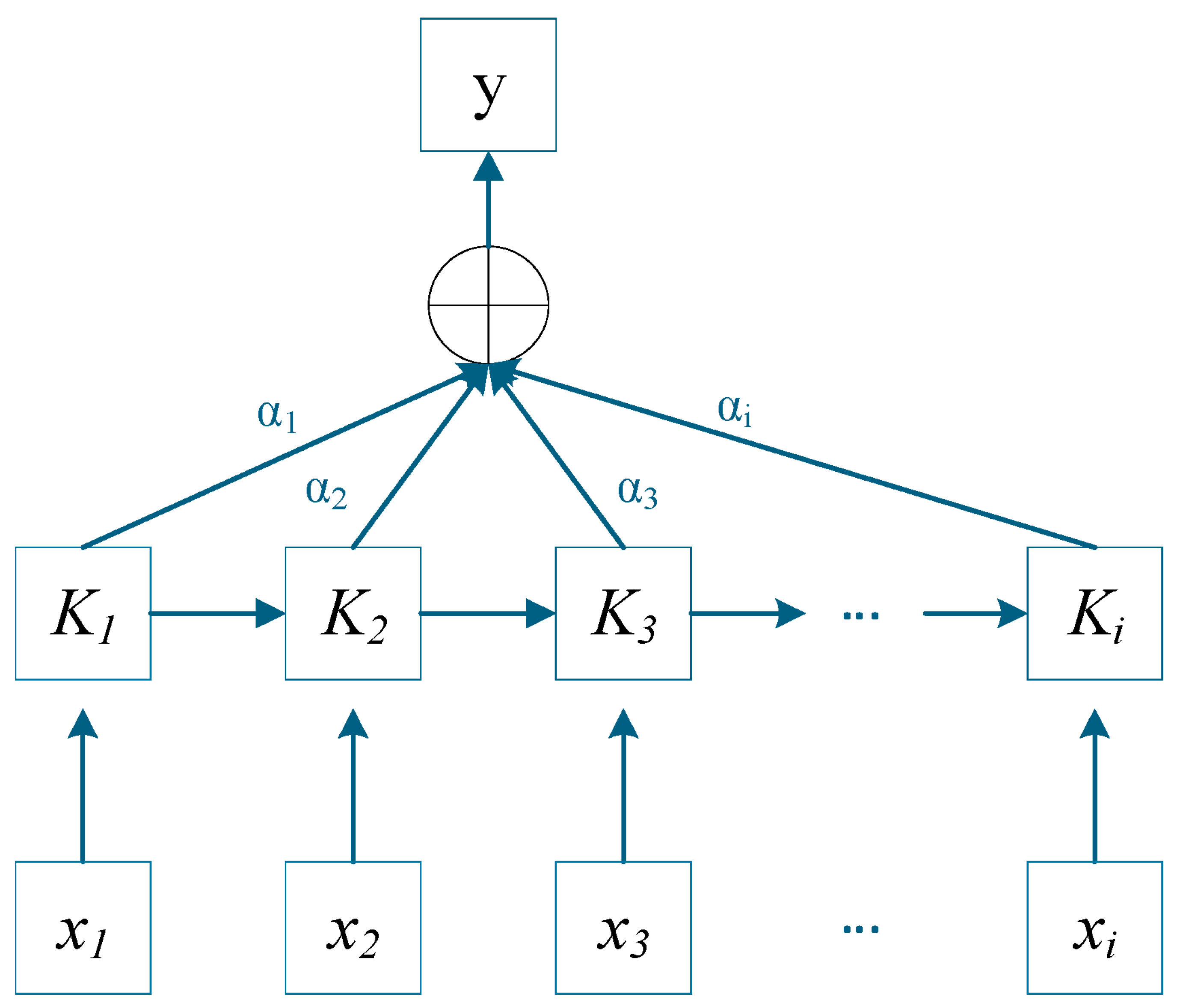
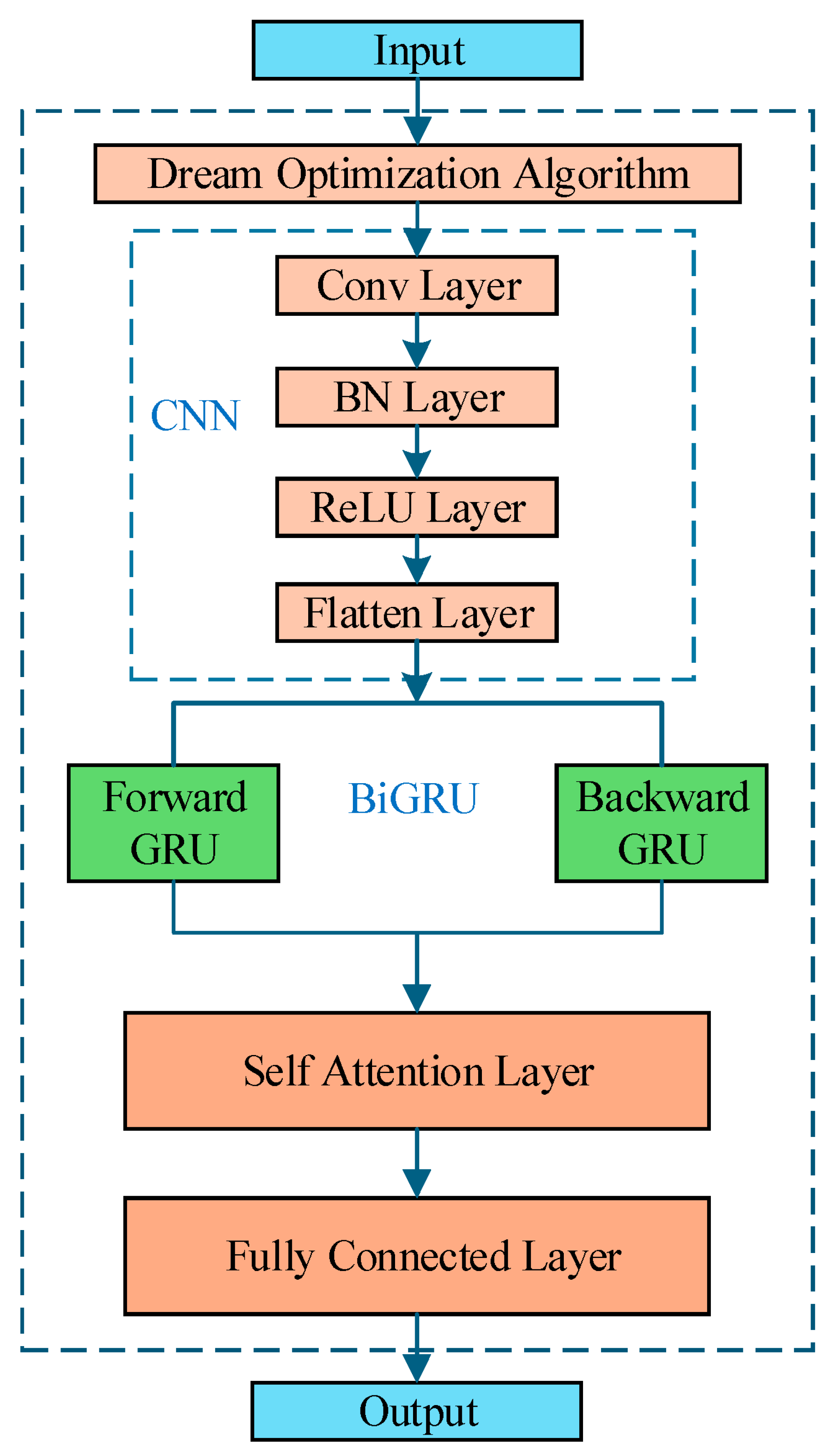
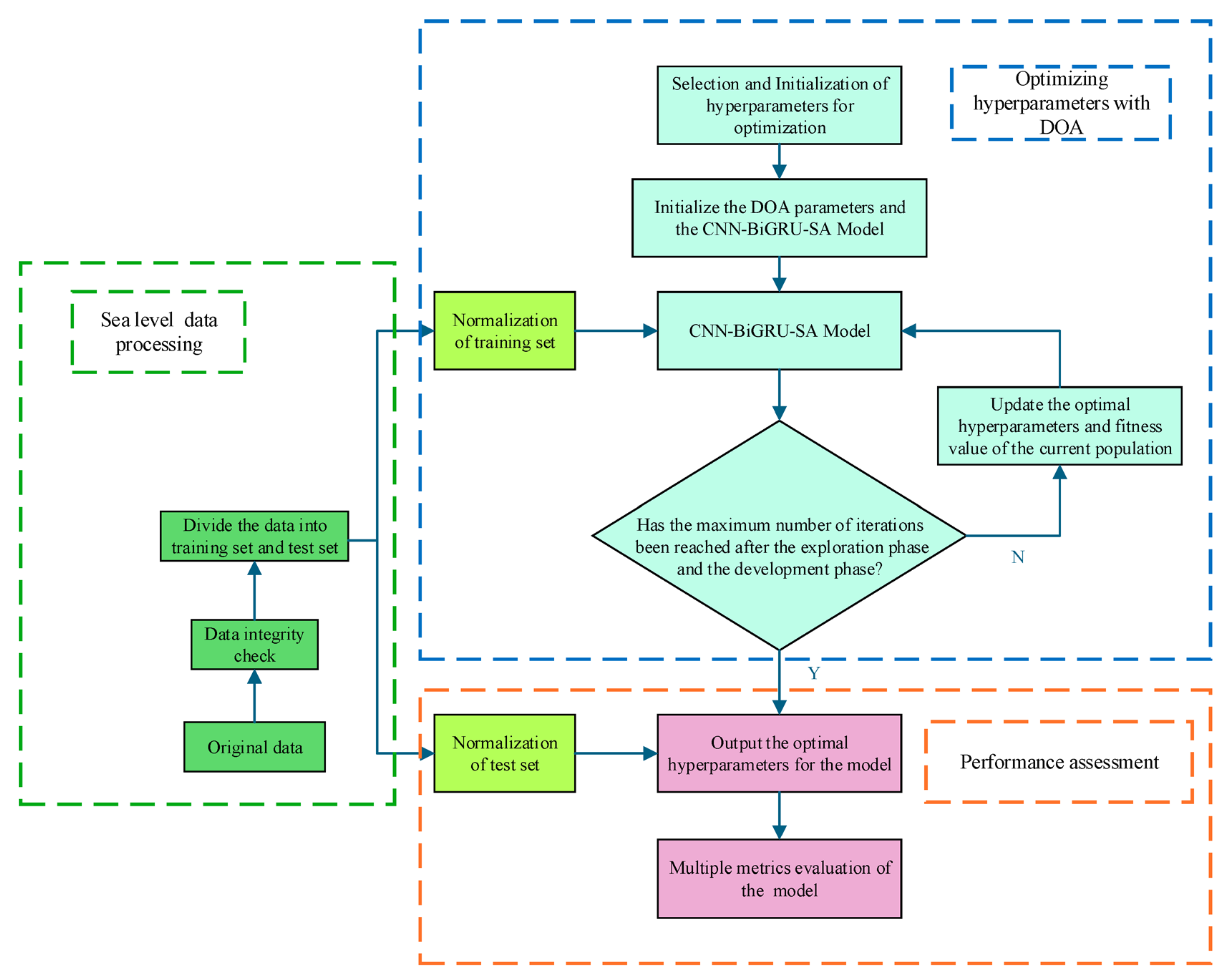
- For the first time, the CNN-BiGRU-SA fusion framework is introduced for predicting sea level changes. In this framework, the CNN extracts features from the input sequence, while the BiGRU layer leverages its bidirectional structure and internal gates to model long-term dependencies. The SA module equips the model to prioritize key information, thereby improving both prediction accuracy and the model’s ability to understand complex dynamic patterns of sea level change. To address the challenge of hyperparameter optimization in the proposed model architecture, the DOA is employed. Recognized for its high stability, rapid convergence, and strong robustness, DOA is applied to identify the most effective hyperparameter configuration. The CNN-BiGRU-SA fusion framework, optimized by DOA, shows better results compared to relevant single and existing fusion models.
- (2)
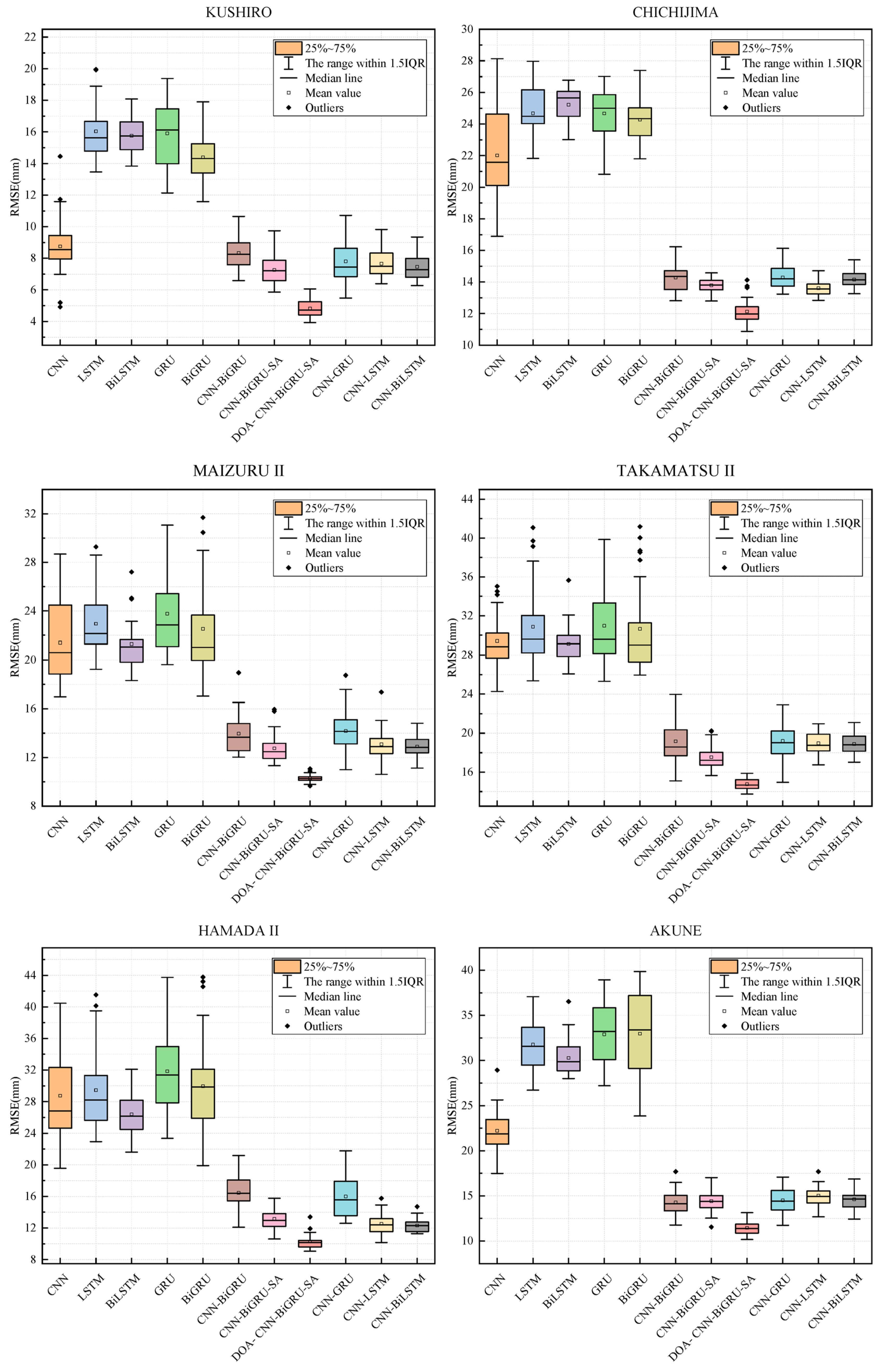
- In DL models, the range of random seed values for neural network initialization is generally [0, 2^32 − 1], with a minimum of 0 and a maximum of 4,294,967,295. During initialization, an integer is randomly generated as the seed, and different seeds can lead to varying outcomes across multiple runs. However, this topic has not been thoroughly explored in previous modeling and prediction research. Our study, therefore, provides the first comprehensive discussion on the impact of selecting seed values randomly from the full range. In this work, we use multiple random seeds to consistently initialize neural network weights across all models. The final prediction results are then analyzed using statistical analysis methods to assess the model’s predictive performance.
- (3)
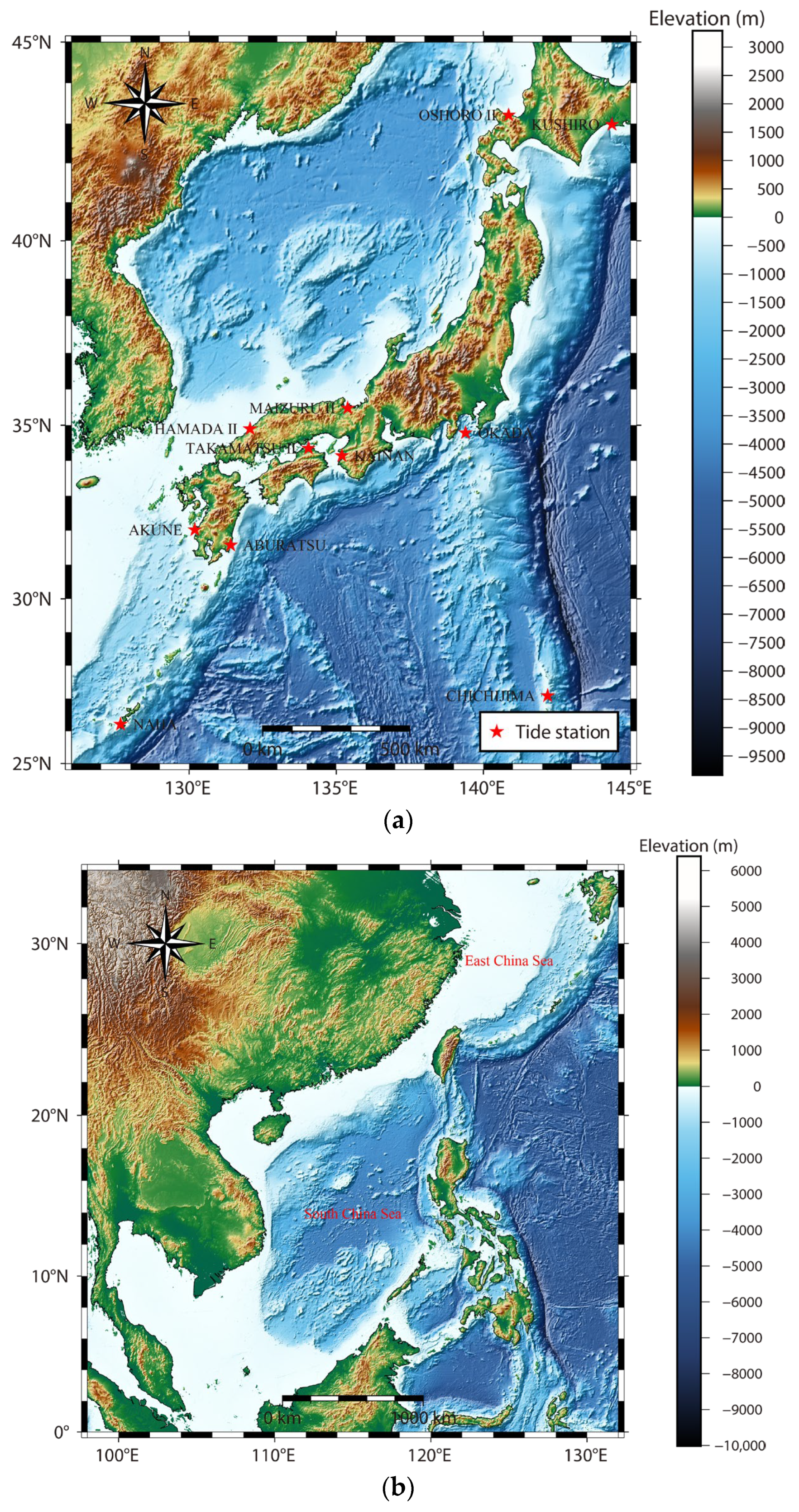
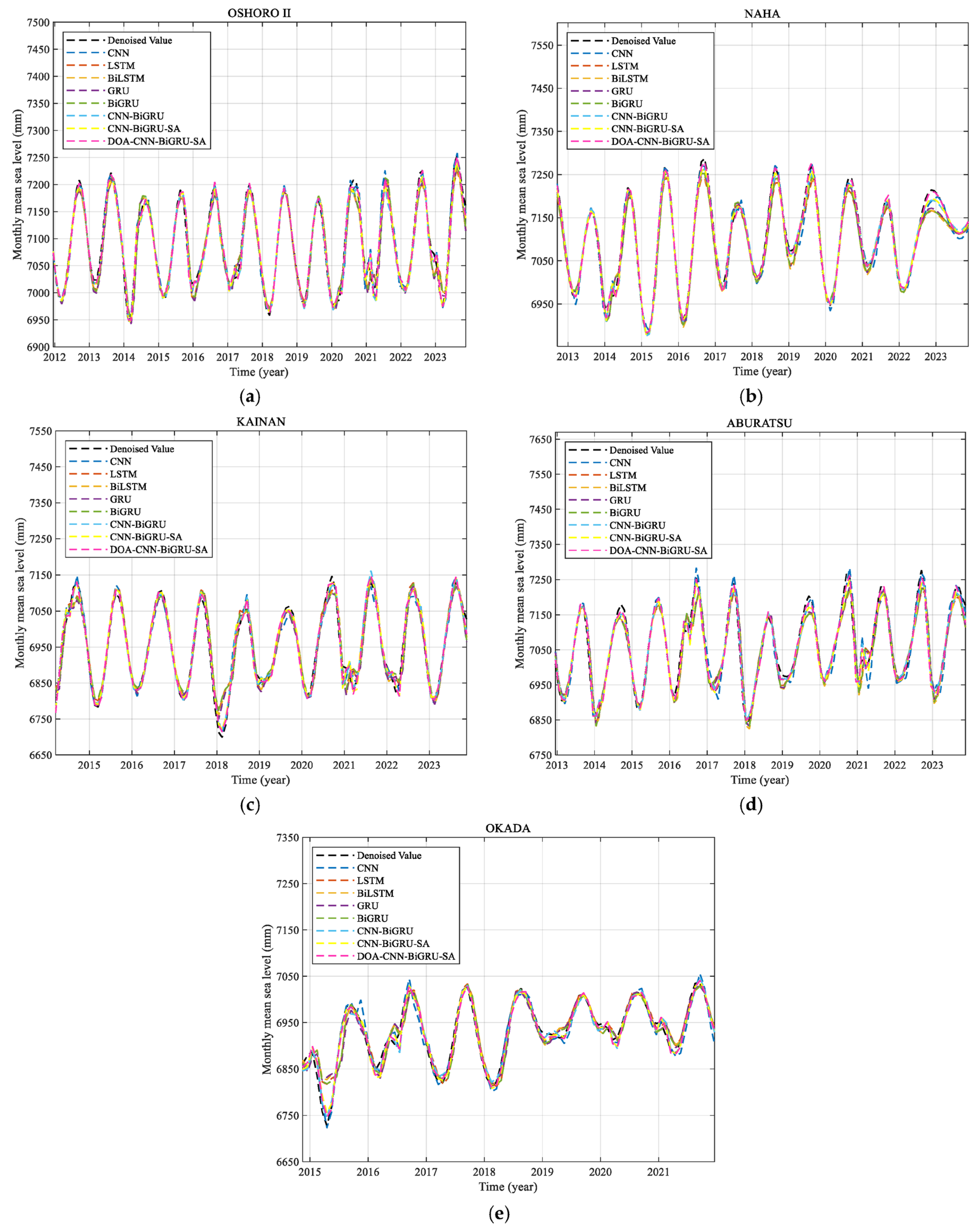
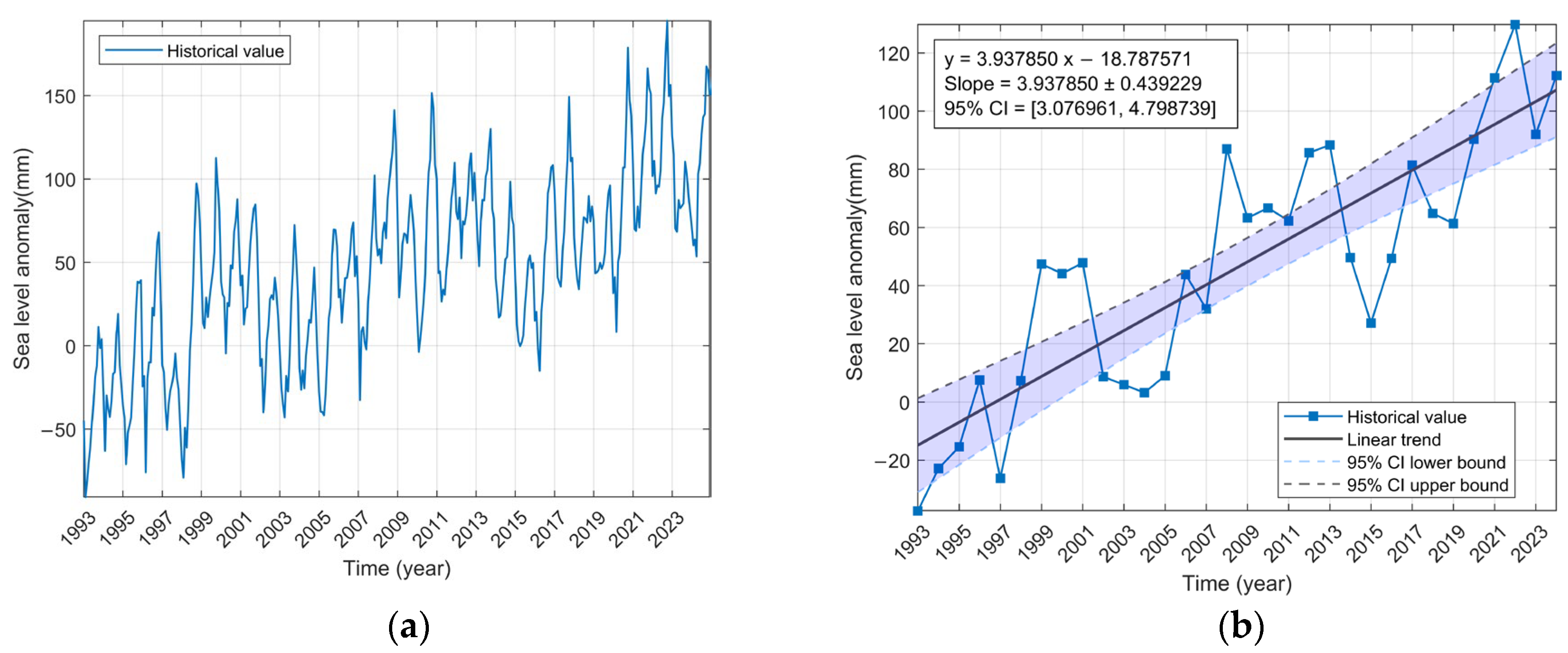
- After initializing neural network weights with multiple random seeds, each model was evaluated using data from several tidal stations, which demonstrated that the proposed model framework achieved competitive predictive performance. The DOA-CNN-BiGRU-SA framework was subsequently applied to satellite altimetry-based sea level anomaly (SLA) data from the combined East and South China Seas to forecast regional short-term sea level variations. The results aligned well with officially published data, demonstrating the model’s reliability and accuracy. In summary, the DOA-CNN-BiGRU-SA fusion framework may offer a novel approach and pathway for future studies on regional sea level prediction.
2. Materials and Methods
2.1. Study Region
2.2. CNN-BiGRU
2.3. Self-Attention Mechanism
2.4. Dream Optimization Algorithm
2.5. The Fusion DOA-CNN-BiGRU- SA Framework
2.6. Parameter Setting
2.7. Evaluation Metrics
3. Results
4. Discussion
4.1. Impact of Random Weight Initialization on Model Performance
4.2. Regional Mean Sea Level Change Prediction for the East and South China Seas Region
- (1)
- The first strategy
- (2)
- The second strategy
- (3)
- Comparison with the baseline models
4.3. Model Limitations and Impact on Prediction Performance
5. Conclusions
- (1)
- Under default seed settings for neural network weight initialization, bidirectional models do not necessarily outperform unidirectional models, and the default seed may constrain the generalization ability. Statistical analysis with multiple random seeds reveals that BiGRU generally outperforms GRU in predictive performance but exhibits lower stability. LSTM and BiLSTM demonstrate variable performance across different stations, with LSTM being less robust. Among the single models, CNN achieves the best overall performance. Fusion frameworks incorporating CNN consistently outperform their counterparts, particularly the CNN-BiGRU-SA model, which demonstrates competitive feature extraction capabilities and enhanced prediction accuracy.
- (2)
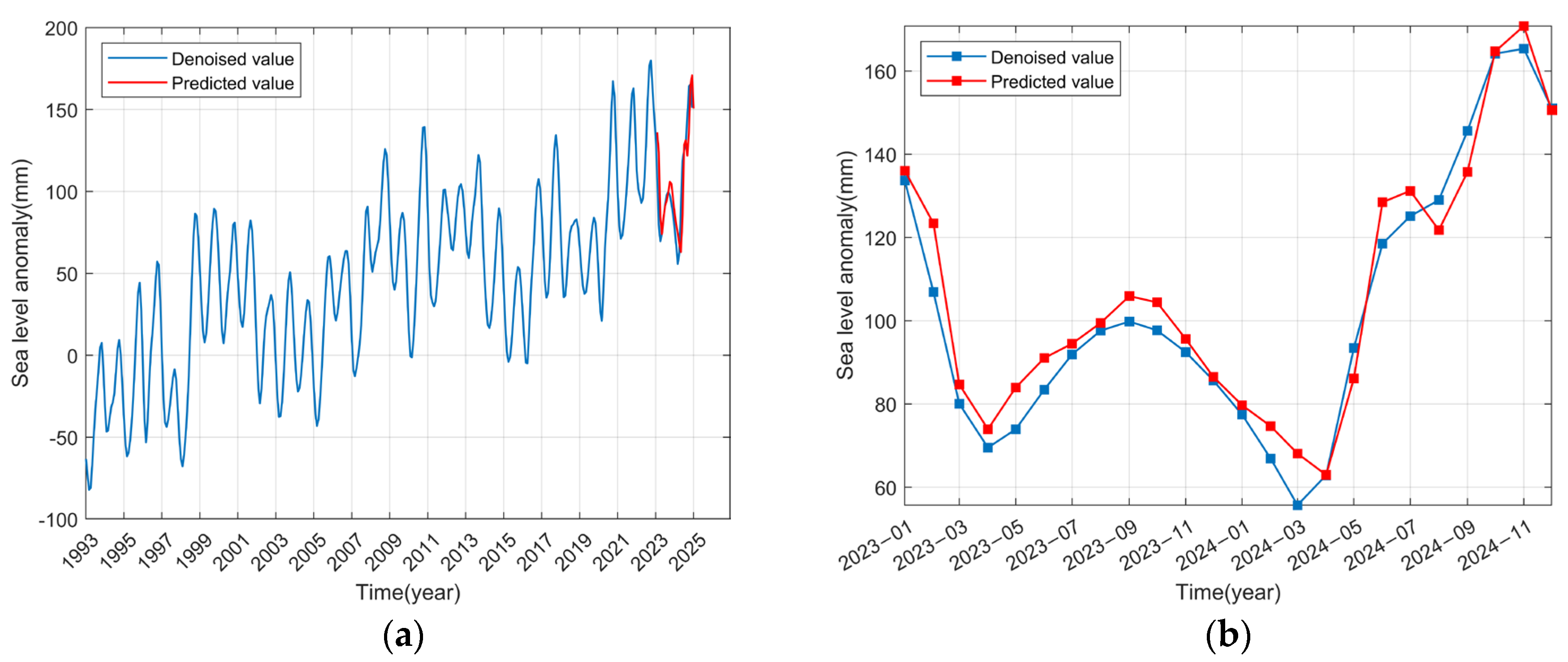
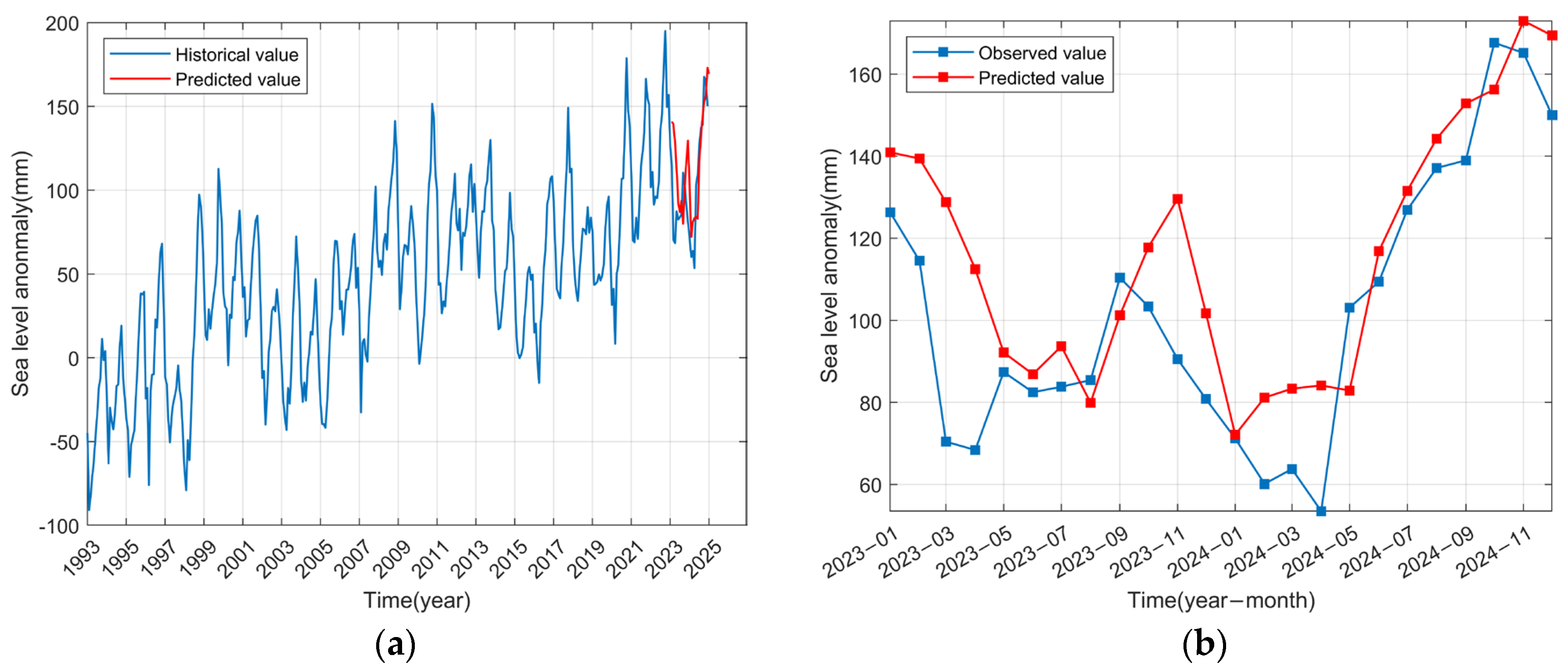
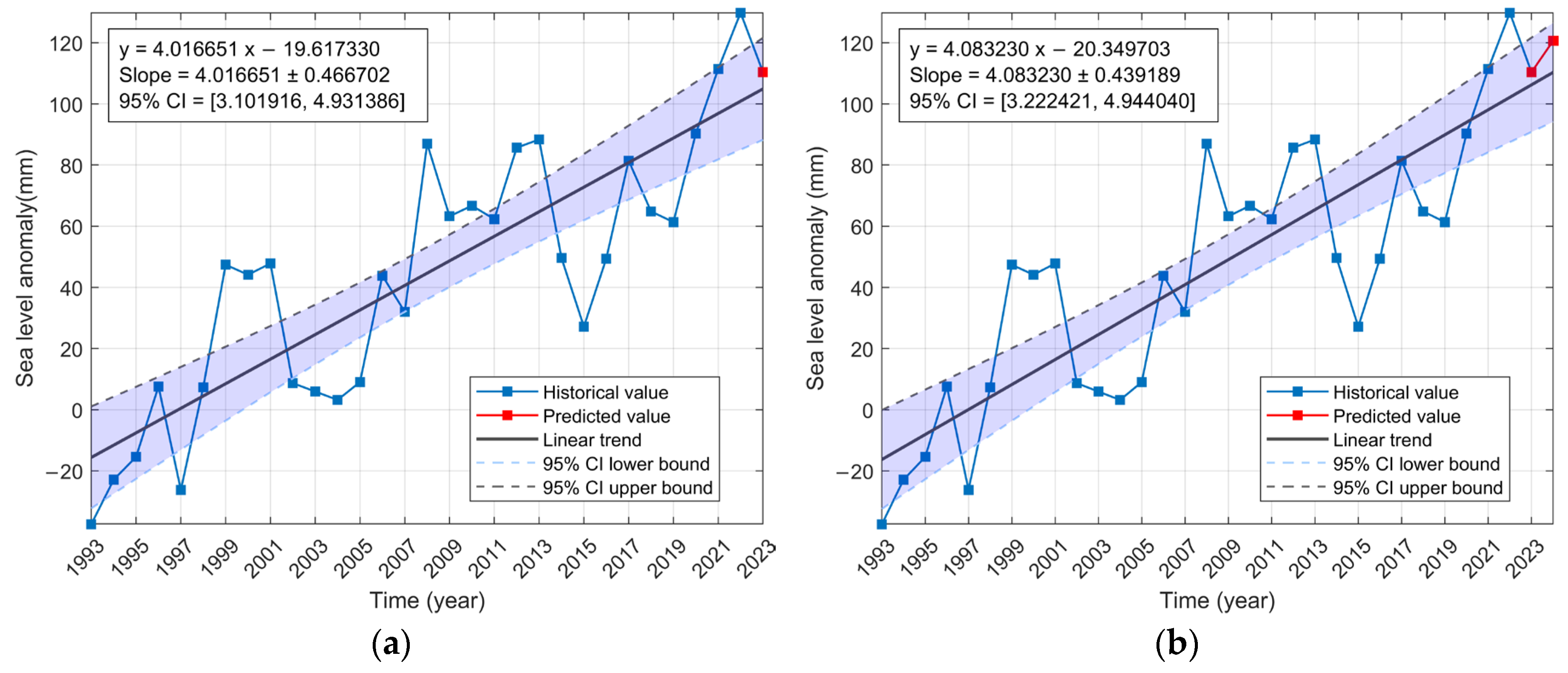
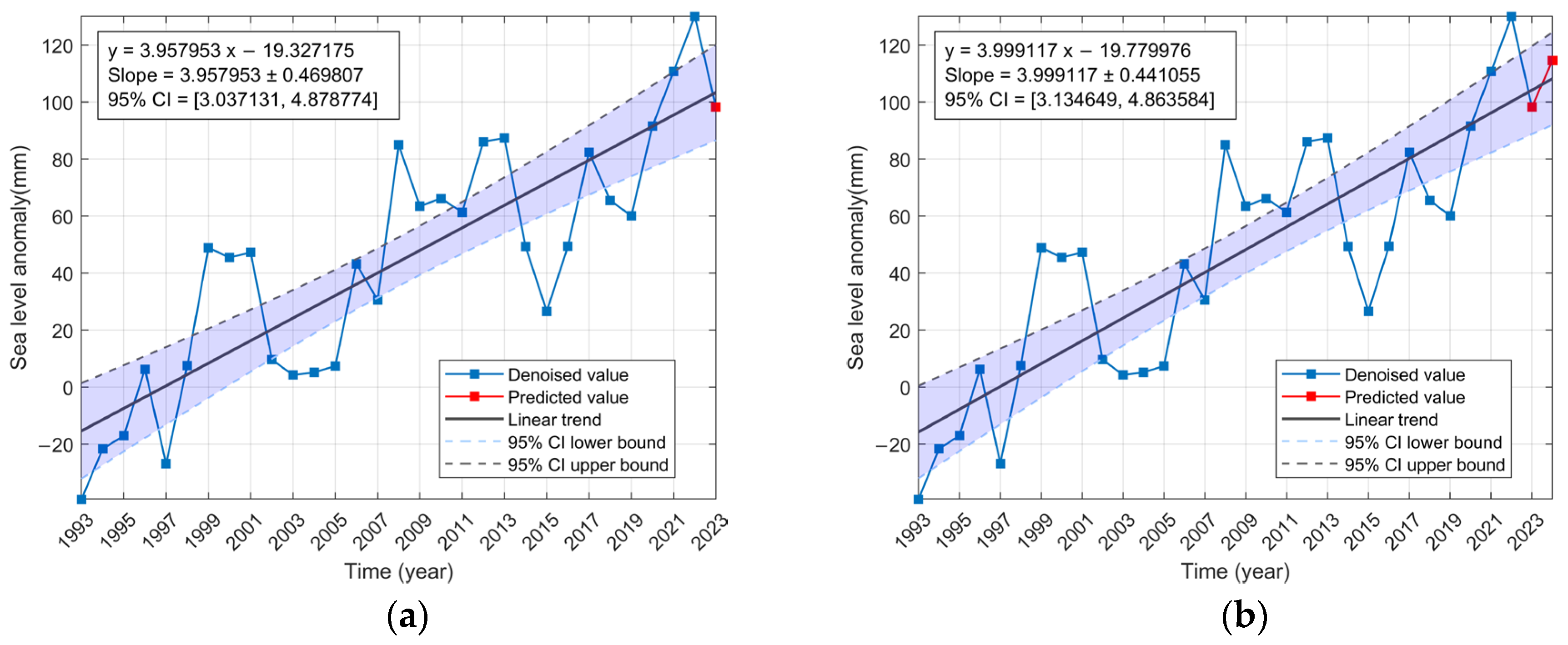
- A well-chosen combination of hyperparameters significantly impacts DL model performance. Optimized with DOA, the CNN-BiGRU-SA model achieves enhanced predictive accuracy and robustness. Based on satellite altimetry data from the combined East and South China Seas, iterative rolling predictions using two distinct strategies yield sea level rise rates of 3.96 ± 0.47 mm/year and 4.02 ± 0.47 mm/year over the period 1993–2023, consistent with the trends reported in the China Sea Level Bulletin (2023) [54]. Predictions for 2023–2024 from both strategies are in good agreement with observations, supporting the potential for short-term sea level forecasting and indicating an upward trend.
- (3)
- Despite the proposed model’s good performance in predicting sea level changes under small-sample conditions, it still requires improvement. It should be noted that the model is designed to predict total sea level (including the annual cycle and trend) rather than unpredictable weather-driven residuals, which is of practical value for coastal management. Future work may involve developing efficient optimization algorithms to accelerate the hyperparameter search process. Additionally, exploring methods that integrate multiple influencing factors with DL models or climate models, for multi-scale prediction analysis, may yield more stable and precise prediction outcomes.
Author Contributions
Funding
Data Availability Statement
Conflicts of Interest
References
- Hamlington, B.D.; Gardner, A.S.; Ivins, E.; Lenaerts, J.T.M.; Reager, J.T.; Trossman, D.S.; Zaron, E.D.; Adhikari, S.; Arendt, A.; Aschwanden, A.; et al. Understanding of Contemporary Regional Sea-Level Change and the Implications for the Future. Rev. Geophys. 2020, 58, e2019RG000672. [Google Scholar] [CrossRef]
- Proshutinsky, A.; Ashik, I.; Dvorkin, E.; Hakkinen, S.; Krishfield, R.; Peltier, W. Secular Sea Level Change in the Russian Sector of the Arctic Ocean. J. Geophys. Res. Ocean. 2004, 109, C03042. [Google Scholar] [CrossRef]
- DeConto, R.M.; Pollard, D.; Alley, R.B.; Velicogna, I.; Gasson, E.; Gomez, N.; Sadai, S.; Condron, A.; Gilford, D.M.; Ashe, E.L.; et al. The Paris Climate Agreement and Future Sea-Level Rise from Antarctica. Nature 2021, 593, 83–89. [Google Scholar] [CrossRef] [PubMed]
- Bamber, J.L.; Oppenheimer, M.; Kopp, R.E.; Aspinall, W.P.; Cooke, R.M. Ice sheet contributions to future sea-level rise from structured expert judgment. Proc. Natl. Acad. Sci. USA 2019, 116, 11195–11200. [Google Scholar] [CrossRef] [PubMed]
- Nicholls, R.J.; Cazenave, A. Sea-Level Rise and Its Impact on Coastal Zones. Science 2010, 328, 1517–1520. [Google Scholar] [CrossRef]
- Guillou, N.; Chapalain, G. Machine Learning Methods Applied to Sea Level Predictions in the Upper Part of a Tidal Estuary. Oceanologia 2021, 63, 531–544. [Google Scholar] [CrossRef]
- Siqueira, B.V.P.d.; Paiva, A.d.M. Using Neural Network to Improve Sea Level Prediction along the Southeastern Brazilian Coast. Ocean Model. 2021, 168, 101898. [Google Scholar] [CrossRef]
- Zhao, J.; Cai, R.; Sun, W. Regional Sea Level Changes Prediction Integrated with Singular Spectrum Analysis and Long-Short-term Memory Network. Adv. Space Res. 2021, 68, 4534–4543. [Google Scholar] [CrossRef]
- Xiao, C.; Chen, N.; Hu, C.; Wang, K.; Gong, J.; Chen, Z. Short and Mid-Term Sea Surface Temperature Prediction Using Time-Series Satellite Data and LSTM-AdaBoost Combination Approach. Remote Sens. Environ. 2019, 233, 111358. [Google Scholar] [CrossRef]
- Yan, Y.; Xing, H.-Y. A Sea Clutter Detection Method Based on LSTM Error Frequency Domain Conversion. Alex. Eng. J. 2021, 61, 883–891. [Google Scholar] [CrossRef]
- Acosta, M.C.; Palomas, S.; Paronuzzi Ticco, S.V.; Utrera, G.; Biercamp, J.; Bretonniere, P.A.; Budich, R.; Castrillo, M.; Caubel, A.; Doblas-Reyes, F.; et al. The computational and energy cost of simulation and storage for climate science: Lessons from CMIP6. Geosci. Model Dev. 2024, 17, 3081–3098. [Google Scholar] [CrossRef]
- Zhang, C.; Yang, S.; Huang, X.; Dou, Y.; Li, F.; Xu, X.; Hao, Q.; Gao, J. Sea Level Change and Kuroshio Intrusion Dominated Taiwan Sediment Source-to-sink Processes in the Northeastern South China Sea over the Past 244 Kyrs. Quat. Sci. Rev. 2022, 287, 107558. [Google Scholar] [CrossRef]
- Zhang, J.P.; Tomczak, M.; Witkowski, A.; Zhen, X.; Li, C. A fossil diatom-based reconstruction of sea-level changes for the Late Pleistocene and Holocene period in the NW South China Sea. Oceanologia 2023, 65, 211–229. [Google Scholar] [CrossRef]
- Yang, S.; Gu, F.; Song, B.; Ye, S.; Yuan, Y.; He, L.; Li, J.; Zhao, G.; Ding, X.; Pei, S.; et al. Holocene Vegetation History and Responses to Climate and Sea-Level Change in the Liaohe Delta, Northeast China. Catena 2022, 217, 106438. [Google Scholar] [CrossRef]
- Xie, Y.; Zhou, S.; Wang, F. Prediction Analysis of Sea Level Change in the China Adjacent Seas Based on Singular Spectrum Analysis and Long Short-Term Memory Network. J. Mar. Sci. Eng. 2024, 12, 1397. [Google Scholar] [CrossRef]
- Chen, H.; Lu, T.; Huang, J.; He, X.; Sun, X. An Improved VMD–EEMD–LSTM Time Series Hybrid Prediction Model for Sea Surface Height Derived from Satellite Altimetry Data. J. Mar. Sci. Eng. 2023, 11, 2386. [Google Scholar] [CrossRef]
- Xiao, M.; Jin, T.; Ding, H. A continuous piecewise polynomial fitting algorithm for trend changing points detection of sea level. Comput. Geosci. 2025, 196, 105876. [Google Scholar] [CrossRef]
- Makarynskyy, O.; Makarynska, D.; Kuhn, M.; Featherstone, W. Predicting Sea Level Variations with Artificial Neural Networks at Hillarys Boat Harbour, Western Australia. Estuar. Coast. Shelf Sci. 2004, 61, 351–360. [Google Scholar] [CrossRef]
- Alenezi, N.; Alsulaili, A.; Alkhalidi, M. Prediction of Sea Level in the Arabian Gulf Using Artificial Neural Networks. J. Mar. Sci. Eng. 2023, 11, 2052. [Google Scholar] [CrossRef]
- Liu, H.M.; He, B.; Qin, P.; Zhang, X.; Guo, S.; Mu, X.K. Sea level anomaly intelligent inversion model based on LSTM-RBF network. Meteorol. Atmos. Phys. 2021, 133, 245–259. [Google Scholar] [CrossRef]
- Lou, R.R.; Lv, Z.H.; Dang, S.P.; Su, T.Y.; Li, X.F. Application of machine learning in ocean data. Multimed. Syst. 2023, 29, 1815–1824. [Google Scholar] [CrossRef]
- Sun, Q.; Wan, J.; Liu, S. Estimation of Sea Level Variability in the China Sea and Its Vicinity Using the SARIMA and LSTM Models. IEEE J. Sel. Top. Appl. Earth Obs. Remote Sens. 2020, 13, 3317–3326. [Google Scholar] [CrossRef]
- Di Nunno, F.; Granata, F.; Gargano, R.; de Marinis, G. Forecasting of Extreme Storm Tide Events Using NARX Neural Network-Based Models. Atmosphere 2021, 12, 512. [Google Scholar] [CrossRef]
- Granata, F.; Di Nunno, F. Neuroforecasting of daily streamflows in the UK for short- and medium-term horizons: A novel insight. J. Hydrol. 2023, 624, 129888. [Google Scholar] [CrossRef]
- Nunno, F.D.; Marinis, G.d.; Gargano, R.; Granata, F. Tide Prediction in the Venice Lagoon Using Nonlinear Autoregressive Exogenous (NARX) Neural Network. Water 2021, 13, 1173. [Google Scholar] [CrossRef]
- Shikhovtsev, A.Y.; Kovadlo, P.G.; Kiselev, A.V.; Eselevich, M.V.; Lukin, V.P. Application of Neural Networks to Estimation and Prediction of Seeing at the Large Solar Telescope Site. Publ. Astron. Soc. Pac. 2023, 135, 014503. [Google Scholar] [CrossRef]
- Wu, H.; Zhou, S.; Wang, F.; Lu, T.; Li, X. An optimized network model for sea level height prediction integrating OLSDBO and BiTCN-BiGRU. Dyn. Atmos. Ocean. 2025, 112, 101598. [Google Scholar] [CrossRef]
- Raj, N.; Gharineiat, Z.; Ahmed, A.A.M.; Stepanyants, Y. Assessment and Prediction of Sea Level Trend in the South Pacific Region. Remote Sens. 2022, 14, 986. [Google Scholar] [CrossRef]
- Tiggeloven, T.; Couasnon, A.; van Straaten, C.; Muis, S.; Ward, P.J. Exploring Deep Learning Capabilities for Surge Predictions in Coastal Areas. Sci. Rep. 2021, 11, 17224. [Google Scholar] [CrossRef]
- Fan, S.; Xiao, N.; Dong, S. A Novel Model to Predict Significant Wave Height Based on Long Short-Term Memory Network. Ocean. Eng. 2020, 205, 107298. [Google Scholar] [CrossRef]
- Khan, A.R.; Razak, M.S.B.A.; Yusuf, B.B.; Shafri, H.Z.B.M.; Mohamad, N.B. Future Prediction of Coastal Recession Using Convolutional Neural Network. Estuar. Coast. Shelf Sci. 2024, 299, 108667. [Google Scholar] [CrossRef]
- Raj, N. Prediction of Sea Level with Vertical Land Movement Correction Using Deep Learning. Mathematics 2022, 10, 4533. [Google Scholar] [CrossRef]
- Raj, N.; Murali, J.; Singh-Peterson, L.; Downs, N. Prediction of Sea Level Using Double Data Decomposition and Hybrid Deep Learning Model for Northern Territory, Australia. Mathematics 2024, 12, 2376. [Google Scholar] [CrossRef]
- Li, X.; Zhou, S.; Wang, F.; Fu, L. An improved sparrow search algorithm and CNN-BiLSTM neural network for predicting sea level height. Sci. Rep. 2024, 14, 4560. [Google Scholar] [CrossRef] [PubMed]
- Nieves, V.; Radin, C.; Camps-Valls, G. Predicting Regional Coastal Sea Level Changes with Machine Learning. Sci. Rep. 2021, 11, 7650. [Google Scholar] [CrossRef]
- Ayinde, A.S.; Yu, H.; Wu, K. Sea Level Variability and Modeling in the Gulf of Guinea Using Supervised Machine Learning. Sci. Rep. 2023, 13, 21318. [Google Scholar] [CrossRef] [PubMed]
- Zrira, N.; Kamal-Idrissi, A.; Farssi, R.; Khan, H.A. Time Series Prediction of Sea Surface Temperature Based on BiLSTM Model with Attention Mechanism. J. Sea Res. 2024, 198, 102472. [Google Scholar] [CrossRef]
- Bai, Z.; Sun, Z.; Fan, B.; Liu, A.-A.; Wei, Z.; Yin, B. Multiscale Spatio-Temporal Attention Network for Sea Surface Temperature Prediction. IEEE J. Sel. Top. Appl. Earth Obs. Remote Sens. 2025, 18, 5866–5877. [Google Scholar] [CrossRef]
- Zhao, Y.; Yang, D.; He, J.; Zhu, K.; Deng, X. Hierarchical Stacked Spatiotemporal Self-Attention Network for Sea Surface Temperature Forecasting. Ocean. Model. 2024, 191, 102427. [Google Scholar] [CrossRef]
- Li, G.; Zhang, H.; Lyu, T.; Zhang, H. Regional Significant Wave Height Forecast in the East China Sea Based on the Self-Attention ConvLSTM with SWAN Model. Ocean. Eng. 2024, 312, 119064. [Google Scholar] [CrossRef]
- Wang, L.; Wang, X.; Dong, C.; Sun, Y. Wave Predictor Models for Medium and Long Term Based on Dual Attention-Enhanced Transformer. Ocean. Eng. 2024, 310, 118761. [Google Scholar] [CrossRef]
- Liu, J.; Jin, B.; Wang, L.; Xu, L. Sea Surface Height Prediction with Deep Learning Based on Attention Mechanism. IEEE Geosci. Remote Sens. Lett. 2022, 19, 1–5. [Google Scholar] [CrossRef]
- Katipoğlu, O.M.; Mohammadi, B.; Keblouti, M. Bee-inspired Insights: Unleashing the Potential of Artificial Bee Colony Optimized Hybrid Neural Networks for Enhanced Groundwater Level Time Series Prediction. Environ. Monit. Assess. 2024, 196, 724. [Google Scholar] [CrossRef]
- Almaliki, A.H.; Khattak, A. Short- and long-term tidal level forecasting: A novel hybrid TCN LSTM framework. J. Sea Res. 2025, 204. [Google Scholar] [CrossRef]
- Fei, K.; Du, H.; Gao, L. Accurate Water Level Predictions in a Tidal Reach: Integration of Physics-based and Machine Learning Approaches. J. Hydrol. 2023, 622, 129705. [Google Scholar] [CrossRef]
- Lang, Y.; Gao, Y. Dream Optimization Algorithm (DOA): A Novel Metaheuristic Optimization Algorithm Inspired by Human Dreams and Its Applications to Real-World Engineering Problems. Comput. Methods Appl. Mech. Eng. 2025, 436, 117718. [Google Scholar] [CrossRef]
- Li, Z.; Liu, F.; Yang, W.; Peng, S.; Zhou, J. A Survey of Convolutional Neural Networks: Analysis, Applications, and Prospects. IEEE Trans. Neural Netw. Learn. Syst. 2022, 33, 6999–7019. [Google Scholar] [CrossRef] [PubMed]
- Zhao, Z.; Yun, S.; Jia, L.; Guo, J.; Meng, Y.; He, N.; Li, X.; Shi, J.; Yang, L. Hybrid VMD-CNN-GRU-based Model for Short-Term Forecasting of Wind Power Considering Spatio-Temporal Features. Eng. Appl. Artif. Intell. 2023, 121, 105982. [Google Scholar] [CrossRef]
- Yang, L.; Wang, S.; Chen, X.; Chen, W.; Saad, O.M.; Zhou, X.; Pham, N.; Geng, Z.; Fomel, S.; Chen, Y. High-Fidelity Permeability and Porosity Prediction Using Deep Learning with the Self-Attention Mechanism. IEEE Trans. Neural Netw. Learn. Syst. 2023, 34, 3429–3443. [Google Scholar] [CrossRef] [PubMed]
- Elbisy, M.S.; Aljahdali, A.H.; Natto, A.H.; Bakhsh, A.A.; Almaliki, A.F.; Alharthi, M.A.; Hassan, A.O. PREDICTION OF DAILY TIDAL LEVELS ALONG THE CENTRAL COAST OF EASTERN RED SEA USING ARTIFICIAL NEURAL NETWORKS. Int. J. GEOMATE 2020, 19, 54–61. [Google Scholar] [CrossRef]
- Yang, C.-H.; Wu, C.-H.; Hsieh, C.-M. Long Short-Term Memory Recurrent Neural Network for Tidal Level Forecasting. ISSS J. Micro Smart Syst. 2020, 8, 159389–159401. [Google Scholar] [CrossRef]
- Zaki, I.R.; Annuar, A.Z. Tidal Level Short-Term Prediction Using Back-Propagating Artificial Neural Network (BP-ANN). J. Adv. Res. Appl. Sci. Eng. Technol. 2024, 54, 1–15. [Google Scholar] [CrossRef]
- Liu, Z.; Peng, D.; Zuo, M.J.; Xia, J.; Qin, Y. Improved Hilbert–Huang Transform with Soft Sifting Stopping Criterion and Its Application to Fault Diagnosis of Wheelset Bearings. ISA Trans. 2022, 125, 426–444. [Google Scholar] [CrossRef]
- Ministry of Natural Resources of the People’s Republic of China. China Sea Level Bulletin 2023. 2024. Available online: https://www.nmdis.org.cn/hygb/zghpmgb/2023nzghpmgb/ (accessed on 1 June 2025).
- Rajabi-Kiasari, S.; Ellmann, A.; Delpeche-Ellmann, N. Sea level forecasting using deep recurrent neural networks with high-resolution hydrodynamic model. Appl. Ocean Res. 2025, 157, 104496. [Google Scholar] [CrossRef]
- Niu, D.; Yu, M.; Sun, L.; Gao, T.; Wang, K. Short-term Multi-Energy Load Forecasting for Integrated Energy Systems Based on CNN-BiGRU Optimized by Attention Mechanism. Appl. Energy 2022, 313, 118801. [Google Scholar] [CrossRef]
- Zhang, D.; Chen, B.; Zhu, H.; Goh, H.H.; Dong, Y.; Wu, T. Short-term wind power prediction based on two-layer decomposition and BiTCN-BiLSTM-attention model. Energy 2023, 285, 128762. [Google Scholar] [CrossRef]
- Zhou, Y.; He, X.; Montillet, J.-P.; Wang, S.; Hu, S.; Sun, X.; Huang, J.; Ma, X. An improved ICEEMDAN-MPA-GRU model for GNSS height time series prediction with weighted quality evaluation index. GPS Solut. 2025, 29, 113. [Google Scholar] [CrossRef]





| Station | ID | Country | Latitude (N) | Longitude (E) | Duration (Years) |
|---|---|---|---|---|---|
| OSHORO II | 1027 | Japan | 43.209444 | 140.858056 | 1963–2023 |
| NAHA | 1151 | Japan | 26.213333 | 127.665278 | 1966–2023 |
| KAINAN | 701 | Japan | 34.144167 | 135.191389 | 1974–2023 |
| ABURATSU | 814 | Japan | 31.576944 | 131.409444 | 1968–2023 |
| OKADA | 1091 | Japan | 34.789444 | 139.391389 | 1985–2021 |
| KUSHIRO | 518 | Japan | 42.975556 | 144.371389 | 1983–2023 |
| CHICHIJIMA | 1391 | Japan | 27.083333 | 142.183333 | 1980–2023 |
| MAIZURU II | 1387 | Japan | 35.476667 | 135.386944 | 1990–2023 |
| TAKAMATSU II | 1789 | Japan | 34.351389 | 134.056944 | 1992–2023 |
| HAMADA II | 1585 | Japan | 34.897222 | 132.066111 | 1987–2023 |
| AKUNE | 1265 | Japan | 32.017500 | 130.190833 | 1996–2023 |
| Models | Parameters | Value |
|---|---|---|
| CNN | Convolution kernel size | 3 × 1 |
| LSTM | Number of units in the hidden layer | 10 |
| BiLSTM | Number of units in LSTM hidden layer 1 | 10 |
| Number of units in LSTM hidden layer 2 | 10 | |
| GRU | Number of units in the hidden layer | 10 |
| BiGRU | Number of units in GRU hidden layer 1 | 10 |
| Number of units in GRU hidden layer 2 | 10 | |
| CNN-BiGRU | Convolution kernel size | 3 × 1 |
| Number of units in GRU hidden layer 1 | 10 | |
| Number of units in GRU hidden layer 2 | 10 | |
| CNN-BiGRU-SA | Convolution kernel size | 3 × 1 |
| Number of units in GRU hidden layer 1 | 10 | |
| Number of units in GRU hidden layer 2 | 10 | |
| DOA- CNN-BiGRU-SA | Population | 30 |
| Number of iterations | 10 | |
| Initial learning rate | 0.0001–0.01 | |
| Number of units in the BiGRU hidden layer | 1–100 | |
| L2 regularization parameter | 0.0001–0.01 |
| Station | Models | MAE (mm) | MAPE (%) | RMSE (mm) | R2 |
|---|---|---|---|---|---|
| OSHORO II | CNN | 8.873 | 0.125 | 12.397 | 0.974 |
| LSTM | 11.991 | 0.169 | 16.162 | 0.956 | |
| BiLSTM | 12.242 | 0.172 | 16.313 | 0.955 | |
| GRU | 12.776 | 0.180 | 16.834 | 0.952 | |
| BiGRU | 11.232 | 0.158 | 15.092 | 0.962 | |
| CNN-BiGRU | 8.044 | 0.113 | 10.989 | 0.980 | |
| CNN-BiGRU-SA | 7.668 | 0.108 | 10.466 | 0.981 | |
| DOA- CNN-BiGRU-SA | 6.815 | 0.096 | 9.398 | 0.985 | |
| NAHA | CNN | 10.519 | 0.148 | 13.799 | 0.980 |
| LSTM | 15.956 | 0.223 | 20.581 | 0.956 | |
| BiLSTM | 16.702 | 0.234 | 20.801 | 0.955 | |
| GRU | 14.342 | 0.201 | 18.009 | 0.966 | |
| BiGRU | 15.175 | 0.213 | 19.287 | 0.961 | |
| CNN-BiGRU | 7.901 | 0.111 | 10.332 | 0.989 | |
| CNN-BiGRU-SA | 6.753 | 0.095 | 9.249 | 0.991 | |
| DOA- CNN-BiGRU-SA | 4.997 | 0.070 | 6.715 | 0.995 | |
| KAINAN | CNN | 15.053 | 0.216 | 18.893 | 0.971 |
| LSTM | 19.388 | 0.280 | 27.049 | 0.941 | |
| BiLSTM | 19.044 | 0.275 | 26.544 | 0.943 | |
| GRU | 20.435 | 0.294 | 27.152 | 0.940 | |
| BiGRU | 19.611 | 0.283 | 27.069 | 0.940 | |
| CNN-BiGRU | 11.994 | 0.173 | 15.540 | 0.980 | |
| CNN-BiGRU-SA | 11.065 | 0.159 | 15.092 | 0.981 | |
| DOA- CNN-BiGRU-SA | 9.866 | 0.142 | 13.178 | 0.986 | |
| ABURATSU | CNN | 17.345 | 0.246 | 22.672 | 0.956 |
| LSTM | 21.120 | 0.298 | 27.681 | 0.935 | |
| BiLSTM | 21.290 | 0.301 | 28.342 | 0.932 | |
| GRU | 21.548 | 0.304 | 28.166 | 0.933 | |
| BiGRU | 20.015 | 0.283 | 27.0280 | 0.938 | |
| CNN-BiGRU | 13.331 | 0.188 | 17.627 | 0.974 | |
| CNN-BiGRU-SA | 13.013 | 0.183 | 17.409 | 0.974 | |
| DOA- CNN-BiGRU-SA | 10.305 | 0.146 | 13.955 | 0.983 | |
| OKADA | CNN | 12.231 | 0.177 | 15.464 | 0.948 |
| LSTM | 14.895 | 0.216 | 22.273 | 0.891 | |
| BiLSTM | 15.386 | 0.223 | 23.129 | 0.883 | |
| GRU | 15.944 | 0.231 | 24.180 | 0.872 | |
| BiGRU | 14.819 | 0.215 | 21.933 | 0.895 | |
| CNN-BiGRU | 9.520 | 0.138 | 12.214 | 0.967 | |
| CNN-BiGRU-SA | 9.036 | 0.131 | 11.830 | 0.969 | |
| DOA- CNN-BiGRU-SA | 8.798 | 0.127 | 10.958 | 0.974 |
Disclaimer/Publisher’s Note: The statements, opinions and data contained in all publications are solely those of the individual author(s) and contributor(s) and not of MDPI and/or the editor(s). MDPI and/or the editor(s) disclaim responsibility for any injury to people or property resulting from any ideas, methods, instructions or products referred to in the content. |
© 2026 by the authors. Licensee MDPI, Basel, Switzerland. This article is an open access article distributed under the terms and conditions of the Creative Commons Attribution (CC BY) license.
Share and Cite
Wu, H.; Zhou, S.; Wang, F.; Lu, T. A DOA-CNN-BiGRU-SA Hybrid Framework for Short-Term Sea Level Height Prediction. J. Mar. Sci. Eng. 2026, 14, 982. https://doi.org/10.3390/jmse14110982
Wu H, Zhou S, Wang F, Lu T. A DOA-CNN-BiGRU-SA Hybrid Framework for Short-Term Sea Level Height Prediction. Journal of Marine Science and Engineering. 2026; 14(11):982. https://doi.org/10.3390/jmse14110982
Chicago/Turabian StyleWu, Huan, Shijian Zhou, Fengwei Wang, and Tieding Lu. 2026. "A DOA-CNN-BiGRU-SA Hybrid Framework for Short-Term Sea Level Height Prediction" Journal of Marine Science and Engineering 14, no. 11: 982. https://doi.org/10.3390/jmse14110982
APA StyleWu, H., Zhou, S., Wang, F., & Lu, T. (2026). A DOA-CNN-BiGRU-SA Hybrid Framework for Short-Term Sea Level Height Prediction. Journal of Marine Science and Engineering, 14(11), 982. https://doi.org/10.3390/jmse14110982