Data Fusion Framework for a High-Resolution Regional Dataset in the Western North Pacific


Abstract
1. Introduction
2. Materials
2.1. Profiles
2.2. Surface Observations
2.3. Subsurface Datasets
3. Methods
3.1. Inversion of T/S Profiles
3.2. Gradient-Dependent Optimal Interpolation
3.3. Calculation of Derived Factors
4. Procedure
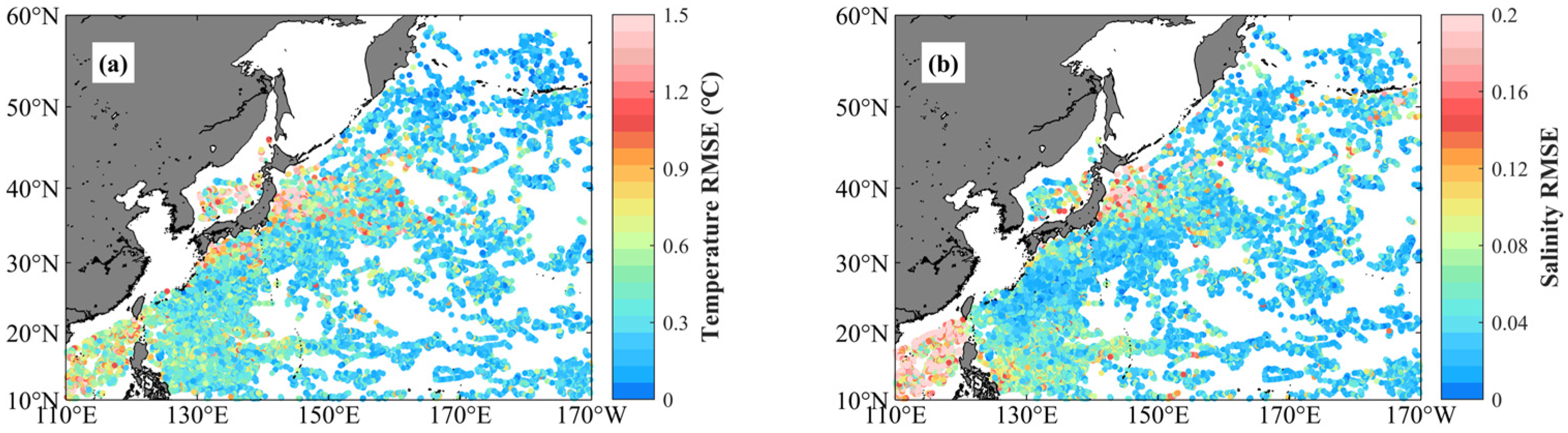
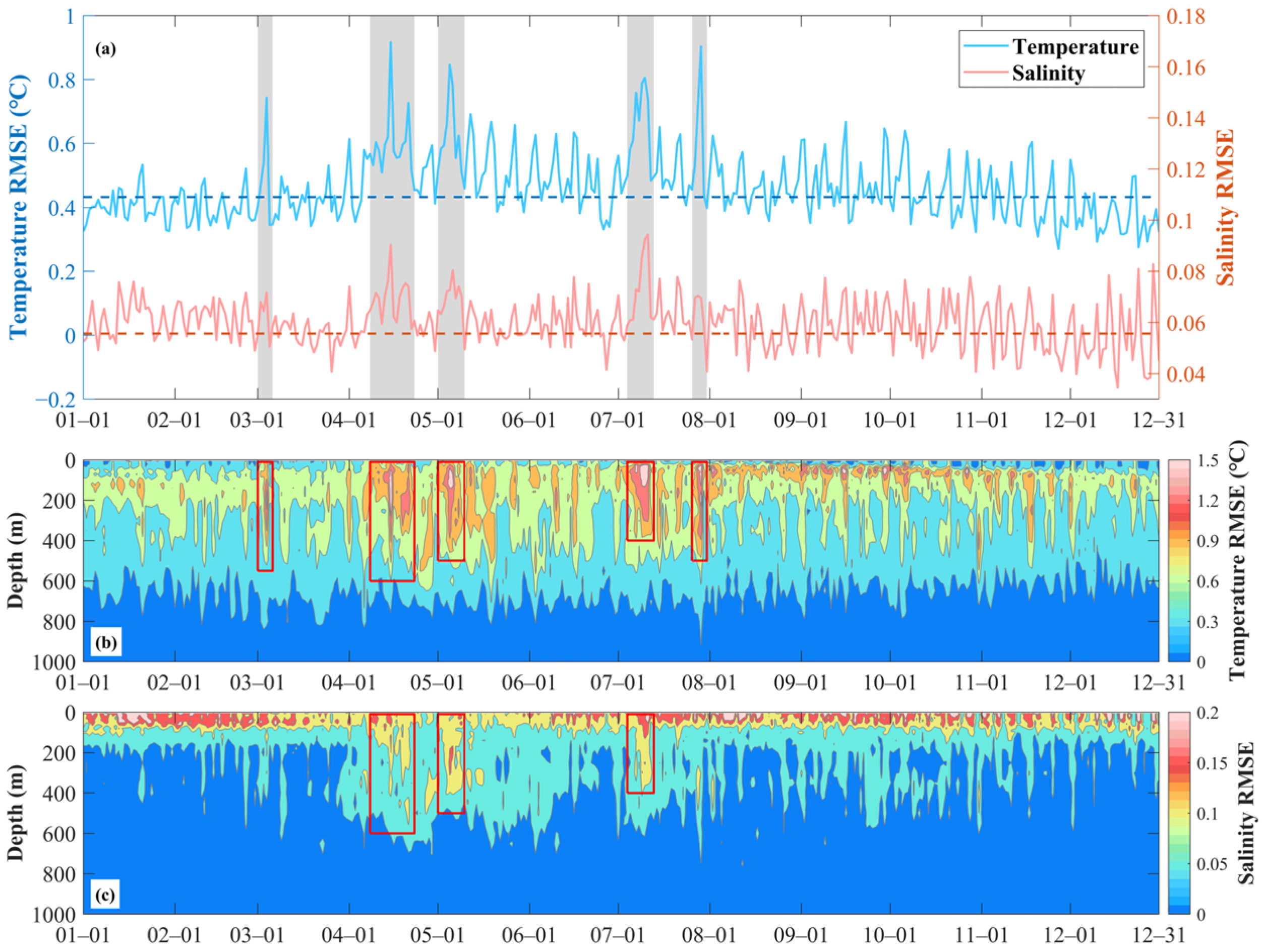
4.1. Validation of Inverted Profiles
4.2. Parameter Set for Data Fusion
5. Results
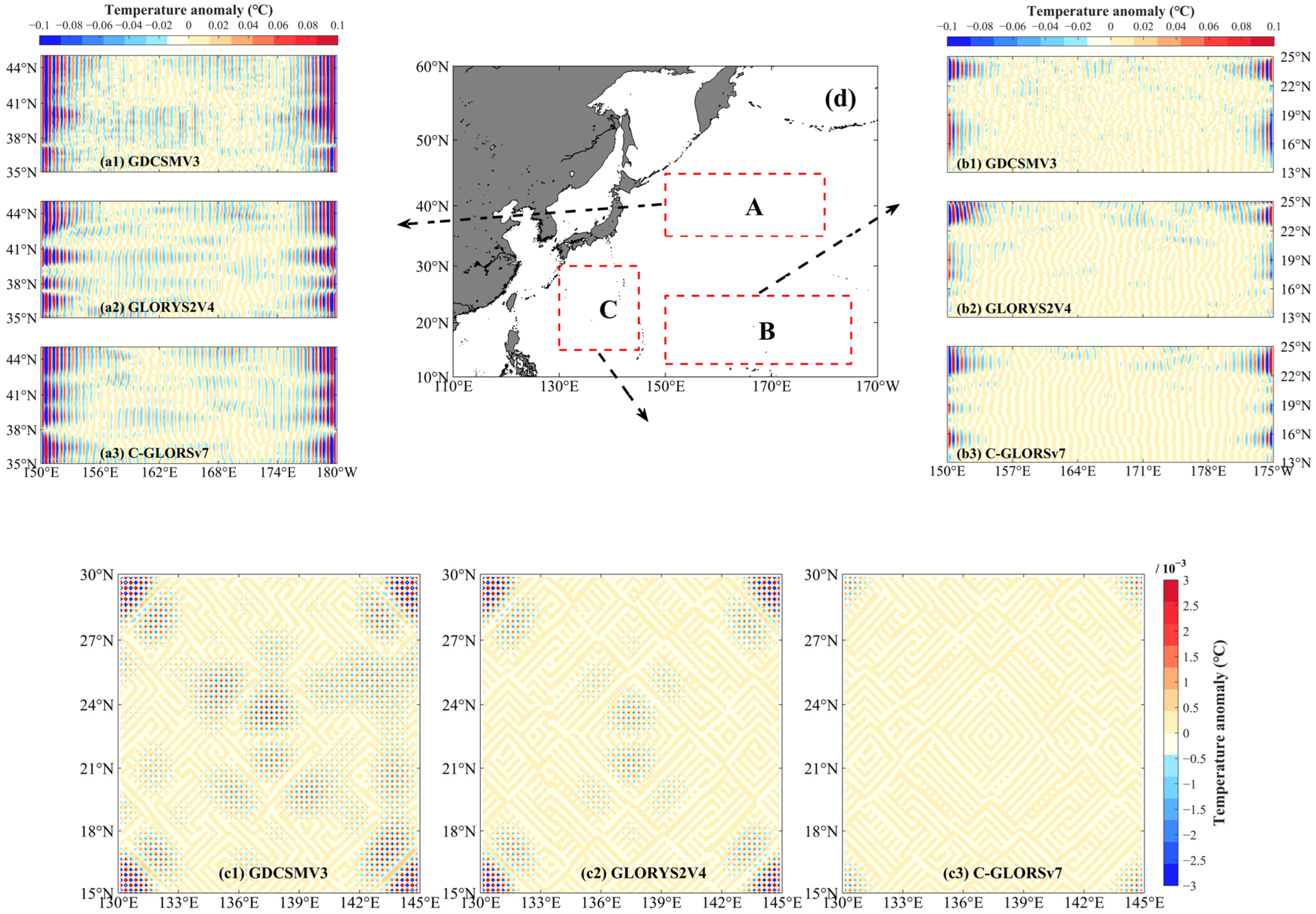
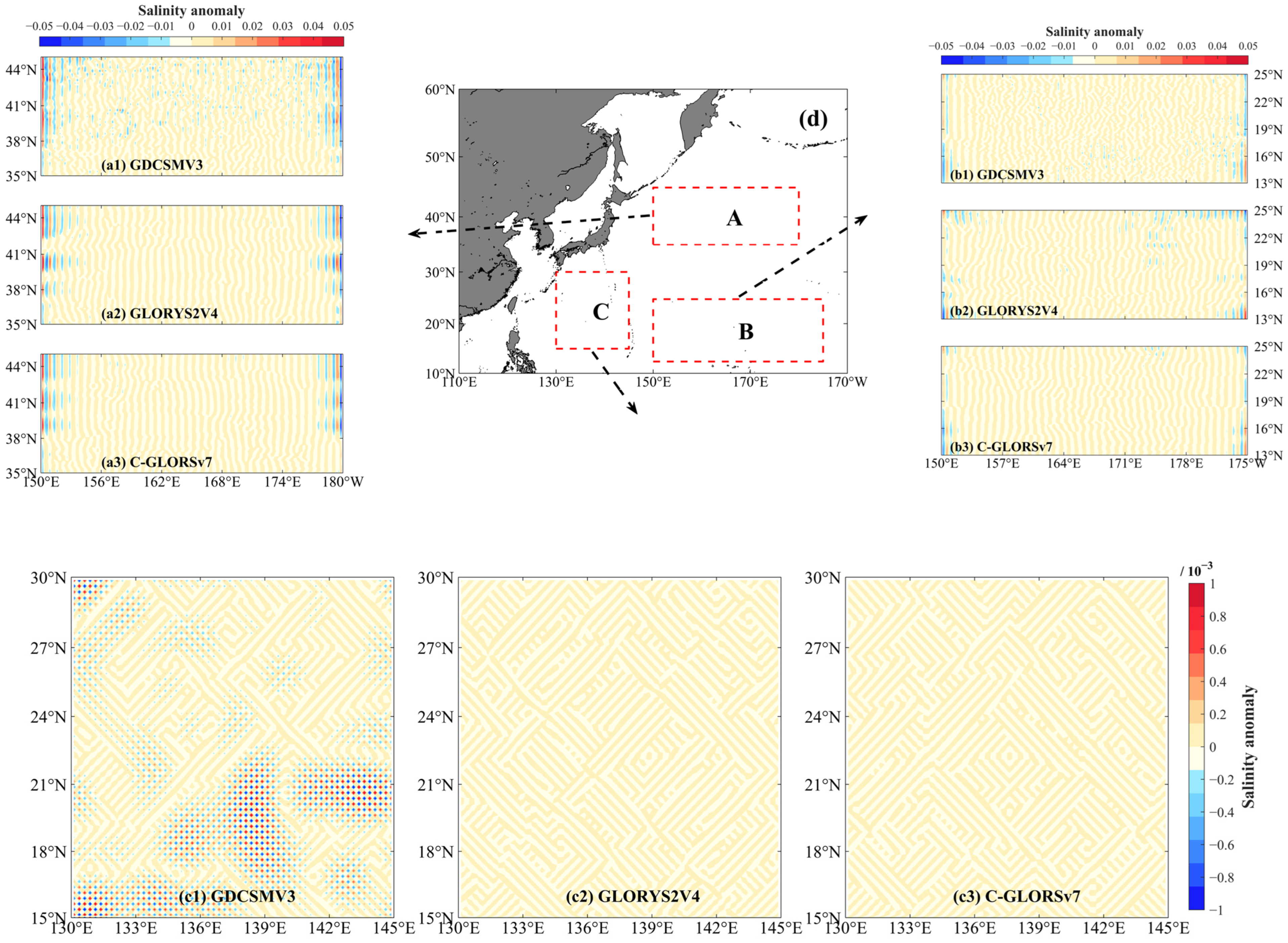
5.1. Theoretical Verification
5.2. Comparison with Other Datasets
6. Discussion
6.1. Identification of Kuroshio Path
6.2. Identification of Mesoscale Eddy
7. Conclusions
Author Contributions
Funding
Data Availability Statement
Acknowledgments
Conflicts of Interest
Appendix A

| Components | Model |
|---|---|
| CPU (central processing unit) | Intel (R) Core(TM) i7-10700 CPU @ 2.90 GHz, 2901 Mhz, octa |
| RAM (random access memory) | 32 GB |
| Process | Time (Seconds) |
|---|---|
| Inversion of T/S profiles | 100.104 |
| Data fusion | 53.007 |
References
- Lehman, J. Sea Change: The World Ocean Circulation Experiment and the Productive Limits of Ocean Variability. Sci. Technol. Hum. Values 2020, 46, 839–862. [Google Scholar] [CrossRef]
- Moltmann, T.; Turton, J.; Zhang, H.M.; Nolan, G.; Gouldman, C.; Griesbauer, L.; Willis, Z.; Piniella, Á.M.; Goldstraw, S.; Barrell, S.; et al. A Global Ocean Observing System (GOOS), Delivered Through Enhanced Collaboration Across Regions, Communities, and New Technologies. Front. Mar. Sci. 2019, 6, 291. [Google Scholar] [CrossRef]
- Liu, Q.; Bao, S.; Yan, H.; Wang, H.; Wang, Y.; Ren, Z. Enhancing sea surface salinity short-term prediction using physically informed deep learning. Appl. Ocean Res. 2025, 165, 104832. [Google Scholar] [CrossRef]
- Good, S.; Fiedler, E.; Mao, C.; Martin, M.J.; Maycock, A.; Reid, R.; Roberts-Jones, J.; Searle, T.; Waters, J.; While, J.; et al. The Current Configuration of the OSTIA System for Operational Production of Foundation Sea Surface Temperature and Ice Concentration Analyses. Remote Sens. 2020, 12, 720. [Google Scholar] [CrossRef]
- Meissner, T.; Wentz, F.J.; Manaster, A.; Lindsley, R.; Brewer, M.; Densberger, M. Remote Sensing Systems SMAP Ocean Surface Salinities [Level 2C, Level 3 Running 8-Day, Level 3 Monthly], Version 6.0 Validated Release; Remote Sensing Systems: Santa Rosa, CA, USA, 2024. [Google Scholar] [CrossRef]
- Taburet, G.; Sánchez-Román, A.; Ballarotta, M.; Pujol, M.I.; Legeais, J.-F.; Fournier, F.; Faugère, Y.; Dibarboure, G. DUACS DT2018: 25 years of reprocessed sea level altimetry products. Ocean Sci. 2019, 15, 1207–1224. [Google Scholar] [CrossRef]
- Mishonov, A.V.; Boyer, T.P.; Baranova, O.K.; Bouchard, C.N.; Cross, S.; Garcia, H.E.; Locarnini, R.A.; Paver, C.R.; Reagan, J.R.; Wang, Z.; et al. World Ocean Database 2023; Bouchard, C., Ed.; NOAA Atlas NESDIS 97; NOAA National Environmental Satellite, Data, and Information Service: Silver Spring, MD, USA; NOAA National Centers for Environmental Information: Asheville, NC, USA, 2024; 206p. [Google Scholar] [CrossRef]
- Sun, C.G. The Data Management System for the Global Temperature and Salinity Profile Programme. 2010. Available online: https://www.aoml.noaa.gov/phod/docs/Sun_Goni_TheDataManagement.pdf (accessed on 29 July 2025).
- Gandin, L.S. Objective analysis of meteorological field. Gidrometeorol. Izdatestvo 1963, 286. [Google Scholar]
- Kalman, R.E. A New Approach to Linear Filtering and Prediction Problems. J. Basic Eng. 1960, 82, 35–45. [Google Scholar] [CrossRef]
- Evensen, G. The Ensemble Kalman Filter: Theoretical formulation and practical implementation. Ocean Dyn. 2003, 53, 343–367. [Google Scholar] [CrossRef]
- Lorenc, A.C. Analysis methods for numerical weather prediction. Q. J. R. Meteorol. Soc. 1986, 112, 1177–1194. [Google Scholar] [CrossRef]
- Roemmich, D.; Gilson, J. The 2004–2008 mean and annual cycle of temperature, salinity, and steric height in the global ocean from the Argo Program. Prog. Oceanogr. 2009, 82, 81–100. [Google Scholar] [CrossRef]
- Good, S.A.; Martin, M.J.; Rayner, N.A. EN4: Quality controlled ocean temperature and salinity profiles and monthly objective analyses with uncertainty estimates. J. Geophys. Res.-Ocean. 2013, 118, 6704–6716. [Google Scholar] [CrossRef]
- Zhang, C.; Wang, D.; Liu, Z.; Lu, S.; Sun, C.; Wei, Y.; Zhang, M. Global Gridded Argo Dataset Based on Gradient-Dependent Optimal Interpolation. J. Mar. Sci. Eng. 2022, 10, 650. [Google Scholar] [CrossRef]
- Schmidtko, S.; Johnson, G.C.; Lyman, J.M. MIMOC: A global monthly isopycnal upper-ocean climatology with mixed layers. J. Geophys. Res.-Ocean. 2013, 118, 1658–1672. [Google Scholar] [CrossRef]
- Wijffels, S.E.; Gebbie, G.; Robbins, P.E. Resolving the Ubiquitous Small-Scale Semipermanent Features of the General Ocean Circulation: A Multiplatform Observational Approach. J. Phys. Oceanogr. 2024, 54, 2503–2521. [Google Scholar] [CrossRef]
- Forget, G.; Campin, J.-M.; Heimbach, P.; Hill, C.N.; Ponte, R.M.; Wunsch, C. ECCO version 4: An integrated framework for non-linear inverse modeling and global ocean state estimation. Geosci. Model Dev. 2015, 8, 3071–3104. [Google Scholar] [CrossRef]
- Chen, Y.; Bao, S.; Cao, Y.; Zhang, W.; Wang, H. The Yin-He Global Ocean Data Assimilation and Forecast System. Ocean-Land-Atmos. Res. 2025, 4, 0121. [Google Scholar] [CrossRef]
- Guinehut, S.; Dhomps, A.L.; Larnicol, G.; Le Traon, P.Y. High resolution 3-D temperature and salinity fields derived from in situ and satellite observations. Ocean Sci. 2012, 8, 845–857. [Google Scholar] [CrossRef]
- Hosoda, S.; Ohira, T.; Nakamura, T. A monthly mean dataset of global oceanic temperature and salinity derived from Argo float observations. JAMSTEC Rep. Res. Dev. 2008, 8, 47–59. [Google Scholar] [CrossRef]
- Palupi, I.R.; Raharjo, W.; Kiswanti, S. The Role of 2D Fast Fourier Transform and High Pass Filter in Regional and Residual Anomaly Separation in Gravity. IOP Conf. Ser. 2021, 873, 012017. [Google Scholar] [CrossRef]
- Huang, B.; Liu, C.; Banzon, V.; Freeman, E.; Graham, G.; Hankins, B.; Smith, T.; Zhang, H.-M. Improvements of the Daily Optimum Interpolation Sea Surface Temperature (DOISST) Version 2.1. J. Clim. 2021, 34, 2923–2939. [Google Scholar] [CrossRef]
- Mulet, S.; Rio, M.-H.; Mignot, A.; Guinehut, S.; Morrow, R. A new estimate of the global 3D geostrophic ocean circulation based on satellite data and in-situ measurements. Deep Sea Res. Part II Top. Stud. Oceanogr. 2012, 77–80, 70–81. [Google Scholar] [CrossRef]
- Riishøjgaard, L.P. A direct way of specifying flow-dependent background error correlations for meteorological analysis systems. Tellus A 1998, 50, 42. [Google Scholar] [CrossRef]
- Kalnay, E. Atmospheric Modeling, Data Assimilation and Predictability; Cambridge University Press: Cambridge, UK, 2002. [Google Scholar]
- Zhang, C.; Xu, J.; Bao, X.; Wang, Z. An effective method for improving the accuracy of Argo objective analysis. Acta Oceanol. Sin. 2013, 32, 66–77. [Google Scholar] [CrossRef]
- Zhang, C.; Wang, Z.; Liu, Y. An argo-based experiment providing near-real-time subsurface oceanic environmental information for fishery data. Fish. Oceanogr. 2021, 30, 85–98. [Google Scholar] [CrossRef]
- Stewart, R.H. Introduction to Physical Oceanography; Texas A&M University: College Station, TX, USA, 2008. [Google Scholar]
- Ambe, D.; Imawaki, S.; Uchida, H.; Ichikawa, K. Estimating the Kuroshio axis south of Japan using combination of satellite altimetry and drifting buoys. J. Oceanogr. 2004, 60, 375–382. [Google Scholar] [CrossRef]
- Nencioli, F.; Dong, C.; Dickey, T.; Washburn, L.; McWilliams, J.C. A Vector Geometry-Based Eddy Detection Algorithm and Its Application to a High-Resolution Numerical Model Product and High-Frequency Radar Surface Velocities in the Southern California Bight. J. Atmos. Ocean. Technol. 2010, 27, 564–579. [Google Scholar] [CrossRef]
- Jiang, Q. Hexagonal tight frame filter banks with idealized high-pass filters. Adv. Comput. Math. 2008, 31, 215–236. [Google Scholar] [CrossRef]
- Qiu, B. Variability and Energetics of the Kuroshio Extension and Its Recirculation Gyre from the First Two-Year TOPEX Data. J. Phys. Oceanogr. 1995, 25, 1827–1842. [Google Scholar] [CrossRef]
- Jiang, W.; Peng, L.; Jin, T.; Zhang, S. Variability of the Kuroshio extension system in 1992–2013 from satellite altimetry data. J. Geod. Geodyn. 2017, 8, 103–110. [Google Scholar] [CrossRef]




Disclaimer/Publisher’s Note: The statements, opinions and data contained in all publications are solely those of the individual author(s) and contributor(s) and not of MDPI and/or the editor(s). MDPI and/or the editor(s) disclaim responsibility for any injury to people or property resulting from any ideas, methods, instructions or products referred to in the content. |
© 2026 by the authors. Licensee MDPI, Basel, Switzerland. This article is an open access article distributed under the terms and conditions of the Creative Commons Attribution (CC BY) license.
Share and Cite
Fu, L.; Zhang, C.; Ge, Y.; Shu, B.; Zhou, R. Data Fusion Framework for a High-Resolution Regional Dataset in the Western North Pacific. J. Mar. Sci. Eng. 2026, 14, 976. https://doi.org/10.3390/jmse14110976
Fu L, Zhang C, Ge Y, Shu B, Zhou R. Data Fusion Framework for a High-Resolution Regional Dataset in the Western North Pacific. Journal of Marine Science and Engineering. 2026; 14(11):976. https://doi.org/10.3390/jmse14110976
Chicago/Turabian StyleFu, Lifu, Chunling Zhang, Yijun Ge, Bo Shu, and Ruoxiao Zhou. 2026. "Data Fusion Framework for a High-Resolution Regional Dataset in the Western North Pacific" Journal of Marine Science and Engineering 14, no. 11: 976. https://doi.org/10.3390/jmse14110976
APA StyleFu, L., Zhang, C., Ge, Y., Shu, B., & Zhou, R. (2026). Data Fusion Framework for a High-Resolution Regional Dataset in the Western North Pacific. Journal of Marine Science and Engineering, 14(11), 976. https://doi.org/10.3390/jmse14110976