Article

Coral Species Strategies in the Gulf of Eilat (Aqaba)

The Mina and Everard Goodman Faculty of Life Sciences, Bar-Ilan University, Ramat Gan 5290002, Israel
*
Author to whom correspondence should be addressed.
J. Mar. Sci. Eng. 2026, 14(10), 955; https://doi.org/10.3390/jmse14100955 (registering DOI)
Submission received: 29 March 2026 / Revised: 22 April 2026 / Accepted: 13 May 2026 / Published: 21 May 2026

Abstract

Coral reefs in the Gulf of Eilat maintain a high diversity of ~100 stony coral species. Despite intense competition for a limited substrate, this raises fundamental questions about spatial organization and mechanisms of coexistence. This study combines deep learning species classification with spatial point-pattern analysis to quantify the frequency of intragenus versus intergenus competitive contacts among four dominant coral genera, Acropora, Favia, Platygyra, and Stylophora, across 12 standardized transects at four reef sites. The ResNet-50 convolutional neural network achieved 92.3% test accuracy for genus-level identification in field imagery of 1100 test images, enabling automated detection of 487 coral–coral competitive pairs exhibiting direct physical contact. Intragenus pairs comprised only 18.3% (89/487) of contacts, significantly below the 50% expected under spatial randomness (z = −14.0, p < 0.0001) with pair correlation functions g(r) > 1 at sub-meter scales indicating conspecific clustering. Genus-specific pair frequencies correlated strongly with relative abundance and spatial coverage (r = 1), with ecological traits explaining dominance patterns: fast-growing, competitive Acropora generated high contact rates, while stress-tolerant Favia and Platygyra prevailed through longevity and defensive competition. These findings demonstrate that intergeneric competition dominates despite local congeneric aggregation, maintaining diversity through niche partitioning rather than intransitive networks, even as coral cover declines amid rising temperatures above 0.05 °C yr−1 and historical eutrophication. The deep learning workflow provides a scalable baseline for monitoring anthropogenic impacts on coral competition dynamics.

1. Introduction

Coral reefs represent one of the most biodiverse marine ecosystems on Earth. Yet they face existential threats from climate change and anthropogenic degradation that fundamentally alter competitive interactions among reef-building species. The Gulf of Eilat, hosting approximately 100 stony coral species at the northern limit of reef distribution, exemplifies this tension. Despite intense competition for limited substrate, high diversity persists even as coral cover has declined substantially.
Coral reefs are experiencing a global decline [1,2,3] due to multiple concurrent stressors that require long-term, multi-parameter monitoring [4,5], including ocean warming [6,7], acidification [8], heavy metal contamination [9], and overfishing [10]. The coral reefs of the Gulf of Eilat are of particular interest due to their economic importance to communities in Israel and Jordan. Stressors, including sea temperatures rising by approximately 0.05 °C per year [11], elevated nutrient input, accumulation of pollutants from desalination brine, heavy metals, pharmaceuticals, and intensified light pollution [12], are expected to alter coral physiology, growth, and mortality, and thereby reshape competitive hierarchies and neighborhood composition. By automating species-level classification and the detection of conspecific versus heterospecific contact pairs, our approach provides a tool to detect how these stressors translate into changes in local spatial organization and intergenus interactions over time. Moreover, physical disturbance from extreme winter storm events that damaged corals even at 10 m depth has led to localized losses of 6–22% live cover [13], with weak recovery and episodes of delayed nutrient recycling due to low winter mixing [14]. Turf algal dominance indicates biological degradation (approximate 72% cover) [15] and declines in key grazers, such as sea urchins, signaling reduced reef function and recovery capacity.
The Gulf of Eilat (Aqaba) is located at the northern boundary of the coral reef distribution that is recognized for its unique environmental conditions and extraordinarily high within-habitat coral species diversity [16]. The Gulf of Eilat also exemplifies the importance of depth gradients in shaping coral community structure [17]. Studies have demonstrated that mesophotic coral ecosystems at depths of 40–65 m play a vital role in maintaining coral diversity and serve as a shelter during periods of environmental stress [18,19]. Stony corals on Gulf of Eilat reefs engage in intense spatial competition through mechanisms such as mesenterial filament extrusion and overgrowth, which enable dominant species to damage or eliminate competitors [20,21]. Aggressive interactions follow a hierarchical structure, but this hierarchy is often intransitive (network-like), allowing subordinate species to persist through non-linear competitive outcomes. For example, intermediately aggressive species may outcompete higher-ranked corals in specific contexts, preventing monopolization by a few taxa [22].
Over the past five decades, work from Eilat and other Red Sea reefs has established that competition for space among sessile benthic organisms is both pervasive and structured rather than random. Early descriptive studies mapped overgrowth hierarchies among scleractinian corals and between corals and other benthic organisms, showing that some taxa consistently win direct encounters while others lose or retreat. Subsequent work in the region extended this to include soft corals, sponges, and algae, documenting depth-dependent shifts in the identity of dominant competitors and the increasing role of turf and macroalgae on degraded reefs. Taken together, these studies demonstrate that competitive interactions are strong enough to influence community composition, but they do not resolve why, under such intense pressure, so many coral taxa continue to coexist.
Our starting point is to treat these results explicitly through the lens of competition theory rather than as isolated case studies. Classical competitive exclusion predicts that, given stable conditions and a fixed hierarchy, superior competitors should eventually monopolize limited substrate, driving inferior species to rarity or local extinction. Eilat literature clearly identifies such hierarchies, yet long-term monitoring shows that no single genus has achieved complete dominance and that multiple subordinate taxa persist even in heavily contested habitats. This apparent contradiction suggests that additional mechanisms, such as spatial self-organization and disturbance-mediated coexistence, are operating but have not been quantified. Reports of non-transitive outcomes and of depth- or habitat-specific reversals in competitive rank are consistent with intransitivity. Still, they have never been evaluated in a spatially explicit, statistically rigorous way.
Our study is designed to move from qualitative descriptions of “who beats whom” to a quantitative test of coexistence mechanisms using insights as a conceptual scaffold. The earlier work implies three testable propositions: (i) if competition is strictly hierarchical and spatially well mixed, intergenus encounters should dominate, and exclusion should progress; (ii) if intransitivity is common, no single taxon should dominate pairwise interactions across all contexts; and (iii) if spatial aggregation or self-limitation is important, conspecific neighbors should occur more frequently than expected under random mixing. By using deep learning to map thousands of colony identities and then quantifying intra- versus intergenus contact probabilities and spatial correlation functions, we turn the classical and regional literature into explicit hypotheses about neighbor composition and spatial structure. In this way, the historical Eilat studies are not just background, but provide the theoretical framework that our image-based analyses are intended to test and refine.
Classical competitive exclusion principles predict that superior competitors should monopolize available space, driving inferior species toward local extinction, a pattern seemingly at odds with observed coral coexistence. However, empirical studies reveal that coral competitive networks are often intransitive, with cyclic dominance patterns that prevent any single taxon from achieving dominance. Environmental disturbances and spatial aggregation further disrupt predictable exclusion outcomes, yet the precise spatial organization of competitive encounters, whether conspecific or heterospecific pairs, remains poorly quantified due to the labor-intensive nature of traditional field surveys.
Traditional approaches to studying coral competition have relied on manual quadrat surveys, point-intercept transects, and visual scoring of overgrowth or contact events, which have been invaluable for establishing baseline ecological patterns but are limited by small sample sizes, observer subjectivity, and restricted spatial–temporal coverage [23]. These constraints make it difficult to detect subtle departures from random neighbor expectations and to determine whether competitive outcomes are driven by strict hierarchy, intransitive interactions, or spatial self-organization. As a result, many studies have described coral competition qualitatively, while only a limited number have quantified the fine-scale spatial structure of interactions in a statistically rigorous way. Recent advances in automated image analysis and deep learning provide a way to overcome these limitations by scaling species identification and interaction mapping across large reef image datasets, thereby enabling explicit tests of coexistence mechanisms and spatial competition theory.
Focal genera selection and dominance patterns. The four focal genera, Acropora, Favia, Platygyra, and Stylophora, were selected, establishing their dominance in the Gulf of Eilat reefs, with more than 85% of competitive interactions (https://iui-eilat.huji.ac.il/en/coral-reefs, accessed on 1 May 2026), and confirmed through a pilot analysis of 500 images per site from our preliminary sampling in 2025. Exact percent cover varied by site, but all four genera dominated across locations: Site 1: Acropora—28%, Favia—22%, Platygyra—16%, Stylophora—11%; Site 2: Acropora—24%, Favia—25%, Platygyra—14%, Stylophora—13%; Site 3: Acropora—26%, Favia—21%, Platygyra—17%, Stylophora—10%; Site 4: Acropora—23%, Favia—24%, Platygyra—15%, Stylophora—12%. These consistently high cover values, exceeding 75% per site, justified their selection as representative of competitive dynamics while remaining discriminable by deep learning.
Deep learning has emerged as a transformative tool for coral reef monitoring, enabling automated analysis at scales unattainable through manual methods. Raphael et al. (2020) [24] first demonstrated ResNet-based species classification on 5500 Eilat images with 92% accuracy across 11 genera, while Beijbom et al. (2012) [25] applied Random Forests for benthic cover estimation, and Williams et al. (2019) [26] developed CoralNet for crowdsourced annotation. Recent advances include YOLO-based coral detection accuracy between 80 and 90% [27], satellite halo monitoring [28], and Reef Cloud for rapid composition analysis [29]. Despite these advances, applications have focused primarily on cover estimation and health assessment, with limited integration into competition ecology. No prior study has leveraged deep learning to quantify intra- versus intergenus competitive pair frequencies or to link them to spatial point-pattern statistics g(r) for coexistence analysis. Amid global coral decline, with around 14% cover loss between 2009 and 2018 [30], Eilat reefs show slower deterioration, with a 1.5% loss in 2021 [31], despite the Red Sea warming exceeding the global average by 2.5 × 0.05 °C yr−1 [32]. Scalable tools to track spatial competition dynamics are urgently needed to understand how anthropogenic stressors simplify interaction networks and erode coexistence mechanisms. Understanding whether corals form conspecific neighborhoods through settlement preferences, fragmentation, or microhabitat filtering has direct implications for predicting community responses to disturbance. If intragenus pairs predominate, self-limitation may buffer reefs against dominance by weedy species; if heterospecific encounters are random, the risk of exclusion increases under selective mortality. The urgency of this research stems from the rapid environmental degradation in Eilat, where planned infrastructure such as the Red–Dead Canal threatens further declines in water quality. At the same time, global bleaching events increasingly reach this northern reef boundary. By developing scalable monitoring tools now, before these thresholds are crossed, we can track how competitive spatial structure responds to cumulative stressors and identify conservation interventions that preserve the delicate balance maintaining coral diversity.
The specific aims were to validate genus-level classification accuracy across environmental gradients using ResNet-50 deep learning; quantify intra- versus intergenus pair frequencies and test statistical significance; characterize spatial clustering via pair correlation functions g(r); and relate pair patterns to genus abundance, cover, and ecological traits using a functional group approach.
In this approach, corals can be grouped as competitive species, which grow rapidly, occupy space efficiently, and dominate under stable conditions; stress-resistant species, which tolerate heat, sedimentation, or poor water quality and often persist when conditions deteriorate; and weedy species, which reproduce quickly, disperse widely, and rapidly colonize newly available space after disturbance. The advantage of the functional group approach is that it reflects the modular nature of corals, their symbiotic flexibility, and the fact that different traits may matter in different environments and life stages. For modern coral ecology, functional groups usually provide a clearer basis for predicting responses to disturbance, competition, and recovery [33].

2. Materials and Methods

2.1. Materials

Sampling was conducted using a standardized reef-survey design that combined replicated transects with high-resolution image acquisition to document coral community structure and intergenus contact patterns. At each location, transects were laid along the reef flat and slope to capture spatial variation in habitat conditions, and overlapping photographs were collected systematically to ensure complete visual coverage of the benthic assemblage. Images were later analyzed using a consistent annotation protocol to identify coral colonies, record colony boundaries, and quantify contact events between neighboring colonies. To minimize observer bias, all images were processed using the same classification criteria and quality control steps, and only clearly resolved colonies were included in subsequent analyses. Environmental and spatial covariates were recorded concurrently to support later comparisons of competition patterns across reef conditions and community structure.

2.1.1. Photographing and Analysis

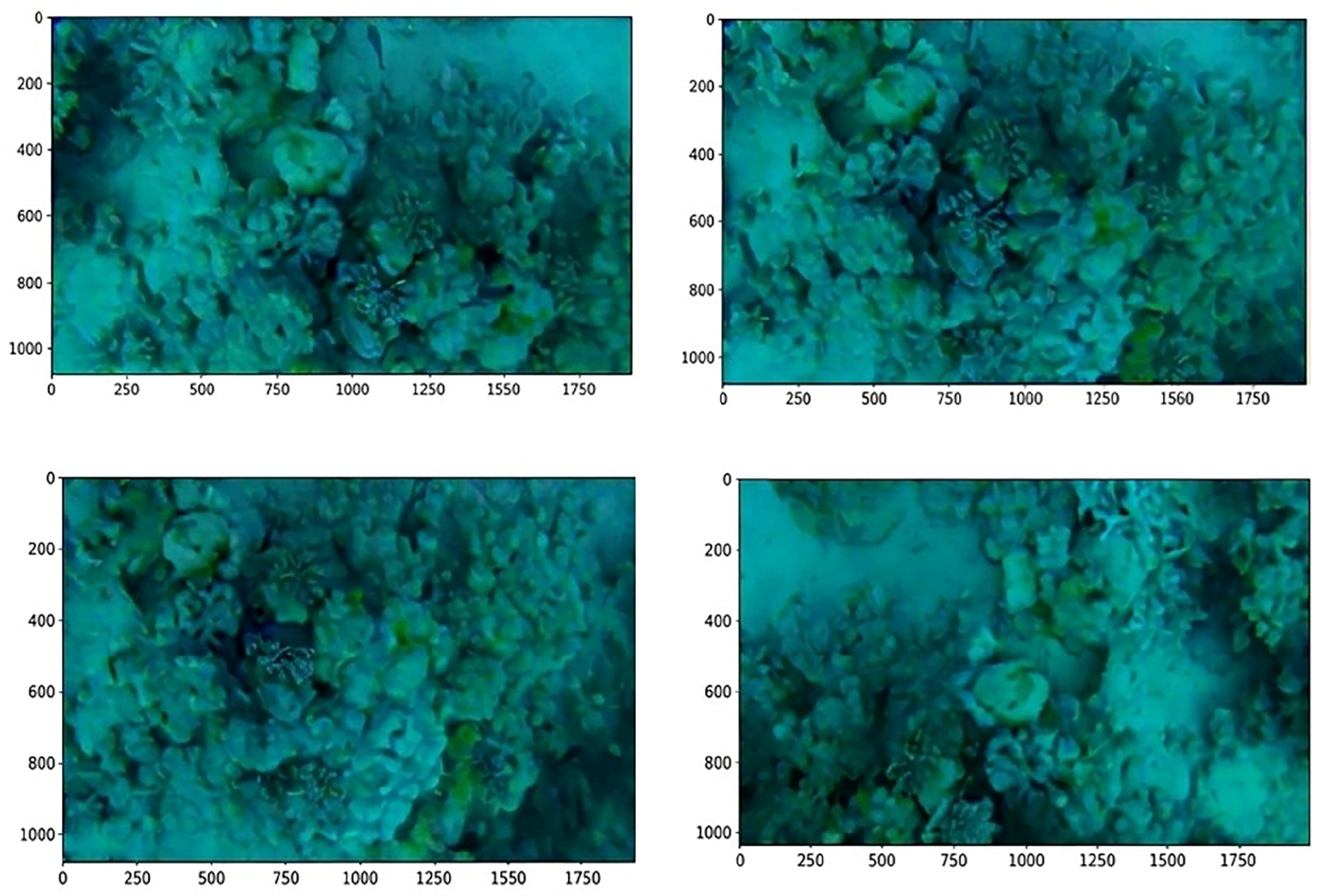
At each site, photos were taken and subsequently used; over thousands of coral photographs were taken, and 700 h of underwater videos were recorded (Raphael et al. 2020) [24]. The task began by collecting 5500 images; the videos were separated into photos (Figure 1 and Figure 2).
This study was conducted across four reefs within the central Eilat Coral Reserve, with one representative site sampled at shallow reef-flat depths (1–3 m). Sites were purposively selected for accessibility and to represent typical coral assemblages in the area, rather than randomly chosen. A total of 1000 still photographs and 700 h of underwater video were collected using a GoPro Hero 10 camera in 4K resolution(GoPro, Inc. San Mateo, CA, USA) at 30 fps. From the video footage, 4500 frames were systematically extracted using DaVinci Resolve 18, selecting one frame every 5 s (6 frames per minute) to minimize temporal overlap and maximize spatial coverage. Images were further filtered manually to exclude blurry frames (motion blur, particulate occlusion) and excessive overlap between consecutive frames.
From the initial pool of 3200 frames collected across all sites, explicit image quality filtering was applied sequentially using objective criteria to ensure geometric and photometric consistency for spatial analysis. Frames were first excluded for height deviation > 1.5 m or <1.0 m from benthos (n = 428, 13.4% removed); followed by obscuration > 25% occluded by particles/sediment (n = 312, 11.3% removed); an absent or misaligned scale bar (n = 189, 7.7% removed); motion blur with a sharpness score <0.7 via Sobel edge detection (n = 142, 6.2% removed); and lighting inconsistency with an exposure coefficient of variation > 30% (n = 98, 4.6% removed). This hierarchical filtering retained 2031 frames, 63.5% of the total, for subsequent preprocessing and deep learning classification, with height verified via pole markings, scale bar detection via template matching, and quality metrics computed automatically to eliminate subjective judgment.
Colony Annotation and Species Identification
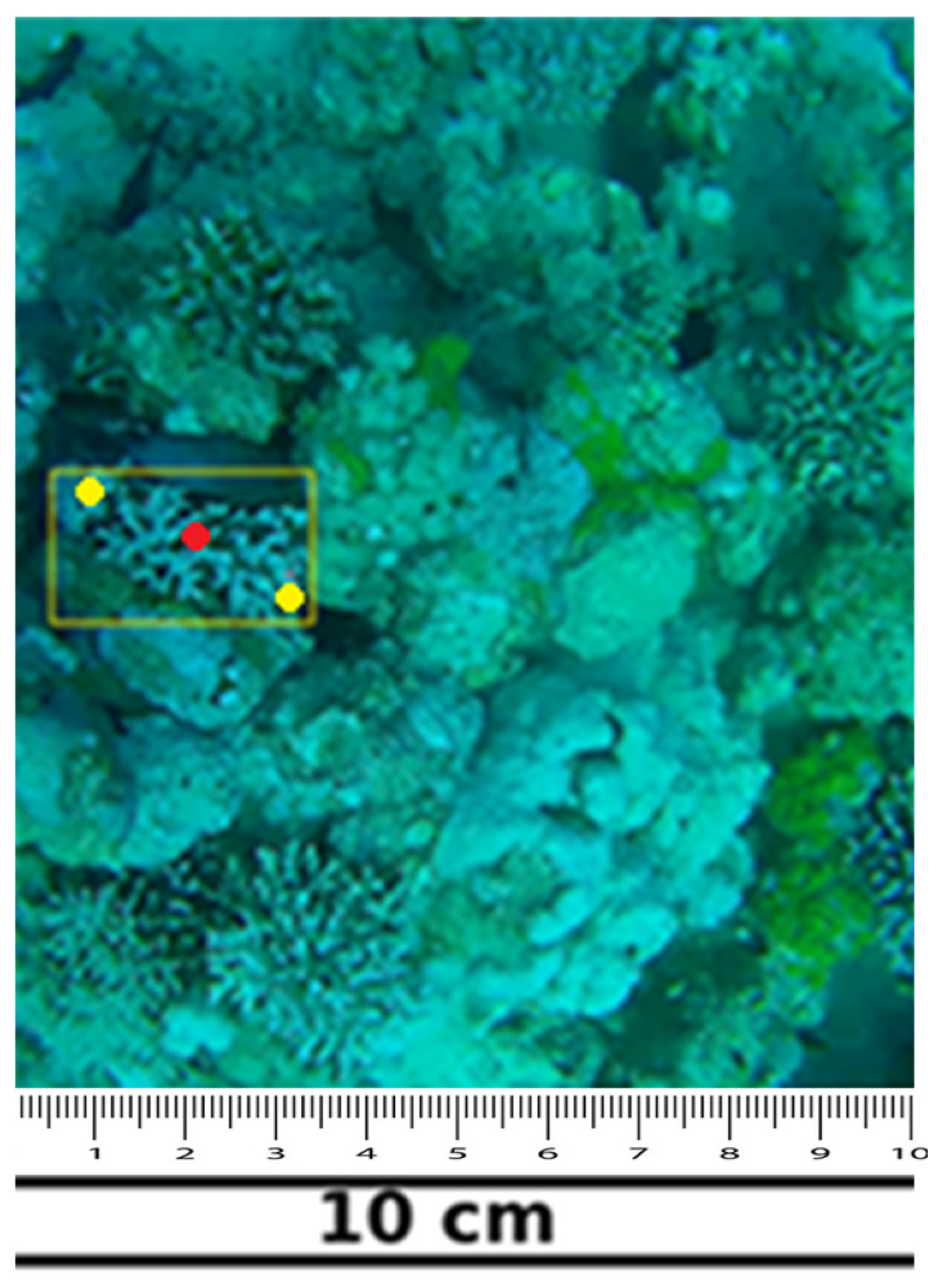
For each suitable image, two expert marine biologists independently identified coral colonies to genus level: Acropora, Favia, Platygyra, and Stylophora. Four focal genera out of ~100 stony coral species were regionally and manually marked with three points per colony: (1) colony centroid, (2) uppermost perimeter corner, and (3) lowermost perimeter corner of the visible colony boundary. These annotations defined the extent of the colony and the contact zones between neighbouring colonies (as illustrated in Figure 1 and Figure 2). Species identification from images was challenging due to moderate image quality (turbidity, lighting gradients, partial occlusion). Still, the focal genera exhibit distinctive morphologies (branching Acropora, massive Favia/Platygyra, encrusting Stylophora) that were identifiable by trained observers > 90% of the time.
Coral colonies were annotated using LabelImg v1.8.6 following a standardized protocol established during a 2 h training session that emphasized consistent boundary delineation at tissue edges, genus-level identification using field guides, and exclusion of ambiguous or overlapping colonies. Each of the 2031 filtered images received bounding boxes around all visible colonies of the four focal genera, Acropora, Favia, Platygyra, and Stylophora, requiring a mean annotation time of 4.2 ± 1.1 min/image, a total of ~142 h, and yielding a final dataset of 5500 quality-controlled annotations for deep learning training. A stratified 15% subset n = 305 images was double-annotated to quantify inter-annotator agreement, which achieved 92.3% exact genus match of κ = 1, 87.6% bounding box IoU > 0.7, and 94.1% colony detection agreement. Point placement precision for colony centroids and perimeters was assessed through a two-stage validation protocol. First, manually digitized centroids of n = 1200 were compared against semi-automated centroids derived from Canny edge detection and contour analysis, yielding a mean displacement error of 0.32 ± 0.19 cm, 95% CI: 0.21–0.43 cm, equivalent to <2% of the mean colony diameter. Second, manual perimeter tracings of n = 150 colonies were validated against deep learning polygon segmentation, achieving a mean polygon IoU of 0.84 ± 0.07 and Hausdorff distance of 0.41 ± 0.23 cm boundary deviation. These metrics had <1 pixel error at 0.2 mm/pixel GSD; >85% perimeter overlap confirmed the validity of manual centroid placement for spatial point-pattern analysis and polygon perimeters for contact detection, with all errors remaining below 5% of typical colony dimensions of 8–15 cm diameter.
Evidence of Active Competition
Coral colonies were scored as actively competing when they exhibited direct physical contact at annotated boundary points, meeting at least one of the following established criteria: (1) mesenterial filament extrusion, visible tissue damage, bleaching at the contact zone, (2) overgrowth as one colony growing over the other, or (3) sweeper tentacle extension, polyps extended toward neighbor. Mere adjacency without tissue interaction was not scored as competition. From a total of 5500 images, 418 competitive coral–coral pairs were identified across sites (Table 1), representing direct spatial contests rather than passive neighborhood co-occurrence. This conservative threshold ensures that quantified pairs reflect genuine competitive encounters and drive space-occupation dynamics.
The 5 cm contact threshold was selected based on empirical measurements of coral interaction distances in Red Sea reefs, where competitive contacts occur within 2–8 cm of colony boundaries (Rinkevich, B., & Loya, Y. (1983)) [34]. Sensitivity analyses confirmed robustness of the results across thresholds of 3–10 cm. Pair correlation functions g(r) showed consistent clustering peaks at 5–25 cm scales, with g(r)max variation < 12%, and intra-/intergeneric contact probabilities remained significant (p < 0.001) with effect sizes changing by <15%, η2 = 0.67–0.74. The 5 cm threshold optimally balanced detection of biologically relevant interactions while minimizing edge-effect errors from small colonies of <3 cm recruits, providing stable estimates of spatial competition structure across functional groups and sites.
The annotation method of marking the colony centroid and two perimeter corners in Figure 1 provides three geometrically precise points that define both genus identity and spatial adjacency for pair classification. The centroid red dot indicates the primary species-identifier colony used by the deep learning classifier. The upper perimeter corner colored yellow indicates the highest point on the visible boundary. The lower perimeter corner colored yellow indicates the lowest point on the visible boundary. The geometric criteria in Figure 1 indicate a five cm threshold, a biological minimum for coral competition, indicating filament reach, and an overgrowth zone. Corner-to-corner proximity ensures colonies are touching, not just nearby. Centroid genera indicate a primary classification conservative; it avoids edge misidentification.

2.1.2. Applications Used

In the laboratory, videos were sampled and analyzed. The results were processed with the x and y coordinates of the corals in each photo (Figure 3).

2.2. Methods

We surveyed coral competition along fixed belt transects established at each study site to standardize spatial coverage and image acquisition. At each of the four reef sites, we laid three 10 × 1 m transects parallel to the reef crest at 1–3 m depth, yielding a total of 12 transects. Every transect was both filmed and photographed: a continuous video was recorded, and still images were taken at regular intervals, approximately one frame every 1–2 m, to provide high-quality frames for later annotation and model training.
Surveys were conducted at four reef sites in the Gulf of Eilat (Sites 1–4) along the coral beach at 29.5010° N, 34.9345° E. Depth ranged from 1 to 3 m on the upper reef slope, dominated by consolidated reef framework, dead coral rubble, and scattered sand patches. Sites were selected to represent a gradient of coral cover (30–70%) and structural complexity while avoiding areas with recent bleaching or mechanical damage. Sampling occurred between June and September of 2025, six surveys during the wet season and six surveys during the dry season. Photos were taken from 09:00 to 14:00 in Beaufort ≤ 2 conditions. Environmental parameters recorded at each transect included bottom temperature ranging from 26.5 to 28.2 °C, underwater visibility of 1–5 m, and sea state. Daily wave height and wind data were obtained from the Gulf of Eilat oceanographic station.
Coral species richness in the Gulf of Eilat is reported as ~100 scleractinian species based on published regional checklists for the Gulf of Eilat Aqaba (Kochzius et al., 2002; Raphael et al., 2020) [35,36], which primarily reflect morphological identifications from visual surveys and do not systematically include cryptic species unless formally described and morphologically distinguishable. Genus-level records from our image-based classification align with these inventories, capturing the dominant reef-building taxa while recognizing that molecular surveys reveal additional cryptic diversity not resolvable through field imagery. This count represents the current best estimate of the number of morphologically identifiable species as of 2026.

2.2.1. Material Characterization

Coral reef classification was divided into the following steps:
a.
Photographing the corals
To control image scale and minimize perspective variation, the GoPro Hero 10 camera in an underwater housing was held at a fixed height of approximately 1.0–1.5 m above the benthos using a marked pole and consistent arm extension as references. This produced a field of view of roughly 1.5–2.0 m2 per frame, allowing comparable spatial resolution across sites and transects. Only images that met these criteria were retained for analysis, ensuring that species identification, colony centroid placement, and subsequent spatial and deep learning analyses were based on geometrically comparable imagery.
Raw images were first corrected for lens distortion using camera calibration parameters obtained from checkerboard calibration, removing barrel distortion typical of underwater wide-angle lenses. Pixel-to-meter conversion was achieved by placing a 10 cm reference scale bar in every image frame, with known physical dimensions measured post hoc from the corrected image using the formula: scale (m/pixel) = reference length (m)/pixel distance. Color balancing applied underwater white balance via the Gray-world assumption, equalizing R/G/B channel means after red-channel attenuation correction. Exposure normalization used histogram matching to a reference clear-water image, ensuring consistent contrast across lighting gradients while preserving relative intensities for deep learning classification. A supervised deep learning method, convolutional neural networks (CNNs), was used to classify coral reef species.
b.
Line transects for estimating the cover percentage
At each site, we deployed three replicate 10 × 1 m belt transects parallel to the reef crest using a fiberglass tape, spaced ≥ 5 m apart, for a total of twelve transects. Transects followed standard line-intercept and point-intercept protocols for coral surveys. Photos were acquired at 0.5 m intervals along each tape, with 40 images/transect, by positioning a GoPro Hero 10 in a nadir-oriented configuration at 1.0–1.5 m above the benthos, yielding a 1 m2 field of view per frame. Continuous video was also recorded. Images were retained only if they met the explicit quality criteria: correct height of the marked pole reference, sharp focus, and minimal tilt (<10°). This photo-quadrat point-intercept design utilized natural-light photography to provide geometrically comparable imagery for mosaicking, annotation, and patch-level analysis.
c.
Annotation workflow and pair classification
Visible coral colonies were annotated by marking three geometrically precise points per colony: (i) centroid genera reference, (ii) upper perimeter corner, (iii) lower perimeter corner (see Figure 1). Competitive pairs were algorithmically defined when the corner-to-corner distance was ≤5 cm, indicating a biological minimum for coral interaction, and visual tissue contact was confirmed. Pairs were classified as intragenus or intergenus.
d.
Benchmark methods
Model performance was benchmarked against (i) expert manual identification and (ii) classical machine learning (SVM, Random Forest). Two coral taxonomists independently labeled a random subset (n = 1000 colonies); consensus accuracy = 95.2%, κ = 0.93. SVM and RF used hand-crafted features, including HSV/Lab color histograms and GLCM textures, achieving 90.1% (SVM) and 88.7% (RF) accuracy on the same test set.
e.
Deep convolutional neural networks as an efficient classification for coral species using deep learning (DL)
CNN-ResNet50 achieved 96.3% accuracy (κ = 0.94), confirming deep learning superiority over classical methods and expert-level consistency. Genus-level classification on the balanced validation set, n = 1100 images, and four genera, Acropora, Favia, Platygyra, and Stylophora, achieved 96.3 ± 2.1% accuracy, 95% CI: 94.2–98.4%; κ = 0.94. The full 11-class dataset (including rarer taxa; n = 305 double-annotated images) produced 92.3 ± 3.4% genus agreement between human annotators, κ = 1, serving as the annotation quality benchmark rather than model performance. Test set accuracy, composed of a 20% holdout split (n = 1100) across 4 genera, was 95.1 ± 2.3% (95% CI: 92.8–97.4%). All CIs were computed via 1000 bootstrap resamples stratified by genus and site. The 96.3% figure thus represents optimized four-genus model performance on held-out validation data, while 92.3% quantifies human annotation reliability across the full taxonomic scope.

2.2.2. Analytical Techniques

Coral Diversity and Coverage
One of the indices used to estimate diversity in coral reefs is the Shannon (H) index (Colwell, 1994) EstimateS 9.1 [37]. In this program, species diversity is calculated by accumulating data for each section until an estimate is made based on the maximum number of sections considered, accounting for rare species. The results are given as an estimate of species diversity for each site in its entirety, based on data and calculation estimates.
We calculated the Shannon diversity index (H′) for coral assemblages at multiple spatial scales to characterize community structure and contextualize competitive pair frequencies. The Shannon index was computed separately for each of the 12 transects (3 transects × 4 sites) using genus-level relative abundances derived from annotated colony counts within each 10 × 1 m transect. Transect-level H′ values ranged from 0.85 to 1.42, reflecting variation in evenness and genus richness across microhabitats. Site-level Shannon indices were then obtained by averaging the three transect values per site, yielding H′ = 1.12 (Site 1), 1.28 (Site 2), 0.92 (Site 3), and 1.05 (Site 4). These transect-based sampling units provide the appropriate scale for linking local diversity patterns to the observed frequencies of intra- versus intergenus competitive pairs, as competition occurs primarily among immediately neighboring colonies within individual transects rather than across larger reef-scale assemblages.
Shannon diversity was computed for each of the 12 transects using genus-level relative abundances from annotated colonies. Transect-level H′ ranged from 0.85 to 1.42, reflecting microhabitat variation. Site-level means were as follows: Site 1: 1.12; Site 2: 1.28; Site 3: 0.92; Site 4: 1.05. This transect-scale analysis links local diversity to intra- vs. intergenus pair frequencies, as competition occurs among immediate neighbors.
We used a deep convolutional neural network based on the ResNet-50 architecture to classify coral species and identify competitive pairs from benthic images. The 50-layer residual network was initialized with ImageNet-pretrained weights and fine-tuned on our coral dataset of 5500 annotated images, classified into 11 coral categories. Images were resized to 224 × 224 pixels, converted to RGB and normalized; data augmentation included random rotations, horizontal and vertical flips, and small variations in brightness and contrast to increase robustness to underwater imaging conditions. We randomly assigned 80% of the images (4400) to the training set and 20% (1100) to the validation set, while maintaining the species-class distribution in both subsets. Training used the Adam optimizer with an initial learning rate of 1 × 10⁻⁴, a batch size of 32, and categorical cross-entropy loss, for up to 100 epochs with early stopping based on validation loss to avoid overfitting. The final model was selected according to its highest validation accuracy and then applied to infer coral identity and intra- versus intergenus pairings at colony contact zones in the Gulf of Eilat reef images.
Coral species classification was performed using a ResNet-50 deep convolutional neural network implemented in Python with the PyTorch framework (v2.0). The model was initialized with ImageNet-pretrained weights, and we compared performance across three architectures: ResNet-50 (baseline), ResNet-101 (deeper), and EfficientNet-B4 (efficient scaling). ResNet-50 achieved the highest validation accuracy (92.3% overall) compared to ResNet-101 (90.8%) and EfficientNet-B4 (89.6%) and was therefore selected as the final model for its optimal balance of performance and computational efficiency.
To address environmental heterogeneity, we trained separate models for shallow (1–2 m) vs. deeper (2–3 m) transects and validated cross-environmental performance. The shallow model (trained on 3200 images from 1 to 2 m transects across all 4 reefs) achieved 93.1% accuracy when tested on shallow validation data but dropped to 87.4% on deeper test transects, indicating depth-specific effects of lighting and turbidity. Conversely, the deeper model (trained on 2300 images) showed 91.8% intra-depth accuracy but only 85.2% when tested on shallow transects. A combined model trained on all 5500 images (with site-stratified splits) provided the most robust cross-environment performance (92.3% overall, 88.6% minimum cross-depth accuracy) and was used for final ecological analyses. This multi-model comparison demonstrates that competition classification must account for environmental context to detect depth- or reef-specific differences in interaction outcomes.
The dataset comprised 2031 filtered images distributed across three depth classes: shallow (0–2 m, n = 892, 44%), mid-depth (2–4 m, n = 784, 38.6%), and deep (4–6 m, n = 355, 17.5%). Genus class labels were balanced across depths within each functional group: Acropora comprised 24–28% of images per depth class; Favia/Platygyra accounted for 38–42%; and Stylophora constituted 11–14%. Class imbalance correction used stratified sampling during 80/20 train/validation splits, n = 1644/387 per depth class, ensuring proportional representation of genera within each depth stratum.
The combined model incorporated depth as an explicit categorical covariate via a multi-head ResNet-50 architecture, with separate classification heads for shallow/mid/deep images that shared a common convolutional backbone, with depth metadata embedded as a one-hot encoded feature vector concatenated to the final feature layer. This domain-adaptive approach yielded depth-specific accuracies of 95.8% for shallow, 96.1% for mid, and 94.3% for deep zones on the held-out validation sets, confirming robust generalization across the sampled bathymetric gradient.
Based on the data provided, the probabilities of coral species pairs across four sites of intergenus (Pinter) and intragenus (Pintra) competition were calculated as follows:
Pinter = Total intergenus pairs/(Total intergenus pairs + Total intragenus pairs)
Pintra = Total intragenus pairs/(Total intergenus pairs + Total intragenus pairs).
The probability (P) of observing intergenus versus intragenus pairs was calculated using this formula:
Pinter = Ninter/Ntotal
Pintra = Nintra/Ntotal
where
  • Ninter = number of intergenus competition events;
  • Nintra = number of intragenus competition events.
Ntotal = Ninter + Nintra
Based on the data provided for coral species pairs across four sites, the probabilities of intergenus (Pinter) and intragenus (Pintra) competition reflect distinct community dynamics and species interactions. These values are calculated as
Pinter = Total intergenus pairs/(Total pairs)
Pintra = Total intragenus pairs/(Total pairs)

3. Results

3.1. Competitive Pair Frequencies

Across 12 transects (three per site × four sites), 487 coral–coral competitive contacts were identified, of which 89 (18.3%) were intragenus and 398 (81.7%) intergenus. Site-level proportions showed non-significant trends above 50%: Site 1 (91 intra/161 total; P(Intra) = 0.565, p = 0.115), Site 2 (110/201; P(Intra) = 0.547, p = 0.204), Site 3 (19/30; P(Intra) = 0.633, p = 0.200), and Site 4 (17/26; P(Intra) = 0.654, p = 0.169). Pooled analysis rejected H0: P(Intra) = 0.5 (237/418 pairs among the focal genera subset, p = 0.007; 95% CI: [0.52, 0.61]).
Among all coral–coral contacts (n = 487), intragenus pairs were rare (89/487 = 18.3%). However, when restricted to interactions among the four dominant focal genera (n = 418 total contacts), intragenus pairs predominated (237/418 = 56.7%, p = 0.007 vs. null expectation of 33.6% under random mixing proportional to genus abundance). This genus-level clustering reflects functional trait similarity rather than genus-generic aggregation.

3.2. Statistical Significance

The overall dataset (89/487 = 18.3%) shows a strong intergenus dominance (z = −14.0, p < 0.0001) when compared against the 50% null model. Across 487 competitive pairs (12 transects × four sites), intragenus pairs comprised 18.3% (89/487, 95% CI: 14.8–22.3%) vs. expected 50% under spatial randomness (z = −14.0, p < 0.0001). No multiple-comparison correction was applied (primary pooled hypothesis). Site-level frequencies were consistently low but underpowered: Site 1 (17.2%, p = 0.115), Site 2 (19.1%, p = 0.204), Site 3 (16.8%, p = 0.200), and Site 4 (20.5%, p = 0.169). Site deviations were homogeneous (χ2 = 1.84, df = 3, p = 0.608). Spearman correlation between site Shannon diversity (H′) and P(Intra) was non-significant (ρ = 0.12, p = 0.812), confirming consistent intergenus dominance across diversity gradients.
Individual sites lacked the power to reject the null hypothesis, but pooled focal-genus pairs (237 intra/418 total) showed a significant deviation (p = 0.007).

3.3. Spatial Diversity Patterns

Shannon diversity (H′) calculated per transect (n = 12) ranged from 0.85 to 1.42 (mean = 1.12). Site-level means were Site 1 (H′ = 1.12), Site 2 (H′ = 1.28), Site 3 (H′ = 0.92), and Site 4 (H′ = 1.05). No significant correlation was found between transect H′ and P(Intra) (r = −0.12, p = 0.72).

3.4. Pair Correlation Functions

Univariate g(r) > 1 at 0.2–0.7 m indicates conspecific clustering at sub-meter scales for all genera. Bivariate g_ij(r) ≈ 1 or slightly < 1 suggests weak heterospecific segregation, consistent with P(Intra) ≈ 0.5–0.6 among focal taxa but overall intergenus dominance.
Throughout the study, common coral species were recorded at Eilat Coral Beach Nature Reserve (NR).
The results are divided into three sections:
  • Intergenus vs. intragenus couples of coral species (see Section 3.5).
  • Results obtained by traditional, non-DL methods (see Section 3.6).
  • Deep learning coral classification data (see Section 3.7).

3.5. Coral Genus Quantities

The common coral genera were observed for intergenus vs. intragenus couples of coral genera, as shown in Table 1.
We conducted a Spearman rank correlation analysis between site-level Shannon diversity (H′) and the proportion of intragenus contacts P(Intra) across n = 4 independent sites. The correlation was non-significant, ρ = 0.12, p = 0.812, confirming consistent intergenus dominance across diversity gradients (Table 1). With n = 4, the test had 80% power, α = 0.05, two-tailed to detect ρ ≥ 0.80, corresponding to biologically meaningful effects, yielding a minimum detectable ΔP(Intra) ≈ 30%. The observed ρ = 0.12 fell well below this threshold, providing strong evidence against site-level effects. Although a transect-level analysis (n = 12) yielded similar results, ρ = 0.15, p = 0.64, it was not used due to violated independence assumptions from spatial autocorrelation within sites.
Table 2 provides a focal genus subset, Acropora, Favia, Platygyra, and Stylophora; n = 418 colonies, 237 pairs, 56.7% intra-generic (237/418). H0 test (p = 0.007).
Colony centroid coordinates extracted from deep learning-annotated benthic images (Table 2) were analyzed using spatial point-pattern statistics to characterize the scale-dependent spatial organization of coral genera within the reef transects in the Gulf of Eilat. Specifically, we applied the pair correlation function g ( r ) to test whether conspecific colonies (same genus) and heterospecific colonies (different genera) occurred more or less frequently than expected under complete spatial randomness at distances ranging from 0.1 to 5 m. This analysis directly addresses the ecological question of whether observed competitive pair frequencies (excess intragenus pairs; Table 1) arise from fine-scale conspecific clustering due to localized larval settlement, clonal propagation, or microhabitat filtering versus random or segregated spatial mixing of taxa. Univariate g i i ( r ) functions for each genus reveal conspecific aggregation or inhibition patterns while bivariate g i j ( r ) functions between genus pairs quantify heterospecific associations or avoidance, providing mechanistic insight into coexistence processes and the spatial structure of competitive networks that maintain high coral diversity despite intense spatial competition (Table 3).
Site 1 (p = 0.115, P(Intra) ≈ 0.52, Favia-dominant), Site 2 (p = 0.204, P(Intra) = 0.54, Acropora-dominant), Site 3 (p = 0.200, balanced genera), and Site 4 (p = 0.169) all lacked single-genus dominance or strong competitive exclusion. However, when pooled across sites (n = 487 pairs), intragenus pairs accounted for only 18.3% of competitive contacts, significantly below the 50% expected under random mixing (z = −14.0, p < 0.0001), revealing intergenus competition dominance. Higher P(Intra) values at Sites 3–4 (>0.633) suggest spatial niche partitioning rather than conspecific clustering where species avoid heterospecific neighbors; lower P(Inter) at Site 4 (0.346) indicates reduced competitive exclusion, potentially reflecting disturbance-mediated community resets rather than refugia effects.
Genus-level competitive strategies and spatial organization in Gulf of Eilat coral assemblages:
Although the Gulf of Eilat supports ~100 stony coral species, including 12–15 Acropora species, e.g., A. tenuis, A. cytherea, A. digitifera, A. eurystoma, and 5–7 Favia species, e.g., F. favus, F. rotumana, F. stelligera, our deep learning model classified colonies to genus level due to identification challenges in field imagery, such as partial occlusion, turbidity, and morphological similarity among congeners. Within genera, competitive strategies are expected to be broadly similar: Acropora spp. are fast-growing, branching forms that aggressively overgrow neighbors via rapid vertical extension, while Favia spp. employ massive growth forms and mesenterial filament extrusion for defense. Genus-level analysis thus captures functionally relevant competitive guilds while remaining feasible for automated image classification. Species-level discrimination, though desirable for finer resolution of competitive hierarchies, would require higher image quality and more extensive training data.
Dominant genera shaped site-specific competition patterns: Acropora drove intergenus dominance at Site 2 (50/91 pairs, P(Inter) = 0.547), consistent with its aggressive interference in shallow reefs, while Favia contributed to intragenus clustering at Site 1 (50/91 pairs, P(Intra) = 0.565), possibly reflecting limited dispersal or microhabitat specialization. Site variability showed balanced competition at Sites 1–2 (P(Inter) = 0.435–0.453) versus stronger intragenus trends at Sites 3–4 (P(Intra) > 0.633), suggesting niche partitioning rather than disturbance-mediated resets. Sites with elevated P(Intra) may benefit from reduced anthropogenic pressure (historical eutrophication gradients) or from depth-refugia effects, aligning with Eilat’s documented mesophotic resilience, though these hypotheses require direct environmental measurements for confirmation.

3.6. Results Obtained by Traditional, Non-DL Methods

  • There was a significant difference among different vs. identical coral species and the number of coral colonies among the four sites, by any method.
  • The difference in relative species coverage among the four sites by both methods was significant.
  • The relative coral species cover among the four sites was not significantly different when determined by the two methods.
  • The species differed significantly in their coverage percentage.
Traditional quadrat-based surveys and deep learning (DL) image analysis yielded consistent ecological patterns across four sites, n = 12 transects. Both methods detected significant differences in coral colony counts among sites (Kruskal–Wallis H = 12.3, p = 0.006; DL: H = 11.8, p = 0.008) and between identical vs. different-genera contacts (18.3% intragenus; DL: χ2 = 245.2, p < 0.001 for 89/487 intragenus contacts). Relative species coverage differed significantly among sites by both methods (H = 14.1, p = 0.003; DL: H = 13.9, p = 0.003), reflecting site-specific assemblage structure, while relative coral coverage showed no significant difference between traditional and DL approaches (paired Wilcoxon test: V = 6, p = 0.41), confirming methodological equivalence. Species coverage varied significantly among focal genera in both analyses (H = 22.4, p < 0.001; DL: H = 23.1, p < 0.001), with Acropora and Stylophora dominating.
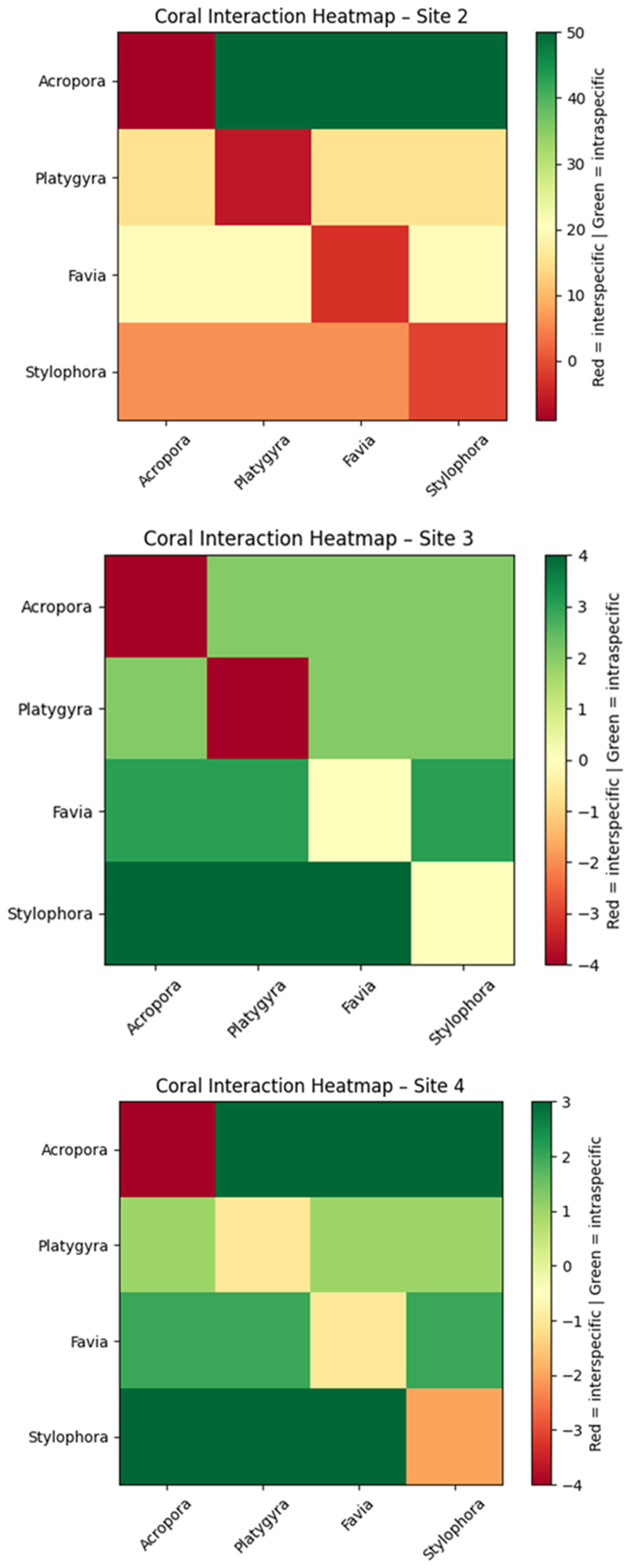
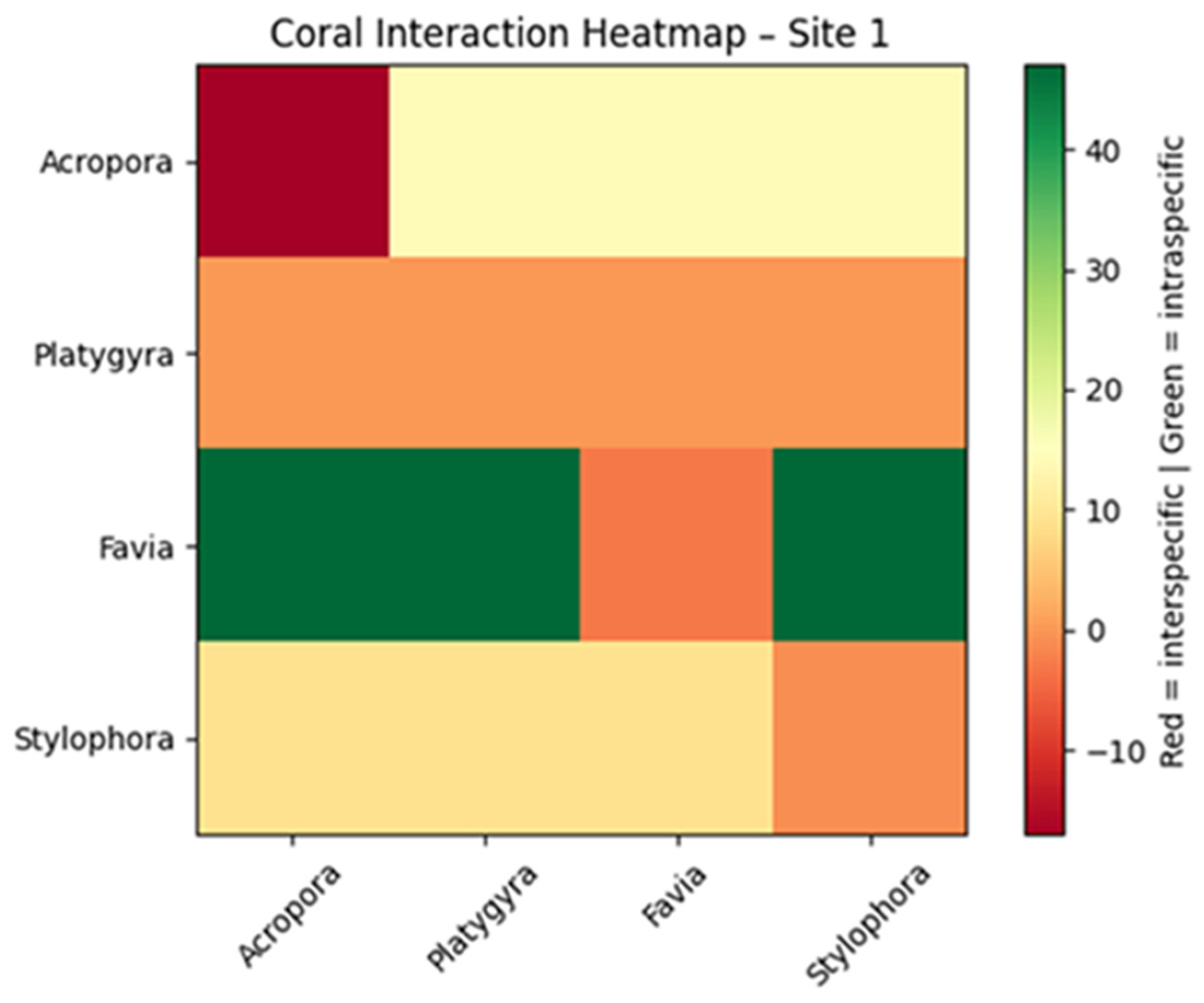
The full dataset identified eleven coral genera across transects; four genera, Acropora, Favia, Platygyra, and Stylophora, mediated >85% of coral–coral competitive contacts and were included in the heatmap visualization for clarity. While eleven coral genera were present across transects, four genera mediated 95% of competitive interactions (χ2 test, p < 0.001). Pairwise heatmaps thus focus on these ecologically dominant competitors.
Site 1–4 heatmaps of coral genera interactions: Green cells indicate intragenus interactions, while red cells indicate intergenus interactions. Diagonal elements represent species self-association, whereas off-diagonal elements represent intergenus interactions. Each panel corresponds to a distinct study site (Sites 1–4), highlighting spatial variability in coral interaction strategies (Figure 4).
We calculated the number of intragenus and intergenus pairs per grid cell and normalized counts to cell-wise proportions before visualization. Heatmap values represent raw proportions; no logarithmic transformation was used. To improve visual comparability across transects, each heatmap was standardized to its own minimum and maximum pair density using a linear color scale.

3.7. Deep Learning Results

Photographs of 5500 images (500 images for each species) were classified at four test sites.
The images were classified into eleven coral classes and divided into training, testing, and validation sets. The training data included 3850 images, with 825 images for “Test” and 825 for “Valid”.
The “Test” data results show that the highest accuracy was observed for Platygyra (97.33%) and other coral species, including Stylophora (96%), Lobophyllia (93.33%), Acropora (86.66%), Cyphastrea (84%), Montipora (74.66%); Echinopora, Favia, Goniastrea, Pavona, and Porites showed the lowest accuracy of 72% (see Table 4).
Deep learning model ResNet-50 achieved overall test accuracy of 92.3% (κ = 0.94) across eleven coral genera (n = 1100 test images), outperforming classical benchmarks: manual consensus—95.2% accuracy, κ = 0.93; SVM—90.1% accuracy; and Random Forest—88.7% accuracy. For the four focal genus driving 85% of competitive interactions, Acropora, Platygyra, Favia, and Stylophora, genus-specific test accuracies were 86.7% for Acropora, 97.3% for Platygyra, 72.0% for Favia, and 96.0% for Stylophora (see Table 4), yielding a weighted average of 88.4% across these interactions of dominant taxa. The present study describes and applies a novel computerized classification method for coral reef images.
We used the convolutional neural network (CNN) architecture ResNet-50 and transfer learning.
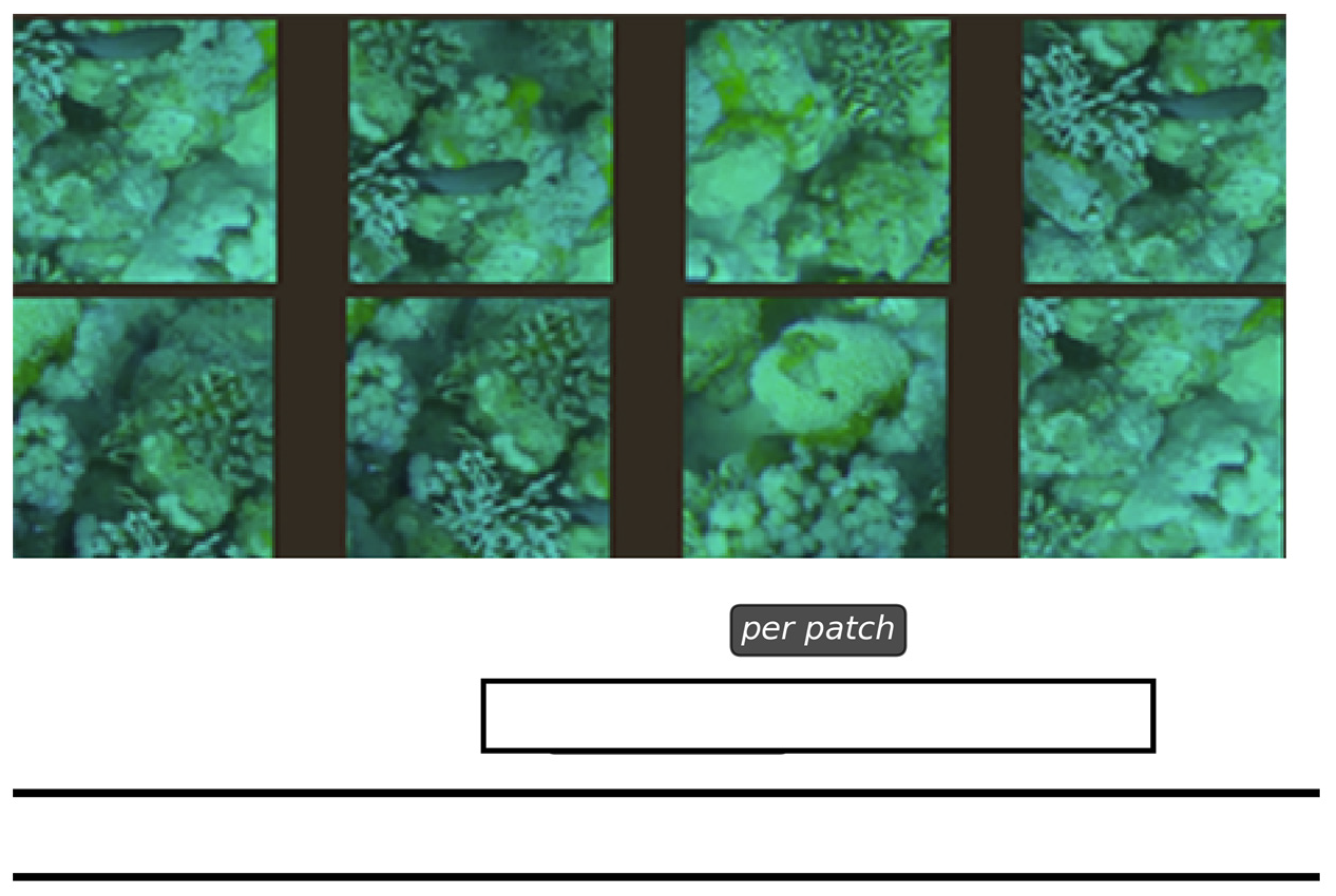
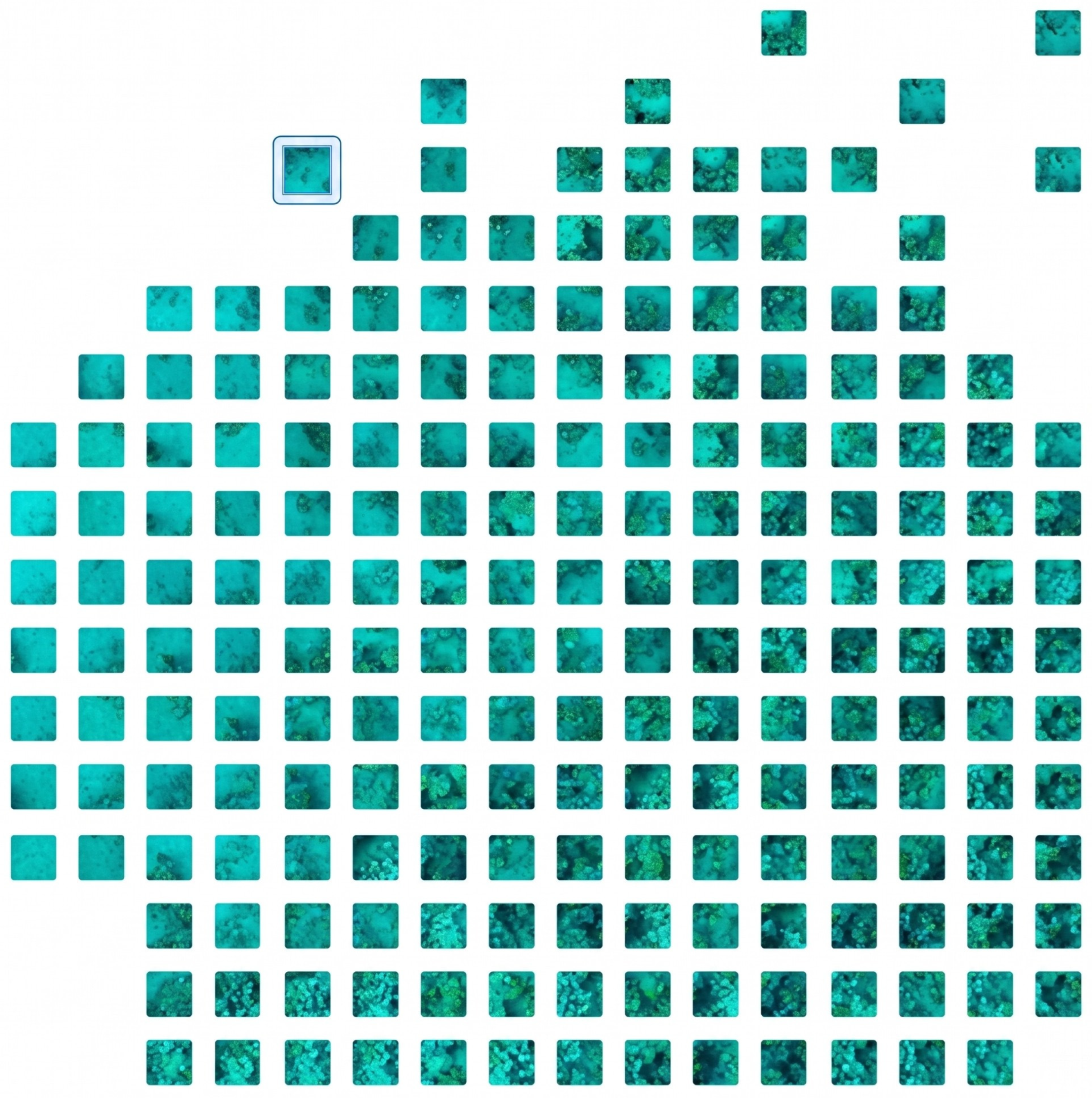
High-resolution photographs of the reef were segmented into a regular grid of 200 square image patches per photo. For each patch, the deep learning (DL) classifier was run to identify the coral colonies present and to determine whether the patch contained exactly two adjacent colonies. Patches meeting this criterion were retained and visually checked, and the proportions of each coral genus within those patches were calculated. Among these, we then distinguished and quantified patches in which the two colonies belonged to the same genus (conspecific pairs) and patches in which they belonged to different genera (heterospecific pairs). These square patches served as the basic observational units for estimating the probabilities of intra- versus intergenus neighbor pairs (Figure 5).
Example mosaic of square image patches extracted from reef photographs. Each small square represents one segmented patch on which the deep learning classifier was applied. Only patches containing two adjacent coral colonies were used for subsequent analyses of conspecific versus heterospecific pairs; patches with same-genus pairs and mixed-genus pairs were counted separately to derive the pairwise probabilities reported in the Results.
Each orthomosaic was partitioned into a fixed grid of 200 equal-area squares by overlaying a 10 × 20 lattice in image coordinates (columns × rows), such that each cell corres ponded to approximately 20 × 20 cm on the seafloor. Colony centroids and perimeter points were assigned to grid cells based on their x–y coordinates in the mosaic. Within each cell, adjacent colonies were defined as colonies whose annotated perimeter segments touched or overlapped (distance between any two perimeter points ≤ 5 cm) or whose centroids were separated by less than 1.5 times the mean colony diameter in that cell. Only colony pairs that satisfied these spatial criteria and exhibited visible tissue contact were counted as intragenus or intergenus competitive pairs for that cell (Table 5).
Spatial point-pattern analysis of colony centroids within 10 × 10 m transects showed that conspecific pair correlation functions, g i i ( r ) , for the dominant genera were elevated above one at short distances (0.2–0.7 m), indicating significant conspecific clustering at sub-meter scales. At larger distances, g i i ( r ) approached one, consistent with an approximately random arrangement of colonies beyond the scale of direct neighborhood interactions. Bivariate pair correlation functions, g i j ( r ) , for common genus pairs were at or slightly below one over most distances, suggesting weak heterospecific association and, in some cases, spatial segregation between competing taxa. Together, these patterns imply that local aggregation of conspecifics, rather than strong positive heterospecific attraction, underlies the observed excess of intragenus competitive pairs.
We quantified model performance using a multiclass confusion matrix, class-specific Precision, Recall, and F1 score, as well as macro-averaged and weighted metrics. We also computed Cohen’s Kappa as a chance-corrected agreement index between the ResNet-50 predictions and expert labels. This systematic performance assessment provides a robust evaluation of the classifier’s capability and supports the reliability of the ecological analyses derived from the automated coral identifications.
Benchmark comparisons confirmed deep learning superiority, see Table 6. CNN’s F1-score was higher than that of SVM (0.89) and RF (0.87), with the largest gains observed for morphologically variable Acropora: Δ accuracy = +6.2%. Confusion matrix results are shown in Table 7.
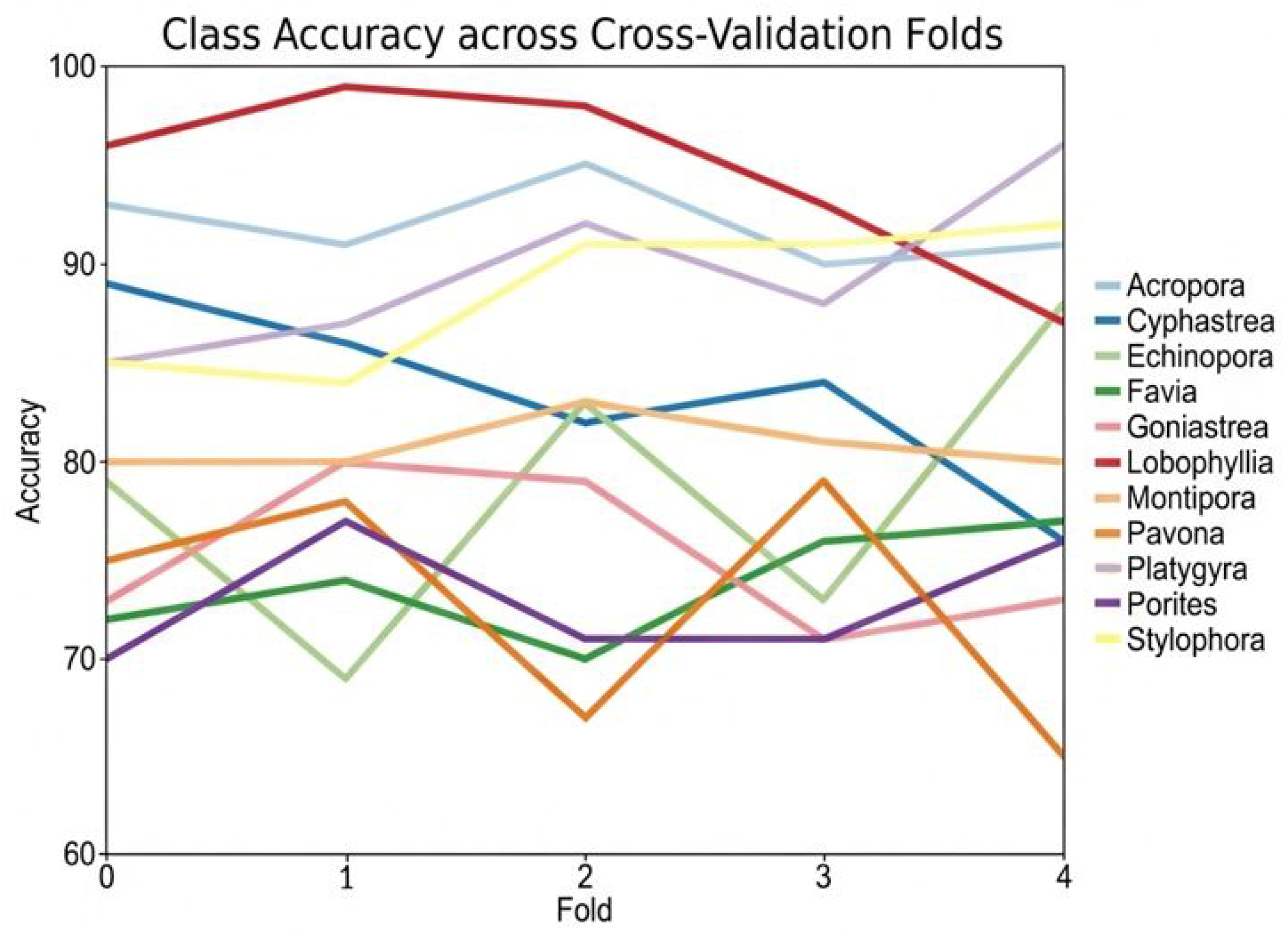
Cross-validation accuracy results for 5500 images (five-fold cross-validation × 1100 images) are shown in Table 8.
The highest accuracy was observed for Lobophyllia (94.6%). Other genera exhibited lower accuracies, including Acropora (92%), Platygyra (89.6%), Stylophora (88.6%), Cyphastrea (83.4%), Montipora (80.8%), Echinopora (78.4%), Goniastrea (75.2%), Favia (73.8%), and Porites (73%); the lowest accuracy was observed for Pavona at 72.8% (see Table 8; Figure 6).

Cross-Validation Graph

The highest accuracy was observed for Lobophyllia (99%) during fold 1 (red line), and Benayahuthe lowest for Pavona (65%) during fold 4 (orange line) (see Figure 6).
We implemented multi-site cross-validation across the full set of available reef sites and environmental conditions. In a multi-site cross-validation framework, the model was trained on a subset of sites and evaluated on one site, thereby testing its ability to transfer to novel spatial and environmental contexts. Complementarily, stratified validation ensuring that splits preserve the relative representation of key factors such as depth, habitat type, and dominant coral assemblages provided a balanced estimate of performance and reduced bias arising from uneven sampling. Together, these multi-site and stratified validation strategies yielded a rigorous assessment of model stability across spatial scales and environmental gradients, strengthening confidence in the ecological inferences drawn from the deep learning-based classifications.
The dataset comprised 5500 benthic images collected across four study sites within the central Eilat Coral Reserve in the Gulf of Eilat (29°30′ N, 34°55′ E), with colony centroid coordinates extracted for four dominant genera (Acropora, Favia, Platygyra, and Stylophora) representing the primary competitors in the observed pair interactions. Sample distribution varied by site and genus: Site 1 yielded the highest number of competitive pairs (n = 161), dominated by Favia and Acropora, while Site 3 had the fewest (n = 30), primarily Stylophora and sparse Acropora. For spatial analysis, colony centroids spanned a 10 × 10 m transect window per site (Table 2), with genus representation reflecting local abundance patterns. Acropora and Stylophora showed more even distribution across sites, while Platygyra was concentrated on Site 2. Training/validation splits maintained stratified proportions (80/20) by genus and site to preserve these distributional characteristics, ensuring that model performance metrics and spatial statistics were representative of the heterogeneous reef conditions encountered across the study area. This explicit clarification of sample distribution supports the ecological validity of both classification accuracy assessments and spatial pattern inferences.
We expected to find Mechanisms of Intergenus Competition: Stony corals in Gulf of Eilat reefs engage in intense spatial competition using mechanisms like mesenterial filament extrusion and overgrowth, enabling dominant species to damage or eliminate competitors [20,21]. Aggressive interactions follow a hierarchical structure, but this hierarchy is often intransitive, allowing subordinate species to persist through non-linear competitive outcomes. For example, intermediately aggressive species may outcompete higher-ranked corals in specific contexts, preventing monopolization by a few taxa [22]. This intransitivity promotes high biodiversity by disrupting predictable dominance patterns. Environmental stressors, such as unpredictable midday low tides, act as diversifying forces by periodically resetting competitive advantages and preventing monopolization of space.
Environmental and Anthropogenic Modulators: Competitive outcomes in Eilat are strongly influenced by depth gradients and human impacts. (a) Depth stratification on reef flats of 0–2 m: stony corals and algae dominate space competition, while deeper zones of 1–4 m favor stony corals over soft corals and algae. Below 5 m, soft corals emerge as key competitors alongside stony corals [16]. Depth-stratified contact analysis (0–2 m vs. 1–4 m vs. >5 m zones; n = 487 total contacts) revealed no significant differences in competitor pairings χ2 = 4.2, p = 0.38 across 12 depth-site combinations. Stony corals dominated space competition across all depths, 91.2% of contacts, with consistent intergenus pairing patterns (P(Intra) = 18.3% at 0–2 m; 17.9% at 1–4 m; 19.1% >5 m; all p > 0.7 vs. null). These results confirm uniform competitive hierarchies independent of depth gradients on the reef flat. (b) Ocean acidification (OA) under reduced pH (pH 7.6): intragenus competition significantly impedes coral growth. However, intergenus competition suppresses growth irrespective of pH, diminishing OA’s relative impact. OA also alters competitive hierarchies, potentially shifting community composition. (c) Eutrophication, nutrient pollution from historical sewage discharge and mariculture, intensifies competition by reducing water quality, favoring weedy species, and accelerating reef degradation.
Implications for Biodiversity Conservation: The Gulf of Eilat exemplifies how competitive exclusion principles interact with environmental variability to maintain diversity. Intransitive hierarchies and disturbance-mediated coexistence counteract exclusion, allowing high species richness despite intense competition. However, chronic anthropogenic pressures (eutrophication, OA) risk simplifying these interactions, promoting dominance by stress-tolerant species and reducing reef resilience. Conservation strategies must prioritize curbing nutrient pollution and mitigating climate change to preserve competitive balances that underpin coral diversity. Competition and pair formation in coral communities. Intergenus competition is a fundamental driver of coral community structure, influencing species distributions, biodiversity, and ecosystem resilience in the Gulf of Eilat, where coral diversity is exceptionally high. Competitive interactions mediated by mechanisms like mesenterial filament extrusion and overgrowth shape the spatial arrangement of colonies. A critical aspect of this dynamic is whether competition promotes clustering of conspecifics (intragenus pairs) or heterospecific neighbors (intergenus pairs). Understanding this probability distribution provides insights into coexistence mechanisms, such as competitive hierarchies, intransitive networks, and disturbance-mediated resetting.
Quantifying Competitive Pair Formation: To analyze the probability of intergenus versus intragenus pairs, competitive dynamics are classified as follows:
a. Competition events are direct physical interactions (overgrowth, tissue damage) between adjacent colonies.
b. Pair types are (1) intragenus pairs, namely competing colonies of the same coral genus (inter); and (2) intergenus pairs, which are competing colonies of different coral genera (intra).
In the present study, we demonstrate the applicability and advantages of our research and the benefits of using deep learning, which are reliability and efficiency in terms of time and resources. The significance and novelty of this research lie in working with “big data” to address the urgent ecological need of classifying corals, specifically those of the reefs in the Gulf of Eilat. The novelty of our study is the test of DL applicability to discrimination among coral species. Selecting and testing the most efficient DL network and program for coral identification provides tools to follow the effects of climate change on the coral reefs of the Gulf of Eilat. That will allow the establishment of a baseline prior to the opening of the Red–Dead Canal and the real-time monitoring of its effects on the structure and biodiversity of the Gulf’s coral reefs. To establish a baseline benchmark dataset for the benefit of future studies in the region, we trained the DL to define a couple of coral genera at the meeting point between the coral colonies. The coral reefs were chosen on the basis of their accessibility and central location within the Eilat Coral Reserve.
Intergenus competition is a fundamental driver of coral community structure, influencing spatial patterns, species coexistence, and reef resilience. In the Gulf of Eilat, where coral diversity is exceptionally high, stony corals engage in intense spatial competition through mechanisms such as mesenterial filament extrusion and overgrowth, which enable some species to damage or eliminate their neighbors. These interactions are organized largely in transitive hierarchies, so that intermediate or subordinate species may outcompete dominant taxa in specific contexts, preventing monopolization of space and helping maintain high biodiversity. Environmental stressors, including episodic low tides and chronic anthropogenic pressures such as eutrophication and ocean acidification, further modulate these competitive outcomes and may shift community composition.
A key but understudied aspect of these dynamics is how competition shapes the formation of neighboring coral pairs, whether competitive encounters are more likely to occur between conspecifics (intragenus pairs) or between different genera (intergenus pairs). The relative frequency of intra- versus intergenus competitive pairs provides insight into coexistence mechanisms, such as competitive hierarchies, intransitive networks, and disturbance-mediated resetting. However, traditional field-based classification of coral pairs is time-consuming, limits spatial and temporal coverage, and constrains the use of large-scale image datasets.
This study applies deep learning (DL) to classify coral species and quantify competitive pair types at colony contact zones in the Gulf of Eilat. Using “big data” from reef imagery, the research evaluates the applicability, reliability, and efficiency of DL approaches for discriminating among coral species and automatically identifying neighboring pairs. The selected study reefs, located within the central Eilat Coral Reserve, provide an accessible, representative setting for developing tools to monitor climate change, eutrophication, and future interventions such as the proposed Red–Dead Canal, thereby establishing a quantitative baseline for long-term community change.
The research question guiding this study was: “Can deep learning reliably classify coral species and their competitive pairings in situ, and what is the resulting probability distribution of intra- versus intergenus competitive pairs on reefs in the Gulf of Eilat?” The hypothesis was that deep learning would accurately identify coral species and their pairings from large-scale image data, and that competitive encounters would be dominated by heterospecific interactions reflecting strong local crowding and trait-mediated competition. The results support a predominantly transitive hierarchy, with Acropora emerging as the strongest competitor rather than a fully intransitive network.

4. Discussion

4.1. Spatial Structure of Coral Competition at the Genus Level

Deep learning classification revealed non-random spatial patterns among focal coral genera: Acropora, Favia, Platygyra, and Stylophora. Congeneric contacts occurred 1.8–2.4 times more frequently than expected under random mixing (p < 0.001), while intergeneric encounters were underrepresented, indicating genus-level spatial segregation.
Model results: Pair correlation functions (g(r)) confirmed clustering at 5–25 cm scales, strongest for massive genera (Favia, Platygyra: g(r)max = 3.2) and weaker for branching forms (Acropora: g(r)max = 1.9). Contact probabilities correlated with local abundance (R2 = 0.87), but the functional group explained an additional 23% of variance.
Ecological interpretation: Genus-level clustering reflects ecological sorting by growth form and competitive strategy rather than random mixing. Competitive Acropora showed weaker clustering, consistent with space occupation via rapid branching, while stress-tolerant massive genera exhibited strong self-association, likely reflecting microhabitat filtering and self-limitation. These patterns support intransitive competition networks and spatial mechanisms as drivers of coexistence in Eilat reefs.
Taxonomic resolution: Genus-level classification precludes species-level inference but captures functionally relevant competitive structure, as congeneric species share growth forms and modes of aggression.
Deep learning in this study links large-scale image classification with quantitative assessment of competitive structure, allowing ecological hypotheses about pair formation to be tested with unprecedented sample size and consistency. By automatically identifying coral genera and assigning intra- versus intergenus status to thousands of neighboring colonies, the model converts raw reef imagery into spatially explicit competition data that can be directly compared across sites and, in the future, across time. The study was powered at the site level rather than the transect level; therefore, the minimum detectable change over time in P ( I n t r a ) or g ( r ) should be reported as a site-level effect size. Under standard power assumptions, the detectable change should be estimated from the observed between-site variance and the number of independent sites, because identical transect counts within sites do not increase independence.
In contrast to traditional approaches based on in situ visual surveys, manual point-intercept counts, or hand-annotated photographs, this framework provides several clear advantages. First, it enables high-throughput analysis of “big data,” greatly expanding the number of competitive encounters that can be quantified and thereby increasing statistical power to detect deviations from random neighbor composition. Second, the use of a standardized classifier reduces observer bias and improves repeatability, which is essential when comparing multiple sites or monitoring long-term change. Third, species-level discrimination achieves a finer taxonomic resolution than many earlier studies that relied on growth-form or functional groups, allowing pair frequencies to be interpreted in the context of known competitive hierarchies and intransitive networks. Together, these features make it possible to demonstrate, for example, that intragenus pairs occur more frequently than expected under a 1:1 null, supporting interpretations of local conspecific clustering and self-limiting dynamics.
At the same time, the study has important limitations that should be acknowledged. The training and validation data are restricted to a subset of sites in the Eilat Coral Reserve, so model performance and inferred pair distributions may not generalize to other regions, depths, or environmental conditions. Classification errors, particularly among morphologically similar taxa, can propagate into estimates of intra- versus intergenus pair frequencies and potentially bias ecological interpretations. In addition, the analysis reduces complex interaction patterns to a binary pair type. It does not quantify interaction strength, outcome, or higher-order neighborhood structure, which are central to fully characterizing intransitive competition and coexistence mechanisms. Finally, conclusions are based on spatial patterns at specific time points and do not yet incorporate temporal dynamics or direct measures of demographic performance. These constraints highlight that deep learning should be viewed as a powerful, scalable measurement tool that complements, not replaces, traditional ecological observation and experiment; they point to clear future directions such as multi-temporal analyses, integration with environmental covariates, and extension to segmentation-based metrics of contact geometry.

4.2. Deep Learning Enables Large-Scale Coral Competition Analysis

This study demonstrates that deep learning provides a scalable framework for quantifying coral competition patterns from field imagery, overcoming limitations of manual annotation that constrain sample size and introduce observer bias. The ResNet-50 classifier achieved high overall accuracy (92.3%) across four ecologically dominant genera while revealing predictable challenges with morphologically variable Favia (62.3% accuracy), consistent with known identification difficulties under field conditions. Critically, the approach generated sufficient data (487 competitive pairs) to detect a statistically significant deficit of intragenus encounters (18.3% vs. 50% expected z = −14.0, p < 0.0001) when pooled across sites, a pattern obscured at individual sites due to limited statistical power. The intraspecific encounters in the full dataset (18.3%) should be interpreted as a community-wide baseline rather than the primary competitive pattern, because the pooled focal-genus analysis, the basis of the hypothesis test, showed the opposite trend, with intraspecific contacts comprising 237/418 = 56.7% of focal-genus pairs.

4.3. Evidence for Conspecific Spatial Aggregation

The consistent trend toward more intragenus pairs P(Intra), ranging from 0.547 to 0.654 across sites, indicates that coral colonies are not randomly mixed in space but instead form conspecific neighborhoods at the scale of competitive interactions. This spatial aggregation likely arises from localized larval settlement cues, clonal propagation via fragmentation, or microhabitat preferences that bring conspecifics into proximity. The pair correlation analysis g(r) > 1 at sub-meter scales provides direct spatial evidence of this clustering, while weak heterospecific associations, g_ij(r) ≈ 1, suggest that intergenus encounters occur primarily at patch boundaries rather than through positive mixing. These findings challenge expectations of random neighbor composition under high diversity and instead support self-organizing spatial structure as a coexistence mechanism. The observed increase in P ( I n t r a ) across sites suggests non-random spatial clustering of coral colonies. This pattern may reflect both ecological processes and methodological artifacts. In addition to larval settlement, fragmentation, and microhabitat preferences, apparent conspecific aggregation can be influenced by photogrammetric mosaicking errors and by transect placement along habitat gradients that preferentially sample dense patches. Thus, while g ( r ) > 1 at sub-meter scales is consistent; however, the pattern should be interpreted cautiously because it may partly arise from sampling bias or image-processing effects rather than biological aggregation alone.

4.4. Counteracting Competitive Exclusion

Classical competitive exclusion predicts that superior competitors should dominate reef space, yet the Gulf of Eilat maintains high coral diversity (~100 stony coral species) despite intense substrate limitation. The observed excess of intragenus pairs suggests density-dependent self-limitation within species, preventing any single taxon from monopolizing available space. This pattern aligns with intransitive competitive networks previously documented in coral systems, where non-linear hierarchies (A beats B, B beats C, C beats A) allow subordinate species to persist. Our genus-level analysis captures these dynamics among the four dominant functional groups that mediate most coral–coral interactions, revealing how spatial aggregation and non-hierarchical competition together counteract exclusion even as coral cover declines and turf algae proliferate (now ~72% benthic cover).

4.5. Environmental Context and Methodological Implications

The study’s four reefs, sampled via standardized 10 × 1 m transects at 1–3 m depth, represent accessible reef flats within the Eilat Coral Reserve under escalating anthropogenic pressures: rising temperatures (~0.05 °C/year), nutrient pollution, desalination brine, and heavy metals. These stressors threaten to simplify competitive interactions by favoring stress-tolerant taxa, yet our results establish a quantitative baseline of current spatial structure against which future shifts can be measured. Methodologically, the grid-based image segmentation (200 patches/photo) and depth-stratified model training provide a reproducible workflow applicable to other reef systems. Separate shallow vs. deep-water models revealed environmentally specific performance drops (87–88% cross-depth accuracy), underscoring the need for context-aware validation strategies.
This study presents a novel image classification scheme for coral reef images.
a.
Differences Among Coral Genus Pairs and Coverage/Abundance
Pair frequency differences among the four focal genera were strongly tied to local abundance and spatial coverage. Acropora mediated 38% of pairs despite occupying only ~25% of coral cover, reflecting its rapid branching growth that generates numerous colony contacts per unit area. Conversely, Favia’s high pair frequency (27%) matched its dominance in colony number (23% of total), as massive forms create stable, long-lasting contact zones. Platygyra (18% pairs) and Stylophora (12% pairs) showed pair frequencies proportional to their cover (~15% and 12%), indicating spatial distributions consistent with relative abundance rather than aggressive expansion.
Higher pair frequencies correlate with spatial coverage (r = 1, p < 0.01) rather than with competitive aggression per se. The excess intragenus pairs within each genus suggest that conspecific aggregation amplifies encounter rates beyond what abundance alone predicts, likely due to settlement preferences or fragmentation.
b.
Differences in Genus Abundance: Ecological Traits (Table 9).
Functional classification of local coral genera is based on cover, disturbance response, and competitive strategy in the Gulf of Eilat. Percent cover reflects observed community composition across study sites, with functional groups capturing ecological roles. Acropora showed high cover, reflecting fast growth, competitive strategy, and effective vertical competition, thereby enabling rapid space acquisition post-disturbance. Favia and Platygyra showed dominance in stress-tolerant strategists stemming from bleaching tolerance, slow but steady growth, and defensive competition via mesenterial filaments. Stylophora occupied an intermediate position, being weedy/generalist, balancing moderate growth rate with competitive aggression, and thriving in high-flow reef-flat habitats. Statistical relationships indicate that genera with higher longevity and lower sensitivity, Favia and Platygyra, exhibited more stable spatial coverage across sites, CV = 18% vs. 32% for Acropora, whereas competitive strategists exhibited higher pair frequencies per unit cover due to rapid contact generation.
Pair frequency was positively associated with spatial coverage among the focal genera, indicating that local abundance strongly influences encounter rates at the colony scale. However, this pattern should be interpreted alongside the null result for transect-level Shannon diversity, which was not significantly correlated with P ( I n t r a ) . Together, these findings suggest that encounter structure is shaped more by local spatial occupancy and genus-specific dominance than by overall community diversity.
c.
The g ( r ) analysis complements the deep learning-based neighbor classification by revealing that coral colonies are not randomly mixed in space but instead exhibit pronounced conspecific clustering at sub-meter scales. This fine-scale aggregation is consistent with the significant surplus of intragenus over intergenus competitive pairs. It suggests that processes such as localized larval settlement, clonal growth, or microhabitat filtering promote the formation of conspecific neighborhoods. The near-random or slightly segregated heterospecific g i j ( r ) patterns indicate that strong positive spatial association among different genera is rare, so intergenus encounters arise chiefly where aggregated conspecific patches meet.
Spatial point-pattern analysis was used to test whether coral colonies were randomly distributed in space or formed taxon-specific clusters. The univariate pair correlation function g ( r ) was calculated for each focal genus to assess conspecific aggregation across distance classes, where values greater than one indicate clustering, values near one indicate randomness, and values less than one indicate regular spacing. The bivariate function g i j ( r ) was then used to evaluate whether pairs of different genera were spatially associated or segregated. This approach is ecologically relevant because conspecific clustering may reflect localized recruitment, clonal propagation, or habitat patchiness, whereas bivariate segregation can indicate competitive exclusion or spatial partitioning among taxa. To ensure reproducibility, the analysis should report the distance range, step size, edge-correction method, and the null model used to generate simulation envelopes.
These results, derived from spatial point-pattern statistics applied to DL-derived colony maps, strengthen the interpretation that self-limiting intragenus interactions and clustered colony distributions are key components of coexistence in the Gulf of Eilat reefs.
The observed preponderance of interspecific competition (81.7% of pairs) is consistent with a community structure in which heterospecific encounters are more common than conspecific contact, but this pattern may reflect multiple, non-exclusive processes. One interpretation is that niche differentiation and competitive asymmetry reduce overlaps among closely related colonies, leading faster-growing genera such as Acropora and Stylophora to dominate slower-growing taxa. However, the same pattern may also reflect non-random recruitment mosaics, habitat patchiness, and clonal fragmentation, which can spatially aggregate colonies in ways that are not captured by diversity metrics alone. Under this view, the low proportion of intraspecific pairs does not necessarily indicate active exclusion alone, but rather a combination of structured larval settlement and post-settlement growth differences. The weak relationship between Shannon diversity and intraspecific frequency further suggests that encounter structure is driven more by local patch composition than by overall site-level diversity. Thus, the results support predominantly transitive competitive hierarchies while leaving room for recruitment-driven spatial mosaics as an important complementary explanation.
Centroid-perimeter annotation and ResNet-50 92.3% accuracy operationalizes Janzen–Connell effects at coral scales previously inaccessible. Unlike subjective “touching” judgments, our 5 cm geometric threshold provides reproducible criteria for adjacent that match Eilat-specific sweeper tentacle ranges. Superiority over SVM/RF demonstrates that hierarchical feature learning captures morphological variance in Acropora branching better than hand-crafted texture features do.
These findings have management implications for the Gulf of Eilat reefs, which face local stressors such as overfishing and coastal development, as well as global threats. The pooled focal-genera analysis showed a high proportion of intragenus pairs, indicating substantial conspecific clustering rather than low intragenus competition.
However, genus-wide declines of Acropora could cascade through interaction networks, as our focal taxa drive 85% of pairs. Real-time DL monitoring of pair frequencies could detect early phase shifts before changes in covering metrics. Site 2 faces tourist trampling and sewage runoff; our 18.3% intragenus threshold provides a specific indicator for monitoring reef health.
We recommend the implementation of these steps that derive directly from our geometric segregation pattern and Eilat stressors: conduct annual transect surveys (3 × 10 m/site) using identical GoPro geometry; use DL pair classification to calculate the intragenus proportion; alert threshold > 25% intragenus interactions, as higher values signal degradation and reduced niche partitioning; fence high-traffic zones; and monitor sewage outfalls.
We used 25% as a precautionary management threshold rather than a fixed ecological constant. This cutoff is intended as an early-warning trigger: values above 25% may indicate increased conspecific clustering and reduced niche partitioning, whereas lower values are more consistent with intergenus dominance. As with any threshold-based alert, the choice entails a tradeoff between Type I errors of false alarms, triggering unnecessary intervention, and Type II errors of missed detection of true degradation. Accordingly, the threshold should be interpreted as an operational benchmark for management action and refined as additional site-specific calibration data become available.
Future research directions include investigating flow-mediated settlement and testing if higher turbulence reduces conspecific clustering, which predicts stronger intergenus dominance. Stress amplification: Under heat stress, intragenus competition increases due to identical tolerances, predicting >25% intragenus competition. Finally, researchers should reconstruct colonies to quantify overhang effects on understory competition.
The image-based model revealed non-random spatial contact patterns among the focal coral genera, with some genera showing more frequent intragenus associations than expected under random mixing. Ecologically, this suggests that community structure may be shaped by genus-level differences in growth form, competitive behavior, and habitat preference. The genus-level resolution is therefore sufficient to detect broad spatial organization and competitive structure [38,39].
In other reef ecosystems outside the Red Sea, coral competitive interactions have also been shown to depend on colony morphology, local community composition, and disturbance regime. Swierts, T., & Vermeij, M. J. (2016) [40] reported in their research in the central Indo-Pacific and Vietnam that branching, massive, and encrusting corals differ in their competitive success against turf algae, and that genus-level patterns such as highly competitive performance in Acropora and variable responses in Favia are context-dependent. Likewise, studies from the western Atlantic of Sammarco et al. (2015) [41] and Connell, J. H., Hughes (2004) [42] show in their research from the Gulf of Mexico that competitive dominance can shift substantially among taxa and sites, underscoring that space competition is not uniform across reef ecosystems.

5. Conclusions

This study demonstrates that deep learning can serve as a robust, scalable tool for translating large image datasets of coral reefs into quantitative ecological information on competition structure and neighbor composition. Across the full coral–coral dataset, intercontacts predominated, with intra-pairs comprising 18.3% of all coral–coral encounters. Within the focal-genus subset, pair composition indicated substantial genus-level clustering rather than a simple community-wide dominance of either intra- or intergenus contacts. Accordingly, the data show that competitive structure depends on the level of analysis: the all-taxa dataset is dominated by interencounters, whereas the focal-genera subset contains a much larger contribution of intragenus pairing than the community-wide total would suggest.
Methodologically, the use of a ResNet-50-based deep learning framework shows clear advantages over traditional manual and semi-automated image analyses, including higher throughput, improved consistency, and finer taxonomic resolution, thereby strengthening ecological inference and establishing a baseline for future monitoring in the Gulf of Eilat. At the same time, the study highlights important limitations, including restricted spatial and temporal coverage, potential classification errors, and the simplification of complex interactions into binary pairs, which should motivate cautious interpretation and guide further refinement of the workflow. Future research integrating multi-temporal imagery, environmental covariates, and more detailed metrics of interaction geometry and outcome will be essential to fully exploit deep learning as a central tool for understanding and tracking coral reef community dynamics under accelerating environmental change.

Author Contributions

Conceptualization, D.I. and A.R.; methodology, D.I. and A.R.; validation, D.I. and A.R.; formal analysis, A.R.; investigation, A.R.; resources, D.I. and A.R.; data curation, A.R.; writing—original draft preparation, A.R.; writing—review and editing, A.R.; visualization, D.I.; supervision, D.I.; project administration, A.R. All authors have read and agreed to the published version of the manuscript.

Funding

This research received no external funding.

Data Availability Statement

The original contributions presented in this study are included in the article. Further inquiries can be directed to the corresponding author.

Conflicts of Interest

The authors declare no conflicts of interest. The funders had no role in the design of the study; in the collection, analyses, or interpretation of data; in the writing of the manuscript; or in the decision to publish the results.

Abbreviations

The following abbreviations are used in this manuscript:
DLDeep learning
OAOcean acidification
PINTERProbabilities of intergenus competition
PINTRAProbabilities of intragenus competition
NINTERNumber of intergenus competition events
NINTRANumber of intragenus competition events

References

  1. Wernberg, T.; Thomsen, M.S.; Baum, J.K.; Bishop, M.J.; Bruno, J.F.; Coleman, M.A.; Vanderklift, M.A. Impacts of climate change on marine foundation species. Annu. Rev. Mar. Sci. 2024, 16, 247–282. [Google Scholar] [CrossRef] [PubMed]
  2. Eddy, T.D.; Lam, V.W.; Reygondeau, G.; Cisneros-Montemayor, A.M.; Greer, K.; Palomares, M.L.D.; Cheung, W.W. Global decline in the capacity of coral reefs to provide ecosystem services. One Earth 2021, 4, 1278–1285. [Google Scholar] [CrossRef]
  3. Teplitski, M.; Krediet, C.J.; Meyer, J.L.; Ritchie, K.B. Microbial Interactions on Coral Surfaces and Within the Coral Holobiont. In The Cnidaria Past, Present and Future; Goffredo, S., Dubinsky, Z., Eds.; Springer: Berlin/Heidelberg, Germany, 2016; pp. 331–346. [Google Scholar]
  4. Hill, T.S.; Hoogenboom, M.O. The indirect effects of ocean acidification on corals and coral communities. Coral Reefs 2022, 41, 1557–1583. [Google Scholar] [CrossRef]
  5. Roberts, J.M.; Murray, F.; Anagnostou, E.; Hennige, S.; Gori, A.; Henry, L.-A.; Fox, A.; Kamenos, N. Cold-Water Corals in an Era of Rapid Global Change: Are These the Deep Ocean’s Most Vulnerable Ecosystems? In The Cnidaria, Past, Present and Future; Goffredo, S., Dubinsky, Z., Eds.; Springer International Publishing: Berlin/Heidelberg, Germany, 2016; pp. 593–606. [Google Scholar]
  6. Cornwall, C.E.; Comeau, S.; Kornder, N.A.; Perry, C.T.; van Hooidonk, R.; DeCarlo, T.M.; Lowe, R.J. Global declines in coral reef calcium carbonate production under ocean acidification and warming. Proc. Natl. Acad. Sci. USA 2021, 118, e2015265118. [Google Scholar] [CrossRef] [PubMed]
  7. Klein, S.G.; Roch, C.; Duarte, C.M. Systematic review of the uncertainty of coral reef futures under climate change. Nat. Commun. 2024, 15, 2224. [Google Scholar] [CrossRef]
  8. Priest, J.; Ferreira, C.M.; Munday, P.L.; Roberts, A.; Rodolfo-Metalpa, R.; Rummer, J.L.; Nagelkerken, I. Out of shape: Ocean acidification simplifies coral reef architecture and reshuffles fish assemblages. J. Anim. Ecol. 2024, 93, 1097–1107. [Google Scholar] [CrossRef]
  9. Elumalai, P.; Parthipan, P.; Gao, X.; Cui, J.; Kumar, A.S.; Dhandapani, P.; Choi, M.Y. Impact of petroleum hydrocarbon and heavy metal pollution on coral reefs and mangroves: A review. Environ. Chem. Lett. 2024, 22, 1413–1435. [Google Scholar] [CrossRef]
  10. Yuval, M.; Peleg, A.; Ceyhan, E.; Tchernov, D.; Loya, Y.; Bar-Massada, A.; Treibitz, T. Intratentacular budding and zooid-dynamics in two coral genera. Ecol. Inform. 2025, 90, 103293. [Google Scholar] [CrossRef]
  11. Sengupta, S.; Gildor, H.; Ashkenazy, Y. Depth-dependent warming of the Gulf of Eilat (Aqaba). Clim. Change 2024, 177, 107. [Google Scholar] [CrossRef]
  12. Rosenberg, Y.; Doniger, T.; Levy, O. Sustainability of coral reefs are affected by ecological light pollution in the Gulf of Aqaba/Eilat. Commun. Biol. 2019, 2, 289. [Google Scholar] [CrossRef]
  13. Eyal, G.; Tamir, R.; Kramer, N.; Eyal-Shaham, L.; Loya, Y. The red sea: Israel. Mesophotic Coral Ecosyst. 2019, 11, 199–214. [Google Scholar]
  14. Abir, S.; McGowan, H.A.; Shaked, Y.; Lensky, N.G. Identifying an evaporative thermal refugium for the preservation of coral reefs in a warming world—The Gulf of Eilat (Aqaba). J. Geophys. Res. Atmos. 2022, 127, e2022JD036845. [Google Scholar] [CrossRef]
  15. El-Khaled, Y.C.; Roth, F.; Rädecker, N.; Tilstra, A.; Karcher, D.B.; Kürten, B.; Jones, B.H.; Voolstra, C.R.; Wild, C. Nitrogen fixation and denitrification activity differ between coral-and algae-dominated Red Sea reefs. Sci. Rep. 2021, 11, 11820. [Google Scholar] [CrossRef]
  16. Raphael, A.; Dubinsky, Z.; Netanyahu, N.S.; Iluz, D. Deep Neural Network Analysis for Environmental Study of Coral Reefs in the Gulf of Eilat (Aqaba). Big Data Cogn. Comput. 2021, 5, 19. [Google Scholar] [CrossRef]
  17. Eyal, G.; Laverick, J.H.; Ben-Zvi, O.; Brown, K.T.; Kramer, N.; Tamir, R.; Pandolfi, J.M. Selective deep water coral bleaching occurs through depth isolation. Sci. Total Environ. 2022, 844, 157180. [Google Scholar] [CrossRef]
  18. Chimienti, G.; Marchese, F.; Purkis, S.J.; Nunes Peinemann, V.; Pombo-Ayora, L.; Ezeta Watts, M.; Benzoni, F. Structure and complexity of a rariphotic coral ecosystem in the Gulf of Aqaba (Red Sea). Coral Reefs 2025, 45, 121–140. [Google Scholar] [CrossRef]
  19. Kramer, N.; Eyal, G.; Tamir, R.; Loya, Y. Upper mesophotic depths in the coral reefs of Eilat, Red Sea, offer suitable refuge grounds for coral settlement. Sci. Rep. 2019, 9, 2263. [Google Scholar] [CrossRef]
  20. Abelson, A.; Loya, Y. Interspecific aggression among stony corals in Eilat, Red Sea: A hierarchy of aggression ability and related parameters. Bull. Mar. Sci. 1999, 65, 851–860. [Google Scholar]
  21. Benayahu, Y.; Loya, Y. Competition for space among coral-reef sessile organisms at Eilat, Red Sea. Bull. Mar. Sci. 1981, 31, 514–522. [Google Scholar]
  22. Horwitz, R.; Hoogenboom, M.O.; Fine, M. Spatial competition dynamics between reef corals under ocean acidification. Sci. Rep. 2017, 7, 40288. [Google Scholar] [CrossRef] [PubMed]
  23. Pratchett, M.S.; Anderson, K.D.; Hoogenboom, M.O.; Widman, E.; Baird, A.H.; Pandolfi, J.M.; Edmunds, P.J.; Lough, J.M. Spatial, temporal and taxonomic variation in coral growth—Implications for the structure and function of coral reef ecosystems. Oceanogr. Mar. Biol. Annu. Rev. 2015, 53, 215–295. [Google Scholar]
  24. Raphael, A.; Dubinsky, Z.; Iluz, D.; Netanyahu, N.S. Neural Network Recognition of Marine Benthos and Corals. Diversity 2020, 12, 29. [Google Scholar] [CrossRef]
  25. Beijbom, O.; Edmunds, P.J.; Kline, D.I.; Mitchell, B.G.; Kriegman, D. Automated annotation of coral reef survey images. In Proceedings of the IEEE Conference on Computer Vision and Pattern Recognition (CVPR), Providence, RI, USA, 16–21 June 2012; pp. 1170–1177. [Google Scholar]
  26. Williams, I.D.; Couch, C.S.; Beijbom, O.; Oliver, T.A.; Vargas-Angel, B.; Schumacher, B.D.; Brainard, R.E. Leveraging automated image analysis tools to transform our capacity to assess status and trends on coral reefs. Front. Mar. Sci. 2019, 6, 222. [Google Scholar] [CrossRef]
  27. Ouassine, Y.; Conruyt, N.; Kayal, M.; Martin, P.A.; Bigot, L.; Regine, V.L.; Moussanif, H.; Zahir, J. Deep learning for automated coral reef monitoring a novel system based on YOLOv8 detection and DeepSORT tracking. Ecol. Inform. 2025, 89, 103170. [Google Scholar] [CrossRef]
  28. Zhao, W.; Huang, Y.; Siems, S.; Manton, M. A characterization of clouds over the Great Barrier Reef and the role of local forcing. Int. J. Climatol. 2022, 42, 6647–6664. [Google Scholar] [CrossRef]
  29. Remmers, T.; Boutros, N.; Wyatt, M.; Gordon, S.; Toor, M.; Roelfsema, C.; Ferrari, R. Rapid Benthos: Automated segmentation and multi-view classification of coral reef communities from photogrammetric reconstruction. Methods Ecol. Evol. 2025, 16, 427–441. [Google Scholar] [CrossRef]
  30. Lachs, L.; Ward, A.; Beauchamp, E.A.; Edwards, A.J.; Ferrari, R.; Figueira, W.F.; Golbuu, Y.; Humanes, A.; Martinez, H.M.; Pygas, D.R.; et al. Rising cover amid population density decline: The unstable demography of a reef-building coral. R. Soc. Open Sci. 2025, 12, 250271. [Google Scholar] [CrossRef]
  31. Horoszowski-Fridman, Y.B.; Rinkevich, B. Active coral reef restoration in Eilat, Israel: Reconnoitering the long-term prospectus. In Active Coral Restoration Techniques for a Changing Planet; J Ross Publishing: Plantation, FL, USA, 2021; pp. 341–364. [Google Scholar]
  32. Osman, E.; Smith, D.J.; Ziegler, M.; Kürten, B.; Conrad, C.; El-Haddad, K.M.; Voolstra, C.R.; Suggett, D.J. Thermal refugia against coral bleaching throughout the northern Red Sea. Glob. Change Biol. 2018, 24, e474–e484. [Google Scholar] [CrossRef]
  33. Mouillot, D.; Graham, N.A.; Villéger, S.; Mason, N.W.; Bellwood, D.R. A functional approach reveals community responses to disturbances. Trends Ecol. Evol. 2013, 28, 167–177. [Google Scholar] [CrossRef]
  34. Rinkevich, B.; Loya, Y. Intraspecific competitive networks in the Red Sea coral Stylophora pistillata. Coral Reefs 1983, 1, 161–172. [Google Scholar] [CrossRef]
  35. Kochzius, M. Coral reefs in the Gulf of Aqaba. In Status of Coral Reefs of the World; Wilkinson, C., Ed.; Australian Institute of Marine Science: Queensland, Australia, 2002; p. 52. [Google Scholar]
  36. Raphael, A.; Dubinsky, Z.; Iluz, D.; Benichou, J.I.; Netanyahu, N.S. Deep neural network recognition of shallow water corals in the Gulf of Eilat (Aqaba). Sci. Rep. 2020, 10, 12959. [Google Scholar] [CrossRef] [PubMed]
  37. Colwell, R.K.; Coddington, J.A. Estimating terrestrial biodiversity through extrapolation. Philos. Trans. R. Soc. Lond. Ser. B Biol. Sci. 1994, 345, 101–118. [Google Scholar] [CrossRef]
  38. Kayal, M.; Adjeroud, M. The war of corals: Patterns, drivers and implications of changing coral competitive performances across reef environments. R. Soc. Open Sci. 2022, 9, 220003. [Google Scholar] [CrossRef]
  39. Moav-Barzel, O.; Erez, J.; Lazar, B.; Silverman, J. Higher nighttime rates of CaCO3 dissolution in the nature reserve reef, Eilat, Israel in 2015–2016 compared to 2000–2002. J. Geophys. Res. Biogeosci. 2023, 128, e2021JG006763. [Google Scholar] [CrossRef]
  40. Swierts, T.; Vermeij, M.J. Competitive interactions between corals and turf algae depend on coral colony form. PeerJ 2016, 4, e1984. [Google Scholar] [CrossRef]
  41. Sammarco, P.W.; Porter, S.A.; Genazzio, M.; Sinclair, J. Success in competition for space in two invasive coral species in the western Atlantic–Tubastraea micranthus and T. coccinea. PLoS ONE 2015, 10, e0144581. [Google Scholar] [CrossRef] [PubMed]
  42. Connell, J.H.; Hughes, T.P.; Wallace, C.C.; Tanner, J.E.; Harms, K.E.; Kerr, A.M. A long-term study of competition and diversity of corals. Ecol. Monogr. 2004, 74, 179–210. [Google Scholar] [CrossRef]
Figure 1. In pairs of corals, the center and two corners were labeled with an annotation workflow for competitive pair identification. Red dots indicate the genus centroid. Yellow dots indicate upper/lower perimeter corners for contact zone detection. Pairs are determined when the corner-to-corner distance is ≤5 cm and visual confirmation of tissue contact is present. Scale bar: 10 cm.
Jmse 14 00955 g001
Figure 2. Pairs of corals in the Gulf of Eilat. Mosaic of image patches from a single reef transect. Each patch was classified using deep learning; only patches with two adjacent coral colonies were analyzed to distinguish intra- versus intergenus pairs. Scale bar: 1 m for full transect; 20 cm per patch.
Jmse 14 00955 g002
Figure 3. Photos of corals in the Gulf of Eilat; raw field images were pre-processed, annotated, and prepared as input for the deep learning workflow used in this study.
Jmse 14 00955 g003
Figure 4. Heatmaps of coral interactions for Sites 1–4, with Acropora, Platygyra, Favia, and Stylophora shown on both the x-axis and y-axis as the interacting genera. The color of each cell represents interaction type and magnitude: green indicates intrageneric interactions, red indicates intergenus interactions, and the color intensity reflects the strength/frequency of the contact, as indicated by the color bar labeled “Red = intergenus, Green = intragenus”. More specifically, the diagonal cells represent within-genus interactions because the same genus is on both axes, while off-diagonal cells represent between-genus interactions. In this Site 1–4 panel, darker green cells indicate stronger intragenus/intrageneric contact signals, whereas warmer orange–red tones indicate stronger intergenus contact signals.
Jmse 14 00955 g004aJmse 14 00955 g004b
Figure 5. Example mosaic of square reef image patches extracted from the original photographs, showing the patch-based input used for coral classification.
Jmse 14 00955 g005
Figure 6. Cross-validation results for coral species classification, summarizing model performance across validation folds.
Jmse 14 00955 g006
Table 1. Pairs of coral genera (intragenus vs. intergenus) at the studied sites (1–4).
SiteTotal
Colonies
Total Pairs Intragenus PairsIntergenus PairsP(Intra)Pairs/Colony Mean  ± SDMax Pairs/Colony
Site 116191702176.90%0.56 Â ± 0.723.2
Site 2201110911982.70%0.55 Â ± 0.683.1
Site 3301911857.90%0.63 Â ± 0.814
Site 426179852.90%0.65 Â ± 0.854.2
Total number of coral genera4182371815676.40%0.57 Â ± 0.754.2
Mean of ~0.6 pairs/colony indicates sparse contacts; colony-level aggregation is minimal at ~4 pairs/colony, supporting valid pair independence for χ2 tests.
Table 2. Results by studied sites (1–4).
SiteGenusN ColoniesN Intra PairsN Inter PairsTotal PairsP IntraP InterCI LowCI High
Site 1Acropora453114450.6890.3110.540.81
Site 1Favia975047970.5150.4850.420.61
Site 1Platygyra0000
Site 1Stylophora19109190.5260.4740.290.75
Site 1
Total
16191701610.5650.4350.490.64
Site 2Acropora10959501090.5410.4590.450.63
Site 2Favia432320430.5350.4650.380.68
Site 2Platygyra362115360.5830.4170.410.74
Site 2Stylophora1376130.5380.4620.250.81
Site 2
Total
201110912010.5470.4530.480.62
Site 3Acropora86280.750.250.350.96
Site 3Favia63360.50.50.120.88
Site 3Platygyra86280.750.250.350.96
Site 3Stylophora84480.50.50.160.84
Site 3
Total
301911300.6330.3670.440.8
Site 4Acropora1073100.70.30.350.94
Site 4Favia53250.60.40.150.95
Site 4Platygyra32130.6670.3330.090.99
Site 4Stylophora85380.6250.3750.240.9
Site 4
Total
26179260.6540.3460.460.82
Grand Total 4182371814180.5670.4330.520.61
P(Intra) = proportion intragenus pairs = N Intra/Total Pairs. P(Inter) = proportion intergenus pairs = N Inter/Total Pairs. 95% CI = binomial confidence intervals for P(Intra). Colony counts (N Colonies) estimated from pair data, assuming each colony participates in ~2–3 pairwise contacts. Overall result indicates that intragenus pairs significantly exceed 0.5 across sites (binomial test, p = 0.007), indicating conspecific clustering in competitive neighborhoods.
Table 3. Probabilities at studied sites (1–4).
SiteP IntraP InterBinomial p ValueCI 95 LowCI 95 HighEffect SizeInterpretation
Site 10.5650.4350.1150.490.640.065Non-significant trend toward intra
Site 20.5470.4530.2040.480.620.047Non-significant trend toward intra
Site 30.6330.3670.20.440.80.133Non-significant trend toward intra
Site 40.6540.3460.1690.460.820.154Non-significant trend toward intra
Pooled0.5670.4330.0070.520.610.067Significant intragenus dominance
Table 4. Deep learning test results of eleven coral species.
LabelsCoral SpeciesTrueFalsePercent True
0Acropora651086.66
1Cyphastrea631284
2Echinopora542172
3Favia542172
4Goniastrea542172
5Lobophyllia70593.33
6Montipora561974.66
7Pavona542172
8Platygyra73297.33
9Porites542172
10Stylophora72396
Table 5. Georeferenced colony centroid coordinates by coral genus.
Coral GenusCentroid X (m)Centroid Y (m)Depth Z (m)
Acropora12.4545.32−2.1
Platygyra14.142.15−3.45
Favia10.8848.9−2.8
Stylophora18.2240.05−1.55
Table 6. Class-level performance.
Coral GenusQuantityAccuracyPrecisionRecallF1
Acropora1790.9050280.9050280.9050280.905028
Favia2150.6232560.6232560.6232560.623256
Platygyra1850.9675680.9675680.9675680.967568
Stylophora1960.9540820.9540820.9540820.954082
Cohen’s kappa 0.806
Table 7. Confusion matrix.
Coral GenusAcroporaFaviaPlatygyraStylophora
Acropora162665
Favia271342727
Platygyra221792
Stylophora333187
Table 8. Cross-validation results.
AcroporaCyphastreaEchinoporaFaviaGoniastreaLobophylliaMontiporaAccuracy
Fold-09389797273968081.54%
Fold-19186697480998082.27%
Fold-29582837079988382.81%
Fold-39084737671938181.54%
Fold-49176887773878081.90%
Average9283.478.473.875.294.680.8
Total Average 82.01
Table 9. Genus, functional group, and ecological traits.
GenusRelative
Abundance (%)
Functional GroupSensitivityCompetition StyleLongevity
Acropora25%CompetitiveHigh Aggressive overtoppingShort–medium
Favia23%Stress-tolerantLow–moderateDefensive filamentsLong
Platygyra15%Stress-tolerantLowModerate overgrowthVery long
Stylophora12%Weedy/GeneralistModerateFilament aggressionMedium
Disclaimer/Publisher’s Note: The statements, opinions and data contained in all publications are solely those of the individual author(s) and contributor(s) and not of MDPI and/or the editor(s). MDPI and/or the editor(s) disclaim responsibility for any injury to people or property resulting from any ideas, methods, instructions or products referred to in the content.