1. Introduction
Coastal regions, as global population and economic centers, face increasing risks from compound flooding. This hazard is typically driven by the non-linear superposition of sea-level rise, storm surges, and extreme precipitation; to address the underestimation inherent in traditional univariate analysis, recent studies have advanced the quantification of joint probabilities among these trivariate climate drivers [
1]. However, numerical simulation of coastal flooding is further complicated by rapid urbanization, which introduces micro-topographic features (e.g., seawalls, elevated roadbeds, and building clusters) that fragment and redirect floodwaters, yet these anthropogenic barriers are frequently overlooked in current modeling frameworks [
2]. Unlike continuous inundation in flat terrains, flood propagation in dense cities exhibits high spatial heterogeneity due to structural blocking. Therefore, accurately quantifying the topological linkages between complex terrain obstacles and spatial flood propagation remains a key technical challenge. Improving the precision of inundation models is thus a necessary step for effective disaster mitigation and urban planning.
Large-scale coastal flood assessments typically rely on two approaches, the static bathtub model and two-dimensional hydrodynamic models. The conventional bathtub model operates on the passive inundation rule, delineating flooded areas by applying a uniform water-level threshold across a digital elevation model (DEM). Due to its computational efficiency, operational simplicity, and low data requirements, this approach is advantageous for preliminary macro-scale exposure screenings, particularly in data-scarce regions [
3]. For instance, recent global assessments [
4,
5] have utilized this static methodology to map population and asset exposure under various sea-level rise scenarios, demonstrating its utility in macro-level risk identification. However, when applied to complex coastal topographies or short-duration extreme storm surges, the bathtub model exhibits two primary physical limitations. First, it neglects spatial hydrological connectivity. Without explicitly representing surface flow routing, the model cannot determine whether an unobstructed physical pathway exists between potential inundation zones and flood sources. In regions with complex micro-topography, this passive approach amplifies DEM errors and fails to account for the blocking effects of barriers such as seawalls and ridges [
6,
7]. Consequently, inland low-lying areas that are physically disconnected from water bodies are erroneously classified as inundated. Second, it relies on a static water-level assumption. The bathtub model assumes a uniformly flat water surface within the flooded area, ignoring the dynamic attenuation of floodwaters as they propagate inland [
8]. Because the static approach does not solve hydrodynamic equations to account for momentum loss caused by bottom friction and surface roughness, it frequently overestimates the maximum inundation extent and depth, particularly in extensive inland plains or heavily vegetated areas [
9].
To overcome the spatial connectivity and static water-level limitations of the bathtub model, two-dimensional hydrodynamic models based on Shallow Water Equations (SWEs), such as the MIKE 21 modeling system developed by the Danish Hydraulic Institute (DHI) and the Delft3D software (version 4.04.01) suite by Deltares, have become the mainstream approach for high-resolution inundation assessments. By replacing uniform water-level thresholds with physical conservation equations, these models effectively resolve the challenges of identifying flow barriers and simulating flow routing within complex coastal zones. In practical applications, 2D models accurately quantify the attenuation and retardation effects of microtopographic features, such as seawalls and elevated road networks, on flood propagation. They also explicitly resolve the dynamic pathways and velocity variations of overland flow at the urban block scale [
10,
11]. These capabilities enable highly accurate physical simulations of the landward propagation of extreme storm surges. However, the comprehensiveness of these hydrodynamic mechanisms inherently incurs increased computational costs and operational complexity. When applied to large-scale storm surge modeling at fine grid scales, such as 10 m, 2D hydrodynamic models encounter several critical operational constraints. First, they face extreme computational demands. Constrained by the Courant–Friedrichs–Lewy (CFL) numerical stability condition, fine grids necessitate the adoption of highly restrictive time steps. A single simulation run can thus consume hours or even days, rendering it impractical for rapid multi-scenario assessments (e.g., evaluating varying typhoon tracks and tide-level combinations) required for emergency response prior to an impending disaster [
12]. Second, they possess stringent data and parameterization requirements. These complex models are highly sensitive to baseline data, including high-accuracy topographic elevations and spatially distributed surface roughness [
13]. Acquiring these datasets is costly, and the complex parameter calibration processes are computationally exhaustive and heavily reliant on expert knowledge, thereby impeding their broad deployment in operational early warning systems. Furthermore, they are vulnerable to numerical instability in shallow waters. When simulating storm surge overtopping or inundation in low-elevation flats, frequent transitions across the boundary between wet and dry states (i.e., wetting and drying processes) are prone to triggering local numerical oscillations of water levels or causing computational divergence [
14], significantly increasing the risk of model failure. Fundamentally, solving the full physical equations subjects 2D hydrodynamic models to a dual bottleneck of computational capacity and numerical stability at high spatial resolutions. While these models provide necessary physical accuracy, the pressing demand for rapid and large-scale disaster warnings dictates an urgent need for alternative methodologies that can bridge the gap between the computational efficiency of static models and the routing accuracy of hydrodynamic simulations.
To overcome the dual bottlenecks of inaccurate static elevation assessments in the traditional bathtub model and the prohibitive computational costs hindering rapid responses in hydrodynamic models, source-connected inundation analysis based on hydrological topological connectivity has gradually emerged as the mainstream methodology for rapid, large-scale coastal flood assessments [
15]. This approach typically designates open water boundaries as source points and employs connectivity algorithms (such as region-growing or seed-spread) to dynamically trace flood propagation pathways across adjacent DEM cells (via 4- or 8-connectivity) [
16]. By enforcing these spatial constraints, the model effectively eliminates spurious isolated inundation pools that occur inland solely due to low terrain elevations [
17]. In recent years, such algorithms have been extensively applied for global sea-level rise (SLR) vulnerability assessments, rapid regional storm surge inundation mapping, and waterlogging identification in low-lying coastal urban areas, striking a commendable balance between computational efficiency and spatial accuracy [
18].
However, in heavily engineered coastal zones with dense seawall networks, this method exhibits pronounced limitations due to spatial discretization errors. Physically narrow seawalls are prone to being smoothed out in raw DEM rasters, losing their authentic crest elevations. Consequently, connectivity algorithms often identify pseudo-channels across continuous defense lines, causing severe simulation discrepancies [
19]. For instance, a 5 m wide, 4 m high seawall captured within a 30 m DEM cell is frequently flattened below 3 m due to pixel averaging. Under a 3.5 m storm surge, the algorithm will erroneously propagate inland through these artificial breaches, misclassifying the protected hinterland as inundated. Furthermore, most connectivity assessments are confined to static validations under singular prescribed water levels. They fail to dynamically capture the transition from effective containment to overtopping failure as water levels continuously rise. Inland inundation expansion typically exhibits strong non-linear characteristics in response to rising water levels [
20]. Before water levels surpass physical crests, the inundation area expands minimally; however, once overtopping occurs, the formerly protected hinterland experiences a drastic surge in inundation. Because static models cannot account for such continuous water-level variations and micro-topographic barrier effects, decision-makers struggle to accurately identify critical tipping points of abrupt risk escalation under extreme scenarios.
Traditional static models are fundamentally limited by the spatial distortion of physical barriers and the absence of temporal evolution mechanisms. To overcome these dual limitations, this study develops a dynamic coastal inundation modeling framework that couples vector-constrained terrain reconditioning with high-frequency water-level time series. Specifically, we first employ spatial constraint reconstruction techniques, namely DEM reconditioning, integrated with vector data of seawalls to restore the accurate barrier elevations of micro-topographic features within the digital elevation model. Building upon this, a tide-level sequence with a 5-min temporal resolution is introduced to drive an 8-neighbor seed-spread model, simulating the dynamic process of floodwaters overtopping physical barriers and propagating inland as water levels rise. The methodological progress of this study is threefold. First, we couple a high-frequency tidal sequence with the 8-neighbor seed-spread algorithm, enabling a transition from static water-level evaluations to dynamic flood propagation simulations. This allows us to capture non-linear overtopping processes and generate Time of Arrival (ToA) maps. Second, by combining vector-constrained DEM reconditioning with hydrological connectivity constraints, the model accurately preserves micro-topographic barriers (e.g., seawalls) and eliminates false inundation in disconnected inland depressions. Third, the proposed pipeline maintains high computational efficiency while providing spatio-temporal inundation information, making it suitable for rapid coastal risk assessment and evacuation planning.
This paper is organized as follows:
Section 2 describes the data acquisition and preprocessing procedures.
Section 3 presents the scenario simulations, evaluates the inundation differences between the models, and provides a robustness analysis using independent tidal data.
Section 4 discusses the model’s limitations and its potential applications in coastal management. Finally,
Section 5 concludes the paper.
2. Materials and Methods
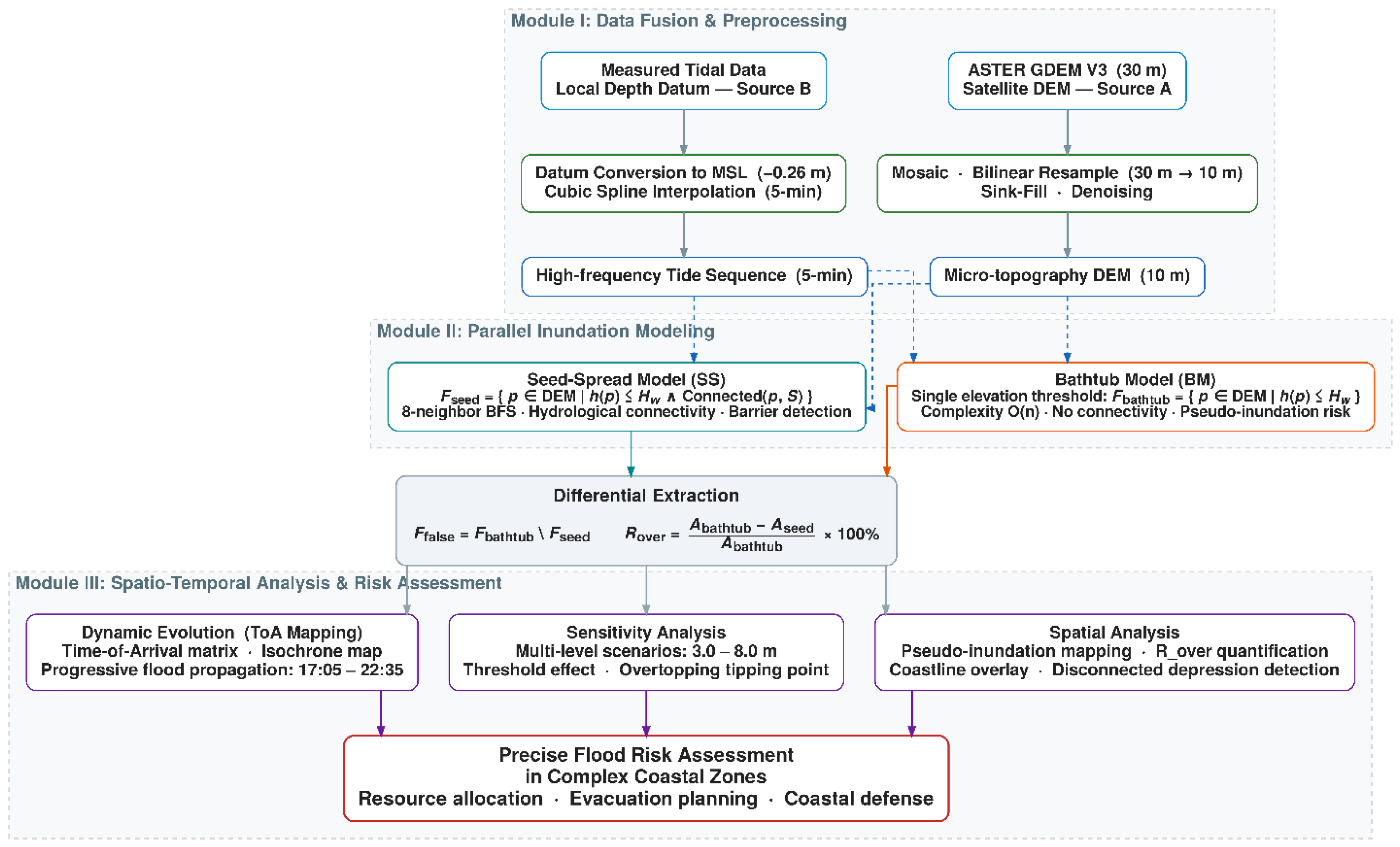
To address the failure of the traditional bathtub model to account for the blocking effects of topographic barriers, and to overcome the lack of dynamic evolutionary characteristics in existing connectivity assessments, this study develops a dynamic seed-spread inundation model coupled with high-resolution micro-topography and driven by high-frequency tidal data. The overall research framework and modeling workflow, as illustrated in
Figure 1, consist of three modules.
Module I Data Fusion and Preprocessing: This module accurately integrates high-frequency tidal sequences at 5-min intervals with a micro-topographic DEM downscaled to a 10 m resolution.
Module II Parallel Inundation Modeling: This module runs a hydrological connectivity-based seed-spread model and a single-threshold bathtub model in parallel. By comparing the mechanistic differences between the two, spatial computations are employed to extract false inundation areas and quantify the corresponding area overestimation rates.
Module III Spatio-Temporal Analysis and Risk Assessment: This module integrates dynamic inundation evolution, multi-scenario sensitivity analysis, and spatial overlay calculations to ultimately generate precise flood risk assessments for complex coastal zones.
2.1. Data Sources and Processing
This section systematically completes the collection, generation, and preprocessing of all fundamental data required for tidal flat inundation analysis. It constructs a unified baseline multi-source spatial dataset, which lays the foundation for subsequent model driving and algorithm implementation.
2.1.1. Tidal Data
The tidal data for this study are obtained from the public tidal platform Dayu Tide Table [
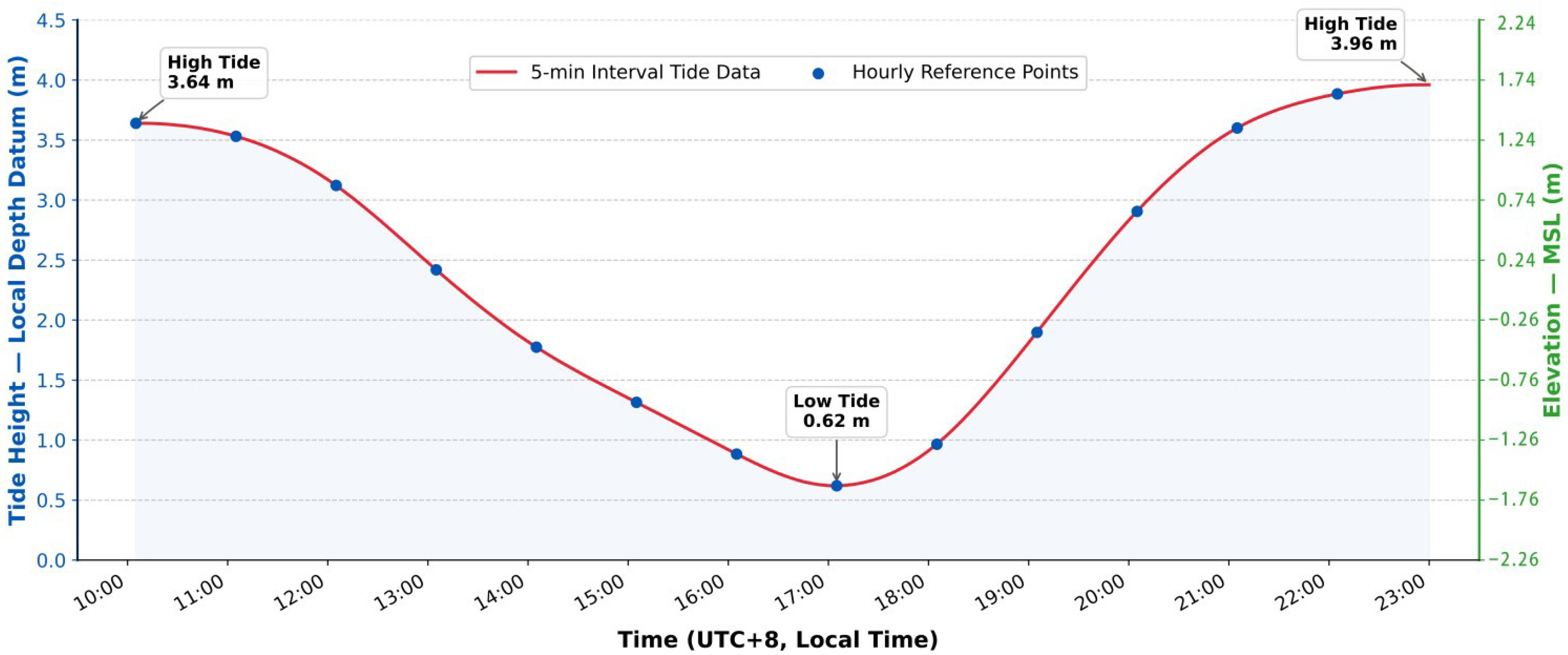
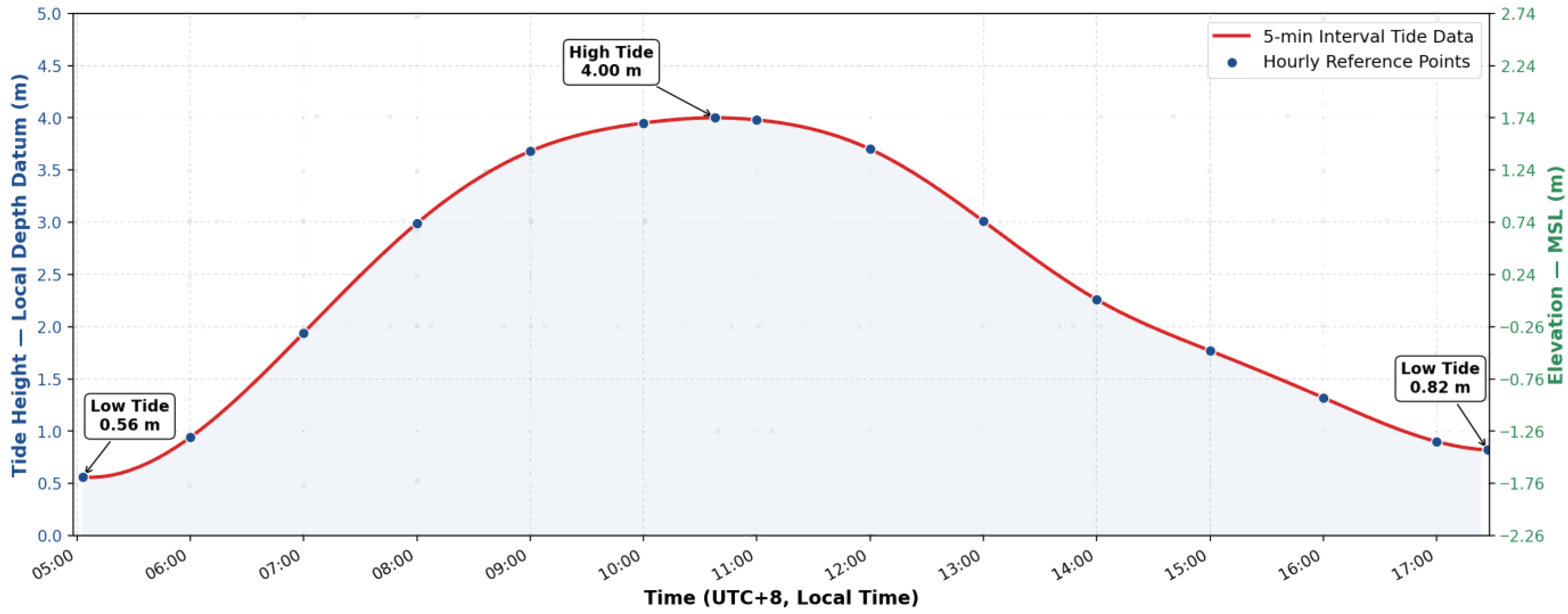
21], from which hourly tide levels and high and low tide extreme data for 8 September 2025 are extracted. Given that the tidal range is the key driving factor determining the inundation extent and hydrodynamic processes of tidal flats, the tide levels on this day exhibit significant spring tide characteristics. The highest tide level reaches 3.96 m, the lowest is 0.62 m, and the maximum tidal range is up to 3.34 m, making it highly representative as a typical scenario. To accurately depict the dynamic processes of inundation and exposure, this study selects the period from 10:05 to 22:54 as the driving boundary for the model. This period totals 769 min. Its hydrodynamic process sequentially recedes from the initial high tide of 3.64 m at 10:05 to the extreme low tide of 0.62 m at 17:08, and subsequently climbs to the highest tide of 3.96 m at 22:54. This continuous time series accurately maps the complete physical cycle of the tidal flat from ebb exposure to flood inundation, fully aligning with the requirements of the dynamic model for driving boundaries.
Given that the original forecast data are discrete hourly points, to meet the demand of the dynamic inundation model for high-resolution continuous boundary conditions, this study introduces the cubic spline interpolation method to downscale and reconstruct the discrete tide levels. Tidal fluctuations in nature are continuous physical processes driven by tide-generating forces and possess strong smoothness. Cubic spline interpolation constructs a piecewise cubic polynomial between adjacent time nodes
and
as follows
where
t is the target interpolation time corresponding to the specific time points divided by a 5-min step in this study;
is the starting time node of the known discrete tidal data;
is the reconstructed tide level value at any time
t within the time interval from
to
; and
,
,
, and
are the unknown polynomial coefficients within this interval. By applying first-derivative and second-derivative continuity constraints at the interpolation nodes, this method effectively avoids the pseudo-corners that conventional linear interpolation tends to produce at the nodes. Based on this algorithm, this study successfully interpolates and reconstructs the hourly and extreme data into a smooth tide level curve with a 5-min time step, as shown in
Figure 2. This processing approach maximizes the restoration of the true physical morphology of tidal fluctuations.
Building upon achieving the temporal continuity of the tidal driving series, to ensure the consistency of elevation calculations in three-dimensional space between the hydrological driving boundary and the topographic data, it is necessary to perform a strict vertical datum alignment on the original tide levels. The satellite micro-topographic dataset used in this study natively adopts the EGM96 geoid as the vertical elevation datum, which is equivalent to the global Mean Sea Level (MSL) in spatial mapping and physical oceanography applications. However, original tidal forecasting systems typically use the local theoretical depth datum as the starting zero point, and an inherent spatial elevation difference exists between the two. Therefore, all reconstructed tide levels need to be uniformly converted to the MSL elevation system. The specific datum conversion formula is defined as
where
is the converted MSL elevation,
is the original tide height observation obtained from the tide table, and 2.26 m [
21] is the elevation difference constant from the theoretical depth datum of the study area to the MSL. By implementing this systematic elevation shift of negative 2.26 m, the high-frequency tide level series is accurately mapped onto a unified vertical datum that matches the micro-topographic DEM. The comparison of the water level series before and after interpolation and datum conversion is shown in
Figure 2.
Following the vertical datum adjustment, the baseline tidal range spans from m to m, peaking at a Highest Astronomical Tide (HAT) of m. However, severe inland flooding is rarely caused by tides alone; it typically occurs when storm surges coincide with these high tides. Historical records from the Chinese coast show that severe typhoons generally generate extreme surges between m and m. To test how the two models perform under such extreme conditions, we simulated a compound hazard scenario. By adding a representative m storm surge to the HAT, the simulated water level shifted to a range of m to m. We therefore adopted m as the final water level threshold for our extreme inundation tests.
2.1.2. DEM Data
This study utilizes the ASTER GDEM V3 with a 30 m spatial resolution [
22,
23] as the foundational topographic data, and extracts coastline vector features from an open-source geospatial database [
24]. To ensure the consistency of multi-source data in spatial analysis, the horizontal coordinates and vertical datums of all datasets are strictly unified to the WGS 1984 coordinate system and the MSL elevation system, respectively.
In the preliminary data preprocessing stage, multiple raw topographic scenes covering the study area were first mosaicked, with invalid edge null values removed. To prevent numerical truncation errors and preserve the sub-meter elevation precision required for subsequent hydrodynamic inundation modeling, the mosaicked terrain matrix was converted directly from its native 16-bit integer format to a 32-bit floating-point data structure. Subsequently, the topological boundary of the study area was constructed based on hydrological features and administrative borders, which was then used as a mask to extract the target terrain. Recognizing that the native 30 m coarse-resolution grid is prone to hydrological connectivity misinterpretations, such as creating digital dams or false artificial connectivity, this study employed bilinear interpolation to downscale and resample the DEM to a 10 m spatial resolution. This step smooths the surface elevation and improves the overall fluid-routing characteristics of the grid. However, the physical width of coastal seawalls and breakwaters in the study area is typically only 3 m to 10 m. During the topographic downscaling and rasterization process, such linear and abrupt elevation changes are highly susceptible to the smoothing and averaging effects of the surrounding extensive low-lying pixels. The resulting loss of physical flood-defense elevations disrupts local surface topology, causing simulated floods to prematurely propagate inland through these digitally flattened pseudo-channels before the actual overtopping threshold is reached. To rectify this micro-topographic distortion caused by grid resolution limitations [
25], this study employs an elevation burning algorithm for topographic reconstruction [
26] to accurately restore the continuity of the seawalls’ water-blocking elevations in the digital model.
The spatial processing logic and mathematical implementation are as follows: First, a spatial buffer was generated based on high-precision seawall vector lines and their actual base widths. This buffer was then converted into a raster mask perfectly aligned with the spatial reference of the primary terrain, denoted as the target modification area
. Second, the design crest elevation of the standard seawall was obtained according to the tidal defense standards of Dinghai District, Zhoushan City, and the actual conditions of the Seawall Safety Project. After eliminating the systematic deviation between the national elevation datum and the MSL, the absolute defense elevation of the seawall under the unified vertical datum was set to
m. Finally, using this mask as the spatial constraint boundary, a conditional reconstruction was executed for any pixel coordinate
within the terrain matrix. The elevation modification formula is defined as
where
is the reconstructed pixel elevation, and
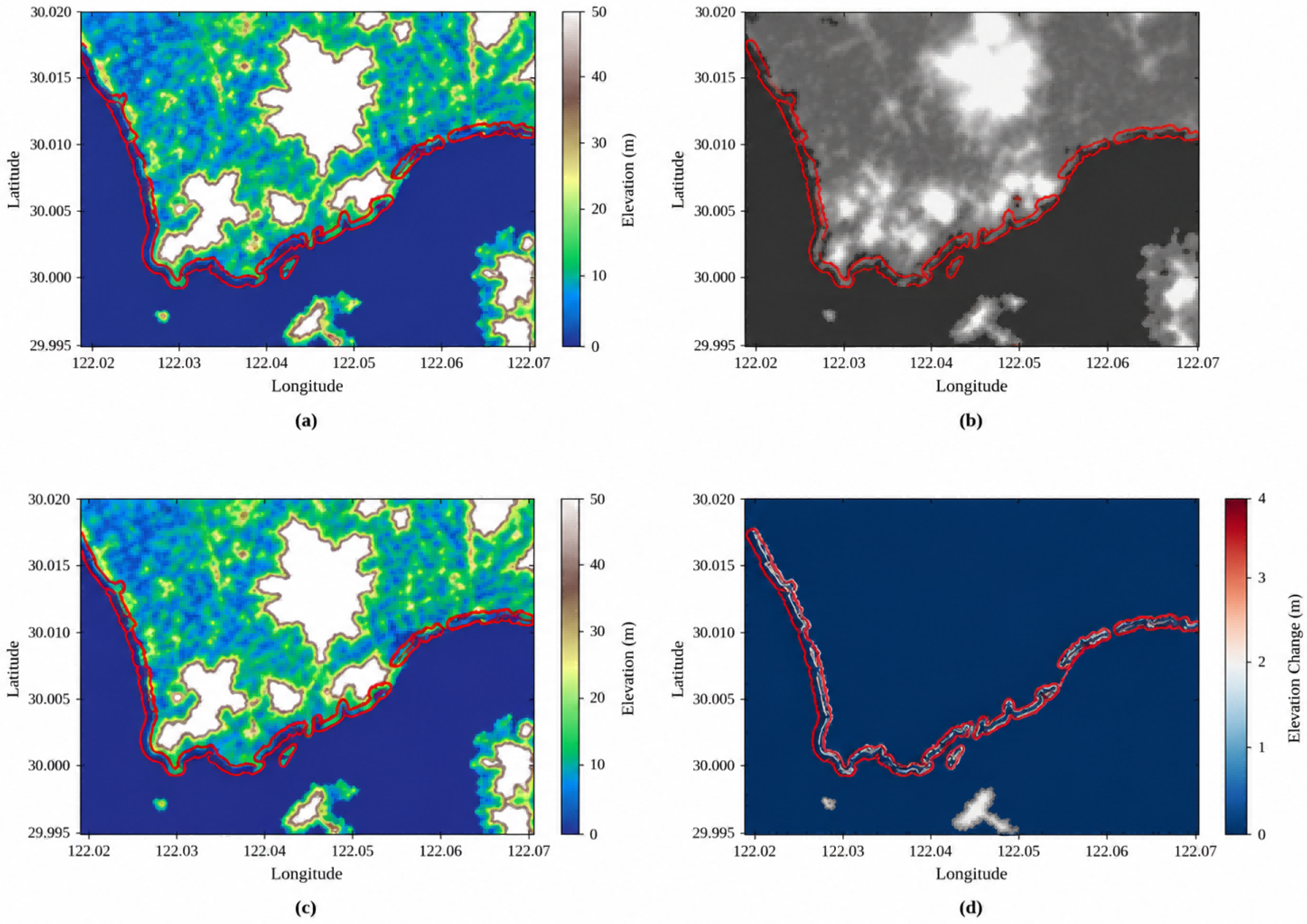
is the initial pixel elevation of the original 10 m resolution digital terrain. By utilizing the maximum value function for non-linear elevation replacement, this mechanism prevents the unnatural flattening of natural highland edges (e.g., mountainous terrain intersecting with seawalls) caused by forced assignment. Simultaneously, it accurately elevates the low-lying seawall pixels, which were previously lost to spatial smoothing, back to the design defense elevation. Through the coupled processing of the aforementioned downscale resampling and vector feature burning, this study effectively repaired the elevation deficits and spatial discontinuities of the flood barriers. The physical continuity of the seawall’s water-blocking boundary was restored in the digital model. The topological effect of this elevation correction is illustrated in
Figure 3.
Furthermore, due to inherent temporal discrepancies in acquiring multi-source heterogeneous datasets, compounded by intense dynamic surface evolutions such as coastal land reclamation, some extracted seawall vectors may exhibit minor spatial projection offsets of one to two pixels relative to the original land–water interface of the terrain data. Despite this geometric deviation, within the topological context of grid computation, the reconstructed elevation barrier still establishes a continuous and closed physical defense line at the forefront of the land–sea boundary. This processing not only preserves the seawall’s blocking mechanism against external water intrusion but also ensures that such minor offsets do not significantly interfere with the inundation progression and hydrodynamic routing of inland floods.
2.2. Dynamic Connectivity Algorithm Based on 8-Neighbor Seed-Spread Model
This study incorporates hydrological connectivity constraints to construct a dynamic flood inundation algorithm based on the 8-neighbor seed-spread algorithm, an approach that has emerged as a mainstream methodology for rapid, large-scale coastal flood assessments [
15].
2.2.1. Definition of Initial State and Spreading Rules
At the initial stage of the algorithm, the vector coastline boundary extracted during the aforementioned preprocessing is rasterized and defined as the initial Source. Within a single fixed time step, the propagation of water flow strictly follows the Breadth-First Search (BFS) logic, spreading outward based on the 8-neighbor topological relationship (i.e., up, down, left, right, and the four diagonal directions) of the central cell [
16]. For an adjacent cell to be classified as inundated, it must simultaneously satisfy two strict conditions: first, the elevation condition, meaning the DEM elevation value of the cell must be lower than the tide or flood water level set for the current time step; second, the topological connectivity condition, meaning the cell must be spatially adjacent to at least one already inundated cell, effectively eliminating spurious isolated inundation pools [
17]. Through the continuous pushing and popping of the BFS queue, the algorithm systematically inspects boundary cells layer by layer until no adjacent cells satisfy the elevation condition at the current water level, thereby completing a single spatial spreading calculation for that time step.
2.2.2. Temporal Dynamic Progression and Overtopping Mechanism
The actual ebb and flow of tides is an inherently continuous dynamic process. As time advances from
to
, rather than independently recalculating at each time step, the model introduces a historical state inheritance mechanism. Specifically, the algorithm utilizes the final inundation boundary calculated at time
as the initial source set, acting as the expanded seed points for time
. This temporal dynamic progression mechanism accurately captures the physical process of flood overtopping. For instance, when tidal waters encounter a high-elevation seawall or natural ridge at time
, the propagation halts at that location because the elevation condition is not met. However, as time advances to
and the water level continues to rise, surpassing the obstacle’s elevation, the water accumulated at the forefront of the obstacle, represented by the seeds inherited from
, satisfies the condition to breach the barrier, subsequently continuing its spread into the low-lying hinterland behind the obstacle. This mechanism strictly adheres to the physical principles of flow obstruction, water accumulation, and eventual overtopping, fundamentally eliminating the false inundation phenomenon prevalent in traditional bathtub models, which fail to account for physical barriers [
6,
7].
2.3. Quantification of the Spatio-Temporal Evolution Characteristics of Inundation
To comprehensively analyze the flood inundation process and verify the advantages of the connectivity algorithm, this study constructs a quantitative evaluation system for inundation characteristics from two dimensions: spatial distribution and temporal evolution.
2.3.1. Spatial Accuracy Assessment
To quantitatively evaluate the impact of hydrological connectivity constraints on the extraction accuracy of the inundation extent, and to quantify the simulation differences between the two models, this study defines two evaluation metrics: Overestimation Rate (
) and False Inundation Zone (
). Specifically,
is used to measure the extent to which the bathtub model exaggerates the inundation area due to its neglect of topographic blocking effects. Meanwhile,
identifies, from a spatial topological perspective, the areas with elevations lower than the water level that remain dry due to a lack of hydrological connectivity. Similar comparative metrics have been widely adopted in recent flood modeling studies to quantify the inherent limitations of static approaches and emphasize that realistic flooding cannot be merely simplified as filling a bathtub [
6,
9,
19].
The calculation formula for
is defined as
where
is the total inundation area calculated by the traditional bathtub model, and
is the actual inundation area derived from the connectivity-based spreading algorithm.
Furthermore, the
area is calculated via a difference operation between the Boolean inundation rasters generated by the two models. The calculation formula for
is expressed as
where
and
represent the sets of spatial inundation cells for the bathtub model and the spreading model, respectively. The extracted
areas correspond to the low-lying enclaves protected by flood-control levees or high ground.
2.3.2. Temporal Evolution Quantification
In dynamic evolution analysis, the sequence in which water reaches each area is a critical indicator for early warning forecasting, emergency rescue response, and the development of adaptation pathways [
8,
19]. This algorithm introduces the First State Jump Principle to record temporal information. Throughout the entire simulation cycle, the algorithm monitors the state matrix of each pixel in real time. When a pixel’s state first transitions from a Dry state of 0 to a Wet state of 1, the system immediately captures the current timestamp
T and writes it into the pixel’s attributes. In subsequent time steps, even if the water depth of the pixel continues to increase, its time record is no longer updated. After traversing the entire simulation period, the model outputs a ToA raster matrix containing a complete temporal gradient. Based on the ToA matrix, dynamic isochrones can be generated using contour extraction tools. The spatial distribution of isochrones intuitively reveals the non-linear propagation dynamics of the overland flow: areas with dense isochrones indicate slow flood advancement, reflecting high topographic resistance (e.g., seawalls or urban blocks) or gentle slopes; conversely, areas with sparse isochrones represent rapid water spreading, typically corresponding to flat and unobstructed low-lying terrains [
10]. This quantitative method provides a visual analytical means for evaluating the flood retardation effect under complex micro-topography.
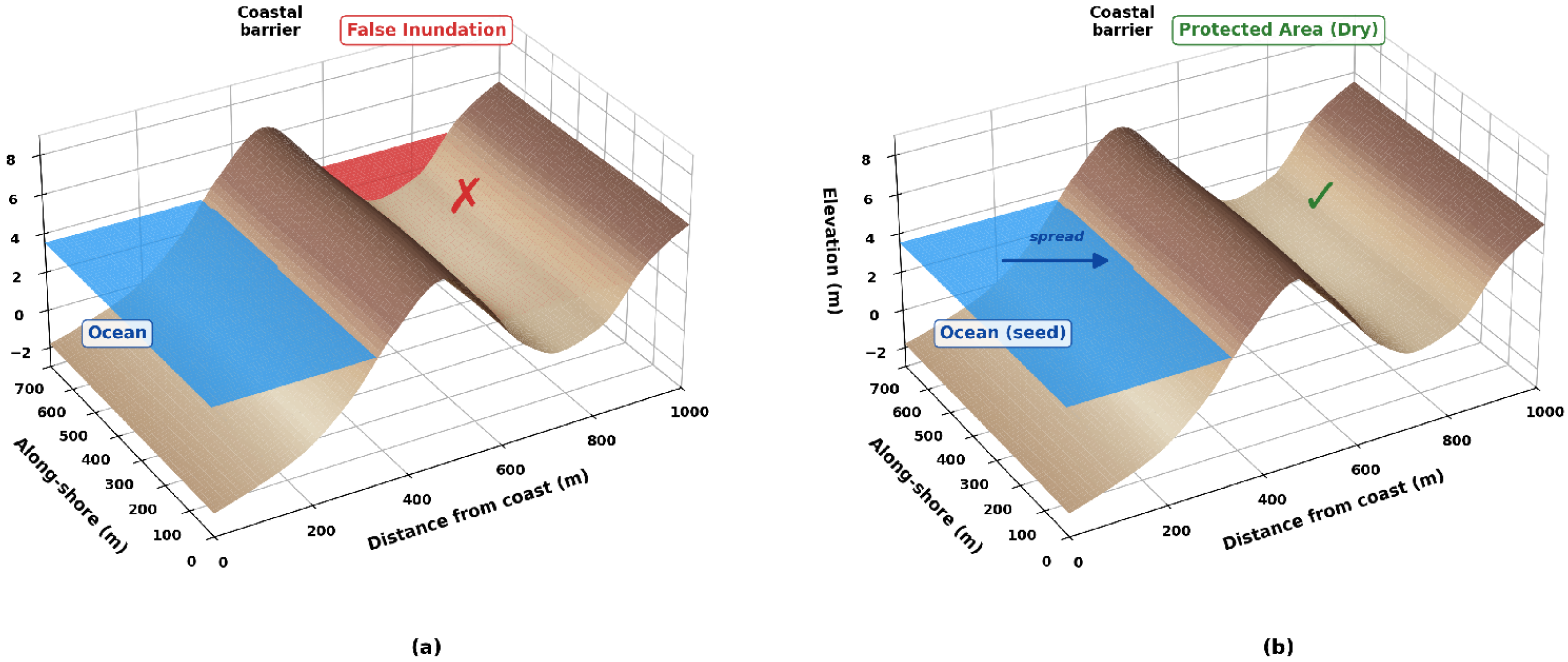
Figure 4 provides a 3D conceptual comparison of the two models.
Figure 4a shows the false inundation caused by elevation-only filling in the bathtub model, while
Figure 4b illustrates the connectivity-based realistic routing of the seed-spread model that respects topographic barriers.
3. Experimental Design and Results Analysis
3.1. Study Area and Scenario Configuration
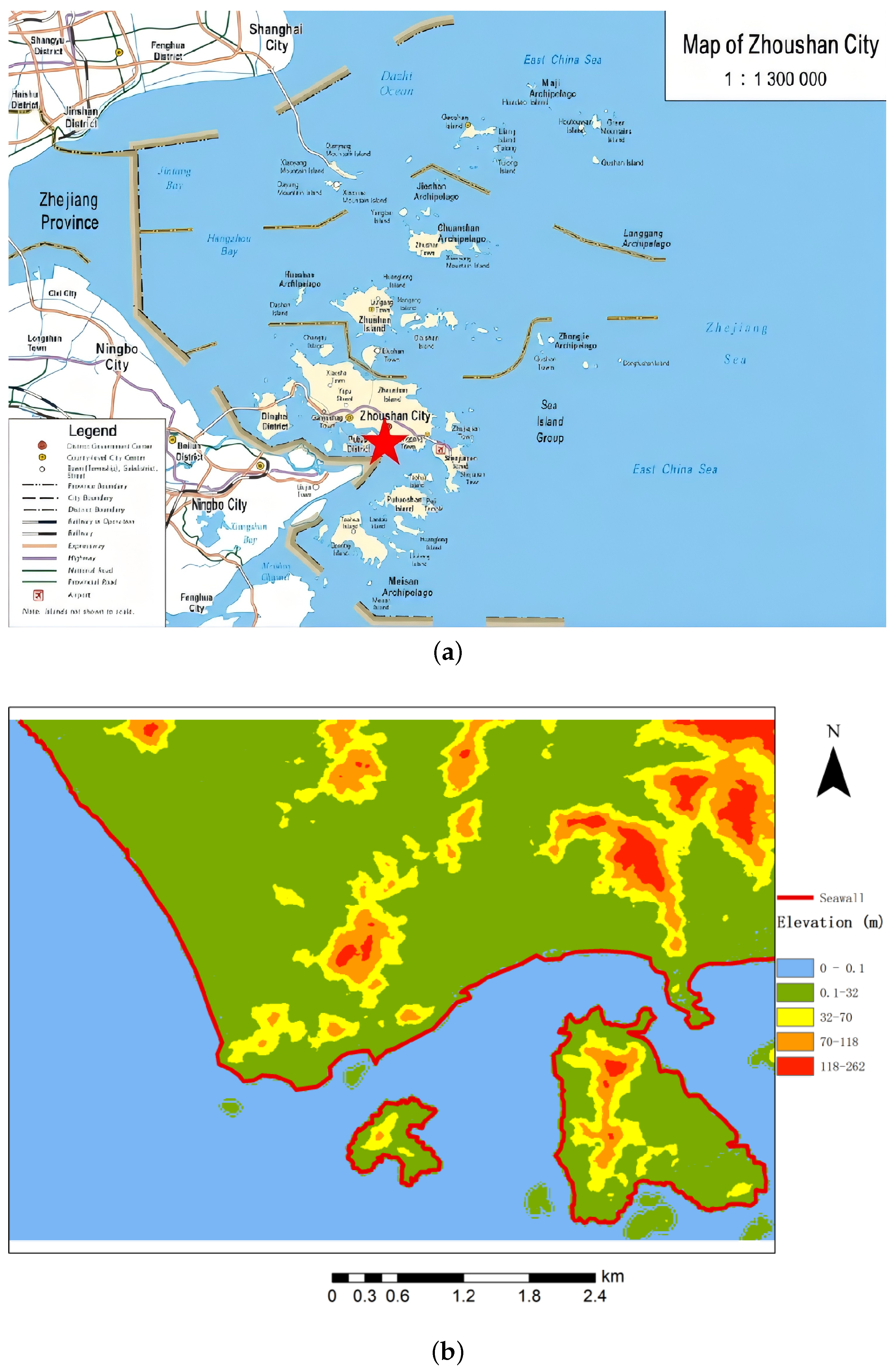
This study selects the coastal area of Yancang Subdistrict and its adjacent regions in Dinghai District, Zhoushan City, as the typical study area, as shown in
Figure 5. Located at the forefront of the East China Sea, the Zhoushan Archipelago is one of the coastal regions in China most severely affected by typhoons and storm surges, as well as compound flooding [
27,
28,
29]. Consequently, conducting accurate storm surge inundation simulations is crucial for improving regional urban flood resilience [
30]. The study area exhibits a typical interleaved spatial pattern of mountains, city, and sea. As illustrated in the DEM in
Figure 5, the periphery is predominantly natural hilly terrain reaching up to 262 m, while the central and southern coastal areas are densely populated, asset-rich, low-lying alluvial plains. To defend against storm surges, a continuous seawall system has been constructed along the coastline. The primary rationale for selecting this region as the algorithm testbed is the prevalent topographic inversion phenomenon protected by artificial barriers. Specifically, the absolute elevation of the low-lying hinterland behind the seawalls is frequently lower than extreme high water levels. In such complex scenarios, the traditional bathtub model is highly prone to misclassifying these protected zones, represented by the green areas in
Figure 5, as inundated zones because it lacks connectivity constraints and cannot identify physical barriers. In actual physical processes, seawater propagates inland only when it surges above the seawall crest and overtopping occurs. Therefore, the pronounced topographic blocking effect of Yancang Subdistrict provides an ideal scenario for validating the core advantages of the proposed algorithm in eliminating false inundation and quantifying the time of arrival of inundation. To evaluate these capabilities, extreme water level scenarios ranging from 2.9 m to 4.0 m were configured for comparative assessment.
To meet the computational demands of high-resolution and long-term dynamic simulations, the model construction and algorithm execution in this study were implemented in a Python 3.9 environment. To ensure computational robustness and manage massive spatial data throughput, scenario testing across multiple water level gradients and continuous dynamic simulations was deployed on a workstation equipped with an Intel Core i9-12900K processor and 64 GB of RAM, running the Windows 11 operating system. For spatial data processing, automated batch processing for coastline extraction, the mosaicking of high-precision 32-bit floating-point DEMs, and the reconditioning of micro-topographic coastal defense elevations were accomplished utilizing open-source geospatial libraries, specifically GDAL/Rasterio and GeoPandas. The core algorithm, driven by 5-min high-frequency tidal forcing, utilizes BFS and historical state inheritance mechanisms implemented via NumPy (version 1.26.0) and SciPy (version 1.11.4) scientific computing libraries. This architecture transforms the spatial topological search into vectorized raster matrix operations and dynamically updates the wet–dry states of pixels within in-memory arrays. Consequently, this effectively circumvents the overhead associated with frequent disk Input/Output (I/O) operations during continuous simulations, significantly optimizing memory scheduling for large-scale grids.
3.2. Overall Inundation Differences
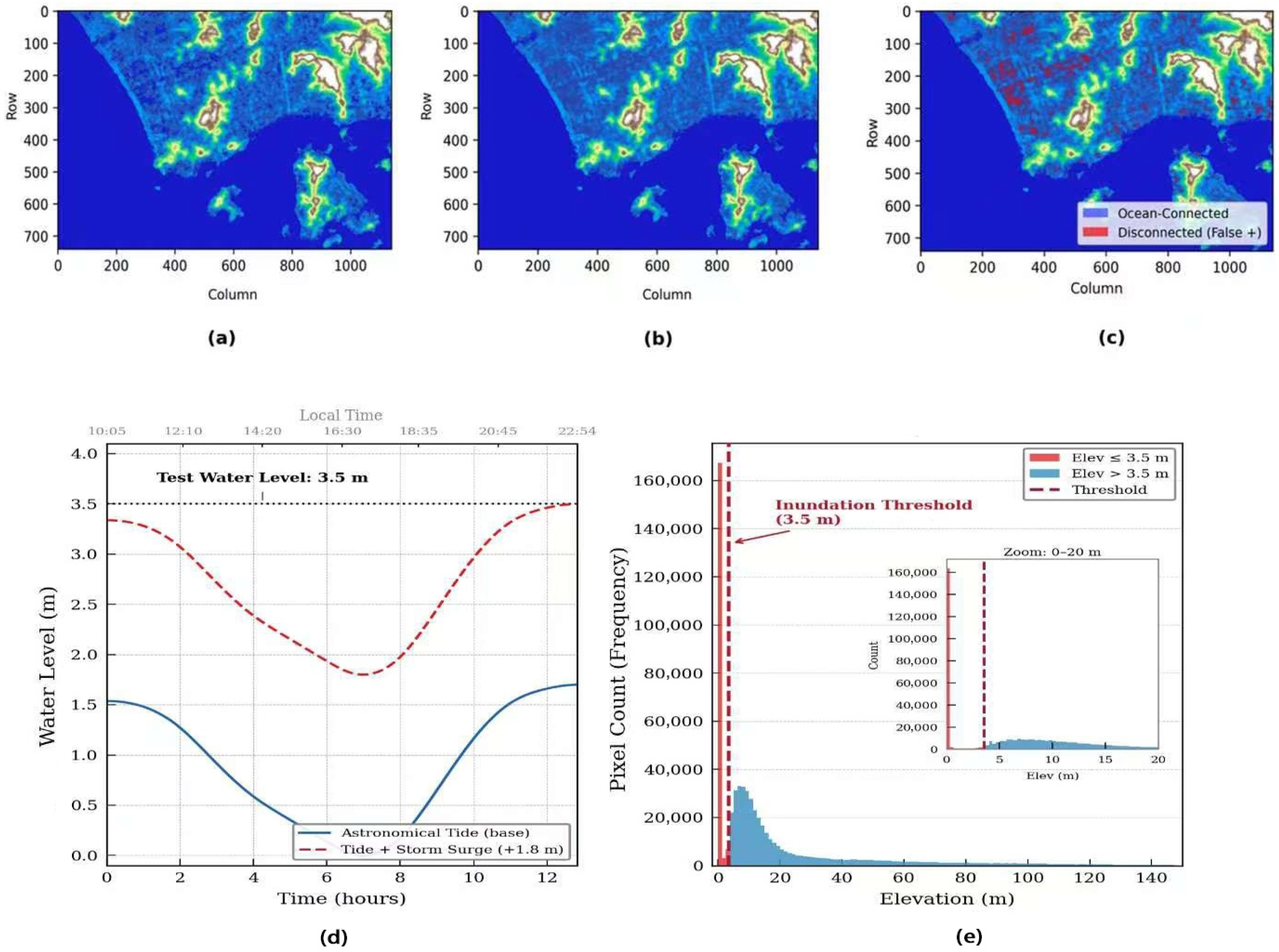
Following the compound hazard scenario outlined above, an extreme Total Water Level (TWL) of 3.5 m was adopted as the baseline for inundation testing. Here, TWL represents the absolute elevation of the ocean surface relative to the DEM vertical datum. It is not merely sea-level rise, but a composite of high tides, extreme storm surges, and potential future sea-level anomalies. While hydrodynamic simulations conventionally start from a mean tide level to achieve initial equilibrium, we purposefully initialized the model at this peak high-tide level to simulate a worst-case scenario. This direct initialization allows the model to immediately capture maximum hydrodynamic stress and rapid inundation propagation, thereby yielding a conservative and robust estimation for coastal disaster management. A comparison of the simulation results between the two models is presented in
Table 1 and
Figure 6.
The quantitative results presented in
Table 1 reveal a significant difference in the inundation areas extracted by the two models. Since the bathtub model relies solely on elevation thresholds, it includes all low-lying areas below the TWL, yielding a total inundation area of 40.07 km
2, equivalent to 400,650 pixels. In contrast, the 8-neighbor seed-spread algorithm, which incorporates hydrological connectivity constraints, successfully excludes areas disconnected from the ocean, reducing the actual extracted inundation area to 39.66 km
2. The pixel-level statistical comparison reveals that the bathtub model generates
km
2 and
.
From the perspective of the spatial distribution characteristics illustrated in
Figure 6, the differences between the two models are particularly intuitive. The comparison of
Figure 6a,b shows that, due to the neglect of topographic barrier effects, the inundation extent predicted by the bathtub model appears more fragmented and extensive in inland areas. Specifically, as depicted in the model difference distribution map in
Figure 6c, the red false inundation areas precisely pinpoint the source of error for the bathtub model: these areas are concentrated in inland depressions far from the coastline or in zones blocked by micro-topographic features such as hills and dikes. Combined with the elevation distribution characteristics of the study area shown in
Figure 6e, it is evident that although the absolute elevation of these red areas satisfies the threshold of being below 3.5 m, they do not experience inundation in a real physical scenario due to the lack of an actual flow path connected to the ocean.
The aforementioned quantitative statistics and spatial analysis corroborate each other, fully demonstrating that the bathtub model carries a systematic risk of overestimation when dealing with complex terrain. In contrast, the improved seed-spread model, by incorporating hydrological connectivity, is able to more objectively and accurately reflect the actual extent of coastal inundation.
To explore whether the bathtub model could achieve comparable performance through calibration, a sensitivity analysis was performed by varying its input TWL from 2.9 m to 4.0 m, as summarized in
Table 2. At the true baseline TWL of 3.5 m, the bathtub model inherently overestimates the flooded area by misclassifying 0.41 km
2 of disconnected inland depressions. To force a numerical match with the total area of the seed-spread model (39.66 km
2), the bathtub model’s input TWL must be artificially reduced to 2.9 m (yielding 39.68 km
2). However, this overall area similarity masks significant spatial errors. Arbitrarily lowering the global input TWL to compensate for overestimation fails to completely eliminate false positives in topologically protected inland depressions, while simultaneously causing under-predictions along unprotected open coasts. This demonstrates that modifying a global input parameter primarily scales the overall inundation magnitude but fundamentally struggles to replicate true hydrological connectivity. Consequently, the advantage of the proposed seed-spread algorithm lies in ensuring a physically realistic spatial pattern, addressing a topological issue that simple model calibration cannot resolve.
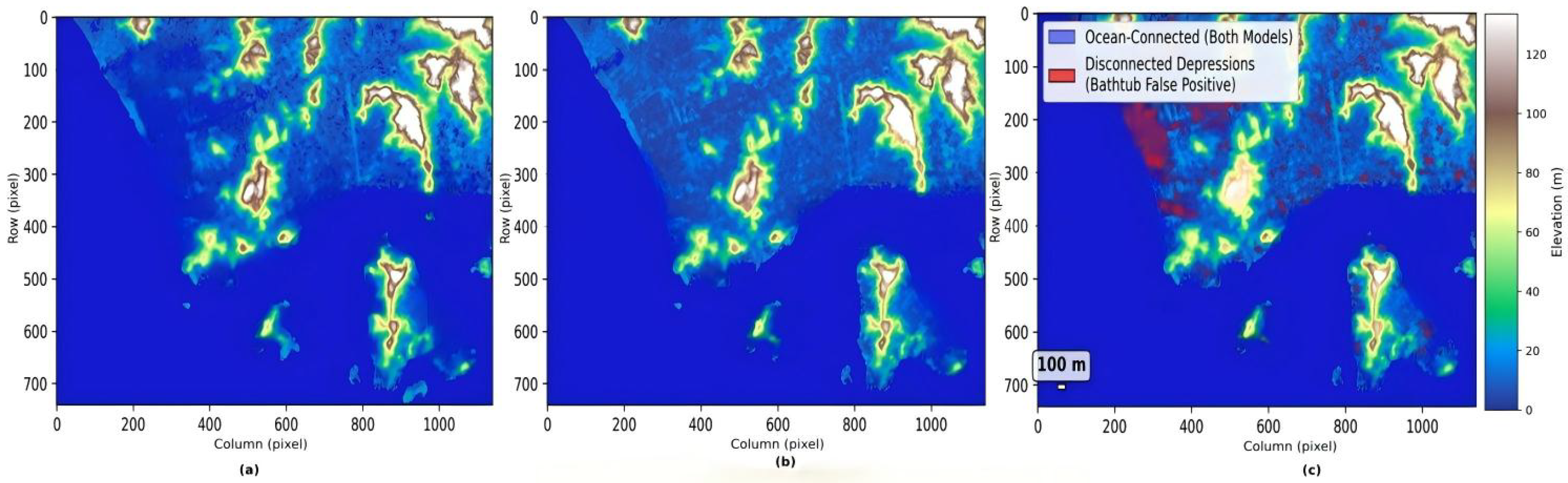
3.3. Spatial Distribution Characteristics and Connectivity Analysis
Figure 7 compares the spatial distribution characteristics of the bathtub model and the improved seed-spread model at a test TWL of 3.5 m. As shown in
Figure 7a,b, the inundation extents of the two models are highly consistent in areas directly connected to the coast. However, the difference distribution map in
Figure 7c intuitively reveals the limitations of the bathtub model, where the red patches clearly indicate numerous false inundation areas that are disconnected from the ocean.
A spatial topological analysis of the aforementioned difference areas reveals that these false inundation areas are not continuously distributed along the coastline; rather, they exhibit significant spatial heterogeneity, scattered as isolated patches throughout the inland study area. Quantitatively, these scattered patches amount to approximately 0.41 km2, constituting a 1.00% false positive rate () in the bathtub model’s total inundation extent. Combined with contour lines and actual topographic features, it is evident that these red patches are all located within enclosed depressions surrounded by natural highlands (e.g., hill remnants, ridges) or artificial barriers (e.g., seawalls, road embankments). Although the absolute elevation within these depressions is lower than the 3.5 m test TWL, they are surrounded by topographic barriers higher than 3.5 m, forming a natural water-blocking ring. The improved seed-spread model, utilizing a path-searching algorithm, accurately identified these elevation barriers and blocked the spreading paths, confirming that in a real physical scenario, seawater is fundamentally unable to overtop these barriers and enter the inland depressions.
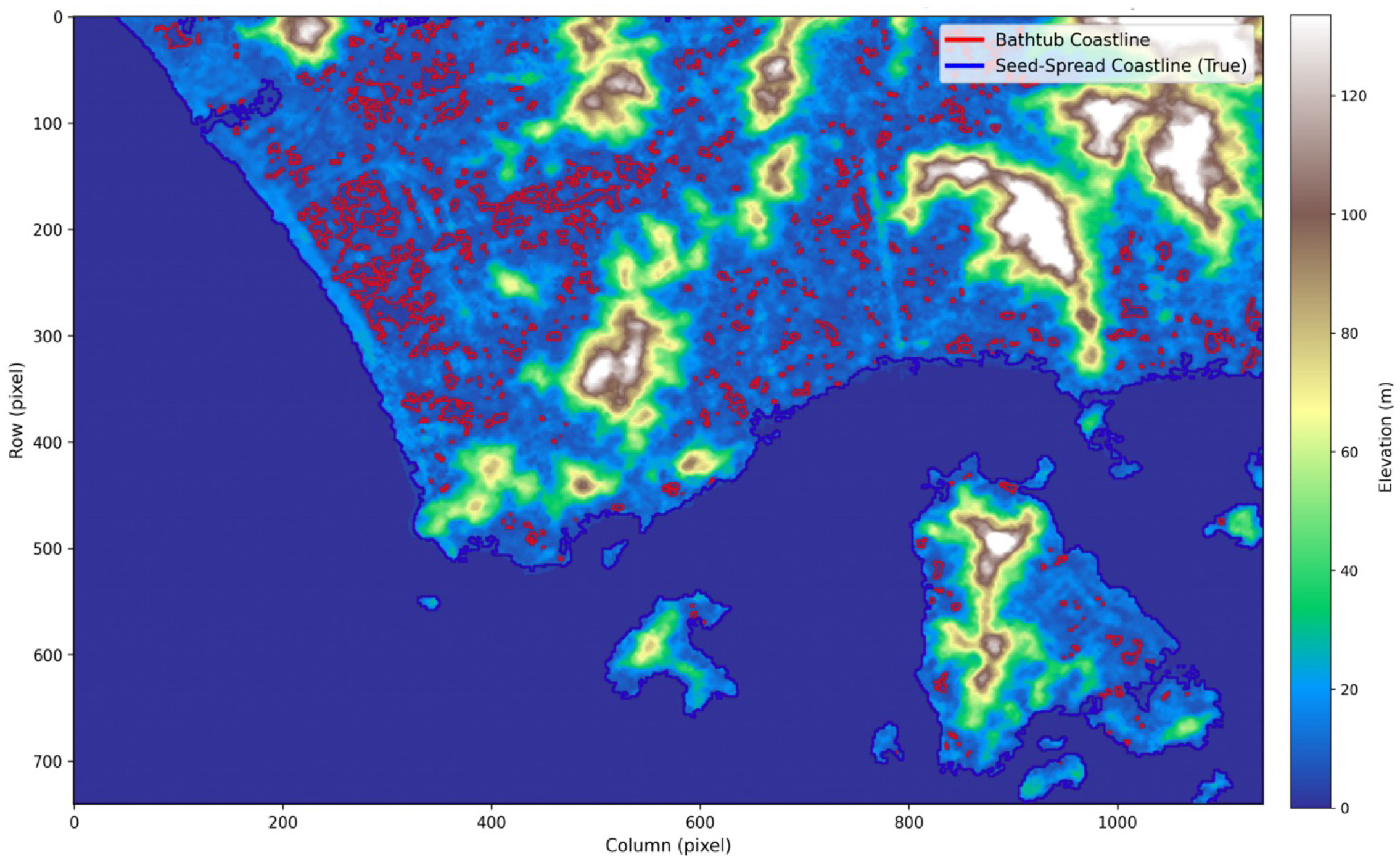
As shown in the overlay results in
Figure 8, the boundaries extracted by the two models largely coincide at the actual coastal interface that is directly connected to the ocean. However, significant discrepancies appear in the inland regions of the study area. Since the bathtub model relies solely on elevation thresholds for judgment, it generates numerous dense and physically meaningless isolated coastline loops, represented by red closed lines, around various enclosed inland depressions. In contrast, the seed-spread model, benefiting from hydrological connectivity constraints, successfully filters out these inland depressions that lack a real seawater connection path.
In summary, the traditional bathtub model’s reliance on absolute elevation makes it highly susceptible to interference from complex, enclosed inland terrain, resulting in extensive false inundation zones and erroneous boundaries. The improved seed-spread model, however, accurately eliminates interference from isolated inland depressions, only retaining the physical coastline that is genuinely connected to the ocean. This further confirms the necessity of incorporating connectivity constraints to enhance the scientific rigor and accuracy of coastal inundation simulations.
3.4. Dynamic Inundation Evolution and ToA Mapping
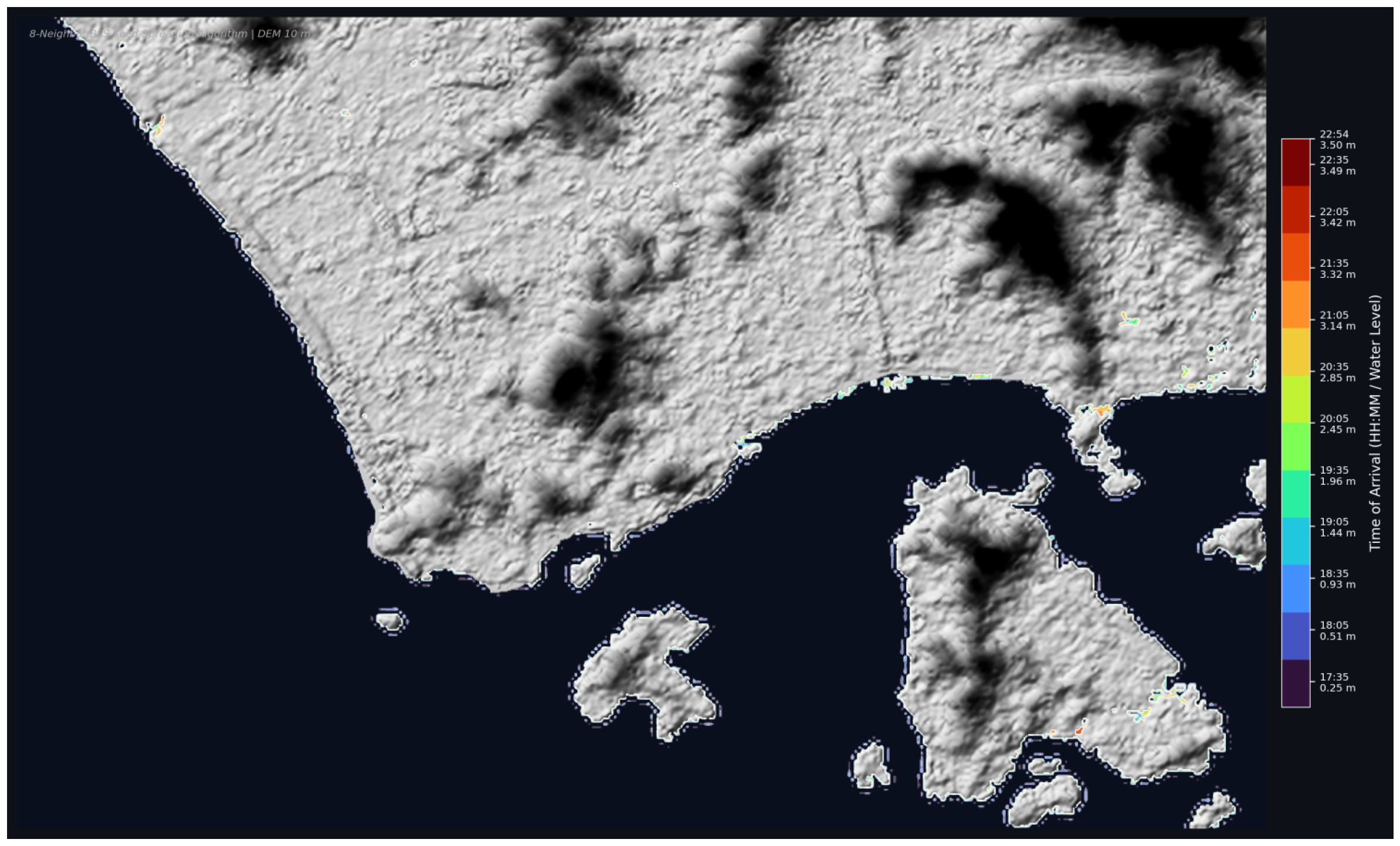
Previous analyses under static extreme TWLs have demonstrated the critical role of hydrological connectivity in eliminating false inundation errors. To further reveal the dynamic spatio-temporal evolution of floodwaters constrained by complex micro-topography, this section conducts continuous dynamic simulations during the flood tide phase. This is achieved using a reconstructed high-temporal-resolution tidal sequence and the eight-neighborhood seed-spread algorithm, thereby extracting the ToA for each spatial pixel. As illustrated in
Figure 9, the resulting map visually delineates the isochrones of flood progression from the sea towards the land using a cool-to-warm color gradient. In contrast to the instantaneous, global inundation assumption of the traditional Bathtub model, which lacks realistic physical mechanisms, this mapping clearly captures the progressive, marginal overflow process governed non-linearly by the terrain.
An analysis of the spatio-temporal distribution in
Figure 9 reveals that, under the
m extreme TWL scenario, the inundation evolution exhibits significant marginal confinement and is effectively intercepted by coastal defense structures. During the early to middle stages of the flood tide (17:35 to 19:35), TWL gradually rises from
m to
m. The dark purple to blue-green areas in the figure indicate that water progression is primarily confined to the outer natural beaches and low-lying exposed mudflats. As the tide continues to climb to
m, the yellow-green to orange bands reflect seawater beginning to penetrate inward along narrow tidal creeks, continuously accumulating at the forefront of the coastline. The most critical phase, approaching the extreme TWL, occurs between 21:05 and 22:54, when the TWL peaks at
m. The dark red areas in the map are distributed closely along the outer side of the artificial seawalls. Quantitative statistics from the simulation further corroborate this phenomenon: throughout the entire flood tide phase, characterized by rapidly surging TWLs, the actual newly inundated land area within the computational domain is a mere
km
2 (accounting for approximately 1.5% of the total area), after excluding approximately 385,000 ocean pixels that were already submerged initially. These evolutionary features clearly indicate that under this extreme compound scenario, the existing natural terrain and coastal engineering defenses serve as a robust physical barrier. No substantial overtopping occurs, effectively severing the hydrological connectivity between the advancing seawater and inland low-lying areas.
Such dynamic mapping, underpinned by high-precision hydrological connectivity, provides an intuitive, time-dimensional reference for assessing flood control pressure in coastal cities and verifying the redundancy of engineering defenses. In practical disaster management, although this extreme compound scenario does not trigger catastrophic inland flooding, the mapping accurately records the duration over which the seawater surges against the coastal defenses. Coastal segments featuring denser red bands indicate that the toes of their seawalls endure high hydrostatic pressure for the longest durations, implying a relatively higher potential risk of seepage and piping. Decision-makers can leverage this mapping to pinpoint these continuously stressed, weak nodes along the seawalls, thereby prioritizing targeted inspections and engineering reinforcements. This mechanism aids in the scientific evaluation of the safety margins of coastal infrastructure before a hazard exceeds engineering design standards. Consequently, it significantly enhances the disaster resilience of complex coastal communities in both spatial and temporal dimensions.
Regarding the added value of the dynamic component, the use of a high-frequency tidal sequence instead of a static TWL provides two distinct advantages. First, it enables the generation of ToA maps, which record the exact time each pixel is first inundated. This temporal information is critical for early warning systems and evacuation planning. Second, the dynamic progression captures the non-linear overtopping process as TWLs gradually rise, revealing threshold effects that static models completely miss. In contrast, a static bathtub simulation can only produce a single binary flood map without any temporal information. Therefore, the proposed dynamic component transforms a simple static assessment into a comprehensive spatio-temporal hazard analysis.
3.5. TWL Sensitivity Analysis and Discussion
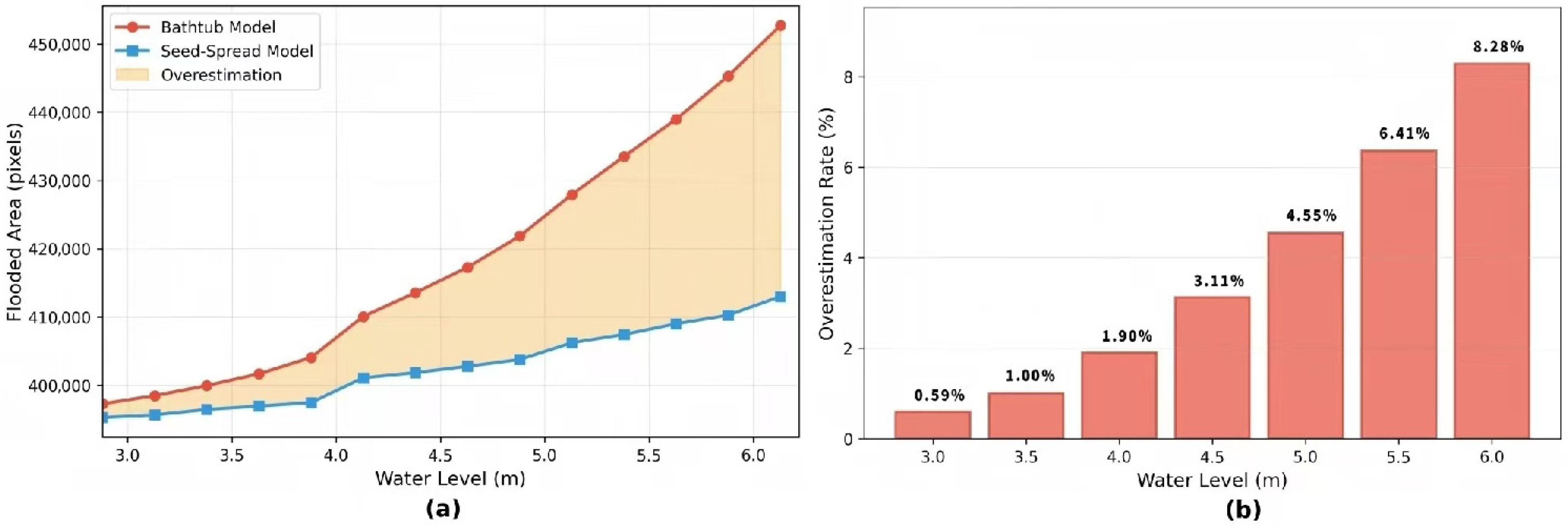
To investigate how the discrepancies between the two models evolve with varying TWLs, this study conducted simulations across a TWL gradient from 3.0 m to 6.0 m. As detailed in
Table 3 and
Figure 10, the statistical results at different TWLs highlight the evolving trends in pixel counts and overestimation rates when comparing the bathtub model to the seed-spread model.
As indicated by the data, the overestimation rate of the Bathtub model does not increase linearly with rising TWLs; rather, it exhibits a non-linear surge. Under the lower water-level scenarios of 3.0 m and 4.0 m, seawater is primarily confined to coastal mudflats and low-lying peripheral areas, having not yet reached the complex inland topography. At this stage, the simulation discrepancies between the two models remain minimal, with the overestimation rate staying at a low level of 0.59% to 1.90%. However, as the TWL progressively climbs and approaches the average elevation of the inland plains, the discrepancies between the models begin to widen rapidly. Notably, as the TWL transitions from 4.0 m to 5.0 m and further to 6.0 m, the difference in inundation area experiences an explosive growth. The overestimation rate jumps sharply from 1.90% to 4.55%, ultimately reaching 8.28%, thereby demonstrating a distinct topographic threshold and inflection point effect.
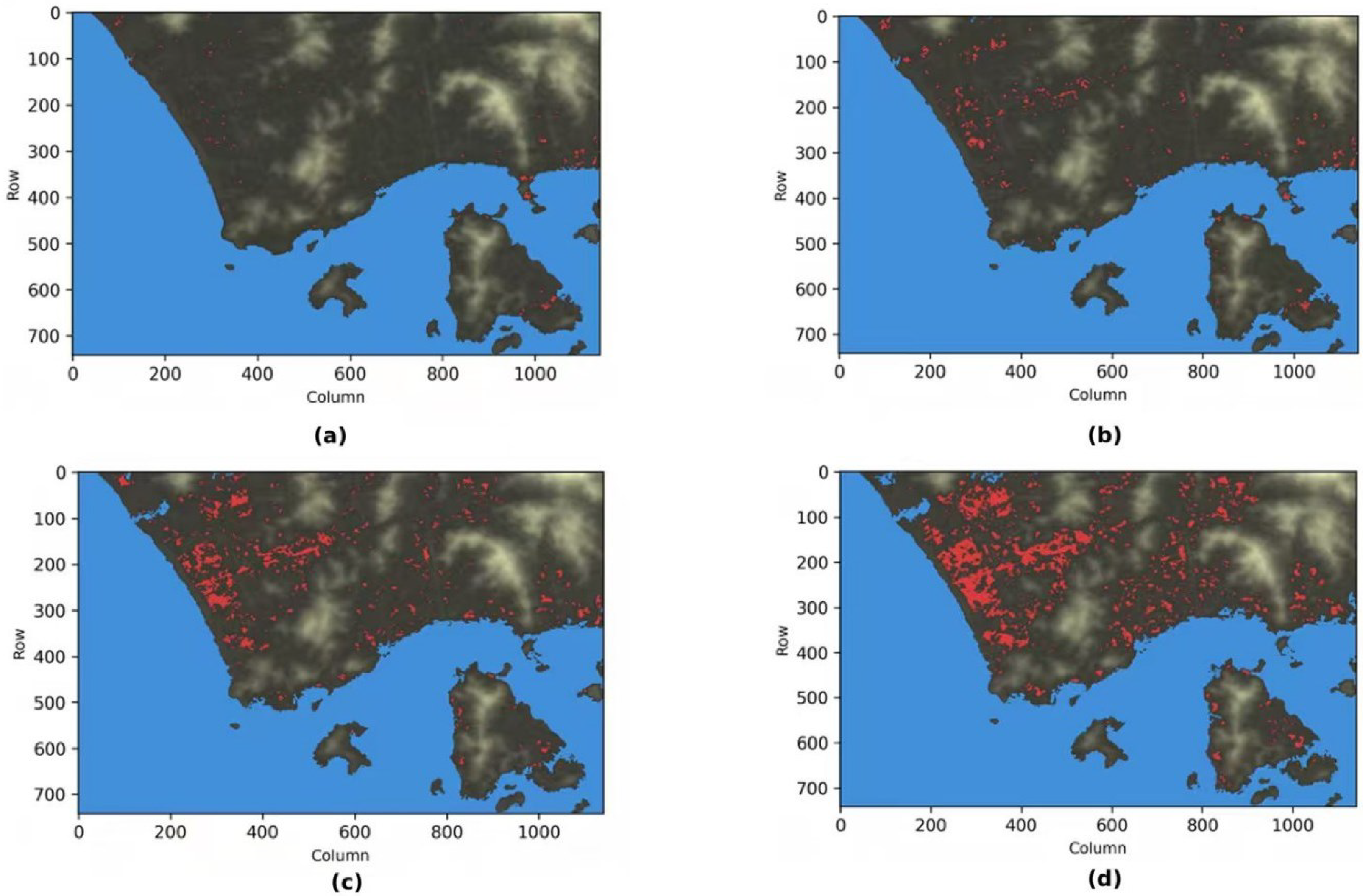
The spatial sequence in
Figure 11 explains the physical cause of these model discrepancies. Blue areas represent correctly flooded zones identified by both models, while red areas indicate false positives, representing the false inundation unique to the bathtub model. When the TWL exceeds 3.0 m, the Bathtub model, which lacks hydrological connectivity constraints, incorrectly simulates flooding across low-lying inland plains located behind coastal defenses. This produces extensive false inundation zones marked in red. In the actual environment, this elevation range is heavily protected by seawalls and breakwaters. The Seed-Spread model accounts for these engineering barriers, preventing unrealistic flood routing. As illustrated in
Figure 11c,d, when the TWL rises between 4.0 m and 6.0 m, floodwaters may overtop certain low defenses. However, many inland depressions remain dry because they are isolated by road networks and elevated micro-topography. The Bathtub model fails to identify these isolated areas since it does not consider a continuous physical path to the flood source. As a result, the simulated false inundation zones extend deeply into inland urban areas. This comparison indicates that ignoring hydrological connectivity in coastal flood modeling can lead to a significant overestimation of inland disaster impacts.
3.6. Robustness Test Based on Independent Tidal Data
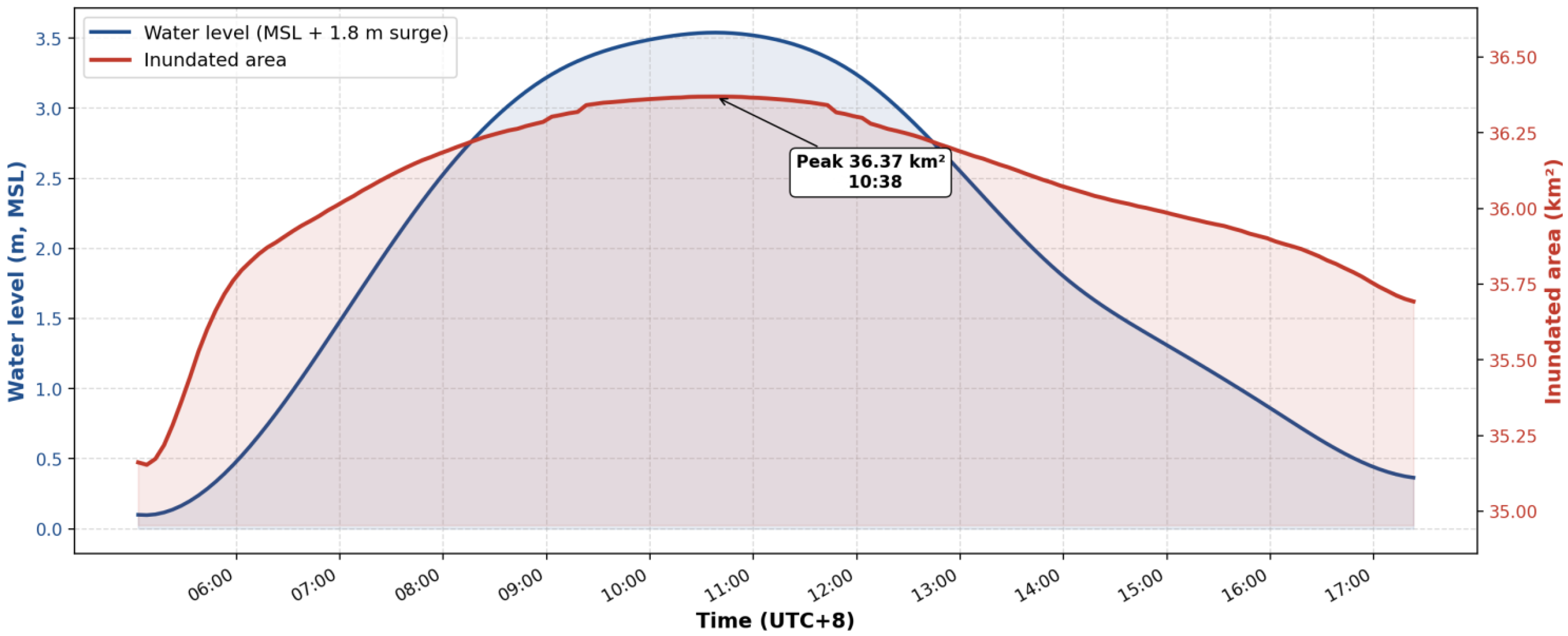
To verify the model’s adaptability and mitigate potential single-event bias, an independent spring tide sequence on 8 October 2025 was selected for further testing. A 1.8 m storm surge was superimposed on the MSL-standardized tidal sequence to serve as the extreme boundary condition, as shown in
Figure 12. All model parameters were kept strictly consistent with those used in the primary experiment.
As illustrated in
Figure 13, the simulated inundated area exhibits a high degree of temporal synchronicity with tidal level fluctuations. The inundation extent begins to expand as the water level rises, reaching its peak at 10:38. At this moment of peak TWL, the net land inundation is recorded as 1.22 km
2, which is defined as the total peak water area minus the initial permanent ocean extent. This trend demonstrates that the model accurately captures the dynamic advance and retreat processes of tidal flooding.
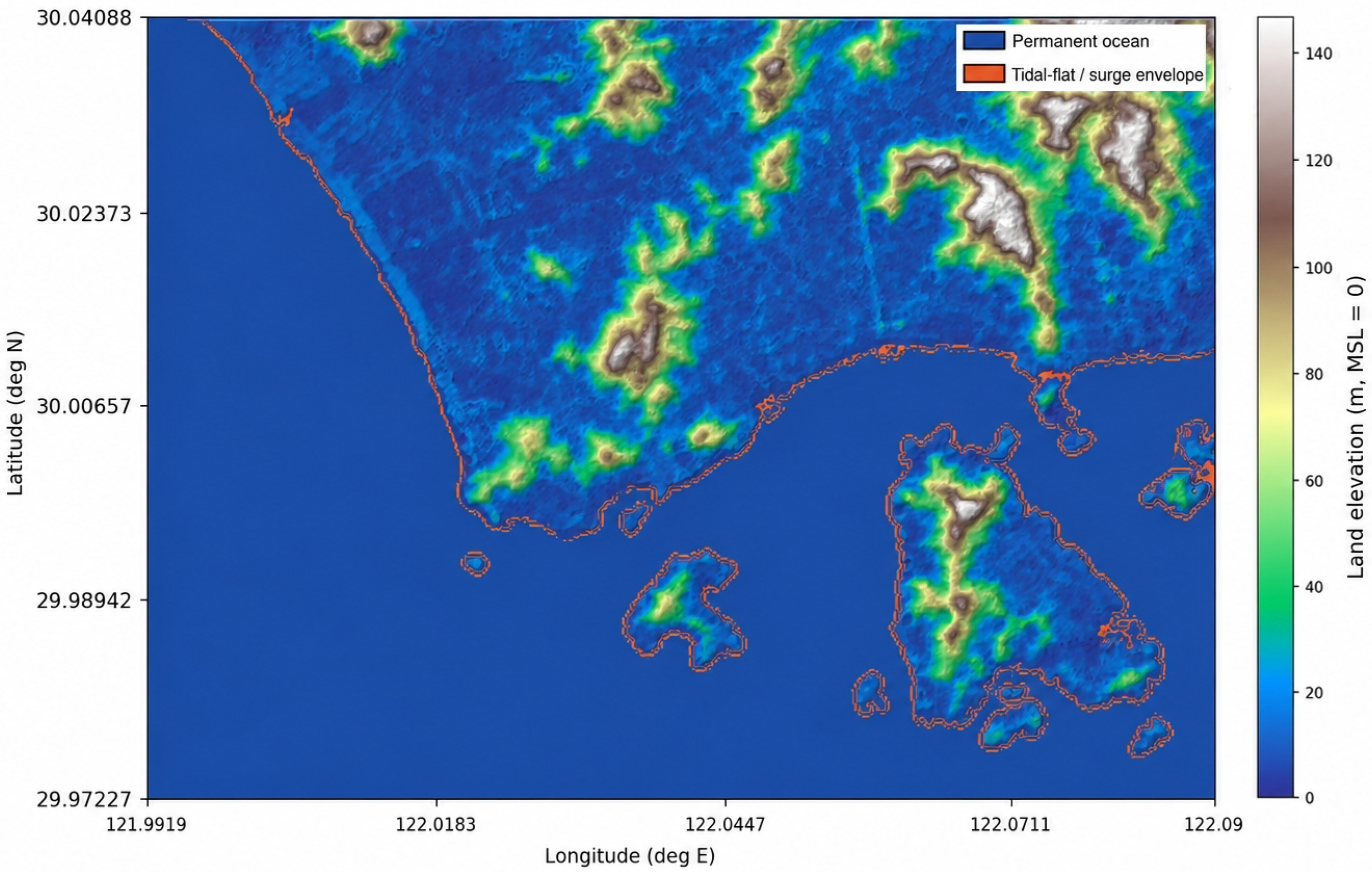
Figure 14 further presents the spatial distribution of the maximum inundation envelope during this extreme tide. The simulation results show that the flooded areas are strictly confined to the narrow coastal fringe and low-lying intertidal zones. Crucially, no pixel-hopping or artificial inland flooding is observed, confirming the model’s capability to preserve the hydrological integrity of protected hinterlands. This spatial pattern indicates that the 8-neighbor connectivity constraint effectively restricts water propagation to physically plausible pathways.
In contrast, under the same TWL conditions, the traditional bathtub model predicts a land inundation area of 15.86 km2, overestimating the risk by approximately 13 times. By incorporating hydrological connectivity, our dynamic model successfully identified and eliminated 14.64 km2 of spatially isolated and false inundation zones. The high consistency between these findings and the primary experiment demonstrates that the model’s performance remains highly stable across varied tidal processes. This reaffirms that the 8-neighbor connectivity approach effectively mitigates overestimation in complex coastal terrains, thereby providing a more reliable quantitative basis for disaster risk management.