1. Introduction
Driven by increasing demands for underwater observation, resource exploration, and multi-platform collaborative operations, the requirements for high-speed, low-latency data transmission among underwater devices have increased significantly [
1,
2]. Owing to its advantages of high bandwidth, low latency, and low power consumption, underwater wireless optical communication (UWOC) has emerged as a pivotal technology for supporting high-definition video transmission, sensor data backhaul, and mobile platform coordination [
3,
4]. However, underwater optical signals are affected by the aquatic environment during propagation. Absorption and scattering in water cause optical power attenuation and pulse broadening. Turbulence effects induced by factors such as temperature and salinity lead to random fluctuations in the received optical intensity [
5]. From the perspective of propagation mechanisms, previous studies first established UWOC channel models that account for water type, absorption and scattering characteristics, and geometric spreading loss to characterize the power attenuation and temporal spreading of optical signals in different aquatic environments [
6]. On this basis, researchers have further used statistical distribution models, such as log-normal and Gamma–Gamma models, to describe the random fading of received optical intensity caused by underwater turbulence [
7]. Recent studies have also examined UWOC channel modeling by considering different water types and turbulence conditions, as well as the optimization of modulation performance in varied aquatic environments [
8,
9]. These studies have laid an important foundation for understanding underwater optical transmission characteristics. Furthermore, UWOC relies strongly on line-of-sight (LoS) links and requires accurate transceiver alignment [
10,
11]. At the same time, underwater communication payloads are typically subject to engineering constraints, including watertightness requirements and limitations on size, weight, and power (SWaP), which often make it difficult to integrate complex acquisition, pointing, and tracking (APT) systems. Moreover, mobile platforms such as remotely operated vehicles (ROVs), autonomous underwater vehicles (AUVs), and divers are susceptible to relative displacements in dynamic oceanic environments, further exacerbating the challenges of link establishment and maintenance [
12].
To address beam misalignment and limited field of view (FOV) in UWOC systems, multi-transceiver arrays and spatial tiling of narrow beams have been used to provide wide-angle coverage [
13,
14]. In commercial implementation, the BlueComm 200 system developed by Sonardyne integrates 450 nm blue LED arrays and high-sensitivity photodetectors, achieving a 180° wide-angle transmission and reception FOV [
15]. Similarly, Hydromea’s LUMA X modem achieves wide-beam UWOC with a 120° conical beam pattern by using multiple LED banks for transmission and up to four active receivers for reception [
16].
In academia, extensive research has been conducted on the design theory and performance optimization of wide-FOV multi-faceted transceiver architectures. The authors of [
17] proposed an omnidirectional transmission architecture based on an icosahedral topological layout using blue LED arrays. A symmetric triangular prism configuration was proposed by the authors of [
18] to achieve quasi-omnidirectional 360° horizontal emission and experimentally demonstrated data rates of tens of Mbps over a 10 m underwater link. The authors of [
19] established a three-dimensional (3D) spatial coverage model for polyhedral transmission structures. By implementing a facet-selection strategy and optimizing parameters such as the beam divergence half-angle and facet deflection angles, the effective spatial coverage volume was significantly enhanced. These studies have demonstrated the effectiveness of multi-faceted structures in extending spatial coverage; however, their focus has mainly been on coverage enhancement at the transmitter side and experimental feasibility validation, with limited attention paid to performance analysis of multi-faceted receiver geometries.
Focusing on receiver performance, the authors of [
20] investigated spatial angular diversity under a selection combining (SC) strategy. The analysis of performance metrics, including the bit error rate (BER), provides a theoretical foundation for efficient wide-FOV detection. In [
21], six independent transceiver units were integrated onto the six sides of a biomimetic robotic fish. Dynamic experimental scenarios validated the operational robustness of this spatial configuration under orientation misalignment and platform motion. Beyond the UWOC field, studies on multi-faceted angular diversity receivers in indoor visible light communication (VLC) also provide useful references for wide-FOV receiver design. Existing studies have compared combining strategies such as SC, equal gain combining (EGC), and maximal ratio combining (MRC) using angularly segmented multi-faceted receiver structures and diversity reception schemes, showing that multi-faceted angular diversity can improve the uniformity of received optical power and mobility adaptability [
22]. Among these strategies, SC selects only the branch with the strongest received signal or the best link quality and therefore exhibits relatively low complexity. Because different receiving facets correspond to different spatial directions, SC can also support random access and multi-user access by mobile nodes from different directions [
23]. However, these VLC studies mainly focus on ceiling-mounted fixed transmitters and relatively stable indoor environments, whose channel characteristics differ from those of UWOC systems affected jointly by water attenuation, turbulence-induced fading, and LoS link constraints.
In summary, multi-faceted transceiver architectures significantly mitigate the problem of limited coverage in traditional single-facet UWOC systems, representing a key technical solution that can enhance a system’s operational feasibility and environmental adaptability. Nevertheless, existing studies on multi-faceted UWOC receivers predominantly focus on specific geometric structures, with emphasis placed mainly on coverage modeling, FOV configuration, or parameter optimization under a given configuration [
17,
18,
19,
20,
21,
22,
23]. Different multi-faceted receiver structures differ in the number of receiving facets and the distribution of facet normal vectors. Therefore, optimization based on a single structure cannot fully address the performance differences among different polyhedral configurations. At present, a theoretical analysis framework that fairly compares different regular polyhedral receiver configurations under unified system parameters, reception strategies, and performance evaluation metrics is still lacking.
Furthermore, the orientation of the normal vectors of each receiving unit in a multi-faceted structure is governed by its geometric layout. In random-access scenarios involving mobile transmitters, an incidence deflection angle inevitably exists between the incident beam and the normal vector of the receiving facet, even when the system can dynamically select the optimal receiving facet. This deflection angle is not caused by platform attitude errors but is fundamentally rooted in the inherent geometric discreteness of the polyhedral structure. Although this angle directly affects angular gain and link reliability, existing studies have not yet modeled or analyzed the statistical characteristics of the minimum incidence deflection angle in polyhedral receiver structures or its impact on link performance.
To address the above issues, the main contributions of this paper are summarized as follows:
- (1)
To address the lack of statistical modeling for the minimum incidence deflection angle in polyhedral structures, this paper proposes a statistical modeling framework. Specifically, under geometric constraints, a truncated Gumbel minimum distribution is used to model the minimum incidence deflection angle, describe the angular characteristics induced by the discrete distribution of facet normal vectors in polyhedral structures, and further analyze its impact on receiver angular gain and link reliability.
- (2)
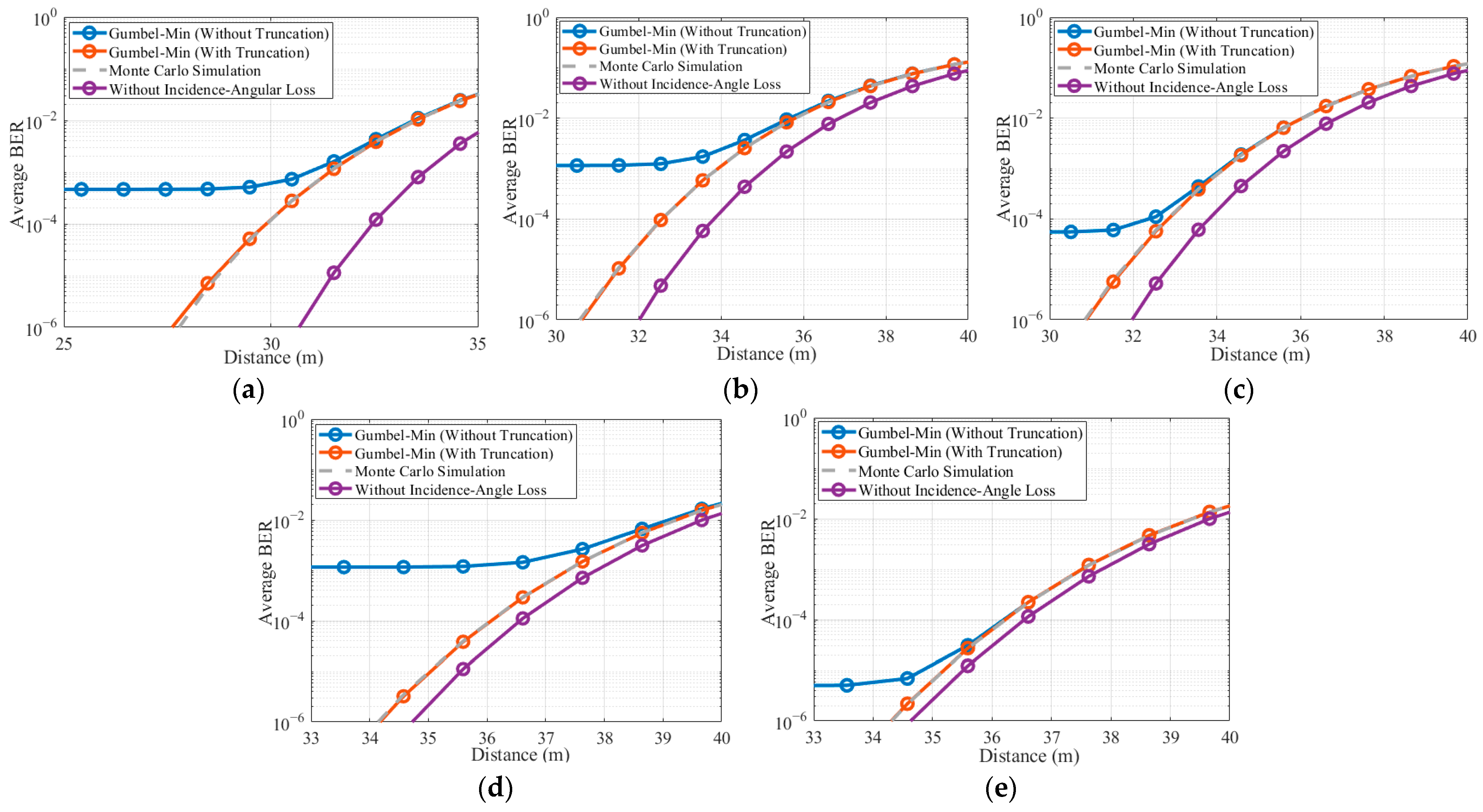
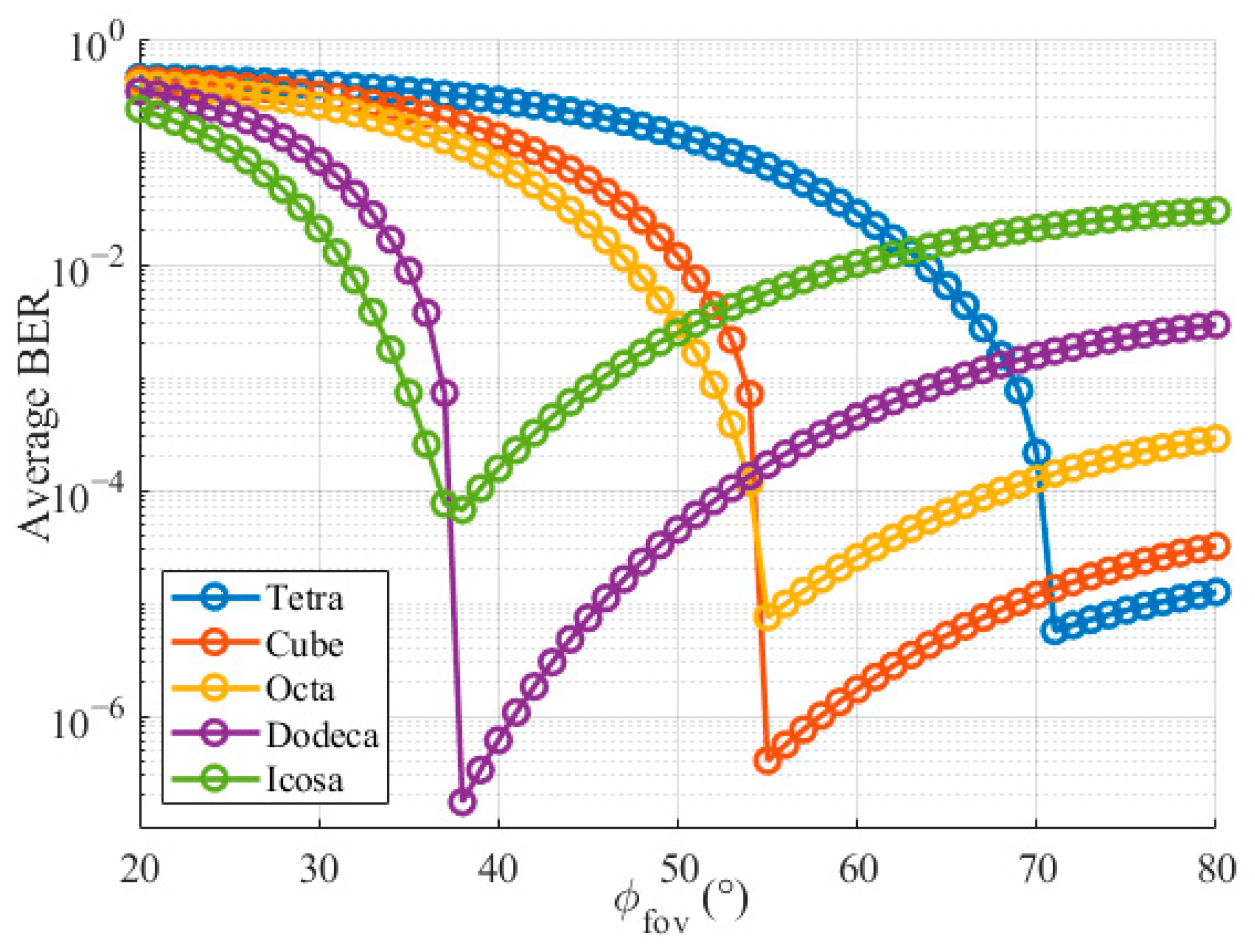
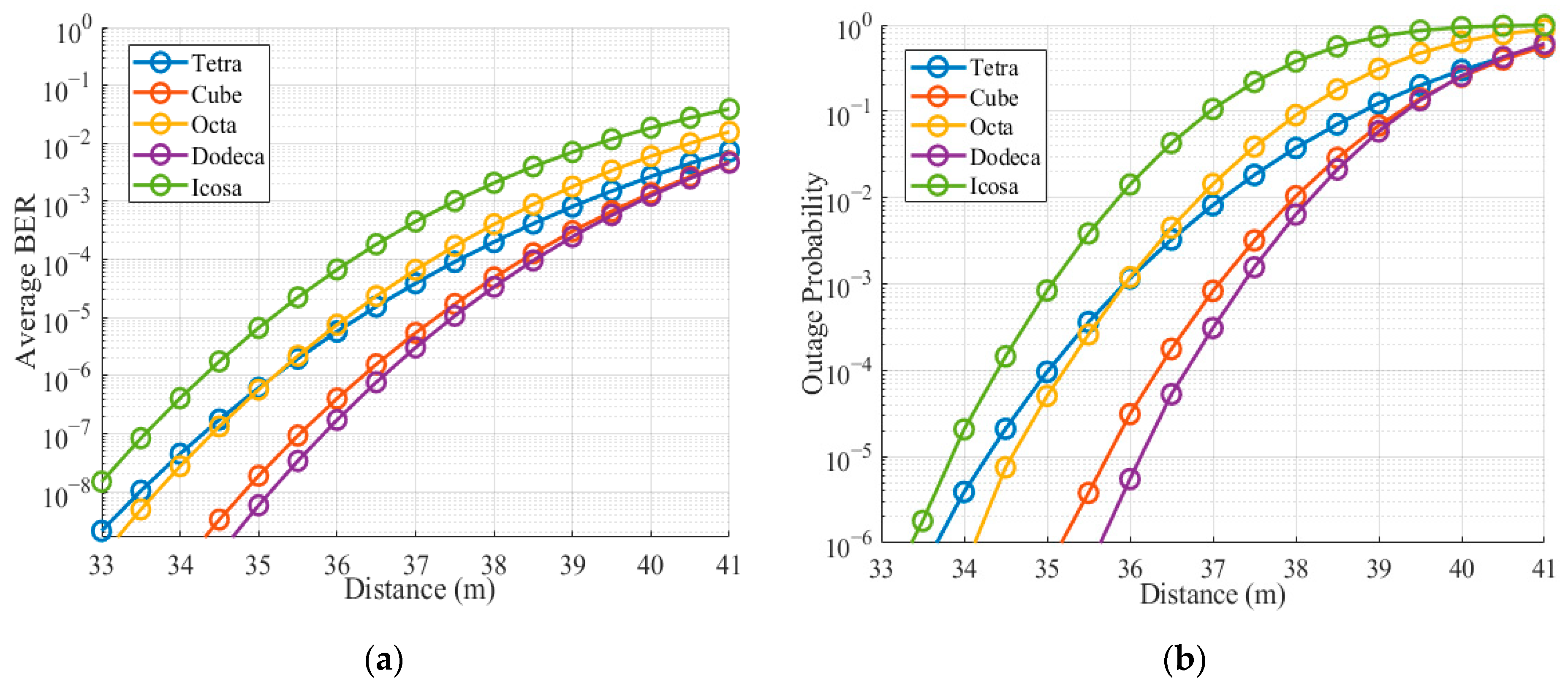
A unified performance analysis model is developed for UWOC receiving systems based on polyhedral geometries. Five regular polyhedra in three-dimensional Euclidean space are selected as typical geometric models, including the regular tetrahedron, cube, regular octahedron, regular dodecahedron, and regular icosahedron. Under the unified constraints of fixed total effective detection area and SC strategy, the average BER and outage probability under different polyhedral configurations and receiver FOV settings are evaluated, and the reception performance of different geometric structures is compared.
The rest of this paper is organized as follows.
Section 2 presents the system model, the statistical modeling of the incidence deflection angle of the selected receiving facet, and the link performance analysis model.
Section 3 provides the numerical results and discusses the impacts of various geometric structures and parameter settings on system performance. Finally,
Section 4 concludes the paper and suggests potential avenues for future research.
2. Main Assumptions and System Model
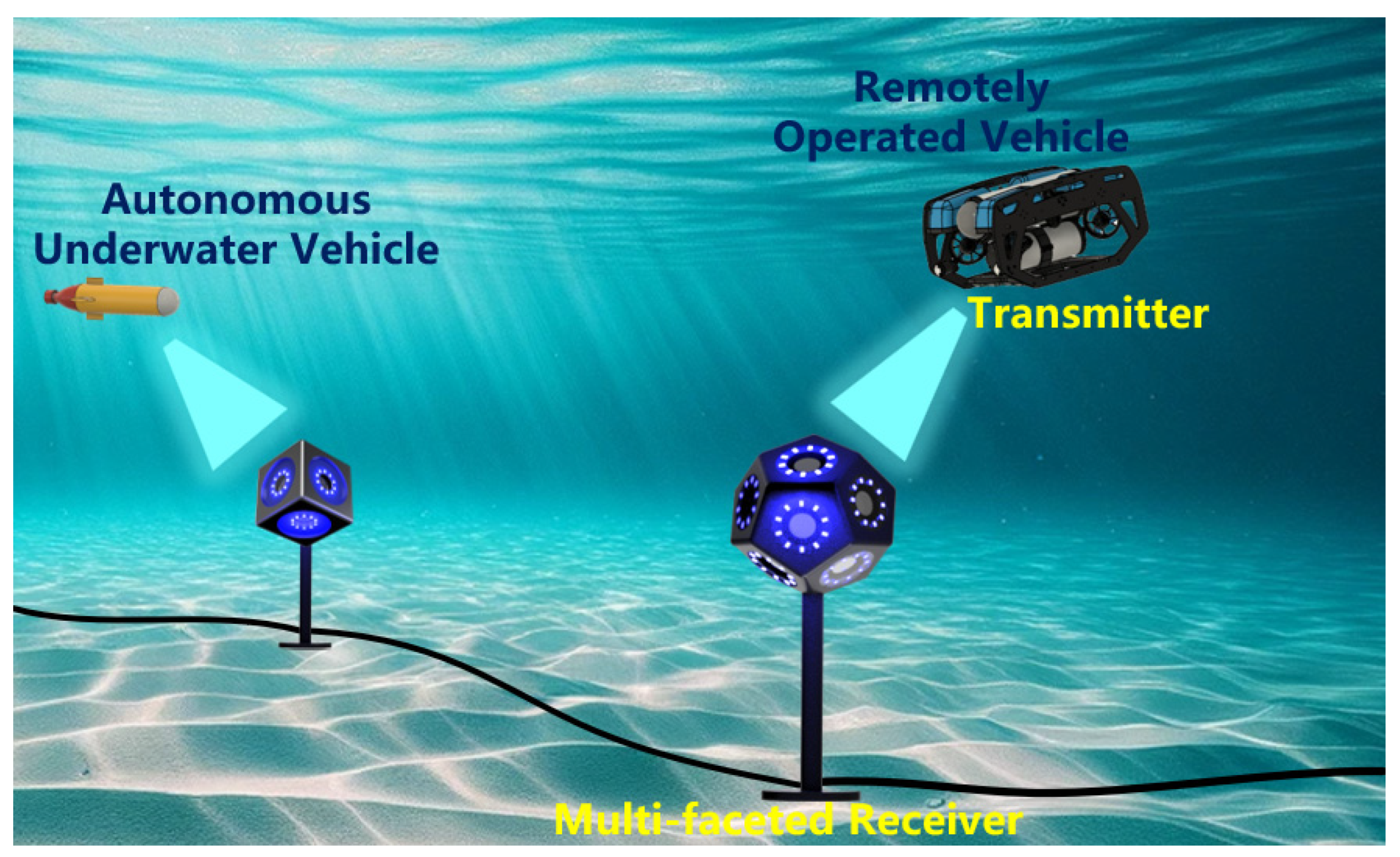
The scenario modeling communication between the multi-faceted UWOC receiver and the mobile transmitter is illustrated in
Figure 1. The receiver adopts a regular polyhedral structure, with optical receiving units integrated on each facet to establish communication links with the transmitter from diverse directions. Data transmission between the receiver and the transmitter is conducted via LoS links. The block diagram of the communication link is shown in
Figure 2. The transmitter employs an LED array for transmission, while the receiving units utilize avalanche photodiodes (APDs) for direct detection. After being processed by a transimpedance amplifier (TIA) and a low-pass filter (LPF), the received signals are recovered through multi-channel SC and demodulation [
6,
24].
To isolate the effect of the polyhedral architecture on system performance, we assume a homogeneous water medium and neglect the vertical stratification of seawater [
25]. The transmitter’s optical axis is assumed to point toward the geometric center of the multi-faceted receiver [
20], thereby excluding additional transmitter-side pointing errors. Nevertheless, because the facets’ normal vectors are discretely distributed over the regular polyhedral surface, a geometry-induced incidence deflection angle remains between the incident beam direction and the boresight of the selected receiving facet. Therefore, this study focuses on the incidence deflection caused by the discrete distribution of the receiver facets’ normal vectors.
2.1. Geometric Model of the Multi-Faceted Receiver
In the geometric modeling of the multi-faceted UWOC receiver, a Cartesian coordinate system
was established, with the origin
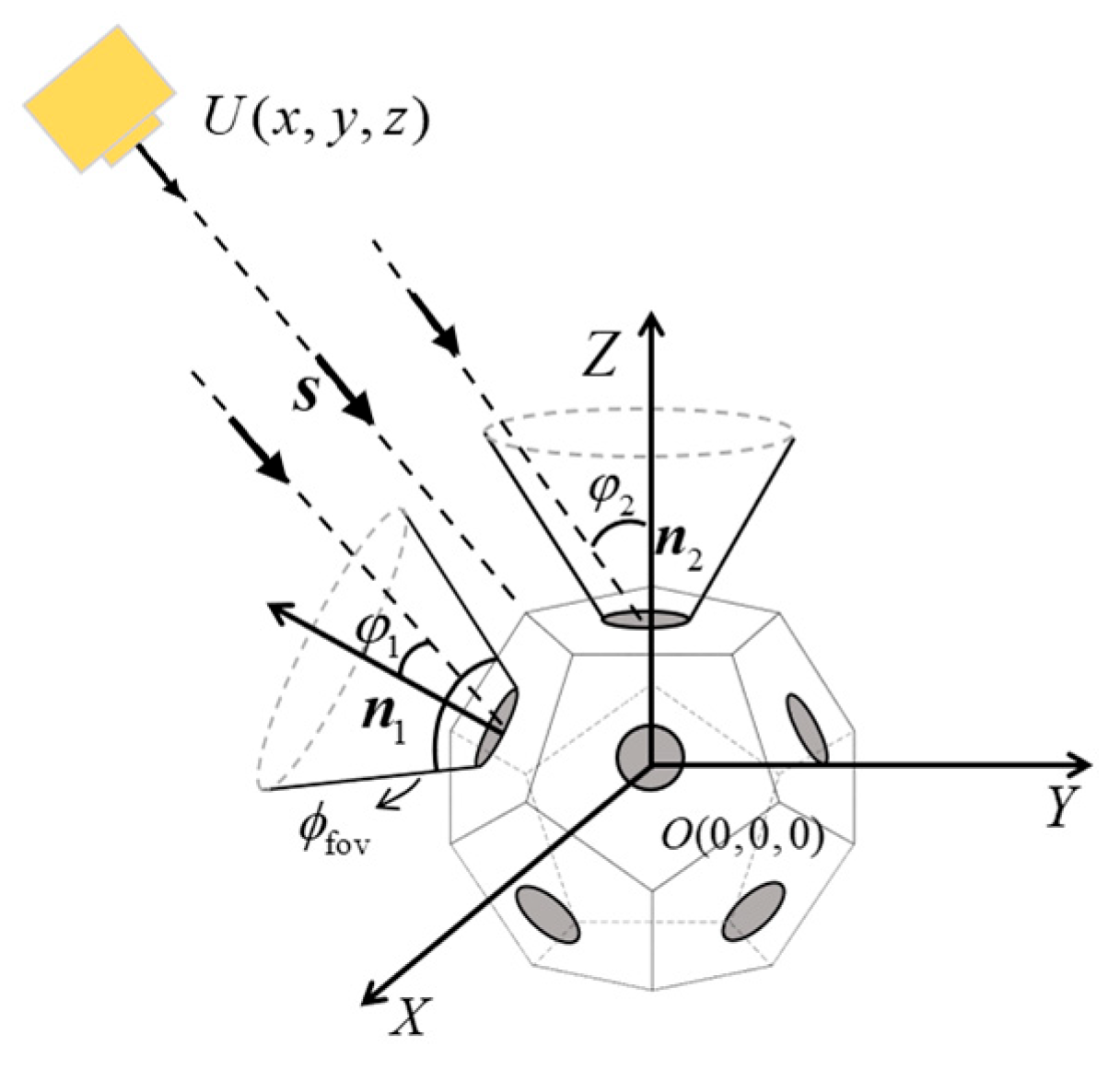
coinciding with the geometric center of the polyhedral structure. A schematic representation of the regular polyhedral receiver model is illustrated in
Figure 3. The unit normal vector of the
-th facet (
, where
denotes the total number of facets) is defined as
, which represents the optical axis of the receiving unit integrated on that facet. Given a transmitter located at
, the unit vector directed from the transmitter toward the center of the UWOC receiver is as follows:
If the receiver unit on the
-th facet is located at
, then the unit direction vector from the transmitter to this receiving unit is
When the physical dimensions of the multi-faceted UWOC receiver are significantly smaller than the link distance (the far-field condition), the wavefront can be approximated as a plane wave over the receiver’s spatial scale [
26]. The angular discrepancy between the LoS directions from a single transmitter to different receiving units is thus negligible. Consequently, the following approximation holds:
2.2. Transmitter Optical Emission Model
The light source of the transmitter comprises an array of
LEDs. The relationship between the peak radiant intensity
and the radiant power
of a single LED is given by the following:
Here, the function
denotes the relative intensity profile, which typically follows the Lambertian radiation pattern, i.e.,
with
. The Lambertian order
is uniquely determined by the half-power angle of the light source,
, as follows:
The radiant intensity of the transmitted optical signal,
, can be expressed as
2.3. Multi-Faceted UWOC Reception Model
In the multi-faceted UWOC receiver, the attenuation of optical signals in the water medium is characterized by the Beer–Lambert law. Let
denote the distance between the transmitter and the receiver, and
represent the extinction coefficient of the water. The received optical power on the
-th facet of the multi-faceted receiver can be expressed as
Here,
denotes the deflection angle gain term at the receiver, which characterizes the impact of the geometry-induced incidence deflection angle inherent to the polyhedral structure on the reception gain. Let
denote the comprehensive coefficient, which includes the effects of propagation loss, turbulence, and the received deflection gain term.
is the receiver’s effective optical parameter, given by the following:
Here, the effective detection area of a single APD,
, is related to the total effective detection area of the multi-faceted receiver,
, by
.
is the optical filter transmittance, and
denotes the gain of the non-imaging concentrator, expressed as:
where
denotes the refractive index of the non-imaging concentrator, and
denotes the receiver FOV half-angle, i.e., the maximum acceptance angle measured from the receiver boresight.
The random component
is introduced to characterize the channel gain fluctuations induced by underwater turbulence. A log-normal model is adopted to describe turbulence-induced fading. Specifically, the log-amplitude coefficient
, where
, is introduced to characterize the turbulence effect. The probability density function (PDF) of
is given in [
7] as:
Here,
and
are the mean and variance of
, respectively. The relationship between
and the scintillation index
is given by the following:
The log-normal turbulence model is mainly applicable to weak turbulence conditions. Statistical analyses of ocean observation data show that the log-normal probability density function fits most measured temperature–salinity gradient data well [
7]. For moderate-to-strong underwater turbulence environments, other fading models, such as the Gamma–Gamma distribution and K distribution, can be introduced by replacing the turbulence component
in the channel gain expression.
2.4. Statistics of the Receiver Incidence Deflection Angle in a Multi-Faceted Structure
In a multi-faceted receiver, the reception boresight of each facet is determined by the polyhedral geometry and remains fixed. Therefore, when the transmitter is located at an arbitrary position in space, an incidence deflection angle between the incident signal direction and the reception boresight of each facet is inevitable. The angle between the transmitter direction and the boresight of the
-th facet is given by the following:
The receiver adopts the SC strategy using the minimum deflection angle as the decision criterion [
23]. For each transmitter, only the channel corresponding to the facet with the smallest incidence deflection angle is activated, while the remaining channels remain inactive to avoid noise accumulation. Consequently, the effective incidence deflection angle
of the polyhedral structure is determined by the deflection angle of the selected facet, and is expressed as:
To characterize the impact of
on reception gain, we adopt a cosine angular response model and incorporate it into the link gain as the receiver incidence deflection angle gain term, expressed as:
Under the SC strategy, the facet with the minimum angular deflection is selected as the effective receiving facet. Therefore,
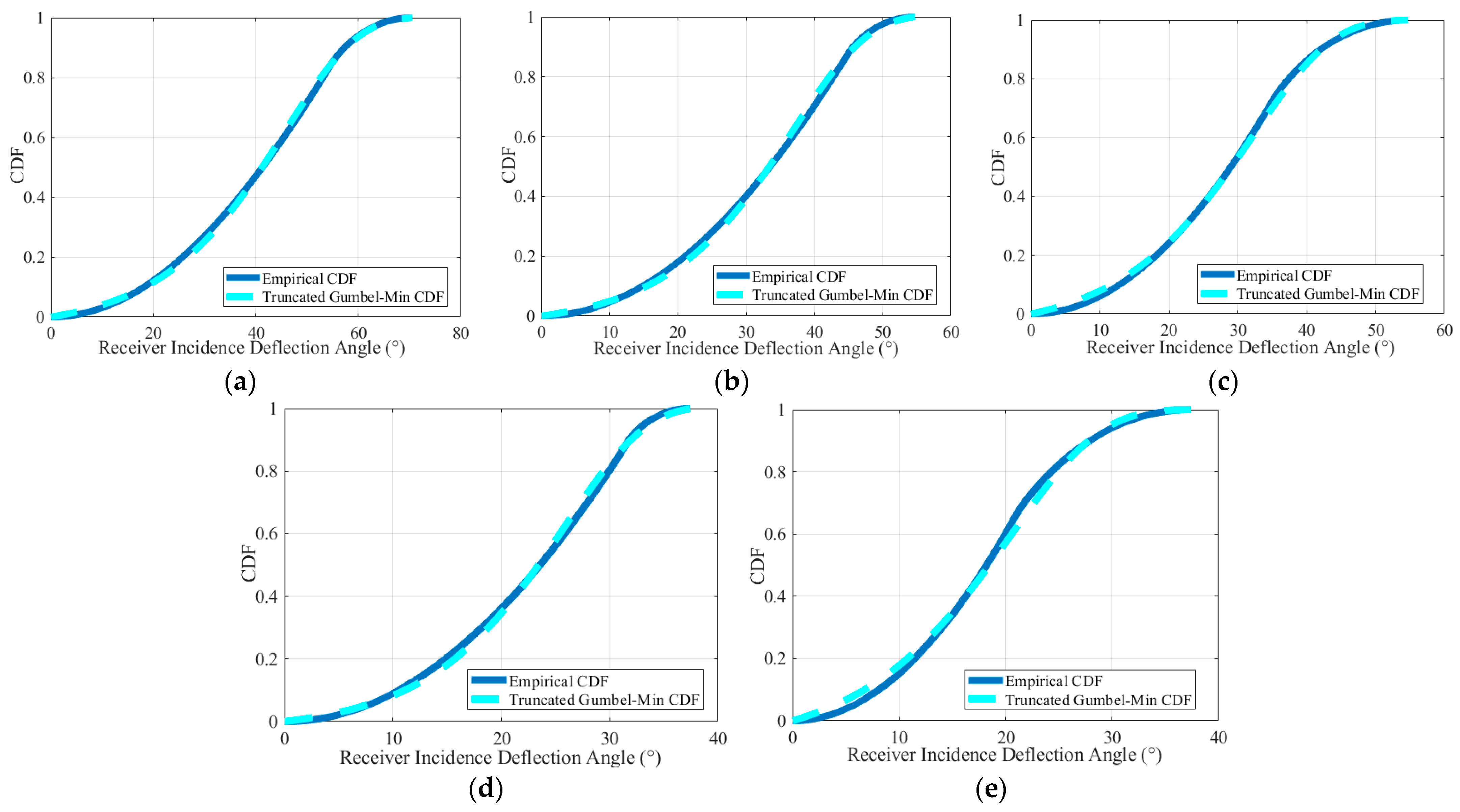
is not an ordinary angular random variable, but rather a first-order statistic, i.e., the minimum of the geometry-related angular deflections. From the perspective of extreme value theory, the distribution of this selected minimum can be described using a minimum-type extreme value model. In this paper, the Gumbel minimum distribution is adopted to describe the statistical characteristics of
, with the PDF and cumulative distribution function (CDF) given as follows:
Transmitter position samples are randomly generated in space using the Monte Carlo method, and the number of samples is denoted by
. For each sample, the set of incidence deflection angles for all facets
is computed, and the effective deflection angle samples
are obtained according to Equation (13). The distribution parameters
and
are then estimated by maximum likelihood estimation (MLE) [
27]. Furthermore, under the SC strategy,
is subject to geometric constraints and has a reachable upper bound
, satisfying
. Here,
is defined as the maximum deflection angle at the facet-selection boundary. When the incidence angle exceeds this boundary, the system switches the receiving facet. Because the standard Gumbel minimum distribution is not naturally confined to this finite interval, directly using the untruncated model may assign nonzero probabilities to angular deviations that are geometrically unreachable. Therefore, Equations (15) and (16) are truncated over the interval
and renormalized to satisfy the physical constraint, yielding the truncated PDF and CDF as follows:
2.5. Link Performance
In this study, an intensity modulation/direct detection (IM/DD) system is considered, employing the on–off keying (OOK) modulation scheme. Binary signals “0” and “1” are transmitted by switching the optical signal power. The resulting photocurrent
output by the photodetector on the
-th receiving facet is given by
Here,
is the responsivity of the APD,
denotes the photocurrent noise, and
represents the background noise current, given by
, where
denotes the background irradiance. The output signal
, after passing through the LPF, can be written as
Here,
is the load resistance, and
denotes the thermal noise component. The total noise variance of the output signal,
, is given by
Here, the signal shot noise variance is
, the background noise variance is
, and the thermal noise variance is
. These noise terms are given by
Here, is the electron charge, is the Boltzmann constant, is the temperature in kelvin, is the LPF bandwidth, is the APD internal gain, and is the APD excess noise factor given by , where is the ionization ratio.
The SC strategy based on the minimum deflection angle criterion is employed at the receiver. The output voltage of the selected facet, corresponding to the equivalent incident deflection angle
, is denoted as
and serves as the post-combining output voltage
. The instantaneous BER
can be expressed as [
28]
Here,
and
denote the signal voltages at the demodulator input corresponding to bit “0” and bit “1”, respectively, and
is the decision threshold. By averaging the conditional BER over the channel gain distribution, the average BER is obtained as
The BER threshold is set as
. When the instantaneous BER exceeds this threshold, the link is regarded as being in outage. Consequently, the channel gain threshold
corresponding to
can be expressed as
When
, the link is declared to be in outage, and the outage probability is expressed as
2.6. Pseudo-Code for Numerical Procedure
Algorithm 1 summarizes the complete numerical procedure for incidence angle distribution modeling and link performance evaluation. Random transmitter positions are generated, and the effective incidence angle samples are obtained under the SC strategy. These samples are then used to fit the truncated Gumbel minimum distribution. Finally, the fitted distribution is incorporated into the numerical evaluation of the BER and outage probability.
| Algorithm 1. Pseudo-code for the performance analysis of the multi-faceted UWOC receiver. |
Initialize
for k = 1:
Generate the k-th transmitter position sample
Calculate the incident direction s using Equations (1)–(3)
for i = 1:
Calculate the incidence angle using Equation (12)
end for
Select the facet with the minimum by the SC strategy
Set = min{} using Equation (13)
Store
end for
Fit the truncated Gumbel minimum distribution of using Equations (15)–(18)
Input system parameters, receiver , and link distance , etc.
Calculate the received optical power using Equations (7), (10) and (14)
Calculate the output current, output voltage, and noise variance using Equations (19)–(22)
Calculate the instantaneous BER using Equation (23)
Numerically average the BER using Equation (24)
Calculate the outage probability using Equations (25) and (26)
Output , and |
4. Conclusions
Under unified system configuration constraints, this paper establishes a geometric modeling and performance analysis framework for regular polyhedral multi-faceted receivers in UWOC systems. Five typical regular polyhedral structures, namely the regular tetrahedron, cube, regular octahedron, regular dodecahedron, and regular icosahedron, are systematically compared under the same total effective detection area and selection-combining strategy. To characterize the effective incidence deflection angle of the selected receiving facet, this paper proposes a truncated Gumbel minimum distribution model with geometric boundary constraints. The numerical results indicate that this model can accurately fit the statistical characteristics of the incidence deflection angle under different structures. The RMSEs of the corresponding PDF and CDF are generally below and , respectively. In addition, system performance does not improve monotonically with the number of facets. Although increasing the number of facets can reduce the incidence deflection angle and the corresponding angular gain loss, the effective detection area of each receiving facet decreases as the number of facets increases under a fixed total effective detection area, thereby limiting the received optical power of the selected channel. Therefore, under the parameter settings considered in this paper, the regular dodecahedron achieves the best performance in terms of average BER and outage probability, followed by the cube, whereas the regular icosahedron exhibits degraded overall performance because of its relatively small effective detection area for each individual facet.
These results provide guidance for the structural design of polyhedral UWOC receivers. For fixed underwater nodes or deployment scenarios where reliability is prioritized, the regular dodecahedron can be considered a preferable option, provided that the structural complexity is acceptable. For mobile platforms such as AUVs and ROVs, which are subject to stricter constraints on size, weight, power consumption, and implementation complexity, the cube structure can provide a more balanced trade-off between performance and engineering feasibility. It should be noted that this study is still based on several assumptions, including a homogeneous water medium, ideal transmitter alignment, and regular polyhedral geometries. These assumptions help highlight the influence of receiver geometry on system performance. Future work will further consider dynamic pointing errors on the transmitter side and apply multi-faceted transceivers to multi-user UWOC scenarios, with a focus on link scheduling, receive combining strategies, and network coordination mechanisms under multi-faceted transceiver architectures.