Article

Numerical Study of KVLCC2 Self-Propulsion with Conventional and Ducted Propellers in Shallow Water

1
Naval University of Engineering, Wuhan 430033, China
2
School of Naval Architecture, Ocean and Energy Power Engineering, Wuhan University of Technology, Wuhan 430063, China
3
Hunan Jinhang Shipbuilding Co., Ltd., Yiyang 413100, China
*
Authors to whom correspondence should be addressed.
J. Mar. Sci. Eng. 2026, 14(10), 905; https://doi.org/10.3390/jmse14100905
Submission received: 20 April 2026 / Revised: 7 May 2026 / Accepted: 8 May 2026 / Published: 13 May 2026
(This article belongs to the Section Ocean Engineering)

Abstract

This study investigates the hydrodynamic performance of the KVLCC2 tanker in deep and shallow water using computational fluid dynamics (CFD) simulations, focusing on resistance and self-propulsion with both ducted and non-ducted propellers. The Reynolds-averaged Navier–Stokes (RANS) equations, coupled with the SST k-ω turbulence model, are solved using STAR-CCM+ to analyze ship resistance, open-water propeller characteristics, and self-propulsion factors. Validation against experimental data confirms the numerical accuracy, with uncertainties below acceptable thresholds. In deep water, the body force propeller and body force ducted propeller methods are validated against the discretized propeller approach, yielding errors under 5%. The ducted propeller enhances open-water efficiency but results in higher thrust deduction and lower wake fractions, leading to reduced hull and overall propulsive efficiencies compared to the non-ducted case. In shallow water, as the depth-to-draft ratio (H/T) decreases to 1.5, added resistance, sinkage, and trim increase sharply due to blockage effects. The ducted configuration mitigates these penalties, achieving a 20.8% power reduction at H/T = 1.5. Added self-propulsion factors reveal that the duct improves hull efficiency and offsets shallow-water losses, enhancing propulsive efficiency. Flow field analysis shows accelerated stern wakes and asymmetric structures in shallow water, with the body force methods providing consistent predictions despite minor discrepancies in extreme conditions. This research highlights the efficacy of ducted propellers in shallow water and the reliability of body force methods for efficient simulations, offering insights for ship design in restricted depths.

1. Introduction

Ship propulsion in shallow-water environments presents significant challenges that directly affect maritime safety, operational efficiency, and energy consumption. As global maritime traffic continues to expand, large commercial vessels such as tankers and bulk carriers are increasingly required to operate in ports, canals, access channels, estuaries, and restricted coastal waterways, where the under-keel clearance is limited and the hydrodynamic interaction among the hull, propulsor, free surface, and seabed becomes more pronounced [1,2]. For full-bodied ships, these shallow-water effects may lead not only to increased resistance but also to modified wake fields, higher delivered power, larger sinkage and trim, and reduced propulsive efficiency. Therefore, accurate prediction of resistance and self-propulsion performance in shallow water is essential for both propulsion-system design and safe operation in restricted waterways. More broadly, recent reviews on ship operation in complex marine environments, including ship–ice interaction, also emphasize the importance of reliable numerical methods for predicting hydrodynamic loads and operational safety [3].
The fundamental physics of shallow-water navigation involves complex interactions between the vessel hull, propulsion system, and confined water body. When the water depth-to-draft ratio (H/T) decreases below approximately 2.5, significant alterations in flow patterns occur, leading to increased resistance, modified wake characteristics, and substantial changes in propulsive efficiency [4]. These effects are particularly pronounced for large commercial vessels such as tankers and bulk carriers, which frequently navigate through shallow ports, canals, and coastal waters where operational margins are critical. However, the extent to which alternative propulsor configurations, such as ducted propellers, can mitigate these shallow-water propulsion penalties remains insufficiently clarified, especially when efficient body force methods are used for self-propulsion prediction.
Traditional marine propellers experience notable performance degradation in shallow-water conditions. The restricted water depth creates a blockage effect that accelerates the flow beneath the hull, modifies the pressure distribution, and alters the propeller inflow characteristics [5]. This phenomenon results in increased power requirements, reduced propulsive efficiency, and potential operational challenges, including enhanced squat, trim variations, and increased bank effects during canal transits.
To address these limitations, ducted propellers have emerged as a promising alternative propulsion solution. The addition of a shroud or duct around the propeller can provide several hydrodynamic advantages: acceleration of the propeller inflow, reduction in tip vortex losses, and improved thrust generation at lower advance ratios [6,7]. Recent investigations have demonstrated that ducted propellers can offer superior performance in certain operating conditions, particularly in heavily loaded scenarios typical of shallow-water operations [8].
The numerical prediction of ship propulsion performance has evolved significantly with advances in computational fluid dynamics (CFD). Modern Reynolds-Averaged Navier–Stokes (RANS) solvers provide detailed insights into complex flow phenomena, enabling comprehensive analysis of hull–propeller interactions under various operating conditions [9,10]. However, the computational cost of high-fidelity propeller simulations remains substantial, particularly for parametric studies and design optimization processes.
To balance computational efficiency with acceptable accuracy, body force propeller models have gained widespread adoption in marine hydrodynamics [11,12]. These methods replace the discrete propeller geometry with a virtual disk that applies equivalent body forces to the fluid domain, significantly reducing mesh complexity and computational time while maintaining reasonable prediction accuracy. The body force approach has proven particularly valuable for self-propulsion simulations and maneuvering studies where multiple propeller operating conditions must be evaluated.
Recent developments in body force modeling have extended to ducted propeller configurations. Cai et al. [13,14] proposed a modified body force method specifically tailored for ducted propellers, addressing the unique challenges of modeling duct–propeller interactions within the virtual disk framework. This approach requires careful calibration of the propeller open-water characteristics to account for duct effects, but offers significant computational savings compared to fully discretized ducted propeller simulations.
Despite these methodological advances, systematic investigations of ducted propeller performance in shallow water remain limited. While several studies have examined conventional propeller behavior in restricted water depths [15,16], comprehensive comparisons between ducted and non-ducted configurations under varying shallow-water conditions are scarce. Furthermore, the validity and accuracy of body force methods for shallow-water ducted propeller simulations require thorough verification against high-fidelity computational approaches.
The present study addresses these research gaps by conducting a comprehensive numerical investigation of ship self-propulsion performance in both deep- and shallow-water conditions. Using the well-documented KVLCC2 tanker as the test case, systematic comparisons are made between ducted and conventional propeller configurations across multiple water depth-to-draft ratios. The research employs both discretized propeller methods and body force approaches, providing validation data on the computational efficiency-versus-accuracy trade-offs inherent in different modeling strategies.
The specific objectives of this investigation include: (1) validation of CFD methods for shallow-water resistance and propulsion predictions, (2) comprehensive comparison of ducted versus conventional propeller performance across varying water depths, (3) assessment of body force method accuracy for shallow-water ducted propeller simulations, and (4) analysis of flow field modifications and their impact on propulsive efficiency in constrained water environments.
To support these objectives, the remainder of this paper is organized as follows. Section 2 introduces the KVLCC2 hull, the conventional and ducted propeller models, and the numerical methodology. Section 3 presents the deep-water resistance and open-water simulations, including grid convergence, verification, and validation. Section 4 describes the deep-water self-propulsion simulations and compares the body force and discretized propeller methods. Section 5 extends the analysis to shallow-water conditions with different depth-to-draft ratios. Section 6 discusses the pressure and velocity fields to explain the hydrodynamic mechanisms behind the observed performance changes. Finally, Section 7 summarizes the main findings, limitations, and future research directions.

2. Research Objects and Numerical Methodology

2.1. KVLCC2 Model

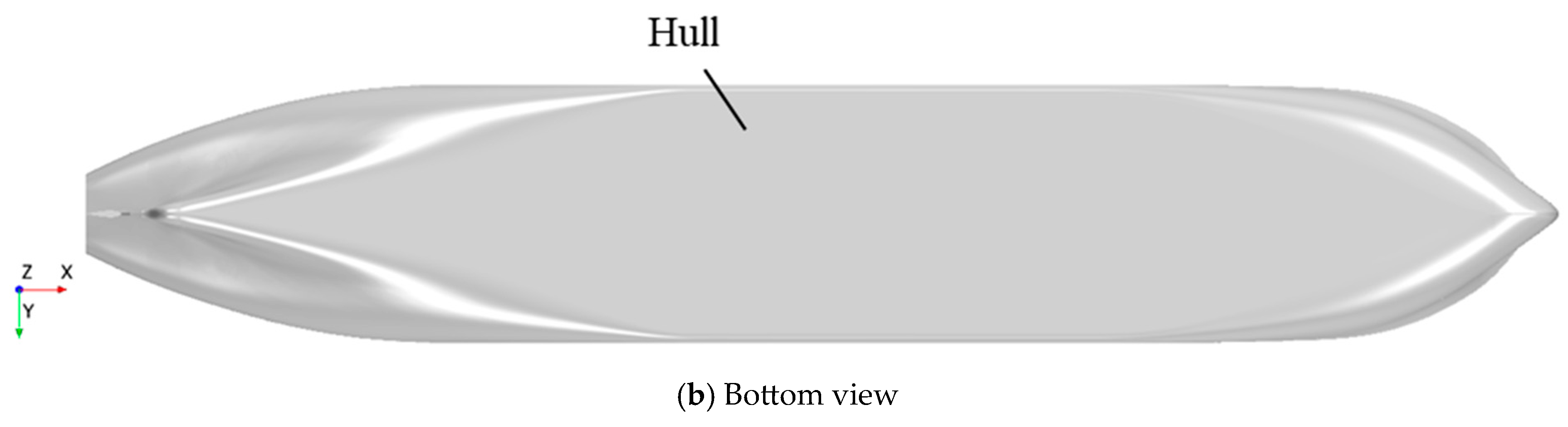
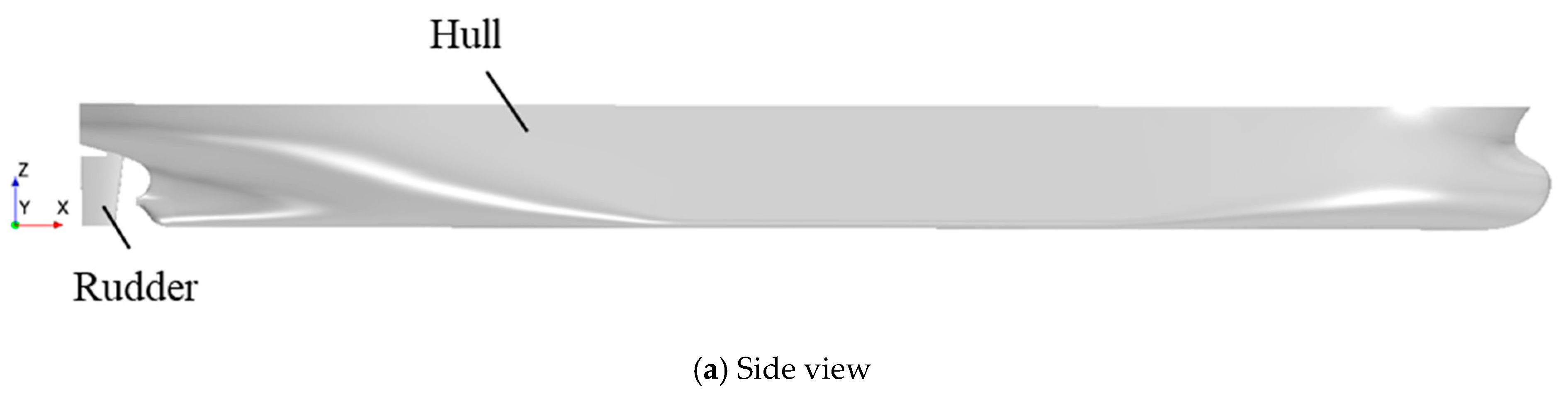
The KVLCC2 tanker model, originally developed by the Korea Research Institute of Ships and Ocean Engineering (KRISO), serves as the primary vessel in this investigation [17]. The hull and propeller geometries are depicted in Figure 1, with key dimensions outlined in Table 1. A model scale of 1:58 is employed.
The coordinate system originates at the juncture of the vessel’s baseline and aft perpendicular. The propeller is positioned at model-scale coordinates (0.107 m, 0.000 m, 0.101 m), aligning with its central hub.

2.2. Ducted and Conventional Propeller Models

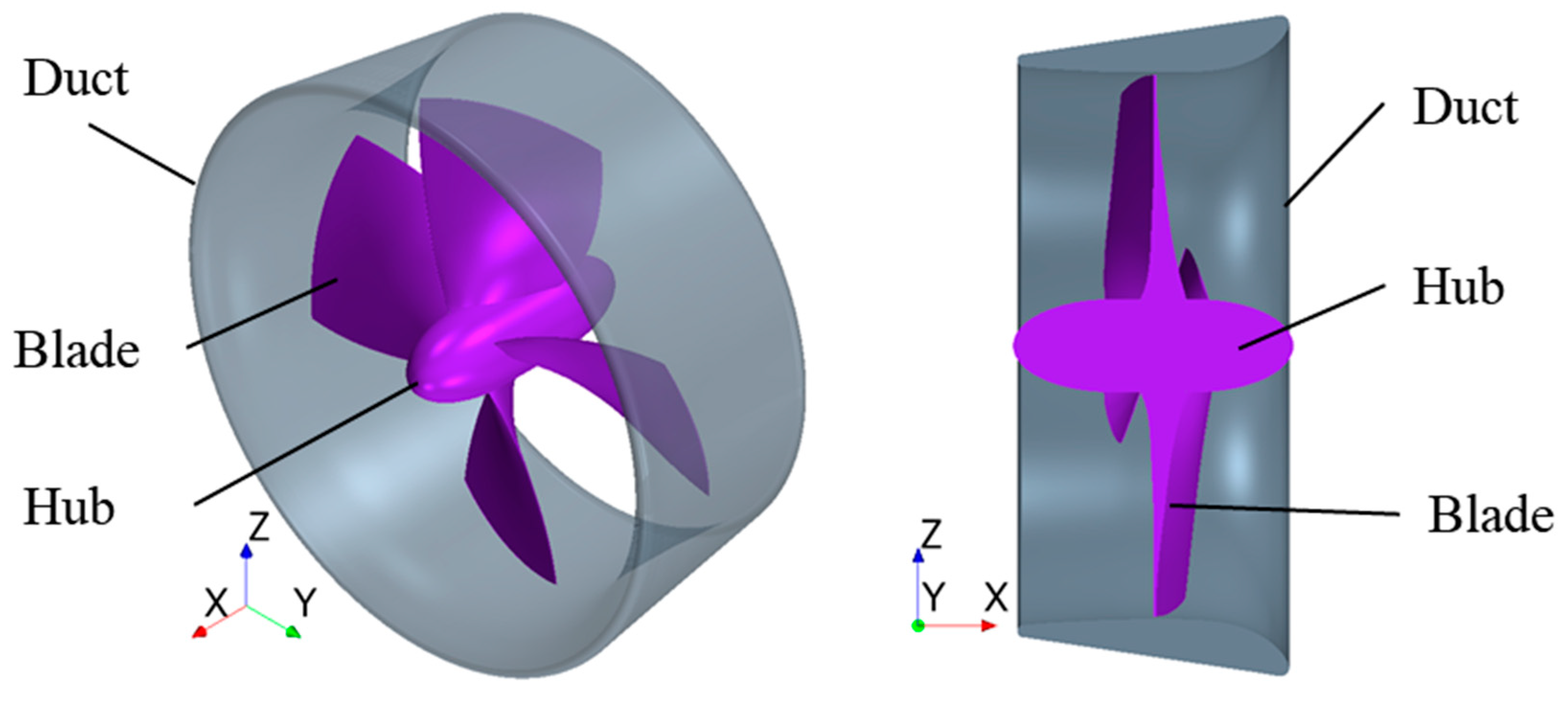
To validate the numerical methodology, this investigation employs the Ka4-70 propeller fitted within a standard 19A duct defined by Oosterveld [6] (Netherlands Ship Model Basin, Wageningen, The Netherlands). The ducted propeller features a diameter of 0.17 m. The tip clearance between the propeller and the duct is kept at 0.42% of the propeller diameter [18].
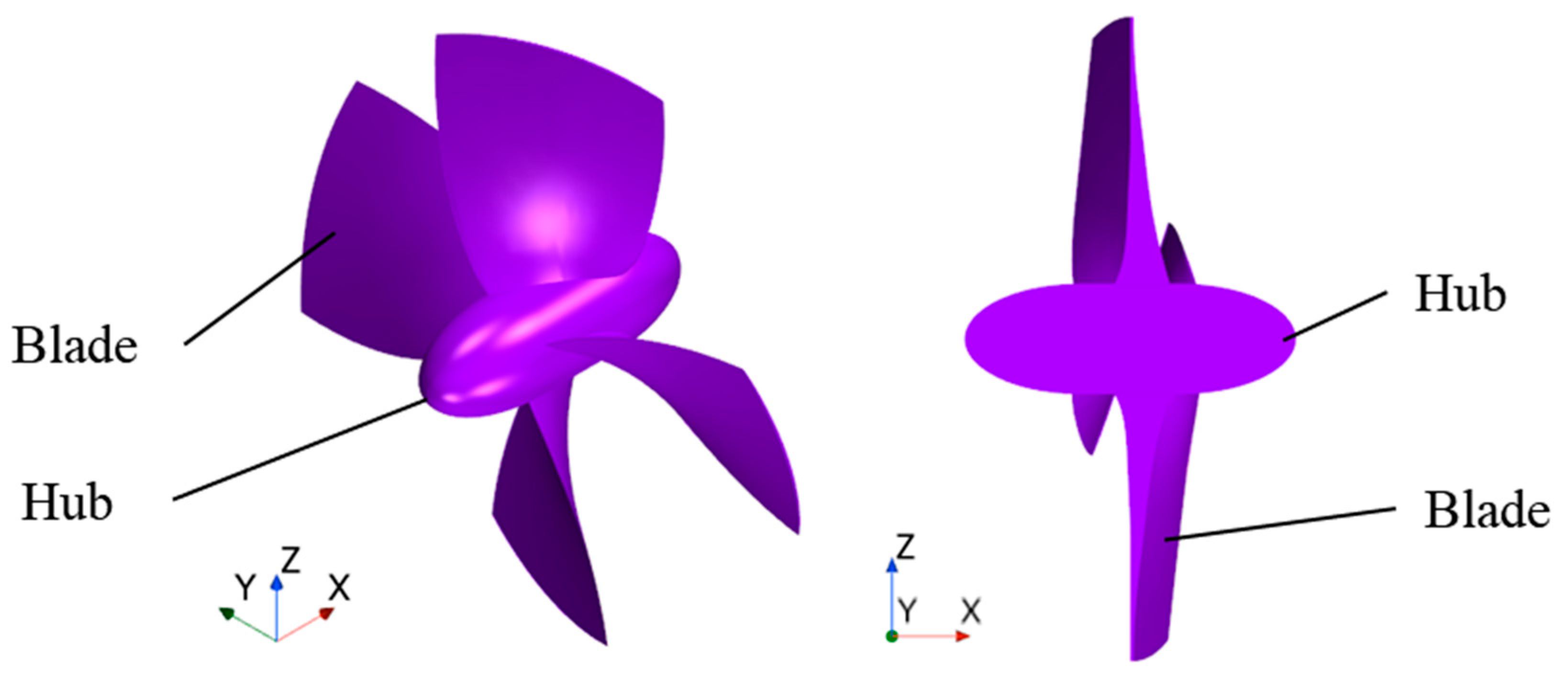
For comparison, the Ka4-70 propeller without the duct is employed as the reference case. Both ducted and non-ducted propellers are installed aft of the ship model for self-propulsion simulations. In both cases, the propellers rotate clockwise, as illustrated in Figure 2 and Figure 3. The principal particulars of the Ka4-70 propeller are presented in Table 2.

2.3. Numerical Methodology

The numerical simulations are conducted using the CFD software STAR-CCM+ (2021) [19]. The governing equations comprise the Reynolds-averaged Navier–Stokes (RANS) equations, closed by the shear stress transport (SST) k-ω turbulence model [20]. This methodology has been extensively utilized in recent hydrodynamic investigations of ships, propellers, and ducted propellers [7,9,10].
The near-wall region is resolved with the Reichardt wall function [21], whereas the volume-of-fluid (VOF) method [22] is employed to simulate the free-surface wave patterns. An all-y+ wall treatment is implemented: the laminar law applies for y+ < 5, while the logarithmic law holds for 30 ≤ y+ ≤ 500–1000 [23]. Further computational specifics are detailed in ADAPCO [19].
The flow around the hull–propulsor system is assumed to be incompressible and turbulent. The governing equations are the continuity equation and the Reynolds-averaged Navier–Stokes (RANS) equations. In Cartesian tensor notation, they can be written as:
u ¯ i   /   x i   =   0
and
ρ u ¯ i / t + ρ u ¯ i u ¯ j   /   x j = p ¯ / x i + / x j     μ + μ t     u ¯ i / x j + u ¯ j / x i     + ρ g i + S i
where u ¯ i is the time-averaged velocity component, x i is the Cartesian coordinate, ρ is the fluid density, p ¯ is the mean pressure, μ is the dynamic viscosity, μ t is the turbulent eddy viscosity, g i is the gravitational acceleration component, and S i represents the momentum source term. In the discretized propeller simulations, S i = 0, whereas in the body force propeller simulations, it represents the equivalent momentum source generated by the virtual disk.
The SST kω turbulence model is adopted to close the RANS equations. The transport equations for the turbulent kinetic energy k and the specific dissipation rate ω are expressed as:
ρ k   /   t   +   ρ k u ¯ j   /   x j =   P k     β * ρ k ω   +   / x j     μ   +   σ k μ t   k / x j  
ρ ω   /   t + ρ ω u ¯ j   /   x j = α ω / k P k β ρ ω 2 + / x j     μ + σ ω μ t   ω / x j   + D ω
where P k is the production term of turbulent kinetic energy; α, β, β*, σ k , and σ ω are model coefficients; and D ω denotes the cross-diffusion term of the SST formulation. The turbulent eddy viscosity is evaluated as:
μ t = ρ a 1 k / m a x a 1 ω ,   S F 2

where a1 is a model constant, S is the strain-rate magnitude, and F2 is the second blending function of the SST model. The standard coefficients of the Menter SST formulation are used in the present simulations.
The free surface is captured using the volume-of-fluid (VOF) method. The transport equation for the water volume fraction αw is:
α w / t +   α w u   =   0
The local mixture density and dynamic viscosity are calculated as:
ρ   =   α w ρ w   +   1     α w ρ a
μ = α w μ w + 1 α w μ a
where the subscripts w and a denote water and air, respectively. The hull motions in sinkage and trim are solved using the Dynamic Fluid Body Interaction (DFBI) model with the overset grid technique. The near-wall treatment follows the all-y+ wall treatment, and the non-dimensional wall distance is defined as:
y +   =   ρ u τ y   /   μ
where u τ is the friction velocity and y is the distance from the wall to the first cell center.

3. Deep-Water Simulations: Resistance and Open Water

Prior to conducting the self-propulsion simulations, it is essential to evaluate the resistance of the ship and the open-water characteristics of the propeller under deep-water conditions. In this section, an uncertainty analysis of the CFD approach is performed, and the numerical results are compared against the corresponding model test data.

3.1. Verification and Validation of the Numerical Method

The ITTC verification and validation procedures are employed to evaluate the numerical uncertainty in the CFD simulations [24,25]. This section addresses both verification and validation for ship resistance and the open-water performance of the ducted propeller. The relevant dimensionless parameters are defined as follows. The parameters and units are shown in Table 3.
Froude number
F r = U g L W L
Ship resistance coefficient
C t = R t 1 2 ρ U 2 S W
Advance coefficient
J = V A n D P
Ducted propeller thrust coefficient
K T = T ρ n 2 D P 4
Duct thrust coefficient
K T D = T D ρ n 2 D P 4
Propeller thrust coefficient
K T P = T P ρ n 2 D P 4
Propeller torque coefficient
K Q = Q ρ n 2 D P 5
Open water efficiency
η = K T K Q J 2 π
where ρ = 997.561 kg/m3 is the water density and VA is the advance speed of the ducted propeller. The total thrust is expressed as
T = T D + T P
where T, TD and TP denote the total thrust, duct thrust and propeller thrust, respectively. Q represents the propeller torque.

3.1.1. Computational Domains and Boundary Conditions

See Table 4 for the boundary conditions and regional division applied in the ship resistance simulations. The coordinate system is defined with its origin at the intersection of the ship’s bottom and stern perpendicular. The overset grid technique, combined with the Dynamic Fluid Body Interaction (DFBI) model, is employed to predict ship motions [19]. Although the motion amplitude of the hull is very small in deep water, the overset grid approach is still adopted here to ensure consistency and comparability with the subsequent shallow-water simulations.
For the propeller open-water simulations, the boundary conditions and computational domains are summarized in Table 5 (ducted propeller) and Table 6 (non-ducted propeller). In both scenarios, the computational domain is partitioned into two distinct regions: a stationary background region and a rotating region, interconnected via interfaces. The origin of the coordinate system is positioned at the propeller’s center.
Owing to the minimal clearance between the propeller and the duct, the rotating region incorporates a portion of the duct’s inner surface. Within this region, the duct surface is configured to remain stationary relative to the global coordinate system. Propeller rotation is simulated using the steady moving reference frame (MRF) method, in line with established studies [8,13,26,27].
To ensure consistency, the sliding velocities of all sliding walls are set equal to the incoming flow velocity. Moreover, a wave-damping zone is implemented to attenuate reflections from the side and outlet boundaries [19].

3.1.2. Mesh Generation and Numerical Uncertainty

The term verification refers to the process of estimating the numerical uncertainty, denoted as USN. In this study, the grid spacing uncertainty UG is considered as the primary contributor to USN (Equation (19)).
U S N 2 = U G 2 + U T 2
To investigate grid convergence, the Richardson extrapolation method [24] is applied. The refinement ratio is defined as:
r k = Δ x 2 Δ x 1 = Δ x 3 Δ x 2
where Δx1, Δx2 and Δx3 denote the coarse, medium, and fine grid spacings, respectively, and S1, S2 and S3 are the corresponding numerical results. The differences between medium–coarse and fine–medium solutions are denoted as ε21 and ε32.
C R = ε 32 ε 21
which indicates monotonic convergence when 0 < CR < 1.
P R E = ln ε 21 / ε 32 ln r k
The estimated order of accuracy PRE is defined as above. The distance metric is given as:
P = P R E P t h
where Pth serves as an approximation of the ultimate accuracy order when the grid spacing tends toward zero [28]. The following describes the safety method uncertainty factor:
U F S ( 2.45 0.85 P ) S 3 S 2 r P R E 1 , 0 < P < 1 ( 16.4 14.8 P ) S 3 S 2 r P R E 1 , P > 1
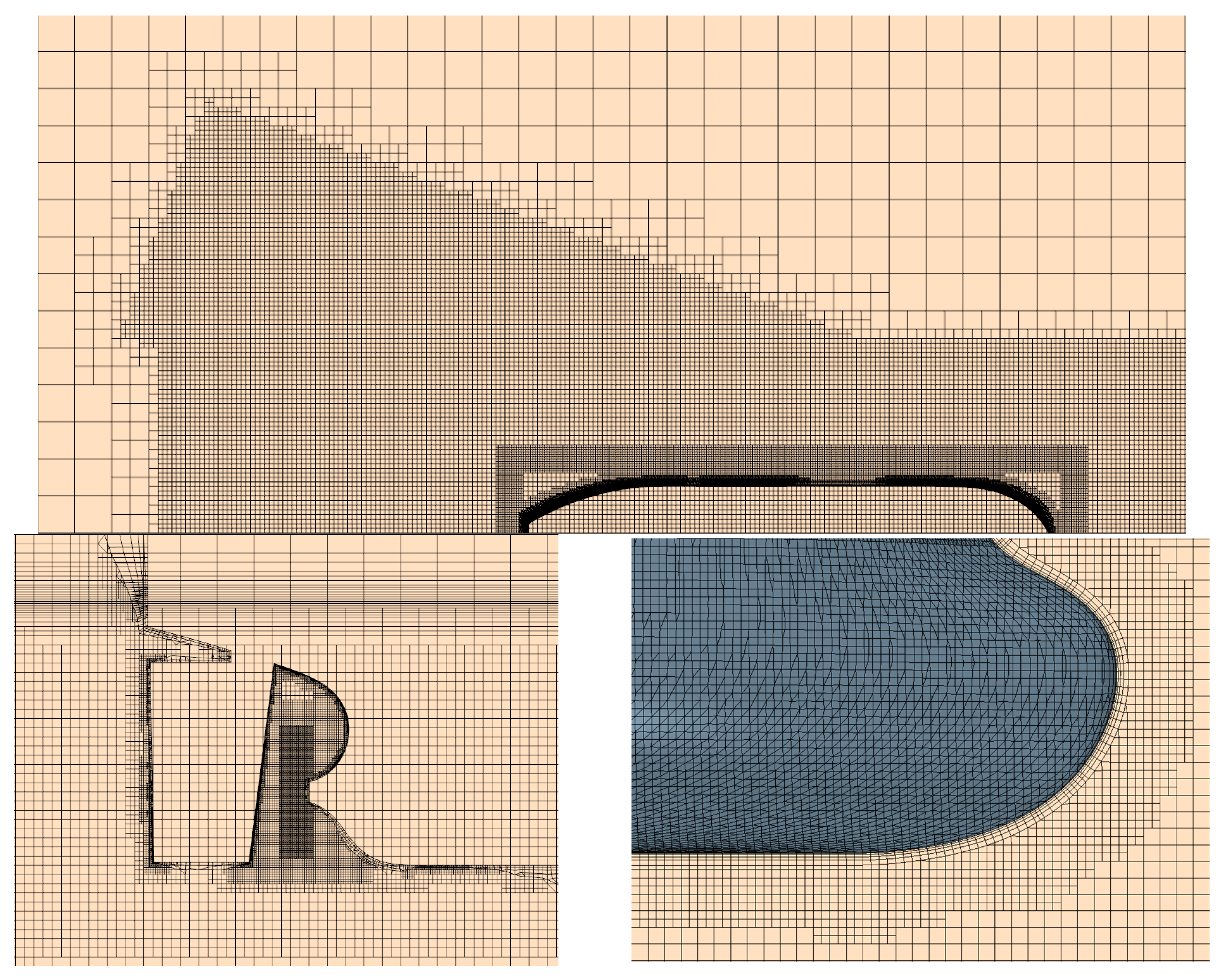
In the ship resistance simulation, Figure 4 illustrates the grid distribution near the free surface, stern, and bow, where local mesh refinement is applied to reduce numerical errors. To enable direct application of the body force method for self-propulsion simulations following the resistance calculations, the mesh in the propeller region is also refined. In the resistance simulation, the prism-layer mesh is adjusted such that y+ > 30 on more than 99% of the hull surfaces.
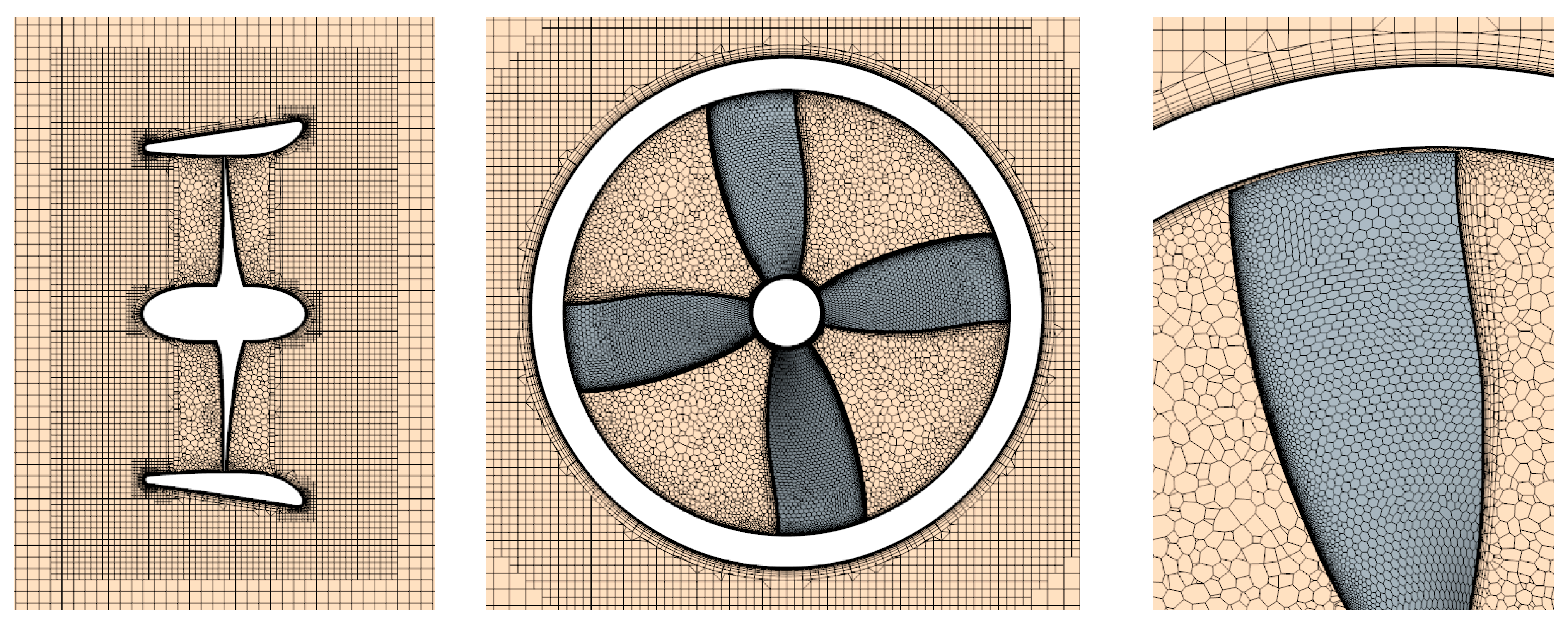
In the ducted propeller open-water simulation, local refinement is applied around the duct surface and the clearance between the propeller tip and the duct, as shown in Figure 5. The rotating region and background region are discretized using a polyhedral mesh and a trimmed mesh, respectively, following the approach reported in [29]. In this case, the prism-layer mesh is modified to ensure that y+ remains below 5 on more than 99% of the ducted propeller surfaces.
In the deep-water resistance simulations, the time step is set to less than LWL/(200 U), ensuring that the Courant number remains below 1.0 [19]. This treatment provides improved computational efficiency. The scale effect can be neglected since Re > 3 × 10⁵ [30].
Table 7 summarizes the grid system information along with the refinement ratio. Since 0 < CR < 1, the Richardson extrapolation method can be applied. Verification is performed to evaluate the numerical uncertainty USN for both ship resistance and ducted propeller open-water conditions.
For the ship resistance case, the total resistance coefficient Ct at Fr = 0.142 is selected as the verification parameter, with experimental reference data obtained from Kim et al. [31]. For the ducted propeller open-water case, two operating points are considered: J = 0.2 (n = 16 rps) and J = 0.6 (n = 16 rps). The verification parameters are the thrust coefficient KT and the torque coefficient KQ, with test data taken from Oosterveld [6].
The grid-spacing uncertainties in Ct, KT and 10 KQ are presented in Table 8, where D represents the corresponding experimental data.
The relatively high UFS value for 10 KQ at J = 0.6 is caused by the slow grid convergence of the torque coefficient. Although the convergence is monotonic (0 < CR < 1), the convergence ratio is close to unity, and the estimated order of accuracy is low (p = 0.3863). Therefore, the safety-factor-based uncertainty estimate is amplified. This value should not be interpreted as the direct CFD-EFD error. The actual comparison error for 10 KQ at J = 0.6 is −4.29%. The higher uncertainty is mainly attributed to the sensitivity of the ducted propeller torque to local viscous flow, tip-clearance flow, and duct–propeller interaction at this relatively high advance coefficient.

3.1.3. Validation

The discrepancy between the experimental data D and the numerical result S is quantified by the comparison error E, defined as:
E = D S
The validation uncertainty UV is expressed as:
U V 2 = U D 2 + U S N 2
To evaluate whether validation is achieved, the comparison error E is compared with the validation uncertainty UV. If E < U V , then the total error between the numerical result S and the experimental data D is smaller than UV, indicating that validation is satisfied at the UV level.
The test data uncertainty UD plays a crucial role in the validation process. However, since UD for Ct, KT and 10 KQ cannot be directly obtained, it is estimated as UD = 1.00%D, following Feng et al. [32]. The computational results are confirmed to be valid within the UV level, as summarized in Table 9. Consequently, the medium grid is selected for the subsequent simulations, as it offers an optimal balance between efficiency and accuracy.

3.2. Results and Discussion

To validate the ship resistance in deep water, the model test data [31] are compared with the numerical results. The total resistance coefficients obtained from the experiment and simulation are 4.110 × 10⁻³ and 4.105 × 10⁻³, respectively, with an error of less than 5%.
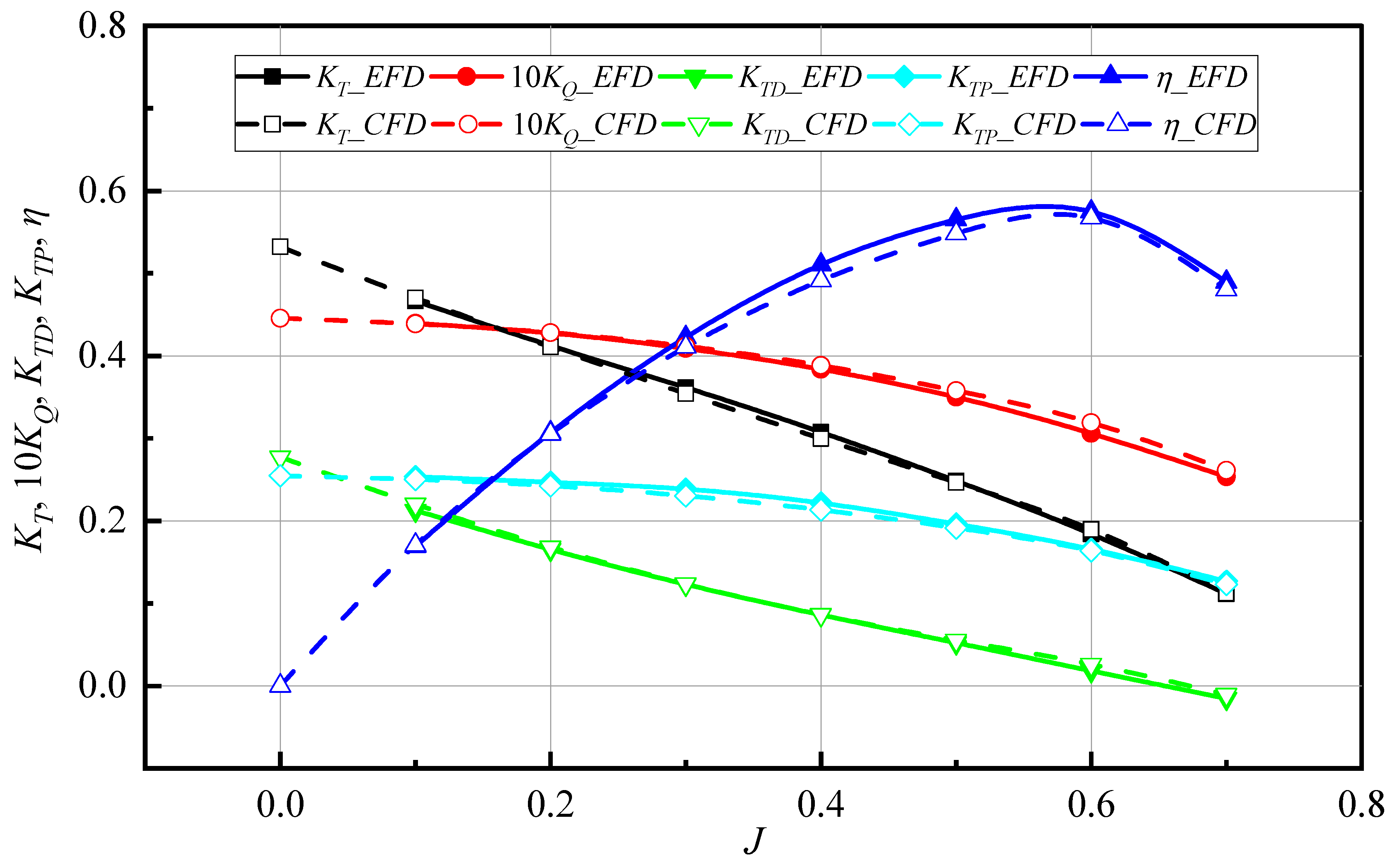
Simulations of the ducted propeller open-water characteristics were performed at a rotation rate of n = 16 rps. As shown in Figure 6, the numerical results agree well with the experimental data reported by Oosterveld [6]. For the range 0 < J < 0.7, the relative errors of KT and 10 KQ are all less than 5%, indicating that the present CFD method can accurately predict the open-water performance of the ducted propeller.
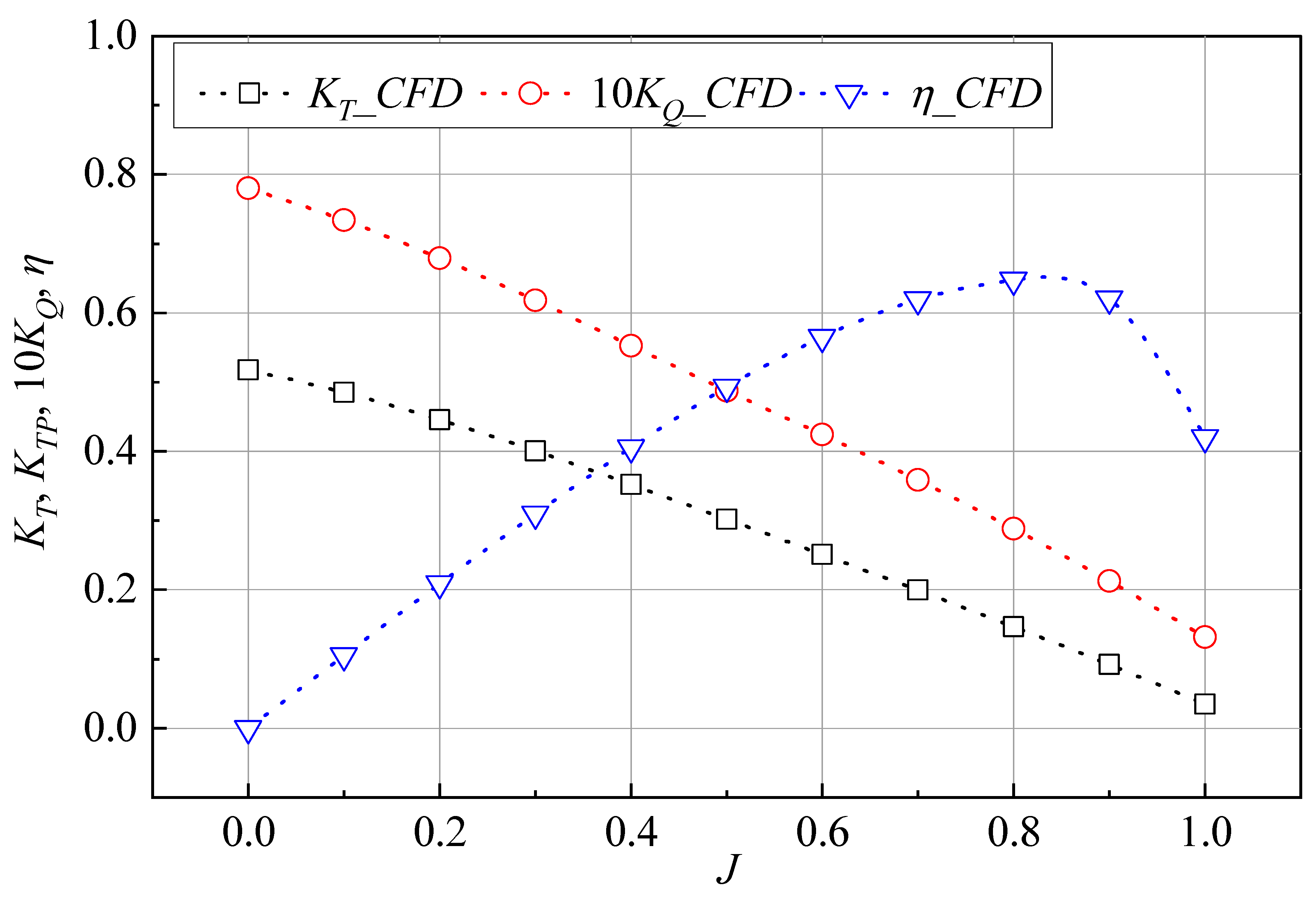
Subsequently, the open-water performance of the propeller without the duct was also simulated, with the results presented in Figure 7. The mesh generation strategy for the non-ducted propeller is identical to that of the ducted propeller, except that the duct is absent. The simulations were also conducted using the moving reference frame (MRF) method.
The resistance and open-water results presented in this subsection will serve as the foundation for the subsequent self-propulsion simulations in both deep and shallow water.

4. Deep-Water Simulations: Self-Propulsion

In this section, the body force method is applied to simulate ship self-propulsion in deep water at Fr = 0.142. For the ducted propeller and the non-ducted propeller, the computational procedures of the body force method exhibit certain differences. The results are subsequently compared with those derived from the discretized propeller method.

4.1. Body Force Propeller Method and Virtual Disk Open Water

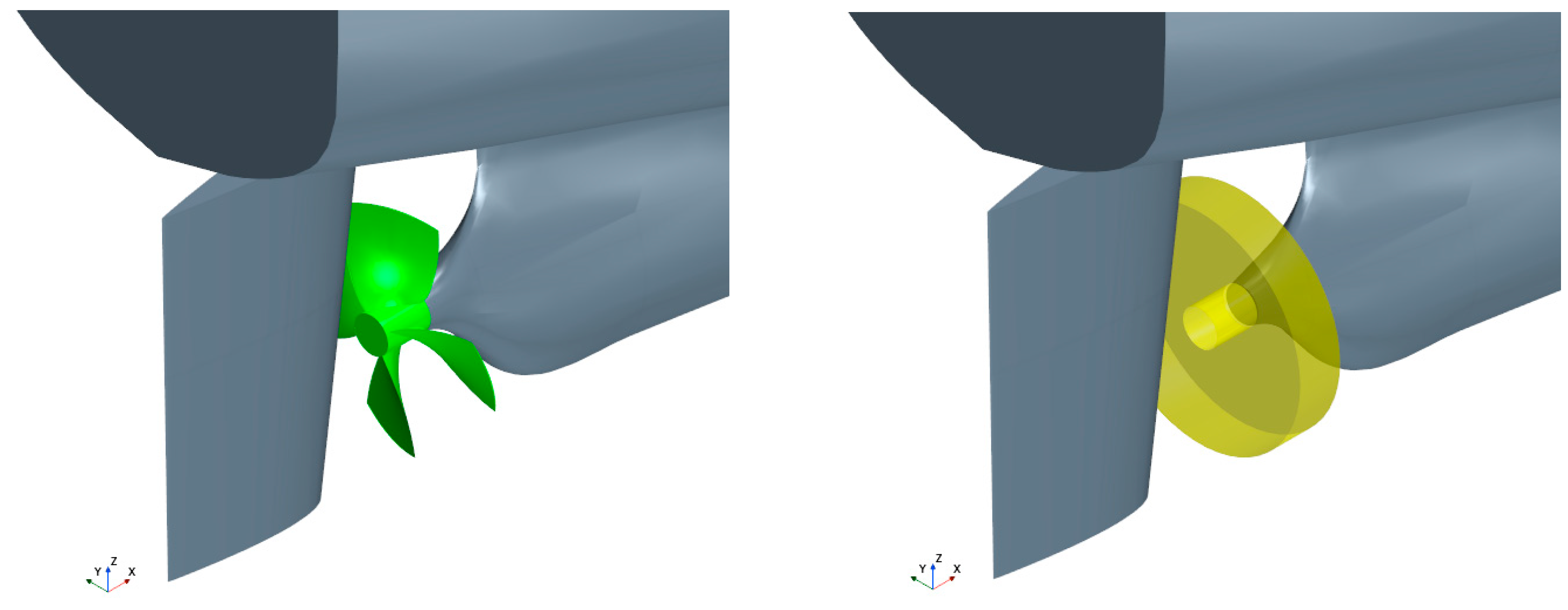
For the non-ducted propeller self-propulsion simulations, the body force propeller method provides an efficient approach. In this study, the efficient and concise descriptive body force method is adopted, in which the propeller is substituted by a virtual disk [11,19], as illustrated in Figure 8. To generate the corresponding thrust and torque, the propeller open-water characteristics are incorporated into the virtual disk model.

4.1.1. Configuration of Virtual Disk Parameters

The virtual disk geometry is defined by the outer diameter, inner diameter, and thickness, which correspond to the propeller diameter DP, the propeller hub diameter DH, and the hub thickness Δ, respectively. The geometry of the virtual disk, along with the imported open-water characteristics, rotational speed n, and advance speed VA, collectively determine the thrust T and torque Q generated by the virtual disk [19].

4.1.2. H-O Body Force Model

The force and torque distributions along the propeller are computed using Goldstein’s Optimum Distribution [33]. This model was first applied to actuator disk theory by Hough and Ordway [34]. Relevant formulas can be found in ADAPCO [19]. Specifically, in the H–O body force model, the momentum source varies along the radial direction, while the distributions along the axial and circumferential directions remain constant.

4.1.3. Virtual Disk Open Water

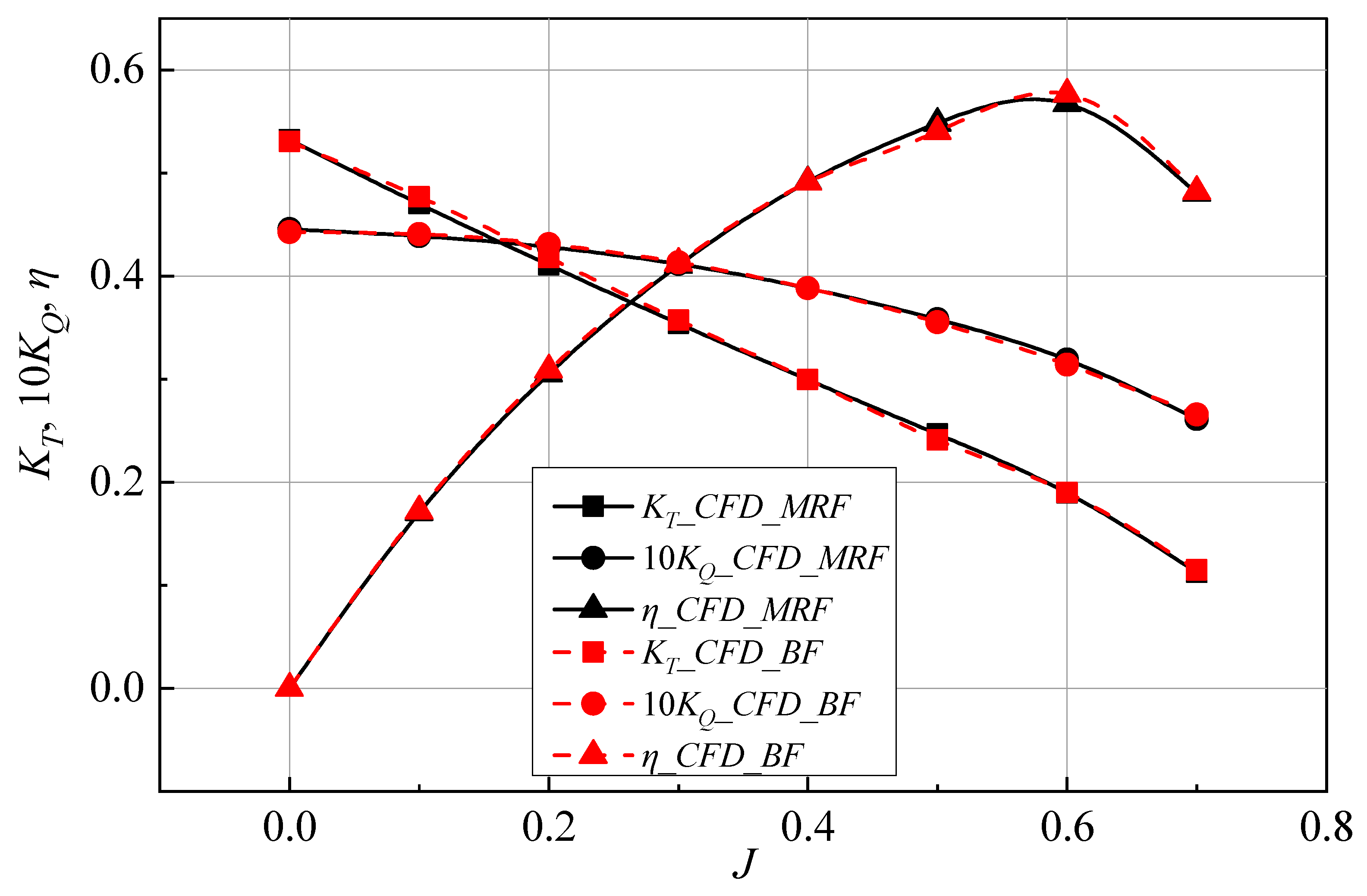
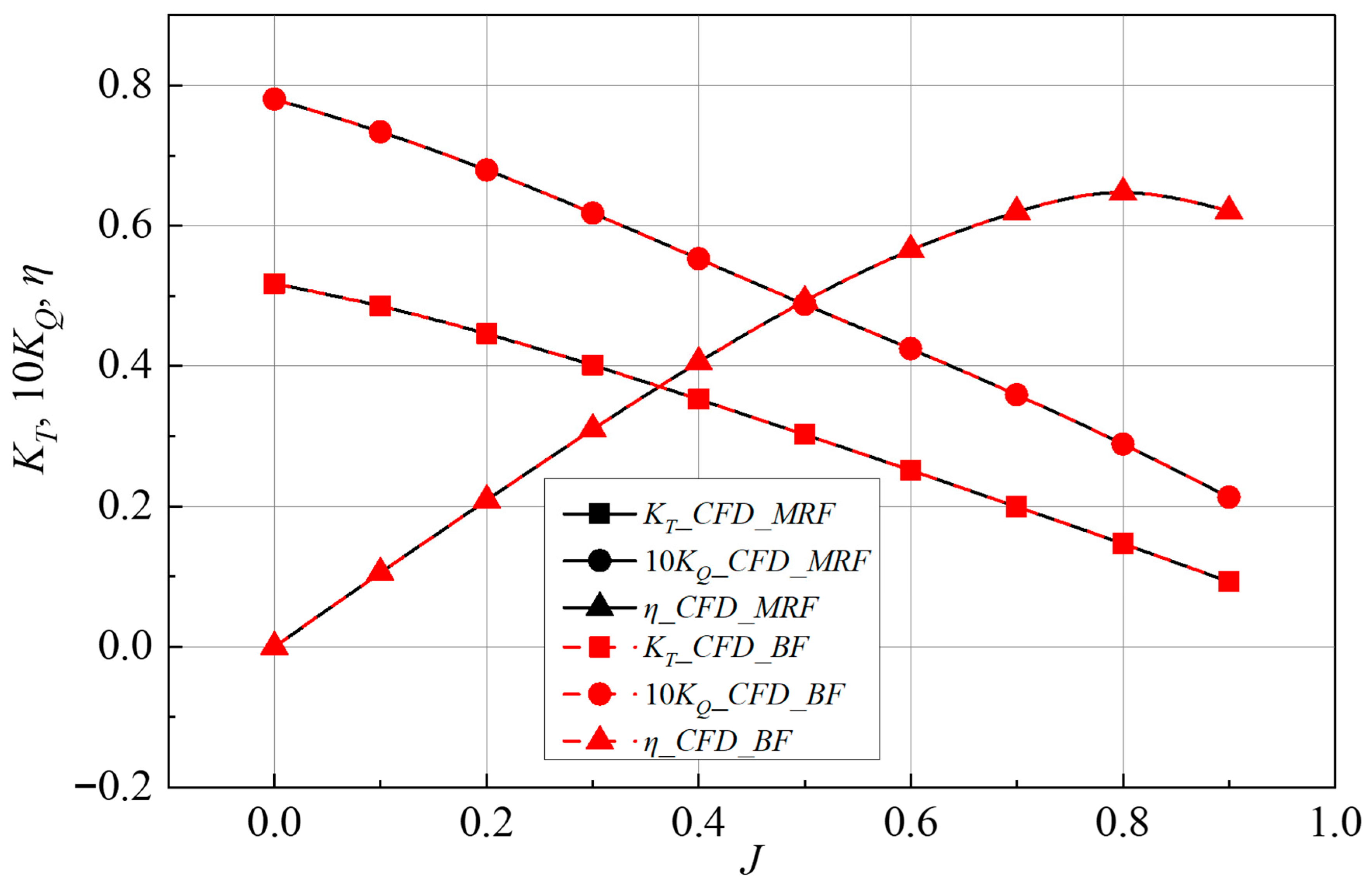
The open-water performance data shown in Figure 7 is integrated into the virtual disk. The virtual disk is then simulated under open-water conditions with a rotation rate of n = 16 rps. The advance speed VA of the virtual disk is set equal to the inflow velocity at the velocity inlet, which is implemented through the “constant inflow values” function in STAR-CCM+ [19]. The simulation results are compared with those of the propeller open-water simulations, as shown in Figure 9. The virtual disk’s open-water characteristics demonstrate strong alignment with those of the actual propeller. These open-water simulation results provide the basis for the subsequent self-propulsion simulations.

4.2. Body Force Ducted Propeller Method and Ducted Virtual Disk Open Water

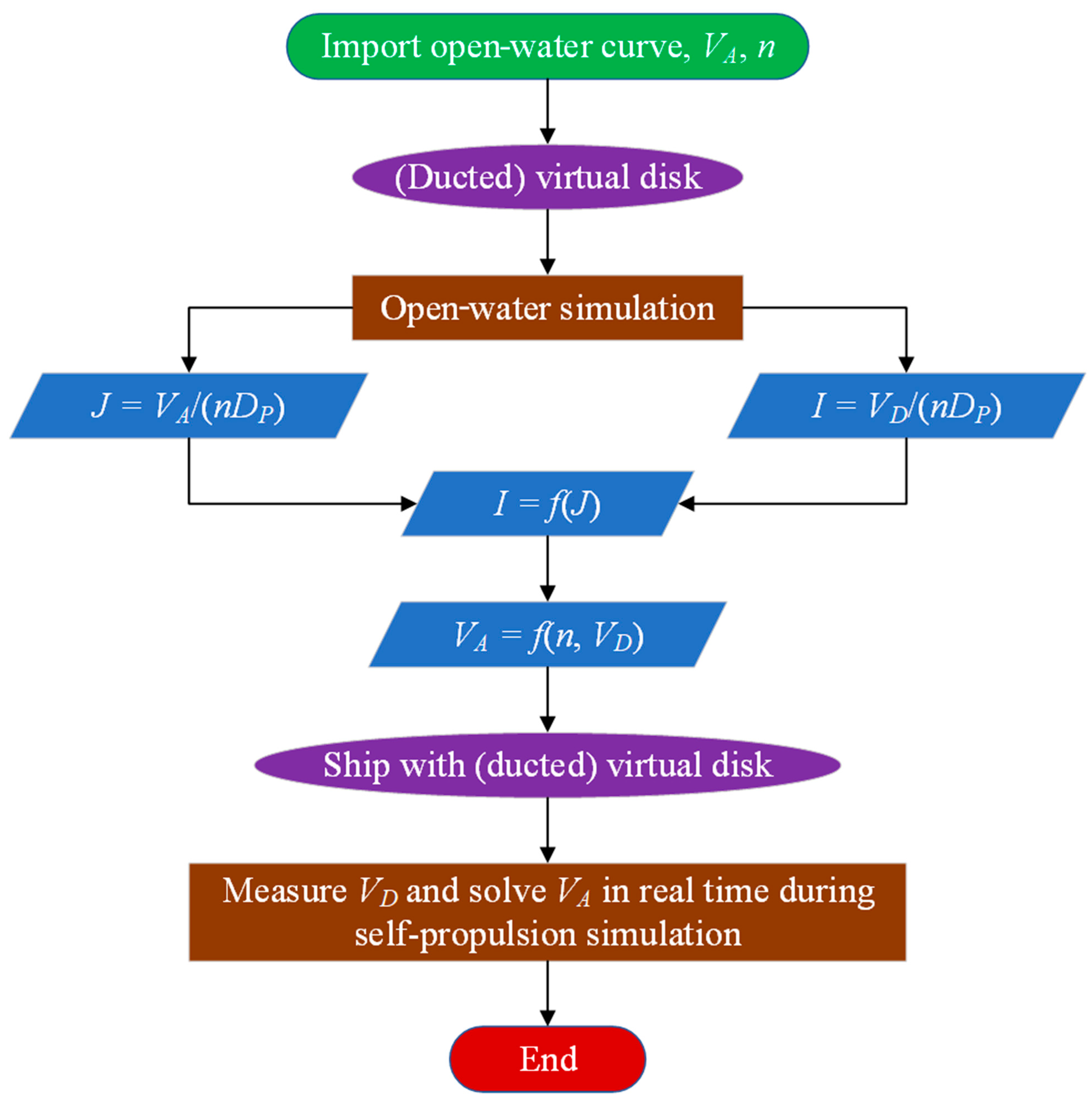
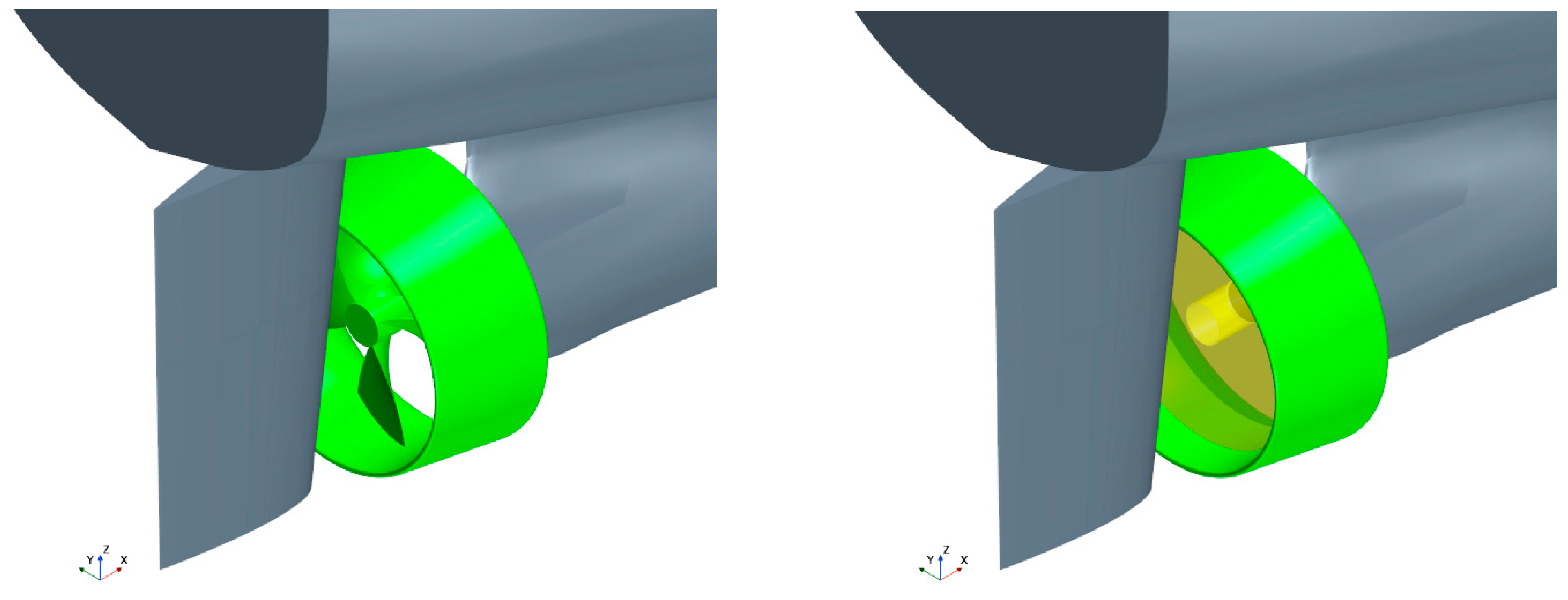
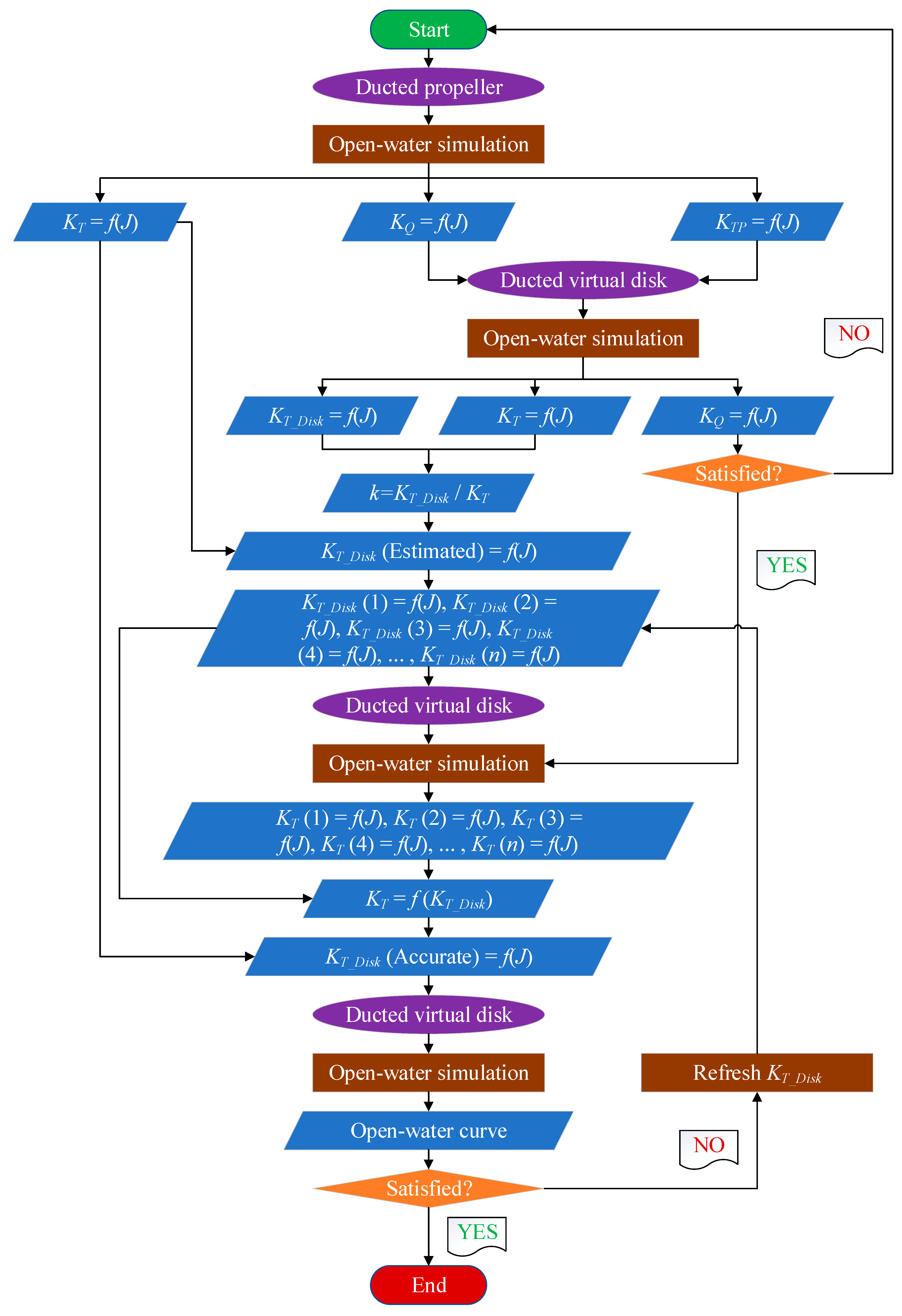
The body force ducted propeller method is a novel method proposed by Cai et al. [13] and later refined by Cai et al. [35], specifically developed for ducted propellers. In this method, the ducted virtual disk (shown in Figure 10) is employed as a substitute for the actual ducted propeller. To ensure that the open-water performance of the ducted virtual disk matches that of the ducted propeller, the open-water curve of the virtual disk must be modified to account for the duct effect [13]. Figure 11 illustrates the main steps of the body force ducted propeller method.
The configuration of the virtual disk parameters remains consistent with those described in Section 4.1.1, except for the modified open-water curve. The model is still based on the H–O body force model.

Ducted Virtual Disk in Open Water

The ducted virtual disk is simulated under open-water conditions. For the body force ducted propeller method, the KTP and KQ curves shown in Figure 6 are imported into the virtual disk, as expressed in Equations (27) and (28). The effect of the duct has already been incorporated into Equations (27) and (28).
K T P = 0.20793   J 3 0.05650   J 2 0.04643   J + 0.25515
K Q = 0.03291   J 3 0.00433   J 2 0.00713   J + 0.04461
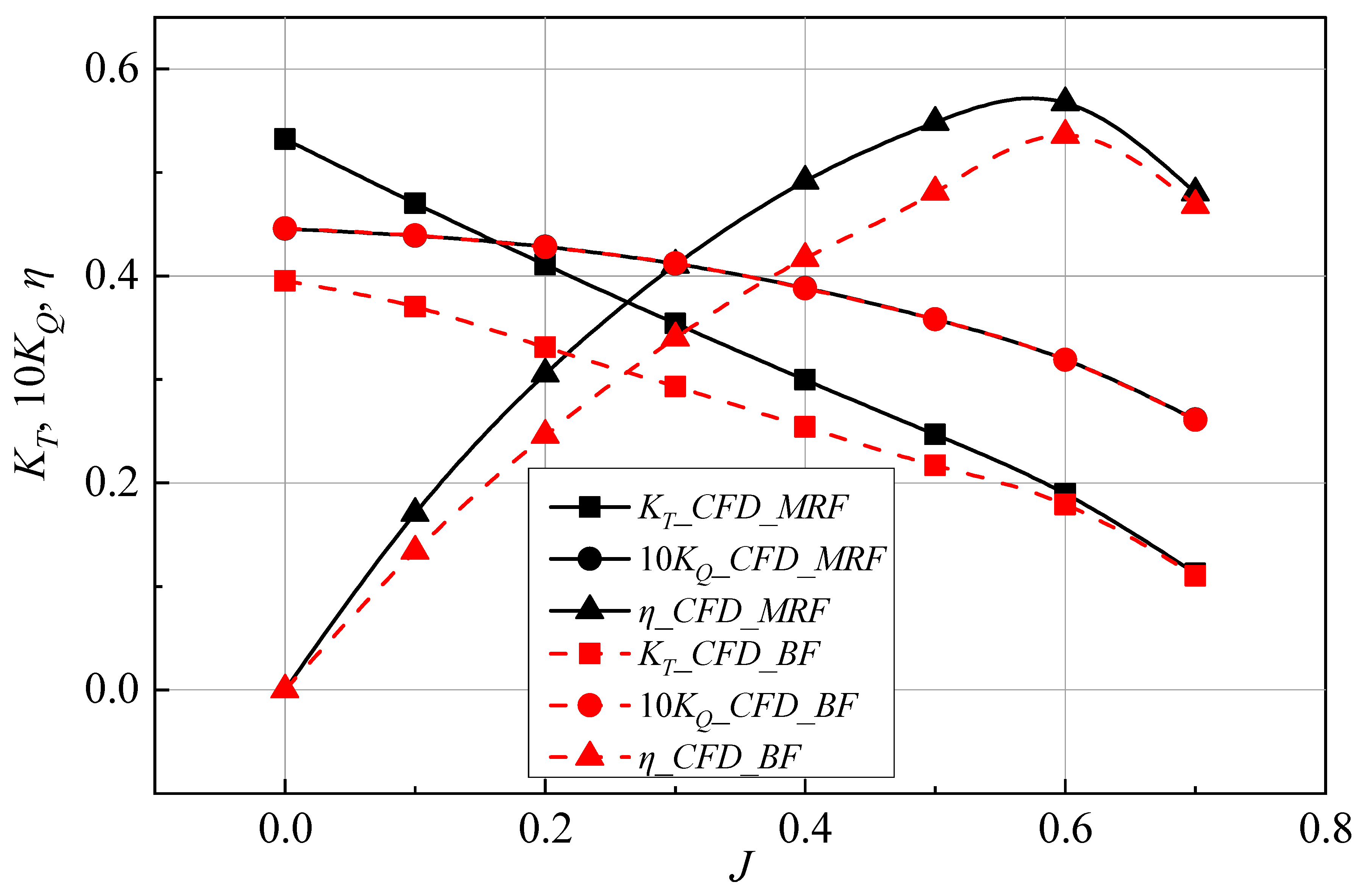
The ducted virtual disk is simulated at a rotational speed of n = 16 rps, and the results are compared with those of the ducted propeller in Figure 12. The KQ curves obtained by the two methods show good agreement. The KT curves, however, exhibit significant discrepancies because the virtual disk cannot reproduce the same duct–propeller interaction effects as the actual propeller [13]. Therefore, in order to improve the agreement between the open-water results of the two methods, the KT curve of the virtual disk must be modified.
The ratio of the thrust produced by the virtual disk to the total thrust for the ducted virtual disk is defined as follows:
k = K T _ D i s k K T
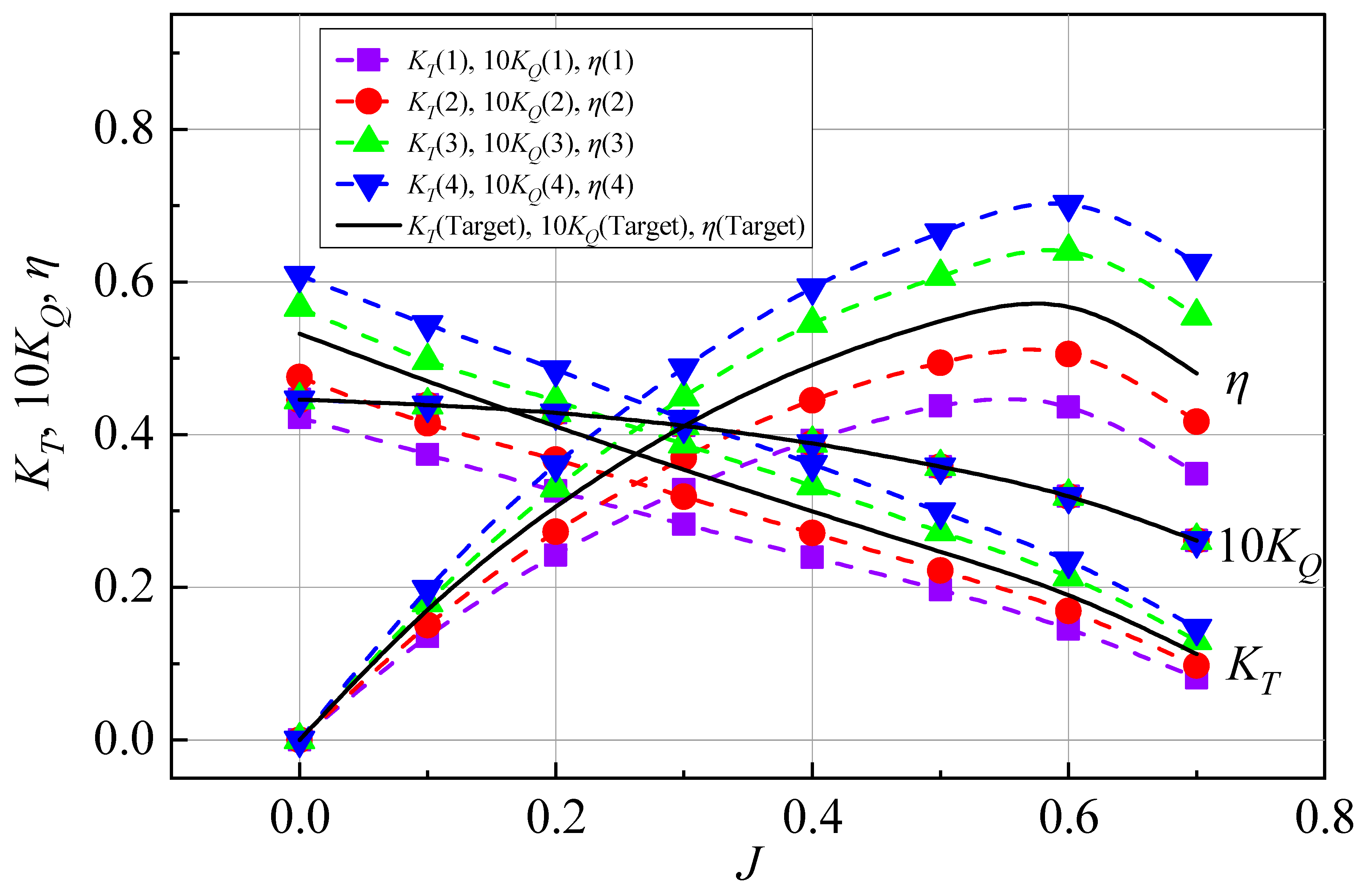
The values of k are obtained from the KT curve of the ducted virtual disk shown in Figure 12 and the imported KT_Disk curve. Next, the KT curve of the ducted propeller is selected as the target curve, and an estimated KT_Disk curve is derived based on the corresponding k values. To improve accuracy, four additional KT_Disk curves are generated around the estimated curve. Specifically, the estimated KT_Disk values are multiplied by scaling factors of 0.8, 0.9, 1.1, and 1.2, resulting in KT_Disk (1), KT_Disk (2), KT_Disk (3), and KT_Disk (4). These curves, listed in Table 10, are then imported into the virtual disk while keeping the KQ curves unchanged. Consequently, four open-water curves of the ducted virtual disk are obtained, as illustrated in Figure 13.
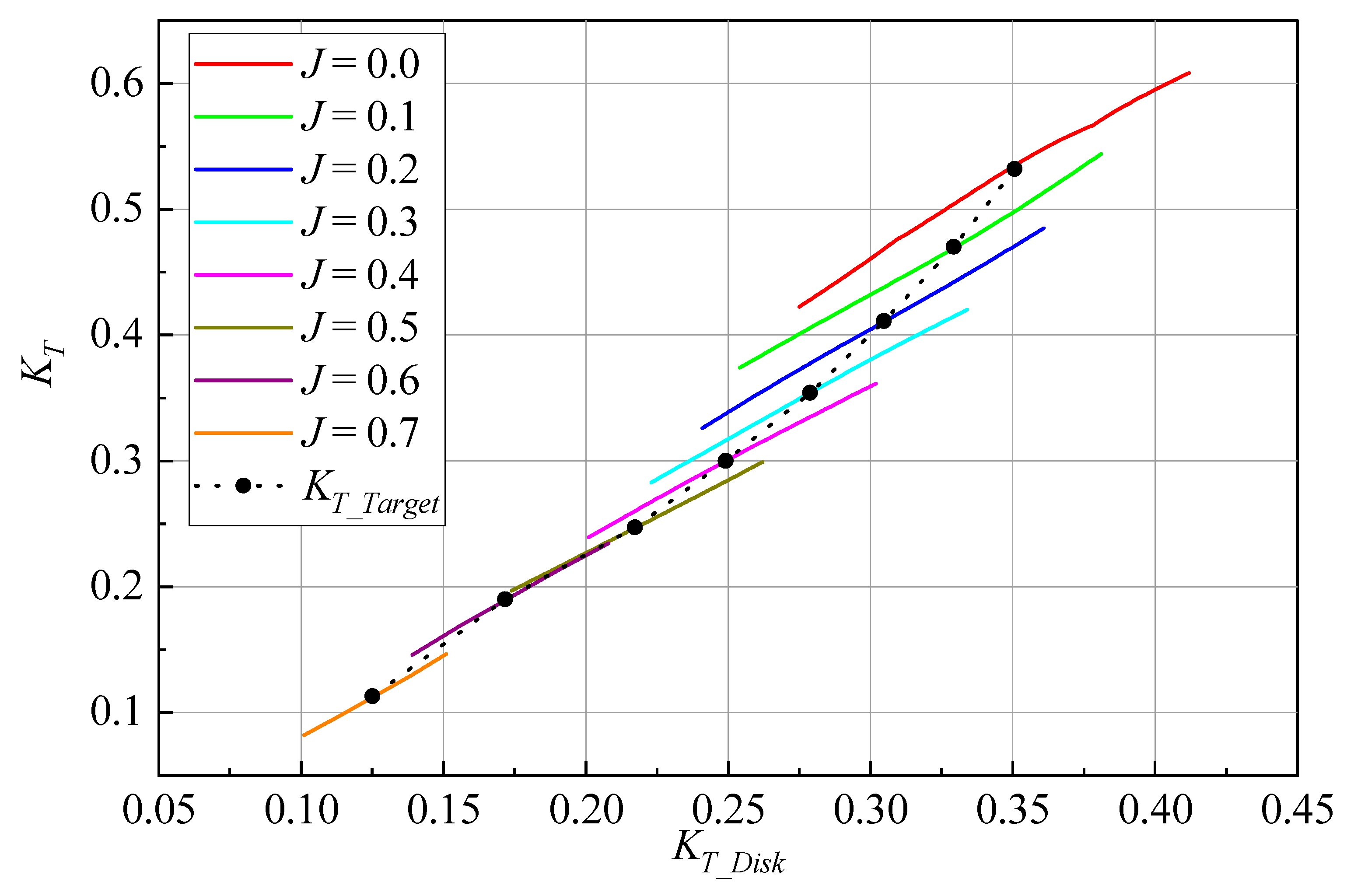
The results show that the four open-water curves either exceed or fall below the target open-water curve. Thus, the precise KT_Disk curve corresponding to the target curve can be determined through interpolation. The relationship between KT_Disk and KT at different advance ratios (J) is then analyzed using the data in Table 10 and Figure 13. Finally, by applying the target KT curve, the accurate KT_Disk curve is derived, as shown in Figure 14.
The precise KT_Disk curve is incorporated into the virtual disk to simulate the ducted virtual disk under open-water conditions. As shown in Figure 15, the results for the modified ducted virtual disk are compared with those for the ducted propeller, showing good agreement. Previous studies [13,35] also report that the modified ducted virtual disk exhibits good agreement with the ducted propeller across different values of n. Therefore, the present results provide a reliable basis for subsequent self-propulsion simulations in shallow water.

4.3. The Improved Principle of Momentum Conservation

The virtual disk introduced in Section 4.2 and the modified ducted virtual disk described in Section 4.3 are employed for self-propulsion simulations. In particular, determining the advance speed of the virtual disk and the ducted virtual disk is essential in such simulations [19]. To this end, the improved principle of momentum conservation [14], which enables precise real-time determination of VA, is adopted. The procedure for solving VA in the self-propulsion simulation is illustrated in Figure 16.
The internal velocity coefficient of the virtual disk is defined as follows:
I = V D n D P
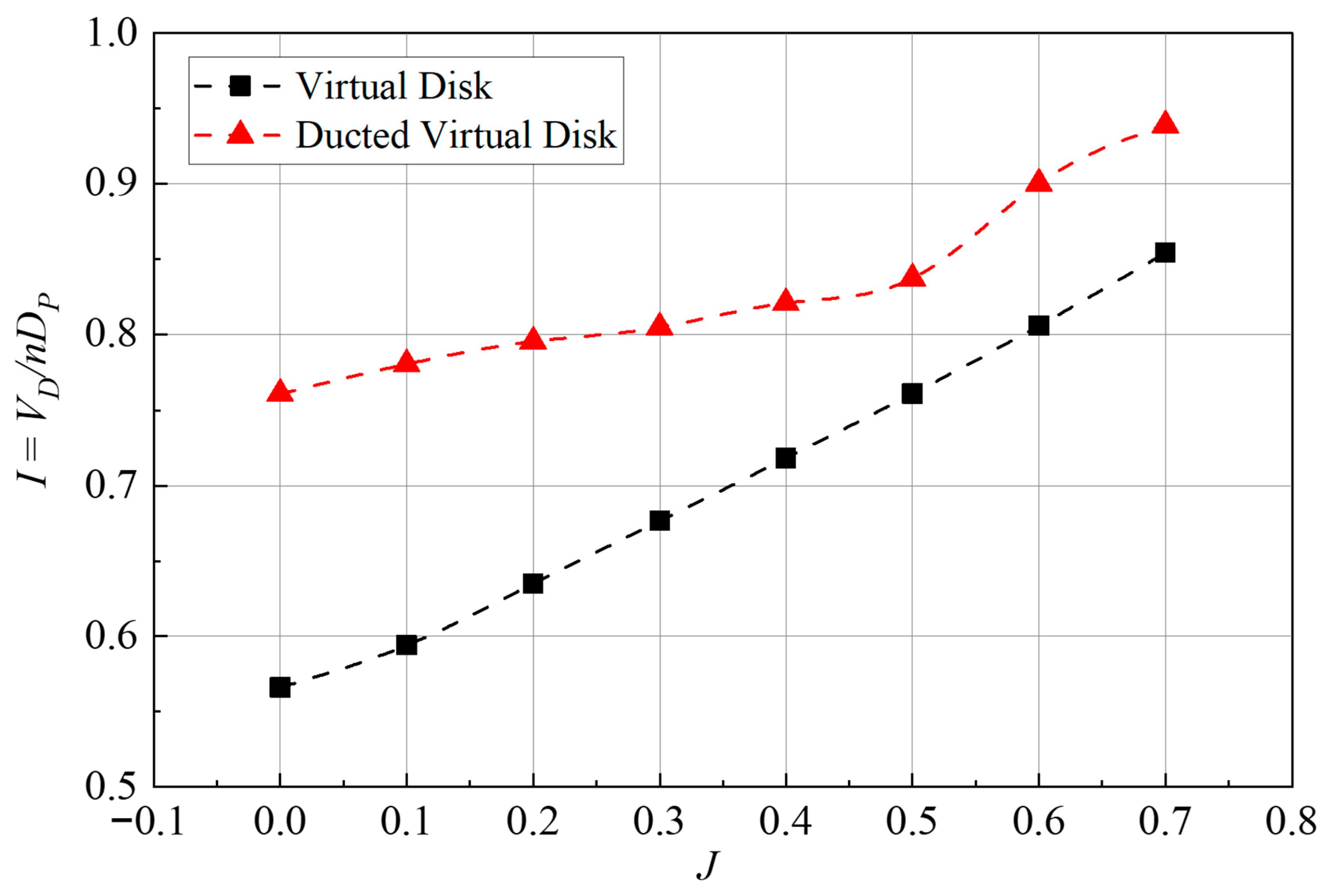
where VD denotes the mean axial flow velocity in the virtual disk, obtained by monitoring the velocity field across the mesh within the entire virtual disk region. In the open-water simulations shown in Figure 6 and Figure 7, VD is recorded simultaneously. The relationship curves for both the virtual disk and the ducted virtual disk are presented in Figure 17, which shows that the value of I increases with increasing J. Moreover, the ducted virtual disk exhibits a more complex behavior than the virtual disk due to the influence of the duct.
To describe the relationship between I and J, two polynomial models can be applied:
Without duct:
J = 1.42134 I 2 + 4.40740 I 2.02893 0 < J < 0.9
With duct:
J = 2569.15433 I 3 5956.00577 I 2 + 4607.32253 I 1189.17788   0 < J < 0.3 1.16808 I 2 + 8.06989 I 5.43859 0.3 < J < 0.5 9.63334 I 2 15.14668   I + 6.42856 0.5 < J < 0.7
In particular, according to previous studies [14,35], the relationship between I and J at different rotational speeds n can be well represented by Equations (31) and (32). Therefore, V A = f ( n , V D ) can be determined using Equations (12) and (30)–(32). In the self-propulsion simulation, once n is specified, VD is measured in real time, and VA can thus be solved in real time. It should be noted that if I falls outside the range shown in Figure 17, n should first be adjusted downward until I lies within the valid range, after which n is gradually increased until the prescribed value is reached. This adjustment process requires only a short amount of time. The entire process relies on the “field function” module and the “constant inflow values” function in STAR-CCM+.

4.4. Self-Propulsion Simulations Using Different Methods

This section applies the body force approach for propellers and ducted propellers to model the ship’s self-propelled performance in unrestricted water depths. These findings are then contrasted with outcomes from the discretized propeller technique. Additionally, the improved principle of momentum conservation is utilized to establish the inflow velocity VA for both the virtual disk and its ducted variant within the self-propulsion analyses.
In the discretized propeller method, the sliding grid technique is used to perform unsteady simulations of propeller rotation. The computational grids are constructed by combining those for ship resistance with either the propeller (or ducted propeller) open-water performance or the virtual disk (or ducted virtual disk) open-water performance. Compared with the virtual disk (or ducted virtual disk), the discretized propeller (or ducted propeller) requires substantially finer mesh resolution. Grid quality is ensured by maintaining y+ < 5 or y+ > 30 for all surfaces [23]. In the discretized propeller method, the propeller advances by 2° per time step [36], whereas in the body force propeller method and body force ducted propeller method, the time step is identical to that used in ship resistance simulations. Consequently, the body force approaches achieve a significant reduction in computational cost.
Nevertheless, several computational constraints should be noted when CFD is used for self-propulsion simulations. The discretized propeller method requires a rotating/sliding grid, refined near-wall mesh around the blades, hub, duct, and tip-clearance region, and a small time step to resolve propeller rotation. These requirements substantially increase the total cell number, computational time, and data storage demand, especially when several propeller configurations and water depths are considered. In shallow water, additional mesh refinement is also required in the narrow region between the hull bottom and the seabed to capture the accelerated under-keel flow and strong pressure gradients. Therefore, although the discretized propeller method provides more detailed blade-scale flow information, its computational cost limits its efficiency for parametric studies. In contrast, the body force method reduces mesh complexity and allows larger time steps, but it cannot fully resolve blade-scale unsteady vortical structures and circumferentially non-uniform loading. Thus, the present study uses the discretized propeller method mainly as a high-fidelity reference, while the body force method is evaluated as a computationally efficient alternative for shallow-water self-propulsion prediction.
In self-propulsion simulations, the values of n must be adjusted until the self-propulsion point is reached. At the model scale, the skin friction correction force (SFC) is introduced to correct the towing force, which is defined as:
S F C = 1 2 ρ M V M 2 S M ( C F M C F S )
In Equation (33), ρM, VM, SM, and CFM represent the water density, velocity, wetted surface area, and friction resistance coefficient at the model scale, respectively, while CFS denotes the friction resistance coefficient of the full-scale ship. The self-propulsion point is achieved when RT = SFC, where R is the resistance of the hull with rudder in the self-propulsion simulation and T is the thrust generated by the propeller (or ducted propeller) or by the virtual disk (or ducted virtual disk). At a scale ratio of 1/58, the skin friction correction (SFC) force is 10.39 N, which aligns with the model test conditions provided by Seo et al. [37].
Self-propulsion factors are defined as follows:
Thrust deduction fraction:
t = T + S F C R T
where T is the thrust generated by the propeller (or ducted propeller) or by the virtual disk (or ducted virtual disk) and R is the resistance of the bare hull with rudder.
Wake fraction:
w = 1 V A U
where VA denotes the advance speed of the propeller (or ducted propeller) or the virtual disk (or ducted virtual disk) and U is the ship speed.
Open-water efficiency:
η 0 = K T K Q 0 J 2 π
Relative rotative efficiency:
η R = K Q 0 K Q
where KQ0 and KQ are the propeller torque coefficients in open-water simulation and self-propulsion simulation, respectively. Once KT is obtained in the self-propulsion simulation, KQ0, J and η0 can be determined from the open-water curve.
Hull efficiency:
η H = 1 t 1 w
Propulsive efficiency:
η D = η 0 η R η H
Delivered power:
P = 2 π n Q
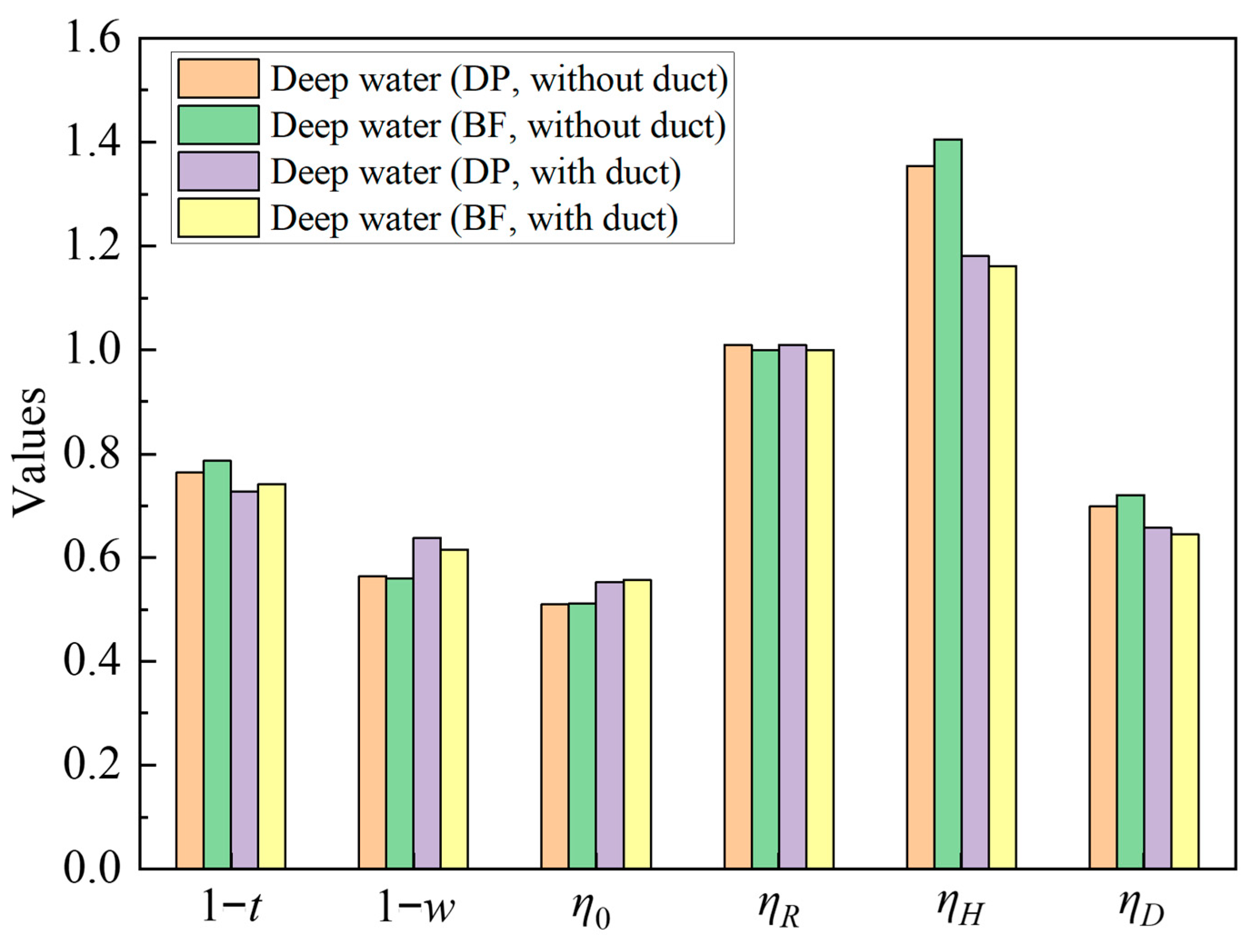
The discretized propeller method is frequently used as a benchmark for assessing the results of the body force propeller method, due to its high accuracy [12,38]. In Table 11 and Table 12, the self-propulsion factors obtained from the body force propeller method and the body force ducted propeller method (hereafter referred to as BF) are compared with those from the discretized propeller method (hereafter referred to as DP). The wake fraction w, which is directly related to VA, is accurately determined using the improved principle of momentum conservation. Furthermore, the self-propulsion factors show discrepancies of less than 5%.
In Figure 18, several self-propulsion factors are compared for the cases with and without a duct, using both DP and BF methods. The presence of the duct accelerates and confines the inflow, producing a more contracted, high-momentum wake. This concentrated wake impinges more strongly on the stern and enhances the hull–propulsor interaction. Consequently, the effective hull resistance under self-propulsion increases, leading to a larger thrust deduction fraction t in the ducted cases compared with the non-ducted cases.
Moreover, by accelerating the inflow and reducing the velocity deficit ahead of the propeller disk, the duct increases the advance speed VA at the propeller plane. According to the definition w = 1 ( V A / U ) , a higher VA corresponds to a reduced wake fraction w, explaining why the ducted propeller exhibits a smaller w than the conventional propeller.
At the self-propulsion point, the open-water efficiency (η0) of the ducted propeller is higher than that of the conventional propeller. This improvement can be attributed to three factors: (i) the duct reduces the loading on the propeller blades, allowing them to operate under more favorable hydrodynamic conditions with smaller torque; (ii) the duct suppresses tip vortices and mitigates associated induced losses, improving blade efficiency; and (iii) the acceleration of the inflow by the duct shifts the operating point to a region of higher efficiency on the open-water curve. As a result, the ducted propeller achieves a higher η0 at the self-propulsion point, despite the additional viscous losses introduced by the duct.
In the ducted cases, the larger t and smaller w (i.e., lower (1 − t) and higher (1 − w)) reduce the ratio ( 1 t ) / ( 1 w ) , which leads to a lower hull efficiency ηH compared with the non-ducted cases. The relative rotative efficiency ηR shows little variation, since the propeller loading distribution is not significantly altered. Finally, because ηD is the product of η0, ηH, and ηR, the reduction in ηH outweighs the increase in η0, resulting in an overall lower propulsive efficiency ηD for the ducted cases compared with the non-ducted cases.
Table 13 lists the trim and sinkage of the hull in deep-water resistance and self-propulsion simulations. It can be observed that both trim and sinkage are small under deep-water conditions, and thus, the influence of hull attitude on resistance is limited. Moreover, the differences in trim and sinkage between the resistance and self-propulsion simulations are minor, indicating that the propeller (or virtual disk) and the ducted propeller (or ducted virtual disk) exert little influence on the hull attitude in deep water.

5. Shallow-Water Simulations: Resistance and Self-Propulsion

The following assumptions and approximations are adopted in the present simulations. The flow is assumed to be incompressible and turbulent and is solved using the RANS equations with the SST kω turbulence model. The simulations are conducted at model scale in calm water, without wind, waves, current, bank effects, or seabed roughness. The free surface is captured using the VOF method. For deep-water simulations, the bottom boundary is placed sufficiently far from the hull to avoid noticeable seabed influence. For shallow-water simulations, the water depth is represented by the depth-to-draft ratio H/T, with H/T = 3, 2, and 1.5. The seabed is treated as a flat and rigid sliding wall, and the only change from the deep-water condition is the reduced distance between the ship bottom and the bottom boundary. The hull is allowed to move in sinkage and trim using the DFBI model, while roll, sway, and yaw motions are not considered. The propeller is modeled either by a discretized rotating propeller or by a body force/virtual disk approximation. In the body force method, the blade-scale geometry and circumferential non-uniformity are not fully resolved, and the propeller action is represented by an equivalent momentum source.
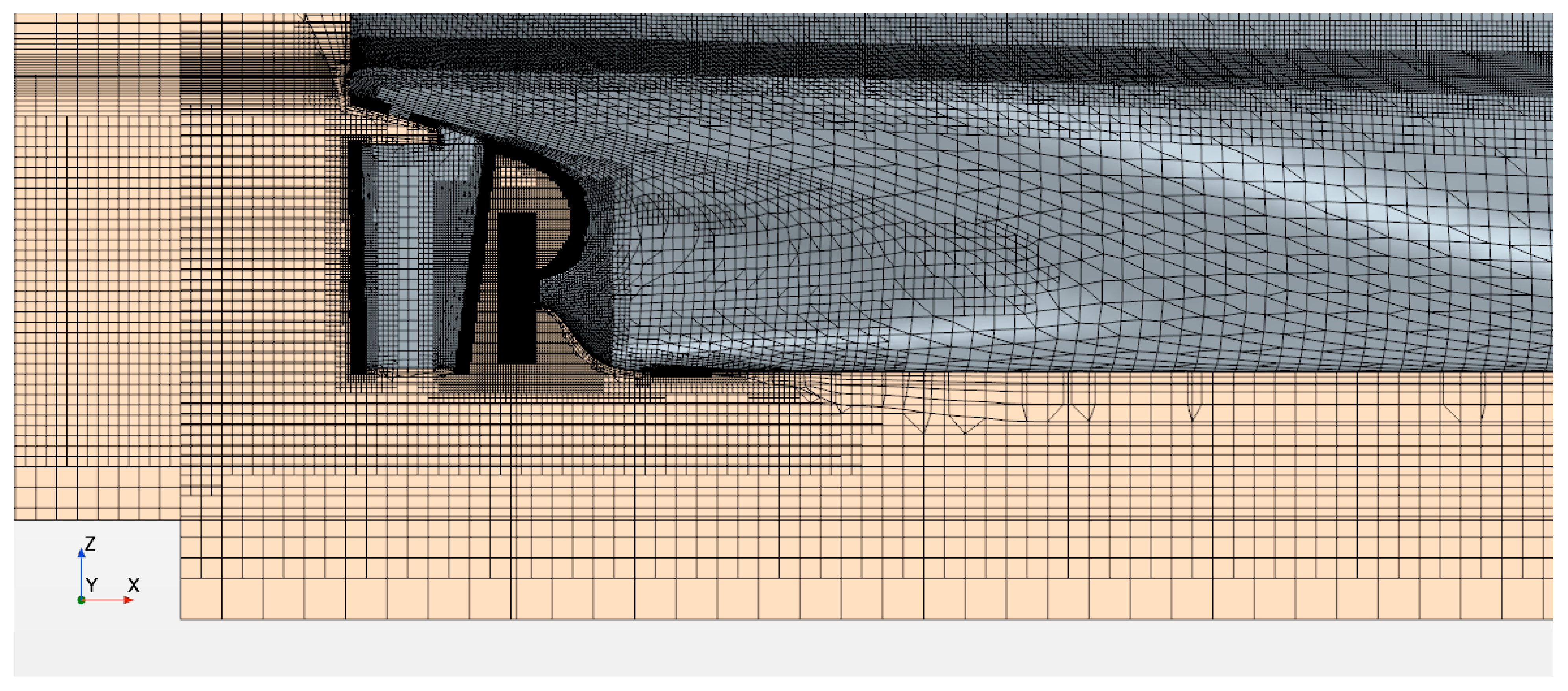
The mesh generation strategy follows that described in Section 3 and Section 4. Compared with the deep-water resistance and self-propulsion simulations, the only modification is the reduced distance between the bottom boundary of the computational domain and the ship bottom. Since the clearance between the hull and the seabed is small, the mesh in this region is refined to better capture the flow field, as illustrated in Figure 19.
For the self-propulsion simulations, both the body force propeller method and the body force ducted propeller method are employed, and the results are compared with those obtained from the discretized propeller method.
The added values in shallow-water resistance and self-propulsion simulations are defined as the differences between the results in shallow water and those in deep water and are denoted by the subscript AS. For example, RAS represents the resistance in shallow water minus that in deep water. This definition is consistent with the convention used for added resistance and added power in waves [37].
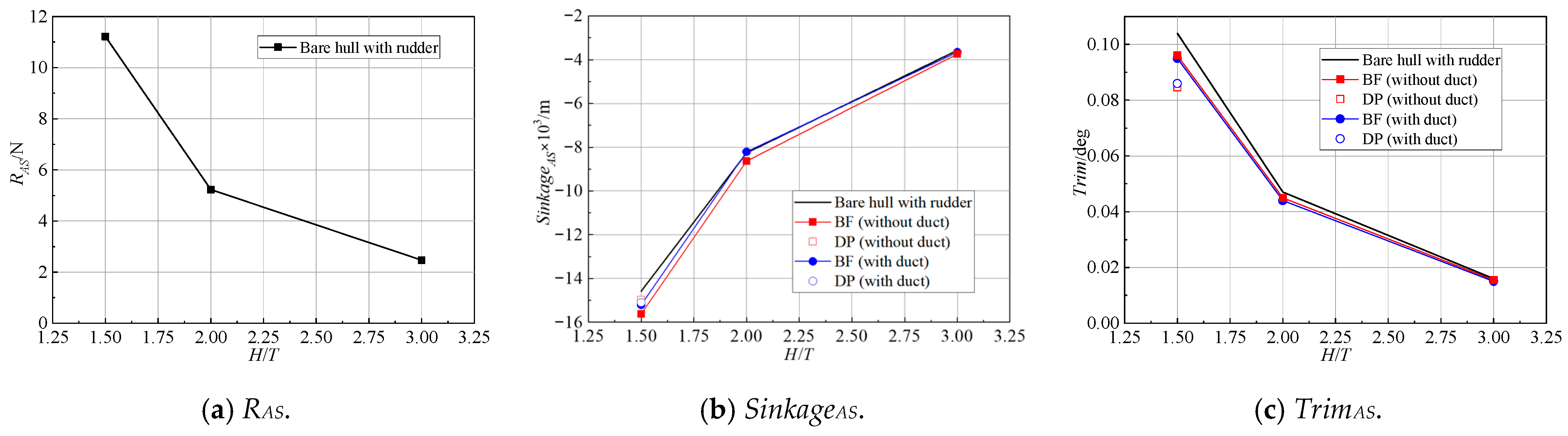
Figure 20 presents the added values of RAS, SinkageAS and TrimAS. It can be observed that all three quantities gradually increase as the depth-to-draft ratio (H/T) decreases, with a sharp rise occurring at H/T = 1.5. These phenomena can be explained by shallow-water hydrodynamics: as H/T decreases, the clearance between the hull bottom and the seabed becomes smaller, enhancing the blockage effect. This restriction accelerates the flow beneath the hull, increases the pressure difference between bow and stern, and results in larger added resistance, sinkage, and trim. The abrupt increase at H/T = 1.5 indicates the onset of critical shallow-water effects when the under-keel clearance is very limited.
For SinkageAS, the ducted case shows a slight reduction compared with the non-ducted case because the duct modifies the propeller inflow and alleviates part of the stern suction. However, both the ducted and non-ducted cases exhibit slightly larger SinkageAS than the bare-hull-with-rudder case due to additional propulsor–hull interaction. For TrimAS, both the ducted and non-ducted cases show a slight reduction relative to the bare hull with rudder, suggesting that the propulsor introduces a compensating moment that mitigates the bow-up trim tendency in shallow water. Overall, the differences between ducted and non-ducted cases are relatively minor, indicating that the dominant factor governing sinkage and trim variations is the shallow-water effect itself rather than the propulsor configuration.
Table 14 and Table 15 present the self-propulsion factors obtained by BF in shallow water without and with a duct, respectively, while Table 16 and Table 17 provide error comparisons of self-propulsion factors at H/T = 1.5 for BF and DP. At H/T = 1.5, the ducted configuration yields a 20.8% reduction in power relative to the non-ducted case. When compared with the deep-water results, the errors are greater in shallow water, with the discrepancies being more pronounced in the ducted cases than in the non-ducted ones. Despite these differences, all errors remain within an acceptable range.
These trends can be explained by shallow-water hydrodynamics. As the depth-to-draft ratio decreases, the clearance between the hull and seabed is reduced, which enhances the blockage effect and alters the stern wake distribution. This strengthens the hull–propulsor interaction and increases the sensitivity of the self-propulsion factors, thereby amplifying the differences between BF and DP. In the ducted cases, the duct further accelerates and concentrates the inflow, intensifying the interaction with the hull and resulting in larger errors compared with the non-ducted cases. Despite these influences, the discrepancies remain within practically acceptable limits, demonstrating that the BF method can still provide reliable predictions of self-propulsion performance in shallow water.
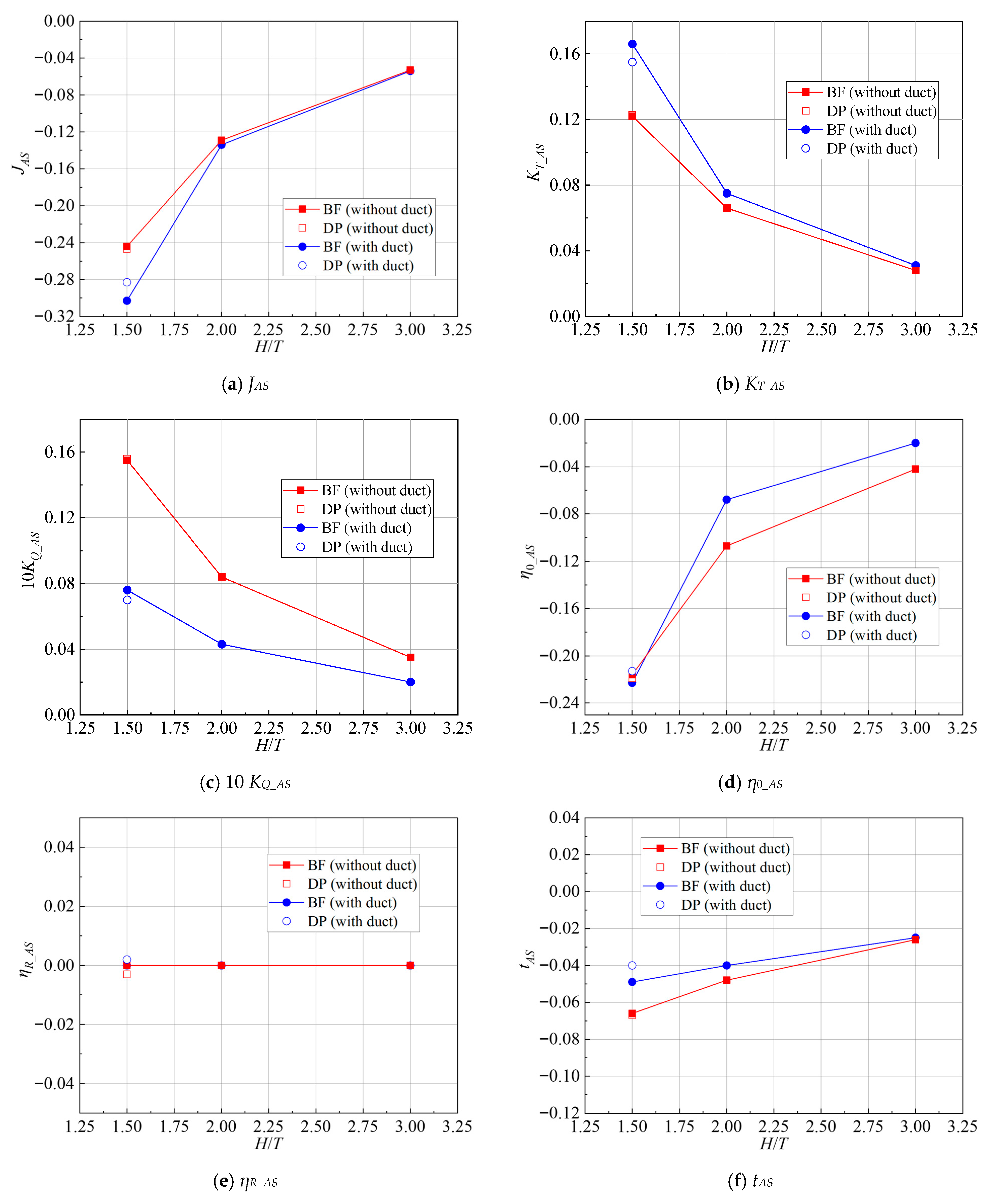
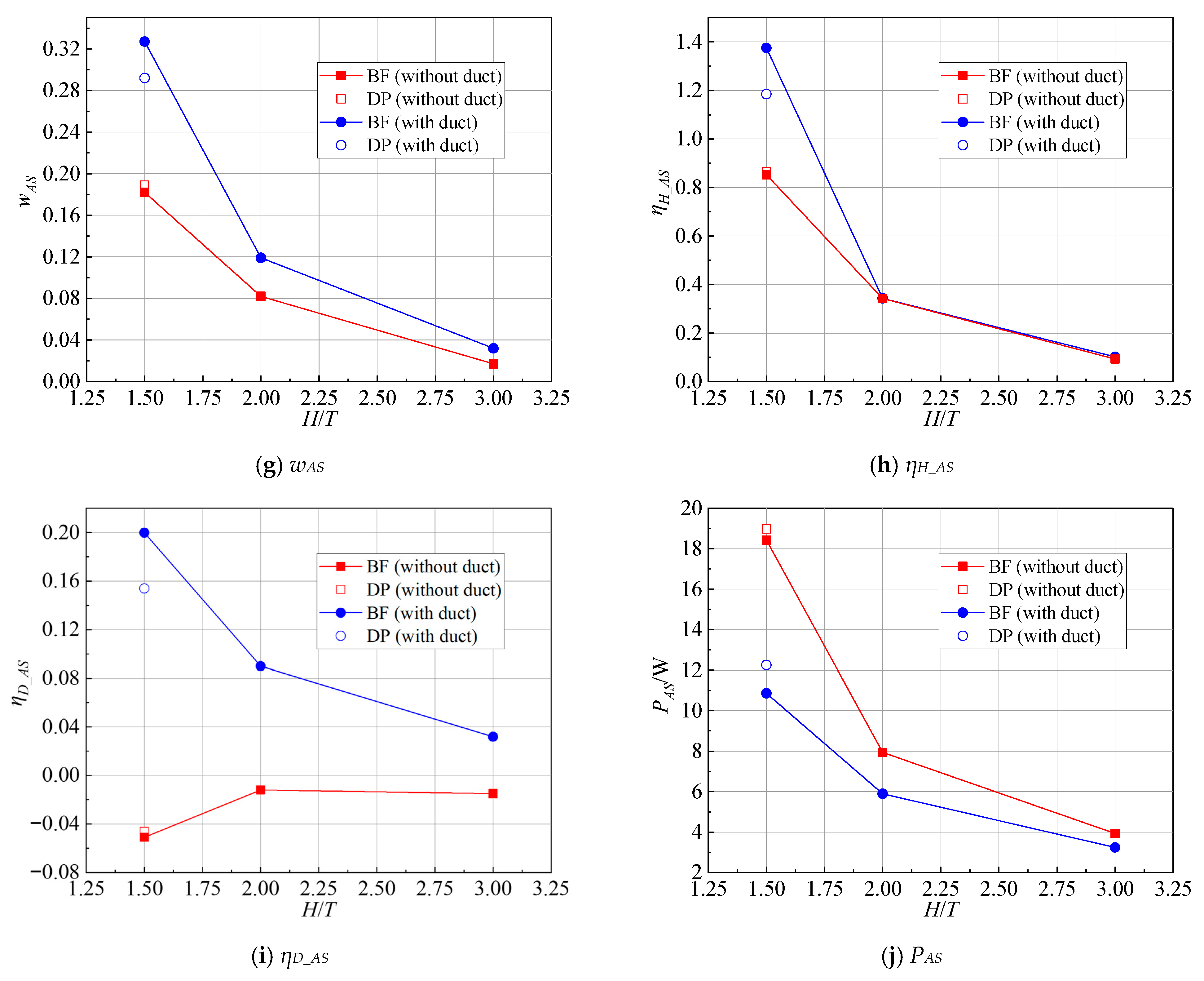
Figure 21 shows the added values of the self-propulsion factors in shallow water. As the depth-to-draft ratio (H/T) decreases, JAS decreases and even becomes negative, with significantly smaller values in the ducted case compared with the non-ducted case at H/T = 1.5. This behavior arises because the reduction in under-keel clearance intensifies the blockage effect, increasing hull resistance and thus requiring a higher propeller load, which shifts the operating point to a lower advance coefficient. Consequently, the variations in KTAS, 10 KQAS, and η0_AS are largely governed by the reduction in JAS. For the wake fraction, wAS > 0 in shallow water and increases as depth decreases, with the ducted case showing a more pronounced growth. This is because the duct accelerates and concentrates the inflow, which, according to English and Rowe [39], increases the proportion of fluid induced into the boundary layer, thereby reducing VA and further elevating the wake fraction.
For the thrust deduction fraction, tAS remains positive but gradually decreases as the water depth decreases, with a larger reduction in the non-ducted case, reflecting differences in the hull–propulsor interaction. Relative rotative efficiency ηR_AS shows negligible change: in the BF method, it is identically 1 [11], while in the DP method, it remains close to 1 in both the ducted and non-ducted cases. The hull efficiency increment, ηH_AS, decreases as depth decreases but remains positive in the ducted cases and is noticeably higher than in the non-ducted cases, particularly at H/T = 1.5, due to the stronger acceleration effect of the duct.
The propulsive efficiency increment, ηD_AS, exhibits opposite trends: it increases and remains positive in the ducted cases, while it decreases and becomes negative in the non-ducted cases. This favorable influence of the duct can be explained by its contribution to thrust generation, which reduces the load on the propeller blades, lowers torque demand, and allows the propeller to operate at higher hydrodynamic efficiency. In addition, the duct suppresses tip vortex formation and reduces induced losses, further improving efficiency and offsetting shallow-water penalties. Finally, the delivered power increment PAS increases with decreasing water depth and remains positive in all cases. However, the increase is significantly smaller in the ducted case, since the duct provides part of the thrust directly, thereby reducing the power required from the propeller itself.

6. Results of Flow Fields in DP and BF

In this section, the flow-field details under deep-water and shallow-water conditions, with and without a duct, are compared in order to further analyze the trends observed in the self-propulsion results.
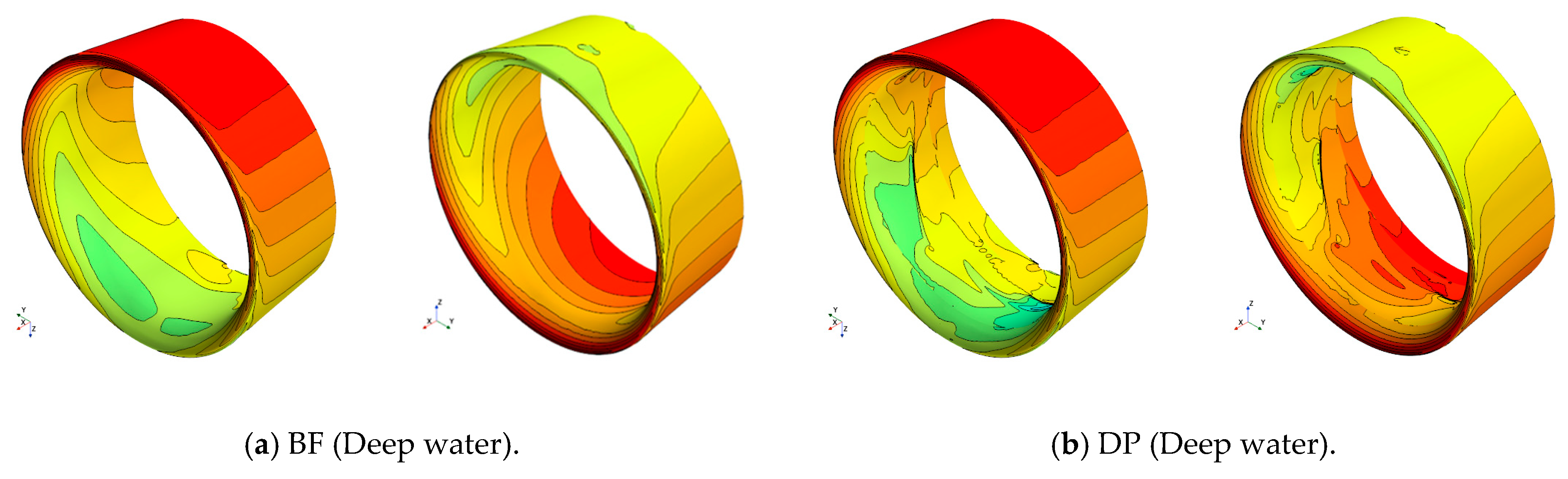
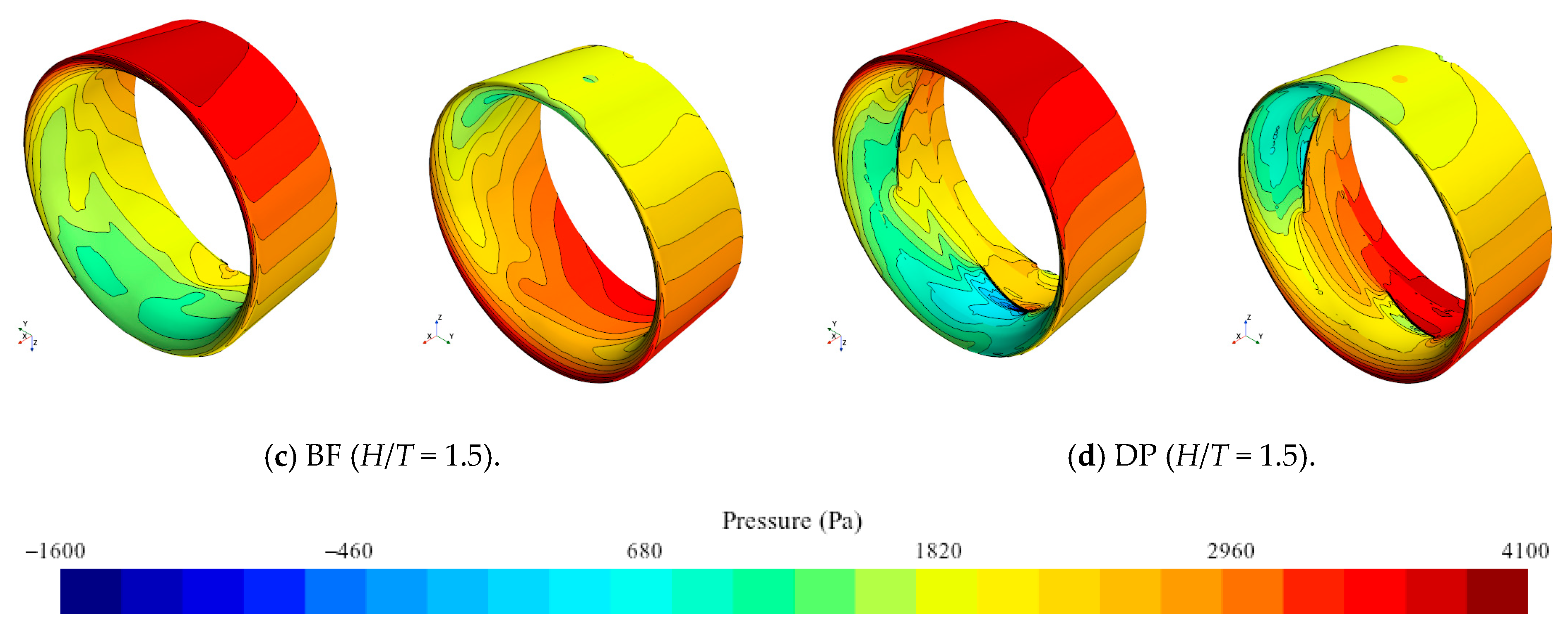
Figure 22 shows the pressure distributions on the duct surface from different perspectives, which can be identified using the coordinate system in the figure. The results obtained with the BF method exhibit good agreement with those from the DP method. This indicates that the interactions among the duct, propeller, and hull can be reasonably approximated by BF, whereas more detailed features of the flow field are captured by the discretized propeller method.
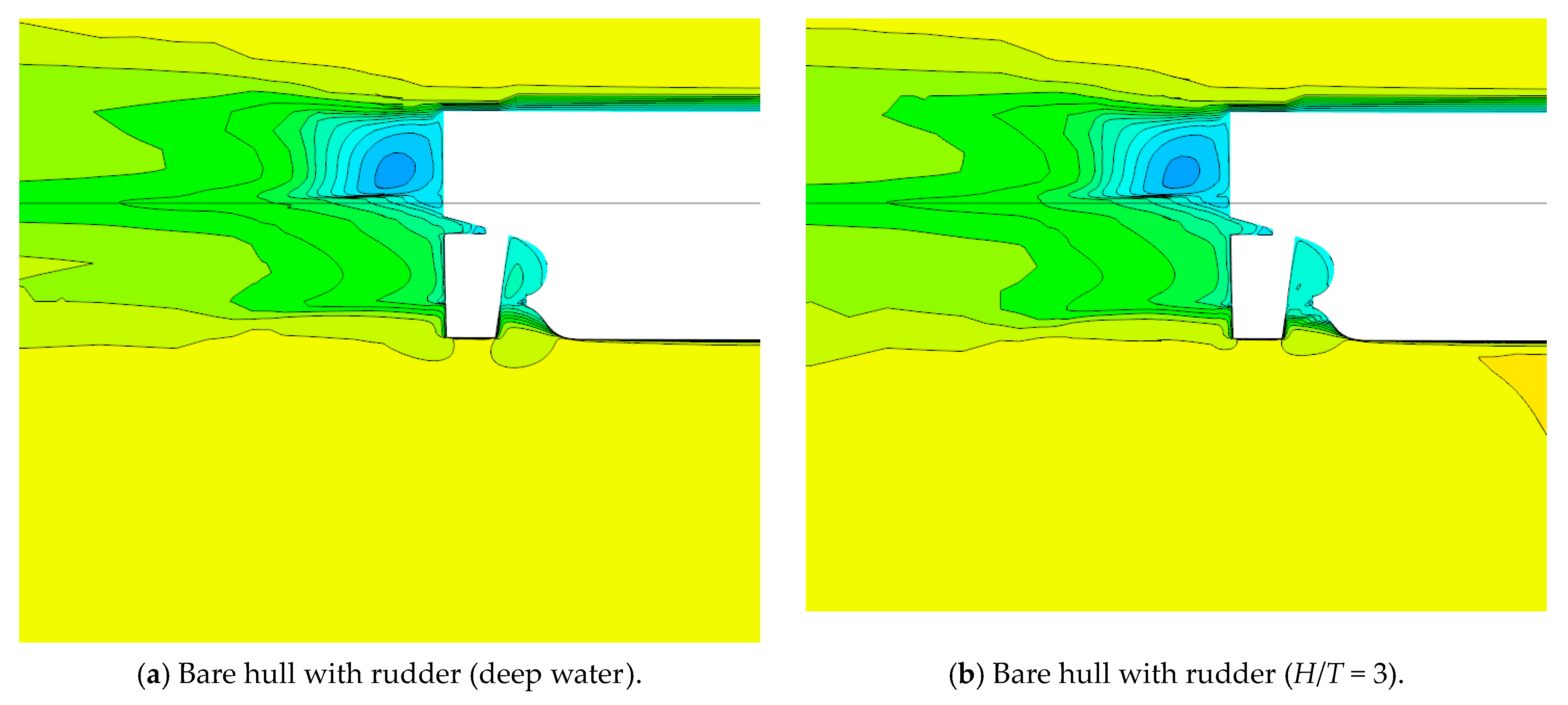
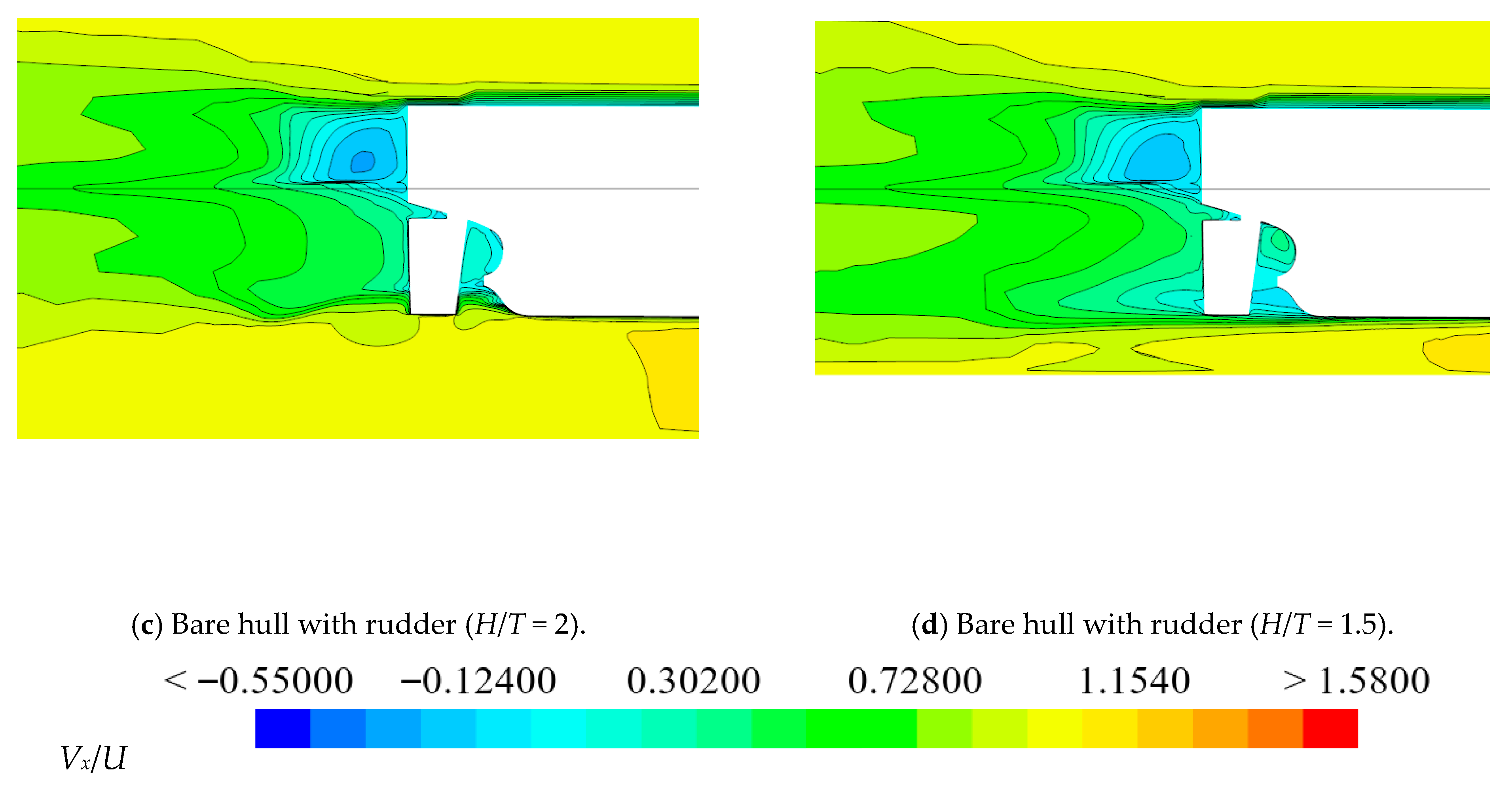
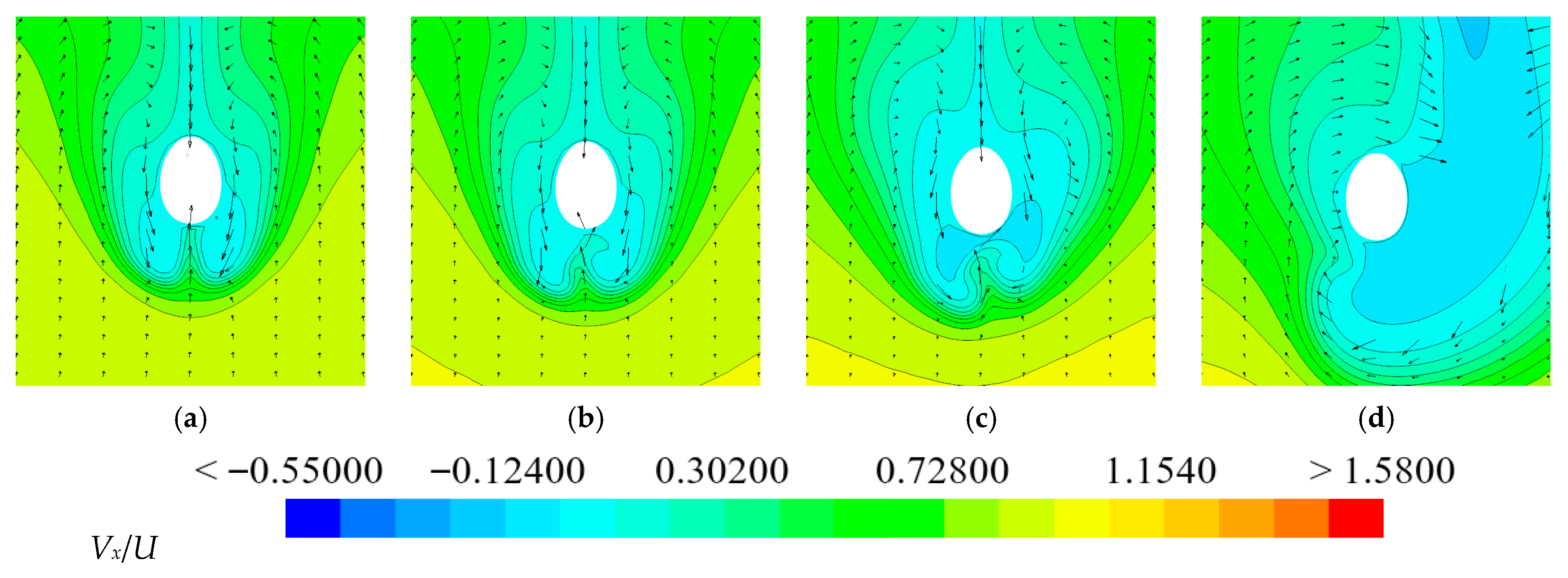
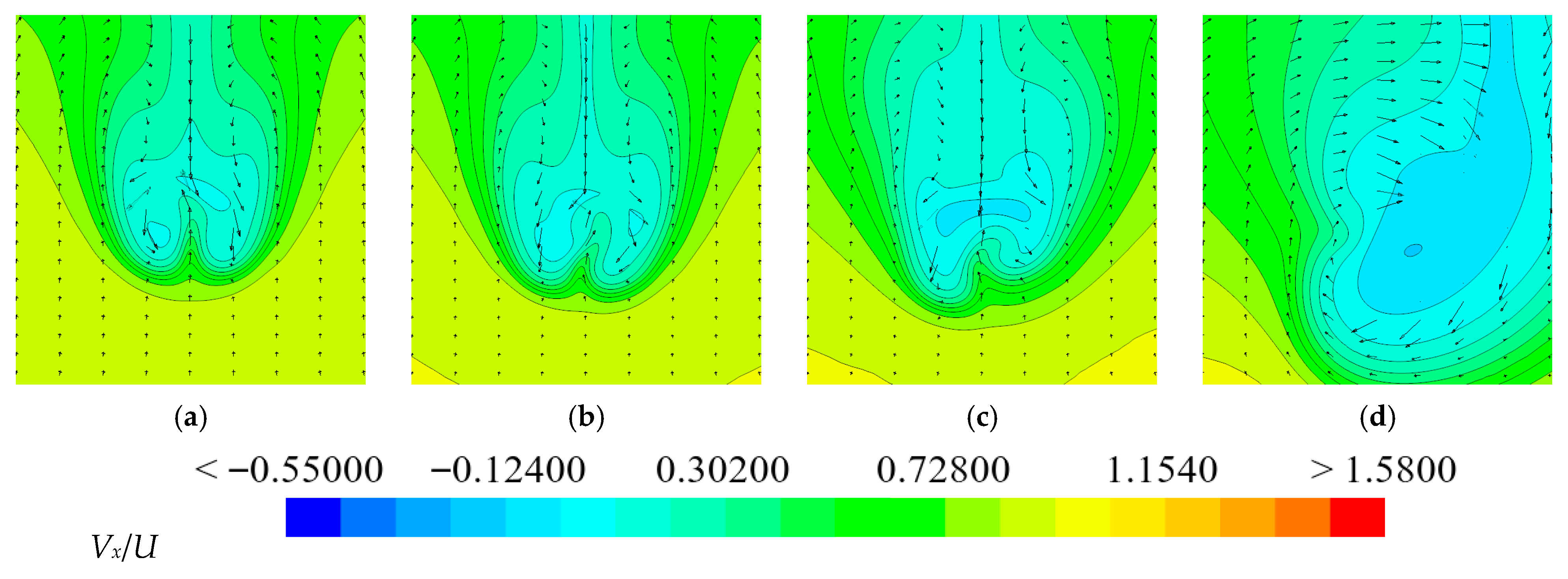
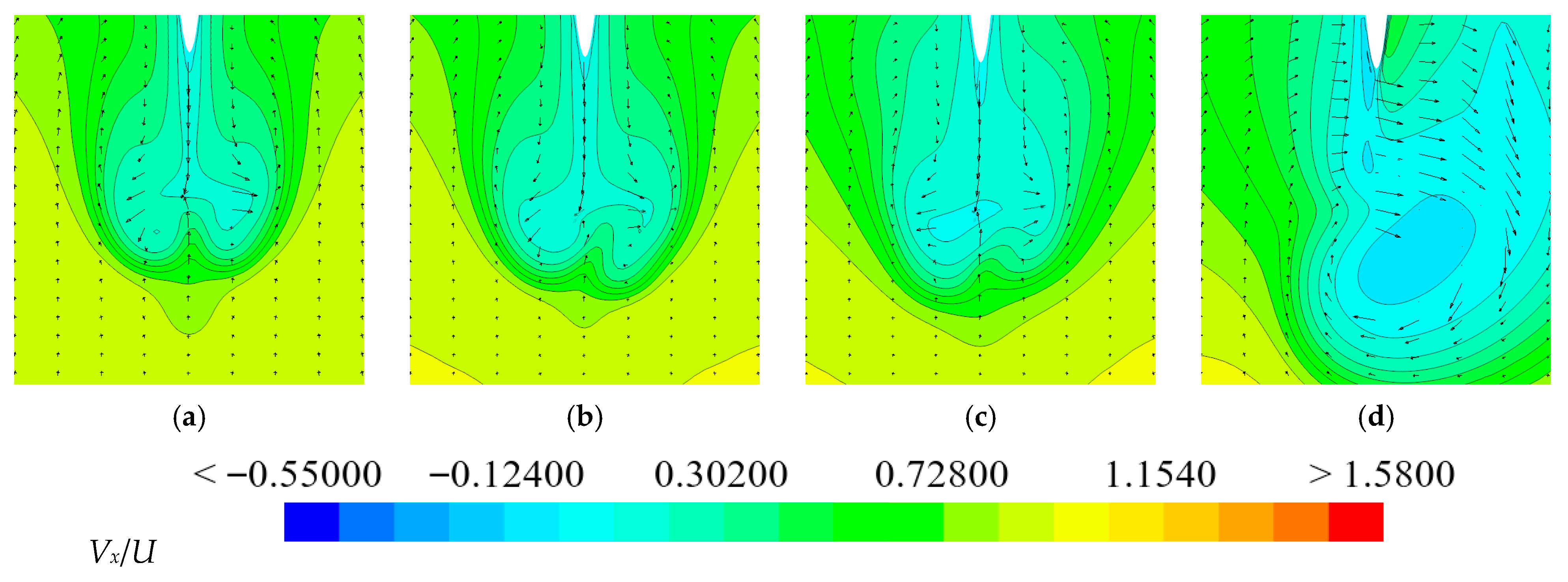
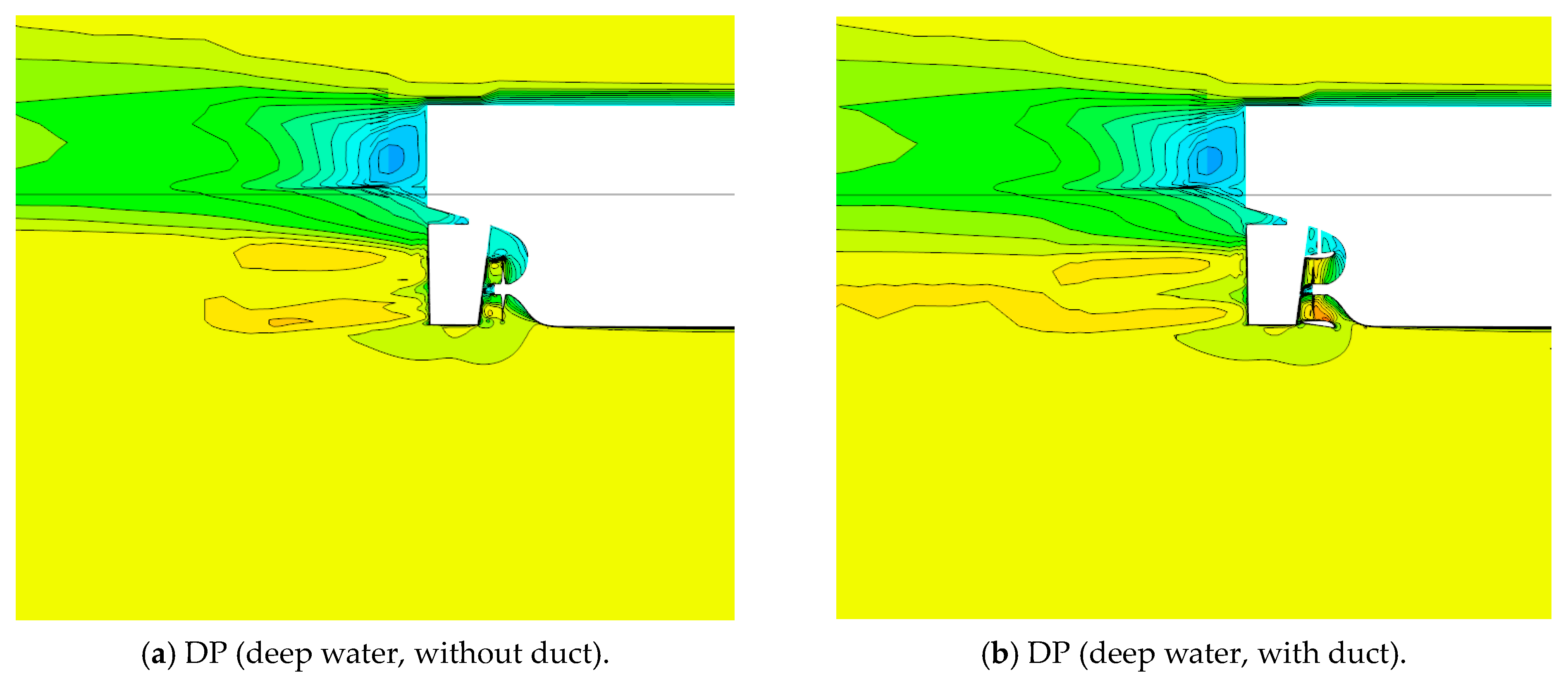
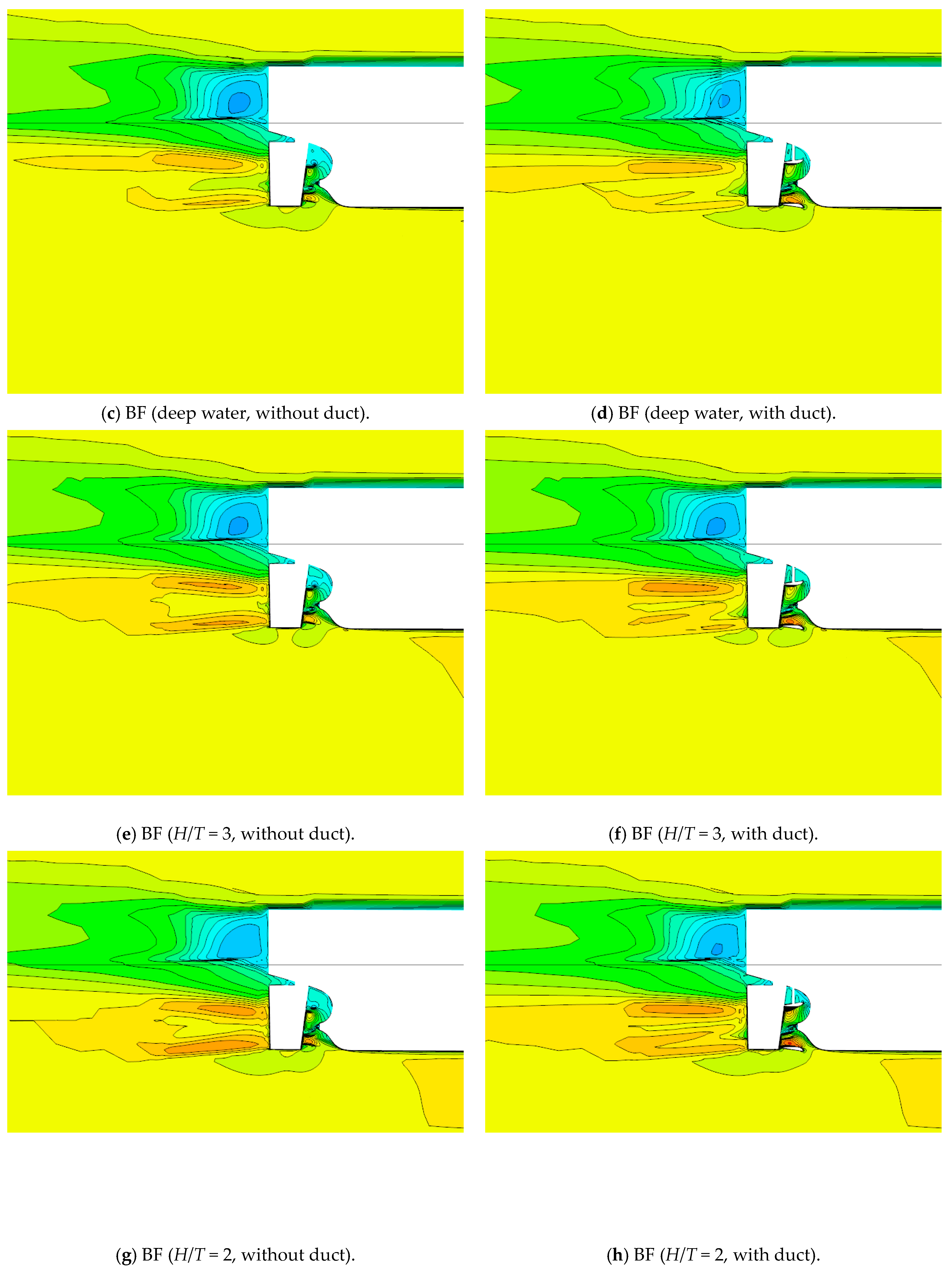
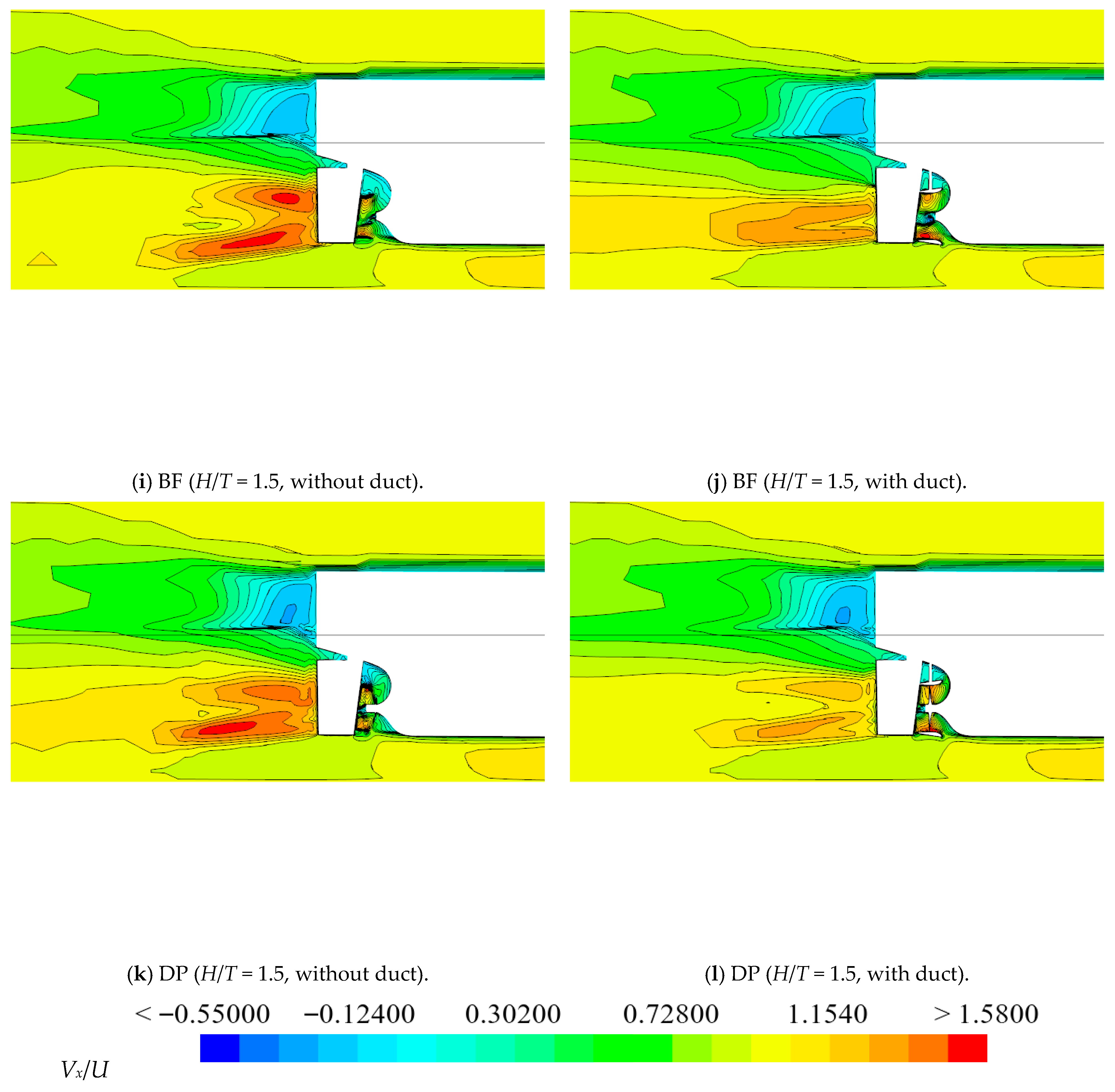
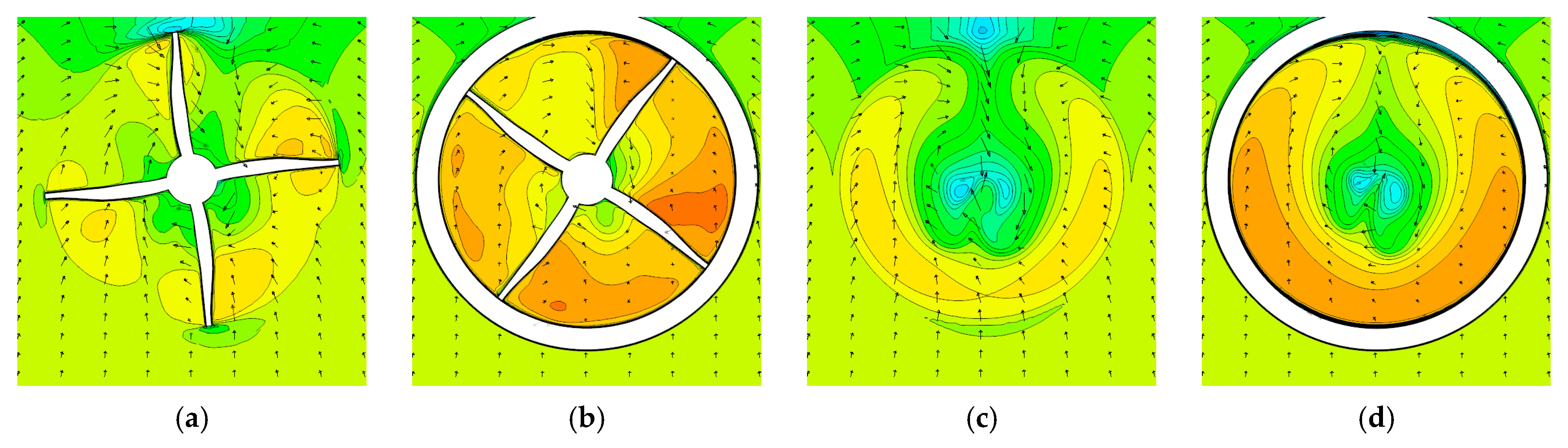
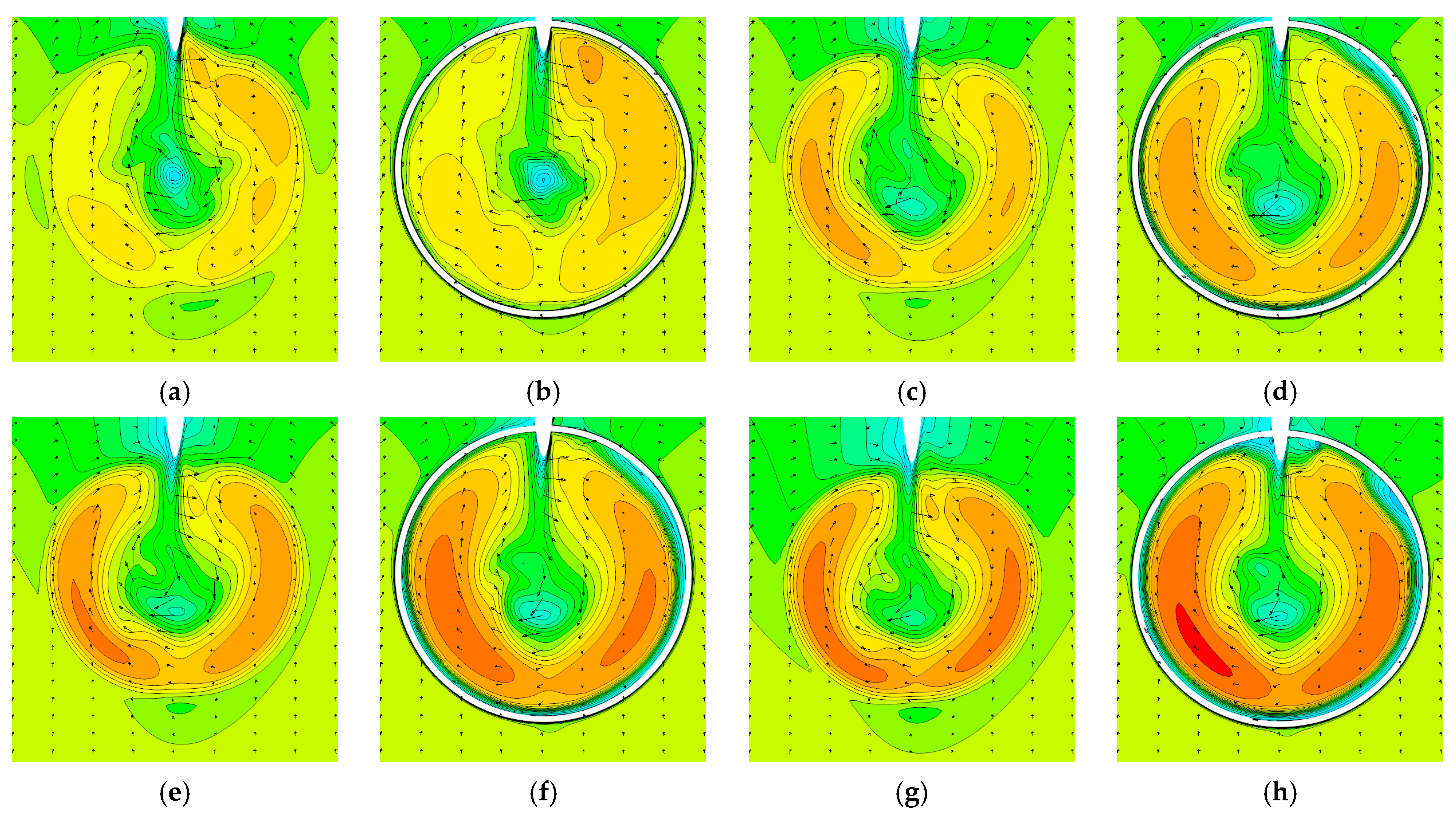
Figure 23 presents the velocity field in the x-direction for the bare hull with rudder in the resistance simulations. The black line in the figure indicates the waterline position. As the water depth decreases, the flow velocity between the hull bottom and the seabed gradually increases, and the recirculation in the propeller region becomes more pronounced. Figure 24, Figure 25 and Figure 26 further show the axial velocity fields at different longitudinal positions, with the origin of the local coordinate system located at the propeller center. The velocity fields are generally symmetric about the center plane, except for the case of H/T = 1.5, where symmetry is lost despite the computational domain and hull geometry being completely symmetric with respect to the x-z plane.
These phenomena can be attributed to the combined effects of blockage, pressure gradients, and numerical sensitivity under shallow-water conditions. With decreasing water depth, the under-keel clearance is reduced, which intensifies the blockage effect and accelerates the flow beneath the hull. This acceleration enhances the adverse pressure gradient in the stern region, promoting the development and amplification of recirculation zones near the propeller plane. The loss of symmetry at H/T = 1.5 reflects the heightened sensitivity of the shallow-water flow field to small perturbations, which in CFD may arise from discretization asymmetries, round-off errors, or transient vortex shedding. Once triggered, such disturbances are amplified by the restricted under-keel clearance and strong stern vortices, leading to significant deviations from symmetry.
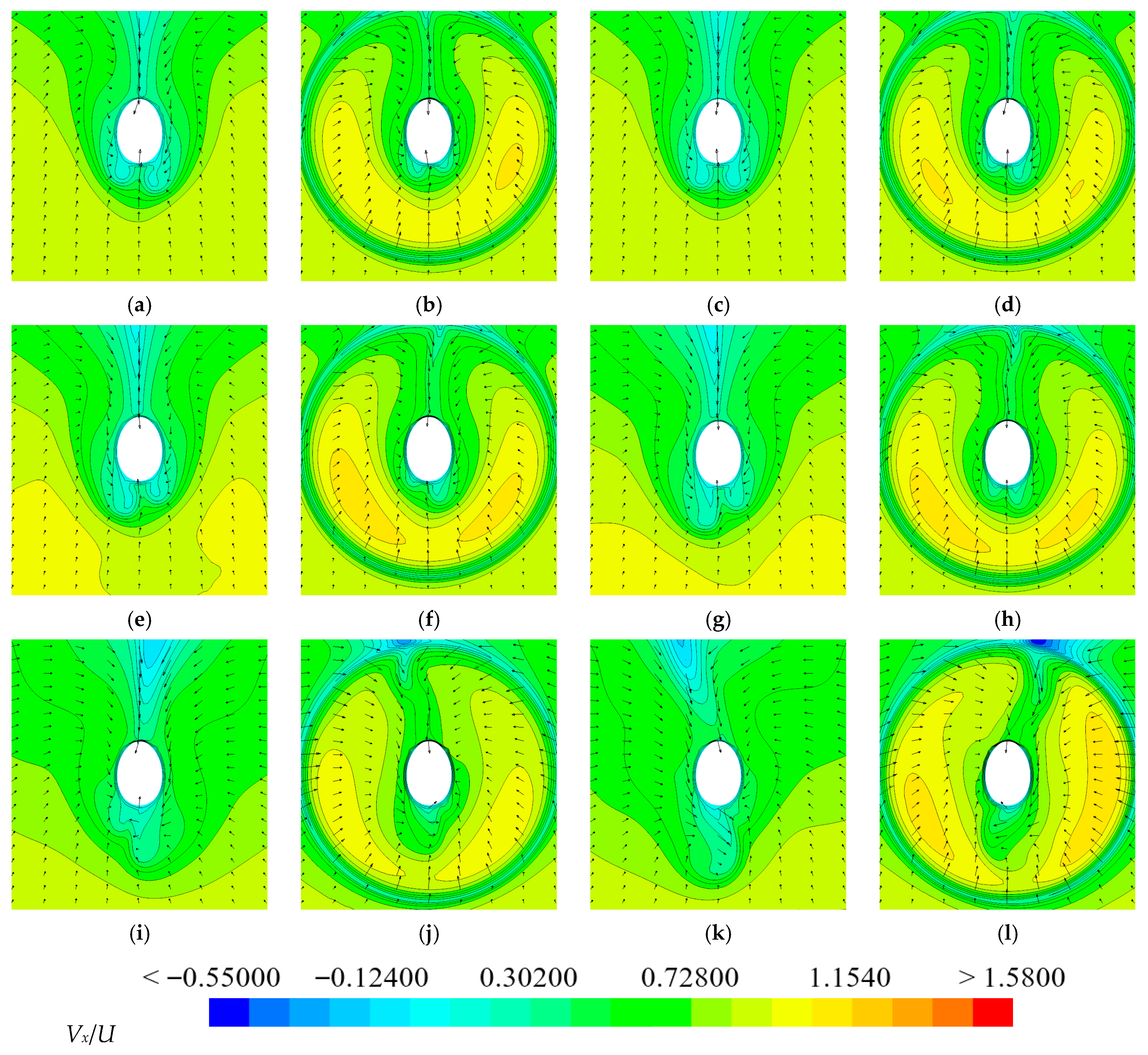
Figure 27 presents the velocity field in the x-direction obtained by DP and BF. Compared with the resistance case (Figure 23), the stern wake is significantly accelerated by the propeller (or virtual disk) and the ducted propeller (or ducted virtual disk). Overall, the velocity distributions predicted by DP and BF are consistent. As the water depth decreases, the stern wake velocity gradually increases. However, the ducted cases exhibit lower wake velocities than the non-ducted cases, particularly under the extremely shallow condition of H/T = 1.5. This is because the duct not only accelerates the core flow but also diverts part of the momentum into the boundary layer through ingestion and pressure recovery, thereby reducing the effective axial velocity in the outer wake.
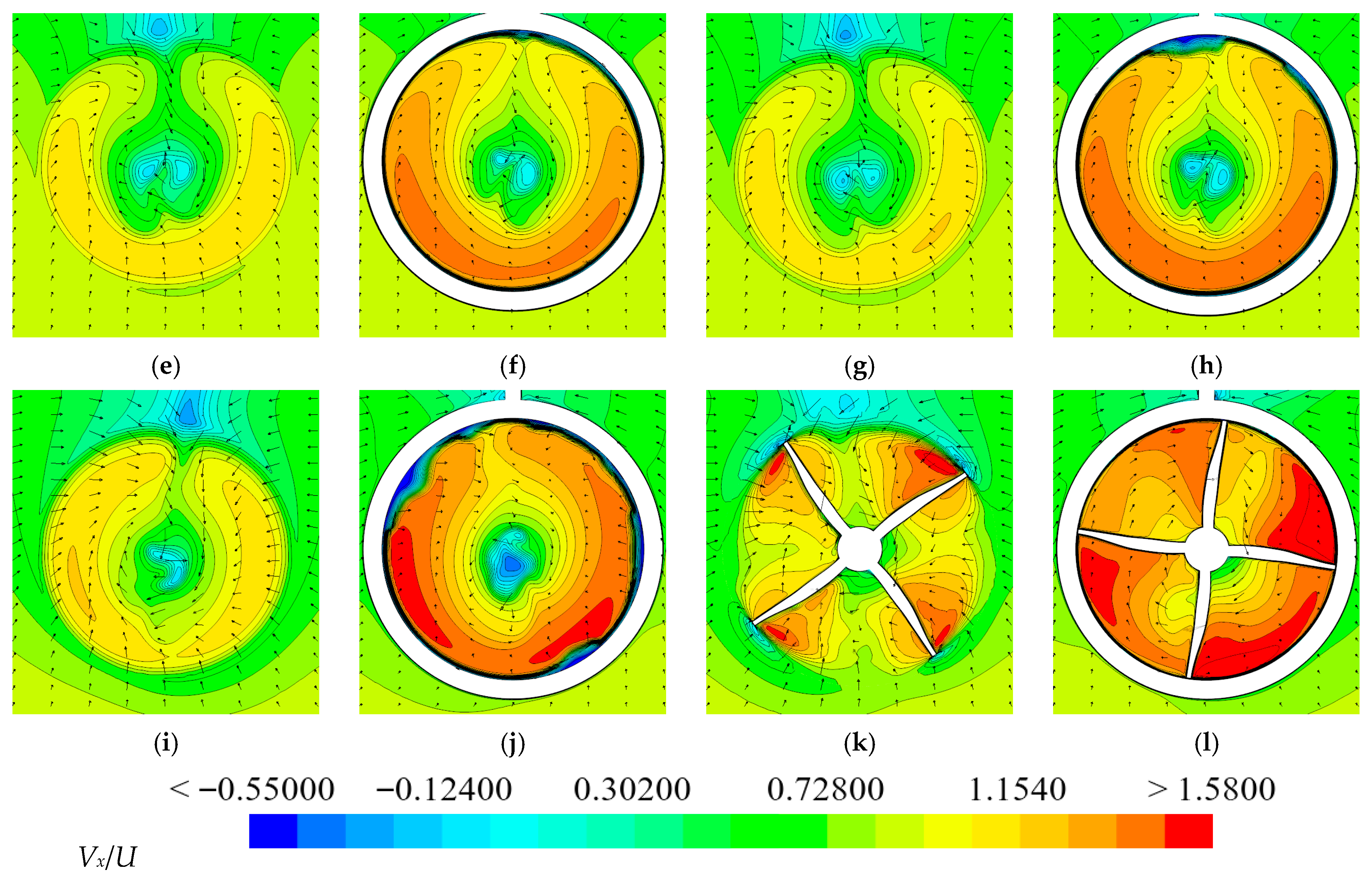
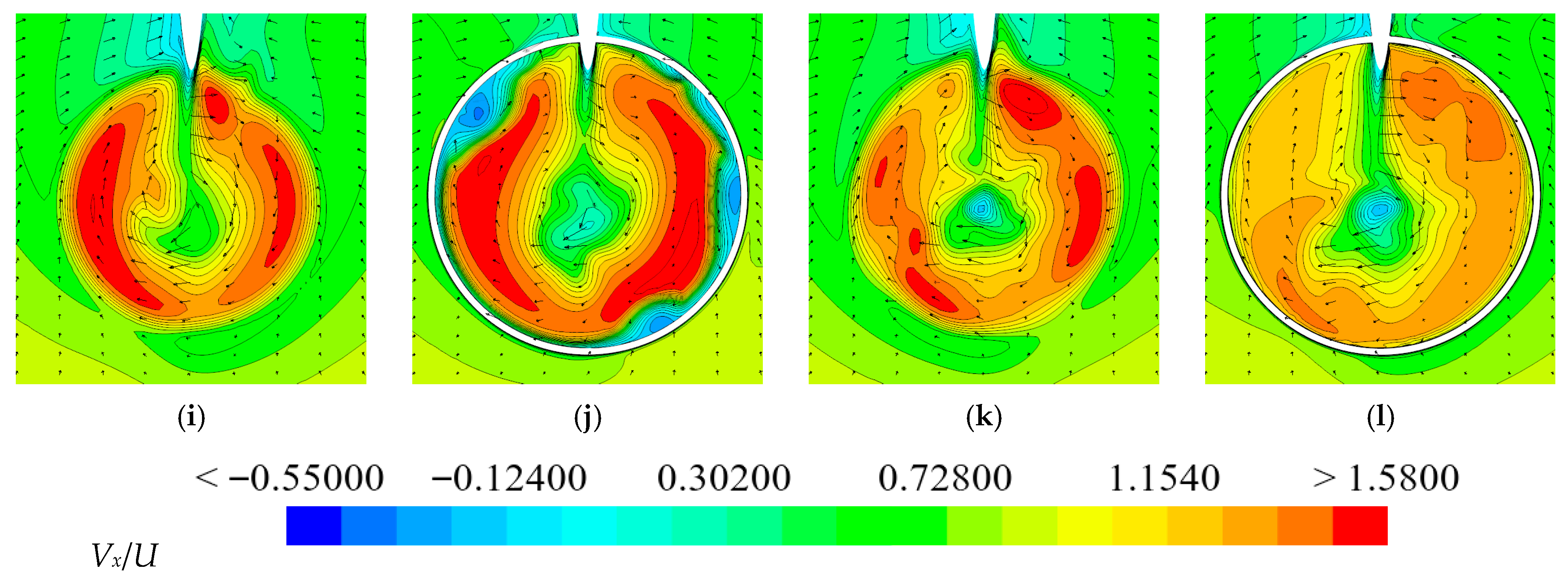
Figure 28, Figure 29 and Figure 30 show the axial velocity fields at different longitudinal positions, with the local coordinate system’s origin located at the propeller center. The flow acceleration induced by the propeller (or virtual disk) and ducted propeller (or ducted virtual disk) is clearly reflected. In general, DP and BF provide similar results, except in the ducted case at H/T = 1.5, where larger discrepancies occur. DP also reveals asymmetric wake structures at x = −0.25 DP due to propeller rotation, while BF displays only mild asymmetry because of its circumferential averaging. According to Goldstein’s optimum distribution, the tangential distributions of force and torque are invariant, but Wu et al. [11] noted that torque effects are implicitly considered.
At H/T = 1.5 with a duct, further differences are observed: at x = 0.25 DP, the velocity predicted by BF is smaller than that from DP, while at x = −0.25 DP, the opposite is true (see Figure 28j,l and Figure 30j,l). This discrepancy arises from the fundamental difference between DP and BF in representing momentum addition. In DP, the blade loading produces a concentrated and non-uniform axial force distribution, with strong initial acceleration near the disk and weaker acceleration downstream. In BF, by contrast, the axial force is imposed uniformly along the axis, leading to a uniform acceleration process. The duct pressure field further amplifies these differences, highlighting that the actual axial force distribution is non-uniform. Consequently, the BF method exhibits larger errors in the ducted case at H/T = 1.5 (see Table 17).

7. Conclusions

This study numerically investigated the resistance and self-propulsion performance of the KVLCC2 tanker in deep and shallow water using CFD simulations. Both conventional and ducted propeller configurations were considered. The RANS equations with the SST k-ω turbulence model were solved, and the VOF method was used to capture the free surface. The discretized propeller method, body force propeller method, and body force ducted propeller method were compared to evaluate the accuracy and efficiency of different propulsor modeling strategies.
The numerical method was first verified and validated under deep-water conditions. For the resistance simulation at Fr = 0.142, the computed total resistance coefficient agreed well with the experimental value, with an error below 5%. The open-water simulations of the ducted propeller also showed satisfactory agreement with the experimental data. For 0 < J < 0.7, the relative errors of KT and 10 KQ were all less than 5%, confirming the reliability of the numerical setup for subsequent self-propulsion simulations.
In deep-water self-propulsion simulations, the body force propeller method and the body force ducted propeller method produced results close to those obtained by the discretized propeller method. For the non-ducted case, the discrepancies in the main self-propulsion factors were generally below 5%, with propulsive efficiencies of 0.720 and 0.698 predicted by the BF and DP methods, respectively. For the ducted case, the corresponding propulsive efficiencies were 0.645 and 0.657. These results indicate that the body force methods can provide acceptable accuracy while significantly reducing mesh complexity and computational cost. In deep water, the ducted propeller increased the open-water efficiency but also produced a larger thrust deduction and a smaller wake fraction, resulting in lower hull efficiency and slightly lower overall propulsive efficiency than the non-ducted propeller.
Under shallow-water conditions, the hydrodynamic performance changed significantly as the depth-to-draft ratio decreased. Added resistance, sinkage, and trim increased with decreasing H/T, and the increase became particularly pronounced at H/T = 1.5. The self-propulsion results showed that the ducted propeller became more advantageous in shallow water. At H/T = 1.5, the delivered power predicted by the BF method was 29.955 W for the non-ducted configuration and 23.733 W for the ducted configuration, corresponding to a power reduction of 20.8%. The propulsive efficiency also increased from 0.669 for the non-ducted configuration to 0.845 for the ducted configuration. These results demonstrate that the ducted propeller can effectively mitigate shallow-water propulsion penalties under extremely restricted water-depth conditions.
The comparison between the BF and DP methods further showed that the body force methods remain practically useful in shallow water, although the discrepancies become larger under extremely shallow conditions. At H/T = 1.5, the delivered power errors between BF and DP were −3.34% for the non-ducted case and −5.08% for the ducted case. The larger discrepancy in the ducted case is mainly attributed to the stronger hull–duct–propeller interaction and the simplified representation of axial and circumferential loading in the body force model. Flow-field analysis confirmed that shallow water accelerates the under-keel flow and modifies the stern wake. The duct further changes the wake distribution and pressure field, which explains the observed variations in thrust deduction, wake fraction, hull efficiency, and delivered power.
Several limitations of the present methodology should be noted. First, the simulations were conducted at model scale under calm-water conditions; therefore, full-scale effects, wind, waves, currents, bank effects, and seabed roughness were not considered. Second, the shallow-water environment was simplified as a flat and rigid seabed, and only three depth-to-draft ratios were investigated. Third, the hull motions were limited to sinkage and trim, while lateral motions, yaw, roll, and maneuvering effects were beyond the scope of this study. Fourth, although the body force propeller and body force ducted propeller methods reduce computational cost, they approximate the propeller action using an equivalent virtual disk and cannot fully resolve blade-scale unsteady vortical structures, tip-vortex evolution, and circumferentially non-uniform loading. These limitations may become more pronounced under extremely shallow-water conditions, especially for the ducted configuration.
Future work should focus on full-scale simulations and validation, a wider range of depth-to-draft ratios, and more duct and propeller geometries. More realistic restricted-waterway conditions, including waves, currents, bank effects, seabed roughness, and maneuvering motions, should also be considered. In addition, further improvements in the body force ducted propeller model is needed to better represent non-uniform axial loading and unsteady duct–propeller interactions under shallow-water conditions.

Author Contributions

Conceptualization, B.C. and J.Q.; Methodology, B.C.; Software, B.C. and J.Q.; Validation, B.C., Q.Y., J.L., J.Y., K.C., J.Q. and J.T.; Formal analysis, J.L. and J.Y.; Investigation, Q.Y.; Resources, Q.Y.; Writing—original draft, B.C.; Writing—review & editing, Q.Y., W.C. and J.Q.; Visualization, B.C., J.Y., K.C., W.C. and J.T.; Supervision, Q.Y., J.L., K.C., W.C. and J.Q. All authors have read and agreed to the published version of the manuscript.

Funding

This work was supported by the Naval University of Engineering, Wuhan University of Technology, and CD-adapco. Additional funding was provided by the National Natural Science Foundation of China (NSFC) under Grant Nos. 52471354 and 52201389. Wei Chai is currently supported by the Science and Technology Innovation Program of Hunan Province (2023RC4028; 2024QY2008).

Data Availability Statement

The original contributions presented in this study are included in the article. Further inquiries can be directed to the corresponding authors.

Conflicts of Interest

Author Wei Chai is employed by Hunan Jinhang Shipbuilding Co., Ltd. The remaining authors declare that the research was conducted in the absence of any commercial or financial relationships that could be construed as a potential conflict of interest.

References

  1. Toxopeus, S.L.; Simonsen, C.D.; Guilmineau, E.; Visonneau, M.; Xing, T.; Stern, F. Investigation of water depth and basin wall effects on KVLCC2 in manoeuvring motion using viscous-flow calculations. J. Mar. Sci. Technol. 2013, 18, 471–496. [Google Scholar] [CrossRef]
  2. Lee, S.; Hong, C. Study on the course stability of very large vessels in shallow water using CFD. Ocean Eng. 2017, 145, 395–405. [Google Scholar] [CrossRef]
  3. Mohapatra, S.C.; Amouzadrad, P.; Soares, C.G. Recent developments in the nonlinear hydroelastic modeling of sea ice interaction with marine structures. J. Mar. Sci. Eng. 2025, 13, 1410. [Google Scholar] [CrossRef]
  4. Wang, J.; Liu, X.; Wan, D.; Chen, G. Numerical prediction of KCS self-propulsion in shallow water. In Proceedings of the Twenty-Sixth International Ocean and Polar Engineering Conference, Rhodes, Greece, 26 June–1 July 2016; pp. 757–763. [Google Scholar]
  5. Rzeszutko, J.; Zentari, L.; el Moctar, O. Mathematical modeling of propulsion forces in shallow waters. Appl. Ocean Res. 2025, 154, 104417. [Google Scholar] [CrossRef]
  6. Oosterveld , M.W.C. Wake Adapted Ducted Propellers. Ph.D. Thesis, TU Delft, Delft, The Netherlands, 1970. Available online: https://resolver.tudelft.nl/uuid:549e4c44-cc16-41e7-9230-55afb799ad06 (accessed on 7 May 2026).
  7. Bhattacharyya, A.; Krasilnikov, V.; Steen, S. Scale effects on open water characteristics of a controllable pitch propeller working within different duct designs. Ocean Eng. 2016, 112, 226–242. [Google Scholar] [CrossRef]
  8. Stark, C.; Shi, W.; Atlar, M. A numerical investigation into the influence of bio-inspired leading-edge tubercles on the hydrodynamic performance of a benchmark ducted propeller. Ocean Eng. 2021, 237, 109593. [Google Scholar] [CrossRef]
  9. Guo, C.; Wang, X.; Wang, C.; Zhao, Q.; Zhang, H. Research on calculation methods of ship model self-propulsion prediction. Ocean Eng. 2020, 203, 107232. [Google Scholar] [CrossRef]
  10. Heydari, M.; Sadat-Hosseini, H. Analysis of propeller wake field and vortical structures using k− ω SST Method. Ocean Eng. 2020, 204, 107247. [Google Scholar] [CrossRef]
  11. Wu, Z.H.; Chen, Z.G.; Dai, Y. Numerical prediction of self-propulsion with a body-force propeller model. J. Shanghai Jiaotong Univ. 2013, 47, 943–949. [Google Scholar]
  12. Jin, Y.; Duffy, J.; Chai, S.; Magee, A.R. DTMB 5415M dynamic manoeuvres with URANS computation using body-force and discretised propeller models. Ocean Eng. 2019, 182, 305–317. [Google Scholar] [CrossRef]
  13. Cai, B.; Mao, X.; Xu, Q.; Chai, W.; Tian, B.; Qiu, L. Simulation of the interaction between ship and ducted propeller with a modified body force method. Ocean Eng. 2022, 249, 110950. [Google Scholar] [CrossRef]
  14. Cai, B.; Qiu, L.; Tian, B.; Xu, Q.; Mao, X.; Chai, W.; Zhan, X. Research on predicting methods of propeller-hull interactions in head waves. Ocean Eng. 2023, 269, 113493. [Google Scholar] [CrossRef]
  15. Li, J.; Wang, Q.; Dong, K.; Wang, X. Numerical simulations of a ship’s maneuverability in shallow water. J. Mar. Sci. Eng. 2024, 12, 1076. [Google Scholar] [CrossRef]
  16. Luo, W.; Yang, B.; Sun, Y. Hydrodynamic analysis of KVLCC2 ship sailing near inclined banks. Math. Probl. Eng. 2021, 2021, 6655971. [Google Scholar] [CrossRef]
  17. Van, S.H. Experimental investigation of the flow characteristics around practical hull forms. In Proceedings of the Third Osaka Colloquium on Advanced CFD Applications to Ship Flow and Hull Form Design, Osaka, Japan, 25–27 May 1998. [Google Scholar]
  18. Yongle, D.; Baowei, S.; Peng, W. Numerical investigation of tip clearance effects on the performance of ducted propeller. Int. J. Nav. Arch. Ocean Eng. 2015, 7, 795–804. [Google Scholar] [CrossRef]
  19. Siemens Digital Industries Software. STAR-CCM+ Theory Guide, Simcenter STAR-CCM+ 2021; Siemens Digital Industries Software: Plano, TX, USA, 2021; Available online: https://docs.sw.siemens.com/documentation/external/PL20200805113346338/en-US/userManual/userguide/html/index.html (accessed on 7 May 2026).
  20. Menter, F.R. Two-equation eddy-viscosity turbulence models for engineering applications. AIAA J. 1994, 32, 1598–1605. [Google Scholar] [CrossRef]
  21. Reichardt, H. Vollständige Darstellung der turbulenten Geschwindigkeitsverteilung in glatten Leitungen. ZAMM-J. Appl. Math. Mech./Z. Für Angew. Math. Und Mech. 1951, 31, 208–219. [Google Scholar] [CrossRef]
  22. Hirt, C.W.; Nichols, B.D. Volume of fluid (VOF) method for the dynamics of free boundaries. J. Comput. Phys. 1981, 39, 201–225. [Google Scholar] [CrossRef]
  23. Blocken, B.; Stathopoulos, T.; Carmeliet, J. CFD simulation of the atmospheric boundary layer: Wall function problems. Atmos. Environ. 2007, 41, 238–252. [Google Scholar] [CrossRef]
  24. Xing, T.; Stern, F. Factors of safety for Richardson extrapolation. J. Fluids Eng. 2010, 132, 61403. [Google Scholar] [CrossRef]
  25. Stern, F.; Wilson, R.V.; Coleman, H.W.; Paterson, E.G. Comprehensive approach to verification and validation of CFD simulations—part 1: Methodology and procedures. J. Fluids Eng. 2001, 123, 793–802. [Google Scholar] [CrossRef]
  26. Luo, J.Y. Prediction of impeller induced flows in mixing vessels using multiple frames of reference. Inst. Chem. Eng. Symp. Ser. 1994, 136, 549–556. [Google Scholar]
  27. Joung, T.H.; Sammut, K.; He, F.; Lee, S.K. Shape optimization of an autonomous underwater vehicle with a ducted propeller using computational fluid dynamics analysis. Int. J. Nav. Archit. Ocean. Eng. 2012, 4, 44–56. [Google Scholar] [CrossRef]
  28. Naz, N. Numerical Simulation of Flow Around Ship Hull Considering Rudder-Propeller Interaction. Master’s Thesis, Department of Naval Architecture and Marine Engineering, Bangladesh University of Engineering and Technology, Dhaka, Bangladesh, 2017. Available online: https://www.researchgate.net/publication/332886649 (accessed on 7 May 2026).
  29. Wang, L.; Guo, C.; Xu, P.; Su, Y. Analysis of the wake dynamics of a propeller operating before a rudder. Ocean Eng. 2019, 188, 106250. [Google Scholar] [CrossRef]
  30. International Towing Tank Conference (ITTC). 1978 ITTC Performance Prediction Method. In ITTC Recommended Procedures and Guidelines, Procedure 7.5-02-03-01.4, Revision 05; ITTC Association: Zürich, Switzerland, 2021; Available online: https://www.ittc.info/media/9872/75-02-03-014.pdf (accessed on 7 May 2026).
  31. Kim, W.J.; Van, S.H.; Kim, D.H. Measurement of flows around modern commercial ship models. Exp. Fluids 2001, 31, 567–578. [Google Scholar] [CrossRef]
  32. Feng, D.; Yu, J.; He, R.; Zhang, Z.; Wang, X. Free running computations of KCS with different propulsion models. Ocean Eng. 2020, 214, 107563. [Google Scholar] [CrossRef]
  33. Reissner, H. On the vortex theory of the screw propeller. J. Aeronaut. Sci. 1937, 5, 1–7. [Google Scholar] [CrossRef]
  34. Hough, G.R.; Ordway, D.E. The Generalized Actuator Disk; Therm Advanced Research Inc.: Ithaca, NY, USA, 1964. [Google Scholar]
  35. Cai, B.; Mao, X.; Xu, Q.; Tian, B.; Qiu, L.; Zhan, X. Numerical simulation of KVLCC2 self-propulsion with ducted propeller in head waves. Ocean Eng. 2023, 285, 115427. [Google Scholar] [CrossRef]
  36. International Towing Tank Conference (ITTC). ITTC Recommended Procedures and Guidelines. Practical Guidelines for Ship Self-Propulsion CFD; Report 7.5-03-03-01; International Towing Tank Conference (ITTC): Zürich, Switzerland, 2014. [Google Scholar]
  37. Seo, J.-H.; Lee, C.-M.; Yu, J.-W.; Choi, J.-E.; Lee, I. Power increase and propulsive characteristics in regular head waves of KVLCC2 using model tests. Ocean Eng. 2020, 216, 108058. [Google Scholar] [CrossRef]
  38. Aram, S.; Mucha, P. Computational fluid dynamics analysis of different propeller models for a ship maneuvering in calm water. Ocean Eng. 2023, 276, 114226. [Google Scholar] [CrossRef]
  39. English, J.W.; Rowe, S.R. Some Aspects of Ducted Propeller Propulsion; NPL Ship Report No. 178; National Physical Laboratory, Ship Division: Feltham, UK, 1974. Available online: https://discovery.nationalarchives.gov.uk/details/r/C3113107 (accessed on 7 May 2026).
Figure 1. Geometry of the KVLCC2.
Jmse 14 00905 g001aJmse 14 00905 g001b
Figure 2. Geometry of the ducted Ka4-70 propeller.
Jmse 14 00905 g002
Figure 3. Geometry of the Ka4-70 propeller (without duct).
Jmse 14 00905 g003
Figure 4. Grid refinement in the ship resistance simulation (S2).
Jmse 14 00905 g004
Figure 5. Grid refinement in the ducted propeller open-water simulation (S2).
Jmse 14 00905 g005
Figure 6. Open-water performance of the ducted propeller: comparison between experimental (EFD) and numerical (CFD) results.
Jmse 14 00905 g006
Figure 7. Open-water performance of the non-ducted propeller obtained from numerical (CFD) simulations.
Jmse 14 00905 g007
Figure 8. Ship with propeller (left) and with virtual disk representation (right).
Jmse 14 00905 g008
Figure 9. Comparison of open-water performance between the virtual disk and the propeller.
Jmse 14 00905 g009
Figure 10. Ship with ducted propeller (left) and with ducted virtual disk representation (right).
Jmse 14 00905 g010
Figure 11. Schematic of the steps in the body force ducted propeller method.
Jmse 14 00905 g011
Figure 12. Comparison of open-water performance between the ducted virtual disk and the ducted propeller.
Jmse 14 00905 g012
Figure 13. Four open-water curves for the ducted virtual disk (n = 16 rps).
Jmse 14 00905 g013
Figure 14. Relationship between KT_Disk and KT at different values of J.
Jmse 14 00905 g014
Figure 15. Open-water results for the ducted virtual disk (modified, n = 16 rps).
Jmse 14 00905 g015
Figure 16. Procedure for determining VA in self-propulsion simulations of the virtual disk and ducted virtual disk.
Jmse 14 00905 g016
Figure 17. The relationships between J and I for the virtual disk and ducted virtual disk.
Jmse 14 00905 g017
Figure 18. Selected self-propulsion factors in deep water using BF and DP methods.
Jmse 14 00905 g018
Figure 19. Mesh refinement between the ship bottom and the bottom boundary of the computational domain (ship resistance, H/T = 1.5).
Jmse 14 00905 g019
Figure 20. Added values of RAS, SinkageAS and TrimAS.
Jmse 14 00905 g020
Figure 21. Added values of self-propulsion factors in shallow water.
Jmse 14 00905 g021aJmse 14 00905 g021b
Figure 22. Pressure distributions on the duct surface obtained by DP and BF.
Jmse 14 00905 g022aJmse 14 00905 g022b
Figure 23. Velocity field in the x-direction (ship resistance).
Jmse 14 00905 g023aJmse 14 00905 g023b
Figure 24. Velocity fields at x = 0.25 DP (ship resistance). (a) Bare hull with rudder (deep water). (b) Bare hull with rudder (H/T = 3). (c) Bare hull with rudder (H/T = 2). (d) Bare hull with rudder (H/T = 1.5).
Jmse 14 00905 g024
Figure 25. Velocity fields at x = 0 (ship resistance). (a) Bare hull with rudder (deep water). (b) Bare hull with rudder (H/T = 3). (c) Bare hull with rudder (H/T = 2). (d) Bare hull with rudder (H/T = 1.5).
Jmse 14 00905 g025
Figure 26. Velocity fields at x = −0.25 DP (ship resistance). (a) Bare hull with rudder (deep water). (b) Bare hull with rudder (H/T = 3). (c) Bare hull with rudder (H/T = 2). (d) Bare hull with rudder (H/T = 1.5).
Jmse 14 00905 g026
Figure 27. Velocity field in the x-direction (DP and BF).
Jmse 14 00905 g027aJmse 14 00905 g027bJmse 14 00905 g027c
Figure 28. Velocity fields at x = 0.25 DP (DP and BF). (a) DP (deep water, without duct). (b) DP (deep water, with duct). (c) BF (deep water, without duct). (d) BF (deep water, with duct). (e) BF (H/T = 3, without duct). (f) BF (H/T = 3, with duct). (g) BF (H/T = 2, without duct). (h) BF (H/T = 2, with duct). (i) BF (H/T = 1.5, without duct). (j) BF (H/T = 1.5, with duct). (k) DP (H/T = 1.5, without duct). (l) DP (H/T = 1.5, with duct).
Jmse 14 00905 g028
Figure 29. Velocity fields at x = 0 (DP and BF). (a) DP (deep water, without duct). (b) DP (deep water, with duct). (c) BF (deep water, without duct). (d) BF (deep water, with duct). (e) BF (H/T = 3, without duct). (f) BF (H/T = 3, with duct). (g) BF (H/T = 2, without duct). (h) BF (H/T = 2, with duct). (i) BF (H/T = 1.5, without duct). (j) BF (H/T = 1.5, with duct). (k) DP (H/T = 1.5, without duct). (l) DP (H/T = 1.5, with duct).
Jmse 14 00905 g029aJmse 14 00905 g029b
Figure 30. Velocity fields at x = −0.25 DP. (a) DP (deep water, without duct). (b) DP (deep water, with duct). (c) BF (deep water, without duct). (d) BF (deep water, with duct). (e) BF (H/T = 3, without duct). (f) BF (H/T = 3, with duct). (g) BF (H/T = 2, without duct). (h) BF (H/T = 2, with duct). (i) BF (H/T = 1.5, without duct). (j) BF (H/T = 1.5, with duct). (k) DP (H/T = 1.5, without duct). (l) DP (H/T = 1.5, with duct).
Jmse 14 00905 g030aJmse 14 00905 g030b
Table 1. Principal particulars of the KVLCC2.
ParametersSymbolsUnitsModelFull-Scale
Length at waterline LWLm5.612325.500
Length between perpendicularsLPPm5.517320.000
BeamBm1.00058.000
Block coefficientCB-0.8100.810
Wetted area with rudderSWm28.08427,194.000
Draftdm0.35920.800
Longitudinal center of gravityLCGm2.951171.129
Displacement m31.602312,622.000
Metacentric heightGMm0.0985.710
Vertical center of gravityKGm0.32118.600
Moment of inertiakyy/LPP-0.2500.250
Table 2. Principal particulars of the Ka4-70 propeller.
ParametersSymbolsUnitsModel
Propeller diameter DPm0.170
Expanded area ratioAE/AO-0.700
Hub ratioDH/DP-0.167
Hub thicknessΔm0.034
Pitch ratioP0.70R /DP-1.000
Blade numberZ-4
Rotation direction--clockwise
Table 3. Parameters and units.
ParameterUnit
ρkg/m3
U, VAm/s
LWL, LPP, DPm
SWm2
Rt, T, TD, TPN
QN·m
nrps
t, Δts
Ct, KT, KQ, J, η 0 , Frdimensionless
Table 4. Computational domain and boundary conditions for ship resistance.
RegionsBoundariesTypesThe Distance from the Origin
Back groundInletVelocity inlet2.0 LPP
SidesSymmetry1.5 LPP
OutletPressure outlet4.0 LPP
BottomSliding wall20 d
TopSliding wall10 d
OversetOverset interfaceOverset mesh 
DeckWall-
HullWall-
RudderWall-
Table 5. Computational domain and boundary conditions for ducted propeller open-water simulation.
RegionsBoundariesTypesThe Distance from the Origin
Back groundInletVelocity inlet6 DP
OutletPressure outlet8 DP
Far fieldSliding wall5 DP
DuctWall-
Propeller hubWall-
InterfacesInterface-
RotationDuct (inner surface)Wall-
Propeller bladesWall-
Propeller hubWall-
InterfacesInterface-
Table 6. Domain of calculation and boundary conditions (propeller, open water).
RegionsBoundariesTypesThe Distance from the Origin
Back groundInletVelocity inlet6 DP
OutletPressure outlet8 DP
Far fieldSliding wall5 DP
 InterfacesInterface-
RotationPropeller bladesWall-
Propeller hubWall 
Table 7. Number of grid cells (million).
Coarse (S1)Medium (S2)Fine (S3)
Ship resistance1.693.478.17
Ducted propeller, open water2.613.144.18
Table 8. Numerical uncertainties in Ct, KT and 10 KQ.
rkS1S2S3CRpEFDUFS (%D)
Ct × 103 2 4.02504.10484.10670.02385.39234.11000.0830
KT (J = 0.2) 2 0.40520.41070.41100.05504.18350.41250.2299
10 KQ (J = 0.2) 2 0.43140.42820.42810.02935.09130.4277−0.0457
KT (J = 0.6) 2 0.19310.18950.18830.34281.54470.1841−3.6553
10 KQ (J = 0.6) 2 0.32550.31900.31410.76510.38630.305944.5309
Table 9. Validation of ship resistance and ducted propeller in open water.
USN (%D)UD (%D)UV (%D)E (%D)
Ct   ×  1030.08301.00001.00340.1265
KT (J = 0.2)0.22991.00001.02610.4306
10 KQ (J = 0.2)−0.04571.00001.0010−0.1166
KT (J = 0.6)−3.65531.00003.7896−2.9225
10 KQ (J = 0.6)44.53091.000044.5421−4.2893
Table 10. Estimated KT_Disk curve and four neighboring KT_Disk curves.
JKT_DiskKTkKT
(Target)
KT_Disk
(Estimated)
KT_Disk (1)KT_Disk (2)KT_Disk (3)KT_Disk (4)
00.2550.3950.6460.5320.3440.2750.3090.3780.412
0.10.2500.3700.6760.4700.3180.2540.2860.3490.381
0.20.2420.3310.7330.4110.3010.2410.2710.3310.361
0.30.2300.2930.7860.3540.2780.2230.2510.3060.334
0.40.2130.2540.8390.3000.2520.2010.2260.2770.302
0.50.1910.2170.8840.2470.2180.1740.1960.2400.262
0.60.1640.1790.9150.1900.1730.1390.1560.1910.208
0.70.1230.1101.1200.1130.1260.1010.1140.1390.151
Table 11. Self-propulsion factors obtained by BF and DP in deep water (without duct).
JKT10 KQ1 − t1 − wη0ηRηHηDP/W
Deep water (BF)0.5300.2860.4710.7860.5590.5121.0001.4060.72011.537
Deep water (DP)0.5280.2870.4730.7640.5640.5111.0101.3540.69812.017
Errors (%)0.379−0.348−0.4232.880−0.8870.196−0.9903.8403.152−3.994
Table 12. Self-propulsion factors obtained by BF and DP in deep water (with duct).
JKT10 KQ1 − t1 − wη0ηRηHηDP/W
Deep water (BF)0.5270.2310.3480.7410.6380.5561.0001.1610.64512.871
Deep water (DP)0.5120.2390.3540.7270.6160.5521.0091.1810.65712.752
Errors (%)2.930−3.347−1.6951.9263.5710.725−0.892−1.693−1.8270.933
Table 13. Trim and sinkage of the hull in deep-water resistance and self-propulsion simulations.
Sinkage × 103 (m)Trim (Deg)
Bare hull with rudder−5.5210.128
Without duct (DP)−5.5920.125
Without duct (BF)−5.5780.123
With duct (DP)−5.5980.123
With duct (BF)−5.5940.122
Table 14. Self-propulsion factors obtained by BF in shallow water (without duct).
JKT10 KQ1 − t1 − wη0ηRηHηDP/W
H/T = 3 (BF)0.4770.3140.5060.8120.5420.4701.0001.4990.70515.463
H/T = 2 (BF)0.4010.3520.5550.8340.4770.4051.0001.7480.70819.475
H/T = 1.5 (BF)0.2860.4080.6260.8520.3770.2961.0002.2580.66929.955
Table 15. Self-propulsion factors obtained by BF in shallow water (with duct).
JKT10 KQ1 − t1 − wη0ηRηHηDP/W
H/T = 3 (BF)0.4730.2620.3680.7660.6060.5361.0001.2630.67716.105
H/T = 2 (BF)0.3930.3060.3910.7810.5190.4881.0001.5040.73518.760
H/T = 1.5 (BF)0.2240.3970.4240.7900.3110.3331.0002.5360.84523.733
Table 16. Error comparison of self-propulsion factors at H/T = 1.5 (BF and DP, without duct).
JKT10 KQ1 − t1 − wη0ηRηHηDP/W
H/T = 1.5 (BF)0.2860.4080.6260.8520.3770.2961.0002.2580.66929.955
H/T = 1.5 (DP)0.2810.4100.6290.8310.3750.2921.0072.2180.65230.991
Errors (%) (DP)1.779−0.488−0.4772.5270.5331.370−0.6951.8032.607−3.343
Table 17. Error comparison of self-propulsion factors at H/T = 1.5 (BF and DP, with duct).
JKT10 KQ1 − t1 − wη0ηRηHηDP/W
H/T = 1.5 (BF)0.2240.3970.4240.7900.3110.3331.0002.5360.84523.733
H/T = 1.5 (DP)0.2290.3940.4240.7670.3240.3391.0112.3660.81125.002
Errors (%) (DP)−2.1830.7610.1702.999−4.012−1.770−1.0887.1854.192−5.076
Disclaimer/Publisher’s Note: The statements, opinions and data contained in all publications are solely those of the individual author(s) and contributor(s) and not of MDPI and/or the editor(s). MDPI and/or the editor(s) disclaim responsibility for any injury to people or property resulting from any ideas, methods, instructions or products referred to in the content.