1. Introduction
The study of ice–structure interaction is a critical area of research in polar engineering, offshore structure design, and ship navigation in ice-covered waters. With the increasing economic and strategic significance of Arctic and sub-Arctic regions, accurate modelling of ice-induced loads is essential for ensuring the safety and reliability of ships, offshore platforms, and marine infrastructure operating in these extreme environments. Ice–structure interaction involves complex processes such as ice crushing, bending failure, and fragmentation, which require robust numerical approaches to capture the underlying physics.
Over the past few decades, various numerical methods have been developed to simulate ice–structure interaction [
1]. Traditional methods, such as the finite element method (FEM) and discrete element method (DEM), have been widely used [
2,
3,
4,
5]. While FEM excels in modelling continuous deformation, its capability in capturing ice fracture and fragmentation is limited without additional crack propagation criteria [
6]. DEM, on the other hand, represents ice as an assembly of discrete particles, effectively simulating fracture and fragmentation [
7].
In recent years, the peridynamic (PD) method has emerged as a promising alternative for modelling ice–structure interactions due to its ability to naturally handle discontinuities and material failure without requiring external crack-tracking algorithms [
8,
9,
10]. Unlike conventional continuum mechanics approaches, which rely on partial differential equations and suffer from singularities at discontinuities, the PD method employs an integral formulation that allows for seamless simulation of ice fracture and damage evolution [
11]. This nonlocal nature makes the PD method particularly suitable for capturing the complex mechanical response of ice under loading.
PD formulations can be categorized into bond-based and state-based models [
12]. The bond-based model, which assumes a fixed force relationship between material points, is computationally efficient but imposes a strict constraint on Poisson’s ratio, limiting it to 1/4 in three-dimensional (3D) problems and 1/3 in two-dimensional (2D) problems [
13]. The state-based PD model, in contrast, allows for arbitrary Poisson’s ratios and provides a more flexible framework for modelling ice behaviour. Many existing 3D numerical studies on ice–structure interaction utilize the bond-based PD model [
14,
15,
16,
17,
18], which inherently constrains Poisson’s ratio and deviates from the actual mechanical behaviour of ice (experimental studies have shown that Poisson’s ratio of isotropic ice typically exceeds 0.33 and can reach values as high as 0.42 [
19,
20,
21]).
This simplification in bond-based PD models raises concerns regarding the accuracy of bond-based PD in capturing the complex response of ice under loading. To assess whether the bond-based PD model is sufficient for 3D ice–structure interaction simulations, this study examines ice–structure interaction with varying Poisson’s ratios. In the present study, all numerical investigations are conducted in three-dimensional settings. The υ = 0.25 case corresponds to Poisson’s ratio condition simulated by the bond-based PD model in 3D, whereas higher Poisson’s ratios, representative of real ice behaviour, are simulated using the ordinary state-based PD formulation. Based on this framework, two representative ice–structure interaction scenarios are investigated to evaluate how Poisson’s ratio influences failure modes and ice-induced loads. The findings provide insights into the applicability of different PD formulations for ice mechanics and highlight the necessity of selecting an appropriate model for accurate ice–structure interaction simulations.
The remainder of this paper is structured as follows:
Section 2 presents a review of PD theory applied to ice–structure interaction, including an overview of bond-based and state-based models.
Section 3 details the numerical implementation, covering discretization strategies and benchmark case validation.
Section 4 and
Section 5 discuss the numerical results for the two ice–structure interaction scenarios, followed by conclusions in
Section 6, which summarizes key findings and potential future research directions.
2. Review of PD Theory in Ice–Structure Interaction
2.1. Bond-Based and State-Based Peridynamic Models
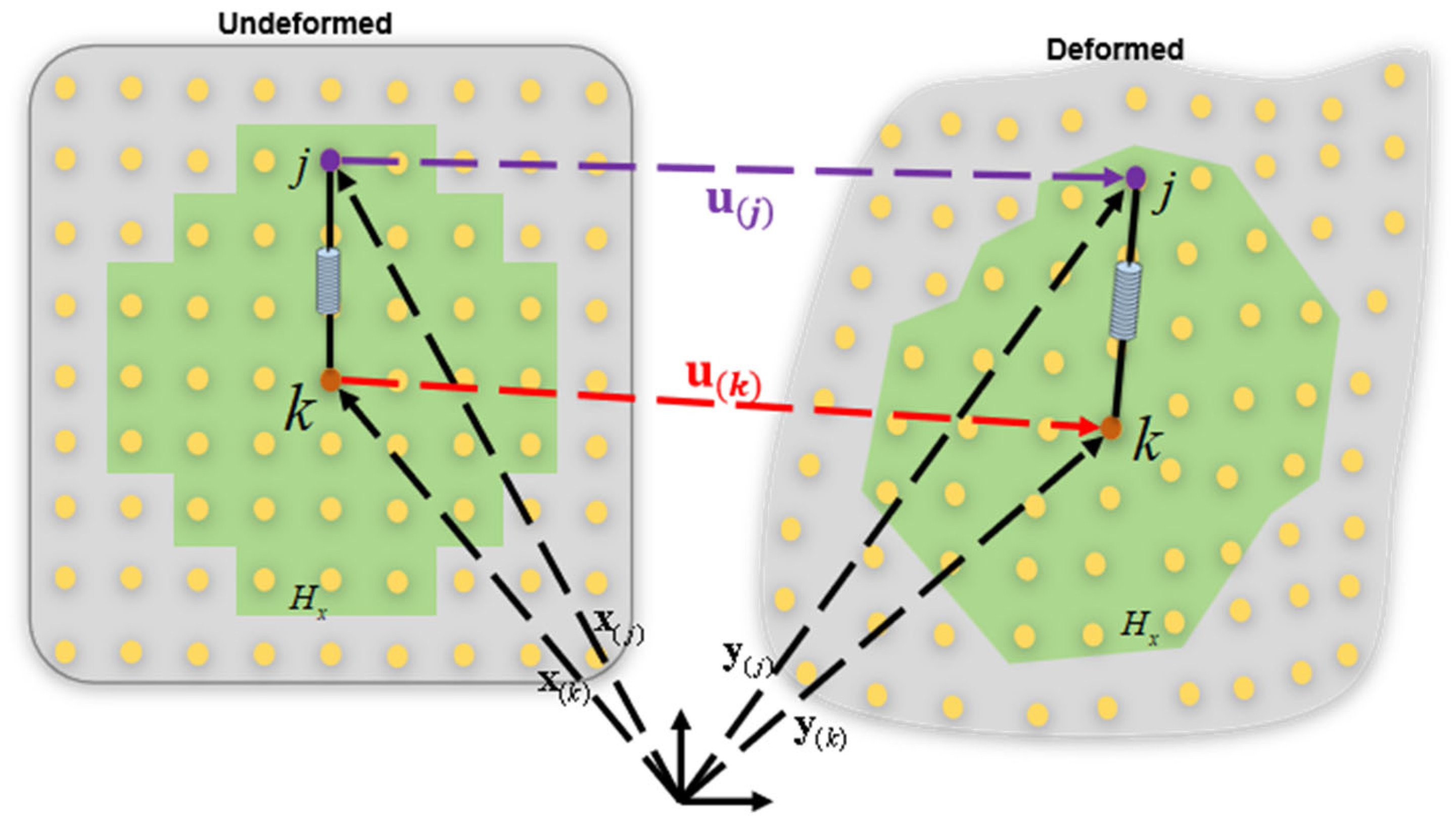
Within the peridynamic (PD) framework, the ice body is represented by a collection of discrete material points. The motion of each particle is governed by the nonlocal equation of motion given in Equation (1) [
22]. Unlike classical continuum mechanics, where interactions are defined through spatial derivatives, the PD method introduces a finite interaction domain, referred to as the horizon (
). As illustrated in
Figure 1, each particle interacts only with its neighbouring particles located within this horizon, e.g., particle
and particle
. These neighbouring particles are termed the family members of the reference particle.
The positions of two interacting particles k and j in the undeformed configuration are denoted by [m] and [m], respectively. Under external actions such as displacement boundary conditions or body forces [N/m3]), the particles undergo displacements [m] and [m]. The relative deformation induces pairwise force interactions, represented by the force density terms, and , acting between particles. The governing equation of motion incorporates the contributions from all interacting particles within the horizon, along with the particle density [kg/m3], acceleration [m/s2], and volume .
A key feature of PD theory is the formulation of the pairwise force density, which leads to two commonly used models:
- (1)
Bond-based PD (BB-PD) model.
In the bond-based formulation, the interaction force between two particles is assumed to act along the line connecting them, and the force magnitudes are equal and opposite. This constraint significantly simplifies the constitutive relation but imposes a restriction on Poisson’s ratio, limiting it to υ = 1/3 in two-dimensional cases and υ = 1/4 in three-dimensional cases. The corresponding force density expression is given in Equation (2).
- (2)
Ordinary state-based PD (SB-PD) model.
In contrast, the state-based formulation relaxes the constraint on the direction and magnitude of pairwise forces. The force interactions are no longer restricted to the bond direction, allowing for a more general constitutive representation. As a result, Poisson’s ratio is no longer constrained and can take arbitrary values. The force density is expressed as shown in Equation (3).
In these formulations, the force response depends on the stretch s between two particles, defined in Equation (4), which quantifies the relative deformation. The constitutive relations in Equations (2) and (3) correspond to a linear elastic material model. The associated PD parameters , , and are expressed in Equation (5), where the elastic modulus E, bulk modulus K, and shear modulus μ define the mechanical properties of ice.
For completeness, the classical elastic relations in Equation (6) connect the material constants. By substituting Poisson’s ratio constraints of the BB-PD model into these relations, the bond-based force expression can be derived consistently within the PD framework.
The PD parameters are
where
E [Pa] is the elastic modulus,
is the bulk modulus and
is the shear modulus.
h [m] is the thickness of the ice floe.
represents the cross-sectional area of the particle.
Given the following conditions,
2.2. Discrete Energy Release Rate Criterion
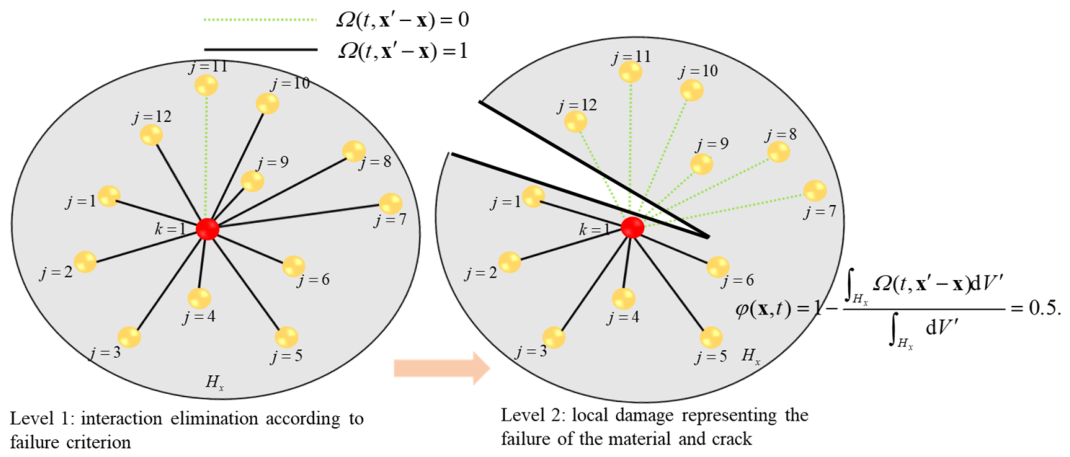
The failure process of ice in the PD method can be described at two distinct levels—bond-level failure and continuum-level damage—as illustrated in
Figure 2.
At the first level, fracture is represented by the breakage of interactions between particle pairs. This is achieved through a binary damage function
, which determines whether a bond remains active or is removed. Once a bond is broken, its force contribution is eliminated from the equation of motion. The corresponding formulation is given in Equations (7) and (8).
where
At the second level, material degradation is described using a scalar damage variable
defined in Equation (9). This variable represents the proportion of broken bonds within the horizon of a particle and ranges from 0 (undamaged) to 1 (fully damaged). Intermediate values correspond to partially damaged states and can be interpreted as the formation and propagation of macroscopic cracks.
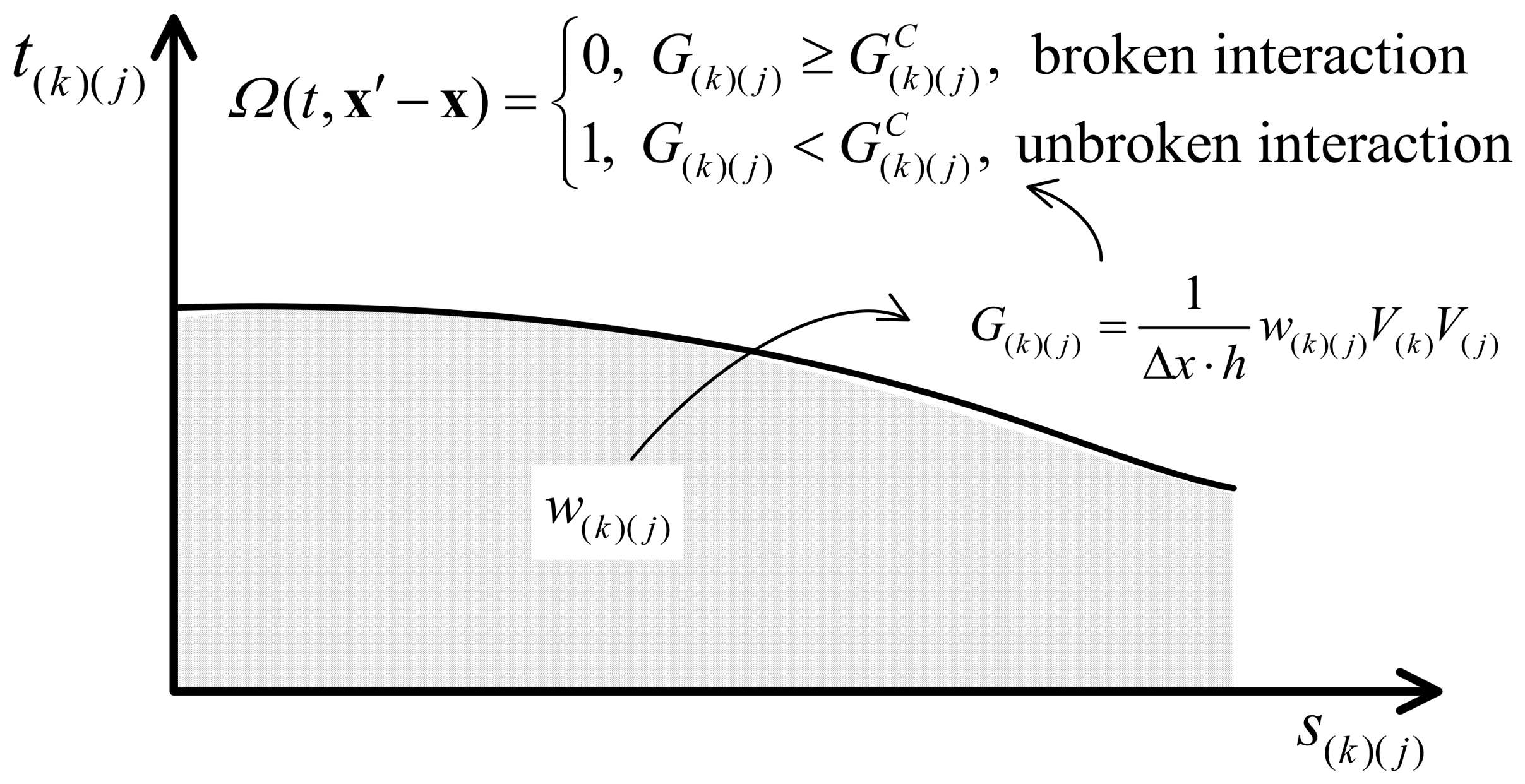
The bond breakage criterion is based on the concept of energy release rate, as illustrated in
Figure 3. The discrete energy release rate criterion, expressed in Equation (10), compares the energy stored in a bond with a critical threshold. When the energy exceeds this threshold, the bond fails, enabling the simulation of fracture processes.
In Equation (10),
where
is the number of full interactions contributing to the generation of a unit crack surface of
. In the 2D PD model,
for a horizon size of
[
23]. The energy release rate
between two particles is calculated according to Equation (11), where the contribution of each interaction is determined by the work done during deformation, as given in Equation (12). This formulation allows the PD model to capture both linear and nonlinear fracture behaviour in a unified manner.
where
is the particle spacing;
is the thickness of calculation domain.
is the corresponding work done by the interaction between particles
and
, and expressed as
2.3. Peridynamic Modelling of Ice–Structure Interaction
The simulation of ice–structure interaction using the PD method involves two essential components: contact detection and load evaluation.
For contact detection, the ice body is discretized into material particles, while the structure (e.g., a propeller) is represented by a surface mesh. An efficient continuous detection strategy is adopted to identify potential interactions between ice particles and the structural surface. The detection procedure is formulated as a geometric point-to-surface problem and is implemented using a cylindrical coordinate framework to reduce computational cost. The process includes two filtering stages: a radial filter to exclude particles outside the interaction region, followed by an angular filter to identify particles within the blade sector. A final proximity check based on surface normals confirms the contact condition. Detailed formulations of the detection algorithm can be found in previous studies [
24].
Once contact is established, the ice load is evaluated by computing both normal and tangential forces acting on the structure. The normal force is determined using a penalty-based approach, where the penetration depth of particles is used to estimate the contact force. The tangential force is calculated according to Coulomb’s friction law, which depends on the normal force and relative sliding velocity.
The total load acting on the structure is obtained by summing the contributions from all interacting particles. By distributing these forces over the structural surface, the resulting force and moment can be evaluated. This approach enables the accurate prediction of ice-induced loads and provides a consistent framework for analyzing complex ice–structure interaction scenarios. The detailed formulation of the load calculation procedure can be found in Ref. [
18].
3. Numerical Implementation
3.1. Discretization and Solution Strategy
To solve Equation (1), a nested spatial–temporal integration scheme is adopted. Following [
22], the ice body is represented by discrete particles. Within each particle’s horizon, spatial integration is performed to compute the instantaneous total force acting on the particle. Temporal integration then updates particle positions over time. Finally, Equation (1) (including the damage function) is discretized as follows:
where
is the number of particles in the horizon of particle
.
The discretization parameters adopted in the present simulations (following Sections), including particle spacing and time step, are based on our previously developed and validated in-house numerical solver. Therefore, the same set of validated discretization parameters is directly employed in the present study, and the detailed convergence procedures are not repeated here for brevity.
3.2. Benchmark Validation and Case Analysis
This section presents a preliminary benchmark based on uniaxial compression at different Poisson’s ratios to verify the numerical implementation of the PD model in reproducing Poisson’s-ratio-dependent elastic deformation. It should be noted that this example is intended only as an implementation check for elastic deformation behaviour, rather than a full validation of fracture evolution, damage initiation, or dynamic ice impact response. For the 3D benchmark analysis, the case with = 0.25 corresponds to the BB-PD, while the cases with larger Poisson’s ratios are implemented using SB-PD to examine the effect of realistic ice Poisson’s ratios on the computed deformation response.
3.2.1. Numerical Model Setup
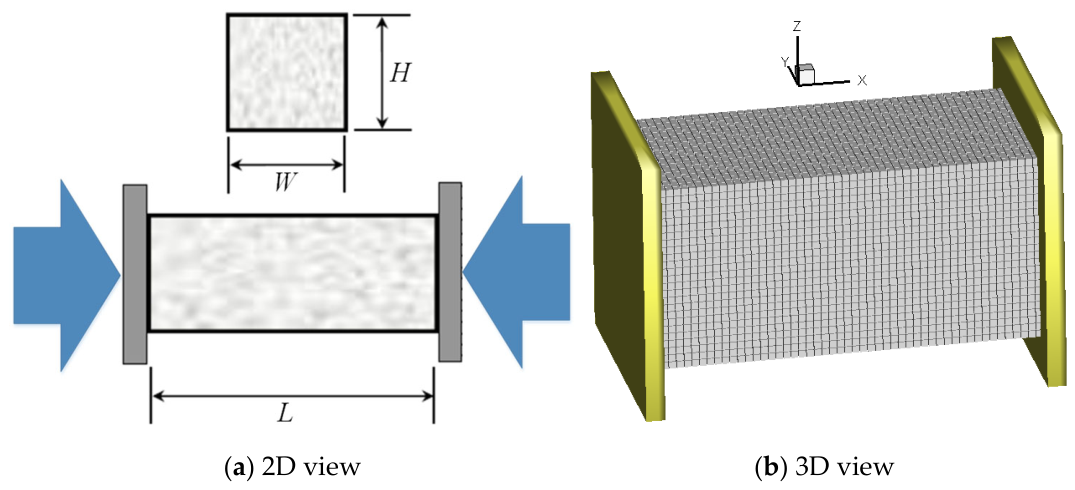
A uniaxial compression test is conducted on a rectangular specimen with dimensions 100 mm × 50 mm × 50 mm, as shown in
Figure 4. The material is assumed to be homogeneous, isotropic, and elastic. The displacement boundary conditions are applied. Material properties and numerical setup are as follows: elastic modulus of 1.0 GPa, Poisson’s ratios of 0.25, 0.33, 0.4, density of 900 kg/m
3, loading velocity of 0.0001 m/s, and a time step of 0.00001 s. Since this benchmark case involves linear elastic deformation without fracture, the solution is relatively insensitive to mesh discretization. A preliminary mesh sensitivity check was performed, and further refinement resulted in negligible changes in the predicted response. Therefore, the adopted mesh with a size of 1 mm is considered sufficiently refined for the present study. For completeness, the mesh convergence study is presented quantitatively in
Table 1 below. The results demonstrate that reducing the particle spacing from 1.0 mm to 0.5 mm changes the computed Poisson’s ratio by only 0.001 (relative error reduction of 0.4%), and further refinement to 0.25 mm yields negligible additional change. Therefore, a particle spacing of 1.0 mm is sufficient for the present study, consistent with the statement in the original manuscript.
The displacement in the loading direction and perpendicular to the loading direction is recorded, enabling the computation of strain components
and
. The numerical Poisson’s ratio is then obtained as
3.2.2. Numerical Results
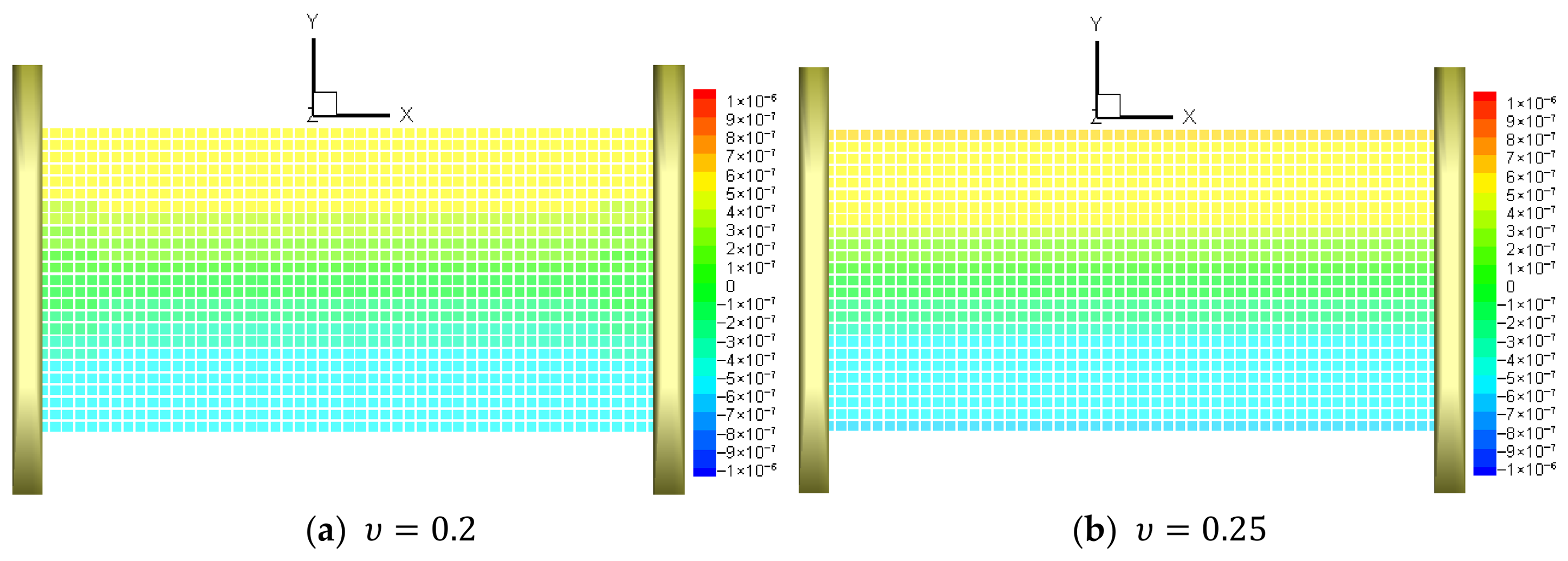
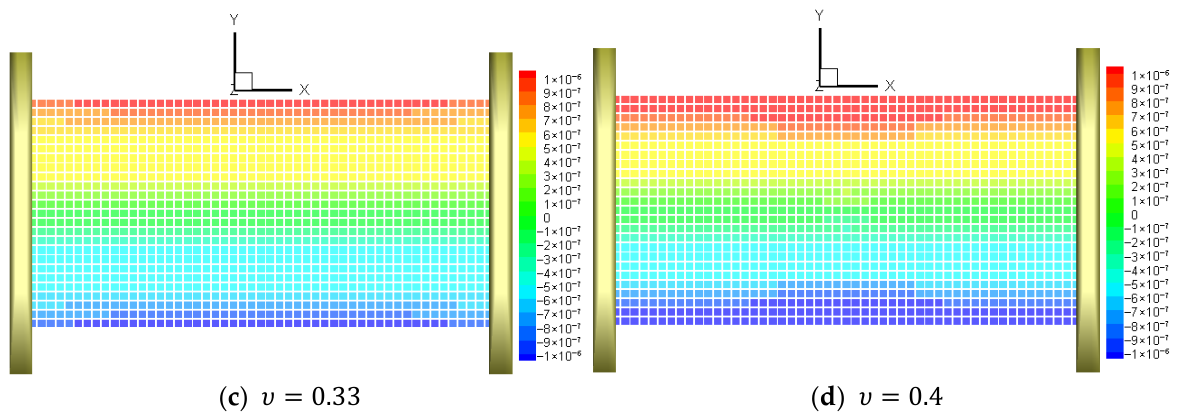
Figure 5 presents the deformation distribution of the specimen at different Poisson’s ratios when the applied displacement reaches 0.0001 m.
The results indicate that as Poisson’s ratio increases, the lateral expansion of the specimen becomes more pronounced. The numerical deformation patterns align with the expected theoretical behaviour.
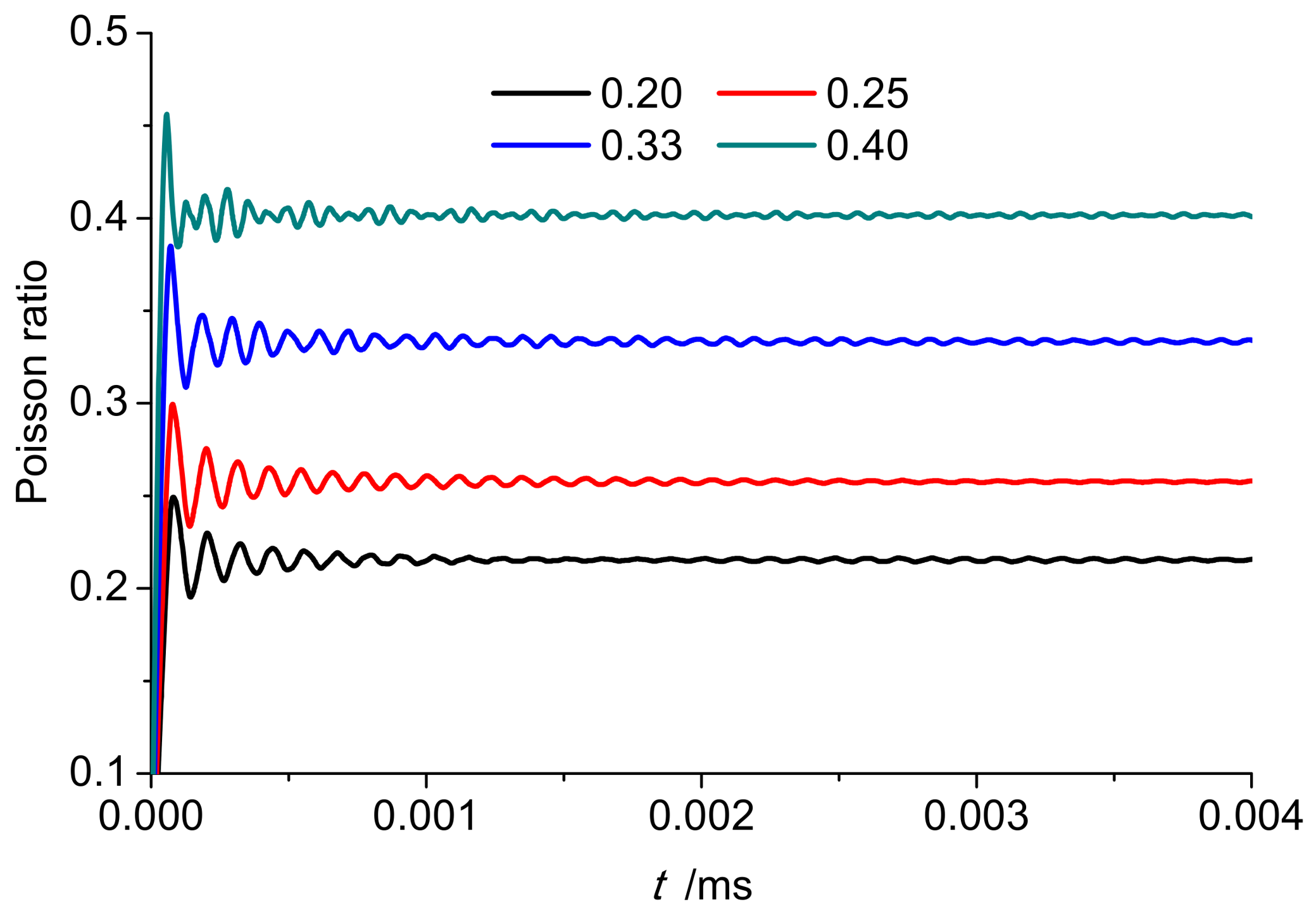
To further validate the model, the numerically computed Poisson’s ratios are compared with the input values.
Figure 6 illustrates the time history of the computed Poisson’s ratio. Initially, fluctuations are observed due to the transient loading phase, but the values gradually stabilize.
Table 2 summarizes the numerical Poisson’s ratio values and their relative errors compared to the input values. The results show that the numerical errors decrease as Poisson’s ratio increases. The SB-PD model effectively reproduces Poisson’s-ratio-dependent deformation behaviour, validating its suitability for ice–structure interaction modelling.
The benchmark results demonstrate that the SB-PD implementation can correctly reproduce the expected Poisson’s-ratio-dependent elastic deformation characteristics in a three-dimensional setting. This provides a basic implementation check for the subsequent simulations. However, the present benchmark is limited to elastic deformation behaviour and does not, by itself, constitute a full validation of fracture evolution, damage initiation, or dynamic impact response, which are further examined through the later case studies.
To further assess the model capability in capturing fracture processes, dynamic response, and ice-induced loads, the following sections investigate impact-driven and ice–structure interaction cases, where failure evolution and load characteristics play a dominant role.
4. Ice Cylinder Impact on a Rigid Plate
This section investigates the impact behaviour of a cylindrical ice specimen on a rigid plate. Since this case involves impact-induced damage evolution and load response, the comparison with experimental observations provides a more relevant validation for the fracture-related modelling capability of the proposed peridynamic framework. In the 3D simulations presented in this section, the case with υ = 0.25 is performed using BB-PD, whereas the cases with higher Poisson’s ratios are simulated using SB-PD. The simulation results are compared against experimental data to validate the peridynamic modelling approach. Additionally, the influence of Poisson’s ratio on ice impact response is examined. Because BB-PD is equivalent to SB-PD when υ = 1/4 (3D), the comparison between the BB-PD case (υ = 0.25) and the SB-PD cases (υ with other values) effectively isolates the effect of Poisson’s ratio on ice–structure interaction.
4.1. Numerical Model Setup
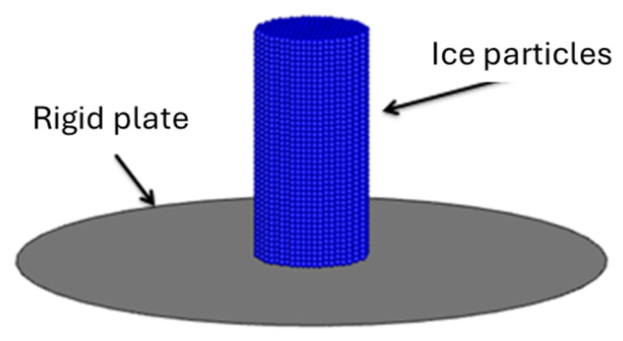
A PD model of cylindrical ice impact is established, as illustrated in
Figure 7. The ice cylinder is modelled as a homogeneous isotropic material and discretized into uniformly distributed material particles using the SB-PD formulation. The rigid plate is assumed to be an undeformable surface, and gravitational, frictional, and aerodynamic forces are neglected. The mechanical properties of the ice are defined based on the numerical setup [
25] and corresponding experimental measurements [
26], as shown in
Table 3. We have previously carried out systematic sensitivity analyses for this case, including the effects of the time step, particle spacing, ice elastic modulus, and fracture toughness. These results have been reported in our published work [
25]. Based on those prior studies, the numerical parameters adopted in the present paper were selected accordingly. Specifically, the time step and particle spacing used here are 1.841 × 10
−7 s and 0.72 mm, respectively.
4.2. Computational Results
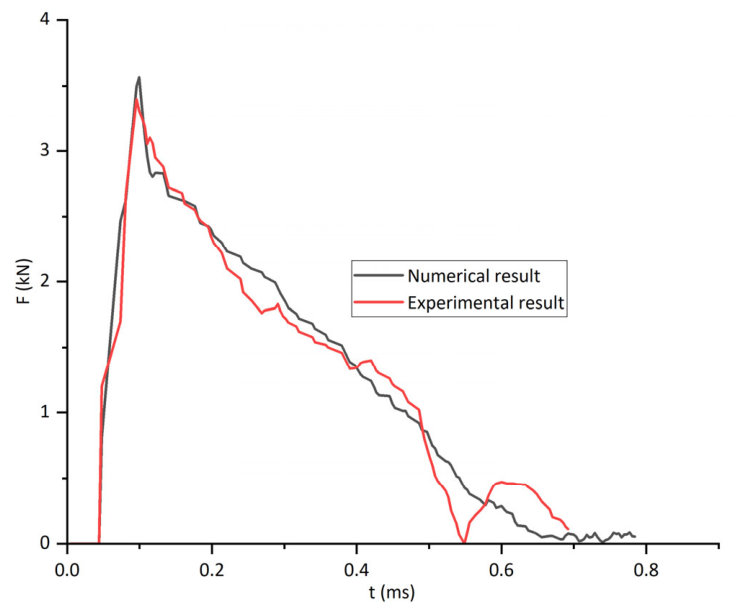
The simulated impact force history is first compared with the experimental data of [
26], as shown in
Figure 8. Regarding experimental data, the experimental programme involved launching ice specimens using a gas-driven device toward an instrumented rigid target. The tests were carried out under controlled environmental conditions to ensure repeatability of the impact process. The ice specimens were cylindrical in shape, and a range of impact velocities was considered. The impact force was recorded by a load-sensing system attached to the target structure, and the signals were processed using appropriate filtering techniques. Both perpendicular and inclined impact configurations were included in the experiments. The experimental data shown in
Figure 8 correspond to the perpendicular (normal) impact configuration (ice cylinder axis aligned with the impact direction, striking the rigid plate at 0°).
The simulated peak impact force is 3.54 kN, which agrees well with the experimental peak value of 3.4 kN, giving a relative difference of approximately 4.1%. In addition, based on the force history curves in
Figure 8, the peak force occurs at approximately 0.085 ms in the numerical result and 0.095 ms in the experimental result, corresponding to a peak-timing difference of about 0.01 ms. The force–time history follows a similar trend to the experimental data, demonstrating a rapid increase upon contact, reaching a maximum value, and gradually declining. Discrepancies in the unloading phase are observed due to differences in fragmentation mechanics between the numerical model and experiments.
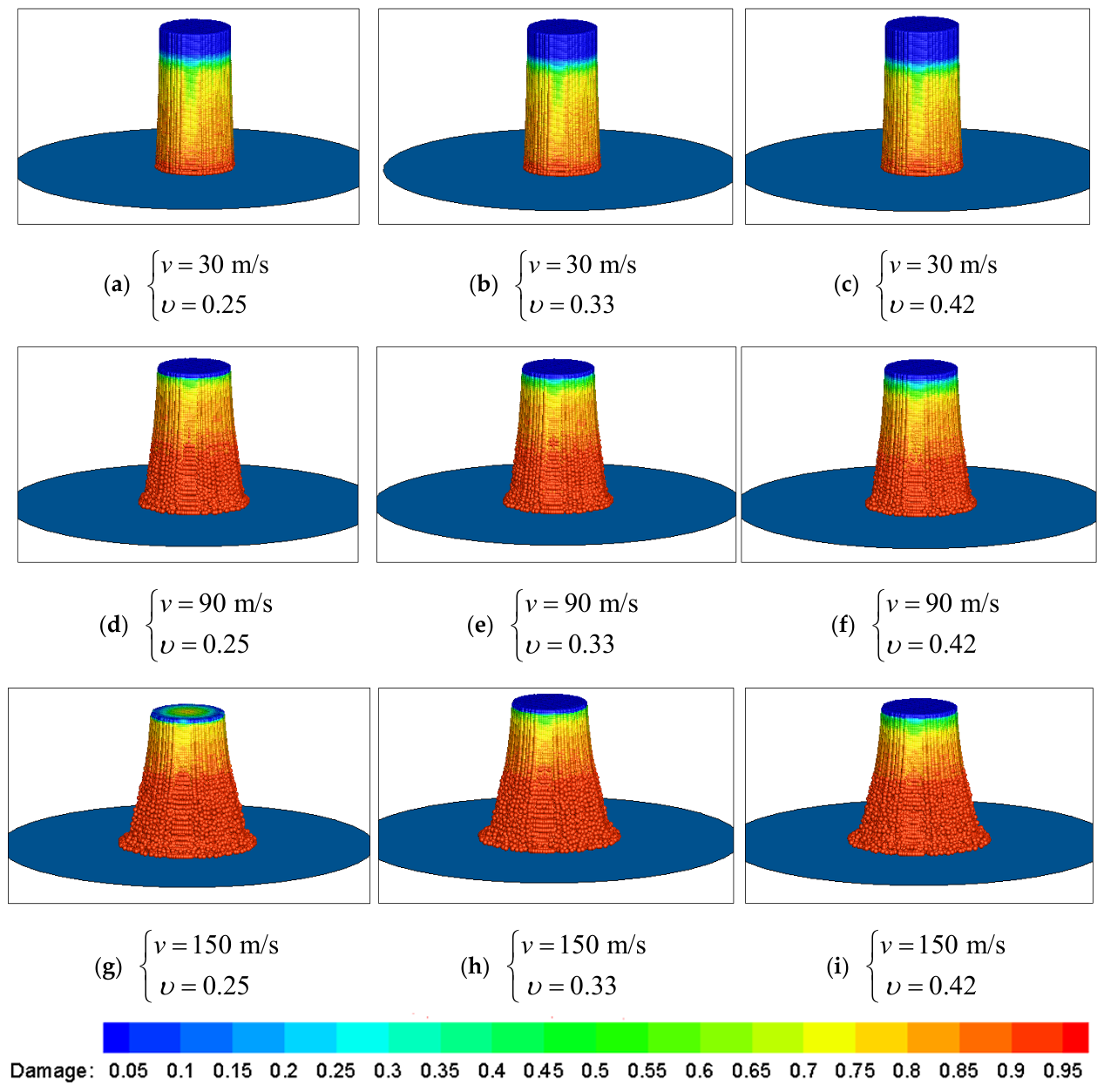
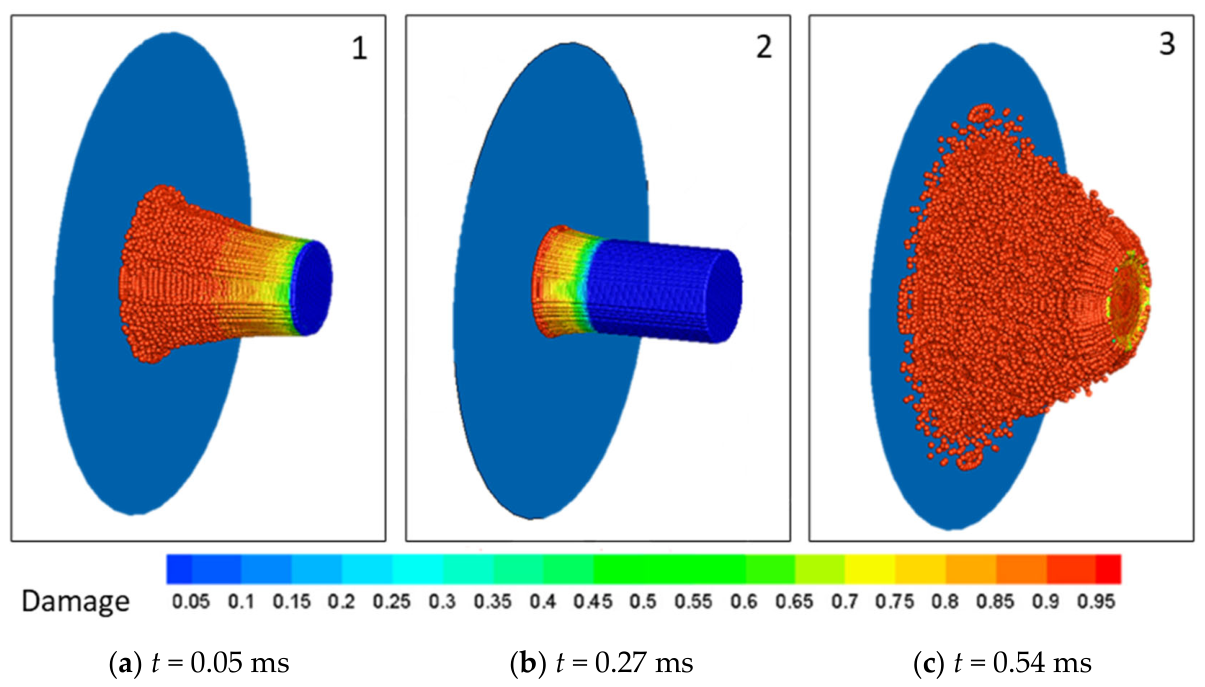
Figure 9 presents the numerical simulation of ice cylinder impact. The colour gradient in the figure represents the damage degree computed using Equation (9), where red indicates complete fracture, and lighter shades correspond to lower damage levels. In the simulation, the ice cylinder undergoes progressive crushing from the contact interface upward, without forming distinct cracks. The fractured ice disperses radially, closely matching the experimental observations [
26]. This agreement confirms that PD approach effectively captures the ice crushing process, reproducing both damage evolution and fracture propagation during impact. It should be noted that the present experimental comparison is mainly based on the available force history record and qualitative fracture observations. Additional quantitative indicators, such as contact duration, impulse, and fragmentation statistics, would further strengthen the validation, but such information is not sufficiently available from the current reference experiment.
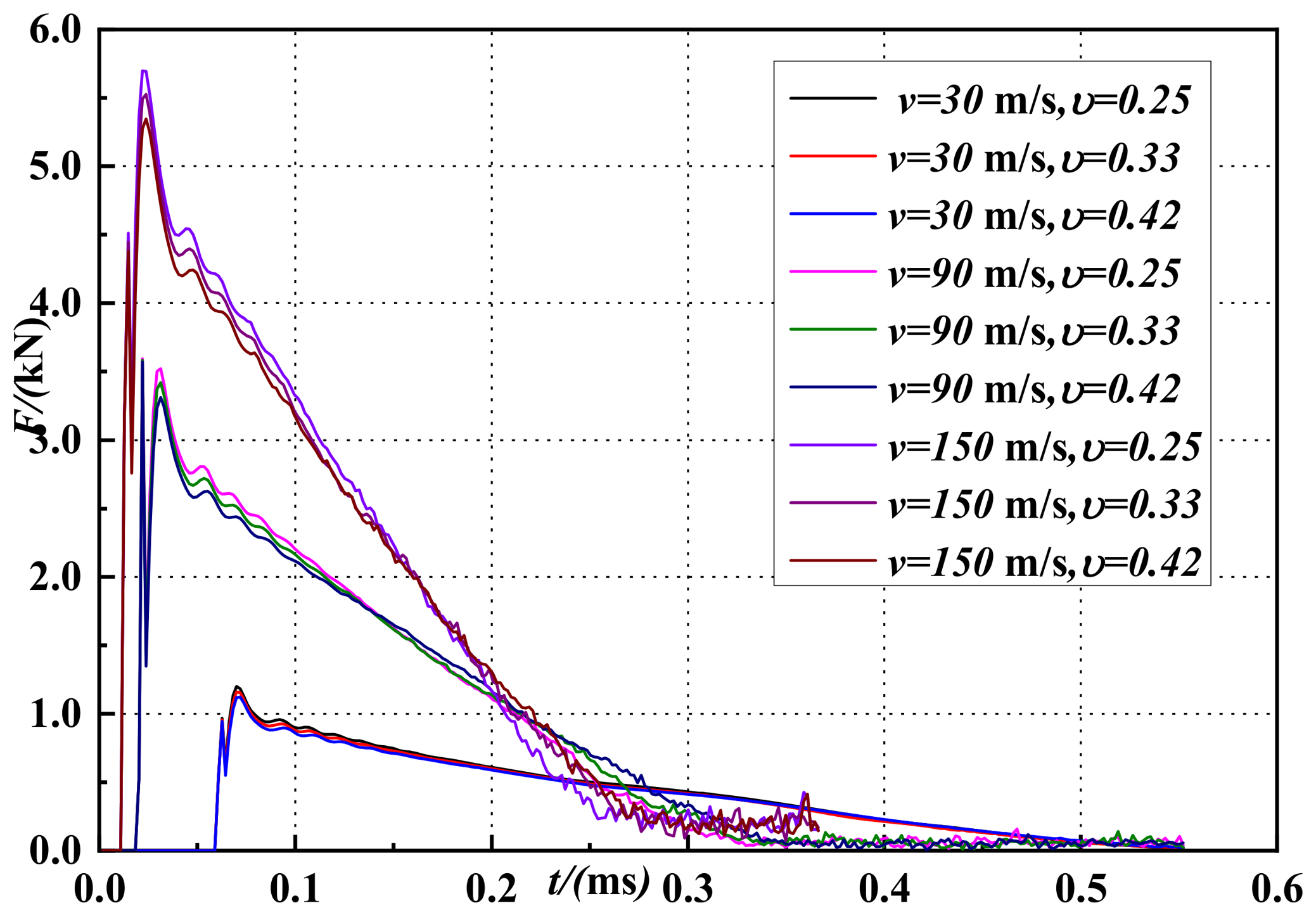
To evaluate the effect of Poisson’s ratio on impact behaviour, simulations are performed with Poisson’s ratios of 0.25, 0.33, and 0.42 at different impact velocities. As shown in
Figure 10, it is found that at low impact velocities (30 m/s), Poisson’s ratio has minimal influence on impact force and ice fracture behaviour. At higher impact velocities (150 m/s), the peak impact force decreases as Poisson’s ratio increases, indicating that stress distribution and energy dissipation mechanisms are affected by Poisson’s ratio. Higher Poisson’s ratios lead to greater lateral deformation, which reduces stress concentration, alters crack propagation paths, and influences fracture morphology.
Figure 11 presents fracture patterns of the ice cylinder at different Poisson’s ratios and impact velocities. The results indicate that at low impact velocities, the fracture mode remains consistent across different Poisson’s ratios. At higher impact velocities, increasing Poisson’s ratio leads to more distributed fragmentation, with the ice breaking into smaller pieces, indicating an enhanced lateral stress dispersion effect.
Overall, the comparison indicates that BB-PD (υ = 0.25) provides similar predictions to SB-PD under low impact velocities. However, at higher impact velocities, SB-PD captures more realistic fracture patterns and reduced peak forces due to enhanced lateral deformation effects, which cannot be represented by BB-PD.
5. Ice–Propeller Interaction Analysis
The interaction between ice and propellers is a critical concern in marine engineering, affecting propulsion efficiency, structural integrity, and operational safety in ice-covered waters. This section investigates the influence of Poisson’s ratio on ice fracture patterns and ice-induced loads in a propeller milling scenario. The case with υ = 0.25 is performed using BB-PD, whereas the cases with higher Poisson’s ratios are simulated using SB-PD. As explained in
Section 4, BB-PD is a special case of SB-PD under the constraint of υ = 1/4 in 3D; therefore, the υ = 0.25 case computed using BB-PD is equivalent to an SB-PD simulation with the same Poisson’s ratio. Hence, varying only υ while keeping all other parameters unchanged provides a consistent basis for evaluating the influence of Poisson’s ratio.
5.1. Numerical Model Setup
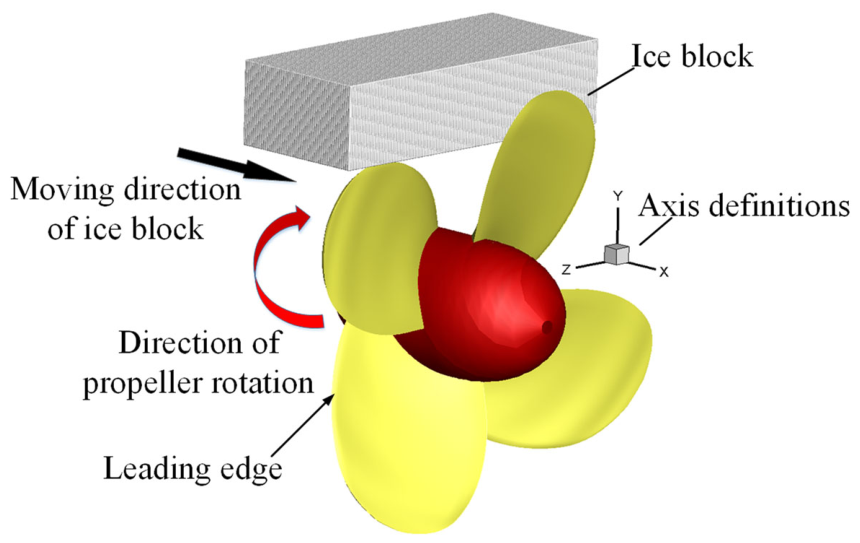
A numerical model is established to simulate the milling process of an ice block by a rotating propeller blade, as shown in
Figure 12. Taking the 1200-series R-class ice propeller installed on the Canadian Coast Guard R-class icebreaker as the parent prototype [
27], and with reference to the publicly available literature on the geometric parameters and experimental data of ice-class propellers abroad, an ice-class propeller with hydrodynamic performance and geometric characteristics comparable to those of the R-class propeller was designed using propeller optimization design methods. The designed propeller was named Icepropeller1 [
18], and its model is shown in
Figure 12. The propeller has a diameter of
D = 4.12 m, a hub diameter of
rh = 1.24 m, and a pitch ratio of
P = 0.76.
The ice block was modelled as a rectangular cuboid, with a length of
L = 0.5
D, a width of
, and a thickness of
. The ice block is discretized into material particles, while the propeller blade surface is represented by a mesh of elements. The ice approaches the propeller at a uniform velocity, and the propeller rotates at a constant angular speed around its axis. The mechanical properties of the ice block are defined in
Table 4. The interaction model follows the methodology described in
Section 2.3, ensuring efficient identification of ice–propeller interactions. In the present study, the dynamic friction coefficient is prescribed as a constant value of 0.8, and no sensitivity analysis on friction is conducted, since the focus is placed on the effect of Poisson’s ratio.
For the ice–propeller interaction problem, no fixed penetration depth is prescribed in this milling case. Instead, the blade–ice engagement develops dynamically as the ice block advances toward the rotating propeller with a speed of 1.8 m/s. Therefore, the effective cutting depth varies with the instantaneous relative position between the blade and the incoming ice block. In addition, extensive convergence and sensitivity analyses have been carried out in our previous studies [
18], including the effects of propeller-blade mesh resolution, particle spacing, and time step. Based on these validated studies, the numerical parameters used in the present case were selected accordingly. Specifically, the propeller-blade mesh, particle spacing, and time step were adopted from our prior validated numerical framework, with the time step set to 0.0348 ms. The parameters listed in
Table 4 are therefore supported by previous propeller–ice interaction studies and are representative of typical engineering conditions.
5.2. Computational Results
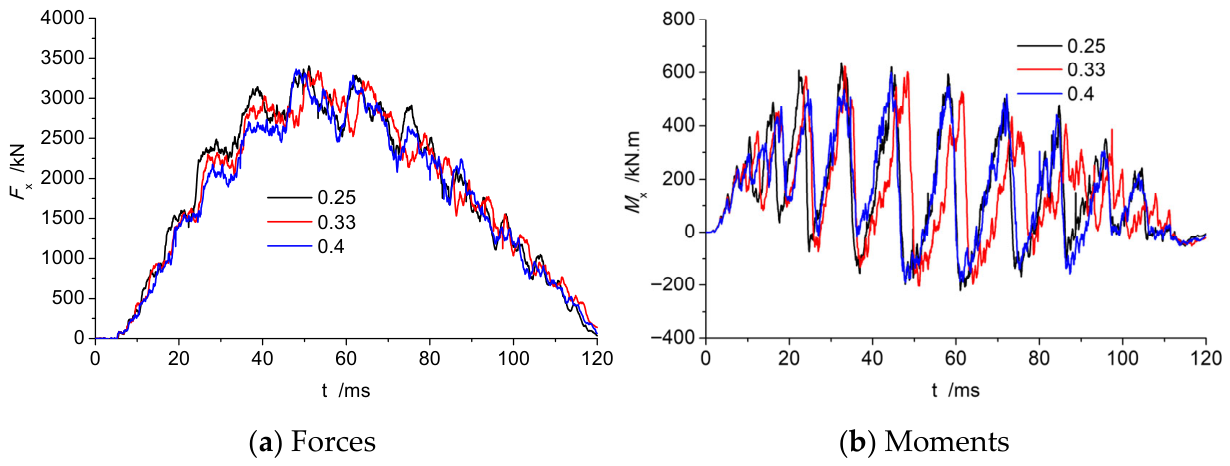
To examine the effects of Poisson’s ratio on ice loads, simulations are conducted for Poisson’s ratios of 0.25, 0.33, and 0.4. The time history of propeller-induced forces and moments is illustrated in
Figure 13. The forces and moments shown in
Figure 13 are the resultant ice-induced loads acting on the propeller. They are obtained by summing the contact-force contributions from all ice particles interacting with the propeller blade surface. The force components
Fx,
Fy, and
Fz are defined in the global Cartesian coordinate system shown in
Figure 12, and the corresponding moments
Mx,
My, and
Mz are calculated about the propeller coordinate origin. In
Figure 12, the coordinate axes and force directions are added to clarify the load definition.
As Poisson’s ratio increases, the computed ice loads show a slight reduction. The overall trend remains similar, suggesting that Poisson’s ratio has a moderate influence on ice-induced loads. The load variations primarily arise due to differences in lateral deformation and stress redistribution in the ice block. These results indicate that Poisson’s ratio does not significantly alter the overall force magnitude, but it does influence load distribution and contact dynamics.
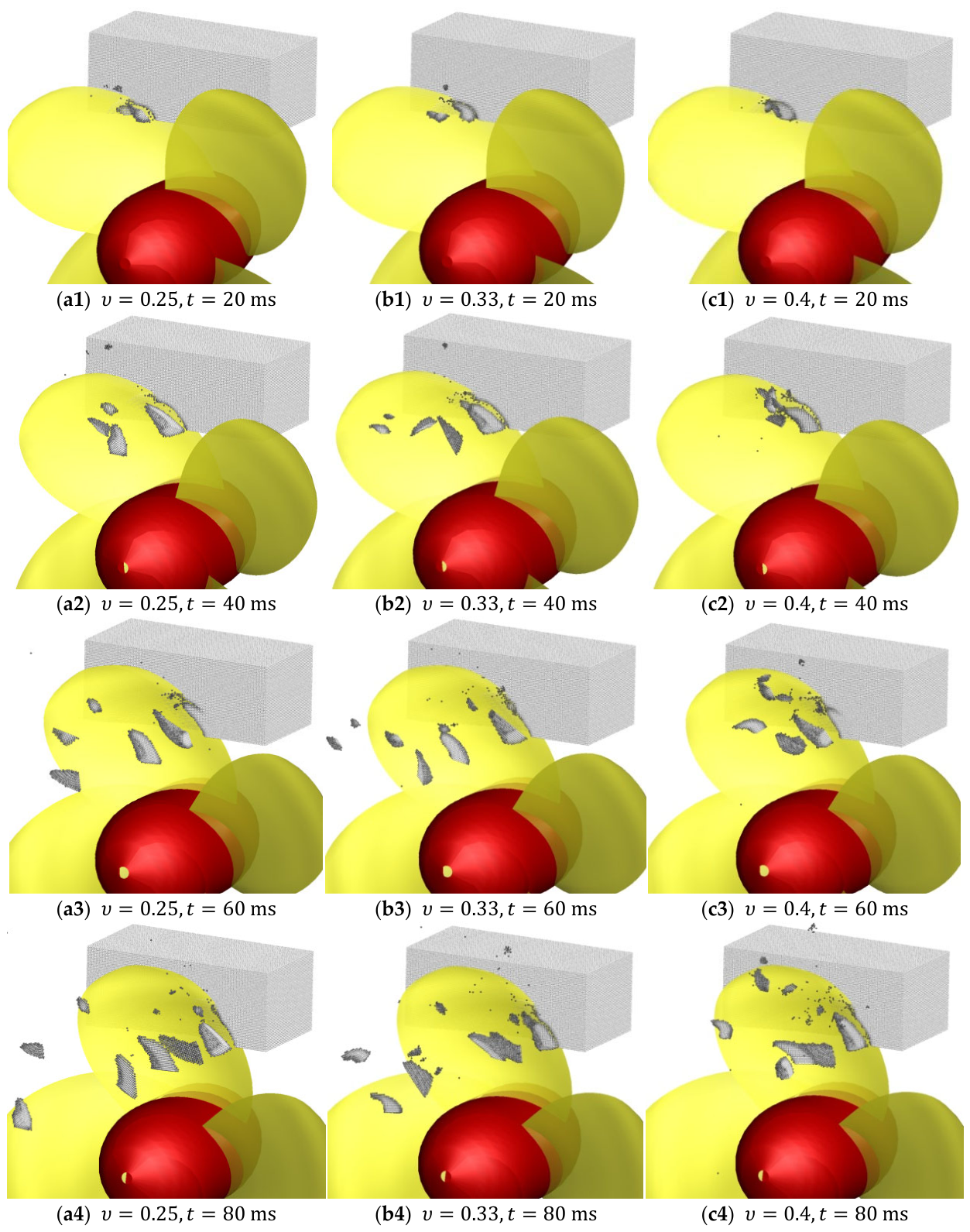
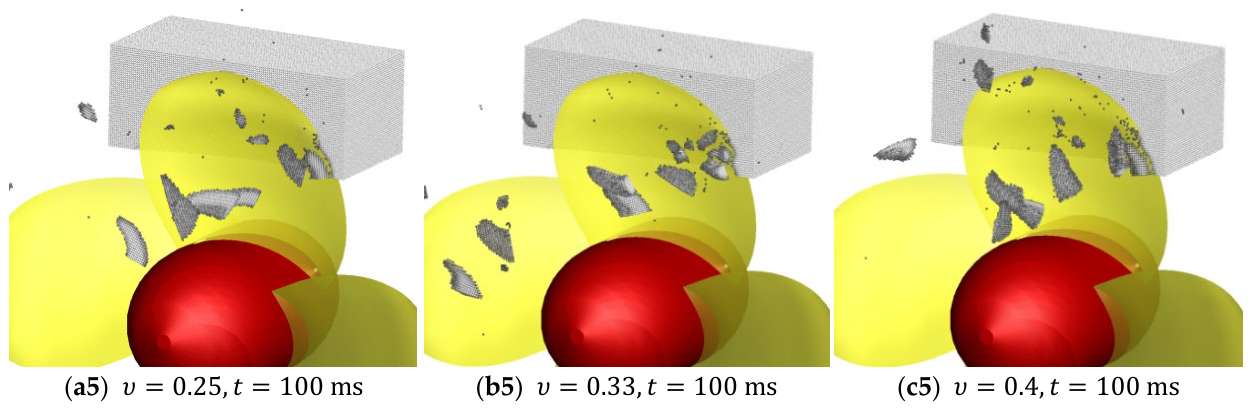
The fracture morphology of the ice block is analyzed under different Poisson’s ratios, as shown in
Figure 14. Because the present problem involves fracture of ice interacting with a complex structure, the failure pattern is highly heterogeneous and evolves in a geometry-dependent manner. Therefore, the comparison in
Figure 14 is performed by keeping the operating conditions unchanged and examining the fracture morphology at the same physical time step. Under this consistent basis, the effect of Poisson’s ratio is reflected through visual differences in the fracture pattern. During the milling process, ice fragments are generated progressively as the rotating blade contacts and cuts the advancing ice block. Since the ice block is continuously fed toward the propeller, the size of the removed ice pieces is governed by the coupled effects of blade rotation, ice advancing velocity, contact position, and fracture evolution, rather than by a prescribed cutting depth. As shown in
Figure 14, the BB-PD case with υ = 0.25 produces relatively larger fragments and more localized fracture surfaces. In contrast, the SB-PD cases with higher Poisson’s ratios lead to finer and more dispersed ice pieces, indicating stronger lateral deformation and stress redistribution during the milling process.
The results reveal that for low Poisson’s ratio (0.25), the ice fractures into larger fragments, with distinct failure surfaces. For higher Poisson’s ratio (0.4), the ice undergoes powder-like fragmentation, indicating a brittle failure mode. With increasing Poisson’s ratio, the fracture morphology at the same physical time appears to become finer and more dispersed. The transition from large fragments to fine fragmentation is attributed to the increased lateral deformation capacity of ice with higher Poisson’s ratio, leading to more distributed stress dissipation.
These findings indicate that Poisson’s ratio plays a significant role in governing ice failure mechanisms in milling interactions. In particular, the BB-PD case (υ = 0.25) tends to produce larger and more localized fracture fragments, whereas the SB-PD cases with higher Poisson’s ratios result in more distributed and fine-scale crushing due to enhanced lateral deformation. This comparison highlights the limitation of BB-PD in capturing realistic fracture behaviour in complex ice–structure interaction scenarios.
6. Conclusions
This study presents a numerical investigation of Poisson’s ratio effects on ice–structure interaction using the PD method. The analysis systematically evaluates BB-PD and SB-PD formulations in two representative ice–structure interaction scenarios: (1) cylindrical ice impact on a rigid plate and (2) ice–propeller interaction. In the present 3D simulations, the case with υ = 0.25 represents the BB-PD formulation, whereas the cases with higher Poisson’s ratios are simulated using SB-PD to represent more realistic ice behaviour. The key findings are summarized as follows:
- (1)
The benchmark uniaxial compression test confirmed that the SB-PD implementation can reproduce Poisson’s-ratio-dependent elastic deformation. For prescribed Poisson’s ratios of 0.2, 0.25, 0.33, and 0.40, the computed values were 0.215, 0.258, 0.333, and 0.401, corresponding to relative errors of 7.5%, 3.2%, 1.02%, and 0.38%, respectively. This verifies the capability of SB-PD to overcome Poisson’s ratio constraint inherent in BB-PD.
- (2)
In the cylindrical ice impact case, the numerical model reproduced the experimental impact response with a simulated peak force of 3.54 kN compared with the experimental peak value of 3.4 kN. At low impact velocities (30 m/s), the BB-PD result with υ = 0.25 shows similar impact force and fracture behaviour to the SB-PD cases, indicating that BB-PD can provide acceptable predictions when Poisson’s ratio effects are weak. However, at higher impact velocities (150 m/s), SB-PD simulations with higher Poisson’s ratios predict lower peak impact forces, more distributed fragmentation, and stronger lateral deformation effects. These findings emphasize the need for SB-PD in high-strain-rate ice impact simulations where stress redistribution and fracture morphology are important.
- (3)
The ice–propeller interaction analysis indicates that Poisson’s ratio has a moderate effect on ice-induced loads but a more pronounced influence on fracture morphology. The BB-PD case can approximate the overall load level, but it tends to produce larger and more localized fragments. In contrast, the SB-PD cases with higher Poisson’s ratios show finer and more dispersed fragmentation, reflecting enhanced lateral deformation and stress redistribution. This indicates that SB-PD is more suitable for complex ice–structure interaction problems involving contact evolution, fracture morphology, and load redistribution.
The results highlight the limitations of the BB-PD model in ice–structure interaction simulations, primarily due to its Poisson’s ratio constraint (1/4 in 3D, 1/3 in 2D), which restricts its ability to accurately capture the mechanical behaviour of ice. BB-PD may still be acceptable for simplified engineering estimations where Poisson’s ratio effects are not dominant. In contrast, the SB-PD model offers greater flexibility by allowing arbitrary Poisson’s ratio values, enabling more realistic representations of ice failure, fragmentation, and stress redistribution. This makes SB-PD a more suitable choice for engineering applications where precise modelling of fracture mechanics and load distribution is critical.
It should also be emphasized that the present simulations adopt a simplified ice material model, in which ice is treated as homogeneous, isotropic, and linearly elastic with a constant critical energy release rate. While this allows the influence of Poisson’s ratio to be examined in a relatively isolated manner, important factors such as strain-rate dependence, temperature effects, salinity, and anisotropy are not included. These factors may affect the quantitative response of real ice, especially under high-speed impact conditions, and should be incorporated in future work for more realistic engineering prediction.
Author Contributions
Conceptualization, Y.Z. and D.Z.; methodology, Y.Z.; software, X.Z.; validation, L.Y. and Y.Z.; formal analysis, B.L.; investigation, Y.Z.; data curation, D.Z.; writing—original draft preparation, Y.Z.; writing—review and editing, Y.Z.; visualization, S.P.; supervision, C.W.; funding acquisition, J.M. All authors have read and agreed to the published version of the manuscript.
Funding
National Natural Science Foundation of China: No. 52371316, 52502407 and 51245316; Joint Funds of the Natural Science Foundation Project of Heilongjiang Province: No. LH2023E072; Naval University of Engineering: 2026505030.
Data Availability Statement
The original contributions presented in this study are included in the article. Further inquiries can be directed to the corresponding authors.
Conflicts of Interest
The authors declare no conflicts of interest.
References
- Xue, Y.Z.; Liu, R.W.; Li, Z.; Han, D.F. A review for numerical simulation methods of ship-ice interaction. Ocean. Eng. 2020, 215, 107853. [Google Scholar] [CrossRef]
- Tsarau, A.; Lu, W.; Lubbad, R.; Løset, S.; Zhang, Y. High-resolution regional sea-ice model based on the discrete element method with boundary conditions from a large-scale model for ice drift. Ann. Glaciol. 2024, 65, e25. [Google Scholar] [CrossRef]
- Tuhkuri, J.; Polojärvi, A. A review of discrete element simulation of ice–structure interaction, Philosophical Transactions of the Royal Society A: Mathematical. Phys. Eng. Sci. 2018, 376, 20170335. [Google Scholar] [CrossRef]
- Li, F.; Korgesaar, M.; Kujala, P.; Goerlandt, F. Finite element based meta-modeling of ship-ice interaction at shoulder and midship areas for ship performance simulation. Mar. Struct. 2020, 71, 102736. [Google Scholar] [CrossRef]
- Waisman, H.; Tuminaro, R. Modeling the Fracture of Ice Sheets on Parallel Computers; Columbia University: New York, NY, USA, 2013; 31p. [Google Scholar]
- Lu, W. Ice Fracture. In IUTAM Symposium on Physics and Mechanics of Sea Ice Proceedings of the IUTAM Symposium held at Aalto University, Espoo, Finland, 3–9 June 2019. [Google Scholar]
- Polojärvi, A. Numerical model for a failure process of an ice sheet. Comput. Struct. 2022, 269, 106828. [Google Scholar] [CrossRef]
- Diehl, P.; Lipton, R.; Wick, T.; Tyagi, M. A comparative review of peridynamics and phase-field models for engineering fracture mechanics. Comput. Mech. 2022, 69, 1259–1293. [Google Scholar] [CrossRef]
- Javili, A.; Morasata, R.; Oterkus, E.; Oterkus, S. Peridynamics review. Math. Mech. Solids 2019, 24, 3714–3739. [Google Scholar] [CrossRef]
- Wang, Q.; Ju, L.; Xue, Y. Chapter 13—The application of peridynamics for ice modeling. In Peridynamic Modeling, Numerical Techniques, and Applications; Oterkus, E., Oterkus, S., Madenci, E., Eds.; Elsevier: Amsterdam, The Netherlands, 2021; pp. 275–308. [Google Scholar]
- Madenci, E.; Roy, P.; Behera, D. Advances in Peridynamics; Springer: Cham, Switzerland, 2022. [Google Scholar]
- Silling, S.A.; Askari, E. A meshfree method based on the peridynamic model of solid mechanics. Comput. Struct. 2005, 83, 1526–1535. [Google Scholar] [CrossRef]
- Silling, S.A. Reformulation of elasticity theory for discontinuities and long-range forces. J. Mech. Phys. Solids 2000, 48, 175–209. [Google Scholar] [CrossRef]
- Vazic, B.; Oterkus, E.; Oterkus, S. Peridynamic approach for modelling ice-structure interactions. In Trends in the Analysis and Design of Marine Structures; CRC Press: Boca Raton, FL, USA, 2017; pp. 55–60. [Google Scholar]
- Lu, W.; Wang, Q.; Jia, B.; Shi, L. Simulation of Ice-Sloping Structure Interactions with Peridynamic Method. In The 28th International Ocean and Polar Engineering Conference; International Society of Offshore and Polar Engineers: Mountain View, CA, USA, 2018. [Google Scholar]
- Wang, Q.; Wang, Y.; Zan, Y.F.; Lu, W.; Bai, X.L.; Guo, J. Peridynamics simulation of the fragmentation of ice cover by blast loads of an underwater explosion. J. Mar. Sci. Technol. 2018, 23, 52–66. [Google Scholar] [CrossRef]
- Liu, R.W.; Xue, Y.Z.; Lu, X.K.; Cheng, W.X. Simulation of ship navigation in ice rubble based on peridynamics. Ocean Eng. 2018, 148, 286–298. [Google Scholar] [CrossRef]
- Ye, L.Y.; Wang, C.; Chang, X.; Zhang, H.Y. Propeller-ice contact modeling with peridynamics. Ocean Eng. 2017, 139, 54–64. [Google Scholar] [CrossRef]
- Timco, G.W.; Weeks, W.F. A review of the engineering properties of sea ice. Cold Reg. Sci. Technol. 2010, 60, 107–129. [Google Scholar] [CrossRef]
- Schulson, E.M.; Duval, P. Creep and Fracture of Ice; Cambridge University Press (CUP): Cambridge, UK, 2009. [Google Scholar]
- Schulson, E.M. Brittle failure of ice. Eng. Fract. Mech. 2001, 68, 1839–1887. [Google Scholar] [CrossRef]
- Madenci, E.; Oterkus, E. Peridynamic Theory and Its Applications; Springer: New York, NY, USA, 2014. [Google Scholar]
- Madenci, E.; Oterkus, S. Ordinary state-based peridynamics for plastic deformation according to von Mises yield criteria with isotropic hardening. J. Mech. Phys. Solids 2016, 86, 192–219. [Google Scholar] [CrossRef]
- Zhang, Y.; Tao, L.B.; Ye, L.Y.; Wang, C.; Sun, S.; Lu, W.J. An updated fast continuous contact detection algorithm and its implementation in case study of ice-structure interaction by peridynamics. Mar. Struct. 2023, 89, 103406. [Google Scholar] [CrossRef]
- Wang, C.; Yang, B.; Zhang, Y.; Guo, C.; Ye, L. Numerical Simulation and Analysis of Cylindrical Ice Impacting Problem. J. Shanghai Jiaotong Univ. 2022, 56, 368. [Google Scholar]
- Carney, K.S.; Benson, D.J.; Bois, P.; Lee, R. A high strain rate model with failure for ice in LS-DYNA. In 9th International LS-DYNA Users Conference; 2006; pp. 4–6. Available online: https://www.dynalook.com/conferences/international-conf-2006/11MaterialModeling.pdf (accessed on 5 March 2026).
- Walker, D.L.N. The Influence of Blockage and Cavitation on the Hydrodynamic Performance of Ice Class Propellers in Blocked Flow. Ph.D. Thesis, Memorial University of Newfoundland, St. John’s, NL, Canada, 1996. [Google Scholar]
Figure 1.
Discretization and particle interactions in PD theory.
Figure 1.
Discretization and particle interactions in PD theory.
Figure 2.
Diagram of damage presentation in the PD model.
Figure 2.
Diagram of damage presentation in the PD model.
Figure 3.
Discrete critical energy release rate criterion in the nonlinear relationship between stretch and force density.
Figure 3.
Discrete critical energy release rate criterion in the nonlinear relationship between stretch and force density.
Figure 4.
Numerical model for uniaxial compression test.
Figure 4.
Numerical model for uniaxial compression test.
Figure 5.
Deformation distribution of the 3D benchmark specimen under different Poisson’s ratios, computed using the BB-PD method for υ = 0.25 and the SB-PD method for the other cases.
Figure 5.
Deformation distribution of the 3D benchmark specimen under different Poisson’s ratios, computed using the BB-PD method for υ = 0.25 and the SB-PD method for the other cases.
Figure 6.
Time history of the computed Poisson’s ratio under different input conditions, using the BB-PD method for υ = 0.25 and the SB-PD method for the other cases.
Figure 6.
Time history of the computed Poisson’s ratio under different input conditions, using the BB-PD method for υ = 0.25 and the SB-PD method for the other cases.
Figure 7.
Peridynamic model of cylindrical ice impact.
Figure 7.
Peridynamic model of cylindrical ice impact.
Figure 8.
Comparison of simulated and experimental impact force histories.
Figure 8.
Comparison of simulated and experimental impact force histories.
Figure 9.
Simulation phenomenon of ice cylinder impacting a rigid plate.
Figure 9.
Simulation phenomenon of ice cylinder impacting a rigid plate.
Figure 10.
Impact force histories under different Poisson’s ratios with different impact speed. The case with υ = 0.25 corresponds to BB-PD, whereas the other cases were computed using the SB-PD method.
Figure 10.
Impact force histories under different Poisson’s ratios with different impact speed. The case with υ = 0.25 corresponds to BB-PD, whereas the other cases were computed using the SB-PD method.
Figure 11.
Fracture at different Poisson’s ratios and impact velocities. The case with υ = 0.25 corresponds to BB-PD, whereas the other cases were computed using the SB-PD method.
Figure 11.
Fracture at different Poisson’s ratios and impact velocities. The case with υ = 0.25 corresponds to BB-PD, whereas the other cases were computed using the SB-PD method.
Figure 12.
Peridynamic model of ice–propeller interaction.
Figure 12.
Peridynamic model of ice–propeller interaction.
Figure 13.
Time histories of resultant ice-induced forces and moments acting on the propeller under different Poisson’s ratios (the force directions are defined in the global Cartesian coordinate system shown in
Figure 12). The case with υ = 0.25 corresponds to BB-PD, whereas the other cases were computed using the SB-PD method.
Figure 13.
Time histories of resultant ice-induced forces and moments acting on the propeller under different Poisson’s ratios (the force directions are defined in the global Cartesian coordinate system shown in
Figure 12). The case with υ = 0.25 corresponds to BB-PD, whereas the other cases were computed using the SB-PD method.
Figure 14.
Ice fracture patterns under different Poisson’s ratios. The case with υ = 0.25 corresponds to the BB-PD, whereas the other cases were computed using the SB-PD method.
Figure 14.
Ice fracture patterns under different Poisson’s ratios. The case with υ = 0.25 corresponds to the BB-PD, whereas the other cases were computed using the SB-PD method.
Table 1.
Mesh sensitivity check for the uniaxial compression test (input = 0.25).
Table 1.
Mesh sensitivity check for the uniaxial compression test (input = 0.25).
| Particle Spacing | Computed Poisson’s Ratio | Relative Error (%) | Change from Previous Refinement |
|---|
| 2.0 | 0.265 | 5.2% | -- |
| 1.0 | 0.258 | 3.2% | 0.005 (<1.9%) |
| 0.5 | 0.257 | 2.8% | 0.001 (<0.4%) |
| 0.25 | 0.257 | 2.8% | <0.001 (<0.1%) |
Table 2.
Comparison of input and computed Poisson’s ratios.
Table 2.
Comparison of input and computed Poisson’s ratios.
| Input Poisson’s Ratio | Computed Poisson’s Ratio | Error (%) |
|---|
| 0.2 | 0.215 | 7.5% |
| 0.25 | 0.258 | 3.2% |
| 0.33 | 0.333 | 1.02% |
| 0.4 | 0.401 | 0.38% |
Table 3.
Input parameters for ice cylinder impacting a rigid plate.
Table 3.
Input parameters for ice cylinder impacting a rigid plate.
| Cylinder diameter | 18 mm |
| Cylinder height | 42 mm |
| Elastic modulus | 1.8 GPa |
| Poisson’s ratios considered | 0.25, 0.33, 0.42 |
| Density | 900 kg/m3 |
| Impact velocity | 30 m/s, 90 m/s, 150 m/s |
| Critical energy release rate | 11.14 J/m2 |
Table 4.
Input parameters for ice–propeller Interaction.
Table 4.
Input parameters for ice–propeller Interaction.
| Blade rotational speed | 3 rps |
| Ice velocity toward propeller | 1.8 m/s |
| Elastic modulus | 1.8 GPa |
| Poisson’s ratios considered | 0.25, 0.33, 0.4 |
| Density | 900 kg/m3 |
| Propeller diameter | 4.12 m |
| Disclaimer/Publisher’s Note: The statements, opinions and data contained in all publications are solely those of the individual author(s) and contributor(s) and not of MDPI and/or the editor(s). MDPI and/or the editor(s) disclaim responsibility for any injury to people or property resulting from any ideas, methods, instructions or products referred to in the content. |




 ,
,