Review

Tsunamites Versus Tempestites: A Comprehensive Review from the Precambrian to Recent Times

by
Mohamed Amine Doukani
1,2,3,*,
José Madeira
3,4,
Linda Satour
1 and
Sérgio P. Ávila
2,3,5,6
1
Laboratoire de Paléontologie Stratigraphique et Paléoenvironnement, Faculté des Sciences de la Terre et de l’Univers, University of Oran 2 Mohamed Ben Ahmed, BP.1524 El M’Naouer, Oran 31000, Algeria
2
CIBIO, Centro de Investigação em Biodiversidade e Recursos Genéticos, InBIO Laboratório Associado, BIOPOLIS Program in Genomics, Biodiversity and Land Planning, Pólo dos Açores, 9500-801 Ponta Delgada, Portugal
3
MPB-Marine Palaeontology and Biogeography Laboratory, University of the Azores, Rua da Mãe de Deus, 9501-801 Ponta Delgada, Portugal
4
Instituto Dom Luiz, Faculdade de Ciências, Universidade de Lisboa, Campo Grande, 1749-016 Lisboa, Portugal
5
Departamento de Biologia, Universidade dos Açores, 9501-801 Ponta Delgada, Portugal
6
UNESCO Chair—Land Within Sea: Biodiversity & Sustainability in Atlantic Islands, University of the Azores, Rua da Mãe de Deus, 9500-321 Ponta Delgada, Portugal
*
Author to whom correspondence should be addressed.
J. Mar. Sci. Eng. 2026, 14(1), 49; https://doi.org/10.3390/jmse14010049
Submission received: 14 November 2025 / Revised: 12 December 2025 / Accepted: 17 December 2025 / Published: 26 December 2025
(This article belongs to the Special Issue Feature Review Papers in Geological Oceanography)

Abstract

Insight regarding the overall geological history of tsunamis and their impacts requires information gained from preserved deposits. Although recent decades have seen a rise in tsunami deposit studies overall, most reviews focus on specific time intervals, such as the Paleozoic, the K–Pg boundary, the Quaternary, or historical and recent events, while others concentrated on particular depositional settings, including lacustrine, offshore, or onshore environments. This review paper provides a comprehensive synthesis of tsunami deposits spanning the geological record from the Precambrian to recent times based on a global compilation of onshore, offshore, and lacustrine examples. Selections from the available evidence is traced from the oldest known tsunamites in the Archaean through major extinction boundaries such as the K–Pg, to the well-preserved Holocene and historical deposits. The findings indicate that while the fundamental sedimentological signatures of tsunamis have remained broadly consistent over geological time, their recognition in ancient strata remains challenging due to difficulty in differentiating between storm deposits (tempestites) and other high-energy facies. A central aspect of this review is the critical assessment of diagnostic criteria proposed to differentiate tsunamites from tempestites. By using a multidisciplinary approach, integrating sedimentological, paleontological, geochemical, and geomorphological evidence in palaeotsunami research, this review provides a detailed framework to improve the confidence in identifying tsunami deposits. This, in turn, enhances palaeotsunami reconstructions, which are valuable for advancing hazard assessment along vulnerable coastlines.

1. Introduction

As a scientific discipline, palaeotsunami research remains relatively young. It is still in the process of refining its methodological frameworks and establishing robust criteria for the identification of tsunami deposits. As the field evolves, there has been an increasing emphasis on integrating multidisciplinary approaches, including sedimentology, palaeontology, geomorphology, geochemistry, geophysics and recent/historical records—to enhance the accuracy of tsunami reconstructions. Seminal works by Atwater [1] and Dawson et al. [2] were pivotal in initiating a fundamental paradigm shift in the understanding of tsunami generation and associated sedimentation processes. This shift was further accelerated by the catastrophic tsunamis of the Indian Ocean (2004), South Pacific (2009), Chile (2010), and Japan (2011) [3,4], which profoundly transformed scientific perspectives on tsunami hazards and underscored the critical need to reassess existing models (e.g., [5,6,7]). In the aftermath of these events, researchers focused on sedimentological evidence, coastal geomorphology, and the integration of geological and historical data in tsunami hazard assessment [8,9,10].
Over the last three decades, researchers have shown a surge of interest in studying tsunami related deposits with case studies spanning worldwide regions [4,5,6,7,8,9,10,11,12,13,14,15,16,17,18,19,20,21,22,23,24,25]. Consequently, this rapid build-up of different datasets and perspectives motivated updated comprehensive reviews aimed at synthesizing and summarizing the state-of-knowledge [19,26,27,28,29].
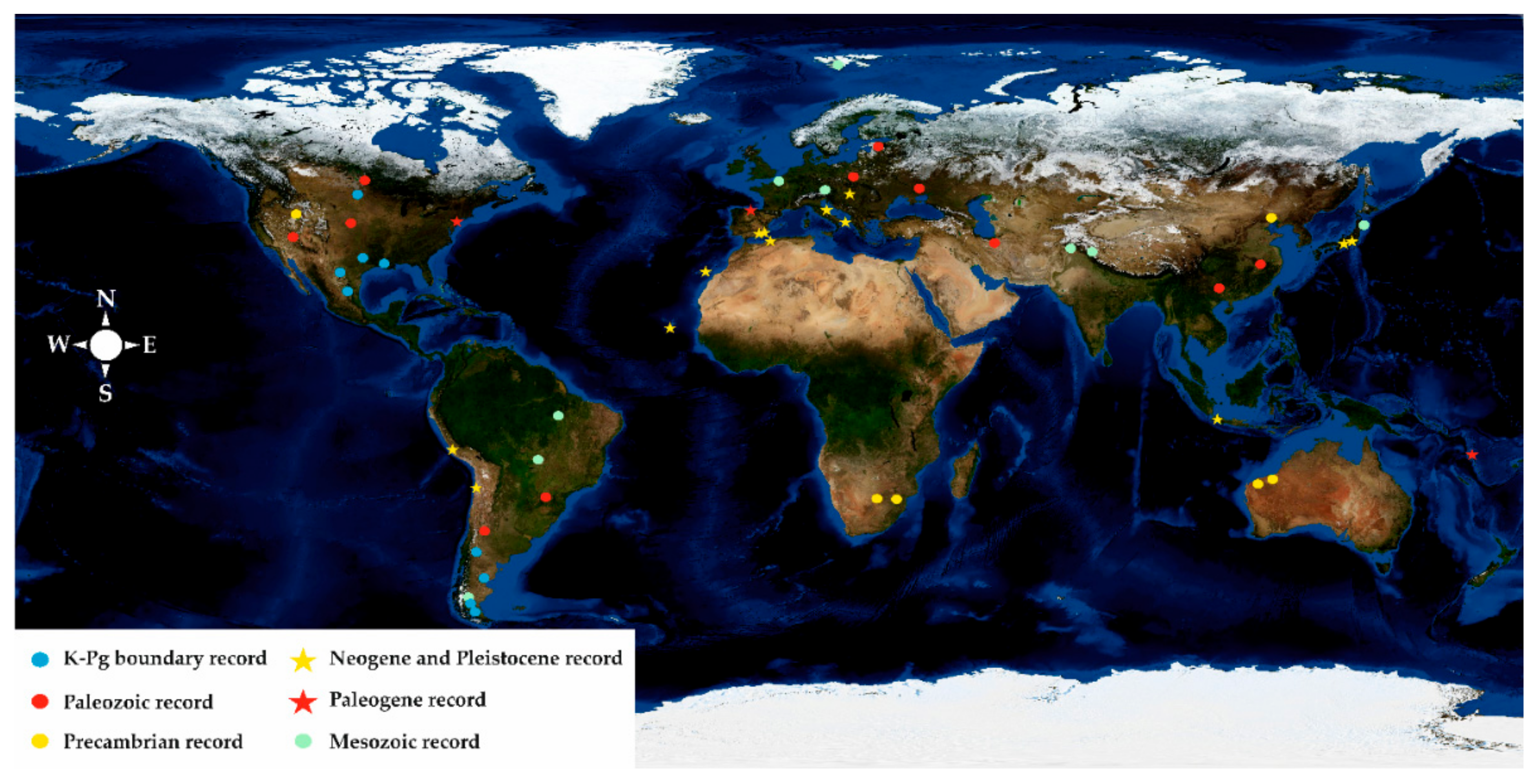
Despite the increasing volume of research on tsunami deposits from the Quaternary, historical, and recent times, evidence from older geological periods, particularly from the Precambrian (>541 Ma) to the Neogene (23.03–2.588 Ma), remain scarce and poorly documented [30,31,32]. According to Dawson et al. [26], this gap can be attributed to two primary factors: (i) the low preservation potential of tsunami deposits, as the coastal and shallow marine environments most impacted by such events are frequently subjected to continuous sediment reworking; and (ii) the inherent difficulty in distinguishing sedimentary structures generated by tsunamis from those produced by other high-energy marine processes, such as storms. The latter factor presents a major challenge for researchers in the field. That is why recently, many authors have increasingly focused on the comparative analysis of tsunamites and tempestites across various depositional settings, including onshore [17,20,21,24,25,33,34,35,36,37,38], offshore [11,15,19,39,40,41], and lacustrine systems [42,43,44,45]. These efforts aimed to refine diagnostic criteria and improve the reliability of distinguishing between these two types of high-energy sedimentary deposits. According to Sztanó et al. [43] and Doukani et al. [25], an additional challenge in palaeotsunami research is to accurately determine the triggering mechanism of a tsunami based only on the sedimentological and taphonomic characteristics of its deposits. However, recent and historical tsunami deposits are often directly linked to well-documented triggering events, such as large-magnitude earthquakes, submarine landslides or volcanic eruptions. However, establishing these cause-and-effect relationships becomes much more complex when it comes to older geological records, for which direct observational data are lacking. In these cases, interpreting the origin of tsunami deposits requires careful integration of sedimentological, stratigraphic and tectonic (seismic, volcanic, etc.) information. An additional, though less frequent, triggering mechanism for tsunami events is extraterrestrial impacts, such as the strike of a meteorite. Such events can generate large-scale tsunamis, and this mechanism is often associated with tsunamites preserved near the Cretaceous-Paleogene (K–Pg) boundary [46,47,48,49,50,51,52] (Figure 1).
The aim of this paper is to present a comprehensive review of the current state of knowledge regarding tsunami deposits preserved in onshore, offshore, and lacustrine environments, spanning from the earliest known geological records to recent historical events. Special attention is given to the methodological advances and challenges associated with the identification and interpretation of tsunami deposits, particularly in distinguishing them from other high-energy event deposits, such as those generated by storms (tempestites). By synthesizing recent research findings and addressing key diagnostic criteria, this review seeks to highlight existing gaps, ongoing debates, and emerging perspectives in palaeotsunami studies, with the goal of contributing to a more robust framework for recognizing and interpreting tsunami-generated sedimentary records across diverse geological settings.

2. Methodology

This review adheres to the geological time framework established by the International Commission on Stratigraphy, spanning from the Precambrian through the Holocene [53]. The synthesis is structured chronologically, beginning with the Precambrian and progressing through the Paleozoic and Mesozoic. A dedicated subsection addresses the Cretaceous-Paleogene boundary, given its global significance and the abundance of impact-related tsunami studies. From the Cenozoic onward, a finer subdivision is applied, treating the Paleogene and Neogene together and devoting special emphasis to the Pleistocene and Holocene to recent time, where the volume and quality of evidence are greatest.
The present review is based on a comprehensive and critical literature search, namely published articles, book chapters, and monographs, and also “grey literature” (e.g., unpublished PhD and MSc thesis), selected where they explicitly referred to tsunami deposits (tsunamite, tsunamiite) or where they employed broader terminology related to high-energy or catastrophic events, including homogenites, megaturbidites, megatsunamis, mass flows, seismites, and related concepts. Such a broad set of descriptions was adopted to ensure full coverage of the diverse terminologies used across different sub-disciplines of sedimentology, stratigraphy, and geochemistry.
Bibliographic data were compiled through systematic searches of major scientific databases, including Web of Science, Scopus, and GeoRef, supplemented by publishers’ platforms such as Elsevier, Springer, and MDPI. Additional references were retrieved through Google Scholar and ResearchGate, especially for grey literature and regionally focused works. Search queries were applied across titles, abstracts, keywords, and, where possible, full texts. Following the removal of duplicates and works of limited relevance, a final corpus of literature was assembled. Although not exhaustive, this review is considered representative of the present state of research, recognizing that variable terminology and the incomplete preservation of ancient deposits inevitably limit coverage.
The collected works were analyzed with three main objectives: (i) to document the sedimentological and paleontological evidence used to infer tsunami deposition (e.g., erosional bases, grading patterns, sedimentary structures, mixture of organisms, taphonomy); (ii) to evaluate the interpretive certainty, which was classified qualitatively: cases interpreted exclusively as tsunami deposits are regarded as highly reliable; those where tsunami origin is proposed alongside alternative mechanisms (such as storms or debris flows) are treated as moderately reliable; weakly supported cases are those where attribution to tsunamis remains tentative, studies explicitly rejecting a tsunami interpretation are also considered, as they highlight the methodological challenges in differentiating tsunamites from other high-energy deposits; (iii) to examine the proposed triggers across different ages, including seismic events, submarine landslides, volcanic activity, extraterrestrial impacts, and climate-driven processes.
Whenever possible, localities were consolidated into broader paleogeographic domains to reduce heterogeneity and highlight regional trends. For example, closely spaced sites within the same basin or coastal setting are treated together, even when multiple case studies are available. However, we do not combine events with different ages into a single example. Instead, we present together studies from the same region (e.g., Cabo Verde) or from nearby sites within the same basin or coastal environment, especially when they fall within the same age interval. This allows us to reduce heterogeneity and highlight regional trends without merging distinct events. Similarly, temporal clusters were identified in intervals where tsunami evidence is most abundant, such as at major extinction horizons, the Permian–Triassic boundary (P–T), the Cretaceous–Paleogene boundary (K–Pg), or within well-dated Quaternary sequences.
Ultimately, this review aims not only to compile occurrences of tsunami deposits through time but also to assess their diagnostic criteria, evaluate the certainty of their interpretation, and compare them against alternative high-energy depositional processes. By integrating cases across multiple geological periods and depositional settings, the study provides a global framework to understand how tsunami deposits are recognized, interpreted, and differentiated from other catastrophic sedimentary records.

3. Tsunami Deposits in the Geological Record

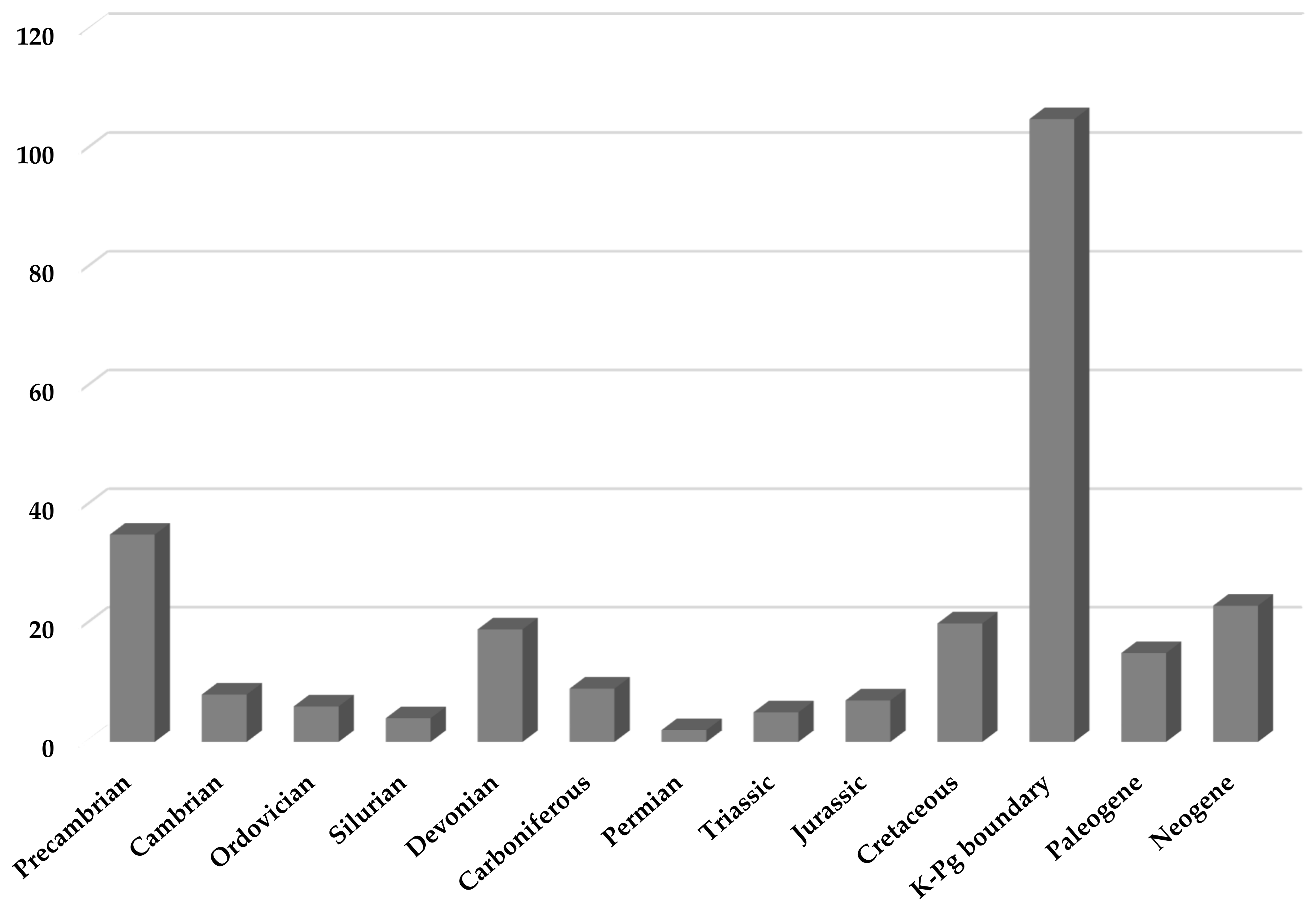
Extreme events such as tsunamis have frequently inundated the world’s coastlines [29] and can have a major impact on marine environments [54,55]. According to Schnyder et al. [56], the geological record should reflect a comparable or even higher frequency than that observed in modern and historical times. However, evidence of such deposits is rarely preserved or identified in older strata [26,57]. Despite the challenges of identifying tsunamites in the geological record, due to factors such as post-depositional alteration, limited preservation potential, and the similarity of tsunami deposits to those produced by other high-energy processes, several authors have interpreted some sedimentary sequences as the result of tsunami events across different geological periods [58] (see Figure 2). These interpretations are typically based on a combination of sedimentological and palaeontological criteria, integrated with tectonic and volcanic context, as well as evidence of abrupt marine inundation extending into the onshore environment during run-up, or offshore deposits associated with backwash flows (Table 1).

3.1. Precambrian

The oldest tsunami deposits ever reported on Earth dates to Early Archaean (ca. 3.48 Ga) and is located in the Pilbara Craton, Western Australia [59]. The authors link this catastrophic event to local faulting associated with volcanic activity, although an asteroid impact or volcanic eruption is also possible. Field features, include large imbricated clasts, hummocky bedding, and turbidity-type graded layers, indicate bidirectional currents. The lower sedimentary deposits were produced by the incoming tsunami waves, while the upper deposits testify the backwash process. However, previously the Hamersley Group of Western Australia provided the geological record of what was considered until recently the oldest known tsunami (~2.6 Ga), attributed to the Late Archaean–Palaeoproterozoic [61]. Here, sedimentary ripples are preserved in deep-marine shelf deposits containing impact-melt spherules—small glassy droplets produced by asteroid impacts during the Late Archaean. Numerical simulations supporting this interpretation indicate that a bolide with a diameter of 4.9 km, a density of 2.6 g/cm3, and an impact velocity of 20 km/s could generate a crater approximately 60.4 km in diameter. Modelling of tsunami waves produced by the subsequent crater collapse, using shallow-water wave theory, suggests that impacts occurring between 2000 and 8000 km away would have been capable of generating waves strong enough to form the observed ripple structures in the Hamersley Basin. Byerly et al. [60] documented another Archaean example from the Barberton Greenstone Belt in South Africa. Both events are associated with extraterrestrial impacts, which occurred frequently during this period of early Earth history [87]. These impact-related tsunamites contain diagnostic features such as impact spherules, minerals showing shock-induced deformation (e.g., shocked quartz), and distinctive cosmochemical signatures (microtektites) [60,88,89].
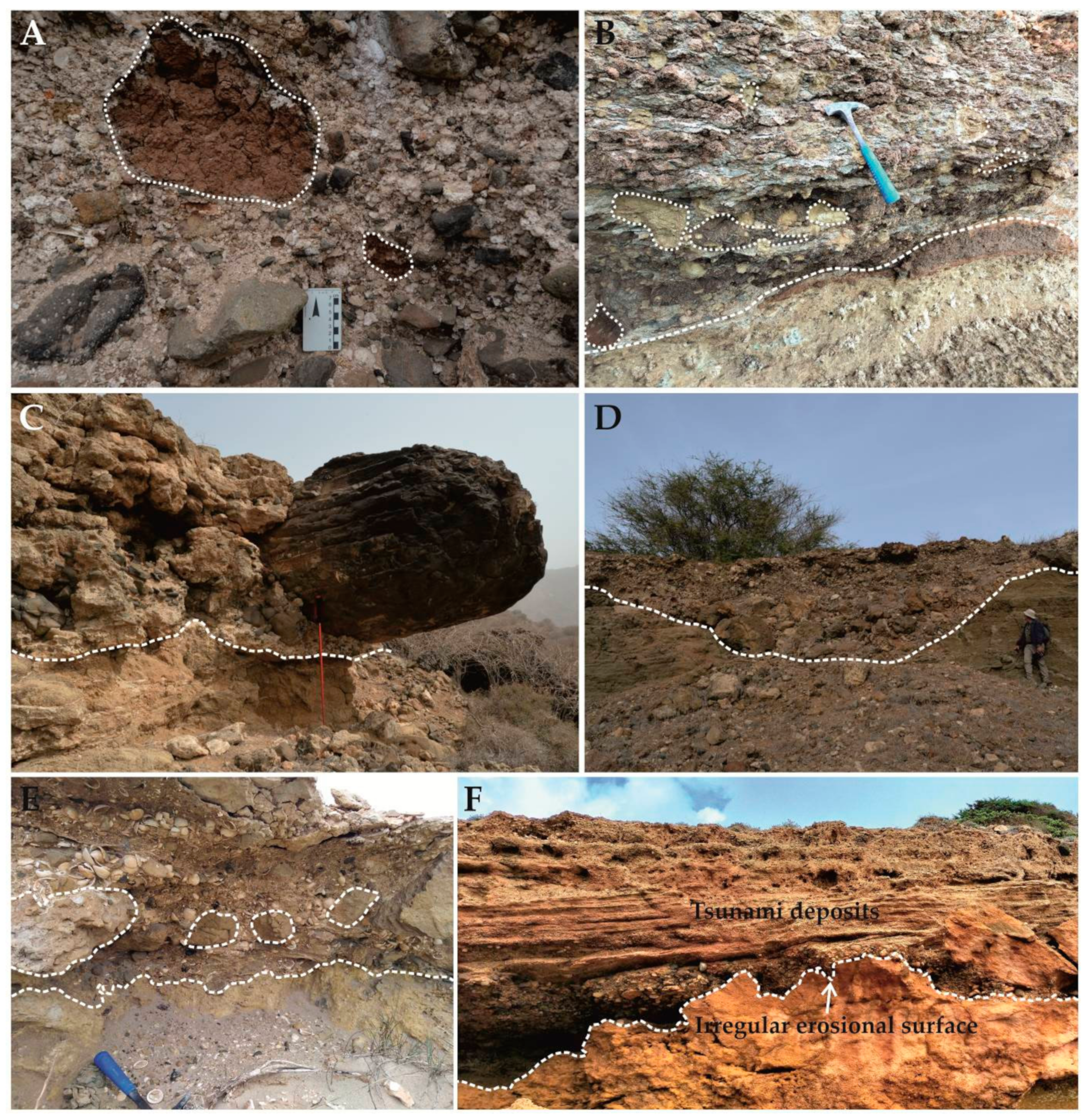
During the Mesoproterozoic, within the Changcheng Group (1.8 to 1.6 Ga) of the North China Craton, Wang et al. [63] identified tsunami deposits representing one of the oldest recognized examples of tsunamites in the Northern Hemisphere. This event was attributed to a large earthquake in an active extensional setting during the breakup of the Columbia (Nuna) supercontinent. Although these deposits are approximately 1.5 billion years old, they display sedimentological characteristics essentially identical to those documented from the Quaternary and even from historical to recent tsunami deposits in onshore settings. Key features that distinguish them from normal shallow-marine siliciclastic facies include abundant rip-up clasts, poor sorting with a wide range of grain sizes from clay to gravel, fining-upward sequences indicative of waning flow, reworked and redeposited material eroded from underlying strata suggesting a complex provenance from multiple source units, and erosional scours at the base of beds produced by strong incoming waves and backwash flows. Similar features have been reported from Pleistocene and Holocene outcrops, e.g., [17,20,25] (Figure 3A,B), collectively providing compelling evidence for a high-energy tsunami origin, demonstrating that the fundamental depositional signatures of tsunami events have remained consistent over geological time.
In Western North America, tsunami deposits from a previously offshore marine setting were recognized in the Mesoproterozoic Helena Formation of the Belt Supergroup (~1.45 Ga) [64]. The deposits associated with this event are characterized by the widespread occurrence of molar-tooth structures, which are composed of offshore swept ooids and rounded, coarse-grained, feldspath and quartz sand. These beds display an erosive base that testify to the action of strong, high-energy currents, producing gutter casts and other scour features. Such sedimentary structures indicate deposition under the influence of powerful tsunami-generated flows, attributed to major submarine fault surface ruptures during episodes of tectonic subsidence.

3.2. Palaeozoic

The Palaeozoic (ca. 541–252 Ma) is known as a period of major tectonic and climatic changes, as well as the proliferation of more complex biological forms. Intense tectonic activity created more outcrops and exposures that remain accessible today, which likely contributed to the greater number of published studies on tsunami deposits (~40 works), compared to those documented from the Precambrian (Figure 2). Despite the difficulty in identifying and dating depositional signatures of catastrophic events, evidence suggests that such records (tsunamites and seismites) extend deep into geological time (e.g., Early Paleozoic). For example, Guo et al. [90] documented deformation structures induced by earthquakes of magnitude 7.0–7.6 in the Early Cambrian of western Zhejiang, China, which are classified as seismites. Such strong tectonic activity highlights the potential for tsunami generation during the Early Paleozoic. During the Cambrian, many shallow-marine deposits from both South and North America were traditionally attributed to storm activity [65,66]. However, new interpretation suggests that some of these record tsunami events instead. In the Middle Cambrian La Laja Formation (Argentine Precordillera), coarse-grained strata on an epeiric shelf include lenticular beds of intraclastic conglomerate interbedded within burrowed mudstones. These beds lack stratigraphic patterns, allochthonous input, or evidence of sea-level fluctuation, and instead record brief, anomalous episodes of deep scour and strong oscillatory flow that are best explained by tsunami waves rather than storms [65]. Similarly, the Upper Cambrian Deadwood Formation (Montana, USA) provides one of the earliest confident identifications of tsunamites in the Paleozoic. Here, conglomerates composed of angular to subangular sandstone intraclasts with a high degree of scouring, were long interpreted as storm deposits [91]. However, Pratt [66] proposed recognition criteria that distinguish these deposits from storm-generated counterparts, including deformation cracks, intraclast angularity, polygonal plan-view geometries, and intense scouring, thereby linking them to tsunami activity. These case studies demonstrate that tsunamites can be reliably differentiated from tempestites in ancient shallow-marine successions. Taken together, they challenge the conventional tempestite paradigm and emphasize the importance of recognizing tsunamites as a distinct class of high-energy deposits in the geological record.
Landslides, slumps, and density-based avalanches can generate sediment gravity flows (turbidity current) [92]. According to Shanmugam [29] earthquakes, tsunamis, and cyclones are additional powerful triggers of turbidity currents. A comparable case was reported by Põldsaar et al. [67] from the Middle Ordovician shallow-marine deposits of the Baltoscandian palaeobasin (Northern Europe), where sedimentological evidence indicates a single turbidite event displaying a Bouma sequence. This deposit was interpreted as the product of a rare tsunami, which eroded and transported sediments from land into deeper parts of the basin. Such evidence demonstrates that tsunami-triggered turbidites can also occur in epicontinental settings, not only along active continental margins. Ruban [93] synthesized Ordovician tsunami deposits (485.4–443.8 Ma) from various paleocontinent domains, including Gondwana, Laurentia, Baltica, North China, and Siberia, and concluded that our knowledge of ancient (pre-Quaternary) tsunamis is extremely limited, likely representing less than 0.00001% of all events. Pratt and Sproat [68] documented a widespread carbonate conglomerate in the latest Ordovician Stonewall Formation (Williston Basin, central Laurentia), composed of dolomudstone intraclasts, and interpreted as the result of successive tsunami waves and backwash. This interpretation may also account for other anomalous marker beds in shallow-marine epeiric seas, particularly in settings where storm activity or sea-level fluctuations are unlikely [69].
In Sweden, Parnell [94] concluded that the unusually high concentration of meteorites over a short time interval indicates a flux roughly 100 times greater than present-day rates. These events may have triggered a tsunami during the Middle Ordovician. Concurrently, sedimentary megabreccias (i.e., large rock fragments dispersed in a fine matrix) were deposited in multiple locations. These deposits likely reflect downslope movement of sediments along continental margins on a global scale. The megabreccias may have been triggered by seismic activity and slope destabilization caused by the meteorite bombardment, suggesting that the anomalous occurrence of such deposits in the geological record could serve as a proxy for other episodes of enhanced meteorite delivery to Earth.
Contrary to other systems in the Paleozoic, Silurian tsunami deposits (ca. 443–419 Ma) are still poorly documented. One of the rare examples is reported by Jarochowska and Munnecke [70], who interpreted the Makarivka Member of the Ustya Formation (Ukraine) as a tsunamite, with the run-up phase represented by conglomerate facies, while the heterolith unit composed of grainstone and mudstone laminae reflects alternating high-density landward currents, stagnant intervals that allow mud and land-derived debris to settle, and backwash flows. This study provides rare insights into the interplay between high-energy redeposition and carbon isotope stratigraphy in the geological record, where a tsunami event mixes sediments from different depths and stratigraphic levels, producing clasts with variable δ13C values.
In contrast, there are a remarkably large number of deposits related to tsunami events documented for the Devonian period across different domains [71,72,73,95,96]. This abundance may be explained by the fact that the Devonian coincides with major orogenic events, such as the Acadian orogeny (Laurentia-Avalonia collision) and the ongoing Caledonian-Variscan tectonics, which created seismically active continental margins—ideal settings for large earthquakes capable of generating tsunamis. This intense seismic activity has been linked by Du et al. [73] to the formation of seismite structures, including seismic-cracks, sandstone dykes, syn-depositional faults, microfolds (micro-corrugated lamination), fluidized veins, load casts, flame structures, pillow structures, and brecciation, resulting from the collision between the North China Plate and the Qaidam microplate during the Devonian. Extraterrestrial bolide impacts are another trigger of Devonian tsunami deposits as reported by Warme and Kuehner [71] from southern Nevada, where shallow-water carbonate-platform deposits are represented by a carbonate breccia—an unusual sedimentary unit containing shocked quartz grains, unique ejecta spherules, and an iridium anomaly interpreted as impact-generated tsunami event. Additional evidence suggests that the event occurred over a few hours to days, with the impact producing a seismic shock that delaminated the upper 50–100 m of the platform, generating large carbonate blocks. Taphonomic analysis of skeletal concentrations is often used to identify depositional processes in onshore settings [24,25,26,34,97], or from offshore environments [11,15,19]. From the central Poland, within the Devonian Kowala Formation, Łuczyński [72] applied the same methods to examine the sedimentary history of two types of stromatoporoid accumulations—an allobiostrome and a parabiostrome. By combining sedimentological observations with taphonomic analyses, he concluded that the large-scale onshore redeposition of stromatoporoid skeletons could only have occurred through erosion at considerable depths, most likely caused by a tsunami event.
Despite the long duration of the Carboniferous (~60 Ma) and its complex tectonic setting, this system represents a paradoxical interval in tsunami research [93], with only rare scientific papers reporting evidence of deposits attributed to tsunami events, most of them discussed only marginally, e.g., [98,99,100,101,102]. This rarity likely reflects a research bias rather than a genuine absence of tsunamites or their poor preservation. Similarly, what may be the only high-energy extreme event recorded in deposits from the Late Permian from the intracratonic Paraná Basin (Brazil), is documented by Tohver et al. [74] which were interpreted as being related to an impactogenic earthquake.

3.3. Mesozoic

The Permian–Triassic boundary (P–Tr), represents one of the most challenging limits in the geological records, characterized by the largest biological crisis in Earth’s history [103,104], during which approximately 90% of marine species and about 70% of terrestrial species were eliminated [105]. Based on limited occurrences of shocked quartz, Retallack et al. [106] proposed that an extraterrestrial impact was the cause of this event. However, according to Reichow et al. [107] and Korte et al. [108], the eruption of the Siberian Traps flood basalts is currently regarded as the most probable trigger for the extinction event, as the environmental disturbances it generated are widely considered decisive. Within this debate and close to the paleontologically defined P–Tr boundary at Guryul Ravine in Kashmir (India), Brookfield et al. [75] reported sedimentary structures interpreted as seismites, including convoluted bedding and fluid-escape structures, followed by three lenticular, fining-upward bioclastic grainstone beds interbedded with argillites and interpreted as tsunamites. According to the authors, the presence of hummocky cross-stratification and grading within these beds, combined with the associated physical processes and faunal assemblages, indicates deposition by waning irregular waves at water depths exceeding 100 m. The recurrence of such deposits suggests multiple successive tsunami events in a large open-ocean setting. However, the absence of geochemical evidence for an extraterrestrial impact, supports a terrestrial origin, likely related to tectonic or volcanic activity. The same types of sedimentary structures have also been observed in offshore tsunami deposits associated with large earthquakes from Spain [19].
At the P–Tr boundary (~251 Ma), seismites and tsunamites have been reported in multiple sections globally [109,110,111,112,113,114], suggesting that voluminous volcanic activity, earthquakes, bolide impacts, and related tsunamis may have been significant contributors to the environmental stress during the largest mass extinction in Earth history. A recent review of the extant literature on Triassic tsunamis [114], highlighted that most reported examples cluster around two major intervals: the Permian–Triassic transition and the end-Triassic crisis, close to the Triassic–Jurassic boundary. The certainty of these interpretations remains limited, as many of the proposed tsunami deposits could alternatively be attributed to storm activity. This ambiguity arises from two main factors. First, distinguishing between storm- and tsunami-generated facies in the rock record is challenging due to the inherent variability of such sedimentary features. Second, the paucity of detailed sedimentological studies available for the Triassic further complicates matters. Differentiation between tsunami and storm deposits thus relies primarily on the development and application of robust diagnostic criteria rather than the number of examples available from a specific period. Therefore, although the potential role of tsunamis during these major biotic crises is intriguing, the existing evidence should be considered provisional until further investigations, involving more precise sedimentological, stratigraphic, and geochemical analyses, like those reported near the K–Pg boundary, are conducted. The difficulty in unequivocally identifying the triggering mechanism also means that most interpretations of tsunamis-related deposits in the Mesozoic remain uncertain. A representative example is provided by Schnyder et al. [56], who attributed sedimentary units deposited around the Jurassic–Cretaceous boundary from northern France to a tsunami event. Their interpretation was based on comparison with modern tsunami deposits and the recognition of diagnostic features, including a basal erosional surface, soft-sediment deformation, the presence of wood fragments, and clay layers containing a mixed assemblage of continental and marine fauna. This last criterion, faunal mixing across different marine environments or with continental fauna, has often been considered a benchmark indicator of tsunami deposits [15,19,24,25,26,34,37]. Nevertheless, despite the presence of these diagnostic features, the absence of direct evidence for the triggering source led the authors to classify these sediments as possible rather than definitively tsunamites.
Since the Cretaceous, and in contrast to the other systems of the Mesozoic, research on palaeotsunami deposits has expanded considerably. More robust interpretations are now supported by multiple lines of evidence, including several diagnostic criteria. These include anomalous concentrations of amber in deep-sea settings far from its continental source and the occurrence of deformation features identical to soft-sediment structures in surrounding deposits [77], rapid burial of mixed faunas without time for reworking, taphonomic contrasts such as articulated shells versus fragmented shells, the intermixing of freshwater and marine faunas within the same layer [115], and the exceptional preservation of molluscan fossils from different shallow-marine settings [116]. Additional diagnostic features include the large lateral extent and facies uniformity of the deposits, their multi-scale facies heterogeneity, and their predictable petrophysical properties [117]. The latter case-study highlights how tsunami deposits can be identified not only through sedimentological and taphonomic features, but also by their large-scale architecture and internal facies organization, with implications that extend beyond sedimentology (e.g., for reservoir characterization).
The triggering mechanisms of these deposits are linked to a range of geological processes, including major earthquakes [118,119], submarine landslides [77], and even bolide impacts [120]. This diversification of recognized triggers reflects not only the improved preservation potential and accessibility of Cretaceous tsunamites, but also the increasing application of modern sedimentological and palaeontological approaches, which enable a more confident distinction between tsunami deposits and other high-energy event beds, such as storm deposits.

3.4. Near the K–Pg Boundary

The search for the ultimate cause behind the extinction of the dinosaurs and nearly 72% of all other species stands as one of the most widely debated questions in Earth’s history [121]. About sixty-six million years ago, a bolide impacted at Chicxulub on the northwestern corner of the Yucatán Peninsula, Mexico [78,122,123,124,125]. This impact is now largely accepted as the primary cause of the mass extinction that marks the Cretaceous–Paleogene (K–Pg) boundary ([125] and references therein). It generated a complex cascade of hydrodynamic and mass-transport processes around the Gulf of Mexico and beyond, including tsunamis, impact-seiche waves, margin collapse, and sediment-gravity flows [50].
The K–Pg boundary provides a particularly compelling case for studying tsunamis generated by catastrophic extraterrestrial impacts. Consequently, tsunami deposits from this interval have been the focus of extensive research worldwide and studied for more than 30 years [97]. Well-documented examples are found across the Gulf of Mexico and Caribbean regions, including the Brazos River in Texas, northeastern Mexico, Cuba, and Haiti [49,126,127,128,129].
In Western Cuba, the Moncada Formation preserves a tsunamite characterized by shocked quartz, impact glass, an iridium anomaly, and complex ripple cross-lamination interpreted as evidence of oscillatory tsunami palaeocurrents [47]. Similarly, in the La Popa Basin of Northeastern Mexico, an 8-m-thick chaotic unit contains Chicxulub ejecta overlain by graded sandstones that reflect multiple tsunami surges and hyperconcentrated flows generated by slope failure [49]. High-altitude and continental deposits at Tanis (ND, USA) have provided complementary evidence, when a remarkable seiche-induced inland surge deposit containing fish fossils with impact spherules embedded in their gills, capturing the near-instantaneous arrival of seismic waves and ejecta fallout [50]. In Patagonia, an iridium anomaly, platinum group enrichment, and palynofacies changes at the boundary horizon further attest to the impact signal [51].
Identifying tsunami-related deposits in offshore settings is challenging due to limited access to shelf archives [22]. Preservation potential strongly depends on the depositional environment, sandy tsunami deposits in areas shallower than ~65 m are particularly prone to storm reworking [39], providing a framework to assess which K-Pg deposits are likely to be preserved. However, another deep-water record from the southeastern Gulf of Mexico (DSDP Sites 536 and 540) reveals a five-unit succession at the boundary, interpreted as deposits of a giant wave and associated backflow in a basin-floor to lower-slope setting [130]. These cores are characterized by graded sand, rip-up clasts, and reworked bioclasts, which extend the tsunami signal into deeper parts of the basin and demonstrate rapid, high-energy emplacement immediately following ejecta deposition. In Argentina, Scasso et al. [48] documented a coarse-grained sandstone bed within the Jagüel Formation showing erosive bases, grading, and hummocky cross-stratification, features interpreted as products of tsunami flows in a distal neritic setting.
Following the impact-extinction hypothesis, tsunami deposits became central to testing and documenting catastrophic sedimentary responses to the Chicxulub event, and subsequent resistance to the impact theory stimulated detailed sedimentological, geochemical, and paleontological investigations [121]. Hydrodynamic models further confirm the extraordinary reach of the Chicxulub tsunami, with velocities capable of eroding sediments at distances exceeding 10,000 km from the crater [131]. Collectively, these records demonstrate that K–Pg tsunamites are globally distributed and diverse in sedimentological character, ranging from chaotic breccias and graded marine sandstones to inland surge deposits. Their identification relies on the integration of sedimentology, paleontology, geochemistry, and geophysical modelling, and these collectively provide compelling evidence that the Chicxulub impact tsunami was not only a local catastrophe but also a globally significant sedimentary phenomenon that played a major role in the End-Cretaceous mass extinction.

3.5. Paleogene and Neogene

Compared with K–Pg, tsunami deposits from the Paleogene are fewer and patchier, reflecting both preservation and recognition challenges as well as research bias toward younger successions. Despite this, several major tectonic phases occurred worldwide during this System [132,133,134,135,136], many of which strongly influenced sedimentation, basin evolution, and even potential tsunami generation. Documented Paleogene tsunamites are concentrated in the Eocene, when two large impacts (Chesapeake Bay, USA) occurred within ~0.5 Myr of each other [79,137,138]. In the Atlantic Coastal Plain of North Carolina (USA), a sandy-matrix breccia with mixed terrestrial (paleosol rip-up clasts, petrified wood) and marine (fossiliferous chert, meter-scale clasts) components, interpreted as high-energy tsunami surges and a capping quartz sand with gravel, interpreted as a subsequent tsunami wave or backwash [79]. This extreme event related to Late Eocene Chesapeake Bay impact illustrates the preservation of coupled impact ejecta and tsunami deposits in a shallow-marine to marginal-terrestrial setting. From the New Jersey continental margin at ODP Sites 903 and 904, the same impact generated both strong ground motion and tsunami waves [137,138]. These impact-related tsunamites highlight the importance of extraterrestrial forcing, whereas other Paleogene catastrophic events underscore tectonic and climatic trigger.
Climatic perturbation also played an indirect role in triggering tsunami. Rapid warming events, such as the Initial Eocene Thermal Maximum (IETM), which represents the warmest period on Earth during the Cenozoic [139], influenced sedimentary processes by affecting slope stability and promoting landslide and turbidity current [140,141]. When slope failure occurs, the sudden pressure drop or sediment remobilization can destabilize hydrates within or beneath the failed mass, leading to rapid dissociation and the release of methane [142,143]. This process not only contributes to weakening slope sediments, thereby enhancing the likelihood and magnitude of failure-generated destructive tsunamis that can produce a turbidity current activity on non-glacially influenced margins [80,144,145]. A similar case is documented from the Eocene of Zumaia in Northeastern Spain, demonstrating that such findings are highly relevant for assessing future landslide-triggered tsunami hazards and the vulnerability of seafloor infrastructures, highlighting the value of recent geological records for recurrence estimates [80,145,146,147,148].
An earthquake may generate tsunami waves that subsequently induce turbidity currents, may trigger turbidity currents directly without the involvement of a tsunami [29], or in the case of large submarine landslide, turbidity current and slope failures may themselves act as the primary mechanism for tsunami generation. This overlap often leads to confusion between triggering mechanisms and depositional processes, as illustrated by the Late Oligocene–Early Miocene from the Lower Sarava Formation in the Southwestern Pacific. Deposited within a deep-sea fan at depths > 4.25 km and fed by volcanic material from the Vitiaz arc, its thick rudite–arenite beds have been interpreted as tsunami-related deposits [81]. This interpretation is supported by their unusual thickness, coarse grading, and rapid emplacement, features consistent with high-energy flows most likely triggered by strong seismicity, volcanic activity, or slope failure within the interarc basin.
The research on Neogene (23–2.58 Ma) tsunami deposits has progressed considerably. These deposits have been identified in a wide range of settings, from onshore to offshore environments [11,15,19,82,83,149,150,151,152,153,154,155,156,157], as well as within lacustrine systems [43]. Multi-proxy approaches are commonly used, with sedimentary evidence documenting both the run-up and the backwash phases.
From the Miocene Makran accretionary complex (Iran), a chaotic unit is represented by reworked blocks of various lithologies and sizes dispersed within a muddy matrix, previously interpreted as a tectonic mélange diapirically emplaced from depth [158,159]. According to Burg et al. [160], the presence of ophiolitic blocks and reworked fragments of underlying turbidites, together with soft-sediment deformation structures within this unit, supports a sedimentary rather than tectonic origin, making it comparable to large debris flows observed along modern continental margins or unstable volcanic edifices. Another debated case is reported from northern Chile, where Miocene shoreface sandstones of the Caleta Herradura half-graben were firstly interpreted as deposits formed by tsunami surges [82]. The succession consists of two erosively based units, likely emplaced by successive waves, and displaying diagnostic features attributed to tsunami backwash processes. These include exceptionally coarse grain size compared to surrounding deposits, sharp erosional bases, mixed sediment sources, abrupt lateral facies changes, and grading from chaotic to massive textures. However, this interpretation was later re-evaluated by Bahlburg et al. [161], who argued that the deposits are better explained as debris flow units representing physically continuous distal subaqueous equivalents of graben flank alluvial fan breccias, rather than tsunami deposits. For Son et al. [157], discriminating specific triggering events from sedimentary gravity-flow deposits is particularly challenging, especially in ancient records where diagnostic features are often subtle, overprinted, or poorly preserved. Such sedimentary features may be produced by both tsunamis and the other type of events mentioned above; therefore, distinguishing between the triggering mechanism and the depositional processes is crucial to avoid misinterpretation [29].
Nevertheless, despite such interpretative challenges, particularly in offshore settings, the Miocene deposits of Spain [11] and the Pliocene successions of Italy [15] provide well-preserved examples that, together with model cases, serve as methodological benchmarks. These studies highlight the value of multi-proxy approaches in improving the reliability of interpretations and in distinguishing tsunami deposits from other high-energy events such as storms and mass-flow processes. The Hackcheon Chogok Megaturbidite from the Miocene Pohang-Youngouk basin (Republic of Korea) represents one of the best-documented examples where sedimentological, structural, and provenance evidence point to a tsunami-triggered megaturbidite [157], helping to distinguish it from other, similar looking gravity flow deposits in the geological record. Recently, Di Celma et al. [156] reported that in the Lower Miocene Chilcatay Formation of southern Peru, offshore tsunami deposits are characterized by several key features: an irregular basal erosion surface with multiple asymmetric and symmetric scours, unusually coarse grain-size compared to the surrounding background sediments, absence of internal bioturbation, the presence of multiple graded beds, and a mixture of both well-rounded and angular clasts derived from nearshore and subaerial coastal areas. Additionally, the abundance of vertebrate skeletal remains (sedimentological concentration sensu Kidwell et al. [162]) embedded within these deposits suggests that such catastrophic tsunami events could be responsible for mass mortality of fishes, turtles, and dolphins, as observed in modern tsunami events [82]. The preservation potential of tsunamites in offshore settings is enhanced by their emplacement below the storm wave base, where they remain largely unaffected by typical wave reworking. For Puga-Bernabéu and Aguirre [19], shell beds generated by tsunami backwash are characterized by a distinctive taphonomic signature, including the admixture of organisms from different ramp zones, reduced fragmentation, sharper shell edges, oblique to perpendicular skeletal orientations, chaotic stacking of concave shells, and a lower incidence of encrustations and borings.
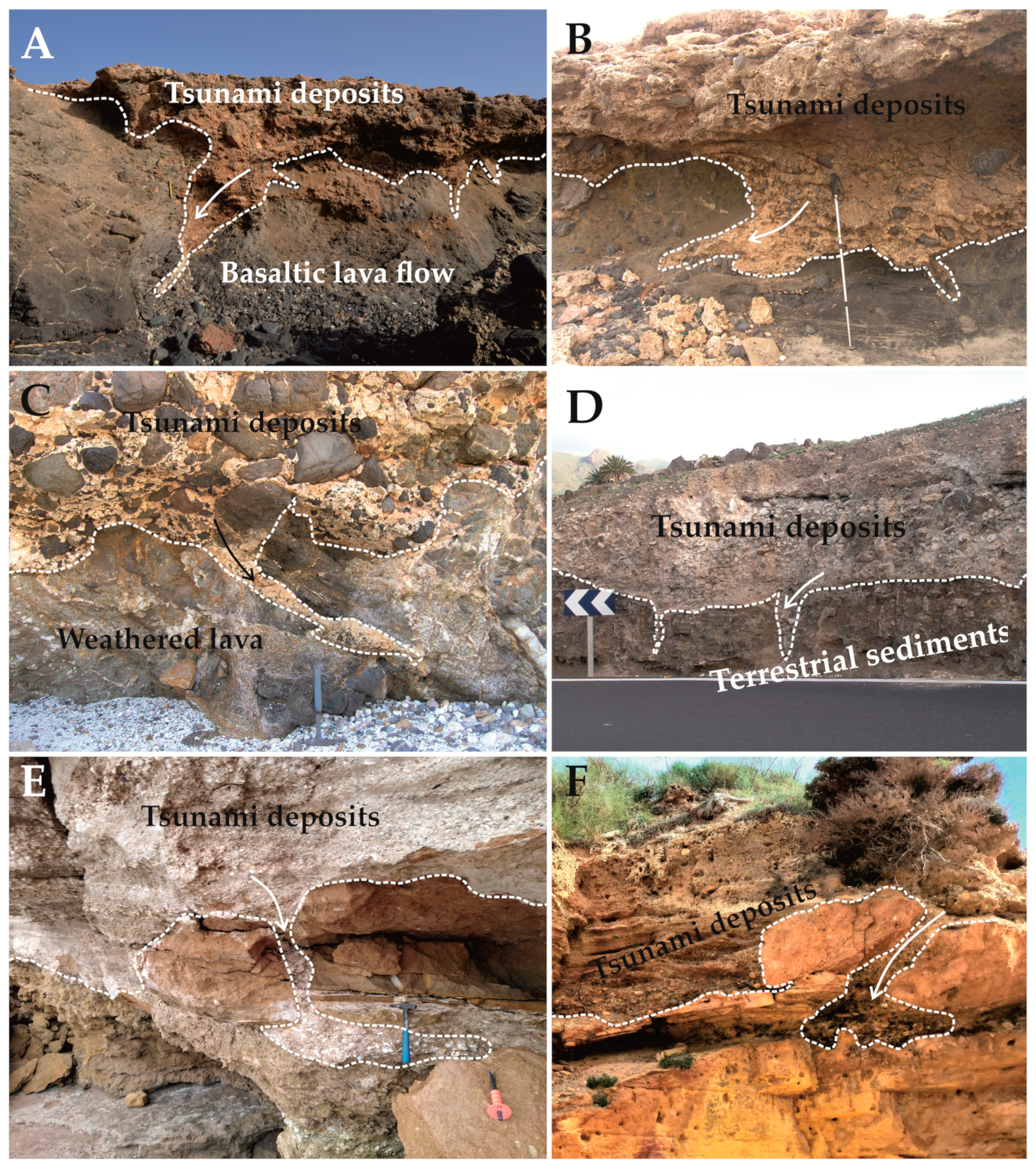
Within the Late Miocene–Early Pliocene Bentang Formation at Tegal Buleud (Indonesia), where active subduction between the Australian and Eurasian plates frequently generated strong earthquakes, the first and oldest geological evidence of a tsunami has recently been identified in the region [83]. This discovery not only extends the tsunami record of Java and Indonesia into the Neogene but also confirms some benchmarks usually considered the most critical criteria marking tsunamites across the Phanerozoic, such as clay clasts, siltstone rip-up clasts, normally graded sandstones, bimodal to multimodal grain-size distributions, and mixed marine fossils from different environmental settings (e.g., inner shelf to middle neritic). Another criterion, reported by Le Roux et al. [163] within deposits linked to a large tsunami event affecting the southern Chilean coastline during the Pliocene, includes inverse grading, planar laminations, ripple or trough cross-lamination, and the injection of sand-rich material into the underlying cohesive substrate. Similar characteristics have been documented in tsunami-related deposits from foreshore and backshore settings in the Mediterranean [25] and the Atlantic Ocean [16,17,20] (Figure 4).

3.6. Pleistocene

In contrast to other Phanerozoic times, the Pleistocene (2.588–0.0117 Ma) represents the most crucial interval for understanding palaeotsunami deposits. This epoch provides the most continuous, accessible, and well-preserved sequences, which can be directly compared with historical and recently documented events across diverse environmental settings. Interest in palaeotsunami deposits from this interval has grown not only because of their significance for reconstructing palaeocoastline evolution, palaeogeomorphology, and reservoir characterization [26,117], but also because studies of Quaternary tsunamis highlight the history of volcanism and tectonic activity, particularly earthquakes and plate-boundary processes, essential for hazard assessment. Many Pleistocene tsunami-related deposits (tsunamites), originally triggered by earthquakes or landslides, were later overlain by additional tsunami deposits of the same age [17,20,164,165] or by younger Holocene and even historical events [25,37,38]. This stratigraphic superposition indicates that seismic activity and tsunami generation persisted from the Pleistocene into the Holocene and historical periods. However, as several previously cited examples demonstrate, tsunami events in this interval were not exclusively linked to tectonic activity; flank collapses and other non-seismic triggers in tectonically less active regions also played a significant role. Together, these records underscore the long-term recurrence of tsunamigenic processes across a range of geodynamic settings.
The Pleistocene Epoch was characterized by repeated glacio-eustatic sea-level fluctuations, tectonic activity that generated marine terraces, and large-scale slope instabilities [25,166,167,168,169,170,171,172,173,174]. These conditions were highly favorable for tsunami generation. Several well-documented Pleistocene examples highlight the diversity of depositional settings associated with catastrophic events, often linked to seismic activity and volcanic collapses. Such occurrences have been reported worldwide, including the Pacific Basin—particularly Japan [175] and New Zealand [176,177], as well as in the Atlantic regions [16,17,20,178] and the Mediterranean [25,34,37,84].
Oceanic volcanic islands are prime settings for investigating tsunami deposits, as volcanism, flank instability, erosion, and vertical crustal movements (subsidence or uplift) have driven rapid morphological changes during the Quaternary [17,168,179,180,181]. Compared to regions located along active subduction zones, such as the margins of the Pacific and Indian Oceans, tsunami hazards in the NE Atlantic archipelagos, including Madeira, the Canary Islands, and Cabo Verde, may be significantly underestimated [20]. While subduction zones are recognized as the primary sources of large, destructive tsunamis, oceanic volcanic islands can also generate catastrophic events through mechanisms such as massive flank collapses, volcanic explosions, and associated landslides. These mechanisms can generate a mega-tsunami [17]. The term mega-tsunami refers to a wave amplitude exceeding 50 m [182]. In comparison, the 1958 Lituya Bay tsunami [183] is often cited as the only historical mega-tsunami, with a maximum run-up of 524 m, however, its effects were spatially limited and rapidly diminished away from the landslide source [17]. The limited number of historical tsunami records in the Central Atlantic may create a false sense of security; however, geological evidence demonstrates that these islands have experienced multiple large-scale events during the Pleistocene [16,24,164,165,184].
One of the best examples interpreted as evidence of a mega-tsunami generated by catastrophic volcanic flank collapse is represented by chaotic marine conglomerates and large boulders found at a wide range of elevations on the flanks of the Cabo Verde islands [16,20,164,165,178] and Canary Islands [184,185]. These deposits, often perched tens to hundreds of meters above present sea level, display sedimentological features consistent with high-energy emplacement. Their interpretation as tsunami deposits was previously debated [17]. Previous studies proposed that these accumulations could instead represent uplifted littoral deposits [186,187,188,189]. However, more recent investigations integrating detailed sedimentological, geomorphological, and chronological data [17,18,19,20] have provided robust evidence supporting their interpretation as tsunami deposits. These advances highlight the importance of combining multiple lines of evidence to accurately distinguish tsunami deposits from uplifted coastal facies in island settings.
Dating tsunami deposits using methods such as U-Th, radiocarbon and/or amino acid racemization in shells, cosmogenic exposure techniques, or stratigraphically constraining the deposits between the underlying and overlying units is critical, as it not only constrains the timing of extreme events but also helps to evaluate whether they had a regional impact. By establishing the timing of events at multiple sites, it is possible to correlate deposits across the region and assess the extent and impact of individual tsunamis. This is particularly relevant for the Last Interglacial (MIS 5e), when tsunami deposits have been reported across the Western Mediterranean. In Southwestern Spain, MIS 5e deposits at La Mata and Torrevieja reflect coastal uplift that occurred between MIS 7 and MIS 5e [37]. These successions include accumulations of randomly arranged and well-preserved Glycymeris and Acanthocardia mollusc bivalve shells, as well as the transport of enormous boulders onto stepped abrasion platforms. These features are interpreted as tsunami surge deposits generated by an offshore earthquake. Comparable successions interpreted as the result of an offshore earthquake-induced tsunami are also documented from Northwestern Algeria [25], where the Glycymeris-rich Unit of the Hachacha Plateau is characterized by mixed molluscan assemblages, including the so-called Senegalese fauna, excellent shell preservation, and diagnostic sedimentological features such as erosive bases, lateral facies variations, wide grain-size ranges (from clay to boulders), rip-up clasts, and soft-sediment deformation structures. Both Spanish and Algerian examples emphasize the importance of precise dating for identifying synchronous tsunami events, and their shared faunal content (notably the dominance of Glycymeris), combined with geomorphological, sedimentological, and taphonomic characteristics, suggest a regional-scale impact during MIS 5e, directly linked to seismic activity along the Africa–Europe plate boundary.
From Central Japan, anomalous deposits are interpreted as earthquake-induced tsunami deposits from the Pleistocene [175]. These show a rare example where successions collectively suggest a three-stage depositional model, with the preservation of a lower unit that shows the presence of contorted structured beds (convolute structures) interpreted as earthquake event deposits (seismites), which may testify to the triggering mechanism of this catastrophic event or help to relate these tsunamites directly to seismic activity. The middle unit suggests tsunami current-dominated processes, whereas the upper unit represents a suspension-settling event characterized by the presence of cross-laminated sand with mud drapes. The same succession has been reported within tsunami deposits related to seismic activity documented from northwestern Algeria [25], where seismite structures were found near the erosion surface. In this case, the authors described soft-sediment deformation structures (SSDS) rather than convolute bedding, and a mud layer instead of the mud drapes. The features reported above, including the presence of unit presenting seismite structures, overlain by tsunami deposits, which are themselves characterized by rapid lateral facies variation, changes in thickness, and in some cases the presence of large boulders and shell beds, can therefore be used as indicative of an earthquake-induced tsunami sequence in similar tectonically active settings.

4. Holocene to Recent Times Records

The Holocene (the last ~11,700 years) is characterized by relatively stable coastlines, following the last major post-glacial sea-level rise. This stability has created ideal conditions for the preservation and dating of palaeotsunami deposits [190,191,192]. The good preservation and dating of these deposits allow for direct correlation with historically documented events. Their significance extends far beyond academic interest, as they are fundamental for extending the often short and incomplete record of tsunamigenic events in any given region [18,22,33,37]. Moreover, the study of tsunami deposits from the Holocene to recent times enables the scientific community to better characterize the full range of diagnostic features of these deposits by applying the principle of actualism [193]. This approach also strengthens the assessment of geological hazards, particularly those triggered by seismic activity [37].
From the Holocene, the identification and interpretation of tsunami deposits are based on an integrated combination of multi-proxy approaches, including sedimentology, paleontology/micropaleontology (e.g., foraminifera, diatoms, mollusks, corals, and other fauna), geochemistry, and geomorphology with precise dating techniques comprising radiocarbon (14C), optically stimulated luminescence (OSL), and amino acid racemization (AAR) [12,34,35,37,40,194,195,196,197,198,199].
Several studies have emphasized the value of estuaries as natural archives for tsunami research, since they can preserve a wide range of geological evidence [85,199,200]. The estuaries are excellent coastal systems for recording tsunami deposits because they preserve a variety of geological indicators, including beach erosion and shoreline retreat, breaching and overtopping of sandy spits, and the deposition of bioclastic layers above the normal action of sea waves and storms [85]. The multiple fining layers or units reflect multiple successive waves during the extreme events (tsunamis) [15,25,82]. These features have also been reported from the 2004 Indian Ocean tsunami [201], where the catastrophic event generated multiple patterns in vertical textural trends represented, from bottom to top, by upward fining, upward coarsening, and uniform units. In the same context, from eastern Japan, a Holocene depositional model demonstrates that, while individual structures such as hummocky cross-stratification and graded bedding resemble storm deposits, the vertical stacking forms a distinctive signature of tsunami wave trains [4]. This interpretation allowed the authors to propose a genetic vertical facies model organized into four units (Tna–Tnd), reflecting changes in wave size and energy, and providing a key criterion to distinguish tsunamites from tempestites in the same setting. However, this interpretation has been challenged. For Shanmugam [29], a single depositional event, such as a tsunami cannot reasonably account for the formation of both traction carpets and hummocky cross-stratification (HCS) based on hydrodynamic consideration. This is because these features form via genetically unrelated processes, dispersive pressure and oscillatory flow, respectively. This controversy remains a challenge not only in distinguishing storm from tsunami deposits, but also in determining whether these succession units are related to a single or to multiple tsunami events that occurred close together or separated in time.
Many terms such as turbidite, megaturbidite, debrite, gravitite, and homogenite have been used with overlapping meanings and are often collectively referred to as tsunamites [29]. A classic example is found in the eastern Mediterranean, near the Calabrian and Hellenic arcs. There, a thick marl layer composed of clay, quartz, nannofossils, and foraminifera has been described. This thick unit is characterized by a sharp basal contact, a normally graded sandy base, and overall homogeneity-showing no visible sedimentary structures in core sections or X-radiographs. Since its discovery, it has been interpreted as a homogenite [202]. According to Cita et al. [84], this deposit is a key piece of evidence for the tsunami generated by the Late Bronze age collapse of the Santorini caldera (~3500 years ago). The event triggered large-scale slope failures that, in turn, generated sediment gravity flows. These flows deposited turbidites and megaturbidites in the abyssal plains of the Ionian Sea, while the distinctive homogenite was laid down across the subdued topography of the Mediterranean Ridge, an area often referred to as Cobblestone Topography. This interpretation suggests that tsunamis, turbidites, mass flows, and slope failures are closely interconnected processes. A comparable relationship has been reported from the northern flank of Tenerife, where a massive volcanic collapse mobilized a volume of ~200 km3 offshore, producing three debris lobes and seven turbidites, and was associated with a Pleistocene mega-tsunami [17,203].
The study of both historical and modern tsunami deposits, particularly those from the Lisbon earthquake tsunami (1755), Indian Ocean tsunami (2004), and Tohoku-Oki tsunami (2011), has served as a crucial calibration tool for interpreting older events [18,204,205,206,207,208,209,210,211,212,213]. These modern analogues allowed refining diagnostic features, such as landward fining, inverse-to-normal grading, the presence of intraclasts (rip-up clasts), and the transport of marine sediments (sand, shells, microfossils) far inland [214,215]. Geochemical signatures, including elevated concentrations of salt-derived ions (e.g., Cl, Na+, S) in soil and groundwater, have been established as a reliable indicator of seawater inundation, even when the sedimentary evidence is subtle [18,216,217,218,219]. Furthermore, taphonomic analyses of molluscan and foraminiferal assemblages in modern tsunamites have confirmed faunal mixing across different ecological zones as a key indicator [195,220,221,222].
Well-documented Holocene tsunami records have been established in numerous tectonically active regions worldwide. In the Pacific Rim, extensive research has been conducted along the coasts of Japan [35,86,223,224], Chile [225,226,227], the Cascadia subduction zone of North America [228,229,230], and New Zealand [176,231]. In the Atlantic Ocean, the 1755 Lisbon tsunami serves as a benchmark event, with its deposits identified in Spain, Portugal, and Morocco [211,212,218,219,232,233,234,235,236,237,238,239]. The Mediterranean Sea, a basin with a long history of seismic and volcanic activity [240], also preserves a rich Holocene tsunami record, with studies in Turkey [241], Greece [242,243,244], Italy [245,246], the Levant [247,248], Malta [249], Algeria [14,38], and Spain [250] revealing repeated large-scale events.
Despite their higher preservation potential, interpreting Holocene tsunami deposits still presents challenges. These include distinguishing the deposits of closely spaced events [229], differentiating tsunami signals from intense storm deposits (tempestites) in areas where both occur [27,33,251], and understanding the complex effects of local geomorphology and anthropogenic activity on sediment deposition and preservation [252,253]. Nevertheless, the Holocene record, including tsunamis from the last few decades, remains an indispensable reference for interpreting older events. It provides a long-term perspective on tsunami recurrence, magnitude, and source mechanisms, thereby enabling more accurate association between triggers and depositional outcomes, and supporting robust hazard and risk assessments [254,255,256].

5. Tsunamites vs. Tempestites: Key Challenges

5.1. Sedimentological Criteria

Tsunamites and tempestites are sedimentary deposits formed by extreme wave events, such as tsunamis and major storms, respectively. These events are powerful geological agents capable of transporting and depositing vast amounts of sediment both inland and across shallow marine environments [4,17,25,29,57,181,257]. However, distinguishing between tsunami and storm deposits remains one of the most persistent and challenging problems in sedimentary geology [25,28,34]. Both events occur in similar environmental settings (e.g., coastal plains and shallow marine areas) and can share several sedimentary characteristics, such as erosive bases, coarse-grained layers, and internal stratification. Misidentification can therefore lead to significant errors in interpreting the geological record, for example, by attributing a seismic history to a region based on deposits that were actually formed by storms, or vice versa. In fact, several sedimentological and palaeontological characteristics have recently been used to discriminate between these two extreme events across the Phanerozoic, with examples provided from different oceans [12,20,24,25,26,27,37,241].
From the Storegga tsunami deposits in Norway, Dawson et al. [2] were the first to describe the presence of a sharp erosional contact at the base of tsunamigenic layers [198]. Since their pioneering work and following their contribution, this type of erosion has been observed later at the base of deposits related to tsunami events from Japan [258], Papua New Guinea [259], Thailand [260,261,262], and Indonesia [263]. However, Morton et al. [27] reported that this feature can also occur in storm deposits. This overlap highlights one of the major challenges in distinguishing between these two types of extreme events [85], and underscores the need for a multi-proxy approach when interpreting the deposits left by this type of events. The erosional surfaces produced by the 2004 Indian Ocean Tsunami in Tamil Nadu, India, were described as an “erosional unconformity” by Bahlburg and Weiss [264]. This terminology is stratigraphically misleading, as a true unconformity classically represents a significant gap in the depositional record, often involving millions of years [265,266]. Since the 2004 event lacks such a substantial temporal hiatus, its erosional features should not be conflated with stratigraphic unconformities [29]. Instead, such short-lived, high-energy features are more accurately classified as “event surfaces” to prevent confusion in sequence stratigraphic interpretation.
Beyond sharp erosional contacts, other erosive features have also been reported in tsunami-related successions. From northwestern Algeria, within deposits interpreted as the result of a catastrophic tsunami event, Doukani et al. [25] described an irregular erosional surface separating the event deposits from the underlying bedrock (Figure 3F). Here the authors linked this irregular erosion to the lithology and heterogeneity of the eroded basements. According to Bryant and Young [267] and Aalto et al. [268], the bedrock sculpting is related to a tsunami activity. However, Bourgeois [87] (p. 18) has challenged this interpretation and emphasizing that “There is no fundamental basis for the argument that tsunamis are more powerful sculptors than storm waves”.
Tsunami deposits can show a wide grain-size spectrum in sediments, ranging from clay to boulders [20,25,198] (Figure 3C–E). Such conditions are characteristic of catastrophic depositional events, during which extreme hydrodynamic energy rapidly entrains, transports, and reworks sediments from diverse environments in a chaotic manner [269]. According to Bourgeois [87], the grain-size distribution within tsunami deposits is controlled primarily by the availability of sediment sources rather than by the hydraulic competence or flow direction. In many cases, the presence of imbricated boulders is considered another benchmark criteria of tsunami deposits [14,16,17,20,25,270,271,272,273,274], reflecting rapid and high-energy depositional processes. This contrasts with deposits linked to storm events, where sediments are formed under more gradual and oscillatory flow conditions.
Both fragile soil fragments and hard-rock rip-up angular clasts have been reported from the oldest known tsunami event on Earth [59] to more recent records across diverse environmental settings, ranging from coastal lowlands to deep-marine environments [17,20,25,27,79,82,126,130,185,259,275,276,277,278]. These features are typically concentrated in the lower portions of tsunami deposits and along erosional surfaces, particularly where fine-grained sediments are present. In contrast, they are generally absent or rarely documented in storm deposits [27]. Sediment injections, resulting from the extreme dynamic pressure of tsunami surges, provide another key criterion for identifying tsunamites, as they are commonly emplaced into both soft and consolidated underlying strata and reported from several tsunami deposits (Figure 4) [17,20,25].
The identification of tsunami deposits based only on internal sedimentary structures remains a significant challenge. Several tsunamites display features such as cross-stratification, parallel and oblique lamination, hummocky cross-stratification (HCS), and mud drapes [4,25,27,62,145,259,277,279,280,281]. However, many of these structures, particularly parallel and cross-lamination, as well as HCS, are also widely documented in storm-related deposits [281,282], reducing their diagnostic reliability. For instance, parallel lamination has been identified in deposits from the 2004 Indian Ocean tsunami in Sri Lanka and Tamil Nadu [29,201]. Similarly, hummocky cross-stratification has been reported in tsunami deposits from the Precambrian of Australia [61], the Cretaceous–Paleogene boundary in Argentina [48], the Neogene of Spain [13], the Pleistocene of Algeria [25], and the Holocene of Japan [4]. Low-angle cross-stratification has also been described not only in fossil and recent tsunami deposits [15,283] but also in estuarine successions and tidal facies [284]. Unlike tsunami deposits, storm deposits frequently display a wider variety of sedimentary structures beyond simple planar stratification [27]. These include foreset bedding [258,285,286,287,288], backset lamination [289], and climbing ripple structures [282,283,284,285,286,287,288,289,290,291].
In addition to cross-stratification and lamination, both normal and reverse grading have been reported from tsunami deposits at multiple localities worldwide [15,17,20,25,292]. According to Massari et al. [15], the occurrence of these grading patterns reflects sedimentation from prolonged, high-energy flow conditions, which can produce both upward fining and upward coarsening depending on the turbulence and sediment supply. Spiske and Jaffe [293] further emphasized that inverse grading is commonly associated with deposits from tropical cyclones, where oscillatory storm surges and strong backwash can generate upward coarsening trends. By contrast, normal grading has frequently been reported within tsunami deposits attributed to deep environment beneath the storm wave base [83,84], reflecting the waning energy conditions typical of decelerating tsunami flows.
Within this ongoing debate, it is evident that no single sedimentary structure can serve as a definitive indicator of tsunami deposits. Instead, recent studies emphasize that a more reliable identification requires the integration of multiple diagnostic features. These include the association of graded bedding with mud drapes, the presence of rip-up clasts, layers enriched in heavy minerals, sediment injections into both hard and soft substrates, and evidence of both landward and seaward-directed transport, often considered alongside geomorphological context and macro to microfossil assemblages [17,20,24,25,27,37,43,216]. Such multi-proxy approaches substantially improve the reliability of distinguishing tsunamites from tempestites and highlight the importance of integrating sedimentological, palaeontological, geochemical, and geomorphological lines of evidence in paleo-tsunami research (Table 2).
This interpretation is further strengthened by incorporating additional sedimentological and taphonomic criteria, including a wide grain-size spectrum from clay to boulders, pronounced lateral variations in facies and thickness, and the presence of reworked biological remains. Taken together, these features provide compelling support for a high-energy tsunami origin rather than a storm-related process (Figure 5).

5.2. Paleontological and Taphonomic Criteria

Both tsunamis and storms events represent highly energetic physical processes capable of producing sedimentological shell beds (sensu Kidwell et al. [162]), although the resulting deposits display distinct sedimentological and taphonomic characteristics [25]. More recently, shell-bed concentrations have been widely used to infer their origins in both marine and lacustrine settings [12,15,19,24,25,37,43,45,76,257,292,301]. Studies on storm-generated shell beds (tempestites) have examined how taphonomic attributes such as fragmentation, orientation, and encrustation vary across different environments [259,286,294,302,303,304,305], while research on tsunami shell beds (tsunamites), has highlighted key taphonomic criteria related to extreme high-energy events (tsunami) [12,15,24,25,26,34,35,37,301].
From Oman, Donato et al. [12] present one the best examples applying bivalve-shell taphonomy to identification of tsunami deposits. They concluded that a key criterion characterizing such deposits is the mixture of allochthonous organisms derived from different environments (e.g., pelagic, shallow-water, and deep water, and even continental sources), coupled with a high degree of angular shell fragmentation. Similar signatures have been recognized in tsunamites from offshore settings associated with backwash flows. In this context, Puga-Bernabéu and Aguirre [19] compared the taphonomic features of two shell beds—one attributed to a tsunami and the other to a storm—and emphasized the importance of such comparisons for process discrimination. Comparable evidence has also been reported from coastal settings influenced by both run-up and backwash, including southwestern Spain [37] and northwestern Algeria [25].
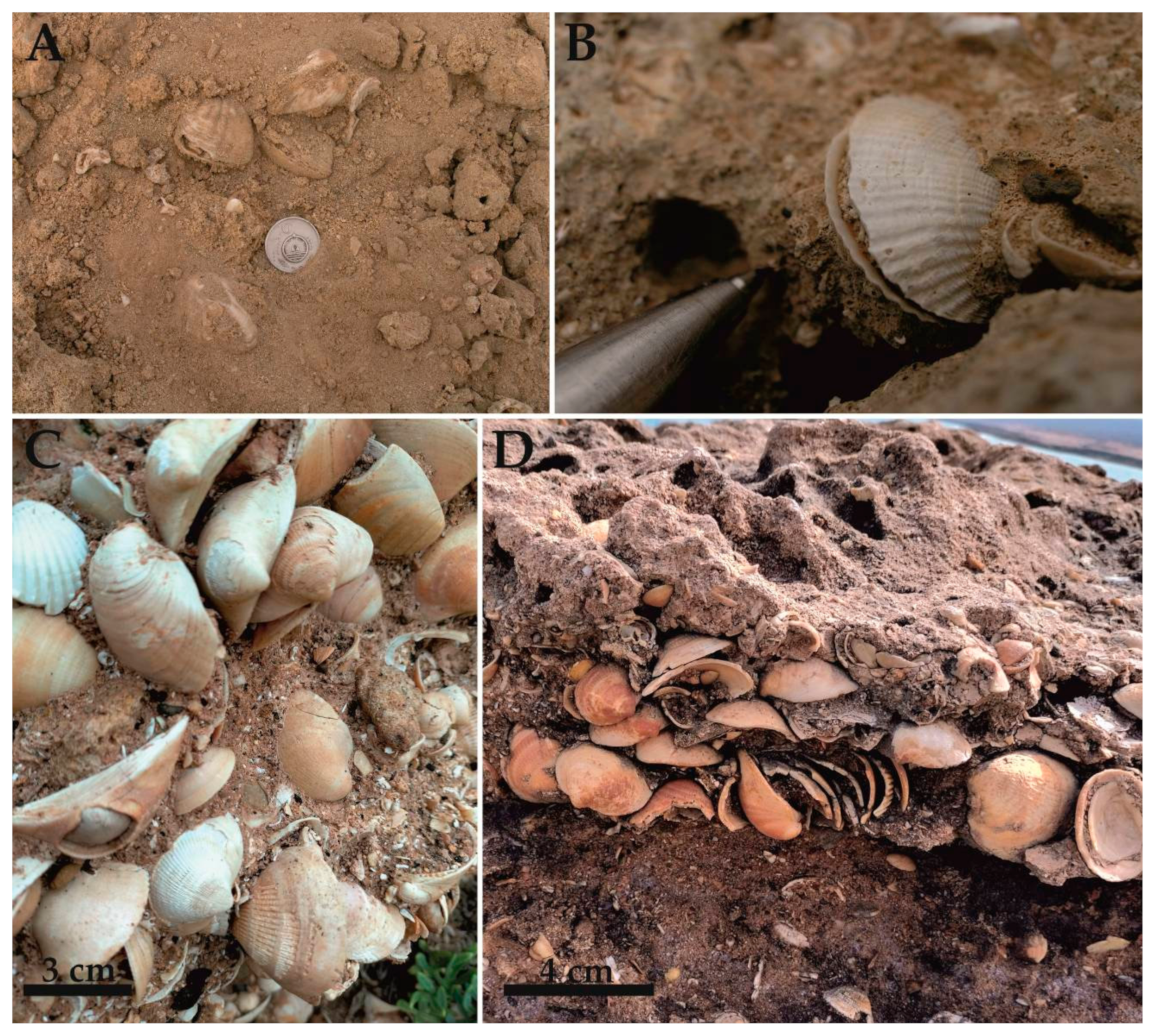
Marine shell deposits linked to tsunamis are generally characterized by dense, thick, and laterally extensive beds [19]. The shells are often well to excellently preserved, frequently oriented obliquely or perpendicularly to bedding, and may be dominated by a single species [25,37]. Standardized 1 kg samples of fossiliferous sediments from tsunamigenic facies also yield consistently higher taxonomic richness and evenness than equivalent samples from tempestites [24], and these authors suggested that whenever fossils were present in tsunami deposits, this could be a decisive criterion to distinguish between tsunami and storm deposits. In addition, the low frequency of boring and encrustation combined at times with the presence of articulated bivalves in non-living position or disarticulated shells stacked like plates in dishwater (Figure 6), suggests that exceptionally powerful tsunami waves penetrated below the taphonomically active zone, eroding sediment masses that had previously buried the shells [13,15,20,25].
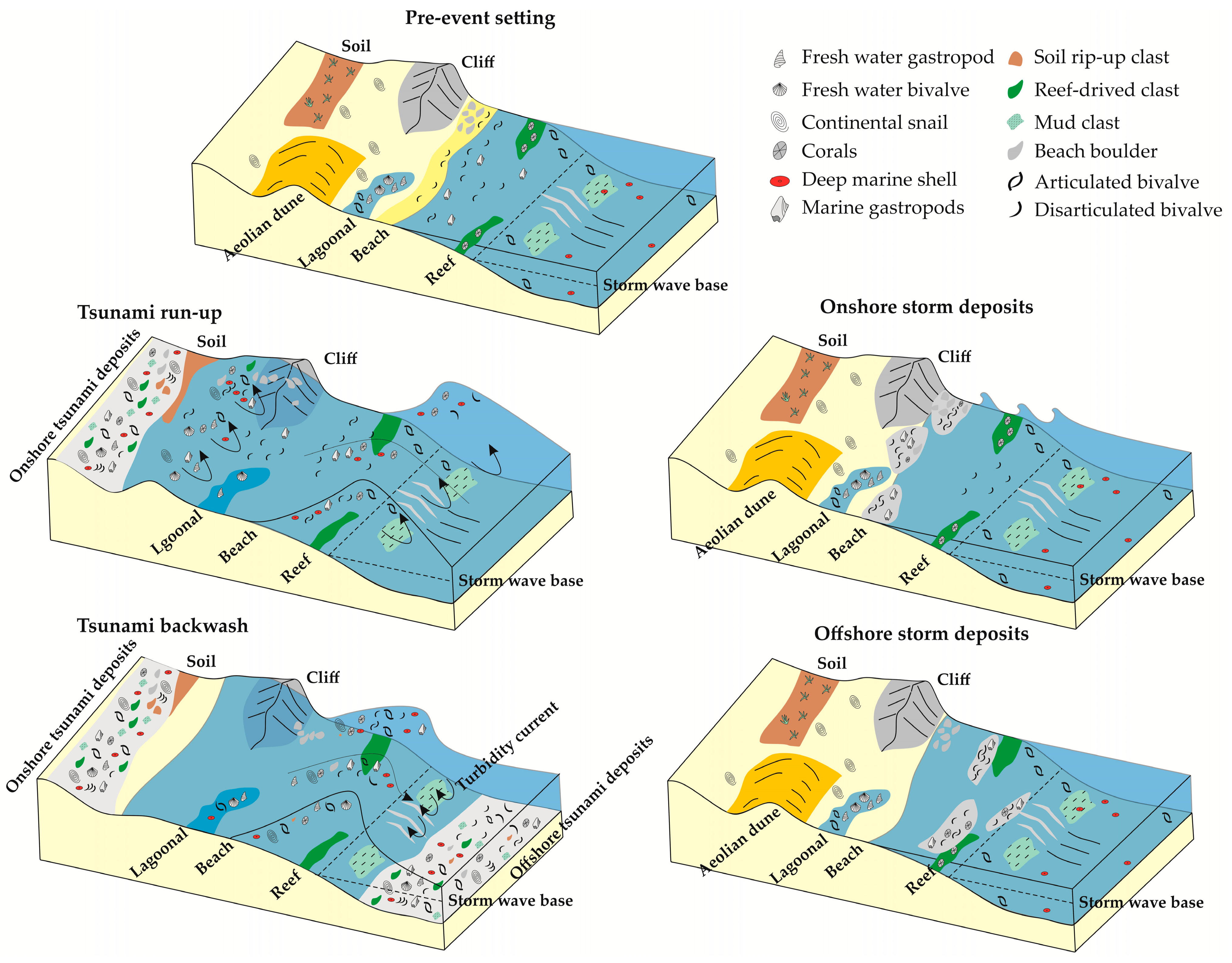
By contrast, tempestite shell beds usually consist of organisms derived from adjacent habitats, reflecting localized reworking by storm waves [19] (Figure 5). Their assemblages tend to exhibit lower taxonomic richness, higher rates of encrustation and bioerosion, and more ordered shell orientations. According to some authors [15,19,25,33,37] shells in tempestites are typically arranged subhorizontally, at angles of less than 30° to stratification, and concave-up stacking is common. Tsunamites, on the other hand, frequently display a wide range of depositional orientations, including chaotic fabrics, normal and reverse grading, as well as oblique to vertical alignments (>30–60°) (Figure 6). The abundance of large, heavy shells in molluscan assemblages has also been recognized as an additional criterion reflecting the extreme energy of tsunami waves in shallow coral reef lagoons [35]. Similarly, the chaotic and variable arrangement of concave shells in tsunamites, both from offshore [19] and onshore records [25,37], contrasts with the more systematic stacking observed in tempestites, further underscoring the diagnostic value of taphonomic features in distinguishing between these two types of extreme-wave deposits.
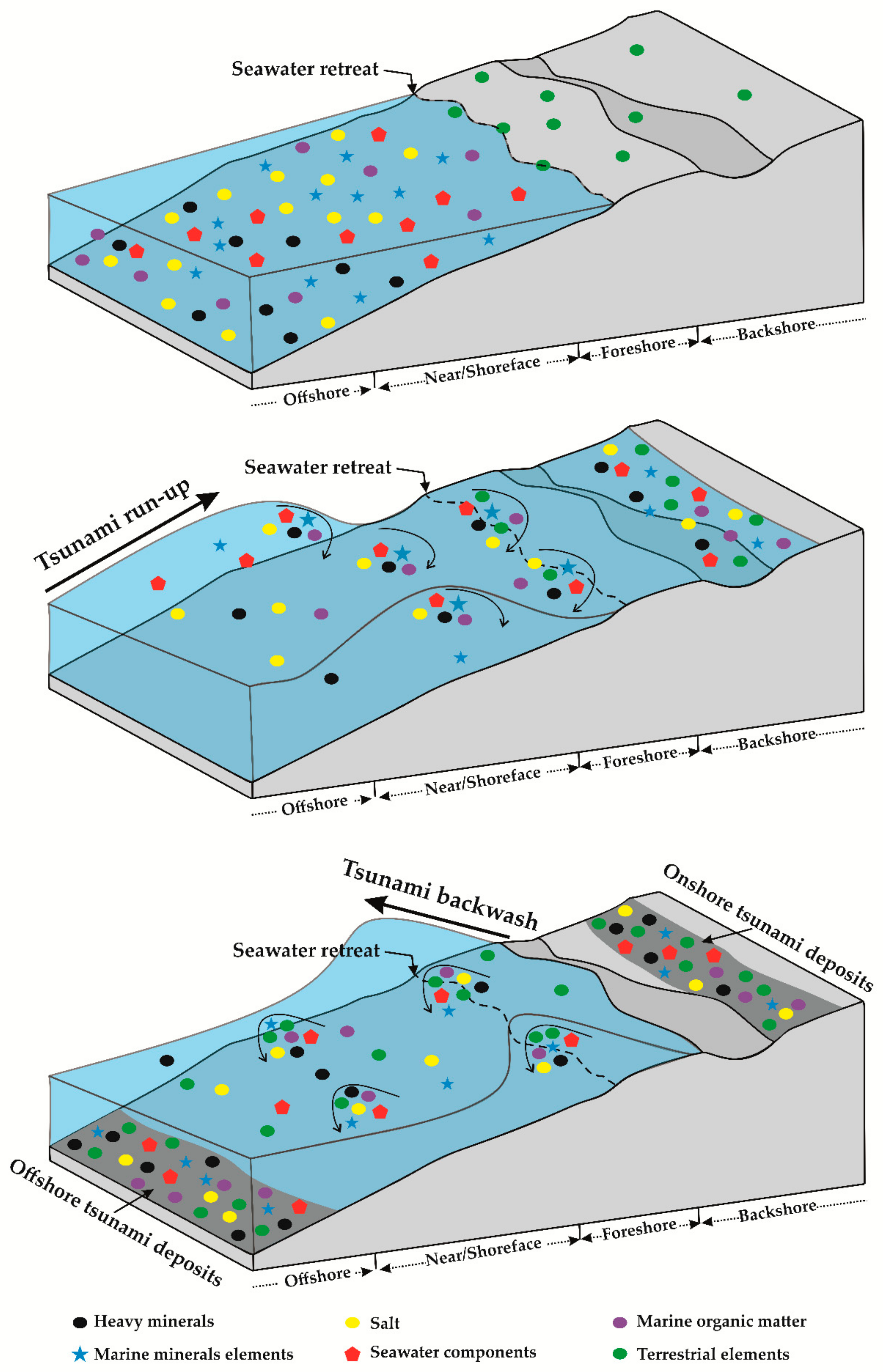
In addition to taphonomic criteria, comparison of microfossil taxonomic assemblages (e.g., ostracods, foraminifera, diatoms, and pollen) has also been successfully used to differentiate between storm and tsunami deposits [34,294,295,296,297,304,305]. Foraminiferal tests are frequently preserved in tsunami deposits and provide reliable evidence of sediment remobilization, often indicating the transport of seafloor material from depths greater than 100 m and from locations several kilometres offshore [221]. Similarly, diatom assemblages in tsunami deposits are often characterized by a chaotic mixture of freshwater and brackish–marine species, reflecting the entrainment of material from different environmental settings during transport [198] (Figure 5).

5.3. Geomorphological Criteria

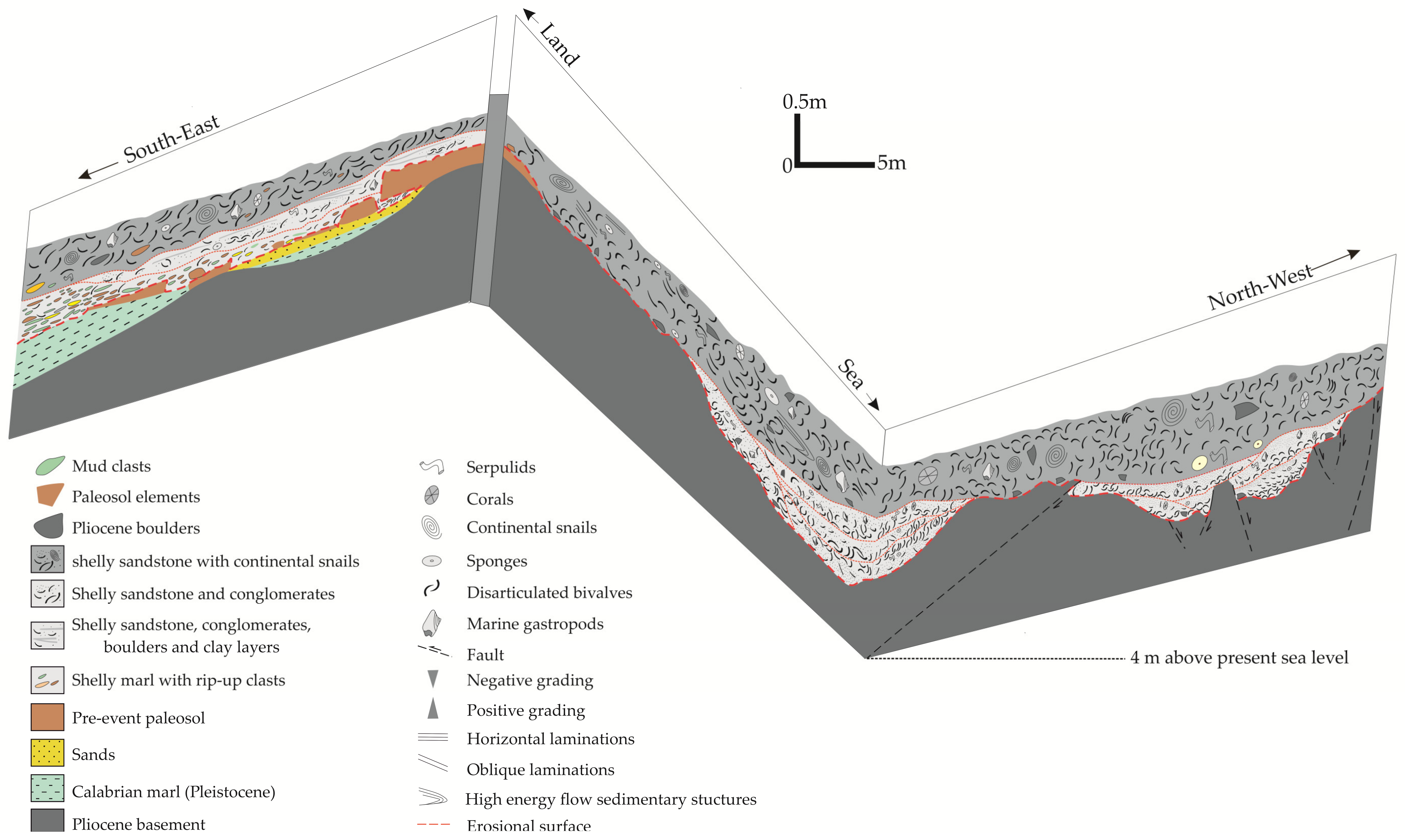
In addition to sedimentological and taphonomic evidence, geomorphological indicators play a crucial role in identifying and distinguishing tsunami from storm deposits. Features such as boulders ridges, and landward sediment lobes provide insights into the dynamics of extreme-wave events and their capacity to reshape coastal landscapes [17,18,25,57,181,257]. These landforms provide crucial insights into the hydrodynamic energy, directionality, and inundation distance of extreme-wave events [16,20,28]. When preserved in the stratigraphic record, such geomorphological signatures serve as important proxies for identifying and reconstructing past tsunami events in both modern and ancient contexts. For Doukani et al. [25], the variations in facies and thickness in tsunamites are largely controlled by the pre-existing topography and the lithological characteristics of the affected areas (Figure 7). According to Nishimura and Miyaji [306] topographic undulations often control the thickness of sediment layers produced by a tsunami event. Such features have been documented both from the Pleistocene record [25] and recently, during the 2004 event along the west coast of Thailand [261], tsunami deposits tending to be thicker in channelized areas, whereas they are comparatively thinner over locally convex topographic highs. For Morton et al. [27] the lateral variability is not considered a key diagnostic criterion, as both tsunami and storm deposits may exhibit lateral variation in geometry. This variability is often strongly influenced by local costal and nearshore topography, including features such as river channels, canyons, embayments, and irrefular shorelines. Such topographic controls can modify flow paths, sediment transport, and deposition patterns, producing lateral differences in thickness, grain size, and bedding architecture that are not uniquely indicative of either tsunamis or storms. Therefore, while topography affects the distribution of deposits, lateral variability alone cannot reliably distinguish between these high-energy events.
Erosion zones produced by tsunami generally penetrate much farther inland and to much higher elevations above sea level than those generated by storms (Figure 5), owing to their greater wave amplitude, long period, and enhanced competence for sediment entrainment immediately beyond the shoreline [260,298,307]. By contrast, storm overwash deposits usually remain confined to the back-beach setting, often forming as extensions of the berm or beginning at an erosional scarp [299,308]. Broader erosion fields may develop under extreme storm conditions when wind stress substantially enhances flow [309]. Tsunamis also leave behind distinctive landform signatures, including deep scour channels, stripped soil layers, uprooted vegetation mats, and laterally continuous sand sheets or boulder ridges that may extend kilometers inland [25,28,34,43,263,277]. In similar depositional settings, the absence of marine sediments above and below tsunami layers is considered another key criterion for identifying tsunamites [25,37].
The transport of megaclasts onto coastal platforms or cliff tops is another hallmark rarely matched by storm activity [38,57,178,195]. Storms, in contrast, tend to generate localized geomorphic features such as overwash fans, washover terraces, and breaches through dune ridges, generally restricted to low-lying coastal barriers [299]. Taken together, blanketing of steep slopes by the sediments, often into elevations well above the reach of storms, the inland extent of erosion, the scale of sediment reworking, and the capacity to mobilize a metric megaclasts are key geomorphological criteria that help differentiate tsunami deposits from those generated by storms.

5.4. Geochemical Criteria

The distinctive geochemical signature has also been used to identify and interpret deposits related to tsunami events, e.g., [217,300]. The analysis of elemental geochemistry, often via X-ray fluorescence (XRF), further help the discrimination between tsunami and storm events. Tsunami deposits frequently exhibit enrichments in Strontium (Sr), Calcium (Ca), and Magnesium (Mg) related to the influx of shell fragments, carbonate sediments, and saline water [18,209,216,217] (Figure 8). Recent works analyzed the environmental DNA signatures for distinguishing between tsunami and storm deposits, e.g., [310]. Environmental DNA (eDNA) is a novel biogeochemical proxy for identifying tsunami deposits, with case studies from the Tohoku region (Japan) [300]. Here, the authors demonstrated that marine eDNA preserved in lacustrine sediments provided unequivocal evidence of seawater incursion during the 2011 Tohoku-oki tsunami, despite the inland setting of the deposits. Importantly, eDNA assemblages were also used to assess older events, including the 869 CE Jōgan tsunami and a prehistoric tsunami dated at 2400–2900 calibrated yr BP from the same region. In both cases, the eDNA composition of the event layers differed markedly from that of background sediments. Moreover, eDNA detected marine taxa in a thin muddy layer above the Jōgan deposit, which was visually indistinguishable from peat, suggesting that eDNA can reveal cryptic tsunami layers not recognized through sedimentological observation alone. This study highlights the potential of eDNA to complement classical geochemical indicators and to elucidate the origin of event deposits that are otherwise difficult to identify.
As mentioned above, it is often difficult to determine whether tsunami succession units are the result of a single event or of multiple events that occurred either close together or separated in time. Moreira et al. [218] demonstrated that high-resolution XRF core scanning, combined with detailed grain-size and image analyses, can help disentangle the complexity of tsunami deposition. Their study of the 1755 Lisbon tsunami revealed up to four distinct depositional pulses, interpreted as successive inundation and backwash phases, thereby illustrating how geochemical signatures and textural variability can be used to refine event stratigraphy and reconstruct depositional phases.

6. Conclusions

This review covers the global and temporal distribution of tsunami deposits from the Precambrian to recent times, underscoring their value as persistent recorders of catastrophic events throughout Earth’s history. The geological record, from the earliest tsunamites triggered by bolide impacts in the Precambrian to those associated with major mass extinctions and the well-calibrated events of the Holocene, provides an unparalleled long-term perspective. It reveals that tsunamis are a recurring geological phenomenon, generated by a variety of triggers including earthquakes, submarine landslides, volcanic flank collapses, volcanic eruptions, extraterrestrial impacts, and climate-driven processes. The preservation of these event-deposits across the geological times highlights the importance of tsunamites not only for understanding past dynamics of the Earth system, but also for assessing future coastal hazards.
Whereas the Pleistocene and Holocene records are relatively robust, older successions from the Precambrian to the Cenozoic remain underexplored, presenting a significant knowledge gap. Future studies should focus on applying advanced geochemical, taphonomic, sedimentological, geomorphological and, whenever possible, quantitative palaeontological approaches to these ancient deposits, while continuing to use modern analogues for calibration.
A principal finding of this synthesis is the critical importance and necessity of a multi-proxy methodology for the accurate identification of tsunami deposits and their discrimination from tempestites. As detailed across the sedimentological, taphonomic, geomorphological, geochemical, and palaeontological criteria, no single feature is unequivocally diagnostic. The most confident interpretations arise from the convergence of multiple lines of evidence: (i) the presence of erosive bases and rip-up clasts coupled with a chaotic grain-size distribution; (ii) taphonomic signatures such as mixed ecological assemblages and variable shell orientations; (iii) geomorphological indicators like far-inland penetration and megaclast emplacement; (iv) geochemical tracers of marine incursion, including ions, elemental ratios, and now, revolutionary environmental DNA; (v) and quantitative palaeontological methods. This integrated approach is paramount for avoiding misinterpretation in the geological record and for building reliable paleotsunami databases.

Author Contributions

M.A.D.: Writing—original draft, conceptualization, methodology, software, validation, formal analysis, investigation, data curation, preparation, writing—review and editing, visualization. J.M.: Formal analysis, investigation, visualization, validation, writing—review and editing. L.S.: Project administration, supervision, funding acquisition, validation, writing—review and editing. S.P.Á.: Supervision, funding acquisition, conceptualization, methodology, formal analysis, validation, writing—review and editing. All authors have read and agreed to the published version of the manuscript.

Funding

This work is carried out thanks to the support of the DGRSDT (General Direction of the Scientific Research and Technologic Development, Ministry of Higher Education and Scientific Research, Algeria). SPA acknowledges his former contract with project M1.1. A/INFRAEST CIENT/A/001/2021—Base de Dados da PaleoBiodiversidade da Macaronésia, funded by the Regional Government of the Azores. SPA acknowledges his current FCT/2023.07418 CEEECIND research contract with BIOPOLIS (https://doi.org/10.54499/2023.07418.CEECIND/CP2845/CT0001). This work also benefitted from FEDER funds, through the Operational Program for Competitiveness Factors—COMPETE, and from National Funds, through FCT (UIDB/50027/2020, POCI-01–0145-FEDER-006821, UIDB/00153/2020, LA/P/0048/2020), as well as through the Regional Government of the Azores (M1.1.a/005/Funcionamento-C-/2016, CIBIO-A; M1.1.A/INFRAEST CIENT/A/001/2021). JM acknowledges Portuguese Fundação para a Ciência e Tecnologia, FCT, I.P./MCTES through national funds (PIDDAC): UID/50019/2023, LA/P/0068/2020 e UID/50019/2025; https://doi.org/10.54499/LA/P/0068/2020 and https://doi.org/10.54499/UID/PRR/50019/2025.

Data Availability Statement

No new data were created or analyzed in this study.

Acknowledgments

The authors thank Markes E. Johnson (Williams College) for the invitation to participate in the journal’s Special Issue and for improving the English. We also sincerely thank Ouali Mehadji Abdelkader (University of Oran 2) for his valuable feedback during the preparation of this paper, especially regarding the Paleozoic section, given his expertise in this time interval. This study was conducted as part of the doctoral training program of the 3rd Cycle “Geology of Marine and Continental Environments: Integrated Stratigraphy, Chronology and Dynamics of Paleoenvironments”.

Conflicts of Interest

The authors declare that they have no known competing financial interests or personal relationships that could have appeared to influence the work reported in this article.

References

  1. Atwater, B.F. Evidence for great Holocene earthquakes along the outer coast of Washington State. Science 1987, 236, 942–944. [Google Scholar] [CrossRef] [PubMed]
  2. Dawson, A.G.; Long, D.; Smith, D.E. The Storegga slides: Evidence from eastern Scotland for a possible tsunami. Mar. Geol. 1988, 82, 271–276. [Google Scholar] [CrossRef]
  3. Costa, P.J.M.; Andrade, C. Tsunami deposits: Present knowledge and future challenges. Sedimentology 2020, 67, 1189–1206. [Google Scholar] [CrossRef]
  4. Fujiwara, O.; Kamataki, T. Identification of tsunami deposits considering the tsunami waveform: An example of subaqueous tsunami deposits in Holocene shallow bay on southern Boso Peninsula, Central Japan. Sediment. Geol. 2007, 200, 295–313. [Google Scholar] [CrossRef]
  5. Grezio, A.; Babeyko, A.; Baptista, M.A.; Behrens, J.; Costa, A.; Davies, G.; Geist, E.L.; Glimsdal, S.; González, F.I.; Griffin, J.; et al. Probabilistic tsunami hazard analysis: Multiple sources and global applications. Rev. Geophys. 2017, 55, 1158–1198. [Google Scholar] [CrossRef]
  6. Geist, E.L.; Lynett, P.J. Source processes for the probabilistic assessment of tsunami hazards. Oceanography 2014, 27, 86–93. [Google Scholar] [CrossRef]
  7. Mori, N.; Satake, K.; Cox, D.; Goda, K.; Catalan, P.A.; Ho, T.C.; Imamura, F.; Tomiczek, T.; Lynett, P.; Miyashita, T.; et al. Giant tsunami monitoring, early warning and hazard assessment. Nat. Rev. Earth Environ. 2022, 3, 557–572. [Google Scholar] [CrossRef]
  8. Karkani, A.; Evelpidou, N.; Tzouxanioti, M.; Petropoulos, A.; Gogou, M.; Mloukie, E. Tsunamis in the Greek region: An overview of geological and geomorphological evidence. Geosciences 2021, 12, 4. [Google Scholar] [CrossRef]
  9. Shiki, T.; Tachibana, T.; Fujiwara, O.; Goto, K.; Nanayama, F.; Yamazaki, T. Characteristic features of tsunamiites. In Tsunamiites, 2nd ed.; Shiki, T., Tsuji, Y., Yamazaki, T., Nanayama, F., Eds.; Elsevier: Amsterdam, The Netherlands, 2020; pp. 383–404. [Google Scholar] [CrossRef]
  10. Reid, J.A.; Mooney, W.D. Tsunami occurrence 1900–2020: A global review, with examples from Indonesia. Pure Appl. Geophys. 2023, 180, 1549–1571. [Google Scholar] [CrossRef]
  11. Puga-Bernabéu, Á.; Martín, J.M.; Braga, J.C. Tsunami-related deposits in temperate carbonate ramps, Sorbas Basin, southern Spain. Sediment. Geol. 2007, 199, 107–127. [Google Scholar] [CrossRef]
  12. Donato, S.V.; Reinhardt, E.G.; Boyce, J.I.; Rothaus, R.; Vosmer, T. Identifying tsunami deposits using bivalve shell taphonomy. Geology 2008, 36, 199–202. [Google Scholar] [CrossRef]
  13. Donato, S.V.; Reinhardt, E.G.; Boyce, J.I.; Pilarczyk, J.E.; Jupp, B.P. Particle-size distribution of inferred tsunami deposits in Sur Lagoon, Sultanate of Oman. Mar. Geol. 2009, 257, 54–64. [Google Scholar] [CrossRef]
  14. Maouche, S.; Morhange, C.; Meghraoui, M. Large boulder accumulation on the Algerian coast evidence tsunami events in the western Mediterranean. Mar. Geol. 2009, 262, 96–104. [Google Scholar] [CrossRef]
  15. Massari, F.; D’Alessandro, A.; Davaud, E. A coquinoid tsunamite from the Pliocene of Salento (SE Italy). Sediment. Geol. 2009, 221, 7–18. [Google Scholar] [CrossRef]
  16. Paris, R.; Giachetti, T.; Chevalier, J.; Guillou, H.; Frank, N. Tsunami deposits in Santiago Island (Cape Verde archipelago) as possible evidence of a massive flank failure of Fogos volcano. Sediment. Geol. 2011, 239, 129–145. [Google Scholar] [CrossRef]
  17. Paris, R.; Ramalho, R.S.; Madeira, J.; Ávila, S.P.; May, S.M.; Rixhon, G.; Engel, M.; Brückner, H.; Herzog, M.; Schukraft, G.; et al. Mega-tsunami conglomerates and flank collapses of ocean island volcanoes. Mar. Geol. 2018, 395, 168–187. [Google Scholar] [CrossRef]
  18. Chagué-Goff, C.; Goff, J.; Nichol, S.L.; Dudley, W.; Zawadzki, A.; Bennett, J.W.; Mooney, S.D.; Fierro, D.; Heijnis, H.; Dominey-Howes, D.; et al. Multi-proxy evidence for trans-Pacific tsunamis in the Hawai’ian Islands. Mar. Geol. 2012, 299, 77–89. [Google Scholar] [CrossRef]
  19. Puga-Bernabéu, A.; Aguirre, J. Contrasting storm-versus tsunami-related shell beds in shallow-water ramps. Palaeogeogr. Palaeoclimat. Palaeoecol. 2017, 471, 1–14. [Google Scholar] [CrossRef]
  20. Madeira, J.; Ramalho, R.S.; Hoffmann, D.L.; Mata, J.; Moreira, M. A geological record of multiple Pleistocene tsunami inundations in an oceanic island: The case of Maio, Cape Verde. Sedimentology 2020, 67, 1529–1552. [Google Scholar] [CrossRef]
  21. Costa, P.J.M.; Dawson, S.; Ramalho, R.S.; Engel, M.; Dourado, F.; Bosnic, I.; Andrade, C. A review on onshore tsunami deposits along the Atlantic coasts. Earth Sci. Rev. 2021, 212, 103441. [Google Scholar] [CrossRef]
  22. De Martini, P.M.; Bruins, H.J.; Feist, L.; Goodman-Tchernov, B.N.; Hadler, H.; Lario, J.; Mastronuzzi, G.; Obrocki, L.; Pantosti, D.; Paris, R.; et al. The Mediterranean Sea and the Gulf of Cadiz as a natural laboratory for paleotsunami research: Recent advancements. Earth Sci. Rev. 2021, 216, 103578. [Google Scholar] [CrossRef]
  23. Coca, O.; Ramírez-Herrera, M.T. Tsunami deposits in tropical regions: A review. Quat. Int. 2024, 698, 11–25. [Google Scholar] [CrossRef]
  24. Ávila, S.P.; Paris, R.; Ramalho, R.S.; Melo, C.S.; Martín-González, E.; Rolán, E.; Madeira, P.; Ávila, G.C.; Porteiro, J.M.; Medeiros, A.M.; et al. Mega-tsunami deposits and range expansion of cold-temperate marine species towards the tropics in glacial times. Front. Biogeogr. 2025, 18, e138319. [Google Scholar] [CrossRef]
  25. Doukani, M.A.; Satour, L.; Ozer, C.K.; Belkebir, L.; Voelker, A.H.L.; Tedjeddine, H.; Landau, B.; Uchman, A.; Bessedik, M.; Johnson, M.E.; et al. A Glycymeris-rich Unit as evidence of late Pleistocene tsunami event from NW Algeria: A biostratigraphy, taphonomy, and sedimentological approach. Quat. Sci. Rev. 2025, 368, 109552. [Google Scholar] [CrossRef]
  26. Dawson, A.G.; Stewart, I. Tsunami deposits in the geological record. Sediment. Geol. 2007, 200, 166–183. [Google Scholar] [CrossRef]
  27. Morton, R.A.; Gelfenbaum, G.; Jaffe, B.E. Physical criteria for distinguishing sandy tsunami and storm deposits using modern examples. Sediment. Geol. 2007, 200, 184–207. [Google Scholar] [CrossRef]
  28. Engel, M.; Brückner, H. The identification of palaeo-tsunami deposits—A major challenge in coastal sedimentary research. Coastline Rep. 2011, 17, 65–80. [Google Scholar]
  29. Shanmugam, G. Process-sedimentological challenges in distinguishing paleo-tsunami deposits. Nat. Hazards 2012, 63, 5–30. [Google Scholar] [CrossRef]
  30. Putra, P.S.; Nugroho, S.H.; Setyonegoro, W. Bibliometric analysis of paleotsunami research: Current trends and overview. Curr. Sci. 2023, 125, 1304–1309. [Google Scholar] [CrossRef]
  31. Goodman-Tchernov, B.; Katz, T.; Shaked, Y.; Qupty, N.; Kanari, M.; Niemi, T.; Agnon, A. Offshore evidence for an undocumented tsunami event in the ‘low risk’ Gulf of Aqaba–Eilat, Northern Red Sea. PLoS ONE 2016, 11, e0145802. [Google Scholar] [CrossRef]
  32. Chiu, W.T.; Ho, Y.S. Bibliometric analysis of tsunami research. Scientometrics 2007, 73, 3–17. [Google Scholar] [CrossRef]
  33. Engel, M.; Oetjen, J.; May, S.M.; Brückner, H. Tsunami deposits of the Caribbean towards an improved coastal hazard assessment. Earth Sci. Rev. 2016, 163, 260–296. [Google Scholar] [CrossRef]
  34. Khadraoui, A.; Kamoun, M.; Hamad, A.B.; Zaïbi, C.; Bonnin, J.; Viehberg, F.; Bahrouni, N.; Sghari, A.; Abida, H.; Kamoun, F. New insights from microfauna associations characterizing palaeoenvironments, sea level fluctuations and a tsunami event along Sfax Northern coast (Gulf of Gabes, Tunisia) during the Late Pleistocene-Holocene. J. Afr. Earth Sci. 2018, 147, 411–429. [Google Scholar] [CrossRef]
  35. Kitamura, A.; Ito, M.; Ikuta, R.; Ikeda, M. Using molluscan assemblages from paleotsunami deposits to evaluate the influence of topography on the magnitude of late Holocene mega-tsunamis on Ishigaki Island, Japan. Prog. Earth Planet Sci. 2018, 5, 41. [Google Scholar] [CrossRef]
  36. Dawson, S.; Costa, P.J.M.; Dawson, A.; Engel, M. Onshore archives of tsunami deposits. In Geological Records of Tsunamis and Other Extreme Waves; Elsevier Inc.: Amsterdam, The Netherlands, 2020; pp. 95–111. [Google Scholar] [CrossRef]
  37. Torres, T.; Ortiz, J.E.; Mediavilla, R.; Sanchez-Palencia, Y.; Santisteban, J.I.; Vega-Panizo, R. Assessment of prospective geological hazards in Torrevieja-La Mata coast (western Mediterranean) based on Pleistocene and Holocene events. Nat. Hazards 2022, 111, 2721–2748. [Google Scholar] [CrossRef]
  38. Benfedda, A.; Bouhadad, Y.; Maouche, S.; Bezzeghoud, M. Tsunami hazard along the Northwestern Algerian coast: Evidence of unusual deposits, boulders accumulation and tidal waves modeling. J. Seismol. 2025. [Google Scholar] [CrossRef]
  39. Weiss, R.; Bahlburg, H. A note on the Preservation of Offshore Tsunami Deposits. J. Sediment. Res. 2006, 76, 1267–1273. [Google Scholar] [CrossRef]
  40. Kümmerer, V.; Drago, T.; Veiga-Pires, C.; Silva, P.F.; Magalhães, V.; Mena, A.; Lopes, A.; Rodrigues, A.I.; Schmidt, S.; Terrinha, P.; et al. Exploring offshore sediment evidence of the 1755 CE tsunami (Faro, Portugal): Implications for the study of outer shelf tsunami deposits. Minerals 2020, 10, 731. [Google Scholar] [CrossRef]
  41. Feist, L.; Costa, P.J.M.; Bellanova, P.; Bosnic, I.; Santisteban, J.I.; Andrade, C.; Brückner, H.; Duarte, J.F.; Kuhlmann, J.; Schwarzbauer, J.; et al. Holocene offshore tsunami archive—Tsunami deposits on the Algarve shelf (Portugal). Sediment. Geol. 2023, 448, 106369. [Google Scholar] [CrossRef]
  42. Freundt, A.; Kutterolf, S.; Wehrmann, H.; Schmincke, H.U.; Strauch, W. Eruption of the dacite to andesite zoned Mateare Tephra, and associated tsunamis in Lake Managua, Nicaragua. J. Volcanol. Geotherm. Res. 2006, 149, 103–123. [Google Scholar] [CrossRef]
  43. Sztanó, O.; Budai, S.; Magyar, I.; Csillag, G.; Nadrai, J.; Fodor, L. Facies and implications of a coarse-grained lacustrine onshore paleo-tsunamiite: An integrated study of an upper Miocene bouldery cobble gravel. Glob. Planet Change 2020, 195, 103321. [Google Scholar] [CrossRef]
  44. Kremer, K.; Anselmetti, F.S.; Evers, F.M.; Goff, J.; Nigg, V. Freshwater (paleo)tsunamis—A review. Earth Sci. Rev. 2021, 212, 103447. [Google Scholar] [CrossRef]
  45. Rodrigues, M.G.; Giovanini Varejão, F.; Fürsich, F.T.; Christofoletti, B.; Matos, S.A.; Warren, L.V.; Inglez, L.; Cerri, R.I.; Assine, M.L.; Simões, M.G. Not all shell beds are made equal: Recognizing singular event-concentrations in megalakes. Sedimentology 2024, 71, 4–47. [Google Scholar] [CrossRef]
  46. Gilbert, A.; Martins, P.P., Jr. A possible tsunami deposit at the Cretaceous-Tertiary boundary in Pernambuco, northeastern Brazil. Sediment. Geol. 1996, 104, 189–201. [Google Scholar] [CrossRef]
  47. Tada, R.; Nakano, Y.; Iturralde-Vinent, M.A.; Yamamoto, S.; Kamata, T.; Tajika, E.; Toyoda, K.; Kiyokawa, S.; García Delgado, D.; Oji, T.; et al. Complex tsunami waves suggested by the Cretaceous-Tertiary boundary deposit at the Moncada section, western Cuba. Geol. Soc. Am. Spec. Pap. 2002, 356, 109–123. [Google Scholar] [CrossRef]
  48. Scasso, R.; Viramonte, J.; Keller, G.; Stover, L. A tsunami deposit at the Cretaceous/Paleogene boundary in the Neuquén Basin of Argentina. Cretac. Res. 2005, 26, 283–297. [Google Scholar] [CrossRef]
  49. Schulte, P.; Smit, J.; Deutsch, A.; Salges, T.; Friese, A.; Beichel, K. Tsunami backwash deposits with Chicxulub impact ejecta and dinosaur remains from the Cretaceous–Palaeogene boundary in the La Popa Basin, Mexico. Sedimentology 2012, 59, 737–765. [Google Scholar] [CrossRef]
  50. DePalma, R.A.; Smit, J.; Burnham, D.A.; Kuiper, K.; Manning, P.L.; Oleinik, A.; Larson, P.; Maurrasse, F.J.; Vellekoop, J.; Richards, M.A.; et al. A seismically induced onshore surge deposit at the KPg boundary, North Dakota. Proc. Natl. Acad. Sci. USA 2019, 116, 8190–8199. [Google Scholar] [CrossRef]
  51. Manríquez, L.M.E.; Krahl, G.; Carvalho, M.A.; Lavina, E.L.C.; Santiago, G.; Bom, M.H.H.; Fauth, G.; Leppe, M. The K/Pg event at high southern latitudes: New evidence from continental deposits in the Magallanes/Austral Basin, Patagonia, South America. Cretac. Res. 2024, 129, 105931. [Google Scholar] [CrossRef]
  52. LeVeque, R.J.; DePalma, R.A.; Garrison Laney, C.; Maurya, S.; Smit, J.; Richards, M.A. Possible mechanisms for tsunami-like surge deposits due to the Chicxulub impact at the K-Pg boundary at the Tanis site, North Dakota. J. Geophys. Res. Solid Earth 2024, 129, e2023JB027643. [Google Scholar] [CrossRef]
  53. Cohen, K.M.; Harper, D.A.T.; Gibbard, P.L.; Car, N. The ICS international chronostratigraphic chart this decade. Episodes 2025, 48, 105–115. [Google Scholar] [CrossRef] [PubMed]
  54. Einsele, G.; Chough, S.K.; Shiki, T. Depositional events and their records—An introduction. Sediment. Geol. 1996, 104, 1–9. [Google Scholar] [CrossRef]
  55. Bahlburg, H.; Spiske, M. Sedimentology of tsunami inflow and backflow deposits: Key differences revealed in a modern example: Tsunami deposits at Isla Mocha. Sedimentology 2012, 59, 1063–1086. [Google Scholar] [CrossRef]
  56. Schnyder, J.; Baudin, F.; Deconinck, J.F. A possible tsunami deposit around the Jurassic—Cretaceous boundary in the Boulonnais area (northern France). Sediment. Geol. 2005, 177, 209–227. [Google Scholar] [CrossRef]
  57. Scheffers, A.; Kelletat, D. Sedimentologic and geomorphologic tsunami imprints worldwide—A review. Earth Sci. Rev. 2003, 63, 83–92. [Google Scholar] [CrossRef]
  58. Dunbar, P.; McCullough, H. Global tsunami deposits database. Nat. Hazards 2012, 63, 267–278. [Google Scholar] [CrossRef]
  59. Runge, E.A.; Duda, J.P.; Van Kranendonk, M.J.; Reitner, J. Earth’s oldest tsunami deposit? Early Archaean high-energy sediments in the ca. 3.48 Ga Dresser Formation (Pilbara, Western Australia). Depos. Rec. 2022, 8, 590–602. [Google Scholar] [CrossRef]
  60. Byerly, G.R.; Lowe, D.R.; Wooden, J.L.; Xie, X.G. An Archean impact layer from the Pilbara and Kaapvaal cratons. Science 2002, 297, 1325–1327. [Google Scholar] [CrossRef]
  61. Hassler, S.W.; Robey, H.F.; Simonson, B.M. Bedforms produced by impact-generated tsunami, ~2.6 Ga Hamersley Basin, Western Australia. Sediment. Geol. 2000, 135, 283–294. [Google Scholar] [CrossRef]
  62. Bhattacharya, H.N.; Bandyopadhyay, S. Seismites in a Proterozoic tidal succession, Singhbhum, Bihar, India. Sediment. Geol. 1998, 119, 239–252. [Google Scholar] [CrossRef]
  63. Wang, Y.N.; Zhang, M.S.; Li, X.B.; Yang, M. The sedimentary record of a Mesoproterozoic tsunami from the North China Craton. Geol. J. 2015, 50, 56–70. [Google Scholar] [CrossRef]
  64. Pratt, B.R. Oceanography, bathymetry and syndepositional tectonics of a Precambrian intracratonic basin: Integrating sediments, storms, earthquakes and tsunamis in the Belt Supergroup (Helena Formation, ca. 1.45 Ga), western North America. Sediment. Geol. 2001, 141–142, 371–394. [Google Scholar] [CrossRef]
  65. Pratt, B.R.; Bordonaro, O.L. Tsunamis in a stormy sea: Middle Cambrian inner shelf limestones of western Argentina. J. Sedi. Res. 2007, 77, 256–262. [Google Scholar] [CrossRef]
  66. Pratt, B.R. Storms versus tsunamis: Dynamic interplay of sedimentary, diagenetic, and tectonic processes in the Cambrian of Montana. Geology 2002, 30, 423–426. [Google Scholar] [CrossRef]
  67. Põldsaar, K.; Ainsaar, L.; Nemliher, R.; Tinn, O.; Stinkulis, G. A siliciclastic shallow-marine turbidite on the carbonate shelf of the Ordovician Baltoscandian palaeobasin. Est. J. Earth Sci. 2019, 68, 1–14. [Google Scholar] [CrossRef]
  68. Pratt, B.R.; Sproat, C.D. A tsunami deposit in the Stonewall Formation (Upper Ordovician), northeastern margin of the Williston Basin, Canada, and its tectonic and stratigraphic implications. Sediment. Geol. 2023, 457, 106518. [Google Scholar] [CrossRef]
  69. Pratt, B.R.; Raviolo, M.M.; Bordonaro, O.L. Carbonate platform dominated by peloidal sands: Lower Ordovician La Silla Formation of the eastern Precordillera, San Juan, Argentina. Sedimentology 2012, 59, 843–866. [Google Scholar] [CrossRef]
  70. Jarochowska, E.; Munnecke, A. Silurian carbonate high-energy deposits of potential tsunami origin: Distinguishing lateral redeposition and time averaging using carbon isotope chemostratigraphy. Sediment. Geol. 2015, 315, 14–28. [Google Scholar] [CrossRef]
  71. Warme, J.E.; Kuehner, H.C. Anatomy of an anomaly: The Devonian catastrophic Alamo impact breccia of southern Nevada. Int. Geol. Rev. 1998, 40, 189–216. [Google Scholar] [CrossRef]
  72. Łuczyński, P. Tsunamites versus tempestites: Various types of redeposited stromatoporoid beds in the Devonian of the Holy Cross Mountains (Poland), a case study from the Ołowianka Quarry. PLoS ONE 2022, 17, e0268349. [Google Scholar] [CrossRef]
  73. Du, Y.S.; Gong, Y.M.; Zeng, X.W.; Huang, H.W.; Yang, J.H.; Zhang, Z.; Huang, Z.Q. Devonian Frasnian–Famennian transitional event deposits of Guangxi, South China and their possible tsunami origin. Sci. China D Earth Sci. 2008, 51, 1570–1580. [Google Scholar] [CrossRef]
  74. Tohver, E.; Schmieder, M.; Lana, C.; Mendes, P.S.T.; Jourdan, F.; Warren, L.; Riccomini, C. End-Permian impactogenic earthquake and tsunami deposits in the intracratonic Paraná Basin of Brazil. Bull. Geol. Soc. Am. 2018, 130, 1099–1120. [Google Scholar] [CrossRef]
  75. Brookfield, M.E.; Algeo, T.J.; Hannigan, R.; Williams, J.; Bhat, G.M. Shaken and Stirred: Seismites and Tsunamites at the Permian-Triassic Boundary, Guryul Ravine, Kashmir, India. Palaios 2013, 28, 568–582. [Google Scholar] [CrossRef]
  76. Diedrich, C. Tsunami killed and backwashed accumulated crinoids in Middle Triassic (Anisian) intracratonic Germanic Basin carbonates of central Europe. Carbo. Evap. 2017, 32, 435–458. [Google Scholar] [CrossRef]
  77. Kubota, A.; Takeda, Y.; Yi, K.; Sano, S.I.; Iba, Y. Amber in the Cretaceous deep sea deposits reveals large-scale tsunamis. Sci. Rep. 2025, 15, 14298. [Google Scholar] [CrossRef]
  78. Clyde, W.C.; Krause, J.M.; De Benedetti, F.; Ramezani, J.; Cúneo, N.R.; Gandolfo, M.A.; Haber, P.; Whelan, C.; Smith, T. New South American record of the Cretaceous–Paleogene boundary interval (La Colonia Formation, Patagonia, Argentina). Cretac. Res. 2021, 126, 104889. [Google Scholar] [CrossRef]
  79. Ganis, G.R.; Willoughby, R.H.; Cicimurri, D.J.; Whittecar, G.R.; Hageman, S.J. Evidence for distal bolide impact and tsunami deposits in the upper Atlantic Coastal Plain of Moore County (North Carolina, USA) generated by the Eocene Chesapeake Bay bolide impact. Southeast. Geol. 2025, 55, 47–67. [Google Scholar]
  80. Clare, M.A.; Talling, P.J.; Hunt, J.E. Implications of reduced turbidity current and landslide activity for the Initial Eocene Thermal Maximum—Evidence from two distal, deep-water sites. Earth Planet Sci. Lett. 2015, 420, 102–115. [Google Scholar] [CrossRef]
  81. Neef, G.; Plimer, I.R.; Bottrill, R.S. Submarine-fan deposited sandstone and rudite in a mid-Cenozoic interarc basin in Maewo, Vanuatu (New Hebrides). Sedimentology 1985, 32, 519–542. [Google Scholar] [CrossRef]
  82. Cantalamessa, G.; Di Celma, C. Sedimentary features of tsunami backwash deposits in a shallow marine Miocene setting, Mejillones Peninsula, northern Chile. Sediment. Geol. 2005, 178, 259–273. [Google Scholar] [CrossRef]
  83. Rizal, Y.; Aswan, A.; Zaim, J.; Puspaningrum, M.R.; Santoso, W.D.; Rochim, N. Late Miocene to Pliocene tsunami deposits in Tegal Buleud, South Sukabumi, West Java, Indonesia. Mod. Appl. Sci. 2019, 13, 80–92. [Google Scholar] [CrossRef]
  84. Cita, M.B.; Camerlenghi, A.; Rimoldi, B. Deep-sea tsunami deposits in the eastern Mediterranean: New evidence and depositional models. Sediment. Geol. 1996, 104, 155–173. [Google Scholar] [CrossRef]
  85. Ruiz, F.; Abad, M.; Rodríguez-Vidal, J.; Cáceres, L.M.; Carretero, M.I.; Pozo, M.; Gómez-Toscano, F.; Izquierdo, T.; Font, E. Morphosedimentary evidence of Holocene tsunamis in the southwestern Spanish estuaries: A summary. In Proceedings of the VIII Reunión de Cuaternario Ibérico, La Rinconada, Sevilla, Spain, 3–6 October 2013. [Google Scholar]
  86. Velasco-Reyes, E.R.; Goto, K.; Sugawara, D.; Nishimura, Y.; Shinohara, T.; Chiba, T. Paleotsunami history of Hachinohe, northern Japan: A multiproxy analysis and numerical modeling approach. Prog. Earth Planet Sci. 2022, 9, 77. [Google Scholar] [CrossRef]
  87. Bourgeois, J. Geological effects and records of tsunamis. In The Sea, Volume 15: Tsunamis; Robinson, A.R., Bernard, E.N., Eds.; Harvard University Press: Boston, MA, USA, 2009; pp. 53–91. [Google Scholar]
  88. Hassler, S.W.; Simonson, B.M. The sedimentary record of extraterrestrial impacts in deep-shelf environments: Evidence from the Early Precambrian. J. Geol. 2001, 109, 1–19. [Google Scholar] [CrossRef]
  89. Glikson, A.Y.; Allen, C.; Vickers, J. Multiple 3.47-Ga-old asteroid impact fallout units, Pilbara Craton, Western Australia. Earth Planet Sci. Lett. 2004, 221, 383–396. [Google Scholar] [CrossRef]
  90. Guo, F.S.; Yan, Z.B.; Chen, L.Q. Early Cambrian seismic events and their tectonic significance in western Zhejiang. Adv. Mater. Res. 2012, 524–527, 42–48. [Google Scholar] [CrossRef]
  91. Hein, F.J.; Nowlan, G.S. Regional sedimentology, conodont biostratigraphy and correlation of Middle Cambrian–Lower Ordovician (?) strata of the “Finnegan” and Deadwood formations, Alberta subsurface, Western Canada Sedimentary Basin. Bull. Can. Pet. Geol. 1998, 46, 166–188. [Google Scholar]
  92. Mutti, E.; Tinterri, R.; Remacha, E.; Mavilla, N.; Angella, S.; Fava, L. An Introduction to the Analysis of Ancient Turbidite Basins from an Outcrop Perspective; The American Association of Petroleum Geologists: Tulsa, OK, USA, 1999; 61p. [Google Scholar]
  93. Ruban, D.A. An enigma of Carboniferous tsunamis: Synthesizing the almost invisible knowledge. Nat. Hazards 2025, 121, 16431. [Google Scholar] [CrossRef]
  94. Parnell, J. Global mass wasting at continental margins during Ordovician high meteorite influx. Nat. Geosci. 2009, 2, 57–61. [Google Scholar] [CrossRef]
  95. Bełka, Z.; Narkiewicz, M. Devonian. In The Geology of Central Europe. Vol. 1: Precambrian and Paleozoic; McCann, T., Ed.; The Geological Society: London, UK, 2008; pp. 383–411. [Google Scholar]
  96. Vierek, A. The palaeogeographical background of Late Devonian storm events in the western part of the Holy Cross Mountains (Poland). Geologos 2013, 19, 257–272. [Google Scholar] [CrossRef][Green Version]
  97. Paris, R.; Goto, K.; Goff, J.; Yanagisawa, H. Advances in the study of mega-tsunamis in the geological record. Earth Sci. Rev. 2020, 210, 103381. [Google Scholar] [CrossRef]
  98. Wagner, R.H.; Diez, J.B. Verdeña (Spain): Life and death of a Carboniferous forest community. Comptes Rendus Palevol 2007, 6, 495–504. [Google Scholar] [CrossRef]
  99. Pfefferkorn, H.W.; Alleman, W.; Iannuzzi, R. A greenhouse interval between icehouse times: Climate change, long-distance plant dispersal, and plate motion in the Mississippian (late Visean–earliest Serpukhovian) of Gondwana. Gondwana Res. 2014, 25, 1338–1347. [Google Scholar] [CrossRef]
  100. Gierlowski-Kordesch, E.H.; Cassle, C.F. The ‘spirorbis’ problem revisited: Sedimentology and biology of microconchids in marine–nonmarine transitions. Earth Sci. Rev. 2015, 148, 209–227. [Google Scholar] [CrossRef]
  101. Gierlowski-Kordesch, E.H.; Falcon-Lang, H.J.; Cassle, C.F. Reply to comment on the paper of Gierlowski-Kordesch and Cassle “the ‘spirorbis’ problem revisited: Sedimentology and biology of microconchids in marine–nonmarine transitions”. Earth-Sci. Rev. 2015, 148, 209–227. [Google Scholar] [CrossRef]
  102. Nasiri, N.; Bayet-Goll, A.; Mahboubi, A.; Moussavi-Harami, R. Paleoenvironmental control on trace fossils across a Mississippian carbonate ramp succession, Mobarak Formation, east of central and eastern Alborz, Iran. J. Afr. Earth Sci. 2020, 165, 103800. [Google Scholar] [CrossRef]
  103. Wignall, P.B.; Twitchett, R.J. Extent, duration and nature of the Permian–Triassic superanoxic event. In Catastrophic Events and Extinctions; Impacts and Beyond; Koeberl, C., MacLeod, K., Eds.; Geological Society of America Special Paper 356: Boulder, CO, USA, 2002; pp. 395–413. [Google Scholar]
  104. Shen, S.Z.; Crowley, J.L.; Wang, Y.; Bowring, S.A.; Erwin, D.H.; Sadler, P.M.; Cao, C.Q.; Rothman, D.H.; Henderson, C.M.; Ramezani, J.; et al. Calibrating the end-Permian mass extinction. Science 2011, 334, 1367–1372. [Google Scholar] [CrossRef]
  105. Erwin, D.H. Extinction: How Life on Earth Nearly Died 250 Million Years Ago; Princeton University Press: Princeton, NJ, USA, 2006; 296p. [Google Scholar]
  106. Retallack, G.J.; Seyedolali, A.; Krull, E.S.; Holser, W.T.; Ambers, C.P.; Kyte, F.T. Search for evidence of impact at the Permian–Triassic boundary in Antarctica and Australia. Geology 1998, 26, 979–982. [Google Scholar] [CrossRef]
  107. Reichow, M.K.; Pringle, M.S.; Al’Mukhamedov, A.I.; Allen, M.B.; Andreichev, V.L.; Buslov, M.M.; Davies, C.E.; Fedoseev, G.S.; Fitton, J.G.; Inger, S.; et al. The timing and extent of the eruption of the Siberian Traps large igneous province: Implications for the end-Permian environmental crisis. Earth Planet Sci. Lett. 2009, 277, 9–20. [Google Scholar] [CrossRef]
  108. Korte, C.; Pande, P.; Kalia, P.; Kozur, H.W.; Joachimski, M.M.; Oberhänsli, H. Massive volcanism at the Permian–Triassic boundary and its impact on the isotope composition of the ocean and atmosphere. J. Asian Earth Sci. 2010, 37, 293–311. [Google Scholar] [CrossRef]
  109. Tohver, E.; Cawood, P.A.; Riccomini, C.; Lana, C.; Trindade, R.I.F. Shaking a methane fizz: Seismicity from the Araguainha impact event and the Permian-Triassic global carbon isotope record. Palaeogeogr. Palaeoclimatol. Palaeoecol. 2013, 387, 66–75. [Google Scholar] [CrossRef]
  110. Ghosh, N.; Basu, A.R.; Bhargava, O.N.; Shukla, O.K.; Ghatak, A.; Garzione, C.N.; Ahluwalia, A.D. Catastrophic environmental transition at the Permian-Triassic Neo-Tethyan margin of Gondwanaland: Geochemical, isotopic and sedimentological evidence in the Spiti Valley, India. Gondwana Res. 2016, 34, 324–345. [Google Scholar] [CrossRef]
  111. Brookfield, M.E.; Wolbach, W.S.; Stebbins, A.G.; Gilmour, I.; Roegge, D.R. Organic carbon content and carbon isotope variations across the Permo-Triassic boundary in the Gartnerkofel-1 borehole, Carnic Alps, Austria. Acta Geochim. 2018, 37, 422–432. [Google Scholar] [CrossRef]
  112. Zuchuat, V.; Sleveland, A.R.N.; Twitchett, R.J.; Svensen, H.H.; Turner, H.; Augland, L.E.; Jones, M.T.; Hammer, O.; Hauksson, B.T.; Haflidason, H.; et al. A new high-resolution stratigraphic and palaeoenvironmental record spanning the End-Permian Mass Extinction and its aftermath in central Spitsbergen, Svalbard. Palaeogeogr. Palaeoclimatol. Palaeoecol. 2020, 554, 109732. [Google Scholar] [CrossRef]
  113. Mir, J.A.; Bhat, I.M.; Murtaza, K.O.; Qader, W.; Dar, R.A. Geological Heritage of the Kashmir Valley, North-Western Himalaya, India. Geoheritage 2023, 15, 26. [Google Scholar] [CrossRef]
  114. Ruban, D.A. Tsunamis Struck Coasts of Triassic Oceans and Seas: Brief Summary of the Literary Evidence. Water 2023, 15, 1590. [Google Scholar] [CrossRef]
  115. Varela, A.N.; Richiano, S.; Poiré, D.G. Tsunami vs Storm Origin for Shell Bed Deposits in a Lagoon Environment: An Example from the Upper Cretaceous of Southern Patagonia, Argentina. Lat. Am. J. Sedimentol. Basin Anal. 2011, 18, 63–85. [Google Scholar]
  116. Le Roux, J.P.; Vargas, G. Structure and depositional processes of a gravelly tsunami deposit in a shallow marine setting: Lower Cretaceous Miyako Group, Japan—Discussion. Sid. Geol. 2007, 201, 485–487. [Google Scholar] [CrossRef]
  117. Veloso, F.M.L.; Liesa, C.L.; Soria, A.R.; Meléndez, N.; Frykman, P. Facies and petrophysical modelling of a thick Lower Cretaceous tsunami deposit in E Spain: Up-scaling from sample to outcrop scales. Sediment. Geol. 2016, 343, 38–55. [Google Scholar] [CrossRef]
  118. Rossetti, D.D.F.; Góes, A.M.; Truckenbrodt, W.; Anaisse, J. Tsunami-induced large-scale scour-and-fill structures in Late Albian to Cenomanian deposits of the Grajau Basin, northern Brazil. Sedimentology 2000, 47, 309–323. [Google Scholar] [CrossRef]
  119. Fujino, S.; Maeda, H. Environmental changes and shallow marine fossil bivalve assemblages of the Lower Cretaceous Miyako Group, NE Japan. J. Asian Earth Sci. 2013, 64, 168–179. [Google Scholar] [CrossRef]
  120. King, D.T.; Petruny, L.W.; Neathery, T.L. Paleobiologic effects of the Late Cretaceous Wetumpka marine impact, a 7.6-km-diameter impact structure, Gulf Coastal Plain, USA. In Biological Processes Associated with Impact Events; Cockell, C., Koeberl, C., Gilmour, I., Eds.; Springer: Berlin/Heidelberg, Germany, 2006; pp. 121–142. [Google Scholar] [CrossRef]
  121. Smit, J. The KPg boundary Chicxulub impact-extinction hypothesis: The winding road towards a solid theory. In From the Guajira Desert to the Apennines, and from Mediterranean Microplates to the Mexican Killer Asteroid: Honoring the Career of Walter Alvarez; Koeberl, C., Claeys, P., Montanari, A., Eds.; Geological Society of America: Boulder, CO, USA, 2022; Volume 557, pp. 391–414. [Google Scholar] [CrossRef]
  122. Alvarez, W.T. Rex and the Crater of Doom; Princeton University Press: Princeton, NJ, USA, 1997; 185p. [Google Scholar]
  123. Gradstein, F.M.; Ogg, J.G.; Schmitz, M.D.; Ogg, G.M. The Geologic Time Scale 2012; Elsevier: Oxford, UK, 2012; ISBN 978-0-444-59425-9. [Google Scholar]
  124. Renne, P.R.; Deino, A.L.; Hilgen, F.J.; Kuiper, K.F.; Mark, D.F.; Mitchell, W.S.; Morgan, L.E.; Mundil, R.; Smit, J. Time scales of critical events around the Cretaceous-Paleogene boundary. Science 2013, 339, 684–687. [Google Scholar] [CrossRef]
  125. Kinsland, G.L.; Egedahl, K.; Strong, M.A.; Ivy, R. Chicxulub impact tsunami megaripples in the subsurface of Louisiana: Imaged in petroleum industry seismic data. Earth Planet Sci. Lett. 2021, 570, 117063. [Google Scholar] [CrossRef]
  126. Bourgeois, J.; Hansen, T.A.; Wiberg, P.L.; Kauffman, E.G. A tsunami deposit at the Cretaceous–Tertiary boundary in Texas. Science 1988, 241, 567–570. [Google Scholar] [CrossRef] [PubMed]
  127. Smit, J.; Montanari, A.; Swinburne, N.H.M.; Alvarez, W.; Hildebrand, A.R.; Margolis, S.V.; Claeys, P.; Lowrie, W.; Asaro, F. Tektite-bearing, deep-water clastic unit at the Cretaceous–Tertiary boundary in northeastern Mexico. Geology 1992, 20, 99–103. [Google Scholar] [CrossRef] [PubMed]
  128. Stinnesbeck, W.; Barbarin, J.M.; Keller, G.; Lopez-Oliva, J.G.; Pivnik, D.A.; Lyons, J.B.; Officer, C.B.; Adatte, T.; Graup, G.; Rocchia, R.; et al. Deposition of channel deposits near the Cretaceous–Tertiary boundary in northeastern Mexico: Catastrophic or “normal” sedimentary deposits. Geology 1993, 21, 797–800. [Google Scholar] [CrossRef]
  129. Schulte, P.; Alegret, L.; Arenillas, I.; Arz, J.A.; Barton, P.J.; Bown, P.R.; Bralower, T.J.; Christeson, G.L.; Claeys, P.; Cockell, C.S.; et al. The Chicxulub asteroid impact and mass extinction at the Cretaceous-Paleogene boundary. Science 2010, 327, 1214–1218. [Google Scholar] [CrossRef]
  130. Alvarez, W.; Smit, J.; Lowrie, W.; Asaro, F.; Margolis, S.V.; Claeys, P.; Kastner, M.; Hildebrand, A.R. Proximal impact deposits at the Cretaceous–Tertiary boundary in the Gulf of Mexico: A restudy of DSDP Leg 77 Sites 536 and 540. Geology 1992, 20, 697–700. [Google Scholar] [CrossRef]
  131. Range, M.M.; Arbic, B.K. The Chicxulub impact produced a powerful global tsunami. AGU Adv. 2022, 3, e2021AV000627. [Google Scholar] [CrossRef]
  132. Dickinson, W.R.; Snyder, W.S. Plate tectonics of the Laramide Orogeny. Geol. Soc. Am. Mem. 1978, 151, 355–366. [Google Scholar] [CrossRef]
  133. Vergés, J.; Millán, H.; Roca, E.; Muñoz, J.A.; Marzo, M.; Cirés, J.; Cloetingh, S. Eastern Pyrenees and related foreland basins: Pre-, syn- and post-collisional crustal-scale cross-sections. Mar. Pet. Geol. 1995, 12, 903–915. [Google Scholar] [CrossRef]
  134. Najman, Y. The detrital record of orogenesis: A review of approaches and techniques used in the Himalayan sedimentary basins. Earth Sci. Rev. 2006, 74, 1–72. [Google Scholar] [CrossRef]
  135. Pindell, J.; Kennan, L. Tectonic evolution of the Gulf of Mexico, Caribbean and northern South America in the mantle reference frame: An update. Geol. Soc. Lond. Spec. Publ. 2009, 328, 1–55. [Google Scholar] [CrossRef]
  136. Tugend, J.; Manatschal, G.; Kusznir, N.J. Spatial and temporal evolution of hyperextended rift systems: Implication for the nature, kinematics, and timing of the Iberian–European plate boundary. Geology 2015, 43, 15–18. [Google Scholar] [CrossRef]
  137. McHugh, C.M.; Snyder, S.W.; Miller, K.G. Upper Eocene ejecta of the New Jersey continental margin reveal dynamics of Chesapeake Bay impact. Earth Planet Sci. Lett. 1998, 160, 353–367. [Google Scholar] [CrossRef]
  138. Poag, C.W. The Chesapeake Bay bolide impact: A convulsive event in Atlantic Coastal Plain evolution. Sediment. Geol. 1997, 108, 45–90. [Google Scholar] [CrossRef]
  139. Schmitz, B.; Pujalte, V.; Nunez-Betelu, K. Climate and sea-level perturbations during the initial Eocene thermal maximum: Evidence from siliciclastic units in the Basque Basin (Ermua, Zumaia and Trabakua Pass), northern Spain. Palaeo. Palaeoclim. Palaeoecol. 2001, 165, 299–320. [Google Scholar] [CrossRef]
  140. Kennett, J.P.; Cannariato, K.G.; Hendy, I.L.; Behl, R.J. Methane Hydrates in Quaternary Climate Change: The Clathrate Gun Hypothesis; American Geophysical Union: Washington, DC, USA, 2003; Volume 54, pp. 1–216. [Google Scholar]
  141. Bock, J.; Martinerie, P.; Witrant, E.; Chappellaz, J. Atmospheric impacts and ice core imprints of a methane pulse from clathrates. Earth Planet Sci. Lett. 2012, 349, 98–108. [Google Scholar] [CrossRef]
  142. Hornbach, M.J.; Lavier, L.L.; Ruppel, C.D. Triggering mechanism and tsunamogenic potential of the Cape Fear Slide complex, U.S. Atlantic margin. Geochem. Geophys. Geosyst. 2007, 8, Q12008. [Google Scholar] [CrossRef]
  143. Maslin, M.; Owen, M.; Betts, R.; Day, S.; Jones, T.D.; Ridgwell, A. Gas hydrates: Past and future geohazard? Philos. Trans. R. Soc. A Math. Phys. Eng. Sci. 2010, 368, 2369–2393. [Google Scholar] [CrossRef]
  144. Tappin, D.R.; Watts, P.; McMurtry, G.M.; Lafoy, Y.; Matsumoto, T. The Sissano, Papua New Guinea tsunami of July 1998—Offshore evidence on the source mechanism. Mar. Geol. 2001, 175, 1–23. [Google Scholar] [CrossRef]
  145. Bondevik, S.; Løvholt, F.; Harbitz, C.; Mangerud, J.; Dawson, A.; Svendsen, J.I. The Storegga Slide tsunami—Comparing field observations with numerical simulations. Mar. Pet. Geol. 2005, 22, 195–208. [Google Scholar] [CrossRef]
  146. ten Brink, U.S.; Barkan, R.; Andrews, B.D.; Chaytor, J.D. Size distributions and failure initiation of submarine and subaerial landslides. Earth Planet Sci. Lett. 2009, 287, 31–42. [Google Scholar] [CrossRef]
  147. ten Brink, U.S.; Lee, H.J.; Geist, E.L.; Twichell, D. Assessment of tsunami hazard to the U.S. East Coast using relationships between submarine landslides and earthquakes. Mar. Geol. 2009, 264, 65–73. [Google Scholar] [CrossRef]
  148. ten Brink, U.S.; Geist, E.L.; Andrews, B.D. Size distribution of submarine landslides and its implication to tsunami hazard in Puerto Rico. Geophys. Res. Lett. 2006, 33, L11307. [Google Scholar] [CrossRef]
  149. Shiki, T.; Yamazaki, T. Tsunami-induced conglomerates in Miocene upper bathyal deposits, Chita Peninsula, central Japan. Sediment. Geol. 1996, 104, 175–188. [Google Scholar] [CrossRef]
  150. Le Roux, J.P.; Vargas, G. Hydraulic behavior of tsunami backflows: Insights from their modern and ancient deposits. Environ. Geol. 2005, 49, 65–75. [Google Scholar] [CrossRef]
  151. Fortuin, A.R.; Dabrio, C.J. Evidence for Late Messinian seismites, Nijar Basin, south-east Spain. Sedimentology 2008, 55, 1595–1622. [Google Scholar] [CrossRef]
  152. Smit, J.; Laffra, C.; Meulenaars, K.; Montanari, A. Probable late Messinian tsunamiites near Monte Dei Corvi, Italy, and the Nijar Basin, Spain: Expected architecture of offshore tsunami deposits. Nat. Hazards 2012, 63, 241–266. [Google Scholar] [CrossRef]
  153. Tachibana, T. Lonestones as indicators of tsunami deposits in deep-sea sedimentary rocks of the Miocene Morozaki Group, central Japan. Sediment. Geol. 2013, 289, 62–73. [Google Scholar] [CrossRef]
  154. Tachibana, T.; Tsuji, Y. Geological and hydrodynamical examination of bathyal tsunamigenic origin of Miocene conglomerates in Chita Peninsula, central Japan. Pure Appl. Geophys. 2011, 168, 997–1014. [Google Scholar] [CrossRef]
  155. Spiske, M.; Bahlburg, H.; Weiss, R. Pliocene mass failure deposits mistaken as submarine tsunami backwash sediments—An example from Hornitos, northern Chile. Sediment. Geol. 2014, 305, 69–82. [Google Scholar] [CrossRef]
  156. Di Celma, C.; Bosio, G.; Pierantoni, P.P.; Gariboldi, K.; Malinverno, E.; Gioncada, A.; Varas-Malca, R.M.; Urbina, M.; Collareta, A.; Lambert, O.; et al. Allostratigraphy and paleontology of the lower Miocene Chilcatay Formation in the Zamaca area, East Pisco Basin, southern Peru. J. Maps 2019, 15, 393–405. [Google Scholar] [CrossRef]
  157. Son, J.; Cho, S.; Hwang, I.G. The Hakcheon-Chogok Megaturbidite in the Miocene Pohang-Youngduk Basin, SE Korea: High-gradient slope failure probably triggered by a giant tsunami wave. Geosci. J. 2024, 28, 301–318. [Google Scholar] [CrossRef]
  158. McCall, G.J.H.; Kidd, R.G.W. The Makran, southeastern Iran: The anatomy of a convergent margin active from Cretaceous to present. In Trench-Forearc Geology: Sedimentation and Tectonics of Modern and Ancient Plate Margins; Leggett, J.K., Ed.; Geological Society, London, Special Publication; Geological Society of London: London, UK, 1982; Volume 10, pp. 387–397. [Google Scholar] [CrossRef]
  159. McCall, G.J.H. Mélanges of the Makran, southeastern Iran. In Ophiolitic and Related Mélanges; InMcCall, G.J.H., Ed.; Benchmark Papers in Geology; Hutchinson Ross Publ. Co.: Stroudsburg, PA, USA, 1983; Volume 66, pp. 292–299. [Google Scholar]
  160. Burg, J.P.; Bernoulli, D.; Smit, J.; Dolati, A.; Bahroudi, A. A giant catastrophic mud-and-debris flow in the Miocene Makran. Terra Nova 2008, 20, 188–193. [Google Scholar] [CrossRef]
  161. Bahlburg, H.; Spiske, M.; Weiss, R. Comment on “Sedimentary features of tsunami backwash deposits in a shallow marine Miocene setting, Mejillones Peninsula, northern Chile” by G. Cantalamessa and C. Di Celma [Sediment. Geol. 178 (2005) 259–273]. Sediment. Geol. 2010, 228, 77–80. [Google Scholar] [CrossRef]
  162. Kidwell, S.M.; Fürsich, F.T.; Aigner, T. Conceptual framework of the analysis and classification of fossil concentrations. Palaios 1986, 1, 228–238. [Google Scholar] [CrossRef]
  163. Le Roux, J.P.; Nielsen, S.N.; Kemnitz, H.; Henriquez, A. A Pliocene mega-tsunami deposits and associated features in the Ranquil Formation, Southern Chile. Sediment. Geol. 2008, 203, 164–180. [Google Scholar] [CrossRef]
  164. Madeira, J.; Mata, J.; Moreira, M.; Hoffman, D.L. Deposits of a major Pleistocene tsunami in the Island of Maio (Cape Verde). Geophys. Res. Abstr. 2011, 13, EGU2011–1995. [Google Scholar]
  165. Madeira, J.; Mata, J.; Moreira, M.; Ramalho, R.S. Tsunami deposits in the Island of Maio (Cape Verde): Paleocurrent markers and basal erosion features. In Abstract Volume, Proceedings of the 5th International Tsunami Field Symposium, Lisbon, Portugal, 3–7 September 2017; Costa, P.J.M., Andrade, C., Freitas, M.C., Eds.; Universidade de Lisboa: Lisboa, Portugal, 2017; pp. 76–77. [Google Scholar]
  166. Matougui, R.; Haddoum, H. Mise en evidence de mouvements gravitaires sur la pente continentale de la marge du Dahra occidental (Tenes–Cap Ivi). Bull. Serv. Geol. Natl. 2008, 19, 267–285. [Google Scholar]
  167. Ramalho, R.; Helffrich, G.; Schmidt, D.N.; Vance, D. Tracers of uplift and subsidence in the Cape Verde Archipelago. J. Geol. Soc. Lond. 2010, 167, 519–538. [Google Scholar] [CrossRef]
  168. Ramalho, R.S.; Quartau, R.; Trenhaile, A.S.; Mitchell, N.C.; Woodroffe, C.D.; Ávila, S.P. Coastal evolution on volcanic oceanic islands: A complex interplay between volcanism, erosion, sedimentation, sea-level change, and biogenic production. Earth Sci. Rev. 2013, 127, 140–170. [Google Scholar] [CrossRef]
  169. Andreucci, S.; Panzeri, L.; Martini, P.; Maspero, F.; Martini, M.; Pascucci, V. Evolution and architecture of a west Mediterranean upper Pleistocene to Holocene coastal apron-fan system. Sedimentology 2014, 61, 333–361. [Google Scholar] [CrossRef]
  170. Benjamin, J.; Rovere, A.; Fontana, A.; Furlani, S.; Vacchi, M.; Inglis, R.H.; Galili, E.; Antonioli, F.; Sivan, D.; Miko, S.; et al. Late Quaternary sea-level changes and early human societies in the central and eastern Mediterranean Basin: An interdisciplinary review. Quat. Int. 2017, 449, 29–57. [Google Scholar] [CrossRef]
  171. Cerrone, C.; Vacchi, M.; Fontana, A.; Rovere, A. Last Interglacial sea-level proxies in the western Mediterranean. Earth Syst. Sci. Data 2021, 13, 4485–4527. [Google Scholar] [CrossRef]
  172. Melo, C.S.; Da Silva, C.M.; Scarponi, D.; González, E.; Rolán, E.; Rojas, A.; Martinez, S.; Silva, L.; Johnson, M.E.; Rebelo, A.C.; et al. Palaeobiogeography of NE Atlantic archipelagos during the Last Interglacial (MIS 5e): A molluscan approach to the conundrum of Macaronesia as a marine biogeographic unit. Quat. Sci. Rev. 2023, 319, 108313. [Google Scholar] [CrossRef]
  173. del Valle, L.; Timar-Gabor, A.; Fornós, J.J. Chronology of Pleistocene sedimentary cycles in the western Mediterranean. Quat. Sci. Rev. 2024, 330, 108451. [Google Scholar] [CrossRef]
  174. Johnson, M.E.; Uchman, A.; Ramalho, R.S.; Martín-González, E.; Martins, G.M.; Hipólito, A.; Marques, S.; Ávila, G.C.; Madeira, P.; Doukani, M.A.; et al. Basalt sea stack and related facies from the Middle Pleistocene on Sal Island (Cabo Verde Archipelago, NE Atlantic Ocean). Facies 2025, 71, 20. [Google Scholar] [CrossRef]
  175. Takashimizu, Y.; Masuda, F. Depositional facies and sedimentary successions of earthquake-induced tsunami deposits of Upper Pleistocene incised valley fills, central Japan. Sediment. Geol. 2000, 135, 231–239. [Google Scholar] [CrossRef]
  176. Goff, J.R.; Chagué-Goff, C.; Nichol, S.L. Palaeotsunami deposits: A New Zealand perspective. Sediment. Geol. 2001, 143, 1–6. [Google Scholar] [CrossRef]
  177. Goff, J.R. The New Zealand Palaeotsunami Database; NIWA Technical Report (NIWA TR 131); National Institute of Water & Atmospheric Research: Wellington, New Zealand, 2008. [Google Scholar]
  178. Ramalho, R.S.; Winclker, G.; Madeira, J.; Helffrich, G.R.; Hipólito, A.R.; Quartau, R.; Adena, K.; Schaefer, J.M. Hazard potential of volcanic flank collapses raised by new megatsunami evidence. Sci. Adv. 2015, 1, e1500456. [Google Scholar] [CrossRef] [PubMed]
  179. Paris, R.; Pérez-Torrado, F.J.; Cabrera, M.C.; Schneider, J.L.; Wassmer, P.; Carracedo, J.C. Tsunami-induced conglomerates and debris flow deposits on the western coast of Gran Canaria (Canary Islands). Acta Vulcanol. 2004, 16, 133–136. [Google Scholar]
  180. Paris, R.; Pérez-Torrado, F.J.; Carracedo, J.C. Massive flank failures and tsunamis in the Canary Islands: Past, present, future. Z. Geomorphol. 2005, 140, 37–54. [Google Scholar]
  181. Johnson, M.E.; Uchman, A.; Costa, P.J.M.; Ramalho, R.S.; Ávila, S.P. Intense hurricane transport sand onshore: Example from the Pliocene Malbusca section on Santa Maria Island (Azores, Portugal). Mar. Geol. 2017, 385, 244–249. [Google Scholar] [CrossRef]
  182. Goff, J.; Terry, P.; Chagué-Goff, C.; Goto, K. What is a mega-tsunami? Mar. Geol. 2014, 358, 12–17. [Google Scholar] [CrossRef]
  183. Miller, D.J. Giant waves in Lituya Bay, Alaska. In Geological Survey Professional Paper 354-C; U.S. Government Printing Office: Washington, DC, USA, 1960. [Google Scholar]
  184. Ferrer, M.; Gonzalez de Vallejo, L.; Seisdedos, J.; Coello, J.J.; García, J.C.; Hernandez, L.E.; Casillas, R.; Martín, C.; Rodríguez, J.A.; Madeira, J.; et al. Güímar and La Orotava mega-landslides (Tenerife) and tsunamis deposits in Canary Islands. In Landslide Science and Practice, Volume 5: Complex Environment; Margottini, C., Canuti, P., Sassa, K., Eds.; Springer: Berlin/Heidelberg, Germany, 2013; pp. 27–33. [Google Scholar]
  185. Perez-Torrado, F.J.; Paris, R.; Cabrera, M.C.; Schneider, J.L.; Wasmer, P.; Carracedo, J.C.; Rodriguez Santana, A.; Santana, F. Tsunami deposits related to flank collapse in oceanic volcanoes: The Agaete Valley evidence, Gran Canaria, Canary Islands. Mar. Geol. 2006, 227, 137–147. [Google Scholar] [CrossRef]
  186. Moore, J.G.; Moore, G.W. Deposit from a giant wave on the island of Lanai, Hawaii. Science 1984, 226, 1312–1315. [Google Scholar] [CrossRef]
  187. Brückner, H.; Radtke, U. Fossile Strände und Korallenbänke auf Oahu, Hawaii. In Neue Ergebnisse der Küstenforschung. Vorträge der AMK Jahrestagung Wilhelmshaven 18. und 19. Mai 1989; Kelletat, D., Ed.; Essener Geographische Arbeiten: Essen, Germany, 1989; Volume 17, pp. 291–308. [Google Scholar]
  188. Meco, J. Islas Canarias. In Mapa del Cuaternario de España a Escala 1:100000; Pérez-González, A., Cabra, G.P., Martín Serrano, A., Eds.; Instituto Tecnológico y Geominero de España: Madrid, Spain, 1989. [Google Scholar]
  189. Grigg, R.W.; Jones, A.T. Uplift caused by lithospheric flexure in the Hawaiian archipelago, as revealed by elevated coral deposits. Mar. Geol. 1997, 141, 11–25. [Google Scholar] [CrossRef]
  190. Fujiwara, O.; Masuda, F.; Sakai, T.; Irizuki, T.; Fuse, K. Tsunami deposits in Holocene bay mud in southern Kanto region, Pacific coast of central Japan. Sediment. Geol. 2000, 135, 219–230. [Google Scholar] [CrossRef]
  191. Kortekaas, S.; Dawson, A.G. Distinguishing tsunami and storm deposits: An example from Martinhal, SW Portugal. Sediment. Geol. 2007, 200, 208–221. [Google Scholar] [CrossRef]
  192. King, D.N.; Clark, K.; Chagué, C.; Li, X.; Lane, E.; McFadgen, B.G.; Hippolite, J.; Meihana, P.; Wilson, B.; Dobson, J.; et al. Tsunami or Storm Deposit? A Late Holocene Sedimentary Record from Swamp Bay, Rangitoto ki te Tonga/D’Urville Island, Aotearoa–New Zealand. N. Z. J. Geol. Geophys. 2023, 66, 629–645. [Google Scholar] [CrossRef]
  193. Chagué-Goff, C.; Schneider, J.L.; Goff, J.R.; Dominey-Howes, D.; Strotz, L. Expanding the proxy toolkit to help identify past events—Lessons from the 2004 Indian Ocean Tsunami and the 2009 South Pacific Tsunami. Earth Sci. Rev. 2011, 107, 107–122. [Google Scholar] [CrossRef]
  194. Boomer, I.; Waddington, C.; Stevenson, T.; Hamilton, D. Holocene coastal change and geoarchaeology at Howick, Northumberland, UK. Holocene 2007, 17, 89–104. [Google Scholar] [CrossRef]
  195. Mamo, B.; Strotz, L.; Dominey-Howes, D. Tsunami sediments and their foraminiferal assemblages. Earth Sci. Rev. 2009, 96, 263–278. [Google Scholar] [CrossRef]
  196. Pozo, M.; Ruiz, F.; Carretero, M.I.; Rodríguez Vidal, J.; Cáceres, L.M.; Abad, M.; González-Regalado, M.L. Mineralogical assemblages, geochemistry and fossil associations of Pleistocene–Holocene complex siliciclastic deposits from the Southwestern Doñana National Park (SW Spain): A palaeoenvironmental approach. Sediment. Geol. 2010, 225, 1–18. [Google Scholar] [CrossRef]
  197. Dura, T.; Hemphill-Haley, E.; Sawai, Y.; Horton, B.P.; Ely, L.L.; Engelhart, S.E.; Shennan, I.; Garrett, E.; Kelsey, H.M.; Briggs, R.W.; et al. The application of diatoms to reconstruct the history of subduction zone earthquakes and tsunamis. Earth Sci. Rev. 2016, 152, 181–197. [Google Scholar] [CrossRef]
  198. Costa, P.J.M.; Dawson, S. Tsunami Sedimentology. In Complexity in Tsunamis, Volcanoes, and Their Hazards; Tilling, R.I., Ed.; Springer: New York, NY, USA, 2022; pp. 135–151. [Google Scholar]
  199. Kench, P.S.; Nichol, S.L.; Smithers, S.G.; McLean, R.F.; Brander, R.W. Tsunami as agents of geomorphic change in mid-ocean reef islands. Geomorphology 2008, 95, 361–383. [Google Scholar] [CrossRef]
  200. Morales, J.A.; Borrego, J.; San Miguel, E.G.; López-González, N.; Carro, B. Sedimentary record of recent tsunamis in the Huelva Estuary (Southwestern Spain). Quat. Sci. Rev. 2008, 27, 734–746. [Google Scholar] [CrossRef]
  201. Morton, R.A.; Goff, J.R.; Nichol, S.L. Hydrodynamic implications of textural trends in sand deposits of the 2004 tsunami in Sri Lanka. Sediment. Geol. 2008, 207, 56–64. [Google Scholar] [CrossRef]
  202. Kastens, K.A.; Cita, M.B. Tsunami induced sediment transport in the Abyssal Mediterranean Sea. Geol. Soc. Am. Bull. 1981, 89, 591–604. [Google Scholar] [CrossRef]
  203. Hunt, J.E.; Wynn, R.B.; Masson, D.G.; Talling, J.; Teagle, D.A.H. Sedimentological and geochemical evidence for multi-stage failure of volcanic island landslides: A case study from Icod landslide on north Tenerife, Canary Islands. Geochem. Geophys. Geosyst. 2011, 12, Q12007. [Google Scholar] [CrossRef]
  204. Andrade, C. Tsunami generated forms in the Algarve Barrier Islands (South Portugal). Sci. Tsunami Haz. 1992, 10, 21–34. [Google Scholar]
  205. Andrade, C.; Freitas, M.C.; Oliveira, M.A.; Costa, P.J.M. On the sedimentiological and historical evidences of seismic-triggered tsunamis on the Algarve Coast of Portugal. In Plate Boundaries and Natural Hazards; Duarte, J.C., Schellar, W.P., Eds.; American Geophysical Union: Washington, DC, USA; John Wiley & Sons: Hoboken, NJ, USA, 2016; pp. 219–238. [Google Scholar]
  206. Paris, R.; Wassmer, P.; Sartohadi, J.; Lavigne, F.; Barthomeuf, B.; Desgages, E.; Grancher, D.; Baumert, P.; Vautier, F.; Brunstein, D.; et al. Coastal sedimentation associated with the December 26, 2004 tsunami in Lhok Nga, west Banda Aceh (Sumatra, Indonesia). Mar. Geol. 2007, 238, 93–106. [Google Scholar] [CrossRef]
  207. Goto, K.; Chagué-Goff, C.; Fujino, S.; Goff, J.; Jaffe, B.; Nishimura, Y.; Richmond, B.; Sugawara, D.; Szczuciński, W.; Tappin, D.R.; et al. New insights of tsunami hazard from the 2011 Tohoku-oki event. Mar. Geol. 2011, 290, 46–50. [Google Scholar] [CrossRef]
  208. Chagué-Goff, C.; Andrew, A.; Szczuciński, W.; Goff, J.; Nishimura, Y.; Richmond, B.; Sugawara, D.; Wallace, L. Environmental impact assessment of the 2011 Tohoku-oki tsunami on the Sendai Plain. Sediment. Geol. 2012, 282, 175–187. [Google Scholar] [CrossRef]
  209. Szczuciński, W. The post-depositional changes of the onshore 2004 tsunami deposits on the Andaman Sea coast of Thailand. Nat. Hazards 2012, 60, 115–133. [Google Scholar] [CrossRef]
  210. Richmond, B.; Szczuciński, W.; Chagué-Goff, C.; Goff, J.; Jaffe, B.; Fujino, S.; Nishimura, Y.; Hong, Y.; Gusman, A.; Dominey-Howes, D.; et al. Erosion, deposition and landscape change on the Sendai coastal plain, Japan, resulting from the March 11, 2011 Tohoku-oki tsunami. Sediment. Geol. 2012, 282, 27–39. [Google Scholar] [CrossRef]
  211. Costa, P.J.M.; Andrade, C.; Dawson, A.G.; Mahaney, W.C.; Freitas, M.C.; Paris, R.; Taborda, R. Microtextural characteristics of quartz grains transported and deposited by tsunamis and storms. Sediment. Geol. 2012, 275, 55–69. [Google Scholar] [CrossRef]
  212. Costa, P.J.M.; Costas, S.; González-Villanueva, R.; Oliveira, M.A.; Roelvink, D.; Andrade, C.; Freitas, M.C.; Cunha, P.P.; Martins, A.; Buylaert, J.P.; et al. How did the AD 1755 tsunami impact on sand barriers across the southern coast of Portugal? Geomorphology 2016, 268, 296–311. [Google Scholar] [CrossRef]
  213. Abe, T.; Goto, K.; Sugawara, D. Relationship between the maximum extent of tsunami sand and the inundation limit of the 2011 Tohoku-oki tsunami on the Sendai Plain, Japan. Sediment. Geol. 2022, 435, 106138. [Google Scholar] [CrossRef]
  214. Matsumoto, D.; Shimamoto, T.; Hirose, T.; Gunatilake, J.; Wickramasooriya, A.; DeLile, J.; Young, S.M.; Rathnayake, C.; Ranasooriya, J.; Murayama, M. Thickness and grain-size distribution of the 2004 Indian Ocean tsunami deposits in Periya Kalapuwa Lagoon, eastern Sri Lanka. Sediment. Geol. 2010, 230, 95–104. [Google Scholar] [CrossRef]
  215. Naruse, H.; Abe, T. Inverse-to-normal grading of sand layer deposited by the 2011 Tohoku-oki tsunami at Sendai Plain, Japan. Sediment. Geol. 2017, 353, 1–12. [Google Scholar]
  216. Chagué-Goff, C.; Szczuciński, W.; Shinozaki, T. Applications of geochemistry in tsunami research: A review. Earth Sci. Rev. 2017, 165, 203–244. [Google Scholar] [CrossRef]
  217. Chagué-Goff, C. Chemical signatures of palaeotsunamis: A forgotten proxy? Mar. Geol. 2010, 271, 67–71. [Google Scholar] [CrossRef]
  218. Moreira, S.; Costa, P.J.M.; Andrade, C.; Ponte Lira, C.; Freitas, M.C.; Oliveira, M.A.; Reichart, G.J. High resolution geochemical and grain-size analysis of the AD 1755 tsunami deposit: Insights on the inland extent and inundation phases. Mar. Geol. 2017, 390, 94–105. [Google Scholar] [CrossRef]
  219. Vigliotti, L.; Andrade, C.; Freitas, M.C.; Capotondi, L.; Gallerani, A.; Bellucci, L.G. Paleomagnetic, rock magnetic and geochemical study of the 1755 tsunami deposit at Boca do Rio (Algarve, Portugal). Palaeogeogr. Palaeocl. 2019, 514, 550–566. [Google Scholar] [CrossRef]
  220. Hawkes, A.D.; Bird, M.; Cowie, S.; Grundy-Warr, C.; Horton, B.P.; Tan Shau Hwai, A.; Law, L.; Macgregor, C.; Nott, J.; Eong Ong, J.; et al. Sediments deposited by the 2004 Indian Ocean tsunami along the Malaysia-Thailand Peninsula. Mar. Geol. 2007, 242, 169–190. [Google Scholar] [CrossRef]
  221. Uchida, J.; Fujiwara, O.; Hasegawa, S.; Kamata, T. Sources and depositional processes of tsunami deposits: Analysis using foraminiferal tests and hydrodynamic verification. Isl. Arc. 2010, 19, 427–442. [Google Scholar] [CrossRef]
  222. Pilarczyk, J.E.; Dura, T.; Horton, B.P.; Engelhart, S.E.; Kemp, A.C.; Sawai, Y. Microfossils from coastal environments as indicators of paleo-earthquakes, tsunamis and storms. Palaeogeogr. Palaeoclimatol. Palaeoecol. 2014, 413, 144–157. [Google Scholar] [CrossRef]
  223. Sawai, Y.; Namegaya, Y.; Okamura, Y.; Satake, K.; Shishikura, M. Challenges of anticipating the 2011 Tohoku earthquake and tsunami using coastal geology. Geophys. Res. Lett. 2012, 39, L21309. [Google Scholar] [CrossRef]
  224. Fujiwara, O.; Kamataki, T.; Fuse, K. Genesis of mixed molluscan assemblages in the tsunami deposits distributed in Holocene drowned valleys on the southern Kanto region, east Japan. Quat. Res. (Daiyonki-Kenkyu) 2003, 42, 389–412, (In Japanese with English Abstract). [Google Scholar] [CrossRef]
  225. Cisternas, M.; Atwater, B.F.; Torrejón, F.; Sawai, Y.; Machuca, G.; Lagos, M.; Eipert, A.; Youlton, C.; Salgado, I.; Kamataki, T.; et al. Predecessors of the giant 1960 Chile earthquake. Nature 2005, 437, 404–407. [Google Scholar] [CrossRef] [PubMed]
  226. Garrett, E.; Shennan, I.; Watcham, E.P.; Hawkes, A.D.; Sawai, Y. Reconstructing paleoseismic deformation, 2: 1000 years of great earthquakes at Chucalén, south central Chile. Quat. Sci. Rev. 2015, 113, 112–122. [Google Scholar] [CrossRef]
  227. Dura, T.; Cisternas, M.; Horton, B.P.; Ely, L.L.; Nelson, A.R.; Wesson, R.L.; Pilarczyk, J.E. Coastal evidence for Holocene subduction-zone earthquakes and tsunamis in central Chile. Quat. Sci. Rev. 2015, 113, 93–111. [Google Scholar] [CrossRef]
  228. Peters, R.; Bourgeois, J.; Hutchinson, I.; Nelson, A.R.; Engelhart, S.E. Distribution and sedimentary characteristics of tsunami deposits along the Cascadia margin of western North America. Sediment. Geol. 2007, 200, 372–386. [Google Scholar] [CrossRef]
  229. Witter, R.C.; Peterson, C.D.; Bourgeois, J.; Engelhart, S.E.; Reynolds, J.M. Simulating tsunami inundation at Bandon, Coos County, Oregon, using hypothetical Cascadia and Alaska earthquake scenarios. Oregon Dep. Geol. Miner. Ind. Spec. Pap. 2012, 43, 57. [Google Scholar]
  230. Kelsey, H.M.; Nelson, A.R.; Hemphill-Haley, E.; Witter, R.C. Tsunami history of an Oregon coastal lake reveals a 4600 yr record of great earthquakes on the Cascadia subduction zone. Geol. Soc. Am. Bull. 2005, 117, 1009–1032. [Google Scholar] [CrossRef]
  231. Cochran, U.; Berryman, K.; Zachariasen, J.; Mildenhall, D.; Hayward, B.; Southall, K.; Hollis, C.; Barker, P.; Wallace, L.; Alloway, B.; et al. Paleoecological insights into subduction zone earthquake occurrence, eastern North Island, New Zealand. Geosci. World 2006, 118, 9–10. [Google Scholar] [CrossRef]
  232. Andrade, C.; Freitas, M.C.; Miranda, J.M.; Baptista, M.A.; Cachão, M.; Silva, P.; Munhá, J. Recognizing possible tsunami sediments in the ultradissipative environment of the Tagus estuary (Portugal). In Proceedings of the Coastal Sediments’03—The 5th International Symposium on Coastal Engineering and Science of Coastal Sediment Processes, Clearwater Beach, FL, USA, 14–18 June 2003; 14p. [Google Scholar]
  233. Whelan, F.; Kelletat, D. Boulder deposits on the southern Spanish Atlantic Coast: Possible evidence for the 1775 AD Lisbon Tsunami. Sci. Tsunami Haz. 2005, 23, 25–38. [Google Scholar]
  234. Ramos-Pereira, A.; Trindade, J.M.N.; Borges, B. Indicadores geomorfológicos de tsunami no Parque Natural do SW Alentejano e Costa Vicentina (Malhão). In Proceedings of the VI Congresso da Associacao Portuguesa de Geomorfólogos, Braga, Portugal, 16–18 October 2007; pp. 51–56. [Google Scholar]
  235. Medina, F.; Mhammdi, N.; Chiguer, A.; Akil, M.; Jaaidi, E.B. The Rabat and Larache boulder fields; new examples of high-energy deposits related to extreme waves in north-western Morocco. Nat. Hazards 2010, 59, 725–747. [Google Scholar] [CrossRef]
  236. Hindson, R.A.; Andrade, C.; Dawson, A.G. Sedimentary processes associated with the tsunami generated by the 1755 Lisbon earthquake on the Algarve coast, Portugal. Phys. Chem. Earth 1996, 21, 57–63. [Google Scholar] [CrossRef]
  237. Font, E.; Cuven, S.; Gutiérrez, F.; Sabatier, P.; Pinos, M.; Dias, J.A. Identification of tsunami-induced deposits using magnetic fabric and rock magnetic analyses: The 1755 Lisbon tsunami in Algarve, Portugal. Earth Planet Sci. Lett. 2013, 377–378, 218–230. [Google Scholar]
  238. El Talibi, H.; El Moussaoui, S.; Zaghloul, M.N.; Aboumaria, K.; Wassmer, P.; Mercier, J.L. New sedimentary and geomorphic evidence of tsunami flooding related to an older events along the Tangier-Asilah coastal plain, Morocco. Geoenviron. Disasters 2016, 3, 14. [Google Scholar] [CrossRef]
  239. Khalfaoui, O.; Joudar, I.; Chahid, N.E.; El Khalidi, K.; Minoubi, A.; Bouchkara, M.; Zourarah, B. The Safi boulders (Morocco): Evidence of past extreme wave events. Mar. Geol. 2024, 470, 107265. [Google Scholar] [CrossRef]
  240. Álvarez-Gómez, J.A.; Aniel-Quiroga, Í.; González, M.; Olabarrieta, M.; Carreño, E. Scenarios for earthquake-generated tsunamis on a complex tectonic area of diffuse deformation and low velocity: The Alboran Sea, Western Mediterranean. Mar. Geol. 2011, 284, 55–73. [Google Scholar] [CrossRef]
  241. Şahoğlu, V.; Sterba, J.H.; Katz, T.; Çayır, Ü.; Gündoğan, Ü.; Tyuleneva, N.; Tuğcu, İ.; Bichler, M.; Erkanal, H.; Goodman-Tchernov, B.N. Volcanic ash, victims, and tsunami debris from the Late Bronze Age Thera eruption discovered at Çeşme-Bağlararası (Turkey). Proc. Natl. Acad. Sci. USA 2022, 119, e2114213118. [Google Scholar] [CrossRef]
  242. Vött, A.; Brückner, H.; May, S.M.; Sakellariou, D.; Nelle, O.; Lang, F.; Kapsimalis, S.; Jahns, R.; Herd, R.; Handl, M.; et al. The Lake Voulkaria (Akarnania, NW Greece) palaeoenvironmental archive—A sediment trap for multiple tsunami impact since the mid-Holocene. Z. Geomorphol. 2009, 53, 1. [Google Scholar] [CrossRef]
  243. Scheffers, A.; Kelletat, D.; Vött, A.; May, S.M.; Scheffers, S. Late Holocene tsunami traces on the western and southern coastlines of the Peloponnesus (Greece). Earth Planet Sci. Lett. 2008, 269, 271–279. [Google Scholar] [CrossRef]
  244. Paris, R.; Smedile, A.; Falvard, S.; Devidal, J.L.; Suchorski, K. A Minoan and a Neolithic tsunami recorded in coastal sediments of Ios Island, Aegean Sea, Greece. Mar. Geol. 2022, 452, 106908. [Google Scholar] [CrossRef]
  245. De Martini, P.M.; Tinti, S.; Armigliato, A.; Pignone, S.; Gutiérrez, F. A unique 4000 yr long geological record of multiple tsunami inundations in the Augusta Bay (eastern Sicily, Italy). Mar. Geol. 2010, 276, 42–57. [Google Scholar] [CrossRef]
  246. Smedile, A.; De Martini, P.M.; Pantosti, D. Combining inland and offshore paleotsunamis evidence: The Augusta Bay (eastern Sicily, Italy) case study. Nat. Hazards Earth Syst. Sci. 2012, 12, 2557–2567. [Google Scholar] [CrossRef]
  247. Goodman-Tchernov, B.N.; Cisternas, M.; Kessel, R.; Friedrich, W.L.; Abbasi, R. Tsunami waves generated by the Santorini eruption reached Eastern Mediterranean shores. Geology 2009, 37, 943–946. [Google Scholar] [CrossRef]
  248. Shah-Hosseini, M.; Saleem, A.; Mahmoud, A.A.; Morhange, C. Coastal boulder deposits attesting to large wave impacts on the Mediterranean coast of Egypt. Nat. Hazards 2016, 83, 849–865. [Google Scholar] [CrossRef]
  249. Bellanova, P.; Feist, L.; Mathes-Schmidt, M.; Micallef, A.; Mottershead, D.N.; Reicherter, K.; Terry, J.P. Tsunami deposits preserved in coastal karst pockets on Malta (Central Mediterranean Sea). Sedimentology 2025, 72, 2060–2086. [Google Scholar] [CrossRef]
  250. Roig-Munar, F.X.; Gelabert, B.; Rodríguez-Perea, A.; Martín-Prieto, J.A.; Vilaplana, J.M. Storm or tsunamis: Boulder deposits on the rocky coasts of the Balearic Islands (Spain). Mar. Geol. 2023, 463, 107112. [Google Scholar] [CrossRef]
  251. Switzer, A.D.; Jones, B.G. Large-scale washover sedimentation in a freshwater lagoon from the southeast Australian coast: Tsunami or exceptionally large storm? Holocene 2008, 18, 787–803. [Google Scholar] [CrossRef]
  252. Judd, K.; Chagué-Goff, C.; Goff, J.; Gadd, P.; Zawadzki, A.; Fierro, D. Multi-proxy evidence for small historical tsunamis leaving little or no sedimentary record. Mar. Geol. 2017, 385, 204–215. [Google Scholar] [CrossRef]
  253. Spiske, M.; Tang, H.; Bahlburg, H. Post-depositional alteration of onshore tsunami deposits—Implications for the reconstruction of past events. Earth Sci. Rev. 2020, 202, 103068. [Google Scholar] [CrossRef]
  254. Atwater, B.F.; Musumi-Rokkaku, S.; Satake, K.; Tsuji, Y.; Ueda, K.; Yamaguchi, D.K. The Orphan Tsunami of 1700—Japanese Clues to a Parent Earthquake in North America; University of Washington Press: Washington, DC, USA, 2005; Volume 1707, 144p. [Google Scholar]
  255. Goff, J.; Chagué-Goff, C.; Nichol, S.; McFadgen, B. The elusive AD 1826 tsunami, South Westland, New Zealand. Nat. Hazards Earth Syst. Sci. 2020, 20, 1579–1591. [Google Scholar]
  256. Clark, K.; Howarth, J.; Litchfield, N.; Cochran, U.; Turnbull, J.; Dowling, L.; Howell, A.; Berryman, K.; Wolfe, F. Geological evidence for past large earthquakes and tsunamis along the Hikurangi subduction margin, New Zealand. Mar. Geol. 2019, 412, 139–172. [Google Scholar] [CrossRef]
  257. Ávila, S.P.; Ramalho, R.S.; Habermann, J.M.; Quartau, R.; Kroh, A.; Berning, B.; Jonson, M.; Kirby, M.X.; Zanon, V.; Titshack, J.; et al. Palaeoecology, taphonomy, and preservation of a lower Pliocene shell bed (coquina) from a volcanic oceanic island (Santa Maria Island, Azores). Palaeogeogr. Palaeoclimatol. Palaeoecol. 2015, 430, 57–73. [Google Scholar] [CrossRef]
  258. Nanayama, F.; Shigeno, K.; Satake, K.; Shimokawa, K.; Koitabashi, S.; Miyasaka, S.; Ishii, M. Sedimentary differences between the 1993 Hokkaido-nansei-oki tsunami and the 1959 Miyakojima typhoon at Taisei, southwestern Hokkaido, northern Japan. Sediment. Geol. 2000, 135, 255–264. [Google Scholar] [CrossRef]
  259. Gelfenbaum, G.; Jaffe, B. Erosion and sedimentation from the 17 July, 1998 Papua New Guinea tsunami. Pure Appl. Geophys. 2003, 160, 1969–1999. [Google Scholar] [CrossRef]
  260. Szczuciński, W.; Chaimanee, N.; Niedzielski, P.; Rachlewicz, G.; Saisuttichai, D.; Tepsuwan, T.; Lorenc, S.; Siepak, J. Environmental and geological impacts of the 26 December 2004 tsunami in the coastal zone of Thailand—Overview of short- and long-term effects. Pol. J. Environ. Stud. 2006, 15, 793–810. [Google Scholar]
  261. Hori, K.; Kuzumoto, R.; Hirouchi, D.; Umitsu, M.; Janjirawuttikul, N.; Patanakanog, B. Horizontal and vertical variation of 2004 Indian tsunami deposits: An example of two transects along the western coast of Thailand. Mar. Geol. 2007, 239, 163–172. [Google Scholar] [CrossRef]
  262. Fujino, S.; Naruse, H.; Matsumoto, D.; Jarupongsakul, T.; Sphawajruksakul, A.; Sakakura, N. Stratigraphic evidence for pre-2004 tsunamis in southwestern Thailand. Mar. Geol. 2009, 262, 25–28. [Google Scholar] [CrossRef]
  263. Paris, R.; Wassmer, P.; Sartohadi, J.; Lavigne, F.; Barthomeuf, B.; Desgages, E.; Grancher, D.; Baumert, P.; Vautier, F.; Brunstein, D.; et al. Tsunamis as geomorphic crises: Lessons from the December 26, 2004 tsunami in Lhok Nga, West Banda Aceh (Sumatra, Indonesia). Geomorphology 2009, 104, 59–72. [Google Scholar] [CrossRef]
  264. Bahlburg, H.; Weiss, R. Sedimentology of the December 26, 2004, Sumatra tsunami deposits in eastern India (Tamil Nadu) and Kenya. Int. J. Earth Sci. 2007, 96, 1195–1209. [Google Scholar] [CrossRef]
  265. Shanmugam, G. Origin, recognition and importance of erosional unconformities in sedimentary basins. In New Perspectives in Basin Analysis; Kleinspehn, K.L., Paola, C., Eds.; Springer: New York, NY, USA, 1988; pp. 83–108. [Google Scholar]
  266. Catuneanu, O. Principles of Sequence Stratigraphy, 1st ed.; Elsevier B.V.: Amsterdam, The Netherlands, 2006; pp. 1–375. [Google Scholar]
  267. Bryant, E.A.; Young, R.W. Bedrock-sculpting by tsunami, south coast New South Wales. J. Geol. 1996, 104, 565–582. [Google Scholar] [CrossRef]
  268. Aalto, K.R.; Aalto, R.; Garrison-Laney, C.E.; Abramson, H.F. Tsunami(?) sculpting of the Pebble Beach wave-cut platform, Crescent City area, California. J. Geol. 1999, 107, 607–622. [Google Scholar] [CrossRef]
  269. Scheffers, S.R.; Haviser, J.; Browne, T.; Scheffers, A. Tsunamis, hurricanes, the demise of coral reefs and shifts in prehistoric human populations in the Caribbean. Quat. Int. 2009, 195, 69–87. [Google Scholar] [CrossRef]
  270. Goto, K.; Chavanich, S.A.; Imamura, F.; Kunthasap, P.; Matsui, T.; Minoura, K.; Sugawara, D.; Ynagisawa, H. Distribution, origin and transport process of boulders deposited by the 2004 Indian Ocean tsunami at Pakarang Cape, Thailand. Sediment. Geol. 2007, 202, 821–837. [Google Scholar] [CrossRef]
  271. Scicchitano, G.; Monaco, C.; Tortorici, L. Large boulder deposits by tsunami waves along the Ionian coast of south-eastern Sicily (Italy). Mar. Geol. 2007, 238, 75–91. [Google Scholar] [CrossRef]
  272. Barbano, M.S.; Pirrotta, C.; Gerardi, F. Large boulders along the south-eastern Ionian coast of Sicily: Storm or tsunami deposits? Mar. Geol. 2010, 275, 140–154. [Google Scholar] [CrossRef]
  273. Sugawara, D.; Goto, K.; Jaffe, B.E. Numerical models of tsunami sediment transport—Current understanding and future directions. Mar. Geol. 2014, 352, 295–320. [Google Scholar] [CrossRef]
  274. Brill, D.; May, S.M.; Mhammdi, N.; King, G.; Brückner, H. OSL surface exposure dating of wave-emplaced coastal boulders—Research concept and first results from the Rabat coast, Morocco. In Proceedings of the 19th EGU General Assembly, EGU2017, Viena, Austria, 23–28 April 2017. [Google Scholar]
  275. Takayama, H.; Tada, R.; Matsui, T.; Iturralde-Vinent, M.; Oji, T.; Tajika, E.; Kiyokawa, S.; Garcia, D.; Okada, H.; Hasegawa, T.; et al. Origin of the Peñalver Formation in northwestern Cuba and its relation to K/T boundary impact event. Sediment. Geol. 2000, 135, 295–320. [Google Scholar] [CrossRef]
  276. Le Roux, J.P.; Gómez, C.; Fenner, J.; Middleton, H. Sedimentological processes in a scarp-controlled rocky shoreline to upper continental slope environment, as revealed by unusual sedimentary features in the Neogene Coquimbo Formation, north-central Chile. Sediment. Geol. 2004, 165, 67–92. [Google Scholar] [CrossRef]
  277. Goff, J.; McFadgen, B.G.; Chagué-Goff, C. Sedimentary differences between the 2002 Easter storm and the 15th-century Okoropunga tsunami, southeastern North Island, New Zealand. Mar. Geol. 2004, 204, 235–250. [Google Scholar] [CrossRef]
  278. Matsumoto, D.; Naruse, H.; Fujino, S.; Urphawajruksakul, A.; Jarupongsakul, T.; Sakakura, N.; Murayama, M. Truncated flame structures within a deposit of the Indian Ocean tsunami: Evidence of synsedimentary deformation. Sedimentology 2008, 55, 1559–1570. [Google Scholar] [CrossRef]
  279. Bondevik, S.; Svendsen, J.I.; Mangerud, J. Tsunami sedimentary facies deposited by the Storegga tsunami in shallow marine basins and coastal lakes, western Norway. Sedimentology 1997, 44, 1115–1131. [Google Scholar] [CrossRef]
  280. Choowong, M.; Murakoshi, N.; Hisada, K.I.; Charusiri, P.; Charoentitirat, T.; Chutakositkanon, V.; Jankaew, K.; Kanjanapayont, P.; Phantuwongraj, S. 2004 Indian Ocean tsunami inflow and outflow at Phuket, Thailand. Mar. Geol. 2008, 248, 179–192. [Google Scholar] [CrossRef]
  281. Harms, J.C.; Southard, J.B.; Spearing, D.R.; Walker, R.G. Depositional Environments as Interpreted from Primary Sedimentary Structures and Stratification Sequences; SEPM Short Course No. 2; SEPM: Dallas, TX, USA, 1975. [Google Scholar]
  282. Benyoucef, M.; Bendella, M.; Brunetti, M.; Ferré, B.; Kocie, T.; Bouchemla, I.; Slami, F.; Ghenim, A.F. Upper Pliocene bivalve shell concentrations from the Lower Chelif Basin (NW Algeria): Systematics, sedimentologic and taphonomic framework. Annal. Paleontol. 2021, 107, 102509. [Google Scholar] [CrossRef]
  283. Srinivasalu, S.; Rajeshwara Rao, N.; Thangadurai, N.; Jonathan, M.P.; Roy, P.D.; Ram Mohan, V.; Saravanan, P. Characteristics of 2004 tsunami deposits of the northern Tamil Nadu coast, southeastern India. Bol. Soc. Geol. Mex. 2009, 61, 111–118. [Google Scholar] [CrossRef]
  284. Shanmugam, G. 50 years of the turbidite paradigm (1950s–1990s): Deep-water processes and facies models—A critical perspective. Mar. Pet. Geol. 2000, 17, 285–342. [Google Scholar] [CrossRef]
  285. Hayes, M.O. Hurricanes as geological agents—Case studies of Hurricanes Carla, 1961, and Cindy, 1963. Bur. Econ. Geol. Rep. Invest. 1967, 61, 1–56. [Google Scholar]
  286. Schwartz, R.K. Nature and Genesis of Some Storm Washover Deposits; Technical Memorandum No. 61; U.S. Army Engineer Research and Development Center: Vicksburg, MS, USA, 1975; pp. 1–109. [Google Scholar]
  287. Morton, R.A. Large-scale rhomboid bed forms and sedimentary structures associated with hurricane washover. Sedimentology 1978, 25, 183–204. [Google Scholar] [CrossRef]
  288. Leatherman, S.P.; Williams, A.T. Vertical sedimentation units in a barrier island washover fan. Earth Surf. Process. Landf. 1983, 8, 141–150. [Google Scholar] [CrossRef]
  289. Barwis, J.H.; Hayes, M.O. Antidunes on modern and ancient washover fans. J. Sediment. Pet. 1985, 55, 907–916. [Google Scholar]
  290. Bendella, M.; Benyoucef, M.; Mukilas, R.; Bouchemla, I.; Ferré, B. Shallow to marginal marine ichnoassemblages from the Upper Pliocene Slama Formation (Lower Chelif Basin, NW Algeria). Geol. Carpathica 2021, 72, 529–548. [Google Scholar] [CrossRef]
  291. Nemra, A.; Tellal, J.; Knaust, D.; Bendella, M.; Belkhedim, S.; Ouali Mehadji, A. Middle Miocene trace fossils from the Tenes area (NW Algeria) and their palaeoenvironmental implications. Palaeobio. Palaeoenv. 2023, 104, 327–362. [Google Scholar] [CrossRef]
  292. Naimi, M.N.; Cherif, A.; Mahboubi, C.Y.; Bachagha Bensaci, M.; Mazouzi, A.; Benkhedda, A.; Laouini, H. Palaeoecological, taphonomic and biosedimentary analysis of Mid-Holocene lacustrine deposits from Ouargla area (Lower Sahara, SE Algeria). Neues Jahrb. Geol. Palaontol. Abh. 2023, 307, 65–80. [Google Scholar] [CrossRef]
  293. Spiske, M.; Jaffe, B.E. Sedimentology and hydrodynamic implications of a coarse-grained hurricane sequence in a carbonate reef setting. Geology 2009, 37, 839–842. [Google Scholar] [CrossRef]
  294. Smith, D.E.; Shi, S.; Cullingford, R.A.; Dawson, A.G.; Dawson, S.; Firth, C.R.; Foster, I.D.L.; Fretwell, P.T.; Haggart, B.A.; Holloway, L.K.; et al. The Holocene Storegga Slide tsunami in the United Kingdom. Quat. Sci. Rev. 2004, 23, 2291–2321. [Google Scholar] [CrossRef]
  295. Hindson, R.A.; Andrade, C. Sedimentation and hydrodynamic processes associated with the tsunami generated by the 1755 Lisbon earthquake. Quat. Int. 1999, 56, 27–38. [Google Scholar] [CrossRef]
  296. Pilarczyk, J.E.; Sawai, Y.; Matsumoto, D.; Namegaya, Y.; Nishida, N.; Ikehara, K.; Fujiwara, O.; Gouramanis, C.; Dura, T.; Horton, B.P. Constraining sediment provenance for tsunami deposits using distributions of grain size and foraminifera from the Kujukuri coastline and shelf, Japan. Sedimentology 2020, 67, 1373–1392. [Google Scholar] [CrossRef]
  297. Liu, B.C.; Dai, M.Y.; Qi, Y.A.; Sun, X.F.; Zheng, W.; Wang, M.; Xing, Z.F.; Li, D.; Fan, Y.C. Alternation of stromatolites and vertical burrows controlled by storm processes and sea-level changes in the middle Cambrian carbonates of central China. J. Earth Syst. Sci. 2022, 131, 65. [Google Scholar] [CrossRef]
  298. Shi, S.Z.; Dawson, A.G.; Smith, D.E. Coastal sedimentation associated with the December 12th, 1992 tsunami in Flores, Indonesia. Pure Appl. Geophys. 1995, 144, 525–536. [Google Scholar] [CrossRef]
  299. Morton, R.A.; Sallenger, A.H. Morphological impacts of extreme storms on sandy beaches and barriers. J. Coast. Res. 2003, 19, 560–573. [Google Scholar]
  300. Shinozaki, T.; Iguchi, A.; Nishijima, M.; Goto, K.; Fujino, S. Identification of deposits from modern and ancient large tsunamis by means of environmental DNA. Sci. Rep. 2025, 15, 242. [Google Scholar] [CrossRef]
  301. Reinhardt, E.G.; Pilarczyk, J.; Brown, A.L. Probable tsunami origin for a shell and sand sheet from marine ponds on Anegada, British Virgin Islands. Nat. Hazards 2012, 63, 101–117. [Google Scholar] [CrossRef]
  302. Chakroun, A.; Zaghbib-Turki, D. Facies and fauna proxies used to reconstruct the MIS 5 and MIS 7 coastal environments in eastern Tunisia. Geol. Quat. 2017, 61, 131–142. [Google Scholar] [CrossRef][Green Version]
  303. Khallili, R.; Satour, L.; Mennad, S.; Tadjeddine, H. Bioérosion et encroûtement sur les huîtres Pliocène du bassin de Bas Chélif (Algérie nord-occidentale). Rev. Paléobiol. 2022, 41, 241–265. [Google Scholar]
  304. Cundy, A.; Sprague, D.; Hopkinson, L.; Maroukian, H.; Gaki-Papanastassiou, K.; Papanastassiou, D.; Frogley, M.R. Geochemical and stratigraphic indicators of late Holocene coastal evolution in the Gythio area, southern Peloponnese, Greece. Mar. Geol. 2006, 230, 161–177. [Google Scholar] [CrossRef]
  305. Belghouthi, F.; Zouari, H. Storm-dominated shallow-marine carbonates of the lower Eocene succession of the northwestern Tunisian domain. J. Afr. Earth Sci. 2019, 160, 103608. [Google Scholar] [CrossRef]
  306. Nishimura, Y.; Miyaji, N. Tsunami deposits from the 1993 Southwest Hokkaido earthquake and the 1640 Hokkaido Komagatake eruption, northern Japan. Pure Appl. Geophys. 1995, 144, 719–733. [Google Scholar] [CrossRef]
  307. Jaffe, B.; Gelfenbaum, G.; Rubin, D.; Peters, R.; Anima, R.; Swensson, M.; Olcese, D.; Bernales, L.; Gomez, J.; Riega, P. Tsunami deposits: Identification and interpretation of tsunami deposits from the June 23, 2001 Perú tsunami. In Proceedings of the International Conference on Coastal Sediments 2003, Corpus Christi, TX, USA, 18–23 May 2003; 13p. [Google Scholar]
  308. Morton, R.A.; Paine, J.G. Beach and Vegetation-Line Changes at Galveston Island, Texas: Erosion, Deposition, and Recovery from Hurricane Alicia; The University of Texas at Austin: Austin, TX, USA, 1985; p. 85. [Google Scholar]
  309. Morton, R.A. Subaerial storm deposits formed on barrier flats by wind-driven currents. Sediment. Geol. 1979, 24, 105–122. [Google Scholar] [CrossRef]
  310. Yap, W.; Switzer, A.D.; Gouramanis, C.; Marzinelli, E.; Wijaya, W.; Yan, Y.T.; Dominey-Howes, D.; Labbate, M.; Srinivasalu, S.; Jankaew, K.; et al. Environmental DNA signatures distinguish between tsunami and storm deposition in overwash sand. Commun. Earth Environ. 2021, 2, 129. [Google Scholar] [CrossRef]
Figure 1. World map showing global distribution of tsunami records from the Precambrian to the Pleistocene compiled in this review.
Jmse 14 00049 g001
Figure 2. Number of published studies on tsunami deposits by geological age, from the Precambrian to Neogene. Data were compiled from major scientific databases and supplemented by publisher platforms and Google Scholar. Only studies explicitly addressing tsunami deposits or related high-energy sedimentary processes were included.
Jmse 14 00049 g002
Figure 3. Characteristics of tsunamigenic sediments deposited inland from Santiago island and Northwestern Algeria. (A) Rip-up clasts from the underlying soil in a tsunami deposit at Chão do Porto, Santiago Island (Cabo Verde). (B) Abundant mud and paleosol clasts ripped up from the underlying substrate (Port de Menard, Northwestern Algeria). (C) Tsunami deposit on Santiago Island over tuffites; ~80-ton basalt block with mixed boulders and pebbles in biogenic sand matrix. Walking stick (1.4 m) for scale. (D) Highly heterometric tsunami deposit on Santiago Island filling an erosive surface in tuffites; normal grading with larger clasts at base. Person (1.75 m) for scale. (E) Accumulation of variously sized materials in the coastal area of the Kef Boughetar site (northwestern Algeria). (F) Irregular erosional surface between the tsunami deposits and the underlying Pliocene basement, with the presence of parallel lamination within the tsunami deposits at Sid El Adjel beach (Northwestern Algeria).
Jmse 14 00049 g003
Figure 4. Representative photographs showing injection of tsunami sediment into the underlying cohesive substrates. (AC) Examples from Maio Island (Cabo Verde Archipelago). (A) Injection of tsunami sediment into a basaltic lava flow (Ponta Pedrenau). (B) Sediments injected into conglomerate facies (Ponta dos Flamengos). (C) Downward injections of tsunami sediment into weathered lava (Ponta dos Flamengos). (D) Tsunami materials injected into terrestrial sediments from Gran Canaria (Canary Islands). (E,F) Downward injections of tsunami sediment from northwestern Algeria.
Jmse 14 00049 g004
Figure 5. Conceptual model illustrating the differences between tsunamites and tempestites in both offshore and onshore settings, based on sedimentological, paleontological, and geomorphological criteria.
Jmse 14 00049 g005
Figure 6. Examples of the depositional structures of shells within tsunami deposits from Cabo Verde and Algeria that reflect their taphonomy. (A) Articulated bivalves in non-living position, imbricated within tsunami deposits at Nossa Senhora da Luz, Santiago Island (Cabo Verde). (B) Another example of closed bivalves in non-living position within tsunami deposits from Ponta Pedrenau, Maio Island (Cabo Verde). (C) Coquina related to a tsunami event from Port de Menard (northwestern Algeria), showing a chaotic shell orientation with a predominance of angles > 30° and a dominance of Glycymeris spp. (D) Disarticulated Glycymeris shells stacked like plates in dishwater.
Jmse 14 00049 g006
Figure 7. Simplified and modified example from [25] showing the lateral variation in thickness and facies, with details of the internal structures within tsunami deposits from Northwestern Algeria.
Jmse 14 00049 g007
Figure 8. Schematic diagram simplified from [216,300], illustrating the processes responsible for the elevated concentrations of salts and marine geochemical signals in onshore settings, as well as the occurrence of terrestrial chemical signals within offshore tsunami deposits, and the transport and deposition of environmental DNA (eDNA) by tsunami processes.
Jmse 14 00049 g008
Table 1. Listing of tsunami records from the Precambrian to recent times, including age, triggering mechanism, location, and environmental settings. Most of the records are cited and discussed in the main text.
AgeLocationCriteriaTriggerEnvironmentReference
Archaean (3.48 Ga)AustraliaLarge imbricated clasts, hummocky bedding, Bouma-type graded sequences.UnknownBelow storm-wave base[59]
Archaean (3.2–3.5 Ga)South AfricaImpact spherules, shock-deformed minerals.Meteorite impactShallow-marine[60]
Late Archaean (2.6 Ga)AustraliaAnorbital wave ripples.Meteorite impactDeep marine shelf[61]
Palaeoproterozoic
(2.5–1.6 Ga)
IndiaTidal successions with seismites and tsunami beds; includes deformed cross-bedding, convolute lamination, slump folds, and faults.Seismic activityTidal to shallow-marine basin[62]
Mesoproterozoic
(1.8–1.6 Ga)
ChinaRip-up clasts, poorly sorted gravels, fining-upward units, erosional bases.Seismic activityCoastal to shallow-marine[63]
Mesoproterozoic
(ca. 1.45 Ga)
USA Molar-tooth structures, granular lime mud with terrigenous silt, swept ooids and rounded, coarse-grained feldspathic quartz sand, and erosive current with gutter casts.Seismic activityBelow storm-wave base[64]
Cambrian
(541–485 Ma)
ArgentinaCoarse-grained strata, allochthonous input, conglomerate interbedded within burrowed mudstones, and deep scour.Faulting or rifting beyond the shelf marginContinental shelves and epeiric sea[65]
Cambrian
(541–485 Ma)
USADeformation cracks, intraclast angularity, polygonal plan-view geometries, and intense scouringSeismic activityShallow subtidal intracratonic shelf[66]
Ordovician
(485.4–443.8 Ma)
PolandSingle siliciclastic turbidite lobe,UnknownOuter ramp carbonates[67]
Ordovician
(485.4–443.8 Ma)
CanadaWidespread carbonate conglomerate, argillaceous marker beds, and lack of quartz sand/silt (not storm-related).Seismic activityShallow, tropical epeiric (carbonate) shelf within an intracratonic basin[68]
Ordovician
(485.4–443.8 Ma)
ArgentinaGraded beds overlying sharply scoured surfaces, anomalous intraclastic rudstone and laminated dolostone, lack of evidence for storms or eustatic sea-level changes.Seismic activityShallow subtidal[69]
Silurian
(443.8–419.62 Ma)
UkraineSand to boulders size clasts and grainstone to mudstone laminae.UnknownTidal flat/shallow-marine carbonates[70]
Devonian
(419.62–358.86 Ma)
USACarbonate megabreccia with shocked quartz, ejecta spherules, and multiple graded tsunami units.Meteorite impactOuter carbonate platform to slope[71]
Devonian
(419.62–358.86 Ma)
PolandStromatoporoid accumulations (allobiostrome and parabiostrome) with distinctive morphometric and taphonomic features indicating deposition by a high-energy extreme event.UnknownShallow-water carbonate platform[72]
Devonian
(419.62–358.86 Ma)
ChinaIsochronous event deposits (rudstone, calcirudite, turbidite, homogenite) across platform-margin slope and inter-platform trough faciesBolide impactPlatform-margin slope to inter-platform[73]
Permian
(298.90–252.17 Ma)
BrazilExtensive soft-sediment deformation (seismites), thick debritic conglomeratic breccia bed with irregular, scoured base and fining-upward structure, chaotically oriented, imbricated clasts (10–400 cm) of chert, siltstone, and sandstone derived from underlying strata, shock-metamorphosed zircon grains.Bolide impactShallow epicontinental marine to lacustrine conditions[74]
Permian
(298.90–252.17 Ma)
BrazilShell-rich rudstone and conglomerate beds, bioclastic concentrations with taphonomic signatures of sudden reworking.Seismic activityLacustrine system[45]
P-Tr boundary
(~252 Ma)
IndiaFining-upward bioclastic grainstone beds interbedded with argillites, hummocky cross-stratification, grading, and coarse clasts.Seismic activityOuter shelf to upper slope marine setting[75]
Triassic
(251.9–201.3 Ma)
GermanyLaterally extensive crinoid-bearing bioclastic bed, Heterogeneous facies association with grain-size sorting and lateral transitions, Chaotic orientation of terebratulids and crinoids, mixed faunas from various ramp zones.Seismic activityOuter ramp to basin setting[76]
Jurassic–Cretaceous boundary
(~143 Ma)
FranceBasal erosional surface, soft-sediment deformation structures, lateral facies variation, and erosional conglomerate overlain by wood fragments and clay.UnknownCoastal to nearshore[56]
Cretaceous
(143.1–66.0 Ma)
Pacific marginExtraordinary amber concentrations, flame-like structures, terrestrial material (resin) over long distances from continental sources, and Absence of subaerial exposure before deposition.Massive submarine landslidePelagic deep-sea[77]
K–Pg boundary
(~66 Ma)
ArgentinaPresence of erosional and reworked horizons and mixed continental and marine fossils.Chicxulub impactShallow marine to marginal marine[78]
K–Pg boundary
(~66 Ma)
CubaRipple cross-laminations, changes in detrital provenance, and maximum grain-size variations.Chicxulub impactShallow marine to coastal shelf[47]
K–Pg boundary
(~66 Ma)
ChileSingle iridium anomaly, Palynofacies disturbance: abrupt transition from fresh cuticles to degraded plant matter and spike in spore abundance.Chicxulub impactFluvio-deltaic setting[51]
Eocene
(56–33.9 Ma)
USASandy carbonaceous clay with carbon glass and rock fragments, sandy-matrix breccia with terrestrial (paleosol rip-ups, wood) and marine clasts (fossiliferous chert)Chesapeake Bay impactShallow marine/coastal plain setting[79]
Eocene
(56–33.9 Ma)
SpainTypical deposits represent large, disintegrative submarine landslides, but with reduced occurrence during the thermal maximumInitial Eocene Thermal Maximum (IETM)Deep-sea continental slope and abyssal settings[80]
Late Oligocene–Early Miocene
(27.82–20.44 Ma)
Southwest PacificMassive spilite-rich rudite, graded coarse and fine rudite–arenite, intraformational rudite, brown/grey siltstone, minor calcarenite, airfall tuff, and Bouma-type turbidites, Dominance of massive and graded rudite–arenite beds from high-density turbidity currents.Volcanic activity and slope failureDeep-sea fan system[81]
Miocene
(23.03–5.333 Ma)
ChileBoulder-bearing breccia and poorly sorted sandstone, inverse to normal grading, mixed subaerial, beach, and marine sources.Seafloor faultShoreface[82]
Miocene
(23.03–5.333 Ma)
HungaryCobble- to boulder-grade gravel, subangular clasts derived from local Cretaceous sandstone, landward imbrication, mixed clayey-sandy matrix with articulated molluscs and ostracodsSeismic activityLacustrine system[43]
Miocene
(23.03–5.333 Ma)
SpainFolded layers overlain by convex-upward, stratified megahummocks, thick shell-debris bed, erosional surfaces, inflow/backflow structures, and bioclastic redepositionSeismic activityOuter-ramp carbonate setting[11]
Late Miocene–Early Pliocene
(11.63–3.60 Ma)
IndonesiaNormal-graded sandstone with disturbed structures (siltstone rip-ups, clay clasts, flame structures), bimodal to multimodal grain-size distribution, mixed marine microfossils (inner to middle neritic).Seismic activityShallow-marine[83]
Pliocene
(5.333–2.588 Ma)
ItalyComposite shell bed, chaotic taxonomic mixing, draping geometry (thicker in lows), articulated valves, limited breakage, reworked deep-infaunal bivalves, and rapid burialUnknownShallow-marine carbonate[15]
Pleistocene
(2.588–0.0117 Ma)
Maio Island (Cabo Verde)Multiple stacked tsunami conglomerates and sandstones, erosive bases, rip-up clasts, high runups (>60 m a.s.l.), coarse clasts reworked from coastal settings.Volcanic flank collapsesCoastal setting[20]
Pleistocene
(2.588–0.0117 Ma)
Santiago Island (Cabo Verde)Erosive base, rip-up clasts of paleosol, high runup (>250 m a.s.l.), marine bioclasts out of life position, poorly to very poorly sorted conglomerate with boulders.Volcanic flank collapseCoastal setting[16]
Pleistocene
(2.588–0.0117 Ma)
AlgeriaIrregular erosive base, lateral facies variation, wide grain-size range (clay to boulders), normal and inverse grading, angular boulders, fragile and hard-rock rip-up clasts, injection and deformation structures, imbricated and chaotic shell orientations, well-preserved mixed fauna from supralittoral to circalittoral zones, good sorting and sharp-edged fragments.Seismic activityCoastal setting[25]
Pleistocene
(2.588–0.0117 Ma)
SpainErosive unconformity, random accumulations of Glycymeris and Acanthocardia shells; well-preserved, disarticulated bivalves; and chaotic fabric.Seismic activityCoastal setting[37]
Holocene
(11.7–0.0 ka)
Ionian SeaThick (up to 10–20 m) graded mud turbidites and megaturbidites.Collapse of the Santorini caldera.Deep-sea to abyssal plain[84]
Holocene
(11.7–0.0 ka)
SpainErosion of beaches and shoreline retreat, breaching and overwash of sandy barriers, deposition of bioclastic layers, and geomorphological reshaping of estuarine mouths.Seismic activityEstuarine and coastal setting[85]
Holocene
(11.7–0.0 ka)
JapanMultiple sandy and gravelly sub-layers with scoured bases, inverse and normal grading, hummocky cross-stratification (HCS), alternations of sand and mud drapes.Seismic activityShallow marine bay/nearshore[4]
Holocene
(11.7–0.0 ka)
JapanMarine geochemical and paleontological signatures, erosive basal contacts, fining upward trends, presence of marine fossils, and geophysical (GPR) evidence of lateral continuity.Seismic activityCoastal setting[86]
Holocene
(11.7–0.0 ka)
PortugalCoarse-grained layers with erosive bases, abrupt contrast with background fine sediments, distinct internal structures; element composition anomalies.1755 CE LisbonOffshore shelf[41]
Table 2. Tsunami versus storm deposit features based on sedimentological, palaeontological and taphonomic, geomorphological, and geochemical criteria.
CriteriaTsunami Deposits (Tsunamites)Storm Deposits (Tempestites)Key References
Trigger and energy sourceGenerated by long-period seismic sea waves (earthquakes, landslides, volcanic activity), extremely high energy with multiple run-up and backwash phases.Generated by short-period oscillatory waves and storm surges (cyclones, hurricanes, etc.), energy concentrated nearshore.[57,265]
Erosional featuresSharp, irregular erosional bases, deep scours and event surfaces, erosion may cut into bedrock or soil, extensive inland erosion.Shallow scours and erosional truncations near beach/shoreface, usually limited to berms and dunes.[2,25,27,264]
Grain-sizeVery wide spectrum (clay to boulders), often poor sorting, rapid energy fluctuations, possible imbricated boulders.Moderate to good sorting; coarser sands and gravels typical.[16,20,25,270]
Sedimentary structuresCombination of HCS, parallel and cross-lamination, normal and reverse grading, mud drapes; stacked sublayers reflecting multiple waves.Dominated by HCS, cross-bedding, ripple lamination, foresets, climbing ripples; grading mainly normal or inverse depending on wave energy.[27,190,294]
Rip-up clasts and sediment injectionsCommon, angular rip-up clasts and injections of sediment into underlying strata from extreme pressure.Rare, weak injection or absent rip-up clasts.[17,20,25]
Thickness and lateral extentThick, laterally continuous sheets; often thinning landward but extensive over kilometers; multiple subunits possible.Thinner, lenticular layers restricted to nearshore bars and back-beach environments.[27,207,261]
Facies variabilityStrong lateral variation depending on topography and inundation pathways; may overlie non-marine units.Typically confined to marine or shoreface settings; limited facies variability.[20,25,261]
Macrofossil assemblagesMixed allochthonous assemblages from multiple habitats (marine, continental); high richness and evenness, The abundance of large, heavy shells in molluscan assemblagesAutochthonous or parautochthonous assemblages from local habitats; lower richness.[12,19,24,25,35,37]
Microfossils (foraminifera, diatoms, etc.)Mixed assemblages of deep, shallow, and terrestrial taxa; offshore species transported inland.Restricted to local shallow-marine assemblages; absence of deep-water species.[295,296,297]
TaphonomyAngular fragmentation, shell breakage, chaotic orientations (often >30–60°) with dominance of vertical and oblique orientations; evidence of strong backwash; limited bioerosion, low encrustation.Rounded fragmentation, ordered shell orientation, concave-up stacking, higher bioerosion and encrustation, concave-up, subhorizontal stacking (<30°).[15,19,25,37]
GeomorphologicalDeep scour channels, stripped soil layers, uprooted vegetation, boulder ridges, landward sediment lobes extending far inland (hundreds of meters–km).Washover fans, beach ridges, dune breaches, limited to low-lying coastal zones.[28,57,263]
Inland extent of erosion and depositionCan extend several kilometers inland and tens hundreds of meters above sea level.Typically confined to nearshore and back-beach areas (<few meters inland).[259,298,299]
Geochemical signatureEnrichment in Sr, Ca, Mg; marine-derived saline and carbonate influx; distinct XRF peaks; possible marine environmental DNA (eDNA).Less marine element enrichment; composition similar to local sediments; absence of eDNA marine signals.[209,217,300]
Disclaimer/Publisher’s Note: The statements, opinions and data contained in all publications are solely those of the individual author(s) and contributor(s) and not of MDPI and/or the editor(s). MDPI and/or the editor(s) disclaim responsibility for any injury to people or property resulting from any ideas, methods, instructions or products referred to in the content.