1. Introduction
In recent years, the gradual transition of fishery aquaculture to deeper and more remote marine environments has garnered considerable attention towards large-scale aquaculture platforms constructed from steel and concrete materials [
1]. These platforms exhibit robust structural integrity and possess the capability to endure substantial environmental loads, making them well-suited to the complexities of oceanic conditions. A variety of large-scale offshore farms have been proposed and constructed, including semi-submersible aquaculture platforms such as Ocean Fishery 1, Deep Blue 1, and Jostein Albert, among others.
Semi-submersible aquaculture platforms primarily consist of frame structures, including columns, support rods, and floats, alongside net structures. The hydrodynamic loads acting on the columns and net structure represent the principal components of the overall loads on the aquaculture platform, thereby influencing the dynamic response characteristics of the entire structure [
2].
In deep and remote marine environments, aquaculture platforms frequently encounter severe conditions [
3], Strong winds, huge waves, and powerful currents significantly increase the risk of mooring failure and instability in movement. Periodic wave loads present a significant threat to the overall stability of floating aquaculture platforms when moored, compromising the integrity of the local structure [
4]. To enhance the understanding of aquaculture platform structures, scholars have conducted extensive research on their hydrodynamic performance [
1,
2,
3,
4,
5,
6,
7,
8,
9,
10,
11,
12,
13,
14,
15,
16,
17,
18]. However, while many studies have concentrated on the sensitivity analysis of environmental loads on the platform, there remains a notable deficiency in in-depth investigations of the column structure. For example, Bai et al. [
1] conducted numerical and experimental analyses of the hydrodynamic response of a ship-shaped semi-submersible aquaculture platform with square columns under wave action by using physical modeling experiments and numerical simulation, in which the effect of the net structure on the platform’s motion was also investigated. However, this study failed to consider the column structure in relation to the platform motion; Wang et al. [
2] investigated the hydrodynamic interactions between columns and nets for an aquaculture structure with circular columns and proposed a new method to evaluate the hydrodynamic interactions between the aquaculture structure and the environment. However, the study focused on the basic substructure containing only one cylinder and two symmetrically arranged nets, and the effects of neighboring cylinders and nets in the complete platform structure were not investigated, and the dynamic response characteristics of the column structure on the whole platform structure were not taken into account; Yue et al. [
5] employed three-dimensional potential flow theory alongside the quasi-static finite element analysis (FEA) method to calculate wave-induced loads and dynamic responses of a semi-submersible aquaculture platform featuring square columns. Their analysis focused on parameters such as wave frequency, wave direction, and draft, but did not consider how column structure parameters might affect the platform’s dynamic responses.
Existing studies on the hydrodynamic characteristics of semi-submersible aquaculture platforms primarily focus on the effects of wind and wave current conditions, mooring methods, and net coat design on the platforms’ hydrodynamic performance. However, there is a notable lack of research examining the relationship between structural changes in the columns and the dynamic response of these platforms.
This study focuses on a semi-submersible truss-form fishery aquaculture platform operating in the southern waters of the South China Sea, specifically within a deep-sea net-pen aquaculture area in Zhanjiang City, China. This platform represents an innovative type of wind and wave-resistant green intelligent aquaculture equipment, characterised by its semi-submersible structural design. It comprises eight square columns, features four-corner mooring and positioning, and measures 86 m in length, 32 m in width, 16.50 m in height, and has an operating draft of 10.5 m. As a novel aquaculture solution, this semi-submersible platform is preferred for its substantial aquaculture capacity, high structural strength, robust resistance to wind and waves, and advanced level of intelligence [
1].
The prevalent column types for fishery aquaculture platforms are square and circular structures [
1,
2,
5]. Currently, there is no research documenting the use of quasi-elliptical column structures in fishery aquaculture platforms. Quasi-elliptical caissons have been employed in related engineering applications owing to their superior performance in reducing fluid resistance and suppressing vortex-induced vibrations [
19]. This study presents a quasi-elliptical column structure, integrating it with both square and circular column designs. It thoroughly investigates how variations in column structure affect the dynamic response of a semi-submersible aquaculture platform. The aim is to precisely assess how column structure influences the platform’s dynamic characteristics. This research is essential for supplying valuable data for the design and optimisation of aquaculture facilities, thereby mitigating the risk of structural instability or damage. These investigations hold significant importance.
This paper investigates a semi-submersible truss form fishery aquaculture platform, serving as the reference object for the study. Three platform models featuring square, circular, and quasi-elliptical column cross-sectional shapes are designed to examine their dynamic responses under the combined effects of wind, wave, and current. This analysis employs numerical simulation methods alongside three-dimensional potential flow theory and Morrison’s equations. The study evaluates hydrodynamic characteristics, including additional mass, radiation damping, first-order wave excitation force, motion response amplitude operators (RAO), and motion responses under irregular waves. Relevant conclusions regarding the impact of column shape on the hydrodynamic performance of semi-submersible platforms are presented.
2. Research Objects
2.1. Platform Model Design
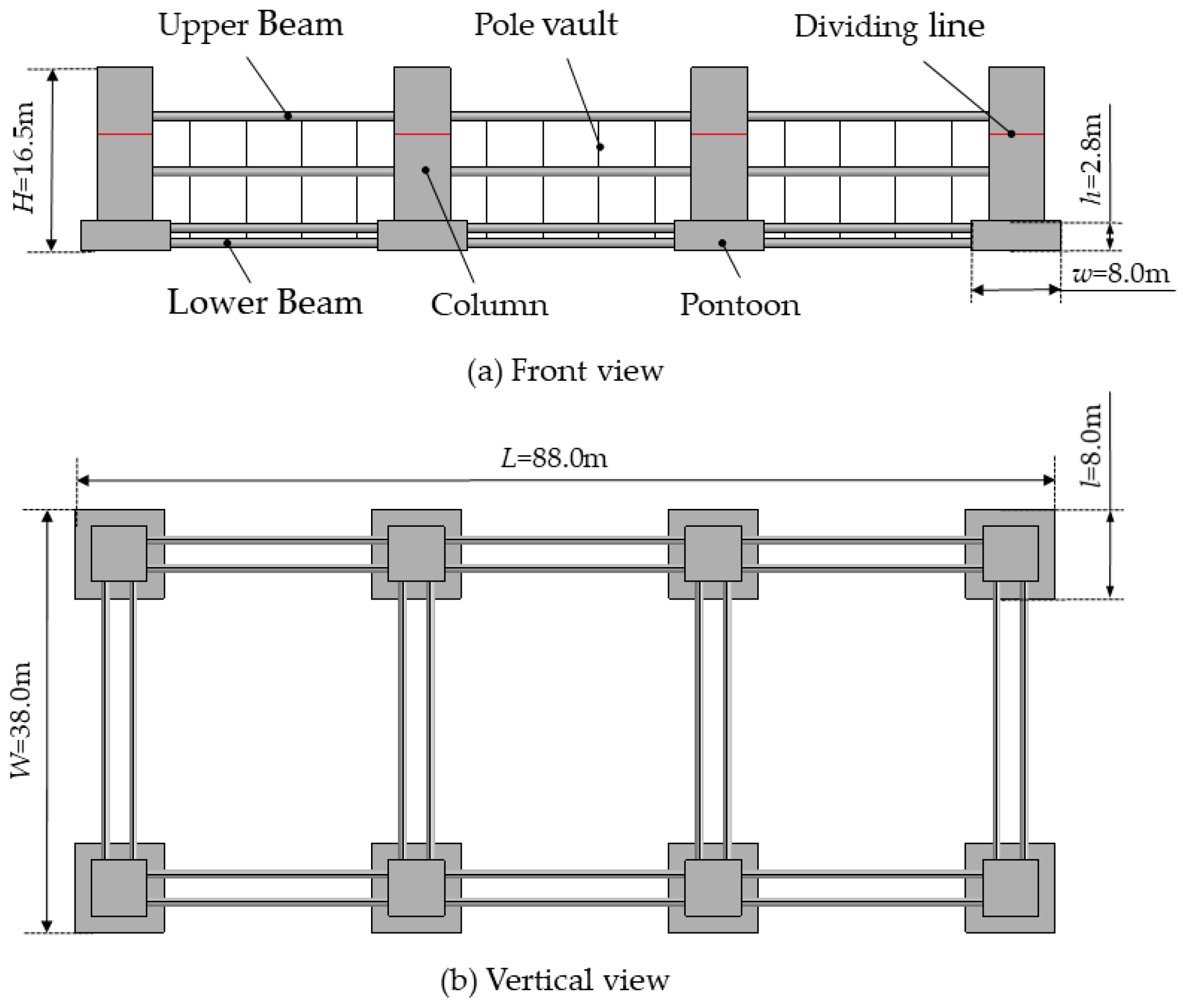
The semi-submersible fishery aquaculture platform model developed in this study comprises a floating body system, which includes columns, pontoons, cross beams, and spars, alongside a mooring system and a net suit. The platform frame adopts a truss design, with the lower float tank and upper deck rigidly connected by columns. These columns are further interconnected by cross beams, resulting in a cohesive structure, as illustrated in
Figure 1. Notably, the platform is distinguished by the substantial size of individual columns and the considerable number of column groups.
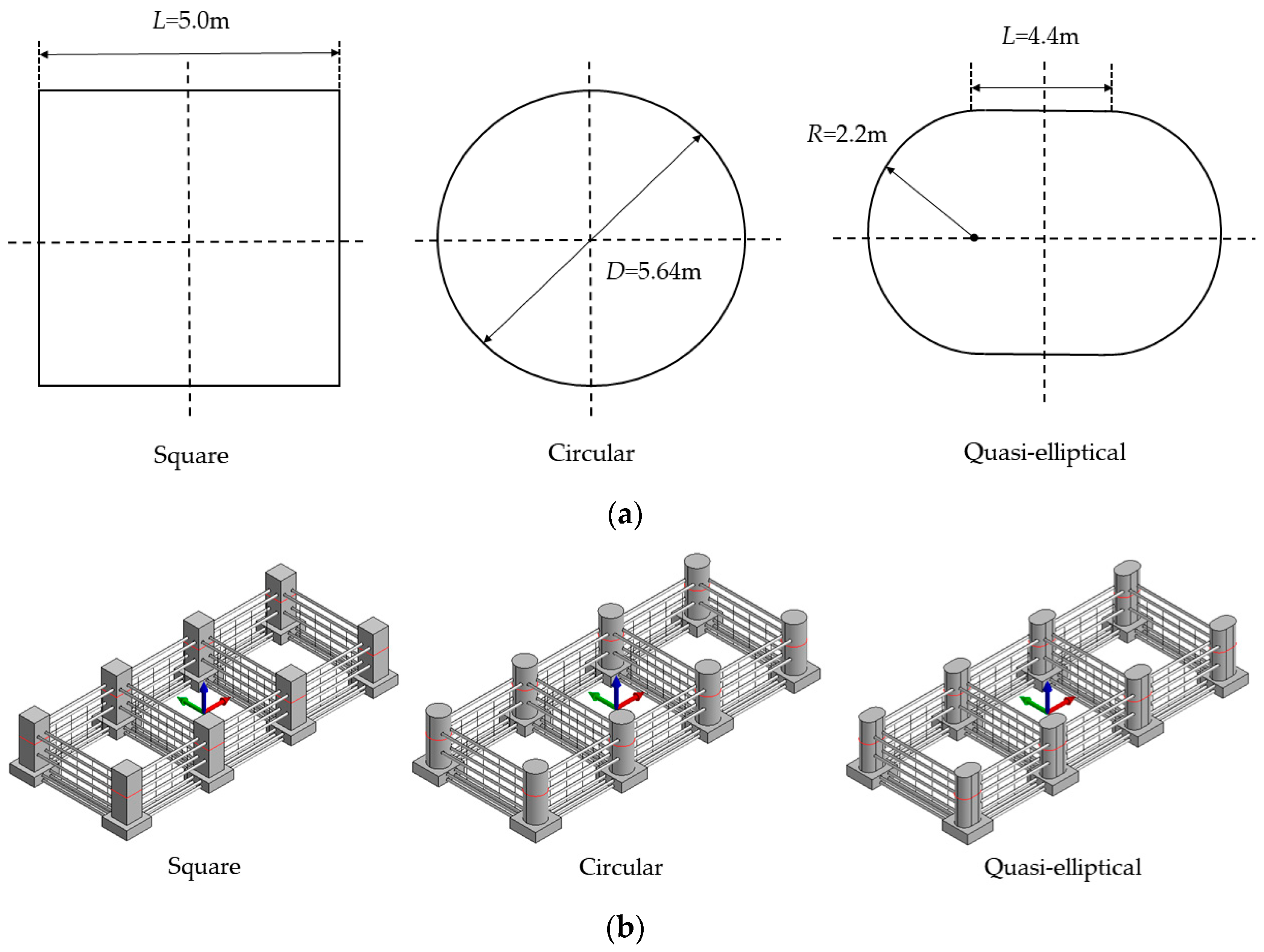
On the basis of the design of the square column platform, the columns are controlled to have the same or similar volume of the underwater submerged part, i.e., the buoyancy provided by the columns is equal, and the columns of circular section and quasi-elliptical section are modeled respectively.
Figure 2 illustrates the cross-sectional views of three distinct column structures alongside the 3D model of the platform.
Table 1 details the platform’s pertinent parameters.
2.2. Kinematic Modes and Coordinate Systems
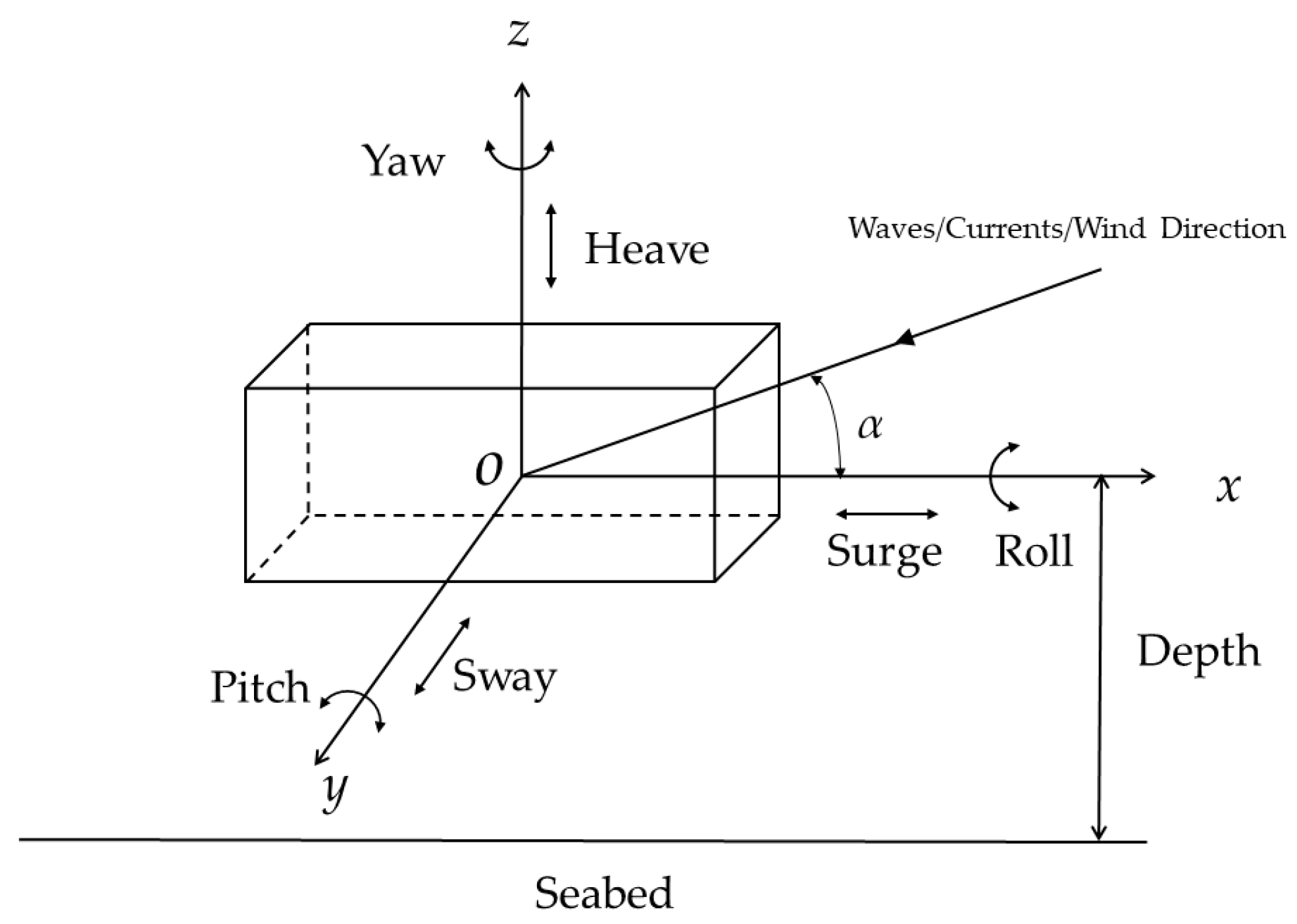
The designed working depth is 100 m, and the environmental loads consider the effects of waves and currents. The semi-submersible aquaculture platform has 6 degrees of freedom under wave loads, which are translation along x-axis, y-axis and z-axis, and rotation around each axis, including Surge, Sway and Heave for translation, and Roll, Pitch and Yaw for rotation.
The right-angle coordinate system
Oxyz is established, with the
Oxy plane parallel to the hydrostatic water surface. The origin
O is positioned at the centre of gravity of the platform. The longitudinal direction of the structure is designated as the
x-axis, oriented towards the bow, while the transverse direction is defined as the
y-axis. The
z-axis extends vertically upwards, passing through the centre of gravity of the platform. The definition of the coordinate system is illustrated in
Figure 3.
2.3. Mooring Systems
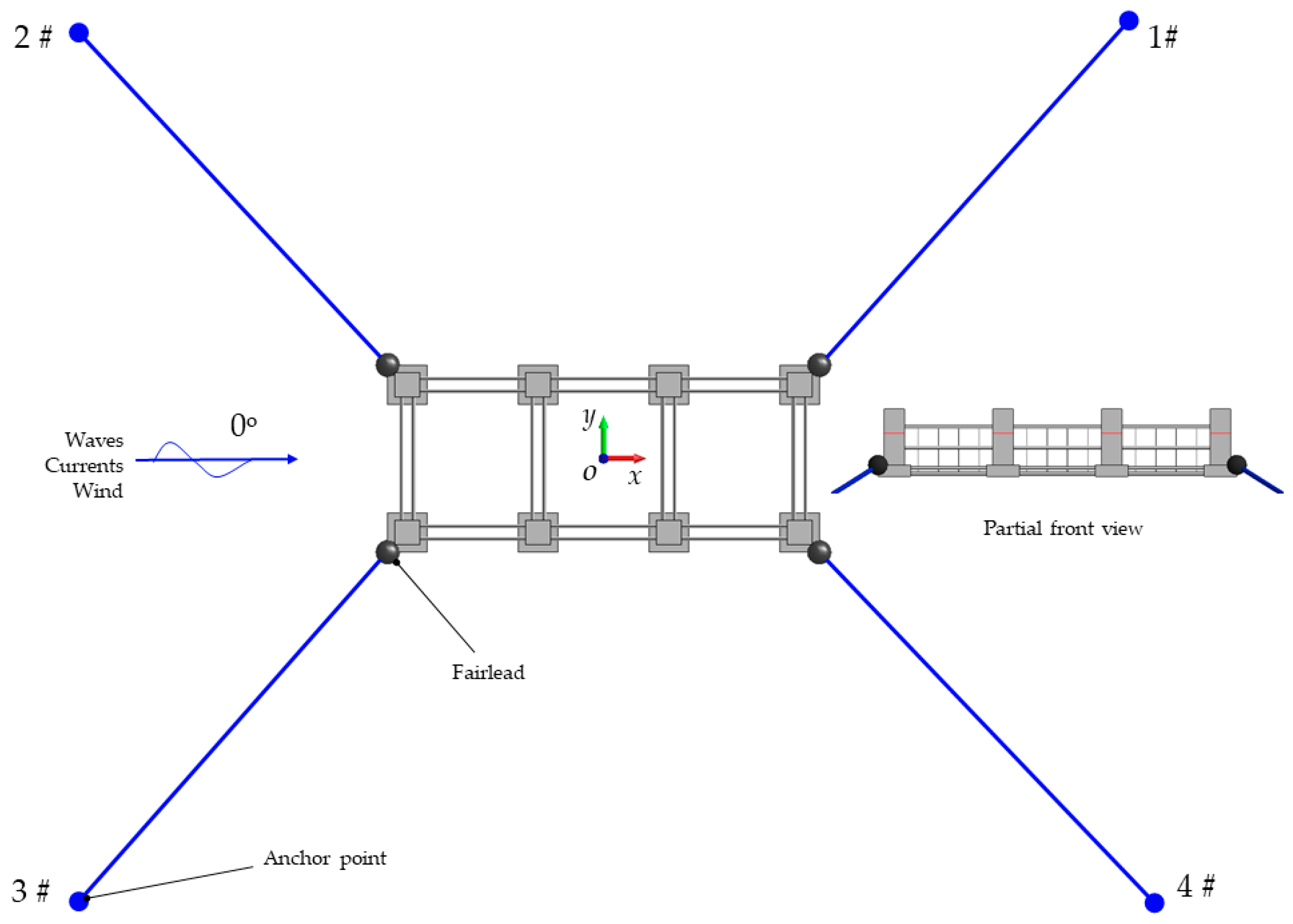
The longitudinal structure of the semi-submersible truss-type aquaculture platform is set up with the mooring fixed in the same direction as the 0° down-wave direction, which is along the x-axis positive direction. The platform is positioned by a multi-point mooring system, which consists of four mooring cables with suspended chain lines, arranged symmetrically. One end of the cable is connected to the platform foundation through a cable guide hole, and the other end is fixed to the seabed through an anchoring point.
Based on the consideration of control variables, the mooring system arrangement and cable parameters of the three platforms are kept consistent,
Figure 4 shows the form of this mooring system arrangement, and the design parameters of the mooring cable are shown in
Table 2.
3. Research Methodology
3.1. Environmental Load Calculation
3.1.1. Ocean Random Waves
Wave spectra, as an effective means of describing complex waves, are commonly used, such as the Pierson–Moskowitz spectrum, the JONSWAP spectrum, the Wallops spectrum and the Bretshneider spectrum. Among them, JONSWAP spectrum is a wave spectrum developed on the basis of P-M spectrum, which takes into account the influence of wave development state, and is usually applicable to underdeveloped waves with limited wind distance. The southern part of the South China Sea is a semi-enclosed deep-sea area with a significant limited wind range.
The reference object of the study in the paper is located in the southern sea area of the South China Sea, and the JONSWAP spectrum used in this paper is used to generate random waves [
5]. The wave energy spectral density function
S(
ω) is expressed as:
where
A is the constant;
ω0 is the peak frequency;
γ is the peak growth factor; and
σ is the peak shape parameter.
3.1.2. Theory of Wave Load Calculation
Based on the ratio of the cross-section characteristic scale D to wavelength λ of semi-submersible fishery aquaculture platform components, the calculation method of platform wave loads is divided into two ways.
(1) For small-sized members with
D ≤ 0.2
λ, the viscous effect and additional mass effect are mainly considered. For the wave force acting on the gusset, Morrison’s equation is:
where
ρ is the density of seawater;
Cd is the coefficient of drag force;
ur is the velocity of relative motion in the horizontal direction;
Cm is the coefficient of inertia;
is the acceleration of relative motion in the horizontal direction;
uW is the velocity of the water quality point;
uB is the velocity of the floating body motion; and
Ca is the coefficient of additional mass,
Ca =
Cm − 1.
(2) For large-size members with D > 0.2λ, the scattering, bypassing and radiation effects of wave loads on the structure are mainly considered. Wave loads on columns, floats and beams are calculated using the potential flow theory method.
Using the Green function method, the boundary integral equation satisfying the fixed solution condition is solved to obtain the velocity potential function Φ(
x,
y,
z,
t). The velocity potential
Φ is decomposed into the incident potential
ΦI, the number of bypassing potentials
ΦD and the radiation potential
ΦR. The wave dynamic pressure
pw distribution is obtained by Bernoulli’s equation, and the wave force
Fw as well as the wave moment
Mw are obtained according to the linearized Bernoulli’s equation:
where
ρ is the density of seawater;
SB is the wet surface of the platform;
n is the outer normal vector of the wet surface of the platform;
r is the tangent direction vector of the wet surface of the platform.
The first-order wave force of a semi-submersible fish culture platform consists of the first-order wave excitation force and the radiation force.
A unified description of Equations (5) and (6) yields the first-order wave force
Fk expression [
20].
where i is the imaginary unit;
ω is the wave circular frequency;
ζj is the amplitude of the motion of the platform in the
jth degree of freedom direction;
nj is the unit vector normal to the outside of the wet surface of the platform in the
jth degree of freedom direction; and
is the spatial component of the radial wave velocity potential per unit amplitude in the
jth degree of freedom direction.
The first term of Equation (7) is the first-order wave excitation force (FEX), which characterizes the wave excitation forces and moments, and is composed of the Froude–Krylov force related to the incidence potential and the wrap-around force related to the wrap-around potential, which is the main wave loading.
The 2nd term of Equation (7) is the radiation force (
FR), expressed in terms of additional mass and radiation damping:
where
FRjk denotes the radiative force or moment in the
kth degree of freedom due to the
jth mode of motion under the action of unit wave amplitude;
and
are the linear motion velocity vector and acceleration vector of the structure with forced motion, respectively;
μkj and
λkj are the additional mass of the platform and the radiative damping, respectively, which are usually frequency-dependent and satisfy the following relationship:
3.1.3. Current Loads
Currents are generated by a steady, continuous flow of seawater over a large area. The speed of movement of the water quality points in the current changes very slowly, and its force on the platform is simplified as the horizontal drag force
Fcurrent. The formula is as follows:
where
CD is the drag force coefficient,
Vc is the design current velocity, and
Ac is the plane projection area of the member perpendicular to the flow direction.
3.1.4. Wind Loads
Wind loads predominantly affect the structural elements of the platform situated above the waterline. The calculation formula is as follows:
where
ρw is the air density;
Cs is the shape coefficient of wind load;
Ch is the height coefficient of wind pressure;
Aw is the orthographic projection area of the wind-affected component;
Vw is the wind speed.
3.1.5. Hydrodynamics of Net-Coat Systems
The main hydrodynamic models of netcoat are Morison model and Screen model [
21]. In this paper, Morison units are used to simulate the equivalent netcoat. These Morison units are assumed to be small-scale cylinders and are rigidly connected to the platform frame structure so that the whole works as a rigid body [
22]. The wave and current hydrodynamic forces acting on a fishing net can be categorized into inertial, drag and lift forces. In this paper, the inertial force [
23,
24] and the lift force [
25,
26] are ignored when calculating the hydrodynamic force on the net coat, and only the drag force on the net coat is considered. The force per unit length of netting can be expressed as [
27].
where
Cd is the drag force coefficient in the Morrison model;
D is the diameter of the structure; and
u is the relative flow velocity perpendicular to the mesh rope, and where the drag force coefficient
Cd is determined based on a screen model developed by Loran through mesh drag tests [
28].
where
CD is the drag coefficient in the screen model;
θ is the angle between the normal direction of the net and the water flow; and
Sn is the denseness of the net.
3.2. Equations of Motion
According to Newton’s second law, the equation of motion in the frequency domain for a semi-submersible truss fishery aquaculture platform under the action of a unit amplitude regular wave is:
where
M is the platform structural mass matrix;
M(
ω) is the additional mass matrix;
C(
ω) is the platform structural damping matrix;
K is the platform stiffness matrix;
FEX(
ω) is the first-order wave excitation force acting on the platform;
,
and
are the acceleration vector, velocity vector, and displacement vector of the platform, respectively.
In order to ensure the accuracy of the numerical simulation results, the indirect time-domain method is used to convert the frequency-domain calculation results to the time-domain for the coupling analysis. The frequency domain calculation results are converted to time domain by inverse Fourier transform, and the coupled equations of motion in time domain for the floating body system, the net-clothing system and the mooring system are:
where
M(∞) is the additional mass matrix at infinity frequency;
C is the damping matrix;
K is the stiffness matrix;
R(
t −
τ) is the hysteresis function matrix;
,
, and
are the acceleration, velocity, and displacement vectors of the platform at the moment
t, respectively;
F(
t) is the environmental load of the platform’s floatation system;
Fn(
t) is the environmental load of the netsuit system; and
Fm(
t) is the mooring cable force.
3.3. Hydrodynamic Modeling
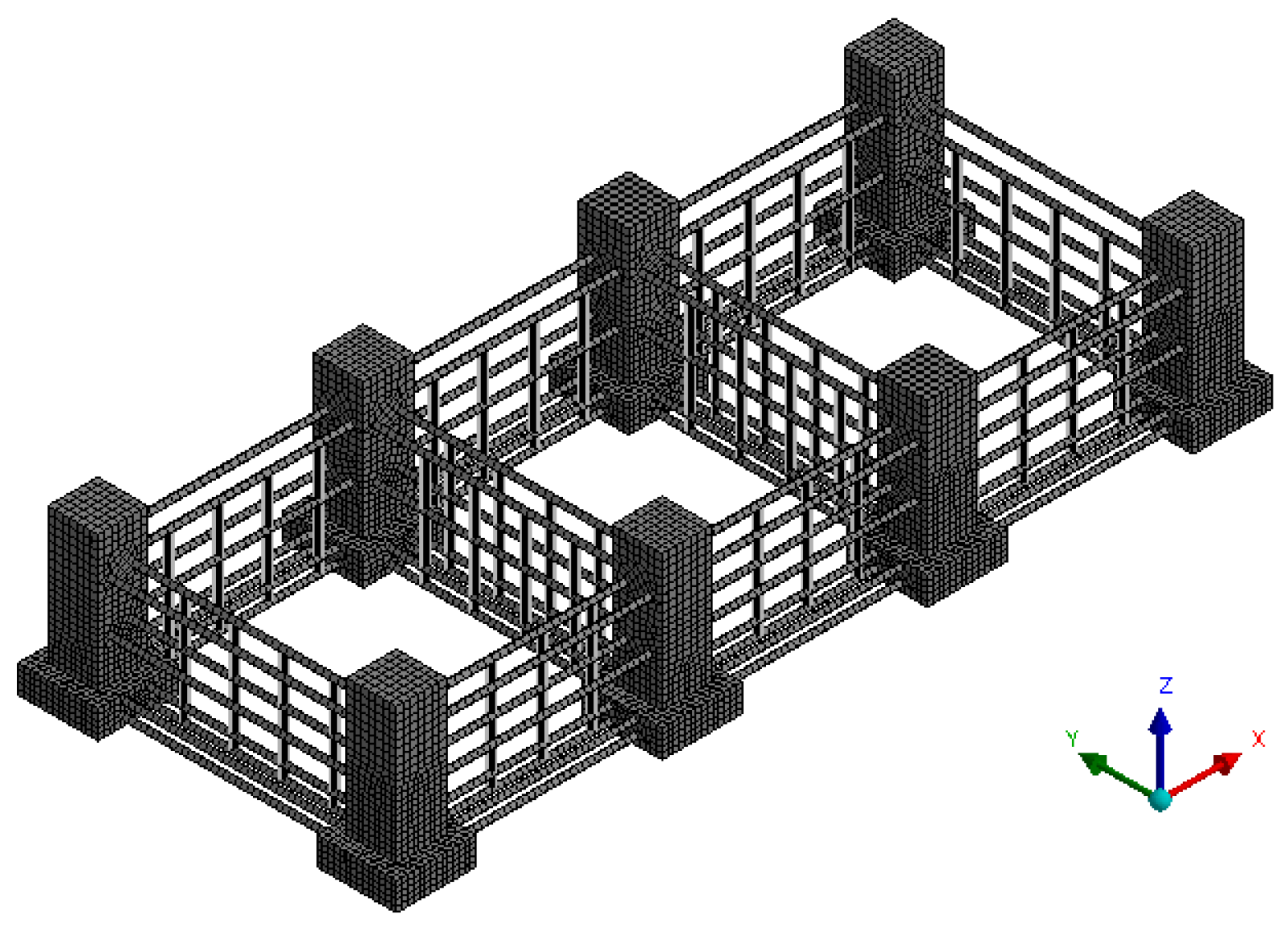
The Ansys/Aqwa (ANSYS 2020 R2) software establishes the hydrodynamic calculation grid for the platform. In this grid, the columns, floats, and beams utilise surface cells, with grid sizes of 1.0 m for the upper part and 0.65 m for the lower part of the waterline. The spars employ Morrison cells, featuring a grid size of 0.2 m.
Figure 5 illustrates the hydrodynamic model of the square column platform.
4. Method Validation
4.1. Validation of Computational Mesh Accuracy
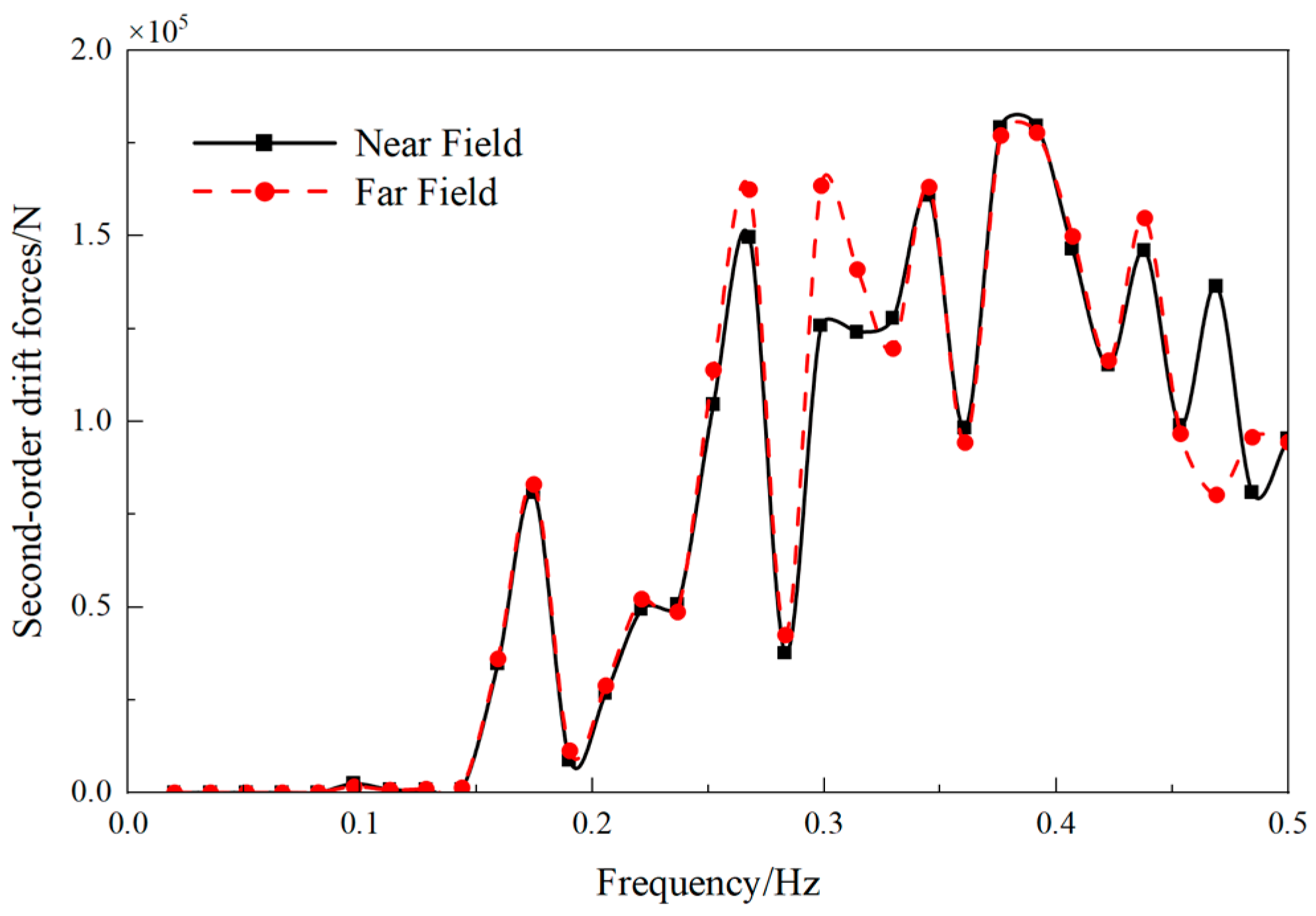
The Haskind relation is usually used to verify whether the mesh partitioning meets the hydrodynamic calculation accuracy requirements, or judged by comparing the consistency of the second-order drift force obtained from the near-field method and the far-field method [
28]. In this study, the second-order mean drift force of the longitudinal oscillation of the platform model is solved by using the near-field method and the far-field method, and when the results of the two solution methods have the same trend and are close to the same order of magnitude, it can be assumed that the mesh delineation meets the requirements for the accuracy of hydrodynamic calculations. Taking the square column platform as an example, its calculation results are shown in
Figure 6.
Figure 6 illustrates that the near-field and far-field methods exhibit strong agreement in the solution results for the second-order mean drift force associated with longitudinal oscillations. The maximum discrepancy observed in the numerical difference is merely 1%. Therefore, it can be concluded that the mesh division sufficiently meets the accuracy requirements for hydrodynamic calculations.
4.2. Validation of Model Rationality
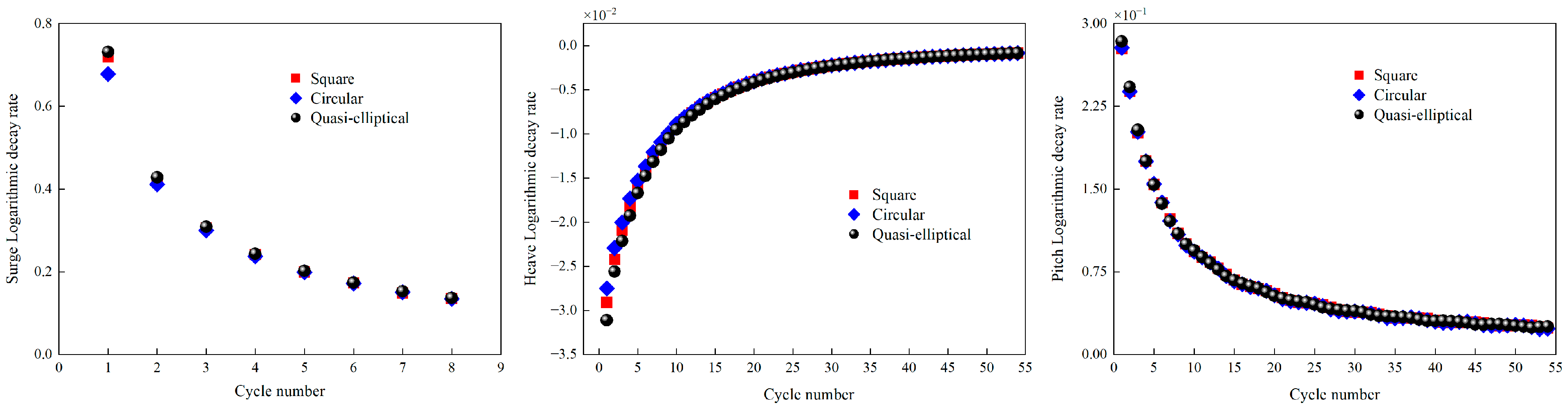
The hydrodynamic models of square, circular and quasi-elliptical column platforms are established, and the initial displacement in the longitudinal swing direction is 8 m, the initial displacement in the vertical swing direction is 2 m, and the initial inclination angle in the longitudinal swing direction is 8°. The free decay motions of three platform types were analysed, with simulations conducted over 600 s. The logarithmic decay rates for these platforms were subsequently calculated, and the findings are presented in
Figure 7.
From
Figure 7, the free decay results of the three types of platforms in the longitudinal oscillation, pendulum oscillation and longitudinal rocking directions all show a gradual decrease in amplitude over time, all converge to the equilibrium position, and the trend of change is consistent. Based on the free decay results, the intrinsic frequencies of the square, circular and quasi-elliptical column platforms are 0.015 Hz in the longitudinal oscillation direction, 0.093 Hz in the pendulum direction and 0.093 Hz in the longitudinal rocking and pendulum direction. In summary, the three different column platforms all have stable convergence, highly consistent trends and the same intrinsic frequency, indicating the reasonable validity of the three platform hydrodynamic models.
4.3. Comparative Validation
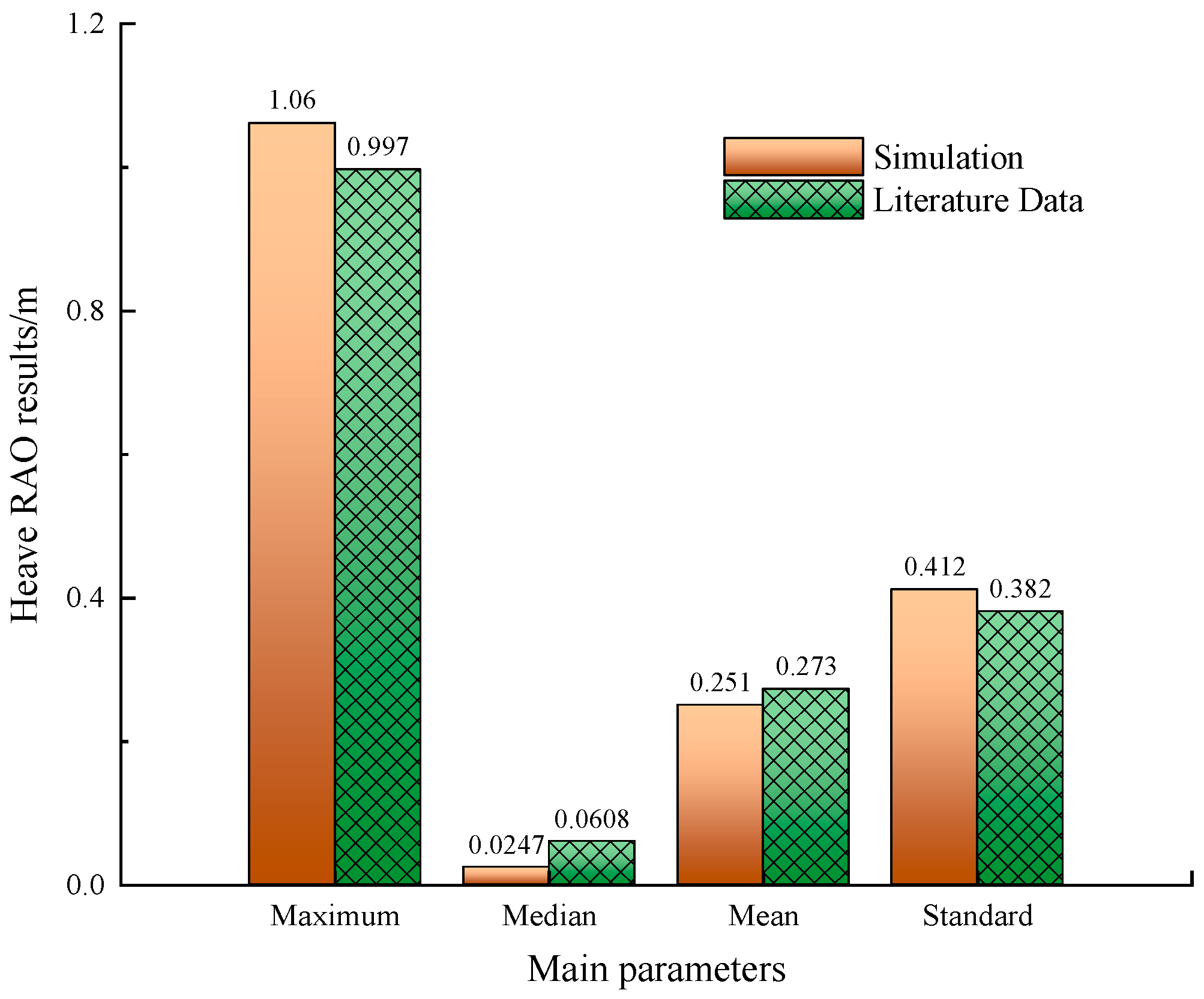
To verify the reliability of the numerical model, the results of the sagging Response Amplitude Operator (RAO) calculation for the square-column semi-submersible aquaculture platform, without net suit mounting, were extracted and compared with data from the literature [
5] pertaining to the square-column aquaculture platform. The main parameter comparisons are illustrated in
Figure 8.
The comparison reveals that the resultant deviations of the mean and standard deviation between the two datasets are −8.11% and −7.47%, respectively, indicating a relatively small difference. Despite these discrepancies, both models exhibit similar structures, and the trends in the changes of the RAO curves are alike. Therefore, it can be concluded that the calculation method employed in this study demonstrates high accuracy and reliability.
5. Results
5.1. Frequency Domain Response Analysis
Thirty regular wave frequencies in the range 0.02–0.5 Hz were selected as the design waves, and wave directions from −180° to 180° at 15° intervals were used; frequency-domain analysis was performed with ANSYS/Aqwa. This paper presents only the dynamic responses in three degrees of freedom—surge, heave and pitch—under those waves.
5.1.1. Additional Mass and Radiation Damping
From Equation (8), it can be seen that the additional mass is directly proportional to the acceleration of the breeding platform motion, and the radiation damping is directly proportional to the speed of the breeding platform motion, and at the same time, the additional mass and the radiation damping are also a function of the shape of the breeding platform and the vibration frequency.
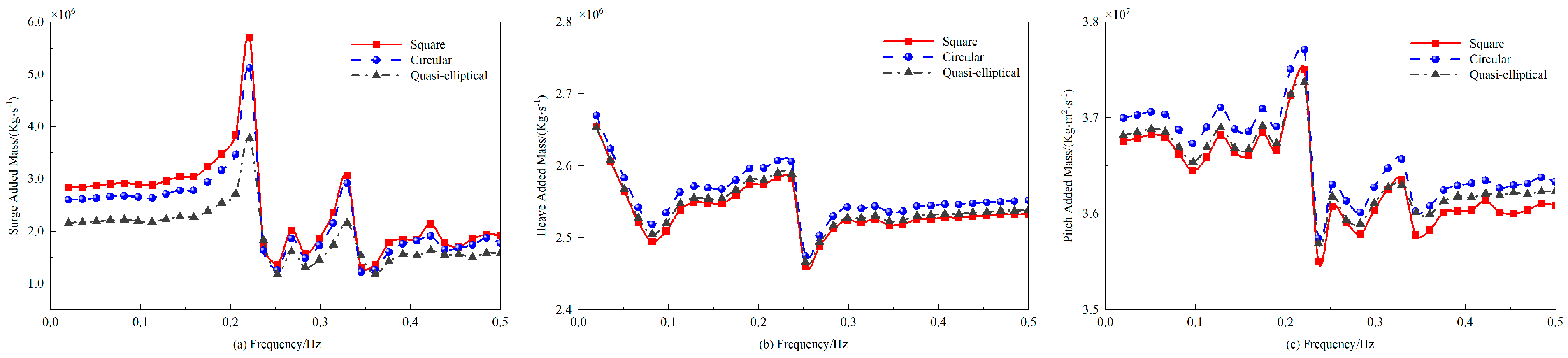
Figure 9 shows how added mass in surge, heave and pitch varies with wave frequency for square, circular and quasi-elliptical column platforms; the vertical axis denotes added mass per unit wave amplitude.
Figure 9 shows that the added-mass trends for the three platforms are broadly consistent. In the surge direction, the added mass of all platforms is highly sensitive to frequency between 0.2 and 0.45 Hz, exhibiting marked oscillations and extreme values. Overall, the added-mass magnitudes follow the order: square-column platform > circular-column platform > quasi-elliptical-column platform. The maximum added-mass peaks for all three platforms occurred at 0.221 Hz, with substantial numerical differences: the square-column platform had the largest value, while the quasi-elliptical-column platform had the smallest, lower by approximately −40%.
In heave, the added mass of all three platforms varied relatively smoothly with frequency, and the overall ranking by magnitude was: circular-pillar platform > quasi-elliptical-pillar platform > square-pillar platform. The maximum added-mass peak for each platform occurred at the initial response frequency of 0.02 Hz, and the peak magnitudes differed only slightly among the platforms.
In pitch, the added-mass trends resembled those in surge, and the overall magnitude ranking matched that in heave, remaining circular-pillar platform > quasi-elliptical-pillar platform > square-pillar platform. The peak frequency coincided with that in surge (0.221 Hz), and the peak magnitudes again showed only small differences among the three platforms.
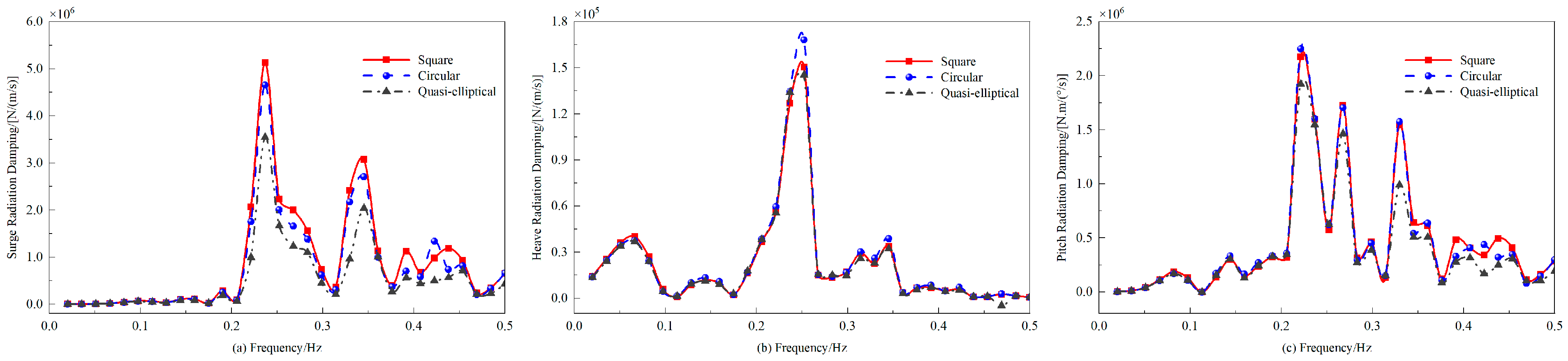
Figure 10 presents the response curves of radiation damping per unit wave amplitude for the square-column, circular-column and quasi-elliptical-column platforms under heave, surge and pitch motions, plotted against wave frequency. The vertical axis denotes the radiation damping per unit wave amplitude. Overall, the three platform types exhibit similar trends in radiation damping with frequency.
For surge motion, when the frequency lies in the 0.2–0.469 Hz range, radiation damping is markedly sensitive to frequency, showing pronounced oscillations and multiple extrema. The primary peaks for all three platforms occur near 0.237 Hz, although their magnitudes differ substantially: the square-column platform attains the largest peak, while the quasi-elliptical-column platform has the smallest, with a difference of −30%. Secondary peaks appear near 0.345 Hz, where the values for the square-column and quasi-elliptical-column platforms differ by −33%.
In heave, the radiation damping of all three platform types is highly sensitive to frequency, with responses concentrated mainly in the 0.2 Hz to 0.3 Hz band. Each configuration exhibited its largest peak at 0.252 Hz, though the peak magnitudes differed markedly: the circular-column platform showed the highest value, while the square- and quasi-elliptical-column platforms showed the lowest, with a maximum difference of −13%.
In pitch, the radiation damping of each platform was strongly frequency-sensitive, with responses concentrated mainly in the 0.2–0.469 Hz band and accompanied by pronounced oscillations that produced multiple extrema. The magnitudes of the primary peak (0.221 Hz), the secondary peak (0.267 Hz) and the tertiary peak (0.329 Hz) followed the pattern: square-column platform highest and quasi-elliptical-column platform lowest, with inter-peak differences of −15%, −14% and −37%, respectively.
5.1.2. First-Order Wave Excitation Forces
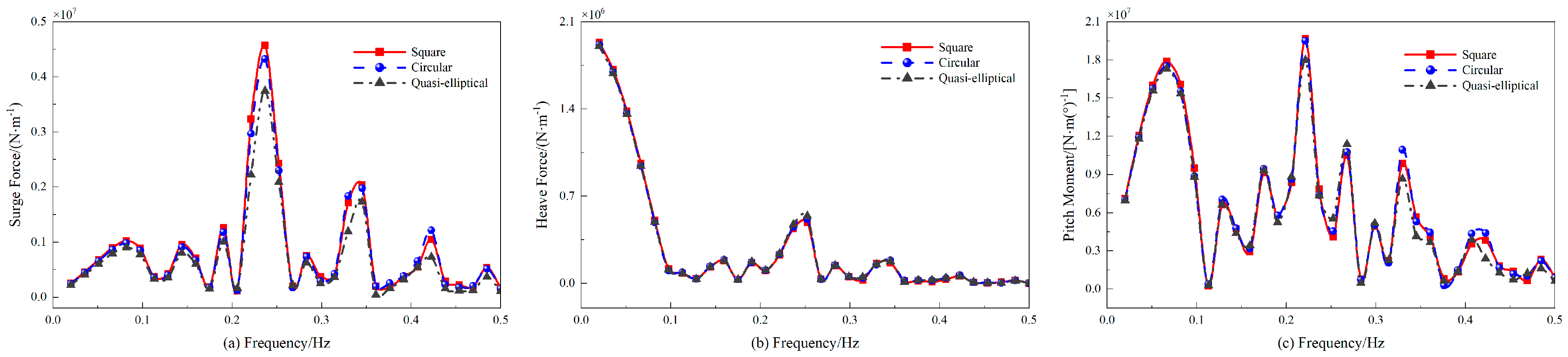
Figure 11 illustrates the characteristics of first-order wave excitation forces on square, circular, and quasi-elliptical column platforms in surge, heave, and pitch directions as the wave frequency varies. The vertical axis represents the wave excitation force corresponding to a unit wave amplitude.
Figure 11 illustrates that the wave-induced excitation forces in surge, heave, and pitch directions exhibit similar patterns across the three platforms. In the surge direction, all platforms demonstrate high sensitivity to frequency changes in the high-frequency range, with significant fluctuations and multiple extremum points during oscillation. The primary peak for all platforms occurs at a frequency of 0.237 Hz. Notably, the quasi-elliptical column platform has the smallest response amplitude, 18% lower than that of the largest, the square column platform. Other secondary peaks appear near frequencies of 0.19 Hz, 0.237 Hz, 0.345 Hz, and 0.422 Hz, where the response differences among the platforms are relatively minor.
In the heave direction, the wave-induced forces on the three platforms predominantly concentrated in the low-frequency range. The maximum peak occurred at the initial response frequency of 0.02Hz, with all three platforms exhibiting similar peak amplitudes. At a frequency of 0.252Hz, a significant oscillation peak was observed, where the square column platform displayed the smallest value, differing by −9.75% from the maximum value of the quasi-elliptical column platform. The study indicated the presence of minor local high-frequency responses in the heave direction.
In the pitch direction, the wave-induced forces on the three platforms demonstrated high sensitivity to high-frequency variations, exhibiting considerable fluctuations with multiple extrema. The main peak appeared at 0.221 Hz, where the quasi-elliptical column platform had the smallest value, differing by −8.5% from the maximum value of the square column platform. Other peaks were observed at frequencies of 0.066 Hz, 0.175 Hz, 0.267 Hz, and 0.329 Hz, with minimal differences among the three platforms at these peaks.
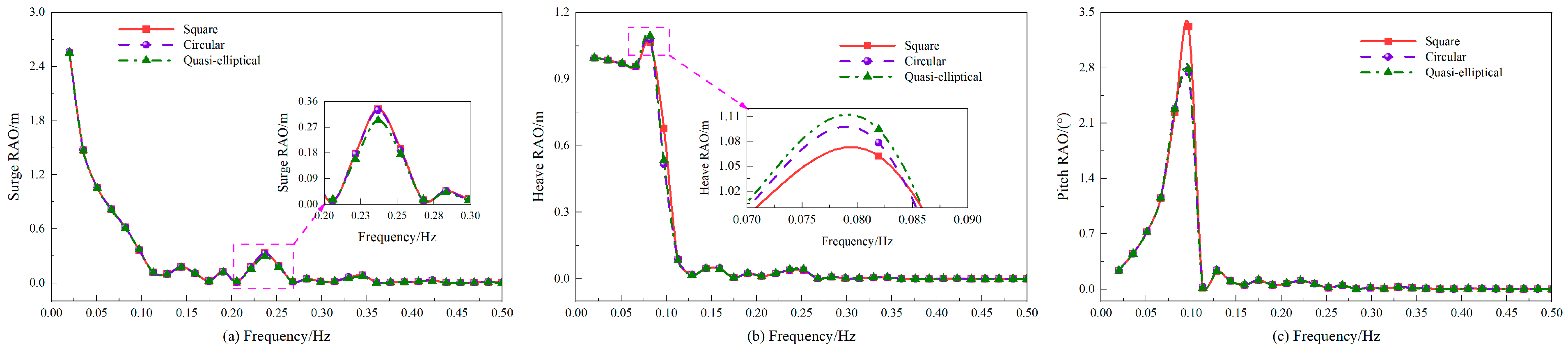
5.1.3. RAO Frequency Domain Motion Response
Figure 12 illustrates the variation in the Response Amplitude Operators (RAO) with wave frequency for square column platforms, circular column platforms, and quasi-elliptical column platforms in the surge, heave, and pitch directions. The vertical axis represents the RAO corresponding to a unit wave amplitude.
Figure 12 shows that, overall, the RAO amplitudes of the three platforms in all three degrees of freedom decrease gradually as wave frequency increases, and after small oscillations they stabilise; the patterns of variation are broadly consistent. In surge, the main responses concentrate in the low-frequency range, with the largest response peak occurring at the initial response frequency of 0.02 Hz for all platforms; the peak amplitudes are essentially identical (approximately 2.56 m). In the high-frequency region there is a small oscillation at 0.236 Hz. At that frequency the quasi-elliptical-column platform has the smallest peak (0.294 m), followed by the circular-column platform (0.329 m), and the largest peak is observed for the square-column platform (0.333 m). The peak values for the circular and square platforms are almost the same, but the difference between the smallest and largest values is −12%. In summary, the quasi-elliptical-column platform exhibits superior motion characteristics in surge.
In heave, the predominant response occurred below 0.128 Hz. All maximum response peaks were at 0.082 Hz, with the square-column platform showing the smallest peak (1.06 m), the circular-column platform 1.08 m, and the quasi-elliptical platform the largest at 1.09 m. The difference between the minimum and maximum peaks was −2.8%, indicating that the heave characteristics of the three platforms were essentially identical.
In pitch, the principal response occurred below 0.112 Hz. All maximum peaks occurred at 0.097 Hz, with the circular-column platform reaching 2.74°, the quasi-elliptical platform 2.78°, and the square-column platform 3.32°. The circular and quasi-elliptical platforms therefore had nearly identical, and the smallest, peaks; the difference between the minimum and maximum values was −17%. Thus, the circular and quasi-elliptical platforms exhibited the most favourable pitch motion characteristics.
5.2. Time Domain Response Analysis
The most notable dynamic response of the semi-submersible truss aquaculture platform is the change in spatial pose under environmental loading, specifically translational displacements and rotational angles. To evaluate the platform’s dynamic response accurately, one must solve its global equations of motion in the time domain and account for the coupling between the mooring system and the platform structure, thereby revealing its motion characteristics.
5.2.1. Marine Environmental Parameters
According to the results of China’s domestic literature, the maximum wave height of the sea state in the South China Sea in one year is 2.7 m. In order to better evaluate the kinematic performance of the semi-submersible truss fishery aquaculture platform, the influence of the one-year marine environment on the platform is selected to be studied in this paper. Irregular waves are generated based on the JONSWAP spectrum, with a meaningful wave height Hs of 2.7 m, a spectral peak period Tp of 8.3 s, and a spectral peak factor γ of 3.3. The current load velocity of 0.9 m/s. The frequency calculation range of the selected frequency is 0.07 Hz ~ 0.5 Hz, and the angle of incidence of the wave is 0°, and the length of the simulation is 3600s.
5.2.2. Time Domain Motion Response
Table 3 presents the time-domain statistics of the heave, sway and surge responses for the three platforms; the maximum value denotes the largest absolute response.
From
Table 3 it can be seen that, in the surge direction, the circular-column platform exhibits the smallest maximum, mean and standard deviation. Compared with the square-column platform, these three metrics are reduced by 36.8%, 44.2% and 33.2%, respectively; compared with the quasi-circular column platform, they are reduced by 35.1%, 42.7% and 29.4%, respectively. These results indicate that the circular-column platform performs best in surge response, followed by the quasi-elliptical-column platform.
In the heave direction, the three platforms showed minimal differences in maximum and mean values, with all deviations within 4.5%. For standard deviation, the square-column platform recorded the smallest value, differing by −16.7% and 10.9% relative to the circular- and quasi-elliptical-column platforms, respectively. Overall, the circular-column platform produced the smallest heave motion, with the square-column platform ranking second.
In the pitch direction, maximum and mean values for all three platforms were very small and nearly identical. The square-column platform again had the smallest standard deviation, while the quasi-elliptical-column platform had the largest; the maximum difference between extremes was −8.2%. Thus, the circular-column platform exhibited the smallest pitch motion, followed by the square-column platform.
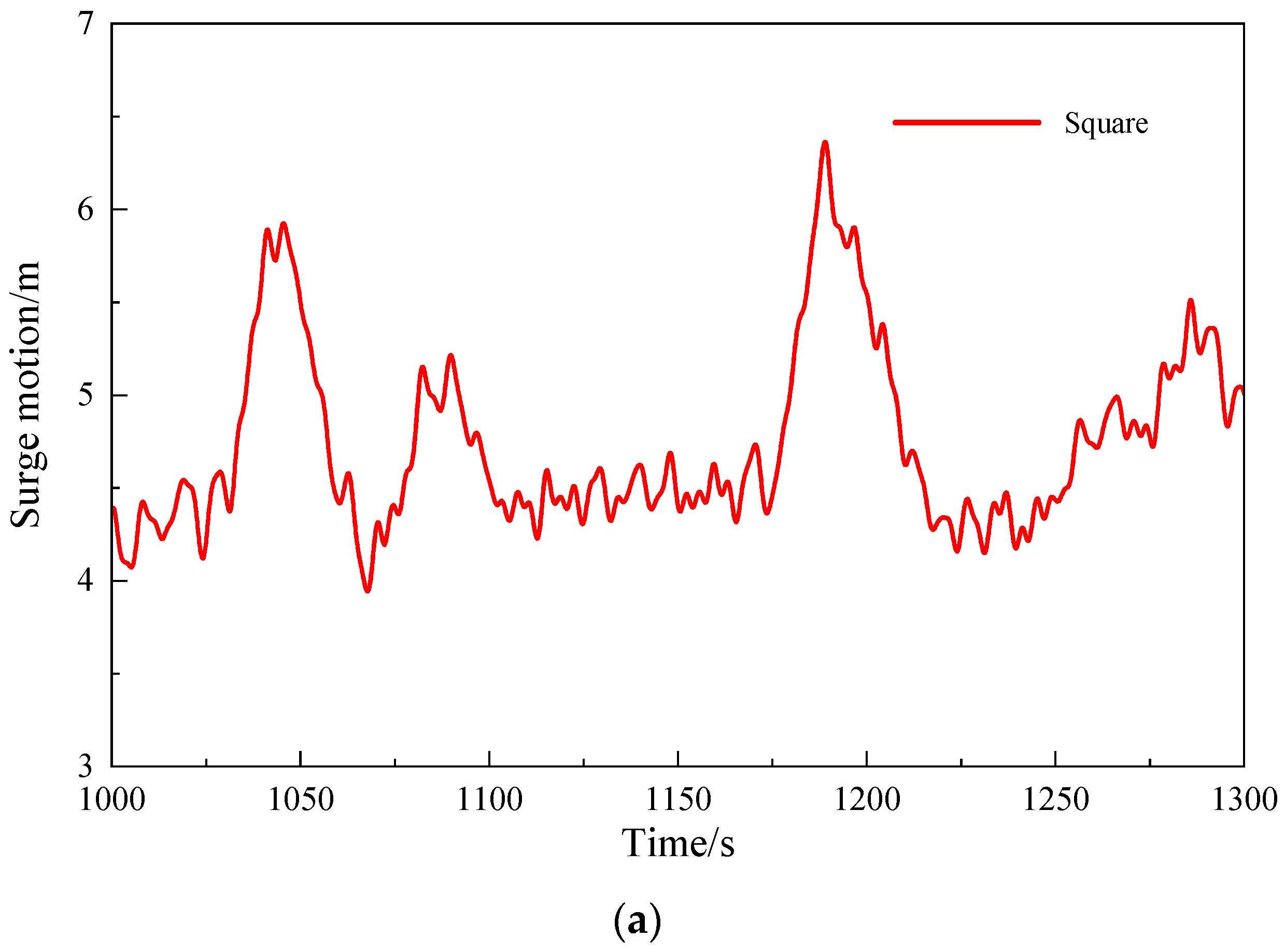
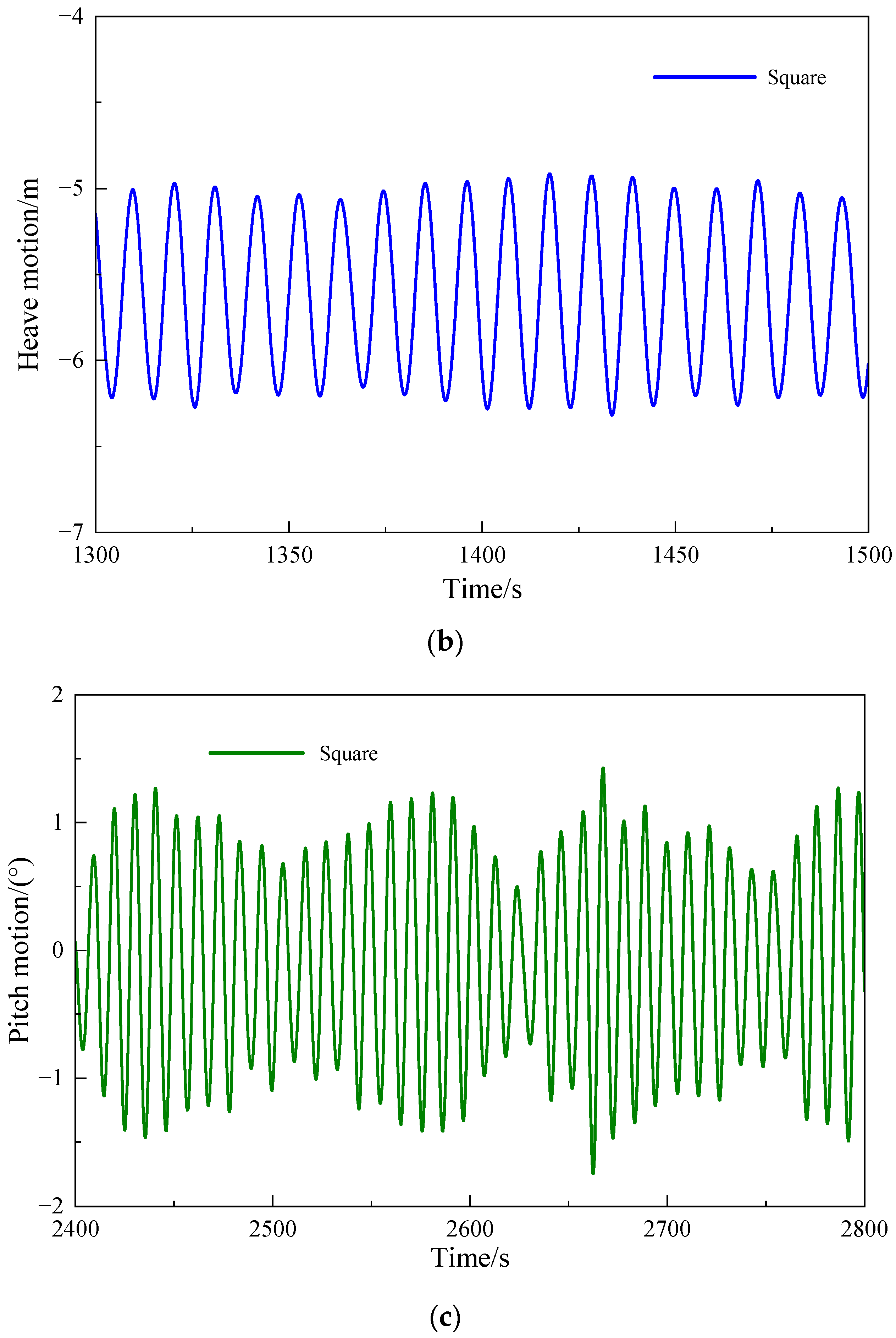
For clarity,
Figure 13 shows the motion response curves only during the period when the square-column platform attains its maximum response. As shown in
Figure 13, in the surge, heave and pitch directions all three platforms underwent aperiodic reciprocating motion, oscillating strongly about the median and exhibiting peaks in translational displacement and rotational deflection angle.
5.2.3. Power Spectrum Analysis
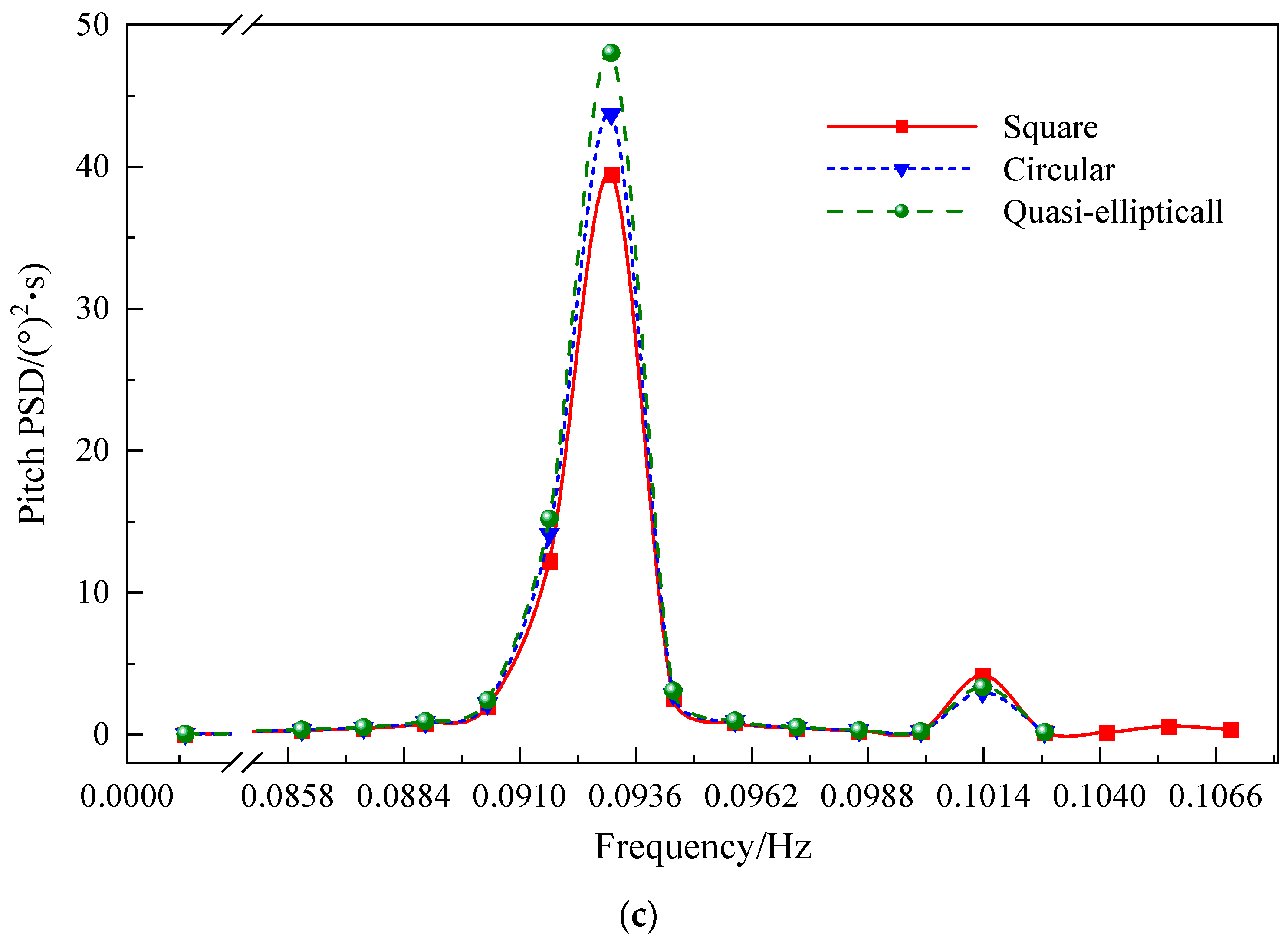
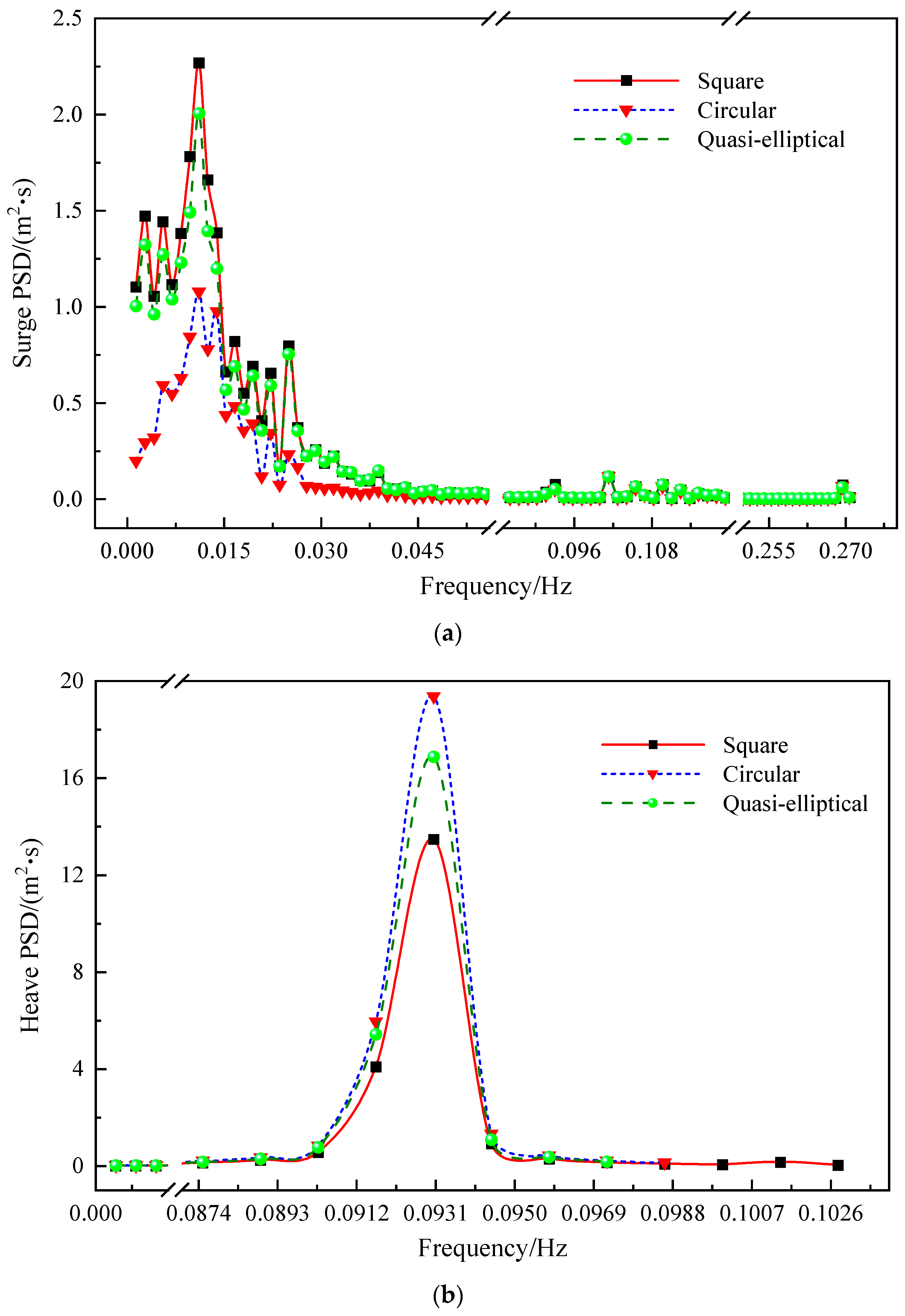
In order to be able to assess the difference in energy components of the time-domain course motion response at different frequencies, the time-domain course responses of the three platforms under the three degrees of freedom of longitudinal oscillation, vertical oscillation and longitudinal rocking were analyzed by spectrum analysis, and the characteristic curves of the spectrum analysis are shown in
Figure 14, respectively, where the vertical coordinate is the value of the power spectral density (PSD).
Figure 14 illustrates that, in the surge direction, the energy distribution for the three platform types is primarily concentrated within the frequency range below 0.028 Hz. Within this range, several energy peaks are evident at approximately 0.0028 Hz, 0.0056 Hz, 0.011 Hz, 0.0167 Hz, 0.0194 Hz, 0.022 Hz, and 0.025 Hz. Notably, 0.011 Hz emerges as the dominant frequency of the motion spectrum. In terms of peak values, the square column platform exhibits the highest peak, followed by the circular column platform, with the quasi-elliptical column platform demonstrating the lowest peak. Conversely.
In the heave direction, the energy distribution for all three platforms is primarily centred around a frequency of 0.093 Hz. Regarding peak power spectral density values, the circular column platform records the highest, the quasi-elliptical column platform follows, and the square column platform registers the lowest.
In the pitch direction, the energy distribution of the three platforms aligns with that in the heave direction, with the dominant frequency of the motion spectrum at 0.093 Hz. A secondary peak emerged around 0.109 Hz, close to the spectral peak frequency of 0.12 Hz, demonstrating distinct wave frequency characteristics. Regarding peak values, the quasi-elliptical column platform exhibited the highest, followed by the circular column platform, with the square column platform displaying the lowest.
5.2.4. Mooring Cable Tension Response
Mooring-line tension is also an important indicator for assessing the motion performance of the platform. Typically, the ratio of mooring-line breaking strength to mooring-line tension defines the safety factor; according to the API-RP-2SK design code, the platform must satisfy an allowable safety factor of 1.67.
Table 4 presents the maximum mooring-line tensions and safety factors for a 0° wave heading.
From
Table 5, the maximum tensions for all three platforms occur at Cable1 and Cable4; the square-column platform exhibits the highest values, followed by the quasi-elliptical-column platform, with the circular-column platform showing the lowest values. All three platforms meet the strength requirements; the circular-column platform has the highest safety factors at Cable1 and Cable4, the quasi-elliptical-column platform has intermediate values, and the square-column platform has the lowest.
5.2.5. Dynamic Response of the Platform Under the Combined Action of Wind, Waves, and Currents
Previous studies primarily focused on the dynamic response characteristics under wave and current influences, which may present significant limitations. Consequently, it is essential to investigate the platform’s motion response under combined sea conditions of wind, waves, and currents. In light of the South China Sea’s conditions, a rated wind speed of 11.4 m/s has been chosen. The wind, waves, and currents are aligned in the same direction, with the incident angle corresponding to the wave direction.
Table 5 presents the statistical results of the time-domain motion responses for the three platforms in the surge, heave, and pitch directions. The maximum value indicates the highest absolute value of these responses.
Table 3 and
Table 5 reveal that, under the combined influence of wind, waves, and currents, the surge displacement of the three types of platform motion responses is slightly greater than when only waves and currents are considered. However, the differences in heave and pitch responses remain minimal. Specifically, the response of the square-column platform increased by approximately 1.73%, the circular-column platform by about 3.48%, and the quasi-elliptical-column platform by around 1.61%. These findings suggest that the dynamic response characteristics of the semi-submersible aquaculture platform do not significantly alter when wind is added to the combination of waves and currents. This may be attributed to the wind-exposed height above the waterline being just 6 m, with heave further reducing this height, thus resulting in a relatively small wind-exposed area.
Table 6 displays the maximum tensions experienced by the mooring lines of three different platform types when subjected to the combined effects of wind, waves, and currents.
Table 4 and
Table 6 illustrate that, when subjected to the combined forces of wind, waves, and currents, the mooring tension in Cable1 and Cable4 increased, whereas Cable2 and Cable3 experienced a slight decrease. Among the platforms, the circular-column platform exhibited the most significant increase in tension at 2.29%, followed by the square-column platform at 2%, with the quasi-elliptical column platform showing the smallest increase at 1.76%. Conversely, the decrease in tension across the three platforms was negligible.
6. Discussion
6.1. Frequency-Domain Response Characteristics
(1) Added Mass and Radiation Damping
In terms of added mass, according to the calculation results in
Section 5.1.1, the variation trends of the frequency affected by the added mass for the three platforms are similar, and the sensitivity is obvious in the motions in all directions.
In the surge direction, the added mass of the quasi-elliptical column platform is the smallest, which is related to the fact that the longitudinal projected area of this model is the smallest. The added mass of the square column platform is the largest, followed by the circular column platform. In the heave direction, although there are differences in the added masses of the three platforms, the deviations are very small, which is related to the fact that the vertical projected areas of the three platforms are almost the same. In the pitch direction, there are also differences among the three platforms, but the deviations are very small.
In terms of radiation damping, the variation trends of the three platforms with respect to frequency are the same as those of the added mass, also showing basically consistent trends, with an increasing degree of sensitivity and multiple peaks and troughs. In the surge direction, the radiation damping of the quasi-elliptical column platform is the smallest, which is also affected by the projected area. In the heave and pitch directions, the radiation damping of the circular column platform is the largest, that of the square column platform is moderate, and that of the quasi-elliptical column platform is the smallest.
The above results indicate that the added mass and radiation damping of the quasi-elliptical column platform are either the smallest or tend to be insufficient. For the operation of semi-submersible aquaculture platforms, heave and pitch are the primary motion modes of concern. The differences in the maximum peaks of the quasi-elliptical column platform in the heave and pitch directions compared with those of the square and circular column platforms are not very significant. These are all aspects worthy of attention.
In addition, the heave and pitch radiation damping values of the three platforms in the low-frequency region are extremely small, indicating that the platforms will not generate significant radiation waves under low-frequency response conditions. Moreover, the peak frequencies of the maximum added mass and maximum radiation damping of the three platforms are the same, and in the high-frequency region, the high-frequency response is obvious. These are also aspects worthy of attention.
(2) First-order wave excitation force
According to the calculation results in
Section 5.1.2, the variation laws of wave excitation forces of the three platforms are similar. They are significantly sensitive to frequency and exhibit multiple wave peaks and troughs. The wave excitation forces of the quasi-elliptical column platform in the surge, heave, and pitch directions are all the smallest, while those of the square column platform are the largest. The wave excitation forces of the circular column platform are moderate, but the difference from those of the square column platform is not obvious.
The peak frequencies of the maximum wave excitation forces of the three platforms are all the same and are in the high-frequency region, showing obvious high-frequency characteristics. Additionally, the phenomenon of multiple wave crests and troughs in surge and pitch was observed, which may be attributed to the special internal structure of the semi-submersible aquaculture platform with multiple compartments and multiple columns. The cancellation effect of wave loads on the platform may lead to the occurrence of wave troughs.
(3) RAO frequency-domain motion response
The calculation results in
Section 5.1.3 indicate that the motion variation patterns of the three types of platforms are similar. Among them, the quasi-elliptical column platform has the optimal motion characteristics, followed by the circular column platform, and the square column platform ranks last. It is observed that the peak frequencies of the maximum motion responses of the three platforms are all the same and occur in the low-frequency region, suggesting obvious low-frequency characteristics and the highest sensitivity to low-frequency waves. Meanwhile, the extreme frequencies of the aquaculture platform in the heave and pitch directions are around 0.082 Hz and 0.097 Hz, which are close to the natural frequencies, intensifying the platform’s motion and even leading to resonance. Additionally, small-amplitude oscillations in the high-frequency region in the surge direction are noticed. Although the oscillation level is very small, the influence of wave frequencies in severe sea conditions needs attention.
6.2. Time-Domain Response Characteristics
Based on the calculation results in
Section 5.2.2, in the directions of surge, heave, and pitch, all three types of platforms undergo non-periodic reciprocating motions around the median, with peaks in translational displacement and rotational deflection angle. The circular column platform has the smallest motion response values in all three directions. The square column platform has relatively small response values in the heave and pitch directions, while the quasi-elliptical column platform has relatively small response values in the surge direction. Focusing on the motion responses in the heave and pitch directions, the circular column platform shows the most significant advantages. There are differences between the square column platform and the quasi-elliptical column platform, but they are not very obvious.
In terms of the motion spectrum, the data results in
Section 5.2.3 indicate that the energy peak frequency band in the surge direction is relatively wide, showing obvious low-frequency characteristics and being sensitive to low-frequency incident waves. The PSD peaks show that the motion of the square-column platform is the most intense, followed by that of the circular-column platform, and the quasi-elliptical column platform has the smallest motion. The dominant frequency (0.011 Hz) is close to the natural surge frequency (0.015 Hz), which is likely to cause resonance responses.
The prominent peaks in the heave direction indicate that the platform motion is extremely intense, which is most evident for the circular-column platform and least for the square-column platform. The dominant frequencies all coincide with the natural frequency in the heave direction (0.093 Hz), which can easily lead to severe resonance responses and intensify the platform’s heave motion. The response in the pitch direction is similar to that in the heave direction, except that it is most evident for the quasi-elliptical-column platform and least for the square-column platform.
The research also found that the low-frequency components of the three types of platforms dominate the surge, heave, and pitch motions; there are local high-frequency motions, but they are not obvious. The dominant frequencies of the three types of platforms are close to or coincide with the natural frequencies, which are likely to cause resonance responses. In particular, they intensify the motions of the platform in the heave and pitch directions, posing a danger to the structural safety and operational efficiency of the platform.
In terms of mooring cable tension response, the results in
Section 5.2.4 indicate that the circular column platform has the highest safety factor, while the square column platform has the lowest. The safety factor of the quasi-elliptical column platform is moderate, but the difference between it and the square column platform is small. It can be seen that the circular and quasi-elliptical column platforms have significant advantages in terms of mooring cables.
Section 5.2.5 reports the dynamic response of the platform under combined wind and wave currents. The quasi-elliptical column platform exhibited the most favourable dynamic response, followed by the square column platform. In particular, the quasi-elliptical riser platform performed best in mitigating longitudinal oscillations induced by wind and wave currents, thereby reducing the risk of platform motion instability and mooring failure. Comparing the frontal areas of the three column types in the incident direction, the quasi-elliptical column platform had the smallest area (161.4 m
2), the square column platform was larger (176 m
2), and the circular column platform was the largest (191.84 m
2). The superior dynamic responses of the quasi-elliptical and square column platforms may be attributed to their column geometries.
7. Conclusions
In this study, a semi-submersible truss-type fishery aquaculture platform was taken as the research object, and three platform models with square, circular, and quasi-elliptical column cross-sectional shapes were designed. Based on the potential flow theory and the Morrison equation, through numerical simulation methods, the response characteristics of the platforms with three column forms under the combined action of wind, waves, and currents were systematically studied from aspects such as theoretical methods and analysis means. These characteristics include added mass, radiation damping, first-order wave excitation force, motion RAO, and motion response under irregular waves. The differences in the responses of the semi-submersible platforms caused by different column forms were also compared and analyzed.
(1) The quasi-elliptical column platform exhibits the lowest first-order wave excitation forces in the surge, heave, and pitch directions when considering frequency-domain characteristics. The circular column platform follows, while the square column platform experiences the highest forces. In terms of frequency-domain motion characteristics, the quasi-elliptical column platform performs best, the circular column platform ranks second, and the square column platform shows relatively poor performance.
(2) Time-domain characteristics under the combined influence of waves and currents: The circular column platform exhibited the smallest motion response values across all three degrees of freedom. In contrast, the square column platform showed relatively low response values in the heave and pitch directions, while the quasi-elliptical column platform demonstrated a smaller response in the surge direction. Regarding mooring cable tension safety factors, the circular column platform achieved the highest, followed by the quasi-elliptical column platform with a moderate factor, and the square column platform with the lowest. Thus, the circular and quasi-elliptical column platforms offer notable advantages in cable mooring.
(3) Time-domain characteristics under the combined influence of wind, waves, and currents: The quasi-elliptical column platform exhibited the most favourable dynamic response, followed by the square column platform. In contrast, the circular column platform demonstrated a comparatively weaker response.
This paper presents a numerical analysis of the hydrodynamic responses of a semi-submersible aquaculture platform subjected to sea winds, waves, and ocean currents. However, certain limitations persist. For instance, the platform’s responses under extreme wind, wave, and current conditions warrant further investigation. In particular, the impact of typhoons and the associated wave currents should be examined, given the frequent occurrence of typhoons affecting aquaculture platforms in the South China Sea. Moreover, future research could explore whether the mechanical properties of mooring lines in the direction of incident winds, waves, and currents differ from those of other mooring lines, especially when wind, wave, and current directions are non-collinear. This study aims to assess the influence of column forms on the dynamic responses of a semi-submersible truss-type fishery aquaculture platform, offering valuable insights for the design and optimisation of aquaculture facilities. Future research might also consider a 45° rotation of the square columns to examine the sensitivity of column angle changes to the incident direction of loads.
Although this study has identified some hydrodynamic performance advantages of the quasi-elliptical column structure compared to the commonly used circular and square column structures, experimental tests are lacking. Further preparation of test models should be carried out to provide feasibility guidance for the future engineering application of the quasi-elliptical column structure in semi-submersible aquaculture platforms.
Author Contributions
Conceptualization, K.L. and D.Z.; methodology, K.L.; software, K.L.; validation, K.L. and D.Z.; formal analysis, K.L.; investigation, D.Z.; resources, D.Z.; data curation, K.L.; writing—original draft preparation, K.L.; writing—review and editing, K.L.; visualization, D.Z.; supervision, D.Z.; project administration, D.Z.; funding acquisition, K.L. All authors have read and agreed to the published version of the manuscript.
Funding
This research was funded by the Zhanjiang Science and Technology Key Project of China (No. 2024B01083).
Data Availability Statement
The original contributions presented in this study are included in the article. Further inquiries can be directed to the corresponding author.
Conflicts of Interest
The authors declare no conflict of interest.
References
- Bai, X.D.; Lu, Z.; Luo, H.B.; Guo, M.; Yang, C. Experimental and numerical investigations on hydrodynamic response of vessel-shaped semi-submersible aquacultural platform. Aquac. Eng. 2025, 110, 102540. [Google Scholar] [CrossRef]
- Wang, H.B.; Zhang, X.Y.; Zhang, X.T.; Li, X.; Tian, X.; Shen, Y.; Song, W. Experimental investigations on hydrodynamic interactions between the cylinder and nets of a typical offshore aquacultural structure in steady current. Mar. Struct. 2023, 88, 103367. [Google Scholar] [CrossRef]
- Liu, H.F.; Zhao, T.H.; Liu, Y. Investigation on dynamic performance of semi-submersible aquaculture platform in two mooring forms. Ocean Eng. 2024, 297, 117092. [Google Scholar] [CrossRef]
- Liu, H.F.; Liu, Y. Numerical investigation on the dynamic response of the semi-submersible aquaculture platform in regular waves. Ocean Eng. 2024, 294, 116718. [Google Scholar] [CrossRef]
- Yue, W.Z.; Wang, W.S.; Sheng, S.W.; Ye, Y.; Hong, T. Analysis of the wave load and dynamic response of a new semi-submersible wave-energy-powered aquaculture platform. Ocean Eng. 2022, 248, 110346. [Google Scholar] [CrossRef]
- Wang, G.; Martin, T.; Huang, L.Y.; Bihs, H. Numerical investigation of the hydrodynamics of a submersible steel-frame offshore fish farm in regular waves using CFD. Ocean Eng. 2022, 256, 111528. [Google Scholar] [CrossRef]
- Zhao, Y.P.; Liu, H.F.; Bi, C.W.; Cui, Y.; Guan, C.-T. Numerical study on the flow field inside and around a semi-submersible aquaculture platform. Appl. Ocean Res. 2021, 115, 102824. [Google Scholar] [CrossRef]
- Zhao, Y.; Guan, C.; Bi, C.W.; Liu, H.; Cui, Y. Experimental investigations on hydrodynamic responses of a semi-submersible offshore fish farm in waves. J. Mar. Sci. Eng. 2019, 7, 238. [Google Scholar] [CrossRef]
- Liu, H.; Bi, C.; Zhao, Y. Experimental and numerical study of the hydrodynamic characteristics of a semisubmersible aquaculture facility in waves. Ocean Eng. 2020, 214, 107714. [Google Scholar] [CrossRef]
- Miao, Y.J.; Ding, J.; Tian, C.; Chen, X.-J.; Fan, Y.-L. Experimental and numerical study of a semi-submersible offshore fish farm under waves. Ocean Eng. 2021, 225, 108794. [Google Scholar] [CrossRef]
- Ma, C.; Bi, C.W.; Xu, Z.; Zhao, Y.-P. Dynamic behaviors of a hinged multi-body floating aquaculture platform under regular waves. Ocean Eng. 2022, 243, 110278. [Google Scholar] [CrossRef]
- Ding, W.W.; Jiang, J.Q.; Yue, W.Z.; Li, Y.-Z.; Wang, W.-S.; Sheng, S.-W.; Chen, M. Numerical study on hydrodynamic performance of a new semi-submersible aquaculture platform. Appl. Sci. 2022, 13, 12652. [Google Scholar] [CrossRef]
- Liu, Q.; Chen, H.; Wang, B.L. A true double-body method based on porous media model for simulation and froude scaling verification of an aquaculture vessel resistance. Ocean Eng. 2024, 310, 118501. [Google Scholar] [CrossRef]
- Wang, C.M.; Ma, M.; Chu, Y.; Jeng, D.-S.; Zhang, H. Developments in modeling techniques for reliability design of aquaculture cages: A review. J. Mar. Sci. Eng. 2024, 12, 103. [Google Scholar] [CrossRef]
- Ma, C.; Zhao, Y.P.; Bi, C.W. Numerical study on hydrodynamic responses of a single-point moored vessel-shaped floating aquaculture platform in waves. Aquac. Eng. 2022, 96, 102216. [Google Scholar] [CrossRef]
- Yu, J.; Cheng, X.M.; Fan, Y.L.; Ni, X.; Chen, Y.; Ye, Y. Mooring design of offshore aquaculture platform and its dynamic performance. Ocean Eng. 2023, 275, 114146. [Google Scholar] [CrossRef]
- Bi, C.W.; Ma, C.; Zhao, Y.P.; Xin, L.-X. Physical model experimental study on the motion responses of a multi-module aquaculture platform. Ocean Eng. 2021, 239, 109862. [Google Scholar] [CrossRef]
- Liu, J.B.; Guo, A.X. Wave force identification for a large-scale quasi-elliptical cylinder from monitored wave elevation. Ocean Eng. 2023, 271, 113769. [Google Scholar] [CrossRef]
- Wang, S.; Cao, Y.; Fu, Q.; Li, H. Hydrodynamic performance of a novel semi-submersible platform with nonsymmetrical pontoons. Ocean Eng. 2015, 110, 106–115. [Google Scholar] [CrossRef]
- Kristiansen, T.; Faltinsen, O.M. Modelling of current loadson aquaculture net cages. J. Fluids Struct. 2012, 34, 218–235. [Google Scholar] [CrossRef]
- Lei, Y.; Zheng, X.Y.; Li, W.; Zheng, H.; Zhang, Q.; Zhao, S.; Cai, X.; Ci, X.; He, Q. Experimental study of the state-of-the-artoffshore system integrating a floating offshore wind turbine with a steel fish farmingcage. Mar. Struct. 2021, 80, 103076. [Google Scholar] [CrossRef]
- Fan, Q.X.; Xu, Y.W.; Xie, Q.H.; Zhang, M.; Ren, H.; Sun, T. Investigation of the dynamic response of a floating wind-aquaculture platform under the combined actions of wind, waves and current. J. Ocean Eng. Sci. 2025, 10, 580–592. [Google Scholar] [CrossRef]
- Cifuentes, C.; Kim, M.H. Hydrodynamic response of a cage system underwaves and currents using a Morison-force model. Ocean Eng. 2017, 141, 283–294. [Google Scholar] [CrossRef]
- Cifuentes, C.; Kim, M.H. Numerical simulation of fish nets in currents using a Morison force model. Ocean Syst. Eng. 2017, 7, 143–155. [Google Scholar]
- Cha, B.J.; Kim, H.Y.; Bae, J.H.; Yang, Y.S.; Kim, D.H. Analysis of the hydrodynamic characteristics of chain-link woven copper alloy nets for fish cages. Aquac. Eng. 2013, 56, 79–85. [Google Scholar] [CrossRef]
- Lei, Y.; Zhao, S.X.; Zheng, X.Y.; Li, W. Effects of Fish Nets on the Nonlinear Dynamic Performance of a Floating Offshore Wind Turbine Integrated with a Steel Fish Farming Cage. Int. J. Struct. Stab. Dyn. 2020, 20, 2050042. [Google Scholar] [CrossRef]
- Løland, G. Current Forces on and Flow Through Fish Farms. Ph.D. Thesis, Institutt for Marin Hydrodynamikk, Trondheim, Norway, 1991. [Google Scholar] [CrossRef]
- Roddier, D.; Cermelli, C.; Aubault, A.; Weinstein, A. WindFloat: A floating foundation for offshore wind turbines. J. Renew. Sustain. Energy 2010, 2, 033104. [Google Scholar] [CrossRef]
Figure 1.
Schematic diagram of square column platform structure.
Figure 1.
Schematic diagram of square column platform structure.
Figure 2.
Three types of column structure cross-sectional diagrams and platform 3D models. (a) Column cross-sectional view; (b) 3D model of the platform.
Figure 2.
Three types of column structure cross-sectional diagrams and platform 3D models. (a) Column cross-sectional view; (b) 3D model of the platform.
Figure 3.
Coordinate system.
Figure 3.
Coordinate system.
Figure 4.
Mooring cable arrangement.
Figure 4.
Mooring cable arrangement.
Figure 5.
Hydrodynamic model of the square column platform.
Figure 5.
Hydrodynamic model of the square column platform.
Figure 6.
Comparison of second-order average drift forces in Surge.
Figure 6.
Comparison of second-order average drift forces in Surge.
Figure 7.
Comparison of logarithmic decay rates among three platforms.
Figure 7.
Comparison of logarithmic decay rates among three platforms.
Figure 8.
Comparison of simulation results with reference data.
Figure 8.
Comparison of simulation results with reference data.
Figure 9.
Comparison of added mass in frequency domain. (a) Surge added mass; (b) Heave added mass; (c) Pitch added mass.
Figure 9.
Comparison of added mass in frequency domain. (a) Surge added mass; (b) Heave added mass; (c) Pitch added mass.
Figure 10.
Comparison of radiation damping in frequency domain. (a) Surge radiation damping; (b) Heave radiation damping; (c) Pitch radiation damping.
Figure 10.
Comparison of radiation damping in frequency domain. (a) Surge radiation damping; (b) Heave radiation damping; (c) Pitch radiation damping.
Figure 11.
Comparison of first order wave excitation force. (a) Surge wave excitation force; (b) Heave wave excitation force; (c) Pitch wave excitation force.
Figure 11.
Comparison of first order wave excitation force. (a) Surge wave excitation force; (b) Heave wave excitation force; (c) Pitch wave excitation force.
Figure 12.
Comparison of RAO motion response. (a) Surge RAO; (b) Heave RAO; (c) Pitch RAO.
Figure 12.
Comparison of RAO motion response. (a) Surge RAO; (b) Heave RAO; (c) Pitch RAO.
Figure 13.
Comparison of three kinds of platform motion response time history curves. (a) Surge position; (b) Heave position; (c) Pitch position.
Figure 13.
Comparison of three kinds of platform motion response time history curves. (a) Surge position; (b) Heave position; (c) Pitch position.
Figure 14.
Comparison of Time-domain history spectrum analysis. (a) Surge PSD; (b) Heave PSD; (c) Pitch PSD.
Figure 14.
Comparison of Time-domain history spectrum analysis. (a) Surge PSD; (b) Heave PSD; (c) Pitch PSD.
Table 1.
Main parameters of the platform.
Table 1.
Main parameters of the platform.
| Parameters | Square | Circular | Quasi-Elliptical |
|---|
| Platform scale (L × W × H)/m | 88 × 38 × 16.5 | 88 × 38 × 16.5 | 88 × 38 × 16.5 |
| Pontoon (l × w × h)/m | 8 × 8 × 2.8 | 8 × 8 × 2.8 | 8 × 8 × 2.8 |
| Column height/m | 13.7 | 13.7 | 13.7 |
| Roll Ixx/m | 16.58 | 16.59 | 16.59 |
| Pitch Iyy/m | 30.36 | 30.38 | 30.31 |
| Yaw Izz/m | 32.93 | 32.93 | 32.88 |
| Designed full load mass/t | 3358 | 3360 | 3349 |
| Design drainage volume/m3 | 4575.72 | 4573.88 | 4563.15 |
| Center of gravity (x,y,z)/m | 0, 0, 4.59 | 0, 0, 4.59 | 0, 0, 4.59 |
| Draught/m | 10.5 | 10.5 | 10.5 |
Table 2.
Parameters of the mooring system.
Table 2.
Parameters of the mooring system.
| Parameter | Length/m | Diameter/m | Wet Weight/(kg∙m−1) | Axial Stiffness/kN | Additional Quality Factor | Drag Coefficient | Breaking Force/kN |
|---|
| Numerical value | 508 | 0.076 | 20 | 23,300 | 1 | 1.2 | 3660 |
Table 3.
Statistical results of time-domain motion response of three kinds of platforms.
Table 3.
Statistical results of time-domain motion response of three kinds of platforms.
| Degree of Freedom | Column Form | Numerical Value |
|---|
| Maximum | Mean | Standard |
|---|
| Surge/m | square | 6.36 | 4.67 | 0.45 |
| circular | 4.02 | 2.61 | 0.30 |
| quasi-elliptic | 6.20 | 4.56 | 0.43 |
| Heave/m | square | 6.32 | −5.61 | 0.43 |
| circular | 6.40 | −5.55 | 0.51 |
| quasi-elliptic | 6.48 | −5.70 | 0.48 |
| Pitch/(°) | square | 1.75 | −0.10 | 0.76 |
| circular | 1.73 | −0.07 | 0.79 |
| quasi-elliptic | 1.86 | −0.10 | 0.83 |
Table 4.
Maximum tension and safety factor of mooring cables.
Table 4.
Maximum tension and safety factor of mooring cables.
| Number | Fmax/N | Safety Factor |
|---|
| Square | Circular | Quasi-Elliptical | Square | Circular | Quasi-Elliptical |
|---|
| Cable1 | 557,916.50 | 372,640.59 | 541,339.31 | 6.56 | 9.82 | 6.76 |
| Cable2 | 199,291.77 | 219,349.08 | 196,547.42 | 18.37 | 16.69 | 18.62 |
| Cable3 | 199,219.20 | 219,418.30 | 196,352.98 | 18.37 | 16.68 | 18.64 |
| Cable4 | 558,366.00 | 373,843.19 | 537,501.69 | 6.55 | 9.79 | 6.81 |
Table 5.
Statistical Results of Three Platform Motion Responses Under Combined Wind, Wave, and Current Actions.
Table 5.
Statistical Results of Three Platform Motion Responses Under Combined Wind, Wave, and Current Actions.
| Degree of Freedom | Column Form | Numerical Value |
|---|
| Maximum | Mean | Standard |
|---|
| Surge/m | square | 6.47 | 4.79 | 0.45 |
| circular | 4.16 | 2.80 | 0.30 |
| quasi-elliptic | 6.30 | 4.66 | 0.43 |
| Heave/m | square | 6.32 | −5.61 | 0.42 |
| circular | 6.40 | −5.55 | 0.51 |
| quasi-elliptic | 6.48 | −5.70 | 0.48 |
| Pitch/(°) | square | 1.75 | −0.10 | 0.76 |
| circular | 1.73 | −0.07 | 0.79 |
| quasi-elliptic | 1.87 | −0.10 | 0.83 |
Table 6.
The maximum mooring tension of Cable.
Table 6.
The maximum mooring tension of Cable.
| Number | Square | Circular | Quasi-Elliptical |
|---|
| Cable1/N | 569,087.75 | 381,168.91 | 550,840.31 |
| Cable2/N | 198,991.63 | 216,696.84 | 196,257.08 |
| Cable3/N | 198,913.08 | 216,768.31 | 196,068.02 |
| Cable4/N | 569,511.06 | 382,422.22 | 546,967.25 |
| Disclaimer/Publisher’s Note: The statements, opinions and data contained in all publications are solely those of the individual author(s) and contributor(s) and not of MDPI and/or the editor(s). MDPI and/or the editor(s) disclaim responsibility for any injury to people or property resulting from any ideas, methods, instructions or products referred to in the content. |
© 2025 by the authors. Licensee MDPI, Basel, Switzerland. This article is an open access article distributed under the terms and conditions of the Creative Commons Attribution (CC BY) license (https://creativecommons.org/licenses/by/4.0/).