Article

Numerical Investigation of Maneuvering Characteristics for a Submarine Under Horizontal Stern Plane Deflection in Vertical Plane Straight-Line Motion


1
College of Shipbuilding Engineering, Harbin Engineering University, Harbin 150001, China
2
People’s Liberation Army Unit 92493, Huludao 125000, China
*
Author to whom correspondence should be addressed.
J. Mar. Sci. Eng. 2025, 13(12), 2371; https://doi.org/10.3390/jmse13122371 (registering DOI)
Submission received: 14 November 2025 / Revised: 9 December 2025 / Accepted: 12 December 2025 / Published: 14 December 2025
(This article belongs to the Section Ocean Engineering)

Abstract

The maneuverability of a submarine in the vertical plane is a key indicator of navigation safety. However, existing studies typically evaluate maneuvering performance based on hydrodynamic coefficients, often neglecting the flow-field evolution induced by different steering strategies. In this study, a high-fidelity numerical model for the vertical-plane motion of the DARPA SUBOFF submarine is established using the Reynolds-Averaged Navier–Stokes (RANS) method and validated against benchmark data. Unlike traditional analyses that employ a fixed rudder angle, this work systematically compares three steering strategies with continuously varying rudder angles—trapezoidal, step, and linear steering—examining their motion responses, hydrodynamic performance, and unsteady flow-field evolution. The results show that, although step steering produces the fastest response with the strongest transient characteristics, it also triggers pronounced flow separation and significant unsteady effects. Linear steering yields a smoother but the weakest motion response, with reduced rudder effectiveness and a noticeable lag effect. In contrast, trapezoidal steering maintains a stable flow field around the submarine, with uniformly concentrated vorticity distribution, ensuring smooth and safe motion and achieving a favorable balance between response speed and flow stability. The findings provide theoretical reference for research on submarine vertical-plane steering motion, rudder-angle control, and flow-field stability.

1. Introduction

As a critical component of global naval forces, submarines have become an integral indispensable strategic asset for major nations around the world due to their unparalleled stealth and powerful multifunctionality. Amid profound transformations in the global maritime strategic landscape, the significance of submarines’ capabilities in blue-water and polar operations has become increasingly prominent. Consequently, the process of submarine depth adjustment and surfacing is not only a vital strategic means for asserting sovereignty, evading attacks, responding to malfunctions, and ensuring survivability, but also a crucial element in realizing the strategic value of submarines. The surfacing of a submarine can generally be categorized into two types: emergency surfacing, which involves expelling ballast water from the ballast tanks under critical conditions, and non-emergency surfacing, which is achieved through controlled steering. In existing research on submarine surfacing maneuverability, most studies focus on the use of high-pressure air to expel ballast water from the ballast tanks, thereby reducing the submarine’s weight and inducing ascent [1]. In contrast, studies examining depth changes induced by adjusting the angle of the aft control surfaces—specifically, the stern planes—to alter the submarine’s pitch angle in the vertical plane remain relatively limited.
Maneuverability is one of the key performance indicators of submarine handling characteristics, specifically referring to the submarine’s ability to change its navigational state, such as pitch adjustment and depth control. The research on submarine vertical-plane maneuverability has evolved through three major stages: Theoretical modeling stage: This phase primarily relied on the fundamental principles of rigid-body dynamics and fluid mechanics to develop relatively complete mathematical models of submarine maneuvering motion [2]. Constrained model testing stage: With the maturation of planar motion mechanism (PMM) technology, research shifted toward obtaining hydrodynamic coefficients through constrained model tests, which were then used to predict the submarine’s maneuvering performance [3]. Numerical simulation and response modeling stage: Benefiting from advancements in computer technology and Computational Fluid Dynamics (CFD), current studies mainly employ high-fidelity numerical simulation methods or construct corresponding motion response models to conduct in-depth analysis and prediction of submarine maneuverability [4].
The submarine surfacing process is often accompanied by issues such as excessive pitch angles and unstable ascent attitudes. Difficulty in controlling the longitudinal inclination of the hull leads to highly nonlinear surfacing motion [5]. As one of the key control devices of a submarine, the rudder plays a vital role in heading, depth, and attitude control. The rudder-based stern control system is not only a core component of the submarine’s hydrodynamic layout but also a crucial element in ensuring its maneuverability [6]. In previous studies, Sener et al. [7] investigated the hydrodynamic performance of rudders under varying rotational speeds and Reynolds numbers. Sang et al. [8], using a glider as the research subject, analyzed the added mass and damping coefficients corresponding to different rudder deflection angles. Hasanvand et al. [9] examined the influence of different rudder types on ship turning performance, and further analyzed the associated roll, pitch, and heave motions induced during the turning maneuvers. Meanwhile, Ke et al. [10] conducted experiments on different stern control surface configurations, specifically cruciform and X-shaped rudders, and measured as well as compared the performance parameters of submarines under both low-speed and high-speed conditions. Zhang et al. [11] investigated the full-hull SUBOFF model and found that when marine fouling is present on the aft one-third of the hull, the degradation in motion stability is most pronounced. Comprehensive numerical modeling and experimental validation demonstrate that the stern control surfaces play a critical role in enhancing the dynamic stability of the submarine. In studies focusing on the vertical maneuvering characteristics of underwater vehicles, with an emphasis on stern control surfaces, Guo et al. [12] conducted numerical investigations using the DARPA SUBOFF model. Employing Unsteady Reynolds-Averaged Navier–Stokes (URANS) and Delayed Detached Eddy Simulation (DDES) methods, they analyzed the flow characteristics of the submarine under large rudder deflection during steady-speed straight-line motion, with particular attention to the effects of rudder deflection on the flow field and maneuverability of the submarine. Li et al. [13] analyzed the local flow field characteristics at the stern junction of an underwater vehicle equipped with X-shaped rudders during vertical plane maneuvers, and proposed a new hydrodynamic expression that reduced the prediction errors in submarine depth and pitch angle. However, the above studies have certain limitations: they are unable to simulate the complex motions of a submarine in real-world scenarios. Therefore, Kim et al. [14] conducted PMM experiments in the vertical plane under high angle-of-attack conditions for submarines. Based on the experimental data, a mathematical model of submarine motion was developed, and in subsequent studies, an interaction model between the hull and the stern control surfaces under high angle-of-attack flow conditions was established [15]. In recent studies, Lee et al. [16] proposed a free-running numerical model to further investigate the interaction mechanism between the submarine hull and stern control surfaces during the surfacing process accompanied by complex motions.
The free-running method represents an emerging simulation methodology in the field of CFD, particularly suited for hydrodynamic problems involving complex fluid–structure interactions. This method enables the effective resolution of highly nonlinear hydrodynamic equations and facilitates the investigation of interaction mechanisms between fluid flows and structures. To date, the free-running method has been applied to aerodynamic simulations by researchers such as Dugeai et al. [17] and Hiremath et al. [18] In the field of naval architecture and ocean engineering, Kim et al. [19] integrated the free-running approach with feedback control using a sliding mesh technique to achieve precise course-keeping of surface vessels. Dong et al. [20] employed the free-running numerical method to investigate the maneuvering characteristics of damaged ships during turning motions. Similarly, Wang et al. [21] applied this method to explore the interaction mechanisms among the hull, propeller, and rudder of a ship sailing in a wave environment. Furthermore, coupling the free-running method with control modules can significantly enhance the realism and accuracy of ship maneuvering simulations [22]. To this end, Kim et al. [23] used the Functional Mock-up Interface (FMI) developed a Functional Mock-up Unit (FMU) to enable co-simulation between the free-running method and control systems. This approach was applied to investigate ship course-keeping and course-changing behaviors under wave conditions, providing a reliable basis for improving ship maneuverability in the horizontal plane. Given the unique advantages of the free-running simulation method in capturing complex fluid–structure interaction mechanisms, an in-depth investigation of its application to strongly nonlinear motions, such as submarine maneuvering in the vertical plane, holds significant engineering relevance.
Therefore, based on the current state of research, this study aims to establish a numerical model of submarine motion in the vertical plane. The model is used to investigate the submarine’s depth variation in an infinite, calm, and deep water domain under a constant forward speed by altering the rudder angle of the stern control surfaces. Furthermore, the study explores the relationship between the rudder deflection and the submarine’s attitude, as well as the evolution of the flow field around the submarine during the steering process. The abbreviations used in this study and their meanings are listed in Table 1.

2. Materials and Methods

The direct maneuvering simulations of the submarine for this study were performed by using the commercial CFD software STAR-CCM+, version 15.06. This chapter will discuss the specific numerical methods employed in this paper to compute the direct CFD simulations.

2.1. Governing Equations

The numerical simulation of three-dimensional submarine flow requires the coupled solution of the continuity equation and the momentum conservation equation. For incompressible Newtonian fluids, the governing equations in a fixed coordinate system can be expressed as follows [24]:
Continuity Equation:
ρ t + ( ρ υ ) = 0
where ρ is the density, the mass per unit volume, and υ is the velocity of the continuum.
Momentum Conservation Equation:
( ρ υ ) t + ( ρ υ υ ) = σ + f b
where denotes the cross product, f b represents the resultant of all body forces per unit volume acting on the continuum, such as gravity and centrifugal force. σ represents the stress tensor. For fluids, the stress tensor is typically expressed as the sum of normal and shear stresses, namely: σ = P I + T , where P , I and T denote the pressure, the identity tensor, and the viscous stress tensor, respectively. We obtain:
( ρ υ ) t + ( ρ υ υ ) = ( P I ) + T + f b

2.2. Turbulence Model

To simulate submarine motion in the vertical plane, this study employs the RANS solver available in STAR-CCM+. Compared to the Navier–Stokes (N–S) equations, the RANS equations include an additional Reynolds stress term. Therefore, a turbulence model is required to provide closure for the RANS equations governing the transport of mean flow quantities. In this study, the k ε turbulence model is adopted, and the corresponding equations are given as follows [25]:
μ t = ρ C μ k 2 ε
where μ t is the turbulent viscosity; k is the turbulent kinetic energy; ε is the turbulence dissipation rate; and C μ .
The standard k ε turbulence model is a two-equation model that solves transport equations for the turbulent kinetic energy k and its dissipation rate ε . The equations are as follows [26]:
Turbulent Kinetic Energy Equation:
( ρ k ) t + ( ρ k ν ) = [ ( μ + μ t σ t ) k ] + p k ρ ( ε ε 0 ) + S k
Turbulent Dissipation Rate Equation:
( ρ ε ) t + ( ρ ε ν ) = [ ( μ + μ t σ ε ) ε ] + 1 T e C ε 1 P ε C ε 2 f 2 ρ ( ε T e ε 0 T 0 ) + S ε
where ν is the mean velocity, μ is the dynamic viscosity, σ k   σ ε   C ε 1   C ε 2 the symbols are model coefficients, P k and P ε are the residual term, f 2 is the damping function, and S k   S ε are the user-defined source term. According to the corresponding turbulence model theory, the numerical model in this study adopts the following model coefficients: C μ = 0.09, C ε 1 = 1.44, and C ε 2 = 1.92.
In this simulation, the k ε turbulence model was selected for turbulence modeling, with a three-dimensional solver enabled. A two-layer wall treatment based on full y+ was applied. The flow was assumed to be separable, allowing the k ε two-layer model to more accurately handle near-wall flow. The wall distance was calculated using a constant density gradient, with gravity and buoyancy effects taken into account. An implicit unsteady solver was used, and the RANS equations were solved.
Equations (5) and (6) constitute a coupled set of nonlinear transport equations for the turbulent kinetic energy k and the turbulent dissipation rate ε . In STAR-CCM+, the Reynolds Stress Transport (RST) model, also known as the second-moment closure model, is used to solve the transport equations of turbulence. This model directly computes the components of the Reynolds stress tensor, thereby providing a closure for the k ε model. The corresponding formula is as follows [27]:
The RST model approximates the stress tensor as:
T R A N S = ρ R + 2 3 t r ( R ) I
where ρ is the density, and I is the identity tensor.
The transport equation for the Reynolds stress tensor R is given by:
( ρ R ) t + ( ρ k ν ) = D + p + G 2 3 I γ M + ϕ ¯ ρ ε ¯ + S k
where D is the diffusion of Reynolds stresses, P is the production term from turbulence, G represents buoyancy effects, γ M is the dilatational dissipation, ϕ ¯ is the pressure-strain tensor, ε ¯ is the turbulent dissipation rate tensor, and S R is a user-specified source term.

3. Model Analysis and Verification

This section presents the definition of the submarine model and the coordinate system, along with a detailed description of its fundamental physical parameters. Subsequently, numerical simulations are carried out, including the specification of boundary conditions and the generation of the computational mesh. The vertical plane maneuvering performance of the submarine is then simulated, and the numerical results are compared with benchmark experimental data to validate the accuracy of the numerical model.

3.1. Submarine Model and Coordinate System

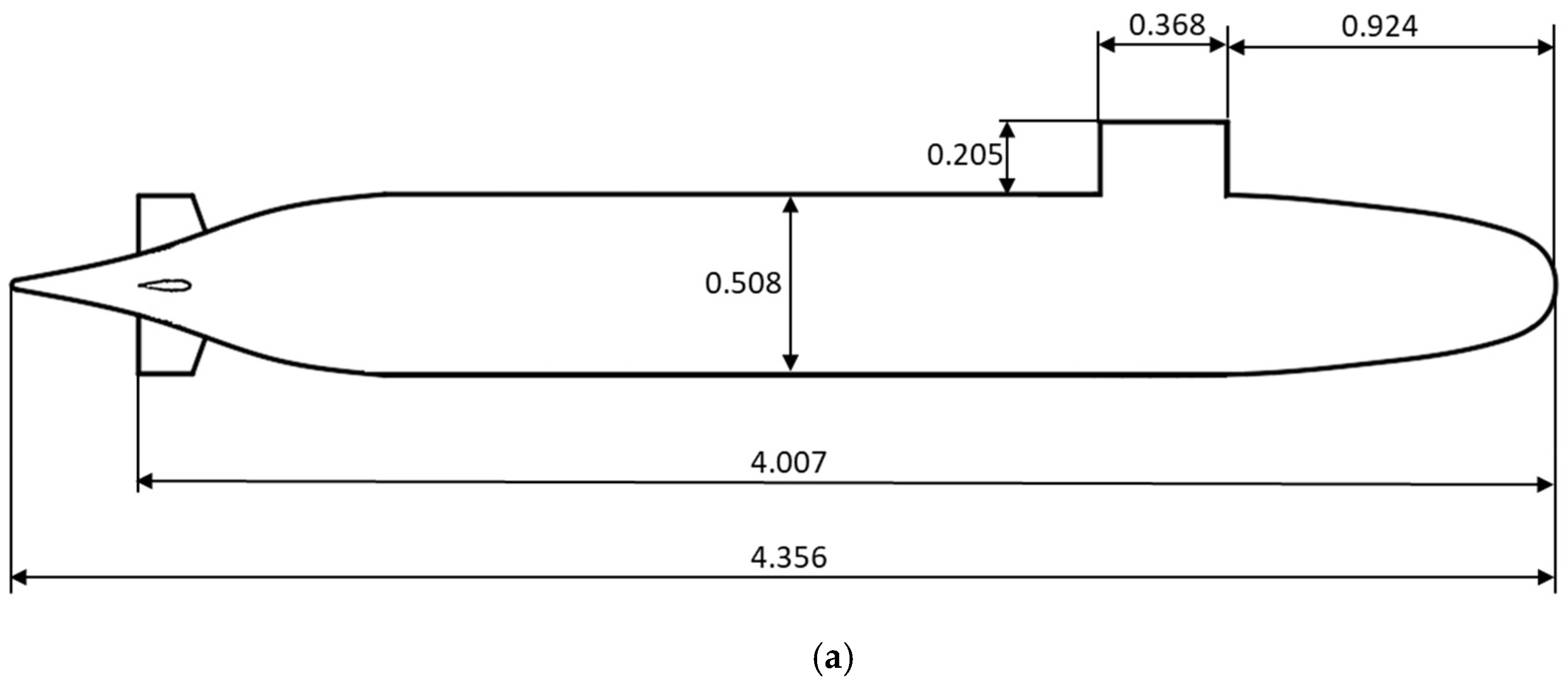
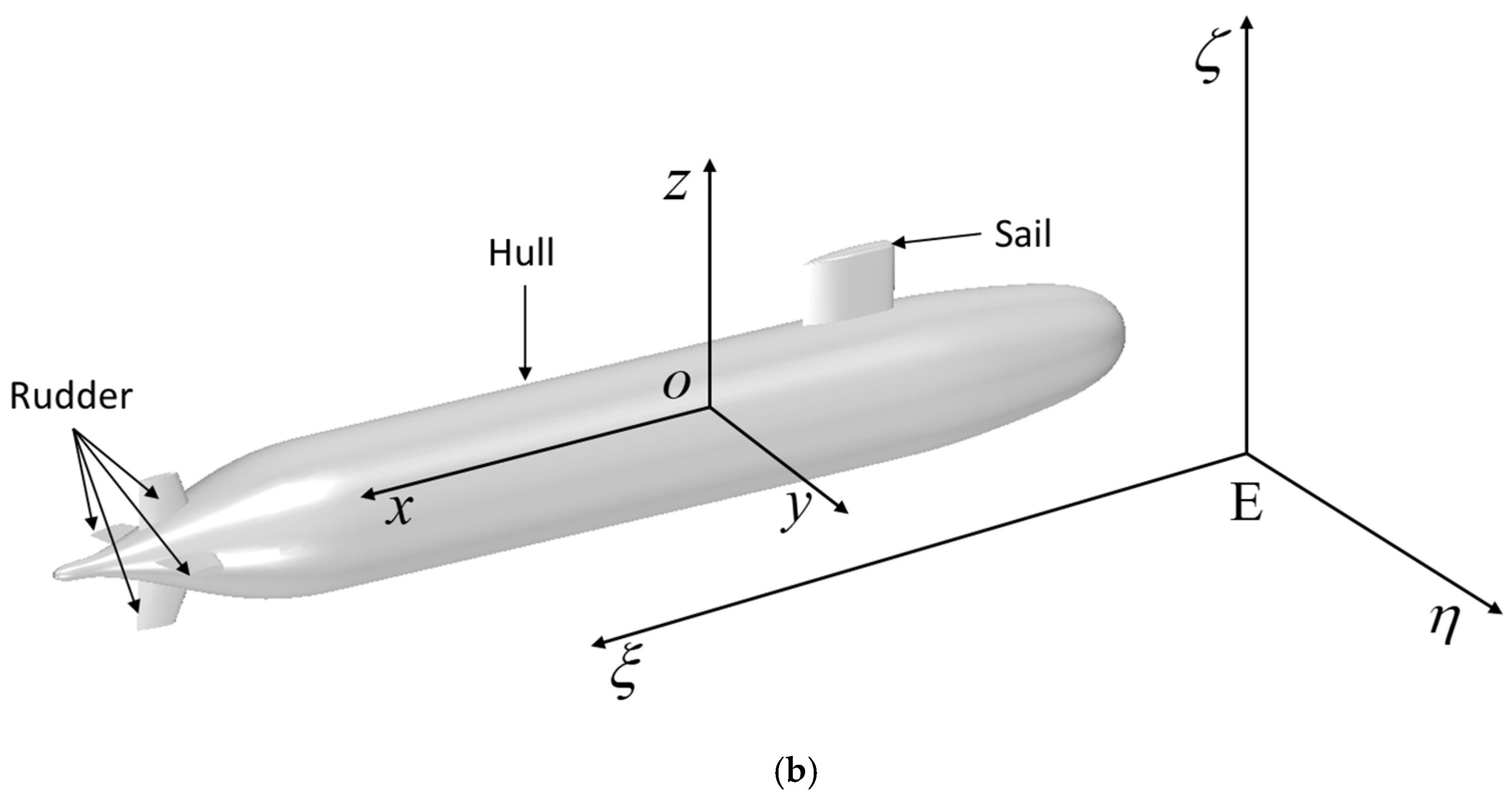
The subject of this study is the DARPA SUBOFF model, a conceptual nuclear submarine model developed by David Taylor [28]. As shown in Figure 1a the model consists of three main components: an axisymmetric, teardrop-shaped hull; a streamlined sail (fairwater); and a symmetrically arranged cruciform tail. The cruciform tail comprises a pair of horizontal stern planes and a pair of vertical rudders. The detailed physical parameters of the DARPA SUBOFF model are listed in Table 2 [29].
The coordinate systems employed in this study are illustrated in Figure 1b. An Earth-fixed coordinate system is used to define the position of the submarine within the flow field, while a body-fixed coordinate system, which moves with the submarine, is established to describe its motion. Both coordinate systems follow the right-hand rule.

3.2. Computational Domain Dimension and Boundary Condition

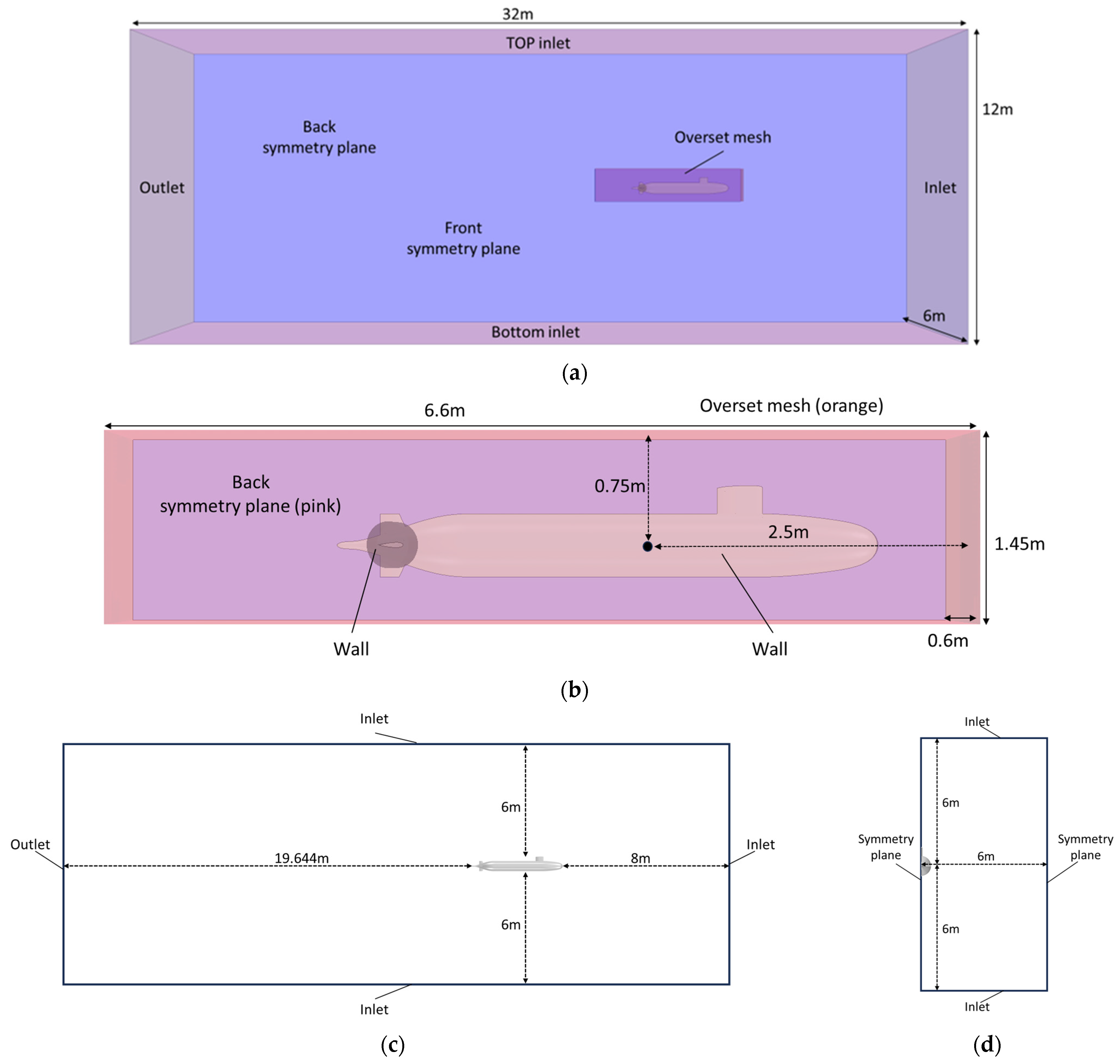
In this study, a rectangular computational domain was employed to simulate the flow field around the submarine. Considering the symmetry of the DARPA SUBOFF model about its centerline, only half of the domain was used to reduce computational cost.
The origin of the body-fixed coordinate system is located at the submarine’s center of gravity, 2.009 m from the submarine’s spherical nose. From this, the distances from the origin of the body-fixed coordinate system to the boundaries of each region in Figure 2 can be inferred. As shown in Figure 2a. The dimensions of the rectangular domain were 32 m × 6 m × 12 m. For the boundary conditions, a velocity inlet and a pressure outlet were specified at positions 8 m upstream and 19.644 m downstream of the submarine’s bow and stern, respectively. The top and bottom boundaries of the domain were also defined as velocity inlet, each located 6 m from the submarine’s center of gravity. The left side (centerline plane) and the right side of the domain were set as symmetry planes, with the right symmetry plane located 6 m from the center of gravity. As shown in Figure 2b, to improve the accuracy of the numerical results, a refined region was established around the submarine. The dimensions of this refined computational zone are 6.6 m × 0.6 m × 1.45 m. The figure illustrates the distances from the submarine’s center of gravity to the boundaries of the refined region, as well as the settings of the boundary conditions. The submarine’s longitudinal symmetry plane is set as a symmetry boundary (pink area), while the other five faces are defined as overset mesh interfaces (orange area). The submarine surface and the rudder rotation region are specified as wall boundaries. The front and side views of the entire computational domain are shown in Figure 2c,d, respectively.

3.3. Grid Generation and Arrangement

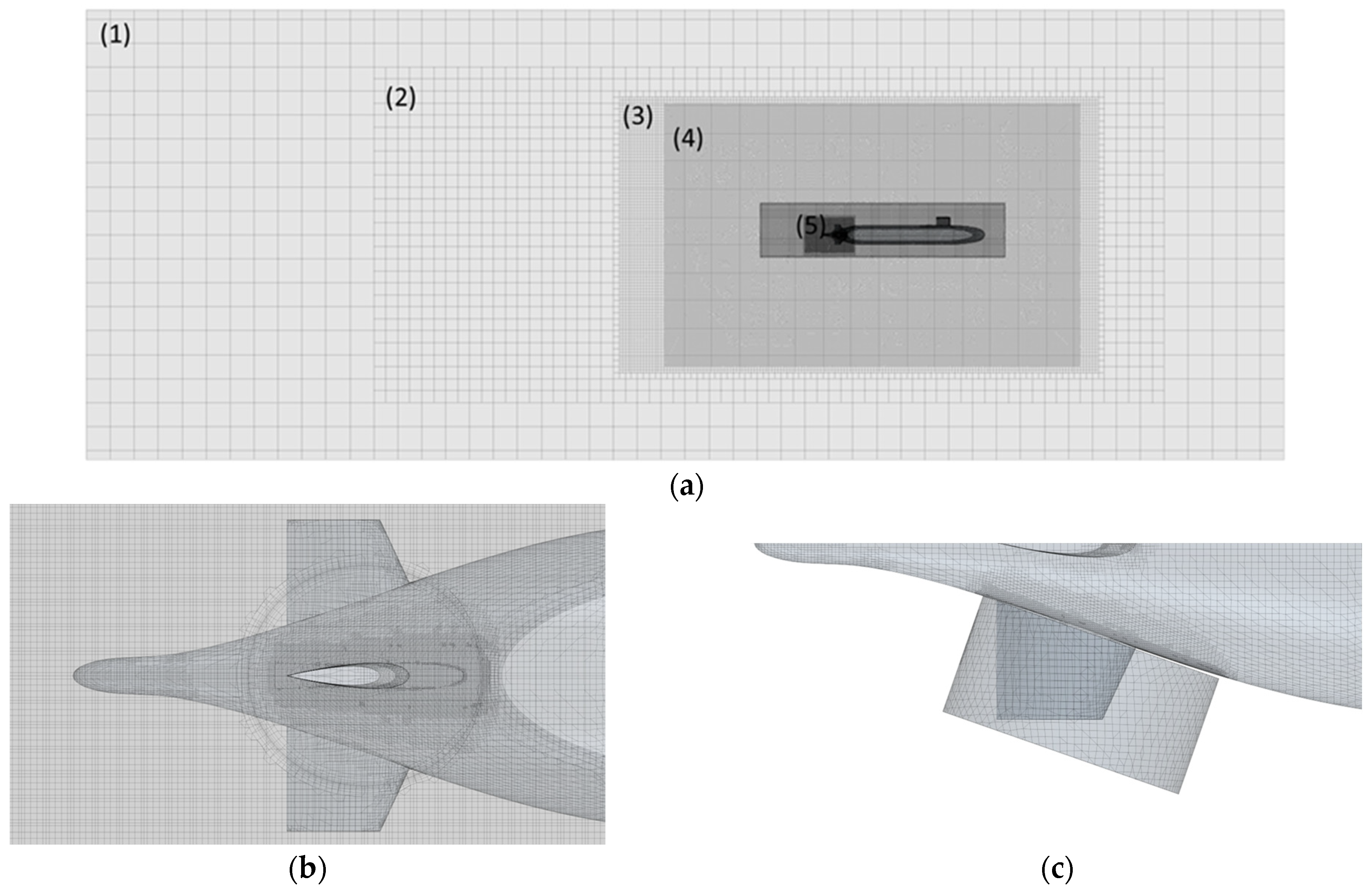
Given the geometric complexity of the hull and its appendages, the present study employs a trimmed-cell mesh to discretize the entire computational domain. To accurately capture the flow characteristics around the submarine, the domain is divided into five subregions, with the mesh density progressively refined from the outermost to the innermost regions. As shown in Figure 3a, Region (1) corresponds to the far field and features the coarsest mesh; the mesh size in this region transitions smoothly and becomes progressively finer toward Region (2) and Region (3). Region (4) fully encompasses the entire submarine, with dimensions designed to accommodate the hull even under certain pitch angles. The relatively fine mesh in this region enables detailed resolution of the flow field around the hull. Furthermore, to accurately simulate the complex flow structures induced by variations in the stern control surface deflection, a locally refined zone (Region (5)) is established in the stern area. This region features the smallest cell size and the highest mesh density, aiming to capture intricate flow details in the vicinity of the stern planes and thereby enhance computational accuracy. The rotation mode of the stern horizontal planes is illustrated in Figure 3b,c.

3.4. Validation and Verification of the Numerical Model

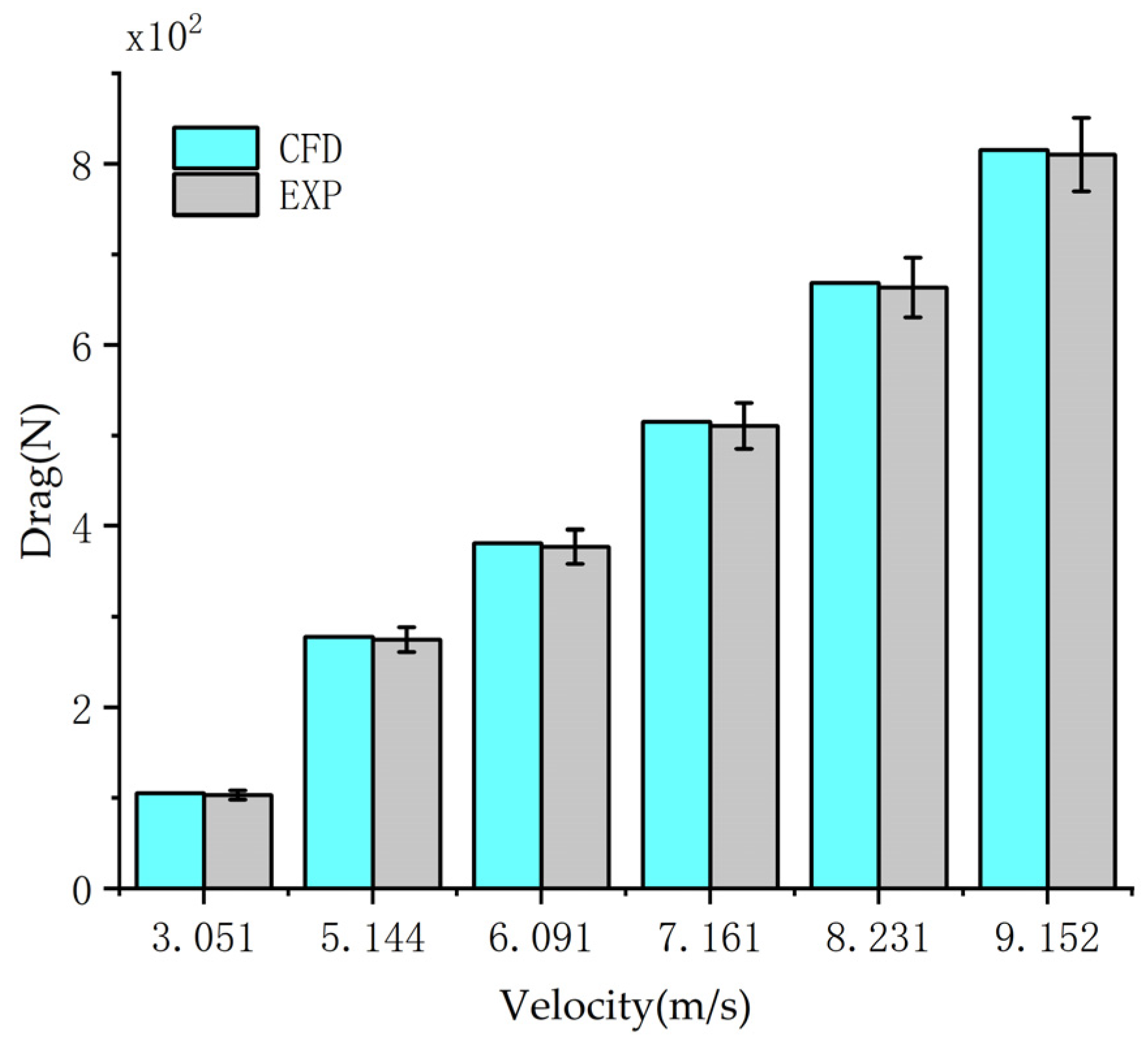
To ensure the accuracy and reliability of the developed submarine numerical model with appendages, a systematic validation procedure was conducted in this study. The validation consists of two primary aspects. First, straight-ahead simulations at different forward speeds were performed, and the computed resistance values were compared with internationally recognized experimental data (from the David Taylor Research Center). Second, for various pitch-angle conditions, steady-flow simulations were carried out to obtain the nondimensional force and moment coefficients of the submarine, which were subsequently compared with benchmark experimental data. This comprehensive validation provides a thorough assessment of the capability of the numerical model in predicting the hydrodynamic characteristics of submarines in calm-water conditions.
Figure 4 illustrates the comparison of submarine resistance at different forward speeds, where the blue bars represent the numerical simulation (CFD) results and the gray bars denote the experimental (EXP) data, with error bars included. As shown in the figure, the resistance increases significantly with speed. At lower speeds, the numerical and experimental results are nearly identical. With increasing speed, the numerical predictions become slightly higher than the experimental values, which may be attributed to minor discrepancies in simulating boundary layer development and vorticity distribution. Nevertheless, the deviations remain small and within the acceptable range for engineering applications. Overall, the CFD results are in good agreement with the experimental data, with consistent trends observed across all speeds, indicating that the developed numerical model can reliably predict the resistance characteristics of the submarine.
In addition to straight-ahead resistance, the maneuverability of a submarine in the vertical plane is more directly influenced by the hydrodynamic forces and moments acting at different angles of attack. Therefore, in this study, submarine pitch simulations were further conducted at a forward speed of 3.3436 m/s (6.5 knots) to obtain the lift, drag, and pitching moment coefficients. The results were nondimensionalized and compared with the benchmark experimental data.
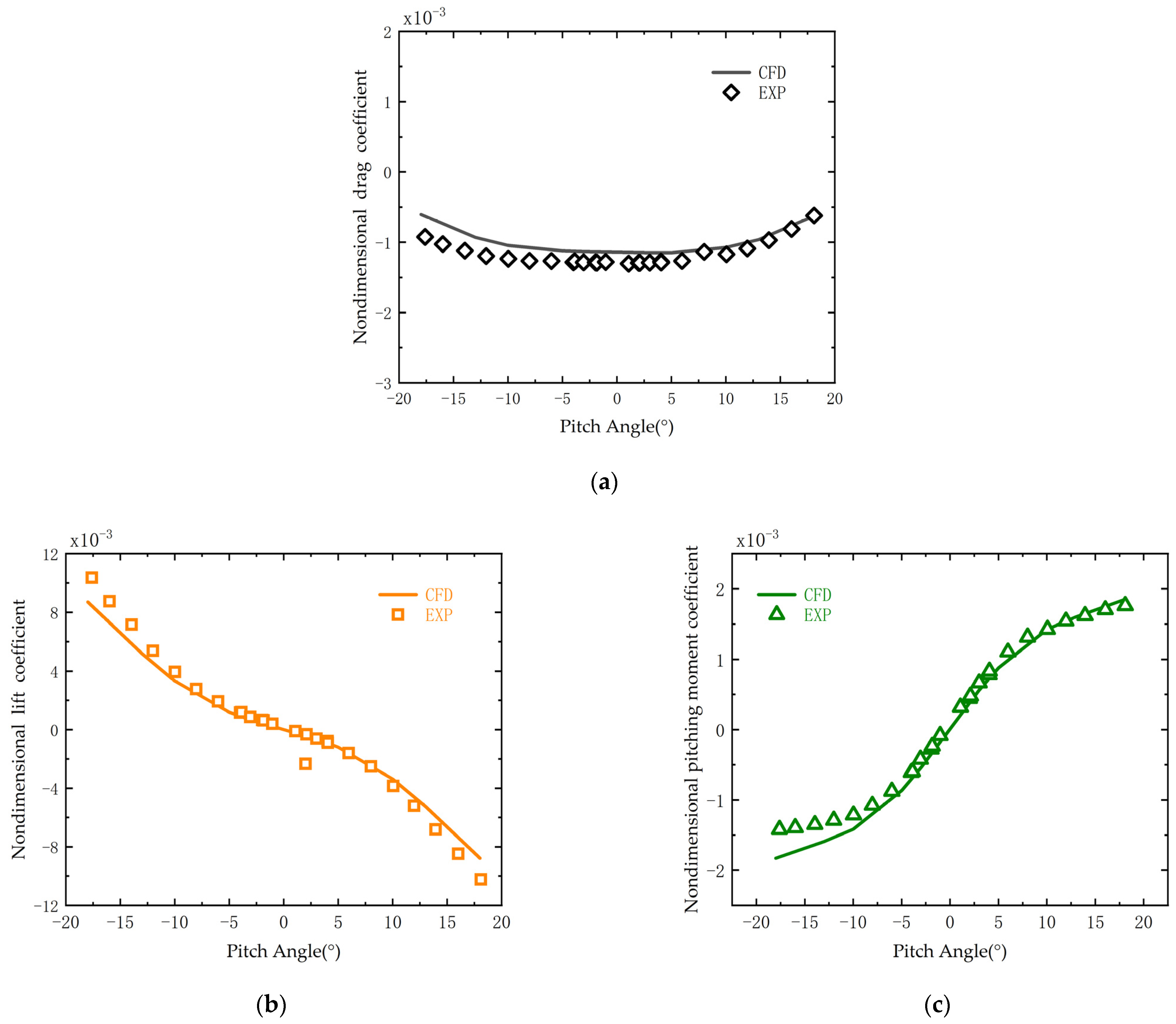
As shown in Figure 5, this study systematically compares the numerical simulation results of the nondimensional force and moment coefficients of the submarine at different pitch angles (−18° to +18°) with experimental data, thereby verifying the reliability of the numerical model in predicting hydrodynamic performance in calm water from multiple perspectives. As shown in Figure 5a, both the CFD and experimental results indicate that the drag coefficient varies only slightly with pitch angle, with its minimum occurring near a slightly negative pitch. The overall trends of the two datasets are consistent, and good agreement is observed in the positive pitch-angle range. In the range of −18° to −15°, the CFD predictions are slightly higher than the experimental values; however, the maximum deviation remains within 15%, which is considered acceptable.
Regarding the lift and pitching moment coefficients shown in Figure 5b,c, the numerical predictions exhibit excellent agreement with experimental measurements in the linear region (small angles of attack). As shown in Figure 5b, the lift coefficient exhibits an approximately linear variation with pitch angle in both the CFD results and the EXP data. Within the pitch angle interval between −10° and 10°, the slope and magnitude of the two datasets match closely, demonstrating good agreement. At larger pitch angles, the CFD curve remains smoother, whereas the experimental data become slightly more scattered. As shown in Figure 5c, the pitching moment coefficient increases monotonically with pitch angle in both datasets. The CFD results successfully reproduce this trend and accurately capture the rapid increase in pitching moment when the pitch angle exceeds +10°. In the range of −10° to −5°, the CFD values are slightly higher than the EXP measurements, whereas at larger positive pitch angles, the two results converge again and exhibit good agreement. More importantly, the simulation accurately captures the nonlinear transition trends at higher pitch angles (α > 10°). This indicates that the k ε model, despite its simplified assumptions, successfully resolves the macroscopic pressure distribution changes along the hull and the restoring moment generated by the stern stabilizers. The maximum relative error remains within 10%, verifying the model’s reliability for stability analysis.
Overall, this good agreement is primarily attributed to several factors. First, the numerical model employed a high-resolution cut-cell mesh, with local refinements applied to the boundary layer, stern region, and control surfaces, enabling accurate capture of pressure distribution and vortex evolution at different angles of attack. Second, the k ε turbulence model was utilized to simulate the viscous flow field. This model offers a robust balance between computational efficiency and physical accuracy, particularly when the submarine operates at pitched attitudes where adverse pressure gradients are liable to induce flow separation. It demonstrated exceptional capability in resolving the fully turbulent flow regime and the evolution of wake structures around the sail and stern appendages, thereby ensuring high accuracy in the prediction of hydrodynamic moments. Furthermore, the numerical simulations strictly followed the geometric and operating conditions of internationally recognized benchmark experiments, ensuring the validity of comparisons. The model still exhibits overall reliable hydrodynamic prediction capability under calm-water conditions. This demonstrates its ability to meet engineering requirements and provides a solid foundation for subsequent numerical investigations of submarine maneuvering in the vertical plane.

4. Analysis of the Influence of Steering Strategies on Vertical Plane Maneuvering Characteristics

The aforementioned static simulations verified the accuracy of the numerical model in predicting hydrodynamic forces under steady-state conditions. However, the actual maneuvering of a submarine is a highly unsteady process involving complex coupled interactions among the hull, appendages, and surrounding flow. To investigate the dynamic response characteristics of the submarine in the vertical plane, this section carries out maneuverability simulations under motion conditions. The submarine is set to travel straight at a fixed initial speed for a certain period to ensure stable initial motion and the establishment of a fully developed flow field. Subsequently, while maintaining this speed, the stern planes are actuated. During this process, the unsteady motion trajectories, attitude variations, and hydrodynamic responses of the submarine are captured, and the influence of different steering strategies on the pitching motion and vertical-plane maneuverability is analyzed.

4.1. Steering Strategies and Simulation Conditions

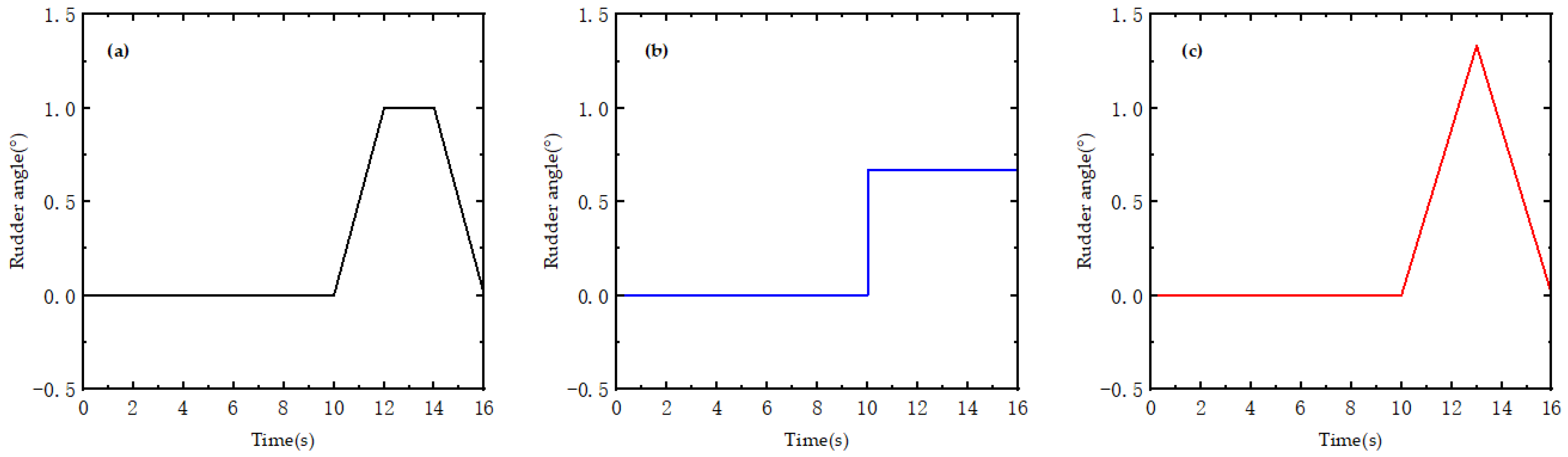
To investigate the influence of different steering strategies on the vertical-plane maneuverability of the submarine, three typical steering modes were designed in this study: trapezoidal steering, step steering, and linear steering. The rudder angle–time curves of these three modes are shown in Figure 6. In Figure 6, the areas enclosed by the rudder angle curves and the time axis are equal, thereby ensuring that the rudder impulse is the same for all cases. This enables a fair comparison of the differences in submarine motion and hydrodynamic responses under different steering strategies. The rudder impulse is defined as the integral of the rudder angle over time, which physically represents the total angular momentum input imparted to the hull by the steering action. Therefore, by comparing cases under the condition of equal total impulse, the independent effect of the time-varying pattern of the steering command (how the rudder is applied) on the system response can be isolated.
Based on existing studies on submarine vertical-plane maneuvering, it is generally recommended to employ small rudder angles during the initial stage of vertical-plane unsteady motion at high speeds. As shown in Figure 6, the submarine’s rudder angle remains at 0 degrees during the first ten seconds, and the three steering strategies are applied starting from t = 10 s.: (a) Trapezoidal steering: The rudder angle begins to increase at 0.5°/s from the 10 s, reaches 1°, remains constant for 2 s, and then decreases back to zero at a rate of −0.5°/s. (b) Step steering: At the 10 s, the rudder angle instantaneously reaches the maximum commanded value of 2/3°, and is held constant until the 16 s. (c) Linear steering: The rudder angle starts to increase at a constant rate of 4/9°/s from the 10 s, reaches 4/3° at the 13 s, and then decreases back to zero at a rate of −4/9°/s by the 16 s.
The simulation conditions are set as follows: The submarine initially executed horizontal straight-line motion in the vertical plane at a speed of 6.5 knots. From t = 0 s to t = 10 s, this straight and level cruise was maintained, with the rudder angle held at zero to ensure the flow field was fully developed (For the first 10 s, the submarine maintained constant depth and heading). Subsequently, after t = 10 s the three steering commands described above are applied, with each maneuver lasting 6 s per cycle. The total simulation time is 16 s, ensuring that the submarine completes the entire maneuver and reaches a new steady state. The simulation employs the previously validated numerical methods ( k ε turbulence model) to ensure the comparability and reliability of the results.

4.2. Motion Response Comparison and Analysis

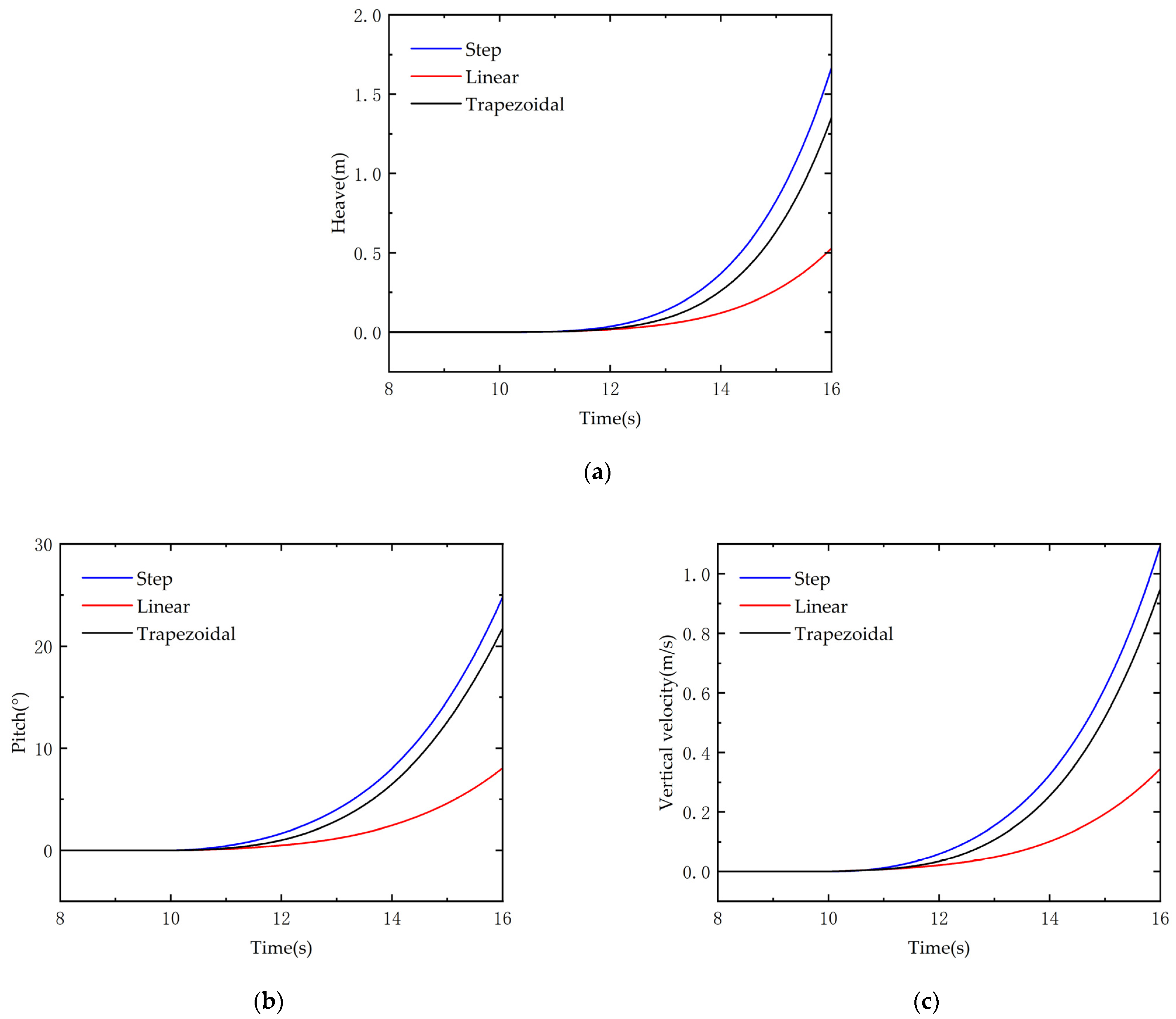
As shown in Figure 7, the variations of heave, pitch angle, and vertical velocity under the three different steering strategies are compared and analyzed. The vertical plane motion responses under the three steering strategies exhibit the same overall trend: the submarine’s heave motion, pitch angle, and vertical velocity all increase over time. Numerically, the magnitudes are the largest for step steering, followed by trapezoidal steering, and the smallest for linear steering.
As shown in Figure 7a, during the initial stage (0–10 s), the submarine maintains a steady horizontal attitude without rudder deflection, and the vertical displacement remains zero. When the rudder starts deflecting (10–12 s), the response among the three steering strategies remains negligible due to the small rudder amplitude and motion inertia. After 12 s, the effect of steering becomes significant: both step and trapezoidal steering produce a rapid increase in vertical displacement, while linear steering shows a gradual and delayed response. By 16 s, the maximum heave amplitudes reach approximately 1.67 m, 1.35 m, and 0.53 m, respectively. The pitch angle variation in Figure 7b follows a similar trend. The attitude remains level before 10 s, and pitch fluctuations are minor during 10–12 s. Afterward, as the stern plane deflects, the pitch increases rapidly—most prominently under step steering, followed by trapezoidal, while linear steering exhibits the slowest, smoothest response. At 16 s, the maximum pitch angles are about 25°, 21°, and 8°, respectively. As shown in Figure 7c, the vertical velocity remains nearly zero during 0–10 s, with only slight variations up to 12 s. Afterward, the growing rudder deflection enhances lift and accelerates the submarine’s ascent. Step steering yields the fastest increase (about 1.1 m/s), trapezoidal steering follows (about 0.95 m/s), and linear steering shows the weakest rise (about 0.35 m/s).
Through comparative analysis, it can be concluded that the variation trends of submarine heave, pitch, and vertical velocity are generally consistent. However, the motion responses under different steering strategies show significant differences. The step steering strategy induces the fastest initial response but tends to cause overshoot, resulting in strong unsteady effects. Correspondingly, the submarine exhibits large heave and pitch variations, intense attitude fluctuations, and poor motion stability. In practical operation, excessive pitch angles may even lead to capsizing. The linear steering strategy produces a smoother but slower attitude change; however, its motion response is relatively sluggish, and the vertical velocity fails to reach the desired value, making it suitable only for small attitude adjustments. In contrast, the trapezoidal steering strategy achieves a moderate response rate and smooth velocity variation, effectively reducing the rate of pitch change and ensuring a more stable and controllable ascent attitude, making it more suitable for conventional surfacing and depth adjustment maneuvers.

4.3. Hydrodynamic Characteristics Comparison and Analysis

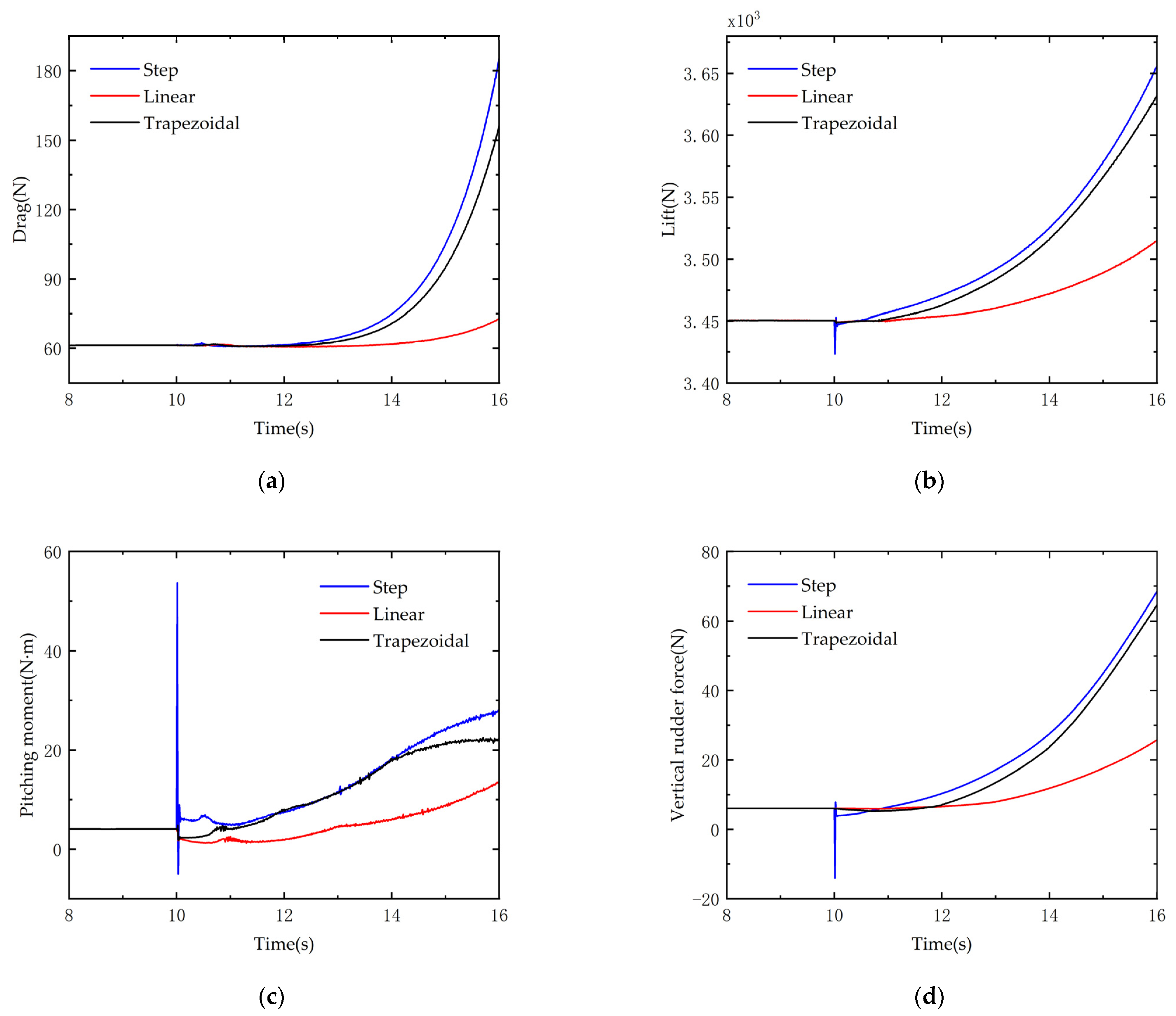
The hydrodynamic results of the submarine under three different steering strategies are shown in Figure 8, focusing on the comparative analysis of drag, lift, pitching moment, and vertical rudder force.
As shown in Figure 8a, the variation of submarine resistance generally follows the trend of the pitch angle. Within the safe pitch range, resistance increases approximately proportionally with pitch angle. Both step and trapezoidal steering show similar patterns—slow growth followed by a sharp rise between 14 s and 16 s, reaching about 185 N and 155 N, respectively—while linear steering exhibits a gradual increase to roughly 73 N. In Figure 8b, during the first 10 s of straight-line motion, the lift on the submarine remains nearly constant (about 3450 N). When steering begins at 10 s, the sudden deflection of the stern plane causes a pressure reversal on the rudder surface (with the pressure on the upper surface exceeding that on the lower surface), resulting in an instantaneous negative lift, a drop in overall lift, and the onset of oscillations. Among the three cases, the oscillations under step steering are the most pronounced, while those under trapezoidal and linear steering are more moderate. Subsequently, as time progresses, the lift increases steadily for all steering modes, eventually reaching approximately 3650 N (step), 3625 N (trapezoidal), and 3500 N (linear). Figure 8c presents the time history of the submarine’s pitching moment. Due to the geometric asymmetry of the hull, the flow exerts a net force on the sail, resulting in a slightly positive pitching moment during straight sailing. At t = 10 s, when the stern plane begins to deflect, the submarine experiences a sudden onset of translational and angular acceleration. This leads to the instantaneous generation of added-mass forces and added-moment-of-inertia effects, which act on the hull and cause an immediate reduction in the pitching moment. Because the torque produced by the trapezoidal and linear steering modes is relatively small, their pitching moments decrease first. In contrast, the step steering generates a substantially larger rudder moment, exceeding the counteracting moment induced by the added rotational inertia, and thus the blue curve exhibits a sharp initial rise. As time progresses, all three cases show a gradual increase in pitching moment, with the step, trapezoidal, and linear modes eventually reaching approximately 30 N·m, 25 N·m, and 15 N·m, respectively. Figure 8d presents the time history of the vertical rudder force generated by the stern plane. During the straight-sailing stage from 0 to 10 s, the vertical rudder force remains close to zero for all three steering strategies, with no significant lift variation observed. At 10 s, as the stern plane begins to deflect, the sudden change in angle causes the pressure on the upper surface of the rudder to exceed that on the lower surface, producing a downward vertical force. Consequently, the step and trapezoidal steering cases exhibit a sharp negative pulse, whereas the linear steering case shows a smoother variation, followed by a gradual increase in rudder force. By 16 s, the rudder forces corresponding to step, trapezoidal, and linear steering reach approximately 70 N, 65 N, and 30 N, respectively.
The comparative analysis shows that at the moment the rudder command is applied, the step steering strategy generates extremely large instantaneous peaks in pitching moment and vertical rudder force—approximately 14 and 15 times greater, respectively, than those produced by the trapezoidal and linear steering strategies. This peak moment triggers intense pitching motion of the submarine and induces subsequent oscillations. Meanwhile, the resistance rises sharply, and the flow field undergoes a violent unsteady adjustment process. The hydrodynamic characteristics under linear steering are relatively smooth; however, due to its weakest rudder effectiveness, the resulting pitching moment is small, leading to limited capability in adjusting the submarine’s attitude. In contrast, under the trapezoidal steering strategy, the submarine’s lift, pitching moment, and vertical rudder force gradually increase over time without noticeable transient shocks, exhibiting good coupling with the motion response. This approach not only maintains maneuverability in the vertical plane but also enhances the controllability of the submarine’s attitude.

4.4. Flow Field Analysis

The preceding sections have analyzed the hydrodynamic characteristics and motion responses of the submarine under different steering strategies. The flow field structure during the maneuvering process is one of the key factors causing these differences. Therefore, in this section, a detailed flow field analysis is conducted based on the velocity field and vorticity distribution, to investigate the evolution of the surrounding flow field around the submarine during the steering process.

4.4.1. Velocity Fields Around the Submarine

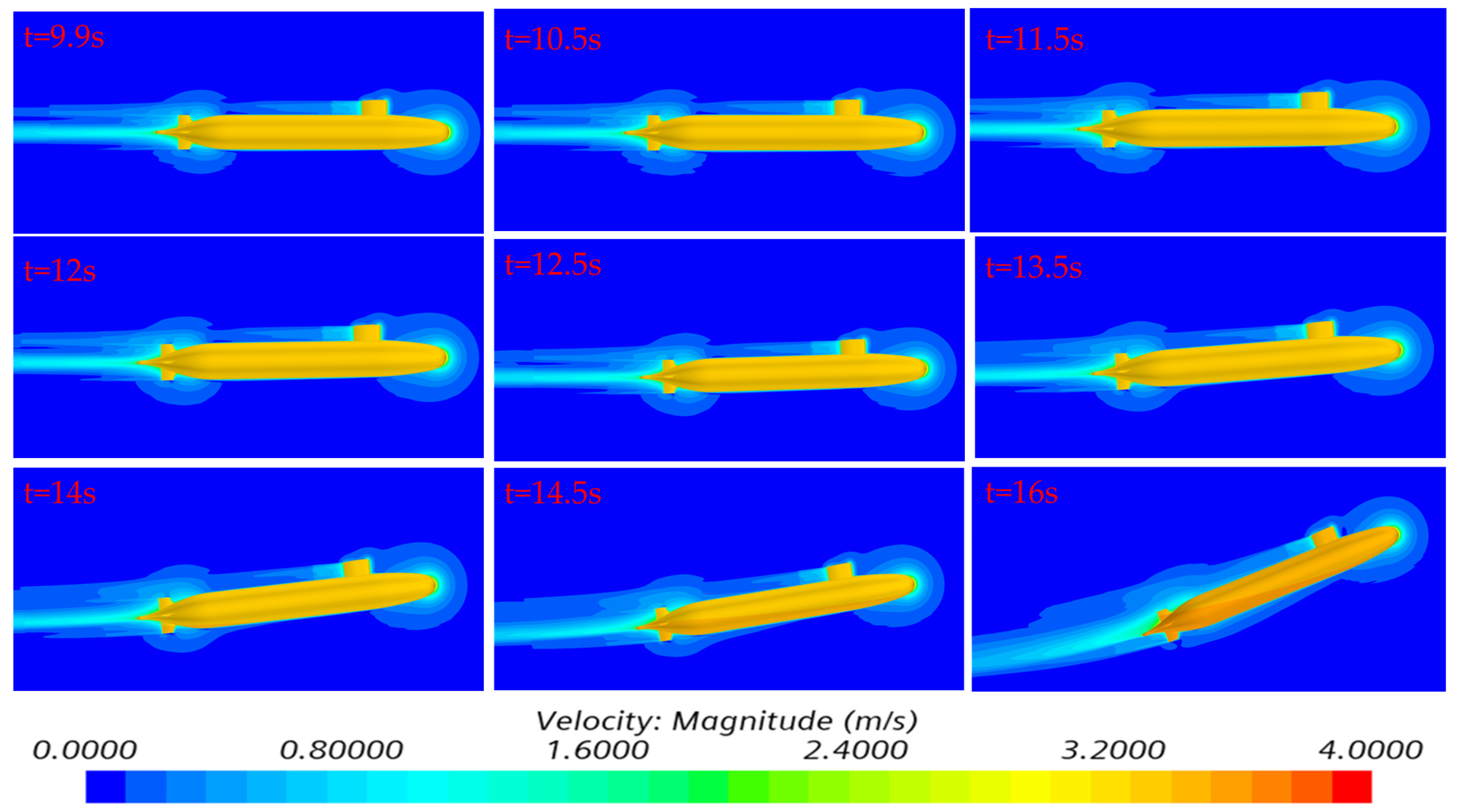
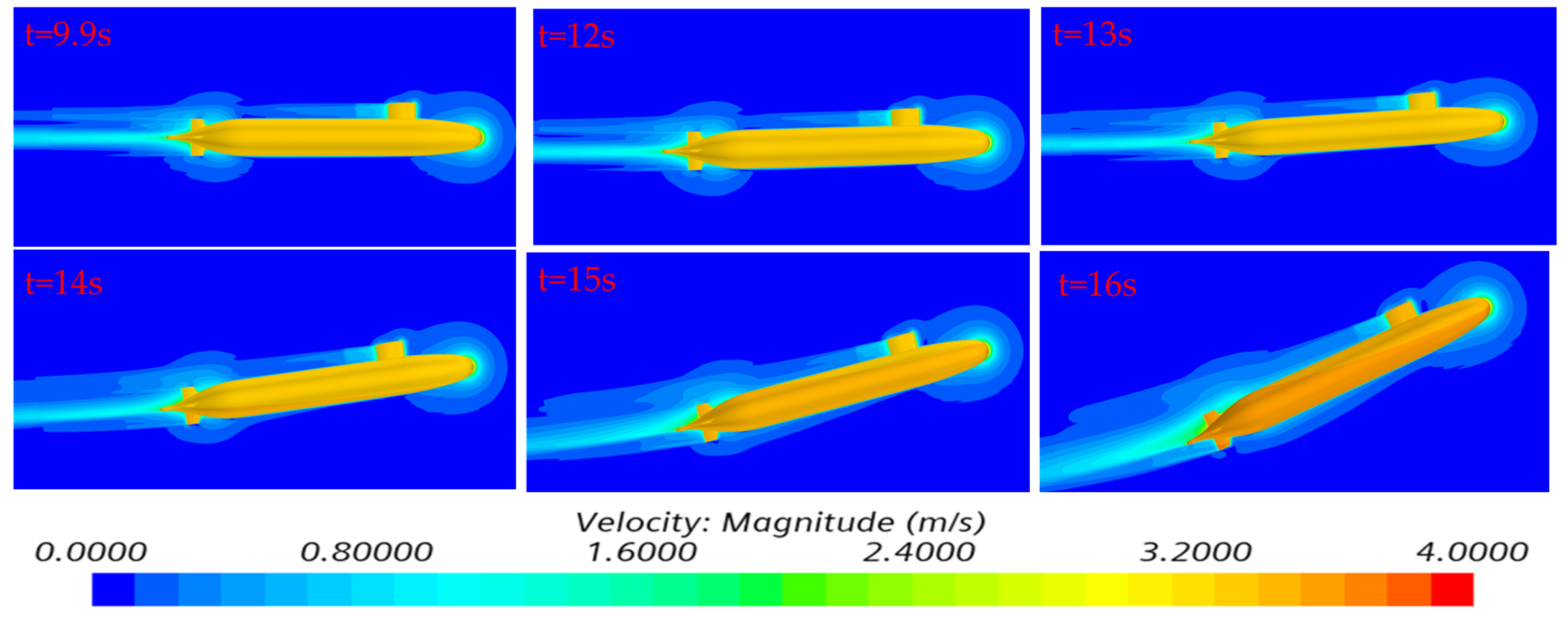
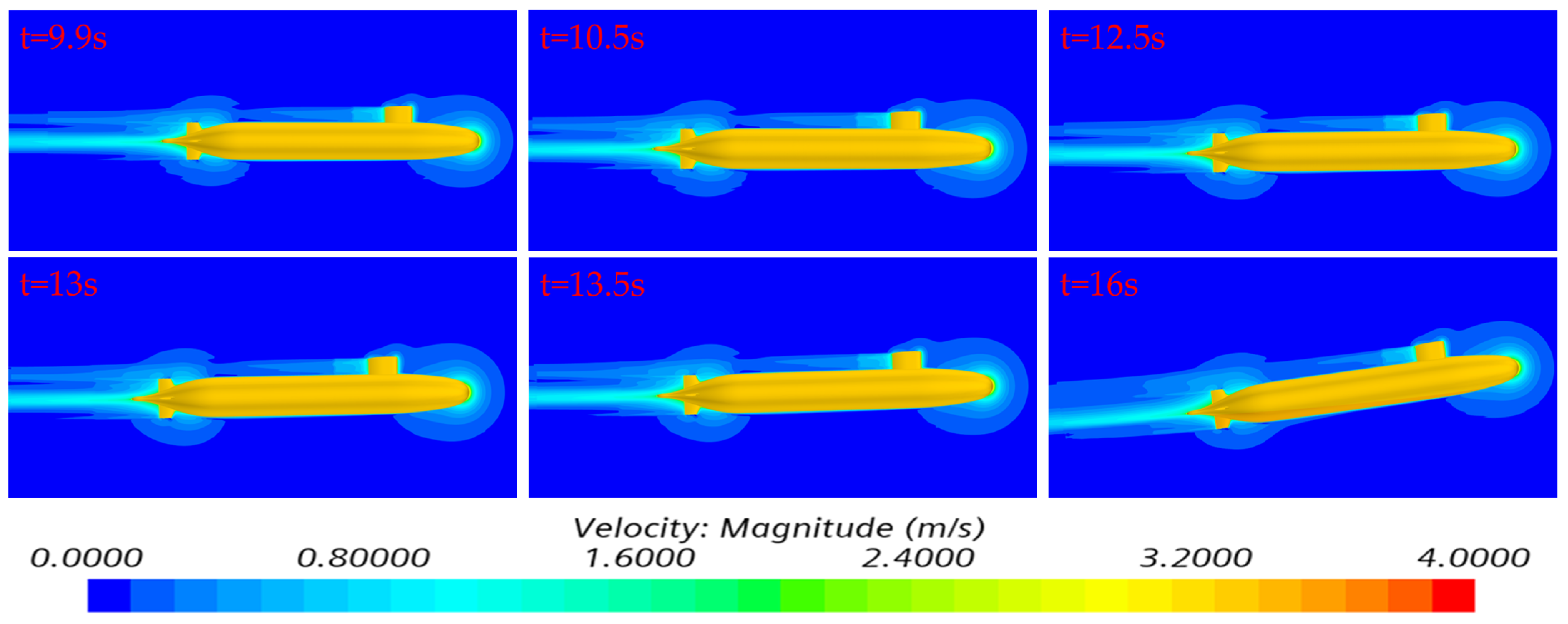
The evolution of the flow field in the submarine’s vertical plane under the three steering modes is shown in Figure 9, Figure 10 and Figure 11. For the three steering conditions, we analyzed the evolution of the flow field at the moments before and after the rudder-angle variation. During the steering process, as the control surface continues to deflect, the flow field around the submarine undergoes a dynamic evolution. Once steering begins, the symmetry of the flow breaks down, and two regions with different velocity gradients develop near the aft control surfaces. With further evolution of the flow, the pressure beneath the hull becomes greater than that above, causing the submarine to pitch. The pitch angle then gradually increases, and the flow-field evolution under the three steering strategies can be summarized as follows:
Before steering begins at t = 9.9 s, the flow field around the submarine is symmetric and stable, with streamlines smoothly attached to the hull surface and no significant disturbance observed in the wake region. As the control surface deflects and the submarine begins to pitch, the aft flow structure changes: a low-velocity region develops beneath the stern and extends downstream, while a high-velocity region forms above it, breaking the flow symmetry and marking the establishment of longitudinal lift.
As time progresses beyond t = 13 s, the flow-field responses of the three steering modes begin to diverge noticeably. Under step steering (Figure 10), the rapid and abrupt change in deflection angle induces a strong transient disturbance, which quickly destroys the symmetry near the stern. The high- and low-velocity regions shift noticeably, accompanied by the formation and movement of local separation points, leading to a significantly elongated wake. By t = 16 s, the velocity gradients within the wake intensify, the shear layers become more distinct, and the low-velocity region continues to expand, indicating highly unsteady hydrodynamic loading. This unstable flow corresponds directly to the strong pitching response and hydrodynamic oscillations, making step steering the most unsteady of the three modes.
In contrast, trapezoidal steering (Figure 9), characterized by a gradual increase and subsequent decrease in rudder angle, introduces a more progressive excitation. As a result, the aft flow develops with better continuity and stability. The high- and low-velocity regions expand steadily while maintaining overall flow attachment. The shear layer remains thin and moderate, and only minor local separation occurs without forming sustained vortex shedding. Consequently, trapezoidal steering yields smoother lift growth and a more stable pitching response.
Under linear steering (Figure 11), the rudder deflects at the slowest rate, resulting in the weakest disturbance to the flow. The wake preserves a highly stable structure throughout the maneuver, and variations in velocity are minimal. Flow separation is nearly negligible. The maximum flow velocity is only about 4.7 m/s, lower than that of trapezoidal (≈5.2 m/s) and step steering (≈5.3 m/s), indicating reduced rudder effectiveness. Due to the limited rudder-induced acceleration, the flow adjusts more slowly, and shear-layer development is delayed, leading to a noticeably slower dynamic response. Although linear steering maintains the most stable flow field, it also yields the lowest maneuvering efficiency and weakest transient response.
Overall, although the three steering modes share similar global flow evolution patterns in the vertical plane, significant differences exist in local flow behavior and unsteady characteristics. The step steering mode induces the strongest transient acceleration and flow separation; the trapezoidal steering achieves a good balance between rudder effectiveness and flow stability, while the linear steering produces the most stable flow but the weakest control response.

4.4.2. Velocity Fields Around the Rudder

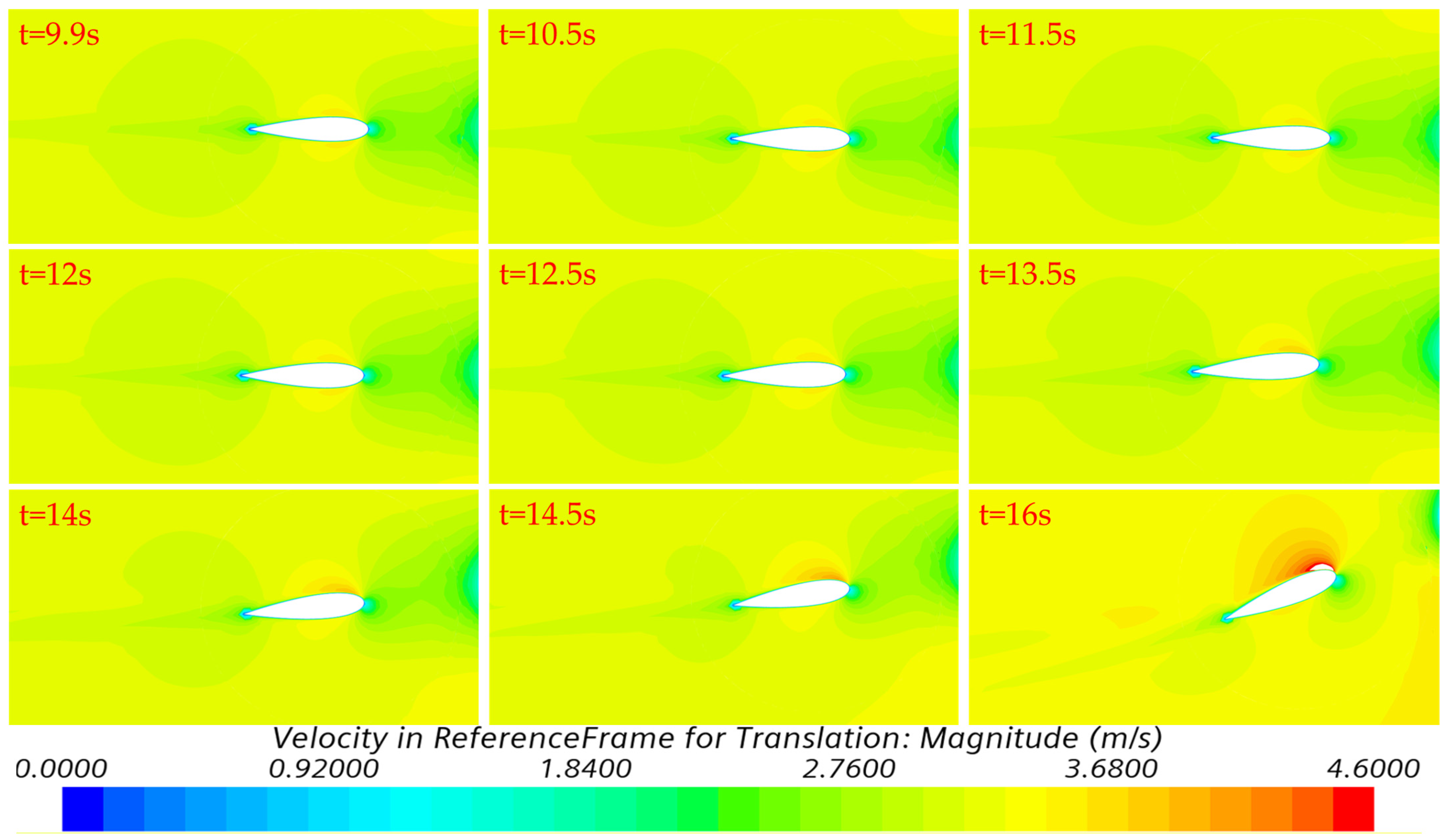
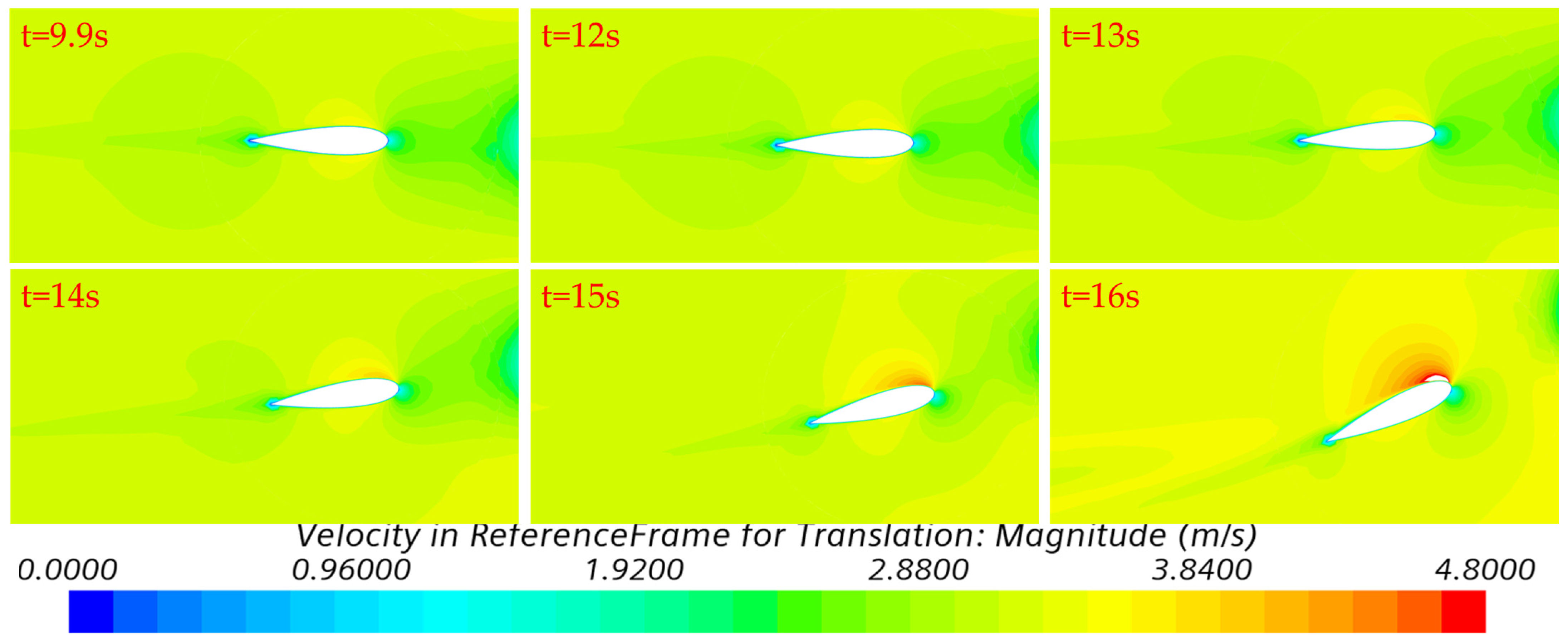
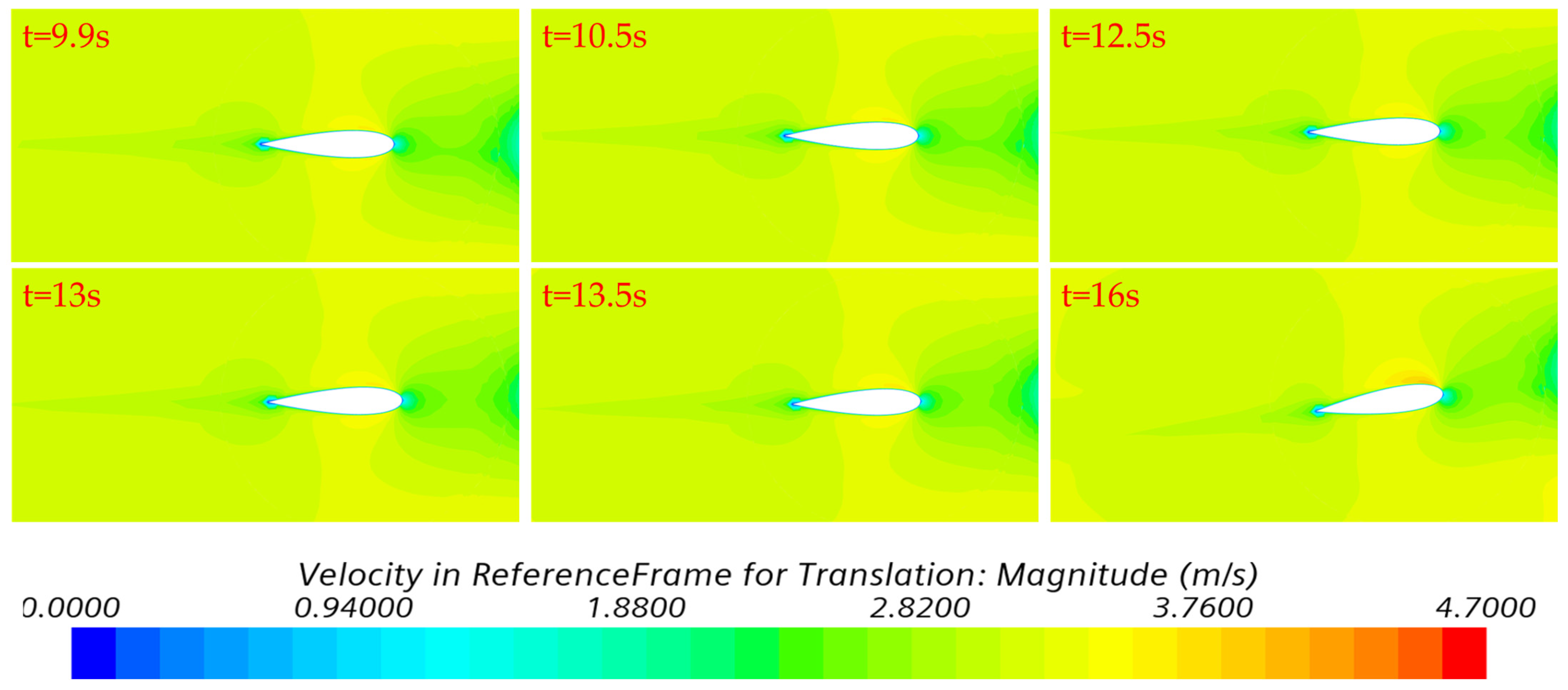
After analyzing the velocity variations and wake evolution of the overall flow field around the submarine in the global coordinate system, a more detailed investigation is conducted to examine the local flow behaviors near the rudder—such as acceleration, deceleration, and separation—and their relationship to rudder surface pressure and hydrodynamic force generation. To this end, the present study analyzes the local flow field around the rudder based on the relative velocity in a translational reference frame. The evolution of the velocity field near the rudder from t = 9.9 s to t = 16 s under the three steering strategies is shown in Figure 12, Figure 13 and Figure 14.
The local flow evolution near the rudder exhibits similar qualitative behavior for all three control modes. At t = 9.9 s, before the rudder deflection begins, the flow distribution on both sides of the rudder remains nearly symmetric, indicating good flow attachment, with only a small localized high-speed region appearing near the mid-chord of the rudder. As the submarine starts to pitch upward, the angle between the rudder and the horizontal incoming flow gradually increases, leading to an enhanced velocity gradient near the rudder’s leading edge and the development of a downstream low-speed region behind the trailing edge.
As time progresses beyond t = 13 s, the flow-field responses of the three steering modes begin to diverge noticeably. In the step steering case (Figure 13), the abrupt rudder-angle change causes an instantaneous increase in local angle of attack, leading to the strongest flow response. The velocity gradient near the leading edge rises sharply, flow asymmetry develops rapidly, and a downstream separation region forms and extends. By t = 16 s, a large high-speed region appears on the suction side (maximum velocity ≈ 5.3 m/s), accompanied by wake elongation and evident unsteady vortex shedding.
In contrast, trapezoidal steering (Figure 12) produces a smoother and more gradual flow evolution. As the effective angle of attack increases steadily, the suction-side high-speed region and pressure-side low-speed region expand in a controlled manner, resulting in a smooth lift development. Flow separation remains weak, and the wake stays stable, with a slightly lower maximum velocity of about 5.2 m/s but better overall stability.
For linear steering (Figure 14), the response is the mildest. The flow remains largely attached, with only weak trailing-edge separation. Variations in the high- and low-speed regions are limited, and the wake remains compact and steady. The maximum velocity reaches only 4.7 m/s, indicating the weakest control effectiveness and the most delayed hydrodynamic response, though with the highest flow stability.
In summary, while the overall structural evolution of the rudder flow field remains generally consistent across the three steering strategies, clear and meaningful differences emerge in terms of local flow intensity, unsteadiness, and stability. Step steering produces the most abrupt change in rudder angle, resulting in strong transient acceleration, a rapid increase in velocity gradients, and pronounced flow separation near the trailing edge. These effects lead to an elongated wake and intensified vortex shedding, reflecting its highly dynamic but less stable hydrodynamic response. In contrast, trapezoidal steering provides a smoother transition of rudder angle, enabling a more controlled development of suction- and pressure-side flow regions. This approach offers a balanced compromise between flow stability and control effectiveness, generating steady lift growth with limited separation and a relatively stable wake. Meanwhile, linear steering results in the mildest flow variations. The flow remains largely attached to the rudder surface, the wake stays compact and coherent, and unsteady features are minimal. However, this high level of stability comes at the cost of reduced hydrodynamic authority, leading to the weakest control effectiveness and the most delayed response among the three strategies.

4.4.3. Vortex Fields

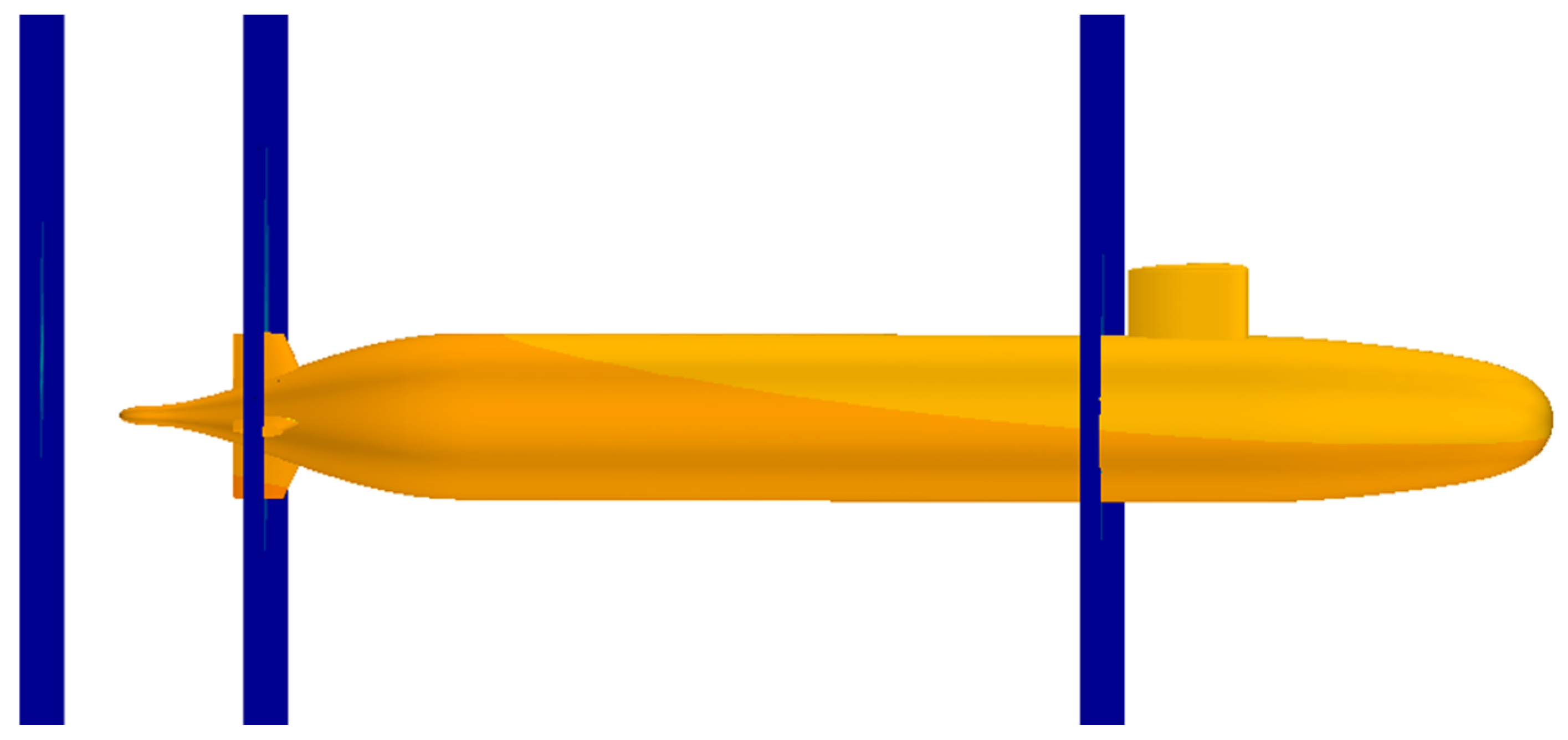
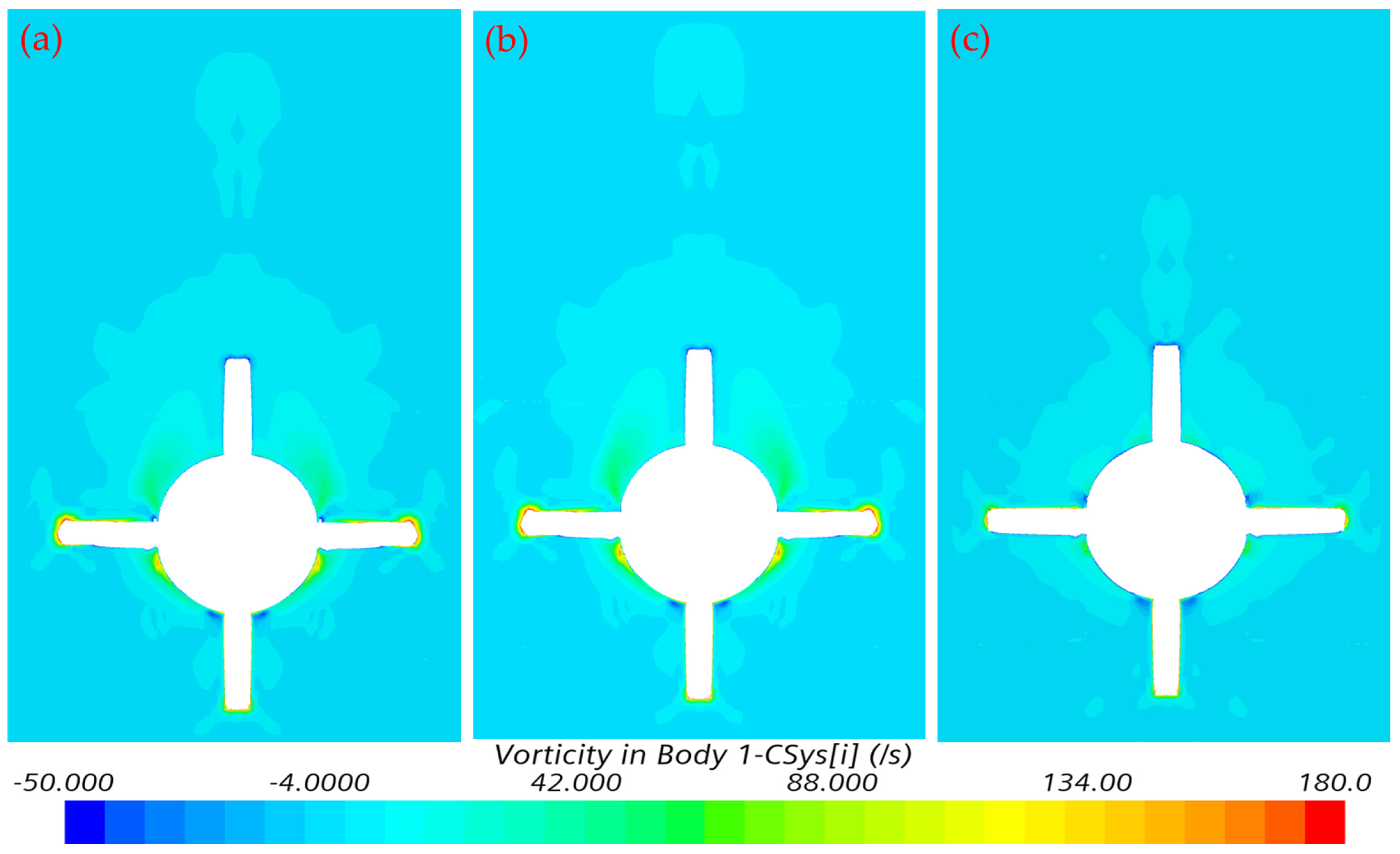
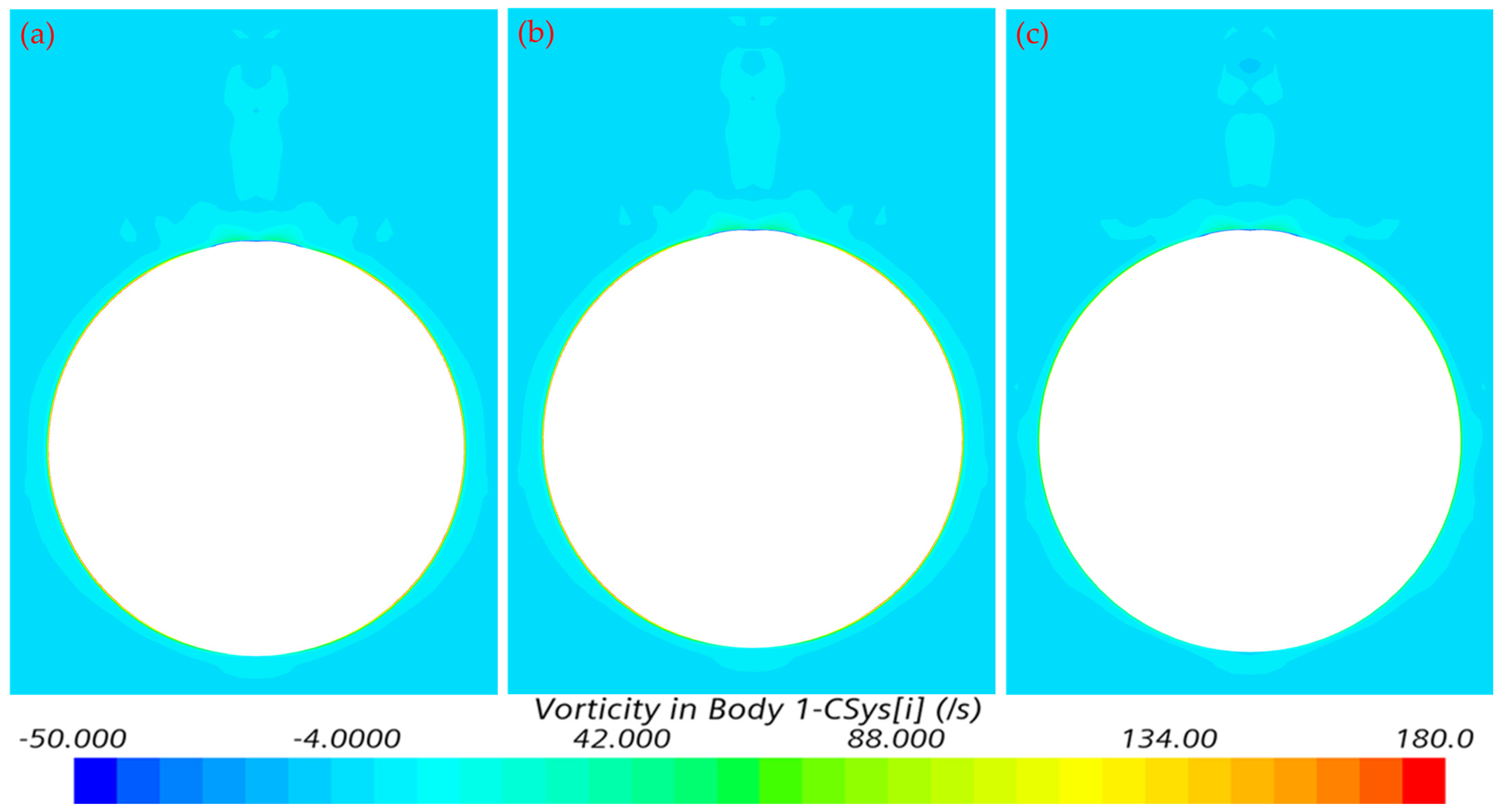
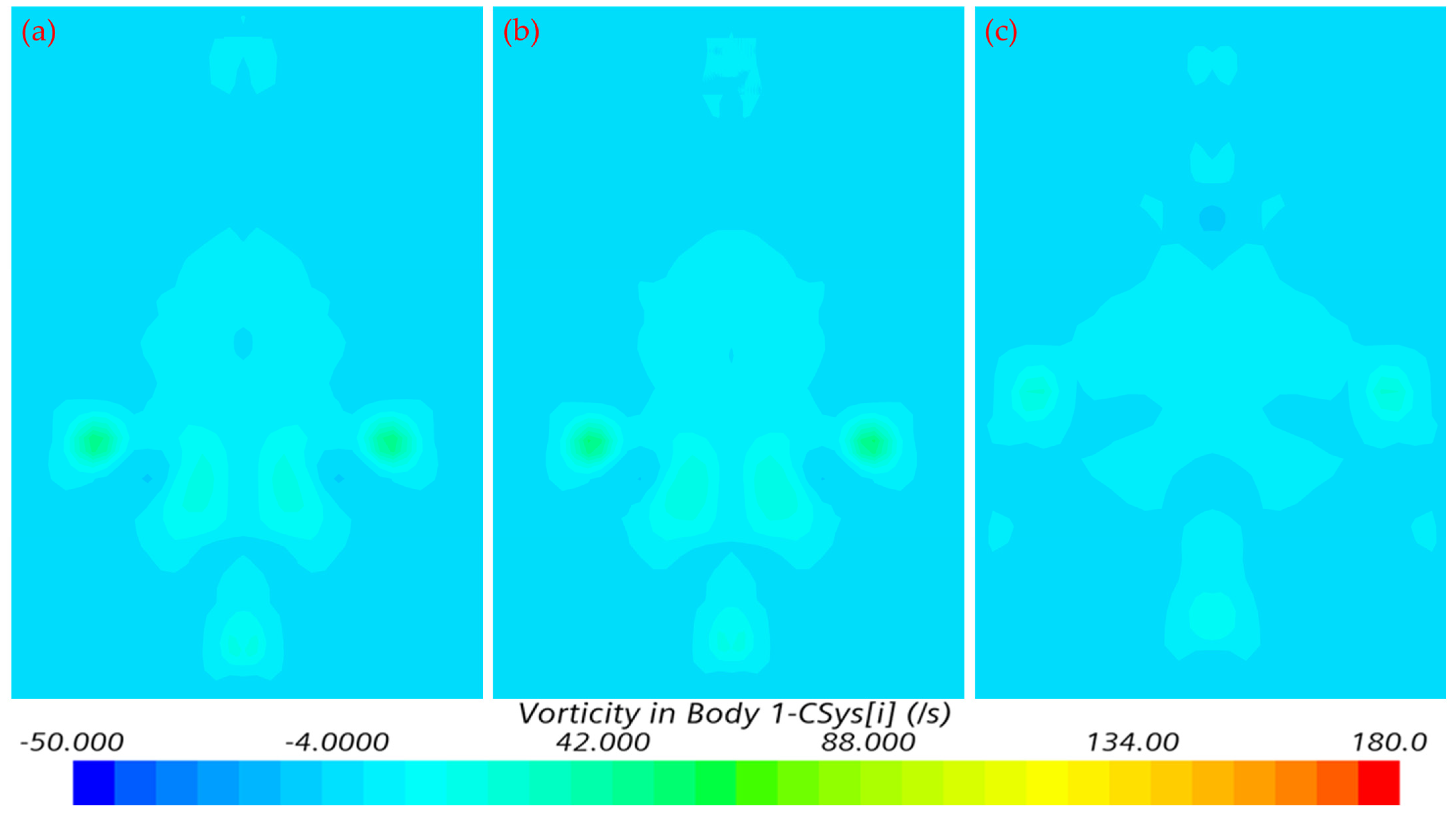
After investigating the evolution of the flow velocity around the submarine hull and in the vicinity of the rudder, a further analysis is conducted to examine the detailed flow characteristics induced by different steering modes, particularly the unsteady phenomena such as flow separation, vortex generation, and evolution. In this study, three representative cross-sections are selected for vorticity distribution analysis, including the section behind the sail, the rudder section, and the section downstream of the tail rudder. The locations of these three sections are shown in Figure 15, and the vorticity distribution results of the three cross-sections under the three steering modes at t = 16 s are shown in Figure 16, Figure 17 and Figure 18, respectively.
Figure 16 illustrates the vorticity distribution in the X-direction of the body-fixed coordinate system at the rudder cross-section under the three steering modes at t = 16 s, where (a) corresponds to trapezoidal steering, (b) to step steering, and (c) to linear steering. The overall vorticity range lies between −50 s−1 and 180 s−1.
Under trapezoidal steering, clear vortex structures can be observed. Strong vorticity (with maximum positive values of 140–180 s−1) is mainly concentrated near the rudder trailing edge and along the upper and lower surfaces. The vortex core intensity increases toward the hull, reaching about 70 s−1. Distinct negative vortex cores (−50 to −20 s−1) appear at the intersections of the vertical rudder, horizontal rudder, and hull. Due to the submarine’s pitch angle, vortex structures also form above the vertical rudder. Overall, the vorticity distribution under trapezoidal steering exhibits smooth transitions, with highly concentrated rudder-induced vortices. Negative vorticity regions appear mainly near the leading edge and outer flow field, indicating local separation and reattachment.
For step steering, the vorticity pattern is similar to that of trapezoidal steering, but the larger pitch angle results in slightly stronger vorticity above the horizontal rudder, a wider spatial distribution, and stronger negative vortex cores. The unsteady vortex structures are therefore more pronounced.
Under linear steering, the vorticity distribution near the rudder is relatively uniform, with significantly weaker and more localized vorticity compared with the other two modes. The weaker vorticity gradients on both sides correspond to reduced hydrodynamic forces and weaker motion responses.
As shown in Figure 17, under the trapezoidal steering condition, the overall vorti-city intensity at the cross-section behind the hull fairwater ranges from −50 s−1 to 180 s−1. The vorticity distribution along both sides and the lower region of the hull remains smooth, indicating that the flow is in a relatively stable attached state. In contrast, the vorticity above the hull appears more diffused, forming distinct positive and negative vorticity regions. The positive vorticity region is concentrated near the junction be-tween the fairwater and the hull, with a core vorticity value of approximately 40 s−1, while the negative vorticity region is distributed near the upper edge of the fairwater, where the core vorticity reaches about −8 s−1.Under the step steering condition, the vorticity distribution pattern behind the fairwater is generally similar to that of the trapezoidal steering case, but the intensity of the positive vorticity core is slightly higher. This indicates an increased local velocity gradient above the hull, suggesting the presence of stronger shear layers and partial flow separation in this region. In contrast, under the linear steering condition, the vorticity above the hull is more diffused than in the previous two cases. The positive vorticity region near the junction between the fairwater and the hull is smaller in both size and intensity, with a core value of about 40 s−1. However, the negative vorticity near the upper edge of the fairwater becomes noticeably stronger, reaching approximately −15 s−1. This, on the other hand, reflects the limited rudder effectiveness and the delayed maneuvering response associated with the linear steering mode.
The vorticity distributions in the X-direction within the body-fixed coordinate system at the rudder-aft cross-section for the three steering modes are shown in Figure 18, with vorticity values ranging from −50 s−1 to 180 s−1.
Under the trapezoidal steering condition, two distinct high-intensity vortical structures appear symmetrically on both sides of the cross-section. The positive vortex cores exhibit peak intensities of approximately 50 s−1, accompanied by adjacent negative vortex cores located slightly below and closer to the centerline, with intensities around −8 s−1. In the inner region of the submarine wake and near the lower side, positive vorticity regions with magnitudes between 15 s−1 and 28 s−1 can be observed. Furthermore, a V-shaped symmetric double-peak vortex pattern is visible in the upper wake region, characterized by upward-opening positive vorticity contours. For the step steering condition, the overall vorticity distribution pattern is similar to that of trapezoidal steering. However, the positive vortex cores exhibit slightly higher intensities, reaching up to 53 s−1. Due to the strong transient rudder force induced by the step input, the vorticity gradient in the wake increases, leading to an enhanced local shear layer and a marginally larger flow separation region. In contrast, the linear steering condition exhibits a much weaker vortical structure. The twin vortex contours appear blurred, with significantly reduced vorticity intensity—the maximum positive vorticity is only about 25 s−1. Additionally, a distinct negative vortex region emerges above the rudder, suggesting weaker wake evolution and limited energy transfer.
In summary, the vorticity distribution analysis reveals that the submarine’s flow field evolution under different steering inputs is dominated by the interaction between rudder-induced shear layers and the aft-body wake. Although all three steering modes share similar large-scale vortex structures, their intensity, spatial coherence, and degree of asymmetry differ substantially. The step steering input generates the strongest vortical structures and pronounced unsteady features, while the linear input yields the weakest and most diffused vorticity patterns. The trapezoidal steering mode achieves an optimal balance, maintaining stable, well-organized vortex evolution with moderate vorticity strength and minimal flow separation.

5. Conclusions

This study systematically investigates the vertical-plane maneuvering motion of a submarine through high-fidelity numerical simulation. The numerical model was first validated against benchmark experimental data, confirming its accuracy in predicting the submarine’s hydrodynamic performance. Subsequently, the vertical-plane hydrodynamic characteristics and motion responses under three different steering modes were compared, followed by an analysis of the flow-field velocity evolution and vorticity distribution around the submarine before and after steering. The main conclusions are summarized as follows:
(1) The numerical model based on the governing equations and the k ε turbulence model is capable of accurately simulating the submarine’s vertical-plane maneuvering motion. The computed straight-line resistance and hydrodynamic coefficients at fixed angles of attack show excellent agreement with international benchmark experiments. The three steering strategies adopted in this study are reasonable and effectively prevent excessively sharp dynamic responses during vertical-plane maneuvers.
(2) The numerical results show that the flow field around the submarine exhibits fully turbulent characteristics under all three steering conditions, and the steering process induces a time-dependent evolution of the flow field. As the pitch angle gradually increases, pronounced unsteady separated vortex structures are clearly captured near the aft edge of the sail and around the rudder surfaces. The separation flow and unsteady turbulent structures induced by rudder deflection dominate the submarine’s longitudinal response in the vertical plane, serving as the primary physical mechanism responsible for the differences observed among the three steering strategies.
(3) Among the three steering modes, the time-dependent variations of the submarine’s motion response and hydrodynamic characteristics exhibit consistent trends. The step input exhibits strong transient behavior and induces pronounced unsteady flow responses. The linear input produces relatively weak rudder effectiveness, with delayed flow evolution and limited attitude control capability. In contrast, the trapezoidal steering mode provides the best overall performance, achieving a favorable balance between maneuverability and stability. It enables efficient and controllable attitude adjustment during submarine ascent and pitch control operations.
(4) Unlike traditional approaches that rely mainly on fixed-rudder towing tests or steady-state numerical simulations, the dynamic rudder inputs used in this study enable the capture of key unsteady hydrodynamic phenomena near the stern plane—such as flow separation, local angle-of-attack variation, wake development, and the resulting pitch motion of the submarine. By constructing a numerical model that couples dynamic rudder motion with submarine body dynamics, the present work more accurately represents the real-time interaction between the hull and the control surface. This approach improves the predictive accuracy of submarine maneuvering performance under realistic operating conditions and clarifies the flow-evolution mechanisms associated with hull–rudder interference.
Future work will further combine experimental validation and high-fidelity turbulence modeling to investigate the submarine’s vertical-plane maneuvering under varying rudder amplitudes, frequencies, and composite steering strategies. Moreover, coupling studies of steering maneuvers and ballast water blow operations in wave environments will be conducted, providing theoretical guidance for enhancing submarine maneuverability and optimizing flow-field control in vertical-plane motions.

Author Contributions

Conceptualization and writing—review and editing, Y.Z.; methodology and writing—original draft preparation, B.Z.; formal analysis, R.G.; software, S.W.; validation, Z.J. and Q.X. All authors have read and agreed to the published version of the manuscript.

Funding

This research was funded by the Fundamental Research Funds for the Central Universities (Grant No. 3072024KX0101).

Data Availability Statement

The original contributions presented in this study are included in the article. Further inquiries can be directed to the corresponding author.

Conflicts of Interest

The authors declare no conflicts of interest.

References

  1. Mahdaviniaki, M. Simulation of emergency hovering maneuvers in submarines. Mech. Based Des. Struct. Mach. 2022, 50, 3768–3780. [Google Scholar] [CrossRef]
  2. Sutulo, S.; Guedes Soares, C. Mathematical models for simulation of manoeuvring performance of ships. Mar. Technol. Eng. 2011, 1, 661–698. [Google Scholar]
  3. Cardenas, P.; de Barros, E.A. Estimation of AUV hydrodynamic coefficients using analytical and system identification approaches. IEEE J. Ocean. Eng. 2019, 45, 1157–1176. [Google Scholar] [CrossRef]
  4. Bhushan, S.; Alam, M.; Walters, D.K. Evaluation of hybrid RANS/LES models for prediction of flow around surface combatant and Suboff geometries. Comput. Fluids 2013, 88, 834–849. [Google Scholar] [CrossRef]
  5. Beaver, W.E.; Morabito, M.G. Investigations of pitch instability of a wide-body submarine operating near the surface. Nav. Eng. J. 2018, 130, 105–117. [Google Scholar]
  6. Kong, Y.; Wang, Q.; Wang, X. Experimental and numerical study of rudder torque for BB2 generic submarine under steering conditions. Ocean Eng. 2025, 335, 121761. [Google Scholar] [CrossRef]
  7. Sener, M.Z.; Aksu, E. The numerical investigation of the rotation speed and Reynolds number variations of a NACA 0012 airfoil. Ocean Eng. 2022, 249, 110899. [Google Scholar] [CrossRef]
  8. Sang, H.; Zhang, Z.; Sun, X.; Zhang, S.; Li, C.; Liu, F. Maneuverability prediction of the wave glider considering ocean currents. Ocean Eng. 2023, 269, 113548. [Google Scholar] [CrossRef]
  9. Hasanvand, A.; Hajivand, A. Investigating the effect of rudder profile on 6DOF ship turning performance. Appl. Ocean Res. 2019, 92, 101918. [Google Scholar] [CrossRef]
  10. Ke, L.; Ye, J.; Liang, Q. Experimental Study on the Flow Field, Force, and Moment Measurements of Submarines with Different Stern Control Surfaces. J. Mar. Sci. Eng. 2023, 11, 2091. [Google Scholar] [CrossRef]
  11. Zhang, X.; Huo, J.; Zhang, M.; Cai, X.; Wang, B.; Xie, Z. Maneuverability characteristics of a fouling submarine near the seabed. Ocean Eng. 2025, 315, 119773. [Google Scholar] [CrossRef]
  12. Guo, H.; Li, G.; Du, L. Investigation on the flow around a submarine under the rudder deflection condition by using URANS and DDES methods. Appl. Ocean Res. 2023, 131, 103448. [Google Scholar] [CrossRef]
  13. Li, Y.; Pan, Z.; Li, Y.; Song, C.; Zhang, M.; Ren, M. Investigation of the Asymmetric Features of X-Rudder Underwater Vehicle Vertical Maneuvring and Novel Motion Prediction Technology. J. Mar. Sci. Eng. 2025, 13, 1288. [Google Scholar] [CrossRef]
  14. Kim, D.-H.; Kim, Y.; Baek, H.-M.; Choi, Y.-M.; Kim, Y.J.; Park, H.; Yoon, H.K.; Shin, J.-H.; Lee, J.; Chae, E.J. Experimental study of the hydrodynamic maneuvering coefficients for a BB2 generic submarine using the planar motion mechanism. Ocean Eng. 2023, 271, 113428. [Google Scholar] [CrossRef]
  15. Kim, D.-H.; Kim, J.; Baek, H.-M.; Choi, Y.-M.; Shin, J.-H.; Lee, J.; Shin, S.-c.; Shin, Y.-h.; Chae, E.J.; Kim, E.S. Experimental investigation on a generic submarine hydrodynamic model considering the interaction effects of hull motion states and control planes. Ocean Eng. 2024, 298, 116878. [Google Scholar] [CrossRef]
  16. Lee, J.; Kim, S.; Shin, J.; Yoon, J.; Ahn, J.; Kim, M. Experiment and modeling of submarine emergency rising motion using free-running model. Int. J. Nav. Archit. Ocean Eng. 2025, 17, 100641. [Google Scholar] [CrossRef]
  17. Dugeai, A.; Vuillemin, P. Highly flexible aircraft flight dynamics simulation using CFD. In Proceedings of the IFASD 2024, The Hague, The Netherlands, 17–21 June 2024. [Google Scholar]
  18. Hiremath, S.; Malipatil, A.S. CFD simulations of aircraft body with different angle of attack and velocity. Int. J. Innov. Res. Sci. Eng. Technol. 2014, 3, 16965–16972. [Google Scholar] [CrossRef]
  19. Kim, D.; Song, S.; Tezdogan, T. Free running CFD simulations to investigate ship manoeuvrability in waves. Ocean Eng. 2021, 236, 109567. [Google Scholar] [CrossRef]
  20. Dong, K.; Yu, J.; Liu, L.; Zhang, D.; Wang, X. An investigation into the effects of damaged compartment on turning maneuvers using the free-running CFD method. Ocean Eng. 2023, 271, 113718. [Google Scholar] [CrossRef]
  21. Wang, J.; Zou, L.; Wan, D. CFD simulations of free running ship under course keeping control. Ocean Eng. 2017, 141, 450–464. [Google Scholar] [CrossRef]
  22. Zhang, J.; Guo, Z.; Zhang, Q.; Shang, Y.; Zhang, L. Turning and zigzag maneuverability investigations on a waterjet-propelled trimaran in calm and wavy water using a direct CFD approach. Ocean Eng. 2023, 286, 115511. [Google Scholar] [CrossRef]
  23. Kim, I.-T.; Kim, S.; Paik, K.-J.; Yang, J.-K.; Kwon, S.-Y. Free-running CFD simulations to assess a ship-manoeuvring control method with motion forecast in waves. Ocean Eng. 2023, 271, 113806. [Google Scholar] [CrossRef]
  24. Ferziger, J.H.; Perić, M.; Street, R.L. Computational Methods for Fluid Dynamics; Springer: Berlin/Heidelberg, Germany, 2019. [Google Scholar]
  25. Jones, W.P.; Launder, B.E. The prediction of laminarization with a two-equation model of turbulence. Int. J. Heat Mass Transf. 1972, 15, 301–314. [Google Scholar] [CrossRef]
  26. Launder, B.E.; Sharma, B.I. Application of the energy-dissipation model of turbulence to the calculation of flow near a spinning disc. Lett. Heat Mass Transf. 1974, 1, 131–137. [Google Scholar] [CrossRef]
  27. Sarkar, S.; Lakshmanan, B. Application of a Reynolds stress turbulence model to the compressible shear layer. AIAA J. 1991, 29, 743–749. [Google Scholar] [CrossRef]
  28. Groves, N.C.; Huang, T.T.; Chang, M.S. Geometric Characteristics of DARPA SUBOFF Models (DTRC Model Nos. 5470 and 5471); David Taylor Research Center: Bethesda, MD, USA, 1989. [Google Scholar]
  29. Takahashi, K.; Sahoo, P. Numerical study on self-propulsive performance of the DARPA SUBOFF submarine including uncertainty analysis. In Proceedings of the International Conference on Ships and Offshore Structures, Melbourne, FL, USA, 4–8 November 2019. [Google Scholar]
Figure 1. The DARPA SUBOFF model and coordinate system: (a) Drawing of the DARPA SUBOFF model (Unit: m); (b) Side view of the DARPA SUBOFF.
Jmse 13 02371 g001aJmse 13 02371 g001b
Figure 2. Computational domain dimension and boundary condition: (a) Schematic of the far-field computational domain dimensions and boundary conditions for the submarine; (b) Schematic of the near-field computational domain dimensions and boundary conditions for the submarine; (c) Front view of the computational domain; (d) Side view of the computational domain.
Jmse 13 02371 g002
Figure 3. Illustration of mesh generation and layout: (a) Global mesh schematic; (b) front view of the submarine’s tail mesh; (c) top view of the submarine’s tail mesh.
Jmse 13 02371 g003
Figure 4. Comparison of submarine drag from numerical simulation and experiment at different speeds.
Jmse 13 02371 g004
Figure 5. Comparison between numerical and experimental results at different pitch angles: (a) Comparison of nondimensional drag coefficient at different pitch angles; (b) Comparison of nondimensional lift Coefficient at different pitch angles; (c) Comparison of nondimensional pitching moment coefficient at different pitch angles.
Jmse 13 02371 g005
Figure 6. Three different steering strategies (the rudder angle is 0 during the first 10 s): (a)trapezoidal steering; (b) step steering; (c) linear steering.
Jmse 13 02371 g006
Figure 7. Comparison of Submarine Motion Responses under Three Different Steering Strategies: (a) Time-history curve of submarine heave; (b) Time-history curve of submarine pitch angle; (c) Time-history curve of submarine vertical velocity.
Jmse 13 02371 g007
Figure 8. Comparison of the submarine’s hydrodynamic characteristics under three different steering strategies: (a) Time-history curve of submarine drag; (b) Time-history curve of submarine Lift; (c) Time-history curve of submarine pitching moment; (d) Time-history curve of submarine vertical rudder force.
Jmse 13 02371 g008
Figure 9. Velocity field evolution of the submarine’s vertical plane under trapezoidal steering from 9.9 s to 16 s.
Jmse 13 02371 g009
Figure 10. Velocity field evolution of the submarine’s vertical plane under step steering from 9.9 s to 16 s.
Jmse 13 02371 g010
Figure 11. Velocity field evolution of the submarine’s vertical plane under line steering from 9.9 s to 16 s.
Jmse 13 02371 g011
Figure 12. Velocity-field evolution around the horizontal rudder under trapezoidal steering from 9.9 s to 16 s.
Jmse 13 02371 g012
Figure 13. Velocity-field evolution around the horizontal rudder under step steering from 9.9 s to 16 s.
Jmse 13 02371 g013
Figure 14. Velocity-field evolution around the horizontal rudder under line steering from 9.9 s to 16 s.
Jmse 13 02371 g014
Figure 15. Schematic diagram of the selection of three cross-sections for DARPA SUBOFF vorticity analysis.
Jmse 13 02371 g015
Figure 16. Vorticity distribution at the rudder cross-section for the three steering modes at t = 16 s: (a) trapezoidal steering; (b) step steering; (c) linear steering.
Jmse 13 02371 g016
Figure 17. Vorticity distribution at the aft cross-section of the sail at t = 16 s for the three steering modes: (a) trapezoidal steering; (b) step steering; (c) linear steering.
Jmse 13 02371 g017
Figure 18. Vorticity distribution at the rudder–aft cross-section for the three steering modes at t = 16 s: (a) trapezoidal steering; (b) step steering; (c) linear steering.
Jmse 13 02371 g018
Table 1. Abbreviations and Their Definitions.
AbbreviationDefinitions.
RANSReynolds-Averaged Navier–Stokes
PMMPlanar Motion Mechanism
CFDComputational Fluid Dynamics
URANSUnsteady Reynolds-Averaged Navier–Stokes
DDESDelayed Detached Eddy Simulation
FMIFunctional Mock-up Interface
FMUFunctional Mock-up Unit
RSTReynolds Stress Transport
Table 2. Principal dimension of DARPA SUBOFF.
TernsValuesUnits
Total body length4.356m
Maximum body diameter0.508m
Total sail length0.368m
Total sail height0.205m
Volume0.706m3
Wetted surface6.35m2
Inflow velocity3.3436m/s
RudderNACA0020/
Scale ratio24/
Disclaimer/Publisher’s Note: The statements, opinions and data contained in all publications are solely those of the individual author(s) and contributor(s) and not of MDPI and/or the editor(s). MDPI and/or the editor(s) disclaim responsibility for any injury to people or property resulting from any ideas, methods, instructions or products referred to in the content.