Article

Analysis of the Fatty Acid Desaturase Gene Family and Construction and Screening of High-EPA Transgenic Strains in Phaeodactylum tricornutum


College of Life Science, Fujian Normal University, Fuzhou 350117, China
*
Author to whom correspondence should be addressed.
J. Mar. Sci. Eng. 2025, 13(12), 2369; https://doi.org/10.3390/jmse13122369 (registering DOI)
Submission received: 29 October 2025 / Revised: 9 December 2025 / Accepted: 11 December 2025 / Published: 13 December 2025
(This article belongs to the Section Marine Biology)

Abstract

Fatty acid desaturase (FAD) is a key enzyme that catalyzes the biosynthesis of polyunsaturated fatty acids (PUFAs) and is widely present in animals, plants and microorganisms. In this study, Phaeodactylum tricornutum was used as the material. Bioinformatics methods were employed to identify the FAD gene family within the entire genome of P. tricornutum. The genomic distribution, gene structure, conserved domains, phylogenetic relationships, and physicochemical properties of proteins were systematically analyzed. The results showed that a total of 15 FAD genes were identified in the genome of P. tricornutum, which could be classified into 4 subfamilies. These genes are unevenly distributed on the 11 chromosomes. Motif analysis predicted that motif1 and motif2 are not only highly conserved but also play a key role in the synthesis of unsaturated fatty acids. To verify the gene function, we transferred the exogenous Ptd5α gene into P. tricornutum. Through screening and verification, we successfully obtained three transgenic algal strains (5D1, 5D2, 5D3). Compared with the wild algal strain (WT), overexpression of the Ptd5α gene did not have a significant impact on the growth and development of P. tricornutum. Moreover, the total fatty acid content of the transgenic algal strain was significantly increased, and the proportion of EPA in the total fatty acids could be raised to over 30%. The results of this study lay an important foundation for in-depth analysis of the biological functions of the FAD gene family in P. tricornutum, and also provide experimental and theoretical basis for the large-scale industrial production of EPA using model microalgae.

1. Introduction

Phaeodactylum tricornutum Bohlin is a microalga in the phylum Bacillariophyta and genus Phaeodactylum that is also one of the few model microalga with a completed genome sequence [1]. P. tricornutum exhibits rapid growth and strong adaptability. It is rich in various natural pigments [2,3,4] and fatty acids [5,6], making it widely used as an initial feed for juvenile aquaculture animals [7,8]. The P. tricornutum is renowned not only for its ability to synthesize abundant unsaturated fatty acids but also for its high content of eicosapentaenoic acid (EPA). EPA is an essential nutrient for the growth and development of various aquatic species, such as fish, shrimp, and crabs. When utilized as an aquafeed ingredient, it significantly promotes healthy growth and improves survival rates of farmed organisms, while also enhancing the nutritional value of aquatic products [2]. Furthermore, due to its high content of valuable metabolites, P. tricornutum has recently been recognized as a highly promising bioreactor for extracting natural bioactive compounds, offering significant potential for future applications [9].
Fatty acid desaturase (FAD) is a key enzyme in the synthesis of unsaturated fatty acids [10]. Its function is to catalyze the formation of carbon–carbon double bonds at specific sites in the fatty acid chain, promoting the conversion of saturated fatty acids to unsaturated fatty acids, and thereby producing unsaturated fatty acids with specific structures and functions. In plants, FAD affects the composition and function of biofilms by regulating the synthesis of unsaturated fatty acids [11]. Based on the research on model plants such as Arabidopsis thaliana, multiple enzyme-coding genes involved in the process of fatty acid desaturation metabolism have been successfully isolated [12]. FAD usually exists in the form of gene families. It can regulate the changes in fatty acid components and thereby control the accumulation of related metabolites [13]. Take P. tricornutum as an example, the synthesis of EPA relies on the synergistic action of multiple fatty acid desaturases and extenders, and is gradually catalyzed through reaction steps such as dehydrogenation and oxidation. During the synthesis process, Δ5 desaturase in the FAD family is a key enzyme in the EPA synthesis pathway [14]. Therefore, in this study, a systematic physicochemical property analysis was conducted on the protein encoded by it (Ptd5α) using bioinformatics methods.
Very long chain poly unsaturated fatty acids (VLCPUFAs) refer to straight-chain fatty acids with a carbon chain length exceeding 18 carbon atoms and containing at least three double bonds [15,16]. According to the position of the first double bond at the end, VLCPUFAs can mainly be classified into two categories: ω6 fatty acids and ω3 fatty acids. Common ω6 fatty acids include dihigh-γ-linolenic acid (DGLA, 20:3) and arachidonic acid (AA, 20:4). Typical ω3 fatty acids include eicosapentaenoic acid (EPA, 20:5) and docosahexaenoic acid (DHA, 22:6) [17,18,19].
EPA is an essential component in human and mammalian breast milk and has important physiological functions. However, higher animals and plants cannot synthesize EPA on their own. Studies have shown that EPA helps lower cholesterol, unblock the cardiovascular system, effectively prevent the occurrence of cardiovascular and cerebrovascular diseases such as cerebral thrombosis and hypertension, as well as inflammation, and can enhance the human immune system [20,21,22]. At present, the main source for humans to obtain EPA is wild marine fish oil. Due to long-term overfishing, wild fish resources are increasingly depleted, making it difficult for fish oil production to meet the growing market demand. Meanwhile, toxic compounds caused by marine pollution accumulate in fish oil, also reducing its quality [23,24], making it no longer suitable for pregnant women and young children to supplement. Therefore, finding a more sustainable, stable and safe alternative production route for EPA and DHA has become an urgent task [25,26]. P. tricornutum is regarded as an ideal model organism for studying the mechanism of EPA synthesis because its EPA content can reach 30% of the total fatty acids [27]. In this study, the Ptd5α gene was successfully transferred into the P. tricornutum through transgenic technology, and three transgenic algal strains with high EPA production were screened out. The synthetic EPA content can be as high as over 30%. This indicates that the EPA yield of P. tricornutum can be increased through genetic engineering technology, providing experimental and theoretical basis for the large-scale industrial production of EPA using model microalgae.

2. Materials and Methods

2.1. Materials

We purchased the microalga P. tricornutum (FACHB-863) from the Seaweed Culture Collection Center, Institute of Oceanology, Chinese Academy of Sciences. After purification and identification, the strain was maintained in our algal culture room at the College of Life Sciences, Fujian Normal University.

2.2. Methods

2.2.1. Algal Strain Cultivation

Liquid culture: The culture was maintained in f/2 liquid medium. The algal strain was inoculated into conical flasks and cultivated under static conditions. Under normal culture conditions, P. tricornutum exhibits three morphologies: oval, fusiform, and triradiate (Figure S1), which could interconvert in different environments. Solid culture: Solid plates were prepared by adding 0.7% agar powder to f/2 medium. Then, 50–100 μL of algal suspension was taken and spread evenly across the plate surface, followed by incubation upside down.
Culture conditions: Included alight intensity of 72 μmol·m−2·s−1, a light–dark cycle of 12 h light/12 h dark, and culture temperature of 22 °C.

2.2.2. Identification of the FAD Gene Family in P. tricornutum

The FAD protein sequences and their conserved domain information were obtained from the Arabidopsis database TAIR (https://www.arabidopsis.org/index.jsp (accessed on 1 March 2024)). Using these as query sequences, Blast P alignment was performed against the Chlamydomonas reinhardtii genome database to screen for candidate FAD proteins. Simultaneously, two conserved domains from the Pfam 38.0 database—PF00487 (FA desaturase) and PF03405 (FAdesaturase2)—were downloaded and used to construct a Hidden Markov Model (HMM). Furthermore, the local hmmsearch program was used to identify additional members of the FAD gene family in P. tricornutum.

2.2.3. Physicochemical Characterization of the Fatty Acid Desaturase Gene Family in P. tricornutum

The molecular weight and isoelectric point of FAD proteins were analyzed using ExPASy 3.0. The subcellular localization of FAD gene family members was predicted using the plant protine prediction software Plant-PLoc (https://www.csbio.sjtu.edu.cn/bioinf/plant/ (accessed on 3 March 2024). Conserved motifs within this gene family were identified with the online tool MEME (https://meme-suite.org/). Based on FAD gene sequences and genomic information obtained from the NCBI database, genomic visualization and chromosome mapping analysis were performed using the MG2C 2.0 online platform. For evolutionary analysis, multiple alignments of FAD protein sequences from P. tricornutum and other species were performed using the Clustal W program in MEGA 7.0 software. A phylogenetic tree was constructed using the neighbor-joining method.
Additionally, for the protein encoded by the ptd5α gene, NetPhos and FoldIndex online tools were further employed to analyze its phosphorylation sites and disordered regions within the amino acid sequence, respectively. Comprehensive evaluation of the protein’s physicochemical properties, hydrophobicity, and transmembrane domains was conducted using ProtParam and ProtScale on the ExPASy platform, along with the TMHMM 2.0 online tool.

2.2.4. Construction of Ptd5α Gene Overexpression Vector

First, the cloned Ptd5α gene was ligated overnight with the overexpression vector pPha-T1 using T4 ligase to construct the recombinant plasmid pPha-T1-Δ5. Subsequently, the ligation product was heat-shock transformed into DH5α competent cells. Transformants were validated via both bacterial culture PCR and plasmid PCR. Upon confirmation that all amplified bands matched the expected sizes, the preliminarily validated recombinant plasmid was submitted for sequencing to confirm the accuracy of the sequence.
The validated recombinant plasmid pPha-T1-Δ5 was introduced into P. tricornutum via electroporation. Electroporation parameters were set at 800 kV, 25 μF, and 40 Ω. Following electroporation, algal cells were recovered in dark conditions for 24 h. The algal suspension was then spread onto f/2 solid medium containing 50 μg/mL ble for resistance screening, cultured for 2–3 weeks. Once single algal colonies emerged on the plates, they were transferred to liquid medium for expansion and further identified using molecular biological methods to select positive overexpressing transformed strains.

2.2.5. Growth Curves and Biomass Measurement

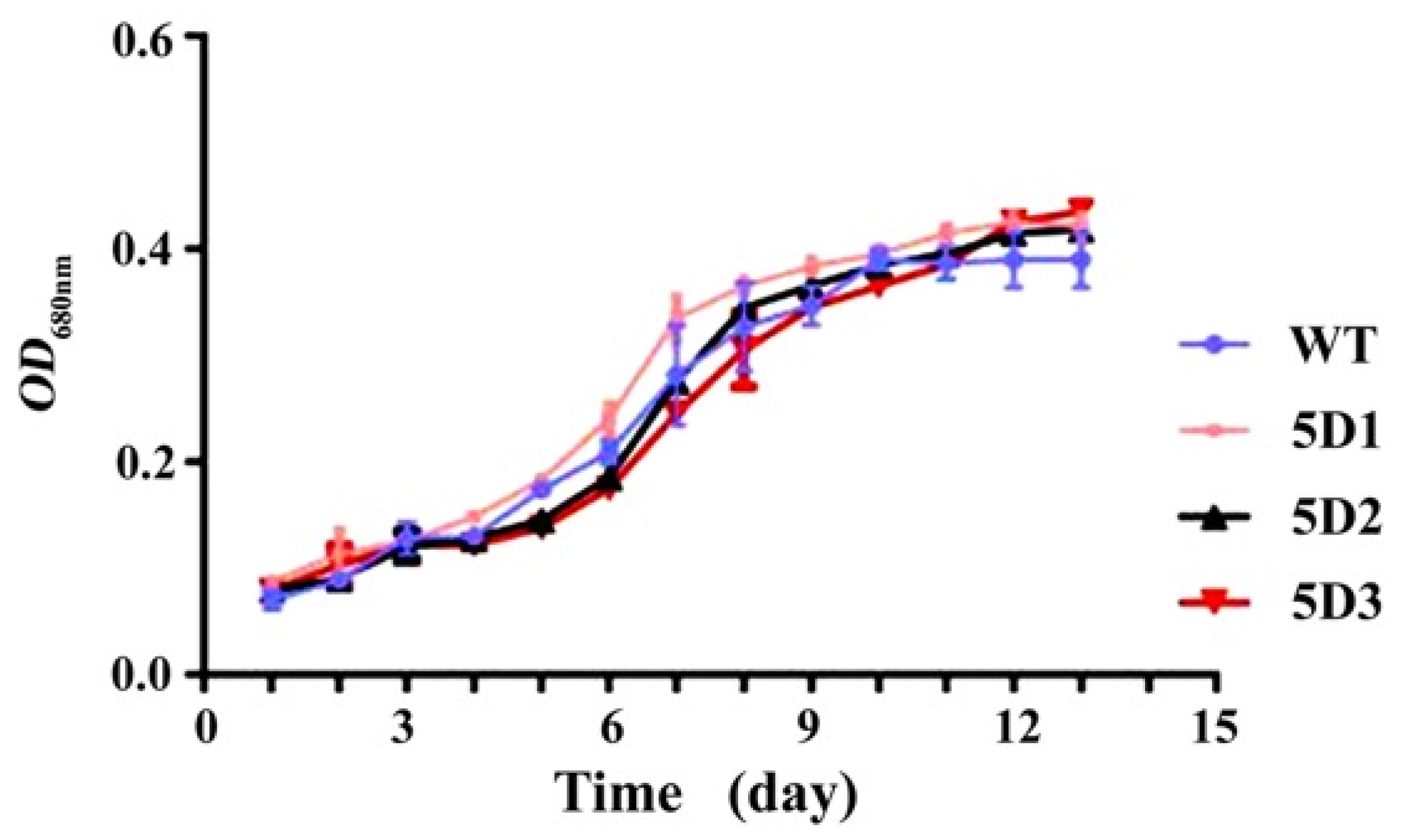
The three positive mutant strains (5D1, 5D2, 5D3) selected were cultured alongside the wild-type strain (WT) under identical conditions. During the 13-day cultivation period, the optical density (OD) of the algal culture at a specific wavelength was measured daily. Growth curves were plotted for the wild-type and each mutant strain, with cultivation time on the x-axis and OD values on the y-axis, to compare their growth characteristics.

2.2.6. Extraction and Determination of Fatty Acids

Quantitative analysis was performed using the internal standard method [28]. Using n-hexane as the solvent, solutions of methyl n-nonanoate (as internal standard) and EPA standard (Sigma-Aldrich Inc., St. Louis, MO, USA) were prepared at a concentration of 1 mg/mL. A calibration curve was plotted using a series of mixed standard samples of fatty acid methyl esters at known concentrations. The content of target substances in the sample was calculated based on the ratio of the chromatographic peak area to the internal standard peak area.
All cultures were inoculated with the same initial density and then harvested on days 3, 6, 9, and 12 of cultivation. The collected algal cells were centrifuged, freeze-dried, and precisely 50 mg of the resulting algal powder was weighed for fatty acid methylation. All operations were conducted under low light conditions and nitrogen atmosphere to prevent oxidation. Upon reaction completion, the supernatant was collected for subsequent gas chromatography analysis.
Analysis was performed using an Agilent 7890B Gas Chromatograph System (Agilent Technologies Inc., Santa Clara, CA, USA) [29]. The injector temperature was set at 240 °C, with a split ratio of 100:1 and an injection volume of 1 μL. High-purity nitrogen was used as the carrier gas at a flow rate of 80 mL/min (constant flow mode); hydrogen and air flow rates were set at 30 mL/min and 400 mL/min, respectively. The column temperature program was as follows: the first stage started at 150 °C and increased at a rate of 5 °C/min to 210 °C; the second stage maintained at 210 °C before continuing the temperature increase at a rate of 10 °C/min [29]. The fatty acid content in the samples was ultimately quantified using the internal standard method.

2.2.7. Quantitative Fluorescent Detection of Ptd5α Gene Expression Levels

Quantitative real-time quantitative PCR (qRT-PCR) analysis was performed to examine the expression levels of the Ptd5α gene in three transformants at different growth stages (3, 6, 9, and 12 days). Algal cells of the three transformants were harvested at different cultivation stages. Total RNA was extracted using the TransZol Up Plus RNA Kit (TransGen Biotech Inc., Beijing, China). Three biological replicates were established for each treatment.
The β-actin gene served as the internal control. Specific primers for Ptd5α and β-actin genes were designed based on their mRNA sequences using Primer 5.0 software (Table S10) and synthesized by Sangon Biotech (Shanghai, China) Co., Ltd. RNA purity was assessed with a DeNovix DS11 microvolume UV–Vis spectrophotometer, and total RNA integrity was confirmed by agarose gel electrophoresis. cDNA synthesis was carried out using a TransGen Biotech reverse transcription kit. Quantitative PCR amplification employed the TransStart® TOP Green qPCR SuperMix Kit (TransGen Biotech, Beijing, China) on the CFX96 Touch Real-Time PCR system (Bio-Rad Laboratories, Hercules, CA, USA) with the following cycling parameters: 94 °C for 30 s, then 40 cycles of 94 °C for 5 s and 60 °C for 15 s. All steps adhered strictly to the manufacturer’s standard protocols. The relative expression of the target gene was determined using the 2−ΔΔCt method.

3. Results

3.1. Identification of Members of the Desaturase Gene Family in P. tricornutum

Through bioinformatics analysis, 15 members of the FAD gene family were identified in P. tricornutum genome (Table 1). Among these, desaturases involved in fatty acid biosynthesis include Δ5α, Δ6, Δ4, and Δ12 desaturases.

3.2. Sequence Characteristic Analysis of Gene Family Members

The amino acid sequence characteristics of the 15 family genes are shown in Table S1. Based on their predicted isoelectric points (pI), these proteins can be classified into three categories. Alkaline proteins: including PtFAD2, Pt44622, Ptd5α, Ptd15, Ptd9, etc., with pI values ranging from 8.25 to 9.03; Neutral proteins: including Pt46383, Ptd12, Pt22677, Ptd5b, Pt50443, etc., with pI values ranging from 7.02 to 7.73; Acidic proteins: including Ptd6, Pt46275, Pt22510, Pt55137, Ptd9316, with pI values ranging from 5.41 to 6.98. Subcellular localization analysis using the Plant-PLoc online tool predicted that Pt9316 and Pt46383 localize to chloroplasts; the localization of Pt44622 and Pt50443 remains unclear; most other members were predicted to localize to the endoplasmic reticulum. The gene with the longest sequence is Ptd5α, measuring 3832 bp, followed by Pt55137 at 2006 bp. The shortest sequence is that of Pt9316, spanning 927 bp. The remaining FAD family members exhibit sequence lengths ranging between 1000 and 2000 bp.

3.3. Motif Analysis of the FAD Family

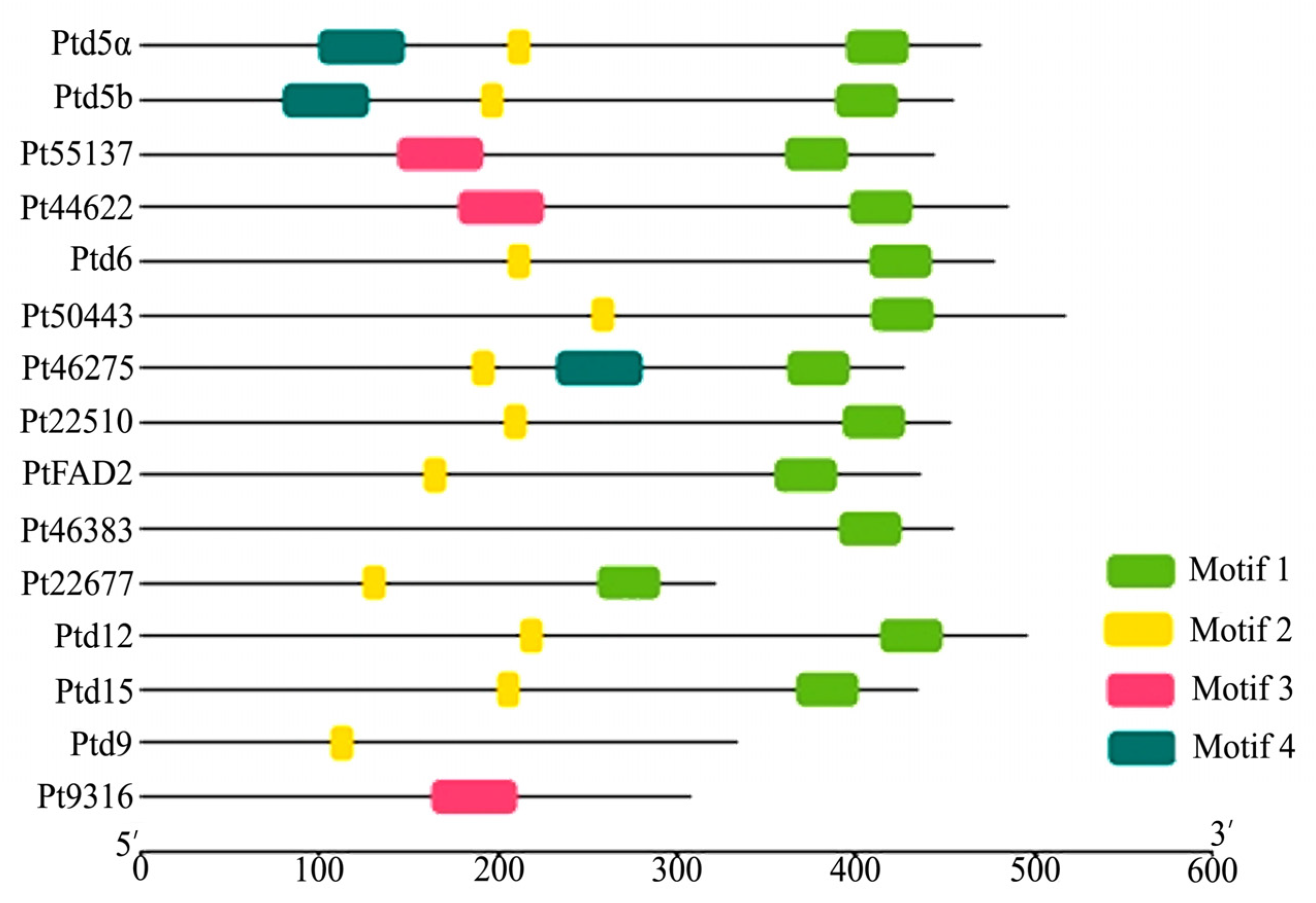
Using the online software MEME (v5.5.9), a conserved motif analysis was performed on the PtFAD gene family of P. tricornutum. The results revealed that this gene family contains four motifs (Figure 1). The Δ5α, Δ6, Δ4, and Δ12 desaturases involved in fatty acid synthesis all contain motif 1 and motif 2. Among these, the Δ6, Δ4, and Δ12 desaturases possess only these two motifs, both located at the C-terminal end of the proteins. This distribution pattern indicates that motif 1 and motif 2 are highly conserved evolutionarily, constituting a typical FAD functional domain. The biological functions they perform are crucial for fatty acid synthesis.

3.4. Structural Analysis and Chromosomal Localization of the PtFAD Gene Family

Members of the PtFAD gene family are distributed across 13 chromosomes of P. tricornutum (Figure S2). Among these, the three genes ptd6, ptd12, and ptd5b are co-localized on chromosome 17, while the remaining members are distributed across different chromosomes.
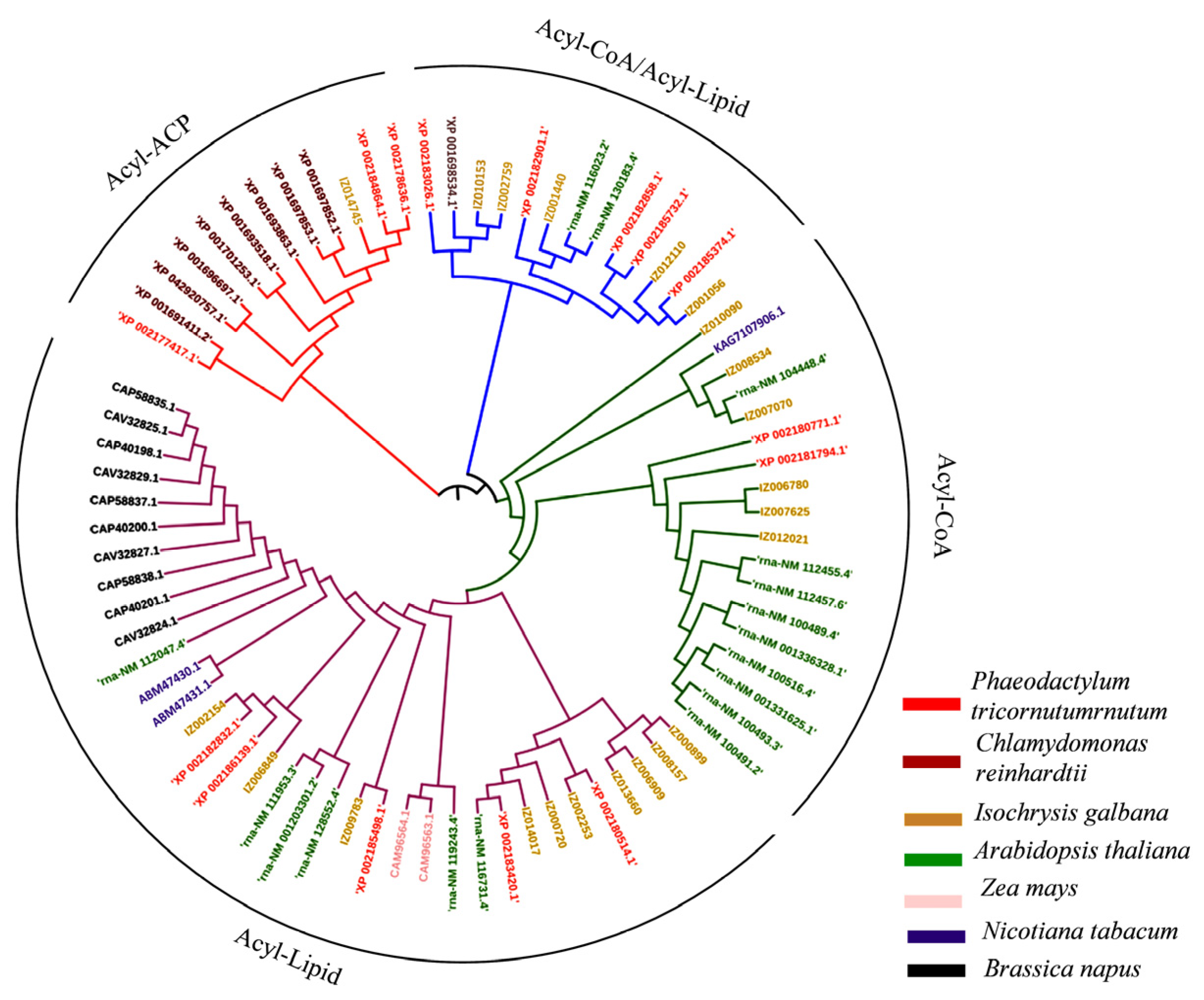
To analyze the phylogenetic relationships of FAD proteins, sequences from P. tricornutum, Isochrysis galbana, Chlamydomonas reinhardtii, Arabidopsis thaliana, Brassica napus, Zea mays, and Nicotiana tabacum were selected and used to construct a phylogenetic tree. Based on their functional substrates and binding carriers, these FAD proteins can be classified into four subfamilies: Acyl-CoA, Acyl-ACP, Acyl-Lipid, and Acyl-CoA/Acyl-Lipid.
  • Acyl-CoA desaturase, primarily localized on the endoplasmic reticulum membrane in animals and fungi, is a membrane-bound fatty acid desaturase. Its function is to catalyze the formation of double bonds in fatty acids bound to coenzyme A. For example, Δ9 Acyl-CoA desaturase belongs to this category [30].
  • Acyl-ACP desaturase is primarily localized in the plant plastid matrix and belongs to the soluble fatty acid desaturase family. Its function is to catalyze the formation of double bonds in fatty acid substrates bound to acyl carrier protein (ACP) [31]. In P. tricornutum, genes such as Pt44622, Pt55137, and Pt9316 are classified within this category.
  • Acyl-Lipid desaturase, primarily found in higher plants and cyanobacteria, functions to catalyze the formation of double bonds in fatty acids present in membrane-bound lipid complexes. Examples include desaturases such as Ptd12 and Ptd15, which belong to the membrane-bound FAD family and are difficult to isolate and purify [32].
  • Members of the FAD gene family can act on both Acyl-CoA, and Acyl-Lipid substrates, hence their classification into the Acyl-CoA/Acyl-Lipid subfamily. For example, Ptd5α and Ptd5b, as well as Ptd6 and Pt22510, exhibit high sequence homology, indicating their evolutionary conservation. Based on phylogenetic relationships, members of the PtFAD gene family in P. tricornutum primarily belong to the Acyl-CoA/Acyl-Lipid and Acyl-Lipid subfamilies [33].
As can be seen from the evolutionary tree shown in Figure 2, compared with the four terrestrial plants, the FAD members of algal plants such as Chlamydomonas reinhardtii, P. tricornutum and Isochrysis galbana account for a significantly higher proportion in the two subfamilies of Acyl-ACP and Acyl-CoA/Acyl-Lipid.

3.5. Analysis of the Structure and Physicochemical Properties of Ptd5α Protein

Due to its rich content of EPA (eicosapentaenoic acid, 20:5), and the fact that Ptd5α is a key enzyme catalyzing EPA synthesis, we conducted an in-depth analysis of the protein structure and physicochemical properties of this enzyme. The primary structure analysis of the Ptd5α protein using the ExPASy (v3.0) tool shows (Table S2) that this protein is composed of 469 amino acids, and its predicted isoelectric point (pI) is greater than 7, making it an alkaline protein. When the instability coefficient of a protein exceeds 40, it is generally regarded as an unstable protein. The predicted instability coefficient of Ptd5α is 35.54 (less than 40), thus it is determined to be a structurally stable protein.
The hydrophobicity of the Ptd5α protein was predicted using Hydrophobicity ProtScale software on the ExPASy platform (Figure S3). The ProParam prediction results show that the Grand Average of Hydropathicity (GRAVY) value for the Ptd5α protein was −0.210 (values < 0 indicate a hydrophilic protein, while values > 0 suggest a hydrophobic protein). Although the Ptd5α protein contains hydrophobic transmembrane helix structures, as shown in Figure S3, its overall amino acid distribution profile confirms that it is a hydrophilic protein.
The secondary structure of Ptd5α protein was analyzed by using the GOR IV online software. The results show that irregular curling is the main component of this protein, accounting for 40.17%. The second is the α-helix, accounting for 20.56%. The extended chain structure accounts for 11.34%.
The conserved domains in the Ptd5α protein sequence were analyzed using the NCBI online CDD database. The results showed that the two conserved domains of the Ptd5α protein sequence were located at positions 33–94 and 155–428, respectively. The number and position of these domains in the amino acid sequence encoded by the entire gene also varied among different species.
In addition, Phyre2 server and SWISS-MODEL software (https://swissmodel.expasy.org/ (accessed on 16 March 2024) were applied to predict and model the tertiary structure of Ptd5α protein (Figure S4).
The transmembrane domain of the target protein Ptd5α was predicted and analyzed using TMHMM software, and the results are shown in Figure S5. The purple rectangular area in the figure represents the predicted transmembrane segments. Analysis indicates that the Ptd5α protein contains four transmembrane domains, located at amino acids 127–149, 246–268, 299–317, and 327–349, respectively. The first transmembrane helix likely anchors the protein within the membrane; the second, approximately 23 amino acids long, is well-suited to span the lipid bilayer’s hydrophobic core; the third helix is relatively short and may reside at the membrane interface or cooperate with other helices to form a channel; its amino acid sequence exhibits distinct amphipathicity, with a hydrophobic face oriented toward the membrane lipids and another face, potentially bearing polar residues, directed toward the membrane interior. This result confirmed that Ptd5α is a transmembrane protein that can embed into biological membranes and undergo transmembrane movement.

3.6. Construction of Ptd5α Gene Overexpression Vector and Acquisition of Overexpression Algal Strains

The recombinant plasmid pPha-T1-Δ 5 was transformed into DH5α competent cells. Verified by bacterial liquid PCR and plasmid PCR, the size of the amplified bands obtained was consistent with expectations, which preliminarily proved that the target gene had been successfully inserted into the vector polyclonal site. Subsequently, sequence analysis was conducted on the recombinant plasmids submitted for sequencing. The results showed that the length of the cloned Δ 5-desaturase gene was 1518 bp (the sequence is shown in Table S3). Through sequence alignment of the NCBI BLAST program (v2.17.0), the homology of this gene with the Δ 5-desaturase gene (registration number: XM_002185696.1) of the standard strain CCAP 1055/1 of P. tricornutum reached 99.01%. The above results jointly confirm that the overexpression vector pPha-T1-Δ5 of the Δ5-desaturase gene in P. tricornutum had been successfully constructed.
The algal solution transformed by electric shock was, respectively, spread on conventional plates and resistant plates containing ble, and was cultured for two weeks to observe the growth situation. The results showed that the number of algal colonies growing on the resistant plate (Figure S6B) was significantly less than that on the control plate (Figure S6A). This result can serve as a preliminary screening basis for transformed algal strains.
After picking single algal colonies from ble resistant plates for expanded culture, the genomic DNA of the candidate transformed algal strains was amplified by PCR to verify whether ble resistance genes were integrated. The amplification product presented a specific band at approximately 500 bp. After sequencing, this segment was compared through the NCBI database, and the results showed that its similarity to the reference sequence of the ble gene reached 100%. This result confirmed that the selected transformed algal strains had successfully integrated the target gene and were positive overexpression algal strains. Through this verification process, three stably overexpressing Ptd5α gene P. tricornutum strains were finally obtained and named 5D1, 5D2 and 5D3, respectively.

3.7. Determination of the Growth Curve of P. tricornutum

The growth curves of the three overexpressed algal strains within 14 days are shown in Figure 3. Under identical inoculation densities, the growth dynamics of the wild type (WT) and each mutant algal strain were similar, each progressing through four typical phases: a lag phase from days 0–3, a logarithmic growth phase from days 3–9, a deceleration phase from days 9–12, and a stable phase after the 12th day. The experimental results show that the overall growth trend of the overexpressed algal strains did not change significantly compared with the wild type. This indicates that Ptd5 gene overexpression does not impair normal growth and development.
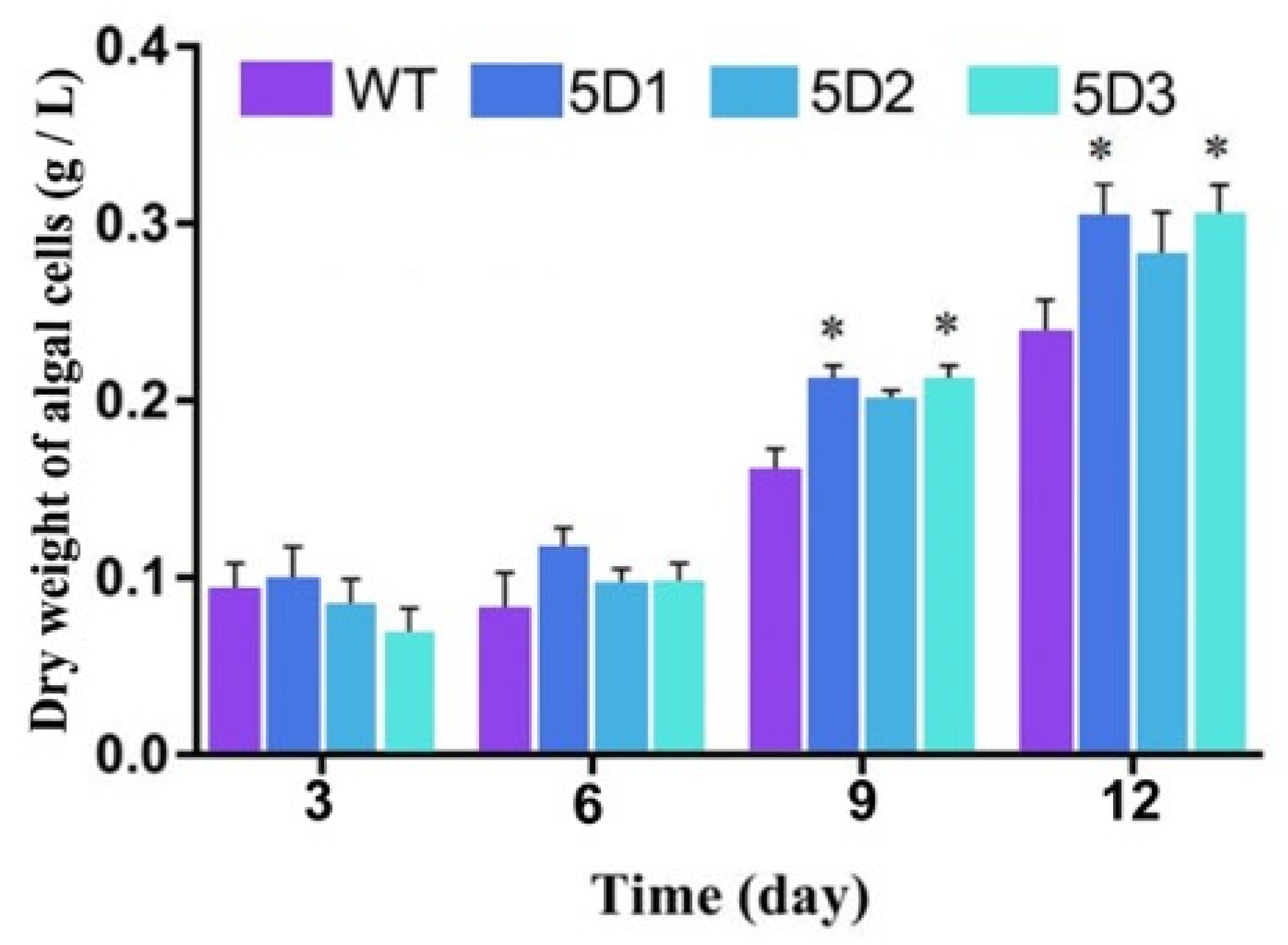
As shown in Figure 4, the algal cell dry weight of transgenic strains 5D1 and 5D3 increased significantly compared to the wild type (WT) on the 9th and 12th days of cultivation. The above results indicate that the introduction of the Ptd5α gene did not inhibit the normal growth and development of P. tricornutum.

3.8. Determination of Fatty Acid Content in P. tricornutum

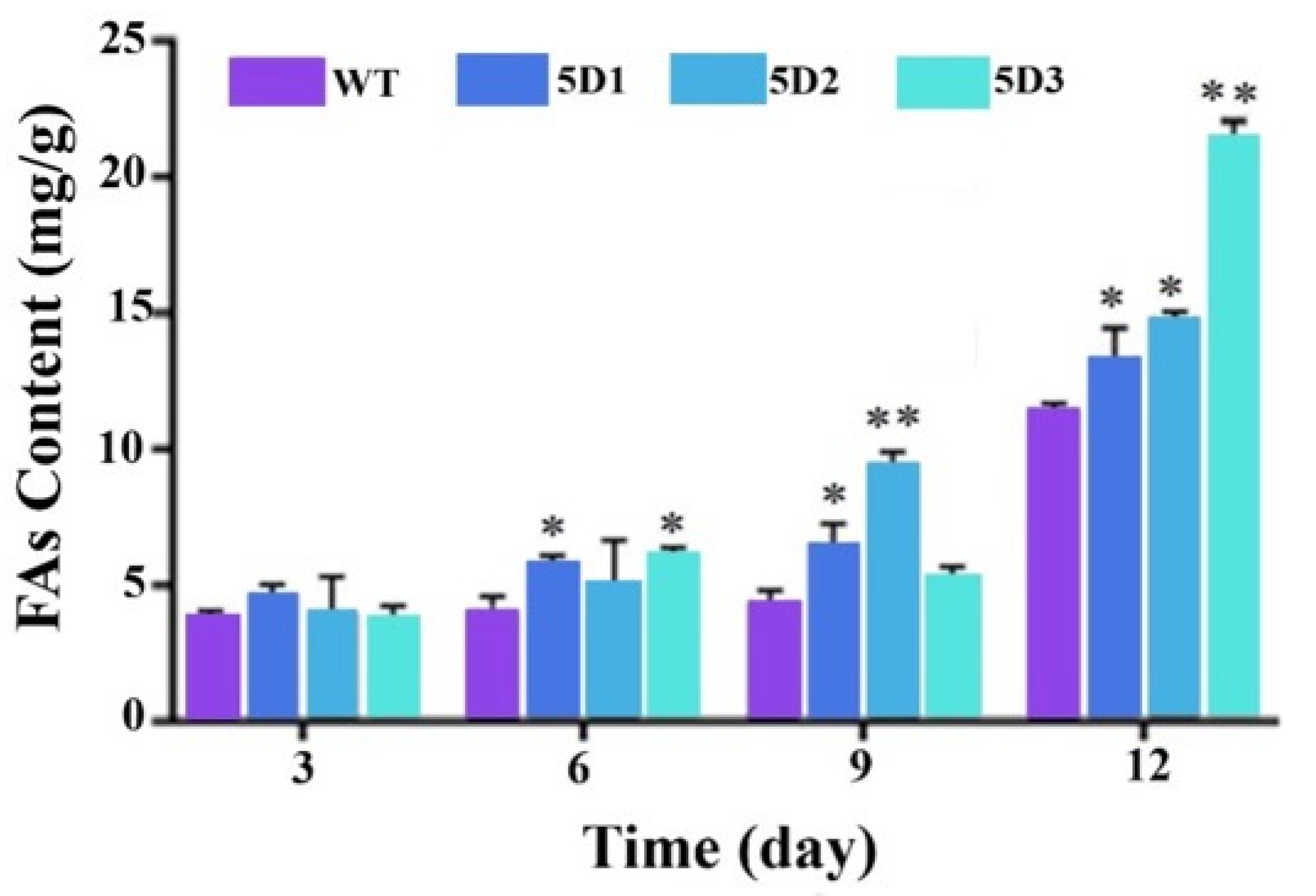
On the 6th day of culture, no significant difference was shown in the total fatty acid content between the overexpressed algal strains and the wild algal strains (WT). From the 9th day on, the fatty acid content of the overexpressed algal strain began to be significantly higher than that of the wild type. On the 9th day, the total fatty acid contents of algal strains 5D1 and 5D2 increased by 20.7% and 50.3%, respectively, compared with WT (p < 0.05). This growth trend became even more pronounced on the 12th day. At this point, the total fatty acid content of all three overexpressing algal strains (5D1, 5D2, 5D3) was significantly higher than that of WT. Among them, the increase in algal strain 5D3 was the greatest, with its content increasing by 55.6% compared to WT (p < 0.05), reaching an extremely significant level (Figure 5).
Analysis was carried out under the optimized chromatographic conditions using an Agilent 7890B Gas Chromatograph. The results showed that the Fatty Acid Methyl Esters Standard Mixture (20 comps., C8-C22; Sigma) was effectively separated under identical detection conditions: each component displayed a clear peak time with a single, symmetrical sharp peak, achieving baseline separation for all peaks (Figure S7). The relevant peak time data are as follows: The retention times of each peak in the total ion current diagram of the fatty acid standard are shown in Table S4. The elution times of the total ion current diagrams of fatty acids in the overexpressed algal strain samples are shown in Table S5.
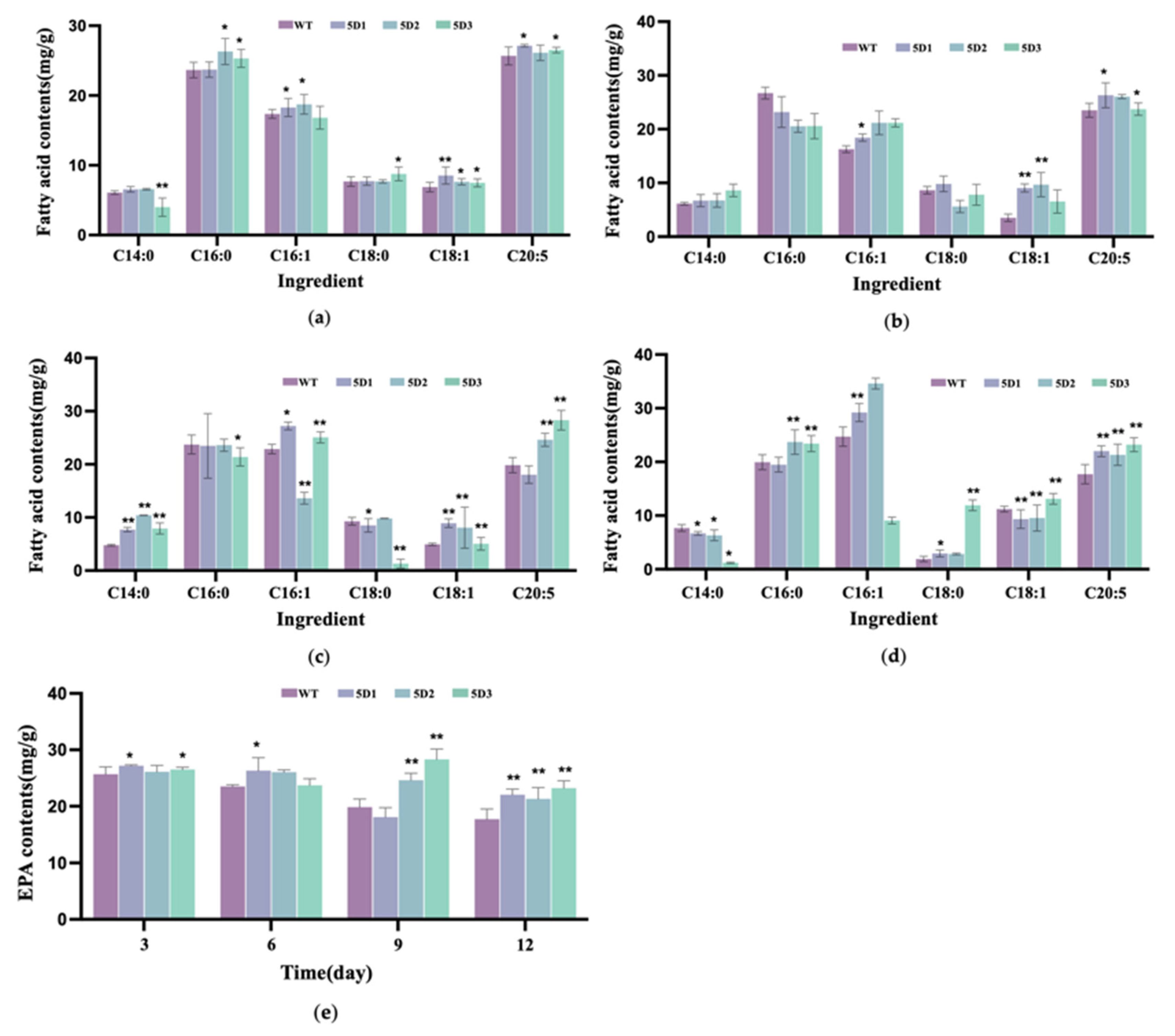
The results showed (Figure 6a,d, Tables S6–S9) that on the 3rd, 6th, 9th and 12th days of inoculation and culture, the three overexpressed mutant algal strains, while synthesizing fatty acids, might also be using their own synthesized organic substances (including fatty acids) to support their growth and development. At all detection time points, the contents of major fatty acids in the three mutant algal strains were generally higher than those in the wild type. On the 9th day, the EPA content of the mutant strains 5D2 and 5D3 began to be significantly higher than that of the wild strains. On the 12th day, the EPA content of the three mutant strains was extremely significantly higher than that of the wild strains. Among them, the EPA accumulation of the 5D3 algal strain reached the highest on the 9th day, which was 28.3 mg/g, significantly increasing by 42% compared with the wild type (Figure 6e). This phenomenon may be related to the introduction of the Δ5 desaturase gene: its overexpression may have promoted the synthesis of more EPA, thereby altering the proportion of each fatty acid component.
On the third day of cultivation, the algal strains are in the lag period, which is the initial stage for them to adapt to the cultivation environment. By the 9th day, the algal strain enters the logarithmic phase of rapid growth. During this stage, the growth rate reaches its peak, and physiological metabolic activities are vigorous. Algal cells support their rapid growth by synthesizing and consuming various organic substances. The content of fatty acids varies depending on the dynamic balance between their synthesis and catabolism: when the synthesis rate exceeds the decomposition and utilization rate, fatty acids accumulate. Conversely, when the decomposition rate is greater than the synthesis rate, the content of fatty acids decreases.
Based on the above data, it can be inferred that if the industrial production of EPA is to be carried out, harvesting can be conducted on the 9th or 12th day of cultivation, when the algal body accumulates a higher level of EPA.

3.9. Fluorescence Quantitative Detection of Ptd5α Gene Expression

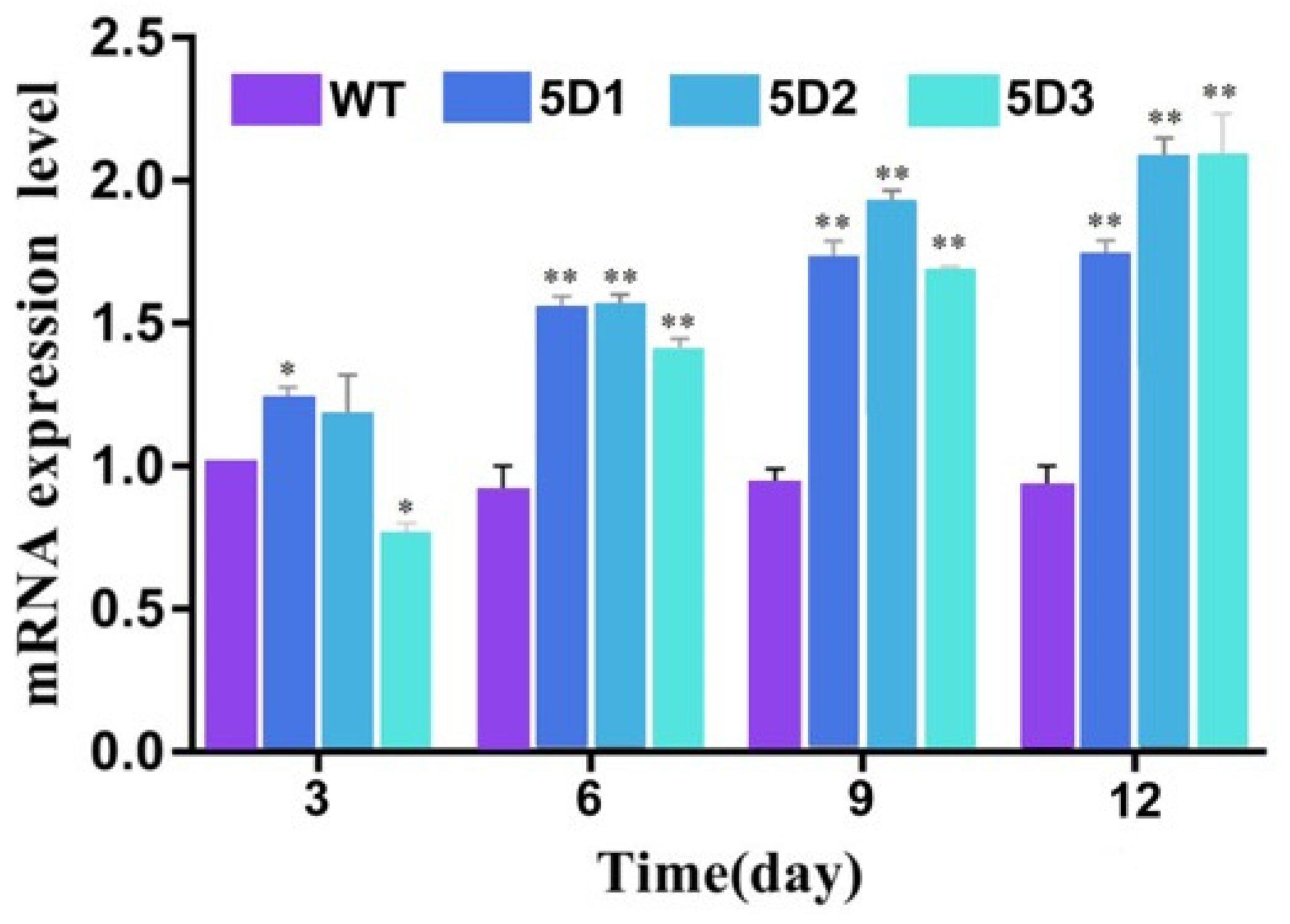
In Figure 7, the y-axis represents the expression level of the Ptd5α gene in the overexpressing algal strains as a fold change relative to the wild-type strain, and the x-axis represents the culture time. On the 6th day of culture, the expression levels of the Ptd5α gene in the three overexpressed mutant algal strains were significantly higher than those in the wild type (WT), and the expression levels of the 5D1 and 5D2 algal strains increased by 50.1% compared with WT. On the 9th day, the expression levels of 5D1, 5D2 and 5D3 increased by 61.2%, 78.9% and 59.8%, respectively, compared with WT. On the 12th day, the expression level of the 5D1 algal strain increased by 61.5%, while that of the 5D2 and 5D3 algal strains increased by 85.3% compared with WT. The above results indicate that the successful transfer of the exogenous Ptd5α gene effectively upregulated the expression level of the endogenous Ptd5α gene in P. tricornutum.

4. Discussion

Fatty acid desaturase is a key enzyme in the synthesis of polyunsaturated fatty acids (PUFAs), introducing one or more carbon–carbon double bonds (C=C) at specific positions with in the fatty acid chain [34]. These PUFAs provide diverse physiological benefits, including regulating blood lipids, maintaining retinal health, alleviating joint inflammation, and promoting brain cell development [35,36,37]. Among marine microalgae, 40% to 86% of species can synthesize a relatively high content of PUFAs [38,39,40]. At present, researchers have cloned multiple coding genes of fatty acid desaturase and extensomease from various microalgae [41], and some of these genes have been successfully functionally expressed in heterologous systems such as Escherichia coli, Saccharomyces cerevae, Arabidopsis thaliana, and rapeseed [42]. Therefore, a systematic analysis of the fatty acid desaturase gene family is essential to elucidate regulatory mechanisms of anabolic pathways and to understand the composition and accumulation of the resulting metabolic products [43].
Using the conserved FA desaturase and FA desaturase 2 domains as query models, 15 FAD genes were identified in P. tricornutum. Based on functional characteristics, they were classified into four subfamilies: Acyl-CoA, Acyl-ACP, Acyl-Lipid, and Acyl-CoA/Acyl-Lipid, with the majority belonging to the last group. Subcellular localization prediction shows that FAD gene family members are mainly distributed in the endoplasmic reticulum and chloroplasts, which is consistent with the research conclusion of Hajiahmadi et al. [44] that the process of fatty acid desaturation occurs in chloroplasts or the endoplasmic reticulum through two different pathways, respectively. Protein structure and stability are crucial for maintaining function during evolution [45]. The key desaturases contain two highly conserved motifs: motif 1 binds electron-transfer cofactors via conserved residues, while motif 2 facilitates substrate recognition and binding. These motifs function cooperatively to ensure efficient progression of the desaturation reaction [46].
Bioinformatics analysis revealed that the Ptd5α enzyme sequence contains 74 predicted phosphorylation sites. The identification of these phosphorylation sites implies proteinal dynamic regulation of Ptd5α activity through interactions with other proteins. Additionally, Ptd5α was characterized as a transmembrane protein, suggesting that its function may involve or require transmembrane movement. These findings establish a theoretical basis for future studies on the role of Ptd5α in regulating the synthesis of EPA [47].
Δ5 desaturase shows a high degree of conservation among species. Dongmei Liu et al. successfully transformed the IgD5 gene of Chlorella globosa into Arabidopsis thaliana, confirming that IgD5 can convert omega-6 fatty acid DGLA (dihigh-γ-linolenic acid) into arachidonic acid AA [48]. According to Linden H et al. [49], the Crd5 gene was successfully cloned from Chlamydomonas reinhardtii and its functional expression was achieved in Pichia pasteuris. Shi et al. [50] also demonstrated that the homology of the Δ5 desaturase gene sequences between Nitzschia closterium and P. tricornutum was as high as 99.4%, further confirming the stability and functional conservation of this protein structure [51].
In this study, the pPha-T1-Δ5 overexpression plasmid was successfully constructed, and the exogenous Ptd5α gene was introduced into the P. tricornutum by the electroporation conversion method. At the same time, the optimal electroporation conditions were optimized and determined. After screening for resistance to ble and sequence verification, three stably expressed transforming algal strains were finally obtained. The results of the growth curve measurement indicated that the growth trend of the Ptd5α transformed algal strain did not change significantly compared with the wild-type algal strain, suggesting that the introduction of this gene did not have an adverse effect on the normal growth and development of the algal. The fatty acid composition of the transformed algal strains at different culture periods was further analyzed by HPLC. It was found that the overexpression of the exogenous Δ5 desaturase gene could not only significantly increase the total fatty acid accumulation of P. tricornutum, but also effectively promote the synthesis of EPA, and its content was significantly higher than that of wild-type algal strains. Analysis of the expression level of the Ptd5α gene at different culture periods by qRT-PCR showed that the expression trend of this gene was basically consistent with the changing trend of EPA content, indicating the association between the two in metabolic regulation.
Environmental stress and molecular breeding are two principal strategies for enhancing fatty acid content in P. tricornutum. While cold stress with salt/ABA and nitrogen starvation effectively promote lipid synthesis [51,52], these approaches often lead to compromised biomass and, under prolonged stress, the catabolism of lipid reserves for survival, limiting their practical utility. In contrast, molecular techniques like the overexpression of the Ptd5α gene directly enhance fatty acid biosynthesis without growth inhibition. Moreover, such transgenic strains retain stress responsiveness, creating a synergistic effect between genetic enhancement and stress induction that further boosts fatty acid production and highlights the superior potential of this integrated approach.
In this study, we systematically identified 15 FAD gene family members in P. tricornutum and constructed three engineered algal strains stably expressing Ptd5α. The transgenic strains exhibited growth characteristics comparable to those of the wild type, yet showed significant increases in both total fatty acid and EPA contents. At its peak, EPA constituted more than 30% of the total fatty acids, which strongly supports the essential role of Δ5 desaturase in EPA synthesis in P. tricornutum. This work not only identifies key targets for the directed breeding of high-EPA microalgae via genetic engineering but also successfully isolates mutant strains with enhanced EPA production. It thereby establishes a material basis for developing high-value microalgal health products [53], sustainable aquatic feeds [54], and algae-based biofuels [55], highlighting its considerable application potential.

Supplementary Materials

The following supporting information can be downloaded at: https://www.mdpi.com/article/10.3390/jmse13122369/s1, Figure S1: Microscopic morphology of P. tricornutum (400X); Figure S2: Chromosomal location of the FADs in P. tricornutum; Figure S3: Hydrophobicity prediction of Ptd5α protein; Figure S4: 3D model of Ptd5α protein; Figure S5: Prediction of the transmem-brane domains of Ptd5α protein; Figure S6: Resistance plate screening positive inverters; Figure S7: Total ion current chromatogram of 20 fatty acid methyl esters mixed standard; Table S1: The sequence characteristics of the FAD gene family in P. tricornutum; Table S2: The primary structure analysis of Ptd5α protein; Table S3: The CDS sequence of the Ptd5α gene of P. tricornutum; Table S4: The peak time of the total ion of the standard fatty acid; Table S5: The peak time of total ion of fatty acid in over expressing algal strains; Table S6: Fatty acid contents and proportion of P. tricornutum on the third day; Table S7: Fatty acid contents and proportion of P. tricornutum on the sixth day; Table S8: Fatty acid contents and proportion of P. tricornutum on the ninth day; Table S9: Fatty acid contents and proportion of P. tricornutum on the twelfth day; Table S10: qRT-PCR primer sequences.

Author Contributions

Conceptualization, W.H.; data curation, B.W., Q.C., P.G. and W.M.; formal analysis, B.W., Q.C. and H.Y.; funding acquisition, W.H.; investigation, W.H., P.G., W.Z. and W.M.; methodology, W.H. and P.G.; project administration, W.H.; supervision, W.H., P.G. and B.W.; validation, B.W., Q.C., J.S. and H.M.; Writing—Original draft, W.H. All authors have read and agreed to the published version of the manuscript.

Funding

This work was supported by the China Agriculture Research System (Grant No. CARS-17) and the Natural Science Fund of Fujian (No. 2023J01509).

Data Availability Statement

The original contributions presented in this study are included in the article/Supplementary Materials. Further inquiries can be directed to the corresponding author.

Conflicts of Interest

The authors declare that they have no conflicts of interest.

References

  1. Bowler, C.; Allen, A.E.; Badger, J.H.; Grimwood, J.; Jabbari, K.; Kuo, A.; Maheswari, U.; Martens, C.; Maumus, F.; Otillar, R.P.; et al. The Phaeodactylum genome reveals the evolutionary history of diatom genomes. Nature 2008, 456, 239–244. [Google Scholar] [CrossRef]
  2. Wang, X.Y.; Xing, H.; Zhong, Y.S.; Song, D.H.; Xu, Y.C. Comparison of Nutrient Contents between Phaeodactylum tricornutum and Chlorella vulgaris. J. Tianjin Univ. Sci. Technol. 2014, 2, 11–15. [Google Scholar]
  3. Olguín, E.J.; SánchezGalván, G.; AriasOlguín, I.; Melo, F.J.; GonzálezPortela, R.E.; Cruz, L.; De Philippis, R.; Adessi, A. Microalgae-Based Biorefineries: Challenges and Future Trends to Produce Carbohydrate Enriched Biomass, High-Added Value Products and Bioactive Compounds. Biology 2022, 11, 1146. [Google Scholar]
  4. Shimazaki, K.; Takamiya, K.; Nishimura, M. Studies on Electron Transfer Systems in the Marine Diatom Phaeodactylum tricornutum. J. Biochem. 2008, 83, 1639–1642. [Google Scholar] [CrossRef]
  5. Yang, Y.N.; Yang, M.; Zhou, Y.H.; Chen, X.Q.; Huang, B.Y. Effect of RNA Demethylase FTO Overexpression on Biomass and Bioactive Substances in Diatom Phaeodactylum tricornutum. Biology 2025, 14, 414. [Google Scholar] [CrossRef] [PubMed]
  6. Yuan, X.; Liang, L.; Liu, K.; Xie, L.J.; Huang, L.Q.; He, W.J.; Chen, Y.Q.; Xue, T. Spent yeast as an efficient medium supplement for fucoxanthin and eicosapentaenoic acid (EPA) production by Phaeodactylum tricornutum. J. Appl. Phycol. 2020, 32, 59–69. [Google Scholar] [CrossRef]
  7. Xue, Z.; Zhu, L.Y.; Wang, B.Y.; Liu, Z.Y. Effect of Temperature and Salinity on Feeding and Metabolism of Two Marine copepods. Oceanol. Limnol. Sin. 2020, 51, 99–102. [Google Scholar]
  8. Ben Ayed, R.; Chirmade, T.; Hanana, M.; Khamassi, K.; Ercisli, S.; Choudhary, R.; Kadoo, N.; Karunakaran, R. Comparative Analysis and Structural Modeling of Elaeis oleifera FAD2, a Fatty Acid Desaturase Involved in Unsaturated Fatty Acid Composition of American Oil Palm. Biology 2022, 11, 529. [Google Scholar] [CrossRef] [PubMed]
  9. Liu, K.; Zhao, S.; Wang, S.; Wang, H.X.; Zhang, Z.H. Identification and analysis of the FAD gene family in walnuts (Juglans regia L.) based on transcriptome data. BMC Genom. 2020, 21, 299. [Google Scholar] [CrossRef] [PubMed]
  10. Li, J.J.; Zhang, J.J.; Nian, H.J. Characteristics of Δ12-fatty Acid Desaturase FAD2 and Its Functions Under Stress. Life Sci. Res. 2013, 17, 174–178. [Google Scholar]
  11. Wei, H.; Movahedi, A.; Xu, S.; Zhang, Y.; Liu, G.; Aghaei-Dargiri, S.; Ghaderi Zefrehei, M.; Zhu, S.; Yu, C.; Chen, Y.; et al. Genome-Wide Characterization and Expression Analysis of Fatty acid Desaturase Gene Family in Poplar. Int. J. Mol. Sci. 2022, 23, 11109. [Google Scholar] [CrossRef]
  12. Dai, X.F.; Xiao, L.; Wu, Y.H.; Wu, G.; Lu, C.M. Research Progress on Plant Fatty Acid Desaturase and Its Encoding Genes. Chin. Bull. Bot. 2007, 24, 105–113. [Google Scholar]
  13. Li, Y.T.; Fu, C.H.; Li, M.T.; Yu, L.J. Cloning and Sequence Analysis of Δ6 Fatty Acid Elongase Gene from Phaeodactylm tricomutum. Biotechnol. Bull. 2009, 10, 120–123. [Google Scholar]
  14. Peng, K.T.; Zheng, C.N.; Xue, J.; Chen, X.Y.; Yang, W.D.; Liu, J.S.; Bai, W.B.; Li, H.Y. Delta 5 fatty acid desaturase upregulates the synthesis of polyunsaturated fatty acids in the marine diatom Phaeodactylum tricornutum. J. Agric. Food Chem. 2014, 35, 8773–8776. [Google Scholar] [CrossRef]
  15. Liu, D.M.; Ma, X.L.; Zhu, B.H.; Li, S.; Yu, W.G.; Yang, G.P.; Pan, K.H. Expression ression of Δ5 fatty acid desaturase encoding gene of Phaeodactylum tricornutum in prokaryotic system. Trans. Oceanol. Limnol. 2012, 1, 116–122. [Google Scholar]
  16. Dolch, L.J.; Maréchal, E. Inventory of Fatty Acid Desaturases in the Pennate Diatom Phaeodactylum tricornutum. Mar. Drugs 2015, 13, 5732–5735. [Google Scholar] [CrossRef]
  17. Hamilton, M.L.; Powers, S.; Napier, J.A.; Sayanova, O. Heterotrophic Production of Omega-3 Long-Chain Polyunsaturated Fatty Acids by Trophically Converted Marine Diatom Phaeodactylum tricornutum. Mar. Drugs 2016, 14, 53. [Google Scholar] [CrossRef] [PubMed]
  18. Domergue, F.; Spiekermann, P.; Lerchl, J.; Beckmann, C.; Kilian, O.; Kroth, P.G.; Boland, W.; Zähringer, U.; Heinz, E. New Insight into Phaeodactylum tricornutum Fatty Acid Metabolism. Cloning and Functional Characterization of Plastidial and Microsomal Δ12-Fatty Acid Desaturases. Plant Physiol. 2003, 131, 1648–1660. [Google Scholar] [CrossRef] [PubMed]
  19. Viso, A.-C.; Marty, J.C. Fatty acids from 28 marine microalgae. Phytochemistry 1993, 34, 1521–1533. [Google Scholar] [CrossRef]
  20. Cui, Y.; Thomas-Hall, S.R.; Chua, E.T.; Schenk, P.M. Development of High-Level Omega-3 Eicosapentaenoic Acid (EPA) Production from Phaeodactylum tricornutum. J. Phycol. 2020, 57, 258–268. [Google Scholar] [CrossRef]
  21. Gu, W.; Kavanagh, J.M.; McClure, D. A scalable model for EPA and fatty acid production by Phaeodactylum tricornutum. Front. Bioeng. Biotechnol. 2022, 10, 1011570. [Google Scholar] [CrossRef] [PubMed]
  22. Petrie, J.R.; Shrestha, P.; Zhou, X.R.; Mansour, M.P.; Liu, Q.; Belide, S.; Nichols, P.D.; Singh, S.P. Metabolic Engineering Plant Seeds with Fish Oil-Like Levels of DHA. PLoS ONE 2012, 7, e49165. [Google Scholar] [CrossRef] [PubMed]
  23. Wang, S.; Said, I.H.; Thorstenson, C.; Thomsen, C.; Ullrich, M.S.; Kuhnert, N.; Thomsen, L. Pilot-scale production of antibacterial substances by the marine diatom Phaeodactylum tricornutum Bohlin. Algal Res. 2018, 32, 113–120. [Google Scholar] [CrossRef]
  24. Remmers, I.M.; Martens, D.E.; Wijffels, R.H.; Lamers, P.P. Dynamics of triacylglycerol and EPA production in Phaeodactylum tricornutum under nitrogen starvation at different light intensities. PLoS ONE 2017, 12, e0175630. [Google Scholar] [CrossRef]
  25. Peng, K.T.; Xiong, B.H.; Cheng, G.; Zhong, Y.H.; Yu, L. A novel non-genetic strategy to increase lipid content in Phaeodactylum tricornutum. Food Biosci. 2025, 68, 106396. [Google Scholar] [CrossRef]
  26. Jesionowska, M.; Ovadia, J.; Hockemeyer, K.; Clews, A.C.; Xu, Y. EPA and DHA in microalgae: Health benefits, biosynthesis, and metabolic engineering advances. J. Am. Oil Chem. Soc. 2023, 100, 831–842. [Google Scholar] [CrossRef]
  27. Jiang, M.L.; Guo, B.; Wan, X.; Gong, Y.M.; Zhang, Y.B.; Hu, C.J. Isolation and Characterization of the Diatom Phaeodactylum Δ5-Elongase Gene for Transgenic LC-PUFA Production in Pichia pastoris. Mar. Drugs 2014, 12, 1317–1334. [Google Scholar] [CrossRef]
  28. Haslam, R.P.; Hamilton, M.L.; Economou, C.K.; Smith, R.; Hassall, K.L.; Napier, J.A.; Sayanova, O. Overexpression of an endogenous type 2 diacylglycerol acyltransferase in the marine diatom Phaeodactylum tricornutum enhances lipid production and omega-3 long-chain polyunsaturated fatty acid content. Biotechnol. Biofuels 2020, 13, 87. [Google Scholar] [CrossRef]
  29. Şirin, P.A.; Serdar, S. Effects of nitrogen starvation on growth and biochemical composition of some microalgae species. Folia Microbiol. 2024, 69, 889–902. [Google Scholar] [CrossRef]
  30. Sun, D.; Quan, W.; Wang, D.; Cui, J.; Wang, T.; Lin, M.; Wang, Y.; Wang, N.; Dong, Y.; Li, X.; et al. Genome-Wide Identification and Expression Analysis of Fatty Acid Desaturase (FAD) Genes in Camelina sativa (L.) Crantz. Int. J. Mol. Sci. 2022, 23, 14550. [Google Scholar] [CrossRef]
  31. Liu, B.; Sun, Y.; Hang, W.; Wang, X.; Xue, J.; Ma, R.; Jia, X.; Li, R. Characterization of a Novel Acyl-ACP Δ9 Desaturase Gene Responsible for Palmitoleic Acid Accumulation in a Diatom Phaeodactylum tricornutum. Front. Microbiol. 2020, 11, 584589. [Google Scholar] [CrossRef]
  32. Starikov, A.Y.; Sidorov, R.A.; Kazakov, G.V.; Leusenko, P.A.; Los, D.A. The substrate preferences and “counting” mode of the cyanobacterial ω3 (Δ15) acyl-lipid desaturase. Biochimie 2025, 232, 74–82. [Google Scholar] [CrossRef] [PubMed]
  33. Starikov, A.Y.; Sidorov, R.A.; Los, D.A. Counting modes of acyl-lipid desaturases. Funct. Plant Biol. 2025, 52, 24338. [Google Scholar] [CrossRef] [PubMed]
  34. Liu, W.; Lu, G.; Yang, G.; Bi, Y. Improving oxidative stability of biodiesel by cis-trans isomerization of carbon-carbon double bonds in unsaturated fatty acid methyl esters. Fuel 2019, 242, 133–139. [Google Scholar] [CrossRef]
  35. Méndez, L.; Pazos, M.; Gallardo, J.M.; Torres, J.L.; Pérez-Jiménez, J.; Nogués, R.; Romeu, M.; Medina, I. Reduced protein oxidation in Wistar rats supplemented with marine ω3 PUFAs. Free Radic. Biol. Med. 2013, 55, 8–20. [Google Scholar] [CrossRef] [PubMed]
  36. Yang, B.; Ren, X.L.; Fu, Y.Q.; Gao, J.L.; Li, D. Ratio of n-3/n-6 PUFAs and risk of breast cancer: A meta-analysis of 274,135 adult females from 11 independent prospective studies. BMC Cancer 2014, 14, 105. [Google Scholar] [CrossRef]
  37. Hossain, M.A. Fish as Source of n-3 Polyunsaturated Fatty Acids (PUFAs), Which One is Better-Farmed or Wild? Adv. J. Food Sci. Technol. 2011, 3, 455–466. [Google Scholar]
  38. Sakai, H.; Kajiwara, S. A Stearoyl-CoA-specific Δ9 Fatty Acid Desaturase from the Basidiomycete Lentinula edodes. Biosci. Biotechnol. Biochem. 2003, 67, 2431–2437. [Google Scholar] [CrossRef]
  39. Makay, K.; Griehl, C.; Grewe, C. Downstream Process Development for Multiproduct Recovery of High-Value Lead Compounds from Marine Microalgae. Chem. Ing. Tech. Verfahrenstech. Tech. Chem. Apparatewesen Biotechnol. 2022, 94, 1254. [Google Scholar] [CrossRef]
  40. Jónasdóttir, A.H. Fatty Acid Profiles and Production in Marine Phytoplankton. Mar. Drugs 2019, 17, 151. [Google Scholar] [CrossRef]
  41. Peltomaa, E.; Johnson, M.; Taipale, S. Marine Cryptophytes Are Great Sources of EPA and DHA. Mar. Drugs 2018, 16, 3. [Google Scholar] [CrossRef] [PubMed]
  42. Chi, X.Y.; Lu, Y.D.; Wang, M.Q.; Bian, S.G.; Yang, Q.L.; Qin, S. Cloning and Sequence Analysis of the Δ12 Fatty Acid Desaturase Gene in Chlorella. Mar. Sci. 2009, 33, 11–20. [Google Scholar]
  43. Gai, W.Y.; Sun, H.; Hu, Y.; Liu, C.Y.; Zhang, Y.X.; Gai, S.P.; Yuan, Y.C. Genome-Wide Identification of Membrane-Bound Fatty Acid Desaturase Genes in Three Peanut Species and Their Expression in Arachis hypogaea during Drought Stress. Genes 2022, 13, 1718. [Google Scholar] [CrossRef]
  44. Hajiahmadi, Z.; Abedi, A.; Wei, H.; Sun, W.B.; Ruan, H.H.; Zhuge, Q.; Movahedi, A. Identification, evolution, expression, and docking studies of fatty acid desaturase genes in wheat (Triticum Aestivum L.). BMC Genom. 2020, 21, 778. [Google Scholar] [CrossRef]
  45. Jin, X.L.; An, J.B.; Qi, D.S.; Qiao, F.; Jiang, D.; Du, S.B.; Ji, S.; Xie, H.C. Identification and Expression Pattern Analysis of FAD Gene Family in Populus tomentose. Mol. Plant Breed. 2022. [Google Scholar]
  46. Wang, M.X.; Chen, H.Q.; Gu, Z.N.; Zhang, H.; Chen, W.; Chen, Y.Q. ω3 fatty acid desaturases from microorganisms: Structure, function, evolution, and biotechnological use. Appl. Microbiol. Biotechnol. 2013, 97, 10255–10262. [Google Scholar] [CrossRef]
  47. Ran, Z.; Xu, J.; Liao, K.; Li, S.; Chen, S.; Yan, X. Biosynthesis of Polyunsaturated Fatty Acids in the Razor Clam Sinonovacula constricta: Characterization of Δ5 and Δ6 Fatty Acid Desaturases. J. Agric. Food Chem. 2018, 66, 4592–4601. [Google Scholar] [CrossRef] [PubMed]
  48. Liu, J.; Sun, Q.X.; Li, X.Z.; Qi, B.X. Functional Characterization of Isochrysis galbana Δ5 Desaturase Gene IgD5 in Arabidopsis thaliana. Acta Agron. Sin. 2013, 39, 928–934. [Google Scholar] [CrossRef]
  49. Bohne, F.; Linden, H. Regulation of carotenoid biosynthesis genes in response to light in Chlamydomonas reinhardtii. Biochim. Et Biophys. Acta (BBA) Gene Struct. Expr. 2002, 1579, 26–34. [Google Scholar] [CrossRef]
  50. Shi, J.; Pan, K.H.; Wang, X.Q.; Chen, F.; Zhou, M.; Zhu, B.H.; Qing, R.W. Hierarchical recognition on the taxonomy of Nitzschia closterium f. minutissima. Chin. Sci. Bull. 2008, 53, 245–250. [Google Scholar] [CrossRef]
  51. Fierli, D.; Barone, M.E.; Graceffa, V.; Touzet, N. Cold stress combined with salt or abscisic acid supplementation enhances lipogenesis and carotenogenesis in Phaeodactylum tricornutum. Bioprocess Biosyst. Eng. 2022, 45, 1967–1977. [Google Scholar] [CrossRef] [PubMed]
  52. Zhang, Y.; Wu, H.J.; Yuan, C.J.; Li, T.; Li, A.F. Growth, biochemical composition, and photosynthetic performance of Scenedesmus acuminatus during nitrogen starvation and resupply. J. Appl. Phycol. 2019, 31, 2797–2809. [Google Scholar] [CrossRef]
  53. Zhou, J.; Wang, M.; Bäuerl, C.; Cortés-Macías, E.; Calvo-Lerma, J.; Collado, M.C.; Barba, F.J. The impact of liquid-pressurized extracts of Spirulina, Chlorella and Phaedactylum tricornutum on in vitro antioxidant, antiinflammatory and bacterial growth effects and gut microbiota modulation. Food Chem. 2023, 401, 134083. [Google Scholar] [CrossRef] [PubMed]
  54. Cui, Y.; Thomas-Hall, S.R.; Chua, E.T.; Schenk, P.M. Development of a Phaeodactylum tricornutum biorefinery to sustainably produce omega-3 fatty acids and protein. J. Clean. Prod. 2021, 300, 126839. [Google Scholar] [CrossRef]
  55. Branco-Vieir, M.; Costa, D.M.B.; Mata, T.M.; Martins, A.A.; Freitas, M.A.V.; Caetano, N.S. Environmental assessment of industrial production of microalgal biodiesel in central-south Chile. J. Clean. Prod. 2020, 266, 121756. [Google Scholar] [CrossRef]
Figure 1. The motif composition of the FAD gene family members in P. tricornutum.
Jmse 13 02369 g001
Figure 2. Evolutionary relationships of FAD genes among P. tricornutum, C. reinhardtii, I. galbana, A. thaliana, Z. mays, N. tabacum, and B. napus.
Jmse 13 02369 g002
Figure 3. Growth curve of overexpressing algal strains.
Jmse 13 02369 g003
Figure 4. Effect of Ptd5α overexpression on algal cell dry weight. “*” indicates a significant difference.
Jmse 13 02369 g004
Figure 5. Effect of transforming the Ptd5α gene on the FA production of the algae strains. “*” indicates a significant difference, and “**” indicate a highly significant difference.
Jmse 13 02369 g005
Figure 6. The changes in the contents of each component of fatty acids of wild algal strains and mutant algal strains at different culture periods. (a) Contents of each component of fatty acids in wild and mutant algal strains on the 3rd day; (b) Contents of each component of fatty acids in wild and mutant algal strains on the 6th day; (c) Contents of each component of fatty acids in wild and mutant algal strains on the 9th day; (d) Contents of each component of fatty acids in wild and mutant algal strains on the 12th day; (e) The changes in EPA content of wild algal strains and mutant algal strains on the 3rd, 6th, 9th, and 12th day. “*” indicates a significant difference, and “**” indicates a highly significant difference.
Jmse 13 02369 g006
Figure 7. Relative expression levels of Ptd5α gene in wild and transgenic algae strains. “*” indicates a significant difference, and “**” indicates a highly significant difference.
Jmse 13 02369 g007
Table 1. Identification of fatty acid desaturase gene family members in P. tricornutum.
Conserved
Domain
ProteinIDGene NameChromosomeProduct
FAD desaturase
(PF00487)
XP_002186139.1PtFAD2Chr3Δ12 fatty acid desaturase
XP_002178636.1Pt44622Chr4predicted protein
XP_002180514.1Pt46275Chr9predicted protein
XP_002180771.1Pt46383Chr10predicted protein
XP_002185732.1Ptd5αChr11Δ5 fatty acid desaturase
XP_002181794.1Ptd9Chr13Δ9 desaturase
XP_002182901.1 Ptd6Chr17Δ6 fatty acid desaturase
XP_002182832.1Ptd12Chr17precursor of desaturase ω-6 desaturase
XP_002182858.1Ptd5bChr17Δ5b fatty acid desaturase
XP_002183026.1Pt22510Chr18predicted protein
XP_002183420.1Pt22677Chr19dihydroceramide Δ4 desaturase
XP_002184864.1Pt55137Chr26acyl desaturase
XP_002185374.1Pt50443Chr30predicted protein
XP_002185498.1Ptd15Chr31precursor of desaturase ω-3 desaturase
FA desatrase.2
(PF03405)
XP_002177417.1Pt9316Chr1predicted protein
Disclaimer/Publisher’s Note: The statements, opinions and data contained in all publications are solely those of the individual author(s) and contributor(s) and not of MDPI and/or the editor(s). MDPI and/or the editor(s) disclaim responsibility for any injury to people or property resulting from any ideas, methods, instructions or products referred to in the content.