Article

Integrated Geophysical, Isotopic, and Hydrochemical Approach to Studying Freshwater–Saline Water Interaction in Coastal Wetland at Punta Rasa Nature Reserve, Argentina


1
Centro de Investigaciones Geológicas (CIG), Consejo Nacional de Investigaciones Científicas y Técnicas, Universidad Nacional de La Plata, La Plata 1900, Argentina
2
Facultad de Ciencias Astronómicas y Geofísicas (FCAyG), Universidad Nacional de La Plata, La Plata 1900, Argentina
3
Instituto de Geociencias Básicas, Aplicadas y Ambientales de Buenos Aires (IGEBA), Consejo Nacional de Investigaciones Científicas y Técnicas, Universidad de Buenos Aires, Buenos Aires 1428, Argentina
*
Author to whom correspondence should be addressed.
J. Mar. Sci. Eng. 2025, 13(12), 2362; https://doi.org/10.3390/jmse13122362
Submission received: 16 November 2025 / Revised: 9 December 2025 / Accepted: 9 December 2025 / Published: 12 December 2025
(This article belongs to the Special Issue Monitoring Coastal Systems and Improving Climate Change Resilience)

Abstract

The interaction between freshwater and saline water in coastal wetlands generates an interface zone where vertical and horizontal salinity gradients develop. This interface has been investigated through geophysical, hydrochemical, and isotopic studies, which constitute useful tools that provide different types of information whose combined interpretation allows for a more comprehensive understanding of the processes associated with this interaction. This work assessed, through an integrated geophysical (electrical resistivity tomography), hydrochemical (major ions), and isotopic (δ2H, δ18O, and 222Rn) study, the freshwater–saline water interaction between marsh and dune environments in the Punta Rasa Natural Reserve (Argentina). Results show that salinity gradients occurring between dune and marsh environments are associated with fresh groundwater discharge and rainwater infiltration. Fresh groundwater discharge takes place in topographically elevated dunes, where freshwater lenses form. This discharge generates vertical and horizontal salinity gradients because the hydraulic gradient causes the interface to migrate with the groundwater flow. In low-relief dunes, lenses do not develop and the salinity gradient that develops within the interface due to rainwater infiltration is vertical. The findings clarify plant zonation linked to freshwater–saline water interfaces and provide environmental data to assess wetland resilience to climate-driven changes.

1. Introduction

Marshes are highly productive coastal environments that provide important functions and services, such as sediment retention, storm buffering, carbon sequestration, and nutrient cycling [1]. They are among the most hydrologically dynamic environments on Earth, partly as a result of their interaction with adjacent uplands and the coastal ocean. Water exchange in these systems can be simplified considering the main freshwater inputs (from precipitations and adjacent uplands) and saline inputs (from the sea). Freshwater (<1500 µS/cm) may derive from vertical flows driven by rainfall infiltration into sediments [2] or from underlying aquifers [3]. Freshwater flows can also occur laterally as groundwater discharge from adjacent uplands [4,5]. In turn, saline water (>35,000 µS/cm) enters the marsh vertically when sea level exceeds the marsh topography, while lateral saline flow is local and occurs through the banks of tidal channels [6,7]. In addition to these flows, water loss through evapotranspiration, mainly in high marsh zones, constitutes another important component [8,9].
Tidal flooding frequency and soil and groundwater salinity are considered the main drivers of vegetation zonation in marshes [10,11,12,13]. These variables are commonly linked to marsh elevation, where higher elevations exhibit lower flooding frequency and higher soil and groundwater salinity. However, beyond tidal flooding, significant water exchange occurs between tides and fresh groundwater discharge from adjacent uplands [3,9,14,15]. This interaction between saline tidal water and continental freshwater, and the associated interface, has been studied in marsh environments through hydrochemical and isotopic studies [6,16,17,18] and geophysical studies [18,19,20,21].
Although these methods are useful for studying freshwater–saline water interactions, each provides different types of information, and their combined analysis allows for a more comprehensive understanding of the associated processes. In this context, the aim of this work was to study, through an integrated geophysical, hydrochemical, and isotopic approach, the freshwater–saline water interaction occurring in marshes of the Punta Rasa Natural Reserve (Argentina), where marsh environments develop among dune deposits. For this purpose, geophysical (electrical resistivity tomography), hydrochemical (major ions), and isotopic (δ2H, δ18O and 222Rn) data analyses will be performed. Based on this analysis, the location and extent of the freshwater–saline water interface, the related water mixture, and the associated processes will be defined. The proposed hypothesis is that dunes work as freshwater reservoirs that discharge groundwater toward the marsh, leading to a freshwater–saline water interface. This interface is a mixing water zone with both horizontal and vertical development, related to groundwater flow and infiltration processes, respectively.

2. Materials and Methods

2.1. Study Area

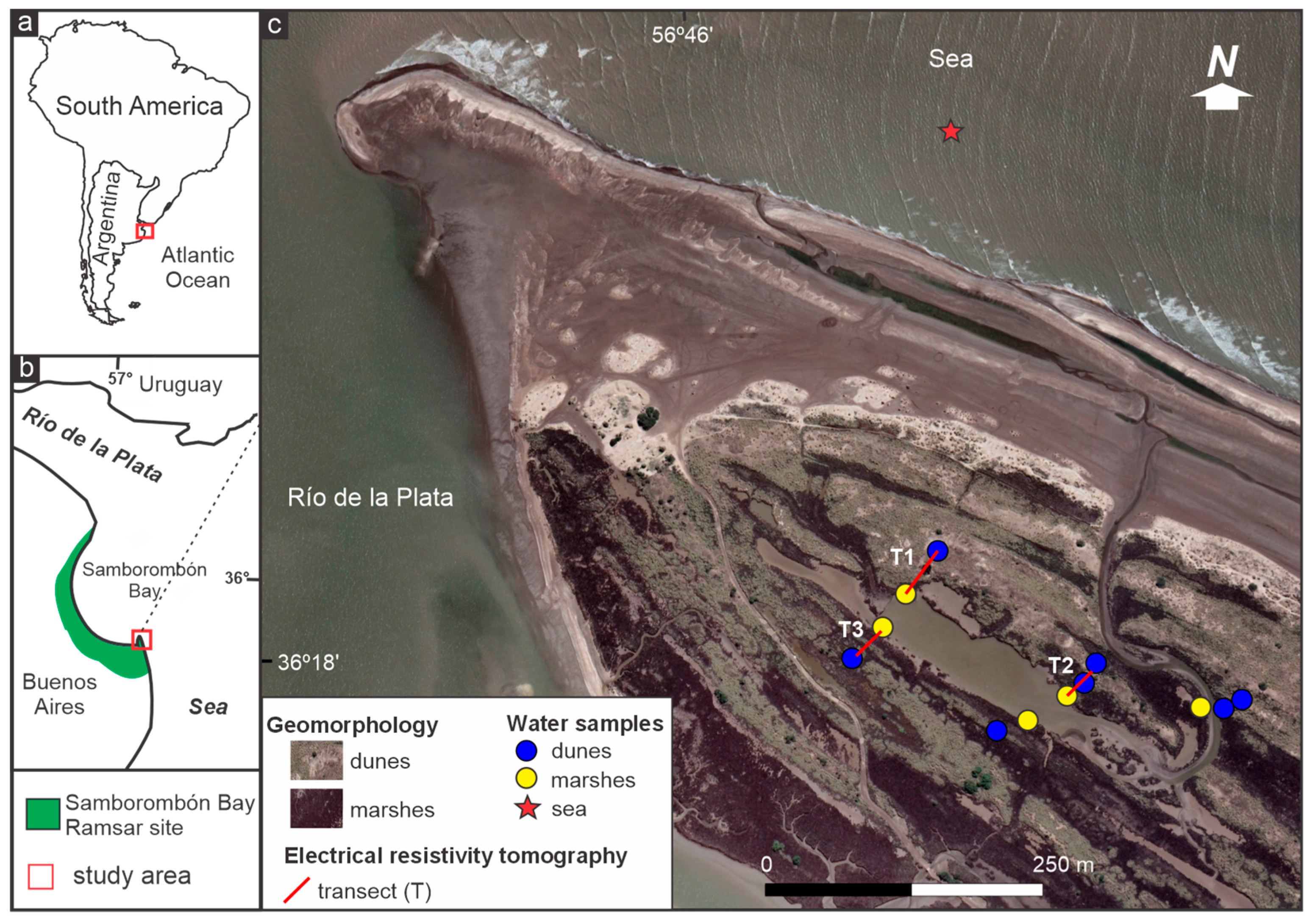
Punta Rasa Natural Reserve is situated in the southernmost region of Samborombón Bay in Argentina, between the outer limit of the Río de la Plata and the ocean (Figure 1a,b). This reserve belongs to a group of natural reserves located within the Ramsar site Samborombón Bay. The Punta Rasa Natural Reserve is located at the southern end of the bay, associated with a northward-migrating sand spit.
The Natural Reserve comprises marsh environments located in depressed areas between dunes developed on beach ridge deposits of the spit (Figure 1c). Marshes are connected to the sea through a tidal channel that crosses the beach and the coastal dune ridge. The tide is semidiurnal and microtidal, and the tidal flooding frequency of the marshes is low, with less than 20 flooding events per year [22]. In this context, high marshes represent more than 90% of the area, and are vegetated by Spartina densiflora, Limonium sp. and Sarcocornia sp. Along the dune margins, Juncus acutus is characteristic, while elevated dune areas are dominated by Cortaderia selloana.
Groundwater in the marsh is brackish, with seasonal hydrochemical variations in the proportion of major ions, whereas groundwater in the dunes is fresh to brackish and exhibits lower hydrochemical variability [23]. Freshwater in dunes results from rainfall infiltration under a humid climate, where mean annual precipitation is close to 1000 mm [24].

2.2. Geophysics Surveys

Three instances of electrical resistivity tomography (ERT) were made along transects which intercepted both the dune and marsh environments, which represent the geomorphological variations in the wetland (Figure 1c). Transect 1 intercepted a dune sector deposited over elongated beach ridges which reached topographic heights close to 3.7 m asl, with widths of about 130 m, as well as adjacent marshes which developed between the dunes and the coastal lagoon. Transect 2 was located towards the southeast and crossed similar environments, except that here the dune sector was narrower (40 m). Transect 3, in turn, intercepted dune environments over thin beach ridges (less than 20 m wide) with elevations lower than 1 m asl, between which marshes developed.
ERT surveys were measured with a 2.5 m dipole–dipole array. The dipole–dipole configuration was selected due to its sensitivity to horizontal resistivity variations [25], which are essential for identifying the boundaries of freshwater lenses and their transitions toward the higher-conductivity phreatic aquifer. Apparent resistivity data was inverted using Res2DInv software, version 3.53. Resistivity model interpretation was based on sediment texture data, groundwater level measurements, and electrical conductivities (ECs) of the water measured in field. Topographic variations along each transect were also taken into consideration, using elevation data obtained from UAV-derived digital elevation models in previous work conducted by the research group [22].

2.3. Hydrochemistry and Isotope (2H, 18O, and 222Rn) Measurements

A groundwater monitoring network was made, located along the geophysical transects, intersecting dune and marsh environments adjacent to the coastal lagoon. Additional monitoring points were also placed in areas adjacent to the tidal channel that connects the lagoon with the sea, as well as one sampling point in the sea (Figure 1c). At each monitoring point, pH, electrical conductivity (EC), and groundwater level were measured in situ, using a field multiparameter instrument for both pH and EC and a sounding probe for the groundwater level. Additionally, water samples were collected for the determination of major ions (Ca2+, Mg2+, Na+, K+, CO32−, HCO3, Cl, and SO42−). The collection, preservation, and analysis of major ions in water were carried out in accordance with the standard methods proposed by the American Public Health Association [26]. Variations in water chemistry associated with freshening or salinization processes and hydrochemical facies were studied using the Hydrochemical Facies Evolution Diagram (HFE-D) [27].
Together with the hydrochemical sampling, water samples were collected to determine stable isotopes of the water molecule (δ2H and δ18O) and 222Rn. Stable isotopes δ18O and δ2H were analyzed by mass spectroscopy. The analytical accuracy was ±0.5‰ for δ2H and ±0.05‰ for δ18O. The isotopic values obtained were compared with the local meteoric line δ2H = 8 × δ18O + 14 [28] which corresponded to the closest dataset available for a coastal environment. Given that the marsh sector received groundwater discharge from the dunes as well as seawater input during tides, a theoretical mixture (Equation (1)) was applied using both sources as end members. In this model, one end member belonged to the average isotopic composition of the dunes (Cfrw) while the other end member represented the isotopic value of the seawater sample (Csw).
Cm = x Csw+ (1 − x) Cfw
where Cm is the isotopic composition of the mixture, y is the percentage of seawater (Csw), and (1 − y) the percentage of freshwater in the dunes (Cfw).
The portable gas analyzer RAD-7 (Durridge Co., Billerica, MA, USA) was used for 222Rn measurements. 222Rn-specific activity in water was determined using the RAD-H2O accessory of the equipment. All water samples were analyzed within hours of collection. Following the recommendations of the user manual [29], the WAT-250 protocol was applied.

3. Results

3.1. Geophysics Data

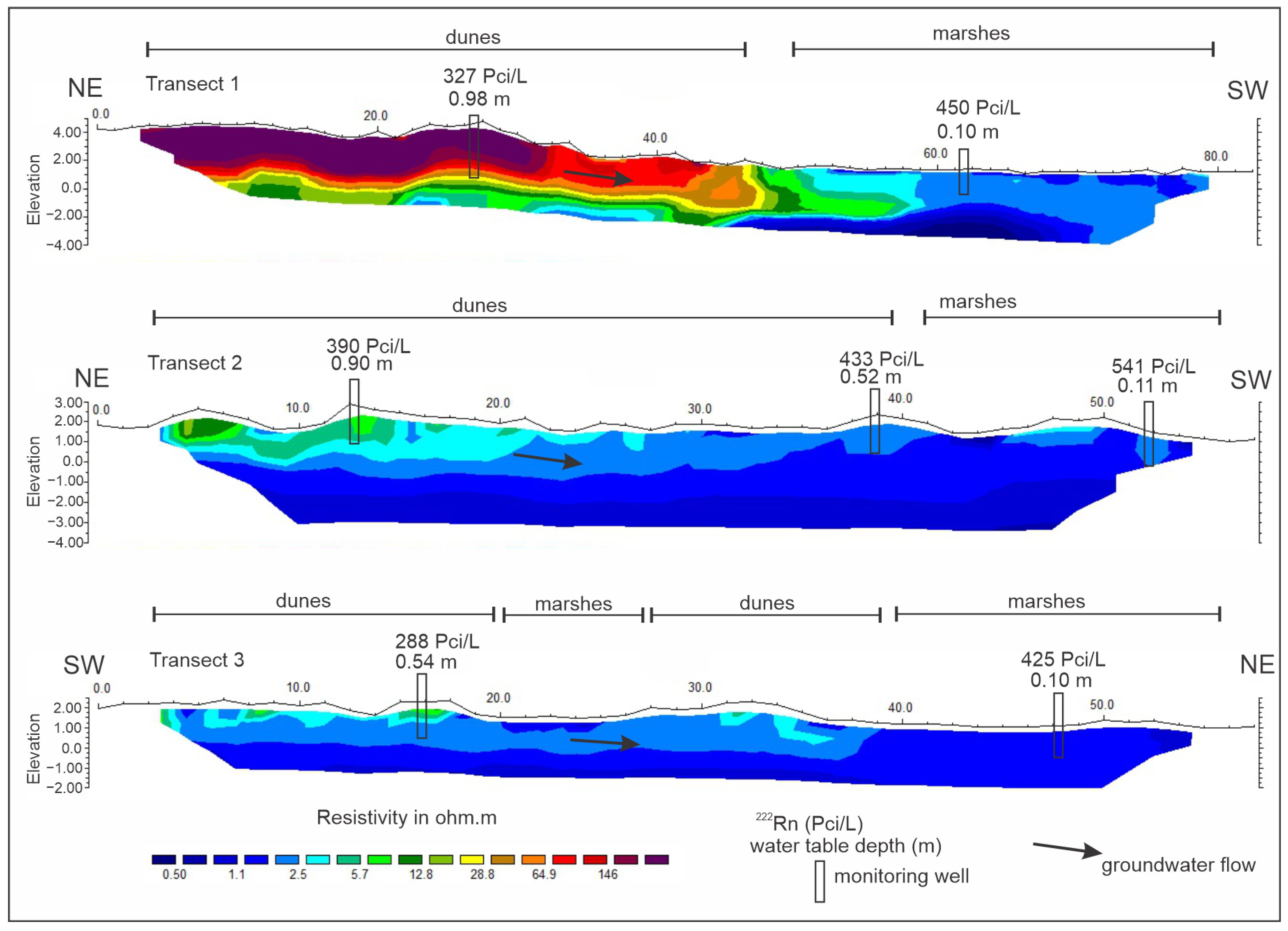
The ERT surveys made in the three sectors of the wetland exhibited distinctive behaviors. In the ERT carried out along Transect 1 (Figure 2), two monitoring wells were available where groundwater levels were measured, which were found at a depth of 0.98 m in the dune and 0.10 m in the marsh. In this transect, it was possible to identify that the unsaturated zone showed very high resistivity values (greater than 146 Ohm m). Beneath it, in the dune sector, an area of intermediate resistivity (12.8 a 146 Ohm m) was observed, attributable to the presence of low EC (fresh) groundwater. This zone had an elongated shape, and a decrease in resistivity toward the marsh area, where resistivity values were very low (below 2.5 Ohm m), was found and was associated with high EC (saline) groundwater. Here, a zone of low resistivities (2.5 to 12.8 Ohm m) was observed, interpreted as an interface zone between freshwater and saline water, that elongated in the direction of groundwater flow, which occurred from the dunes toward the marsh. Consequently, this interface shows both a vertical and a horizontal development. In Transect 2, the water table was found at a depth of 0.90 m in the higher dunes, while at the dune–marsh boundary, it was at 0.52 m and at 0.11 m in the marsh. In this transect, low resistivity zones (2.5 to 12.8 Ohm m) were observed in the dune sector, which were related to fresh to brackish water. This zone reached smaller thicknesses than in Transect 1, and tended, even within the dune sector, to shift toward very low resistivities associated with saline water, keeping this trend in the marsh area. Groundwater flow occurred from the dunes towards the marsh, and in this transect only a slight elongation of resistivities close to 2.5 Ohm m was observed in the direction of groundwater flow. Meanwhile, Transect 3 showed shallow water tables (0.54 m in the dunes and 0.10 m in the marsh), with very low resistivities dominating over this profile. Only a few small areas with higher resistivity values could be identified in the dune sector, which belonged to the unsaturated zone. Resistivity values recorded in this transect would indicate a predominance of saline water, with brackish sectors in the dunes, and the interface developing only in the vertical direction. The difference in the water table levels between the dune sector and the marsh was very small, which determined that groundwater flow between these two environments was limited.

3.2. Hydrochemistry and Isotopes

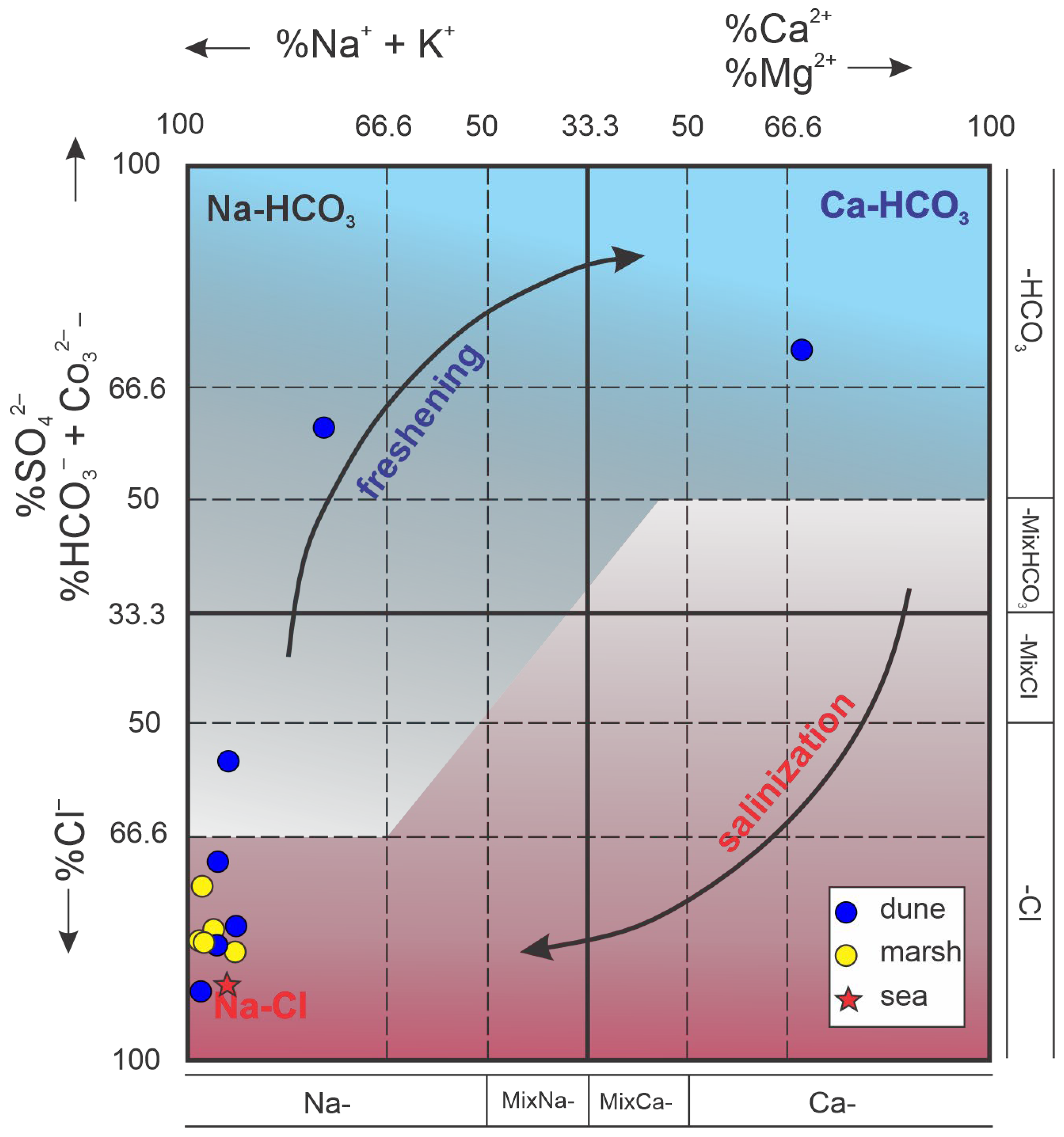
Physicochemical parameters measured in situ (EC and pH) and the abundance of major ions indicate that the dune and marsh environment exhibit different hydrochemical signatures. The EC and hydrochemical facies of groundwater in the dunes vary considerably depending on the topographic height and spatial extent of the dunes. Dunes which exhibit higher topography and are more extensive (e.g., dune sector in transect 2 of Figure 1) present EC values between 600 and 1500 µS/cm and facies Ca/Na-HCO3, showing trends indicative of freshening processes. Low-relief and less extensive dunes (e.g., dune sector in Transect 3 of Figure 1) recorded EC values between 6000 and 22,800 µS/cm and facies Na-Cl, showing slight to negligible freshening trends (Figure 3). In turn, groundwater in the marsh exhibited EC values between 5500 and 31,800 µS/cm with Na-Cl hydrochemical facies, associated with salinization processes, with an isotopic signal resembling that of seawater (Figure 3). The pH values ranged from slightly acid to slightly alkaline, being, in general, more alkaline in the marsh.
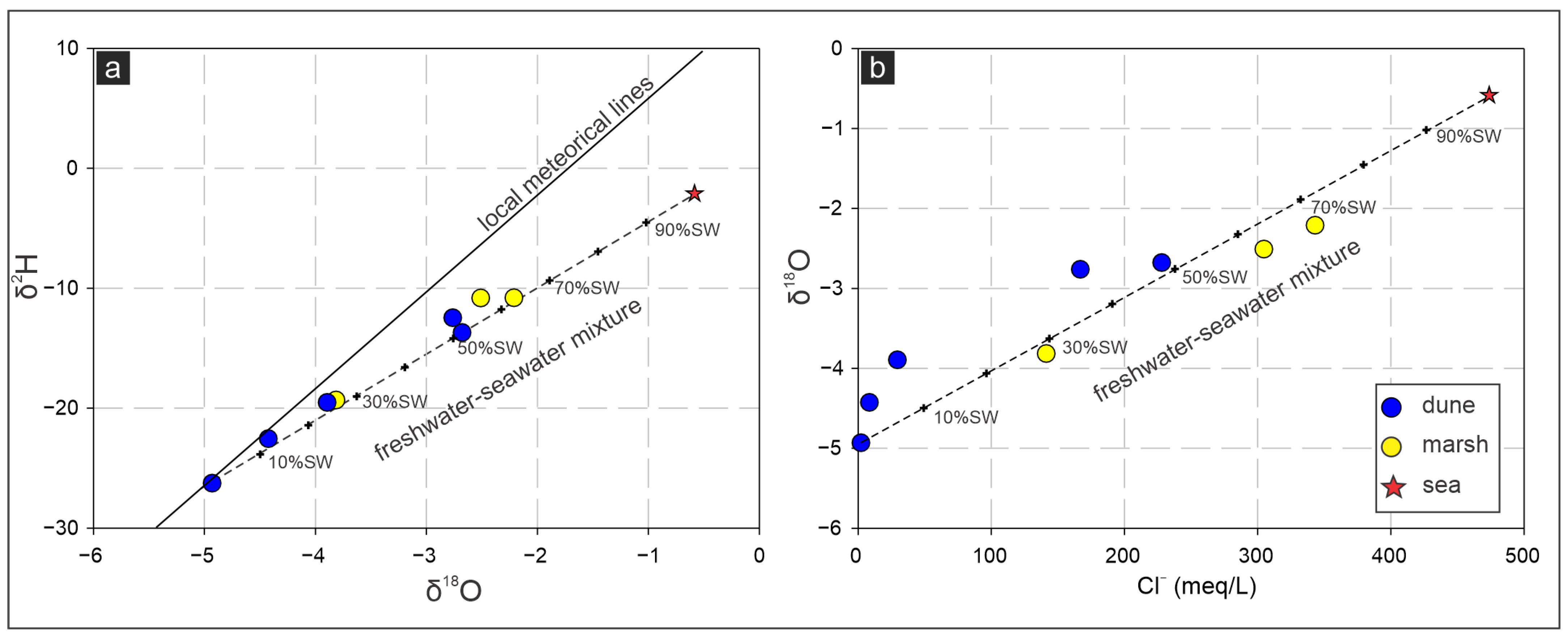
The stable isotope contents of the water molecule (δ18O and δ2H) indicate that groundwater from the dune and marsh environments is related to water mixture processes (Figure 4a). One of the end members of the mixture is represented by the freshest water sample from the topographically higher dunes, which isotopically lies over the local meteoric water line, with values of −4.90 for δ18O and −26.00 for δ2H. The other end member is represented by the seawater saline sample, with values of −0.60 for δ18O and −2.00 for δ2H. Around the mixing line (δ2H = 5.8 δ18O + 2.6 with r2 = 0.99), samples from the marsh and the topographically lower and smaller dunes are located at mixing percentages corresponding to 20 to 70% seawater (indicated as %SW in Figure 4). Notably, the marsh sample located near the higher and more extensive dunes exhibits the highest proportion of freshwater (27% of seawater and 73% of freshwater). Mixing processes between freshwater and saline water in marsh environments and in topographically lower dunes can also be observed in the δ18O vs. Cl plot (Figure 4b). The percentages estimated from conservative mixing with Cl (Equation (1)) are similar to the isotopic mixing results, although with slight increases in the seawater proportion.
The 222Rn contents measured in situ in groundwater from the dunes and marshes, as well as in seawater, registered values between 326 and 390 Pci/L in the topographically higher and more extensive dunes, between 97 and 433 Pci/L in the lower and less extensive dunes, between 425 and 542 Pci/L in the marsh, and 8 Pci/L in the seawater sample.

4. Discussion

4.1. Location and Extent of the Freshwater–Saline Water Interface

Geophysical results (ETR) allowed for the identification of freshwater–saline water interface zones that develop along the boundary between the marsh and the dunes. Low resistivities dominate within the marsh, whereas high resistivities characterize the dunes, being the interface a zone where a salinity gradient between both end members exists.
Rainwater infiltration occurs preferentially in the dunes, promoting the formation of freshwater lenses as infiltrated water accumulates and, due to density contrasts, displaces the underlying saline water. These lenses only form in the topographically higher and more extensive dunes (Transect 1 in Figure 1 and Figure 2), whereas in lower or smaller dunes, brackish groundwater lenses develop, which are thin and limited in extent (Transects 2 and 3 in Figure 1 and Figure 2). The interface thickness is greater in the topographically higher dune sectors, where a lateral displacement of the interface is also observed in the direction of groundwater flow from the dunes toward the marsh (e.g., Transect 1 in Figure 2). This does not occur in the topographically lower dunes, where the water table levels between the dunes and the marsh are similar, and consequently the groundwater flow is very slow. In these dunes, small brackish water lenses develop, which may overlap when dunes are very close to each other (e.g., Transect 3 in Figure 2). This mixing via rainwater infiltration occurs mainly in dune environments and, to a lesser extent, in the marsh, where water is more saline. This is consistent with previous studies which show that rainfall primarily affects the salinity of surface water in tidal channels and coastal lagoons, without generating significant changes in marsh groundwater salinity [11,19,30,31].
Regarding seasonal or tidal variability that may cause changes in the freshwater–saline water interface, studies based on ETR analyses conducted under different hydrological and tidal periods in marshes have shown that such variability exerts only a minimal effect the interface and on groundwater chemistry [19,32]. In addition, the study area exhibits limited seasonal variability in rainfall [24] and a low tidal flooding frequency [22], indicating that, although measurements in this study were only made during a single period, they can still be considered representative. Nevertheless, seasonal studies would help to further refine the freshwater–saline water interface behavior.

4.2. Freshwater–Saline Water Interaction and Mixing Water Processes

Groundwater electrical conductivity (indicative of salinity) is a useful indicator of the degree of water mixing occurring in marshes as a result of fresh groundwater discharge and saline tidal infiltration [4]. Moreover, the mixing processes resulting from freshwater–saline water interaction are clearly reflected in the hydrochemical facies and isotopic signatures of groundwater. In the topographically higher dunes, groundwater is fresh with low EC and facies Na-Ca/HCO3 related to freshening processes (Figure 3), showing an isotopic signal similar to local precipitation (Figure 4a). This confirms, as observed in the ERT, that rainwater in these dunes displaces saline water, forming freshwater lenses. In the topographically lower dunes, groundwater has EC values characteristic of brackish water and Na-Cl facies associated with slight to negligible freshening processes (Figure 3). The δ2H vs. δ18O and δ18O vs. Cl relationships (Figure 4a,b) show that these hydrochemical characteristics result from mixing processes between fresh and saline groundwater, generating brackish zones. In turn, groundwater in the marsh exhibit EC values related to brackish to saline water, which do not respond strictly to tidal inflows but rather to a mixture with freshwater from the groundwater discharge and/or precipitation, as reflected in the δ2H vs. δ18O and δ18O vs. Cl relationships (Figure 4a,b). In marsh areas associated with topographically higher and more extensive dunes, the estimated freshwater percentages from water mixing are close to 70% and would be associated with fresh groundwater discharge from the lenses located in the dunes plus the contribution of precipitation [3,13,33]. The greater differences in the position of the water table between the dunes and the marsh increase the groundwater flow toward the marsh, enhancing discharge [34]. Meanwhile, in marsh areas associated with low dunes, the freshwater percentage is lower (close to 30–40%) and would mainly respond to infiltration from precipitation. Regarding the latter, it is expected that in marshes that are frequently flooded by tides, the proportion of freshwater related to rainfall infiltration would be lower. However, the low tidal flooding frequency of the studied marshes [22] favors a higher percentage of rainfall water in the mixture. This low flooding frequency is also supported by the 222Rn isotopic signature, as it is present in groundwater due to processes related with natural decay of 226Ra hosted in subsurface minerals and sediments. Its short half-life (3.8 days) causes it to be present at very low concentrations in seawater [35]. Marsh groundwater samples do not show values close to those of seawater, but are similar to those of the dunes (between 425 and 542 Pci/L). This indicates that, although the studied marsh experiences mixing with seawater, the seawater remains in the marsh sediments for prolonged periods, allowing 222Rn to accumulate as a consequence of the extended interaction with the sediments. In contrast, if daily tidal flooding were to occur, 222Rn concentrations in the marsh would be expected to be lower, as observed in the only sample collected in the high frequency tidal flooding zone (97 Pci/L).

4.3. Environmental Implications of Freshwater–Saline Water Interaction

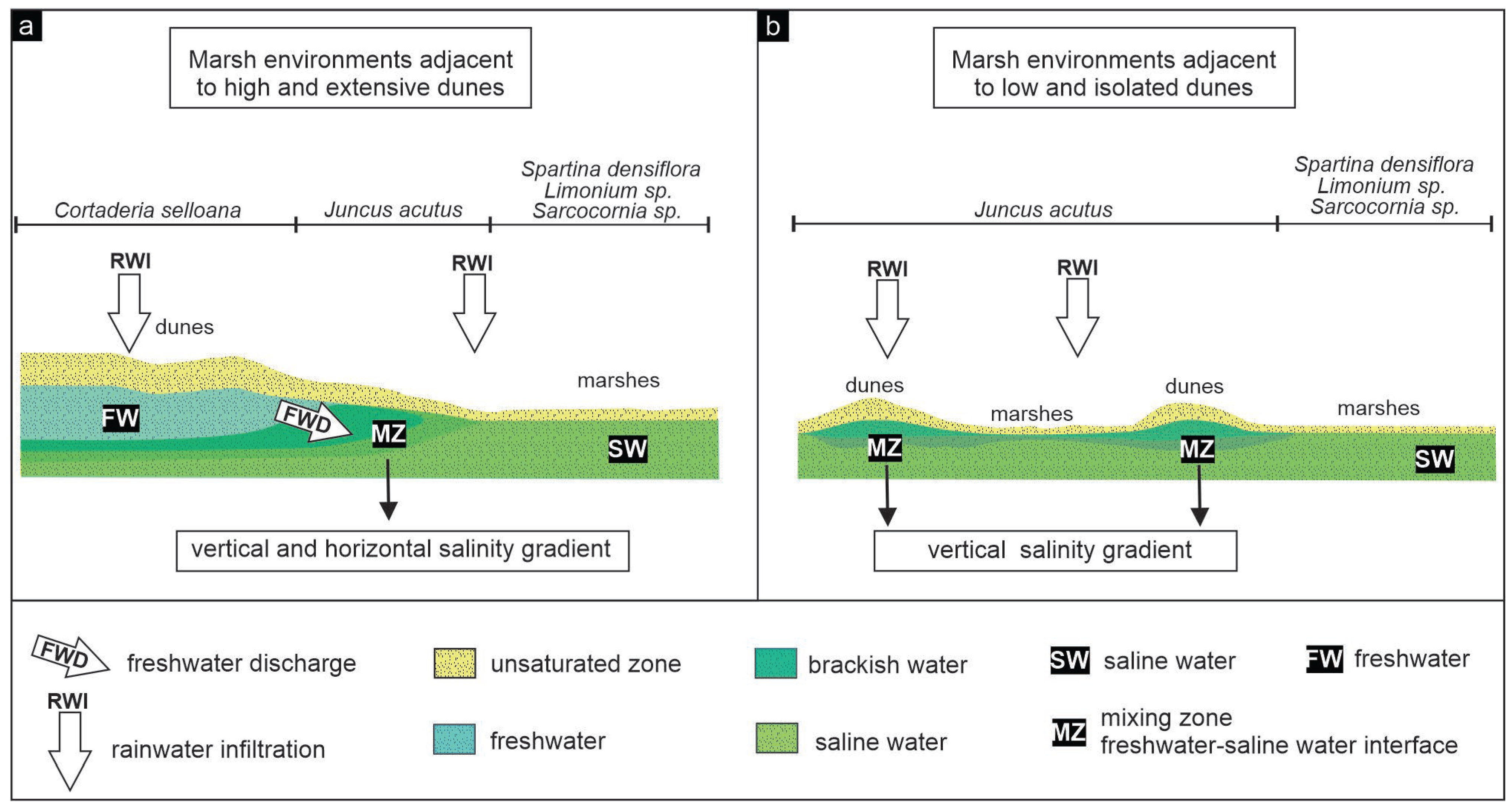
Several studies have addressed the integrated study of marshes hydrogeology in relation to vegetation zonation, focusing mainly on lateral variations in soil and groundwater salinity rather than the freshwater–saline water interface that develops between these two flows [13,30,36,37,38]. In saline marsh environments of the Punta Rasa Natural Reserve, the dominant vegetation is Spartina densiflora, Limonium sp., and Sarcocornia sp. The factors controlling vegetation zonation of the marsh have been studied based on the analysis of tidal flooding frequency [22]. Additionally, with respect to vegetation in the dune zones, it is well established that Cortaderia selloana dominates the dunes of the region, where groundwater exhibits low salinity. This study provides new insights into how freshwater–saline water mixing generates salinity gradients that may explain the vegetation distribution in the interface zone. In particular, Juncus acutus develops within the Natural Reserve in low, floodable, brackish areas adjacent to dune deposits, coinciding with the freshwater–saline water mixing zones identified in this study. Figure 5 shows a conceptual model where groundwater salinity in the different hydrogeological environments, the location and type of freshwater–saline water interface, and the dominant vegetation in each environment can be visualized. This demonstrates not only that freshwater–saline water interactions determine groundwater salinity [38,39,40] but also that this groundwater mixing controls vegetation development, highlighting the relevance of groundwater studies for understanding wetland ecosystems.
Freshwater and saline water interaction controls the distribution of salinity gradients that characterize coastal wetlands [39]. Understanding the processes associated with freshwater–saline water interaction and the consequent development of water mixing zones contributes to understanding the potential resilience, or lack of thereof, of the studied wetland in the face of global changes. For example, sea level rise associated with climate change would lead to an increase in the flooding frequency, while changes associated with variations in precipitation patterns would alter freshwater inputs and water table levels, affecting groundwater flows. Any of these changes would modify the freshwater–saline water interaction and, consequently, the salinity of groundwater and soils, potentially promoting vegetation succession in response to these changes [31,40,41,42]. In this sense, understanding the current functioning of freshwater–saline water interactions provide a basis for developing datasets to predict environmental resilience, thereby supporting wetland management.

5. Conclusions

This study demonstrates that in coastal wetland environments, where marshes coexist with dunes, dune morphology plays a key role in controlling freshwater inputs to the marsh. High and extensive dunes promote the development of freshwater lenses and groundwater discharge, generating horizontal and vertical salinity gradients within the wetland. In contrast, low and isolated dunes produce limited and mostly vertical salinity gradients due to restricted groundwater flow, resulting in marsh areas fed mainly by precipitation. This indicates that the proposed hypothesis is only partially supported; however, in both settings, the interaction between freshwater and saline water creates mixing zones associated with salinity gradients that determine the wetland’s environmental conditions. Ecologically, the findings highlight the strong link between groundwater dynamics and habitat salinity, helping to explain the distribution of plant species associated with freshwater–saline water interface zones.
Case studies such as the one presented here highlight the importance of analyzing the freshwater–saline water interface through the integration of multiple methodologies. Individually, each method provides distinct information about the freshwater–saline water interface. Geophysical methods (ETR) provide information on the location and extent of the interface. Hydrochemical approaches based on the analysis of physicochemical parameters and major ions reveal salinity gradients and the hydrochemical facies associated with the interface. Meanwhile, stable and radioactive isotopes allow for the quantification of water mixing and the identification of contributions from groundwater discharge and precipitation. Their integrated use—still uncommon in hydrological studies of marshes—enables all this information to be assessed collectively, yielding more robust results. This is particularly relevant for generating environmental data that help evaluate the resilience of wetland ecosystems to hydrological variations induced by climate change.

Author Contributions

Conceptualization, E.C.; methodology, M.J.G., S.P., R.S., and R.A.; formal analysis, E.C., M.J.G., S.P., and R.S.; investigation, E.C., M.J.G., S.P., R.S., and R.A.; resources, E.C.; data curation, S.P., R.S., and R.A.; writing—original draft preparation, E.C.; writing—review and editing, M.J.G., S.P., R.S., and R.A.; project administration, E.C.; funding acquisition, E.C. All authors have read and agreed to the published version of the manuscript.

Funding

This research was funded by Ministerio de Ciencia, Tecnología e Innovación de Argentina (Ministry of Science, Technology and Innovation of Argentina), grant number Pampa Azul A10 and PICT 2019-2124, and the APC was funded by MDPI.

Data Availability Statement

The data presented in this study are available on request from the corresponding author.

Acknowledgments

The authors thank the Ministry of Environment of the Province of Buenos Aires (Argentina) for granting the permits to carry out the research work in the Natural Reserve area. They also thank the Ministry of Science, Technology and Innovation of Argentina for funding the fieldwork through grant numbers Pampa Azul A10 and PICT 2019-2124.

Conflicts of Interest

The authors declare no conflicts of interest. The funders had no role in the design of the study; in the collection, analyses, or interpretation of data; in the writing of the manuscript; or in the decision to publish the results.

Abbreviations

ECElectrical Conductivity
ETRElectrical Resistivity Tomography
SWSeawater

References

  1. Costanza, R.; Arge, R.; de Groot, R.; Farber, S.; Grasso, M.; Hannon, B.; Limburg, K.; Naeem, S.; Oneill, R.V.; Paruelo, J.; et al. The value of the world’s ecosystem services and natural capital. Nature 1997, 387, 253–260. [Google Scholar] [CrossRef]
  2. Hemond, H.F.; Nuttle, W.K.; Burke, R.W.; Stolzenbach, K.D. Surface Infiltration in Salt Marshes: Theory, Measurement, and Bio-geochemical Implications. Water Resour. Res. 1984, 20, 591–600. [Google Scholar] [CrossRef]
  3. Nuttle, W.K.; Harvey, J.W. Fluxes of water and solute in a coastal wetland sediment. l. The contribution of regional groundwater discharge. J. Hydrol. 1995, 164, 89–107. [Google Scholar] [CrossRef]
  4. Wilson, A.M.; Shanahan, M.; Smith, E.M. Salt marshes as groundwater buffers for development: A survey of South Carolina salt marsh basins. Front. Water 2021, 3, 770819. [Google Scholar] [CrossRef]
  5. Carol, E.; Sanci, R.; Tanjal, C.; Acosta, R.; Galliari, J. Use of hydrochemical and isotopic signatures to trace hydrological connectivity in Northern Patagonian marshes. Sci. Total Environ. 2025, 996, 180193. [Google Scholar] [CrossRef]
  6. Carol, E.S.; Kruse, E.E.; Pousa, J.L.; Roig, A.R. Determination of heterogeneities in the hydraulic properties of a phreatic aquifer from tidal level fluctuations: A case in Argentina. Hydrogeol. J. 2009, 17, 1727–1732. [Google Scholar] [CrossRef]
  7. Xin, P.; Yuan, L.-R.; Li, L.; Barry, D.A. Tidally driven multiscale pore water flow in a creek-marsh system. Water Resour. Res. 2011, 47, W07534. [Google Scholar] [CrossRef]
  8. Alvarez, M.; Carol, E.; Dapeña, C. The role of evapotranspiration in the groundwater hydrochemistry of an arid coastal wetland (Península Valdés, Argentina). Sci. Total Environ. 2015, 506, 299–307. [Google Scholar] [CrossRef] [PubMed]
  9. Guimond, J.; Tamborski, J. Salt marsh hydrogeology: A review. Water 2021, 13, 543. [Google Scholar] [CrossRef]
  10. Thibodeau, P.M.; Gardner, L.R.; Reeves, H.W. The role of groundwater flow in controlling the 608 spatial distribution of soil salinity and rooted macrophytes in a southeastern salt marsh, USA. Mangroves 609 Salt Marshes 1998, 2, 1–13. [Google Scholar] [CrossRef]
  11. Gardner, L.R.; Reeves, H.W. Spatial patterns in soil water fluxes along a forest-marsh transect in the southeastern United States. Aquat. Sci. 2002, 64, 141–155. [Google Scholar] [CrossRef]
  12. Silvestri, S.; Defina, A.; Marani, M. Tidal regime, salinity and salt marsh plant zonation. Estuar. Coast. Shelf Sci. 2005, 62, 119–130. [Google Scholar] [CrossRef]
  13. Wilson, A.M.; Evans, T.B.; Moore, W.S.; Schutte, C.A.; Joye, S.B. What time scales are important for monitoring tidally influenced submarine groundwater discharge? Insights from a salt marsh. Water Resour. Res. 2015, 51, 4198–4207. [Google Scholar] [CrossRef]
  14. Wilson, A.M.; Moore, W.S.; Joye, S.B.; Anderson, J.L.; Schutte, C.A. Storm-driven groundwater flow in a salt marsh. Water Resour. Res. 2011, 47, 1–11. [Google Scholar] [CrossRef]
  15. Alvarez, M.; Carol, E.; Hernández, M.A.; Bouza, P.J. Groundwater dynamic, temperature and salinity response to the tide in Patagonian marshes: Observations on a coastal wetland in San José Gulf, Argentina. J. S. Am. Earth Sci. 2015, 62, 1–11. [Google Scholar] [CrossRef]
  16. Da Lio, C.; Carol, E.; Kruse, E.; Teatini, P.; Tosi, L. Saltwater contamination in the managed low-lying farmland of the Venice coast, Italy: An assessment of vulnerability. Sci. Total Environ. 2015, 533, 356–369. [Google Scholar] [CrossRef]
  17. Gilfedder, B.S.; Frei, S.; Hofmann, H.; Cartwright, I. Groundwater discharge to wetlands driven by storm and flood events. Quantification using continuous Radon-222 and electrical conductivity measurements and dynamic mass-balance modelling. Geochim. Cosmochim. Acta 2015, 165, 161–177. [Google Scholar] [CrossRef]
  18. Glaser, C.; Frei, S.; Massmann, G.; Gilfedder, B.S. Tidal creeks as hot-spots for hydrological exchange in a coastal landscape. J. Hydrol. 2021, 597, 126158. [Google Scholar] [CrossRef]
  19. Carter, E.S.; White, S.M.; Wilson, A.M. Variation in groundwater salinity in a tidal salt marsh basin, North Inlet Estuary, South Carolina. Estuar. Coast. Shelf Sci. 2008, 76, 543–552. [Google Scholar] [CrossRef]
  20. Goes, B.J.; Oude Essink, G.H.P.; Vernes, R.W.; Sergi, F. Estimating the depth of fresh and brackish groundwater in a predominantly saline region using geophysical and hydrological methods, Zeeland, the Netherlands. Near Surf. Geophys. 2009, 7, 401–412. [Google Scholar] [CrossRef]
  21. Wrobel, D.M. Characterizing Groundwater Flow Across the Barrier Island-High Marsh Interface. Master’s Thesis, Coastal Carolina University, Conway, SC, USA, 2024. [Google Scholar]
  22. López, L.; Oreiro, F.; Dragani, W.; Galliari, J.; Cellone, F.; Carol, E. Tidal connectivity modelling in wetlands associated with coastal lagoon of Punta Rasa natural reserve, Argentina. Estuar. Coast. Shelf Sci. 2024, 306, 108898. [Google Scholar] [CrossRef]
  23. Galliari, M.J.; Tanjal, C.; del Pilar Alvarez, M.; Carol, E. Hydrochemical dynamics of a wetland and costal lagoon associated to the outer limit of the Rio de la Plata estuary. Cont. Shelf Res. 2020, 200, 104109. [Google Scholar] [CrossRef]
  24. Pasquale Pérez, M.P.; Carol, E.; Santucci, L.; Idaszkin, Y.L. Nutrient dynamics in wetland systems associated with hydrological and anthropogenic variations in the south of Samborombón Bay, Argentina. Sci. Total Environ. 2024, 928, 172564. [Google Scholar] [CrossRef]
  25. Loke, M.H. Tutorial: 2-D and 3-D Electrical Imaging Surveys. 2004. Available online: www.geoelectrical.com (accessed on 13 October 2025).
  26. American Public Health Association. Standard Methods for the Examination of Water and Wastewater American Water Works Association, 20th ed.; Water Environment Federation: Washington, DC, USA, 1998. [Google Scholar]
  27. Giménez-Forcada, E. Dynamic of sea water interface using hydrochemical facies evolution diagram. Groundwater 2010, 48, 212–216. [Google Scholar] [CrossRef] [PubMed]
  28. Dapeña, C.; Panarello, H.O. Composición isotópica de la lluvia de Buenos Aires. Su importancia para el estudio de los sistemas hidrológicos pampeanos. Rev. Lat.-Am. Hidrogeol. 2004, 4, 17–25. [Google Scholar]
  29. 29. Durridge RAD-H2O. User Manual. Radon in Water; Durridge Company Inc.: Billerica, MA, USA, 2013; Available online: https://durridge.com/documentation/RAD_H2O_Manual.pdf (accessed on 20 October 2025).
  30. Cao, M.; Xin, P.; Jin, G.; Li, L. A field study on groundwater dynamics in a salt marsh–Chongming Dongtan wetland. Ecol. Eng. 2012, 40, 61–69. [Google Scholar] [CrossRef]
  31. Xiao, K.; Li, H.; Wilson, A.M.; Xia, Y.; Wan, L.; Zheng, C.; Ma, Q.; Wang, C.; Wang, X.; Jiang, X. Tidal groundwater flow and its ecological effects in a brackish marsh at the mouth of a large sub-tropical river. J. Hydrol. 2017, 555, 198–212. [Google Scholar] [CrossRef]
  32. Kelly, J.L.; Hladik, C.M. Shallow Hydrostratigraphy Beneath Marsh Platforms: Insights from Electrical Resistivity Tomography. Water 2025, 17, 144. [Google Scholar] [CrossRef]
  33. Boorman, L.A. The role of freshwater flows on salt marsh growth and development. In Coastal Wetlands, 2nd ed.; Elsevier: Amsterdam, The Netherlands, 2019; pp. 597–618. [Google Scholar] [CrossRef]
  34. Guimond, J.A.; Seyfferth, A.L.; Moffett, K.B.; Michael, H.A. A physical-biogeochemical mechanism for negative feedback between marsh crabs and carbon storage. Environ. Res. Lett. 2020, 15, 034024. [Google Scholar] [CrossRef]
  35. Baskaran, M. Radon in groundwater system. In Radon: A Tracer for Geological, Geophysical and Geochemical Studies; Springer International Publishing: Cham, Switzerland, 2016; pp. 167–188. [Google Scholar]
  36. Moffett, K.B.; Gorelick, S.M.; McLaren, R.G.; Sudicky, E.A. Salt marsh ecohydrological zonation due to heterogeneous vegetation–groundwater–surface water interactions. Water Resour. Res. 2012, 48. [Google Scholar] [CrossRef]
  37. Xin, P.; Kong, J.; Li, L.; Barry, D.A. Modelling of groundwater–vegetation interactions in a tidal marsh. Adv. Water Resour. 2013, 57, 52–68. [Google Scholar] [CrossRef]
  38. Xin, P.; Wilson, A.; Shen, C.; Ge, Z.; Moffett, K.B.; Santos, I.R.; Chen, X.; Xu, X.; Yau, Y.Y.Y.; Moore, W.; et al. Surface water and groundwater interactions in salt marshes and their impact on plant ecology and coastal biogeochemistry. Rev. Geophys. 2022, 60, e2021RG000740. [Google Scholar] [CrossRef]
  39. Kitheka, J.U. Coastal tidally-driven circulation and the role of water exchange in the linkage between tropical coastal ecosystems. Estuar. Coast. Shelf Sci. 1997, 45, 177–187. [Google Scholar] [CrossRef]
  40. Yando, E.S.; Osland, M.J.; Willis, J.M.; Day, R.H.; Krauss, K.W.; Hester, M.W. Salt marsh-mangrove ecotones: Using structural gradients to investigate the effects of woody plant encroachment on plant–soil interactions and ecosystem carbon pools. J. Ecol. 2016, 104, 1020–1031. [Google Scholar] [CrossRef]
  41. Naus, F.L.; Schot, P.; Groen, K.; Ahmed, K.M.; Griffioen, J. Groundwater salinity variation in Upazila Assasuni (southwestern Bangladesh), as steered by surface clay layer thickness, relative elevation and present-day land use. Hydrol. Earth Syst. Sci. 2019, 23, 1431–1451. [Google Scholar] [CrossRef]
  42. Zhang, G.; Bai, J.; Tebbe, C.C.; Zhao, Q.; Jia, J.; Wang, W.; Wang, X.; Yu, L. Salinity controls soil microbial community structure and function in coastal estuarine wetlands. Environ. Microbiol. 2021, 23, 1020–1037. [Google Scholar] [CrossRef] [PubMed]
Figure 1. (a) Study area regional location; (b) Samborombón Bay Ramsar site location; (c) Punta Rasa Natural Reserve location, showing geomorphology, water sampling points, and geophysical transects. Satellite image taken from Google Earth.
Jmse 13 02362 g001
Figure 2. Electrical resistivity tomography conducted along the three transects shown in Figure 1. The locations of the monitoring wells are indicated for each transect, along with 222Rn and water table values.
Jmse 13 02362 g002
Figure 3. Plot of groundwater and seawater samples on the Hydrochemical Facies Evolution Diagram (HFE-D) [27]. The arrows in the diagram indicate salinization and freshening trends.
Jmse 13 02362 g003
Figure 4. Graphs of (a) δ2H vs. δ18O, where the local meteoric line is δ2H = 8 × δ18O + 14 [28], and (b) δ18O vs. Cl. In both (a,b), the dashed line represents the mixing line. The points plotted along this line indicate increments of mixing between freshwater from the dunes and saline seawater at 10% intervals, with some values shown on the line as %SW (seawater percentage).
Jmse 13 02362 g004
Figure 5. Conceptual model showing the distribution of dominant vegetation in different hydrogeological environments according to groundwater salinity and the freshwater–saline water interface. (a) Marsh environments adjacent to high and extensive dunes; (b) marsh environments adjacent to low and isolated dunes.
Jmse 13 02362 g005
Disclaimer/Publisher’s Note: The statements, opinions and data contained in all publications are solely those of the individual author(s) and contributor(s) and not of MDPI and/or the editor(s). MDPI and/or the editor(s) disclaim responsibility for any injury to people or property resulting from any ideas, methods, instructions or products referred to in the content.