Dynamic Mutual Adversarial Learning for Semi-Supervised Semantic Segmentation of Underwater Images with Limited and Noisy Annotations


 and
and
Abstract
1. Introduction
- 1.
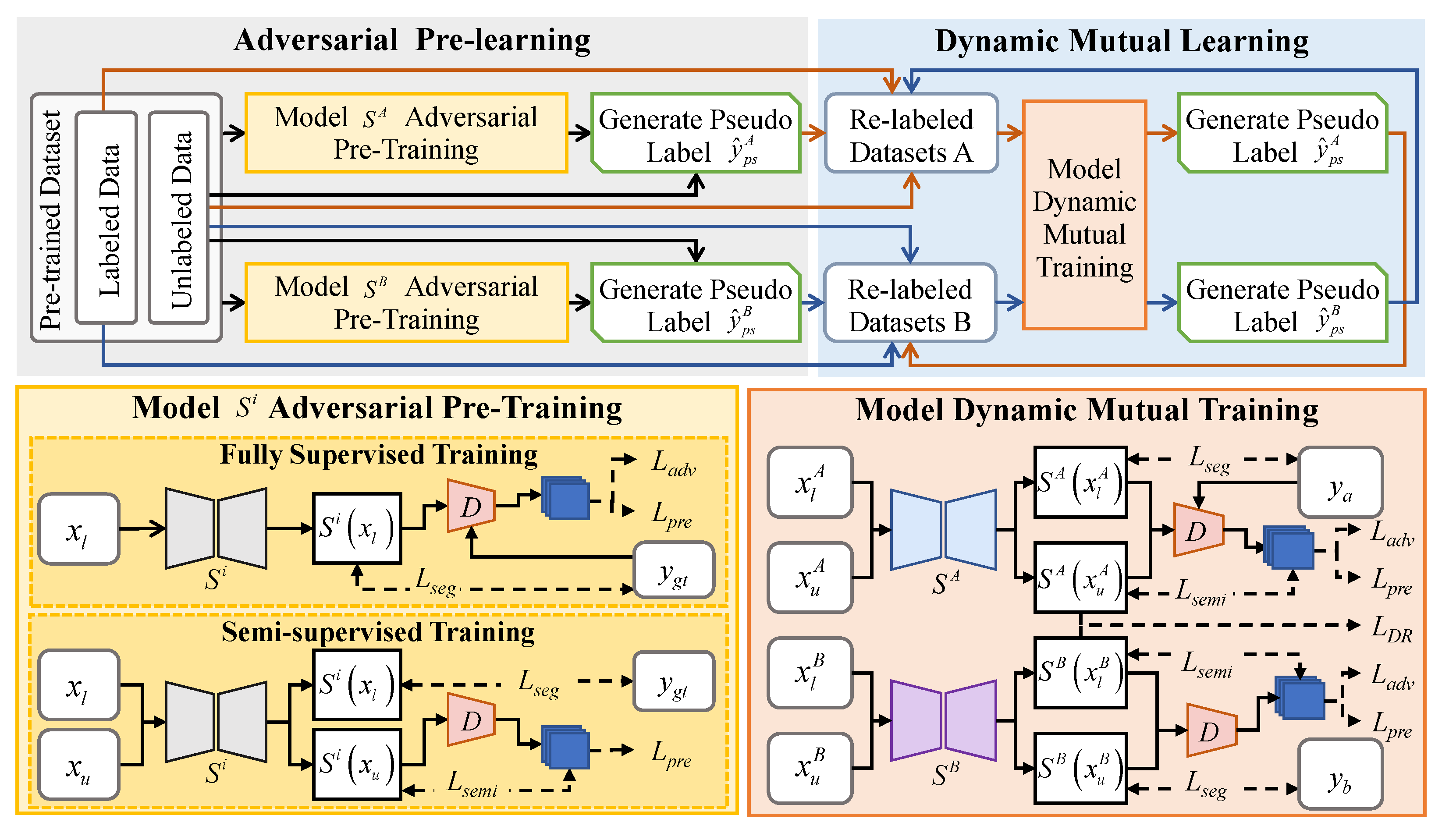
- The DMAS framework is based on two essential sub-processes: the first stage involves adversarial pre-training of two segmentation networks and their respective discriminators to develop two preliminary pseudo-label annotation models. The second stage is dynamic mutual learning, which measures the discrepancies between different segmentation models through confidence maps to mitigate the effects of potential pseudo label labeling errors, thereby enhancing the accuracy of the training process.
- 2.
- The adversarial training method is mainly used for training a segmentation model and a fully convolutional discriminator with labeled data to generate pseudo-labels. This allows the discriminator to differentiate between real label maps and their predicted counterparts by generating a confidence map. Also, it enables a quantitative assessment of segmentation accuracy in specific regions of the pseudo-labels.
- 3.
- Dynamic mutual learning guides different models based on their varying prior knowledge. It leverages the divergence between these models to detect inaccuracies in pseudo-label generation. By employing a dynamically reweighted loss function, it reflects the discrepancies between two models trained with each other’s pseudo-labels, thereby assigning lower weights to pixels with a higher likelihood of error.
- 4.
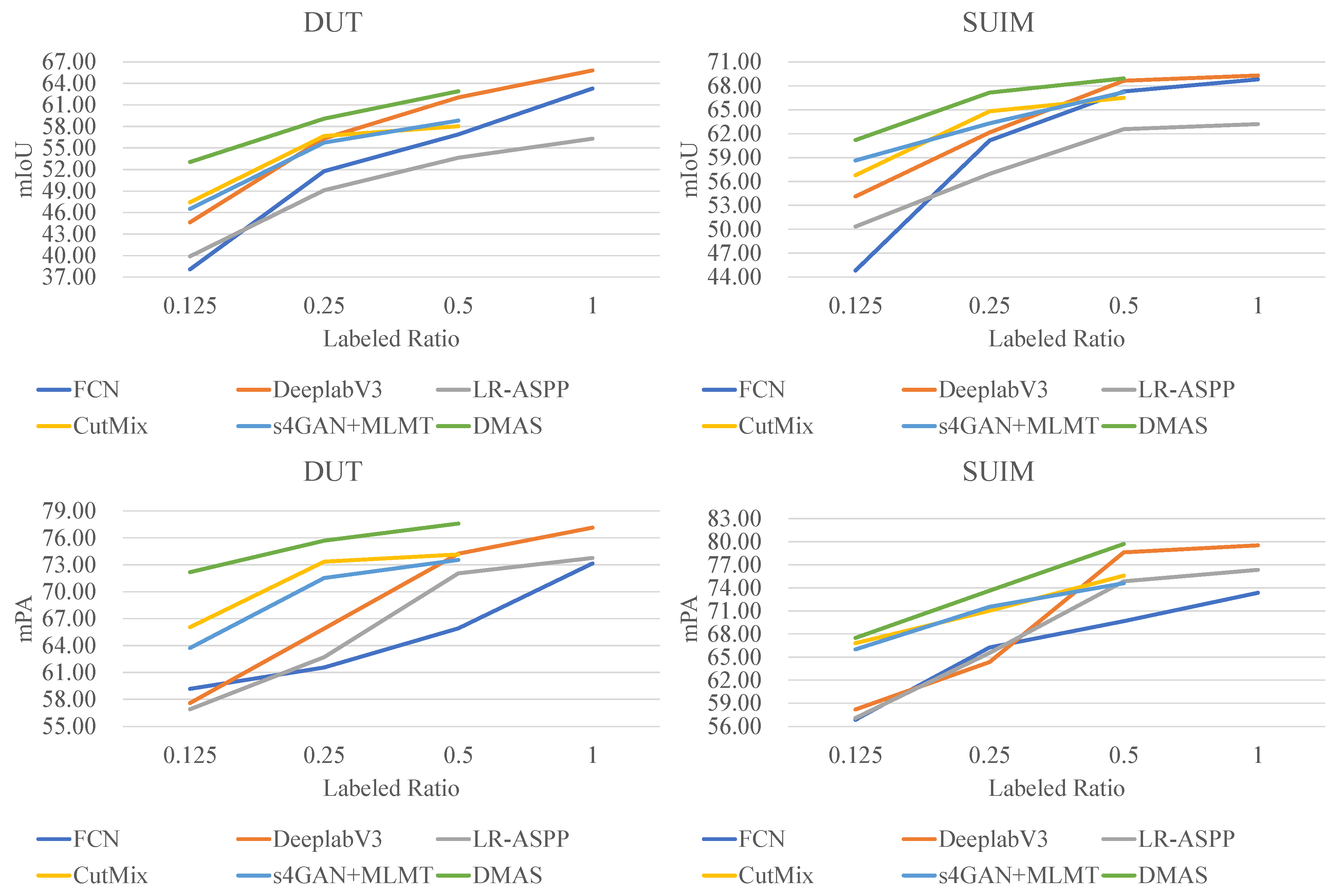
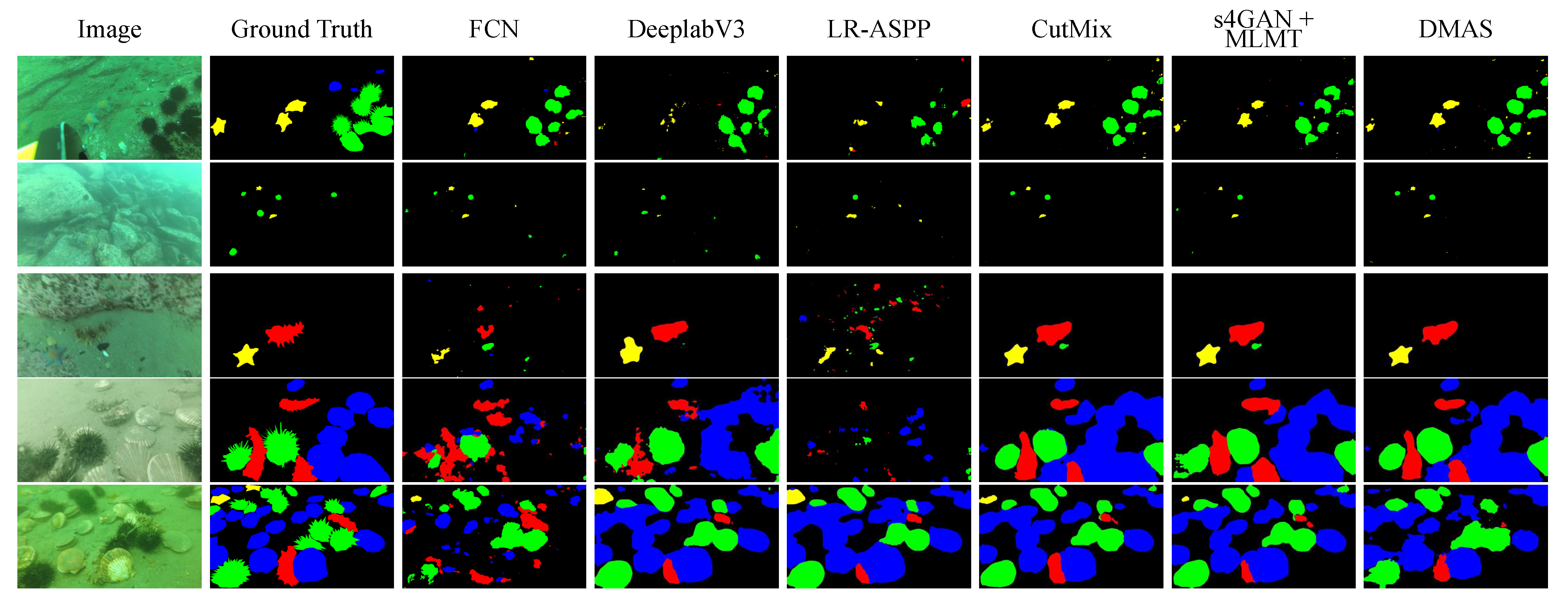
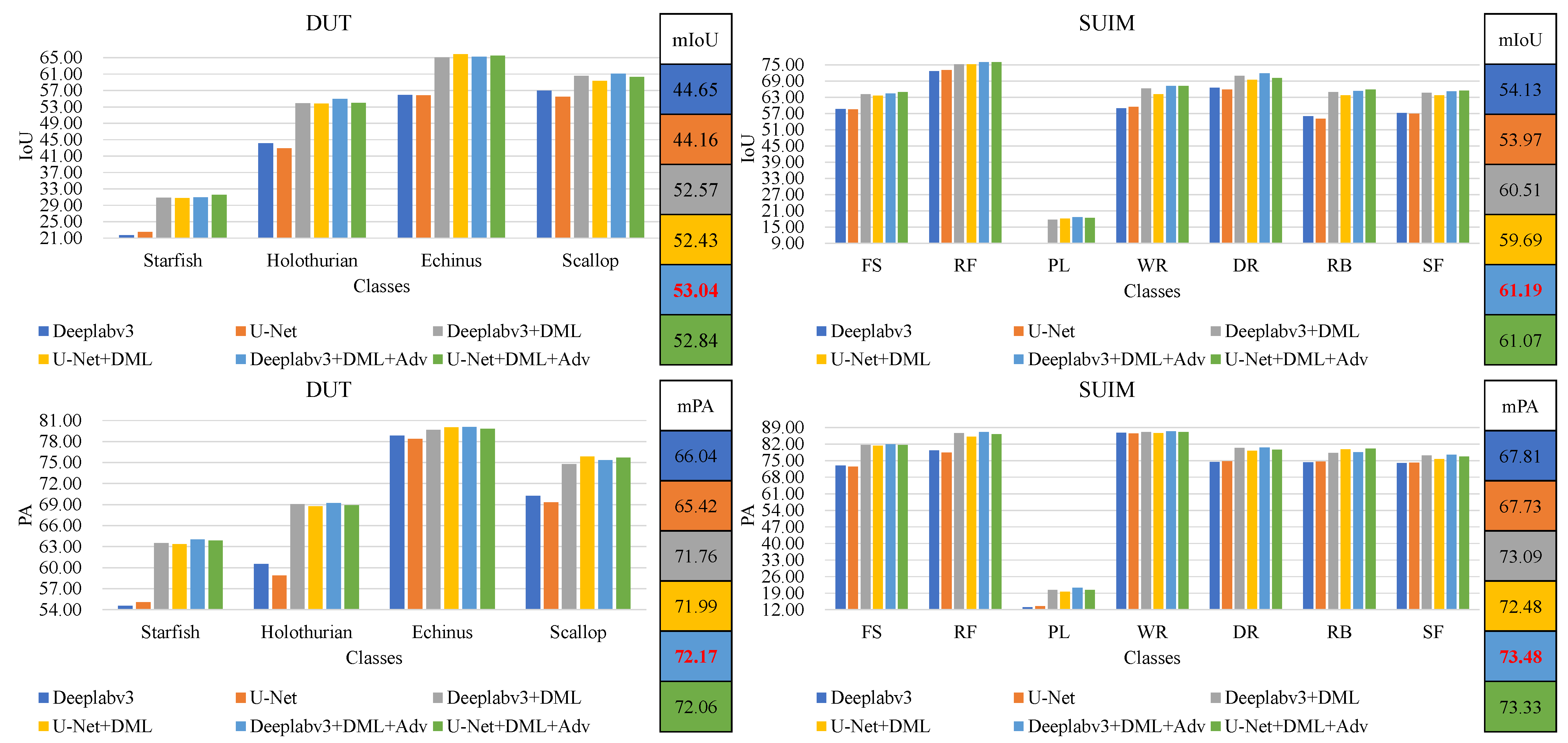
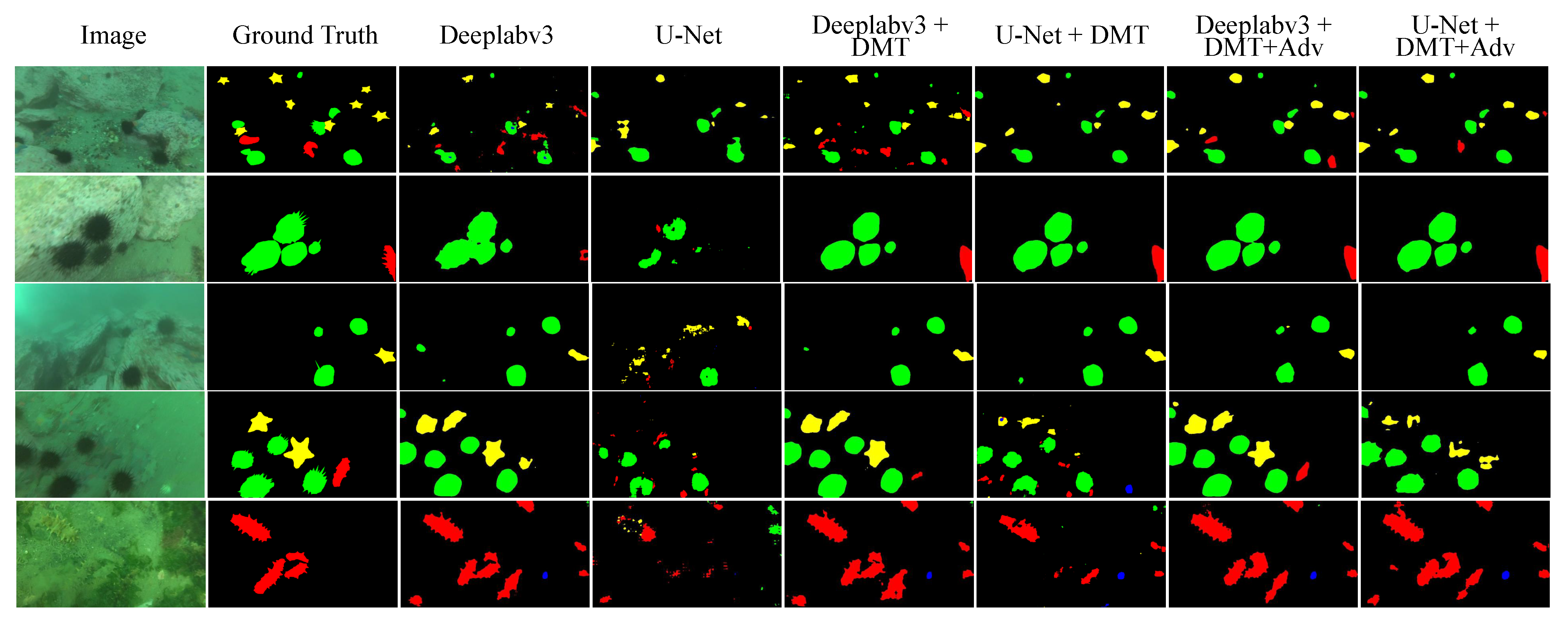
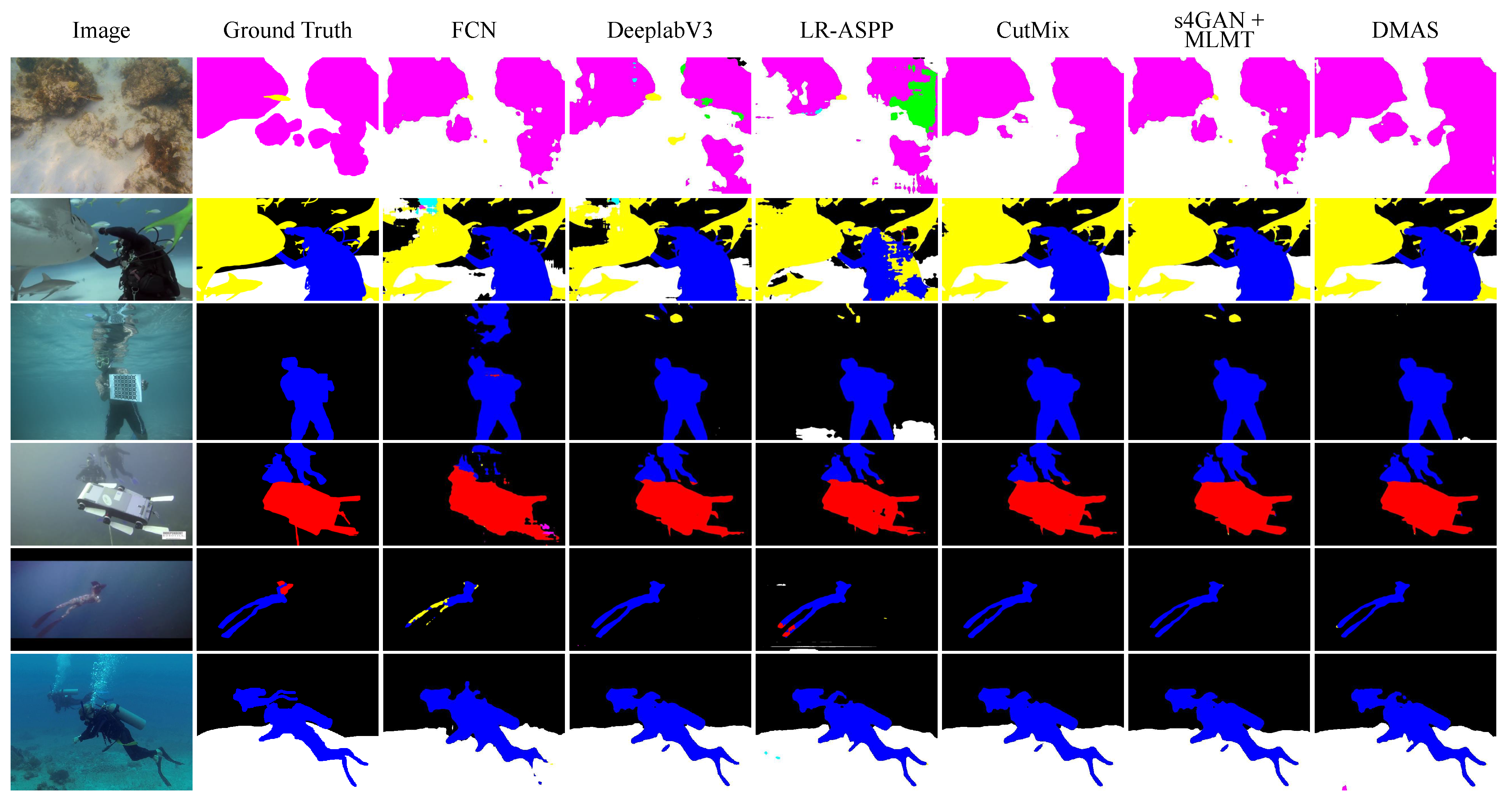
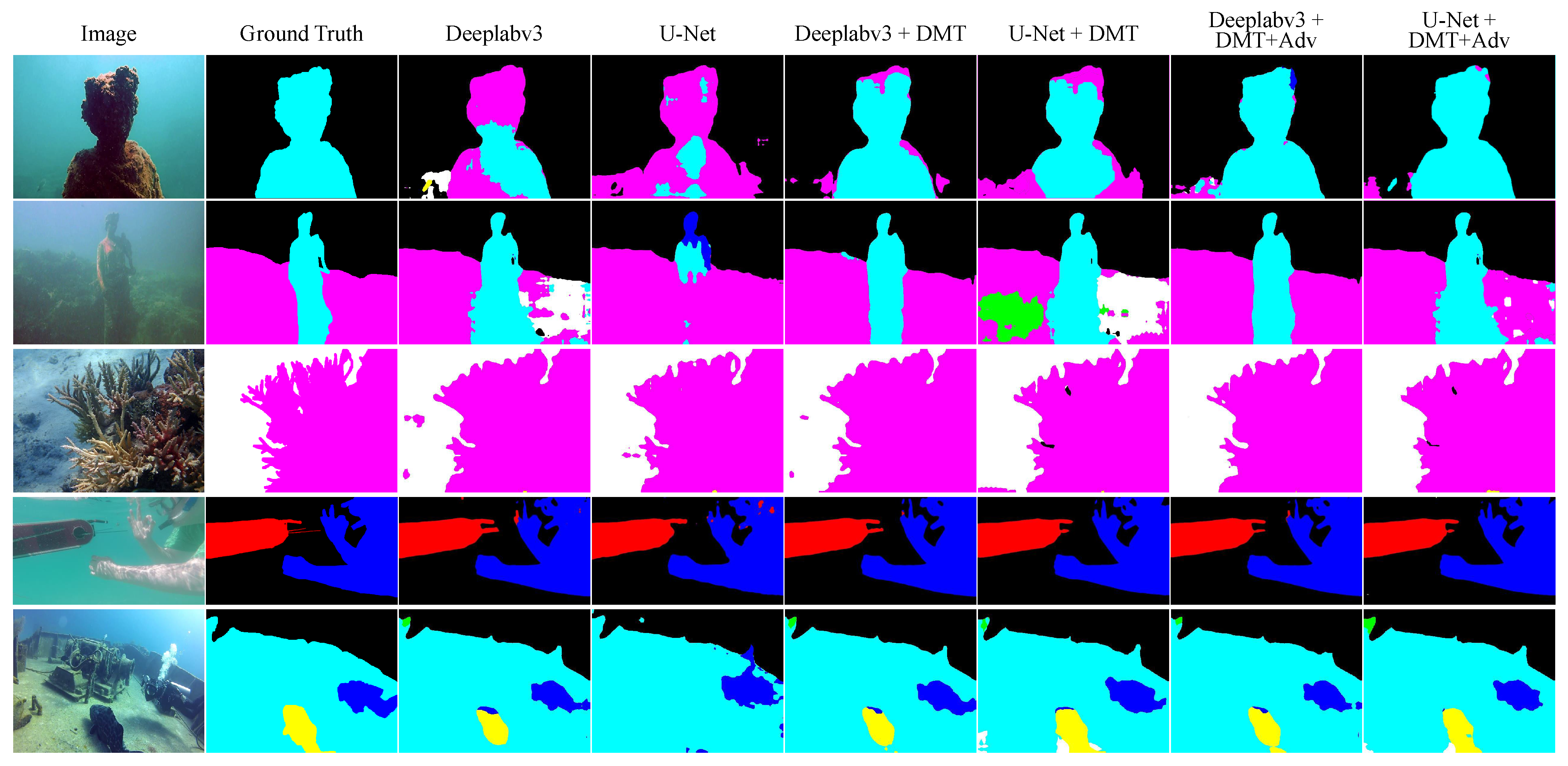
- We validate the effectiveness of our proposed method on various underwater datasets, namely the DUT dataset and the SUIM dataset, demonstrating that the proposed semi-supervised learning algorithm is capable of enhancing the performance of models trained with limited and noisy annotations to be comparable to models supervised fully and trained with large amounts of labeled data.
2. Related Work
2.1. Pseudo-Label Methods for Semi-Supervised Semantic Segmentation
2.2. Adversarial Learning for Semi-Supervised Semantic Segmentation
3. Methodology
3.1. Overview
3.2. Adversarial Pre-Training
| Algorithm 1 Model Adversarial Pre-training. |
| Input: Labeled data ; Unlabeled data Output: Trained segmentation network ; Trained discriminator for number of fully supervised training iterations do for do • Training steps: 1. Segmentation network training: 2. Discriminator training: end for end for for number of semi-supervised training iterations do for do • Segmentation network training: end for end for |
3.2.1. Fully Supervised Training
3.2.2. Semi-Supervised Training
3.3. Dynamic Mutual Learning
3.3.1. Dynamic Mutual Iterative Framework
| Algorithm 2 Dynamic Mutual Learning (DML). |
| Input: Pre-trained models (from adversarial pre-training); Re-labeled Dataset A (), Dataset B (); Discriminator ; Hyperparameters Output: Final trained models for number of DML iterations do • Step 1: Generate cross-supervised pseudo-labels from for Dataset B for do Generate pseudo-label and update : Compute confidence map: end for • Step 2: Update using ’s pseudo-labels and for do Predict with : Compute confidence map: Update : end for • Step 3: Generate cross-supervised pseudo-labels from for Dataset A (symmetric to Step 1) for do Generate pseudo-label and update : Compute confidence map: end for • Step 4: Update using ’s pseudo-labels and (symmetric to Step 2) for do Predict with : Compute confidence map: Update : end for end for |
3.3.2. Dynamic Reweighting Loss
4. Experiments
4.1. Dataset
4.2. Implementation Details
4.3. Evaluation Metrics
4.4. Performance Comparison
4.4.1. Quantitative Analysis
4.4.2. Qualitative Analysis
4.5. Ablation Study
4.6. Discussion
5. Conclusions
Author Contributions
Funding
Data Availability Statement
Conflicts of Interest
References
- McNelly, B.P. Advances in Autonomous Underwater Vehicle Technologies for Enhanced Harbor Protection. Ph.D. Thesis, Johns Hopkins University, Baltimore, MD, USA, 2023. [Google Scholar]
- Li, Z.; Liang, S.; Guo, M.; Zhang, H.; Wang, H.; Li, Z.; Li, H. Adrc-based underwater navigation control and parameter tuning of an amphibious multirotor vehicle. IEEE J. Ocean. Eng. 2024, 49, 775–792. [Google Scholar] [CrossRef]
- Yang, X.; Song, Z.; King, I.; Xu, Z. A survey on deep semi-supervised learning. IEEE Trans. Knowl. Data Eng. 2022, 35, 8934–8954. [Google Scholar] [CrossRef]
- Zeng, H.; Liu, Z.; Cai, H. Research on the application of deep learning in computer network information security. J. Phys. Conf. Ser. 2020, 1650, 032117. [Google Scholar] [CrossRef]
- Zhang, M.; Zhou, Y.; Zhao, J.; Man, Y.; Liu, B.; Yao, R. A survey of semi-and weakly supervised semantic segmentation of images. Artif. Rev. 2020, 53, 4259–4288. [Google Scholar] [CrossRef]
- Li, Q.; Wu, X.-M.; Liu, H.; Zhang, X.; Guan, Z. Label efficient semi-supervised learning via graph filtering. In Proceedings of the IEEE/CVF Conference on Computer Vision and Pattern Recognition, Long Beach, CA, USA, 15–20 June 2019; pp. 9582–9591. [Google Scholar]
- Wei, Y.; Xiao, H.; Shi, H.; Jie, Z.; Feng, J.; Huang, T.S. Revisiting dilated convolution: A simple approach for weakly-and semi-supervised semantic segmentation. In Proceedings of the IEEE Conference on Computer Vision and Pattern Recognition, Salt Lake City, UT, USA, 18–23 June 2018; pp. 7268–7277. [Google Scholar]
- Ouali, Y.; Hudelot, C.; Tami, M. Semi-supervised semantic segmentation with cross-consistency training. In Proceedings of the IEEE/CVF Conference on Computer Vision and Pattern Recognition, Seattle, WA, USA, 14–19 June 2020; pp. 12674–12684. [Google Scholar]
- Lee, D.-H. Pseudo-label: The simple and efficient semi-supervised learning method for deep neural networks. Work. Chall. Represent. Learn. ICML 2013, 3, 896. [Google Scholar]
- Li, R.; Li, S.; He, C.; Zhang, Y.; Jia, X.; Zhang, L. Class-balanced pixel-level self-labeling for domain adaptive semantic segmentation. In Proceedings of the IEEE/CVF Conference on Computer Vision and Pattern Recognition, New Orleans, LA, USA, 18–24 June 2022; pp. 11593–11603. [Google Scholar]
- Triguero, I.; García, S.; Herrera, F. Self-labeled techniques for semi-supervised learning: Taxonomy, software and empirical study. Knowl. Inf. Syst. 2015, 42, 245–284. [Google Scholar] [CrossRef]
- Chapelle, O.; Scholkopf, B.; Zien, A. Semi-Supervised Learning; MIT Press: Cambridge, MA, USA, 2006. [Google Scholar]
- Yang, L.; Zhuo, W.; Qi, L.; Shi, Y.; Gao, Y. St++: Make self-training work better for semi-supervised semantic segmentation. In Proceedings of the IEEE/CVF Conference on Computer Vision and Pattern Recognition, New Orleans, LA, USA, 18–24 June 2022; pp. 4268–4277. [Google Scholar]
- Teh, E.W.; DeVries, T.; Duke, B.; Jiang, R.; Aarabi, P.; Taylor, G.W. The gist and rist of iterative self-training for semi-supervised segmentation. In Proceedings of the 2022 19th Conference on Robots and Vision (CRV), Toronto, ON, Canada, 31 May–2 June 2022; IEEE: New York, NY, USA, 2022; pp. 58–66. [Google Scholar]
- Li, H.; Zheng, H. A residual correction approach for semi-supervised semantic segmentation. In Proceedings of the Pattern Recognition and Computer Vision: 4th Chinese Conference, PRCV 2021, Beijing, China, 29 October–1 November 2021; Proceedings, Part IV 4. Springer: Berlin/Heidelberg, Germany, 2021; pp. 90–102. [Google Scholar]
- Yuan, J.; Liu, Y.; Shen, C.; Wang, Z.; Li, H. A simple baseline for semi-supervised semantic segmentation with strong data augmentation. In Proceedings of the IEEE/CVF International Conference on Computer Vision, Montreal, BC, Canada, 11–17 October 2021; pp. 8229–8238. [Google Scholar]
- Zhang, Y.; Xiang, T.; Hospedales, T.M.; Lu, H. Deep mutual learning. In Proceedings of the IEEE Conference on Computer Vision and Pattern Recognition, Salt Lake City, UT, USA, 18–22 June 2018; pp. 4320–4328. [Google Scholar]
- Feng, Z.; Zhou, Q.; Gu, Q.; Tan, X.; Cheng, G.; Lu, X.; Shi, J.; Ma, L. Dmt: Dynamic mutual training for semi-supervised learning. Pattern Recognit. 2022, 130, 108777. [Google Scholar] [CrossRef]
- Zhou, Y.; Jiao, R.; Wang, D.; Mu, J.; Li, J. Catastrophic forgetting problem in semi-supervised semantic segmentation. IEEE Access 2022, 10, 48855–48864. [Google Scholar] [CrossRef]
- Creswell, A.; White, T.; Dumoulin, V.; Arulkumaran, K.; Sengupta, B.; Bharath, A.A. Generative adversarial networks: An overview. IEEE Signal Process. Mag. 2018, 35, 53–65. [Google Scholar] [CrossRef]
- Gui, J.; Sun, Z.; Wen, Y.; Tao, D.; Ye, J. A review on generative adversarial networks: Algorithms, theory, and applications. IEEE Trans. Knowl. Data Eng. 2021, 35, 3313–3332. [Google Scholar] [CrossRef]
- Wang, Z.; She, Q.; Ward, T.E. Generative adversarial networks in computer vision: A survey and taxonomy. Acm Comput. Surv. (CSUR) 2021, 54, 1–38. [Google Scholar] [CrossRef]
- Souly, N.; Spampinato, C.; Shah, M. Semi supervised semantic segmentation using generative adversarial network. In Proceedings of the IEEE International Conference on Computer Vision, Venice, Italy, 22–29 October 2017; pp. 5688–5696. [Google Scholar]
- Li, D.; Yang, J.; Kreis, K.; Torralba, A.; Fidler, S. Semantic segmentation with generative models: Semi-supervised learning and strong out-of-domain generalization. In Proceedings of the IEEE/CVF Conference on Computer Vision and Pattern Recognition, Nashville, TN, USA, 19–25 June 2021; pp. 8300–8311. [Google Scholar]
- Jin, G.; Liu, C.; Chen, X. Adversarial network integrating dual attention and sparse representation for semi-supervised semantic segmentation. Inf. Process. Manag. 2021, 58, 102680. [Google Scholar] [CrossRef]
- Xu, D.; Wang, Z. Semi-supervised semantic segmentation using an improved generative adversarial network. J. Intell. Fuzzy Syst. 2021, 40, 9709–9719. [Google Scholar] [CrossRef]
- Mendel, R.; Souza, L.A.D.; Rauber, D.; Papa, J.P.; Palm, C. Semi-supervised segmentation based on error-correcting supervision. In Proceedings of the Computer Vision–ECCV 2020: 16th European Conference, Glasgow, UK, 23–28 August 2020; Proceedings, Part XXIX 16. Springer: Berlin/Heidelberg, Germany, 2020; pp. 141–157. [Google Scholar]
- Ke, Z.; Qiu, D.; Li, K.; Yan, Q.; Lau, R.W. Guided collaborative training for pixel-wise semi-supervised learning. In Proceedings of the Computer Vision–ECCV 2020: 16th European Conference, Glasgow, UK, 23–28 August 2020; Proceedings, Part XIII 16. Springer: Berlin/Heidelberg, Germany, 2020; pp. 429–445. [Google Scholar]
- Hung, W.-C.; Tsai, Y.-H.; Liou, Y.-T.; Lin, Y.-Y.; Yang, M.-H. Adversarial learning for semi-supervised semantic segmentation. arXiv 2018, arXiv:1802.07934. [Google Scholar] [CrossRef]
- Zhang, J.; Li, Z.; Zhang, C.; Ma, H. Stable self-attention adversarial learning for semi-supervised semantic image segmentation. J. Vis. Commun. Image Represent. 2021, 78, 103170. [Google Scholar] [CrossRef]
- Luc, P.; Couprie, C.; Chintala, S.; Verbeek, J. Semantic segmentation using adversarial networks. arXiv 2016, arXiv:1611.08408. [Google Scholar] [CrossRef]
- Yurtkulu, S.C.; Şahin, Y.H.; Unal, G. Semantic segmentation with extended deeplabv3 architecture. In Proceedings of the 2019 27th Signal Processing and Communications Applications Conference (SIU), Sivas, Turkey, 24–26 April 2019; IEEE: New York, NY, USA, 2019; pp. 1–4. [Google Scholar]
- Long, J.; Shelhamer, E.; Darrell, T. Fully convolutional networks for semantic segmentation. In Proceedings of the IEEE Conference on Computer Vision and Pattern Recognition, Boston, MA, USA, 7–12 June 2015; pp. 3431–3440. [Google Scholar]
- Howard, A.; Sandler, M.; Chu, G.; Chen, L.-C.; Chen, B.; Tan, M.; Wang, W.; Zhu, Y.; Pang, R.; Vasudevan, V.; et al. Searching for mobilenetv3. In Proceedings of the IEEE/CVF International Conference on Computer Vision, Seoul, Republic of Korea, 27 October–2 November 2019; pp. 1314–1324. [Google Scholar]
- French, G.; Laine, S.; Aila, T.; Mackiewicz, M.; Finlayson, G. Semi-supervised semantic segmentation needs strong, varied perturbations. arXiv 2019, arXiv:1906.01916. [Google Scholar]
- Mittal, S.; Tatarchenko, M.; Brox, T. Semi-supervised semantic segmentation with high-and low-level consistency. IEEE Trans. Pattern Anal. Mach. Intell. 2019, 43, 1369–1379. [Google Scholar] [CrossRef] [PubMed]





| Model Variant | DUT mIoU | DUT mPA | SUIM mIoU | SUIM mPA | Avg. Gain vs. Baseline |
|---|---|---|---|---|---|
| Baseline | 44.65 | 66.04 | 54.13 | 67.81 | – |
| Baseline+AP | 46.70 (+2.05) | 67.50 (+1.46) | 56.30 (+2.17) | 69.40 (+1.59) | +1.8 |
| Baseline+DML | 48.20 (+3.55) | 69.00 (+2.96) | 58.00 (+3.87) | 71.00 (+3.19) | +3.4 |
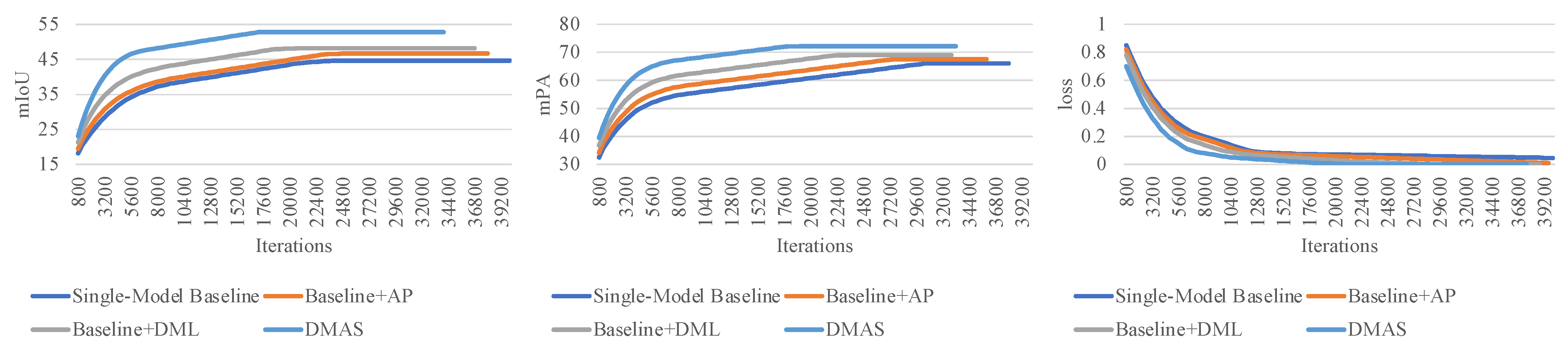
| DMAS (Baseline + AP + DML + ) | 53.04 (+8.39) | 72.17 (+6.13) | 61.19 (+7.06) | 72.48 (+4.67) | +6.6 |
| Metric | Trainable Parameters (M) | Training Time (h) | Inference Speed (FPS, 512 × 512) |
|---|---|---|---|
| Baseline | 42.0 | 15 | 19.5 |
| DMAS (AP + DML + ) | 85.6 | 28 | 18.3 |
Disclaimer/Publisher’s Note: The statements, opinions and data contained in all publications are solely those of the individual author(s) and contributor(s) and not of MDPI and/or the editor(s). MDPI and/or the editor(s) disclaim responsibility for any injury to people or property resulting from any ideas, methods, instructions or products referred to in the content. |
© 2025 by the authors. Licensee MDPI, Basel, Switzerland. This article is an open access article distributed under the terms and conditions of the Creative Commons Attribution (CC BY) license (https://creativecommons.org/licenses/by/4.0/).
Share and Cite
Chen, H.; Li, M.; Liu, Y.; Zhou, J.; Fu, X.; Liu, S.; Yu, F.R. Dynamic Mutual Adversarial Learning for Semi-Supervised Semantic Segmentation of Underwater Images with Limited and Noisy Annotations. J. Mar. Sci. Eng. 2025, 13, 2334. https://doi.org/10.3390/jmse13122334
Chen H, Li M, Liu Y, Zhou J, Fu X, Liu S, Yu FR. Dynamic Mutual Adversarial Learning for Semi-Supervised Semantic Segmentation of Underwater Images with Limited and Noisy Annotations. Journal of Marine Science and Engineering. 2025; 13(12):2334. https://doi.org/10.3390/jmse13122334
Chicago/Turabian StyleChen, Han, Ming Li, Yancheng Liu, Jingchun Zhou, Xianping Fu, Siyuan Liu, and Fei Richard Yu. 2025. "Dynamic Mutual Adversarial Learning for Semi-Supervised Semantic Segmentation of Underwater Images with Limited and Noisy Annotations" Journal of Marine Science and Engineering 13, no. 12: 2334. https://doi.org/10.3390/jmse13122334
APA StyleChen, H., Li, M., Liu, Y., Zhou, J., Fu, X., Liu, S., & Yu, F. R. (2025). Dynamic Mutual Adversarial Learning for Semi-Supervised Semantic Segmentation of Underwater Images with Limited and Noisy Annotations. Journal of Marine Science and Engineering, 13(12), 2334. https://doi.org/10.3390/jmse13122334