


Abstract
Offshore wind turbines are subjected to environmental loads such as wind and ocean waves throughout their entire service lives. Saturated sandy soils experience liquefaction under cyclic shear stresses induced by earthquakes or strong wave actions, which can result in the tilting, settlement, or even overturning of structures. This study investigates the effect of fine content (FC) on the liquefaction resistance (CRR) of saturated sandy soils with different density states. Sandy soils with varying FC values are examined under three scenarios: (1) constant relative density; (2) constant void ratio; and (3) constant skeleton void ratio. A series of undrained cyclic triaxial tests are conducted on sandy soils with different FC and density states (Dr, e, and esk). The results indicate that an increase in FC leads to a decrease in CRR at constant Dr or e, whereas CRR at constant esk increases with increasing FC. No clear correlation is observed between Dr, e, or esk and CRR for saturated sandy soils with varying FC. Since esk does not account for the effect of fine particles on the contact state of skeleton particles, the equivalent skeleton void ratio (esk*) is introduced to describe the particle contact state of sandy soils with different fine contents (FCs), considering the degree of fine particle participation. In addition, the test data reveal that the CRR of sandy soils with different FC and density states decreases with increasing esk*, and a power relationship between the reduction in CRR and the increase in esk* is established. This finding indicates that esk*, which considers the proportion of fines contributing to the load-sustaining framework, serves as a reliable index for evaluating the CRR of various sandy soils. We find that grain shape plays a significant role in influencing CRR, and the overall CRR of sandy soils increases as the grain shape changes from spherical to angular, compared to the published test results for other sandy soils.
1. Introduction
Wind turbines are a key solution as the demand for renewable energy sources continues to increase, with offshore wind turbines (OWTs) increasingly being deployed worldwide due to the limited space for new onshore wind farms. OWTs are subjected to various environmental forces, including waves, winds, and hydrodynamic loadings. In addition, many OWTs are located in seismically active regions such as China and Southeast Asia [1,2]. Under cyclic shear stress induced by earthquakes or strong wave actions, saturated sand undergoes liquefaction, resulting in the tilting, settlement, or even overturning of structures. Sand liquefaction is a phenomenon in which pore water pressure within the soil increases due to cyclic loading caused by earthquakes, leading to reduced effective stress and causing partial or complete loss of the soil’s bearing capacity [3]. Earthquake-induced sand liquefaction can trigger rapid landslides, foundation instability, and settlement. These effects can lead to structural tilting, the buoyancy of underground pipelines and water tanks, riverbank displacement, bridge collapse, dam or levee slippage, and damage to underground structures and pier facilities [4], resulting in severe casualties and substantial economic losses. Multiple recent earthquakes have revealed that liquefied sand does not purely comprise sand grains but is instead a type of sandy soil with varying fine particle content, defined as the percentage by mass of soil particles with a diameter smaller than 0.075 mm. Examples of seismic events that induce sand liquefaction include the 1999 Chi-Chi Earthquake in Taiwan [5], the 2008 Wenchuan Earthquake [6,7,8,9], and the 2011 Great East Japan Earthquake off the Pacific coast of northeastern Japan [10,11,12,13,14]. These events have drawn increased scholarly attention to the influence of fine particle content on the liquefaction strength of sandy soils. Based on particle size, fine particles are classified as silt or clay. Sandy soils are defined as soils with a gravel content (percentage by mass of soil particles larger than 2 mm) less than or equal to 50% of the total mass and a fine particle content less than or equal to 50%. As FC increases, sandy soils can be classified as sand, sandy soils containing fine particles, or fine-grained sandy soils [15].
Numerous studies have demonstrated that fine particle content significantly influences the cyclic resistance ratio (CRR) of sandy soils. Liu and Chen [16] investigated the influence of fine particle content on the liquefaction characteristics of Nanjing silty sand. The experimental results showed that as FC increased, the cyclic resistance ratio of Nanjing silty sand did not change monotonically; instead, it was lowest at approximately FC = 10%, where CRR was lowest. Shen et al. [17] found through undrained cyclic triaxial tests that when the skeleton void ratio of sandy soils remains constant, increased fine particle content leads to an increased CRR. Polito and Martin [18] conducted undrained cyclic triaxial tests on saturated sandy soils with varying fine particle contents. The results indicated that for sandy soils with the same relative density (Dr), the CRR remained relatively unchanged as FC increased. However, when FC exceeded 37%, the CRR decreased with further increases in FC. For sandy soils with the same void ratio (e), the CRR initially decreased and then increased as FC increased. Similarly, Sitharam et al. [19] found that for sandy soils with the same void ratio, the CRR initially decreased and then increased as the fine particle content increased, with the lowest CRR occurring at FC = 20%. Hsiao et al. [20] showed that for sandy soils with the same void ratio, the CRR gradually decreased as the fine particle content increased. Xu et al. [21] conducted a series of strain-controlled monotonic undrained triaxial compression tests and critical-state constitutive modeling on medium-dense saturated sandy soil for various fines contents (FC), mean grain sizes () of nonplastic fines, and initial effective confining pressures. The results revealed that the peak deviatoric stress decreased significantly with decreasing , particularly for high FC. The equivalent granular state parameter () at the phase transformation characterized the effect of fines on the dilatancy of sandy soils in constitutive modeling. In addition, the initial value of () serves as a physical index for describing the influence of fines on the undrained instability state of sandy soils.
A literature review reveals that researchers have attempted to establish relationships between the CRR of saturated sandy soils and fine particle content through various experimental approaches. However, these studies’ conclusions remain inconsistent, resulting in considerable debate regarding the influence of FC on the liquefaction characteristics of sandy soils [22]. Therefore, this study explores the liquefaction process of saturated sandy soils through a series of undrained cyclic triaxial tests. It investigates the CRR of sandy soils under different densification states, analyzes the influence of fine particle content on the CRR of sandy soils with varying densification states (Dr, e, and esk), and explains the underlying mechanisms of this influence.
2. The Particle Contact State of Sandy Soils
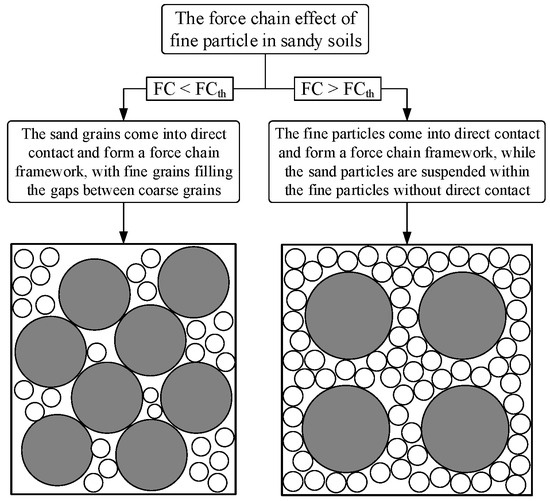
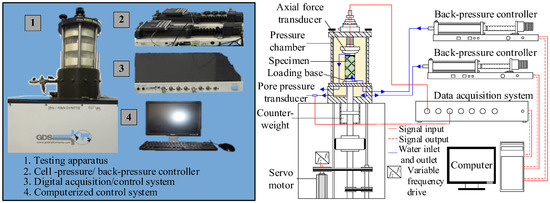
Thevanayagam [23] and Thevanayagam and Martin [24] reported that with increasing FC, the particle contact behavior of sandy soils exhibits distinct changes, as illustrated in Figure 1. When the FC is relatively low, direct contact occurs between sand particles, forming the primary skeletal framework of the soil. The finer particles occupy intergranular voids, and the soil’s mechanical properties and response are predominantly controlled through the arrangement of sand particles. This type of sandy soil, characterized by such particle contact behavior, is referred to as granular-sand-like soil. In contrast, when the FC is relatively high, direct contact occurs between fine particles, forming the primary skeletal structure of the soil. The sand particles become suspended within the fine particles, and the mechanical properties and response of the soil are primarily determined through the arrangement of the fine particles. Once contact between fine particles is disrupted, the entire specimen fails. This type of sandy soil is referred to as fine-particle-like soil. The skeletal void ratio (esk) describes the contact state of the framework particles in sandy soils [25,26]. When the sandy soil exhibits granular-sand-like behavior, the skeletal void ratio is given by esk = (e + FC)/(1 − FC), whereas when the soil exhibits fine-particle-like behavior, the skeletal void ratio is given by esk = e/FC. Therefore, for sandy soils with different FC values, a threshold fine content (FCth) exists [27,28]. When FC < FCth, the sandy soil exhibits granular-sand-like behavior, whereas when FC > FCth, it behaves akin to fine-particle-like soil. FCth is a critical parameter for distinguishing the particle contact state and mechanical properties of sandy soils. Rahman et al. [26] proposed an empirical formula for determining FCth, expressed as follows:
where α and β are taken as 0.50 and 0.13, respectively. χ = D10/d50, D10 is the effective particle size of pure sandy soil (with FC = 0%), and d50 is the mean particle size of pure fine-grained soil (with FC = 100%).
Figure 1.
The intergrain contact state of sandy soils [24].
3. Undrained Cyclic Triaxial Test
3.1. Testing Equipment
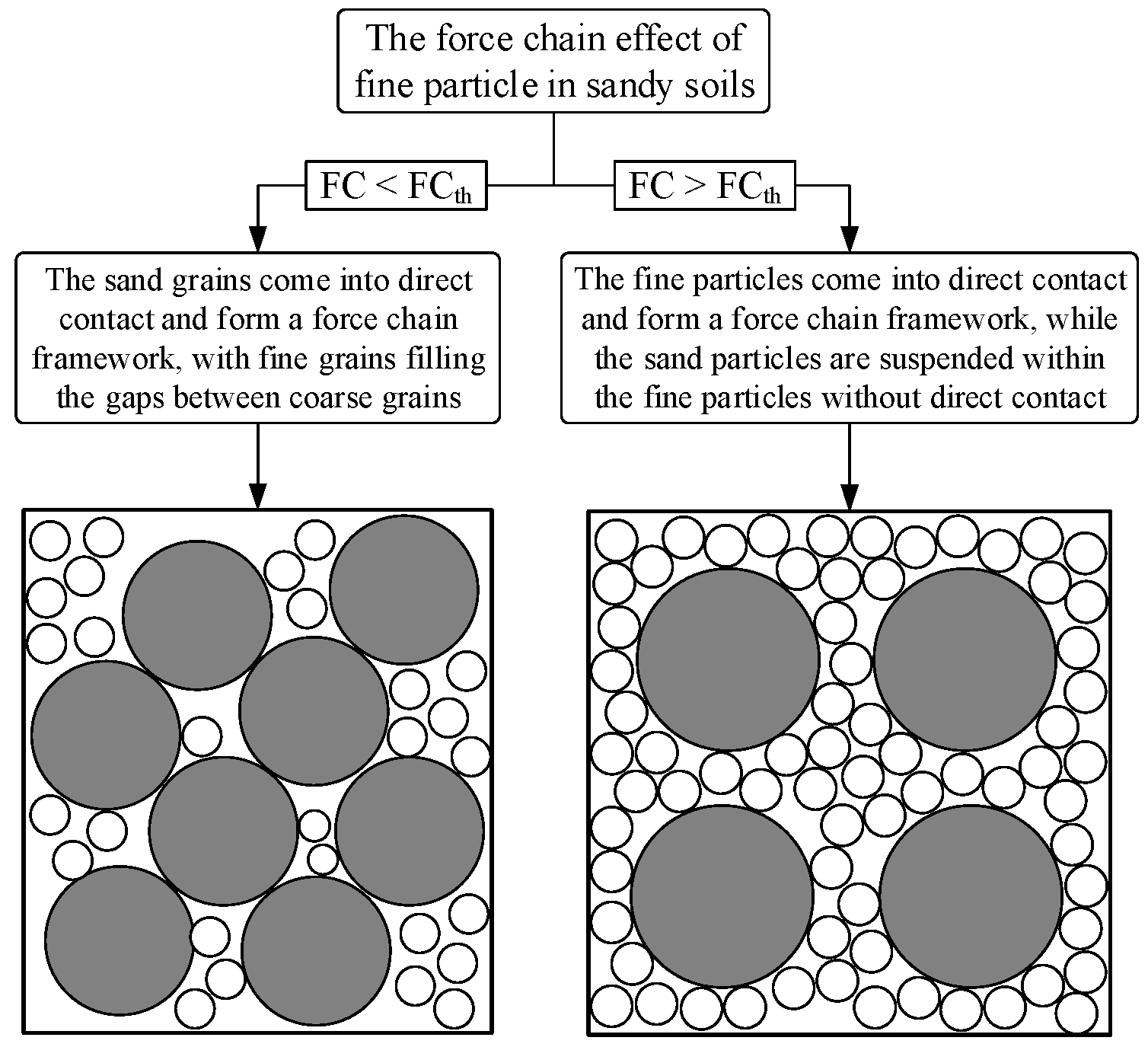
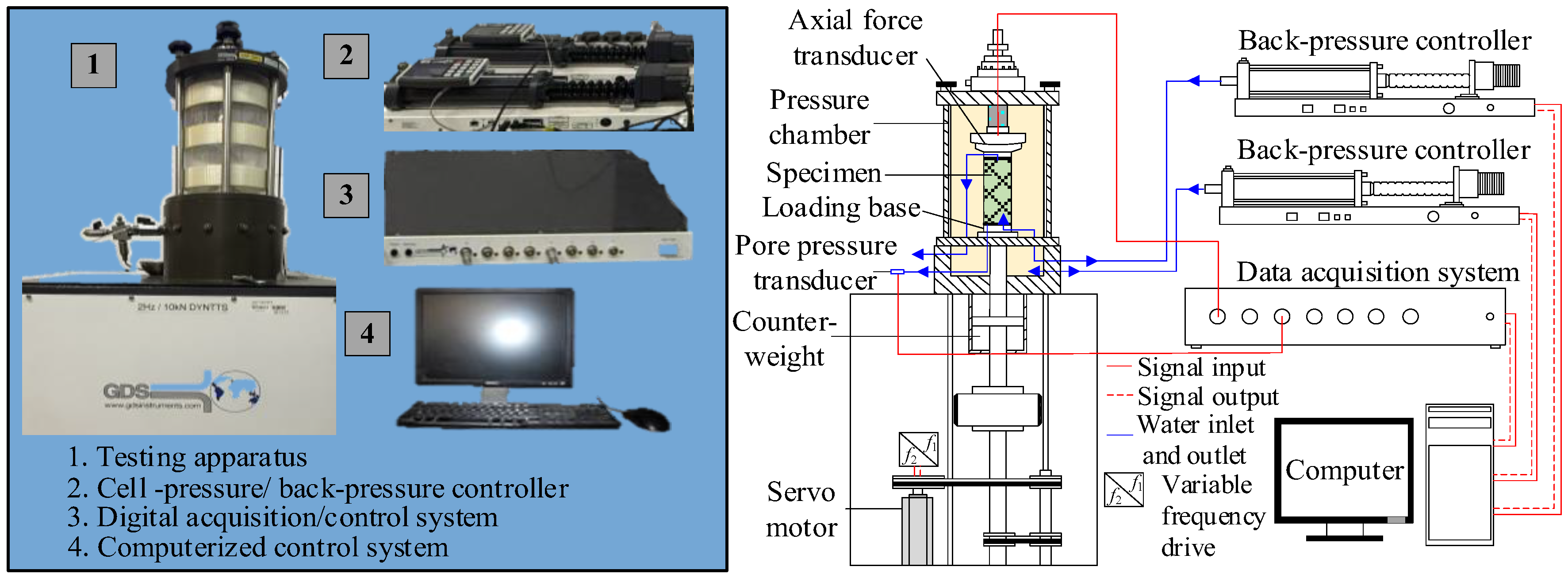
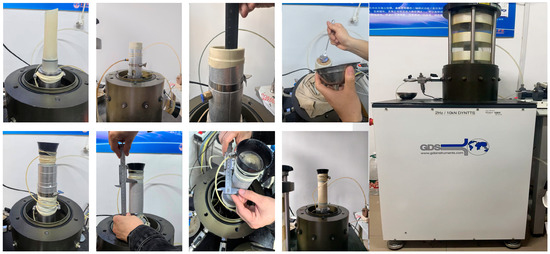
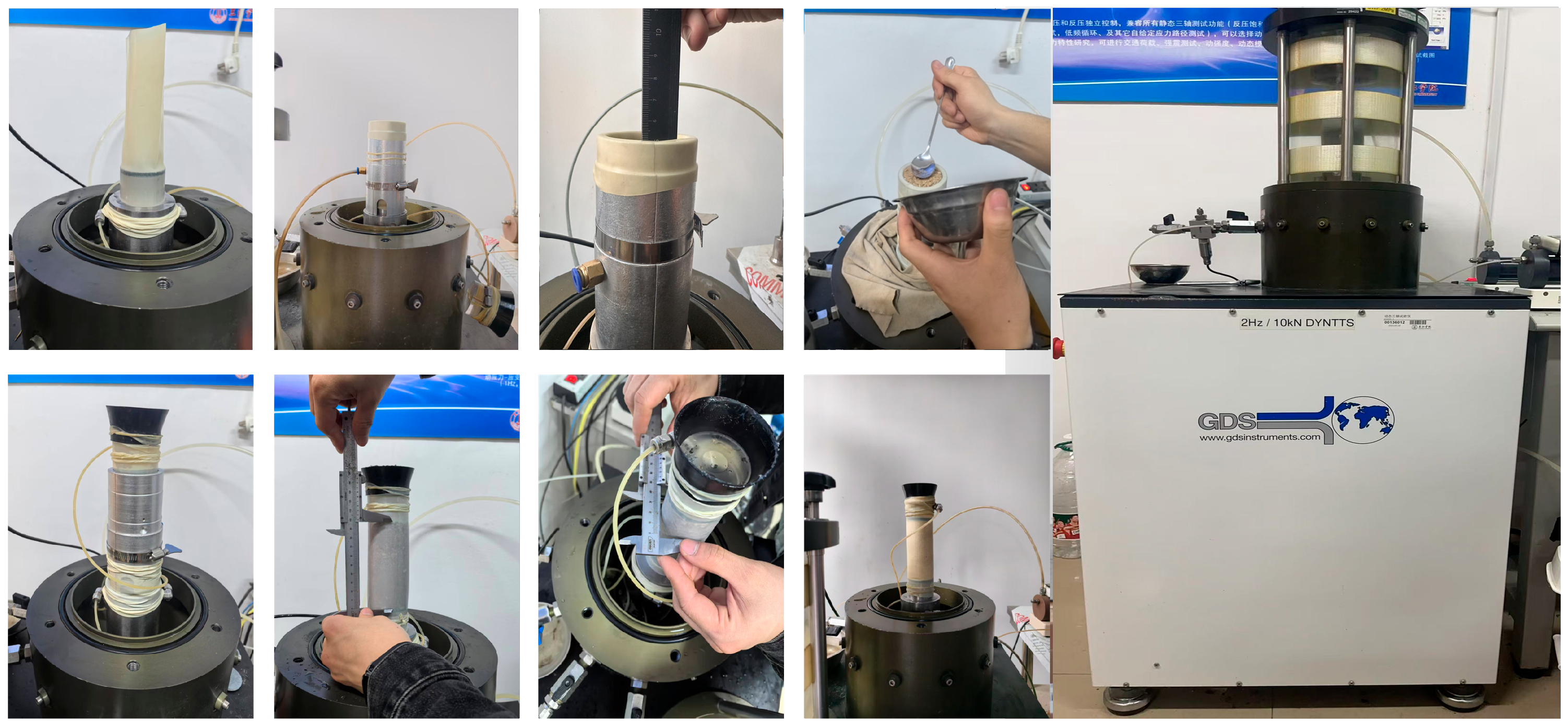
The experiments were conducted using the biaxial vibration triaxial testing system (DYNTTS) from GDS Instruments, the UK, which is designed for undrained cyclic triaxial tests, as shown in Figure 2. The DYNTTS enables independent control of the axial force, confining pressure, and back pressure for both static and dynamic loading. The axial force and axial deformation are regulated via a motor-driven base with a screw mechanism located at the bottom of the pressure chamber. The system can apply dynamic loads up to 10 kN with a frequency of 2 Hz. The confining pressure and back pressure are applied and measured using standard pressure/volume controllers with a maximum capacity of 2 MPa. An axial force sensor is positioned at the top of the specimen, where the back pressure is applied, while the pore pressure is measured at the bottom of the specimen. A multi-step saturation method was adopted while maintaining a constant effective confining pressure of 100 kPa. The back pressure was increased in three stages (100 kPa → 200 kPa → 300 kPa).
Figure 2.
GDS bi-directional dynamic triaxial test system.
3.2. Experimental Materials
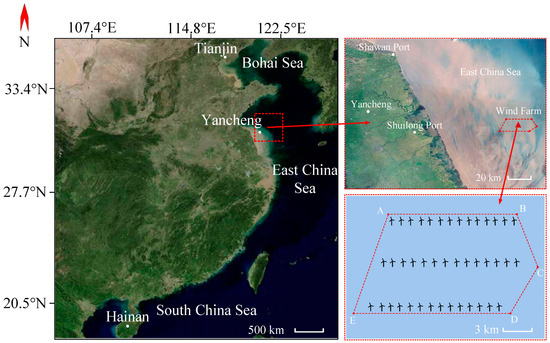
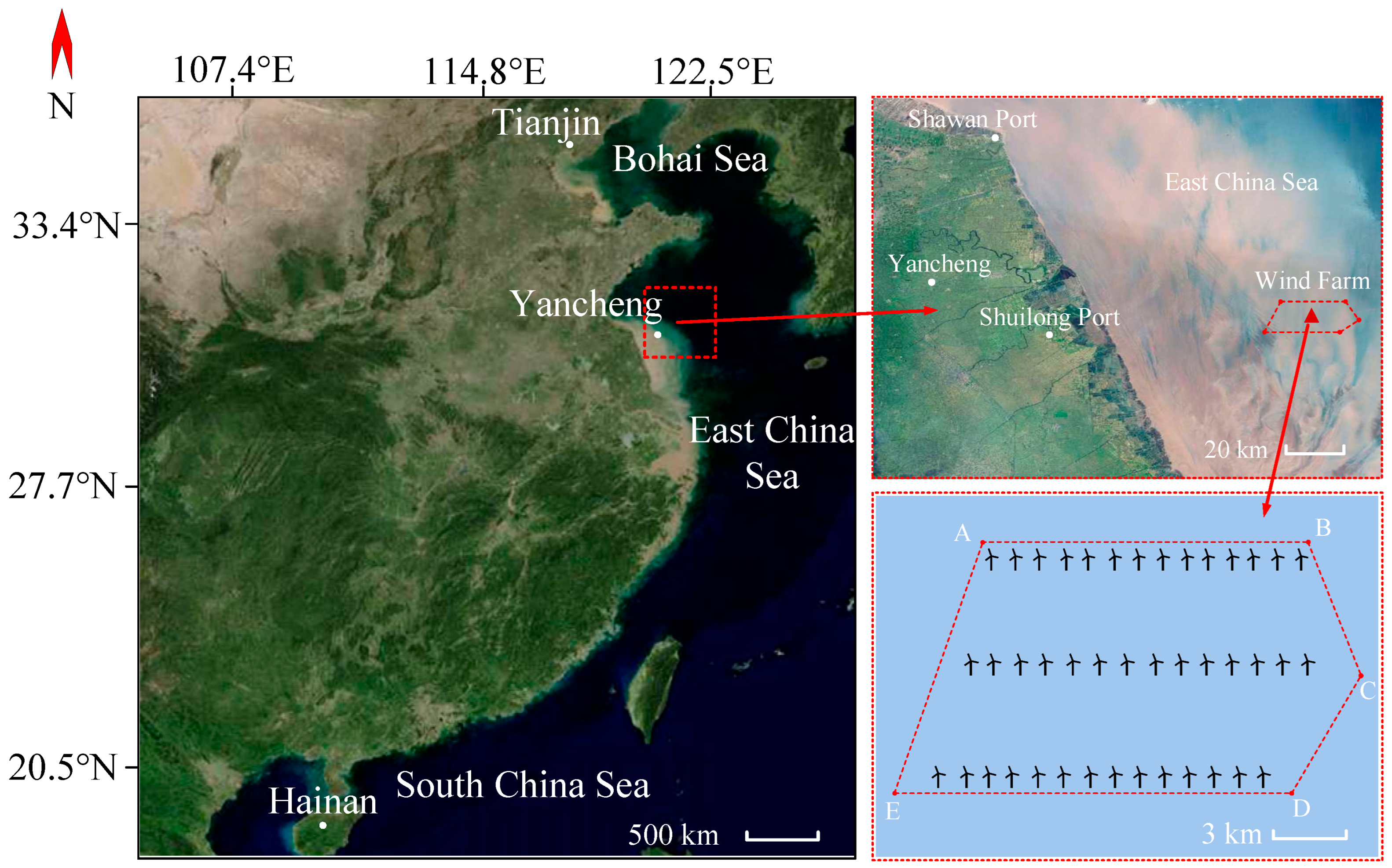
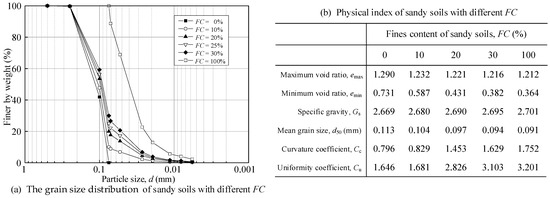
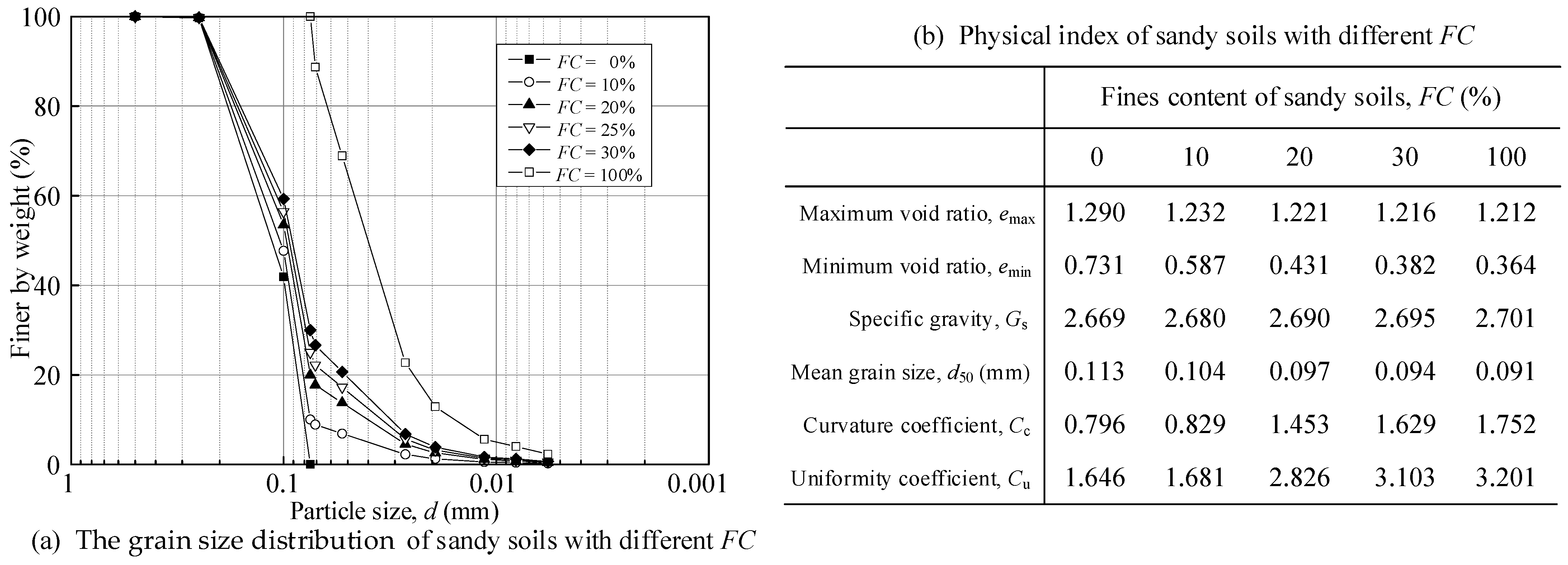
The testing material used in this study was sandy soil collected from the nearshore seabed of Yancheng, as shown in Figure 3. The maximum particle size was 0.5 mm, and the particles were predominantly sub-angular in shape. After collection, the sandy soil was oven-dried and then sieved using a 0.075 mm aperture sieve. Particles larger than 0.075 mm were classified as sand fractions, while those smaller than 0.075 mm were classified as fines. The effective particle size of the pure sandy soil was d10 = 0.080 mm, and the mean particle size of the pure fine-grained soil was d50 = 0.040 mm. Accordingly, the parameter for the sandy soil was χ = 2. Based on Equation (1), the threshold fine content of the sandy soil was FCth = 37.6%. Therefore, we preliminarily determined that when FC < 37.6%, the sandy soil exhibits granular sand-like behavior. Fine contents of FC = 0%, 10%, 20%, 25%, and 30% were utilized to examine the influence of fine content on the CRR of sandy soil. Figure 4a presents the particle size distribution of sandy soils with varying fine contents (FC), while Figure 4b provides the fundamental physical properties of these sandy soils at different FC levels. All basic physical indices in this experiment were obtained in accordance with ASTM standards [29].
Figure 3.
The specific location of the offshore wind farm.
Figure 4.
The grain size distribution and physical index of the sandy soils with different FC values.
3.3. Specimen Preparation, Saturation, and Consolidation
In this study, the target void ratios listed in Table 1 were strictly controlled using a mass–volume-based layered compaction procedure, which fully adheres to the specimen preparation protocols outlined in international cyclic triaxial testing standards, such as ASTM D5311 [30] and JGS 0541 [31]. For each fines content and density state, the target void ratio from Table 1 was converted to the corresponding target dry density, and the required total dry mass for the specimen was calculated based on the mold volume (diameter 50 mm, height 100 mm). The specimen was prepared in four layers, a widely adopted method for reconstituted cyclic triaxial specimens, as recommended in numerous standards and publications. To ensure uniformity across layers, a uniform layering strategy was employed, with each layer having an equal thickness, and the tamping process was applied uniformly. The 1 kg hammer with a 15 cm drop height used in this study conforms to standard practices for reconstituted cyclic triaxial specimen preparation, as specified in established international guidelines. To guarantee specimen uniformity and repeatability, the following quality control measures were implemented: after compaction and trimming, the mass and dimensions of each specimen were measured, and the deviation of the achieved dry density from the target value was found to be within ±1.5% [32]. Additionally, no signs of shear bands or localized stress fluctuations due to layering were observed in the stress–strain and pore pressure curves, which is consistent with previous studies. This suggests that the manually tamped specimens demonstrated stable and repeatable responses during cyclic loading. It should be noted that, in the preparation of reconstituted cyclic triaxial specimens, the void ratio is controlled through mass–volume methods, not by compaction energy. Tamping is primarily used to level the soil particles and remove large voids, rather than to achieve a specific “energy requirement.” After trimming, the total mass, diameter, and height of each specimen were measured, and the final void ratio was recalculated based on the volume and mass of the specimen. The deviation of the achieved void ratio from the target value was found to be less than 0.012, which aligns with the density control standards set forth by ASTM D5311 [30] and JGS 0541 [31] for reconstituted cyclic triaxial specimens.
Table 1.
Cases of undrained cyclic triaxial tests for sandy soils with different fine contents (FCs).
After specimen preparation, the sample was first saturated using the vacuum extraction method, followed by the absorption of air-free water, and then subjected to graded back-pressure saturation. The pore pressure coefficient B was determined, and if B > 0.95, the specimen was considered to be fully saturated [28]. The saturated specimen was subjected to isotropic consolidation under an initial effective confining pressure σ’3c of 100 kPa. The specific sample preparation procedure is shown in Figure 5.
Figure 5.
Procedures used for specimen preparation.
3.4. Experimental Protocol
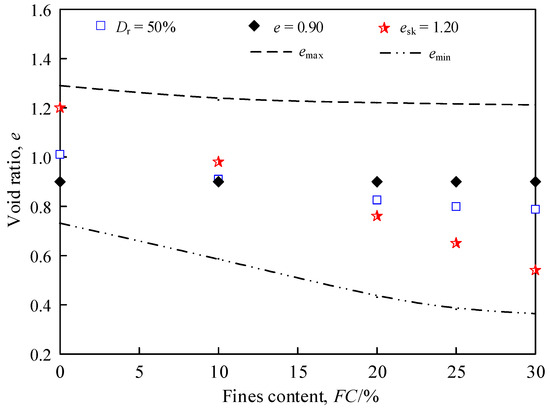
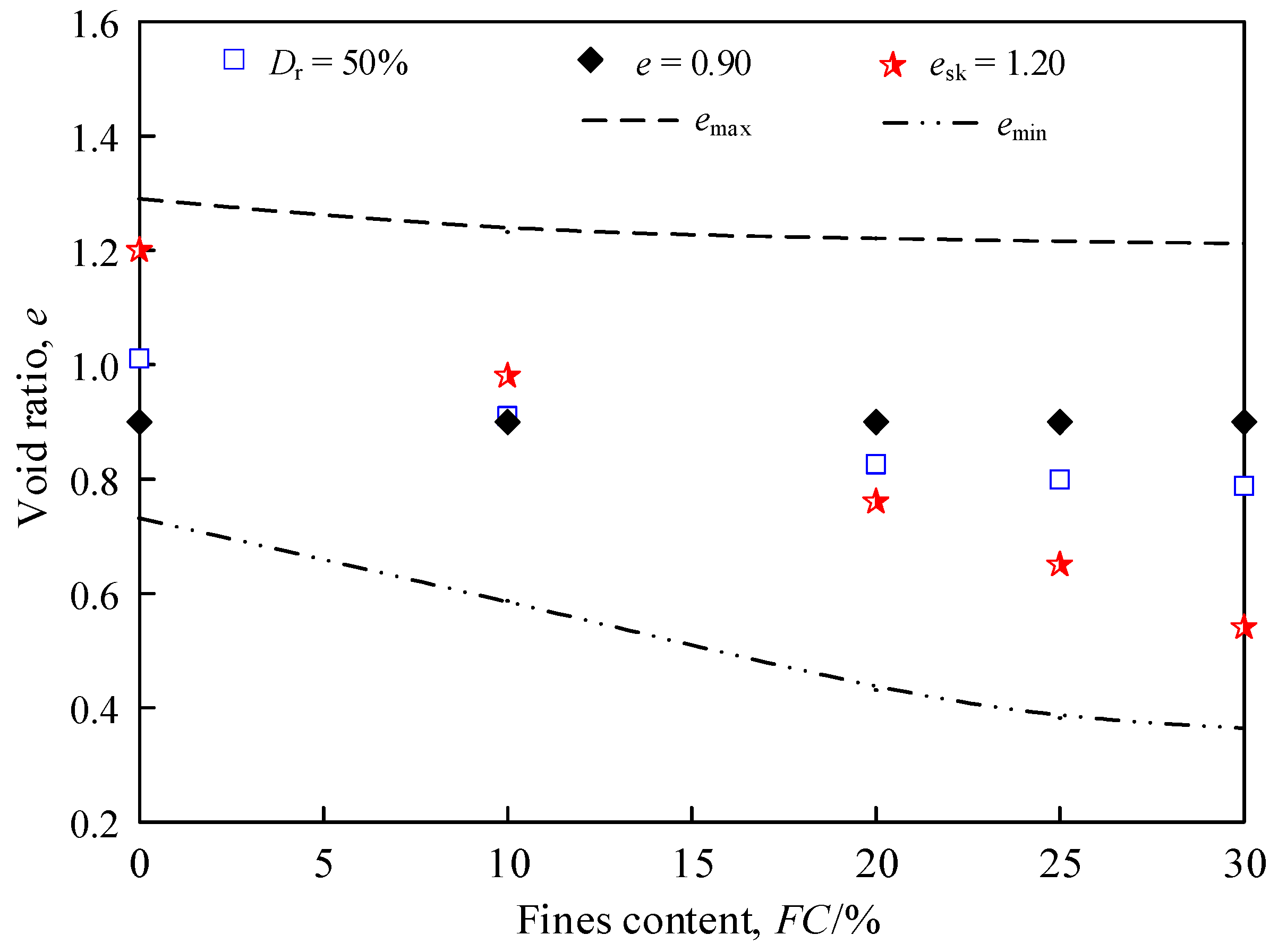
The sandy soil samples with varying FCs were divided into three groups—Group A contained samples with the same Dr, Group B contained samples with the same e, and Group C contained samples with the same esk—to investigate the influence of FC on the CRR of sandy soils with different densities (Dr, e, or esk). We observed that the maximum void ratio (emax) slightly decreased with increased FC, whereas the minimum void ratio (emin) more noticeably decreased as the FC increased, as depicted in Figure 6. The Dr of natural soils typically ranges from 20% to 80%, with most natural soils being of medium density (Dr = 33–66%). In addition, the current sample preparation methods make it difficult to prepare cyclic triaxial test samples with Dr values lower than 15% or higher than 80%. Therefore, for Group A, Dr was set to 50%; for Group B, e was set to 0.90; and for Group C, esk was set to 1.20. Figure 6 shows the relationship between porosity (e) and fine particle content (FC) for the three groups of sandy soils. It indicates that for sandy soils with the same Dr, e slightly decreased as FC increases, whereas for sandy soils with the same esk, e rapidly decreased as FC increases. Considering the combined factors of FC, Dr, e, and esk, 15 sample numbers are listed in Table 1. Each sample underwent three undrained cyclic triaxial tests, with different amplitudes of axial cyclic stress (σd) applied sequentially using a sinusoidal waveform. A loading frequency of 0.1 Hz was selected for this experiment. Earthquake ground motions are characterized by dominant frequencies of only a few hertz (typically 0–15 Hz). Krawinkler (1996) [33] pointed out that to avoid inertial effects, structural tests typically adopt low-speed cyclic loading in the order of 0.1 Hz to ensure that the loading process remains in a quasi-static state. This quasi-static principle is equally applicable to cyclic triaxial tests on sand, making 0.1 Hz a reasonable choice for simulating the cyclic shear induced by earthquakes.
Figure 6.
Void ratio e of specimens in undrained cyclic triaxial tests.
4. Experimental Results and Discussion
4.1. Liquefaction Criteria for Sandy Soils
The appropriate liquefaction criteria are essential for analyzing the CRR of soils. Due to differing interpretations of the liquefaction mechanism, two liquefaction criteria were proposed for undrained cyclic triaxial tests on saturated sandy soils [27]. The first criterion is based on pore pressure [28]: liquefaction occurs when the excess pore water pressure Δu under cyclic loading equals σ’3c or when the pore pressure ratio Ru (=Δu/σ’3c) reaches 1. The second criterion is based on deformation [34,35]: liquefaction is considered to occur when the single axial strain εSA reaches 2–3% or the double axial strain εDA reaches 5% under cyclic loading. However, for sandy soils with varying FC, due to differences in particle composition, particle shape, and the proportions of various particle sizes, no consensus was established regarding the liquefaction criteria. Therefore, selecting an appropriate liquefaction criterion for sandy soils is critical, as it directly influences the determination of the CRR [36].
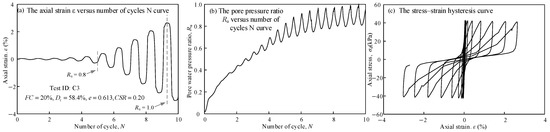
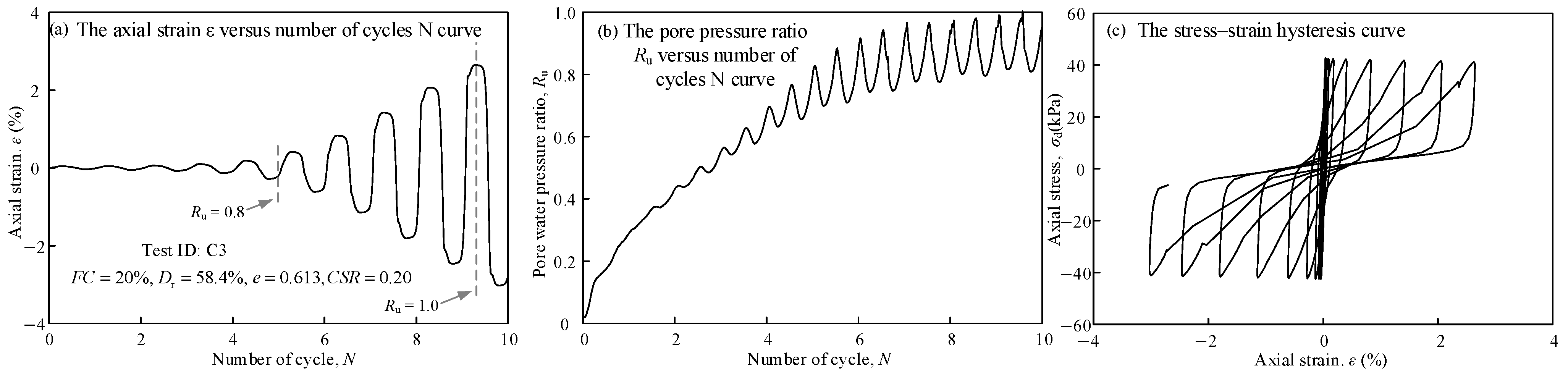
Figure 7 presents the results of undrained cyclic triaxial tests conducted on a sandy soil sample (FC = 20%) of type C3, illustrating the relationships between the pore pressure ratio Ru and axial strain ε with the number of cycles N, as well as the stress–strain hysteresis curve. This indicates that Ru increases rapidly at the initial stage and stabilizes once it exceeds 0.8, exhibiting a “fast-stable” growth pattern. The axial strain εDA remains nearly constant at first; however, when Ru > 0.8, εDA gradually increases, and when Ru = 1.0, εDA exceeds 5%. This behavior aligns with the typical cyclic triaxial test results for saturated sandy soils [27]. As FC varies, the sandy soil transitions from sand to silty sand, and when the soil framework undergoes flow failure, the sandy soil loses its shear strength. For sandy soils with different FC values, liquefaction occurs when Ru = 1.0, while εDA ranges from 5% to 7%. Therefore, using Ru = 1.0 as the liquefaction criterion for sandy soils with different FC values is appropriate. For offshore wind turbine monopile foundations, engineering performance is typically governed by serviceability limit states, particularly the allowable permanent rotation or tilt of the foundation–tower system, rather than by a pure strength-type criterion. Recent design studies show that the accumulation of pile rotation under cyclic lateral loading is a key design concern and that permanent rotation must be kept below project-specific limits (often in the order of 0.25–0.5°) [37,38,39]. In this context, Ru = 1.0 indicates the onset of severe strength and stiffness degradation in the surrounding soil, but the actual functional failure of the monopile foundation is controlled by the accumulated deformation and resulting permanent rotation, rather than by the pore-pressure criterion alone. However, when discussing engineering implications for offshore wind applications, the post-liquefaction deformation behavior and foundation rotation requirements should be considered together, and the CRR values obtained here should be used in conjunction with deformation-based or rotation-based design checks at the foundation level.
Figure 7.
Undrained cyclic triaxial test results of sandy soils with CSR = 0.20 for testing case C3.
4.2. Effect of the Fine Particle Content on the Liquefaction Strength of Sandy Soils
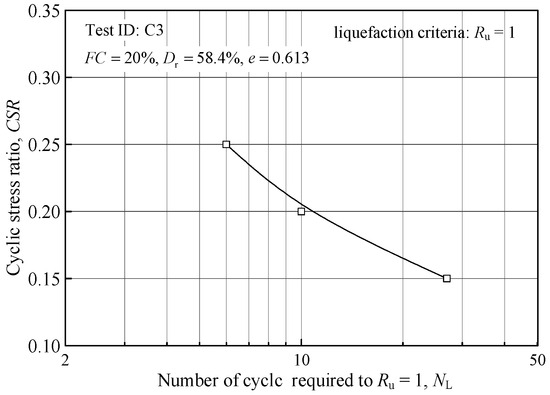
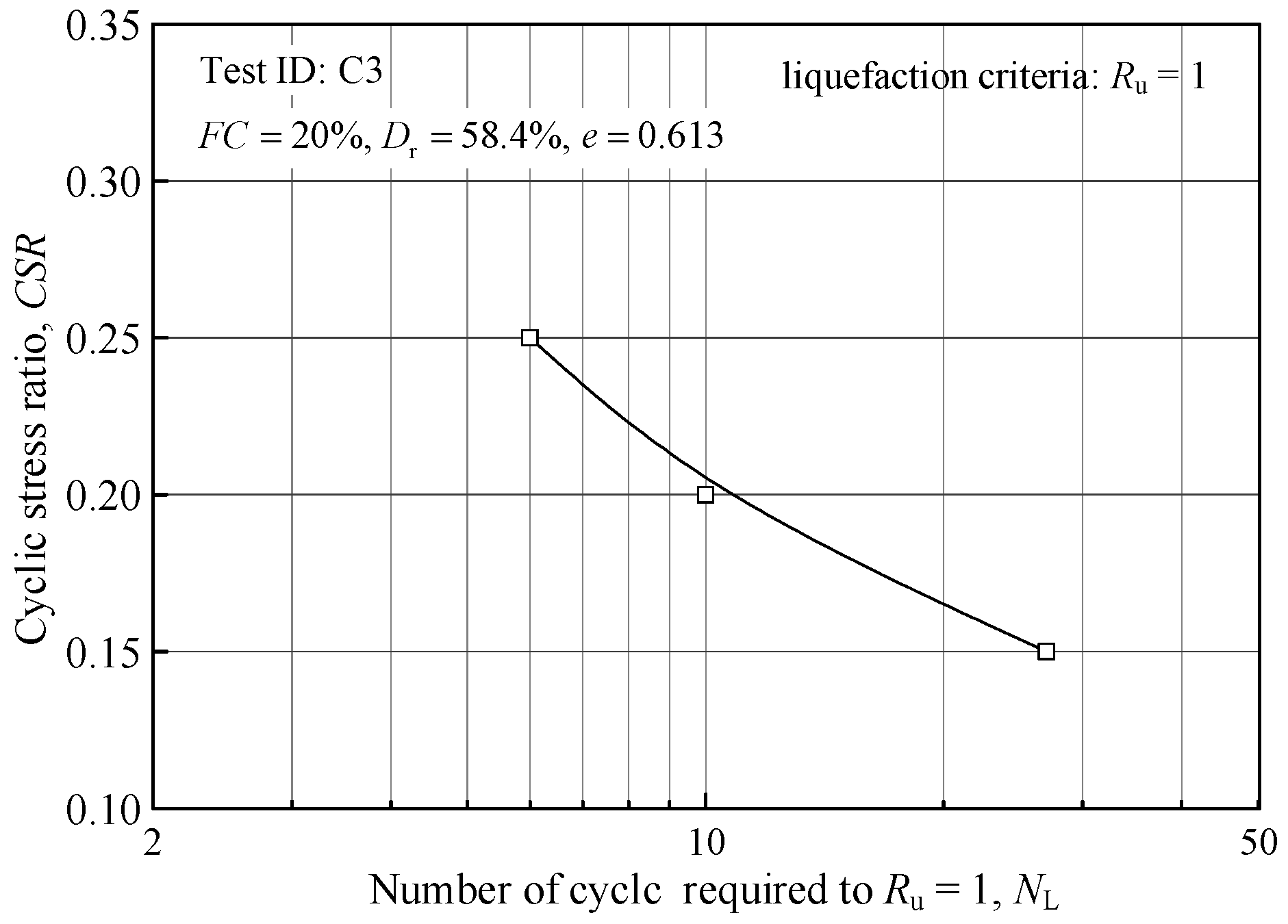
Figure 8 illustrates the relationship between the cyclic stress ratio (CSR) and the liquefaction number of cycles (NL) for the sandy soil sample identified as test number C3. NL is defined as the number of axial cyclic load cycles required for the sample to reach the liquefaction criterion (Ru = 1.0). For sandy soils with identical FC and density state (Dr, e, or esk), NL increases rapidly as CSR decreases. The CSR–NL relationship for other samples follows a similar trend, which is not discussed further in this section. The level of cyclic stress was calculated using the cyclic stress ratio (CSR), which is defined as follows:
where σd is the amplitude of axial stress as loading progresses.
Figure 8.
The relationship between the cyclic stress ratio (CSR) and the number of cycles (Nf) for test case C3.
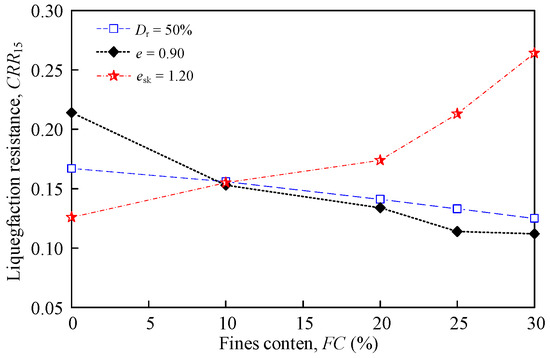
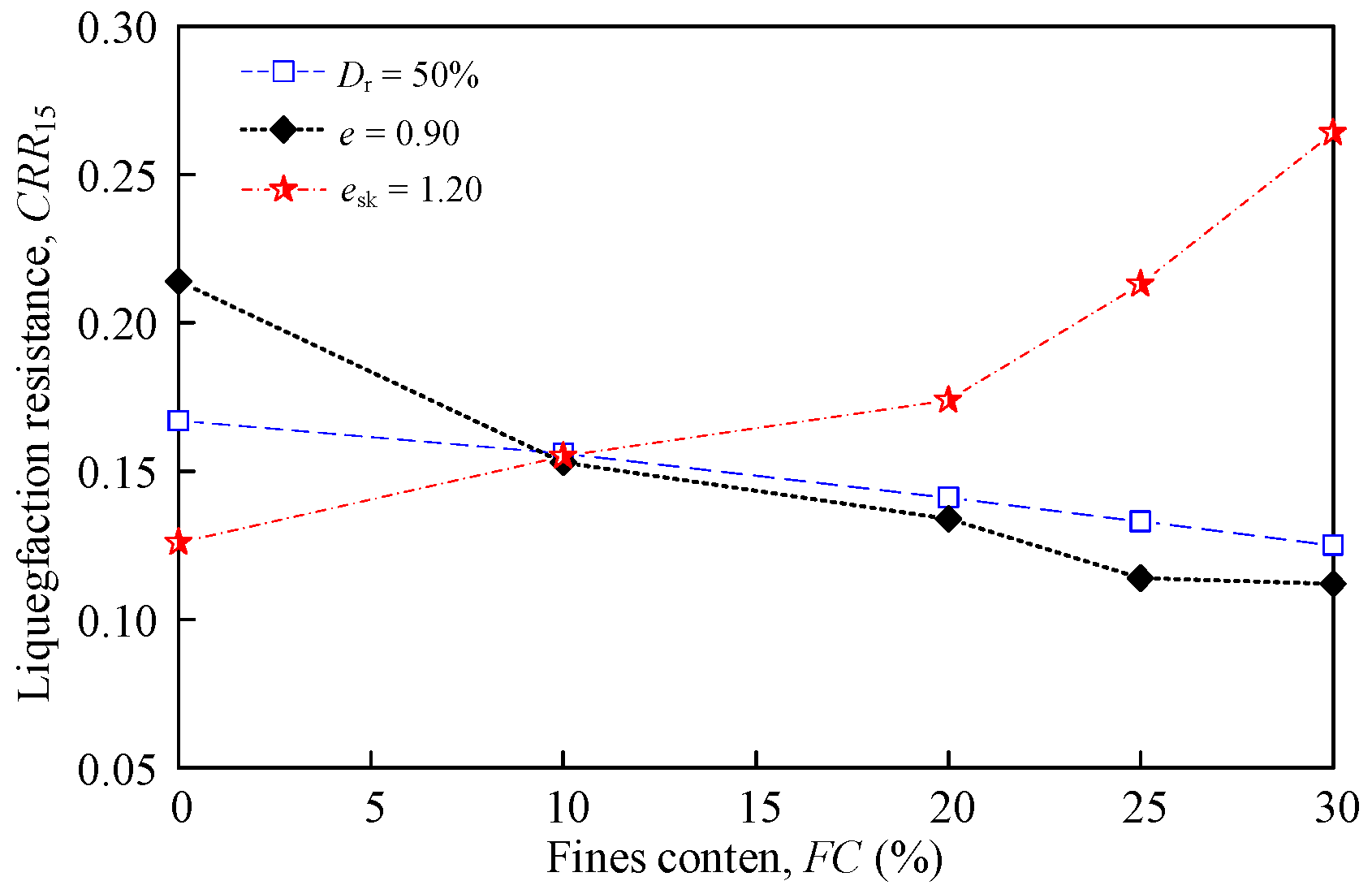
The CRR of soil is generally defined as the CSR required for the soil to reach the liquefaction criterion under a specified number of cyclic loadings. In undrained cyclic triaxial tests, the CRR is commonly defined as the CSR required for a sample to reach the liquefaction criterion when NL = 15 cycles [40]. Figure 9 presents the relationship between liquefaction strength and fine particle content for sandy soils. It reveals that for sandy soils with the same e or Dr, the CRR decreases gradually as FC increases. This observation aligns with the findings of Hsiao et al. [20], who reported a similar influence of FC on the CRR of sandy soils. When esk is constant, CRR increases rapidly with increasing FC. This behavior occurs because, when e or Dr is constant, an increase in FC decreases the number of sand particles forming the soil framework. Although some fine particles contribute to the soil framework, a substantial portion merely fills the voids within the structure and does not participate in force transmission, reducing the CRR of the sandy soil. In contrast, when esk is constant, the sand particles constituting the framework remain unchanged. As the FC increases, some fine particles fill the voids between the sand grains, and a portion of these particles gradually becomes part of the soil framework, increasing interparticle friction and contact area, enhancing the CRR. Accordingly, the effect of the FC on the CRR of sandy soils varies with the density state (e, Dr, or esk). Therefore, FC alone cannot accurately describe the CRR of sandy soils with different density states (Dr, e, or esk).
Figure 9.
Liquefaction resistance (CRR) of sandy soils with different fine contents (FC).
4.3. Relationship Between Liquefaction Strength and Density State Parameters
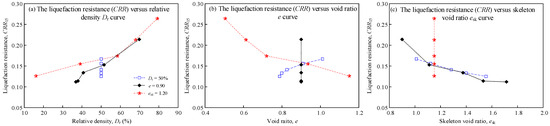
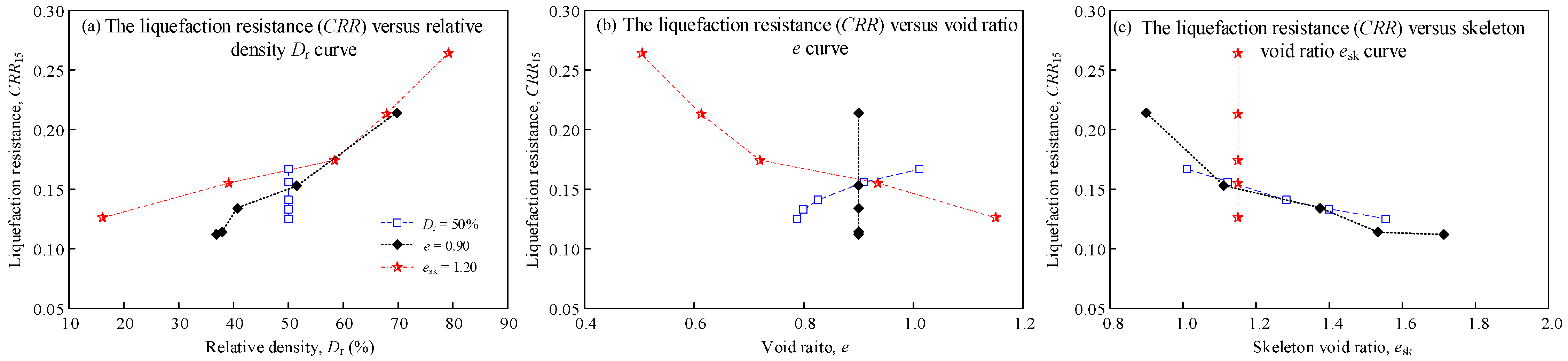
Existing research demonstrates that the CRR of saturated sandy soils increases with relative density [41,42]. The results of small-scale soil box vibration table tests conducted by Wang et al. [43] also indicate that the CRR of gravelly soils follows a similar trend. Figure 10a presents the relationship between liquefaction strength and relative density for sandy soils. The CRR generally increases with increasing Dr for sandy soils with varying FC values. However, when the relative density is constant (Dr = 50%), the CRRs of sandy soils with different FC values vary between 0.125 and 0.167. Figure 10b shows the relationship between liquefaction strength and void ratio for sandy soils. When the relative density is constant, the CRRs of sandy soils with different FC values increase as the void ratio increases. However, when the skeleton void ratio (esk) is constant, the CRR decreases with increasing e. No significant correlation is observed between CRR and e for sandy soils with different FC values, supporting the findings of other researchers. Polito and Martin II [18] reported that the CRRs of sandy soils with different FC values show no strong correlation with e, while for soils with the same FC, the CRR decreases as e increases. Hsiao et al. [20] also indicated that, whether the sandy soil has the same Dr or undrained shear strength, the CRR does not correlate with e. Thevanayagam [23] introduced the skeleton void ratio to uniformly describe the density state of sandy soils with different fine particle contents. Chang and Hong [44] showed that for sand–clay mixtures with FC < 35%, the CRR decreases as esk increases. Wu et al. [45] indicated that for fine-grained sand–gravel mixtures, the CRR decreases with increasing esk, and when FC < 25% or FC > 35%, an exponential relationship exists. However, when 25% ≤ FC ≤ 35%, the mixture framework consists of both coarse and fine particles, and the contact condition between sand and fine particles jointly determines the CRR. Therefore, esk is not a reasonable descriptor for the particle density state of such mixtures. Papadopoulou and Tika [46] showed that although CRR tends to decrease with increasing esk when FC < 35%, there is no strong correlation between the two. Figure 10c illustrates the relationship between liquefaction strength and the skeleton void ratio for sandy soils. It indicates that for soils with the same Dr or e, the CRR decreases as esk increases. However, for soils with the same esk, the CRR varies with FC. Accordingly, the CRRs of sandy soils with different FC values do not strongly correlate with Dr, e, or esk. Therefore, Dr, e, and esk are not effective indicators for characterizing the CRRs of sandy soils.
Figure 10.
Liquefaction resistance (CRR) versus Dr e and esk of sandy soils with different FC.
4.4. Characterization of Liquefaction Strength via the Equivalent Skeleton Void Ratio
Thevanayagam et al. [47] found that for sandy soils with fine particle contents below a certain threshold (FC < FCth), as the FC increases, some fine particles fill the voids between sand grains, while others contribute to the soil framework. At this stage, the mechanical behavior of the sandy soil is influenced by fine particles. However, esk does not account for the effect of fine particles on the contact condition between framework particles. Therefore, Thevanayagam et al. [47] introduced the equivalent skeleton void ratio (esk*) to describe the particle contact state in sandy soils with varying FC values, considering the degree of fine particle participation. esk* is defined as the ratio of the pore volume between framework particles to the volume of framework particles, expressed as follows:
where b is the fine particle influence coefficient, 0 ≤ b ≤ 1. When b = 0, no fine particles contribute to the soil framework, whereas when b = 1, all fine particles participate in its formation. The value of b depends on the FC and the particle size difference between sand and fine content, which influence the degree to which fine particles contribute to the structural framework. Based on the findings of Rahman and Lo [48], Mohammadi and Qadimi [49] used results from undrained uniaxial and cyclic triaxial tests on sandy soils with different FC values to propose an empirical formula for calculating b:
where r = χ−1 and k = 1 − r0.25. Equation (6) indicates that b is related to k, r, FC, and FCth. k and r are determined by χ, and FCth is an empirical formula based on χ. Therefore, variations in FC and χ lead to differences in the value of b.
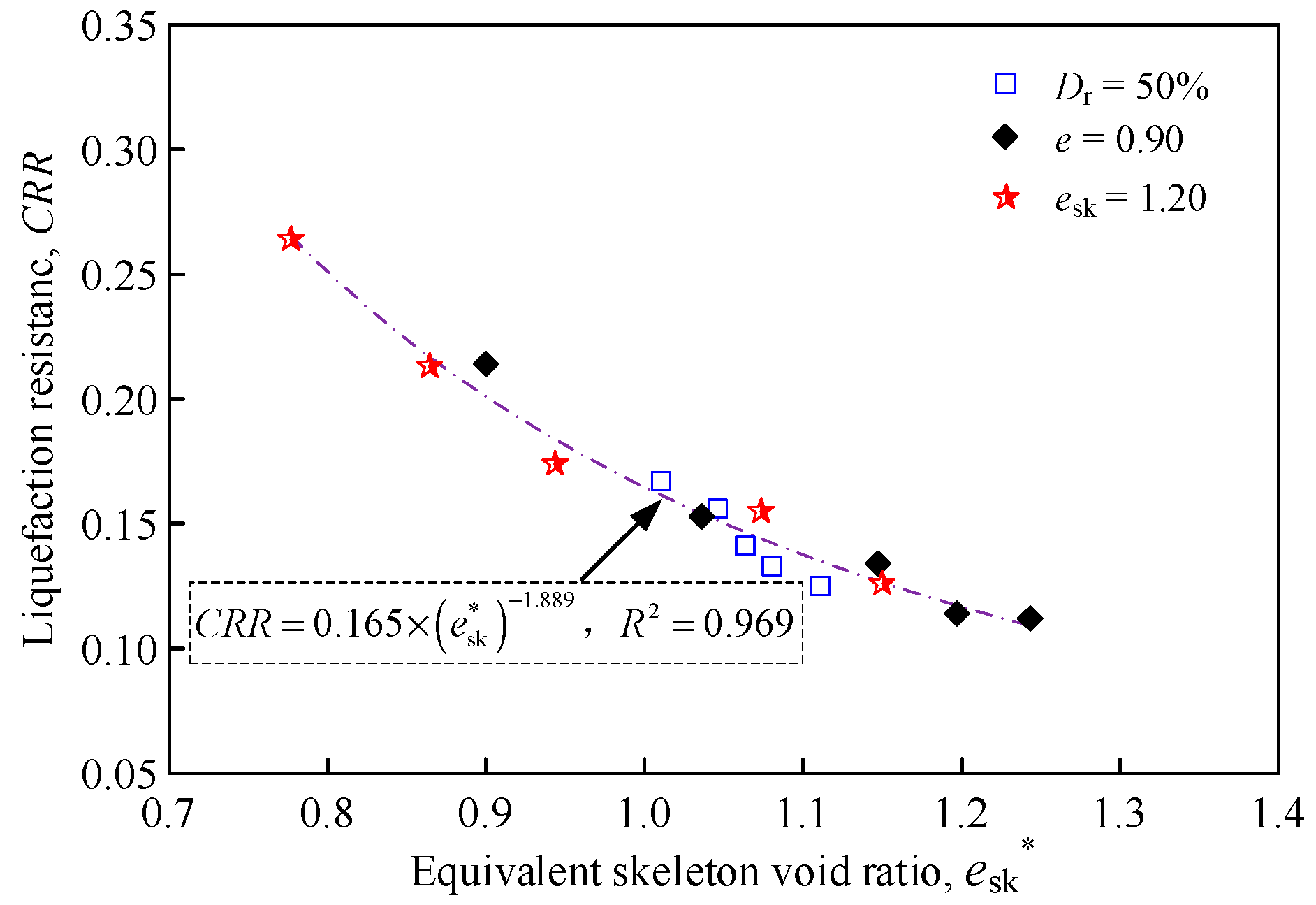
The relationship between the CRR and the equivalent skeleton void ratio (esk*) for sandy soils is presented in Figure 11. For sandy soils with different FC, e, Dr, or esk values, the CRR exhibits a similar variation pattern with esk*. The CRR values obtained under different experimental conditions fall within a narrow range. In addition, when esk* < 1.1, the CRR decreases rapidly with increasing esk*, whereas for esk* > 1.1, the CRR decreases more gradually. A strong correlation exists between the CRR and esk*, indicating that esk*, which accounts for the influence of fine particles, can consistently represent the CRR of sandy soils with different FC values and density states (Dr, e, or esk). Therefore, the CRR of sandy soils can be reasonably expressed as a negative power function of esk*:
Figure 11.
The liquefaction resistance (CRR) versus equivalent skeleton void ratio (esk*) of sandy soil.
The esk* values for sandy soils with different density states and their corresponding CRR values were substituted into Equation (7) for parameter fitting. Through analysis, the parameters for Yancheng sandy soil were determined to be A = 0.165 and B = 1.889, with a coefficient of determination (R2) of 0.969. This outcome indicates that, compared to FC, Dr, e, or esk, esk* is a more reliable physical state indicator for evaluating the liquefaction strength of Yancheng sandy soil.
The CRR of multiple types of sandy soils were re-evaluated using esk*, which accounts for the influence of fine particles, to examine the rationality and universality of esk* in evaluating the CRR of various sandy soils. This analysis was conducted based on existing results from undrained cyclic triaxial tests performed on three different sandy soil types. The fundamental physical properties of the pure sand and pure fine-grained soils corresponding to the three sandy soil types are presented in Table 2. The particle composition, particle shape, and basic physical properties of the three sandy soils differ considerably.
Table 2.
The characteristics of the sand grains and fine grains of sandy soil used in the analysis.
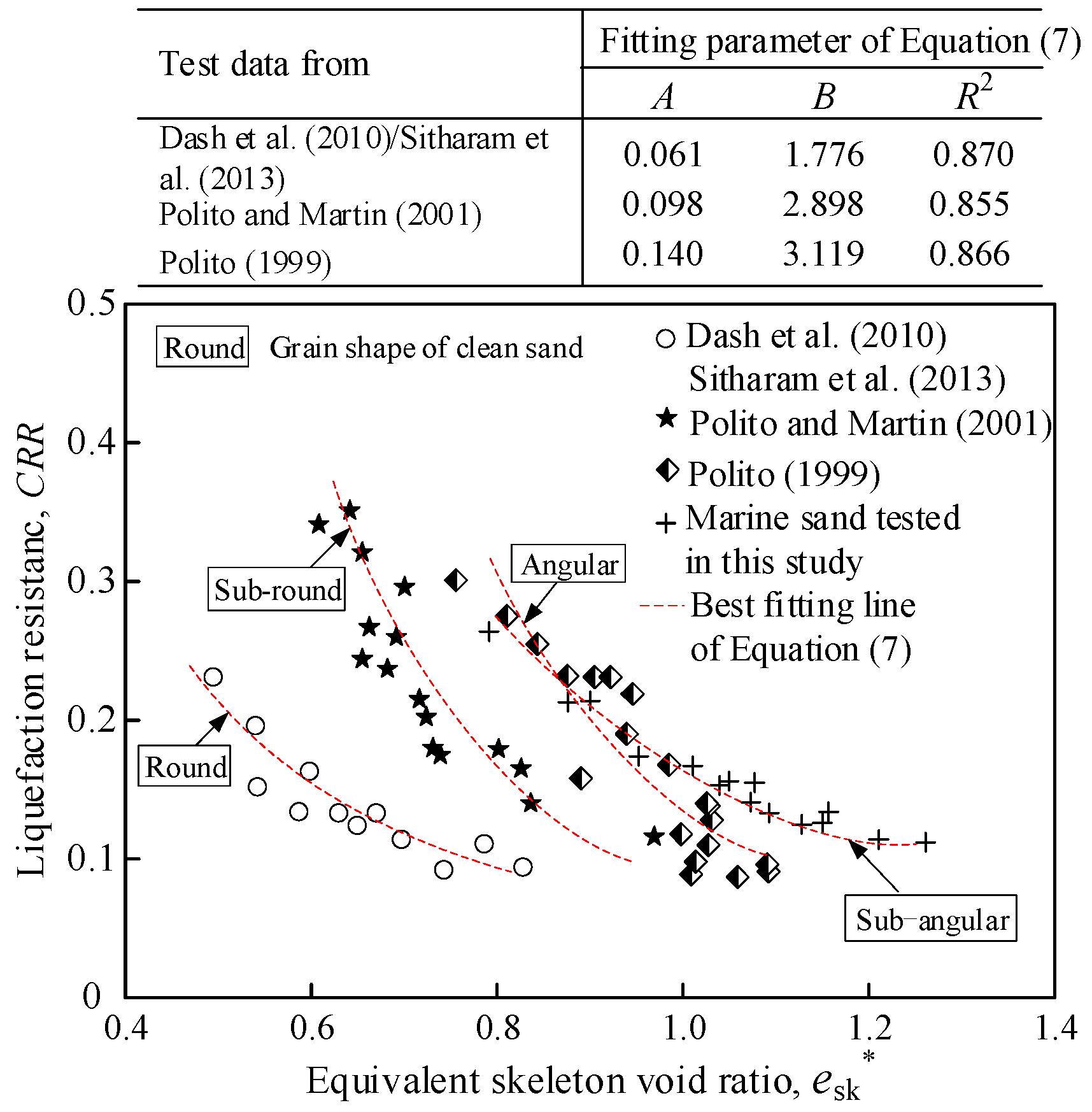
Based on Equation (7), the CRR values of the three sandy soil types were fitted using esk*, and the corresponding fitting parameters are provided in Figure 12. The CRRs of the three sandy soils, together with that of the sandy soil from this study, are plotted against the equivalent skeleton void ratio (esk*) in Figure 12. The CRR of the different sandy soils decreases as esk* increases, exhibiting a strong negative power function relationship. This outcome demonstrates that esk* can effectively assess the CRRs of various sandy soils and possesses good universality. In addition, as illustrated in the figure, the prediction curves for the different sandy soils are not identical but vary based on the specific soil type used.
Figure 12.
Liquefaction resistance CRR versus equivalent skeleton void ratio esk* of different types of sandy soils [18,19,50,51].
It is particularly clear that in the experiments conducted by Polito and Martin [18] and Polito [51], the fine particles employed were both Yatesville silt. When esk* is identical, the CRRs of the sandy soils used in the Polito and Martin [18] experiment are significantly higher than those of the sandy soils tested by Polito [51]. This variation occurs because the sand particles in [18] were Monterey sand, whereas those in [51] were Yatesville sand. This finding indicates that the type of sand particles present in sandy soils plays a vital role in influencing the CRR. In addition, the analysis shows that when sand particles are rounded, the overall CRR of the sandy soil is the lowest. As the sand particle shape transitions from rounded to angular, the overall CRR of the sandy soil gradually increases.
5. Conclusions
A series of undrained cyclic triaxial tests were conducted on Yancheng sandy soils with FC ≤ 30% to examine the effect of FC on the CRR of sandy soils under different density states (Dr, e, or esk). The main conclusions are as follows:
(1) The influence of FC on the CRR of sandy soils varies based on the density state (Dr, e, or esk). For sandy soils with the same e or Dr, the CRR gradually decreases as FC increases. However, for sandy soils with the same esk, the CRR rapidly increases with increased FC.
(2) There is no significant correlation between the CRR of sandy soils with varying FC values and Dr, e, or esk. Hence, Dr, e, or esk are not effective indicators for reasonably representing the CRR of sandy soils.
(3) Regardless of whether Dr, e, or esk are identical, the CRR of different sandy soils decreases as esk* increases, and the relationship between CRR and esk* follows a clear power function. This finding indicates that esk*, which accounts for the influence of fine particles, is a reliable physical indicator for representing the CRR of sandy soils.
(4) The prediction of CRR using esk* for various types of sandy soils is not consistent, as it depends on the specific type of sand studied. As the sand particle shape changes from rounded to angular, the overall CRR of the sandy soil gradually increases.
(5) The practical implications of the obtained CRR–esk* relationships for offshore engineering applications, particularly for offshore wind turbine foundations, and several directions for future research, including field validation, the macro-element modeling of monopile response under post-liquefaction deformation, and the extension of the proposed framework to other marine deposits, have been identified in this study.
Author Contributions
Writing—review and editing, Writing—original draft, Validation, Data curation, S.G.; Writing—original draft, Methodology, Data curation, W.Z.; Writing—review and editing, Visualization, Conceptualization, Funding acquisition, Q.W.; Visualization, Data curation, W.Z. and S.W. All authors have read and agreed to the published version of the manuscript.
Funding
The funding agency is Nanjing Tech University, this study was funded by the National Natural Science Foundation of China (Grant No. 52378346).
Data Availability Statement
The original contributions presented in this study are included in the article. Further inquiries can be directed to the corresponding author.
Conflicts of Interest
The authors declare no conflicts of interest.
References
- Zheng, X.-Y.; Li, H.-B.; Rong, W.-D.; Li, W. Joint earthquake and wave action on the monopile wind turbine foundation: An experimental study. Mar. Struct. 2015, 44, 125–141. [Google Scholar] [CrossRef] [Scilit]
- Katsanos, E.I.; Thons, S.; Georgakis, C.T. Wind turbines and seismic hazard: A state-of-the-art review. Wind Energy 2016, 19, 2113–2133. [Google Scholar] [CrossRef] [Scilit]
- Chen, G.-X. Geotechnical Earthquake Engineering; Science Press: Beijing, China, 2007. [Google Scholar]
- Chen, G.-X.; Jin, D.-D.; Chang, X.-D.; Li, X.-J.; Zhou, G.-L. Preliminary research on liquefaction characteristics of Wenchuan 8.0 earthquake. Rock Soil Mech. 2013, 34, 2737–2755. [Google Scholar]
- Chan, Y.F.; Alagappan, K.; Gandhi, A.; Donovan, V.; Tewari, M.; Zaets, S.B. Disaster management following the Chi Chi earthquake in Taiwan. Prehosp. Disaster Med. 2006, 21, 196–202. [Google Scholar] [CrossRef] [Scilit]
- Fan, X.; Juang, C.H.; Wasowski, J.; Huang, R.; Xu, Q.; Scaringi, G.; van Westen, C.J.; Havenith, H.-B. What we have learned from the 2008 Wenchuan Earthquake and its aftermath: A decade of research and challenges. Eng. Geol. 2018, 241, 25–32. [Google Scholar] [CrossRef] [Scilit]
- Peng, X.; Zhou, Y.-G.; Chen, Y.-M.; Gao, Y.-M. Liquefaction evaluation on sand like gravelly soil deposits based on field vs. measurements during the 2008 Wenchuan earthquake. Eng. Geol. 2024, 343, 107782. [Google Scholar] [CrossRef] [Scilit]
- Huang, Y.; Jiang, X.-M. Field-observed phenomena of seismic liquefaction and subsidence during the 2008 Wenchuan earthquake in China. Nat. Hazards 2010, 54, 839–850. [Google Scholar] [CrossRef] [Scilit]
- Zhang, L.-M.; Zhang, S.; Huang, R.-Q. Multi-hazard scenarios and consequences in Beichuan, China: The first five years after the 2008 Wenchuan earthquake. Eng. Geol. 2014, 180, 4–20. [Google Scholar] [CrossRef] [Scilit]
- Sasakia, Y.; Towhata, I.; Miyamoto, K.; Shirato, M.; Narita, A.; Sasaki, T.; Sako, S. Reconnaissance report on damage in and around river levees caused by the 2011 off the Pacific coast of Tohoku earthquake. Soils Found. 2012, 52, 1016–1032. [Google Scholar] [CrossRef] [Scilit]
- Bhattacharya, S.; Hyodo, M.; Goda, K.; Tazoh, T.; Taylor, C.A. Liquefaction of soil in the Tokyo Bay area from the 2011 Tohoku (Japan) earthquake. Soil Dyn. Earthq. Eng. 2011, 31, 1618–1628. [Google Scholar] [CrossRef] [Scilit]
- Susumu, Y.; Kenji, H.; Keisuke, I.; Yoshiki, K. Characteristics of liquefaction in Tokyo Bay area by the 2011 Great East Japan Earthquake. Earthq. Eng. 2011, 31, 1618–1628. [Google Scholar]
- Towhata, I.; Maruyama, S.; Kasuda, K. Liquefaction in the Kanto region during the 2011 off the Pacific coast of Tohoku earthquake. Soils Found. 2014, 54, 859–873. [Google Scholar] [CrossRef] [Scilit]
- Unjoh, S.; Kaneko, M.; Kataoka, S. Effect of earthquake ground motions on soil liquefaction. Soils Found. 2012, 52, 830–841. [Google Scholar] [CrossRef] [Scilit]
- Standardization Administration of China. Soil Engineering Classification Standards; China Standards Press: Beijing, China, 2008. [Google Scholar]
- Liu, X.-Z.; Chen, G.-X. Experimental study on influence of clay particle content on liquefaction of Nanjing fine sand. Earthq. Eng. Eng. Vib. 2003, 23, 150–155. [Google Scholar]
- Shen, C.K.; Vrymoed, J.L.; Uyeno, C.K. The effect of fines on liquefaction of sands. In Proceedings of the 9th International Conference on Soil Mechanics and Foundation Engineering, Tokyo, Japan, 10–15 July 1977; Japanese Society of Soil Mechanics and Foundation Engineering: Tokyo, Japan, 1977; pp. 381–385. [Google Scholar]
- Polito, C.P.; Martin, J.R., II. Effects of nonplastic fines on the liquefaction resistance of sands. J. Geotech. Geoenviron. Eng. 2001, 127, 408–415. [Google Scholar] [CrossRef] [Scilit]
- Sitharam, T.G.; Dash, H.K.; Jakka, R.S. Post-liquefaction undrained shear behavior of sand-silt mixtures at constant void ratio. Int. J. Geomech. 2013, 13, 421–429. [Google Scholar] [CrossRef] [Scilit]
- Hsiao, D.H.; Phan, V.T.A.; Hsieh, Y.T. Engineering behavior and correlated parameters from obtained results of sand–silt mixtures. Soil Dyn. Earthq. Eng. 2015, 77, 137–151. [Google Scholar] [CrossRef] [Scilit]
- Xu, L.-Y.; Cai, F.; Zhang, J. Evaluation of grain size and content of nonplastic fines on undrained behavior of sandy soils. Mar. Georesour. Geotechnol. 2020, 39, 1215–1229. [Google Scholar] [CrossRef] [Scilit]
- Eseller Bayat, E.E.; Monkul, M.M.; Akin, Ö. The coupled influence of relative density, CSR, plasticity and content of fines on cyclic liquefaction resistance of sands. J. Earthq. Eng. 2017, 23, 909–929. [Google Scholar] [CrossRef] [Scilit]
- Thevanayagam, S. Effect of fines and confining stress on undrained shear strength of silty sands. J. Geotech. Geoenviron. Eng. 1998, 124, 479–491. [Google Scholar] [CrossRef] [Scilit]
- Thevanayagam, S.; Martin, G.R. Liquefaction in silty soils—Screening and remediation issue. Soil Dyn. Earthq. Eng. 2002, 22, 1035–1042. [Google Scholar] [CrossRef] [Scilit]
- Naeini, S.A.; Baziar, M.H. Effect of fines content on steady-state strength of mixed and layered samples of sand. Soil Dyn. Earthq. Eng. 2004, 24, 181–187. [Google Scholar] [CrossRef] [Scilit]
- Rahman, M.M.; Lo, S.R.; Gnanendran, C.T. On equivalent granular void ratio and steady state behaviour of loose sand with fines. Can. Geotech. J. 2008, 45, 1439–1456. [Google Scholar] [CrossRef] [Scilit]
- El Mohtar, C.S. Evaluation of the 5% double amplitude strain criterion. In Proceedings of the 17th International Conference on Soil Mechanics and Geotechnical Engineering, Alexandria, Egypt, 5–9 October 2009; pp. 80–83. [Google Scholar]
- Skempton, A.W. The pore-pressure coefficients A and B. Géotechnique 1954, 4, 143–147. [Google Scholar] [CrossRef] [Scilit]
- ASTM D2216-19; ASTM International. Standard Test Method for Water Content of Soil by Mass. ASTM International: West Conshohocken, PA, USA, 2019.
- ASTM D5311/D5311M-13; Standard Test Method for Load-Controlled Cyclic Triaxial Strength of Soil. ASTM International: West Conshohocken, PA, USA, 2013.
- Japanese Geotechnical Society. Method for Cyclic Triaxial Test on Soils; Japanese Geotechnical Society: Tokyo, Japan, 2009. [Google Scholar]
- Zhou, R.-R.; Xin, S.-L.; Wang, B.-H.; Zhang, L.; Zhang, Y.-F.; Wu, Q.; Ma, W.-J.; Qin, Y. Experimental analysis on the cyclic strength and deformation characteristics of marine coral sand under different loading frequencies. Soil Dyn. Earthq. Eng. 2025, 190, 109165. [Google Scholar] [CrossRef] [Scilit]
- Krawinkler, H. Cyclic Loading Histories for Seismic Experimentation on Structural Components. Earthq. Spectra 1996, 12, 1–12. [Google Scholar] [CrossRef] [Scilit]
- Ishihara, K. Stability of natural deposits during earthquakes. In Proceedings of the 11th International Conference on Soil Mechanics and Foundation Engineering, San Francisco, CA, USA, 12–16 August 1985; Balkema: Rotterdam, The Netherlands, 1985; Volume 1, pp. 321–376. [Google Scholar]
- Ishihara, K. Liquefaction and flow failure during earthquakes. Géotechnique 1993, 43, 351–451. [Google Scholar] [CrossRef] [Scilit]
- Seed, H.B. Soil liquefaction and cyclic mobility evaluation for level ground during earthquakes. J. Geotech. Eng. Div. 1979, 105, 201–255. [Google Scholar] [CrossRef] [Scilit]
- LeBlanc, C.; Houlsby, G.T.; Byrne, B.W. Response of Stiff Piles in Sand to Long-Term Cyclic Lateral Loading. Géotechnique 2010, 60, 79–90. [Google Scholar] [CrossRef] [Scilit]
- Kallehave, D.; Byrne, B.W.; Thienen, S.V.; Mikkelsen, K.K. Optimization of Monopile Support Structures for Offshore Wind Turbines. Eng. Struct. 2015, 100, 332–341. [Google Scholar]
- Byrne, B.W.; Houlsby, G.T.; Burd, H.J.; Gavin, K.; McAdam, R.; Taborda, D.; Zdravković, L. PISA Design Model for Monopile Foundations in Sand. Géotechnique 2019, 69, 108–121. [Google Scholar]
- Seed, H.B.; Martin, P.P.; Lysmer, J. The Generation and Dissipation of Pore Water Pressures During Soil Liquefaction; College of Engineering, University of California: Berkeley, CA, USA, 1975. [Google Scholar]
- De Alba, P.; Seed, H.B.; Chan, C.K. Sand liquefaction in large-scale simple shear tests. J. Geotech. Geoenviron. Eng. 1976, 102, 909–927. [Google Scholar] [CrossRef] [Scilit]
- Tokimatsu, K.; Yoshimi, Y. Empirical correlation of soil liquefaction based on SPT N-value and fines content. Soils Found. 1983, 23, 56–74. [Google Scholar] [CrossRef] [Scilit]
- Wang, B.-H.; Chen, G.-X.; Sun, T. Liquefaction resistance of sand-gravel soils using small soil-box shaking table tests. Chin. J. Geotech. Eng. 2015, 37, 2094–2100. [Google Scholar]
- Chang, W.J.; Hong, M.L. Effects of clay content on liquefaction characteristics of gap-graded clayey sands. Soils Found. 2008, 48, 101–114. [Google Scholar] [CrossRef] [Scilit]
- Wu, Q.; Chen, G.-X.; Zhou, Z.-L. Influence of fines content on cyclic resistance of fines-s0nd-gravel mixtures. Chin. J. Geotech. Eng. 2017, 39, 1038–1047. [Google Scholar]
- Papadopoulou, A.; Tika, T. The effect of fines on critical state and liquefaction resistance characteristics of non-plastic silty sands. Soils Found. 2008, 48, 713–725. [Google Scholar] [CrossRef] [Scilit]
- Thevanayagam, S.; Shenthan, T.; Mohan, S. Undrained fragility of clean sands, silty sands, and sandy silts. J. Geotech. Geoenviron. Eng. 2002, 128, 849–859. [Google Scholar] [CrossRef] [Scilit]
- Rahman, M.M.; Lo, S.R.; Baki, M.A.L. Equivalent granular state parameter and undrained behaviour of sand–fines mixtures. Acta Geotechnica 2011, 6, 183–194. [Google Scholar] [CrossRef] [Scilit]
- Mohammadi, A.; Qadimi, A. A simple critical state approach to predicting the cyclic and monotonic response of sands with different fines contents using the equivalent intergranular void ratio. Acta Geotechnica 2015, 10, 587–606. [Google Scholar] [CrossRef] [Scilit]
- Dash, H.K.; Sitharam, T.G.; Baudet, B.A. Influence of non-plastic fines on the response of a silty sand to cyclic loading. Soils Found. 2010, 50, 695–704. [Google Scholar] [CrossRef] [Scilit]
- Polito, C.P. The Effects of Non-Plastic And Plastic Fines on the Liquefaction of Sandy Soils. Ph.D. Thesis, Virginia Tech, Blacksburg, VA, USA, 1999. [Google Scholar]

Disclaimer/Publisher’s Note: The statements, opinions and data contained in all publications are solely those of the individual author(s) and contributor(s) and not of MDPI and/or the editor(s). MDPI and/or the editor(s) disclaim responsibility for any injury to people or property resulting from any ideas, methods, instructions or products referred to in the content. |
© 2025 by the authors. Licensee MDPI, Basel, Switzerland. This article is an open access article distributed under the terms and conditions of the Creative Commons Attribution (CC BY) license (https://creativecommons.org/licenses/by/4.0/).