Article

Coral Recruitment and Survival in a Remote Maldivian Atoll 11 Years Apart

1
Seascape Ecology Laboratory, Department of Earth, Environment and Life Sciences (DiSTAV), University of Genoa, Corso Europa 26, 16132 Genova, Italy
2
National Biodiversity Future Center (NBFC), Piazza Marina 61, 90133 Palermo, Italy
3
Genoa Marine Centre, Department of Integrative Marine Ecology (EMI), Stazione Zoologica Anton Dohrn-National Institute of Marine Biology, Ecology and Biotechnology, Villa del Principe, Piazza del Principe 4, 16126 Genova, Italy
4
Benthic Ecology Laboratory, Department of Earth, Environment and Life Sciences (DiSTAV), University of Genoa, Corso Europa, 26, 16132 Genova, Italy
*
Author to whom correspondence should be addressed.
J. Mar. Sci. Eng. 2025, 13(12), 2274; https://doi.org/10.3390/jmse13122274
Submission received: 6 October 2025 / Revised: 24 November 2025 / Accepted: 26 November 2025 / Published: 28 November 2025

Abstract

Recruitment is a crucial process for the recovery of coral populations after large-scale disturbances causing mass mortality events such as coral bleaching. This study examined the juvenile coral community of the remote Huvadhoo Atoll (southern Maldives, Indian Ocean) 11 years apart (2009 and 2020). Coral recruits (≤5 cm) and juveniles (5–15 cm) were surveyed at eight reef sites located in both lagoon- and ocean-facing environments, under the hypothesis that density and survival of recruits differ with respect to exposure. The total mean number of recruits differed slightly between years, with densities of 25 individuals·m−2 in 2009 and 30 individuals·m−2 in 2020. However, Acropora populations, which represented 60% of juvenile corals in 2009, halved in 2020, particularly in ocean reefs. The decrease in Acropora recruits seems to have favoured other corals: Pocillopora doubled compared to 2009, and species with massive growth morphologies became dominant. In all, the juvenile coral community structure underwent substantial changes between the two surveys. The comparison between the number of recruits and that of juvenile corals suggested higher survival of the species with massive growth morphologies. Whether branching corals will also have the ability to adapt to increasingly frequent climatic disturbances deserves attention in the future.

1. Introduction

Coral reefs are degrading worldwide due to global warming and other anthropogenic pressures [1,2]. The frequency and intensity of disturbances affecting coral reefs are predicted to increase in the future as a result of climate change [3,4]. In this context, having the broadest possible understanding of the variables that drive the recovery of these ecosystems is of primary importance. While the causes that led to the decline of coral reefs are well documented, the processes that build their resilience remain relatively understudied [5].
The persistence of coral reefs depends on successful larval recruitment [6]. Recruitment is a key process for the recovery of reef-building coral populations following major disturbances, such as bleaching and mass mortality events [7]. Yet, the perception of recovery after widespread coral death is influenced by several factors, including the method of measurement, the severity of the mortality event, and the mechanisms by which new colonies are added to the population [8].
In the marine environment, dispersal plays a central role for organisms that exhibit alternating benthic and pelagic life stages [9]. Coral recruits can be supplied to the reef in several ways, either by brooders or by broadcasters. Both strategies have advantages and disadvantages: brooders release ready-to-settle larvae with limited dispersal capacity, while broadcasters can disperse over long distances, but their comparatively long pelagic life makes them more vulnerable to predation [10]. However, in the pelagic realm, the connectivity within and between reefs introduces a further layer of complexity, so that brooders’ larvae can potentially reach remote reefs when transported on floating debris [11]; conversely, long-lived larvae of broadcast spawners may be trapped by local hydrodynamics in the immediate surroundings of the spawning site [12,13,14]. At the end of the planktonic stage, coral larvae need to find a proper substrate on which to settle and begin their benthic life. Settlement can be affected by the interaction with other benthic species; for instance, it can be facilitated by crustose coralline algae but also hampered by turf and macroalgae competing for space [15,16]. A dynamic balance between the two opposing effects may be a determining factor in the survival of settled corals [17].
Many studies have addressed the issue of recruitment capacity in reefs that have been severely damaged. In the Persian Gulf, the impact of recurrent mass mortality events associated with rising water temperatures has resulted in a reduction in the size of corals and a subsequent decline in their reproductive capacity [18]. In the years following the impact of hurricanes, tropical storms and coral bleaching events in the Caribbean, coral recruitment remained limited in terms of numbers and diversity [19]. The effect of hurricanes on coral recruitment appeared to be more important than mass bleaching, at least in some regions [20,21]. The mass mortality of adult corals observed along the Great Barrier Reef following the 2016–2017 heat peaks resulted in a decline of larval recruitment, with a reduction of 89% compared to historical levels [22].
Successful recruitment is particularly critical for the future of reef ecosystems in atoll nations, where human livelihoods are closely dependent on healthy coral reefs [23].
The Maldives, in the Indian Ocean, one of the only four atoll nations in the world, has experienced two major mass bleaching events over the past quarter of a century, in 1998 and 2016. These events have resulted in a mortality rate among reef-building corals ranging from 60% to 100%, depending on species and locality [24,25,26]. A number of studies have examined the recovery of Maldivian coral reefs following the two mortality events [10,24,25,26,27,28,29,30,31,32,33]. Nevertheless, while the majority of existing research concerns adult coral colonies, there remains a limited understanding of the survival and growth of the young coral community [10,25]. After 1998, the recovery of coral reefs in the Maldives was slow [10,25]. In terms of recruitment, in particular, it took 11 years for the juvenile coral community to become once again representative of the adult coral population [10]. The consequences of the 2016 bleaching event on coral recruitment have yet to be elucidated. Despite evidence indicating that juvenile corals exhibit greater resilience than larger colonies, elevated temperatures resulted in a general decline in juvenile coral densities during 2017 [33].
A critical element in the assessment of reef recovery is the reference condition against which the recovery is evaluated [34,35]. The lack of historical data, or an ill-defined historical baseline for assessing change, presents a major challenge in determining whether recovery comparable to pre-disturbance conditions has been achieved [8].
The availability of a unique, nearly three-decade-long historical series of data on Maldivian coral reefs provided an opportunity to evaluate their recovery [26]. Here we examine coral recruitment in Huvadhoo, one of the most remote and least anthropized atolls of the archipelago. Due to its location, in the southernmost part of the Maldives, Huvadhoo has not been routinely surveyed during the annual scientific expeditions [26,36]. The first survey was carried out in 2009 and the second survey in 2020. Coral recruitment is known to vary greatly across time and space [37], yet long-term data series collected in the same locality remain scarce [8]. Revisiting previously surveyed reef sites may therefore provide valuable insights [36,38].
This work aims to describe the community of young corals in Huvadhoo atoll in 2009 and 2020. Data were collected at eight reef sites with different exposures (i.e., facing the lagoon or the ocean), based on the hypothesis that recruit density and survival may differ between lagoon and ocean reefs.

2. Materials and Methods

2.1. Study Area

Increasing sea surface temperatures have become a dominant stressor for Maldivian coral reefs, driving four mass bleaching events since 1998 (i.e., 1998, 2010, 2016, and 2024). In recent years heat stress has become more intense, starting earlier and lasting longer, exposing corals to prolonged thermal conditions beyond their tolerance limits. Alongside recurrent thermal stress, Maldivian reefs are subject to growing anthropogenic pressures due to rapid tourism development and population increase, which potentially influence recovery dynamics.
Huvadhoo is the largest of the 27 atolls of the Maldives. It lies in the southern part of the archipelago (0°32′ N, 73°17′ E), separated from the central atolls by the one-and-a-half-degree channel [39] (Figure 1). With a population of about 15,000 inhabitants spread over 241 vegetated islands, the coral reefs of Huvadhoo can be considered among the least anthropized in the archipelago. The atoll rim is characterized by a multitude of passes, which allow ocean swell and currents to enter the lagoon. The latter is notable for its depth, reaching a maximum of 80 m. In April 2009 and 2020, eight reef sites with different exposure were surveyed: four facing the ocean and four facing the lagoon (Table 1; Figure 1).

2.2. Field Activities

A univocal definition of the term ‘recruit’ does not exist, and it should therefore be stressed that different conclusions about the role of recruitment in mediating coral population growth can be drawn depending on whether small colonies (e.g., ≤5 cm in diameter), counted on reef, or coral spat (e.g., corals smaller than 2 mm in diameter), detected on tiles, are taken into account [8].
This study was exclusively restricted to scleractinian coral colonies with a diameter smaller than 15 cm. Corals were classified into three categories: Acropora (a branching coral), Pocillopora (a bushy coral), and Others (mostly represented by massive and encrusting corals, among which Porites, Goniopora, Pavona, Fungia, Galaxea, Favia, Goniastrea, Platygyra were recognized). Building upon the methodology proposed by Bianchi et al. [24], colonies described as ‘recruits’ were visible to the naked eye, exhibiting a minimum detectable size of 1 cm and a diameter not exceeding 5 cm. These colonies typically displayed circular outlines as a sign of larval settlement. The size data considered at the genus level did not allow us to accurately determine the age of coral recruits, as growth rates vary considerably among species. Based on the literature (e.g., [40]), most corals smaller than 5 cm were likely less than one year old, but generalizing would be unwise. Colonies classified as ‘juveniles’, presumably older than one year, displayed a diameter between 5 and 15 cm [14]. Although somewhat arbitrary, these definitions of recruits and juveniles are useful for fieldwork and monitoring purposes and are consistent with the literature regarding the relationship between coral colony size and reproductive condition [41]. Sites surveyed in 2009 were exactly located in 2020 using the GPS coordinates recorded during the first sampling period. Three distinct depths were surveyed along the reef, encompassing the reef flat (i.e., 3 m to 5 m depth), the reef upper slope (i.e., 10 m to 12 m depth), and the reef slope (i.e., 15 m to 18 m depth). As the Maldives archipelago experiences a semidiurnal microtidal regime with a tidal range of approximately 1 m [42], we considered the differences due to the tide to be negligible when referring to a depth range. Density of recruits and juveniles was counted within a graduated quadrat frame of 0.25 m2 surface area. A total of 12 quadrats were examined at each depth, using dice to randomize sampling [41]. We preferred random over permanent quadrats, which had been a fashionable technique in ecology for a long time [43], because the latter are deemed to be representative of single spots, whereas the former are better suited to capturing variation across the entire habitat [44].
To minimise bias in data collection, the senior diving scientist involved in the 2009 fieldwork trained the two scientists who collected the data in 2020. Each diving scientist spent an average of three minutes on each quadrat, performing six quadrats at each sampling depth.

2.3. Data Analyses

The density per m2 was calculated by randomly summing the abundance data of four quadrats in order to get 3 replicated sampling units of 1 m2 for each depth. Although a sample size cannot be recommended universally [45], previous studies on coral recruits in the Maldives indicated that quadrats of 1 m2 are adequate [25,41]. Ultimately, the minimum area issue is a practical matter, reflecting a cost–benefit balance between information yield and sampling effort. [46]. The total number of 1 m2 quadrats surveyed was 144 (2 years × 2 reef type exposures × 4 sites × 3 depth zones × 3 replicates). Recruit density data (number of recruits·m−2) were subjected to 3-way permutational analysis of variance (PERMANOVA), with years as fixed factor with 2 levels (2009 and 2020), exposure as fixed factor with 2 levels (ocean and lagoon) orthogonal to years, depth zones as fixed factor orthogonal to exposure with 3 levels (flat, upper slope, and slope), sites as random factor nested within years with 4 levels, and quadrats as replicates (n = 3). Pairwise comparisons of significant terms were performed; the p-values were corrected using Bonferroni adjustments. The two-dimensional ordination of the recruits’ density data was represented by means of the Principal Component Analysis (PCA). Statistical differences across coral categories in terms of average density of recruits and survival (SI) were tested using Student’s t-test (see the Supplementary Materials: Table S1). Data analyses were conducted using RStudio 2025.05 (libraries: stat, vegan, remotes, ecole, ggfortify).
The formula proposed by Oprandi et al. [14] was used as a proxy for the survival (SI) of coral recruits:
SI = 1 R R + J ) · 100
where R is the density of recruits and J that of juveniles.

3. Results

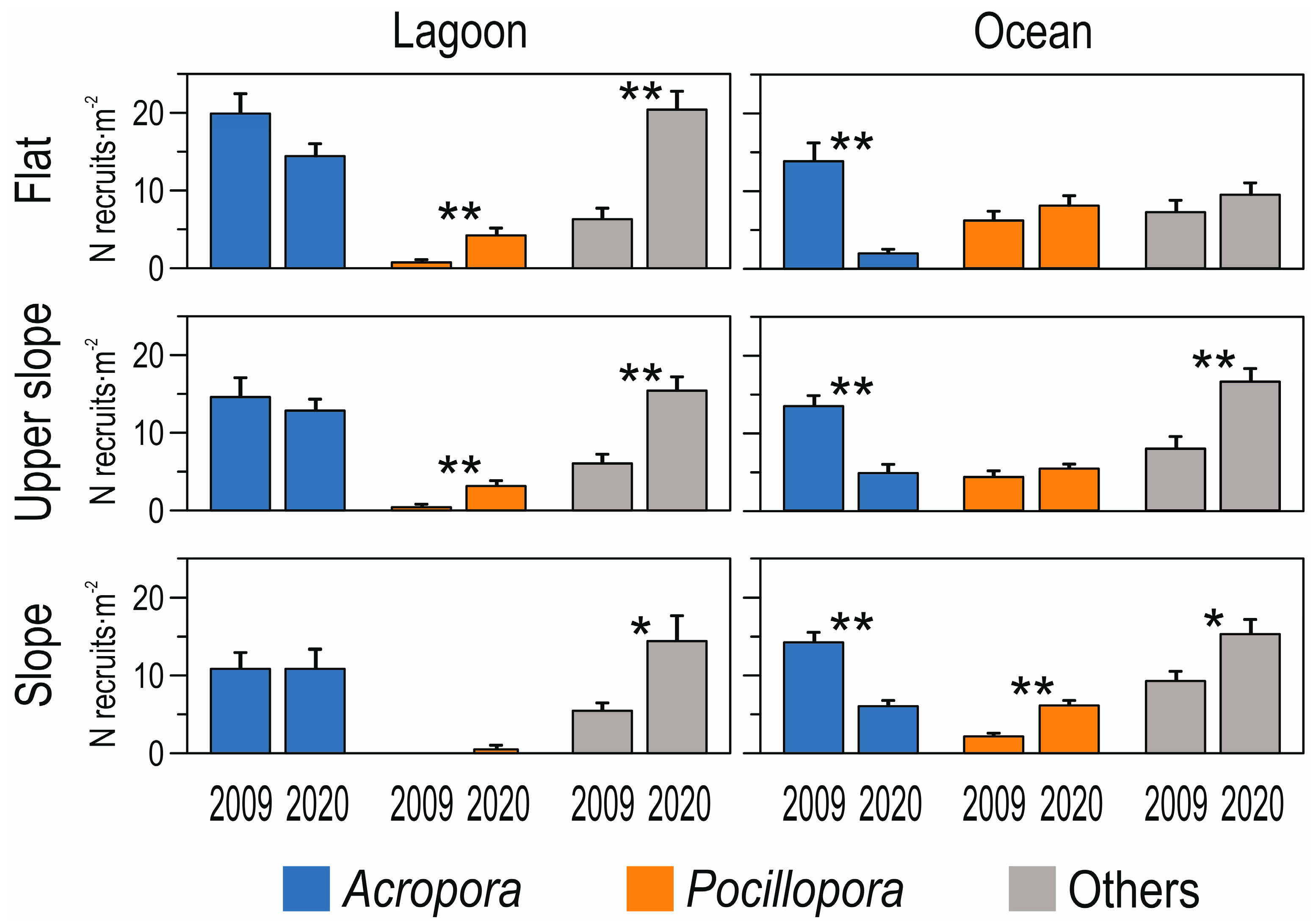
The total number of recruits was different in the two years: in 2020, 2143 recruits were counted with a mean density of 29.8 ± 1.5 recruits per m2 compared to 1800 in 2009 with a mean density of 25 ± 1.5 recruits per m2. The greater abundance in 2020 was mainly due to “Others”, which tripled their density (from 6 ± 0.6 to 18 ± 1.5 recruits per m2), especially at lagoon sites (Figure 2; Table 2; Table S1), and partly to Pocillopora. Acropora, on the other hand, has decreased, especially at ocean sites, where its abundance has more than halved (from 15 ± 0.9 to 4 ± 0.5 recruits per m2) (Figure 2; Table 2; Table S1). Disparities in abundance were more evident in the lagoon, where a general decline in the number of recruits was observed with increasing depth (Figure 2; Table 2). In contrast, the ocean sites exhibited less pronounced variations related to depth. The trend with depth was comparable between the two years: Pocillopora revealed a decline with depth, whereas both Acropora and Others exhibited a tendency for a decrease at inner sites and an increase at outer sites (Figure 2).
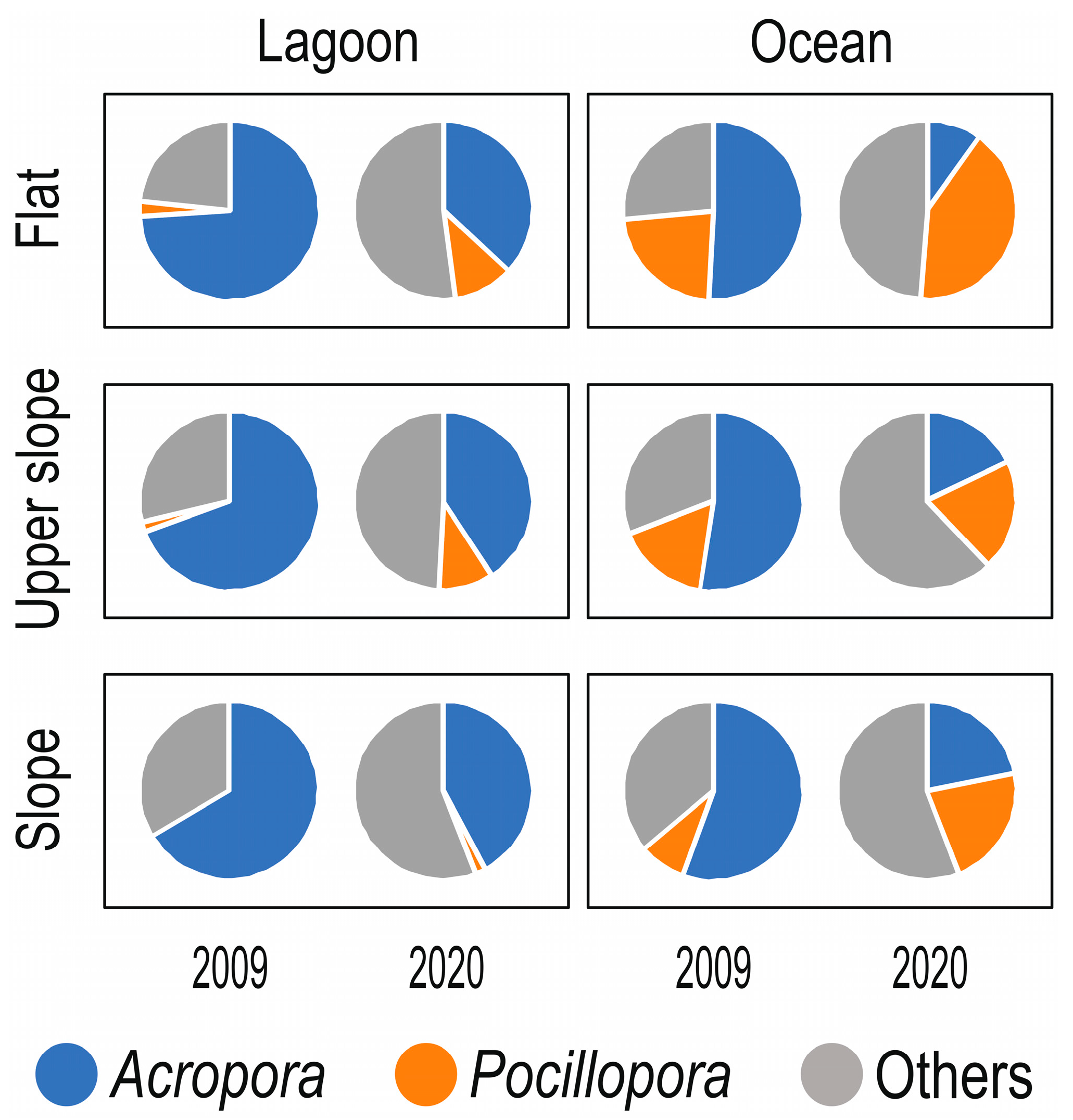
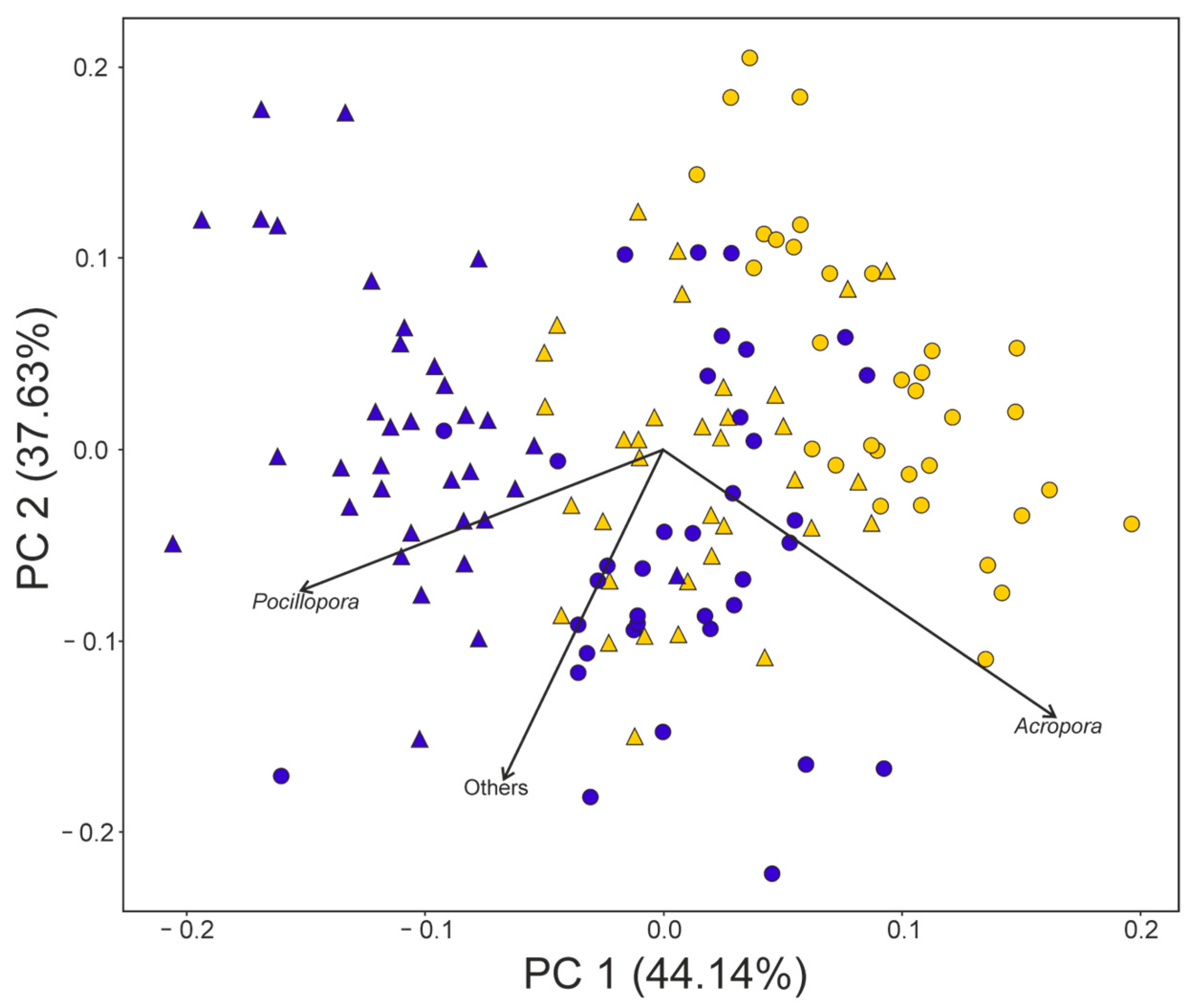
The community structure has undergone a significant transformation, shifting from a predominantly Acropora-dominated community, which constituted over 60% of the small coral colonies in 2009, particularly in the lagoon, to a new assemblage in 2020, where Others have emerged as the dominant category (54%) within the young coral community (Figure 3). Such a change in the community composition was evident from the two-dimensional representation (PCA) of recruits’ density data (Figure 4). The cumulative percentage of variation explained by PC1 and PC2 was high (81.77%). The distribution of points along the first axis evidenced the role of both space and time in the observed change: Acropora characterized lagoon sites in 2009 and Pocillopora ocean sites in 2020 (Figure 4). Consistently, PERMANOVA (Table 2) provided a significant interaction between time (year) and site types (exposure).
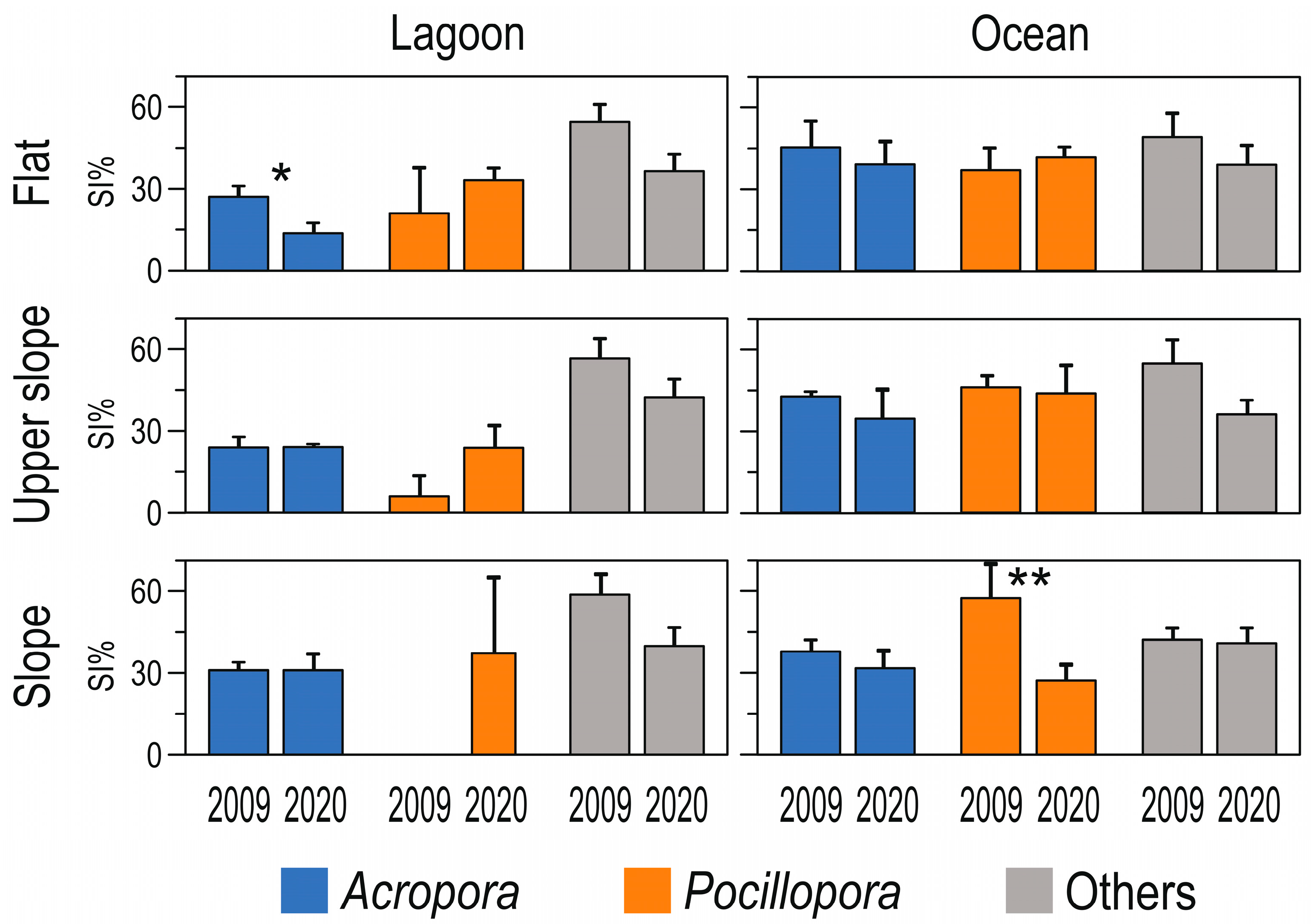
Survival was generally higher at ocean sites, with an average value of 42% compared to 31% at lagoon sites (Figure 5). Based on the Student’s t-test (Table S1), no year-related differences were detected in mean total survival at lagoon sites. In contrast, mean total survival was higher in 2009 (46%) than in 2020 (37%) at oceanic reefs. Indeed, survival showed a common tendency to decrease in 2020, except for Pocillopora at lagoon sites and on the flat of ocean sites, where Survival Index (SI) values increased. Differences between the two years were significant only in the cases of Acropora at the lagoon flat (p = 0.03), where SI decreased from 27% in 2009 to 13% in 2020, and Pocillopora at the ocean slope (p = 0.01), where SI decreased from 57% to 27% (Figure 5; Table S1).

4. Discussion

Despite higher recruitment in 2020, survival is lower than in 2009, indicating higher post-settlement mortality and a possible reduction in the resilience of the reef. This pattern is particularly evident in the ocean, where a decline in survival is accompanied by a reduction in recruits’ total average density, albeit not significant. Conversely, an increase in the total average density of recruits is recorded at the lagoon sites, yet survival remains constant despite lower values.
The comparison between the numbers of recruits and juvenile corals suggests higher survival of “Others” (39%). Indeed, the latter category is mainly represented by species with massive growth morphologies, which are recognized for their tolerance to environmental stressors, such as the two bleaching events of 1998 and 2016 [24,25,31]. The next most resistant genera are Pocillopora (35%) and Acropora (29%). It is notable that Pocillopora is the only genus to increase survival in 2020. Quantitative differences mainly concern the lagoon reef sites, whereas, in the ocean, the overall abundance of recruits is comparable in the two years.
In 2009, Pocillopora recruits were extremely rare on the lagoon reefs of Huvadhoo. As most Pocillopora species are known to be brooders [47], it can reasonably be assumed that the number of recruits is strictly dependent on the population density of the adults [14], which were still virtually absent after the bleaching of 1998 [25].
In line with the general trend seen in the region, Acropora, a highly competitive fast-growing species [48], seems to recover more quickly than other corals, becoming the dominant genus in both lagoon and ocean sites by 2009 [25,32].
Within the lagoon, the average number of Acropora remains consistent between the two years except for the shallowest zones, where the abundance and survival of colonies decrease in 2020. Acropora is vulnerable to temperature increase [49], which may have limited its post-settlement success. This notwithstanding, the numbers of Others and Pocillopora exhibited significant growth in 2020, indicating that the inner ecosystem of the lagoon fosters recruitment. After all, the features of the Huvadhoo lagoon are notable for their uniqueness: despite being a confined environment, its size and depth make it more similar to the ocean, with consequent benefits such as enhanced water recirculation, though with reduced wave action [36].
At the ocean sites, the significant decline of Acropora was offset by a concurrent increase of other corals in 2020. Exposed coral reefs are prone to being dominated by massive, encrusting growth forms of corals (i.e., Others) in the aftermath of disturbances [31,32]. The dearth of Acropora may be due to the poor connectivity with other reefs where adult broadcast spawners can be found. Huvadhoo Atoll is rather isolated, being separated from the central atolls to the north by a wide channel and to the south by a vast expanse of ocean, measuring over 85 kilometres, beyond which only lies Addu, the southernmost and smallest atoll of the Maldives. Furthermore, the ocean is a more dynamic environment than the lagoon; the interplay of topography, tidal currents, and wave-driven oscillatory flows can collectively generate substantial forces along settlement surfaces [50].
A dedicated discussion is required for Pocillopora: despite being among the coral taxa most adversely affected by bleaching [24,25], it shows a positive recovery trend in both the lagoon and the ocean, although with comparatively low values. In 2020, a significant increase in survival rates was revealed in the lagoon, while, in the ocean, the density of Pocillopora exceeded that of Acropora. A similar trend is observed in other geographical areas [51]. Pocillopora had already shown a slow increase in other areas of the Maldives following the 1998 bleaching event [25]. Being a genus with opportunistic life traits [44], Pocillopora may be able to take advantage of the circumstances that arose after a suitable period of time following disturbances.
It should be noted that the SI provides only a rough proxy of survival as it is based on the assumption that every juvenile originated from the previous year’s recruit cohort. Ideally, two consecutive years of data would allow direct comparison of previous-year recruits with the following year’s juveniles. However, in the absence of major disturbances, there is no reason to expect substantial variation in recruitment.
The two divergent trends observed in the lagoon and the ocean suggest that exposure plays a pivotal role in shaping the young coral community. This result is consistent with the findings by Zampa et al. [36] regarding hard coral cover at the same sites and indicates that the zonation pattern of the coral reef is already established at the early stages of reef colonization and coral settlement [52].
The long time elapsed since the 1998 bleaching event may have favoured the survival of young corals in 2009. After a disturbance, rapid recovery of degraded reefs is primarily contingent on the growth of surviving corals [53], but recruitment and subsequent growth of new colonies can considerably lengthen the recovery process [31,33]. Maldivian coral reefs exhibited a more rapid recovery from the 2016 bleaching event compared to that of 1998 [26], largely thanks to a reduced mortality and the increase in tolerant taxa capable of withstanding thermal stress [54].
Contrarily to the observations made in the central atolls following the 2016 bleaching event [26,32], the lagoon environment of Huvadhoo seems to have attained a more stable and favourable condition for coral recovery as compared to the ocean. The present findings may indicate that other factors, including local anthropogenic pressures, may be responsible for the reduced resilience of the lagoon areas in the central atolls, as observed elsewhere [55], and that the remoteness of Huvadhoo atoll has played a role in coral reef resilience.
The mean recruits’ densities we observed across the Huvadhoo Atoll in 2020 (30 ± 1.5 recruits per m2) are comparable to the values reported in the central atolls in 1999, barely 10 months after the event of 1998 [27,28]. This similarity in abundance can be interpreted positively, as recruitment soon after the bleaching of 1998 was more pronounced due to the “emergency spawning” induced by rising temperatures [29,56]. Yet, this enhanced recruitment was not a permanent response as it was followed by a decrease in the subsequent years [24,27,28,29]. Our data, being collected several years after the two bleaching events, rule out the possibility of an emergency response. Rather, they are indicative of a tangible local trend of increased recruitment, in contrast to the decline observed at the global scale [8].
Several studies show that disturbance frequency is more important than its magnitude in determining the recovery time of coral communities; although coral populations may recover to pre-disturbance abundance levels, their structural complexity and surface roughness can take much longer to return—or may never fully return—to their original state [33,57,58,59]. The change in community composition is already underway and predictions of an expected increase in the incidence and frequency of bleaching events in the future [60] oblige us to remain cautious with respect to the recovery capacity of coral reefs.
The peculiar location and morphology of Huvadhoo atoll seem to make its lagoon an ideal refuge for branching species, including Acropora, whose populations elsewhere have been severely affected. Whether branching corals will also have the ability to adapt to increasingly frequent climatic disturbances deserves attention in the future [61,62]. Sustained long-term monitoring remains the only way to track the future evolution of Maldivian coral reefs. The known high interannual variability in coral recruitment [10] prevents any speculation about the causes of the differences observed between 2009 and 2020. In addition to temporal variability, the use of only three replicated 1 m2 samples per depth zone may not be sufficient to capture the spatial heterogeneity of coral recruitment. However, the low variance among replicates found in the present study (the standard error is always one order of magnitude smaller than the mean) indicates that spatial variability has been adequately described. Previous studies in the Maldives have shown that the same sampling design adopted here effectively illustrated temporal trends in both lagoon and ocean reefs across all depths, despite spatial variability [25]. Of course, a comparison of only two points in time cannot equal the value of a continuous temporal data series, and large proportions of variation in recruitment remain unexplained. However, as our data were collected using consistent methods at the same sites, the results can be credited with reliability and provide novel insights into the understanding of coral reef resilience in the Maldives. At a time when attempts to better manage or even restore Maldivian coral reefs are underway [63], information on recruitment may become central.

Supplementary Materials

The following supporting information can be downloaded at: https://www.mdpi.com/article/10.3390/jmse13122274/s1. Table S1: Results of Student’s t-test for Recruit density and Survival (SI). (A = Acropora; P = Pocillopora; O = Others; 09 = 2009; 20 = 2020). Significant p-values in bold.

Author Contributions

Conceptualization, A.O. and C.N.B.; methodology, C.N.B.; software, V.A.; validation, A.O. and I.M.; formal analysis, A.O., C.N.B. and V.A.; investigation, C.N.B., A.O. and A.A.; data curation, A.O. and C.M.; writing—original draft preparation, A.O.; writing—review and editing, A.O., C.N.B., and C.M.; supervision, C.N.B.; project administration, M.M.; funding acquisition, M.M. All authors have read and agreed to the published version of the manuscript.

Funding

This research received no external funding.

Data Availability Statement

The raw data supporting the conclusions of this article will be made available by the authors upon request.

Conflicts of Interest

The authors declare no conflicts of interest.

References

  1. Riegl, B.; Bruckner, A.; Coles, S.L.; Renaud, P.; Dodge, R.E. Coral reefs: Threats and conservation in an era of global change. Ann. N. Y. Acad. Sci. 2009, 1162, 136–186. [Google Scholar] [CrossRef]
  2. Hughes, T.P.; Barnes, M.L.; Bellwood, D.R.; Cinner, J.E.; Cumming, G.S.; Jackson, J.B.C.; Kleypas, J.; van de Leemput, I.A.; Lough, J.M.; Morrison, T.H.; et al. Coral reefs in the Anthropocene. Nature 2017, 546, 82–90. [Google Scholar] [CrossRef] [PubMed]
  3. King, A.D.; Karoly, D.J.; Henley, B.J. Australian climate extremes at 1.5 °C and 2 °C of global warming. Nat. Clim. Change 2017, 7, 412–416. [Google Scholar] [CrossRef]
  4. Hughes, T.P.; Anderson, K.D.; Connolly, S.R.; Heron, S.F.; Kerry, J.T.; Lough, J.M.; Baird, A.H.; Baum, J.K.; Berumen, M.L.; Bridge, T.C.; et al. Spatial and temporal patterns of mass bleaching of corals in the Anthropocene. Science 2018, 359, 80–83. [Google Scholar] [CrossRef] [PubMed]
  5. Klein, S.G.; Roch, C.; Duarte, C.M. Systematic review of the uncertainty of coral reef futures under climate change. Nat. Commun. 2024, 15, 2224. [Google Scholar] [CrossRef]
  6. Bellwood, D.R.; Hughes, T.P.; Folke, C.; Nyström, M. Confronting the coral reef crisis. Nature 2004, 429, 827–833. [Google Scholar] [CrossRef]
  7. Adjeroud, M.; Kayal, M.; Penin, L. Importance of recruitment processes in the dynamics and resilience of coral reef assemblages. In Marine Animal Forests: The Ecology of Benthic Biodiversity Hotspots; Rossi, S., Bramanti, L., Gori, A., Orejas, C., Eds.; Springer International Publishing: Cham, Switzerland, 2017; pp. 549–569. [Google Scholar]
  8. Edmunds, P.J. Coral recruitment: Patterns and processes determining the dynamics of coral populations. Biol. Rev. 2023, 98, 1862–1886. [Google Scholar] [CrossRef]
  9. Hughes, T.P.; Baird, A.H.; Dinsdale, E.A.; Moltschaniwskyj, N.A.; Pratchett, M.S.; Tanner, J.E.; Willis, B.L. Supply-side ecology works both ways: The link between benthic adults, fecundity, and larval recruits. Ecology 2000, 81, 2241–2249. [Google Scholar] [CrossRef]
  10. Bianchi, C.N.; Morri, C.; Lasagna, R.; Montefalcone, M.; Gatti, G.; Parravicini, V.; Rovere, A. Resilience of the marine animal forest: Lessons from Maldivian coral reefs after the mass mortality of 1998. In Marine Animal Forests: The Ecology of Benthic Biodiversity Hotspots; Rossi, S., Bramanti, L., Gori, A., Orejas, C., Eds.; Springer International Publishing: Cham, Switzerland, 2017; pp. 1241–1269. [Google Scholar]
  11. Jokiel, P.L. How corals gain foothold in new environments. Coral Reefs 1992, 11, 192. [Google Scholar] [CrossRef]
  12. Sammarco, P.W.; Andrews, J.C. Localized dispersal and recruitment in Great Barrier Reef corals: The Helix experiment. Science 1988, 239, 1422–1424. [Google Scholar] [CrossRef]
  13. Black, K.P.; Moran, P.J.; Hammond, L.S. Numerical-models show coral reefs can be self-seeding. Mar. Ecol. Prog. Ser. 1991, 74, 1–11. [Google Scholar] [CrossRef]
  14. Oprandi, A.; Montefalcone, M.; Morri, C.; Benelli, F.; Bianchi, C.N. Water circulation, and not ocean acidification, affects coral recruitment and survival at shallow hydrothermal vents. Estuar. Coast. Shelf Sci. 2019, 217, 158–164. [Google Scholar] [CrossRef]
  15. McCook, L.; Jompa, J.; Diaz-Pulido, G. Competition between corals and algae on coral reefs: A review of evidence and mechanisms. Coral Reefs 2001, 19, 400–417. [Google Scholar] [CrossRef]
  16. Arnold, S.N.; Steneck, R.S.; Mumby, P.J. Running the gauntlet: Inhibitory effects of algal turfs on the processes of coral recruitment. Mar. Ecol. Prog. Ser. 2010, 414, 91–105. [Google Scholar] [CrossRef]
  17. Arnold, S.N. Running the Gauntlet to Coral Recruitment Through a Sequence of Local Multiscale Processes. Master’s Thesis, The University of Maine, Orono, ME, USA, 2007. [Google Scholar]
  18. Riegl, B.; Purkis, S. Coral population dynamics across consecutive mass mortality events. Glob. Change Biol. 2015, 21, 3995–4005. [Google Scholar] [CrossRef]
  19. Mallela, J.; Crabbe, M.J.C. Hurricanes and coral bleaching linked to changes in coral recruitment in Tobago. Mar. Environ. Res. 2009, 68, 158–162. [Google Scholar] [CrossRef]
  20. Mumby, P.J. Bleaching and hurricane disturbances to populations of coral recruits in Belize. Mar. Ecol. Prog. Ser. 1999, 190, 27–35. [Google Scholar] [CrossRef]
  21. Crabbe, M.J.C. Scleractinian coral population size structures and growth rates indicate coral resilience on the fringing reefs of North Jamaica. Mar. Environ. Res. 2009, 67, 189–198. [Google Scholar] [CrossRef]
  22. Hughes, T.P.; Kerry, J.T.; Baird, A.H.; Connolly, S.R.; Chase, T.J.; Dietzel, A.; Hill, T.; Hoey, A.S.; Hoogenboom, M.O.; Jacobson, M.; et al. Global warming impairs stock–recruitment dynamics of corals. Nature 2019, 568, 387–390. [Google Scholar] [CrossRef]
  23. Khan, T.M.A.; Quadir, D.A.; Murty, T.S.; Kabir, A.; Aktar, F.; Sarker, M.A. Relative Sea level changes in Maldives and vulnerability of land due to abnormal coastal inundation. Mar. Geod. 2002, 25, 133–143. [Google Scholar] [CrossRef]
  24. Bianchi, C.N.; Morri, C.; Pichon, M.; Benzoni, F.; Colantoni, P.; Baldelli, G.; Sandrini, M. Dynamics and pattern of coral recolonization following the 1998 bleaching event in the reefs of the Maldives. In Proceedings of the 10th International Coral Reef Symposium, Ginowan, Japan, 28 June–2 July 2004; Suzuki, Y., Nakamori, T., Hidaka, M., Kayanne, H., Casareto, B.E., Nadaoka, K., Yamano, H., Tsuchiya, M., Eds.; Japanese Coral Reef Society: Tokyo, Japan, 2006; pp. 30–37. [Google Scholar]
  25. Morri, C.; Montefalcone, M.; Lasagna, R.; Gatti, G.; Rovere, A.; Parravicini, V.; Baldelli, G.; Colantoni, P.; Bianchi, C.N. Through bleaching and tsunami: Coral reef recovery in the Maldives. Mar. Pollut. Bull. 2015, 98, 188–200. [Google Scholar] [CrossRef]
  26. Montefalcone, M.; Morri, C.; Bianchi, C.N. Influence of local pressures on Maldivian coral reef resilience following repeated bleaching events, and recovery perspectives. Front. Mar. Sci. 2020, 7, 587. [Google Scholar] [CrossRef]
  27. McClanahan, T.R. Bleaching damage and recovery potential of Maldivian coral reefs. Mar. Pollut. Bull. 2000, 40, 587–597. [Google Scholar] [CrossRef]
  28. Edwards, A.J.; Clark, S.; Zahir, H.; Rajasuriya, A.; Naseer, A.; Rubens, J. Coral bleaching and mortality on artificial and natural reefs in Maldives in 1998, sea surface temperature anomalies and initial recovery. Mar Pollut Bull 2001, 42, 7–15. [Google Scholar] [CrossRef]
  29. Loch, K.; Loch, W.; Schuhmacher, H.; See, W.R. Coral recruitment and regeneration on a Maldivian reef 21 months after the coral bleaching event of 1998. Mar. Ecol. 2002, 23, 219–236. [Google Scholar] [CrossRef]
  30. Loch, K.; Loch, W.; Schuhmacher, H.; See, W.R. Coral recruitment and regeneration on a Maldivian reef four years after the coral bleaching event of 1998. Part 2: 2001–2002. Mar. Ecol. 2004, 25, 145–154. [Google Scholar] [CrossRef]
  31. Pisapia, C.; Burn, D.; Yoosuf, R.; Najeeb, A.; Anderson, K.D.; Pratchett, M.S. Coral recovery in the central Maldives archipelago since the last major mass-bleaching in 1998. Sci. Rep. 2016, 6, 34720. [Google Scholar] [CrossRef] [PubMed]
  32. Cowburn, B.; Moritz, C.; Grimsditch, G.; Solandt, J.L. Evidence of coral bleaching avoidance, resistance and recovery in the Maldives during the 2016 mass-bleaching event. Mar. Ecol. Prog. Ser. 2019, 626, 53–67. [Google Scholar] [CrossRef]
  33. Pisapia, C.; Burn, D.; Pratchett, M.S. Changes in the population and community structure of corals during recent disturbances (February 2016–October 2017) on Maldivian coral reefs. Sci. Rep. 2019, 9, 8402. [Google Scholar] [CrossRef]
  34. Done, T.J.; DeVantier, L.M.; Turak, E.; Fisk, D.A.; Wakeford, M.; Van Woesik, R. Coral growth on three reefs: Development of recovery benchmarks using a space for time approach. Coral Reefs 2010, 29, 815–833. [Google Scholar] [CrossRef]
  35. Edmunds, P.J.; Putnam, H.M.; Nisbet, R.M.; Muller, E.B. Benchmarks in organism performance and their use in comparative analyses. Oecologia 2011, 167, 379–390. [Google Scholar] [CrossRef]
  36. Zampa, G.; Azzola, A.; Bianchi, C.N.; Morri, C.; Oprandi, A.; Montefalcone, M. Patterns of change in coral reef communities of a remote Maldivian atoll revisited after eleven years. PeerJ 2023, 11, e16071. [Google Scholar] [CrossRef]
  37. Botosoamananto, R.L.; Todinanahary, G.; Gasimandova, L.M.; Randrianarivo, M.; Penin, L.; Adjeroud, M. Regulation of coral assemblages: Spatial and temporal variation in the abundance of recruits, juveniles, and adults. PLoS ONE 2025, 20, e0329546. [Google Scholar] [CrossRef]
  38. McClanahan, T.R. Changes in coral sensitivity to thermal anomalies. Mar. Ecol. Prog. Ser. 2017, 570, 71–85. [Google Scholar] [CrossRef]
  39. Aslam, M.; Kench, P.S. Reef island dynamics and mechanisms of change in Huvadhoo Atoll, Republic of Maldives, Indian Ocean. Anthropocene 2017, 18, 57–68. [Google Scholar] [CrossRef]
  40. Dullo, W.C. Coral growth and reef growth: A brief review. Facies 2005, 51, 33–48. [Google Scholar] [CrossRef]
  41. Cardini, U.; Chiantore, M.; Lasagna, R.; Morri, C.; Bianchi, C.N. Size-structure patterns of juvenile hard corals in the Maldives. J. Mar. Biol. Assoc. U. K. 2012, 92, 1335–1339. [Google Scholar] [CrossRef]
  42. Rasheed, S.; Warder, S.C.; Plancherel, Y.; Piggott, M.D. Response of tidal flow regime and sediment transport in North Malé Atoll, Maldives to coastal modification and sea level rise. Ocean Sci. Discuss. 2021, 17, 319–334. [Google Scholar] [CrossRef]
  43. Austin, M.P. Permanent quadrats: An interface for theory and practice. Vegetatio 1981, 46, 1–10. [Google Scholar] [CrossRef]
  44. Diekmann, M.; Kühne, A.; Isermann, M. Random vs non-random sampling: Effects on patterns of species abundance, species richness and vegetation-environment relationships. Folia Geobot. 2007, 42, 179–190. [Google Scholar] [CrossRef]
  45. Mancini, I.; Azzola, A.; Bianchi, C.N.; Capello, M.; Cutroneo, L.; Morri, C.; Oprandi, A.; Montefalcone, M. Habitat Fragmentation Enhances the Difference between Natural and Artificial Reefs in an Urban Marine Coastal Tract. Diversity 2024, 16, 316. [Google Scholar] [CrossRef]
  46. Boudouresque, C.F.; Belsher, T. Une méthode de determination de l’aire minimale qualitative. Rapp. Comm. Int. Mer Médit. 1979, 25, 4. [Google Scholar]
  47. Hughes, T.P.; Baird, A.H.; Dinsdale, E.A.; Harriott, V.J.; Moltschaniwskyj, N.A.; Pratchett, M.S.; Tanner, J.E.; Willis, B.L. Detecting regional variation using meta-analysis and large-scale sampling: Latitudinal patterns in recruitment. Ecology 2002, 83, 436–451. [Google Scholar] [CrossRef]
  48. Darling, E.S.; Alvarez-Filip, L.; Oliver, T.A.; McClanahan, T.R.; Côté, I.M. Evaluating life history strategies of reef corals from species traits. Ecol. Lett. 2012, 15, 1378–1386. [Google Scholar] [CrossRef]
  49. McClanahan, T.; Ateweberhan, M.; Graham, N.A.J.; Wilson, S.K.; Sebastián, C.R.; Guillaume, M.M.; Bruggemann, J.H. Western Indian Ocean coral communities: Bleaching responses and susceptibility to extinction. Mar. Ecol. Prog. Ser. 2007, 337, 1–13. [Google Scholar] [CrossRef]
  50. Reidenbach, M.A.; Stocking, J.B.; Szczyrba, L.; Wendelken, C. Hydrodynamic interactions with coral topography and its impact on larval settlement. Coral Reefs 2021, 40, 505–519. [Google Scholar] [CrossRef]
  51. Moritz, C.; Brandl, S.J.; Rouzé, H.; Vii, J.; Pérez-Rosales, G.; Bosserelle, P.; Chancerelle, Y.; Galzin, R.; Liao, V.; Siu, G.; et al. Long-term monitoring of benthic communities reveals spatial determinants of disturbance and recovery dynamics on coral reefs. Mar. Ecol. Prog. Ser. 2021, 672, 141–152. [Google Scholar] [CrossRef]
  52. Miller, M.W.; Weil, E.; Szmant, A.M. Coral recruitment and juvenile mortality as structuring factors for reef benthic communities in Biscayne National Park, USA. Coral Reefs 2000, 19, 115–123. [Google Scholar] [CrossRef]
  53. Halford, A.; Cheal, A.; Ryan DWilliams, D.M. Resilience to large-scale disturbance in coral and fish assemblages on the Great Barrier Reef. Ecology 2004, 85, 1892–1905. [Google Scholar] [CrossRef]
  54. Coles, S.L.; Bahr, K.D.; Ku’ulei, S.R.; May, S.L.; McGowan, A.E.; Tsang, A.; Bumgarner, J.; Han, J.H. Evidence of acclimatization or adaptation in Hawaiian corals to higher ocean temperatures. PeerJ 2018, 6, e5347. [Google Scholar] [CrossRef]
  55. Evans, R.D.; Wilson, S.K.; Fisher, R.; Ryan, N.M.; Babcock, R.; Blakeway, D.; Bond, T.; Dorji, P.; Dufois, F.; Fearns, P.; et al. Early recovery dynamics of turbid coral reefs after recurring bleaching events. J. Environ. Manag. 2020, 268, 110666. [Google Scholar] [CrossRef]
  56. Schuhmacher, H.; Loch, K.; Loch, W.; See, W.R. The aftermath of coral bleaching on a Maldivian reef—A quantitative study. Facies 2005, 51, 80–92. [Google Scholar] [CrossRef]
  57. Ortiz, J.C.; Wolff, N.H.; Anthony, K.R.; Devlin, M.; Lewis, S.; Mumby, P.J. Impaired recovery of the Great Barrier Reef under cumulative stress. Sci. Adv. 2018, 4, eaar6127. [Google Scholar] [CrossRef]
  58. Gouezo, M.; Golbuu, Y.; Fabricius, K.; Olsudong, D.; Mereb, G.; Nestor, V.; Wolanski, E.; Harrison, P.; Doropoulos, C. Drivers of recovery and reassembly of coral reef communities. Proc. R. Soc. B 2019, 286, 20182908. [Google Scholar] [CrossRef]
  59. Morais, J.; Tebbett, B.; Morais, A.; Bellwood, R. Natural recovery of corals after severe disturbance. Ecol. Lett. 2024, 27, e14332. [Google Scholar] [CrossRef]
  60. Frieler, K. Limiting global warming to 2 °C is unlikely to save most coral reefs. Nat. Clim. Change 2013, 3, 165–170. [Google Scholar] [CrossRef]
  61. Loya, Y.; Sakai, K.; Yamazato, K.; Nakano, Y.; Sambali, H.; Van Woesik, R. Coral bleaching: The winners and the losers. Ecol. Lett. 2001, 4, 122–131. [Google Scholar] [CrossRef]
  62. van Woesik, R.; Sakai, K.; Ganase, A.; Loya, Y. Revisiting the winners and the losers a decade after coral bleaching. Mar. Ecol. Prog. Ser. 2011, 434, 67–76. [Google Scholar] [CrossRef]
  63. Pancrazi, I.; Feairheller, K.; Ahmed, H.; di Napoli, C.; Montefalcone, M. Active coral restoration to preserve the biodiversity of a highly impacted reef in the Maldives. Diversity 2023, 15, 1022. [Google Scholar] [CrossRef]
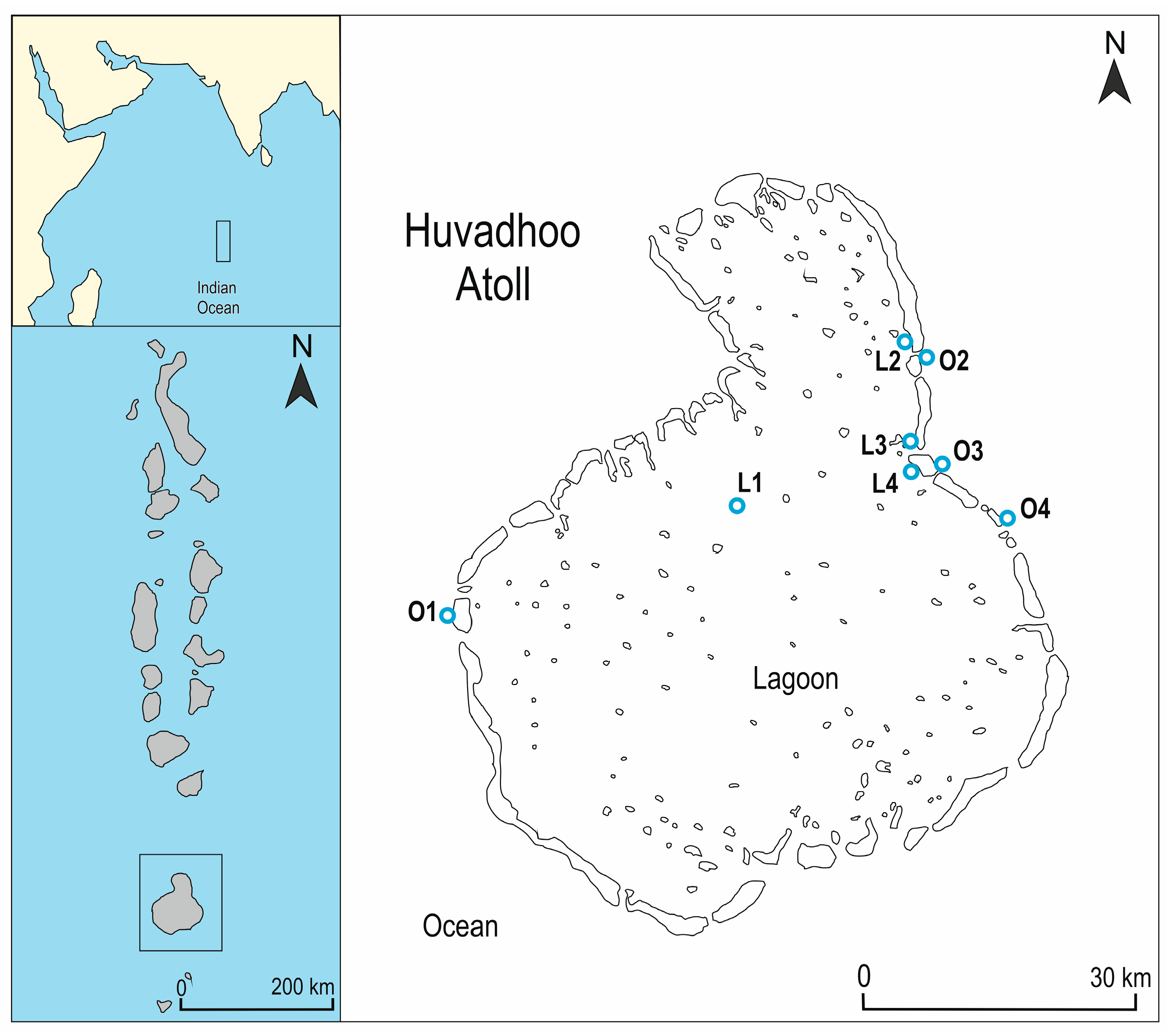
Figure 1. Locations of coral reef sites (O = ocean; L = lagoon) surveyed in Huvadhoo atoll.
Jmse 13 02274 g001
Figure 2. Average density (± se) of coral recruits in the two years (2009 and 2020) across depth zone (flat, upper slope, and slope) and reef exposure (lagoon vs. ocean). Significant differences identified by Student’s t-test are indicated by asterisks (* p < 0.05, ** p < 0.01).
Jmse 13 02274 g002
Figure 3. Percent composition of the coral recruit community in the two years (2009 and 2020) across depth zone (flat, upper slope, and slope) and reef exposure (lagoon vs. ocean).
Jmse 13 02274 g003
Figure 4. PCA plot on the plane formed by the first two axes (PC 1 and PC 2) of the abundance data of coral recruits. Colours refer to the two years (yellow = 2009; blue = 2020). Triangles represent ocean sites; circles represent lagoon sites.
Jmse 13 02274 g004
Figure 5. Average values (± se) of Survival Index (SI) in the two years across the different coral categories. Significant differences identified by the Student’s t-test are indicated by asterisks (* p < 0.05, ** p < 0.01).
Jmse 13 02274 g005
Table 1. Coral reef sites surveyed in 2009 and 2020 in the Huvadhoo atoll.
Site CodeSite NameExposureLatitudeLongitude
L1Koamas GiriInner lagoon0°35.137′ N73°15.559′ E
L2Wiringgili house reefInner lagoon0°45.050′ N73°25.906′ E
L3Kuredhdhoo FinolhuInner lagoon0°39.498′ N73°26.096′ E
L4Tippe GiriInner lagoon0°38.146′ N73°26.245′ E
O1Kadheddhu BeyruOuter ocean0°29.447′ N72°59.075′ E
O2Kooddoo BeyruOuter ocean0°44.368′ N73°26.355′ E
O3Nilandhoo BeyruOuter ocean0°38.108′ N73°27.232′ E
O4Mahadhdhoo BeyruOuter ocean0°34.996′ N73°31.119′ E
Table 2. Results of 3-way PERMANOVA and Pairwise tests (F = Flat; U = Upper Slope; S = Slope). Significant p-values in bold.
PERMANOVA
SourceDfSSR2Fp
Year13.0020.22254.6480.001
Exposure11.6350.12129.7520.001
Depth20.5300.0394.8210.001
Year × Exposure10.2560.0194.6620.005
Year × Depth20.0560.0040.5110.817
Exposure × Depth20.6040.0455.4970.001
Year × Exposure × Depth20.1670.01231.5170.164
Residual1327.2520.537
Total14313.5011.000
Pairwise Test (Year × Exposure)
PairsSSF. ModelR2pp adj
2009 Lagoon vs. 2009 Ocean0.5908.4480.1080.0010.006
2009 Lagoon vs. 2020 Lagoon1.32419.5860.2190.0010.006
2009 Ocean vs. 2020 Ocean1.93434.9350.3330.0010.006
2020 Lagoon vs. 2020 Ocean1.30124.4830.2590.0010.006
Pairwise Test (Exposure × Depth)
PairsSSF. ModelR2pp adj
F Lagoon vs. U Lagoon0.1241.5910.0330.2031
F Lagoon vs. S Lagoon0.5887.4310.1390.0010.015
F Lagoon vs. F Ocean1.25013.3790.2250.0010.015
U Lagoon vs. S Lagoon0.2052.5670.0530.0640.96
U Lagoon vs. U Ocean0.3805.1500.1010.0050.075
S Lagoon vs. S Ocean0.6099.1990.1670.0010.015
F Ocean vs. U Ocean0.3093.4550.0700.0160.24
F Ocean vs. S Ocean0.4505.5930.1080.0010.015
U Ocean vs. S Ocean0.0240.4080.0090.6621
Disclaimer/Publisher’s Note: The statements, opinions and data contained in all publications are solely those of the individual author(s) and contributor(s) and not of MDPI and/or the editor(s). MDPI and/or the editor(s) disclaim responsibility for any injury to people or property resulting from any ideas, methods, instructions or products referred to in the content.